Chairman of Missing Persons’ Panel rebuts Zeid

October 2nd, 2015

Courtesy Adaderana

Responding to the UN Human Rights High Commissioner Prince Zeid’s call to disband the Sri Lankan Missing Persons’ Commission and assign its work to a more credible body, the chairman of the panel, Justice Maxwell Paranagama, contended that nobody else can do the job better.

We have been very transparent in our functioning. There were no armed forces or police personnel in the room where people testified. We held several sittings in the Tamil-speaking North and East and Colombo and examined 19,000 people including 16,000 from the North and East. The response to our call for testimonies was so good that if we sent out notices to 300 for a session, 1000 would turn up, and no one was turned away. Transport was arranged for people to go back to their villages if the sittings went late into the evening,” Paranagama told Express on Thursday.

We also sent investigating teams to the complainants’ houses as a follow up measure and wrote to them about progress made in their cases.  We inquired into the rehabilitation aspect and took action wherever the authorities were tardy in their response,” he added.

Paranagama said that a Special Investigating Team is to be formed under a retired High Court judge to go into some cases.

What more can we do?,” he asked in anguish. Nobody else can do better than us. People should realize the enormity of the task. It takes time to show results,” he said.

When former President Mahinda Rajapaksa established the panel, its mandate was only to go into disappearances. Later, when war crimes charges were made in the UNHRC, it was charged with investigating violations of International Human Rights and International Humanitarian Laws in the last phase of the war. Since work on the second mandate is still to be completed, the term of the commission has been extended to February 2016. However, the panel submitted a report to the Presidential Secretariat on August 15 this year.

We are waiting for President Sirisena to come back from New York to officially present it to him,” Paranagama said.

Source: The New Indian Express

PRAIRIE AWARDS FOR LANKAN JOURNALISM — Focus on Manik de Silva Part 2

October 1st, 2015

By Shelton A. Gunaratne

Professor of communication emeritus, MSUM, and lead author of Mindful Journalism and News Ethics in the Digital Era: A Buddhist Approach (New York: Routledge, 2015)

PRAIRIE ROSES: To Manik de Silva, the septuagenarian editor of the Sunday Island for his lifetime dedication to journalism in Sri Lanka.  In an interview with Sanjana Hattotuwa of Groundviews (on March 7, 2010), Manik, the most senior and longest-serving editor of an English-language newspaper in Sri Lanka,” confessed that his very liberal father” Walwin A. de Silva, a former director of education and brother of renowned Trotskyite parliamentarian Colvin R. de Silva, arranged for him to work with the Observer newspaper at the age of 19 while awaiting the results of the University Entrance Examination, which he failed. However, his great, good fortune” to work under the Denzil Peiris, editor of the Observer from 1960-1973 helped him to release the dukkha resulting from his academic failure to enter the university though he excelled in writing as a school boy at the prestigious Royal College in Colombo.

Like numerous other journalists, Manik was obsessed with craving (tanha) and attachment (upadana) to rise up and cling on to his professional career.

He found journalism a fascinating field that enabled him to get a ringside view” of what’s happening in the country. In the old parliament, he savored the cut and thrust of the oratorical clashes of good people” like Dudley Senanayake (1911-73), J. R. Jayewardene (1906-97), N. M. Perera (1905-79), Colvin R. de Silva (1907-87), Philip Gunawardena (1901-73), Felix Dias Bandaranaike (1930-85) and Pieter Keuneman (1917-97), who were among the best” in the world. The ‘60s constituted the golden decade of the Lankan parliament, Manik told Hattotuwa. After hammering each other” in debates on the floor, they would repair to the parliamentary restaurant and enjoy their tea together. Since then, while the number of parliamentarians has increased, their quality has precipitously declined primarily because of patronage giving and patronage taking,” Manik rued.

I suspect that Manik’s ability to get political scoops through his connections with the powerful politicians of the day, thanks to his uncle Colvin and dad’s Royal College schoolmate J. R. Jayewardene who became the all-powerful executive president of the country in 1978 after the UNP secured a two-thirds majority in the 1977 elections, facilitated his job as one of the Lake House reporters assigned to cover the parliamentary beat in the 1960s and the 1970s. By letting Manik have his byline with his parliamentary reports and other scoops,” Denzil Peiris egged on the young man to elevate his illusionary self-esteem resulting in a degree of arrogance” (dosa) toward his colleagues.
I first met Manik in 1962, when I joined Lake House soon after I graduated from the University of Ceylon.  During our five years together at Lake House, Manik (together with Thalif Deen, Neville de Silva, Leila Joseph, Phillip Fernando and a few other non-graduate journalists like H. L. D. Mahindapala, Nalin Fernando and Nihal Ratnaike) worked primarily for the Observer while I (together with Chris Gooneratne, Phillip Coorey, T. Sivaprakasam, Indres Allalasunderam, and a few others) worked primarily for the Daily News.  I resigned from Lake House in mid-1967 after completing a one-year Fellowship at the World Press Institute then affiliated with Macalester College, Saint Paul.

Manik had a similar opportunity to spend a year in the United States in 1972, when he got the offer of a Jefferson Fellowship to immerse in communication scholarship at the Harvard Center for International Affairs. I suspect that having failed to get a university education, Manik made good use of his Harvard year to prove that he was no intellectual dummy. The same year, I earned a doctorate in mass communication from the University of Minnesota. (Incidentally, it was also in 1972 that Lake House let Thalif Deen to do a master’s degree in journalism at Columbia University on a Fulbright scholarship, whereafter he settled down in New York as a bureau chief for the Inter Press Service.) But unlike me who quit Lake House after completing my WPI training because Ernest Corea, the Daily News editor (1964-70) refused to grant me another year’s no-pay leave to complete graduate studies in journalism, Malik dutifully returned to Lake House to continue his journalism career as a state employee.

Manik’s Harvard year had the blessings of Mervyn de Silva whom the Lake House management headed by chairman Ranjith Wijeyawardene appointed as the chief editor of the Daily News in 1970. Mervyn’s journalism style and views were consonant with those of the Sri Lanka Freedom Party-led United Front coalition (hathhavula) government formed in 1970 replacing that of Dudley Senanayake’s United National Party, which came into power after the March 1965 elections, which soundly rejected Mrs. Bandaranaike’s vituperative campaign to take-over the Lake House newspapers because they allegedly served as UNP mouthpieces (pachapatra).

[I was the Daily News reporter who, together with D. C. Karunaratne of the Dinamina, covered the Bandaranaike election campaign in 1965. Fearing a 1965-rype setback if they had highlighted the priority they placed on the takeover.

I suspect that Mervyn’s appointment as the editor of the Lake House flagship was intended as a peace gesture to mollify the new United Front (hathhavula) government, in hopes of preventing the possibility of a takeover.  Moreover, the management elevated Mervyn by shunting the diehard UNP sympathizer Ernest Corea from the editor’s chair of the Daily News to that of its sister newspaper, the Observer, when Denzil Peiris vacated the position. Mervyn’s elevation, however, failed to scuttle the state takeover of Lake House in 1973, when the new dispensation anointed Mervyn as the editor in chief of all Lake House papers. The details pertaining to the takeover appear in my monograph titled The Taming of the Press in Sri Lanka” which the Association or Education in Journalism published as Journalism Monographs No. 39 in May 1975.

Both Mervyn and Ernest, who habitually flaunted their verbal skills and professed punditry unaware of the mental distress (dukkha) they caused others, had to face the consequences of their intentional actions (embedded in their sankhara aggregate).

[Ernest Corea was proud to reveal that he was a descendent of Edirille Rala who was crowned the king of Kotte and Sitawaka in 1596.  Both Ernest and Mervyn came from a Westernized Christian background and had no inclination to foster a Lankan news culture conducive to the emergence of what we now call mindful journalism. Corea, who understood that his prospects of recovery under the hathhavula were very dim, emigrated overseas in 1973 to avoid further reprisals (dukkha). After he spent a short stint as features editor of the Straits Times in Singapore, the UNP government of President Jayewardene rewarded his service as a propagandist by appointing him as Sri Lanka ambassador to the U. S. and high commissioner to Canada.].

Mervyn’s mind-consciousness also failed to discipline the power of the five aggregates that caused his downfall in 1976, just before the abject defeat of the UF government and the emergence of   UNP leader Jayewardene as the first executive president of Sri Lanka. Following a tiff with A. K. Premadasa, the Matara-born legal luminary whom the UF government appointed as the first chairman (1973-77) of Lake House under state control, Mervyn left Lake House to become the editor in chief of the bankrupt Times newspaper group, which the Jayewardene government placed under state control in 1978 and sold to Ranjit Wijeyawardene as compensation for forfeiting his ownership of Lake House. Mervyn found solace as the editor of a weekly rag, the Lanka Guardian, which depended heavily on donations from various foundations.

Manik was quite aware of the impending uncertainties that journalists would face following the state takeover in 1973, the year he returned to work. In the 2010 interview with Hattotuwa, Manik recalled the prophetic observation of journalist D. C. Karunaratne in 1972 that from then onwards Lake House would have a convulsion after each election” proved to be accurate.

Mervyn’s rise and fall at lake House coincided with the rise and fall of Sirimavo Bandaranaike’s United Front government, of which Manik’s uncle Colvin was a minister. J. R. Jayewardene, who ousted the Bandaranaike government, was also a friend of Manik’s father. He probably figured out that if he played his cards with aplomb, he could not be a loser whichever political party was in power. This line of reasoning explains his inclination for practicing a non-aggressive but yet adversarial type of journalism that reflects a healthy degree of tension between the government and the press. In the Hattotuwa interview, he asserted that good governance required investigative reporting, which was not possible to practice without causing political distress (dukkha) for the government.

Implementing UNHRC recommendations problematic: Nimal Siripala

October 1st, 2015

Courtesy The Daily Mirror

The implementation of the UNHRC, recommendations including the establishment of a war crimes tribunal, would create many legal issues in the country’s judicial system, as a new Constitution and a referendum would be required to implement the recommendations, the Sri Lanka Freedom Party (SLFP) said today.

The SLFP’s senior vice president, Minister Nimal Siripala de Silva said the highest court in Sri Lanka was the Supreme Court and there was no hybrid court in Sri Lanka’s judicial system.

The UNHRC report says that Sri Lanka needs to adopt feasibility legislation, specific legislation to facilitate a hybrid court mandated to probe war crimes committed by security forces personnel. We will need to change our Constitution in order to make room for a hybrid court, and we can’t make these happen overnight,” he said at a media briefing.

The minister also said the UNHRC had further recommended that new legislation should be enacted to criminalise war crimes, crimes against humanity, genocide and enforced disappearances, and said new laws would have to be enacted by parliament in order to criminalise these subjects.

According to our law, if a new law was passed, we can’t apply that law to deal with what was done in the past. Therefore, if we are to introduce new laws and then to probe war crimes which were committed in the past, we will have to have a referendum to get the people’s approval,” he said; adding that passing new laws and changing the Constitution were not simple procedures and many problems would would arise when attempts were made to do so.

He said the final position of the SLFP on the subject was not yet to decided as the special committee appointed by the party was still carefully perusing the contents of the final report adopted by the UNHRC.

The minister thanked President Maithripala Sirisena for his achievements at the United Nations and said the delegation had been successful in watering down the resolution to some extent. However, our final stance on the resolution will be made public soon,” he said. (Lahiru Pothmulla) – See more at: http://www.dailymirror.lk/89643/implementing-unhrc-recommendations-problematic-nimal-siripala#sthash.BT38mbmD.dpuf

Police beat me; took nude photos of me-School boy

October 1st, 2015

Courtesy The Daily Mirror

“After being held at the Kotadeniyawa police station for three days, I was beaten and accused of committing this crime. They later took photos of me in the nude,” said the schoolboy who was discharged after being on remand for 12 days on suspicion of having killed Seya Sadevmi. After he was disharged by Court he made this revelation.

He also said, On Wednesday the 16th four policemen came to my home. They were not in uniform. There was a friend of mine with me at that time. They took me and my friend with the laptop in a three wheeler saying they were taking us to record a statement. At the police station I was separated from my friend and taken to the back of the police station and forced to kneel.

Then they beat me saying aren’t you the ones who committed this crime? My mother was not allowed to see me and I was not given any dinner. They continued to beat me. Then they removed my clothes and began to examine me, an ASP also joined in and took photos of me in the nude” He said that he continued to deny the charge and say they were innocent of the crime.

“They threatened to kill me, Later they us us to court and we were remanded in the Negombo Prison,” he said. He said he was not involved in the crime and there were no photos of Seya on his laptop. Kelum Aththanayake, the other suspect, said that he was taken into custody at about 2.30 am on the 16th. He said they covered his face and took him in a van to some place, but they did not remove his blindfold.

They had later uncovered his face on the orders of the OIC. He was not kept at the police station but somewhere else. The police questioned me about my relationship with Seya’s family and I replied to their questions. Later they tookt me to the police station but did not give me a proper meal. They hung me by a rope and severely beat me saying that we were responsible for the killing.

They kept me for three days, and I continued to deny their accusations. They also beat me with a plastic pole. Later, after producing me in court and getting me remanded they continued to assault me.” The mother of the schoolboy said she was happy that her son had finally been released and lamented that he had been falsely accused. She said she was grateful to the attorneys, the class teacher, other teachers at the school and the media for helping to get her son released. “After my son was taken into custody by the police most people looked at us differently, and some looked at my son as though he were a beast.

When my son was on remand our relatives helped me a lot. They shared my grief on hearing about the assault by the police, it is my firm wish to educate my son, therefore I appeal to everyone not to treat my son like a criminal,” she said.(Tharindu Jayawardene and Tony Karunanayake)

– See more at: http://www.dailymirror.lk/89645/police-beat-me-took-nude-photos-of-me-school-boy#sthash.f9YZnfZb.dpuf

Resolution on Sri Lanka adopted at UNHRC without a vote

October 1st, 2015

Courtesy Adaderana

The US-sponsored resolution on Sri Lanka was adopted without a vote by consensus at the UN Human Rights Council in Geneva, a short while ago.

The draft resolution – L29 is entitled ‘Promoting Reconciliation, Accountability and Human Rights in Sri Lanka’ and was co-sponsored by the government of Sri Lanka with 25 additional co-sponsors a the 30th session of the UNHRC.

The adoption of the resolution marked a high point of the current session of the UNHRC which commenced on September 14 and concludes on Friday.

The resolution envisages the establishment of a Sri Lankan judicial mechanism to investigate allegations of violations and abuses of human rights and violations of international humanitarian law. The proposed mechanism will include Commonwealth and other foreign judges, defence lawyers and authorised prosecutors and investigators.

There was no voting and there were no last-minute changes in the text of the draft resolution, which was submitted by the sponsors on September 24, according to a spokesperson of the Office of UN High Commissioner for Human Rights.

Speaking before the adoption of the resolution, the United Kingdom said that while this is the fourth resolution of this council with this title, it is the first to have received co-sponsorship of the government of Sri Lanka.

This is a truly historic development for Sri Lanka and this council,” the UK’s representative said.

The UK was among the core group of sponsors of the resolution with US, Macedonia and Montenegro.

පරණගම, උදලාගම කොමිෂන් වාර්තා ප්‍ර‍සිද්ධ කරන්න. කැෆේ සහ ශ්‍රී ලංකා මානව හිමිකම් කේන්ද්‍රයෙන් ජනාධිපතිතුමාට විවෘත ඉල්ලීමක් Release the Undulagama and Paranagama Commission reports  CaFFE and CHR urge the President

October 1st, 2015

කීර්ති තෙන්නකෝන් Rajith Keerthi Tthennakoon විධායක අධ්‍යක්ෂ/කැෆේ සංවිධානය Executive Director (CaFFE / CHR)

ශ්‍රී ලංකාවේ මානව හිමිකම් කඩවීම්  පිළිබද විමසීම සදහා පත් කරනු ලැබූ මැක්ස්වෙල් පරණගම සහ නිශ්ශංක උදලාගම කොමිෂන් සභා වාර්තා ප්‍රසිද්ධියට පත් කරන ලෙස කැෆේ සංවිධානය සහ ශ්‍රී ලංකා මානව හිමිකම් කේන්ද්‍ර‍ය ඉල්ලයි.  ජනපති මෛත්‍රීපාල සිරිසේන මහතා වෙත විවෘත ආයාචනයක් යොමු කරන එම සංවිධාන පවසන්නේ, ශ්‍රී ලංකා රජය ගෙවීගිය සමයේ සිදු වූ මානව හිමිකම් උල්ලංඝණය කිරීම් සම්බන්ධයෙන් සැබෑ වගවීමේ වැඩපිළිවෙලකට ප්‍රවිශ්ඨ වන්නේ නම්, එහි මුලික පියවර විය යුත්තේ ‘පරණගම සහ උදලාගම‘ කොමිෂන් සභා වාර්තා, අතුරු වාර්තා සියල්ල ප්‍ර‍සිද්ධියට පත් කිරීම බවයි.

පරණගම සහ උදලාගම මහත්වරුන්ගේ සභාපතීත්වයෙන් යුතු ජනාධිපති කොමිෂන් සභා  මානව හිමිකම් පිළිබද නීති මගින් කටයුතු කිරීමේ හෝ විමර්ශන ආරම්භ කිරීමේ පාදක ලියවිල්ල බවට පත් කොට ගත හැකිය.  ඝාතනයට ලක් වූ, අතුරුදන් කරවූ, කෘර වද හිංසාවන්නට ලක් වූ පිරිස් සහ ඔවුන්ගේ සමීපතමයින් විසින් ලබා දුන් තොරතුරු විධිමත් ලේඛණ ගතවීමක් කොමිෂන් සභාව තුලින් සිදුවීම එයට හේතුවයි.

මෙම කොමිෂන් සභා සහ එයට අනුබද්ධව සිදු වූ කටයුතු සහ නිර්දේශ සම්බන්ධයෙන් විවිධ පාර්ශව වෙත විවේචන පැවතිය හැකිය.   වහා චෝදනා ගොනු කිරීම් සිදු කළ හැකි කරුණු සම්බන්ධයෙන් ද,  විශේෂයෙන්ම මුලු ලෝකයේම අවධානය යොමුවී ඇති  ලක්ෂමන් කදිරගාමර් ඝාතනය,  ත්‍රිකුණාමලය මූතූර් ඝාතන,  පාසල් සිසුන් 5 දෙනා ගේ ඝාතන,  නිහාල් ජිම් බ්‍ර‍වුන් පියතුමාගේ අතුරුදන්වීම වැනි සිද්ධි 60 කට වැඩි සංඛ්‍යාවක් පිළිබද නිශ්චිත කරුණු මෙම කොමිෂන් සභා හමුවේ ඉදිරිපත් වී ඇත.

ලංකාවේ සිදුවූ මානව හිමිකම් උල්ලංඝනයක් පිළිබද අතිශෝක්තියට නගන ලද මතයන් දෙකකි.  පළමුවැන්න, කලින් පැවති රජයේ ‘කිසිදු මානව හිමිකමක් සිදු නොවුනේය‘ යන ස්ථාවරයයි.  දෙවැන්න,  යුද්ධයේ අවසන් අදියරේ දී සිදුවූ ඝාතනයන් සම්බන්ධයෙන් වන පරස්පර වූ වාර්තාවන්ය.  ශ්‍රී ලංකාව තුලත් හා ජාත්‍යන්තර ප්‍ර‍ජාව තුලත් ලංකාවේ මානව හිමිකම් උල්ලංඝනය කිරීමේ පරිමාව පිළිබද පොදු මතයක් ඇති කිරීම සදහා ද මෙම කොමිෂන් සභා වාර්තා, අතුරු වාර්තා හේතුවනු ඇත.

ශ්‍රී ලංකා රජය විසින් අවස්ථා ගණනාවක දී පරණගම සහ උදලාගම ජනාධිපති කොමිෂන් සභා වාර්තා මේ වසරේ සැප්තැම්බර් මස අවසානයට පෙර ප්‍ර‍සිද්ධියට පත් කරන බව ප්‍ර‍කාශ කර තිබුණි.  එම පොරොන්දුව ක්‍රියාත්මක කිරීම සදහා මේ වන විට සුදුසුම අවස්ථාව පැමිණ තිබේ.

රජය තවදුරටත් මෙම කොමිෂන් සභා වාර්තා ප්‍රසිද්ධ කිරීම අතපසු කරන්නේ නම් එයට එරෙහිව උතුරේ ද, දකුණේ ද සිවිල් සංවිධාන සහ පුරවැසියන් එක්විය යුතු බව කැෆේ සහ ශ්‍රී ලංකා මානව හිමිකම් කේන්ද්‍රය දැඩිව විශ්වාස කරයි.

කීර්ති තෙන්නකෝන්

විධායක අධ්‍යක්ෂ/කැෆේ සංවිධානය

2015 සැප්තැම්බර් මස 30 වැනිදා

Campaign for Free and Fair Elections (CaFFE) and Centre for Human Rights and Research (CHR) requests the government to release Undulagama and Paranagama Commission reports on alleged human rights violations in Sri Lanka.

The two organizations, making an open request from President Sirisena, said that the best way to open a dialogue on alleged human rights violations during the Rajapaksa Regime is to publicize the Undulagama and Paranagama Commission reports and interim reports of these committees.

These documents can be made base documents which can be used to investigate alleged human rights allegations as the evidence given by victims and associates of victims of assassinations, abduction and torture are properly documented in these reports.

There might be criticisms on the commission, how they conducted themselves and recommendations. However concrete facts of over 60 incidents, including the assassination of Lakshman Kadiragamar, killing of ACF workers in Muttur, the murder of five students in Trincomalee and the disappearance of Father Jim Brown, have been considered by these commissions.

There are two basic false claims on human rights violations which took place in Sri Lanka. One is the zero civilian casualties argument which was initially propagated by the Rajapaksa regime. The second is conflicting reports of civilian casualties in the last phase of the war. However with these commission reports we can start a proper investigation into alleged human rights violations in the country.

The current government, on several occasions promised to release the two reports by the end of September and the time has come to deliver.

If the government keeps on delaying the release of the two reports CaFFE and CHR believes that all Civil Society Organizations and citizens must unite to pressurize the government to keep its promises.


Rajith Keerthi Tthennakoon

Executive Director (CaFFE / CHR)

Why does Belarus President Lukashenko take son Kolya to work?

October 1st, 2015

Courtesy BBC

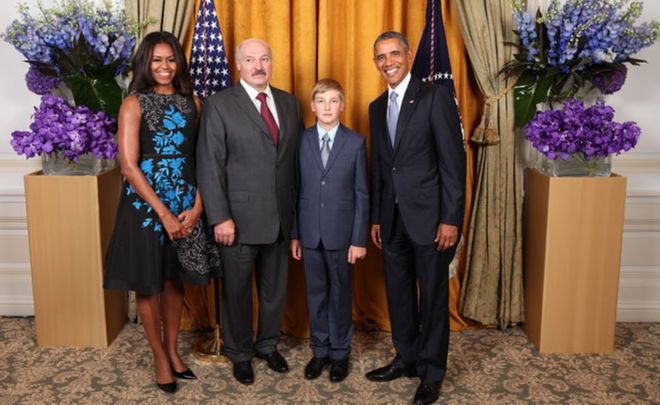
Belarus President Alexander Lukashenko and his son Kolya pose with the Obamas at a reception in honour of the United Nations General Assembly, 28 September 2015Image copyrightPresidential website
Image captionPresident Alexander Lukashenko took his son, Kolya, to meet the US president and his wife

Belarus President Alexander Lukashenko surprised some onlookers by taking his 11-year-old son to the UN General Assembly in New York.

Kolya was photographed posing with his father alongside Barack and Michelle Obama at a reception for the summit on Monday.

But he was not just there for the sandwiches.

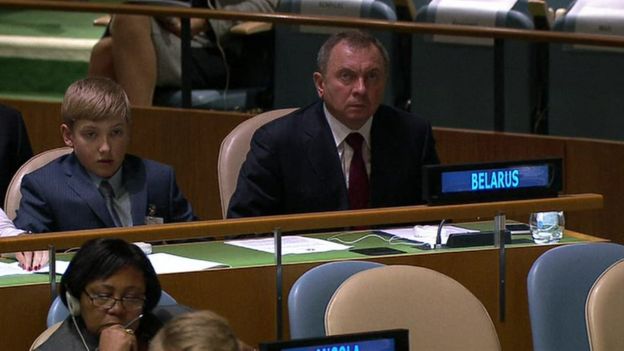
Kolya also joined world leaders in the seats of the general assembly hall as his father addressed delegates from around the world.

Belarus president's 11-year-old son Kolya watches his father during the UN General AssemblyImage copyrightAP
Image captionSmartly dressed Kolya sat with his father’s colleagues as the Belarusian president addressed the General Assembly

But it was not a one-off “take your child to work day” for Belarus’s ruling family.

The little boy in a suit often accompanies his father on official business, including a visit to Beijing for China’s World War Two commemorations on 3 September.

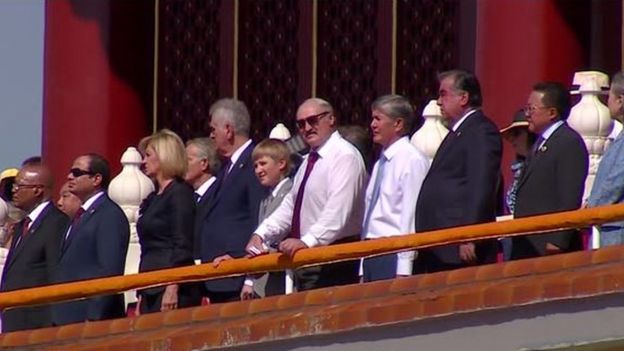
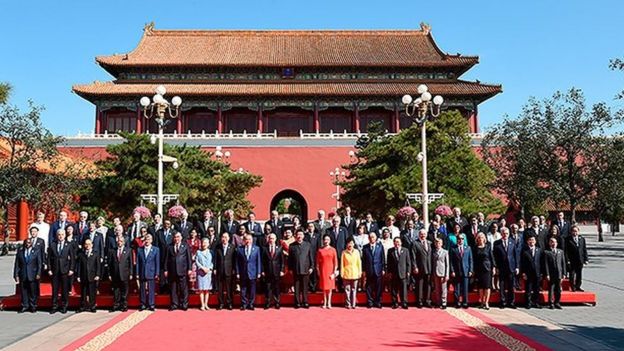
Kolya was pictured watching Beijing’s massive military parade alongside the likes of Russian President Vladimir Putin, and lining up for a photo shoot with leaders including Chinese President Xi Jinping.

Kolya and Alexander Lukashenko watch Beijing's massive military parade on 3 SeptemberImage copyrightPresidential website
Image captionThe pair (centre) watched China’s display of military might with other delegates in Tiananmen square
Kolya and Alexander Lukashenko pose for a photo with leaders at Beijing's WW2 commemorationsImage copyrightPresidential website
Image captionKolya lined up with his father in the front row, fifth from right

There are claims Mr Lukashenko is grooming his youngest son to be his successor.

Speaking to the BBC in 2012, Mr Lukashenko denied this and insisted the boy was so attached to him that he would not go to sleep without him.

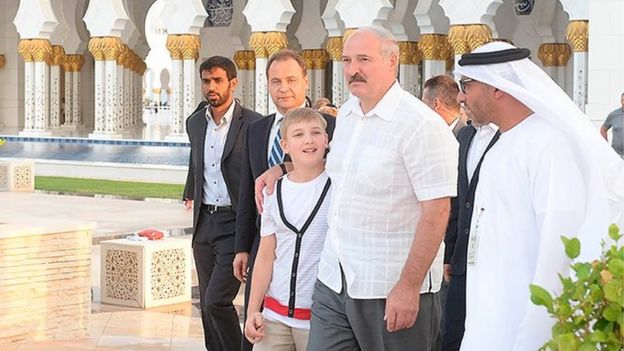
Among other recent trips, Kolya went with his father to the United Arab Emirates in October 2014 where they visited the Sheikh Zayed Grand Mosque in Abu Dhabi.

Kolya and Alexander Lukashenko at the Sheikh Zayed Grand Mosque in Abu Dhabi in October 2014Image copyrightBelarus embassy
Image captionThe proud father took his son on his official visit to the Sheikh Zayed Grand Mosque in Abu Dhabi

He may be extraordinarily well travelled for an 11-year-old, but some critics have begun to question the increasing impact of all these appearances on his education.

Kolya missed a week of school in September this year – the same amount of time that he missed during six months of 2014, according to the Polish-funded, Belarusian-language TV station Belsat.

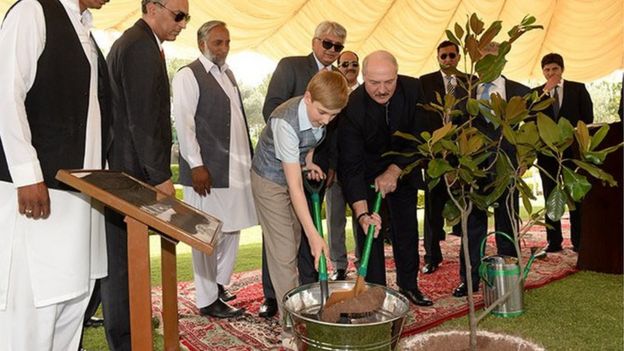
The ceremony of planting a tree in Shakarparian, 29 May 2015Image copyrightPresidential website
Image captionKolya and his father planted a tree in the Memorial Garden of Shakarparian during an official visit to Pakistan in May 2015

Mr Lukashenko’s tight grip on power has brought criticism from the West – with the US Bush administration describing him in 2005 as the “last dictator in Europe” at the head of an “outpost of tyranny”.

Human rights groups accuse him of widespread abuses.

Meanwhile most Belarusian media channels are controlled by the government.

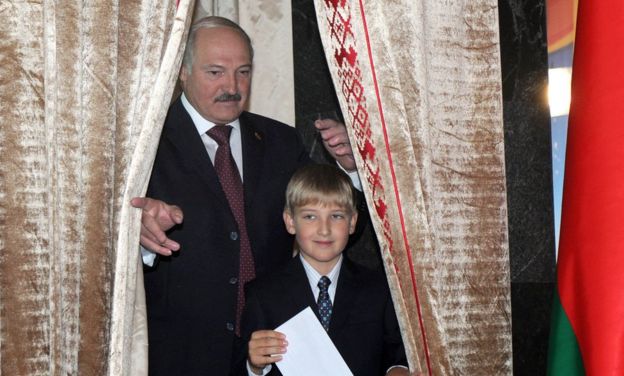
Belarus's President Alexander Lukashenko (left) stands with his son Kolya prior to cast his ballot on September 23, 2012 in MinskImage copyrightGetty Images
Image captionBelarus elected a parliament filled with supporters of President Alexander Lukashenko in 2012 after a boycott by the main opposition parties

Kolya, short for Nikolai, is the youngest of the president’s three sons.

It has been widely reported in Western media that he was born in 2004 as a result of an extra-marital affair between the president and his personal doctor.

Whatever the circumstances of his birth, Kolya has certainly received special attention in recent years – attending numerous world events and meeting global leaders.

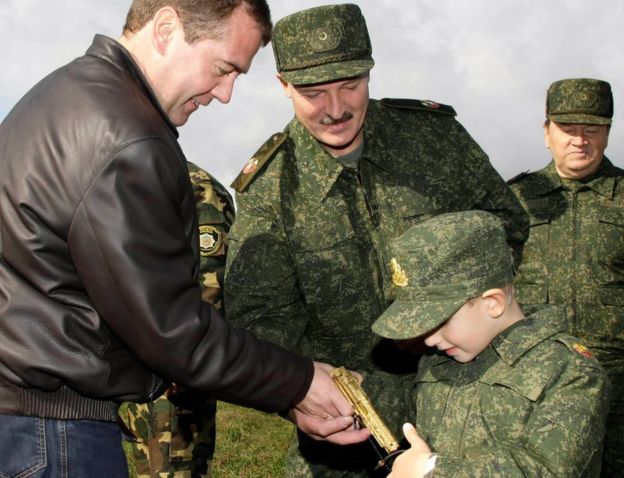
Russian President Dmitry Medvedev (left) and his Belarusian counterpart Alexander Lukashenko (C) interact with Lukashenko's five-year-old son Kolya at the Obuz-Lesnovsky firing range near Baranovichi in September 2009Image copyrightGetty Images
Image captionFive-year-old Kolya proved a hit with Russia’s then President Dmitry Medvedev in 2009
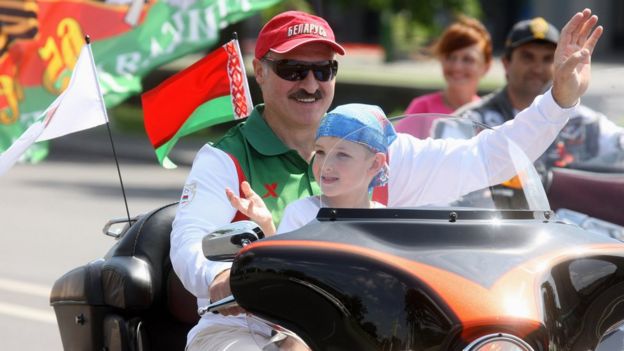
Alexander Lukashenko riding a Harley-Davidson motorcycle with his son Nikolai in his lap, in Minsk, 2009Image copyrightGetty Images
Image captionKolya has been on parade from an early age. Here the pair ride a Harley-Davidson motorcycle through Minsk in 2009

Sri Lankan Driver Teaches Policeman Rules නීතිය නොදත් පොලිසියට නීතිය පෙන්වා දුන් රියදුරා

October 1st, 2015
පොලිස් නිලධාරීන් ඉදිරියේ බොහෝ දෙනෙකු හැසිරෙන්නේ තරමක් නිවට නියාළු අන්දමටය.
 
පොලිස් නිලධාරීන් ඉදිරියේ බොහෝ දෙනෙකු හැසිරෙන්නේ තරමක් නිවට නියාළු අන්දමටය. ඒ පොලිස් නිලධාරීන් හා තර්ක කරන්නට යාම නැති ලෙඩ දා ගැනීමක් ලෙස සිතන නිසාය. වාහනයක් නැවැත්වූ සැනින් රියැදුරන් ලයිසන් ඉන්ෂුවරන්ස් උස්සාගෙන පොලිස් නිලධාරියා වෙත දිව යන්නේ තමා අත වැරදි ඇති නිසාම නොවේ.

බොහෝ රියදුරන් හුරුව ඇති ක්‍රමය එය වුවත් විය යුත්ත නම් පොලිසි නිලධාරියා වාහනය ල`ගට පැමිනීමය.

අප මේ පවසන කතාවේ අහමඩ් නමැති පුද්ගලයා කුඩා ලොරි රථයක් පදවන්නෙකි. එම බට්ටා ලොරි රථයේ ඉදිරියේ අසුන්ගෙන යා හැක්කේ 02ට පමණක් බව පොලිසියේ මතයයි. එහෙත් අහමඩ් එයට එකග නැත. අහමඩ් පොලිස් නිලධාරියා හා තර්ක කරන්නේ නිකම්ද නොවේ එය වීඩියෝවටද නැගේ. මේ එවැනි අවස්ථාවකි.

‘Kahawatte Murder’ Wave and the Serial Killers of Sri Lanka  

September 30th, 2015

Dr Ruwan M Jayatunge M.D.

Serial killers kill for the power and control they experience during the murders and for the added ego boost they get in the aftermath from community fears, media coverage, and the police investigations.

–          Pat Brown

In 1999 I did a study with the help of Dr A.P Waidyasekara Consultant Forensic Psychiatrist, Mr. Mohan Peris PC, and Mr Priyantha Jayakody of the Sri Lanka Police Force to find   any evidence of serial killers in the Sri Lankan Criminal history. Although we dug in to the criminal history of this country up to 1800 s, I could not find any criminal who would fit in to serial murderer profile that is described by the FBI.

serialkiller

First I thought Kallathhave Soysa and Kalu Albert would fit in to this category, but after studying the murders that they had committed I found that there were huge material motives behind their killings. But Kalu Albert showed numerous features of a coldblooded killer and he may have suffered from ASPD (Anti-Social Personality Disorder) He had no remorse for these killings and finally he went to the gallows without any emotional outburst. The eyewitnesses say that Kalu Albert went to the gallows with a sardonic smile on his face even challenging to his own death.

While I was doing this study, one day Mr Priyantha Jayakody informed me about a person who had killed 16 people during the time  1988- 1999. But later it was revealed that he was a contract killer and was not a serial murderer.

In 2003 a mobile vendor was arrested by the Kandy Police for murdering several women and a child. The investigations were conducted by DIG Nimal Madiwaka and I did contact Mr. Madiwaka to clarify the motives of these killings. The perpetrator was a resident from Madugoda -Kandy District. The said person had visited houses to sell domestic items between 10 am to 12 pm and when he found fitting chances he used to kill defenseless women mostly by strangulation.  He had no specific material gain to commit these murders and there was a certain emotional gratification derived by these senseless killings.

He was a deviant character who has had a tormented childhood and experienced paternal rejection when he was very young. He was motivated by free floating anger and ferocious instincts. He derived sadistic satisfaction by killing these innocent women. Obviously this person could be the first serial murderer in the Sri Lankan modern criminal history. In the same year I wrote an article revealing the psychological background of these killings that was published by the Sunday Lakbima newspaper.

In 2002 I was working in the Military Hospital Colombo and I was referred an Army Officer by Dr Neil Frenando – Consultant Psychiatrist to do a comprehensive psychological assessment. The subject was exposed to gruesome combat experiences and sustained a head injury. There was a grenade fragment in his frontal lobe and he suffered fromperiodic attacks of headaches.  These traumatic combat experiences and the head injury may have caused drastic personality changes in him. During the assessment I found some homicidal obsessions in him and it was my professional obligation to inform the authorities about this impending danger.

I informed the relevant authority to get this person to our combat trauma treatment center for further observation and treatment. I specifically mentioned his current mental status and possible dangers to the society. Sadly our request was turned down by the short sighted bureaucrat and the subject went free. We had to close his file.

In less than two years I heard the bad news. The said officer had committed a murder in a brutal manner. According to the Police reports he had invited a cab driver to the Manthhottam camp in Mannar and killed the driver by cutting his throat with a sharp weapon. Then he cut the victim’s body into pieces and burnt it with gasoline.

The investigators had found that he had killed several people prior to this incident.    He committed these murders after he became psychologically unbalanced. Eventually he was caught by the Wattegama Police and charged with manslaughter. When the suspect was at the Bogambara Remand Prison he hanged himself. This was a very unfortunate incident in my professional life and it could have been prevented if not for the unwise administrative decision by a short sighted bureaucrat.

The said officer was not a monster by nature. He came from a good family and he had studied in a reputed school in Kandy. After finishing school he joined the military to become a career officer. He successfully completed a defense degree from the Kotelawala Defense Academy. He became one of the outstanding officers of the VIR (Vijayabahu Infantry Regiment) and served as a Major in the North during the war. He was married and had a child. He never had murderous intentions until he became a psychological casualty of the War. Unfortunately his combat stress related symptoms and the traumatic brain injury were not viewed seriously by the authorities. Therefore he never had the opportunity to undergo effective prolonged treatment as recommended by his doctors.

According to the Police reports he had murdered several people and sometimes stole the victim’s money and vehicles. He committed his last crime in Wattegama and was caught by the police.

What were the true intentions of these murders? According to my understanding his intentions were not purely to rob money or other valuable items. He basically derived a sadistic satisfaction by murdering his victims. I still recall the words that he used during the clinical interview. He said when I find a victim I prefer to do Pashanibutha Kiremameans to fossilize the victims.

If the authorities gave us a helping hand and the opportunity to treat this officer we could have saved at least five lives. This officer suffered from Posttraumatic Stress Decoder (PTSD) and Personality Changes following Head injury.  Based on the psychological profile and his subsequent homicidal actions I think this officer would fit in to the list of Sri Lankan serial murderers.

Another serial murder outbreak was reported recently from Kahawatta. In 2011 Kahawatta in Ratnapura District became under mass fear following mysterious murders. At least seven elderly women were killed and some of the victims had been raped by an unknown assassin. Later the Police arrested several suspects connected with these murders. The Police Department should get help from Psychologists / Psychiatrists to determine whether these suspects are serial murders.

Dr. Muditha Vidanapathirana- Department of Forensic Medicine, Faculty of Medical Sciences University of Sri Jayewardenepura- Sri Lanka provides solid evidence about a potential serial killer who committed 14 murders (12 males) in 9 towns from 2010-2011.

All the killings had been occurred at night and the bodies were left on the location of killing without being moved. All the victims were killed in a similar manner. The causes of death had been blunt force trauma to head.

In November 2011, a beggar was arrested while attempting to kill another beggar when the latter was a sleep. The suspect was produced for medico-legal examination and later referred to a Psychiatrist. He was diagnosed with anti-social traits. Later he admitted that he had murdered altogether 14 beggars. In addition he had shown all the crime scenes to the investigators. He was sent for inward psychiatric treatment and is awaiting trial. According to Dr. Muditha Vidanapathirana the perpetrator had committed fourteen independent, planned murders with potential cooling-off periods. Therefore the suspect could be the highest ‘potential serial killer’ in Sri Lanka.

Who are the Serial Killers?

A serial killer is an individual who has murdered three or more people over a period of more than a month, with down time   between the murders, and whose motivation for killing is largely based on psychological gratification.  Most of the serial killers suffer from Anti-Social Personality Disorder and could appear normal and charming. Sometimes they are highly intelligent.

Dr. Richard von Krafft-Ebing was the first clinician who wrote about serial killers in detail. Dr Ebing in his 1886 text book  Psychopathia Sexualis described numerous case studies of sexual homicide, serial murder, and other areas of sexual proclivity.

There are many reasons why serial killers commit murders. The Serial Killers are geared by different motives. As Lee (1988) points out serial killers commit murders following

1)    Profit

2)    Passion

3)    Hatred

4)    Power or domination

5)    Revenge

6)    Opportunism

7)    Fear

8)    Contract killing

9)    Desperation

10)  Compassion

11) Ritual

Generally there is no prior relationship between victim and the attacker. Often the motive is not for material gain and is believed to be for the murderer’s desire to have power over his victim. For the murderer victims may have symbolic value.

The perpetrator has low self-esteem and increasingly violent fantasies. He might look calm and well-mannered generally hiding his inner motives. He may not appear like a conventional criminal. He could attack the victim unexpectedly and leaves no traces. After committing a murder the serial killer is not emotionally shocked by the feelings of guilt. He is apathetic to his victim’s suffering and detached from the feelings of compassion or remorse.  Traumatic experiences and feelings from the past may be dissociated from conscious feelings and the perpetrator is emotionally numbed.

There are many theories that describe how a person could turn in to a serial murderer. According to the Anomie Theory serial killers lack any bonds tying them to society. They feel isolated, alienated and rejected by the society. Many psychologists believe that family history and childhood development play large roles in this. Childhood anxieties such as rejection by a parent, maternal or paternal deprivation, childhood sexual, physical or emotional abuse could lead to devastating outcomes. Many serial killers have experienced feelings of inadequacy, worthlessness, and powerlessness.

Some research points to brain anomalies in serial killers; possibly due to abnormal development during gestation or the result of an injury. A large number of serial murder studies have showed severe damage to the frontal lobe that could lead to violent behavior. There is also some evidence that abnormalities in the nervous system may play a role. Altered brain chemistry is another hypothesis. For instance low levels of serotonin in the brain have been associated with an increased susceptibility to impulsive behavior, aggression and possible violent crimes.

In 2014 Simkin and Roychowdhury (University of California- Los Angeles) hypothesized that serial killer commits murders when neuronal excitation in his brain exceeds certain threshold.

Castle and Hensley (2002) examined the possible link between serial killers and military service.  Using social learning theory for the study of murder, they studied how potential serial killers learn to reinforce violence, aggression, and murder in military boot camps. Anyhow they highlight that as with other variables considered in serial killer research, military experience alone cannot account for all cases of serial murder. Lester and White (2012) report that in a sample of 483 serial killers, 6.2% were documented to have committed suicide.

Serial Sexual Homicide

Myers and colleagues (2006) consider that seeking of sexual gratification to the achievement of power and controls to the expression of anger motivate serial sexual killers to commit their crimes. They commit their crimes in pursuit of sadistic pleasure. A significant proportion of them appear to have paraphilic disorders within the spectrum of sexual sadism. Chan and colleagues (2014) state that Serial sexual homicide offenders were more likely than the single offenders to report deviant sexual fantasies, having selected victims with distinctive characteristics, to have targeted strangers, structured premeditation and/or verbal humiliation of their victims during the offences. In my opinion Cpl Somarathne who raped and murdered Krishanthi Kumaraswami would fit in to Serial Sexual Homicide Offender category.

Serial Murder by Healthcare Professionals

Dr Harold Frederick Shipman was the worst known serial killer in British history. On January 31, 2000, Dr. Harold Shipman was convicted at Preston, England; of murdering 15 of his patients by administering lethal doses of diamorphine (pharmaceutical heroin). Most victims were elderly and had histories of natural disease. Analysis of skeletal muscle disclosed significant quantities of morphine, to which the deaths were attributed (Pounder, 2003).

Dr Shipman killed at least 215 patients and may have begun his murderous career at the age of 25, within a year of finishing his medical training. His case has had a profound impact on the practice of medicine in the United Kingdom (Gunn, 2010).

Yorker (2006) states that the prosecution of Charles Cullen, a nurse who killed at least 40 patients over a 16-year period, highlights the need to better understand the phenomenon of serial murder by healthcare professionals

Famous Serial Killers in the Criminal History 

Jack the Ripper

The British serial killer Jack the Ripper operated in 1888 in Whitechapel East End of London. His victims were sex workers who were affected by extreme poverty. Although he had eliminated only five victims the name of Jack the Ripper became prominent worldwide. His murders shocked the Victorian society and Jack the Ripper was seen as the personification of all the evils. When the time he committed these murders the London society fought a daily battle against poverty and starvation. Many conspiracy theories were associated with these White Chapel murders. The entire Scotland Yard was against a lone assassin who was hiding among the London’s most densely populated and crime ridden areas.

Ripper mutilated most of his victims and used to remove the internal organs such as intestines, uterus etc. After committing the murders the killer signed his name as Jack the Ripper in blood. Some Criminal historians believe that Jack the Ripper was collecting trophies from his victims. This is a common practice among the serial killers. Although numerous investigations launched no-one was ever brought to justice or charged with the crimes. The true murderer remains as an unresolved mystery. (In 2006 I met a Psychology lecturer   at the Washburn University in Kansas who showed me compelling evidence of Jack the Ripper. According to him Ripper was a butcher working in the White Chapel area. He may have contacted a venereal disease by a sex worker in the White Chapel are and was seeking revenge.  He became delusional may be due to Neuro-syphilis and had thought he was implementing the God’s punishment on sinners – the prostitutes.  Hence he killed a number of prostitutes creating a mass fear psychosis)

Andre   Chikatilo alias the Citizen X 

Way back in 1991 when I was a medical student our professor of Psychiatry Dr. Ludmila Wevskaya of the Vinnitsa National Medical University informed us that a psychopath   was arrested in Rostov in connection with series of murders. The name of this man was Andre Chikatilo. By the time he was captured Chikatilo had murdered 53 people over the period of 15 years. The Rostov police had no clue on these brutal murders. Eventually they got help from a renowned Psychiatrist of the Rostov Medical University Dr. Alexander Bukhanovsky. Alexander Bukhanovsky made the psychological profile of the killer, his external appearance and behavior pattern.

The chief investigator Lt Viktor Burakov was on the trail of the Rostov killer over a decade and he used the psychological profile of the killer that was compiled by Dr. Alexander Bukhanovsky to capture the serial murderer. The FBI later admired the chief investigator Lt Viktor Burakov’s laborious work to capture Andre Chikatilo. Today every FBI agent study the investigative methods used by Lt Viktor Burakov to capture Andre Chikatilo alias the Citizen X.

Andre Chikatilo. was born shortly after the Ukrainian famine that was artificially organized under the Stalinist Collectivization. Some claim that during the Ukrainian famine which was called Holodomor, young Chikatilo’s elder brother Stephan had been cannibalized by the hungry neighbors. Young Chikatilo was constantly surrounded by horror and destitution.

He was a bright student and became a school teacher after finishing his formal education. He was an introvert with gentle behavior.  Although externally Chikatilo looked calm and well-mannered his psyche was severely damaged due to the horror and childhood anxieties that he experienced. Deep down Chikatilo felt lonely and alienated. He got married and had two children. For the outside world Andre Chikatilo was a model citizen. He did not smoke or drink and even became a Communist party member. He obtained a University degree in Marxism.

In his middle life Andre Chikatilo suffered from sexual dysfunction and did not wish to get any treatment. Chikatilo became more and more isolated and projected his hate to the society. He committed his first killing in 1978.  He took a little girl to an abandoned house,raped her and later murdered her with a knife. While committing the murder he felt sense of dominance and empowerment. Later Chikatilo confessed “What I did was not for sexual pleasure. Rather it brought me some peace of mind.”

Hence he derived great satisfaction by killing innocent defenseless victims. He committed nearly 52 murders over the period of 15 years and the Soviet Police could not catch him because of his calm well-mannered and orderly behavior.

Andre Chikatilo preyed on adolescent boys and girls, sometimes on prostitutes. He used to take them to the woods and then used to stab them suddenly and unexpectedly.  Often he used to eat the body parts of his victims. The autopsy reports of Chikatilo’s victims revealed that the killer used to stab their eyes and destroy the pupil. It was a form of his criminal signature. As the Psychiatrist Dr. Alexander Bukhanovsky pointed out Chikatilo had a fear that his image was preserved on his victim’s retina and therefore he used to stab the victim’s eyes.

Andre Chikatilo became a well-known character in the West and his killer story inspired several Hollywood moves. Chris Gerolmo’s Citizen X (starring Donald Sutherland and Stephen Rea) was based on how Andre Chikatilo was brought to justice. According to Scott Christianson (2006) Chikatilo was so impressed by the psychiatrist Dr. Alexander Bukhanovsky’s profile that he asked the doctor to attend his execution.

Professor Alexander Bukhanovsky on Kahawatta Murders

When Kahawatta murders terrified Sri Lanka I contacted Professor Alexander Bukhanovsky and informed him about the nature of these killings. I emailed him the newspaper reports etc about the Kahawatta murders and gave him basic idea how the killings had done.

Professor Bukhanovsky further told me that similar murder pattern like Kahawatta had occurred in Southern Italy between 1995 and 1997.  There were fifteen murders of elderly women over the age of 70 years old.  According to Campobasso   (2009) not all the murders were attributed to a single serial killer. The majority of the victims were stabbed multiple times in the neck, except for three cases in which the cause of death was manual strangulation. There was evidence of sexual assault in only one of the cases. All the victims were discovered in their own apartments, which were located on the ground level, with no signs of forced entry.

Professor Bukhanovsky had a great interest in Kahawatta murders and he surmised that these killings were done by a psychologically deviant person (s) who had a tormented childhood and the perpetrator (s) gained abnormal satisfaction by killing these old women.  Before making a comprehensive profile Professor Bukhanovsky passed away. Hence I lost a mentor who could give us valuable insights.

Charles Sobhraj or the Bikini Killer 

Charles Sobhraj (born in 1944) is a French serial killer of Indian and Vietnamese origin. Charles Sobhraj had a problem childhood and grew up on the streets of Saigon and in juvenile prisons in France. Sobhraj preyed on Western tourists throughout Southeast Asia during the 1970s.

Sobhraj was an intelligent, articulate and a manipulative character. He committed his first known murder in 1975. The victim was a young woman from Seattle. He had killed a number of American, French, Dutch and Canadian tourists who came to South East Asia seeking mystic experiences and inner tranquility. Most of the victims used drugs such as LSD, Marijuana and Cocaine. Therefore it was easy for him to deceive the victims and then subsequently poisoned them. Sometimes he used to drown his female victims after making them unconscious with drug overdoses.  On one occasion Charles Sobhraj drugged two of his victims, then stabbed them and partially burned them, before dumping the bodies in two separate locations. One time he operated in Pattaya beach in Thailand killing two female tourists.

The Journalist Richard Neville interviewed Sobhraj  and published a book titled ‘The Life and Crimes of Charles Sobhraj that narrates the intricate methods that he used to kill his victims. As Richard Neville highlights Sobhraj was famous for his mastery of disguise, his multiple identities and his ability to deceive. At present Charles Sobraj is in custody serving a prison term.

Serial Killers and the Sri Lankan Society

Sri Lankan society experienced the repercussions of an armed conflict for over three decades that negatively affected the mental health of the combatants, militants and the civilians. War trauma still hounds the Sri Lankan society. Social violence, alcoholism and substance abuse, suicides,self-harm, deep mistrust, degradation of communities have increased in the recent past. These circumstances can increase law-breaking in the society.

The War trauma should be identified among the combatants, ex militants (members of the LTTE) and the civilians who were exposed to traumatic war situations. The affected people should be treated appropriately. The Police indicate that the one of the perpetrators who killed the old women in Kahawathha was a disabled soldier. If these accusations are true this solder may have been suffering from undiagnosed posttraumatic conditions. He cannot be held fully responsible for his actions since he is being psychologically traumatized by the war. There may be hundreds of such individuals walking free in our society and it could be an impending danger to the civil society. Therefore systematic case identification and effective psychological treatment for combat trauma would be essentially needed.

We should not forget that War can create heroes as well as slayers.  After the Vietnam War some distinguished solders became deviant characters as a result of combat trauma and committed crimes. For instance Sgt.Dwight H Johnson who was awarded the Medal of Honor for his bravery and distinguished service became an antisocial.

After coming from Vietnam he suffered from Post Combat Depression and committed several crimes. In 1971 he was shot during an armed robbery by the Police in Detroit. The DC Sniper (John Allen Muhammad) had served Louisiana Army National Guard for seven years seven years before he became a serial killer. The Gulf War veteran Timothy McVeigh received Bronze Star for his military services. After his military career McVeigh became an isolated character and probably sufferer from PCS (Post Combat Syndrome).  In 1995 Timothy McVeigh planted a bomb in Alfred P. Murrah Federal Building in Oklahoma City killing 167 people.

These tragedies teach us a huge lesson. During the Eelam War over 150,000 combatants were in active combat and some were exposed to traumatic and gruesome realties of the war. A considerable percentage of solders (including members of the Navy, Air force, Police) are suffering from combat related PTSD. Similarly there are a large numbers of ex LTTE members in the Northern part of the country and a vast number of civilians from the North and South who suffer from war trauma. Their emotional scars are not yet diagnosed and untreated. Many use negative stress coping methods to deal with their past war traumas. This could be a time bomb in the Sri Lankan society. Our health system should take necessary steps to identify war trauma and treat appropriately. The affected combatants should be provided with appropriate psychosocial support and their mental health must be uplifted.

From 2002 – 2006 Dr. Neil Fernando and I have treated a large number of patients who were affected by war trauma. Some individuals suffered from malignant PTSD and DESNOS (Disorders of Extreme Stress, Not Otherwise Specified) Some of these war victims had grandiose urge to see / touch human  blood, kill people by stabbing, manual throttling, shooting etc. These homicidal urges were part of their illness and we were able to treat them successfully evading social calamities. Unfortunately in 2006 this center was closed and today we don’t know what happened to some of our patients who suffered from malignant PTSD. I hope and pray that these individuals are still taking adequate treatment and they are under medical monitoring. Also hope that they will not be a threat to the society.

Recent social unrests connected with Grease Yaka (Grease Devil) indicate frustration and deviant behavior of individuals and groups who get satisfaction by attacking people and disrupting the civil order. People with anti-social personality disorder and sexual deviant behaviors such as voyeurism, exhibitionism etc have an inclination towers such forms of behavior and these individuals need treatment. Extremist and fundamental groups can always make use of these types of people to gain their egoistic and petty needs. Therefore the society has an obligation to prevent such catastrophes helping to maintain law and order.

The Sri Lankan Police Department needs knowledge and skills to handle crimes committed by these deviant personalities and especially by the serial killers.  As a matter of fact higher numbers of serial killers do not exhibit the conventional criminal behavior pattern. Therefore the Police officers should be educated and equipped with knowledge and skills to deal with such people and situations.

Sri Lankans are warm and companionate people. Sri Lankan communities are interconnected and people help each other. This allows the people to know about each other and everyone’s movements. This is one of the positive factors in our society that prevented the actions of secretive murderers. We had an innate social buffer against serial killers.

In some countries neighbors do not know about each other and people have secluded and isolated lives and such situations help a serial murder to strike easily. Now days these countries introduce neighborhood watch systems to protect people.  But these social protective systems prevailed in our Sri Lankan society since ancient times. Unfortunately manmade disasters like war and civil unrests in 1971 and 1988 disintegrated the communities and their positive human touch. People became hostile to one another and suspicion and mistrust   started to grow. Disintegration of extended family systems and breaking of neighborhood collaboration have endangered people like never before.

Today many mothers go to the Middle East countries leaving their children behind. The Middle East Syndrome has caused maternal derivation creating a deep void in children. Many children grow with severe unbearable   stressors and in unsafe environments.  According to Professor Harendra De Silva – former Chairman of the National Child Protection Authority, a large number of children under go physical, sexual and emotional trauma annually. There is no appropriate safety net to protect these children. Unfortunately these social upheavals have become fertile grounds to breed future serial murderers. Therefore mental health experts should take appropriate measures to prevent such social problems.

The public must work as crime stoppers and start to build positive communities and healthy relationships with the help of community leaders and religious leaders. It is an effective measure to combat crime. Awareness plays a key role to prevent crimes committed by conventional criminals and especially by the deviant killers. Most of the victims who knew to avoid or defense themselves from traditional criminals had no clue to protect themselves from deviant murderers such as serial killers. Therefore they became potential victims.  It is everyone’s duty is to be cautious and vigilant and maintain the optimal social equilibrium to prevent such crimes.

Sinhala Majority discriminated : Paid adverts ‘Tamil Only’

September 30th, 2015

Shenali D Waduge

We have been told enough times that the minorities are discriminated by the majority. The paid media is quick to sensationalize and the international organizations find this an opportunity to advance their agendas for which foreign governments are ready to disburse funds. However, let’s stick to the principles of things. Where in the world do you find adverts openly canvassing through paid advertisements where land and property are sold/leased/rented to only a particular race/religion? In most countries this is an illegal act just as adverts are not allowed to include the age when calling for vacancies. However, a new trend has emerged where minorities are now openly paying to advertise property as being for Tamils Only/Muslims Only. How politically correct is this and why is none of the international agencies protesting?

advertisement

http://www.lankapropertyweb.com/sale/property_details-77227.html

(The advert has now removed the part about Only Tamils)

This is only a sample of the many instances where the majority is being subject to discrimination which never gets highlighted because it is politically savvy to stick to minority getting discriminated.

Anyone wanting to test this further need only to go to the hundreds of apartments/flats from Bambalapitiya to Dehiwela on either side of the Galle Road and ask whether any apartments are for rent. The immediate response without any feeling of guilt is that these are available to only Tamils or Muslims. If a proper census is taken of Colombo and suburbs it would be shocking to count the increase in Tamils and Muslims to Colombo & outskirts as well as the increasing Maldivians now arriving to marry and live and slowly acquire land in Sri Lanka. Fast forward to future years to realize the outcome though no politician nowadays is bothered other than to enjoy perks of office leaving aside what happens to the country.

While the media & publicity is generated at all that the minorities are not given there is never any mention of what the minorities are given and what they do enjoy. The majority has continued to ask what they enjoy which constitutionally and legally are denied to the minority and this question never gets answered because there is no answer. The majority & minority are all equal before the law and there is no law that states that the majority race has any right over the minority though the current trend is to create new laws that are marginalizing and demarcating people by giving special place to minorities only, when in practice the minorities are enjoying a more preferred place already.

Ignored to are the differences among minorities themselves. How many are remotely aware that in the North the Tamils do not donate blood because the high caste Tamils do not wish to have their blood given to the low castes? Are people aware that the Sri Lanka Military did a magnanimous gesture by donating blood to the blood bank for Tamils because Tamils do not donate blood. People seem to forget these gestures and are today ridiculing the very soldiers that went out of their way to even build homes for them following the end of the conflict. It goes to highlight the mentality of people behind the paid media masquerade.

Bogus discrimination of minorities

The last persons to be asked whether discriminations exist or not are the politicians and any agencies that are paid to earn a living. Politicians hardly ever mingle with the people to know what the practical problems people suffer from and their advisors are very happy to keep politicians ignorant for it makes their life less complicated! As for local and international bodies that earn a living because of the existence of global issues they do not wish to entirely solve problems because that would leave them unemployed. It’s a vicious circle.

Nevertheless, anyone wanting to know if the minorities are discriminated or not, need only to ask some very basic questions and can easily seek answers for themselves.

  • Can you think of any sizeable population where industry and property are dominated by the minority communities as in Sri Lanka?
  • Colombo the commercial hub of Sri Lanka is populated by Tamils and Muslims leaving Sinhalese in the minority
  • The largest supermarket chain – Cargills is owned by the Page Family who are Jaffna Tamil Christians
  • The largest brewery – Carsons (brands Lion, Three Coins Beer) is owned by the Selvanathan family who are Tamils
  • The largest media network – MTV, Sirasa are owned by the Maharaja family who are Tamil
  • The largest hardware manufacturer – Slon, Kevilton are also owned by the Maharaja family who are Tamil
  • The largest construction conglomerate – St Anthony’s (Anton, Tokyo Cement) are owned by another Tamil family the Gnanam’s.
  • Tamils and Tamil speaking Muslims dominate gem/jewellery industry as well
  • Tamils and Tamil speaking Muslims dominate the wholesale trade too.
  • Tamils and Tamil speaking Muslims dominate the property ownership in Colombo as well
  • Go around Colombo on a Friday noon time to gage the number of Muslim owned shops which would all be closed including the supermarkets owned by them.
  • When the LTTE prevailed the Hindus never celebrated or demanded to celebrate Vel… now virtually every month there is a kovil procession blocking the traffic systems across Colombo.

If the above property advert of ONLY TAMILS is applied it also means that these shops are frequented by minorities while at the same time none of these shops can thrive if the Sinhalese did not buy from these shops as well. It also means that thousands of Sinhalese are also employed and working under these minority owned companies.

If there was discrimination shouldn’t you now ask how minorities have come to dominate important areas of business and property throughout the country?

Tamils are increasingly purchasing property in the South of Sri Lanka in particular Colombo and suburbs. But when Sinhalese wish to simply travel to religious sites in the North that had been in existence far before Tamils migrated from Tamil Nadu, the Sinhalese are now being stoned and shouted to leave and Tamil politicians are crying ‘colonization of Sinhalese’ which is a ridiculous notion that has yet to be countered.

Similarly, in the East too areas occupied by the other minority are claiming that it is their domain and an Arabic culture is being created totally ignored by Government officials without realizing future danger scenarios.

What needs to be reiterated is that while there are 76million Tamils in the world and 1.3billion Muslims worldwide there are only 14.8million Sinhalese. Thus, it is the Sinhalese race & ethnicity as well as the Sinhala language that is endangered and needs to be protected from discrimination & extinction.

Whatever attempts being made to say otherwise Sri Lanka was a Sinhale nation and it was built by the Hela people and that civilizational history cannot be usurped just because Abrahamic neo-colonial agendas deem it their quest to do so. This is why historically ever since the arrival of the colonials the place of the Sinhala Majority and Buddhism as state religion have been earmarked for destruction and annihilation and the new governments with Anglican links will no doubt attempt to create a new constitution omitting the distinct place given to the Sinhala Buddhists who built the nation by peddling the minority card & multicultural/multifaith theme which in the end invariably will lead to Christian West ruling over the entire world.

Both the Church and Islam as institutions are worth billions with a mandatory requirement for worshippers to donate their incomes to these institutions. Over and above the billions at their disposal these institutions are invariably linked to countries & governments that are able to diplomatically influence nations where these faiths are not in the majority to ensure a significant place is given to their faiths that enables them to covertly try to increase their flocks. The incursions that both Buddhism and Hinduism is subtly being subject to is often ignored because governments, media and foreign agencies are all controlled or owned by non-Buddhists/non-Hindus.

All that needs to be said is that there is a total distortion of facts and it is now time to evaluate whether it is really the minorities that are being discriminated or the majority because foreign agendas find it easy to piggy back on minority rights to get a foothold into countries they wish to use as a base for their geopolitical missions.

In such a scenario with the bogus distortions at play who will come forward to defend the Sinhalese and protect the Sinhalese ethnicity/race & Sinhalese language from annihilation?

Footnote – The advert has now removed the part about Only Tamils 

PRAIRIE AWARDS FOR LANKAN JOURNALISM–Focus on Manik de Silva – Part 1

September 30th, 2015

By Shelton A. Gunaratne

Professor of communication emeritus, MSUM, and lead author of Mindful Journalism and News Ethics in the Digital Era: A Buddhist Approach (New York: Routledge, 2015)

MOORHEAD, MN (28 Sept. 2015)– Because newspapers in Sri Lanka hide names of their editors and publishers from the general public while they clamor for legislation necessary for open government, I decided to mull over the dispositions/intentional actions (samkhara) aggregate of a few journalists/ publishers who have dedicated their lives for the sake of the Fourth Estate because of their love for journalism rather than for pecuniary benefits or fame. I continue to reap the benefits of their dedication electronically even though I live in a remote Prairie town.

All sentient beings– including the journalists, publishers, politicians, and assorted criminals–are composites of the Five Aggregates that Buddhists identify as namarupa (rupa = material form; nama = mind comprising sensation/feelings, perception, dispositions, and consciousness). Therefore, a being’s intentional actions or dispositions (sankhara) are conditioned by the interactions of these aggregates. Journalism reflects the intentional action of the journalist/publisher, who should use his/her mind consciousness to discipline all five of the aggregates of craving.

I will use the Five Aggregates framework to assess the type of journalism fostered by a selected few who have phenomenologically understood the folly of craving and attachment because a being” (often identified as I,” me,” s/he,” etc.) is an illusion of these aggregates, all of which contribute to interminable dukkha (suffering) associated with their anatta (no-self/asoulity) and anicca (impermanence/ inconstancy) characteristics.

LEAFY SPURGE: To the newspapers in Sri Lanka for their uncritical subservience to Western news values– impact, proximity, timeliness, conflict, the unusual and the bizarre, currency, and relevance –thereby making news a commodity rather a social good intended to lay down the foundation of a news culture conducive to promote cultural and social development of the country.  Our most recent book Mindful Journalism and News Ethics clearly presents Lankan journalists food for thought for initiating a new news culture that might propel journalism into an inestimable social good that many global journalists would want to emulate.

Thumbs down” to the current state of journalism in Sri Lanka because so far it has failed to produce even a single quality newspaper in any of the three official languages of the country — English, Sinhalese or Tamil — reflecting the characteristics of mindful journalism. Most of the influential journalists in the past who shaped our news culture were shamelessly uneducated on Asian history and philosophy as they reified Western science, culture and ideas. They ignored the seminal principles on morality/ethics propounded in the Dhammapada and Bhagavad Gita and invariably looked for intellectual guidance from the West.

Senior editor Manik de Silva, who has clung on to journalism like a leech (no offence meant) despite the poor salaries that journalists earn from the handful of newspaper groups, claims that he earned more money as a stringer for the foreign press, particularly the Associated Press, than as the editor of the island’s premier Daily News in the mid-1980s. Presenting a paper at a media workshop on communication challenges held at the Sri Lanka Institute in 1987, he used the analytical skills he learned during his year at Harvard to trace the country’s poor quality of journalism to the following:

  • Uneven quality of the news staff
  • Inability to attract the best and the brightest” into journalism in the absnce of financial incentives
  • Various constraints that bureaucrats and managers both in the private and state sectors placed on newsgathering believing that no news is good news”
  • Lack of a reliable communication system [which I believe is no longer valid]
  • Inadequacy of the journalists’ language skills, particularly in English [although I believe that high-level English skills are not vital for vernacular papers]
  •  Inadequate attention to business, human interest and other areas because of the journalists’ preoccupation with the state sector (government departments, corporations, etc.) and institutions like parliament, courts, and political parties
  • Reluctance of journalists to do higher-level investigative reporting that shows enterprise (Layer 2 type), as well as skills in analysis and interpretation (Layer 3 type) [inasmuch as they find it easier to get by with reporting surface facts–Layer 1 type– without digging deeper to discover the buried facts]
  • High cost of transport that discourages reporters from traveling to news spots without depending on office transportation
  • Limitations placed by the political orientation of different newspapers shutting out news from groups and parties that consider such media as hostile
  • Lack of an efficient information dissemination system in most private and public sector institutions

Even though we are in the digital era with smart phones, I-pads, and other electronic devices at the disposal of most journalists making their fact gathering and news dissemination easier, the 11 reasons that Manik highlighted almost three decades ago still remain valid in varying degrees. But Manik is thinking of news/journalism as a commodity only whereas I consider news/journalism as primarily a social good with emphasis on morality and ethics, concentration, wisdom and compassion–the genre that we now call mindful journalism. While conceding and admiring Manik’s contribution to journalism over a career span of more than half century that includes 20 years as the editor of the Sunday Island, I regret to observe that he failed to help foster a new news culture in Sri Lanka because of his obsequiousness to Western norms of journalism as critiqued by scholars like Johan Galtung.


War winning army on the Geneva ‘human rights front’

September 30th, 2015

By Shamindra Ferdinando Courtesy Island

The combined security forces concluded ‘Exercise Cormorant Strike VI’ with an assault on enemy bases, at Punnakudha, Batticaloa, on the afternoon of September 23, 2015. The exercise involved 2,500 troops, including Army Commandos and Special Forces. Launched on September 3, the exercise covered Pulmudai, to the north of Arugam Bay, in the East. The exercise attracted 53 foreign participants, both as participants and observers.

During the exercise, the Office of the High Commissioner for Human Rights (OHCHR) released a report that dealt with the Sri Lankan military. On the basis of unsubstantiated accusations, the report recommended a series of punitive measures meant to humiliate the war-winning military. The presentation of the 250-page report, on September 16, paved the way for informal discussions on the draft resolution to reach a consensus.

The Maithripala Sirisena-Wickremesinghe government in no uncertain terms rejected the first draft resolution at the first Geneva informal session, on Sept. 21. A statement issued by Sri Lanka’s top envoy in Geneva, Ravinatha Aryasinha, clearly reflected Sri Lanka’s disappointment.

Oddly, other members of the administration seem to be oblivious to this development. Obviously, they haven’t bothered to peruse Aryasinha’s well-articulated statement. Asserting that the first resolution hadn’t met Sri Lanka’s expectations, Aryasinha said: “… my delegation is of the view that a lengthy resolution of the nature of the current draft before us which contains 24 preambular paragraphs and 26 operative paragraphs, which is repetitive, judgmental and prescriptive is not keeping with the spirit of the process of reconciliation and reform that is underway in my country under the National Unity Government. Neither is it helpful in adopting a collaborative approach to reaching consensus. Many paragraphs in the current draft are in fact counterproductive for the reconciliation efforts of the government, and have the tendency to polarize communities, vitiate the atmosphere on the ground that is being carefully nurtured towards reconciliation, and the peace building and restrict the space required for consultations. There is a real danger that the current approach will leave room for negative interpretation, thus, only helping ‘spoilers’ in the process.”

Veteran career diplomat, and one-time Foreign Secretary, Bernard Goonetilleke, frowned on the first draft of the proposed Geneva resolution under discussion.

Pointing out that the draft resolution contained 24 preamble paragraphs and 26 operative paragraphs, Goonetilleke said, “It looks like a novel to me.”

Goonetilleke echoed Sri Lanka’s Permanent Representative to the UN in Geneva, Ambassador Ravinatha Aryasinha, that the sections of the current draft were counterproductive to reconciliation efforts. Goonetilleke didn’t mince his words when he explained the circumstances under which Western powers used Geneva as a political instrument. The diplomatic veteran emphasized that the Geneva-based United Nations Human Rights Council (UNHRC) remained a political tool among Western powers, though United Nations Human Rights Commission had been worse.

However, subsequent to consultations, Sri Lanka accepted an amended shorter version of the draft, a few days later, thereby paving the way for a special hybrid court, comprising Sri Lankan as well as Commonwealth and other foreign judges, defence lawyers and authorized prosecutors and investigators.

Sri Lanka’s triumph over the LTTE, in May, 2009, made Exercise Cormorant Strike possible. Had the then Army Chief Lt. Gen. Sarath Fonseka’s troops failed on the Vanni front, there wouldn’t have been Exercise Cormorant Strike or Geneva taking up accountability issues. Geneva turned a blind eye to what was happening here until nearly a three-year long offensive brought the LTTE to its knees. The Commonwealth never felt the need to intervene here during the conflict. In fact, the Commonwealth allowed influential member India to destabilize Sri Lanka, another member of the grouping. The Commonwealth also turned a Nelsonian eye to Sri Lanka’s plight. The LTTE raised massive amounts of funds in Commonwealth countries to procure weapons to cause mayhem in Sri Lanka. Commonwealth heavyweight India even funded over half a dozen terrorist groups in Sri Lanka. One of them, the People’s Liberation Tigers of Tamil Eelam (PLOTE), mounted a sea-borne assault on Male, in Nov., 1988. The operation, meant to assassinate the then Maldivian leader, went awry. The rest is history. Hope Sri Lanka has the guts to present its case before the hybrid court in correct perspective. Perhaps, one-time Liberian President Charles Taylor’s case should be closely examined in the backdrop of Sri Lanka accepting the UN backed mechanism. Taylor is now serving 50-year-long jail term in the UK after being found guilty by a UN- backed court for aiding and abetting war crimes in neighboring Sierra Leone.

Having eradicated the LTTE, the then Defence Secretary, Gotabhaya Rajapaksa, authorized the military to launch Exercise Cormorant Strike well over a year after the war victory. The role played by Gajaba Regiment veteran Rajapaksa can never be disputed, though an ungrateful few despised him. Some obviously cannot stomach Sri Lanka’s victory over terrorism. Unfortunately, the war winning Army Chief, now Field Marshal Sarath Fonseka, never had an opportunity to give post-war leadership to troops.

The inaugural Exercise Cormorant Strike was launched on November 21, 2010, in the North Western region. The nine-day exercise had been the first post-LTTE era joint exercise conducted, on an amphibious setting, on the north-western coast.

The twice-put off training exercise had been originally scheduled to be held in the Vanni east, where the Army’s 58 and 53 Divisions finished off the LTTE in the third week of May, 2009.

The inaugural exercise coincided with LTTE’s ‘Heroes Week’ events in the West. The LTTE-organized week-long celebrations, in areas under its control in the Northern and Eastern provinces, culminated with its leader Velupillai Prabhakaran’s birthday speech, until 2008. The Army brought that boru show to an end in late 2008 with the crushing of enemy formations in the Vanni west region.

Annual Defense seminar, and the Galle Dialogue, organized by the army and the navy, respectively, got underway with the blessings of former Defence Secretary Rajapaksa. That, too, was thanks to the eradication of the LTTE.

Rajapaksa also played a significant role in paving the way for Indo-Sri Lanka Defense Dialogue in the wake of the latter’s victory over the LTTE. The inauguration of the annual event, in 2012, should be examined in the backdrop of Indian intervention here, leading to a three decades long war. Rajapaksa’s successor, Eng. Karunasena Hettiarachchi, led a high level delegation for talks, in New Delhi, at the latest edition of the Indo-Sri Lanka Defense Dialogue over a week ago. Whatever, the differences between the Rajapaksas and the present administration, that shouldn’t in any way, undermine Sri Lanka’s defence. National Freedom Front (NFF) leader Wimal Weerawansa recently recollected Maithiripala Sirisena had been high on the LTTE hit list during his tenure as SLFP General Secretary. Weerawansa said that President Sirisena wouldn’t do anything to facilitate the eelamists project.

The military should be prepared for a robust defense with re-examination of all available evidence and look for new avenues. The previous government had to pay a heavy price for failing to take tangible measures in the face of war crimes accusations. It would be the responsibility, on the part of the military, to pursue measures meant to disapprove lies propagated since the conclusion of the war, six years ago. Those responsible for Sri Lanka’s defence, at the proposed hybrid court, should keep in mind that Western powers moved three resolutions, twice with New Delhi’s backing and the third with our neighbour’s understanding on the basis of unsubstantiated allegations. The recently released Geneva report, too, had been based on unverified accusations propagated by various interested parties, in some instances for domestic political reasons. The bottom line is that the military should focus on the forthcoming probe. The top brass should put on hold various image building and welfare projects and address accountability issues. All should be mindful that Army celebrates its 66th anniversary at a critical juncture with the former political and military leaderships facing severe charges. Accusations regarding ‘system crimes’, during closing stages of the eelam war IV, are meant to prove the former President Mahinda Rajapaksa guilty. Those who had commanded the ground forces, during operations (January-May 19, 2009) on the Vanni east front, as well as senior officers in charge of air and artillery, could face charges. The previous government will be accused of turning the Vanni east to a mass killing field, during the last five months of the campaign. It would be pertinent to refer to a statement made in the British parliament, in September, 2011, two years after the conclusion of the conflict. The British parliament was told of the Sri Lankan military killing 100,000 LTTE combatants and civilians, during the period, January-May 19, 2009 Perhaps, the Labour Party MP, Siobhain  McDonagh, who made that claim, on behalf of the influential Tamil Diaspora, can appear in the proposed hybrid court to help convict Sri Lankan leaders! With the Commonwealth playing a role in the judicial examination here, British politicians can enlighten us what had happened on the ground. Maybe her colleague Joan Ryan, formerly of the Labour Party parliamentary group, now policy advisor to UK headquartered Global Tamil Forum (GTF), can tell war crimes court what she knows about those hiding in the UK under assumed names. Among those British nationals of Sri Lankan origin are, I’m sure, many categorized as missing or allegedly executed by the Army.

The government needs to comprehend the actual situation on the human rights. In spite of warm relations with the Maithripala Sirisena-Wickremesinghe administration, the US will not do anything to jeopardize its strategic partnership with the UK, EU and other powers sympathetic towards the Tamil cause, primarily due to domestic political reasons. Thanks to whistle blowing website Wiki Leaks, we know exactly why the then British Foreign Secretary, David Miliband, persuaded his French counterpart, Bernard Kouchner, to join him in a mission to Colombo, in 2009. Miliband had no option but to intervene here or face the wrath of the influential Tamil electorate.

Wiki Leaks also revealed that the US had asserted the then government committed war crimes over two years before the first resolution on Sri Lanka was moved in Geneva. The US diplomatic mission in Colombo alleged the Rajapaksa government committed war crimes on the basis of information received from its ‘contacts’ here.

In a cable originating, in Colombo, on January 15, 2010, the US ambassador in Colombo, Patricia Butenis, said one of the reasons there was such little progress towards a genuine Sri Lankan inquiry into the killings was that the president and the former army commander, Sarath Fonseka, were largely responsible. “There are no examples we know of a regime undertaking wholesale investigations of its own troops or senior officials for war crimes while that regime or government remained in power,” Butenis noted.

“In Sri Lanka, this is further complicated by the fact that responsibility for many alleged crimes rests with the country’s senior civilian and military leadership, including President Rajapaksa and his brothers and opposition candidate General Fonseka.” Butenis alleged that both Gotabhaya Rajapaksa and Basil Rajapaksa committed war crimes.

The US intervened in Geneva on behalf of those wanting to haul Sri Lanka up before an international war crimes tribunal in the wake of others failure. The US moved three consecutive resolutions on Sri Lanka during 2012, 2013 and 2014.

The previous government never took all relevant factors into consideration when countering a relentless propaganda offensive. Those responsible for Sri Lanka’s defence lacked the capacity to realize the looming danger of an international probe unless meaningful steps were taken to address accountability issues.

But, the then US Defence Attache, Lt. Colonel Lawrence Smith contradicted Butenis in June, 2011.

Even five years after that public contradiction, Sri Lanka is yet to examine the US military statement’s official. For want of a cohesive strategy, the country struggled in Geneva over the past several years finally leading to last week’s resolution meant to set up a hybrid court. Sri Lanka has no way of side-stepping the forthcoming probe. The Sri Lankan military face an unprecedented scrutiny with foreign judges and top experts intervening in the accountability probe.

Key recommendations included unprecedented security sector reforms in accordance with what the amended US resolution called transitional justice process. That particular recommendation is meant to deprive those who had been found guilty of serious crimes involving human rights violations, abuses or violations of international human rights law of an opportunity to serve the military, including the intelligence services. The resolution suggested that action should be taken once they were implicated through a ‘fair administrative process.’ Although there cannot be any dispute over that recommendation, Sri Lanka should go for a credible investigative process to verify hitherto unverified accusations. Let me give you an example of the circumstances under which the US State Department acted on false complaint regarding a clandestine operation carried out by the Directorate of Military Intelligence (DMI), in September, 2009.

Kathiravel Thayapararajah, allegedly abducted and killed by the DMI, surfaced in India, in May 2014. Thayapararajah disappearance, in September, 2009, prompted a section of the media, as well as some international NGOs, to accuse the DMI of executing him. No less a person than the then US Assistant Secretary of State for South Asian Affairs and one-time US Ambassador in Colombo, Robert O. Blake, inquired about the missing person.

The University Teachers for Human Rights (Jaffna), the Australian Government Refugee Review Tribunal, Tamilnet and the European Center for Constitutional and Human Rights among others blamed the Sri Lankan intelligence for the disappearance.

After the much publicized disappearance his wife Uthayakala, too, accused intelligence services of having executed Thayapararajah.

Thayapararajah had been closely connected to the LTTE, though he wasn’t involved in actual fighting on the ground. Having graduated from the Peradeniya University, Thayapararajah had joined a project run by Vanni Tech, in Kilinochchi, with the financial backing of the US based Tamil Diaspora. The project, launched in 2003, during the Ceasefire Agreement, brokered by Norway, was one of those operations undertaken by the Diaspora, though Thayapararajah joined the organization in 2005.

Thayapararajah is still believed to be in India. His wife is with him. India can help Sri Lanka to question them to ascertain the circumstances under which one-time Vanni Tech director disappeared, in September, 2009. Thayapararajah’s case is a glaring example of Sri Lanka being falsely accused of disappearances. It wasn’t an isolated case. Wouldn’t it be interesting to know whether the previous government inquired into this particular case? Did External Affairs Ministry take it up with the Indian High Commission? Did the previous government make an attempt to extradite the suspect? The government didn’t see any requirement, in spite of the rapid deterioration of the situation.

To be continued on Oct 7

Co-sponsorship of the Geneva resolution: Some reflections

September 30th, 2015

by Prof. G.L. Peiris Courtesy Island

The events of the last week demonstrate, with poignant clarity, the folly of naïve expectation and the need for realistic thinking.

This cannot be better illustrated than by reference to the reassuring statement, barely hours before tabling of the Resolution, by the Cabinet Spokesman: “The (UNHCR) Report proposes establishing a hybrid court with international judges, but I think the U.S. backed Resolution will want that expunged.” Equally confident statements have been made throughout the week by several of his cabinet colleagues.

The sequel, not surprisingly, has been quite different. The text of the U.S. Resolution, submitted to the Council on the last date for submission, advocates the participation of “Commonwealth and other foreign judges” and, no less significantly, calls for the involvement of foreign personnel including “authorised prosecutors and investigators” in the work of the Office of the ‘Special Counsel’ (in effect, the Special Prosecutor).

It is absolutely essential, in the interest of a coherent and nationally beneficial strategy, to insist that, once a co-sponsored Resolution (that is to say, a Resolution brought by the United States, with Sri Lanka joining in the bringing of the Resolution) is placed before the Council, every member of the Cabinet, in terms of the seminal doctrine of collective responsibility, is bound by the text of the Resolution and is compulsorily held to account for the entirety of its consequences and repercussions. During the last few days there were several instances of Cabinet Ministers, no doubt acutely aware of the grave harm inflicted by the Resolution on Sri Lanka’s national interest, seeking to distance themselves from core elements of the Resolution while remaining members of the Cabinet and the Government. Imputation of responsibility to the Government as a whole for the entire effect of the Resolution is inescapable.

A Resolution of this kind, in which we directly join with the United States as co-sponsor, imperils Sri Lanka’s wellbeing beyond redemption. The most harmful consequence of this action, apart from abject capitulation to what is manifestly unjust, is that we ourselves, by our deliberate action, prevent supportive nations in the world community from raising their voice in our defence. In the David and Goliath situation in 2014, the United States, for all its might, was able to muster only 23 votes in support of its Resolution, while 12 countries voted against, with 12 abstentions. The result was that less than one-half of the total membership of the Council felt able to associate themselves with the content of the U.S. Resolution.

The countries which extended their support to us relied persuasively on grounds of principle firmly anchored in intuitive concepts of justice and fairplay, and the value systems underpinning basic structures of the United Nations system. There were, for instance, emphatic assertions that “interference is counterproductive” and “went beyond the mandate of the High Commissioner” (Russian Federation), there is “double standard of play” (Cuba), “aimed at developing countries forcing them into submission” (Philippines), parameters have been shifted and “there is intolerable interference in the internal affairs of Sri Lanka” (Pakistan) and that “People have the right to choose their own path” (China), while intrusion creates “a negative impact” (Maldives). Countries made use of the Debate on Sri Lanka to make strident protests against “serious risks created by intervention” (Venezuela) and “the biased approach to specific countries” (Ecuador). They decried failure “to take into account continuing progress” (Thailand) and the attempt to stifle the “energy” (Indonesia) of countries. Regrettably, the Government of Sri Lanka now proposes, with one stroke of the pen, to silence all these countries which have steadfastly stood by us on the basis of their convictions through our challenges and travails.

Above all, the public of Sri Lanka must not be lulled into the comforting belief that the Human Rights Council is a body which can safely be entrusted with fair, objective assessment of situations. This is starkly evident from the candid musings of functionaries at the highest levels of the U.N. system. In an evaluation of the Human Rights Commission, the predecessor of the current Human Rights Council, Mr. Kofi Annan, at that time Secretary-General of the United Nations, lamented that the Commission’s “declining credibility and professionalism cast a shadow on the reputation of the U.N. system, as a whole”. He specifically referred to “a credibility deficit” and underlined the need for adherence in the future to principles of “impartiality, objectivity and non-selectivity”. U.N. Watch had this apt comment to make on the Commission’s successor, the Council: “The Council’s first few years have gone from bad to worse, showing even more selectivity and politicization than that which marred the Commission”.

The High Commissioner for Human Rights, to his credit, has made no bones about his intentions regarding Sri Lanka. At his media conference in Geneva, he declared that the Report on Sri Lanka is an exercise that has been done “for the first time”; that the Report is “rather unique”; and that it is “the first of its kind” by his Office in respect of any country.

Having regard to the scale and intensity of intrusion into Sri Lanka’s internal affairs, it is hardly surprising that no other country would even remotely contemplate agreeing to such a Report which the Resolution specifically appreciates, let alone co-sponsoring on its own initiative a Resolution founded upon it. In the thinly veiled guise of “effective security sector reforms”, the Report goes so far as to make drastic recommendations relating to demilitarization of the North and the East, downsizing the military, repealing not only the Prevention of Terrorism Act but, in substantial part, indispensable security mechanisms embedded in the Public Security Ordinance – rudimentary legislation enacted even prior to Independence – and impinging on command structures of the military.

Other cardinal recommendations, breathtaking for the degree of their intrusive impact, include fundamental land reforms, distributing of political and administrative powers within the country, constituting altogether new criminal offences entailing liability without the protection of Statutes of Limitation, and the establishment of “special” courts entirely outside the contours of the Island’s constitutionally entrenched Judicature.

The Resolution which we ourselves are now co-sponsoring, “encourages” us to implement these recommendations.

As for the criterion of justice and fairplay pervading the content of the Report, even at its most basic level, numerous anomalies leap out of its pages, as it were. A few examples will suffice. 193 countries are exhorted to prosecute Sri Lankans “under universal jurisdiction”. Sri Lanka is severely castigated for delays in resettling internally displaced persons, but no mention is made in appropriate terms of the principal reason for the delay – namely, the mines intricately laid by the LTTE, claiming in fact the life of even a French bomb disposal expert some months before the end of the war; the strictures for “persecution” by Sri Lankan political and military authorities, without any proper consideration of the harrowing problem of “human shielding” and the obvious complicity of the LTTE in this regard; the wholly unfounded, but hugely damaging, statement that the LTTE had not made use of hospitals and other similar facilities in the North which, by virtue of such activity, were deemed legitimate targets by Sri Lanka’s Armed Forces; and the strikingly invidious instructions to all Member States of the United Nations to apply an especially stringent yardstick (not operative across the board) in considering applications by Sri Lanka’s military and police personnel for participation in peacekeeping and training programmes across the world.

Surveying the developments of this eventful week, one cannot but be struck by the claim that the Report would have been infinitely worse, had a government led by Mr. Mahinda Rajapakse been in power at this time. It would be difficult to imagine graver allegations, carrying more condign punishment, than those set out in this Report. It purports to embody findings pertaining, inter alia, to widespread unlawful killings, systemic sexual and gender based violence, kidnappings, abduction and disappearances, recurring patterns of torture, calculated starvation of civilian populations, denial of essential medical supplies and the recruitment of children to be deployed in war.

Strange as it may seem, the Government has now decided to co-sponsor (that is to say, call upon the Council to adopt) the U.S. Resolution which “notes with appreciation” the Report, one of the core findings in which is that there are reasonable grounds to believe that Sri Lanka’s Armed Forces committed all of these diabolical acts carrying exemplary punishment. How this can be claimed as a victory for Sri Lanka defies all understanding.

However, the claim that the Report was appreciably softened as a result of the change of Government, is of singular importance for quite a different reason. One of the primary aims of the Report was to examine, and to arrive at conclusions on, events encompassed in the final stages of the war. These are events which are said to have taken place in the past. They are fixed and unalterable happenings, if they occurred at all.

It is impossible to understand how findings as to what happened during a particular period in history can change, depending on the complexion of a government which assumed office six years after the commission of the alleged events. One would be equally hard put to comprehend how the attitudes of external actors to the subsequent government, and its predecessor, could have any rational bearing on an objective appraisal of past events.

There can be no more compelling proof of what we have consistently maintained: objectivity is furthest from the tenor and substance of the Report. Far from being a voyage of discovery in quest of the truth, it is a naked political exercise.

No less facetious is the claim that the absence of names of alleged offenders in the Report is a commendable achievement. Naming and shaming at this stage, on the basis of anonymous testimony incapable of verification by the most basic techniques known to the law, will obviously carry very little credibility. It would be incomparably more damaging for the alleged offenders to be identified by so-called hybrid (but in fact international) courts which will operate as political instruments, in much the same way as the Report has served an essentially political objective.

One of the most bizarre developments so far is the assertion, by official representatives of the Sri Lanka Freedom Party, at a Press Conference held at the Party Headquarters at Darley Road, and prominently reported in the media, that the Party “neither accepts nor rejects” the Report. In the eyes of the Party, it would seem, the Report is neither good nor bad, neither right nor wrong. It simply has no view on the matter. In the midst of the swirling controversy engaging the whole spectrum of society, the Party maintains a stoic silence on an issue bearing on the very foundations of national survival. A more responsible approach is surely to be advocated as a matter of the highest priority in the national interest.

The solution, it may be suggested in all earnest, is neither surrender nor a posture of non-committal detachment. What, then, is the way forward?

The Government is in possession of an amplitude of material which, properly used, will demonstrate beyond any effective challenge that Sri Lanka’s Armed Forces, by the action they took in the closing stages of the war, confronted as they were by an unparalleled hostage situation deliberately engendered by the LTTE, are in no way culpable in terms of established principles of international law. This is why it is a matter of the greatest importance that the Government should, without any further delay, make available to Member States of the Human Rights Council the Report on the Second Mandate of the Presidential Commission on Missing Persons (The Maxwell Paranagama Commission), which was assisted by internationally renowned experts who were mandated “to provide assistance to the Commission with regard to international humanitarian law, international human rights law, customary international law and the laws governing armed conflict”. They were merely resource persons whose advice was certainly not binding and could be accepted or rejected by the Sri Lankan Commission, at their discretion. They were not, in any sense, judges, prosecutors or investigators having independent authority to act in their own right. They performed an exceedingly useful, although limited and advisory role, and there is absolutely no justification for suppressing their thorough and painstaking work which provides essential protection for our Armed Forces.

The travails of the Government arise from their unfortunate resolve to abandon the bedrock of principle for the shifting sands of expediency.

SL judicial system isn’t equipped to probe war crimes: Zeid

September 30th, 2015

Courtesy The Daily Mirror

UN Human Rights Chief Zeid Ra’ad Al Hussein justifying the OISL report recommendation for a hybrid special court to address accountability issues in Sri Lanka, said the domestic judicial system is not equipped to conduct an investigation into the crimes listed in the findings.

Addressing the ongoing 30th UNHRC session a short while ago via a video statement, the High Commissioner pointed out the ‘breadth and magnitude’ of the crimes documented in the OISL report cannot be probed by local judicial systems and emphasized the need for international participation in the mechanism that is due to be established to address accountability concerns.

He also noted that although the scope for freedom of expression has improved, cases of surveillance have been reported on district levels in the North and East. The High Commissioner also expressed concern over the 19 arrests made under the PTA and 14 cases of torture that have been reported since January 2015.

HC Zeid also called on the government to criminalize hate speech and added that he hopes the recommendations are taken up with due consideration. (Lakna Paranamanna)

The full statement of UN Human Rights Chief:

Mr President, Excellencies, Ladies and Gentlemen,

I am pleased to present the report of OHCHR on promoting reconciliation, accountability and human rights in Sri Lanka, including the findings of the comprehensive investigation mandated by Human Rights Council resolution 25/1. As you know, following signals of engagement by the newly elected Government of Sri Lanka in January 2015, the Human Rights Council decided to defer consideration of the report until this thirtieth session.

The context in which this report is presented is very different to the one during which it was mandated. The election of a new President and Government on a platform centred on good governance, human rights and the rule of law presents a historic opportunity to address the grave human rights violations that have wracked Sri Lanka, including through accountability and institutional reform, and to lay the basis for long-term reconciliation and peace. We are also seeing renewed engagement by the new Government with OHCHR and the UN human rights mechanisms.

The previous Government categorically rejected the Human Rights Council-mandated investigation and refused access and cooperation. More worryingly, it resorted to an unrelenting campaign of intimidation and harassment against victims, witnesses and representatives of civil society who might seek to provide information to OHCHR.

The new Government did not alter the stance on cooperation with the investigation, nor did it admit the investigation team into the country. However, it has engaged more constructively with me and my Office on possible options for an accountability and reconciliation process. It also invited the Special Rapporteur on truth, justice, reparations and guarantees of non-recurrence to make a technical visit in March/April 2015, and will host the Working Group on Enforced and Involuntary Disappearances in November 2015.

I hope this will mark the start of a closer engagement with the Special Procedures, whose mandates can offer valuable advice and technical assistance.

Mr President,

The Presidential election of 8 January 2015 marked a watershed in the political environment in Sri Lanka. The manifesto of the new Government included a 100-day programme of important constitutional reforms and other important measures.

The Chief Justice, who was controversially impeached in January 2013, was briefly reinstated and Parliamentary elections subsequently held on 17 August 2015. Since January 2015 space has significantly opened up for freedom of expression, at least in Colombo.

But surveillance and interference continue to be reported at the district level in the North and East, including harassment and intimidation by military and intelligence services.

This demonstrates the pervasiveness of the structures and institutional cultures that created the repressive environment of the past, and highlights the importance of much more fundamental security-sector reforms.

Six years after the end of the war, many displaced populations have yet to achieve durable solutions, particularly with regard to livelihoods.

One major continuing problem is the occupation by the military of private land, although the Government has proceeded with some land releases in recent months. Women-headed households, numbering nearly 60,000 in the Northern Province, are especially vulnerable, including to sexual harassment, exploitation and violence. The Government has yet to clarify the number and identity of detainees still held under the Prevention of Terrorism Act (PTA) and emergency regulations.

Reports have continued to suggest the existence of secret and unacknowledged places of detention. These require urgent investigation. According to local civil society sources, from January to August this year, 19 people were arrested under the PTA. 12 of them remain in detention and 14 cases of torture have been reported to us by credible sources since January 2015.

I welcome the Government’s commitment to review and repeal the PTA, which has long provided a legal context facilitating arbitrary detention, unfair trials and torture.

While the past six months have seen an abatement of religious tensions and violence, incidents against Muslim and Christian communities continue to be reported.

There have been no prosecutions in relation to the June 2014 attacks by the Buddhist group Bodu Bala Sena on the Muslim community in Aluthgama This highlights the continuing need for the Government to promote inter-communal tolerance and to criminalize hate speech and incitement to violence.

Since January 2015, President Sirisena and other government figures have emphasized reconciliation in public statements. On Independence Day, on 4 February, the Government issued a special declaration of peace” in three languages, expressing sympathy and regret for all the victims of the 30-year armed conflict, and pledging to advance national reconciliation, justice and equality for all citizens”.

The Government also established a new Office of National Unity and Reconciliation, headed by former President Kumaratunga, to drive progress on key issues such as the release of detainees and restitution of civilian land occupied by the military. In our previous reports to the Human Rights Council, we have described the total failure of domestic mechanisms to conduct credible investigations, clarify the truth of past events, ensure accountability and provide redress to victims.

The Presidential Commission to Investigate into Complaints regarding Missing Persons that was appointed by the previous Government has continued its work, despite widespread concerns raised about its credibility and effectiveness. We believe this Commission should be disbanded and its pending cases transferred to a credible and independent institution established in consultation with families of the disappeared.

Since January there have been a few promising developments in some emblematic cases previously highlighted by OHCHR: On 25 June a former army staff sergeant was convicted of the murder of eight Tamil civilians in Mirusuvil, Jaffna District, in 2000.

This is a rare case of a conflict-related violation being successfully prosecuted, albeit after twelve years. In March 2015, three navy personnel and a former police officer were arrested in relation to the killing, in November 2006 of parliamentarian Nadarajah Raviraj.

In August 2015, police also announced that they had arrested several military personnel in relation to the disappearance of journalist and cartoonist Prageeth Eknaligoda. But many other criminal cases languish before the courts, including those concerning the killing of five students on the Trincomalee beachfront in January 2006, and of 17 humanitarian workers for Action Contre la Faim in Muttur in August 2006 also.

Mr President,

The comprehensive investigation presented in this report was undertaken by a special team constituted within OHCHR. I am grateful to the three distinguished experts – Martti Ahtisaari, Silvia Cartwright, and Asma Jahangir – who have played a supportive and advisory role in this process.

Special procedure mandate holders also provided input to the investigation. The aim of the investigation was to identify the patterns of violations of international human rights and humanitarian law, not only during the final stage of the armed conflict but during the whole nine year period covered by its mandate.

The timeframe covered by the investigation, the extent of the violations, the amount of information available, and the constraints to the investigation, including lack of access to Sri Lanka and witness protection concerns, posed enormous challenges. The investigation found that there are reasonable grounds to believe that gross violations of international human rights law and serious violations of international humanitarian law were committed by all parties during the period under review.

Indeed, if established before a court of law, many of the allegations may amount to war crimes, and/or crimes against humanity. These findings are detailed in the accompanying 250-page investigation report, and I will highlight only key elements today: We found reasonable grounds to believe the Sri Lankan security forces and paramilitary groups associated with them were implicated in widespread and unlawful killings of civilians and other protected persons. Tamil politicians, humanitarian workers and journalists were particularly targeted.

The Liberation Tigers of Tamil Eelam (LTTE) also unlawfully killed civilians perceived to hold sympathies contrary to the LTTE, or suspected as informers, as well as rival Tamil political figures, public officials and academics. Civilians were also killed or injured in indiscriminate suicide bombings and claymore mine attacks carried out by LTTE.

We also investigated allegations of extrajudicial executions of identified LTTE cadres and unidentified individuals in or around 18 May 2009, and established in several cases that they appear to have been killed after surrendering to the Sri Lankan military. We documented long-standing patterns of arbitrary arrest and detention by government security forces, and of abductions by paramilitary organizations linked to them, typically in unmarked white vans”, which often reportedly led to enforced disappearances and extrajudicial killings.

We also documented the widespread torture by the Sri Lankan security forces, particularly in the immediate aftermath of the armed conflict, when former LTTE members and civilians were detained en masse. A particularly shocking finding is the widespread use of rape and other forms of sexual violence by security forces personnel against both male and female detainees.

We gathered information that reflected a pattern of abductions and of forced recruitment of adults by LTTE that became more prevalent towards the end of the conflict. The forced recruits were obliged to perform both military and support functions and were often denied contact with their families. Victims and families who tried to resist were physically mistreated, harassed and threatened.

We also documented extensive recruitment and use of children (including under the age of 15) by the LTTE over many years, which intensified during the last few months of the conflict. We gathered information on child recruitment by the Karuna Group after its split from the LTTE in 2004, with the apparent knowledge of the security forces.

Mr President,

We examined closely the impact of hostilities on civilians and civilian objects during the last months of the war. On the basis of the information available, there are reasonable grounds to believe that both the Government and LTTE failed to comply with key principles of international humanitarian law on the conduct of hostilities designed to protect civilians. In particular, the report documents repeated shelling by Government forces impacting on hospitals and humanitarian facilities in the densely populated ‘No Fire Zones’ which the Government itself had announced.

The presence of LTTE cadres directly participating in hostilities and operating within the predominantly civilian population, launching attacks from close proximity to these locations, and the LTTE policy of forcing civilians to remain within areas of active hostilities, may also have violated international humanitarian law.

Our investigation also found that the Government placed considerable restrictions on humanitarian access, and may have deliberately blocked the delivery of sufficient food aid and medical supplies, essential to the survival of the civilian population. This may amount to the use of starvation of civilians as a method of warfare. We also examined the manner in which screening processes were carried out at the end of the war to separate former LTTE combatants from civilians. Almost 300,000 IDPs were deprived of their liberty in camps for periods far beyond what is permissible under international law.

There are also reasonable grounds to believe that IDPs were treated as suspects and detained because of their Tamil ethnicity, which may amount to discrimination and to the crime against humanity of persecution.” Mr President, The sheer number of allegations, their gravity and recurrence and the similarities in their modus operandi, as well as the consistent pattern of conduct they indicate, all point to system crimes. Such acts cannot be treated as ordinary crimes: if established in a court of law, they may constitute international crimes, which are of interest to the international community.

I welcome the Government’s commitments, made before this Council, to investigate these violations and ensure accountability, despite the opposition of some political parties and sections of the military and society. The unfortunate reality is, however, that Sri Lanka’s criminal justice system is not currently equipped to conduct an independent and credible investigation into allegations of this breadth and magnitude, or to hold accountable those responsible for such violations, as requested by the Council in resolution 25/1.

First, Sri Lanka lacks a reliable system for victim and witness protection, particularly in a context where the risk of reprisals is very high. A long-pending law was recently passed, but it is not yet operational. I note the Government’s commitment to further review and strengthen the law to address various shortcomings that could compromise the independence and effectiveness of the new system. Secondly, the domestic legal framework is inadequate to deal with international crimes of this magnitude.

When Sri Lanka has prosecuted conflict-related cases, it has relied on offences in regular criminal law, such as murder. This approach fails to recognize the gravity of the crimes committed, their international character, or to duly acknowledge the harm caused to the victims. To fully reflect their gravity and bring redress to their victims, international crimes must be charged as such. Thirdly, the State’s security sector and justice system have been distorted and corrupted by decades of impunity.

The independence and integrity of key institutions such as the Attorney General’s Office and the Human Rights Commission remain compromised. The security forces, police and intelligence services have enjoyed near total impunity and have not undergone any significant reform since the armed conflict. A full-fledged vetting process should be designed to remove from office security forces personnel and public officials suspected of involvement in human rights violations. This is why I have recommended the establishment of an ad hoc hybrid special court, integrating international judges, prosecutors, lawyers and investigators, mandated to try notably war crimes and crimes against humanity, with its own independent investigative and prosecuting organ, defence office and witness and victims protections programme.

In a highly polarized environment, such a mechanism is essential to give all Sri Lankans, especially victims, confidence in the independence and impartiality of this process. Judicial accountability should be accompanied by broader transitional justice measures, including truth-seeking and reparations, to ensure that the right of victims to redress is realized.

These must be designed through a process of genuine, informed and participatory consultation, especially with victims and their families, and OHCHR stands ready to lend its assistance in this regard. Mr President, This is a time of tremendous hope. Sri Lanka can finally break the cycle of impunity that for so long wracked its past.

This will require more than prosecuting a few emblematic cases, but rather a comprehensive approach, developed through a broad-based and victim-centred process of consultation, that draws on the full range of transitional justice measures of judicial accountability, truth-seeking, reparations, vetting and deep institutional reform.

I hope the recommendations made in our report will make an important contribution to this process, and emphasise OHCHR’s readiness to continue to assist and support the development of credible accountability and transitional justice mechanisms that meet international standards.

The Human Rights Council has played – and should continue to play – a critical role in encouraging progress on accountability and reconciliation in Sri Lanka. I thank you Mr. President.

– See more at: http://www.dailymirror.lk/89441/sl-judicial-system-isn-t-equipped-to-probe-war-crimes-zeid#sthash.cUNMA8eB.dpuf

Ekneligoda disappearence – Wives of detained military intelligence officers file Habeas Corpus application

September 30th, 2015

By Chitra Weerarathne 

The Court of Appeal yesterday issued notice on Director CID and six others to be present in Court on October 9, 2015 or be represented by a counsel.

The notice is in respect of the Habeas Corpus applications, filed by the wives of four officers comprising four personnel, including a corporal, who had been arrested and detained in respect of the disappearance of Media person Pradeep Ekneligoda. The petitioners had said that their spouses had been unduly detained under the Prevention of Terrorism Act.

They were officers of impeccable service records, the court was told. Counsel Kalinga Indatissa President’s counsel appeared with Ranil Samarasuriya, Kanchana Ratwatte and Harshini Nanayakkara for the petitioners. The Bench Comprised, Justice Vijith Malalgoda, President Court of Appeal and Justice H.C.J. Madawela.

New plan of action to advance human rights: President Sirisena

September 30th, 2015

Courtesy Adaderana

We intend to implement a new programme and plan of action in Sri Lanka to advance human rights, President Maithripala Sirisena said at the General Assembly of the United Nations during the 70th Session of the UN General Assembly Meeting held at the UN Headquarters.

Sri Lanka has played a very active and responsible role as a member state of the United Nations. We intend to implement a new programme and plan of action in Sri Lanka to advance human rights.

Sri Lanka succeeded in eliminating terrorism, which continues to throttle other developing countries from Asia to Africa and Latin America. We believe that Sri Lanka’s conflict and post-conflict experience can be shared with the rest of the developing world.

The new consensual government under my leadership has already taken several steps to introduce and operationalize the reforms required. Our social and human development approach is founded on pluralism, reconciliation and sustainable development. Within the first six months, my Government introduced essential amendments to the Constitution in order to strengthen democracy in Sri Lanka. With my personal facilitation, some of the executive presidential powers were transferred to Parliament and other independent institutions.
Our new vision for the country involves achieving the twin objectives of sustainable development and reconciliation. I was able to unite the two major political parties in the country to create an alliance for consensual governance in the country.

In dealing with the past, we will follow a process of truth seeking, justice, reparation and non-recurrence.

Resorting to terrorism as a means to solve grievances as well as action taken to eliminate terrorism can create problems. Development should result in the empowerment of women and youth and assure security for children. Youth is the driving force for sustainable development. We should transform youth to a skilled workforce to succeed in the 21st-century. We should similarly launch a national programme to empower women and thereby enhance their contribution in development.

My understanding of sustainable development is not to have sectorally or group-wise isolated development, but to have an inclusive model of development that is capable of uplifting development standards globally.”

Full text of the Speech:

Mr. President,
Mr. Secretary-General,
Excellencies,
Delegates,
Ladies and Gentlemen,

Being a long standing member of the United Nations, it is indeed an honour and a pleasure for me to address the United Nations annual General Assembly as the newly elected President of the Democratic Socialist Republic of Sri Lanka.

Your Excellency Mogens Lykketoft, on behalf of the Government and people of Sri Lanka, please accept my heartfelt congratulations on your election as the President of the 70th Session of the General Assembly.

Let me also convey my gratitude to the former President His Excellency Sam Kutesa who contributed immensely to the achievements of the 69th Session of the General Assembly.

The United Nations now has a distinguished track record of seventy years. We in the UN have consistently engaged in the responsible and challenging task of ensuring global peace, security and development during these past seventy years. However, I realize that similar challenges still lie ahead of us.
Mr. Trygve Lie, the first Secretary-General of the United Nations, when leaving office at the height of the Korean crisis in 1953 described the Secretary-General’s position as: The most impossible job in the world”. It is no secret that all Secretaries-General who have held office contributed substantively to promote the universality of the United Nations and make it an organization that could serve humanity well in to the future.

The incumbent Secretary-General His Excellency Ban Ki-moon has also made an excellent contribution to the Organization. Secretary General Ban Ki-moon, please accept my honoured gratitude and that of my people for the service you have rendered.

Mr. President,

Sri Lanka has been a member of the United Nations for sixty years. As a member state we have played a very active and responsible role in this organization.

Sri Lanka is a nation that respects the purposes and principles of the Charter of the United Nations and international conventions and treaties. A main objective of the UN is to recognize, safeguard and promote human rights. Sri Lanka remains committed to fulfil this responsibility. In this respect, we intend implementing a new programme and plan of action in Sri Lanka to advance human rights.

Sri Lanka plays a multi-faceted role in the United Nations. Our contribution to UN peacekeeping missions that began in the 1960s continues. Sri Lanka looks forward to enhancing further, our committed contribution to UN Peace Keeping in the future.

Mr. President,

A new era of democracy dawned in Sri Lanka on January 08th 2015 ushering in justice, freedom and equality. Our social and human development approach is founded on pluralism, reconciliation and sustainable development. The development vision of my Government for the next five years is also based on the same.

The theme of this Session – Seventy Years of the UN: the Way Forward to Peace, Security and Human Rights”, is therefore very much in consonance with the vision of my Government. Moreover, my Government is committed to developing a proactive and practical programme in Sri Lanka to further ensure peace, security and human rights.

Mr. President,

The people of Sri Lanka elected a new President and a new Government in two consecutive elections during the last eight months. Within the first six months, my Government introduced essential amendments to the Constitution in order to strengthen democracy in Sri Lanka. These amendments have reinforced the foundations of good governance through institutional reforms that strengthened pluralism and democracy. With my personal intervention and facilitation, some of the executive powers vested in the Presidency were transferred to the Parliament and other independent institutions.

Following the General Elections in August this year, I was able to unite the two major political parties in the country to create an alliance for consensual governance in the country, changing the confrontational political culture that prevailed in the country for six decades.

Our new vision for the country involves achieving the twin objectives of sustainable development and reconciliation. A fundamental requirement in this context is dealing with the past honestly and building a modern Sri Lankan Nation.

In dealing with the past, we will follow a process of truth seeking, justice, reparation and non-recurrence.

It is imperative that Sri Lanka adopts a new social, economic and political approach to rise up to the challenges of the 21st century. In this regard, reconciliation receives priority attention in my country. The new consensual government under my leadership has already taken several steps to introduce and operationalize constitutional and institutional reforms required to accelerate the achievement of these goals.

Mr. President,

Sri Lanka is a country that has suffered from conflict. While conflict brings destruction to a society, there are also many lessons that could be learnt during and after a conflict.

All forms of war and terrorism are a disgrace to humanity. The Preamble of the Universal Declaration of Human Rights states the manner in which such rebellions break out. Whatever their root cause is, the challenge of this era is to find ways and means to defeat such brutality against humanity. Resorting to terrorism as a means to solve grievances as well as action taken to eliminate terrorism can create problems. Sri Lanka succeeded in eliminating terrorism, which continues to throttle other developing countries extending from Asia to Africa and Latin America.

We defeated one of the world’s most ruthless terror outfits. Equally, our post conflict experiences also have been significant. We believe that all these experiences can be shared fruitfully with other developing countries affected by terrorism. Sri Lanka remains prepared to engage in a more active dialogue with these countries and will continue to speak and advocate against terrorism.

Mr. President

It is in this context that I wish to address the theme of this Session.
We all know that the United Nations was established with the objective of preventing the recurrence of human tragedies derogatory to mankind that took place in the twentieth century. The theme this year is: Peace, Security and Human Rights”. This theme motivates us to review whether we have lived up to the initial expectations of the United Nations during the past seven decades.

Mr. President,

I believe that for global development, it is important to have a dialogue within the South as much as between the North and South. My country that represents the South can contribute immensely to nurture such South-South dialogue.

Mr. President,

Sri Lanka is in the forefront among the oldest representative democracies in the South Asian region. We have been fortunate in preserving the democratic ethos in our country despite the prolonged conflict. Despite several factors militating against maintaining a high economic growth rate, we succeeded in sustaining the state social welfare policies that were carried over from Independence. We never compromised on these policies which includes universal free education, free healthcare and eradication of poverty.

Following a path of social democracy, Sri Lanka has succeeded in achieving high levels in the Human Development Index, even during the years of conflict. This success is testimony to our commitment for achieving the Millennium Development Goals of the United Nations.

Mr. President,

Development should result in the empowerment of women and youth and assure security for children. Frustration in youth usually leads to conflict. Nevertheless, Youth is the driving force for sustainable development.
Therefore, we should transform the youth to a totally skilled workforce to succeed in the 21st century knowledge-based world. It should be a lead component of the Post 2015 Sustainable Development Agenda.

We should similarly launch a national programme to empower women and thereby enhance their contribution in development. Special programmes to protect the children and safeguard their rights are also an essential factor to develop an efficient and humane society.

My understanding of sustainable development is not to have sectorally or group-wise isolated development, but to have an inclusive model of development that is capable of uplifting development standards globally. For this purpose, I stress on the need for a fresh universal approach.

Mr. President,

As we learn from the Buddhist ethos prevalent in Sri Lanka, I recognize there are three kinds of human conflicts.

The first is the conflict between the human being and nature. We are constantly engaged in this conflict in order to enjoy material comforts in life. As a result, modern human beings seek to exploit natural resources extensively in the name of development.

The second is the conflict between ‘human’ and ‘human’. Such conflicts occur among individuals, among communities and among nations. The Universal Declaration of Human Rights affirms that such conflicts occur when human rights are not protected by rule of law.

The third is the conflict within the human being. The two kinds of conflict I mentioned earlier occur when we lose the battle within us as human beings. Therefore, this is the root cause of all conflicts.

Mr. President,

Extremism, over-consumption, arbitrary exploitation of the environment, violation of human rights, vicious disparities in income are all results of our inability to overcome our craving. Among other problems, they cause insecurity, conflict, violation of rights, and exploitation.

The edifice of sustainable development should therefore be built upon the foundation of self-discipline and equity. If this could be practised at a personal, community, national and global level, it would mark a giant leap forward for human kind.

I propose that we, as national leaders, take cognizance of this self-discipline and equity-based approach when drawing relevant Action Plans for the future.

May the Noble Triple Gem Bless you.

Jamaica calls for Britain to pay billions of pounds in reparations for slavery

September 30th, 2015

Courtesy The Guardian

David Cameron is facing calls for Britain to pay billions of pounds in reparations for slavery ahead of his first official visit to Jamaica on Tuesday.

Downing Street said the prime minister does not believe reparations or apologies for slavery are the right approach, but the issue is set to overshadow his trade trip to the island, where he will address the Jamaican parliament.

Ahead of his trip, Sir Hilary Beckles, chair of the Caricom Reparations Commission, has led calls for Cameron to start talks on making amends for slavery and referenced the prime minister’s ancestral links to the trade in the 1700s through his cousin six times removed, General Sir James Duff.

In an open letter in the Jamaica Observer, the academic wrote: You are a grandson of the Jamaican soil who has been privileged and enriched by your forebears’ sins of the enslavement of our ancestors … You are, Sir, a prized product of this land and the bonanza benefits reaped by your family and inherited by you continue to bind us together like birds of a feather.

PMjamaica

Jamaican Prime Minister Portia Simpson Miller

We ask not for handouts or any such acts of indecent submission. We merely ask that you acknowledge responsibility for your share of this situation and move to contribute in a joint programme of rehabilitation and renewal. The continuing suffering of our people, Sir, is as much your nation’s duty to alleviate as it is ours to resolve in steadfast acts of self-responsibility.”

Professor Verene Shepherd, chair of the National Commission on Reparation, told the Jamaica Gleaner that nothing short of an unambiguous apology from Cameron would do, while a Jamaican MP, Mike Henry, called on fellow parliamentarians to turn their back on Cameron if reparations are not on the agenda, noting that the Jamaican parliament has approved a motion for the country to seek reparation from Britain.

If it is not on the agenda, I will not attend any functions involving the visiting prime minister, and I will cry shame on those who do, considering that there was not a dissenting voice in the debate in parliament,” he told the newspaper.

Jamaica’s prime minister Portia Simpson Miller called for non-confrontational discussions at the UN in 2013, but Britain has never accepted the case for any compensation payments.

A Number 10 official said: This is a longstanding concern of theirs and there is a longstanding UK position, true of successive governments in the UK, that we don’t think reparations are the right approach.

The PM’s point will be he wants to focus on the future. We are talking about issues that are centuries old and taken under a different government when he was not even born. He wants to look at the future and how can the UK play a part now in stronger growing economies in the Caribbean.”

The official said Cameron’s purpose in visiting Jamaica and Grenada was to reinvigorate their relationship with the UK.

He looks at that kind of relationship and who the Caribbean see as their major partners and sees them looking to China and Venezuela and thinks Britain should be in there. Britain has long historical ties with these countries,” she said. (The Guardian)

The consumption of raw meat is often shown in British TV, why?

September 30th, 2015

Dr Hector Perera    London

The consumption of meat has grown significantly during the last few years, with one estimate of the global average in 2000 to be 38 kg/capita. The United States of America has the highest consumption rate of meat in the world, estimated to be around 82 kg/capita in 2000 alone. You also must have witnessed how cooking is done by so called famous chefs in British TV. Sometimes they toss a slice of raw meat a few times on a hot pan then say it’s cooked. When cut, either virtually blood dripping red raw meat. Further lots of fumes containing oils and chemicals are given out this process but the chefs don’t care at all. I am sure you have already heard that inhaling cooking aroma is unhealthy but they cook that way in order to impress the public. The excuse was the medium cooked beef is tastier than over cooked beef.

While the majority of meat is cooked before eating, some cultural traditions such as crudos, steak, tartare, sushi, sashimi, raw oysters, or other delicacies call for uncooked meat. The risk of disease from ingesting pathogens found in raw meat is significantly higher than cooked meat, although both can be contaminated. Meat can be incorrectly or insufficiently cooked, allowing disease-carrying pathogens to be ingested. Also, meat can be contaminated during the production process at any time, from the slicing of prepared meats to cross-contamination of food in a refrigerator. All of these situations lead to a greater risk of disease.

Raw meat diseases

Every year in the United States, 6.5 million to 33 million cases of illness are diagnosed due to microbial pathogens, with about 900,000 deaths occurring annually as well. According to a multi-state study published in the America Journal of Preventative Medicine, the annual cost of disease caused by food borne pathogens is estimated to be anywhere from 9.3 to 12.9 billion dollars in medical costs and productivity losses.”  Most of these diseases come from contact with contaminated raw meat, although other “vehicles of transmission” are becoming more and more frequent due to global travel. Other sources of disease-causing pathogens can include, but are not limited to: lettuce, sprouts, fruit juices vegetables and raw milk and water.  The type of pathogen present varies depending on the type of meat eaten.

Beef, poultry and seafood

I am not in favour to eat any kind of raw or under cooked beef because of the risks to health. Those British TV chefs must be unaware of the risks of eating under cooked beef or medium cooked beef. There are many disease-carrying pathogens found in raw meats, and they differ according to the source, whether it be mammalian, poultry or seafood. Some disease-carrying pathogens found in beef are Salmonellas, Escherichia coli, Shaquille, Staphylococcus aureus and Listeria monocytogenes.

When you walk down the high street in small towns, you might come across some butcher shops where they display poultry without refrigeration. Those people must be unaware the fact that that kind of display is not healthy. I am so surprised to see even the local authorities also ignore that kind of display. If vehicles are parked on a yellow line for minutes, the parking attendants are there to issue tickets but if meat and beef are displayed in the wrong way then the health authorities are not there to see to them. Different varieties of Salmonellas are often found in contaminated poultry. You would not be surprised to see some fish stalls as well keep lots of fish without refrigeration for long number of hours. The local supermarkets always follow rules in refrigeration of meat and fish but the rules are not obeyed by local butcher shops. Seafood itself can also contain a wide variety of pathogens. Some people consume large garden snails. In some fish shops or even in common grocery shops they sell these snails and oysters but they are not under any kind refrigeration to avoid the growth of germs and bacteria. The most common pathogen in raw oysters is Vibrio gastroenteritis, while Salmonella, Plesiomonas shigelloides and staphylococcus are found in contaminated raw shrimp, and Vibrio cholerae has been found in raw crabmeat. In Sri Lanka, in places like Negombo and Chilaw, large and small live crabs and oysters are found in fish markets.

Damage done by eating raw meat

Many of the symptoms that result from these diseases involve intestinal damage and can have potentially fatal effects for those at risk. The symptoms of an E. coli infection include bloody diarrhea, severe abdominal pain, and possible complications for the immune-compromised, elderly or children. These complications can include Haemolytic uraemic syndrome (HUS) and neurological problems. The symptoms of Vibrio gastroenteritis include frequent fevers, bloody diarrhea, long duration of illness and hospitalization. While most of these diseases are still most commonly found in raw meat, the instances of detection in other mediums are increasing. For instance, Salmonella is most commonly found in poultry, but has been recently identified in sources such as eggs, diary, meat, fresh vegetables and fruits. E. coli has also been found in beef, lamb, lettuce, sprouts, fruit juices, vegetables, raw milk, and water. Possible reasons for the increase are the globalization of the food market, improper handling, and leakage.

Safety precautions

Food can be contaminated at any step of production or cooking, especially those that occur at home before consumption. According to a study published in the Journal of Food Safety on consumer attitudes and awareness of disease, most outbreaks of food borne illnesses result from contaminated raw foods, cross-contamination, insufficient cooking, inadequate cooling or a lapse of more than 12 hours between preparing and eating.”  The study focused on habits of consumers in the kitchen with preparing raw meat. According to the results, 14% did not wash utensils or dishes between using them for raw and cooked foods, and 75% were unaware of the risks of storing raw meat on upper levels of refrigerators and the risk of cross-contamination below. The instances of salmonellosis and campylo-bacteriosis have increased in the past decade, according to the study, most frequently because of the improper handling of foods by consumers and food service workers.” Data gathered in a multi-state survey in 1999 found that out of 19,356 adults interviewed: 19% did not wash hands or cutting boards after handling raw meat, 20% ate pink hamburgers often, 50% ate undercooked eggs on a regular basis, 8% had raw oysters habitually, and 1% drank unpasteurized milk. These behaviours increase the risk of acquiring SalmonellasVibrio vulnificusVibrio gastroenteritis, and Escherichia coli. Your comments are welcomed perera6@hotmail.co.uk

Syria could be Australia’s moment of truth: will we be independent?

September 30th, 2015

Citizens Electoral Council of Australia Media Release

Wednesday, 30 September 2015

Foreign Minister Julie Bishop has repeatedly conceded in the past few days that the policy pursued by Australia’s major allies to resolve the Syria crisis, premised upon the overthrow of Assad, hasn’t worked.

Bishop told The Weekend Australian, Given Australia’s significant contribution to the humanitarian crisis in Syria and Iraq and our involvement in militant operations against Daesh, it is inevitable that we will play a role as an advocate for a political solution in Syria. It is evident there must be a political as well as a military solution to the conflict in Syria. There is an emerging view in some quarters that the only conceivable option would be a national unity government involving President Assad.” (Emphasis added.)

Initially, Bishop’s statements coincided with a shift by the Obama administration towards dialogue with Russia over Syria, including the first telephone call between the US Defence Secretary and Russian Defence Minister since April 2014, and Barack Obama’s agreeing to meet Vladimir Putin on the sidelines of the UN this week; the UK government has similarly adjusted its rhetoric.

Suddenly, however, Obama has dug in his heels, to once again insist on regime change in Syria as a prerequisite to peace. Given that the US Defense Intelligence Agency’s own documents from 2012 have revealed that Obama and his British, Saudi and Turkish allies knowingly created ISIS in order to topple Assad, it is clear that Assad is not the obstacle to peace, Obama is.

The question now is, will the Australian government backflip on the statements its Foreign Minister has made in the last few days, to fall into line with Obama’s dangerous new mood?

Until his death in March this year, former Liberal Party Prime Minister Malcolm Fraser argued passionately, including in his 2014 book Dangerous Allies, that Australia must turn away from its strategic dependence upon Great Britain and the United States, and become an independent nation with an independent foreign policy.

That has never been more urgent than now. If Julie Bishop rescinds her recent statement under orders from the US, Australia will be contributing to a potential war with Russia.

Russia will not accept the overthrow of Assad, because they know Assad is a target only because he is the ally of Russia. It must be noted that Assad’s ostensible war crimes happened after Obama and co. backed an uprising against him in 2011, following their overthrow and brutal murder of Qaddafi in Libya. In other words, Obama was already targeting Assad for regime change before any alleged war crimes.

Russia is offering to work with the West to defeat ISIS in a way that is legal under international law: through Russian action in Syria, where it is present legally at Syria’s invitation, working with the US-led coalition action in Iraq, operating legally at Iraq’s invitation. This is the best, and only, solution to the crisis that has killed hundreds of thousands of people and displaced millions more. But it requires the US and UK to drop their regime change agenda, which anyway is completely discredited after the total folly of Iraq and WMDs, and the disaster that Libya has become.

Australia can play its role in the shift that is required to achieve peace, by ending our subservience to Anglo-American foreign policy; we can start by sticking to the approach stated by Bishop this week.

Why has the GOSL not translated the Geneva Resolution to Sinhala?

September 29th, 2015

Shenali D Waduge

The West has helped deliver democracy to Sri Lanka via its new found partner in the present government. What is puzzling is the manner in which the GOSL has agreed to become co-partner of the resolution. The question is on what grounds has the GOSL agreed to co-sponsor the resolution and more importantly why has the Sri Lankan public not being kept abreast of the contents of the resolution. Only a handful of people in Sri Lanka can read, write and understand English and even out of this number the majority are clueless about the ramifications of the contents. When the majority of the populace speak and understand only Sinhala, has the GOSL translated the Geneva Resolution into Sinhala and afforded time and opportunity for the Sinhala readers & lawyers to study and make their arguments before the GOSL agreed to co-sponsor the resolution. Moreover has the Attorney General given his verdict after studying the Resolution and suggested the stand the Government should take. If the AG has not been consulted these leave scope for legal actions for the public.

What is very clear from the manner that the UN has been hounding Sri Lanka is that they are making a very shoddy attempt to cover up what they know to be legally flawed arguments against a UN member state. Just because the country has wimps in governance at all levels to argue the country’s case in defense that cannot give the baton to the UN to use its immunity to the level of impunity that it is doing.

We are now faced with a situation where those in power and officials too meek to say otherwise are likely to allow a sovereign nation’s judicial system and penal codes to be changed just because the laws in place are not agreeable to the agendas that are being carved out. This is a very serious situation and it is time the ordinary public understood the seriousness. Much of their inability to comprehend the situation is because the GOSL has failed to or is purposely denying them the right to information and the right to the freedom of thought that requires proper facts presented to them. The Sinhala speaking public do not know what the English-worded contents of the Geneva Resolution are and the onus is on the GOSL to immediately have the Resolution translated and demand time from the UNHRC till the People of Sri Lanka read the contents and they are given time to make their observations clear.

An article by attorney Dharshan Weerasekera outlines in brief the extent of the illegalities taking place right before our eyes and much to the ignorance of a government who seems to be oblivious to the eventual outcome.

All that needs to be said is that after much rigmarole the UNHRC pushed the necessity for an international investigation and a 3 member panel was appointed but they seem to have not found or been able to present hard evidence with proof to claim war crimes were committed. It is because of this inability that they are moving to phase two of using an inept and subservient government to push for another money wasting Truth Commission when we know that all other Truth Commissions ended up a bloody failure with those involved getting richer only! Obviously the Truth Commissions are likely to be used as a carrot and stick to keep the Rajapakse’s in tow with a clear message ‘you step out of line, we will pull out evidence and lock you up for good’. Now is this the way democracy is to function? Well by the manner things are happening it looks to be.

The case filed recently by Dr. Gunadasa Amaasekera against the illegalities committed by the UN will needless to say end up with the judge claiming it has no jurisdiction on account of the UN’s blanket immunity. But where does that leave a plaintiff with a right to know whether the UN has knowingly committed illegalities or not? We cant expect any reprieve from the UN system for the UN’s appointed lawyers will undoubtedly declare without blinking an eye that no illegalities were committed.

However ever since the doctrine of R2P was passed and military intervention on the guise of humanitarian intervention became the norm, the UN has being used as an imperial tool to invade and occupy nations and the UN and its officials have been simply puppets endorsing what the interventionists demand of them and the nations that do not tow the line are hounded with UNHRC Inquisitions as we see taking place through successive illegal resolutions from 2012, 2013, & 2014…. Other than showing an edited film by a man who seems to think he’s human rights gift from heaven there is nothing to showcase that war crimes as per UN’s own definitions have been committed. Instead we end up having to go along with teary-western government funded media blitz that go to town showcasing footage given by the enemy and that ends up hard evidence against a sovereign state.

For those of us who have kept abreast of the UN illegalities and the biased manner with which the UN officials, foreign governments, envoys and supposed to be unbiased agencies have functioned, the next question is where can we go to address these illegalities and precedents that are being created which will next be directed at other nations after having tested out on Sri Lanka?

Shenali D Waduge

https://www.lankaweb.com/news/items/2015/09/29/the-ohchr-investigation-on-sri-lanka-a-brief-analysis/

https://www.lankaweb.com/news/items/2015/09/27/sri-lankan-takes-the-un-to-court-immunity-is-not-impunity-for-illegalities-by-un/

https://www.lankaweb.com/news/items/2015/09/24/dr-gunadasa-amarasekera-makes-history-sri-lankan-takes-un-to-court/

Foreign ministry in deliberate attempt to mislead the public

September 29th, 2015

By A Special Correspondent  Courtesy Island

Sinhala translation of UNHRC draft resolution distorted and ‘sugar coated’ for public consumption

article_image

The foreign ministry has posted on their official website the English language text of the US sponsored draft resolution on Sri Lanka which has been tabled before the UN Human Rights Council along with a Sinhala translation thereof. The Sinhala reading public will obviously be dependent on the Sinhala translation to form an opinion about this draft resolution. The Sinhala translation provided by the foreign ministry will also be made use of by the media in conveying to the public the contents of this contentious UNHRC resolution.

In this regard, The Island has uncovered a deliberate attempt to mislead the Sinhala reading public by distorting the wording of two of the most important operational paragraphs in this resolution. Operational paragraphs 6 & 8 of the draft resolution that is now before the UNHRC goes as follows:

6. Welcomes the government’s recognition that accountability is essential to uphold the rule of law and build confidence in the people of all communities of Sri Lanka in the justice system, takes note with appreciation of the Government of Sri Lanka’s proposal to establish a Judicial Mechanism with a Special Counsel to investigate allegations of violations and abuses of human rights and violations of international humanitarian law, as applicable; and affirms that a credible justice process should include independent judicial and prosecutorial institutions led by individuals known for integrity and impartiality; and further affirms in this regard the importance of participation in a Sri Lankan judicial mechanism, including the Special Counsel’s office, of Commonwealth and other foreign judges, defence lawyers, and authorized prosecutors and investigators;

8. Encourages the Government of Sri Lanka to introduce effective security sector reforms as part of its transitional justice process that will help enhance the reputation and professionalism of the military and include ensuring that no scope exists for retention in or recruitment into the security forces of anyone credibly implicated through a fair administrative process in serious crimes involving human rights violations or abuses or violations of international humanitarian law including members of the security and intelligence units; and increasing training and incentives focused on the promotion and protection of human rights of all Sri Lankans;

The Sinhala translations of these two operational paragraphs that appear on the foreign ministry website are reproduced herewith for comparison.  If readers look at the last four lines of English original  of operational paragraph 6, they will see that what is envisaged is the ‘participation’ of foreign judges, lawyers, prosecutors and investigators in the judicial mechanism that is to be set up. But the Sinhala version, the ‘participation’ of foreign judges, lawyers, prosecutors and investigators in the Sri Lankan judicial mechanism is said to be in the form of an ‘advisory office’ (upadeshaka karyalayak). The actual resolution before the UNHRC does not refer to any upadeshaka karyalaya. While the majority of the Sinhala public will find the participation of foreign judges, lawyers, prosecutors and investigators in a Sri Lankan judicial mechanism to be obnoxious, it can be made more palatable by saying that these foreigners will only be ‘advising’ the judicial mechanism.

Similarly in operational paragraph 8 reproduced above, it will be seen that what the USA and other sponsors of the resolution are ‘encouraging’ the government to do is to ensure through a ‘fair administrative process’ that no one ‘credibly implicated’ in violations of human rights or humanitarian law is either recruited or retained in the armed forces. This in other words is to tell the government of Sri Lanka to remove through an administrative vetting process individuals in the armed forces against whom there is insufficient evidence to go through a judicial process.

But when you read the Sinhala version of this same operational paragraph 8 put out by the foreign ministry, you see the phrase “sampradayika adhikarana kriyawaliye kotasak lesa”. The Sinhala version gives the impression to the reader that members of the military were to be removed through ‘traditional judicial processes’ in Sri Lanka. The original English version of operational paragraph 8 says nothing about any judicial process even though the Sinhala version says that the removal of members of the armed forces will take place only through a ‘sadharana adhikarana kriyawaliyaka prathipalayak lesa.” Such distortion of the original will not enable the Sinhala reading public to form an informed opinion about this draft resolution.

The foreign ministry has deliberately misled the Sinhala reading public by distorting and ‘sugar coating’ the more unpalatable operational paragraphs of the draft resolution  that is now before the UNHRC.  In putting out this deliberately distorted Sinhala translation, the foreign ministry has also wilfully misled the mass media that makes use of this translation in the belief that it is an authentic version of the original.


මහින්දව විදුලි පුටුවෙන් බේරුවා කියන, රනිල්ගේ දිව දෙකේ බොරු හෙළිදරව්ව.

September 29th, 2015

උපුටා ගැන්ම www.mahinda.info

[1]. (i). මේ අලුත් යෝජනාවලියේ තිබෙන තවත් වැදගත් දෙයක්‌ තමයි අපේම යාන්ත්‍රණයක්‌ මගින් යුද අපරාධ සම්බන්ධයෙන් පරීක්‍ෂා කිරීමට ලංකාවට ඉඩ ලැබීම. පසුගිය ජනාධිපතිවරණයේදී මෛත්‍රීපාල සිරිසේන මහතා බලයට එන්නේ ප්‍රජාතන්ත්‍රවාදය සහ සංහිඳියාව ඇති කරන්නටයි. අපේ වැඩපිළිවෙළ නිසා හිටපු ජනාධිපතිතුමත් විදුලි පුටුවෙන් බේරෙනවා. හිටපු ආරක්‍ෂක ලේකම්තුමත් විදුලි පුටුවෙන් බේරෙනවා.” යැයි රනිල් වික්‍රමසිංහ මහතා පැවසූ බව 2015/09/28 දිවයින පුවත්පතෙන් වාර්තා කර තිබේ.


(ii). අපේම යාන්ත්‍රණයක්‌ මගින් යුද අපරාධ සම්බන්ධයෙන් පරීක්‍ෂා කිරීමට ලංකාවට ඉඩ ලැබීම” නිසා මහින්ද රාජපක්ෂ මැතිතුමාව විදුලි පුටුවෙන් බේරන්න තමන්ට හැකි වුණා කියන රනිල් වික්‍රමසිංහ මහතා 2014 දී පැවසූයේ මෙලෙසයි.  (2014/02/03 දිවයින පුවත්පත)

(iii). අපේ රටේ කිසිවෙකු විදුලි පුටුවේ වාඩි කරවන්න බැරිනම්, දේශීය යැයි කියන යුද අපරාධ යාන්ත්‍රණය නිසා මහින්ද රාජපක්ෂ මැතිතුමාව විදුලි පුටුවෙන් බේරන්න තමන්ට හැකි වුණා යැයි අලුතෙන් කියන්න දෙයක් නැත. මොකද 2014 දී රනිල් පැවසූ කාරණාව අනුවනම් මහින්ද රාජපක්ෂ මහතා 2003 සිටම විදුලි පුටුවෙන් බේරිලා අවසන් විය යුතුයි.

ඒ අනුව 2015 දී රනිල් වික්‍රමසිංහ මහතා පවසන දේ ඇත්තක්නම් 2014 දී කියා ඇත්තේ පට්ට පල් බොරුවකි. 2014 දී කියපු දේ ඇත්තක් නම් 2015 දී කියන දේ පට්ට පල් බොරුවකි. ඒ දෙකම ඇත්ත වීමට හැකියාවක් නොමැත. නමුත් දෙකම බොරු විය හැකියි.

[2]. මහින්දව විදුලි පුටුවෙන් බේරෙනවා” යැයි එජාපයෙන් මෑතක සිට පවසන කතාවට උදය ගම්මන්පිළ මහතා මනා පිළිතුරක් දී තිබේ. (2015 දී කියන බොරුවට පිළිතුරු)

ජිනීවා මානව හිමිකම් පිළිබඳ ලංකාව සම්බන්ධව යෝජනාව සකස්‌ කරන්න ලංකාවෙන් දායක වන්නේ මංගල සමරවීර හා විජයදාස රාජපක්‍ෂ ඇමැතිවරුන් දෙදෙනා බවත් මේ දෙදෙනා දකුණේ මිනිස්‌සු නිසා දකුණේ අය වන මහින්ද රාජපක්‍ෂ හා ගෝඨාභය රාජපක්‍ෂ මහත්වරුන් අමාරුවේ දැමීමට ඉඩ නොදෙන බවට අගමැති රනිල් වික්‍රමසිංහ මහතා පෙරේදා (27 දා) මාධ්‍ය ආයතන ප්‍රධානීන් හමු වූ අවස්‌ථාවේදී කර තිබෙන ප්‍රකාශයට පිළිතුරු දෙමින් ගම්මන්පිල මහතා මේ බව පැවසීය.

2008 දී කොටි ත්‍රස්‌තවාදය පරාජය කිරීමට හිටපු ජනාධිපති මහින්ද රාජපක්‍ෂ හා හිටපු ආරක්‍ෂක ලේකම් ගෝඨාභය රාජපක්‍ෂ මහත්වරුන් දැවැන්ත යුද්ධයක නියෑලී සිටියදී කොටි පරදන ආණ්‌ඩුව අයවැයෙන් පරාජය කිරීමට ආණ්‌ඩුවේ සිට විපක්‍ෂයට ගිය තිදෙනාගෙන් දෙදෙනකු වූයේ මොවුන් බවත් හෙතෙම සිහිපත් කළේය.”

ඒ අනුව එදා යුද්ධයට එරෙහි වූවන් බහුතරයගෙන් සැදුම්ලත් වත්මන් ආණ්ඩුව මහින්ද රාජපක්ෂ මහතා කෙරෙහි කිසිදු තැකීමක් නොකරන බව පැහැදිළි වෙයි.

[3]. රෝම ගිවිසුම අත්සන් නොකළේ තමන්ගේ වුවමනාව නිසා බව රනිල් වික්‍රමසිංහ මහතා පවසයි. මෙයද පට්ට පල් බොරුවකි. මෙන්න මූලාශ්‍රය (2014 දී කියපු බොරුවට පිළිතුරු).

ශ්‍රී ලංකාව මෙම රෝම සම්මුතියට එකඟ නොවූයේ චන්ද්‍රිකා කුමාරතුංග මහත්මිය ජනාධිපතිනියව සිටි සමයේදීයි. මේ සම්මුතියේ ඇති භයානකකම වටහාගත් හිටපු විදේශ ඇමැති ලක්‍ෂ්මන් කදිර්ගාමර් ඊට සහය නොදනෙ ලෙස උපදෙස්‌ දී තිබිණි. (2015/08/23 දිවයින)


ලංකා ඉතිහාසයේ කීර්තිමත් රාජත්‍රාන්ත්‍රිකයෙක් වූ ලක්ෂ්මන් කදිරගාමර් මහතාට හිමි විය යුතු ගෞරවය වෙන අය සොරාගැනීමට හැදීම ගැන අපි කණගාටු වෙමු.

රටේ ජාතික ආරක්ෂාවට බලපාන ගිවිසුම් අත්සන් කළ යුත්තේ ආරක්ෂක ඇමතිවරයා වන ජනාධිපතිවරයා විසිනි. නැතිව අග්‍රාමාත්‍යවරයා විසින් නොවේ. (කාටත් හොරෙන් සාම ගිවිසුම් අත්සන් කිරීමේ නීති විරෝධී භාවය වෙනම බැලිය යුතුයි.)

[4].  අනික් අතට රෝම ප්‍රඥප්තිය අත්සන් නොකළ පමණින් විදේශ අතපෙවීම් හි අවදානම පහව යන්නේ නැත. මේ බවත් දිවයින ආරක්ෂක තීරුවේ පැහැදිළි කර තිබේ. (මේවා බොරුනම් එක්සත් ජාතික පක්ෂයේ නීතීඥයින්ට අදාල පුවත්පත සම්බන්ධ කරගෙන නිවැරදි කිරීම් පළකිරීමට හැකියාව තිබුණි. නමුත් එසේ කර නැත්තේ මේවා ඇත්ත බැවිනි)

ශ්‍රී ලංකාව රෝම සම්මුතියට අත්සන් කර නොමැති නිසා හමුදා නායකයන්ව ජාත්‍යන්තර අධිකරණය වෙත ගෙන යැමට බැරි බවට ඇතැම් දේශපාලකයන් විසින් ප්‍රචාරයක්‌ දියත් කර තිබේ.

එහෙත් ජාත්‍යන්තර අධිකරණයට ගෙන යැමේ කොන්දේසි මෙසේයි.

1. රෝම සම්මුතියට අත්සන් කළ රටෙක වැසියකු වීම
2. අපරාධ ක්‍රියා සිදුවූයේ සම්මුතියට අත්සන් කළ රටේ භූමිය තුළදී වීම.
3. එක්‌සත් ජාතීන්ගේ ආරක්‍ෂක මණ්‌ඩලයේ නිර්දේශය මත
4. චෝදනා මගින් යුද අපරාධ සිදුවී ඇති බවට සනාථ වීම.

ඇමරිකාව ප්‍රමුඛ බටහිර රටවල් විසින් ශ්‍රී ලංකාව ජිනීවා මානව හිමිකම් කවුන්සිලයට යොමු කළේ මෙම සිව්වැනි කරුණ අනුවයි.

චැනල් ෆෝ රූපවාහිනියේ වීඩියෝපට – හිටපු මානව හිමිකම් කොමසාරිස්‌ ලුවිස්‌ ආබර් මෙහෙයවන ඉන්ටර්නැෂනල් ක්‍රයිසස්‌a ගෲප් සංවිධානයේ වාර්තාව හිටපු එක්‌සත් ජාතීන්ගේ නිලධාරිනියක්‌ වූ යස්‌මින් සුකාගේ වාර්තාව සහ ලන්ඩන් නුවර ප්‍රීඩම් ඔප් ටොචර් සංවිධානයේ වාර්තා මගින් යුද අපරාධ සිදුවූ බවට කරුණු ගොනු කර තිබේ. (මේවා බොරු චෝදනා වන අතර දයාන් ජයතිලක මහතා පෙන්වා දුන් අයුරින් මේවා නිශේධනය කළ යුතුය)

ජිනිවාහිදී ශ්‍රී ලංකාවට එරෙහි යුද අපරාධ චෝදනා පරීක්‍ෂණ මණ්‌ඩලය ක්‍රියාත්මක වන්නේ ඉහත කී වාර්තා මතය.  (මූලාශ්‍රය: 2015/08/23 දිවයින)

[5]. මහින්ද රාජපක්ෂ මහතාට එරෙහිව කටයුතු කරන්න බටහිරයන් මීටත් වඩා බරපතල උත්සාහයක් දැරුවේ මානුෂික මෙහෙයුමේ අවසන් කාලයේ සහ අවසන් වූ පසු වසර කිහිපය ඇතුළතදීයි. නමුත් එවකට චීනය සහ රුසියාව යන ලෝක බලවතුන් දෙදෙනා සමග මහින්ද රාජපක්ෂ මැතිතුමා ඇති කරගෙන තිබූ දැඩි මිත්‍රත්වය නිසා මානව හිමිකම් චෝදනා නිශේධනය කිරීමට හැකි විය.  වර්තමානයේ මහින්ද රාජපක්ෂ මැතිතුමා ජනාධිපතිව සිටියානම් වත්මන් ආණ්ඩුව මෙන් ජාත්‍යන්තර පරීක්ෂණ අභ්‍යන්තරව පවත්වමින් අහක යන නයි රෙද්ද අස්සේ දාගේන්නේ නැත.,  ලෝක බලවතුන් දෙදෙනාගේ නිශේධ බලය යොදවා පසුගිය පෙබරවාරි වලදීම මෙම යෝජනාව පරාජය කරනු ඇත.

අනිත් අයටත් බලන්නට SHARE කරන්න.


3 comments to මහින්දව විදුලි පුටුවෙන් බේරුවා කියන, රනිල්ගේ දිව දෙකේ බොරු හෙළිදරව්ව.

    • Dinuu

      යහපාලනය රට විපතට ඇද දමමින්…
      කරනා සැම වරද අද බොරුවෙන් වසමින්…
      මහජනතාව රවටයි සැම බය කරමින්…
      තොරතුරු දැනගන්න අයිතිය නැති කරමින්…!

      රට බරපතල අනතුරකට ඇද දමමින්…
      පිටරැටියනට ගැති වී තීරණ ගනිමින්…
      දෙමුහුන්” නම නැතත් එවැනිම අධිකරණෙන්…
      යහපාලනය රණවිරුවන් පෙති ගසමින්…!

      කරනට යන මහා බියකරු වැරැද්දට…
      මුලු රට එකතු වී මහ හඬ නගන්නට…
      යට විය යුතුම නැත-මෙය වරදක් බවට…
      පෙන්විය යුතුය යහපාලන නඩය හට…!

      ‘ජනමත විමසුමක්’ ඉල්ලා හඬ නඟමූ…
      ‘පිටරට අධිකරණ ඕනෑ නැහැ’ කියමූ…
      අද අද සැවොම එක්වී බල කර සිටිමූ…
      රට රැකි රණවිරුන් අප එක්වී රකිමූ…!

      රණවිරු සෙන්පතින් ‘රජිඳා’ රකින්නට…
      අපි සැම එකතු වෙමු ‘සිරි ලක් ධජය යට’…
      යුද බිය නැති කරපු විරුවන් අප රටට…
      කල මෙහෙයට ඔවුන් ‘සුරකිමු’ හැම කලට…!

      විරුවන් සෙන්පතින් ‘රජිඳා’ වෙහෙස වෙලා…
      දිවි පරදුවට ලා ‘අප හා රට රැකලා’…
      කල මෙහෙයුමට බැති පුද දෙමු එකතු වෙලා…
      සුරකිමු ඔවුන් ‘අප සැම ජීවිත පුදලා’…!

  • Power

    අද දේශප්‍රේමීත්වයක් ගැන කිසිදු කතාවක් නැත.දේශමාමකත්වයෙන් යුතුව අප මවු රටට වීමට යන දැවැන්ත විනාශය ගැන කතා කරන දේශමාමක බලවේග අද දේශද්‍රෝහීන් වී ඇත.ඔවුන් වර්තමාන රජය පෙරලා දැමීම සඳහා විවිධ කතා ජනතාවට කියනවාය කියා වර්තමාන පාණ්ඩුවේ සම හරක් කොටස් චෝදනා කරයි.ඒත් ඇත්ත එය නොවේ.තමන් උපන් මවුබිම ගැන සැබෑ ම කැක්කුමක් ඇති මිනිසුන් අද ඇමතිප්‍රේමීන් නොවී රට වෙනුවෙන් තවමත් තම පණ ගැහෙන හදවතින් තම සුජාත හඬ අවදි කරයි.ඇමතිකටු පස්සෙ ගිය ඇමතිප්‍රේමීන් අද රටට හෙණ ගහලා ගියත් රටට අහිතකර බලපෑම් ගැන කිසිදු කතාවක් නැත.

    වර්තමාන පඹ පාණ්ඩුව අහක යන නයි රෙද්ද අස්සෙ දාගෙන මේ බිමට නැවතත් අහිතකර අධිරාජ්‍යවාදීන්ගෙ සපත්තු ලෙවකමින් යන යුගයක මුල පිරීමක ආරම්භයක් ලබාදෙමින් ඇත. අහක යන නයි රෙද්ද අස්සෙ දාගෙන කනවෝ..කනවෝ කියා කියනවා වෙනුවට හරි සනීපයි කියයි.ඇත්ත..ඔවුන්ට සනීපය..රටට අසනීපය. එදා මහින්ද රාජපක්ෂ ජනාධිපතිතුමා මේ බිම කුරිරු මිනීමරු බෙදුම්වාදී ත්‍රස්තවාදයෙන් බේරා ගැනීමේ දී සුජාත දේශමාමකත්වයෙන් යුතුව පැවසුවේ පළමුවත් රට,දෙවනුවත් රට,තෙවනුවත් රට කියාය. එහෙත් අද මේ රටේ ඉන්නෙ පළමුවත් බඩ,දෙවනුවත් බඩ,තෙවනුවත් බඩ ම තමයි කියා මහින්ද රාජපක්ෂ නැමැති එම දැවැන්ත දේශමාමක නායකත්වය පරාජය කිරීමට තව දිවි පරදුවට තබා සටන් කරපු ඇමරිකන්ප්‍රේමී පිටකොඳු බිඳගත් ඔලමොල නිවටුන් හා ඔවුන්ගෙ කීම එක පයින් පිලිගෙන දැවැන්ත නායකත්වය බිඳ හෙලීමට කටයුතු කළ කෘතගුණ නොදත් රටක් ගැන නොසිතන ජනතාවයි.

    රටකට ඕනෑ ඇමරිකන් යුගයක්
    ඒකට ඕනෑ පඹයෙක්ගේ යුගයක්

    එදත් අගමැති..අදත් අගමැති අතිගරු රනිල් වික්‍රමසිංහ අගමැතිතුමාගේ එදා වැඩ :-

    https://www.youtube.com/watch?v=WltVTXfTelU

මහින්ද – ගෝඨාභය ඇතුළු රණවිරුවන් බේරා ගන්නවා කියන රනිල්ගේ බොරුවට විමල්ගෙන් පිළිතුරු

September 29th, 2015

උපුටා ගැන්ම www.mahinda.info

ඇමරිකාව සමග ඒකාබද්ධ යෝජනාවක් ගෙනවිත් මහින්ද රාජපක්ෂ මැතිතුමාව, ගෝඨාභය රාජපක්ෂ මැතිතුමාව සහ රණවිරුවන්ව බේරා ගන්නවා කියන රනිල් වික්‍රමසිංහ මහතාගේ බොරුවට විමල් වීරවංශ මහතා පිළිතුරු ලබා දුනි. ඇමරිකන් යෝජනාව සම්බන්ධයෙන් අදහස් දක්වමින් නාරාහේන්පිට අභයාරාමයේ පැවැති මාධ්‍ය සාකච්ඡාවකදී මේ අදහස් පළ කළේය.

අනිත් අයටත් බලන්නට SHARE කරන්න.

The Tamil Tiger Front Organizations Produced Fabricated Reports and Documentaries at the UNHRC Sessions to Frame Sri Lanka

September 29th, 2015

Courtesy Asiantribune.com:

Toronto, 29 September,

The Executive Committee of the Sri Lanka United National Association of Canada based in Toronto Canada has come out with a report alleging that the Tamil Tiger Front Organizations Frantically Scramble to Produce Fabricated Reports and Documentaries to Frame Sri Lanka at the 2015 UNHRC Sessions.

The report reveals that the following front organizations of the internationally designated terrorist movement known as the Liberation Tigers of Tamil Eelam (LTTE), aka Tamil Tigers, have been using their accumulated funds earned through human smuggling, extortion and other illicit operations to come up with fabricated material to produce reports and video documentaries to frame Sri Lanka at the current UNHRC sessions in progress since 14 September 2015 in Geneva.

These 15 front organizations listed from Nos. 2 to 16, and 424 key activists belonging to these groups have been duly proscribed as terrorist entities in terms of the UN Security Council Resolution Number 1373 of September 2001 and UN Regulation No. 1 of 2012 with effect from March 21, 2014:

  1. Liberation Tigers of Tamil Eelam a.k.a LTTE a.k.a Tamil Tigers.
  2. Tamil Rehabilitation Organization a.k.a TRO.
  3. Tamil Coordinating Committee a.k.a TCC
  4. British Tamil Forum a.k.a BTF
  5. World Tamil Movement a.k.a WTM
  6. Canadian Tamil Congress a.k.a CTC
  7. Australian Tamil Congress a.k.a ATC
  8. Global Tamil Forum a.k.a GTF
  9. National Council Of Canadian Tamils a.k.a NCCT a.k.a Makkal Avai
  10. Tamil National Council a.k.a TNC

11.Tamil Youth Organization a.k.a TYO

  1. World Tamil Coordinating Committee a.k.a WTCC.
  2. Transnational Government Of Tamil Eelam a.k.a TGTE
  3. Tamil Eelam Peoples Assembly a.k.a TEPA

15 .World Tamil Relief Fund a.k.a WTRF

  1. Headquarters Group a.k.a HQ Group

The Executive Committee of the Sri Lanka United National Association of Canada further referred to the report titled ‘Tainted – Freedom From Torture Report’ and the video documentary named ‘Sri Lanka – The Search For Justice’, which have been put together with the aid of questionable sources.

Freedom From Torture Report: This report is based on alleged torture of about a dozen former Tamil Tiger fighters who escaped to the UK with the help of the LTTE front organizations at the conclusion of the armed warfare between the LTTE and the Sri Lanka Army which was concluded on May 19, 2009. It is apparent that these persons would not qualify for entry to the UK, and most likely agreed to be subjected to their bodies being burned with hot irons, cigarette butts, etc, at the hands of paid operators in the UK in order to make a case for asylum in that country and demonize Sri Lanka at the same time. Over 11,700 former LTTE cadres that surrendered to the Sri Lankan forces were rehabilitated with new life skills and released to society whilst 594 among them who were ex-child soldiers were released to their parents. None of these rehabilitated former Tiger fighters have complained of any such torture and ill treatment at the hands of Sri Lanka’s military. The UK must thoroughly investigate these cases and find out if these tell-tale signs of torture were discovered at the time of arrival in the UK or if such tales were brought to their notice only at the time of applying for asylum in the country? If the torture marks were found on arrival in the UK, their travel routes should be verified, as most likely, they would have first proceeded to Tamil Nadu, in South India, before setting forth to the UK where such disfigurement could have been arranged with the help of a host of supporters of the Tamil Tiger cause living there.

Video Documentary called: Sri Lanka – The Search For Justice: This is the same Channel 4 video that appeared each year before the UNHRC sessions with footage supplied to the TV station by pro-LTTE sources and questionable INGO/NGO and none having being filmed by CH4. This time around it has been regurgitated with professional editing by TPR Media Consultants in the UK who have shortened it to 30 minutes and have shut out the arrogant and aggressive narrator Callum Macrae’s picture and allowed only his voice in the background but in a softer tone. The usual culprits, namely Gordon Weiss who as the Resident UN Spokesperson in Colombo reported a total of 7,721 deaths during the period September 2008 and May 13, 2009 without distinguishing between Tiger fighters both in uniform and civilian attire and genuine civilians, who later went on to blow it up to a range of 10,000 to 40,000 in his book titled The Cage” aimed at the over one million Tamil expatriates with an eye to profit. On his being questioned about the large number at a public event in Australia, he had claimed it was a printer’s mistake and rolled back the number to 10,000, giving him the dubious title of ‘unreliable witness’. The total number of persons who sustained injuries according to the ICRC was around 18,400, and it is beyond belief that more were killed, whereas the injured are usually 2-3 times those killed in war zones. Then there is Benjamin Dix hired as a photographer for Norwegian People’s Aid in 2004 to work in the Vanni controlled by the LTTE which INGO’s heavy equipment was used by the LTTE to build high earthen dams and ditches to defend their diminishing terrain. He later joined the UN at Kilinochchi next to Tiger headquarters in 2007, and was cognizant of abductions and child conscription, but attempts to pin blame on the Sri Lankan authorities on whom a war was thrust by the Tigers seeking to break up the country and achieve their goal of a mono-ethnic racist separate state called Eelam”. It is apparent that he had befriended the Tigers and was governed by his emotional ties and incapable of thinking as an independent human rights worker.

There is the scene showing screaming women standing in a ditch close to a bunker and a man weeping beside a body on the ground supposedly dead and sounds of explosions in the background, which most likely is a staged scene produced by the LTTE’s propaganda unit. We are also reminded of the WFP Food Convoy No.11 of January 21, 2009, where 2 or 3 UN security officers (a westerner, a retired Bangladeshi military officer and a Canadian Sri Lankan Tamil) had accompanied the convoy without prior permission and set up a distribution point wrongly outside the Army declared ‘No Fire Zone’ in a militarily contested area. The westerner whose name probably is Peter Mackay states that shells fell within 5 to 10 meters from the place where they were and he had contacted the UN office in Colombo by satellite phone and wanted the Army to halt the shelling. On the Army becoming aware of the UN presence in the middle of the battlefield, they suspended hostile actions. He then goes on to state that on his waking up the next morning and coming out of his bunker he had seen the bodies of several civilians lying on the ground possibly killed by artillery fire. He then goes on to state that the shells had been fired by the Army which was positioned in the south whereas he had taken shelter in his bunker overnight and not in a position to reach such a decision. This version of the event was relayed to the UN office in Colombo and from there to UN in New York. On Sri Lanka’s Ministry of Disaster Management later becoming aware of this report, they had summoned Chris du Toit the UN Security Chief in Colombo (who had earlier trained Joseph Savimbi’s forces in Angola for the Aparthied regime of South Africa) and the Bangladeshi military officer who had gone with the food convoy, and when asked from which direction the shells were fired, they had identified one that came from where the LTTE forces operated whilst they were unaware from which side the rest had been fired. The wrong assumption reached by the UN officer was never corrected by the UN, and this officer shamelessly maintains his incorrect conclusion to blame the army which had suspended operations easing pressure on the LTTE.

The extrajudicial killing scenes of naked and bound men being shot by an unknown person dressed in a military uniform is repeated in this video as well. The first and subsequent revised video footage was analyzed by Mr.Siri Hewavitharana,Executive Director of IPTV Systems in Sydney, Australia,former head of Cisco’s Global Broadcast and Digital Video Practice Division, and a Video Technology Consultant to the US Defence Department. He stated that the whole video is a fake with a date indicating UTC 2009-07-15 13 :17:23 which falls after the end of the war, and taken by a Video Camera and NOT by a Mobile Phone as indicated. To me, video editing is so obvious that all it needs is to look into the video end to see more than one video layer, and audio is also not synchronized in with the video as indicated by the previous Channel 4 video.” The UN Rapporteur Christopher Heyns hired a new US based video specialist named Grant Fredericks who made a similar conclusion, that the video had been edited using Phillips editing software, and that it never came from a Mobile Phone as the video is using an Optical Zoom which is not available in any Mobile Phone Camera at the time. Mr. Jeff Spivack the earlier expert also hired by the UN was trying to dishonestly claim that rudimentary editing could be done on a mobile phone, but he cannot maintain that the editing done on this video using a PC is possible with a mobile phone. What can he say about the 17 frames of video that are inconsistent with the original video? This anomaly was caused in the attempt to create a mobile video format from the original film made from a video camera.” The audio is not synchronized as the original Tamil words spoken by the perpetrators of these crimes have been deleted, and meaningless Sinhala words dubbed in its place to frame the Sri Lanka Army. Video media report:http://www.asiantribune.com/news/2011/06/16/forensic-expert-digital-vide…

The Sri Lanka Army uniforms worn by the perpetrators were available to the LTTE that overran several Army camps at Pooneryn, Mullativu, Elephant Pass, etc. in prior battles. “A Tamil asylum seeker (Tamil migrant may have taken part in shooting of soldiers, hearing told – Global News ) who arrived in Canada on the ‘MV Sun Sea’ admitted to have been one of the LTTE fighters who had been asked to shoot and kill Sri Lankan soldiers held captive towards the end of the war, per news report of 4/19/2011 by Doug Quan in the Postmedia News.”

Reviewing the video, British journalist A.A. Gill said in the Sunday Times: Not a second of this has been shot by Channel 4; none of the eyewitness accounts come from journalists.” The so called experts hired by the UN Special Rapporteur to authenticate this fabricated video had a poor track record which clearly displayed incompetence, which details were put together by Hassina Leelaratne, a Sri Lankan journalist in San Francisco, in an article titled, UN Officials’ Channel 4 Video Analysis a ‘Forensic Hoax’. This could be accessed at the following Web Link: http://srilankausa.weebly.com/un–forensics-hoax.html .

Colombo based Daily Mirror reported on June 5, 2012, that Ms. Sabaratnam, a former LTTE member, had arrived with her husband from Britain via Dubai on Sunday. Her detention and subsequent deportation was the result of her being blacklisted. On being questioned by detectives, Ms. Sabaratnam admitted she had used different passports to travel to Sri Lanka’s North both during the war and after the war ended. Ms. Sabaratnam who was born at Vaddukoddai in Jaffna is married to Stuart Cosgrove a director of Channel 4. Stuart Cosgrove, who managed to enter Sri Lanka on Sunday despite being blacklisted, was deported yesterday morning, Ms. Sabaratnam is employed as a producer in Channel 4 where Mr. Cosgrove is a director.

Stuart Cosgrove as the spouse of a Sri Lankan Tamil has even been eligible to vote in the selection of MPs to the parliament of the Transnational Government of Tamil Eelam (TGTE) which is a proscribed entity under UNSC Resolution 1373 of September 2001. http://www.thehindu.com/news/international/sri-lanka-deports-two-channel… . These links could possibly explain how Channel 4 TV came to be associated with this questionable video which has been fabricated to shame, blame and frame Sri Lanka on false charges.

Vany Kumar (just one of her various aliases) who claimed she was a British university student who took an innocent trip to the war zone right in the thick of a conflict simply to visit relatives and becomes the unwitting witness to the bombing of hospitals, killing of civilians and other crimes against humanity. Vany Kumar, in fact, is identified by former LTTE cadre as someone who eagerly volunteered for the LTTE, received military training under an LTTE leader named Castro, wore the LTTE’s signature cyanide capsule around her neck, and was part of the ‘Sothiya’ regiment.

Her stories therefore should be assessed based on her connections to the terrorist movement and not as the innocent British student who knowingly came over to meet with family members in a deadly war zone where she narrates horrendous atrocities while she escaped without a scratch on her body.

There are valid explanations for almost all allegations. It is unfortunate that the so called UNSG’s Panel of Experts on Accountability in Sri Lanka appointed for appraising the Secretary General for his future guidance, who arrived at conclusions deemed credible allegations”, based on one sided information coming from pro-LTTE sources which they recommended should be locked away for 20 years is still being referred to in this video as the UN Panel. This unofficial report was surreptitiously leaked by the UNSG’s office and ends up with Navi Pillay former High Commissioner of UNHRC of Tamil descent, who in turn unsuccessfully attempts to table it, but becomes the basis of discussions in Geneva aimed at hounding Sri Lanka for alleged war crimes and violations of international humanitarian law which the Panel themselves state in their report have not been proven.

Also click on the following link provided by Prof. Michael Roberts of Adelaide, in his blog, which gives access to photos taken in the latter stages of the war that shows the actual ground situation before one runs with the slanted stories: https://www.flickr.com/photos/thuppahi/sets/.

– Asian Tribune –

Free Workshops by experts on Tea & Coffee on Saturday 3rd October 2015 at World Tea & Coffee Expo

September 29th, 2015

PRESS RELEASE

For all the Tea & Coffee fans, here’s a chance to sharpen your skills at exclusive and free workshops by leading experts of the field being conducted along the sidelines of The World Tea & Coffee Expo at Bombay Exhibition Centre, Goregaon East, Mumbai. Leading luminaries are conducting training workshops on the last day of the 3-day expo which falls on Saturday 3rd Oct 2015.

Renowned Chefs and cooking experts are showing newer and more innovative ways of savouring your daily cuppa… whether it’s Tea or Coffee. Amongst the bigwigs who a will be conducting these workshops is Chef Yogesh Utekar, Head of the Department at Sheila Raheja Institute of Hotel Management, teaching on the Usage of Tea & Coffee in Main Course and also on Tea & Coffee Service Etiquette. Also to be learnt is the art of Cooking with Tea from Chef Michael Swamy & Chef Shaival Chandra, founders of Hoppingchef, an innovative concept wherein celebrated chefs are brought to one’s home, along with the best ingredients, servers, bartenders, cleaners and crockery to create a fabulous meal. There’s also Chef Anuj Rathi of Gourmet Treats who will be enlightening on the Types of Tea and their Methods of preparation which will involve How to Correctly Brew, Taste & Consume Tea.

The workshops start at 12 noon and are completely free to attend and ideal for wannabe chefs, culinary hobbyists and all those who are keen to learn more about the art of tea & coffee. The World Tea & Coffee Expo is also hosting over 50 Indian and International companies displaying their novel Tea & Coffee flavours and one can take a dekko before or after attending the workshops. Companies are presenting (and offering tasting too!) exotic and new-age products like Lemon tea, White tea, Green Tea, Oolong Tea, Anti-Diabetes Tea, Slimming Tea and many other such variants.

So if you’re really keen to rev up your beverage quotient, cancel your other plans and head for the Bombay Exhibition Centre on Sat 3rd Oct 2015 from 12 noon onwards. For more information on Workshops & Conference; please visit: http://www.worldteacoffeeexpo.com/conference_schedule.asp or call on +91 22 28625131 or email to info@worldteacoffeeexpo.com

Did Ancient Buddhist Tales Prophesy the DSM-5?

September 29th, 2015

Timothy Ness

On the Sri Lankan social media platform LankaWeb, medical doctor Ruwan M. Jayatunge recounts stories of difficult states of mind described in the ancient Buddhist Jātaka stories and compares them to syndromes described in the Diagnostic and Statistical Manual of Mental Disorders. “The Buddha used such stories to heal people with emotional and spiritual problems,” writes Jayatunge.

“According to archaeological and literary evidence, the Jātaka stories were compiled in the period, the 3rd Century B.C. to the 5th Century A.D.,” writes Jayatunge in at times grammatically awkward English. “The Khuddaka Nikāya contains 550 stories the Buddha told of his previous lifetimes as an aspiring Bodhisattva or a person who compassionately refrains from entering nirvana in order to save others and is worshiped as a deity in Mahayana Buddhism… The Jātaka stories were a form of teaching approach which used the case method. This method consists in presenting the disciples with a case and did descriptive, exploratory analysis of a person, his mental state, actions and consequences. The Buddha knew the power of storytelling. The Buddha used such stories to heal people with emotional and spiritual problems. These stories gave insight and created Aha moments.”

Jayatunge then recounts key stories reputed to come from the Buddha, and compares the descriptions to DSM-defined disorders like hysteria, sexual dysfunction, gender dysphoria, paraphilias, substance abuse, personality disorders, psychosis, schizophrenia, depression, autism, and even Disruptive Mood Dysregulation Disorder and Intermittent Explosive Disorder.

“The Buddhist Jātaka stories describe various types of mental disorders and how it affects the individual as well as the society,” writes Jayatunge. “For centuries these stories helped the people to treat individuals with mental illnesses with utmost compassion. There is no evidence of persecution of psychiatric patients in the ancient Buddhist societies.”

‘We want to know the truth’ -Prime Minister Ranil Wickremesinghe

September 29th, 2015

By The Island News Desk  Courtesy Island

* Resolution favourable to SL
* ‘We would have faced sanctions’
* Prabhakaran waged two wars

There was much more to the resolution to be moved on Sri Lanka at the UNHRC shortly than a probe into war crimes allegations, Prime Minister Ranil Wickremesinghe told the media yesterday at Temple Trees. It was also about restoring democracy and bringing about national reconciliation, he stressed.

Addressing newspaper editors and other media representatives, Prime Minister Wickremesinghe said the resolution was not inimical to Sri Lanka’s interests and it did not intend to prosecute one and all, contrary to claims being made in some quarters to that effect.

“We want to know the truth,” Prime Minister Wickremesinghe said, noting that the proposed Truth Commission was aimed at assisting the country in that endeavour. The Compassionate Council which was part of that mechanism would consist of representatives of religious dignitaries and it had been appreciated by the international community, he said.

If the Rajapaksa government had fulfilled its obligations as spelt out in its agreement with UNSG Ban Ki-moon and its own resolution adopted by the UNHRC in 2009 and implemented the Lessons Learnt and Reconciliation Commission (LLRC) recommendations, the need for subsequent resolutions on Sri Lanka would not have arisen, said the Prime Minister. The post-Jan. 08 government had presented a set of new proposals to the UNHRC through Foreign Minister Mangala Samaraweera and they contained, among other things, an office for missing persons, special counsel’s office, a truth commission and a domestic judicial mechanism, the Prime Minister said. But for timely action taken by the new government the country would have faced sanctions, he stressed. The government had no objections to foreign experts providing assistance, he said.

Commenting on why the government had decided to co-sponsor the resolution at issue, Prime Minister Wickremesinghe said that since the document mostly contained its own proposals the government did not want anyone else to take the credit. “We have taken it back into our hands,” he said of the resolution.

Cabinet Spokesman Rajitha Senaratne, addressing the media, said the critics of the UNHRC resolution claimed that it was part of a foreign conspiracy against the war heroes. He dismissed as baseless that argument. It was the Rajapaksa government which had involved foreign experts in local investigations into war related matters, he maintained.

Minister Senaratne cited, as an example, the involvement of Sir Desmond De Silva et al in the Paranagama Commission which probed disappearances during the conflict. He said the late Prime Minister Sirimavo Bandaranaike had taken action against military officers responsible for the rape and murder of Premawathie Manamperi in Kataragama during the 1971 JVP uprising. “The army saved the country by crushing that uprising, but the errant officers who committed crimes were punished.”

Prime Minister Wickremesinghe said the UNHRC resolution sought to probe allegations against the LTTE, which had committed grievous crimes. “The LTTE, in fact, waged two wars, one against Jaffna and the other against Colombo. It destroyed the entire democratic Tamil political leadership.”

Asked whether the resolution to be presented to the UNHRC on Sept. 30 would be the same as the draft released to the media the other day, Prime Minister Wickremesinghe said the operative paragraphs would remain the same and there might be changes in the preambular ones. The new draft would be made available to the public through the media shortly, he said.

All change at Central Bank station -Problems at Sri Lanka’s Central Bank

September 29th, 2015

Courtesy The Sunday Times

As a series of unexpected transfers at Sri Lanka’s Central Bank were effected at the banking regulator causing uncertainty amongst officers on Tuesday, more transfers were likely to be put in place in coming days, informed sources said.

Fifteen senior officers were transferred from their positions, including a few officials who had given evidence before the Parliamentary Committee that probed the bond issue, the sources said. The bank’s information department officials were not available for comment on these developments. With no statement being issued it was unclear whether these were routine transfers or made for another, unexplained purpose.

The uncertainty came amidst another issue on Tuesday when Governor Arjuna Mahendran walked into a supposedly ‘private’ meeting of senior officials including Assistant Governors called to raise concerns about the transfers and the proposed hiring of retired bank officers as consultants. The sources said the Governor was involved in an argument with these officials saying such meetings were not the right approach (in dealing with issues). Those present said in defence that they had a right to discuss these concerns and grievances and this has been a practice in the past.

None of the officers moved to others positions had advance notice of the transfers. The transfer list issued on Friday by A.M.N. Gunawardana, Director/Human Resources is as follows:

1) E.A. Hettiarachchi – Director/ITD as Director/Facilities Management Department;

2) M.I. Sufiyan –Secretary as Director/Northern and Eastern Provinces;

3) Ms. K.M.A.N. Daulagala – Director/SNBFI as Director/North Central and North Western Provinces;

4) U.P. Alawattage – Director as Director/Supervision of Non-Bank Financial Institutions Department;

5) D.M. Rupasinghe – Controller of Exchange as Director/Upcountry;

6) M.J.S. Abeysinghe – Director/CBS as Director/Southern Province;

7) U.H.E. Silva – Director/FMD as Director/Centre for Banking Studies;

8) Ms. Yvette Fernando -Director/BSD as Controller/Exchange Control Department;

9) Ms. C.M.D.N.K. Seneviratne – Superintendent/PDD as Director/Information Technology Department;

10) T.H.B. Sarathchandra – Additional Director/IOD as acting Superintendent/Public Debt Department;

11) Ms. S.H. Gunawardena – Additional Superintendent/CRD as acting Director/Bank Supervision Department;

12) K.H.A.S. Ariyaratna – acting Additional Director/STD as Secretary/Secretariat Department

13) T.D.H. Karunarathne – Additional Superintendent/EPF as Additional Superintendent/Currency Department

14) M.S.K. Dharmawardena – Additional Superintendent/EPF as Additional Director/Regional Development Department; and

15) Dr. M Z M Aazim – Acting Additional Superintendent as Acting Additional Director/Statistics Department. – ENDS –

– See more at: http://www.sundaytimes.lk/business/problems-sri-lankas-central-bank.html#sthash.tORDTL1d.dpuf

ඇමරිකානු යෝජනාවේ මුල මැද අග – -ආචාර්‍‍ය දයාන් ජයතිලක

September 29th, 2015

ආචාර්‍‍ය දයාන් ජයතිලක

පසුගිය යුධ සමයේ මෙරට සිදුවුයේ යැයි කියන මානව හිමිකම් කඩවීම් පිළිබඳ සොයා බලා යුක්තිය පසිඳලීමේ ක්‍රියාවලියකට අප යා යුතු බවට ජාත්‍යන්තරය කිඹුල් කඳුළු හෙළනන්ට පටන් ගෙන බොහෝ කාලයකි. ජිනිවා මානව හිමිකම් කොමිසම සිය වාර්තාව ගෙන එමින් දෙමුහුන් අධිකරණයක් ගැන කියද්දී මෙරට දේශපාලනඥයන් යුක්තිය පසිඳලිමේ දේශිය යාන්ත්‍රණයක් ගැන කියනු ලැබුහ. එම කරුණු කාරණා සැලකිල්ලට ගැනීමේදි වත්මන් ආණ්ඩුවේ මුලෝපායන් යම් අර්බුදයක් දක්වා ගමන් කර ඇති බව හඳුනා ගත හැකිය. එම අර්බුදය තවත් වර්ධනය වන්නේ ඇමරිකා එක්සත් ජනපදය ජිනිවා මානව හිමිකම් කවුන්සිලයට ඉදිරිපත් කර ඇති ඒකාබද්ධ යෝජනාව නිසාවෙනි.

එම යෝජනාවේ හයවැනි වගන්තියට අනුව ශ්‍රි ලංකා ආණ්ඩුව විශේෂ අධිකරණ යාන්ත්‍රණයක් සහ විශේෂ නිලධාරින් පත් කිරීම පිළිබඳ කාරණය සතුටින් පිළිගන්නා බවත්, එම ශ්‍රී ලාංකීය අධිකරණ යාන්ත්‍රණයේ විශ්වාසනීයත්වය සඳහා පොදු රාජ්‍ය මණ්ඩලීය මෙන්ම විදේශීය නඩුකාරවරුන්, අධි චෝදනා මෙහෙයවන්නන්, නීතිඥවරුන්, පරික්ෂකවරුන්ගෙන් සමන්විත යුතුය යන්න එම යෝජනාවේ අන්තර්ගතයයි. එම යෝජනාවට දැන් ශ්‍රී ලංකා ආණ්ඩුව එකඟ වි තිබේ. එම එකඟතාවට ඔවුන් පැමිණ ඇත්තේ කිසිදු විරෝධයක් නොමැතිව හෙයින් මේ පිළිබඳව වෙනත් රටකටද ඒ පිළිබඳව කිසිදු විරෝධයක් පෑමට අවස්ථාවක් නැත.

ඔවුන්ගේ යෝජනාව තුළ හයිබ්‍රිඩ් යන වචනය නැතත්, මෙය හයිබ්‍රිඩ් විශේෂ උසාවියකි. එය සම්මිශ්‍රිත වු හයිබ්‍රිඩ් උසාවියක් වන අතර විදේශීය නඩුකාරවුරුන්, නිරීක්ෂකවරුන් මෙන්ම දේශීය නඩුකාරවරුන්,
නීතිඥයන්, නිලධාරීන් ලංකාවේ කටයුතු කිරීම තුළ අපට සිහිගන්වනු ලබන්නේ බ්‍රිතාන්‍ය යටත් විජිත කාලයේ පැවති ආකෘතියකි. එහිදී උතුරු නැගෙනහිරින් හමුදාව ඉවත් කිරීම ඇතුළුව මෙහි ඒකාබද්ධ යෝජනාවට ස්වාධින පරිපාලන යන්ත්‍රයක් විසින් ජාත්‍යන්තර ප්‍රජාවගේ සහයෝගය සහ සහභාගිත්වය සමඟ ඇති කෙරෙන විශ්වාසදායි සහ සංක්‍රාන්තිමය අධිකරණ ක්‍රියාවලියක් වෙත වැදගත් පියවරක් තැබිම අරමුණ බව පෙන්වා දෙනු ලබයි. ඔවුන් එහිදි කියා සිටින්නේ එක්සත් ජාතින්ගේ මානව හිමිකම් කවුන්සිලයේදි ඇමරිකාව තමන් ඇතුළු පාර්ශවකරුවන් එක් වී ශ්‍රී ලංකාව පිළිබඳ යෝජනාවක් සභාගත කළ බවත්, එය සත්‍යයේ, යුක්තියේ වරද නිවරද කිරීමේ සංහිඳියාව වර්ධනය කිරීමේ පියවරක් ලෙස දකිනා බවත්ය.
මෙතැනදි ඇති වන්නේ කිසි ලෙසකින් ස්වාධීන අධිකරණයක් නොවේ. මෙය සමස්ත අධිකරණ යාන්ත්‍රණය උඩු යටිකුරු කරන්නක් වන අතර රාජ්‍යයක ස්වෛරිත්වය ට අභියෝග කරන්නකි. මෙම විශේෂිත අධිකරණය ස්ථාපිත කිරීමේදි, ශ්‍රි ලංකාවේ සම අනුග්‍රාහකයෙක් ලෙස එක්වීමට ගත් තීරණය අගය කර ඇති අතර , එක්ව කටයුතු කිරීමක් ගැනද එහි දක්වා ඇත. තවද එහි දක්වා ඇති කරුණක් වන්නේ ශ්‍රී ලාංකිකයන්ට අයත් ජාත්‍යන්තර ප්‍රජාවගේ සහයෝගය සහ සහභාගිත්වයත් සමඟ ඇති කෙරෙන විශ්වාසදායි සංක්‍රාන්තිමය අධිකරණ ක්‍රියාවලියක් වෙත වැදගත් පියවරක් මෙම යෝජනාව මඟන් තබනු ඇති බවය.

එහිදී ඔවුන් යුද්ධයේ අතුරුදහන් වුවන් ගැන සඳහන් කරන අතර, ඔවුන් විෂයෙහි ගතයුතු ක්‍රියාදාමයන් ගැන සඳහන් කරමින් අතුරුදහන් වූ පුද්ගලයන්ට අදාළව පිළිතුරු ලබා දීමටද අපේක්ෂා කරනු ලබන බව සඳහන් කොට ඇත.

එක්සත් ජාතින්ගේ මානව හිමිකම් කොමිසමේ මෙන්ම ඇමරිකානු යෝජනාව දෙස බැලිමේදි පෙනි යන්නේ පොදු රාජ්‍ය මණ්ඩලීය සහ විදේශීය නිලධාරින් නඩුකාරවරුන්ගෙන් යුත් ශ්‍රී ලාංකික නිලධාරින්ද සිටින දෙමුහුන් අධිකරණයකට ශ්‍රී ලාංකික නිලධාරින්ද සිටින දෙමුහුන් අධිකරණයකට ශ්‍රී ලංකාව එකඟ වී ඇති බවය. මෙය අර මුලින් කී හයිබ්‍රිඩ් උසාවියටත් වඩා භයානකය.

හයිබ්‍රිඩ් හා සම අනුග්‍රාහකත්වය යන වදනේ ලොකු වෙනසක් නැති අතර මෙය ජාත්‍යයන්තර මැදිහත්වීම සහිත මුලින් කී ආකාරයේ දේශීය හා ජාත්‍යන්තර පරීක්ෂණ උසාවියකි. එය ලාංකික දේශපාලනඥයන් රටට කී, මෙරට ස්ථාපිත කරන්නට බලාපොරොත්තු පරීක්ෂණ උසාවියකි. එය ලාංකික දේශපාලනඥයන් රටට කී, මෙරට ස්ථාපිත කරන්නට බලාපොරොත්තුව සිටි පරික්ෂණ උසාවිය නොවේ. හයිබ්‍රිඩ් යන වදන භාවිත නොකළද එය එවැනි උසාවියකට වඩා ඇතට ගිය එකක් බව ඉතා පැහැදිලිය.

ආණ්ඩුව සිතා ගෙන සිටියේ සහ රටට ලද්දේ මේ වන විට ලංකාව ඇමරිකාව සමඟ කිට්ටු හිතවත්කම් ඇති තත්ත්වයක සිටින බවත් රාජපක්ෂ ආණ්ඩුවේ ප්‍රතිපත්තිවලට වඩා එය සර්ව සම්පුර්ණයෙන්ම වෙනස් බවත්ය. 
ආණ්ඩුව සිතාගෙන සිටියේ සහ රටට කියන ලද්දේ මේවන විට ලංකාව ඇමරිකාව සමඟ කිට්ටු හිතවත්කම් ඇති තත්ත්වයක සිටින බවත් රාජපක්ෂ ආණ්ඩුවේ ප්‍රතිපත්ති වලට වඩා එය සර්ව සම්පූර්ණයෙන්ම වෙනස් බවත්ය.
එහෙත් අද වන විට සිදුව ඇත්තේ කුමක්ද? අද වන විට දකින්නට ඇත්තේ එම අපේක්ෂා කළ තත්ත්වය නොවේ. ඇමරිකා එක්සත් ජනපදයේ ස්ථාවරය සහ ඇමරිකානු හිතෛෂි, ලංකා ආණ්ඩුවේ ස්ථාවරය අතර කිසියම් පරතරයක් ඇති වී තිබේ.

එයට හේතු විමසා බැලිමේදි අපට පෙනී යන්නේ ඇමරිකානු යෝජනාව ලංකාව සම්බන්ධයෙන් මෙතුවක් මානව හිමිකම් කවුන්සිලයට ඉදිරිපත් කර ඇති යෝජනා සියල්ලටම වඩා සැර යෝජනාවක් වන බවයි.

ඇමරිකාවේ සගයන් ලෙස සලකනු ලබන මහා බ්‍රිතාන්‍යය සහ යුරෝපා සංගමය, එක්සත් ජාතීන්ගේ මානව හිමිකම් මහ කොමසාරිස් සෙයිඩ් අල් හුසේන් සහ ඔහුගේ කාර්යාලයත්, බටහිර රටවල ලිබරල්වාදි ජාලය මෙහිදී දැරුවේ ලංකා ආණ්ඩුවේ ස්ථාවරයට වඩා දැඩි ස්ථාවරයක් බවත් පැහැදිලිය.

ඇමරිකානු කෙටුම්පත් යෝජනාව සැළකිල්ලට ගැනීමේදි එහි සඳහන් කරුණු කාරණා බෙහෙවින්ම සටන්කාමී, රැඩිකල්වාදී මෙන්ම රටට අනර්ථකාරී ඒවා බව පැහැදිලිය. දැන් බළලා මල්ලෙන් එළියට පැන ඇත. එම බළලා නම් ඇමරිකානු එක්සත් ජනපදය ප්‍රමුඛ බටහිර කඳවුර ලංකාවෙන් සැබැවින්ම බලාපොරොත්තු වන දේ සහ පතන දේයි. මේවා ඉතා පාරදෘෂ්‍ය ලෙස ඇමරිකානු යෝජනාවේ සඳහන්ව ඇත. එහි අනෙකුත් කාරණාද අප විසින් විමසා බැලිය යුතුය. උදාහරණයක් ලෙස එහි තවත් තැනක දැක්වෙන්නේ ලංකාවේ උතුරු නැගෙනහිර නිර්හමුදාකරණය කළ යුතු බවය. එමඟින් ඔවුන් අදහස් කරන්නේ හමුදාවන්ගෙන් තොරවු තත්ත්වයකට පත් කළ යුතු බවයි. එහිදි උතුරු නැගෙනහිර පළාත් හමුදා බලය පමණට වඩා වැඩි යැයි අයෙකුට තර්ක කළ හැකි වුවද එම අතිරික්තය අඩු කිරීමව ඇමරිකාවේ ප්‍රශ්නය නම් ඉහත වගන්තිය වෙනත් ආකාරයකට නිර්මාණය කළ යුතුව තිබුණි. එහිදී නිර් හමුදා කරණය කළ යන නිශ්චිත යෙදුම වෙනුවට හමුදාවේ ප්‍රමාණය යළි සළකා බැලීම වැනි වඩා මෘදු යෙදුමක් භාවිතා කරන්නට අවකාශ තිබුණි.

දැන් මෙම කරුණු සළකා බැලීමේදි ප්‍රශ්න කිහිපයක් එකට ගොනුවී ඇති බව පෙනේ. විශේෂයෙන්ම සාමකාමී රටක් ගතහොත් යම් කිසි පළාතකින් හමුදාව ඉවත් කළ යුතු යැයි පැවසීමට ඇමරිකාවට හෝ එක්සත් ජාතීන්ගේ මානව හිමිකම් කවුන්සිලයට කිසිදු අයිතියක් නැත. උතුරු නැගෙනහිර කියන්නේ ජාත්‍යන්තර නීතිය යටතේ යටත් කළ ප්‍රදේශ නොවේ. ගාසා තීරය ගතහොත් යටත් කළ ප්‍රදේශයකි. පලස්තීනයේ බටහිර ඉවුර ජාත්‍යන්තර නීතිය යටතේ යටත් කළ ප්‍රදේශයකි. එහෙත් ලංකාවේ උතුරු නැගෙනහිර වනාහි ජාත්‍යන්තර නීතියට හෝ එක්සත් ජාතීන්ගේ ආරක්ෂක මණ්ඩලයේ තීන්දුවලට කිසිලෙසකින් වත් යටත් වන ප්‍රදේශ නොවේ. එම ප්‍රදේශවලින් හමුදා ඉවත් කළ යුතු යයි කියන්නේ කුමක් නිසාද? එමෙන්ම එම වගන්තිය ප්‍රතික්ෂේප කරමින් ශ්‍රී ලංකාවේ විදේශ ඇමති වරයා වදනක්නත් නොපැවසීමට හේතුව කුමක්ද? එමෙන්ම විදේශ ඇමතිවරයා හැරුණුකොට, ජිනීවා ගැන කතා බහ කරන අධිකරණ අමාත්‍යවරයා මෙන්ම කැබිනට් ප්‍රකාශක ලෙස කටයුතු කරන අමාත්‍යවාරයා මෙම නිර් හමුදා කරණය විවේචනය නොකරන්නේ කුමක් නිසාද?

මෙහිදී ඇමරිකානු නිර්දේශ ගතහොත් තවත් වැදගත් වගන්ති කිහිපයක් ඇත. එම වගන්ති තුළින්ද ලංකාව පිළිබඳ ඔවුන්ගේ දැක්ම ප්‍රත්‍යක්ෂ වේ. ඉන් එක් වගන්තියක ඇත්තේ යුද සමයේ මානව හිමිකම් උල්ලංඝනය කළා යැයි සාධාරණව සැකකළ හැකි කවරෙක් හෝ සිටින්නේ නම් එම පුද්ගලයන් සියලු දෙනා ත්‍රිවිධ හමුදාවේ තවදුරටත් තබා නොගත යුතු බවයි. ඔවුන් මින් අදහස් කරන්නේ ඔවුන් ත්‍රිවිධ හමුදාවෙන් ඉවත් කර දැමිය යුතු බවයි. මේ කතා කරන්නේ කිසිදු උසාවියකින් වරදකරුවන් ලෙස තීන්දු කරනු ලැබු පුද්ගලයන් ගැන නොවේ. ඔවුන් එහිදී පාවිච්චි කරන යෙදුම වන්නේ එනම්, විශ්වාසනිය සැකයක් ඇත්නම් යන්නයි. එවැනි සැකයක් වේ නම් ඒ සියලු පුද්ගලයන් හමුදාවෙන් අස්කළ යුතු බවත්, රටේ කිසිදු ආරක්ෂක සේවාවකට මොවුන් අනුයුක්ත කරගත නොයුතු බවත්ය.

මෙයින් ප්‍රදර්ශනය වන්නේ ප්‍රථමයෙන් අන්ත කුහකකමකි. කොරියානු යුද්ධයේ සිට ඉරාකය සහ ලිබියාව දක්වා මානව හිමිකම් මෙන්ම ජාත්‍යන්තර නීතිය උල්ලංඝනය කර ඇති ඇමරිකානු හමුදාවෙන් අස්කරනු ලැබුනේ කී දෙනෙකුදැයි අපට ප්‍රශ්න කළ හැකිය. මෙම යෝජනාවට පක්ෂ බ්‍රිතාන්‍ය හමුදාව සම්බන්ධයෙන් තත්ත්වය එයයි. මෙහිදී ඔවුන් කියා සිටින්නේ කුමක්ද? අපේ රට ත්‍රස්තවාදයෙන් මුදවාගත් අපේ රාජ්‍යය යළි එක්සේසත් කළා වූ සාධාරණ ආත්මාරක්ෂක යුද්ධයකට තම ජීවිතය පරදුවට තබා සහභාගි වුවන් අතුරින් කවරෙකු හෝ කළු කොටියෙක්ගේ වුව මානව හිමිකම් උල්ලංඝනය කළා යැයි සාධාරණ සැකයක් වේ නම් ඊට එරෙහිව පියවර ගත යුතු බවයි. එනම් එම පුද්ගලයින් සියලු දෙනා රට වෙනුවෙන් කළ සේවයට ස්තුති ලෙස ත්‍රිවිධ හමුදාවෙන් නෙරපා දැමිය යුතු බවයි. එයින්ම ඇමරිකාව අපේ හමුදා දෙස බලන ආකාරය පැහැදිලි වේ.

මෙහි ඊළඟ වැදගත් කරුණ වන්නේ සෙයිඩ් අල් හුසේන් මහ කොමසාරිස්වරයා සහ ඔහුගේ කාර්යාලයේ වාර්තාව ගෙඩිය පිටින්ම ඇමරිකාව විසින්ම පිළිගැනීමත් එය එලෙසම ක්‍රියාත්මක කිරීමට ලංකාව යෝජනා කරනු ලැබීමත්ය.

එහිදී හයිබ්‍රිඩ් යන වචනය නොයෙදුවත් සෙයිඩ් අල් හුසේන්ගේ නිර්වචනය කෙටුම්පත් යෝජනාවට අන්තර්ගත කොට ඇත. එම යෝජනාවේ ඇත්තේ ජාත්‍යන්තර නඩුකාරවරුන්, ජාත්‍යන්තර අධිචෝදනා පමුණුවන්නන් ජාත්‍යන්තර නීතිඥයන් සහ ජාත්‍යන්තර නිරීක්ෂකයන් යන යෙදුම් හතරයි. මෙම යෙදුම් හතරම ඇමරිකානු යෝජනාවේ තිබේ.

ඇමරිකානු යෝජනාවේ තවත් වැදගත් කාරණාවක් වන්නේ මංගල සමරවීර විදේශ ඇමතිවරයා ජිනීවා වලදි දුන් ප්‍රතිඥාවක් පුනරුච්චාරණය කිරීමයි. ලංකා ආණ්ඩුව ප්‍රතිඥා දුන් ආකාරයටම ත්‍රස්තවාදය වැළැක්වීමේ පන. අහෝසි කළ යුතු බව ඇමරිකානු කෙටුම්පත් යෝජනාව මඟින් නිර්දේශ කොට තිබේ. මෙහිදී ත්‍රස්තවාදය වැළැක්වීමේ පනත සමාලෝචනයට ලක් කිරීම හෝ සංශෝධනයට ලක් කිරීමේ වරදක් ඇත්තේ නැත. එහෙත් ත්‍රස්තවාදය වැළැක්වීමේ පනත අහෝසි කරන්නේ නම් අනිවාර්යයෙන් සිදුවන්නේ එම පනත යටතේ සිරගතව සිටින උදවිය නිදහස් වීමයි. ත්‍රස්තවාදය වැළැක්වීමේ පනත වෙනුවට වඩා හොඳ පනතක් ගේන්නේ නම් එම අලුත් පනත යටතේ කළු කොටින්ට සහ භයානක මිනීමරු ත්‍රස්තවාදීන්ට දඬුවම් කළ නොහැකිය. එයට හේතුව නම් තමුන් එම වැරදි කරද්දි නොතිබුණු පනතක් යටතේ ඔවුන්ව රඳවා ගන්නටවත් තමන් වරදකරුවන් ලෙස තීන්දු කරනු ලැබු පනත අහෝසි වු පසුව එම දඬුවම අහෝසි වීමත්ය.

මංගල සමරවීර ඇමතිවරයා ජිනීවා වල කළ තවත් ප්‍රතිඥාවක් වුයේ මහජන ආරක්ෂක පනත අහෝසි කිරීමයි. එම පනත අහෝසි කරන්නේ නම් එය උල්පත ලෙස යොදවමින් ප්‍රකාශයට පත් කරන ලද හදිසි තත්ත්වය හා යුධ නීතිය වැනි දේ ප්‍රකාශයට පත් කිරීමට නොහැකි වේ.

ඒ අනුව මෙම සමස්ත චිත්‍රය ගත්විට අපට පෙනෙන්නේ ඇමරිකාවට අවශ්‍ය වන්නේ හුදු මහින්ද රාජපක්ෂට හෝ ගෝඨාභයට දඬුවම් කිරීමේ ව්‍යාපෘතියක් නොව ශ්‍රී ලංකා රාජ්‍ය තන්ත්‍රය බිඳ දමා විසුරුවාලීමේ සහ උතුරු නැගෙනහිර සම්පුර්ණයෙන්ම අනාරක්ෂිත තත්ත්වයකට පත් කිරීමේ ව්‍යාපෘතියක් බවයි. එහිදී මංගල සමරවීර මහතාගේ ප්‍රතිඥා දෙස බැලීමේදි පෙනෙන්නේ ද ඔහු නොදැනුවත් ව හෝ දැනුවත්ව එම ව්‍යාපෘතිය හෝ මතවාදයේ කොටස්කරුවෙකු වී ඇති බවයි.
එමෙන්ම මේ වන විට ඇමරිකානු යෝජනාවට අඩංගු සම අනුග්‍රහය යන වදනට අනුව, රටේ ස්වාධින අධිකරණ පද්ධතියේ උඩුයටිකුරු වීමක් මෙම යෝජනාවලිය හරහා ඇති වීම නොවැළැක්විය හැකිය.

-යුතුකම සංවාද කවය
www.yuthukama.com

ඔබේ මනාපය රට වෙනුවෙන් කැපවුනු යුතුකම සංවාද කවයේ ෆේස්බුක් පිටුවේ ලකුණු කරන්න. 
(Like us on facebook)
https://www.facebook.com/yuthukama

ජීනීවා කෝළම

September 29th, 2015

වංශපුර දේවගේ ජානක,  යුතුකම සංවාද කවය www.yuthukama.com

අගමැතිතුමාට අනුව බටහිර රටවල් මෙරටට ආර්ථික සම්බාධක නොපනවන්නේ වත්මන් රජය විසින් කරන ලද කිසියම් දෙයක් නිසාය. එය එසේ නම් ඊනියා මානව හිමිකම් කොමිසමේ ක්‍රියාකාරිත්වය ගැන නිශ්චිතවම යමක් කිව හැකිය. එනම් මේ කොමිසම හරහා බටහිර රජයන් විසින් පසුගිය රජයට ප්‍රබල බලපෑමක් කර තිබිනි. ඉහත කොමිසමෙන් මෙරටට කිසිම තර්ජනයක් නොතිබුන බවක් මැතිවරණ සමයේදී යහපාලනවාදීන් විසින් පෙන්නුවේ ජනතාව රැවටීමටය. ඒ බොරු මෙන්ම වෙනත් බොරුවලටත් සිංහලුන් රැවටිනි. දැන් සිංහලුන්ට කල හැක්කේ රනිල්-මෛත්‍රී හවුල් රජය බටහිරුන් සහ ඉංදියාව සමඟ එකතුවී මෙරටට කරනදේ බලා හිඳීමය. එසේ බලා සිටින අපට වැදගත් වන්නේ ආර්ථික සම්බාධක නොපැනවීම උදෙසා රනිල්-මෛත්‍රී හවුල් රජය ඉංදියාවට සහ බටහිරුන්ට පොරොන්දුවී ඇත්තේ කුමක්දැයි දැන ගන්නටය.

මානව හිමිකම් කොමිසම හරහා දියත් කෙරී ඇති දේශපාලණ මෙහෙයුම සාධාරණීකරණය කිරීම සඳහා රජයේ විවිධ පාර්ශවයන් විසින් වමාරන කතන්දර ඒ ඒ බනිස් වලට ඒ ඒ කෙසෙල් ගෙඩි වැනිය. රනිල් වික්‍රමසිංහ මෙරට ව්‍යාපාරික ජනයා හමුවී පවසන්නේ දැන් මෙරටට ආර්ථික සම්බාධක පැනවීමේ තර්ජනයක් නැති බවය. චම්පක රණවකට අනුව පිහිටවීමට යෙදී ඇති දේශීය අධිකරණය හමුවට ඇමෙරිකාවේ රුද්‍රා කුමාරන් මෙන්ම එංගලන්තයේ අදේල් බාලසිංහම්ද කැඳවිය හැකිවා පමණක් නොව මෙරට හමුදාවේ ආත්මගරුත්වය රැකීමට නම් එවැනි යාන්ත්‍රණයක් අත්‍යාවශ්‍යමය. ඒ අතර දෙමළ ගෝලීය සංසදයද දේශීය අධිකරණයට ආශිර්වාද කරමින් කියා සිටින්නේ අතුරුදහන්වූ සිංහල හමුදා භටයින්ටද ඒ හරහා සාධාරනයක් ඉටුකල හැකි බවය. මේ සියල්ල පවසන අතරේ මේ යෝජිත යාන්ත්‍රණයෙන් රණ විරුවන්ට කිසිදු අපහාසයක් හෝ දඬුවමක් හෝ නොකෙරන බවද ඇඟවෙයි.

මේ නන්දෙඩිවිලි වලින් සිතා ගත හැකි එකම කාරණය නම් යුධ අපරාධ විමර්ශණය කෙසේ වෙතත් මෙරට විශාල දේශපාලන වෙනසක් සිදු කිරීම සඳහා රනිල්-මෛත්‍රී හවුල් රජය ඉංදියාව සහ බටහිර ආණ්ඩුවලට සහය දෙමින් සිටින බවය.

ඒ බව තහවුරු වන්නේ මානව හිමිකම් කොමිසමට ඇමරිකාව විසින් ගෙනෙන යෝජනාවේ සම යෝජයකයෙක් ලෙස ශ්‍රී ලංකාව ඉදිරිපත්වීමෙනි. දැන් කොමිසමේ කිසි සාමාජිකයෙකුට ඇමෙරිකානු මෙහෙයුමට විරුද්ධ වීමට පදනමක් නැත.

රනිල්-මෛත්‍රී හවුල් රජයත් බටහිරුනුත් තද බල උවමණාවකින් යුතුව මෙරට කරන්නට සැරසෙන දේශපාලන විපර්යාසය කුමක්ද?

මෙරට යුධ හමුදාව අපරාධ සිදුකලේ යැයි බටහිර ආණ්ඩු සිතන්නේ නම් ඔවුන්ට අනුව අපරාධ කරුවන්ට දඬුවම් කිරීම හැර වෙන විසඳුමක් සාධාරණීය නොවේ. නමුත් රනිල් වික්‍රමසිංහ අඟවන්නේ රණවිරුවන්ට මේ යාන්ත්‍රණයෙන් අගතියක් සිදු නොවන බවය. එසේ නම් බටහිර ආණ්ඩුවල සැබෑ අරමුණ ඊනියා වරද කරුවන්ට දඬුවම් කිරීම නොව වෙන එකක් විය යුතුය.

අප දකින ආකාරයට ඒ වෙන කිසිවක් නොව මෙරට රාජ්‍ය බලය ජන වාර්ගික පදනමක් මත බෙදා දැමීමය. යුධ අපරාධ විමර්ශණය සිංහලුන්ගේ බලය බිඳීම සඳහා යොදා ගන්න ට්‍රෝජන් අශ්වයෙකි.

බලය බෙදීම ව්‍යවස්ථාව වෙනස් කිරීම තුලින් මෙරට නීතියටම අනුව සිදු කෙරෙනු ඇත. ව්‍යවස්ථාව වෙනස් කෙරෙනු ඇත්තේ දෙමුහුන් අධිකරණයක නියායෙන් බටහිර ආණ්ඩු වලට මෙරට නීතිමය කටයුතුවලට මැදිහත්වීමට ලබා දී ඇති ඉඩ කඩ හරහාය. ඊට විරුද්ධ විය හැකි අධිවිනිශ්චය කරුවන් මෙන්ම නීතිපතිවරයාද පළවා හැරෙනු ඇත. බලය බෙදීම හරහා මේ රට සිංහලුන්ගේ රට යැයි තව දුරටත් කිව නොහැකි වන ලෙස සිංහලුන්ගේ දේශපාලන බලය බිඳ දැමෙනු ඇත. ඉංදියාව හිංදුන්ගේ රට වන පරිදි, ඒංගලන්තය සහ ඇමෙරිකාව ක්‍රිස්තියානි ඇන්ග්ලෝ සැක්සන් වරුන්ගේ රට වන පරිදි ලංකාව සිංහලුන්ගේ රට වීමට බටහිරුනුත් ඉංදියාවත් ඉඩ නොදෙයි. රනිල්-මෛත්‍රී හවුල් රජය බටහිර ආණ්ඩුවලට සහය දක්වන්නේ ඉංදියාවේත් බටහිරුන්ගේත් ඒ උවමණාව ඉටු කරදීම සඳහාය.

මේ ව්‍යාපෘතිය මෙරට ජනතාවට නොදැනී සාර්ථක කර ගැනීමට නම් රණ විරුවන්ට අත නොතැබිය යුතුයැයි රනිල්-මෛත්‍රී හවුල් රජය විසින් බටහිරුන්ට දන්වන්නට ඇති. සමහරවිට බටහිර ආණ්ඩුද රනිල් වික්‍රමසිංහට එසේ නොකරන බවට පොරොන්දුවක් දී ඇති. නමුත් බටහිරුන් ඒ පොරොන්දුවද ඉටු නොකරනු ඇත.

-වංශපුර දේවගේ ජානක,
යුතුකම සංවාද කවය
www.yuthukama.com


Copyright © 2026 LankaWeb.com. All Rights Reserved. Powered by Wordpress