THE NEW CHINESE SILK ROAD AND ECONOMIC BELT LEADING TO A NEW WORLD – IMPLICATIONS FOR SRI LANKA AND OUR FUTURE

July 9th, 2015

By Wakula Gunapala (Former Head Science and Technological Education, Faculty of Education, University of Colombo), Ilford, Essex, UK.

A new weekly tabloid has appeared on the London newsstands from a few weeks back.. Named  CHINA DAILY’, It presents to readers in the EU a selection of news, articles and reading matter for discerning readers in Europe about the fast growing role of China in the emerging new world.

That the paper is targeting all sectors of the European Union as can be gathered from the long list of European capitals in which it is available for sale with the prices in different currencies, ranging from the sterling pound, euro etc. These indicate the wide range of links China has built up with the European Union over the last forty years since about 1975 up to today.

Extensive Mutual Growth

As described in a recent article in an issue of this tabloid,” in 1975 when most Chinese families were struggling to keep the wolf from the door and Europeans enjoyed the kind of lifestyle that many Chinese do now, Beijing and Brussels wooed each other. Today after 40 years, both China and Europe have changed enormously. By and large Chinese can feed themselves and go abroad in their millions for work or travel. Many struggle to lose weight and try to keep fit by adopting healthy lifestyles. The EU has evolved from a community of several powers in Western Europe in 1975 to a union of 28 countries and an economic block and a population of 500 million”.

China’s Tremendous Economic Growth

During the last 15 years, China’s manufacturing capacity and production has been so vast that today China is indisputably accepted as the workshop of the world. This leap forward has been in the face of and in spite of economic blockades, viscous financial and other obstructions as at the entry to the World Trade Organization in 2002 by the Western Block led by the US. This economic growth has left China with surplus foreign funds which have made it possible for the country to move outward encompassing the three continents around it, Asia, Africa and Europe. The first move has been started from around the time of the 18th National Congress of the Chinese Communist Party in 2012. Commencing with President Xi Jinping’s  Central Asian Tour of 2013, a new economic project named The New China Silk Road and the Economic Belt” leading to a new world has been launched. The idea of such a massive development project had been around as a concept for some time and China had been making moves, laying the financial and diplomatic infrastructure for the last two to three years

 The Asian Infrastructure Investment Bank (AIIB)

Although the Eastern Regions of China have been developing rapidly in the recent past, the need for a common economic framework in the regions around China, especially in the Central Asian Region had been noted for some time. There is a significant gap between the region’s infrastructure financing and the financial resources available from existing multilateral and bilateral institutions. It is partly to meet this need that China seems to have put forward the idea of this bank.

Basic Principles

The principles followed by China in establishing this bank has been in keeping with the country’s foreign policy which emphasises it as an extension of its domestic policy. In its foreign policy, China stresses that it is based on three No”s and three ”Yes”es.

They are:

of the ”No”s, the first No is to expansion. China will never follow the policies of the former colonial powers of expansion. The second is No” to hegemony. China will never follow the policies of the United States or the Soviet Union of forming leadership blocks or groups. The third is No Alliances”. It will never form military alliances with any country.

Of the Yes”es, the first Yes is to peace. China has vowed to develop itself internally and externally. Peace is the sine qua non for development. So the second Yes” is for development. Being a developing country, China faces many problems. In a globalized world, no country can solve its problems in isolation. This has to be done in cooperation with other countries. So the third Yes” is for co-operation.

In keeping with these foreign policy principles, since the 18th congress of the CPC in 2012, China has been moving towards creating a development initiative for the Asian sector countries. The AIIB proposal is a major initiative in this direction. This proposal when put forward in early 2014, received a mixed reception initially. The response of the West led by the US was hostile as usual. Views such as whether it was an attempt at Chinese dominance, doubts as to whether China is capable of managing the affairs of such a global institution, can it be trusted etc. were brought forward with the usual arguments by the economic pundits and gurus conditioned by Western views.

But before long it became clear that countries led by US and its lackeys like Japan, Canada etc. saw this bank initiative as a threat to their lending institutions such as the World Bank, IMF, ADB etc. who had all along dominated this sector.

However, the Middle East and many countries of the European Union including France, Germany, Italy and Ireland had by a few months expressed their desire to join as Prospective Founding Members (PFMs).

China had offered as an initiative some capital support with $100 billion for the Bank’s coffers. It had also established a $40 billion Silk Road Fund. By March 2014, private investors had also contributed 30 billion yuan (4.3 billion euro) for the Green Silk Road Fund.

From the outset, China had clearly expressed that its role would by no means be as a charity provider but seeking investment partners. These partners would share the risks and shoulder reciprocity in the risks. Some economic analysts have expressed the view that China might offer some countries low interest long term loans – similar to those given in Africa or (Sri Lanka?) – Beijing would be seeking investment partners. It is shared risk that would make this proposal more sustainable.

AIIB Established

By October 2014, fifty seven countries from Asia, the Middle East including North Africa and the European Union had expressed the desire to join as Founding Members. Of these 57 countries 19 or one third were from the European Union.

The Pattern of this International Response – Some Inferences

When the idea of AIIB was first proposed, the US had seen this as a threat to the dominant position held by the capitalist countries in Europe and the US started on a barrage of scepticism misinterpreting China’s motive on this move. The dominance held by lending institutions such as the World Bank, IMF and the ADB for decades over the Asian developing countries is well known. They often imposed stringent conditions on borrower countries when providing such funding which were often considered as unfair to the borrowers. These measures had often been pointed out as advantageous to the capitalist countries helping them promote their markets at the expense of these poor borrower countries. Such unfair practices had been pointed out on many occasions. For example, in the Asian Development Bank where the shareholders were supposed to be from the Asian countries, the largest shares had been from the US and Japan with 15% each while China and India, two of the richest shareholders had had been allowed only 6.3% and 6.4% respectively. Many Asian countries had considered this institution as an unfair lender, not mirroring the current economic reality in Asia. No wonder this Bank (AIIB) was seen as a breath of fresh air in an unfair environment.

Of the European countries, the U.K. which has been usually considered as being in the U.S. camp on matters like this, kept on dilly -dallying for some time until it also joined the new AIIB, abandoning the stance taken by the U.S. As one U.K. paper declared in its headline, this was a slap on the face of U.S. administration in this matter.

It is also noteworthy that out of the powerful Asian countries, Japan was the only country that did not join as a founder member preferring to hold onto the aprons of the U.S on a flimsy technical point.

THE SILK ROAD __ OLD AND NEW

As is well known China had been linked with the Mediterranean and Europe by a trade route running for over 6,000 miles across Central Asia for more than 2 millennia. It was by this caravan route that gold, spices, gems and products manufactured in the East used to be transported overland to the West. One of the most valued products from China which was brought by this overland road was silk which was highly sought after. Hence this route began to be called the Silk Route. This was the main route through which East-West trade was conducted until about 600 years ago when this trade was taken over by the development of naval routes from the West to the East and vice versa
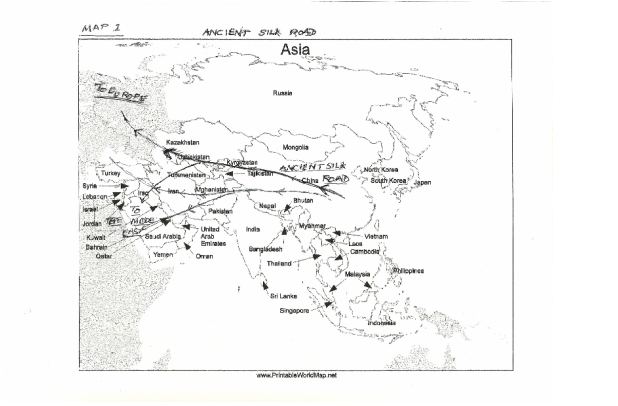
map01

The New Silk Road

Today although some rudiments of the East-West trade remains, it has changed vastly with regard to the nature of the commodities as well as the partners in the trade.
map02

Commodities

In the area around the Caspian Sea through which the old Silk Route ran, things have changed vastly. Countries like Iraq, Iran, Tajikistan etc. are the countries which account for more than 1/3 rd of the world’s oil reserves. These would be the new commodities – the black gold – together with the products from Central Asia. The new trade partners would be all the countries around that area which has tremendous potential for development.

From Where to Where? By Land and By Sea

As the biggest manufacturing country in the world, China needs to ensure its own energy supplies as well as ready outlets to transport its manufactured products all over the world. Eastern China being the major manufacturing area and being at the beginning of the New Silk Road too, China would like to build up links with all the countries of the region – Asia, the Mediterranean and Europe. This would be by a network of land and maritime routes.

The Maritime Silk Road

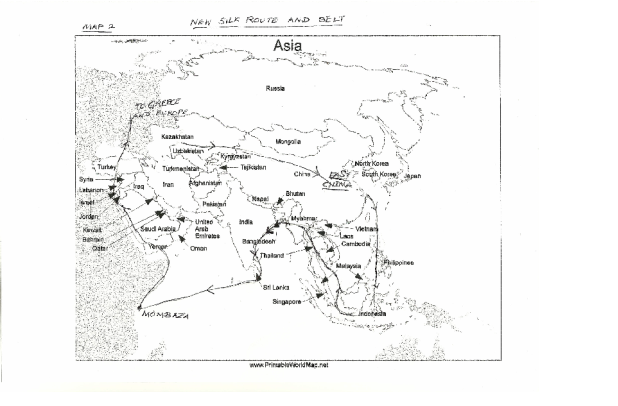
The Maritime Silk Road would stretch from China’s East Coast running South to Indonesia. It would then run West passing ports in Singapore, Malaysia, Myanmar, Bangladesh and Sri Lanka and then onto Africa’s East Coast at Mombasa and through the Suez Canal to Greece in Southern Europe. The Silk Road’s economic belt would be the overland route mentioned earlier with a Northern branch through Kazakhstan, linking Moscow to Poland and on to Western Europe and a Southern route through Iraq, Iran and Turkey to the Mediterranean.

Belt and Road Concept

This belt and road concept involves 60 countries and together they account for more than 60% of the world’s population ( see map for details).

Partnership

It is clear that the most important factor in this New Silk Road and Belt proposal is the partnership undertaken by all traders and producers in the interest of all the players in the region. The fact that the AIIB and the New Silk Road and Belt proposal has drawn in almost all the countries in Asia, their well wishers in Europe and the Middle East augurs well indicating that this is the correct direction for the New World.

Some countries in this region have already started taking concrete steps in the envisaged direction. One such was when on a visit to Pakistan on the 20th April 2015, the Chinese President Xi Jingping unveiled the first major project funded by US $ 40 billion Silk Road Infrastructure Fund in order to make this initiative a reality. It is a US $ 1.65 billion hydro-power plant on the Jhelun River in Pakistan’s North East. The Karot Hydel Project which is a subsidiary of China’s Three Gorges Corporation is to begin building before the end of 2015. This is only one of the initial steps of the 51 projects of the two countries signed by the two leaders. More than 30 of these agreements relate to the One Road-One Belt initiative. This 3,000 km long economic belt and trade corridor will link Xingiyang Autonomous Region in China to Gwardar Port in the Arabian Sea.

The green light has already been given to update the Gwardar Port, a new airport, roads and rail links and resource pipelines. This gives an idea of the scale of work envisaged under this economic belt and road project.

Another group of countries which will benefit from The New Silk Road and Belt would be the countries in Central Asia such as Turkmenistan and Uzbekistan. These stand to gain as they will carry not only oil and gas lines but also optic fibre pipelines.

This is only a glimpse of the vast opportunities opening up in the new world encompassing these new moves to link South East Asia, Central Asia, the Middle East and Europe.

IMPLICATIONS OF THE ABOVE PROPOSALS AND WHAT THEY INDICATE FOR SRI LANKA AND IT’S FUTURE

In November 2005, Mahinda Rajapakshe was elected as the president of the country. There was much hope for the future especially among the patriotic masses.

Urgent action was needed in the war against the Tamil Tiger separatists who had been waging a war against the Government for over two decades. This terrorist group, led by the megalomaniac Prabhakaran with his suicide bombers, had been causing havoc and destruction for a long while and people were fed up and tired of this war.

The tasks Mahinda had to face were unenviable The first task was to remedy the leftovers for two decades or so of mismanagement of a war by unpatriotic politicians for whom the war had been a source of undue income at the expense of the country, its future and even its sovereignty. So his immediate task was to handle this war that had been passed over to his hands. Much hope had been placed on the new regime for an early success.

Victory and After

We now know how by his prudent management, together with the heroic efforts of our armed forces, he vanquished the enemy and redeemed the country from the enemies’ clutches. This victory came in May, 2009. Of course, there was much jubilation and much long awaited relief.

With a long chapter of war over, the equally daunting tasks of post-war reconciliation, rehabilitation, rebuilding to bring back normalcy were needed urgently. The Government sat down immediately to fulfil these tasks. As this continued, by 2010, the first period of the Rajapakshe Presidency was also almost coming to an end. After the 2010 presidential elections, which Rajapakshe again won with a large majority, the new regime continued on with the post-war tasks they had started.

Enemy Forces Set to Work

We must not forget the fact that what the country set out to do was to bring about reconciliation between a separatist minority group of 12%of the population who had fought against a majority Government of over 73% of the population.

The Country’s Enemies

We know how since the early nineteen eighties, our powerful neighbour India had played a treacherous double game, even training the separatist terrorist forces while pretending to be our friends and helpers.

The Tamil Diaspora Group

Things were complicated further by the minority Tamils in the North and the East of the country migrating to affluent Western Countries on the pretext of being asylum seekers (‘really economic migrants’) at the beginning of the early 1980s for over two decades developing into a diaspora group of almost over a million or more. Actually, these were the people who funded the separatist war effort over the years.

The Tamil Diaspora and Western Countries

As mentioned earlier, the Tamil diaspora carried on a continuous campaign, initially covert and later overt, against the Sri Lankan regime throughout from day one of the separatists defeat still continuing ceaselessly. They also have internationalised their campaign and we know how these issues have been taken to the UN Human Rights Council (UNHRC) with the help of the US, UK, Norway and other Western Countries against us. In these, they have spared no effort to take our leaders of the armed forces to international war tribunals. This is still going on. That is a separate story.

Let us continue with our efforts to develop our country

Large Scale Structural Development Work

Since the early nineteen eighties, the roads and highways in the whole country had been neglected and urgently needing attention and modernisation. The war and unrest in the country had led to neglect in all sectors of the economy and infrastructure. From around 2008, in the first term of the Rajapakshe presidency itself such large scale projects were started post-haste. Some such important projects are:

Ports

Hambantota development projects a.k.a. Magampura port or Mahinda Rajapakshe port commenced in 2008, completed in 2010.

Colombo harbour extension projects: many new terminals were developed.

Special projects: Colombo port city project. It is a major project to re-claim land from the sea and expansion of Colombo city.

Airports

Under the Greater Hambantota City Project, a new airport was started in Hambantota. Hitherto we had only one international airport in Katunayake. In 2006, we saw how inadequate it was to depend on one airport, and the need for another airport in the South away from Colombo was felt sharply. While upgrading the facilities in Colombo to international standards, a new international airport was constructed at Mattala in Hambantota.

A Massive Programme of Development

From about 2010, these tasks which started as the rehabilitation effort developed into a massive programme of structural development. The landscape of the country began to change day by day. Major highways changed into Expressways and flyovers started to appear at junctions around us for the first time in our country. The quality of life also started to improve from which people of all classes began to benefit.

Of course, all these required much funding. A part of this could be met by the Government’s peace dividend saved by the ending of the war. But these were not enough by any means as in addition, modernisation work costs much.

Fortunately for us by this time, China had started on its programs of support for development efforts by Asian and African neighbour countries, utilizing over US$4 trillion foreign exchange reserves. This helped us much in borrowing necessary funding at reasonably low rates. This came by borrowing through the Export-Import (Exim) Bank of China.

Most of this work was carried out using local manpower trained by Chinese technicians and engineers. For example, on the A9 project, out of a workforce of 4,500, only 50 technicians (1.4%) were Chinese. Others were all local technicians and engineers trained by the Chinese. Thus we were building up our own workforce for the future. These did not please some of the local capitalist class who were waiting for the end of the war to get the big contracts out of the peace dividend. Also some big Western countries who had expected to get the lion’s share of these contracts. Also displeased were politicians whom as I mentioned earlier had conducted lucrative businesses in the war supply contracts. All these elements were especially displeased by China coming into the game.

Enemies get Organised

The Western backing opposition in the country who had lost the opportunity for power for about fifteen years were disgruntled by all these developments and started a vicious campaign of vilification against the regime. All these elements started their intrigues and formed an enemy front. Especially busy with their covert activities were the leader of the opposition, an ex-president and some disgruntled ministers in the Rajapaksa cabinet who were known to have met in foreign countries some of the diaspora elements. These rumours started going about which made discerning political observers strongly suspect that these were signs of treachery and intrigue going on. American backed ‘NGOs too had been busy for decades in the country It was just after the series of Arab uprisings which had messed up the Middle East and the concept of regime change” was in the air. This became the favourite catchphrase among the idiotic urbanised and semi-urbanised groups of youth.

Treachery and Intrigue

By about mid 2014, these vilification campaigns had risen to a sort of crescendo but Mahinda Rajapakshe had solid support in the country and in the Parliament among the majority Sinhala community. Also the Tamil community were en masse against Mahinda in spite of all the work he had done for that group. It was clear that only a split in the Sinhala group comprising the ruling party and other minority groups, such as e.g. the Muslims and Indian Tamils moving against him could break Mahinda’s power.

Sri Lankans are well known as a gullible lot that can be taken for a ride easily especially when it comes to politics.

So by the end of 2014 or so the Facebook + rumours + gossip became the main means of political communication in the country. All of these had a field day in the confusion.

To cut a long story short, we know how some opportunistic politicians who had been clinging to the ruling party started crossing over in order to erode Rajapakshe’s power. We know how the president decided to go for elections held on 8th January.

We know how a disgruntled minister of the ruling party crossed over to the opposition and contested as the common opposition candidate defeating Mahinda by a narrow margin. This was a shock to the whole country. According to the deceptions, rumours and false propaganda spread by the opposition, people had expected massive retributory reactions from the defeated power. Mahinda handed over power peacefully to the winner Maithripala Sirisena and moved down South to his country residence.

The Loss to the Country and the Immediate Aftermath

Needless to say that Mahinda’s defeat is unfortunately a tremendous loss to the country. We have had a glimpse of the new world of the 21st century to which Mahinda was endeavouring to take our beloved country with his enthusiasm and effort together with Chinese technological assistance. The new president who came to power and using a makeshift ‘National Government” he set up has stopped much of the work, and started a witch hunt against the Rajapaksas’ the failure of which has glaringly exposed the vicious lies they had used in their election campaign. As for the economic front, it looks as if the country’s Central Bank and the Treasury has been handed over to a new Governor, an incompetent man who is behaving like a blundering cowboy.

Colombo and other cities which had been looked after like a showpiece is now neglected to such an extent, that it looks like a crow infested garbage site. Within a few months, the new rule under these incompetent fools is proving to be a disaster for the whole country. No wonder the people are clamouring for Mahinda’s comeback before all is lost. That seems to be what is happening.

A general election is due shortly and if the country is to progress, Mahinda should be voted into leadership to continue the work he and the people started. This may be the last opportunity to retrieve the country from the impending disaster which only we, the people can prevent.
US GSP renewal: Hype and reality

July 9th, 2015

By Subhashini Abeysinghe Courtesy FT.lk

Untitled-1

The renewal of the Generalised System of Preferences (GSP) of the United States is indeed welcome news for exporters from developing countries, not only Sri Lanka. It is a scheme that provides non-reciprocal, duty free access to certain products imported from designated Beneficiary Developing Countries (BDCs).
Some of the articles that appeared on newspapers about the US GSP renewal however carried inaccurate information and exaggerated the perceived benefits. For example, some claimed the renewal was due to the improved human rights record of the Government, and that this is a big boost to Sri Lankan exports destined to the United States, especially apparel. These are false claims.
Expiration or renewal of US GSP had nothing to do with Sri Lanka
The expiration of the US GSP scheme on 31 July 2013 or the renewal of the scheme on 29 June 2015 had nothing to do with Sri Lanka. The US GSP program is subject to periodic renewal by Congress. This is not a country specific review.
The GSP program was most recently extended until 31 July 2013, and congress failed to renew it on the due date, therefore the GSP scheme expired. As a result all 122 GSP beneficiary countries lost duty free access given by the scheme for selected products exported to the United States.
Also, it is not the first time this has happened. It was in fact the eighth time the scheme has expired without being renewed in a span of 30 years. The US GSP scheme when it is renewed after a lapse of several months/years, is renewed retrospectively; i.e. the US Customs will reimburse U.S. importers for tariffs paid on eligible products during the gap period.
Untitled-2

Only 8% of Sri Lankan exports to USA benefits from US GSP scheme
The reports also claim that the GSP program provides duty-free entry for 5,000 products exported from Sri Lanka. The product coverage is much less for developing countries like Sri Lanka; it is roughly about 3,500 products (and it is at HS 8-digit level, which makes the actual coverage even smaller).
The least developed beneficiary developing countries (LDBDCs) receive duty free status to an additional 1,500 products. Therefore it is these 43 LDBDCs that actually have duty free access to 5,000 products.
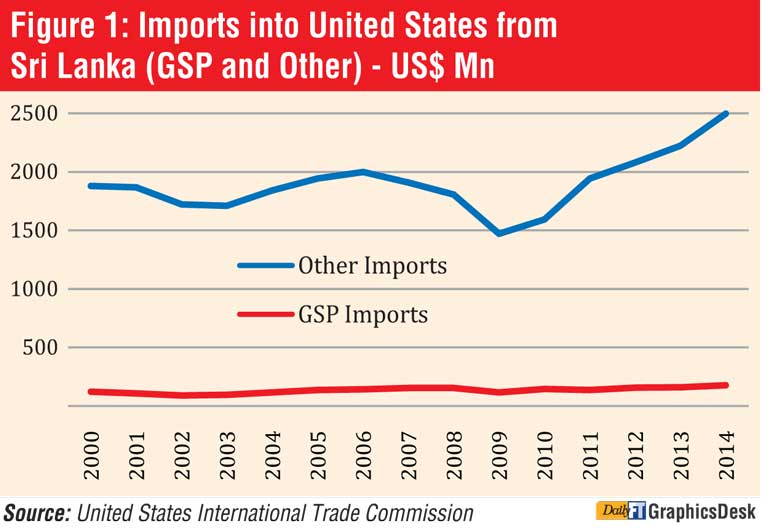
According to statistics published by the United States International Trade Commission (USITC) the percentage of exports from Sri Lanka that benefits from US GSP is very low. As a percentage of total exports from Sri Lanka to the United States, it has been around 8% (refer Figure 1).
According to a report published by the Congressional Research Service on the GSP scheme, imports that utilised the GSP concessions from the 122 beneficiary countries amounted to only 1% of total imports into US in 2012, whereas the total imports from these countries into US was 12%. Overall, the benefits of the scheme for beneficiary countries is important but not large.
Textile and apparel is not eligible for GSP concessions
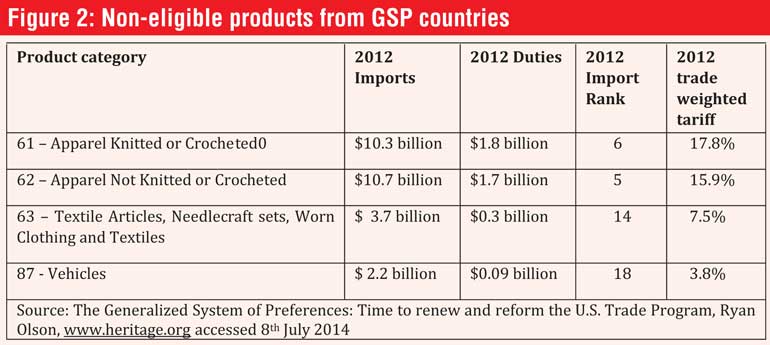
The US GSP scheme does not give concessions to certain import sensitive” products such as textile and apparel exports from developing countries (refer Figure 2). Apparel account for nearly 80% of total exports from Sri Lanka to the United States. This is the key reason for the low level of utilisation of GSP concessions by Sri Lankan exporters. Therefore the renewal of the US GSP scheme will not give a big boost to Sri Lankan exports destined to US.
Sri Lanka’s eligibility for US GSP was reviewed in 2012
GSP country and product eligibility are subject to annual review. The country review takes into consideration whether the country is eligible by assessing the level of economic development, the level of diversification of exports, and their competitiveness both globally and relative to GSP eligible products. Based on this assessment, countries considered economically advanced and competitive are graduated out of the scheme.
The countries are also reviewed on other criteria such as worker rights, intellectual property protection, existence of trade distorting investment policies etc. For example on June 27, 2013, the US President announced the suspension of GSP benefits for Bangladesh on the grounds that it has not taken or is not taking steps to afford internationally recognised worker rights to workers in the country”.
In fact Sri Lanka was also under review, in 2012. The review however was not about human rights record of Sri Lanka, and US did not suspend concessions given to Sri Lanka. It was a review of country practice on worker rights. After reviewing the status and measures taken by the government, on 29th June 2012, the United States Trade Representative (USTR) confirmed that Sri Lanka will continue to receive GSP concessions.
Conclusion
Thus the current renewal of US GSP has nothing to do with the current political developments in Sri Lanka and its human rights record. Sri Lanka was of course one of the many developing countries that lobbied for early renewal of the scheme.
Further, contrary to some reports, only a small portion of Sri Lankan exports to the United States benefit from the GSP concessions. Hence, US GSP renewal, while benefiting some exporters to United States, is not going to give a big boost to overall exports from Sri Lanka to the United States.
(The writer is an expert on international trade and Head of Research at Verité Research)

– See more at: http://www.ft.lk/article/442917/US-GSP-renewal–Hype-and-reality#sthash.FQKoWdmZ.53zg1ApG.dpuf

සන්ධානය තුනෙන් දෙකකට ආසන්න බලයක් ලබන හැටි ගම්මන්පිල එජාප සූත‍්‍රයෙන්ම සාධනය කර පෙන්වයි..

July 9th, 2015

– අරවින්ද අතුකෝරල

එන මැතිවණයෙන් සන්ධානය  තුනෙන් දෙකකට ආසන්න ජයග‍්‍රහණයක් අත්පත් කරගන්නා බව බස්නාහිර පළාත් සභා මන්ත‍්‍රී උදය ගම්මන්පිල මහතා කොලඹ අභයාරාමයේදී පැවති ප‍්‍රවෘත්ති සාකච්චාවකදී කියා සිටියේය.

එහිදී ඒ මහතා මෙසේද අදහස් පල කලේය.

පසුගිය සදුදා සිට ආරම්භ වුනේ යහපාලන නාඩගමේ  අවසාන ජවනිකාව. මේ ජවනිකාවේ තමයි ජනතාවට පෙන්වන්නේ යහපාළනය නමින් රාජ්‍ය දේපල මැතිවරණයකදී අවභාවිතා කරන්නේ කොහොමද කියලා. අපේ විමල් වීරවංශ මැතිතුමා ඒ පිළිබදව උදාහරණ ගනණාවක් කියුවා. ඒ වගේම අද දිනයේ හදිසි ඇමති මණ්ඩල රැස්වීමක් පැවැත්වෙනවා. ඒ රැස්වීමේ දී විශේෂ ජල ව්‍යාපෘති කිහිපයක් පිළිබද භාණ්ඩාගාරයේ නිරික්ෂණයකින් තොරව අරමුදල් වෙන් කිරිමට නියමිතයි. මෙය සෘජුවම මැතිවරණය ඉලක්ක කරගත් ජල ව්‍යාපෘති කිහිපයක්. ඒ වගේම මේක පිටිපස්සේ මැතිවරණයට මුදල් සොයා ගැනිමට ටෙන්ඩර් ප්‍රධානය කිරිමේ අරමුණත් තියෙන්න පුළුවන්. යහපාලනය ගැන කථා කරන්න පෙරමුණ ගත් අයම අද ඛනිජ තෙල් නීතිගත සංස්ථාවේ සම්පත් මැතිවරනයට අවභාවිතා කරලා තියෙනවා. ඒ නිසා යහපාළනය නමින් බුක්ති විදින ලැබුණු යමපාළනයේ අවසන් ජවනිකාවත් බලමින් පහන් සංවේගය උපදවා ගන්නයි කියලා අපි ජාතියෙන් ඉල්ලා සිටිනවා.

කැප කිරිම් මතින් ජයග්‍රහණය කරා

මේ සමගිය ගැන විවිධ කටකථා පැතිරෙනවා. අපි දන්නවා දෙපාර්ෂවයක් විසින් තනි තනිවම හදපු ලැයිස්තු දෙකක් එකතු කරලා  එක ලැයිස්තුවක් හදන විට දෙපාර්ශවයටම යම් යම් කැප කිරිම් කරන්න වෙනවා. අපි එම කැප කිරිම් කරන්නේ එක්සත් ජාතික පක්ෂය නතර කර යුතු නිසා. එක්සත් ජාතික පක්ෂය පරාජය කල යුතු නිසා. ඒ වගේම පසුගිය මාස 6 තුල සවිමත් උන බෙදුම්වාදයට, ආර්ථිකය කඩා වැටිමට, සංවර්ධන නතර විමටත් තිත තැබිය යුතු නිසාය. අද අපිට මතකයි එක්සත් ජාතික පක්ෂය ජග්‍රහනයේ සූත්‍රයක් විස්තර කළා කොහොද එක විස්තර කළේ. සන්ධානය දෙකට කැඩෙනවා ඒ නිසා අපි දිනනවා. ඒ සූත්‍රය අදට ගැලපුවනම් එජාපය කියන්න ඕනේ සන්ධානය දෙකට කැඩුනේ නෑ. ඒ නිසා එජාප අපි පාරදයි කියලා. මොකක්ද අපේ ජග්‍රහනයේ සූත්‍රය අපි දන්නවා පහුගිය ජනාධිපතිවරණයේදී බුලත් කොළේට ලක්ෂ 58ක් ලැබුණා, හංසයාට 62ක් ලැබුණා. මේ ලක්ෂ 58 ගෙන්න දායක වුනු සියළුම දේශපාලන පක්ෂ අද එක මිටියට මෙවරත් සන්ධානයෙන් ඉදිරිපත් වෙනවා.

එහෙම නම් මේ ලක්ෂ 58 ගෙඩිය පිටින් බුලත් කෙළේ වටේ රැදිලා තියෙනවා. කොහොමද හංසයාගේ 62 දෙමළ සන්ධානයේ හංස පැටවු ලක්ෂ 07ක් අරගෙන එළියට පියබා ගිහිල්ලා තියෙනවා. ජනතා විමුක්ති පෙරමුනේ හංස පැටවු ලක්ෂ 05ක් අරගෙන එළියට පියබා ගිහිල්ලා තියෙනවා. ෆිල්ඩ් මාෂල් ෆොන්සේකා මහත්මයාගේ ප්‍රජන්ත්‍රවාදි පක්ෂයේ හංස පැටවු ලක්ෂ 02ක් අරගෙන එළියට පියබා ගිහිල්ලා තියෙනවා. හෙළ උරුමයත් සමාවන්න දැන් යහපාළන මොකක්ද කියන පක්ෂයේ පෙරමුණ මට හරියට නම මතක නෑ ටිකක් දිගයි. ඒ පක්ෂයත් ලක්ෂයක විතර හංස පැටවු අරගෙන එළියට පියබා ගිහිල්ලා තියෙනවා. ඒ විතරක් නෙවෙයි අපේ වර්තමාන ජනාධිපතිතුමා ලක්ෂ 03ක් විතර අරගෙන ඒ පැත්තට ගියේ. එතුමා අද ඒ ඡන්ද ටිකත් අරන් මේ පැත්තට ඇවිල්ලා මේ පැත්තට නායකත්වය දෙනවා. මේ ටික ඔක්කොම එකතු වුනාම ලක්ෂ 18ක් විතර ඒ පැත්තෙන් අඩු වෙලා තියෙනවා. ඡන්ද ලක්ෂ 03කින් අපේ වැඩි වෙලා තියෙනවා. 58යි 03යි 61. 62න් 18ක් අඩු කළාම 44යි. ජනාධිපතිවරණයේ දී පක්ෂ ගොනු වෙච්ච අකාරය පාර්ලිමේන්තු මැතිවරණයේ දී නැවත ගොනු වීමත් සමග සලකා බලද්දි දෙපාර්ශවය අතර පරතරය ලක්ෂ 61ට ලක්ෂ 44 බවට පත්වෙලා තියෙනවා.

හැබැයි අමතක කරන්න එපා මේ දවස්වල හංසයා වෙනුවෙන් පෙනි සිටිය අනුර කුමාර දිසානායක, සරත් ෆොන්සේකා, චම්පික රණවක වැනි හංස පිලේ නායකයන්ම තමයි කියන්නේ මේ ආණ්ඩුව හොරකම් කලා, මේ ආණ්ඩුව බෙදුම්වාදයට පාර කැපුවා, මේ ආණ්ඩුව බඩු මිල අඩු කරනවා කියලා බොරු කලා, මේ ආණ්ඩුව සහන දුන්නේ නෑ කියන්නේ හංස පැටවුමයි. අපිට වඩා කියන්නේ හංස පැටවු මේ නියෝජනය වෙන්නේ හංසයාට ඡන්දය දුන් පාවෙන ඡන්දයේ හඩයි. පාවෙන ඡන්ද තමන්ට ආකර්ෂනය කර ගන්නයි මේ කියන්නේ. එමෙනම් විවිධ කාරණා මත පාවෙන ඡන්ද දස ලක්ෂයක් පමණ ඒ පැත්තෙන් මේ පැත්තට ඇවිත් තියෙනවා. 44න් 10ක් ගියාම 34යි ඒ 10 මේ පැත්තට එකතු කලාම 71යි. එජාපය ලක්ෂ 34ක් ගන්නා විට අපි ඡන්ද 71යි සරල ගණිතයට අනුව  දෙගුණයකටත් වඩා ඡන්ද ලැබීමට නියමිතයි. ඒ නිසා ඉතිහාසයේ ලොකුම ජග්‍රහනය අපි කරනවා කියන්න කැමතියි.

මේ මැතිවරණය වැදගත් වන්නේ ජග්‍රහනයේ විශිෂ්ඨ බව නිසාම නොවේ අපි දන්නවා ජනතාව වෙනසක් ඉල්ලුවා ජනතාවට වෙනස දුන්නා බුදු අම්මෝ මේක නම් වෙනස, වෙනස එපෝ කියලා ජනතාව සැදිපැහැදි ඉන්නනේ වෙනස වෙනස් කරන්න. මාස 06ක් විපක්ෂයේ සිටීම නිසා ජනතාව අපිට ලක්ෂ 58ක් ඡන්දය දෙන්න බලපැ හේතුත්, ලක්ෂ ගනණනින් අප වටා එකතු වෙන්න බපලැ හොද ගුණාංග ඒ අකාරයටම රුකගෙන අපෙත් තිබුණු දුර්වල ස්ථාන හදුනා ගන්න මේ මාස 06 විවේක කාලය අපිට හේතු බුත වුනා. ඒ නිසා අපි විස්වාස කරනවා ආගෝස්තු 18 වෙනිදා එළබෙන්නේ නිදහසෙන් පසු ශ්‍රි ලංකා ඉතිහාසයේ මහින්ද රාජපක්ෂ යුගය පමණක් නෙවෙයි නිදහස් ශ්‍රි ලංකාවේ ස්වර්ණම යුගය ආගොස්තු 18 වෙනිදායින් පසු මේ රටට අපි උදා කරනවා කියන පොරොන්දුව ප්‍රතිඥව අපි ජාතියට ලබා දෙනවා.


Those who can’t COPE..

July 9th, 2015

Courtesy The Nation

Those who cannot the COPE need to go home, and that is almost axiomatic.Parliament was dissolved before the COPE Report on the Central Bank Governor’s bond dealings had a chance of seeing the light of day.

It is patently obvious to the people that the abrupt dissolution of Parliament at this juncture was a direct result of the COPE bombshell, and other financial irregularities of government heavyweights which were bound to be highlighted in the no-confidence debates that were to come.

The Yahapalana (good governance) administration has left under a massive cloud, with corruption of 10 billion rupees suspected in the bond scam alone. It happened in less than 200 days.

On every economic indicator, the alarm bells were ringing. Here is a recap of that ignominy:
These are the contrasting numbers for January 2015, and for barely six months later.

Forex reserves – (Jan – 9 billion,  June- 6.3 billon.). Imports ( USD). Jan – 4 billon, June -3.84 billion.) LKR borrowing limit – LKRT Bonds and Bills. (Jan  – 850 billion, June  – 1250 billion.) external USD cost 10 year bond. (Jan – 5.87 percent. June  – 6.125 percent.) GDP ( Jan  – 7.4. percent.)  2015 6.4). Long term rupee bond interest rates. ( Jan-9.75 percent – June-11.75 percent.)  Budget deficit as percentage of GDP- (Jan 6.5- June  9.5).

Such contrasts are not in the abstract. Bottom-rung  UNPers are themselves seething over what they see as the grand betrayal due to financial shenanigans of the top UNP elite, with Karunanayake heading the pack of hyenas.

For a dispensation that claimed to have come to power on a mandate of good governance, the above recapped economic debacle coupled with the fact that the Govt., had to save itself by dissolving Parliament, should be the kind of ignominy that takes years to achieve.

But no, Wickremesinghe’s UNP managed all of this in an easy six months! Ranil’s cronies have done him in, and there are no more ignominious henchmen among that lot than Arjuna Mahandran who came in with a cloud hanging over his head, having been an advisor to HSBC Private, which was convicted for money laundering in the USA.

All governments have cronies and a less than savoury characters who are hangers-on, but a bunch of cronies who were able to wreck a perfectly promising economy in less than 200 days is special by any reckoning!

Rajapaksa is accused of many things but his worst detractors find it difficult to say he was not a doer. He accomplished many things, though many faults are laid at his door, such as the alleged protection afforded to bad eggs and those who are routinely evading the law.

But the UNP’s record of cronyism in a matter of six months ascertained two things. These people governed a train-wreck and a train-wreck seems to be the only thing this lot has the experience to deliver.

That forms a telling contrast to Rajapaksa’s record for performance, a fact bolstered by the statistics given above for the shape the economy was in at the beginning of the year when the election abruptly delivered change.

Anyone surprised that there is a hankering after the lost Rajapaksa rule should understand that the dynamic there is simple. People have eyes. They have a sense of smell. They know the obvious when it is happening right under their noses, right before their eyes.

As Rajapaksa gains — and make no mistake, it is Rajapaksa and not the SLFP which is essentially a sign board for just another opposition party — the dirty bombs being planted by the likes of Kumaratunge would go down in history as the worst recorded campaign in Sri Lankan history for unwelcome and perfidious vilification.

People are not prepared to see Kumaratunge, universally seen as a zero-achiever in government, ask for the jailing of Rajapaksa for no reason!

She says ‘these people should be in jail’ and has nothing to show in terms of facts to back-up that piece of mealy mouthed vilification, as nobody was caught up in more financial scandals during incumbency than Kumaratunge herself.

This is a morally degenerate condition for which the entirety of the Sri Lankan polity should be held responsible. All of us should hang our heads in shame over the fact that this brand of vilification has been allowed about a man who turned around a bleak situation for the country, won a war, and built upon that success with the kind of economic gains that has the numbers to show for it. There aren’t lines of Buddhist monks however, taking to the streets to say that such vilification is a demonic excess.

But why should there be?

The people are the ultimate witnesses and their verdict is the only one that matters.
It seems to be why the rants are taken in a spirit of nonchalance.

The contrasts are so glaring that a five year old won’t miss the joke. Here is CBK saying she is saving the country. After the six months of UNP rule and the situation that was recapped above, it is clear she does not know the meanings of either of those two words. Save? From herself?

Country? Which part of it that is left after January 2015?

The lie has exposed itself. But this degree of ignominious and farcical let down should not go without repercussions. Ranil and his hundred days cronies and how they managed to crash the economy in less than half of a year should be the subject of a meticulous probe.

A six month swindle of this order would qualify as epic, even in the annals of major disasters and ultimately memorable debacles.

The conspiracy to demonize and erase the Sinhala Buddhist identity of Sri Lanka

July 9th, 2015

Shenali D Waduge

When colonial invaders landed in Sinhale with the intent to trade and spread Christianity they had just one obstacle and one enemy – the Sinhalese Buddhists. The nation of Sinhale to which these colonials arrived saw the culture, the heritage, the civilization that existed as a threat to them. That threat continues to prevail. With annihilation by mass killing not a norm to be followed the alternate options have been to erase the Sinhala Buddhist identity while demonizing Buddhists through every medium and mode possible.

Eliminating Sinhala language:

Every area that the Sinhale Buddhists show exclusivity, it is being targeted for systematic elimination. The Sinhala language becomes a target for it is binding of the Sinhala identity and is a unique language found nowhere else in the world. Sinhala is the identity that provides evidence of the civilization that was built and holds reign to determine ownership to Sri Lanka or rather the Sinhale Nation the real name of the country. Thus Sinhala is one of the oldest living languages with a history of 2300 years derived from Indo-Aryan dialects with its own literary tradition. The Sinhala language is the ONLY language to have evolved and developed in Sri Lanka while all other languages spoken in Sri Lanka have origins in other countries. The only language that can claim to be distinct to Sri Lanka is Sinhalese.

The best way to remove true Sinhala from the people is to subtly dilute the language and mix it with words from other languages. The ‘Singlish’ being introduced mixing English and Sinhalese is one subtle form to remove the Sinhala language from its hold over the Sinhale race. Neither the Education nor the Government has understood the need to preserve the Sinhale language and drawn up plans to ensure that it is not diluted or destroyed but nurtured through the education system. Lethargy of academics are questioned as well as the Buddhist organizations that should insist on preservation of Sinhala, the only homogenous native language.

Eliminating Buddhism:

The other area targeted to be demonized is Buddhsm – the chosen religion of the Sinhale nation brought by royal invitation from India because the Sinhale Kings wished its people to follow the compassionate teachings of Buddhism towards both man and animal. All other religions and ethnic groups that prevail in Sri Lanka have come via immigrants or forced by colonial invaders after forcible conversions.

Historical accounts will reveal the brutal manner in which colonial invaders Portuguese, Dutch and even the British destroyed Buddhist temples, ancient artifacts, historical heritage sites even killing Buddhist monks in a sinister bid to Christianize Ceylon and wipe out traces of Buddhism. The same took place and continues to take place in Buddhist Maldives where the official history of Buddhist roots of Maldives have been expunged from records and whatever traces of Buddhism is being systematically removed. When international entities tasked to preserve history/artifacts are in the control of the very nations trying to Christianize/Islamize countries what justice can nations with rich heritage and history expect? The manner that Christian/Islam owned media has managed to control content of what gets published has helped to create a Nalanda syndrome among Buddhists themselves who have been brainwashed to feel guilty because media drills into them a feeling of guilt because the actions of others are subtly camouflaged by diverting the news to the reaction of Buddhists only.

A sample of how Buddhism has been subject to media denigration without authorities taking action is shown below. Reactions instead have led to hate speech legislation without taking cognizance of the origins or reasons for people’s grievances.

If anyone writes anything defending one’s religion / nation the immediate response is to flood the web comments with names ‘fascist writer’ ‘Buddhist extremist’ and thereafter once branded into the minds of readers the goal is to stop new readers from reading the contents of their articles. Time tested strategy that has worked but unlikely to work always!

Expose Thugs In Robes And Isolate Them http://www.thesundayleader.lk/2014/04/27/expose-thugs-in-robes-and-isolate-them/ 27 April 2014
Saffron robed destroyers of Sinhala-Buddhism http://www.island.lk/index.php?page_cat=article-details&page=article-details&code_title=101536 April 11, 2014
Bodu Bala Sena’s Thug Leader Gnanasara Thero Should be Flogged Publicly and Chased on the Road with Full Exposure on TV http://dbsjeyaraj.com/dbsj/archives/29655 4 May 2014
The ‘Mad Monk’ Phenomenon: BBS as the underside of Sinhala-Buddhism http://groundviews.org/2014/04/15/the-mad-monk-phenomenon-bbs-as-the-underside-of-sinhala-buddhism/ 15 April 2014
An unholy alliance of Buddhists http://www.srilankaguardian.org/2014/04/an-unholy-alliance-of-buddhist.html April 2014
Buddhist extremists attack innocent http://www.srilankaguardian.org/2014/06/buddhist-extremists-attack-innocent.html
Barbarism of Sinhala Buddhist extremist forces against Muslims https://www.colombotelegraph.com/index.php/barbarism-of-sinhala-buddhist-extremist-forces-against-muslims/ June 16 2014
Buddhist Extremists Hope to Attain NIBBANA” by Attacking Muslims, Mosques and Muslim Owned Businesses http://dbsjeyaraj.com/dbsj/archives/24278 14 August 2013
Sinhala Buddhist extremists https://www.colombotelegraph.com/?s=Sinhala-Buddhist+extremists&x=8&y=5
Barbarism of Sinhala Buddhist extremist forces against Muslims http://www.latheeffarook.com/index.php/9-sri-lanka/1188-barbarism-of-sinhala-buddhist-extremist-forces-against-muslims June 2014
Excerpt from Sinhala Buddhists vs Buddhist Moderates: Sinhala-Buddhists live in constant fear of their ‘concrete/clay/stone made’ religion which they call ‘Buddhism’ being destroyed.” ………: Today, in place of Anagarika Dharmapala and S.W.R.D. Bandaranaike we have Sinhala-Buddhist Warlords to carry on the tradition!” https://www.colombotelegraph.com/index.php/sinhala-buddhists-vs-buddhist-moderates/ July 2013

There is also need to go back to 2002 period under Ranil Wickremasinghe wherein the state newspaper published an article by a team of non-Buddhists with the sinister objective to ridicule the Buddhists by challenging the authenticity of the sacred tooth relic at Dalada Maligawa which had to be recalled and the then Prime Minister and Media Minister Imtiaz Markar having to make a public apology to the Buddhists. Yet the efforts to marginalize, denigrate and slowly omit the status of Buddhism have not stopped and will not stop.

Its also impossible for Buddhists to get their opinion across. This comment on a private website reveals how disgruntled a lot of Buddhists really are because their views are never entertained by the media publications majority of editors who are non-Buddhists and told to ensure the Buddhist opinion is not publicized. In order to negate or refute this it is time we have a content analysis of all articles published. With 70% Sinhala Buddhists the papers must give a ratio to that percentage which however is not happening.

https://www.lankaweb.com/news/items/2015/06/25/daily-mirror-buddhism/comment-page-1/

This has been perfectly analyzed in the Press Commission Report of 1964 which clearly indicates that the media is part of the plot to demonize both the Sinhale race and Buddhism in a bid to remove the nationalism from those that defend the nation.

112, page 56 of the 1964 report of the Commission that was chaired by Justice K D de Silva, Press Commissioner:

If these English language newspapers were sufficiently patriotic they could have made a very useful contribution to bringing about unity among the various communities after the country achieved its independence. They should have advised the minority groups to adapt themselves to the changing circumstances and exhorted the majority to be generous towards the former. They failed to do that. What they consistently did was to poison the minds of the minority groups and encourage them to fight to retain the unjust privileges they had received during the era of foreign domination. ”

The politicians keen only on power, money and political survival have no time to strategize on how it should protect the Sinhale Buddhists not only because of its cultural/historical/heritage roots but because it is beholden to do so constitutionally.

The open economy, capitalism and emergence of elite classes have created a barrier and resulted in drawbacks to preserving the rich cultural heritage.

The Vatican or the Pope cannot be offended or Catholics and Christians cannot complain when these past atrocities are brought to light for these acts were not confined to Sri Lanka alone, they were part of a policy by the Church to eliminate and annihilate races, religions and only spread the faith of Catholicism/Christianity.

Similarly, Muslims too cannot complain when verses from the Koran are brought forward to argue why Islam demands Muslims to kill and punish non-Muslims for there is not a single line in Buddhism that tells Buddhists to do so whereas the religious texts of Abrahamic religions are full of hate speech proven in the quotes themselves. There’s a world of a difference in name calling and arguing texts in a religion!

Unfortunately, Sri Lanka’s leaders have not been able to understand who their friends from enemies are in their quest to remain in power they have embraced every enemy out to destroy the Sinhala language, the Sinhale race and Buddhism. When these are slowly removed the people will find they have nothing to fight or defend and that would be an automatic self-sacrifice of the Sinhale nation. We can see that now happening before our very eyes.
It is this reason why there are opposition to turning Buddhist schools into multicultural outfits just to satisfy voter bases. The background that students of Ananda, Visakha have gained is nothing that is restricted to paper. We next question why education authorities have not ‘multiculturalized’ Muslim schools where these schools function to the dictates of what Islam upholds. If so, why should only the Buddhists be one’s to compromise?

The multicultural ploy is out to systematically eliminate our ties to our heritage. It is subtly attempting to remove our links to our past. It is attempting to take away our identity.

What needs to be said is that the country must certainly have a Sri Lankan identity. That identity can only happen if people integrate into the culture of the majority race that built the nation. A sovereign country cannot function to different laws that are not cohesive.

Sri Lankan identity cannot come at the expense of the Sinhala Buddhist identity. It is only the Sinhalese Buddhists who are always been asked to compromise and give up what they traditionally held.

The minorities must be aware and be told that it was the Sinhala Buddhist civilization that built Sri Lanka.

Politicians may wish to follow the policy of appeasement not for the love of the country but simply to gain power and enter politics. But such appeasement is a challenge to the common identity of Sri Lanka with long term plans that aim to remove the Buddhist identity of the country and replace Sinhala Buddhists. This is why citadels of Buddhists are now being occupied by non-Buddhists claiming it their heritage site. If Sri Lanka has a 2300 Buddhist heritage if any other religion is claiming stake of heritage sites should they not prove with proper evidence (not propaganda or shouting) that they existed before 2300 years? Politicians must now stop marketing Buddhism and use Buddhism as a commercial commodity and cosmetic tool. The ancient Kings in their hearts were determined to preserve and follow the tenets of Buddhism through the dasa raja dharma, sadly we do not see such now but ideally that should be the order of the day.

Today all Buddhist countries are at risk. People say there is nothing to fear and preach peaceful co-existence but only Buddhists know how from Persia to Indonesia the entire Buddhist space was lost because of their non-violence and today there are just 5 Buddhist majority nations fighting for survival. Fighting to keep the Buddhist ethos which no one can remove simply because of a newly entered slogan called ‘secularism’

The competition is between Christians & Islam to either Christianize or Islamize Sri Lanka.

Shenali D Waduge

times1

times2

Additional reading:

https://www.lankaweb.com/news/items/2013/06/17/buddhists-are-victims-of-hate-speech-and-media-manipulation-in-sri-lanka/

COMPARISON OF “GLADIATOR” PRESIDENT MAHINDA RAJAPAKSA

July 9th, 2015

Well wisher

The tragedy that seems to have befallen on President Mahinda Rajapaksa reminds me of the “Gladiator” from the film with Russel Crowe. In the film he is the favorite of the Emperor Marcus Aurelius and his son Commodus becomes jealous of the Emperor’s love for his General Maximus. Commodus kills his father and sends Maximus also to be also killed. Fortunately he escapes and goes underground. Then he comes back as a Gladiator and Commodus recognizes him and arranges a fight with him in the arena. However before the fight Commodus goes and stabs Maximux in the back and tells the soldiers to dress him up in the suit of the Gladiator and fights with him in the arena. Even though mortally wounded  Maximux defeats Commodus and kills him.

Look at what befell MR.

  1. MR was stabbed in the back by Maitripala Sirisena (MS) who then manages to convince the people of the country that MR was corrupt, based purely on allegations without any proof.
  2. The Yahapalanya group tried hard to prove their allegations and have failed even though they had the backing of foreign countries to investigate MR. Even his family members and all his associates were accused in a similar manner and arrested and taken to prison without proof of crimes.
  3. MR handed over to MS his party UPFA, and the SLFP too, of which he had been a life long member.
  4. He then retired hoping to live a quiet life. However the ordinary Sinhala villagers started coming to his house and begging him to run for office. His caring for them was so strong that he agreed at great personal risk and loss of all his Presidential privileges. (The people are equivalent to Marcus Aurelius in the story).
  5. MS was jealous of this love of the people for MR and tried to persuade everyone to follow him rather than MR. But it was not to be. So like in the film he first mortally wounds him by removing all the support for MR and after putting negative conditions, tells him to run for elections in the forthcoming general elections.
  6. Like Maximus in the film, MR has suffered all the insults and allegations stoically.
  7. Let us hope that in the election MR can defeat the anti Sri Lanka elements who have tried their best to destabilize the economy and destroy the country in the name of good governance.

When MS who contested the Presidential election under a different party instead of SLFP for UPFA then appointed a minor party UNP as the Governing party against all rules of norm. He appointed RW as Prime Minister when there was an existing Prime Minister, a Chief Justice when there was an existing head and did not follow any rules of good governance to appoint these people. People anyway decided to give him a chance to prove this mettle and overlooked all the irregularities. The man who spoke vehemently against family bandyism promptly appointed his Family members to key posts. Even his son Daham who was under investigation by the Police for having $1.2 Million in Swiss Francs and Dollars was released and went to USA on a Green card offered by grateful USA. See http://www.island.lk/index.php?page_cat=article-details&page=article-details&code_title=116619

It is ironic that the JVP people who was slaughtered mainly by Mrs. Bandaranayake and then by the UNP seem to have forgotten history and joined the UNP/CBK wing. Kumara Dissanayake whose speech is colored by his hatred has decided to direct his venom at MR when MR is the one person who has tried to uplift the poor villagers, both Sinhala and Tamil. KD is like a spitting cobra spitting venom at MR and associates.  Similarly the JHU which has as policies the upliftment of the Sinhala Buddhists have also forgotten history and joined the UNP. Have they forgotten the past so soon how both CBK and RW betrayed the country again and again. So many of the Sinhala soldiers who all came from the villages were killed due to the incompetence of these two people. The should have resigned from active politics a  long ago for what they did to the country.

RW who gave a personal undertaking to the Parliament that he will be responsible for Arjun Mahendran’s actions when he was brought in as CB Governer since there were many in the Parliament who opposed RW. Earlier Arjun was calling RW “Uncle Ranil” at every turn. However when things went wrong Arjun put the blame on RW and said that he was acting on RW’s instructions. Now RW is like a cat scratching the floor trying to cover up after laying its faeces on a concrete slab. Now the poor people of the country will be paying for RW and Arjun’s bond scam for the next 30 years.

MR’s biggest fault appears to be his inability to ciriticise even  his worst enemies or speak ill of them and also not defending him self when false accusations were brought against him.  Of course the English media is run more or less by the pro-foriegn UNP Colombians and Christian/Catholic journalists. Read the Colombo Telegraph to see what I mean.

Let us watch the outcome and let us hope that TRUTH wins.


Honesty, Integrity and Conflicts of Interest

July 9th, 2015

Janaki Chandraratna – Perth, Western Australia

Ethical values of Honesty and Integrity are fundamental to our existence in this complex modern world. In terms of governance these values are essential for politicians who are being elected to positions of trust and power to act on behalf of the voter and safeguard the rights and welfare of the electorate.

Honesty in simplest form is to be truthful and not lie to others. In the broader sense it includes not generating/spreading un-substantiated rumors; denying commitments; fabricating evidence; deceptive behavior; stealing; cheating etc.  Integrity is an extension of honesty where one is expected to uphold the moral values and ethical standards one professes to maintain.

In the secular world one can argue that there is some difficulty in adhering to these norms and standards at all times and we do need to occasionally indulge in ‘white lies’ to overcome certain unavoidable situations. But the gross manipulation is something that can never be of any gratification to the offender. Buddhism purports that every action has a reaction and the said reaction can be immediate and shattering depending on the gravity of the depraved action.

Conflict of Interest occurs when there are competing professional and or personal commitments/obligations. These competing interests do have the potential to motivate corruption and dishonorable conduct. Codes of ethics are of immense value to practitioners to mitigate the risks of conflicts of interest in various disciplines. It is regretful that such a code of ethics is not available to Sri Lankan politicians. Nevertheless, common sense suggests that honesty and integrity are basic values that need to be considered when dealing with conflicts in competing interests.

It is no secret that moral values of Sri Lankan society, in particular, those pertaining to honesty and integrity had plummeted in recent months. People have gone viral on faceless Facebook with unsubstantiated allegations in unspeakable language. Facebook junkies are on an over drive once again with the forthcoming elections. As adults we are to set an example for the younger generation. I wonder what score we have on this count. Much of this damaged moral ethos is due to unscrupulous politicians trying to win their seats by whatever means available. Lying, denigrating competitors, fraudulent and unethical conduct are of no consequence if they can win elections. Misleading the voter, character assassinations, and deals made compromising the sovereignty of the nation are secondary to the immediate gains at the polls.

What is more heartbreaking is that some of our educated role models, have at times, endorsed the decrepit behavior of our politicians as the accepted norm. For example, writing to The Island, on 10 May 2015, Prof. Carlo Fonseka, appears to have accepted the notion that the dictatorial activities of the current President in the last 150 days and the seeming inaction of the public are due to a temporary replacement of the rule of law by the will of the sovereign in times of a revolution.  I see no justification to this statement, whatsoever, because what happened on 8 January is not a revolution but a well-orchestrated ‘Arab Spring’ to replace the existing regime. The surreptitious defection of the current President, the secret meetings with the West, RAW, and Diaspora are unmistakable evidence of a coup that took place under our own noses.

Also the apparent lack of protest is mainly due to the fear psychosis developed in the community in recent times. People writing against Govt.’s actions; generally do so under different names and most newspapers are reluctant to give a voice to critics because of the ‘self controlled media censorship’ imposed by the PM. I would like to inform the good professor that the above are more plausible reasons for lack of protests and media apathy and not by any means people accepting the ‘will of the sovereign’, as the rule of law.

Further, a learned civil servant, Mr. Somapala Gunadheera, explains in the Island (8 July), that the ‘President have other tricks up his sleeve to optimize the aspirations of his backers’; and advises ‘the Presidents sponsors should have the trust in his integrity and capability to get over the crisis, without peeping over his shoulders’.

I fail to understand this ‘integrity’; the learned public servant is alluding to. Isn’t the President’s current predicament due to the conflicts of Interest related to the basic ethics of honesty and integrity’?

Under the Guise of Protecting Human Rights and Establishing Democracy: US Intervention in Sri Lanka

July 9th, 2015

Jamili Natasha Gooneratne Courtesy the University for Peace. Peace & Conflict

The paper argues that strong US intervention in Sri Lanka after the end of the island’s armed conflict in 2009 is not based on altruistic efforts to protect human rights as presented in mainstream sources, but stems from deepening US geopolitical and ideological interests in the Indian Ocean region. Keywords: Sri Lanka-US relations, US foreign policy, North-South relations, Neoliberal policy, interventionism, Indian Ocean, US-China relations

Introduction

The discourse regarding Sri Lanka within international media has intensified since 2009, when the then government of president Mahinda Rajapaksa announced that it had defeated terrorism in the form of the armed non-state group known as the Liberation Tamil Tigers of Eelam (LTTE) [recognized as an international terrorist organisation by the US in 1997], that Sri Lanka had been in armed conflict with since the early 80s. Sri Lanka’s announcement prompted widespread reports of humanitarian law violations, and human rights abuses by both sides. A week after the announcement, on May 26th, the UN Human Rights Council held a special two-day session on the situation in Sri Lanka, concluding in the adoption of a resolution commending the state for the policies it had adopted. The resolution passed with 29 votes in favor, 12 against, and 6 abstentions.

The United States was not a member of the UNHRC at the time, but would begin its term in June that same year. During its statement as an observer, the US permanent Mission’s Charge d’Affaires, Mark C. Storella noted that ‘This is an important moment in the life of the Sri Lankan nation, and we should all recognize that the Sri Lankan people are emerging from terrible conflict against the LTTE, an implacable foe[1].’ In retrospect, the statement was if anything supportive of the Sri Lankan state and even went as far to draw attention to the joint statement concluded by the government of Sri Lanka and UN Secretary General Ban Ki Moon, that international human rights advocacy groups had criticized for being too complacent toward the state. But in a space of 5 years US-Sri Lankan relations would alter dramatically, with the US bringing in a country-specific HRC resolution against Sri Lanka in 2012 which was adopted by vote. By the time the UNP, the Sri Lankan liberal political party, led government replaces the former Rajapaksa government in 2015, US Secretary of State John Kerry publicly refers to the Sri Lankan conflict as the ‘…30 years of war with the Tamils…’[2] and not the LTTE. In the space after the conflict ended, numerous international media would portray Sri Lanka as an authoritarian led melting pot of human rights abuses and the country would receive far more publicized attention than it had received during the entire 30 years of its conflict. This paper begins by asking the question, why?

Limitations and Area of focus

The content covered in this paper does not aim to establish if or if not human rights and humanitarian law violations occurred in the last phase of the Sri Lankan conflict. It is written from the standpoint that there is no conflict on earth that has waged even for a matter of days and has been free of such realities. Furthermore, the resources surrounding that area is extensive, ranging from Sri Lankan Government reports, UN reports, pro-LTTE sources, local and foreign media publications, diaspora blogs, and NGO reports. There is however somewhat of a deficiency in resources pertaining to a complete analysis of why US intervention in Sri Lanka post-2009 was so strong. And this paper hopes to contribute toward filling that gap. It hopes to draw attention to facts that indicate that US intervention in Sri Lanka fits into the discourse of globalization, because it is concerned with furthering neoliberal political agendas and geopolitical interests, rather than stemming from an altruistic international obligation to protect human rights. Thus it is dependent upon principles of power politics, where smaller states from the global South, as is the case with Sri Lanka, are unable to compete and withstand the tools and political weapons of its larger more powerful counterparts of the North, in this case the US.

US-Sri Lanka relations and the military

Contact between Sri Lanka and the US can be traced to ‘1787, when New England sailors first anchored in Sri Lanka’s harbors to engage in trade’[3]. Since its independence in 1948, Sri Lanka maintained friendly relations with the US, including throughout the Cold War period when the country played a significant role in the Non-Aligned Movement; but this role did not prevent Sri Lanka from ‘supporting U.S. military operations during the first Gulf War’[4]. Likewise the US has in the past been supportive of Sri Lanka, its democratic institutions and socio-economic development[5] [6]. Areas of cooperation included trade, diversity immigration programmes and more interestingly, military cooperation. In fact military to military cooperation spanned throughout the internal conflict with joint combined exchange training (JCET), and education programmes[7], and in 2007 the countries signed an Acquisition and Cross-Services Agreement which increased their military collaborative efforts[8]. In terms of US relations, the Sri Lankan military has been viewed as a disciplined and effective institution, combatting terror tactics, including suicide bombings and use of human shields, perfected and utilized by the LTTE. Although under civilian control, the nature and intensity of the conflict had provided the military forces with a level of autonomy that was necessary in order to carry out its operations effectively. Abuses or violations that occurred within the ranks of the Sri Lankan military throughout the 30-year conflict are in light of isolated individual cases and are not seen as a larger occurrence of overall policy. Such an understanding is crucial in evaluating the reports that occurred after the end of the war and the situation may appear even somewhat contradictory; for years the Sri Lankan military is seen as a professional model but post-2009 the critique of the military operation goes beyond reports of humanitarian and HR violations to include insinuations of crimes against humanity and a genocide of the Tamil people. For this paper at least, it remains difficult or impractical to suppose that an institution that had gained respect over a period of 30 years for its overall military conduct, could suddenly transform into something quite the opposite. Secretary Kerry’s statement in 2015 that the three decade conflict was in fact against the Tamil peoples and not the LTTE, may serve to understand that the change in the portrayal of the Sri Lankan military, was if anything a necessity to pursue larger political interests.

Part I: The Geographical

Geo-significance and accommodationist policies

Historically, Sri Lanka’s geo-significance in the Indian Ocean was capitalized on by the Dutch, Portuguese and finally, British colonizers. And during World War II the country served as the South Asian headquarters of the Supreme Allied Commander[9]. Furthermore a US Senate report notes that Sri Lanka is ‘strategically located at the nexus of maritime trading routes connecting Europe and the Middle East to China and the rest of Asia. It is directly in the middle of the “Old World,’ where an estimated half of the world’s container ships transit the Indian Ocean’[10]. This geo-significance possibly became weightier to the US when China’s influence in the region became more apparent. This is evident by a change in US Naval and Marine core vision strategies during 2007 and 2008, which asserted that the two oceans of relevance for the US would no longer be the Atlantic and Pacific, but the Indian Ocean and the Pacific[11]. For the most part, these geopolitical concerns remained unperturbed, given that the armed conflict disqualified Sri Lanka from being used as a strategic international naval stronghold. Given the history of relations between the US and Sri Lanka, it is possible that the US also expected that if and when the war did come to a close, that establishing its influence within the island state would be simple, apart from India’s influence.

As such, Sri Lanka-US relations need to be viewed in terms of power politics. The monetary toll that the conflict had on Sri Lanka was immense. Whether dependent on the World Bank or IMF, that are principally under the control of the US, whether it’s the island’s export garment trade with US clients that include Nike and Victoria’s Secret, whether it was the ambiguous private entities coveting Sri Lanka’s phosphate mines, or whether it was military intelligence or technical support, Sri Lanka required to go out of its way to maintain friendly relations with the US. This included, the acceptance of conditonalities that the US may require of it; as articulated by Jeffrey Lunstead, the US Ambassador to Sri Lanka from 2003 to 2006, the US believed ‘that economic incentives could help motivate the domestic players to make the political choices needed to move the peace process forward’[12][emphasis added]. Sri Lanka’s policy toward the US was therefore one of accommodation, yielding to those conditionalities, including in the area of its national military strategies with regard to the conflict with the LTTE. National military analysts deemed that the peace processes that the Government was often pressured into by international actors, operated as a reformation mechanism for the LTTE. In 2001 this accomodationist policy intensified with the Prime Ministerial tenure of Ranil Wickremasighe, the leader of Sri Lanka’s liberal political party, the UNP. As explained by former Ambassador Lunstead,

‘U.S. enthusiasm was bolstered by the policies of the Ranil Wickremesinghe government… In addition to its willingness to engage ina risky peace process; that government was generally friendly to the U.S., in favor of market-oriented economic reform, and pro-free trade and globalization. …the U.S. clearly supported the Wickremesinghe government’[13]. [Emphasis added]

Threat to US interests

But from 2005, that policy of accommodation would dwindle rapidly under the presidency of Mahinda Rajapaksa. Hailing from the SLFP, the socialist political party, president Rajapaksa’s Strategic national plan known as the ‘Mahinda Chinthanaya’ aimed to end the armed conflict with the LTTE, improve the Sri Lankan economy and further focused on subtle protectionist policies in the agricultural sector[14] quite in contrast to the liberal model described by Ambassador Lunstead. During his tenure as president, numerous rumors surfaced that promulgated that varying requests and conditions that emulated from Washington, had been either refused or ignored. In retrospect such rumors may have been well founded. It is however likely that the policies of president Rajapaksa had been expected by the US, given his ideological background. As the youngest member of Sri Lanka’s parliament in the 70’s, he became one of the first South Asian political figures to express solidarity with the Palestinian peoples and was a ‘key figure in opening the PLO embassy in the capital city of Colombo in July 1975’[15]. After meeting Yasir Arafat during a visit to Sri Lanka in 1997, Rajapaksa had stated,

‘I am happy to say that he was one of the greatest leaders in the world,” and every political leader should emulate [his] rare qualities.’[16]

These political affiliations were coupled with unchecked rhetoric and jests against the US when pressure was exerted on Sri Lanka during his presidency. This was in contrast to the diplomatic nuance that the country had practiced towards the West previously. For example, in 2009, when military forces were occupied in battle, the US had requested that forces be pulled out and a seize fire be established. President Rajapaksa is reported to have reflected that,

‘They are trying to preach to us about civilians. I tell them to go and see what they are doing in Iraq and Afghanistan.’[17]

Thereafter, when the 3rd follow-up of the US led HRC resolution was adopted in March 2014, which included clear language on requesting UN bodies to set up investigative mechanisms within Sri Lanka, he likened the move by the U.S. to Cassius Clay using a schoolboy as a punching bag; a euphemism he used during an international press briefing.[18]

The larger concern however was undoubtedly his affiliation toward the Chinese, with their loans free of conditionalities, and their willingness to invest in infrastructure and development projects that had been part of his vision since his early political career. China’s influence in Sri Lanka meant the country’s gradual distancing from US dependency. A US Congress report in 2009 asserts that ‘China is seeking to gain influence with the Sri Lankan government as part of a string of pearls” naval strategy to develop port access in the northern reaches of the Indian Ocean[19].’ Within a year of the war coming to a close, the Chinese had completed one port harbor and had begun construction on the second in the capital, as well as assisted in numerous highway projects. In return Sri Lanka had provided various concessions including an exclusive investment zone a short distance from the port in the capital[20]. A US Senate report draws attention to such developments by asserting that,

‘According to the Congressional Research Service, “Chinese activity in the region appears to be seeking friends like Sri Lanka to secure its sea lines of communication from the Straits of Hormuz and the western reaches of the Indian Ocean region to the Strait of Malacca to facilitate trade and secure China’s energy imports’.’[21]

Part II: The political

International Civil Society as de facto arms of the state

International Civil Society played an equally large role in applying international pressure on Sri Lanka post 2009. For instance the Human Rights Watch report which assessed Sri Lanka’s rehabilitation camps as soon as they were set up, made concrete recommendations to the United Nations and the International community, calling upon ‘influential governments and the United Nations and its relevant agencies to publicly and privately raise concerns about the legal status and treatment of security detainees’[22], and went even further to warn that ‘while the Sri Lankan government has requested financial support from the international community to build rehabilitation centers for LTTE cadres, no such support should be provided unless and until the basic rights of those detained are respected’. The language expressed is strong and advocates that the international community should step up. However, in dealing with similar subject matter that same year, with regard to the US’s use of detention centres, including Guantanamo Bay, the organisation’s report carries no language, whatsoever, directed at the United Nations or the international community, as means of coercing change as illustrated in the Sri Lankan example. Far from it, it provides a checklist of ‘recommendations’ addressed to ‘President Obama’[23].

Given that the Human Rights Watch reports deal with similar issues for both countries, that of illegal detainment of suspected terrorists, it is logical to warrant a similar and balanced approach in both reports. It may even be argued that in the case of Sri Lanka leeway may have been provided given that the state claimed that the ‘detainees’ were to be rehabilitated and released, a guarantee it lived up to by 2013. It’s acutely obvious however that instead the language is far stronger and prescriptive in the Sri Lankan report. It is the assumption of this paper that the imbalance of language thus illustrated by organisations such as Human Rights Watch, is used as an impetus to complement efforts of the US Government in their political strategies; defacto state arms to carry out foreign policy. For such an assumption to be legitimately considered, an analysis of Human Rights Watch as an institution is required; for instance the current Director of its Global Affairs being Eileen Donahue[24], the former Ambassador of the United States who organised drafting sessions, advocated support, and presented to the Human Rights Council, the country-specific resolution adopted on Sri Lanka in 2012. Likewise the Asia Foundation that does extensive Civil Society work in Sri Lanka is a US Congress funded institution.

This use of civil society as a defacto arm is neither sensationalist nor new; researchers on non-state activism and scholars of third world approaches to international law (TWAIL) have been drawing focus to the issue for some time now. Indeed, as explained by Reimman, the United States is not simply the home-State to one of the largest bodies of civil society entities in the world, but ‘is also one of the world leaders in state-support of the nonprofit sector’[25]. In the case of US state-led or funded civil society institutions in Sri Lanka, the capacity and media reach of such organizations is so immense, that they have a tendency of making invisible local endeavours prevalent on the ground, or more commonly, by simply assimilating local endeavours within the limitations, restrictions and frameworks of US state-led movements such as USAID. The dominant voice within the discourse then, invariably becomes that which has more capacity to yield its influence, whether or not its concerns are genuine or altruistic. As explained by Mutua,

‘In the human rights story, the savior is the human rights corpus itself, with the United Nations, Western governments, INGOs, andWestern charities as the actual rescuers, redeemers of a benighted world. In reality, however, these institutions are merely fronts. The savior is ultimately a set of culturally based norms and practices that inhere in liberal thought and philosophy’.[26] [emphasis added]

The robust danger in the use of INGOs as defacto state arms lies in the fact that the main outcome pursued by such entities then becomes ideological and political in nature, rather than a constructive and genuine endeavor to address, and meaningfully resolve, issues on the ground. An imbalanced measure may then be used, depending on the outcome pursued; a case in point may be the contrasting reports by Human Rights Watch as explained above.

Human Rights Protection vs Regime Change

Reports of corruption under president Rajapksa’s leadership and discontent regarding him placing his family in ministerial positions began to surface heavily by 2011, and culminated to a crescendo by his defeat to former minister of Health, Maithripala Sirisena in the presidential elections of January 2015. And while political families are a regular phenomenon in Sri Lankan politics, including in the case of the current president Sirisena[27], international actors such as the US were heavily critical of president Rajapaksa’s brother Gotabaya Rajapaksa, an ex- Lieutenant Colonel of the Sri Lankan Army, who served as secretary of defence, and was equally vocal in the refusal to yield to pressure from the West. However, such reports often leave out the fact that Rajapaksa’s following in the country is still massive, and that his supporters generally equate reports of corruption as political revenge, that has regularly been used as a tool during a change in regime in the country, such as during the end of president Bandaranayake’s tenure[28]. The omission of this fact in media reports, does not however mean that the US is unaware of the existence of such support. And it is likely an awareness exists which promulgates that as long as there remains the possibility of Rajapaksa returning to power, US neoliberal and geopolitical interests will not be secure. Indeed, in an article published by a US State Department advisor[29] it is noted that,

‘It is in the new government’s interest to move decisively to protect its democratic victory by eliminating the threat of Mr. [Gotabaya] Rajapaksa’s return to power. That is a distinct possibility if his brother, Mahinda, succeeds in a bid to maintain control over the powerful opposition party.’ [emphasis added]

The article goes on to indicate that since Gotabaya Rajapaksa possesses US citizenship that,

‘The United States could help by signaling its own interest in opening a criminal case against Mr. Rajapaksa in the event that Sri Lanka doesn’t. That would give the new government both an opportunity and a justification to clean its house. Because of Mr. Rajapaksa’s citizenship, the United States would also be less vulnerable to accusations that it was meddling in the affairs of another nation’.

A return to accomodationism and neoliberal policy

With the (UNP) Liberal Party led government in place since January, it appears as though Sri Lanka-US relations have already noticeably transformed. In February, the Office of the High Commissioner for Human Rights, that had since the US led resolution in 2012, been actively engaged in presenting its report to the Human Rights Council, informed that it would delay its consideration for a period of six months in a never before seen ‘one time only’ deferral within the HRC[30]. Among the reasons flagged by the High Commissioner, one was with regard to ‘the changing context in Sri Lanka, and the possibility that important new information may emerge which will strengthen the report.” The recommendation was supported by the US.

During his visit to Sri Lanka in May this year, US Secretary Kerry affirmed that the US would provide ‘ technical assistance” to the newly elected government as it makes constitutional and democratic reforms’ and that ‘the Commerce and Treasury departments will send advisers to help develop a plan for more investment and economic growth[31]. [emphasis added].

Sri Lanka’s new foreign minister noted that Secretary Kerry’s visit signified ‘the return of our little island nation to the center stage of international affairs…’[32]

But to others, it marks Sri Lanka’s return to a future devoid of its own making, and its own model. The exacerbation of relations between the two countries since 2009, or more aptly since 2005, simply places Sri Lanka as another example of US geopolitical conquests, under the guise of Human Rights protection and the establishment of democracy. It is expected that all developments taking place within Sri Lanka will now move toward the consolidation of US interests there, regardless of whether those developments are the model that best suits the country itself (this includes areas of free trade and foreign investment that may be pushed through the US agenda that this paper does not extensively deal with). As with all US exploits historically, the full extent of its control and policy measures exerted over Sri Lanka may only be known long after its effects cannot be reversed. And while to some, this paper may appear biased or deficient, if it opens up a larger discussion on at least a few of the points it raises, it would have served its purpose.


[1] Mark C. Storella, statement presented by the US Delegation during the Special Session on Sri Lanka, Human Rights Council, on 26 May 2009

[2] ‘Remarks With Foreign Minister of Sri Lanka Mangala Samaraweera Before Their Meeting’ US Department of State (12 February 2015)http://www.state.gov/secretary/remarks/2015/02/237457.htm accessed 21 May 2015

[3] ‘Sri Lanka: Recharting U.S. Strategy After The War’ Committee On Foreign Relations – United States Senate (7 December 2009) accessed 22 May 2015

[4] ibid

[5] ‘Changing Sino-US Relations and the Sri Lankan Perspective’ Shanghai Institute for International Studies (14 September 2013) accessed 22 May 2015

[6] Ronak Desal, ‘Tensions Rise Between the United States and Sri Lanka Over Human Rights’ Huffington Post (26 February 2014) <http://www.huffingtonpost.com/ronak-d-desai/a-row-emerges_b_4859375.html> accessed 23 May 2015

[7] ‘Statement on U.S. Military Cooperation with Sri Lanka’ Pacific Command, Camp H.M. Smith, Hawaii (15 August 1996) <-http://www.usembassy-israel.org.il/publish/press/defence/archive/august/dd1_8-16.htm> accessed 23 May 2015

[8] ‘Sri Lanka: Recharting U.S. Strategy After The War’ Committee On Foreign Relations – United States Senate (7 December 2009) accessed 22 May 2015

[9] ‘Commonwealth war cemeteries in Sri Lanka’ Serendib Magazine (1998) accessed 24 May 2015

[10] ‘Sri Lanka: Recharting U.S. Strategy After The War’ Committee On Foreign Relations – United States Senate (7 December 2009) accessed 22 May 2015

[11] Robert Kaplan, ‘Monsoon: The Indian Ocean and the Future of American Power’ (presentation on youtube, September 2012) <https://www.youtube.com/watch?v=WYPoSKznrOg > accessed 22 May 2015

[12] Jeffrey Lunstead, ‘The United States’ Role In Sri Lanka’s Peace Process 2002 – 2006’ The Asia Foundation (2007) <http://asiafoundation.org/resources/pdfs/SLSupplementarytoSCA.pdf > accessed 24 May 2015

[13] ibid

[14] Rajabdeen, Nawaz, ‘FCCISL positive on SME policies of Mahinda Chinthana’ Daily News (25 October 2005) accessed 24 May 2015

[15] Shlomi Yass, ‘The Palestinian Cause in the International Arena: The Case of Sri Lanka’ Institute for National Security Studies (15 January 2015)accessed 24 May 2015

[16] ibid

[17]Vaughn ‘Sri Lanka: Background and U.S. relations’ Congressional Research Service (2011) accessed 22 May 2015

[18] ‘Rajapaksa says Lanka must not face UN rights resolution’ Press Times of India (2014) accessed 22 May 2015

[19] ibid 17

[20] ‘Sri Lanka: Recharting U.S. Strategy After The War’ Committee On Foreign Relations – United States Senate (7 December 2009) accessed 22 May 2015

[21] ibid 17

[22] ‘Legal Limbo: The Uncertain Fate of Detained LTTE Suspects in Sri Lanka’ Human Rights Watch (2010) < hrw.org > accessed 22 May 2015 pp 5

[23] ‘Fighting terrorism fairly and effectively: recommendations for president-elect Barack Obama’ Human Rights Watch (2010) < hrw.org > accessed 22 May 2015

[24] ‘Director of Global Affairs’ HRW accessed 22 May 2015

[25] Kim D. Reimann, ‘A View from the Top: International Politics, Norms and the Worldwide Growth of NGOs’ ISA (2006) < http://www.jstor.org/stable/3693551 > circulated during Globalization course (2014), University for Peace. Accessed 27 June 2015

[26] Makau Mutua, ‘Savages, Victims, and Saviors: The Metaphor of Human Rights’ 42 Harv. Int’l L. J. 201 (2001) circulated during Globalization course (2014), University for Peace. Accessed 27 June 2015

[27] Taylor Dibbert, ‘Sri Lanka: Can Sirisena Deliver on Reforms?’ The Diplomat (14 April 2015) < http://thediplomat.com/2015/04/sri-lanka-can-sirisena-deliver-on-reforms/> accessed 24 May 2015

[28]‘Waters Edge transaction Chandrika’s presidential robbery’ Sunday Times (12 October 2008) <http://www.sundaytimes.lk/081012/News/sundaytimesnews_20.html> accessed 24 May 2015

[29]Ryan Goodman, ‘Helping Sri Lanka’s new democracy’ Just Security (19 January 2015) <http://www.nytimes.com/2015/01/20/opinion/helping-sri-lankas-new-democracy.html?_r=0> accessed 22 May 2015

[30] ‘Zeid requests one time only” deferral of key report on Sri Lanka conflict’ OHCHR (February 2015) <http://www.ohchr.org/EN/NewsEvents/Pages/DisplayNews.aspx?NewsID=15574#sthash.ueesCVI0.dpuf> accessed 24 May 2015

[31] Carol Morello, ‘Kerry: U.S. will deepen ties with Sri Lanka’ (2 May 2015) accessed 24 May 2015

[32] ibid


Jamili Natasha Gooneratne completed a Masters in International Law and Human Rights (expected November 2015) at the UN mandated University for Peace, Costa Rica, where she was Valedictorian for the class of 2015; She is currently a Masters candidate in Political Science with a major in Global Governance at Ateneo de Manila University, Philippines; and holds a Bachelor of Arts from the University of Colombo, Sri Lanka. She was awarded a place in the 8th Cohort of the Asian Peacebuilders’ Scholarship granted by the Japan Nippon Foundation in 2014. Her experience is multi-sectorial, spanning from the advertising industry, to the non-governmental sector and diplomatic corps, being appointed as second secretary to Sri Lanka’s permanent Mission to the UN, Geneva, from 2011 to 2013. Her area of interest focuses on North-South relations, geopolitics, and the use of non-conventional approaches toward reconciliation and peacebuilding.

MR signs nominations for Kurunegala: Wimal

July 9th, 2015

Courtesy dailymirror.lk

Former president Mahinda Rajapaksa has signed nominations to contest the upcoming general election from the Kurunegala district today, former MP Wimal Weerawansa said.

Meanwhile, he said himself, Udaya Gammanpila and Bandula Gunawardena will sign nominations for the Colombo district to contest from the UPFA today.

He said Western Provincial Council Chief Minister Prasanna Ranatunge will also sign nominations to contest from the Gampaha district despite rumours his nominations would be rejected.

Latest News 

By midday today 09-07-2015 all disagreements were sorted out between Mahinda group and Sirisena group and subsequently, only four candidates did not get nominations .Sajin Gunawardana, Duminda Silva, Mervyn Silva and Sarana Gunawardana were refused nominations from UPFA.

23,774 Viewers

ජාතික විශ්ව විද්‍යාල ආචාර්ය සංගමය

July 9th, 2015

Dear All,

We have established a new university teachers association in Sri Lanka. National University Teachers Association (NUTA) is the name (Logo is attached herewith). This is not a trade union or welfare association but a gathering of true nationalistic university academics in Sri Lanka.

Any Sri Lankan PATRIOTIC-NATIONALISTIC university academic who is in active service or retired are welcome to joined with us.

We will definetely help and campaign for Mahinda Rajapaksha in forthcoming election.

If you are interested or anyone who known to you is interested kindly contact us.

nutasrilanka@gmail.com” is our email address. Don’t hesitate to write us.

Kind Regards,

Organising committee,

NUTA

The Annual Pirith ceremony and the Heel Dana in commemoration of the Foundation Day of the All Ceylon Women’s Buddhist Congress

July 9th, 2015

The Annual Pirith ceremony and the Heel Dana in commemoration of the Foundation Day of the All Ceylon Women’s Buddhist Congress

will be held

on Saturday 11 July and 12th morning at 400 Bauddhaloka Mawatha, Colombo 07,

All members and well-wishers are welcome.

චම්පික රණවකට විවෘත ඇරයුමක් — කුරුවල් පොල් එපා!

July 9th, 2015

J.C.Ahangama

ගරු හිටපු ඇමතිතුමණි,

එ.ජා.ප. ය මහ බැංකුවේ කොල්ල කෑමට දායක වුනා:
කිසි කෙනෙක් ණයවල් තිබියදී ඒවායේ පොළිය අඩුකරවාගන්නේ නැතිව ඒවා එකතු කරලා වැඩි පොලියට වෙන ණයක් අරගෙන ඒවා ගෙවා දාන්නේ උන්මත්තකයෙක් නම් පමණයි.

මෙහෙම දෙයක් කළේ උතුරේ ඡන්ද ගන්න කළ ගනුදෙනුවක් නිසා කියා පේනවා. බටහිර ඉන්න ත්‍රස්තවාදයට හවුල් වූවන් කවුරුන්ද කියා අමෙරිකාවේ FBI මධ්‍යම පොලිසිය දන්නවා. බලාගෙන ඉන්නේ පොඩ්ඩ වැරදුනාම අල්ලාගන්නයි. එහෙම තමා රාජ් රාජරත්නම් හිරේට ඇරියේ. නඩුව දැම්මේ දැනදැන ආයතනය ඇතුලත කොටස් වංචා කරා (insider trading) කියලායි. නමුත් අවශ්‍ය වුනේ ත්‍රස්තවාදයට ගොඩගසාගත් මුදල් තියාගෙන සිටිය වග දන්න නිසායි. (ඇමරිකාව ත්‍රස්තයන්ගේ සල්ලි යන එන තැන් වතිකානුවට යනකම් සොයා බලාගෙනයි ඉන්නේ)

කේ. පීව ලංකාවට ගේන්න සතියකට පෙරදී ලෝකයේ ලොකුම හොර ආයුධ වෙළෙන්ඳා වන වික්ටර් බූට්ව තායිලන්තයේදී FBI එක ඇල්ලුවා. කේ.පී හිටියෙත් බැන්කොක් නගරයේමයි. එයා නූලෙන් බේරිලා වහාම ලංකාණ්ඩුවට භාර වුනා. ඉතින් රාජපක්‍ෂ ආණ්ඩුව ඔහුගේ සාක්කු සුද්ද කරගත්ත එක හොඳයි.

නමුත් යතාර්‍ථය දත යුතුයි. දමිල ත්‍රස්තයන්ට ඕනේ තම නම සුද්ද කරගන්නයි. නැත්නම් හැමදාම වටපිට බලබලා හොරෙක් වගේ ඉන්නයි වෙලා තියෙන්නෙ. ඒක කරගන්න පුළුවන් ලංකාණ්ඩුවේ උදව්වෙන් පමණයි. එකක්, ලංකාණ්ඩුව ත්‍රස්තයන්ට ලොකු තැන් දීලා පෙන්වන්න ඕනේ දැන් මුන් ත්‍රස්තය අතහැරලා කියලා. නමුත් අමෙරිකාවට ඒක මදියි. ඔවුන් බලාගෙන ඉන්නේ මොවුන් ළඟ තියාගෙන ඉන්න හොර සල්ලි කොහෙද තියෙන්නේ, කොහෙද යන්නේ කියලා සෙවිල්ලෙනුයි. අනික් ත්‍රස්තයන්ට නොලැබෙයි කියා ප්‍රත්‍යක්‍ෂවෙන්න පමණක් නොවෙයි, ලෝකෙට ත්‍රස්තය උගන්වන ජාතිය මොවුන් ය කියා ඔවුන් එලිපිටම කියනවා. ඉස්‍රායල් මොසාඩ් එකත් ඒ ගැන දන්නවා.

ඉතින් අහක යන කුණු ගොඩක් එජාපය අපේ ඔළුවේ දැම්මා. එජාපෙ දැන් කුරුවල් පොල්. කුණු වලට දැමිය යුතුයි.

ශ්‍රී ලංකා නිදහස් පක්‍ෂයත් කුරුවල් පොල් කියන එක කිව මනාද? චන්ද්‍රිකාගේ ලන්ඩන් ගෙදර ආලින්දයේ ඉඳගෙන ඉන්නේ දමිළ ත්‍රස්තයිනුයි.

මේ දෙගොල්ලන්ම කුරුවල් පොල්!

ඉතින්, හිටපු ඇමතිතුමනි! ගණන් හදන කාලේ ඉවරයි. ගමින් ගමට ගිහිං කව්ද ගමේ අය පිළිගත් වැදගත් තරුණයන් / තරුණියන් 50 /50 තෝරාගෙන දාන්න ලැයිස්තුවක් එලියට.

පළාත් පාලන සභා හැදුවේ පාක්‍ෂිකයන්ට රැකියා දෙන්නයි. පුංචි රට ඇයි කඩන්නේ? ඒ ඒ ජාතීන්ට පාර්ලිමේන්තුවේම තම ජාතියේ අයිතීන් සඳහා කමිටු තබාගන්න ඉඩකඩ තියෙනවා. දමිළයාටත් හෙළයාට වගේම රටේ හැම අඟලක්ම සමව අයිතියි. ඉතින් තල්කොළ වැට ගහන්නේ ඇයි? 13A ගැන ලත වෙන්න එපා. මෙවර පත් වෙන අයගෙන් ජේ.ආර්. ව්‍යවස්ථාව සහ ඊට පස්සේ ආ සියල්ලම අහෝසි කරනවා කියා ප්‍රතිඥාවක් ගන්න එක තමා ඍජු ව්‍යවස්ථානුකූල විසඳුම. ඒක සුද්දයි, ඒ වගේම පැහැදිලියි. ඒ ප්‍රජාතන්ත්‍රවාදී ක්‍රමය මේ රටේම හොඳට පැවතුන ක්‍රමයයි. යමක් වෙනස් කරන්නේ ඒක නරන නම් විතරයි. ඒ කියන්නේ අමෙරිකාවේ කියනවා වගේ, If it aint broke, don’t fix it යන්නයි. ජේ ආර් හිතුවේ ඒ කාලේ 50% වඩා ඡන්ද එජාපයට ලැබුන නිසා සදාකාලිකව එජාප රජය ගෙනියන්න හැකි වේවි කියලයි. නමුත් ඒක වුනේ නෑනේ?

අපිට ඕනේ ගෙමෙන් නියෝජිතයෙන් මන්ත්‍රණ සභාවය යවන්න. ඒ නිසා ඡන්ද කොට්ඨාශයේම වුරුදු 15ක් වාසය කළ අයට පමණක් ඡන්දය ඉල්ලන්න සුදුසුකම සීමා කල යුතුය. තව ප්‍රජාතනත්‍රවාදයේ සත්‍යයක් තමා All politics are local යන කියමන. ඒකටත් ප්‍රතිඥාවක් ගන්න.

අනික් ප්‍රතිඥාව විය යුත්තේ වචනයේ තේරුමට එරෙහිව වෙන රටක පුරවැසි භාවය තබාගන්න ඉඩ දීම නැවතීමයි. ‘වැසි’ කියන්නේ මොකක්ක්ද? Dual Citizenship එක අමෙරිකාව පටන් ගත්තේ අමෙරිකාවෙන් ගිය ඉස්‍රායල් ජාතිකයන්ට වුන බල කිරීමක් නිසායි. අමෙරිකාවේ පුරවැසි දිවුරුමට අනික් රටේ පුරවැසිභාවය යටයි. ඒ නිසා ලංකාවේ පුරවැසිභාවය ගන්න කෙනෙක් අනික් රටවල පුරවැසිභාවය අතහැරිය යුතුයි.

සමහර විට ජාත්‍යන්තර ගිවිසුම් වලට අස්සන් කිරීම නිසා රටේ ස්වෛරීභාවය ඒවාට යටවෙන්න  පුළුවන්.  ඒ නිසා හැම ජාත්‍යන්තර ගිවිසුමක්ම ඒකේ සංවත්සරයේදී යලිත් මන්ත්‍රණ සභාව අනුමත නොකළොත් අහෝසි වෙනවා කියා අළුත් නීතියක් අවශ්‍යමයි. දැන් ඇමරිකාව විසින් ආසියාවේ රටවල් කිහිපයක් එක්ක TPP: Trans Pacific Partnership කියලා ගිවිසුමක් ඇති කරගත්තා. ඒක අනුව ජාත්‍යන්තර සමාගම්වලට ආසියාතික රටවල්වල නීති නිසා තමන්ට වන හානි පෙන්වා ඒ ටරවල්වලින් වන්දි ගැනීමට ඉඩකඩ සදා තියෙනවා. මේ නිසා මෙම නීතිය ක්‍රියාත්මක කිරීම ඉතාම හදිසියි.

Delegation of Bhikhkus, laymen protest Lake House denigration of Buddhism ( Report in Sunday Island – Jan. 20, 2002)

July 9th, 2015

by a Special Correspondent Sunday Island

A large delegation of Bhikkhus and lay persons representing Buddhist organisations have lodged a strong and vehement protest with the Acting Chairman of Lake House, Kumar Abeysinghe, General Manager B. A. Jinadasa and Editors of the newspapers of the Associated Newspapers of Ceylon, at the anti-Buddhistic and anti-national crusade of the English newspapers of Lake House and their unbridled Christianisation.

The protest was triggered off by reports of an article published in the Sunday Observer of Jan. 6/2002 alleging that the Sacred Tooth Relic was a fake made of ivory and implying that a fraud is being committed on the public by the Dalada Maligawa.

The delegation expressed anguish and sadness at the deliberate denigration of Buddhism and its most revered and sacred relic venerated here and worldwide.

Though it has been stated by the Lake House management that the offending copies had been withdrawn from circulation, some copies had been distributed in Ratnapura and Moneragala. In fact, the Ven. Maduluwawe Sobhita who was in the delegation said that he got a copy from Moneragala.

The delegation pointed out to the mystery of the article getting into internet.

Among the 12 bhikkhus present were: Ven. Dr. Bellanwila Wimalaratane Nayake Thero, and Theros Ven. Maduluwawe Sobhitha, Ven. Muruttettuwe Ananda, Ven. Kotapola Amarakirthi Nayake Thero, Ven. Bengamuwe Nalaka Nayake Thero, Ven. Weligamuwe Dhammissara and Hiniyawala Palitha Thero. Among the lay persons were Noel Wijenaike (President, YMBA), M. M. P. Senaratne (Secretary, Mahabodhi Society), Mrs. Indrani Devendra and Mrs. Clodagh Fernando (ACWBC), Arjuna Amerasekera (Lanka Bauddha Sanrakshana Sabhawa) and Senaka Weeraratna (Secretary, German Dharmaduta Society).

The delegation demanded that the Editor of the Sunday Observer and all those responsible for the publication of the article be removed from their posts.

Chairman of Lake House, Kumar Abeysinghe assured the delegation that an unqualified apology would be published in this week-end’s Sunday Observer.

He said that the writer of the article had been interdicted and stern action would be taken against those responsible after the Committee of Inquiry completed its work. Its findings will be made public in a day or two, the acting chairman said to a query made by Ven. Palitha.

The Ven. Bellanwila Wimalaratane and the Ven. Maduluwawe Sobhitha emphasised that this article does not appear to be the work of one person, but it is part of a conspiracy to denigrate and devalue Buddhism and bring it to ridicule.

It is unacceptable that Lake House built by a Buddhist pioneer, should be transformed into an anti-Buddhist institution, they said.

A collection of articles denigrating Buddhism was handed over to the acting chairman. Senake Weeraratna said that this was not an isolated incident. It showed a pattern of conduct of the English newspapers in recent years which pointed to a campaign to ridicule, mock, bring to disrepute Buddhism, diminish its value and side-track it in the content of its publications.

The Sunday Observer of Oct. 21 carried a letter by B. F. Perera of the M. R. I. which questioned the authenticity of the Tooth relic and requested a public debate on the subject, he said. Mr. Perera had said that only fanatical Buddhists worship the Tooth Relic.

Indrani Devendra and Clodagh Fernando said that in the past they found it very difficult to get a Buddhist article published in the Lake House English newspapers. The ACWBC even went before the Press Commission and complained. They said that an article on Marie Museaus Higgins was cut up into five pieces and published in the Daily News.

Arjuna Amerasekera said that the tolerance of the Sinhala Buddhists has been tested to the maximum by Lake House. Before this, the Sunday Observer carried a letter which said that the Tooth Relic was that of an animal and not of human origin. He too pointed to a sustained conspiracy against Buddhism.

B. A. Jinadasa the General Manager of the Lake House, pointed out that the constitution of the BBC stipulates that the BBC should not challenge or say anything offensive against the British Crown or against Christianity.

Members of the delegation demanded that similar standards should be established and observed in Sri Lanka.

Abeysinghe said that he would immediately meet all Lake House editors and impress on them the seriousness of refraining from defaming or ridiculing any religion.

Courtesy: Sunday Island ( January 20, 2002)

Statement by the Editor, Sunday Observer : Safeguarding religion and culture ( January 20, 2002)

buddhistmeeting2002
Here, the Ven. Maduluwawe Sobhitha, Nayaka Thera of the Kotte Sri Naga Vihara, Ven. Professor Bellanwila Wimalarathana Thera, Viharadhipathi of the Bellanwila Raja Maha Viharaya, Ven. Muruththettuwe Ananda Thera, Sri Abhayaramadhipathi, Ven. Keeniyawala Palitha Thera, Ven. Bengamuwe Nalaka Thera and other members of the Sangha in discussion with Mass Communications Ministry Secretary and ANCL Acting Chairman Kumar Abeysinghe, General Manager B. A. Jinadasa and Chief Administrative Officer/ Editorial Sarath Amarakoon, were also present. The delegation also included representatives from the All Ceylon Women’s Buddhist Congress, German Dharmaduta Society, Maha Bodhi Society and the YMBA.

A delegation from a group of prominent Buddhist organisations headed by senior members of the Maha Sangha on Friday met the management of the Associated Newspapers of Ceylon Limited (ANCL) to make representations concerning an article on the Sacred Tooth Relic which had been prepared for publication but was subsequently withheld as unsuitable.

http://www.sundayobserver.lk/2002/01/20/new14.html

Statement by the Editor:

Safeguarding religion and culture

http://www.sundayobserver.lk/2002/01/20/new13.html

A controversy has arisen over an article which had been prepared for publication in the ‘Sunday Observer’ of 6th January, 2002 and then withheld from publication due to its unsuitability.

The management of the Associated Newspapers of Ceylon Limited acted swiftly to ensure that the article was withdrawn from the pages of the ‘Sunday Observer’ and not published.

However, given the subject of the article pertaining to the Sacred Tooth Relic of the Buddha members of the public as well as Buddhist organisations have expressed deep perturbation over what they fear was an attempt to belittle a most hallowed symbol of Buddhism and object of veneration by the Buddhist community.

The ‘Sunday Observer’ has respectfully taken note of the representations submitted to our management by venerable members of the Maha Sangha as well as by several Buddhist lay organisations.

The article was withheld from publication precisely because there was danger that it may offend the sensibilities of the Buddhist community.

The ‘Sunday Observer’ profoundly regrets the perturbation that has arisen as a result of this episode and hastens to reassure all those who have expressed concern that this newspaper remains committed to the ideals of democracy that protect all religious and philosophical traditions.

As a national newspaper in a society that has suffered much under colonial rule, the ‘Sunday Observer’ is especially committed to the nurturing and revival of Buddhism as well as other indigenous religious and cultural traditions that have been undermined by several hundred years of foreign rule.

Courtesy: Sunday Observer ( January 20, 2002)

මහාචාර්ය ජයදේව උයන්ගොඩ සහ 71 කැරැල්ල

July 9th, 2015

වෛද් රුවන් එම් ජයතුංග

මහාචාර්ය ජයදේව උයන්ගොඩ 1971 කැරළිකරුවන් අතරින් බිහිවූ විශිෂ්ඨතම බුද්ධිමතා යයි කිවහොත් සාවද්‍ය නොවේ. මට ඔහු හමු උනේ කොළඹ විශ්විද්‍යාලයේ දේශපාලන විද්‍යා පීඨයේදීය. සිනහවකින් මා පිළිගත් මහාචාර්ය උයන්ගොඩ තම අතීතය ස්මරණය කළේ මෙසේය.

පේරාදෙනිය විශ්වවිද්‍යාලයේ පළමු වසරේ ඉගෙනුම ලබන කාලයේදී ලොකුඅතුල මාව විජේවීර හමුවීමට ගෙනයනු ලැබුවා. ඒ 1969 දී. විජේවීර  අපට හමුඋනේ කතරගම දිවුල්ගම කියන ගමේදී. විජේවීර  හමුවනවිට හවස හතට විතර ඇති ඔහු ගැමියෙකු වගේ සරමකින් සැරසිලා හිටියේ. මාව දැක්ක හැටියේම ලෙන්ගතුව කථා කළා. විෙජ්වීර ශරීර ප්‍රමාණයෙන් කුඩා පුද්ගලයෙක්. ඔහු ආකර්ශනීය චරිතයක්. අපි පසුවදා උදේ වෙනතෙක් කථා කළා. ඔහු සමඟ කථා කිරීම කාන්සියක් ගෙන දුන්නේ නැහැ. ඒ අවස්ථාව මගේ ජීවිතයේ තීරණාත්මක මංසන්දියක් වෙන්න ඇති. මම පූර්ණකාලීනයෙක් ලෙසට වැඩකරන්න එකඟ වුණා. 

uyangoda

විජේවීරට මාක්ස්වාදය පිළිබඳව ගැඹුරු දැනුමක් නොතිබුණත්, ඔහු හැකි හැම අවස්ථාවකදීම මාක්ස්වාදය හැදෑරුවා. ඒ වගේම නිතරම සාකච්ඡා කළා. මට පැවරුණේ පන්ති පැවැත්වීම. විශෙෂයෙන් අධ්‍යාපන කටයුතු. සන්නද්ධ කටයුතු මට පැවරී තිබුණේ නැහැ. මම ලංකාව පුරා අධ්‍යාපන පන්ති පැවැත්තුවා.

කැරැල්ල ආරම්භ වූ විට එය මැ~ලනු ලැබුවා. 1971 මැයි මාසයේදී මට වේවැල්දෙනිය ප්‍රදේශයේදී මහළු මාතාවක් මුණ ගැහුනා. ඇය මට අඞමින් කියා සිටියා ඇයගේ පුතා පොලිසිය විසින් අත්අඩංගුවට ගෙන වෙඩි තබා මරාදැමූ අයුරු. ඇයගේ දුක්මුසු කථාව මා සසල කළා. අද උනත් නුවර යනවිට වේවැල්දෙනිය පස ුකරනවිට මෙම සිදුවීම මට මතක් වෙනවා.

මාව අත්අඩංගුවට පත් වුනේ 1971 අගෝස්තු 2 දින විතර. මම කොල්ලූපිටියෙන් බස් එකෙන් බැහැලා බි්‍රටිෂ් කවුන්සිලයට ගියා. ඒ අවස්ථාවේදී මාව අත්අඩංගුවට ගත්තා. මාව ගෙනගියේ සීඅයිඩී එකේ හතරවන තට්ටුවට. සුමාන දෙකක් මාව රඳවාගෙන පහර දුන්නා. නිලධාරීන් මට පොලූවලින් ගැහුවා. පයින් ගැහුවා. සාජන් ගුණරත්න මට දරුණු විධිහට පහර දුන්නා. ඒ වගේම සාජන් ජලාල්දීන්ගේ නමත් මට මතකයි. ඉයන් වික්‍රමනායක මගේ කම්මුලට ගැහැව්වා. රහස් පොලිසියේ සර්නි විජ්සූරිය මහතා මට හොඳට කථා කළා. ඔහු මා සමඟ කථාකළේ ඉංග්‍රීසි භාෂාවෙන්. සමහර අවස්ථාවලදී ඔහුගේ පුතාට කියවීමට සුදුසු පොත් මොනවාද කියා මගෙන් ඇහුවා. 

මාව ප්‍රශ්න කිරීමෙන් පසු වැලිකඩ හිරගෙදර රඳවනු ලැබුවා. මම හිරේදී අධ්‍යාපන කටයුතුවල යෙදුනා. සාහිත්‍යය කියෙව්වා. නීති විභාගවලටත් පෙනී සිටියා. අපට දඞුවම් කොට හිරේ දැම්මාට පස්සේ ෆීලික්ස් ඩයස්

බණ්ඩාරනායකට අපට දුන්  දඞුවම්  මදිවුනා. ඔහුට අවශ්‍ය උනා අපට ජීවිතාන්තය දක්වා දඞුවම් ලබාදෙන්න. මට නඩුවේදී ලැබුනේ අවුරුදු 14ක සිරදඞුවමක්. සෑම සිරකරුවෙකුටම යහපත් කල්ක්‍රියාව මත වසරකට මාස ගණනක් අඩුවෙනවා. 

ෆීලික්ස් මේ නීතිය අපට බල නොපවත්වන ලෙසට අධිකරණ අමාත්‍යංශයේ ලේකම් නිහාල් ජයවික්‍රම හරහා ගෙනාවා. අපි සියළුදෙනා මීට විරෝධය දැක්වූවා. මට මතක හැටියට මෙය සිදුවුණේ 1975 විතර. අපි උපවාසය පටන්ගත්තා. අපි මරණය දක්වා උපවාසය ගෙනිච්චා. 5 වෙනි දවස වෙනකොට අපි හොඳටම දුර්වලයි. අධිකරණ අමාත්‍යංශය බයවුනා මරණයක් සිදුවෙයිද කියලා. එහෙම උනොත් අන්තර්ජාතිකව රජය අපහසුතාවයට පත්වෙනවා. නිහාල් ජයවික්‍රම ආව මේක සමථයකට පත්කරන්න. සාකච්ඡාවට මමයි, විෙජ්වීරයි තමයි සහභාගි උනේ. අපව සාකච්ඡාවට ගෙනිච්චේ  ස්ටේ‍රචර්  මත තබාගෙන. අවසානයේදී නිහාල් ජයවික්‍රම එකඟ උනා අසාධාරණ නීතිය ඉවත්කර ගැනීමට. 

සාකච්ඡාව ඉවර උනාට පස්සේ උපවාසය අත්හැරීම සඳහා නිහාල් ජයවික්‍රම අපට දොඩම් යුෂ පිළිගැන්නුවා. අපි නිහාල් ජයවික්‍රම දුන් දොඩම් යුෂ බීම ප්‍රතික්ෂේප කරලා, සිරගෙදර රෝහලේ වෛද්‍යවරයා දුන්න දොඩම් යුෂ පානය කරලා උපවාසය නතර කළා. ඒ අවස්ථාවේදී මම දැක්කා නිහාල් ජයවික්‍රමගේ මුහුණට තරහ ආපු අයුරු.

1975 වෙනකොට මම ව්‍යාපාරයෙන් ඉවත්වෙන්න තීරණය කළා. මම මුලින්ම ව්‍යාපාරය හා විජේවීරගේ ජාතිවාදී ප්‍රවණතා  වෙනස් කරන්න උත්සාහ කළා. ඒත් ඒක හරිගියේ නෑ. ඒ නිසා මම තවදුරටත් එතන රැඳීසිටියේ නැහැ. ඒත් අපේ මිත්‍රත්වය තිබුණා. මම නිදහස් උනේ 1977 නොවැම්බර් 2 දින. මම නිදහස් වෙලා ගමට ගිහිල්ලා කඩමණ්ඩිය පැත්තට ගියා. ගමේ මිනිස්සු මාව පිළිගත්තේ වීරයෙක් පිළිගන්නවා වගේ. කැරැල්ලට අහුවෙලා හිරේ ඉඳල එන ගමටත් නම්බුවක් වගේ ඒ අය කථා කළේ. මම ටික වේලාවක් ඒ අය එක්ක කථාකරලා එන්න ආවා. මම එතනින් එනකොට ඒ අය කසුකුසුවෙන් කියනව මට ඇහුණා  ඔය මහ ලොකුවට ගියානේ ආණ්ඩුව අල්ලන්න. මගේ මුහුණට මිනිස් ස්වභාවය ගැන සරදම් සිනාවක් ආවා.

මම නිදහස් වෙලා යළිත් අධ්‍යාපන කටයුතු ආරම්භ කළා. 1978 දී මට අනපේක්ෂිතව සීඅයිඩී එකේ උපාලි සෙනෙවිරත්න හමුඋනා. මාව දැක්ක ගමන් උපාලි සෙනෙවිරත් කිව්වා මම උයන්ගොඩට නරකට සැලකුවේ නෑනේ කියලා. හොඳම සිද්ධිය උනේ 77 නිදහස් වීමෙන් පසුවදා මට සාජන් ගුණරත්න මුණගැසීම. මම පේරාදෙනිය විශ්වවිද්‍යාලයට යනකොට විශ්වවිද්‍යාල භූමියේ සාජන් ගුණරත්න හිටියා. මම ළගට ගිහිල්ලා කථා කළා. මාව අඳුනන්න පුළුවන්ද කියා ඇසුවා. සාජන් ගුණරත්න මාව අඳුනගත්තා. මම සාජන්ව කැන්ටිමට එක්ක ගිහිල්ලා බනිස්, කෙසෙල් ගෙඩි, තේ අරගන දුන්නා. මිස්ටර් උයන්ගොඩ මම නරක වැඩ කළේ නෑ නේද? කියලා සාජන් මගෙන් ඇහුවේ වරදකාරී කටහඞකින්. මම තේවලට සල්ලි ගෙවන්න ගියාම සාජන් ගුණරත්න මට සල්ලි ගෙවන්න දුන්නේ නැහැ. එයාම ගෙව්වා.

සාජන් ගුණරත්න ඇවිල්ල තියෙන්නේ මහාචාර්ය ඈෂ්ලි හල්පේගේ නාට්‍යයක් ගැන තොරතුරු සොයන්න. මේක රාජය විරෝධී නාට්‍යයක්ද කියලා සෝදිසි කරන්නයි ඇවිල්ලා තිබුණේ. මම සාජන් ගුණරත්නව කෙළින්ම මහාචාර්ය ඈෂ්ලි හල්පේ ළඟට ගෙනිච්චා. ඊට පස්සෙ සාජන් ගුණරත්නට නාට්‍ය ගැන තිබුණ කුකුස නැති උනා.

71 සිද්ධීන් ගැන මට පසුතැවීමක් නැහැ. අපි අත්දැකීම් ලැබුවා. ඒවගේම වේදනාකාරී සිද්ධීන්ට මුහුණ දුන්නා. පහරකෑම් නිසා දශක තුනක් ගෙවිලත් මගේ පාදයේ වේදනාව සමහරවිට එනවා. හිටපු ගමන් සිහිනෙන් හිරේ ඉන්නවා දකිනවා. ගාඩ්ලාගේ අඩි සද්දෙ පවා නින්දෙදි ඇහෙනවා. 71 විසින් ගාමිණී සමරනායක, කීරවැල්ල වගේ උගතුන් බිහිකළා. ඒත් 88/89 දී අපි දැක්කේ ම්ලේච්ඡ ඝාතන. ඒ අනුව බලනකොට 71 ඇතැම් ස්මරණයන් ආශ්වාදයෙන් සමරන්න උනත් පුළුවන්.

(වෛද් රුවන් එම් ජයතුංග ගේ 71 කැරැල්ල ආරම්භයේ සිට අවසානය දක්වා පුර්ණ සමාලෝචනයක්   කෘතිය ඇසුරෙනි)

ශ්‍රී ල නි ප ඝාතනය

July 9th, 2015

නලින් ද සිල්වා

2015 ජනවාරි 8 වැනි දා ඝාතනය කෙරුණු ශ්‍රී ල නි ප ජූලි 8 වැනි දා ආදාහනය කෙරිණි. 1959 දී බණ්ඩාරනායක මහතා ඝාතනය කෙරුණ ද ශ්‍රී ල නි ප ඝාතනය නො කෙරිණි. ඉන්පසුව ද ශ්‍රී ල නි ප ප්‍රමුඛ සංධාන බලයට පත්විණි. 1977 දී ජේ ආර් ජයවර්ධන බලයට පත් වී බණ්ඩාරනායක මැතිණියගේ ප්‍රජා අයිතිවාසිකම්  නැති කිරීමෙන් පසුව ද ශ්‍රී ල නි ප ඝාතනය ඝාතනය කිරීමට නො හැකි විණි. 

හදිසියේ දේශප්‍රේමී බවට පත් වූ පඬි දෙනක තමන්  පුනබ්භවය විශ්වාස කරන්නේ ඇයි දැයි බෞද්ධ සංදර්භයක ප්‍රශ්න කළ විට එයට පිළිතුරු දී ගත නොහැකිව ෙසෙලවල නැවත ඇතිවීම ගැන කියන පඬි විද්‍යාත්මක බෞද්ධයකු පවත්වා ගෙන යන එක්තරා කසිකබල් වෙබ් අඩවියක සඳහන් කර තිබුණේ ශ්‍රී ල නි ප ඝාතනය කෙරුණ ද ශ්‍රී ල නි ප රැකගන්න කියා සිංහල ජාතියට දිවි නසාගන්න ඉඩ දෙන්න බැහැ යනුවෙනි. ඇය නොදන්නා කරුණ නම් ශ්‍රී ල නි ප පිහිටුවීමට පෙර සිංහල ජාතිය තිබූ බව ද ඇය සිටියත් නැතත් ශ්‍රී ල නි ප ඝාතනය කිරීමෙන් පසුව ද සිංහල ජාතිය  පවතින බවත් ය. එමෙන් ම මහින්ද රාජපක්‍ෂ මහතා වෙනත් පක්‍ෂයකින් මැතිවරණයට ඉදිරිපත් විය යුතු බව අප කියා ඇත්තේ අද ඊයේ නො වේ. 

1989 භීෂණ සමය විය. ජයවර්ධන ප්‍රේමදාස විජේවීර භීෂණය ඉහළම තලයක පැවතිණි. එකල පැවතියේ යුද්ධයක් යැයි ඊනියා දේශපාලන විචාරකයෝ නො පවසති. එය හුදෙක් ත්‍රස්තවාදය මැඩලීමක් පමණක් ලෙස හැඳින්විණි. යුද්ධයක් නොපැවති බැවින් යුද්ධාපරාධ ද නො වී ය. එකල සොල්හයිම්ලා  මෙහී නො වූහ. බටහිරයෝ ද ඉන්දියානුවෝ ද ජ වි පෙ ත්‍රස්තවාදය (සෝමවංශලා එදා ත්‍රස්තවාදය මෙහෙය වූ නායකයෝ වූහ. අනුර කුමාරලා ලාල්කාන්තලා හුදු ඇටිකිච්චෝ වූහ. එහෙත් එදා සිදු වූ ඝාතනවලට අද ශාන්තුවරයන් ලෙස පෙනී සිටින ජ වි පෙ නායකයෝ ද වගකිවයුත්තෝ වෙති) මැඩලීමට එ ජා ප ආණ්ඩුවලට සහාය දුන්හ. එබැවින් ද එකල යුද්ධාපරාධ තිබෙන්නට හැකියාවක් නැත. බටහිරයන් අතින් යුද්ධාපරාධ නො කෙරෙයි! 

එහෙත් දෙමළ ත්‍රස්තවාදය මැඩීමට කෙරී ඇත්තේ යුද්ධයක් යැයි බටහිරයෝ ද ඊනියා දේශපාලන විචාරකයෝ ද කියති. අභාවප්‍රාප්ත මර්වින් සිල්වා ජනමාධ්‍යවේදියා ඊළාම් යුද්ධය 1, 2, 3 ආදී වශයෙන් ඒ නම් කෙළේ ය. අද යුද්ධාපරාධ ගැන බටහිරයන් ද රාජ්‍ය නොවන පඬියන් ද එ ජා ප නායකයන් ද කතා කරන්නේ ඒ බටහිර සංකල්ප මත පදනම් වෙමිනි. කොටින්ට විරුද්ධව කෙරුණු යුද්ධාපරාධ තිබිණි නම් ජ වි පෙරමුණට ද එරෙහිව කළ යුද්ධාපරාධ තිබිය යුතු ය. රනිල් වික්‍රමසිංහ ඒ ගැන නිහඬ ඇයි? බටලන්දේ දී මරා දැමුණේ අත් අඩංගුවේ පසු වූවන් බව අමතක නොකළ යුතු ය. අඩුම තරමින් එ ජා ප සමග දීගකන ජ වි පෙ නායකයන්ට ද බටලන්ද අමතක වී ඇත.   

ශ්‍රී ල නි පක්‍ෂය ද දුර්වල වූ නමුත් ඒ නොමැරි පවත්වාගෙන යෑමට මහින්ද රාජපක්‍ෂ ඇතුළු කිහිප දෙනෙක් සමත් වූහ. ඔවුහු 1989 දී බණ්ඩාරනායක ඝාතනයෙන් අවුරුදු තිහකට පසු සමරු දේශනයක් සංවිධානය කළහ. එයට බණ්ඩාරනායක මැතිණිය එතරම් කැමැත්තක් නොදැක්වූයේ ජනතා සහභාගිත්වය අඩු මට්ටමක තිබේ යැයි එතුමිය විශ්වාස කළ බැවිනි. එපමණක් නොව දේශකයකු සොයා ගැනීම ද සංවිධායක මණ්ඩලයට අසීරු කරුණක් විය. අවසානයේ දී දේශනය පැවැත්වීම මට භාර කෙරිණි. ඒ දේශනයේ මාතෘකාව වූයේ පනස්හයේ දරුවෝ යන්න ය. සංවිධායක මණ්ඩලයේ අප්‍රතිහත කැපවීම හේතුවෙන් අති විශාල පිරිසක් දේශනයට සවන් දීමට බණ්ඩාරනායක අනුස්මරණ සම්මන්ත්‍රණ ශාලාවට එක් රොක් වූහ. 

ඉන්පසු අනූවේ දශකයේ මුල එංගලන්තයේ පදිංචි වී සිටි චන්ද්‍රිකා කුමාරතුංග ලංකාවට ආනයනය කර ඇය ලවා පක්‍ෂ ප්‍රතිපත්ති වෙනස් කර ශ්‍රී ල නි ප ඝාතනය කරවීමට වික්ටර් අයිවන්, ප්රාජිත ආදී පිරිසක් උත්සාහ ගත්හ. එහෙත් ඒ ව්‍යර්ථ විය. එහෙත් අද එය වෙනත් ක්‍රමයකින් සාර්ථක වී ඇත. මෛත්‍රිපාල සිරිසේන චන්ද්‍රිකාට ද කළ නොහැකි වූ ඝාතනය සිදු කෙළේ ය. කළ යුතුව තිබුණේ ඉන් පසුවවත් මෛත්‍රිපාල සිරිසේන ශ්‍රී ල නි පක්‍ෂයෙන් ඉවත් කිරීම ය. එහෙත් ඒ නො කෙරිණි. ශ්‍රී ල නි ප නායකයෝ අපට සවන් නොදුන්හ. අදත් සවන් නො දෙති. ඒ අතර පඬියෝ හා පඬි දෙන්නු අපට උගන්වති. 

නලින් ද සිල්වා

2015 ජූලි 09

PLAN B  (Part 2 ) TO BE ACTIVATED- PRESIDENT MAHINDA RAJAPAKSE FROM KURUNEGALA, OTHERS?

July 8th, 2015

By M D P DISSANAYAKE

The Mahinda Rajapakse factor is having a disastrous impact on the UNP and the corrupt groups of SLFP.   The SLFP realizing the defeat into the 3rd place at the election, it  is trying to use the name of Mahinda Rajapakse to salvage the sagging fortunes.

MR has not been given the authority by MS to lead the campaign.   This means MR is free to support any other group, outside Kurunegala.   The current thinking in the MR camp circles revolves around fielding all candidates of the MR camp list under a different Alliance to be supported by MR. This will isolate the SLFP candidates who will not be able to be benefitted from MR factor, as MR will be campaigning in support of his own Alliance outside Kurunegala.

It will also create a positive image for MR team, where every voter in support MR will be given an opportunity to direct its preferential vote to MR team candidate in each District as they can be directly identified as against President Sirisena’s men and women. Of course there will be a split in votes, but it will be a direct fight between MR Alliance and SLFP/UPFA in all districts, barring Kurunegala.  This stragegy will provide a great opportunity to the masses to eliminate Messrs Rajitha Senaratne, S B Dissanayake, Arjuna Ranatunaga, Mervyn Silva, Wimuni Soyza etc. from the political map.

On the other side of the coin, this strategy will also give an opportunity to the voters to reject the likes of Messrs Patali Champika Ranawaka, Anura Kumara Dissanayake,  Sarath Fonseka , Upul  Shantha Sannasgala, (Mr One Shot) Ranjan Ramanayake, Akila Wiraj Kariyawasam, Ravi Karunanayake.

By fielding popular Muslim candidates in the relevant Districts by MR list candidates, a direct challenge can be mounted against the likes of Mr Rauf Hakeen and SLMC.  MR camp must be able to field a commanding Tamil candidate aimed at defeating  Mano Ganesan, a political weed.

It will be left open to the likes of Messrs Ratnasiri Wickremanayake, D M Jayaratne whether to contest with MS or MR Alliance.  The other option will be to leave politics altogether.

It has been revealed that President Maithreepala Sirisena’s hold on UPFA and SLFP will be short-lived.   He is currently leading both UPFA and SLFP by virtue of the fact that he is the Chairperson of the SLFP, the main constituent party of the UPFA.  However, in view of the fact that MS did not contest the Presidential Election as a Member of the SLFP, under the SLFP constitution he is not entitled to be the Chairperson.  As MR is contesting under SLFP/UPFA ticket, he will be  entitled to take control of SLFP, and consequently the UPFA, after a successful legal challenge against MS or by majority vote at an Extraordinary General Meeting of the SLFP after  the general election.

In the campaign hustings, it will be apparent that the MR list candidates will be able to garner massive ground support against the UNP and SLFP candidates.   The main backup plan for  all MR  candidates, including MR himself contesting under the new Alliance is very much on top of the Agenda.

Supplying clean drinking water to the Rajarata in Sri Lanka.

July 8th, 2015

By Bodhi Dhanapala, Quebec, Canada

The north-central province (NCP) in Sri  Lanka, encompassing much of the ancient Rajarata with its irrigation channels and tanks (weva),  has been afflicted with a kidney disease that was first identified by Nephrologists circa 1992. These patients were not linked with such well-understood causes like having diabetes or hypertension. The disease was named chronic kidney disease of unknown aetiology (CKDU). Also, although the first cases appeared in the early nineties, its causes must have existed before, as the illness develops slowly. This threw back the roots of the illness to the debut of the Mahaweli project, i.e., the  late 1970s. This period, and the earlier decade (following the eradication of Malaria) saw a rapid rise  in population in this  fragile dry-zone environment. The disease may even have existed in earlier times without being recognized.

Theories about the cause of CKDU.

A comprehensive study of the illness was sponsored by the  WHO and the NSF. It  examined the  recognized  causes like  toxic heavy metal pollutants like arsenic (As), cadmium (Cd), lead (Pb) etc., as well as pesticide residues, gender and life-styles.  The WHO-study showed clearly that  arsenic and other metal”  toxins, or pesticide residues like glyphosate were NOT  present in the NCP water or the soil.

Theories based on arsenic and other toxins had to be ruled out as several independent research groups (from Peradeniya, and from Japan etc.) confirmed the WHO-conclusion that  metal toxins are absent even at the astonishingly low  10 parts per billion level in the Rajarata water. However, a very small number of researchers like Dr. Jayasumana of the Rajarata University have adamantly maintained that arsenic enters into the body combined with glyphosate,  and causes CKDU, even though neither arsenic, not glyophosate is found in the Rajarata water table. The  arsenic people”  have the support of  credulous religious activists who claim that even divine spirits have confirmed that CKDU arises from  arsenic!  Their vociferous, short-sighted approach to combating CKDU has been to call for  a rapid ban on herbicides and fertilizers. In Sri Lanka.  Politicians propelled by uninformed journalists who fan public fear have recently banned glyphosate, throwing the plantation sector into jeopardy. This action is similar to that of persons  who take preventive medication” against some disease even though  blood tests show that they do not have the disease!

Arsenic was detected in the WHO study in the hair and body organs of CKDU patients. According to a study by Nanayakkara et al., jointly with Tokyo university, the  type of arsenic found in CKDU patients is identifiable with that found in dried fish. Healthy people reject such arsenic, but those with damaged kidneys bio-accumulate the arsenic and show up in bio-assays. Thus the arsenic accumulation is a result of bad kidneys rather than an initial cause.

Focus on clean water.

Rajarata residents who consumed spring water, municipal piped water  or flowing surface water (in rivers and tanks) are relatively free of CKDU . This prompted several researches to consider that the illness must be linked to drinking water,  since the metals, herbicides, and other  multi-factorial” causes  (like life-style, poor agro-chemical safety practices etc) cannot be the culprit” since the first two are absent, while the life-styles and agro-chemical usage of these farmers are common to all (a multi-factorial set of all the usual causes has been claimed by Prof. Wimalawansa).

This led to various proposals for the c ause of the disease, one of which  is that the high ionicity (excessively high levels of certain salts which affect protein layers in the kidney) could be the cause of CKDU. This has the merit of not needing arsenic, Cd, or glyphosate as  the causative agent, given that they  are in fact NOT  found in the Rajarata water at any significant levels. Irrespective of whether this ionicity idea (Prof. Dhamawardana et al) , and related ideas based on fluoride ions (Prof. Illeperuma et al)   etc., are  correct or not, it is evident that the supply of clean water  should be a very desirable step in eliminating CKDU. It has also been ascertained that the  water in ground wells (rather than from rivers and tanks)  have high electrical conductivities,  showing that they have a lot of salts and a high ionicity, while not containing arsenic or glyphosate.

How to provide clean water to NCP residents.

The above discussion  suggests that it is  desirable to use the water from rivers and tanks, and treat them at home or in community locations to bring the water to municipal standards,  using simple low-cost methods which are appropriate for the  affected rural villages  of the Rajarata.  Meanwhile, a number of NGOs have promoted the technology known as reverse osmosis” (RO), where the contaminated water is forced through special membranes using high pressure pumps. The membranes allow clean water to pass through, retaining the salts and contaminants behind.  This provides a high-tech turn-key” solution, providing fully de-mineralized water. This technology is not cheap, even for affluent communities.  However, RO is the only adequate method if the untreated water is salty. Water containing over 3.0 grams/litre of salt is salty. Completely demineralized water (RO water) is normally  remineralized  to bring its hardness to about 200 mg of Ca-equivalents/Liter to make the water palatable. It should also be  chlorinated  (as with municipal water) to ensure that no accidental bacterial contamination occurs. Many, but not all scientists,  believe that such mineralization helps to reduce cardio-vascular diseases (see, e,g., the Wikipedia article on hardness). The proposal to put back a bit of the RO waste water to remineralize the RO water may be adequate for livestock, but certainly not for human consumption.

However, very low-tech, extremely cheap methods are available for  obtaining clean water from polluted fresh water where the remove of NaCl and full de-meneralization are not needed. Since the NCP waters are not high in  NaCl  (c.f.,Table I of Water Lanka, vol. 3, issue 3), we discuss two possible water-cleaning devices which are, in our opinion, adequate  as they can deal with fluoride and many other toxins. The first is a simple domestic  filter that can be assembled at home,  which uses clean sand and granulated bleach (calcium hypochlorite),  and optionally some activated charcoal.  A family would need a bag of  fine clean sand, and a small drum of calcium hypochlorite granules from a swimming-pool supplier. To last 3-4 months.  About 25 liters (i.e., about 5 imperial gallons) of water are brought from a stream or  tank (weva”)  each day and provide the drinking and cooking water for a family of five. This water is stored in a glass fish-tank” and  treated with about one spoon of swimming-pool grade granulated bleach. The chlorine in the bleach destroys the bacteria, algae, organic matter etc.. The resulting broken-down debris  flocculate  and sink to the bottom of the tank.  Furthermore, the calcium hydroxide and calcium carbonate present in the bleach granules react with any fluorides, phosphates, (or arsenates)  and precipitate them  as insoluble calcium salts which are brought down with the rest of the debris. These processes work best when the pH of the water is maintained near 7.  Even if some of this material remain as suspended matter, they are removed by the next stage where the water passes through a sand filter. The sand is held in a cloth bag lining the container and thrown out every two or three  days.

The water may be (optionally)  brought into contact with (a cloth bag containing) activated charcoal (made at  home from coconut shells, or purchased), and  further  refiltered (sand bed).  The sand from the last stage can be used in the first stage to economize on sand.  A method of making home-made” activated charcoal from coconut shells, developed by  scientists at  Santa Clara University, California, USA  may be found at  http://library.queensu.ca/ojs/index.php/ijsle/article/viewFile/4244/4344

I also contacted a municipal water-works engineer in Quebec, Canada who suggested that commonly available swimming pool filtration technology can be used to construct filtration units that may be used to at least pre-treat (or fully treat) river water or  weva”  water. It is easy to set up a 10, 000 gallon above-ground plastic pool and use it as the water container or storage tank. It is  filled, when needed,  from a stream containing contaminated water. The pool-tank” is treated with the appropriate amount of calcium hypochlorite  (determined using a drop of indicator in a test tube, available from pool supply stores  to optimize  the amount of bleach used), and the chlorine is allowed to act on the water. Once the algae, organic matter, and insoluble calcium salts have precipitated down (usually 24-48  hours), the pump is turned on. This circulates the water thorough a  sand-filtering system. As the sand gets clogged with the filtered debris, the pressure builds up. At that point a back-wash step is carried out to wash away the contamination and the filter is rejuvenated. This process is carried out till the water is clean, or using test papers and indicator solutions giving the pH, total solids, total chlorine etc. The back-washing process leads to a loss of about 10% of the good water produced by the unit.  RO membranes also needs regular back-washing, and also looses a significant amount of the input water as the RO-waste water is  unusable.

The chlorination and filtration presented here will purify the water but it will not reduce the hardness of the water. However, as mentioned before, the hardness data seen in Table I of the Walter Lanka, vol. 3 reference given earlier suggest that river and tank waters in the Rajarata are hard but quite palatable. In any case, it is very easy to determined that the output water (collected in the pool tank”) is palatable by drinking a bit of it. A detailed chemical assay (as done for municipal water) should be conducted as frequently as possible.

Notice that we have not used activated charcoal in this pool-tank filter system. We feel that maintaining  the stipulated amount of chlorine. Health  guidelines state that The use of chlorine in the treatment of drinking water has virtually eliminated water borne diseases, because chlorine can kill or inactivate most micro-organisms commonly found in water. All drinking water supplies should be disinfected, unless specifically exempted by the responsible authority. …The health risks associated with disinfection byproducts are much less than the risks from consuming water that has not been adequately disinfected. Free chlorine concentrations in most Canadian drinking water distribution systems range from 0.04 to 2.0 mg/L.”

The water delivered from a simple sand- filtration and chlorination system will run at a tiny fraction of the cost of high-tech RO plants, and will require minimal intervention. The sand in sand filters need not be replaced for several years. The filtration units for a 10,000 gallon installation would be less than $150! The chemicals, equipment and know-how needed for  a pool-filtration type water system should be freely available in Sri Lanka because tourists hotels and resorts routine maintain swimming pools.

It is sometimes suggested that the chlorine in the water should be removed and that its presence is mildly  objectionable. However, the Walkerton tragedy, where accidental contamination at the output stage (this led to the death of 7 people and hospitalization of thousands) was due to lack of adequate chlorination. Water from RO plants and other large distribution units should also include a chlorination step.

An important question that can be raised here is, what evidence do we have that this type of treatment of water is sufficient to eliminate CKDU? The main evidence we have is the fact that  Anuradhapura municipality is NOT a CKDU- stricken locality. The municipal water used in Anuradhapura does not completely de-mineralize the water as is done in RO plants. While the methods used bu municipalities are more elaborate than what is described here, the filtered water obtained by the simple methods used here should produce a water similar to municipal water, and far more healthy than the highly contaminated  water from grond wells consumed by residents in CKDU- affected areas.

ITI scientists have also proposed water-filtration systems using a clay-filtration tablet.  The tablets can be discarded when they get clogged, as back-wash may not be possible, unlike with a sand-filtration system. Chlorination and means to remove fluorides, phosphates etc., are not included in the ITI system.

Collection of rain water has also been discussed by many people, and this should also be encouraged by supplying inexpensive water tanks to the people in the affected areas.

In conclusion, we have explored a number of very simple and inexpensive water filtration devices that may be useful to rural people, and well within their technological and financial capacity.  The high-tech RO units belong to another level of sophistication and the two technologies are complementary. The rationale for proposing such simple units is that many of the causative factors originally proposed for CKDU can now be ruled out. For instance, metal toxins,  glyphosate,  agro-chemical  misuse, or poor lifestyles cannot be relevant since these are equivalent for people in a village using spring water and not contracting CKDU, or for people in an adjacent village who do not use spring water and end up with CKDU.  Metal toxins, herbicides or chloro-carbons  etc., are not detected even at 10 parts per billion levels and hence attempting to remove them is pointless. The simple methods proposed here do not require a re-mineralization process to make the water more palatable and more healthy. They automatically incorporate a chlorination step which is mandatory for  community water distribution systems. Furthermore, these simple filtration systems can be set up using local technological competence.

What’s good for the Goose is good for the Gander

July 8th, 2015

Vajiragnana Warnakulasuriya 

Since Sinhalaya lost the innocence & virginity” with the arrival of the colonial master in 1805 it has been a gradual deterioration of the virtues & the morality” that the Buddhist influence the country inherited since the arrival of Venerable Mihinda and his retinue!

In the Asian sub continent Sri Lankans leads in imitating the West to the letter! This may be due to being over humble” in nature and timid” (niwata) in actions! The country has no sense of pride” as a nation”, ever ready to worship the West, in contrast what action would Sri Lanka would have chosen in a situation like that of Greece? Would Sri Lankans value the pride” like the Greeks did? We can remember how in 2002 Sri Lankan PM, Ranil Wickramasinghe ran to George Bush with CFA document seeking his approval.

The globe that was huge due to the vastness in geographical proportions has shrunk to a Global village with the arrival of the technological breakthrough. As a result what happens anywhere in the globe is instantly repeated elsewhere in the globe, this has both good and bad repercussions!

Before the Presidential elections for nearly two years the popular slogan every media carried was absence of good governance, corruption, financial frauds, nepotism” etc. Very same malpractices were repeated from day1 of My3Palanaya. However these are not factual allegations but pure myth to tarnish the profiles of decent people using the human weakness of creating a doubt” which played a desired outcome. Nowadays in this Global village these things are common features in every government, not that one condones them but has become the facts of life.

Today any Tom, Dick and Harry knows how the Director of IMF Dominique Strauss-Kahn’s sex scandal, then Monica Lewinski smoking Bill Clinton’s cigar, and the recent FIFA Bribery scandal, then Lalith Kothelawala the list goes on and on there’s not a single Mr. or Mrs. Clean a reminder, like the Bible says let the one who hath not sinned cast the first stone”, but when they are influential there’s enough to whitewash them.

To conclude this preamble I include here two video clips that aired in Australian ABC TV for two weeks showing how the underworld mafias manipulate both sides of the politics zipping the mouth pieces of those who parrot slogans such as absence of good governance, corruption, financial frauds” in the Western regimes when they are least qualified to do so.

Unfortunately one must not forget the saying what’s good for the Goose is good for the Gander”

http://www.abc.net.au/4corners/stories/2015/07/06/4266149.htm

http://www.abc.net.au/4corners/stories/2015/06/29/4261876.htm

Either you copy this link to the Address bar and hit enter or keep pressing Ctrl and Click the mouse.

When opens click on the white arrow in the Video.

Vajiragnana Warnakulasuriya

Melbourne

මෛත්‍රිපාල අත්හරිමු 

July 8th, 2015

නලින් ද සිල්වා

අගමැති ධුරයට කෑදරකමින් ශ්‍රී ල නි පක්‍ෂය ද එ ජ නි සංධානය ද කඩාගෙන ගියේ මෛත්‍රිපාල සිරිසේන ය. ඔහු මොකක්දෝ පක්‍ෂයකින් හංසයා ලකුණෙන් විජාතික බලවේගවල ආධාරයෙන් ගියවර ජනාධිපතිවරණය සුළු ප්‍රතිශතයකින් ජය ගත්තේ ය. ඒ දෙමළ හා මුස්ලිම් ඡන්ද ද ජ වි පෙරමුණේ ඡන්ද ද ඔහුට තොගපිටින් වැටෙද්දී ය. ජ වි පෙරමුණට ඇති ඡන්ද තුන්ලක්‍ෂයක ප්‍රමාණය අවසානයේ දී තීරණාත්මක විය. මෛත්‍රිපාල බලයට පත් කිරීමේ පාප කර්මයෙන් එ ජා පක්‍ෂයට, දෙමළ ජාතික සංධානයට විවිධ මුස්ලිම් පක්‍ෂවලට මෙන් ම ජ වි පෙරමුණට හා ජාතික හෙළ උරුමයට ද මිදිය නො හැකි ය. 

මෛත්‍රිපාල බලයට පත් වූ විගස නීති විරෝධී ව රනිල් පික්පොකට් අගමැති ලෙස පත්කර පික්පොකට් කැබිනට්ටුවක් පත් කෙළේ ය. අගවිනිසුරු මොහාන් පීරිස් මහතා නීති විරෝධී ව ගෙදර යැවුවේ ය. අල්ලස් ලෙස ඇමතිකම් දෙමින් ආණ්ඩු පක්‍ෂයේ මෛත්‍රි කණ්ඩයමේ ශක්තිය වැඩි කර ගැනීමට ක්‍රියා කෙළේ ය. තම කණ්ඩායමේ මන්ත්‍රීවරුනට ගර්ජන මරදන කරමින් රනිල්ගේ සුළුතර ආණඩුව පවත්වාගෙන යෑමට ආධාර කෙළේ ය. රනිල්ගේ අවශ්‍යතාච මත කෝප් වාර්තාව පාර්ලිමේන්තුවට ඉදිරිපත් කිරීමට පෙර පාර්ලිමේන්තුව විසුරුවා හැරියේ ය. මෙහි දී ඩිව් ගුණසේකර ද වරදක් කර ඇති බව පැහැදිලි ය. 
ඒ සියල්ලෙහි දී මෛත්‍රිපාල කටයුතු කර ඇත්තේ ශ්‍රී ල නි පක්‍ෂයට විරුද්ධ ව ය. ඔහුගේ අනුගාමිකයෝ ද ශ්‍රී ල නි පක්‍ෂයට විරුද්ධ ව වැඩ කළහ.  ඔවුහු අද ඊනියා සමගියක මුවාවෙන් නැවතත් එ ජා පක්‍ෂයට බලය ලබා දීමට කටයුතු කරති. ඒ අතර ශ්‍රී ල නි ප දුර්වල කරති. අද ශ්‍රී ල නි පක්‍ෂය ඇත්තේ මහින්ද සමග ය. මෛත්‍රිපාල සමග වැඩ කර ඇමතිකම් බදා ගත්තෝ ද මැතිවරණවල දී ශ්‍රී ල නි පක්‍ෂයේ මෛත්‍රී කණ්ඩායමෙන් ඉදිරිපත් වී තනතුරු බලාපොරොත්තු වූ නිවටයෝ ද මහින්දට විරුද්ධ වූහ. මේ නිවටයන් නොදැන සිටිය ද රටේ සිංහල ජනතාවගෙන් අති විශාල බහුතරය ද සම්‍යක් දෘෂ්ටික දෙවිවරු ද මහින්ද සමග සිටියහ.
අප කිහිප වතාවක් ම පෙන්නා දී ඇති පරිදි දේශපාලන බල තුලනය ජනවාරි 8 වැනි දා සිට ඉතා ඉක්මණින් වෙනස්වීමට පටන් ගත්තේ ය. නුගේගොඩ රැස්වීමට පෙර ද ජන ගඟ මහින්ද දිශාවට ගමන් කිරීමට පටන් ගත්තේ ය. තවත් පනස්හයක පෙර නිමිති පහළ විය. නිවටයෝ මහජන අප්‍රසාදයට ලක් වූහ. මහින්ද කණ්ඩායමට තනිව ම තරග කර මැතිවරණයෙන් ජයග්‍රහණය කළ හැකි බව පෙනෙන්නට තිබිණි. 
එහෙත් එසේ නොදුටු කිහිප දෙනෙක් ද වූහ. ඔවුහු රනිල් අගමැති ධුරයේ දිගටම සිටියහොත් තම ජීවිතවලට අනතුරක් වන බව සිතුවෝ ය. ඔවුහු නිවටයන් සමග එක්වී මෛත්‍රිපාල හා මහින්ද සමගි කිරීමේ ද්‍රෝහී ක්‍රියා මාර්ගයකට එළඹියහ. මහින්ද වෙන ම තරග කිරීම පක්‍ෂය කැඩීමක් ලෙස හැඳින්වූහ. එසේ හැඳින්වූවෝ පක්‍ෂය කඩාගෙන ගිය මෛත්‍රිපාලගේ නිවට ඇම්බැට්ටයෝ ම වූහ. මේ නිවටයන් දැන සිටි කරුණ නම් මෛත්‍රි කණ්ඩායම වෙන ම තරග කළහොත් ඔවුන්ට කිසි දිනෙක ජයග්‍රහණය කළ නොහැකි බව ය.  නිවටයන් සැලසුම් කෙළේ මහින්ද සමග එකතු වී මහින්දගේ ඡන්දවලින් ජයග්‍රහණය කර පසුව මෛත්‍රිපාලගේ සුපුරුදු ද්‍රෝහි ප්‍රතිපත්තිය අනුගමනය කරමින් එ ජා ප සමග නැවතත් හවුල් ආණ්ඩුවක් පිහිටුවීම ය. මෛත්‍රිපාල ඇමතිකම් අල්ලස් දීමෙන් මහින්ද කණ්ඩායමේ මන්ත්‍රීවරුන් ද ඩැහැ ගැනීමේ බලාපොරොත්තුවෙන් සිටියේ ය. 
සාමාන්‍ය ශ්‍රී ල නි පාක්‍ෂිකයන්ට අනුව පක්‍ෂය කැඩී ගොස් නො තිබිණි. ඔවුන්ට අවශ්‍ය වූයේ මහින්ද ජයග්‍රහණය කරවීම ය. නිවටයෝ ද රනිල් බලයට පත්වුවහොත් ජීවිත නැති වේ යැයි සිතුවෝ ද මහින්දගේ කරපිටින් බලයට පැමිණ මහින්දට අගමැති කම නැතිකිරීමට සැලසුම් කළහ. ඔවුහු මහින්ද හා මෛත්‍රිපාල කණ්ඩායම් එකතු කිරීමේ ජනතා විරෝධී ක්‍රියාදාමයක නිරත වූහ. දේශපාලන බල තුලනයේ වෙනස හේතුවෙන්  මහින්දට සංධානයෙන් තරග කිරීමට ඉඩ දීමට නිවටයන් එකඟ වූයේ මහින්දගේ කරපිටින් බලයට පැමිණීමට ය.
ඔවුන්ගේ ද්‍රෝහි සැලැස්මේ පියවර කිහිපයක් වෙයි. පළමුවෙන් ම මහින්ද පිළ රවටා අවසාන දිනයේ දී ශ්‍රි ල නි පක්‍ෂය සංධානයෙන් ඉවත් වී සංධානය අහෝසි කර එහි අපේක්‍ෂකයන් අතරමං කිරීම ය. ඒ අතර නිවටයන් කිහිප දෙනකු එ ජා ප සංධානයකින් තරග කර නැවතත් රනිල් මෛත්‍රි දේශද්‍රෝහි ආණ්ඩුවක් පිහිටුවීම ය. දෙවනු ව සංධානයෙන් තරග කර හැකිතාක් මෛත්‍රිපාල හිතවාදීන් මන්ත්‍රීන් ලෙස පත්කරගෙන මහින්ද කණ්ඩායමෙන් ද කිහිප දෙනකු අල්ලස් දීමෙන් තමන්ට දිනාගෙන මහින්ද හා මහින්ද හිතවාදීන් නන්නත්තාර කර රනිල් මෛත්‍රි ආණ්ඩුවක් පිහිටුවීම ය. අද මේ සඳහා නාමයෝජනා පත්‍ර සකස් කිරීමේ දී මෛත්‍රි කණ්ඩායමට වාසි ලබා දෙන ලෙස නිවටයෝ ඉලලා සිටිති. මහජන බලවේගය ඇත්තේ මහින්ද සමග මිස පක්‍ෂයට ද්‍රෝහීවූ මෛත්‍රිපාල සමග නො වේ. අද මහින්ද වෙනුවෙන් පළමුවෙන් ම වේදිකාවට නැගි අයට, විශේෂයෙන් ම බස්නාහිර පළාතේ පළාත්සභා මන්ත්‍රීවරුන්ට, නාමයෝජනා නොලැබී මහින්දට ද්‍රෝහි වූවනට නාමයෝජනා ලැබෙන  තත්ත්වයක් උදා වී ඇත.
මේ ඉතා අයහපත් තත්ත්වයකි. මෛත්‍රිපාල ජනාධිපති ධුරය මෙන් ම පක්‍ෂ සභාපති ධුරය ද යොදා ගනිමින් අද උත්සාහ ගන්නේ උපක්‍රමශීලිව මහින්ද නන්නත්තාර කර රනිල් මෛත්‍රි ආණ්ඩුවක් පිහිටුවීම ට. මේ උත්සාහය පරාජය කළ යුතු ය. ඒ කළ හැක්කේ මෛත්‍රිපාල අත්හැර මහින්ද කණ්ඩායම තනිව තරග කිරීමෙනි. එවිට නිවටයන්ට එ ජා පක්‍ෂයෙන් නාම යෝජනා ලබා ගෙන හෝ මෛත්‍රිපාල පිළ ලෙස තනිව තරග කර නන්නත්තාර වීමට අවස්ථාව සැලසෙනු ඇත. මහින්ද කණ්ඩායමට තනිව තරග කළත් අද ජයග්‍රහණය කළ හැකි ය. නිවැරදි සටන් පාඨ මත පදනම් වුවහොත් ඔවුන්ට තුනෙන් දෙකේ බලයක් සහිත ආණ්ඩුවක් වුව ද පිහිටුවීමට හැකි වනු ඇත. 
නලින් ද සිල්වා
2015 ජූලි 07

මහින්දගේ පුනරාගමනය හා රටේ වටිනාකම

July 8th, 2015

නලින් ද සිල්වා

පසුගිය ජූලි පළමුවෙනිදා අධි ඇසළ පොහොය විය. බෞද්ධ සාහිත්‍යයේ අධි පොහොයවල සිදු වූ විශේෂ සිද්ධි නොමැත. මම ද එදින මැදමූලන ගියෙමි. පොළොන්නරුවේ සිට වැඩම කර එදින මැදමූලන ධර්මදේශනය පැවැත්වූ භික්‍ෂූන් වහන්සේ ප්‍රකාශ කළ පරිදි මෙවර අධි ඇසළ පොහොය මහින්ද රාජපක්‍ෂට ජනතාව අණකළ පොහොය විය. මැදමූලනට දිවයිනේ දසතින් වැඩම කළ භික්‍ෂූන් වහන්සේ හා ගිහි ජනතාව මහින්ද රාජපක්‍ෂ මහතාට අණ කළේ මැතිවරණයට ඉදිරිපත් වන ලෙස ය. මහින්ද රාජපක්‍ෂ මහතා ඒ අණ පිළිගත්තේ ය. එපමණක් නොව ආණ්ඩුවක් පිහිටුවන බව ද ප්‍රකාශ කෙළේ ය. 

ලංකා ඉතිහාසයේ මෙතෙක් නොවූ විරු මැතිවරණ සටනක් ආරම්භ වී ඇත. ඒ රටේ ස්වාධීනත්වය, ස්වෛරිභාවය හා ඒකීයත්වය වෙනුවෙන් වෙයි.  මෛත්‍රිපාල සිරිසේන මහතාගේ පිළ යැයි කිවහැකි පිරිසක් දැන් නැතිවුවත්, රාජිත සේනාරත්න, එස් බී දිසානායක, එම් කේ ඩී එස් ගුණවර්ධන, දුමින්ද දිසානායක, නන්දිමිත්‍ර ඒකනායක ආදී මහත්වරු ද, හිරුණිකා ප්‍රේමචන්ද්‍ර මෙනෙවිය ද වැනි කිහිප දෙනකු හැරෙන්නට සෙසු ශී්‍ර ල නි ප මන්ත්‍රීන් සංවිධායකයන් වත්මන් සංධාන මන්ත්‍රින් හා සංවිධායකයන්  හා එක් ව  දැනට ලියා පදිංචි වී ඇති යම්  පක්‍ෂයකින් මහින්ද රාජපක්‍ෂ මහතාගේ නායකත්වයෙන් තරග කිරීමට නියමිත ය. ඒ ශ්‍රී ල නි ප නොවන බව නම් පැහැදිලි ය. ඇතැම් විට ඒ එක්කෝ එක්සත් ජනතා නිදහස් සංධානය ම විය හැකි ය. නැත්නම් මහජන එක්සත්  පෙරමුණ විය හැකි ය. එසේත් නැත්නම් වෙනත් දේශපාලන පක්‍ෂයක් විය හැකි ය. ඒ කුමක් වුවත් ඔවුහු මෛත්‍රිපාල සිරිසේන නම් පාවා දෙන්නාගෙන් නාම යෝජනා බලාපොරොත්තු නො වෙති. බොහෝ දෙනෙක් මෛත්‍රිපාල සිරිසේන මහතා සතපහකට විශ්වාස නො කරති. 

ජාතික හෙළ උරුමයට යන එන මං නැත. මැතිවරණයේ දී මෛත්‍රිපාල සිරිසේන මහතාගේ ශ්‍රී ල නි පක්‍ෂයට ආසන පහක්වත්  බලාපොරොත්තු විය නො හැකි ය. මෛත්‍රිපාල සිරිසේන මහතාට ලැබුණු ඡන්ද හැට දෙලක්‍ෂය ඔහගේ ඡන්ද නො වේ. ඒ එ ජා ප, දෙමළ ජාතික සංධානය, මුස්ලිම් කොංග්‍රසය, ජ වි පෙ ආදී පක්‍ෂ අතර බෙදී යයි. එහි මෛත්‍රිපාල සිරිසේන මහතාගේ ඡන්ද ලක්‍ෂයක්වත් නැත. මෛත්‍රිපාල සිරිසේන මහතාගේ කණ්ඩායම  ශ්‍රී ල නි පක්‍ෂය ලෙස තනිව ම තරග කිරීම සිය දිවි නසා ගැනීමකි. එබැවින් ඔවුන්ට විවිධ මහින්ද විරෝධී, එනම් ජාතිකත්ව විරෝධී පක්‍ෂ සමග සංධානයකට ඇතුල් වීමට සිදු වෙයි. එවිට මනාප මගින් පාර්ලිමේන්තුවට ඒමට හැකි වුවත් වැඩි කල් නොගොස් එවැනි ආණ්ඩුවක් ගෙදර යැවීමේ හැකියාව ජනතාව සතුවෙයි. 

කලක සිට ලංකාවේ මැතිවරණ පැවැත්වෙන්නේ විජාතිකත්වය ජාතිකත්වය අතර සටනක් ලෙස ය. අගෝස්තු මැතිවරණය ද එසේ ම ය. මහින්ද රාජපක්‍ෂ මහතා ජාතිකත්වය වෙනුවෙන් පෙනී සිටියි. රනිල් මෛත්‍රිපාල හවුල විජාතිකත්වයේ ගැති හවුලකි. තම ජීවීිත බේරා ගැනීම සඳහා මෛත්‍රිපාල මහින්ද එකතුවක් ගැන කතාකිරීම රනිල් මෛත්‍රිපාල හවුලට බලය අත්කර දීමකි. විජාතික කණ්ඩායම තම විජාතිකත්වය යටත්විජිත ගැති බව වසා ගැනීම සඳහා ඊනියා යහපාලනය, දූෂණය, භීෂණය ආදිය යොදා ගනිති.

එහෙත් ඒ ඇස් බැන්දුමක් පමණකි. මහා බැංකු කොල්ලයේ දී පික්පොකට් ආණ්ඩුවේ මහා අය කිහිප දෙනකුගේ ම පැටිකිරිය හෙළිදරවු විය. කෝප් වාර්තාව වහාම ප්‍රසිද්ධ කළ යුතු ය. පාර්ලිමේන්තුව විසුරුවා හැරීම වාර්තාව ප්‍රසිද්ධ කිරීමට බාධාවක් නො විය යුතු ය. 

අනෙක් අතට හුදෙක් තර්කය සඳහා පසුගිය ආණ්ඩුවෙන් දූෂණ සිදු වී ඇතැයි සිතමු. ඒ දූෂණ නිසා රටට හා ජනතාවට රුපියල් ප්‍රකෝටි ගණනක හානියක් සිදු වී ඇතැයි ද සිතමු. රටේ ඒකීය භාවයට නියම කරන මිළ කුමක් ද? දෙමළ ත්‍රස්තවාදය පරාජය කිරීම කීයක් වටින්නේ ද? ඒ අමිළ ය. එලෙස කල්පනා කිරීමේ දී රාජපක්‍ෂ ආණ්ඩුවෙන් දූෂණයක් සිදු වී ඇතැයි උපකල්පනය කළ ද, ඒ ආණ්ඩුවෙන් රටට වී ඇති යහපත සලකා බැලීමේ දී දූෂණය නොගිණිය හැකි තරම් ය. 

එහෙත් යටත්විජිත ගැති පිකාපොකට් කරුවන්ගෙන් රටට සිදු වී ඇති යහපත කුමක් ද? ඔවුහු කොටි පැරදවීමට විරුද්ධ වූහ. ඊනියා සාම සාකච්ඡා මගින් රට පාවා දුන්හ. ප්‍රභාකරන් සමග ගිවිසුම් අත්සන් කළහ. ඒ විවිධ දුෂණවලට අමතරව ය. පික්පොකට් කාරයෝ රහතන් වහන්සේලා නො වෙති. එලෙස කල්පනා කරද්දී රාජපක්‍ෂ ආණ්ඩුවෙන් දූෂණ සිදු වී ඇතැයි උපකල්පනය කළ ද පික්පොකට් කරුවන් සමග සංසන්දනය කිරීමේ දී ඒ ඊනියා දූෂණ නොසලකා හැරිය හැකි ය.    

මහින්ද රාජපක්‍ෂ මහතාගේ සංධානය, එය කුමන පක්‍ෂයක් වුවත්, ජය ලබනු ඇත. එයට නිවැරදි සටන් පාඨ ඉදිරිපත් කළහොත් ආසන එකසිය විසිපහක් පමණ ලබාගත හැකි ය. පනස්හයක් ඉන් අවුරුදු හැටකට පසු නැවත නිර්මාණය කර ගත යුතු ය, කර ගත හැකි ය. ඒ අතර තිබෙන ව්‍යවස්ථාවට පිටින් ගොස් 1972 දී කළාක් මෙන් ව්‍යවස්ථාදායක සභාවක් මගින් ව්‍යවස්ථාව වෙනස් කිරීමට ජනවරමක් ලබා ගත යුතු ය. 

ජාතිකත්වය තහවුරු කිරීම, රටේ ස්වෛරීභාවය රැකීම, ඒකිය භාවය පවත්වාගෙන යැම, ආර්ථිකය නගා සිටුවීම, රටට ගැලපෙන අධ්‍යාපනයක්, සංවර්ධනයක් හා නීති පද්ධතියක් ඇති කිරීම, කැබිනට්ටුවට උපදේශක භික්‍ෂූ මණ්ඩලයක් නිකායත්‍රයෙහි ම සහභාගිත්වයෙන් උන්වහන්සේලා විසින් පත්කරනු ලැබීම ආදී කරුණු රාශියක් ගැන ද තීරණ ගැනීම මැතිවරණයේ දී සිදුවිය යුතු ය. 

එසේ ම ජනතාවට මෙම මැතිවරණයේ දී ඡන්දය දී ගෙදර ගොස් අපේ යුතුකම අප ඉටු කළා යැයි සතුටු විමට නො හැකි ය. කවුරු ජයග්‍රහණය කළත් රනිල් වික්‍රමසිංහ මහතා අගමැති යැයි වෙන්ඩ උපාධිධාරී සජිත් ප්‍රේමදාස මහතා කියන්නේ නිකමට විය නො හැකි ය. මෙය බටහිරයන් හා මෛත්‍රිපාල අතර ඇති ගිවිසුමෙන් ගලා එන්නකි. මේ බටහිරයන්ගේ ලංකා වසන්තය ය. එහි එකම තේරුම මහින්ද රාජපක්‍ෂ මහතාගේ පුනරාගමනය වැළැක්වීම ය. අප ඒ වසන්තය බටහිරයන්ට හේමන්තයක් බවට පත් කළ යුතු ය. 

ඒ කළ හැකි එක් ක්‍රමයක් නම් මහින්ද රාජපක්‍ෂ මහතාගේ සංධානයට ඉතා වැඩි ආසන ගණනක් ලබා දීම ය. දෙමළ හා මුස්ලිම් පක්‍ෂවල සහාය නොමැතිව ආණ්ඩුවක් පිහිටුවීමටත් ව්‍යවස්ථාදායක සභාව මගින් නව ව්‍යවස්ථාවක් සම්පාදනය කිරීමටත් හැකි වන පරිදි ආසන සංඛ්‍යාවක් මහින්ද සංධානයට ලබා දීම දේශප්‍රේමීන්ගේ වගකීම වෙයි. ඒ සඳහා වහාම මැතිවරණ ව්‍යාපාරය දියත් කළ යුතු ය.

නලින් ද සිල්වා

2015 ජූලි 05

ගමනක අවසානය

July 8th, 2015

නලින් ද සිල්වා

1959 සැප්තැම්බර් 26 වැනි දා බණ්ඩාරනායක මහතා ඝාතනය කිරීමෙන් පසු ගමනක අවසානය නමින් කෙටි වාර්තා චිත්‍රපටියක් නිර්මාණය කෙරිණි. මට ඒ චිත්‍රපටියේ නම මතක් වූයේ එතුමා ආරම්භ කළ ශ්‍රී ල නි ප 2015 ජනවාරි 8 වැනි දා ඝාතනය කෙරී ඉන් හයමසකට පසු අද දින (2015 ජූලි 08) ආදාහනය කෙරෙන බැවිනි. ජනවාරි 8 වැනි දා බණ්ඩාරනායක මහතාගේ උපන් දිනය වීමෙන් කණගාටුව තවත් තීව්‍ර වෙයි. බණ්ඩාරනායක ඝාතනයට කැලණිය පන්සල සම්බන්ධ විය. බුද්ධරක්ඛිත හා විමලා විජේවර්ධන කැලණිය පන්සලේ කෙළිකරුවෝ වූහ.  ශ්‍රී ල නි ප ඝාතනය සැලසුම් කෙරුණේ කැලණිය පන්සලේ ප්‍රධාන දායකයකු වූ රනිල් වික්‍රමසිංහ අතිනි. මේ සිද්ධිවලින් පන්සලට අගෞරවයක් අත් නොවනු ඇත. එහෙත් දෛවයේ සරදම එබඳු ය. 

මෙය ශ්‍රී ල නි ප පිළිබඳ ගුණ කථනයක් නො වේ. 1951 දී බණ්ඩාරනායක මහතා ශ්‍රී ල නි ප බිහි කෙළේ ලිබරල් පක්‍ෂයක් ලෙස ය. එය 1952 මින්නේරිය අතුරු මැතිවරණයට පෙර මෙරට ජාතිකත්වයේ පක්‍ෂය බවට පත්වීමේ දිශාවට ගමන් ඇරඹී ය. යම් යම් අඩපාඩුකම් තිබුණ ද අවුරුදු 63ක් පමණ ශ්‍රී ල නි ප මෙරට ජාතිකත්වයේ පක්‍ෂය ලෙස ක්‍රියා කෙළේ ය. ඒ පක්‍ෂය කුමක් දැයි හඳුනා ගැනීමට බොහෝ දෙනාට නොහැකි විය. මාක්ස්වදීන් ඒ පක්‍ෂය දුටුවේ ජාතික ධනේශ්වරයේ පක්‍ෂය ලෙස ය. ජාතික විඥානය යනු ව්‍යාජ විඥානයක් ලෙස සලකන මාක්ස්වාදයට ජාතිකත්වයේ පක්‍ෂ තිබිය නො හැකි ය. ඔවුන් ජාතික ධනේශ්වරය ලෙස හැඳින්වූයේ ද ශ්‍රී ලාංකික යන හුදු භූගෝලිය අර්ථයකිනි. ශ්‍රී ල නි පක්‍ෂය පිළිබඳ වෙනත් දෘෂ්ටි කෝණයකින් බැලීම ආරම්භ කළ මාක්ස්වාදී නායකයා වූයේ එවකට විප්ලවකාරී ලංකා සමසමාජ පක්‍ෂයේ නායකයා වූ පිලිප් ගුණවර්ධන මහතා ය. එතුමා එවකටත් මාක්ස්වාදයෙන් යම් ප්‍රමාණයකට කැඩී තිබීම මෙහි දී වැදගත් වෙයි. 1956 දී මහජන එක්සත් පෙරමුණ බිහිවූයේ ප්‍රධාන වශයෙන් ම ශ්‍රී ල නි පක්‍ෂයේ හා විප්ලවකාරි ලංකා සමසමාජ පක්‍ෂයේ සුසංයෝගයෙනි. 

එහෙත් අවාසනාවකට ඒ පක්‍ෂ දෙකට වැඩි කලක් එකට ක්‍රියාත්මක වීමට නො හැකි විය. බණ්ඩාරනායක ඝාතනයට සුළු කලකට පෙර පිලිප් ගුණවර්ධන මහතාට  ආණ්ඩුවෙන් ඉවත් වීමට සිදු විය. ඒ ආණ්ඩුවේ ඇතැමුනට ම එ පෙරමුණේ ජාතික ආර්ථික ප්‍රතිපත්ති දිරවා ගත නො හැකි වීම නිසා ය. බණ්ඩාරනායක ඝාතනය හුදු පෞද්ගලික ඝාතනයක් නො වී ය. බුද්ධරක්ඛිත විමලා විජේවර්ධන දුසංයෝගයට ආණ්ඩුවේ ආර්ථික ප්‍රතිපත්ති නො ගැලපිණි. 

ශ්‍රී ල නි ප ජාතිකත්වයේ පක්‍ෂය වූයේ එහි නායකයන් නිසා ම නොව පක්‍ෂය වටා සිටි අනුගාම්කයන්, ආධාරකරුවන්, හිතවතුන් ආදීන් නිසා ය. ශ්‍රී ල නි ප ඝාතනය කිරීමට අනූවේ දශකයේ මුල උත්සාහයක් ගැණිනි. වික්ටර් අයිවන්, ප්රාජිත ආදීහු එංගලන්තයේ සිටි චන්ද්‍රිකා මෙරටට ගෙන්වා පක්‍ෂයේ ප්‍රතිපත්ති වෙනස් කිරීමට උත්සාහ ගත්හ.  කුරුඳු පොලු මංගලලා පමණක් නොව චම්පකලා ද එකල එයට ආධාර කළහ. එහෙත් පක්‍ෂයේ හිතවත්තු එයට ඉඩ නොදුන්හ. අයිවන්ලාට අකුලා ගැනීමට සිදු විය. 

2005 දී මහින්ද රාජපක්‍ෂ පක්‍ෂ නායකත්වයට පත් කර ගනු ලැබිණි. එහෙත් ඒ ජනාධිපතිවරණයෙන් මාස ගණනාවකට පසුව සිදු වූවක් විය. අද අප්සරාවක් ලෙස පෙනී සිටින චන්ද්‍රිකා එදා සභාපතිත්වය අත්හැර නො ගියා ය. ඇගේ ඊනියා ප්‍රජාතන්ත්‍රවාදය එබඳු විය. අද රනිල් මෛත්‍රිපාල දුසංයෝගය ස්තොත්‍ර ගයන්නේ් එවැනි චන්ද්‍රිකා කෙනකු වෙනුවෙනි. මහින්දගේ නායකත්වයෙන් දෙමළ ත්‍රස්තවාදය පරාජය කෙරිණි. රට ජාතික මාවතක ම නොවූවත් බටහිර යටත්විජිත විරෝධී මාවතක ගමන් කිරීම අරඹා තිබිණි.

බටහිරයෝ හා ඉන්දියානුවෝ එකතු වූහ. මෛත්‍රිපාල නම් ගැත්තකු ආධාර කරගෙන විජාතික බලවේගවල නියෝජිතයෝ  උපක්‍රමශීලීව රනිල් පික්පොකට් අගමැති කර ජනවාරි 8 වැනි දා  ශ්‍රී ල නි ප ඝාතනය කළහ. මළේ අප්පච්චි නොව පක්‍ෂය ය. අප 1998 පෙබරවාරි 4 වැනි දා වෙල්ලස්සේ දී වේල්ස් කුමාරයා වෙනුවට වෙල්ලස්සේ කුමාරයා සමරනවිට එයට විරුද්ධව තර්ජනයෙන් අප නැවැත්වීමට උත්සාහ කළ විජිතමුන්ිට මරාදමනු ලැබුයේ පක්‍ෂය බව තේරුම් ගැනීමට නොහැකි විය. බුද්ධරක්ඛිත හා විමලා බණ්ඩාරනායක මහතා ඝාතනය සැලසුම් කළ ආකාරයට විමලාගේ බැණනුවකු වූ රනිල්, සෝභිත හා රතන හිමිවරුන් සමග එකතු වී ශ්‍රී ල නි ප ඝාතනය සැලසුම් කෙළේ ය. චම්පක, සුමන්තිරන්, හකීම් ආදීහු ඩිකීලා සිඩ්නිලා වූහ. මෛත්‍රිපාල ඉටු කෙළේ සෝමාරාමගේ කාර්ය භාරය ය. ඝාතනයෙන් මාස හයකට පසු අද දින අදාහන කටයුතු සිදු කෙරෙයි. චිතකයට ගිනි තැබීම චාරිත්‍රානුකුලව නොවුණත් චන්ද්‍රිකා හා පාක්‍යසෝති (සුනේත්‍රා නියෝජනය කරමින්) අතින් සිදුවෙයි.  

නලින් ද සිල්වා

2015 ජූලි 08

UPFA nomination foils; Mahinda preparing to contest through ‘budding flower’???

July 8th, 2015

Latest Hot News

It is reported that the former President Mahinda Rajapaksa is now unable to contest the upcoming General Election under the UPFA due to some restrictions imposed and failure of  Mahinda-Maithri collaboration, Rajapaksa is now planning to contest under the Our Sri Lanka Freedom Front (Ape Sri Lanka Nidahas Peramuna) with the symbol of a budding flower.

The party which was formerly named Sri Lanka National Front with the symbol cricket bat recently changed its name to ‘Ape Sri Lanka Nidahas Peramuna’ and symbol to a budding flower.

Although the former President Mahinda Rajapaksa was granted nominations from the UPFA, it has been revealed that the President has imposed several conditions on Rajapaksa contesting the upcoming general election. One specific condition states that Rajapakse will not, under any condition, be appointed Prime Minister. In addition MR was limited to only contesting in the Hambantota District electorate. The most important condition is  that should Rajapaksa be indicted of charges by any international or local tribunal, he would have to immediately vacate his seat as an MP, if he is elected into a seat, paying way for Western power to punish him for defeating LTTE terrorists.

A release was recently published with the signature of UPFA General Secretary Susil Premajayantha that President Maithripala Sirisena has agreed to give former President Mahinda Rajapaksa nomination through the UPFA without any pre conditions.

However speculation was rife that the release had been issued arbitrarily by Premajantha without the explicit consent of President Maithripala Sirisena. A statement to this effect was published under a Facebook page that claimed to be of former MP Arjuna Ranatunga who had attributed it to former President Chandrika Bandaranayake Kumaratunga. However when contacted by Ada Derana Ranatunga claimed that the Facebook page for a bogus one.

Regardless political analysts state that with the majority of the SLFP Central Committee backing affording nominations to Rajapaksa and the faction led by Kumaratunga maintaining strongly that nominations should be withheld, a split in the SLFP is imminent.

Incidentally due to this political uncertainty the next rally in the series ‘Stand up with Mahinda’ scheduled to be held in Anuradhapura on July 9 has been cancelled. This rally was slotted to officially kick off the election propaganda campaign.

In this context President Maithripala Sirisena said that he is not prepared to betray the peoples’ revolution that began on January 8.

Rights after the decision to afford nomination for Rajapaksa, Minister Patali Champika Ranawaka said that the Jathika Hela Urumaya will depart from the United People’s Freedom Alliance (UPFA) and will contest under a new front at the forthcoming general election.

Meanwhile SLFP Treasurer and Minister S.B. Nawinne announced that he will join the United National Party (UNP) and contest the upcoming General Election from the UNP ticket. Media reports claim that Minister Arjuna Ranatunga is also holding talks with UNP officials to form a Front under the UNP.

Due to these circumstances if there is a breakdown in the Mahinda-Maithri collaboration those who are backing the former President is prepared to contest under the budding flower symbo

වත්මන් දොන් ජුවන් ධර්මපාලලාගේ කතාව

July 8th, 2015

-සොනාල ගුණවර්ධන www.yuthukama.com

ශ්‍රී ලංකා ඉතිහාසයේ සුවිශේෂ කාල පරිච්ජේදයක් ලෙස සැලකෙන 14-15 යන ශත වර්ෂයන් තුළ ලක්දිව අග නගරය වුයේ ශ්‍රී ජයවර්ධනපුර කෝට්ටේ රාජධානියයි. 1977 දී එවකට ජනපතිව සිටි ජේ .ආර් ජයවර්ධන මහතා ශ්‍රී ජයවර්ධනපුර කෝට්ටේ පරිපාලන අගනගරය ලෙස නැවත මාරු කිරීමට ගත් තීරණය වසර 30කට පසු ශ්‍රී ලංකාවේ ඉතිහාසය නැවත ලියැවෙන කාරණයක් වේයැයි කිසිදා නොසිතන්නට ඇත.

2009 වසරේ මැයි 18 වන දින, මෙරට වසර 30 ක් පුරා පැවතී ත්‍රස්තවාදී යුද්ධය නිමාකර මෙරට එකම ධජයක් යටතේ එක්සේසත් කිරීමට මහින්ද රාජපක්ෂ ජනාධිපතිතුමාට හැකිවිය. එතුමාට පෙර මෙම සමත්කම දක්වා තිබුනේ කෝට්ටේ යුගයේ රජකම් කළ හයවන පරාක්‍රමබාහු රජතුමායි. ජනාධිපති මහින්ද රාජපක්ෂ මහතා එතුමාගේ ධූර කාලය තුළ හයවන පරාක්‍රමබාහු රජතුමා මෙන්ම චීන රජය සමග ශක්තිමත් රාජ තාන්ත්‍රික සබඳතාවක් පවත්වාගෙන ගියේය. හයවන පරාක්රතමබාහු රජතුමාගෙන් පසුව මෙරට පාලකයන් චීනය පිලිබඳ එතරම් අවධානය යොමු නොකළ අතර ඒ සඳහා හේතු වූ කාරණා මම පසුව සඳහන් කරමි. එවකට සිටි නායකයින් මෙරට අභ්‍යන්තර බල අරගලයන්ගෙන් මැඩපවත්වා ගැනීමේ අරමුණු ඇතිව පෘතුගීසි, ලන්දේසි සහ ඉංග්‍රීසින් යන බටහිර ජාතීන්ගේ උදවු පතන්නට විය, එහෙත් එම ජාතීන්ගේ දීර්ඝකාලීන අරමුණ වුයේ මෙරට යටත් දිවයිනක් බවට පත්කොට මෙරටෙහි සම්පත් සූරාකෑමයි. මෙරට පාලකයින් අතරේ සිටි දුර්දාන්ත පාලකයෙකු ලෙස සැලකෙන, වර්ෂ 1551-1557 යන කාල වකවානුව තුළ මෙරට පාලනයකල දොන් ජුවන් ධර්මපාල රජු, තෑගි ඔප්පුවකින් ලක්දිව පෘතුගාලයේ රජු වෙත පවරාදීමට සුදානම් විය. එහෙත් මෙරටේ වාසනාවට නාමමාත්‍රිකව පමණක් රජු ලෙස ක්‍රියාකල බැවින් එසේ පවරා දීමේ බලයක් දොන් ජුවන් ධර්මපාල රජුවෙත නොමැති විය. මෙලෙස ද්‍රෝහී වීමේ ප්‍රථිපලයක් ලෙස ක්‍රමයෙන් අපගේ පරමාධිපත්‍ය නැතීවී ගොස් බටහිර ජාතීන්ගේ ජාතීන්ගේ කොළනියක් ලෙස වසර 500කටත් වඩා මෙරට නිදහස අහිමිකර ගතතේය. හිටපු ජනපති මහින්ද රාජපක්ෂගේ නික්මයාමත් සමග මෙරට නායකයින් චීනය සමග ජනපති මහින්ද රාජපක්ෂ ගොඩ නැගු සබඳතා පළුදු කොට ඇත. මේ වනවිට ඔවුන් බටහිර කෙරෙහි යොමුවී ඇත්තේ බටහිරජාතින්ගෙන් බලයෙහි පිහිටෙන් තම ආරක්ෂාව සහ රාජපක්ෂවරුන්ගේ නැගිටීමට එරෙහිවී, බලයේ රැඳී සිටීමට උදවු දේ යැයි සිතීමෙනි. අපගේ පාලකයින් එකිනෙකා ඇනකොටාගන්නා විට මෙරට අරාජකත්වය කරා ආදී යයි. ආර්ථිකය කඩාවැටෙන අතර ජනතාවගේ දිරිසුන්වී ඇත. කාලයත් සමග මෙරට දකුණු ප්‍රදේශය අප නැවතත් අහිමි කරගන්නා ලකුණු පෙනෙන්නට ඇත. ඉතිහාසය නැවත නැවත සිදුවෙමින් තිබෙන අයුරු පෙනෙන්නට තිබේ.කෝට්ටේ යුගයේ ඓතිහාසික සිදුවීම් බොහෝදෙනා කවදා කෙසේ හෝ කියවා ඇතැයි සිතෙනමුත් ඔවුනට සියලු කාරණා මතකයේ නොමැති වෙන්නට පුළුවන. එබැවින් කෝට්ටේ යුගයේ ඓතිහාසික සිදුවීම් ඉස්මතු කරමින් ලියා ඇති මෙම ලිපිය අවසානය තෙක් කියැවූ විට මෙම ඓතිහාසික සිදුවීම්වලන් මෙරටට සිදුවූ බලපෑම අවබෝධ කරගැනීමට හැකිවන අතර, ඔබද මා මෙන් මෙරටෙහි අනාගතය පිලිබඳ මහත් උනන්දුවක් දක්වනු ඇත.

විචිත්‍රවත්ව ලියවුන ඉතිහාසයක් ශ්‍රී ලංකාව සතුව ඇත. ක්‍රි.පු 543 විජය රජුගේ පැමිණීමෙන් පසු මෙරට පාලකයින් පිළිබඳ සටහන් ඇති බැවින් බොහෝ පාලකයින් හඳුනා ගැනීමට හැකිය. කෙසේවෙතත් 1397-1402 යන වර්ෂයන් තුළ සමහර අපහැදිලි තත්වයන් දක්නට ලැබේ. මෙමෙ කාලය තුළ වීර බාහු, වීර අලකේශ්වර වැනි ප්‍රාදේශීය පාලකයින් සිට ඇත. නමුත් තනි බලයක් තිබු රජ කෙනකු හඳුනා ගැනීමට අපහසුය. වර්ෂ 1412 සිට 1467 දක්වා වසර 50කටත් වැඩි කාලයක් රජකම්කළ හයවන පරාක්‍රමබාහු රජුගේ කාලසමය යුධ ජයග්‍රහණයන් හා සාමය ස්ථාපිත වූ විශිෂ්ට කාල පරිච්ජේදයකි. මෙම පාලන කාලය රටෙහි එක්සත් බාවය, ආර්ථික හා සංස්කෘතික ප්‍රබෝධය, රාජතාන්ත්‍රික සබඳතාවයනගේ පිරිපුන් වූ වකවානුවකි. චීනය සමග පැවැත්වූ රාජතාන්ත්‍රික සබඳතා එවන් වැදගත් සබඳතා අතර ප්‍රධාන තැනක් ගනී.

චීනයෙන් මෙරටට පැමිණි, විශිෂ්ටතම යාත්‍රිකයා නාවුක සෙනාධිපති චන්ග් හ (Zheng He) විය හැකිය. වසර 1405 දී ප්‍රථමවරට මෙරටට පැමිණි ඔහු බටහිර පැසිෆික් හා ඉන්දියානු මුහුද තරණය කොට එවකට ප්‍රකටව තිබු ගොඩබිම හරහා වැටි තිබු සේද මාවතට විකල්ප ලෙස මුහුදු ගමන් මාර්ගයක් හදුන්වාදුන් යාත්‍රිකයා වේ. බොහෝ බුද්ධිමතුන්ගේ තර්කයට අනුව ලොවවටා ප්‍රථමයෙන් යාත්‍රා කළ නාවුකයා ඔහුය. ඔහුගේ මුහුදුගමන් ඇමෙරිකාව සොයාගත් ක්‍රිස්ටෝපර් කොලොම්බස්ගේ මුහුදුගමන් වලට වසර 87කට පෙර හා ලොව වටා යාත්‍රාකළ ෆර්ඩිනන් ඩි මැගලන්ගේ මුහුදුචාරිකාවට වසර 114 ට පෙර සිදුවී ඇත. චන්ග් හ (Zheng He) හයවතාවක් ශ්‍රී ලංකාවට පැමිණ ඇති අතර එයින් පස් වතාවක්ම හයවන පරාක්‍රමබාහු රජසමය තුළ සිදුවී ඇත. ඉතිහාස වාර්තාවන්ට අනුව හයවන පරාක්‍රමබාහු රජු දෙවරක්ම චීනයට ගොස් ඇති අතර අවස්ථාවන් කීපයකදීම දූතයින් පිටත්කොට ඇත.

හයවන පරාක්‍රමබාහු රජුට චීනයෙන් ලැබුණු ප්‍රයෝජන අතර නාවුක හමුදා සහය ප්‍රධාන තැනක්ගන්නට ඇත. පරාක්‍රමබාහු රජතුමා එවකට යාපනයේ පාලකයා වූ ආර්ය චක්‍රවර්තීගෙන් යාපනය මුදාගැනීමට සපුමල් කුමාරයා යැවූ අවස්ථාවෙ ඉන්දියාවෙන් ආර්ය චක්‍රවර්තීට ලැබුණු සහය වලකාලන්නට ඔහුගේම මුර සංචාරක යාත්‍රාවන් යොදාගෙන ඇත. එවකට විශාල නාවුක බලයක් හා නාවුක තාක්ෂණයක් තිබු චීන නාවුක සහය, තම නාවුක බලඇණි ශක්තිමත් කිරීමට බොහෝ දුරට හයවන පරාක්‍රමබාහු රජු විසින් ලබාගන්නට ඇති බව විශ්වාස කළ හැක.

හයවන පරාක්‍රමබාහු රජුගෙන් පසු කාලය අවිනිශ්චිත කාල පරිච්ජේදයකි. ඉන්පසු කෝට්ටේ පාලනය කළ සෑම රජකෙනෙකුම බලය ලබාගැනීමට බලපෑම්කළ අනෙකන් නිසා අනාරක්ෂිත බවෙන් පසු විය.බොහෝ රජවරුන්ට බොහෝකල් පාලනය කාලය පවත්වාගත නොහැකිවුයේ බලය ලබාගැනීමට තැත්කළ අනෙකා අතින් පරාජය වීම හෝ අනෙකා අතින් මිය යාම නිසාවෙනි.හයවන පරාක්‍රමබාහු රජුගේ මරණයෙන් කීප වසරකට පසු යාපනයේ බලය අල්ලා ගැනීමට ආර්ය චක්‍රවර්තී නැවතත් පැමිණි අතර සුළු දිනකින්ම උතුරු ප්‍රදේශය වෙන්වූ පරිපාලනයක් බවට පත්විය. රට රාජධානි කීපයකට බෙදුණි. 1815 දී ඉංග්‍රීසින් බලය අල්ලා ගන්නා තුරුම මෙරට කිසිදු පාලකයෙකුට රට එක්සේසත් කිරීමට නොහැකි විය.

හයවන පරාක්‍රමබාහු රජුගෙන් පසු බලයට පැමිණි සෑම රජකෙනෙක්ම එකම වරද නැවත නැවතත් සිදු කළේය. ඔවුන් සෑම දෙනෙකුම තමන්ගේ මෙරට සතුරන් පරාජය කිරීමට යුරෝපීයන්ගේ සහය පැතීය. පෘතුගීසි, ලන්දේසි හා ඉංගීසින් සිංහල නායකයන්ගේ දුර්වලකම්වලින් ප්‍රයෝජන ගත්තේය . සිංහල ප්‍රධානීන්ගේ තිබු බල කාමය වටහාගත් යුරෝපීයෝ සෑමවිටම උදවු ලබාදීමට ඉදිරිපත් වුයේ ඔවුනට අවශ්‍ය යමක් ලබා ගැනීමේ අරමුණු ඇතිවය. මෙය තේරුම් ගැනීමට පෘතුගීසී සමය දෙසට අවධානය යොමු කරමු. 1505 දී ලොරෙන්සෝ ද අල්මේදාගේ නායකත්වයෙන් නැවු කීපයකින් මෙරටට පෘතුගීසීන් ගොඩබස්නා විට අප රට කෝට්ටේ, මහනුවර හා යාපනය ලෙස කොටස් තුනකට බෙදී වෙන්වී තිබුණි. අප රටෙහි ඇති වටිනාකම වටහාගත් පෘතුගීසීහු 1518 නැවතත් පැමිණියේය. එවකට කෝට්ටේ පාලකයා වූ වීර පරාක්‍රමබාහු රජු ඔහුගේ සතුරන් මැඩලීම උදෙසා පෘතුගීසීන් යොදා ගත හැකියයි සිතා කොළඹ කුඩා බලකොටුවක් තැනීමට අවසර දෙන ලදී. ප්‍රථමවරට තම සතුරන් පරාජය කරීමට පෘතුගීසී සහය පැතුවේ වීර පරාක්‍රමබාහු රජුගේ පුතු වූ අටවන ධර්ම පරාක්‍රමබාහු රජුය. පෘතුගීසීන් රජුට උදවු කිරීමට කැමැත්ත පළකොට ඒ වෙනුවෙන් තම බලකොටුව විශාල කිරීමටත් පල්ලියක් තැනවීම්ටත් අවසර පැතීය. පෘතුගීසි සහය පැතුවද අටවන ධර්මපරාක්‍රමබාහු රජු මරා දමා කෝට්ටේ මීළඟ පාලකයා බවට පත්වීමට හයවන විජයබාහු රජුට හැකිවිය.තම පුතුන් තිදෙනාගෙන් අනාරක්ෂිත වූ විජයබාහු රජුද පෘතුගීසි සහය පැතීය. ඒ සඳහා බොහෝ බලතල පෘතුගීසින්වෙත ලබාදුන්නේ ඔවුන්ගේ බලකොටු මුහුදුබඩ දක්වාම විශාල කරගැනීමට ඉඩකඩ ලබාදෙමිනි .එහෙත් එයින් පිළිසරණක් නොලැබූ රජු තම පුතුන් අතින්ම මරණයට පත්වීය. හයවන විජයබාහු රජුගේ ඇවෑමෙන් ඔහුගේ වැඩිමහල් පුතුවූ හත්වන බුවනෙකබාහු රාජත්වයට පත්විය. ඔහු නිරන්තරයෙන්ම තම සොහොයුරන් වූ රයිගම පාලනය කළ රයිගම් බණ්ඩාර සහ සීතාවක පාලනය කළ මායාදුන්නේගේ ප්‍රහාරයන් පිළිබඳව බියකින් පසුවිය. මුල් රජවරුන් අනුගමනය කරමින් හත්වන බුවනෙකබාහු රජුද පෘතුගීසි සහය පැතු අතර ඔහුගේ ආරක්ෂකයකු ලෙස පෘතුගීසි සෙබළෙකු යොදාගන්නා ලද අතර අන්තිමේදී එම සෙබළා අතින්ම වෙඩි කා මිය යාමට රජුට සිදුවිය. මෙය අත්වරදක් ලෙස පෘතුගීසින් හුවා දැක්වූවද ඉතිහාසඥයින් පවසන ලෙසටනම් මෙය මායාදුන්නේ විසින් දෙන ලද කොන්ත්‍රාත්තුවකට අනුව සිදුකළ ඝාතනයකි. හත්වන බුවනෙකබාහු රජුගේ අවසන් භාගයේ තම සොහොයුරන්ගේ කැමැත්තට එරෙහිව, තම මුණුපුරා වූ ධර්මපාල කුමරුට රාජත්වය ලබා දීමට පෘතුගීසි සහය පැතීය. ඔහු පෘතුගාලයේ රජුට ධර්මපාල කුමරුගේ රනින් කරනළද පිළිරුවක් යවා අනාගත රජු ලෙස රාජාභිෂේක මංගල්‍යය පැවැත්වීය. එලෙසම ධර්මපාල කුමාරයා කතෝලික දහම වැළදගෙන දොන් ජුවන් ධර්මපාල නමින් බෞතීස්ම විය. කෙසේ නමුත් තම මාමාවරුන් නිරන්තරයෙන් ප්‍රහාර එල්ල කිරීමට ගත් උත්සාහයන් නිසා ඔහුට නිදහසේ රට පාලනය කිරීමට නොහැකි වූ අතර කොළඹ කොටුවේ පෘතුගීසි රැකවරණය යටතේ සිටීමට සිදු විය.දොන් ජුවන් ධර්මපාල දුර්වල රජෙකු වූ අතර ඔහු කෝට්ටේ යුගයේ සිටි ලොකුම ද්‍රෝහියා ලෙස බොහෝ දෙනා සලකයි.තම ජීවිතය තකා පෘතුගීසින්ගෙන් යැපුන ධර්මපාල රජු ඔප්පුවකින් මෙරට අයිතිය පෘතුගීසි රජුට පවරා දීමේ අන්තය තෙක්ම වැඩ කළ රජෙකු විය.

එදා කෝට්ටේ යුගයේ සිදුවූ සිදුවීම් හා අද මෙරට සිදුවෙන සිදුවීම් සසඳා බලනවිට කෙනෙකුට සමානතාවයන් දක්නට හැකිවනු ඇත. 14 වන ශතවර්ෂයේ බලවත් රජෙකුගෙන් පසුව, රට බෙදී වෙන්වී අරාජිකත්වය කරා යෑමදී පෙන්වූ සියලු ලක්ෂණ අද ප්‍රකට කරමින් සිටින්නේ අපට රට එක්සේසත් හා සංවර්ධනය කළ හැකි ශක්තිමත් නායකයෙකුගේ අඩුව පෙන්වා දෙමිනි. අද අපගේ ජාතික නායකයින්ගේ ප්‍රධාන ඉලක්කය වී ඇත්තේ කෙසේ හෝ බලය රඳවා තබා ගැනීමයි. මෙම නායකයින් සහයෝගය පතා යන්නේ කාවෙතද? යුරෝපීයන් හා ඇමෙරිකාව වෙතයි. බටහිර ලෝකය තමන්ට යමක් පෙරළා නොලැබේ නම් කිසිදු රටකට උදවු නොකරන්නේය යන්න අපගේ නායකයින්ට අමතකව ගොස් ඇත. එමෙන්ම අපගේ වර්තමාන නායකයින් අමතක කර ඇති තවත් කරුණක් නම් බටහිර රටවලට වඩා චීනය අපගේ සංවර්ධන ක්‍රියාවලියට උරදීමට හොදින් ආම්පන්න වී ඇති රටක් බවයි. අවාසනාවකටමෙන් අපගේ නායකයින් සංවර්ධනයට වඩා මුල්තැන දෙන්නේ තම දේශපාලන අභිමතාර්ථයන් මුදුන් පමුණුවා ගැනීමටය.ඓතිහාසික වශයෙන් ගත්කලද චීනය තම මිතුරු රටවල අභ්‍යන්තර දේශපාලන කටයුතුවලට ඇඟිලි නොගසයි. වර්තමාන නායකයන් චීනය කෙරේ කැමැත්තක් නොදක්වීමටද හේතුව මෙයයි.අනෙක් අතට බටහිර රටවල් කැසකවන්නේ අපගේ අභ්‍යන්තර කටයුතු කෙරෙහි මැදිහත්වීමට අවස්ථාවක් ලැබෙන තුරුයි. ස්වභාවයෙන්ම අපගේ නායකයන් උනන්දුව දක්වන්නේ තම දේශපාලන පැවැත්ම ගැන පමණක් නිසා ඇමෙරිකාව සහ යුරෝපය තම මිතුරන් සේ සලකයි. බටහිර සතුටු කිරීම වෙනුවෙන් ඔවුන්ට නැමෙන අපගේ වර්තමාන දොන් ජුවන් ධර්මපාලලාගේ තනි සහ සාමුහික අරමුණු වෙනුවෙන් ඔවුන් උදවු කරනු ඇත. එහෙත් එය රටකට කරන උදව්වක් නොවනු ඇත.

චීනය අනෙක් රටක අභ්‍යන්තර දේශපාලන කටයුතු කෙරෙහි සම්බන්ධ නොවන බවට කෝට්ටේ යුගයෙන්ම උදාහරණ ගෙන හැර පෙන්විය හැක. අද්මිරාල් චන්ග් හ (Zheng He) ශ්‍රී ලංකාවට පැමිණියේ පෘතුගීසින් (1505) පැමීණීමට වසර සියයකට පෙරය, එමෙන්ම ලන්දේසීන් (1638) පැමීණීමට වසර දෙසිය තිස්තුනකට පෙර හා බ්‍රිතාන්‍යන් (1802) පැමීණීමට වසර තුන්සිය අනුහතකට පෙරය. ඔහු පැමිණියේ නැවු 317ක් හා නාවිකයින් 27,800 සමගය. එය මෙලොව දෙක ඇති විශාලම නාවුක බල ඇණිය වීමටද පුළුවන. බල ඇණියේ විශාලත්වය නොතකා ලංකාවට ගොඩබට චන්ග් හ (Zheng He) එවකට රජු මුණ ගැසුණු විට (ඉතිහාසඥයින් විශ්වාසකරණ ආකාරයට වීර අලකේශ්වර) අමුත්තන්නට හොදින් සලකනවා වෙනුවට පහර දීමට පටන් ගත්තේය. ඉතිහාස පොත් පවසන ආකාරයට චන්ග් හ (Zheng He) ගමන්කළ 100ක් රටවල් අතර ඔහුට පහරදී ඇති එකම රට ශ්‍රී ලංකාවයි. එය රජුගේ තිබු වැරදි වැටහීමක් වියහැකිය. ඔවුනට මෙරට හමුදා පරාජය කොට රජු අත්අඩංගුවට ගෙන රාජධානිය අල්ලා ගැනීමට ගතවුයේ දින 6ක කාලයක් පමණි. බටහිර ජාතීන්ට මෙය කිරීමට 1505-1815 දක්වා වසර 300කට වඩා කාලයක් ගතවිය.එහෙත් රජතුමා අත්අඩංගුවට ගත් පසු චීන ජාතිකයින් සිදු කළේ කුමක්ද? ඔවුන්ට යටත් විජිතයක් බවට මෙරට පත් කර ගැනීමට හැකියාව තිබුනද, එසේ නොකරන ලද්දේ එය ඔවුන්ගේ අභිප්‍රාය නොවූ බැවිනි. එබැවින් ඔවුන් රජතුමා ඇතුලු ඔහුගේ පවුලේ පිරිස චීනයට ගෙනගොස් ඔවුන්ගේ අධිරාජ්‍යයා හමුවට පමුණුවා ඇතත් අධිරාජ්‍යයා ඔවුනට සමාව දී ඇත. නමුත් රට පාලනය කිරීමට එම රජ පවුලෙන් ගැලපෙන වෙන අයෙකු රජකමට පත් කරග්න්නා ලෙස ඉල්ලීමක් කර ඇත. එලෙසම එම කණ්‌ඩායමෙන්ම කුමාරයෙකු පත්කොට ආරක්ෂා සහිතව මෙරටට ගෙන්වා ඇත. සමහර ඉතිහාසඥයින් හිතනා ආකාරයට එම කුමාරයා හයවැනි පරාක්‍රමබාහු රජුයි.තවත් සමහරෙක් තර්ක කරන්නේ වීර අලකේශ්වරගෙන් පසු රජවූ පුද්ගලයා ඝාතනයකොට හයවැනි පරාක්‍රමබාහු රජවූ බවයි. චීනයේ යුධ බලය පෙන්වූ, චීන ජාතිකයින් හා ලාංකිකයින් අතර සිදුවූ ඓතිහාසික ගැටුමින් පසු මෙරට දේශපාලනයේ කුමක් සිදු වුවද ඉන්පසු චීන ජාතිකයන් මෙරට දේශපාලනය කෙරෙහි ඇඟිලි ගසා නැත.ඒ වෙනුවට ඔවුන් ශ්‍රී ලංකාව සමග අඩසිය වසක් යනතුරු හොඳ රාජතාන්ත්‍රික සබඳතාවක් පවත්වාගෙන ගොස් ඇත .

චීන ජාතිකයන් මෙරට අල්ලා ගැනීමෙන් පසු අනුගමනය කර ඇති ‘යන්න ඉඩ හැරීමේ ‘ ක්‍රියා පටිපාටිය නිසා බොහෝ ශ්‍රී ලාංකිකයන් තුළ මෙම වටිනා ඓතිහාසික කරුණු පිලිබඳ මනා අවබෝධයක් නොමැත.මට දැනෙන ආකාරයට මෙම කරුණු පිළිබඳව අපගේ පරපුර මෙන්ම අනාගත පරපුරද ඇගයීමක් කොට දැනුමක් ලබා තිබීම වැදගත් වේ.

ශතවර්ශ හතකට පසුව ඉතිහාසය නැවත සිදුවෙමින් පවතී. වත්මන් දොන් ජුවන් ධර්මපාලලා කෝට්ටේ යුගයේ කළ විනාශයන් දැනුදු කරමින් සිටී.

-සොනාල ගුණවර්ධන
www.yuthukama.com

[ඡායාරූපය : e-අටුවාව අඩවියෙන්]

සියළු වාමවාදියෝ නැමෙන සුළුය

July 8th, 2015

වංපුර දේවගේ ජානක මගේ රට – May 20, 2015

සෝමවංශ අමරසිංහට අනුව දැන් ජවිපෙ සේවය කරන්නේ එජාපයටය. ඒ බව අපි ජනාධිපතිවරණයට බොහෝ කලක සිටම දැන සිටියෙමු. නමුත් ජවිපෙ නායකයින් ගැන අපි නොදන්නා දෙයක් සෝමවංශ අමරසිංහට අපට කියා දෙයි. ලුණු ඇඹුල් අත්හල විට ව්‍යවහාර භාශාවෙන් පැවසුවහොත් ඔහු පවසන්නේ ජවිපෙ නායකයින්ගේ කිසි කොලිටියක් නැති බවය. බැලූ බැල්මට ඔහු කියනදේ නිවැරදියැයි මමද සිතමි. මීට වසර විසි පහකට පමණ ඉහතදී ජවිපෙය විසින් අදට වඩා වෛරී මිනීමරු දේශපාලනයක් ගෙනගියද පුද්ගලිකව ගත් විට එහි කාඩරයන් තුල අද පොදුවේ වාමවාදීන් යැයි හඳුනාගන්නා දේශපාලන ක්‍රියාකාරීන්ට නැති මානූශීය ගුණ තිබුනැයි මම සිතමි. ඒ මානුශීය ගුණයේ පදනම එකල සිටි ජවිපෙ සහෝදරයින් පොදුවේ පුද්ගලිකත්වය තුනීකරගෙන සිටීම යැයිද මම සිතමි.
මුලු සමාජයම තව තවත් බටහිර සංස්කෘතික ආධිපත්‍යයට යටවීමත් සමඟම ජවිපෙ කාඩරයන් මෙන්ම විවිධ වර්ණවල සමාජවාදීන්ද පුද්ගලිකත්වය ඉස්මතු කරගෙන සංස්කෘතික විපර්යාසයකට ගොදුරුවී සිටිති. එහි විශේෂත්වය වාමවාදීන්ගේ දේශපාලන රංචු සාමාන්‍යයෙන් සාමූහිකත්වය මුල් කරගෙන සංවිධානයවෙන රංචුවීමය. සාමූහිකත්වය මුල් කරගෙන සංවිධානය වෙන රංචු වල සාමාජිකයින්ගේ පුද්ගලිකත්වය ඉස්මතුවනවිට ඒ සංවිධානවලට තිබුනු ආකාරයටම පැවැතිය නොහැකිය. ඔවුන් තමන්ගේ ජීවන චර්යාවට ගැලපෙන පරදි දේශපාලන මතවාදද වෙනස් කර ගත යුතුය. මීට වසර විසි පහකට පමණ ඉහත සිටි සමාජවාදීන් මේ වනවිට ලිබරල් සමාජවාදීන් බවට රූපාන්තරණය වී ඇත්තේ ඒ අනුවය. නුදුරු අනාගතයේදී ඔවුන් සමාජවාදී කෑල්ලත් හලා ගනිමින් හුදු ලිබරල්වාදීන් බවට පත්වනු ඇත්තේ යුදෙව් ක්‍රිස්තියානි සංස්කෘතිය විසින් සමාජවාදය ගිලගෙන එහි හිස් කබල ආභරනයක් ලෙස පැලඳීම සිනිටුහන් කරමිනි.
අද එජාපය විසින් ජවිපෙය ගිල ගන්නේද ඒ න්‍යායටමය. නමුත් මේ සංස්කෘතිකමය විපර්යාසය වාමවාදීන් විසින් හඳුනාගන්නේ දැයි සැක සහිතය. ඔවුන් තෝන්තුවී ඇති බව නම් පෙනේ. ලඟදී වාමවාදියෙකු විසින් මට කියා සිටියේ දැන් ඉන්නේ පනස් හයේ දරුවන් නොව හැත්තෑ එකේ දරුවන් සහ (මෙහි සහ කෑල්ල වැදගත්ය) හැත්තෑ හතේ දරුවන් බවය. මේ දරුවාගේ නැණසට හසු නොවන්නේ හැත්තෑ හතේ බලයට පත්වූ එජාපය විසින් හැත්තෑ එකේ සමාජවාදී විප්ලවයකට නායකත්වය දුන් නායකයා ඝාතනය කල බවය. පෙරලීමට එරෙහිව මතවාදයක් නැතිවිට පෙරලුනු පැත්ත හොඳා යැයි කීම හැරෙන්නට කරන්නට දෙයක් නැත.

සමාජවාදීන්ගේ සංස්කෘතික පෙරළිය ඇමෙරිකානු සංස්කෘතියේ පසුගිය වසර පනහ හැට කාලය තුල සටහන් කෙරී ඇත. මැකාති යුගයේ එහි සිටියේ සමාජවාදීන්ය. අද එහි සිටින්නේ ඔවුන්ගෙන් බුද්ධිමය වශයෙන් පැවතගෙන එන ලිබරල්වාදීන්ය. ඔවුහු අද එරට යුදෙව් ක්‍රිස්තියානි සංස්කෘතියේ ප්‍රධාන දේශපාලන ධාරාවක එතරම් වැදගත්කමක් නොලැබෙන උප කුලකයකි. බටහිර සංස්කෘතික ආධිපත්‍ය දිගටම පැවතිය හොත් මෙරට විවිධ වර්ණදාරී වාමාවාදීන්ද තව වසර විස්සකින් පමණ නවතින්නේ එතැනය.

උගතෙකුවූ ඔබාමාද ඇමෙරිකානු ජනාධිපතිවරණයට මුලින්ම ඉදිරිපත්වන කාලයේදී යම් තරමක ලිබරල්වාදී අදහස් දැරීය. ඔහු කළු ජාතිකයෙක් වීම ගැන මහා ප්‍රචාරයක් ලබා දුන්නද ඔහුගේ මුල් රැලිවලට එරට නූගත් කළු ඇමෙරිකානුවන් සහභාගීවූයේ නැති තරම්ය. ඔබාමාට ජනාධිපතිකම හිමිවූයේ ඔහු ඔහුගේ ලිබරල් ගති හලා එරට ප්‍රධාන දේශපාලන ධාරාවට අනුගතවූ බැවිනි. අද එරට ලිබරල් වාදීන් අතර ඔබාමා ලිබරල් යැයි හඳුනාගන්නෙකු සොයාගත නොහැකි තරම්ය.

ඇමෙරිකාවේ මෙන් මෙරට සියළු වාමවාදී සංවිධාන වලටද පිරිස් බලය හිඟය. ඔවුන්ගේ රැලි වල මිනිස්සු නැත්තේ ඒ නිසා මිස වෙනයම් හේතුවක් නිසා නොවේ. නමුත් ඔවුන්ටද ඇමෙරිකාවේ ලිබරල්වාදීන්ට මෙන්ම උගත්කම නිසා ලැබෙන උද්දච්ඡ කමක් ඇත. ලිබරල්වාදීන්ගේ සාමාන්‍ය ආකල්පය නුගත් මිනිස්සුන්ට තමන්ගේ දාර්ශණික මතවාද නොතේරන බවය. ඒ නිසා ඔවුන්ගේ කාර්යය නුගතුන්ට කියාදීම බවය. ඒ අතින් බලන විට මෙරට ජාතික ව්‍යාපාරය සැමවිටම උත්සාහ කරන ලද්දේ නුගත් සාමාන්‍ය මිනිස්සුන්ගේ හිතැඟි මතවාද ලෙස ඉදිරිපත් කිරීමටය. ජාතික ව්‍යාපාරයේ පිරිස් බලය හෙට අනිද්දා ලිබරල් වීමට නියමවී සිටින ඊනියා ලිබරල් වාමවාදීන්ගේ පිරිස් බලයට වඩා වැඩි වීමට එය හේතුවක් විය හැකිය.
ලිබරල්වාදීන්ට ඇමෙරිකාව තුල සැලකිය යුතු දේශපාලන බලයක් නැත. බොහෝවිට ඔවුන් පවතින්නේ ඇමෙරිකාවේ විශ්ව විද්‍යාල ආශ්‍රිත ශිෂ්‍යය සංවිධාන මතය. ප්‍රධාන නගර වලින් එපිට ඔවුන්ගේ භෞතික පැවැත්මක්ද නැත. නමුත් ඔවුහු ඇමෙරිකානු ප්‍රධාන දේශපාලන ධාරවක් වන ඩිමොක්‍රැටික් පක්‍ෂයට දාර්ශණික මතවාද (බයිට්) සපයන බැවින් ඔවුන්ට තමන්ගේ ඡන්ද බලයට වඩා පෙනුමක් මාධ්‍ය තුලින් ලැබෙයි. ලිබරල්වාදීන්ගේ පැවැත්මට පාදක වන්නේ එම කාර්යය. අද ජවිපෙ ඇතුළු සියළු වාමවාදීන්ගේ ඓතිහාසික කාර්ය භාරය වී ඇත්තේද එයමය. එනම් යුදෙව් ක්‍රිස්තියානි සංස්කෘතිය විසින් මෙහෙයවනු ලබන රනිල් වික්‍රමසිංහ සහෝදරයාගේ එකසත් ජාතික පක්‍ෂයට බයිට් සැපයීමය. සියළු වාමවාදීන් තව වසර විස්සකින් පමණ පූර්ණ ලිබරල්වාදීන් බවට පත්වී තමන්ගේ ෆැන්ටසිය අත් කරගැනීම ගැන සතුටු වනු ඇතැයි අපි බලාපොරොත්තු වෙමු.

වංපුර දේවගේ ජානක
මගේ රට – May 20, 2015ශ

[ඡායාරූපය උපුටා ගැනීම : livingmarxism ]

මහින්දට කොන්දේසි නෑ‘ : ‘දෙන්නාම එකම වේදිකාවට එ්වි‘ No Conditions imposed On Mahinda – Susil

July 8th, 2015

මහින්ද රාජපක්ෂ හිටපු ජනපති ශ්‍රී ලංකා නිදහස් පක්ෂ සන්ධානයෙන් මහ මැතිවරණයට ඉදිරිපත් වන බවත් පක්ෂ සභාපති මෛත්‍රිපාල සිරිසේන ජනපති ඔහුට කිසිම කොන්දේසියක් පනවා නැති බවත් සන්ධානයේ මහ ලේකම් සුසිල් ප්‍රේම්ජයන්ත් මහතා අද (8) ශ්‍රීලනිප මූලස්ථානයේ පුවත්පත් සාකච්ඡාවකදී ප්‍රකාශ කළේය. Absolutely there are no conditions imposed on Mahinda Rajapaksa contesting the upcoming general election  UPFA General Secretary Susil Premajayantha said at a special press briefing held at  SLFP head office today.

මහින්ද රාජපක්ෂට නාම යෝජනා දෙන්නේ කොන්දේසි අනුවදැයි මාධ්‍යවේදීන් විමසූ විට ප්‍රේම්ජයන්ත මහතා පැවසුවේ කිසිම කොන්දේසියක් නැති බවයි.UPFA General Secretary Susil Premajayantha that President Maithripala Sirisena has agreed to give former President Mahinda Rajapaksa nomination through the UPFA without any pre conditions.

‘කල්ලි, කණ්ඩායම් දැන් නැහැ. සභාපතිතුමා පක්ෂය මෙහෙයවනවා. කිසිම අර්බුදයක් ගැටුමක් නැහැ. හිටපු ජනපතිට හම්බන්තොටින් පමණක් ඉදිරිපත් විය හැකි බවට ජනපති පළ කළැයි කියන මාධ්‍ය වාර්තා ගැන විමසූ විට එහෙම දෙයක් නැතැයි ප්‍රේමජයන්ත මහතා කීවේය.

‘මම කියනදේ ඇත්ත නැත්ත 13 වැනිදාට බලාගත හැකියි.‘ MR was not limited to only contesting in the Hambantota District electorate and This will be revealed on the 13th Susil Premajayantha confirmed.

ශ්‍රීලනිප ලේකම් අනුර ප්‍රිය දර්ශන යාපා මහතා පැවසූයේ සමහරුනට නාමයෝජනා නොලැබෙන බවයි. එහෙත් ඔහු එවැනි අය කවුදැයි කීවේ නැත.

මහින්ද හා මෛත්‍රී එකම ඡන්ද වේදිකාවකට එනු ඇත්දැයි විමසූ විට සන්ධාන ලේකම්වරයා කීවේ එසේ විය යුතු බවයි. මාධ්‍යවේදීන්ගේ බොහෝ ප්‍රශ්නවලට පිළිතුරු දුන්නේ ප්‍රේමජයන්ත මහතායි. අනුර ප්‍රියදර්ශන යාපා මහතා ඉඳහිට ප්‍රශ්නයකට පිළිතුරු දුන්නේය.

සුසිල් ප්‍රේම්ජයන්ත මහතාගේ පිළිතුරුවල හරයවූයේ මහින්ද හා මෛත්‍රී අතර කිසිම ප්‍රශ්නයක්, ගැටුමක්, අර්බුදයක් නැති බවයි.

https://youtu.be/WIq-g23At-E

Self-Reformation and helping others Reform

July 8th, 2015

By A. Abdul Aziz.

 (Given below is an excerpt of the Friday Sermon delivered by Hazrat Mirza Masroor Ahmad, Supreme Head of the world-wide Ahmadiyya Muslim Community in Islam, on 3rd July, 2015, at ‘BaithulFuthuh’, London, U.K. gave a discourse on Self-Reformation and others Reform.

Ahmadiyya Khalifa said:

We should remember and revisit the commandments given by God in the Holy Qur’an. Those given the responsibility to remind others about the commandments should indeed do so. Those with such responsibility are missionaries and office-holders. With the grace of God the Jama’at operates on central as well as auxiliary levels and these in turn have office-holders from national to neighbourhood level. Each of these office-holders is expected to discharge of the responsibilities as helpers of Khilafat; i.e responsibilities of Khilafat on a wider scale. If all missionaries and office-holders were to understand this a revolutionary change could come about. This entails the person given the responsibility to have the awareness that having devoted/dedicated their life or having received a Jama’at obligation they should first self-reflect if they are abiding by God’s commandments and presenting themselves as a role model so that they can remind others about their responsibilities. If they only remind others while not practicing on the commandments themselves it a great cause for concern and they should engage in istaghfar (seeking forgiveness from God).

It should be clear to all office-holders that advising others is not just the responsibility of the Ameer, or the presidents of Ansar, Khuddam or Lajna or their respective tarbiyyat secretaries. Each secretary, for example those serving for hospitality or sports should all present themselves as role models in this regard. If this was put in practice it would ensure that more than fifty percent of Jama’at would abide by commandments of God, be they regarding attending the mosque or be they about paying dues of mankind.

Any person serving Jama’at should first self-reflect and see how much he is abiding by the commandments, change himself for the better and then advise others. Similarly, each Ahmadi who says that he took bai’at to bring pure changes in his life should repetitively keep God’s commandments in view. Not only would this bring about their own reformation it will also enable them to impart true morals to the world. Special attention should be given to this and Divine commandments should be looked for and practiced.

Last Friday sermon was based on some qualities of true believers; today again some other qualities were expounded.

Ramadan is a great source of reformation. While it draws us to worship of God it also makes us look at our weaknesses. We should thus make full efforts during this month to make good our shortcomings. If we do not do so we will only be partaking of sehri and iftar with no effect on our practices to enhance our spirituality and morality. It would be like a case of those who come up with excuses when they are asked to fast or asked to offer optional Prayer or Taraweh or asked to offer congregational Prayer. But when they are asked regarding iftar they readily agree saying of course they are not that bad at practicing religion. We should not be like such believers who make a mockery of faith and their situation is indicative of the rather sorry state of Muslims.

The standards of those who accepted the Promised Messiah (on whom be peace) should be very high. With the exception of proper justification for not fasting, they should keep fasts and have a most excellent level of worship of God and read the Holy Qur’an during Ramadan. Hazrat Jibraeel used to specifically have the Holy Prophet (peace and blessings of Allah be on him) repeat the Qur’an during this month. Thus everyone should pay special attention to recitation of the Qur’an and search God’s commandments and practice them. Taraweh Paryers are not obligatory in Ramadan. They were started in the time of Hazrat Umer (may Allah be pleased with him) to facilitate those who could not offer Tahajjud. Indeed, those who can wake up early should offer Tahajjud. These days there is little time to offer Tahajjud, so a few should be offered. It is not essential to offer Taraweh

Prayers when fasting and Tahajjud is also not obligatory. However, optional Prayers should be offered during Ramadan and Tahajjud is encouraged even outside of Ramadan. This clarification was made because someone had said that it was essential for a person keeping fast to at least offer eight units of Prayers or Taraweh. This is not a condition of keeping fast. However, reading of Holy Qur’an is desirable and commendable. Indeed, one should try and further adorn one’s worship during Ramadan and spend as much time as possible in remembrance of God. Efforts should be made in the special atmosphere of Ramadan to overcome any weakness in offering Prayers and this should be done with the intention of making it a permanent part of one’s life. Everyone should have a very clear understanding that Salat/Prayer is a one of the fundamental commandments of God.

Most people focus on worship of God during Ramadan because it is a month of blessings and acceptance of prayers and they wish to seek the beneficence. It should be remembered that God knows what is in the depth of our hearts and knows our intentions and sees our practices in accordance with our intentions. Therefore we should focus on worship of God with the intention of abiding by righteousness and make the worship offered in this month part of our life. If we get used to offering Tahajjud or optional Salat, we should try to make it a constant part of our lives. God states: ‘O ye men, worship your Lord Who created you and those who were before you, that you may become righteous;’ (2:22) Explaining Ahmadiyya Founder Hazrat Mirza Ghulam Ahmad – the Promised Messiah (on whom be peace) wrote: ‘O people worship the God Who has created you…He alone is worthy of worship Who has created you, that is, He alone is Ever-Living, so it is Him you should love. Thus faithfulness is in having a special connection with God and in considering everything else nothing compared to Him.’ (Tafseer Hazrat Masih e Maud, Vol. I, p. 454)

We know on an intellectual level and also have belief that God created us and it is God alone Who is Ever-Living and listens to prayers and we should love Him. Still, most people do not make the needed special effort in this regard which would make everything else nothing by comparison. The special atmosphere of Ramadan takes one towards forging this connection but afterwards gradually the process stops. We should prove from our actions that everything else is nothing to us when compared with God. The above verse states worship God so that you develop righteousness. Purpose of worship of God is not only to recognise God but is also to inculcate righteousness and attain spiritual heights and develop insight into Divine attributes. Indeed insight of Divine attributes is what makes us consider everything as nothing compared to God. In the verse above God states ‘…worship your Lord…’ . The Arabic word here is Rabb which is a Divine quality to create, to nurture and to develop. Thus it signifies that all progress of man is associated with God and while His worship alone will grant physical beneficence of His quality of Rububiyyat (quality to create, nurture, sustain)it will also provide spiritual nurturing and progress. Offering worship of God with its due requisites will give us spiritual beneficence of this Divine attribute and this will enhance us in righteousness making our spirituality not just limited to Ramadan but sustained throughout the year.

The Promised Messiah (on whom be peace) said: The fact is that the reason for the creation of man is worship of God alone. As stated elsewhere: ‘And I have not created the Jinn and the men but that they may worship Me.’ (51:57). In truth worship is when man clears the terrain of his heart from all manner of crookedness and hardness just as a farmer prepares his land.’ (Tafseer Hazrat Masih Maud, Vol. V, p. 237) He also said: There is a great need for you to understand that God Almighty created you so that you may worship Him and become His. The world should not be your objective. This is why I repetitively mention this fact, because for me this alone is the aspect behind the creation of man and this is the aspect from which man is distant.’

It is very embarrassing when a complaint is received about an office-holder not attending mosque for Salat or not offering Salat at home. There is a great need to pay attention to this because there can be no righteousness without it. Without it one can neither pay the dues of God nor the dues of mankind and there can be no blessing and such a worker cannot be a useful part of the Jama’at.

God also commands: ‘O ye who believe! Do not betray Allah and the Messenger while you so often betray your trusts and you know it.’ (8: 28) This is a most essential commandment and requires great attention. Betrayal is not perpetrated on large scale only but breach of trust in small matters also constitutes betrayal. The Promised Messiah (on whom be peace) included avoiding and shunning betrayal in his second condition of Bai’at (as dishonesty). Some ills give rise to other ills and betraying trusts is one such ill. God states that one who betrays neither pays the dues of God nor the dues of mankind. A person can assert a million times that he is regular in Salat but the objective of worship of God is to instil righteousness and righteousness means paying the dues of God and mankind out of love and fear of God and betraying trusts distances one from righteousness. God does not accept the worship of such a person. Let alone be an ‘abid’ (worshipper of God) one who betrays trusts cannot even be considered as having faith.

The Holy Prophet (peace and blessings of Allah be on him) said that belief and disbelief, veracity and falsehood cannot co-exist in a person’s heart. Similarly trust and betrayal of trust cannot co-exist. The Holy Prophet (peace and blessings of Allah be on him) also said: A believer may have bad habits aside from falsehood and betraying trusts; he cannot (by definition) have these two habits. The subject of betrayal of trusts is a vast subject and it is expected of a believer to know its significance and its scope. The above saying of the Holy Prophet (peace and blessings of Allah be on him) explain very well that the heart of a believer cannot breach trusts in three situations: sincerity in doing work for the sake of God, wishing well for all Muslims and living in harmony with Jama’at/community.

Each person who is entrusted with serving faith should self-reflect with righteousness. This will give them an idea as to how much are they paying the dues of their trust. The Holy Prophet (peace and blessings of Allah be on him) also said that one who does not fulfil the rights of his brother betrays trust. Hurting them with words or with actions is not fulfilling their rights and is thus betrayal of trust. In fact it is obligatory on a Muslim to fulfil the rights of every human being and absence of this makes him one who breaches trusts. It is essential for every member of Jama’at to abide by the Nizaam of Jama’at and to abide by the conditions of bai’at. Every Ahmadi makes pledge at their respective meetings, these pledges are also trusts and not fulfilling them is betrayal of trust. It is also important to be connected and obedient to Khilafat and this is repeated in the pledges.

It should also be remembered that in domestic matters after marriage young men and women have some rights over each other and fulfilling these rights is a trust. A husband holds a trust to pay his wife haq mehr (dower). Many cases are brought up where in instances of conflict efforts are made not to pay haq mehr. The Holy Prophet (peace and blessings of Allah be on him) said that a man who has haq mehr fixed at marriage with no intention to pay it is an adulterer and a person who takes a loan with no intention of paying it back is a thief. If a man seeks counsel from his Muslim brother who advises him without wisdom, he betrays trust. Indeed, some people trust others and seek their advice but they do not give them proper advice. If one does not have the required knowledge to give proper advice one should simply offer apologies and where possible give information of someone who can advise. Some lawyers give incorrect or careless advice to asylum seekers but pocket their fees. This is betrayal of trust.

The Promised Messiah (on whom be peace) said, ‘a man who does not repent and give up trespass of the eye, betrayal of trust, bribery and every other unwarrantable means is not from my Jama’at. Every husband who betrays the trust of his wife and every wife who betrays the trust of her husband is not from my Jama’at. After accepting God as One it is essential not to usurp the rights of His creation. A person who usurps his brother and betrays him is not an adherent of ‘there is none worthy of worship except Allah’. He said, ‘God has related righteousness with the word raiment in the Holy Qur’an. Raiment of righteousness is a Quranic idiom. This indicates that spiritual beauty and spiritual elegance comes from righteousness. And righteousness is abiding by all trusts of God and pledges of faith as well as all trusts and pledges of mankind to the best of one’s abilities. That is, practice their deeper and finer points to the best of one’s capacities.’

All obligations and rights given to us are trusts. If we wish to seek God’s beneficence we must abide by all trusts given to us. Another commandment of God which enhances societal harmony is: ‘Those who spend in prosperity and adversity, and those who suppress anger and pardon men; and Allah loves those who do good;’ (3:135). This verse expounds that further to fulfilling rights of others is the act of making sacrifice for societal harmony. A society in which rights of each other are fulfilled and are fulfilled by making sacrifices is truly a paradise-like society. We saw manifestation of this in the lives of the Companions of the Holy Prophet (peace and blessings of Allah be on him). God states: ‘…but prefer others to themselves even though poverty be their own lot…’ (59:10). It is practices like these which instil spirit of sacrifice and one sincerely wishes well for the others. The most excellent example/model of this was indeed found in the Holy Prophet (peace and blessings of Allah be on him) who even forgave the killer of his daughter. Who advised to suppress anger and show high morals!

Someone was once abusive to Hazrat Abu Bakr (may Allah be pleased with him) in the presence of the Holy Prophet (peace and blessings of Allah be on him). Hazrat Abu Bakr (may Allah be pleased with him) did not say anything and the Holy Prophet (peace and blessings of Allah be on him) kept smiling. When the person exceeded his abuse, Hazrat Abu Bakr responded to him harshly. Displeased, the Holy Prophet (peace and blessings of Allah be on him) stood up and left. At a later time Hazrat Abu Bakr (may Allah be pleased with him) submitted to him that while the man was being abusive the Prophet stayed but as soon as he responded angrily the Prophet left. To this the Holy Prophet (peace and blessings of Allah be on him) responded: ‘as long as you were silent in the face of the man’s abuse God’s angel was responding on your behalf. But when you responded Satan came.’ Indeed, after this the Holy Prophet (peace and blessings of Allah be on him) could not have stayed there.

Hazrat ‘Aishah (may Allah be pleased with her) once said that the Holy Prophet (peace and blessings of Allah be on him) did not ever retaliate any personal abuse.

The Promised Messiah (on whom be peace) said: Those who were close to God were greatly abused and were intensely persecuted but they were given the narrative of ‘…stay away from the ignorant.’(7:200) Indeed, the perfect man, the Holy Prophet (peace and blessings of Allah be on him) was severely persecuted. He was verbally abused and mischief was made against him. But the embodiment of high morals responded by praying for his abusers because God had promised to safeguard his life and honour if he stayed away from the ignorant and he was promised that people of lax morals would not be able to attack him. Indeed this is what happened. These people were disgraced and they either fell down in his feet submitting to him or they were ruined.

The model of the true and ardent devotee of the Holy Prophet (peace and blessings of Allah be on him), the Promised Messiah (on whom be peace) is also exemplary. During the court case involving Dr Martyn Clark Maualwi Muhammad Hussain Batalawi was to give testimony against the Promised Messiah (on whom be peace). In order to weaken his testimony the Promised Messiah’s lawyer asked him some contemptuous questions regarding his parentage in court. The Promised Messiah (on whom be peace) stopped his lawyer from asking questions of such nature and promptly put his hand on the lawyer’s mouth to prevent him from speaking. Thus, he put himself in danger in court but safeguarded the honour of his sworn enemy. The lawyer often related this incident and said Mirza Sahib was a man of amazing morals. A man attacks his honour, in fact his life. Some questions are asked to weaken his testimony and he promptly forbids asking the questions. This indeed is the station where anger is suppressed and not only are men pardoned, but kindness is extended to them.

The Promised Messiah (on whom be peace) said: True believers are those who suppress anger and forgive attacks of crude and cruel people and do not respond to rudeness with rudeness. He advised his Jama’at and said, the purpose of preparing this Jama’at is to instil righteousness in speech, sight hearing and every other faculty and a person has the light of righteousness inside and outside and is an excellent model of courtesy with no unwarrantable anger and fury. He said he has observed that people in the Jama’at still had the failing of short temper and fought with each other. Such people have nothing to do with the Jama’at. He said: I do not understand the problem in keeping quiet in response to an abusive person! Reformation of every community starts with high morals. What is needed is patience and the best way is to pray with heart-felt compassion for anyone who is abusive that Allah may correct the person. Rancour and malice should not be entertained. God too has laws just as there are worldly laws. The world does not give up its laws, why would God give up His? Unless you bring about change God will not value you. God Almighty does not like that instead of the fine qualities of forbearance, patience and forgiveness there is barbarity. If you develop in high morals, you will reach God very quickly.

May God enable us to establish such standards and make them permanent part of our lives and no matter in what capacity we serve the Jama’at, may we first demonstrate good models both at home and outside

INTERFERENCE OF FOREIGN AGENCIES IN PAKISTAN  

July 8th, 2015

ALI SUKHANVER

Traveling to other lands always adds to knowledge. One gets a chance of observing the ways and manners, traits and temperaments and liking and disliking of other nations. Last month, I had an opportunity of being there in Iran as a state guest for about ten days. The occasion was Imam Khomeini’s death anniversary; every year on the eve of this death anniversary, the government of Iran invites foreign delegates from all over the world. For the participants from Pakistan, all arrangements are done by the Cultural Consulate of Iran in Pakistan and different offices of Khana-e-Farhang Iran in different cities of Pakistan help out the Cultural Consulate in this regard. The main aim and objective of this yearly-organized visit is to tell more and more people about the economic, political and social development and progress of Iranian society. Staying at luxuriously comfortable five-star hotels, a lot of air-traveling to different cities of Iran, visiting the tomb of Firdosi in Neeshapur, the tomb of Imam Khomeini in Tehran, the National Library, the Palaces of Raza Shah Pehalvi near Tajreesh and so many other places of Iran’s national importance; all was dreamingly wonderful and enchantingly attractive. Moreover the addresses of Mr. Hashmi Rafsanjani and Imam Ali Khamnai at different seminars also added a lot to my knowledge. In short enjoying the hospitality of the people of Iran and getting pleasure from generous kindness of the government of Iran was no doubt a wonderful experience. The whole credit goes to the Cultural Consulate of Iran in Pakistan who supervises the Khana-e-Farhang throughout Pakistan. I don’t know if the offices of the Khana-e-Farhang Iran are working in other countries also but as far as Pakistan is concerned, here we find a very vibrant working of Khana-e-Farhang offices in almost all big cities. Same liberty and freedom are enjoying the diplomatic officers and offices of other countries like USA, England in Pakistan. The independent working of Khana-e-Farhang Iran, The British Council, the American Consulate and of the diplomatic offices of other countries in Pakistan is a proof that Pakistan is a peaceful and secure land for everyone and the people of Pakistan and the government of Pakistan, both are doing all their best to provide these foreign offices a very cordial and congenial atmosphere.

Unfortunately this extra-ordinary cordial and congenial atmosphere sometimes creates a lot of problems for Pakistan. According to different media reports, a few fictitious and suspicious types of international Non-governmental organizations are misusing this liberty and freedom under the umbrella of some foreign offices in Pakistan. This question still needs answer whether such foreign offices are aware of their umbrella being misused or things are going on with their consent and support. Recently the Digital Rights Foundation published an analysis based on a report of the Intercept. The report said, ‘Britain’s intelligence agency GCHQ as a result of its Computer Network Exploitation (hacking) operations had gained presence on the Pakistan Internet Exchange prior to 2008. This gave GCHQ an access to almost any user of the internet inside Pakistan and the ability to re-route selected traffic across international links towards GCHQ’s passive collection systems.’ The Government Communications Headquarters, GCHQ, is a British intelligence and security organization responsible for providing signals intelligence and information assurance to the British government and armed forces. The Digital Rights Foundation condemned the actions of GCHQ and suggested in its analysis that the government of Pakistan must take action to protect the right to privacy of Pakistani citizens.

It is not only the British Intelligence agency GCHQ, there are so many foreign intelligence agencies working in and outside Pakistan against Pakistan. Their only aim and objective is to destabilize Pakistan simply because they know that Pakistan is the only Islamic country which could be a threat to the hegemony of the anti-Muslim countries. A report published in 2012 said, ‘The agents of CIA-led RAW and Mosssad are well-penetrated in various NGOs and human rights organizations. These NGOs are being used for vile propaganda against Pakistan’s security forces. The report further said, ‘ On July 31, 2011, a rally was organized by Baloch Human Rights Council in UK, in front of the US Embassy in London, which raised false accusations such as inhuman torture and extrajudicial murder of the Baloch intellectuals by the Pakistani army and the ISI.’ In his recent statement Pakistan’s Minister of Defence Khawaja Asif categorically criticized RAW for its involvement in “whipping up terrorism” in the Pakistan. Talking to a private TV channel, he said that Research & Analysis Wing of India was created to destroy Pakistan. Referring to the foreign insurgency in Baluchistan he said that the so-called separatist leaders of Baluchistan posses Indian passports. Now-a-days it is also in the air that the RAW sponsored terrorists are involved in disrupting the law and order situation in Karachi. The BBC has also revealed linkage of the RAW terrorists with the miscreants in Karachi. The government must take stern action against all such involvements of the foreign intelligence agencies in Pakistan. Moreover a strict check must also be imposed on the international NGOs working in Pakistan. We must not allow these foreign agencies to trample over our Greenland.

The flip side of America’s foreign ‘democratic’ interventions & anti-China-syndrome

July 8th, 2015

Shenali D Waduge

 While corporate America via think tanks, lobbies and promoted through media get their installed leaders to declare wars, start conflicts, manufacture & sell arms to both sides and then encircle, invade or occupy nations in bids to further acquire profit and expand imperial domination, the mighty nation of America is crumbling apart. By the time corporate America gets to the end-station China apart from the foot soldiers created via evangelical cults Americans would be too impoverished, sedated, suicidal, obese and lack any sense of patriotism to defend their nation. A closer look at the statistics foretell a very gloomy story for America and partner nations in Europe too.

Americans may like to believe that the rest of the world looks up to America, but in fact the rest of the world is laughing at America. Americans are today physically, mentally, emotionally, morally & ethically, financially and politically defunct. If they are not addicted to food, they are addicted to shopping via credit card, tv, prescription drugs. All these added with time is like a time-bomb with values crumbling, traditions being replaced by new liberal experiments which have created a deteriorated American society.

Some alarming statistics

The corporates have found it lucrative to make Americans ill because money is generated for them via pharmaceutical industry / health care facilities & prisons!

American health

  • More than one-third (34.9% or 78.6 million) of U.S. adults are obese. This number is said to go up to 42% by 2030. In 1962 only 13% Americans were obese.
  • Medical costs related to obesity annually is $147billion & likely to rise.

Mental illness

  • 7 million adults suffered some sort of mental illness in 2012
  • An estimated 13 million American adults (approximately 1 in 17) have a seriously debilitating mental illness
  • An estimated 2 percent of Americans ages 18 and older or about one in four adults suffer from a diagnosable mental disorder in a given year.
  • 40 million adults in the United States age 18 and older, or 18% of the population suffer anxiety disorder (Anxiety disorders cost the U.S. more than $42 billion a year, almost one-third of the country’s $148 billion total mental health bill)
  • 7 million, 3.5% suffer post traumatic disorders

Suicides

  • suicide is the 11th leading cause of death in the United States, accounting for the deaths of approximately 30,000 Americans each year
  • Suicide rates for lesbian, gay, bisexual, transgender and questioning (LGBTQ) youth and adults in the U.S. are three times higher than national averages
  • The economic cost of suicide death in the U.S. was estimated in 2010 to be more than $44 billion annually.
  • show that at least 90% of teens who kill themselves have some type of mental health problem, such as depression, anxiety, drug or alcohol abuse, or a behavior problem

American children: 4million US children suffer some sort of anxiety disorder.

  • Approximately 50% of students age 14 and older who are living with a mental illness drop out of high school
  • Children aged 3-17 years currently had:
  • ADHD (6.8%)
  • Behavioral or conduct problems (3.5%)
  • Anxiety (3.0%)
  • Depression (2.1%)
  • Autism spectrum disorders (1.1%)
  • Tourette syndrome (0.2%) (among children aged 6–17 years)
  • Adolescents aged 12–17 years had:
  • Illicit drug use disorder in the past year (4.7%)
  • Alcohol use disorder in the past year (4.2%)
  • Cigarette dependence in the past month (2.8%)

What’s Causing the Rise in Mental Health Disorders

Toxic exposures: (Including agricultural chemicals; air and water pollutants; chemicals in personal care and household products; excessive vaccinations; heavy metals; prescription drugs, and more) research from 2009 discovered that infants who lived in homes with vinyl floors were twice as likely to have autism five years later, compared to those with wood or linoleum flooring. Vinyl floors can emit chemicals called phthalates, which are widely used plastic softeners found in much more than just vinyl flooring.

Hairsprays, perfumes, cosmetics, toys, shower curtains, wood finishers, lubricants, certain medical devices and more all contain phthalates. Researchers have suggested the chemicals may contribute to autism by disrupting hormones not only in small children but also in the womb. Mercury pollution is widespread from the burning of fossil fuels, but the use of thimerosal-containing vaccines and dental amalgams—both of which contain mercury—also cannot be overlooked as major sources of individual exposure to this neurotoxin. Electromagnetic fields (EMF): These come not only from cell phones and cordless phones, but also from electrical outlets and Wi-Fi. Cultured or fermented foods have always been highly prized for their health benefits, which we now understand is linked to their probiotics content. The advent of processed foods dramatically altered the human diet, and we’re now reaping the results in the form of rapidly rising chronic health problems.

American veterans

  • There are 2 million veterans
  • Suicides are surging among America’s troops, averaging nearly one a day
  • More than 6,800 troops have died in Iraq and Afghanistan since 9/11 and more than 3,000 additional service members have taken their lives in that same time
  • US drugging its military – The military spent at least $2.7 billion on antidepressants alone in the decade after 9/11,
  • Patients treated by Veteran Affairs dept was up 29 %, narcotics prescriptions were up 259 %
  • between 2009 and 2013, the Defense department increased its number of therapists by 43 percent, to 9,425
  • June 2010 internal report by the DOD’s Pharmacoeconomic Center said 213,972, or 20 percent of the 1.1 million active-duty troops surveyed, were taking some form of psychotropic drug — antidepressants, antipsychotics, sedative hypnotics or other controlled substances
  • as many as 900 narcotic pain pills a month and 1,000 milligrams of morphine a day, which is 10 times the level she believed was safe. (Dr. Basimah Khulusi)
  • after the deployment of U.S. troops in Afghanistan, the volume of drugs prescribed by doctors of the medical service of the department for veterans’ affairs, has grown by 270 % 

Education / Knowledge

  • Every year, over 1.2 million students drop out of high school in the United States – a student every 26 seconds – or 7,000 a day.
  • About 25% of high school freshmen fail to graduate from high school
  • S., which had some of the highest graduation rates of any developed country, now ranks 22nd out of 27 developed countries
  • Almost 2,000 high schools across the U.S. graduate less than 60% of their students.
  • In the U.S., high school dropouts commit about 75% of crimes
  • When NEWSWEEK recently asked 1,000 U.S. citizens to take America’s official citizenship test, 29 percent couldn’t name the vice president
  • Seventy-three percent couldn’t correctly say why we fought the Cold War. Forty-four percent were unable to define the Bill of Rights. And 6 percent couldn’t even circle Independence Day on a calendar.

Employment & Poverty

  • Americans aged 16 and older not participating in the labor force hit 92,898,000 in
  • in January 2009, there were 80,529,000 Americans who were not participating in the workforce, which means that 12,369,000 US citizens have left the workforce
  • More than one-third of the U.S. workforce is aged 18 to 34.
  • 40% of America’s workforce will be freelancers by 2020 (more than 60million)
  • Between 2009 and 2012, according the Bureau of Labor Statistics, the number of temporary employees rose by 29%. A survey of the 200 largest companies found that temporary workers represented, on average, 22% of their workforce
  • Of the 46.5 million Americans living in poverty, 20.4 million live under half the poverty line. millions of Americans live on less than $2 a day.
  • A crude comparison of Shaefer and Edin’s estimates with the World Bank’s official $2 a day poverty estimates for developing economies would place the United States level with or behind a large set of countries, including Russia (0.1 percent), the West Bank and Gaza (0.3 percent), Jordan (1.6 percent), Albania (1.7 percent), urban Argentina (1.9 percent), urban China (3.5 percent), and Thailand (4.1 percent). Many of these countries are recipients of American foreign aid.

American law & order

  • 1,163,146 violent crimes / 8,632,512 property crimes (2013)
  • 3million prisoners costs around $32,000 per inmate per year

American lifestyle

  • An average American family purchases 200pounds of meat per individual each year
  • Average American watches 28hours of television each week (but doesn’t know what is happening in the world!)
  • US corporations sell more fast food & soda than anywhere else in the world
  • Average American drinks more than 600sodas a year.
  • Americans take more prescription drugs than anywhere else in the world
  • US has the highest number of illegal drug use – In 2013, an estimated 24.6 million Americans aged 12 or older—9.4 percent of the population—had used an illicit drug
  • Only 51% of Americans above 18 are married (Pew Research) in 1960 it was 72%
  • America has the highest divorce rate in the world. Singles now outnumber married people in America. About 50.2 percent — or 124.6 million American adults — are single. about 40 to 50 percent of married couples in the United States divorce
  • 1 out of 4 teen girls in the US has at least one sexually transmitted disease.
  • US has the highest teen pregnancy rate in the world! 750,000 a year! percent of all high school age students, and 62 percent of high school seniors, have had sexual intercourse; almost nine million teens have already had sex
  • US has the highest child abuse death rate in the world!
  • US produced more pornography than any other nation in the world! The financial cost to business productivity in the U.S. alone is estimated at $16.9 Billion annually. 40 million American people regularly visit porn sites. 25% of all search engine queries are related to pornography, or about 68 million search queries a day. About 200,000 Americans are porn addicts”. According to National Coalition for the Protection of Children & Families, 2010, 47% of families in the United States reported that pornography is a problem in their home. 68% of divorce cases involve one party meeting a new paramour over the internet while 56% involve one party having an obsessive interest” in pornographic websitesxv
  • Consumer debt in America increased by 1700% since 1971. In total, American consumers owe: $11.85 trillion in debt.
  • US has the highest credit card debt – Average credit card debt: $15,706. Total credit card debt – $890.9 billion
  • US has the highest mortgage debt in the world – Average mortgage debt: $156,333. Total mortgage debt $8.17 trillion
  • US has the highest student loan debt in the world – Average student loan debt: $32,953. Total student loan debt – $1.19 trillion
  • US has the highest plastic surgery rate in the world!
  • one-third of American children – a total of 15 million – are being raised without a father. Nearly five million more children live without a mother. While married couples with children enjoy an average income of $80,000, single mothers average only $24,000. While married couples with children enjoy an average income of $80,000, single mothers average only $24,000.

Exactly how rich are the Top 1%?

Table 1: Income, net worth, and financial worth in the U.S. by percentile, in 2010 dollars

Wealth or income class Mean household income Mean household net worth Mean household financial (non-home) wealth
Top 1 percent $1,318,200 $16,439,400 $15,171,600
Top 20 percent $226,200 $2,061,600 $1,719,800
60th-80th percentile $72,000 $216,900 $100,700
40th-60th percentile $41,700 $61,000 $12,200
Bottom 40 percent $17,300 -$10,600 -$14,800

From Wolff (2012); only mean figures are available, not medians.  Note that income and wealth are separate measures; so, for example, the top 1% of income-earners is not exactly the same group of people as the top 1% of wealth-holders, although there is considerable overlap.

findata

  • The upper 1 percent of Americans are now taking in nearly a quarter of the nation’s income every year. In terms of wealth rather than income, the top 1 percent control 40 percent

Taking these stats it is obvious that the nation is completely in a total mess while corporate media shows a total different picture. Whether America is ruled by its people or corporates is a good question to ask and the solutions can be found in the manner the declining American society has become a means of revenue for American corporates!

Matt Bruenig at The American Prospect did the calculations and determined it would take $173.5 billion to bring those Americans just above the official poverty line. US corporations only paid 13% of their profits in the Federal corporate income tax. US spends $550 Billion towards alleviating poverty but how come Americans are so poor? If you take the figures of the companies that profits from the manufacture and sale of arms and the sub-business they make people will be shocked….there is much kept hidden from the ordinary American people today subject to various laws on the pretext of protecting them when in reality these laws are brought to control the American people once they find out the truth!

So you really must wonder where Americans is likely to be when they do encircle China! While China is steadily building up its nation partnering development with neighbors America’s gun-ho attitude on the one hand does not compliment the dwindling status of people values/mentality/physical and social conditions!

Let’s call it NEMESIS… KARMA in action.

Shenali D Waduge

Sources:

American Foundation for Suicides

National Institute of Mental Health

Anxiety Disorders Association

Centers for Disease Control and Prevention

World Hunger

Crime in America

American civil liberties union

Finance Minister orders probe into tsunami relief vehicles 

July 8th, 2015

Press Rlease from the Finance Ministry

The Minister of Finance,  Mr. Ravi Karunanayake, has initiated an inquiry into the importation of  high-value vehicles  for tsunami relief and subsequently given to third parties without paying due taxes and depriving the state of billions of rupees.

This was brought to light when a vehicle imported for a UN agency to carry out tsunami relief work in 2005 was involved in an accident on June 10, 2015 in Tangalla. The vehicle had been used illegally, violating Sri Lankan laws.

The Minister. Karunanayake has instructed the Director General of Customs Mr R Semasinghe to carry out  an investigation to find out how a vehicle imported by the World Food Program (WFP) ended up with a third party without paying customs duties.

The Director general has been asked to find out how many such vehicles had been imported on duty free basis to carry out emergency relief operations, but have ended up in private hands depriving the state of due revenue.

It is believed that hundreds of vehicles had been imported duty free and most of them have disappeared and efforts will be made to trace them and recover the revenue that is due to the state.

The minister has also directed the Customs chief to cause an internal investigation to find out of there had been any lapses on the part of the Sri Lanka customs in allowing the UN agency to transfer the possession of vehicles imported duty free into the country and not taking action for over three years to recover taxes due to the state.

The vehicle which met with an accident while being driven by a member of the former president’s security detail has been given to Siriliya Saviya Foundation (SSF) of former First Lady Shiranthi Rajapaksa.Police investigations have revealed that the  WFP had gifted” this vehicle and another to the SSF.

The legality of this gift” is also to be investigated with the help of the relevant agencies. Sri Lanka Customs will also work closely with the police who are having a separate investigation.

M.Ali Hassen

Director (Information)

SINHALESE DO NOT GET SERVICE IN JAFFNA IS THIS THE RE-CONCILLIATION?

July 8th, 2015

Stanley Perera reporting from Colombo

Gamage started his journey from Colombo to Jafna on Monday the 6th of july.  It was an Insurance office in Jaffna few minutes after 3p.m.

when he arrived at his destination.  The chappie at the counter abrubtly said that they do not work after 3 p.m.  The Tamil chappie quickly noticed Gamage was a Sinhalese and was rude and showed no courtesy.  Gamage was told to come back the next day and had no other alternative other than to find some accommodation to spend the night.

Next day he returned to the insurance office again.  The service was hopeless and Gamage had to wait for sometime to get his work done.  By the time he returned to Colombo it was past 11 p.m.  First thing he told me was is this the reconcilliation in Jaffna?” This is how we Sinhalese are treated by Tamils in Jaffna.  Can somebody refer this letter to the proper authority for necessary action?  Are not the Tamils racists and have attitude promblem?  Is it not a shame on you Jaffna Tamils?  Are you not worse than the animals?  Vigneswaran and Sampanthan must give me valid answers to my questions raised in this letter.  It is absolutely disgusting behaviour of the said scoundrel.

Why did not MR exterminate these pigs.


Copyright © 2026 LankaWeb.com. All Rights Reserved. Powered by Wordpress