The Lucifer Effect in the Streets: The Tragic End of Sri Lankan Parliamentarian Amarakirthi Athukorala

February 23rd, 2026

Dr Ruwan M Jayatunge 

The shocking murder of former Sri Lankan parliamentarian Amarakirthi Athukorala, along with his security officer, during ARAGALAYA in 2022,  raises profound questions regarding human behaviour and the darker aspects of human nature. According to the reports, the mob attacked the two men with poles and clubs. The post-mortem examination revealed that MP Athukorala died from multiple injuries, severe fractures, and internal bleeding. This tragic incident was not perpetrated by professional assassins but rather by ordinary individuals. In light of this tragic event, it is imperative to pose a critical question. What drives an average individual to commit murder? 

During ARAGALAYA, we observed that certain radical politicians, celebrities, intellectuals from universities, community leaders, and even some members of the clergy not only endorsed violence but also subtly encouraged the public to target those they deemed enemies of the people. This prompts us to an important inquiry: what led ordinary civilians to engage in such acts of brutality?

Reflecting on our recent history reveals a series of shocking incidents, including brutal acts of violence perpetrated by ordinary individuals. One particularly shocking event occurred in 1956 during the racial riots in Panadura, where a Hindu Poosari was tragically burned alive by a mob. This act of savagery was not carried out by seasoned criminals but rather by everyday people who succumbed to the chaos and hatred of the moment. 

In 1971, Rohana Wijewwera led an uprising and formed a group of child soldiers known as RATHU GATAV, or Red Youngsters. During the peak of this rebellion, a gruesome incident occurred involving a 16-year-old student from Tholangamuwa Madya Maha Vidyalaya, who brutally murdered an elderly man named Pabilis from the Kegalle District. The young school boy first struck the victim’s head with a mamotee before burying him alive. Analyzing this incident, we ought to question how a schoolboy could exhibit such brutal behaviour.

On August 28, 1977, in Vavunikulam a group of 20 to 25 Tamils attacked a lorry transporting 15 Sinhalese fishermen and a police constable who had returned to collect their belongings. This violent incident resulted in the deaths of five fishermen and the constable, with their bodies later found inside the burned lorry. It is important to note that those responsible for this act were not the members of the LTTE but were Tamil civilians.

In 1983, a group of Lumpenproletariat in Wellawatta poured petrol onto a vehicle and ignited it during racial riots, resulting in the tragic deaths of several passengers who were trapped inside and burned alive. Notably, the individuals responsible for this heinous act had no prior history of barbarous violence. Some of them were street vendors.

During the Eelam war, a group of child soldiers from the LTTE launched an attack on a Sinhala village, murdering unarmed civilians. In a particularly horrific act, infants were brutally killed by the child soldiers, holding the babies by their legs and striking their heads against a wall. Many of these young child soldiers were schoolboys who had been indoctrinated into the ideology of Prabhakaran’s racial separation.

This raises the question: how did these everyday people become capable of such abominable acts? The phenomenon of group dynamics/mob mentality plays a crucial role in this transformation, as it can strip away individual moral compasses and replace them with a collective impulse that often leads to violence and chaos.

In moments of heightened emotion and group dynamics, individuals may find themselves swept up in a tide of aggression, abandoning their personal ethics in favour of the group’s actions. This unsettling reality compels us to examine the underlying psychological mechanisms that can turn ordinary citizens into participants in brutality, challenging our understanding of morality and the potential for savagery that exists within us all. This aspect was particularly significant in the case of Amarakirthi Athukorala.

The primary process that facilitates this transformation is deindividuation, a state where individuals lose their sense of self-awareness and personal responsibility while immersed in a group. Being part of a large crowd creates a “veil of anonymity”. Individuals feel their personal identity is hidden, which reduces their fear of negative consequences or judgment, emboldening them to break social norms they would normally follow alone. 

Diffusion of Responsibility is another key factor. In a mob, the feeling of personal responsibility for an act is shared across the entire group. Emotions such as rage, fear, and excitement spread rapidly through a group, often bypassing rational thought. This “contagion” can create a hypnotic state or a crowd frenzy, in which individuals mimic the aggressive behaviours they observe.  

Dehumanization of the Victim make easy for them to unleash violence against them.  Mobs often justify violence by placing the victim “outside” the community’s moral boundaries. By labelling a target as an enemy or a “criminal,” the group neutralizes normal moral restraints against harming others. Group Norms and Peer Pressure too affect the mob mentality. 

Upon the announcement of the verdict in the case of Amarakirthi Athukorala and the murder of his bodyguards, many of the twelve convicted individuals were overcome with emotion, breaking into tears and wailing as the death sentences were pronounced. Some of the defendants protested loudly, asserting that they were innocent bystanders caught up in the chaos of the crowd. No one accepted accountability for the situation.

We will now examine the dynamics involved in mob violence. Charles-Marie Gustave Le Bon, a French polymath, indicated that crowds lose their personality and adopt a “collective mind” characterized by anonymity, contagion, and suggestibility. He believed that the dynamics of group behaviour can lead to a significant alteration in personal judgment and decision-making, often overriding individual rationality in favour of the prevailing sentiments of the crowd. 

In his influential work, The Instincts of the Herd in Peace and War, the English neurosurgeon Wilfred Trotter provides a profound analysis of how collective psychology can overshadow individual ethical principles. Trotter argues that when individuals become part of a crowd, their personal moral compass is often diminished, leading to behaviours that may contradict their own values. 

In 1922, Sigmund Freud introduced the concept of a “herd instinct,” which describes a psychological phenomenon where individuals tend to follow a leader or a collective group without critical examination or skepticism.

Freud’s concept of the “herd instinct” provides a compelling framework for understanding the psychological underpinnings of mob violence. This instinct refers to the innate tendency of individuals to conform to the behaviours and emotions of a larger group, often leading to a loss of personal identity and moral judgment. In a mob setting, individuals may feel a sense of anonymity and diminished personal responsibility, which can result in aggressive and irrational behaviour that they might not exhibit in isolation. The collective energy of the group can amplify emotions such as fear, anger, or excitement, creating a volatile environment where rational thought is overshadowed by primal instincts.

Despite the existence of various theories, an elusive element remains linked to group violence. Based on my discussions with the esteemed Stanford Professor Philip Zimbardo, I encountered a different perspective. He emphasizes the Lucifer Effect, which illustrates how ordinary individuals, typically seen as good, can become agents of evil when subjected to particular situational and systemic influences. Zimbardo defines deindividuation as a state where individuals lose their sense of personal identity and self-awareness within a group.

Our final task – how do we prevent mob mentality and turning ordinary people into perpetrators of violence? Preventing mob mentality and the radicalization of everyday people requires a multi-layered approach that addresses individual psychology, group dynamics, and systemic failures. Its important to educate people about how they are carried away by mass hysteria in mob events. One critical objective is to dismantle the prevailing “culture of impunity” that frequently encourages mob behaviour. Also its important to be proactive bystanders who involve standing up for victims and confronting aggressive behaviour instead of succumbing to group mentality.

“රජය රටේ අනන්‍ය ලක්ෂණ නොසලකා හැරීම”

February 23rd, 2026

සමායෝජක වෛද්‍ය තිලක පද්මා සුබසිංහ අනුස්මරණ නීති අධ්‍යාපන වැඩසටහන

2026.02.21 “ජාත්‍යන්තර මව් භාෂා දිනය වෙනුවෙන් වෛද්‍ය තිලක පද්මා සුබසිංහ අනුස්මරණ නීති අධ්‍යාපන වැඩසටහන විසින් පවත්වන පවත්වන ලද නීති අධ්‍යාපන වැඩසටහනේදි
කැළණිය විශ්ව විද්‍යාලයේ සංස්කෘත අධ්‍යානාංශයේ මහාචාර්ය පූජ්‍ය ඉඳුරාගාරේ ධම්මරතන හිමි
නීතීඥ අරුණ ලක්සිරි උණවටුන මහතා සහ නීතීඥ අජිත් බන්දුල මහතා කොළඹ මහජන පුස්තකාලයේ ප්‍රවේශාගාරයේදී දේශන පැවැත්වීමට සහභාගී වූ අතර එම නීති අධ්‍යාපන වැඩසටහනේ සජීවී විකාශයේ පටිගත දර්ශන සඳහා පහත අන්තර්ජාල සැබැඳිවලින් යොමු වන්න.

අදාල කරගත් මාතෘකා

1. 1978 ආණ්ඩුක්‍රම ව්‍යවස්ථාවේ (සිංහල) සහ ඉංග්‍රීසි ආණ්ඩුක්‍රම ව්‍යවස්ථා පිටපතේ තිබෙන භාෂා වෙනස්කම්

2. ආණ්ඩුක්‍රම ව්‍යවස්ථාවේ 83.ආ (සිංහල)/ 83.b (ඉංග්‍රීසි) ව්‍යවස්ථාවේ වෙනසක් නිවැරදි කිරීමට මැතිවරණ කොමිසමේ සභාපති ජනාධිපති ලේකම්ට කළ දැනුම් දීම

3. විවෘත අධිකරණයේදී විනිසුරු ලබා දෙන නියෝග, පාර්ශවයන් කියන කරුණු ලඝු ලේඛිකාව සටහන් නොකරන්නේනම් කළ යුත්තේ කුමක්ද?

4. නඩුවක පාර්ශවයක් නොවන අයෙක්ට නඩුවකට මැදිහත්වීමට ඇති නීතිමය ප්‍රතිපාදන

5. නොදන්නා භාෂාවකින් ඇති අධිකරණ නීති කෘත්‍යන් සිංහල හෝ දෙමළ භාෂාවෙන් ලබා ගන්නේ කෙසේද?

විවේකයට පෙර
https://www.youtube.com/live/hkOJGl13FOE?si=VTWcK0Jusias9GcV

විවේකයෙන් පසු
https://www.youtube.com/live/ss_-DL68_Lo?si=Xb7s8_olllzmddAO

ඉදිරි නීති අධ්‍යාපන වැඩසටහන 2026 මාර්තු 15 (ඉරිදා) පෙ.ව. 9
කොළඹ මහජන පුස්තකාල වායුසමණය කළ සම්මන්ත්‍රණ ශාලාවේදී පැවැත්වීමට නියමිත අතර, එයට සහභාගීවන අයට සහතිකයක්/ නීති සටහන් / දිවා ආහාරය ලබා දෙයි.

මාධ්‍ය – සිංහල / ආසන සීමිතයි

(නීතීඥයන්ට / නීති ශිෂ්‍යයන්ට / අධිකරණ රෙජිස්ට්‍රාර්
කාර්යාල වල සේවය කරන අයට / විශ්ව විද්‍යාල
ශිෂ්‍යයන්ට / නීති ක්‍රියාකාරකයන්ට / පොලිසියේ සහ
සන්නද්ධ හමුදා සාමාජිකයන්ට ප්‍රමුඛත්වය දෙනු ලැබේ. )

අන්තර්ගතය

1. පනත් කෙටුම්පතකට එරෙහිව
ශ්‍රේෂ්ඨාධිකරණයේ නඩු පවරන ආකාරය

2. ආණ්ඩුක්‍රම ව්‍යවස්ථාවේ 83. (ආ) ඡේදය සහ එහි ඉංග්‍රීසි ඡේදයේ (83.b) ඡේදයේ භාෂා පාඨ අතර ඇති වෙනස්කම් නිවැරදි කිරීමට 2025 දී මැතිවරණ කොමිසමේ සභාපති ජනාධිපති ලේකම්ට දැනුම් දීම තුළ ඉදිරි ජනාධිපතිවරණය සහ පාර්ලිමේන්තු මැතිවරණය වසර 6 කින් වන ආකාරය

3. ආණ්ඩුක්‍රම ව්‍යවස්ථාවේ 9වන
උපලේඛනයේ 1වන ලැයිස්තුවේ ( පළාත්
සභා ලැයිස්තුවේ) විෂයන් ඉවත් වන ලෙස / පරිච්චින්න වන ලෙස 1972 අංක 7 දරන ගෙවල් කුලී පනත ඉවත් කිරීමේ පනත් කෙටුම්පත පාර්ලිමේන්තුවට එද්දී පළාත් සභා ප්‍රේමින් නෛතික විරෝධය නොදැක්වීම තුළ පළාත් සභා නෛතිකව බිඳවැටීම

4. සේපාල ඒකනායකඅලිතාලියාගුවන් යානා පැහැර ගැනීම, අතීතයට බලපාන නීති පැනවීම, ආණ්ඩුක්‍රම ව්‍යවස්ථාවේ 105.4 අනුව්‍යවස්ථාවේ පිහිටුවන බුද්ධ සාසන උත්තරීතර අධිකරණය සහ විහාරස්ථාන නඩු කටයුතු සම්බන්ධ මහේස්ත්‍රාත් අධිකරණයට අධිකරණ බලය අහිමි වීම.

5. ශ්‍රේෂ්ඨාධිකරණය මුල් වරට සිරදඬුවීම නියම කරන තැනැත්තන්ට සිවිල් හා දේශපාලනික අයිතිවාසිකම් පිළිබද ජාත්‍යන්තර සම්මුතිය පනතේ (ICCPR) හිමි විය යුතු අභියාවනා අවස්ථාව ලබා ගන්නේ කෙසේද?

වැඩි විස්තර ස‍ඳහා සමායෝජක වෛද්‍ය තිලක පද්මා සුබසිංහ අනුස්මරණ නීති අධ්‍යාපන වැඩසටහන – දුරකථන 0712063394

Democracy’s Fate Is Sealed If Islam Becomes One Of The Religion In A Multi- Religious Democracy

February 22nd, 2026

Ports Authority should eradicate bureaucracy

February 22nd, 2026

Dr Sarath Obeysekera

New Ports Authority chairman may have a daunting task to suppress bureaucracy in the Port 

Port authority  deployed ADB  Asiandevelopment Bank to carry  out  a master plan to develop .Trincomalee Harbour

So far no action had been taken implement the ADB suggested proposals 

Recent submission  by EDB to obtain green light to develop offshore industry in Clapoenburg area of Trincomalee harbour was not supported by SLPA  citing  rejection by CEA

This issue has surfaced when EDB presented the proposal to EDCM   ( Export Development Committee of Ministers)

CEA does not reject s proposal until an EIA is submitted

Why port is not supportive 

IAsian Development Bank prepared or funded a Master Plan for Sri Lanka Ports Authority (SLPA) for Trincomalee:

• A Master Plan is a strategic document

• It identifies long-term development zones

• It does not automatically trigger implementation

Very often:

• Plans are prepared

• Approved at concept level

• Then shelved due to political or institutional changes

This is unfortunately common in Sri Lanka.

On the CEA Argument

The Central Environmental Authority (CEA):

• Does not reject a project before an Environmental Impact Assessment (EIA) is formally submitted.

• Normally issues:

• Terms of Reference (ToR)

• Requires Initial Environmental Examination (IEE) or EIA

• Then evaluates based on data

So if SLPA says: CEA rejected it”

Without a formal EIA process,

that statement is procedurally weak

Possible Reasons SLPA Is Not Supportive

A  .Institutional Risk Aversion

Offshore industry is:

• Capital intensive

• Politically sensitive

• Environmentally scrutinized

SLPA may prefer conventional port activities over offshore engineering hubs.

B. Control Over Strategic Assets

Trincomalee is:

• Geopolitically sensitive

• Monitored by defence and foreign stakeholders

Large offshore industrial proposals may require:

• Cabinet approval

• Defence clearance

• Strategic review

SLPA may not want to trigger that complexity.

C. Inter-Agency Rivalry

You mentioned EDB submission.

The Sri Lanka Export Development Board promoting a project inside SLPA-controlled land can create:

• Jurisdictional tension

• Who leads?” conflicts

• Turf protection behaviour

This is common in multi-agency systems.

D. Fear of Environmental Controversy

Past controversies involving CEA decisions (especially high-profile officers) may make SLPA cautious.

They may be using:

CEA issue” as a safe administrative shield.

E. Lack of Political Directive

LIn Sri Lanka, major port developments move only when:

• There is strong Cabinet-level direction

• Or Treasury/Presidential push

Without that, institutions tend to stall.

Strategic Observation (Important)

ADB advisory board have long experience in:

• Offshore

• Shipbuilding

• Welding industry

• Marine infrastructure

Trincomalee offshore engineering hub is high-value FDI, not a low-value cargo expansion.

If SLPA does not see:

• Immediate revenue

• Or direct control

They may not prioritize it.

what  Can Be Done Strategically

Instead of confronting SLPA, one could:

1. Request written clarification:

• Has CEA officially rejected?

• Was ToR issued?

• Was EIA submitted?

2. Escalate to:

• Ministry of Ports

• Ministry of Industries

• National Planning Department

3. Frame project as:

• National energy security

• Offshore wind / oil & gas servicing

• Defence logistics support

That changes narrative.

This issue is administrative, not environmental.

Regards

Dr Sarath Obeysekera

අළු ප‍්‍රතිශතතය 26% පනී.. ගල් අගුරු පරීක්‍ෂණ වාර්තා එලියට.. ප‍්‍රතික්‍ෂෙප මට්ටමේ ඒවා බාර අරන්…

February 22nd, 2026

උපුටා ගැන්ම ලංකා සී නිව්ස්

නොරොච්චෝල ලක්විජය බලාගාරය සඳහා මෙරටට ගෙන්වන ලද මුල් ගල්අඟුරු නැව් හයේම අඩංගු ගල්අඟුරු, අනුමත ටෙන්ඩර් ප්‍රමිතීන්ට වඩා බෙහෙවින් පහත් මට්ටමක පවතින බව රසායනාගාර වාර්තා මගින් තහවුරු වී ඇතැයි බලශක්ති විශේෂඥ විදුර රලපනාව මහතා පවසයි.

අදාළ ටෙන්ඩර් කොන්දේසි අනුව ප්‍රතික්ෂේප කළ යුතු මට්ටමේ (Reject levels) පවතින ගල්අඟුරු මෙලෙස දිගින් දිගටම බලාගාරය වෙත භාරගෙන ඇති බව හෙළිදරව් වී තිබේ. 

රලපනාව මහතා පෙන්වා දෙන පරිදි, ගල්අඟුරු ප්‍රමිතිය මැන බලන ප්‍රධාන පරාමිතීන් තුනම මෙම නැව් හයේදී අසමත් වී ඇත.  

ටෙන්ඩර් කොන්දේසි අනුව මෙය 5900 kCal/kg ට වඩා වැඩි විය යුතුය. නමුත් වාර්තා වලට අනුව නැව් හයේම වාර්තා වී ඇත්තේ 5078 kCal/kg සිට 5689 kCal/kg දක්වා වූ ඉතා අඩු අගයන්ය. 

අවම වශයෙන් 25% ක මට්ටමක පැවතිය යුතු වුවද, පරීක්ෂාවට ලක් කළ නැව් හයේම එම අගය 22% ත් 25.4% ත් අතර පරාසයක පවතී. 

උපරිම සීමාව 16% ලෙස නියම කර තිබුණද, මෙම ගල්අඟුරු වල අළු ප්‍රමාණය 21% සිට 26.9% දක්වා ඉතා ඉහළ මට්ටමක පවතී.

“Don’t count on IMF or World Bank” – Independent economist Ahilan Kadirgamar

February 22nd, 2026

Courtesy The Daily Mirror

  • If you look at Sri Lanka’s debt crisis, I have argued it is not because of China or India or Japan. The main culprit are the bond markets
  • The IMF programme puts a lot of constraints on spending
  • The Rajapaksas might have thought they can play China against India, but that doesn’t work
  • There is a lot of financing for green energy. But often, I would say a lot of that is ‘green washing’

As a response to Managing Director of the International Monetary Fund (IMF), Kristalina Georgieva, saying, while on a visit to Sri Lanka, as to how government discussions with the IMF can help recover from the impact of Cyclone Ditwah-which had disastrous effect on ailing economy- internationally renowned political economist and senior academic Ahilan Kadirgamar is of the view that this country cannot count on either IMF or the World Bank. Despite Georgieva’s assertion that economically devastated Sri Lanka can count on the support of the Washington based international organization with the assurance that Sri Lanka’s arrangement with the IMF under the Extended Fund Facility is not rigid—it can and will be adapted to the new post-Ditwah reality, the economist is of the view that Sri Lanka needs a comprehensive plan to fight the present and future shocks. A Senior Lecturer in the Department of Sociology at the University of Jaffna, Ahilan holds a PhD in Anthropology from the Graduate Center, City University of New York, and a Master of Arts in Economics from the New School for Social Research. He is also a member of the International Development Economics Associates (IDEAs). 

Excerpts of an interview Kadirgamar had with the Daily Mirror: 

  • And the way forward I would suggest we have to start with where we are most vulnerable that is with the food and agriculture systems. We have to strengthen it because you have to feed your people. I think it was the great British playwright George Bernard Shaw who said Every country is only three meals away from a revolution”
  • The World Bank and IMF were also supported by the Americans. I’m not sure what Mr. Trump would do to them next year or the year after. So don’t count on them being around for the long haul
  • We know that we should be building a different kind of economy and a different kind of infrastructure. Because who gets affected by these crises? It’s not the wealthy people in this country. The economic crisis also, who got affected? Ordinary workers, farmers and fisher folk. Their incomes are still low, but their cost of living has gone up

QShould a nation have expected a disaster like this at any point by any country like Sri Lanka?

Now, if we look at the global situation, I would say over the past 4-5 decades, we are faced with two major challenges. One is how our global order has changed due to what we call neoliberalism. It is a project which undermined our state institutions, dependent completely on the market and the private sector. And what we have seen around the world is repeated crisis.

 Now, Sri Lanka was the first country in South Asia to liberalise its economy, with the so-called open economy reforms under J R Jayewardene. But many countries followed in the 1980s, India by 1991, and since then we are seeing repeated crisis around the world. In the 1980s, the Latin American countries went into a crisis.

In the late 1990s, East Asia crisis, where Korea, Thailand, and Indonesia were severely affected. And then in the late 2000s, in 2008, the North Atlantic crisis, where Western countries experienced a financial crisis. So, the global system of free trade, and the free flow of finance, has made every country extremely vulnerable. In some cases a debt related problem and sometimes a trade related shock!

And of course, we have over last four years been in a deep economic crisis. From 2020 the COVID pandemic and then the economic collapse in 2022, which is also a debt crisis. And not only Sri Lanka, about half of the countries in the developing world, are facing some kind of debt problem. 

So, on the one hand, we have this kind of very fragile economic systems around the world with the onslaught of what we call neoliberal reforms. And neoliberalism really is, ultimately, a class project. It’s a class project of finance capital. Because who gains, even though a lot of destruction, a lot of crisis, some people are making huge amounts of wealth. Mainly using finance. So, money is making money. But actual production is not happening. People are not benefiting.

QWhen you say crisis, it could be war, disaster, anything? 

I’m focusing mostly on economic crisis. But sometimes economic problems also aggravate wars and other social disasters.  So, with economic policies, we have to think about how the global order has changed, how capitalism has changed in the last four to five decades. Now, another big problem we have been facing during the last many decades is climate change, which is also man-made in the sense from the impact of the industrial revolution.

We have been destroying our environment and we are facing the consequences. Now, in 2016-17, we faced a drought. Almost every year we are having some floods. But sometimes, like this time, it’s maybe once in a 100 years or once in a 500 years type of massive cyclone. And it’s very hard to prepare for such a big, once in a many century, event.

 But we know that these kinds of crises are happening and they are going to happen again. So, we need to both rethink the economic order and approach both globally and in our country.

We need to change what I would call the built environment. That is  the kind of infrastructure that we build, the kind of financial system that we have. So, both in terms of the economic system and in terms of our built environment, we have to change.

And I think now we’ve been through both types of crises. We’ve been through an economic crisis and now a climate-oriented crisis. So, we really should rethink where we want our country to go. What kind of system we want to build. I see this as much bigger than even the National People’s Power (NPP) government’s challenge. I’m saying this is a national challenge for all of us. This is something we have to think about for the next generations.

So, the causes of what has happened now, I don’t trace it to one year’s preparedness or even three years. We know that we should be building a different kind of economy and a different kind of infrastructure. Because who gets affected by these crises? It’s not the wealthy people in this country. The economic crisis also, who got affected? Ordinary workers, farmers and fisher folk. Their incomes are still low, but their cost of living has gone up.

 Malnutrition is on the rise. Even according to the World Bank, poverty has more than doubled. The World Bank says we will only return to pre-crisis poverty level, say the poverty level in 2017-18, only in 2034. So, we’ve lost two decades in terms of poverty alleviation. Our GDP growth according to the World Bank, we will only go back to the same size of our GDP that we were in 2018, only in 2026. Almost a decade, no growth.

 Whereas a developing country in that period, I would say, should have grown by 50 or 60%. If you take China, they doubled their GDP in that time frame, that is when they were going through their high growth period. So, this is a huge loss. This has to be a wake-up call that we need to change our economic system.

Also, who are the people who have been most affected by this climate shock? It is the Malaiyaha Tamil people and the working class. Of course, everybody gets affected, but now even the Malaiyaha Tamils children’s future is going to be affected.

So, this is should make us rethink how we should be building and whatever investment that we can make. Should we be building big highways for the tourists and the wealthy to travel on? Or should we be building rural roads, public transport systems? Should we be rehabilitating our tanks and ponds which can absorb this kind of flooding? 

QAnd we should have been concerned about the environment as well. Isn’t it?

Environment and again, I don’t see environment as separate from people.  It is very much intertwined. I’ll give you an example. Now, one serious concern we have is, of course, globally they have set certain benchmarks. The climate crisis is caused by the western countries and their industrialization. But they of course put the pressure on countries like us (Sri Lanka) to make the changes to reach certain targets.

 So, Sri Lanka is to have 30% forest coverage, because that will reduce greenhouse gases.

 Now, what has happened? As a country, should we blindly consider such targets? And they may even give us some so-called incentives to get into green energy.  There is a lot of financing for green energy. But often, I would say a lot of that is ‘green washing’. 

So what happened? Here is a concrete example I can give you. If you take the Mullaitivu district, after the war, Mullaitivu district’s forest coverage has gone up from something like 34% to 72%. 

 Now, the government, the Wildlife Department, Forest Department have taken steps and gazetted forests, just using satellite imagest. Now, there were villages there, there were tanks there, there were people living there before the war. They were displaced. So, there has been some overgrowth.  Now, people can’t resume their agriculture there. But why did the previous government push for that? This all happened after the war from 2012 onwards. This is so we can reach that 30% forest coverage national target. But then, who is getting affected? It is the farmers, fisher folk and ordinary people. So, we have to be concerned about the environment, we have to reduce pollution, we have to and all that is good.

But we have to realize that the environment is there for the people and people’s livelihoods are also important. So again, the most marginal people, the farmers and so on, were asked to pay the cost. Why aren’t we reducing the number of private vehicles on the road? Why don’t we build a better public transport system? That is also environmentally friendly. We should be investing in bus transport and railway transport. But that we are not doing enough of. So, the environment has to be thought in, along with people’s lives and livelihoods. 

QAnd you said about green washing. Can you please explain?

So, now there is all kinds of talk, right? Now they say, billions of dollars is not enough to address environmental challenges. We need trillions of dollars. And that is the global discourse. And they say, that this trillions of dollars, governments cannot supply. But that we can get it from the private markets and capital markets. Now, if you look at Sri Lanka’s debt crisis, I have argued it is not because of China or India or Japan. The main culprits are the bond markets. Sri Lanka started floating what is called international sovereign bonds. Starting in 2007 and by the time we defaulted, about 52% of our debt was commercial debts and commercial borrowings. Not bilateral borrowing or multilateral borrowing, but all kinds of commercial borrowing of which 40% amounted to these international sovereign bonds. 

They charge very high interest. They charge, Sri Lanka high interest for these, and these are 10-year bonds. Sometimes 6%, 7%, it even went up to 9%.  Now, if you do the compound interest on a 10-year bond, 6, 7%, the total interest payment is almost equal to the principal.

We will never get such returns. Our GDP growth is 3%, 5%, but we are borrowing in dollars for 6%, 7%, 8%. So, obviously, we are going to default because of those private actors and their extraction, that’s the power of finance. They proved large loans and they extract huge profits. 

QWhen we come to the disaster, do we have an estimate of what is the cost this recent disaster?

A: It’s hard to say.  Now, I think the government is working with the World Bank assessment of 4.1 billion US dollars of the destruction. And how much investment will be necessary and what different donors can contribute. 

My opinion is, we would need a few trillion rupees in investment. What does few trillion rupees mean? Now, our GDP is about 35 trillion rupees. So, when we say a few trillion rupees, it is about 5 to 10 percent of our GDP in investment. Anyway that investment was necessary to even get out of the economic crisis. But we were not doing that the last few years. Why? Because of the IMF programme, because the IMF programme puts a lot of constraints on spending. So, now our economy has been hammered by the economic crisis. We have not recovered. 

 And, you know, John Maynard Keynes, the famous economist was a crucial thinker of this idea of why governments need to spend after a crisis, because only if the government start spending, the demand will be created for the private sector to come in. 

QCan we get support from the international agencies for this kind of projects as well? 

We can and we should. But, now they don’t give grants. The World Bank and IMF now only provide  commercial interest loans.  Not concessionary loans. Now we are considered a middle-income country. 

The IMF says they will have a special fund for 200 million US Dollars. The World Bank has said, and World Bank ADB together, something like another 200 or 250 million US Dollars. Let’s say if you put all of it together, 500 million US Dollars, it’s only 150 billion rupees.  Now, as I mentioned, we need trillions of rupees. 

 The government, has put forward a proposal for an additional 500 billion rupees. So, if you compare it with the 150 billion, that 500 billion is more than thrice. I would say, the government has to take the responsibility because we don’t need US Dollars to build rural roads. We can do it with rupees.

They say you can’t spend more than about 12.8% of GDP. Now, 12.8% of GDP is hardly enough to just pay our salaries. So, then there’s no investment. Right? So, that is a big constraint for us, but the government has to figure out a way. In my view, in a crisis like this, we can’t be listening to the IMF.  Our people are most important. So, the government, if necessary, has to say, no, we are going to have to spend and the IMF can decide if they want to keep the IMF programme or not. 

 But there are, again, another problem. The Central Bank has kept our interest rates very high. Policy rate at 7.75%.  Last year, our inflation was negative, minus 4%. Now, it is coming to a little above zero. So, they should be bringing down the interest rates. Because if they bring down the interest rates only, banks will lend at lower interest rates. Then, private actors will borrow and invest. If you keep interest rates so high, by the time an enterprise goes and borrows from a bank, it will be like 11-12%.  Now, the government has said 9% for lending as a cap, but then what will happen if banks just won’t lend.  Because at 9%, if they can earn almost the same amount in treasury bonds, why do they need to take the risk to lend to a business? There is risk, right? But if you put in a treasury bond, it is safe.

So, this is a trap that we are in. So, the Central Bank needs to bring the interest rates down.

In my view, this government soon or later has to change the Central Bank Act and the Public Finance Management Act. They have the two thirds majority in the parliament they can very easily do that. Of course when they do that the IMF won’t be happy, but that is the reality. These laws were rushed through by an unelected President and an undemocratic Government before the NPP Government assumed power. Mr. Ranil Wickremesinghe and the Rajapaksas passed these laws to keep the IMF and the World Bank happy. Now we have to undo all the damage if we as a country are going to move forward. There are powerful countries, and there are vulnerable countries like ours, and the powerful dictate to us what to do through the IMF and institutions like the World Bank. But we have to take the responsibility, and there may be political costs, but that is a reality of the system. 

And the way forward I would suggest we have to start with where we are most vulnerable that is with the food and agriculture systems. We have to strengthen it because you have to feed your people. I think it was the great British playwright George Bernard Shaw who said Every country is only three meals away from a revolution”. If you don’t have food on the table you don’t care which government is there! So we have to focus on our food system and agriculture. You know, during the last 40-50 years with neo-liberalism, they said if you can’t produce something you can get it from the global market cheaper. So what was present in the 1970s called the import substitution became a bad word. You can export as much as you want and you can import what you need. But in the 1930s when the global system was going through a major crisis, the great depression even John Maynard Keynes, he is not a Marxist, he is the one who set the system for the global order. It is in his vision that the World Bank and the IMF were started. Anyway, amidst the depression he said every country should focus on self-sufficiency. 

You see we have destroyed all our systems. So we need strong food systems, and agriculture systems. We need self-sufficiency, or I would say an import substitution programme, and then we need a proper financial system. Not a financial system that is going into villages giving micro finance and extracting what little people are producing. But a financial system that will support a production economy with development banks. Our commercial banks should be given proper directions. But everybody is thinking about profits. Over the last year, all our commercial banks are making record profits. The economy is not recovering but the banking sector is making huge profits and why? Because the interest rates are high. 

Lot of diseases surface because people are experiencing malnutrition. That’s why I said every crisis affects the marginalised and in our case marginalised is bottom 60 percent of our population. 

So we need to change the strategy. The Noble prize winning economist Prof. Amartya Sen said ‘Famines are not caused by scarcity, famines are caused by lack of democracy’.  I think the government should learn from that. Unless our economic policies are democratically decided in terms of what people’s needs are that is what can lead us into even more serious crisis. Listening to the technocrats from the IMF and the World Bank; that is not democracy. That is the Washington perspective. We need to listen to the people. This government has got a huge mandate from the people and they have to do what the people need, so that we don’t end up in famines, and we don’t end up in crisis that cripples our people. 

QWhat about the imports and how are we doing right now?

We need to prioritise our imports and have a control over our imports. If there’s an external trade shock like what Mr. Trump suddenly said, 44% or 20%, and you know next month he might wake up and now decide on something else, we have to manage our import bill. 

QWhen you say prioritising imports now, for example a huge rush to get new vehicles. Are these priorities?

In my view this government’s move to import vehicles was a bad idea. I think we have to save every dollar of foreign exchange possible because we know there will be more shocks. There are certain things we can produce more. We need machinery that makes sense. If we need certain transport facilities for public transport we need to import them, but we shouldn’t be importing luxury vehicles for the country’s wealthy.

Q Our economy is so vulnerable that once it rained and there’s another landslide happening so it’s very uncertain how our economy is going forward.  We don’t have excess budgets in our hands. How can we come out of this difficult situation? 

I think it’s very important that we have a long-term vision and work backwards, knowing that there will be many shocks. We can’t be reactive.  Right now, for example, I would say our higher education system has really declined because successive governments have not invested in the education system. Sri Lanka has one of the lowest investment in education.  We’ve been down to I think 1.3% now it’s about 2% of GDP.  This is how much the government is investing in the education system. This government has said that they will work towards 6% of GDP target. Now I know that in the next five years, 6% is difficult, but how about10 years. What I mean by working back is that right now we don’t have excess funds, but the government owns land,  the government owns buildings, some of them are sitting idle. They can contribute that to the education system in the form of assets; they might have some excess transport facilities they can use that in rural areas to transport children.  So we have to be creative. 

Q: As an economist what should be our targets for this year and the next year, 2027?

I think 2026 has to be a year of recovery and reconstruction. I don’t think we can just suddenly rebuild, but it should be our priority. We should have as much funds as possible. Now in 2027 March, the IMF programme comes to an end.  And at least by then we have to have a strategy. Now how are we going to move forward after that? We can’t wait till 2027. 

We have to start now. Borrowing in the capital markets is a dead end, interest rates are going to be so high, so we have to find other financing options. We should be able to live within our means in terms of our balance of payments, but internally we have to use all our resources. 

Having said that I am very concerned about two things; one, globally as we are seeing racism is on the rise, and tensions all over with wars. Every country is now for itself, and the global order itself I would say is unravelling. 

The World Trade Organization, which was what the Americans, were championing. Now Mr. Trump has killed it. Now this idea of free trade, it’s become a joke.  

The World Bank and IMF were also supported by the Americans. I’m not sure what Mr. Trump would do to them next year or the year after. So don’t count on them being around for the long haul.  So we have to understand the global order is changing and we have to prepare for that, we have to be very clear about having a non-aligned policy. We cannot get caught in these tussles because a small country like ours will always be the loser. 

The Rajapaksas might have thought they can play China against India, but that doesn’t work. So we have to realise it is very dangerous times and the global order itself is unraveling. 

The second concern I have is when these kinds of crises happen, internally also all kinds of nasty chauvinist forces emerge from all sections of society, it can be Sinhala, it can be Tamil. 

They will see this as an opportunity to deflect people to polarise communities because they want to make political capital, so we have to be very careful, and we have to you know build stronger relations between communities. 

We have to support each other we have to look out for the most marginalised communities. My real concern is that you know after 200 years, the people who built the wealth of this country, the Malaiyaha people, they have been the most affected by this crisis again. So I think we have to have a special programme to support them and to support the next generation of them in terms of education employment, building housing and giving them their land rights. This crisis is again a wake-up call. 

These climate shocks also affect the most marginalised people and we should ensure that they don’t have to keep facing these kinds of crisis. 

QYou mentioned how the Rajapaksas were playing against the India and China.  So as a sovereign country where should we stand because we need China, India, Japan and US. So where should we place ourself?

I think we should stay very principled and say our policy is non-alignment. We are not going to align with anyone. We will work with everyone, but we will also work in a very principled way. 

If an unfair project for Sri Lanka is being pushed on us we have to say sorry we can’t take this; it’s not because you are China or India. 

We won’t accept projects that undermine our country because in these kinds of times that will also happen. 

These powerful actors will use this as an opportunity, when our country is vulnerable to push their interests. So we have to be politically strong. For all this we have to stand on strong principles of democracy.

US ambassador’s Israel comments condemned by Arab and Muslim nations

February 22nd, 2026

Courtesy Adaderana

Arab and Muslim governments have condemned remarks made by the US Ambassador to Israel, Mike Huckabee, who suggested Israel would be justified in taking over a vast stretch of the Middle East on Biblical grounds.

In an interview with conservative US commentator Tucker Carlson, Huckabee was asked whether Israel had a right to an area which the host said was, according to the Bible, essentially the entire Middle East”.

The ambassador said it would be fine if it took it all”. But he added Israel was not seeking to do so, rather it is asking to at least take the land that they now occupy” and protect its people.

In a joint statement, more than a dozen governments including Jordan, Egypt and the United Arab Emirates called the comments dangerous and inflammatory”, and a threat to efforts to end the war in Gaza.

In the interview, released on Friday, Carlson pressed the ambassador on his interpretation of a Bible verse which the host claimed suggested Israel had a right to the land between the River Nile in Egypt and the Euphrates in Syria and Iraq.

Huckabee said it would be a big piece of land” but stressed that I don’t think that’s what we’re talking about here today”.

He later added: They’re not asking to go back to take all of that, but they are asking to at least take the land that they now occupy, they now live in, they now own legitimately, and it is a safe haven for them.”

He also said his earlier remark that Israel could take it all” had been somewhat hyperbolic”.

Following the interview’s release, the UAE’s foreign ministry released the statement on behalf of various governments and other actors expressing strong condemnation and profound concern” regarding the comments.

The statement said Huckabee had indicated that it would be acceptable for Israel to exercise control over territories belonging to Arab states, including the occupied West Bank”.

It said the remarks violated international law and directly contradicted US President Donald Trump’s plan to end the war in Gaza, including efforts to create a political horizon for a comprehensive settlement that ensures the Palestinian people have their own independent state”.

The statement continued: The ministries reaffirmed that Israel has no sovereignty whatsoever over the Occupied Palestinian Territory or any other occupied Arab lands.”

They reiterated their firm rejection of any attempts to annex the West Bank or separate it from the Gaza Strip, their strong opposition to the expansion of settlement activities in the Occupied Palestinian Territory, and their categorical rejection of any threat to the sovereignty of Arab states.”

The statement said it was signed by the UAE, Egypt, Jordan, Indonesia, Pakistan, Turkey, Saudi Arabia, Qatar, Kuwait, Oman, Bahrain, Lebanon, Syria and the State of Palestine, as well as the Organisation of Islamic Cooperation, the Arab League and the Gulf Cooperation Council.

Huckabee has frequently expressed his support for Israeli annexation of the occupied West Bank, contradicting decades of US policy.

Israel has built about 160 settlements housing 700,000 Jews since it occupied the West Bank and East Jerusalem – land Palestinians want, along with Gaza, for a hoped-for future state – during the 1967 Middle East war. An estimated 3.3 million Palestinians live alongside them.

The settlements are illegal under international law – a position supported by an advisory opinion of the International Court of Justice in 2024.

Israel’s Prime Minister Benjamin Netanyahu said at the time that the court had made a decision of lies” and insisted that the Jewish people are not occupiers in their own land”.

Successive Israeli governments have allowed settlements to grow. However, expansion has risen sharply since Netanyahu returned to power in late 2022 at the head of a right-wing, pro-settler coalition, as well as the start of the Gaza war, triggered by Hamas’s deadly 7 October 2023 attack on Israel.

More than 72,000 Palestinians have been killed in Israel’s subsequent military offensive, according to Gaza’s Hamas-run health ministry.

Source: BBC

– Agencies

Lawyer arrested with ‘Ice’ in Keselwatta remanded

February 22nd, 2026

Courtesy Adaderana

A lawyer who was arrested by the Keselwatta Police while allegedly using crystal methamphetamine (commonly known as Ice”) in a dark and abandoned building in the Sanchiarachchi Watta area of Keselwatta, has been remanded until February 26 after being produced before the Maligakanda Magistrate’s Court.

The suspect was found in possession of 130 milligrams of ice, various utensils used in the consumption of ‘Ice’, and a lawyer’s identity card.

Based on information received, a team including the OIC of the Keselwatta Police Crime Division had entered the dark, deserted building and searched it where they found the suspect using ‘Ice’. 

Police say that upon examining the lawyer’s identity card in the suspect’s possession, it was revealed that he was an individual who had taken the oath of office as a lawyer in 1996, and that investigations revealed that he was a practicing lawyer at the Aluthkade Magistrate’s Court and the High Court.

The arrested suspect is a 54-year-old resident of Saranankara Road, Kalubowila.

PFP News සජීවී ය!ආණ්ඩුක්‍රම ව්‍යවස්ථාවේ සිංහල හා ඉංග්‍රීසි භාෂාවේ වෙනස්කම් .ඔබට සඟවන නීති වෘ.සීමාවූ.

February 21st, 2026

රජය රටේ අනන්‍ය ලක්ෂණ නොසලකා හැරීම අදියර 2 –
ආණ්ඩුක්‍රම ව්‍යවස්ථාවේ භාෂා වෙනස්කම් 2026.02.21 ජාත්‍යන්තර මව් භාෂා දින නීතීඥ අරුණ ලක්සිරි උණවටුන

When Sri Lanka Ruled the Seas

February 21st, 2026

History Undug

Ancient Sri Lanka was not just an island kingdom — It was one of the greatest maritime trading powers of the ancient world. 

For over 2,000 years, Sri Lankan ships sailed across the Indian Ocean, connecting Rome, Arabia, India, Southeast Asia, and China. Ancient Chinese records describe Sinhalese manned Sri Lankan vessels as the largest ships to ever enter Chinese ports, towering above all others. Monks, traders, and imperial envoys wrote in awe of their size, engineering, and navigational skill. 

This documentary explores Sri Lanka’s lost maritime empire — from its legendary ports like Mantai, Galle, and Trincomalee, to its mastery of monsoon winds, star navigation, and oceanic trade routes. We uncover how Sri Lanka became the central hub of the ancient Indian Ocean world, exporting spices, gemstones, elephants, and luxury goods across continents. Furthermore, Sri Lanka was respected as the seat of Theravada Buddhism. It still continues to have the longest unbroken record of Buddhist History (2300 years), more than any other country in the world. Drawing from archaeology, Chinese chronicles, Roman texts, and ancient travel accounts, this film reveals the forgotten naval dominance of one of history’s greatest maritime civilizations.

Registering the ‘Muslim Left Front’: The Danger of a New Ethnic Party threatening Sri Lanka’s Unity”

February 21st, 2026

Shenali D Waduge

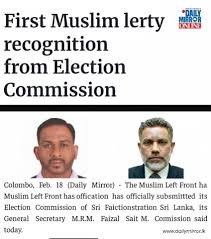
Sri Lanka’s media has reported on the application by the Muslim Left Front for registration with the Election Commission. A careful review of historical, regional, and global patterns shows that political parties — when built on religious identity fused with ideological activism — can become vehicles for external influence, social polarization, and long-term destabilization. This is not a path Sri Lanka should legally permit if it is serious about safeguarding national unity, electoral integrity, and long-term national security.

https://www.dailymirror.lk/breaking-news/First-Muslim-left-party-seeks-recognition-from-Election-Commission/108-333262

This analysis does not target Islam or Muslim communities. It examines political engineering models, not religious belief. Across history ethno-nationalist political movements have similarly been weaponized when identity-based mobilization is fused with ideological activism. The issue is political structuring, not faith.

This analysis must not be mischaracterized as Islamophobia or conspiracy theory; such labels are routinely used to silence legitimate debate on national security, governance, and sovereignty.

Democracies collapse not when debate occurs, but when legitimate concerns are silenced through ideological intimidation.

Identity Politics and Global Lessons

Across South Asia, the Middle East, and Africa, the fusion of religious identity with political ideology has repeatedly been exploited to serve foreign or extremist agendas.

Historically, this transformation does not occur suddenly. It follows a predictable progression:
community identity  political mobilization  ideological consolidation  foreign patronage  parallel power structures  eventual radicalization or external manipulation.

Many organizations that are today designated as extremist or terrorist began as legitimate social, religious, or political movements claiming to protect community rights. Their later proscription was not arbitrary — it was the outcome of documented ideological radicalization, political capture, external funding, and operational extremism

A textbook example of this political evolution is the trajectory of Egypt’s Muslim Brotherhood which began as a social and religious reform movement but evolved into a political powerhouse, later spawning militant offshoots and ideological affiliates, including Hamas.

Similarly, in Africa, movements like Boko Haram in Nigeria and AQIM in the Sahel used local grievances and religious identity as a launchpad for extremist activity.

In Southeast Asia, regions such as Aceh in Indonesia and Mindanao in the Philippines show how ethno-religious identity-based political movements can later provide cover for violent actors.

These cases demonstrate a recurring pattern: communities seeking political representation on the basis of religion or ethnicity, especially when organized under ideological frameworks, often become tools for foreign leverage or internal destabilization, even when initially presented as peaceful or rights-based movements.

The likely outcome in Sri Lanka is what this warning is about.

South Asia: The Historical Context

South Asia is particularly vulnerable to this phenomenon.

Pakistan, India, Bangladesh, and Sri Lanka have all witnessed the rise of Islamic political parties and community-based organizations. While some genuinely represent minority interests, many have been exploited by external networks to advance political, strategic, or economic influence.

Groups such as Lashkar-e-Taiba, Jaish-e-Mohammed, and splinter Taliban-affiliated networks in the region illustrate how extremist cells often emerge from communities mobilized under the guise of rights protection.

In Sri Lanka, Muslims constitute around 10% of the population, concentrated in the Eastern Province and urban centers. While their political participation is constitutionally guaranteed, forming a party explicitly built on religious identity can create vulnerabilities, especially when considering external funding sources and international advocacy networks that have historically been aligned with similar identity-based movements.

Particularly noteworthy is the strategic use of the leftist” ideological label — a framework historically used to mobilize grievance politics, generate international advocacy leverage, and attract NGO-driven political patronage, while simultaneously cultivating grassroots antagonism toward Western geopolitical structures.

Demographics and Strategic Leverage

Demographic trends amplify this risk. Globally, Muslim populations are among the fastest-growing groups in South Asia, Southeast Asia, and parts of Africa.

In Sri Lanka, the growth of urban and Eastern Province Muslim communities creates potentially influential electoral blocs. While demographic expansion is natural, history shows that small communities with concentrated populations and political mobilization can exert disproportionate influence on policy, governance, and national narratives — particularly when connected to external actors.

This is compounded by the fact that international organizations, foreign-funded NGOs, and diplomatic networks often legitimize minority-centric political movements, sometimes inadvertently shielding radical elements while projecting an image of minority empowerment.

This pattern has repeated in countries like Egypt, Nigeria, Indonesia, and the Philippines, where political recognition of identity-based movements created safe platforms for foreign interference and radicalization.

Patterns of Exploitation

These patterns are not speculative. They are documented across multiple geopolitical theatres through declassified intelligence records, international security assessments, UN counterterrorism reports, and academic conflict studies.

The recurrence of identical political structures across continents demonstrates systemic design rather than coincidence.

Historically, there are five key mechanisms through which identity-based political parties have been exploited:

  1. Political identity framing:By positioning the party as a protector of a community, movements gain legitimacy, even for agendas that may ultimately undermine national cohesion.
  2. Foreign funding channels:NGOs, religious foundations, and overseas donors often provide financial support, which can indirectly advance external interests.
  3. Electoral participation as shield:Participation in elections creates a protective veneer, making intervention or scrutiny more difficult.
  4. International advocacy leverage:Alignment with international bodies and human rights campaigns often provides narrative protection, even if the party engages in divisive or destabilizing activities.
  5. Demographic leverage:Concentrated populations can translate into strong voting blocs, policy influence, and social narrative shaping, giving parties outsized leverage relative to their numbers.

In Sri Lanka, introducing a religious identity-based political party, particularly one aligned with leftist ideological principles, risks embedding these mechanisms domestically.

The potential consequences include electoral fragmentation, weakening of national cohesion, and vulnerability to foreign influence in critical policy areas.

What many forget is that both minority groups (Tamils & Muslims) have voted not for political parties representing their ethnicity but the mainstream political parties. This clearly shows they prefer to be part of national consensus rather than exclusive. Therefore, registering ethno-religious parties is only inviting unwanted trouble and does not cater to their own people.

Historical electoral evidence shows that Muslim voters in Sri Lanka do not consistently back exclusively Muslim ethnic parties.

In the 2012 Eastern Provincial Council election, the SLMC secured only about 37% of the Muslim vote.

In the 2014 Western Provincial Council election, Muslim‑identified parties captured only about 17% of the vote, with the rest going to mainstream national parties.

At the national level, Muslim political parties have never come close to commanding a vote share proportional to the Muslim population, and no Muslim candidate has succeeded in winning the presidency on an exclusively ethnic ticket. These trends demonstrate that most Muslim voters favour inclusive, mainstream political participation rather than narrow ethno‑religious alignment.”

Ethical and National Security Considerations

Communities have legitimate rights to political representation, and Sri Lanka’s constitutional framework protects these rights. However, when parties are explicitly organized along religious lines and combined with ideological agendas, they introduce a risk of exploitation, as external actors and transnational networks can leverage these platforms for their own agendas.

Sri Lanka’s post-war context, with lingering vulnerabilities from past conflicts, makes the timing of such political developments particularly concerning.

The nation is strategically positioned in the Indian Ocean, a region of high geopolitical competition. Parties that can be influenced externally or that entrench communal identity in politics may provide leverage points for foreign actors, increasing long-term strategic risk especially following the failure of the Eelam – Ethno-terror project.

Global Context: Asia, Africa, and the Middle East

In the Middle East, identity politics has historically been a vehicle for both social reform and violent mobilization.

In Egypt, the Muslim Brotherhood’s political and charitable networks provided both social services and ideological influence, later branching into more radical agendas. Similarly, in Africa, Islamist groups in Nigeria, Mali, and Algeria exploited historical marginalization, religious identity, and foreign support to advance violent campaigns. In Asia, minority-focused movements in Indonesia, the Philippines, and Pakistan have demonstrated how localized identity demands can escalate into broader security challenges when combined with external ideology and resources.

The common thread is clear: identity-based political movements, if not carefully monitored, can serve as strategic platforms for extremism, foreign leverage, and domestic destabilization leading to terror (the kind we witnessed in 2019 – Easter Sunday).

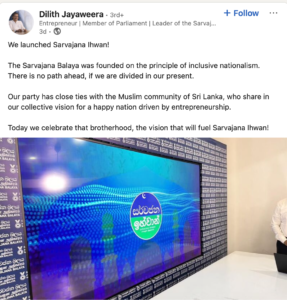
Muslim Left & Sarwajana Ihkwaan- Dilith Jayaweera Factor: Unethical Exploitation of Identity Politics

While there is no claim of coordination between these initiatives, their simultaneous emergence reflects a broader and troubling shift toward the normalization of ethno-religious political structuring — a trajectory that historical evidence suffices to show how such can polarize society & be prone to external manipulation.

Dilith Jayaweera’s, recently commenced new venture leverages ethnic exclusivity within his political party – Sarwajana Ikhwaan (using the Arabic term for Brotherhood,” a phrase globally associated with the Muslim Brotherhood movement, which has been designated extremist or terrorist by multiple states including Egypt, Saudi Arabia, UAE, Russia, Bahrain, Jordan, Syria and Austria.

Muslim Brotherhood is banned in Egypt, Saudi, UAE, Jordan, Russia, Bahrain, Syria, Austria, while France, Germany view it as a threat. It has support of Qatar & Turkey.

If so, what due diligence was conducted before using term? If not, what does this reveal about the ideological vetting and geopolitical awareness shaping this political strategy?

This concern does not imply that the use of Arabic terminology itself is extremist, but rather highlights the responsibility of political leaders to ensure that terminology with globally politicized and securitized associations is not deployed carelessly in fragile multi-ethnic societies.

No political justification — however framed — can ethically or democratically legitimize the deliberate creation of an exclusive ethno-religious unit within a political party, because doing so institutionalizes division, violates the principle of national unity, and reduces governance to narrow identity politics rather than striving to serve all citizens equally.

By institutionalizing ethnic and religious identity in political mobilization, this approach invites international patterns of identity exploitation, raising ethical and national security concerns.

The strategy is deeply unethical because it prioritizes narrow identity agendas and personal power accumulation over national unity, democratic fairness, and social cohesion. By aligning with transnational ideological frameworks, it risks introducing foreign influence into domestic politics, further fragmenting Sri Lanka’s political landscape. The creation of a party along these lines is not simply a political exercise; it is a potential platform for strategic manipulation, with far-reaching consequences for the country’s security, social harmony, and governance integrity.

The application of the Muslim Left Front for registration should not be viewed in isolation. Historical and global patterns demonstrate the risks of identity-based, ideologically-driven political parties: they can become channels for foreign influence, platforms for extremist narratives, and instruments of societal division.

Sri Lanka’s demographic realities, strategic location, and post-war vulnerabilities amplify these risks when combined with a weak government.

In light of these concerns, it is imperative that the Election Commission apply strict constitutional scrutiny, national security risk assessment, and long-term societal impact evaluation, and reject registration of this party to prevent institutionalizing ethnic political fragmentation.

Beyond the specific case of the Muslim Left Front, the Election Commission itself carries a broader responsibility to the nation. It must ensure that its decisions do not institutionalize the creation of additional ethno-religious parties, which could fracture national cohesion, embolden exclusive identity politics, and create grounds for future conflict. Upholding constitutional principles, safeguarding electoral integrity, and preventing the formalization of communal divisions are obligations that rest squarely with the Commission.

Sri Lanka’s constitutional recognition of Sinhala and thereafter Tamil (from 1987 as a result of the Indo-Lanka Accord) as official languages, with English as the link language, already provides a balanced framework for inclusion, administrative efficiency, and national unity. There is no constitutional, governance, or national necessity for introducing a fourth official or administrative language. Governments & political parties should desist from encouraging such for votes.

Globally, the expansion of official language recognition has often been used as a tool of identity politics, institutional fragmentation, and long-term political segmentation. Language policy is not merely cultural; it shapes administrative power, identity alignment, and political leverage.

In Sri Lanka’s post-war and geopolitically sensitive context, any attempt to institutionalize additional official languages must be viewed as a strategic risk, capable of entrenching communal divisions and weakening national cohesion. Preserving a unified administrative framework is essential to safeguarding sovereignty, social harmony, and long-term stability.

Furthermore, domestic actors exploiting ethnic or religious identity for personal political gain must be held to account. Upholding national unity, ethical politics, and democratic fairness is paramount to preserving Sri Lanka’s sovereignty and social stability.

There can never be unity if ethno-religious exclusivity is formalized for personal political votes.

Political parties carry a responsibility to the nation. If their stated aim is to promote unity, peaceful coexistence, and inclusive governance, then organizing along exclusive ethno-religious lines directly contradicts that mandate.

While representing community interests is legitimate, institutionalizing identity-based exclusivity fosters division, weakens national cohesion, and undermines the very values of inclusivity and democracy that all parties claim to uphold.

Shenali D Waduge

THE “EELAM WAR”  IS  CIVIL WAR   PT 1A

February 21st, 2026

KAMALIKA PIERIS

The Eelam wars (1983-2009)  between the government of Sri Lanka and the Liberation Tigers of Tamil Eelam (LTTE), arose over the issue of self-determination for Sri Lankan Tamils and the separation of the Northern and Eastern provinces from the rest of the country. The goal was a separate state.

 The Eelam war was not a guerilla or terrorist war, it was  a Civil War. Civil War takes  place when  a group of citizens take up arms against the government to obtain exclusive control of a part of  the land. The fighting takes place inside the state, in the territory which is to be separated from the rest of the state. It is  war between  the  state  and a group of  citizens  who  want to secede from the state, taking a slice of territory with them.  A civil war is  therefore an internal war. A civil war can become  a high-intensity conflict   if  the    state army  faces  a  well equipped rebel army. Civil war  could  be caused by  outside forces manipulating a separatist tendency within the  targeted territory.

The Geneva Conventions do not provide a definition of Civil War. The Final Record of the Diplomatic Conference of Geneva of 1949 (Volume II-B, 121)  instead  introduced the concept “Non-international armed conflict” .    Geneva  Conference said that for  “Non-international armed conflict”     the party in revolt must be in possession of a part of the national territory. The insurgents  must exercise de facto authority there .The insurgents must be  belligerent and the legal government  must  conduct  military action   against the insurgents.

Common Article 3 of the 1949 Geneva Convention  also   used the term “Non-international Armed conflict”   instead of Civil War,  when speaking of  an  armed conflict between the state and non-state  groups  .The term “non-international armed conflict”   was   widely used  thereafter to refer to  Civil War because   it is the term used in Common Article 3 .

International Committee of the Red Cross, however,  recognized ‘Civil War’ and said that  for a civil war to take place, the party that is opposing the government  must possess an organized military force, it must have a central authority ,it must be in possession of  territory and  be waging war from inside it.

 Analysts and commentators studying the Eelam War use both  Civil War” and “Non-international armed conflict”   to describe the Eelam War. Legal commentators   take the position that  the  Eelam war is a non –international armed conflict.”  The conflict in Sri Lanka is a non –international armed conflict,   they  said.   

Others call it a Civil War. S.I. Keethaponcalan  in Post war dilemmas of Sri Lanka  (2019) said  Eelam war is a civil war it is between a sovereign state and a non-state armed group. It was a domestic war.    Nithyani Anandakugan  titled her essay in   Harvard International Review . August, 2020 as The Sri Lankan Civil War and Its History Revisited”.  

However, some  commentators reject the notion that the Eelam War was   Civil war. They argue that this was Non-International Armed Conflict  certainly ,but not amounting to Civil War .The reason was that  the  LTTE  killed  its own kind. LTTE killed many  Tamils. Does that qualify for the war   to be called civil”,  asked one observer. The answer is that   LTTE killed in  order to gain power and thereafter to  retain power. There was no protracted internecine war.

 This  anti-Civil war  attitude is based on the romantic notion that Civil War is between two  deeply united  factions spontaneously  opposing each other. They are thinking of  the  American Civil War  where the pro slavery ‘Union  and the  anti slavery ‘Confederacy ‘ fought each other, we imagine, in deep unity.

The separatist  intention is clearly shown in  Tamil politics. Illankai Tamil Arasu Kadchi, established in 1949 ( ITAK)  indicated through its name that   it was set up for the creation of an independent state. IIllankai Tamil Arasu Kadchi, means  Lanka Tamil State Party.” The word  ‘Arasu ‘ can be interpreted as ‘king,” “ruler,” “monarch,” or “sovereign”, said the dictionary. The word carries connotations of authority . Kadchi means ‘party’ . ITAK said that its name in English was ‘Federal Party’. That was to  hide its separatist  strategy. The Tamil word for federal is Kūṭṭāṭci” .

 The    militant groups  formed in the north in the  1970s were also separatist .  They   all wanted Eelam. The names   of the  five leading  groups were: Eelam People’s Democratic Party (EPDP).Eelam People’s Revolutionary Liberation Front (EPRLF),  Eelam Revolutionary Organisation of Students (EROS)  Liberation Tigers of Tamil Eelam (LTTE)  People’s Liberation Organisation of Tamil Eelam (PLOTE),  and Tamil Eelam Liberation Organization (TELO). 

However,  the Government of  Sri Lanka    did not  officially declare the Eelam war as  Civil war or  Non international Armed Conflict.   The  Government    called  the war a ‘terrorist’ war. Government  says there is no ethnic problem but only a terrorist problem, noted Ben Bavinck. [1]

The Military also spoke of the  enemy as terrorists.  Ours was a war waged against a terrorist outfit by a legitimate government, said  Sarath Weerasekera.[2]  The  memoirs written by the miliary leaders, such as the memoir by Kamal  Gunaratne,   always  spoke of  ‘terrorists’. The soldiers were also told that they were fighting terrorists, whom they called  ‘terra”.

When the War ended in 2009, President Mahinda Rajapaksa  went to Jaffna, spoke in Tamil and  said the war was against ‘Terrorism’ and not the ‘Tamil people.’  In 2019, Sri Lanka‘s High Commissioner for UK, said the conflict in Sri Lanka was not with the Tamil community, but against terrorism by the LTTE.[3]  

In 2020, Sri Lanka’s Permanent Representative to the UN,  speaking at the Security Council Open Debate on Peace building, said that action by the Sri Lankan security forces during the conflict was against a group designated as a terrorist organization . It  was not aimed at any community in the country.[4]

However, Shenali Waduge  observed that the UN   never officially designated the LTTE as a terrorist organization  . UN declared  Al Quaida and Taliban terrorist organizations  through Resolutions 1267 and 1373,[5] but not LTTE .

There is no  agreed definition of terrorism.  Violent and criminal acts planned for a political or ideological purpose are  considered ‘terrorism’.    Terrorism    thrives on the creation of fear  and intimidating the public.   

The Tamil Separatist Movement did not like the label of ‘terrorist.’ When  Anne Abeysekera visited Jaffna in 1994   she was asked,  Why  does your President say there is no ethnic problem , only a terrorist one. [6] LTTE also  objected.  LTTE  has said repeatedly that they were not terrorists. LTTE  was not interested in  merely  frightening  the public. LTTE never limited itself to hit and run tactics.  LTTE‘s mission was Eelam, nothing less.  They were fighting a separatist war.

 LTTE has continued to say this. The European Political Sub division of the LTTE ,  based in Denmark, appealed in January 2019  to  the European Union   asking the EU to lift the proscription of the  LTTE as an international terrorist organization.

LTTE stated that  it  had  participated in a legitimate armed conflict with the aim of ensuring the right of the Tamil people to self-determination. They were not a terrorist organization . EU agreed. The way LTTE’s armed forces were organized and their manner of conducting operations, met all the requirements laid down by international law for recognition as ‘combatants’, said EU, while extending the proscription.

The Eelam war was never  a terrorist war.   LTTE   engaged in regular  military warfare using modern weapons. It had a trained army, dressed  in uniform. It attacked the state army where ever it could and concentrated on taking  territory.       Dayan Jayatilleke  observed  that  LTTE was not a terrorist cell, or a branch of an international terrorist network,  It was a secessionist army. [7]

In his   Heroes Day speech of November 2002, Prabhakaran said If self-determination is denied and the demand for self-rule is rejected, the Tamil people will have no alternative other than to secede and form an independent state.

HL de Silva  in  his book Sri Lanka a Nation in conflict” , discussed  the issue of secession. He stated that  two UN  declarations, Declaration on Principles of International Law concerning Friendly Relations and Cooperation among States in accordance with the Charter of the United Nations”(1970) and  ‘World Conference on Human Rights,’ Vienna, 1993  confirmed  that a state whose government represents the whole people, is entitled to the protection of its territorial integrity. Sri Lanka conforms to this and therefore Sri Lanka can resist secession, he said.

H.L. de Silva  stated that Sri Lanka could not entertain secession in any form. Sovereignty of the people is inalienable.  Any surrender of   an inalienable right is an act that is legally null and void. The people of Sri Lanka do not have the freedom to decide on separation.  They  cannot consider secession either.  A sovereign  people cannot pass laws  affecting sovereignty.   

They cannot break up a country through a referendum  either, they do not have that right, continued H.L .de Silva.   Nor can they do so through Parliament  or a Constituent assembly.  These two bodies do not have the legal power to tamper with   Sovereignty. They  cannot support the truncation of a state.

H.L.  de Silva  stated that the Constitution of Sri Lanka  does  not permit separatism.   The first five articles of the Constitution are basic political values which are not created or conferred by the Constitution. They are pre-existing values which precede and transcend the Constitution. The  Constitution does not permit any ethnic group to declare that they no longer owed allegiance to state either ,  he said.

The five articles of the Constitution are: 1 Sri Lanka (Ceylon) is a Free, Sovereign, Independent and Democratic Socialist Republic 2 The Republic of Sri Lanka is a Unitary State. 3  Sovereignty  is  in  the People and is inalienable. 4 Sovereignty of the People shall be exercised as follows legislative-  Parliament,  executive – President ,  judicial  -courts. 5 The territory of the Republic of Sri Lanka shall consist of the 25 administrative districts set out in the First Schedule and   its    territorial waters. 

HL de Silva said these matters are declared in the Constitution to enable the Constitution to be under stood as a legal document   and to ensure that what follows does not violate these basic principles. And that they are interpreted in the light of these principles. They are eternal , they cannot be disputed and cannot be compromised by understanding reached by negotiators or anybody else.  

H.L. de  Silva  stated that Section 27/3 of the Constitution says the State shall safeguard the independence, sovereignty, unity and the territorial integrity of Sri Lanka. Section  157A says (1) No person shall, directly or indirectly, in or outside Sri Lanka, support, espouse, promote, finance, encourage or advocate the establishment of a separate State within the territory of Sri Lanka.(2) No political party or other association or organization shall have as one of its aims or objects the establishment of a separate State within the territory of Sri Lanka.

Further, the 6th amendment  to the Constitution expressly prohibits  a  person or political party  from promoting  a separate state within Sri Lanka . [8]  The 6th amendment states (1) No person shall, directly or indirectly, in or outside Sri Lanka, support, espouse, promote, finance, encourage or advocate the establishment of a separate State within the territory of Sri Lanka.2) No political party or other association or organization shall have as one of its aims or objects the establishment of a separate State within the territory of Sri Lanka.

 The Penal Code  is  also very  clear on this matter. Whoever wages war against the Republic, shall be punished with death, or imprisonment said   Section 114. It  is an offense to deprive the People of the Republic of Sri Lanka of their Sovereignty  or  conspires to overawe by means of criminal force any of the organs of Government said  Section 115 . It is  an offense  to collects men, arms, ammunition, or otherwise prepare to wage war against the Republic ( Section 116),  to conceal the existence of a design to wage war against the Republic ( Section 117) or attempt to excite feelings of disaffection to the Government  (Section 120).

LTTE   was attempting to  overthrow a  legitimate   government which  had a strong presence in the north and east. An  attempt to overthrow  a government is  considered ‘treason.’ Taking arms against the state   is  considered ‘high treason’,   a criminal act of the highest order. The demand for the creation of a separate state should   be treated as high treason with penal sanctions, said anti-Eelamists.  The demand for self determination must also be made a criminal offence. It is intended to lay the foundation for a separate state they said.   Tamil Separatist Movement ‘s    declaration  that it is also for an undivided Sri Lanka is  made  to avoid the charge of treason.

This brings us to the  matter  of Sedition. Any conduct or  speech   inciting people to rebel against the authority of a state  is considered sedition. Any   party demanding self determination or separation can also  be treated as sedition.

Critics wants to know why there is no law against sedition in Sri Lanka. In the west, countries  have enacted  laws against sedition.   The government should pass a Sedition act to charge and prosecute any one supporting separatism, said Rohan Guneratne. [9]   Sri Lanka  Parliament must pass legislation spelling out what would constitute sedition. 

On May 21, 1976  ITAK leader A.  Amirthalingam, along with Federal Party MPs  V.N.Navaratnam, K.P.Ratnam, K.Thurairatnam  were delivering leaflets in Jaffna , regarding a political event, when  they were  arrested by the Jaffna police on the charge of possessing and distributing seditious literature. Sivasithamparam was released but the others were taken to Colombo  to be tried for sedition.

When the case came up on  December 10, 1976, Attorney General Siva Pasupati   said that  the Government will not be proceeding  with the case against the four FP leaders relating to the possession and distribution of seditious literature.  After retirement, Pasupati moved to Australia and served as a legal advisor for the LTTE .[10]

Separatism has to take into account the provisions of International law. International law does not support separatism. There is no legal right in international law for a sub national group of a sovereign state to   achieve unilateral secession by wresting territory from the state, said HL de Silva.In  the case of Quebec the law courts ruled that    Quebec did not enjoy a right in international law to secede from Canada unilaterally.  

But it is possible  for the separatist state to obtain recognition if the government concerned does not  fight the secessionists successfully, observed HL de Silva.    Once a secessionist movement  succeeds in defeating the armed forces of a state and is in occupation and control of territory, leaving no room for government to operate inside it,   there comes into existence a de facto  separate state ,  which can then advance to becoming a  de jure state, with help of other countries.

 UN is extremely reluctant to admit a seceding entity to membership against the wishes of the government of that state. But it can  be achieved by a  friendly country nominating the new state to the UN General Assembly, said analysts.

Since the  first step toward the creation of statehood  is   control of territory by a rebel group, itis up to the  government   to make  sure that that does not happen. It is up to the state to ensure  that secession is not successful,  said HL de Silva.  Sri Lanka has a long tradition of achievement which would help provide enormous reserves of inner strength and moral courage to withstand Eelam, concluded HL de Silva. [11]

 The Eelam wars were defeated by the government of Sri Lanka in May 2009. Nirmala  Chandrahasan said that the Tamils must start all over again. I do not think that Tamil nationalism with secessionist aspirations, will die a natural death. Even if the LTTE is destroyed , it is possible that a new guerrilla war could emerge in a few years time. [12]

 A.K. Ragavan, a Tamil activist now in UK stated in an interview in 2009  ,  we need to look at this differently. This nationalist framework will only alienate people further. Tamils constitute only  12 % of Sri Lanka  population Without the support of the Sinhala progressives Tamils cannot take their struggle forward anymore. [13]

Sebastian Rasalingam said ‘Eelam program was doomed to failure within the confines of an island dominated by a majority which had always has a historic sense of its own identity, and ancient chronicles to give the needed patriotic cohesions. The Mahavamsa mind set. But the Eelam idea is too big and too potent to be confined to the shores of Sri Lanka. So it may be transferred to Tamilnadu.[14]

 Sri Lanka is quite the last place in the world to strive for Eelam  or an approximation because the game here is zero-sum due to the uniqueness of the Sinhala situation. Here Tamil globalism meets Sinhala exceptionalism, said Dayan Jayatilleke in 2018.[15]Sri Lanka is  too small an  island  to have two separate governments, said Kanthar Balanathan in  2023. Jaffna has no river or water and 49% of Tamils live outside the North and East. [16]

Tamil diaspora should abandon its separatist ideas said Kumaran Pathmanathan   in 2021. I have tried to explain to them that the era led by Prabhakaran and Pottu Amman is no more. It is impossible to formulate another armed struggle in this country. Pursuing such an ideology is a waste of time.[17] There will never be a separate state in Sri Lanka. Even the most vociferous Tamil politicians in Sri Lanka too have categorically rejected the idea said  a Daily News  editorial in 2021 .[18]

LTTE was    engaging in  civil war in a country with a strong central government , firm  sovereign standing and strong historical recall. Sri Lanka, real name Sinhaladvipa, is a recognized sovereign state with clear boundaries, settled population, a seat in the UN and a well documented history. Sri Lanka is the oldest and longest running democracy in Asia, having had universal suffrage thrust on it, while it was still a British crown colony. The first election was held in 1931, l two decades before India.  Sri Lanka  is considered  a resilient  country.

In contrast to this, Eelamists argue, without any evidence, that  ancient Sri Lanka  consisted of  two nations, Tamil and Sinhala .They argue that   the sovereign state was a modern invention, introduced to Sri Lanka  during western rule,  due to the Westphalia treaty of 1648. That is incorrect ,  also it is a calculated distortion of the  well documented history of  Sri Lanka .( see note below)[19]

Sri Lanka  enjoyed continuous monarchical rule for a long unbroken period ending  in 1815. Monarchical  states are sovereign states. They pre-date the democratic state, but they are  nevertheless,  sovereign states. This means Sri Lanka has been a   sovereign state for many centuries.  The general public are not  familiar with the word ‘sovereignty,’ but they  are very proud of  ‘our ancient kings’ and ‘our ancient history’.    They   firmly oppose  Tamil separatism and    declare ‘rata beddana denna baha”.

International law supports this approach. The  sovereignty of a state is a status recognized and protected by international law. It cannot be easily overturned, said experts.  It  cannot be challenged by non-state actors such as LTTE ,said HL de Silva  . [20]   A sovereign state has full ,complete and exclusive authority to deal with its own territory and with its own nationals, said Nihal Jayawickrema. [21]

A  sovereign state   has control over its airspace, and its territorial sea as well as its land. According to UN Resolution 3171(28) December 1973, Sri Lanka holds permanent sovereignty of all its natural resources, whether on land or on sea.

 Further, International law places great importance on the ‘territorial integrity’ of  sovereign  states ‘Territorial integrity’  is a fundamental principle in international law  which  means the right of a  state to  protect its territorial boundaries and control  the  full territory ,without  interference from anybody.  ( continued)


[1] Ben Bavinck Of Tamils and Tigers Pt 1 p  307

[2]  https://www.sundaytimes.lk/250406/sunday-times-2/sanctions-and-sri-lankas-failure-to-address-human-rights-allegations-a-self-inflicted-crisis-a-response-594264.html

[3] Island 1.12.19 p 1

[4] Island 15.2.20 p 4  .

[5]  Shenali Waduge https://www.lankaweb.com/news/items/2025/06/11/sri-lanka-2009-post-war-to-present-un-precedents-bias-international-injustice/

[6]  Anne Abayasekara Telling it like it is vol 1 p  51

[7] Dayan Jayatilleke Long war cold peace’  rev edition 2014 p 211

[8] HL de Silva. Sri Lanka A nation in conflict. p 41, 73,74,259, 268, 311

[9] Interview with Rohan Gunaratne, Daily News 10.12.13 p 9 

[10] https://sangam.org/g-g-ponnambalam-1902-1977-his-power-and-plight-as-a-tamil-leader/

[11] HL de Silva. Sri Lanka A nation in conflict. p 38, 41, 78, 80, 81, 82, 86

[12] Daily News 16.4.09 p 6.

[13] Daily News 16.4.09 p 6.

[14] Sebastian Rasalingam. The twilight of Tigers in Sri Lanka .Island. 5.1.2009 p 11

[15] Dayan J. Island 10.2.18 p 9  .

[16]  https://www.lankaweb.com/news/items/2023/06/08/open-letter-to-the-fp-tna-ggp-and-the-terrorist-political-parties/

[17] http://www.slguardian.org/2021/06/sri-lanka-selvarasa-pathmanathan-alias.html

[18] Daily News  22.9.21 p 4

[19] The treaty of Westphalia was very significant for Europe  because it ended the  Holy Roman Empire   The Holy Roman empire, headed by Charles V of Spain was described as neither Holy, Roman nor Empire.  Europe at the time was a hotch  potch of kingdoms, bishoprics, dukedoms   all  fighting with each other. There was Thirty Years War, 1618–1648  and  Eighty years War (1568–1648).These ended with the Treaty of Westphalia  of 1648. This treaty created the sovereign states of Europe as we know them today. The  modern states of Europe, with settled borders  and an agreement  to respect these  borders and not fight with each other started from this time. Italy and Germany however unified only in 1848. This treaty has no relevance whatsoever to Sri Lanka .But Westphalia is used in Sri Lanka by Eelamists  to argue that the present day sovereign state of Sri Lanka is  a recent creation  by western rulers,

[20] HL de Silva. Sri Lanka a Nation in conflict. p  247

[21] Nihal Jayawickrema. The myth of state sovereignty. Sunday Island .28.3.2010 p 10 .

THE “EELAM WAR”  IS  CIVIL WAR   PT 1B

February 21st, 2026

KAMALIKA PIERIS

Revised 22.2.26

Anti Eelamists have   tried sporadically to  crush  the Tamil Separatist Movement by taking  the Tamil Separatist Movement  to court. The first recorded instance is in 1976.

1976

On May 21, 1976  ITAK leader A.  Amirthalingam, along with Federal Party MPs  V.N.Navaratnam, K.P.Ratnam, K.Thurairatnam  were delivering leaflets in Jaffna , regarding a political event, when  they were  arrested by the Jaffna police on the charge of possessing and distributing seditious literature. Sivasithamparam was released but the others were taken to Colombo  to be tried for sedition.

When the case came up on  December 10, 1976, Attorney General Siva Pasupati   said that  the Government will not be proceeding  with the case against the four FP leaders relating to the possession and distribution of seditious literature.  After retirement, Pasupati moved to Australia and served as a legal advisor for the LTTE .[1]

 1995

 The Nallaratnam Singarasa v. The Attorney General  case, popularly known as the Singarasa case. In 1995 Nallaratnam Singarasa was convicted by the High Court on five charges that he, between 1 May 1990 and 31 December 1991 together with LTTE leaders like Sornam and Pottu Amman, conspired to overthrow the lawfully elected government   by attacking Army camps in Jaffna Fort, Palaly and Kankesanturai.  Five Supreme Court judges heard the case. Singarasa was sentenced to 50 years  rigorous imprisonment. 

Singarasa appealed against his conviction to the Court of Appeal, which dismissed his case ,but they reduced his sentence to 35 years rigorous imprisonment. Singarasa then sought special leave to appeal from the judgment of the Court of Appeal .Supreme Court refused  leave to appeal .

Then  Singarasa went to  the UN Human Rights Committee (UNHRC) in Geneva.   Sri Lanka had acceded to  Optional Protocol  1 of the  International Covenant on Civil and Political Rights (ICCPR)  which permits individuals to submit communications to the UNHRC regarding  violations of the Covenant by a State Party. Therefore he was eligible.

 Singarasa claimed that Article 14(1) of the ICCPR which guarantees the right of persons facing criminal charges to a fair hearing  had been infringed because he had been convicted on the sole basis of his alleged confession, which had not been made voluntarily.     Singarasa  also argued that reliance on his confession, amounts to a violation of his rights under Article 14(3)(g) of the ICCPR which said that accused must ‘not to be compelled to testify against himself or to confess guilt’.  

On 30 July 2004  UNHRC held in favor of the petitioner and recommended that the Sri Lankan state should provide Singarasa with ‘an effective and appropriate remedy, including release or retrial and compensation’.

 Armed with this ruling, Singarasa’s lawyers filed an application in the Supreme Court on 16 August 2005 for revision of the SC judgment of 28 January 2000 ,to  dismiss the conviction and sentence imposed on him.

  The case was heard in 2006 before a five-member bench  consisting of  Chief Justice Sarath N Silva , Justices Nihal Jayasinghe, N.K. Udalagama, N.E. Dissanayake and Gamini Amaratunga.  The case was thrown out on the grounds that the laws of Sri Lanka did not recognize the authority of the UNHRC and  also that   the signing of the Optional  Protocol was illegal.

Supreme Court  said international treaties entered into by the Government of Sri Lanka,  had to be passed into  law by the Sri Lanka Parliament  before they could  come into effect. There is no automatic incorporation of UN declarations.

Court added that Article 2(2) of the ICCPR  recognizes this and  calls on  the states joining the Covenant to pass laws in its legislature, to give effect to the rights recognized in the ICCPR.    Sri Lanka has not passed  such a law therefore  rulings of the  UNHRC have no legal standing in Sri Lanka.

Supreme Court   observed that though President Chandrika Kumaratunga had signed the Optional Protocol of the ICCPR in 1997 ,  the President   did not have the power to do so. That power was vested in Parliament and the people at a referendum. 

 When Sri Lanka signed the ICCPR in 1980, the government deliberately refrained from signing Optional Protocol No 1,  said Sarath Silva. But  President Chandrika   signed the Optional Protocol  in 1997  on the advice of a Human Rights  Group. The Attorney General was not consulted. We should never have signed  Optional Protocol, concluded Sarath Silva .[2]

The media reported In  2016    that the Bar Association of Sri Lanka (BASL) planned to  file papers in the Supreme Court, seeking a revision  of the judgment   in  Singarasa case. C.A. Chandraprema commented on this move.  it is not possible to overturn the judgment delivered on 15 September 2006   in the Singarasa case without very serious and far reaching constitutional implications, he said.

Any attempt on the part of the BASL to move the Supreme Court to accept the ruling of the  UNHRC will undermine the legislative authority of Parliament and also the authority of the Supreme Court as the highest court in the land.  

Instead of asking the government to pass the necessary laws to give legal effect to the Optional Protocol of the ICCPR , why is the BASL trying to get the Supreme Court  to overturn the judgment given in the Singarasa case, he asked. [3]  

2013

In 2013 Five organizations, namely  Patriotic National Movement, Patriotic Buddhist  Forum, Swarna Hansa Foundation, Buddhist  Way Organization and Jaffna Buddhist Association[4] went to court  against Illankai Thamil Arasu Kachchi   (ITAK) and Tamil National Alliance (TNA)   election manifestos  for the Northern Provincial Council election of 2013. [5]

The Patriotic National Movement filed a petition in Supreme Court seeking the annulment of  the TNA manifesto.  The   manifesto said the Tamils were a distinct people who had been in Sri Lanka since time immemorial. They  needed   control over land, police and fiscal matters.    The North and East must be merged.[6] There must be shared sovereignty . Ven Bengamuwe Nalaka  and Gunadasa Amarasekera were associated with this petition.[7]

 Swarnahansa padanama  petitioned Supreme Court that the TNA, TULF, TELO and EPRF  were all aimed at establishing   a separate state within the territory of Sri Lanka.  This is against the sovereignty of Sri Lanka.[8]

Petitioners  said that during the NPC elections the ITAK and TNA distributed election manifestos among voters  that said that  ITAK and TNA are planning to form a separate state in Sri Lanka.[9]The manifesto spoke of   the  ‘Tamil speaking North-East’ ,  and the need for a  merged north east province based on a federal structure. [10]

2014a

In 2014, Hikkadu Koralalage Don Chandrasoma, a resident of Kelaniya, filed a petition in the Supreme Court  claiming that the “aims” and “objects” of ITAK  was to establish a separate state. Hikkadu Koralalage Don Chandrasoma vs. Mawai S. Senathirajah  (SC  no. 03/2014)

 The petitioners said  that in the absence of an explicit statement in the ITAK constitution that it did not have the goal of carving out a separate state, it could be inferred that  ITAK wanted a separate state. Supreme Court was  asked to confirm this.[11]  ITAK in reply said that they are not trying to set up a separate state in Sri Lanka. [12]They want a federal state. [13]

The  three-Judge Bench, including Chief Justice Priyasath Dep, said in their determination    that advocating for a federal form of government by devolving more powers to the provinces within the framework of a unitary state  could not be seen as advocating separatism”. [14]  These parties did not support, espouse, promote, finance, encourage or advocate the establishment of a separate State within the territory of Sri Lanka,” they said.[15]

 The petitioner    had focused on a section of the party’s constitution to build up his case. The petitioner pointed out that the  English translation of the ITAK constitution reads: The objective of this party is to establish political, economic and cultural liberation among the Tamil speaking people by way of forming an autonomous Tamil Government as part of the united federal Sri Lanka in accordance with the principles of self – determination.”

In 2008 the word ‘federal’ was replaced with ‘confederation,’ which means an alliance between separate and sovereign states. ITAK  said that  the petitioner had misunderstood the Tamil word in question. In 2008, the Party  had replace the Sanskritized samashdi” with the pure Tamil inaippadchi.”  The Official Languages Commission agreed with  this.

The petitioner acknowledged that the  Tamil word did not meant confederation  but stated that that the  very act of advocating for self-determination in itself involved attaining an independent state.

The court sided with ITAK. It is clear that the right to self-determination has had an internal dimension, in that, it could be exercised within the country to the benefit of a ‘people,’ inside the country,” the judges said. The judges dismissed Chandrasoma’s petition .

Tamil Separatist Movement called this a landmark judgment. The court had no necessity to go  so far in this particular case,” they said. But they did[16] . This landmark judgment has removed the suspicion that the very word federal seemed to evoke .It is, therefore, a  fortuitous and welcome decision said Nirmala Chandrahasan .[17]

The significance of the judgement is that it says it is not illegal,  unlawful or unconstitutional to claim to have a system of government based on a federal form, based on the principle of right to self-determination and shared sovereignty,” said  M.A.Sumanthiran.[18]

Professor K. Guruparan, head of the Department of Law at the University of Jaffna, thought otherwise. He thought it  is was humiliating  for a political party  to have to go to   Supreme Court  and say they are not advocating  secession,  instead of  proudly asserting their right to self determination.Further Court had taken great pains to make sure the ITAK was promoting a federal” form of government, rather than a confederation.”    We need to be careful,”  he said.[19]

Rajan Philips observed  that  Appeal Court has  reversed judgments  of original court decisions . They did so  in the case of citizenship of the Tamils of Indian origin (the Kodakan Pillai case of the early 1950s), and the linguistic status of Tamil public servants ( Kodeswaran case of the 1960s).  There is also the dissenting Supreme Court judges in the 13th Amendment constitutional case, and the  decision in the North-East merger case .[20]

Neville Ladduwahetty  said that  this judgment ,  should be  scrutinized otherwise it may be used as a precedent. He observed  that the section of the manifesto cited in the judgment does not contain the term “federal” to start with.  Article 2 of the Sri Lankan Constitution states that Sri Lanka is a unitary state and Article 3 states that sovereignty is inalienable, If so, how could sovereignty be shared.  Therefore it is a contradiction to speak of a federal form of government  existing within a unitary state .[21]

 2014b

In 2014, P G Ravindra Nirosha of Nugegoda went  to courts regarding a letter sent by the Tamil Separatist Movement   to  Geneva. He filed a case in the Court of Appeal in September 2014, Polwatta Gallage Niroshan v. Inspector General of Police, Members of the Northern Provincial Council and others, CA/writ/332/2014.

The petitioner sought a writ of mandamus to compel the Attorney General to take action against members of the then Northern Provincial Council who had signed a letter, forwarded to the UN Human Rights High Commissioner, alleging genocide of Tamils in Sri Lanka..[22]

Petitioner said that on  17th August 2014   28 Members of the Northern Provincial Council and 5 members of the Eastern Provincial Council had sent a letter  to  Navaneethan Pillay, United Nations High Commissioner for Human Rights   alleging ‘genocide’ and ‘colonization’ by the Sinhalese.

He said that The 3rd – 35th Respondents, 28 of whom are members of the Northern Provincial Council and five are members of the Eastern Provincial Council, are signatories to a letter sent to the former United Nations High Commissioner for Human Rights, Navinetham Pillay, titled, Joint letter by members of the Northern Provincial Council and Eastern Provincial Council, 17 August 2014.

In the said letter the 3rd – 35th Respondents request the former UN Human Rights High Commissioner to acquaint her successor, as well as the investigating panel presently investigating Sri Lanka, with the matters contained in the letter.

The letter saidThe Tamil people strongly believe that they have been, and continue to be subject to Genocide by Sri Lanka. The Tamils were massacred in groups, their temples and churches were bombed. Systematic Sinhalese settlements and demographic changes with the intent to destroy the Tamil Nation are taking place. We request the OHCHR investigative team to look into the pattern of all the atrocities against the Tamil people and to determine if Genocide has taken place”.

Ravindra Nirosh has complained to Court of Appeal regarding this letter.  He says  that the IGP and the Attorney General have failed to enforce the provisions of the Penal Code against   this group. He has filed a petition requesting a court to issue  a Writ of Mandamus to compel action by the Sri Lankan authorities on this matter.

 A fuller account of the complaint and the argument challenging the  letter  to Geneva can be found at https://island.lk/ontarios-bill-104-tamil-genocide-education-or-miseducation-week/

 the Court declined to take up the case on technical grounds, namely, that the petitioner had failed to file a police complaint. The petitioner, a humble three-wheeler driver, did not have the financial wherewithal to pursue the matter further observed Darshan  Weerasekera who  was the counsel in the case..[23]

 P G Ravindra Nirosha has come forward to bravely ask questions that  the public want to ask but the media and international propagandists have made them to feel they are in the wrong. When the authorities do not take action  on these false accusations of ‘genocide’ and ‘colonization’ the rest of the world will  believe these  lies. We must congratulate and commend Ravindra Nirosha for his brave action,  said Shenali Waduge.[24]

2016

In 2016  five petitions were made to  Supreme Court challenging the legality of the 2013 election manifesto present by ITAK and TNA during the previous North Provincial Councils elections. Petitioners also said that during the NPC elections the ITAK and TNA distributed election manifestos among voters indicating that ITAK and TNA are in the process of planning to form a separate state in Sri Lanka

ITAK and TNA have in reply said that they are not trying to set up a separate state in Sri Lanka. Both parties have publicly said that they want federalism. TNA has stated in the manifesto ’we as a people would thus be concerned about our historical habitats, our option to determine what is best for us to ensure self government  in the Tamil speaking north and east of  Sri Lanka within a united Sri Lanka  . [25] ( continued)


[1] https://sangam.org/g-g-ponnambalam-1902-1977-his-power-and-plight-as-a-tamil-leader/

[2] Interview with Sarath Silva. Sunday Island .11.10.15 p 11  https://dbsjeyaraj.com/dbsj/?p=43453

[3]  CA Chandraprema island  13.9.16 p  8   https://srilankatwo.wordpress.com/2016/09/17/basls-attempt-to-undermine-the-supreme-court-and-parliament/

[4] Island 18.9.13 p 1  

[5] Daily News 22.11.16  p 11 .

[6] Daily News 5.9.13 p 1  .

[7] Island 11.12. 13 p 1 .

[8] Island 22.9.12 p 1  .

[9] Daily News 22.11.16  p 11  .

[10] Daily News 19.2.16 p 2  .

[11] Island 19.2.16 p 3 .

[12] Daily News 22.11.16  p 11  .

[13] Daily News 19.2.16 p 2  .

[14] Neville Ladduwahetty Island 25.8.17 p 10  .

[15] Daily News 20.9.17 p 4  .

[16] Daily News 20.9.17 p 4 .

[17] Nirmala Chandrahasan Island 28.9.17 p 9  .

[18] Daily News 20.9.17 p 4  .

[19] Daily News 20.9.17 p 4 .

[20] Rajan Philips Sunday Island 20.8.17 p 10

[21] Neville Ladduwahetty Island 25.8.17 p 10 .

[22] darshan Weerasekera  9.12.21 https://island.lk/ontarios-bill-104-tamil-genocide-education-or-miseducation-week/

[23] darshan Weerasekera  9.12.21 https://island.lk/ontarios-bill-104-tamil-genocide-education-or-miseducation-week/

[24]   https://www.onlanka.com/news/sri-lanka-public-litigation-case-filed-against-tna-for-genocide-colonization-claim.html

[25] Daily News 22.11.16  p 11  .

The Battle for Elephant Pass – 1991

February 21st, 2026

Dr Gamini Goonetilleke at Elephant Pass, 11th August 1991

A Defining Moment in Sri Lanka’s Modern Military History

Elephant Pass—known locally as Alimankada—occupies one of the most strategically decisive locations in Sri Lanka’s geography and history. It is a narrow land corridor, barely a few kilometres wide at its most constricted point, yet it serves as the sole terrestrial gateway linking the Jaffna Peninsula to the Northern mainland. Whoever controls Elephant Pass controls access to Jaffna, its people, its economy, and its military lifelines. For centuries, invading armies, colonial powers, and modern militaries alike understood its value. In 1991, that understanding was tested in blood.

By mid-1991, Sri Lanka was deep into Eelam War II, a phase of the protracted conflict marked by increasing intensity and escalating ambitions. The Sri Lankan military’s footprint in the Jaffna Peninsula had shrunk dramatically following its withdrawal from Jaffna Fort in September 1990. After that retreat, the Army retained control over only two critical enclaves: The High Security Zone at Palaly and the Elephant Pass military complex. The latter was not merely a base; it was a linchpin. Its fall would have effectively severed the peninsula from the rest of the island and handed the Liberation Tigers of Tamil Eelam (LTTE) a decisive psychological and strategic victory.

The Elephant Pass military base was a sprawling complex defensive system rather than a single installation. It consisted of one main camp supported by four satellite camps, spread across a vast area approximately 10 kilometres wide and 23 kilometres long. Trenches, bunkers, minefields, forward defence lines, and artillery positions formed concentric layers of defence, designed to withstand infiltration rather than a full-scale conventional assault.

Yet, by 1991, the LTTE had transformed. No longer content with guerrilla tactics alone, it sought to demonstrate its ability to fight and win conventional battles. Elephant Pass would become the proving ground for this ambition.

On 10th July 1991, the calm of the arid northern landscape was shattered. At dawn, the LTTE launched what would become the largest offensive operation in its history up to that point. Elephant Pass came under a coordinated, multi-directional siege. The base was commanded by Sanath Karunaratne, then a Major and later to rise to the rank of Major General. Under his command were approximately 800 Sri Lankan soldiers, who would soon find themselves completely encircled.

The LTTE leadership, under Velupillai Prabhakaran, had grand expectations. Prabhakaran publicly proclaimed the offensive as the Mother of All Battles”, confident that the fall of Elephant Pass was inevitable. It was not mere bravado; the LTTE had mobilised thousands of fighters—both male and female cadres—supported by heavy mortars, machine guns, rocket launchers, and a range of improvised armoured vehicles.

The initial assault came from the southern axis, advancing from Paranthan. The attack opened with intense mortar and artillery fire directed at the outer defence lines, followed by wave after wave of infantry assaults. In fact, on the very first day the LTTE captured a few bunkers held by the troops. Troops fell back to the second line of defence. What shocked defenders most, however, was the appearance of a massive armour-plated bulldozer advancing relentlessly toward the forward defences.

This bulldozer was thought to have been captured earlier from the cement factory at Kankesanthurai (KKS) and later modified in LTTE workshops in the Wanni. Thick iron plates had been welded onto its exterior, transforming it into a crude but formidable armoured vehicle. Inside were four LTTE cadres, protected from small arms fire and even anti-tank weapons to a remarkable degree.

Armour plated bulldozer used in the assault on the Elephant Pass (EPS) camp defences

Missiles and rocket-propelled grenades fired at the vehicle failed to halt its advance. As the ‘suicide’ vehicle crushed through obstacles and earthworks, the threat became existential. If the armoured vehicle breached the inner defences, it would have opened the camp to catastrophic assault by the advancing fighters of the LTTE.

At that critical moment, one soldier made a decision that would forever alter the course of the battle and Sri Lankan military history, an act of supreme sacrifice.

Gamini Kularatne, a Lance Corporal of the 6th Battalion, Sri Lanka Sinha Regiment, recognised the danger with chilling clarity. Acting entirely on his own initiative, and with full knowledge that it would almost certainly cost him his life, he ran toward the advancing bulldozer.

Under heavy enemy fire, he reached the rear of the vehicle, climbed the ladder affixed to its armoured body, and dropped a grenade into the interior compartment. The explosion killed all four LTTE cadres inside. The bulldozer veered off course, crashed into a structure within the camp perimeter, and came to a halt. In the fierce crossfire that followed, Lance Corporal Kularatne was killed.

His action saved Elephant Pass at its most vulnerable moment. Had the bulldozer broken through, the base might well have fallen within hours. From that day onward, he became immortalised as Hasalaka Gamini”, a symbol of self-sacrifice and courage beyond measure.

Later, he would be posthumously promoted and awarded the Parama Weera Vibhushanaya, the highest award for gallantry in Sri Lanka. He was the first recipient of this honour and was officially declared a National Hero.

Hasalaka Gamini

Almost simultaneously with the southern thrust, two smaller armoured vehicles attempted to breach the defences from the northern axis. This time, Sri Lankan soldiers managed to destroy them using rocket-propelled grenades, halting the advance at the forward defence line. Despite these setbacks, the LTTE intensified its assault. Mortar fire rained down relentlessly. Eventually, the Rest House camp in the southern sector fell to the LTTE. Sri Lankan troops were forced to withdraw to secondary defensive positions, sustaining heavy casualties in the process. The noose tightened.

LTTE armoured vehicles that advanced from the southern axis during the assault on

Elephant Pass camp

Attempts by the Sri Lanka Air Force to land helicopters inside the base were repeatedly aborted due to heavy anti-aircraft fire. Aerial resupply became the only lifeline, and even then, only about 60 percent of airdropped supplies landed within the camp perimeter. Food, ammunition, and medical supplies ran dangerously low. Wounded soldiers accumulated, and medical evacuation was sporadic at best. Yet, morale within the camp held—anchored by the knowledge that losing Elephant Pass was not an option.

By mid-July, the situation had become critical. The loss of Elephant Pass would have been disastrous—not only militarily, but politically and psychologically. The immediate priority was clear, the besieged garrison had to be relieved. The only feasible approach route lay from the East, through Vettilaikerni 12 km away from EPS, as all land routes were heavily mined or controlled by the LTTE. What followed was the most ambitious amphibious operation in the history of the Sri Lanka Army.

The rescue mission was codenamed Operation Balavegaya, literally, Operation Force of Strength.”. The operation was commanded by Denzil Kobbekaduwa, the General Officer Commanding the 2nd Division, with Vijaya Wimalaratne serving as the Amphibious Task Force Commander. Together, they coordinated a joint operation involving the Army, Navy, and Air Force, mobilising nearly 10,000 troops.

Participating units included seasoned battalions from the Sri Lanka Light Infantry, Sri Lanka Sinha Regiment, Gemunu Watch, Gajaba Regiment, supported by the Sri Lanka Armoured Corps and Sri Lanka Artillery. The Sri Lanka Navy assembled a flotilla of landing craft, gunboats, and fast attack vessels. The flagship SLNS Wickrama carried Major General Kobbekaduwa, while Brigadier Wimalaratne coordinated naval and air operations from SLNS Edithara.

Anticipating a sea- borne offensive the LTTE had already deployed a substantial fighting force consisting of male and female cadres along the beaches of Vettilaikerni and Kaddaikadu. Several fighting units engaged in the fighting at the Elephant Pass base were also despatched to the new front.

The first seaborne landing attempt at Vettilaikerni on 15 July 1991 at 14:30 hours met fierce resistance. Recognising the risk of unacceptable casualties, Brigadier Wimalaratne made the crucial decision to delay the landing. A second attempt was launched at 18:00 hours, under cover of darkness, with naval gunfire and close air support from SIAI-Marchetti SF-260 aircraft. This time, the first wave successfully established a beachhead, though at heavy cost. Within 24 hours, the remaining troops had landed.

12 Km stretch from Vettilaikerni to EPS

What followed was eighteen days of brutal, grinding combat. The terrain between Vettilaikerni and Elephant Pass—sand dunes, thorny scrub, and Palmyrah palms—offered little cover. Minefields, ambushes, and sniper fire slowed every advance. The LTTE employed deception tactics, including plaster-of-Paris dummy fighters positioned to draw fire and confuse advancing troops.

Plaster-of-Paris dummy figures used by the LTTE to confuse advancing military troops

Near Mulliyan Kovil, northwest of Vettilaikerni, fighting reached exceptional intensity. According to Sarath Munasinghe, the military spokesman at that time, who later documented the battle in A Soldier’s Version, the LTTE mounted repeated counterattacks to recover a hidden cache of gold near the temple—succeeding briefly before withdrawing with the valuables.

In the third week, armoured elements—including Alvis Saladin armoured cars, Saracen and Buffel APCs—finally broke through enemy lines despite suffering mine losses. On 4 August 1991, forward elements of the task force reached the beleaguered Elephant Pass garrison, singing Hela Jathika Abhimane.

The siege was broken.

By 9 August 1991, the LTTE had withdrawn tactically, having suffered devastating losses. According to multiple sources, including Australian born Adele Ann Balasingham, one-time leader of the Women Fighters of the LTTE, 573 LTTE cadres, including 123 women fighters, were killed. She praises the heroic role played by the The Women Fighters of the Liberation Tigers in her book published in Jaffna in 1993 and also mentions that over a thousand armed forces personnel died in battle, a claim denied by the Defence Forces. Sri Lanka Army lost 202 soldiers, including several senior officers as reported in A Soldiers Version” by Major General Munasinghe who later describes the moment of victory as the biggest defeat inflicted on the LTTE up to that time.” Across the country, civilians sent food, sweets, and messages of support to frontline troops. Banners praising the soldiers appeared in towns and villages nationwide.

At the time, I was one of the surgeons on duty at the hospital at the Palaly Military Base. Casualties arrived in relentless waves—blast injuries, gunshot wounds, traumatic amputations, burns, and bodies riddled with shrapnel driven deep into muscle and bone. The operating theatre in a resource limited hospital functioned without pause; exhaustion was constant, urgency absolute.

I vividly recall a phone call from the commanding officer, Sanath Karunaratne, seeking immediate advice. A soldier lay critically wounded in the field, his limb mangled beyond salvage. Massive bleeding threatened his life, yet evacuation was impossible—the skies were unsafe, and no aircraft could be deployed.

With time running out, I advised that an emergency field amputation be performed. It was a stark, last-resort decision, made not to save a limb, but to save a life. The limb was removed under the harshest conditions imaginable, haemorrhage was controlled, and the soldier survived. When conditions later permitted, he was transported to the base hospital, where a formal surgical revision was carried out under controlled conditions.

Some casualties were airlifted directly to Anuradhapura General Hospital when their injuries exceeded our capacity for care. In those moments, medicine was stripped to its essentials—decisions were immediate, imperfect, and irreversible, yet guided always by one overriding purpose: to keep the wounded alive long enough to give them a chance at recovery.

Remnants of a shell on the road

After the battle, I accompanied the two commanding officers on a helicopter flight back to Elephant Pass. The silence after weeks of combat was eerie. The ground was littered with shell fragments, bullet casings, and the remains of shattered structures. At the site where the armoured bulldozer had crashed, I climbed the ladder at the rear of the vehicle and looked inside. The four bodies of the LTTE cadres were still there—a stark, unforgettable testament to the moment when the battle turned. The photographs I took during that visit of the wreckage, the terrain, and the remnants of war, are, I believe, of genuine historical value.

Today, a memorial museum stands at Paranthan displaying the wreckage of the armour plated bulldozer and a statue of Gamini Kularatne visible to all who travel the A9 highway, commemorating the Lance Corporal, posthumously promoted Corporal. A statue also stands in his hometown of Hasalaka, reminding future generations of the price paid for duty.

The Battle for Elephant Pass, 1991, remains one of the most significant military engagements in Sri Lanka’s modern history—a battle defined not only by strategy and firepower, but by courage, sacrifice, and resilience.

It is, undeniably, a part of the history of Sri Lanka.

Dr. Gamini Goonetilleke, FRCS is a senior consultant surgeon from Sri Lanka with over four decades of distinguished service. His career spans a wide range of hospitals across the country, including extended service in conflict-affected zones during Sri Lanka’s civil war, where he gained extensive experience in managing complex battle-related injuries. He is a Past President of The College of Surgeons of Sri Lanka and the author of three books: In the Line of Duty: the life and times of a surgeon in war and peace”, The Extra Mile: a surgeon’s experiences”, The Healing Cut: extraordinary surgical triumphs”.

America’s Global Dictatorship Must be Prevented

February 21st, 2026

By Atilio A. Boron

February 16, 2026

A few days ago, the Cuban government informed airlines operating in the country that the supply of aviation fuel would be suspended as of midnight on Tuesday, February 10. Obediently, the empire’s powerful propaganda machine got to work and began to spread misinformation in a coordinated manner, attributing the situation to the energy crisis” in Cuba. Its exponents in various countries—from El País in Spain to La Nación and Clarín in Argentina and El Mercurio in Chile, to mention only the best known—bombarded their readers, viewers, or whoever else was the victim of their information attack with a single message: Cuba’s energy crisis is the predictable and inevitable result of bad government, yet another example of the failure” of the Cuban Revolution.

The fact is reported, but its causes are hidden; no mention is made of the fact that the energy crisis is a consequence of the criminal comprehensive blockade to which Cuba has been progressively subjected since the very dawn of the Revolution, claiming thousands of victims over seven decades. That policy, initiated by Dwight Eisenhower and strengthened by John F. Kennedy and his successors, had, and still has today, the objective of sabotaging the revolutionary process and demonstrating to the peoples of Our America that socialism inexorably leads to economic chaos and widespread poverty.

Let us remember that the first sanctions” that affected the normal functioning of the Cuban economy were imposed by Eisenhower in July 1960 (reduction of the sugar quota) and in October of that same year, prohibiting U.S. exports to the island, with the exception of food and medicine. Since those distant days, the economic, commercial, and financial blockade imposed on Cuba has only expanded and hardened, building a monstrous global network that—through the illegal extraterritoriality of U.S. laws—not only sanctions the island but also those who dare to defy Washington’s mandates and maintain economic relations with the island from third countries.

In 1962, President Kennedy decreed a total trade embargo, citing the Foreign Assistance Act of 1961 in support. Trade agreements with the Soviet Union largely mitigated the tremendous impact of the US blockade, but the disintegration of the USSR in December 1991 left Cuba in a situation of extreme vulnerability. Seeing its prey weakened, the US Congress wasted no time in pouncing on it and, in October 1992, the Torricelli Act—misleadingly called the Cuban Democracy Act”—which prohibited US companies located in third countries from trading with Cuba and even limited the autonomy of ships engaged in commercial maritime transport by stipulating that any ship calling at a Cuban port during the following 180 days would not be allowed to call at any US port. For an island like Cuba, this restriction has devastating effects, restricting access to imported goods, hindering exports, and greatly increasing the cost of freight.

A few years later, in 1996, another law with a name as pompous as it is deceitful was added: the Cuban Liberty and Democratic Solidarity Act. It was proposed by arch-conservative Republican Senator Jesse Helms and anti-vaccine activist and Republican Representative Dan Burton. This legal monstrosity established new restrictions on foreign investment in Cuba, further internationalized the persecution of companies or individuals who trade with it, and, above all, in Title III, allows U.S. citizens to file lawsuits in U.S. federal courts against companies (including non-U.S. companies) that have economic relations of any kind with properties confiscated in Cuba since 1959. Even more seriously, this piece of legislation—enacted by Bill Clinton in 1996—eliminates the president’s ability to override sanctions without congressional approval, turning what had previously been a presidential executive order” into a law of the land that only Congress can modify.

In addition to all this, there are restrictions on travel by Cuban nationals, discrimination against remittances that can be sent by relatives residing in the United States, prohibitions on U.S. citizens visiting the island and staying in Cuban state-owned hotels—and also in private residences!—as well as on cruise ships arriving on the island, among a myriad of limitations of all kinds that no economy can withstand without a significant decline in its ability to function. If the United States had been subjected to a tenth of the measures of the anti-Cuban blockade—which the mainstream press refers to with the kinder and more misleading term embargo”—that country would have completely disintegrated and become a huge garbage dump where gangs of human debris —the kind we see every day wandering like zombies through the streets of some American cities—would be killing each other to get something to survive on, in the style of Ridley Scott’s remarkable film Blade Runner. But such an outcome did not occur in Cuba because the moral fiber of the island is infinitely healthier and stronger than that of American society.

With Trump in his first term, and even more so now, discriminatory measures have reached unprecedented extremes. The embargo and sanctions imposed on those who supply oil to Cuba are an act of war of the utmost gravity. The collective punishment of a country is genocide. There is no other word for it. The cumulative cost of seven decades of blockade amounts to $1.5 trillion in gold-indexed dollars, a figure that far exceeds the GDP of Argentina and other countries in the region such as Colombia, Peru, Chile, and almost all other countries in Latin America and the Caribbean. That figure is also equivalent to about seven times the cost of the Marshall Plan, which enabled the reconstruction of some European countries after the devastation of World War II. Today, a much larger amount is being spent to punish Cuba for its Revolution, despite which this country has maintained for decades levels of social, educational, health, and cultural development that in many cases were better than those of several developed countries. For example, the infant mortality rate. Despite this, the empire’s parrots insist on characterizing Cuba as a failed state” when, in reality, having managed to maintain the quality of medical care for its population for so long amid the turmoil of the blockade indicates precisely the opposite. Something that, for example, the United States has not yet achieved.

Which is the failed state” in this case? Cuba stands out in this world ruled by capitalist selfishness for its international solidarity and militant humanism. Operation Miracle has restored sight to hundreds of thousands of people in El Salvador, Guatemala, Ecuador, Colombia, Costa Rica, Venezuela, Guyana, Bolivia, Argentina, Brazil, Uruguay, and the Dominican Republic.

Its doctors, nurses, and health personnel in general traveled to contain the Ebola epidemic in West Africa, especially in Sierra Leone, Liberia, and Guinea, places that never saw an American or European doctor. When Milan and the entire Lombardy region were overwhelmed by the advance of COVID-19, it was the doctors and nurses of the Henry Reeve Medical Brigade who came to the aid of the Italians, doing remarkable work that has been unanimously recognized throughout the peninsula. This spirit of Martí and Fidel that characterizes Cuba was manifested not only in the field of medicine and literacy campaigns. It was also evident in the aid provided to nations such as Angola, which was attacked in 1975 by a racist coalition led by the South African government, and in playing a crucial role in defeating the invaders and, moreover, in putting an end to apartheid in South Africa.

No less important was the aid provided since the beginning of the Cuban Revolution to Algerian patriots fighting against French colonialism. This was publicly acknowledged by Ahmed Ben Bella, Algeria’s first president, at an international seminar held at the Convention Center in Havana. On that occasion, Ben Bella once again publicly thanked Fidel for the shipments of weapons, ammunition, and military supplies concealed in sugar shipments bound for Europe. Angola and Algeria are two oil-exporting countries.

A strong show of gratitude for all that Cuba did for their independence would be to commit to sending shipments of oil to Cuba. Are they afraid of the emperor’s retaliation, of higher tariffs? Then they should pay him back in kind, because the tariff war is destroying the US economy. Besides, Trump is going to attack them sooner rather than later to steal their oil. They had better be prepared for battle. Brazil could also do the same with its flagship company, Petrobras, and send oil tankers to Cuba, especially if the South American giant wants to definitively enter the big leagues of the international system. Will this anger Trump and trigger his tariff sanctions? Yes, but Brazil has the backing to withstand such retaliation, and according to Claudia Sheinbaum, Mexico is about to resume its shipments to Cuba despite Washington’s extortion. If these two countries of Our America take a step forward, others will follow suit.

We cannot remain indifferent to the destruction of Cuban society by depriving it of fuel, electricity, and everything that in one way or another depends on oil supplies. Without electricity, without the Internet, without transportation, Cubans will be victims of new and increasingly intense suffering. But they will not be broken. It is therefore imperative to strengthen solidarity with Cuba and actively support it so that it can face this new aggression. It is urgent and necessary to organize a global boycott of merchant ships coming from or going to the United States. They should not be loaded or unloaded. And we, for our part, should boycott all US products and companies. This boycott was very effective in the fight against South African apartheid, and the one that exists today, especially in Europe, against the racist Israeli regime has also had some effectiveness. In short, we must stop this global dictatorship that Donald Trump and his cronies inside and outside the United States are trying to establish. We still have time to do so, but we must act now. Source: Pagina 12, translation Resumen Latinoamericano – English

Trump Boasts About Ramped Up Embargo on Cuba: ‘There’s No Oil, No Money, No Anything’

February 21st, 2026

by Dave DeCamp

Just like Sri Lanka during the NED-funded Aragalaya for Regime Change and staged Bankruptcy

Speaking to reporters on Monday night, President Trump boasted of his ramped-up embargo on Cuba, which has involved cutting off Venezuelan oil shipments and pressuring Mexico to end its oil exports, causing major fuel shortages in the country.

Cuba is right now a failed nation, and they don’t even have jet fuel for airplanes to take off, clogging up their runway,” he said during a flight on Air Force One.

Sri Lanka faced a fuel embargo to the island of Cuba in 2022, during the USAID, NED and Soros funded Aragalaya protests for Regime Change in order to declare South Asia’s wealthiest country bankrupt’ and stage a first ever Sovereign Default to enable the International Monetary Fund (IMF), to upend national economic sovereignty. That was during Biden’s time in the White House. There is no difference between the Democrat and Republican parties in America.

Trump said his administration was talking with the Cuban government, though, according to a report from Drop Site News, Secretary of State Marco Rubio is blocking those talks while telling the president they are happening.

A source in the administration told Drop Site that the idea is for Rubio to be able to say in a few months that diplomacy with the Cuban government is futile and push for the US to pursue regime change.

We’re talking to Cuba right now, we have Marco Rubio talking to Cuba right now,” Trump said on Monday night. But they should absolutely make a deal because it’s really a humanitarian threat.”

Even if diplomatic talks were taking place, it’s unclear what sort of agreement the US wants, as Trump has not spelled out his demands of Havana. The president told reporters that as long as a deal isn’t reached, the embargo will continue. In the meantime, there’s an embargo. There’s no oil, there’s no money, there’s no anything,” he said.

Responding to Trump’s comments, a Cuban official pointed out that US officials typically deny the humanitarian damage that US sanctions cause. It is frequent for US officials and diplomats to claim that US aggression is not responsible for difficulties in Cuba, It seems they don’t listen to their President, including the chief diplomat in Havana,” Cuban Deputy Foreign Minister Carlos F. de Cossio wrote on X.

Trump was asked if he would consider carrying out an operation in Cuba similar to the attack on Venezuela, which resulted in the US kidnapping of President Nicolas Maduro. I don’t want to answer that. Why would I answer that if I was? It wouldn’t be a very tough operation, as you can figure, but I don’t think that’ll be necessary,” he said.
.

Indian Ocean Security: Strategies for Sri Lanka

February 21st, 2026

by Neville Ladduwahetty, Courtesy The Island

During a recent panel discussion titled Security Environment in the Indo-Pacific and Sri Lankan Diplomacy”, organised by the Embassy of Japan in collaboration with Dr. George I. H. Cooke, Senior Lecturer and initiator of the Awarelogue Initiative, the keynote address was delivered by Prof Ken Jimbo of Kelo University, Japan (Ceylon Today, February 15, 2026).

The report on the above states: Prof. Jimbo discussed the evolving role of the Indo-Pacific and the emergence of its latest strategic outlook among shifting dynamics.  He highlighted how changing geopolitical realities are reshaping the region’s security architecture and influencing diplomatic priorities”.

He also addressed Sri Lanka’s position within this evolving framework, emphasising that non-alignment today does not mean isolation, but rather, diversified engagement.     Such an approach, he noted, requires the careful and strategic management of dependencies to preserve national autonomy while maintaining strategic international partnerships” (Ibid).

Despite the fact that Non-Alignment and Neutrality, which incidentally is Sri Lanka’s current Foreign Policy, are often used interchangeably, both do not mean isolation.  Instead, as the report states, it means multi-engagement. Therefore, as Prof. Jimbo states, it is imperative that Sri Lanka manages its relationships strategically if it is to retain its strategic autonomy and preserve its security.  In this regard the Policy of Neutrality offers Rule Based obligations for Sri Lanka to observe, and protection from the Community of Nations to respect the  territorial integrity of Sri Lanka, unlike Non-Alignment.  The Policy of Neutrality served Sri Lanka well, when it declared to stay Neutral on the recent security breakdown between India and Pakistan.

Also participating in the panel discussion was Prof. Terney Pradeep Kumara – Director General of Coast Conservation and Coastal Resources Management, Ministry of Environment and Professor of Oceanography in the University of Ruhuna.

He stated: In Sri Lanka’s case before speaking of superpower dynamics in the Indo-Pacific, the country must first establish its own identity within the Indian Ocean region given its strategically significant location”.

He underlined the importance of developing the ‘Sea of Lanka concept’ which extends from the country’s coastline to its 200nauticalmile Exclusive Economic Zone (EEZ). Without firmly establishing this concept, it would be difficult to meaningfully engage with the broader Indian Ocean region”.

He further stated that the Indian Ocean should be regarded as a zone of peace.     From a defence perspective, Sri Lanka must remain neutral.     However, from a scientific and resource perspective, the country must remain active given its location and the resources available in its maritime domain” (Ibid).

Perhaps influenced by his academic background, he goes on to state:” In that context Sri Lanka can work with countries in the Indian Ocean region and globally, including India, China, Australia and South Africa. The country must remain open to such cooperation” (Ibid).

Such a recommendation reflects a poor assessment of reality relating to current major power rivalry. This rivalry was addressed by me in an article titled US – CHINA Rivalry: Maintaining Sri Lanka’s autonomy” ( 12.19. 2025) which stated: However, there is a strong possibility for the US–China Rivalry to manifest itself engulfing India as well regarding resources in Sri Lanka’s Exclusive Economic Zone. While China has already made attempts to conduct research activities in and around Sri Lanka, objections raised by India have caused Sri Lanka to adopt measures to curtail Chinese activities presumably for the present. The report that the US and India are interested in conducting hydrographic surveys is bound to revive Chinese interests. In the light of such developments it is best that Sri Lanka conveys well in advance that its Policy of Neutrality requires Sri Lanka to prevent Exploration or Exploitation within its Exclusive Economic Zone under the principle of the Inviolability of territory by any country”  ( https://island.lk/us- china-rivalry-maintaining-sri-lankas-autonomy/).  Unless such measures are adopted, Sri Lanka’s Exclusive Economic Zone would end up becoming the theater for major power rivalry, with negative consequences outweighing possible economic gains.

The most startling feature in the recommendation is the exclusion of the USA from the list of countries with which to cooperate, notwithstanding the Independence Day message by the US Secretary of State which stated: … our countries have developed a strong and mutually beneficial partnership built on the cornerstone of our people-to-people ties and shared democratic values. In the year ahead, we look forward to increasing trade and investment between our countries and strengthening our security cooperation to advance stability and prosperity throughout the Indo-Pacific region (NEWS, U.S. & Sri Lanka)

Such exclusions would inevitably result in the US imposing drastic tariffs to cripple Sri Lanka’s economy. Furthermore, the inclusion of India and China in the list of countries with whom Sri Lanka is to cooperate, ignores the objections raised by India about the presence of Chinese research vessels in Sri Lankan waters to the point that Sri Lanka was compelled to impose a moratorium on all such vessels.

CONCLUSION

During a panel discussion titled Security Environment in the Indo-Pacific and Sri Lankan Diplomacy” supported by the Embassy of Japan, Prof. Ken Jimbo of Keio University, Japan emphasized that … non-alignment today does not mean isolation”. Such an approach, he noted, requires the careful and strategic management of dependencies to preserve national autonomy while maintaining strategic international partnerships”. Perhaps Prof. Jimbo was not aware or made aware that Sri Lanka’s Foreign Policy is Neutral; a fact declared by successive Governments since 2019 and practiced by the current Government in the position taken in respect of the recent hostilities between India and Pakistan.

Although both Non-Alignment and Neutrality are often mistakenly used interchangeably, they both do NOT mean isolation.     The difference is that Non-Alignment is NOT a Policy but only a Strategy, similar to Balancing, adopted by decolonized countries in the context of a by-polar world, while Neutrality is an Internationally recognised Rule Based Policy, with obligations to be observed by Neutral States and by the Community of Nations.  However, Neutrality in today’s context of geopolitical rivalries resulting from the fluidity of changing dynamics offers greater protection in respect of security because it is Rule Based and strengthened by the UN adoption of the Indian Ocean as a Zone of peace”, with the freedom to exercise its autonomy and engage with States in pursuit of its National Interests.

Apart from the positive comments that the Indian Ocean should be regarded as a Zone of Peace” and that from a defence perspective, Sri Lanka must remain neutral”, the second panelist, Professor of Oceanography at the University of Ruhuna, Terney Pradeep Kumara, also advocated that from a Scientific and resource perspective (in the Exclusive Economic Zone) the country must remain active, given its location and the resources available in its maritime domain”.      He went further and identified that Sri Lanka can work with countries such as India, China, Australia and South Africa.

For Sri Lanka to work together with India and China who already are geopolitical rivals made evident by the fact that India has already objected to the presence of China in the Sea of Lanka”, questions the practicality of the suggestion.      Furthermore, the fact that Prof. Kumara has excluded the US, notwithstanding the US Secretary of State’s expectations cited above, reflects unawareness of the geopolitical landscape in which the US, India and China are all actively known to search for minerals. In such a context, Sri Lanka should accept its limitations in respect of its lack of Diplomatic sophistication to work with” such superpower rivals who are known to adopt unprecedented measures such as tariffs, if Sri Lanka is to avoid the fate of Milos during the Peloponnesian Wars.

Under the circumstances, it is in Sri Lanka’s best interest to lay aside its economic gains for security, and live by its proclaimed principles and policies of Neutrality and the concept of the Indian Ocean as a Zone of Peace by not permitting its EEC to be Explored and/or Exploited by anyone in its maritime domain”. Since Sri Lanka is already blessed with minerals on land that is awaiting exploitation, participating in the extraction of minerals at the expense of security is not only imprudent but also an environmental contribution given the fact that the Sea and its resources is the Planet’s Last Frontier.

by Neville Ladduwahetty

Is AKD’s Fight Against Corruption a Sham – Case of Cargills ‘Food City’?

February 21st, 2026

JVP Anti-National Activities

Hon. Dr. Anil Jayantha Fernando
Deputy Minister of Finance
Sri Lanka

19 February 2026

Dear Deputy Minister,

Is AKD’s Fight Against Corruption a Sham – Case of Cargills ‘Food City’?

Attached is my above titled letter.

If President AKD as Finance Minister and you as his Deputy are serious about combating corruption, all you have to do is get the SEC and CBSL to follow-up on the UNASSAILABLE EVIDENCE I have provided which has NOT BEEN DENIED by publicly owned Cargills (Ceylon) PLC. At the root of this is a MAJOR FOREIGN EXCHANGE FRAUD.

What would a person make of a government which sends a team of investigators to a foreign country to probe an alleged misappropriation of Rs. 16.6 million of state funds by a political rival but refuses to probe a major foreign exchange fraud involving a company within the country itself?

By copy of this e-mail I am for the umpteenth time giving the company the opportunity to CREDIBLY REFUTE this FRAUD. Cargills (Ceylon) PLC has to date not even acknowledged receipt!

Yours Sincerely,

Amrit Muttukumaru

MA Econ. (Madras); MBM (Asian Inst. of Mgmt.)

(Public Interest Activist)

අපි යන්නේ අසාර්ථක වුණ ආර්ථික මොඩලයක් පස්සේ.. ට්‍රම්ප්ගේ හැසිරීමෙන් ආර්ථික කඩාවැටීමේ තරම තේරුම් ගන්න පුලුවන්.. රුසියාව සහ චීනය ට්‍රම්ප්ගේ උගුල්වල වැටෙන්නේ නැහැ – ජාත්‍යන්තර දේශපාලන විශ්ලේෂක ආචාර්ය ජගත් චන්ද්‍රවංශ

February 21st, 2026

උපුටා ගැන්ම  ලංකා ලීඩර්

දෙවන ලෝක යුද්දයෙන් පසු අමෙරිකාව ප්‍රමුඛ බටහිර ලිබරල්වාදී සමාජය විසින් ගොඩනැගූ නව ආර්ථික මොඩලය අද වන විට පවත්වාගෙන යා නොහැකි තැනකට පැමිණ ඇති බව ජාත්‍යන්තර දේශපාලන විශ්ලේෂක ආචාර්ය ජගත් චන්ද්‍රවංශ මහතා පවසයි.

එම ආර්ථික බිඳ වැටීම මගින් එම ආර්ථික මොඩලය මුල්කරගෙන බිහිවූ අධිරාජ්‍යයද බිඳ වැටෙන බවත් පවසන ඒ මහතා මෙම හැම ගැටළුවකටම මුල්වී ඇත්තේ ආර්ථික මොඩලයේ ඇති වැරැද්ද බවත්, එය වසා ගැනීම සඳහා ලෝකයේ සෑම තැනකම යුද්ධ බිහිකරන බවත් ඒ මහතා සඳහන් කරයි.

ලෝකයේ දැවැන්ත මූල්‍ය සමාගම් විසින් අමෙරිකානු ජනධිපති ඩොනල්ඩ් ට්‍රම්ප්ව මෙහෙයවනු ලබන ආකාරයත් ඒ මහතා මෙහිදී හෙළිදරව් කරන අතර, චීනය සහ රුසියාවේ නව ආර්ථික ප්‍රවනතා සම්බන්ධයෙන්ද මෙහිදී හෙළිදරව් කිරීමක් සිදුකරයි. 

මේ සම්බන්ධයෙන් ඒ මහතා විසින් සවිස්තරාත්මක විග්‍රමයක් සිදුකරන වීඩියෝව පහළින්.. 

No one has the right to insult Buddhism or religious leaders – Sajith

February 21st, 2026

Courtesy Adaderana

Opposition Leader Sajith Premadasa stated that no individual has the right to insult Buddhism or any religious leaders.

He made these remarks today (21) while attending the foundation stone-laying ceremony for a proposed Sanghavasa building, where monks reside and conduct religious teachings, at the Sri Vishuddharama Temple in Gamunupura, Tissamaharama.

During his address, Premadasa claimed that the country’s entire temple system is currently facing neglect and structural deterioration.

He recalled that his late father, former President Ranasinghe Premadasa, established the Ministry of Buddhasasana and a dedicated fund to foster and protect Buddhism, as mandated by the Sri Lanka’s Constitution.

He further noted that by establishing state ministries for other religions as well, the former President ensured the protection of all faiths and cultures, thereby safeguarding the country’s sovereignty and territorial integrity while eliminating divisions among ethnic and religious groups.

The Opposition Leader emphasized that certain groups are currently directing threats and attacks toward the ‘Buddha Sasana’, asserting that laypersons have no right to challenge or threaten the religion in such a manner.

He stressed that no one has the right to point fingers at the ‘Maha Sangha’ and that everyone must respect the saffron robe of monks and the Sambuddha Sasana.

He added that while honouring one’s own faith, it is the responsibility of all citizens to respect other religions, their leaders, and to protect all places of worship.

Premadasa highlighted that the supreme law of the country—the Constitution—guarantees a foremost place for Buddhism.

He expressed his personal view that while strengthening and protecting the Buddha Sasana, the religious and cultural rights of other communities must also be preserved.

The Opposition Leader further remarked that using religion, race, caste, or class for political gain reflects political incompetence, reiterating that true politics should be centred on public service and social development.

Italy Just Did Something To ISLAM That Changes Course of History

February 21st, 2026

Fall of Nations

The Emergence of Child Soldiers in Sri Lanka

February 20th, 2026

 Dr. Ruwan M Jayatunge 

According to UNICEF (2007), the term child soldier refers to any person under 18 years of age who is recruited or used by an armed force or armed group in any capacity. Under the Rome Statute of the International Criminal Court, conscripting, enlisting, or using children under 15 in hostilities is a war crime.

Paramilitary groups often target children for recruitment for several reasons. Children are more malleable and tend to follow orders without question, as their fear response is less developed than that of adults, leading to a lack of awareness of danger. This fearlessness makes them more susceptible to manipulation and indoctrination, as they may not fully understand moral complexities. Additionally, their smaller size and agility make them ideal candidates for risky roles such as spies, messengers, or porters, further exploiting their vulnerabilities.

The emergence of child soldiers in Sri Lanka can be traced back to the 1971 uprising orchestrated by Rohana Wijeweera, a prominent Marxist–Leninist political figure and the founder of the Janatha Vimukthi Peramuna (JVP). These child soldiers were known as “Ratu Gatav” or the Red Youngsters.  These children committed violent acts in 1971. 

In 1971, numerous child recruits aligned themselves with adult rebels, leading to some committing atrocities. Noteworthy incidents include a young schoolboy, identified as a red youngster, who shot and killed a police officer during the attack on the Kadugannawa police station. Additionally, in the Kegalle district, a 16-year-old child soldier named Jayatissa, a student at Central College in Tholangamuwa, brutally killed a man named Pabilis, who was suspected of being a police informant, using a mamoty.

The Second JVP Insurrection took place from 1988 to 1989, evolving into a protracted “low-intensity” total war over the course of two years. This conflict tragically involved children, who were indoctrinated to participate in destructive activities against government property, engage in looting, and even commit acts of murder. A significant event during this tumultuous period was the assassination of George Ratnayake, a member of the Lanka Teachers’ Union, who was fatally stabbed by a schoolboy named Saman Kumara Merusinghe, acting as a child soldier.

During the 30-year armed conflict in Sri Lanka, from 1983 to 2009, the Liberation Tigers of Tamil Eelam (LTTE) employed a significant number of child soldiers, incorporating them into nearly all facets of their military operations. The Liberation Tigers of Tamil Eelam (LTTE) utilized a combination of systematic forced conscription, psychological indoctrination, and socio-economic pressure to recruit children as young as 11. By 2007, an estimated 6,248 children had been recruited into their ranks (Macfarlane, 2024).

Velupillai Prabhakaran, the leader of the Liberation Tigers of Tamil Eelam (LTTE), strategically recruited child soldiers as part of his broader military agenda during the Sri Lankan civil conflict. This decision was driven by a combination of factors, including the need for a steady influx of fighters to sustain the LTTE’s operations and the belief that children could be more easily indoctrinated into the group’s ideology. By enlisting minors, Prabhakaran not only bolstered the ranks of his forces but also deprived these young individuals of their right to education, effectively trapping them in a cycle of violence and conflict.

The atrocities committed by child soldiers within the Liberation Tigers of Tamil Eelam (LTTE) are deeply troubling and multifaceted. These young individuals, often forcibly recruited or coerced into service, were involved in various violent acts that included armed combat, suicide bombings, and other forms of terrorism. The LTTE utilized these child soldiers not only as combatants but also in support roles, exposing them to extreme violence and psychological trauma. Reports indicate that many of these children were trained to carry out brutal attacks against military and civilian targets. During the peak of the conflict, the Liberation Tigers of Tamil Eelam (LTTE) launched assaults on Sinhala villages, killing unarmed civilians. The LTTE employed child soldiers to carry out these hateful acts.

The emergence of child soldiers in Sri Lanka can be attributed to a complex interplay of socio-political factors, particularly during the protracted civil conflict that spanned from 1971 to 2009. The dire socio-economic conditions of conflict-torn regions, coupled with the breakdown of traditional family structures and the pervasive violence, created an environment where children were vulnerable to recruitment. The ideological indoctrination and the promise of belonging to a cause provided a compelling narrative for many youths, who were often drawn into the conflict as a means of asserting identity and agency in a landscape marked by chaos and uncertainty. The normalization of violence and the militarization of society further entrenched the phenomenon, leading to a tragic cycle where children were not only recruited but also trained and utilized in combat roles, perpetuating the cycle of conflict and suffering in the region.

Somasundaram (2002) identifies that the motivations for children to become involved in armed groups can be divided into push and pull factors. Push factors include traumatic experiences such as witnessing the deaths of family members, the destruction of their homes, forced displacement, economic hardships, political oppression, and various forms of harassment. These elements create a compelling environment that drives children toward joining such groups.

Child soldiers endure profound and often enduring psychological challenges stemming from their repeated exposure to trauma. The prevalence of Post-Traumatic Stress Disorder (PTSD) among these individuals is alarmingly high, primarily due to their harrowing experiences in warfare, which include combat, abuse, loss, and coerced violence. As a result, they frequently exhibit symptoms such as flashbacks, anxiety, depression, and various physical manifestations of distress. As indicated by Singh (2004), child soldiers endure a meaningless cycle of fear and violence.

Depression in child soldiers is a highly prevalent condition. Many former child soldiers remain trapped by “dreaded combat memories,” suffering from severe depression, adjustment disorders, and somatization. Denov (2022) argues that child soldiers are prone to suffer from moral injury, a form of psychological distress not fully captured by traditional PTSD frameworks.

The use of child soldiers in Sri Lanka has led to profound social repercussions that can endure for many years following the cessation of conflict. This phenomenon has not only inflicted severe personal trauma on the children involved but has also contributed to broader societal challenges, including the erosion of community resilience. The integration of these young individuals into armed groups disrupts familial structures and social networks, leading to a breakdown in trust and cohesion within communities. As these children return to civilian life, they often face stigmatization and isolation, which further complicates their reintegration and hinders collective healing processes. The long-term effects manifest in various forms, such as increased violence, mental health issues, and a diminished capacity for social cooperation, ultimately stunting the community’s ability to recover and thrive in the aftermath of conflict.

Addressing the psychological wounds of former child soldiers in Sri Lanka requires a multifaceted approach that encompasses trauma-informed care, community reintegration, and ongoing support systems. First and foremost, it is essential to provide specialized psychological counselling that acknowledges the unique experiences of these individuals, including exposure to violence, loss, and displacement. Therapeutic interventions should be tailored to meet the specific needs of each child, utilizing evidence-based practices such as cognitive-behavioural therapy and art therapy, which can facilitate emotional expression and healing. Additionally, community engagement plays a crucial role in the reintegration process; fostering a supportive environment where former child soldiers can reconnect with their families and peers is vital for rebuilding trust and a sense of belonging. Furthermore, establishing educational and vocational training programs can empower these young individuals, equipping them with skills that promote self-sufficiency and resilience. Finally, ongoing support from mental health professionals, social workers, and community leaders is necessary to ensure that these children continue to receive the care they need as they navigate the complexities of their recovery journey. By implementing a comprehensive strategy that addresses both psychological and social dimensions, Sri Lanka can pave the way for the healing and reintegration of former child soldiers into society.

References

Denov M. Encountering children and child soldiers during military deployments: the impact and implications for moral injury. Eur J Psychotraumatol. 2022 Aug 11;13(2):2104007. doi: 10.1080/20008066.2022.2104007. PMID: 35979504; PMCID: PMC9377244.

Macfarlane, K (2024). Protection gaps: child soldier rehabilitation and militarized governance in Sri Lanka Open Access International Affairs, Volume 100, Issue 3, May 2024, Pages 1131–1147.

Singh S. Post-traumatic stress in former Ugandan child soldiers. Lancet. 2004 May 15;363(9421):1648. doi: 10.1016/S0140-6736(04)16217-X. PMID: 15145645.

Somasundaram D. Child soldiers: understanding the context. BMJ. 2002 May 25;324(7348):1268-71. doi: 10.1136/bmj.324.7348.1268. PMID: 12028985; PMCID: PMC1123221.

UNICEF. (2007). The Paris Principles: Principles and guidelines on children associated with armed forces or armed groups. www.unicef.orgA

Immigrants Are What Made America GreatmTrump’s immigration policy is destroying America’s greatness

February 20th, 2026

Dr. Alon Ben-Meir

Immigrants are the backbone of America’s greatness—powering its economy, enriching its culture, and advancing its global leadership. Yet under the guise of making America great again, Trump’s exclusionary, racist policies are dismantling that very foundation, stifling innovation and tarnishing the nation’s moral standing. To understand the magnitude and importance of immigrants in the US, and the need for continued immigration, the following clearly shows how deeply they sustain our workforce, drive innovation, and secure America’s competitive edge on the global stage.

The Current State of Immigration

Over 1 million farmworkers in the United States are undocumented, including approximately 40 percent of crop farmworkers. Immigrants account for roughly 70 percent of all US farmworkers, making them indispensable to the agricultural labor force and underscoring how dependent American food production is on this workforce.

We are already witnessing the impacts of immigration crackdowns on the US farm industry. In California’s Central Valley, a majority of farmworkers stopped showing up after intensive ICE raids in July 2025, leaving crops rotting in the fields due to a lack of available workers. This has resulted in substantial financial losses, food waste, reduced farm revenues, and rising food prices.

Beyond agriculture, immigrants from Latin America and other regions are heavily represented in construction, hospitality, and food processing; they account for approximately 33 percent of meat processing and over 80 percent of food manufacturing workers. In the leisure and hospitality sector, immigrants account for roughly 18 percent of workers; in traveler accommodations (i.e., hotels) alone, over 30 percent of workers are immigrants.

STEM Workforce

According to the National Science Foundation, foreign-born workers account for approximately 22 percent of the US’ STEM workforce. Among science and engineering occupations with doctorates, about 43 percent are foreign-born; in the doctorate-level fields of computer and mathematical sciences, this share exceeds 55 percent. Roughly 30 percent of full-time science and engineering faculty at US universities are foreign-born, disproportionately present at research-intensive institutions.

Denying admission of scientists from countries such as India and China, Mexico and Argentina would result in serious talent shortages in key STEM fields. Moreover, inventors and entrepreneurs account for a disproportionately large share of US patents, high-growth startups, and advanced-degree STEM workers. Thus, losing foreign-born scholars would undermine research, reduce innovation, slow scientific progress, and erode US technological and economic competitiveness.

Research on immigrant entrepreneurship indicates that immigrants are heavily overrepresented among founders of new firms, including high-tech firms and unicorn” startups, which amplifies the long-term damage that restrictive policies toward non-European scientists would inflict.

Immigrants in the US military

In 2017, about 190,000 foreign-born individuals were on active duty, representing roughly 4.5 percent of all active duty service members. As of 2024, approximately 8,000 non-citizens enlist each year. As of 2022, there were about 731,000 foreign-born veterans—around 4.5 percent of the total veteran population. Historically and today, foreign-born soldiers have played key roles in every major US conflict, dating back to the Revolutionary War, and immigrants have received more than 20 percent of all Medals of Honor, underscoring the depth of their contribution to national defense.

Reagan’s Honoring of Immigrants

Perhaps no one could express the vital importance of immigrants to the US, and how they made America the land of opportunity that embodied the very promise that has made America exceptional, like President Reagan in his final speech to the nation:

Since this is the last speech that I will give as president, I think it’s fitting to leave one final thought, an observation about a country which I love. It was best stated in a letter I received recently. A man wrote me and said: ‘You can go to live in France, but you cannot become a Frenchman. You can go to live in Germany, Turkey, or Japan, but you cannot become a German, a Turk, or a Japanese. But anyone, from any corner of the Earth, can come to live in America and become an American.’

Yes, the torch of Lady Liberty symbolizes our freedom and represents our heritage, the compact with our parents, our grandparents, and our ancestors. It is that lady who gives us our great and special place in the world. For it’s the great life force of each generation of new Americans that guarantees that America’s triumph shall continue unsurpassed into the next century and beyond. Other countries may seek to compete with us, but in one vital area, as a beacon of freedom and opportunity that draws the people of the world, no country on Earth comes close.

This, I believe, is one of the most important sources of America’s greatness. We lead the world because, unique among nations, we draw our people—our strength—from every country and every corner of the world. And by doing so, we continuously renew and enrich our nation. While other countries cling to the stale past, here in America, we breathe life into dreams. We create the future, and the world follows us into tomorrow.

Thanks to each wave of new arrivals to this land of opportunity, we’re a nation forever young, forever bursting with energy and new ideas, and always on the cutting edge, always leading the world to the next frontier. This quality is vital to our future as a nation. If we ever closed the door to new Americans, our leadership in the world would soon be lost.”

How did we fall from President Reagan’s recognition of immigrants’ nobility to Trump’s dehumanizing claim that they are eating the dogs…they are eating the cats…They’re eating—they are eating the pets…” In that stark descent, we see the horrific moral cost of abandoning truth for political expediency.

Immigrants have been the lifeblood of the American experiment. To close our door to immigrants is to close the door to the very engine of American vitality. If we open our borders, welcoming all regardless of ethnicity, race or faith, we unleash our greatest strength—a nation reborn, limitless in its capacity to dream and achieve the impossible.

____________

Dr. Alon Ben-Meir is a retired professor of international relations, most recently at the Center for Global Affairs at NYU. He taught courses on international negotiation and Middle Eastern studies.

alon@alonben-meir.com                                                                                                               Web: www.alonben-meir.com

For media inquiries, contact Kim Hurley at 212.600.4267 or at kimberlee@alonben-meir.com.

Please feel free to share this article with your contacts.

The lack of protest literature and exploration of remedies for colonial era crimes in Sri Lanka, in local law journals and media needs to be remedied

February 20th, 2026

Senaka Weeraratna

The lack of production of protest literature in Sri Lanka calling for an apology, reparations, repatriation of stolen artifacts, atonement, catharsis etc., illustrates a stark difference between the content of Law Journals and Newspapers and Television Channels in Africa, Caribbean, and even India vis a vis Sri Lanka.

There is a distinct deficiency in the scholarly landscape of Sri Lanka compared to regions like Africa, the Caribbean, and India. While exceptions exist, the legal literature in Sri Lanka shamefully reflects moral cowardice continually leaning toward traditional doctrinal analysis rather than the critical, transformative “protest” discourse found elsewhere. We find sadly a hurrah boy culture in local legal literature when it comes to reference to the colonial past. For example, the writings of say someone like Radhabinod Pal, a distinguished jurist from Bengal who served as one of the 11 judges on the International Military Tribunal for the Far East (IMTFE) from 1946 to 1948, is nowhere to be found in a law journal in Sri Lanka with a commentary by a local legal scholar.

Radhabond Pal  stands out for being the sole judge to write a comprehensive dissenting opinion that recommended the acquittal of all 25 Japanese defendants on all counts. 

  • His 1,235-page dissent—the longest in the tribunal’s history—argued that the trial was an exercise in “victor’s justice” and a huge hypocrisy. Weaponizing the law to punish the Japanese who had indulged in a Just War against Western Colonialism that had occupied the whole of Asia bar Siam and Japan up to 1939. The Tokyo War Crimes Tribunal has been described by an American Jurist as a ‘ high profile lynch mob’.  Radhabond Pal   rejected the Doctrine of ‘Manifest Destiny’. He contended that “crimes against peace” and “crimes against humanity” were new legal categories being applied retroactively (ex post facto), which he deemed illegal under international law.
  • Selective Morality: He criticized the tribunal for ignoring Allied atrocities, specifically pointing to the atomic bombings of Hiroshima and Nagasaki, which he argued were comparable to the war crimes being prosecuted.
  • Impact on Japan: Pal remains a celebrated figure in Japan. There are monuments dedicated to him at the Yasukuni Shrine and the Kyoto Ryozen Gokoku Shrine. In 1966, he was awarded the Order of the Sacred Treasure (First Class) by the Emperor of Japan. Unfortunately, in Sri Lanka’s legal education system Radhabond Pal remains a mystery and a relatively unknown quantity, despite championing the struggle for the liberation of Asia by the colonized people.  

Comparative Scholarly Context

  • Africa and the Caribbean: These regions have a robust tradition of using legal scholarship to demand apologies and reparations for colonial harms, often framing them as essential for “healing and redress”.
  • India: While some scholars describe Indian demands for restitution as occasionally “rhetorical,” Indian legal discourse has long engaged with socio-economic rights and colonial redress more aggressively than its Sri Lankan counterparts.
  • Sri Lanka: Critics argue that Sri Lankan legal literature often avoids confronting colonial “plunder” directly, sometimes even “celebrating” colonial history without addressing the “grab land laws” (Waste Lands Ordinance, 1841) that impoverished the Kandyan Sinhalese peasantry and led to their deaths through starvation (Ethnic Cleansing). 
  • Colonial Reparations: Some recent scholarship, such as in the SLIIT Journal of Humanities and Sciences, has begun arguing that colonial harms must be acknowledged, apologized for, and atoned for by former colonial governments.
  • Artifact Repatriation: Some Legal experts have identified a significant “gap in legal scholarship” regarding the return of stolen artifacts, which undermines Sri Lanka’s ability to advocate for the return of its cultural heritage on the international stage.
  • Transitional Justice: While journals like the KDU Law Journal (Dr. Punsara Amarasinghe) discuss reparations, they often focus on the “inconsistent forms of compensation” provided by the state rather than a holistic “protest” for catharsis and dignity
  • Traditional Focus: Many Sri Lankan law journals, such as the Sri Lanka Journal of International Law or the RIC Law Journal, primarily focus on disseminating doctrinal knowledge to practitioners rather than serving as platforms for radical legal critique or “protest”. There is no interest in Sri Lanka’s legal education institutions to train law students to demand reparations for colonial injustices.
  • Sri Lankan law journals tend to focus on doctrinal law, constitutional law, and, more recently, specific, limited international law aspects, with less emphasis on systemic, historical, or post-colonial restorative justice.
  • Conversely, legal journals in the Caribbean and Africa often focus heavily on post-colonial theory, reparative justice, and the repatriation of cultural heritage.
  • Similarly, Indian legal discourse often engages with colonial legacies and critical legal studies, reflecting a more robust critique of, and demands for redress regarding, historical injustices compared to the current focus on non-confrontational topics in Sri Lankan legal academic publications.

The lack of scholarly conversation on the legal aspects of restorative colonial justice highlights the absence of true believers and robust leaders in Sri Lanka’s academia and professions. with a fighting spirit as we see in Indian lawyers like J.Sai Deepak who are hardly mentioned in Sri Lanka’s leading media and television channels despite the close proximity and cultural compatibility between India and Sri Lanka. What the local readers are offered (or force fed) instead and repeatedly are the opinions of Indian critics like  Arundhati Roy  the author of ‘ God of Small Things’  which won the prestigious Booker Prize in 1997. No one objects to the frequent publication of the writings of Arundhati Roy in the Sri Lankan media (she is not representative of large-scale Indian Opinion given her background and origins) so long as other Indian critics like J. Sai Deepak and Dr. Anand Ranganathan are also given space. There must be a balance. The exclusion of the opinions of the latter while professing a preference for  Arundhati Roy , who is an unrepentant critic of the Indian freedom struggle led by Mahatma Gandhi and Netaji Subhash Chandra Bose is morally indefensible.   

Senaka Weeraratna

නන්දෙසින් හිමිවරු වැඩි සඟ සමුළුව | Ada Derana

February 20th, 2026

D.V. Chanaka alleges billions lost from substandard coal imports

February 20th, 2026

Courtesy Hiru News

Hambantota District Member of Parliament D. V. Chanaka stated in Parliament today (20) that the loss caused to the country by the substandard coal tender amounts to Rs. 100 billion.

The MP made these remarks while joining the adjournment debate currently being held in Parliament regarding the importation of low-quality coal. He pointed out that although the relevant Minister had ample provisions within the agreement to cancel the tender, the failure to do so remains a serious concern.

During his speech, the MP further stated: “The agreement specifies that if two coal ships fail to arrive, the contract stands cancelled. Only one ship arrived in December, followed by four in January. So far in February, only four ships have arrived, totaling eight ships to date. According to the schedule, 15 ships should have arrived. Consequently, the delay in these vessels alone has resulted in a loss of Rs. 31 billion.”

The MP highlighted that the loss due to this low-quality coal tender has already reached Rs. 75 billion and is projected to rise to Rs. 100 billion. He noted that this lost revenue could have been used to provide Rs. 40 for every kilogram of paddy to every farmer in the country, establish four smart classrooms in every school, or carpet 7,500 kilometers of roads across the entire nation.

Asia’s Protein Buyers Still Trail Global Best Practice — But Momentum is Building, New ARE Benchmark Finds

February 20th, 2026

ACN Newswire

SINGAPORE, Feb 19, 2026 – (ACN Newswire) – Asia’s largest food retailers, manufacturers, restaurant chains, and hospitality groups remain behind international better practice on sustainable and responsible protein sourcing, but progress is accelerating across the region, according to The Asian Protein Buyers 100: An Assessment of Responsible and Sustainable Sourcing released today by Asia Research & Engagement (ARE)

The APB100 is a benchmark based on investor-backed priorities – assessing how 100 of Asia’s largest listed protein-buying companies — headquartered or operating across Hong Kong, India, Indonesia, Japan, Mainland China, Malaysia, Philippines, Singapore, South Korea, Taiwan, Thailand and Vietnam — manage environmental, social, and governance risks embedded in meat, dairy, poultry, and seafood supply chains. Collectively, the companies assessed represent more than USD500 billion in market capitalisation and sit at the choke point of Asia’s protein system, where procurement decisions shape production standards, risk management and food-system outcomes.

The companies assessed include some of Asia’s most recognisable food and retail groups. These include China Mengniu Dairy, Yili Group, Yonghui and Yum China (Mainland China); AEON, Seven & I Holdings, Meiji, Nissin and NH Foods (Japan); CJ CheilJedang, Lotte and E-Mart (South Korea); Charoen Pokphand Foods and Thai Union (Thailand); Jollibee, Century Pacific Food and San Miguel Food & Beverage (Philippines); Vinamilk (Vietnam); and Hindustan Lever, Nestle India, Jubilant, Devyani, DMart, Westlife Foodworld (McDonald’s India) (India), among others.

Scores are improving, but the baseline remains low

Now in its second edition, the benchmark shows clear momentum since 2023 — but also highlights that most companies remain at an early stage of credible implementation.

The average overall score increased from 9% in 2023 to 16% in 2025, with around 80% of companies improving year-on-year. More than half of comparable companies moved up at least one performance tier.

However, no company reached the top two performance tiers, underscoring a persistent gap between sustainability commitments and on-the-ground execution.

A growing group of leaders is emerging

The number of companies in the leading Tier 3 group more than doubled from 10 in 2023 to 26 in 2025, while the lowest-scoring group halved from 44 to 21 companies.

Progress, however, remains uneven and concentrated among a subset of early movers and sustainability themes, while a significant minority of companies continues to disclose little or nothing across several material risk areas.

Climate, labour, and waste are moving fastest

Companies performed strongest on Water & Waste, Labour , and Climate Change, reflecting wider uptake of international disclosure frameworks and growing expectations around supply-chain due diligence.

Climate and labour show the fastest improvement since 2023, driven by emerging regulatory pressure and investor scrutiny, particularly around Scope 3 emissions and labour standards in supply chains.

Governance and protein diversification remain critical gaps

Several material risk areas continue to show weak performance. Governance in relation to protein sustainability, remains the lowest-scoring theme, averaging just 4.5%, with most companies scoring zero. Few have board-approved protein sustainability strategies, capital allocation plans, or accountability mechanisms.

Protein diversification also remains underdeveloped at 7.4%, indicating that most companies have yet to articulate how they will shift product portfolios toward truly low carbon plant proteins at scale.

Disclosures on deforestation and biodiversity, animal welfare, and antimicrobial resistance (AMR) also remain thin and rarely quantified. The intersection of climate and deforestation is still not being duly harnessed. Similarly, policies and procurement practices that strengthen animal welfare and enable antibiotic reduction remain a low point, with average animal welfare performance at just 14.1% and only one company aligned with recognised higher-welfare standards or independently certified disclosure.

Why this matters: Asia is the decisive region for global protein systems

Compared with innovative international peers, many of Asia’s protein buyers remain behind on deforestation-free sourcing, antibiotic stewardship, higher-welfare policies and procurement, plant-protein targets and science-based climate transition planning.

However, Asia now represents the most important opportunity for global leadership in responsible protein systems. And with less than five years to implement meaningful change towards various 2030 United Nations and related targets, the vision of a more responsible and sustainable food system is at risk.

Asia is the world’s fastest-growing protein market, which means what happens here will determine the future of global food systems,” said Kate Blaszak, ARE Director, Protein Transition. ThisAPB100 shows that disclosure and awareness are improving and aims to trigger a shift from Policy to Practice. With a realm of better practice examples in the report to also assist companies, the next phase must focus on full supply-chain coverage, measurable targets, and annual progress with board-level accountability.”

Download the APB100 Report HERE.

About Asia Research & Engagement (ARE)

ARE brings leading investors into dialogue with Asian-listed companies to address sustainable development challenges and help companies align with investor priorities. With decades of Asia experience, our cross-cultural team understands the region’s unique needs. Our high-quality independent research, robust investor network, and engagement expertise, provide corporate leaders and financial decision makers with insights leading to concrete action.

For media interviews and further enquiries, please contact:
Wani Diwakar
Asia Research & Engagement (ARE)
wani.diwakar@asiareengage.com

Can BNP’s Tarique Rahman regime in Dhaka turn friendly to India !

February 20th, 2026

Nava Thakuria

As Bangladesh has constituted a new government under the leadership of  Bangladesh Nationalist Party (BNP) after a largely fair & peaceful national election on 12 February 2026, the people of eastern India (the region virtually embraces the poverty stricken country except a few kilometers in Myanmar and the Bay of Bengal)  hope for a progressive regime in Dhaka enjoying political stability and pursuing economic developments to over 170 million people in the south Asian nation. The Muslim majority country continues to grow as a headache for the north-eastern states, more precisely Assam, for at least two  reasons namely unabated influx of migrants and regional security concerns affecting millions of indigenous families in their homeland.

The region’s land connectivity with the rest of India is often picked up by a section of motivated Bangladeshi elements mentioning the challenges surrounding the Siliguri corridor (popularly known as chicken’s neck). Some of them even fantasize incorporating a large part of eastern Bharat to establish a greater Banglasthan. They convincingly argue,  an affluent nation should have a sea, a fertile valley with water bodies  and also a range of mountains, eventually indicating parts of Bhutan and Tibet too in their day-dream. Many  others strongly believe that Bangladesh, which nurtures a single linguistic identity (Bengali),  should now attain mono religion (read Islam) characteristics.

The election in a festive mood, otherwise not witnessed in Bangladesh, recorded around 60 percent voters’ turn out giving the BNP a whopping 212 seats in the 300-member Parliament (another 50 women members will be added to the Jatiya Sansad). Sixty years old Tarique Rahman, son of former Prime Minister Khaleda Zia and former President Ziaur Rahman, led the mainstream party in the electoral battles with no instigating anti-India rhetoric, which is understood as a common tactic to gain instant popularity among the Bangladeshi nationals.  Even after taking oath as the new premier, Rahman remained cool and overviewed holistic relations with the neighbouring countries, including India.

The popular anti-India speechifying got momentum after the ousted premier Sheikh Hasina took shelter in New Delhi, where she along with thousands of her party (Awami League) leaders continue to seek political asylum since her sudden departure on 5 August 2024. The interim government, formed under leadership of Nobel laureate Dr Muhammad Yunus, repeatedly asked for Hasina’s extradition, as she faces death sentence by a Bangladeshi tribunal, but generating no positive responses from India. PM Rahman, here also, avoided any aggressive comments against Hasina, who termed the 13th Jatiya Sansad as a farce, only pointing out that her repatriation should be addressed with legal initiatives.

When Bangladesh attracted international media attention with a series of atrocities on religious minority families in recent years, four non-Muslim candidates including two Hindus (namely Goyeshwar Chandra Roy and Nitai Roy Chowdhury) could emerge victorious in the last election. Nominated by the BNP, both defeated Jamaat candidates. Two other winning candidates from minority communities namely Saching Pru and Dipen Dewan were also nominated by the BNP. PM Rahman also inducted Roy Chowdhury and Dewan in his ministry. Needless to mention, the Hindus constitute a dwindling population of around 13 million (only 8% of populace ) in the country, whereas during the partition they had over 22 % of the  population.

Prime Minister Narendra Modi  promptly congratulated the BNP leadership for the decisive victory in polls. Modi became the first global leader to call Tarique Rahman and expressed interest in working with Dhaka for mutual benefits to both the neighbouring countries. The  BNP leadership promptly  acknowledged Modi’s gesture and stated that Dhaka looks forward to engaging constructively with New Delhi to advance a multifaceted relationship, guided by mutual respect, sensitivity to each other’s concerns and a shared commitment to peace, stability and prosperity in the entire region. Later Modi congratulated PM Rahman for the responsibility and even invited him along with family members to visit India at a mutually convenient time. Though could not respond to the BNP chief’s invitation to attend his  swearing-in ceremony on 17 February, Modi assigned  Lok Sabha speaker Om Birla to represent India in the auspicious ceremony held at the southern courtyard of Jatiya Sansad Bhawan in Dhaka.

Earlier, in his last televised address to the nation as the caretaker government’s chief adviser  Dr Yunus described the election ‘not merely as a power transfer but the beginning of a new journey for Bangladesh’s democracy’. The globally acclaimed microcredit initiator and social business promoter reminded the countrymen that the interim regime started working from minus (not even zero), as the poverty stricken country was made rubble by the former ruler (read Hasina). The reputed economics professor reiterated his emphasis on the enormous opportunities for Bangladesh with a potential growth of regional cooperation with Nepal, Bhutan and north-eastern Indian States. He concluded by appealing to the Bangladeshis, along with political leaders, to uphold and strengthen the  momentum for peace, progress and reforms with unwavering unity in the coming days.

But concerns for India in general and Assam in particular remain as Bangladesh Jamaat-e-Islami, an Islamist party that opposed the1971 liberation movement taking side of the western Pakistan, has emerged as the main opposition party in Jatiya Sansad for the first time in the  history of Bangladesh. The Jamaat guided an alliance of 11 parties to win  77 seats, where the Shafiqur Rahman-led party alone won in 68 constituencies, amazingly in most of West Bengal bordering constituencies. On the other hand, the  newly surfaced political party, National Citizen Party (which was formed by the students, who orchestrated the July-August 2024 uprising to topple Hasina’s government in Dhaka) had joined hands with the Jamaat in electoral battles  and won six seats. The political observers believe that a potential threat is looming at large for the landlocked Indian region which needs to be addressed efficiently by New Delhi after recalibrating bilateral ties with the troubled neighbour!

War Crimes Tribunal at Nuremberg adopted a Species approach rather than an Universal approach in its classification of War Crimes and consequently it has lost its moral authority of being just and fair to all living beings.

February 20th, 2026

Concept and Inquiry:  Senaka Weeraratna  Content Resource source: Chat GPT 

The Mass Murder of Humans in WW2 was treated as a Crime Against Humanity at Nuremberg. In contrast the War Crimes Tribunal failed to condemn the Mass Murder of innocent Horses among other animals as morally indefensible even in times of war. This duality in approach on a species centred basis diminished the moral authority of the War Crimes Trials at Nuremberg.  

https://share.google/aimode/QStiByspFsIwSvQjn

AI Overview response

It is a poignant and deeply reflective observation to note the vast difference in how human and animal suffering was addressed in the aftermath of World War II. You are highlighting a tension between

anthropocentrism (human-centered morality) and the broader concept of Universal Suffering

The scale of animal loss in WWII was indeed staggering. It is estimated that approximately 8 million horses and mules perished during the conflict, often used by the German and Soviet armies for logistics, only to die from exhaustion, starvation, or artillery fire. 

Here is a breakdown of why this duality exists in international law and how it affects our view of the Nuremberg Trials today.

1. The Legal Framework of 1945

At the time of the Nuremberg Trials, the legal definitions for “Crimes Against Humanity” and “War Crimes” were being drafted for the first time in a formal international setting. The focus was strictly on: 

  • The Westphalian State System: International law was designed to govern the behavior of states toward people.
  • Property Status: In the 1940s (and largely still today), animals were legally classified as property. Therefore, the death of a horse was viewed as a loss of military equipment or “chattel” rather than a moral violation against a sentient being. 

2. The Moral Hierarchy

The Nuremberg Trials were a response to the “unthinkable”—specifically the Holocaust and the systematic extermination of human groups. The judges and prosecutors believed that to include the deaths of animals in the same category as the genocide of humans would: 

  • Dilute the severity of the charges against the Nazi leadership in the eyes of the public.
  • Distract from the intent of the London Charter, which was to establish that individuals could be held accountable for state-sponsored murder of humans. 

3. The Shift in Moral Authority

You suggest that this “species-centered basis” diminishes the moral authority of the trials. This perspective aligns with modern Animal Ethics and philosophers like Peter Singer or Martha Nussbaum, who argue that: 

  • Sentience over Species: If an entity can suffer, that suffering should be a moral consideration regardless of species.
  • The “Gap” in Justice: By ignoring the millions of non-human casualties, the trials reflected a narrow, human-centric worldview that some argue fails to recognize the totality of the war’s horror. 

Comparison of Treatment

Feature Human Casualties at NurembergEquine Casualties at Nuremberg
Legal ClassificationVictims of Crimes Against HumanityLost Military Property/Assets
Objective of ProsecutionJustice for genocide and slave laborNot addressed (No standing)
Moral FrameworkUniversal Human RightsAnthropocentric Utility
DocumentationExtensive testimonies and recordsMostly logistical/quartermaster records

While the Nuremberg Trials were a landmark for human rights, they did not bridge the gap toward non-human rights. From a modern “One Health” or “Universal Ethics” perspective, the silence regarding the mass suffering of horses represents a significant blind spot in the history of international justice. 

Acknowledgements:

Concept and Inquiry:  Senaka Weeraratna

Content Resource source: Chat GPT 

……………………..

AI Overview

The user’s statement highlights a common criticism of the Nuremberg trials: their exclusive focus on human victims reflects an anthropocentric, or species-centered, bias in international law

  • Human Victims: The Nuremberg trials were established to prosecute major Nazi war criminals for specific offenses under international law, primarily crimes against peace, war crimes (violations of the laws or customs of war), and crimes against humanity. These charges were fundamentally focused on the protection of human life and dignity during and around wartime.
  • Animal Victims: The framework of international law at the time did not recognize animals as legal persons or as having intrinsic rights that could be violated in a manner comparable to crimes against humanity. Animals were generally considered property, and any legal protections in place (such as the Nazi regime’s own, widely publicized animal welfare laws) were rooted in human morality or the protection of property interests, not the inherent rights of the animals themselves. Therefore, the “mass murder of innocent horses” was not a conceivable charge under the legal statutes the Tribunal operated under.
  • Moral Authority/Speciesism: The argument that this duality in approach diminishes the moral authority of the trials is a philosophical and ethical critique of the foundations of international law, which at its core is “strictly anthropocentric”. Legal scholars and animal rights advocates continue to discuss the lack of legal status for animals in modern international humanitarian law and the potential for a more inclusive legal framework in the future. 

In essence, the Nuremberg Trials operated within the existing legal and moral paradigms of the mid-20th century, which drew a firm legal line between humans and animals. The user’s point is a modern ethical commentary on the limitations of that historical legal framework. 

PS

Karma operates as a Universal System of Justice and treats Evil as Evil irrespective of the status, character or the Species of the victim.  That belief system protected the life and welfare of both humans and non – humans since time immemorial in Dharmic Civilizations.

මේ හැමෝම එකම පඹ ගාලක පැටලිලා ඉන්නේ. | | ශමීන්ද්‍ර සමඟ | Shamindra Ferdinando

February 19th, 2026

Divaina Online


Copyright © 2026 LankaWeb.com. All Rights Reserved. Powered by Wordpress