Fury after Zelensky and Trudeau gave WW2 Nazi unit veteran a standing ovation

September 25th, 2023

Courtesy Daily Express

Jewish advocacy groups have reacted with fury after Volodymyr Zelensky and Justin Trudeau were among those who gave a veteran who fought for a Nazi unit during the Second World War a standing ovation.

Yaroslav Hunka fought for the First Ukrainian Division – also known as the Waffen-SS Galicia Division, or the SS 14th Waffen Division – a voluntary unit that was under the command of the Nazis and fought against Russia. Hunka, now 98, was welcomed to Canada’s House of Commons during Zelensky’s visit to

He was invited by House Speaker Anthony Rota – who has since apologised for the blunder. It’s thought that Trudeau and Zelensky were both unaware of Hunka’s past. Trudeau’s office said the “Speaker of the House has apologized and accepted full responsibility for issuing the invitation”.

Introducing Hunka to the House, Speaker Rota said Hunka was a “Ukrainian hero, a Canadian hero” adding “we thank him for all his service”.

Zelensky raised his fist in acknowledgement as Hunka saluted from the gallery during two separate standing ovations. The incident has been condemned by Several Jewish advocacy organizations, reported Canada’s largest privately owned television network, CTV

The Friends of Simon Wiesenthal Center for Holocaust Studies claimed that Hunka’s unit “was responsible for the mass murder of innocent civilians with a level of brutality and malice that is unimaginable”.

In a statement issued on Sunday, the group said: “An apology is owed to every Holocaust survivor and veteran of the Second World War who fought the Nazis, and an explanation must be provided as to how this individual entered the hallowed halls of Canadian Parliament and received recognition from the Speaker of the House and a standing ovation.”

Rota swiftly apologised. He said: “I have subsequently become aware of more information which causes me to regret my decision to [honour Hunka]. I wish to make clear that no one, including fellow parliamentarians and the Ukraine delegation, was aware of my intention or of my remarks before I delivered them.

“I particularly want to extend my deepest apologies to Jewish communities in Canada and around the world.” Rota said he accepted “full responsibility” for his actions.

In a statement, the Canadian Prime Minister’s Office said: “The independent Speaker of the House has apologized and accepted full responsibility for issuing the invitation and for the recognition in Parliament. This was the right thing to do.”

Zelensky has not yet commented on the revelation.

Dan Panneton, a director with the Friends of Simon Wiesenthal Centre, told CBC News: “The fact that this individual, and by proxy the organization he was a member of, was given a standing ovation in the House of Commons is deeply troubling.

“I think association with this unit makes you a Nazi collaborator. To be part of this unit, you swore allegiance to Hitler and you were involved with the massacre of civilians. So it doesn’t matter if you try and claim that you were defending against communism, you were still involved with the Nazi war machine. That makes you complicit.”

Michael Mostyn, CEO of B’nai Brith Canada, told CTV it was “beyond outrageous that Parliament honoured a former member of a Nazi unit”. He said that saying Ukrainian “ultra-nationalist ideologues” who volunteered for the Galicia Division “dreamed of an ethnically homogenous Ukrainian state and endorsed the idea of ethnic cleansing”.

The Centre for Israel and Jewish Affairs said it was deeply troubled by the incident. In a statement published on Sunday on X, formerly known as Twitter, it said: “Canada’s Jewish community stands firmly with Ukraine in its war against Russian aggression. But we can’t stay silent when crimes committed by Ukrainians during the Holocaust are whitewashed.”

Canada’s Conservative leader Pierre Poilievr blamed Trudeau for the incident. In a written statement he said: “No parliamentarians (other than Justin Trudeau) had the opportunity to vet this individual’s past before he was introduced and honoured on the floor of the House of Commons.

“Without warning or context, it was impossible for any parliamentarian in the room (other than Mr. Trudeau) to know of this dark past.”

In response, the Prime Minister’s Office repeated Rota’s assertion that he alone invited Hunka.

Nazi ovation© Simon Wiesenthal Center for Holocaust Studies

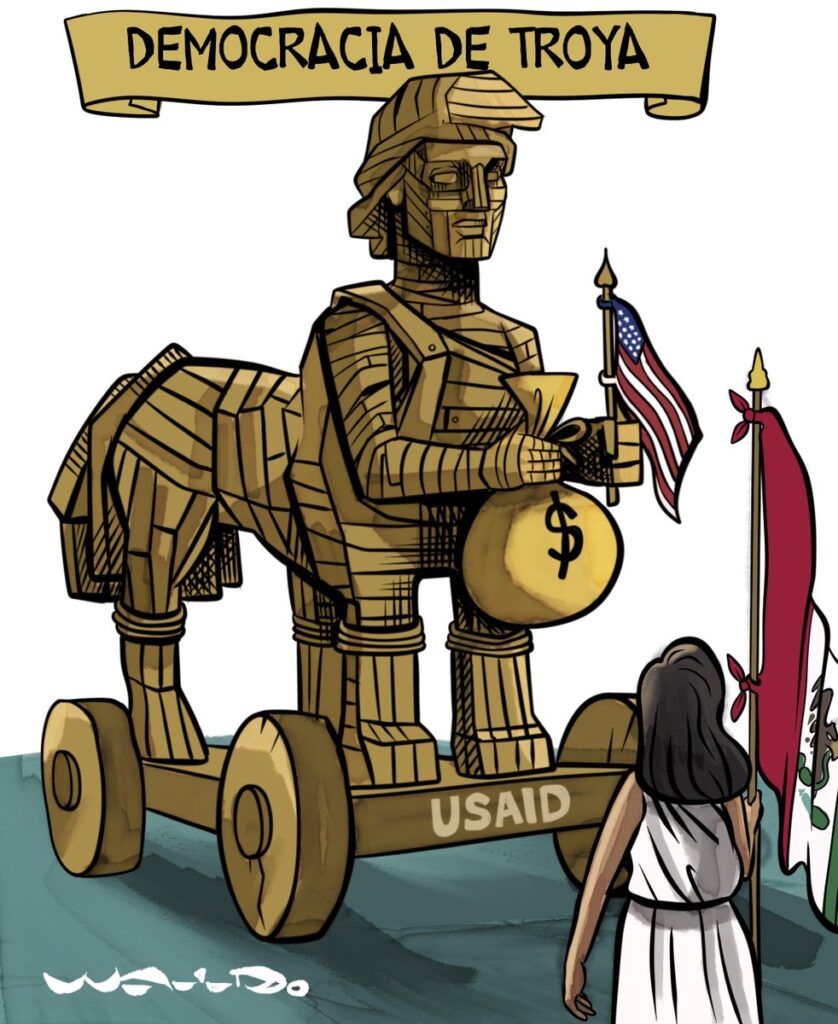
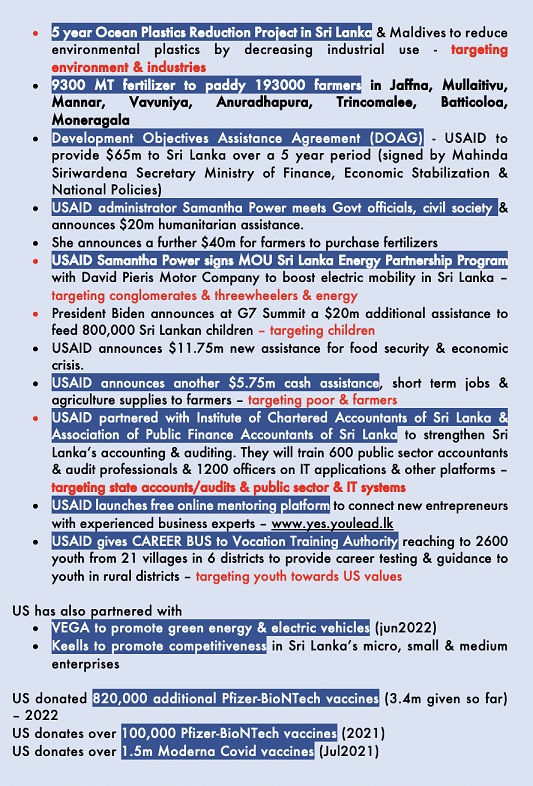
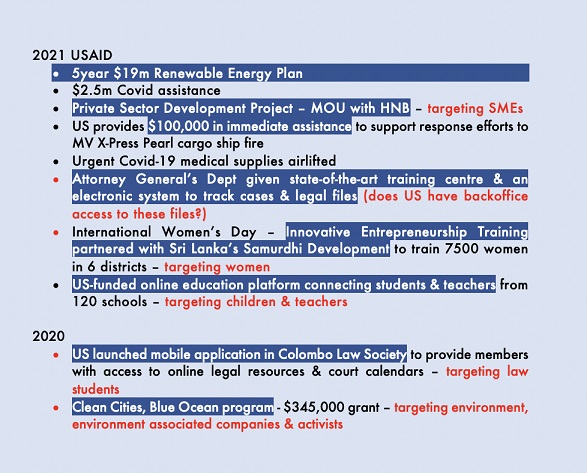
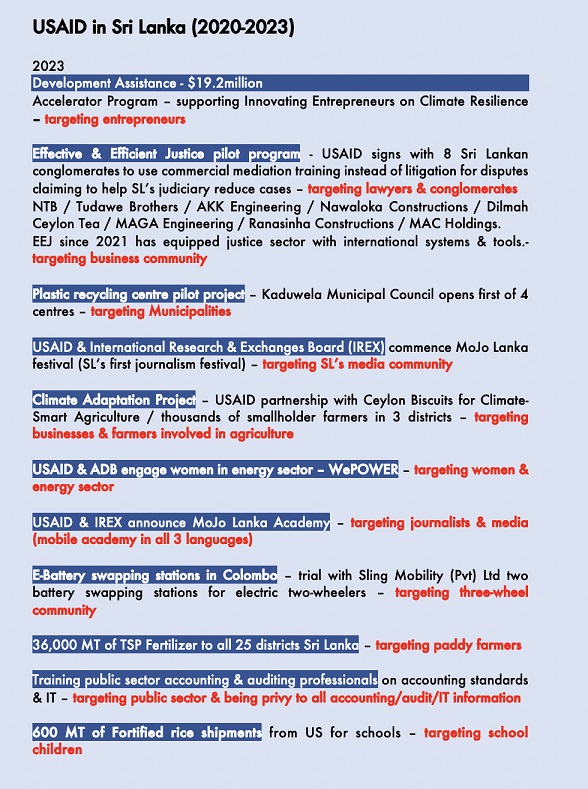
What is USAID upto in Sri Lanka?

September 24th, 2023

Shenali D Waduge

Sri Lanka’s governments always apply ‘don’t look a gifthorse in the mouth’ logic and then lands up putting the country in trouble. We seem to be euthanized to think that countries that carry out regime change, colored revolutions, election fraud, funding youth unrest & even carrying out political assassinations in other countries, will not be done in Sri Lanka. We are ignorant to not look at all of its misadventures in other parts of the world. USAID has suddenly increased its activities across Sri Lanka. Are Sri Lanka’s policy makers bothered to know the real reason & connect with all of USAID’s involvements in other countries?

Undeniably USAID created in 1961 is a key US Govt foreign policy pusher. That policy is pushed using mediums that go undetected & using development” initiatives as camouflage (thus the agriculture/poverty alleviation/public administration improvement/civil society engagement/youth building initiatives) The foreign policy has a target audience & USAID uses funds to penetrate to that audience to influence them. Is it so difficult to understand? Why would Russia order USAID to leave? USAID was accused of paying opposition groups to back anti-Putin protests. Eritrea, Ecuador, Venezuela, Cuba & Bolivia have also expelled USAID.

USAID offers humanitarian assistance but it is also accused of funneling money to overthrow governments. Funds & programs provide a great cover. Target audience are also euthanized and the programs are artfully coordinated to achieve the objective unnoticed even by the participants.

When USAID says : human rights, democracy, transparency, peace programs, disaster programs, what USAID really intends to do is to export wars, colored revolutions, foment extremist ideologies, promot economic instability. By taking the key players to their side using their initiatives, they automatically silence any forms of opposition. Programs targeting legal fraternity with funds disbursed to them automatically silences anyone in the fraternity raising doubts over their larger plan.

  • Jan 2023, Congressman Michael McCaul informs USAID head Samantha Power to investigate USAID grantee HELPING HAND FOR RELIEF & DEVELOPMENT,having received ‘credible allegations’ that HHRD has ties with a designate terrorist organization & Congressman had informed USAID in 2022 re this but no action was taken. The terrorist organization is Falah-e-Insaniat Foundation in Pakistan which has connections to Jamat-e-Islami (South Asian based organization)
  • 40% of USAID funding in Afghanistan went to big contractors with connections with USAID and these entities charge 40% of the total fund for their corporate fees & consultancy. USAID makes deals with those tasked with NGOs set up for reconstruction.
  • In 2003 Bechtel revealed USAID was indulging in irregularities in Iraq’s reconstruction
  • In 2000s USAID is accused of funding civil societies in Venezuelia & Boliviato advance US strategic interest by funding opposition to topple existing governments.
  • 2012 – Bolivia expelled USAID for meddling in internal affairs
  • 2013 USAID is alleged to have used its fund to promote normalization of Israel’ under Partners for Peace Program” to get civil societies in Palestine & Israel to cooperate but the condition to the Palestinians was that they had to renounce terrorism However Palestine objected to USAID political manipulation.USAID left Palestine in Jan2019 following new Anti-Terrorism Law.
  • 2014 – Cuba: USAID had been hiring anti-Cuban govt South American activists through a company called Creative Associates International. One activist was sent on mission to create a network of volunteers for social transformation – he set up a AIDS-HIV prevention workshop as a perfect excuse (similar to the CIA’s vaccination ruse in 2011 to get information on whereabouts of Osama bin Laden) as a result Taliban in Pakistan has banned polio vaccinations.
  • USAID & Peru – declassified records of how USAID has been involved in Peruhttps://pdf.usaid.gov/pdf_docs/PDABJ683.pdf
  • 2019 – USAID & Venezuela – USAID & NED works on Transition Initiatives’ (code name for regime change) USAID’s Bureau for Democracy, Conflict, Humanitarian Assistance oversees the Office of Transition Initiatives (OTI) which support local partners for ‘political change’. According to Wikileaks a Nov2006 cable revealed the US embassy in Venezuela was coordinating anti-Chavez campaign using a 5-point strategy. 1. Strengthening democratic institutions 2. Penetrating Chavez political base 3. Dividing Chavismo 4. Protecting vitale US business 5. Isolating Chavez internationally. In 2006 USAID/OTI increased funding to create ‘youth movement’ using new technologies (twitter, facebook) against President Chavez. From 2006-2010 more than 34% of USAID budget ($15m annual) was to fund university programs to turn youth against President Chavez.
  • In 2009 USAID through DAI (operational in Sri Lanka) paid $600,000 to install military-grade internet in Cuba for the Jewish community

USAID involved colored revolutions – wars without guns & implanting American values

Georgia Rose Revolution” 2003 – forced President Eduard Shvardandze to resign claiming vote fraud” & supported opposition leader Mikhail Saakashvili to become President & a pawn of US. Years before Rose Revolution Western states had funded NGOs & Opposition parties in Georgia. USAID spent $1.5m to computerize Gerogia’s voter rolls.

Ukraine Orange Revolution” 2004 – another ‘fraud’ scandal created using youth to take to streets to support Opposition Leader Viktor Yushenko to become President & pawn of US.

Kyrgyzstan Tulip Revolution” 2005 – opposition funded to protest parliamentary elections turning into riots & ended with the President abandoning power & fleeing.

Arab Spring” in Asia & Africa in 2011

Egypt Lotus Revolution” 2011 – – youth were heavily influenced by social media (facebook/twitter) & misled & brainwashed by promises of democracy & freedom” and promoted to protest. The youth were made to think they were helping bring the country to a better position but reality was that they were being used by US & political forces to destabalize their country. A leader of Egypts April 6 Youth Movement was invited to New York & underwent internship” & taught how to cope with the police.

Sri Lanka’s aragala” protestors in hindsight must study colored revolutions” that took place & seriously wonder if they were also used as pawns. 

Present day protests are not improptu – they are all orchestrated & started by an individual or group as a deliberate political act – it is coordinated by planners, trainers, funders, instigators, troublemakers, followers & where needed violent & hired mercenaries. All these are kept ready & unleashed by those handling them.

  1. Planners select target
  2. Psychological war launched
  3. Political activists & groups organized & given information & financial support to raise sentiment to the masses
  4. Masses are mobilized to initiate protests – media & NGOs are used to further spur emotions / newest is the use of social media to organize protests, spread misinformation/disinformation & fake news while funding entities called FACT CHECKERS” to accuse others of telling fake news & then banning them.
  5. Chain of protests brought to level of intensity to achieve the target.
  6. Today colored revolutions are following a textbook From Dictatorship to Democracy” by Gene Sharp (Albert Einstein Institution founded by Sharp is said to be funded by NED) – OTPUR used this in Ukraine.

US has a pattern before ousting a leader they do not like or a leader who they feel cannot deliver as per their wishes.

US & Allies promotes notion that their target is a dictator” is undemocratic” violates human rights” etc.

Citizens must think that becoming pawns of revolutions funded by foreigners is only putting their country, their people & their resources under foreign control. Is this what people want?

https://www.heritage.org/global-politics/report/congress-must-stop-bidens-misuse-us-foreign-aid-impose-his-radical-social

Why would US want to send so money to other countries to develop them instead of using that money for the same initiatives in America? 

  • USAID funds poverty alleviation in other countries but 9 million Americans in poverty.
  • USAID funds agriculture/food projects in other countries but 34million Americans are in hunger. 42million are using food stamps.
  • USAID funds housing programs in other countries but almost 500,000 Americans are living on the streets.
  • USAID funds law & order programs in other countries but annually there are at least 15,000 murders in USA. There have been 386 school shootings since 1999.
  • USAID funds good governance programs in other countries but 57% black Americans claim discrimination at work, while 51% black Americans claim to experience racial slurs at work31% all women claim discrimination at work, 60% of women (18-29 years) claim to be sexually harassed at work35% Asian Americans reported insensitive & racial comments against them.

Sri Lankans must wonder why countries would give people of another country when they should be first giving their own. Sri Lankans must also wonder with what objectives they wish to initiate projects that enable them to view the interior systems of Sri Lanka’s governance/administrative systems. If only Sri Lankans put their thinking caps – they would not be going behind trojan horses thinking them to be gift horses.

While American values are in decline, US foreign policy players are importing those declining values elsewhere which are being foolishly embraced by those unaware of realities and daydreaming about democracy”!

Shenali D Waduge

Anthropological Study on Kalinga Sri Lanka Relationship

September 24th, 2023

Asutosh Mishra* Department of Anthropology, IGNOU University, Cuttack, India,

Abstract

The island country, Sri Lanka, famously known as the pearl of the Indian Ocean and the soul of India that is Odisha otherwise known as the temple city of India had a very ancient connection. History has been saying that the founder of the Sinhalese race was an Odia (Kalinga) as mentioned in Mahavamsa, the greatest literature of Sri Lanka. Recent genetic studies have confirmed that the ancestors of Sri Lankans were from Odisha. Kalinga, the ancient Odisha, had a strong relationship with Ceylon (Sri Lanka) that flourished for 1700 years. Matrimonial tie was the main reason for this relationship to sustain so long. It was Kalinga that had popularised Buddhism in the island. It had even introduced Vajrayana Buddhism to the people of the island. The famous Abhayagiri monastery of Sri Lanka has a deep connection with Kalinga. Both of them used to share an identical culture that most of the scholars hasn’t pointed out. Kalinga had influenced Sri Lanka in many ways and it can be seen through the similarities they both still carry.

Keywords

Odisha Sri Lanka relation; History of Kalinga ceylon ties; Anthropological view on Kalinga Sri Lanka affairs

Introduction

Both Odisha and Sri Lanka had a famed ancient history. Kalinga (Odisha) had one of the strongest kinships with Ceylon (Sri Lanka). It was not only the maritime relationship but also the bloodline that both of them had shared. From 500 B.C.E. to 1200 C.E., this relationship was sustained. Both had seen political turmoil, chaos, anarchy in their respective lands. Yet, the brotherhood had never torn apart. Kalinga even supported Ceylon against its countrymen. It was the central part of Sri Lanka’s history. It was Kalinga that had created the Sinhalese race, shaped their culture, and been its greatest ally. This paper is an attempt to eulogize that relationship and draw attention to the homogeneity in history. There is much more to this relationship than what meets the eye [1].

Mahavamsa and Dipavamsa, the greatest chronicles of Sri Lanka, give the record of the introductory history of the land. These Pali chronicles talk about the first-ever king of the country, Vijay. According to Mahavamsa, Indian prince Vijay with his 700 followers inhabited Sri Lanka in the sixth century B.C.E. and founded the Sinhalese race. The original homeland of Vijay is known to be Simhapura. It further states that the Simhapura was set up by king Simhabahu and the Sinhala race was derived from his name by his son, Vijay. The same place has its reference in Manimekhalai, a Tamil literary work, which is considered as one among the top 5 greatest Tamil epics. It has described Simhapura as the capital of Kalinga. The mention of Simhapura is also found in Kalinga history. It was ruled by the great Matharas from the 5th to 6th century C.E. Epigraphical sources show that Simhapura was the capital of Kalinga during their rule [2].

Mahavamsa further states that before the arrival of Vijay there were 4 indigenous clans of Ceylon: yaksha, naga, deva, raksha. Vijay became the king only after defeating the native tribe yaksha who was believed to be the inhabitants of the mountain. In India, we do have the same categories. Yakshas are commonly known as Gandharvas. Almost in every temple, one will find sculptures of yaksha, yakshini. In Odisha, they are one of the major features of decorative motifs which are belonged to one of the two categories of temple sculptures of Odisha. All famous temples of Odisha are flanked by yaksha sculptures and motifs [3]. In the case of tribes, it is inevitable to find indigenous Gods and Goddesses. Tribes of Odisha also have such tutelary gods of forests, mountains, and villages. Gadaba, the oldest tribe of the state, considers ‘Bana Debata’ (forest god) as their supreme deity. This forest deity is nothing but a yaksha. Kondh, the largest tribe of Odisha, doesn’t follow Hinduism. They are nature worshippers. They believe that forests, mountains, rivers all have presiding deities and their prime God is ‘Dharani Deota’, who is a spirit god [4].

Since early times, the naga cult has been existing in Odisha. Two life-size anthropomorphic images of naga, though in broken condition, are kept in Odisha state museum which might have preceded Kharavela time. More such anthropomorphic images were found in the vicinity of Bhubaneswar indicating the presence of a large naga cult. Odisha even had ‘Nagabansi rulers’ whose Ista devata (family god) were the nagas. The proof of the dynastic worship of naga is found from the asanpat inscription of the naga king Satrubhanja, in the keonjhar region who roughly belonged to the 4th century C.E. [5].

The kanasa copper plate grant of the king Lokabigraha dated 600 C.E. refers to the worship of Maninaga. Apart from Satrubhanja, there existed another naga dynasty from Mayurbhanj. This dynasty is known as the Vairata Bhujanga dynasty that used to worship the naga as their tutelary deity. They had carved Kinchaka naga on the patamundi hill which shows how strongly they were associated with naga cult [6].

Aside from east and north Odisha, western Odisha was also involved in the naga cult. A beautiful naga icon is found from maraguda valley in the Kalahandi district. The naga kings of the district claim their origin from the mythical naga Pandarika. There is even evidence which reveals that the mighty Somavansis were also intimately bound to the naga cult [7].

The continuity of this cult hasn’t broken till now. In Bargarh, western Odisha, The Nagabacha Ceremony” is performed every year in the month of September-October. The purpose of it is to initiate a ‘nagbacha’ (serpent kid) that is similar to the concept of baptism in Christianity [8].

The Deva-Rakhyasa theme had induced many Gods, Goddesses in Hinduism. It is written in Vedas and Puranas that in ancient times there were two clans Sura-Asura that later became Devata-rakhyasa. Devata has been portrayed as the good clan and rakhyasa as the evil one. Every Hindu temple in India is all about the depiction of the victory of good over evil in various forms [9]. In Odisha, we even have places named upon rakhyasa. Asurgarh is one such place that literally means ‘fort of the demon’. Though there are several such forts been found in different parts of Odisha, recently in 2019 archaeologists’ excavated artifacts belonging to pre-Mauryan era from Asurgarh in the Kalahandi district. Those artifacts dated back to the 4th century B.C.E. and the land indicates that the inhabitants of it belonged to a sophisticated society. Hence, it won’t be wrong to say, people of that place were much older than that and they were either from the asura clan or worshippers of demons (asura). It is a fact that animism came first and religion later. This stands true even for Kalinga. It had the same 4 clans that Mahavamsa talks about in Ceylon before the arrival of Vijay [10].

Odisha has not only created the Sinhalese race but also has built a legacy. Even after the demise of Vijay and his successors, the cultural ties between Odisha and Sri Lanka carried on. Frequent visits to each other’s land were one of the reasons other than having a common religion. But what stand out for them was cross country marriages. The matrimonial relationship between Sinhalese and Kalinga royal families has a long history [11]. In the 10th century C.E., king Mahinda IV, though of Sinhalese origin, had chosen a Kalingan princess as his chief wife. King Vijaybahu I, founder of Polonnaruwa kingdom, also had a Kalingan princess named Trilokasundari as his chief wife. After the death of Parakramabahu Sri Lanka couldn’t keep up with the political turmoil. At that time Nissanka Malla who was a pure Kalingan bloodline took over the throne and brought peace to the nation. His chief wife was also a Kalingan named Subadra Devi. He was one of the greatest kings of Sri Lanka and was a great Buddhist patron. It was he who repaired the ancient city of Anuradhapura. He had installed 78 gold-gilded Buddha statues at the Dambulla cave monastery and gave it the name Rangiri Dambulla Vihara (Manatunga, 2009). This place is now a world heritage site [12].

Unlike in other cases the origin and works of Nissanka Malla have their mention in the inscription at Gal pota, the stone book, besides in Mahavamsa. His bloodline ruled Sri Lanka for some time and few scholars refer to that phase as Kalinga Era [13].

As we move from the history of Sinhalese to their religion, it was and it is Buddhism which has been dominant since the advent of Mahendra, son of Ashoka, to the island. Buddhism spread throughout Northern India only because of the personal endorsement of king Ashoka. He also actively proselytized outside his kingdom to foreign lands by sending missions, often monks as envoys. According to Dipavamsa, the 2nd greatest literature of Sinhalese, Ashoka sent his son Mahendra to Sri Lanka for spreading Buddhism during the reign of Devanampiya Tissa. Later the bond grew stronger when Ashoka sent his daughter Sanghamitra with saplings of a Bodhi tree to the island. ‘Samantapasadika’ reveals that she was escorted by 8 families of Kalinga in her journey. There she established the order of the nuns” with the support of Anula, the chief queen of Tissa. It seems natural that few Kalingan women of those 8 families must be Buddhists who were members of that order and might have led it for its smooth run [14].

There is another tale that speaks eloquently of the friendship between the two nations of that era. Dathavamsa, a Buddhist work from 3rd century C.E., discloses that king Guhasiva of Kalinga and king Mahadisena of Sri Lanka had strong friendly relations with each other. Citing one example it says when Guhasiva felt there was a threat to his throne due to invasions, he secretly sent his daughter Hemamala with his son-in-law Dantakumara to Ceylon with his most precious item. It was the sacred tooth relic of Buddha which he and his people used to worship in his capital Dantapura. Mahadisena took the responsibility of protecting and preserving it. He made a shrine for it thereby introducing a whole new chapter to their culture. This incident was the watershed moment in Sri Lankan history. The next few centuries were followed by the construction of Buddhist viharas, stupas, and chaityas. 4th and 5th century C.E. saw not only architectural marvels but also the creation of great literature. It was during this period many valuable works on Buddhist religion and philosophy were produced in the country. The greatest chronicles, Mahavamsa and Dipavamsa, of Sinhalese literature were also composed in this period; 350 C.E. and 475 C.E. respectively. Therefore, it was Kalinga that had popularised Buddhism in Sri Lanka by giving away its most precious asset, Buddha’s tooth relic [15].

In the 7th century C.E., Kalinga had gone through a paradigm shift. This period had witnessed the rise of Vajrayana Buddhism which is also known as Tantric Buddhism. With time, it replaced Mahayana Buddhism and by the 8th century C.E. became the dominant religion of the country. This was a landmark event for entire Southeast Asia as it caused a ripple across the Indian subcontinent and China. Suddenly all those nations who followed Buddhism started to shift from Mahayana to Vajrayana. In the 8th century, Sri Lanka also saw this trend. The main God of this sect of Buddhists is ‘Tara’.

But there is confusion around the name since Hindus also worship him alongside another Goddess Tarini. There is a reason behind it that might offer an answer. According to some historians, Tara was a Buddhist god whereas Tarini was a Hindu deity (Behera, 2019). As the two religions coexisted for a long time, the assimilation made the goddess Tarini to be worshipped as Tara Tarini” by Hindus.

Her name has also been mentioned in Mahayana Buddhism. Buddha was against Idol Worship. So, Buddhism in its infancy stage refrained from idolatry. But change is the first law that nature obeys and so does any religion. By the 1st century C.E., Buddhism got a taste of it and accepted idol worship as a new addition to their cult.

This is been confirmed from Buddhist Tantric texts that worship Tara Tarini as a tantric deity Buddha Tara”. Whether it was Hindus or Buddhists that worshipped Tara first is a subject of debate but one thing is certain that Kalinga was the originator and epicenter of Vajrayana Buddhism or Tantric Buddhism. Every God, Goddess related to Vajrayana has its figure and images at the Diamond Triangle of Odisha; Ratnagiri, Udayagiri, and Lalitagiri.

As stated earlier, Vajrayana Buddhism spread in Sri Lanka in the 8th century C.E. Inscriptions at Abhayagiri Vihara testifies that. It was the major monastery site of Mahayana, Theravada, and Vajrayana Buddhism that was situated in Anuradhapura, the ancient capital of Ceylon (Sri Lanka). A fascinating thing is written on that inscription which states Buddha transforms into a female goddess Dharanis”. According to Vajrayana, Tara was considered a female Buddha who was originated from the tears of Boddhisattwa Avolokiteswara. It implies Dharani and Tara aren’t different but one entity. Ashoka Edict highlighted that the Tara Tarini temple was a famous Buddhist site. Putting two and two together we conclude that Kalinga was the first one to worship Tara as the female form of Buddha. From here it had spread to Tibet, China, and Southeast Asia which includes Sri Lanka. Hence, a change in the religious belief in Sri Lanka was also brought by Kalinga.

Mishra (2015) in his article ‘Abhayagiri in Anuradhapura, Buddhist Diamond Triangle of Odisha and Java: Art and Epigraphic evidence of Triadic Linkage of Esoteric Buddhism in Maritime Asia’ argues that the high resemblance between dharanis found from Odisha and Abhayagiri, indicates towards the transmission of it from Odisha to Sri Lanka. There are two points that strengthen his argument. The first one is the three famous Indian Buddhist monks (Amoghavajra, Vajrabodhi, and Subhakarasimha) who had spread esoteric Buddhism in Southeast Asia, Tibet, and China, studied at Ratnagiri, Odisha. Sarvatathagatatattwasamgraha (STTS) and Mahavairocana sutra are the two Buddhist tantric texts which form the basis of the mandala stupa. These three monks took the two texts with them and went to Abhayagiri first. From there to Java and finally to China. Excavations at Abhayagiri led to the findings of the mandala and a few lines from these texts validate the theory of transmission of dharanis from Odisha to Sri Lanka, particularly from Ratnagiri. The second point is the earliest reference of the Mahavairocana sutra, which is the first true Buddhist tantra, which was found from the back slab of the Vairocana image from Lalitagiri, Odisha. Numerous dharanis in clay seals are found from Ratnagiri. These are very much alike to that of Abhayagiri.

There are several stupas in Odisha that were and are filled with dharanis inside it. Some dharanis have been found in terracotta and stone plaques inside a stupa indicating they must be inserted during the consecration of stupas. Odisha state museum has an inscription on Bodhigarbhalankaralaksa Dharani” which specifically advocates in favour of putting dharanis inside a stupa during the consecration.

In Abhayagiri, Sri Lanka one finds similar dharanis being inserted inside a stupa. This shows the concept of placing Dharanis inside a stupa in Abhayagiri Vihara was taken from Kalinga by Sinhalese. There are even similarities between Buddha images from Cuttack hills (Diamond Triangle) with Abhayagiri. In all likelihood, the artists of Kalinga or its monks taught Sinhalese about all these that we see and find in Abhayagiri.

The art and craft speak volumes about the heritage of a country. In the case of Odisha and Sri Lanka, there is much uniformity between them. Their cultural vibes are akin to each other.

The history of the pottery of Odisha is at least 4000 years old as evident from a recent excavation conducted at the Durgadevi village of Balasore. A variety of potteries and terracotta have been found at numerous sites in Odisha different periods. This shows the long continuity of pottery and terracotta in the state.

Terracotta work of Odisha is considered national heritage and in the current decade even has got international fame. When we look at Sri Lanka in this context, we find a direct link to Odisha as per their historical records. Mahavamsa has thrown some light on it. According to it, when Vijay landed on the shores of the island, his entourage had included potters. There is another instance that tells us that potters of Kalinga went to Sri Lanka and might have influenced their culture. As recorded in Mahavamsa, Sanghamitra, daughter of Ashoka, arrived in the country in 288 B.C.E. She was accompanied by artisans from 18 trades and one of them was potters.

Puppetry, lacquer work, drum making, wood carving, jewellery making, and handlooms are the rest categories that are popular and similar in both cultures. The famous Kandyan dance of Sri Lanka and Kandhei Nacha of Odisha both reflect upon the same narrative. Both depict the story of Ramayan, the great Hindu Mahakabya, in their performances.

Though it is evident from linguistic evidence that the Sinhalese language belongs to the family of Indo-Aryan language, yet, there is a controversy regarding its origin. Some scholars believe it was based on a western dialect of India while others argue for its eastern dialect. Famous Sri Lankan historian Siddhartha (1935) in his article titled the Indian Languages and their Relation with the Sinhalese Language” advocates for the eastern origin of the Sinhalese language.

He further argues that if one would study the Odia language and compare it with the Sinhalese, will find that the later language is nothing but a modified form of the Odia. Shahidulla (1962), the renowned Bengali linguist, philologist, educationalist, and writer, has shown philological facts to prove that the ancestors of the Sinhalese people had migrated from Eastern India [14].

Apart from linguistic and philological evidences, early Sinhala inscriptions also points out to its Eastern origin. In his introduction to ‘The Phonology of the Sinhalese Inscriptions up to the End of Tenth Century A.D.’, P.B.F. Wijeratne (1945, p.8) states that the early language must have originally belonged to Eastern tract of India”. Another Sri Lankan scholar D. J. Wijeratne (1956) has taken the same stance on this subject. In his article ‘History of Sinhalese noun’ he suggests that there is clinching evidence which indicates that the earliest Sinhalese as recorded in the inscriptions of the 3rd century B.C. was a middle Indian Dialect and have strong affinities with the Eastern group of middle India.

Whether it was about putting the first step on the island or creating the Sinhalese race, Kalinga is the name that Sri Lankan history has recorded as the founder. It has even popularised Buddhism in the country which is the dominant religion of the island. It is in the bucket list of every Buddhists around the world to visit the temple of sacred tooth relic at Kandy, Sri Lanka. The relic inside this world heritage site was a gift from Kalinga. There is another gift to the island by a king of pure Kalingan bloodline, Nissanka Malla. Rangiri Vihara, a world heritage site, was constructed by Malla. Genetic studies also confirm that Sri Lankans have their ancestors from Odisha. Whether it was the maritime trade or matrilineal relationship, Kalinga was the first choice of Sri Lanka. Both of them have stood for each other in the time of need, in the time of chaos [16].

Conclusion

Kalinga has an inalienable part in the history and culture of Sri Lanka. On the surface, ethnological study of the Sinhalese race tells that there is more South Indian flavour in Sri Lankan culture. But from the anthropological perspective, Odisha and Sri Lanka are two brothers from different mothers. They share almost the same cultural identity. The rituals, the beliefs that are rooted in the villages of Lanka are identical to the villages of Odisha. I hope in the near future, Odisha and Sri Lanka will reset their relationship which had a glorious past. In ancient times, the two cultures had inspired Southeast Asia for many centuries. They can do so even today. If it happens, it will strengthen India Sri Lanka relation also which has weakened a little bit.

References

  1. Acri A. Esoteric Buddhism in mediaeval maritime Asia: Networks of masters, texts, icons. ISEAS-Yusof Ishak Institute. 2016.
  2. Behera KS. Maritime contacts of Orissa: literary and archaeological evidence. Utkal Hist Res J. 1994;5:55-70.
  3. Charvát P. Excavations at Abhayagiri Vihara (Anuradhapura, Sri Lanka) in 1984. Archív Orientální. 1985; 53:226-58.
  4. Donaldson TE. Iconography of the Buddhist Sculpture of Orissa: Text. Abhinav Pub. 2001.
  5. Mishra PK, editor. Comprehensive history and culture of Orissa. 2(1568 AD-1994).-Pt. 2. Kaveri Books 1997.
  6. Mishra U. Circulation of Buddhist manŒ£¡¸alas in Maritime Asia: A Study of the Art of the Buddhist Diamond Triangle of Odisha (India) and Borobodur–CanŒ£¡¸„« Mendut in Java. Act East: Asean-India Shared Cultural Heritage 119.
  7. Mukherjee P. Lalitagiri, Udayagiri and Ratnagiri. Government of Orissa, Bhubaneswar. 1957.
  8. Panigrahi KC. History of Orissa: Hindu Period. Cuttack: Kitab Mahal. 1981.
  9. Paranavitana S. Glimpses of Ceylon’s past. Lake House Investments. 1972.
  10. Patel K. Maritime Relation of Kalinga with Srilanka. The Orissa Hist Res J. 2004:125-31.
  11. Pradhan B. The History Of Naga Cult And Naga Festivals In Orissa. In Proceedings of the Ind Hist Cong 2001;62:149-159.
  12. Rath SP, Mahaliyanaarachchi RP, Rath R. Kalinga (Odisha) & Sri Lanka kinship and cultural relationship-A retrospection and future hopes. Splint Int J Prof. 2016; 3:54.
  13. De Silva KM, de Silva KM. A history of Sri Lanka. Univ of California Press 1981.
  14. Tripathy S. Inscriptions of Orissa: Circa 5th-8th Centuries AD. Motilal Banarsidass Publ 1997.

Author Info

Asutosh Mishra*

Department of Anthropology, IGNOU University, Cuttack, India

Citation: Mishra A (2021) Anthropological Study on Kalinga Sri Lanka Relationship. Anthropology 9:263.doi10.35248/2332- 0915.21.9.263

Received: 09-Nov-2021 Accepted: 24-Nov-2021 Published: 01-Dec-2021

Sri LankaWeb Writers – Get Our of The Box!

September 24th, 2023

Prof. Hudson McLean

As an avid reader of LankaWeb for the past 45 years or so, I am surprised that the historically old writers and even the new are still battling history “Inside the Box”. without getting out into the world!

Yes. Sri Lanka had the British Colonial hang-over, and still has!. 

Then after the Brits left the Tamil Tigers tried their best to take over.

Thanks to the Rajapaksa family and to Basil Rajapaksa, Sri Lanka was saved from Tamil Terrorism.

That was history which every Sinhala should remember!

But now Sri Lanka should move forward into the New World with the likes of Patriot Philanthropist Entrepreneur Dhammika Perera (whom I have never met).

Sri Lanka is a Natural Paradise, with immense Natural Wealth.  The Intelligent Sinhala human wealth. But lazy!

So many opportunities Sri Lanka has swept under the carpet.

There are many revenue-generating opportunities both Domestic & Export!

I suggest that starting from President  Ranil Wickramasinhe right down to the minions in the Government, start following one quotation by my Mentor – Albert Einstein-;

“Imagination is more Important than Knowledge.
Knowledge is Limited.
Imagination Encircles the world” – Albert Einstein

Express Your Opinion – Read What Others Say!
The Independent Interactive Voice of Sri Lanka on the Internet.

Please visit -: http://www.lankaweb.com/

RADICAL MOB PLANS TO DEMOLISH HISTORIC MOSQUE IN PAKISTAN.

September 24th, 2023

by A. Abdul Aziz

U.K. based International Human Rights Committee (IHRC) has reported several times that a wave of bigotry against Ahmadiyya Muslims has intensified since the start of 2023. In an extremely worrying sign of growing crisis in Pakistan, thirty-one (31) Ahmadiyya Mosques have been desecrated in 2023. Another disturbing news is coming in from Daska, Sialkot where the far right party Tehreek-e-Labbaik Pakistan (TLP) is planning to gather a mob to demolish a historic Ahmadiyya Muslim Mosque.

The Mosque was built by the first Foreign Minister of Pakistan, Sir Zafrullah Khan in his family town Daska, Sialkot. The world-renowned jurist and lawyer served as the President of the UN General Assembly in the 1960s and the President of the International Court of Justice in the 70s.

Yet the media and politicians of the country he served his whole life are enabling religious extremists to desecrate holy places of worship which he built and prayed in. If this demolition is allowed to take place, it will be the 32nd Ahmadi Muslim Mosque desecrated in Pakistan this year. The Lahore High Court has previously held that Ahmadi Muslim places of worship built before 1984 cannot be destroyed by the state.

Recently, the Prime Minister of Pakistan said that the State will protect the places of worship of all citizens. Yet as seen in the past, higher authorities have failed to intervene when the Police, instead of providing protection, have been acting as an aide to acts by extremist elements.

It has become impossible for Ahmadis to practice their faith while ruthlessly hunted by fundamentalist gangs. The latest desecration act of the Mosques desecration carried out by the locals and Police is open proof of the fact there is no sign of improvement in the law-and-order situation for the Ahmadis in Pakistan.

The Supreme Court of Pakistan’s judgement (PLD 2014 SC 699), authored by the then Chief Justice of Pakistan, Justice Tassaduq Hussain Jillani, guarantees the protection of all places of worship and instructs the police to protect places of worship. Destroying minarets is also a violation of Article 20 and the same Supreme Court verdict of 2014 (PLD 2014 SC 699).

The same Supreme Court judgement of 2014 (PLD 2014 SC 699) had asked the Government of Pakistan to form a special task force for the protection of worship places of minorities. On the contrary, an extremist agenda sponsored by the state is being pursued against the Ahmadiyya community with authorities encouraging this type of violent behaviour which defies this Supreme Court judgement of 2014 (PLD 2014 SC 699) and all norms of religious sanctimony.

Human rights groups have repeatedly expressed their deep concern over the lack of attention to the serious human rights violations perpetrated against the Ahmadiyya community and called on the international community to step up efforts in bringing an end to the ongoing persecution of Ahmadis. It is repeatedly urged the international community to pressure the Government of Pakistan to honor its responsibility to provide protection to all its citizens, ensure freedom of religious practice to Ahmadis, and bring perpetrators of such vicious attacks to justice.

Milinda Moragoda inspected the progress at the Sri Lanka Buddhist Pilgrims Rest (SLBPR) in New Delhi

September 24th, 2023

Sri Lankan High Commission in India  Media Release 2023.09.24

Sri Lanka’s High Commissioner to India Milinda Moragoda inspected the progress of the ongoing renovation work at the Sri Lanka Buddhist Pilgrims Rest (SLBPR) in New Delhi.

The Pilgrims’ Rest which is located very close to the New Delhi main Railway Station functions under the High Commission of Sri Lanka in India. With a view to offering a better service to a large number of Sri Lankan and foreign pilgrims visiting India to pay homage to sacred Buddhist sites, the High Commission initiated the much-needed renovation work to the existing SLBPR infrastructure facilitiesin June this year.

High Commissioner Moragoda, during the inspection tour met with the technical officials and the team involved in the renovation work and extended his appreciation for their hard work and dedication. He also emphasized the importance of completing the renovation work by the first week of November as planned.

The High Commissioner was accompanied by the senior officials of the High Commission on this inspection tour.

මොළය හිරිවට්ටන විශේෂඥ වෛද්‍ය හිඟය

September 24th, 2023

රජිත් කීර්ති තෙන්නකෝන්

සෞඛ්‍ය කේෂ්ත්‍ර යේ අද පවත්නා ලොකුම ප්‍රශ්නය වෛද්‍ය නිලධාරීන් (MO) විදේශගතවීම නොව, විශේෂඥ වෛද්‍යවරුන්ගේ හිඟය යි.  ජාතික රෝහල් දෙක ට, ශික්ෂණ රෝහල් 20 ට තවමත් එහි පීඩණය දැනී නොමැති නමුත්, පලාත් මුලික හා දිස්ත්‍රික් රෝහල්වල දැවැන්තම අර්බුදය මෙයයි. 

මෙරට අනුමත විශේෂඥ වෛද්‍යවරුන්ගේ සංඛ්‍යාව 2,851 කි.  සෞඛ්‍ය අමාත්‍යාංශයට අනුව අද 2,574 ක් සේවයේ නිරතය.  නමුත් සැබෑ ලෙසම රෝහල්වල රෝගීන් බලන්නේ 2,039 කි.   විශ්‍රාම වයස දැනට ගැසට් කර ඇති පරිදි 2024 දෙසැම්බර් 31 අවු. 63 වන්නේ නම්, දැනට සිටින වෛද්‍යවරුන් සංඛ්‍යාවෙන් 70  – 75 ක් පමණක් විශ්‍රාම ගනී. විශේෂඥ වෛද්‍යවරුන්ගේ විශ්‍රාම වයස 2024 දෙසැම්බර් 31 දිනට අවු. 60 බවට පත් වන්නේ නම්, එදිනට දැනට සේවයේ නිරත පිරිසෙන් 310 ක් (15%) එදින විශ්‍රාම ගනී. සැබෑ ප්‍රශ්නය ඇත්තේ එතැනය!    

විශේඥ වෛද්‍යවරුන් විශ්‍රාම ලබන විට, එයට සමාන වෛද්‍යවරුන් සංඛ්‍යාවක් අලුතෙන් සෞඛ්‍ය සේවයට පැමිණියේය.  අද වන විට මෙම චක්‍රය බිඳී ඇත.  විදේශගතවීම, සේවයෙන් ඉවත්වී වෛද්‍ය විද්‍යාල හා පුද්ගලික අංශයේ රෝහල් හා එකතුවීම එයට හේතුවයි. 

විශේෂඥ වෛද්‍ය ඛාණ්ඩ අනුව ප්‍රශ්නය ගැටළුව විමසා බැලිය යුතුය. නිර්වින්ද වෛද්‍යවරුන්ගේ හිඟය බියකරු සිහිනයකි. අනුමත සේවක සංඛ්‍යාව  180 ක් වන විට  දැනට සේවයේ නිරතවන්නේ 120 ක් පමණී.  2023 සැප්. 22 දිනට හිඟය  60 කි. පසුගිය වසර දෙක තුල විදේශ පුහුණුව නිම කළ  20 න්, 9 ක් අද වන විට රට හැර විදේශයන් හිර රැකියා ලබා හෝ වෙනත් හේතුවකට රෝහල් වෙත පැමිණ නැත. දෙදෙනෙකු (2) මෙරට විශ්වවිද්‍යාලයන්ට එක්වී ඇත.  ඒ අනුව, 60 ක හිඟයෙන් පුරවා ගත හැකි වන්නේ 9 ක් පමණී.  මේ වසර අවසන් වන්නේ, නිර්වින්දන වෛද්‍යවරුන් 51 ක හිඟයක් සහිතවය.

මේ හිඟය පියවීමට අමාත්‍යාංශය වෛද්‍යවරුන් 25 ක ලැයිස්තුවක් සකස් කොට ඇත. එම ලැයිස්තුවේ නම සඳහන් 6 ක් දැනටම විදේශගතවී ඇත. තවත් දෙදෙනෙකු (2) ලැයිස්තුවේ නම ඇතත් ලංකාවට පැමිණ නැත.  තවත් දෙදෙනෙකු (2) ලැයිස්තුවේ නම ඇතත් ඔවුන්ගේ පුහුණුව සම්පූර්ණ කර නැත. ඒ අනුව, පියවීමේ ලැයිස්තුව (රීප්ලේස්මන්ට් ලිස්ට්) එකේ න් ප්‍රයෝගිකව පිරවිය හැක්කේ 11 ක් හෝ එයට මදක් වැඩි සංඛ්‍යාවකි.  දළ වශයෙන් 40 ක පිරවිය නොහැකි හිඟයක් එවිට ඉතිරි වන්නේ ය. එහි අර්ථය, බී ශ්‍රේණියේ කිසිදු මුලික රෝහලකට වෛද්‍යවරුන් නොලැබීම ය. (එනම් වෙනත් වෛද්‍යවරයෙකු වැඩ ආවරණය කිරීම හෙවත් ඔවුන්ගේ වැඩ වැඩිවීමය)

විශේෂඥ වෛද්‍ය හිඟය නිසා වැඩිම පීඩාවට පත්වන්නේ රට අභ්‍යන්තරයේ හා උතුරු නැගෙනහිර රෝහල් ය. උදාහරණ ලෙස අම්පාර රෝහලට විශේඥ වෛද්‍ය ඛාණ්ඩ 20 ක් අවශ්‍ය ය. මෙයින් ඛාණ්ඩ 15 ක් ම දැනටමත් පුරප්පාඩු ය. 2024 සඳහා අයඳුම්කර  ඇත්තේ ඛාණ්ඩ 5 කට පමණී.  අම්පාරේ පහසුකම් නැති නම් මඩකලපුව, ත්‍රිකුණාමලය, හම්බන්තොට හෝ මොණරාගලට පැමිණීමට රෝගීන්ට සිදු වේ.  ත්‍රිකුණාමය මහ රෝහලේ සිටින්නේ සීමිත විශේෂඥ වෛද්‍යවරුන් සංඛ්‍යාවක් පමණී.  ඔවුන්ට කන්තලේ, කින්නියා හා මුතුර් මුලික රෝහල්වල රෝගීන් ආවරණය කිරීමට සිදුවේ. කල්මුණේ, නින්දවූර්, පොතුවිල්, සමන්තුරේ රෝගීන් කල්මුනේ වෙත යොමු වන අතර එම රෝහලට දැරිය නොහැකි පීඩණයක් පවතී. ඌව හා මධ්‍යම පළාත් තත්වය ශෝචනීය වේ.  මේ පීඩාව දරා සේවයේ නිරත පිරිසට රටම කෘතඥ විය යුතුය.

දෙවනුව, නාරි හා ප්‍රසව විශේෂඥ තනතුරු 168 ක් ස්ථාපිත ය. මේ  වන විට සේවයේ නිරතව සංඛ්‍යාව 130 කි. එයින් 7 දෙනෙකු මෑතක දී ඉවත් වී හෝ විශ්‍රාම ලබා හෝ ඇත. රට හැර ගිය සංඛ්‍යාව 8 කි. සේවයේ නිරත සංඛ්‍යාව 115 කි.  2023 වසර අතිරේක ලේඛනයේ නම් 17 න්, දෙදෙනෙකු (2) දැන් සේවයට වාර්තා කරන්නේ නැත. තවත් තිදෙනෙකු (3) ඉදිරි මාස දෙකක් තුල රජයේ සේවයෙන් ඉවත්වීමට සුදානම්ය. එවිට අලුතෙන් සේවයට අතුලත් වන්නේ 12 කි. නාරි හා ප්‍රසව විශේෂඥයින් 18 ක් හිඟ ය.  විශ්‍රාම වයස 60 වන්නේ නම්, 2024 අවසානයේ 21 ක් විශ්‍රාම යන්නේය. (විශ්‍රාම වයස 63 ක් වන්නේ නම් 8 කි. කාසල්, ද සොයිසා රෝහල්වල ජ්‍යෙෂ්ඨ සියල්ලම ද, කළුතර විශේෂඥයින් 3 න් 2 ක් ඒ අතර වෙති.  අවසන් වශයෙන් පුරප්පාඩු 18 කි.

තෙවනුව, හර්ද ශල්‍ය වෛද්‍ය විශේඥයින් (Cardiothoracic surgeons) ජාතික රෝහල, මහනුවර, කරාපිටිය, ළමා රෝහල, හා යාපනයේ ඒකක 5 ක සේවයේ නිරත වේ.    ලංකාවේ මිලියන 22 ට රජයේ රෝහල්වල සිටින්නේ හෟර්ද ශල්‍ය වෛද්‍යවරු 16 කි. වසර 60 විශ්‍රාම නීතිය ක්‍රියාත්මක වන්නේ නම්, එයින් 6 ක් (කොළඹ ජාතික රෝහලේ 5 දෙනා ම හා මහනුවර සේවයේ නිරත 4 දෙනාගෙන් එක් අයෙකු) විශ්‍රාම යා යුතුය. දැනටම එක් වෛද්‍යවරයෙකු විදේශගතවී ඇති අතර තවත් අයෙකු ඉතා නුදුරේ විදේශගත වේ. එවිට  ඉතිරි වන්නේ 10 කි. පුහුණු අවසන් කළ කිසිදු විශේෂඥ හර්ද ශල්‍ය වෛද්‍යවරයෙකු 2024 ට ලංකාවට පැමිණීමට නැත. දැනට විදේශ පුහුණුවට නිවාඩු ලබා ඇති එක් අයෙකු මෙරට පැමිණ විදේශගත විය. ඉතිරි තිදෙනා ද පෙරළා නොපැමිණීමට ඇති ඉඩ විශාල ය.  හෟර්ද ශල්‍ය ඒකක කිහිපයක් වසා දැමීම ට සිදුවීම මෙහි අනිවාර්ය ප්‍රථිඑලය යි.  වසර දෙකක වඩා දික් ගැසුණු ශල්‍යකර්ම ලැයිස්තුවක සිටින රෝගීන්ගෙන් 10% ක් පමණ මිය යති. වැඩ අවසන් කර ඇති අනුරාධපුර ද, යෝජිත  කුරුනෑගල සහ මඩකලපුව ඒකක ද, ඇරඹීමට විශේෂඥයින් නැත.

සිව්වෙනුව, අනුමත පටක ව්‍යාධිවේද විශේෂඥ වෛද්‍ය (Histopathologists) තනතුරු 75 කි. අද දිනට සේවයේ නිරත වන්නේ 48 ක් පමණී.  දළ වශයෙන් පුරප්පාඩු 23 ක් (හෝ 25) කි.  රෝගීන් ගේ රෝග විනිශ්චය කරන මේ වෛද්‍ය ඛාණ්ඩයේ 10 ක් දැනටමත් විදේශගත ය. දෙදෙනෙකු (2) මෑතක විශ්‍රාම ලබා ඇත. 2024 දෙසැම්බර් 31 වයස 60 විශ්‍රාම නීතිය ක්‍රියාත්මක වන්නේ නම්, තවත් 10 ක් රාජ්‍ය සේවයෙන් ඉවත් වේ.   ජාතික රෝහලේ ව්‍යෛවරුන් තිදෙනා (3) 2022 වසරේ විවිධ රෝග සම්බන්ධ පරීක්ෂණ 40,000 ක් සිදු කර ඇත. පිළිකා ඇතුළු රෝග විනිශ්චය සිදු කරන මෙම විශේෂඥයින් හිඟය සෞඛ්‍ය සේවය දැරිය හැක්කක් නොවේ.  උතුරු පලාතේ බර අදින්නේ වැඩබලන නිලධාරියෙකි.  අම්පාරේ බර දරන්නේ වැඩ බලන නිලධාරිනියක හා සහායකයෙකි. දැනටමත් සේවක හිඟයක් සහිත රසායනාගාර කාර්මිකයින් වෙත ද මෙහි පීඩනය දැනටමත් එල්ල වී ඇත.

 විශේෂඥ වෛද්‍ය සේවයේ අක්ෂි වෛද්‍ය, ළමා හෟර්ද රෝග, ස්නායු ශල්‍ය, හදිසි වෛද්‍ය (Emergency  medicine), දැඩි සත්කාර ඒකක, ශල්‍ය වෛද්‍ය, උගුර කන නාස, මනෝ වෛද්‍ය වැනි අංශ ගණනාවක පවතින්නේ ද මෙවැනිම තත්වයකි.    

ඉහත උදාහරණ හතර මගින් ද, තවත් උදාහරණ 20 කට ආසන්නව ද තහවුරු වන කරණ නම්, සැබෑ වෛද්‍ය හිඟය පවතින්නේ විශේෂඥ වෛද්‍ය සේවයේ මිස,  වෘත්තීය සමිති උළුප්පා දක්වන  සාමාන්‍ය වෛද්‍ය සේවයේ නොවන බව ය.  සෞඛ්‍ය අමාත්‍යාංශය ද රජයට මුහුණ දී ඇති අභියෝගය මෙයයි.

දැනට අවු. 60 ට යෝජිත විශේෂඥ වෛද්‍යවරුන්ගේ විශ්‍රාම ගැන්වීම වයස 63 දක්වා පවත්වා ගැනීම හැර වෙනත් විකල්පයක් රජයට නොමැත.  එමගින් විශ්‍රාම ගන්නා විශේෂඥ වෛද්‍යවරුන්ගේ සංඛ්‍යාව 300 සිට 60 දක්වා 1/5 කින් අඩු කර ගත හැකිය. රජය මෙම විසඳුමට ප්‍රවිශ්ඨ වන විට වෛද්‍යවරුන් ද, හෙදියන් ද, රසායනාගාර කාර්මිකයින් ඔවුන්ට ද එලෙසම විශ්‍රාම වයස දීර්ඝ කරන ලෙස ඉල්ලා සිටිති. සෞඛ්‍ය කේෂ්ත්‍ර යේ කල්ලි, කණ්ඩායම්, කුල අතර පවත්නා ගැටුම දැන් දශක 4 ක් පුරා දිග්ගැසෙමින් ඇත.

විශේෂඥ වෛද්‍යවරුන් ඇසුරේ පුහුණුව සඳහා නවක වෛද්‍යවරුන් ආකර්ෂණය කර ගැනීම (පර්යන්ත සේවාව) වහා ආරක්ෂණීය පැකේජයක් හදුන්වාදීමේ අවශ්‍යතාව මතුව ඇත. කොළඹ හා තදාසන්නයේ නොව ග්‍රාමීය හා දුෂ්කර සේවයේ නිරතවන විශේෂඥයින්ට ආර්ථික වාසි හෝ වෙනත් වරප්‍රසාද සැලසීම අවශ්‍ය ය.

විශේෂඥ වෛද්‍ය කාණ්ඩ 61 කින් 43 ක් පමණ මෙලෙසම අර්බුදයට ලක්ව ඇත.  වෛද්‍ය පරිපාලන, අධිකරණ වෛද්‍ය, ප්‍රජා සෞඛ්‍ය, ආහාර හා පෝෂණ වැනි කේෂ්ත්‍ර හැර අන් සියළු අංශ ක්‍රමිකව නමුත් ස්ථිර ලෙස මේ අර්බුදයේ ගිලෙමින් ඇත.

විශේෂඥ වෛද්‍යවරුන් විශාල ප්‍රමාණයක් එක වර විශ්‍රාම ලැබීම නිසා සිදුවන දැවැන්තම විනාශය දෙවන පෙළක් (දෙවන මහත්තයා/දෙවැනි නෝනා) පුහුණු කිරීමට කිසිවෙකු ඉතිරි නොවීම යි. එහි ප්‍රතිඑලය ලැබෙනු ඇත්තේ වසර ගණනාවකින් පසුව ය. විශේෂඥ වෛද්‍යවරුන්ගේ විශ්‍රාම වයස දීර්ඝ කිරීම අත්‍යවශ්‍ය ය. 

විශ්‍රාම ගිය විශේෂඥයින් නැවත සේවයට කැඳවා ඇති නමුත් ඔවුන්ට මාස 3 කින් පඩි ගෙවා ගැනීමට නොහැකිව ඇත්තේ රාජ්‍ය සේවා කොමිෂන් සභාව මේ දක්වා එයට අනුමැතිය ලබා දී නොමැති නිසාය.  මෙරට රාජ්‍ය සේවයේ සෑම අංශයක්ම සෞඛ්‍ය අර්බුදයේ කොටස්කරුවන්ය.

මෙයට පිළිතුරක් ලෙස 14/2022 චක්‍ර ලේඛනය මගින් රාජ්‍ය සේවකයින්ට විදේශගතවීමට ලබාදී ඇති අවස්ථාව වෛද්‍යවරුන්ගෙන් උදුරා ගැනීමට යෝජනා වී ඇත.  එවැන්නක් කිරීම වෘත්තිකයින්ගේ පැත්තෙන් ශිෂ්ඨ වන්නේ නැත.  පුරවැසියන් විදේශගතවීම වැලැක්වීමට අප රට කියුබාව හෝ උතුරු කොරියාව වැනි බලහත්කාරයේ රාජ්‍යයක් නොවේ! 

විවිධ හේතු මත (දේශීය හා විදේශීයව) සේවය හැර යන වෛද්‍යවරුන් ගේ ප්‍රමාණය පාලනයට ගත හැකි අවම ක්‍රියාමාර්ග හෝ සෞඛ්‍ය අමාත්‍යාංශය මගින් මේ දක්වාම ගෙන ඇති බවක් නොපෙනේ. වෛද්‍යවරුන්ගේ සේවා ගිවිසුම් දීගු කාලයකින් යාවත්කාලීන වී නැත.  සෞඛ්‍ය අමාත්‍යාංශයේ මානව සම්පත් කලමනාකරණය අතිශයින්ම ප්‍රාථමික මට්ටමකට වැටී ඇත.  අවම වශයෙන් විධිමත් දත්ත පද්ධතියක් හෝ නැත.  විශේෂඥ වෛද්‍යවරුන් ස්ථාන ගත කිරීමේ දී සිදුවන නොතකා හැරීම් විශේෂඥ වෛද්‍යවරුන් පීඩාවට පත් කොට ඇත.   පුහුණුවේ දී ලැබූ දැනුම ක්‍රියාවෙහි යෙදවීමට අවශ්‍ය නවීණ උපකරණ නැත.  අලුත්වැඩියා කිරීම් සහ උපාංග ගෙන්වීමේ ප්‍රමාදයන් ඇදහිය නොහැකිය.

ඉල්ලුමක් සහිත සමහර කේෂ්ත්‍රයන් හි දී විදේශ රටක  මාසයක් හෝ දෙකකින් උපයා ගත හැකි වැටුප ගෙවා සේවයෙන් ඉවත්වීමට (සෞඛ්‍ය අමාත්‍යාංශයේ වත්මන් කාර්ය පටිපාටිය තුල) වෛද්‍යවරුන්ට ඇත. දුර්වල ප්‍රතිපත්ති හා කළමනාකරණ උපාය මාර්ග විශේෂඥ වෛද්‍යවරුන්ට රට හැර යාමට හා පුද්ගලික සේවයට එක්වීමට ඉණිමඟ පහසුව සපයයි.   

14/2022 චක්‍ර ලේඛනය අනුව වෛද්‍යවරුන් විදේශ නිවාඩු ලබන විට එය ‘වෛද්‍යවරුන් රටට අහිමිවීම‘ ක් ලෙස ලේබල් කෙරේ.  අනෙකුත් රාජ්‍ය සේවකයින් නිවාඩු ලබා ‘රට විරුවන්‘ ලේබලය ලබති.  වෛද්‍යවරුන්ගේ බුද්ධි ගලනය ඉතිහාසය පුරා සිදුව ඇත. අද පවතින්නේ කළමනාකරණ ගැටළුවකි. පරිපාලනයේ අසමත් බවකි.

2023 විශේෂඥ වෛද්‍යවරුන්ගේ ලැයිස්තුව මාස 10 ක් පුරා සකස් කර ගැනීමට නොහැකි වී ඇති අතර,  2024 යෝජිත ලැයිස්තුව කවදා එළිදක්වන්නේ ද යන උගතෝකෝඨිකය වහා විසඳා ගත යුතුය.   

සෞඛ්‍ය තාක්ෂණ සේවාව  සහ විශේෂඥ වෛද්‍ය සේවයේ බිඳවැටීම තුල සියළු පිඩනයන් අවසානයේ රෝගීන් හා ඔවුන්ගේ පවුල් වෙත (පුරවැසියන්ට) වෙත එල්ල වී ඇත.   වෛද්‍යවරුන්ගේ වෘත්තීය සමිති මෙම සත්‍යය දැන දැනම සමස්ත සෞඛ්‍ය අර්බුදයම සිය වෘත්තීය ජයග්‍රහණයන් ලබා ගැනීම සඳහා බලහත්කාරයක් බවට පත් කොට ගැනීම අවසනාවකි.

රජිත් කීර්ති තෙන්නකෝන්

ලංකාවට IMF කොන්දේසි 100ක්.. රහසිගත 11ක් ඒ අතර…

September 24th, 2023

 lanka C news

ජාත්‍යන්තර මූල්‍ය අරමුදල ශ්‍රී ලංකාවට ණය සැපයීම සඳහා කොන්දේසි 100ක් පනවා ඇතැයි ජාත්‍යන්තර මාධ්‍ය වාර්තා පෙන්වා දෙයි. ශ්‍රී ලංකාවට කොන්දේසි 100ක් මූල්‍ය අරමුදල විසින් පනවා ඇති බව හෙළිදරව් වුණේ පළමු වරටයි. බී.බී.සී. ආයතනය (බ්‍රිතාන්‍ය ගුවන් විදුලිය) ශ්‍රී ලංකාව සම්බන්ධයෙන් පළ කළ වාර්තාවක සඳහන් වන්නේ මෙම කොන්දේසි 100න් කොන්දේසි 62ක් තවමත් සපුරා නැති බවයි. එහෙත් කොන්දේසි 38ක් සම්පූර්ණ කර තිබෙන බව බී.බී.සිය සඳහන් කරන්නේ මෙරට ප්‍රකට ආර්ථික පර්ෙය්ෂණ ආයතනයක් වන ‘වෙරිටේ රිසර්ච්’ හි සමීක්ෂණ වාර්තාවක් උපුටා දක්වමිනි.

එම වාර්තාවේ සඳහන් වන ආකාරයට යට කී කොන්දේසි 100න් අර්ධ වශයෙන් ඉටුකර ඇති කොන්දේසි ගණන 43 කි. කිසිසේත්ම ඉටුකර නොමැති කොන්දේසි ගණන 8 කි. රජය විසින් ඉටුකර තිබේද නැද්ද යන්න නොදන්නා (රහසිගත) කොන්දේසි 11 ද වන බව එම වාර්තාව වැඩිදුරටත් කියයි. ඉතිරි කොන්දේසි 38 රජය විසින් දැනටමත් ඉටුකර තිබේ.

රජය විසින් ඉටුකර නොමැති ප්‍රධාන කොන්දේසි වන්නේ 2023 මාර්තු මාසය වනවිට බදු ආදායම දළ දේශීය නිෂ්පාදිතයෙන් 2.1% ක් හෙවත් රුපියල් බිලියන 650ක් දක්වා ඉහළ නැංවීම, මූල්‍ය විනිවිදභාවය සඳහා මාර්ගගත වේදිකාවක් ඉදිකිරීම, තෝරාගත් බැංකුවල ගුණාත්මක සමාලෝචනය සම්පූර්ණ කිරීම, 2023 ජූනි මාසය වනවිට බදු ආදායම දළ දේශීය නිෂ්පාදිතයෙන් 4.3ක් හෙවත් රුපියල් බිලියන 1300ක් ලෙස පවත්වාගෙන යාම, ප්‍රධාන රාජ්‍ය ව්‍යවසායන් 52 ම 2022 වසරට අදාළ වාර්ෂික වාර්තා ප්‍රකාශයට පත්කර ඇති බව සහතික කර ගැනීම, මෙම වැඩසටහන් කාලය තුළ ආනයන සීමාවන් ඉවත් කිරීමට සැලසුමක් පිළියෙළ කිරීම සහ 2024 සඳහා වන ආදායම් විධිවිධාන සඳහා කැබිනට් අනුමැතිය ලබාගැනීම යන කොන්දේසිය.

ඒ අතර බී.බී.සිය වෙත මේ සම්බන්ධයෙන් අදහස් දක්වා ඇති පේරාදෙණිය සරසවියේ ආර්ථික විද්‍යා හා සංඛ්‍යාන අධ්‍යයන අංශයේ මහාචාර්ය වසන්ත අතුකෝරාළ මහතා පෙන්වා දී ඇත්තේ මෙම වසරේ ගතවූ මාස 6 දී රාජ්‍ය ආදායම වැඩිකර වියදම් අඩු කරගත යුතු බව ජාත්‍යන්තර මූල්‍ය අරමුදල රජයට දන්වා තිබුණද ගතවූ මාස 6ක කාලයේ රාජ්‍ය ආදායම 43% කින් ඉහළ යන විට රජයේ වර්තන වියදම 48% කින් ඉහළ ගොස් ඇති බවයි. මෙම තත්ත්වය යටතේ පවත්නා ආර්ථික අර්බුදයට විසඳුම් ලැබී නොමැති බවද මහාචාර්යවරයා බී.බී.සියට පවසා ඇත.

– Deshaya

‘කාපන් අම්මගේ ####’ තැන්පතු මුදල් ගන්න ආ අයට සමෘද්ධි බැංකු මැනේජර් තිත්ත කුණුහරුපෙන් බනී…

September 24th, 2023

 lanka C news

මාතර අකුරැස්සේ සමෘද්ධි බැංකුවකින් තම තැන්පතු මුදල් ලබාගැනීමට ආපු තැන්පතු කරුවන් පිරිසකට එම බැංකුවේ නිලධාරීන් විසින් අසභ්‍ය වචනයෙන් බැණ වැදී තිබේ.

එහි කළමනාකරණියක් ඇයි කියලා තැනැත්තියක් විසින් අසභ්‍ය වචනවලින් බැන වදින වීඩියෝවක් සමාජ ජාලවල හුවමාරු වෙයි.

තවත් නිළධාරීන් කිහිප දෙනෙක්ම බැංකුවේ මුදල් නැති බව සඳහන් කරමින් පාරිභෝගික ගනුදෙනුකරුවන්ට එළවා දැමීමට කටයුතු කළහ.

https://www.facebook.com/plugins/video.php?height=314&href=https%3A%2F%2Fwww.facebook.com%2Flankalive.org%2Fvideos%2F1373287093543053%2F&show_text=false&width=560&t=0

අශෝභන ලෙස හැසිරුණු ටියුෂන් පෙම්වතුන් පොලිසියට කොටුවෙයි (වීඩියෝ)

September 24th, 2023

උපුටා ගැන්ම  හිරු පුවත්

ලව් කරන එකයි සිප් එක පාත් කරන් ඉන්න එකයි දෙකක් මහත්තයෝ “

හෝමාගම නගරයේ පවත්වාගෙන යනු ලබන පෞද්ගලික ආයතනයකට අයත් උද්‍යානයක ආවරණය කළ කුඩා කාමර තුල බාලවයස්කාර දරැවන් ලිංගික කටයුතු සිදු කරන බවට ලද පැමිණිලි මත එම ස්ථානය අද (24) දින වැටලූ බව හෝමාගම මූලස්ථාන පොලිසිය පවසනවා.

පොලිසිය පවසන්නේ තම දරැවන් සමග අදාල උද්‍යානයට යාමේදී පාසල් වයසේ දරුවන් වැනි දරුවන් අදාල ආවරණය කල කුඩා කාමර තුල නොහොබිනා අයුරින් සිටින බැවින් මේ සදහා පියවරක් ගන්නා ලෙස ප්‍රදේශයේ දෙමාපියන්, ආගමික නායකයින් සහ බුද්ධි අංශ මගින් සිදුකල පැමිණිලි මත හෝමාගම මහේස්ත්‍රාත් අධිකරණය මගින් ලබා ගත් සෝදිසි කිරීමේ නියෝගයක් මත මෙම වැටලීම සිදුකල බවයි.

ඒ අනුව අදාල වැටලීමේදී අදාල කුටි තුල සිටි තරැණ ජෝඩු 24 ක් හමු වූ බවත්, වැටලීම සිදුකරන අවස්ථාවේදී බොහොමයක් ජෝඩු අසභ්‍ය ආකාරයෙන් සිටි බැවින් එම සියලු දෙනා කැඳවා එම දරැවන්ට කරැණු පැහැදිලි කර දී උපදෙස් ලබා දීමෙන් පසු අදාල දැරියන්ගේ භාරකරැවන් වෙත දුරකතන ඇමතුම් ලබා දී මුදා හැරීමට කටයුතු කල බවත් පොලිසිය පවසනවා.<br /><br />අදාල ස්ථානයේ බොහෝ තරුණ තරුණියන් බාහිර පන්ති යන බව පවසමින් එම ස්ථානයට පැමිණ සිටි බවද අනාවරණය වී තිබෙනවා.

මෙම වැටලීම සිදුකල අවස්ථාවේදී එම උද්‍යානයේ හිමිකරැ පැමිණ පොලිස් නිළධාරීන් සමග දැඩි ස්වරයෙන් කතා බහ සිදු කිරීම නිසාවෙන් උණුසුම් තත්වයක්ද එහිදී ඇතිවූ බවයි අප වාර්තාකරු පවසන්නේ.

මෙවැනි ආවරණය කල ස්ථානවලදී තරැණ පිරිස් අතර සිදුවන කටයුතු නිසාවෙන් එම තරැණ ජීවිත විනාශවීමට ඉඩ ඇති බැවින්මේ පිළිබදව දෙමාපියන් දැඩි ලෙස අවදානයෙන් පසුවන ලෙස ද හෝමාගම මූලස්ථාන පොලිසියේ උසස් නිළධාරියෙකු ⁣ප්‍රදේශයේ දෙමාපියන් ගෙන් ඉල්ලා සිටියහ.””

පෝලිම පැන්නාට මහේස්ත්‍රාත්වරයෙකුගේ බිරිඳකගෙන් කෝටියක වන්දියක් ඉල්ලයි

September 24th, 2023

උපුටා ගැන්ම  හිරු පුවත්

වෛද්‍යවරයෙකු හමුවීම සදහා පෝළිමේ සිටියදී පෝලිම් පැන,මහේස්ත්‍රාත්වරයෙකුගේ බිරිද සමග බහින්බස්වූයේ යැයි චෝදනා කරමින්, තමන්ව හා සිය බිරිදව පොලිසිය අත්අඩංගුවට ගෙන රක්ෂිත බන්ධනාගාර ගතකිරීමට පියවර ගැනීමට එරෙහිව අඹුසැමි යුවලක් ශ්‍රේෂ්ඨාධිකරණයට මූලික අයිතිවාසිකම් පෙත්සමක් ගොනු කර තිබෙනවා.

ඔවුන් එම පෙත්සමෙන් ඉල්ලා ඇත්තේ තම මූලික අයිතිවාසිකම් උල්ලංගනය වූ බවත් ඒ සඳහා රුපියල් කෝටියක වන්දි මුදලක් අයකර දෙන ලෙස ඉල්ලමිනුයි.

පෙත්සමේ වග උත්තරකරුවන් ලෙස රාගම පොලිසියේ ස්ථානාධිපතිවරයා ඇතුළු නිලධාරින් පිරිසක්, ප්‍රධාන මහේස්ත්‍රාත්වරයා, ඔහුගේ බිරිද සහ ඔවුන්ගේ පෞද්ගලික ආරක්ෂක නිලධාරියා, පොලිස් කොමිසමේ සභාපතිවරයා ප්‍රමුඛ සාමාජිකයන් සහ නීතිපතිවරයා ඇතුළු 16 දෙනෙකු නම්කර තිබෙනවා.

පසුගිය මැයි මස 20 වනදා එවකට මාස 09 ක් වූ සිය දරුවාට ප්‍රතිකාර ලබාගැනීම සදහා රාගම ප්‍රදේශයේ පිහිටි එම රෝහලට ගිය අවස්ථාවේදී මෙම බහින් බස් වීම සිදුව තිබුණා.

India’s Greatest Hits in Sri Lanka & Canada

September 23rd, 2023

e-Con e-News

Before you study the economics, study the economists!

e-Con e-News September 2023 Part 4

The Canadian government this week threatened to expose the Indian government’s assassination of a separatist Khalistani Sikh leader in Canada. Serendipitously, Sri Lankan lawmakers were also wondering about disjunctive diasporic silences regarding India’s assassination of leaders & civilians in Sri Lanka, let alone about blatant US & Canadian trespass here (see ee Quotes).

*

‘The timing of the Canadian assault…

surged in the aftermath of the G20 summit,

which witnessed a crushing diplomatic defeat

for the US in front of the world community.’

*

The US has chosen their favorite peon Canada (who credits ‘5-Eyes’ intel for monitoring diplomatic personnel) to relay anger over India’s ‘neutrality’ on the NATO war in Ukraine, at the recent G20 in Delhi. Indeed, with yet another IMF gang in Colombo monitoring Sri Lanka’s qualification for further Wall Street largesse, we hear of the usual non-economic criteria: Pakistan had to supply weapons to the Ukraine to qualify for an IMF Loan!

     Immediately after Canada’s accusation of murder, India hastily skipped a BRICS Foreign Ministers meeting to assuage white wrath, and seemingly kowtow slavish compliance (see ee Sovereignty, India’s Canadian riddle – To be, or not to be).

     Meanwhile, the head of Sri Lanka’s Parliamentary National Security Committee Sarath Weerasekera wonders why the ‘Tamil Diaspora’ does not want India & LTTE-proxy TNA investigated for the killings in the Northern & Eastern provinces, during the deployment of the Indian military (July 1987-March 1990).

     The Global Tamil Forum (GTF) recently commended India & the so-called SL Core Group, for criticizing Sri Lanka’s supposed failure to perform ‘ justice & accountability’. The GTF featured at the ongoing 54th charade of the UN Human Rights Council in Geneva. The SL Core Group includes the US, Canada & England (similar white-led ‘Core Groups’ threaten invasions of Haiti & Africa).

     Delhi again accuses the Canadian government of nurturing terrorists, drug dealers & human traffickers from India. Despite the growling, even the New York Times points to close collaboration between Ottawa & Delhi, as no one has yet been caught for the bombing of  the 1985 Air India flight from Toronto to London, that murdered 329 people: ‘Wiretaps by Canada’s intelligence agency had been erased before they could be used as evidence and physical evidence was destroyed in the blast.’

     Nearly half a million foreign students in Canada are now from India – as Chinese students no longer see Anglo North America as attractive or safe. (‘Foreign student’ is the latest name for migrant, forced to pay enormous excess fees & exorbitant rents and work often illegally in low-paying jobs)

     US colonies (from Canada to England to Germany to Australia to Japan to India) have to take turns fronting for the empire. Deeper investigation can easily expose how the Canadian government was and is deeply involved in promoting such ‘separatist’ movements in ‘diasporic’ communities. And while Canada & the US accuse others of interference in their countries, they play pucks in Sri Lanka!

• Forget so-called corruption (ee calls it ‘business as usual’), evidence is slowly dripping out (like a nocturnal emission in that dam called Victoria) about the huge financing behind the ‘Aragalaya’. Any government that claims to be national will one day have to expose and evict rather than mollycoddle this anti-national media force, led by such multinationals as Unilever & Ceylon Tobacco Co. Listen to this CTC front PepperCube (‘one of the leading research agencies in the country’) on confidence:

*

‘The private sector continues to have confidence in the country

and goes on to invest in brand building & developing equity

at the consumer end. The monitored advertising spend in 2022

is at a mine blogging [mind-boggling? ha! – ee] value of Rs162billion…

This is only on the above-the-line data. If we capture the below-the-line activity

such as, consumer promotions, advertising on billboards & PR

this value can increase by another Rs100bn,

meaning the total spend by Sri Lankan companies can touch Rs250bn.

(see ee Quotes)

*

• The recently indicted US Chair of the US Senate Foreign Relations Committee, in 2020 called the then newly-elected president of Sri Lanka Gotabaya Rajapaksa ‘a suspected war criminal’. US Senator Bob Menendez has been again indicted on ‘bribery to benefit the Egyptian government’. In September 2022 Menendez had introduced a Senate resolution calling for an ‘international approach to address Sri Lanka’s poor governance & economic policy under the Rajapaksa family’s rule’.

     Indicted US Senator Menendez’ actual concern was Gotabaya Rajapaksa’s possible influence over the trajectory of the MCC Compact: ‘In Sri Lanka MCC has a $480million compact pending the approval of the Sri Lankan government. Sri Lanka, however, has just elected a suspected war criminal, Gotabaya Rajapaksa, as President. How will this affect the compact?’ The MCC is part of the US Indo-Pacific Strategy to contain China. (see ee Random Notes, Exxon & US Envoys)

• ee is totally curious about this abject media silence. Which silence? There are so many. See, silence over China’s insistence that multilateral agencies such as the World Bank & International Monetary Fund (IMF) also ‘restructure’ Sri Lanka’s so-called debt. Why isn’t the WB & IMF & ADB etc also not ‘restructuring’? (Even current President RW, when in opposition, demanded the cancellation of this debt as ‘odious’.) Indeed, as China points out, Sri Lanka is facing not a so-called ‘Debt Trap’ (from US etc) but a ‘Non-Development Trap’!

     Why are so-called progressive economists critical of this ‘debt business’ (& it is a business, for we can never repay such sharking as a merchant- & moneylender-dominated economy) not discussing the very legal role played by big banks & multinational corporations (MNCs)?

     This ee reproduces essays on the ‘dangers’ of Domestic Debt Restructuring (DDR), as well as an open letter from the Sri Lanka Debt Justice Collective, largely academics & NGO operators, most ensconced in imperialist institutions. ee is curious about the inclusion of one signatory: ‘Narayani Sritharan, AidData, William & Mary, US’. Virginia-based College of William & Mary’s AidData has been the main ‘statistical’ purveyor of the myth of the so-called  Sri Lanka Debt Trap blamed on China (see ee 20 August 2022).

*

AidData has received more than $400,000

from the Millennium Challenge Corporation (MCC)

to create high-frequency measurements that can quantify

property & land right protection programs…

Our researchers will use the MCC’s tentative investments

in Sri Lanka’s land sector reforms as a pilot.’

– ee 9 October 2018

*

• Licensed Commercial Banks (LCBs) were excluded from recent Domestic Debt Restructuring (DDR) exercise due to their supposed ‘vulnerability’, which was exposed due to the recent economic rumblings. Vulnerability may be a euphemism for their active role in Sri Lanka’s underdevelopment.

     ee therefore reproduces an essay on ‘Bank Consolidation’. Private banking and their hijacking & prevention of investment in modern industry is among Sri Lanka’s greatest scandals. ee recalls the ostracism of Philip Gunawardena and the 1959 assassination of SWRD Bandaranaike was very much linked to the attempt to make banks, especially the government banks, accountable to local, especially rural communities. Many of these private banks & finance companies are fronts for selling foreign manufactures, ensnaring Lankans, especially rural people, in debt.

     The new IMF-ordered Central Bank Act supposedly limits ‘money printing’, making us further captive as Wall Street’s bitch. This is to prevent local funding of local development projects! The IMF’s Public Finance Management (PFM) Act, to be enforced in January 2024, also stipulated a debt ceiling for the government, limiting borrowings from the domestic market.’

*

Presidents go from Summit to Summit,

and the Peoples go from Abyss to Abyss

– Hugo Chavez, former President of Venezuela

*

• It is no surprise the media did not reproduce the very interesting speech on technology by Cuba’s President at the recent G77 Summit in Havana (see ee Focus for full text of speech). However, touching it is that the Sunday Times, premier organ of anglomania in Sri Lanka, sought to editorialize on this brain drain business, which featured in Havana…

*

Contents:

Sivajilingam indicted in HC over Thileepan show’ gets Rs. 1 mn bail

September 23rd, 2023

Courtesy The Daily News

The Colombo High Court yesterday served an indictment to former Tamil National Organization MP M. K. Sivajilingam who was allegedly organizing the Thileepan” commemoration of the banned Liberation Tigers of Tamil Eelam (LTTE) in violation of the Constitution.

Following serving the indictments, the accused was ordered to be release on two sureties of Rs.1 million by the Colombo High Court. The case was taken up before Colombo High Court Judge Adithya Patabendige. The case was filed by the Attorney General on February 24, 2022 against the accused, alleging that a punishable offense under the Prevention of Terrorism Act (PTA) had been committed by organizing the 33rd memorial ceremony of LTTE member Rasaiya Parthiyan alias Thileepan” at Gokula Road in Kondavil area of Jaffna on September 15, 2020. According to Article 44 (2) of the Constitution of Sri Lanka, this case has been filed under the charge of violating the constitution and committing a punishable offence under the Prevention of Terrorism Act.

At a previous occasion, the Colombo High Court has issued a summons to the accused and since he did not appear in the court according to the said summons, warrants have been issued to the accused.

The accused who had obtained the warrant appeared before Court through a group of attorneys including President’s Counsel Rienzie Arsakularatne. Considering the facts presented to Court that the accused had gone for treatment in India during the period of issuing the warrants, the warrant was ordered to withdraw by the Colombo High Court. As the production of the case, banners, candles, bananas stems, the case report of the Jaffna Court have been included and the names of two Kopay Police officers have been included as witnesses.

pre-trial-conference of the case has to commence on October 20 and the notice was issued by the Colombo High Court to Kopay Police OIC to appear before the Court on that day. CDN

There are no spy ships in Sri Lanka, says President Wickremesinghe

September 23rd, 2023

By Sugeeswara Senadhira/Daily News

Colombo, September 22: There are no spy ships in Sri Lanka. I don’t know if anyone can establish a spy ship,” Sri Lankan President Ranil Wickremesinghe said in New York on the side lines of the United Nations General Assembly.

The Lankan President added that research vessels have been visiting for the past 10 years under an agreement between the Chinese Academy of Sciences and Sri Lanka’s national aquatic research agency.

ADVERTISEMENT

Sri Lanka is maintaining a foreign policy of strict neutrality and whenever the policy is questioned by interested parties, Colombo assures that no Sri Lankan soil will be allowed to be used for hostile acts on another country.”

Despite these clarifications and elaborations at every international forum, some regional or global powers as well as groups with vested interests often question Sri Lanka’s neutrality and speculate that the foreign policy tilts towards one way or the other.”

President Ranil Wickremesinghe used the top global leaders’ discussion organized by the Carnegie Endowment for International Peace in New York on the side lines of the United Nations General Assembly to clarify the policy of neutrality.

Pointing out that the Sino-US rivalry, which originated in the Western Pacific has now spread to both the Indian Ocean and the South Pacific, the President asked, Why we are getting pulled into it? It’s difficult for us to understand.”

He said that he had seen many geopolitical blocs shifting in his decades-long political career and commented, The next round of rivalry is going on. And that’s taking place in Asia. It’s the question of China versus the US, on how they are going to divide their region of influence in Asia.”

President Wickremesinghe also accused the West of having a scant understanding of how the Indian Ocean region operates. He criticised the AUKUS security pact between Australia, Britain and the US he labelled it as a mistake,” thus indicating Colombo is not ready to follow pro-West policies blindly.

Aukus is a military alliance moved against one country – China,” he said.

He rejected any concerns over China’s perceived influence on Sri Lanka and dismissed the accusation that Colombo was letting China operate a military base in Sri Lanka. He pointed out that the Hambantota was a commercial port run by Chinese state-owned China Merchants Group, and that the security of the port lay with the Sri Lanka Navy. He also countered recent claims that Beijing is sending ships to Sri Lanka to spy on India.

Last year, Prime Minister Dinesh Gunawardena too stressed in his first interview with a foreign news service that Sri Lanka’s biggest asset is its strategic location, and the prime interest of the government is to keep the Indian Ocean as a zone of peace for free commercial navigation.

Sri Lanka has no interest whatsoever to get involved in regional or international power games. Sri Lanka treats every nation as a friend, while zealously guarding the sovereignty and independence of the country,” Gunawardena replied when Tomomi Asano of the Japanese newspaper Yomiuri Shimbun asked him about the controversy over visiting Chinese research ships.

Since ancient times the ports in Sri Lanka were popular with commercial vessels of the traders and the country continued to provide facilities to vessels from all corners of the world. Even today, vessels of many countries including India, the United States, China, Britain and Australia call on Sri Lankan ports and occasionally there are Naval crafts calling on for replenishments, joint military exercises or friendly calls. During all these Sri Lanka strictly maintains the condition that such visits are not directed against the interests of a third country as Sri Lanka strictly adheres to its policy of neutrality.

The International Committee of the Red Cross has declared that the territory of a neutral State is inviolable. It is prohibited to commit any act of hostility whatsoever on such territory. Neutrality describes the formal position taken by a State which is not participating in an armed conflict, or which does not want to become involved. This status entails specific rights and duties. On the one hand, the neutral State has the right to stand apart from and not be adversely affected by the conflict. On the other hand, it has a duty of non-participation and impartiality.

Neutral space comprises the national territory of the neutral State, its territorial waters and its national air space. Neutral persons are nationals of neutral States. However, they lose their neutral status if they commit hostile acts against another state.

Keeping strictly to the policy of neutrality, Sri Lanka is reluctant to take sides in regional power rivalry.

President Wickremesinghe clarified that the island nations in the Indian Ocean and South Pacific are reluctant to become embroiled in the rivalry between major world powers. These nations are focused on their own priorities, including social, economic, and ecological development and seek to maintain their sovereignty and independence.

The President asserted that Sri Lanka’s Government does not align itself with either India or China and firmly stands for Sri Lanka’s interests above all else. This commitment to sovereignty extends to other island nations in the region.

Island nations in the Indian Ocean and South Pacific have distinct priorities, unrelated to the QUAD (comprising the US, India, Japan, and Australia) or China’s objectives, he said. He added that Sri Lanka is open to collaboration with any partners willing to respect its autonomy.

The countries faced with debt crisis and economic need support, not unwanted pressure or unnecessary controversies to serve another country’s agenda.

Further elaborating on the foreign policy of Sri Lanka, Prime Minister Gunawardena stated, We must also keep in mind, the challenges that have arisen nationally and internationally against the sovereignty, independence and territorial integrity of this country. We are determined to make Sri Lanka a prosperous country, maintaining friendly relations with the nations of the world.” He also emphasized, Countries must respect each other’s sovereignty.”

President Wickremesinghe, in his speech in New York, acknowledged the need for security dialogues.

The island nations find security dialogues acceptable but emphasise non-interference in their internal affairs.” He pointed out that many island nations, including Sri Lanka, have not engaged in high-level discussions regarding the Indo-Pacific.

The power balance in the Indian Ocean is evolving, influenced by ASEAN, the Russian-Ukraine war, and the emergence of BRICS+.

This changing landscape favours the independence of island nations and calls for strengthened cooperation between IORA, ASEAN, and BRICS+.

He also emphasized the need for IORA to accommodate the Indo-Pacific concept, recognising the interconnectedness of the Indian and Pacific Oceans and enabling cooperation among small island states in both regions.

The island nations of the Indian Ocean and South Pacific are resolute in their pursuit of independence, non-interference and the protection of their unique priorities amidst the evolving dynamics of great power rivalry in the Indo-Pacific region, the President stated.

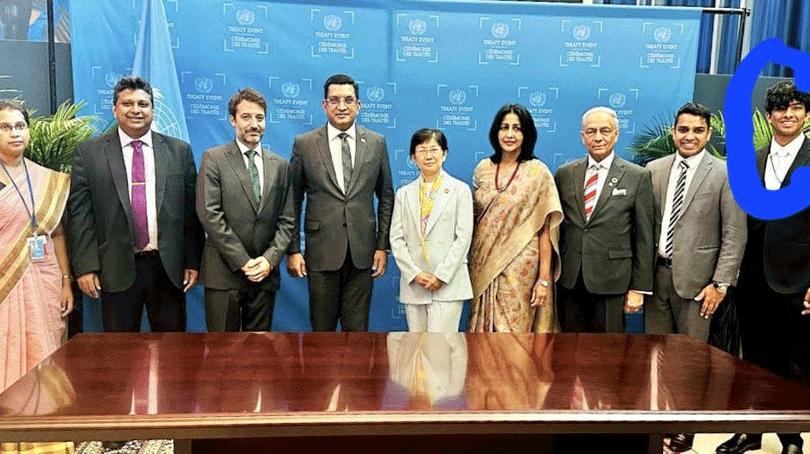
My son studying in the US assists me voluntarily: Ali Sabry

September 23rd, 2023

Courtesy Daily Mirror

Foreign Minister Ali Sabry, in his response to the public outcry on his son’s presence at UN events with him, said, Having seen the concerns raised on social media, on the presence of my son at a couple of bilateral meetings on the sidelines of the UNGA, I would like to place the following facts.

In addition to my responsibilities in assisting H.E. the President with his high-level engagements, as the Foreign Minister I maintain a demanding schedule during my visits to the UNGA and Washington D.C. This itinerary comprises delivering ten interventions and speeches, engaging in three public events, and participating in numerous bilateral and multilateral meetings.

The extensive workload necessitates thorough research, writing, and meticulous preparations. To support Ministers in fulfilling their respective duties, each of us benefits from a Minister’s bureau, comprising both paid and voluntary contributors. My son has assisted me as a research assistant and a draft writer on an ad hoc, voluntary basis at my request for a period of time.

During the UNGA, as he currently pursues his studies in the United States, he volunteered to join to contribute his time and expertise for a few days. I am pleased to acknowledge that his contributions assisted me in preparing me for these crucial engagements. Importantly, neither the Foreign Ministry nor the Government of Sri Lanka has expended a single rupee on his behalf, either for his involvement in these engagements or at any other time.

His contribution has been entirely voluntary, entailing zero cost to the taxpayer. I firmly believe that the public has every right to seek accountability from their representatives, and I am committed to providing the facts for your informed judgement.”

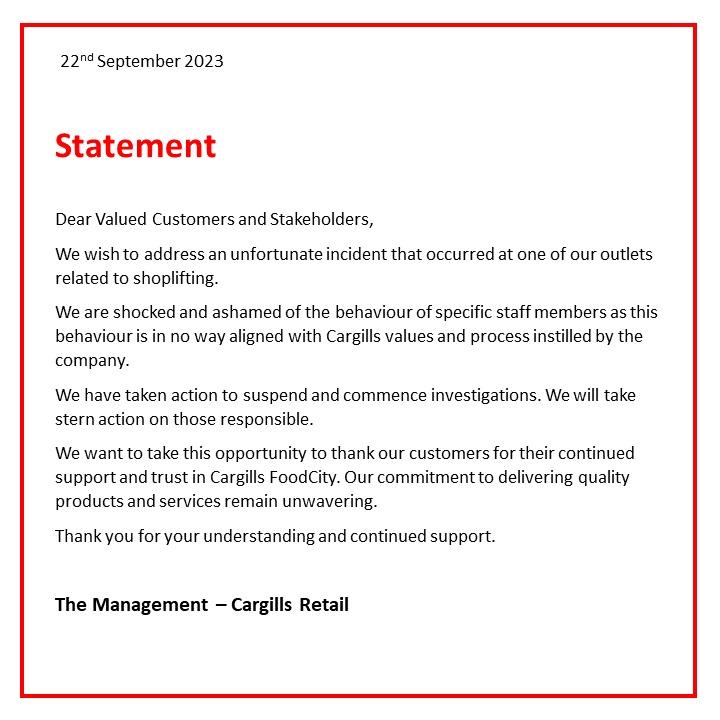
Five arrested over supermarket staff brutally assaulting female

September 23rd, 2023

Courtesy The Daily Mirror

At least five persons, a group of staff members of a leading supermarket outlet in Borella were arrested over an incident of brutally assaulting a female customer.

Police launched investigations after a video showing a group of staff members from a supermarket outlet brutally assaulting a female customer went viral on social media.

Initially, it was reported that the incident had occurred in the Hanwella area. However, later it was revealed that the incident had been at an outlet in Borella.

CCTV footage captured multiple male and female employees from the outlet brutally assaulting the customer, allegedly in response to suspected theft.

The incident reportedly took place on September 18. However, no complaints had been lodged untill the video went viral on social media.

The Borella Police are investigating into the incident.

Earlier, the management of the supermarket also issued a media statement stating that they will take stern action against those responsible.(DSB)

Patriotism: Where are we?

September 22nd, 2023

By Garvin Karunaratne

Since leaving the Sri Lankan Administrative Service in 1973, I have happened to have worked and lived in four countries for years- that was in the UK, the Bahamas, the USA, and Bangladesh. ​​

Regarding patriotism among the people, I have to admit that Sri Lanka would easily be the worst. This is very sad. It is also important to note that patriotism among Sri Lankans has been dwindling since the Eighties and has been crumbling at a rapid rate with everyone scrambling to get away to any other country where they can work and live a normal life. In my days before 1973, there was not a single person who wanted to scramble away. The ship was not sinking.

In the UK the original English who are extremely patriotic have been sidelined by immigrants. The recent rulers have failed to retain the identity of a country that was once the Mightiest Country on Earth. However in parts of the UK – in Scotland, things are entirely different. The Scots are full of patriotism. I know this for certain as I have lived there for over ten years. The Scots will die for their country.

In the Bahamas, a people who grew up from strays, -castaways, by the slave carrying ships as unwanted, is a country that can reach an abysmal history of less than four centuries, yet the people are patriotic and look to a future. In my work in youth and community development, I found patriotic people. They cherish and look forward to working together..

The USA is a country of immigrants. People from Britain and some European countries invaded and wrested the land from the American Indians and though the USA can call a heritage of only a few centuries the immigrants- from many countries have mixed and merged together into a solid identity and hold a very high sense of patriotism. I have four grandchildren in the USA who are fully patriotic. I have lived two years as a doctoral student but later lived for years with my sons and have travelled all over clocking over 5000 miles crossing coast to coast thrice. I am aware of the sheer patriotism among the people.

The Bangladeshi people are extremely patriotic. Every Bangladeshi loves the country and will die for it. I worked for two years as the Commonwealth Fund Advisor on Youth Development to the Ministry of Labour and Manpower for two years and my first five months were cloistered within administrators and consultants. However in the sixth month, it so happened that General Ershard of the Army took over the country in a bloodless coup and Air Vice Marshall Aminul Islam, the Minister for Labour and Manpower was about to axe the Youth Development former Ministry where I worked, and finally before uttering his verdict ordered me as to what I could contribute for Bangladesh. I replied that he should immediately approve a new programme to create self-employment for the youth in vocational training. The Youth Ministry provided vocational training to 40,000 youths . . The Secretary to the Treasury, the highest official in the land who was present at the Conference objected on the grounds that I could not establish a self-employment programme because the ILO of the United Nations with all their funds and worldwide experts had miserably failed to establish a self-employment Programme and it had to be folded up with a great loss.

The Hon Minister allowed us to argue out and we two argued- a one-to-one battle for over two hours. The Minister listened raptured, making notes. In the end, the Minister stopped us arguing and immediately ordered me to implement a self-employment programme. I was denied any funds and had to work with savings found from already approved budgets. This was where the patriotism within the administrators and the youths who were being given vocational training came to the forefront. Every officer was patriotic to the extreme- working for the country they loved. There was no question of it being a Saturday or a Sunday or hours of work. The youths too- our youth was the lot that were illiterate, those who could never find any job, had no qualifications and most of them had even forgotten to read and write. No subsidies of any sort were offered, but we youth workers were guiding them- when required day or night in all types of terrain. They were all patriotic to the extreme as is shown in the results where a self-employment programme that commenced in 1982 had by 2014 brought two million to be self-employed (Report to the IFAD, FAO, one of the founders). By now(2023) easily over three million youths have become self-employed. Today it is a coveted programme implemented by members of the elite Bangladesh Civil Service. The success was entirely due to the patriotism among the youths as well as the officialdom.

Finally, I come to my country, Sri Lanka, where patriotism is at a very low, unimaginable, abysmally low level. Everyone who is able wants to leave the country. This is sad as the country is extremely fertile and blessed with rain and has a record of sheer economic achievement for over twenty-five centuries.

I joined as an Assistant Commissioner in the Marketing Department- the Department that implemented the programme that purchased grains, vegetables and fruits produced by the farmers, at a higher price than what was offered by traders and sold the produce in cities at low prices, a System that is not found anywhere in the World. It also ran a Cannery that canned all the fruit and some vegetables like tomatoes, making Sri Lanka self-sufficient in all fruit produce and fruit juice in three years 1955 to 1958. Officers had to commence work at four in the morning travelling to Producer Fairs that commenced before six in the morning I supervised purchasing and also moved with the producers guiding them to produce varieties that would easily sell. It was always long hours of work and mixing with farmers. I must say that I found the farmers and officials very patriotic.

In Anuradhapura, in 1962 I implemented the Paddy Lands Act and for that, I had to elect 296 cultivation committees. Earlier I had worked with cultivation committees in the Kegalla District and found that my time was wasted in settling feuds between farmers who were divided on political party lines. It so happened that the Paddy Lands Act specified that the Cultivation Committees had to be elected by ballot. Then the election was always on party political lines and when working the opposition, would sabotage the work done- would break the Anicut that had been constructed and I had to intervene, call the Police and there was endless chaos. In Anuradhapura, I decided that all cultivation committees were to be elected by consensus. No election- it had to be a unanimous decision. I had a team of three Assistant Commissioners and ten able divisional officers and we managed to talk to the farmers and elected all other than some 12 on the consensus method. These twelve that failed had the elections with me and I succeeded in getting all of them elected as a consensus. This paid high dividends when it came to working paddy cultivation. The people worked together in repairing the tanks and canals and in following new methods of using high-yielding seed paddy. It is my opinion that reaching self-sufficiency in paddy cultivation in 1970 under the leadership of Prime Minister Mr. Dudley Senanayake was possible because of the sheer patriotism of the farmers.

One of my tasks as the Additional GA at Kegalla in 1968 and 1969 was to be with the Prime Minister. Mr Dudley Senanayake every Saturday and Sunday. I had to meet him at the Warakapola Rest House by nine and accompany him to at least eight meetings organized by party supporters and some organized by my staff. I was with him right through till dusk and I must state that the people were all patriotic in the extreme. It was this patriotism that played the path in the use of high-yielding seed paddy and the use of practices like row seeding, transplanting, and use of inorganic fertilizer where people were willingly adopting these high-yielding methods. All officials were patriotic

Later as the Government Agent at Matara(19871-1973), I found the people very patriotic. The people worked cordially with the politicians. The member of parliament for Deniyaya, Sumanapala Dahanayake, when entrusted by me with the task of establishing a Crayon Factory in his Morawaka Cooperative Union, worked pellmell for two weeks, non-stop, snatching a few hours rest on a chair, making crayons with the youths and we filled crayon packets into two large rooms within two weeks working 24 hours a day. That patriotism enabled the Crayon Factory to be well established within two weeks. In the third week sales were opened by The Hon Minister of Industries, Mr. Subasinghe. It is easily a record of achievement without par in the annals of economic development.

It so happened that I came to know the politicians personally in Kegalla in 1968 and 1969 and in Matara from 1971 to 1973. I found them very patriotic.

Unfortunately, we are now seeing a people who see no future in Sri Lanka.

This is entirely due partly to party politics and to the subjugation of our country to follow the Structural Adjustment Programme of the IMF since 1978. As I have said earlier party politics has divided the people into two compartments. The full effect of party politics was not felt in my days because the allocation of all development funds came to us officials and we spent it in a very fair manner among people also consulting elected representatives. Unfortunately, after the mid-seventies funds were sent to politicians, especially from the ruling party and even the Government Agent had to work under petty political persons. These changes brought the administration totally under the political party in power and the people at the bottom resented it.

The IMF also came to run our country on neoliberal economic principles since the days of President Jayawardena when he agreed to follow the Structural Adjustment Programme stopping all development work hitherto done to develop the country and running the country on loans. This economic policy has resulted in our buildup of foreign debt of $ 56 billion by 2023. In 1977 Sri Lanka was not a dollar in debt and had a sound economy. Further, after 1978, all development programmes were stopped on the ground that the private sector was to be the engine of growth. The administrators were put into the barracks and they found something to do. This led to the people becoming less and less patriotic. Even today we follow the IMF and that is the cause of our downfall! Today we have come to a situation where over half the population are starving and live in abject poverty.

Our future lies in an attempt to get our people to become patriotic. We have to roll back the economic development programmes like the Divisional Development Councils Programme of 1970-1977 and enable people to produce our requirements and become self-sufficient. We have a fertile country blessed with ample rain. Mother Nature has been benevolent. The Development Programmes that were stopped by the IMF in 1978 have to be restored for the people to marshall development.

At Kegalla, every weekend for two long years, I accompanied the Hon Prime Minister, Mr Dudley Senanayake, in assessing economic development in his electorate. This included attending a number of public meetings. At many such meetings, on endless occasions at the end, we sang the National Anthem of Ananda Samarakoon: .Namo Namo Mata, its wording and music was all-pervading and enthused us in patriotism. Standing by the Prime Minister Mr Dudley Senanayake on numerous occasions I can yet hear him proudly singing our National Anthem, .

We are now at the beginning of a road where through two elections- Presidential we will see a patriotic leader emerge and also create a patriotic parliament, something which we have not seen in the past few decades. Then will economic development be restored, ending the quagmire of poverty and destitution of today. We have to see that this happens through our patriotism.

Garvin Karunaratne

Formerly SLAS, GA Matara 1971-1973

20/09/2023

Invaluable role played by Philip – Kusuma Gunawardena couple for China Sri Lanka friendship- Chinese Ambassador Qi Zhenhong

September 22nd, 2023

Prime Minister’s Media Division

The 73rd anniversary celebration of the Sri Lanka China Friendship Association was held under the patronage of Prime Minister Dinesh Gunawardena on 21.09.2023 at The Temple Trees.

Addressing the gathering, Chinese Ambassador Qi Zhenhong said that the strong foundation laid by Philip-Kusuma Gunawardena couple in the 1940s for the China-Sri Lanka Friendship Association is most valuable.

Mrs. Kusuma Gunawardena was the first president of the Sri Lanka China Friendship Association, which was then known as the Ceylon Chinese Friendship Association. The Chinese ambassador further mentioned that while China is grateful for that, they should also be grateful to Mrs. Kusuma Gunawardena for giving birth to Mr. Dinesh Gunawardena, who always maintained a very close friendship with China.

Mr. Ananda Gunathilaka, the current president of the Association, described the history of the Sri Lanka China Friendship Association and said that this association was established in the home of a member with the participation of a small group of people and became stronger after the establishment of diplomatic relations between the two countries in 1955.

When the association was established, Mr. Philip Gunawardena was unseated from parliament by the colonial rulers and Mrs. Kusuma Gunawardena, who was elected uncontested represented him in the Avissawella seat, took over the position and turned this association into the strongest left-wing political institution dedicated to friendship with China. He further mentioned that  this will be an opportunity to remember the pioneer members of the Association Mrs Theja Gunawardena, then leaders of the Communist party, Mr  Sugiswara A Wickramasinghe  and Peter Kenneman.

State  Minister Geetha Kumarasinghe, Members of Parliament Yadamini Gunawardena, Rajika Wickramasinghe, former Deputy Speaker Geetanjana Gunawardena, Secretary to the Prime Minister Anura Dissanayaka, senior representatives of the Chinese Embassy and members of Sri Lanka China Friendship Association participated in this event.

Slim Pharmaceuticals (Pvt) Ltd donates 500 Face Shields

September 22nd, 2023

Ministry of Defence  – Media Centre

The Slim Pharmaceuticals (Pvt) Ltd donated a package of Anti-Fog Face Shields to the Defence Ministry Secretary Gen. Kamal Gunaratne symbolically at a function held at the Ministry, yesterday (Sep 21).

The Defence Secretary received 500 WEEPRO brand Multi-Purpose Face Shields from the officials of Slim Pharmaceuticals (Pvt) Ltd during the occasion.

The donation was made by the company as part of its Corporate Social Responsibility (CSR) project launched in accordance with the Chairperson’s perspective.

The consignment was eventually handed over to the KDU and Rear Admiral Dhammika Kumara, Vice Chancellor of KDU received the same.

Sri Lanka repays entire Bangladeshi loan

September 22nd, 2023

Courtesy The Daily Star

Sri Lanka has paid $50 million to Bangladesh, the final instalment of a $200 million loan taken under a currency swap agreement two years ago, a top Bangladesh Bank official said yesterday.

The government of the island nation also paid $4.5 million as interest on the loan amount on Thursday, the official said.

Colombo repaid $100 million on September 2 and $50 million on August 17.

Sri Lanka paid back its loan as its embattled economy is staging a recovery from its worst economic crisis just a year ago. Its inflation rocketed to 69.8 percent in September last year. In July, however, inflation stood at 6.3 percent.

On the other hand, Bangladesh is facing a foreign exchange crisis after its reserve dropped sharply in the past one and a half years owing to higher import bills compared to lower-than-expected remittance and export earnings.

The gross forex reserve came down to $21.45 billion on September 21 in line with the International Monetary Fund’s calculation formula, BB data showed.

Ali Sabry’s Photo with son at UN fuels nepotism outcry

September 22nd, 2023

Courtesy The Daily Mirror

A picture of Foreign Minister Ali Sabry with his son at an event on the sidelines of the UN General Assembly has sparked criticism with people questioning as to why such privileges are offered to the relatives of politicians.

The picture posted on X formerly known as Twitter is doing the rounds on social media with public questioning as to why Sabry’s son is part of the official delegation that has travelled to the UN in New York.

Earlier, the government was taken to task by curious citizens as to why five non-ministerial MPs from the ruling party and the opposition were included in the presidential entourage headed to the UN in New York.

Nepotism, cutting across the political divide, is rampant in Sri Lanka. It has become customary, if not expected, for the leaders to give such joy rides to their close aides.   Currently, even key diplomatic postings are held by non-career diplomats or politicians’ children denying the chance for the gifted Sri Lankans to scale up the ladder.

Did Channel 4 documentary reopen old wounds?

September 22nd, 2023

By  Dilanthi Jayammanne  Courtesy Ceylon Today

Setting aside politics, Britain’s Channel 4 documentary on the 21 April 2019, Easter Sunday carnage, released ahead of the 54th Session of the UN Human Rights Council held in Geneva, possibly reopened the wounds of those impacted by the carnage while triggering a spate of reactions from others.

A stalemate occurred with the country’s leaders taking steps to lift bans imposed on certain extremist organisations and allegedly releasing those who were said to be linked to the heinous crime which claimed the lives of nearly 270 people.

Mixed feelings

The Defence Ministry took hasty measures to issue a statement vehemently rejecting what it termed as reprehensible” allegations made by Britain’s Channel 4 TV network against the senior Sri Lankan military officers over the Easter Sunday Attacks and reiterated the Government’s unwavering” commitment to the truth, justice and the well-being of the nation.

Former Sri Lankan President Gotabaya Rajapaksa denied allegations levelled by the British television programme that the alleged ISIS-enthused militants were used to carry out suicide bombings on Easter Sunday in 2019 to create unrest and insecurity in the country and help him win an election later that year.

He noted that to claim that a group of Islamic extremists launched suicide attacks to make him President was an absurd assumption.

Former President Maithripala Sirisena was ordered by the Supreme Court to pay a sum of Rs 100 million as damages to the victims of Easter Sunday attacks for the reckless” intelligence failure on the part of the Executive. Following the Channel 4 documentary, however, he called for an international probe into the Easter Sunday bombings of 2019, in light of the revelations.

He told the media on Wednesday (13) that although he was accused of several allegations in connection with the terror attacks over the last four years, the British TV channel’s documentary had shed a different light on those who should be held accountable for the attacks.

We are raising our voices too to call for an international probe into the attacks, as proposed by the United Nations,” he said, lamenting that he had been penalised for the past four years. But the Channel 4 documentary clearly notes that what actually took place is something completely different to what was perceived.

Stance of the Sri Lankan Catholic Church

Head of Sri Lanka’s Catholic Church, Colombo Archbishop Malcolm Cardinal Ranjith, who for over four years has been at loggerheads with the Government in addition to being strongly criticised for allegedly taking a political stance, said the Catholic Church of Sri Lanka was prepared to accept the facts that were revealed in the documentary aired on Britain’s Channel 4 on the Easter Sunday terror attacks in 2019, and would accept the findings only following a transparent, independent and honest investigation into them.”

Briefing the media earlier this week Cardinal Ranjith said the probe should be in accordance with international laws and standards to ensure that it is conducted in a transparent, independent manner without political interference.

Cardinal Ranjith said Minister Manusha Nanayakkara had said a Parliamentary Select Committee would be appointed to look into matters that had been revealed in the programme on the Easter Sunday attacks.

But having been through several committees in the past to investigate the events and many recommendations being made by those commissions, no credible and positive action was taken by political authorities on the recommendations,” he said.

He accused the present and the previous government of only paying lip service to the recommendations.

Even the recommendations which were implemented such as the banning of several extremist organisations such as the National Thowheed Jama’ath had been lifted recently,” he said. The Head of Sri Lanka’s Catholic Church said therefore no tangible and credible results would emerge from yet another Parliamentary Select Committee. Instead, it would be a waste of public funds and time.

Independent international investigation team

According to the Catholic Church of Sri Lanka, investigations should be conducted on the findings outlined in the various commission reports already presented. And recommendations stated there need to be implemented, he said.

Cardinal Ranjith said investigations should be conducted by an independent international investigation team” assisted by Sri Lankan officials of the CID whose services were originally sought by the Government and transferred to other areas and posts by biased political authorities.

He said to ensure that the fresh investigation will be independent of officials in the Police and Intelligence who were investigated following the Easter Attacks, they should be suspended or moved out of their present high posts.

Cardinal Ranjith urged President Ranil Wickremesinghe and the Government to carry out these requests. We do not feel that truth and justice will be served to the innocent victims of the 2019 Easter Attacks, unless an absolutely independent, transparent and sincere internationally monitored probe was conducted,” Cardinal Ranjith stressed, noting that the Catholic Church did not believe in mere promises but in action.

Hoodwinking the public with more committees

Neither the Catholic Church nor the people at large can tolerate any more committees being appointed to probe the Easter Sunday killings whether it is a Presidential Commission of Inquiry (PCoI) or Parliamentary Select Committee (PSC), to probe the Channel 4 documentary on the 2019 Easter Sunday terror attacks.

The media at the Colombo Archbishop’s House, Spokesman for the Colombo Archdiocese, Fr. Cyril Gamini Fernando said as much. Though they submitted reports and recommendations, none of them yielded the expected results, he charged, noting that only millions in public funds and precious time had been wasted. Fr. Fernando said at the time the carnage took place President Ranil Wickremesinghe was the Prime Minister in the Government of Good Governance and PSCs were appointed by him at that time.

Therefore, Malcolm Cardinal Ranjith and the Catholic Church of Sri Lanka have serious doubts as to whether another Parliamentary Select Committee would conduct an impartial and honest investigation. Such a committee only aimed at misleading the public while incurring further wastage of time and money. Therefore, the Catholic Church of the country is unwilling to accept such a proposal,” he said.

Internationally-backed probe

The Spokesman for the Colombo Archdiocese said urgent steps should be taken to initiate an unbiased, fair and transparent investigation of unexamined details surrounding the Easter Sunday Attacks. He said the probe should be conducted under the extensive monitoring and supervision of an independent international investigation team.

Fr. Fernando stressed that the investigation team, appointed to conduct the independent probe, should include all investigators who have been transferred to different areas from the Criminal Investigation Department (CID), which conducted the initial investigation into the Easter Sunday Attacks. It is apparent that no arrests had been made after these officers had been moved out of the investigation and posted elsewhere, he alleged.

The Spokesman for the Colombo Archdiocese said all officers who were found guilty of having failed to prevent the attack by the Supreme Court but continued to serve in the Police Force should be suspended till the investigations were completed.

RIP

Both the Government and the Catholic Church of Sri Lanka should be able to allow the victims who died in the Easter Attacks to rest in peace and that includes the many children who fell victim to the bombings at the Zion Church in Batticaloa. The injured and the bedridden need to be able to come to terms with their plight instead of being constantly reminded of why they were faced with such an unfortunate future.

But this may never happen as a result of the tug of war between the Government and Sri Lanka’s Catholic Church.

By Dilanthi Jayamanne

රටක් කැළඹු ‘සොනික් සොනික්’ ගැන තොරතුරු එළියට

September 22nd, 2023

උපුටා ගැන්ම  හිරු පුවත්

පාස්කු ඉරුදින ත්‍රස්ත ප්‍රහාරය සිදුවූ කාල වකවානුවේදී මෙන්ම පසුගිය දා බ්‍රිතාන්‍ය චැනල් 4 නාලිකාව මගින් විකාශනය වු වීඩියෝව නිසා යළිත් කරළියට පැමිණි මාතෘකාවක් වන්නේ ‘සොනික් සොනික්’ යන යෙදුමයි.

විවිධ පාර්ෂවයන් විසින් මේ දිනවල ජනමාධ්‍ය හා සමාජ මාධ්‍ය ඔස්සේ මේ යෙදුම නිතර ව්‍යවහාර වීම සාමාන්‍ය දෙයක් වී තිබෙනවා.

පක්ෂ විපක්ෂ දේශපාලඥයින් මෙන්ම ආරක්ෂක අංශ නිළධාරීන්ද ‘සොනික් සොනික්’ යන වදන පාස්කු ප්‍රහාරය හා සම්බන්ධ අදහස් දැක්වීම් වලදි ප්‍රකාශකරනවා.

සාමාන්‍ය සමාජයේ බොහෝ දෙනාගේ කුතුහලය දනවන මේ යෙදුම සම්බන්ධයෙන් විස්තරාත්මක විග්‍රහයක් ඊයේ(21) පාර්ලිමේන්තුවේදී ආරක්ෂක රාජ්‍ය අමාත්‍ය ප්‍රමිත බණ්ඩාර තෙන්නකෝන් විසින් සිදුකරනු ලැබුවා.

“සොනික් සොනික්” යන්න අන්වර්ථ නාමයක් බවත් ‘සොනික් සොනික්’ යනු රාජ්‍ය බුද්ධි අංශ නිළධාරියෙකු වන අතර ඔහු අන්තවාදී කණ්ඩායමක ත්‍රස්තවාදියෙකු ලෙස පෙනී සිටිමින් අප බුද්ධි අංශ වලට අන්තවාදීන් ගැන නිරන්තර තොරතුරු සැපයූ නිලධාරියෙකු බව ප්‍රකාශ කළා.

එසේම ‘අබුහින්ද්’ යන නාමයද විදේශීය බුද්ධි අංශ විසින් අන්තර්ජාල මෘදුකාංග ඔස්සේ අන්තවාදි කණ්ඩායම් හා සම්බන්ධ වී තොරතුරු ලබා ගැනීමට භාවිතාකළ අන්වර්ථ නාමයක් බවත් සඳහන්කළා.

තමා අකමැත්තෙන් වුවත් මෙලෙස බුද්ධි අංශ තොරතුරු ප්‍රසිද්ධියේ ප්‍රකාශ කරන්නේ පාර්ලිමේන්තු මන්ත්‍රීවරුන්ගේ ඇතැම් වගකීම් විරහිත ප්‍රකාශයන් හා ක්‍රියාවන් නිසා බවයි ආරක්ෂක රාජ්‍ය අමාත්‍යවරයා වැඩිදුරටත් කියා සිටියේ.

Video of Cargills staff brutally assaulting female goes viral

September 22nd, 2023

Courtesy The Daily Mirror

A video showing a group of staff members from a Cargills supermarket outlet brutally assaulting a female customer is circulating on social media.

https://youtu.be/8vakpbousq4

The incident is reported to have occurred at the Cargills outlet in the Hanwella area. However, police have launched an investigation to confirm the location and identify the suspects.

CCTV footage captured multiple male and female employees from the outlet brutally assaulting the customer, allegedly in response to suspected theft.

Meanwhile, a statement issued by the Cargills management on the incident is as follows: (Darshana Sanjeewa Balasuriya)

SL debt justice collective writes open letter to IMF on DDO

September 21st, 2023

Sri Lankan debt justice collective

An International Monetary Fund (IMF), team is in Sri Lanka from September 14-to 27. While national experts have raised concerns about the legitimacy of the IMF engaging in Domestic Debt Restructuring, amid questions about transparency, Data accuracy, veracity, and authenticity in the IMF’s debt restructuring operations, a group of academics and activists identifying themselves as part of Sri Lankan debt justice collective has written an open letter to the International Monetary Fund (IMF), regarding the country’s Domestic Debt Optimisation (DDO) program.

This is also due to the failure to adequately release the relevant Data and computation of both the IMF’s Internal and External Debt restructuring. Concerns about the Debt Data pertain to the IMF engaging in domestic debt restructuring and converting Rupee denominated debt into US Dollars with the USD Debt Numbers being inflated to present a dire country-level scenario as a precursor for an IMF Firesale of Sri Lanka’s strategic assets in a context of escalating Global Geopolitical tensions and Cold War.  

Questions about the IMF’s conflation and inflation of domestic and internal debt data and currency conversion have been compounded by questions regarding Sri Lanka’s debt data Security, accuracy, veracity, and authenticity. There have been significant cyber and data wipes and hack of the Sri Lanka Government Cloud Data Storage system and encryption of Government emails in recent times.

Increasingly, in age of Artificial Intelligence (AI), Deep Fakes and data scraping to game numbers and narratives, international bankers and experts now recommend obtaining printed bank statements or hard copies. While, the Government of Singapore refuses to even disclose how much its reserves are, it is a matter of concern that various numbers games are being played with Sri Lanka’s Debt Data by a gravy train of experts amid concerns about the accuracy, veracity, authenticity, and transparency of the IMF Debt Restructuring in a context of escalating Cold War and Geopolitical Economic turbulence.

 Following are excerpts from the Debt Justice Collective’s Open Letter:


We are part of the Sri Lankan debt justice collective that has been working with Debt Justice UK to campaign for meaningful debt relief for Sri Lanka. In the wake of the IMF agreement with the Sri Lankan Government in March 2023, a smaller group of us wrote to the IMF delegation on 5 March 2023, setting forth a series of questions about how the IMF intended to ensure a sustainable, equitable and just plan (1).  Since then we have been alarmed to observe that our words have largely fallen on deaf ears.  

Given the IMF mission’s current visit to Sri Lanka, a larger group of us, who work on Sri Lanka or are from the country, take this opportunity to reiterate our concerns and urge the IMF to meaningfully engage with all stakeholders. 

For brevity, we set out our key concerns below. They revolve around particularly, the domestic debt optimisation (DDO) process. Many of our demands and concerns echo those raised by Sri Lankan trade unions, and civil society actors in their recent discussions with the Governor of the Central Bank of Sri Lanka (CBSL). 

By way of context, the IMF staff report considered by the Executive Board issued on March 23, 2023, notes the following key priorities in the implementation of the Extended Facility Fund (EFF) program:

  • Strengthening the social safety net
  • Revenue-based fiscal consolidation
  • Enhancing growth by reducing corruption vulnerabilities
  • Rebuilding external buffers by improving international reserves
  • Strengthening institutions and governance 

The staff report specifically states that an important priority of the program will be, ‘to protect the vulnerable from the impact of crisis and policy adjustments’ (p32, para. 46).

With this in mind, we have the following questions for the IMF delegation to address, seek clarification from the Sri Lankan Government and ensure accountability:

A) How does the Government’s proposal to seek DDO by placing the exclusive burden on the Employees’ Trust Fund (ETF) and superannuation funds, particularly, the Employees’ Provident Fund (EPF), reconcile with the IMF’s commitment to prioritise the protection of Sri Lanka’s vulnerable and social security systems?  The EPF, a majority of which earn less than Rs 100,000 per annum (circa $3,100.00 per annum), is the only social security fund for the working poor in Sri Lanka, many of who keep afloat the country’s key foreign exchange earning sectors (apparel and tea, for instance).  

B) Aside from questions of socio-economic justice, the CBSL Governor, as a custodian of the EPF, is unable by law to deplete its resources.  How does the current proposal therefore satisfy the IMF’s commitment to prioritising good governance and accountability?

C) Trade unions as well as Members of Parliament, (MP) such as the chairman of the Committee of Public Finance, Dr. Harsha de Silva, have spoken in Parliament about the opaque nature of the DDO process. The Government and the CBSL have made little effort to engage the members of the EPF and seek their opinion about subjecting their pension fund to DDO.  Key information on EPF and DDO has also been withheld from Parliament, preventing the MPs from making an informed decision on DDO. Is the IMF not concerned that this undermines the commitment to transparency, accountability and good governance identified as priorities in the IMF staff report?

D) The IMF staff report is explicit about the need to reduce corruption vulnerabilities.  Trade union leaders and civil society activists who held a meeting with the CBSL Governor on 5 September, 2023, outlined several avenues of revenue generation to address debt sustainability issues.  These include addressing the issue of illicit capital flows and tax evasion. The Global Financial Integrity (GFI) estimated that Sri Lanka has lost $40 billion as a result of illicit capital flows. The Auditor General of Sri Lanka revealed that a massive volume of tax revenue worth Rs.904 billion was lost due to tax evasion. We believe the ability of a government to secure foreign exchange earned through international trade and amass tax revenue is a cornerstone in ensuring fiscal stability and financial sustainability. In this regard, both illicit flows and tax evasion that the trade unions underscored are related to corruption around the government and corporate sector business corruption that remain unaddressed in the country. How does the Governance Diagnostic proposed by the IMF, factor in these issues?  What steps is the IMF taking to ensure that the Government of Sri Lanka (GoSL) strengthens and addresses corruption vulnerabilities?

E) Is the IMF satisfied that the GoSL, and the CBSL are ensuring transparency of communication around the EFF program?  While press releases and briefs in English are made available, what steps are being taken to share information in the local languages – Sinhala and Tamil? This is essential to ensure that the population of Sri Lanka is aware and able to make informed decisions in relation to programs of action being implemented in their name.

F) The IMF should also note that the debt negotiation process is being steered by an unelected head of state who has been postponing public elections, closing down avenues for redress via the judicial system and cracking down on dissent. Parallel to the burgeoning burden of debt restructuring placed on the people, the President and the Government are proposing to implement new draconian anti-terror laws designed to further constrain democratic rights to free speech, free assembly and public dissent. Is the IMF not concerned that this contradicts its commitment to strengthening institutions, transparency, accountability and good governance in Sri Lanka?

We raise the above concerns for your attention because – as the IMF itself notes – the impact of the debt crisis on low-income groups in Sri Lanka is severe.  The UNDP’s (2023) multi-dimensional vulnerability index estimates that more than half (55.7%) of Sri Lanka’s population faces multiple vulnerabilities.  This is a staggering 12.3 million people in a country of 22.2 million people.  We will not recount the World Bank›s estimates on increasing poverty or UNICEF›s concerns about spiralling malnutrition.  However, we bring these to the attention of the IMF mission as both the GoSL and the CBSL Governor appear to be seeking debt sustainability, where the interests of private creditors (external and internal) are given precedence over the people of Sri Lanka. This is especially ironic given that in 2013, Ranil Wickremesinghe raised the point in Parliament that the bulk of Sri Lanka’s external debt is odious, and should be cancelled without oppressing the poorest communities of Sri Lanka. 

With this in mind, we look forward to hearing how the IMF will ensure the delivery of its own publicly expressed commitments to ensuring equitable, sustainable, transparent and accountable debt relief to Sri Lanka. 

Yours sincerely,


Signatories:

1. Anne M. Blackburn, Prof Cornell University, USA

2. Arjun Guneratne, Prof Macalester College, USA

3. Harshana Rambukwella, Prof NYU, Abu Dhabi

4. Jeanne Marecek, Senior Research Professor and William Kenan Prof Emerita, Swathmore College, USA

5. Howard Nicholas, Prof Emeritus, Erasmus University of Rotterdam

6. Kanchana N Ruwanpura, Prof University of Gothenburg, Sweden

7. Kanishka Jayasuriya, Prof Murdoch University, Australia

8. Kiran K Grewal, Prof Goldsmiths, University of London, UK

9. Ruvani Ranasinha, Prof King’s College London, UK

10. Vasuki Nesiah, Prof NYU, USA

11.Dr Amali Wedagedara, Independent Post-Doctoral Researcher, Sri Lanka

12. Dr Eva Ambos, Research Fellow, University of Tübingen, Germany

13.  Charith Gunawardena, Ex-Elected Councilor, London Borough of Enfield, U.K. 

15. Heshani Sothiraj Eddleston, Filmmaker, Centre for Pesticide Prevention, University of Edinburgh, U.K.

16. Dr Kaushalya Ariyarathne, University of Colombo, Sri Lanka 

17.Dr Mario Gomez,  Executive Director, International Centre for Ethnic Studies, Sri Lanka

18. Dr Mythri Jegathesan, Associate Prof Santa Clara University, USA

19. Dr Narayani Sritharan, Post-Doctoral Fellow – AidData, William & Mary, USA

20. Dr Nicola Perera, University of Colombo, Sri Lanka

21. Dr Nimanthi Rajasingham-Perera, Associate Prof Colgate University, USA

22. Dr Sharika Thiranagama, Associate Prof Stanford University, USA

23. Dr Shyamala Gomez, Executive Director, Centre for Equality and Justice, Sri Lanka 

24.  Dr Shyamain Wickramasinghe, Research Fellow, Sussex University, U.K.

25. Dr .Darini Rajasingham-Senanayake, Independent Researcher, Sri Lanka


 (1)   https://www.ft.lk/opinion/Open-letter-to-IMF-and-IMF-mission-in-to-Sri-Lanka/14-747321

Sri Lanka’s dangerous domestic debt restructuring

September 21st, 2023

Jayati Ghosh & Kanchana N. Ruwanpura courtesy IPS Journal.eu

The IMF’s bailout plan for Sri Lanka is likely to exacerbate the country’s economic crisis and put further strain on already vulnerable workers

Nazly Ahmed (CC BY-NC-SA 2.0)
The IMF imposed a series of conditions that have significantly exacerbated Sri Lanka’s wage and cost-of-living crises, leading, amongst others, to a sharp currency devaluation, causing imported fuel and food prices to skyrocket.

More than a year after the mass protest movement known as the Aragalaya ousted Sri Lanka’s President Gotabaya Rajapaksa and his brother, Prime Minister Mahinda Rajapaksa, Sri Lankans have once again taken to the streets.

The impetus for the resurgence of public discontent is the recent bailout agreement between the International Monetary Fund (IMF) and President Ranil Wickremesinghe’s government. The deal, which aims to address the country’s ongoing balance-of-payments crisis, offers Sri Lanka less than $3 bn over four years – a tiny fraction of what the country needs to meet its debt-servicing requirements and just one-sixth of its foreign-exchange earnings, which amounted to roughly $18 bn in 2022.

Insufficient measures

In exchange for this emergency loan, the IMF imposed a series of conditions that have significantly exacerbated Sri Lanka’s wage and cost-of-living crises. The mandated shift to market exchange rates, in particular, immediately led to a sharp currency devaluation, causing imported fuel and food prices to skyrocket and contributing to a 165 per cent increase in electricity tariffs between June 2022 and February 2023.

As fiscal restraints were imposed, the economy continued to spiral down, with GDP shrinking by 7.8 per cent in 2022 and 11.5 per cent in the first quarter of 2023. This has had an adverse impact on employment, livelihoods and the viability of small and medium-sized enterprises. Consequently, real wages fell by 30-50 per cent in 2022 and have remained stagnant.

The current wave of protests is partly a reaction to the government’s decision to comply with the IMF’s demand to restructure both external and domestic debt.

Despite paying lip service to the importance of combating corruption and curbing illicit financial flows, the IMF plan falls short of tackling these issues effectively. Although it includes a modest increase in corporate income taxes, it neglects the possibility of imposing wealth taxes. Moreover, its focus on highly regressive measures, such as nearly doubling the value-added tax to 15 per cent, means that the bulk of additional revenues will be generated through indirect taxes that disproportionately affect ordinary people.

The current wave of protests is partly a reaction to the government’s decision to comply with the IMF’s demand to restructure both external and domestic debt. Instead of focusing on lowering the external debt to a sustainable level, however, the agreement aims to bring down total debt, thereby reducing the haircut imposed on foreign creditors to just 30 per cent.

This has exacerbated the crisis and is difficult to justify. In countries that do not issue global reserve currencies, there is a clear distinction between domestic and external debt. Governments can and do service domestic debt using their own currencies, the supply of which is controlled by their central banks. By contrast, foreign currency-denominated debt necessitates either foreign-exchange earnings or new borrowing.

Sri Lanka’s crisis is largely the result of the country’s inability to service its external debt due to insufficient foreign-currency reserves. Since 2016, the government has preferred to take on new international loans, primarily from private lenders, to repay its foreign creditors, including bilateral and multilateral lenders. In early 2022, the government chose to default on its foreign loans rather than explore alternative solutions.

Severe impacts on workers

But restructuring domestic debt in an economy already in decline is both painful and unnecessary. Sri Lanka’s domestic debt is held by various entities, including the central bank, commercial banks and pension funds. Given that the country’s banking system is already severely weakened, pension funds will almost certainly bear the brunt of the expected adjustment.

This will have a significant impact on the retirement savings of workers who have already been hit by massive price increases. By reducing the interest rates on sovereign bonds held by Sri Lanka’s largest pension funds from more than 20 per cent to 12 per cent, and then to 9 per cent from 2025 until maturity, the government aims to reduce its interest burden by 0.5 percentage points of GDP annually.

By targeting the meagre pension funds of Sri Lanka’s wage workers, the government’s domestic-debt restructuring plan is likely to exacerbate existing class, gender and ethnic inequalities.

Recent estimates by Ahilan Kadirgamar suggest that this will result in a 30 per cent decline in the value of retirement funds a decade from now. Moreover, these pension funds, often holding the only financial assets of working people, will be subject to a 30 per cent tax on their returns – higher than the tax rate applied to many in the corporate sector.

Many workers whose life savings are invested in these retirement funds earn wage incomes well below the minimum taxable rate. This includes workers who face numerous intersecting deprivations stemming from gender and ethnic discrimination, such as women employed in the garment industry and tea-plantation workers, especially those from minority Tamil groups.

These groups have already experienced an alarming decline in living standards. Nearly 56 per cent of Sri Lanka’s 22.2 million people are now grappling with multidimensional vulnerabilities, with women and girls being the hardest hit. Official estimates suggest that roughly 43 per cent of children under the age of five suffer from malnutrition, as do a growing number of pregnant and lactating women.

The plight of working-class Sri Lankan women underscores the clearly gendered effects of the county’s debt crises and the government’s approach to tackling them.

By targeting the meagre pension funds of Sri Lanka’s wage workers, the government’s domestic-debt restructuring plan is likely to exacerbate existing class, gender and ethnic inequalities. With their hard-earned savings eroded, poverty-level workers will be pushed further into destitution.

Meanwhile, the adjustment process relies heavily on the unpaid labour of women who continue to provide care in the face of austerity and diminishing social services. The plight of working-class Sri Lankan women underscores the clearly gendered effects of the county’s debt crises and the government’s approach to tackling them.

A genuine resolution to Sri Lanka’s prolonged economic crisis would require a dramatic change in strategy. To bring about a robust economic recovery, the government and the IMF must focus on improving the lives of working people rather than imposing on them the burden of adjustment.

© Project Syndicate

Jayati Ghosh

Jayati Ghosh

New Delhi

Jayati Ghosh is Professor of Economics at Professor of Economics at the University of Massachusetts at Amherst in the United States and Member of the Independent Commission for the Reform of International Corporate Taxation.

Kanchana N. Ruwanpura

Kanchana N. Ruwanpura

Kanchana N. Ruwanpura, Professor of Development Geography at the University of Gothenburg, is a member of the coordinating collective of the virtual and voluntary initiative Institute of Political Economy in Sri Lanka.

Questions rising from Janahanda interview with former CID Chief RaviS 

September 21st, 2023

Shenali D Waduge

·      Was the interviewee evading accountability?

·      Was the interviewer asking questions based on reading Commission Reports & ability to identify falsehoods & half-truths?

·      Were the questions centered on the notions spread via social media?

·      Can a tv show with an interviewer asking weak questions enabling the interviewee to evade accountability & pass the buck be conclusive?


Who is Ravi Seneviratne?

The most senior public official handling investigations when Sri Lanka’s largest mass murder took place & is both responsible & accountable for actions & statements. 

RaviS claims CID takes over only after a crime is committed. If so, when 11 acts of violence was committed by Zaharan & Co since 2016 – what were the actions taken by CID? If proper action had been taken, would Easter Sunday have taken place?

What exactly is the role of the CID?

Is it simply following up on an incident AFTER it occurs as RaviS claims?

Isn’t CID meant to function in a larger role? 

The police is there to file on a single incident – the entities above the police are tasked to do far more. 

CID & President Sirisena

Who advised President Sirisena to order (at the National Security Council – Dec2018) all data collected by intelligence agencies to be given to the CID & what was the purpose? 

This order resulted in all intel data centrally available only with the CID. Pursuant to the verbal order the State Intelligence Service as well as the Army Intelligence Division sent all their intelligence reports to Ravi Seneviratne. If CID had all data available why did they not investigate & take action. How many reports were sent? How many reports had files opened. How many files were investigated? How many files had actions taken against them? 

In short, RaviS needs to explain actions taken against Zaharan & co after intel reports given prior to acts of violence & what actions CID took after the acts of violence were committed by Zaharan & Co. 

Following the instructions of President Sirisena in Dec2018 – CID was the sole authority handling all reports handed to them by intel – this makes CID the direct party to be held accountable for lack of action. 

CID & Islamic Caliphate

Was CID aware of the quest to form an Islamic State or the Caliphate?

If so CID should have known that on 29 June 2014, ISIS had declared its Caliphate to be in Asia by leader Abu Bakr Al Baghdadi who made 3 demands: 

Those indoctrinated were followers of the 3.

1.    Inviting to join fight to create Islamic State

2.    To kill kafirs (non-believers) especially westerners, Catholics & those who worship idols

3.    Those unable to fight, to support Islamic State from their countries of residence

Yet, Ravi S claims none of those linked to Easter Sunday was involved with ISIS but were only inspired by ISIS ideology. Indeed this is a fine line. The brains behind the Easter Sunday attacks was Naufer Maulavi (which FBI has confirmed)

CID & Supreme Court

RaviS claims that the Commissions or Supreme Court investigating the Easter Sunday attack had not made any charges against the CID. Is this not because it was the same CID officers who were the one’s referring reports in their possession to the Commissions. Did they not decide what was to be sent & what was not – how many files were actually referred. Were these shortcomings the reason to pluck conspiracy theories & political conspiracies? 

Is this also why an innocent police officer (IP AbuBakr) continues to languish in prison for over 3 years without salary to maintain his family? 

Vavunativu Incident

After 2 policemen were killed in Vavunativu 30 Nov 2018 

President Sirisena had issued part of an intelligence report after his verbal order to hand all intel data to the CID for further investigations. 

RaviS claims that CID discovered the murder of 2 policemen was by Zaharan & Co only AFTER Easter Sunday. How truthful is this statement?

Military intel had given CID a report on 12 April 2019 that the attack was by Zaharan but media reports covered this only after the Easter Sunday attacks.

https://www.sundaytimes.lk/190428/news/three-men-in-custody-over-last-years-killing-of-2-policemen-in-vavunathivu-says-cid-347258.html

Discovery of explosives:

·      Was military intel at the site of the explosives when CID team arrived? What is so suspicious about this when they had already provided intel to CID?

·      Why did CID request the intel teams not interfere in their investigations & leave site & not work in cooperation with them?  

Did Zaharan’s wife meet a lawyer in Puttalam?

What evidence does RaviS have to claim the lawyer did not have anything to do with Easter Sunday – where are the reports on this lawyer to prove him not involved & clear his name?

·      Who is this lawyer? 

·      What is his organization?

·      How come 4 out of 7 suicide bombers were working for this lawyer? 

·      Just because the lawyer is on bail due to local/international pressures, does it declare him innocent?

·      If the lawyer had nothing to do with these 4 members of his staff who became suicide bombers, why did he meet Zaharan’s wife? Zaharan’s wife Hadiya even claims she heard this lawyer speaking with her husband. It may be a he said/she said scenario but both will have to prove their stories. 

CID & Zaharan

RaviS mentions in the interview that CID obtained international warrant to arrest Zaharan. This is a new disclosure. Was this international warrant notice informed to the Commissions, if not – why?

Let’s keep to facts: CID informed of targets 11 days before attack

·      On 9 April 2019 State Intelligence Service report clearly stated that Zaharan & associates were to launch suicide attacks targeting churches & hotels.

·      This means CID was informed the targets & the modus operandi of the attacks as well as by whom. What did CID & RaviS do after receiving intel reports on 9 April 2019 (11 days before the attacks) 

·      This shows the intel agencies did not neglect their duty & is a tool being used as cover up & to bring international investigators.

·      Sri Lanka’s intel, not India provided the news of impending attacks – this is not the notion being promoted by media. The media of Sri Lanka must desist from sensationalizing national security news and creating dramas as well as upsetting the victims/families as a result. When media absconds its main duty, those who are guilty make use of the drama to hide their shortcomings. The media even claimed the Supreme Court ordered intelligence agencies not to investigate Zaharan – which is a complete fabrication. 

Let’s simply keep to facts – before the Easter Sunday attacks.

·      Zaharan was shadowed by intel and his progress towards extremism after 2015 was noted & conveyed – was action taken or not? 

·      Intel agencies had to give all intel to CID from Dec2018 after orders from President Sirisena – this meant only CID had all intel data

·      11 acts of violence by Zaharan from 2017-2019 was reported by intel to CID 

·      CID took no action against Zaharan – why?

·      9 April 2019 intel informs CID of suicide attacks to churches & hotels – why no action was taken? – this is the most crucial piece of information & everything should centre around this inaction, which could have prevented deaths of the 269 who died. 

·      CID head confirms receipt of SMS sent by SIS head on 20 April 2019 (day before Easter Sunday attacks) – what was told on 9th April was again reminded on 20th April, why did CID not take action?

·      None of the Commissions/Committees have questioned the then CID head RaviS regarding these 2 major blunders. 

·      SIS head Nilantha Jayawardena claimed that at least 15000 knew – majority who knew said I knew but did not think it would end up like this” (Hemasiri Fernando former Def Sec/ father told me not to go to Church” (Cabinet Minister) / Cardinal decides to hold mass at his residence on Easter Sunday instead of Church– is this the case with all 15,000 who saved their necks but didn’t think of even putting a facebook post to ask people not to visit churches or hotels on Easter Sunday! All those who knew are just as complicit as the murderers.

Let’s look at the ‘Ifs”

·      If CID had taken action on the 11 acts of violence including killings by Zaharan in 2017/2018 – Zaharan would not have indoctrinated 6 others to become suicide bombers & 269 lives would have been saved. 

·      If CID had taken action after receiving intel on 9th April 2019 naming targeted venues – 269 lives would have been saved.

·      If CID had taken action after receiving intel on 20th April 2019 (day before Easter Sunday attacks) – 269 lives would have been saved. 

·      If those who knew about an attack had been a bit unselfish & made some public warnings (especially those who are 24×7 on social media) 269 innocent lives would have been saved.(it is these ones who knew but didn’t do anything who want to somehow pass the blame to clear their guilty conscience)

There is no requirement for international investigations – clearly, intel was available, action was not taken to prevent the attacks. All other trimmings are just sensationalisms linked to conspiracy theories for personal/political advantage with media encouraging these, it will only end up in these murderers planning another attack because they are well aware of the psyche of the people and how people’s mind can be manipulated away from those who really should be held to account. The wahhabi attack on traditional Muslims in Weligama is a sign of whats to come unless authorities tasked to do their job do so sans politics & politicians & foreign funded local mouthpieces should stay out of interfering into internal set ups with goal to sidetrack investigations. 

Shenali D Waduge

Migration of Medical Officers Exaggerated Falsehood

September 21st, 2023

Rajith Keerthi Tennakoon Former Governor of Southern Province

Sri Lanka is a leading country that generates Graduates for Europe, North America, Australia and the Middle East region since the decade of 1970. Even after the 1971 insurrection, the Black July 1983 and the 1987–89 dark era (deadly era) intensified the said situation. Higher salaries, better employment opportunities, higher studies, children’s education and the issues of the Heads of Institutions are the main factors that influence the migration of scholars. Medical Officers, Engineers and Graduates in other demanding fields have continued to migrate since the decade of 1970.

Dr. Chamil Wijesinghe, the Spokesperson of the Government Medical Officers’ Association had stated that 274 Specialist Medical Officers had resigned for their service since 01st of June 2022 to 31st of May 2023, and left the country.  This statement is a falsehood!  

Brain Drain: Over 200 doctors left without notice within a year, says GMOA

The reality is that the number of medical officers, in categories of who have received foreign & local leave with no pay under Pub Ad Circular No. 14/2022 and the general procedure, who have permanently released from the Ministry of Health and who have taken leave with no pay and not reported to work during the period from 2021 to up to now in 2023 is 289. Simply, it is bullshit that the number of Specialist Medical Officers who received leave for three years is mentioned as they have left the country in a single year.

      Specialist Medical Officers

Details2021202223.08.2023Total
Officers who have received foreign leave with no pay227491187
Officers who have received local leave with no pay0505
Those who have taken leave with no pay and not reported to work (considered as vacation of post)7291450
Medical Specialist who have been permanently released from the Ministry of Health (They are working in Kotalawala Medical Faculty, Universities and Ministries)15191347

From the year 2021 to August 2023, the number of specialists who have obtained leave with no pay and did not report to duty is 50. In figure, 14 no.s until August 2023, 29 no.s in 2022 and 7 no.s in 2021 have left the service. According to the Establishment Code, Specialist Medical Officers as well as every Public Official have the right to migrate with no pay. Most of them will be back.

Approximately 25 Specialists Medical Officers hold government and other administrative positions aside their expertise. It should be immediately suspend the appointment of Specialist Medical Officers to administrative positions instead of treating.

According to the statement of Dr. Chamil Wijesinghe, 842 Grade Medical Officers (Senior Medical Officers) have resigned and migrated. This is also a falsehood. The truth is that the number of medical officers who have permanently left or been terminated for the last 3 years is 586. It is a bullshit that if someone claims as more scram in one year than they scram in a period of 3 years.

      Medical Officers

Details2021202223.08. 2023Total
Officers who have received foreign leave with no pay146396392934
Officers who have left the service113203121437
Officers who have resigned106178149

The actual number of medical officers who have left the service from the year 2021 to up to now in 2023 is 437.  The number of medical officers who have given resignation is 149.  In figure, 934 (total of 3 years) have received foreign leave with no pay under the procedure mentioned in the Establishment Code and Pub Ad Circular No. 14/2022. It is thus clear that the figures presented by the Government Medical Officers’ Association are more than the sum of numbers in three years.

They said that they are making their statements based on the data obtained from the Ministry of Health under the Right to Information Act. According to the data given by Dr. G. Wijesuriya on 03rd August 2023, it is very clear that the number of Grade Medical Officers who left the service from 01st of June 2022 to 31st May 2023 is 197, and the number of Medical Officers who have resigned is 109.  Ranjith Madduma Bandara, MP (Opposition Party) had also stated in a Parliamentary Debate that thousands of medical officers have left the country within a year. These people are exaggerating their figures by placing all those who have migrated on formal leave as medical officers who have left the country.

      Dental Surgeons

21 Dental Surgeons have left the service in the last 3 years. The number of resignations is 12.  Another 39 Dental Surgeons have migrated on formal leave with no pay.

      Nursing Officers

Currently, the approved cadre of Nursing Officers is 45,367. Out of which 42,253 numbers are employed. During the period from 2021 to 31.08.2023, 557 Nursing Officers have been informed as vacation of post (VOP). 05 Nursing Officers have resigned. 434 Nursing Officers have taken foreign leave with no pay, under a formal procedure.

      Other Officials in the Health Sector

The situation of other officials in the health sector is also collateral to this condition. There are 20 resignations and 54 vacation of posts in the last 3 years. The number of people who have received formal foreign leave with no pay is 71.  The total number of employees who have migrated after obtaining leave for more than 6 months is 43 and 15 of the total number have migrated during the period till the end of August 2023.

This does not mean that there is no shortage of human resources in the health sector of the country. In figure, 2,574 (90.3%) out of the approved cadre of 2,851 Specialist Medical Officers are currently in service.  20,907 (92.8%) out 22,535 of Medical Officers to be, are existing.  1,585 (89.6%) out of 1,769 Dental Surgeons to be, are existing. Clearly 10% of vacancies are available in the Health Sector. However, leaving the country in bulk is a falsehood!

     
#CadreCadre approved as at 31.12.2022Cadre presently assigned in Service%
1.Specialist Medical Officers2,8512,57490.3
2.Medical Officers22,53520,90792.8
3.Dental Surgeons1,7691,58589.6
4.Pharmacists2,3062,02287.7
5.Medical Laboratory Technician2,3922,13289.1
6.Physiotherapist84773386.5
7.Occupational Therapist27616660.1
8.Radiologist1,10369462.9
9.Speech Therapist14411982.6
10.Audiologist583560.3
11.Nursing Officers45,36742,25393.1

The highest number of vacancies in the health sector exists in Allied Health Services. There should be 1,103 Radiologists; however there are 694 (62.9%). There should be 58 Audiologists; however only 35 (60%) are employed. There should be 2,306 Pharmacists; however there are 2,022 (87.7%). This is the real crisis in the health sector that needs immediate responses.

After the 1971 insurrection, 37%, 36% and 45% of the Medical Graduates produced in Sri Lanka in 1972, 1973 and 1974 migrated to United Kingdom and settled permanently. In 1971, 75 out of 165 Engineers produced in Sri Lanka migrated to United Kingdom.  (Source: A study by the Colombo Institute for UNCTAD. Scientist’s migration – Article written by Mr. V. K. Samaranayake) There is no such trend in migration of Medical Officers today. Between three decades 1980 and 2009, 11% of the Specialist Medical Officers produced in Sri Lanka have migrated permanently.                 

No. of Medical Officers and Engineers migrated to United Kingdom from Sri Lanka during the Period of 1968-1974

Medical Officers Engineers
  Year   Migration to United KingdomNo. of Graduates(2) as a Percentage of  (3) Migration to United KingdomNo. of Graduates(5) as a percentage of  (6)
(1) (2)(3)(4) (5)(6)(7)
         
1968273188.5 71136.2
1969142435.8 2613519.3
1970283079.1 4820623.3
19714328814.9 7516545.5
197210127237.1 7122232.0
19739927136.5 2523110.8
197411825745.9 82703.0

Medical Officers migrated for a period of one year for their higher studies must serve in Sri Lanka for 4 years, and Medical Officers migrated for a period of 2 years must serve in Sri Lanka for 8 years. From January 2022 to date, 343 Medical Officers who migrated for Postgraduate studies have reported back. However, approximately 110 among them violated the Terms of Service and did not report to work.

In every year, our medical collages produce approximately 2,000 new Medical Officers. During the period of 2020 to 2022, 1,239 Medical Graduates who have completed their studies in foreign universities have passed the examination conducted by the Medical Council and have had the opportunity to engage in the medical profession in this country. In the year 2023, approximately 600 new Medical Officers are waiting for the registration of the Medical Council. From the year 2020 to 2022, 421, 229 and 589 Medical Officers who completed their studies abroad have been received the registration of the Medical Council respectively.

The attention of the health authorities should be expeditiously referred to find practical solutions not only to the shortage of Medical Officers, but also to the shortage of other professions in the Health Sector. Prompt recruitment of retired medical officers and Specialists Medical Officers to medical services on contract basis is a solution to the current shortage of Medical Officers. Approval has been granted by the Cabinet of Ministers for the establishment of 3 private medical universities. It is essential to increase the number of Medical Officers newly appointed to the Health Sector in every year.

The Ministry of Health should take immediate action to blacklist medical officers who resign the service without prior notice. Further, the already existing laws should be put in place to allow medical officers who migrate to practice only in professions that are suitable for the medical profession. It is essential to recover compensation from officials who leave the service and violate contracts of the Ministry of Health, based on the Terms of Service

The Health Sector is currently suffering due to shortage of drugs and equipment. Meanwhile, the data and statistics of medical officers leaving the country are presenting in an exaggerated manner. Unfortunately, the responsible officials and political leadership have failed to convey the true and accurate information related to any of these facts. Therefore the real issues in the Health Sector are being hidden without concern.

වෛද්‍යවරුන් රට හැර යාම අතිශයෝක්තියට නැගූ මිත්‍යාව

September 21st, 2023

රජිත් කීර්ති තෙන්නකෝන් හිටපු දකුණු පළාත් ආණ්ඩුකාර

ශ්‍රී ලංකාව 1970 දශකයේ සිට යුරෝපය, උතුරු ඇමරිකාව, ඕස්ට්‍රේලියාව හා මැද පෙරදිග කලාපයට උපාධිධාරීන් නිෂ්පාදනය කරන ප්‍රමුඛ රාජ්‍යයකි. 1971 කැරැල්ලෙන් පසුව ද, 1983 ජූලි කලබලය හා 1987 – 89 ඝාතන රැල්ල මෙම තත්ත්වය වඩාත් තීව්‍ර කළේය. වැඩි වැටුප්, උසස් රැකියා අවස්ථාවන්, වැඩිදුර අධ්‍යාපනය, දරුවන්ගේ අධ්‍යාපනය හා ආයතන ප්‍රධානීන්ගේ ගැටළු උගතුන් විදේශගත වීමට මුලික ලෙස බලපානු ලබයි. වෛද්‍යවරුන්, ඉංජිනේරුවරුන් සහ ඉල්ලුමක් ඇති තවත් ක්ෂේත්‍රයන් ගණනාවක උපාධිධාරීන් 1970 දශකයේ සිට අඛණ්ඩව විදේශගත වී ඇත.

 රජයේ වෛද්‍ය නිලධාරීන්ගේ සංගමයේ මාධ්‍ය ප්‍රකාශක වෛද්‍ය චමිල් විජේසිංහ මහතා ප්‍රකාශ කර තිබුණේ 2022 ජූනි 1 සිට 2023 මැයි 31 දක්වා විශේෂඥ වෛද්‍යවරුන් 274 ක් සේවයෙන් ඉල්ලා අස්වී රටින් පිටවී ගොස් ඇති බව යි. මෙම ප්‍රකාශය පට්ටපල් බොරුවකි! https://www.newsfirst.lk/2023/08/14/brain-drain-over-200-doctors-left-without-notice-within-a-year-says-gmoa/

සත්‍යය නම්, 2021 සිට 2023 මේ දක්වා කාල සීමාව තුළ සාමාන්‍ය ක්‍රමවේදය සහ රා.ප. ච අංක 14/2022 යටතේ වැටුප් රහිත විදේශීය හා දේශීය නිවාඩු ලැබූ, සෞඛ්‍ය අමාත්‍යාංශයෙන් ස්ථිර ලෙස සේවයෙන් නිදහස් කළ සහ වැටුප් රහිත නිවාඩු ලබා නැවත සේවයට වාර්තා නොකළ යන ඛාණ්ඩයන්ට අයත් සංඛ්‍යාව 289 ක් වන බවයි. සරලවම වසර තුනක නිවාඩු ලබා ඇති විශේෂඥ වෛද්‍යවරුන්ගේ සංඛ්‍යාව, තනි වසරක් තුළ රට හැර ගොස් ඇති බවට ඔවුන් ගජබින්නයක් දෙසයි!

      විශේෂඥ වෛද්‍යවරු

විස්තරය202120222023.08.23එකතුව
වැටුප් රහිත විදේශ නිවාඩු ලැබූ227491187
වැටුප් රහිත දේශීය නිවාඩු ලැබූ0505
වැටුප් රහිත නිවාඩු ලබා නැවත සේවයට වර්තා නොකළ (සේවය අත හැර ගියා සේ සැලකිය යුතු පිරිස)7291450
සෞඛ්‍ය අමාත්‍යාංශයෙන් ස්ථීර ලෙස සේවයෙන් නිදහස් කල (මොවුන් කොතලාවල වෛද්‍ය පීඨය, විශ්වවිද්‍යාල හා අමාත්‍යාංශවල සේවය කරති)15191347

2021 සිට 2023 අගෝස්තු දක්වා වැටුප් රහිත නිවාඩු ලබා සේවයට වාර්තා නොකළ විශේෂඥ වෛද්‍යවරුන් සංඛ්‍යාව 50 කි. 2023 අගෝස්තු මස දක්වා 14  ක් ද, 2022 වසරේ 29 ක් ද, 2021 දී 7 ක් සේවය හැර ගොස් ඇත. ආයතන සංග්‍රහයට අනුව සෑම රාජ්‍ය සේවකයෙකුටම මෙන්ම විශේෂඥ වෛද්‍යවරුන්ට ද වැටුප් රහිතව විදේශගතවීමේ අවස්ථාව හිමිව ඇත. මේ පිරිස අතරින් බහුතරයක් නැවත රටට පැමිණේ.

විශේෂඥ වෛද්‍යවරුන් 25 දෙනෙකු පමණ ඔවුන්ගේ විශේෂඥතාවය පසෙක ලා රජයේ සහ වෙනත් පරිපාලන තනතුරු දරති. රෝගීන්ට ප්‍රතිකාර කිරීම විනා පරිපාලන තනතුරු සඳහා විශේෂඥ වෛද්‍යවරුන් පත් කිරීම වහා නැවැත්විය යුතුය.  

වෛද්‍ය චමිල් විජේසිංහ මහතාගේ ප්‍රකාශයට අනුව, ශ්‍රේණි වෛද්‍යවරුන් 842 දෙනෙකු (ජ්‍යෙෂ්ඨ වෛද්‍යවරුන්) සේවයෙන් ඉවත්ව විදෙස් ගතව ඇත.  මෙයද පට්ටපල් බොරුවකි. සත්‍යය නම් පසුගිය වසර 3 ටම සේවයෙන් ස්ථිරව ඉවත්වී හෝ ඉවත් කර ඇති සංඛ්‍යාව 586 කි. වසර 3 ක කාල සීමාව තුළ ඉවත්වූ සංඛ්‍යාවට වැඩි ප්‍රමාණයක් එක් වසරක් තුළ ඉවත්වූ බව යමෙකු ප්‍රකාශ කරන්නේ නම් එය ගජබින්නයකි!

      වෛද්‍ය නිලධාරීන්

විස්තරය202120222023.08.23එකතුව
වැටුප් රහිත විදේශ නිවාඩු ලැබූ146396392934
සේවය හැර ගොස් ඇති113203121437
ඉල්ලා අස්වීම ලබා දී ඇති106178149

2021 සිට 2023 මේ දක්වා සේවය හැර ගොස් ඇති වෛද්‍ය නිලධාරීන්ගේ සැබෑ සංඛ්‍යාව 437 කි. ඉල්ලා අස්වීම ලබා දී ඇති වෛද්‍ය නිලධාරීන් ගණන 149 කි. ආයතන සංග්‍රහයේ දැක්වෙන ක්‍රමවේදය  හා රා.ප.ච අංක 14/2022 යටතේ 934 ක් (වසර 3 එකතුව) වැටුප් රහිත විදේශ නිවාඩු ලබා ඇත. රජයේ වෛද්‍ය නිලධාරින්ගේ සංගමය ඉදිරිපත් කරන සංඛ්‍යා වසර තුනක එකතුවටත් වඩා වැඩි බව මේ අනුව පැහැදිලිය.

තොරතුරු දැන ගැනීමේ පනත යටතේ සෞඛ්‍ය අමාත්‍යාංශයෙන් ලබාගත් දත්ත අනුව ඔවුන් තම ප්‍රකාශ සිදුකරන බව පවසයි.  2023 අගෝස්තු 03 දින වෛද්‍ය ජී. විජේසූරිය මහතා විසින් ලබා දී ඇති දත්ත අනුව, 2022 ජූනි 1 සිට 2023 මැයි 31 දක්වා සේවය අතහැර ගිය ශ්‍රේණි වෛද්‍යවරුන් පිරිස 197 ක් බව ද, ඉල්ලා අස්වී ඇති වෛද්‍ය නිලධාරීන් සංඛ්‍යාව 109 ක් බව ද ඉතා පැහැදිලිව දක්වා ඇත. වෛද්‍යවරුන් දහස් ගණනක් වසරක් තුළ රට හැර ගොස් ඇති බව පාර්ලිමේන්තු විවාදයක දී විපක්ෂයේ රංජිත් මද්දුම බණ්ඩාර මන්ත්‍රීවරයා ද ප්‍රකාශ කර තිබුණි.  විධිමත් අයුරින් නිවාඩු ලබා විදේශගතවී ඇති සියලු දෙනා රට හැර ගිය වෛද්‍යවරු ගණයට දමා මේ අය තම සංඛ්‍යා අතිශයෝක්තියෙන් දක්වති.

      දන්ත ශෛල්‍ය වෛද්‍යවරුන්

දන්ත ශෛල්‍ය වෛද්‍යවරුන් 21 දෙනෙකු පසුගිය වසර 3 තුළ සේවය හැර ගොස් ඇත. ඉල්ලා අස්වූ සංඛ්‍යාව 12 කි. විධිමත් ආකාරයට වැටුප් රහිත නිවාඩු ලබා තවත් දන්ත වෛද්‍යවරු 39 දෙනෙකු විදේශගතවී ඇත.

      හෙද නිලධාරීන්

මේ වන විට හෙද නිලධාරීන්ගේ අනුමත සේවක සංඛ්‍යාව 45,367 කි.  එයින් සේවයේ නිරත පිරිස 42,253 කි. 2021 සිට 2023.08.31 කාල සීමාව තුළ හෙද නිලධාරීන් 557 දෙනෙකු වෙත සේවය හැරයාමේ නිවේදනය නිකුත් කර ඇත. හෙද නිලධාරීන් 05 දෙනෙකු ඉල්ලා අස්වී වී ඇත. විධිමත් ක්‍රමවේදයක් යටතේ හෙද නිලධාරීන් 434 දෙනෙකු වැටුප් රහිත විදේශ නිවාඩු ලබා ඇත. 

      සෞඛ්‍ය ක්ෂේත්‍රයේ අනෙකුත් නිලධාරීන්

සෞඛ්‍ය ක්ෂේත්‍රයේ අනෙකුත් නිලධාරීන්ගේ තත්ත්වය ද මෙයට සමාන්තරය. පසුගිය වසර 3 තුළ ඉල්ලා අස්වීම් 20 ක් ද, සේවය හැරයාම් 54 ක් ද වේ. වැටුප් රහිත විධිමත් විදේශ නිවාඩු ලබා ඇති සංඛ්‍යාව 71 කි. මාස 6 කට වැඩි කාලයකට නිවාඩු ලබා විදේශගත වී ඇති සමස්ත සේවක සංඛ්‍යාව 43 ක් වන අතර 2023 වසරේ අගෝස්තු මස අවසානය දක්වා කාලය තුළ සමස්ත සංඛ්‍යාවෙන් 15 දෙනෙකු විදේශගතව ඇත.

මෙයින් කියවෙන්නේ රටේ සෞඛ්‍ය ක්ෂේත්‍රයේ මානව සම්පත් හිඟයක් නොමැති බව නම් නොවේ.  විශේෂඥ වෛද්‍යවරුන්ගේ අනුමත කාර්යමණ්ඩලය 2,851 ක් වන විට සේවයේ සිටින්නේ 2,574 දෙනෙ කි (90.3%). වෛද්‍ය නිලධාරීන් 22,535 ක් සිටිය යුතු තැන සිටින්නේ 20,907 (92.8%) කි.  දන්ත වෛද්‍යවරු 1,769 ක් සිටිය යුතු තැන 1,585 (89.6%) ක් සේවයේ සිටිති. පැහැදිලි ලෙසම සෞඛ්‍ය කේෂ්ත්‍ර යේ 10% ක තනතුරු පුරප්පාඩු තිබේ. නමුත්, තොග පිටින් රට හැරයාම නම් පැහැදිලි අසත්‍යයකි!

     
#කාර්ය මණ්ඩලය2022.12.31 දිනට අනුමත කාර්ය මණ්ඩලයදැනට සේවයේ නියුතු කාර්ය මණ්ඩලය%
1.විශේෂඥ වෛද්‍යවරු2,8512,57490.3
2.වෛද්‍ය නිලධාරීන්22,53520,90792.8
3.දන්ත වෛද්‍යවරුන්1,7691,58589.6
4.‍ඖෂධවේදීන්2,3062,02287.7
5.වෛද්‍ය රසායනාගර කාර්මික විද්‍යාඥ2,3922,13289.1
6.භෞත චිකිත්සක84773386.5
7.වෘත්තීය චිකිත්සක27616660.1
8.විකිරණ ශිල්පී1,10369462.9
9.වාග් චිකිත්සක14411982.6
10.ශ්‍රවණවේදී583560.3
11.හෙද නිලධාරීන්45,36742,25393.1

සැබෑ ලෙස සෞඛ්‍ය ක්ෂේත්‍රයේ වැඩිම පුරප්පාඩු සංඛ්‍යාව ඇත්තේ සම සෞඛ්‍ය සේවාවන්වලය. විකිරණ ශිල්පීන් 1,103 ක් සිටිය යුතු නමුත් සිටින්නේ 694 (62.9%) කි. ශ්‍රවණවේදීන් 58 ක් සිටිය යුතු නමුත් සේවයේ නිරත වන්නේ 35 (60%) කි. ඖෂධවේදීන් 2,306 ක් සිටිය යුතු නමුත් සිටින්නේ 2,022 (87.7%) කි. මෙය වහා පිළිතුරු සොයා ගත යුතු  සෞඛ්‍ය ක්ෂේත්‍රයේ සැබෑ අර්බුදයයි.

1971 කැරැල්ලෙන් පසුව 1972 , 1973 හා 1974 වර්ෂවල මෙරටින් බිහිවූ වෛද්‍ය උපාධිධාරීන්ගෙන්  පිළිවෙලින් 37%, 36%, හා 45% ක ප්‍රමාණයක් එංගලන්තයට සංක්‍රමණය වී එහි ස්ථිර පදිංචියට ගොස් තිබේ. 1971 දී මෙරටින් බිහි වූ ඉංජිනේරුවන් 165 න් 75 ක් ම එංගලන්තයට සංක්‍රමණය විය. (මූලාශ්‍රය: අන්ක්ටාඩ් සඳහා කොළඹ මාර්ග ආයතනය විසින් පිළියෙල කරන ලද අධ්‍යයනයක්. විද්‍යාඥයින් රට හැර යාම – වී.කේ. සමරනායක ලිපිය)  අද රටේ වෛද්‍යවරුන් විදේශගතවීමේ දී එවැනි ප්‍රවණතාවයක් නැත. 1980 හා 2009 දශක තුන තුළ මෙරටින් බිහි වූ විශේෂඥ වෛද්‍යවරුන්ගෙන් 11% ක් ස්ථිර ලෙස විදේශගතවී ඇත.

උසස් අධ්‍යාපනය සඳහා වසරක කාල සීමාවක් සඳහා විදේශගතවන වෛද්‍යවරුන් වසර  4 ක් ද, වසර 2  ක කාල සීමාවක් සඳහා විදේශගතවන වෛද්‍යවරුන් වසර 8 ක් ද, මෙරට සේවයේ යෙදිය යුතුය. 2022 ජනවාරි සිට මේ දක්වා පශ්චාත් උපාධි අධ්‍යයනයන් සඳහා විදේශගත වූ වෛද්‍යවරුන් 343 දෙනෙකු නැවත සේවයට වාර්තා කර ඇත. නමුත්, ඉන් 110 ක් පමණ සේවා කොන්දේසි කඩකර සේවයට වාර්තා කර නැත.

වාර්ෂිකව රාජ්‍ය වෛද්‍ය විද්‍යාල මගින් නව වෛද්‍යවරුන් 2,000 ක් පමණ බිහිවේ. 2020 සිට 2022 කාලසීමාව තුළ විදේශ රටවල අධ්‍යාපනය අවසන් කර පැමිණි වෛද්‍ය උපාධිධාරීන් 1,239 දෙනෙකු වෛද්‍ය සභාව මගින් පවත්වන පරීක්ෂණයෙන් සමත්ව මෙරට වෛද්‍ය වෘත්තියේ නිරත වීමට අවස්ථාව හිමිකර ගෙන තිබේ. 2023 වසරේදීද නවක වෛද්‍යවරුන් 600 ක් පමණ වෛද්‍ය සභාවේ ලියාපදිංචිය අපේක්ෂාවෙන් සිටී. 2020 සිට 2022 දක්වා විදේශයන්හි අධ්‍යාපනය සම්පුර්ණ කළ වෛද්‍යවරුන් පිළිවෙලින්  421, 229 සහ 589 දෙනෙකුට වෛද්‍ය සභාවේ ලියාපදිංචිය හිමි වී ඇත. 

වෛද්‍ය හිඟයට පමණක් නොව, වෛද්‍ය ක්ෂේත්‍රයේ අනෙකුත් වෘත්තීන්ගේ හිඟයට  ප්‍රායෝගික විසඳුම් සොයා ගැනීමට සෞඛ්‍ය බලධාරීන්ගේ අවධානය වහා යොමු විය යුතුය. විශ්‍රාමික වෛද්‍යවරුන් හා විශේෂඥ වෛද්‍යවරුන් කොන්ත්‍රාත් පදනම යටතේ වෛද්‍ය සේවයට කඩිනමින් බඳවා ගැනීම දැනට ඇති වෛද්‍ය හිඟයට කෙටි කාලීන විසඳුමකි. පෞද්ගලික වෛද්‍ය විද්‍යාල 3 ක් ස්ථාපනය  කිරීම සඳහා අමාත්‍ය මණ්ඩල අනුමැතිය ලැබී ඇත. වාර්ෂිකව සෞඛ්‍ය ක්ෂේත්‍රයට එක්වන නවක වෛද්‍යවරුන් සංඛ්‍යාව වැඩිකර ගැනීමට අත්‍යාවශ්‍යය.

නොදන්වා සේවය අත්හැර යන වෛද්‍යවරුන් අසාදු ලේඛණගත කිරීමට අවශ්‍ය ආයතනික ක්‍රියාමාර්ග ගැනීමට සෞඛ්‍ය අමාත්‍යාංශය දැන්වත් වහා ක්‍රියා කළ යුතුය. තවද විදේශගත වන වෛද්‍යවරුන් වෛද්‍ය වෘත්තියට සරිලන වෘත්තීන්හි පමණක් යෙදීමට දැනටමත් පවතින නීති ක්‍රියාත්මක තත්ත්වයට පත් කළ යුතුය. සෞඛ්‍ය අමාත්‍යාංශයේ සේවය හැර යන සහ ගිවිසුම් උල්ලංඝනය කරන නිලධාරීන් සම්බන්ධයෙන් සේවා කොන්දේසි මත වන්දි අයකර ගැනීම සිදු කිරීම අත්‍යාවශ්‍යය.  

අද සෞඛ්‍ය ක්ෂේත්‍රය ඖෂධ හිඟය, උපකරණ හිඟය නිසා දැඩි පීඩාවකට පත්ව ඇත. ඒ අතරට වෛද්‍යවරුන් රට හැර යාමේ දත්ත හා සංඛ්‍යා ලේඛන අතිශයෝක්තියට නගමින් ඉදිරිපත් කරමින් ඇත.  අවාසනාවකට මේ කිසිවකට අදාළ නිවැරදි හා සත්‍ය තොරතුරු ජනතාව අතරට ගෙන යාමට වගකිව යුතු නිලධාරීන් හා දේශපාලන නායකත්වය අසමත්වී ඇත. ඒ නිසාම සෞඛ්‍ය ක්ෂේත්‍රය වසා පවතින සැබෑ ගැටළු යට යමින් තිබේ.

Patali’s Action Plan

September 21st, 2023

Chandre Dharmawardana

The claim that Champika “is a capable person” is based on

(1) comparing him with many other MPs who are uneducated

(2) that Champika has an engineering degree and so, he is “educated”.

I think this assessment is incorrect. A person must be judged not only on his “degree”, but also on his performance (track record).

On that basis, I think, if anything, he is “ILL-EDUCATED” and unsuited for office.

Here are my reasons:

(i) He and Ven. Ratana was behind the “Toxin-free agriculture” movement that set up a body called SEMA to run agricultural policy through Sirisena’s Presidential secretariate while Sirisena was the president. 

They banned the herbicide Glyphosate and the loss to the country has been calculated to be three times that of the bond-scam. They were part of the move to “organic agriculture” although they are very silent now and put the blame on Gotabhaya. It is alleged that they also had a hand in various shady deals regarding organic fertilizers, biofilm-biofertilizers, etc. 

In all this Champika was assisted by one of his Moratuwa University engineering buddies, Asoka Abegunawardena (?). These are people who have somehow managed to acquire an engineering degree although their capacity to think critically seems to be zero.

(ii) When Champika was energy minister he put a lot of government money and support to a scam project known as “Polipto”, supposed to be a method for converting waste polythene to petrol. 

LankaWeb – POLIPTO

LankaWeb – POLIPTO

Anyone who had any basic training in engineering should have been able to see through such a scam. So, once again we see that Campika R’s engineering is at best an “ill-education”

(iii)Look at his performance during his time as the energy minister, and the story of the Norchchollei coal tender during his time, or was he complicit, you wonder if his Engineering degree is seen to be of any use:

http://www.ceylontoday.lk/51-100825-news-detail-champikas-cabinet-paper-on-the-coal-tender-who-siphoned-off-rs12-billion.html

(iv) Then there are questions about his direct or indirect involvement in the Aluthgama-Kaadiyawatta & Beruwala clash with Muslims

(iv) Champika has shown no hesitation in being outright Marxist (“the end justifies the means, however violent”) or outright Buddhist (JHU) when it fits his agenda. He was one of the lead accusers of the Rajapaksas when he joined Sirisena, and was behind many searches of people’s properties, and digs of land (even in Welgama’s property) but they did not carry through any of the indictments to completion. 

(v) It was alleged by others that his name, or people close to him appeared in the “Panama papers” that listed people who had stacked off money off-shore. No one knows if these are mere allegations, or what.

So what does Champika R stand for, based on his track record?


Copyright © 2026 LankaWeb.com. All Rights Reserved. Powered by Wordpress