‘ආගමික ගැටුමක් හදන්න විදේශයකින් මුදල්.. භික්‍ෂු ගිණුම්වලටත් ලැබෙයි..’

May 30th, 2023

උපුටා ගැන්ම ලංකා සී නිව්ස්

ආගමික ජාතික සංහිදියාව විනාශ කරනු ලබන සමාජ මාධ්‍ය යේ කැපී පෙනෙන අයට සහාය ලබා දෙන්න එපා. මේ කණ්ඩායම්වලට විදේශීය රටවලින් සහාය ලබා දෙනවා කියලා තොරතුරු පවතිනවා. අපේ රටේ ඇතැම් භික්ෂුන් වහන්සේලාටත් එහෙම මුදල් එනවා කියලා හෙලිව තිබෙනවා” අධිකරණ, බන්ධනාගාර කටයුතු හා ආණ්ඩුක්‍රම ව්‍යවස්ථා ප්‍රතිසංස්කරණ අමාත්‍ය විජයදාස රාජපක්ෂ මහතා පවසයි

අමාත්‍යවරයා මෙම අදහස් පළ කරනු ලැබුවේ අධිකරණ අමාත්‍යාංශ ශ්‍රවණාගාරයේදි  පැවති විශේෂ මාධ්‍ය හමුවක් සඳහා එක්වෙමිනි

සමාජ මාධ්‍ය පාලනය කළ නොහැකි වුවත් ඔවුන් කරනු ලබන ප්‍රකාශ සදහා නීතිමය පියවර ගැනීමට හැකියාවක් පවතින බව ද අමාත්‍යවරයා මෙහිදී පැවසීය.

එහිදී වැඩිදුරටත් අදහස් පළ කළ අධිකරණ අමාත්‍යවරයා,

බහු භාෂික බහු ජාතික බහු ආගමික ජනතාවක් ඉන්න රටක් ලෙස අපිට සංහිදියාව ඉතා වැදගත්. ආණ්ඩුක්‍රම ව්‍යවස්ථාවේ 14 වන වගන්තියෙන් භාෂණයේ හා අදහස් ප්‍රකාශ කිරීමේ නිදහස තහවුරු කර තිබෙනවා. එහෙත් එම නිදහස භාවිතා කළ යුත්තේ කුමන ආකාරයෙන් ද යන්නත් ව්‍යවස්ථාවේ පැහැදිලිවම සදහන් කර තිබෙනවා. භාෂණයේ හා අදහස් ප්‍රකාශ කිරීම භාවිතා කළ යුත්තේ ජාතික හා ආගමික සමගියට හානි නොවන පරිදි කියලා ආණ්ඩුක්‍රම ව්‍යවස්ථාවේ ම සඳහන් කර තිබෙනවා. ජනතාව භේද භින්න කරන ආකාරයේ අදහස් ප්‍රකාශ කිරීමේ අයිතිය කාටවත් නැහැ. අපේ රටේ ආගමික සුහදත්වය බිද දැමීමට බොහෝ අය උත්සාහ කළා. කිසිම ආගමකින් කියලා නැහැ තවත් ආගමකට අපහාස වන ආකාරයට කටයුතු කරන්න කියලා. ඒ නිසා අනිත් ආගම්වලට හානි නොවන පරිදි කටයුතු කරන්න අපි සියලු දෙනා වග බලා ගත යුතුයි. වෙනත් අය ගරු කරන ආගමික ශාස්තෘවරුන්ට අගෞරව වන පරිදි අපි කටයුතු නොකළ යුතුයි.

එහෙම කටයුතු කරනු ලබන පුද්ගලයින්ට දිය හැකි දඩුවම් පිළිබදව දණ්ඩ නීති සංග්‍රහයේ පැහැදිලිවම සදහන් වෙනවා. අපේ රටේ සියලු දෙනාට පවතින අදහස් ප්‍රකාශ කිරීමේ අයිතිය අපි ආරක්ෂා කරනවා. ජාත්‍යන්තර සිවිල් හා දේශපාලන අයිතිවාසිකම් ප්‍රඥප්තිය අපි පිළි අර ගෙන තිබෙනවා. ඒ අනුව මෙවැනි වෛරී අදහස් ප්‍රකාශ කරන අයට එරෙහිව වසර දහයක් දක්වා සිර දඩුවම් ලබාදීමේ හැකියාව තිබෙනවා. ඒ අයිතිය තිබෙන්නේ සීමාවන්ට යටත්ව කියලා අපි අවබෝධ කර ගත යුතුයි. ආගමික සමගියට බාධා කරන අය ඉන්නවා නම් අපි ඒ පිළිබදව ක්‍රියා කරනවා.

නීතිය ක්‍රියාත්මක කරනවා. සත්‍ය ගවේෂණය කිරීමේ නව යාන්ත්‍රණයක් සකස් කිරිම අපි ආරම්භ කර තිබෙනවා. ඒ සදහා ක්‍රමවේදයක් සකස් කිරීමට අමාත්‍ය මණ්ඩලය විසින් අනුමැතිය ලබා දුන්නා. ඒ අනුව අපි සත්‍ය ගවේෂණය කිරීමට මුලිකත්වය ලබා දෙමින් කටයුතු කරනවා. තම තමන්ට කැමති ආගමක් ඇදහීමේ අයිතියක් අදහන්න අයිතියක් තිබෙනවා. වෙන කෙනෙක් අදහනු ලබන ආගමකට හානි වන දේ කරන්න එපා. එහෙම කළොත් තරාතිරම නොබලා ක්‍රියා කරනවා. ශ්‍රී ලංකාව තුළ වසර දහස් ගණනක් ජනතාව සමගියෙන් ක්‍රියා කළා. ඒ සමගියට බාධා වන දේ කරන්න ඉඩ දෙන්න බැහැ. ශ්‍රී ලංකා රාජ්‍ය බිද දැමීම සදහා ජාත්‍යන්තර හා දේශීය වශයෙන් කටයුතු කරන බව පැහැදිලියි.

කාරුණිකව සියලු ශ්‍රී ලාංකික ජනතාවගෙන් ඉල්ලා සිටිනවා මාධ්‍ය භාවිතය අවභාවිතා කරන්න එපා. සමාජ මාධ්‍ය භාවිතා කළ යුතු වන්නේ සමාජයට හිතකර වන ආකාරයටයි. ඒ නිසා ආගම්වලට හානි වන අයුරින් අගෞරව වන ආකාරයට ක්‍රියා කරන්න එපා. ”එවැනි කටයුතු කිරීමෙන් සිදු වන්නේ ජන ජීවිතය අඩාලවීම බව ද අමාත්‍යතුමා සදහන් කළේය.

මාධ්‍ය වේදින් යොමු කළ ප්‍රශ්න සදහා පිළිතුරු ලබා දෙමින් තවදුරටත් අදහස් පළ කළ අධිකරණ අමාත්‍යවරයා මෙසේ ද සදහන් කළේය.

වර්තමානය වන විට උද්ගතව ඇති ආගම් විරෝධි හා වෛරී අදහස් ප්‍රකාශ කිරීමේ තත්ත්වය සංවිධානාත්මකව සිදු කළ දෙයක් බව අනාවරණය වී තිබෙනවා. අපේ රටේ තිබෙන ප්‍රජාතන්ත්‍රවාදී නිදහස අවභාවිතා කරනු ලබන අය ඉන්නවා. අවස්ථාවාදී දේශපාලන සංස්කෘතිය අපි වෙනස් කළ යුතුයි. රටක කුමන ආකාරයේ සම්පත් පැවතියත් නීතියේ ආධිපත්‍යය බිද වැටිලා නම් රට කඩා වැටෙනවා. ජනතාව අතර සංහිදියාව නැති කරන අයට අනවශ්‍ය ලෙස ඇතැම් ප්‍රධාන මාධ්‍ය තුලින් ප්‍රසිද්ධිය ලබා දෙනවා. ඒ නිසා ආගමික ජාතික සංහිදියාව විනාශ කරනු ලබන සමාජ මාධ්‍ය යේ කැපී පෙනෙන අයට සහාය ලබා දෙන්න එපා. මේ කණ්ඩායම්වලට විදේශීය රටවලින් සහාය ලබා දෙනවා කියලා තොරතුරු පවතිනවා. අපේ රටේ ඇතැම් භික්ෂුන් වහන්සේලාටත් එහෙම මුදල් එනවා කියලා හෙලිව තිබෙනවා. රට නැවතත් ගොඩ ගන්න උත්සාහ කරන කොට නැවතත් විනාශ කරන්න එදනවා. දැන් ඇතැම් අය බෞද්ධ ආගමට හා භික්ෂුන් වහන්සේලාට අපහාස කරලා විනාශ කරන්න හදනවා.

විකාශන අධිකාරී පනතක් ගෙන ඒම තුළින් මාධ්‍ය හෝ සමාජ මාධ්‍ය මර්දනය කිරීමක් වන්නේ නැහැ. මේ පනත් කෙටුම්පත සකස් කර තිබෙන්නේ මාධ්‍ය සිදු කරනු ලබන කටයුතු තවදුරටත් හොදින් කිරීමට සහාය වීමටයි. මෙම පනත් කෙටුම්පත සම්බන්ධව සියලු මාධ්‍ය සමග ඉදිරියේදී සාකච්ඡා කරනවා. වෛරී ප්‍රකාශන විද්‍යුත් මාධ්‍ය, පුවත් පත්,Tik Tok,Face book මේ කුමන මාධ්‍යයෙන් පළ කළත් වරදක් වෙනවා. නමුත් සමාජ මාධ්‍ය පාලනය කරන්න රජයට බැහැ. සමාජ මාධ්‍ය තුළින් සිදු කරනු ලබන වෛරී අදහස් සම්බන්ධව නීතිමය පියවර ගන්න පුළුවන්.

මේ විදිහට ක්‍රියා කරන්න ගියොත් ජනතාව විසින් ඇතැම් සමාජ මාධ්‍ය පාලනය කරන්න යොමු වෙන්නත් පුළුවන්. නව විකාශන අධිකාරී පනත් කෙටුම්පත ගෙන එන්නේ මාධ්‍ය පාලනය කරන්න නොවෙයි කියන එක අවධාරණය කරන්න ඕන. අපිට සමාජ මාධ්‍ය පාලනය කරන්න නීති සකස් කරන්න බැහැ යනුවෙන් ද අධිකරණ අමාත්‍යවරයා තවදුරටත් සදහන් කළේය.

– Media unit

‘බිලියන තුනක් වියදම් කරන්නම්…’ මංජු නිශ්ශංක, අනුර දිසානායකට කියලා..

May 30th, 2023

උපුටා ගැන්ම ලංකා සී නිව්ස්

බුදුදහමට එරෙහිව සිදුකරන කුමන්ත්‍රණ පසුපස මංජු නිශ්ශංක නම් පුද්ගලයා සිටින බව පූජ්‍ය බලංගොඩ කස්සප හිමියෝ කියා සිටිති.

ඔහුගේ පියා ඇමරිකාවේ සිට කොටි ඩයස්පෝරාව හරහා ලබාගන්නා මුදල් ශ්‍රී ලංකාවට එවමින් සිටින බවත් උන් වහන්සේ පවසති.

තමන් බිලියන 3ක් තමන් වියදම් කිරීමට සූදානම් වූ මංජු නිශ්ශංක ජනතා විමුක්ති පෙරමුණේ නායක අනුර දිසානායක මහතා හමුවී සඳහන් කර ඇති බව ද උන්වහන්සේ කියා සිටියහ.

කොළඹදී මාධ්‍ය හමුවක් අමතමින් එහිමියෝ මෙම අදහස් පල කරන ලදී.

‘හෑයියා’ දුරදිග යයි.. ලකාගේ බිරිද රහස් පොලිසියට.. ලකයි සිකයි පිටරට සිට ප‍්‍රකාශයක්..

May 30th, 2023

උපුටා ගැන්ම ලංකා සී නිව්ස්

මෙරට ජනප්‍රිය යූ ටියුබ් නාලිකාවක් වන ‘ලකයි සිකයි’ හි නිර්මාණ ශිල්පීන්ට සමාජ ජාල ඔස්සේ මරණීය තර්ජන එල්ල වන බව ඔවුන් කියා සිටිති.

ඒ සම්බන්ධයෙන් ලක්මාල් වීරසූරිය හා සහන් අරෝෂ ඕස්ට්‍රේලියාවේ සිට අන්තර්ජාලය ඔස්සේ අදහස් පළ කර මේ බව කියා සිටියහ.

ලක්මාල් විරසූරයිගේ බිරිඳ මේ සම්බන්ධයෙන් පොලිස් අපරාධ පරීක්ෂණ කොට්ඨාසයටද පැමිණිලි කර තිබේ.

නතාෂා එදිරිසූරිය විසින් පවත්වන ලද ප්‍රසංගය නැරඹීමට යාම සම්බන්ධයෙන් ඇතැම් පිරිසක් සංවිධානාත්මකව තමන්ට එරෙහිව මෙම කටයුත්තේ නියැළී සිටින බවද ඔවුන් කියා සිටිති.

Debate on genocide without a credible death toll

May 30th, 2023

Courtesy The Daily Mirror

These numbers are not determined by authentic evidence or facts but by political outlooks and agendas. And all those who refer to these numbers seem to have forgotten that they are talking about human lives


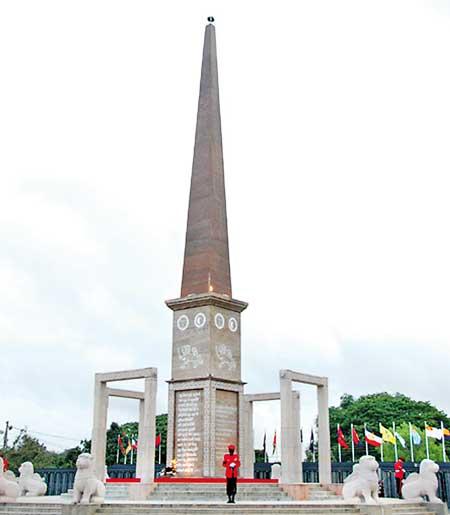
Ranaviru Day Commemoration at Parliament premises
Sri Lankan Government officially commemorates the members of the Armed Forces who died in the war on May 19
Despite the merit or demerit of the decision, it seems to be a move by President Ranil Wickremesinghe, who might have been instrumental to it and who is planning to contest the next Presidential election, to win over the Tamils

There would hardly be any point in Foreign Affairs Minister Ali Sabry summoning Canadian High Commissioner Eric Walsh on May 19 to express Sri Lanka’s objection against Canadian Prime Minister Justin Trudeau’s statement on May 18 on the Tamil Genocide Day” declared by the Tamil diaspora in Canada. The Canadian PM was just addressing a section of his constituency.   

Last year the Canadian House of Commons unanimously adopted a motion recognising May 18 as ‘Tamil Genocide Remembrance Day’. The Canadian Parliament is the only parliament in the world to recognise the claim of Tamil genocide in Sri Lanka made by Tamil groups.   

Despite some Tamil groups in Sri Lanka are also of the view that the destruction of life and property took place in the north in May 2009, ending the war between Sri Lanka’s State Armed forces and the Liberation Tigers of Tamil Eelam (LTTE) is tantamount to genocide, they commemorate this day as Mullivaikkal Day.   

However, former Northern Province Chief Minister C.V.Wigneswaran got a resolution passed in his council on February 10, 2015, declaring that Tamils in Sri Lanka have been subject to genocide and calling the UN to investigate it.   

Sri Lankan Government officially commemorates the members of the Armed Forces who died in the war on May 19 since the completion of the war against the LTTE was announced on May 19, 2009.   

However, Tamil groups commemorate the militants and the Tamil civilians killed in the same war on May 18, apparently because LTTE leader Velupillai Prabhakaran was killed on the banks of the Nanthikadal Lagoon in the Mullaitivu District on May 18, 2009.   

During the tenure of President Mahinda Rajapaksa, no remembrances of LTTE cadres or the Tamil civilians killed in the war were allowed. It was only after the Yahapalana Government under President Maithripala Sirisena and Prime Minister Ranil Wickremesinghe came to power in 2015 that those commemorations were permitted.   

Yet, still, they and the Tamil media are careful not to publicly mention the LTTE in their commemoration events. And still, they encounter resistance from the State Armed forces. 

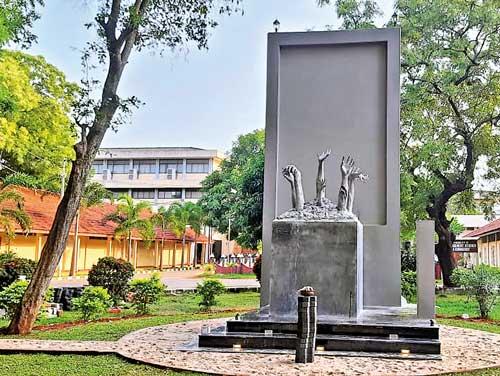
A monument for those Tamils killed in the war had been erected in the Jaffna University premises since early 2019 and the Armed forces destroyed it using bulldozers on January 8, 2021.   

Following widespread protests in the north and condemnation by local and international human rights organizations, the authorities rebuilt it, and it was declared open on April 23 the same year. 

The new monument was 18 feet long and 5 feet wide, symbolizing the 18th day of the 5th month of the year.   

Mullivaikkal Day was commemorated this year as well with a well-attended event being held in Mullivaikkal and many other events taking place in many parts of the north and the east, although Sinhala and English media ignored them.   

Despite former President Mahinda Rajapaksa has not allowed commemoration of terrorists” during his tenure, the Cabinet dominated by the members of his party, the Sri Lanka Podujana Peramuna (SLPP) decided this week to erect a memorial in Colombo to commemorate members of the Armed forces and the Police, civilians and ‘militants’ killed in the war. 

Ironically, the Cabinet decision has not created any fuss thus far, except for individual statements, which would have been the case had the decision been taken by another party. 

Meanwhile, the Sri Lankan High Commission in Canada has raised objections to the erection of a monument to commemorate what the Tamil community living in Canada called the genocide of Tamil civilians in Sri Lanka during the war. 

The common commemoration of all those killed in the war – members of the armed forces. Police and Tamil armed groups, as well as civilians – is not a new concept. It was first mooted by the Lessons Learnt and Reconciliation Commission (LLRC) appointed by President Mahinda Rajapaksa in 2010. 

The Commission report in its final paragraph says:   

The Commission strongly recommends that a separate event be set apart on the National Day to express solidarity and empathy with all victims of the tragic conflict and pledge our collective commitment to ensure that there should never be such bloodletting in the country again. Based on testimonies it received the Commission feels that this commemorative gesture, on such a solemn occasion, and at a high political level, will provide the necessary impetus to the reconciliation process the nation as a whole is now poised to undertake.”   

Mullivaikkal memorial reconstructed in the North

This could be appreciated from a broad perspective of reconciliation, but its practicality and motive seem to be far from the professed objective. Will Tamils make up their mind to commemorate the members of the Armed Forces? If this question is not clear to those who are from the South, they have to ask if Sinhalese will commemorate the LTTE cadres, including the outfit’s leader Prabhakaran. 

Despite the merit or demerit of the decision, it seems to be a move by President Ranil Wickremesinghe, who might have been instrumental to it and who is planning to contest the next Presidential election, to win over the Tamils.  Despite debates being going on over genocide and commemorations, the number of those killed in the more than three-decade-long separatist war in Sri Lanka is a matter that has not been looked into, albeit fourteen years have passed since the end of the war.   

Only two official reports have been issued on the matter so far, which too are highly controversial and conflicting. The civilian death count in one report, the one issued by the experts’ panel appointed by the former UN Secretary-General Ban Ki-moon in 2010 was 40,000 while according to the other, the enumeration conducted by the Sri Lankan Census Department in the north in 2011, the number of deaths other than natural deaths in the Northern Province in the years 2008 and 2009 were 1,349 and 7,934 respectively.

During the Defence Seminar – 2013 at the Colombo Galadari Hotel on September 3, 2013, the then Defence Secretary Gotabaya Rajapaksa said that the enumerators were Government Servants from the Northern Province, all 2,500 of whom were Tamil and Muslim officials.   

Apart from the gathering of usual census data, the enumerators paid attention to the vital events that had taken place in the North from 2005 to 2009, with a particular emphasis on the deaths that took place in the last stages of the war, according to him.   

Yet, the Missing Persons Commission appointed by Mahinda Rajapaksa during his Presidency had recorded statements from the relatives of more than 19,000 persons who were said to have disappeared during the war (Not only at its last stage).   

Gotabaya Rajapaksa as President had told the United Nations Resident Coordinator Hanaa Singer during a discussion on January 17, 2020, that those who have gone missing during the war were dead. 

The numbers put forward by the Tamil leaders here and abroad are extremely higher. The manifesto of the Ilankai Thamil Arasu Kadchi (ITAK) for the first election for the Northern Provincial Council in 2013 said Over one hundred and fifty thousand Tamils have been killed over the years of the conflict and it is estimated that well over seventy thousand civilians have been killed in the last stages of the military onslaught.”   

A member of the same party, Govindan Karunakaram during a media conference on May 17 this year, just ahead of the ‘Mullivaikkal Day’ said that 40,000 civilians were killed in the week ending May 18, 2009, while altogether 300,000 people including the militants have perished in the war.   

The numbers presented by some of the leaders in Tamil Nadu go further higher, up to 500,000. However, the report issued by the UNHRC after the investigation carried out in 2014 by experts appointed by the world’s human rights body, under several international laws including those pertaining to genocide has not accused any party of genocide, in its findings.   

It is clear that these numbers are not determined by authentic evidence or facts but by political outlooks and agendas. And all those who refer to these numbers seem to have forgotten that they are talking about human lives.

Agreement signed to extend India’s $1bn credit line for Sri Lanka

May 30th, 2023

Courtesy Adaderana

The signing of the agreement to extend the USD$ 1,000 million assistance scheme from India for the import of essential materials for a further period of one year has been carried out today (May 30), says Minister of Finance Shehan Semasinghe.

In a Twitter message, Minister Semasinghe has mentioned that the officials of the State Bank of India had participated in the event virtually.

The initial agreement was signed in 2022 March, the minister mentioned, adding that out of the 1,000 million US dollars allocated materials were imported for $ 576.75 million.

Accordingly, the agreement has been extended for the remaining $ 423.25 million, he mentioned.

Furthermore, the Finance Minister also stressed that the import of essential medicines will be prioritized until March 2024.

China will always stand for Sri Lanka’s sovereignty and socioeconomic development – Vice Foreign Minister

May 30th, 2023

Courtesy Adaderana

Chinese Vice Minister of Foreign Affairs Sun Weidong has assured that China, a longstanding ally of Sri Lanka, will always stand by the island nation’s sovereignty and its political and socioeconomic development.

Weidong called on Prime Minister Dinesh Gunawardena at the Temple Trees today (30 May), during which he assured that China will increase investments in several areas, including agriculture, trade and commerce and ports and infrastructure development.

Moreover, he also noted that China will continue to provide economic assistance, while also supporting Sri Lanka’s debt restructuring programme.

The Vice Minister also expressed his deep appreciation to Sri Lanka’s adherence to the One China Policy, despite pressures from many quarters.

Meanwhile, speaking on the shared Buddhist relations between the nations, Vice Minister Weidong revealed that China has taken the required measures to establish a strong cooperation with Sri Lankan Buddhist associations, furthering their religious ties.

Premier Gunawardena expressed his gratitude towards the Chinese Government, for the help extended during both, natural calamities such as the Tsunami and the COVID -19 pandemic, and the ongoing economic crisis.

Speaking with regards to the humanitarian and medical aid received during the COVID-19 pandemic, the Prime Minister acknowledged, with gratitude, the various shipments of the Sinopharm vaccine, medical masks, COVID-19 test kits and other related equipment sent to battle the pandemic, which, according to Gunawardena, further strengthened the solidarity between the two countries. 

Referring to the recent visit of the Governor of the Yunnan Province, Gunawardena also expressed confidence that the fruitful discussions held during the visit in question would enhance cooperation in the agriculture sector, adding that China could invest in agricultural projects.

Minister Sun Weidong has donated 10,000 sets of school bags and  supplies stationary, picture books, oil colour boxes, pencils and pen boxes, sharpeners and erasers, colour oil painting, rulers, water bottles, insulated lunch boxes and fabric of white plain shirt and skirt 33,000 meters, fabric of blue twill pants 10,000 meters for distribution in schools.


Environment Minister Ahamed Naseer, Deputy Speaker Ajith Rajapakse, MP Yadamini Gunawardena and Chinese Ambassador Chinese Ambassador to Sri Lanka Qi Shenhong and senior officials of Chinese Foreign Ministry were present on this occasion.

Sri Lanka to revise penalty for overstaying foreigners

May 30th, 2023

Courtesy Adaderana

The Ministerial Consultative Committee has approved the orders made by the Minister of Public Security under the Immigrants and Emigrants Act to revise the fine of US$500, in addition to the visa fees, to foreigners who have overstayed their period of valid visas.

The approval was given at the Ministerial Consultative Committee held recently under the Chairmanship of the Minister of Public Security Tiran Alles, the Department of Communications of the Parliament said.

Accordingly, it has been recommended that no penalty shall be levied for departure at an approved port of the Department of Immigration and Emigration within a period of 7 days or less than the overstaying period of valid visa without getting extended the period of the visa.

The committee has also recommended to levy a penalty of USD 250 for an overstaying period of more than 07 days and overstaying period of 14 days or less and to levy a penalty of USD 500 for an overstaying period of more than 14 days.

This step has been taken in accordance with the requests made by various parties regarding the promotion of tourism, attracting investors and due to the inconvenience caused to officials working in foreign missions operating in Sri Lanka due to having to pay the above penalty, the parliamentary communications department mentioned.

Accordingly, these orders are to be approved by the Parliament on a future date.

Apart from this, Members of Parliament have pointed out that there is a shortage of officers in police stations as police officers are deployed at various places and for the protection of individuals, it added.

Meanwhile, Minister Tiran Alles has advised the IGP that these tasks have been in operation for a long time, and after conducting a proper security assessment, to deploy officers only for essential needs and deploy other officers at police stations.

Moreover, the members have drawn the attention of the committee to the need to take steps to appreciate officers involved in drug-related raids. Accordingly, the Minister has instructed to take measures to appreciate the relevant officers by getting recommendations related to drug raids from every police zone, according to the release.

State Minister Shantha Bandara, Members of Parliament Dayasiri Jayasekara, Akila Ellawala, Madhura Withanage, Chandima Weerakkody, Mahindananda Aluthgamage, Asanka Navaratne, Thisakutti Arachchi, Rajika Wickramasinghe, Isuru Dodangoda, Kumarasiri Rathnayaka, Weerasumana Weerasinghe, M. W. D. Sahan Pradeep Withana, were present at the Committee meeting held.

Testing imported dried fish, sprats and fruits for heavy metals made mandatory

May 30th, 2023

Courtesy Adaderana

The Sri Lankan government has made it mandatory to test imported dried fish, sprats and fruits for heavy metals such as lead and arsenic with effect from June 01, 2023.

A survey conducted by the Food Control Administration Unit of the Health Ministry between 2021 and 2022 found that certain consignments of imported dried fish, sprats and fruits contain heavy metals, especially lead and arsenic, in large quantities.

According to this survey, some imported fruit stocks contain alarming levels of lead – an extremely toxic heavy metal.

Given the severity of the situation, the government decided to make it mandatory that dried fish, sprats and fruits imported to Sri Lanka be tested for heavy metals including lead and arsenic.

The Food Control Administration Unit has advised the importers to ensure that the amount of heavy metals and arsenic present in dried fish, sprats and fruits brought in from overseas does not exceed the permitted minimum level.

Meanwhile, a special contact number (011 2112718) has been introduced by the Food Control Administration Unit for further inquiries in this regard.

Anonymous Mouse – Nathasha Edirisooriya & Followers of Fool’s Paradise

May 29th, 2023

Shenali D Waduge

An unidentified petition from overseas by one Anonymous Mouse” claims there is a violation of fundamental rights of a comedian by the name of Nathasha Edirisooriya”. There are grave errors in this petition that need to be pointed out as well as a string of other connections that question the agenda behind the surge in anti-Buddhist attacks & the ultimate goal of the attacks & those that fund it.

https://chng.it/mdVDg5Cy

Nathasha E was arrested on 27 May 2023 but she was also immediately released on bail. Which means she is not under arrest.

She was not arrested in the middle of the night for making statements – she was arrested before taking the flight. Her comedy show was not statements” but a well-scripted mockery of Buddha. There is nothing ‘perceived’ it was clear to all.

If the International ICCPR of 2007 is controversial, the Anonymous Mouse must take it up with the architects of the ICCPR.

To gain momentum for the argument, the usual need to plug the oft drummed themes are once again plucked out opposing voices” ethnic minorities” racial, religious hatred”. It works all the time.

Thankfully, Anonymous Mouse did mention religious hatred because that was exactly what Nathasha Edirisooriya & her sponsors were attempting to do.

It is poignant to ask to whose attention this Anonymous Mouse is drawing this petition. It is news to the people of Sri Lanka that the ICCPR has been created to protect Sri Lanka’s dominant faith.

In case Anonymous Mouse maybe unaware there is no carte blanche to fundamental rights. It firstly stems from duties & it is restricted by the statute of limit – one’s fundamental rights stops where one oversteps the fundamental rights of another. This is what she has violated. Her rights stops the moment she infringes upon the fundamental rights of others. Freedom of expression is not unrestricted, unlimited or exclusive. Why don’t Anonymous Mouse or Nathasha go to a Muslim nation & try to express opinions, ideas and beliefs without fear of persecution or censorship to understand the limits in a language they can digest. 

The day Nathasha or any other makes comedies about other religious leaders in the same manner she did about Buddha – we can see how those like Anonymous Mouse will come forward to defend her with petitions.

If Nathasha’s creativity & artistic expression is restricted to mocking Buddha, the world’s greatest teacher, there is little more to say.

There is nothing to advocate for release – she was immediately sent on bail and don’t you worry, part of the plot would have also considered a legal panel kept ready to argue her case too. If anyone breaks the law, the statute of law must be applied. What does Anonymous Mouse mean by engage relevant Sri Lankan authorities” – is this another way of meaning ‘influencing’ them, now isn’t that interesting?

We do agree that an investigation is necessary – this entails to look at all the funding that is flowing to numerous youth who are suddenly put on social media or on stages & tasked to attack the majority community in Sri Lanka. We do see a well-laid out pattern to this & finding the sources that fund them would be a good exposure to who pays for their ‘creativity’.

Anonymous Mouse next pulls out the other rabbit & these are the bevy of actors & actresses from the diplomatic missions who are the next line reinforcements to prevent the government authorities taking action as per the book & this is part 2 of the ‘engage’ scenario being suggested.

It is really amusing that Anonymous Mouse should say we stand ready to support” when no one even knows who this Anonymous Mouse is. Perhaps as a starter, identify yourself first. We presume Anonymous Mouse is not a Sri Lankan from the manner this petition has been written.

Obviously, this Mouse is unaware of what Nathasha Edirisooriya said to even understand the ulterior motive behind her ‘creativity’. Highly unlikely is that this Mouse even knows an iota about Buddha or Buddhism to comprehend why the sentiments of Buddhists have been hurt. In such a situation, how biased is this petition? How can anyone write a petition without knowing exactly why people are questioning Nathasha Edirisooriya’s creativity”.

Let’s park the petition & move on to other more interesting matters.

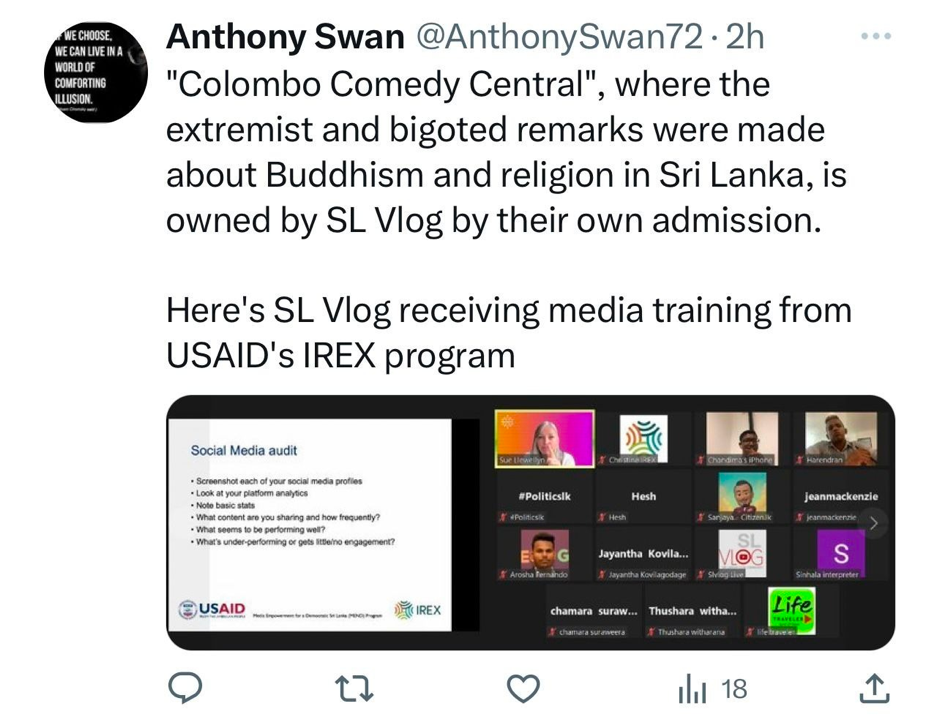
A post on twitter by one Anthony Swan claims the Comedy Central that featured Nathasha Edirisooriya is a sister channel owned by SL Vlog. Other channels hosted by SL Vlog include I am Abhisheka, SLVLog POD talks, SLVlog Tamil, SLVLog Europe & SLVLog clips. By its own admission SLVlog is funded by USAID/IREX. The owner of SLVlog is Manju Nissanka who also runs Singularity Sri Lanka. All are peas in a pod. They all work as a team though attached to different entities & initiatives carried out separately. While one group attacks Buddhism, another promotes politics, media personnel, civil society etc. Overall their goal is one & the same. The goal & the modus operandi are dangerous. Thus the creativity” freedom of expression” that Anonymous Mouse is referring to comes nicely wrapped in millions & millions of rupees specifically to target Buddhism & all that is linked to Buddhism (the Sinhala Buddhists/the Maha Sangha/the Armed Forces & Police/civil society & organizations etc). Oh yes these attacks are done anonymous too. 

May be an image of 15 people, people smiling and text

https://www.facebook.com/search/top/?q=SLVlog

IREX (International Research & Exchanges Board) is funded by the US Govt & partners with Development Gateway for IT. In April 2023, USAID & IREX launched the MoJo Lanka Academy (mobile journalism) which is linked with another USAID/IREX project called MEND (Media Empowerment for  a Democratic Sri Lanka) MEND has been operating in Sri Lanka since 2017. Donors to IREX include the George Soros Open Society Foundation, Carnegie Foundation, Melinda & Bill Gates Foundation & the Ford Foundation to name a few. Nikita Samaratunga is the Deputy Chief of Party for USAID/MEND program.

Ishan Jayasooriya’s facebook post gives some more food for thought.

He asks who are the SLVlog gang & points out that Nathasha is simply a puppet in a bigger scheme of things. SLVlog channel was started by Dhashana Handungoda. He took onboard Abhisheka Fernando, the daughter of his cameraman. When the channel was gaining popularity, a person made an offer that he could not refuse & one Manju bought SLVlog & Bruno was made head of the Channel & its office was located at Access Tower & millions was spent on sophisticated equipment said to be over Rs.250m. Who is Manju & who are his political alliances in particular with Godahewa? why would he pay so much for a youtube channel? Manju arrived from US. USAID provided zoom training for SLVlog. Manju & Bruno began recruiting more people while Abhisheka is the unofficial boss. Nathasha is one such recruit. So too is Hasalaka Thushara. The recruited needed to have one thing to be recruited – hatred for Buddhism. No wonder they call themselves Fool’s Paradise”.

Part 6: Overcoming Stagnant GDP—Reforming Subsidies, Energy, and Taxes, A candid study and an action plan Economic and social development for Sri Lanka

May 29th, 2023

by Professor Sunil J.  Wimalawansa

Tariff and taxation

Most of the Sri Lankan government’s revenue is derived from customs duties and Value-Added-Taxes (VAT).  This contrasts with most other countries where customs act as a border protection force to prevent the smuggling of counter-banned, incoming illegal items such as narcotics and to prevent dumping from protecting local industry.  In addition, when customs duties are charged in Sri Lanka at airports, aviation levy & BTT add about 25% to the CIF Value, which also passes on to the consumers.  This is not the way for a government to collect funds at the expense of the public.  Instead, it should focus on preventing the recently discovered massive VAT scandals prohibiting funds from coming to the treasury.  

Most countries use VAT only when value is added to a product, but in Sri Lanka, the retail sales function adds VAT up to 20%, even when no value is added to a product or consumer.  These taxes are in addition to the CIF and governmental stamp duties.  Besides the lack of digitization, Custom’s collections are open bribes.  Why it is not reformed is a puzzle.  Customs taxation adds an extra third to commodities consumers use. These are passed over to consumers—the poor and middle class bear the brunt.  So where is justice?

Only a tiny percentage of the adult population in Sri Lanka pays personal taxes.  The current tax-exempt earning capacity is Rs 25,000 per month.  However, thousands of Sri Lankans earn much more than this and do not pay income tax.  This is partly due to inefficiencies of the inland revenue department (and favouritisms) and loopholes in the current tax laws.  This should be rectified by paying a fair share of taxes for the services they receive.  Improving the efficiency of the Inland Revenue Department and eliminating inherent corruption is critical for improving the government’s revenue collection.  

Establishing a mandatory auditing and reporting mechanism from all cash banks to the Inland Revenue Department of all high-value transactions and regular deposits by cash-only businesses can be minimized by working with the banking sector.  To collect payroll and debit taxes, Customes and other revenue, the government must establish an efficient and fool-proof electronic mechanism.  Ironically, many in the upper middle class and big businesses avoid paying taxes, as most politicians do.  As a percentage of their income, the lower middle class pay a higher rate of taxes via consumer goods.  Thus, while people experiencing poverty are not paying income tax, they are taxed by the government indirectly via commodities.

Reduction of energy consumption and importation of not dependent on crude oil

Satirically, the Sri Lankan government hinders free trade by enforcing import tariffs.  Gasoline (petrol) is a classic example.  The high cost of gasoline, currently about Rs 450 ($4.50) per gallon (~Rs 90 per litre), is due mainly to governmental taxes.  Despite excessive taxes, it does not deter gasoline consumption by individuals.  At the same time, there is no restriction or program to prevent waste from an estimated one million government vehicles, including the police and military—again paid by the taxpayers.  

Due to the lack of accountability, they continue to abuse this pre-paid” petrol and diesel, including routinely using these vehicles for personal use (e.g., taking their children daily to schools, shopping for spouses, etc.).  Although never discussed, these add a significant financial burden to governmental expenses, ultimately paid by consumers.  Because of the ongoing bribery, irregularity, and routine unlawful actions, the consumer price index increased; they are paying higher prices for everything, even though people with low incomes cannot afford to pay.

Another scandal is that across-the-board subsidies, such as provided to diesel fuel.  This incentivized the rich to use high-consumption luxury vehicles but pay less at the pump. It is estimated that over 90% of this is used by gas-gobbling, governments, NGOs, and companies that own high-consumption vehicles.  The government must act to stop importing and increasing consumption tax on these high-consumption luxury vehicles.  The government need to develop a scheme to phase these out by stopping their importation (except for construction, transportation, military vehicles, and ambulances) and allowing replacing them with low-consumption vehicles (or using alternative energy) to lower the running cost. 

Subsidies harm the development

Gasoline prices have been increasing over the past 20 years, affecting inflation and the cost of living. Rising taxes and tariffs are counter-productive to the country’s economic growth in this situation.  The government must gradually decrease and remove most subsiding on consumer goods, whether diesel, fertiliser, or high-end goods or commodities.  Introduction and raising government subsidies before each election is a political gimmick to attract votes.  Most subsidies are unsustainable and unnecessary and negatively affect the budget.  Moreover, most of the population does not benefit from such sector-based offerings.

Instead of raising gasoline taxes, the government should invest in renewable energy [e.g., capturing energy from sea waves, expanding solar (e.g., countrywide on highways) and wind power].  In parallel, it should take actions to decrease energy consumption [e.g., introducing low energy consumption technologies (LED technology), energy-saving green-building constructions, incentives to decrease energy use, and out-of-the-box technologies], thus, preventing the need to increase (or reduce) the fossil fuel importation, to conserve foreign exchange.

In 2005 alone, the fuel subsidy to the Ceylon Petroleum Corporation was estimated to be about Rs. 22 billion, while the Ceylon Electricity Board lost approximately Rs.19 billion.  How can these two independent organizations lose so much money when they sell their products significantly higher than the estimated total cost of production?  These two alone amounted to about 3% of the GDP of Sri Lanka.  For these state-owned enterprises (SOEs) to lose money, there must be a massive structural failure—mismanagement, overpayment of employees, and/or large-scale pilferage.  When is the government going to audit these SOEs?

The losses mentioned above are equivalent to government spending on healthcare or education.  Allowing such mismanagement, year after year, without acting for structural changes makes no sense.  There has been no substantial ministerial effort to sort out these issues: perhaps they are part of the problem and involved in corruption.  The government must trim these waste and subsidies and use those savings on sustainable development programs to generate jobs, taxes, wealth for low-income people in rural areas, and prosperity.

Who should create jobs?

Government has no business in job creation.  Instead, it should facilitate the private sector by lessening regulations and non-interference for industries to thrive. When left alone, the private sector will create higher-paying, sustainable jobs.  The focus should be on large-scale, modernized agriculture, transportation, and infrastructure development, drastically updating school and university curricula, and educating youth in high-end skills (i.e., skills training programs as mentioned earlier, particularly in rural regions allowing them to diversify their income sources.

Sri Lanka’s government abandoned the automatic fuel price adjustments and adopted monetarization (to print money excessively—artificial currency not attached to gold reserves), equivalent to 3% of GDP from 2004.  This printed money subsidised various commodities, particularly crude oil (gasoline) and fertilizer.  This modified economic policy was another sham, presumably aimed at insulating the country from world market prices and opening doors for pilferage.  However, such short-sighted actions invariably increase inflation, commodity prices, and job losses, leading to a liquidity trap.  Therefore, it will end up with a lose: lose situation for Sri Lanka, adding misery to people and increasing debt.

Not surprisingly, excess borrowing and printing money accelerate inflation and the cost of goods.  As witnessed a few months ago, inflation rose to over 18%, plunging the country into a balance of payments crisis, and the banks were on high alert.  The government must resist the temptation of continuing monitorization.  The absence of a government, at least, wouldn’t cause that harm to the country!

Strangely, 75% of government subsidies benefit high-income earners, some of whom do not pay taxes.  Wouldn’t they be able to succeed without such contributions?  If the government policy is to give subsidies, which is erroneous, subventions should be provided directly to those who desperately need assistance rather than subsidising the rich.  Of subsidised commodities like diesel fuel, 70% are used by wealthy families, comprising 10% in Sri Lanka.  So, where is equity and justice?  This is not the way to help the poor and needy. 

Text Box:  The long-term effects of these inappropriate subsidies include providing wrong price signals and preventing conserving energy or seeking out alternative energy sources (e.g., generating energy from ethanol, wind power, biogas, desalination, and capturing energy from wea waves).  Perhaps, why not the government direct some wasteful subsidies as incentives to develop alternative energy sources mentioned above that would eventually reduce the demand for fossil fuels (coal and gasoline/crude oil) and invest in energy conservation?

For example, instead of losing over seven million rupees a day, the electricity board should divert some of these losses” (including reducing their bonuses) to embark on programs like selling fluorescence and LED light bulbs to consumers at subsidized prices to reduce energy consumption.  Government should only allow importing energy-efficient appliances like refrigerators, air conditioners, and large electrical equipment for industry and hospitals, and incentives to conserve energy and develop alternative energy. 

Stagnant GDPImportance of promoting the agricultural base

Although South Asia is home to one-fifth of the world’s population, the region accounts for only six percent of global GDP and five percent of international trade.  Sri Lanka’s most dynamic current sectors include food processing, textiles and apparel, food and beverages, telecommunications, insurance, and banking.  Exports of plantation crops comprised 90% in 1970, compared to only 15% in 2003, while textiles and garments accounted for 63%.  Since the textile quota system was abolished in 2005, the market has been flooded (e.g., bale clothing) with cheap clothing from countries like China and Taiwan.  

In the long run, exports of only the high-end brand-named finished product will survive due to fierce competition from China.  The apparel industry must prepare for this shrinking market with diversification and finding new markets.  While the percentage of GDP generated from textiles and garments will decrease, the Sri Lankan government must focus on finding other potentially lucrative areas such as tourism, marketing high-end products, assembling and exporting, and communication centres, as described above. 

With trade liberalization, the incoming flow of goods into the region is increasing steadily.  That would not help the budget deficit, solve the potential debt crisis, economic growth or relieve poverty.  Global trade liberalization benefited the industrial sectors but has left the cottage industries and agriculture lagging.  Agriculture is the livelihood for around seventy percent of South Asia families, including Sri Lankan.  It accounts for a quarter of the GDP in South Asian countries, higher than other developing nations.  Agriculture in Sri Lanka currently accounts for 20 percent of GDP and 18 percent of exports.

Since the economy was liberalized in 1977, the contribution from agriculture (assisted by irrigation) to the national economy of Sri Lanka has declined.  However, the agriculture sector was expected to increase significantly with the accelerated Mahaweli project (the last, larger project in Sri Lanka).  Out of the total population of 19 million, nearly 72% live in rural areas.  The number of small farmers employed in the sector is about 75%, and the industry is protected with average tariffs of around 28%.  Expansion and modernization of agriculture are crucial for increasing food supply, profits for farmers’ and overall economic growth and stability, reducing unemployment and poverty, and providing food security.  Instead of fostering them, these have been neglected.  Political interference from provincial councils, removal of tariffs, and mediocre infrastructure facilities, including cold storage and refrigerated transportation of food, have hampered the agricultural sector from developing.

What prevents economic advancement in Sri Lanka

The severe shortage of dedicated, honest, uncorrupt, strong and patriotic leadership with long-term vision has been a significant problem in Sri Lanka for several decades.  Unfortunately, this has also been an essential issue in all developing counties.  However, if a leadership team with impeccable character emerges, there is no doubt that Sri Lanka can beat the Singaporean and Shanghai economies within a decade.

Sri Lanka has the necessary natural resources, educated human resources—skilled labour, access to ports, etc.  However, it lacks the vision, willpower, and credible people to implement it.  Prime Minister Lee Kuan Yu of Singapore borrowed the unimplemented Colombo-Plan” in 1950 from Sri Lanka, which Sri Lankan refused to implement!  He had the wisdom and vision to implement it in Singapore four decades ago.  He and his team embarked on an open market philosophy while keeping corruption at bay, which paved the path for outstanding economic success in Singapore.

Even after 35 years of stagnation, it is not too late for Sri Lanka to embrace a market-driven economic approach with appropriate adjustments to the prevailing democratic political system.  However, this must be implemented without interfering with Sri Lanka’s 2,500-year unique Hela culture, heritage and Buddhism, environment, society’s values, personal freedom, and democratic ideals.  One of the major obstacles is the 1977 constitution with an executive presidency and the enacting of terrible amendments.  It allowed corruption and pilferage of funds and resources, and the executive presidency eroded the independence of the judiciary.  It also opened the door for future dictatorship when a power-hungry, corrupt executive president sustains a two-thirds majority in the parliament.

It is time to consider firm legislation and implement existing laws with punitive punishments for lawbreakers.  It should provide resources, guidance, and incentives for firms and local governments to implement environmental protection and uphold laws.  The consequences of not implementing these laws—the opportunity costs—are enormous. Examples include increasing sickness and premature deaths (higher morbidity and mortality) thus, increased healthcare costs, the spread of infectious and environmental-related” disorders like chronic kidney disease of unknown origin, deterioration of infrastructure, decreased productivity and output from factories, construction and agriculture sectors, and the eventual spiral of economic downturn.  Can Sri Lanka afford these?

Part seven is the last section of this series of articles.  It summarises the type of leadership the country desperately needs, key components the Sri Lankan government needs to address to overcome the financial difficulties, and the path to success and prosperity for Sri Lankans.

COULD SRI LANKA BECOME A DEVELOPED NATION WITH THE EXPORT OF CANNABIS

May 29th, 2023

BY EDWARD THEOPHILUS

It is recorded that various agricultural items produces and products were exported by Sri Lanka in history and many of the agricultural items were rice and cinnamon, and other items, I never heard or read Sri Lanka had exported cannabis for making money or to increase export revenue. The report of Dudley Seers in late 1960s presented a Matching Employment Expectation and Opportunities a Program action for Sri Lanka analytically details the importance of non-traditional exports such as small agricultural products, Seers never advised exporting illicit drugs.  

The amount desired for earning from the export of cannabis could be earned by the enhancement of productivity of current exports, why Sri Lanka wants to gain a bad name exporting or encouraging tourists to consume cannabis. Sri Lanka has a good name as a country that respects religious values and why the government policy makers encourage to burn the hand when there are many tools to prevent such accidents.

What is the estimated revenue from the export of cannabis and the domestic consumption of tourists? Cannabis may be a medicinal plant, this only know scientists and when we were in primary schools understood it was an illicit drug, which creates problems to mental balance of people when it smoked.  The security environment of Sri Lanka proved that cannabis cannot grow protectively without going in hands of addicts. 

People of Sri Lanka are well known that no ladders should make for monkeys and why responsible cabinet ministers in Sri Lanka encourage this type of illicit work?    

සිංහල බෙහෙත් බඩුකඩේ විකුණන්න තියෙන්නෙ රටින් ගෙන්නපු කුණු ජරාව

May 29th, 2023

Chamuditha News Brief

ශ්‍රී ලංකා ස්වදේශීය වෛද්‍ය සභාව සමග චමුදිත සමරවික්‍රම.

Nimal Senanayake’s battle against Viral Diseases

May 29th, 2023

Book review by Prof. N.A. de S. Amaratunga  PhD, DSc

Prof. Nimal Senanayake MD, PhD, DSc, FRCP, eminent neurophysician, creative writer, and film producer continues his major endeavour to educate the public on common diseases and for this purpose he has produced a series of highly readable small books on these topics. Viral diseases that plague our country incessantly have received special attention as most of these deadly infections have no cure and prevention assumes great importance. He has written about all the viral diseases that are endemic in Sri Lanka focusing on what everybody must know about these illnesses. Prof. Senanayake’s crusade against these killers is laudable indeed.

One of those deadly viral diseases is Dengue which is difficult to eradicate and which raises its head from time to time in the underdeveloped tropical countries. Prof. Nimal Senanayake (NS) has brought out a thin volume on Dengue and he has briefly mentioned three other viral conditions, Chikungunya, Zika fever, and Yellow Fever as the causative viruses have a common vector, the Aedes mosquito. NS, as he is wont to do, brings out interesting and captivating stories and anecdotes about the virus, the vector, the history, the clinical picture and outcome so vividly that even those who may not be interested would be glued to the book until the end is reached. The book is well illustrated with labeled colour photos of high quality.

The book begins with a clear introduction to viruses, their classification based on the nucleic acid structure; DNA and RNA. The vector is mainly Aedes aegypti mosquito which is commonly present in the tropics. Story starts with the Aedes mosquito sucking blood from a person who has contracted Dengue via a previous mosquito bite. The virus rapidly spreads throughout the body of the mosquito without causing any harm to it! How nature works for the survival of the virus! And it reaches the salivary glands of the mosquito, another strategic move! Now when this mosquito bites a person free of the infection the virus could enter the blood stream via the saliva of the mosquito and cause the disease. The mosquito survives to carry on its deadly mission. The story is told with the usual story telling ability of the author and takes the form of answers to questions, a technique adopted by NS with excellent designing of questions in their appropriateness enabling the narrative to remain focused.

A detailed description of the journey of the virus in the human body, via the White Cells of the blood stream, and its effects are given in simple language that could easily be understood by the lay person. Yet its scientific quality is not diminished. The virus’ ability to induce the White Cell to produce virus proteins instead of human proteins is explained in clear terms as this character of the virus is vital for its survival and it sets viruses apart from other invasive microorganisms like bacteria. Then the question is asked whether the White Cells keep quiet allowing the virus to do as it likes. No, comes the answer and the response of the White Cells, which are part of the defense mechanism of the body, is described. Some dengue viruses it seems have the ability to derail these mechanisms!

Immune response is explained with the student in mind rather than the lay person and the value of the book to the student as a quick reference is immense. A fascinating battle ensues between the virus and the human immune system. This is of pivotal importance as it will decide the fate of the patient. The author shows his teaching abilities combined with the ability to stimulate curiosity of the reader. The colour photos for illustrations in this section would make it easy to understand even for the lay person. This is an exercise in medical education plus an effort to enhance public awareness of how Dengue becomes deadly compared to other viral infections like common cold which are similar in their manifestation at the beginning.

The clinical features of Dengue are described with the lay person in mind. The ominous signs that indicate the condition may not be harmless are given emphasis. One omission here is the lack of photos to illustrate the signs of the different stages of Dengue, there is only one picture that shows the sub-conjunctival bleeding seen in the eyes in Dengue haemorrhagic stage. The fever pattern which enables the patient as well as the doctor to suspect that the condition may not be a simple viral fever is described in detail with good graphic illustrations. The second stage of the disease is significantly called the decisive stage where the fate of the patient is often decided. In this stage the plasma component of blood leaks through the capillary walls due to disruption of blood clotting mechanism and damage to capillary wall. Plasma leakage is a process in which the protein rich fluid component of the blood leaks from blood vessels into the surrounding tissue. Plasma leakage is the most serious complication that distinguishes Dengue from severe Dengue. The author has described this complication in detail probably for the benefit of students. How patients must take care during the third stage which is the recovery period would be important information to the public. The danger of over hydration via intravenous saline which may cause cerebral oedema is mentioned to caution the doctor as well as the patient.

The description of the structure of the virus which is given next had been delayed probably because there were more important aspects that had to be dealt with at first. However, clinically and pathologically important features in the viral structure are explained adequately. The fact that there are five sero types of the Dengue virus and its significance, ie the ineffectiveness of antibodies formed against one type on the other types is clearly explained. Why a second infection by a different type of Dengue virus could be more dangerous than the first infection, the so called Trojan effect is brilliantly described with reference to the historical incident of the huge wooden horse employed by Greek forces as a ploy to get inside the Troy City fortress. The immune system is tricked by the virus and the defense cells virtually welcome and help the new virus to invade the White Cells just like the Trojan Horse being welcomed into the City of Troy resulting in disaster. One may not find such dramatic explanations in a textbook on Medicine. We must remember that NS is a writer of drama. Front cover of the book carries a picture of a Trojan Horse raising the curiosity of the reader.

The common laboratory tests like blood counts that are usually carried out to diagnose Dengue should be known by the general public. This is very important from the point of view of successful management of the disease. Then the author discuses a very important investigation called NS1 (non-structural protein 1) that could be used from the time the patient develops fever which is not the case with some of the other tests which could only be done after the lapse of a certain period of time after the onset of fever. This test is based on the detection of a protein which is secreted due to the inductive action of the virus but which is not part of the structure of the virus. The book describes all the tests that could be done to confirm the diagnosis of the virus, this information would be very important to the student.

NS, in his usual style, presents the drama of the deadly stages of Dengue. The patho-physiology of the process is discussed with emphasis on the effect of leakage of plasma, how it causes Dengue Haemorrhagic Syndrome and Dengue Shock Syndrome. A knowledge of the clinical features of these complications that help in identifying them would be of value to everybody in countries where Dengue is common. The author very importantly has gone into details of the danger signs that may herald the occurrence of the deadly complications. Author says timely intervention may prevent death.

Prevention of the condition progressing into the deadly stages is the most important measure in the management of the disease. NS employs well designed questions and answers to clearly explain the management of Dengue during this crucial period. NS has not forgotten the patient who could be managed at home. The important measures that should be taken by the caregiver at home are described in great detail. Hydration aimed at prevention of dehydration is emphasised. What type of fluids and what quantities, types of food that should be given and monitoring of passing of urine are described with the layman in mind.

The description of the history of the disease and its spread in the world is thorough and would be extremely useful for the medical historian. Then the author turns his attention to the vector of this deadly disease, the Aedes mosquito. Its origin, the life cycle and its breeding are adequately dealt with. The factors that help the mosquito to survive and spread the virus are mentioned in detail. The prevalence of the mosquito in certain parts of the country is explained and where it prefers to dwell and its meal times are given with good questions and answers. It is the female mosquito that is blood-thirsty; this is a physiological need for the maturation of her eggs. Eggs are laid in stagnant water, a little bit of it is sufficient for her. Another vital bit of information is that these eggs do not die even if the water dries up and could last for six months and then start its life cycle when the next rain comes. These facts would be very important for the lay person who should participate actively to prevent Dengue in his household.

Prof. Nimal Senanayake’s little book is of immense value for the lay person, the medical student, the doctor who battles for the life of Dengue patients, and also for those who are involved in the Dengue prevention campaign. Even a textbook on medicine may not carry all this information in its pages, NS has  covered every aspect of Dengue and therefore the book may interest a wide range of readers.

Digitize the field of foreign employment to ensure the protection of migrant workers

May 29th, 2023

Ven. Akmeemana Dayarathana Thero, President of Sinhala Ravaya

Ven. Akmeemana Dayarathana Thero, the president of the Sinhala Ravaya organization, said the foreign employment sector should be digitized to ensure the safety of migrant workers.

The Sinhala Ravaya organization, Lanka Janatha Pakshaya and the Organization for the Protection of the Rights of Migrant Workers held a silent protest in front of the Ministry of Labour and Foreign Employment in Narahenpita.

Speaking to the media Ven.Akmeemana Dayarathana Thero said;

Now the main source of income for the country is the income generated by our migrant workers. The migrant worker is the one who keeps this country going. After a worker goes abroad, the embassy in that country has a responsibility to ensure their safety. But the people in our foreign missions enjoy luxurious lives and do not help our workers.

An embassy should provide solutions and help our migrant workers when they face difficulties. Even though protests were held in front of the our embassy in Oman, justice has not been done.

Today, the some migrant workers have become slaves. Their rights are violated, some of the workers are forced to work 24-hours a day and their salaries and wages are not given properly. Unable to express their grief, workers sometimes resort to suicide. The government should take steps to address such issues.

They can go in luxury vehicles, but they also should take steps to protect the rights of migrant workers. That responsibility rests with the government.

It is evident that Minister Manusha Nanayakkara is ready to take action in this regard. When a Sri Lankan woman or man goes to a foreign country for work digitize their details and include them in a database.

Make it possible to relay any information to them or for the workers to inform authorities in a speedy manner using new technologies such as SMS, a voice message or other online methods.

We are not asking to stop sending workers abroad. What we are saying is to ensure their rights, provide insurance facilities, give them good working conditions, ensure worker safety and security and facilitate them with technologies to inform officials promptly when they are facing problems.

We can see Minister Manusha Nanayakkara taking certain measure regarding above issues. We request that it be coordinated properly and ensure justice for these workers.

Madhubhashana Prabhath Ranahansa, Sinhala Ravaya’s Propaganda Secretary said:

Take measures to bring back the people suffering in front of our embassy in Oman. Fraudsters take these people for work on visit visas and leave them stranded in that country. These people are being cheated. It is wrong to deceive people in this way and send them into slavery. As a ministry bring measures to prevent such happenings.

Connect the worker going to a foreign country with technology and ensure a direct connection with the ministry. Digitize these things. Now we are not in the Stone Age but in the age of modern technology. We demand the use of digital technology to protect the lives of migrant workers and ensure their safety.

US coercive diplomacy is generally ineffective and often counterproductive and it endangers the whole world

May 29th, 2023

Jubeda Chowdhury in Dhaka city

Economic sanctions, Visa restrictions, political embargo are the part of US coercive diplomacy.  These are not a modern development. These first recorded use was in ancient Greece. But despite all the evidence since then showing they are generally ineffective and often counterproductive; the United States has developed a penchant for imposing sanctions on countries as they enable it to act aggressively on the cheap.

For a long time, the United States will do everything possible to coerce other countries, and the United States has a very disgraceful “dark history” in coercive diplomacy. Today, coercive diplomacy is a standard instrument in the US foreign policy toolbox, and containment and suppression in political, economic, cultural and other fields have been used to conduct coercive diplomacy around the world for pure US self-interest. Countries around the world have suffered, with developing countries bearing the brunt of it, and even US’ allies and partners have not been spared.

Now time to evaluate the evil deeds of US coercive diplomacy in the world and make the international community better understand the hegemonic and bullying nature of US diplomacy, and the serious damages caused by US actions to the development of all countries, regional stability and world peace

In the past half century, the US has never stopped engaging in coercive diplomacy in spite of great changes in the international structure. From economic sanctions to technical blockade, and from political isolation to threat of force, the US has demonstrated what coercive diplomacy is to the world with its own actions.

The developing countries are the “worst-hit areas” of America’s coercive diplomacy. In 1962, the United States imposed an economic, commercial and financial embargo against Cuba which continues to this day. The US-Cuba diplomatic relations were restored in 2015, but the US did not fully lift its blockade against Cuba. In 2017, the Trump administration tightened sanctions on Cuba again. In 2021, the Biden administration twice extended the “Trading with the Enemy Act,” which has served as the legal basis for the blockade and embargo against Cuba. The 61-year-old embargo has brought enormous economic losses and grave humanitarian disasters to Cuba. The US sanctions and blockade on Cuba cover almost everything from fuel, food and daily necessities to medicine, leaving the island facing a chronic and severe shortage of supplies.

Since 2006, the US has imposed sanctions on Venezuela, preventing Venezuela from entering the US financial system.

Twice kicking Iran out of the SWIFT system and disrupting the international financial order. The United States first imposed economic sanctions against Iran in 1979, when it froze $1.2 billion worth of Iranian assets abroad and eventually expanding to a full trade embargo. In 2019, Jake Sullivan, who is now national security advisor to President Joe Biden, wrote an article criticizing the Trump administration’s policy toward Iran, saying that it has nothing but coercion and no diplomacy. No positive outcome of the US coercive diplomacy.

In 1993, the United States announced sanctions against Sudan. Years of US sanctions have led to a severe humanitarian crisis in Sudan, with a large number of children across the country dying of malnutrition, according to a report released by the UN Office for the Coordination of Humanitarian Affairs in Sudan. In addition, the United States has imposed targeted sanctions against individuals and organizations in African countries such as Burundi, the Central African Republic, Somalia and Zimbabwe.

All-round sanctions on Russia. In 2014 and 2018 the USA has imposed sanctions on Russia in a massive row. During the ongoing Ukraine war, this sanction has affected the world dangerously. The coercive diplomacy was very ineffective. Moreover, Sanctions couldn’t stop Russia. Southeast Asia’s Myanmar is another example. The more US and western sanction closed to the Myanmar, Myanmar edged close to China and Russia more.

Violating the principle of fair trade and imposing tariffs on China. In July 2018, the US launched a trade war with China. The USA has been imposing sanctions time to time.

The US imposed sanctions on Mumbai-based petrochemical trading company Tibalaji Petrochem in October 2022, which marks the first time that US imposed sanctions on an Indian company for engaging in oil trade with Iran.

Now, USA targets Bangladesh for serving its own geo-strategic interest in the guise of promotor of human rights, democracy, all we know.

In addition to the economic and financial sanctions, the US is also good at interfering, either directly or indirectly, in the internal affairs of other countries by promotion of human rights, democracy. etc., to counter “disobedient” countries and regions. Since the 20th century, under the banner of “democracy” and “freedom,” the United States has promoted the “Neo-Monroe Doctrine” in Latin America, provoked “color revolutions” in Eurasia, and planned the “Arab Spring” in West Asia and North Africa, engaging in “peaceful evolution” in various parts of the world, wantonly engaging in hegemonic bullying and sending out a clear message that whoever follows it will survive and whoever defies it shall perish.

The United States has many means of coercive diplomacy

The hegemony of US dollar is an important foundation for US economic coercion. The promotion of the so-called democracy and human rights is a common trick of the US to carry out political coercion and interfere in the internal affairs of other countries. The United States has long promoted “American values” worldwide, played up “democracy versus authoritarianism,” wantonly interfered in the internal affairs of other countries, and attempted to shape other countries and world order with its own values and political system. They even interfere with and subvert the legitimate government of other countries in order to weaken rivals, pass on crisis, create chaos, and undermine stability.

The targets of US political coercion are all-encompassing. Be it an adversary or an ally, a developed or a developing country, a large corporation or a small organization, coercion is always the option for the US, as long as the US considers it profitable and the targets won’t bend to the will of the US. The US, under the banner of “promoting democracy,” carried out the “Neo-Monroe Doctrine” in Latin America, provoked the “color revolution” in Eurasia, and planned the “Arab Spring” in West Asia and North Africa.

The US frequently uses military force to initiate or participate in wars and conflicts of all sizes and forms. After World War II, major wars initiated or launched by the US include the Korean War, the Vietnam War, the Gulf War, the Kosovo War, the Afghan War, the Iraq War, the Libyan War and the Syrian War. Proxy wars are a common form of US military interventions, with countries such as Ukraine, Iraq, Afghanistan, Libya, Syria, Pakistan and Yemen suffering.

Distorting the underlying theme of our times of peace and development. Peace and development, as the theme of our times, are the common cause for people of all countries around the world. The US coercive diplomacy has cast a shadow over the cause of global peace and development by instigating “color revolutions” in the world, pouring oil over fire and seeking interests from geopolitical struggles.

The US economic coercion has not only undermined global supply chains and industrial chains based on factor endowments and comparative advantages, reducing labor productivity, but also raised regional and even global production costs and hindered the process of regional economic integration.

Intensifying division and antagonism in the international community. In order to maintain its global hegemony and contain the development of other countries, the US is keen to force other countries to join the “democratic alliance” by means of drawing ideological lines and imposing tariffs.

Shrugging off the fact that the US itself has engaged in coercive diplomacy everywhere, the US, out of political self-interest, readily tags some countries with the label of promotor of human rights those who engage in coercion, sanctions, bullying, suppressing other countries and bringing chaos to the world, will eventually hurt themselves. The United States should address its old habit of wanton coercive diplomacy and return a just and rational international order to the world.

An energy deal will usher in new avenues in Dhaka-Kathmandu relations

May 29th, 2023

Sufian Asif

Energy cooperation between Nepal and Bangladesh is one of the most promising areas of cooperation. Plans to make power an exportable good are outlined in Nepal’s 15th Five-Year Development Plan (2019-2024). Nepal plans to grow its 1,250 MW of electricity production to more than 5,000 MW within the next five years, making it an energy-surplus country. The goal of Bangladesh is to invest, produce, and import surplus energy from Nepal. The fact that Bangladesh and India use more electricity during the summer, which is their busiest time of year, must be emphasized.

It is encouraging that Dhaka and Kathmandu, at their fifth Joint Steering Committee (JSC) meeting on May 16, which was held at the Payra Power Plant office in Patuakhali, decided to move forward with plans to implement agreements on buying electricity from Nepal using the already-existing interconnecting transmission lines through India, their neighbor. Notably, the JSC is a bilateral secretary-level organization promoting collaboration between Bangladesh and Nepal in the energy sectors. You might remember that both nations decided to ask India during the fourth JSC meeting, held in August of last year in Kathmandu, to permit the export of 40 to 50 MW of power from Nepal to Bangladesh via the high-voltage Baharampur-Bheramara cross-border transmission line.

The exploration of the prospect of setting up a joint venture hydropower plant in Nepal as well as importing 500 MW electricity from the Indian company GMR’s 900 MW Upper Karnali Hydropower Project situated in western Nepal, installing a new, dedicated cross-border  transmission line through a tripartite deal between Bangladesh, Nepal and India, potential government and private sector investments for the growth of the energy sector in both countries, were other notable outcomes of the recent energy talks.

A trilateral energy sales and purchase agreement between Bangladesh, Nepal, and India is required for any Dhaka-Kathmandu power transaction to be implemented because Bangladesh and Nepal do not have a direct land link. Both parties have acknowledged that the trilateral agreement’s strategic component is vital; otherwise, electricity exports to Bangladesh would just exist on paper.

It would be important to emphasize that agreements between Bangladesh and Nepal in the area of clean energy, namely hydropower, have a lot of promise.  The development of hydropower plants in Nepal under Bangladesh-Nepal joint venture projects was thoroughly reviewed by the two nations at the JSC meeting in light of these potential outcomes. According to information, the two parties agreed on the development of the 683 MW Sunkoshi 3 hydropower project in Nepal.

The Nepalese foreign minister stated at the gathering in Dhaka that the country has essentially an endless supply of roughly 60,000 MW of hydropower. In Nepal’s hydropower industry, India has been investing. As a neighbor, Bangladesh may work with Nepal to expand cooperation, particularly in the area of environmentally friendly, green hydropower, in order to fulfill its expanding energy needs. However, India’s support will be essential for any significant advancement in this area. It is hoped that India’s transnational green power grids program to supply power in its neighborhood will aid in the promotion of hydropower agreements between Bangladesh and Nepal.

Both hydropower in Nepal and gas in Bangladesh provide a bright future for development, and if used well, these two nations’ natural resources will experience tremendous growth. The two nations committed to working together on the construction of hydropower plants, transmission lines, and energy sector capacities when they signed an agreement on energy cooperation in August 2018. By 2040, Bangladesh will import hydropower from Nepal totaling up to 9,000 MW under the terms of this agreement. Both the then-energy minister of Nepal, Barsha Man Pun, and the state minister for power, energy, and mineral resources of Bangladesh, Nasrul Hamid, signed the agreement. Pun had said, “This agreement has opened up a new door for the growth of the hydropower sector in Nepal,” after it was signed.

The power industry offers further opportunities for collaboration between the two nations.  For instance, Bangladesh possesses institutional resources, such as the Bangladesh Power Management Institute (BPMI), that can be used to train human resources and so increase the ability of the power sector workers in both nations. The knowledge of solar house and net metering operations may be shared in other power sector domains. In particular, there should be considerable consideration given to private sector investment from Bangladesh in Nepal’s hydropower industry. The good news is that all of these topics were discussed extensively at the aforementioned secretary-level meeting between the two nations.

The promise of commercial cooperation between Bangladesh and Nepal is not limited to the hydropower industry. The two nations may collaborate to their mutual advantage in a wide range of industries.

Economic Cooperation

Despite tremendous opportunities brought forth by the two countries’ close proximity and outstanding bilateral relations, their economic relationships have stagnated over time. The potential to advance bilateral investment and commerce is enormous. Lentils, oil, cardamom, wheat, vegetable seeds, handicrafts, pashmina, and other agricultural goods are some of Nepal’s most important exports to Bangladesh. On the other hand, the majority of Nepal’s imports from Bangladesh are industrial raw materials, pharmaceuticals, chemicals, textiles and apparel, jute products, and electrical and electronic goods.

In order to enhance bilateral commerce and business, the private sectors and business communities of both nations have been actively interacting. They have also organized several business exhibitions and fairs. The main trade associations of the two nations, the Federation of Bangladesh Chambers of Commerce and Industry and the Federation of Nepalese Chambers of Commerce and Industry, have institutional frameworks for cooperation.

Another crucial area that plays a major role in bilateral relations between Nepal and Bangladesh is education. In all, 4,000 Nepalese students attend universities in Bangladesh to study medical, engineering, law, and other courses, while Bangladeshi students attend universities in Nepal to study fine arts and development studies, among other things. More opportunities will become available as a result of the mutual concordance and accreditation of each other’s university degrees as well as the affiliation of more colleges and universities in the future.

At the ports of Chittagong and Mongla, the government of Bangladesh has granted Nepal transit privileges. The overland trade route to Bangladesh from Kakarbhitta to Phulbari and Banglabandha has been operational since September 1997. The Bangladeshi government consented to include Rohanpur as a port of call in the Nepal-Bangladesh Transit Agreement on August 10, 2020. The Rohanpur-Singhabad railway route was designated as an extra transit route for traffic-in-transit movement between Nepal and Bangladesh as well as third-country transit trade when Nepal and Bangladesh and Bangladesh signed an Exchange of Letters on March 22 and 23 of 2021.

Nepal and Bangladesh have not been able to convert their bilateral relationships into mutually advantageous economic cooperation despite being geographically close and being members of the SAARC, BBIN, and BIMSTEC. Trade, investment, connectivity, energy cooperation, education, and tourism are just a few examples of the many opportunities. Since India is not only the region’s largest economy but also the only country that is physically located between Dhaka and Kathmandu and does not share a border with either Nepal or Bangladesh, the two governments must convince India of the value of sub-regional cooperation in South Asia where India serves as a facilitator. 

Monk wants probe into Jerome’s ‘int’l’ links

May 29th, 2023

BY Sahan Tennekoon

Monk wants probe into Jerome’s ‘int’l’ links
  • Omalpe Sobitha reiterates need for anti-conversion bill 

Chief Prelate of the Ramanna Sect – Southern Sri Lanka, Ven. Dr. Omalpe Sobitha Thera yesterday (29) said that the intelligence agencies should immediately conduct an investigation into Pastor Jerome Fernando, who allegedly insulted Buddhism and several other religions when preaching, and determine whether he is being led by any international force.

Speaking to the media yesterday, he also said that the Government should immediately launch an investigation into how he amassed such a large amount of wealth and disclose the sources of his wealth.

We have seen this so-called pastor giving sermons insulting Buddhism and several other religions. By making such statements, there is a possibility of creating discord between those religions. We have seen that this person lives a very luxurious lifestyle. It is proof that this person is accumulating a large amount of wealth. But, it is unclear where this money is coming from and for what purpose it is being given. Therefore, we request the Government to immediately conduct an investigation into the incident with the support of the intelligence agencies and expose if there is any international conspiracy behind this,” he said.

Speaking further, he mentioned that it is the responsibility of the relevant authorities to make laws that prevent people from being converted to another religion by force or money.

Video footage related to a sermon delivered by Fernando in front of his congregation, which had been widely circulated on social media platforms in recent days, had stirred controversy due to allegations that it included derogatory statements with regard to Buddhism, Hinduism, and Islam.

Considering the allegations that have been levelled against Fernando by several parties, President Ranil Wickremesinghe had ordered the Criminal Investigations Department (CID) to launch an immediate investigation into his controversial statement. The CID had obtained an arrest warrant and a foreign travel ban on him on 17 May. Meanwhile, a Fundamental Rights petition had been filed by Fernando before the Supreme Court, seeking that an order be issued preventing his arrest by the CID.

කවුද මේ නටාෂා ?

May 29th, 2023

Courtesy Lanka Lead News

මෝඩාභිමානය නම් බුද්ධාගමට දිගින් දිගටම අපහාස කරමින් රංගනයක් ඉදිරිපත් කිරීම හේතුවෙන් අද වන විට රක්ෂිත බන්ධනාගාර ගතව සිටින නටාෂා එදිරිසූරිය සිය මුහුණු පොතෙහි තමා සම්බන්ධයෙන් කළ හඳුන්වාදීම අනුව ඇය සෘජුවම අමෙරිකානු එක්සත් ජනපදයේ USAID මගින් සෘජුවම වැටුප් ගන්නා සාමාජිකාවක් බවට සැක කළ හැකි බව ඇය වැනි අයගේ කටයුතු සම්බන්ධයෙන් අධ්‍යනය කරන්නන් විසින් හඳුනාගෙන තිබේ.
ඇයගේ මුහුණු පොතට අනුව,

1) 2020 නොවැම්බර් මාසයේ සිට මේ දක්වා අමෙරිකා එක්සත් ජනපදයේ රාජ්‍ය දෙපාර්තමේන්තුවේ ව්‍යාපෘති කළමනාකරුවෙකු ලෙස කටයුතු කරමින් සිටී.
2 USAID ආධාර ලබන ශ්‍රී ලංකාවේ ඉංග්‍රීසි ගුරුවරුන් පුහුණු කරන්නන් සංගමයේ ව්‍යාපෘති කළමනාකරුවෙකු ලෙස 2020 ජනවාරි මාසයේ සිට ජූනි දක්වා කටයුතු කර ඇත.
3 සර්වෝදය සංගමයේ ව්‍යාපෘති හවුල්කරුවෙකු ලෙස 2019 මාර්තු මාසයේ සිට 2020 ජනවාරි දක්වා කටයුතු කර ඇත.

Sri Lankan rupee appreciates rapidly against the USD

May 29th, 2023

Courtesy The Daily News

There has been a rapid appreciation of the LKR against the USD within the last week. Today (29 May) the buying rate of 1 USD was reported at LKR 289.89 and selling rate of 1 USD is 303.26 according to the CBSL exchange rates. These exchange rates are based on the rates quoted daily for Colombo for Telegraph Transfers (TT) in Commercial banks. Within this last week dollar has dropped by nearly 10 rupees, from LKR 299.71 reported last Monday (22 May).

For the first time in nearly fifteen months the Middle rate of the USD/LKR spot exchange rate of CBSL has dropped below LKR 300 and the today’s Spot exchange rate is reported at LKR 299.11

In a similar manner, GBP buying rate has reduced from LKR 372.90 last Monday (22 May) to LKR 357.32 today (29 May).

However, that being said author of this article warns the public to not to make rash decision as the reasons for appreciation for the rupee maybe due to temporary shift in macro-economic variables.

ADB approves USD 350 million loan for Sri Lanka’s economic stabilization

May 29th, 2023

Courtesy Adaderana

The Asian Development Bank (ADB) has approved a $350 million special policy-based loan to provide budget support to Sri Lanka for economic stabilization today (29).

In a statement, the ADB said the program is part of a broader package of financial assistance anchored by the International Monetary Fund’s Extended Fund Facility for the country, which aims to stabilize the economy and lay the foundation for economic recovery and sustained growth.

Sri Lanka is facing a severe and unprecedented economic crisis. High inflation has eroded purchasing power, livelihoods have been affected, and past development gains have been reversed, it added.

ADB is concerned about the deep crisis in the country and its impact on the people of Sri Lanka, especially the poor and the vulnerable, particularly women,” said ADB President Masatsugu Asakawa. ADB is committed to standing with Sri Lanka as it addresses its present challenges and strides toward economic stabilization, sustainable recovery, and inclusive growth.”

Sri Lanka has embarked on bold reforms to address the causes of both internal and external imbalances and return to a sustainable debt trajectory. The country faces a long road to recovery and must remain steadfast in the implementation of necessary reforms, which include enhancing tax revenue collection, strengthening public financial management, improving the performance of state-owned enterprises, ensuring autonomy and independence of the central bank, safeguarding financial sector stability, and bolstering governance frameworks, according to the ADB.

As these measures are implemented, it is essential to ensure that adequate social protection is provided. Implementing governance reforms and anticorruption measures will be critical, it said.

Transparency and open communication will be crucial in building agreement around the reforms. ADB will proactively engage with the government, other stakeholders, and development partners to help address structural impediments and plan future support.

ADB has supported Sri Lanka’s response throughout the crisis, the ADB mentioned, adding that in 2022, in close coordination with development partners, ADB provided emergency assistance to support basic services and sustain livelihoods. 

ADB repurposed $334 million of existing loans as an emergency response to support the import of essential items such as fertilizer, medicines, chemicals for water treatment, working capital for small and medium-sized enterprises, and cash transfers to the poorest and vulnerable. Trade finance lines through ADB Trade and Supply Chain Finance Program supported the import of essential items during the crisis.

ADB is committed to achieving a prosperous, inclusive, resilient, and sustainable Asia and the Pacific, while sustaining its efforts to eradicate extreme poverty. Established in 1966, it is owned by 68 members—49 from the region, it added.

Sri Lanka and China to commence 12th round of diplomatic consultations

May 29th, 2023

Courtesy Adaderana

Vice Minister of Foreign Affairs of the People’s Republic of China Sun Weidong will lead a Foreign Ministry delegation to Sri Lanka from 29 May to 01 June 2023, to co-chair the 12th round of Diplomatic Consultations between the two countries with Secretary, Foreign Affairs of Sri Lanka Aruni Wijewardane.

The discussions are expected to enable the two countries to assess the status of bilateral relations covering political, economic and cultural cooperation, as well as thematic cooperation and people-to-people contacts, the Ministry of Foreign Affairs said.

During the visit, the Vice Minister of Foreign Affairs of China is scheduled to call on President Ranil Wickremesinghe, Prime Minister Dinesh Gunawardena and the State Minister of Foreign Affairs Tharaka Balasuriya. 

The delegation will also engage with the members of the Sri Lanka – China Parliamentary Friendship Association and visit the Sri Lanka – China Friendship Village in Dewanagala

Sri Lankans living abroad can renew or apply for new passport online from June 01

May 29th, 2023

Courtesy Adaderana

Sri Lankans living abroad will be able to apply for a new passport or can renew their passport with effect from June 01, 2023. This was stated at a meeting of the Sectoral Oversight Committee on International Relations.

It was revealed by the officials of the Immigration and Emigration Department who participated in the sectoral oversight committee on international relations, held recently under the chairmanship of its chairman, Namal Rajapaksa. 

Officials further pointed out that Sri Lankans who live abroad can apply for passports online without visiting Sri Lankan embassies in their countries, the statement said.

The committee also discussed the implementation of e-passport and the chairman of the committee instructed the relevant officials to speed up this process.

There was also a discussion about various issues including the shortcomings found in visa application online in the committee. For the above purpose, the chairman of the committee instructed the officials to quickly prepare and implement a necessary mechanism for foreigners to obtain their visas without difficulty, and to take necessary steps to further improve the facilities of Sri Lanka’s international airports for both locals and foreigners.

The importance of attracting tourists from high-income generated countries like Europe to Sri Lanka was discussed at length and the chairman advised the officials to take the necessary steps for that without delay.

The members of the committee, Members of Parliament Niroshan Perera, S. M. M. Musharraf, Sagara Kariyawasam, Yadamini Gunawardena, (Dr.) Harini Amarasuriya, and attended the meeting while. Chandima Virakkodi attended with the permission of the Chairman of the Committee.

Officials from the Ministry of Foreign Affairs, Department of Immigration and Emigration, Sri Lanka Tourism Development Authority and Airport and Aviation Services (Sri Lanka) (Private) Limited participated in this meeting.

Food insecurity improved in Sri Lanka but prevails within specific regions – FAO and WFP

May 29th, 2023

Courtesy Adaderana

Food security in Sri Lanka is improving across all provinces, according to the Crop and Food Security Assessment Mission (CFSAM) report jointly carried out in February/March 2023 by the Food and Agriculture Organization of the United Nations (FAO) and the United Nations World Food Programme (WFP). 

The report estimates 3.9 million people or 17 percent of the population is in moderate acute food insecurity which is nearly a 40 percent decrease from June/July last year. Nearly 10,000 people are severely acute food-insecure, down from 66,000 people last year.

The improvement in food security stems from better food consumption, which could be attributed to reduced food prices and improved incomes among farming communities during the harvesting period when the mission was carried out. 

Despite this positive trend, food insecurity remains high in certain districts, especially Kilinochchi, Nuwara Eliya, Mannar, Batticaloa, Vavuniya, and Jaffna. The highest level of acute food insecurity was found within the tea plantation communities in the Estate sector and among daily wage labourers and households who rely on social assistance programmes, such as Samurdhi, as their main source of income, the report said. 

Production of cereal, including rice and maize, across the two main cropping seasons in 2022/23 is forecast at 4.1 million tonnes, 14 percent below the past five-year average, mainly due to poor plant nutrition caused by an inadequate supply of fertilizer and unaffordability of essential material inputs. 

However, essential fertilizers distributed to smallholder farmers by the Government, facilitated by funds received from multilateral and bilateral donor agencies, has significantly impacted production, marking an improvement in the yield with productivity in the recently harvested 2022/23 Maha” season, 12% higher than the 2022 Yala” season. 

Representative of FAO to Sri Lanka and the Maldives, Mr. Vimlendra Sharan speaking on CFSAM Report findings said, The Crop and Food Security Assessment Mission (CFSAM) report is an eye-opener on the continuing vulnerabilities and challenges that exist within the food systems of Sri Lanka. This report and its findings will no doubt serve as a guiding light for policymakers and stakeholders to collectively work towards ensuring food security, strengthening agricultural resilience and mitigating risks faced by farmers and rural communities who have been disproportionately impacted by the economic crisis. FAO remains committed to supporting Sri Lanka in their efforts towards achieving sustainable food systems, food security and zero hunger.”

After many months of challenges, we are finally witnessing an improvement to the country’s food security,” said Abdur Rahim Siddiqui, WFP Sri Lanka’s Representative and Country Director. But there is more to be done. A high number of households — more than 60 percent — are adopting negative measures to put food on the table, including borrowing money and purchasing food on credit. WFP will extend its emergency operation, which commenced last year, to provide food rations and cash assistance to people identified as food insecure.”

Mission recommendations

The joint FAO/WFP Mission recommends providing immediate support to farmers, particularly by releasing available fertilizer stocks to enhance production and productivity in the ongoing Yala” season and make urgent policy decisions to import fertilizers in time for the 2023/24 Maha” cultivation season.  The report also recommends any move for reducing or removing fertiliser subsidy to be in a gradual and phased manner, giving adequate time to the farming community to adapt. 

Other recommendations include the establishment of a Fertilizer Task Force” to streamline fertilizer procurement and distributions as well as to strengthen adaptive research on climate smart agriculture and sustainable farming practices to improve fertiliser use efficiency. Further, to minimize the impact on the livestock and fisheries sectors, the mission recommends providing adequate support to increase fodder and feed crop production.

Further recommendations include continuing food and/or cash assistance to facilitate access to food among households most vulnerable to food insecurity. In the long-term, increased livelihood support to food-insecure households and resilience-building initiatives are also recommended to prevent them from compromising on productivity and their capacity to cope with future shocks.

CFSAM-report-on-LK-was-handed-over-to-the-Minister-of-Agriculture

Caption: The second joint FAO-WFP Crop and Food Security Assessment Mission (CFSAM) report on Sri Lanka was handed over to the Minister of Agriculture, Mahinda Amaraweera, by FAO Representative for Sri Lanka and the Maldives, Vimlendra Sharan and WFP Sri Lanka Representative and Country Director, Abdur Rahim Siddiqui.

Ven. Rajangane Saddharathana Thero remanded

May 29th, 2023

Courtesy Adaderana

Ven. Rajangane Saddharathana Thero who was arrested by police in Anuradhapura for allegedly making statements that could disrupt religious harmony has been ordered to be remanded in custody until June 07, after being produced before Colombo Fort Magistrate’s Court today (29).

Saddharathana Thero was reportedly arrested by the Criminal Investigations Department (CID) last night in the Sravasthipura area in Anuradhapura. 

Ven. Saddharathana Thero has been arrested in connection with the investigations carried out on a complaint made by Ven. Pahiyangala Ananda Sagara Thero regarding certain statements made harmful to religious harmony.

ආගමික සංහිඳියාව රකින්න විශේෂ පොලිස් ඒකකයක් (වීඩියෝ)

May 29th, 2023

උපුටා ගැන්ම  හිරු පුවත්

ආගමික සංහිඳියාවට බාධා කරන කණ්ඩායම් පිළිබඳව පරික්ෂණ කිරිමට වහාම ක්‍රීයාත්මක වන පරිදි විශේෂ පොලිස් ඒකකයක් ස්ථාපිත කිරිමට ජනාධිපති රනිල් වික්‍රමසිංහ තිරණය කර ඇති බව වාර්තා වෙනවා.

ඒ අදාළ කණ්ඩායම් වල මෙවැනි ක්‍රියා සංවිධානාත්මකව කරන ක්‍රියා මිස අහඹු ක්‍රියා නොවන බවට ජනාධිපතිවරයා ලද බුද්ධි තොරතුරු මත බව සඳහන්.

“සංහිඳියාව රකින්න විශේෂ පොලිස් ඒකකයක් – නතාශාට එරෙහිව තවත් පාර්ශ්වයකින් පැමිණිල්ලක්

Bangladesh Separating from Pakistan Did Not Trigger Separatism in West Bengal, India or Elsewhere in India

May 28th, 2023

Dilrook Kannangara

There is a wrong view in some sections of Sri Lankans that India will never allow an Independent Tamil Eelam as that would trigger separatism in India. This belief cannot be more wrong. In fact, the opposite is true.

Both Bangladesh and West Bengal state of India are mostly habituated by Bengali people. Bangladesh was part of Pakistan from 1947 to 1971. After a violent separation, independent Bangladesh was created. West Bengal which also has an ethnic Bengali majority was elated. Their unity and allegiance to India strengthened as India helped Bengalis split from Pakistan and become an independent nation. Over 52 years have passed since and both nations are racing fast towards becoming industrialized nations.

There is a large Bengali Diaspora (larger than the Sri Lankan Tamil Diaspora) in western nations. Had Bangladesh not received Independence by today they too would have financed its separatist movement.

This is a vital lesson for Sri Lanka and for those who naively put their faith on India to keep Sri Lanka in one piece.

Bangladesh’s experience should convince India that the creation of Tamil Eelam will not trigger separatism in India. On the contrary, it will further strengthen India’s unity, reaffirm India’s commitment to the interests of its various ethnic groups beyond its borders, India’s national security and will create a safe buffer zone between India and its potential rivals in its most vulnerable flank.

Powerful nations create buffer zones between them and actual and potential rivals. Ukraine, North Korea, South Korea, Eastern European countries, Laos, Cambodia, Chinese artificial islets, Diego Garcia, French and British Pacific and Indian Ocean territories are examples. Sri Lanka’s parts closest to India make a perfect buffer zone for India. The purpose of a buffer zone is not just to ward off India’s rivals; it is more to place India’s attack forces to target enemies.

Sri Lankan leaders have got this wrong. Not allowing Sri Lankan territory for anti-Indian activities is outdated and not sufficient for India today. Beyond that India wants Sri Lanka to actively be part of India’s offensive (attack) capability targeting Chinese and Pakistani interests. As Sri Lanka does not agree to this vital requirement, India will keep pushing for the creation of a nation within the island that will take this extra mile. In addition to India, NATO and QUOD also want this and Sri Lanka has been unable to deliver on this requirement for good reasons.

Just because Sri Lanka follows a middle path, nonaligned or equidistant foreign policy does not mean others will do same. They don’t.

This is bad news for Sri Lanka but it is the reality. Since becoming a republic in 1972, India has continuously supported Tamil Eelam whenever and whichever way possible. However, India has other plans too for Sri Lanka to salami slice it including Malaya Nadu, Colombo Nadu, etc. These movements have already begun in Sri Lanka and are at the infancy stage; where the Tamil Eelam movement was in the 1940s.   

India’s continuing and increasing camaraderie with USA, Australia, Japan, Canada, UK, etc. against the common rival China is also bad news for Sri Lanka. Modi’s assertion that the Indian Diaspora has built unbreakable bridges between India and Western nations is not just his view. This is the view of all Indians apart from minute political sections. The merging of Sri Lankan Tamil Diaspora with their Indian relatives, especially from Tamil Nadu, is speeding up thanks to a common language, common cultural artefacts, beliefs, identity and aspirations.

Fourthly, all Tamil elected (not appointed) MPs in Sri Lanka have followed a strong pro-India stance even at the expense of their allegiance to Sri Lanka. Elected Tamil MPs represent Tamil people’s desires whereas appointed Tamil MPs have no acceptance on ground. This has been the case since 1930s. LTTE’s attempts to separate the two (1987 to 1991) was short-lived and was not taken up by many. With the absence of the LTTE, Tamil MPs have totally aligned themselves with India and of course Tamil Eelam, Malaya Nadu and Colombo Nadu. There is no likelihood of any other group will rule or control Tamil Eelam, if created.

This convergence of Indian interests, western interests (especially nations with a large Tamil diaspora), Tamils living in Sri Lanka and their elected politicians are pointing towards a very dangerous new round of separatism in Sri Lanka. Divisions created by the LTTE totally disappeared since 2009. Now there is complete unity among them all towards Tamil Eelam.

Sadly, there is no unity among Sinhalese due to religious divisions used by political elements to divide the community, party politics that has divided the community into three rival wings and also due to economic class divisions. There is no end in sight to infighting within the community. It will be a cakewalk for India to assert its territorial expansion project in to the island backed by Tamils in Sri Lanka and in western nations with the support of western nations. If history is anything to go by, it will be supported by a section of aggrieved Sinhalese and Muslims too.

ආණ්ඩුක්‍රම ව්‍යවස්ථාවේ 105.4 ව්‍යවස්ථාවේ කියා ඇති බුද්ධ ශාසන අධිකරණය නොපිහිටුවා බුද්ධ ශාසනය සම්බන්ධ නඩු රෝම ලංදේසි උසාවි වල විමසන්නේ ඇයි? 

May 28th, 2023

ෆීනික්ස් නීති සාර සංග්‍රහය

1. බුද්ධාගම ගැන ප්‍රකාශ කර පසුව සමාව ගැනීම කරන්නේ (ICCPR) විත්ති වාචකයකටද? 

2. රටෙන් පැනීමට තැත් කිරීම. කටුණායකදී අත්අඩංගුවට ගනීම සිදුවන්නේ ඇයි? 

3 බුද්ධාගමට, බුද්ධ ශාසනයට අගෞරව කිරීමේ කාරණා වලදී ආණ්ඩුක්‍රම ව්‍යවස්ථාවේ 9වන ව්‍යවස්ථාව සහ දණ්ඩ නීති සංග්‍රහයේ 289 වන වගන්ති වල වැරදි අත්හැර  දමන්නේ ඇයි? 

4. බුදු දහමේ කාරණා ගැන මුලින් අබෞද්ධයන් හිරේ දමා දෙවැනුව භික්ෂූන් වහන්සේ හිරේ දැමීමට පාර කපා ගැනීමේ පෙරහුරුවක්ද? 

5. ආණ්ඩුක්‍රම ව්‍යවස්ථාවේ 105.4 ව්‍යවස්ථාවේ කියා ඇති බුද්ධ ශාසන අධිකරණය නොපිහිටුවන්නේ ඇයි?

6.බෞද්ධ කාරණා රෝම ල‍ංදේසි උසාවිවලින් විනිශ්චය කර ගැනීම නිවැරදිද? 

7. ආණ්ඩුක්‍රම ව්‍යවස්ථාවේ 9 ව්‍යවස්ථාවේ සිංහල සහ ඉංග්‍රීසි පාඨ වෙනස් ඇයි? 

ෆීනික්ස් නීති සාර සංග්‍රහය – දුරකථන 0712063394

Tribute to Vidya Jyothi Emeritus Professor Dayantha Wijesekera

May 28th, 2023

Prof. Chandana Jayalath University of Vocational Technology

It is with profound grief that the University of Vocational Technology announces the passing away of Vidyajothi Emeritus Professor Dayantha Wijesekera, the first Chancellor of the university. The Vidya Jyothi is considered to be the highest national honor for science in Sri Lanka for outstanding contribution to the development of the country through dedicated work in the field of science. Emeritus Professor Dayantha Wijesekera has held several key academic, professional and administrative portfolios in the field of engineering, both local and international. He was the first Vice Chancellor of Open University of Sri Lanka in 1983. He was also the Vice Chancellor of University of Moratuwa from 1999 to 2005. He later served as Chairman, Tertiary and Vocational Education Commission (TVEC).

In many public occasions, Emeritus Professor Dayantha Wijesekera has been sharing his insights on why the mind and hand” philosophy must be integral in Sri Lankan educational approach. When translated from Latin to mind and hand, the World renowned Massachusetts Institute of Technology (MIT)’s motto, men’s et manus, does reflect the educational ideals of Vidyajothi Emeritus Professor Dayantha Wijesekera who has been promoting, above all, education for practical application. Like MIT, he strongly believed that a motto should be so much more than prosaicism. It should be something that must be meticulously seen to be done in action in every part of education. Unlike many educationalists who think that the pursuit of knowledge is the sole purpose of education, Emeritus Professor Dayantha Wijesekera believed that students need to develop skills that are going to help them sustainable in a changing world where new problems continually arise. In other words, we all should try to imbue in our students, mind and hand, through which the students are able to inculcate resilience, creativity, innovation, flexibility and collaboration. It is these two complementary actions, ultimately form part of a well-rounded education, Emeritus Professor Dayantha Wijesekera believed. His main interest is in developing alternate routes for career development through tertiary education for gainful employment. He firmly believed that the Sri Lankan Universities have to be administratively and financially autonomous.

Let me quote few ending remarks he made at the UoVT convocation held in 2019. Vocational technology in short is the practical application of science and engineering to a wide range of real world problems and in no way should the term technology be underestimated to engineering. The differences between engineering and engineering technology are not always obvious. There is a great deal of overlap between the two fields of studies. In most universities and institutions of technology as listed internationally, engineering programs have a strong emphasis on mathematics and calculus and especially physics while engineering technology programs focus on development of tools and processes. This has enabled the technology graduates of the UoVT where pursued the programs of studies as per the conditions laid down by the Sydney accord. If you deviate from the original intentions and try to go to conventional system, you are invariably inviting conventional problems. I declare the university convocation to be closed”

Being an orator, his sense of humor kept the audience wide awake. He stood for what was right, even if it meant standing alone. O Lord; and let light perpetual shine upon him. May his soul through the mercy of God, rest in peace.

Prof. Chandana Jayalath

University of Vocational Technology

Pakistan’s Imran khan’s praising Bangladesh shows Dhaka’s political stability and economic prosperity

May 28th, 2023

John Rozario Karnataka, India

Pakistan’s former Prime Minister Imran Khan has said Bangladesh has moved far beyond Pakistan and there is a lesson that needs to be learned from the country.

When a nation decides on freedom and its rights … when justice settles in people’s hearts … then whatever you do, even military operations, it doesn’t get out of their hearts. Because the seed of justice and freedom is within us,” he said.

In a live talk streamed on YouTube on Friday, Pakistan Tehreek-e-Insaf Chairman Imran Khan appealed for immediate talks with all state institutions to find a solution to put Pakistan on the path of progress, reports Dawn.

The country (Pakistan) is heading towards an imminent disaster since hyperinflation is around the corner. But the incumbent rulers are least bothered as they have stashed the looted wealth abroad,” he said from his Zaman Park residence in Lahore.

Reuters says Imran Khan, who says corruption charges have been concocted, is embroiled in a confrontation with the powerful military, which has ruled Pakistan directly or overseen civilian governments throughout its history.

Khan was arrested and detained on May 9, sparking widespread protests by his supporters, and raising new worries about the stability of the nuclear-armed country as it struggles with its worst economic crisis in decades.

He was later freed on bail. In the video address, Mr Khan asserted that his appeal for dialogue should not be considered his weakness, adding that the physical and economic excesses being committed against the people of Pakistan was no solution. The solution to the country’s problems rests in the state institutions functioning within their constitutional roles,” he said.

Whenever I ask for a dialogue, the incumbent rulers think I am getting weak and they begin unleashing more excesses on PTI leaders and workers with the hope of crushing the party,” he regretted. He said no government could remove an ideology inculcated among the youth of the country.

He also warned the powers that be that they should exercise restraint as their attempt to crush the PTI could destroy the country. No political party has ever witnessed such a barbaric action from the rulers,” he said.

Mr Khan said the country had already become a banana republic — a poor country with a weak government that depends on foreign money — because the rulers were not even respecting court orders to hold elections.

Pakistan’s politics has been turbulent in recent times. In the wake of the arrest saga of Imran Khan, there is now conflict-violence going on across Pakistan. This fragile country’s democracy is under new threat. Pakistan’s democracy is controlled by the army. And the position of the army is not clear now. But in the current situation of Pakistan, which is in a state of protest, the topic of Bangladesh is being raised. Imran Khan, the former prime minister of Pakistan and the one who is now at the height of tension, said that Bangladesh has not been treated justice. Former Prime Minister of Pakistan Imran Khan commented that justice was not done to Bangladesh in 1971. He said this while addressing the nation while undergoing treatment at a hospital in Lahore on Friday night. What happened to East Pakistan? The largest political party that won the election was repressed by the military, denied their rights. In this context, he further said that if the army could have united the nation, then East Pakistan would not have been separated in the past.

Imran’s comments have created a stir in Pakistani politics. Not only Imran Khan, but many politicians, intellectuals, civil society in Pakistan are repeatedly bringing up the issue of Bangladesh in their internal political affairs and using Bangladesh as an example. Why is Bangladesh being used in Pakistan’s politics? Looking for an answer to this question, political analysts say that in the context of Pakistan’s failure and fragile economy, Bangladesh is emerging as an emerging economic power, while Bangladesh is standing in front of the world as a development role model country. Rising again and again. In such reality, Bangladesh is a role model country in the world. Pakistan, on the other hand, is an example of a failed democracy infested by militants.

In all these realities, the topic of separation of Bangladesh and Pakistan is coming forward again and again. In various talk shows of Pakistan, in various newspapers, Bangladesh is now being praised, learning from Bangladesh is also being said. Pakistan’s current Prime Minister Shahbaz Sharif Khan also praised Bangladesh. Pakistan wants to become Bangladesh now. But analysts feel that no matter how much Bangladesh is involved in Pakistani politics, Pakistan has not apologized to Bangladesh for the genocide and persecution of the 1971s. Until Pakistan apologizes, relations between the two countries cannot be normal and normal. Moreover, Bangladesh is being cited as an example by Pakistan for a completely different reason. There are many questions, many inquiries among the young generation of Pakistan. And the politicians of Pakistan do not have answers to all those questions. In order to attract the young generation of Pakistan, the issue of Bangladesh praise is coming up again and again.

Political instability is responsible for this situation in Pakistan. Currently, Pakistan is reeling under an unprecedented economic crisis. People are desperate to buy daily necessities. Reserve is almost zero. Imports stopped due to foreign exchange crisis. Most of the factories are on the verge of closing due to energy crisis.

Due to the gas crisis, most of the power stations have stopped production, so the entire country is suffering from severe load shedding. Inflation is 27.55 percent, the highest in 48 years. A nuclear bomb in one hand, a begging bowl in the other.

From 1971 to 2009, Pakistan was far ahead of Bangladesh in most economic indicators. But after Bangabandhu’s daughter Sheikh Hasina came to power, the situation in Bangladesh began to change rapidly. In 1971, Pakistan was leading by 70 percent in terms of GDP per capita. But currently, Bangladesh’s per capita income is $2,824 (2022), while Pakistan’s per capita income is $1,671. During Pakistan’s 24-year rule, East Pakistan received only 17 percent of foreign exchange and the remaining 83 percent was spent in West Pakistan. Only 8 percent of bank deposits were received by East Pakistan and 92 percent by businessmen-industrialists of West Pakistan. Only 28 percent of the central government’s budget was spent on East Pakistan and 72 percent on West Pakistan. Bengali participation in Pakistan’s defense forces was only 5 percent. Only 11 percent of private sector factories in East Pakistan were owned by Bengalis, while the remaining 89 percent were owned by West Pakistanis or non-Bengalis. The three major cities of Pakistan were built Karachi, Rawalpindi and Islamabad by looting the resources of Bengal. When the defeat of the Pakistani rulers was confirmed during the war of liberation, the vaults of almost all the banks located in the country were broken and local money, gold and foreign currency were smuggled to Pakistan to destroy the economy of Bangladesh forever.

Bangladesh started its journey with zero reserves and has left Pakistan far behind in all economic and social indicators in just 50 years. Currently Bangladesh’s per capita income is almost double that of Pakistan’s. Foreign exchange reserves of Bangladesh are 34 billion dollars, Pakistan is 309 million dollars, which is more than 11 times. One dollar is equal to 107.35 Bangladesh taka, on the other hand, 276.50 Pakistani rupees. That is, one taka of Bangladesh is equal to 2.57 Pakistani rupees. The Bangladesh Taka is currently two and a half times stronger than the Pakistani Rupee. 100% of people in Bangladesh get electricity, 73% in Pakistan. The average life expectancy of the people of Bangladesh is 72.8 years, 66 years in Pakistan. Bangladesh’s literacy rate is 75 percent, Pakistan’s 59 percent. Bangladesh’s population growth rate is 1.2 percent, while Pakistan’s is 2.1 percent. Infant mortality rate in Bangladesh is 21 per thousand, Pakistan is 59. Women’s participation in the workplace is 38 percent, 23 percent in Pakistan. Poverty rate is 20.5 percent, 47 percent in Pakistan.

Bangladesh is one of the best economic countries not only in South Asia but also in Asia. Bangladesh is behind Pakistan in every economic and social index, in many cases it is even ahead of India. Pakistani economists, socialites and even politicians are often seen citing Bangladesh as an example. The ‘Bangladesh Model’ is being emphasized for development. According to the International Monetary Fund (IMF), Bangladesh is now the 35th largest economy. 25th in 2030 and 21st in 2041. Bangladesh had 75 percent more poverty than Pakistan in 1970, but now Bangladesh is 45 percent richer than Pakistan. Many Pakistani economists think that Bangladesh will have to seek Pakistan’s help by 2030.

Several articles have been published in the Pakistani media praising the leadership of Prime Minister Sheikh Hasina for the economic development of Bangladesh. There the government of Pakistan has been advised to learn from Sheikh Hasina. Bangabandhu’s daughter Sheikh Hasina has made Bangladesh one of the world’s fastest growing economic powers through sustained growth for 14 years. Voices are being raised in Pakistan, not Singapore or New York, make us Bangladesh.

In 52 years of independence, Bangladesh has managed to repay the debt of 3 million martyrs and 200,000 mothers and sisters by being ahead of Pakistan in all indicators. Pakistan is feeling the consequences of injustice, tyranny and oppression. It is the result of their actions.

Multinationals & the Hiding of Import-Export Dollars

May 28th, 2023

e-Con e-News

The uninterrupted interregnum of the aragalaya, from March 2022 – that removed in 3 months a popular President elected by a huge landslide just over 2 years before – took place during the US trial of a relative of the ruling Rajapaksas – former Sri Lanka Ambassador to the US, Jaliya Wickramasuriya – and a former tea exporter.

     Wickramasuriya’s sentencing in a US court for alleged fraud (speculating on land – that foremost US national religion!) was postponed from April to 20 July 2022. With an executive rendered vulnerable in Sri Lanka, coordinated violence (signaled by the May 9th arson attacks on 74 MPs’ homes) then escalated midst threats of foreign invasions, military coups, and assassination by ‘death-dealing 1980s sparrow units’ (see ee 16 July 2022).

     Thus it came to pass that on that 20th day in July 2022, a shut-down Parliament was resumed to choose a new ‘unelected’ President – Ranil Wickremesinghe. Jaliya Wickramasuriya was lightly sentenced later that day in a somewhat quiet Washington ‘show trial’ (minus media ‘perp walk’).

     The US hostage-taking of a Rajapaksa relative may cast further enlightenment on the yet-to-be-shed splotchy snakeskin camouflaging the head-scratching events unfolding before us. It offers private tuition on the limits to a white-west-embedded kalu-suddha leadership (ee Sovereignty, The Ambassador, His Swanky New Embassy & the Limits of Diplomatic Immunity).

     What Washington’s courts have to overlook is that the real scandal of Sri Lanka’s economic practices lies – not just in real-estate speculation – but in the whole colonial import-export plantation game. Yet how could a Washington court or an IMF or World Bank rule against such a system. Why not? The slave plantation system arrived in Sri Lanka via Jamaica and Haiti, etc., wholesale from Washington on the Potomac, hub of the domestic US slave trade.

Sri Lanka’s ruling class and related wannabes are made up of those fully invested in the Anglo-Saxon-led colonial universe anchored in the icy North Atlantic. Their money (the bulk of it ‘legally’ transferred by ‘exporters’, led by the multinational corporations: see, ee Focus) is in the white west. Their children are brainwashed in the ethos and mores of the white west (they just love love love their hollywood & rock’n’roll: Yeah! Yeah! Yeah!). They own property in the white west (property the white west could confiscate or wield as a weapon at will, as shown with Venezuela or Cuba, Russia or Iran, regardless of the so-called ‘international rule of law’).

     The policies enacted to maintain the reckless lifestyles of this Sri Lanka rock-n’rollin middle class have been crashed. At the same time, this middle class seeks to extend by any means this very same untenable unsustainable lifestyle. The Anglo-American media encourages Sri Lanka’s middle class to act more arrogant and lazy, with no constructive plan allowed, driving them full of outrage – not against themselves, though:

‘The Budget has no answer for all these issues.

Despite the crash in the exchange rate,

despite the increase in the interest rates about 2 to 3 times,

the incomes that are already generated in the economy by workers

are not accessible to the government or the public in general.

It is captured by a business elite in the import-export sector

who are more inclined to keep the capital outside the country.

(ee FocusBudget 2023: Heal the Wound or Worsen it?)

Grand robbery has been taking place. For a long time. But the robbers are not those who the white media and their embassies, and the IMF keeps promising to name: The Chinese. Workers. State enterprises. Corrupt politicians. Not them. It’s the old colonial import-export plantation game. What is downplayed however is that this ‘import-export sector’,that’s preventing productive investment in this country, is led by the major MNCs in this country. The national envoys – representing these MNCs – are in a constant state of sermonizing – of undiplomatic tirade and harangue – dutifully reproduced by a salivating hang-tongued media. We will have to await a more incisive hermeneutic of the real role MNCs play in Sri Lanka.

• This ee reproduces an Island analyst’s exegesis of the State Minister for Defense’s promise last week to a visiting US official to ‘right-size’ the military. This visit seemed timed for two anniversaries, largely ignored or disparaged by the English media in Sri Lanka. The defeat of the Liberation Tigers of Tamil Eelam on 19 May 2009. The inauguration of a republic on May 22 1972, that finally released Sri Lanka from English political but not economic thrall.

     The US Official arrived midst the President’s promise to carve out an ‘Interim Administration for the North & East,’ and demands for a ‘non-territorial community council’ for Tamil settlers in the hill-country. What does all this portend for the imposition of US troops and extraterritorial laws via the MCC, SOFA & ACSA. The Island analyst declares, given the economic threats:

‘The country is in such a precarious situation,

political leadership may tend to conveniently ignore basics,

especially to please Uncle Sam, the obvious king-maker here now,

thereby jeopardizing the country’s national security’

 ee Focus,Blind Security Reforms

Full Story


Copyright © 2026 LankaWeb.com. All Rights Reserved. Powered by Wordpress