On the 18th and 19th of March 2023, LankaPropertyWeb hosted the eighth annual Lanka Property Show in the Balmoral Hall, The Kingsbury in Colombo. The event was a huge success, with close to 10,000 visitors attending both physically and virtually, including foreign investors, and solidifying its status as Sri Lanka’s largest property show.
There were 28 exhibitors at the event, including prominent real estate developers, construction firms, banks, and other associated enterprises. The show also featured a Legal Advisory panel for the first time, where visitors could address their real estate-related legal matters. Lanka Property Show 2023 was Sri Lanka’s first-ever hybrid real estate show, which included both physical and virtual elements, which boosted its accessibility, and broadened its reach beyond those who could attend the physical event only.
The expo extended over 835 square metres and featured over thirty projects, including luxury condominiums and gated community housing developments. Visitors could engage with the exhibitors, learn about the most recent trends and technology in the real estate market, and investigate investment prospects. The event’s highlight was the virtual component, which allowed exhibitors to interact with a larger audience than ever before and showcase their projects to a global audience. Visitors from 100+ countries visited the virtual show during the two days it was held and the virtual platform also featured interactive property tours, offering users a more immersive experience of the highlighted properties.
The Sri Lanka Real Estate Investment Forum was held parallelly to the Lanka Property Show 2023. The forum aimed to bring together experts, investors, and stakeholders in the Sri Lankan real estate industry to discuss the market’s key challenges and opportunities. The forum featured three panel discussions that covered a wide range of topics related to the Sri Lankan real estate industry under the topics ‘Navigating Challenges and Attracting Investments to Sri Lanka and Its Real Estate Market’, ‘Strategies when Building a Complete House at a Low Cost in 2023’, and ‘Uncovering Sri Lanka’s Hidden Investment Opportunities’, followed by a one-to-one Real Estate Legal Advice Session. The latter event was notable as it attracted 16,000+ visitors from more than 8 countries, joining the live feed.
Speakers from the real estate sector, academia, and the government provided their perspectives on a variety of themes, including sustainable development, urban planning, and real estate investing techniques. The discussions emphasised the significance of sustainable development and the role of Sri Lanka’s real estate industry in supporting economic progress.
The Managing Director of LankaPropertyWeb, Mr. Daham Gunaratna commented on the event’s success, stating, “While we hope for good news to come from IMF next week, we can already see the positivity in the real estate market today, with 38 projects being displayed at this venue and 1/3rd of them showcased at the event for the first time. This shows that despite the obstacles, new developers are still coming into the market and launching their projects. This industry has given a message to the country and the world that we are still standing strong and will continue to flourish during these turbulent times and I thank the exhibitors today for their support to convey that message”.
The success of Lanka Property Show 2023 has demonstrated the resiliency of Sri Lanka’s real estate industry. Notwithstanding the obstacles created by the global epidemic and economic downturn, the sector has continued to flourish, providing numerous investment opportunities for both domestic and foreign investors. The mission of the Lanka Property Show is to bring all projects and real estate services under one location for buyers to easily find a property and related services in one location and allow the exhibitors to reach a wider audience. With properties being promoted between 15.7M and above USD 1M, this year’s event offered housing and investment opportunities to a broader audience and also reached them via both physical and virtual mediums, underpinning a successful blueprint for future events to come.
About LankaPropertyWeb
LankaPropertyWeb is the leading online real estate platform in Sri Lanka. The organisation provides a variety of property-related services, including property listings, property news, market analysis, and legal and financial assistance. LankaPropertyWeb is dedicated to delivering innovative solutions that assist buyers, sellers, and investors in making educated decisions.
The success of the Lanka Property Show 2023 is evidence of the continuous expansion and promise of Sri Lanka’s real estate sector. With a robust market and an investment-friendly climate, the sector is positioned for expansion and growth in the next few years. LankaPropertyWeb has already made hints about the preparations for next year’s event as well as overseas events this year promoting Sri Lankan properties, which are projected to be bigger and better than ever before.
President of the Indian Council for Cultural Relations Dr. Vinay Sahasrabuddhe has proposed to set up Sinhala and Hindi departments in several Indian and Sri Lankan universities. He also proposed to increase number of ICCR scholarships for Buddhist studies.
Dr Sahasrabuddhe stated this when he called on Prime Minister Dinesh Gunawardena at the Temple Trees on Monday (27).
The Prime Minister thanked ICCR President or granting hundreds of scholarships to Sri Lankan students, musicians, artists and sponsoring cultural and musical exchanges between the two countries over the years. He said the ICCR’s programmes for Youth Leadership Training were of immense use to enhance leadership skills of young professionals and parliamentarians.
Premier Gunawardena requested the ICCR President to make arrangements for exchange programmes for crafts artisans so that they could learn from new innovative craft skills developed by artisans in the two countries.
Dr Sahasrabuddhe said he inaugurated the first meeting of Sri Lankan Alumni of ICCR to ensure continued interaction between those who benefitted from ICCR tradition of enriching skills and academic excellence. He said these students who have studied in India will pursue bright careers in their home country and will also spread the light of education and knowledge tradition in India.
He added that ICCR provides a large number of scholarships to students to enable them to pursue education in over 43000 colleges under over 1100 universities at undergraduate, postgraduate and doctoral research levels.
High Commissioner of India to Sri Lanka Gopal Baglay and Additional Secretaries of Prime Minister’s Office Mahinda Gunaratne and Deepa Liyanage also took part in the discussion.
Each day is a struggle for the players and a heartache for the adoring fans who continue to hope for a sudden surge that will stabilize the ship and sustain the momentum needed to correct all ills in a team floundering in a sea of uncertainty who once basked in the sunshine of the accomplishments of a supreme team feared by opponents that demolished opponents!
Some say it is mismanagement by the Administration, poor leadership, lack of proper guidance, internal corruption by the Administration of SLCA and a combination of factors that has compromised the team’s integrity and credibility so much so that they now have to put up a serious fight to retain their place in the next World Cup something unheard of in years gone by and to add insult to injury, just recently lost out sadly to maintain their status in the World Test Rankings which could have in all probabilities have been prevented through performance and application alone.
Certainly it is not for the lack of talent as the team has many talented young players and more emerging for future consideration but the essential key perhaps is discipline and dedication towards the game as Dhanushka Gunetilleka’s (a fine cricketer within his right) recent indiscipline proved and the relinquishing of the captaincy by Dimuth Karunaratne who appears to have quit in disgust and frustration despite being an excellent leader and skilled performer which bears much testimony among other factors that tell the sad tale of Sri Lanka Cricket where perhaps a concerted effort needs to be made by all the cricketing peers like Kumar Sangakkara, Mahela Jayawardena, Muttiah Muralidaran, Aravinda de Silva and the rest of the giants who made the team a true contending force and restore at least a semblance of past glory for the sake of dignity and posterity by getting involved tangibly with viable contributions beyond lip service towards the restoration of a Cricketing Nation that once held her head proud.rather than become the laughing stock of the cricketing world which is more than likely to transpire unless preventive measures are applied post haste!
The present Administrative set up which has done little or nothing towards correcting Sri Lanka’s cricketing woes certainly needs re-evaluation,re shuffling or even replacement with new visionaries of a strong cricketing and intellectual background whose intentions are not motivated by personal gain or the strengthening of their personal assets and there are many such personalities available for perusal if one searched diligently and gave their 100% towards the cause as otherwise Sri Lanka Cricket could end up being a mere statistic of past history.
In cricket as well as in a host of other sports a system known as the player referral is now being used. In cricket parlance it is called the Umpire Decision Review System (UDRS) or Decision Review System (DRS).
Generally, all inventions carry the name of the founder. In the case of rain affected one day international cricket games the nomenclature ‘Duckworth & Lewis’ system is used because it is a system worked out by two Englishmen (Frank Duckworth and Tony Lewis). Why is it not the same with the DRS? Is it because the man who conceived and for the first time in the world wrote and published the essential ingredients of the ‘ Player – Referral’ mechanism which became the foundation of the DRS, in leading international cricket Journals and newspapers, as far back as March 1997, is non-white? Senaka Weeraratna from Sri Lanka has been fighting for justice since his brainchild came to be used in cricket. His request for an impartial investigation and proper hearing by an independent third party arbitrator has not even been considered.
Senaka Weeraratna’s journey for justice and due recognition of his contribution towards changing the rules of cricket adjudication, has been a long one. The brainchild traces back to an article on 25 March 1997 addressed to the Editor of ‘The Australian’ titled ‘Third Umpire should perform role of Appeal Judge’. This article was republished in the Times of London on 2 May 1997 and several other international publications as well as the Sunday Times, Sri Lanka on 6 April 1997.
Senaka Weeraratna published another article on player referral again on 20 February 1999 titled ‘A Spectators Appeal – Reform Cricket Umpiring’ which appeared in the widely circulating ‘Weekend Australian’. The fuller version appeared in the Sri Lanka ‘Daily News’ on 2 March 1999 and in the Sri Lanka ‘Sunday Island’ (March 18, 1999) under the heading ‘ The field umpire’s immunity limits appeal rights’. Thus, a consistent number of articles has been published since 1997 to establish Senaka Weeraratna’s rightful claim to authorship of the ‘player referral’ mechanism which is the lynchpin of the DRS.
Senaka Weeraratna in fact went on to submit his proposal to then Cricket Board President Mr. Upali Dharmadasa in June 1997 requesting Sri Lanka Cricket Board to table his proposal at the next meeting of the ICC scheduled to be held in July 1997 (ICC does not accept individual proposals). The Board officials failed miserably to do so thereby letting down not only Senaka Weeraratna but also Sri Lanka. Receipt of the proposal was admitted by then President in an interview with sports journalist Saadi Thawfeek (Sunday Nation ‘Point Blank’ – 22 June 2008).
While, Wikipedia has acknowledged and published the claims of Senaka Weeraratna, Robert Steen, senior lecturer in sports journalism at the University of Brighton, England and reputed cricket columnist, in 2011 makes mention of Senaka Weeraratna’s claim to the authorship of the UDRS as follows:
He (Senaka Weeraratna) has been arguing for some time, and with some vehemence, that it was his letter to Colombo’s Sunday Times, on April 6, 1997, the first of many such that sowed the seeds. In an ocean of common sense, that letter likened the players’ right to challenge to the appeal of a dissatisfied litigant”.
In another article in the ‘Sports in Society’ Journal (Vol. 14 issue 10, 2011) Steen says:
Senaka Weeraratna, a Sri Lankan-born lawyer .., maintains that it was his 1997 letter to The Australian, the first of many, which planted the seeds for what became the DRS. In writing it, illuminatingly, he likened the players’ right to challenge umpires to the appeal of a dissatisfied litigant.”
While Sri Lanka’s cricket officials did hand over to David Richardson a dossier of documents pertaining to Senaka Weeraratna’s claim to UDRS authorship in 2008 August, and made an appointment for Senaka Weeraratna to meet David Richardson the very next day, he i.e. Richardson failed to turn up for the meeting as he had left the country by then. Richardson claims that the UDRS system was borrowed from tennis in 2006. Given that the UDRS has to have an author the question that arises is, who is the author? If it is not Senaka Weeraratna who is it? Millions of Cricket fans particularly in the Indian sub – continent and South Asia would like to have the answer from ICC. Simply saying it was borrowed from tennis is not good enough.
If Duckworth-Lewis rain affected game rule is named after the two English statisticians, Frank Duckworth and Tony Lewis, why is it difficult for the UDRS to be christened as Weeraratna Decision Review System (WDRS)?. We are unfortunately compelled to question whether it is because a non-white has authored the system that the colonial mindset that still dominates cricket administration overrules prestige being shared by a non-white. There is no other reason to explain why Senaka Weeraratna is being denied basic natural justice to make a case to claim authorship for what he has discovered.
Introduced into Test Cricket in October 2009, UDRS has brought about a rich dividend in increasing the percentage of accurate decision making by Umpires from 91% to 97% and also resulted in less rancor between the opposing teams due to mistakes of on – field umpires. It has served the best interests of cricket given the plaudits coming from all sectors for the UDRS.
The UDRS has been hailed as the most revolutionary step taken to reform cricket rules since the inception of the game. A concept i.e. player referral, conceived by a Sri Lankan, has brought fairness to umpiring decisions. As Sri Lankans, we must commend this achievement. To stand together with Senaka Weeraratna at this hour, though he has many more hurdles to clear before he gets final recognition from the ICC, is the challenge before our cricket loving nation as well as all other cricket lovers particularly from non – white cricket nations. Our excellence in cricket thinking and intellectual contributions, beyond the playing field boundaries, must be given their due share of recognition by the international cricket establishment.
How can the cricket world sing a song without acknowledging the composer?
If ICC is guilty so too are Sri Lanka Cricket Board, Sri Lanka Sports Ministry and the Sri Lankan Government for not taking up the case on behalf of Senaka Weeraratna. If Senaka Weeraratna’s arguments can be taken up at an international level, the prestige not only comes to the author but also to the nation. How proud we can be to say that one of our own countrymen came up with the system to review umpire decisions that is now being applied universally. The late Tony Greig had advised Senaka Weeraratna that the ball should be rolled by the Sri Lankan Govt. and the Sri Lankan Cricket Board. It is a Sri Lankan issue, he had said.
At this late stage of the untiring effort Senaka Weeraratna has been making to claim an idea that he came up with Asanga Seneviratne, Vice – President of SLC, must be commended for showing leadership where others have shied away from. A ray of hope in the clouds that overshadowed Senaka Weeraratna’s attempts for almost 2 decades may clear if Asanga Seneviratne can inspire the SLC and a high profile legal team to take up Senaka Weeraratna’s case with the ICC and bring him due credit for his brainchild and to the nation as well.
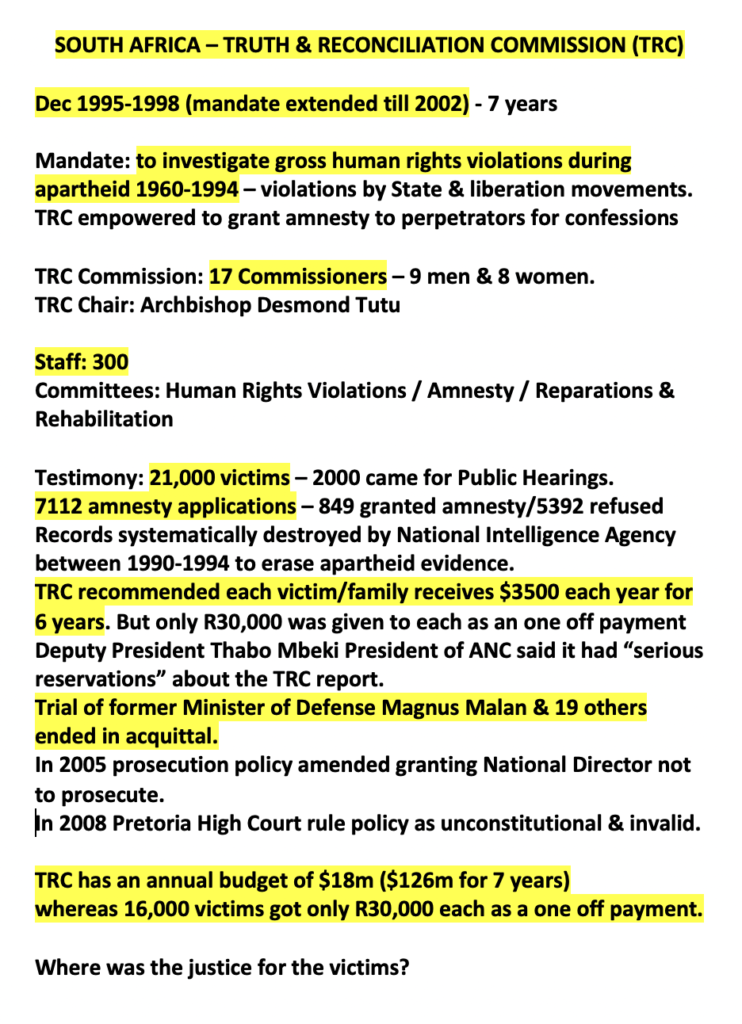
At a meeting in Pretoria on Wednesday, the Sri Lankan Minister of Justice Wijeyadasa Rajapakshe and the Minister of Foreign Affairs Ali Sabry discussed with Roelf Meyer and Ivor Jenkins, the contours of the proposed Truth and Reconciliation Commission (TRC) in Sri Lanka inspired by the South African TRC that functioned between 1995 and 2003.
Sabry tweeted to say that he got some very insightful inputs,” and added that a credible and transparent domestic TRC could be the solution to deal with intrusive and agenda-driven attempts.” He was decrying the UNHRC’s attempts to impose on Sri Lanka mechanisms for achieving ethnic reconciliation based on retributive justice dispensed by a judicial process with foreign participation.
This is not the first time that Sri Lanka is trying to set up a TRC. It has been attempted before, but only to be abandoned because Sri Lankan society is too divided to make it work. A TRC would be mooted when there is a temporary need to mollify the international human rights lobby and abandoned after the threat recedes. It was mooted in 2015 and 2022 because of pressure from the UNHRC, but it was not followed up. It is mooted now primarily to please the IMF, but with no intention to actually set it up.
However, on 16 October 2018, a conceptual framework was submitted to the Lankan Cabinet. It decided to refer it to the Ministry of Defence. But it went no further. In March 2020, the UNHRC reported that the TRC proposal had not made any progress.
The concept paper had said the TRC of Sri Lanka will be established by an Act of Parliament. Justifying this, the concept paper said: Despite the appointment of numerous ad hoc commissions of inquiry during the past (like the Paranagama Commission, the Lessons Learnt and Reconciliation Commission, the Udalagama Commission, Mahanama Tillekeratne Commission) due to failure to implement recommendations made by those Commissions, it has not been possible to successfully prevent recurrence of conflict, or build confidence amongst all the people of Sri Lanka in the efficacy of measures to ensure non-recurrence, advance national unity and reconciliation, or identify and undertake administrative reform interventions that may be necessary.”
The concept paper further said the proposed Act of Parliament would, inter alia, incorporate statutory provisions to appoint a Monitoring Committee which will enable all Sri Lankan citizens, irrespective of race or religion, including families of Police and Security Forces personnel, civilians in villages that came under attack by terrorists, Security Forces personnel and Police personnel, and all affected persons in all parts of the country, to submit their grievances suffered during any phase of civil disturbances, political unrest or armed conflict that has occurred in the past, to the proposed TRC.”
The proposed TRC should have sufficient administrative and investigative powers, including those granted to Commissions of Inquiry. This includes powers to compel the cooperation of persons, State institutions, and public officers in the course of its work. While the TRC will not engage in prosecutions, it should be vested with sufficient investigative powers. But the TRC’s recommendations shall not be deemed to be a determination of civil or criminal liability of any person.”
However, nothing was done till March 2023, when, at the invitation of the South African High Commissioner in Sri Lanka, Ministers Wijeyadasa Rajapakshe and Ali Sabry flew to South Africa to study its TRC.
Impediments
Would the ministerial mission bear fruit? The political and ethnic conditions in Sri Lanka do not appear to be conducive for the setting up of a TRC or for getting a favourable result from it. Lankan society is sharply divided ethnically on what was right and wrong during the 30-year armed conflict. Unlike the majority Sinhala-Buddhists, the minorities, especially the Tamils, are hell-bent on retributive justice, not restorative justice which the TRC in South Africa attempted and the Lankan variant would follow.
One of the major disadvantages in Sri Lanka in comparison with South Africa is the absence of an overarching and towering national leader to move the masses in any particular direction. From 1995 to 2003, when the TRC was functioning in South Africa, it was overseen by icons like President Nelson Mandela and TRC Chairman Bishop Desmond Tutu.
However, even under favourable conditions, the South African TRC (TRCSA) was only a partial success, says Samara Auger, author of Healing the Wounds of a Nation: The Truth and Reconciliation Commission of South Africa.
Key takeaways from Auger’s paper:
The TRCSA collected over 21,298 victim statements. Over 7,000 offenders applied for amnesty. Of these 7,000, 1,167 were granted full amnesty and 145 partial amnesty. The TRCSA released an interim report in 1998 and a final report on 21 March 2003.
The fundamental principle informing the TRCSA’s efforts was encapsulated in the indigenous African concept of Ubuntu. As per Ubuntu, jurisprudence is restorative rather than retributive. Ubuntu says: I am human only because you are human. If I undermine your humanity, I dehumanise myself. You must do what you can to maintain this great harmony, which is perpetually undermined by resentment, anger, and desire for vengeance.”
In the final report of the TRCSA, Ubuntu is reflected. Justice is defined not as punishment, but as reparations to victims and rehabilitation to perpetrators.”
The Ubuntu approach rests on the acceptance of the concept that the sufferings undergone were collective”, that everyone suffered equally, regardless of class, race or religion and that people should seek collective redemption, forsaking revenge in exchange for peaceful alternatives. In the ‘collective approach’, society or the nation is placed above the ‘individual’. The individual victim is expected to subordinate his victimhood to the larger interest of the society or country in securing peace and reconciliation. This is based on the theory that the needs of society are greater than those of individuals because once society is healed, individuals will be healed too.
However, the Ubuntu was met with resistance from the Blacks who thought that equating them with the Whites was grossly unfair. Another drawback in the collectivistic approach was that society (typically represented by the Government) sought closure before the concerned individuals were ready.
Despite its outstanding leaders, South African society was ethnically divided. A survey of 3,700 South Africans conducted in 2000 and 2001 found that 68 per cent of all races found it hard to understand one another and 56 per cent found the other race untrustworthy. Less than one fifth wanted to be friends with members of another race.
But, among the races, more Blacks than Whites accepted that the TRCSA promoted reconciliation. A public opinion poll that asked the question: Did the TRC promote reconciliation?” found 70 per cent of Blacks, 59 per cent Asians, and 26 per cent Whites answering ‘Yes’. Similarly, a 2002 survey done by Jeremy Sarkin-Hughes found 70 per cent Blacks, 61 per cent Asians, and 37 per cent Whites providing moderate to strong approval of the TRC’s work. However, the White-Black gap was cause for concern.
In Sri Lanka, ethnic differences are wide and entrenched. There are sharp differences on what is right and wrong. A TRC under these conditions will only help sustain differences. Additionally, there is no leader to bridge the gulf, even partially.
Alternatives
The more practical alternative would be to take the following non-abrasive steps which had been suggested but not implemented: (1) Release those Tamils incarcerated for years without cases being filed against them; (2) Punish perpetrators of atrocities who are facing credible charges; (3) Release public land acquired by the Security Forces and prevent encroachments on lands by government departments on specious grounds (4) Boost the economies of the war-affected areas North and East and motivate the minority youth to stay in the country and develop it and not flee the country.
Minister of Power and Energy Kanchana Wijesekera has assured that there are sufficient stocks of fuel in the country, and that distribution will continue as usual.
Taking to Twitter, the Minister urged the public not to panic over a potential shortage in the supply of fuel owing to the recent actions taken by the trade union collective of the Ceylon Petroleum Corporation (CPC).
He confirmed that fuel distribution, although delayed earlier today owing to the trade union activists, has been normalised.
The Minister also added that police and armed forces have been deployed to provide the necessary security at petroleum terminals and distribution points.
The Petroleum Trade Unions’ Collective yesterday (27 March) staged a Satyagraha opposite the Kolonnawa petroleum terminal against the government’s alleged ongoing attempts to privatise the CPC.
The Satyagraha was called off this afternoon, after which the trade union collective announced its decision to launch a strike action, withdrawing themselves from engaging in the filling and distribution of fuel.
The report on the batch of imported eggs from India is scheduled to be released tomorrow (29 March), Director General of Animal Production and Health Dr. Hemamali Kotelawala stated.
However, although nearly a week has passed since the arrival of the stock of eggs, the Department of Animal Production and Health are yet to take any steps pertaining to the release of the stock from the Colombo Port.
Speaking to the Media, Trade Minister Nalin Fernando stated that despite the stock of eggs being imported with the approval of the Department of Animal Production and Health, they are yet to provide the relevant certificate.
Nearly two-and-a-half-months were wasted for this task. They are trying to waste more time now. We imported eggs for the public, not for my personal use”, Fernando said in this regard.
Meanwhile, the Sri Lanka State Trading (General) Corporation has stated the stock of imported eggs will be distributed from tomorrow evening.
It was previously decided that this stock of eggs will be distributed amongst bakers at a price of Rs. 35.
It has also been revealed that the eggs imported from India can be refrigerated for up to 90 days.
Minister of Power and Energy Kanchana Wijesekers has called for the termination of employees of both the Ceylon Petroleum Corporation (CPC) and the Ceylon Petroleum Storage Terminals Ltd (CPSTL) who disrupt the distribution of fuel.
Taking to Twitter, the Minister stated that he has instructed the CPC and CPSTL Chairman to take the necessary disciplinary steps required pertaining to the termination of employment of those employees or trade union activists who disrupt the distribution of fuel and the work of other employees, or who act in violation of the essential service orders.
He added that instructions were also given to take any legal steps required in this regard.
Wijesekera’ s decision comes in the backdrop of an announcement made by the Petroleum Trade Unions’ Collective to stage a strike action, withdrawing themselves from engaging in the filling and distribution of fuel across the island.
Despite calling off the Satyagraha staged against the Government’s alleged decision to privatise CPC, the trade union collective had reportedly later decided to stage a strike action instead.
A Satyagraha campaign was launched yesterday (27 March) against the government’s alleged ongoing attempts to privatize the CPC.
The Colombo Fort Magistrate Thilina Gamage has ordered the former opposition leader of the Kotte Municipal Council, Chandima Nanayanajith to be remanded in custody until April 04.
The former opposition leader of the Kotte Municipal Council, Chandima Nanayanajith had been arrested by the Criminal Investigation Department (CID) and produced before the courts today (March 28), in relation to the incident of torching President Ranil Wickremesinghe’s private residence in Colombo 07.
The program initiated on the instructions of President Ranil Wickremesinghe to identify those eligible for welfare benefit payments has completed the information verification for over 2.2 million applications received during the on-going survey and verification process, the President’s Media Division (PMD) said.
Saman Ekanayake, the Secretary to the President, has instructed officers to accelerate the eligibility verification process for welfare allowances pertaining to 3.7 million applications received from 340 Divisional Secretariat Divisions throughout the island.
As a result, the majority of applications that have been confirmed and finalized are from the Matara district, accounting for 82.1% of all applications, according to the PMD.
The data verification process has validated the information of 2,227,888 applications from all over the island. Among them, 78.3% were from Ampara district, 74.5% were from Kalutara district, 73.3% were from Galle district, and 71.7% were from Anuradhapura district, it added.
As the information survey work is set to conclude on March 31st, the government urges applicants to provide accurate data to the officials conducting the survey with utmost urgency.
It should be noted that failure to provide correct information by the deadline may result in the denial of welfare benefits, and therefore, the government emphasizes the importance of timely and accurate information submission, the PMD reported.
The Indian Council for Cultural Relations (ICCR) has proposed to set up Sinhala and Hindi language departments in several Indian and Sri Lankan universities.
The proposal was made by ICCR President Dr. Vinay Sahasrabuddhe, who also proposed to increase the number of ICCR scholarships for Buddhist studies.
The proposals were conveyed to Prime Minister Dinesh Gunawardena when Dr. Sahasrabuddhe called on the former at the Temple Trees yesterday (27 March).
The Premier thanked the ICCR President for granting hundreds of scholarships to Sri Lankan students, musicians and artists, and for sponsoring cultural and musical exchanges between the two countries over the years.
He said the ICCR’s programmes for Youth Leadership Training were of immense use to enhance leadership skills of young professionals and parliamentarians.
The Prime Minister further requested the ICCR President to make arrangements for exchange programmes for crafts artisans, so that they could learn from new innovative craft skills developed by artisans in the two countries.
Dr. Sahasrabuddhe said he inaugurated the first meeting of Sri Lankan Alumni of ICCR to ensure continued interaction between those who benefitted from ICCR tradition of enriching skills and academic excellence, adding that those students who have studied in India will pursue bright careers in their home country and will also spread the light of education and knowledge tradition in India.
He added that ICCR provides a large number of scholarships to students to enable them to pursue education in over 43,000 colleges under over 1,100 universities at undergraduate, postgraduate and doctoral research levels.
High Commissioner of India to Sri Lanka Gopal Baglay and Additional Secretaries of Prime Minister’s Office Mahinda Gunaratne and Deepa Liyanage also took part in the discussion.
Sri Lanka’s politicians may enjoy jaunts overseas but they must be sensible to not agree to every foolhardy suggestion that comes their way. We have had a string of foreign ministers nod their heads to proposals that have nothing to do with Sri Lanka’s plight and contributing to creating more cocktails. LTTE terrorism ended in 2009 but separatism didn’t. It is now 2023 and we have been living without any of the lovey-dovey solutions by the UN apparatus who has yet to stop the separatism quest. However, in 2019 another form of terror arose with Islamic suicide terrorism & Minister Sabry is advised to look into this without digging up what should remain buried for good. While he should spend more time stopping separatist quests in Sri Lanka.
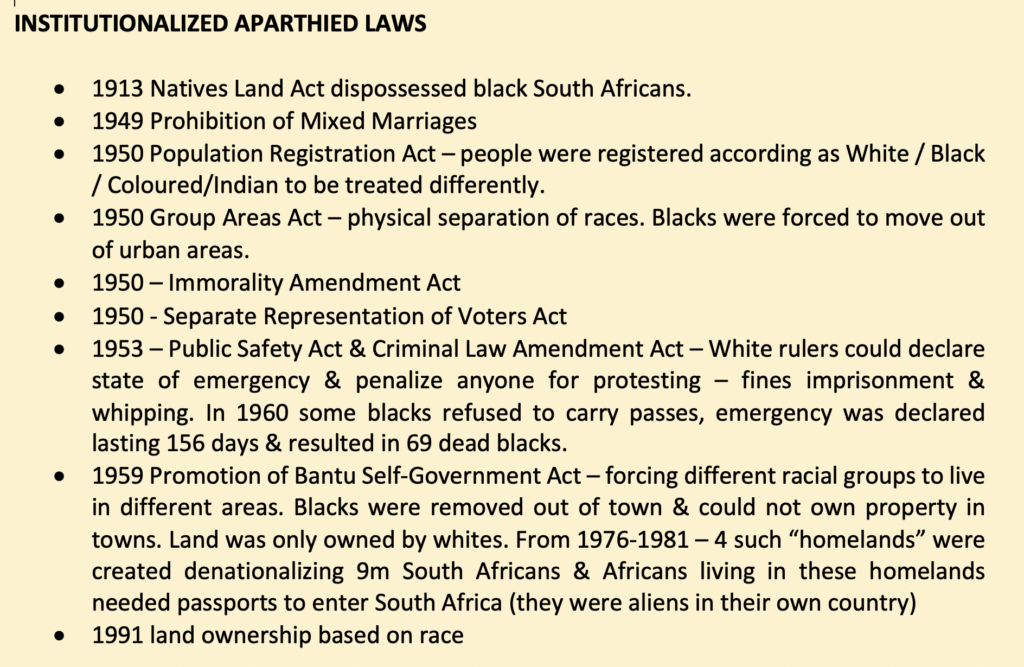
South Africa experienced apartheid laws in 1948 (the year Sri Lanka gained independence)
These laws separated people as blacks & whites. They had to live separately & develop separately. Inter-marriage & social integration was disallowed (this ties well with Wigneswaran’s policy) Whites were barred from having any relationship or even friendship with blacks & vice versa. Jobs were given to whites & blacks separately. In their own land, the majority blacks were made an inferior race by law. Policy of segregation in South Africa did not exist in Sri Lanka except what Tamil leaders aspire to achieve.
What South & Sri Lanka do have in common
Colonized by the British & Dutch
Dutch East India Company arrived in 1652 (Dutch settlers became known as Afrikaners/Boers)
The British seized Cape of Good Hope from the Dutch during Napoleonic wars in 1805. Dutch & British fought for supremacy due to the discovery of diamonds – resulting British setting up concentration camps for Boers.
Rampant corruption (World Bank declared South Africa to be the most corrupt country in the world in 2018)
We complain about Sri Lanka’s politicians, but Jacob Zuma prosecuted for rape in 2006 won the Presidency in 2009. His tenure ended in 2017 after corruption & capitulation to wealthy Guptas emerged (Indian influence in politics)
The African National Congress formed in 1912 after South Africa was created, was formed for the Black educated elite. This mirrored the political framework existing in Sri Lanka where colonials aligned with only English educated Christian converted locals. However, ANC shifted policy to go against apartheid & commenced a Defiance Campaign in 1952. Blacks were called to break apartheid laws & get into white buses” use white toilets” & enter white areas” – another area that Sri Lanka has no comparison with South Africa. 8000 Blacks ended up in jail. ANC broke into PAC which took a more militant path – this may be compared to the TULF calling for youth to take up arms & Tamil youth doing so.
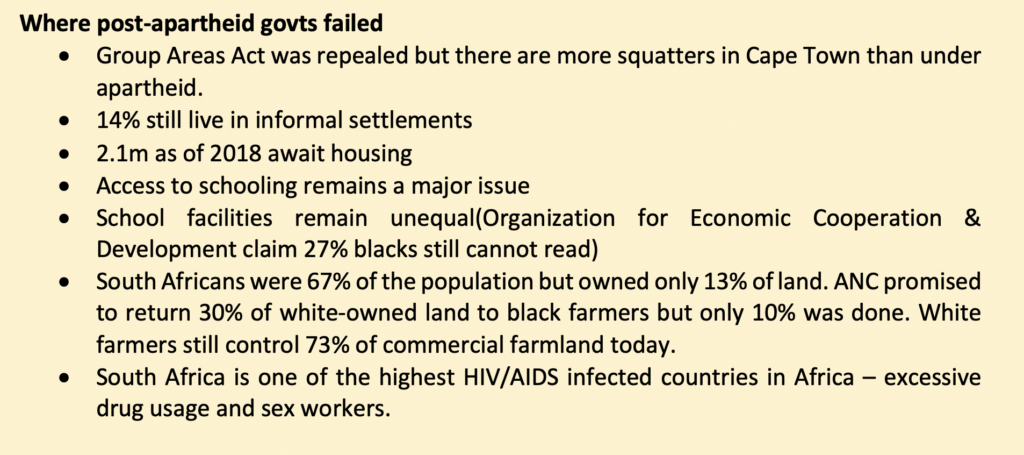
In 1990 Nelson Mandela was freed, ban on ANC was lifted & a new constitution emerged with first democratic elections in 1994 (Sri Lanka’s was in 1947) Mandela became first Black President. Yet, from 1994-2023 South Africa is still living in poverty, inequality, facing health & corruption issues & remains a violent society.
Current President Ramposha has failed to put into practice the reconciliation” efforts he was promoting before becoming President. The same President in 2012 who was a wealthy businessmen ordered police action against strikers – the police ended up killing 34 striking miners on that order.
The neo-liberal aspect of South Africa’s Truth & Reconciliation Commission is identical to the present Truth Commission, Sri Lanka’s foreign minister is trying to promote.
South Africa’s ANC abounds in scandals & corruptions essential ingredients favoring neo-liberal agendas to denationalize citizens at social, political & economic levels. In this sense, Sri Lanka has similarities. If Africa’s TRC has brought about structural collapses, why is Sri Lanka following the same path of destruction or is this the goal?
Human Rights” slogans are part of the neo-liberal framework and used as consort to exert pressures on developing nations at civil & political levels though ignoring inequalities in society. International bodies such as UN/WB/IMF spend more time parroting human rights than they do to erase inequalities.
What exactly is a Truth Commission expected to do?
In South Africa’s context it was to look at human rights abuses during apartheid, share the traumas & then unite in healing. Basically, it was to take the incidents, cry over what happened & just move on because there was little retributive justice, in fact there was hardly any justice.
Where neoliberalism is connected to South Africa’s TRC is the manner that the whites held power over South Africa’s economy (in many ways no different to how minorities control Sri Lanka’s economy) South Africa under apartheid where whites ruled blacks using blacks as labor has changed little in post-apartheid.
The TRC allowed blanket amnesty simply for confessions. The hearings resulted in individuals being coerced into giving truths” that fitted a shared narrative” & peddled as national healing. It was a memory that was far from the truth but people were made to believe it was part of what should be remembered/their memory. Classic case of Christian forgive & forget but take revenge”. How unfair to erase the traumas people suffered around a lie that suited the choreographers who were preparing the narrative. This is why Sri Lanka is being warned & questions on what grounds Sri Lanka’s foreign minister is pursuing this bogus TRC tying up with South Africa.
Individual acts of violence was constituted as group killings or torture & this aspect should be of particular concern in the light of falsified & dramatized allegations being cooked up against Sri Lanka’s armed forces to collectively declare them war criminals. Where Geneva has failed to do, Sabry is taking Sri Lanka into a trap that aims to do the same. The TRC did not treat institutionalized racism which 32m people suffered. TRC even excluded loss of homes to 3.5m people through forced removals. The neutral” position taken by the TRC meant that it looked at abuses even – with more emphasis on reactions rather than the action.
Victim status” depended on the offence meeting the political objective – if not victim statements were turned down.
Desmond Tutu bewailed the ungenerous reparations” to victims of apartheid who appeared at TRC. TRC final report recognized 22,000 victims of apartheid human rights violations. TRC recommended R126,000 reparations over 6 years which Mbeiki reduced to an one-off payment of R30,000 each. Less than 16,000 received this.
Coincidentally, South Africa’s TRC Commissioner was Yasmin Sooka, whose EU funded NGO meant to look into South Africans ended up plugging an anti-Sri Lanka unit into the NGO & going on a witch hunt against Sri Lanka & its armed forces.
In 2020 after 17 years of silence ANC spoke. President Ramposha has failed to respond to letters written by victims’ families re prosecution of TRC cases. South Africa’s TRC has politicized reconciliation. This is exactly what is being imported to Sri Lanka. Without addressing the root causes -the narrative was taken on a different course completely changing the entire systematic racism that prevailed.
If the objective is restorative justice – there is no requirement for any tribunals or commissions. People are simply going on with their lives. What is the point in a commission that is created for a political objective & politically motivated crimes/abuses as in the case of South Africa to be duplicated in Sri Lanka. People in AC rooms and from remote offices see incidents differently to those in the thick of things & they cannot dictate how the traumatized should feel & act. South Africa’s TRC failed to identify racism as the root of apartheid & it downplayed white supremacy. The same players are trying to down play the separatist-terrorism by peddling the creation of mono-ethnic devolution via 13a as it fits a larger geopolitical agenda.
It seems that Sri Lanka used to apply an absurd way for judging the quality of education gained by students looking at irrelevant criteria based on which school kids attended to gain education. Knowledge is identical from whichever school it gained. All over the world accept that education is a quality factor irrespective of from which school it gained and basically education relates to gaining knowledge, skills and values that are regarded as major areas of the basic education. This idea goes back to Socrates who explained that whichever is suitable for the purpose it is regarded as quality and it is easy to determine that if any person has knowledge, skills and values appropriate for the purpose such basic education is regarded as quality disregarding the place where the education was gained. Despite this accepted principle, it seems that Sri Lanka uses a criterion to determine the quality of education based on the place where kids obtained education. Because of this misconception, there is a competition to admitting kids to schools.
Before I gained higher education from universities, I attended a school in a village and this background induced me to insult me in public despite my higher education and other skills. Could education gained by a person be devalued based on the place of education was gained? It happens in Sri Lanka and I faced many instances for humiliation because I gained education from a village school. I visited several countries and never seen in such countries the education is valued based on the place students gained education. I observed that no policymakers or responsible government authority attempted to change this deluded criterion and explain whichever school educated students required level of knowledge, skills and values gained it is quality. I met many kids they studied in so called Christin Colleges but they couldn’t gain required marks to enter the university. Many wealthy parents spent a large sum of money their kids couldn’t gained required level of marks to enter university courses related to medicine, engineering and information technology etc.
Many people in Sri Lanka seems to treat the value of education based on the place or school where the education was obtained and this type of value judgement is fallacious and determination of the value of education in such a manner is a highest disrespect to education. Before, European invasions, education was to categorized as good or bad not on the basis of the place anyone gained education but it was based on the demonstrated ability to display the competencies of a person. In fact, historical education based on the gaining competencies and nobody wanted to determine the value of education by using fallacious criteria.
During the colonial era various churches attempted to interpret the education should be obtained from Christian institutions and the education gained from Buddhist or Hindu institutions regarded as lower quality. Whichever a place with a name board of a Christian saint regarded as quality education without referring to competencies gained and it was a question to me whether such a wrong assessment on the education should be applied to determine the quality of education gained by a person, and my view is quality education should be regarded as knowledge, skills and value gain through the education required competency level.
A conversation between Socrates and Critobulos (Ozman and Craver (1999), Philosophical Foundation of Education, USA, Upper Saddle River) explained that if anything is suitable for the purpose it is regarded as quality. When it judges the quality of education it doesn’t matter from which place or school education obtained it is regarded as quality, if anyone obtained right knowledge, skills and values. Such education regards as the quality education and it is immaterial from which institution obtained education by kids.
The race to admitting kids to schools in Sri Lanka is an outcome of fallacious attitudes and no one has attempted to change this wrong thinking. I observed that in Australia, when a person faced to a job interview the members of interview board never ask if the subject was studied in Australia, which Australian school was attended to, especially they are not concerned about the name of school. As a person who gained higher degrees from Australian universities, I would like to suggest that education policymakers must change the way of determination of education based on school’s name and equity and justice based education should be in Sri Lanka.
My experience of taking the Seethawaka Odyssey to see the natural wonders of the Seethawaka region in Sri Lanka was very mixed.
The train ride was uneventful and peaceful, but once we reached the designated drop-off point at “Waga,” the continuation of the next part of the odyssey was nothing but disappointing and chaotic.
When the train arrived at “Waga”, there were not enough buses to accommodate the number of guests expected, and seeing the numbers, someone from the “Seethawaka Tourist Guides’ Association started making fanatical calls to bus owners from the area.
The other issue was that many did not have tickets for the buses, and the train fare guests pay does not include the side trips, and even the railway authority was of no help except to say “Buses will be there and you have to pay them then and there only”.
What a healthy way to promote their train ride to locals and foreign tourists alike.
Later, I came to understand that someone from the Tourist Promotional Authority had sold those tickets to guests who boarded the train from its starting point, conveniently ignoring the other guests boarding the train from subsequent pick-up points.
Finally, after many frantic calls, a few extra buses totalling six arrived. Four were non-airconditioned and two were supposed to be with air conditioning, but it later turned out that one of those had a defective air conditioning system, resulting in guests who boarded the bus having to travel with the shutters up, with no refund of any fare paid to them at the end.
One can ride on this train by only having a prior booking, and that means the railway authorities have a clear idea of how many guests are expected on the train, and further, their booking system requires the national identity card number of every guest.
If this information can be shared with the tourism promotional authority and their end facilitator, the “Seethawaka Tour Guides Association,” the situation cannot be that chaotic.
The booking details will let them know how many will arrive using the premium air-conditioned coach and other coaches, as the gender and age of every guest arriving by train.
But if the railway authority wants to keep those details as secretive as something like national security details, then they have to reexamine their priorities and stand again on this.
The bus tickets are another concern, with no fare or issuing authority details available on them except that they were colour-coded for AC and non-AC buses, which can only open up opportunities for fraud later.
There were six buses full of guests, and there was only one qualified guide to take them around, and no proper briefing was done prior to the commencement of the second leg of the odyssey on what to do and what not to do in those places guests were supposed to be going.
The last thing was that if the local authority of the Seethawaka region thinks that simply putting up a big sign (most of them were in a crumbling state now) is what the area and facility need to promote themselves, then they are sadly mistaken.
Adding value to those natural wonders is overdue if they want to promote that area as a tourist area.
There are lots of health, safety, and environmental concerns that must be addressed if they are to make a real buck out of this venture, or else it will fizzle out as many other big projects started with big fanfare in the past.
Sad, but those are the real ground-level issues that all authorities have to earnestly address working like a big team together to see the project sustain and flourish in the future.
March 27 (NewsWire) – The governments of Sri Lanka and India have decided to launch a passenger ferry service between Kankesanthurai in Jaffna, Sri Lanka to Karaikal in India from 29th April 2023, it has been reported.
According to reports, discussions in this regard have been held between the Minister of Ports and Shipping Nimal Siripala de Silva and India’s Foreign Affairs Ministry on Sunday (26).
It has also been decided to establish two Immigration and Emigration offices, one each in Kankesanthurai and Karaikal for this purpose, while preliminary measures have already commenced in this regard.
Minister Nimal Siripala de Silva has revealed that boats will not be provided initially by the governments of India and Sri Lanka for the ferry service, instead, boats will be provided under the tender called for by the Indian Ministry of Foreign Affairs.
Under the new passenger ferry programme, a ferry will hold a capacity of a total of 150 passengers with each passenger’s allowed baggage weight of 100 kilos, while the cost of one-way travel is US$ 50.
Sri Lanka crisis: The Sri Lankan finance ministry officials held talks with its Indian counterparts to obtain the new temporary USD 1 billion facility for the purchase of essential items.
Sri Lanka would seek a new temporary credit facility of USD 1 billion from India to purchase essential items including food and medicine, the official media here reported on Monday.
India was the first bilateral lender to issue financing assurances in the debt restructuring negotiations.(AP)
The Sri Lankan finance ministry officials held talks with its Indian counterparts to obtain the new temporary USD 1 billion facility for the “purchase of essential foodstuff, medicines and other goods for the country,” the state-run Daily News newspaper reported.
Meanwhile, former Central Bank Governor Dr Indrajith Coomaraswamy, speaking at a discussion organised by the Centre for Banking Studies of the Central Bank, said, … the negotiations are also underway to secure an Indian rupee swap from RBI. The amount is still uncertain; it could be up to the equivalent of USD 1 billion. That is still being worked out.”
“This is expected to facilitate Sri Lanka-India trade,” the senior economist was quoted as saying by the Daily Mirror newspaper on Saturday.
Coomaraswamy added that the Sri Lankan government also began talks with Indian authorities to extend the repayment of the USD 1 billion credit line received last year and debt under the Asian Clearing Union by five years, the report said.
… we are trying to settle that money over a five-year period. It is still at early levels of negotiations,” he said, noting that the island nation was unlikely to receive such a long extension for the USD 400 million multi-currency swap facility, which has already been extended.
Last week, state minister of finance, Ranjith Siyambalapitiya said that Sri Lanka settled a loan instalment of USD 121 million from the previous facilities extended by India, using the first tranche of the IMF bailout package.
Sri Lanka has been struck by a catastrophic economic and humanitarian crisis sparked by years of mismanagement and the raging pandemic.
India has extended lines of credit worth over USD 4 billion to Sri Lanka in diverse sectors, including the supply of essential items, petroleum, fertilisers, development of railways, infrastructure, defence sector and renewable energy, according to the Indian High Commission here.
The Indian Oil Company’s local operation kept fuel supplies going in the face of miles-long queues forming at retail fuel stations mid-last year, as the state ran dry of forex to import petroleum.
The IMF’s Executive Board approved a 48-month extended arrangement under its Extended Fund Facility (EFF) last week with an amount of SDR 2.286 billion (about USD 3 billion).
The IMF bailout, the seventeenth in Sri Lanka’s history, was approved following prolonged discussions held up over Colombo’s unsustainable debt.
India was the first bilateral lender to issue financing assurances in the debt restructuring negotiations.
President Ranil Wickremesinghe, who spearheaded the IMF negotiations, specially mentioned the contributions made by the Indian finance minister Nirmala Sitharaman to assist his government.
India has extended multi-pronged assistance to Sri Lanka during the peak of its economic and humanitarian crisis in line with its “Neighbourhood First” policy and as an earnest friend and partner of Colombo.
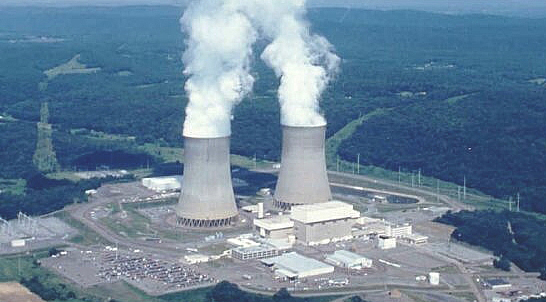
Sri Lanka is considering building small, offshore and onshore reactors, deeming nuclear power an environmentally and economically viable option. Currently, its electricity comes mainly from hydroelectric power plants. The government is vetting an existing contract between Rosatom and Bangladesh.
Colombo (AsiaNews) – The Sri Lankan government wants to work with Russia to generate nuclear energy; hence, it is looking at the possibility of installing small, offshore and onshore modular reactors or floating nuclear plants.
To this end, the cabinet has given its approval for application to two international conventions on nuclear energy and damage.
The goal is to diversify the country’s power supply and nuclear energy is viewed as a low-carbon option to achieve carbon neutrality (zero emissions) by 2050.
Currently, Sri Lanka gets most of its electricity from on hydroelectric power, followed by coal and fuel oil.
According to official sources at the Sri Lanka Atomic Energy Board, Russia put forward a proposal to construct a nuclear power plant in Sri Lanka;” and proposed an agreement for this purpose”.
Since it was a government-to-government program, cabinet approval was given to consider nuclear energy as an alternative source of energy to meet Sri Lanka’s future energy needs.”
According to a proposal put forward by Russia, a team of Russian experts will operate the power plant and train Sri Lankans within three years to operate it.
Thus, Sri Lanka hopes to have three barge-mounted offshore nuclear power plants with small modular reactors (SMRs) with a power capacity of up to 100 MW per unit.”
Currently, Russia is number one in the world for the most nuclear reactor projects, with three units in Russia and 34 units overseas in various phases of construction,” said several senior engineers who spoke to AsiaNews.
More specifically, Russia is active in its support for nuclear power [development] in Asia and is constructing the two-reactor, 2.4-GW Rooppur Nuclear Power Plant” in Bangladesh, which will be the country’s first nuclear power facility” and is expected to enter commercial operation next year.”
India too has installed two nuclear power plants from Russia’s state-owned Rosatom nuclear company.
In 2022, Sri Lankan officials submitted a self-evaluation report to the International Atomic Energy Agency (IAEA),” sources familiar with the file said.
The aim is to obtain approval to establish an independent nuclear regulatory body, develop training programmes for nuclear power personnel, and provide supporting documents covering infrastructure issues,”.
For the sources, Electricity generation by nuclear power is more environmentally friendly than energy sources such as oil, coal and gas, and, with the exception of the initial construction cost, less expensive.”
Indeed, Unlike traditional power sources that can fluctuate over time, there is little possibility of cost inflation,” and this can have a significantly positive impact on Sri Lanka’s current economic situation.”
Thus, Sri Lanka is currently studying the agreement Russia has with Bangladesh in order to determine investments and repayment period.”
It took exactly one year for the IMF to agree to concede Sri Lanka’s appeal to help face the unprecedented economic crisis that is confronting the Island nation. Though referred to as a bailout, the USD 2.9 billion Extended Fund Facility (EFF) will hardly help Sri Lanka in the long term. In fact, it has been criticised as exacerbating the debt crisis than resolving it.
In a nutshell, this is a loan that will assure other creditors to keep lending to Sri Lanka when the country is unable to service her existing loan commitments. In the meantime, Sri Lanka is to raise its Government revenue by increasing taxes and giving up the State’s stake in State-Owned Enterprises (SOEs). Whether this alone will suffice to flatten the debt burden is unclear.
Instead of onetime payment, the IMF bailout will be disbursed in eight tranches, spread over four years. To qualify for each subsequent tranche, IMF must be satisfied that all its conditions have been fulfilled by the Government of Sri Lanka (GoSL). IMF has warned that if GoSL, after receiving the first few tranches abrogates the agreement by not complying with the conditions, then GoSL may never approach the IMF again.
We too, have duly agreed and have publicly pledged to see through the entire gamut. In fact, even before the IMF Executive Board met to discuss the Sri Lankan matter and decide if to grant the EFF, GoSL began working on the conditions. By the time the IMF Executive Board met, GoSL had already fulfilled IMF’s preconditions.
IMF Conditions Put GoSL in Difficulty
These are not easy conditions and are bound to make any government unpopular. Fulfilling these conditions is made even more challenging for the incumbent administration, considering it is an offshoot of the discredited Gotabaya Rajapaksa Government with its former two-thirds majority in Parliament scattered.
Already, the trade unions are in action, organising its members into protesting on the streets over the hike in taxes and utility bills. Little do they seem to be realising that slowing the economy, even for a day, will only push the GoSL further into the IMF grip. It is a pity that these unionists, some with the best brains in the country, are yet to envision ways to revive the economy so that our dependency on the IMF and other multilateral, bilateral and commercial creditors lessens.
Immediately after the IMF Executive Board agreed to the USD 2.9 billion EFF, the GoSL announced its intention in privatising some of Sri Lanka’s most lucrative SOEs. Somehow, between 01.09.2022 (when GoSL reached an agreement with the IMF at staff level) and 20.03.2023 (when the IMF Executive Board approved the agreement the GoSL reached with the staff level) the precondition ‘loss making’ that would qualify the SOEs for privatisation has fallen.
On 23.03.2023, Finance Ministry announced that the Cabinet has approved the divestment of shares of:
• SriLankan Airlines Ltd., including SriLankan Catering Ltd.
• Sri Lanka Telecom PLC
• Sri Lanka Insurance Corporation Ltd.
• Canwill Holdings Pvt. Ltd., (Grand Hyatt Hotel)
• Hotel Developers Lanka Ltd., (Hilton Hotel Colombo),
• Litro Gas Lanka Ltd., including Litro Gas Terminals (Pvt) Ltd., (LPG retailing)
• Lanka Hospital Corporation PLC
This is bound to anger the people even more – especially as many Sri Lankans hate the word ‘privatisation’. For them, this is synonymous with ‘colonisation’.
When Sirima Bandaranaike’s Governments of 1960-65 and 1970-77 took over Sri Lanka’s strategic assets from the private sector, most primarily owned by the Western Governments, into State-control and management, that move was termed as ‘nationalism’. This was to restore the rights and heritage of the people of the land.
In this process, Sinhala entrepreneurs, such as planters, who owned tea estates on a large scale, too, lost the assets that they earned under the most difficult conditions. Yet, stripping off Sinhala entrepreneurs of their livelihoods was hoorayed as the general public could not differentiate between a foreign owned asset and a Sri Lankan -owned asset. As far as they were concerned, anything owned by a private party is anti-national.
It was this mindset that destroyed the private sector in the 1970s decade. Opening the economy in 1977 revived the private sector. While it did not kill the public sector, it also did not rectify the causes that made most of the SOEs a failure and cost the Bandaranaike Government its credibility. Without understanding these causes, if the present government attempts to privatise these assets, it will be akin to Sirima Bandaranaike’s failed effort. Only this time, the effort is to change the ownership of these enterprises from State to private (while Bandaranaike’s attempt was to change from private to public). Either way, this kind of abrupt moves would be too much of a socioeconomic shock to the country.
As things stand as it is, the incumbent Government may not have much of a choice. While the Bandaranaike Government policies on ‘nationalising’ were entirely their own policies, the incumbent Government’s efforts at privatising is not theirs alone. This Government is left with little choice, but to comply with a western oriented multilateral creditor. The backlash from so-called nationalists would be inevitable and severe.
Yet, the already unpopular government, having inherited this course set for an IMF bailout, must now brace itself for the attack. It is almost against the will of the people this Government thus must steer the IMF conditions into fulfillment.
India’s Barely Acknowledged Support
In this context, it is a wonder that India is yet to be hailed as Sri Lanka’s saviour. After all, from day one since Sri Lanka publicly acknowledged the enormity of its economic crisis, India had stood firmly by Sri Lanka’s side. Without any of the conditions that would directly put the GOSL too much at odds with its people, India had extended USD 3.9 billion to Sri Lanka. Sri Lanka’s economic woes are not due to the global pandemic of 2020-21, nor is it due to any particular one incident. It is a collective missteps taken over the past decades. Judging from the trade union actions, it is clear that as a nation we still do not have clarity on the issues affecting our country negatively.
We do not want taxes increased, subsidies reduced or SOEs to be owned or managed by the private sector. Likewise, our graduates prefer to join the State as opposed to the private sector and that is only for the pension. This is the leading attribute that makes SOEs inefficient and loss-making enterprises. Any investment, whether private or public, is viewed with extreme suspicion. Instead of working out the disadvantages, it is used as an excuse to nuke the project altogether. Such is our disdain for new investments.
It is against this background that India supported Sri Lanka, even after the self-declaration of bankruptcy. In other words, India supported Sri Lanka purely on faith – not really knowing when repayment would be done. Of course, India has her own expectations from Sri Lanka, but that is besides the point.
India, as expressly articulated, it wants to establish Sri Lanka as family. Hence, India’s External Affairs Minister Dr. Jaishankar’s pronouncement that blood is thicker than water.”
Sri Lanka ought to feel heartfelt gratitude to India for staying steadfast at our side when most of the world was shying away. However, judging by the comments made by the Sri Lanka Foreign Minister Ali Sabry, to the Indian media during his recent visit to India, it is not appreciation, but fear that was communicated. From the interviews given, it was obvious that Minister Sabry was extremely cautious as not to offend India. He categorically assured that Sri Lanka’s priority is India’s security. He asserted that Sri Lanka will not allow any other, in any guise to compromise India’s security. Thereby, he effectively weakened bridges with every other nation that does not see eye-to-eye with India, but has been our all-weather friend. Since the very onset of this economic calamity, India has been extending strong support on the basis that a friend in need is a friend indeed. Yet, we are prostrating before India in servitude. The reasons for this different positions adapted by the two countries will be discussed in the next column.
ranasingheshivanthi@gmail.com
(The views and opinions expressed in this column are writer’s own and do not necessarily reflect the official policy or position of Ceylon Today)
The Court of Appeal today (March 27) ordered the dismissal of a writ petition filed against Senior DIG in charge of the Western Province Deshabandu Tennakoon accusing him of assaulting protestors near Galle Face during the Gota Go Gama” protests, Ada Derana reporter said.
Accordingly, the petition has been ordered to be dismissed with costs when the relevant petition was taken up before the Appeals Court judge bench consisting of the President of the Court of Appeal Nissanka Bandula Karunaratne and Justice A. Marikkar.
The petition had been filed seeking an order be issued to the Attorney General ordering him to arrest SDIG Deshabandu Tennakoon as a suspect in the incident of attacking the Gota Go Gama” protest site, record statements and to present them before courts.
The court has issued this order after considering a preliminary objection raised by President’s Counsel Romesh de Silva, who appeared on behalf of the SDIG, when the petition was taken up this morning.
Minister of Power and Energy Kanchana Wijesekera says the Cabinet of Ministers has granted approval to award licenses to China’s Sinopec, Australia’s United Petroleum and RM Parks of the USA, in collaboration with multinational oil and gas company – Shell plc, to enter the fuel retail market in Sri Lanka.
In a twitter message, he said that the Energy Committee and other relevant procurement committees had given their approval and recommendation to award the three companies the licenses to operate.
The minister stated that the three companies will each be allocated 150 dealer operated fuel stations, which are currently operated by Ceylon Petroleum Corporation (CPC). A further 50 fuel stations at new locations will be established by each selected company, he said.
They will be granted a license to operate for 20 years to import, store, distribute and sell petroleum products in Sri Lanka, the minister tweeted.
In June 2022, the Cabinet of Ministers had green-lighted the proposal to open up Sri Lanka’s fuel import and retail sales market to companies from oil-producing nations.
In October the same year, the Petroleum Products (Special Provisions) Bill, paving way for new suppliers to enter as importers, distributors and retail operators for petroleum products, was approved by the Ministerial Consultative Committee on Power and Energy.
Prime Minister Dinesh Gunawardena said the government will further negotiate with the International Monetary Fund to provide more relief to low-income earners.
Addressing an event held to distribute free rice to low income earners under the government’s paddy purchase program in Maharagama, Prime Minister Dinesh Gunawardena said many countries have pledged to support Sri Lanka to recover from the economic crisis.
The Prime Minister said In the future, the government will work hard to make the effort to ease the cost of living successful by relaxing the rules for the import of goods.
They used a mixture of lime, volcanic ash, and water to create a building material that was both durable and easy to work with.
The word “concrete” comes from the Latin word “concretus,” which means “compact” or “condensed.”
Over time, the recipe for concrete was refined and improved, and it is now one of the most commonly used building materials in the world.
While the ancient Romans are credited with the initial invention of concrete, many other cultures have contributed to its development and refinement over the centuries.
The Kulasingha Concrete method, also known as the “Sri Lankan method,” is a traditional method of constructing reinforced concrete structures in Sri Lanka.
It was developed by a Sri Lankan engineer named Dr A. N. S. Kulasingha in the 1960s.
The method involves using a series of precast, interlocking concrete blocks that are designed to fit together like puzzle pieces. The blocks are made with a mix of cement, sand, and crushed stone, and are reinforced with steel bars. They are designed to be easy to assemble and disassemble, making them ideal for temporary structures or structures that may need to be moved or modified in the future.
The Kulasingha Concrete method has become popular in Sri Lanka due to its simplicity, affordability, and durability. It has been used to construct a variety of structures, including houses, schools, and bridges. The method has also been adapted for use in other countries, particularly in the developing world, where it has been used to construct low-cost housing and other infrastructure projects.
The Kulasingha Concrete method offers several benefits, including:
Affordability: The method is relatively inexpensive, as it uses locally available materials and does not require specialized equipment or training.
Durability: The concrete blocks used in the method are reinforced with steel bars, making them strong and resistant to damage from natural disasters such as earthquakes and floods.
Flexibility: The blocks are designed to fit together like puzzle pieces, making them easy to assemble and disassemble. This allows for the construction of temporary structures or structures that may need to be modified or moved in the future.
Sustainability: The method promotes the use of local materials and reduces the amount of waste generated during construction, making it a more sustainable option compared to other construction methods.
Speed of construction: The method allows for faster construction times compared to traditional construction methods, as the precast blocks can be manufactured offsite and quickly assembled on-site.
Versatility: The method can be used to construct a variety of structures, including houses, schools, and bridges, making it a versatile option for a range of construction projects.
Overall, the Kulasingha Concrete method offers a cost-effective, durable, and flexible option for construction projects, particularly in areas where resources are limited or access to specialized equipment or training is limited.
A rather forgettable news column rang alarm bells. Tucked away in the Sunday Times, at the very bottom segment of its ST2 supplement, its very last link, was a Project Syndicate article, clumsily headlined ‘How China lost its clout on Asia’ by Yoon Young-kwan, ‘Exclusive to the Sunday Times, SL’, datelined to ‘New Delhi’.
ee (11 March 2023) has recorded before that Project Syndicate is a US CIA outfit. At least one Syndicate article per week in the Wijeya Group media network appears to be a requirement by the US embassy’s news supply section. Yoon Young-kwan turns out to be ‘a former minister of foreign affairs’ of US-occupied Korea, where he is a’ Professor Emeritus of International Relations at Seoul National University’.
What is hilarious is that this article appears at the end of a week that saw some of the most important events in recent world history, signaled in February, when China publicly exposed US hegemony, launched a ‘global security initiative’, and offered a peace plan for Ukraine.
On March 10 China mediated an agreement between Saudi Arabia & Iran. On March 15 Moscow invited Syrian President Bashar al-Assad, who then went to the UAE for talks. Iran & Iraq signed a security cooperation agreement to stop CIA-sponsored terror against Iran. King Salman of Saudi Arabia invited the Iran President to visit Riyadh. After at least 30 years of US-sponsored mass murder (20 years ago it illegally invaded Iraq) – China, ‘by peaceful means, changed the balance… within just one month’ (MoA}.
China’s President Xi went to Moscow to meet Russia’s President Putin. An article by Putin was published in the People’s Daily, while Russian media published a signed article by Xi. In the Ukraine, the US has openly come out against a ceasefire and peace talks, and is actively sabotaging the Chinese peace plan in Europe, and the Saudi-Iranian deal, while creating anarchy in Afghanistan.
On the 20th anniversary of the invasion of Iraq (March 20) and 12th anniversary of the invasion of Libya (March 19), the US has their puppy dogs at the International Criminal Court (who the US will not submit to, and even vows to attack if they dare name a US war criminal) declare Russian President a ‘war criminal’.
So what ‘Asia’ then is this slavish US-Korean diplomat referring to, and what ‘clout’? The US media and education system promotes within its borders a funny definition of ‘Asia’ and ‘Asian’, which usually refers to East Asia aka the ‘Orient’. Such ignorance is reflected by this ‘former minister of foreign affairs’ who no doubt spends too much time in the USA or their Anglosphere. He reduces over 500 years of colonial invasion, claiming, ‘Since the dawn of international politics, smaller states have faced the formidable challenge of navigating great-power rivalries.’ At the same time, his country is not navigating anything but occupied by US troops, just as Japan and Taiwan are. Clout indeed. (ee Sovereignty, How China lost its clout on Asia)
‘Before you study the economics, study the economists!’
e-Con e-News 19-25 March 2023
‘IMF denies influence in postponing SL polls’
‘Anti-corruption & governance reforms a central pillar of EFF-supported program – IMF’
‘Sri Lanka becomes first in Asia to have its governance come under IMF scrutiny’
*
208 years after the English coup d’état of 1815, and 75 years after 1948 Soulbury independence, Sri Lanka may proudly proclaim itself a fully-fledged US colony. All that’s missing today is the transfer of the boots and military weaponry, including nuclear warships, from Diego Garcia. & Thanjavur. Or Thoothukudi.
On Monday, March 20, on the first day of the Northern spring, the IMF displayed their meagre largesse. On Thursday, March 22, the Central Bank Governor met the ‘heads of media organizations’ at the President’s office.
The IMF says it is providing ‘prioritized & sequenced recommendations.’ This prioritization & sequencing involves manipulation of an ever-willing media, attempting to besiege & beguile the vote banks.
The IMF just provided $15.6billion to the Ukraine for war. The $2.8bn of US IMF’s Extended Fund Facility (EFF) to Sri Lanka, spread out over 4 years, is also for a kind of war. A discount war. It is to engineer, lubricate and inspire acceptance – of the ‘restructuring’ of the ‘unsustainable debt’ of $84bn. Hoping to slather more debt on, while buttering select fractions of the country to dispossess the majority of the people and their aspirations.
Rather than delving deeper into the roots of our discontent, there was news this week of a combined campaign – under the World Bank (via Transparency International) & IMF’s definition of ‘corruption’ – to hit 2 members of the USA’s evolving manifestation of the latest axis of evil: Zimbabwe and Sri Lanka. Zimbabwe, as a citadel of African nationalism, and Sri Lanka as a mainspring of Sinhala Buddhism. The English news – has been hiding the massive US-led sanctions against a defiant Zimbabwe, after Africans began to take their land back, and – instead spreads calumny.
Meanwhile, ‘the dreams of those who raised crosses and distributed buriyani and vatalapan at Galle Face have come true’. The country has been graduated ‘from a mixed economy to a fully fledged capitalist economy’ (ee Economists, Dream).
*
‘IMF expects the government to phase out import & exchange restrictions’
*
We like the great ‘expectations’ part: ‘The IMF expects…’ This entire year, it has been the government that has been ‘expecting’ an IMF package. So now, what does the IMF expect?
The IMF this week ordered the removal of import controls & restrictions on Dollar flows, which then won adoring press releases, kiributh & firecrackers at the UNP headquarters, and the usual suspects: Chambers of Commerce, SL-Japan Business Council,etc. So why is IMF denying their influence in getting the government to keep postponing elections? Who is accusing the IMF of doing so?
Economists are now engulfing media platforms offering diagnoses and prognoses: ‘Structural economic reforms don’t always require government spending’, claims Shanta Devarajan, a US agent involved in the IMF-ordered ‘restructuring’ game. Devarajan however betrays epistemological strategy when he laments the government’s political inability to suppress cultivation of paddy. They wish to hobble further the Paddy Lands Act, which ordains that smallholders grow rice. The World Bank agenda (Devarajan is a WB stipendiary) prioritizes the pushing of cash crops and forcefeeding us subsidized US wheat (see ee Agriculture, Attack on Rice Production & Paddy Lands Act).
*
‘Progressive US$3billion SL program will protect poorest’ – IMF
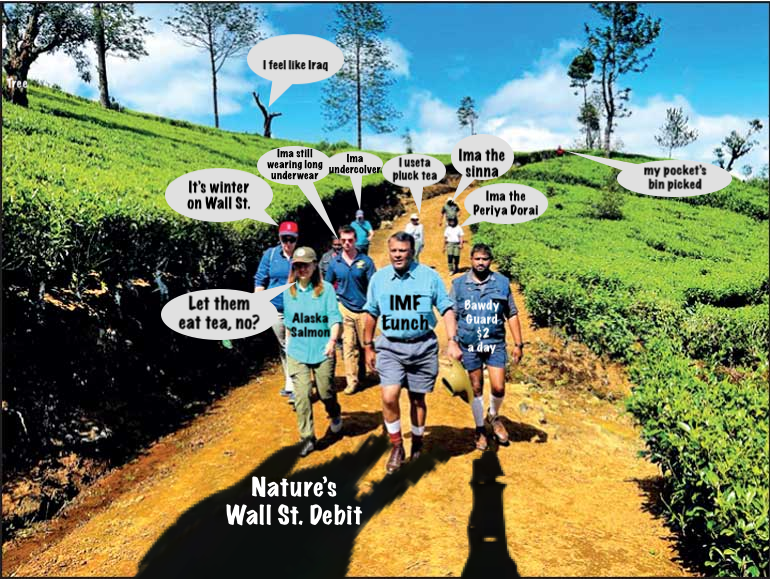
The IMF announcement on imports in & Dollar flows out, was accompanied by the US envoy Santa Chung distributing ‘36,000 tons of Triple Super Phosphate’, plus ‘fortified rice’ and ‘fortified vegetable oil’, plus ‘protein supplements usingyellow split peas & Alaskan pinksalmon’ to 95,000 children!
Industrialization based on rhythms and processes of rice production is key to Sri Lanka’s advance. So who are the US & IMF fooling? And why is Envoy Chung in such a frenzy? She is also diverting from the activities of her whiter compatriots who are busy infiltrating key sectors of the country & its economy. We cannot expect the IMF to shed its wrappings and tell us their ‘prioritized & sequenced’ game plan to corrupt (sorry, privatize) public officials even further (under the guise of anti-corruption of course):
*
‘In June 1954 journalist Rhoda de Silva (later deported from Sri Lanka) wrote in Les Temps Moderne, the journal started by Simone de Beauvoir and Jean-Paul Sartre, about the extent of US ‘penetration’ in Sri Lanka effected under ‘diverse forms of camouflage’. De Silva wrote of Hollywood movies being filmed at strategic locations in Lanka; of the first Central Bank governor (John Exter) being a US citizen; and of other US nationals embedded in commercial, insurance and other companies here.’
‘The US government was putting ‘flagrant pressure’ on the SL government to break the Rice-Rubber agreement with China.’ She also pointed to ‘certain of the US methods of intervention that are less apparent’:
‘We wanted to discover to the slightest detail by precisely which methods the US controls the largest publishing house [Wijewardene-family-controlled Lakehouse] in Ceylon. We wanted to discover how they go about getting the US propagandists there to stir up so well the antagonism between the 2 different language groups… It would interest the Ceylonese people to learn for precisely what reasons the US ambassador and all his personnel frequent the Maldive Islands.’ (International McCarthyism: the Case of Rhoda Miller de Silva, Judy Pasqualge, ee 2 May 2020)’
• Having gone from the ‘aragalaya’ – demanding the government go to the IMF – the cry now is to how the new school principal, or viceroy, will have to impart timely discipline. How will it avoid the 16 previous IMF failures?
And what is different now from 1950 when the Central Bank of Sri Lanka was first set up by the USA? The goal then as now, was and is, to prevent industrialization in the colonies. Industrialization has always had to be held back by any means, and enable the grab of natural resources:
*
‘In the USA, consumption per head of the critical raw materials
is 20 times that in the underdeveloped countries’
(see ee Focus, SBD de Silva, Export-Oriented Industrialization & the Free Trade Zone)
*
• Imperialist powers have intermittently imposed plans & laws to ensure & extend their monopoly over industrialization:
Indian-made iron was as good as England’s, but a 19th century plan to buy local iron for a local project in India was shelved due to opposition by English manufacturers. So much for ‘free trade’. The Economist magazine in 1882 shuddered, accusing the Indian government of ‘travelling beyond its province… and where are schemes of this kind to end?’ (ee Random Notes)
England’s Iron Act of 1750 was just one of the English Trade & Navigation acts to hinder settler colonial manufacturing that competed with England’s home industry, and restricted the iron industry in their American colonies to the supply of raw metals.
200 years later, the USA in 1944 proposed the Morgenthau Plan to weaken Germany and Japan following World War II, eliminating its arms industry, and also removing and destroying other key industries, they deemed key to military power. This included the removal or destruction of industrial plants and equipment in that country (see ee Industry, Morgenthau Plan).
The US wars (cold & hot) on the USSR & China, forced the US to abandon the Morgenthau Plan. This plan was however exported to the rest of the world. To Africa, in particular, says Zimbabwean political analyst Rutendo Matinyarare. He examines the current sabotage of Eskom, South Africa’s electricity company, pointing to the Anglo-American Corporation’s destruction of Zimbabwe’s Ziscosteel, the southern hemisphere’s largest steel plant. Ziscosteel was sabotaged by the ‘monopoly makers’: companies like Anglo American, ISCO of South Africa, Lancashire Steel, and Voestalpine, which were manufacturing the machines that were used in smelting iron & steel in Zimbabwe. These are acts of war to undermine Black people, to maintain the white monopoly over industrialization. ee continues its investigation into the industrialization and electrification of South Africa. Reminding readers that, until 20 years ago, whites prevented 70% of South Africans from obtaining electricity…
Who would be the counterparts of Anglo American plc in Sri Lanka? Iron & steel production has been all but abolished in Sri Lanka. (Some may object & point to a few relatively isolated workshops; however, industrialization has to be examined in relation to transforming the economy.)
*
• Africa is just across the waters from us, and yet we hear little about their real story. We would think, sharing maybe even 3 colonial languages (Portuguese, Dutch & English), we would know more. In fact, we know less. Our English Department is of no help. They are still following England’s Heinemann’s versions of African literature: Things Fall Apart, etc.
We are supposed to follow the white fashions in culture and foreign policy, and thus must follow too, the white pandemonium. We see Somalia and Zimbabwe increasingly creeping into the synonym section under permanent dysfunction. And yet, there are major features we have shared, and not just after colonial plunder (see, ee Random Notes,Djibouti).
*
• A strange coincidence. ee continues its focus on the enormous power that multinational companies (MNCs) wield in determining industrial policy, and overall economic policy. Last week, ee began a series on Southern Africa’s industrialization, delving into DJ ‘Laxapana’ Wimalasurendra’s link to a Boer prisoner & engineer, and Cecil Rhodes’ Victoria Falls fraud (ee 18 March 2023). This trail led us to Niagara Falls, Westingthouse and that famed 1893 Chicago World Exhibition (that Anagarika Dharmapala went to), also recalling the undermining of Wimalasurendra’s hydroelectric scheme by Pearson, Bousteads and the Shell Oil Co, etc. (also see ee Building Blocks). This week’s eealso looks at the MNCs behind the sabotage of industrialization in Africa: One in particular, Anglo American plc has enormous power in Africa, and recalls the power of MNCs such as Unilever plc in Sri Lanka. These multinational companies run the politicians and the media.
Two or 3 news items on Africa struck ee‘s eye this week. Whenever Africa appears in the English newspapers in Sri Lanka, coverage strangely resembles the ways in which Sinhala villagers are represented. It’s usually caricature. And true to form there was this week’s tabloid-style sensationalism about: ‘A Zimbabwe preacher with links to a controversial Sri Lankan ‘prophet’…accused of gold-smuggling’. This is from ‘an undercover operation by Al Jazeera’s Investigative Unit (I-Unit), which is targeting Zimbabwe’s President and his family’. ‘Al Jazeera reporters, posing as Chinese nationals who were looking to launder large sums of money, were offered several ways to remove all stains of corruption from their dirty cash.’ The main Al-J informant is ‘Karen Greenaway, a former US FBI investigator who tracks international money laundering schemes.’ Apparently, the US and EU sanctions imposed on Zimbabwe ‘make it difficult for the government to export gold because of the additional scrutiny on officials in power’. (see ee Sovereignty, Zimbabwe preacher)
So why are we being told about this issue? On the face of it: the story splashes the photograph of Mahinda Rajapakse, with the Zim preacher (circled in red). Also, there is the admirable US (IMF) zeal to root out ‘corruption’. This eeFocus examines the differences between how sanctions are applied to Black countries and white-ruled countries, and, in the end, what real corruption and criminality is all about:
*
Rhodesia was a white English settler state,
set up by the British South Africa Company (BSAC),
and imposed over and stolen from the people of MaDzimbabwe since at least 1890.
Under siege, within & without, the white settlers proclaimed
a Unilateral Declaration of Independence from England in 1965
over division and investment of profits.
White Rhodesia was then subject to UN-led sanctions.
This essay below divulges how these sanctions were ‘cleverly’ undermined by white governments, led by the USA, and provides insights into the undermining of countries’ economies.
After the African war of liberation there was suspended,
the English as usual reneged on their promises,
and when the country’s African leadership started to reclaim the land,
the English turned Zimbabwe into a synonym for ‘failed state’,
and its leadership, particularly Robert Mugabe as synonym for ‘Black dictator’.
These stories as with all widely disseminated English stories turn out to be false as usual.
The other Africa-related item was the Wijeya Group Daily FT’s extended interview with one ‘consultant’ Ronnie Peiris, who is set to hold forth on 24 April in Colombo on ‘Integrated Performance Management’ needed to achieve at least 75% of the IMF’s plans. His bio: ‘Group Finance Director, John Keells Holdings, Managing Director (before the Finance Director), Anglo American Corporation (Central Africa), Planning Manager at Lever Brothers (Ceylon), Board Member in large corporations’. How’s that!? Anglo-American, Unilever & Keells! Hallelujah!
Not sure if this is the same Ronnie Peiris, the ‘collector’ and ‘bagman’ for Chandrika Bandaranaike, and of Water’s Edge fame. But Peiris is now laying down the latest multinational capitalist gospel truth of tinsel-thin social responsibility, diversity, inclusiveness & equality (DIE!) aka Neo-Woke (weaponized astro-turf posing as grassroots), and singing from the MNC choir sheet about ‘sharing’ (no mention of shareholders) and of ‘stakeholders’, including pliant unions – ‘through a combination of top-down and bottom-up approaches’.
The hymn Peiris is singing goes: ‘IMF’s got you by the you-know-what but that’s-not-enough…’ This current hymn amends the pure keenness of the earlier hymn, which was ‘Go to the IMF, you Stupid.’ There’s also other hymns sung by this ‘stupid’ choir: ‘Show us Everything O Naked Lord’ & ‘Blessed are the Poor’. This is for the IMF to act a little more transparent and be kind to the ‘poor’, which it uses as a ‘surplus’ army to discipline the power of the working class (see ee Workers, Integrated Performance Management).
Last ee pointed to the farce of India’s Mahindra claiming ‘assembly’ as manufacture. Also noting the so-called manufacture of Japan’s Senaro motorcycles, and their adoption as the mode of travel by the SL President’s pettier officials. This week we are told: ‘Sri Lanka’s Senaro Motors to export locally assembled motorbikes to Kenya’. So what makes ‘Senaro Motor Corporation, a motorcycle manufacturing company in Sri Lanka’?
‘Around a third of the spare parts used in the motorbikes are manufactured in the firm’s assembly factory in Yakkala, a suburb of capital Colombo’. Which parts we are not told. Senaro ‘is able to import raw materials for spare parts as it has a special certification from the Ministry of Industries… When the bikes are exported, they will be labeled as Made in Sri Lanka and that is a proud moment for us!’ Proud, indeed! Sri Lanka’s good name (at least, among Africans) is being used by Japanese MNCs as a means to avoid export quotas…
*
‘The continuing foreign exchange crisis is broadly attributed to flawed policies,
such as tax cuts, debt monetization, banning fertilizer & agrochemical imports,
real appreciation of the exchange rate, etc. However, the issues at hand can be also
characterized as a liquidity trap in the foreign exchange market,
enforced by the economic structure and exploitative market structure,
in the import & export sector of the economy, in the long run.’
(see last ee, All praise for Lanka’s saviours!)
*
• Which brings us back to the slobbering silence of the mutton-eaters: earlier this month (ee 04 March 2023) we wondered about the hush hush of the League of Multinational Corporations (LMNC) in Sri Lanka, formed in 2018 by 7 MNCs: Unilever, Ceylon Tobacco Company (CTC, ie, British American Tobacco), Baur & Co, Heineken, HSBC, Indian Oil Co, and Mastercard.
These powerful MNCs, with war chests bigger than most countries’ budgets, demanded of Sri Lanka: ‘Everything needs to be fixed in the context of international standards, in terms of human rights & labor laws too.’ And ‘fixing’, as in fraud, is what they do best!
So how does the IMF ‘agreement’ this week, fulfil their demands? Unilever plc is Sri Lanka’s Anglo American plc. Let’s nominate Unilever as the mahamolakaru of Sri Lanka, behind the long-term terrorism perpetrated on the country.
*
• Anglo American plc has its origins in the British South Africa Co (BSAC) of Cecil Rhodes. Settler states were founded by companies led by genocidaires, called all kinds of fancy names – privateer, buccaneer, soldier of fortune – romanticized by the arts. The Virginia Company (US) of De La Warre. The Hudson Bay Co (Canada). The West India Company (Caribbean)’s Henry Morgan. The East India Company (England) of Robert Clive.
Nowadays, these settler units are considered creatures of the oil and mining conglomerates run by an Anglo-American Rothschild-Rockefeller cabal: BHP (Australia), Power Corporation (Canada), Anglo-American (South Africa). In Sri Lanka, Lipton’s Tea Garden has been transformed into Unilever’s Fair&Lovely…
With all its make-up – one of the largest chemical importers into the country – Unilever slinks in the shadows of media-smoke & mirrors.
Russia’s brave decision to confront NATO, to ‘denazify’ and disarm the US arms industry’s proxies in the Ukraine, will eventually require the formation of a broader anti-imperialist alliance, which this week’s historic visit by China’s leader Xi Jinping surely signifies. There is a clear link between the Nazism & Fascism of Europe, and the slave & colonial relations of the last 500 years. London & Washington have been put on notice…
Last Wednesday altogether 9 districts and 211 upazilas across Bangladesh have been declared as homeless and landless free. The number of rehabilitated people is 3,856,505. The beneficiary includes widows, deserted women, bedes, low-caste people, hijras and climate refugees. This is a significant achievement in ensuring fundamental human rights. Bangladesh is lauded for its recent socio-economic development. It has made commendable progress in education and health sector, reducing gender gap, poverty elevation and handling climate change vulnerability. Despite national and international conspiracies the existing legal system has ensured the trial and punishment of the war criminals. Bangladesh has accommodated more than a million of Rohingyas, which demonstrate its commitment to protect human rights.
Some observation on the human rights report of the USA State Department (2022)
The currently published human rights report of the USA State Department gives some interesting perspective on human rights discourse. Since the report is quite big I will focus on few pertinent issues. The report starts with the claims that the 2018 national election of Bangladesh was not considered free and fair. Further it claims that the election witnessed low voter turnout, intimidation, irregularities, and violence during campaigns. The USA stood silent in 1970 when the Awami League won landslide victory in the election. Why democracy and rule of law was not their concern at that time? Since 1975 undemocratic governments have ruled Bangladesh for nearly 20 years which did not allow the State institutions to flourish. Since 2009 elections are taking place at periodic intervals which manifest formal democracy and the country is striving for substantive democracy.
The said USA 2022 report also states that leaders and members of some political party in the country, could not exercise their constitutional freedoms of speech and assembly because of harassment by law enforcement authorities. But in reality, political parties in Bangladesh enjoy their political rights. They always protest in the street. Last 10 December, 2022 was the best example to Understand it. They can be critic against government. They are talking whatever they are thinking. Media alwyas promote their rights. Human chain, movement, protest are being organized regularly on the streets in the Capital Dhaka. We can not see any kind of government obstacle in this regard. Is not a freedom of specch, movement, political rights?
The report of the USA further mentions that the Rohingya refugees do not have any freedom of movement and the government did not register births for nor extend citizenship to Rohingya refugees born in the country”. We have to remember that Bangladesh did not provide refugee status to the Rohingya; instead recognize them as forcibly displaced Myanmar nationals. Bangladesh is not a party to the 1951 Convention Relating to the Status of Refugees or the 1967 Protocol. As a result, the government is not under legal obligation to uphold the basic rights enshrined in this treaty. Therefore freedom of movement, formal education, or livelihood opportunities could not be afforded to the Rohingya population. Bangladesh accommodated these destitute Rohingyas on humanitarian ground and the government is committed to repatriate this huge number of people who has the potential to spoil our national security. The concern of the USA for the Rohingyas can make one question apart from enacting Burma Act, what effective measure did the USA take to ensure human rights of these Rohingyas?
The report of the USA State Department also states that the government prevented war crimes suspects from the 1971 independence war from leaving the country.” If the suspects of war crimes leave the country to avoid legal proceedings and later they do not return then how justice would be ensured? Bangladesh does not have agreement with many countries to repatriate criminals. History shows that even the USA did not take any initiatives to send back one of the murderers of Bangabandhu.
Referring Freedom House’s annual report the said USA report mentioned that corruption is endemic”. According to Transparency International Bangladesh (TIB), Bangladesh stood first among 180 countries in corruption index from 2001 to 2005. Gradually it became 13th in 2009, 16th in 2013 and 17th in 2017. TIB report shows that in the last 10 years the position of Bangladesh in corruption index remained the same. It is imperative to note that Bangladesh has made tremendous economic progress in recent years and many economists also opine that during the early years of development some corruption might take place. The government announced zero tolerance against corruption and now social movement against corruption is desirable.
The USA human rights report is based on the information of various non-governmental organizations. Some of these organizations are not non-partisan and have reputation of producing false news.
Human rightsU discourse: some perspective
The counter-terrorist response of 9/11 carried out in many parts of the world also marks human rights abuses. Human rights violations were considered as an inevitable part of that struggle. But those violations also fueled more terrorism, human rights abuses and mass migration. Though at times the USA imposes sanction on individuals and governments for committing human rights abuses it also forms alliance with abusive government and hence violates international human rights law. Tom Malinowski the former US Assistant Secretary of State once commented that some use human rights only as a club to hit governments they disagree with, while allowing those they are allied with to commit violations with impunity (Andrew Gilmour, March 2018). The USA enthusiastically proclaimed the rights of Iranians to protest for a better life without getting killed, but it is silent when it comes to Palestinian protestors doing the same thing.
The self declared ‘’Responsibility to Protect” invoked by the USA is viewed by many people beyond the west as examples of Western values and policies being imposed on them from outside. Wang Wenbin spokesman of Chinese Foreign Ministry remarked that the Human Rights Practices of Various Countries’ published by the US is an example of political lies and bias and shows US dominance and abuse. The double standard of the super powers and their selective approach to some extent enables the actual violators of human rights to commit more abuses. In the rapidly changing geo-political order human rights plays a major role in the rhetoric of the opposing sides. In essence human rights are subjected to the enormous challenge of manipulation of the superpowers which want to impose imperial designs on the world in the name of peace. Therefore, issue of human rights should be considered in the context of society, law and order situation, extremism, terrorism, growing intolerance and stability of the specific country.
Bangladesh understands human rights are not luxury and it is impossible to achieve sustainable development and peace without having human rights as a basis. The State of Bangladesh is committed to prevent abuses, protect rights and promote values not to please any superpower but to ensure fundamental rights of its citizens, human development and sustainable socio-economic growth. Hence constructive engagement through technical cooperation to promote human rights should be welcomed but any biased statement to establish dominance must be protested.

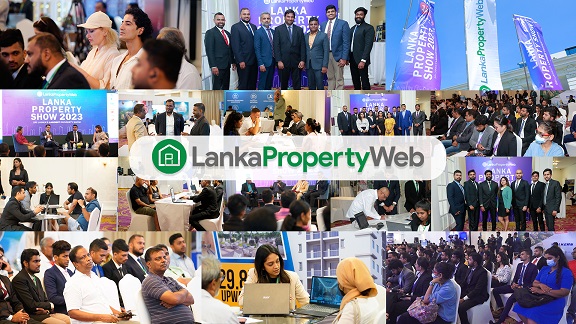
 Generally, all inventions carry the name of the founder. In the case of rain affected one day international cricket games the nomenclature ‘Duckworth & Lewis’ system is used because it is a system worked out by two Englishmen (Frank Duckworth and Tony Lewis). Why is it not the same with the DRS? Is it because the man who conceived and for the first time in the world wrote and published the essential ingredients of the ‘ Player – Referral’ mechanism which became the foundation of the DRS, in leading international cricket Journals and newspapers, as far back as March 1997, is non-white? Senaka Weeraratna from Sri Lanka has been fighting for justice since his brainchild came to be used in cricket. His request for an impartial investigation and proper hearing by an independent third party arbitrator has not even been considered.