Fiscal stability refers to a condition or state in which a country’s government manages its finances responsibly and sustainably, with its revenues and expenditures in balance or in a stable and manageable relationship over time.
It is often characterized by a government’s ability to effectively manage its fiscal policies, including taxation, spending, borrowing, and debt management, to maintain a stable and sustainable fiscal position.
Fiscal stability is crucial for the overall health and well-being of an economy, as it impacts the government’s ability to meet its financial obligations, provide essential public services, and promote economic growth.
A fiscally stable government is able to generate sufficient revenues to cover its expenditures, without accumulating excessive debt or resorting to unsustainable fiscal practices.
There are several key components of fiscal stability, which include:
1. Balanced Budget: A balanced budget is one in which a government’s total revenues match or exceed its total expenditures in a given period. This means that the government is not running a deficit (spending more than it takes in) or a surplus (taking in more than it spends), but rather maintains a balanced fiscal position.
2. Debt Management: Responsible debt management is an important aspect of fiscal stability. This involves managing the government’s borrowing and debt levels prudently and sustainably. Governments may borrow to finance deficits or to invest in infrastructure, education, or other areas that promote long-term economic growth. However, excessive debt levels can lead to debt servicing burdens, increased interest costs, and potential risks to fiscal stability.
3. Sustainable Revenue Sources: Fiscal stability requires a diversified and sustainable revenue base that is sufficient to cover the government’s expenditures. This may include a mix of taxes, fees, and other sources of revenue that are stable, predictable, and capable of generating sufficient revenues to meet government obligations.
4. Prudent Spending: Responsible spending is a critical element of fiscal stability. Governments need to prioritize spending on essential areas such as infrastructure, education, healthcare, and social welfare programs while avoiding wasteful spending and managing expenditures sustainably.
5. Economic Growth: A growing economy can contribute to fiscal stability by generating increased tax revenues and reducing the need for deficit spending. Governments can implement policies that promote economic growth, such as investment in infrastructure, education, and innovation, which can positively impact fiscal stability in the long term.
Fiscal stability is critical to a government’s ability to meet financial obligations, maintain essential public services, and promote economic growth.
Balanced budgets, responsible debt management, sustainable revenue sources, prudent spending, and fostering economic growth are all critical components of achieving and maintaining fiscal stability.
It is critical for a country’s overall economic health and well-being, and it necessitates prudent fiscal policies and responsible management of government finances.
Further, fiscal stability is critical for a country’s overall economic health and well-being, and it necessitates prudent fiscal policies and responsible government finance management.
Overall, fiscal stability is critical for a country’s overall economic health and well-being, and it necessitates prudent fiscal policies and responsible government finance management.
Selling state enterprises is not the right thing to do. If Sweden, Singapore and even Sri Lanka before 1972 could do it, state business undertakings can profit and run efficiently. However, the current state of affairs surrounding state businesses is pathetic and they cannot be salvaged. On top of that Sri Lanka is in a continuing economic downward trend for the fourth year running. Sri Lanka declared its inability to repay loans on April 12, 2022. Under these circumstances the options are very limited. IMF or not Sri Lanka has to sell off government business undertakings to foreign investors just to survive economically. Otherwise it will be a total economic and societal collapse and a foreign takeover of the nation.
All countries other than Cuba and North Korea invite foreign investors. Even developed countries and their geopolitical rivals like China, Russia and India encourage foreign investors. Sri Lanka cannot be the exception.
Combined losses of all loss-making State Owned Enterprises exceed the total government education and healthcare allocation combined! This is a terminal economic illness affecting Sri Lanka.
A comparison of foreign direct investments as a percentage of GDP (for comparison) in Sri Lanka and India shows where Sri Lanka went wrong. Until 2005 (inclusive) Sri Lanka received more foreign direct investments as a percentage of GDP than India. However, since 2006 every year India beat Sri Lanka in receiving more foreign direct investments than Sri Lanka.
What’s worse is that since 2012 Sri Lanka’s loss has been India’s gain in this regard. India performs exceptionally well economically despite massive challenges. It is mostly due to foreign investments. Most surprising is the fact that India closed its doors to foreign investors until the collapse of the Soviet Union whereas Sri Lanka opened its doors since 1977. Still, India has come a long way in overtaking Sri Lanka in receiving more foreign investments than Sri Lanka in comparative terms (and of course in real terms too).
Sri Lanka has mostly positive outcomes from foreign investors.
There are various levels of foreign investments. One is where the foreign investor outright purchases an entity wholly or in part with management control. The other is when a foreign investor enters into joint ventures with local companies. Another is when foreign investors buy shares of local companies traded in the Colombo Stock Exchange. All three forms are important and essential for Sri Lanka. The most controversial has been the first type. However, Sri Lanka’s experience in this regard has been mostly positive.
A host of state entities were sold (wholly or partly) to foreign investors in the 1980s and early 1990s. They have performed very well. They have employed a large number of locals, paid their taxes (after the tax concession period ended), made donations and sponsorships to locals, made additional investments in these ventures and removed the state burden of investment, management and running losses. Some of them include United Motors Lanka Limited, Buhari Hotels Limited, Ceylon Cold Stores Limited, The National Milk Board, Dankotuwa Porcelain, Pugoda Textile Mills, Thulhiriya Textile Mills, Distilleries Corporation of Sri Lanka, Oils and Fats Corporation, Tyre Corporation, Veyangoda Textile Mills, Leather products Corporation, State Hardware Corporation.
A few of them have scaled down their business due to global business reasons. These would have prevailed irrespective of the ownership. They handled these very well without burdening taxpayers and without trapping Sri Lanka in a debt trap.
However, large government corporates resisted privatization. Some of them were privatized in the late 1990s with remarkable outcomes. There was a time when Sri Lankans had to wait for a decade or more to get a telephone connection. With the sale of a majority stake in SLT in the 1990s the Japanese investor revolutionized Sri Lanka’s telecommunications sector. It was turned highly profitable and private and business customers massively benefited from new deregulation and efficiency that came with it. Without this foreign investment, Sri Lanka would have languished in extreme backwardness. Foreign investors did wonders to Sri Lanka’s mobile phone and internet market.
Privatization of Lanka Gas was another epic win for Sri Lanka. That too totally upgraded the gas sector in the island despite many allegations of price hikes, etc. Had it been in government ownership, global price hikes would have resulted in national bankruptcy as the government would have yielded into public pressure to keep prices low and borrowed foreign loans to pay for the difference. That would have landed Sri Lanka in the current mess in the 1990s. Later the gas industry underwent radical change with local and government business entities taking back from the foreign investor as a commercial transaction (not nationalization). Building local business acumen and resilience is another success story of privatization.
Though blamed for price hikes on privatization, there was nothing unusual. Sri Lanka’s gas prices still remained lowest in the region as price increases were driven by global price changes.
Privatization of Srilankan Airlines was yet another success story. Not only did that relieve the government of losses and the burden of investments, it also earned a profit for the government! Srilankan Airlines rose the ranks in the quality of service under the foreign investor. The biggest benefit came in 2001 when Tamil terrorists destroyed most of its fleet. Unknown to most, Srilankan Airlines bounced back within a year without any government burden! In wide contrast, the same airline is making massive losses since the government took it back over and the now forgotten Mihin Air (another government business venture) failed leaving massive losses for taxpayers to pay.
Under the foreign investor, ticket cost did not increase compared to other airlines providing similar service. In fact, it reduced as economies of scale were obtained. Since the government taking over their tickets are over-priced compared to other regional airlines.
In conclusion, while turning around government owned businesses by restructuring while keeping government ownership is preferred, it has always failed in Sri Lanka, and the ongoing economic crises make it impossible to restructure them. Privatization, especially selling off to foreign investors, remains the only economic way out for Sri Lanka. As the saying goes, beggars can’t be choosers. Those who trapped Sri Lanka into this desperate corner are responsible for eliminating options for the nation. If the only available option is not taken, the nation will go bankrupt resulting in civil war and disintegration. Sri Lanka will be unable even to purchase weapons and fuel for military vehicles. Those who think military might can survive without economic might are still living in the 15th century, on the verge of another foreign takeover.
A few weeks ago, the Ceylon Electricity Board (CEB) posted a ‘wanted’ advertisement for a Financial Consultant ‘to provide guidance on investment decisions, cash management and dy-to-day organisational expenses. The expanded responsibilities include, ‘forecasting costs and revenues, conducting risk analysis for financial plans, evaluating capital expansion options and to provide guidance and recommendations to the Chairman and the Board on all finance related matters.’
On the face of it, this is a good move. In fact all state owned enterprises, statutory bodies, state institutions including ministries ought to be regularly monitored and evaluated, inefficiency and incompetence determined and action taken against those responsible if that be the case. The flip side — and we say this taking into consideration the history of such exercises — is to place an agent or set of agents in such positions with an informal but specific brief: deliver ‘findings’ that can justify policy directions already envisaged.
In any event, Minister Kanchana Wijesekera has been saying a lot about cost-reflective pricing, amending legislation and restructuring. All good, except that there’s more than one way to skin the cost reflecting pricing cat and he’s opted to kick the poor and cushion the rich, ensuring that Sri Lanka adds to dollar-expenses for oil and coal to keep the latter satisfied. Except that he seems to believe that restructuring is about kicking non-engineering unions in the teeth and turning a blind eye to inefficiencies, over-staffing and the shady schemes related to the engineers. Except that we are yet to hear him talk specifics in relation to legislative enactment in relation to doing away with archaic clauses which in the name of energy security ensure continued dependence on dollar draining imports.
Sri Lanka, not too long ago, was ahead of India in terms of national coverage. India at the time was heavily dependent on coal and thermal energy. Power cuts were normal. In 2015 Prime Minister Modi essentially told the Indian counterparts of CEB officials that India will go for solar power. They were required to fall in line or else.
Today most of India’s state grids are completely self-sufficient and that country is even exporting electricity to Bangladesh. Modi’s drive in fact had a significantly positive impact on the global solar scenario. India believes that a KWH of electricity could be generated at a cost of just 4 US cents!
What’s Sri Lanka’s story? Given the relative total generating potential, scale, population and demand, Sri Lanka could have produced a surplus. Had the CEB got its act together (a tough ask given entrenched personal interests of high-ranking officials and the complicity of politicians), looked at global trends and technological development, Sri Lanka wouldn’t have ended up in this pathetic dollar-deficient, import-dependent situation.
Numbers. Sri Lanka needs 4,000-4,500 MW of installed capacity to meet currebtpeak demand. Now Bangladesh’s current requirement is 20,000 MW, projected to at least double by 2050. They don’t have major renewable resources and will have to look to fossil fuel thermal and nuclear energy well into the future. The CEB? To put it bluntly, it’s a matter of monkey-sees, monkey does. No working or innovative expertise, no vision, no compulsion; not since Wimalasurendra.
The CEB, Wijesekera must know, cannot be ignorant of the fact that Sri Lanka has tremendous renewable generation potential well in access of even projected increase in local demand. Today countries such as Indonesia, Singapore and Malaysia are talking of importing solar based electrical energy from Australia via an undersea cable almost 4,200 km in length called the ‘Sun Cable.’ Sri Lanka is just 1,800 km away from Bangladesh, a fact that can only become significant if Sri Lanka aggressively pursued the eminently logical option of developing the renewable sector inclusive for export purposes.
It seems logical because even today, the general rule of thumb for the CEB to meet peak demand is to depend on thermal energy. ‘Emergency power,’ when required all the time, year on year for over a decade, makes the adjective meaningless. The CEB has no plan to reduce reliance on emergency power which translates in practical terms to that which a preferred supplier can deliver upon a quick call. Greasing of palms then? Kanchana’s Financial Consultant (FC), if appointed and if possessing any integrity, may find out.
The CEB, it is well known, fought hard to scuttle plans for enhancing the contribution of renewables which, theoretically could satisfy the entire demand for electricity and even double it for export. The CEB grudgingly agreed to a plan to bump the slice to 70% but this hasn’t moved from policy to implementation. Another question that the FC could address. Interestingly, no other country in the world has quibbled over numbers related to targets.
Engineers simply say ‘more expensive, it’s not worth it.’ And they point to archaic related to unwarranted concern about energy security which, interestingly, goes against the economic thinking of this government, namely the limitation on maximum installed capacity by a private sector power producer, 50MW. So, ‘Mega Solar’ is out of the question.
The CEB sites ‘inertia,’ as an inhibiting factor. In other words, thermal energy is generated more or less at a constant, whereas solar is dependent on factors that cannot be controlled, bad weather days, cloud cover etc. Inconsistency plugged into the grid is harder to balance and could trigger it to trip, this is correct. However the concern of instability is easily addressed and indeed has been addressed in countries with worse an ‘inhibiting factor’ not just those that are developed, but by countries in Latin America as well. Maybe the CEB is ignorant, lack sector working expertise or, worryingly, know very well that such transformation could trip cutbacks.
Perhaps this is why the CEB seems to be so averse to digitising the grid. The know-how and technology exists, however, to put in place a highly digitised oversight and dispatch control system based on predictive artificial intelligence on both the generation and demand side, capable of even a 15 minute dispatch interval. Instead, someone has to make a manual intervention to a power generator, is able to fiddle with choice of who andnumbers, scaremonger governments to submission and make a sweet deal with a supplier cutting into Sri Lanka’s exchange reserves. Digitisation would make things algorithm driven. transparent. Accountable. Good for all except whoever is making bucks by blocking the move towards renewables. Maybe Kanchana could hire an FC who is well versed in technologies used in other countries. Indeed there are probably many Sri Lankan expatriates who would fit the bill. Would the CEB embrace such an option and if not, why not? Would Kanchana ask his buddies in the World Bank and IMF to facilitate digitisation? Would they say ‘no’? Unlikely.
The CEB has also talked of the problem posed by grid infrastructure or lack thereof, e.g. ‘we need to build more high tension transmission lines.’ This is a barefaced lie. To put it crudely, no transformer on the planet will argue about the source of generation. Doesn’t know, doesn’t care. As long as you feed the electricity to the specification the transformer is built to receive.
For example, if floating solar panels were installed in all the reservoirs currently producing hydropower, ensuring that less than 15% of the relevant surfaces are used in order not to infringe upon environmental concerns, the very same transformers could be used. The same high tension grid as it is for hydro. The hydropower could be used as back up or to address inertia issues, again based on a system of AI-based generation governance and balance that is transparent and accountable and greasing-free.
The truth is that we would not be needing any backup or ‘emergency power generation’ if we utilised the existing hydro-generation reservoirs,Negombo, Kalpitiya, Batticaloa, Trincomalee and Jaffna lagoons, all locations there are currently touched by transmission lines. No additional infrastructure expenditure, but enabling massive solar generation even at using just 15% of the surface so that there are no environmental concerns.
And that’s just solar. There’ also wind. The CEB, it must be mentioned, has never spent mega bucks on developing the sector to any degree of success. Failure perhaps, success no. The Treasury provides the money, the CEB operates and maintains, spending only for these functions.
Back to numbers. The current peak demand is projected to double by 2030, requiring an additional 15,000 GWhrs annually (4,000-4,500 MW installed capacity) to be provided to the grid. As is, the lagoons and the Mahaweli reservoirs could generate 8,000 MW, meaning that at any given time there’s at least 4,000-4,500 MWs for export, provided of course that there is investment for installation of under sea cables. Do not restrict ones self to existing transformer capacity/ grid connectivity network and more can be exported.
Currently peak demand is 4000-4500 MW or around 15,000 GWhrs a year. By 2030, demand is projected to rise 30,000 GWhrs and therefore an additional 15,000 needs to be provided to the grid. The lagoons and the Mahaweli System at minimum can generate 8,000 MW (as is). At any given time we can export 4000-4500 MW for export. MINIMUM. If we exploit the full solar potential only on floating solar capacities, we can be a dominant net energy exporter in the region. CEB will never be a bankrupt institution, never be a dollar-demanding institute but actually a dollar-earning institute.
Yes, there are costs. Floating solar panels don’t fall from the sky or drip along with sunbeams. If, say, the installation cost is 1.5 million USD per MW, the total cost would be in the region of 6 billion USD. Obviously, it should be opened to private investors. If Kanchana and this government is truly ok with that kind of economic policies, then, why not? We would not be needing a single dollar on imports to produce coal or thermal power. Bad idea? What would the FC say? It can’t be done by limiting maximum generation to 10MW by the private sector. Mega solar is the answer.
As of now, neither Kanchana nor anyone in the CEB seem interested. If no one is, it means that rank idiocy and corruption could be the main reasons. Or rank incompetence. The FC could tell us, of course. And maybe we will have meaningful change which of course requires the necessary restructuring of thinking-ways, frames of reference and of course overall, long-term objectives of energy security and insulation against dollar-dependency.
The National Investigation Agency (NIA) has busted a racket allegedly working for the revival of a militant group in Sri Lanka. The agency has arrested one member and seized illegal proceeds.
The National Investigation Agency has seized a huge cache of cash, gold bars, mobile phones, memory cards, drugs and documents, along with other incriminating material, during raids and searches at the Chennai residential and business premises of eight suspects.
The crackdown on Thursday was on Indo-Sri Lankan illegal drugs and arms trade racket, which allegedly was working for the revival of the Liberation Tigers of Tamil Eelam (LTTE), a militant organisation in Sri Lanka involved in the civil war in the island nation.
In the operation, which began in July last year, the probe agency arrested one of the members of the racket, identified as Ayyappan Nandhu.
Ayyappan Nandhu allegedly managed the drug trade on behalf of Muhammed Asmin, a Sri Lankan refugee and a drug trafficker who conspired with other accused to revive LTTE through drugs and arms trade.
The agency so far has arrested 14 people, 13 from previous raids, including at the Special Detention Camp in Trichy
(Bloomberg) — Sri Lanka’s foreign exchange reserves grew in March to the highest in over a year after the South Asian nation clinched a $3 billion International Monetary Fund bailout.
The stockpile increased to $2.69 billion from $2.22 billion in February, according to data released by the central bank on its website. The reserves include a swap facility from the People’s Bank of China equivalent to about $1.4 billion, which helped lift reserves to a previous high of $3.14 billion in December 2021, even though it has conditions on usability.
On March 20, the IMF board approved the 48-month loan program and subsequently disbursed about $333 million as a first tranche, which helped to stabilize Sri Lanka’s economy and let the nation begin restructuring its debt. The endorsement by the Washington-based lender is expected to unlock more funding and provide a reform framework to enable the island nation to recover from its worst economic crisis in decades.
Improving investor sentiment has also boosted the local currency, while rising worker remittances and tourism has helped ease balance-of-payments constraints after the nation last year ran out of dollars to pay for essentials, including food, fuel and medicines.
Sri Lanka last month took a key step toward winning the cooperation of its external bondholders for restructuring $84 billion in debt by agreeing to include local-currency bonds in the program. The exercise, which will include the shorter term Treasury bills held by the nation’s central bank as well as some longer-term Treasury bonds, is intended to reduce the burden on foreign commercial creditors by providing the concessions needed for Sri Lanka to achieve debt sustainability.
The Central Bank Governor and the leaders of the country must be mindful to work and not complain, former Central Bank Governor Ajith Nivard Cabraal said. I have done this job for the last nine years. Have I ever complained or cried for a single day? We did our work despite a war. That is what is required of a Central Bank Governor and leaders of the country,” Cabraal said.
https://youtu.be/YIMvgo1ITJg
There is no point in talking to us anymore, or the leader of this country. You must ask these questions in Washington as they are now controlling our country and economy,” he added responding to questions by journalists.
Sri Lankan migrant workers’ foreign remittances have seen a sharp increase in March 2023, according to the figures published by the Central Bank of Sri Lanka (CBSL).
Thereby, workers’ remittances amounted to USD 568.3 million last month, recording an increase of more than USD 161 million from February 2023.
Sri Lanka consecutively registered over USD 400 million in migrant workers’ remittances in the first quarter of 2023, with cumulative inflows reaching USD 1,413.2 million.
Workers’ remittances climbed to USD 437.5 million and USD 407 million in January and February, respectively.
Dr Sudath Gunasekara. Ex- Permanent Secretary Prime minister Sirimavo Bandaranayaka and President Mahanuwara Senior citizens Movement
BRICS alliance working to create its own currency, says Russian official
1 min read . Updated: 02 Apr 2023, 10:25 PM IST Anwesha Mitra
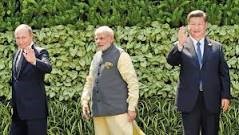
(L-R) Russian President Vladimir Putin, Indian Prime Minister Narendra Modi and Chinese President Xi Jinping leave after a group picture during BRICS (Brazil, Russia, India, China and South Africa) Summit in Benaulim, in the western state of Goa, India, October 16, 2016. REUTERS/Danish Siddiqui TPX IMAGES OF THE DAY – S1BEUHGQRWAA
The bloc grouping the emerging economic heavyweights Brazil, Russia, India, China and South Africa are reportedly working on their own currency – established on a strategy that ‘does not defend the dollar or euro’.
Moscow has found itself reeling under an avalanche of sanctions and restrictions as the Ukraine Russia war rages. Against this backdrop, President Vladimir Putin adopted a new foreign policy this week, identifying China and India as its main allies on the world stage. Now, the ties between the three nations (and a few others) appear poised to go a step further with the formation of a new currency.
According to reports quoting Russian lawmaker Alexander Babakov, the BRICS nations are in the process of creating a new medium for payments – established on a strategy that “does not defend the dollar or euro”. He reportedly indicated that the new currency would be secured by gold and other commodities such as rare-earth elements.
While the claim is yet to be verified by other officials from the member nations, it came mere days before South Africa sent senior officials to Russia to discuss “recalibration of the global order” with President Vladimir Putin’s party. The country is also slated to host a BRICS summit in August this year.
ALSO READ: Russia adopts new foreign policy amid war, cites India, China as main allies
Earlier on Friday, President Putin adopted a new foreign policy that put India and China at the forefront. The announcement also came mere days after Chinese premier Xi Jinping visited Moscow to further cement the “no limits” partnership announced last year.
“Russia will continue to build up a particularly privileged strategic partnership with the Republic of India with a view to enhance and expand cooperation in all areas on a mutually beneficial basis and place special emphasis on increasing the volume of bilateral trade, strengthening investment and technological ties, and ensuring their resistance to destructive actions of unfriendly states and their alliances,” the statement said.
It also announced its intention to prioritise and enhance its capacity and international role in groupings such as BRICS ‘to help adapt the world order to the realities of a multipolar world’.
My Comments
I warmly welcome this move as I see it as a new move for a free world. This will mark the end of western colonial repression and exploitation and the dawn of the Birth of a New World Order”? I see it as the prophecy by Samuel Huntingdon made in1996 coming true. His 1996 thesis was The Clash of Civilizations and the Remaking of World Order” where he argued that the future wars of the world will be between cultures and not countries.
I call upon the BRICKS also to form a new UNO to replace the present UNO and allied organizations run as the monopoly of the Western world in order to make all countries free as I had proposed in the following article
An Independent Afro-Asian UNO to replace the Western dictated UNO? That exploit the So-called Third world countries and eternally trying to keep them as their dependencies.
Posted on July 6th, 2010
Dr. Sudath Gunasekara President Senior Citizens Movement Mahanuwara. 7.7.2010
September last year I wrote on the need for an independent Afro-Asian UNO in view of the anti -Asian and anti-African attitude of the UNO under its present dominance by the western powers. Now with the final appointment of a Committee by its Secretary General under the pressure from these powers it clear that the need for such organization has become more crucial. I reiterate the urgent need for such a new world organization to protect the Asian and African countries from western harassing and also to address the needs of the Afro-Asian countries.
I reproduce what I wrote last year below. I would like to add only one comment regarding the role of Japan and South Korea to this article. These two countries which are pro-American at present I think should now adopt a pro-Asian attitude to common regional problems.
My sympathies with Ban Moon the present Secretary General though he represents an Asian country, he is struggling to gain a second term by representing the western interests. Today he acts only as a puppet in the hands of US ‚ his religious convictions, personal greed for the second term. It is a tragedy that he does not realize that thereby he is going against one of his Asian Nation State. His religious conviction, the influence of his church and personal greed for the second term and perhaps the benefits he may be getting from the Tamil Diaspora may have made him to forget the Sri Lankan government’s support he got last time to gain this position. Had the Sri Lankan Government supported its own man Jayantha Danapala things would have been different.
My article of 27.9.2009.
Going by how things are been currently manipulated at the UNO by the West and its allies and how shabbily and discriminately Asian countries like ours are treated, I fully endorse L. Jayasooriyas proposition (Asian Tribune) that we must look for an alternative Asian (or Afro-Asian) UNO in place of the present disintegrating (politically, Economically and culturally) West dominated neocolonial exploiter gang dancing to the tune of USA in order to destabilize and pauperize the small countries who are trying to rise from the abysmal depths in to which these very colonial powers have driven us from the beginning of the 16th century. The UNO today has forgotten its Charter and has got reduced to a United Neo-colonial Outfit of the west. The main aim of these ex-colonial exploiters is to keep these Afro-Asian countries in eternal poverty entrenched in political disarray and ethnic wars so that they could sell their arms and all other industrial stuff including outdated technology and continue their neo- colonial exploitation in order to perpetuate their hegemony and prosperity.
However, they little realize that their days of supremacy in all aspects, such as economic, military and intellectual are a thing of the past; at least the journey to that destination has already begun with the election of Obama as the President of the United States of America. As Samuel Huntington, the renowned Harvard professor, has very aptly pointed out in his The Clash of Civilization and the Remaking of the World Order (1997) the Euro-American face of Western affluence and political influence, universality of the western culture and the beliefs are no more tenable. Today it is false, immoral and dangerous to have such a view as he says. America today is a disparate nation, whereas countries like Sri Lanka are not. This is what unfortunately the west has failed to understand. They have become the victims of their affluence which is a direct product of colonial exploitation. Rejection of the western creed and civilization as Huntington has argued means the end of the USA. It also means effectively the end of western civilization. Like all other world civilizations today the western civilization has entered in to the stage of internal decay and therefore it is marching towards the grand finale of its end in the same manner other past word civilizations like the Greek, Roman and Ottoman etc did. What is more is now it is universally accepted that tomorrow once again, as it had been in the golden past, belongs to the East and not to the West.
In this backdrop it is high time that these western powers at least now renounce their assumed supremacy mentality and learn to treat all nations as equals, irrespective of their geographical size and economic power. I am making this comment especially in the context of the current attitude of the west towards my own country particularly after the Sri Lanka government has successfully defeated the LTTE terrorist outfit after 30 long years of suffering and destruction. The whole world knows how the western camp and even India were instrumental in training and arming the LTTE to destabilize this little Island, the Home of Theravada Buddhism and the Land of the Sinhala people for the past 2500 years. But thanks to the Present President and his able team led by the Secretary Defense and the Heads of the three forces with Sarath Fonseka in command, we were fortunately able to defeat all those diabolical conspiracies. By doing that I think Sri Lanka has achieved a historic victory. Both in its scale and military ramifications and also external involvements, this was the biggest and the most difficult war ever fought on Sri Lankan soils. What everybody thought unwinnable the Sri Lankan government has won and set an example to the whole world for which they have to be thankful to this little Island nation. Because it has set the modus operandi as to how terrorists should be eliminated. In the aftermath of the war it should be the duty and the obligation of the entire world in the name of world peace and humanity to help Sri Lanka to raise its head out of thirty years of destruction and devastation left by these terrorists and re-emerge as a politically and economically stable state. The whole world also should help Sri Lanka to trace the remaining remnants of LTTE and eliminate them not only to complete the mission carried out by Sri Lanka but also to free the whole world from terrorism. Instead of intimidating this little Island the west should help to complete the wonderful job the Sri Lankan government has done in defeating the LTTE. The burden is more so, on the part of those western countries such as the United Kingdom who are directly as well as indirectly responsible for this unfortunate situation in countries like Sri Lanka. Although the LTTE has been physically defeated on Sri Lankan soils we have to remember that it’s widely spread tentacles both at home and over the globe are still not dead.
Now let us see what some of these countries are doing instead and how they behave nakedly again to destabilize this Island Nation to fulfill their own agendas, completely ignoring the independence, sovereignty and the democratic right to manage our own affairs. The major issues they are gunning at are the question of IDPs, violation of human rights, so-called excesses in the concluded war against LTTE terrorism, freedom of the press and a political solution to the so-called ethnic problem that exist only in their own minds. See the blatant duplicity ‚y ‚ compared with what the”¹…”Bush Doctrine ‚ stated in 2001 that it would not distinguish between ‚ organizations and nations or governments that harbor them
The problem here is the tiny Sri Lankan government ‚ has done in two and half years what these major powers could not do for decades. I know it is a shame on them as it was acknowledged even by the New York Times.
They also must now be trying to take revenge for not conceding to their pressure to save Pirapahan and his lieutenants at the last moment ‚ When they did so, they little realized that they are interfering with the independence and sovereignty of an independent nation and also with the mandated right of the government of Sri Lanka to conduct its internal governance according to the will of its own people. It is true that there are international conventions and treaties governing certain actions of individual nations but you can’t have one criterion for America and its allies and another for smaller countries like Sri Lanka. What the Sri Lankan government has done is it has put an end to an internal terrorist movement that was pestering its very existence for nearly 30 long years, internationalized and supported by these very forces now again trying to give a new lease of life to LTTE under different names like human rights and war crimes. ‚ I also must say that we as a member of the UNO have not violated any principle enshrined in the UN Charter either.
On the other hand, what moral right do they have to advise us on matters like human rights and excesses of war etc when they are the real culprits who have done worst things in other countries like Iraq, Afghanistan and Vietnam? I am sure how suspects are treated in Guantanamo has no conceivable parallels, in Sri Lanka. Sri Lankan government is only trying to rehabilitate those victimized by the LTTE. Of cause in the process the legitimate government of the country also has to weed out the LTTE elements who take cover under the IDP flag with the intention of regrouping and reorganizing in the future.
According to New York Times/The Nation, US $ 800 billion have been spent on the Iraq war. 130,000 US troupes (in addition to other European carders and 75 US bases are involved; 14040 journalists and 600,000 civilians have been so far killed; there are 5 million IDPS suffering 70 % of whom do ‚ not have even adequate water. The Iraq war began in March 2003. In Afghanistan they started the war in 2001 and an equal number if not more people have been killed. What right do they have severally and jointly to invade those countries and kill their people in tens of thousands. Are they not war crimes? Why didn’t Banki Moon take action against such gross violations? Have they not violated human rights in a global scale? The pot calling the kettle black, though we cannot be categorized as a kettle for the simple reason that we have not violated any such human right, as we were only defending the country against an internationally manipulated terrorist outfit which has waged a brutal war to destroy this country? We also have not invaded someone country as they have done. Was it not the USA who trained and financed Al-Queda against Russia in Afghanistan and finally got the retribution with enhanced interest when they attacked the World Trade Centre on 1.11.2001?
Similarly, was it not the UK who provided a heaven for global terrorism by accommodating Al-Queda and LTTE Head Quarters in London even after they have been named and banned as terrorist organizations.
Shenali Waduge recently has lucidly exposed UKs involvement in global terrorist activities under Has not Britain been sponsoring terror?
(Wed, 2009-09-23) I reproduce the whole thing here because it is so interesting to get a clear idea of their duplicity. I do so for the benefit of those who may have not read this in view of its importance as an invaluable source of information
I quote,
It was in 2000, that the Editors of Executive Intelligence Review requested the then Secretary of State Madeleine Albright to review the British Governments role in supporting international terrorism this request came largely on the grounds of the British Government asking for the safe passage of Ahmed Omar Sheikh to Britain claiming that they would not prosecute him despite him being sentenced in India for 5 years in 1998.
If the US feels that Britain has been sponsoring international terrorism it has only to enforce the Congressional acts and it is interesting to know why Britain escapes investigation but then who said the US has a clean record where funding international terrorism remains a hot topic. When G8 nations account for over 90% of manufacture and sale of arms we need not look very far for the culprits and source for where terrorists get their arms and weapons from. Of course, the funds used largely arise from drug trade and other illicit activity for which again these powerful states are in a position to dislodge, if they have the will to do so and relieve the world of all the scrooges that prevail.
Take a few examples in 1996, the US military base in Saudi Arabia was bombed killing 19 US soldiers, M Massari, Head of London-based Committee for the Defense of Legitimate Rights promised more such strikes yet the British Government granted Massari exceptional leave (4 year refugee permit) to remain in Britain. Massari is closely attached to Osama bin Laden as well and would anyone be surprised that he continues to maintain a residence in wealthy Wembly and London, London also happens to be the head quarters of Bin Laden Advise and Reform Commission. Then, again the LTTE headquarters was also in the UK and LTTE theoretician Anton Balasingham and wife were openly canvassing for the LTTE terror movement without any problems by the UK Government.
Also that same year, a former British M15 officer (David Shayler) admitted that British Security Services financed ‚£100,000 to a London based Islamic terrorist group to assassinate Muammar Gaddafi.
Would it not be correct to assume that it was because the British Government had funded terrorist activity that in 1997 a Tory MP, Nigel Waterson felt the need to introduce legislation (Conspiracy and Incitement bill) to ban foreign terrorists from operating on British soil? This bill came soon after the scandal over Britain providing safe haven for Massari. However, Labor MR George Galloway blocked the bill by claiming that the Bill will change political asylum in this country in a profound and dangerous way. It will change a state of affairs that has existed since Napoleon. Time, ¦.We are all in favor of controlling terrorism in Britain. Surely not a single honorable Member has any truck with terrorism here, but we are talking about terrorism in other countries the bill will criminalize such people, even though they have not broken any law in Britain or caused any harm to the Queen peace in her realm
A year later, we can recall the massacre of tourists in Egypt where 62 died perpetrated by Gamaa al-Islamiya whose leaders have been provided political asylum in Britain and calls for extradition by Egyptian authorities even summoning the British Ambassador and demanding that Britain stop providing safe haven to terrorists even going so far as to say that identified Britain as the main center for radical plotting assassinations Egypt did not stop there they even opened a State Information Service (Call to Combat Terrorism) on the country official website & listed some of the wasted masterminds of terrorism who are currently enjoying secure and convenient asylum in some world capitals
Of the 14 listed wanted men linked to the Luxor massacre the top 7 were domiciled in London. What about the US terror list released in 1996 with 30 Foreign Terrorist Organizations banned from operating on US soil also finds 6 groups all headquartered in London including Sri Lanka LTTE the others include Al-Jihad (Egypt), Hamas, Armed Islamic Group, Kurdish Workers Party & the Islamic Group. The UK was to go a step further in 1997 by granting permission to Abel Abdel Majid and Adel Tawfiq al-Sirri of the Islamic Group to open fund raising & media offices in London under International Bureau for the Defense of the Egyptian People.
This was despite Majid being implicated in the 1981 assassination of Egyptian President Anwar Sadat. The Algerian Armed Islamic Group responsible for the assassination of Algerian President Mohamed Boudia most deadliest terrorist organization but it too has been holding its international secretariat in London since 1984 openly canvassing its cause as well as illicitly raising funds and smear campaigns against a democratic Government. Most of the orders for assassinations are delivered via London. So when London-based terrorist groups plans and launches operations to destabilize countries we should not be in the least surprised.
This happened to Yemen in 1998 but the Yemeni authorities were faulted when several of the kidnapped foreigners got killed in the rescue operation. The Yemeni authorities were however immediate in their response by sending back British Scotland Yard officials who had been called to investigate and even went so far as to withdraw its application for British Commonwealth membership.
The connection to Britain by internationally established terror groups is when locating its international bases which all happen to be in London. Egypt, Israel (UK response to accusation of Hamas involvement in several attacks on Israeli We have seen no proof to support allegations that funds raised by the Hamas, in the UK are used directly in support of terrorist acts elsewhere France (Armed Islamic Group ordered a terror war against France), Algeria, Peru (demanded extradition of Adolfo Hector Olaechea but refused by British authorities), Turkey, Germany (following PKK leader Apo Ocalan calling for the assassination of German Chancellor Kohl) and India following the hijacking of Indian Airlines in 1999.
The accusations against Britain from foreign Governments finally got media attention with the Daily Telegraph in 1999 claiming Britain is now an international center for Islamic militancy on a huge scale and the capital is the home to a bewildering variety of radical Islamic fundamentalist movements, many of which make no secret of their commitments to violence and terrorism
Thus, we can safely conclude that terrorists from Britain emerge in every hotbed of terrorist extremism
around the world and therefore should we also conclude that the terror taking place in these countries is perhaps by no accident? This then implies that fundamentalist extremism in the case of the Islamic terrorists and the separatist agenda in the case of LTTE is part and parcel of British policy linked with charities that raise and fund terror campaigns. These accusations against Britain has been documented by a British think tank called Policy Exchange where it cites how the Labor Party and the Foreign Service have promoted radical Islamic terrorism even ensuring that extremist literature is subverting mosques in the UK. Yet, the Muslim community in Britain comprises Muslims from Asian countries like Bangladesh, Pakistan and India and not so much from Saudi Arabia. So why the British legal system protects the Anglo-Saudi financing of terror and why should British intelligence collaborate with terrorists and their recruiters?
Abu Qatada, a notorious Al-Qaeda operative in London was granted asylum in 1994 the Times of London exposed Qatada as being a M15 double agent in 2004- these dealings obviously to ensure that while terror may be unleashed in other quarters Britain remains untouched or undamaged then what happened in 2005? Britain may have wanted terrorists not to bite the hand that fed them but what if they come home to roost? The irony in the aftermath of the attacks on Britain was that while the entire British police were out chasing for the culprits the British Secret Service was all out to hide them! This obviously equates to mean that despite the anti-terror hype and the counter-terror collaborations the Brits have an ugly habit of providing safe havens for terrorists in Britain.
Therefore, it would be no exaggeration when we say that the world most feared terrorists are all creations of the intelligence services of Governments who have directed their emergence into society as toys to instill terror. The CIA created Osama bin Laden and the Al-Qaeda, the CIA and German intelligence (BND) trained the Kosovo Liberation Army (supported by Al Qaeda) in the 1990s (Balkans) to support NATO war effort against Yugoslavia. A Report published in 1999 by the US defense intelligence agency (DIA) that MI6 was asked to arrange training for the KLA this training was sub-contracted to 2 British private security firms who began trained from bases in Northern Albania. So much so for these passionate and patriotic calls to end terrorism.
So, if we are alarmed to hear that virtuous Britain has been creating and harboring terrorists we should not be surprised to hear Britain complicity in torture. The surprise is meritorious in the light of these very officials demanding Sri Lanka to be investigated for war crimes, human rights violations, denied concessions while these very nations are deeply involved in rendition of suspects to unknown destinations and countries to be tortured and abused with no care for their human rights and has the UN Secretary General been the least concerned about these goings on or has the UN Special Rappateur Prof. Alston ever picked up US, UK and its allies for their HR abuses? What have they done about the British territory of Diego Garcia being used for rendition of suspected terrorists? The British however continue to deny these allegations even though former SAS officers like Ben Griffin (2006) revealed that Iraq s and Afghans had been captured by British and US Special Forces and rendered to prisons where they faced torture. We are unaware of any individuals originally detained by UK authorities and subsequently rendered by the USA Kim Howells, December 2005 (response to parliamentary question)
However David Miliband, UK Foreign Secretary admitted that 2 CIA aircrafts transporting abducted prisoners landed in UK in 2002 for refueling en route to Diego Garcia in the Indian Ocean. The admission also recalls Lord Gilbert comments (of UK role in Kosovo) in the House of Commons that the Rambouillet terms offered to the Yugoslav delegation had been absolutely intolerable and designed to provoke war.
The 1994 public inquiry presided by Lord Justice Scott revealed the illegal British arms sales to Iraq this could not have taken place without the explicit approvals of top political figures, very senior civil servants from the Foreign Office, Ministry of Defense and the Dept of Trade and Industry in sum the top echelons of the British Government.
Going back to 1965-66 if we recall the blood bath that brought Gen Suharto to power in Indonesia, the scale of British complicity will emerge. The Labor Government under Harold Wilson supplied logistics and intelligence, warships to support Suharto and close upon a million perished as a result of Britain. Documents are to also reveal how Britain acted to ensure that millions perished in Rwanda and ensured through its diplomatic weight that the UN did not use words like genocide Therefore, Genocide and other rants attributed to UN emissaries are obviously with the explicit nods by powerful nations.
The UN too has a Consolidated List the list includes many for plotting to blow up passenger airlines, bomb US embassies, assassinate foreign dignitaries and they are all British citizens residing in different parts of the UK. David Davies, Conservative MP for Monmouth and a member of the Home Affairs Select Committee, said: quite outrageous for these people to carry on living here, many of them on benefits. The Home Secretary should have the right to either lock them up or throw them out of the country, but for that to happen requires a change in the Human Rights Act.
With the release of the Lockerbie bomber Abdel al-Megrahi by British authorities fresh allegations against the British Govt surfaced. The US Govt was outraged by the manner Megrahi was welcomed in Libya by Muammar Gaddafi.
Therefore, we can assume that the US and UK do not see eye to eye all the time and it is extremely clear that the British Governments have been applying secret services for their own benefits. With at small terrorist listing it is no surprise that London is the home to most of the world deadliest terrorists and London is also the base for the offices of these terror groups.
We were told that there is a war on terror, unfortunately, we do not know against whom. Is it because nations like the UK and US prefers to have an almost enemy giving them a carte blanche to descend upon nations. What these powerful western nations call terrorism may be an inevitable response to this injustice & certainly not when the maxim followed is one man terrorist is another man’s freedom fighter.
With development and population increase, national energy requirements will inevitably rise. Fears of exhaustion of the resource and inflation at supply sources, will surely increase prices of coal and oil. Small nations such as ours are bound to lose out.
Two considerations have dominated discourse on Energy issues. (I) Both coal and oil face scarcity, if not extinction. (Ii) Burning of both as fuels, release large quantities of Greenhouse Gases (Methane, carbon dioxide and monoxide), which contribute towards Global Warming.
This has triggered widespread interest in renewable and non-polluting options. Much progress has been made. Electric cars and use of hydrogen, both for motive power, and liquid hydrogen for energy storage, are two thrust areas of research. Electric cars are already a reality, and petrol engines are being phased out in richer countries.
It has been a constant lament of our Electrical Engineers that Long Term Generation Plans have not been adopted and that this has resulted in the current crisis.
It is said that our Hydropower potential has been fully exhausted and no further expansion is possible. Hence the need for new coal or oil-fired generating facilities.
It is doubtful that possibilities for adoption of renewable biological resources for energy generation have been adequately considered. This is surprising and the reasons for this apparent official reluctance is not clear. Despite this lethargy, considerable information on biomass use is available. Additionally, rooftop solar panels are now also common.
The introduction of the Net Metering” system is a great incentive for such domestic power generation.
Wind and large scale solar possibilities are also now being addressed. Meanwhile, a good number of rooftop solar panels, over houses and commercial buildings are already in use. This has evidently not been helped, nor hardly noticed, by the bureaucracy. There is probably ample scope for exploiting this sector. In fact, in the long term interest, even a 100% subsidy on installation costs may be justified. It needs to be stressed that huge transmission costs from generator to customer as now exists, would thereby be eliminated.
The most inexplicable lethargy in taking fair notice of these options, will for the umpteenth time, mean our missing the bus”!
A slight deviation here would be useful. The World’s only primary source of energy is the sun (materially, as substances such as radioactive minerals, or indirectly as sunlight, wind, waves or biomass). It has also to be noted that coal and petroleum are also derived from bio-materials – coal from tree trunks and petroleum from fat of animals, both from over millions of years. Also, in nature, with every step in a chain, there is an accompanying loss. This would mean that a photovoltaic device, or wood would be more efficient for trapping solar energy and converting it to usable form, than coal or oil.
It is estimated that an hour of bright sun is equivalent to 200,000 times the total amount of energy consumed annually by the World, or that the receipt of a mere second of bright sun would provide about 500 times the current annual consumption of energy by man on earth. Clearly, solar energy is an inexhaustible, clean and practically eternal source. However, to trap it all through photoelectric devices now available, would cover an area of Sweden or Morocco.
Developments in the continuing improvement of photo-voltaic cells are proceeding at great speed. In particular large floating panels over water bodies, is seen as an attractive possibility. Some work is also progressing in using well reinforced panels to cover roadways and walkways (pavements). These are possibilities that it would be unwise to ignore.
Nature’s way of purposefully harnessing this energy resource, is through vegetation (and marine organisms). However the extent of incoming radiation being fixed by photosynthesis is estimated to be only around 2 to 4%. The pigment chlorophyll which makes leaves green, is the first step in capturing energy from the sun. The chlorophyll molecule has magnesium at its centre.” The configuration of the magnesium atom is such that when light hits, an electron in it’s structure is knocked out to an outer orbit, using the energy of the incoming sunlight. After this step is over, the electron returns to its stable orbit, releasing the energy absorbed, to drive a step in carbohydrate synthesis.
This is an exquisitely elegant way, to force upon us the humbling reality, that the capture of the energy that drives all of society, flows from the behavior of electrons in elemental Magnesium. Likewise, the delivery of this energy to all of the cells in our bodies, relies on the iron in the pigment hemoglobin, in our blood. So, acting in accord, Magnesium and Iron are in a sense, central to what we call Life”.
Of the light energy emitted by the sun, only a fraction of less than 1% reaches our planet. Of that too, less than a half is in the fraction that chlorophyll can use for photosynthesis. Despite this apparent profligacy, photosynthesis is crucial as a sink for the millions of tons of carbon dioxide and other pollutants, that human activities discharge annually, into the atmosphere. Vegetation laps this up, and in exchange give us life-giving oxygen. This is why forests are so important. Interestingly, Bhutan is so far, the only country, that through its forest cover of 70% of its land area (the Constitution requires that a minimum of 60% is maintained for posterity), is better than Carbon Neutral”, it is Carbon Negative.”
Internationally, the importance of tree cover is recognized and rewarded by the Carbon Credits” arrangement. This is a kind of parallel of the Net Metering” scheme on a macro scale.
This is a powerful reason for our assiduously
pursuing the option of Dendrothermal Energy”. The potential for this option has led to a wealth of local information. The Late Dr Ray. Wijewardane was an ardent advocate, who deemed that the power needs of a town the size of Kalutara, could be met by 150 hectares of Glyricidia maculata (Wetahira or Makulatha), cultivated and managed. The feasibility of planting Glyricidia as an intercrop in coconut, was extensively studied and endorsed by the work of the Late Dr Jayantha. Gunathilake of the CRI. The use of Biogas generators” as a means of providing gas directly for domestic use, has been demonstrated.
In days gone by, tea estates maintained Wood Lots” mainly of fast growing Gum trees, to supply the needs of tea factories.
So, in summary, much information is available on the potential for sustainable, renewable, economical and clean energy to supplement, perhaps even to replace, fossil based fuels. This must be explored and harnessed before we rush into nuclear or expanded oil and coal facilities.
We are a small and poor country, but blessed by conditions supportive of tree growth and exceptional year round sunlight. Surely these potentials should be examined, the available information harnessed, and workable methodologies worked out. Without which Long Term” generation plans would be incomplete.
Defence Secretary Kamal Gunarathne said he would take legal action against three persons including journalist Chamuditha Samarawickrama, demanding compensation of Rs. 500 million each for defamation through social media.
The Defence Secretary said that he has taken action to file cases against three persons demanding Rs. 500 million compensation each for damaging his reputation and image by making defamatory statements targeting him recently.
Gen. Gunaratne said he intends to seek justice against a person called Asela Dharmasiri for making various defamatory statements targeting the Defence Secretary through the Youtube channel ‘truth with Chamuditha’ and his numerous Facebook accounts and also against journalist Chamuditha Samarawickrama, the owner of the Youtube channel.
He further claimed that he was defamed by the facts recently published by a website called ravanalankanews and has taken steps to file a lawsuit against G.P. Nisshanka, who is believed to be running the website, demanding a compensation of 500 million rupees.
The Ceylon Electricity Board has successfully acquired the 163 MW Combined Cycle Power Plant which was operated by Sojitz Kelanitissa (Pvt) Limited on March 28, 2023.
The acquiring process was initiated in the latter part of the year 2022, in accordance with the terms and conditions of the Power Purchase Agreement (PPA).
The untiring efforts of the CEB team led by the General Manager, CEB; Eng. Rohan Seneviratne has resulted to enhance CEB’s power plant capacity by 163 MW.
Under the GOSL policy framework, CEB signed the PPA with Sojitz Kelanitissa (Pvt) Limited in June, 2000 as an Independent Power Producer (IPP) on BOOT basis. The contract period was for 20 years and the power plant is located in Colombo, Kelanitissa Power Plant complex.
CEB negotiations were very hard especially due to economic constraints, obstacles, challenges, and many issues including legal aspects; but CEB has managed to overcome those difficulties and finally owned a 163 MW power plant. CEB appreciates all those government entities who have helped immensely to complete the acquiring process successfully.
Further, CEB appreciates Sojitz Kelanitissa (Pvt) Limited for the operation of power plant over 19 years and for the cordial cooperation extended during the negotiation and transfer process of the facility.
CEB has foreseen the future power requirements of the country and facilitated the acquisition process in order to increase its power generation capacity. The CEB owned
163 MW facility is compatible with LNG with some minor modifications and hence enables to reduce the current cost of generation when conversion takes place.
The Colombo Chief Magistrate’s court today ordered to dismiss a private plaint filed against former Central Bank Governor Ajith Nivard Cabraal.
Colombo Additional Magistrate Harshana Kekunawala made this order taking into consideration the preliminary objections raised on behalf of the former Central Bank Governor.
Former Southern Province Governor Rajith Keerthi Thennakoon had filed a private plaint in terms of section 136(1)(a) of the Code of Criminal Procedure Act seeking legal action against Cabraal for committing alleged offences while he was serving as the Governor of the Central Bank of Sri Lanka.
President’s Counsel Sampath Mendis appearing for Ajith Nivard Cabraal had raised preliminary objections challenging the maintainability of the plaint on the grounds of insufficient evidence to support the allegations and concealing material facts to effect that a petition filed over similar allegations has been dismissed by the Court of Appeal.
In this case, petitioner Keerthi Thennakoon alleged that Cabraal is responsible for the country’s crippling economic crisis since he took measures to pay a 500 million US dollar sovereign bond.
President’s Counsel Maithri Gunaratne with counsel Iresh Seneviratne, Ashan Nanayakkara and Migara Gunaratne appeared for the petitioner. (Lakmal Sooriyagoda)
The Central Bank of Sri Lanka (CBSL) has issued a statement, clarifying a misreporting of the views recently expressed by the CBSL Governor, Dr. Nandalal Weerasinghe during a recent media engagement.
The media reports in question, which claim that the Governor anticipates a difficult period ahead in the economy, were deemed a ‘gross misinterpretation’ of the views expressed by Dr, Weerasinghe.
This is a gross misinterpretation of the views expressed by Governor, taken out of the context of the discussion on challenges that the economy could face in the period ahead if the envisaged reforms are delayed or derailed”, the statement read.
It further explained that Dr. Weerasinghe had merely viewed that should there be any delay or derailment from the envisaged economic adjustment programme, which entails growth enhancing reforms, there could be significant downside risks to the envisaged economic recovery, thereby dampening the economic outlook.
The Governor viewed that the difficult and painful policy measures implemented by the Government and the Central Bank thus far have helped to stabilise the economic conditions, compared to the unprecedented socio-economic tensions witnessed in 2022. Despite these reforms having resulted in significant adjustment costs, causing hardship to the people and businesses in the near term, they were necessary to restore stability, which will accrue benefits to the people and businesses in the period ahead”, the statement read.
Therefore, CBSL has urged the public to refrain from being dissuaded by misquoted media reports published intentionally or otherwise, at this crucial moment of economic recovery from the worst crisis in history.
Samagi Jana Balawegaya (SJB) MP Rajitha Senaratne has stated that he is ready provide the support required in the event a political request is made by the President with regards to rebuilding the country.
Commenting on recent speculation that several MPs belonging to the SJB intend on joining forces with the President, Senaratne assured that he has no such intentions of leaving the political party.
He noted however, that in the event the President requests all political parties to support the rebuilding of Sri Lanka, and the SJB fails to comply with such a request, he will then be forced to take a political decision.
I have no intention to support the government by myself. But the President must first make this request”.
Meanwhile, Agriculture Minister Mahinda Amaraweera stated that a considerable number of SJB MPs will switch parties to those belonging to the government very soon.
Before the European invasion, the economic policy of Sri Lanka was believed to be maintaining a production economy with a view to enduring of people and making savings for the future. The definition of production is a dynamic term that products and services creation related to agriculture, industry, construction and related services were required to people and the closed economy had in the country responded in the way people wanted, however it was not a highest potential situation. The belief that Sri Lanka had a production economy is an assumption based historical view as interpreted by many historians. Although Sri Lankans assumes it had a production economy such policies were not written in any document, many literatures endeavoured to explain the country was a prosperous economy based on many productions and services.
The so-called production economy in the history had a priority for absorbing grains and related industrial products such as manufacturing mamoties, knifes, plough equipment and many others. Services as medical, religious and cultural activities related to the rural economy and also provided advisory services by relevant experts. Policymakers of the historical administration were not economic scholars who completed thesis on various subject matters, and education was religious based and competency based on activities. The education was not concerned to teach economics, but it used to provide the traditional knowledge for various animation and enterprises. The policy determination was based on the general conduct of people. The nature gave directions for the economic activities (For example, begin to start agricultural seasons) and the traditional knowledge was key to determine the economic and social activities.
The production policy of the government was not declared by the authority as the country had a free economic system without regulation for controls and government intervention. There was no official regulation, but acceptances or ascendances in the society were strong like regulations in modern society. This focus has been changed during the foreign controls of the country; The foreign control means the regulations of the European invaders. Various factors may have contributed to change the policy focus from time to time within domestic society as well as in the rule under the invaders, when people expressed opposition to invaders policy activities, they withdrew the policy and attempted present the policy in the way people agreed. It is quite difficult to appraise the policy directions of invaders as well as domestic rulers as the purpose of invaders and domestic rulers concerned with many aims, which were not disclosed, sometimes they were enigmatic to public who were not too much concerned on politics like today. The colonial policy did not concern on economic prosperity of people, the significant nature of the domestic society was selfish and self-centred. Invaders did not express the policy concerns on the economy as it could imagine that they had hidden motives with the invading activities.
According to historical analysts the major reason to invade the country was to promote trade between invading countries and Sri Lanka, now it is easy to assume that invaders concerned on a hidden policy focus which was not disclosed to people, but it had a closed administration strategy.
Under the leadership of domestic kings and Indian rulers the concept of production economy was generally accepted and gave priority to the concept as it was supporting the prosperity of public who were in a closed society. The priority of Indian invaders based on the available information they were also traders and they had no declared reasons to stop domestic agriculture and related industrial work. In terms of historical literature, the policy of Indian invaders was not concerned to work against the production economy.
The promoting trade between Sri Lanka and European invaders gave new elucidation to the concept of production economy, which meant that producers could have earned profits than hoarding produced goods in material format and the opportunities to participate in international trade was a vital opportunity for domestic producers, it may had get a price than expected, however, the concept of production economy must have diversified under the European invaders because they too had diversified aims of invasion and the tax policy of the Dutch rulers would have based on information they got about the profit making of people.
The application of the concept of welfare economy by European invaders especially the British rulers had potential to disadvantaged the country because the welfare economic policy encouraged promoting discouraging attitudes of domestic producers. Invaders generally focused to promote trade between Sri Lanka and their countries, and invaders forced to apply the concept of welfare economy in Sri Lanka the policy developments toward colonies in the British society discouraged imposition of hard rules in colonies based on democratic policies of ruling parties in Britain. The negative effect of the aspect of welfare policies was local producers animated to depend on welfare payments despite hanging in the concept of production economy, this nature appeared in Western countries after 1980 and the behaviour of trade unions in modern Sri Lanka confirms this view.
Since the era of Donor-more system which introduced certain feature of Western democratic administration the concept of production economy has gradually been locked by the welfare concept of especially the British rulers. Recent negotiation with the International Monetary Fund and the outcomes of such negotiations highlighted in media it is not clear whether IMF has focused on the traditional concept of production economy. Indirectly, IMF may want to support for a production economy in Sri Lanka despite this situation the operational structure and pattern of IMF might force them to get way from talking on the concept of practical circumstances related to a production economy.
Historical experience related to the beginning of the IMF indicates that it originated as a solution to the existed international financial crisis which complicated the international financial system by arbitrary devaluing and revaluing currency to gain trade advantages. The International Monetary Fund has not concerned on the problem of currency devaluation of poor countries and sometimes it forces to determine that the fund was a protector of the US Dollar and currencies of European countries. In this situation, IMF may not concern on the production economy of Sri Lanka, in fact the fund needs to protect the values of the countries where have a greater contribution to international trade.
The major role of the IMF towards developing countries to support the balance of payment adjustment process and its sister organizations such as IBRD, ADA and other provide support for specific development projects they are accompanying the concept of production economy which has a relationship other factors that are not considered as prominent areas of Sri Lanka. For example, corrupt practices of politicians and public servants in government and private enterprises seem to working against the concept of production economy and there is no acceptable authority with potential to take honest decisions to eliminate corruptions supporting the concept of the production economy.
Blaming the IMF would not support the concept of the production economy.
The ageing population in East Asia and the Pacific is poised to have significant implications for economic growth and fiscal stability in the region.
With a rapidly ageing population, countries in this region are facing a myriad of challenges that will require careful planning and policy interventions to mitigate the adverse effects on their economies.
One of the key impacts of an ageing population is the potential decline in the workforce.
As the population ages, there will be a decrease in the number of people of working age, resulting in a shrinking labour force.
This can lead to labour shortages, reduced productivity, and increased labour costs, which can hamper economic growth.
The declining workforce may also strain social welfare programs, as fewer workers will be available to support an increasing number of elderly citizens who require healthcare, pensions, and other forms of assistance.
Another challenge associated with an ageing population is the increasing healthcare costs.
As people age, they tend to require more healthcare services and support, which can put pressure on the healthcare system and strain government budgets.
The rising healthcare costs can lead to increased fiscal burdens, as governments may need to allocate more resources to provide healthcare services to their ageing populations.
This can potentially result in increased public debt, reduced government spending on other essential areas such as education and infrastructure, and higher taxes, which can impact fiscal stability.
Moreover, the ageing population can also have implications for consumer demand and investment patterns. Older individuals tend to have different consumption and savings patterns compared to younger people.
With a larger elderly population, there may be a shift in consumer demand towards healthcare, leisure, and other goods and services that cater to older individuals.
At the same time, there may be reduced demand for goods and services that are typically consumed by younger populations, such as housing, education, and childcare.
This can impact businesses and industries that rely on consumer spending and investment in these areas, potentially affecting economic growth.
To address the challenges posed by an ageing population, governments in East Asia and the Pacific will need to implement a multi-faceted approach.
This may include measures to promote workforce participation among older individuals, such as encouraging later retirement, providing training and education programs to enhance the skills of older workers, and creating incentives for employers to hire and retain older employees.
Governments may also need to reform social welfare systems to ensure their sustainability and adequacy, including adjusting retirement ages, pension systems, and healthcare financing mechanisms.
In addition, governments can also focus on promoting innovation and productivity to offset the potential decline in the labour force.
This may include investments in technology and automation to enhance productivity and offset labour shortages, as well as promoting research and development to drive innovation and create new industries and jobs.
Encouraging immigration and improving labour mobility within the region may also be considered potential solutions to address workforce challenges.
Furthermore, governments may need to adopt prudent fiscal policies, such as managing public debt, prioritizing spending on essential areas, and exploring alternative revenue sources, to maintain fiscal stability in the face of rising healthcare costs and increased demand for social welfare programs.
In conclusion, the ageing population in East Asia and the Pacific presents significant challenges to economic growth and fiscal stability.
Addressing these challenges will require proactive and multi-faceted approaches that focus on promoting workforce participation, innovation, productivity, and prudent fiscal policies.
By taking timely and effective measures, governments in the region can mitigate the adverse effects of an ageing population and ensure sustainable economic growth and fiscal stability in the long run.
Overall, the demographic shift towards an ageing population in East Asia and the Pacific requires careful planning and policy interventions to prepare for the challenges and opportunities associated with this demographic trend.
Jubeda Chowdhury Dhaka based teacher, freelance columnist, researcher.
German-based news media Deutsche Welle aired a documentary about Bangladesh’s elite force Rapid Action Battalion RAB. Deutsche Welle published the investigative documentary in association with Netra News. A summary of the same was also circulated in a press release.
It is said that there is a renewed focus on the serious human rights violations organized by Bangladesh’s Rapid Action Battalion or RAB. Two whistleblowers claimed that high-ranking politicians were using this elite force to suppress political opponents. For the first time, two former RAB commanders, whose identities have been withheld for security reasons, have detailed how the special police force carried out killings, torture and disappearances. Deutsche Welle and Netra News met them and verified their real identities. One of the two whistleblowers described RAB as a ‘death squad’.
According to human rights activists, hundreds of people are still missing in Bangladesh. On April 3, Deutsche Welle released a documentary entitled ‘How elite forces RAB terrorize the people of Bangladesh’ in English and Bengali on YouTube, Facebook and other social media. Apart from this, detailed news is also published on Deutsche Welle’s website.
In the next few days, English, German, Arabic and Spanish versions of the documentary will be aired on DW Television, the release said. DW Radio will also air a half-hour program on this investigative documentary.
On the other hand, according to media report, in a written reply to Deutsche Welle, Bangladesh’s home ministry said the claim was “inconsistent” with its own findings and that the allegations “do not appear to be true”. The allegations were rejected as ‘baseless and untrue’. the Rapid Action Battalion (RAB) said that the information in the documentary, which was jointly published by Deutsche Welle-Netra News, was false. When asked about the information yesterday, RAB’s Legal and Media Wing director told that the entire video documentary of DW and Netra News is fake. We don’t usually see such news. Most of the information here is old and outdated. Two RAB members said it was also their creation. No one admits wrongdoing like this.
On May 26, 2018, municipal councilor and former president of the local Jubo League was killed in the alleged gunfight in Teknaf, Cox’s Bazar, in the name of anti-drug campaign. Ekramul Haque was killed. In this regard, the RAB official said that the issue of slain councilor Ekramul Haque is very old. Police are investigating the matter. Moreover, no RAB bullet was found in Ekramul’s autopsy report. We had no bullets in his body.
It was basically a case of exchange of fire. It is being investigated by the police. The police have also submitted a related report to the court in this regard. Moreover, the investigation of the Ekram issue is ongoing. The timing of Ekram’s death and the voice recorded on the phone do not match.
The statement of the two RAB members in the report is completely false, said the spokesperson of RAB. He said, if a RAB member does wrong, will they ever admit it like this? RAB did not do any such thing as the fabricated statement they put forward. We work according to the rules.
Since its inception in 2004, the elite force developed itself with an upward trajectory and emerged as one of the vital Law Enforcement Agencies (LEA) for Bangladesh. It had a significant contribution to curbing terrorism, fighting drugs, maintaining law and order, and providing security to the citizens. Quickly, RAB and its members were known for their commitment to their service and to the country. In the last 19 years, 27 RAB officials were killed in the line of duty while upholding national security. Countless were also injured during the operations. RAB’s intelligence chief, Lieutenant Colonel Azad Abul Kalam also sacrificed his life during the infamous counter-terrorism operation at Atia Mahal.
However, the United States of America (USA) announced sanctions on the force on 10th December 2021 over the allegations of gross human rights violations that put a strain on RAB.
Then it’s been a bit more than one year since the agency is working in the post-sanction era. Marking the anniversary and against the backdrop of the sanctions, it is worth revisiting RAB’s performance and focusing on its success in the last year.
When, top US diplomat’s recent statement on the issue of the country’s human rights (HR) situation has boosted Bangladesh’s morale to a great extent. He has stated that Bangladesh has improved significantly in its HR issue. The recognition came from none but the US Assistant Secretary of State for South and Central Asian Affairs Donald Lu. He made the remarks after a meeting with the Bangladesh foreign minister and other high officials in Dhaka on Sunday. In this context, the US diplomat mentioned a recent statement issued by the Human Rights Watch (HRW) that recognised “tremendous progress” made by RAB in reducing extrajudicial killings.
Recent US annual human rights report also said that there in 2022, extrajudicial killings, disappearances, suppression of expression and media, use of force in gatherings, obstruction of national and international human rights institutions, etc. continued as usual in Bangladesh. However, compared to 2021, extrajudicial killings have decreased in 2022. We can see that Bangladesh is trying to its level best overcome its shortcomings. But DW has not mentioned this in their report. DW report is very biased, based on vested interest of some actors. DW needs to follow full holistic approach in their report.
On April 03 (2023), the name of 41-year-old Tasnim Khalil, the editor of Netra News, a Swedish expatriate, came into wide discussion after the anti-Bangladesh report was broadcast in the DW. Before leaving the country, various inactions against the spirit of the liberation war are also revealed in various sources. In addition, some vested political parties fueled and political ambition to spend huge sums of money was behind him. In fact, the name of a terrible anti-national conspirator is Tasneem Khalil. At times his profession is to sell documents of national interest to foreign spies. He has been conspiring against Bangladesh with the connivance of various foreign organizations though his media platform ‘Netra News’ (operated from the Sweden). Its purpose is to spoil the image of the country abroad. Basically, he is working as a paid employee. His main task is to spread propaganda to mislead people and incite anti-government sentiments.
On the other hand, there are many debates regarding DW reporting. The media was accused of biased coverage several times. It is the German government funded media. Thus, it obviously servers the interest of the German government. We know that German ambassador in Bangladesh interferers in the internal affairs sometime. It would not be illogical that German govt, media are trying to serve western interest in Bangladesh. However, Germany’s international broadcaster, Deutsche Welle (DW) adopted a new code of conduct which threatens staff with dismissal if they question Israel’s right to exist. Israel is mentioned twice when referring to the company’s commitments against racism and anti-Semitism. No other country, political or national group is mentioned in the same way as the Apartheid State. The intolerance toward any criticism of Israel in DW’s code of conduct has sparked a debate about the contradiction between the broadcaster’s commitment to universal values and what it calls “its special obligation towards Israel”. With near universal consensus amongst the major human rights groups that Israel is practicing the crime of apartheid, it’s unclear how DW or Germany for that matter can maintain its commitment to democracy and human rights wile granting Israel special protection.
In July, DW lost another legal battle in a German Labour court over the dismissal of Palestinian journalist, Maram Salim. A Bonn Labour Court ruled that her termination of employment at Deutsche Welle was invalid, unlawful and that her Facebook posts were not anti-Semitic.
DW had not only conflated criticism of Israel with anti-Semitism as the two cases show but also the fact that in a choice between defending free speech, human rights and democracy on one side and the defence of Israel on the other, the German broadcaster prioritises its support for the Aparthe. Deutsche Welle had accusations of biased coverage, attempting to destabilize state. Egypt accused DW. This is the reporting state of the DW.
However, as a democratic country, Bangladesh is strongly committed to promoting democracy and human rights. As a nation, it has made supreme sacrifice to defend the democratic rights of its people. The US evaluation proves our sincere efforts by taking remedial measures and necessary course correction. The US maintains a global policy of preventing terrorism and RAB has always played a pioneering role against violent terrorism as well as drug trafficking in Bangladesh. Therefore, Washington should appreciate the positive role of RAB by reconsidering the issue through lifting the harsh measure on this particular elite force which was formed at the recommendation of the US that also provided the force with everything such as training, arms, helicopter, and even digital and ICT system. In the area of human rights, there is always scope for further improvement, and this is required to be pursued as continuous efforts.
Since 2004, RAB has successfully deployed a network all over the country to gather information regarding public security. Since its inception, it is playing a primary role in curbing terrorism. It has arrested top JMB leaders including, Shaikh Abdur Rahman and Bangla Bhai.
It is also the best-performing agency against the war on drugs seizing 60 million pieces of Yaba and 3.7 million bottles of Phensedyl – the highest among the LEAs. It has also arrested 47 thousand drug dealers and peddlers.
Apart from terrorism and drug trafficking, RAB also rescued 1000 victims and arrested 1200 human traffickers. It has also seized 17000 firearms. RAB also played important role in making the Sundarbans pirate-free.
However, in the last year, RAB continued fighting terrorism and drug cartel at its capacity and method. Currently, it is playing a praiseworthy role in Bangladesh’s drive against Kuki-Chin National Front (KNF) – a militant separatist entity active in Chittagong Hill Tract. RAB is also curbing terrorism and arrested a number of the top brass of the newly formed terrorist organization, Jamatul Shaqia.
There were hardly any allegations of violation against the force in the last year. RAB’s remarkable success was also acknowledged by the US. In March 2022, US Under Secretary, Victoria Nuland acknowledged it. Recently, Assistant Secretary Donald Lu also praised RAB for its ‘tremendous progress’ in respecting human rights.
Bangladesh still has a terrorism problem and drug cartels pose a significant threat to its national security. As a result, the elite force remains one of the important agencies to curb terrorism and drug abuse. Sanction in this aspect is posing a serious challenge to the agency’s institutional development. It is hindering its operational activities due to reduced training and procurement opportunity. RAB remains a primary force to counter the menace of terrorism. And the US is also acknowledging its remarkable success in the post-sanction era. However, at this time DW report is very inpatriate.
Sri Lanka’s central bank is considering criminal charges against those accused of running a fake crypto scheme.
Colombo, Sri Lanka – The Central Bank of Sri Lanka (CBSL) has announced that it is mulling criminal action against a group that ran a crypto investment scheme dubbed Sports Chain, seven months after an Al Jazeera investigation exposed it as a scam.
In a notice published on March 21, the monetary authority declared that the investment venture had been run as a pyramid scheme, which is prohibited under Sri Lanka’s Banking Act.
We conducted investigations for several months,” M D S N Gunatilleka, the additional director of the CBSL’s resolution and enforcement department told Al Jazeera. He declined to give further details immediately.
The CBSL said it has sought the advice of the attorney general – the chief legal adviser to the government – on pressing criminal charges against those responsible.
Under Sri Lankan law, running pyramid schemes can result in imprisonment between three to five years. Offenders also have to pay a fine of 2 million Sri Lankan rupees ($6,222) or twice the amount received from the participants in the scheme, whichever is higher.
In August 2022, Al Jazeera revealed that as the economy around them cratered, thousands of Sri Lankans, including professionals like doctors, politicians and security personnel, fell prey to the fake crypto scheme.
Some gave up their jobs in the hope of high returns while many pawned their jewellery, mortgaged their property and sold their vehicles to invest all they could in the cryptocurrency introduced to them as Sports Chain. Despite being promised a five-time higher return, they had barely received what they had invested and many did not even get that.
What they did not know at the time was that the cryptocurrency named Sports Chain never existed in the virtual currency market.
Sri Lanka’s Financial Crimes Investigation Division (FCID) began investigations less than a month after Al Jazeera’s revelations and has since charged nine suspects for money laundering.
If found guilty under the Money Laundering Act, the suspects will be liable to pay the state a fine of up to three times the value of the defrauded property. They can also face between five and 20 years of jail time.
But for the investors to retrieve their money, Sri Lanka’s central bank will have to charge the suspects under the Banking Act for running a pyramid scheme.
Lawyers appearing for the accused maintain their clients cannot be charged for money laundering.
Our clients were not the creators of this app. They had no control over it,” lawyer Tivanka Ekaratne, appearing for the accused, said.
This has not been proven as a pyramid scheme yet. It is the investors who have made such claims,” Ekaratne said responding to Al Jazeera on the CBSL’s decision to prohibit Sports Chain.
During hearings at the Colombo Chief Magistrate’s Court late last month, attended by Al Jazeera, the FCID said it was continuing investigations into the suspects.
They had swindled more than 15 billion Sri Lankan rupees ($46.6m) from more than 8,000 Sri Lankans,” the FCID said in a petition filed with the Colombo Chief Magistrate’s Court.
The suspects – Shamal Bandara, Zhang Kai, Wang Yixiao, Shanaka Madushan, Viraj Madushanka, Amith Wickramage, Rovinda Manjula and Pradeep Kumara – had been remanded and granted bail in December. Isuru Lakshika, the ninth suspect, had been granted bail in March.
While their bank accounts have been frozen, the FCID is also seizing assets such as vehicles and houses acquired by them suspiciously. The suspects have been barred from leaving the country.
Where is the money?
As the Sri Lanka economy cratered, some locals bought into the fake crypto scheme in hope of earning money [File: Eranga Jayawardena/AP Photo]
In court filings, seen by Al Jazeera, the FCID has made damning revelations on how the suspects invested some of the money they received from their victims in expensive vehicles and two to four-bedroomed luxury condos at a housing complex in the capital Colombo.
Shamal Bandara, who has been named as the main suspect in the case, had told investigators his only assets were a house in the northwestern town of Kurunegala and an old vehicle. However, the FCID found that Bandara had been using a jeep bought under his mother’s name.
He had also paid 5 million Sri Lankan rupees ($15,556) and 20 million Sri Lankan rupees ($62,226) separately to buy two housing units at the luxury Destiny Mall & Residency complex, which was built on a 4,046 square metre (1 acre) property in Colombo last year, according to a report filed by the FCID with the court.
A Mercedes-Benz vehicle bought under the name of Bandara’s brother had been used by Zhang Kai and Wang Yixiao – the two Chinese nationals who are also suspects in the case.
Court documents show that it was Bandara and Kai who had led efforts to promote this investment scheme by organising events, sometimes at luxury hotels. Kai had been introduced to the investors as the Global Founder of Sports Chain ZS Society.
Other suspects like Shanaka Madushan had bought three units in the same apartment complex as Bandara, while Rovinda Manjula and Pradeep Kumar had bought one each. Manjula had also constructed a luxury two-storied house in Kurunegala for 27.5 million Sri Lankan rupees ($85,561).
At the time of Bandara’s arrest, law enforcement officers had confiscated the staff IDs of all suspects who showed those to claim they were employees of a company called Bionics Healthcare. However, it had come to light that the company was fake and the company address on the IDs was misleading.
The suspects had tried to link themselves to a fake company to create an impression that they had amassed these assets through legal means,” FCID said in a report filed with the court.
Escape attempt
When Shamal Bandara had been under interrogation after his arrest on October 11, 2022, police officers handed him his mobile phone to explain how his team had used a mobile app to run the investment scheme.
According to court documents, Bandara had used this as an opportunity to sneak in a WhatsApp message to an unidentified recipient. The message read: Ask ZK to leave, you keep the key and leave as well”.
The FCID said it had identified the person referred to by the initials ZK, as Zhang Kai.
When investigators visited the rented house at which the two Chinese nationals were staying, other occupants with whom they had shared the place claimed the suspects were out visiting a five-star hotel.
However, shortly afterwards, Zhang Kai and Wang Yixiao were taken into custody at the Bandaranaike International Airport as they attempted to flee Sri Lanka.
‘Give us our money’
Investors say they are desperate to get back their money in the face of the economic crisis in Sri Lanka, which has seen inflation of about 54 percent in February 2023.
Last year, when Al Jazeera spoke to Harshana Pathirana, who had invested 2.2 million Sri Lankan Rupees ($6,844), he said he was looking to migrate to find a job and rebuild his finances.
I am now working at a hotel in Qatar. I am using the money I earn to pay off my debt. I am not in a position to save anything yet,” Pathirana said seven months later.
The 38-year-old said he has been riddled in debt he took to make ends meet until he managed to find a new job.
He had sold his car to invest in the crypto venture and had even quit his job hoping he would become rich from his investment. My family is still unaware that I invested the money in this scheme. I have kept it a secret,” he said.
Pathirana’s name has been changed to protect his identity as his family is unaware that he has lost his money.
Another investor, Priyanga Kasturiarachchi, 40, told Al Jazeera, that getting the money back would make a huge difference to his life given the economic constraints he is facing.
Kasturiarachchi had deposited almost his entire savings of 1.8 million Sri Lankan rupees ($5,600), that he earned as a tourist guide for more than a decade and had managed to withdraw 1.3 million rupees ($4,044), he said.
Since we invested all we had at that time, we had to start from scratch to earn some money. If we manage to get it back, that would be very helpful to all of us,” he said. We are exploring all possible legal options as we want them to give us our money”.
Kasturiarachchi said he and other investors are aware they would not be able to retrieve their lost money if the charges are just for money laundering.
We will be happy if they are sent to jail. But it’s also important for us to get our money back,” he told Al Jazeera. We will have to wait and see what happens when the CBSL files charges against them. At the end of the day, we need our money back”.
The Colombo Chief Magistrate’s court will take up the case filed by the FCID for hearing again in August.
According to the World Bank, the economy will continue to face significant challenges in 2023 and beyond.
The World Bank on Tuesday announced that Sri Lankan economy is projected to contract by 4.3 per cent in 2023 as demand continues to be subdued, job and income losses intensify.
The World Bank in its twice-a-year update said Sri Lanka’s heightened fiscal, external, and financial imbalances and its fluid political situation pose significant uncertainty for the country’s economic outlook.
It added that these factors underscore the need to address the root causes of the country’s economic crisis and build a strong and resilient economy to prevent future crises.
Faris H. Hadad-Zervos, World Bank country director for Maldives, Nepal, and Sri Lanka said the economic crisis in Sri Lanka has had deep impacts with over half a million jobs lost and 2.7 million additional people falling into poverty between 2021 and 2022.
The prolonged recovery from the scarring effects of this crisis in addition to a slow debt restructuring process, limited external financing support, and an uncertain global environment pose significant risks to the country’s economic growth,” the country director said.
According to the World Bank, the economy will continue to face significant challenges in 2023 and beyond, and lower-level external trade equilibrium could have contagion effects on domestic trade, economic activity, jobs and incomes.
Strong and effective implementation of the government’s reform programme, supported by financing from international partners, could boost confidence and attract fresh capital inflows that are key to improving job prospects and restoring livelihoods, said the World Bank.
The Sri Lankan Central Bank is considering charging suspects involved in a crypto pyramid scheme that saw investors lose $47 million.
During a period of economic turmoil in the country, investors disposed of expensive assets to obtain the funds needed to invest in the scheme dubbed Sports Chain.
Countries with high levels of inflation have historically seen more widespread crypto adoption and have become victims of multi-million dollar scams.
The scam offered a 500% return to victims of runaway inflation, who were unaware that Sports Chain was a nonexistent cryptocurrency.
Sports Chain Victims Look for Central Bank Charges to Recover Funds
Victims investing $47 million in the scheme reportedly pawned jewelry, refinanced property, and sold vehicles amid runaway inflation. The economic turmoil that gripped the island nation since Aug. 2022 saw inflation reach 50.6% in Feb. 2023. It has since slowed marginally to 50.3%.
Sri Lanka’s economy is projected to contract further in 2023 before it begins a gradual recovery in 2024, as the country navigates an unprecedented economic crisis, the Asian Development Bank (ADB) said in its annual flagship economic publication, the Asian Development Outlook (ADO) April 2023.
The economy contracted by 7.8% in 2022 and is forecast to contract by 3% in 2023 as it continues to grapple with the challenge of debt restructuring and balance of payments difficulties, according to the report.
The ADB says reform measures, such as the reversal of the tax cuts of 2019, and the recent approval of the International Monetary Fund’s (IMF) Extended Fund Facility arrangement will support the country’s efforts to stabilize its economy.
Sri Lanka’s recovery from the crisis hinges on timely progress on debt relief and steadfast implementation of reforms, the ADB said further.
Sri Lanka entered the crisis on a weak footing as pre-pandemic macroeconomic vulnerabilities, policy missteps, and shocks left the country with thin buffers on the eve of the pandemic.
In 2022, foreign currency scarcity led to shortages of essentials and triggered an acute energy crisis with prolonged power cuts and transport bottlenecks due to lack of fuel, which Sri Lanka needs to import. Inflation soared and eroded living standards, pushing many into poverty. The economic crisis has impacted the poor and vulnerable disproportionally.
Sri Lanka has a long road to recovery, and it will be critical to ensure the poor and vulnerable are protected,” said Deputy Country Director for Sri Lanka Utsav Kumar. It is imperative that the country address the root causes of internal and external imbalances, for which an unwavering commitment to reforms is essential.”
The ADB stressed that the needed reforms include enhancing domestic resource mobilization, improving the performance of state-owned enterprises to reduce their fiscal burden, strengthening public financial management, and encouraging private sector activities through harmonizing trade and investment policies.
The ADB deemed improving governance and accountability mechanisms, such as strengthening anticorruption legislation, building strong institutions, and increasing transparency, essential to address Sri Lanka’s economic vulnerability.