දළදා වහන්සේට අපහාස කිරීමේ සේපාල් අමරසිංහගේ අරමුණ එළියට – මාසෙකට ලක්ෂ 14ක් සමාජ මාධ්‍ය හරහා ගරලා

January 10th, 2023

 Lanka Lead News

දළදා වහන්සේට අපහාස වන අයුරින් ප්‍රකාශ නිකුත් කළ සේපාල් අමරසිංහ අද දින(10)  කොළඹ මහේස්ත්‍රාත් වෙත යොමුකිරීමෙන් අනතුරුව ලබන 17 දක්වා යළි රක්ෂිත බන්ධනාගාර ගත කිරීමට නියෝග කෙරිණි.

මෙහිදී විත්තියේ ඇප ඉල්ලීම සම්බන්ධයෙන් තීන්දුව එදිනට නිකුත් කරන බවයි මහේස්ත්‍රාත්වරයා පැවසුවේ.

කෙසේ වෙතත් අද නඩුව කැදවූ අවස්ථාවේ පැමිණිල්ල වෙනුවෙන් පෙනී සිටි නියෝජ්‍ය සොලිස්ටර් ජනරාල් දිලීප පීරිස් අධිකරණයට පෙන්වා දුන්නේ සේපාල් අමරසිංහ දළදා වහන්සේට අපහාස වන අයුරින් ප්‍රකාශ නිකුත්කර ඇත්තේ 172,000ක ග්‍රාහකයන් පිරිිසක් සිටින සිය සමාජ මාධ්‍ය පරිශීලකයන් හරහා ඒවා බෙදාහැරීමෙන් මුදල් උපයා ගැනීමේ අරමුණින් බවය.

ඔහුගේ මෙම ගිනුම් මගින් මසකට රුපියල් ලක්ෂ 14ක මුදලක් උපයා ඇති බවද මෙහිදී සොලිස්ටර් ජනරාල්වරයා කරුණු අනාවරණය කළේය.

මෙහිදී අතිරේක සොලිස්ටර් ජනරාල්වරයාද පැවසුවේ සැකකරු පුරාවිද්‍යා අඥා පනත යටතේ වරදක් සිදුකර ඇති බවට කරුණු අනාවරණය වන බවය.

The correct method of costing electricity

January 10th, 2023

By Dr Tilak Siyambalapitiya Courtesy The Island

At a time the entire society is confused about who does what in determining electricity costs and prices, it would be useful for the learned and intelligent Sri Lankans to examine the correct procedure. What is written here is practiced across the civilized world, in countries where electricity generation is not a monopoly but electricity supply is still a monopoly. That includes India.

Five activities to get electricity to customer

Electricity industry comprises five businesses: electricity production, transmission, bulk supply, distribution, and retail supply. Transmission and distribution are natural monopolies, since there cannot be several companies building their own lines in the same geographic area to facilitate competition. However, electricity production, bulk supply and retail supply can be open for competition. Competition in generation can be at the initial procurement (as in Sri Lanka) or through short-term competitive contracts. They can be day-ahead competitive procurements (eg: India) or real-time competition. In Sri Lanka, electricity generation is open for private investments. If the investment is private, what is procured competitively is a power purchase agreement. If the power plant is to be CEB’s own”, then what is procured is a turnkey contract” to supply, install and commission a power plant. If the power plant is based on renewable energy up to 10 megawatt and private, electricity is purchased on feed-in-tariffs (some are competitively procured, too). For bigger renewable energy power plants, the law previously said it must be procured competitively, but a few months ago, the government changed the law to imply competition is not required.

Procurement is not the theme of this article. Once a power supply system is in place, how does one calculate the costs and then pass it down to customers in the form of tariffs?

Just like any other industry, electricity supply industry costs, too, can be divided into fixed costs and variable costs.

Fixed Costs

Fixed costs relate to the capacity” of electricity production and delivery. A power plant built with a loan requires the loan principal and interest to be paid. The equity investment on the power plant should yield a return on investment. If the power plant is a private investment, its fixed cost are called capacity charges” stated in the power purchase agreement in which the investors commitments to his banks and co-investors are included. Transmission and distribution lines, and various equipment at substations, too, require investments. There will be debt repayments and return on investments, too, required for such investments.

Fixed costs are independent of the amount of electricity produced. Supply of electricity requires a certain level of reliability of service to be assured. Investments on power plants, transmission lines and distribution lines should ensure the required capacity (amount of current), reliability (no power cuts, blackouts) or quality (no brownouts) are available to electricity customers.

Electricity regulators in most countries in the world review fixed costs submitted by electricity suppliers, compare with norms, examine opportunities to be progressively cost efficient” and then approve the fixed costs. Fixed costs so approved include depreciation, interest costs, maintenance costs, spare parts, and staff salaries, and profits. Since electricity industry cost regulation includes a pre-defined profit, a return on investment is also included in the fixed costs. Since fixed costs do not vary rapidly, they are approved, upfront, for three years or five years. This time-interval, for which fixed costs are approved, is called the tariff period”. Sri Lanka, from 2011 to 2020, followed a five-year tariff period, and since 2021, follows a three-year tariff period. Presently, the active tariff period is 2021-2023.

So, fixed costs are totally independent of how much of electricity is produced. Fixed costs are incurred anyway, literally, even if a single unit of electricity is not produced or purchased by customers.

Variable costs

Variable costs are proportional to the energy delivered. Energy is measured in kilowatthour (commonly called units of electricity). Fuel costs are incurred when a thermal power plant, or a biomass power plant, is operated. For renewable energy power plants, such as hydropower, wind and solar energy, there are no fuel costs. Their variable costs, that mean costs that depend on the quantity of energy delivered, if any, are very small.

When a thermal power plant operates, there will be costs on fuel, lubricating oil and other maintenance expenses. These costs are expressed, based on one unit of electricity (a kilowatt hour). If the power plant is private, the price paid per unit of electricity is based on the price of fuel, as stated in the respective agreement. Almost all agreements do not carry any mark-up on production costs. Investor’s profits are built into the fixed costs. For renewable energy power plants that sell electricity to the grid, without any storage, their costs, too, is based on electricity produced to the grid. Since generation costs depend heavily on hydrology and fuel prices, variable costs are required to be submitted for approval, once in 12-months, but represented in two six-monthly intervals, i.e. January-June and July-December.

Regulatory procedure and timetable to approve costs and prices

The Electricity Act 2009 specifies that a tariff methodology” must be established by the regulator, PUCSL. This tariff methodology” is available in the public domain for anyone to study. Electricity transmission and distribution license holders (currently CEB and LECO) must submit their costs, based on a specific format, which are then reviewed and approved by PUCSL. Submissions for transmission and distribution must be once in three years. These formats, too, are available on-line for public to view. This has been done for the window 2021-2023.

The timetable for cost and price review and who submits what, in which format, are all defined in the Electricity (Procedure for Review and Adjustment of Tariffs) Rules No. 03 of 2016”, published in Gazette No. 1978/21, dated 2nd August, 2016. For example, the rules say On or before the last working day of April, the Licensee shall submit to the Commission the following (using the templates approved by the Commission)” and provides a list of documents. It goes on to say On or before the last working day of May of each year the Commission shall prepare the Draft Tariff Estimates using the Tariff Methodology and post the Draft Estimated Tariffs in its Website.” None of these happen on schedule.

The timetable has been largely ignored by CEB/LECO as well as by PUCSL itself who issued the timetable. However, delayed submissions and delayed decisions have been published from time to time, about costs and prices.

Most recent Published costs

Cost estimates for 2023 have not been submitted by CEB+LECO to PUCSL, as it has been widely stated in the media. Apparently, costs have been submitted to the Ministry. Thus, we have to go by the costs approved by PUCSL for the first half and second half of 2022. Sri Lanka’s national average price of electricity, right now, is Rs 30.13 per unit, which is closer to the costs approved by PUCSL and included in electricity prices announced in August 2022. However, it is clear that the costs of the second half of 2022 of Rs 48.45 per unit, published by PUCSL, would not be covered by charging the present price of Rs 30.13 per unit.

We do have to remember that fixed costs” include depreciation, interest payments, staff, spare parts and a fixed return on investment (i.e. profit). If CEB and LECO agree to forego the profits, the fixed costs” will be lower. Depreciation allowed is expected to finance debt repayments related to investments and for equity for ongoing or future investments. If debts are not being repaid, what happens to the cash set aside for depreciation is a question.

Even if depreciation, interest payments and return on equity are taken out of the calculation of pure cashflow requirements, still the following questions require answers:How much of electricity is planned to be produced, in 2023, from diesel and other petroleum fuels? Actual production from these expensive oils, in 2021, was 21%. Seven years ago, the long-term plan stated that only 13% of electricity will be produced from oil in 2021. So, what happened and where did it go wrong? For 2023, the plan of 2015 said only 9% will be produced from oil, but how much does CEB plan to produce from oil and who is responsible for the gap?

At what price is oil bought to produce electricity. A barrel of diesel is now about USD 100 delivered to Colombo, and a barrel has 160 litres. A small calculation yields that a litre of diesel should be Rs 231, since there are no delivery or retail costs to be added to the import costs. Electricity production does not get oil at these actual international prices. Fuel oil should be still cheaper.

However, it is clear that the delay in getting the full quantity of coal for the Norochcholai power plant (2022-23), the absence of Sampur (was due 2021-22) and Norochcholai No 4 generator (due 2024-25) all cancelled by politicians, and numerous renewable energy power plants delayed or cancelled by various people, and the absence of a gas terminal, may require at least 28% of next year’s electricity to be produced, using the killer fuel, oil.

Once the costs are reviewed and approved, they must be converted to a price schedule. The theory of pricing is taught to all electrical engineers, and it is not too complicated to be learned by anyone.PUCSL’s own approved costs for the second half of 2022 are Rs 48.45 per unit, or about 15 US cents per unit. Internationally, 15 US cents is considered a high” cost of electricity. If CEB was private”, the entire Rs 48.45 would have to be paid, even for the past six months. Thus what is important first, is to get the generation costs down, which for the past six months, was an exorbitant Rs 37 or 10 US cents per unit.

CEB, Ministry or Cabinet Ministers do not have authority to increase electricity tariff: Champika

January 10th, 2023

Courtesy The Daily Mirror

According to the electricity board act and the Public Utilities Commission act, either the Ceylon Electricity Board (CEB), the Power and Energy Ministry, or the Cabinet Ministers do not have the authority to increase the electricity tariff, Former Power and Energy Minister Patali Champika Ranawaka today said.

He told the media that the aforementioned parties lacked the authority to change the tariff in a way that affected the past.

The full authority for announcing the electricity tariff is with the Public Utilities Commission of Sri Lanka (PUCSL).

The PUCSL will conduct a public consultation and decide the percentage of the tariff revision, he said.

Accordingly, the cabinet announcement to increase the electricity tariff with effect from January 1 is against the constitution and against the law.

“The CEB General Manager and the Minister had said that the expenses of the CEB have increased and, therefore, a tariff revision is essential,” the former Minister claimed.

“There was a 75 percent hike in the electricity tariff in August 2022. CEB made cash profits in both October and November 2022, without taking into account old debt or financial costs. After increasing the tariff, the CEB had incurred a profit of Rs. 34,573 million,” the mininister said.

He presented that after the electricity tariff hike in August, the financial costs for the power generation and maintenance costs were covered to some extent.

Hence, the current “cost-reflective” 65% tariff hike could not be justified. (Chaturanga Pradeep Samarawickrama)

UNP joins hands with SLPP for LG election

January 10th, 2023

Courtesy Adaderana

The United National Party (UNP) has decided to join hands with the Sri Lanka Podujana Peramuna (SLPP) to contest the upcoming Local Government (LG) Election.

The general secretary of the party, Palitha Range Bandara stated this speaking to the media today.

At a recent meeting with electoral organizers of both parties, the UNP and the SLPP have agreed to contest certain electoral areas under the ‘elephant’ symbol, some electoral areas under the ‘lotus bud’ symbol and the other electoral areas under a common symbol.

Meanwhile, a general consensus has been reached to contest the Colombo Municipal Council, Kandy Municipal Council and Puttalam Urban Council under the ‘elephant’ symbol, Range Bandara said further.

SL gemstone trading company funded an Al-Qaida support network

January 10th, 2023

Courtesy Hiru News

It has been revealed that a Sri Lankan gemstone company that was key to sanctioned terrorist facilitator Ahmed Luqman Talib’s revenue generation in support of Al -Qaida continued doing business after Talib was sanctioned & arrested.

Sanctions imposed by Canada on former Presidents Gotabaya Rajapaksa and Mahinda Rajapaksa

January 10th, 2023

Courtesy Hiru News

Canada has imposed sanctions on four Sri Lankan state officials, including former Presidents Gotabaya Rajapaksa and Mahinda Rajapaksa, over alleged human rights violations during the island nation’s civil conflict from 1983 to 2009.

Minister of Foreign Affairs M’lanie Joly has announced sanctions under the Special Economic Measures (Sri Lanka) Act targeting four Sri Lankan state officials that Ottawa says are responsible for gross and systematic violations of human rights” during armed conflict in Sri Lanka from 1983 to 2009.

The regulations impose on former Sri Lankan presidents Gotabaya Rajapaksa and Mahinda Rajapaksa, Staff Sgt. Sunil Ratnayake and Lt. Cmdr. Chandana Prasad Hettiarachchi a dealings prohibition, which would effectively freeze any assets they may hold in Canada and also render them inadmissible to Canada under the Immigration and Refugee Protection Act.

The sanctions came into force Jan. 6.

A statement published by the Canadian foreign ministry on Tuesday (Jan 10) accused the two Rajapaksa brothers, Staff Sergeant Sunil Ratnayake and Lieutenant Commander Chandana Prasad Hettiarachchi of committing gross and systematic violations of human rights during the period the country was grappling with the armed conflict.

The Special Economic Measures (Sri Lanka) Regulations impose on the listed four persons a prohibition on any transaction (effectively, an asset freeze) by prohibiting persons in Canada and Canadians outside Canada from engaging in any activity related to any property of these listed persons or providing financial or related services to them. The four individuals listed in the Schedule to the Regulations are also rendered inadmissible to Canada under the Immigration and Refugee Protection Act.

The sanctions will effectively freeze any assets that these four Sri Lankans may hold in Canada and render them inadmissible to Canada under the Immigration and Refugee Protection Act.

Over the past four decades, the people of Sri Lanka have suffered a great deal due to the armed conflict, economic and political instability, and gross violations of human rights, Joly said in a statement from Global Affairs Canada Jan. 10.

;Canada is steadfast in its support to attain peace, reconciliation, justice and accountability on the island, Joly said. ;Canada has taken decisive action today to end international impunity against violators of international law. Canada stands ready to support Sri Lanka’s path to peace, inclusion and prosperity through the advancement of accountability, reconciliation and human rights, including international assistance to address the domestic crisis.”

Canada’s foreign minister, Melanie Joly, who spoke on the sanctions, said this decisive action was taken with the aim of ending international impunity against violators of international law.

Canada stands ready to support Sri Lanka’s path to peace, inclusion and prosperity through the advancement of accountability, reconciliation and human rights, including international assistance to address the domestic crisis.

The statement on the sanctions by M lanie Joly, Minister of Foreign Affairs The Honourable Mlanie Joly, Minister of Foreign Affairs, today announced Canada imposes targeted sanctions under regulations pursuant to the Special Economic Measures Act against four Sri Lankan state officials responsible for gross and systematic violations of human rights during armed conflict in Sri Lanka, which occurred from 1983 to 2009.

The regulations pursuant to the Special Economic Measures Act impose on listed persons a dealings prohibition, which would effectively freeze any assets they may hold in Canada and render them inadmissible to Canada under the Immigration and Refugee Protection Act.

Despite continued calls from Canada and the international community to address accountability, the Government of Sri Lanka has taken limited meaningful and concrete action to uphold its human rights obligations. This jeopardizes progress on justice for affected populations, and prospects for peace and reconciliation.

Victims and survivors of gross human rights violations deserve justice. That is why Canada continues to call on Sri Lanka to fulfill its commitment to establish a meaningful accountability process.

These sanctions send a clear message that Canada will not accept continued impunity for those that have committed gross human rights violations in Sri Lanka.

Canada will continue to collaborate alongside international partners, including through relevant multilateral bodies to advocate for human rights and accountability in Sri Lanka, which is an important step toward securing a safe, peaceful and inclusive future for the country. Canada, as part of the Core Group on Sri Lanka at the United Nations Human Rights Council will continue to advocate for the full implementation of resolution 51/1 and support efforts towards attaining accountability and peace on the island.

Canada supports efforts towards urgent political and economic reforms to alleviate the hardships faced by the people in Sri Lanka. We strongly encourage the Sri Lankan government to promote democracy, human rights and maintain the rule of law as it works to address this crisis.

In addition to today’;s announcement, and in response to the humanitarian crisis in Sri Lanka, Canada announced $3 million to the appeals launched by the United Nations and the International Federation of Red Cross and Red Crescent Societies to address immediate needs, including food security and livelihoods, shelter and non-food items, as well as nutritional assistance and primary healthcare services for vulnerable children and women. Canada has also readjusted ongoing international assistance projects to address pressing needs, providing support, for instance, to the World Health Organization for the procurement of essential medical equipment and supplies.

Govt. refutes claims that Sri Lanka’s forest cover has reduced to 16%

January 9th, 2023

Courtesy The Morning

Govt. refutes claims that Sri Lanka’s forest cover has reduced to 16%

 Conservator General of Forests K.M.A Bandara has refuted media reports implying that Sri Lanka’s forest cover has reduced to 16%.

He said this in response to a query made regarding the media report on the instructions of President’s Secretary Saman Ekanayake, the President’s Media Division (PMD) reported.

The Presidential Secretariat had focused its attention on these reports published in the media, it added.

The assessment of forest cover is carried out every five years and the census conducted in 2020 is scheduled to be completed in June this year. According to the census conducted in 2015, the natural forests of Sri Lanka stood at 29.15% (1,912,970 hectares) of the total land extent, according to the PMD.

The Conservator General of Forests also said that although there has been some reduction in the amount of forest area due to various development and human activities in the country, there has definitely been no decrease in the amount of forest area up to 16% as stated in media reports.

According to media reports, if the forest area in Sri Lanka is 16% of the total land extent, then the existing forest area in the country should be 1,040,000 hectares, which would mean that 872,970 hectares of forest have been destroyed during the seven years from 2015, which translates to 124,710 hectares per year and 341 hectares of forest being destroyed per day, it mentioned further.

He also said that the method used to assess forest area should have been described in the presentation of data on forests, such as the definition of forests, the method of estimating forest size, and the estimation of forest size. However, there is no source from which the relevant data was obtained in the media reports suggesting that the forest cover had decreased.

The Conservator General further stated that if there is widespread forest destruction, as reported in the media, it should have been observed by the Department of Forest, the Department of Wildlife Conservation, the Sri Lanka Police, and the Sri Lanka Air Force, which monitors forest area from the air. However, such extensive forest destruction has not been reported to any of these institutions. He also stated that no such forest destruction was observed during the Forest Department’s activities related to the updating of forest maps.

Is importing eggs such a bad idea?

January 9th, 2023

BY Sumudu Chamara Courtesy The Morning

Balancing consumer demand for cheap protein against the low level risk of possibly introducing Avian influenza/bird flu and evading local egg production industry issues

Sri Lanka is struggling to deal with what could be described as one of the most controversial food-related issues stemming from the economic crisis. The prevailing lack of availability and the high prices of eggs sent shockwaves through the country, due mainly to the fact that eggs are one of the cheapest and most popular sources of protein. At the same time, the egg shortage affected several industries, especially the bakery industry, causing an issue that drew more criticism during the Christmas and New Year season, during which there was an increased demand for eggs.

After several attempts to control egg prices – including a gazette notification issued by the Consumer Affairs Authority (CAA) in August 2022, stipulating a maximum retail price for eggs, which was later suspended by the Court of Appeal, and also a special programme launched by the Government in the Colombo and Gampaha districts to sell eggs at Rs. 55, both of which were unsuccessful in reducing and controlling egg prices in the long run – last week, the Government announced that it is planning to import eggs to combat the shortage and uncontrollable prices of eggs. This was following the granting of Cabinet of Ministers approval for a proposal submitted by Trade, Commerce and Food Security Minister Nalin Fernando for the same.

The potential health risk of imported eggs

The Government’s decision, which is to be implemented soon, received mixed feedback. Consumers and retailers have expressed support for it on the basis that imported eggs are to be priced lower than locally produced eggs, while egg producers and others in that industry condemned this move, adding that the Government must focus on addressing the factors that have made it difficult for them to supply eggs at a lower price instead of importing eggs, which they claimed is unsustainable.

However, last week, allegations were leveled that this decision is an unwise one, not only due to the prices and market-related concerns, but also due to the possibility that imported eggs have the potential to lead Sri Lanka into an unexpected health crisis.

That is the possibility of the spread of Avian influenza, commonly known as bird flu – which has caused a number of outbreaks throughout the globe – in Sri Lanka. Based on this concern, the State Veterinary Surgeons’ Association strongly urged the Government to reconsider this decision. Explaining this potential threat, the association’s President Dr. Sisira Piyasiri said that in a context where importing eggs could pose a massive health threat to Sri Lanka, refraining from importing poultry products such as eggs from countries that have recorded the disease is the first step in preventing an outbreak in Sri Lanka. 

He told The Morning: Avian influenza is a viral disease. In order to control such viral diseases, we employ biosecurity measures, which include refraining from importing certain products from countries that are suspected to be at risk of avian influenza. That is the first measure we could take to prevent the spread of this disease. In a context where India has recorded cases of avian influenza, the risk has been controlled through restrictions on importing poultry products from India, because importing such could allow the virus to enter Sri Lanka. It is the Department of Animal Production and Health that should grant permission for the importation of eggs, and permission should be granted after taking into account the relevant measures taken to control the risk.” Adding that there are various safety measures to deal with the said risk, Dr. Piyasiri opined that irrespective of such measures, the standard practice in the world is to refrain from importing poultry products from countries that have been exposed to diseases such as avian influenza.

That is not to say that importing such products allows the virus to enter Sri Lanka. But, there is a possibility of it happening. Due to that possibility and due to the magnitude and damage of such an issue, usually, such risks cannot be taken.” 

He opined that Sri Lanka’s situation is such that there is no room for experts’ opinion to be implemented or to be taken into consideration by decision-making politicians. If the plan to import eggs is implemented, he further said, eggs should be imported from a country that has not been exposed to such diseases and after subjecting such eggs to proper health and safety measures.

In addition, he opined that proper measures should be taken to streamline egg production in the country instead of importation.

Avian influenza and India

Although The Morning attempted to contact Fernando and Trade, Commerce and Food Security Ministry officials to discuss whether the Ministry has paid attention to this alleged risk and from which countries eggs will be imported, they were not reachable. However, citing importers, media reports claimed that India is one of the countries, if not the only one, from which eggs will be imported.

When it comes to the avian influenza in the South Asian region, India attracted serious attention on a number of occasions. According to the World Health Organisation (WHO), India has reported avian influenza outbreaks in poultry farms every year since the first case was reported in a poultry farm in 2006 in the Maharashtra State. Among the areas that recorded such cases are Kerala, Rajasthan, Madhya Pradesh, and Himachal Pradesh. According to health experts, the type of avian influenza with the greatest risk called Highly Pathogenic Avian Influenza (HPAI) has been recorded in India, and the first case of human infection of avian influenza was reported in 2021. Last month, the state of Kerala decided to cull hundreds of birds after an avian flu outbreak.

According to the US’ national public health agency, the Centres for Disease Control and Prevention (CDC), the HPAI virus occurs mainly in birds and is highly contagious among them. It added that the HPAI subtype-A (H5N1) strain was first detected in humans in 1997 during a poultry outbreak in Hong Kong, and has since been detected in poultry and wild birds in more than 50 countries in Africa, Asia, Europe, and the Middle East. Among the six countries that are considered to be endemic for the HPAI H5N1 strain virus in poultry are Bangladesh and India. The CDC noted that human infections with novel avian influenza viruses like H5N1 are concerning because of the virus’ pandemic potential.

Can avian influenza be transmitted through eggs?

Sri Lanka’s main concern is whether the country could face a risk of avian influenza through imported eggs. However, international health experts and studies show that the likelihood of this happening is minimal. They say that there is no evidence to suggest that the virus that causes avian influenza is transmitted to humans through the consumption of properly cooked poultry or eggs.

Adding that there is no epidemiological evidence to suggest that people have been infected with avian influenza by the consumption of eggs or egg products, in a statement issued in this regard, the WHO said: The HPAI virus can be found inside and on the surface of eggs laid by infected birds. Although sick birds will normally stop producing eggs, eggs laid in the early phase of the disease could contain viruses in the egg white and yolk, as well as on the surface of the shell. Proper cooking inactivates the virus present inside the eggs. Pasteurisation used by the industry for liquid egg products is also effective in inactivating the virus. Eggs from areas with outbreaks in poultry should not be consumed raw or partially cooked (i.e., with runny yolk), the Food and Agriculture Organisation and the WHO advise.”

The US’ food and drug regulator, the Food and Drug Administration (FDA), has said that the likelihood that eggs from infected poultry are found in the retail market is low, and that proper storage and preparation further reduce the risk. International studies that looked into the human health impact of the virus in shell eggs and egg products suggest that the risk of humans becoming infected with HPAI through the consumption of contaminated shell eggs is low.

The WHO has issued several good hygienic practices that could be taken to avoid any risks of contracting avian influenza through the handling or consumption of eggs. Among them are refraining from consuming raw eggs in or from areas with outbreaks in poultry, refraining from using raw or soft-boiled eggs in food preparations that will not be heat treated or cooked, keeping clean and washing hands after handling eggs, and thoroughly cooking eggs to the point where egg yolks are not runny or liquid.

Our goal is $ 1 b forex per month: Manusha Nanayakkara

January 9th, 2023

By Marianne David Courtesy The Morning

  • Focus on sending skilled workers for foreign jobs
  • Working to prevent human trafficking, smuggling
  • Expects foreign remittances to increase this year
  • Benefits introduced to encourage remittances
  • Upskilling domestic aides as housekeepers
  • New foreign employment markets identified
  • Now digitising foreign employment sector

While Sri Lanka recorded the highest-ever number of people migrating for work last year, the focus this year is not on achieving large numbers of expatriate workers but sending skilled workers for foreign jobs and making 2023 the most beneficial year for expatriate workers, said Labour and Foreign Employment Minister Manusha Nanayakkara, in an interview with The Sunday Morning.

He also noted that foreign remittances were expected to rise this year, while outlining steps taken to encourage remittances through official channels. The Minister revealed that despite the perception that Sri Lanka was only sending women for foreign jobs, this was wrong as the majority of those leaving for work were men.

The Labour and Foreign Employment Ministry has also identified new foreign employment markets and is working on opening up job opportunities, including in Japan and Romania. Nanayakkara said the ministry was actively contributing to the prevention of human trafficking and human smuggling and working with many ministries and departments to tackle the issue.

Following are excerpts of the interview:

Last year some 311,000 people left for jobs in foreign countries, which is a record. What are the expectations this year when it comes to labour migration?

When I took over this ministry, the outflow of workers to foreign countries had slowed. The sending of workers for Korean jobs had stopped. As soon as I took over this ministry, I discussed with the Human Resources Department of Korea and was able to resume sending workers for Korean jobs.

We also prepared and implemented short-term and long-term plans to get new job opportunities for our workers in foreign countries. That is why we were able to make last year the year in which the largest number of workers were sent to foreign countries.

We were able to achieve this because we worked with a goal and a plan. On the surface, it could be seen that last year was the year when the largest number of workers left for foreign jobs, but there was a lot of commitment and effort behind the scenes to achieve it.

This year, there are two things that are getting more attention than sending more people for foreign jobs. That is sending more skilled workers for foreign jobs. The other important point is to make this year the most beneficial year for the expatriate worker.

Why is this not reflected in remittances, which show only a marginal increase?

As over 300,000 people left for foreign jobs in 2022, we expect foreign remittances to increase this year. When I took over this ministry, monthly foreign exchange revenue had reduced to around $ 200 million per month. The amount of foreign exchange that was received earlier was $ 600-700 million per month.

There were several reasons for the limitation of foreign exchange earnings from our migrant workers. One is how our migrant workers were treated. I don’t have to remind you how they were treated during the Covid period. Some people extorted money from our migrant workers while providing quarantine facilities at exorbitant rates. Migrant workers were looked at as human bombs. Given this, our workers in foreign countries were hurt and they limited the sending of money back home.

The other thing is, because of the wrong decisions taken with regard to the economy, foreign workers started to remit money through illegal methods such as undial. Due to receiving more rupees through undial rather than through the banking system, they had chosen such methods. As a result, remittances from workers using official channels, like the banking system, diminished.

However, we have changed these conditions. The gap between money paid for remittances through undial and banks has been reduced. Therefore, it is possible to increase foreign revenue by way of remittances from migrant workers.

Also, the benefits received by expatriate workers when sending money through the legal system have been increased. A licence to import an electric vehicle was given based on the amount of money sent by workers. The long-awaited pension scheme for migrant workers was started. We also arranged to provide housing loans for our migrant workers. Thus, with such efforts, we were able to increase remittances.

Last June, when I took over this ministry, we received only $ 242 million as remittances. By July, it had risen to $ 279 million. It was possible to raise the amount to $ 325 million by August and $ 359 million by September. This went further up to $ 355 million in October and to $ 384 million in November. It is a 42% increase compared to the corresponding month last year. 

Looking at these statistics, it can be seen that we were able to increase our foreign remittances relatively. We expect that with the concessions we provide, we will be able to further increase foreign remittances in the future.

What programmes have been initiated to encourage Sri Lankan migrant workers to remit through legal channels and how effective have they been?

As I mentioned before, two months after I took over the ministry, we introduced a system where permission was given for migrant workers to import an electric vehicle with CF value equal to half of the amount they have remitted using legal channels. A special permit was granted. The necessary Cabinet approval was obtained to increase the duty concession at the airport.

A special entry gate (Hope Gate) was introduced at the airport to give due respect to the workers going abroad and returning to Sri Lanka. We were able to introduce the long-awaited pension scheme for expatriate workers. All this was done to give the necessary encouragement to foreign workers to send money through legal methods.

Changes should have taken place in other institutions to provide certain concessions for expatriate workers approved by the Cabinet. The approval of certain ministries should have been received for that, but some State agencies worked very slowly. That is a sad situation.

What is the outlook for remittances this year? Do you believe there will be a significant increase?

Our goal is to bring foreign exchange of $ 1 billion per month to Sri Lanka. Some may think that this is a rather distant goal, but it is not a difficult goal to reach. We will stop sending women to work as domestic aides from this year. Instead, arrangements are being made to send housekeepers. Also, we are working to send skilled workers. We expect that we will be able to get more foreign exchange through it.

In our neighbouring country, India, the amount of remittances received from expatriate workers exceeded $ 100 billion last year. It is regarded as the highest annual income a country has earned from foreign remittances in the world. If India can reach a target like that, then we can reach a target of $ 1 billion per month.

We will not send domestic aides abroad from 1 April. We are working to send housekeepers with training. I expect that this will cause a big revolution in the field of foreign employment. It is not just a case of changing the name of the housemaids and sending them for domestic work. These housekeepers are sent after formal training, with NVQ certificates. We will only send skilled workers after the necessary training. 

Housekeeper is a higher job placement than housemaid. They have better training. It is a job opportunity where you can get a higher salary. Instead of a service category that used to get a salary of $ 300, we are sending workers for a service category that can take a higher salary. That is a big change.

What kind of jobs are Sri Lankans primarily moving for and what are the new markets?

Most of the people who are talking about foreign jobs think that we are only sending women for foreign jobs. That is a wrong perception.

The majority of those who left for foreign jobs last year were men. The number of women is low. Among the workers who left for work last year, there were only 120,000 women. Over 180,000 were male workers while 71,000 people left for domestic work. 

More people left as skilled workers. Over 90,000 skilled workers left for foreign jobs recently. The number of people who left untrained and with minimal training is around 102,000.

We have also identified new foreign employment markets. We are opening up a lot of job opportunities, especially in countries like Japan. We have taken huge steps forward in that direction. Romania is also a new job market we are focusing on.

When Saudi Arabia is mentioned, many people think we are sending only domestic workers. Through the NEOM project in Saudi Arabia, we are working to get jobs in the construction industry and job opportunities for professionals.

How is the Sri Lankan Government dealing with human trafficking? What steps has your ministry taken so far?

Our ministry is actively contributing to prevent human trafficking and human smuggling. We work closely with the Ministry of Public Security, Ministry of Foreign Affairs, Police Department, Immigration Department, and other institutions to prevent human trafficking. A committee has been formed by bringing these institutions together to take the necessary steps.

As a Government, we never encourage human trafficking. No opportunity is given for that. We always work to ensure a safe labour migration process and work closely with local institutions as well as international institutions in this regard.

This Government has a clear policy: we do not allow any space for human trafficking. Sometimes we have also identified people who come in the guise of revealing information about human trafficking and engage in human trafficking themselves. They will also be dealt with according to law. Whether they leave by boat or through the airport, we take every possible step to prevent them if they are involved in human trafficking.

When talking about human trafficking, the situation in the Sri Lankan embassies in Oman and Dubai drew everyone’s attention. There are nearly 150 workers in the safe houses of these two embassies. Most of them went to those countries with tourist visas and engaged in work and faced many problems. We have obtained Cabinet approval to bring back the workers from these embassies and are now working accordingly.

In recent times, on three occasions, we brought home workers who were in shelters. Eight people were brought back the first time and on the next two occasions, we brought six more workers. In this way, we are working to bring home all workers in shelters. The Sri Lanka Bureau of Foreign Employment is also working to take legal action against people who left for foreign jobs on tourist visas and were brought back to Sri Lanka at the expense of the Government.

People cannot work in a foreign country with visit visas; they need to obtain valid employment visas. On the other hand, they have left the country while not mentioning that they are leaving for work; they have committed fraud. If any foreign employment agency is involved in this, we do not think twice about dealing with those agencies in accordance with the law.

Agencies have been given the opportunity to send workers to countries like Dubai on tourist visas on a conditional basis, which means they have to ensure the worker who will be transported to Dubai will be given a job and that they are duly registered.

The relevant agency is responsible for getting a job for that worker and registering them with the Foreign Employment Bureau. We temporarily suspended the licences of 400 organisations that had violated these conditions and removed the ban only after they submitted the relevant information.

We do not condone any person being involved in human trafficking or smuggling. We are not protecting anyone. Bringing foreign exchange to the country through safe labour migration is our only goal.

Why is Sri Lanka still lagging behind in digitising matters related to foreign employment? What steps have been taken to resolve this issue? 

If the field of foreign employment was digitised, we would not have to face the current situation regarding human trafficking. 

When more people are involved in the same thing and there is more human intervention in the same process, more problems and corruption can occur. This also applies to the field of foreign employment. If the work in the field of foreign employment had been digitised, human trafficking would have already been put to an end.

This is why the idea to digitise the foreign employment sector has emerged. When we say that we are digitising, it does not mean that we are working with some computers on the table. It goes beyond that and is a complex process.

When a person in a certain country wants to find another person for work, we want all the related activities to be done on a digital platform. That means if a person from any country hires a worker from Sri Lanka, the job order can be given through this digital system. Then the need to get approval from the embassy to give a job order, pick up the relevant documents, and travel long distances for the purpose will disappear. It becomes possible to do the relevant work in a more formal and diverse manner.

My goal is that by the end of this year, the Foreign Employment Bureau will be able to digitise all its activities. We hope to fully digitise the foreign employment sector by the end of this year. Then, when the foreign employer wants to find one of our workers, they can do it online from there and do all the tasks related to foreign jobs through a digital platform.

How strong is the Foreign Employment Bureau’s presence in key markets serving Sri Lankan migrant workers?

In almost every country where our workers have gone to work abroad, there is a Labour Division with officers from the Foreign Employment Bureau and the Department of Labour. The main positions in these Labour Divisions are held by the officers of the Foreign Employment Bureau. They know this field very well.

However, it has become difficult to send officials to the Labour Departments of the embassies of some countries. Due to a decision taken last year, the appointment of officers to embassies was in a weak state. However, we have obtained the necessary Cabinet approval to send officials to the embassies in countries in which there are many Sri Lankan workers.

ජාතික ජන බලවේගයේ නායක අනුර කුමාර දිසානායක කියන්නේ නොම්බර එකේ දේශපාලන ජාවාරම්කාරයෙක්

January 9th, 2023

තිසර සමල් – අනුරාධපුර

ජාතික ජන බලවේගයේ නායක අනුර කුමාර දිසානායක කියන්නේ නොම්බර එකේ දේශපාලන ජාවාරම්කාරයෙක් යැයි  බුද්ධිමය අරගලය සිවිල් සංවිධානයේ නායක චන්දන ප්‍රේමසිංහ මහතා පැවසීය.

අද (09) පෙරවරුවේ අනුරාධපුරයේදී මාධ්‍ය හමුවක් කැඳවමින් ඒ මහතා මේ බව ප්‍රකාශ කර සිටියේය.

එහිදී වැඩිදුරටත් අදහස් දැක්වූ ඒ මහතා,

අපි සියලු දේශපාලන පක්ෂ වල දේශපාලන ජාවාරම් දුෂ්ඨිවාදීව, විමර්ශනශීලීව පෙන්වා දුන්නා, ඒ දේශපාලන පක්ෂ සියල්ලම නිහඩයි, අපි කිව්වේ සම්පූර්ණ ඇත්ත, අපි ඉදිරියටත් ඒවා හෙළි කරනවා.දැන් අතිගරු ෆේස් බුක් ජනාධිපති අනුරකුමාර දිසානායකගේ ෆේස් බුක් කමෙන්ට් කල්ලිය බොහොම කළබල වෙලා පිස්සෝ වගේ හැසිරෙනවා.අපි ඇතත් පෙන්නා දුන්නාම ඇත්ත පිළි නොගෙන අපිට අභියෝග කරනවා අනුර කුමාර දිසානායක කියන්නේ කවුද කියලා දන්නවාද කියලා? අයියෝ අපි දන්නවා, අනුර කුමාර දිසානායක කියන්නේ මේ රටේ නොම්මර එකේ දේශපාලන ජාවාරම්කාරයෙක්.ඒක තමයි ඇත්ත, මේ බුද්ධිමය අරගලයට කියලා දෙන්න එන්න එපා මේ රටේ දේශපාලඥයෝ කවුද කියලා.මේ හැම කෙනෙක්ගේම පට්ටන්දරයන් අපි ලඟ තියෙනවා.

අපි මඩ ගහන්නේ නෑ, අපිට අතිගරු ෆේස්බුක් ජනාධිපති අනුර කුමාර දිසානායකගේ ළපයෙන් වැඩක් නෑ, පුංචි අම්මගෙන් වැඩකුත් නෑ, පුංචි අම්මාගේ දුවගෙන් වැඩකුත් නෑ, අපිට වැදගත් වෙන්නේ අතිගරු ෆේස් බුක් ජනාධිපති අනුර කුමාර දිසානායකගේ දේශපාලනය පමණයි, අපි විවේචනය කරන්නේ අනුර කුමාරලාගේ දේශපාලනය.හැප්පෙනවා නම් හැප්පෙන්නත්, සාකච්ජා කරනවා නම් සාකච්ජා කරන්නත් බුද්ධිමය අරගලය සූදානම්.

ජනාතා විමුක්ති පෙරමුණේ /ජාතික ජන බලවේගයේ දේශපාලන ජාවාරමේ තොරන් රාජයාගේ පළවැනි කොටුව අපි මෙහෙම විස්තර කරනවා.අපි කියනවා පැහැදිලිවම අනුර කුමාර දිසානායක කියන්නේ නොම්බර එකේ දේශපාලන ජාවාරම්කාරයෙක්.අපි මේක ඔප්පු කරන්න තමයි සූදානම් වෙන්නේ.මම වගකීමෙන් කියනවා අනුර කුමාර දිසානායකලාට වංචාව, දූෂණය කියන වචනයවත් කියන්න අයිතියක් නෑ.යහපාලන ආණ්ඩුවේ අමාත්‍යය මණ්ඩල තීරණ පත්‍රිකා 150005/602/202 යටතේ වංචා විමර්ශන කමිටුව පත් කරනවා. මේ කමිටුවේ සභාපති අනුර කුමාර දිසානායක.මේ කමිටුවේ හිටියා රනිල් වික්‍රමසිංහ, පාඨලී චම්පික රණවක, විජේදාස රාජපක්ෂ, සරත් ෆොන්සේකා, රාවුෆ් හකීම්, ආර්.සම්බන්ධන්, සුමන්තිරන්, මලික් සමරවීක්‍රම යන අය, අපි මේ කියන්නේ බොරුවක් නම් මේ සියලු දේශපාලඥයින්ගෙන් සාක්ෂි ගන්න පුලුවන්, අනුකමිටු පත් කළා, ඒවායෙත් සම්බන්ධිකරණ කටයුතු සඳහා අනුර කුමාර දිසානායක ඉන්නවා.අනු කමිටු වල ලොක්කත් එයා.අනුර කුමාරට තිබුණ බලතල දැක්කාම ජනතාව පුදුම වෙයි.ජනාධිපතිවරයකුට හා සමාන බලතල තිබුණා වංචා දූෂණ නවත්වන්න වර්ථමාන ෆේස් බුක් ජනාධිපති අනුර කුමාර දිසානායකට. පසුගිය වකවානු වල සිදු වූ වංචා- දූෂණ හෙළි කර ගැනීම, සැක සහිත ඕනෑම අයෙකුගේ බැංකු ගිණුම්, සේප්පු, සියලු ගණුදෙනු, ලිපි ලේඛණ පරික්ෂා කිරීමේ බලය ලැබුණා මෙයාට, අනුර කුමාරට අවශ්‍ය ඕනෑම රාජ්‍යය නිළධාරියෙක් තොරා ගන්න පුලුවන් මේ කටයුතු සඳහා. අනුර කුමාර මහතාගේ අභිමතය පරිදී ඕනෑම පොලිස් නිළධාරීන් කැමති ප්‍රමාණයක් යොදා ගන්න පුලුවන්, තමන් කැමති නීතීඥවරුන් තෝරා ගන්න පුලුවන්, අපරාධ පරීක්ෂණ දෙපාර්තමේන්තුවේ ඕනෑම නිළධාරීන් කොටසක් තෝරා ගන්න පුලුවන්, කිසිඳු නියෝගයකට යටත් නොවී ඕනෑම පුද්ගලයෙකු සාක්ෂි සහිතව අත්අඩංගුවට ගෙන නීතිමය ක්‍රියාමාර්ග ගැනීමේ බලය අනුර කුමාර මහත්තයාට තිබුණා,ඒ විතරක් නෙමෙයි,  අනුර කුමාර මහත්තයෝ ඔයාට හෙණ ගහනවා, බලන්න මෙයාට තිබුණ බලතල අනාගතයේ කිසිදු වංචා – දූෂණයකට ඉඩ නොතබා එය වැලැක්වීම සඳහා අවශ්‍යය ක්‍රියාමාර්ග ගැනීම සඳහා නීතී සම්පානය.දැන් වැඩිය ඕන නෑ, අපිට මේ බලතල ලැබුණා නම් අපි ඉස්සරලාම කරන්නේ පොලිස්පති පත් කිරීමේ බලය ගරු අධිකරණයේ විශේෂ කොමිෂන් සභාවක් පත් කරලා ඒ කොමිෂන් සභාවට ලබා දෙනවා.එහෙම කළා නම් මේ දේශපාලඥයෝ ඉවරයි, ඊලඟට නීතීපති පත් කිරීමේ බලය විනිසුරු ඡන්දයෙන් තෝරන්න නීතී හදනවා. දැන් විගණකාධිපති වගකියන්නේ පාර්ලිමේන්තුවටනේ, හොරුන්ගේ ගිණුම් පරික්ෂා කරන කෙනා වගකියන්න ඕන හොරුන්ට, ඉතින් කොහෙද වංචා දූෂණ නවත්වන්නේ, මේ ඔක්කොම අනුර කුමාරට වෙනස් කරන්න තිබුණා.මේ බලතල ඕනවාටත් වඩා වැඩියි ඔය දැන් කයිවාරු ගහන අනුර කුමාරට, මේ රටේ වංචා දූෂණ හෙළි කරලා, ඒ මුදල් අය කරගෙන, හොරු ටික හිරේ දාන්න.

ඒ බලතල අරගෙන අනුර කුමාර මේ රටේ ඔක්කොම වංචා දූෂණ හෙව්වා, ෆයිල් හැදුවා, ඒවාට වගකිව යුත්තන්ට කථා කරලා කුට්ටි පිටින් ගිල්ලා, ඔන්න ඔහොමයි අයිඩෙන්ටි කාඩ් එකතු කරලා කැලේ හැංගිලා හිටිය අනුර කුමාර බිලියනපතියෙක් බවට පත් වෙන්නේ.වංචා දූෂණ ෆයිල් හදලා එක එක වරදාන , වරප්‍රසාද, ප්‍රථිලාභ අරගෙන, කුට්ටි ගිලලා ඒ ෆයිල් එක ගෙදර අරන් යනවා.වංචා දූෂණ අල්ලලා ඒකට වගකිව යුත්තන් හිරේ දාන්න තිබුණ ෆයිල් ටික කුට්ටිය ගිලලා ගෙදර අරන් යනවා, ගෙදර ෆයිල් පුස්ථකාලයක් හදලා, අර පහුගිය දවස් වල එළියට දැම්මේ අන්න ඒ ෆයිල් ටික, කොච්චර නම් කුට්ටි ගිළින්න ඇතිද? මේ තරම් බලයක් ලැබිලා ඔහේ හොයාගත්ත වංචා දූෂණ මොනවාද කියලා අපි අභියෝග කරලා අහනවා.මොනවාද කරපු පරීක්ෂණ, මොනවාද ඒවායේ ප්‍රථිපල කියලා අපි අනුර කුමාර දිසානායකගෙන් අහනවා.ඔය තරම් බලයක් තිබිලා කාවද අත්අඩංගුවට ගත්තේ කියලා කියන්න ෆේස් බුක් ජනාධිපතිතුමෝ.ජනතාව රවට්ටපු තක්කඩියා ආයෙත් කියනවා වංචා දූෂණ නවත්වනවාලු, කට්ටිය හිරේදාලා, ඒ මුදල් අය කරගෙන රට ගොඩනගනවාලු,ඕක ගිහින් කියන්න ඕන කොණ්ඩේ බැඳපු චීන්නුන්ට,මේවාට රැවටුණ ජනතාවක් ඉන්නවා, අපි මේ රටේ ජනතාවට පැහැදිලිව කියනවා අනුර කුමාරට තවත් බලයක් දුන්නොත් දැන් බිලියනපතියෙක් වෙලා ඉන්න අනුර කුමාර, ට්‍රිලියනපතියෙක් බවට පත් වෙයි, වෙන නම් රටටවත්, ජනතාවටවත් සෙතක් වෙන්නේ නෑ.

ජනතා විමුක්ති පෙරමුණේ රෝහණ විජේවීර මැතිතුමා නිර්ධන පන්තිය වෙනුවෙන් සටන් කළා, ප්‍රථිපත්ති පාවා නොදී , ධනපති පන්තිය ලඟ දණ ගහන්නේ නැතිව, ධනපති පන්තියේ සපත්තු ලෙව කන්නේ නැතිව සිංහයෙක් වගේ තමන්ගේ ජීවිතය පූජා කළා, නමුත් රෝහණ විජේවීර සඟයා මේ අනුර කුමාරලා වගේ ධනපති පන්තියේ සපත්තු ලෙවකෑවා නම්, නිර්ධන පන්තිය පාවා දුන්නා නම් එතුමාත් අද බිලියනපතියෙක්, ගෑණු -දරුවෝ සුර සැප විඳිනවා.රෝහණ විජේවීර සඟයාගේ මළ-මිනිය විකුණන් කන අනුර කුමාරලාගේ දේශපාලනයේ නිරුවත පෙන්වන්න අපි ලෑස්තියි.අනුර කුමාරලාට රෝහණ විජේවීර ගැන කිසිම තැකීමක් නෑ, රෝහණ විජේවීරගේ මරණ සහතිකය ගන්න ඔහුගේ අහිංසක බිරිඳට උදව් නොකළ අනුර කුමාර දිසානායකලා අරන් යන දේශපාලන ජාවාරම තේරුම් ගන්න පුලුවන්ද කියලා අපි අහනවා සැබෑ ජනතා විමුක්ති පෙරමුණු පාක්ෂිකයන්ගෙන්.

ධම්මික පෙරේරා ව්‍යාපාරිකයා ලඟ දණ ගහලා සපත්තු ලෙව කාළා, නිවටයෝ වගේ පෝස්ටර් ගහන්න මැතිවරණ ව්‍යාපාර වලට සල්ලි ගත්තේ, අනුර කුමාර දිසානායක.ඇයි මේ රෝහණ විජේවීර උතුම් මිනිහාගේ ප්‍රථිපත්ති මේ ධනපති පන්තිය ලඟ පාවා දෙන්නේ.විජේදාස රාජපක්ෂ නීතීඥතුමන්ගේ හිතවත් ව්‍යාපාරිකයකුගෙන් රුපියල් ලක්ෂ 25 ක් ගත්තා, ඒ ධනපතියාගෙත් සපත්තු ලෙව කෑවා නිවටයෝ වගේ දණ ගැහුවා ධනපති පන්තිය ඉස්සරහා.පාස්කු ප්‍රහාරයට චෝදනා ලැබූ ඒබ්‍රහීම් කියන ව්‍යාපාරිකයා ලඟ ගිහින් බිලියන ගණන් කුට්ටි ගිල්ලා, ඒ ගිලපු චූන් එකට ඒබ්‍රහීම් මහත්තයාගේ එකම පවුලේ දරුවෝ දෙන්නටයි, ලේලිටයි ලිස්ට් එකෙන් පාර්ලිමේන්තු එන්න යෝජනා කළා.අනුර කුමාරගේ යට ඇඳුමෙන් පවා නිරූපනය වෙන්නේ ධනපති පන්තියේ ආශ්වාදය.

ටී.වී දෙරණ එකට අනුර කුමාර මේ දවස් වල බනිනවා, අනුර කුමාරලාගේ හෙංචයියෝ, ටී.වී දෙරණ එකෙන් මිලියන ගණන් ඇඩ් දාගද්දී, ටී.වී දෙරණ හොඳායි, දැන් පිනට ඇඩ් නැති වෙද්දී ටී.වී දෙරණ නරකායි.දිලිත් ජයවීර මැතිතුමා අනුර කුමාරගෙන් අහන්න එපැයි ඈ ගස් බල්ලෝ රෝහණ විජේවීර කියන්නේ නිර්ධන පන්තිය නියෝජනය කරන මිනිහෙක්, ධනපති පන්තිය ලඟ දණ ගැහුවේ නෑ, සිංහයෙක් වගේ මිය ගියා, උඹලාට ලැජ්ජා නැද්ද ජනතා විමුක්ති පෙරමුණ විකුණගෙන කන්න කියලා.ඕකයි අනුර කුමාරලාගේ දේශපාලන පතිවත.අනුර කුමාරලා අවුරුදු 30 ක් නිර්ධන පන්තිය ධනපති පන්තියට යටකළ වරදට අද රෝහණ විජේවීර සඟයා හිටියා නම් අනුරකුමාරටයි, හතර දෙනාගේ කල්ලියටයි ඔලුව කුඩු වෙන්න වෙඩි තියෙනවා.අනුර කුමාර දිසානායකට තවත් ඇඳුමක් ඇඳගෙන ජාතික ජන බලවේගයේ වේදිකාවකට නගින්න පුලුවන්ද කියලා අපි අහනවා.

රෝහණ විජේවීර මැතිතුමා කියලා තියෙනවා, ධනපති පන්තියේ දෝලාව කරේ තියන් යන්නේ කුණම්මඩුවෝ කියලා, අනුර කුමාර දිසානායකත්  කුණම්මඩුවෙක්. චන්ද්‍රිකා මැතිණියගේ දෝළාව කරේ තියන් ගිහින් චන්ද්‍රිකා මැතිණිය එක්ක හනිමූන් ගියා, මහින්ද රාජපක්ෂ දෝළාව කරේ තියන් ගිහින් මහින්ද රාජපක්ෂ එක්ක මගුල් කෑවා, ඊළඟට සරත් ෆොන්සේකාගේ දෝලාව කරේ තියන් ගියා.එහෙම මගුල් කාපු අනුර කුමාර, රනිල් හා මෛත්‍රී එක්ක එකගෙයි කෑවා, දැන් හොරෙන් හොරෙන් වර්ථමාන ජනාධිපතිතුමාගෙත් දෝලාව කරේ තියන් යනවා.මෙහෙම මගුල් 05 ක් කාපු අනුර කුමාර දිසානායක, අනාචාරයේ හැසිරිලා දැන් ස්වයං වින්දනයේ යෙදනවා.

අනුර කුමාර දිසානායක දැන් ප්‍රධාන ආයතනයක් එක්ක දැන්වීම් කරනවා, ජාතික ජන බලවේගය දැන් ප්‍රචාරණ ක්‍රියාවලියට යොදාගෙන තියෙන්නේ මාකෝස් න්‍යාය.මේ තරුණ තරුණයේ ෆේස් බුක් එක තුළින් අනුර කුමාරලා එක්ක එකතු වෙලා නෑ, අනුර කුමාරලා කල්ලියක් දාලා ෆේස් බුක් එක තුළ  පෙන්වන්න උත්සහ කරනවා එයාලට රැල්ලක් තියෙනවා කියලා. මාකෝස් මුළධර්මය යොදාගෙන එයාලා සමාජ මතයක් නිර්මාණය කරන්න උත්සහ කරනවා.ඉස්සරහට අනුර කුමාර දිසානායක මේ රටේ ප්‍රධාන ජාතික මාධ්‍ය ඉස්සරහට එන්නේ නෑ, ඒ වගේ ජාතික මාධ්‍යයේ ප්‍රශ්න වලට උත්තර දෙන්නේ නෑ.සමාජ මාධ්‍ය විතරක් යොදා ගෙන බොරුව වපුරලා වැරදි ජනමතයක් නිර්මාණය කිරීමයි අනුර කුමාරලාගේ උත්සහය. අනුර කුමාර දිසානායකලා අර වංචා දූෂණ කොමිසමේ සභාපති ධූරය දරණ කාළයේ ගිලපු කුට්ටි වලින්දෝ, එහෙම නැත්නම් ධනපති පන්තිය ඉදිරියේ දණ ගහලා හිඟාකන කුට්ටි වලින්ද මේ විශාල මැතිවරණ මෙහෙයුමක් කරනවා.බස් දාලා, ජනතාව ගෙන්නලා, මාධ්‍ය කණ්ඩායම් විශාල ප්‍රමාණයක් යොදා ගනිමින් ධනපති පන්තියේ අරමුණු ඉෂ්ඨ කිරීමේ පජාතික බලවේගයක්, මේ ධනපති අනුරලාගේ වත්කම් බිලියන ගණන්, අනුර කුමාර දිසානායක මහත්තයෝ කොන්ද පණ තියෙනවා නම් ඔයාගේ වත්කම බිලියන 06 ද 08 ද කියලා කියන්න.අනුන්ගේ වංචා දූෂණ හොයන්න යනවා තමන්ගේ වත්කම් හංගාගෙන, අනුර කුමාර වත්කම් හංගන කොට මට මතක් වෙන්නේ වයසක අත්තම්මලා, වයසක අත්තම්මලා හැබිලිය හංගනවා වගේ තමයි අනුර කුමාර දිසානායකලා වත්කම හංගන්නේ යැයි පැවසීය

ජාත්‍යන්තර මුල්‍ය අරමුදලෙන් රටට ලැබෙන සහයෝගය ගැන දේශපාලන කෝණයෙන් නොබලා අපි එකතු වෙලා කටයුතු කළ යුතුයි

January 9th, 2023

තිසර සමල් – අනුරාධපුර

ජාත්‍යන්තර මූල්‍ය අරමුදලේ සහාය ඇමරිකානු ඩොලර් බිලියන 2.9කට සීමා කරන ප්‍රකාශ සිදු කරන්නේ IMF හි ක්‍රියාකාරිත්වය ගැන නොදන්නා කණ්ඩායම් විසින්…මුදල් රාජ්‍ය අමාත්‍ය ෂෙහාන් සේමසිංහ

ජාත්‍යන්තර මූල්‍ය අරමුදල ඇමරිකානු ඩොලර් බිලියන 2.9කට සීමා කරන ප්‍රකාශ සිදු කරනු ලබන්නේ IMF හි ක්‍රියාකාරිත්වය ගැන නොදන්නා කණ්ඩායම් විසින් බව මුදල් රාජ්‍ය අමාත්‍ය ශෙහාන් සේමසිංහ මහතා ප්‍රකාශ කරයි. රාජ්‍ය අමාත්‍ය වරයා මෙසේ ප්‍රකාශ කර සිටියේ අද දින (08) අනුරාධපුර ප්‍ර‌දේශයේ පැවති රැස්වීමකින් අනතුරුව මාධ්‍යවේදීන් අමතමිනි.

ජාත්‍යන්තර මුල්‍ය අරමුදල සහ එහි ගෝලීය මෙහෙයුම්, ඒ අනුග්‍රහය හරහා රටේ මුල්‍ය විනය සහ මුල්‍ය කළමනාකරණය, යළිත් ආර්ථික අර්බුදයක් ඇති නොවන බවට සහතික වීම, බැංකු ක්‍රමයේ විශ්වසනීයත්වය අමතක කළ නොහැක.  ඒ නිසා මේ වගේ වෙලාවක ජාත්‍යන්තර මුල්‍ය අරමුදලෙන් රටට ලැබෙන සහයෝගය ගැන දේශපාලන කෝණයෙන් නොබලා අපි එකතුවෙලා කටයුතු කළ යුතුයි.” ඔහු වැඩි දුරටත් එහිදී පැවසීය. 

මුදල් රාජ්‍ය අමාත්‍ය ෂෙහාන් සේමසිංහ මහතා පවසන්නේ මේ වසරේ මුල් කාර්තුව තුළ ජාත්‍යන්තර මූල්‍ය අරමුදලේ අධ්‍යක්ෂ මණ්ඩල අනුමැතිය රජය අපේක්ෂා කරන බවයි. 

අපි නිල ණය හිමියන්ගෙන් සහතිකය ලබා දීමේ අවසන් අදියරේ ඉන්නේ. ජාත්‍යන්තර මූල්‍ය අරමුදල මේ රටේ ආර්ථිකය යථා තත්ත්වයට පත් කිරීමේ පුරෝගාමී මෙහෙවරක් ඉටු කරනවා. මේ රටට පමණක් නොව තවත් රටවල් රැසකට මේ සහයෝගය ලබා දී තිබෙනවා.  ජාත්‍යන්තර මූල්‍ය අරමුදලේ අධ්‍යක්ෂ මණ්ඩලයේ අනුමැතිය ලබා ගැනීමට අවශ්‍ය සියලුම ක්‍රියාමාර්ග අප විසින් ගෙන තියෙනවා. මේ වසරේ පළමු කාර්තුව තුළදී අධ්‍යක්ෂ මණ්ඩල අනුමැතිය ලබා ගැනීමට හැකි වනු ඇතැයි අපට විශ්වාසයි. ඒ සඳහා අප විසින් බොහෝ දේ නිරාකරණය කර ඇත.  හදුනාගත් ගැටළු පිළිබඳව අවධානය යොමු කළ යුතුය. විශේෂයෙන්ම අපි මූල්‍ය කළමනාකරණය සම්බන්ධයෙන් කටයුතු කර ඇත. 

අපගේ ද්විපාර්ශ්වික ණය හිමියන්ගෙන් මුල්‍ය සහතික ලබා ගැනීමේ අවසන් අදියරේ අප මේ වන විට කටයුතු කරමින් සිටිමු. ඒ අනුව ආර්ථිකය ස්ථාවර කිරීම සඳහා අවශ්‍ය පියවර ගෙන ඇති බවට සහතික වී ඇත.”  රාජ්‍ය අමාත්‍යවරයා වැඩි දුරටත් ප්‍රකාශ කළේය.

මහව – ඕමන්තේ රේල් පාරට ඉන්දියාවට හතර ගුණයක් ගෙවයි

January 9th, 2023

 Lanka Lead News

දේශීය දැනුම, ශ්‍රමය හා අමුද්‍රව්‍ය යොදා ගනිමින් රේල් පීලි පමණක් ආනයනය කර මහව – ඕමන්තේ රේල් පාර ප්‍රතිසංස්කරණය කිරීම සදහා ශ්‍රී ලංකාවේ දුම්රිය දෙපාර්තමේන්තුව විසින් ඇස්තමේන්තු කළ මුදලට වඩා හතර ගුණයක වැඩි මුදලකට ඉන්දියාවට කොන්ත්‍රාත්තුව ලබාදීම පිළිබදව දුම්රිය ඉන්ජිනේරු අංශ විමතිය පළ කරති.

ඒ පිළිබදව අදහස් දැක්වූ හිටපු දුම්රිය සාමාන්‍යාධිකාරීවරයකු සහ අමාත්‍යංශ ලේකම්වරයකු වූ මහාචාර්ය ගුණරුවන් මහතා සදහන් කළේ එම ව්‍යාපෘතිය දේශීයව දුම්රිය දෙපාර්තමෙන්තුව මගින් සිදුකළහොත් උපරිම වශයෙන් ඩොලර් මිලියන 20ක් පමණ වැය වුවත් දැන් ඉන්දියානු සමාගමකට එම කොන්ත්‍රාත්තුව ලබාදෙන්නේ ඩොලර් මිලියන 90කට බවය.

මීට පෙර 2015 දී රංජිත් මද්දුම බණ්ඩාර ඇමැතිවරයා විසින් එම ව්‍යාපෘතිය දේශීයව ඉදිකිරීම සදහා අමාත්‍ය මණ්ඩල අනුමැතිය ලබාගෙන තිබුනද ඉන්දියාවේ බලපෑම සහ කොමිස්කාරයන්ගේ බලපෑම නිසා එය අත්හිටවූ බවද ඔහු සදහන් කළේය.

Indian Bank to hold special Rupee Vostro accounts of 3 Sri Lanka banks

January 9th, 2023

Courtesy The Firstpost

With the help of Vostro account in local currency, Sri Lanka will be able to seamlessly import from neighbouring India without worrying about its depleting dollar supply.

New Delhi: Economic crisis-hit Sri Lanka has been keen to trade in the Indian rupee and to speed up the process, an Indian public sector bank – Indian Bank –  has received a regulatory approval to hold special Vostro accounts of three banks from the South Asian island nation.

Notably, Indian Bank, headquartered in southern India’s Chennai, has had a long presence in Sri Lanka. The financial institution is expected to activate the special accounts in about a week.

A report by Economic Times quoted a person aware of the clearance saying, RBI (Reserve Bank of India – the country’s central bank) has given permission for three vostros…. The accounts are expected to be functional any day now.”

With the help of Vostro account in local currency, Sri Lanka will be able to seamlessly import from neighbouring India without worrying about its depleting dollar supply.

The Vostro accounts would also aid Sri Lanka utilise rupee lines extended by India and would contribute towards stabilising the economy of Colombo.

Last month, Sri Lanka agreed to used Indian rupee (INR) for international trade.

What is rupee trade settlement mechanism?  

Last year in July, the RBI opened up rupee trade. It came at a time when the dollar was appreciating at a very fast rate. Also, a lot of sanctions were imposed on Russia.

To mitigate both the issues, the central bank of India – RBI – came up rupee trade mechanism.

How does it work?

Rupee trade settlement mechanism is a method of using INR instead of dollars and other big currencies for international transactions.

Now, trade transactions are done in US dollar since it is the globally accepted payment benchmark.

With the rupee trade mechanism, the exporter can receive or pay remittances in rupee.

For the unversed, dealing and payments of most of imports, including crude oil and several overseas transactions by India have to be paid in US dollar.

India has to sell INR to buy dollars to pay OPEC (Organization of the Petroleum Exporting Countries) for its oil imports.

Also, INR is not fully convertible and, therefore, it is often difficult to get buyers for it. On the other hand, USD has higher demand as compared to INR and its supply is controlled by the Fed.

Must Read: Indian rupee going global? After Russia, 35 countries show interest in INR trade settlement mechanism

If the trade is done in rupees, RBI will not be required to look for buyers for INR to sell dollars in return.

For example, if a buyer in India enters into a transaction with a seller from Spain, he/she first has to convert rupee into dollars to make payment of the purchase.

After receiving those dollars, the seller will have to get the amount converted into euro. Both the parties involved will incur the conversion expenses and also face the risk of foreign exchange rate fluctuations.

India has been reportedly looking to bring countries that are short of dollars into the rupee trade settlement mechanism.

A Vostro account will enable countries to get the invoice of the goods and services made in Indian rupees if the counterparty has a Rupee Vostro account. They will no longer have to pay or receive dollars.

What are Vostro accounts?

Vostro is an inter-bank, inter-country accounts.

For example, a bank in India does not have a branch in other country, say Denmark. So, this bank opens an account in another bank in Denmark, which is already present in the european country. This is called as Authorised Dealer (AD) for which it takes the AD permission from the RBI.

Rupee Vostro accounts keep a foreign entity’s holdings in the Indian bank in INR. When an Indian buyer wants to make transaction in rupees with a foreign trader, the amount will be credited to this Vostro account. When the Indian exporter needs to be paid for goods supplied, this Vostro account will be deducted, and the amount will be credited to the exporter’s account.

Don’t Miss: Russia starts foreign trade settlements in rupee, more countries to join

For example, a bank of Denmark may approach an AD bank in India for the opening of Special Rupee Vostro account. After which, the AD bank will seek approval from RBI with details of the arrangement and post the approval granted by the India’s central bank, the Special Rupee Vostro account in the Indian AD bank by a Denmark bank will get operational.

The trade settlement between the two parties can then start in INR. Also, the exchange rate between the currencies of the two trading nations may be market determined.

Giving greater flexibility to Vostro facility, the Indian central bank last November clarified that the rupee balances lying in the accounts can be hedged so that foreign companies can minimise their losses from foreign exchange fluctuations.

Also, the RBI has given its approval to transfer balance in one special rupee Vostro account to a similar account of another bank from the same country.

Last month, Russia became the first country to begin settlement of foreign trade in rupee, giving up dollar and euro all together.

About 35 nations have expressed interest in better understanding the rupee trade mechanism. They include neighbours such as Bangladesh, Nepal and Myanmar which have been grappling with a shortage of dollar reserves.

As per reports, Tajikistan, Cuba, Luxembourg and Sudan have also been talking to India about using the mechanism.

Also Read: Sri Lanka, Russia to use Indian rupee for international trade, more countries in talks

On Friday, RBI governor Shaktikanta Das said rupee settlement for cross-border trade has huge potential. He added that the central bank has initiated talks with some nations in South Asia to facilitate such trade.

We are already in discussions with some of the countries in this region to facilitate rupee settlement of cross-border trade in the South Asian region. So, that can be another area which has a very big potential in the years to come,” he said.

Read all the Latest NewsTrending NewsCricket NewsBollywood News,
India News and Entertainment News here. Follow us on FacebookTwitter and Instagram.

Watch: Elephant crossing the road attacks van, passengers manage to escape

January 9th, 2023

Courtesy Scroll.in

The incident took place in the temple town of Katharagama in Sri Lanka, where pilgrims were travelling in the van.

Sri Lanka out of intensive care, but still in the trauma ward

January 9th, 2023

Author: Editorial Board, ANU Courtesy East Asia Forum

If you think your New Year hangover was bad, spare a thought for Sri Lanka. In 2022 what was once a dynamic economy on its way to high middle-income status became a cautionary tale of how rotten politics, and the bad policy it produces, can trump otherwise promising economic prospects.

Peter Breuer, IMF Senior Mission Chief for Sri Lanka, attends a news conference amid the country's economic crisis in Colombo, Sri Lanka, 1 September 2022 (Photo: Reuters/ Dinuka Liyanawatte).

As Dushni Weerakoon writes in this week’s lead article, a continuation of our Year in Review series on the major developments of the year across the region, Sri Lanka has set out on a hard road to recovery in a political environment not conducive to the structural reforms the country needs to achieve its potential.

In the short term, ‘Sri Lanka is banking on an IMF bailout to facilitate access to bilateral and multilateral financial support to get the economy back on track.’ Progress is being made in securing a deal, with the IMF agreeing access to US$2.9 billion under its Extended Fund Facility and the World Bank confirming Sri Lanka has ‘reverse graduated’ to be eligible for concessional finance under the International Development Association. But with Sri Lanka having an unwieldy mix of private and official creditors, the IMF program will require financing assurances and a good faith effort from creditors to restore debt sustainability before Sri Lanka is able to get the support it seeks.

Further bad news, Weerakoon says, is that ‘the standard IMF policy prescription that demands stringent financial discipline means that adjustment costs will be front-loaded, preventing the government from spending its way out of recession. Accordingly, taxes are being hiked and expenditures are being cut’ to get the Fund’s money in the door.

From the IMF’s perspective, this is a feature of the Extended Fund Facility, rather than a bug. The IMF program is intended to help Sri Lanka restore macroeconomic stability and implement necessary reforms, including anti-corruption reforms, to address medium-term balance of payments challenges — rather than subsidising the government’s day-to-day expenses. ‘Even if everything goes according to plan, it will be another two or three years before the Sri Lankan public feels any real improvement in economic conditions.’

That timeframe could be of great importance. As Weerakoon notes, ‘[w]ith all the uncertainties, next year will be crucial for Sri Lanka as it gears up for the all-important presidential elections in 2024.’ Until then President Ranil Wickremasinghe — an ally of the ousted Rajapaksa brothers who was installed by parliament after they fled the country in July 2022 — will navigate both the international debt restructuring negotiations and the domestic policies they entail without any electoral mandate.

For this reason, as Weerakoon says, ‘[a]n economic crisis can sometimes be the catalyst of a major economic overhaul, but in the absence of political stability the downside risks are significant. Governments have far fewer resources in hand to compensate those who are bound to lose out from reforms.’

The Sri Lanka situation occurs against the backdrop of the need for new modes of global debt governance as the international landscape of sovereign creditors becomes more diverse, with China, the Gulf states and India, and private and state-owned creditors based in these countries, all claiming larger roles as development financiers abroad.

As the role of non-traditional creditors grows, governance frameworks for global debt need to change. Recent controversies over the role that Chinese lenders have played in the debt crises afflicting Tonga and Tanzania haven’t substantiated the ‘debt trap’ narrative — nor has China’s role in Sri Lanka’s current problems. Rather, they’ve obscured a more mundane but equally concerning reality: that Chinese lenders got out over their skis in extending loans abroad, driven by a complex mixture of domestic commercial and bureaucratic interests. It’s in everybody’s interest, including China’s, that its overseas lending practices are guided by more clearly-articulated policy principles and are executed with more transparency that has been the case so far.

The impulse to make the developing-world’s debt problem the object of geopolitical rivalry shouldn’t distract from a more worthwhile goal: to fold China, as well as the other emerging non-traditional leaders into fit-for-the times coordination — and, if necessary, adapting those frameworks to the reality that business as usual is increasingly an anachronism. As the World Bank’s chief economist warned in a recent interview, ‘we are applying a restructuring model that was devised for another time’, when Western governments or multilateral lenders were dominant. The Paris Club creditors’ coordination group no longer reflects the creditor mix in emerging economies.

Change is in the interests of all the stakeholders in this mix. The need for multilateral economic coordination through bodies like the G20 couldn’t be clearer. The beleaguered G20 Common Framework for Debt Treatments beyond the DSSI has had only one country achieve debt restructuring in two years. One significant improvement could be expanding eligibility to middle-income countries: until its December ‘reverse graduation’ under the World Bank, Sri Lanka was ineligible — as alluded to in the 2022 Bali G20 Leaders Declaration which noted that members were ‘concerned about the deteriorating debt situation in some vulnerable middle-income countries’.

Sri Lanka will likely face economic pressures for much of the decade ahead, but it would do well to take inspiration from the experience of the region in moving past the Asian Financial Crisis. Indonesia was forced to ‘reverse graduate’ in 1999 in order to access concessional finance but proceeded to graduate again in 2008 and is now a powerhouse economy in the region, whose sustained run of sound macroeconomic management can in no small part be put down to the memories of the traumas of the crisis and its aftermath.

If there’s a silver lining to the hard years ahead for Sri Lanka, it is to be found in the hope that its elites will never allow a repeat of the abysmal policymaking that its people are now paying for with their economic livelihoods.

The EAF Editorial Board is located in the Crawford School of Public Policy, College of Asia and the Pacific, The Australian National University.

People who feed wild elephants will be arrested: Wildlife

January 9th, 2023

Courtesy The Daily Mirror

Wildlife officials have been advised by their director general to arrest people who feed wild elephants and those cause harm to them, after increasing incidents have been reported.

Director General of Wildlife Department, Chandana Suriyabandara said that incidents were reported not only on the Buttala-Kataragama road, but also in other places like Udawalawa, Habarana, etc.

The attention of the ministry in this regard had been focused on the news published in the media as well as on social media, showing cases of accidents to vehicles due to attacks by wild elephants on the Buttala-Kataragama road, he said.

Accordingly, the damage caused by wild elephants has increased due to people traveling in vehicles on those roads, feed the pachyderms, he said.
 
They said the animals used to get food from the vehicles, and some passengers and drivers tried to harm the wild elephants by driving them away with thorns. 

Minister Mahinda Amaraweera advised the Wildlife Director General to initiate a short-term program immediately to minimize such incidents.

As a result, officers and vehicles from the Yala Forest Site Office were deployed over the last four days, from 5:00 am to midnight and mobile vehicles were used to drive away the wild elephants that were straying on the Buttala-Kataragama road, to prevent vehicle accidents.

The wildlife department says that during the past four days, due to the deployment of mobile vehicles on the Buttala-Kataragama road, wild elephants have stopped coming towards the road, and incidents of damage to vehicles have not been reported during that period.

Wild Life Director General Chandana Suriyabandara said that the wildlife department has decided to continue to apply this program from now on. (Chaturanga Pradeep Samarawickrama)

Cabinet gives consent to implement cost effective electricity tariff from Jan.

January 9th, 2023

Courtesy The Daily Mirror

Kanchana Wijesekera, Minister of Power and Energy stated that cabinet approval has been granted to amend the general policy guidelines for the electricity industry and to implement a cost-effective electricity tariff beginning from January 2023.

PUCSL refuses to accept tariff hike, says CEB doesn’t incur huge loss

January 9th, 2023

Courtesy The Daily Mirror

The Public Utilities Commission of Sri Lanka (PUCSL) today said that they cannot accept the proposed electricity tariff hike and said the Ceylon Electricity Board (CEB) is not incurring a huge loss over the past few years.

While accepting the public petition signed by 6.9 million electricity consumers at his office, PUCSL Chairman Janaka Rathnayaka said today that at least Rs. 35 billion goes out of the CEB indirectly and the CEB does not incur losses.

The prime reason for the loss was due to the inability to accurately manage Rs. 35 billion. The ordinary tax policy of the country had been violated when taking the decision to increase the electricity tariff.

When valuing one metric ton of coal, there is a US$90 price difference. “There is an error in this calculation,” he said.

As a result, the PUCSL has full authority to reject the cabinet decision and announce that the electricity tariff hike based on incorrect values. “The proposal for the electricity rate revision is an illegal decision taken by the ministry,” Rathnayaka added. (Chaturanga Pradeep Samarawickrama)

IS THE CHAIRMAN OF THE PUBLIC UTILITIES COMMISSION OF SRI LANKA A HERO OR VILLAIN?

January 9th, 2023

By Sanjeewa Jayaweera Courtesy The Island

Currently there is an ongoing tussle between the Power & Energy Minister Kanchana Wijesekera (KW) in one corner and Janaka Ratnayake (JR), the Chairman of the Public Utilities Commission of Sri Lanka (PUCSL), in the other. As a result, the Minister is on his own, whilst JR is supported by the CEB Engineers Union, CEB Trade Union Alliance, Electricity Consumers Association and pretty much the rest of the country!

It is over the proposed electricity tariff increase effective January 2023. The Minister is on record that if the country is to enjoy an uninterrupted power supply in the forthcoming year, then a significant rate increase is required. That the increase in tariff is being proposed just a few months after a substantial rise, along with an increase in direct and indirect taxes and hyperinflation, is a justifiable cause for concern.

However, what is being forgotten is that there was no tariff increase between 2014 and August 2022 despite the rise in costs. The two-state banks have funded those losses placing a great deal of stress on those banks vis-a-vis their depositors. I have also read that the Independent Power Suppliers have not been paid around Rs. 150 billion for power supplied.

None of those criticizing the proposed tariff increase today demanded a cost-reflective charge in the intervening years. Those who were members of the PUCSL during the period 2014 and August 2022 stand guilty of dereliction of their duty. I believe the Act requires the PUCSL to adjust the tariff yearly according to the cost incurred by the Ceylon Electricity Board (CEB). No doubt, they succumbed to political pressure exerted by those in power and did not discharge their duties as an independent regulator.

To the credit of the minister, he is championing a cause that will not make him popular. Quite a contrast from those who have previously held that portfolio.

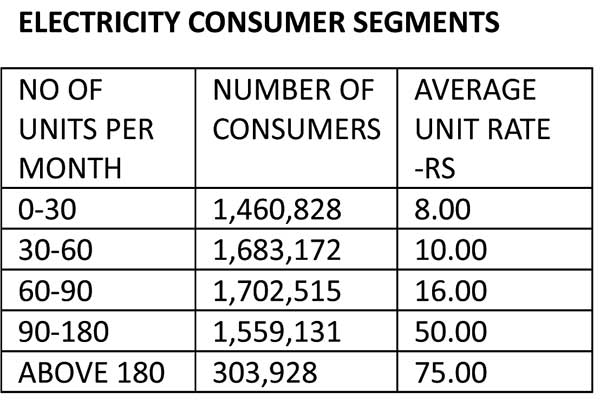
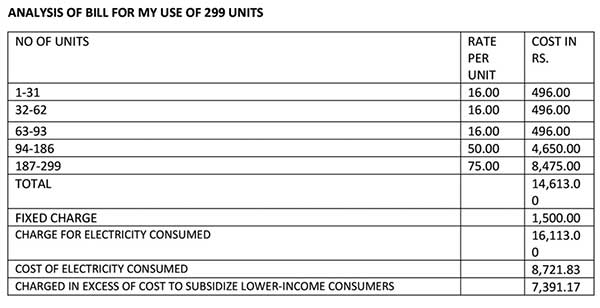
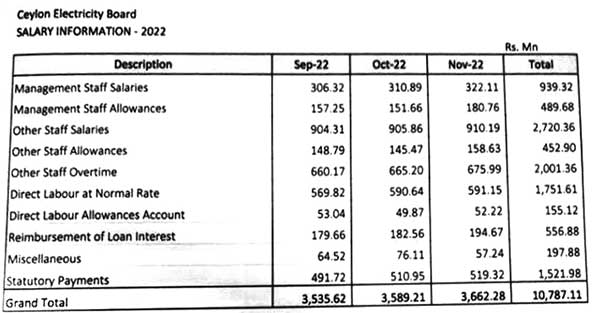
A quote that sums up our predicament Electricity is something that people cannot live without in the modern day. Without it, life will be so much more difficult and slow. Therefore, people need to learn how to value electricity and learn how to produce it from renewable sources (Carolyn Anderson). See Table 1

Yes, we have all gotten used to flicking a switch, and getting our electricity. At least, that was the case in Sri Lanka until the beginning of 2022. Even poorer households are used to having electricity on demand, whether to light a bulb in the evening or watch television for entertainment. But, of course, any power interruption angers people. Those who govern us and are responsible for making challenging and, at times, unpopular decisions pandered to our wishes to keep us happy. So whenever hydro-power was insufficient, the CEB was asked to provide uninterrupted power using expensive fossil fuel. But, unfortunately, the incremental cost of such generation was not recovered from the consumers. So as consumers ( domestic and commercial), we got used to bad habits.

Now that the chickens have come home to roost due to the economic Armageddon we are in and the need to introduce a cost-reflective power charge is causing significant heartburn. I am not underestimating the financial challenges that a tariff increase will cause for most domestic and commercial consumers. However, we also need to sit back and reflect on whether, as citizens of an impoverished nation, we have a right to demand uninterrupted power at below cost.

There is a trust deficit in the government, or should I say there is absolutely no trust! For example, the minister has said that a unit of electricity will cost Rs. 56.90 if the CEB is to supply uninterrupted power in 2023. However, projected cost invariably involves various assumptions. For example, if CEB assumes that rainfall will be less than what we have been blessed with in the last two years, it is a fair assumption.

However, the minister must be blamed for not sharing the assumptions made by the CEB in a public document. Had he done so, it would have enabled various independent power experts like Dr Tilak Siyambalapitiya and others to confirm that the projected tariff accurately reflects the cost. Suppose the revised tariff is proven excessive at the end of the year, there can be a refund made to the consumers, or the following year’s increase can be reduced, or indeed the surplus is used to settle the bank loans and the independent power supplier dues. Ultimately CEB customers should not expect the state bank depositors to bear the loss.

I have reproduced the CEB bill that has analyzed the charge levied to my residence based on the consumption of 299 units in a particular month. According to the CEB, I have been charged Rs. 7,391.17 over the cost. But, unlike certain parliamentarians, I settle my bills in full.

I now realize that in addition to paying a significant amount as income tax every year, paying for private health and educating children privately, I am also being asked to subsidize many customers of the CEB.

Whilst I subscribe to the view that the better-off need to pay taxes to support the less well-off, this responsibility appears to be overburdening some of us. I, therefore, support the statement made by the minister that all consumers, including places of worship, are charged a uniform rate of RS. 56.90 per unit, and the government makes a cash transfer to those entitled to a subsidy due to their lower income. However, I am sure many will not be entitled to the cash transfer and will still need to pay the higher rate. It is certainly not an easy discussion, but ultimately we can no longer continue to operate state enterprises at a loss. See Table II

I cannot understand why Buddhist temples and Christian churches have demanded a lower rate. Driving around, you observe many temples and churches that are excessively illuminated, contributing to the wastage of electricity. Similarly, hotels badly impacted by the revision of tariffs are also significant electricity users. Unfortunately, architects and owners of hotels have not designed their properties with energy conservation as an essential operational requirement.

What of the actions of the Chairman of the PUCSL? Is it his duty to consider the fairness of the tariff as applicable to religious institutions and the poorer segment of the population as opposed to ensuring that the tariff is in line with the cost of supplying electricity by the CEB?

There is no doubt in my mind that JR thrives on publicity through the media. Last year in the period leading up to the lengthy power cuts, there was confusion concerning the duration of power cuts, as pronounced by the CEB Engineers and the Chairman of the PUCSL.

When the Chairman of the PUCSL publicly contradicted the CEB engineers, the consumers were confused and unable to plan their activities, not knowing the exact length of the power interruption. However, after a few days, the CEBEU pronouncement proved to be correct, and there was a lingering doubt about whether the confusion was a result of the protocol as to who was authorized to announce the duration of the cuts as opposed to the actual duration of the power cut.

On a lighter note, many a joke is being made of the attire of JR, which includes a waistcoat which is now pretty uncommon even in countries where it originated. Is it part of his everyday attire, or only for media conferences?

As an independent regulator, I believe that the PUCSL needs to deal with facts concerning the cost of electricity generation and not indulge in political rhetoric.

The Ceylon Electricity Board Engineers Union (CEBEU) and The Ceylon Electricity Board (CEB) United Trade Union Alliance have also been at the forefront of criticizing the revision of rates. However, their actions can be deemed to be hypocritical.

The CEB Engineers have been criticized for lengthy delays in approving the connection to the grid of solar-generating power panels for both commercial and residential customers. Given the low-cost option of generating solar power, there is no justifiable reason for such delays.

The recent disclosure and publication of the monthly wage bill of the CEB should be an eye-opener as to how consumers are being made to pay for a wage bill that seems outrageously excessive. In addition, some of the costs need an explanation. For example, despite the CEB being significantly overstaffed, the monthly overtime bill is approximate Rs. 660 million, and the monthly reimbursement of loan interest is around Rs. 180 million. What it represents is anybody’s guess. See Table III

As is the case in most problematic issues bedevilling our country, there is no simple or logical explanation. Yet, when trying to identify the culprits, the politicians head the list for lacking in vision and not taking difficult and unpopular decisions to ensure that electricity is priced on a cost-reflective basis and investments for increased generating capacity on the least cost basis are made timely.

Former President Sirisena canceled the setting up of a coal power plant which had been in the planning stage for five years with no apparent alternative. The decision was as wrong as banning the use of chemical fertilizer. We are paying dearly for both mistakes.

We, the electorate, are to blame for continuously electing incompetent politicians lacking in visionary leadership. The trade unions, particularly the CEBEU, are to blame for holding the country to ransom by the threat of industrial action and preventing much-needed reforms.

As I write this article, there is a news item stating that the President has asked for a report from the Chairman of Sri Lankan Airlines and the Chairman of the Ceylon Petroleum Corporation as to why bonuses were paid despite both organizations posting significant losses. The sad irony is that the taxpayers of this country ultimately bear these costs. Unfortunately, it seems that being profligate with others’ money for personal popularity is the norm in our country.

FIFA World Cup and One Love

January 9th, 2023

K . Venkat

Once the FIFA World Cup started in Qatar, some of my virtue-signaling white friends went on an overdrive. Captains of a few European football teams had insisted on wearing the ‘One Love’ armband, ostensibly to express solidarity with homosexuals, whom Qatari laws persecute. The Qataris knew how to deal with this neo-aggression. They ordered FIFA to issue a yellow card to anybody who wears the ‘One Love’ armband. The aggressors submitted meekly. The armband was aborted in full-term.

The homophobic laws of Qatar didn’t arise in a void. Those are directly derived from the teachings of Islam, which derived those from the Bible. Both Christianity and Islam are viciously homophobic. You cannot accommodate Christianity or Islam in any form and simultaneously claim to express solidarity with homosexuals. It’s the western leftists who are at the forefront of whitewashing the crimes of Christianity and Islam. It’s they who facilitate the imposition of these two homophobic ideologies on the rest of the non-Abrahamic world under the guise of religious freedom. 

War is the very opposite of love. Which is the #1 terrorist organization in the world? It’s NATO, which has waged one relentless war after another on defenseless nations for decades. NATO has committed the genocides of millions of innocent peoples so that the West could control the resources of the world and usher in the most virulent form of neo-colonialism. It’s also the prime mechanism by which the War Inc. of the West siphons off taxpayer money. NATO and its terrorist overtures are at the very core of the dollar-based trade that forces the poorest people on the earth to service American, and European, debt and profligacy. You cannot simultaneously continue with the NATO-based world order of neo-colonial terrorism and also express solidarity with homosexuals. 

Whites should first show a modicum of scruples and overtly reject NATO, Christianity, and Islam wholesale before they yield to any compulsive urge to signal virtue on any topic. Coming to homosexuality, Hinduism and non-Abrahamic traditions are the only ones which have embraced homosexuals. The Kamasutra designates homosexuals as tritiya prakrti, i.e., the third nature – male and female being the other two. The Arthasastra prescribes punishments for anyone who harasses homosexuals. This is as enlightened and welcoming as a tradition gets. 

Why should the obsessions of wealthy, unscrupulous westerners become the priority of the rest of the world? The persecution of homosexuals is terrible. However, given that homosexuals are only a small percentage of any population, it’s only reasonable that societies prioritize other issues which really matter to the overwhelming majority. Third World countries have many such priorities: ending Abrahamic religious predations, driving economic growth, infrastructure development, healthcare, poverty, education, environmental conservation, etc. Homosexuality hardly warrants any attention from a vast majority of the world population.

These aren’t harmless protests. These are also organized efforts to impose a pseudo-scientific worldview on the population to exercise totalitarian control. This is hardly different from the historical imposition of the Abrahamic worldviews. Take the notion of ‘trans-gender’ for example. Trans-gender is not even a scientific term. Gender is firmly rooted in biology and genes. However, a very tiny fraction of persons, i.e., 1 in 11,000, suffer from a condition known as gender dysphoria. In this condition, which is neurological by nature, the person is ambivalent about his/her sexual identity. Such persons deserve to be treated humanely and as equals as Hindu traditions have always advocated. However, we needn’t submit to totalitarian terror by accepting such pseudo-scientific terms as trans-gender.

It’s also not necessary to assume that homosexuality or gender dysphoria are entirely natural or biological even though Hindu wisdom considered them as such. For example, recent scientific studies indicate that homosexuality is at the most 12-15% rooted in genes. The rest, it seems, is acquired behavior. Studies of female inmates in prisons inform us that many choose the lesbian lifestyle in prison although they had been heterosexual prior to that. Likewise, there’s a huge gap between the number of those who are really gender-dysphoric and those who self-identify as gender-dysphoric. The actual count is a minuscule 1 in 11,000. However, 1.5% of those between 30 and 45 who were surveyed self-identified as gender-dysphoric. For those between 18 and 30, this number rose to 5%. Now, genes don’t change so much over a generation that gender dysphoria increases three-fold. This is clear indication that impressionable children are made to feel ambivalent about their sex through ruthless propaganda run by a few diseased minds. This is a horrendous form of child abuse.

Masculine and feminine traits start manifesting from very early childhood. There are well-attested biological evolution benefits in nurturing those traits which we naturally inherit. We cannot allow woke activists with a totalitarian mindset to impose their pseudo-scientific worldviews on others. It’s also neo-racism. How come those issues which matter to virtually all Third World population is ignored by these westerners but we’re required to join their bandwagon every time they take fancy to some ideological belief?

So, my dear westerners, you need to first wear ‘Say no to Islam,’ ‘Say no to Christianity,’ and ‘NATO is the #1 terrorist organization’ armbands for a few years before you may contemplate wearing a ‘One Love’ armband!

Deepa Bhaskaran had introduced me to the works of Rob Henderson on luxury beliefs. In the past, the elite displayed their wealth ostensibly. That’s no longer fashionable. Now, this advertising has taken a new shape in the form of luxury beliefs that enables westerners to signal virtue. It’s luxury beliefs that the  westerners are displaying whenever they express outrage on any topic. There’s an insistence that we either join the bandwagon and become part of the in-group or get branded as belonging to the undesirable out-group. The division of society into in- and out-groups is fundamental to Christianity and Islam, and now to all woke aggressions.

Writing my Life Story

January 8th, 2023

Dr. .Sudath Gunasekara

 In my school carrier from Kindergarten (1945)-to University Entrance 1958) I had always been the first in all classes,  except twice that is 1950 at Udispattuwa Junior School econd term, after my mother’s untimely death and 1955 first term after I change college to Galahitiyawa Central from  Teldeniya Senior. But even in those two occasions I have bounced back to be the first in style in the next term. I also had been the class Monitor in all classes except at Glahiti[yava Central first term in 1955. Finally at Veyangoda Central College I had the distinction of holding all the following post, UE Class Monitor, President College Buddhist Brotherhood. Vice-Captain Parakarama House, President College Sinhala Literary Association, President College Geographical Association and Deputy Leader College English Debating Team

 All the jobs I did in Public Service from 1962-1997 I have always done better than all my predecessors in those places and none of my successors have been able to even maintain the level to which I had brought them up, in discipline and all round performance.  Throughout my carrier I have never canvased any post and never gone after politicians. All three posts of Secretaries to Health, Education and Prime Minister Mrs B were offered over the telephone to me by President Premadasa, President Wijetunga and finally Mrs Bandaranayaka respectively, the last was offered to me after having called me Home.

Colleges Attended Glahitiyava Central College & Veyangoda Central (Primary Education Meemures School)

University Education University of Peradeniya 1958-62.B.A.(Hons) Passed out in 62 with Second class Hours in Geography

Post Graduate Diploma in Land Management University of Cambridge;

PhD Agriculture University of Peradeniya (Incidentally I am the oldest man to get a PhD by Thesis from Peradeniya)

Professional: Teacher and Educational Administrator as Principle of College.3 years 1962-65 June

Sri Lanka Administrative Service 35 years 1965-1997

 Visiting Lecturer Univ: Peradeniya

Consultant Public Administration Rural Development Agriculture, Settlement Development, Infrastructure Development, Watershed Management, Small industries Development and Education

As a Public Servant 1965- 1997

1 Principal Sanghabodhi MahaVidyalaya Minipe  (1962 may-1965 June 15th)

First Appointment after University. When I took mover it was a typical Minipe village school   I converted it to be the best College all aspects in the Kandy District outside the city with minimum facilities within 3 years.

                        1962 may                                                               1965 may

Students               265                                                                       965

Staff                         7                                                                          38 with 6 Graduates

Exames results: 1963 Dec O/L produced 11 passes out of 12 for the first time in its history. We won the First place, in Kandy District that year.  Within this short period of 3 years the College was brought up as the best in discipline and academic attainments in the region. After 1963 O/Results a large number of children of the colonists who were in other schools in the neighboring areas and even faraway places were brought back and admitted to this college. That was the reason for the remarkable increase in student population during this period. With the success in 1963 O/L results and extracurricular activities I proved that it is not the location of a school what matters but the dedication and commitment on the part of the teaching staff headed by a dynamic and visionary teacher what really matters in the success of a school.

Buildings             2                                                                                                   3

By end of 1963 I got a pipe born water supply installed, a new school building 20X200 and a science building with science teachers by end of 1964

 This was my best job in life where job satisfaction was the highest All three parties teachers, students and parents worked with dedication and commitment as a team.

2  DRO Yatikinda Badulla   (Head Quarters DRO) (June 2nd –May 2nd) 1966 .This was my first CAS  appointment after entering the first CAS batch of 1965 as a cadet

 Badulla GA gave me this station as a special appointment to clean up an Augean mess that was there for 15 years without a permanent DRO. I reorganized the Office with daily job targets for all Officers, brought back strict discipline and work productivity within 2 weeks by activating an old dormant circular   that made it compulsory for each officer to complete a given quantum of every day. Discipline among Grama sevakas was my next target as they formed the live, wire  of a DRO’S Division and also the entire machinery of governance at the grass root level administration in the country. I travelled the whole Division extending up to Mahaweli ganga in the North from Haliela in the South, twice with the GA, first trip after a Division day in Pitamaruwa a remote village, climbed Madolsima ranges 3rd  highest and second tripe climbed Naranagala,  the second highest in the Division. This was done to get to know the area, its people and work I have to do as a public servant, taking a clue from a farewell lecture by our Professor Geography who said one has to learn these 3 things to be a good public servant. But by end of the month I was recalled by Kandy GA under whom I was trained as a cadet to complete an assignment on Kandyan Peasantry Rehabilitation he had given to me and posted me as DRO Udadumbara as the duty station, my home area to my delight. Although I was there only for 1 month all the VC Chairmen of the Division protested against my transfer.

3 DRO Udadumbara  

This was the biggest DRO Division in the District. Access to most villages was mostly on foot and they had to walk long distances often more that 12 miles to the nearest road  the total distance to the DRO Office was more than 25 miles The circuit Magistrate courts was also close to my Office.Within the first few moths my 1 months experience here I introduced a new innovation called the Gamvesiyan Pasdenage Sabhava for each GS Division under the Chairmanship of the Village Priest to keep peace and settle minor disputes in the village without going to courts or coming to my office. The other 4 Members were the GS, Head Master of the village school. Vedamahatataya and another villager of standing selected by the 4. They were given letters of appointment by me for a specific term of office. The arrangement was for them to attend to disputes the GS is unable to settle. Those disputes the GPS cannot settle had to be referred to me. The GS functioned as the Secretary. Instructions were issued by my Office as to how problems are to be handled. The results were surprising. Not eve 2% cases were referred to me.  Going to courts almost became zero Goodwill and togetherness in villages thrived. Money and time wasted were all saved.

Beside attending to my usual Official duties as a DRO I also introduced a new way of Commemorating Independence Day by engaging in some development activity in place of the usual Avurudu utsavaya..

On Feb 4th 1970 the first of that series the construction of the famous Uduwaaheena –Ududaha   5 mile 20 ft wide road with only two bends avoiding the notorious 18 bends on the famous Kandy-Mahiyangana Road was started by shramadana. Jungle clearing of the entire stretch of 20 ft wide 5 miles was done in one day by shramadana, except the section of thick jungle called Roti Ela mukalana where we had to get permission from the forest Dept.  4½ miles on either ends were made jeepable within 3 months. Before the middle section was completed I was transferred to Kandy Kachcheri. It is 2020 now, 50 years gone after I left. But it is a tragedy the road construction is still where I stopped, in spite of the fact there had been 3 Deputy Ministers in Parliament and a Chief Minister from 1987 – 2018.

 1971  Feb 4th started the Ratnella Ela Irrigation scheme to settle 500 farmer families that gave birth to the Hasalaka Gem mining

The philosophy I emulated here was to engage in some development activity or at least a tree planting ceremony or construction of a road instead of indulging in usual merry making by way of Avurudu sanakeli where you indulge in things like climbing the grease pole. Selection of Avuurudu kamari/Kumaraya etc.

1967 Meemure   Pusse Ela settlement scheme under Mahaoya–Heenganga Scheme was inaugurated .

1978 Started the Cardamom planting in Meemure and Kaikaval benefiting more than 100 families. Both these works were in my village Meemure

4 1971-75 Assistant Director Small industries Kandy

A district that was badly neglected and mismanaged was re-organized to be the First place in Handloom production in the Island for all 5 years consecutively from 1971-1975 and resurrected the District Textile Coop Union that was running with an overdraft 150 000 in 1971 to 1.25 m net profit, making coop, by end of 1972 and also opened up a Textile Shop in Colombo St Kandy City for the first time.

Completed stage 2 of Nattarmpota Handicraft colony with 40 new cottages for 40 Craftsmen families with a design Centre and work shop and also got Laksala to decentralize purchasing in Kandy being the most important district in Handicrafts production and renamed it as Sri Veera Parakrama Narendrasingha Kalapuraya to give it a historical importance..

1974 Organized the first Air trip from Katunayaka to Batticalloa for the Instructors who won the first 10 places in Production as a part of a motivational programme.

Opened up 5 Art line Textile Centers at Wegiriya, Menikdivela, Polgolla, .Meegammana and Uda Dumbara the last to revive the only traditional Sinhala weaving pit loom  Talagune Rata. 

DRO renamed as d/AGAA

Meanwhile in 1972 Minister Ilangaratna accepted a proposal made by me and re–designated DROO (Divisional Revenue Officers) as Divisional Assistant Government Agents and Grama Sevakas as Grama Seva Niladharis on a proposal made by me and published in the Nov issue of the Journal of the Sri Lanka Institute of public Administratio..

5  Deputy Director Small Industries (Handicrafts) Head Office 1975 July to-end of 1977

1976 Organized the best Handicraft Exhibition for the Non Align Summit Conference which Mrs B used to call the best H /C exhibition she has ever seen in her life, until she died. Negotiated the annual Handicraft Design Survey Scholarship Tour of BENELUX countries for 5 craftsmen in collaboration with the Dept of Commerce which, I think is still operative.

6 1977-1979 Very bad time

Shifted from place to place as a political victim. 1 Deputy Commissioner Rehabilitation. 2 Addl GA Batticalloa 3. Deputy Director Rural Development as a political victim

But I made it a blessing in disguise by engaging on Religious and Social Service as

1 Secretary to Asgiirya Dayaka  Sabha and that illustrious Mahanayaka Thera ever, and

2 As President Mahanuwara Jatika Kalamandalaya an association of all artists industrial and performing. Among important achievements

1 Improving the income of both groups of artists in Kandy and Matale Districts

2 Stopped the construction of Perahera seats in the Mahamaluwa that was a big fraud

3. Also stopped a Dalada Perahera Diva Nilame and Minister of Education Nissanka Wijeratna was planning to parade the Streets after the Annual Perahera was over to show the Commonwealth Education Ministers who were in the country for a seminar, violating the Age old Tradition by pursuading the Mahanayaka Thero to refuse to give  his key of the Dalada Casket for the Dalada Exhibition if he violate the tradition. It was my plan that worked.

7. 1979-1985 Victoria Project Kandy

My role in constructing the 60 odd miles network as the chief Coordinating Officer in charge of new roads and Towns by negotiating with land owners who were protesting against it and having them ready before inundation date of the reservoir prior to formal acquisition was complete.

Completing Tennekumbura Moragahmula Damtop road nearly 24 miles within1 year

Getting  Teldeniya –Udispattuwa-Moragahamula Loop (7 miles) opened up for heavy traffic within  3 weeks, ( a new proposal by me as a deviation  for Kandy-Mahiyangala traffic between Teldeniya and Moragahamula as the construction of the Teldeniya –Moragahamu section of the new road above the old road would have been never possible.

 Location of the New Teldeniya Town at Karalliyadda and preparing the ground plan for the new Town

 B.L.Panditaratna the Chairman of the Mahaweli Auhtority at the end of the Project once said ‘Sudath If not for you we would have to swim the Victoria to the other side” This sums up the role I had played in getting the road network completed in time.

In fact by mid 1983 when I returned from Cambridge the entire construction work of roads and bridges was at a standstill, the constraints being as engineers said were inadequate machinery, men and material. Immediately after I returned I Suggested to Panditharatna to summon a meeting of all stake holder and it was at that meeting I proposed to withdraw machine material and even men from Maduru oya and Uda walawe projects which were considered of less priority compared with Victoria and start three shifts instead of one and make it a 24 hr operational activity. Also I suggested having two-weekly progress evaluating meetings under his Chairmanship to thrash out the problems on the spot. At these meetings 2 weekly targets were given to all, the completion of which was a must. Also I suggested paying an incentive payment to all workers to motivate them. So it was around the clock 24 hr operation. After that not only workers but even engineers were on the road through out more or less day and night. It worked like magic and the work was completed even before the target date.

II was at the last progress evaluating meeting that Panditahratna made the afore said comment ‘Sudath If not for you we would have to swim Victoria tot the other side”

The funniest thing in this episode is immediately after the work was over Gamini Disanayaka un-ceremonially Transferred me to the pool on representations made by M.B, Adikaram, the Manager, against me perhaps saying that I will be a political threat to the UNP.

From Oct 10.  1985 I was appointed as Director Private Sector Ministry of Industries. This was again a very bad time in my life. Even before I had undergone such situations .For example I was appointed GA Matale thrice from 1977 consecutively. But the local UNP stalwarts in Matale blocked that, Meanwhile my name was also suggested to Kandy as GA. The then President blocked that too having said ‘He is an excellent worker but politically he will be a dead weight round our necks”   I also got two Commonwealth Assignments as Advisor in Handicrafts in Papua New Guinea and Sierra Lyon. But I dint go for personal reasons. Meanwhile they advertised the post of Registrar Peradeniya University. I applied and was selected first, but again another person low down in the mark list was selected for political convenience. 

8 1986-1992 NADSA Project now called HADABIMA Project

It was at that time the opening at NADSA came up in April 1985.. After I mentioned it to Mahanayaka Thera of Asgiriya he took me to the Minister Gamani Jayasuriya next day. After looking at my Bio=data the Minister said , this Project is to be closed down by end of year and since I was a very senior office he offered the Additional Secretary post in his Ministry. But since I wanted to be in Kandy on personal reasons, he said OK you can come here in next January and appointed me to NADSA. That is how I came to NADSA. But next day Chief Minister Disanayaka CP as usual has protested. When inquiries were made I was told that Disanayaka had asked Weragoda the then Secretary Agriculture to tell the Minister not to send me this side of the Kadugannava as they all will lose even their deposits if I come and work there. When I told this to the Mahanayaka Thera he spoke to the Minister again and mentioned this problem. Then the Minister asked for me and over the phone he said Sudath I am the Minister of Agriculture and I have appointed you. You go there immediately and assume duties and come and see me in few days if there is a problem.

When I met the Minister the week after, in his office and told him that, conceptually  NADSA is one of the best development Projects, if not the best, that have ever being conceived in the post Independent era in this country and therefore it should never be closed down until its programme of the threefold development is complete. Even if you forget settlement development and Agricultural Diversification and concentrate only on watershed management it still remains the no 1 development concept. The Minister looked at my face hard and said ‘Sudath you are the only man who says this. All the other fellows just say the opposite. Either you are mad or all others are mad. But having listened to you, I think there is a slot of truth in what you. OK let us have a run and we see”.

This is how I came to NADSA. Thereafter the Minister accepted my proposal to continue the NADSA that was to be closed down by end of that year and it is still there as HADABIMA Authority of Sri Lanka under the name I gave, for which I got 12.5 m US$ Food aid package from FAO/WFP for 6 years in 1991 and resurrected and expanded its area of operation to cover the entire Central, Sabaragaamuwa and Uva Provinces also in 1991.

My relatioship with Lalith Atulathmudali as Minister of Agriculture

 Lalith in 1991 at his first meeting with Heads of Departments at the Agrarian Services Dept Conference Hall who said Gentlemen you know the best example in the whole World where the poor is made poorer is NADSA”. Probably he also had my name in his pav potha.  Again when he came up with a similar remark next month too I raised my hand and said I beg to disagree with you Sir. Why? He asked me with an Oxford accent? If you give me permission I will explain, I said. Go ahead he retorted. After repeating what I had told Minister Jayasuriya I also said, Sir unfortunately none of the politician or the Officialswho had beenincharge of this Project had understood the value of this Project. Had they at least understood the and at least carried out objective one, Watershed management, and carried that out to its logical conclusion, the story of NADSA would have been something entirely different I said.  ‘Sudath you meet me after the meeting I want to fix up a date to visit your project. Within a weeks’ time In he visited the Project and at a meeting held at the PGRI Auditorium this is what he said.

මිත්රවරුනි මම ඊයේ සවස වනතුරු මේ න්ඩ්සා වියාපාරය ගැන,අහලා තිබුණේ දැකලා තිබුනේ කියවලා තිබුනේ ඔක්කොම අසුභවාදී දේවල්. නමුත් මම අද තමා මගේ ඇස්දෙකින් දැක්කේ ඒක මොකක්ද කියලා.මීට මාස එකහමාරකට ඉස්සර කොලඹ  තිබුණ රැස්වීමකදී මම මෙහෙම ප්රකාශයක් කලා  (ඉහත ප්රකාශය සින්හලෙන්) මම අද ඒ ප්රකාශය ඉල්ලා අස්කරගන්නවා. තමුන්නාන්සේලාගේ අධක්ෂක තුමා, මගේ මිත්රයා, සුදත් ගුණසේකර මහත්තයා මොන විස්මකර්ම වැඩක් කරලද මම දන්නේ නෑ. මම අද කියන්වා මේක ලන්කාවෙම තියෙන විෂිස්ඨතම කුඩා ගොවිපොල ව්යාපාරය කියලා” එසේම මෙම වසර අවසාන වන විට ලෝකයේම කෙසේ වෙතත් ආසියාවේම හොදම කුඩා ගොවිපල ව්යාපාරය වෙනවාට කිසිම සැකයක් නෑ” රැස්වීම අවසානයේදී මගේ පිටට අතින් තට්ටු කොට.”Sudath you have done it. My congratulations .After all I am an Oxonian and you are a Cantabrian” කියා කීමටද ඔහු අමතක කලේ නැත. ඒ ලලිත් නම්වූ උදාර මිනිසාය.එවැනි වෙනත් දේශපාලකයකු ඊට පෙර හෝ ඊට පසුව හෝ මම කිසි දිනක දැක නැත.

The same year WFP rated it as the best Small Farmer Project in South Asia.  I made two 35 minutes documentaries 1) The Harita Danavva/Green Habitat (Won an award in 1991 Czec International Film Festival on Environment), 2) The Miracle Basket narrating the wonder, the Food Basket had done to show the progress  to the second evaluation Mission.

Minister Lalith also dropped a proposal made by some agricultural Scientists to grow Girkin in the DZ paddy fields on my advice not to accept that dead rope as the paddy cultivators form the back bone of our society and also the danger of depending on imports for the staple diet of the nation. He also joined hands with Gamini forgetting the differences they had, on my advice to fight their common adversary Premadasa and formed the new Party LPP. The day after I told him that, early morning he rang me up from Colombo and thanked me profusely and said Sudath I told each and every word you told me yesterday to Gamini and we have joined hands to form a new Political Party and both of us have decided to appoint you as the Chief Organizer for the entire Central Province” Had they lived, I would have been a Cabinet Minister in their first Cabinet

9 During President Premadasa’s time   as President SASA (1991-94) I rescued the SLAS from its demise.

In 1992 there was a proposal to amalgamate the Divisional Secretaries Offices with the Divisional Councils and appoint DSS as Secretaries to Divisional Council Chairmen and also appoint outsiders as Div Secretaries.  As the then President of the SASA I summoned an emergency meeting at the BMICH and invited President Premadasa as the chief guest. It was attended by all Ministry Secretaries and over 2000 SLAS Officers working at National, District and Divisional levels all over the Island including the Sec to the President Mr Wijedasa. In addition I also invited few reputed retired Secretaries like Bradmon Weerakoon, Leel Gunasekara and DBIPS Siriwardana. Incidentally that was the first SASA meeting held at the BMICH

In my welcome address explaining the purpose of the meeting I pointed out the dangers of the proposal before the Cabinet in detail and lodge our strong protest against it as the members of SLAS who form the steel frame of the machinery of governance at all levels who carry out the policies and Programmes of the government. I also told him that it will lead to a complete collapse of governance in the country and  if this proposal is accepted there will utter chaos and confusion and no Governance either at the center or in the periphery and therefore requested him to withdraw the Cabinet paper. I also pointed out to him that this in my opinion is a big coup d’tat to destabilize and send the Government Home.  As I came back and sat down President Premadasa turned towards me and said Sudath my congratulations you made an excellent speech” I said thank you Sir. The President made a short speech thanking me and our Association for pointing out that danger about which he had no idea and he concluded his speech granting all four demands I made. The next day morning I got a call from Secretary to the President appointing me as State Secretary to the Ministry of Health straight away from the pool.

Had I not taken that bold decision that day and made that historic but risky speech on that day on behalf of my Service SLAS ,definitely that would have marked the end of SLAS in this country. I am proud that I could

10 Mrs Bandaranayaka accepted my proposal on 23rd  Nov, made at Rosemead Place in the presence of Getambe Loku Hamuduruvo and Visva Warnapala to get down Chandrika  in 1993 from UK to reorganize the Party in place of Anura and they won all subsequent elections and got elected twice as President of this country.  

11 It was my secret plan as Secretary to Mrs B that worked on 10th Sept 1994 that appointed Mrs B as the 12th Prime Minister in this country.

12 Finally  it was my plan and strategy that compelled Chandrika to Appoint Mrs B as PM in Sept 1994 in  place of Chandrika’s favourite Anuruddhda Ratwatte which might have led to the collapse of the Government as there were five contenders. I still remember Mrs B calling me home on Sept 10th from Office and how she showed me the letter signed by all 5 contenders with trembling hands and tears in her eyes saying Sudath now look at this letter all these fellows who wanted to be Prime Minister are now asking me to be the PM” and at 11.30 next   day she was sworn in as PM. She didn’t know how it happened and who the architect was behind that miracle that bore results within a matter of 24 hours.

 It was my strategy and I who prepared that letter together with another addressed to Chandrika to be signed by all 5 aspirants asking Chandrika to appoint Mrs B as Pm and none other, and the other to Mrs B requesting her, to ask Chandrika to appoint her as PM to avoid the imminent collapse of the Government for 6 reasons I have highlighted in that letter. In both letters I wanted Mavellage to get Anuruddhas Signature as the first, as he was Chandrika’s favorite, so that it will have an impact on others as lessor beings.  The messenger was Keerthi Mavellage that dynamic young Private Secretary to Mrs. B from Galle. I also wanted him to get the signatures of the 5 men on the 10th afternoon and hand over the letter to Chandrika at 10 AM next day and to Mrs B at 10.30 AM the same day. At 10.30 Am next day I think it was 11th of Sept Mrs B was sworn in as the 12th Prime Minister of the Republic of Sri Lanka against the wishes of Chandrika, dispelling all frustrations of that Great Lady and misconceptions of Sunetra, her elder daughter. Meanwhile  Chandrika replaced me with her chum Hemasiri Fernando as the Prime minister’s  Secretary. That is how this ungrateful woman treated the man who brought her in to politics in Dec1993 and paved the way for her to be the President of this country for 11 years.

Even on the 8th of Sept evening when I asked Mrs B Madam now who is going to be the Pm, this was what she said ‘Sudath Chandrika will never appoint me as the PM. She will appoint someone whom she wants. Then she paused for a while and said with a drawn face probably Anuruddha”.

When I asked the same question from Sunethra the same evening this is what she said. Sudath do you think this woman who had snatched my husband also, will ever appoint Ammi as PM” When I said no, Sunethra, somehow or the other we have to get her appointed as the PM. If that happens the Sun will rise from the other side she said. By that time I had my plan ready.

The matter was discussed thereafter confidentially under locked doors at Rosmead with the Atulkattale attended by Mrs B’s loyals, including Keerti Mawellage Private Sec , Girty Dunuvila, Mrs Lanerole, Yatawara, that loyal office aid of Mrs B and Atukorala another Mrs B’s  confidante. They all were thoroughly disappointed and disgusted about what is going to happen. But they all were clueless. I told them I have a plan Keerthi you see me in office tomorrow morning. I did not divulge the details. But I got one assurance from all who were there, that is not to divulge anything to anybody on this subject until 12 o’clock next day. When Keerthi met me next morning I gave him two letters. One addressed to the President and the other to Mrs B. Letter to be given to Chandrika was a request made by the 5 Aspirant PMM requesting her to appoint Mrs B as PM for the reasons outlined in that letter to be signed by them The second letter was addressed to Mrs B requesting her to demand Chandrika that she should appointed her as the PM for the reasons outlined in that letter. I presume even before Mrs B made up her mind what to do next she got a call from Chandrika that she has decided to appoint her as the Prime Minister. That is how a bona fide secret coup d’etat hatched in good faith in the name of the country made that Great Lady once again the12th Prime Minister in this country on Sept 11th 1994 and by good luck she could have a State funeral as the PM.

Watercolour paintings by Irish artist Andrew Nicoll presented to the Pathfinder Collection

January 8th, 2023

Gamini Sarath Godakanda

Jennifer Smith, Justice of the Peace and retired London solicitor who has had a long association with Sri Lanka, presented a set of watercolours by the Irish artist, Andrew Nicoll (1804-86) to the Pathfinder Collection. The paintings were recently handed over to Milinda Moragoda, Founder of MMBL-Pathfinder.The Pathfinder Collection was established in 2018, and contains a range of Sri Lankan artefacts, including prints, maps, books, paintings, coins, stamps, seashells, and other items of historical value.

About the artist and paintings:

Andrew Nicoll spent a brief period in colonial Ceylon during which he  taught drawing and landscape painting at the Colombo Academy. He also made a five-week long journey through the jungles of Ceylon during which he painted several subjects including ruined temples, tanks, and dagabas, some of which were used to illustrate Ceylon: an Account of the Island,

Physical Historical and Topographical, etc, the classic 2-volume work on the island written by then Colonial Secretary, Sir Emerson Tennant. Of this jungle sojourn Nicoll remarked that:

‘…it was the most interesting I ever had in my life…and will ever be considered by me the most delightful of all my sketching excursions, either at home or in distant lands.’

The watercolours of Nicoll, who was a prolific artist, can be found in the painting collections of the Colombo National Museum, the British Museum, and the Victoria &Albert Museum. In addition, fifty six of his watercolours of Ceylon plants and trees were presented to Dublin’s Royal Hibernian Academy by his daughter in 1889 in memory of her father.

Recent trend of US-Bangladesh relations

January 8th, 2023

Mehjabin Bhanu – a Bangladeshi teacher, columnist and writer.

In recent times, the USA is very interested in further strengthening bilateral relations. Bangladesh also intends to deepen and enhance its ties with the US. Analysts say that the US wants a holistic relationship with Bangladesh beyond bilateral ties. US President Joe Biden expressed optimism about deepening relations with Bangladesh. Bangladesh’s ambassador to the United States. The United States is one of Bangladesh’s friendliest states and development partners. Political, economic, and trade relations between the two countries have strengthened, especially since the current government took power in 2009. In addition, the United States is one of the most important countries considering Bangladesh’s diplomatic interests. The United States’ contribution to Bangladesh’s socio-economic development and investment, as well as its security cooperation, is particularly significant.

Significance of Rear Admiral Eileen Laubacher’s Bangladesh visit

Rear Admiral Eileen Laubacher with a high-level US defense delegation, one of the advisers (special assistants) to US President Joe Biden and senior director for South Asia affairs of the White House’s National Security Council, arrived on Saturday afternoon in Dhaka as part of a series of political visits. Various issues of bilateral cooperation will be discussed during their visit. Among which the strengthening of defense cooperation and lifting of sanctions on RAB, Rohingya repatriation will be of particular importance in the discussion. The official visit of the US delegation has begun from Sunday.

Rear Admiral Eileen Laubacher recently had a meeting with State Minister for Foreign Affairs Md Shahriar Alam at the Bangladesh Embassy in Washington, D.C. when she was Special Assistant to the US President.

Donald Lu’s upcoming BD visit 

Meanwhile, Donald Lu who became Assistant Secretary of State for the Bureau of South and Central Asian Affairs on September 15, 2021, is likely to begin his Bangladesh visit on January 15. 

Regarding the Bangladesh visit of US Assistant Secretary of State for South and Central Asian Affairs Donald Lu, Momen said it is very good news that he is coming. “He is like a policymaker in this area. We welcome him.”  “We have a very good relationship with the US. We have multifaceted engagements with the US. There will be talks on different issues when he (Donald Lu) comes.” He also hoped Donald Lu’s visit will help strengthen the good relationship between the two countries. Replying to a question from the reporters on the US sanctions on RAB, the minister said bilateral relation is not determined by a single issue. “The US is our biggest consumer and our biggest investor. With engagements in many areas, we don’t have to worry about just one issue. We both have common values and principles.” He said the US wants a democratic system and Bangladesh also wants a democratic system. “The US wants to uphold human rights. We want to, too. Three million people of Bangladesh have sacrificed their lives for human rights, justice and democracy,” he added. “We will talk about many things. It is open. Many issues will be discussed.”

Biden’s desire for working with Bangladesh

United States president Joe Biden has said recently that his country acknowledges their enduring partnership with Dhaka and termed Bangladesh’s economic growth in the past 50 years as a ‘remarkable story’. ‘I hope our nations will continue to work on democratic governance, climate change, refugees, and maritime security. We are invested in your success and support the ability of all Bangladeshis to freely participate in and contribute to their country’s development,’ he said. The US president made the remarks while accepting the credentials of the newly-appointed Bangladesh ambassador to the United States Muhammad Imran at the White House.

‘As 2022 marks the 50th anniversary of US-Bangladesh relations, I would like to acknowledge our enduring partnership with Bangladesh,’ Biden mentioned in his written remarks. Welcoming the new Bangladesh envoy in the United States, Biden said his administration looked forward to working with the ambassador to expand bilateral relations between the two countries. Biden also assured the Bangladesh ambassador of extending all sorts of cooperation during his tenure in the United States.

Bangladesh had emerged as an important partner on international trade and investment, climate change, humanitarian, refugee, United Nations Peacekeeping, and counterterrorism, maritime and other security issues, he continued. Biden said Bangladesh had expanded its largely agrarian-based economy to a regional economic power poised to become a major participant in global supply chains.

Appreciating Bangladesh’s generosity in hosting nearly one million Rohingyas, the US president said that they would continue to support Bangladesh in assisting these refugees and their host communities, and protecting their rights. ‘The United States is committed to finding sustainable and durable solutions to this humanitarian crisis,’ he said. On the Covid-19 pandemic, the US president mentioned that the United States was proud to partner with Bangladesh to address the global pandemic under the Covid-19 Global Action Plan. ‘We are committed to expanding our growing partnership in the months and years ahead,’ he remarked.

The new beginning of Bangladesh’s apparel export in US

American orders for apparel made in Bangladesh are growing faster than U.S. imports from clothes manufacturing giant China, according to data compiled by the United States Department of Commerce through the first 10 months of 2022.

From January to October last year, the United States imported apparel from Bangladesh valued at about $8.5 billion – representing a 49% jump from imports of Bangladeshi-made garments during the same period in 2021, according to the Office of Textiles and Apparels (OTEXA) at the U.S. Department of Commerce.

Bangladesh’s apparel shipment to US, the country’s single largest export destination, increased by about 51 percent compared to last year. In the first 9 months of this year, the country has exported a record of more than 7.5 billion US dollars in clothing. Noteworthy, Bangladeshi apparel makers are getting a strong foothold in the United States of America market as exports posted robust growth in recent times. Despite the global recession, the export of Bangladeshi-made garments to the United States has increased at a significant rate.

The U.S. Embassy in Dhaka acknowledged Bangladesh’s role as a trade partner

US Ambassador to Bangladesh Peter Haas said ‘he is looking forward to continuing the Bangladesh-US partnership in the new year (2023)’ The United States is Bangladesh’s largest export destination, and U.S. garment sector companies increasingly identify Bangladesh among their most important trade and investment partners,” the Embassy said recently.

We value our commercial relationship with Bangladesh, the world’s eighth most populated country in the world, and its place in U.S. commercial imports illustrates the competitive quality of Bangladesh-made products.”

Recent US Rohingya rehabilitation announcement is appreciable

The United States has contributed the most to the Rohingya crisis so far. At this year’s UN General Assembly, the US Secretary of State announced $170 million in additional humanitarian aid. Since 2017, the country has contributed more than 190 million dollars to the Rohingya crisis.

United States wants to resettle Rohingya from Bangladesh. Julieta Valls Noyes, Assistant Secretary for Population, Refugees and Immigration of the US Department of State came Bangladesh for this purpose last month. It would be appreciated if the US administration works with Bangladesh government. It will reflect better mutual understanding between both administrations. The west and well-wishers of the promotors of humanitarian issues can follow the US footprint. 

Looking ahead at the next 50 years

However, Bangladesh is an important regional partner of USA on economic, climate, humanitarian, and security priorities.  As 2022 marked the 50th anniversary of U.S.-Bangladesh relations, the United States and Bangladesh held multiple high-level engagements and strategic discussions in Dhaka and Washington D.C. to deepen bilateral, economic, commercial, and security collaboration. As an increasingly self-confident and prosperous Bangladesh moves away from a sense of obligatory dependency that defined its relationship with the US in the last 50 years, it is in the US’ interest to promote a sense of growing interdependence with Bangladesh, looking ahead at the next 50 years.

ඒ.බී.සී හර්බල්ස් නිෂ්පාදන ආයතනයේ 6 වැනි සංවත්සර සැමරුම පාර්ලිමේන්තු මන්ත්‍රී දුමින්ද දිසානායක මහතාගේ සහභාගීත්වයෙන්

January 8th, 2023

තිසර සමල් – අනුරාධපුර

දිවයිනේ ප්‍රසිද්ධ දේශීය රූපලාවන්‍යය නිෂ්පාදන ආයතනයක් වන ඒ.බී.සී හර්බල්ස් නිෂ්පාදන ආයතනයේ 6 වැනි සංවත්සර සැමරුම හිටපු අමාත්‍යය, ශ්‍රී ලංකා නිදහස් පක්ෂ ජාතික සංවිධායක, පාර්ලිමේන්තු මන්ත්‍රී දුමින්ද දිසානායක මහතාගේ සහභාගීත්වයෙන් ඊයේ (07) පැවැත්විණි.

අනුරාධපුර හෙරිටේජ් හෝටල් පරිශ්‍රයේදී මෙම සංවත්සර සැමරුම පැවැත්විණි. ඒ.බී.සී හර්බල්ස් යනු රූපලාවන්‍යය නිෂ්පාදන රැසක් වෙළඳපලට නිකුත් කරන ප්‍රසිද්ධ අනුරාධපුරයේ නිෂ්පාදන ආයතනයකි.එම ආයතනය මීට වසර 06 කට පෙර ආරම්භ කර ඇති අතර,එහි 06 වැනි සංවත්සර සැමරුම උත්කර්ෂවත් ලෙස මෙලෙස සමරනු ලැබීය.

ඒ.බී.සී හර්බල්ස්  පුද්ගලික සමාගමේ අධිපති අනුරාධ මාරපන මහතා අනුරාධපුර දිස්ත්‍රික්කයේ ව්‍යාපාරික මහතෙකු ලෙස වසර 06 ක් තුළ දිවයිනේ සුප්‍රසිද්ධ දේශීය රූපලාවන්‍යය නිෂ්පාදන රැසක් නිෂ්පාදනය සිදු කරන ආයතනයක් බිහි කරමින්, තරුණ තරුණියන්ට රැකියා ලබා දෙමින් කළ සේවය අගයමින් පාර්ලිමේන්තු මන්ත්‍රී දුමින්ද දිසානායක මහතා විසින් අනුරාධ මාරපන මහතා වෙත සම්මානයක්ද එහිදී පිරිනැමීටම කටයුතු කෙරිණි.

ඒ.බී.සී හර්බල්ස් සමාගමේ අලෙවි ප්‍රවර්ධන නිළධාරීන් ඇතුළු සේවක මහත්ම මහත්මින් අගයමින් සම්මාන හා සහතික පත්‍ර පිරිනැමීමද එහිදී සිදු කෙරිණි.

තව තවත් නව නිෂ්පාදන සිදු කරමින් ඒ.බී.සී පුද්ගලික සමාගම තව තවත් දියුණුවට පත් කරමින් නව රැකියා අවස්ථා උත්පාදනය කිරීමට සුභ පැතුම් එක් කරන බවද, ඒ සඳහා අවශ්‍යය සියලු සහය ලබා දෙන බවද එහිදී අදහස් දැක්වූ පාර්ලිමේන්තු මන්ත්‍රී දුමින්ද දිසානායක මහතා පැවසීය.

මෙම අවස්ථාවට ඒ.බී.සී හර්බල්ස් පුද්ගලික සමාගේ අධිපති අනුරාධ මාරපන මහතා සහ එම මැතිණිය.ඒ.බී.සී හර්බල්ස් අලෙවි ප්‍රවර්ධන නිළධාරීන් ඇතුළු සේවක මහත් මහත්මින්, අනුරාධපුර ව්‍යාපාරික මහත්ම මහත්මීන් ඇතුළු පිරිසක් සහභාගී වූහ.

Killing of a Bangladeshi youth proves the dire situation of extrajudicial killing in USA!

January 8th, 2023

Sufian Siddique Independent researcher and freelance columnist, Dhaka

The United States of America (USA) is popularly known as the ‘Champion of Democracy and Human Rights’. But since the last two decades, in its journey towards a multicultural society, the USA is facing a lot of human rights issues domestically such as hate crimes, structural racism, and extrajudicial killings at the hands of law enforcement agencies. Several statistics show that gun-related violence including hate crimes and extrajudicial killings is taking place at an alarming rate and there exists systemic exploitation of human rights. Every day, US society is facing hate crimes, extrajudicial killings and police violence. Moreover, the government is also failing to introduce or initiate effective policies. Furthermore, in the case of extrajudicial killings, a culture of impunity is also at large. It seems the champion is failing at home lately.

This is not the first time that gunmen swooped in the United States. A young man from an expatriate Bangladeshi community in the US has been gunned down by police at the city of Cambridge in Massachusetts.

The Bangladesh Association of New England organised protests outside Cambridge City Hall on Thursday, condemning the brutal killing” of 20-year-old Sayed Faisal, a student of the University of Massachusetts Amherst.

They described the death of Faisal, the only child of his family, as a racist incident by white police officers”. This is not acceptable in any meaning,” the association said in a Facebook post.

It said that members of the association would meet with Cambridge Mayor Sumbul Siddiqi to look for an explanation.We need to bring justice for this young brother. Police brutality needs to stop,” the post added.

It said members of the association would meet with Cambridge Mayor Sumbul Siddiqi to look for an explanation. We need to bring justice for this young brother. Police brutality needs to stop.”

In this tragic turn of events, a young Bangladeshi-American student was shot to death by police at the city of Cambridge in Massachusetts on Wednesday. This has stirred protests and angered the Bangladeshi community living in the US state.

Accordinmg to media reports, the victim is 20-year-old Arif Sayed Faisal, a student at the University of Massachusetts Amherst. Even though he was born in the US, his parents hail from Chittagong’s Fatikchhari upazila, said his uncle Selim Jahangir.

Citing police, CBS News reported that Faisal was carrying a large knife – an allegation boldly denied by Jahangir, who is a Massachusetts resident. According to media reports, they were given no videos showing Faisal carrying a sharp weapon.  

Jahangir claimed that Faisal was calm in nature. We don’t understand why police shot at him?” he questioned.  He also demanded fair probe of the incident and punishment of the police officer who opened fire.

Police killings of unarmed people have drawn significant attention in recent years and spurred mass protests.  Fatal police shootings remain a persistent and contentious issue in the US, prompting protests and ongoing calls for serious reforms to policing.

Meanwhile, referring to the killing, Foreign Minister AK Abdul Momen on Friday said Bangladesh does not want any hate crime anywhere in the world. Referring to the killing of a Bangladeshi in the US, Foreign Minister AK Abdul Momen on Friday said Bangladesh does not want any hate crime anywhere in the world.

The Bangladeshi community there (US) are alleging it to be a hate crime,” Momen told reporters about the death of a Bangladeshi expatriate after being shot by the police at Cambridge in Massachusetts of the US on Thursday. We want to stop racism, communal violence and establish peace in the world,” Momen said.

On Tuesday, May 24, 2022, blood was shed on the campus of the United States again. A young man named Salvador Ramos killed 19 children and two teachers one by one with a firearm he got as a gift on his 18th birthday. The gunman, Ramos, attacked Rob Elementary School in Uvalde, Texas, a small town about an hour’s drive from the Mexican border. Members of the Border Patrol rushed to the scene and shot the young man to death. In other words, another extrajudicial killing took place in the United States.

Such incidents took place many times. Just days before the Tuesday shooting incident, 10 people were killed in a gun attack on a super shop in Buffalo, New York, according to the BBC and AFP. A 2012-gun attack at Sandy Hook Elementary School in Connecticut killed 20 children and six others. There have been 26 such incidents in the United States last year. Gun-related attacks are the leading cause of death for children and adolescents in 2020, surpassing road accidents.

A gunman has been shot dead by police near a school in Toronto, Canada, shortly after gunfire erupted at an elementary school in Texas.

These are the example of the extrajudicial killings in the United States and Canada, which are known as the countries of advanced human rights.

The U.S. Department of Human Rights has highlighted the issue of extrajudicial killings in Bangladesh. Highlighting a number of statistics, it has been said that the law enforcement agencies of Bangladesh are involved in these extrajudicial killings.

Let’s take a look at extrajudicial killings by law enforcement in the United States. Turkish media outlet TRT World has provided vital information about the United States being at the top of extrajudicial killings by law enforcement. According to a report published on June 1, 2020, a total of 7,666 people were killed in police shootings in the United States in the seven years from 2013 to 2019. Of these, 1,106 were shot by police in 2013, 1,050 in 2014, 1,103 in 2015, 1,071 in 2016, 1,095 in 2017, 1,143 in 2018 and 1,098 in 2019. Of these, the year 2018 saw the highest number of deaths by police shooting – 1,143. The average number of people killed every year between 2013 and 2019 is around 1,100. The reports also said that more than 1,200 Black people were killed in police shooting in 2015. These statistics did not include the deaths in police custody or other means of killing.

At the same time, 13 per cent of Black in the United States have been killed or injured in police shootings, at least three times as many as Whites.

A report published by the Washington Post on February 12, 2019, states that the number of people killed in police shootings in the United States has been close to one thousand for four consecutive years. According to the report, 996 people were killed in police firing in 2018 while the number was 987 in 2017, 963 in 2016, and 995 in 2015.

The Associated Press-AP, USA Today and a joint survey of researchers from North-Eastern University found that the United States had the highest number of mass killings in any year in 2019.

In 2020, there were 996 extrajudicial killings in the United States. Ninety-six per cent of homicides occurred in police shootings. Of the deceased, 27 per cent are African-Americans, although they constitute 13 per cent of the total population. According to the Human Rights Report, no action has been taken against the police in 98.8 per cent of the cases. However, the United States brought charges against Bangladesh on the pretext of human rights violations.

Any extrajudicial killing is bad. Such extrajudicial killings are taking place in many countries. But the United States will not have the courage to take such a step there. Expressing concern, he said: The United States does not take such action on its own.

In the backdrops of recent events, it is right to say that countries like the United States or Canada should now look at themselves in the mirror. It is high time to change the spectacles they wear for analyzing the human rights situation in Bangladesh.

Apart from international laws and norms, extrajudicial killing is also an act of ” violations of basic human rights,” and it overrides due legal process and “right to justice.”

It seems in the national sphere, the U.S. itself has questionable actions that go against human rights and has a tendency to bypass the existing international laws and norms when it comes to its own interests. Therefore, the U.S. itself is a violator, and it is currently not in a position to “lecture” others about human rights. To be the “actual” champion of human rights, the U.S. must give up its violations, duality, and “immoral” aspects of its policy that raise questions against it.

මෙරට පොදු ප්‍රවාහන ක්ෂේත්‍රය නඟාසිටුවීමට ඉන්දීය රජයෙන් ලැබෙන සහයෝගය ඉතාමත් ප්‍රශංසනීයයි

January 8th, 2023

තිසර සමල් – අනුරාධපුර

“නිදහසින් පසු අපේ රට මුහුණ දී ඇති දැවැන්තම අර්බුදකාරි තත්වය යටතේ දී වුවත්, මෙරට පොදු ප්‍රවාහන ක්ෂේත්‍රය නඟාසිටුවීමට ඉන්දීය රජයෙන් ලැබෙන සහයෝගය ඉතාමත් ප්‍රශංසනීයයි.”යැයි ප්‍රවාහන මහාමාර්ග හා ජනමාධ්‍ය අමාත්‍ය ආචාර්ය බන්දුල ගුණවර්ධන මහතා පැවසීය.

අමාත්‍යවරයා මෙම අදහස් පළ කළේ උතුරු දුම්රිය මාර්ගයේ මහව සිට ඕමන්ත දක්වා කොටසේ ප්‍රතිසංස්කරණ කටයුතු ආරම්භ කිරීම වෙනුවෙන් මැදවච්චිය දුම්රිය ස්ථාන පරිශ්‍රයේ පැවති සමාරම්භක උත්සවයට එක්වෙමිනි.

මහව සිට ඕමන්ත දක්වා දුම්රිය මාර්ගයේ සිදු කරන මෙම ප්‍රතිසංස්කරණ ව්‍යාපෘතිය ඉන්දියානු ණය යෝජනා ක්‍රමය යටතේ, ඉන්දීය IRCON සමාගම මගින් ක්‍රියාත්මක කිරීමට නියමිතයි. ඒ උදෙසා සිදුකෙරෙන ආයෝජනයෙහි වටිනාකම ඇ. ඩොලර් මිලියන 91.27කි. මෙහි අනුරාධපුර සිට වව්නියාව දක්වා කි. මී.48ක කොටසක් ප්‍රතිසංස්කරණය කෙරෙන අතර මීළඟ අදියර ලෙස වව්නියාව සිට ඕමන්ත දක්වා කි. මී.13ක කොටසක් ප්‍රතිසංස්කරණය කෙරේ.

ව්‍යාපෘති අවසන් කිරීමෙන් අනතුරුව පැයට කිලෝ මීටර් 100ක වේගයෙන් දුම්රිය ධාවනය කළ හැකි වන අතර, කොළඹ සිට යාපනය කන්කසන්තුරේ දක්වා දැනට දුම්රිය මගින් ගමන් කිරීමට ගතවන කාලය පැයකින් අවම කරගත හැකිවේ. ඊට අමතරව නඩත්තුව අඩුවීම සහ අවම වීම, සුඛෝපභෝගී ධාවනයක් සිදු කළ හැකි වීම, සුවපහසු සුරක්ෂිත ආරක්ෂාකාරී ගමනාන්තයක් මගීන්ට ලබාගත හැකිවීම, බුඔය නමින් නව දුම්රිය ස්ථානයක් දුම්රිය පද්ධතියට එකතුවීම ඇතුළු ප්‍රතිලාභ රැසක් හිමිවේ.

සමාරම්භක උත්සවය අමතමින් අදහස් දැක්වූ අමාත්‍යවරයා,

නිදහසින් පසු අපේ රට මුහුණ දී ඇති දැවැන්තම අර්බුදකාරි තත්වය යටතේ දී වුවත්, මෙරට පොදු ප්‍රවාහන ක්ෂේත්‍රය නඟාසිටුවීමට ඉන්දීය රජයෙන් අපට ලැබෙන සහයෝගය ඉතාමත් ප්‍රශංසනීයයි. 2023 වසරේ ශ්‍රී ලංකාවේ ආරම්භ කෙරෙන ප්‍රථම දැවැන්තම සංවර්ධන ව්‍යාපෘතිය ලෙස මහව සිට ඕමන්ත දක්වා දුම්රිය මාර්ගය ප්‍රතිසංස්කරණ ව්‍යාපෘති ආරම්භ කිරීමට ලැබීම සුවිශේෂී අවස්ථාවක්. රට තුල නව ව්‍යාපෘති ආරම්භ කිරීමට කිසිදු හැකියාවක් නොමැති වටපිටාවක් වුවත් ඉන්දීය ණය යෝජනා ක්‍රමය යටතේ උතුරු දුම්රිය මාර්ගයේ පවතින ගැටලු රැසක් නිරාකරණය කිරීම සඳහා මෙම ව්‍යාපෘතිය මඟින් විශාල පිටුවහලක් ලැබෙනු ඇතැයි මා බලාපොරොත්තු වෙනවා.

පසුගිය කාලය පුරා මුහුණ දුන් යුද ගැටුම් හමුවේ මෙම දුම්රිය මාර්ගය ද දැඩි ලෙස හානියට පත්ව තිබුණා. යුද තත්වය අවසන් වීමෙන් පසු හිටපු ජනාධිපති මහින්ද රාජපක්ෂ මහතාගේ ඉල්ලීම පරිදි ඉන්දීය ණය යෝජනා ක්‍රමය යටතේ කන්කසන්තුරේ දක්වා මාර්ගය ප්‍රතිසංස්කරණය කරනු ලැබුවා. නමුත් මහව සිට ඕමන්ත දක්වා වන මෙම දුම්රිය මාර්ග කොටස දීර්ඝ කාලයක් තිස්සේ කිසිදු ප්‍රතිසංස්කරණයකට ලක් නොවූ මාර්ගයක්. එම අඩුව සම්පූර්ණ කිරීම සඳහා මේ දැවැන්ත සංවර්ධන ව්‍යාපෘතිය මේ ආකාරයෙන් ආරම්භ කරනු ලබනවා.

ඒ වෙනුවෙන් පසුගිය පස්වැනිදා සිට දුම්රිය මාර්ගය වසා තබා තිබෙන නමුත් මාස 5 ක් තුල එහි ඉදිකිරීම් කටයුතු අවසන් කිරීමට ඉදිකිරීම් භාර සමාගමසැලසුම් කොට තිබෙනවා. එම කාලය තුළ ජනතාවගේ ප්‍රවාහන කටයුතු අවහිරයකින් තොරව සිදු කිරීමට ලංගම සහ පෞද්ගලික බස් රථ ඒකාබද්ධව විශේෂ ප්‍රවාහන සේවාවක් සැපයීමට අපගේ අමාත්‍යාංශය සහ අදාල ආයතන මේ වන විටත් සියළු කටයුතු සූදානම් කොට තිබෙනවා. ඒ අනුව ඉතාමත් සුවිශේෂී මෙම ව්‍යාපෘතිය කටයුතු අවසන් කිරීම දක්වාම කිසිදු පක්ෂ පාට ජාති ආගම් භේදයකින් තොරව සියලුම ශ්‍රී ලාංකික ජනතාවගේ සහයෝගය හිමිවනු ඇතැයි මා බලාපොරොත්තු වෙනවා.

එසේම මෙම ව්‍යාපෘතිය මඟින් රටට නව ආදර්ශයක් ලබා දෙමින් මෙම දුම්රිය මාර්ගයෙන් ඉවත් කරනු ලබන සෑම සිල්පර කොටසක්ම, පිල්ලක් ම, ආදි සෑම කොටසක්ම නිශ්චිත ආකාරයකින් ගණන් තැබීමකින් අනතුරුව විනිවිද පෙනෙන ආකාරයෙන් මුදල් බවට පත් කිරීමේ වගකීම දුම්රිය දෙපාර්තමේන්තුවේ කාර්ය මණ්ඩලයට හිමි වනවා. එසේම නැවත පරිහරණය කළ හැකි සෑම කොටසක්ම නැවත පරිහරණය කිරීම සඳහා යොදා ගැනීමට අප බලාපොරොත්තු වනවා.

මෙම අවස්ථාව සඳහා ශ්‍රී ලංකාවේ ඉන්දීය මහකොමසාරිස් ගෝපාල් බාග්ලේ මැතිතුමා ඇතුළු ඉන්දීය රාජ්‍ය තාන්ත්‍රික නිලධාරීන්,අමාත්‍ය ඩග්ලස් දේවානන්ද,රාජ්‍ය අමාත්‍යවරුන් වන සිරිපාල ගම්ලත් ෂෙහාන් සේමසිංහ යන මහත්වරුන්, පාර්ලිමේන්තු මන්ත්‍රීවරුන් ඇතුළු ප්‍රාදේශීය දේශපාලන නියෝජිතයින්, ප්‍රවාහන හා මහාමාර්ග අමාත්‍යාංශයේ නිලධාරීන්, දුම්රිය සාමාන්‍යාධිකාරිතුමා ඇතුළු නිලධාරීන් සහ ප්‍රදේශවාසින් ඇතුළු පිරිසක් එක්ව සිටියහ.

යුක්රේනයෙන් පුපුරණ ද්‍රව්‍ය මිලදී ගෙන කොටුවේ මහ බැංකු බෝම්බ පිපිරීම සිදු කළ හැටි වසර 27කට පසු හෙළිවෙයි

January 8th, 2023

Lanka Lead News

කැනඩාවේ හිටපු ශ්‍රී ලංකා නියෝජ්‍ය මහකොමසාරිස් අශෝක වීරසිංහ මහතා හෙළිකරන්නේ 1997 ජනවාරි 31 දා සිදුවූ කොටුවේ මහ බැංකු බෝම්බ පිපිරීම සඳහා ටී. එන්. ටී. පුපුරණ ද්‍රව්‍ය ටොන් 50 ක් සහ ආර් ඩී එක්ස් පුපුරණ ද්‍රව්‍ය ටොන් 10 ක් මිලයට ගෙන ඇත්තේ යුක්රේනයේ රුබේයෝන් රසායන කම්හලෙන් බව ය.

කොටුව බෝම්බ පිපිරීමෙන් සියයකට අධික සංඛ්‍යාවක් මරුමුවට පත් වූ අතර, මෙම ප්‍රහාරය පිළිබද තොරතුරු මෙලෙස අනාවරණය වන්නේ වසර 27 කට පසුවය.

බෝම්බ සෑදීම සදහා අධිබල පුපුරණ ද්‍රව්‍ය මිලයට ගෙන ඇත්තේ කැනඩාවේ වැන්කුවර්හි බැංකුවක ඩොලර් මිලියන 7 ක ගිණුමකින් වන අතර, ගිණුමේ හිමිකරු ද්‍රවිඩයකු බවද අශෝක වීරසිංහ මහතා තවදුරටත් හෙළිකර ඇත.

එහෙත් කැනඩාවේ ආණ්ඩු අද වනතුරු එම සිද්ධිය ගැන පරික්‍ෂණ පවත්වා නොමැති බවත් ඒ මහතා සදහන් කරයි.

කොටුවේ බෝම්බ පිපිරීම ප්‍රභාකරන් සිදුකළ බවට තහවුරු වූයේ බෝම්බකරුවන්ට තෑගි කළ තෑගි බෝම්බයේ තිබී පොලිස් ත්‍රස්තමර්දන ඒකකයේ පරීක්‍ෂක නිලාබ්දීන් ප්‍රභාකරන්ගේ ඇඟිලි සලකුණු තුනක් සොයාගැනීම නිසාය.

IMF Machinations to Demobilize Sri Lanka’s Army

January 8th, 2023

e-Con e-News

Why, by interweaving our destiny with that of any part of Europe,

entangle our peace & prosperity in the toils of European ambition,

rivalship, interest, humor or caprice?

– George Washington, Farewell Address, 17 September 1796

Under no circumstances, from here to eternity,

will we ever let any critical sphere of our country

or our people’s lives depend on Western investment or technology.

Russian Foreign Minister Sergey Lavrov, 4 June 2022

Some people are threatening action against

those who say we must go to the IMF,

but then what is the alternate plan?’

– SJB MP Harsha de Silva, 18 August 2022

We are grateful to India, which encouraged us to go to the IMF.

Finance Minister (Nirmala) Sitharaman & External Affairs Minister S Jaishankar

played a role in that. India was the only country, the only partner,

which stepped up without us having any kind of program.’

– Sri Lanka High Commissioner to India Milinda Moragoda, 3 Sept 2022

‘There is no sight of the said IMF package.

The Government has no plan or program with its creditors’

– SJB MP Harsha de Silva, 2 January 2023

‘The public must not fall victim to extremist elements & Marxist slogans

that have continuously worked towards the downfall of this country…

…No country has developed by heeding Marxist slogans,

there must instead be a proper vision & plan.’

– SJB National-list MP Imtiaz Bakeer Markar, 2 Jan 2023

ee does not know if it’s due to their Marxism, that the US & the IMF are demanding that the Sri Lankan government un-employ 10,000s of soldiers with ‘skills in wielding weapons’. However, if the military were to announce fresh recruitment drives instead, as this ee Focus records, 10,000s would rush to line up and join the forces – the author sees no irrationality in their options.

Between one man carrying a gun & another carrying a tool,

the more important of the two is the man with the tool.

We’ve taken up arms to defeat the Portuguese,

but the whole point of driving out the Portuguese

is to defend the man with the tool.

– Amilcar Cabral of Guinea-Bissau

ee Focus’ story on the IMF cutting the forces alternatively recommends redeployment in various vital military-civilian functions like drug-wars, disaster-management & peace-keeping, etc. ee finds a more resonant resolve, however, in continuing the story of The Humble Origins of Modern Japan’s Machine Industry. This history recalls the origins of Toyota and Suzuki, Nissan and Daihatsu, etc, in the artisans who learned from making weapons to promote development of machine-making workshops.

Machine tools have been described as the ‘machines nobody knows,’ and for good reason…

Lathes & milling, drilling, or grinding machines – all of which are machine tools –

are ungainly slabs of steel & iron that cut metal using brute force.

But they vary… ‘as much in power, size & complexity in the field of metal cutting

as do elephants & earthworms in the animal kingdom.

Machine tools are in fact the mother or master machines,

the machines that make all machines.

Every manufactured product is made either by a machine tool

or by a machine that was made by a machine tool.

(Max Holland, From Industry to Alchemy)

Full Report

India Provides 75 Buses To Sri Lanka To Bolster Public Transport System

January 8th, 2023

Courtesy NDTV

As part of its ‘Neighbourhood First’ policy, India has extended multi-pronged assistance to Sri Lanka.

Colombo: 

India has handed 75 passenger buses to Sri Lanka as part of its assistance towards strengthening public transport infrastructure in the cash-strapped country.

As part of its ‘Neighbourhood First’ policy, India has extended multi-pronged assistance to Sri Lanka to help the country tide over its worst economic and humanitarian crisis since its independence from Great Britain in 1948.

“Supporting mobility and accessibility in Sri Lanka, High Commissioner handed over 75 buses for use by Transport Board. 500 buses are being supplied to Sri Lanka through Indian assistance towards strengthening public transport infrastructure,” the Indian High Commission here said in a statement.

In a similar move, India handed 125 SUVs to the Sri Lanka Police under a line of credit in December to support the island nation and help it address the serious mobility restriction issues faced by the police, due to the non-availability of vehicles.

The Sri Lankan government in May last year declared a debt default on over USD 51 billion in the foreign loan – a first in the country’s history.

Extending a much-needed lifeline to a neighbour in need, India gave financial assistance of nearly USD 4 billion to Colombo during the year.

In January, India announced a USD 900 million loan to Sri Lanka to build up its depleted foreign reserves as the financial crisis began to unfold.

Later, it offered a USD 500 million credit line to Sri Lanka to fund the country’s fuel purchases. The credit line was later expanded to USD 700 million due to the sheer gravity of the situation.

he Indian credit lines since early 2022 have been in use to import essentials and fuel after street protests erupted due to severe shortages of essentials.

Sri Lanka’s anti-government protests have gone silent – for now

January 8th, 2023

By Sam Cabral Courtesy BBC News, Colombo

New Year's Eve celebrations at the former protest site
Image caption,Thousands gathered at the former protest site to ring in the New Year

Long gone are the throngs of protesters who occupied an area around the president’s office for months during Sri Lanka’s worst economic crisis since independence.

Instead a slew of carollers sang to the public from across the heavily-guarded fences of the Presidential Secretariat. Next to the building rose an 80 ft (24m) Christmas tree, the signature piece in a landscape dotted with décor, food stalls and musical shows. And as fireworks ushered in the new year, a massive crowd flocked to the oceanfront promenade known as Galle Face Green.

It was all part of a festive zone planned by the government as a year-end tourist attraction in the central business district of Colombo, Sri Lanka’s capital.

But for many locals, who used the site as their “ground zero” for Occupy-style protests from April to August and demanded their leaders resign, there is little to celebrate.

“It’s disgusting,” says Swasthika Arulingam. “It’s an indecent display of wealth that this country does not have, and of resources this country is denying to the weakest sectors of our population.”

The carnival lighting is particularly galling, she adds, given that the state-run electricity board has incurred a loss of 150bn Sri Lankan rupees (£344m) this year.

The prospect of extended daily blackouts looms again. Food staples, transport fees and children’s school supplies are increasingly unaffordable. And the new year brings with it steep tax hikes that will only compound the misery.

There is “a kind of pseudo-stability” right now, Ms Arulingam says, but residents are under tremendous stress as it grows harder to make a living.

Christmas decorations at the Presidential Secretariat
Image caption,Christmas carollers sing on the steps of the president’s office, which was occupied by protesters in July

Through much of last year, Sri Lankans faced acute shortages of food, fuel and other basic supplies after a slew of government policies followed by the pandemic had depleted foreign reserves and left the country teetering on the edge of bankruptcy. Lengthy fuel queues and power outages sparked months of mass unrest, culminating in the storming and occupation of then-President Gotabaya Rajapaksa’s official workplace and residence in July, forcing him to flee the country.

Six months on, with more pain on the horizon, there have been calls for early elections. Mr Rajapaksa’s parliament-appointed replacement, Ranil Wickremesinghe, has largely demurred, but local government elections are expected to take place next month after a one-year delay.

Mr Wickremesinghe has also cracked down on the anti-government protest movement and its leaders, after vowing that he will not allow “fascists” to “tear up our constitution”.

“Any form of protest is controlled in Sri Lanka right now,” says Shreen Saroor, a local human rights campaigner. “He has kept his powers well intact to do what he needs to do and in case he needs to call on the military to control the country.”

Ms Saroor points to how Mr Wickremesing has retained the powers of executive presidency – he can deploy security forces, and issue detention orders under what is known as the Prevention of Terrorism Act (PTA).

Critics say the system, which heavily centralises power in the hands of the president, was bolstered by the Rajapaksas during their two decades in power, and lacks the appropriate checks and balances. Calls for abolishing it and reforming the constitution were a key demand in last year’s protests.

Father Jeewantha Peiris, a Catholic clergyman, is among the protest leaders who have been charged with various criminal offences, including assault and unlawful assembly, under PTA. He is fighting back in court against what he calls “baseless accusations”.

Father Jeewantha Peiris
Image caption,The 2022 protests were a freedom struggle that united all Sri Lankans, says Father Jeewantha Peiris

Parliament “totally betrayed” the people when they voted in Mr Wickremesinghe as president, he says, referring to the former six-time prime minister as “another culprit who had been engaged with the corrupt system”.

“Apparently the crisis is now solved but, underneath, its real causes have not been treated,” he says. “Corruption is still taking place. Real issues like malnutrition and medicine shortages exist. Downtrodden people cannot face this inflation.”

The state is intimidating citizens like him, he alleged, but “unless they bring to account those who have committed economic injustices and violated human rights, this crisis will not be solved”.

Father Peiris is the parish priest to mostly Tamil-minority rubber estate workers in the village of Doloswala in the south-central Ratnapura district. He says successive governments have neglected Sri Lanka’s poorest and most vulnerable.

When the pandemic arrived, he claims, villagers fell ill in droves with no ability to socially distance inside their homes and no access to vaccines – and with schools shut, their children suffered with no prospect of remote learning.

“Mothers would come to my cottage and cry for their starving children,” he says. “As a priest working among them, I could not wait around and watch them in their daily misery.”

With his black locks and pristine white cassock, the parishioner was at the Galle Face Green protests every day. His message: the country needs a national movement for structural change.

He describes it as the first time Sri Lankans united, in a struggle for the greater good, irrespective of race, religion or ideology: “We had no divisions among us and we all felt we were victims.”

Protesters enter the president's office on 9 July 2022
Image caption,Protesters broke into the president’s office on 9 July

Beginning on 9 April, daily demonstrations quickly grew into “GotaGoGama” – a word that combines the Sinhalese word for “village” with protesters’ demand for Mr Rajapaksa to step down as president.

Camped opposite the Presidential Secretariat, the little community spawned rallies, candlelight vigils, stage dramas and a huge library of donated books, all focused on broadening political literacy.

It commemorated atrocities from Sri Lanka’s past, held open forums about minority divisions and, when government-aligned thugs brutally laid siege to the site, grew even stronger.

But by July, as protesters grew increasingly restive over Mr Rajapaksa’s refusal to leave office, the crowds had grown larger and more uncontrollable.

In the days after the president’s home and office were stormed, as Mr Rajapaksa fled to the Maldives and finally resigned, security forces under the orders of his successor reclaimed the two buildings and raided the GotaGoGama protest camp, arresting demonstrators and dismantling their tents.

With many of its key figures now behind bars, facing legal action or under regular surveillance, the so-called “aragalaya” – or people’s struggle in Sinhala – has largely gone silent.

“It was a national movement, a vision of what Sri Lanka could be,” says Dr Paikiasothy Saravanamuttu, founder of the Centre for Policy Alternatives, but “the middle class has deserted it, the ordinary community groups have all deserted it”.

“[Mr Wickremesinghe] successfully changed the narrative to show there’s a good aragalaya and a bad aragalaya, and what we’re now lumped with is the bad aragalaya,” he says.

Three-wheelers queue to buy petrol due to fuel shortage, amid the country's economic crisis, in Colombo, Sri Lanka, in July.
Image caption,Queues for fuel snaked along Colombo’s streets at the peak of the shortage in July

Dr Saravanamuttu argues that sections of the population, particularly older Sri Lankans, view Mr Wickremesinghe as the best possible option to salvage the cash-strapped economy, but he must adhere to a reasonable timetable for elections at the local and presidential level.

“The sooner we have some legitimacy, the better,” he adds. “But from Ranil’s point of view, he wants to be elected president of this country, so he’s not going to do anything that will register a huge rebuke against any government that he is heading.”

As Sri Lanka waits on a US$2.9bn (£2.4bn) IMF bailout and financing assurances from China and other bilateral creditors, its people will struggle for a while longer. Dr Saravanamuttu warns a fresh outbreak of mass protests is on the cards in the near future, particularly in areas outside of Colombo where people are poorer and will be hit harder by rising food costs and fuel shortages.

“People will come out, not because they want constitutional reform or they want impunity checked, but because they can’t survive,” he says. “And that might be more dangerous, because it will be spontaneous and it will have a them-versus-us dimension.”

For Buwanaka Perera, a 27-year old social media activist who helped organise the GotaGoGama protests, whatever comes next, the protest movement of 2022 has left a permanent mark.

“People stood up against monsters and gave them the finger,” he says.

“We managed to send Gotabaya home. If people could send him fleeing, and hiding in [army] camps and on islands, there’s no stepping back from that.”


Copyright © 2026 LankaWeb.com. All Rights Reserved. Powered by Wordpress