Acting President Ranil Wickramasinghe has instructed to conduct an investigation into the allegations that certain individuals through social media are attempting to influence or exert pressure on Members of Parliament and obstruct their right to vote freely to elect the next President.
The Acting President has issued these instructions to the security forces after being notified by MPs that due to threats made through social media, a situation has arisen where they are unable to vote freely.
Accordingly, Mr. Wickramasinghe has informed to investigate the relevant incidents under the Parliament (Powers and Privileges) Act and related criminal laws.
The Acting President has pointed out that MPs should have the opportunity to freely travel to and from the Parliament as well as to work freely in the Parliament and to act against it is a violation of MP’s privileges.
Sri Lanka’s crisis-hit economy is likely to contract by more than 6% this year as political instability and social unrest hamstring key discussions on financial relief with the International Monetary Fund and bilateral creditors, the country’s central-bank governor has said to wall street journal.
While technical discussions at the central bank and finance ministry level have continued, Nandalal Weerasinghe, who took over as central-bank chief in April, said top-level talks with the IMF on a multibillion-dollar bailout had stalled.
He said the country urgently needed a stable political administration to progress discussions with the IMF on key structural reforms—such as taxation and public expenditure as well as to secure short-term bridge financing from other countries and multilateral agencies to help pay for key imports like fuel, pharmaceuticals and fertilizers.
Without that obviously we’re going to see these shortages continuing, Weerasinghe said in an interview with The Wall Street Journal. A delay means people will be suffering continuously.
Nandalal Weerasinghe said Sri Lanka’s political uncertainty and acute shortages of fuel, had adversely impacted nearly every industry in the country except for some key exports like tea, garments and rubber, which the government had prioritized. Despite a promising recovery in tourist arrivals early in the year before the unrest the economy contracted by 1.6% in the first quarter. With economic contraction accelerating in the second and third quarters, Nandalal Weerasinghe expects this year’s recession to be worse than in the pandemic-affected 2020, when the economy shrank 3.5%.
This year the contraction will be much higher, maybe higher than 6% contraction, he said.
The forecasted contraction underlines the pace of Sri Lanka’s economic backsliding. Prime Minister Ranil Wickremesinghe, who is now acting president, said earlier this month that the economy was expected to contract by 4%-5%, citing the central bank.
While Indian credit lines in recent months have provided a key lifeline enabling Sri Lanka to purchase fuel, Nandalal Weerasinghe said a $500 million extension expected last month hasn’t materialized, exacerbating Sri Lanka’s fuel shortages. Similarly, there had been no progress on a $1 billion currency swap with the Reserve Bank of India, nor has China relaxed conditions to allow Sri Lanka to use a $1.5 billion currency swap.
At the heart of the nation’s economic woes has been a balance-of-payments crisis that has drained its foreign-exchange reserves, leaving it unable to pay for imports or service its external debt. Sri Lanka fell into default in May for the first time in its history.
Sri Lanka builds its foreign reserves through tourism, worker remittances from abroad and government borrowing of foreign debt. Although there were some encouraging signs for the natural growth of reserves at the beginning of 2022, much of that progress has been undone in recent weeks.
Right now there’s hardly any tourists coming, Nandalal Weerasinghe said. He also said remittances of foreign currency from Sri Lankans working overseas were declining. Sri Lanka had tightened government policies for inflows to ensure money makes it into the Sri Lankan banking system instead of gray market channels, but these measures have recently been relaxed again.
He also said the country’s balance of payments deficit, which had seen it bleed $700 million a month, had narrowed considerably because of a sharp drop in import demand due to a deep decline in the local currency, the rupee.
The Sri Lanka Muslim Congress said that they will announce today as to who would get their support in the vote to elect the next President.
The number of candidates to be the next President has now increased to 4 after Leader of the National People’s Power Anura Kumara Dissanayaka also entered the race yesterday.
The Samagi Jana Balawegaya had unanimously agreed to support Sajith Premadasa as their candidate.<br /><br />Meanwhile, the Group of 9 Independent Parties is also yet to decide on whom to support during the upcoming vote in Parliament.
It is reported that they will hold discussions with the Candidates individually and come to a conclusion.
The Tamil National Alliance is also yet to decide on whom to support during the vote to elect the next President.
Meanwhile, the Sri Lanka Freedom Party has decided to refrain from supporting any candidate until a proper framework is presented by any of them.
The vote to elect the next President will be held in Parliament on the 20th of this month.
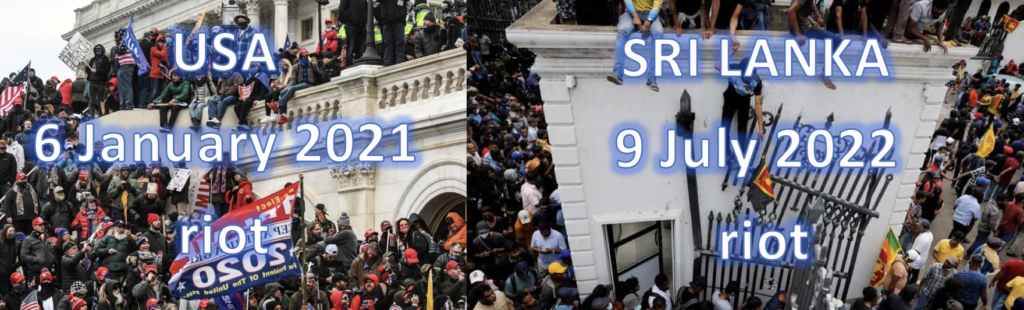
An 11 member far-right militia group Oath Keepers” are charged with seditious conspiracy for January 2021 while another group was also charged in January 2022 attacks on the US Capitol. More than 725 Trump supporters were arrested for their role in opposing transfer of presidential powers. Sedition is the attempt to overthrow, put down or destroy by force the government of the United States”. The Oath Keepers claim that the US Government has been corrupted by elites. The group is accused of using encrypted communications to plan the attack on Congress by creating several quick reaction force” teams to stop transfer of presidential power. If Capitol Hill riot was defined a ‘brutal riot’ by both President Biden & VP Kamala Harris, what makes Aragala riot any different?
The first group entered the building & proceeded to the House & Senate Chambers.
The next group confronted the security personnel.
As per testimony of the Oath Keepers leader, some of the groups had gone off mission”.
The lawyers for the groups defended their actions. They are also charged with resorting to violence to ensure their ‘preferred election outcome’.
The allegations also include instructions to prepare for a full battle on the streets.
Timeline of riot in the US Capitol
6 Jan 2021 – Congress to certify Joe Biden’s win.
6 Jan – 12p.m. – President Trump addresses supporters & calls on VP Pence to reject Bidens win. Thousands of Trump supporters gathered near the White House
m. – protestors storm outer police barrier around Capitol shouting USA, USA, USA”
1:30p.m. – protestors overcome the police. Police run into the building. Protestors breaks through police barricades.
m. – Protestors break windows and climb into the Capitol building.
2:20p.m. – building goes into lockdown. Evacuations begin of Top senators
2:38p.m. – Trump tweets calling support of Capitol Police & law enforcement. Tear gas is used and gas masks are sent for the Senators.
m. – Rioters break into Senate Chamber – they jump from balcony, they take photos & selfies, they rifle through papers, march through halls of Capitol, bang on doors, destroy property & break into lawmakers offices. A group of rioters chant break it down, break it down” overwhelming Capitol Police officers guarding Speakers lobby where lawmakers are sheltered. One of the rioters is shot & dies.
3:36p.m. White House Press Secretary tweets that Trump has ordered National Guards to arrive. More Trump supporters gather in Sacramento, California, Austin, Texas, Denver & Minneapolis.
m. Biden addresses nation. Biden calls protest an ‘insurrection’
m. protestors pound on State capitol doors & breaks windows. Demonstrations turn violent.
National Guards arrive & clear Capitol
m. Mayor of Washington places city on 12hour curfew
m. Twitter removes Trumps tweets and shuts down his account.
Capitol Hill autonomous zone” (CHAZ) vs Aragala Gotagama”
Protestors in US took over a six-block area near the police department in Seattle, a large city in Washington DC.
Protestors in Sri Lanka took over several areas in the heart of Colombo.
The Seattle autonomous zone” was created as part of police brutality against African Americans. The zone had free food, a co-op station, volunteer medics, music 24×7, art & drama, it became a place for people to just hang out, people began camping overnight, tents were put up, water and soap were provided, so were toilets, those living in apartments became regular visitors, there was a large kitchen, a large screen playing movies.
Like in Gotagama, the autonomous zone in Capitol Hill were struggling to name their leader” as too many were making claims.
On 7 June 2021 a man drove his car into the Capitol Hill autonomous zone, days later 2 men were shot, one died, several more shootings took place.
Sri Lanka saw no deaths or mass shootings.
While President Trump ordered to take back the city, Sri Lanka’s President allowed the gotagama to continue.
Some Seattle residents are suing the City on account of the autonomous zone being a public place & illegally trespassed on. A likely scenario in Sri Lanka too.
Reporters were not allowed into the Capitol Hill Autonomous Zone (Fox News)
Majority of media channels were very much involved in GotaGama.
On 22 June 2021 the City of Seattle requested the people inside Capitol Hill Autonomous Zone to leave as they had set up a Postal service inside the zone. In Sri Lanka ironically GotaGama put up a grama sevaka and a postal address too.
The Capitol Hill Autonomous Zone declared independence – luckily even after 90 days of illegal occupation, GotaGama has not done same.
Role of Social Media in riots in Capitol Hill & Sri Lanka
Misinformation, foreign interference & hate speech were key features that increased both riots. Online mayhem has been identified as hitting 40,000 false news” an hour. Facebooks role in the event was disclosed by whistleblower Frances Haugen.
#STOPTHESTEAL in US was no different to the #GiveBackOurMoney.
Capitol Hill rioters like Aragala were recording their arson” and relaying across social media platforms while supporters celebrating online.
It took a year for US lawmakers, researchers & journalists to examine the role of social media in US but it should not take so much time in Sri Lanka. Congress has even criticized companies for their role in the riot – many companies in Sri Lanka shoulder blame too.
Washington Post among others investigated & found evidence that Facebook played a ‘critical role in spreading lies that fermented the violence on 6 Jan” – at least 650,000 posts across FB groups attacked Biden’s Presidential victory with many calling for political violence.
According to UK journalism professor Al Cross – Disinformation is worse than misinformation as disinformation is purposeful and intentional.
Ironically, how can factcheckers themselves be trusted if they also are paid to claim their version as ‘fact’.
The ‘megaphone’ lay in the hands of the Capitol Hill rioters on 6 Jan & in the hands of the Aragala bandwagon of supporters on 9Jul. They wrote the narrative and they decided what was right.
The calls to overwhelm barricades & cops were identical in both US & Sri Lanka riots.
Social media was used extensively by both rioters.
Corrupt politicians need to hang for their treason” was a call from US and not Sri Lanka but obviously echoed similar lines.
Another noteworthy feature was how supporters of the riots in both US & Sri Lanka bragged about the chaos they had helped create & were proudly sharing minute-to-minute developments across social media platforms.
If US analysts now blame fake news & spreading misinformation & disinformation to make the riot worse – would it be any different in Sri Lanka?
If some rioters were part of anti-fascist movements in US – was the situation any different in Sri Lanka?
However a noteworthy difference was how the US was quick to accuse Russia of interfering into its internal affairs, the US envoy to Sri Lanka visited or invited virtually all of the key players involved in Sri Lanka’s riot. The general calls were to allow peaceful protestors” to protest and a subtle message not to take any action against them. Inspite of breaking barricades, scaling walls, illegally trespassing and breaking iron gates as well as breaking state property, damaging them and even stealing them and illegally occupying 6 state venues – the diplomatic community that referred to these protestors as peaceful” have not uttered a word on the damage done. Their silence may have to be broken when more images or the scale of the damage is released.
The riots and the scale of the riots in US came nowhere near the damage done by the rioters in Sri Lanka, yet US appointed a House Select Committee to Investigate the January 2021 attack on the US capitol.
By May 2022 the Committee had interviewed over 1000 people. In July the interim report was released.
The US Justice Dept too commenced investigations to prosecute the rioters.
In January 2022 the Oath Keepers were indicted on sedition charges. In June the Proud Boys group has been also charged with sedition. 860 people across 48 states have been charged with crimes connected to the riot.
5 have been charged with ‘oppose by force the authority of the government’. The lawyers claim the defendants had no plan to storm the congressional building – obviously the same argument will be used by lawyers who will represent the aragala rioters.
The flip side of the participants of the riots in US and probably for rioters in Sri Lanka is that their selfies and self-publicity across social media platforms have provided the evidence needed for authorities to charge them. The US have compiled people who have spewed hateful rhetoric, spread disinformation, spurred rioters on. Prosecutors have also tabulated those trying to destroy their social media post evidence. Deleting these has proven far worse than keeping them. Even the Justice Department looked at the manner violence and property damage was encouraged and what was destroyed, where they went inside the buildings and whether they have shown sincere remorse.
These are all factors for the investigations into the riots in Sri Lanka on 9 July 2022 too.
Those who claim to uphold rule of law & democracy must not simply mouth it but act it – as per modern format of representative governance, people are elected by an election or rejected by an election not be gathering into groups to chase away a legitimately elected leader. It is setting an ugly precedent which may swell into corporates as well and should not be encouraged. Creating a problem is easy – solving it is virtually impossible.
While everyone is distracted with the horse trading and the Parliament Puppet show to elect the next President and the Aragalaya, at this time questions are being raised as to whether there in a Air-Sea and Cyber Blockade of Sri Lanka to stop fuel arriving in the country from Russia or Iran since the first week of June? These countries do NOT trade in ‘exorbitantly privileged’ US Dollars. There seems to be a fuel embargo on Sri Lanka to deepen the crisis caused by the Staged Default, these months of June-July by starving the economy while US controles Sri Lanka’s Oceans and Airspace – see this link:
Sea Vision Training US Department of Defense Field operatives in Sri Lanka June-July training SL Navy:
Who controls the SL Navy and oceans is a legitimate question to raise as ships bringing fuel in June and July disappeared and fishermen cannot go to sea due to lack of fuel…?
No Sri Lanka media have covered this story for the past 3 days that 120 Sri Lanka-bound flights diverted to Kerala’s Thiruvananthapuram and Kochi airports
Meanwhile many of the Araglaya ‘Protestors’, (who gave the game away by supporting the IMF), are like those in the Arab Spring/ Colour Revolutions, CIA controlled to enable installing a US-Backed Military Dictator – Ranil WIckramasinghe – to deliver Sri Lanka to the Washington Consensus to dollarize the country and Digitalize the citizens using the Social Safety Net narrative. This will be after re-naming South Asia’s second wealthiest country with the best Human and Social indicators in the Region a Least Developed COuntry (LDC), with the aid of the UN agency Disaster Capitalists – WHO, UNICEF, FAO, ILO etc.
Sri Lanka will then become a US military base to service the QUAD war Machine, as was initially planned with the MCC Compact, now with the IMF project..
This is a QUAD operation to enable US colonization of the strategic Indian Ocean island.
Sri Lanka is the first Domino to Fall in the New Cold War in America’s mythical “Free and Open Indo-Pacific”! But there is a new blockade preventing analysis of the BIG PICTURE re. the New COLD WAR in the Indian Ocean.
India play acts with Union Aviation Minister Jyotiraditya Scindia applauding Thiruvananthapuram and Kochi airports on Wednesday for going out of their way to help the crisis-hit nation!
These are not conspiracy theories but have US Intelligence Names – Over the Horizon (OTH) operations for Full Spectrum Dominance (FSD) of small strategic countries to be COLONIZED!
Behind the food and fuel shortages causing Sri Lanka’s protests lie unmanageable debts to the West. The only answer to worsening humanitarian catastrophe is an immediate write-off.
On Sunday, demonstrators broke into the lavish private residence of Sri Lankan President Gotabaya Rajapaksa. As protesters swam in his pool and made use of the gym, Rajapaksa finally succumbed to popular demands and promised to resign. But as he flees the country and a state of emergency is declared, it is unclear whether the victory for people power the resignation represented will open up solutions to the debt crisis that has brought the country to a standstill.
The Rajapaksa government has faced months of protests against its mishandling of the country’s economic collapse, as shortages and skyrocketing prices of food and fuel have made normal life impossible. Hospital workers in the capital Colombo have been on strike to demand supplies of medicine and fuel—since the government suspended petrol sales to the public at the end of June, they cannot get to work.
The imminent humanitarian catastrophe facing the Sri Lankan people is the result of debt. In May, Sri Lanka became the first default of this period of spiralling global food and fuel prices, in the wake of the Russian invasion of Ukraine. The country has effectively run out of fuel, with little prospect of new supplies—it has run out of money, so cannot afford to pay its suppliers. Its foreign reserves are down almost to zero, after the government spent months in a futile attempt to avoid default by keeping up with unmanageable debt payments, mostly to Western banks and bondholders.
Protesters are demanding that a new government develop an urgent programme to provide food, fuel, and essential services. It is not yet clear how responsive any new government will be to demands from the street, given the dominance of Parliament by the Rajapaksas’ party, and a likely long timescale for elections. But any new government will face an unchanged economic impasse—it needs resources immediately to pay for essential food and fuel to keep people alive, but its debts mean it cannot access them.
Unmanageable Debt
Sri Lanka is unlikely to get relief any time soon. A new government is likely to restart negotiations for a new loan from the International Monetary Fund (IMF), which will demand that it come to agreement with its creditors to reduce its debts to a sustainable level—otherwise the IMF loan will go straight into corporate pockets in debt repayments.
The negotiations could take years. Zambia has been trying for twenty months to persuade its private lenders to restructure its debts, without visible progress. When Sri Lanka finally defaulted, Hamilton Reserve, a bondholder based in the tax haven of St Kitts and Nevis, immediately sued Sri Lanka in the US courts to demand repayment in full, regardless of the country’s inability to pay.
The extremity of Sri Lanka’s situation is partly a result of the Rajapaksa dynasty’s debt-funded infrastructure projects, brutal civil war, and tax cuts. But many countries are facing similar problems—the global food and fuel crisis is also a debt crisis. Last week, Ghana followed Sri Lanka in requesting an IMF loan, and is likely to be told that it too must negotiate with its creditors. Large countries like Pakistan and even Turkey could follow. As prices of food and fuel have rocketed in the wake of the Russian invasion of Ukraine, lower income countries across the world face being pushed over the edge into economic meltdown.
Even before the Russian invasion, lower income countries were facing a growing debt crisis. Fifty-four countries were in debt crisis globally, up from thirty-one in 2018. Debt levels have grown dramatically over the last ten years, as private lenders looked for returns in a period of cheap money and low interest rates in the West, where riskier bonds issued by lower income governments still promised hefty levels of interest. Lenders were gambling that countries wouldn’t face external shocks that would interrupt the economic growth necessary to pay off the debts and interest.
Of course, those shocks materialised, in the form of the pandemic and now the Ukraine war. Lower income country governments borrowed to support communities and for the healthcare response to the pandemic, as income from tourism and many exports crashed. They borrowed far less than rich countries, but at much higher interest rates. They were unable to afford the massive economic stimulus given to rich economies, and emerged with weakened economies burdened by dramatically increased debts. They were in no position to confront a further shock, when Western sanctions on Russia and the Russian blockade of Ukrainian ports reduced food and fuel supplies.
Many lower income countries are heavily dependent on Russian and Ukrainian wheat production—Sri Lanka receives forty-five percent of its supplies from those two countries. The globalised food system means that wheat price rises lead to rising prices across the board. Since the US deregulated commodities markets in the 1990s, rampant speculation on food prices has led to price volatility that can become extreme in the event of a major shock, forcing prices up beyond the means of many people and countries, even as overall food production levels hold up.
Fuel price increases have made fertilisers increasingly unaffordable, leading Sri Lanka to temporarily and disastrously ban imports in April 2021 and demand its farmers make an overnight and chaotic transition to organic farming, with a devastating impact on subsequent harvests. Lower income countries often lack food security because their economies were orientated away from self-sufficiency by colonial powers followed by the structural adjustment programmes of the IMF, which prioritised the production and export of food crops for the international market.
Countries have managed the escalating crisis by subsidising food and energy, to keep them at affordable levels for their populations. But the IMF is demanding the removal of these subsidies, and the imposition of new taxes on food and fuel, as part of its austerity conditions for new loans.
The impact is disproportionately felt by poorer people within lower income countries because they spend more of their income on food and fuel, just as poorer households in the UK are being hardest hit by the cost of living crisis here.
A Growing Crisis
All the indicators are that the crisis is just beginning. Rising price inflation has provoked the US Federal Reserve to raise interest rates, which will make it more expensive for lower income countries to repay dollar-denominated debts, including by taking out fresh loans, as interest rates risk on international financial markets and the dollar increases in value. Simultaneously, higher interest rates in rich countries are leading to capital flight, as investors seek safely profitable investments.
Meanwhile, the climate emergency is causing catastrophic droughts and famines in some of the world’s most indebted countries, including Chad, Ethiopia, and Somalia, all of which are heavily dependent on Russian and Ukrainian wheat and other food imports.
For the Western powers, it’s always someone else’s fault. The food and energy crisis is explained as an automatic consequence of the Russian invasion, without mention of the record profits of energy companies or food speculators. The failure to make progress on restructuring debts is all the fault of China, despite the fact that a far greater proportion of debt is owed to Western bondholders, who failed to participate even in the G20’s limited debt suspension initiative. Sri Lanka has been widely presented as a victim of a mythic Chinese ‘debt-trap diplomacy’, despite an almost complete absence of evidence.
Western leaders continue to point to the G20 Common Framework as the solution to the debt crisis. A response to the pandemic, the Common Framework was supposed to allow countries in debt crisis to restructure their debts in a coordinated way with all of their creditors—yet twenty months on, no debts have been restructured, largely due to the recalcitrance of private lenders.
Western banks, hedge funds, and oil traders, who lent at high interest because of the risk, are refusing to accept that the pandemic and food and fuel crisis mean they have lost their gamble. In most cases they are continuing to be paid the repayments and interest they demand, even as people in lower income countries go down to one meal a day to make ends meet. Indeed, many of the creditors bought the debt at knock-down prices because of the likelihood of defaults—if paid in full, BlackRock could make 110 percent profit on its Zambian debt.
Cancel the Debt
But this situation cannot last. It is unimaginable that lower income countries will continue indefinitely supporting BlackRock’s profiteering while their people lose livelihoods and can’t feed themselves. Waves of protest are shaking many countries, and the Sri Lankan government is unlikely to be the last to fall. Debt cancellation is a demand of protesters and a coalition of civil society leaders. In Tunisia, the powerful union movement is preventing an authoritarian government from capitulating to IMF austerity demands, strengthening its hand in ongoing negotiations. In Argentina, a deal with the IMF has split the government and mobilised the streets against compliance.
Western leaders may care little for the welfare of communities in lower income countries—but they will care about this growing wave of instability, particularly if large countries default and destabilise the international financial system. It will be complex and difficult to herd private creditors into fair and sufficient debt restructurings and cancellation, to bring debt down to sustainable levels and address Chinese concerns about bailing out Western banks—but on the scale of global challenges, not that difficult. It simply requires political will in the G7 to reform a discredited system that currently only benefits corporate freeloading.
The Sri Lanka crisis, likely to be followed by a looming Ukrainian debt restructuring, should be the wake-up call. In the short-term, Sri Lanka needs resources now: the IMF should provide an immediate loan, on the condition that it not be used to pay off creditors.
But systemic change is overdue. Replacing or strengthening the discredited Common Framework is one of the simplest single things that world leaders can do to address the multiple crises facing lower income countries. A system that allows countries to suspend debt repayments in the event of external shocks, and cancel debts when they go bankrupt, will be essential for addressing the climate emergency as well as the food and fuel crisis. The world cannot continue to stagger on with the delusion that all debts can and must be paid, no matter the scale of the emergency.
In recent days, Power generation is being disrupted as per the demand due to sudden power and gas crisis in the country. This has increased load shedding in the country, including the capital Dhaka. According to media reports, load shedding is going on for six to eight hours in some districts including Rajshahi and Rangpur in the northern part of the country. Dhaka, Chittagong, Barisal, Sylhet and Mymensingh divisions are experiencing three hours of load shedding every day.
Due to this, the city dwellers have become restless in the heat and industrial production is being hampered to some extent. Due to load shedding, the cost of buying diesel and running the generator is increasing. Many are not able to ship on time. State Minister for Power, Energy and Mineral Resources Nasrul Hamid cited the Ukraine-Russia war as the main reason for the disruption of global energy supply and the continuation of the crisis.
According to the Department of Power Development, 52% of the country’s natural and LNG gas is used for power generation. The government has decided not to buy LNG now as the price of LNG has gone up in the world market. Will buy again when the price goes down. As power generation has declined due to the gas crisis, the power department has been forced to carry out load shedding.
Global crisis
The recovery from the Covid-19 attack and the Russia-Ukraine war have made the fuel market extremely unstable. The international food market is also volatile.
This crisis is not only in Bangladesh, a developing country, but also in many developed countries. No one was ready. Europe is in a serious crisis. Russian dependence has put them in danger. They never thought Russia would cut off gas supplies. The war has changed the situation. Crisis has also occurred in Japan, Taiwan and India. People are protesting in different countries.
There is an emphasis on making the use of electricity economical. It is uncertain how long the energy crisis will last in the world market. Due to this, the crisis has intensified as the developed countries have accumulated more energy from the world market and built reserves.
The countries of the subcontinent are also facing energy crisis. Due to the crisis in Pakistan, the process of austerity in the use of electricity has continued. Everyone knows the dire situation of Sri Lanka in the energy crisis. Observers have described the power and energy crisis in the country as a “prediction” of Sri Lanka becoming a “predictor” and advised those concerned to be vigilant.
At this time, the price of fuel has risen in stages, this is the crisis we have been dealing with for the last few days. But developed countries like Japan have been dealing with the power crisis for two months. Neighboring countries India, Pakistan, Sri Lanka and Nepal are also facing load shedding.
Options at hands
There is no other way but to take measures to save electricity and prevent wastage. Otherwise, the crisis will intensify as the days go by. It is necessary to save electricity by identifying the low-importance and unnecessary use of electricity. Without going into any kind of blame game, we have to take effective steps to save and save electricity by judging and analyzing the world reality.
There is no substitute for austerity in dealing with the power crisis. The concerned departments of the government have to find out where the power is wasted, where there is redundancy and where the power can be saved. We have to think of saving electricity by reducing the office schedule and increasing the speed of work.
Wherever electricity can be saved, measures must be taken. There are electric billboards on various roads and highways in the capital and plans can be made to close them on time. Effective initiatives should be taken to stop illegal connections as well as to reduce system losses that have been going on for years. In order to ensure uninterrupted supply of electricity, emphasis should be laid on increasing domestic gas production.
So, the government is thinking of saving by reducing imports. And cost-saving load shedding is a tool for the government. It may be effective for a period of time. If prices rise, the economy will be under pressure. So cost-effective load shedding can be a temporary tool for the government. The alternative to load shedding is to increase the price of gas and electricity. But the extra price will create huge pressure for the customer.
Now the load management has to be done in such a way that the economic shock is less.
There is no problem with production capacity. The problem is the primary fuel supply. A large portion of power generation comes from imported fuels. Gas, fuel oil can all be bought, but the cost will go up a lot. Prices have doubled in countries like the United Kingdom and Hungary, and could double in the country as well.
Bangladesh needs 1500-1600 million cubic feet of gas to generate electricity. There we can deliver only 900 million cubic feet of gas. It can’t afford more gas. As it has to give priority to agriculture and industry. Fertilizer is essential for agriculture. We also have to pay a lot of gas for fertilizer production. Moreover, now the country’s economy may be under pressure to import LNG from abroad at high prices.
Undoubtedly, until recently, the Awami League has given load shedding free electricity facility to 100% of the people of the country. But now, as a result of the Russia-Ukraine war, the global energy crisis has fallen on Bangladesh. So, experts are seeking the answer, Will the reputation that the present government has gained among the people of the country by stopping load shedding be tarnished?
Sufian Siddique is a researcher and freelance columnist.
In recent times, Bangladesh most often gets significant global attention for her geopolitical quandary, US- backed targeted sanctions on security apparatus and climate disasters, while ignoring its significant and proven contribution to humanitarian activities. Though Bangladesh’s realization of humanitarian diplomacy has not been developed for many years, an impressive record of development and growth since the last decade owing to the demographic dividend, robust ready-made garment exports, remittances, and comparatively stable macroeconomic circumstances motivates the country to use its soft power through humanitarian assistance.
Natural calamities including cyclones, floods, droughts, earthquakes, heatwaves, forest fires, severe food and energy scarcity caused by the Ukraine-Russia conflict, the COVID-19 pandemic, the Sri-Lanka crisis, and the Afghan humanitarian catastrophe remind South Asian countries to revitalize the SAARC food bank and the SAARC disaster management framework to navigate economic and humanitarian turmoil in member nations. Unfortunately, no major breakthrough in regional cooperation and coordination has happened till now due to the respective countries’ narrowly defined geopolitical calculation.
It is evident that Afghanistan, under the new Taliban regime, is confronting a wide range of challenges from severe economic and humanitarian crises to a lack of inclusive governance, international recognition, Human rights, and terrorism concerns. But among them, humanitarian challenges have intensified in parts of Afghanistan recently when a powerful earthquake on June 22 killed some 1,150 people, including at least 155 children, and destroyed or damaged hundreds of homes in the hardest-hit southeastern Paktika and Khost provinces.
While the Taliban are hoping for support from the international community, many Asian as well as western countries hesitate to extend assistance as no country has yet recognized the Taliban government, not even the nations seen as closest to the regime, such as Pakistan or China. Moreover, after the Taliban’s rise to power on August 15, Western countries froze billions of dollars in Afghan central bank assets, including $10 billion held by the US Federal Reserve. Additionally, Western countries also suspended financial assistance to Afghanistan, a nation that is heavily dependent on aid and accounts for 43% of the country’s GDP.
However, while many Western developed nations bypassed their responsibilities towards the Afghan people, it is really praiseworthy that Bangladesh has delivered a sizable amount of emergency relief in the form of dried food, blankets, tents, and medicine to earthquake-hit Afghanistan as part of its ongoing efforts to broaden its network of humanitarian aid. Needless to say, Bangladesh earlier sent Tk. 10 million to the United Nations Office for the Coordination of Humanitarian Affairs (UNOCHA) to assist Afghan people when the country plunged into deep social and political turmoil after the Taliban took over following the withdrawal of the US military from the country.
Afghanistan expressed their gratitude to Bangladesh for the assistance, which is a manifestation of the Bangladesh Prime Minister’s commitment to the collective prosperity of South Asia and its people. The move, without a doubt, is a realistic evidence of the PM’s policy of regional brotherhood, the integrated development of South Asia and policy of cooperation towards everyone, regardless of their geopolitical alignment.
Thus, Bangladesh’s humanitarian approach effectively contributed to alleviating the acute shortage of food, shelter, and social services, ensuring the inclusive socio-economic development of Afghanistan and rebuilding their country. Bangladesh is also keen to be a partner in Afghanistan’s developmental process as Bangladesh seeks to enhance regional cooperation for the attainment of a vision of shared prosperity for the region.
Bangladesh only gained independence 50 years ago, and thus it wasn’t that long ago that the country itself needed the humanitarian assistance of other countries to survive. Now, it has gone a long way on the road toward nationhood. It sets the greatest humanitarian example by expressing solidarity with the Rohingya refugees from Myanmar. Despite the huge burden on the economy, food management, and limited resources, the country has been generously hosting more than a million Rohingya refugees for over a half-decade purely on humanitarian grounds.
Despite the fact that Bangladesh is not a signatory to the 1951 Refugee Convention, its economy is burdened with an estimated $1.21 billion in annual support for the Rohingyas, and the cost may rise as their population grows, inflation rises, and foreign funding declines. Even Bangladesh, with its own financing at a cost of over Tk. 23 billion, has set up a modern-township at Bhasan Char to relocate more than 1 lakh Rohingyas with better living standards for them.
The history of the so-called “basket case” has changed. Bangladesh, as a friend and neighbor, recently provided a humanitarian potato aid package to Sri Lanka in a bid to resolve the ongoing food crisis in the country. Earlier, Bangladesh provided $2.3 million in emergency medical supplies and $250 million in the form of a currency swap to Sri Lanka, an island nation experiencing its worst economic and humanitarian food crisis since 1948, to replenish the island nation’s fast-depleting foreign reserves and ease pressure on its exchange rate.
It is to be noted that in the past, Bangladesh has provided relief by responding swiftly to natural and humanitarian disasters in other South Asian countries. In the immediate aftermath of the catastrophic floods in Pakistan and Myanmar and the devastating earthquake in Nepal, the Bangladesh government’s emergency relief and medical assistance were widely praised by the people and governments of the two countries.
Bangladesh, now ranked first out of eight countries in South Asia and fifth out of 121 countries across the world in Covid recovery index, expressed solidarity at its neighbor in critical state of Covid pandemic and offered emergency medical and safety equipment supplies to China, India, Bhutan, Nepal, and Maldives to combat the massive surge in the coronavirus cases.
Bangladesh also extended its helping hand to Sudan, a poor African country unable to repay a loan from the International Monetary Fund (IMF). In response to the IMF’s call, Bangladesh stood by Sudan and granted a “debt waiver” of $650 million on June 15. Earlier, Bangladesh had also given similar benefits (provided 0.70 million SDR) to Somalia to break the shackle of poverty as part of the IMF initiative.
Experts believe that Bangladesh is now looking at deeper integration with its neighbors, ultimately branding Bangladesh positively by building its image globally. The country’s continuous support and its vocal stance on the Rohingya crisis in Myanmar, the Israeli occupation of Palestine and its active attempts to assist people in crisis around the world have made the country “a symbol of humanitarianism”.
Sri Lankans make a unique and hilarious knicker-twisted nation, exasperated over lengthy fuel lines to the point of ousting a president and then entire families sweating lengthier lines under umbrellas to see his residence.
Any uprising cast as being spontaneous invariably runs into a bunch of problems, the most serious being the one about credentials. Who speaks for the aragalaya, one could ask. If anyone claims he/she speaks for the aragalaya (and many have, as individuals or groups), the immediate question is, who gave him/her the authority and on what grounds? This of course doesn’t necessarily mean that spontaneous mass uprisings are bad or are bound to fail. Sometimes things unfold and it is in the unfolding that leaders emerge.
As one might expect, the surge, whether all spontaneous or subtlety orchestrated (yes, such things happen too), made many want to have a piece of it. It was a low-cost adventure for many who had for years benefitted from a rotten system but had never once complained. Yes, they would whine now and then when preferred parties/politicians were out of power but even when sworn enemies were in power, they never balked at exploiting the very same rotten system.
There were those kinds of people, largely Kolombians who had most likely voted for Ranil/UNP or Sajith/SJB, Kolombians who were suffering from lifestyle deprivation but were certainly not feeling anything like the pinch that most people in the country were experiencing. They were a small but significant minority in the aragalaya. Their posts were in English. When they tried to speak in Sinhala, it was actually funny. Mind you, the issue was not that Sinhala was not their mother tongue.
Why am I talking about these politically marginal set of people, you may be wondering. Well, there’s a note that’s being circulated titled ‘’Why did we join the aragalaya?’ It is signed by ‘We, the people.’ Obviously convenient but possible dodgy. An interesting and telling read, though.
Here it is: 1. WE…protested against the Rajapaksa regime. 2. WE…protested against corruption, nepotism, violation of the rule of law and of human rights. 3. WE…protested in favour of economic stability, civil liberties and rights, the upholding of the constitution, the legislature and the preservation of our democratic values. 4. WE…protested as a Sri Lankan along with my brothers and sisters, for what I believed would be a new future for my country that is shaped in accordance with our constitution. 5. WE…DID NOT PROTEST in favour of anarchy, violence or to empower subversive elements who would deem to overthrow our democratic values. What’s happening now is NOT OUR ARAGALAYA!
In Number 4, there’s a slip from ‘we’ to ‘I’. I noticed in similar posts that this has been since corrected. It’s a personal angst obviously, but then again it is collectively subscribed to, going simply by the fact that it is being shared on multiple social media platforms. Ok, that’s out of the way.
So, ‘these people’ claim they protested against the Rajapaksa regime. Fair enough. They’ve protested against corruption, nepotism, violation of the rule of law and of human rights. Again, legit. Now, is it the case that all these nasties (corruption, nepotism, violation of the rule of law and of human rights) was the preserve of Gotabaya Rajapaksa or indeed the Rajapaksa clan? Obviously not. We saw such things galore even during the Yahapalana times during which there was little ‘yaha’ and even less ‘palana’ and, mind you, without having to deal with decades long buttressing of the import mafia, dependency on remittances and tourism, Covid-19 related shocks that lasted for two whole years etc.
Here are some questions: did ‘these people’ a) benefit or not from ‘the system’? b) did they always vote SLFP (or SLFP-led coalition) or did they vote for Ranil/UNP or Sajith/SJB? c) did they ever protest these nasties when the UNP or UNP-led coalition or coalitions the UNP was part of?
There’s talk of economic stability, civil liberties and rights, the upholding of the constitution, legislature and the preservation of democratic values. Lovelies, all of them, BUT, again, were these things sitting pretty until November 2019? We can run through three to four decades, name parties, name individuals and name ideologies and policies that took potshots at one and all. So here’s the question: did these worthies utter a single word about those other transgressions?
The darlings are claiming that they did not favour anarchy, violence or empowerment of subversive elements who would deem to overthrow democratic values. Lovely. Let’s break it down.
Throughout this aragalaya there were calls for and affirmation of anarchy. Sure, not all aragalists were anarchists in ideological bent or in action, but only the myopic and naive could dismiss the possibility that anarchy of the worst kind was festering and could very well erupt. Forget all that. Did these lovelies who are now in whine-land ever once say ‘hey, hey, hey…ease off guys’? Mirihana. Rambukkana. Warakapola. Temple Trees. Galle Face. President’s House. Ranil Wickremesinghe’s residence. Parliament. And let’s not forget the vandalism, arson, thuggery etc., that followed the unleashing of thugs from Temple Trees by forces beholden to or controlled at that time Mahinda Rajapaksa. Who called for, who indeed demanded anarchy and violence? Who called for and demanded subversion, who indeed subverted? What were the democratic values affirmed by pillage, destruction of public property, arson and thuggery? Why this sorrow now, but not then? Is it ok to be selective about these things? Is it ok to just go along, look askance when unpleasant things happen until the process yields an outcome that is, well, ok? And if the outcome is ok for you but not for others, if those others continue to do what you called for, cheered, took part in perhaps or supported one way or another, do you have a moral right to object?
Regardless of who started the fire (and it was certainly not lit in November 2019), if those who were mandated to quash it did not or could not, regardless of unforeseen and unfortunate circumstances (Covid-19, which by the way Gotabaya Rajapaksa did much to quash — efforts which were scoffed at by, I suspect, ‘these [very] people’: no cheers for all that by the way), then they can, do and even must come under fire, so to speak.
People were angry. People protested. Legit. People made demands that could not be delivered. That’s ok, for that is all legitimate in politics. Gotabaya could have come clear, said the unpalatable truths, expressed regret for errors despite good intention (let’s say), stated options being considered (if there were any) or simply said ‘there is a crisis of legitimacy, I agree, and therefore I believe that the democratic thing to do is to hold elections so the people can decide for themselves.’ He didn’t. Is that enough to call for his blood, though? If it was enough, then why didn’t ‘these people’ call for the blood of other who did much worse for so many decades?
Democracy. Let’s get back to the word/term. There are values associated with democracy and ‘these people’ have mentioned this. There’s also a thing called ‘representation.’ And so, sorry lady/ladies and/or gentleman/men, we need to unpack ‘the people’ a little, if you don’t mind.
How do we know what a collective really wants? How do we obtain the popular will? Well, elections. Sometimes there are mass uprisings. Mass uprisings can be orchestrated, particularly in times of hardship, but let’s assume that’s not what happened here, just for argument’s sake. So yes, there’s a mass uprising. What was it about? Well, it was reduced to evicting an elected president. There were some noises about system change, yes, but nothing to write home about.
And so you had ostensibly classless, religion-free, ethnicity-erased and even ideology-free people coming together. They even said it was a ‘nirpaakshika aragalaya’ or a struggle free of political parties. Now, they got what they wanted: Gota left. All well and good. Now what? Struggle done and dusted? Victory achieved? Now that Gota has gone home, should everyone else also go home? But why should everyone go home? There was no agreement was there that if and when Gota does go home, everyone would pack up and go home themselves? Things evolve and even if they didn’t, there are people out there who are not necessarily ‘these people.’ They have political aspirations whose shelf life haven’t expired. There was no referendum on what ought to happen, after all. It was assumed that the entire country, the entire voting population wanted Gota out. Now, without a referendum, can anyone claims that the entire country wants the aragalaya to fold up and the aragalists to go home? That’s the problem of representation. No election, no way to verify anything like that. If some want to go home, sure. If others don’t, so be it. And those who left cannot tell those who didn’t ‘well, the kind of anarchy we cheered is no longer acceptable.’
Democracy. There’s more to it. ‘These people’ didn’t give a hoot about established democratic procedures and institutions until Gota left. They didn’t give a hoot about constitutionally sanctioned procedures. Now, all of a sudden, they are swearing by the very same institutions, values and processes they themselves were ever ready to subvert.
‘These people’ claim, ‘What’s happening now is NOT [THEIR] ARAGALAYA! So what happened before ‘no’ WAS their aragalaya? The arson, thuggery, looting, pillage and destruction of public and private property before July 9 WAS their kind of Aragalaya? And is it that THEIR aragalaya is done? Is Sri Lanka now ‘all set’? Is there no political crisis any more? Has the economic crisis been resolved?
Let’s hypothetically fast-forward to, say, August 9, 2022. There are still long queues for petrol and diesel. There’s still galloping inflation. The constitution is intact (interesting fact: talk of repealing the 20th, restoring the 19th and so on seems to have disappeared). Presidential powers: intact. Sajith Premadasa is the President. There is no IMF bailout or there is and they’ve imposed conditions which exacerbate inequities and deprivation over and above ensuring chronic dependency and slavery. People are as or more anxious, fearful and incensed as they were in April, May, June and early July, 2022. The people storm the barricades. The people weather teargas, disregard water cannons, brush aside policemen and soldiers and aim to re-take President’s House, Temple Trees, Prime Minister’s office and the Presidential Secretariat. What would be the take of ‘these people’? Would they spur the aragalists to do what they’ve done in all these past few months? Would they say ‘go ahead and threaten politicians’? Would they, on social media platforms egg them on to search, ransack and burn houses? And if all that did happen, would ‘these people’ (as they did before) remain mum?
‘These people’ are not woolly-headed. They are not in cloud cuckoo land. They knew and know what they wanted/want. There are outcome preferences that have nothing to do with systems, systemic flaws and assaults on the rule of law, democratic institutions and values, and human rights.
‘We the people.’ I would love it if anyone who has posted, re-posted or shared that note has the courage to put his/her name to it. Then, we can do a background check and figure out who is who and what is what. In the name of democracy, decency, transparency etc., etc., etc. How about it, ‘[the] people’?
It is easy to make allegations, especially now that every one has access to social media. But subsequently, no attempt is made to take them to courts by the enemies of politicians who make these accusations.
See the book “Chavura Rajina”[Bandit Queen] on Chandrika Bandaranaike written by Victor Ivan
indicting Chandrika. Only thing she was finally indicted upon was the Water’s Edge land case. Every one has to be presume innocent until proven guilty. Yahapalanaya came to power with the express statement that they will investigate the Rajapaksas. A special unit was set up, with people like Champika R and Rajitha S driving it, sworn foes of the Rajapaksas.
They dug up the properties looking for loot etc., and also autopsied the bodies of the ruggerite several times. There is no doubt that there was financial corruption, esp with Basil Rajapaksa’s deals, or with Ravi Karunannayak, Bond scam etc., but why did the other side fail to prove in any of the claims? After all, there was no shortage of vindictiveness and wish to get revenge! Perhaps they (govt and opposition) and the courts are all corrupt and cover each other?
Then there is no point in talking. The last king of Kandy [Sri Wickremasinghe] was allegedly a tyrant. We have all heard of how he ordered the mother Ehalapola Kumari to pound the head of her baby etc. Sri Wickrema R was a victim of intrigue among the Adigras, some of whom worked secretly with the English. The king was caught and treated ignominiously by the enemy Adigars and handed over to the English. However, the British treated him with the decorum and dignity due to a king, both on land and even in exile. Even in the second world war, when heinous Nazi Generals were captured, they were treated with the dignity and decorum that was due to them. according to their rank.
I am no dedicated supporter of Rajapaksas; and GR must go as he has shown his incompetence as an executive president.
He is finally responsible for all failures of his regime even though he can say that he acted on the advise of his economic advisors (Prof. Lakshman, Cabral and others), and his agriculture and medical advisors (Prof. Priyantha Yapa, Dr. Padeniya, Prof. Channa Jayasumana, Ven. Ratana etc).
But when the Bolsheviks captured the Family of the Tzar, they ruthlessly killed even the young children. The extreme wing of the Aragala is nothing but the same sort. They allegedly threatened to burn the houses of Colombo judges if they allowed the road closure request made by the police on the 8th. Allegedly, they have threatend to burn the house of the IGP and others if the police lays charges on any Aragalaya people (according to soical media, and a news item in the Island)!
This is Fascism.
The language used in political discourse in Sri Lanka now lacks any sense of fair play, dignity and decorum. Today, the political discourse is that used by street politicians with their cries that started in the old days as “Bhangaweva or now, “Kaerali karav, palayav, pannanamu, kudukramu, raamuva galavamu, kadamu, thalamu, puchchamu” etc.
There is no sense of decency or civility.
A man’s right to limb and life, and his right to be given a chance to state his side of the story etc., are all denied by the very people who talk of human rights when it fits them.
It is mob justice and lynching.
The trial can wait! Is it redundant?
Aragalaya may have started as a people’s protest and a farmer’s protest against lack of fertilizers, fuel etc., but today it has been hijacked by shadowy political elements and has passed into the hands of Fascists, as I think Ranil Wickremasighe (also a fascist?) has said.
But they are not there, no orgaization exists, to MAKE biodiesel, biogas, or plant manioc.
Doing those is SIMPLER, easier, and more helpful to the country and the down-trodden people than doing all this agitation and sowing vindictiveness.
Sri Lanka is supposed to be a Buddhist country. Whether you are a Buddhist or a Marixts or an agnostic, the logic behind the Buddha’s message contained in the parable of the man writhing in agony with an arrow in his body is unbeatable.
The Buddha asked, if you see a man writhing in agony with an arrow in him, do you spend time asking who shot the arrow (Gotabhaya Basil or Ranil ete etc?), from which direction did the arrow (USA or China?), what wood it is made of?, was the man shot a corrupt rascal worth of being shot etc etc?
NO.
He pointed out that all those questions are IRRELEVANT.
The ONLY acceptable course of action is to save the person from suffering, by taking remedial action.
Instead, we see that even in these email they are trying to apportion blame, distribute head bands for more violence and hate.
The consequences of these actions are clear. The wheels of the cart will follow the idiot donkeys who are pulling it, inexorably, to further anarchy.
SYDNEY (IDN) – After a White Australian of Christian background Brenton Tarrant gunned down 50 Muslims praying at a Christchurch mosque on a Friday, it took the New Zealand Prime Minister Jacinda Ardern more than a day to call it a terrorist” act, and when she did so, the mainstream media in Australia and New Zealand quoted Tarrant’s mother as describing him an angelic boy”.
Social media users across the world have condemned the Western tabloids’ attempts to humanize the killer, while ignoring those Muslims killed – many of whom had fled such terrorism in their own countries to find refuge in New Zealand. If the killer had a Muslim background, headlines across the world would scream Islamic Terrorism Strikes ‘Peaceful’ New Zealand’ and would have described the killer as an evil” person and a product of a violent religious culture.
This thinking was reflected in a statement released by Australian senator Fraser Anning from Queensland following the Christchurch massacre. He blamed the New Zealand immigration program that allowed Muslim fanatics to migrate” who promote a violent ideology” as the cause of the attack.
He was condemned widely in Australia for spreading such hate speech. But his diatribes distracted attention from the violent nature of Christian identity politics, which the Western media prefer to call far-right”, white supremist” or Neo-Nazi” violence.
They never call it Christian Terrorism” even though using violence to spread or defend Christianity has a long history from the crusades of the 11th to 13th centuries, European colonial conquests and to contemporary violence against Muslim communities in Western countries.
Four days after the Christchurch massacre, Australia’s only high-profile Muslim media identity Waleed Aly said on the popular TV Show he hosts ‘The Project’ that he was gutted, scared, overcome with utter hopelessness — but not shocked by extremists’ violence.
He added that some eight years ago the then Shadow Minister for Immigration had suggested at a party room meeting that the opposition should use community concerns that Muslims fail to integrate to Australian society as political strategy. Though he did not name the person, he was referring to the current Prime Minister Scott Morrison, who threatened to sue him for defamation but later withdrew the threat.
Needless to say, similar strategies have been used by mainstream politicians and political parties in the West – the most notable are U.S. President Donald Trump and French opposition figure Marine Le Pen – to drum up political support from their Christian bases. The media tend to use the word race” rather than religion to discuss such issues, even though the word Muslim” refers to a religion rather than a particular race.
Germany hosts the second largest community of Muslims in Europe numbering around 5 million and last year there have been over 570 attacks on Muslims, but, these attackers are always described as ‘far-right” or neo-Nazis” not Christian extremists”.
In June 2018, when nine French men and a woman were charged in a Paris Court for planning to attack veiled women, imams, mosques and halal grocery stores across France, the New York Times (NYT) said the group claimed they were fighting an Islamic peril” but nowhere in the report was the word Christian used, instead they were described as a small right-wing vigilante group”.
In 2005, the popular American Christian televangelist Pat Robertson publicly called on the U.S. government to kill Venezuelan President Hugo Chavez. He was quoted in NYT as saying it’s a whole lot cheaper than starting a war. And I don’t think any oil shipments will stop”. Though the newspaper did quote Venezuelan Vice-President Jose Rangel as saying that it is sheer hypocrisy for a nation supposedly fighting terrorism to let a Christian preacher make such a terrorist statement, NYT did not label Robertson as a Christian Terrorist”.
But, in 2013, Time magazine ran a cover story on ‘The Face of Buddhist terror” in Asia referring to how militant monks are fuelling anti-Muslim riots in Asia. But, when Christian evangelical preachers do the same it is not ‘Christian Terror’. Even the Burmese army that attacked Rohingyas were called a Buddhist Army” but NATO jets pounding so-called Islamic terror camps” in Afghanistan, Pakistan or Iraq are not called Christian Armies”. Applying the same logic as for Myanmar it can be said so.
Leave aside the crusades and European colonialism that destroyed the Inca civilization of South America, in the post-war era we have had a whole chain of Christian terror groups that have killed people and bombed communities. There was the Irish Republican Army that almost assassinated British Prime Minister Margaret Thatcher in 1984. In the 1970s and 1980s they terrorized the UK with bombings and assassinations but they were never called Catholic Terrorists” just merely IRA.
Between 1987 and 2004, the Lord’s Resistance Army (LRA) was involved in a terror campaign to create a Christian state in Uganda ruled according to the Ten Commandments. They killed thousands of people in the process and were described as one of the most ruthless terror groups in the world – even the U.S. State Department declaring them a terrorist organization. In 2005, LRA leaders were charged by the International Criminal Courts for crimes against humanity and war crimes. But, the western media never called them Christian Terrorists” just referred to them as LRA.
There is the infamous Oklahoma City bombing of 1995, which killed 168 people and two white Americans were ultimately convicted for the bombing. The media described them as belonging to a religious cult” or when it became obvious this was Christian they said both were radicalized by a Davidian religious sect” near Waco, Texas – a state well-known as a base of Evangelical Christianity movement that propelled both George W Bush and Donald Trump to the White House.
In China, when two Christian cult members were sentenced to death for murdering a woman at a McDonald’s restaurant, media reporting across Asia referred to them simply as members of a Chinese cult” even though it was stated in the reports that they belong to an underground ‘Church of the All Mighty God” that believes its founder is a reincarnation of Jesus Christ.
In the 1980s when the campaign for a separate Khalistan state for Sikhs in India intensified leading to the blowing up of an Air India flight flying between Montreal and London, and the assassination of Indian Prime Minister Indira Gandhi in 1984, these actions were described as Sikh Terrorism” by the western media, even though Sikh militants would like to call themselves the Khalistan Liberation Army”.
In north-east India there is a long simmering terror campaign in Nagaland to create a separate Christian state that has killed over 200,000 people, where the late American Christian evangelist Billy Graham has attracted pop-star status. Nowhere do we hear about Christian terrorists” in Nagaland, but, we hear a lot about the Hindu Saffron Armies”.
When I raised the question of why Turrant is not labeled a ‘Christian Terrorist’ when even his manifesto released on social media had references to threats facing Christianity, a Christian friend of mine in Sydney said: He is not a Christian. Because if one were to hold extreme Christian views, he would be handing out food to the poor.” Well one could make the same argument about the Muslims, Buddhists and the Hindus.
Perhaps the best strategy for the media, at least in Asia, would be to take religion out of reporting terrorism and investigate and analyse more mindfully the socio-economic issues that give rise to such conflicts. If that could be done, different religious movements could come together to help solves the pressing economic, social and environmental problems threatening human civilization, as the core values of all the major religions would entice them to do so. [IDN-InDepthNews – 01 April 2019]
Photo: Governor-General of New Zealand, Dame Patsy Reddy, lays flowers for the victims of the Christchurch mosque shootings at Hagley Park on 19 March 2019. CC BY-SA 4.0
Sri Lanka’s slide into political instability since April 2022 culminated in the resignation of former president Gotabaya Rajapaksa following public protests on 9 July 2022. The government’s policy blunders and resistance to course correction were blamed for unleashing the harshest economic crisis on the Sri Lankan population in recent history. The former president’s resignation paves the way for the formation of an interim all-party government.
Gotabaya Rajapaksa leaves behind an economy ravaged by shortages of essential goods, spiralling inflation and a historical-first debt default. Much of the blame for this sorry state of affairs can be placed on policy hubris.
The election-driven tax cuts and the stubborn resistance to reverse them were economically disastrous as COVID-19 pandemic-related spending pressures mounted. The central bank was made complicit in a money printing exercise that drained investors’ faith in the currency — which lost more than 80 per cent of its value. This was coupled with an overly ambitious pursuit of environmental goals namely the banning of chemical fertilisers which devastated agricultural output in the process.
There is no doubt that the COVID-19 pandemic magnified Sri Lanka’s economic problems, but plenty of other countries have emerged from the pandemic relatively unscathed. For a country with a large exposure to foreign commercial debt that is vulnerable to market volatility, the most credible move would have been to embrace sound macroeconomic policies out of its own understanding of the many risks involved.
Yet flawed policies and a refusal to redirect course narrowed the country’s options. In April 2022, Sri Lanka finally declared itself unable to service foreign debt and approached the International Monetary Fund (IMF) for a deal. Negotiations with the IMF on a staff-level agreement and separate debt restructuring talks with creditors had to proceed simultaneously.
Political stability is essential to such negotiations. IMF negotiations are centred on returning to a sustainable debt path and Sri Lanka will have to promise that it will run a primary fiscal surplus (before interest payments) within a specified period. This means that significant tax hikes across the board and spending cuts or freezes are expected.
Unlike IMF negotiations with which Sri Lanka has plenty of experience, debt restructuring is unchartered territory. Such negotiations are not easy given the current complex creditor landscape where each creditor wants an assurance of comparable treatment. Sri Lanka’s bonds are held primarily by a private-creditor base in the United States while its large bilateral lenders include non-Paris Club members like China and India.
China has already signalled a reluctance to an IMF-aligned debt restructuring of its loans, preferring instead to refinance rollovers. Among bondholders, potential holdout creditors need to be corralled to avoid costly lawsuits.
The timeline threatens to undermine economic stability further. Sri Lanka must present its debt restructuring plans for the IMF Executive Board’s approval on the bailout program. In the interim, the country will continue to struggle in securing the foreign currency inflows necessary to overcome import interruptions that have fuelled much of the public dissent.
Sri Lanka desperately needs a strong and stable government that can get things done. That will still be months away as a transitional arrangement is put in place. The proposed all-party consensus appears to suggest appointing an acting president and a prime minister who have the majority support of parliamentarians by 20 July 2022.
The new governing arrangement will have more legitimacy than the ousted regime, but it will still be beholden to narrow party interests present in such coalitions. In these circumstances, the new leadership must reassure the IMF and Sri Lanka’s creditors of its legitimacy to negotiate and its commitment to implement the terms of the agreement in the event of fresh elections and another change of leadership.
A fresh election that truly reflects the public mood holds the key to Sri Lanka’s future. The country needs a strong and stable government to see through painful economic adjustments. The required fiscal changes will stop any government from spending its way out of the current crisis, limit help for the poor and restrict public investment.
Forcing a recession through tight monetary policy is necessary to tame the rampant inflation — currently at over 50 per cent — even if much of it is due to supply-side factors. Despite the obvious drawbacks on jobs and employment, building credibility by implementing the promised reforms is critical considering the magnitude of Sri Lanka’s political and economic crisis. Once the economy is put on a sounder financial footing, a cautious policy shift to emphasise growth will be needed. It will demand more flexibility on macroeconomic policy and investor-friendly reforms without throwing fiscal targets into reverse.
In this period of national trauma, all is not lost to Sri Lanka. The political and economic upheavals may yet usher a renewed commitment to strengthen political and economic institutions to prevent similar episodes of avoidable policy errors with serious social repercussions.
As a starting point, Sri Lanka’s political class must now resist the temptation to engage in short-run political battles and focus on building critical consensus to restore political stability. If politicians and the parliamentary system come to be seen as ineffectual, then Sri Lanka will truly be caught up in a vicious crisis of legitimacy.
*About the author: Dushni Weerakoon is Executive Director and Head of Macroeconomic Policy Research at the Institute of Policy Studies of Sri Lanka.
The Ministry of Power & Energy today (July 16) introduced the National Fuel Pass which allows the general public to purchase a guaranteed quota of fuel per week for their personal vehicles.
The fuel pass was launched with the technical support of the Institute of Information and Communication Technology Agency (ICTA), with the intention of easing the fuel queues.
Accordingly, one vehicle can be registered under one National Identity Card (NIC), passport number or business registration number, Power and Energy Minister Kanchana Wijesekara said joining the launch.
A QR code will be allocated to each vehicle following the registration and verification of the chassis number, the vehicle registration number, the number plate and other details by the Motor Traffic Department (DMT).
The members of the public can obtain fuel twice a week according to the last digit of the number plate, using the QR code assigned to them.
• Number plates ending with 0, 1, or 2: Mondays and Thursdays • Number plates ending with 3, 4, or 5: Tuesdays and Fridays • Number plates ending with 6, 7, 8, or 9: Wednesdays, Saturdays and Sundays
The QR code can be kept as a screenshot on one’s mobile phone. Those who do not possess a smartphone can keep a printout of the QR code with them.
This will be the only pass that the government will allow people to purchase fuel, not only from Ceylon Petroleum Corporation’s filling stations, but also from Lanka IOC filling stations as well, the minister stressed.
However, the quota of fuel allocated to a vehicle is subject to change in line with the availability of fuel reserves in the country. A separate procedure will be introduced to supply fuel to essential services and public transport services.
The lawmaker stated that vehicles are registered under six categories used by the DMT: cars (including jeeps, SUVs and double cabs), motorcycles, three-wheelers, vans, lorries and buses.
Registrations are available from today (July 16) via the official website introduced by the ministry: fuelpass.gov.lk
However, only the registrations will be allowed from today, Minister Wijesekara added.
The date of commencement of the fuel pass system will be announced in due time once the registration process is completed.
The lawmaker said there challenges are expected in implementing this fuel pass system, but the excessive use of fuel has to be curtailed, given the prevailing situation in the country.
Sri Lanka’s ousted president, who fled overseas this week to escape a popular uprising against his government, has said he took all possible steps” to avert the economic crisis that has engulfed the island nation.
Gotabaya Rajapaksa’s resignation was accepted by parliament on Friday. He flew to the Maldives and then Singapore after hundreds of thousands of anti-government protesters came out onto the streets of Colombo a week ago and occupied his official residence and offices.
Sri Lanka’s parliament met on Saturday to begin the process of electing a new president, and a shipment of fuel arrived to provide some relief to the crisis-hit nation.
Dhammika Dasanayake, the secretary general of Sri Lanka’s parliament, formally read out Rajapaksa’s resignation letter, the contents of which had not previously been made public.
In the letter, Rajapaksa said Sri Lanka’s financial crisis was rooted in years of economic mismanagement that pre-dated his presidency and in the COVID-19 pandemic that drastically reduced Sri Lanka’s tourist arrivals and remittances from foreign workers.
It is my personal belief that I took all possible steps to address this crisis, including inviting parliamentarians to form an all-party or unity government,” the letter said.
Parliament will next meet on Tuesday to accept nominations for the post of the president. A vote to decide the country’s leader is set to take place on Wednesday.
Prime minister Ranil Wickremesinghe, an ally of Rajapaksa who is the sole representative of his party in parliament, has been sworn in as acting president until then.
Wickremesinghe is one of the top contenders to take on the role full-time but protesters also want him gone, leading to the prospect of further unrest should he be elected.
The opposition’s presidential nominee is Sajith Premadasa. The potential dark horse is senior ruling party lawmaker Dullas Alahapperuma.
Urgent relief programme
Wickremesinghe said on Saturday he would implement an urgent relief programme to provide fuel, gas and essential food items to Sri Lankans who are struggling because of the economic situation. He also promised to enter dialogue with protesters on reducing government corruption.
Sri Lanka’s economy is likely to contract by more than 6% this year as political instability and social unrest affect discussions on financial relief with the IMF, the governor of the country’s central bank told The Wall Street Journal.
Over 100 police and security personnel with assault rifles were deployed on the approach road to parliament on Saturday, manning barricades and a water cannon to prevent any unrest. Columns of security forces patrolled another approach road to parliament, though there were no signs of any protesters.
Street protests over Sri Lanka’s economic meltdown simmered for months before boiling over on July 9, with protesters blaming the Rajapaksa family and allies for runaway inflation, shortages of basic goods, and corruption.
The Rajapaksa family had dominated politics in Sri Lanka for years and Basil Rajapaska, brother of Gotabaya Rajapaksa, resigned as finance minister in April as street protests surged and quit his seat in parliament in June.
Days-long fuel queues have become the norm in the island nation of 22 million, while foreign exchange reserves have dwindled to close to zero and headline inflation hit 54.6% last month.
Sri Lanka received the first of three fuel shipments on Saturday, Energy Minister Kanchana Wijesekera said. These are the first shipments to reach the country in about three weeks.
A second diesel consignment will also arrive on Saturday, with a shipment of petrol due by Tuesday.
Payments completed for all 3,” the minister said in a tweet.
Acting President Ranil Wickremesinghe has decided to commence an urgent relief program to provide fuel, LP gas and essential food items to reduce the burden on the people who are under economic pressure.
He took this decision at a discussion held with Cabinet ministers and parliamentarians this morning (July 16).
In addition, it has been decided to use additional funds for this purpose from the relief-oriented budget to be presented in the parliament in August.
During the discussion, the Acting President also gave directives to speed up the measures pertaining to the food security program and to strengthen the process.
In particular, attention was drawn to the provision of fuel and fertilizer in an orderly and expeditious manner.
Further, proposals were made on preparing an environment conducive for entrepreneurs to operate their businesses without hindrance.
Meanwhile, Acting President Wickremesinghe has stated that the people’s council” proposed by the peaceful protesters is an apt resolution.
He also mentioned that the activists will be informed about the measures taken to curb corruption in the country.
The parliamentarians of the main opposition Samagi Jana Balawegaya (SJB) and Samagi Jana Sandhanaya met today (July 16), under the leadership of Opposition Leader Sajith Premadasa for a further discussion on the vacant position of the President.
The SJB leader had earlier announced that he also plans to join the race for the presidency. His candidature was unanimously adopted by the parliamentary groups of the two parties.
Accordingly, the adoption of the candidacy of the opposition leader was reaffirmed at today’s meeting.
Several more rounds of discussions are scheduled to be held within the day with other political parties representing the opposition.
Chairman of Sri Lanka Podujana Peramuna (SLPP), Prof. G.L. Peris has called for an explanation from the party’s General-Secretary Sagara Kariyawasam regarding his statement on backing the candidature of Acting President Ranil Wickremesinghe in the election in parliament for the office of President.
In a letter directed to Kariyawasam, Prof. Peiris demanded a response for the following:
• Under what authority this purported decision was made; • The names of the persons who purportedly participated in the making of this decision; • The basis of selecting these persons; • The venue, date and time of the purported meeting; • Particulars relating to the notice convening the purported meeting including the date and time of the notice; • The provision of the constitution of SLPP, in terms of which this purported decision was made.
After SLPP MP Dullas Alahapperuma announced his decision to vie for the presidency yesterday, Kariyawasam had stated that the party would support Acting President Ranil Wickremesinghe as a candidate in the parliamentary vote scheduled for July 20, to elect a new President for post which currently remains vacant
The Sri Lanka Freedom Party (SLFP) says it will refrain from voting to elect a new President as many candidates are now vying for the post, party leader Maithripala Sirisena says.
The former president noted that a single candidate should be elected for the office of President unanimously.
The leader of National People’s Power (NPP) Anura Kumara Dissanayake has decided to enter the race for the presidency alongside three other frontrunners.
MP Vijitha Herath told a media briefing held at the NPP headquarters today that the party will nominate its leader for the election in the parliament for the office of President, scheduled to be held on July 20.
Meanwhile, Acting President Ranil Wickremesinghe, SLPP MP Dullas Alahapperuma and Opposition Leader Sajith Premadasa will also contest to become the country’s next Head of State, which was left vacant after former President Gotabaya Rajapaksa was forced to step down following unprecedented anti-government protests.
However, the Sri Lanka Podujana Peramuna (SLPP), which holds the majority in the current parliament, remains divided on their nominee.
MP Alahapperuma yesterday expressed his intention to vie for the presidency. Soon after he made his decision public, SLPP general-secretary Sagara Kariyawasam announced that the party would back Acting President Ranil Wickremesinghe in the election.
Last night, the Opposition Leader stated that he intends to run for the presidency. In a tweet, the leader of Samagi Jana Balawegaya (SJB) said: I am contesting to be the President. Electorate is confined to 225 MPs with the GR coalition dominating the numbers. Even though it is an uphill struggle I am convinced that truth will prevail.”
The vacancy in the office of President of Sri Lanka was announced in the House this morning, by Secretary-General of Parliament Dhammika Dasanayake.
The parliament met at 10.00 a.m. today under the provisions of the Presidential Elections (Special Provisions) Act, No. 02 of 1981, after former President Gotabaya Rajapaksa vacated the office effective from the 14th of July.
The letter of resignation submitted by Rajapaksa to the Speaker was also read out in the House.
A parliamentary vote is scheduled for July 20 (Wednesday) to elect a Member of Parliament, who is qualified to be elected to as the Head of State, to hold office for the unexpired period of the term of office of the President vacating office.
Accordingly, the nominations will be accepted on July 19, after the parliament convenes at 10.00 a.m., the Secretary-General announced further.
Explaining the procedure, the Secretary-General said, a Member of Parliament who wishes to nominate a fellow member for election to the office of President is required to obtain their prior written consent, indicating that such member is willing to serve if elected. Also, the MP proposed for candidacy must be present in Parliament that day.
If only one member is nominated and seconded, they be declared by the Secretary-General to have been elected to the office of President. However, if more than one member is proposed and seconded, the parliament is required to fix a date and time for the holding of the election. That date should not be later than forty-eight hours from the time of receiving nominations, he added.
On the dates fixed for the receipt of nominations and for the holding of the election, the Secretary-General will act as the returning officer.
The procedure for election of the President when the office of President shall become vacant (In terms of Presidential Elections (Special Provisions) Act No. 2 of 1981.)
The parliament media unit has explained the procedure to elect a new President in terms of Presidential Elections (Special Provisions) Act No 02 of 1981, when the office of President becomes vacant.
It states that, when the office of President becomes vacant in terms of paragraph (1) of Article 38 of the Constitution, as provided by Article 40 of the Constitution, Parliament should elect as President one of its members, who is qualified to be elected to the post, to hold office for the unexpired period of the term of office of the President vacating office.
This election is held in accordance with the provisions of the Presidential Elections (Special Provisions) Act No. 2 of 1981.
In particular, this process is led by the Secretary General of Parliament and the Speaker also has a vote in this election. Also, for this process the Parliament will meet for 3 days.
Accordingly, the following steps will be taken to hold this election under the provisions of the Act.
• In this case, the election shall be held as soon as possible after, and in no case later than one month from, the date of occurrence of the vacancy
• Accordingly, the Parliament should be convened within three days after the vacancy occurs, and the date and time for the Parliament sitting will be informed by the Secretary General of the Parliament to the Members of Parliament.
• When Parliament meets, the Secretary-General shall inform Parliament that a vacancy in the office of President has occurred. He shall fix a date and time at which nominations shall be received by him being a date not earlier than forty-eight hours and not later than seven days from the date of such meeting.
• On the date fixed for the receipt of nominations Parliament shall meet and the Secretary-General shall act as the returning officer. A member who wishes to propose any other member for election to the office of President shall obtain prior written consent of the member whom he wishes to propose indicating that such member is willing to serve if elected. Also, the MP proposed for candidacy must be present in Parliament that day.
• If only one member be so proposed and seconded the office of President he shall be declared by the Secretary General to have been elected to such office. If more than one member be so proposed and seconded, Parliament shall fix a date and time for the holding of the election. That date should not be later than forty-eight hours from the time of receiving nominations.
• On the date fixed for the holding of the election, the Secretary-General shall act as the returning officer. Before voting commences the returning officer shall show the empty ballot box or boxes to the members and thereafter seal it or them, as the case may be, in their presence. When voting commences, the returning officer shall call out the name of each member including the Speaker. Accordingly, each member should go to the returning officer’s desk, get a ballot paper and mark the vote. Then it should be put in the ballot box.
• If a member inadvertently spoils a ballot paper, he may return it to the returning officer who shall, if satisfied of such inadvertence, give him another ballot paper and the spoilt ballot paper shall be immediately cancelled by such returning officer. The returning officer shall, before the voting is due to end, call out a second time the name of any member who has not voted when his name was called out. If such member does not vote after his name is called out a second time, he shall be deemed to have abstained from voting.
• Each member shall have only one vote and shall place on his ballot paper the figure ‘1’ in the square opposite the name of the candidate for whom he votes. There is also an opportunity to mark preferences when several candidates have been nominated. Accordingly, according to the number of candidates presented, preferences can be applied in the order of 2, 3 etc. in the square opposite the name of the candidates.
• If any candidate desires to be present at the counting of votes he may do so or if he wishes to appoint another member to represent him at the counting.
• Where any candidate has received more than one half of the valid votes cast, the returning officer shall forthwith declare such candidate elected to the office of President.
• Where no candidate has received more than one-half of the valid votes cast, the returning officer shall eliminate from the contest the candidate who has received the lowest number of votes, and the second preference of each member whose vote had been for the candidate eliminated from the contest shall be counted.
• Where at the end of the count no candidate has obtained more than one-half of the valid votes, the returning officer shall declare the candidate who has obtained the majority of the votes at that count, elected to the office of President.
• Also, when two or more candidates have the same number of votes, the determination shall be made by lot by the returning officer.
Dear Mr. Chandaka Jayasundara(Presidents Counsellor),
You, being an educated man, seem to be blind and did not analyse the entire situation of Sri Lanka. Real problem is that this crisis was NOT created by Rajapaksa. Maybe Mr.Kabral is a bit responsible as the Governor of the Central bank did not see that this was going to happen.
In 1920 Mahatma Gandhi organized the Indian people to boycott imported goods(imported by the British) while Ceylonese(I mean Sinhalaya) embraced them. These goods were not given free to Sri Lankans. The money went out of the country. Mahatma Gandhi’s struggle made the British empire crumble and even Sri Lanka got independence in 1948. Our “Kalu Suddo” kept on importing goods. When we were kids in the 1950-1960’s I can remember Apples and Grapes were rotting on Borella Streets. Shops were full of Cheese, Ham, Fish canns and so on. They were all eating away our wealth.Between 1970 and 1977 Sirimavo stopped all that and tried to make the country ECONOMICALLY INDEPENDENT, getting donations from the Eatern Europe and China to set up industries. There were shortages. Since I was about 11-21 of age I spent time queuing up for rice ration andt CWE to buy dry fish, near the bakery to buy bread. I never felt bad about it. Indian people don’t even eat bread, even if they live in the UK.
Sinhalaya did not like this and voted out Mrs. Bandaranaike giving JRJ an absolute power to import. I left SL. Each time I come I find that more and more new things are imported. There were only a few EXPORTS. Sinhalese people don’t have brains to see this. Even now how many Gas, petrol, diesel, urea(mixed with Indian Urine) and coal ships come to Colombo. We(you) are getting into more debts.. Leave Rajapaksa’s alone unless you are working for LTTE diaspora. If they are harmed you all will be cursed. Especially the innocent gentleman Gotabaya Rajapaksa. In 2017 when I questioned the plastic broom from a lady in Kelaniya, she said “We also like to use Foreign goods like Australians”. I just thought what a patriotic citizen she was.. In Australia they don’t have coconut fiber to make brooms and the country is so rich with valuable exports. If I can find conventional Sri Lankan brooms I will definitely buy them(Like I drank CEylon tea for 7 years in the UK and 35 years in Australia). You are lucky that in 1960 Mrs. Bandaraniake stopped letting Queens Councillors practice in Colombo, because they charged large sums of money to defend rich criminals(like Buddharakkitha).
Please leave Gatabaya Rajapakse alone, else you will be cursed(all of Sinhala community).