Why did Bangladesh need to cancel an NGO, Odhikar’s license?

June 15th, 2022

Samina Akhter Dhaka

The Bangladeshi NGO Odhikar has been deregistered by the Prime Minister’s Office’s NGO Affairs Bureau. The company’s registration renewal application was denied on June 12 due to a bureau application.

The license of the private voluntary organization Odhikar has not been renewed, according to NGO Bureau Bangladesh, due to financial irregularities, foreign grants, moving money into personal accounts other than designated bank accounts, and other inconsistencies.

Despite the government’s claim that Odhikar is required to send regular information on operations, working people, and a list of ongoing projects to the NGO Bureau, Odhikar has not done so in the last seven years. The Bangladeshi NGO Odhikar has been deregistered by the Prime Minister’s Office’s NGO Affairs Bureau. On Judgment Day, the agency submitted an application. The registration of ‘Odhikar’ has been canceled, according to an order issued by the NGO Bureau, for a variety of reasons, including engaging in actions that degrade the country’s image in the international arena. The information required for registration and non-payment of additional fees and VAT imposed by the new law, as well as no response or explanation for objections to the eight financial audit reports of foreign-funded projects, are among the reasons listed on the Odhikar.org website (odhikar.org). Making accusations against Bangladesh and failing to respond adequately to security agency reports on money transaction discrepancies in three projects.

The information that Odhikar has posted on its own website concerning suspected extrajudicial killings, including purported disappearances and murders, has harmed Bangladesh’s reputation overseas, according to the NGO Bureau. To verify the information, the NGO office requests the person’s full name and address. The cause of the case, however, was not disclosed by the company.

Odhikar, a non-governmental voluntary organization in Bangladesh, has been operating without renewing its license for the past seven years. However, the organization is pathetically failing to provide information regarding its actions to the NGO Affairs Bureau. Detailed information on any NGO’s activities, such as the source of finances for conducting activities, updated information about the activities, information about the working individuals, a list of ongoing projects, and so on, must be given to the Bureau of Regular NGOs, according to the concerned. This rule has not been followed by Odhikar.

But, under the guise of a court writ suit, Odhikar is carrying out its activities without informing the NGO Bureau. Officials who are concerned have labeled the situation as illegal.On March 25, 1995, Odhikar, a non-governmental volunteer organization, was registered with the NGO Bureau. Odhikar has made declarations and comments on a number of contentious topics. However, the report’s transparency and the reliability of the data have been questioned at times.

From October 2001 to May 2006, Adilur Rahman Khan, the founder and main leader of Odhikar 7, served as the Deputy Attorney General. By publishing a list of people slain in skirmishes between law enforcement and Hefazat protestors in Dhaka’s Motijheel on May 5 and 6, 2013, the Odhikar NGO generated a big controversy. According to a report released on Odhikar’s website on June 10 of that year, the fighting claimed the lives of 61 Hefazat activists. The report had substantial inaccuracies, according to a preliminary examination by law enforcement. For instance, having the names of five persons on the list many times, adding 11 fictional names to the list, adding the names of those who died of natural causes due to physical disease, adding the names of six people who died outside of Dhaka, and so on.

The Ministry of Information requested a report detailing the list under the Right to Information Act on July 10, 2013, to clear up the uncertainty, but Odhikar refused.Under the guise of confidentiality, the agency refused to submit information to the NGO bureau. In this case, a case was brought under the Information Technology Act against Adilur Rahman Khan, Odhikar’s General Secretary, and Nasir Uddin Allan, Director. The Dhaka Cyber Tribunal is hearing the case.

According to media sources, the NGO Bureau’s rights have discovered several severe anomalies in the NGO’s actions. In violation of the law, the corporation operated eight accounts, including two personal accounts. The NGO had eight audit objections when it applied for re-registration.The NGO bureau was warned by the government’s security agency about bad activity and discrepancies in financial transactions in Odhikar’s three initiatives. The bureau later demanded an explanation several times, but Odhikar was unable to produce one that was adequate. Odhikar failed to submit the project report to the local administration every year and at the end of the project time, despite the fact that it was required.

Many people believe the Bangladeshi government would remove Adhikari’s license if it continues to hide its human rights abuses from the international community. That is not the case, however. The United States has sanctioned RAB and its top seven officers. The United States may rely on unsourced statistics from the human rights organization. Bangladesh, on the other hand, has been warning the NGO about its negative operations for years. The organization, on the other hand, did not believe it was necessary to hear the proper authority’s procedural orders. However, if the group’s license is removed as a result of the RAB sentence, it’s possible that the incense will be canceled as well. On the other hand, that’s a very different tale. As a result, tying the RAB sentence to the Odhikar situation is inexcusable and irresponsible.It is a Bangladeshi human rights organization that has been aiming to damage Bangladesh’s image by supplying and disseminating misleading, erroneous, and unjustified facts to the Bangladeshi people and the rest of the world.

Even the money’s origins are unknown. Some powerful interests in Western countries may be able to donate money to human rights groups. The group spreads false information regarding the human rights situation to international human rights groups. As a result, it’s easy to deduce that it promotes the interests of people with vested interests. As a result of recent US sanctions against RAB and its seven executives, some speculate that Odhikar could be pursued by Bangladeshi authorities.They should keep in mind, however, that the human rights organization has been working in Bangladesh for several years without their license being renewed. Every organization and individual has the legal right to work in the country, but the government must legalize it. Odhikar, being a company, is required to follow the country’s standards, rules, and laws. Many people believe Bangladesh is powerless to cancel the organization’s license. But why is it the case? Is Odhikar operating in defiance of Bangladesh’s legal system? Odhikar will not be able to do so if he follows the proper protocol. Authorities have issued many warnings. Isn’t seven years sufficient? On the other hand, no one, even organizations, has the authority to deliberately smear a country’s image by supplying and disseminating false information.

Has the organization right to tarnish the image of the country by disseminating misinformation about the human rights issue in the country? 

Since they are funded by donors, they naturally feel loyal towards whichever group is providing the funding. Because these NGOs are funded by donors, they feel driven to gather negative information, thinking that if only positive information is collected, their funding will be cut off. Politics might or might not play a role here.

Because they are financed by contributors, they are naturally loyal to the organizations that supply the funds. Even huge non-governmental organizations rely on donations, and they struggle if they don`t get the cash they need. This is exactly what happened throughout the pandemic.

NGOs were largely inactive throughout the outbreak. The NGOs were unable to offer much funds because the western world was also suffering from the pandemic`s effects. There is a limitation in this sense.

The methodology utilized to collect this data has been questioned. The procedures utilized by data collectors are not accurate. They employ an ineffective methodology. They must produce and share the data with the appropriate authority if they are truthful in their data collection method. That, however, was not the case. This is also a stumbling block. What are the stumbling blocks? I believe they have a nefarious motivation. Critics must remember that the Bangladeshi authority did not make a mistake in this regard. The group`s license is revoked for legitimate reasons.
Why is China dragging its feet on helping Sri Lanka?

June 15th, 2022

By P.K.Balachandran Courtesy NewsIn.Asia

Colombo, June 15: On the face of it, China appears to be shedding its aloofness and trying to create the impression that it is also helping Sri Lanka overcome the current grave economic crisis. It says that it has pumped in US$ 76 million so far.

But that sum pales into insignificance in comparison with India’s largesse of US$ 3.5 billion. What is glaring is the absence of a willingness on China’s part to restructure the repayment of its loans, and the conditions which it has attached to the use of the funds given.

Beijing’s tough stance gives the impression that it does not consider it worthwhile to put any more money into Sri Lanka or go out of the way to be considerate to it.

Apparently, China thinks that Sri Lanka has not created a climate for economic growth which will help attract Chinese and foreign investment. For Beijing, the real solution to Sri Lanka’s current crisis lies in promoting economic growth, securing FDIs, increasing trade and signing an FTA with it.

China believes that Sri Lanka’s problems are of its own making. Therefore, first and foremost task for Sri Lanka should be to set its house in order.  If the Western nations want Sri Lanka to agree to the IMF’s conditions before they consider pumping in money or make investments, China wants Sri Lanka to create a suitable climate for Chinese investment and sign a Free Trade Agreement with it. Chinese Foreign Minister Wang Yi and other top officials had made this very clear to the Lankan Establishment.  

However, Sri Lankans have a different way of looking at this. President Gotabaya Rajapaksa had told Bloomberg News that China is not helping because it has lost interest in South Asia as such, and that it is concentrating on South East Asia and Africa instead. Therefore, there is little chance of securing Chinese help now. But Prime Minister Ranil Wickremesinghe has a different perception. He told WION TV that China is very much involved in South Asia through its military engagement with India on the Himalayan border and its economic stakes in Pakistan, Sri Lanka and the Maldives.

Unlike Gotabaya Rajapaksa, Wickremesinghe believes that negotiations with China on loan rescheduling will help and that he can get China to waive the conditions attached to its loans. He pointed to the difficulty created by the fact that China is not a member of the Paris Club which works out re-scheduling loan repayments.

However, if China persists with its line of seeking radical changes in the way the Sri Lankan economy is run, chances of any meaningful aid coming from it are dim. And that could mean that Sri Lanka will have no option but to hitch its fortunes to India and the West rather than China.

Wickremesinghe told WION that Sri Lanka had to rely on India during the present crisis because China remained aloof and came up with conditions, while India rushed material aid and loosened its purse strings.  Naturally, Sri Lanka had to opt to go with India (and as a follow-up, go to the IMF with India’s help). The Chinese Ambassador, Qi Zhenhong, complained about the swing towards India and suggested that China itself could have helped Sri Lanka negotiate a good deal with the IMF given its clout in that organization.

But his suggestion came too late. Taking Chinese help when India had already taken up Sri Lanka’s case with the IMF would have put off India, China’s geo-strategic rival in South Asia. Moreover, the Gotabaya Rajapaksa government had taken a decision to hitch its security wagon to New Delhi, and has been increasingly and closely working with the Indian security establishment.

However, China has, of late, expressed an interest in working with India in the Sri Lankan case. Its foreign ministry spokesman, Zhao Lijian, told the media that India has done a lot to help Sri Lanka and China is ready to work with India and the rest of the international community. Prime Minister Wickremesinghe has a plan to put in place a multilateral aid consortium, including China and India.

But the worrying questions are: Will India accommodate China, its geopolitical rival? Will China allow repayment of its loans to be restructured as it did in the case of Pakistan?  According to Lankan economist Umesh Moramudali, China has become risk averse” and might hesitate to be very accommodative. 

Chinese Foreign Ministry spokesman Zhao Lijiang said on June 8 that   Sri Lanka should boost its own effort, protect the stability and credibility of the investment and financing partners and ensure the stability and credibility of its investment and financing environment.”

On June 9, 2022, the Director-General of the Department of Asian Affairs of the Foreign Ministry Liu Jinsong told Ambassador of Sri Lanka Dr. Palitha Kohona that Sri Lanka should stick to the independent domestic and foreign policies, by which he meant that it should not fall prey the West’s machinations.

On January 9, 2022 Chinese Foreign Minister Wang Yi had told President Gotabaya Rajapaksa that Sri Lanka should make good use of the two growth engines, the (Chinese-built) Colombo Port City and Hambantota Port  projects, tap the opportunities of the enforcement of the Regional Comprehensive Economic Partnership (RCEP) and China’s vast market, and discuss the restart of talks on a free trade agreement between China and Sri Lanka to send more positive signals to the world and contribute to Sri Lanka’s economic recovery and development.” He further said that if these are done, China would encourage competent Chinese enterprises to invest and develop in Sri Lanka. But this is a tall order for Sri Lanka.

In March 2022, Chinese Ambassador Qi Zhenhong said that Beijing is considering a loan of US$ 1 billion, and a credit line of US $ 1.5 billion, in addition to the US$2.8 billion assistance that it had extended to Sri Lanka since the outbreak of the pandemic. Asked if China had taken a decision on President Gotabaya Rajapaksa’s request to restructure Chinese loans, the Ambassador said both sides are negotiating. He further said that the two countries are negotiating a Free Trade Agreement and that its successful completion and signing will open up” the Chinese market for Sri Lanka’s exports.

However, the promised loan and buyers credit have not come. Negotiations on loan repayment are stuck and talks on the FTA are at a standstill. FTAs are an anathema to Sri Lankans.

Role of Geopolitics

China’s reluctance to put money into Sri Lanka is partly due to its geopolitical rivalry with India. China was put off by Sri Lanka’s decision to cancel a project given to the Chinese firm Sinosoar-Etechwin to install hybrid renewable energy systems” in Nainativu, Delft or Neduntheevu and Analaitivu islands, located in the Palk Bay in North Sri Lanka, after India raised security issues.  

The cancellation of the island power projects had taken place when China was showing an interest in investing in the North, if only to challenge to India’s claim to have exclusive rights in the Tamil-dominated area. Ambassador Qi asserted that Tamils love China”. China has established a sea cucumber farm and factory in the North. It is also interested in getting a foothold in the Tamil-speaking Eastern Province, in which India has 99 oil tanks and an interest in the Trincomalee harbor which is seen as a strategic asset.

(A version of this article appeared in Counterpoint on June 15, 2022)

Official report on UL504 filed, report confirms possible collision avoided

June 15th, 2022

Courtesy The Daily Mirror

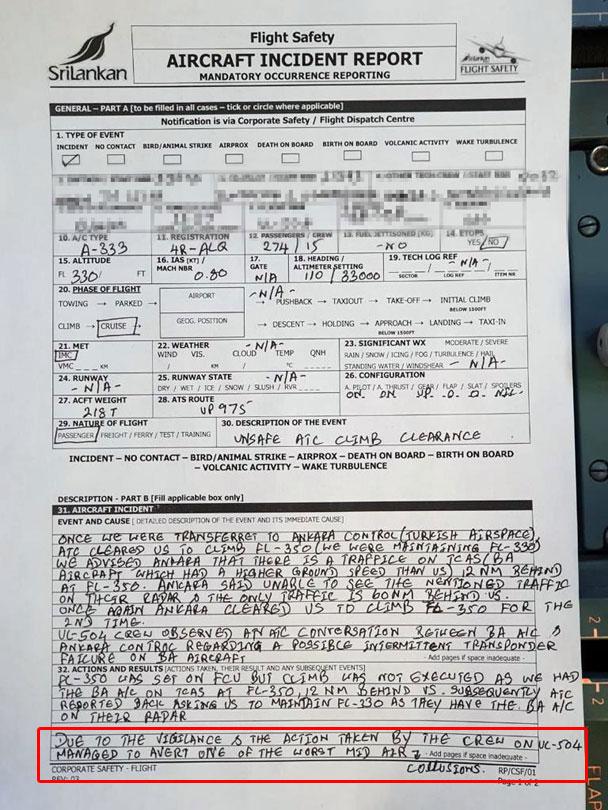
An official report on the possible mid-air collision avoided by UL 504 has been filed by the crew upon their return to the BIA yesterday which has confirmed that due to the vigilance and action taken by the crew, they had managed to avert one of the worst mid-air collisions.

Sri Lankan Airlines however seem to be unaware of this report filed by its own crew and have released a statement saying UL 504 was not at risk of a mid-air collision with another aircraft at any point, despite their official document confirming it. Sri Lankan Airlines clearly seem to be misleading the public at this point or simply are unaware of the official mandatory documents filed by their own staff.

While it is confirmed that the vigilance and quick decision-making by the pilot and crew avoided this mid-air collision, Sri Lankan Airlines failed to answer the calls by Daily Mirror last evening when we attempted to re-confirm the story. 

It is the document that the Daily Mirror later came in possession of that divulged the exact details.

The report clearly mentions that there was a British Airways flight above at 35,000 feet in the Turkish Airspace and the UL504 crew observed an ATC conversation between BA AIR and Ankara Control regarding a possible intermittent transponder failure on BA AIR.

In the crew’s own words, “Due to the vigilance and the action taken by the crew on UL504, managed to avert one of the worst mid-air collisions.”

The UL pilot and crew who had been vigilant had detected a British Airways flight just 15 miles away from them flying at 35,000 feet and informed the air traffic control at Ankara that there was a flight already above.

The British Airways flight which was on its way to Dubai and then Singapore had left Heathrow just shortly after the UL flight had taken off.

If the UL captain had climbed to the requested height, the UL flight would have faced a mid-on collision with the British Airways flight, as it was flying at a faster speed than the UL flight. Upon landing at the BIA the passengers safely disembarked from the flight along with the crew and a report on the incident was filed. (Jamila Husain)

U.S. DFC approves $120 Mn in new loans and investments for Sri Lanka

June 15th, 2022

Courtesy Adaderana

The Embassy of the United States of America announced today that the U.S. International Development Finance Corporation (DFC) Board of Directors has approved USD 120 million in new loans to grow and support the Sri Lankan economy.

For seventy years, the United States has provided foreign assistance, loans, and trade opportunities to help grow the Sri Lankan economy and support the Sri Lankan people,” said U.S. Ambassador to Sri Lanka Julie Chung.

Today’s announcement is good news for the private sector, as the DFC’s USD 120 million in new investments will reach small and medium-sized businesses and help to provide equity, jobs, and futures,” she added.

The projects announced today include a USD 100 million direct loan to the Commercial Bank of Ceylon, Sri Lanka’s leading commercial private bank, to expand lending to micro-, small-, and medium-sized enterprises (MSMEs) and address the credit gap for women-owned businesses, which represent 25% of MSMEs in Sri Lanka.

In addition, DFC announced a USD 15 million loan to BPPL Holdings PLC, a polyester yarn manufacturer incorporating recycled plastic materials. 

The loan will support increased production and strengthen Sri Lanka’s recycling infrastructure in support of efforts to reduce plastic waste in Sri Lanka.

Also announced today was a USD 5 million loan to MA’s Tropical Food Processing (Private) Limited, a sustainable food company, to finance its expansion and grow its supplier network.  This effort will strengthen Fair Trade practices in Sri Lanka and create new jobs, with an emphasis on increasing women’s employment.

These new loans build on DFC’s existing portfolio in Sri Lanka of nearly USD 300 million in funding for the MSME sector over the past two years.

The diverse set of transactions announced today will make real impact across a range of sectors and development challenges,” said DFC CEO Scott Nathan. These transactions showcase how DFC strategically catalyzes private capital where it matters most.”

Around the world, DFC partners with the private sector to finance solutions to critical challenges, investing across sectors including energy, health care, critical infrastructure, and technology.  DFC also provides financing for small businesses and women entrepreneurs in order to create jobs in emerging markets.  DFC investments adhere to high standards and respect the environment, human rights, and worker rights.

These announcements may be subject to congressional notification in Washington and other administrative approvals. The U.S embassy said more information will be made available when funds are ready for disbursement.

It took 1 CIA agent 4 days to oust democratically elected Iranian leader in 1953

June 14th, 2022

Shenali D Waduge

It took US 60 years (19 Aug 2013) of silence and denial to finally admit to its role in toppling the elected PM of Iran Mohammad Mossadegh on 19 August 1953. There was no social media then, no artificial intelligence, no NGOs of the kind present today, all it took was one US CIA agent – Kermit Roosevelt Jnr (grandson of US President Theodore Roosevelt). Kermit Roosevelt toppled a leader in just 4 days. Operation Ajax was the name of the coup started on 15th August 1953 and ending with the ouster on 19th August 1953. Kermit died aged 84 years in 2000 and was not alive to see US take responsibility for the coup he orchestrated.

Who was Mohammad Mossadegh

He was a leader the Iranians held in high esteem & elected by the Iranian people in 1951.

Iran had a constitutional Monarchy with Mohammad Reza Pahlavi remained monarch & Mossadegh becoming PM.

Where did he go wrong

He began introducing a range of social & economic policies that led to the nationalization of Iranian oil which didn’t go too well with UK who controlled Iran’s oil via Anglo-Iranian Oil Co.

London based financier William D’Arcy struck oil in Iran in 1908 & an Anglo-Persian Agreement was signed giving Britain control over Iran’s army, treasury, transport system & communications network. Nationalizing oil meant nullifying that agreement.

This meant it would end UK’s monopoly of Iran’s reserves for 45 years (1908)

Britain secured US assistance to orchestrate Mossadegh’s overthrow.

Lesson here is – any leader going against Western corporate interest will be overthrown!

Outcome of overthrowing Mossadegh

CIA chased a democratically elected leader & brought in Mohammad Reza Pahlavi – the Shah of Iran. The Shah ruled for 25 years until 1979. Years of brutal suppression for which US has to account for.

Who was Kermit Roosevelt

Kermit joined Office of Strategic Services (OSS) in 1947 which was the predecessor of CIA. It was in February 1953 that British intel agents approached CIA head Allen Dulles & his brother Secretary of State John Foster Dulles (no nepotism here) to assign Kermit for the task. A request made in February 1953, received final approval in June 1953, Kermit arrived in Iran on 19 July 1953 and exactly a month later the coup succeeded after Kermit hired protestors/demonstrators & military officials. Leaders of US & UK were President Eisenhower and British PM Churchill.

Part of Operation Ajax was to work with nicknames – Shah was Boy Scout’ and Mossadegh was Old Bugger”.

What was Kermits role in the overthrow of Mossadegh

Kermit Roosvelt knew communication was key.

He bought people in media bribing them. Nothing new – we see it happening even presently.

Kermit got these paid media personnel to come up with anti-Mossadegh propaganda.

That happens even now in all parts of the world.

Kermit next turned to tapping the Islamic clergy – a tactic used presently too.

Kermit paid Iranians to protest – he paid for the banners – he paid for the slogans.

Kermit also tapped Iran’s military including Gen. Zahedi.

Kermit then plotted to capture Mossadegh from his home.

The 1st coup attempt failed. The 2nd didn’t.

Mossadegh was captured after CIA tapped Iranians to capture their leader.

He was placed under house arrest (14 years) until he died on 5 March 1967.

Countries that are geopolitically significant where US & West have their hotspots, the manner they operate cannot be missed.

Look at how Iran fell and tie them up with countries also under West’s radar.

  • US does not like negative public criticism – what do they do, they buy over the press and communication channels & Voice of America radio is used to counter criticisms
  • US spent a lot of energy showing concerns for Iranians & their welfare – to build trust, popular personalities invited for tea & sharing their photos is a good clue.
  • If US used slogan anti-communism, anti-Soviet previously, present context is anti-China
  • Locals that US tapped in Iran were wealthy landowners (pro-West elite society), university professors & students, secondary school teachers & even students (present ploy of gifting laptops and smartphones is a clue), professionals, government employees, leaders of public opinion, religious leaders, village headmen, tribal chief, labor leaders, army officers. (same coterie getting tapped presently too)
  • The Campaign US deployed against Mossadegh was to paint him as being sympathetic towards communism, that he was directly dealing with the Soviets & that he was planning to surrender Northern Iran provinces to the Soviet Union,
  • The Campaign US deployed against Mossadegh vis a vis economy was to blame him – calling him corrupt & dictatorial
  • US used religious leaders against Mossadegh
  • US used false information (Black Propaganda) – which included threatening people
  • US plan included staged attacks (similar to the 9 May 2022) which was to be supported with fake documents of Mossadegh giving instructions for attacks
  • US plan was to divide segments of society against Mossadegh but creating lies & distancing nationalists away from Mossadegh to isolate him (similarities with Sri Lanka)
  • CIA knew that they could influence the top tier of Iranians & succeed

US State Dept agreed that they faced 3 issues following the ouster of PM Mossadegh

  1. Allegation of US role in deposing Mossadegh
  2. Allegation that Gen. Zahedi was a US puppet
  3. Nullifying Mossadegh as the Iranian hero.

Geopolitical importance of Iran for US/UK

Iran was needed to block Soviet access to the Persian Gulf. This meant the West required to ensure Iran’s oil reserves remained accessible to Western companies stationed in Iran since 1908.

Declassified documents revealing details of Operation Ajax is a public admission of CIA role in regime change which the US State Dept denied previously. US Secretary of State Madeline Albright in 2000 and President Obama in 2009 also referred to US role in coup. How many other coups has US denied while declassified documents have shown quite the opposite.

1000 pages of documents on the 1953 coup reveal that the 1st attempt failed and US advised to call off the operation but CIA agent Kermit went ahead & on his own will carried out the coup using ‘rented’ crowds (protestors)

Hired crowds became a hallmark of US regime change operations in the present decade as well.

Iranian protestors did not know the US had funded the protests – they knew only years later.

The speculation of US involvement was raised but denied.

It took 60 years for US to admit to hiring and funding the protests and opposition needed to oust an elected PM.

The same blueprints are happening even in Sri Lanka.

What we can be sure of is that we shall only know the truth decades later!

Shenali D Waduge

– ඉන්ෆ්ලේෂන් = + අන්එම්ප්ලෝයිමන්ට්

June 14th, 2022

ජයන්ත හේරත්

ඉන්ෆ්ලේෂන් අඩු කරන්නට

අන්එම්ප්ලෝයිමෙන්ට්

වැඩි කල යුතුය.

භාණ්ඩ මිල අධිකව

ඉහල ගොසින්ය

ඉන්ෆ්ලේෂන් ය.

එවිට

භාණ්ඩ මිලදී ගැනුමට

වැඩි වැටුප් ලබන

හොඳ ඉල්ලුමක් ඇති

රැකියා තිබිය යුතුය.

හොඳ ඉල්ලුමක් ඇති

රැකියා තියෙන්නේ

වැටුප ඉහල නිසාය

පුහුණු ශ්රමය නැති නිසාය

පළපුරුද්ද ඇති ශ්රමිකයන් අඩු නිසාය

දැනුම, පුහුණුව හා පළපුරුද්ද

නැත්තේ

JVP NPP තක්කඩි

විශ්ව විද්යාල අන්තරය හසුරවන නිසාය

උද්ඝෝෂණ කිරීම

උන්ගේ රැකියාව කල නිසාය

JVP NPP තක්කඩි

තරුණ සිසු සිසුවියන් බිලි බා ගෙන 

හැමදාම කලේ

ඉරිසියාව ක්රෝධය වැපිරීමය.

ඇමරිකාවෙත්

ඉන්ධන හා භාණ්ඩ මිළ

ඉහල ගොසින්ය. 

මුදල් ඇත්නම්

මිළ අධික වුනත්

තිබෙන-භාණ්ඩ මිලට ගැනීමේ ප්රශ්නයක් නැත

භාණ්ඩ හිඟ වීමට

හේතුව

zelensky ගේ යුද්ධය ය.

අධික වැටුපක් ලබන

විදුලි ඉන්ජෝ

මාසේ

වැටුප ගෙන යන්නේ වීල් බැරෝ එකේය

ඒ තරම් සල්ලිය.

ගුරුවරුත් එහෙමය

වැඩ වර්ජන කරන්න යන්නේ

කාර් එකේ නැගලාය!

විශ්ව විද්යාල ළමයි

කරන්නේ වැඩ වර්ජන විතරය.

උන්ට නිකන් දෙන

නිදහස් අධ්යාපනයට,   

ශිෂ්යත්ව 

රුපියල් කෝටි ගණන්ය.

ඉංජිනේරු ළමයෙක්ට

රුපියල් කෝටි දහයක ශිෂ්‍යත්වයක්ය.

විශ්ව විද්යාලෙන් ගිය පසු

රස්සාව නළලේ කොටා ඇත,

හම්බ කරන්න ගත් කල

මිලියන් ගණන් වලින්

උපයා ගන්නේය.

නොමිලේ

අද්‍යාපනය නම්

නොමිලේ වැඩ තිබිය යුතුය.

ඉන්ෆ්ලේෂන් අඩු කරන්නට

භාණ්ඩ වලට ඇති

ඉල්ලුම අඩු කල යුතුය

රැකියා ද අඩු කල යුතුය.

ප්රේමේගේ ගම්උදාව

ගම කෑවේය

නගරය කෑවේය

රට ද කෑවේය.

ගෝල්පීස් ආරගලිස්ට්ලා

ප්රේමේ ගේ

ගම සංකල්පය

හොරා ගත්තෝය, 

උන්ගේ ගමත් දිය වී 

කෙළ වී ගියේ

උන්ගේ ප්රශ්න වලට

උත්තර

විසඳුම්

සංරචක ව්යුහයන් ගෙන්

ගම සෑදී

තිබුනේ නැති නිසාය.

ආරගලිස්ට්ලාට කරන්න තිබුනේ

ඇති ප්රශ්න වලට

නියම හේතු දක්වා

ඒවාට පැලැස්තර නැති

තිරසාර විසඳුම්

දැක්වූ

ආදර්ශ ගමක්

පළමුව හදා

පසුව රට පුරා

Replicate

කිරීමය.

එහි,

හරක් පට්ටියක්

තිබුනාට කමක් නැත

ඒ හරක් කිරි බීමෙන්

සැනසීම

හොයන්නෝ වෙනුවෙන්ය.

විදුලිය නැති

ඉන්ටනෙට් නැති

අයි ෆෝන් නැති

වායු සමීකරණ නැති

නිස්කලංක

ගෙවල් තිබිය යුතුය.

පිදුරු හෙවිලි කල 

මැටි බිත්ති

මැටි පොලොව සහිත

සරල වුනත්

දැකුම්කළු

පිළිවෙලට තැනු

Low cost ගෙවල්

තිබිය යුතුය.

ඉන්ධන දහනය කරන 

භූතයෝ, ත්සුනාමියෝ

වගා භූමියෙන් පන්නා දැමිය යුතුය

ඒ වෙනුවට

මීහරක්

නැවත කැන්දා ගත යුතුය.

පරිසරයට හිතකාමි

ජීවන රටාවක ජීවත් විය යුතුය

සම්පත් අසීමිතව නැත.

මිනිස් අවශ්යතාවන් සීමා කල හැක.

Decoding the Narrative ‘there will be no Hindus left in Bangladesh in the next 30 years’

June 14th, 2022

Samina Akhter Dhaka

Bangladesh has recently been depicted by some in the international media saying ‘there will be no Hindus left in Bangladesh in the next 30 years if the current rate of exodus continues’ and Hindus are fleeing to India’.  However, this understanding is completely incorrect. Bangladesh is being depicted unfairly and without evidence as a country that discriminates against its minorities, particularly Hindus. There is no doubt that Bangladesh has seen a steady outflow of Hindus since Partition. Minorities accounted for 23.1% of the population in 1951, but only 9.6% in 2011.A recently published book has predicted that there will be no Hindus left in Bangladesh in the next 30 years if the current rate of exodus continues. According to the book, 11.3 million Hindus were either forced to leave the country or migrated between 1964 and 2013. The author of the book, said the rate of exodus over the last 49 years paints a grim picture for the Hindu minority in Bangladesh where their population remains just 8.2 percent according to the last census.

The book, perhaps, is unable to make understand of the real situation in Bangladesh. The author has failed to depict the real scenario of Bangladesh.  For example, Priya Saha a Hindu minor rights activist, participated in the Second Ministerial to Advance Religious Freedom held at the US Department of State in Washington, DC on July 16-18, 2019.  In a video clip that went viral on social media, that Priya Saha was heard telling Trump: “Sir, I’m from Bangladesh … 37 million Hindus, Buddhists and Christians are disappeared. Please help us – for the Bangladeshi minor people. We want to stay in our country. In a video message, Priya Saha explained her position and tried to defend her remarks tagging Abul Barkat’s research findings. Then the[u1]  author said in 2019 Priya Saha has distorted his research findings by her comments during an interaction with US President Donald Trump that 37 million Hindus, Buddhists and Christians have disappeared in Bangladesh. However, the author’s works sparked a controversy in Bangladesh. On the other hand, during the eruption of communal violence in Bangladesh against Hindu minorities in 2021, a countless arguments and numerous criticisms had been brought to light. Some claimed that Bangladesh has become quite a case of ethnic cleansing- subtly but forcefully ousting Hindu minorities across the border. Some even went further claiming that Bangladesh has failed to form a state where different religious and ethnic groups can coexist based on the principle of secularism- one of the four fundamental pillars of the liberation war in 1971. To cast evidence to those criticisms, most of them point fingers to the continuous decline of Hindu minority population in Bangladesh- a case drawn to demonstrate Bangladesh as a prolific ground of persecution against Hindu. But an objective discernment to those allegations, especially through comprehensive statistical appraisal, relative systemic endeavors and broader political landscape, makes them, in most part, lose their grounds.

Statistics and Apparent Assumptions

According to the BBS (Bangladesh Bureau of Statistics) data, the percentage of Hindu community to total population was 13.5% in 1974, on Bangladesh’s first population census, which, as of the latest census in 2011, stands at 8.5%, and again increases to 10.7% in 2015. Ostensibly, these statistical figures, continuous decline in percentage, seem to confer voice to predominant arguments about the decline of Hindu population. But mere percentage estimation tells only the half truth about the broader demographic landscape of Hindu minority in Bangladesh. If we take the increase in total number, other than mere percentage, over the years along with other factors that have contributed to decline, into account, it will substantially clarify the whole picture and weaken the predominant narratives about the decrease of the number and persecution of Hindus in Bangladesh.

Taking the total number into account, in 1974, the number of Hindu populations was 10.31 million which hit slightly above 12.7 million in 2011 and 17 million in 2015. It is seen that the total number has remained increasing whereas percentage to total Muslim population, due to relatively higher growth in the number of Muslim populations from 65.24 million in 1974 to135.4million in 2011, has kept decreasing. It is true that growth in numbers is a little slow among Hindu population and could hit 22 million by 2011 only if it increased linearly in terms of percentage as reported in 1974 (13.5%). But that is not because of any systematic persecution against the minority rather, in most part, of international economic migration, relatively lower birth and high mortality rate among Hindu population, higher rate of contraceptive use and particular political reality in the history of Bangladesh.  

According to the study paper prepared by researchers from ICDDR, B’s Health Systems and Population Studies Division and the University of North Carolina (Chapel Hill), studying the population data of 1989-2016 of Matlab Upazila in Chadpur to find out why Hindus have lower population growth than Muslims, the birth rate of Hindu populace in every thousand falls short by 3 points comparing to Muslims. While the probability of having a child among the Muslim women is 35, it is 32 among Hindu women.

The study found that the tendency to late marriage and having not more than 2 children and relatively higher use of contraceptives also contribute to the low birth rate among Hindu populace. Even higher numbers of deaths, 4 more than that of Muslims in every ten thousand, can also be subscribed to the decrease in percentage. Finally, researchers concluded that 71 percent of low growth rate may be attributed to the the low rates of fertility and 23 percent to the international out-migration by Hindus. 

In the report, they also observed that, since 2006, more Hindus have been opting for countries other than India for out-migration. Only 36 percent of the migrating Hindus of Matlab went to India between 2005 and 2012, but the bigger portion of them went to the states other than India for better living- a countervailing evidence against predominant propaganda that more Hindus have been leaving for India due to persecution.

Political Upheaval and Systemic liability

To be true, the percentage of Hindu minority comparing with that of Muslim has declined over last 50 years. But this estimation has overlooked a subtle but solid point: a fundamental political upheaval and constitution of Bangladesh from 1975 to 1991. Just take the number into account, from 1974 to 1991, percentage of Hindu minority to total population came down from 13.5 to 10.5 in 16 years. But, after the end of anti-secularism fueled military rule in 1991 and installation of constitutional democracy, percentage decline got little slower- 10.5 in 1991 to 8.5 in 2011 within 20 years of time span. In 2011, after the 15th amendment of Bangladesh constitution, secularism was restored which especially which has contribution to increase of percentage of Hindu people to total populace to 10.7% point in 2015. Unlike, its two bordering states- Myanmar and India, the former denying Muslim Rohingya minority of citizenship since 1982 out of pathological hatred and the latter rendering Muslims stateless through anti-Muslim laws, Bangladesh has never, particularly since 1991, intended to promote any discriminatory policy, be it in practice or by laws. Praiseworthy and prompt  action taken by the Government of Bangladesh against the menace of recent Durga Puja incident, is a glaring example of this.

Minority is such a phenomenon which every country must possess, be it ethnic or linguistic or religious. But state sanctioned discriminatory policy, inherent ethnic or religious tension or historical schism mobilized by for political score usually contribute to violence against minorities. However, in Bangladesh mostly politically cornered vested groups have played out on minority to stoke crisis and tame the situation to their end. Besides long cherished pluralistic sentiment in Bangladesh is, rather in times, menaced by ‘spill-over effectof politics and policies in proximate neighbors, of course by political fringe groups.


අපට කල නොහැක්කේ මොනවාද?

June 14th, 2022

චන්ද්‍රසේන පණ්ඩිතගේ විසිනි

ස්ථානය රාගම ශික්ෂණ රෝහල් වැඩබිමයි. ඒ වනවිට රෝහල ඉදිවෙමින් පැවතිණි.බිම් මහල ඇතුළුව මහල් 4ක කොන්ක්‍රීට් වැඩ නිමවා තිබුණි. තවද එක කණුවක් නියමිත ස්ථානයට වඩා අඩියක පරතෙරකින් පිහිටීමේ වරදක් අප අතින් සිදුව තිබුණි. මේ වරද මම එතරම් ප්‍රභල වරදක් ලෙස නොසැලකුවත් එය ව්‍යාපෘති කළමනාකාර මහතාට දැක ගැනීමට ලැබුනේ, 4 වෙනි මහලත් සම්පුර්ණ වූ පසුවය. මෙය දුටු ඔහු මහත් ව්‍යාකුල තත්වයකට පත්ව මා වෙතට පැමිණ ඒ සම්බන්ධව ඔහු තුල ඇති නොසතුට මට පැවසුහ.
“චන්දරේ, මම කොහොමද මේක දන්නේ නැහැ වගේ ඉන්නේ?” දැන් මට මේක ලොකු හිසරදයක් නිර්මාණය කරලයි තියෙන්නේ, යයි මහත් සැලෙන හඬකින් පැවසුහ.

ඒ වනවිට මේ අද අප ගතකරන ආකාරයේම නිවාඩුවක් ලංව තිබුණි.
“එහෙම නම් මිස්ටර් …………..අපි මේ සිකුරාදා වැඩ ඉවර වුනාට පස්සේ සදුදත් නිවාඩු දීලා දවස් 4ක් වැඩබිම වහන්න මම ඔය කණුව අවශ්‍ය තැනට අරගෙන තියන්නම්.”

ඔහු පුදුමයෙන් මෙන් “ඔයාට සුවර්ද ඔය වැඩේ කරන්න පුළුවන් කියලා?”

“ඔව් මම ඕක කරන්නම් අපිට දවස් 4කම තියෙනවානේ “යයි මම පැවසුවෙමි.

සියල්ලන්ටම හොරෙන් මේ අපි කරන්න යන්නේ කිසිවෙක්වත් අත නොගසන ආකාරයේ,කටයුත්තකි.වැඩබිම් කළමනාකාරතුමා, මා මිට පෙර වැඩකර ඇති ආකාරය ඉතා හොදින් දන්නෙකු වූ බැවින්, මා කෙරෙහි තබාගෙන සිටි අසීමිත විශ්වාසය නිසා මට එම කාර්ය කිරීමට අවස්තාව හිමිවිය.
තට්ටු 4ක් දක්වා ඉහලට ගමන් කොට තිබු කණුව නිවැරදි තැනට ස්ථානගත කිරීම සිකුරාදා හවස 6අට පමණ ආරම්භ කොට සෙනසුරාදා උදෑසන වනවිට නිම කිරීමට මා ඇතුළු කණ්ඩායමට හැකිවිය.එවැන්නක් සිදුකල බවට කිසිවෙකුටත් තේරුම් ගත නොහැකිවන සේ සියලුම දේ ඉතා සුක්ෂම නිම කළෙමු. දින හතරකදී නිමකිරීමට සැලසුම් කල කටයුත්ත. පය 12කින් නිම කිරීමට හැකිවීම සම්බන්ධව ඊට සහභාගිවී මා සැලසුම කල ආකාරයටම සියල්ලක්ම කල කණ්ඩායමට වැඩිපුර දීමනා ලබාදී ඔවුන් විසින් සිදුකල කාර්ය භාරය අපි ඉහලින්ම ඇගයීමකට ලක් කළෙමු. අපට කල නොහැක්කක් නැත අවශ්‍ය නම් පොළොවේ සිට අඩි 150ක ඉහලකට ජලය ස්වභාවික ක්‍රමයකට ගෙන ගොස්,එහි සිට සිට අඛණ්ඩව ගලා හැලෙන දිය දහරාවක් නිර්මාණය කර ජල විදුලිය නිපදවීමේ මධ්‍යස්ථානයක් වුවද ගොඩනංවන එක එතරම් අසීරු කටයුත්තක් නොවන බව අපි දන්නෙමු. නමුත්. ඒ සඳහා අවශ්‍ය වන්නේ, අපව විශ්වාස කරන අයගේ සහය පමණි.

Take holiday to grow your own food, civil servants told by Sri Lankan government

June 14th, 2022

Courtesy The South China Morning Post

  • Officials granted leave for one working day a week and ‘provided with the facilities to engage in agricultural activities in their backyards’, cabinet said
  • The country’s unprecedented economic downturn has left staple foods in short supply and 4 out of 5 people in the nation of 22 million were forced to skip meals

Crisis-hit Sri Lanka is asking civil servants to take an extra day off each week to grow crops in their backyards in a bid to forestall a looming food shortage.

The island nation’s unprecedented economic downturn has left several staple foods in short supply, along with petrol and medicines, and rampant inflation is ravaging household budgets.

It seems appropriate to grant government officials leave for one working day of the week and provide them with the necessary facilities to engage in agricultural activities in their backyards,” a cabinet statement said Tuesday.

The extra day off would be a solution to the food shortage that is expected to occur in the future”, the statement read, adding that cutting down on civil servant commutes would also help reduce fuel consumption.

Sri Lanka PM open to buying Russian oil, accepting China’s financial help12 Jun 2022

Last week the United Nations warned Sri Lanka was facing a dire humanitarian crisis”, and said four out of five people in the nation of 22 million were forced to skip meals.

Motorists, meanwhile, have suffered through months of chronic petrol and diesel shortages, and long queues of vehicles outside filling stations are a regular sight around the country.

Public employees will have every Friday off for the next three months without a pay cut, according to the cabinet decision, but the arrangement will not apply to essential services staff.

The government also said any members of the 1.5 million-strong public sector who wanted to travel abroad to find work would be given up to five years of unpaid leave without affecting their seniority or pensions.

‘Sometimes I sleep in the tuk-tuk: taxi mum among the casualties of Sri Lanka’s economic crisis

The move is aimed at encouraging more people to get foreign jobs and send money back to the island, which is labouring under a critical shortage of foreign currency to buy imports.

Sri Lanka has defaulted on its US$51 billion foreign debt and is in talks with the International Monetary Fund for a bailout.

Public protests have demanded the resignation of President Gotabaya Rajapaksa over mismanagement of the country’s economy and the severe hardships facing its people.

Rajapaksa introduced sweeping tax cuts soon after coming to power in November that have been blamed for leaving the island without the means to pay for essential imports.

The cash shortfall was worsened by the Covid-19 pandemic, which savaged the local tourism industry and cut remittances sent back home by Sri Lankans working abroad

Who is pouring oil on the flames in Sri Lanka?

June 14th, 2022

Feng Guoquan Courtesy CGTN

Sri Lanka is in a dire situation. Known as the “Pearl of the Indian Ocean,” the country is facing the worst economic crisis since independence in 1948. Western media has taken this opportunity to hype up the so-called Chinese debt trap, alleging that Sri Lanka is on the verge of economic collapse because it was unable to repay its large loans from China. They add that the Belt and Road Initiative (BRI) has brought a heavy burden to the Sri Lankan economy, and constantly pitting the Sri Lankan government and its people against China, while turning a blind eye to those who are really behind all this.

Caught fire by accumulated debt

There are many causes for Sri Lanka’s economic crisis, among which the foreign exchange crisis is the main factor. Since its independence, Sri Lanka has suffered from internal and external troubles. It has been carrying trade deficits and relying on loans for years. Due to the combined impact of a string of terrorist attacks in April 2019, the COVID-19 pandemic and the Russia-Ukraine conflict, the country’s pillar industries including tourism, overseas remittances, tea and garments have been hit hard and it has rapidly drained its reserves.

What’s worse, Sri Lanka introduced a low tax regime in late 2019, which caused the government a loss of more than $1.4 billion in revenue, further limiting its capability to purchase foreign exchange.

While foreign exchange earnings have plummeted, Sri Lanka’s import payments have continuously increased. Sri Lanka’s production materials and daily necessities are highly dependent on imports, and the armed conflict between Russia and Ukraine has triggered a surge in global commodity prices. Taking energy as an example, 60 percent of Sri Lanka’s electricity is generated from coal and oil, which both need to be imported. The global oil price increased by six-fold from $18 a barrel in April 2020 to above $100 a barrel now.

At the beginning of 2021, the Sri Lankan government banned the import of chemical to prevent the outflow of foreign exchange, resulting in large-scale crop failures, and the government had to replenish food reserves from abroad, further exacerbating the shortage of foreign exchange.

Sri Lanka’s foreign exchange reserves have plummeted by about 70 percent in the past two years. Its reserves stand at around $1.9 billion at the end of March, while its foreign debt obligations for this year exceed $7 billion. On April 12, the Sri Lankan government officially announced the temporary suspension of foreign debt payments, defaulting on its $50.7 billion foreign debt. On May 19, the government announced that it had failed to repay a total of $78 million in debt, which marked the nation’s first sovereign debt default since it gained independence.

The U.S.-led West have been pouring oil on the flames after setting fire

Although Sri Lanka has been in debt for many years, it has previously maintained a good record of foreign debt repayment. The Russia-Ukraine conflict, which was caused by the U.S.-led West intervention, had a very serious impact on Sri Lanka’s economy, which was already in bad shape, and leading to its default. It is the hegemony and the greed of capital of the U.S.-led West that are the root causes of the economic crisis faced by Sri Lanka and other developing countries.

The mounting sanctions imposed on Russia by the U.S.-led West have been pushing global food and energy prices to new heights, and there are also restrictions on Russian financial and aviation sectors. The food prices surged in Sri Lanka due to soaring prices of wheat and corn triggered by the Russia-Ukraine conflict.

Sri Lanka exports about $150 million of tea and other commodities to Russia annually. However, as more and more Russian banks are banned from the SWIFT network, Sri Lanka was unable to obtain foreign exchange by exporting to Russia. In January this year, Russia was Sri Lanka’s largest source of tourists, but in March, the state-run national carrier of Sri Lanka suspended its flights to Russia due to the Western sanctions.

In terms of debt structure, most of Sri Lanka’s debts are in the form of international sovereign bonds, and the Asian Development Bank and Japan are its main lenders. According to Central Bank of Sri Lanka data, as of October 2021, Sri Lanka’s international sovereign bonds reached $11.82 billion, accounting for 34.1 percent of total external debt. In terms of bilateral loans, Japan and India ranked first and second, with $3.54 billion (10.2 percent) and $790 million (2.3 percent) respectively, higher than China.

China’s bilateral loans to Sri Lanka are not the largest. Even with financial market loans (Exim Bank of China) included, it only accounts for 10 percent, and most of the loan interest rates are much lower than the capital markets, among which over 60 percent are concessional loans, and the remaining 40 percent are interest-free loans. So Sri Lanka’s debt repayment problems have very little to do with Chinese loans.

In fact, Sri Lanka is not the only country that suffers from the economic crisis. The Federal Reserve and other major central banks have raised interest rates to quell inflation, which drives up borrowing costs and may bring debt crisis to many developing countries. Turmoil triggered by rising food and energy prices is already gripping countries like Egypt, Tunisia and Peru. Scarcities of food, energy and finance put more than 70 countries at risk of following Sri Lanka into default, says United Nations, according to a recent report by the Wall Street Journal.

The trap of so-called Chinese debt trap

In recent years, governments and media of the U.S.-led West have tied the concept of the “debt trap” to China as a weapon to tarnish China’s reputation and the BRI in order to counter China’s promotion of BRI, maintain their political and economic hegemony, and prevent the developing countries from participating in the BRI.

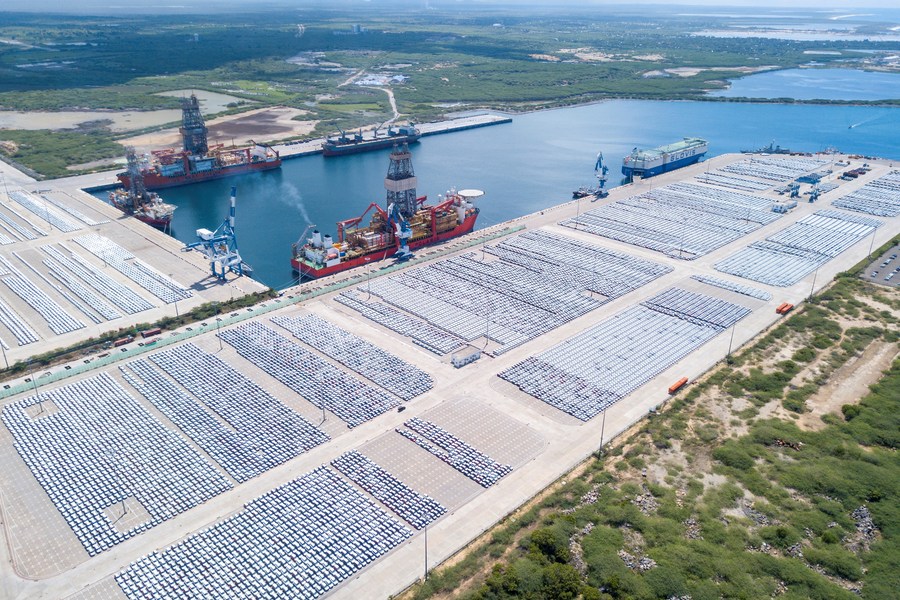
A view of Sri Lanka’s Hambantota International Port, May 6, 2021. /Xinhua

The Hambantota Port is a most cited case by the U.S.-led West in hyping up the “Chinese debt trap.” It is falsely claimed that China used the port to drag Sri Lanka deep in debt and would transform it into a military base in the future. But the fact is that the Hambantota Port added $1.12 billion of foreign exchange reserves for Sri Lanka to repay some short-term foreign debts. What’s more, the Hambantota Port is difficult to use as a military base due to water depth limitations, and the Sri Lankan government has explicitly prohibited the use of the Hambantota Port as a foreign military base.

On the contrary, India has recently partially acquired the Trincomalee Port situated on the eastern coast of Sri Lanka, which is a large natural port from a military point of view and used to be a strategic oil terminal for the British army during World War II. Because the United States intended to build a “economic corridor” and highway from Trincomalee to Colombo through the the Millennium Challenge Corporation (MCC), which is obviously for military purposes, the United States, India and other countries have played deaf and dumb.

As a close neighbor of Sri Lanka, China has been sincerely helping Sri Lanka develop its economy. Instead of causing any crisis, China has over the years provided selfless help and firm support to Sri Lanka in socio-economic development. Especially since the onset of the COVID-19 pandemic, China and Sri Lanka have supported each other and pulled through together, writing a new chapter of China-Sri Lanka friendship. Chinese Premier Li Keqiang noted that China empathizes with Sri Lanka for its difficulties and challenges, and China is ready to provide much-needed livelihood assistance for Sri Lanka within its capacity.

The Sri Lankan government have explicitly refuted the myth of “Chinese debt trap” time and time again. Recently, Ranil Wickremesinghe, Sri Lanka prime minister and leader of the United National Party, expressed his gratitude to China for assisting Sri Lanka in overcoming difficulties in all aspects and stressed that the government will continue to attach great importance to developing ties with China and push forward BRI projects in the country, accelerate the development of the Colombo Port City, Hambantota Port and other major cooperation projects, make every effort to protect the safety of Chinese institutions and personnel in Sri Lanka.

The international community, especially the developing countries, need to be wary of the trap of “Chinese debt trap” set by the U.S.-led West,which is a systematic move orchestrated by the U.S. to obstruct the BRI. Countries should endeavor to safeguard their national security and development interests, strengthen international cooperation, including those under the BRI, increase their representation and voice in global economic governance, and promote the establishment of a more just and reasonable international economic order. For developing countries including China, underdevelopment is the biggest trap, and the political, economic, military, and cultural hegemony of the U.S.-led West is the real trap.

Editor’s note: Feng Guoquan is a commentator on international affairs. The article was first published by The People’s Daily in Chinese on June 11, 2022. The article reflects the author’s views, and not necessarily those of CGTN.

Gazette to be issued lifting ban on ‘Angampora’

June 14th, 2022

By Rebecca Pavey Courtesy Ceylon Today


The Cabinet today (14) approved a proposal to issue a Gazette lifting the ban on ‘Angampora’ martial art, a traditional game that was banned under British rule.

The relevant proposal was tabled by the Minister of Sports.

A similar proposal to lift the ban imposed on the game was approved in 2019, however the relevant Gazette is yet to be published.

Fridays to be declared holidays for public sector for 3 months

June 14th, 2022

Courtesy Adaderana

The Cabinet of Ministers has given the approval to the proposal to declare Fridays as holidays for public sector employees from this week.

According to Minister Dinesh Gunawardena, this will not include the essential services including health, power & energy, education, water, electricity, transport, port and air services, and defence.

As the current shortage of fuel has disrupted passenger transport, making it difficult for public sector workers to access their own transportation, it seems appropriate to grant government officials leave for one working day of the week, the government said in a statement.

Further, it was decided to provide the government officials with the necessary facilities to engage in agricultural activities in their backyards or elsewhere as a solution to the looming food shortage.

Accordingly, the Cabinet of Ministers has given its approval to close all government institutions except agencies providing essential services on Fridays for the next 3 months.

The relevant proposal was tabled by the Minister of Public Administration, Home Affairs and Provincial Council.

Sri Lanka to receive 6 batches of rice from China

June 14th, 2022

Courtesy Adaderana

Six batches of rice are scheduled to arrive in Sri Lanka under China’s 500 million RMB grant to the island nation, the Embassy of China in Colombo said today.

The first and the second batches are meanwhile scheduled to reach the Colombo Port on the 25th and 30th of June.

Taking to its official Twitter handle, the Chinese embassy said 10,000 metric tons of rice will be provided to the most needy kids under the School Meal Program” across Sri Lanka.

Latest LP gas shipment to be distributed on priority basis

June 14th, 2022

Courtesy Adaderana

Priority in the distribution of the latest shipment of 3,500 metric tonnes of LP gas will be given to hospitals, hotels and crematoriums, says Prime Minister Ranil Wickremesinghe.

The payment for this LP gas shipment was made yesterday and it is currently being unloaded.

Unloading of a consignment of 3,600 metric tonnes of LP gas began today (June 14) after the balance payment of USD 2.5 million was settled.

The LP gas tanker was anchored for over six days off Thaldiyawatta coast in Kerawalapitiya as the balance payment was delayed.

Former Maldivian President refutes Harsha’s remarks

June 14th, 2022

Courtesy Adaderana

Former President of the Maldives, Mohamed Nasheed has dismissed the remarks made by Sri Lankan Opposition MP Harsha de Silva as inaccurate”.

Issuing a clarification on the matter, Mr. Nasheed said, I believe a number of countries are willing to help Sri Lanka and the assistance will come through.”

MP Harsha de Silva, addressing an event yesterday, stated that the Saudi Arabian Crown Prince, Mohammed bin Salman Al Saud has rejected a request made by the former Maldives President to provide assistance to Sri Lanka.

The parliamentarian said he met with Mr. Nasheed, who told him that the Sri Lankan government has requested him to approach foreign leaders to help find US dollars for the island nation to ride out the economic crisis.

As per the request, the former Maldives President had approached the Saudi Arabian crown prince who told him that Sri Lanka does not have a proper plan in place, MP Harsha de Silva had said further.

He also stated that M. Nasheed had approached the ruler of the United Arab Emirates, who asked for a list of properties that Sri Lanka is prepared to sell.

“Clearly disappointed”: Adani reacts to Sri Lanka controversy on energy project

June 14th, 2022

Courtesy Adaderana

The Adani Group today said it was disappointed” as it reacted to a massive controversy over an energy project in Sri Lanka awarded to the group, after a Lankan official’s claim that President Gotabaya Rajapaksa acted under pressure from Prime Minister Narendra Modi.

Our intent in investing in Sri Lanka is to address the needs of a valued neighbour. As a responsible corporate, we see this as a necessary part of the partnership that our two nations have always shared. We are clearly disappointed by the detraction that seems to have come about. The fact is that the issue has already been addressed by and within the Sri Lankan Government,” said a spokesperson of the Adani group.

MMC Ferdinando, the chairman of Sri Lanka’s Ceylon Electricity Board (CEB), resigned today, three days after he claimed before a parliamentary panel that he was told by President Rajapaksa about PM Modi pressuring him to give the wind power project directly to the Adani Group.

The government has not reacted to the claim, which the official retracted on Sunday evening and which President Rajapaksa has emphatically denied.

The allegations involve a 500-Megawatt renewable energy project in Sri Lanka’s Mannar district. A video of Mr Ferdinando’s comment at the parliamentary hearing has been widely circulated on Twitter.

On November 24, the President summoned me after a meeting and said that India’s Prime Minister Modi is pressuring him to hand over the project to the Adani group. I said ‘this matter doesn’t concern me or the Ceylon electricity board and this consists of the board of investments’. He insisted that I look into it. I then sent a letter that the President has instructed me and that the Finance Secretary should do the needful. I pointed out that this is a government-to-government deal,” the official said in Sinhala in the video, addressing the panel.

On Sunday evening, following a strong denial by President Rajapaksa on Twitter, Mr Ferdinando also withdrew his comments, claiming he had been overcome with emotion” while facing questions that suggested wrongdoing by him.

President Rajapaksa had tweeted: Regarding a statement made by the #lka CEB Chairman at a COPE committee hearing regarding the award of a Wind Power Project in Mannar, I categorically deny authorisation to award this project to any specific person or entity. I trust responsible communication in this regard will follow.”

His office followed it up with a longer statement vehemently denying” the charge. The President has categorically stated that he had not at any time given authorisation to award a wind power project in Mannar to any person or any institution,” the statement said.

Sri Lanka is currently in an acute shortage of power and President desires to expedite implementation of mega power projects as early as possible. However, no undue influence will be used in awarding such projects. Project proposals for large-scale renewable energy projects is limited, but special attention will be paid to the selection of institutions for the projects, which will be carried out strictly in accordance with the transparent and accountable system by the government of Sri Lanka,” said President Rajapaksa’s office.

The controversy erupted a day after Sri Lanka changed its laws to remove competitive bidding for energy projects. The Adani group figured in the parliamentary debate on the Electricity Amendment Bill before it was passed amid opposition protests. The opposition accused the government of ramming the bill through parliament to facilitate large renewable energy deals to the Adani group, which signed an unsolicited government-to-government agreement to build the Mannar wind power plant.

The main opposition SJB in Lanka asserted that projects beyond 10 MW capacity should go through a competitive bidding process, but government MPs voted against it.

The Adani Group reportedly won contracts to develop two wind power projects, in Mannar and in Pooneryn, in December.

Gautam Adani had visited Sri Lanka in October and had tweeted about his meeting with President Rajapaksa.

In 2021, the Adani Group had signed a $700 million deal with the state-run Sri Lanka Ports Authority (SLPA) to develop and run the strategic Colombo Port’s West International Container Terminal.

Source: NDTV

Declare Poson Poya Day as our National Day.

June 13th, 2022

Dr Sudath Gunasekara Mahanuwara

Every nation, some founded only a few decades ago have a national day in their calendar, celebrated with pomp and glory to mark their nationhood and inspire their people, particularly the younger generation for nation building even if they don’t have any longstanding heritage to commemorate.

But isn’t it a pity and a tragedy too, that we, in spite of the fact   of having an unusually a long and illustrious history of more than 2500 years of a glorious past as a great nation don’t have any national day celebrations as if we are a nation without any history or civilization? The effect of this lethargy has a tremendous impact on nation building as it inhibits all inspirations that should be injected for the younger generation for nation building as a future robust and a vibrant nation in the world.

Talking about national days generally, it may be founding date of the nation or the date of independence, of becoming a republic, of becoming a federation. The national day for every country is often a public holiday. Denmark and the United Kingdom are said to be the only two countries without a national day.

We in this country, while still maintaining blind allegiance to the British Empire that has robbed our national wealth and destroyed the age old heritage, continues to celebrates it on the 4th of February, calling it the day on which we are supposed to have got independence, from British rule although we are still tied down to the colonial clutches of British rule.

In 1972 May 22nd after 24 years of so-called independence from the British yoke, under Sirimavo Bandaranayake’s Government, we declared ourself as an Independent Republic.  Since then we celebrated the Republic Day as the national day ( although it was not called so) on the 22nd  of May  each year up to 1977.  The unpatriotic government that was elected in 1977 again reverted this to Feb 4th the next year. Even the SLFP government that came to power under Mrs Bandaranaike’s own daughter in 1994 not only continued to celebrate feb 4th as the national day but  also invited the aging Crown Prince Charles as the chief guest of the occasion displaying the mental servility inbuilt in her head as the leader of the nation, that is a common trait that has infested the heads of all our political leaders. Her successor Mahinda Rajapaksa who owes his entire political achievements to Mrs B, also continued with the same servility and had the national Day celebration on the 4th pf February. The pro-western UNP Government that followed continued the same slavish mentality and celebrated the national Day on the 4th of feb, calling it the Independence Day, an independence we never got up to date. Nevertheless if our politicians wanted to celebrate independence say as the National day they should have done it more appropriately AT LEAST on the 22nd of May, the day we got real political independence by becoming a fully Independent Republic

Pas for me personally I don’t agree for having the national Day, even on that day as it was only a transitory event of minor importance when we look in retrospect at the line of great events in the annals of this once glorious nation for over a period of over 2500 years.  Of all historical events in nation making including the founding day of the Sinhala Nation in 543 BC I rate the Poson Poya Day dawned on 307 BC as the most important and culturally significant Day in the entire annals of history of this Island nation as, that was the day on which Buddhism was introduced to this nation.  It was the advent of this Great religion on the Poson Poya Day in 307 BC that revolutionized the nationhood of this Island by laying the firm foundation of the Sinhala Buddhist Nation in this world. Thus. a new Nation called the Sinhala Buddhist Nation was born on this Day on this soil under the reign of King Devaanampiyatissa under the noble missionary and blessings of Arahath Mahinda Mahaa Thera.  That pristine nation hood was jealously guarded and effectively protected by our ancestors up to 1505.

There after it was destroyed and vandalized by three colonial powers up to 1948 and by local lackeys of the former colonial masters since then up to date

I have been agitating for years demanding the governments to declare Poson Poya Day as the National Day of this Nation for the past so many years. But it has fallen on deaf years of all Governments. Nobody took any notice of that solitary call. It is no wonder that the governments and the general public takes no interest in such patriotic calls as we have ceased to be a patriotic nation long time ago thanks to the nefarious anti national activities of three successive Western colonial invaders. Portuguese, Dutch and finally, the British as from 1815 onwards up to 1948.

Isn’t it a big tragedy that none of our political leaders who were supposed to have ruled this country since the so-called independence in 1948 appears to have known that this country had a well- developed nationhood millennia before most of the present- day nations were even found?

 I wish that the government that will be there next year at least will declare the Poson Poya Day as the National Day of this Island Nation.

බුරියානි අරගලය

June 13th, 2022

Dilrook Kannangara

අරගලකාරයන්ගේ ප්‍රධාන ආහාරය බුරියානි. ඔවුන්ට බුරියානි සපයන්නන් ඔවුන්ව නටවන සෙයක් පෙනෙන්නට තිබේ. වෙසක් මාසේ නම වෙනිදා සිදුවීම් පිටුපස විශාල බුරියානි කාරයන් ප්‍රතිශතයක් සිටින බව ඒ සම්බන්ධයෙන් අත් අඩංගුවට ගත් 2,400 ඉක්මවූ අයගේ නම් වලින් පෙනේ. වෙනස්ව කිවහොත් මිනී මැරීම, ගෙවල් ගිනි තැබීම, අරගලය වෙනුවෙන් මැර ප්‍රහාර එල්ල කිරීම, කොළඹ පාතාලය ප්‍රතිප්‍රහාර සඳහා කැඳවීම පිටුපස සිටින දැනට අත්අඩංගුවේ සිටින අයගෙන් 20%ක් පමණ බුරියානි කාරයන්ය. ඒ කියන්නේ ලංකා සමාජයට වඩා අරගලයේ සිටින බුරියානි කාරයන්ගේ  ප්‍රතිශතය වැඩි බවයි.

ආර්ථික අහේනිය සහ බඩගින්න නිසා විශාල පිරිසක් බුරියානි කාරයන්ගේ ගොදුරු බවට පත් වෙලා. බුරියානි පතට ඕනෑම දෙයක් කරන පිරිසක් ඇතිවෙලා. අන්තර්ජාතිකවද ශ්‍රී ලංකාව බුරියානිකාරයන්ගේ අතකොළුවක් වෙලා. ඒ නිසා රටේ නැගෙන අන්තවාදයට වැට කඩොලු බඳින්නට රටට හැකියාවක් නෑ.

රටේ ප්‍රශ්න සමුදායටම ගැලපෙන විසදුම් ඕන වෙනවා. සියලු ආනයන රාජ්‍ය අංශයෙන් සිදු කිරීම එහි පළමු පියවරයි. රාජ්‍ය ආනයන සංස්ථාව ස්ථාපිත කල යුතුයි. පුද්ගලික අංශයට වෙළෙඳ ප්‍රමාණයේ ආනයන තහනම් කල යුතුයි. පුද්ගලික අවශ්‍යතා පමණක් ආනයනය ප්‍රශ්නයක් නොවේ. මෙමගින් රටට අවශ්‍ය ආනයන ලැබෙනවා පමණක් නොව වටිනා විදේශ සංචිත රැකෙනවා. අනවශ්‍ය ආනයන නවතිනවා. රජයේ ආදායම කිසිම බදු ගැසීමකින් තොරව වැඩිවෙනවා. ආනයනින භාණ්ඩ වල බදු එසැනින්ම සහ සම්පූර්ණයෙන්ම පියවා ගැනීමට හැකි වෙනවා. ඒවා විකුණා ගන්නා ලාභය අදායම් බදු ගණනයත් සමග සැසදීමට හැකි වෙනවා. අරගලයට බුරියානි නැතිවුනදා එයත් කඩා වැටෙනවා. අන්තවාදය බඩගින්නට ගොදුරු වෙනවා. රාජ්‍ය ආර්ථික බලය ශක්තිමත් වෙනවා. අන්තවාදය බෙලහීන වෙනවා.

‘Pivot-to-Asia’ – America Executes a Lightning Coup to Take Control of a Strategic Island in the ‘Indian-Ocean’

June 13th, 2022

By Jonathan Manz

Bewildered, reeling and confused, Sri Lankans are just beginning to pick up the pieces of the jigsaw to decipher the events of Black-Monday, 09 May 22, when America, with its all-too-familiar ‘false-flag’ operations, executed a lightning Coup, to take control of the strategic Island in the Indian Ocean. 

Taking control of the Island-Nation was critical to the Americans to implement their re-chartered game-plan for the Indian-Ocean region; this plan, they were compelled to develop following the unexpected defeat of their proxy mercenaries in Sri Lanka.

 A military-style appreciation was sketched-out by John Kerry in his report of Dec 2009 and subsequently fleshed out into an action- plan, code named ‘Pivot-to-Asia’, by President Obama.

Populist leader, Mahinda Rajapakse, an unrelenting thorn in the side of the Americans who consider Sri Lanka their holy-grail, was unceremoniously deposed as Prime Minister in a bizarre turn of events that began just five metres from the US Embassy in Colombo.

Intelligence reports suggest that ‘Operation Mahinda’ was a classic false-flag operation by the Americans, to rid Sri Lanka of her froward Prime Minister who had refused to budge to make room for Wickramasinghe, the IMF and the MCC.

Although Black Monday was successful in dislodging a major impediment to US policy in Sri Lanka, the plan to do a ‘Gaddafi’ on the charismatic Prime Minister, failed. 

The speed of the unfolding drama was not lost on President Rajapakse; he colluded with matching alacrity and surprised nearly everyone, especially Government Parliamentarians, with his controversial selection of Wickremasinghe as his Prime Minister.

Wickramasinghe is an unrepentant American apologist who has pledged to be an active partner of the US in its ‘Pivot-to-Asia’ strategy; his policies are at variance with the policies of the current government, clearly enunciated in its Election manifesto of 2019, which ensured the Rajapakses an overwhelming majority in parliament.

Senior politicians assert that the President’s rationale in choosing Wickramasinghe is flawed and violates Article 43 (3) of the Constitution.

These politicians deride President Rajapakse’s view that Wickramasinghe is the person most likely to command the confidence of the 225-member assembly which paradoxically is dominated by the President’s own Party.

It is ironic that Wickramasinghe is the lone member of his Party in parliament, having suffered the ignominy of not being able to secure even his own seat; 54 members of his party, openly expressing their lack of confidence in the man, secured parliamentary seats at the General Elections after defecting from Wickremasinghe’s Party and contesting under their own banner.  

Wickramasinghe made a sneak entry into parliament, through the National List.

If the parliamentarians had any plans to challenge the President’s selection of Wickramasinghe as PM, they were squashed by the terror unleashed on Black Monday.

With the breakdown of the State’s Intelligence and Security apparatus, the law-makers were petrified with fear; para-military mobs were allowed to roam untethered on the streets, unleashing violence and terror in their wake; unbridled anarchy reigned supreme; the entire county was set ablaze.

The President, responsible for the security of the Country and the personal safety of her citizens, failed very badly.

Organised groups of hoodlums, working on carefully choreographed patterns of arson and destruction, unleashed terror with military precision on the country’s Legislators, torching their properties, lynching some and attempting to create a ‘Gaddafi’ style scenario in Sri Lanka.

The Parliament which should reflect the sovereign voice of the people, communicated through the democratic exercise of their franchise, reflects today the anarchial voice of terror projected at ‘Galle Face’; Wickremasinghe has been appointed as the de facto leader of the ‘Pohottuwa’ government.

It was only two and a half years ago when Wickramasinghe, with his Americentric policies, was booted out of office by the people; the American apologist was, at the time, on the verge of signing the ‘MCC Compact’, one of the crucial components in Operation ‘Pivot-to-Asia’.   

It was only public outrage that prevented Wickramasinghe signing the Compact; it had seemed that the bygone election was Wickramasinghe’s swan song.

That, was to disregard the many options the Americans had in their arsenal to destabilise and take control of Sri Lanka.

What happened on Black Monday was a coup d’état in which an American votary, rejected by the people, was installed as the Prime Minister with callous disregard to democracy, the Constitution and the sovereign will of the people.

This was done with the indispensable collaboration of President Rajapakse, an American citizen till two years ago, who is yet required to meet his obligations to the United States of America as the spouse of an American citizen.

Analysts say that with a conniving Executive and a terrorised Legislature, the Americans have seized control of this strategic Island; only the Judiciary remains, to be completely broken down.

Wickramasinghe publicly asserted that he would be changing the policies which brought President Rajapakse into power; he has already initiated measures in that direction.

Are the decisions and policies taken and implemented by a government brought into power by a Coup and sustained by a Legislature frozen by terror, valid?” This is the question on the lips of ordinary Sri Lankans.

They also ask, Could these policies and decisions be challenged and overturned when Democracy and Constitutionality is restored in Sri Lanka?” 

Observers say that Black Monday has the hallmarks of the Ukrainian Coup of 20th Feb 2014, when the US executed a false-flag operation and stage-managed events to undemocratically unseat a democratically elected President and to thereafter unconstitutionally change the Constitution of the country, placing in power an American apologist.

There is commonality between what happened in Ukraine and the events in Sri Lanka; America’s F-bomb, Victoria Nuland, was here in Sri Lanka too.

Some questions are being asked. Are, unknown to Sri Lanka, para-military units being trained in urban warfare?”

Like in Ukraine, is the 33rd Brigade from Illinois involved in training elements like the 43rd Brigade?”

Minister of Education Susil Premajayantha of Sri Lanka leads the delegation for the 2nd Asia-Pacific Regional Education Minister’s Conference on SDG4-Education 2030 (APREMC II), Bangkok, Thailand

June 13th, 2022

Embassy & Permanent Mission of Sri Lanka Bangkok

Minister of Education of Sri Lanka Susil Premajayantha led the Sri Lanka delegation for the 2nd Asia-Pacific Regional Education Minister’s Conference (APREMC-II), from 5th  to 7th  June 2022, in Bangkok. The Conference held on hybrid modality under the theme of ‘Education Recovery and Transformation towards more Responsive, Relevant and Resilient Education Systems: Accelerating Progress towards SDG 4- Education 2030’, was attended by Ministers of Education from across Asia  at the Shangri-La Hotel in Bangkok and was co-organized by the UNESCO Asia and Pacific Regional Bureau for Education (UNESCO Bangkok), UNICEF East Asia and Pacific Regional Office (EAPRO), and the UNICEF Regional Office for South Asia (ROSA), and hosted by the Ministry of Education of Thailand with the support of the Ministry of Education, Culture, Sports, Science and Technology (MEXT) of Japan.

The three-day Conference was inaugurated by Her Royal Highness Princess Maha Chakri Sirindhorn with Minister of Education Treenut Thienthong, Deputy Minister of Education Khunying Kalaya Sophonpanich. Director of the UNESCO Bangkok Office, Shigeru Aoyagi, Director of UNICEF Office Debora Comini  ,Chairman of the UNESCO Executive Committee Tamara Rastovac Siamashvili and, UNESCO Assistant Director-General for Education Stefania Giannini  addressed the gathering and UN Secretary-General Envoy on Youth Jayatma Wickramanayake made a virtual statement.

During the Ministerial roundtable discussion, Minister Susil Premajayantha stated that Under reforms to teaching and learning, the need for curriculum reforms for teachers and students alike to equip the teachers for professional development and to empower the learners to have the skills and flexible pathways required for life and work, to be employable and to contribute to changing socio-economic needs should be given due focus and attention”. He emphasized that to build back better post COVID-19 for adolescents and youth, education, training, and retraining systems needed to be strengthened and make more flexible for secondary level education through the establishment of multiple and flexible learning pathways and lifelong learning and training opportunities for General and Technical and Vocational Education and Training including the recognition of previous learning, validation of skills, career guidance and counseling.  He further stated that Investments should also be made into the Rising Skills of the 21st Century, since as of 2020, 42% of the core skills required for a job will have changed. We therefore need to map out what our existing talent is capable of and investing into reskills early can help take the sting out of disruption. At the end of the Conference, the Bangkok Statement -2022 Towards an effective learning recovery for all and transforming education in Asia-Pacific” was adopted.

Minister Premajayantha had a bilateral meeting with Director of the UNESCO Asia and Pacific Bureau for Education Shigeru Aoyagi and explained the prevailing financial crisis in Sri Lanka followed by the COVID-19 pandemic and challenges faced by the Education sector and implementing digitalization and smart classrooms. Director Shigeru Aoyagi invited the active participation of the Minister in Preparatory meeting of UNESCO in Paris on 28th June 2022. Minister Susil Premajayantha also had bilateral discussion Executive Secretary of the Economic and Social Commission for Asia and the Pacific Armida Salsiah Alisjahbana, and exchanged views on enhancing co-operation in the fields of Information and Communications Technology, Science, Technology and Innovation and Research with the UNESCAP.

From the Sri Lanka Mission in Bangkok Ambassador and Permanent Representative C.A. Chaminda I Colonne, and First Secretary A.W.S. Samanmali were included in the delegation and Director of the Ministry of Education of Sri Lanka B.P. Vithanage joined the delegation virtually.

Embassy & Permanent Mission of Sri Lanka

Bangkok

09th June 2022

Justice for Animals and Nature’ is the next big challenge for lawmakers all over the world.

June 13th, 2022

Senaka Weeraratna

A just God must give a hearing to the prayers and cries of all species

Prayers are offered by believers on the assumption that these prayers will be heard by God (or Providence) and  accordingly will be responded with relief.

With what assumption do animals in slaughter houses scream prior to death?

If God is meant to hear the cries of only humans and concomitantly ignore the cries of all other species, how just is such a God?

Aren’t  the screams of dying animals in slaughter houses the moral equivalent of prayers of human beings, seeking relief to their problems? 

Do animals have moral rights? Do they have a legal or even a moral right to protect their precious lives when confronted with death at the hands of humans?

There are millions of various species in this planet and more so in the  cosmos.

Is God as interpreted by humans listening exclusively to the prayers of only one species i.e. humans, and ignoring the terrified cries  of all other Siyalu Sathwayo ?

Natural Justice requires all to be heard and not the prayers of only one predatory species i.e. Human beings.

‘ Justice for Animals and Nature’ is the next big challenge for lawmakers all over the world. 

Likewise the future lawyers of the world must fight for Justice not only for human beings but also for the rights of other species trampled by human beings.

Visit a Zoo and see the suffering of the victims of humanity. It is a Jailhouse for lifetime for non  – humans who have done no wrong to anyone. 

If a human has a conscience then his ( or her) conscience must be pricked at such a shameful sight. 

Animals who are suffering at the hands of humans have a right to advocacy. This principle must be accepted as a start say begining with the larger animals such as Elephants.

Abuse of animals under the pretext of carrying out of religious ritual is no longer acceptable.

This issue can no longer be ignored even as a point of discussion in law schools.

What is the use of legal education if the sight of an animal suffering at the hands of humans does not evoke a response from the legal fraternity at least on moral principle to stop it ? 

The legal systems of the Occident in the past ignored the human rights of the ‘other’, i. e., Black, Brown and Yellow Races, slaves, women, members of non – Abrahamic faiths and so on. Now there has been progress though much more needs to be done.

Animals are standing in this very same queue waiting for emancipation from man’s inhumanity.

The Natural Rights of Animals is a subject worthy of study in law schools.

Senaka Weeraratna

රුසියන් AEROFLOT ගුවන් යානා නඩුවේ (CHC/126/22/MR) ෆිස්කල්ට එරෙහිව නීතිය ක්‍රියාත්මක කිරීමට කිහිප දෙනෙකු ගන්නා උත්සාහය ඉංග්‍රීසියෙන් ඇති අධිකරණ නියෝග තේරුම් නොගැනීමක්ද?

June 13th, 2022

නීතිඥ අරුණ ලක්සිරි උණවටුන B Sc(Col), PGDC(Col)

1) Registrar is directed to convey this enjoining order to the Head of Air Navigation Services, the 2nd defendent.

2) Registrar is directed to inform the Chief Trafic Controller by telephone and serve through the Fiscal also.

ඉහත නියෝග 2 කොළඹ වාණිජ මහාධිකරණය විසින් CHC/126/22/MR නඩුවේදී එරොෆ්ලොට් රුසියන් එයර්ලයින් වෙත වාරණ නියෝගයක් නිකුත් කිරීමට අතිරේකව 2022.06.02 දින ලබා දී ඇත.


රුසියන් AEROFLOT  ගුවන් යානාව බේරුම්කරණ තීරණය ප්‍රදානය කරන තෙක් පියාසර කටයුතු කිරීම වළක්වමින් වාරණ නියෝගයක්  නිකුත් කිරීමේදී ඉහත නියෝග 2ද අතිරේකව ලබා දී ඇත.

සිංහල භාෂාවෙන් වාරණ නියෝගය ලබා දී ඇති අතර ඉහත අතිරේක නියෝග 2 ඉංග්‍රීසි භාෂාවෙන් ලබා දී ඇත.

රුසියන් AEROFLOT ගුවන් යානා තහනම් නඩුවේදී  සිංහලෙන් එක නියෝගයක් ලබා දී ඉංග්‍රීසියෙන් තවත් නියෝග කිහිපයක් ලබා දී තිබියදි ෆිස්කල් මගින් කළ ක්‍රියාව අභියෝග කිරීමේදී හෝ ඒවායේ වරද, නිවරද පරීක්ෂා කිරීමේදී අධිකරණය ලබාදුන් සියලු නියෝග කෙරෙහි අවධානය යොමු කළ යුතුය.

කොළඹ වාණිජ මහාධිකරණ CHC/126/22/MR නඩුවේ 2022.06.02 නියෝග කිහිපයක්ම ලබා දී ඇත.

එදින වාරණ නියෝගය සිංහල භාෂාවෙන් ලබා දී ඇත්තේ 1වන විත්තිකාර රුසියාව, මොස්කව් 119002, බිල්ඩ් 10, ආර්බට් ස්ට්‍රා, ඒරොෆ්ලොට් රුසියන් එයාර් ලයින්, පබ්ලික් ජොයින්ට් ස්ටොක් කම්පැනියට එරෙහිවය. (මේ වාරණ නියෝගයේ පිටපතක්, පැමිණිල්ල, දිව්රුම් පෙත්සම, ඇමිණුම් සහ අතුරු තහනම් නියෝග ඉල්ලීම පිළිබඳ දැන්වීම විත්තිකරුට යවයි.)

එසේ වුවත් නඩු වාර්තාවේ වෙනම ඉංග්‍රීසි භාෂාවෙන් ඇති ඉහත අතිරේක නියෝග විත්තිකරු වෙත අධිකරණ ෆිස්කල් මගින් යැවෙන්නේ නැත.

ගුවන් නාවික සේවා වැඩබලන ප්‍රධානී එන්.සී.අබේවර්ධන මෙම නඩුවේ 2වන විත්තිකරු වන අතර ඔහු සහ තවත් අය සම්බන්ධයෙන්  නඩු වාර්තාවේ කාර්ය සටහන් සහ විනිශ්චයාසනයේ සිට ලබා දුන් වෙනත් නියෝග සන්නිවේදනය වන්නේ නැත.

ෆිස්කල්වරයා සහ අධිකරණ රෙජිස්ට්‍රාර්වරයා අධිකරණය ලබා දෙන සියලු නියෝග ක්‍රියාත්මක කළ යුතු අතර නීතිගරුක තැනැත්තන් ඒ අධිකරණ නියෝගවලට කීකරු වෙයි.

ඒ අනුව කොළඹ වාණිජ මහාධිකරණය විසින් ඉංග්‍රීසි භාෂාවෙන් ලබා දී ඇති,

1) Registrar is directed to convey this enjoining order to the Head of Air Navigation Services, the 2nd defendent.

2) Registrar is dorected to inform the Chief Trafic Controller by telephone and serve through the Fiscal also යන නියෝගද ඒවා අධිකරණය විසින් වෙනස් කරන තෙක් වලංගු නියෝග ලෙස සැළකිය යුතුය.


මේ අනුව ෆිස්කල්වරයා සිදුකර ඇත්තේ අධිකරණ නියෝග අනුව ක්‍රියා කර වාරණ නියෝගය සහ ඒ සමග ඇති ලේඛන 1වන විත්තිකරුට ලබා දීමය. 

ඒ අනුව ෆිස්කල්වරයා වරදක් කර නැත.ඔහු අධිකරණය ලබා දුන් නියෝග සියල්ලම ක්‍රියාත්මක කර ඇත.

“සතාසිවම්” නඩුවේ මෝල්ගහ වරද කර ඇති බව ජනතාව කීවා සේ ඒරොෆ්ලොට් රුසියන් එයාර් ලයින් ගුවන් යානා තහනමේදී වරද කර ඇත්තේ ශ්‍රී ලංකාවේ “සංචාරක කර්මාන්තය” විසින්ම බව ජනතාව කීවොත් පුදුම විය යුතු නැත. මන්ද ඒරොෆ්ලොට් රුසියන් එයාර් ලයින් නඩුවේදී
නීතිමය වරදක් කිසිවෙකු විසින් හෝ සිඳුකර නැති හෙයිනි.

මෙම නඩුවේ නඩු වාර්තාව පරිශීලනය කිරීමේදී මේ කරුණු අනාවරණය වුවද, ෆිස්කල්වරයා වැරදි ලෙස ක්‍රියා කර ඇති බවට තොරතුරු සමාජයට ගලායාම සහ මාධ්‍ය මගින් යථාතත්ත්වය ජනතාවට සන්නිවේදනය නොවී ඇත්තේ සහ නීති අපගමනයන්  වන්නේ  අධිකරණ භාෂාවෙන් නීති කටයුතු සිඳුකිරීම වළක්වා තිබීම සහ අධිකරණ භාෂාව නොවන ඉංග්‍රීසි භාෂාවෙන් අධිකරණ නීති කටයුතු සිඳු කිරීම හේතුවෙන්‍ බවට පරීක්ෂා කිරීමේදී නිරීක්ෂණය වේ.

මේ වන විට අධිකරණ අමාත්‍යාංශයේ මෙහෙයවීමෙන් අධිකරණ භාෂාවෙන් නීති අධ්‍යාපනය ලබා දීමද සංස්ථාගත නීති අධ්‍යාපන සභාව විසින් වළක්වා ඇති අතර, 2020.12.30 අංක 2208/13 අතිවිශෙෂ ගැසට් පත්‍රය මගින් අධිකරණය භාෂාවෙන් නීති අධ්‍යාපනය ලබා දීමට එරෙහිව නීති පනවා ඇති හෙයින් මෙවැනි නීති අපගමයන්, යුක්ති අපගමනයන් ඉදිරියේදී වැඩි වශයෙන් ඇති වීම සහ සිඳුකිරීම වැළැක්විය නොහැකිය.

විදේශීය සමාගම් සම්බන්ධ අධිකරණ කටයුත්තකදී වියයුත්තේ අධිකරණ භාෂාවෙන් නඩු කටයුතු සිඳුකර එකී විදේශීය සමාගම කටයුතු කරන භාෂාවෙන් පරිවර්තන ලබා දීම සහ අධිකරණ නියෝග සියල්ලම සන්නිවේදනය කිරීම වුවත් ශ්‍රී ලංකාවේ නීති ක්‍රමය තුළ එය සිඳු නොවේ.

ඒ බව කොළඹ වාණිජ මහාධිකරණ CHC/126/22/MR නඩු වාර්තාව අධ්‍යයනය කිරීමේදී පෙනී යයි.

ශ්‍රේෂ්ඨාධිකරණ තීරණ සිංහල භාෂාවෙන් ලබා දෙන ලෙස ආණ්ඩු පක්ෂයේ සහ විපක්ෂයේ පාර්ලිමේන්තු මන්ත්‍රීවරුන් කතානායකවරයාගෙන් පාර්ලිමේන්තු සභාගැබේදී ඉල්ලා සිටියද එය ඉටුකිරීමට කථානායකවරයාට නොහැකි වූ අතර, රටේ බහුතර ජනතාව භාව්තා කරන සිංහල භාෂාවෙන් ශ්‍රේෂ්ඨාධිකරණ තීරණ ලබා දීමට තරම්වත් ව්‍යවස්ථාදායක බලයක් පාර්ලිමේන්තුවටනොතිබීමෙන් පෙනී යන්නෙ ව්‍යවස්ථාදායක, අධිකරණ සහ විධායක ආයතන ජනතා පරමාධිපත්‍යය නොතකන ප්‍රමාණයේ තරමය.

මෙවැනි තත්ත්වයක් තුළ කොළඹ වාණිජ මහාධිකරණ නියෝග අනුව ක්‍රියා කළ ෆිස්කල්වරයාට අයුක්තියක්, අසාධාරණයක්  සිඳුවීම පිළිබඳ තැකීමක් කළ යුතුද? නැද්ද? එය සමාජ ප්‍රශ්නයකි. නීතියේ පාලනය පිළිබඳ ප්‍රශ්නයකි. යුක්තියට ඇති සම ප්‍රවේශයේ අයිතිය පිළිබඳ ප්‍රශ්නයකි.

නීතිඥ අරුණ ලක්සිරි උණවටුන B Sc(Col), PGDC(Col) (සමායෝජක) වෛද්‍ය තිලක පද්මා සුබසිංහ අනුස්මරණ නීති අධ්‍යයන වැඩසටහන. දුරකථන 0712063394) (2022.06.12)

EC not empowered to ask NL MPs for asset declarations – Chairman

June 13th, 2022

By Shamindra Ferdinando Courtesy The Island

Chairman of Election Commission Nimal Punchihewa yesterday (11) said that there was no legal requirement for a National List MP to submit his or her asset declaration before the EC accepted nomination made by a political party.

Attorney-at-Law Punchihewa said so responding to The Island query whether he had received asset declaration from newly-appointed SLPP MP Dhammika Perera before the issuance of gazette notification pertaining to his appointment.

The SLPP last Friday (10) nominated Perera to fill the vacancy created by Basil Rajapaksa’s resignation.Responding to another query, the EC Chairman said that the EC hadn’t received asset declarations from those who had been appointed National List MPs previously. Basil Rajapaksa, Wijeyadasa Rajapaksa, PC, Saman Ratnapriya and Jayantha Ketagoda hadn’t submitted their asset declarations to the EC.

In the absence of required constitutional or electoral provisions, the EC couldn’t even ask for asset declarations from National list nominees, Punchihewa acknowledged. According to the EC’s former Director Legal as well as one-time member of the Human Rights Council, the law pertaining to asset declarations didn’t impact on National List MPs.

The EC Chairman said that the Parliament would have to look into this matter. As regards Dhammika Perera, the Parliament would have to obtain his asset declaration. Punchihewa strongly denied Perera, widely believed to be one of Sri Lanka’s richest persons, received special treatment.

Punchihewa said that he was not aware of civil society activist Rajith Keerthi Tennakon requesting the EC to deny recognition until Dhammika Perera handed over his asset declaration.Tennakoon said that the EC lacked the courage to take a stand on this matter of utmost importance. The EC couldn’t absolve itself of the responsibility for being the guardian of the voters’ right, Tennakoon said, urging the Parliament and the EC to take tangible measures to scrutinize MPs. Pointing out that the National List had been introduced way back in 1989, Keerthi said that the claim appointed MPs were not required to submit asset declarations underscored the pathetic state of affairs.

SL has to wait till year end to obtain loan from IMF: Harsha

June 13th, 2022

Courtesy The Daily Mirror

MP Dr. Harsha De Silva said that Sri Lanka will have to wait until the end of this year to obtain a loan from International Monetary Fund (IMF).

Even though staff level meetings are underway it’s monetary board has to approve the loan.

“When I had a discussion with the Japanese Ambassador he said that they have lost their trust in Sri Lanka. They said that they could consider giving a short term loan if there’s an all-party government or else both the Opposition and the government should sign the loan agreement,” he said.

“I then met former Maldivian President Nasheed and he said that Sri Lanka has given him a contract to bring in some dollars. He had spoken to Mohammed Bin Salman, the crown prince of Saudi Arabia. But he has said that Sri Lanka doesn’t even have a plan to obtain financial assistance. He has then spoken to the ruler of United Arab Emirates who has requested Nasheed to send a list of things that Sri Lanka is willing to sell and that he would consider providing financial assistance.This shows that Sri Lanka doesn’t even have a representative to talk to MBS,” he added.

Chinese, U.S. envoys meet in Colombo; pledge support to help Sri Lanka mitigate economic crisis

June 13th, 2022

Courtesy The Daily Mirror

In a significant development, the Chinese Ambassador to Sri Lanka Qi Zhenhong met his U.S. counterpart Julie Chung in Colombo on June 13 and held discussions on broad topics of mutual interest” and pledged support in helping the island nation mitigate its crippling economic crisis.

Sri Lanka is currently facing its worst economic crisis since independence from Britain in 1948.

The economic crisis has prompted an acute shortage of essential items like food, medicine, cooking gas and other fuel, toilet paper, and even matches, with Sri Lankans being forced to wait in lines lasting hours outside stores to buy fuel and cooking gas.

Ambassador Qi Zhenhong met with the U.S. Ambassador Julie Chung at the Chinese embassy on June 13 and had a friendly discussion on broad topics of mutual interest. China and the United States could work together to help Sri Lanka overcome current difficulties,” a tweet from the Chinese Embassy in Sri Lanka said.

Commenting on the meeting, U.S. Ambassador Chung said discussions centered on the current political and economic situation in Sri Lanka and asserted that there was an exchange of ideas on trade investment and development.

Both envoys agreed on the need to jointly come forward in helping Sri Lanka weather through the current economic and political crisis.

Iranians to dispatch medicine & physicians to Sri Lanka

June 13th, 2022

Courtesy The Daily Mirror

Pir-Hossein Kolivand, Head of the Iranian Red Crescent Society (IRCS) has said that the society is ready to send medicine and physicians to Sri Lanka.

Kolivand made the remarks in a meeting with the Sri Lankan Ambassador to the Islamic Republic of Iran G.M.V. Wishwanath Aponsu, noting that the IRCS, in line with its high humanitarian goals, is able to offer aid after reviewing Sri Lanka’s pharmaceutical needs.

If the Sri Lankan administration declares a need and considers a place for providing services, the IRSC can dispatch its health team, which includes volunteer medical personnel, to a deprived area of the country for some time and provide visits, medicines, and treatment services for patients.

The Sri Lankan envoy Aponsu, for his part, said that Iran is a manufacturer of medicines, and medical equipment, urging the IRSC to cooperate with Sri Lanka.(MEHR News Agency)

There is a man-made economic crisis in Sri Lanka – PM Ranil Wickremesinghe

June 13th, 2022

Courtesy Adaderana

Sri Lanka is currently going through the worst economic crisis since gaining their independence in 1948 and Prime Minister Ranil Wickremesinghe believes that it is the fault of the previous governments and the politicians. 

In an exclusive interview with WION’s Managing Editor Palki Sharma, Wickremesinghe called it a man-made economic crisis” and pointed out that the politicians in the country need to come together and change in order to rectify the current situation.

There is a man-made economic crisis. The politicians they say and certainly the governments that were in power earlier. I think most in the government carried on. Not only previous government, but the politicians are also responsible.” 

Yes, in a way we have to admit we all have the responsibility for the downfall of the system, and we should change now. That is the challenge to all our members of parliament, that you are willing to change or not. Some are, others are not. So, the politics of Sri Lanka will be decided by those who are willing to change and come a new and those who are not,” Wickremesinghe said.

The Sri Lankan PM also provided a sneak peek into their plans for restructuring of the economy. He explained that Sri Lanka is open to loans from both donors as well as private investors and they will also be discussing the situation with India and China. 
We have to take restructuring loans both from the donors as well as the private investors. In case of the donors, we have to ensure, all of them agree to the restructuring program. Because only Japan is in the Paris club. China and India are out of the Paris Club. We got to get agreement. Matter has been taken up. I have not discussed it yet but will be discussing with China. There has been no response so far. Because Ambassador to Beijing is also discussing it with the government there,” he explained.

Wickremesinghe says that China has not shifted its focus on Southeast Asia and continues to be interested in South Asia.

Speaking exclusively to India’s WION, the Prime Minister said China has a lot of interest in the region, and you [India] will know better than us with the Himalayan border… I don’t think they have lifted their interest in (sic) South Asia, in Sri Lanka, in the Islands, in the Maldives, Seychelles, I think the interest is still there, otherwise, you [India] would not be moving troops around in Ladakh”.

Insisting that China has not abandoned Sri Lanka, Wickremesinghe said we focused on India [for initial assistance], I don’t think we could get much from China or Japan… we decided we will go along with India because India came up with the money first, it’s a question of who had less red tape”, adding that he will call Indian Prime Minister Narendra Modi to thank him for assistance.

Speaking about the politics at home, the Prime Minister said that has not faced any interference from President Gotabaya Rajapaksa.

I am not a CEO [appointed by the Rajapaksas]; I am a Prime Minister… I am an Independent Prime Minister… There is no interference [from Gotabaya Rajapaksa], if there are any differences, we have to sort it out in the cabinet”, Wickremesinghe said, adding that indeed there are differences of opinion”.

The Prime Minister said President Rajapaksa will be bringing in the 21st Amendment that empowers Parliament over the executive President. 

There were earlier (sic) disagreements [on the 21st Amendment] within the ruling party, but this [agreement] was finally brought in… so far there has been no adverse reaction.”

The Prime Minister said he believes that Rajapaksa’s party, Sri Lanka Podujana Peramuna (SLPP) will be on board, and he’s certainly the President too. It was still to his advantage, not to his disadvantage”, Wickremesinghe remarked.

Calling the economic crisis man-made”, Wickremesinghe said that the responsibility lies with the politicians, and the Mahinda Rajapaksa government.

About President Gotabaya Rajapaksa, the Sri Lankan Prime Minister said, he has publicly taken the blame, not once but twice, he’s not leaving office, you can’t throw him out of office… Under the proposals put by the bi-associations, there is no need for him [Gotabaya Rajapaksa] to leave office.”

The six-time Prime Minister said that his current stint is the most-challenging job I’ve ever had… someone had to take up the challenge to put the country’s economy into order”.  

Wickremesinghe was first elected to office in 1994, he’s currently 73. What’s wrong with 73?’, the veteran leader asked, ‘After I took it [job] over, someone sent me a note and they said that Deng Xiaoping also started at 73, I am not the Deng Xiaoping of Sri Lanka”. 

The Sri Lankan Prime Minister said, stabilisation and recovery will take about 18 months”, adding that the road ahead will include consensus-driven economic proposals, and 21st Amendment.

Source: WION

–Agencies

Blinken assures support to promote US investments in Sri Lanka after IMF talks end

June 13th, 2022

Courtesy Adaderana

US Secretary of State Antony J. Blinken has agreed to assist Sri Lanka and to promote investment after the conclusion of the talks with the International Monetary Fund (IMF). 

This was during a phone conversation with Sri Lanka’s Prime Minister Ranil Wickremesinghe today

In a twitter message, the Prime Minister said that he briefed the US Secretary of State regarding the current economic situation in Sri Lanka and requested for both countries to work closer.

It was a pleasure speaking to Secretary of State @SecBlinken today. I briefed him on the current economic situation and requested for our countries to work closer. He assured his support to further promote US investments in Sri Lanka upon the completion of IMF negotiations,” he tweeted.

This is the most challenging appointment I ever had – China has NOT ditched us” – PM

June 13th, 2022

Courtesy Hiru News

In an exclusive interview of Sri Lankan PM Ranil Wickremesinghe with Palki Sharma on WION’s Global Leadership, he said, this is the most challenging appointment I ever had and someone had to take up the challenge.

Sri Lanka Prime Minister Ranil Wickremesinghe said that India helped the island nation way more than China while they were going through a major economic crisis. Wickremesinghe was made prime minister of Sri Lanka amid tremendous inflation and resulting protests. In an exclusive interview with Managing Editor of WION Palki Sharma, the Sri Lanka PM explained that China had a lot of red tape when it came to helping Sri Lanka and that is why they focused more on negotiations with India.

“They (China) helped in some ways, but big arrangements did not come through because we focused on India. I don’t think they could get much from China and Japan during that time. It is not a fault of Colombo as we decided to focus on India because India came up with the money. And that’s what we wanted. It is the question of who had less red tape,” Wickremesinghe said in the interview.

Wickremesinghe was quick to point out that the Sri Lankan government does not believe that China ditched them during tough times and made it clear that he will be speaking to China about the donor conference which is aimed towards the “Reconstruction and Development of Sri Lanka”

I don’t think they (China) have ditched Sri Lanka. Well, I think actually we should have negotiated with them (China) but we did not. I can’t understand why we did not. We just made a request.

With the crisis in Sri Lanka, they (China) have been silent from few months. I don’t know how much the previous government had negotiated earlier. But I intent to start talking with China. And get them to get into the donor conference. Which they have agreed to get into the donor conference and get help that way,he said while explaining his government’s future stance towards China.

SL sign USD 27 million project with US to double the milk production

June 13th, 2022

Courtesy Hiru News

On June 13, U.S. Ambassador to Sri Lanka Julie Chung attended the signing ceremony for a Memorandum of Understanding (MOU) with the Sri Lankan Department of Agriculture, for a $27 million project that aims to double the milk production of Sri Lankan dairy farmers participating in the U.S. Department of Agriculture’s Food for Progress; initiative.

In close partnership with the Government of Sri Lanka, the project began in late 2017 and has already benefited 25,000 Sri Lankan dairy farmers, increasing their milk production by an average of 68 percent to date. An estimated 80,000 Sri Lankans will ultimately receive assistance from this program, as part of the United States’ continued efforts to support food security and economic growth in Sri Lanka. After unforeseen delays including the COVID pandemic, the U.S. Embassy and the Sri Lankan Department of Agriculture finalized this partnership agreement today.

Ambassador Chung stated, ;This $27 million contribution is a prime example of the United States multi-year commitment to promoting sustainable economic development in Sri Lanka. Not only is this support significantly improving production for the country’s dairy industry more important now than ever it is also equipping Sri Lankan dairy farmers with the resources necessary to compete, grow, and thrive.

Food for Progress Market-Oriented Dairy Project partners with a U.S. non-profit organization called the International Executive Service Corps to help Sri Lankan farmers increase dairy production by providing them with the skills they need to improve farm operations and management. It will also provide better access to financing, so farmers can expand their businesses and reach new markets.

In addition to assisting Sri Lankan farmers, the U.S. Department of Agriculture last year contributed US $26 million to a school nutrition program that benefitted over 453,000 Sri Lankans across the country, in coordination with Save the Children. Taken together, USDA initiatives to promote food security are benefitting over half a million Sri Lankans, ensuring schoolchildren have essential nutrition, and helping farmers increase productivity.

Source: US Embassy in SL


Copyright © 2026 LankaWeb.com. All Rights Reserved. Powered by Wordpress