Tamil Genocide Remembrance Day – Questions for Canada

May 20th, 2022

Shenali D Waduge

This image has an empty alt attribute; its file name is Screenshot-2022-05-19-at-13.53.32.png

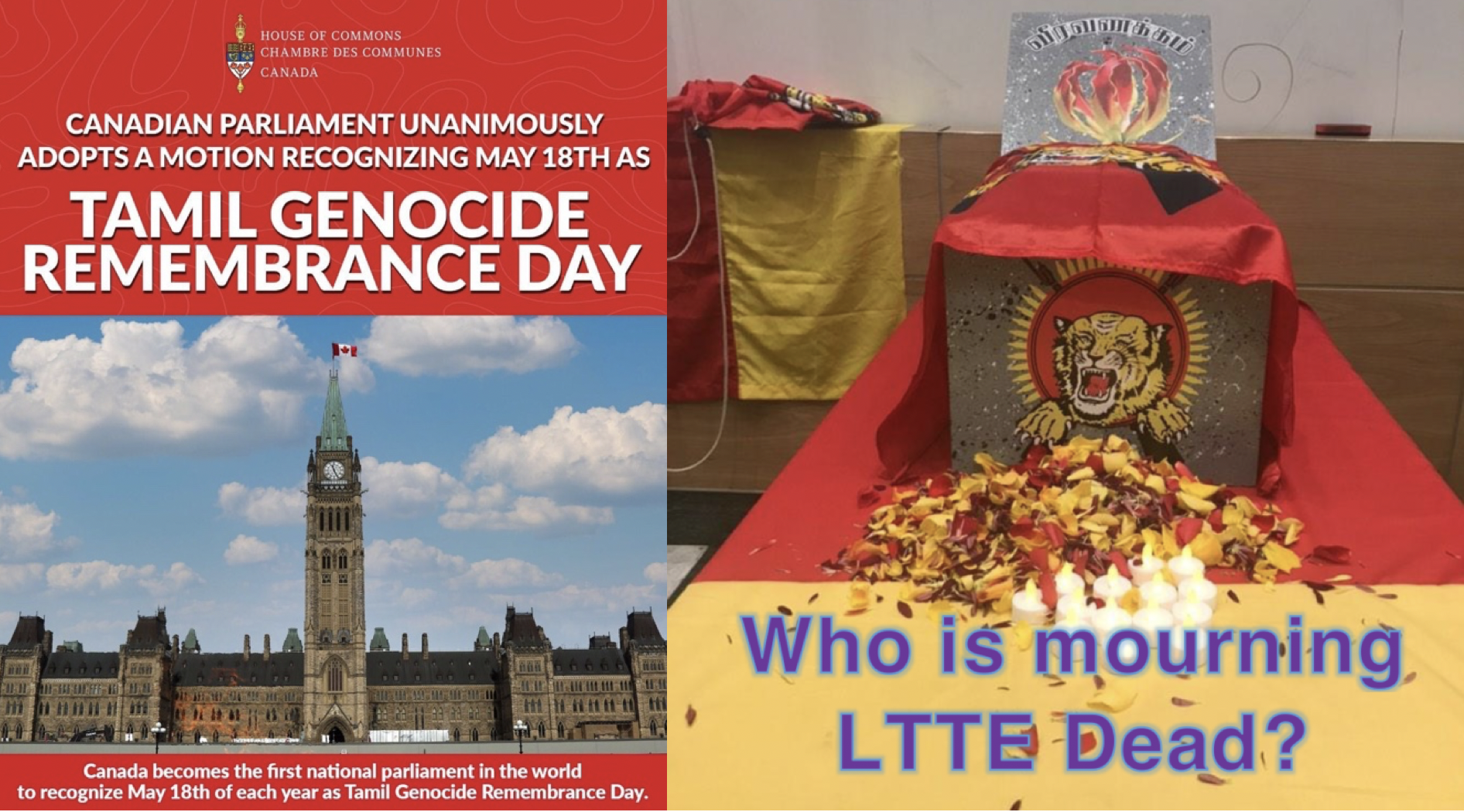
We have a situation. Sri Lanka ended 30 years of LTTE terrorism in 3 years on 18 May 2009 bringing to safety 294,000 Tamils among whom were close to 12,000 LTTE combatants in civilian clothing and 545 child soldiers. The civilians are now leading normal lives & LTTE combatants are rehabilitated & also getting on with their lives. Then there is an allegation that 40,000 to 200,000 have been killed, while there are commemorations titled Mullaiwaikkal Memorials” with LTTE paraphernalia (emblems, logos, colours etc) & photos of dead LTTErs claiming them to be ‘civilians’. Canada has decided to join in declaring 18 May as Tamil Genocide Remembrance Day. If Canada or any other Government are not intelligent enough to link LTTE paraphernalia with LTTE commemorating their dead & realize that the ‘genocide’ claims is a lie, then we cannot help Canada becoming a laughing stock eventually when the truth comes out. But, in order not to embarrass Canada any more than they have, we would like to ask Canada’s foreign mission to provide answers to the following & pass on to the Canadian Government. If Canada or any other foreign government does not wish to appreciate the effort that saved 294,000 Tamil people and instead wishes to commemorate a number claiming to be ‘killed’ – they should at least know the names & identities of those supposed to have been killed. It looks rather silly for a foreign government to be commemorating people who may not even exist.

The war theatre had 3 players

  1. The Sri Lankan Armed Forces
  1. The LTTE & their families (fought in uniform & civilian clothing) & if they died during hostilities they cannot be deemed ‘civilian’ just because they wore civilian clothing.
  1. Tamil civilians taken by force or voluntarily, who also engaged in hostilities & died cannot claim civilian status. Only Tamil civilians who were not engaged in hostilities and died during cross fire can claim to be ‘civilian’. If they died during a cross fire – was it by LTTE or Sri Lankan Armed Forces? To claim they died at the hands of Sri Lankan Forces has to be proved & it has to be disproportionate to the advantage aspired.

Can Canada put numbers to those engaged in hostilities

  • How many LTTE in uniform …..died?
  • How many LTTE in civilian clothing ….died?
  • How many LTTE family members….died?
  • How many Tamil civilians (forcibly or willingly)…..died?
  • How many Tamil civilians not engaged in hostilities died?
  • How many Tamil civilians were killed by LTTE trying to flee LTTE?
  • How many Tamil civilians died of fatigue/hunger or due to old age?
  • How many Tamil civilians died from Sri Lankan Armed Forces fire?

Without answering any of the above, ‘genocide’ is being freely used unfairly.

Definition of Genocide:

the deliberate killing of a large number of people from a particular nation or ethnic group with the aim of destroying that nation or group”.

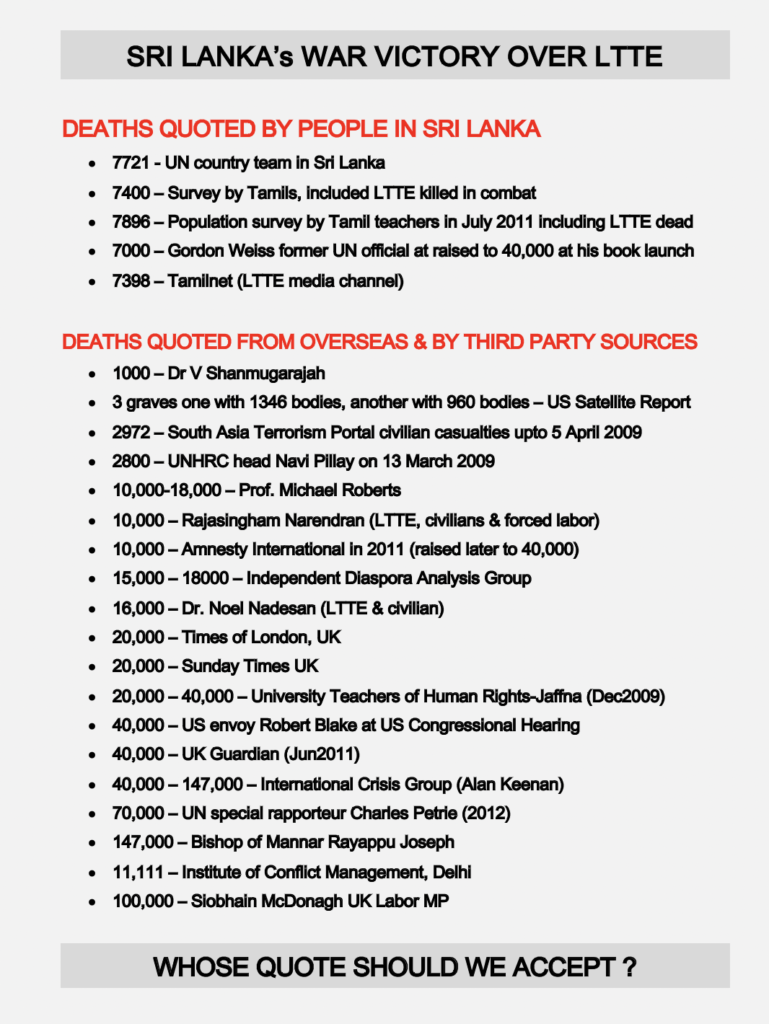
The casualty figures by people on the ground differs to the third party figures in vogue

Claims of war crimes & genocide falls flat when Tamils voted for the Army Commander Sarath Fonseka that led the war victory eliminating LTTE.

The genocide” allegations are based on claims that Sri Lanka killed 40,000 to 200,000 people.

For anyone to claim such a number, they must be able to provide answers

  • What are the names of these dead”, where did they live, where are their families, what is there age
  • Do these ‘dead’ have an identification – birth certificate, NIC, grama sevaka certificate, school admission, marriage certificate etc
  • Have a police complaint or habeas corpus been filed?
  • Have 40,000 – 200,000 families or even those alleging that they are ‘dead’ provided 40,000 to 200,000 names/details to the Missing Persons Commission or even to UNHRC?
  • Why are the names of these dead” 40,000 – 200,000 not publicized?
  • Where are their ‘dead’ bodies – after 13 years there has to be skeletons of 40,000 – 200,000 dead – where are the skeletons?
  • Where are the graves of these 40,000 – 200,000 dead”?
  • There are numerous mobile videos taken inside the war zone – how come there is no footage of soldiers digging graves to dump 40,000 – 200,000 dead bodies! Surely, this itself is an arduous task in between firing. Doesn’t this itself look odd? Just use your imagination to even imagine such a scenario!

The situation is that Sri Lanka saved 294,000 people and official death figures hover around 7721 figure (UN Country Team)

The LTTE fronts claim 40,000-200,000 dead & this could only mean they are either throwing a bogus figure or they are enabling a scenario to allow them to annually commemorate/mourn LTTE dead. What a laugh if Canada & foreign governments are joining efforts to mourn terrorists! But who are we to stop them!

There is definitely possibility that the genocide” claims & Memorial Day in reality is to enable the continuance of an annual event to keep alive LTTE & its money generating kitty. This is established by all of the commemorations held globally where mourning is only centred around LTTE flags, emblems, colours & photos of dead LTTE to whom everyone goes to pay homage. Its amusing to watch foreign MPs & other dignitaries not only visit these memorials but issue statements of grief!

If Canada or any other foreign government wishes to mourn terrorists, by all means go ahead but don’t justify mourning terrorists by claiming a bogus ‘genocide’ of Tamil civilians. 294,000 Tamil civilians were brought to safety not by foreign governments or the UN but by Sri Lanka’s Armed Forces. Even ICRC head declared Sri Lanka could have finished the war earlier but chose to not do so, as the lives of civilians would have been compromised. Instead lives of 6261 soldier lives were compromised to save 294,000 Tamil civilians. These soldiers deserve to be mourned.

Sri Lanka did eliminate LTTE terrorists & that is what Sri Lanka annually celebrates, but Sri Lanka did not kill Tamil civilians to be accused of ‘genocide’. Without naming 40,000-200,000 supposed to be ‘dead’ or locating their skeletons or mass graves, these allegations are just fairy tales. Mullaiwaikkal Memorials are for dead LTTE combatants whose families & LTTE fronts/supporters wish to commemorate annually – we do not wish to stop Canada & any other foreign government commemorating terrorists that are international banned still.

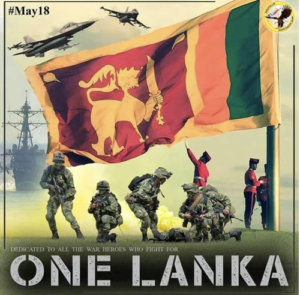
In Sri Lanka we celebrate the end of LTTE terrorism, the freedom for all communities to live without LTTE suicide missions and bombs & freedom for Tamil children from being kidnapped & turned into child soldiers – we owe all this to the bravery & sacrifices of Sri Lanka’s National Army that carried out a military offensive alongside a humanitarian rescue operation saving 294,000 people bring everyone under one National Flag on 18 May 2009.

Shenali D Waduge

Masks of democracy and energy geopolitics: Is Full Spectrum Dominance the endgame?

May 19th, 2022

Dr. Darini Rajasingham-Senanayake

South Asia’s Arab Spring has arrived amid energy wars and slow tectonic shifts in power and wealth eastward to Asia and the Indian Ocean Region. This has been hastened by the new Cold War proxy-war in Ukraine, US-led sanctions on energy-rich Russia and a refugee crisis in Europe. 

Two regime change operations amid staged protests have transpired within a month in Pakistan and Sri Lanka. Pakistan’s Prime Minister Imran Khan known for his courage on an off the cricket pitch was removed on April 9:. He accused Washington of orchestrating his ouster on the heels of his visit to Moscow.

Exactly a month later in Sri Lanka on Monday May 9, as the Central Bank commenced talks with the International Monetary Fund (IMF), for a ‘bailout’ a regime change operation was launched in the strategically located Indian Ocean island perpetually in the cross-hairs of big power rivalry. The stage had been set by 6 weeks of peaceful protests at Galle Face, which tipped into coordinated violence the same day.

As talks with the IMF commenced hitherto peaceful demonstrators, some who even held pro-IMF posters” were inexplicably attacked and violence spiraled against ruling party politicians resulting in a mass resignation of the Cabinet. The violence was a prelude to curfew, lockdowns and the swift installation of a pro-Washington Prime Minister, Ranil Wickramesinghe. The timing of events was remarkable.

There was instant approval by US Ambassador Julie Chung who said: Ranil Wickremesinghe’s appointment and the quick formation of an inclusive government are first steps in addressing the crisis and promoting stability. We encourage meaningful progress at the IMF and long term solutions that meet the needs of all Sri Lanka.” A new regime that the IMF could ‘vibe with’ was being set up as noted by senior journalist Saeed Naqvi.

One of South Asia’s wealthier countries, Sri Lanka is caught like Greece and Lebanon in an International Sovereign Bond (ISB) debt trap. The island faces the usual cycle of currency depreciation against the US dollar, with clearly coordinated trade and supply chain disruptions in every sector resulting in fuel and food scarcities and along with cyber hacks and protests.

Simultaneously, as the Lankan rupee depreciates steeply against the US dollar, there have been calls to de-dollarize and end the reign of the ‘exorbitantly privileged” Petrodollar, and source Sri Lanka’s petrol, diesel gas, jet fuel and other energy requirements at discount prices from Russia, as India is already doing.

Such energy policy alternatives however would be stymied by the proposed privatization and IMF ‘firesale” of national energy assets and infrastructure (such as the Yugadanavi power plant that was sold to a dubious American company called New Fortress), which would further compromise Sri Lanka’s Energy Security at a time of global energy wars.

Mask of Democracy and Full Spectrum Dominance

Questions arise about the legitimacy of Washington’s Manchurian Candidate for the post of Prime Minister in Sri Lanka at this time. Wickramasinghe’s United National Party (UNP), the equivalent of the GOP, was decimated in the last elections and he did not win a single seat. He was sworn in on May while the military patrolled the streets and citizens were under curfew.

To what extent are democracy, society and economy gamed and controlled by external actors when a national parliament is convened via Zoom while citizens are locked down with military on the streets in an era of heightened Disinformation Playbook narratives, artificial intelligence, data wipes, and cyber war globally and locally?

Leaderless protestors at ‘Gota Gama’ were also organized anonymously via social media platforms and networks like Facebook (META) and Whatsapp chats via remote servers with invisible bots on the English-language based internet. Who or which intel agents and agencies backed and provided the digital intelligence? After all, Facebook Whistleblower Frances Haugen not so long ago had also revealed how social media were used to de-stabilize countries such as Myanmar and Ethiopia by spreading disinformation and hate and fueling ‘protests’ that also gamed election and other outcomes. On the ground the activities in Galle Face Green were organized by foreign funded local Non-Government Organizations NGOs mobilizing genuine grievances.

As protests continued a propaganda operation to continue economically debilitating lockdowns and supply chain disruptions was staged on Vesak Poya holiday: Several Indian news channels suddenly resurrected the Liberation Tigers (LTTE) and claimed that they planned attacks, just like the mysterious Islamic State (ISIS) claimed Easter Sunday attacks of 2019. Simultaneously, NDTV talked up a staged refugee crisis” to distract from the main plot.

There can be no better candidate for such abject surrender to Washington than someone as politically weak as RW” noted Delhi-based Naqvi. Wickramasinghe has always been supportive of an American presence in Sri Lanka and was promoting the Millennium Challenge Corporation (MCC) compact and Status of Forces Agreement when he was fired by former President Srisena.

But can the mask of democracy be sustained and for how long? Is this not a façade of democracy promoted by external actors – a new pro-western Prime Minister who has no moral legitimacy sworn to deliver debt trapped Sri Lanka into the IMF’s and Washington’s arms?

Are these masks of and for democracy in Sri Lanka and Pakistan sustainable? The outcome of talks with the IMF including the proposed firesale” of land, transport, energy and telecom assets in Sri Lanka have been hidden from scrutiny of the citizens of this strategic Indian Ocean island, kept distracted with food, fuel and energy shortages.

Is Full Spectrum Dominance (FSD), of the strategic island nation, a spaghetti junction of Undersea Data Cable (UDC) routes that keep the Indian Ocean and global financial system going, the endgame?

Meanwhile, regional hegemon and junior partner, India seems to be watching and waiting as her neighbourhood is destabilized and impoverished, seemingly benefiting from Washington’s Chaos strategy” in South Asia– to counter Chinese investment and development projects such as the Belt and Road initiative.

The same chaos strategy was visible in NATO’s exit from Afghanistan with the promise of Over the Horizon (OTH) engagement via remote servers and cyber and drone operations in that country.

India’s short term gains on China will however be long-term collective regional loss since no country can develop when its neighbourhood is in chaos. In the long term, the entire South Asia region, which is a development laggard in Asia relative to Southeast and West Asia has suffered another setback due to Washington’s new Cold War.

Wouldn’t it be in India’s own self-interest to shelve its differences for awhile and work with fellow Asian giant, China, to develop the South Asian region together?

Cold War dynamics in South Asia

Prior to the regime change operation in Pakistan and Sri Lanka, as Russian Foreign Minister, Sergey Lavrov, met Indian Prime Minister Narendra Modi in New Delhi in April, western pressure had mounted with almost simultaneous visits from various British, European and US emissaries who cautioned and questioned Delhi’s historic and close ties with Moscow. 

Simultaneously, Pakistani Prime Minister Imran Khan, who had visited Russia on a pre-planned trip a few weeks earlier, was subject to a “no confidence” motion. Khan pointed the finger at the United States as the foreign power behind events in Islamabad and a Regime Change operation by buying politicians and political parties. 

Prime Minister Khan showed material evidence of the ‘foreign conspiracy’ and named Assistant Secretary of State for south and central Asian affairs Donald Lu. A letter from Washington dated one day before the No Confidence was stated, “Pakistan would be forgiven if Imran Khan lost the No Confidence motion!” Washington had foreknowledge of events in Islamabad.

Ironically, Prime Minister Khan, who saved Pakistan’s economy from the economic destruction that almost two years of unnecessary WHO-recommended Covid-19 lockdowns caused in Sri Lanka and protected the Pakistani people and economy by refusing to lockdown Pakistanis, stating that the resulting poverty would kill more people than the lab-made virus, has been accused of economic miss-management even though he was proved right.

The World Bank had lauded Prime Minister Khan’s handling of the Covid Panicdemic’ in Pakistan. Imran Khan’s friendship with China and the recent visit to Moscow and Mr Putin, he noted, had irked Washington and was the reason that Pakistan was targeted. Washington, however, has been much softer on its Indian Quadrilateral Group QUAD partner’s friendship with Russia. There may yet be a new Asian confluence with China, India and Pakistan all refusing to follow NATO condemnation of Moscow following the NATO debacle in Afghanistan last year.

Geopolitics and IMF as Deus ex Machina

Remarkably, the Government, the Opposition, and even  some protestors see the IMF as a sort of ‘Deus ex machina” solution to the crisis triggered by an apparent dollar shortage after rating agencies downgraded the island in concert last year, making it difficult for the government to roll over the 7 billion debts to be paid this year owed primarily to Sovereign Bond traders.

Sri Lanka’s Creditors are mostly based in the USA” noted senior economist Dr. Dushni Weerakoon of the Institute for Policy studies. The island’s debt to GDP ratio is around 110 per cent, partly due to economic mismanagement, including lost tax revenue, and the Covid lockdown and injection policy debacle. But then Japan’s Debt to GDP ratio is over 200 per cent! Compared to America’s 20 trillion debt, Sri Lanka’s debt is around 67 billion.

Is the currency steeply depreciated as a precursor to IMF negotiation in March because of an apparent dollar shortage to clear goods and fuel from the targeted port staged? The saucy island dared to refuse the US Millennium Challenge Corporation (MCC) Compact and Status of Forces Agreement (SOFA) in 2019. The economic crisis has escalated to default, and an IMF bailout now appears inevitable.

The island was repeatedly downgraded by Rating agencies and could not roll over its debt. The Euro-American Financial system comprises rating agencies, sovereign bond traders and, of course, the Washington Consensus and OECD or Paris Club. 

To be fair the IMF has never pretended that it cares about poor people or inequality but instead prefers to impose austerity measures on the ordinary people which should be imposed on luxury-living politicians and business elites with, for and by which the IMF works. Is the IMF a Fake Solution offered by ALL—who are bought for a unity National Government?

Unlike Pakistani Prime Minister Imran Khan, known for his courage and integrity on and off the cricket field, the hybrid American-Sri Lanka Rajapaksa Regime would not point the finger at the external factors behind Sri Lanka’s 2019 Easter attacks, the blow to the tourism-dependent economy followed by lockdowns and travel warning and the compounding economic debacle of the past three years.

Lockdowns to devastate an Economy?

Keeping hapless citizens in economically debilitating curfews and lockdowns seem to be President Gotabaya Rajapakse’s and his foreign advises’ preferred response to the unexpected.

For the past four years, since the mysterious 2019 Easter Sunday Islamic State (ISIS), claimed attacks that the US Federal Bureau of Investigation (FBI), later farcically concluded were Master-minded by an internet bot named Sonic Sonic” in Malaysia, there have been economically-devastating Lockdowns in the months of March, April and May, the annual religious festivals season in this multi-religious land.

The Easter curfew were followed in 2020 and 2021 with militarized Covid Lockdowns recommended by the WHO that devastated economy, society and democracy. There were also mysterious cyber hacks of data on the Government Cloud and maritime trade and supply chain disruptions, including the burning and sinking of ships MV Pearl and MT Diamond. 

This year in the week that Pakistan’s PM Imran Khan faced a No-Confidence motion, Sri Lanka saw Arab Spring style’ protests unfold against former US citizen President Gotabaya and the Rajapaksa brothers’ regime, given the soaring cost of living, fuel and food shortages due to a much-hyped dollar shortage in the country and downgrades by rating agencies. 

A few weeks earlier, the Sri Lankan rupee was crashed, having lost 70 per cent of its value in a year against the exorbitantly privileged dollar—a precursor to an International Monitory Fund (IMF), “bailout” or is it “bail-in” negotiations in Washington DC?

Although Sri Lanka is one of South Asia’s wealthiest countries with high social and Human development indicators in REAL TERMS, a coordinated food, fuel and electricity crisis materialized after the rupee crash. There were long queues at petrol sheds and gas shops.

But the strategic island’s crisis may be more about Geopolitics and less about Economics. Since 2019 staged Easter Sunday attacks on Tourist hotels and the economy using religion as a smokescreen and the country’s rejection of America’s Millennium Challenge Corporation (MCC) Compact, this strategically located island amid Indian Ocean Sea Lanes of Communication (SLOC), appears to have been subject to a form of hybrid ECONOMIC and TRADE WAR with Supply Chain disruption and cyber hacking of Data.

Four years of hybrid economic and trade war

Retrospectively, the mysterious Islamic State (ISIS) claimed Easter Sunday attacks on coastal Hotels and the Tourism dependent economy in 2019, ten years after the defeat of the LTTE and the dawn of peace in Sri Lanka, may be seen to herald the onset of hybrid Economic War in Sri Lanka. The attacks used religion as a cover to hit the tourism-dependent economy and Chinese investments including the Shangri La Hotel where the leader Zaharan and another suicide bomber perished, signaling this was the most crucial target.

The US FBI which removed the cell phones Easter attackers claiming to be ‘helping’ with the investigations and cover-up subsequently claimed that the attacks were master-minded by an internet BOT named Sonic-Sonic!

The hybrid war style Easter 2019 attacks were followed by two years of Covid-19 biowar and fear narratives and economically destructive Lockdowns in 2020, 2021. There was massive health sector expenditure (almost 38 per cent of the budget) and 16 million useless and expensive Pfizer booster injections by Basil Rajapaksa, Head of the Covid Task Force.

At this time while the narrative is that there are no funds to purchase essential drugs, the 4th Pfizer booster injection is on offer although Covid has disappeared! All health institutions were also captured through Digital Colonialism by Big Pharmaceutical industry and external actors promoting the Covid narrative and LOCKDOWNS (Great Reset after Event 201).

Energy Security compromised on UN climate catastrophe narrative

The crisis was compounded during Covid lockdowns in 2021 by Agriculture and Energy policies that appeared to follow the UN climate catastrophe” narrative. Farmers were instructed to switch overnight to organic fertilizer without a transition plan. The result was fertilizer shortages, harvest failure and farmer’s livelihoods decimated. But President Rajapakse was awarded a prize at the UN for his ‘organic fertilizer’ policy!

So too the island’s Energy security was compromised during Covid lockdowns following the United Nation’s climate catastrophe narrative although Sri Lanka’s per capita carbon emissions are minute comparted to most countries in the world.

There was a rush to convert power plants to LNG and focus on renewables, without a phased transition plan, also given high levels of corruption in energy sector and oversight institutions like the Ceylon Electricity Board and Public Utilities Commission PUCSL. Meanwhile, the Yugadhanvi power plant at Kerawelapitiya was sold to an American company- further compromising national energy security during an energy crisis! The claim was that the answer to corruption in State owned enterprises (SOE) in privatization and sale of assets to foreign companies. Is this not a case of throwing a baby out with the bathwater?!

For the past four years then a pattern has emerged: Every March-April, a new round of destabilization and economically, socially and democracy debilitating lockdowns starts and since 2019, Sri Lankan citizens have been routinely put in LOCKDOWNS and CURFEWS. Meanwhile, foreign navies stage war games off the island’s coasts of this strategic island, as was the case with the Malabar War games that beached and killed pilot whales while Lankans were in lockdown in 2020.

Has the island been systematically targeted because it sits on the Indian Ocean Sea Lanes of Communication (SLOC), vital to securing America’s “Free and Open Indo Pacific” after refusing the MCC compact and SOFA? Geography is history in this strategic island in the Indian Ocean. Similarly, Pakistan was targeted for regime change after Imran Khan’s visit to Russia.

Former US Assistant Secretary for South and Central Asia, Alice G. Wells, once referred to Sri Lanka as a “valuable piece of real estate” and the island appears to be vital for maintaining America’s “Free and Open Indo Pacific”.

So too, the Sinhala Diaspora seems to have been Weaponized: Basil Rajapaksa, brother of the President and Prime Minister and Minister of Economic Disaster in Sri Lanka, is a US Citizen. Governance in Sri Lanka for the past three years has been a family affair of the hybrid American-Sri Lankan Rajapaksa family. Basil Rajapaksa was set to fly to Washington to the International Monetary Fund (IMF) after a staged parliamentary debate on April 8 but was later ditched as a liability.

Lawfare: Solutions when conspiracy theories come true

We live in a post-Covid world when conspiracy theories increasingly seem to come true. In a landmark decision the Supreme Court of India ruled last week, that ‘no one could be forced to be vaccinated’ and that that there was NO data to show more risk from unvaccinated persons than vaccinated individuals. This begs the question why and millions being spent on Covid injections and boosters?

At this time Protests may be useless without creative alternatives to the proffered IMF “solution” requiring foreign legal firms to take over Sri Lanka’s economic negotiations. 

Strategic Sri Lanka may need to look to look east, beyond India for help and development at this time of national humiliation and develop a strategy to de-dollarize and trade in a basket of currencies. It may consider an independent Economic, Trade, Energy and Foreign Policy and source its oil, gas, and other energy needs from Russia at discount prices like India is doing.

Going to the IMF and its aid conditionalities means that Sri Lanka loses policy autonomy and sovereignty and is rendered unable to have an INDEPENDENT FOREIGN, ECONOMIC, TRADE or ENERGY policy that serves the interest of her citizens.

Sri Lanka seems to be subject also to the phenomenon of lawfare as part of a Full Spectrum Dominance (FSD) remote Over the Horizon (OTH) operation. As documented in the regime change operation against Brazil’s leftist President Lula by the Central Intelligence Agency (CIA), lawfare has been identified as the process whereby a country’s legal system is subverted and weaponized against justice. 

There is a pattern of fundamental rights cases against government actions being dismissed while the people are distracted with food and fuel shortages and or Covid-19 lockdowns. Petitions that have been refused leave to proceed sometime by five-judge benches include challenges to the sale of the Kerawelapitiya Yugadhanavi Power plant at this time of Energy Crisis to a US company name New Fortress in a midnight deal by the President, the Central Bank Bond scam cases, the cases challenging the Covid-19 mass injections Gazette of 2022 which would impose digital vaccine certificates and discriminate those who are not injected from public places under a Fake Health Emergency etc. that would also enable surveillance, stop crowds and protest, stymie democracy and promote digital colonialism and control of citizens.

Are the citizens of strategic Sri Lanka being targeted in an Over the Horizon (OTH) Full Spectrum Dominance (FSD) operation for control, colonization and occupation as Cold War returns to South Asia with America’s ominous Pivot to the Indian Ocean region?

 [IDN-InDepthNews – 04 April 2022]

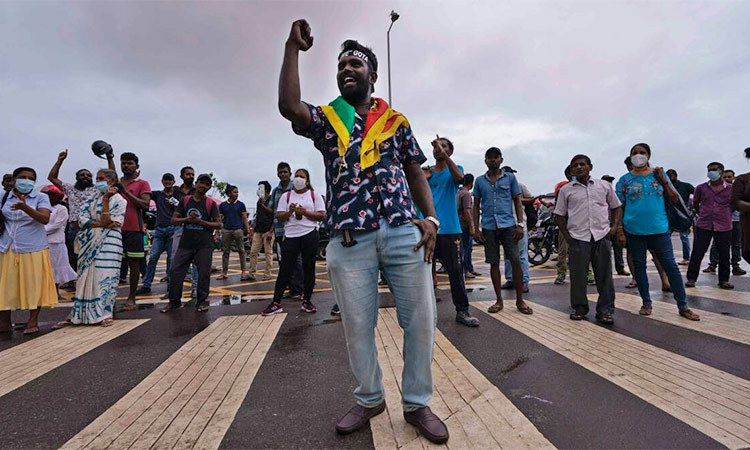
Photo: A Sri Lanka protestor. Source: DAWN

IDN is the flagship agency of the Non-profit International Press Syndicate.

Visit us on Facebook and Twitter.

We believe in the free flow of information. Republish our articles for free, online or in print, under Creative Commons Attribution 4.0 International, except for articles that are republished with permission.

සුපර්කැලි-ෆ්රැගිලිස්ටික්-එක්ස්පියලි-ඩෝසියස්

May 19th, 2022

ජයන්ත හේරත්

අපේ අගමැති අතිවිශිෂ්ටය

සුපර්කැලි-ෆ්රැගිලිස්ටික්-එක්ස්පියලි-ඩෝසියස් ය

supercalifragilisticexpialidocious –

වැ ඩ ට එන්න එපා

supercalifragilisticexpialidocious

අගමැති කියයි;

වැ ඩ ට එන්න එපා

එනවා නම් ඇවිද ගෙන එන්න,

බයිසිකලේ එන්න.

ව්යායාමයට හොඳය,

ඊටත් වාහන වල එන්න ඉන්ධන දෙන්න විදියක් නැත.

දීමනා දීම නතර කර ඇත.

වැටුප් අඩු කරන්න වෙන්නේය.

මගේ වැටුප අඩු කර ගත්ත විදියට

ඔහෙල ගෙත් පඩිය අඩු කරාන්න වෙන්නේය.

අයි එම් එෆ් කියන විදියට ජොබ් ගණනකට කෙලවෙන්නේය.

සූදානම් වෙන්න.

ආණ්ඩුවේ ඉස්කෝල වහල දමන්න

ඉගෙන ගන්න අවශ්ය නැත

ගෝල්පීස් ඉස්කෝලේ හොඳය. 

ටීචර්ලා ඉන්නෙත් ගෝල්පීස් එකේය

මේ අවුට්ඩෝ එඩියුකේෂන් කාලයයි,

අයි-පෝං එඩියුකේෂන් එක හරියට කරගන්න

ලෝකේ වෙන්නේ මොනවාද කියා දැන ගෙන

තානාපතිවරුන්ගේ අත්පොලොසන් නද මැද

ලංකා-වසන්තේට  කතා කරන්න.

විශ්ව විද්යාල වහල දමන්න

කොල්ලන්ට කෙල්ලන්ට ගෝල්පීස් යන්න කියන්න

ආචාර්ය මහාචාර්ය වරු කොහොමත් ඉන්නේ ගෝල්පීස්ය

මුහුදු හුළං වැදි වැදී

එන් ජී ඕ ෆන්ඩ්ස් වලින් කකා

එන් ජී ඕ බයිලා අහ අහා

බිම දිගෑදී ඉඳීම ආතල්ය

දැනුම හොයන්න කිමිදුම් කරන්නත් පුළුවන

මේ දවස්වල මෝරු තල්මස්සු ඉන්නෙත් බඩගින්නේය

එවුන්ටත් ආහාරයක් හිඟය

ශිෂ්යත්ව මුදල් ඉතිරි වන්නේය

පාර්ලිමේන්තු එන්න එපා

එක එකාට බැණීම

අඩි හප්පා ගැනීම

ගෙදර ඉඳන් කරන්න පුළුවන

ගෙදරට වී හිටින්න

ඉන්ධන ඉතිරි වෙන්නේය

කැන්ටිමේ කෑම වියදම නවතින්නේය

පාර්ලිමේන්තු දවසකට වැය වෙන රුපියල් ලක්ෂ 50

ඉතිරි කරගත්තත් ලොකු ගානක්ය.

ඕනෑම නම් විදුලි බලය ලැබෙන විදියට

සූම් ටීම් මීටීන්  තියන්න පුළුවන

අපේ අභිනව අගමැති මරුය

supercalifragilisticexpialidocious ය 

කීපවතාවක්ම

ලංකාව බේරා නොගෙන-බේරාගත්තේය

ඉස්සරහටත් වෙන්නේ ඕකමය.

Supercalifragilisticexpialidocious

Queen Elizabeth opens Elizabeth Line

May 19th, 2022

Janaka Alahapperuma from London

Her Majesty The Queen has made a surprise appearance with her youngest son, the Earl of Wessex at London’s Paddington Station to mark the completion of the new railway ‘The Elizabeth Line’, named in honour of the Queen in her Platinum Jubilee year, ahead of its opening to passengers on Tuesday 24 May. 

During the Royal visit to see the newly built east-west Crossrail, the 96-year-old monarch officially unveiled a very simple plaque to celebrate the completion of the rail line. The plaque will be moved later to be permanently mounted on the wall at Paddington station, celebrating The Queen’s connection with the railway for generations to come. Holding a walking stick, The Queen emerged from a transparent lift with a brightly smiley face, looking magnificent at her age in a coat in sunshine yellow and a matching hat with a Singapore brooch.

Her Majesty and Prince Edward were welcomed by the Prime Minister Boris Johnson, the Mayor of London Sadiq Khan, Transport for London (TfL) Commissioner Andy Byford, the Transport Secretary Grant Shapps and the Crossrail Chief Executive Mark Wild. 

The Queen and Prince Edward also met with staff who have been key to the Crossrail project, as well as Elizabeth line staff who will be running the railway. They were eagerly waited to see the Queen and witness the opening ceremony. The Queen also met with train drivers, station staff including apprentices

The visit was Her Majesty’s second to the Elizabeth line. She came to see the railway during its construction to mark the name change from Crossrail to the Elizabeth line in 2016. Today’s visit builds upon a long-held association between the Royal family and London’s Transport network. The Queen became the first reigning monarch to travel on the London Underground when she opened the Victoria line in 1969. That time she had to put a coin in a machine to get her ticket and travelled in the driver’s cab. In 1977, the Jubilee line was named after Her Majesty’s Silver Jubilee, but did not open until two years later, when the Prince of Wales officially inaugurated it. The Elizabeth line is the third London transport line opened during her reign and named in honour of the Royal family.

After unveiling the plaque, the Queen was given Elizabeth line commemorative Oyster card topped up with £5 for the Queen, who famously rarely carries cash and showed how the ticket machine worked and how to top up an Oyster card by Kofi Duah, a customer experience assistant.

He later said: the Queen asked, ‘Where can it take you to?’ I said, ‘It can take you on all the lines, from Paddington to Abbey Wood’.”

The Queen passed up the opportunity to travel on one of the new trains, instead returning to Buckingham Palace while Prince Edward was given the privilege of becoming the first passenger, travelling through the tunnels to Tottenham Court Road and back. He took a ride on the train with Prime Minister Boris Johnson, London Mayor Sadiq Khan and MP Grant Shapps, the Transport Secretary. The Prince was invited to stand in the driver’s cab during the second leg of the journey back to Paddington and chatted with driver Carinne Spinola as the train moved. Normally that trip from platform to platform would take about 10 minutes by tube train but it will be just under 5 minutes when the Elizabeth line opens. After stepping off the train at Paddington, the Earl of Wessex said: ‘That was brilliant. I did enjoy that. It was a great view and good fun.

Within hours of the opening, PM Johnson said he would now be pushing for Crossrail 2 – a proposed north-south rail link across London to be built.

He further said: “That is going to be transformative again. All the problems of commuters coming into Waterloo getting up to north London, you can fix that with another Crossrail.

Elizabeth line project was delayed more than 3 years and 5 months and almost £4 billion over budget due to numerous issues including construction difficulties and complications installing signalling systems. It was due to be completed in December 2018 and was set a budget of £14.8 billion in 2010. Later the total cost has been estimated at £18.9 billion, including £5.1 billion from the Government. London is paying for most of the Elizabeth line, with nearly 70 per cent of the total funding paid by London, made up of roughly 30 per cent is from London’s farepayers, around 40 per cent from London’s businesses, combined with 30 per cent from Government, and when open is expected to boost the UK economy by an estimated £42 billion.

The structure stretches more than 100 km (62 miles) from Reading in Berkshire and Heathrow Airport in west London through central London to Shenfield in Essex and Abbey Wood in southeast London. Trains will initially operate in three sections, which are expected to be integrated in the autumn. Services will be limited to six days a week and the new Bond Street station, which has been beset by engineering and construction difficulties, will remain closed for some time. Sunday services will be suspended to allow a series of testing and software updates in preparation for more intensive services from the autumn”, according to TfL. The Elizabeth line will boost capacity and cut journey times for travel across the capital.

The Queen who now rarely carries out public engagements outside of her royal residences and was always using a walking stick. Therefore, her attendance was not publicly announced in advance because she has been suffering ongoing mobility problems, but organisers were told there was a possibility she might be able to attend. In recent months ill health has forced her to pull out of a string of high-profile engagements including last week’s State Opening of Parliament. However, The Queen rallied to make a trip to the Windsor Horse Show on both Friday and on Sunday evening was the guest of honour at the equestrian extravaganza A Gallop Through History near Windsor, the first major event of the Jubilee festivities. This engagement is the Queen’s first one outside of the Windsor area since she attended the Duke of Edinburgh’s memorial service in Westminster Abbey seven weeks ago.

The Queen’s public appearances are being closely watched and raising hopes that she will be well enough to attend at least some of the celebrations as Britain prepares to celebrate the monarch’s 70 years on the throne with Platinum Jubilee festivities during the four-day bank holiday weekend from 2nd to 5th June in the summer

Source: Buckingham Palace

Vesak celebrations at Das Buddhistische Haus ( Berlin Buddhist Vihara) in Germany

May 19th, 2022

Senaka Weeraratna Trustee German Dharmaduta Society

Vesak was celebrated at the Berlin Buddhist Vihara on Sunday May 15, 2022 in a fitting manner. The Vesak ceremony was conducted outdoors in bright weather conditions against the backdrop of a picturesque natural setting that is the hallmark of this Temple which is called ‘ Das Buddhistische Haus’ (DBH) in German. It is the oldest Theravada Buddhist Temple in Continental Europe and was founded by the pioneering German Buddhist Dr. Paul Dahlke in 1924.

Asoka Weeraratna, founder of the German Dharmaduta Society, led the first Buddhist Mission from Sri Lanka to Germany in 1957. The Mission comprised Ven. Soma, Ven. Kheminde and Ven. Bope Vinita Thero, all chosen from the Vajiraramaya Temple, Bambalapitiya, Colombo 04.

Asoka Weeraratna purchased the property of DBH from the relatives of Dr. Paul Dahlke, on behalf of the Trustees of the German Dharmaduta Society of which he was one Trustee, in December 1957. It thus became the first Buddhist Centre in Continental Europe to come under the management of an Asian Buddhist Society. Asoka Weeraratna thereupon under the auspices of the GDS transformed the DBH into a Buddhist Vihara with necessary repairs and structural changes and by lodging Dharmaduta monks mainly from Sri Lanka, on a long term footing to spread the Dhamma in Germany and other Western countries.

To this day monks from Sri Lanka and other Theravada Buddhist countries, like Thailand and Myanmar, plus German and other European Buddhist monks have taken up residence from time to time at the Berlin Vihara to deliver Buddhist sermons, conduct meditation retreats, participate in discussions, and teach and guide children on the basics of Buddhism. German Buddhist laymen are regular lecturers at DBH.

Das Buddhistische Haus is a protected heritage site and has been declared a National Monument by the German Government. DBH is marked as a destination for tourists on the national tourist map. It is one of the few large buildings in Berlin that escaped the massive Allied bombardment of that City during World War Two. The German residents of Frohnau, which is located in the Northern part of Berlin, in particular are very proud of this landmark site as it has placed the picturesque town of Frohnau on the world map. During the time of the German Monarchs, the Kaiser Park was located in Frohnau. 

100th anniversary of DBH in 2024

Das Buddhistische Haus will be celebrating in 2024 the 100th anniversary of its founding. Both Sri Lanka and Germany, and rest of the Buddhist World are expected to participate in this commemorative event. Das Buddhistische Haus is an iconic symbol of Buddhism in Europe and the longest standing cultural link between Sri Lanka and Germany. 

Vesak

Vesak was observed this year at DBH in the presence of a sizeable gathering of Buddhists from Sri Lanka, Germany, Thailand, Myanmar, Bangladesh, China, and Argentina. 

Among the dignitaries present were Ms. Manori Unambuwe, Sri Lanka’s Ambassador to Germany. Mr. Karunasena Sonnadara, one of the long standing dayakayas of the Berlin Vihara and who was a member of the Third Buddhist Mission from Sri Lanka to Germany in 1962, now aged, was also present with his wife and children.

Mr. Sonnadara who attended the inaugural meeting of the Lanka Dhammaduta Society ( later renamed as the German Dharmaduta Society) held on September 21, 1952 in Maradana, Colombo 10, Sri Lanka, is now the last remaining survivor of the 1960’s era of Das Buddhistische Haus. He has rich anecdotal memories to share of the bygone days in both Sri Lanka and Germany.

There were four Buddhist (Sinhala) monks in attendance, namely 

1.Ven. Pelane Dhammakusala Thero ( Resident monk of DBH), 

2. Ven. Marthagoda Uparathana Thero, Viharadipathi, Denmark Copenhagen Buddhist Temple, 

3. Ven. Kannimahara Piyasiri Thero, Viharadipathi, Munich Buddhist Temple, and

4. Ven. Minuwangoda Gnanavasa Thero.

The religious program commenced at 7.00 a.m. with several dayakayas clad in white taking ‘ Sil’. The monks solemnly walked in line on Pindapatha outside the Temple premises enabling the dayakayas to give alms i.e. place food inside the Bowl carried by the monk. 

The religious program contained both Sila and Bhavana components. In the morning session, Ven. Marthagoda Uparathana Thero delivered a sermon centered on the ‘ Sukho Buddhanang Uppado’ verse. It means the ‘ The Birth of the Buddha is a cause for happiness’.

In the afternoon session the Dhamma Discussion was conducted by Ven. Minuwangoda Gnanavasa Thero. 

It was followed by a session on Meditation with a talk in German by Mr. Tissa Weeraratna, caretaker of the DBH, on the theme ‘ Cultivation of the Mind is an essential pre – requisite for achieving success in Meditation’. 

The Berlin Vihara was well decorated with colourful Buddhist flags and traditional Vesak lanterns for the  occasion.

The Sri Lankan residents in Berlin organized a Dansala providing a range of vegetarian food for lunch and afternoon tea for the participants. 

Ven. Pelane Dhammakusala Thero acted as the host monk while Mr. Tissa Weeraratna, the caretaker of the DBH, oversaw the arrangements with the help of both the Sri Lankan (Sinhala) and German Buddhists.

The proceedings concluded at about 5.00 p.m.

Senaka Weeraratna

Trustee

German Dharmaduta Society

High Commissioner Milinda Moragoda and India’s National Security Advisor Shri Ajit Doval carry out a comprehensive review of the bilateral relationship

May 19th, 2022

Media Release 2022.05.19 Sri Lankan Commission in New Delhi

Sri Lanka’s High Commissioner to India Milinda Moragoda met with the National Security Advisor of India Shri Ajit Kumar Doval, at the latter’s office in New Delhi on 19 May 2022.

During their discussion a comprehensive review of the status of the bilateral relationship was carried out and priority areas for future cooperation were deliberated on.

The discussion particularly focused on the present economic crisis in Sri Lanka, and the High Commissioner thanked the National Security Advisor for the support that is extended by the Government of India to Sri Lanka to manage the situation.

In this context, High Commissioner Moragoda requested for India’s assistance in garnering international support for the economic recovery in Sri Lanka, to which the National Security Advisor responded positively.  

Deputy National Security Advisor of India Ambassador Vikram Misri and the Deputy High Commissioner of Sri Lanka in New Delhi Niluka Kadurugamuwa also participated in the meeting.

USLA Wellington Ranaviru Commemoration 19.5.22-USLA Spokesperson’s Message

May 19th, 2022

Dr. Chula Rajapakse MNZM

USLA Wellington Ranaviru Commemoration 19.5.22

USLA Spokesperson’s Message

Mr President, Ladies and Gentlemen

Thank you for once again offering me the privilege of being able to contribute to this USLA  sponsored Ranaviru commemoration on this the 19th day of May 2022.

Today we once again,  remember the Ranaviru, our war heroes who sacrificed life and limb to liberate Sri Lanka from three decades of Tiger terror.  It is because of their sacrifices that the Sri Lankan’s  can enjoy the many freedoms that they enjoy  today which they didn’t have then, like travelling to anywhere at any time on public transport without any fear of any bomb blasts or injuries.  It is the ranaviru sacrifices that have enabled us living overseas to travel to Sri Lanka and enjoy these same freedoms .  In fact it is the ranaviru  sacrifices that have enabled the Sri Lankan’s in the argali boomiya to exercise their democratic privileges as they have done for over 40 days now.

Today we remember every single one of these Raaviru who sacrificed their life and limb for these freedoms.  We remember the 13 soldiers who were ambushed in 1983 that set off this campaign to liberate Sri Lanka.  We remember the lives lost in the different campaigns, including the liberation  of Jaffna , Elephant Pass, Thoppigala & the  Eastern Province,and finally the liberation of all of Sri Lanka on the banks of the Nandikadal Lagoon in Mulativu, exactly 13 years ago. 

We remember every single soldier, naval rating, air force man, the police personnel, other security forces personnel, intelligence officers – all of them who were involved in this effort.  We remember the leaders of the campaigns like the Generals  who led from in front .  We also honour and record our appreciation of the civilian and the political leadership that made this possible by making every facility available to these forces to carry out what they did. 

We also remember ladies and gentlemen,  the civilian victims of the terrorist war.  We remember the assassination of Mr Alfred Duraiappah, the Mayor of Jaffnal in 1975 .We remember the innocent pilgrims gun downed  mercilessly in front of Sri Maha Bodhi.  We remember the border villagers who were gunned down in their sleep  We remember the victims of many attacks, including that of the central bank  in Colombo, some of whom experienced this may be here right now. 

It is for these reasons that we are grateful to the Ranaviru for their  liberation of us all from this carnage. I am proud that …USLA…. is honouring them not only with commemorating their memory but also with providing significant monetary assistance to the various Abimansalas scattered around the country .We are proud that last year we provided 28 computer tablets to children of the ranaviru ,to help in theireducation.

However, I don’t believe that our obligation to the Ranaviru  ends with such material support only.  It is our duty also to do whatever it takes to protect the majesty, the sanctity and the purity of their sacrifices without it being tarnished by false and baseless allegations .  The worst of these is the UNHCR resolution passed in 2016 which effectively condemns the liberation as having been achieved through excessive loss of civilian life , so calling them to be HR violations and war crimes.  This has been exposed  as being false through the findings of  many Presidential  commissions whose findings have been endorsed by international legal luminaries .  Their falsehood  has been revealed most of all by the despatches from the defence attachés from the United States Embassy and the UK Embassy in Colombo, the two countries who are the sponsors of this resolution.  However up till now with the UNHCR every year reinforcing the resolution, the provision of this information exposing their fallacy has not been particularly inspiring.  We have had Lord Naseby in the House of Lords in the UK tabling in 1987 and thereafter the original  defence attache despatches which confirm what we say,. I have presented them in lengthy submissions to UNHCR . However , I don’t believe the SL govt ever provided such comprehensive submissions till  March ’22, when the present Foreign Minister, Prof.GL Pieris made a very good and  successful effort to place all of this information before the UNHC. This resulted in his securing support of many nations in UNHCR for Sri Lanka’s contention that this is a very unjustified resolution.  It is our hope that this will be pursued every six months at the UNHRC with more vigour until we finally get this scar on the Rnaviru removed from the statute books of the UNHRC and let their reputation and the memory of . remain sacred as it should be. 

On a further positive note I am  happy to see that in the ongoing demonstrations in the Aragaa Boomiya  on the Galle face green in Sri Lanka  members of all races – the Singhalese, the tamils, the Muslims and those of different religious  faiths, Buddhists, Hindus, Islamic faith and Christians  all united in their protesting and over the last four weeks. They have celebrated together many religious festivals as if they were all part of one group . .These included the Easter,, the Id Il Fitur after the Ramzan fasting month  & the Wesak  ceremonies. This has been the best demonstration of Eka Mavekuge Daru Kala Bavina, Ymu, Yamu V nopamma”.  This would surely be what the Ranaviru would have wanted.

It was also heartening to see that the Tamil Nadu politicians who were once the adversaries are now pitching in as donors of medical equipment and medications to help Sri Lanka in their hour of need. 

It is also heartening for me to note that whilst last year we had the information that here in New Zealand there was a meeting listed  to commemorate the Tamil Genocide, when I wrote to the Prime Minister Jacinda Arden  of NZ and  Sri Lankan born NZ MP, Vanushi…Walters saying that this baseless claim was hurtful and an encroachment on our human rights  not to be so accused falsely . I suggested in the future that this meeting should not have that label, I am glad to see that at least so far I have not heard of a similar labelled meeting going on in New Zealand today.

So on those positive notes and positive changes I wish to conclude once again Mr President bowing my head in  humble appreciation of the sacrifices of the Ranaviiru   that has  enabled all of us to enjoy the freedoms that we now enjoy as I outlined earlier.

Thank you very much.

Dr. Chula Rajapakse MNZM

Spokesperson, USLA

19.5.22

ඉන්ධන හා විදුලිය නොමැති කමින් අඩුආදායම්ලාභීන් වෙත එකවර ගෙවන ලද දීමනාව ගෙවීම සඳහා සේවකයින් හට මතුව ඇති ගැටළුකාරීත්වය

May 19th, 2022

සමෘද්ධි සංවර්ධන නිළධාරීන්ගේ සංගමය

ලේකම්,
සමෘද්ධි සංවර්ධන අමාත්‍යාංශය,
සෙත්සිරිපාය,

ඉන්ධන හා විදුලිය නොමැති කමින් අඩු ආදායම්ලාභී පවුල් තොරතුරු CRM පද්ධතියට ඇතුලත් කිරීමේදී මතුව ඇති දුෂ්කරතා මත පොරාත්තු ලේඛණයේ සිටින අඩුආදායම්ලාභීන් වෙත එකවර ගෙවන ලද දීමනාව ගෙවීම සඳහා සේවකයින් හට මතුව ඇති ගැටළුකාරීත්වය පිළිබඳව.

පවතින ආර්ථික අර්බුදය හේතුවෙන්, ජීවිත අඩාලවීම වෙනුවෙන් පවත්නා සුබ සාධක වැඩසටහන් වල හා පොරොත්තු ලේඛනවල සිටින ප‍්‍රතිලාභීන් හට මාස 03 ක කාල සීමාවකට එකවර ගෙවීමට තීරණය කරන ලද රු. 5000/ වු දීමනාව ඉන්ධන හා විදුලිය නොමැතිකම හේතුවෙන් නියමිත දිනට ගෙවීමට සේවකයින් හට නොහැකි තත්වයක් උදාවී ඇති බව කණගාටුවෙන් වුවද ඔබවෙත මෙයින් දන්වා සිටින්නෙමු.

උක්ත කරුණට අදාලව සමෘද්ධි අධ්‍යක්ෂ ජනරාල් විසින් ඔබටද පිටපතක් සහිතව සියළුම සමෘද්ධි බැංකු කළමණාකරුවන් හට එවා ඇති 2022. 04. 22, 2022. 04. 26 හා 2022. 05. 05 මඟින් උපදෙස් ලබා දී ඇති අතර, දීමනාව ලැබීමට සුදුස්සන්ගේ තොරතුරු පරිඝණකගත කිරීම 2022. 05. 18 අද දින අවසන් කල යුතු බවත් එකී අයට අදාල මුදල් බැර කිරීම වෙනුවෙන් සමෘද්ධි බැංකුවේ ගිණුමක් ආරම්භ කරන මෙන් උපදෙස් ලබා දී ඇත.

සමෘද්ධි අධ්‍යක්ෂ ජනරාල් විසින් 18 යන අද දින ලබා දී තිබුණද දින ගණනාවක සිට රට පුරා පවතින ඉන්ධන හිඟයත්, දෛනික විදුලි කප්පාදුවත් මත උපදෙස්හි සදහන් කාර්යන් කළමණාකරුවන් ඇතුළු බැංකු කාර්ය මණ්ඩල වෙත මෙන්ම ක්ෂෙත්‍ර කටයුතු නිරත සමෘද්ධි සංවර්ධන නිලධාරීන් හට ලබා දීමට නොහැකි තත්වයක් උදාවී ඇති බවත් එය සේවකයින්ගේ වරදක් හෝ අඩුපාඩුවක් නොවන බව අප සංගමය ඔබ වෙත මෙයින් අවධාරණය කරන්නෙමු.

පවතින මෙම තත්වය හමුවේ සේවකයින් මෙන්ම අදාල ප්‍රතිලාභ අපේක්ෂා කරන 2,50,000(දෙලක්ෂ පනස්දහසකට) ආසන්න, පවතින ආර්ථික අර්බුදය හේතුවෙන් අපහසුතාවයට පත් ජනතාවද තවත් අපහසුතාවයට පත්වන බව පෙන්නා දෙන්නෙමු. ඒ අනුව අදාල දීමනාව ගෙවීමේදී සේවකයින් හට ප්‍රායෝගිකව බලපා ඇති දුෂ්කරතා පිළිබඳව අවධානය යොමු කර අදාල ප්‍රතිලාභ අපේක්ෂා කරන අයද අපහසුතාවයකට පත් නොවන අයුරින් කාලය දීර්ඝ කර දෙන මෙන් මෙයින් කාරුණිකව ඉල්ලා සිටින්නෙමු.

මේ සම්බන්ඳව ඔබ දක්වන සහය ඉතා අගය කොට සලකමු.

ස්තූතියි.

මෙයට,
චාමර මද්දුමකළුගේ,
(ප්‍රධාන ලේකම්)
සමෘද්ධි සංවර්ධන නිළධාරීන්ගේ සංගමය.

Personalities and Systems

May 19th, 2022

MALINDA SENEVIRATN​E

‘The Eighteenth Brumaire of Louis Bonaparte,’ one of the more literary essays written by Karl Marx famously, contains many quotable quotes which are of course frequently used in contexts that have little to do with the thrust of the man’s thinking. This, however, is apt for our times: ‘Men make their own history, but they do not make it as they please; they do not make it under self-selected circumstances, but under circumstances existing already, given and transmitted from the past.’ Pierre Bourdieu, the French sociologist who concerned himself with the dynamics of power, captured the same issue of structure and agency in ‘Distinction,’ speaking of structuring structures and structured structures.  

The overbearing nature of structures and how they weigh upon the universe of the possible are too often forgotten, perhaps mostly because public anger/perception focuses on personalities and their strength, weaknesses and idiosyncrasies. People vote for people. People vote for parties, but political organizations are judged less by ideologies and programs than by those identified with them.

Over the past six weeks or so, people did talk about ‘systems’ but if pushed to describe these, few would have gone beyond ‘the executive presidency.’ It was easier, as it has always been, to pick (on) an individual. So we got #gotagohome. Then we got, what is essentially a reboot without disturbing the structures or foundations. As some wit put it, ‘in 2015, Maithri became the de facto leader of the UNP; in 2022 Ranil became the de facto leader of the pohottuwa.’ Regardless of how many votes Ranil Wickremesinghe received, regardless of whether or not parliamentary strength reflects popular support (which of course cannot be precisely ascertained this side of an election), within Parliament, Wickremesinghe’s legitimacy is now established — the majority accept his leadership.  

Now all this seems to have floored many in the much talked of ‘aragalaya.’ Even Dr Harini Amarasuriya, the National List MP of the JVP, obviously one of the better informed parliamentarians and certainly someone equipped to engage in intelligent debate seemed to be surprised. She tweeted the following:

‘Ok, let’s talk stability. 1. @GotabayaR resigns, 2. Interim govt formed, 3. Constitutional amendments, 4. Election. Why wasn’t this an option? How is appointing a person with a single seat in parliament as PM going to ensure stability?’

So, Gotabaya Rajapaksa resigns, let’s assume. What next? Well, as per the constitution, Parliament has to elect a successor. Who? Anura Kumara Dissanayake, the leader of her party? Well, we’ll get to that presently. Let’s assume MP X succeeds Gotabaya Rajapaksa. Let’s assume an interim government is formed. We then come to constitutional amendments. All talk of constitutional amendment is reducible to a. Repealing the 20th Amendment and replacing it with the 19th Amendment, b) strengthening the resultant ‘independent institutions,’ c) inclusion of robust auditing mechanisms.

Harini must have read the 20th and the 19th. Would she claim that the 19th is flawless (apart from weaknesses of independent institutions as per the BASL proposals)? We haven’t heard the JVP talk about the composition of the Constitutional Council (in the 19th) or ‘national government’ being left undefined. Few talk about the passage of the 19th and how it made a mockery of judicial review or, for that matter, the fact that the architects of the 20th followed judicial recommendations to the letter.

Among the changes to the constitution is the abolishing of the executive presidency. Neither the BASL nor constitutional tinkerers seem to have bothered the consequences in a context where the 13th Amendment remains untouched.

So, to the question, ‘why was this not an option?’  An option for whom? What’s forgotten here is that at the end of the day options can only be considered by the incumbent and the Parliament; what’s opted for is essentially reflective of the power balance in the latter. It can’t be the case that a bunch of NGOs or ragtag parties or a diplomatic cabal gets to choose among options, certainly not if ‘solutions’ have to be found within the framework of the existing constitution. Outside of it, of course, there’s revolution, but that’s something the JVP seems to have abandoned ages ago and it’s not something that the aragalists seem to be serious about since the focus has been, from Day One, on personality (and to a lesser degree family/clan and party), and not on system and structure.

‘How is appointing a person with a single seat in parliament as PM going to ensure stability?’ This is an interesting question in and of itself and amusing too, coming from Harini. Yes, Wickremesinghe obtained less than 3% of the vote from the Colombo District, keyword ‘district.’ In 2020, the Jathika Jana Balavegaya, led by the JVP, polled 60,600 votes in Colombo (5.72%). The UNP’s slice country-wide was 249, 435 (2.15%) whereas the JJB got 445,958 (3.84%). Harini’s got a point.

However, one wonders if Harini raised an eyebrow when AKD demanded Gotabaya Rajapaksa’s resignation as a precondition for accepting the Prime Minister’s post, essentially saying ‘get out and make way for me to become your successor.’ AKD got 418,553 votes (3.16%) at the last presidential election (Sajith Premadasa got 5.6 million or 42% while Rajapaksa got 6.9m or 52%). Again, remember, legitimacy thereafter can only be obtained via elections. So, what’s AKD’s legitimacy? So, what’s the legitimacy of the JJB to assume control? ‘Better than Ranil’s’ is a legitimate answer but it falls short, way short, of claims that cannot be scoffed at.

The larger question is not related to the season of silliness vis-à-vis legitimacy questions/claims; it is the fixation with individuals, the strange desire for a saviour. Brecht put it well in ‘Galileo’ who, responding to his student Andrea Sarti’s bitter remark ‘unhappy is the land that has no hero,’ pointed out, ‘no, Andrea, unhappy is the land that needs a hero.’

Wickremesinghe has a tough task and needs to be given credit for taking it on in the worst of circumstances. Whether he would deliver, what he would deliver and when he would deliver are left to be seen. For now, there’s political stability, relatively speaking. Those who wanted Rajapaksa’s head on a platter may want his as well tomorrow. Those who focus on personalities love ‘off with the head’ and seldom pause to reflect on the fact that heads can get replaced but if systems remain intact ‘change’ is cosmetic. At best.

As for the aragalaya/aragalists, the work is not even half done. Surfaces have been scratched, certainly, but a bit of polish sorts such things out easily. Enough? Harini Amarasuriya, despite being ‘clipped’ so to speak by party loyalty, would probably say, ‘hardly.’

malindadocs@gmail.com

IMF says Sri Lanka talks conclude May 24, monitoring developments closely

May 19th, 2022

Courtesy Reuters

May 19 (Reuters) – An International Monetary Fund virtual mission to Sri Lanka is expected to conclude technical talks on a potential IMF loan program to the crisis-wracked South Asian country on May 24, Fund spokesman Gerry Rice said on Thursday.

Rice, speaking to a virtual IMF briefing, said the IMF monitoring political and economic developments in Sri Lanka very closely. The debt burdened island country is experiencing its worst economic crisis since it won independence in 1948 as shortages of essential goods have triggered social unrest and has triggered social unrest. read more

“So we remain committed to help Sri Lanka in line with the IMF policies and we’ll engage with stakeholders in support of a timely resolution of the crisis that is being faced there,” Rice said.

Ranil Wickremesinghe ropes in ex-Maldives President to ‘coordinate’ foreign aid for crisis-hit Sri Lanka

May 19th, 2022

Meera Srinivasan Courtesy The Hindu

Former Maldives President Mohamed Nasheed agrees to ‘do everything to assist the people’ of the island nation

Sri Lankan Prime Minister Ranil Wickremesinghe has appointed Maldivian Parliamentary Speaker and former President Mohamed Nasheed as the coordinator” for securing foreign aid to Sri Lanka that is facing an unprecedented economic crisis.

Mr. Wickremesinghe on May 19 held a closed-door meeting with his long-time friend Mr. Nasheed who is visiting Colombo, and discussed Sri Lanka’s dire economic situation, while exploring possible sources of relief. During the discussions, the former President of Maldives generously offered to assist Sri Lanka in securing relief for the country from foreign nations. The Prime Minister accepted the former President’s offer and appointed him to coordinate the relief efforts,” Mr. Wickremesinghe’s office said in a statement.  

Mr. Nasheed – who has spent many of his years in exile in Sri Lanka – has maintained close links with Sri Lankan leaders across political parties. Observing that the situation in Sri Lanka is extremely serious”, he told The Hindu in Colombo: We must all do whatever we can in times of need for our neighbour and cousin. I will do everything I can to assist the people of Sri Lanka.”

Mr. Nasheed, known for his wide international appeal as an advocate of democracy and human rights, and a climate hero, will reach out to international partners and regional leaders on Sri Lanka’s behalf, to secure immediate assistance.

Sri Lanka’s foreign reserves have depleted rapidly in the last few months, leaving the government desperate for dollars to import essentials including food, fuel, and medicines. Mr. Wickremesinghe has warned that the next few months would be the most difficult” for Sri Lankans, who are struggling amid acute shortages and record inflation. According to political sources in Colombo, Mr. Wickremesinghe is counting on the QUAD grouping – United States, India, Japan, and Australia – to lead the foreign aid consortium that he mooted soon after his sudden appointment on May 12, amid political tumult in Sri Lanka.

Also read: In Sri Lanka, an economic crisis foretold

President Ibrahim Mohamed Solih’s government in Male, led by Mr. Nasheed’s Maldivian Democratic Party, follows an India first” foreign policy, pursuing close defence and economic ties with India and the U.S. in over the last few years.  

Plea to India

Speaking to The Hindu, Mr. Nasheed made a specific appeal to Indian banks and the Indian business community to make themselves available” for Sri Lanka at such a time. My plea to the generous people of India, especially entrepreneurs and businesspeople, is please make yourselves available for financing and debt restructuring to support Sri Lanka.”

Financial institutions must underwrite” Sri Lanka’s future, Mr. Nasheed said, adding Indian entrepreneurs and banks are very well placed” to do so. 

Further, Mr. Nasheed observed that Maldivians will never forget” the help extended by Sri Lanka and its leaders throughout the years. If I have a single penny, I will make sure Sri Lankans have it,” he said.

Mr. Nasheed has closely followed and weighed in on developments in Sri Lanka in recent weeks. Following violent attacks that spilled over to the streets of Colombo and elsewhere on May 9, he said in a tweet: Oh my dearest Lanka, please don’t go there. Please come back.”

On Mr. Wickremesinghe’s appointment last week, after Mahinda Rajapaksa stepped down as Prime Minister, the Maldivian leader tweeted again, saying: I wish Sri Lanka’s new PM @RW_UNP the very best of luck. Throughout my political life, I’ve always listened to Ranil’s advice & it has never been found wanting. Sri Lanka is in trouble, but I’ve no doubt the PM will do his best to bring back prosperity.”

Meanwhile, Maldivian President Ibrahim Mohamed Solih welcomed Mr. Nashid’s appointment. Maldives will always stand with Sri Lankans and will support Sri Lanka in every possible way to overcome these difficult times,” he tweeted.

Sri Lanka’s President Is Girding Himself for the Long Haul

May 19th, 2022

By , a freelance journalist covering Sri Lankan affairs, and , a legal advisor and human rights activist from Sri Lanka. Courtesy Foreign Policy

Despite two months of anti-government protests, Gotabaya Rajapaksa doesn’t seem like a leader preparing to relinquish power.

Embattled Sri Lankan President Gotabaya Rajapaksa’s party soundly defeated an urgent no-confidence vote against the government on Tuesday after rallying coalition support, but the leader still faces loud calls from the public to resign. Opposition leaders who moved to hold the vote after their constituents turned against the president could still bring the motion forward again—but the president and his powerful family appear to be girding themselves for the long haul, even as protesters continue to gather in the capital, Colombo.

Sri Lanka has now faced two months of nationwide anti-government protests, the country’s largest popular uprising since its independence. Severe food and fuel shortages have driven people into the streets, protesting what they see as years of mismanagement and corruption. (The ruling Rajapaksa family denies these allegations.) The president’s cabinet resigned in April. Prime Minister Mahinda Rajapaksa—Gotabaya Rajapaksa’s brother, who also served as president from 2005 to 2015—stepped down last week amid violence and fled the capital. However, protesters have said they won’t stand down until the Rajapaksa regime is out for good.

Anti-Rajapaksa sentiment has been building for months in Sri Lanka. Since late last year, polls have shown record numbers of disapproval for the government; in January, approval numbers dropped to just 10 percent. The once-popular president faces plummeting support even among the Sinhalese ethnic majority who make up the Rajapaksas’ traditional base. The anti-government protests that began in March represent a striking display of solidarity across ethnic groups—and a clear sign that the president has lost his mandate.

Gotabaya Rajapaksa named political veteran Ranil Wickremesinghe as prime minister shortly after his brother resigned, but the appointment hasn’t changed protesters’ minds. Wickremesinghe served five previous terms as prime minister and enjoyed close ties with the Rajapaksa family for decades. His appointment has raised suspicions that he will prioritize the president’s political survival over the will of the people—something Gotabaya Rajapaksa may be banking on. Last Wednesday, the president delivered a last-minute address to the nation, his first official appearance in more than a month. He defiantly said he would not immediately resign but would instead enact reforms, and he promised to build a new cabinet without any Rajapaksas.”

Expand your perspective with unlimited access to FP.

SUBSCRIBE NOW

If Gotabaya Rajapaksa did accede to demands to resign, the prime minister would act as president until Parliament could elect a new leader. But Sri Lanka can’t afford to buy emergency supplies of fuel, let alone hold a national election. Last week, Gotabaya gave police the power to arrest protesters without a warrant; Mahinda Rajapaksa, having narrowly escaped an attack on his compound in the capital, is holed up at a secure military base in the northeast. Neither the president nor his brother seem like they are preparing for the family to relinquish power.

The Rajapaksas have more at stake than simply staying in power and retaining their wealth. There are also allegations of war crimes dating to at least 2005 that could follow them. The most egregious of the allegations stems from 2009, during the final phase of the Sri Lankan government’s civil war against the Tamil Tigers insurgency, when Mahinda Rajapaksa was president and Gotabaya Rajapaksa served as his defense minister. U.N. experts say that as many as 40,000 civilians in the country’s northeast died during the last months of the war. Witness interviews and U.N. reports during Gotabaya Rajapaksa’s tenure as defense minister said the military bombed government-declared no-fire zones and civilian hospitals. (Gotabaya Rajapaksa denies these allegations, but in a past interview, he admitted that he did not consider a hospital off limits during the civil war.)

Both Gotabaya and Mahinda Rajapaksa have so far used their power to thwart probes into the charges, including those related to the shelling of civilian hospitals, the execution of surrendered fighters, and other extrajudicial killings. The Rajapaksas have never cooperated with any official investigation within Sri Lanka, and both leaders have been shielded from justice abroad through so-called head of state immunity. In 2019, Gotabaya Rajapaksa faced two civil lawsuits in California that accused him of involvement in the killing of a journalist and the torture of a Tamil civilian. Months later, he won the presidency. To prevent a case against the Rajapaksas from moving forward, Gotabaya Rajapaksa—or a close ally—hopes to hang on to office.

To do that, the president has two undemocratic options: keeping power through force or by changing the rules. Last week, it seemed like he might choose the first, with some sources in Colombo expecting him to declare martial law. Instead, Gotabaya Rajapaksa used last Wednesday’s speech to offer the country half measures. Rather than step down immediately to appease protesters, he announced his intentions to rid his regime of corruption, amend the constitution to abolish the president’s absolute powers, and resign when he is satisfied that Sri Lanka’s economic crisis has passed.

READ MORE

How the Rajapaksas Destroyed Sri Lanka’s Economy

Crony capitalism, protectionism, and corruption have caused havoc—uniting various ethnic groups, including Sinhalese Buddhists, in protest against the regime.ARGUMENT AMITA ARUDPRAGASAM

Opposition leaders have dismissed these promises as an effort to stall for time, noting that Gotabaya Rajapaksa has repeatedly refused to give a timetable for amending the constitution or his exit. Less than a week after the speech, the government cracked down on critics with police raids. Furthermore, the president’s stated plan has a fatal flaw: He said he will quit after the economic crisis abates, but the economic crisis cannot be solved until he steps down. [Opposition members of Parliament] tell him that … the most proximate and immediate cause for the collapse of the economy was the president’s actions,” said M.A. Sumanthiran, a lawmaker who represents the northern city of Jaffna.

To critics, Gotabaya Rajapaksa’s selection of Wickremesinghe as prime minister confirmed that he has opted to retain power via corrupt” means. If he was going to refuse to leave, he needed to strike a deal. Although a member of the political opposition, Wickremesinghe is unpopular, and his appointment has ignited speculation among other lawmakers about unsavory dealings behind closed doors. Weeks ago, Wickremesinghe said he would support a no-confidence vote against the president. But by last week, the two had begun a campaign to persuade opposition members of Parliament to side with the government.

It was Wickremesinghe’s protection that allowed the Rajapaksas to evade investigations the last time they lost power, when Mahinda Rajapaksa was voted out of office in 2015, and he could serve that role again. Tuesday’s result confirmed the view of many in the capital that Wickremesinghe was brought on board to help Gotabaya Rajapaksa remain in office against protesters’ demands. And as Sri Lanka’s economic catastrophe continues, so will the demonstrations—ensuring the political crisis isn’t over yet either.

Reserve Bank of India approves India, Sri Lanka trade settlement in rupee outside ACU

May 19th, 2022

Courtesy Business Standard

Regulatory nod only for State Bank of India’s term loan of $1 billion for island nation battling economic crisis.

The Reserve Bank of India (RBI) has approved trade transactions between India and Sri Lanka to be settled in Indian rupee outside the Asian Clearing Mechanism.

The approval is alongside a government-guaranteed $1 billion term loan from State Bank of India (SBI) to the Sri Lankan government for purchasing essential goods from India.

India, On March 17, announced a term-loan facility for Sri Lanka as a part of its financial assistance to help the country to deal with its worst financial crisis in modern times.

In view of the difficulties being experienced by exporters in receipt of export proceeds from Sri Lanka and State Bank of India’s credit facility agreement dated March 17, 2022 with the Government of Sri Lanka for sanction of Government of India guaranteed USD 1000 million term loan to the latter for financing purchase of essential goods by Sri Lanka from India, it has been decided that such trade transactions with Sri Lanka, falling under the said arrangement, may be settled in INR outside the ACU mechanism,” RBI said in a notification.

The Asian Clearing Union (ACU) was established in 1974 at the initiative of the United Nations Economic and Social Commission for Asia and Pacific (ESCAP) for promoting regional cooperation. The clearing union facilitates payments among member countries for eligible transactions on a multilateral basis, thereby economizing on the use of foreign exchange reserves and transfer costs, as well as promoting trade among the participating countries.

The RBI said in a circular that under the arrangement, financing of export of eligible goods and services from India would be allowed subject to their being eligible for export under the Foreign Trade Policy of the Government of India and whose purchase may be agreed to be financed by SBI under this agreement.

On Thursday, Sri Lanka defaulted on debt payment obligation for the first time in history as the grace period to repay $78 million of debt interest payment expired.

More pain in Lanka before any resolution to crisis

May 19th, 2022

Courtesy Gulf Today

Sri Lankans protest demanding president Gotabaya Rajakasa resign and decrying the appointment of Prime Minister Ranil Wickeremesinghe in Colombo. AP

Sri Lankans protest demanding president Gotabaya Rajakasa resign and decrying the appointment of Prime Minister Ranil Wickeremesinghe in Colombo. AP

Jorgelina do Rosario and Swati Bhat, Reuters

Running out of petrol, medicines and foreign reserves, once-booming Sri Lanka is in a mess. And the measures needed to pull its economy out of the unparalleled crisis are likely to bring even more pain. The dire assessment by new Prime Minister Ranil Wickremesinghe this week of the island nation’s economic plight was a necessary first step, economists said. His proposed solution to bring back some stability includes selling the loss-making national airline, printing more money and possibly raising taxes as well as energy and utility prices.

Wickremesinghe said the unpleasant and terrifying” facts facing the country included a fiscal deficit that was 13% of gross domestic product (GDP), virtually no foreign reserves and shortages of petrol, gas, furnace oil and cancer and anti-rabies medications. The country has suspended sovereign debt payments and ratings agencies are expected to place it in default.

In addition, the chronic foreign exchange shortage has led to rampant inflation, bringing thousands of anti-government protesters onto the streets of the Indian Ocean nation, over which China and India jostle for influence.

In Colombo, the commercial capital, no petrol was to be found at most service stations on Wednesday. Long lines of auto-rickshaws, the city’s most popular mode of transport, and other vehicles were parked in front, waiting for supplies.

Any petrol station you go, there is no fuel, and people (are) lined up for kilometres and kilometres,” said Mohammad, a delivery driver who only gave one name. So, how can you run a vehicle, right? How can you do your daily…day-to-day activities?”

Sri Lanka has no dollars to pay for petrol shipments, Power and Energy Minister Kanchana Wijesekera told parliament, appealing to people to stop queuing for the next two days.

Economists said most of the prime minister’s proposals made sense. However, the decision to print money was concerning and would raise fiscal and external imbalances, said Patrick Curran, senior economist at London-based Tellimer.

The policies announced are a necessary first step to resolve Sri Lanka’s economic crisis, but will entail significant short-term pain via higher inflation and currency depreciation and will necessitate further rate hikes from the CBSL (Central Bank of Sri Lanka) to contain the pressure,” he said.

S&P said printing money would have significant inflationary implications”.

The central bank holds a rate meeting on Thursday and is likely to raise rates for a fourth consecutive time this year, according to a Reuters poll. It increased the key lending rate by a historic 7 percentage points to 14.5% in April and is likely to decide on a further increase of up to 2 percentage points this week, most analysts said.

Sri Lanka’s economic crisis, unparalleled since its independence in 1948, has come from the confluence of the COVID-19 pandemic battering the tourism-reliant economy, rising oil prices and populist tax cuts by the government of President Gotabaya Rajapaksa and his brother, Mahinda, who resigned as prime minister last week.

Other factors have included heavily subsidised domestic prices of fuel and a decision to ban the import of chemical fertilisers, which devastated the agriculture sector.

Sri Lanka was a model for emerging market economies and grew at an average rate of 6.2% between 2010 and 2016, according to World Bank figures. In the next three years, the figure had dropped to 3.1%.

The World Bank has forecast the economy will grow 2.4% this year from 3.5% in 2021 but has said the outlook is highly uncertain.

Charles Robertson, global chief economist at Renaissance Capital in London, said the removal of electricity and fuel price subsidies was essential.

These and other reforms would form the starting point for discussions with the International Monetary Fund for a crucial bail-out, other economists have said.

We will also have to see massive tax hikes, probably a doubling of VAT from 8% to at least back to the 15% we saw in 2019,” Robertson said. It was the cut in those VAT rates which contributed to this crisis.”

The sale of SriLankan Airlines is not likely to fetch much money in the current environment, the experts said. Not a bad thing to sell it but that is a drop in the bucket vs their USD financing needs,” said Nathalie Marshik, head of emerging market sovereign research at Stifel Financial Corp.

The worry is that fuel and utility price increases will add to public anger against the government at a time when the administration is in deep disarray. The new prime minister has to convince the people that the measures are necessary to restore stability, economists said.

Inflation hit 29.8% in April, with food prices sky-rocketing by 46.6% year-on-year.

Overall, it seems that corporates and individuals are preparing for more tax measures,” said Trisha Peries, head of research at CAL Securities in Colombo. Further, expectations are being set for electricity tariff hikes to come as well.

In a sense he was preparing the minds of the public for the economic pain that is to come,” Peries said of Wickremesinghe.

Fitch downgrades Sri Lanka’s rating to ‘restricted default’

May 19th, 2022

Courtesy CNA

Ratings agency Fitch on Thursday downgraded Sri Lanka’s rating to ‘RD’ from ‘C’ after the grace period expired on coupon payments that were due on Apr 18 on two international sovereign bonds.

“We have affirmed Sri Lanka’s Long-Term Local-Currency IDR at ‘CCC’, as the government has continued to service local-currency debt and we assume this will continue,” the ratings agency said in a statement.

Sri Lanka secures forex for fuel as protests continue

May 19th, 2022

Courtesy The TelegraphOnline

Most of the country’s petrol stations running dry.

Sri Lanka’s central bank has secured foreign exchange to pay for fuel and cooking gas shipments that will ease crippling shortages, its governor said on Thursday, but police fired tear gas and water canon to push back student protesters.

 Most of Sri Lanka’’’’s petrol stations have run dry as the island nation battles its most devastating economic crisis since independence in 1948. At some pumps in the commercial capital, Colombo, dozens of people stood in lines holding plastic jerry cans, as troops in combat gear and armed with assault rifles patrolled the streets. Traffic was extremely light.

Residents said most people were staying at home because of the lack of transport.

 Hundreds of students carrying black flags marched on Colombo’s central Fort area, chanting slogans against the government. Police fired repeated rounds of tear gas and water canon to push them back, according to a Reuters witness.

 Central bank governor P. Nandalal Weerasinghe told a news conference adequate dollars had been released to pay for fuel and cooking gas shipments, utilising in part $130 million received from the World Bank and remittances from Sri Lankans working overseas.

 He was speaking after the central bank held interest rates steady at a policy meeting, citing a massive 7 percentage point increase in April that it said was working its way through the system.

 The country was more politically and economically stable, Weerasinghe said, adding that he would stay on in his post. He told reporters on May 11 he would resign in two weeks in the absence of political stability as any steps the bank took to address the economic crisis would not be successful amid turmoil.

Opposition parliamentarian Ranil Wickremesinghe was named Prime Minister last week and he has made four cabinet appointments. However, he has yet to name a finance minister.

 Inflation could rise further to a staggering 40 per cent in the next couple of months but it was being driven largely by supply-side pressures and measures by the bank and government were already reining in demand-side inflation, the central bank governor added.

 Inflation hit 29.8 per cent in April with food prices up 46.6 per cent year-on-year.

 Sri Lanka’s economic crisis has come from the confluence of the Covid-19 pandemic battering the tourism-reliant economy, rising oil prices and populist tax cuts by the government of President Gotabaya Rajapaksa and his brother, Mahinda, who resigned as Prime Minister last week.

 Other factors have included heavily subsidised domestic prices of fuel and a decision to ban the import of chemical fertilisers, which devastated the agriculture sector.

 Sri Lanka is also officially now in default on its sovereign debt as a so-called grace period to make some already-overdue bond interest payments expired on Wednesday.

 Weerasinghe said plans for a debt restructuring were almost finalised and he would be submitting a proposal to the cabinet soon. We are in pre-emptive default,” he said. Our position is very clear, until there is a debt restructure, we cannot repay.”

 The central bank said energy and utility prices needed to be urgently revised, and analysts said the Prime Minister’s ability to push reforms through parliament and overcome public anger would be crucial.

They need to bring in critical reforms and other measures to parliament to test their support and see if they really have consensus and stability,” said Shehan Cooray, head of research at Acuity Stockbrokers in Colombo.

 He added, however, that the situation had taken a turn for the better. Reuters

G-7 backs debt relief efforts for Sri Lanka, draft communique shows.

May 19th, 2022

Courtesy The Straits Times

KOENIGSWINTER, GERMANY (REUTERS) – The Group of Seven economic powers support efforts to provide debt relief for Sri Lanka, G-7 finance chiefs said on Thursday (May 19) in a draft communique from a meeting in Germany after the country defaulted on its sovereign debt.

The once-booming island country has suspended debt payments as it grapples with its worst economic crisis since it won independence in 1948, facing shortages of essential goods that have triggered social unrest.

G-7 countries said in their statement they were committed to finding long-term solutions for the Indian Ocean nation and urged it to “negotiate constructively” with the International Monetary Fund on a potential loan programme.

“The G-7 stands ready to support the Paris Club’s efforts, in line with its principles, to address the need for a debt treatment for Sri Lanka,” they said, referring to the group of mostly rich creditor nations.

The draft statement, which is to be finalised before the end the G-7 finance ministers’ meeting on Friday, also called on other big creditor nations not in the Paris Club to coordinate with the group and urged them to provide debt relief on comparable terms.

G-7 finance chiefs also singled out China, which has become a major creditor to low-income countries, to actively contribute to debt relief for such countries.

Chad, Ethiopia and Zambia have so far sought debt relief under a new G-20 common framework, but progress has so far been slow with some officials accusing China of dragging its feet.

Sri Lanka limits foreign currency holdings amid crisis

May 19th, 2022

By BHARATHA MALLAWARACHI Courtesy AP

COLOMBO, Sri Lanka (AP) — Sri Lanka will lower the maximum amount of foreign currency that individuals can possess to $10,000 from $15,000 and penalize anyone who holds it for more than three months, the central bank announced Thursday, as police fired tear gas and water cannons at thousands of students demanding the government step down for failing to solve the country’s economic crisis.

The students from the Inter University Students’ Federation attempted to march to the presidential residence but were blocked by police in the commercial center of the capital, Colombo.

Central Bank Governor Nandalal Weerasinghe said people must place their excess foreign currency in a bank or convert it into local currency within two weeks. After that time, Central Bank officials and police will conduct raids and anyone violating the new rules will be fined, he said.

The regulations, to be implemented under the country’s foreign exchange act, come amid a severe shortage of foreign currency that has sharply limited imports of essential items such as fuel, cooking gas, medicine and food.

For months, Sri Lankans have endured long lines to buy those essentials, most of which come from abroad. Shortages of hard currency have also hindered imports of raw materials for manufacturing and worsened inflation.

Protesters blocked main roads to demand gas and fuel, and television stations showed people in some areas fighting over limited stocks.

Weerasinghe said black-market premiums have led people to hoard foreign currency.

The Indian Ocean island nation is on the brink of bankruptcy and has suspended payments on its foreign loans. Its economic woes have brought on a political crisis, with the government facing widespread protests.

Sri Lanka has suspended repayment of about $7 billion in foreign loans due this year out of $25 billion to be repaid by 2026. The country’s total foreign debt is $51 billion. The finance ministry says the country currently has only $25 million in usable foreign reserves.

Sri Lanka is now almost without gasoline and faces an acute shortage of other fuels as well. Authorities have announced countrywide power cuts of up to four hours a day because they can’t supply enough fuel to power generating stations.

The government asked state employees not to go to work on Friday, except for those needed to maintain essential services, because of the fuel shortages.

Protesters have occupied the entrance to the president’s office for more than a month calling for President Gotabaya Rajapaksa to resign. Months of anti-government rallies have led to the near-dismantling of the once-powerful ruling family, with one of the president’s brothers resigning as prime minister, and other siblings and a nephew leaving their Cabinet posts.

Protesters accuse the Rajapaksas of triggering the crisis through corruption and misrule.

New Prime Minister Ranil Wickremesinghe said Monday that about $75 billion is needed urgently to help provide essential items, but the country’s treasury is struggling to find even $1 billion.ADVERTISEMENT

Attacks by Rajapaksa’s supporters on protesters last week sparked nationwide violence that left nine people, including a lawmaker, dead and more than 200 injured. Homes of lawmakers and their supporters were burned down.

Protesters hold Rajapaksa and his family — who have dominated nearly every aspect of life in Sri Lanka for most of the last 20 years — responsible for the crisis.

Sri Lanka to repay debts after six months

May 19th, 2022

Courtesy Borneo Bulletin

COLOMBO (AFP) – Sri Lanka will take at least six more months to start repaying its debts, the central bank said yesterday as the government shut schools because of fuel shortages.

Central Bank of Sri Lanka Governor Nandalal Weerasinghe said there will be no debt servicing until the country was able to restructure its USD51 billion external debt.

We hope to be able to reach an agreement with our creditors in about six months,” Weerasinghe said. Our position is very clear. Until they come to (a) restructure (agreement), we will not be able to pay.”

He said the mob violence and the government’s failure to finalise a finance minister under a new Cabinet could delay negotiations with creditors and the International Monetary Fund (IMF).

The governor said bailout talks with the IMF were under way, but a final agreement required approval by a finance minister the country is yet to appoint.

Prime minister Mahinda Rajapaksa resigned last week following pressure over the acute economic hardships faced by the 22 million population.

His successor Ranil Wickremesinghe has inducted only four ministers.

Sri Lanka is trying to sell its national airline, but who will buy it?

May 19th, 2022

Courtesy Stuff

Sri Lanka’s new Prime Minister Ranil Wickremesinghe wants to sell the national airline, saying the country’s poorest people who’ve never flown shouldn’t be saddled with its losses. Finding a buyer might not be easy.

SriLankan Airlines, which prior to the pandemic flew to 126 destinations in more than 60 countries, lost 45 billion rupees (NZ$195 million) in the year through March 2021, Wickremesinghe said, less than a week into his job.

Sri Lanka had bought back a stake in the carrier from Dubai’s Emirates in 2010, betting on a resurgent travel industry after the end of its 26-year civil war, but the airline has been marred in controversy, including corruption scandals.

“I don’t expect much interest from airlines,” said Brendan Sobie, Singapore-based founder of consultancy Sobie Aviation. “Many of the airlines that made overseas investments in prior years have shifted their strategies and are no longer eager to acquire airlines in other markets. SriLankan also isn’t that attractive given its history and the challenges it still faces.”

The attempt to sell the airline comes with Sri Lanka on the verge of defaulting on two unpaid foreign bonds. High inflation has led to widespread public anger and violence, prompting the former prime minister to resign.

Wickremesinghe said he had to print money to pay government salaries, which will pressure the local currency. “The next couple of months will be the most difficult ones of our lives,” he said.

SriLankan’s predicament carries risks for aircraft-leasing firms, including Air Lease and Avolon Holdings, analysts at Bloomberg Intelligence wrote in a report last month. While the size of the Sri Lankan aviation market isn’t close to Russia’s, where lessors face writedowns of billions of dollars, the crisis could exacerbate their problems, wrote analysts, including Adrian Sim.

Sri Lanka has previously failed to find a buyer for the debt-laden airline. In 2018, the country revived a process of privatising the carrier after talks with TPG Capital collapsed following due diligence of the airline. But two years later, that plan was taken off the table.

At least eight parties had showed interest in a 2016 attempt to sell the flag carrier, including US buyout firm Blackstone Group, Bloomberg News reported at the time. Sri Lanka’s allure in part is down to its proximity to India, from where travellers are increasingly taking stops in Colombo to either visit the island or the neighbouring Maldives and Seychelles.

India’s largest conglomerate, Tata Group, which recently bought formerly state-run Air India, and European carriers such as Deutsche Lufthansa, Air France-KLM or Turkish Airlines could be interested in buying SriLankan, according to Mark Martin, founder of Dubai-based Martin Consulting. A successful bid could help them establish a second hub in Asia, enabling them to take on Gulf carriers that dominate the continent’s south and southeast, he said.

Sri Lanka is also home to many European expatriates, creating demand for the Visiting Friends and Relatives travel segment, which holds significant potential, Martin said. “Will SriLankan find a buyer? Absolutely it will. It had a foreign airline investor before, and it again will.”

However, the crisis in Sri Lanka has plunged the flag carrier further into crisis, sending its dollar bond to a record low and indicating a distressed level, according to data compiled by Bloomberg. It has also slashed jobs and salaries, and renegotiated aircraft leases after grounding about 95% of its fleet during the worst of the pandemic. The carrier has about two dozen Airbus SE jets.

“Sri Lanka is in a very bad shape, so anyone thinking of buying its flag carrier is therefore taking a huge risk,” said Shukor Yusof, founder of aviation consulting firm Endau Analytics in Malaysia. It would be “better to let the airline go down and let market forces dictate the future of air connectivity for Sri Lanka”.

The airline brings “more problems than advantages given its legacy issues,” Yusof said. Some potential buyers, like Singapore Airlines, would struggle to justify shelling out for it after receiving government bailouts, while a cash-rich carrier like Qatar Airways is helmed by a chief executive who is “not easily swayed, no matter how cheap the valuation,” he said. IndiGo, India’s biggest airline, may not “bite off more than it can chew” given its own issues.

Wimal asks for PSC probe into top officials’ complicity in violence

May 19th, 2022

By Shamindra Ferdinando Courtesy The Island

Colombo HC lawyers concerned over shocking developments

National Freedom Front (NFF) leader Wimal Weerawansa, MP, says a Parliamentary Select Committee (PSC) should be appointed to investigate the role played by IGP C.D. Wickremaratne and Public Security Ministry Secretary Maj. Gen. (retd.) Jagath Alwis in the recent SLPP hothead attack on those demanding the resignation of President Gotabaya Rajapaksa and the Cabinet of Ministers, including Mahinda Rajapaksa.

Weerawansa yesterday (18) told The Island that Parliament should inquire into the unprovoked attack that triggered an extremely violent response by the public as well as those awaiting an opportunity to unleash violence on selected group of lawmakers on 09 May.

The former Industries Minister said he was confident that Attorney General Sanjay Rajaratnam, PC, would look into the issues at hand.

Responding to another query, Weerawansa said that Senior DIG Colombo Deshabandu Tennakoon’s claim that the IGP and the Public Security Ministry Secretary had interfered with his (Tennakoon’s) plan to disperse the SLPP mobs couldn’t be easily dismissed.

MP Weerawansa declared, in Parliament on Tuesday (17), that the IGP and the Public Security Ministry dissuaded the Senior DIG from performing his duties although he had received specific instructions from President Gotabaya Rajapaksa to stop the march on Galle Face. The former JVPer questioned whether those conspirators wanted to show the world the failure on the part of the police and the armed forces to maintain law and order.

Asked whether police headquarters and the Public Security Ministry had responded to his accusations, Weerawansa said he hadn’t been contacted by them so far.

Pointing out that the Human Rights Commission of Sri Lanka (HRCSL), inquiring into 09 May turmoil had recorded Senior DIG’s statement, Weerawansa said that the outfit could issue an interim statement on the matter.

The Colombo High Court Lawyers’ Association said that the shocking revelation, made in Parliament, should be expeditiously inquired into.

The Association’s President Attorney-at-Law Lakshman Perera said that the ongoing investigations had taken an unexpected turn in the wake of high profile specific allegations pertaining to the conduct of the IGP, as well as the Public Security Ministry Secretary. Pointing out that the HRCSL and the CID had already recorded DIG Tennakoon’s statement, pertaining to the incidents, and the officer was among a group of 22 persons slapped with a travel ban by the Fort Magistrate, lawyer Perera said that the CID couldn’t turn a blind eye to accusations directed at the head of the department as well as Secretary to the relevant ministry.

Lawyer Perera said that investigations couldn’t be completed without verifying accusations made in Parliament.

Lawmaker Weerawansa said that the question was on whose behalf the IGP and the Public Security Ministry Secretary intervened at a time the country was under emergency and after the Senior DIG in charge of Colombo received specific instructions from the President himself.

Although the SLPP goons did not shed any blood or cause any serious injuries, unlike the well-organized mobs that caused havoc across the country thereafter, MP Weerawansa said that he couldn’t comprehend why the police and the armed forces allowed the situation to develop to an extremely dangerous level.

The HRCSL in its initial reaction to the unprovoked attacks on those who had been demanding the resignation of the government condemned the violence caused by a group of people who made it very clear that violence was their intention.

HRCSL Chairperson retired Supreme Court Justice Rohini Marasinghe said: The failure of the police to prepare for this eventuality and prevent and manage the violence and destruction is a gross failure of public order. There must be an immediate inquiry into this matter. The inaction of the police to prevent the clash is condemned.”

The Island brought the latest developments to the notice of the HRCSL yesterday as MP Weerawansa said that those who conspired and planned the project that involved those at the helm of Temple Trees then and the SLPP should be arrested. The conspirators shouldn’t be allowed to escape justice while the CID arrested those who carried out the actual attacks.

Police spokesman SSP Nihal Thalduwa said that the department couldn’t respond to what transpired in Parliament. Acknowledging that he was aware of the allegations made in Parliament, Attorney-at-Law Thalduwa said in case their response was sought through proper channels, whatever the queries would be answered.

Fuel not sold at R.121 a liter to MPs, if they want fuel, must stand in the queue- CPC trade unions

May 19th, 2022

Courtesy The Daily Mirror

The Ceylon Petroleum Corporation Trade Unions today denied reports which claimed that fuel was sold at a subsidized rate of Rs.121 per liter to MPs and VIPs and said if any MP needed to fill their vehicle tanks, they would have to stay in the queue.

Trade Union officials told Daily Mirror that following the allegations on social media that fuel was sold at subsidized rates, they had inquired from the filling station closer to the Narahenpita police Transport Division, and checked the bills, to confirm that the claims were false. 

They further said that social media pictures circulating that fuel was sold for MPs at Rs.121 a liter may have been filmed when there was a system upgrade and this was not the price the fuel was sold at.

The CPC Trade Unions further said that they had informed the Narahenpita fuel station, which was allocated for the MPs to fill their fuel, that if any MP wants to fill their vehicle tanks, they must come in the queue and no special preference should be given to them.

Officials said that following a tense situation at the Narahenipta Filling Station today, the Power and Energy Minister Kanchana Wijesekara had informed them to stop giving special preference to VIPs or MPs.

Desperate consumers who were in the queue for hours overnight had threatened the filling station employees to stop the preferential treatment immediately.

As a result, the Trade Unions said that instructions had been given to the shed employees that if any MPs require fuel, they must wait in the queue like all citizens. (Chaturanga Samarawickrema)

The Reserve Bank of India allows settlement of government-backed $1 billion credit facility to Sri Lanka in rupee terms

May 19th, 2022

Courtesy The Daily Mirror

The Reserve Bank of India (RBI) on May 19 said that the government of India-backed $1 billion term loan granted to Sri Lank through the State Bank of India (SBI) for financing purchase of essential goods can be settled in rupee terms, outside the purview of the Asian Clearing Union (ACU) arrangement.

This is in view of difficulties experienced by exporters in receipt of export proceeds from Sri Lanka,” the central bank said in a statement.


In March, the government had said that State Bank of India will provide $1 billion credit facility to Sri Lanka for procurement of food, medicines and other essential items, the Indian media reported.

Under the arrangement, financing of export of eligible goods and services from India, as defined under the agreement, would be allowed subject to their being eligible for export under the Foreign Trade Policy of the Government of India and whose purchase may be agreed to be financed by State Bank of India under this agreement, it said.

Asian Clearing Union or ACU is a payment arrangement in which participants settle payments for intra-regional transactions among the participating central banks on a net multilateral basis. The central banks and the monetary authorities of Bangladesh, Bhutan, India, Iran, Maldives, Myanmar, Nepal, Pakistan and Sri Lanka are currently the members of the ACU, according to an earlier notification by the RBI.

As per the arrangement, receipt for export of eligible goods and services by debit can only be settled in a ACU Dollar account, ACU Euro account and/or Japnese Yen account in India of a bank of the member country.

Three social media admins including TV presenter arrested over recent unrest.

May 19th, 2022

Courtesy The Daily Mirror

Three admins of social media platform including a 39-year-old TV presenter have been arrested by the CID for instigating and aiding and abetting recent violent activities through the social media.

Police said the CID, police stations across the country and special police units are conducting investigations to identify social media groups and its admins over instigating violent activities following the incidents at Kollupitiya and Galle Face Green on May 9.

They said the Computer Crimes Investigating Unit of the CID arrested three suspects including a female TV presenter from Colombo for aiding and abetting to instigate violence through social media.

Accordingly, a 22-year-old man from Dickwella was arrested on Wednesday. Police said the suspect had shared posts on social media calling the public that houses of police and three armed forces should be set on fire.

The CID also arrested a 21-year-old youth from Nugegoda for promoting violence on social media and posting information that threatens public safety.

Police said the TV presenter from Narahenpita in Colombo 5 was arrested on charges of aiding and abetting violence on social media.

Police said action will be taken against the suspects under the Computer Crimes Act. (Darshana Sanjeewa Balasuriya)

Former Prime Minister Mahinda Rajapaksa did not arrive to Parliament by air, his office clarifies

May 19th, 2022

Courtesy The Daily Mirror

Former Prime Minister Mahinda Rajapaksa’s office, today rejected social media reports claiming that Rajapaksa was flown in for the parliamentary sessions on Wednesday, saying Rajapaksa traveled by road and not by chopper. Former Coordinating Secretary to Rajapaksa, Geethanath Cassilingam said Rajapaksa is in Colombo and arrived in Parliament by road and not by helicopter as claimed on social media.  He will continue to attend parliamentary sittings with MP Namal Rajapaksa saying the former Prime Minister will address Parliament soon.

China offers shipment of diesel , but no response from Sri Lanka

May 19th, 2022

Courtesy The Daily Mirror

Sri Lanka is yet to respond to a Chinese offer of a shipment of diesel to tide over the present crisis of fuel shortage, Daily Mirror learns.

According to an informed source, China has made the offer in terms of emergency assistance. However, Sri Lanka has not yet responded to it.

The country is currently going through a fuel crisis. Prime Minister Ranil Wickremesinghe announced earlier that diesel stocks have been secured, but the country has been down to its last day of petrol.

Power and Energy Minister Kanchana Wijesekara also asked people not to queue up at filling stations for petrol since the supply is limited. He said the available stocks would be released only for emergency services such as ambulances. (Kelum Bandara)

No privileges for new cabinet ministers – PM –

May 19th, 2022

Courtesy Hiru News

The Prime Minister says that the new cabinet ministers will not be paid their ministerial salaries.<br /><br />This was during the parliamentary session held today (19).

Meanwhile, the Prime Minister has stated that some of the privileges of the Members of Parliament will also be curtailed.

Earlier it was reported that the Prime Minister had decided to reduce the expenses of the Prime Minister’s Office by 50% and return 16 vehicles used.

Mirihana unrest: Man arrested on suspicion of torching army bus

May 19th, 2022

Courtesy Adaderana

A 42-year-old man has been arrested on suspicion of torching an army bus during the protest staged in front of the President’s residence in Pengiriwatte, Mirihana on the 31st of March.

The arrest was made by the Criminal Investigation Department, in the area of Deraniyagala today (May 19).

A protest was staged near the President’s residence in Mirihana on March 31, demanding immediate solutions to the various crises faced by the people of the country. 

A tense situation during the protest, which ended with clashes between protesters and police officers after tear gas was used to disperse the crowd, had led to the arrest of several dozens of protesters by the police.

Earlier this week, the CID announced that it is seeking public assistance to apprehend the suspects who had incited tensions and torched public property during the Mirihana protest.

Members of public were accordingly requested to inform on any information about the suspects to the following contact numbers via calls or WhatsApp messages:

OIC Public Complaints Division – 071 859 4922
Public Complaints Division – 011 244 1379
Control Room – 011 242 2176

CBSL governor to stay in post, says improvement observed in political stability

May 19th, 2022

Courtesy Adaderana

Sri Lanka’s central bank governor said on Thursday he will stay on as head of the bank given an improvement in political stability in the midst of an economic crisis, and he would not step down as he had earlier said he would.

Governor P. Nandalal Weerasinghe also said the Central Bank of Sri Lanka had almost finalised plans to restructure the country’s debt and proposals would be submitted to the cabinet soon, possibly by Friday.

Weerasinghe told reporters on May 11 that he would resign in two weeks in the absence of political stability as any steps the bank took to address the economic crisis would not be successful amid political turmoil.

Speaking to reporters after his bank announced it was holding its key lending and borrowing rates steady, Weerasinghe said there had been positive political developments.

Earlier, there was no prime minister and no cabinet. Comparatively there has been significant improvement,” he said.

We now have fresh appointments. We have also seen that our measures are working well. I would like to see a finance minister appointed. Now we are seeing improvement, so I think on that basis I intend to continue,” he said.

Opposition parliamentarian Ranil Wickremesinghe was named prime minister last week and he has made four cabinet appointments. However, he is yet to name a finance minister.

The nation of 22 million people is battling a devastating economic crisis as tax cuts by President Gotabaya Rajapaksa drained government coffers, COVID-19 hit the important tourism industry and rising oil prices emptied foreign exchange reserves.

The central bank held rates steady following a massive 7 percentage point increase at its previous meeting and reiterated the need for more fiscal measures and political stability in the crisis-hit economy.

Weerasinghe said proposals on debt were nearly ready and could be sent to the Cabinet by Friday for approval.

He also said inflation could rise to 40% in the next couple of months but it was being driven largely by supply-side pressures and measures by the bank and government were already reining in demand-side inflation.

Inflation hit 29.8% in April with food prices expanding by 46.6% year-on-year.

U.S. investment bank JPMorgan backed Sri Lanka’s crisis-hit government bonds on Wednesday, saying recent political changes should gradually improve its strains and help its talks with the International Monetary Fund.

Sri Lanka is officially now in default as a so-called grace period to make some already-overdue bond interest payments expired on Wednesday.

We are in pre-emptive default. There can be technical definitions … From their side they can consider it a default. Our position is very clear, until there is a debt restructure, we cannot repay,” Weerasinghe told reporters.


Source: Reuters
-Agencies

Non-essential public workers asked not to report to work tomorrow

May 19th, 2022

Courtesy Adaderana

Public sector employees, except those in essential services, are not required to report to work tomorrow due to the prevailing fuel crisis, Prime Minister Ranil Wickremesinghe said in parliament this morning (May 19).

Delivering a speech in the House, the Premier also urged the general public to limit non-essential travels tomorrow.

Meanwhile, Energy Minister Kanchana Wijesekara who addressed the parliament, appealed to the general public not to stand in queues for petrol today, as supplies are unavailable.

However, people are still waiting in queues despite being asked to stay away from filling stations for three days since yesterday, he added.

A vessel carrying a petrol shipment was docked at the Colombo Port at around 8.30 a.m. this morning after the payment was settled last night, Minister Wijesekara said further, adding that the unloading process is expected to begin later today.

It will take at least two days to finish distributing the petrol stocks to filling stations, the minister continued.


Copyright © 2026 LankaWeb.com. All Rights Reserved. Powered by Wordpress