Public sector employees, except those in essential services, are not required to report to work tomorrow due to the prevailing fuel crisis, Prime Minister Ranil Wickremesinghe said in parliament this morning (May 19).
Delivering a speech in the House, the Premier also urged the general public to limit non-essential travels tomorrow.
Meanwhile, Energy Minister Kanchana Wijesekara who addressed the parliament, appealed to the general public not to stand in queues for petrol today, as supplies are unavailable.
However, people are still waiting in queues despite being asked to stay away from filling stations for three days since yesterday, he added.
A vessel carrying a petrol shipment was docked at the Colombo Port at around 8.30 a.m. this morning after the payment was settled last night, Minister Wijesekara said further, adding that the unloading process is expected to begin later today.
It will take at least two days to finish distributing the petrol stocks to filling stations, the minister continued.
A crisis is the best time to analyze what went wrong & what we can do to correct this. A constitution is just a piece of paper. Its applicability is what matters. Its applicability by the correct persons is equally important. The problem lies in the issue of definition of ‘correct persons’. Everyone has their own view of ‘correct person’ as per what is advantageous to them or their line of thinking. So where do we draw the line?
Government Apparatus – The Legislature
Headed by the PM, this is the pillar making the laws & enacting them. The people’s grievance with this pillar is rampant corruption / favoritism & cronyism / political bias / Public Sector corruption / Wastage of state funds / not keeping to a National Plan
Solving corruption by Politicians / their cronies & the Public Sector
New entity of an Ombudsman Ministry must be the conduit which will accept complaints against Politicians & Public Sector personnel for any acts of corruptions. They will do the preliminary investigations & then present to AG’s department to file action. There should be no political interference in this process. Perhaps the AG’s dept should come under the judiciary instead of the Justice Ministry.
Immediate action is to take cases where Senior Secretaries have indulged in corrupt practices and investigate their bank accounts & lifestyles & take necessary action against them. This will immediately straighten up the public sector as their corruptions happen hiding behind the politicians.
Target the Public Sector corruptions first & see a major change. It will send a message down the line to all other levels of Public Servants indulging in corrupt practices including lethargy & wasting public funds for personal use.
Political corruptions
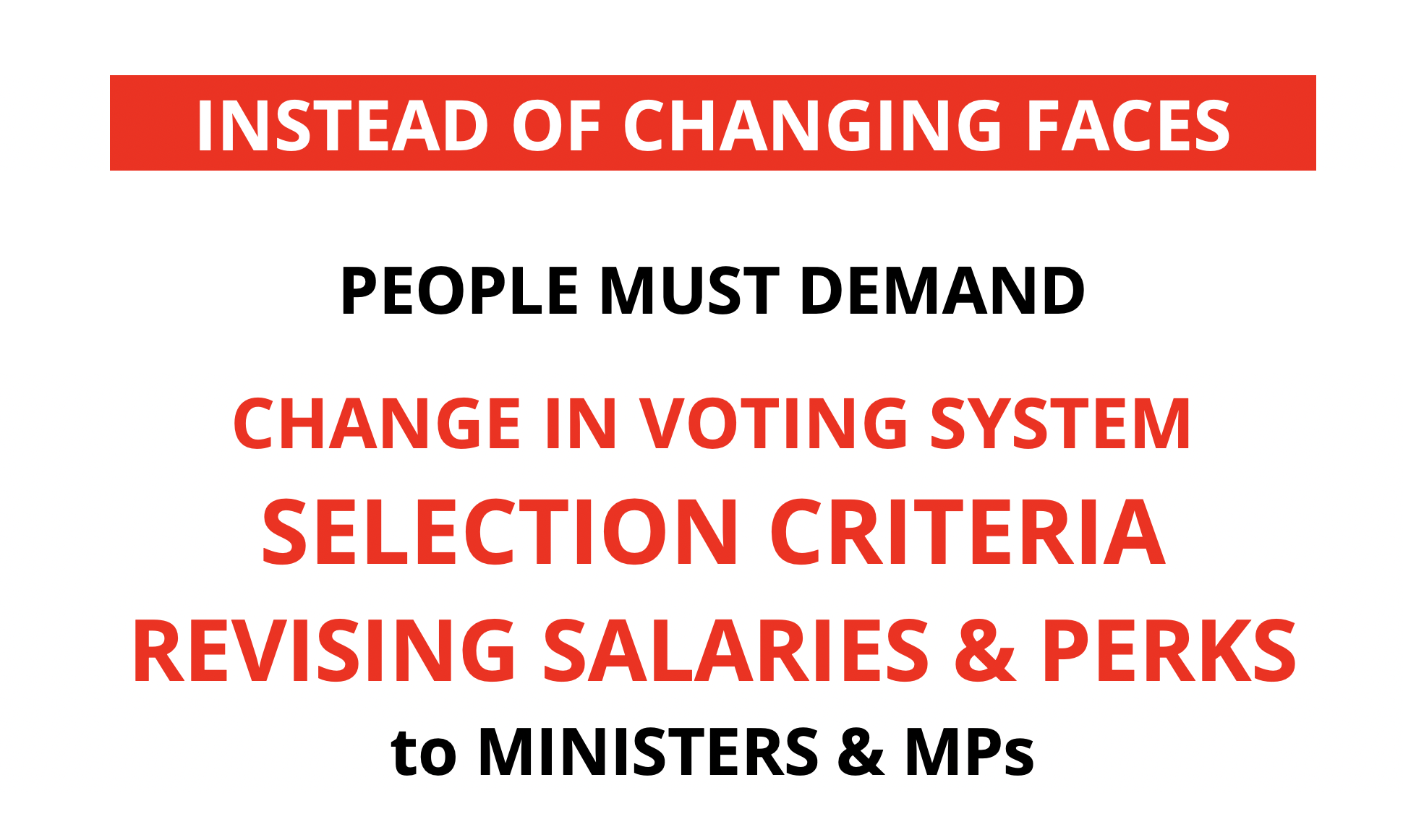
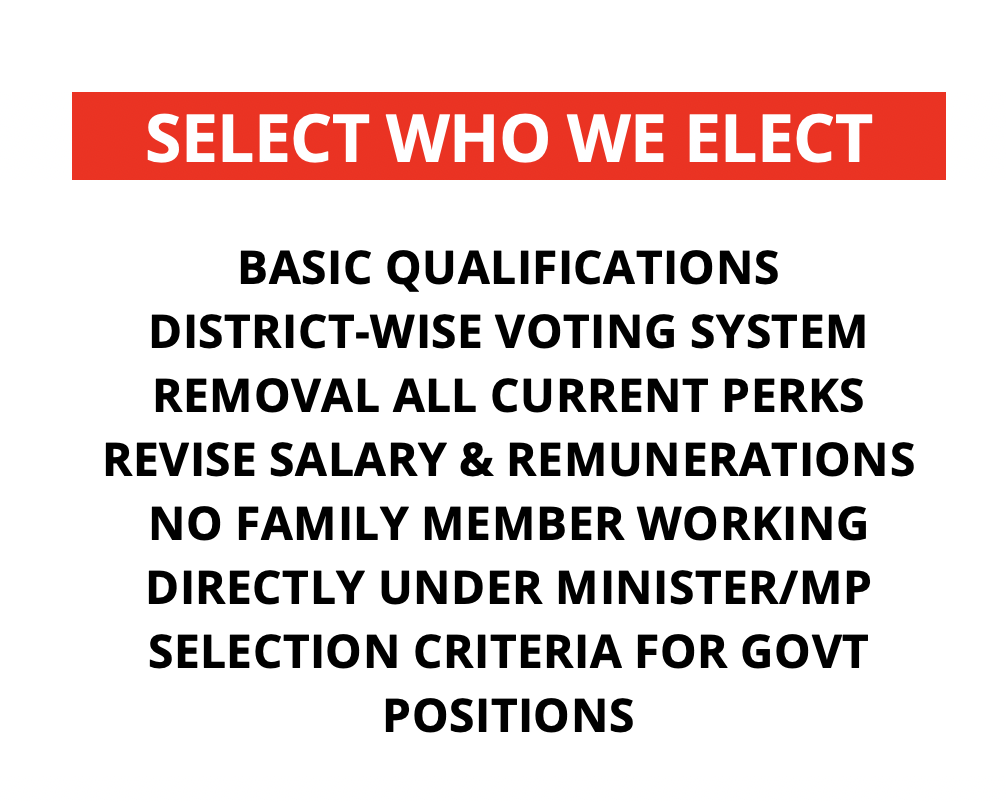
Change criteria for voting & revise salary and perks given to Ministers & MPs. The current wastage they indulge in with impunity must stop. Every aspect of undue privileges must be stopped. Their package needs to be revisited & revised.
Changing voting system – end proportional representation as it is bringing politicians who people have not voted for to enter Parliament simply due to the seat allocations.
The above two will discourage politicians who become politicians simply to enjoy a life of luxury from entering politics.
Political cronyism/favoritism/political bias
The practice of appointing wives/daughters/sons as private secretaries must stop. No family member should be allowed to hold post directly under or reporting to the Minister. All positions must be based on an exam/interviews and via selection criteria process as took place prior to 1978.
Wastage of State Funds
The practice of refurbishing official residences with every change of Minister or Govt must stop.
With clear demarcations as to what every state sector employee (from politician to peon) is allowed – wastage will automatically stop or be brought to a minimum. Punitive actions must be clearly identified and implemented.
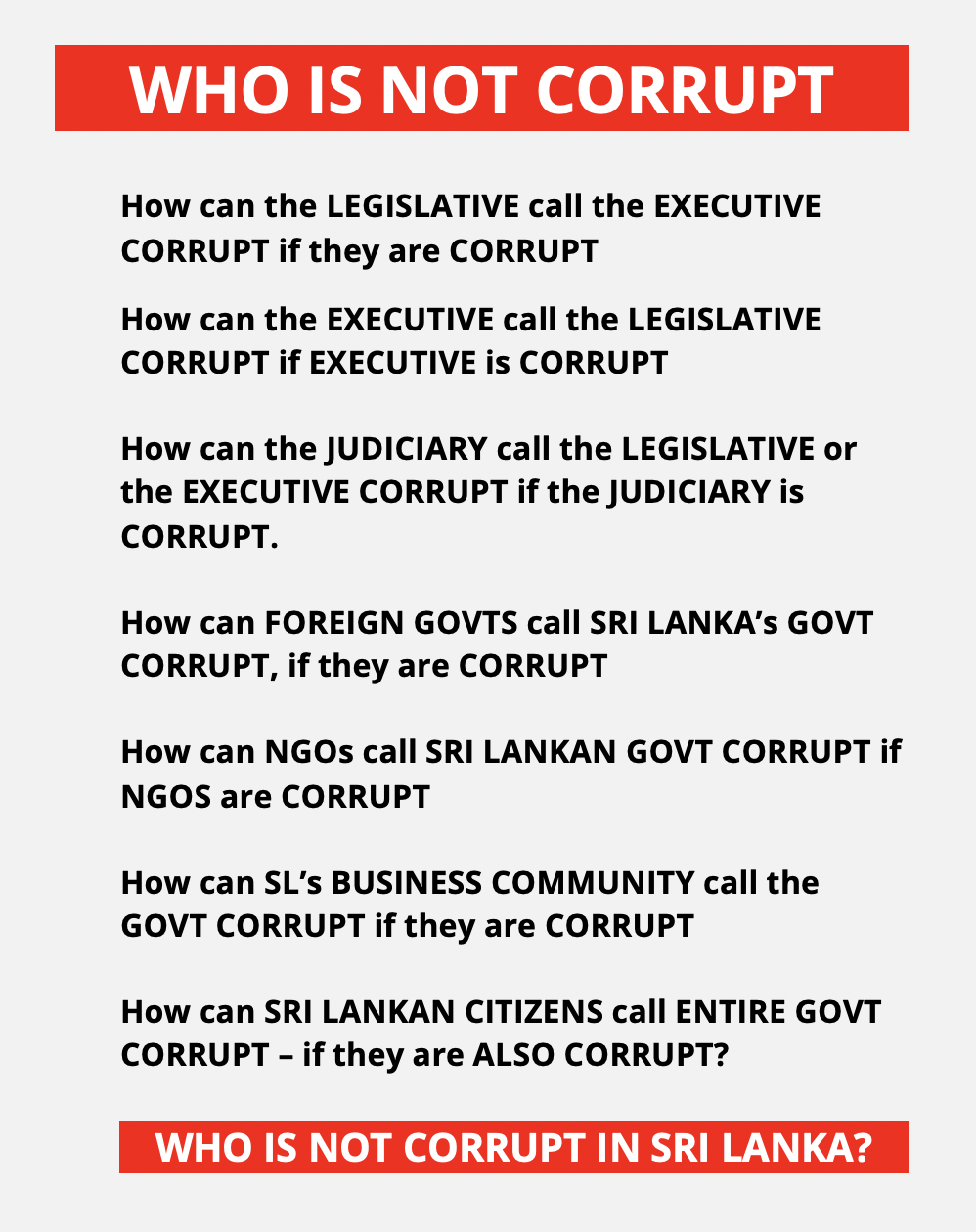
If the judiciary is corrupt, is it in any position to punish other corrupt? Therefore, there is need for some transparency in the judicial mechanism as well. Judges of the Court who are held as the beacons of justice and lawyers too cannot be corrupt when they are tasked to deliver justice & punish the corrupt. This is a key area where justice is not happening as people expect.
National Plan
Every Ministry had a planning unit – these are non-functional entities because of political interference and lethargy of public officials. These must be revised and they must be tasked to come up with necessary plans for their Ministries which must get amalgamated into a proper national development plan that CANNOT change with every government unless they add value to the plan.
Sri Lanka has the ability to come out of the crisis easily unlike other countries. We have the resources. We have the brains. We have committed people. The problem is these people are always sidelined and a bunch of opportunists take over & ruin all the wealth we have. We have to protect our wealth (our People/ Our Resources/Our Assets) Any proposal or any investment cannot barter these key wealth channels. Investments must be done giving priority to protecting these 3 areas.
We must first identify what we deem ‘development’ – thereafter only, we should form workable action plan to reach these goals.
When the above are functioning as they should – the President will also fall in line.
We are faced with a situation of the lack of $$$ to import even essentials, this means
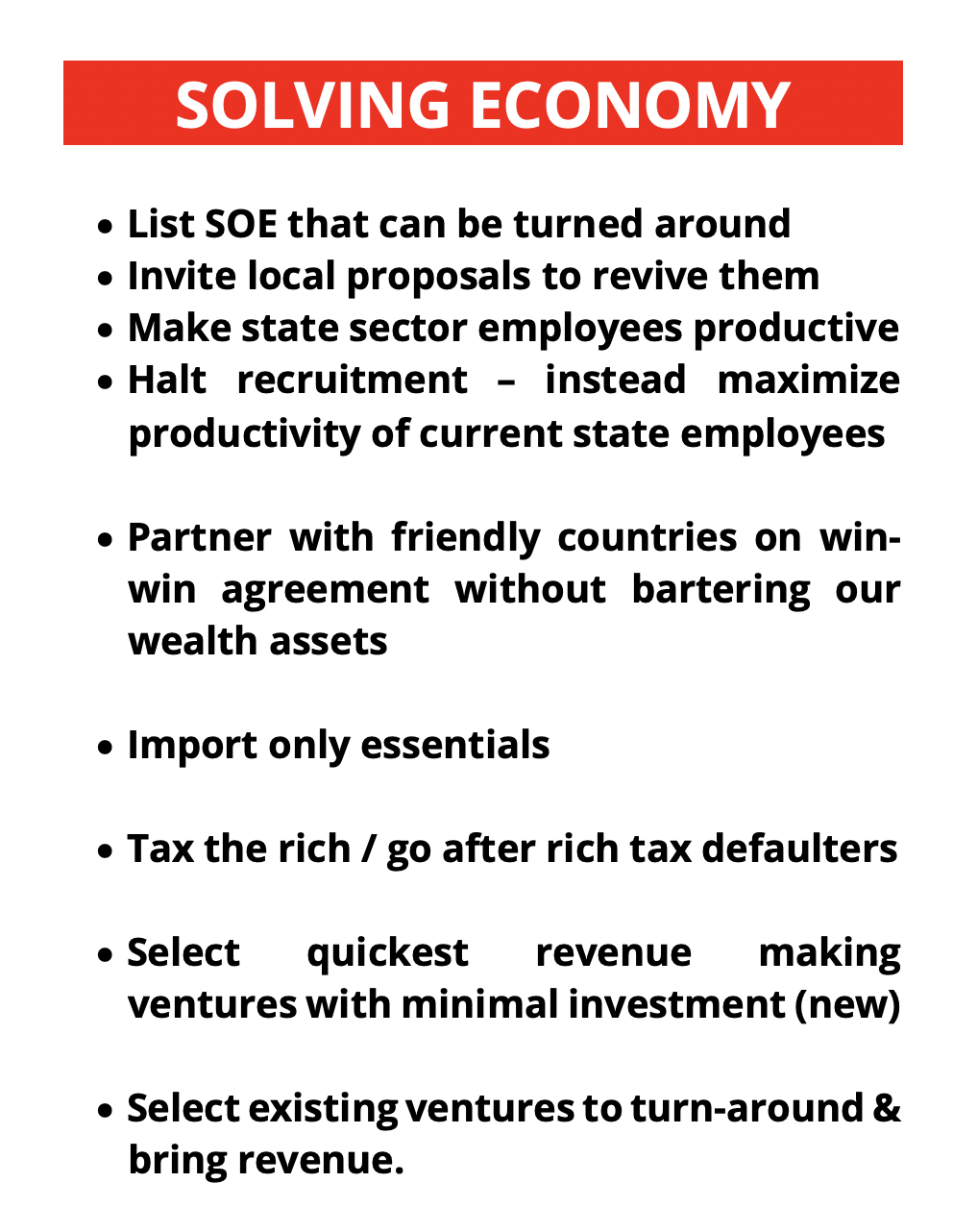
We have to remove ourselves from the mentality of relying on $$$ & import everything (dedollarize is the trend) – think of new ways we can negotiate import of essentials
Govt must uplift whatever can sustain our people and support them in new out of the box solutions. Food is most important area.
We must think of quick revenue generating projects and take these proposals to foreign countries who have been traditional friends & come up with a win-win deal & implement these projects quickly. This can be used to negotiate a delay in any loan payment.
If countries who are exporting from Sri Lanka are using this as a threat to cancel our orders – then we must find alternative export options with other countries. Sri Lanka should not meekly allow to be blackmailed. We must either look for other options or find ways to mitigate the threat.
The biggest obstacle in developing Sri Lanka, unfortunately remains India who never wants to see Sri Lanka develop & it is not because Sri Lanka is seen as a threat to India but simply because India wishes to bully Sri Lanka & use Sri Lanka as its foothold. No government has devised a plan to mitigate this threat. Whatever national plans Sri Lanka has, however great these are on paper, India will never allow them to materialize. With India now part of Quad – Sri Lanka is now vulnerable to 2 powerful bullies on our soil.
At present we are in a situation where we have to first come out of the rut we are in. It is agreed that the corrupt system that currently exists cannot deliver any solutions even if an election is held.
Therefore, People must call for immediate implementation of a new voting system, revised perks/salaries for politicians, punitive actions against Public Sector officials (from Senior downwards).
The Ombudsman’s Ministry can channel complaints against Politicians & Public Sector & a revamped Judiciary can take the cases & deliver justice as deserved.
This will start the domino effect for the change we need.
We should not fall prey for proposals that are drafted from external parties whether these are what IMF gives CBSL, USAID gives BASL or foreign think tanks that give local NGOs in Sri Lanka. These proposals are all to benefit not Sri Lanka or Sri Lankans but are aligned with their geopolitical project for Sri Lanka.
This is our country. People who want to protect and preserve our sovereignty, our territorial integrity must champion these changes. We must have relations with all countries, but all countries must know, Sri Lanka puts its interests first. If Mrs.B could tell that to the West and East and she remains the only Sri Lankan leader held in high esteem by both blocs even now, why can’t the present leaders lead with spine?
This is a letter I wrote to Gotabhaya Rajapaksa, the present President, in 2006 from Texas USA, when I was holidaying at my younger daughter Achala when he was the Defense Secretary in President Mahinda Rajapaksa’s government requesting him to take immediate safety measures against a possible LTTE attack on the Kotmale dam. (to which I never got a reply as usual).
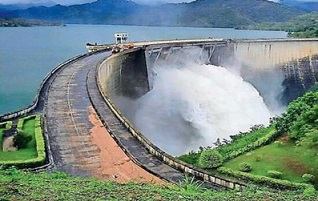
The Kotmale dam
The Kotmale dam 87.m high (285 ft) and 600 m long, constructed across the Kotmale Oya a left bank tributary of Mahaweliganga. at 703 m msl (2306 ft) in the central hill country of Sri Lanka. It has a storage capacity of 800 000m2 (28,000,000 cu ft) at spill level. It was constructed against the advice of eminent Geologists like late Prof of Geology, P.W Withanage University of Sri Lanka, as it is identified as a geologically unstable region constituted with characteristic crystalline lime stones.
Map 1
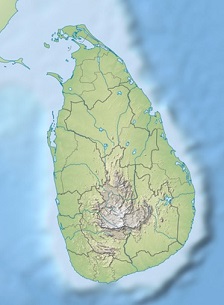
Extreme caution has to be taken not to upset physical equilibrium set by nature by constructing large reservoirs like Kotmale reservoir on these watersheds at such a high elevation. Because one day if there is going to be a dam breach at this level, at spill level, carrying a 285 feet high 28,000,000 cu ft of water either due to natural causes or manmade actions like a LTTE terrorist attack, the resulting downstream disaster would be extremely high and unimaginable, considering the elevation of the location (2306 ft msl) of this dam in relation to the densely populated downstream settlement, the height and the enormous volume of water in the reservoir at spill level, 28,000,000 cu ft and the relative cumulative gravitational force the flood will acquire as it role down roaring over the hills and valleys will be definitely beyond human imagination. If a breach takes place this could be ranked as the world’s most disastrous dam breach tragedy in history. This danger becomes all the more serious in view of the relative location of the reservoir at very high level, the abrupt drop in the elevation and the peculiar radial geomorphological lay out of the Island in relation to the location of the Kotmale reservoir as shown in the map1.
Under these circumstances if the dam breaches due to any reason the enormous volume of water that it empties will roar down the precipice of Kotmale Oya will be extremely devastative with its thundering high tide pouring in to Mahaweli. First it will scoop out Gampola and Gelioya towns together with the rich Kandyan agricultural villages on either side of Mahaweli and once it reaches Peradeniya it will get split in to three massive floods, one turning left at Peradeniya. and another urning right at Getambe while the main flood will go down Mahaweli up to Katugagastota, where it will again bifurcate in to two, the left flood will force up Pingaoya and go towards Matale and the main one, erasing Katugastoa, sweeping Polgolla barrage will surge in to Victoria reservoir. The third flood that will takes its course along the Peradeniya Kandy road and then scooping Kandy town and pouring in to Victoria Reservoir over Buwelikada gap taking a part of Udawatta kele together with the debris of the historic Mahanwara Town together with the Temple of the Tooth with all its sacred and mundane treasures to be deposited in the depth of the Indian Ocean.This will then join the flood coming down Polgolla and together it will get reinforced with the Victoria waters (722,000.000 m2)_ and then
VICTORIA DAM
burst in to Randenigala (647,000,000 cu ft) and finally collecting 361,446 Cu ft of Rantembe with the debris of all the Dams will end up in the Eastern Sea with all what this mighty surge will scoop out from the Eastern province and what it has already collected from either side of the Mahaweli river from Kotmale downward, say up to about hundreds of feet on either side up to end of Rantembe, the last reservoir on the Mahaweli, carving out a huge canyon up to the sea. You can just imagine the thrust of the total volume of water that will scoop out almost 2/3 of the Eastern Province in an open funnel shape cavity in to the Indian Ocean.
Meanwhile the one that go down the Kumbiyangoda precipice will scoop out the Matale town, empties the Nalanda Reservoir and the Moragakha kanda, with its 521,000,000 m3 and will erase what is left out by the main flood that comes down the main Mahaweli and also that is surging in to the eastern flat land at its bend near old Minipe anicut site. The Matale Moragahakanda flood will take the balance of the eastern Province to the Indian Ocean, with the Polonnaruwa town and all the sacred treasures standing in the Polonnaruwa kingdom along with the waters of the Parakrama Samudra(112,500 acre feet).
Finally, the flood that go across Kiribath kumbura and Kadugannava down the precipice to Mavanella will scoop out the areas on either side of the Ma Oya from there onwards and empties in to the Indian Ocean on the western side of the Island around Negambo.
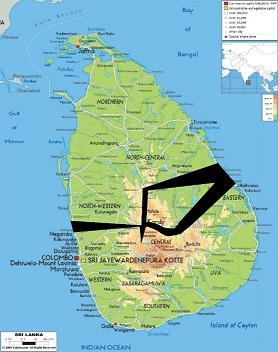
Now you will see how Sri Lanka will end up in three huge permanent canyons like scars from Kotmale to the Indian ocean on either sides of the central axis running north from the central hill country, dividing the Sinhale in to three parts (remnants of the old 3 Sinhale with a major part of the Malayarata} like a huge canyon of the Colarado canyon type with a central axis starting at Kotmale in the Central hill country of Sri Lanka.
I also suggest that you have a look at the disasters caused by similar dam breaches that have taken place in other countries.to imagine how such dam breaches have affected human life in those countries. For example, dam breach studies in countries like USA, (the johnston town flood 1989), Italy, (Vaiont Dam 1963) and India, (Tiwari Dam failure in Maharastra) to understand the national danger I am talking about in this paper.
If this breach takes place I think it could be the worst dam breach in the world in known history, forming a huge canyon looking like a fork with 3 prongs with its handle in the south that had erased a whole civilization that was the ancient Kandyan Kingdom.
MAP 2
GRAPHIC IMAGINATION of man made SRI LANKAN CANYONS
Sudath Gunasekara
It is in this backdrop Mr Gotahbhaya that I appeal to you to take the maximum precautionary action in time to prevent this historic national catastrophe.
Any delay on your part as Defense Secretary to take adequate precautionary measures will put the blame squarely on you for outright negligence, if the Kotmale dam breaks due to an attack by the LTTE.
I only hope by providence of God, they will not attack it. Let us all pray for it
PS: I am writing this note almost 16 years after I addressed this note to Gotabhaya in 2006. I am very happy that no disaster has happened so far thanks God. I warn authorities that they should not take things for grant and rest asleep. A disaster as predicted can take place at any moment in view of its location in a limestone region, particularly at such height in the center of Sri Lanka with the enormous volume of water stored in the reservoir.
Therefore, I plead to the authorities in charge of the DAM to keep a 24 hours vigil on the changes taking place so that you can take timely action at least to mitigate the scale of the disaster that might occur one day.
epilogue
Under the Mahaweli Development Project Kotmale flooded nearly 4000 ha of fertile land in the Mahaweli upper catchment, which included about 600 ha of paddy fields and has directly affected 3056 traditional Sinhala families with a legacy of a rich traditional culture who were involuntarily evacuated from their ancestral lands whose ancestors had been living there from the early Christian times, if not earlier.
Of them 1722 families were moved to downstream areas in the Dry Zone and 1334 families, which were said to be resettled in 17 settlements around the reservoir
The evacuation of such a large number of Sinhala people from an agriculturally rich historic settlement in the heartland of the nation where there is a large concentration of Indian Tamil population invariably leads to weakening the power of the native Sinhala population in the region, which will have serious political repercussions in future. Thus, considering the immediate economic, and demographic losses and the impending disaster for the whole nation as forecasted above, I hold the view that the construction of Kotmale dam was an unpardonable historic political blunder.
South Asian countries should be thankful and grateful to India for various reasons. India is a friend in need to all South Asian countries. Despite having some internal problems, India always tries to help others. Even, India set examples by assisting Pakistan at different times. However, since the start of the Russia-Ukraine crisis, India’s ban on wheat exports has reignited worldwide concerns about rising food prices that can exacerbate the problems of food-deficit countries especially neigbouring countries.
The Indian high commission in Dhaka has clarified recently concerning India’s ‘ban’ on wheat exports, saying that the directives have no bearing on shipments of wheat previously contracted for sale. Commercial wheat exports from India have been restricted, according to a press release released on Sunday (May 15, 2022).
‘These directives will not preclude wheat from being exported to India’s neighbors and other nations that may request it to assist their domestic food security measures,’ according to the announcement. The Indian high commission stated that recent media reports claimed that India has imposed a “ban” on wheat exports.
The release stated, “These actions have been taken to ensure domestic food availability, minimize food price-related inflation, and support the legitimate requirements of India’s neighbors and other nations with food security issues.”
According to a statement issued by the Indian High Commission in Dhaka, India’s restriction on wheat export will not prevent export to neighboring countries and countries that may seek to acquire the current crop to boost their domestic food security measures at the request of their governments.
India said today that it will not allow the wheat export embargo to jeopardize the food security of its South Asian neighbors, and that the policy was only temporary.
According to media reports, BVR Subrahmanyam, India’s Commerce Secretary, told that there was no wheat shortage in the country and that the decision was to keep domestic wheat and wheat flour prices under control.
He also stated that India is dedicated to addressing the food security of its neighbors and vulnerable nations.
He also stated that India is dedicated to addressing the food security of its neighbors and vulnerable nations.
“We’ve left the window open for the sake of (our) neighbors.” We’ve also left the door open for a significant number of vulnerable countries to make such requests if their governments do so… He went on to say, “The order is to divert trade to the needy, poor, and vulnerable countries,” without mentioning any of them.
“We’ve left the window open for the sake of (our) neighbors.” We’ve also left the door open for a significant number of vulnerable countries to make such requests if their governments do so… He went on to say, “The order is to divert trade to the needy, poor, and vulnerable countries,” without mentioning any of them.
Wheat prices hit a new high on Monday after India opted to halt exports due to a heat wave that hampered output. As the European market opened, the price increased to 435 euros ($453) per tonne.
Since Russia’s February invasion of agricultural powerhouse Ukraine, which previously accounted for 12% of global exports, global wheat prices have risen due to supply concerns.
After the hottest March on record, India, the world’s second-largest wheat producer, announced a restriction on exports on Saturday. New Delhi expressed concern over the food security of its 1.4 billion people, citing reasons such as decreased supply and dramatically increased world prices.
To understand, in the case of Bangladesh (for example), following the commencement of the conflict between Russia and Ukraine, India became Bangladesh’s primary wheat importer. India, on the other hand, has stopped exporting wheat since Friday. The price of wheat in Bangladesh was already expensive, and this move has driven costs much higher.
Bangladesh’s second most important crop is wheat. 30 million (3 crore) tonnes of rice and 7.5 million (75 lakh) tonnes of wheat are required annually in the country.
Bangladesh’s imports from the two countries came to a halt near the end of February, following Russia’s invasion on Ukraine. Traders in Bangladesh began importing wheat from India after that.
According to the website of India’s commerce ministry, the country exported roughly 6.6 million (66 lakh) tonnes of wheat in the first 11 months of the fiscal year 2021-22. Bangladesh was the final destination for 57% of this wheat.
According to Bangladeshi media outlets, Prices were spiralled as news broke out in Bangladesh. As wheat has been quite inexpensive. The news of increasing prices of wheat has left people bewildered.
Neighbouring countries including Bangladesh were saddened by the news that India has stopped exporting wheat. Bangladesh is the single largest importer of Indian wheat. Besides, wheat is the second most used food grain in Bangladesh.
Bangladeshi economists and importers have expressed concern after India announced a halt to wheat exports. Meanwhile, the government is holding one meeting after another on how to import wheat in an alternative way.
The country’s wheat importers are in trouble as India announced a sudden halt to wheat exports last Friday. After the start of the war in Ukraine, Bangladeshi importers chose India to import more wheat than before.
However, Neighboring countries of India see a glimmer of hope in an assurance from India’s Commerce Secretary amid the sanctions. He said the sanctions would benefit neighboring and poorer countries.
It is the successful implementation of India’s ‘Neighbourhood First Policy’. India’s neighbors should be thankful and grateful to India. It proves that India deserves to be regional responsible country. India’s neighbours must recognize that ‘India is a really South Asian leader because India deserves it. However, India should help its neighbours in such way in their needy moment. India should remind that it is the responsible country in the region. India’s Neighbourhood First Policy, a key component of the country’s foreign policy, emphasizes peaceful relations and collaborative synergetic co-development with its South Asian neighbors. Thus, India’s declaration is timely for implementing its ‘Neighbourhood first policy’.
The Modi administration recognizes the importance of cultivating and maintaining relationships with its neighbors. The Modi government has emphasized the “Neighbourhood First” policy as a key component of Indian foreign policy since taking office in 2014. The strategy aims to foster friendly and cooperative connections with its South Asian neighbors in a variety of fields, including the economy, science and technology, research, and education.
Vaccine diplomacy has been viewed as a pragmatic response to the global epidemic and a means of enhancing the country’s image as a responsible leader at both the regional and global levels. Notably, Indian diplomacy, particularly during the Covid-19 pandemic, resulted in India being recognized on the international scale as a harbinger of hope, delivering critical assistance to needy nations and people around the world. Vaccine diplomacy (Vaccine Maitri) was used by India as part of its Neighbourhood First strategy to assist numerous countries throughout the world including neighboring countries during the Covid-19 pandemic.
Operation Ganga was conducted to rescue Indian nationals stranded in war-torn Ukraine. So far, thousands of Indian nationals have been repatriated under the scheme. Significantly, the Indian government has rescued citizens of several other countries besides Pakistan, Bangladesh, and Nepal through this operation.
It is India that stood by Bangladesh always. Even during the Ukraine crisis, India helped Bangladesh to evacuate Bangladeshi people. India’s helping hand to Bangladesh is time-tested. A friend in need is a friend indeed. According to the media reports, 9 Bangladeshi nationals have been rescued from Ukraine recently under Operation Ganga. Prime Minister of Bangladesh Sheikh Hasina has already thanked Prime Minister Narendra Modi for rescuing the citizens of Bangladesh.
India’s vital assistance to South Asian countries by prioritizing neighbouring countries in its pursuit of foreign policy objectives, particularly by offering assistance to Sri Lanka and Afghanistan during their crises, demonstrates India’s commitment to its Neighbourhood First policy.
Now, declaration of ‘Indian wheat export ban not to affect South Asian neighbours’ is obviously a reflection of ‘Neighbourhood First Policy’.
There are more reasons in the future to support the Neighbourhood First policy: First, persistent interaction with neighboring countries will aid in the creation of a friendly atmosphere in the region, which has long been a barrier to the region’s stability, trust, and progress. Stability will allow India to pursue its foreign policy objectives while also allowing other South Asian countries to flourish and prosper. Second, by providing the essential assistance likeDeclaration of ‘Indian wheat export ban not to affect South Asian neighbours’ , India can improve its position in the area and gain economic and strategic depth in relation to China. As a result, there is a stronger need for ongoing involvement with its neighbors. Third, for long-term cordiality and stability, people-to-people interactions and strong cultural affinities should be prioritized. Furthermore, quick delivery should be prioritized.
JVP is undoubtedly the best organized political party in Sri Lanka. It is also the richest party in Sri Lanka. Its base includes the youth & adults & disenchanted voters of other parties. Prior to every election, the JVP take pains to support the ground campaigning of other parties instead of its own. Is there a particular reason for this? Is their role limited to playing mischief maker in parliament or simply as a whistleblower while propping a new party to the throne of governance? Leaving aside the ground support & the funds from foreign branches, who are the real brains that dictate how JVP functions politically? Is their instructions for JVP – not to win elections? Do they plan to fail” elections & only secure the votes to ensure they are in Parliament?
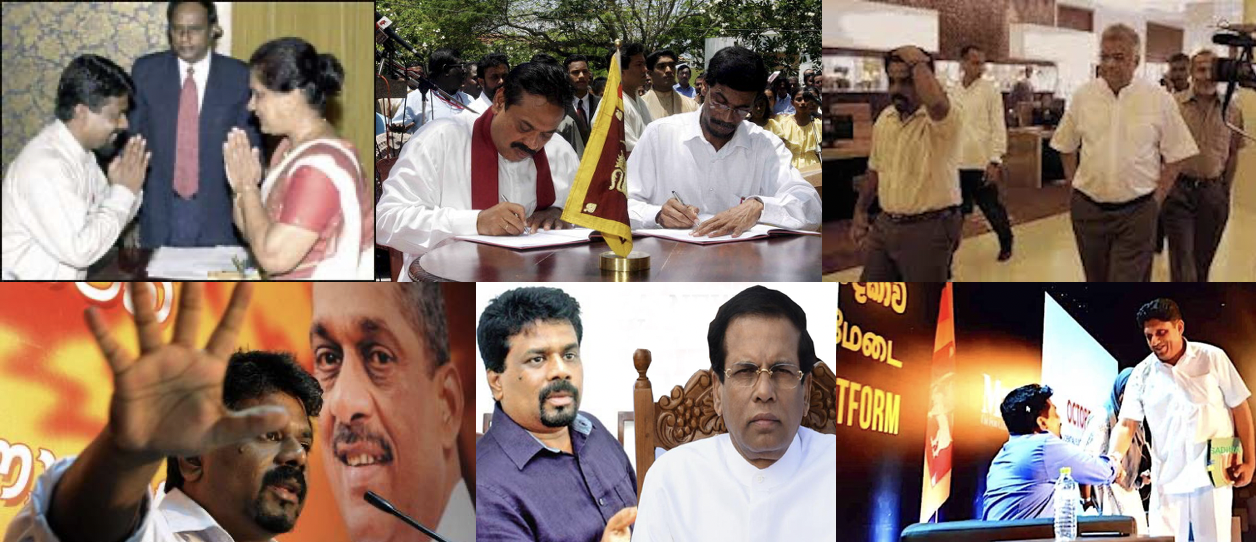
JVP successfully brought to power Chandrika Kumaratunga, Mahinda Rajapakse and the Sirisena-Ranil duo. JVP failed in its effort to bring Sarath Fonseka & Sajith Premadasa to power – was this intentional? Is there a particular reason for this? The ground campaign of all the above irrespective of their winning or losing was outsourced to the JVP. Their support base was used overseas across branches and islandwide to campaign for the contestant they were told should become winner. This next raises the question, why does JVP shy from taking the leadership mantle instead of helping others to come to power? Can JVP themselves provide answers.
Each time after falling out with the political parties they partnered, the JVP end up their foes until another election & instructions come to decide who they are to campaign for.
We saw the manner JVP supported Chandrika & attacked others
We saw the manner JVP supported Mahinda & attacked others
We saw the manner JVP supported Fonseka & attacked others
We saw the manner JVP supported Maithripala-Sirisena & attacked others
We saw the manner JVP supported Sajith & attacked others
Presently JVP is anti-Mahinda and now suddenly JVP has gone anti-Ranil
If anyone is confused to understand how JVP thinks or functions, it should be JVPers themselves!
Notice how the leadership & key players find enough and more reasons not to want to sit on the hot seat though they can produce list after list of complaints about governance & how they will do better.
Another puzzle is the manner that inspite of their organizing capabilities, their powerful slogans, their campaign capabilities the best they could achieve was 3 seats and that too thanks to the proportional representation system.
The only conclusion we can derive from this is that this party is playing a political role for other purposes.
From 1970s, the JVP has succeeded to tap the youth & brainwash their minds. The country’s human assets are heavily influenced by JVP and no action has been taken to curb this influence taking root within the educational system.
The JVP was used for 2 insurrections that eliminated the best of youth to the gun, while using the same youth to eliminate the best of Sinhalese in the military, police, academia, artists etc. Over 60 Sinhalese died because of the JVP. What could these youth have become had they been alive. What would these fallen soldiers, police, artists and academic be today, had JVP not killed them? The JVP destroyed many public property too – similar to the destruction seen during the last few days. Is there a pattern to the envy & jealousy they suffer as echoed in the recent statement by the JVP General Secretary.
Fronts of JVP (People’s Liberation Front)
Deshapremi Janatha Vyaparaya
Patriotic People’s Armed Troops (attacked SLAF in Pallekele)
Socialist Students Union – Samajavadi Shishya Sangameya
Jathika Jana Balavegaya (NPP) National People’s Power
Deshapremi Janatha Vyaparaya DJV (Patriotic People’s Movement) aligned to the People’s Liberation Front (1987-1989) was the militant branch of the JVP– banned in 1988 as a terrorist organization after throwing a grenade at the Parliament.
The DJV wore uniforms similar to soldiers of SLAF & targeted military bases as well as police stations.
The DJV opposed Indo-Lanka Accord. It brought the country to a virtual standstill with its posters & death threats & assassinations.
The DJV comprised undergraduates from University of Peradeniya.
Interestingly, where JVP & Tamil organizations get linked was in the supply of arms – the primary motivation for this was to get rid of the IPKF. JVP had even trained alongside Tamil militant groups.
DJV also received international funds – from whom & for what?
Patriotic People’s Army (PPA) – දේශප්රේමීජනතාසන්නද්ධබලකාය
Militant arm of the JVP/PLF
The PPA & DJV attacked civilians and Sri Lanka Armed Forces. PPA attacked army camp in Pallekele, John Kotelawala Defense Academy & SLAF Katunayake base. Death threats were issued calling for military personnel to desert & join them.
Socialist Students Union – Samajavadi Shishya Sangameya
SSU is a member of the Inter-University Students Federation & is the oldest Student union in Sri Lanka. In 1988 the SSU and the Patriotic Students Union was banned.
Jathika Jana Balawegaya – National People’s Power (NPP)
Coalition of 28 political parties, worker unions, women’s rights groups, youth organizations & ethnic communities & established in 2015 by Anura Kumara Dissanayake leader of the JVP. Anura Kumara is the leader of the coalition while General Secretary is Lakshman Nipuna arachchi. NPP ideologically centres around communism but is also supporting democracy & secularism.
The crimes of the JVP is unknown to most – not only the loss of human lives but the massive loss to public property – buses & depots, transformers, state centres – all gutted down. Were these damages valued – Did JVP pay for these crimes? Before pointing fingers at corruptions of others – shouldn’t JVP clean its house of guilt first!
Let’s look at how the JVP has fared in elections:
1994 General Elections Sri Lanka Progressive Front –
90,078 votes / 1 seat
2000 General Elections – Janatha Vimukthi Peramuna
518,774 votes (5.99%) / 9,128,823 total voted
Total seats = 10 (8 district / 2 national list)
2001 General Elections – Janatha Vimukthi Peramuna=Peoples Liberation Front
815,353 votes (9.0%) / 9,449,813
Total seats = 16 (13 district/3 national list)
2015 – People’s Liberation Front
544154 votes
Total seats = 6 (4 district / 2 national list)
2020 – Jathika Jana Balawegaya (established in 2015)
445958 votes (3.8%)
Total seats = 3 (2 district / 1 national list)
JVP leader Anura Kumara Dissanayake contested Presidential Elections in 2020 & secured only 418,553 (3.16%)
Under the camouflage of a political party, advancing its ideology combining socialism & democracy, JVP is tasked to play a bigger role
Swaying Sinhalese away from ethno-nationalism
Swaying Sinhalese away from embracing & defending Buddhist history & heritage
Swaying Sinhalese away from preserving, protecting and promoting its traditions & cultures
Drilling envy, jealousy & hate into the minds of university students majority of whom come from poor/rural homes.
Brainwashing these poor/rural students who inherently suffer inferiority complexes by turning that into seeking revenge from those who have instead of inspiring them to take their talents to greater heights & doing well in life.
The success of the above 5 areas that JVP has been outsourced to do can be seen in the behavior of not only university students but even academia & adults that support not only their ideology but their line of thinking as well.
Is the JVP only tasked to carry out election campaign contracts & somehow pass the finishing line to place at least 3 in Parliament while their bigger role in social-education-cultural transformation continues?
One of the biggest mistakes made post-1978 was to create a lay-focused education system for Bhikkus allowing them to enter universities/institutes with laypersons. This resulted in the decline in the importance given to pirivena education system as well as the Bhikkus. While this is not to discuss or debate on Bhikkus, it is to showcase that there is a difference in lay persons and a Bhikku & a Bhikku is expected to adjust behavior in line with the Buddha Sasana and its disciplinary codes. A Bhikku to journey towards Nibbana requires to detach from lay-society. Since ancient times the kings went to the Maha Sangha for advice & blessings. The Maha Sangha did not go to the Kings. Today, the politicizing of society has even resulted in the political allegiances of the Maha Sangha even in universities. The outcome is nothing that we can be proud of & is detrimental to the continuance of the Buddha Sasana. The GoSL and the Buddha Sasana Ministry must immediately address this & confine Bhikkus to Buddhist universities & away from laymen & universities/institutes for laymen.
Sri Lanka is one of the key countries where Theravada Buddhism prevails. Monasteries have played a key role and has been under royal patronage since ancient times – The Maha Vihara, Abhayagiriya Vihara & Jethawana.
The aim of pirivena education was to create a Bhikku Council while preserving the tradition of Sri Lanka’s classical education. From pirivena, Bhikkus can proceed to tertiary education in the same field.
There are 825 pirivenas in Sri Lanka with close to 70,000 students enrolled. The dhamma schools number over 17,000 with close to 3million enrolled. Vidyodaya & Vidyalankara were converted into universities which produced great scholars.
We have seen student Bhikkus behaving in appalling manner. Whether these are ordained Bhikkus or simply men wearing a robe & pretending to be a Bhikku to tarnish the image of Buddhism, we may need to investigate further. However, had Bhikkus not been studying alongside lay students, such a scenario would not arise.
There are enough and more Bhikku universities dedicated for Bhikkus – the Open Buddhist University, the Buddhasravaka Dharma Peetaya was established under Parliamentary Act no 106 of 1968 in Anuradhapura which became Buddhasravaka Bhikshu University under Parliament Act 26 of 1996. It was a national university for Bhikkus. Students pursued studies in Western & Eastern languages & other disciplines. The university was relocated in 2012 & 2 faculties were opened – Faculty of Buddhist studies & Faculty of Languages & Cultural Studies.
Essentially becoming a Bhikku is to align to the teachings of Buddha, to learn Buddhist principles, to propagate Theravada Buddhism in Sri Lanka & abroad, to research, to promote Buddhist culture & values & more. None of these can be achieved when Bhikkus end up protesting on streets, throwing stones, toppling barricades, shouting in filth, pointing fingers & following lay practices and behaviors. Most often, these Bhikkus who benefit by free education, end up changing their names to lay names at the final exam! Their conduct has given room for people to lose respect and give their respect. Inspite of lay persons worshipping the robe and not the person wearing the robe, the conduct of student bhikkus during strikes and protests are a sight no Buddhist likes to see.
Therefore, in viewing the increase in such behaviors, it is time that the Bhikkus & their education be separated from lay persons and Bhikkus return to Bhikku universities where they can follow disciplines pertaining to the Buddha Sasana. It is left to the Bhikku learning centres to add to the subjects relevant to enhancing Bhikku education, but it is now time the Bhikkus return to Bhikku learning centres and away from education institutes/universities meant for laypersons.
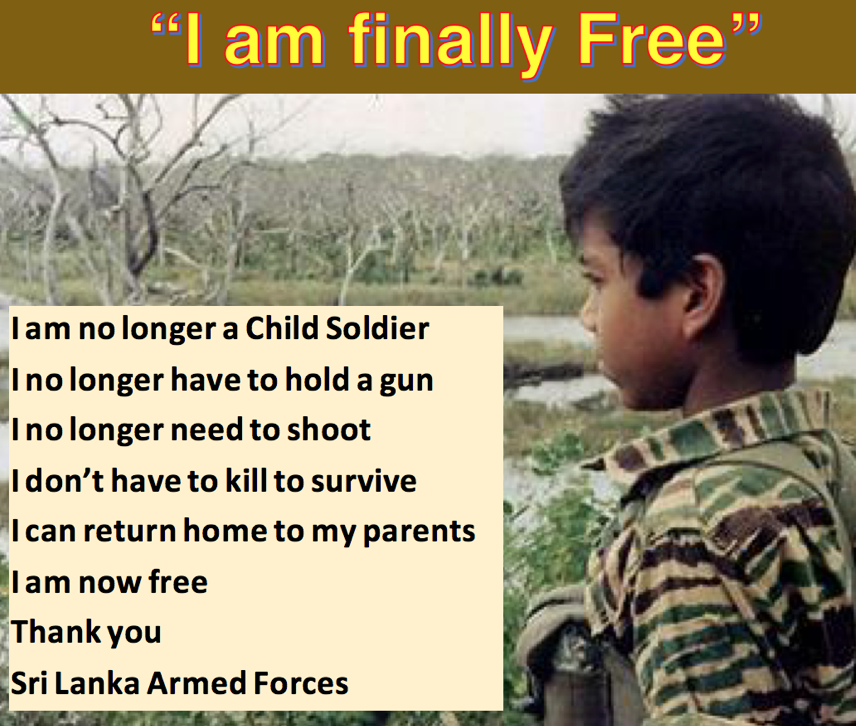
Sri Lanka’s conflict is defined a non-international armed conflict. LTTE was an armed non-state actor. 3 decades of armed militancy ended on 18 May 2009. The military offensive took place amidst a humanitarian rescue operation that saved 294,000 people. The victory was marred by allegations initiated by entities linked to the militants. The most important question is why would Sri Lanka’s Armed Forces sacrifice over 6261 soldiers to save 294,000 Tamils but kill 40,000-200,000 Tamils (people who have no names, no identification & there is no skeletons even to prove they were killed) Can those making the allegations answer this simple question! Without proof that 40,000 – 200,000 existed, that they were Tamil civilians and not LTTE, without proof that the Sri Lanka Armed Forces killed them – no one has any right to be pointing fingers at the National Army of Sri Lanka. To claim genocide there must be dead people. Without so much as a mass grave or skeleton, how can there be ‘genocide’. Anyone making allegations must come out with facts & evidence or rest their case.
Accountability depends on Truth
Justice depends on Facts & Evidence
We cannot accept any figure – be it 40,000 or 200,000 unless there is proof that such a number existed, proof that they were in the war zone, proof that they were civilian as per international definition & proof that the Sri Lanka Armed Forces killed them.
Allegation that Sri Lanka has killed 40,000 to 200,000 Tamil civilians
Questions: Proof 40,000-200,000 were killed
Proof 40,000-200,000 were killed by Sri Lanka Armed Forces
Proof 40,000-200,000 were Tamil civilians (LTTE combatants cannot be included to this list)
Proof any killings were intentional & deaths were disproportionate to the military advantage legally accepted in a non-international armed conflict.
Can those making the allegations prove Sri Lanka’s Armed Forces killed 40,000-200,000
Can those making the allegations prove this 40,000 or more Tamil civilians as per international definition
Can those making the allegations prove Sri Lanka’s Armed Forces intentionally killed & the deaths were disproportionate to the military advantage legally allowed.
DID 40,000 – 200,000 EXIST
WERE THEY BORN?
Establishing their identity
Proof of Birth of 40,000 – 200,000 (birth certificate or some form of identification)
The names of 40,000 – 200,000 (full name / parent’s names)
Addresses of 40,000 – 200,000 (home address/village/district/province)
National Identity of 40,000 – 200,000 (school ID/marriage certificate or national ID)
Registrar of Births proof
Grama Sevaka proof
School admission proof
Affidavits by family & friends that such a person belonging to this 40,000 – 200,000 existed
The above should be able to determine how many of this 40,000-200,000 quoted figure have names & some form of ID
WERE 40,000 – 200,000 IN THE WAR ZONE
HOW DID THEY DIE
WERE THEY LTTE OR CIVILIANS
Anyone can come up with 40,000 – 200,000 names & identifications, but they next need to prove that this number was in the war zone.
How did they come to the war zone – forcibly taken by LTTE, willingly joining LTTE or members of LTTE & their families (so this 40,000-200,000 must be divided into these 3 main categories)
How many of this 40,000 – 200,000 was forcibly taken by LTTE
How many of this 40,000 – 200,000 voluntarily joined LTTE
How many of this 40,000 – 200,000 were members of LTTE
How many of this 40,000 – 200,000 were members of LTTE families
We can presume this number to be far less if their birth identification & their presence in the war zone is not confirmed by proof/evidence.
HOW DID 40,000 – 200,000 ‘DIE’
The Sri Lanka Armed Forces cannot be charged of any crime, unless there is proof beyond reasonable doubt to claim they intentionally killed civilians. This next raises more questions
Civilian = anyone not engaged in any form of hostility (willingly or by force)
How many in the war zone were Tamils forcibly taken by LTTE
How many in the war zone were Tamils who willingly went with LTTE
How many in the war zone were Tamil civilians ready to take up arms with LTTE
How many in the war zone were Tamil civilians forcibly given arms by LTTE
How many in the war zone were LTTE (LTTE men/LTTE women/LTTE child soldiers)
How many in the war zone were LTTE in uniform & died during hostilities
How many in the war zone were LTTE in civilian clothing & died during hostilities
How many in the war zone were civilians forcibly put by LTTE to engage in hostilities & died
How many in the war zone were civilians willingly fighting for LTTE & died during hostilities
How many in the war zone were civilians who were shot dead by LTTE when trying to flee
How many in the war zone were civilians who died from fire by Sri Lankan Armed Forces
Who can put numbers to the above?
Sri Lanka’s Armed Forces can be faulted only for the last item
WAS 40,000 – 200,000 KILLED
WAS 40,000 – 200,000 KILLED IN THE WAR ZONE
WERE COMPLAINTS FILED
WHERE ARE THEIR BODIES
Establishing deaths of 40,000 – 200,000 Tamils
Did their families file police report of missing – if so are there 40,000 to 200,000 police complaints?
Habeas Corpus for 40,000-200,000 Tamils – how many have been filed?
Filing with the Presidential Commission for Missing Persons – how many have been filed?
Where are the skeletons of the dead – its 13 years now & if 40,000 – 200,000 has been killed by now their skeletons or mass graves should have been discovered.
How the hell did Sri Lanka’s soldiers did graves while fighting the LTTE to fit 40,000 – 200,000 dead bodies?
Given that LTTE fronts overseas claim there has been a ‘genocide’ have they filed names of 40,000 – 200,000 dead or are they just happy to be wailing ‘genocide’ & collecting funds for memorials?
If these 40,000 – 200,000 have not been killed and are not dead, can we presume they are ‘missing’ if they are ‘missing’ are they in Sri Lanka or have they sought asylum/refugee status and changed not only their identity but also their look through cosmetic surgery? Who can answer this?
A standard grave is 2 ½ feet wide and 8 feet in length and 4 feet deep. Exactly how many adult bodies can fit into such a grave and why is there no ‘eyewitness’ mobile phone shots of troops digging these graves, placing the dead inside the graves or killing them? All we hear is only allegations.
Therefore, if 40,000 – 200,000 are dead/killed – where are their dead bodies. US satellite images found only 3 graves, 2 of which were LTTE and had less than 3000 bodies. So where are these dead bodies?
13 years since end of LTTE, there should be mass graves & skeletons but none have been found. There is no explanation how Sri Lanka’s Armed Forces could have dug graves to put 40,000 – 200,000 dead while engaged in hostilities with the LTTE.
By 31 March 2009, LTTE was restricted to an area of 21sq.km.
Unless these questions are answered, Sri Lanka’s Armed Force’s cannot be declared ‘war criminals’ or Sri Lanka accused of ‘genocide’.
By Jorgelina do Rosario and Swati Bhat Courtesy FXEmpire
By Jorgelina do Rosario and Swati Bhat
(Reuters) -Running out of petrol, medicines and foreign reserves, once-booming Sri Lanka is in a mess. And the measures needed to pull its economy out of the unparalleled crisis are likely to bring even more pain.Advertisement
71% of retail investor accounts lose money when trading CFDs with this provider
The dire assessment by new Prime Minister Ranil Wickremesinghe this week of the island nation’s economic plight was a necessary first step, economists said. His proposed solution to bring back some stability includes selling the loss-making national airline, printing more money and possibly raising taxes as well as energy and utility prices.
Wickremesinghe said the unpleasant and terrifying” facts facing the country included a fiscal deficit that was 13% of gross domestic product (GDP), virtually no foreign reserves and shortages of petrol, gas, furnace oil and cancer and anti-rabies medications.
The country has suspended sovereign debt payments and ratings agencies are expected to place it in default.
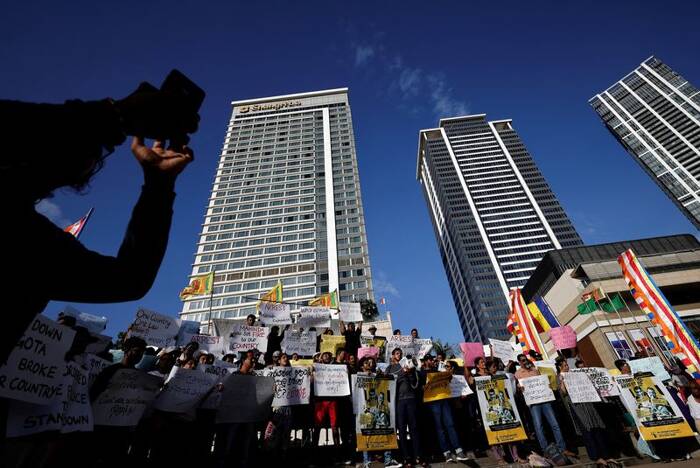
In addition, the chronic foreign exchange shortage has led to rampant inflation, bringing thousands of anti-government protesters onto the streets of the Indian Ocean nation, over which China and India jostle for influence.
In Colombo, the commercial capital, no petrol was to be found at most service stations on Wednesday. Long lines of auto-rickshaws, the city’s most popular mode of transport, and other vehicles were parked in front, waiting for supplies.
Any petrol station you go, there is no fuel, and people (are) lined up for kilometres and kilometres,” said Mohammad, a delivery driver who only gave one name. So, how can you run a vehicle, right? How can you do your daily…day-to-day activities?”
Sri Lanka has no dollars to pay for petrol shipments, Power and Energy Minister Kanchana Wijesekera told parliament, appealing to people to stop queuing for the next two days.
Economists said most of the prime minister’s proposals made sense.
However, the decision to print money was concerning and would raise fiscal and external imbalances, said Patrick Curran, senior economist at London-based Tellimer.
The policies announced are a necessary first step to resolve Sri Lanka’s economic crisis, but will entail significant short-term pain via higher inflation and currency depreciation and will necessitate further rate hikes from the CBSL (Central Bank of Sri Lanka) to contain the pressure,” he said.
S&P said printing money would have significant inflationary implications”.
The central bank holds a rate meeting on Thursday and is likely to raise rates for a fourth consecutive time this year, according to a Reuters poll. It increased the key lending rate by a historic 7 percentage points to 14.5% in April and is likely to decide on a further increase of up to 2 percentage points this week, most analysts said.
SUBSIDIES, FERTILISER BAN
Sri Lanka’s economic crisis, unparalleled since its independence in 1948, has come from the confluence of the COVID-19 pandemic battering the tourism-reliant economy, rising oil prices and populist tax cuts by the government of President Gotabaya Rajapaksa and his brother, Mahinda, who resigned as prime minister last week.
Other factors have included heavily subsidised domestic prices of fuel and a decision to ban the import of chemical fertilisers, which devastated the agriculture sector.
Sri Lanka was a model for emerging market economies and grew at an average rate of 6.2% between 2010 and 2016, according to World Bank figures. In the next three years, the figure had dropped to 3.1%.
The World Bank has forecast the economy will grow 2.4% this year from 3.5% in 2021 but has said the outlook is highly uncertain.
Charles Robertson, global chief economist at Renaissance Capital in London, said the removal of electricity and fuel price subsidies was essential.
These and other reforms would form the starting point for discussions with the International Monetary Fund for a crucial bail-out, other economists have said.
We will also have to see massive tax hikes, probably a doubling of VAT from 8% to at least back to the 15% we saw in 2019,” Robertson said. It was the cut in those VAT rates which contributed to this crisis.”
The sale of SriLankan Airlines is not likely to fetch much money in the current environment, the experts said. Not a bad thing to sell it but that is a drop in the bucket vs their USD financing needs,” said Nathalie Marshik, head of emerging market sovereign research at Stifel Financial Corp.
The worry is that fuel and utility price increases will add to public anger against the government at a time when the administration is in deep disarray. The new prime minister has to convince the people that the measures are necessary to restore stability, economists said.
Inflation hit 29.8% in April, with food prices sky-rocketing by 46.6% year-on-year.
Overall, it seems that corporates and individuals are preparing for more tax measures,” said Trisha Peries, head of research at CAL Securities in Colombo. Further, expectations are being set for electricity tariff hikes to come as well.
In a sense he was preparing the minds of the public for the economic pain that is to come,” Peries said of Wickremesinghe.
LONDON, May 18 (Reuters) – U.S. investment bank JPMorgan backed Sri Lanka’s crisis-hit government bonds on Wednesday, saying recent political changes in the country should gradually improve its strains and help its talks with the International Monetary Fund.
Adding an ‘overweight’ – effectively a buy recommendation – JPMorgan analysts said: “political stability should pave the way for bonds to move higher from near all-time lows”.
Sri Lanka is officially now in default as a so-called “grace period” to make some already-overdue bond interest payments expired on Wednesday.
“We think this stability should result in both IMF discussions and the process of appointing legal and financial advisors moving forward,” JPMorgan added.
Sri Lanka was expected to be placed into default by rating agencies on Wednesday after the non-payment of coupons on two of its sovereign bonds, while the energy minister said the country had run out of money to pay for fuel.
An economic crisis unprecedented in the country’s history since independence in 1948 has led to a critical shortage of foreign exchange, that saw it miss two coupon payments on sovereign bonds on April 18.
Sri Lanka has already said it is unable to make the coupon payments, and a 30-day grace period ends on Wednesday.
S&P has said the ratings on the bonds, maturing in 2023 and 2028, have already been cut to ‘default’ and the country’s overall rating could be further cut to ‘D’ on confirmation of the non-payment after the grace period ends.
Sri Lanka currently has no dollars to pay for petrol shipments, Power and Energy Minister Kanchana Wijesekera told parliament, appealing to people to stop queuing for the next two days.
A petrol shipment has been at Colombo port since 28 March but the government has been unable pay, he added.
“There aren’t enough dollars available to open letters of credit,” he said.
“We are working to find funds but petrol will not be available at least until the weekend. The very small reserve stock of petrol is being released for essential services like ambulances,” he said.
Prime Minister Ranil Wickremesinghe said on Wednesday the country had secured $160 million in bridge financing from the World Bank, but it was not clear if the funds could be used for fuel payments.
“The statistics have gone haywire,” he said. “But the reality is we don’t even have $1 million.” Hit hard by the pandemic, rising oil prices and populist tax cuts, Sri Lanka’s dire economic situation has led to spiralling inflation and shortages of essential supplies, bringing thousands of onto the streets in protest.
Violence between pro- and anti-government factions and police left nine dead and more than 300 injured last week, and was followed by the resignation of former prime minister Mahinda Rajapaksa.
By Nicole Johnston, news reporter, Sri Lanka Courtesy Sky News
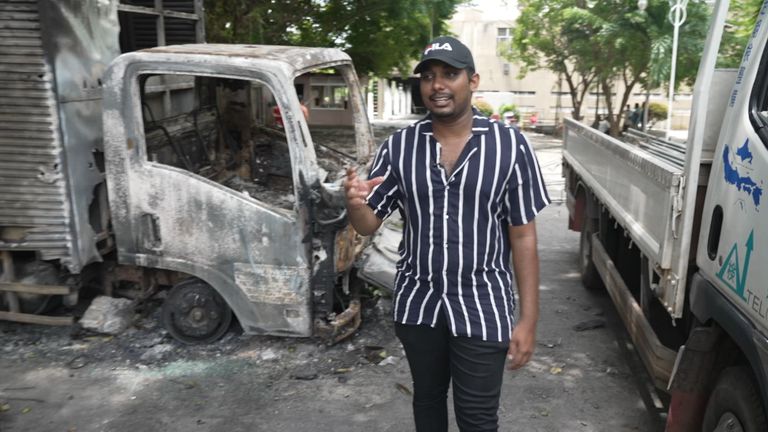
It’s difficult to fathom the fury that people must have felt to not only set fire to it and smash it to pieces, but also loot everything they could get their hands on.
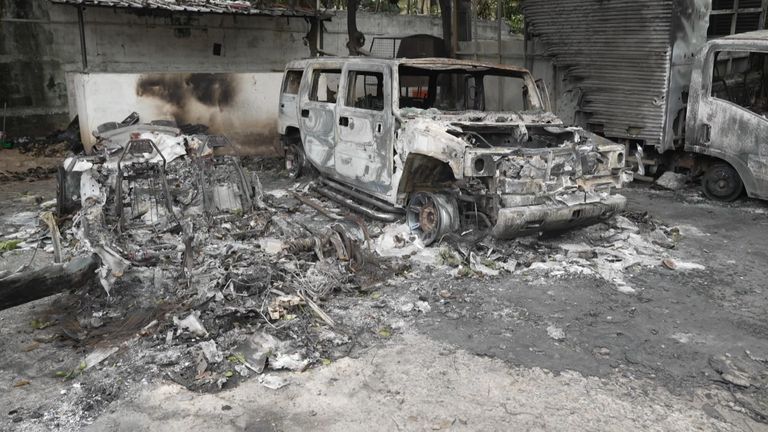
Image:The remains of a Lamborghini and Hummer which were torched
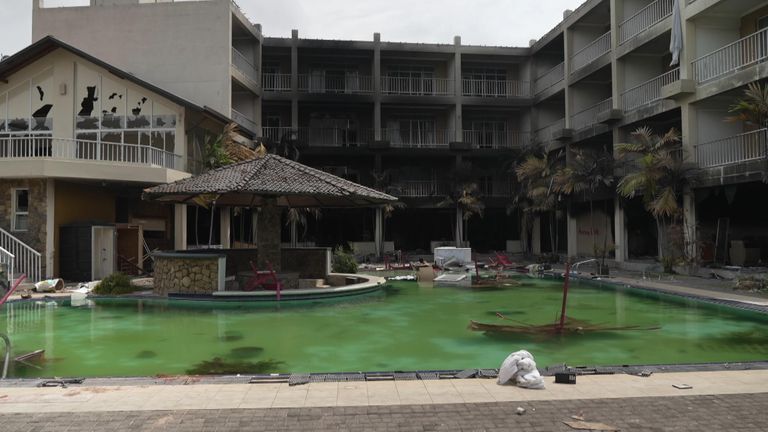
An hour’s drive from Colombo, a luxury hotel wedding venue was utterly destroyed on the night violence swept across Sri Lanka.
It’s difficult to fathom the fury that people must have felt to not only set fire to it and smash it to pieces, but also loot everything they could get their hands on.
The unrest happened amid the country’s worst economic crisis since independence from Britain in 1948, which has been blamed on a combination of COVID, rising oil prices and populist tax cuts by the president and his brother, until recently the prime minister.
The Avenra Hotel’s manager, Yohan Perera, says a crowd of up to 2,000 people attacked the complex, believing the owner had links with the ruling Rajapaksa family. However, Mr Perera insists there was no connection.
Image:The Avenra Hotel’s manager, Yohan Perera, said a crowd of up to 2,000 people attacked the complex
“They have taken every single thing. The cutlery, the forks, spoons, knives, plates, even the beds,” he said. “Everything is gone.”
No part of the hotel was left untouched. A safe is upturned next to the pool, the toilets ripped out from the floor and every tile in the bathroom smashed.
The hotel rooms and reception halls are blackened shells covered in glass and debris.
Then there’s the luxury car collection. The attackers set fire to more than a dozen cars, including a Lamborghini, Hummer and a Cadillac. All that’s left is burned out shells, a few tyre rims and mounds of ashes where a stray cat has made a home.4:08https://imasdk.googleapis.com/js/core/bridge3.516.0_en.html#goog_628569130Play Video – What’s led to Sri Lanka’s emergency?What’s led to Sri Lanka’s emergency?
Police have now arrested more than 800 people nationwide who are accused of ransacking property, looting and setting fire to MPs’ houses on 9 May.
But human rights lawyers say in some cases police are jailing people who were out on the streets watching what was happening, rather than actively taking part in violence.
Image:No part of the luxury hotel was left untouched
People have been demonstrating against the arrests, calling for equal justice for both sides.
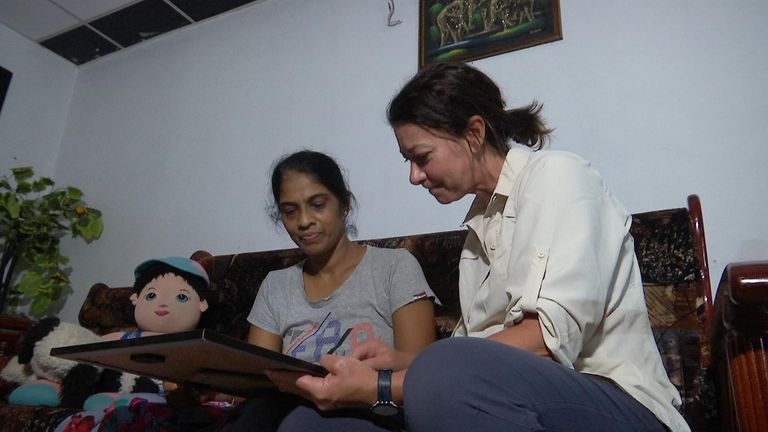
Nineteen-year-old Prabodh Madushan is one of those arrested. He was filmed near a burning car on the night of violence and he is now in jail awaiting trial.
His mother Sunethra Sanjeewani insists her son was an innocent bystander.
“Look at the number of people who went to see the protests and see if there’s room in our prisons for all of them,” she said.
Image:Sunethra Sanjeewani, pictured with Nicole Johnston, insists her son Prabodh Madushan was an innocent bystander
Only around a dozen supporters of former PM Mahinda Rajapksa have been arrested, even though they were bussed in to assault anti-government protesters camped out at Colombo’s Galle Face area on the night the trouble started.
This led to pitched battles between the two sides – and kicked off the country’s mayhem.
Now, the government has ordered a report into that assault.
But while Sri Lanka is in the middle of an economic and political crisis the chances of a report calming the tension and healing deep divisions, appears remarkably slim.
Prime Minister Ranil Wickremesinghe and Leader of Opposition Sajith Premadasa were engaged in an open dialogue in Parliament yesterday for the first time after the two split giving birth to the Samagi Jana Balawegiaya(SJB),
Prime Minister Wickremesinghe who started the dialogue said in a lighter vein that the SJB was not involved in the recent violence where residences and business establishments of former Ministers and MPs were destroyed. I don’t think the SJB was involved in the violence it does not have time for such things as they spent the whole 24 hours thinking how they could marginalize me,” the Prime Minister said.
We don’t want to marginalize you but want to incorporate you as you are a single member of Parliament,” Premadasa said.
The Prime Minister then made a request from the Leader of the Opposition where he requested the SJB Leader to provide medicine under its Husma programme.
Provide us with one kind of medicine as there is a serious shortage of essential medicines in rural hospitals. There is a shortage of medicine used for heart disease and disabilities,” the Prime Minister said.
The Husma programme has been designed to provide life saving medical equipment and not to provide medicine. However you name a medicine you know and we will do our best to provide it. We cannot provide medicine to the whole nation but we will do out best,” Premadasa said.(Yohan Perera and Ajith Siriwardana)
Minister of Power and Energy Kanchana Wijesekara has requested the general public to refrain from waiting in queues to obtain petrol as supplies are unavailable today and tomorrow (May 19 and 20).
Giving an update on the fuel stocks available in the country during today’s parliamentary session, the lawmaker pledged to resolve the issue this weekend.
However, diesel will be supplied continuously as sufficient stocks are available, Minister Wijesekara said further.
Both Auto Diesel and Super Diesel were distributed to filling stations yesterday. We hope to provide an uninterrupted supply of Auto Diesel and Super Diesel in the coming weeks, to 1,190 active filling stations in the country, although there are 1,300 filling stations in total.”
However, there is an issue regarding the availability of petrol volumes, the minister noted adding that a vessel carrying a petrol consignment has been docked in Sri Lankan waters since late March, but the shipment could not be cleared owing to the US dollar shortage in the country. There is also a payment of USD 53 million due for the same vessel for a previous shipment delivered in January 2022, he continued.
According to Minister, Wijesekara, the relevant company had refused to release the vessel until both payments are settled. Following a written assurance by the Central Bank of Sri Lanka to make the payment for the previous shipment within 15 days from August, the said company agreed to release the vessel after the due payment is settled, he explained.
The lawmaker stated that the ministry is yet to find funds to make this payment. We are however working on getting the shipment released either today or tomorrow.”
This is why we requested people not to wait in queues for petrol as the distribution process is being carried out with very limited stocks,” the minister said adding that petrol stocks need to be supplied for essential services, especially ambulances at the moment.
We apologize for this [situation]. We understand that three-wheelers operate with daily fuel purchases. However, we urge the general public not to wait in queues today and tomorrow.”
The minister noted that it would take at least three days to complete petrol distribution to all filling stations.
The Inspector-General of Police and the Secretary to the Ministry of Public Security had given directives not to use water cannons and tear gas at the ruling party supporters who were heading towards the GotaGoGama protest site at the Galle Face Green on the 9th of May, says MP Ramesh Pathirana.
The former minister, delivering a special statement in the parliament on the events that unfolded last week, stated that they had received instructions on the 8th of May to gather ruling party supporters to the Temple Trees for the farewell of Mahinda Rajapaksa, who was expected to step down as the Prime Minister the following day.
Majority of these people only wanted to extend their greetings to the former prime minister as he was resigning, however, several politicians who were there at the Temple Trees that day had exerted malevolent influence on these people, MP Pathirana said further. We need to admit to that.”
He said less than 10 percent of the supporters who were provoked into attacking the GotaGoGama had then marched towards the protest site. This is a very unfortunate incident.”
Neither the President nor the government had any intention of attacking the protesters although it had been there for a month, MP Pathirana explained.
I was at the Temple Trees at the moment. I called SDIG [in charge of Western Province] Deshabandu Tennakoon and asked him to prevent this unfortunate event that is going to happen.
The parliamentarian said he later attended a meeting at the President’s House, during which SDIG Tennakoon was directed by President Gotabaya Rajapaksa to prevent the impending assault on the protesters.
According to MP Pathirana, DIG Tennakoon had responded that he was instructed by the IGP and the Public Security Ministry’s Secretary not to use water cannons or tear gas on the ruling party supporters.
He said the President then instructed the Senior DIG to immediately stop the government supporters from attacking the protesters at Galle Face and that is when the police fired water cannons and tear gas to disperse the government supporters.
Pathirana said that testimony given by two individuals at the Human Rights Commission that the IGP and the Secretary to the Ministry of Public Security had ordered not to stop the SLPP supporters from marching towards anti-government supporters was in fact correct.
The Colombo Fort Magistrate’s Court has ordered to remand SLPP MPs Sanath Nishantha and Milan Jayatilleke until May 25.
The two parliamentarians, who were arrested in connection with the attack on the anti-government protest sites in Colombo on the 9th of May, were produced before the Colombo Fort Magistrate’s Court earlier today.
The Criminal Investigation Department (CID) had arrested MP Nishantha at the Flower Road in Colombo last evening while he was later brought to the CID office to record a statement.
MP Jayathilake was apprehended near the Sri Sambuddhathva Jayanthi Mandiraya in Colombo.
Meanwhile, the Senior DIG in charge of Western Province Deshabandu Tennakoon had recorded a statement at the CID regarding the recent unrest for more than 10 hours.
The Attorney General, on Monday (May 16), instructed the CID to arrest 22 suspects including MPs Johnston Fernando, Milan Jayathilake, Sanath Nishantha, Sanjeewa Edirimanna and Senior DIG in charge of Western Province Deshabandu Tennakoon, if sufficient evidence is available against them over the attack on anti-government protest sites in Colombo last week.
If there is direct, circumstantial and technical evidence against the 22 suspects, they should be arrested as soon as possible, the Attorney General’s Department had said further.
The Attorney General’s Department also instructed the CID to file cases against the arrested suspects under the Criminal Procedure Code.
The CID was further instructed that it is crucial to record the statements of those against whom foreign travel bans have already been obtained.
On May 12, the Fort Magistrate’s Court imposed a travel ban on former Prime Minister Mahinda Rajapaksa, MPs Namal Rajapaksa, Johnston Fernando, Sanath Nishantha and 13 others over investigations into the incidents near Temple Trees and Galle Face.
MPs Pavithra Wanniarachchi, Sanjeewa Edirimanna, Kanchana Jayaratne, Rohitha Abeygunawardena, C.B. Ratnayake, Sampath Athukorala and Milco chairman Renuka Perera, SLPP activist Mahinda Kahandagama, and Senior DIG Deshabandu Tennakoon are also among the officials who were barred from travelling overseas.
Defaulting debt is a very complicated and painful matter. It is not a casual or frivolous matter. It is well known that various people had suggested to the Sri Lankan authorities at various times to default on its external public debt. They gave various reasons as to why that should be done. Some opposition MPs also advised default, and in fact, found fault with the relevant officials and other authorities when it was not done. However, few persons realize that it is not possible to have selective defaults of particular sovereign loans, since many loan agreements with international creditors have cross-default” clauses which are far-reaching. It is also likely that those persons who were calling for the default of the ISB of January 2022 were blissfully unaware that, as per the Offering Circular for the ISB of USD 500 million, the Sri Lankan Government had solemnly assured all prospective investors that the full faith and credit of the Democratic Socialist Republic of Sri Lanka will be pledged for the due and punctual payment of the principal of, and interest on, the Bonds.”
When a sovereign forex loan is not repaid, the credibility of the country will be lost, and investors will shun that country. It will not be easy for the defaulting country to obtain new forex loans thereafter. The country’s banking system will come under a lot of pressure and face very serious difficulties when opening letters of credit and carrying out forex transactions. Forex loans and investments that were previously forthcoming to the local banks would be halted or postponed. Most forex-funded infrastructure projects will stop. Foreign Direct Investors will adopt a wait and see” attitude. Small and medium sized import-based businesses and entrepreneurs will be badly affected. Accordingly, it would be vital to have a strategy to deal with these challenges when external debt is defaulted. Failure to do so may lead to unmanageable problems.
It is also likely that those who proposed default, won’t be around to assume responsibility when the default repercussions arise, and it will be the Government and the people that will have to face the consequences. That is why if a sovereign debt default is contemplated, it is the responsibility of the authorities to initiate and undertake a discussion on the subject and thereafter take the decision. In fact, a decision to default by a country is so serious that it should properly receive the formal approval of the Cabinet of Ministers with the advice of the Attorney General as well. Further, in view of the fact that the Parliament has already voted the necessary funds for debt servicing at the time of approving the Budget and Parliament has the final responsibility for finances, obtaining Parliament’s approval may also be in order.
Hence, even though various people urged the non-payment of the International Sovereign Bond (ISB) on 18th January 2022 and/or other debts, it must be understood that such unsolicited requests cannot be considered by officials, without proper authority or approval of the Government.
In any event, up to 11th April 2022, it was Government Policy not to default, and both Ministry of Finance (MOF) and the Central Bank of Sri Lanka (CBSL) had followed that policy faithfully since independence. However, as announced by the MOF on 12th April 2022, that policy was changed when the MOF decided to default on that day. Now that the Government has already announced the decision to default, it may be presumed that all connected issues have been carefully considered and approvals obtained. At the same time, certain key government leaders and several private sector leaders who proposed this strategy of default have stated that the forex saved by not paying the loans could be used to fund essential imports. However, many analysts have serious reservations about the materialization of that outcome.
Sri Lanka’s gem-bearing gravels, called illam, are some of the richest in the world. The gravels yield sapphire, ruby, cat’s-eye and other chrysoberyls, spinel, garnet, beryl, tourmaline, topaz, quartz, and many other gemstones. The island was blessed with geology that provided an ideal blend of chemistry, heat, pressure, time, weathering, for gem crystals to grow and be deposited in gravels.
Gemstone mining in Sri Lanka is mostly from these deposits. The gravels at Elahara show evidence of having traveled over long distances. They are often eroded, which suggests that the various kinds of gemstones found in the deposits have different origins.
In Sri Lanka gems are extracted from pit mines and rivers. The pit mine contains the main deposits, the residue is found in the rivers. The tributaries known as ‘Kelani ganga’ and ‘Kalu ganga’ carry some of the world’s finest cornflower blue sapphires.
Gem deposits can also be found in the banks of rivers. A tributary of the Mahaweli, known as Kalu ganga runs through the main gem area in Elahara. This tributary has been a major route for the transportation of gem materials into the Elahara valley. This has resulted in accumulation of deposits on hill slopes as well as along the banks of the river at Elahara, said researchers.
River mining is usually carried out after the rainy season. Rivers in gem-producing areas contain alluvial deposits where the river bends or otherwise slows down. River miners usually select a shallow, slow flowing area within the river and build a dam built of wood or rock where the water slows, allowing it to escape from one side. that water is directed through a funnel. The ‘illam’ flows through the funnel and are then filtered by an experienced ‘gem panner’.
Using metal blades attached to long wooden poles,the miners scoop up the gravel and remove the overburden until they reach the illam. Then they use long pointed steel rods to loosen the illam and drag it up, allowing the rushing water to wash the gem-bearing gravel. They remove any visible gemstones, and the remaining gravel is given further washing.
The operation of a mine requires special skills and a long experience of the industry prospecting for high value gem deposits is left to well-experienced professionals who use a variety of low tech but very effective methods. One commonly used method is driving a 10 foot long rod into a geographical depression and listening to a very distinct sound as it pierces through the earth. This process usually takes about one or two days and has a proven track record in many areas of Ratnapura and Balangoda.
One of the surprising aspects of gem mining in Sri Lanka is that you come across traditional pit mines just driving down the roads .One mine was alongside a paved road, as was another shallow pit operation we found by accident right in front of a home and farm, observed visiting gemologists.
Pit mines are often dug in paddy fields. There are two kinds of pit mining, surface mining (Goda patal) and deep mining in tunnel pits ( Dona patal).Shallow circular pits are dug In areas where gem deposits are located near the surface. this method is economical, when the gem-bearing deposits are not far underground. a shallow pit usually extends 3 to 10 meters in depth. Work in shallow pits is usually finished within a couple of days.
Dona Patal, the deep mine pits, have depths that can range up to 50 meters, though most pits are between 5 and 25 meters. They are rectangular in shape and consists of a vertical shaft that measures two by four meters. A team of 10 laborers dig a pit reinforced by wooden frames fitted to the walls. A system of air and water pumps are used to remove any water that may have seeped in to the pit and to provide breathable conditions as the laborers go deeper into the earth. The mines are excavated horizontally, creating tunnels extending from 6 to 9 meters or more away from the shaft. It takes at least six months to finish work in a Dona Patal.
These tunnels are beneath the farmlands so the disruption to the fertile fields is minimal. . When the mine was no longer useful, its shafts were filled, its sumps removed, and rice was planted over the mine, making it impossible sometimes to locate an old mine site.
Unlike in Africa, there are no unfilled, abandoned pits. National Gem and Jewellery Authority collects a cash deposit when a license is issued. If the mine owner does not rehabilitate the land after mining is complete, the NGJA uses the deposit money for that purpose.
Work in the gem pit starts at an auspicious date and time. Rituals are followed and offerings made to the spirits at the opening of a new mine. Most of the gemstone mining in Sri Lanka was done by hand in open pits using hand tools They use picks and shovels to excavate the gem gravel. The gravel was removed in baskets on the miners’ shoulders.
A worker at the bottom of the pit removed soil and gravel with a scraper and placed it in a basket held by another miner. With almost perfect coordination, the basket was tossed up to a chain of three miners, each one a bit higher up, until the basket was emptied and placed in a pile at the top of the pit. As the mud- and gravel-filled basket was tossed to the top, an empty basket was thrown back to the bottom of the pit in what looked like a juggling act, an acrobatic tossing of baskets .
Gem mining in Sri Lanka has always been conducted in this way ,using artisan methods, said researchers. This tradition is supported by government and industry to help sustain the industry and minimize damage to the environment. Trade and regulatory bodies are against large-scale gemstone mining. They consider traditional small-scale mines less harmful to the environment and a more stable source of employment for more people.
The use of back-hoes and gravel-washing plants has been limited to isolated cases where the gravel beds were known to contain only low concentrations of gems or the same plot of land had been worked by hand methods for many years.
Pit mining decreased in Elahara in the late 1980s, when the State Gem Corporation engaged in large-scale surface mining. It used bulldozers, which lowers the costs involved and increases the yield of gem materials.
There are usually several people involved in a mining operation, including the landowner, the holder of the mining rights, the person who supplies the water pump to remove water from the pit, and the miners. They all receive a share of the proceeds from the sale of the gemstones.
The bearer of the license for a mine is considered the owner of the mine. He joins the group with the licence haula or share. Many have four to five mining pits on the property.
The miners excavate the pit, collect gravel, and wash and examine the gravel in the search for gems. Miners are paid a weekly allowance, however they are entitled to a percentage of any profit received from the mine. Under current regulations, sales proceeds from the rough stones are divided among the laborers, the land owners and the traders.
Miners form a group and share the costs, labor and profits from the sale of any gemstones found. Such a group is known as karu haula. The others involved in karu haula include the owner of the land, the owner of the water pump, and the supplier of timber and logs for lining the pit. they also receive their share by percentages calculated on the total gross realization. In Sri Lanka the miners are well taken care of and well paid unlike in other countriesby 1986, virtually all of the 650 miners at Elahara were employed by the State Gem Corporation and licensed private enterprises.
Gem mining is a complex trade , it needs patience and involves massive expenses. Mining can last from a couple of months to several years and is often very expensive. But the benefits reaped make it all worthwhile, said traders. It’ was estimated in 2014 that more than two million pits had been dug over the last 50 years.
In Sri Lanka mining is regulated so that the land is protected from overuse. Mining is restricted to small-scale operations where heavy machinery is forbidden.‘large scale excavations’ using automated heavy machinery is not allowed. one can mine for gemstones in Sri Lanka only by obtaining a permit from the National Gem and Jewellery Authority.foreign nationals are prohibited from obtaining permits for gem mining The mines are peaceful and pretty much safe compared to other mining cities and countries, said visiting gemologists.
Gem-mining activity in Sri Lanka escalated after the government established the State Gem Corporation in 1971. The corporation took over the functions of issuing gem-mining licenses and leasing government land for mining.
In Sri Lanka, gems found on private holdings or on government-owned land (forests, wildlife reserves) are considered government property. In the case of private land, mining rights are given to the land owner and the government collects license fees in lieu of a royalty. In a gem rush situation the government imposes no immediate restriction, but eventually, the NGJA takes over the land . it is kept under armed protection until the mining rights are auctioned to the public.
Gems has been excavated at Elahera in ancient times. The evidence was there. it has been abandoned thereafter. in the mid-1940s)a Sri Lankan engineer working on an irrigation project along the Amban Ganga lost a ring along the side of the river while he was bathing. In the process of searching for the lost ring, he discovered a number of blue and red pebbles, which proved to be either corundum or garnets. He soon started mining but kept the discovery secret.
In the early 1950s construction workers on the Elahera-Pallegama road found many pebbles of sapphire that had been exposed after a heavy rain. The news of their discovery gradually spread among the professional gem miners in Ratnapura, many of whom set up private, small-scale mining operations in the “new” district.The local farmers started mining in their paddy fields.
in the 1980s, at Elahara Large-scale mining was being conducted by the State Gem Corporation in collaboration with the private sector. The corporation, at its own expense, built a new road to connect Elahera and Pallegama. in the 1980s,the project area was closed to the public, and anyone who wishes to visit the mines must obtain a permit at the corporation’s head office in Colombo.
at Kataragama site the mining site was situated within a forest with few settlements. Thousands rushed to the scene in search of sapphires and some even used excavators and dump trucks to remove loads of earth. However, the NGJA soon secured this area. The entire excavated area measured only about 60 sq meters. The NGJA divided this pit and the surrounding area into 49 blocks of about 10 perches(22 m2) each and mining rights went up for public auction.
Because of the publicity surrounding these gems, there was a frenzy of bidding at the auction for one-year mining rights. The auction raised a staggering 270 million rupees, US$2.45 million. Some of the claims sold for as much as US$80 million per sq meter, thereafter. (part 4B concluded)
Bricks are easier to throw than Bouquets. Sri Lanka’s Armed Forces sadly have never got the accolades they deserve. They never will. Being grateful doesn’t fit into the scheme of things. Every time well-funded campaigns nit-pick on what they didn’t do ignoring all that they did. No national army in the world has successfully carried out a military cum humanitarian operation simultaneously. No national army has been able to eliminate the ground force of an internationally proscribed terrorist organization while saving close to 300,000 Tamils & accepting close to 12,000 LTTE combatants all of whom surrendered wearing civilian clothing. Out of these close to 12,000 LTTE combatants were 545 LTTE child soldiers. Sri Lanka’s President considered them victims of LTTE & gave them a presidential pardon, another first. No foreign government has looked at the humanitarian side of the terrorists – even child soldiers. These 545 became the last of batch of Tamil children who were kidnapped & turned into child soldiers by Tamil militants.
None of the so-called Tamil leaders in the political scene today uttered a word against LTTE & its recruitment of child soldiers. Today, the bellow in Parliament, but they did not even donate a bag of rice to the refugee camps following the end of the conflict.
While in the international arena, other than writing fancy reports – what did the UN, its rapporteurs, UN agencies for children & women or the human rights organizations do to stop LTTE child soldier recruitment from 1970s to 2009?
Do their reports reveal how many Tamil children between the ages of 7 to 18 years ended up kidnapped by LTTE?
Do their reports highlight from what homes these kidnapped Tamil children came from?
Do their reports reveal how many got killed since 1970s by LTTE during training or by LTTE while trying to flee training? How many fleeing children did LTTE shoot to death?
Do their reports cover the horrendous training they had to undergo in the thick jungles?
Do their reports cover the deaths of these children, trained to hold a gun & shoot at a national army?
Do their reports reveal how many child soldiers died at the hands of the LTTE while trying to flee during the last phase of the conflict?
Do their reports cover how many Tamil children would have died biting the cyanide capsule & committing suicide?
Have any of these international entities raised the demand for justice against LTTE for these war crimes against children?
It is indeed very sad, that the LTTE diaspora takes pains to demand accountability” and is promoting a bogus genocide” but they shy from answering questions related to the kidnapping of Tamil children and turning them into child soldiers or justice which will invariably turn to their accountability for aiding and abetting child soldier recruitment.
The LTTE Diaspora and their supporters in Sri Lanka are also shy to answer the question from what type of homes these children were kidnapped from?
They were kidnapped from LOW CASTE and IMPOVERISHED homes – parents who were too poor to even travel to a police station to complain, parents too scared to say anything against the LTTE, parents too poor to feed their children that they thought joining the LTTE would make their life better.
The ordeal these Tamil low caste & poor children went through is factual & nothing like the made up stories of genocide by LTTE rump overseas.
Why don’t the LTTE diaspora celebrate the LTTE children during these memorials?
They dare not do so because it impacts negatively on them. LTTE will never highlight the child soldier regiments because it is a black mark on them. Notice how LTTE fronts have never covered any child soldier in their wailings about supposed killings by Armed Forces.
LTTE was an armed movement – they cannot expect the Sri Lanka Armed Forces to be firing roses. LTTE was an armed non-state actor in uniform and a clear hierarchy. If LTTE is firing with aim to kill, LTTE must expect the return. However, the scenario LTTE fronts are presenting to the world is that they were an innocent group of people getting shot at by the Sri Lankan Armed Forces. Obviously the world is oblivious to its list of crimes & any international body holding roses for LTTE should seriously look up LTTE’s crimes first.
The majority of Tamil community comprise low caste & poor.
LTTE used their own children to acquire international status as a terrorist outfit. LTTE had armed units comprising of child soldiers.
These children lost their youth, they lost their childhood, they were denied education, freedom of movement & the right to live in a happy environment with their parents.
No one can measure this loss.
When 545 child soldiers surrendered to Sri Lanka’s Armed Forces in May 2009, these 545 child soldiers became the last of the children that LTTE were able to steal from parents & turn into child soldiers.
Tamil children & their parents did not have to fear walking to school or returning home from school to get kidnapped on the way & taken to a thick jungle hide-out where they were training in combat operations, taught how to commit suicide & given a gun to kill. Sri Lanka’s Armed Forces saved the Tamil child and the Sri Lankan Armed Forces deserve more than bouquets for this.
The Sri Lankan Prime Minister Ranil Wickremesinghe told the people of Sri Lanka on Monday, that he will fulfil the promises he had made to them when he assumed office last Thursday after the fall of the Mahinda Rajapaksa government.
In his first TV address after assuming office, Wickremesinghe listed the grave challenges ahead of him, but assured the people of his determination to meet them successfully. He also suggested the formation of a National Assembly comprising all parties, to arrive at solutions. There may be an example for him. He can Overcome the crisis by following Bangladesh’s ‘PM Sheikh Hasina Model’. Now the question is why and how. Let’s discuss.
The South Asian Island nation of Sri Lanka is currently going through an extreme economic crisis. Foreign exchange reserves have fallen so low that some school examinations have been closed indefinitely due to a lack of imported paper. In addition to cooking gas, there has been a shortage of kerosene and petrol.
The situation is so dire that due to inflation, high unemployment, and shortages of almost all necessities, many Sri Lankans are fleeing their country in the hope of a better life abroad. Countless Sri Lankans are now being forced to do something other than their main occupation as not everyone can afford to leave the country.The country has never been in such a bad situation since Independence in 1947. To cope with the situation, the Sri Lankan Government has asked for a new loan of US$ 1.5 billion from neighbouring India. When Sri Lanka faced problems, Bangladesh provided US$ 250 million for the first time. This was the first loan from Bangladesh for any country. They have again asked for a loan from Bangladesh. Besides, they have been repaying loans of different countries through the exchange of goods.
Sri Lanka was quite capable of human resources and internal prosperity. Then why their situation? Sri Lanka has undertaken several mega projects in their country for more than a century. These include seaports, airports, roads, and other projects that are currently considered unnecessary and redundant. Different governments of Sri Lanka have taken loans from different sources at home and abroad. As a result, their foreign exchange reserves gradually ran out. Instead of foreign investment, various governments have focused on borrowing.
The country’s government has issued sovereign bonds since 2007 to raise money. This type of sovereign bond is sold when the expenditure is more than the income of a country. Such bonds are sold in the international capital market to raise money. That is what Sri Lanka has done.
The once-self-sufficient country is also in dire straits due to tax cuts, reduced income from tourism remittances, and unplanned decisions in agriculture. Different countries including Bangladesh have to learn from this situation. The world economic situation has begun to change rapidly since the Russia-Ukraine war, at which time any country could fall into a new crisis. We are hopeful that friendly Sri Lanka will soon be able to return to normalcy with the help of various countries and organisations around the world.
On the other hand, Bangladesh is currently a wonder of development. It is Hasina’s contribution that has made a least developed country such as Bangladesh a developing country now, going by economic indicators. Sheikh Hasina changed Bangladesh from a basket case to a middle-income country. Strong leadership is one of the main reasons behind ‘Bangladesh model.
The implementation of big projects is now just a matter of time. City facilities have also been ensured in the villages. A Metrorail will be launched in a few days. The long Padma bridge is not a dream now, it is real. The implementation of such a project with the government’s own funding was at one time unimaginable. The country is moving forward with a sound plan.
On various indicators of human development, Bangladesh had shown significant improvement,” she said, adding, “Life expectancy in 2019 was 72.6 years, a gain of over 7 years since 2000, years of schooling were up from 4.1 to 6.2, and the country’s human development index value climbed from 0.478 in 2000 to 0.632 in 2019. As a result, Bangladesh’s index ranking is now 133rd out of a total of 189 countries.”
The High Commissioner pointed out that Bangladesh’s growth stems largely from its success as an exporter of readymade garments, which account for 83% of its total exports, and remittances from overseas, which amount to over 7% of GDP. However, the principal driver of growth is investments, which has risen from 24% of GDP in 2000 to 32% in 2019. When asked about Bangladesh’s amazing rise and economic growth, she put it down to the “Sheikh Hasina factor”.
The High Commissioner emphasised that during the Covid-19 pandemic, the government offered a 2% incentives bonus for Bangladeshis sending remittance back to the country, creating $2 billion to keep the growth going. In addition, the Bangladesh Government under Prime Minister Sheikh Hasina provided an exponential stimulus to the economy to protect the marginal fringes of the workforce. She also highlighted that completion of the Padma Bridge will make a huge contribution to the economy.
Nobody disputes the economic credentials of Sheikh Hasina’s government – the Asian Development Bank (ADB) is the latest member of a growing list of international institutions attesting to Bangladesh’s economic success. The ADB ranked Bangladesh as the fastest-growing economy in the Asia-Pacific region, eclipsing China, Vietnam and India. At the same time, our improvements in many socio-economic indicators are another object of envy to our neighbours.
When she returned to power in 2009, Sheikh Hasina knew that the energy shortage first needed to be mitigated to a tolerable extent, before embarking on long-term plans. As a temporary measure, she decided to allow private companies to build small-range power plants, known as quick-rental power plants. The decision received a barrage of criticism from many quarters — from opposition parties and economists to the press and think tanks — intimidating many in the bureaucracy.
But Sheikh Hasina refused to back down from what she thought was the right step forward. She defended her decision forcefully, making necessary amendments to clear any legal ambiguity, and focused on its implementation. Nearly 10 years on, no one doubts that the decision was instrumental in solving the persistent energy crisis.
While in power, Sheikh Hasina has opened up many sectors traditionally reserved for the public sector to the private sector, including health, banking, higher education, TV and even export processing and economic zones. At the same time, her government has substantially widened and expanded welfare programmes to lift the poorest and most neglected section of the population and increased subsidies for other crucial elements of the economy such as agriculture. Her development philosophy is a blend of capitalistic and socialistic virtues.
Propelled by a robust manufacturing sector and an enormous boom in infrastructure, Bangladesh has set a target of becoming a developed nation by 2041 to coincide with the platinum jubilee of its independence. Many commentators have called the goal ambitious, but even the government’s staunchest critics would think twice before questioning its plausibility.
The present government in Bangladesh has shown great prudence and foresight in the progress of Bangladesh. Bangladesh current regime has ensured political stability in the country, zero-tolerance policy against terrorism, illegal narcotics deal, empowerment of women, liberalism of economy, social welfare policy towards the people, increasing capacity building through training, inclusive economic growth policy, timely bold decisions etc. For this reason, there is nothing to be afraid of seeing the situation of any country as a nightmare. Around 100 economic zones are being formed. Investment is coming from different countries. Foreign exchange reserves are adequate (US$ 45 billion, January 2022), and remittances are satisfactory. It can be said that every economic foundation of Bangladesh is still in a strong position. The economy of Bangladesh was also active during COVID and emphasis has been laid on revenue collection and the agricultural sector of Bangladesh is very strong. Bangladesh is in a positive position in terms of foreign exchange reserves, remittances, and export earnings.
Bangladesh’s foreign exchange reserves now stand at more than US$ 45 billion, despite rising import costs. With which we will be able to meet the import cost of six months. Bangladesh’s growth rate was way above Pakistan, even before the pandemic; in 2018-19 it was 7.8% compared to Pakistan’s 5.8%. Various international organisations, including the World Bank, the World Economic Forum, and the Economic Intelligence Unit, have identified Bangladesh’s economic development as a wonderful puzzle”. While the current economy of Bangladesh is US$ 410 billion, the size of Pakistan’s economy is about US$ 260 billion.
Bangladesh has improved its quality of life, economic strength, prosperity, education, and research in every field. Due to the global coronavirus pandemic, Bangladesh’s growth has slowed down. But where the growth of all the developed countries of the world was negative in these years, the achievement of Bangladesh was also noticeable.
Premier Sheikh Hasina has achieved full potential to move from a least developed country to a developing country. It has been possible because of people’s hard-working, strong leadership. Political stability, the flow of FDI, empowerment of women, unique poverty alleviation model, inclusivity of economy, etc. That is the story of a South Asian country: ‘Bangladesh’ is a ‘miracle story’.
British colonials with a pet cheetah in Secunderabad, India, 1906. (Hulton Archive / Getty Images)
In 2005, Britain’s then–Labour chancellor of the exchequer, Gordon Brown, chose the backdrop of Tanzania to make a dramatic statement about his nation’s unmatched record of imperial conquest and rule. The time is long gone,” he said, when Britain needs to apologize for its colonial history.” The choice of locale for such a proclamation was, to be charitable, curious. A braver stage would have been Kenya, to pick an African nation that had experienced horrific violence during its independence struggle from British colonial rule, or India or Malaya, where extreme and brutal measures to sustain imperial control had been carried out on an even greater scale. But here we were, nonetheless.
Brown’s speech reflected the slow and creaky rotation of the wheel not so much of history but of historiography. Mirroring 19th-century historians’ and politicians’ polished encomiums to a beneficent British Empire, the speech brought elite assessments of Britain’s unparalleled dominion over one quarter of the globe, and over a similar fraction of the human population, almost full circle. Back in the 19th century, the task of ruling over myriad darker-skinned peoples around the world had been depicted less as a matter of self-interest than of moral obligation. It was Britain’s unique vocation to spread progressive constitutional freedoms and the rule of law, along with free trade and free labor, among the less fortunate barbarians. As the Whig politician and historian Thomas Babington Macaulay wrote of Britain’s empire: It is to her peculiar glory, not that she has ruled so widely—not that she has conquered so splendidly—but that she has ruled only to bless, and conquered only to spare.”
Such views remained fairly unchallenged until the 1960s, when space for more critical, revisionist accounts of the British Empire began to open up. Most famous among these were the histories by Jack Gallagher and Ronald Robinson, whose co-authored essay The Imperialism of Free Trade” helped launch the so-called Cambridge School of historiography, which argued that Britain had profited from empire through trade while avoiding extensive formal control over its colonies. According to the historian Richard Drayton, these new accounts stripped the traditional emphasis of high moral purpose” from the British narrative, replacing it with a franker acknowledgment of self-interest and realpolitik. Yet by the 1990s and 2000s, conservative British academics, followed by Tory politicians, had begun to revise the revisionists, reprising the old claims that empire, at least in its British form, had been good for the world, and they succeeded to such an extent that even Labour politicians like Gordon Brown felt confident enough in these claims of British-led progress to reiterate them before an audience of Africans.
Against this backdrop, a new wave of revisionist reconsiderations of the British Empire has resulted in a number of popular and prizewinning books. In Empireland, Santham Sanghera recently documented the neglect of pre-20th-century history in British education, as well as the country’s nativist attitudes toward the brown-skinned immigrants who had been encouraged to migrate to Britain in the postwar years in order to boost its economy. In Slave Empire, Padraic X. Scanlan examined the role that the wealth acquired from sugar plantation slavery in the Caribbean played in Britain’s economic rise. And in The New Age of Empire, Kehinde Andrews asserted that Western empire has continued in a new guise through Western-led institutions like the World Bank and others that still exert control over the Global South.
With Legacy of Violence, Caroline Elkins has stepped firmly into this arena—or, rather, reentered it—offering a sweeping and detailed history of the violence and brutality of the British Empire. The book marks a return to the scene of a previous battle for Elkins, whose Pulitzer Prize–winning Imperial Reckoning (2005) documented Britain’s colonial atrocities in Kenya by mining the long-buried official archives with such thoroughness that the British government was obliged to issue an official statement of regret for its actions in the 1950s and ’60s.https://buy.tinypass.com/checkout/template/cacheableShow?aid=NmGa4IzWHL&templateId=OTFVM3RHWZ0B&offerId=fakeOfferId&experienceId=EXAO0X9CQ04A&iframeId=offer_6a607d574eb5007ae5e3-0&displayMode=inline&widget=template&url=https%3A%2F%2Fwww.thenation.com
Kenya appears in this book, too, where Elkins brings her accounting up to date, but compared with that earlier work, Legacy of Violence also represents a formidable escalation on her part. With its enormous breadth and ambition, it amounts to something approaching a one-volume history of imperial Britain’s use of force, torture, and deceit around the world. As devastating as the details of these tactics are, even more damning is Elkins’s account of what she argues has been the persistent and perverse misuse of law to cast a veneer of justice and respectability over the remorseless exploitation of others. For all of the bluster and proclaimed moral certainty of British politicians, Elkins argues, much of Britain’s zeal in clinging to its control over others, even as the Age of Empire seemed increasingly destined to end, was driven not by self-confidence but rather by insecurity over the rapid rise of rival Western powers. It was global empire alone that, in this view, had prevented England from becoming, say, just another Sweden. There are not wanting those who say that in this Jubilee year our Empire has reached the heights of its glory and power, and that now we shall begin to decline, as Babylon, Carthage, Rome declined,” she quotes Churchill as saying in one 1897 exhortation. Do not believe these croakers but give the lie to their dismal croaking by showing by our actions that the vigor and vitality of our race is unimpaired and that our determination is to uphold the Empire that we have inherited from our fathers as Englishmen.” As Elkins makes clear throughout Legacy of Violence, the racialized aspect of empire—meaning clear notions of Britain’s Anglo-Saxon superiority over its Black, brown, and so-called yellow subjects—has been present from the beginning.
As its title suggests, Elkins’s book argues that violence was not just an incidental feature of the British Empire, not simply its midwife, so to speak. Rather, it was foundational to the system itself, a fact borne out in considerable detail. To flesh out the central role of violence in British imperial rule, Elkins shifts from the Indian Mutiny of 1857 to Jamaica’s Morant Bay Rebellion in 1865, to India’s northwestern frontier and South Africa in the 1890s, to Ireland at the dawn of the 20th century, and on from there to a dizzying variety of more recent locales: Palestine, Malaya, Kenya, Cyprus, and Aden, among others.
Assembling so many examples spread widely across space and time allows Elkins to build an impressively damning account of the British Empire. But her most original argument lies not in the violence itself but rather in London’s use and abuse of the notion of the rule of law, much touted by Britain as an elevating feature of modern Western civilization and a pillar of democracy. In Elkins’s hands, the rule of law in Britain’s many colonies becomes something more akin to lawfare: a system under which the use of codified rules was wielded to curtail freedoms rather than expand them, to expropriate land and property from Indigenous peoples, and to guarantee a steady flow of low-paid or sometimes unpaid workers to colonial mines and plantations, all under a veneer of principled legitimacy. When the genteel-seeming laws proved insufficient for these purposes, the empire was more than happy to resort to states of emergency and martial law, which conferred extraordinary authority upon its far-flung colonial governors. This legalized lawlessness,” as Elkins calls it, meant that Britain in effect became a recurrent conqueror of its subjects. States of emergency effectively turned organized resistance against the colonial regime itself into a forbidden or, at a minimum, highly circumscribed activity, and redefined people fighting for their freedom as criminals or terrorists. The forms of violence Britain employed in the enforcement of these writs, she continues, included corporal punishments, deportations, detentions without trial, forced migrations, killings, sexual assaults, tortures, and accompanying psychological terror, humiliation, and loss.”
Elkins documents this well-organized use of violence throughout the history of British Empire, from India and Jamaica in the mid-19th century to the South African War, the Irish War of Independence, the Arab Revolt, the Caribbean strikes, the Zionist uprising, and the states of emergency in Malaya, Kenya, and Cyprus. Writing about these different historical episodes, Elkins convincingly demonstrates that during the imperial era—indeed, she would probably say, since the imperial era as well—violence has been inherent to liberalism. Although liberalism has promised virtuous-sounding ideals like freedom, modernity, reformism, and the rule of law, it has freely used these ideals, time and again, as justifications for wreaking devastation on the subject peoples caught in its grip.
This self-serving hypocrisy will be familiar to those American readers who recall an infamous episode from the Vietnam War, when after the bloody Battle of Bến Tre, which left hundreds of civilians dead and thousands of homes destroyed, a US Army major explained to Associated Press reporter Peter Arnett, It became necessary to destroy the town to save it.” But for Elkins, it also demonstrates how liberalism’s willingness to ride roughshod over others has a long imperial pedigree that can be traced through a series of shockingly violent wars that are seldom recalled outside of the nations or regions in which they occurred.
DONATE NOW TO POWER THE NATION.
Readers like you make our independent journalism possible.
As a result of Elkins’s resourcefulness in digging into the colonial archives, we can also see how Britain’s imperial project became a vast tentacular atelier, with elite public schools and universities serving as the training grounds for generations of colonial administrators who refined both the repressive techniques used against native populations and the legal arguments used as cover and justification. With a surprising degree of recurrence, England’s original subalterns, the Scottish and especially the Irish, emerge as indispensable military cadres and hands-on functionaries who cycle from place to place in Britain’s increasingly global colonial project as the scale of atrocity grows.
Hence we see how, in response to the Indian Mutiny of 1857, British officials began to experiment with mass confinement measures aimed at putting down the revolt. This led to the incarceration of 20,000 Indian subjects, who were swept up in aggressive, broad-brush campaigns of repression and then exiled to the Andaman Islands in the distant reaches of the Bay of Bengal. By the turn of the century, tactics like these were being applied on an even larger and more brutal scale to put down the rebellion in South Africa. There, Elkins writes, about 100 concentration camps were built, where Afrikaner rebels were confined, along with women and children, and where Black undesirables” were herded into overcrowded detention centers by order of Lord Kitchener, in order to weaken them and bring them to their senses.” Elkins notes that the campaign against the Afrikaners was the first time a single ethnic group had been targeted for detention or deportation,” adding that 30,000 people, a disproportionate number of them children, died as a result. In the 64 camps reserved for Black South Africans, conditions were even worse: The emaciated and disease-ridden detainees undertook forced labor for reduced rations, and their death rates climbed, conservatively, to over 10 percent of the camp populations.”
What may feel disorienting for anyone who has been conditioned to believe in human progress is that this history doesn’t get any better as time progresses, even as the British Empire pursued tactical reforms. Worried about the potential spread of communism via the Chinese immigrant communities in Malaya—which, together with another commodity powerhouse, Ghana, was a leading source of financial sustenance for London in the immediate aftermath of World War II—Britain sent colonial officers to Malaya who had just overseen a brutal repression in Palestine in order to snuff out this resistance to its rule. The Chinese population, which had been growing in Malaya since the turn of the century, was declared alien” by the British, who then forcibly removed them from their villages, burning huts to the ground and salting the farmlands to prevent their return. The victims of this extrajudicial process were resettled in unfamiliar new areas, surrounded by barbed-wire fencing and kept under heavy surveillance. This resettlement campaign became what Elkins calls the British Empire’s largest forced migration since the era of the trade in enslaved people,” with 573,000 people, nearly 90 percent of whom were Chinese…relocated into 480 resettlements.” This campaign would be carefully studied by the United States two decades later and became a prototype for its war in Vietnam as well as the inspiration for one of that war’s most famous phrases: hearts and minds.” Elkins cites a top-secret British report from Malaya that argued that successes against bandit gangs, though essential to security…is only in effect a ‘rap on the knuckles’” and added: It is at the ‘heart’ that we must aim—to dominate the Chinese populated and squatter areas.”
Fittingly, Elkins’s book concludes where her original scholarly work began: with a return to Kenya. There, in the early 1950s, veterans of the British colonial schemes in Malaya, Palestine, and Greece converged in a bid to use emergency laws to thwart the rising political unrest in that East African colony. Following a familiar pattern, European settlers grabbed control of Kenya’s best farmlands to grow coffee and tea at great profit, separated the indigenous population by putative ethnic group, and relegated them to native reserves.”
The Kikuyu, an ethnic group based in the coveted highlands and other areas of central Kenya, which boasted some of the richest soils on earth, were hardest hit by this relocation campaign, with many rendered illegal squatters or sharecroppers on their own land. Simultaneously, pass laws” that required Africans to carry an ID showing their work history and current employer’s signature were imposed on the Indigenous population, as well as hut and poll taxes. Elkins says these taxes amounted to two months of a typical African’s wages. They fueled a stout resistance movement by the Kenya Land and Freedom Army, which came to be known as the Mau Mau (a term that Tom Wolfe later trivialized and perverted when he introduced it into contemporary political usage with a clearly derogatory meaning that suggested out-of-control radical violence, usually by Black Americans). In their efforts to resist the sweeping taxation and the takeover of their lands, the Mau Mau rebels killed 32 European settlers during the emergency, triggering an enormous and often indiscriminate crackdown. In the space of 18 months, 1,040,899 Kikuyu were forcibly relocated into newly created reserves built on the Malayan model. By the end of 1955, Elkins writes, colonial authorities had penned up nearly the entire Kikuyu population, employing the largest archipelago of detention and prison camps in the history of Britain’s empire.” One chilling paragraph gives the flavor:
White and Black agents of empire perpetrated horrific crimes in defense of British rule in Kenya. They used electric shock and hooked suspects up to car batteries. They tied suspects to vehicle bumpers with just enough rope to drag them to death. They employed burning cigarettes, fire, and hot coals. They thrust bottles (often broken), gun barrels, knives, snakes, vermin, sticks, and hot eggs up men’s rectums and into women’s vaginas. They crushed bones and teeth; sliced off fingers or their tips; and castrated men with specially designed instruments or by beating a suspect’s testicles till the scrotum burst,” according to Anglican church officials. Some used kiboko, or a rhino whip, for beating; others used clubs, fists, and truncheons. Bucket fatigue” was a routine practice, as were various forms of human excrement torture. Mau Mau suspects and detainees were forced to clean nightsoil buckets barehanded and run for hours around a compound holding a full nightsoil bucket aloft, which then spilled over, encrusting the person holding it with feces and urine. No Kikuyu—man, woman, or child—was safe.
Techniques of repression, policing, and dispossession were not the only things that were copied and refined as the British colonial officers moved from place to place within the empire; so, too, were stratagems for covering up the evidence. Elkins shows that what was already being done with no lack of efficiency in Malaya was improved on yet further in Kenya, where records of the kinds of tactics described above were systematically destroyed—showing, if nothing else, a deep consciousness of guilt. Within days of the signing of the treaty that paved the way for the independence of the Federation of Malaya in 1956, colonial officials began sorting, culling, transferring, and burning files.”
In 1958, Britain created a Public Records Act intended to preserve secret documents, including colonial records, and provide public access for all but the most sensitive after 50 years. The last chapter of Legacy of Violence describes Elkins’s search for evidence that the British hid or destroyed records pertaining to the suppression of the Mau Mau insurrection, which lasted from 1952 to 1963, when Kenya won its independence. Her research, as well as the documents produced by the British government in response to persistent disclosure requests lodged by plaintiffs in the 2009 Mau Mau case, which became key to proving the claims against London made by the Kenyan survivors of the colonial-era campaign to suppress the revolt.
Britain mounted a two-pronged defense: It asserted that the statute of limitations had expired for such claims, then said that the colonial Kenyan government had regardless acted independently with little British control. Working in collaboration with a British law firm, Elkins led a team of five Harvard student researchers in reviewing 30,000 pages of mostly previously uncatalogued files that would ultimately make this position untenable.
JOIN THE NATION’S BOOKS & THE ARTS NEWSLETTER
Please enter your email below and subscribe to our bi-weekly collection of the best of the Books & the Arts.
In June 2013, at the culmination of the case, hundreds of grizzled Mau Mau claimants gathered in downtown Nairobi’s Hilton Hotel to listen as Christian Turner, Britain’s high commissioner to Kenya, read a copy of the foreign secretary’s statement to the House of Commons:
I would like to make it clear now and for the first time on behalf of Her Majesty’s Government that we understand the pain and grievance felt by those who were involved in the events of the emergency in Kenya. The British Government recognise that Kenyans were subject to torture and other forms of ill treatment at the hands of the colonial administration. The British Government sincerely regret that these abuses took place and that they marred Kenya’s progress towards independence. Torture and ill treatment are abhorrent violations of human dignity, which we unreservedly condemn.
Only eight years had passed since Gordon Brown claimed that the time was long gone when Britain needed to atone for anything it had done as a colonizer. On this day, though, at least in this corner of the former empire, for once there was an apology.
Editor’s note: This article originally stated that Gordon Brown was prime minister in 2005. It had been updated to reflect that he was chancellor of the exchequer that year.
Prime Minister Ranil Wickremesinghe has said his country only has enough gasoline to last one more day, and is $74 billion short of funds to pay for essentials.
Ruling party lawmakers in Sri Lanka blocked quicker debate of a no-confidence motion against President Gotabaya Rajapaksa on Tuesday, as the country’s economic crisis intensified.
Opposition members of parliament had called the vote on fast-tracking the motion after new Prime Minister Ranil Wickremesinghe said in a speech on Monday that there was only about a day’s worth of petroleum and diesel left in the country.
He had said the country needed $75 billion (roughly €70 billion) to pay for essential supplies, but had less than a billion available.
“The next couple of months will be the most difficult ones of our lives,” he said in the speech.
The bid to expedite the motion of no-confidence failed by 119 votes to 68, but it can be debated at a later stage as a normal proposal.
Any no-confidence motion passed by legislators would be non-binding, but would have a symbolic effect given the scale of the crisis.
Protesters have demonstrated for weeks over the crisis, with worsening shortages of food, fuel and medicine affecting the entire country and some protesters attacking lawmakers’ homes.
Ongoing protests, as president tries to hold on
After the vote failed, Wickremesinghe wrote on Twitter that he had opposed the move as members of parliament in the ruling party wanted to debate attacks on their homes by protesters before any confidence motion.
“I advised M.P. Sumanthiran on the 16th that this would be self-defeating, as government MPs who were wanting to debate the attacks on their houses would not vote in favor to immediately debate the Motion of Displeasure,” tweeted Wickremesinghe.
Paikiasothy Saravanamuttu, founder and executive director of the Center for Policy Alternatives in the Sri Lankan capital, Colombo, told DW that protests will continue if the protesters’ core demands are not met.
“A time frame has to be set. The executive presidency has to be abolished and a definite date for new elections will have to be found,” said Saravanamuttu.
“There are people that don’t have three meals a day. There is a shortage of drugs. They [people] are constantly standing in queues for fuel and for gas. It is very grim and as the prime minister said, it is going to get worse.”
Rajapaksa has let go almost every one of his relatives in prominent positions in recent weeks, including his other brother and until recently his finance minister, Basil Rajapaksa. However the president himself seems to be hoping to ride out the storm while keeping his post.
New Prime Minister Wickremesinghe said Monday that some of the supply problems would be resolved to some extent through shipments from India.
Three ships carrying crude oil have been anchored off Sri Lanka for more than a month, according to Wickremesinghe. But the country needs to source US dollars to pay for them. The country defaulted on its foreign debts in April.
Claiming that attacks on MPs’ residences were not restricted to May 9, Minister Kanchana Wijesekara said today MPs residences were being attacked from April 4.
He told Parliament that some organised groups started attacking the residences of MPs after the incident where the President’s private residence was surrounded by a group of protesters on April 3.
The Minister said his residence was first attacked on April 4.
“Carlton House and Roshan Ranasinghe’s house were first attacked on April 4 and 5. I reject the claims that the attack on MPs’ residences started on May 9. This is an organised attack,” he said.
He also refuted claims that the meeting at Temple Trees provoked the people who gathered there to attack protesters on Galle Face.
He said politicians of JVP, SJB and Frontline Socialist Party were responsible for making statements in Parliament and on stages provoking people against MPs.
“Law should be implemented against the MPs who made provoking statements,” he said.(Ajith Siriwardana and Yohan Perera)
The Criminal Investigation Department (CID) arrested SLPP MPs Sanath Nishantha and Milan Jayathilake this evening, in connection with the attack on the anti-government protest sites in Colombo on the 9th of May.
The Attorney General, on Monday (May 16), instructed the CID to arrest 22 suspects including MPs Johnston Fernando, Milan Jayathilake, Sanath Nishantha, Sanjeewa Edirimanna and Senior DIG in charge of Western Province Deshabandu Tennakoon, if sufficient evidence is available against them over the attack on anti-government protest sites in Colombo last week.
If there is direct, circumstantial and technical evidence against the 22 suspects, they should be arrested as soon as possible, the Attorney General’s Department had said further.
The Attorney General’s Department also instructed the CID to file cases against the arrested suspects under the Criminal Procedure Code.
In its letter, the Attorney General noted that if the suspects are not found at their known addresses, they must present evidence and obtain an open warrant from a magistrate to arrest them or even seek public assistance to arrest suspects who are not found at such designated addresses.
The Attorney General’s Department had further instructed the CID that it is crucial to record the statements of those against whom foreign travel bans have already been obtained.
On May 12, the Fort Magistrate’s Court imposed a travel ban on former Prime Minister Mahinda Rajapaksa, MPs Namal Rajapaksa, Johnston Fernando, Sanath Nishantha and 13 others over investigations into the incidents near Temple Trees and Galle Face.
MPs Pavithra Wanniarachchi, Sanjeewa Edirimanna, Kanchana Jayaratne, Rohitha Abeygunawardena, C.B. Ratnayake, Sampath Athukorala and Milco chairman Renuka Perera, SLPP activist Mahinda Kahandagama, and Senior DIG Deshabandu Tennakoon are also among the officials who were barred from travelling overseas.