Mitigating COVID-19’s impacts on child development outcomes in Sri Lanka

February 6th, 2022

CHIYO KANDA Country Manager, Maldives and Sri Lanka, South Asia Published on End Poverty in South Asia Worldbank blogs

COVID-19 has resulted in the worst health, social and economic crisis of our time. From the loss of life and its impact on communities, to the widespread economic instability and job loss, the devastating impacts of the pandemic are being felt across borders, sectors, and age groups. For the youngest members of our society, the pandemic has resulted in considerable upheaval. The prolonged closure of pre-schools and childcare centers, the shift to online education, the limited access to routine medical services, and the isolation from friends and family has increased vulnerability and stifled opportunities for child growth and development. Given the importance of the early years in human development, it is likely that the impact of these losses will be felt for generations to come. As we make our way through the seemingly endless list of COVID-19 variants, we are left with little choice but to accept and adapt to a new normal. In doing so, we must now focus on mustering the support to rebuild and recover. 

In Sri Lanka, the World Bank has collaborated with the State Ministry of Women and Child Development Pre-Schools & Primary Education, School Infrastructure & Education Services (SMWCD) and the MARGA Institute to obtain a more holistic understanding of how the pandemic has affected child development outcomes and the provision of Early Childhood Development (ECD) services in the country. A telephone survey carried out in August 2021 across all nine provinces of the country captured the views and experiences of primary caregivers, ECD teachers, and ECD officers. It covered different aspects of child development ranging from health and nutrition deficits to behavioral changes and losses in cognitive and non-cognitive skill development. 

hand washing
Health safety and hygiene practices inculcated with use of face masks, sanitizers and handwash basins at the ECD centers.

The survey showed that in many parts of the country the pandemic has disrupted routine healthcare services, leading to delays in child vaccinations, check-ups, and nutrition support programs. Overall, 22 percent of caregivers indicated that their children have missed clinic appointments due to the pandemic. Many children also missed out on nutritional supplements and support provided by the government. The data suggests that children may have experienced food security challenges during the pandemic. Approximately 10.7 percent of surveyed families received the emergency support dry ration pack given by the government and 19.7 percent of families took loans for consumption purposes. For a country that was already grappling with childhood stunting and malnutrition, the consequences of these disruptions will be significant and are likely to be amplified by broader socio-economic issues including the rising cost of living. 

Teachers also noticed behavioral changes in children, which in some cases could be a red flag. In general, teachers observed decreased activity and skill use, and also noticed increased impatience, anger, and less camaraderie among children. Following extended periods of isolation and limited social interaction, teachers felt that some children have become quieter and more reserved. Many of these concerns were shared by caregivers who felt that their children have missed out on valuable time in school. My child misses preschool so much. She makes me dress up like a teacher, and she dresses up in her school clothes, and we pretend that we are in preschool. She insists on this. Otherwise, she refuses to do her schoolwork,” said one parent from the Monaragala District. 

On a more positive note, the findings indicate that most children have accessed learning material through various channels: 94 percent of caregivers said they maintained communication with teachers or community volunteers, and 80 percent of ECD teachers had taken steps to provide material and instructions to caregivers. Around 47 percent of teachers had visited children’s homes to provide support, and 63 percent of urban sector teachers, 33 percent of rural sector teachers, and 11 percent of estate sector teachers had used online platforms or mobile apps while ECD centers were closed. 

Though not representative of the country’s overall situation, these findings do provide some indication of the pandemic related developmental losses in children from the rural, urban and plantation regions. They reveal gaps in service provision, particularly related to the challenges and lack of infrastructure and facilities for online education. They also highlight the difficulties faced by ECD professionals and the financial challenges and job losses within the sector which could affect the service provision capacity in the country. 

This information can serve as a starting point for remedial action and provide a basis for the prioritization of interventions. In the short term it is necessary to ensure that all children continue to have access to early education. In addition, the implications on child nutrition suggest the need for urgent remedial action to prevent further damage and to reverse the negative impacts on child health and nutrition status. In the long-term, further action may be necessary to revive the ECD sector by providing necessary support to vulnerable centers and ECD professionals. Exploring alternative approaches for the provision of early years services may be needed to recover from the massive development losses, and to remediate, catch up and build back better. 

Given that the early childhood years form the foundation of human capital development, ECD and the ECD service sector must be given due priority in the post pandemic recovery process. Targeted attention is needed to improve and strengthen children’s health and nutrition status, care and well-being, and cognitive and non-cognitive skill development. Let’s commit to action to develop robust and resilient systems to support Sri Lanka’s littlest citizens.


Jaishankar-Peris to focus on economic assistance, fishers issue

February 6th, 2022

Suhasini Haidar Courtesy The Hindu

Sri Lanakan Foreign Minister’s visit ahead of Finance Minister trip

Sri Lankan Foreign Minister G.L. Peiris will meet External Affairs Minister S. Jaishankar on Monday, in his first visit to India since being appointed last August. Both sides are expected to discuss India’s economic support to Sri Lanka, plans for new infrastructure projects and pending issues over fishermen’s rights.

Announcing Mr. Peiris’ arrival in Delhi on Sunday, the Ministry of External Affairs (MEA) said Foreign Secretary Harsh Shringla would call on him on Monday morning, and he would meet Mr. Jaishankar later in the day, and fly out on Tuesday.

BIMSTEC summit

Officials are also expected to discuss Sri Lanka’s plans to hold the BIMSTEC (Bay of Bengal Initiative for Multi-Sectoral Technical and Economic Cooperation) summit on March 30 as the current Chair of the regional grouping that includes Bangladesh, Bhutan, India, Myanmar, Nepal, Sri Lanka, Thailand, which Prime Minister Narendra Modi has also been invited to attend.

The Foreign Minister arrived just days after the Export Import Bank (EXIM) of India and the Government of Sri Lanka signed a $500- million Line of Credit agreement which would help Sri Lanka cope with its current fuel shortages. Last month India announced it would defer Sri Lankan debt repayment of $500 million by two months, and extended a $400 million currency swap arrangement, to give its neighbour some breathing space on a currency reserve crunch.

India and Sri Lanka have signed an MoU for the development of oil facilities in Trincomalee, after detailed talks with Sri Lankan Finance Minister Basil Rajapaksa during his visit to Delhi in November. Both governments are in talks for another $1 billion in assistance from India, which will be reviewed during Mr. Peiris’s visit, and also during another visit later this month by Mr. Basil Rajapaksa.

Tensions over fishing

However, long-drawn differences over fishermen’s rights are expected to be on the agenda for talks, as Sri Lanka demands that Indian fishermen stop bottom trawling” and overfishing of the Palk Straits. Tensions escalated last month after mid-sea clashes between Indian and Sri Lankan fishermen that led to the death of two Jaffna fishermen. Meanwhile, on January 25, Sri Lanka released more than 50 Indian fishermen who had been detained by the Sri Lankan navy in December. The foreign ministers are expected to discuss ways to defuse tensions over the issue.

Mr. Peris has met Mr. Jaishankar on two previous occasions in the past few months, including on the side-lines of the UN General Assembly in New York, and an Indian Ocean Region conference in Abu Dhabi in December. He was Foreign Minister of Sri Lanka from 2010-2015 under then-President Mahinda Rajapaksa who is now Prime Minister.

India shouldn’t treat China-Sri Lanka cooperation as its loss

February 6th, 2022

Courtesy Global Times

Illustration: Liu Rui/GT

Illustration: Liu Rui/GTEconomic cooperation between China and Sri Lanka has made headlines lately, after Sri Lanka asked for China’s help on its debt restructuring. A spokesperson for China’s Ministry of Foreign Affairs said earlier this week that China will continue to provide assistance to Sri Lanka’s economic and social development to the best of its capacity, when commenting on the issue of “Sri Lanka’s debt restructuring.” 

However, it seems that mutually beneficial economic cooperation between China and Sri Lanka has made some people in Sri Lanka’s neighboring country India anxious and fearful. They feel growing cooperation between China and Sri Lanka is a loss for India, which traditionally treats Sri Lanka as part of its sphere of influence. 

In a Foreign Policy magazine article, India journalist C. Raja Mohan warned that “China’s two-ocean strategy puts India in a pincer.” Another article on the Indian news site theprint.in said that “New Delhi will be watching with an eagle eye,” as the Chinese Foreign Minister visits “a bunch of Indian Ocean states.” It suggested that an India-led QUAD rescue Sri Lanka from its “Made in China” crisis. 

India indeed is watching closely, but unfortunately, with the wrong lens that makes many in the country so shortsighted that they cannot see the benefits of cooperation between China and its neighbors. That also makes them over-confident over where the country is. 

For example, since when India is leading the QUAD? How can the QUAD – a US-led geopolitical tool in the Indo-Pacific on security issues – provide real economic support for Sri Lanka to endure current temporary difficulties? 

It’s China that has been providing concrete assistance to Sri Lanka’s economic development, and China has made the same commitment amid the South Asia country’s current economic test. On the contrary, India has always viewed China-Sri Lanka economic cooperation from the perspective of a geopolitical game. New Delhi insistently views normal economic cooperation between China and Sri Lanka as a strategic loss, which is completely wrong.

In fact, China’s assistance to Sri Lanka could also benefit India’s economy in many ways. Sri Lanka is a close neighbor of India and is very close to India economically. Therefore, Sri Lanka’s economic development is beneficial to India. Conversely, an economic crisis in Sri Lanka will also hurt India’s economy.

Putting aside political differences, there still remain many opportunities for cooperation among China, India and Sri Lanka. China and India can jointly help Sri Lanka develop its economy, which will also help enhance cooperation and trust between China and India. 

That’s also true for India’s other neighbors. For instance, Nepal, which had long relied on importing electricity from India, last November for the first time sold hydropower to India, amid a reported acute power shortage following the impact of COVID-19. And it was Chinese investments in Nepal’s hydropower sector help it realize this important milestone. The country needs both Chinese investment and the Indian market to tap the full potential of its hydropower sector. 

India is a major power in South Asia and is still one of the fastest growing economies in the world. No one is denying that; however, how many in India think and behave is not befitting the status of a major power. They need to take a long view of where India’s national interest really lies in the long term and act accordingly. Blindly following the US geopolitical games and relentless pursuing a confrontational approach toward China are definitely not in its interests.

Rumors behind ‘China debt trap’: How Western and Indian conspiracists smear China-Sri Lanka cooperation

February 6th, 2022

By Huang Lanlan in Shanghai and Chen Runze in Colombo Courtesy Global Times

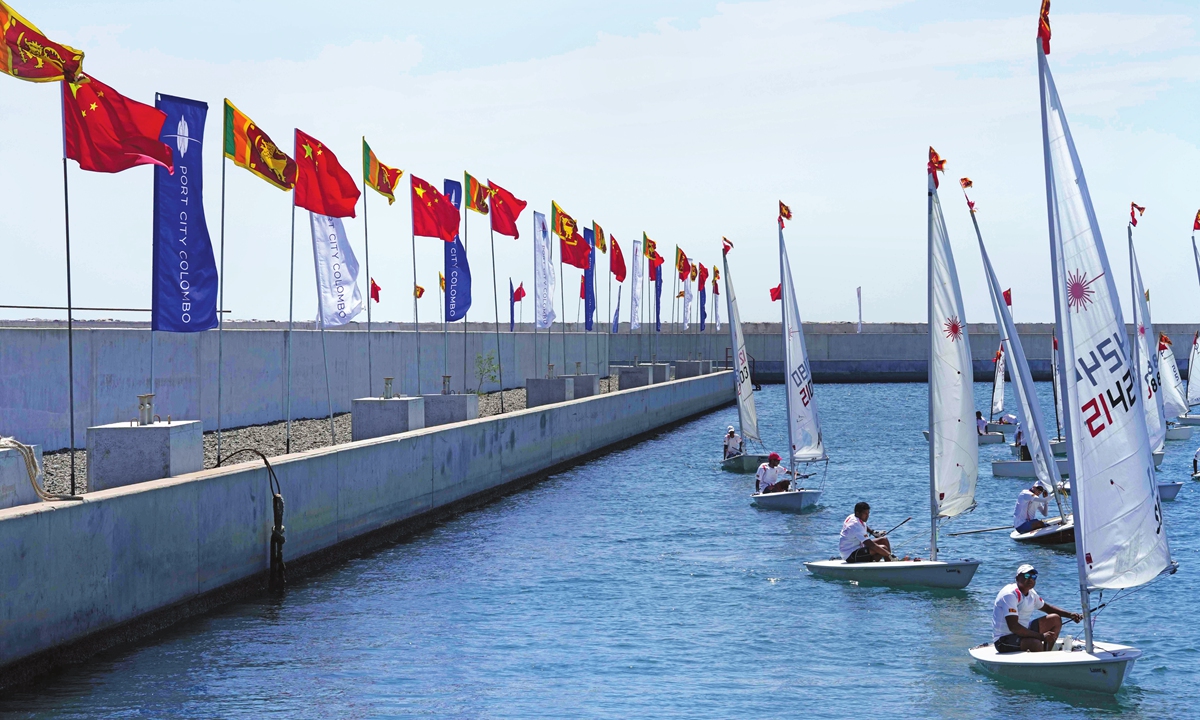
Chinese and Sri Lankan national flags are seen at Colombo's Port City during the visit of Chinese State Councilor and Foreign Minister Wang Yi in Colombo, Sri Lanka, on January 9, 2022. Photo: VCG

Chinese and Sri Lankan national flags are seen at Colombo’s Port City during the visit of Chinese State Councilor and Foreign Minister Wang Yi in Colombo, Sri Lanka, on January 9, 2022. Photo: VCG
After Sri Lanka declared an economic emergency and asked China for help at the beginning of the year, some Western and Indian conspiracists once again went on a bashing spree against China and its Belt and Road Initiative (BRI). 

By maliciously tying Sri Lanka’s recent financial distress to the Chinese investment in the country, they got busy hyping the so-called “Chinese debt trap” in an attempt to mislead the public and attack the China-Sri Lanka cooperation.

Some users created and spread rumors on social media in January that “China’s central bank issued bank notes with a face value of 10,000 rupees in Sri Lanka,” which was later refuted. This misinformation insinuates China’s violation of Sri Lanka’s currency sovereignty, smearing the mutually beneficial economic cooperation between the two sides as an “unequal plunder” by China, observers told the Global Times.

With either rumors about currency sovereignty or the so-called “China debt trap,” some Western countries, led by the US, and India have been attacking China’s overseas construction projects. However, their clichés have rarely been echoed in BRI countries, Chinese and Sri Lankan scholars said.

China is a good friend “with consistent economic policies, good trade practices and a win-win attitude,” Samitha Hettige, advisor of the National Education Commission of Sri Lanka, mentioned in his article published in December on Sri Lanka’s English-language newspaper, Ceylon Today. “Sri Lanka-China relations are quite strong, only based on friendship and nothing to do with [business or politics],” Hettige told the Global Times.

Disinformation campaign

The rumor about currency sovereignty went rife earlier in January, coinciding with Wang’s visit to Sri Lanka. One of the earliest rumormongers was a Twitter user under the name “bandhini fernando” who frequently posts anti-China misinformation, the Global Times found. On January 9, “bandhini fernando” posted two fake pictures of “Sri Lanka’s new 10,000 rupees note” saying it was issued by the People’s Bank of China.

 “Wang Yi officially handed over new currency to Sri Lanka during his meeting with [Sri Lankan] President,” bandhini fernando wrote. The user claimed that the “new bank note” can be used in Sri Lanka and wickedly described the Chinese-invested projects of Colombo Port City and Hambantota Port as “Chinese territory.”

The rumor was refuted the following day by Sri Lankan fact-checking agency Factcrescendo, which quoted a response by the Deputy Governor of the Central Bank of Sri Lanka, CJP Siriwardana, as saying that the bank currently has no plans to issue a 10,000 rupees bank note and the highest currency value in Sri Lanka remains 5,000 rupees. 

The “China debt trap,” an old accusation though, is another defamation campaign by the West and India against China-Sri Lanka’s economic cooperation.The Chinese Ministry of Foreign Affairs responded by saying that the accusations are not true. “China-Sri Lanka cooperation is mutually beneficial and has been warmly welcomed by all sectors in Sri Lanka,” said the ministry spokesperson Wang Wenbin on January 10.

There is no such thing as a “China debt trap,” noted Hettige. “The total Chinese loans only account for a little more than 10 percent of our total loan property portfolio, and China is actually the fourth largest [creditor], behind international capital markets, multilateral development banks and Japan,” he told the Global Times, highlighting that “the media did not show the fact.”

US and India’s role

The US and India play a major role in the slandering campaign against China-Sri Lanka cooperation and China-funded projects in the country, observers found.

“Sri Lanka has not fallen into a debt trap,” President of Sri Lanka, Gotabaya Rajapaksa, once stressed in the presence of then US Secretary of State Mike Pompeo, as Sri Lanka’s news site Ada Derana reported in October 2020. Readers often see mainstream American newspapers and magazines, including The New York Times, the Wall Street Journal, Foreign Policy and The Atlantic, publish articles blathering about the alleged “China debt trap.” Responding to the smears and attacks, Rajapaksa said in an official statement in October 2020 that “constructing a port in Hambantota is an idea of Sri Lanka and not China’s.” He also added that the project has a vast potential for generating income and employment opportunities for his country.

“The US frequently defames China-invested projects in Sri Lanka, partly to hope that Sri Lanka will abandon [the BRI] and opt for the [aid plans] the US offers,” said Qian Feng, Director of the Research Department of the National Strategy Institute at Tsinghua University.  

“Some Indian government officials and reporters always regard South Asia as India’s ‘sphere of influence,’ wary of the so-called ‘outside forces’ developing relations with other countries in the region,” Qian said while highlighting that “with hostility toward China, they see China’s cooperation with countries like Sri Lanka a weakening of India’s power of influence there.”

7 of the best places to stay in Sri Lanka

February 6th, 2022

Make your trip to Sri Lanka even more special with a sleepover in one of these unique hotels, although don’t blame us if you can’t bear to leave…

This sleek bed and breakfast feels like a stylish home from home – guests are invited to help themselves to snacks and (non-alcoholic) drinks from the bar, or explore the countryside on the property’s bicycles.

Accommodation takes the form of a villa or one of three one-bedroom bungalows, named after the three sons of Don Hendrick Wickramarathne, a local judge who built the house in the early 20th century.

After stumbling across the property in 2010, current owners Raf and Harold subsequently transformed it into a boutique hotel, and it’s now one of Tangalle’s most charismatic stays.

Dr Parakrama Waidyanatha

February 6th, 2022

Courtesy Island

Numerous positive claims are often cited for organic farming such as being environmentally friendly, superior food quality free from pesticides and other toxins, efficient energy use and sustainable food production. Much of these are highly contestable, and the most critical issue, why it is expanding only at a snail pace, is hardly discussed.

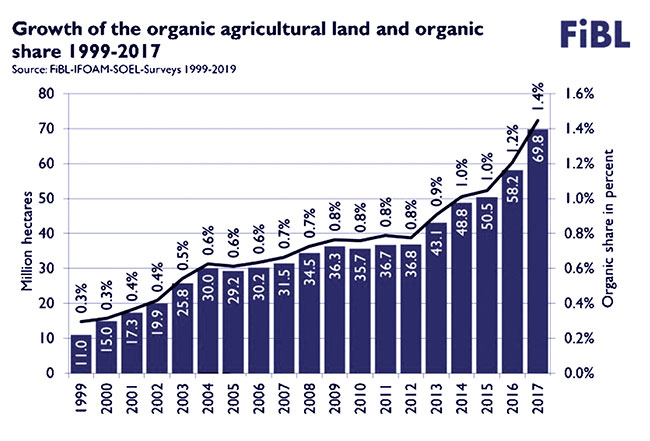
As shown in Fig.1, organic farming, despite it commencing in the 1960s, yet comprises only a very small fraction, 1.5%, of the global farmlands of which 66% is pasture; and it is expanding at only 2% annually. Only 16 countries have over 10% of their agricultural land organic, the highest extent of 46% being in Liechtenstein, a very small country (principality) in Europe, of 160.5 square kilometers with a population of 38,137 people.

Nearly all these 16 countries (with over 10% organic farmland) have pastures and animal production as the principle agricultural pursuit, and the main fertilizer for pasture is farmyard manure. The elite in rich countries love organic beef steaks though costly!

Nitrogenous fertilizer scarcity the biggest constraint to organic farming

Of the four main nutrients components in fertilizers, nitrogen (N), phosphorus (P), potassium

Why is organic farming expanding only at snail’s pace globally?

(K) and magnesium (Mg), the last three have natural sources approved for use in organic farming. Rock phosphate (P), muriate of potash or potassium chloride( K) and Epsom salt or magnesium sulphate(Mg) are natural deposits. Magnesium and calcium can also be supplied via dolomite, another natural mineral deposit.

Whereas muriate of potash and Epsom salt are readily soluble and hence can be taken up by roots; rock phosphate is insoluble and is made available to plants in the soil very slowly via solubilization with acids in the soil and microbes. Rock phosphate, therefore, usually cannot meet the P demand of seasonal crops. The answer has been super-phosphate manufactured by adding sulphuric acid to rock phosphate which makes its use prohibitive in organic farming. On the other hand, copper sulphate manufactured using sulphuric acid and copper metal or copper oxide is widely used as a fungicide in organic agriculture.

However, according to the founding concepts of organic farming based on philosophical views about nature, not biological science, even synthetic mineral fertilizer use is prohibitive. Natural means and methods were assumed to be superior. However, this argument is not consistent with science.

Nitrogenous fertilizer scarcity is the biggest constraint to expansion of organic farming as synthesized ammonium compounds such as ammonium sulphate and urea are prohibitive. Mineral deposits of sodium nitrate or Chile saltpetre from Chile and Peru are used as a nitrogenous fertilizer sources in organic farming in some European and other countries, but not permitted in others because the use of soluble fertilizers is considered to be contrary to organic farming principles. Then how can the use of copper sulphate be condoned? The International Federation for Organic Agriculture Movements (IFOAM) should review some these conditions that should vastly enable expansion of organic farming.

One of the ‘environmentalists’ objection to production of ammonia and urea is the very high energy consumption amounting to 1% of the global energy or 173 KWh and the related greenhouse gas emissions. The reaction of the synthesis of ammonia using atmospheric nitrogen and hydrogen from methane, via the Haber- Bosch process is carried out at very high temperatures of 400-450 degrees C and a high pressure of 210 atmospheres.

Urea manufacture also accounts for a large water consumption of 12.8 cubic metres/ton of which 95% is clean water. On the other hand, global conventional agriculture is heavily dependent on it and the reputed geographer and economist Prof. Vaclav Smil, of the University of Manitoba some years ago calculated that 40% the global population is alive on account of availability of urea for crop production.

There is much research in progress for synthesis of ammonia and urea with far less energy use. For example a Chinese research team led by Shuangyin Wang reports (Nature Communications Vol.12 Article number 4080; 2021) an electrochemical method, still at research stage, of urea synthesis from nitrogen and carbon dioxide at room temperature using some metal catalysts (MBenes). Concurrently, several projects are under way on urea production from the same raw materials using solar and wind energy. If these technologies become feasible for industrial urea manufacture, would IFOAM approve use of such urea in organic agriculture, now that an exception has been made by way of copper sulphate use as a fungicide in organic farms?

One of the complaints of our farmers who have switched to organic farming is the very slow decomposition of organic vegetative material, especially grass and straw in the preparation of compost. This is because of their very high carbon-nitrogen ratio. Microbes require soluble nitrogenous compounds, amino acids etc, for their growth and multiplication, a pre-requisite for decomposition of the organic matter, which provides them the nutrients and energy needed. Much labour is needed for collecting, heaping and churning the organic matter from time to time for accelerating the decomposition; and many organic fertilizer producers surreptitiously mix a little urea to increase the nitrogen content in the organic mass, which helps rapid decomposition, although it is against the organic principles.

Much of the organic material such as compost used in organic farming usually contains only about 2% nitrogen implying that to provide 100kg/ha of nitrogen at least 5 tons/ha of such material has to be applied as against 217 kg of urea ,for example, which contains 46% nitrogen. A high nitrogen demanding crop such as tea or leafy vegetables would require 10 to 20 tons per hectare per year or season to meet the crop nitrogen demand supply of which should be impractical for large scale use.

Crop rotation with leguminous crops is a common way of providing at least a part of the nitrogen. However, such crops should be worked into the soil for optimum benefit which means that the cropping intensity is reduced leading to less crop yield per unit time in such organic farming approaches.

On the whole organic crop yields are lower than conventional ones. For example, Holger Kirchman, Professor of Soil fertility and Plant Nutrition of the Swedish University of Agricultural Sciences (Outlook on Agriculture 2019, Vol. 48(1) 22–27) estimates that on average yields of organically cropped legumes were 20% and non-legumes 40% lower than those of conventionally grown crops.

Overall the yield was 35% lower for organic crops than conventional. Since yields are lower under organic, more land is required to produce the same amount of crop. A 35% yield gap means that 50% more arable land is required to produce the same yield. A demand for 50% more farmland imposes huge land use changes implying wide-ranging environmental consequences that follow when converting to organic farming.

By 2050 the global population is to reach 10 billion, and according to the UN, about two-thirds of the predicted growth in population between 2020 and 2050 will take place in Africa implying the huge demand for land for food production. Organic farming then is not the answer but conventional farming, with modern technologies involving genetic engineering and other technologies for optimizing land productivity.

Pesticides

A serious limitation to the expansion of organic farming is the inadequacy of effective organic pesticides. Consequently sulphur and copper sulphate as mentioned above are widely used in organic farming as fungicides. Both their use especially in organic farming has reports of ill-health among workers.

Several toxic plant extracts are used in organic farming for insect control such as rotenone and pyrethrums.

They cause environmental and health risks. Rotenone is moderately toxic to birds and highly toxic to fish, and kills bees when used in combination with pyrethrum. According to the Occupational Safety and Health Administration of the U.S , it can also cause damage to the human liver and kidney. Research has established a connection between rotenone and Parkinson’s disease. Pyrethrum has also been shown to be toxic to many animals. Apart from being a human carcinogen, it has been shown to be toxic to some fish and even kill lizards.

Unavailability of effective weed killers (herbicides) for organic agriculture is a further serious constraint to its expansion. This was dramatically shown here in the last Maha season, when with the virtual 100% overnight shift to organic farming, and application of nanourea (‘Nanoraja’) and other fertilizer concoctions to paddy crops, the accelerated growth of weeds relative to the rice, competitively suppressing the rice yields.

Health risks with organic fertilizers

Organic fertilizers although an essential source of plant nutrients and soil conditioners, may carry infectious agents and toxic materials such as antibiotics. They are reported to be mostly introduced into the food chain via animal and human excreta. The recent highly controversial shipload of organic matter from China that was identified by the local Quarantine authority to contain a pathogen is a case in point.

Numerous pathogens, bacteria, viruses and parasitic organisms have been reported as the cause of food –borne epidemics. Antibiotics and other medications used for treating animals from organic fertilizer sources can enhance the occurrence of resistant strains of microbes that can harm human health via consumption of organic foods. Sub-lethal concentrations of antibiotics in organic food products can induce antibiotic resistance. In fact the WHO has directives on the reuse of organic matter sources, especially excreta.

Heavy metals such as cadmium, zinc, arsenic and lead can accumulate far more in organic fertilizer applied soils than from chemical fertilizers because huge quantities of it are applied (usually 10 tons/ha) than chemical fertilizer; and although similar concentrations (quantities as parts per million) are present in both sources, the amounts entering the soil and crops are far greater with organic fertilization. This is evident from substantially higher concentrations reported both in organically fertilized soils and organic vegetables and fruits.

In conclusion, that organic farming is natural is no argument for its expansion because growing populations and the consequent demand for food would, under organic farming, mean clearing more forest and other lands for agriculture because of its inherently lower yields. The way forward as pointed out by the FAO and other international organizations and scientists is via generation of new technologies (genetic engineering) to produce more crops per unit of land and water, apart from population control.

Foreign Minister Peiris arrives in Delhi for three-day visit

February 6th, 2022

Courtesy Adaderana

Sri Lankan Foreign Minister G. L. Peiris arrived in Delhi on Sunday for a three-day visit to India to strengthen bilateral ties including in areas of trade and connectivity.

He was received in Delhi by the High Commissioner of Sri Lanka in India, Mr Milinda Moragoda.

Foreign Minister of Sri Lanka Prof. G. L. Peiris arrives in Delhi on an official visit,” tweeted Indian External Affairs Ministry Spokesperson Arindam Bagchi.

He will meet India’s External Affairs Minister S Jaishankar and National Security Advisor Ajit Doval.

According to the Ministry of External Affairs (MEA) of India, Foreign Secretary Harsh Vardhan Shringla will also call on the visiting dignitary on Monday.

In their talks, the two foreign ministers are expected to delve into ways to further expand bilateral cooperation in diverse areas including trade and investment.

The contentious fishermen issue is also likely to figure in the talks, according to Indian media.

Jaishankar met Peiris in September last year in New York and held a comprehensive discussion on the close partnership between the two countries. 

Sri Lanka’s Finance Minister Basil Rajapaksa had travelled to India in December last year. His trip focused on measures concerning the economic crisis faced by the island nation.

Jaishankar had a virtual meeting with Sri Lankan Finance Minister on January 15 and conveyed that India has always stood with Sri Lanka and will continue to extend support. 

The USD 400 million SAARC currency swap facility has been extended to Sri Lanka and the ACS settlement of $ 515.2 million has been deferred by two months. Another USD 500 million LOC for the purchase of fuel from India has also been extended. 

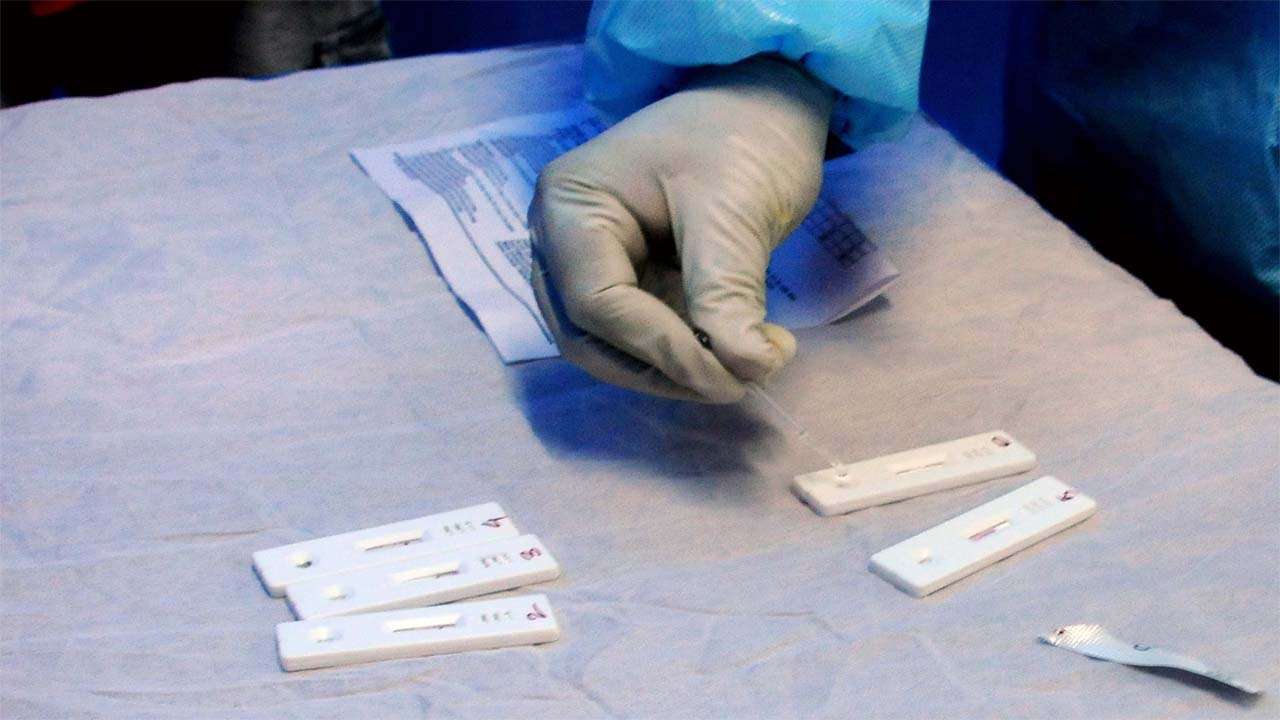
India delivered 100,000 Rapid Antigen Self Test Kits to Sri Lanka on Friday to assist it in the fight against COVID-19. 

–Agencies

Over 1,300 new cases of Covid-19 reported and confirms 23 more Covid deaths in Sri Lanka

February 6th, 2022

Courtesy Adaderana

The Health Ministry says that another 1,331 persons have tested positive for Covid-19 today, as the daily count of new cases continues to rise in the country.

This brings the tally of Covid-19 cases registered in the country thus far to 618,520. 

The number of Covid-19 infected patients currently under medical care across the island is 21,720.

Meanwhile this is the first time that the daily count of fresh cases has surpassed 1,300 since September last year. 

The Director General of Health Services has confirmed another 23 coronavirus related deaths for February 05, pushing the country’s death toll due to the virus pandemic to 15,596.

The deaths reported today includes 11 males and 12 females while one of the victims is below the age of 30 years. 

Four of the patients are between the ages 30-59 years while the remaining 18 are aged 60 years and above.

Bad news: Vellalars are back in Jaffna

February 5th, 2022

H. L. D. Mahindapala

Vellalarism has been a unique force in Sri Lankan history.  It has been the longest running political force in Sri Lankan history. It has run through three colonial empires – Portuguese, Dutch and British – without losing its grip on power. Even when slavery was abolished in 1844 Vellalarism managed to defy the law. Its capacity to adapt itself to changing circumstances without breaking up is evidence of its inner strength. It emerged as a political force from its shadowy past in the Dutch period and continued to dominate, without a break, directing the politics and culture of Jaffna with a fascist fist whenever necessary. It dominated Jaffna and enforced its will on the politics of the peninsula. It is this force that spilled over the Jaffna Lagoon in the post-independent period as a divisive force to disrupt peace and stability of the nation. It has lasted for roughly 700 years whereas Sri Lanka celebrated its 74th year only the day before yesterday. Its longevity, its deep-rooted power to survive and its tentacled grip on the commanding  heights of power have been ignored by historians, sociologists and political scientists. It has been the most under-researched and under-reported force in Sri Lankan politics.

In recent times, most of Vellalar politics have gone disguised as Tamil politics. Tamil nationalism” came in the nick of time to save the Vellalars. Earlier they were dependent on the caste-driven ideology to survive in their Vellalar-dominated electorates. But the Vellalars could not fight their political battles inside and outside Jaffna in the 20th century under their anachronistic and supremacist casteist label. So, they latched on to identity politics. Consequently, the Vellalars took to Tamil nationalism” like duck to water. There is nothing in Tamil nationalism” that which is not in Vellalarism. It is the politics of Vellalars that is wrapped in Tamil nationalism”. In short, Vellalarism = Tamil nationalism”.

Like everything big that came out of Jaffna it is the Vellalars who crafted the Tamil identity and  Tamil nationalism” in the late 19th and early 20th centuries respectively. They were quick to change their garb into national dress because they were in a hurry to grab the nationalist” leadership which was gathering momentum in the dying days of Vellalarism. They never gave up the leadership of Jaffna except for a brief period to Velupillai Prabhakaran. The Vellalar leadership, assembled at Vadukoddai in 1976, declared war and handed over the gun to the Tamil youth to fight for Eelam. The ageing Vellalar leadership went into hibernation during the 33-years of the Vadukoddai War (1976 – 2009). Now that Prabhakaran is no longer there the Vellalars are back in the saddle in Jaffna. That is the latest sad news from Jaffna. This is confirmed in the latest book written on the Vellalars by one of the best authorities on the subject – Ms. Selvy Thiruchandran.

In the 20th century the Vellalars were forced to yield to the forces of modernity. As Vellalar casteism ran out of steam in the 20th century the Vellalars switched over to Tamil nationalism, which was also the only remedy available to unite fragmented Jaffna on casteist lines. It was also the only ideology available to retain their grip on power in the 20th century. Ideologies of Marxism, Stalinism, Trotskyism, liberalism, Castroism etc., were not palatable to conservative Vellalars. They were too radical for them. Besides, anyone of those modern ideologies would have decisively undermined and dislodged the supremacy of the Vellalar casteists. This placed the Vellalars in a dilemma: how were they going to march into modernity. Vellalars needed a new ideology. The only option was Tamil nationalism”.  Until the thirties the Vellalar leaders were fighting tooth and nail to retain casteism. Sir. Ponnambalam Ramanathan’s last trip in the late twenties to London was to convince the Colonial office that casteism – meaning supremacy of the Vellalars – was necessary for law and order in Jaffna. 

Even G. G. Ponnambalam, the new leader of Tamils, after the deaths of turbaned Ramanathans, Arunachalams and Mahadevas, was an arch conservative, refusing to accommodate the Panchamars (low-castes). But the rising tide of modernity was against casteism. After the triumph of mass politics under the Donoughmore Constitution the Vellalars could not rely on the traditional power of casteism to win votes. The initial clashes of the Vellalars in the colonial period were with the other castes in the peninsular. And the domestic politics of the colonial masters in Jaffna was focused on holding the balance between the rival castes competing for power. The Dutch records carry the details of the caste rivalry. After the early inter-caste skirmishes, the Vellalars emerged as the dominant force ever since Modeeley Tambi led the riot against the Dutch, which was followed by the codification of the Tesawalamai (1707) – the legal document that reinforced the powers of the Vellalars to rule over the slaves. But casteism as an ideology was losing its credibility and viability like imperialism. Casteism was cracking up Jaffna, threatening the supremacy of the Vellalars in the 20th century. .

Nevertheless, with their numerical superiority, their supremacy remained untouched by any rival caste. They were the wealthy over lords of the land, kovils, and schools  — all of which were the commanding heights of the peninsula at the time. In 1680, the population of the Jaffna region was 169,299, according to Dutch records. (p. 192 – Tamils in Sri Lanka, A Complete History (C. 300.B. C. –  C. 2000 AD, Murugar Gunasingam). Of these 12,000 were slaves owned by the rich Vellalas, according to the Tombos kept by the Dutch in 1690, (p.192 – ibid) The Vellalas were the majority among the Tamil people and enjoyed high social status,” (p.192 – Ibid). In addition, they dominate society by monopolising the official and authoritative and official positions. They also occupy the principal places in the religious institutions and rituals and through their high status present an appearance of authoritativeness”.(p. 192 – Ibid). Their strength and durability have been in their ability to cling on to strategic points of power in the colonial administration, first in the Jaffna peninsula from colonial times and then outside Jaffna in the post-independent administration, despite cries of discrimination.

The turning point which consolidated the Vellalars as formidable political force was in the Dutch period. The conquests of the Tamil regions by the Dutch in 1658 proved to be a great advantage to the Vellalas,” says Gunasingam. (p.192 – Ibid). Vellalar power was consolidated by occupying the strategic places in the Dutch administration – a power base which they occupied even after the British  left in 1948. Their craze for clerkship” in government service brought them together as an unofficial power bloc of the Jaffna Tamils.   A popular saw of the time summarising the privileged position of the Tamil public servant ensconced in government offices said that the son shone in Colombo while the father the reaped the harvest in Jaffna. Recognising their political clout, S. J. V. Chelvanayakam launched his movement for Ilankai Tamil Arasu Kachchu in December 1948 at the headquarters of the Government Clerical Service Union at Maradana and not in Jaffna.

The disproportionate power they held in the colonial administration gave them the upper-hand in steering and distributing administrative power. In the absence of political power, they used the administrative power to further their interests. From the Dutch to British and British to the independent era the Vellalars never lost their grip on administrative power. The collective power of kovils, schools, land-ownership, casteist supremacy, wealth, and most of all, administrative power made them the supremacists of Jaffna for  nearly 700 years. They manipulated among themselves to keep the lion share of government jobs in their hands. The other castes  had to share the left-overs. They held a disproportionate share of power in the public service of the Dutch and British regimes. The Soulbury Commission dismissed G. G. Ponnambalam’s complaint of discrimination in the public service because Jaffna Tamils (11% population) held 32 % of the government jobs. And Prof. A. J. Wilson confirms this: On the whole, the Tamil vellalas have dominated the government service and professions….” (p140 –  S. J. V. Chelvanayakam and the Crisis of Sri Lankan Tamil Nationalism, 1947 – 1977, A Political Biography.)

In other words, the Vellalars had a considerable grip on administrative power in the colonial administration. As subalterns of the colonial masters the Vellalars captured the key posts of mudliyars, vidanes, canecapulles, aratchies, majoorals etc. At these administrative levels they had a certain degree of power which they could use to their advantage. As stated by Zwardecroon, the Commander of Jaffna, his aim in appointing a Madapally instead of a Vellalar to a government job was to break the power of the Vellalars  — a task which he failed to achieve. The census statistics of the time reveal the power of the Vellalars. According to the 1760 census,” wrote historian Murugar Gunasingham, 516 held Mudliar posts in the four provinces of Jaffna Peninsula. Among these there were 317 Vellalars, 127 Madapallys, 17 Chetties, 14 Parathesis, 10 Malayalis, six Karaiyars, three Siviars and two Tankkaras.” (p. 193 – Tamils in Sri Lanka, A Complete History (C. 300.B. C. – . C. 2000 AD). Read together, the Dutch records, Prof. Wilson and historian Gunasingham agree that the Vellalars clung on to administrative power steadfastly from at least 1707 to 1993 – the year in which Prof. Wilson published his father-in-law’s biography. No other political force has reigned for so long, virtually dominating the politics of the Jaffna and the administration of the nation in the post-independent era as the Vellalars. As decision-makers at the centre of power, they managed to corner the best of privileges and the welfare services which made them and Jaffna the most privileged society of the colonial and the post-colonial periods. The PQLI Index which surveyed the quality of life index put Jaffna, in some respects, higher than even Colombo. But blaming the Sinhala-Buddhist was a chronic disease with them. It was another way avoiding responsibility for the consequences of the crimes they committed against their own people during the feudal and colonial periods. It was the Vellalars who had the power to determine the dignity, equality and justice of the Tamils of Jaffna. Not even the magnificient piece of legislation passed by Bandaranaike in the 1957, Prevention of Social Disabilities Act, was able to break through the entrenched power of the Vllalars.

Disentangling the skeins of thread that twines the Tamils and the Vellalars together is another issue which needs a special study. Separating the two strands and identifying the dominant Vellalar force is a prime necessity to grasp the North-South dynamics that meshed and bedevilled national peace and stability. By and large, the conventional wisdom  has merrily gone along with the calculated attacks on Sinhala-Buddhists – a popular target being Anagarika Dharmapala – to demonise Sinhala-Buddhism. This gave rise to the mono-causal theory which blamed only the Sinhala-Buddhists for the national crisis. The inter-action of the inter-ethnic forces that needled each other was seldom factored in. For instance, Vellalarism, the force which overtook other rival forces, is never inter-woven to obtain a fairly comprehensive overview of the multifarious factors that worsened inter-ethnic relations. Keeping the Northern factors out of the picture, or projecting the North as the victims of the South, have been the common tactic that distorted the perspectives of the crisis.

A mono-causal theory can never explain the historical and political forces that combined to explode in the post-1956 era. Hiding the terror and horrors of Vellarism has been a consistent and successful tactic of the Vellala elite. It was a part of the Vellalar campaign to project the elitist priviligentsia of the Sri Lankan society in Jaffna as the victims of majoritarian politics. Simultaneously redressing the imbalances of history, caused by nearly 500 years of imperialism, was touted as communalism. The return to the roots of history was an inevitable and a common feature of all ex-colonies. Undoubtedly, the violence that broke out at the lower-level of ethnic leadership mainly cannot be condoned. The post-1956 violence gained  notoriety because it the targeted the Vellalar elite. Incidentally, no one heard a similar intensity of outrage when the poor and the helpless Panchmars were tortured and persecuted for 700 years by the Vellalars.

The Tamils naturally are shy about their criminal past. But the Tamils and the pro-Tamil lobbies in the NGOs and academia are never shy to attack the Sinhala-Buddhist with every bit of dirt they can find on Sinhala-Buddhists. The Vellalar crimes documented  by Thiruchandran’s is a well-researched, ground-breaking study of the hidden history of Jaffna. Thiruchandan’s book exposes the ideology, practices, rituals and politics of the Vellalars as an evil force that left no space for non-Vellalars to breathe freely. Her in-depth analysis of the Vellalar society is the  best book I’ve read on the subject since I read K. Daniel’s mini-classic, KANAL, a novel on the suffering  the Panchamars under Vellalar oppression. As she says, the common attitude has been for the Jaffnaites to cover up their crimes. Her book reveals a key element of the history of Jaffna that was hidden even by the Jaffna University. The history of Jaffna can no longer be written as a bland account of mainly colonial rulers changing hands, with a few kings preceding them. The central role of the caste relations and the cruel domination and exploitation of the fascist Vellalars is displayed with historical accuracy. And the bloody, gory and inhuman narrative is told with scientific objectivity. Her book  reveals the hidden forces that bloodied the history of Jaffna. She delineates in detail the internal Vellalar characteristics, institutions, laws and customs that warped Jaffna society. It is possible to decipher the internal casteist pressures that pushed the Vellalars to act the way they did.

She argues convincingly that it was the dominant upper-class, land owning Vellalars, of the North of Sri Lanka who constructed the caste system with graded and stratified rules similar to the way the literate hegemonic  dominant group, the Brahmins, laid down the rules of caste in India……it is the Vellalars who are the most beneficiaries of the system.” (p.16 – Ibid). She challenges the religious foundations of the caste system (a la Prof.  Bryan Pfaffenberger). Citing Indian opinion, she states that the caste system is a development from the political and socio-economic conditions.” (p. 17 – Ibid). I think she is right as far as the origins of the caste system is concerned. But later Arumuka Navalar, the caste fanatic, tied the Vellalar hierarchy to Saivism, anointing the hierarchy as a kind of divine  order. His universe consisted of (1) the Tamil language, (2) Saivism and (3) caste. In the 20th century this was also the tripod on which Vellalarism rested. He placed the Vellalars at the peak of the caste hierarchy. His reformist Saivism, however, lacked the Brahmins at the top. I think he was trying to fill the vacancy left by the Brahmins by placing the Vellalars at the top. Of course, he was a Vellalar himself.

Understanding the North in all its dimensions is essential to come to grips with the complexities that obstructs reconciliation.   At last, it is heartening to know that new light is being  shone on the dark side of Sri Lankan history. Selvy Thiruchandran’s book on the caste issue has come as a breath of fresh air.  Her book, CASTE AND ITS MULTIPLE MANIFESTATIONS, breaks the silence on a taboo subject. Her courage in exposing the evils of Jaffna society should be commended. The overwhelming attitude earlier has been to put a lid on the inhuman  history of Jaffna because the perceptive analyses of the horrors and terrors of Vellalarism presents the gruesome realities of Jaffna. The idyllic Jaffna painted by the privileged Vellalar has been torn to bits. The suffering of the Panchamars is vividly depicted. The details are well researched. What is missing, however, is the larger picture. She asks many questions and answers them cogently and thoroughly. But she missed one question: What was the impact of Vellarism on the post-independent political landscape? Out of the 700 years of Vellalarism the elected democratic state ruled only for 74 years. Even out of that Prabhakaran ruled his quasi state for 33 years –( 1976 – 2009). Nevertheless, isn’t the 74 years, with all its infirmities, the best years that gave dignity, equality and justice to all the citizens?

Compare that period to the taboos that ruled Jaffna. Thiruchandran gives a sample of the taboos:

  • Taboo on wearing a shirt or covering the upper part of their bodies, the shawl having to be lowered in the presence of Vellalar.
  • Taboos on tying the tali, and having a wedding  procession or musical accompaniment during weddings
  • Taboo on naming their children with high caste names and using common ponds and common wells
  • Taboo on cremating dead bodies. (They have to be buried , but in their special cemeteries not in the Vellalar cemeteries.)
  • Taboo on equal  seating and equal dining in schools and churches,
  • Taboo on temple entry and on worshipping Gods of the high caste
  • Taboo on entry into cafes, restaurants and equal seating in public transport,
  • Taboo on wearing slippers or any kind of foot-wear and holding umbrellas. (pp. 57 -58 – Ibid)

So in what period of the 700 years of Vellalarism did the Tamils get any dignity, equality and justice? She adds: These taboos are symptomatic of injunctions imposed on slaves. They cover the whole gamut of their existence, their dress, their movements, religious and socio-economic behaviour, to finally their death rites of disposing the dead bodies.” In a passage above she says: What is most distressing is the birth ascribed unchangeable inequalities of the unjust system.” (p.57 – Ibid).

It is inequalities of the unjust system” of Jaffna that makes a mockery of the Vellalar leaders claim for dignity, equality and justice.” The Panchamars, for instance, had to leave Jaffna and come down South to get a fair ride in a bus! On balance, won’t a fair and objective assessment of the two periods lead to the conclusion that Tamil who could get a ride in a bus without being forced to sit on the floor boards had a better deal among the Sinhalese than their arrogant and nasty fellow-Tamils? Comparing the 74 years of the democratically elected state of the South with the 700 years of Vellalarism would expose the hypocrisy of the Tamil leaders who run around demanding dignity, equality and justice. Naturally, Thiruchandran is rather nervous and suspicious about the resurgence of Vellalarism in Jaffna. Considering its past its return does not bode well for the Panchamars. Besides, it is time for the politics of Jaffna to be released from the clutches of predatory Vellalars.  

This is not even a sketchy outline of the excellent study done by Thiruchandran. It is a book that should be on the shelves of those who are concerned about the future of Sri Lanka. Finally, it must be mentioned that the subject of Jaffna casteism has been dealt with the most appropriate scholar. She is the daughter the great Handy Perinbanayagam – the outstanding liberal and enlightened Tamil leader who pioneered the path to peaceful co-existence, the path to the future. At a time when Jaffna was wallowing in the two evils of communalism and casteism he led the very first movement to abolish both evils. If G. G. Ponnambalam did not snuff it out with rabid communalism and casteism Sri Lanka would not be in this plight today. The hypocrites posing as human rights champions can’t hold a candle to the visionary genius of  her father. He held the nation in his palm. He made Jaffna the centre of national politics. Indian and Sinhala leaders flocked to  him following his courageous leadership. The narrow and corrosive politics that came after her father ruined the chances of the nation rising as a model of communal harmony. What Jaffna – and the nation  — needs now is a Handy Perinbanayagam and not a pompous humbug like Rajavarothiam Samapanthan who did not lift a finger to save the Panchamars when their heads were smashed by his fellow-Vellalars with bottles filled with sand at Maviddipuram Temple. The champions who are parading as champions of human rights today should not forget that the right to pray in a temple is a right to live with dignity, equality and justice.   

e-mail: mahindapala8@gmail.com

බෞද්ධ ජනරජ ප්‍රවාදය – 56 වැනි කොටස – ‍උරුමයට නීතිය

February 5th, 2022

ආචාර්ය වරුණ චන්ද්‍රකීර්ති

ජනරජයේ පරමාධිපත්‍යය බලය මේ ප්‍රවාදය තුළ අර්ථදැක්වෙන්නේ ජනතාවගේ සාමූහික අයිතිවාසිකම් ද ඇතුළත් වන පරිදි ය. ජනරජයේ අනන්‍යතාව ප්‍රකාශ කෙරෙන සාමූහික අයිතිවාසිකම් සහ පොදු සාමූහික අයිතිවාසිකම් ලෙසින් ඒවා බෙදා දැක්වුණි. බුද්ධ ශාසනය, සිංහල භාෂාව සහ දේශීය දැනුම අයත්වන්නේ ජනරජයේ අනන්‍යතාව ප්‍රකාශ කෙරෙන සාමූහික අයිතිවාසිකම් තුළට ය. එයට අමතරව, වර්ධනය වන දේශීය දැනුම් පද්ධතියක් ලෙසින් ජනරජයේ නීතිය ද එම ගොන්නට ඇතුළත් කළ හැකි බැව් මෙයින් කියැවිණි.

ජනරජයේ අනන්‍යතාව ප්‍රකාශ කෙරෙන සාමූහික අයිතිවාසිකම් ආරක්‍ෂාකිරීමෙන් ද, ඒ අරභයා නීති සම්පාදනයෙන් සහ ආරවුල් පසිඳලීමෙන් ද ස්වදේශීය නීතියේ වගකීම් ඉටුකළ හැකි අතර ඒ තුළින් එහි වර්ධනය ද සළසාගත හැක්කේ ය. දීර්ඝ කාලයක් පැවැතුණු යටත්විජිත පාලනය නිසා බිඳවැටුණු දේශීය නීතියට කාලීන වර්ධනයක් අත්පත් කරගැනීමට නො හැකි විය. එවැනි වර්ධනයක් සඳහා අවැසි මූලධර්ම භාවිතාවෙන් බාහිරව හඳුන්වාදිය හැකි වුව ද ඒවා පූර්ණත්වයට පත්වනු ඇත්තේ භාවිතාව තුළිනි. ජනරජයේ අනන්‍යතාව ප්‍රකාශ කෙරෙන සාමූහික අයිතිවාසිකම් ආරක්‍ෂා කරදීම උදෙසා මැදිහත්වීම ඒ සඳහා වන එක් ප්‍රවේශයකි.

දැනට පුරාවිද්‍යා අණපනත් සහ නීතිවලින් ආවරණය වෙන ක්‍ෂේත්‍රයේ කාර්යයන් විශාල ප්‍රමාණයක් බුද්ධ ශාසනයට අදාළ ඒවා වෙයි. නටබුන් බවට පත් වී ඇති ඒ ශාසනික උරුමය පිළිබඳ ඇතිවන ආරවුල් විසඳිය යුත්තේ ජනරජය විසින් බුද්ධ ශාසනයට පිරිනමන ප්‍රමුඛතාව සැළකිල්ලට ගැනීමෙනි.

මෙම ඓතිහාසික ස්ථානවල උරුමය සතුවන්නේ ශාසනයේ භාරකාරත්වය උසුළන භික්‍ෂු, භික්‍ෂුණි, උපාසක, උපාසිකා සිව්වනක් පිරිස වෙත ය. ශාසනික භාරකාරත්වයක් නැති පුරාවිද්‍යා දෙපාර්තමේන්තුව වැනි රාජ්‍ය ආයතනයකට එම ස්ථාන පිළිබඳ උරුමයක් නොමැත. පුරාවිද්‍යා දෙපාර්තමේන්තුව වැනි ආයතන වෙත පැවැරෙන්නේ අදාළ ස්ථාන කැණීම, සංරක්‍ෂණයකිරීම වැනි කාර්යයන්ට අදාළ තාක්‍ෂණික සහාය ලබාදීමේ වගකීම පමණකි.

ඓතිහාසික වටිනාකමක් තිබෙන ශාසනික උරුමය ආරක්‍ෂාකිරීමේ ශක්තිය (ඒ සඳහා අවශ්‍ය අධ්‍යාත්මික බැඳීම, පිරිස් බලය සහ මූල්‍යමය හැකියාව) ඇත්තේ ද සිව්වනක් පිරිස වෙත ය. පුරාවිද්‍යා දෙපාර්තමේන්තුව වැනි ආයතනවලට එවැනි ශක්තියක් නොමැත. එහෙයින් මෙම කාර්යයට අදාළ නීති සම්පාදනය විය යුත්තේ ද ඒවා ආශ්‍රිතව ඇතිවිය හැකි ආරවුල් නිරාකරණය කළ යුත්තේ ද ශාසනික උරුමය සුරක්‍ෂිත වන පරිදි ය. එම නීතිවලට අවනතව පුරාවිද්‍යා ක්‍ෂේත්‍රයේ විශේෂඥයන්ගේ උපදෙස් සහ මගපෙන්වීම් ද ලබාගනිමින් අදාළ ස්ථාන ප්‍රතිසංස්කරණය සහ මැනැවින් පවත්වාගෙන යෑම ශාසනික භාරකරුවන්ගේ වගකීමකි.

මේ හා සමාන කාර්යයක් වන සංරක්‍ෂණ නීතිවලට ද අදාළ වෙයි. රාජ්‍යයේ පැවැත්ම වෙනුවෙන් වන සම්පත ආරක්‍ෂාකිරීමේ වගකීම ජනරජයේ සෑම රටවැසියකු වෙත ම පැවැරෙයි. විධිමත් සහ අවිධිමත් ආකාරවලින් එයට අදාළ දැනුම ජනගතකිරීම ජනරජයේ සියලු මට්ටමේ ආයතනවලින් සිදුවිය යුත්තේ ය. එ සේ ම, ජනතාවගෙන් ඈත්කර එම සම්පත ආරක්‍ෂා කරගත නො හැකි බව ද අදාළ නීති සම්පාදකයින් විසින් වටහාගත යුත්තේ ය. රාජ්‍යයේ පැවැත්මට සහ අභිවෘද්ධියට උපකාරී වන සම්පතක් ආරක්‍ෂා කළ යුත්තේ ජනතාව විසින් ම ය.

මෙම වගකීම ජනතාව විසින් ඉටුකරනු ඇත්තේ ඒ පිළිබඳ අධ්‍යාත්මික සහ ජීවන බැඳීමක් වන සම්පත කෙරෙහි ඇත්තේ නම් පමණකි. මෙම කාර්යය සඳහා අපේක්‍ෂිත අධ්‍යාත්මික බැඳීම ශාසනික මැදිහත්වීම් තුළින් ද ඇති කළ හැක්කේ ය. මෙ රට පවත්නා ආරණ්‍ය සේනාසන සම්ප්‍රදාය මැදිහත් කරගැනීම මේ සඳහා යොදාගත හැකි ඉතා යෝග්‍ය ක්‍රමවේදයකි. එවැනි සේනාසනයක පැවැත්ම සහ අභිවෘද්ධිය තහවුරුවන්නේ අදාළ වනාන්තර භූමි ආරක්‍ෂා වන තරමට ය.

මෙවැනි සේනාසනවල පැවැත්ම ජනරජයේ අනන්‍යතාව ප්‍රකාශ කෙරෙන සාමූහික හිමිකම් තුළට ද අයත්වෙයි. එහෙයින් ජනරජයේ වන සංරක්‍ෂණ තීති සම්පාදනය කිරීමේ දී මෙම උරුමයට ප්‍රමුඛතාව දිය යුතු බව ද පැහැදිළි ය. එ මෙන් ම, මෙම කාර්යය ආශ්‍රිතව උද්ගත විය හැකි ආරවුල් නිරාකරණයේ දී ද අදාළ ශාසනික ප්‍රමුඛතාව සැළැකිය යුතු වෙයි.

මෙයින් කියැවෙන්නේ සියලු වනාන්තර ආරණ්‍ය සේනාසන බවට පත්කළ යුතු බවක් නොවේ. මෙම අදහස අදාළවනුයේ දැනට පවත්නා සහ ඉදිරියේ දී පිහිටුවනු ලබන ආරණ්‍ය සේනාසන සම්බන්ධයෙන් පමණකි. දැනට පවත්නා සේනාසනයක් ආරක්‍ෂාකිරීමේ දී සහ ඉදිරියේ පිහිටුවනු ලබන සේනාසනයක් සඳහා අනුමැතිය ලබාදීමේ දී මෙම ප්‍රමුඛතාව නො සළකා ක්‍රියා කළ නොහැකි බව නීති සම්පාදකයින් සහ නීතිය පසිඳලන්නන් විසින් වටහාගත යුත්තේ ය.

මේ අනුව ජනතා පරාමාධිපත්‍යයට අයත් ශාසනික උරුමය පරිපාලන නීතිවලට යටපත්කිරීම වැළැකෙයි. අදාළ නීති පැවැතිය යුත්තේ සහ ක්‍රියාත්මක කළ යුත්තේ ජනරජයේ අනන්‍යතාව ප්‍රකාශ කෙරෙන සාමූහික අයිතිවාසිකම් (උරුමය) ආරක්‍ෂා කරගැනීමේ ප්‍රමුඛ වගකීම සැළැකිල්ලට ගැනීමෙනි. සිංහල භාෂාව සහ දේශීය දැනුම භාවිතය සහ පෝෂණයට අදාළ ජනරජයේ වගකීම් ද මෙම ආකාරයෙන් ම තහවුරු කළ හැක්කේ ය.

ආචාර්ය වරුණ චන්ද්‍රකීර්ති

පාසල් සඳහා ලබාදුන් නිවාඩුව පිරිවෙන් සඳහා ලබා නොදීම පිළිබඳව.

February 5th, 2022

ලංකා පිරිවෙන් ගුරුසේවා සංගමය

දිනය:- 2022.02.05

අධ්‍යාපන ලේකම්
මහාචාර්ය කේ. කපිල. සී.කේ. පෙරේරා
අධ්‍යාපන අමාත්‍යංශය
ඉසුරුපාය,
බත්තරමුල්ල.

අධ්‍යාපන ලේකම්තුමනි,

පාසල් සඳහා ලබාදුන් නිවාඩුව පිරිවෙන් සඳහා ලබා නොදීම පිළිබඳව.

ඔබගේ ED/09/12/06/05/01-2022 දරණ චක්‍ර ලේඛනය මගින් සියලූ පාසල් හා පිරිවෙන් සඳහා නිවාඩුව 2022.02.07 දින සිට 2022.03.06 දක්වා මාසයක කාලයක් ලබාදී ඇත. උසස් පෙළ විභාගය පදනම් කරගෙන උසස් පෙළ සහිත පාසල් සඳහා පමණක් නොව ප්‍රාථමික අංශ හා ප්‍රාථමික පාසල්ද නිවාඩු ලබාදෙමින් පාසල්, පිරිවෙන්, රජයේ ආධාර ලබන පාසල් හා පෞද්ගලික පාසල් යන සමස්ත පාසල් සහ පිරිවෙන් පද්ධතියම නිවාඩු ගන්වා ඇත,

02.
ඔබගේ ඉහත චක්‍ර ලේඛනය එසේ නිකුත්කර තිබියදී එදිනම ඔබ ආණ්ඩුවේ අමාත්‍යාංශ බෙදීම අනුව, අධ්‍යාපන අමාත්‍යාංශයේ රාජ්‍ය අමාත්‍යාංශය වන දහම් පාසල්, පිරිවෙන්, භික්‍ෂු අධ්‍යාපන රාජ්‍ය අමාත්‍යාංශයේ ලේකම්වරයාගේ නම හා අධ්‍යාපන අධ්‍යක්‍ෂ (පිරිවෙන්) හිමිගේ අත්සනින් ED/ST/BUD/8/1/4/2/1 දරණ චක්‍ර ලේඛනය නිකුත්කර පිරිවෙන් සඳහා ඔබතුමා ලබාදුන් නිවාඩුව අහෝසිකර ඇත,

03.
ඉහත චක්‍ර ලේඛනය ඔබ නිකුත් කිරීමේදී ඔබගේ නිලධාරී මණ්ඩලයේ, උපදේශකවරුන්ගේ, අධ්‍යාපන විශේෂඥයින්ගේ අදහස් හා කාලීන තත්වයන් සැලකිල්ලට ගන්නට ඇතැයි සිතමු. අනුව #කොවිඩ් තත්වයෙන් අධ්‍යාපනය බිඳවැටීම නිසා වැටුණු මානසිකත්වයෙන් යුතුව උසස් පෙළ විභාගයට මුහුණ දෙන දරුවන් පිළිබඳවත්, එක් දරුවෙකු හෝ දෙදෙනෙකු උසස් පෙළ විභාගයට සූදානම් කරද්දී අනෙක් දරුවන් පාසලට සූදානම් කිරීමේදී දෙමාපියන් මුහුණදෙන දුෂ්කරතාත්, දෙමාපියන්ද වන ගුරුවරුන් ඉහත කාර්යයන් කරද්දී රාජකාරියට වාර්තාකිරීමත් අනිවාර්ය වූ විට සිදුවන අතිමහත් දුෂ්කරතාවත්, වේගයෙන් පැතිරෙන #කොවිඩ් තත්වයත්, යන කරුණු හා තවත් කරුණු ඔබ පාදක කරගන්නට ඇතැයි සිතමු. මෙකී කාරණා මේ ලෙසින්ම පරිවේණාචාර්ය වරුන්ගෙන් සාතිශය බහුතරයක් වන ගිහි පරිවේණාචාර්යවරුන්ට පවතින හෙයින් එයද ඔබ සැළකිල්ලට ගන්නට ඇතැයි අපි සිතන්නෙමු,

04.
එසේ සලකා ඔබ නිකුත් කළ චක්‍ර ලේඛනය ඉක්මවා රාජ්‍ය අමාත්‍යංශය නිකුත්කර ඇති චක්‍ර ලේඛනයෙන් ඔවුන් මේ කුමක් සැළකිල්ලට ගන්නට ඇද්දැයි නොදනිමු. කෙසේ වෙතත් අධ්‍යාපන අමාත්‍යාංශයත්, අධ්‍යාපන රාජ්‍ය අමාත්‍යාංශයත් අතර ඇති පරිපාලන අර්බුදය මගින් සුවිශාල අසාධාරණයට පරිවේණාචාර්යවරයා ප්‍රමුඛ පිරිවෙන් පද්ධතිය ලක්කර ඇති බව මේ තුළින් ඔබතුමාට පසක් වනු ඇතැයි සිතමු.

ඉහත කරුණු එසේ හෙයින් පාසල් නිවාඩුව පරිවේණාචාර්යවරුන්ට ලබා නොදිමට එරෙහිව එය දිනාගනු පිණිස පෙබ 07 දින පිරිවෙන් ගුරුවරුන්ගේ විරෝධතාවක් පවත්වන බවත් මෙම ගැටලූ සාධාරණව විසඳාගැනීම පිණිස එදිනට සාකච්ඡාවක් ලබාදෙන ලෙසත් ඉල්ලා සිටිමු.

ස්තුතියි.

මෙයට,
මීගහජඳුරේ සීලානන්ද හිමි
ලේකම්
ලංකා පිරිවෙන් ගුරුසේවා සංගමය.

සම්බන්ධීකරණය071 8082647
Coordinating – +94 71 8082647


පිටපත්:-
01.
අධ්‍යාපන අධ්‍යක්‍ෂ (පිරිවෙන්) පූජ්‍ය වටිනාපහ සෝමානන්ද හිමිදැ.ගැ.. හා ..
02.
අධ්‍යාපන රාජ්‍ය අමාත්‍ය විජිත බේරුගොඩ මහතාදැ.ගැ.. හා ..
03.
අධ්‍යාපන රාජ්‍ය ලේකම් එස්.එච්. හරිස්චන්‍ද්‍ර මහතාදැ.ගැ.. හා ..
04.
සියලූ ජනමාධ්‍ය

ජංගි හොරා මනෝවිද්‍යාත්මක කෝණයකින්

February 5th, 2022

වෛද්‍ය රුවන් එම් ජයතුංග

සෝමරත්න දිසානායක සිනමා නිර්මාණයක් වන ජංගි හොරා චිත්‍රපටය  මානසික ව්‍යාකූලත්වයෙන් සහ අර්චන කාමයෙන් ( Fetishism  ) පෙලෙන  පුද්ගලයෙකු පිලිබඳ කතාවකි. Fetishism” යන පදය ආරම්භ වන්නේ පෘතුගීසි වචනය feitico යන්නෙන් වන අතර එහි අර්ථය “උමතු ආකර්ෂණය” යන්නයි.  මෙම පුද්ගලයා ලිංගික තෘප්තිය ලබන්නේ කාන්තා යට ඇඳුම් සොරකම් කිරීමෙනි. අර්චන කාමය ලිංගික අපගමනීය චර්‍යාවක් ලෙස දැක්වෙන අතර බෞද්ධ ජාතක කතාවලද , සිග්මන් ෆ්‍රොයිඩ් සහ ජර්මානු මනෝ  වෛද්‍ය රිචඩ් වොන් ක්‍රාෆ්ට් එබිං යන විද්වතුන් ගේ සායනික ලේඛන වලද මෙම තත්වයෙන් පෙළුණු පුද්ගලයන් පිලිබඳ සදහන් වෙයි.  

අර්චන කාමය ලිංගික විචල්‍යයක් ලෙස හඳුනාගෙන තිබේ. මෙවැනි පුද්ගලයන් තුල අඩු ආත්ම අභිමානය, සමාජ කාංසාව, සමාජ කුසලතා දුර්වලතා, මානසික අවපීඩන රෝග ලක්‍ෂණ තිබිය හැකිය. ඔවුන්ට  අර්චනකාමී වස්තුවක්  නොමැතිව ලිංගිකව උද්දීපනය වීමට හෝ සුරාන්තයට පත් වීමට නොහැක.  බොහෝ විට මොවුන් අර්චනකාමී වස්තුව සොරකම් කිරීමෙන්, වස්තුව නැරඹීමෙන් හෝ එම වස්තුව සමඟ ස්වයං වින්දනයේ යෙදීමෙන්  ලිංගික සතුට ලබා ගනිති.  

පහත දැක්වෙන්නේ අර්චන කාමය පිලිබඳව මා විසින් ලියන ලද ලිපියකි. එහි මෙම අපගමනීය තත්වය , ඒ සඳහා හේතු කාරකයන් සහ පිලිගත් ප්‍රතිකාර කම පිලිබඳව සඳහන් වෙයි.

 වෛද්‍ය රුවන් එම් ජයතුංග

Underwear Fetishism

Ruwan M Jayatunge M.D. 

Underwear Fetishism is a paraphilic disorder that can cause distress for the person who is affected by it and frequently leads to societal condemnation and rejection. Underwear Fetishism is contradictive of normal sexual behavior and some view Underwear Fetishism as OCD-related sexual ideation. 

Fetishism has been recognized as a sexual variation for over 100 years and has very often been considered a disorder in all of its presenting forms (Martin, 2016). The German Psychiatrist Richard Von Krafft-Ebing identified paraphilias in 1886. The Buddhist Jathaka stories describe Fetishism in a young man named Kema” (Jayatunge, 2014).

Kafka (2003) defined paraphilias as disorders characterized by an alteration of sexual preference, volitional impairment, and an increase in sexual drive-oriented behaviors. Paraphilias are persistent, unconventional, and problematic sexual interests that exist on a continuum. Briken & Basdeskis-Jozsa (2010) highlight those individuals with paraphilias may experience negative factors such as low self-esteem, social anxiety, social skills impairment, depressive symptoms, and socially deviant behavior.

Fetishistic behavior can involve stealing or buying undergarments and having an obsessive fixation with erotic fantasies. They cannot become sexually aroused or reach orgasm without the object and feel unable to control their need for the fetish. They are experiencing sexual arousal from undergarments (arousal from the smell of used women’s pantiesor voyeuristic excitement viewing it).  Often, they prefer solitary sexual activities associated with their fetishistic and sexualized fantasies.

Fetishists become aroused by stealing the object, viewing the object, or masturbating with the object. During masturbation, the fetish object may be held, tasted, smelled, or used to stimulate the genitals. They often feel guilty about their disorder and these fantasies, sexual urges and behaviors cause clinically significant distress or impairment in social, occupational, or other important areas of functioning in the person. Men appear to report greater interest in paraphilic activities than do women.

Patients with fetishism often show a strong interest in non-genital body parts. Female undergarments and shoes are among the most frequently preferred fetish objects. The person becomes sexually aroused by wearing or touching the object. Most fetishists do not intend to cause harm to other people.

Paraphilic disorder such as underwear Fetishism is associated with acts that are deviations from socially accepted sexual behavior. Paraphilias are persistent and recurrent sexual interests, urges fantasies, or behaviors of marked intensity involving objects, activities, or even situations that are atypical in nature.

The International Classification of Mental Diseases (ICD-10th, World Health Organization 1992), paraphilias were classified in the Sexual and Gender Identity Disorders. In the Diagnostic and Statistical Manual of Mental Disorders (DSM–5) the term paraphilia is defined as an intense and persistent sexual interest other than sexual interest in genital stimulation or preparatory fondling with phenotypically normal, physiologically mature, consenting human partners.”

In the DSM-5 these criteria should be addressed in the presence of three main aspects: first, the sexual arousal by deviant sexual stimuli, second, the negative consequences for the individual or the society and, finally, the fact that the person acts on his or her urges or that the urges or fantasies cause significant distress, interpersonal difficulty or impairment in functioning.

Fetishism is described in both the medical and legal literature. The term “fetishism” originates from the Portuguese word feitico, which means “obsessive fascination.” People with the fetishistic disorder may not be able to function sexually without their fetish. The fetish may replace the typical sexual activity with a partner or may be integrated into sexual activity with a willing partner. The fetishistic disorder tends to fluctuate in intensity and frequency of urges or behavior over the course of an individual’s life. The existing literature indicates that people with fetishistic disorder often report a lack of self-esteem, a difficult childhood, and intrapsychic conflicts.

The etiology of fetishism is not known. The experts believe a combination of neurobiological, interpersonal, and cognitive processes all play a role. The level of an individual’s sex drive is not consistently related to paraphiliac behavior. Paraphilias occur primarily in males with an average onset between ages 8 and 12. They are a lifelong condition. 

Some researchers began reporting a series of findings linking paraphilias with brain structure and function. Two reported cases of fetishism have been associated with abnormalities in the temporal lobe.  According to Wise (1985) temporal lobe epilepsy and temporal lobe tumor are linked to the development of fetishism. Some experts believe that temporal lobe dysfunction and fetishism. They surmise that hippocampal agenesis is associated with hypersexuality and can be treated with carbamazepine.

Biological explanations have included the notion that perhaps paraphilia is related to hormones. However, research has failed to show relationships between circulating hormonal levels and atypical sexual fantasies, urges, or behaviors

In 1927 Freud argued that a fetish is a special form of penis substitute. Freud described fetishism as a defense against castration anxiety arising from the perception of the female genitals.  According to Freud fetishism is a special kind of split within the subject, one that allows the male to sustain two incompatible assertions.

Some theorists believe that fetishism develops from early childhood experiences, in which an object was associated with a particularly powerful form of sexual arousal or gratification. A psychodynamic model of paraphilias may complement and add meaning to a neurodevelopmental model by viewing the paraphilic fantasies and behaviors as sexualized forms of defence against underlying personality difficulties, anxieties, or conflicts, particularly those concerning emotional intimacy

Although the etiology of paraphilias is unknown, it is probably a learned behavior. The classical conditioning explanation for the origination of paraphilia seems to be the most widely accepted theory.

The main symptom of Fetishistic Disorder is a recurrent and intense sexual arousal from either the use of nonliving objects or a highly specific focus on the non-genital body parts. Sexual fetishists frequently need to be touching, smelling, or looking at their unique object or engaging in fantasy about it in order to function sexually alone or with a partner. Fetishistic Disorder is most often diagnosed through self-report of symptoms.

The treatment of Fetishistic Disorder is challenging. Due to stigma the patients rarely seek professional treatment. Treatment is focused on decreasing the arousal to deviant sexual behavior. Treatment includes medication (antidepressants- Selective serotonin reuptake inhibitors and anti-anxiety medications) can also be used in conjunction with psychotherapy.  Clinical success has been reported in behavioral therapy, social skills training, sex education, and cognitive behavioral therapy (CBT). The CBT is regularly followed by psychosocial education, family system treatment, multimodal treatment, and multisystemic therapy. Some therapists use Sensatefocus therapy which was developed by Masters and Johnson in the 1960s to treat Fetishistic Disorder. Lijian Wu – a prominent EMDR therapist highlights using (Eye Movement Desensitization and Reprocessing) EMDR for fetish disorders. 

References

Briken, P., & Basdeskis-Jozsa, R. (2010). When sexual behavior gets out of control. Bundesgesundheitsblatt – Gesundheitsforschung – Gesundheitsschutz, 53, 313- 318.

Fedoroff J.P. (2022). The paraphilias, in The New Oxford Textbook of Psychiatry (ed 2). Edited by Gelder M, Andreasen N, Lopez-Iber Jr, et al.

Freud, Sigmund (1927). Fetishism,” Standard Edtio. XXI.

Kafka, M. P. & Hennen, J. (2003). Hypersexual desire in males: Are males with paraphilias different from males with paraphilia-related disorders? Sexual Abuse: A Journal of Research and Treatment, 15, 307-321.

Lackamp, J. M., Osborne, C., Wise, T. N., Baez-Sierra, D., & Balgobin, C. (2016). Treatment of Paraphilic Disorders. Practical Guide to Paraphilia and Paraphilic Disorders, 43.

Masiran R. (2018). Fetishism in ADHD: an impulsive behaviour or a paraphilic disorder?. BMJ case reports2018, bcr2018226212.  

Masuda, K., Ishitobi, Y., Tanaka, Y., & Akiyoshi, J. (2014). Underwear fetishism induced by bilaterally decreased cerebral blood flow in the temporo-occipital lobe. BMJ case reports.

“Paraphilic Disorders”. Diagnostic and Statistical Manual of Mental Disorders (Fifth ed.). Philadelphia, Pennsylvania: American Psychiatric Publishing. 2013. pp. 685–686.

Weiderman, M (2003). “Paraphilia and Fetishism“. The Family Journal. Thousand Oaks, California: SAGE Publications. 11 (3): 315–321.

Fully vaccination compulsory from April 30, Gazette issued

February 5th, 2022

Courtesy The Daily Mirror

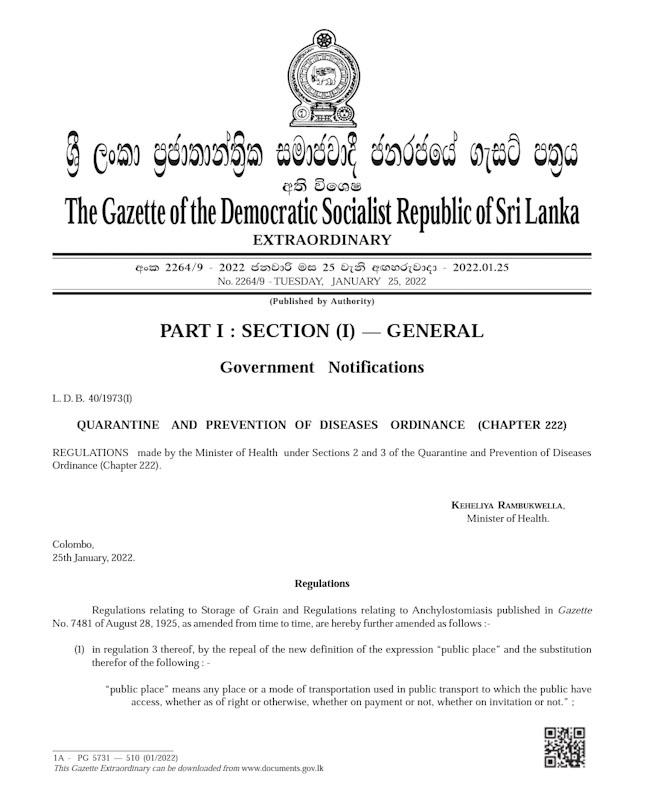
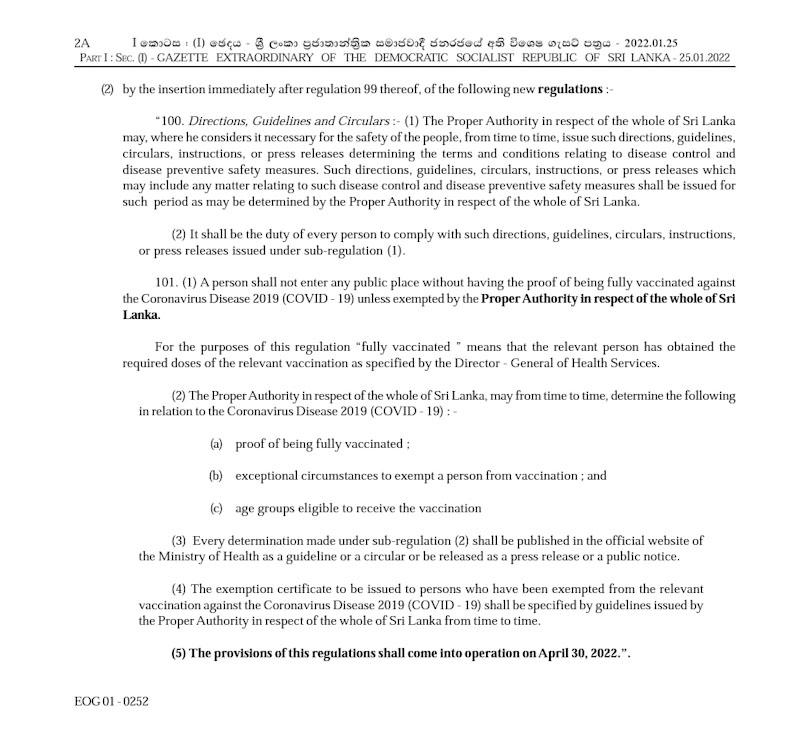
While issuing an extraordinary gazette notification the Health Ministry announced that people should not enter public places without having proof of being fully vaccinated against the Coronavirus from April 30.

The gazette notification was issued by Health Minister Keheliya Rambukwella.

The gazette mentioned ‘fully vaccinated’ as a relevant person has obtained the required doses of the relevant vaccination as specified by the Health Services Director-General.

Regulations and guidelines have been published on the official website of the Health Ministry, it said.

The exemption certificate to be issued to persons who have been exempted from the relevant vaccination against the Coronavirus should be specified by guidelines issued by the Proper Authority in respect of the whole of Sri Lanka from time to time, the gazette notification said. (Chaturanga Samarawickrama)

  Comments – 6


Daily cases of Covid-19 in Sri Lanka hit 1,287 today and records 28 new coronavirus-related deaths

February 5th, 2022

Courtesy Adaderana

The Ministry of Health says that another 1,287 persons have tested positive for the novel coronavirus today (February 05).

Sri Lanka’s tally of Covid-19 cases confirmed in the country thereby climbed to 617,189.

According to official figures, 580,770 positive cases have recovered.

With the new development, the number of virus-infected people who are undergoing treatment moved to 20,847. Meanwhile, the death toll stands at 15,572.

This is the seventh consecutive day Sri Lanka recorded more than 1,000 daily cases of Covid-19.

The Director-General of Health Services has confirmed 28 new coronavirus-related fatalities for February 05, increasing the death toll in the country due to the virus to 15,572.

This includes 20 males and 08 females, according to the Department of Government Information.

Five of the deceased were in the age group of 30-59 years. Two others were aged below 30 years and the remaining 21 victims were aged 60 years and above.

For Canada, organic food is an expensive status symbol. For Sri Lanka, it’s a catastrophe

February 4th, 2022

Courtesy The Globe & Mail

Next time you think of reaching for the higher-priced produce on your supermarket’s organic” shelf, spare a moment’s thought for the people of Sri Lanka.

After its annual rice harvest failed, this poor island nation – whose diet is about 80-per-cent rice – in recent weeks launched a US$1.2-billion program of emergency food aid to a population staggering under a 22-per-cent rise in food prices. It also launched a US$200-million program to bail out the incomes of hundreds of thousands of rice farmers, and huge sums to import hundreds of thousands of tonnes of rice. This, in a heavily indebted country whose government income rarely exceeds $10-billion, is proving ruinous, leaving it begging India, China and Iran for assistance.

This humanitarian catastrophe is the result of a single policy decision: Last April, Sri Lankan president Gotabaya Rajapaksa declared that the entire country would immediately switch to organic farming.

His reasons weren’t hard to discern: Westerners, and wealthy Asians, like to pay a premium for foods labelled organic.” In recent decades, as food prices have otherwise plummeted worldwide, buying organic has become a status-affirming act of conspicuous consumption.

For Mr. Rajapaksa, it meant immediately banning all imports of fertilizer – which, he assumed, would also be cost-saving. Organic farming techniques replace fertilizer with the reuse of tillage and other composts, as well as natural fertilizers such as manure.

But rice is a particularly nitrogen-intensive crop, and even if you eliminate fertilizers, you need to use expensive inputs and tricky techniques – including flooding the paddies earlier and more often, resulting in greater water use – to replace the lost nutrients. Weeds and pests are huge threats to rice crops, and the natural” alternatives to herbicide and pesticide are difficult to implement and less effective. Even when done properly, organic rice farming produces considerably lower yields than conventional techniques. It also releases more greenhouse gases into the atmosphere.

Shortly after he ordered the change, agronomists from the Sri Lanka Agricultural Economics Association warned Mr. Rajapaksa in a letter that, even if successful, organic farming would reduce rice yields by a quarter and rice-farmer profitability by 33 per cent, and result in even greater productivity drops in the country’s major export crops of tea and coconuts; over all, the shift would cut the size of the country’s economy by 3 per cent. This proved to be a conservative estimate – a majority of farmers say they received no training in organic techniques, and fertilizer and pesticide alternatives could not be found.

Behind Sri Lanka’s catastrophe is the larger price of consumer fetishization of organic.” Organic farming was developed, decades ago, to address a single controversy: The use of chemical inputs in agriculture, during an era when herbicides and pesticides contained menacing chemicals that lingered in the ecosystem. Organic’s lower crop yields, higher price, greater land use and, therefore, greater climate damage were considered a reasonable price to pay – and that attitude continued after the 1990s saw the adoption of new farm chemicals whose lasting harm to the environment is negligible.

Organic produce has been shown to have no nutritional or flavour advantages over conventional produce. Its ecological advantages in some crops are balanced by ecological damage caused by, for example, the heavy use of tillage, which can result in faster soil exhaustion. Other modern sustainable agricultural techniques, such as no-till farming, are considerably more ecologically beneficial and productive – but they can’t earn the organic” label.

Broadly speaking, the rise of the organic-food fetish has been bad for poor people.

You don’t need to go to South Asia to see that. Just look at the fact that every supermarket now features well-promoted shelves of foods that cost three or four times as much as the otherwise identical stuff in the lower bins. Or that TV shows and cookbooks frequently insist on organic produce, implying that you’re somehow harming your children if you do otherwise. Just as we’ve finished enjoying five decades of plummeting food prices and therefore declining poverty, we’re now sending a message to people with low incomes: If you aren’t buying these premium foods, you’re harming your family.

We’re sending a similar message to countries such as Sri Lanka. The majority of the world’s very poor people are farmers working small holdings with few resources, and the switch to less productive, and therefore more land-intensive organic techniques, is the opposite of what they need.

A country like Sri Lanka could easily triple the amount it produces per hectare; instead, it somehow found a way to cut its already low yield. Sri Lankans were sold a bill of goods by their naive leader, and we’re holding the receipts.

නවදිල්ලි, ශ්‍රී ලංකා මහ කොමසාරිස් කාර්යාලයේ ප්‍රධාන ගොඩනැගිල්ල ශ්‍රීමත් ඩී. බී. ජයතිලක නාමයෙන් නම් කරයි High Commission of Sri Lanka in New Delhi names its Chancery Building after Sir D.B. Jayatilaka

February 4th, 2022

High Commission of Sri Lanka New Delhi

හැත්තෑ හතරවන නිදහස් දින සමරුව නිමිත්තෙන් නවදිල්ලි ශ්‍රී ලංකා මහ කොමසාරිස් කාර්යාලය චාම් උත්සවයක් සංවිධානය කළ අතර එයට සමාන්තරව එහි කාර්යාලයේ ප්‍රධාන ගොඩනැගිල්ල ශ්‍රීමත් ඩී.  බී. ජයතිලක මහතා නමින් නම් කෙරිණ . නිදහස ලබන්නට කලින් වකවානුවේ පළමුවතාවට එතුමා ලංකාවේ විශේෂ නියෝජිත වශයෙන් 1942 වසරේ සිට ඉන්දියාවේ කටයුතු කර ඇත.  

ලංකාණ්ඩුව පත් කරන ලද පළමු නියෝජිතයා ගේ සිට යෙදෙන අසු වසර මෙම වසරට යෙදී තිබේ. එය නිමිත්තෙන් සැමැරුම් උත්සව මාලාවක් ඉදිරි කාලය තුළ සංවිධානය කර ඇති අතර ජයතිලක මහතා ගේ සේවය සිහිපත් කර කාර්යාලයීය ප්‍රධාන ගොඩනැගිල්ල නම්කිරීම එහි පළමු අංගය විය. ඉන්දීයාවේ ශ්‍රී ලංකා මහ කොමසාරිස් මිලින්ද මොරගොඩ මහතා නාමකරණය කළ ප්‍රධාන ගොඩනැගිල්ලේ ඵලකය නිරාවරණය කළ අතර මහ කොමසාරිස් කාර්යාලයේ කාර්ය මණ්ඩලය එම අවස්ථාවට සහභාගී වූහ.

ශ්‍රීමත් දොන් බාරොන් ජයතිලක මහතා රාජ්‍යතාන්ති්‍රකයෙකු , බෞද්ධ අධ්‍යාපනඥයෙකු. අධි නීතිඥවරයෙකු පමණක් ද නොව සාහිත්‍යධරයෙකි. කල්කටා සහ ඔක්ස්ෆඩ් විශ්ව විද්‍යාලවලින් උසස් අධ්‍යාපනය ලැබූ එතුමා ලංකාවේ ස්වදේශ කටයුතු අමාත්‍ය ධුරය ද හෙබැවීය. විශේෂ නියෝජිතයෙකු ලෙස ඉන්දියාවට පැමිණ ඇති ශ්‍රීමත් ජයතිලක මහතා දෙරට අතර පැවැති සාකච්ඡා අවසානයේ දී ලංකාවට අවශ්‍ය කරන ආහාර ඉන්දීය ආණ්ඩුවෙන් ලබා ගැනීමට සමත්ව ඇත. ලංකාණ්ඩුවේ පළමු නියෝජිතයා වශයෙන් ජයතිලක මහතා පත් කරකරන්නේ එයින් අනතුරුවය. එම අවස්ථාව වන විට දෙරට අතර රාජ්‍ය තාන්ත්‍රික සම්බන්ධතා නිල වශයෙන් ආරම්භ කර නොතිබුණි. නිල සම්බන්ධතා ඇරඹෙන්නේ 1948 වසරේ සිට වන අතර දෙරට අතර ඉතාම සුවිශේෂී බැ`දීමක් ගොඩනගන්නට පුරෝගාමී මෙහෙවරක් කර දැයෙන් සමුගත් ජාතික නායකයෙකු ලෙස ජයතිලක මහතා ලාංකේය ජනතාවගේ මහත් ගෞරවාදරයට පත්ව ඇත.

Media Release

High Commission of Sri Lanka in New Delhi names its Chancery Building after Sir D.B. Jayatilaka

The High Commission of Sri Lanka in New Delhi today (04) named its Chancery Building after Sir D.B. Jayatilaka, Sri Lanka’s first representative to India, coinciding with the event to mark the 74th anniversary of Independence of Sri Lanka, held at the High Commission premises.

This year marks the 80th anniversary of Sri Lanka (then Ceylon) sending Sir D.B. Jayatilaka as its first Representative to India in 1942. Naming of the Chancery Building after Sir D.B. Jayatilaka comes as the first of a series of activities organized by the High Commission of Sri Lanka in New Delhi this year to mark the important anniversary.

In a simple ceremony attended by the staff of the High Commission, Sri Lanka’s High Commissioner to India Milinda Moragoda unveiled the plaque containing the new name of the Chancery Building this morning.  

Sir Don Baron Jayatilaka, Statesman, Buddhist Educationalist, Barrister, pioneering literary figure of his era and one time Home Minister of Ceylon, had graduated from the Universities of Calcutta and Oxford. Sir Baron had first come to India to negotiate food shipments to Ceylon by the Government of India, and was later appointed as the first Representative of the Government of Ceylon to New Delhi.

The appointment of Sir D.B. Jayatilaka as Ceylon’s Representative to India, which pre-dates the establishment of formal diplomatic relations between independent India and Sri Lanka in 1948, stands testimony to the very special bond and close relationship that the two countries have been enjoying since time immemorial.

High Commission of Sri Lanka New Delhi

04 February 2022

The Death of the Most Ven. Homagama Kondanna Maha Thero

February 4th, 2022

German Dharmaduta Society Colombo

Most Ven. Homagama Kondanna Maha Thero

It is with great sorrow that we convey the sad news of the death of Most Ven. Homagama Kondanna Maha Thero, one of Sri Lanka’s best-known monks for Buddhist missionary work overseas, and mentor and meditation teacher of several famous people including a former President of Argentina.  Bhante Kondanna passed away on the morning of Thursday, February 03, 2022, at the Heathrow Athula Dassana International Buddhist Temple, London, UK. He was 82 years of age.    

VENERABLE BHANTE HOMAGAMA KONDANNA was a Forest Tradition monk in the style of Ajahn Chah and was born on April 15, 1939, in Homagama, (20 kilometers from Colombo), Sri Lanka. He was the first of a large family. He attended Royal Primary School and Thurstan College, Colombo. He was sent by his parents to London to study and graduated in automotive engineering in 1962. He went to work for the company Rolls-Royce. After a 16 – year professional career in London he began to see the futility of the things that had attracted him as a layperson. He realized that life was a transient temporary journey with no real meaning and no permanence and in monkhood, he saw a better alternative to live his life and work out his answers for the imponderables of life.

He was ordained in 1978 on a barge at high tide on the River Thames (ordination on the water is an alternative when a properly bounded location is not available). Ajahn Dr. Hammalawa Saddhatissa Thero (Head of the UK Sangha) was the preceptor and Ajahn Sumedho was the acharya. Thereafter he spent about a year and a half at the Hampstead Vihara and was a member of the pioneer group that carried out the huge renovation and reconstruction needed to revive the Monastery at Chithurst from 1978/79. In 1981 he was sent to be with Ajahn Chah in Ubon. He started off on his pilgrimage around the world to disseminate his message of peace and spiritual concentration in 1983.

From Thailand, he went to Vipassana Meditation Center in Moratuwa. He also served as a member of the Elders Committee for 11 years. He was the spiritual advisor of the Sewa Lanka Foundation. Sewa Lanka enhances the capacity of rural communities to democratically identify and address their own development needs and provides services that contribute to the economically viable, socially just, and ecologically sustainable development of Sri Lanka. He has traveled widely in North and South America, Europe, and Asia where he has led retreats for the last 40 years

He was the director of the Siresena Meditation Centre of Moratuwa in Sri Lanka. While serving in this capacity he used to travel all over the world sharing his message of peace and spiritual concentration. He ran meditation retreats in Latin America and he delivered talks on Buddhism and Meditation all around the world. Meditation is the only way to transform human beings, get them away from their bad habits, from their bad temper, from hate. We can change just by thinking, we can control our mind”, stated the monk.

In Sri Lanka, Ven. Kondanna was a popular preacher of Bana Sermons at various Buddhist Temples and particularly at Meththaramaya, Lauries Road, Colombo 04.

He has served as the Anusasaka of the German Dharmaduta Society (founded by Asoka Weeraratna) for some time and delivered a Bana Sermon on the occasion of the commemoration of the 50th anniversary of the founding of the German Dharmaduta Society (1952 – 2002) held in Colombo.  

Bhante Homagama Kondanna Thero was a frequent visitor to Das Buddhistische Haus (Berlin Buddhist Vihara) in Berlin – Frohnau, Germany. He has facilitated numerous dhamma talks and retreats over the years at Das Buddhistische Haus. Bhante Kondanna also spent a couple of months there at DBH once again at the end of 2021, before finally heading to the UK where he passed away. Bhante Kondanna had highly recommended his disciple Bhante Pelane Dhamma Kusala for Dhamma work at Das Buddhistische Haus in Berlin, and we are very grateful that the latter has now become the current Resident monk at DBH (Berlin Vihara).

German Dharmaduta Society

Colombo

February 05, 2022

Sri Lanka’s march to freedom alongside the rest of Asia

February 4th, 2022

Senaka Weeraratna

Sri Lanka won freedom not in isolation but in step with the rest of Asian countries in the aftermath of the end of the Second World War in 1945.

Many factors contributed to the collapse of Western Colonial Domination of Asia. But the outstanding and most notable factor was the epic attack of the Japanese on Pearl Harbour on December 07, 1941, followed by Japan’s attacks on military bases in European colonies including India (Imphal and Kohima), and Ceylon. Japan ended the colonial occupation of Burma, Indonesia, Malaya, Philippines, Singapore, Hong Kong, Indo – China, Vietnam and several Pacific countries that were under foreign occupation. These blitzkrieg type Japanese victories inspired the National Liberation movements all over Asia and even Africa to come forward and fight for their freedom.

In 1939, i.e., prior to the beginning of the second world war, the entirety of Asia was under foreign (western) occupation bar Japan and Siam (Thailand). In varying degrees, vast swathes of Asian (and also African) territory were under the control of western colonial powers such as Portugal, Spain, Netherlands, France, Germany, Great Britain, and finally the USA, for nearly 500 years. However, incrementally South East Asian and South Asian countries won their freedom after 1945 as a fall out from the second world war, and with the victory of Vietnam over USA in 1975, the chapter of colonial occupation of the orient more or less came to a close. It must be remembered that not all countries in Asia wanted to fight and liberate their countries. Some obtained their independence on a passive footing virtually on a platter i.e., without a fight on the battlefield such as Ceylon and Maldives. Others gave hell for leather. It must be noted that the countries that fought the West heroically such as Vietnam, Indonesia, Japan, and India are doing far better economically today than the countries that opted to walk the path of least resistance to foreign occupation e.g., Ceylon.  

Freedom did not fall from the sky to Asia. It came due to the freedom fight of Asians and their huge blood sacrifices.  Japan under Prime Minister Hideki Tojo played a big role in this effort being the only major world power to declare at the beginning of Japan’s entry to the second world war that one of its primary goals was the liberation of fellow Asians from Western imperialism. No other country either in the West or the East gave such a pledge to free people (black, brown and yellow races) then in colonial bondage.

Sri Lanka’s freedom struggle

Sri Lanka gained independence on the back of the Indian independence struggle. There was no threat of a physical nature from the locals to British occupation. It was a very passive movement confined to exchange of letters. We were very weak and incapable of giving ultimatums to the British to vacate the country. There was no push factor from our side.  In contrast , there was a push factor in the Indian struggle led by Netaji Subash Chandra Bose. Bose started a march on to Delhi with Japanese military assistance, with his call ‘ Delhi Chalo’.  If India did not gain independence on August 15, 1947 neither Burma nor Ceylon would have been granted independence on January 04, 1948 or February 04, 1948, respectively. When Britain lost the jewel in its Crown i.e., India, it decided to vacate South Asia altogether.

Lessons from India

The Govt. of India has declared Netaji Subash Chandra Bose as the father of India’s freedom struggle displacing Mahatma Gandhi from a pedestal that many thought was unassailable. This represents a historic shift towards changing the grand narrative of India’s liberation from British occupation. The colonial hangover of not saying anything to displease the former masters i.e., British Raj, now appears to be a thing of the past.

The view that Mahatma Gandhi using ‘Ahimsa’ and ‘non- violence’ in his civil disobedience campaigns won freedom for India has been discarded.

It was a big myth propagated by the British and empire loyalists in India.  Gandhi’s ‘Quit India’ Satyagraha campaign launched in 1942 fizzled out with no effect on the colonial Govt. They saw no threat to their colonial rule from Gandhi and the Indian Congress.

Indian Mutiny

It was the threat of a Mutiny from the British Indian Army soldiers, Navy and Air Force that finally convinced the Labour Govt. of Clement Atlee to quit India. A repeat of the Indian Mutiny of 1857 in 1946 would have ended in the slaughter of 30, 000 British soldiers then resident in India by more than 2, 500, 000 well trained Indian soldiers who had been discharged (demobbed) and returned to India.

The credit given to Gandhi for liberating India has now collapsed. There was no push factor in his campaign. The rest of Asia fought. Japan in particular had a battle plan to liberate India. (‘Japan’s Master Plan for Victory: What could have been’ by Moteki Hiromichi – Tokyo: 2018). Western colonialism in Asia was ultimately defeated by force of Arms on the part of the people of Asia. The Japanese, Vietnamese, Indonesians, Burmese, Indians, Philippines, have all successfully fought the West, resisted foreign occupation and finally won.   The exit of the West from the East after nearly 500 years of military adventurism and hegemonic rule is one of the defining landmarks of the 20th century.

It must be admitted however that Netaji received help from both Germany and Japan to wage war against the British then in occupation of India. 

It can be asked: If Adolf Hitler did not supply a German Submarine to carry Netaji Subash Chandra Bose out of Germany and to rendezvous with a Japanese Submarine I 29 off the shores of Madagascar, which would then in turn carry him to Penang and later Japan, how would his life story have unfolded then? The level of support rendered by both Germany and Japan to Netaji to raise the Indian Legion in Germany, and the Indian National Army in Singapore, was pivotal to enable Netaji to play the role that he did eventually. Trying to be politically correct should not lead to sidelining or suppressing important facts from the narrative.

De – Colonization

We need to revise the narrative on how Sri Lanka achieved independence. We gained independence on a platter. No freedom fight in the colloquial sense of waging war on battlefields and defeating the enemy, and thereby gaining freedom from foreign occupation. Vietnam stands out in this respect. It defeated the most powerful country i.e., the USA.

Furthermore, Britain was forced to grant independence because it was heavily weakened economically and militarily by the war against Germany, and therefore was in no mood to fight more wars.

To be truly independent our minds and our institutions must be decolonized. All colonial legacies, if redundant and not necessary for Sri Lanka, should be rejected and replaced.  Ideally speaking, our written History particularly of the colonial era from 1505 – 1948 should be reviewed and rewritten by top scholars with de-colonized minds. This principle also applies to the drawing of the national constitution. It must be done by de-colonized minds as far as possible and not as a copycat exercise. It must never be treated as a Holy Book. Constitutional values should never be accepted as a substitute for Civilizational values.

Patriotism and compassion for animals must be inculcated in every child from the time of kindergarten. Animal Protection education must be introduced in schools. Self – reliance must be encouraged in respect to growing more food locally especially plant – based food and more use of traditional medicine. Sri Lanka is basically an agricultural country. This country is also a Dharmic Civilizational country. This identity supersedes all other descriptions borrowed from the West such as Multiculturalism and Secularism which are more explicable and better understood in the countries that they had their origins in rather than in the countries they were planted.

Senaka Weeraratna

United Sri Lanka Association (USLA) Sri Lanka Independence Commemoration-4. Feb 2022

February 4th, 2022

Dr. Chula Rajapakse MNZM  Spokesperson USLA

Sri Lanka’s independence commemoration often kindles nostalgic memories of it’s first Prime Minister, Rt Hon DS Senanayake hoisting Sri Lanka’s national flag on the 4th of Feb 1948, following the Duke of Gloucester’s lowering the Union Jack on behalf of the British Crown, at the Independence Ceremony at the specially bult Independence hall at the Torrington Square in Colombo.

The day still kindles nostalgic memories of music that was frequently played in those days around independence day, songs such as  Namo Namo Matha, that in Sinhala urges its citizens to march forth  like children of one mother and others like Lanka, Lanka Pembara Lanka whose description of Lanka’s many virtues still inspires immense patriotic fervor.  

As a beneficiary of many of these virtues, not the least of which was it’s free education till the end of Tertiary, I often reflect on this with gratitude and ponder on how I could pay back these receipts. I remain acutely aware that having professionally served it’s citizens for seven years, the remainder of my over fifty years of professional service as a Medical Specialist has been to citizens of three other countries in three other continents. I have endeavored to make up for this shortfall by contributing to the training of Sri Lanka’s specialists in this field, by providing them opportunities in NZ and frequently contributing to their on  going education programs back in Sri Lanka.

In our frequent travels to Sri Lanka , we have endeavored to contribute to the lives and lively hoods of its citizens especially in the hospitality service by spending generously be it in five star hotels or in road side kiosks  enjoying a  Thambili or a delicious mango or a pot of curd and honey from the south.

We have also invested in Sri Lanka’s real estate and share market, not too faced by any losses , considering it a pay back to a country and people I owed.

As USLA’s spokesperson for nearly three decades, I have persistently and relentlessly defended Sri Lanka from  baseless and  vicious misinformation and denigration in the international and national media, and among politicians in NZ and internationally, during its thirty year war that successfully rescued Sri Lanka from  Tiger terror. This is the pay back that gives me the greatest satisfaction.

It was during this war that I realized the real significance of our independence , when a few weeks before this war victory the foreign ministers of UK and France, having travelled thousands of miles , pressured the then President to withdraw his offensive. His response was, please remember we ceased to be your colony sixty years ago. My people voted me in, to successfully end this war.  I have no intention of doing anything else” . A few days later he gave a similar response to a similar pressure  from New Delhi. One can only ponder what SL ‘s destiny would have been but for that steely resolve of its leader on that golden day in its history!

Today, Sri Lanka is in throes of another war , that against Covid. However, following an admirably successful vaccination drive , and the return of Tourism income and foreign remittances, we have every reason to be confident of a successful out come in this war too, similar to that in the terrorist war, especially with the same  drivers at the wheel.

Some glimpses of what this successful outcome, might mean was on display, with the opening of the Magnificent Golden Gate Kalyani, A bridge spanning the Kelani River in Colombo  featuring  a cable support system for the first time in Sri Lanka, where the water flow in the river was not disturbed by the bridge at all.

A similar glimpse was provided with the opening of the equally magnificent walkway and promenade of the brand new Port city Colombo with its Yatch marina with locally built Yatchs including double hulls on proud display. This promenade that is now the venue for many water front events provides vistas like in Hawaii , the likes of which was never before available to Sri Lankans who are now lapping them up in droves.

Finally, the opening of the Mirigama Kurunegalle section of Sri Lanka’s  central expressway provided scenes and arial views of a picturesque highway through Sri Lanka’s beautiful central hills that also provided new and pleasurable experiences to Sri Lankans who are eagerly lapping them up  as well.

With these dreams of the future , gradually becoming reality, I can only urge all Sri Lankans to respond to the call of it’s national anthem and march forward to prosperity, in unity  like the children of one mother.

Thank You

Dr. Chula Rajapakse MNZM  Spokesperson USLA. 4.2.22

Sri Lanka and Denmark to Explore Potential Collaborations in the Renewable Energy Sector

February 4th, 2022

Prime Minister’s Media Unit

Sri Lanka and Denmark have both expressed interest in exploring the possibilities of collaborating on projects in the renewable energy sector. The discussion took place when the newly appointed Ambassador of Denmark to Sri Lanka Freddy Svane called on Prime Minister Mahinda Rajapaksa this morning at Temple Trees.

Ambassador Svane told the Prime Minister that there is a lot of interest in Denmark to pursue investment in Sri Lanka. He said that in addition to manufacturing and dairy sectors, the renewable energy is another sector that could be explored.

The Sri Lankan delegation briefed the Ambassador about the Government’s policy to have 70% of the country’s energy consumption generated from renewable energy sources by 2030.

The Prime Minister encouraged the ambassador to promote Sri Lanka as an investment destination among Danish investors. The Ambassador said there are already plans to bring a business delegation from Denmark to Sri Lanka.

Ambassador Svane is resident in New Delhi, India, and this is his second time being accredited to Sri Lanka. He served as Denmark’s Ambassador to Sri Lanka from 2010 to 2015 as well.

Sri Lanka at the edge of an economic abyss on its 74 th. Independence Day

February 4th, 2022

By P.K.Balachandran Courtesy NewsIn.Asia

Sri Lanka at the edge of an economic abyss on its 74 th. Independence Day

Colombo, February 4 (Counterpoint): It is widely acknowledged that Sri Lanka has not been in such dire straits economically as it is now in its 74 th. year as an independent nation. Seven decades of erratic economic policies adopted in the midst of a 30-year war, two insurgencies, self-defeating nationalism and ethnic and religious strife, have created a situation where the country is now going around with a begging bowl seeking loans from India, China, Pakistan and Bangladesh.

In a throw-back to 1952, when Sri Lanka had to barter its rubber for rice from China to stave off starvation, the government is now negotiating with China to secure a million tons of rice to make up for a severe rice shortage. The sudden ban on chemical fertilizers and pesticides to promote organic agriculture, and that in the midst of lockdowns, had hit farmers below the belt. A subsequent relaxation of the fertilizer policy left rice cultivation out and favored export crops like tea. Food price shot up. Government took to printed money. Inflation has now touched 14%.

Subscribe to our Telegram channel for the latest updates from around the world

A survey done by MTI Business Review found that in 2020, 74% of the businesses were down. It came down to 54% in 2021 due to the lifting of lockdowns. Thanks to the opening of the economy in 2021, there was an all-round recovery with GDP growing by 4% and industry growing by 6.8%. Some sectors in agriculture like tea and vegetables, improved with a partial relaxation of the ban on chemical fertilizer. Tea production rose by 17%. Apparel exports went up by 21.9%. Overall, exports went up by 23%  to rake in US$ 15 billion.

Grim Downside

However, the downside remains grim. In 2022, debt service payments of US$ 6.6 billion are due. The current usable official reserves are less than US$ 1 billion (2-3 weeks of imports). Tourism was down with less than 200,000 arriving in 2021. It is yet to pick up. 

READ: Sri Lanka’s inflation accelerates to Asia’s fastest

Sri Lanka is confronted with both a cash flow problem and a debt problem, says the Colombo-based think tank, Pathfinder Foundation (PF) in its latest report.

The liquidity problem is compounded by the fact that the only known additional external financing, at this point, are lines of credit from India (USD 1.5 billion)  and Pakistan (USD 200 million). These will certainly contain the depletion of reserves. They will not have a very material impact on the existing external financing gap, which is likely to be at least US$ 7 billion this year, even with very optimistic assumptions about receipts from tourism, asset sales, remittances and FDI.”

With each passing day, the dollar illiquidity will worsen unless there are large inflows. There will be some temporary reduction in the hardships being experienced by the people due to the Indian SWAP, the deferral of the Asian Clearing Union settlement and the lines of credit obtained in recent weeks. The intention of the Indian government to provide humanitarian support in this time of great need is very laudable. However, these generous initiatives will not serve to buy more than two or three months’ time. We need to do much more to help ourselves rather than relying on the goodwill of friendly neighbors, such as Bangladesh, India and Pakistan, whose per capita incomes are below ours,” Pathfinder Foundation said.

Solvency Problem

Thanks to the high level of external debt, the country also has a solvency problem. This formidable challenge will not be resolved by a few bilateral sources temporary financing. They do not alter the debt burden.”

The Pathfinder Foundation advocates: (1) an immediate announcement of a preemptive restructuring of external debt, (2) a very early and urgent approach to the IMF; and (3) bridging finance from friendly bilateral partners pending completion of the negotiations with creditors and the IMF which can take at least six months.”

Debt restructuring, excluding multilateral debt, can save over USD 3 bn, during the first year. These dollars can be used to finance imports that meet the essential needs of the people and urgent requirements of businesses. An IMF program can trigger a combination of balance of payments financing and direct budgetary support from the World Bank and Asian Development Bank to the tune of USD 1.5- 2.0 bn in the first year. The combined increases in USD availability during the first twelve months will have a huge positive impact in resolving the problems currently being caused by dollar illiquidity.”

Need for Austerity

However, there can be no gain without pain, Pathfinder Foundation said.

The painful consequences of many years of indiscipline, resulting in the country living well beyond its means, cannot be wished away. An austerity program is inevitable. Its depth and duration can be mitigated by robust structural reforms that increase productivity/competitiveness and thereby strengthen the growth framework of the economy. This would increase output, employment and incomes. The policies adopted should also prioritize inclusiveness and sustainability.” 

A home-grown program needs to be developed to meet these objectives. It should also be credible enough to negotiate with the IMF and creditors. Such a program may include, inter alia, the following:-

(1) A realistic exchange rate that contributes to building reserves; and ends the current multiple exchange rates that incentivize the expansion of the black economy. (2) Continuation of the Central Bank’s shift to a more market-oriented monetary policy. (3) A medium-term fiscal consolidation program which sets out a clear path to debt sustainability, including by improving the primary balance through a widening of the tax base, improving tax administration, rationalizing public expenditure in accordance with a clear set of national priorities, and adopting transparent fiscal rules by strengthening the Fiscal Management Responsibility Act. (4) Reform of the present highly inefficient subsidies, which disproportionately benefit the non-poor, with a well-designed and targeted system of cash transfers supported by a digital Identity Card. (5) Full-cost pricing of fuel and energy based on transparent and predictable formulas. (6) Further progress in commercializing State Owned Enterprises.  

Need to Seek IMF Help

The above could, inter alia, be key elements of a home-grown reform program that can be the basis of negotiations with the IMF. It can also be credible enough to generate confidence among creditors. However, it is also important to accelerate the long over-due structural reforms to ensure that the above program, which is primarily focused on stabilization, does not lead to a growth deficit. This has been a repeated problem with reform efforts in the past decades.”

The structural reforms to generate growth are very well known and relate to: factor markets (land, labor and capital); the investment climate; investment promotion; trade policy, including trade agreements; trade facilitation; education, training and skills development; and digitalization.”

In conclusion the Foundation issued a grim warning: There is much to be done, and done quickly, to avoid falling into the abyss.”

Promoting Gandhara

February 4th, 2022

By Dr Ramesh Kumar Vankwani Courtesy The News

Today, on February 4, the people of Sri Lanka are celebrating their 74th Independence Day to commemorate their freedom and sovereignty from British imperialism. The 5,000-year-old ancient island is also described in the sacred Hindu book ‘Ramayana’ as Lanka where Sri Ram had fought with the demon king ‘Ravana of Lanka’ who abducted his wife Sita.

According to historians, this beautiful island, currently sharing maritime borders with India and Maldives, has a human population for 3000 years, which belongs to different religions including Buddhism, Hinduism and Islam. Many Sindh-origin people also emigrated from the Sindh province of Pakistan to the country.

On the diplomatic front, Pakistan and Sri Lanka are considered close allies that support each other on several international issues. The bilateral ties between the two countries are linked with cultural, military and diplomatic cooperation. Sri Lanka has faced insurgency in the form of the Tamil Tigers. The cooperation by Pakistan during this critical time is highly regarded and valued by Sri Lankan leadership.

In my view, faith tourism is another initiative that has brought Pakistan and Sri Lanka even closer. Present-day Pakistan was once considered a significant centre of the Gandhara ancient Buddhist civilisation that extended from the 1st century AD to the 7th century AD. Many Buddhist monuments and worship places are located in various places from Taxila to Swat.

Also, Sri Lanka used to host cultural exhibitions under the name ‘Gandhara Art of Pakistan’ regularly. Most recently, the high commission of Pakistan in Sri Lanka and Siddhivinayak Cine Arts (Private) Limited with the support of and in coordination with the Ministry of Buddha Sasana, Religious and Cultural Affairs of Sri Lanka have jointly produced a documentary titled ‘Gandhara’ with a focus on a visual journey along the Gandhara Buddhist heritage sites of Pakistan.

Thakshashila, the most ancient university of known human civilisation was based in Taxila, where a great philosopher and teacher, Kautliya Chanakya, used to teach his students. Even today, his books including ‘Arthashastra’ and ‘Chanakya Niti’ are most popular with a huge readership throughout the world.

Historians believe that the first sculpture of Buddha was created in the region now called Pakistan. There is also a huge global demand for Buddha statues made in Pakistan. In the historic city of Taxila, there are many talented sculptors who have learned the art of making statues from their ancestors. According to international media reports, these Pakistani sculptures are sometimes smuggled in the international black market and sold for $10,000. On the other hand, the sculpture artists are paid a few thousand rupees for their hard work.

The Pakistan Hindu Council has taken up the task of projecting a positive image of Pakistan in the eyes of the international community. In this regard, faith tourism could play a pivotal role. I wish we could start special international flights with Sri Lanka for facilitating Buddhist followers interested in visiting Gandhara heritage sites.

Similarly, Pakistanis could be facilitated to visit Adam’s Peak in Sri Lanka. The more than 7,000 feet tall conical mountain contains the ‘sacred footprint’ which in Buddhist tradition is held to be the footprint of the Buddha, and in Hindu tradition that of Shiva. However, some Islamic and Christian traditions describe it to be Hazrat Adam’s first footprint when he landed from the paradise.

Apart from Sri Lanka, other Asian countries including Japan. Korea, China, Myanmar, Thailand, Cambodia, Vietnam, Singapore, Bhutan, Hong Kong, Laos, India, and Mongolia also have large Buddhist populations. China’s 244 million people (18 percent population) are Buddhist followers. Similarly, there is a good number of Buddhists residing in Russia, the United States, and some Western countries.

Today, while extending my best wishes to Sri Lankans on their Independence Day. I would like to urge our authorities to promote Gandhara heritage as a symbol of international peace in order to attract foreign tourists from Sri Lanka and other Buddhist-majority countries.

The writer is a member of the National Assembly and patron-in-chief of the Pakistan Hindu Council.

He tweets @RVankwani

India offers Covid-19 aid to Sri Lanka, sends 1,00,000 RAT kits

February 4th, 2022

Courtesy DNA India

India has stepped up and pledged a whopping Rs 3844 crores to Sri Lanka to help overcome dire financial constraints.

India offers Covid-19 aid to Sri Lanka, sends 1,00,000 RAT kits

India continues its COVID-19 assistance to Sri Lanka by initiating the delivery of 100,000 Rapid Antigen Self-Test Kit from Friday, according to the High Commission of India in Colombo, Sri Lanka.

Taking to Twitter, the High Commission said that the remaining kits to follow in the coming days.”A special gift from a friend on #IndependenceDay!! #India continues its #COVID19 assistance to #SriLanka by initiating the delivery of 100,000 RAT kits from today. Remaining kits to follow in the coming days,” India in Colombo tweeted.

As Sri Lanka is facing a serious financial crisis, India has stepped up and pledged a whopping USD 2.415 billion to the island nation to help overcome dire financial constraints caused by external debt payments and a lack of US dollars in the country for business.

Last month, External Affairs Minister S Jaishankar held a virtual meeting with the Finance Minister of Sri Lanka Basil Rajapaksa. During the meeting, Jaishankar conveyed that India has always stood with Sri Lanka, and will continue to support Sri Lanka in all possible ways for overcoming the economic and other challenges posed by the COVID-19 pandemic.

To help Sri Lanka overcome its economic challenges, India under the SAARC currency swap arrangement has made an extension of USD 400 million to Sri Lanka and provided a deferral of ACU (Asian Clearing Union) settlement of Rs 3844 crores by two months.

India`s critical support to Sri Lanka is due to the ongoing fuel crisis where the country is unable to purchase due to short of US dollars in the country, the Policy Research Group (PRG) had said in its report. 

Cash-strapped Sri Lanka appeals to expats to send money

February 4th, 2022

Courtesy Mail Online

COLOMBO, Sri Lanka (AP) – Sri Lanka celebrated its Independence Day on Friday with an appeal by the president to the country´s expatriates to send money home as it struggles with the worst economic crisis in decades mainly due to depleted foreign reserves.

Sri Lankans are facing shortages of milk powder, cooking gas, kerosene and other essentials. Cash shortages have hindered imports of raw materials for manufacturing and worsened inflation, which surged to 12.1% in December.

The pandemic has dealt a heavy blow to an economy that depends heavily on tourism and trade, with the government estimating a loss of $14 billion over the last two years. The economy is estimated to have contracted by 1.5% in July-September 2021, according to the central bank.

President Gotabhaya Rajapaksa said Sri Lankans abroad who sent foreign currency back home are a major resource.

“I invite all expatriate Sri Lankans to invest in their homeland,” he said in an address during a ceremony marking Independence Day in the capital, Colombo. A colorful military parade followed his speech.

Data shows that overseas remittances – the nation’s main foreign exchange earner- have fallen by nearly 60% to $812 million in December from a year earlier. For the whole year, remittances declined 22% to $5.4 billion. The drop came after the government ordered the mandatory conversion of foreign currency and exchange rate controls.

Sri Lankan soldiers dressed in traditional costumes carry nation al flags during the Independence Day celebration in Colombo, Sri Lanka, Friday, Feb. 4, 2022. Sri Lankans celebrated it's independence day on Friday as the island nation's president made an appeal to the country's expatriates to send money home as the country struggles in the throes of its worst economic crisis. (AP Photo/Eranga Jayawardena)

Sri Lankan soldiers dressed in traditional costumes carry nation al flags during the Independence Day celebration in Colombo, Sri Lanka, Friday, Feb. 4, 2022. Sri Lankans celebrated it’s independence day on Friday as the island nation’s president made an appeal to the country’s expatriates to send money home as the country struggles in the throes of its worst economic crisis. (AP Photo/Eranga Jayawardena)

Because of the currency shortage, importers are unable to clear their cargo and manufactures are unable to buy raw materials from overseas.

Sri Lanka has borrowed heavily and faces repayments on $15 billion in international sovereign bonds.

Officials have said the government is gradually building back reserves to ensure it can honor its debts.

“None of the crises we experience today are long term problems. We can find solutions to them with an optimistic approach,” Rajapaksa said. “We have faced critical problems in the recent history as well and found solutions.”

Sri Lankan president Gotabaya Rajapaksa hoists the national flag of Sri Lanka during the country's  Independence Day celebration in Colombo, Sri Lanka, Friday, Feb. 4, 2022. (AP Photo/Eranga Jayawardena)

Sri Lankan president Gotabaya Rajapaksa hoists the national flag of Sri Lanka during the country’s Independence Day celebration in Colombo, Sri Lanka, Friday, Feb. 4, 2022. (AP Photo/Eranga Jayawardena)

Sri Lankan army soldiers march during the Independence Day celebration in Colombo, Sri Lanka, Friday, Feb. 4, 2022. (AP Photo/Eranga Jayawardena)

Sri Lankan army soldiers march during the Independence Day celebration in Colombo, Sri Lanka, Friday, Feb. 4, 2022. (AP Photo/Eranga Jayawardena)

Efforts to revive LTTE

February 4th, 2022

By Neville Ladduwahetty Courtesy The Island

The Island of 31 Jan. 2022 carries a report which states: The Indian National Investigation Agency (NIA) has registered a case and launched a probe in connection with fake passports who are allegedly involved in raising money to revive the LTTE ….”

The amended Prevention of Terrorism (Special Provisions) Act No. 48, 1979 of Sri Lanka that is tabled in Parliament does not adequately address the act of raising money” by terrorist entities such as the proscribed LTTE. Instead, the amended PTA addresses mainly the rights and entitlements of perpetrators of terrorism, and not those who fund, advise and support the many facets of LTTE activities. Despite this shortcoming, Sri Lanka and several other states have sufficient provisions in their domestic law to proscribe entities such as the LTTE; the latest being the European Union that rejected the multiple pleas of the LTTE to lift their ban as a Terrorist Organization. However, limiting it to proscribing entities is not a sufficient deterrent to discourage terrorism. Instead, the breadth and scope of the legal provisions that exist need to be strengthened in order to prevent and suppress terrorism.

According to The Island report, the action taken by the NIA is under provisions of Unlawful (Prevention) Act and Foreigners Amendment Act among others of the Penal Code”. Whether these instruments cover only terrorist acts or are sufficiently wide in scope to cover fund raising” needs to be established if they are to prevent and deter terrorism. If not, they need to be extended beyond to activities such as selecting, training, fund raising and engaging the perpetrators of terrorism if the legal provisions are to have an impact. Since the Security Council Resolution 1373 is sufficiently wide in scope to address these issues, it is imperative that ‘all’ Member States incorporate its provisions because they are specifically designed to prevent and suppress terrorism. Since those arrested are now engaged in the revival of the LTTE, it is absolutely vital that Sri Lanka takes immediate action to implement the full scope of Security Council Resolution 1373, if terrorism is not to recur.

Security Council Resolution 1373

This Resolution states:

1. Decides that all States shall:(a) Prevent and suppress the financing of terrorist acts;(b) Criminalize the wilful provision or collection, by any means, directly or indirectly, of funds by their nationals or in their territories with the intention that the funds should be used, or in the knowledge that they are to be used, in order to carry out terrorist acts;(c) Freeze without delay funds and other financial assets or economic resources of persons who commit, or attempt to commit, terrorist acts or participate in or facilitate the commission of terrorist acts; of entities owned or controlled directly or indirectly by such persons; and of persons and entities acting on behalf of, or at the direction of such persons and entities, including funds derived or generated from property owned or controlled directly or indirectly by such persons and associated persons and entities;

(d) Prohibit their nationals or any persons and entities within their territories from making any funds, financial assets or economic resources or financial or other related services available, directly or indirectly, for the benefit of persons who commit or attempt to commit or facilitate or participate in the commission of terrorist acts, of entities owned or controlled, directly or indirectly, by such persons and of persons and entities acting on behalf of or at the direction of such persons;

2. Decides also that all States shall:(a) Refrain from providing any form of support, active or passive, to entities or persons involved in terrorist acts, including by suppressing recruitment of members of terrorist groups and eliminating the supply of weapons to terrorists; (b) Take the necessary steps to prevent the commission of terrorist acts, including by provision of early warning to other States by exchange of information; (c) Deny safe haven to those who finance, plan, support, or commit terrorist acts, or provide safe havens;(d) Prevent those who finance, plan, facilitate or commit terrorist acts from using their respective territories for those purposes against other States or their citizens; (e) Ensure that any person who participates in the financing, planning, preparation or perpetration of terrorist acts or in supporting terrorist acts is brought to justice and ensure that, in addition to any other measures against them, such terrorist acts are established as serious criminal offences in domestic laws and regulations and that the punishment duly reflects the seriousness of such terrorist acts;(f) Afford one another the greatest measure of assistance in connection

with criminal investigations or criminal proceedings relating to the financing or support of terrorist acts, including assistance in obtaining evidence in their possession necessary for the proceedings;(g) Prevent the movement of terrorists or terrorist groups by effective bordercontrols and controls on issuance of identity papers and travel documents, andthrough measures for preventing counterfeiting, forgery or fraudulent use of identity papers and travel documents;

The sentiments and near identical opinions were expressed by the United States Supreme Court in the case of Holder v Humanitarian Law Project, when the …court voted 6 to 3 to uphold a federal law banning ‘material support’ to foreign terrorist organizations. The ban holds, the court explained, even when offerings are not money or weapons but things such as ‘expert advice or assistance’ or ‘training’ intended to instruct in international law or appeals to the United Nations” (Washington Post, June 22, 2010). Chief Justice John G. Roberts Jr. in writing the majority opinion said that those challenging the ban simply disagree with the considered judgement of Congress and the Executive that providing material support to a designated terrorist organization – even seemingly benign support bolsters terrorist activities of the organization…(the law) is on its face, a preventive measure – it criminalizes not terrorist attacks themselves, but aid that makes the attack more likely to occur…” (Washington Post 2010).

The provisions of Security Council Resolution 1373 have been in existence since 2001. Successive Sri Lankan governments did not deem it necessary to incorporate provisions of Resolution 1373 into domestic law perhaps of the belief that provisions of Prevention of Terrorism (Temporary Provisions) Act (No. 48 of 1979) provided sufficient cover to deal with all aspects of terrorism. What they did not appreciate was that PTA addresses only acts committed by perpetrators and not those who support, finance and promote others to commit acts of terrorism. The opportunity to justifiably incorporate provisions of Resolution 1373 as part of amending the PTA was not seized by Sri Lanka. This means that if Sri Lanka decides to do so at a later date it would have to do so as a stand-alone law that would inevitably be subjected to petitions. Instead, what Sri Lanka should have done was to have made provisions of Resolution 1373 as part of the PTA, thus combining acts of terrorism by perpetrators as well as those who support, finance and promote such acts.

Conclusion

The Island report fruther states that the Indian National Investigation Agency (NIA) has launched a probe in connection with the arrest of three Sri Lankans with false passports who were allegedly involved in raising money to revive the LTTE”. The report also states that other Sri Lankan nationals had been arrested in 2021, also for possessing false passports. The Island refers to a report from The Hindu that Sri Lankan nationals operating from European countries are working towards drawing huge sums of money from dormant accounts to revive the LTTE.

While developments to revive the LTTE are under way, the focus in Sri Lanka is on the amended Prevention of Terrorism (Temporary Provisions) Act No. 48 of 1979 that is tabled in Parliament. The observations of civil society analysts and commentators are that the amended PTA does not go far enough. What they fail to realize is that even if the PTA is amended to be in keeping with international standards, all its provisions would relate ONLY to perpetrators of terrorist acts. The fact that the amended PTA does not contain provisions to prevent and suppress raising funds does not appear to concern them. Furthermore, the fact that it is the input from those who raise funds, advise and promote terrorism that enable and facilitate the perpetrators, does not also seem to occur to them. It is this realization that prompted the Security Council to introduce SC Resolution 1373 and called on all Member States to incorporate its provisions, to prevent and suppress terrorism, into its Domestic Law. The incorporation of provisions in the amended PTA would amount to fulfilling these international obligations. Hopefully, Sri Lanka’s Parliament would as the last resort prevail and ensure that provisions of Resolution 1373 are incorporated into the body of domestic law.

At the time of the Easter Sunday terrorist attack on 21 April, 2019 the only legal provisions available were those in the PTA and the Penal Code. Consequently, the scope of the inquiry has to be limited to the perpetrators and the lapses on the part of those responsible for security. No provisions existed to extend the inquiry to cover those who funded, planned and engaged the perpetrators – in other words those behind the scene that made it happen. Consequently, although the scope of the inquiry has been a cause for disappointment, the fact remains that it is constrained by the limits of the existing law. This lacuna will remain until provisions of Resolution 1373 are incorporated ito domestic law at least for the sake of the victims.

Cabraal says IMF advice is for technical assistance programme, nothing more

February 4th, 2022

Courtesy The Daily Mirror

Central Bank Governor Ajith Nivard Cabraal was quick to set the record straight with regard to Sri Lanka’s intention to reach out to the International Monetary Fund (IMF) for assistance.

Referring to the comments made by the Finance Minister Basil Rajapaksa last evening where he shared that the government had sought advice from the IMF in tackling the current economic crisis, Cabraal said it is about a routine technical assistance programme and nothing more.

Finance Minister’s comment yesterday (2) regarding Sri Lanka informing the IMF to provide expert advice on the economic situation is about a routine Technical Assistance Program on Macro-Fiscal capacity building for MOF’s new Macro-Fiscal Unit. Nothing else,” the Governor tweeted this morning, tagging the Finance Minister.

Governor Cabraal has always maintained, and continues to do so, that the ongoing economic crisis can be solved with following a home-grown fix as opposed to reaching out to international agencies for help.

While the Finance Ministry has hinted in the recent past that Sri Lanka might reach out to the IMF to ease the prevailing economic pressures, the Central Bank has been firm on its stance that such assistance is not required.

The Ministry of Foreign Affairs refutes claims by Ambika Satkunanathan to the European Parliament’s Subcommittee on Human Rights

February 4th, 2022

Courtesy Hiru News

The Ministry of Foreign Affairs has released a statement refuting the claims included in the testimony of Ambika Satkunanathan, during an exchange of views on the situation of human and labour rights in Sri Lanka at the European Parliament’s Subcommittee on Human Rights on 27 January, 2022.

The full statement by the MFA is as below.

The Foreign Ministry notes with concern the numerous misleading statements contained in the testimony of the Chairperson of the Neelan Tiruchelvam Trust Ambika Satkunanathan, during an exchange of views on the situation of human and labour rights in Sri Lanka at the European Parliament’s Subcommittee on Human Rights on 27 January, 2022.

Ms. Satkunanathan’s testimony completely ignores the progress made by the government of Sri Lanka on many fronts and creates doubts about the government’s intents and sincerity, particularly at a time when it is engaged in a long-standing cooperation with the UN human rights mechanisms and the UN Human Rights Council and is delivering on its commitment to address accountability and reconciliation through domestic processes and institutions.

The Ministry is disappointed that among the recommendations made by Ms. Satkunanathan is that the EU uses its leverage on GSP plus facility to exert pressure on the government on human rights. If Sri Lanka loses the EU GSP plus facility, particularly at a time when livelihoods of millions of Sri Lankans belonging to all communities are already affected by the ongoing COVID-19 pandemic, the resulting losses would exacerbate poverty and income inequality. Some of the worst affected sectors will be fisheries and agriculture which are among the key industries in the North and the Eastern Provinces of Sri Lanka.

The Ministry also notes that the unfounded allegations about discrimination of ethnic communities in her testimony are reminiscent of LTTE propaganda that once stoked hatred among communities. In a multi-ethnic and multi-religious country such as Sri Lanka, such allegations need to be refuted in the interest of social harmony and to prevent the spread of dangerous fallacies about Sri Lanka in the international community.

The Ministry refutes Ms. Satkunanathan’s claims on ‘a culture of impunity’. The Ministry wishes to point out that the government is engaged in a long-standing cooperation with the UN human rights mechanisms as well as with the UN Human Rights Council. Sri Lanka is delivering on its commitment to address accountability and reconciliation through domestic processes and institutions. The government has been actively engaging the international community including the UNHRC’s Universal Periodic Review and Special Procedures to address the various concerns that have been raised. This includes the allegations of systematic torture. The Government has made it clear that additional reforms will be undertaken to further strengthen rule of law, access to justice, and accountability. It remains open to a constructive discussion on suggestions and further steps to address shortcomings.

The Ministry notes that Ms. Satkunanathan makes references to ‘Sinhala Buddhist nationalism’ and ‘militarisation’ as driving the actions of the Government. She makes vague claims of racial profiling in the absence of any concrete evidence of discrimination against minorities. In reply, the Ministry wishes to point out that Sri Lanka is a secular country and all citizens, irrespective of their religion or ethnicity share the same fundamental rights under the Constitution. Furthermore, Sri Lanka ensures access to public services such as free education and free health facilities without any discrimination on the basis of ethnicity or religion. In fact, even during the military conflict when large areas of the Northern and the Eastern Provinces were under the control of the LTTE, the government continued with the provision of such public services to the areas so that the civilians, who were mainly ethnic Tamils and Muslims, would not be affected.

Ms. Satkunanathan points to the Presidential Task Force on Archaeology which she accuses of being a tool for land grabbing and changing the demographics of minority-heavy areas and the Presidential Task Force on One-Country One Law” which she accuses of stoking ethnic hatred and violence. After the war, as displaced persons returned to the Northern and the Eastern Provinces, there has been an increase in unauthorized encroachment into forest areas inevitably leading to destruction of archaeological sites. So, there is an urgent need to take concrete measures in order to protect these sites. There is no truth in the claims that the Presidential Task Force on Archaeology is a pretext for land grabbing and introducing the Sinhalese to these areas. It may be noted that there is representation of all ethnic communities in this Task Force. With respect to the Presidential Task Force on One Country One Law,” it should be noted that it is expected to play an advisory role only. The Task Force’s recommendations will be first studied by the Justice Ministry, then the Cabinet of Ministers and finally the Parliament following the democratic traditions.

With regard to her allegations that the Northern and Eastern Provinces are ‘occupied’ by the military, it should be pointed out that the the majority (more than 92%) of the private lands occupied by the military at the end of the conflict in year 2009 have already been released to legitimate land owned civilians. A mechanism is already in place to expedite the process of releasing remaining private lands.

It is particularly disappointing to see Ms. Satkunanathan’s allegations that ‘civic space’ is shrinking and that informal and extra-legal processes are used to curtail the activities of civil society organizations. The Ministry asserts that government views NGOs as partners and not as adversaries. The government acknowledges the constructive contributions made by civil Society organisations in the work of the Office for National Unity and Reconciliation (ONUR) and Sustainable Development Council of Sri Lanka. It has also introduced certain policy changes to facilitate the work of NGOs such as bringing the NGO Secretariat under the Foreign Ministry. It must be reiterated that apart from operating routine security networks in the interest of national security, particularly after the devastating Easter Sunday terrorist attacks, the Security Forces and intelligence agencies are not engaged in monitoring or targeting any specific group of people in the country.

The Ministry refutes Ms. Satkunanathan’s claims of extra-judicial killings and arrests under the pretext of a war and drugs.” With regard to the PTA, it should be noted that the government is in the process of amending the Act, which is now at the final stage and the international community is being briefed on that process.

Ms. Satkunanathan also alleges that the government is exploiting its friendship with China to undermine the efforts of states that call for accountability for human rights violations” in Sri Lanka. On the contrary, mindful of strategic competition that is increasing in the Indo-Pacific region, our main foreign policy directive is to maintain neutrality, in line with the non-aligned foreign policy we have adopted since Independence. The Ministry wishes to point out that apart from China, Sri Lanka has entered into partnerships with several countries such as India and Japan to fill gaps in national infrastructure development. Such partnerships have no bearing on Sri Lanka’s commitment to address accountability and reconciliation through domestic processes and institutions.

Sri Lanka achieves its first ever GI certification with Ceylon Cinnamon

February 4th, 2022

Courtesy Adaderana

Marking a moment of historical significance, Sri Lanka received its first ever Geographical Indication (GI) certification when the European Union (EU) Commission on 02 February,2022 granted GI status to Ceylon Cinnamon. The outcome was a result of a painstaking, decade-long, arduous endeavour led by the Sri Lanka Export Development (EDB) under the Ministry of Trade with the support of numerous public and private stakeholders.

During this monumental task, the much needed technical assistance was provided by UNIDO, Delegation of the European Union to Sri Lanka and the World Trade Organisation (WTO) while some financial assistance was granted by the Common Fund for Commodities, based in the Netherlands. In this breakthrough mission, the EDB was ably supported by Foreign Ministry, Department of Commerce, National Intellectual Property office, the Department of Export Agriculture, Spice Council and the Spices and Allied Products Producers’, Traders’ Association (SAPPTA).

GI registration has the purpose to differentiate Ceylon Cinnamon in the EU market from its substitutes of lower quality. GI will act as a source of competitive advantage which will help to increase market differentiation, product turnover and allow for a premium price from the consumer. An enhanced competitive position of Ceylon Cinnamon in the EU market will have a positive impact in terms of an increase in exports for Sri Lanka, higher income and employment generation across the cinnamon value chain, benefiting about 30,000 stakeholders involved in cinnamon production and processing.

As part of obtaining the GI status, the Ceylon Cinnamon Geographical Indication Association (CCGIA) was established representing all the stakeholders in the cinnamon industry in the country. The responsibility of the CCGIA is to implement an internal control mechanism to monitor their members meeting the specifications stated in the GI specification document. The participants within the cinnamon supply chain need to be registered/obtain the membership of the CCGIA to export Ceylon Cinnamon to the EU region under the Ceylon Cinnamon” name.

The EDB wishes to place on record the wholehearted assistance and encouragement given by Trade Minister Hon Bandula Gunawardena in the course of this challenging task. Minister Gunawardena in October 2020, submitted a proposal to the Cabinet to advise the Legal Draftsman to draft a bill to amend the Intellectual Properties Act No. 36 of 2003, with the provisions to establish a comprehensive and definitive legal framework for the registration of geographical indications in Sri Lanka, which paved the way to secure GI status for Ceylon Cinnamon.

Objection was raised by the competing countries to block the granting of GI status by the EU commission to Sri Lanka for Ceylon Cinnamon, however, the EDB, with the support and encouragement of the aforementioned stakeholders, persevered against all the odds to realise this landmark accomplishment.

We have passed a long journey in obtaining GI for Ceylon Cinnamon. Since 2009, followed by branding of Pure Ceylon Cinnamon, the EDB started the journey to secure registration of GI for Ceylon Cinnamon in the EU. Obtaining GI representing the whole country is a significant achievement and GI is beneficial to all stakeholders representing the cinnamon supply chain. Further, special focus can be given on rural development through Ceylon Cinnamon GI certification”, EDB Chairman Suresh D de Mel expressed his views on this important milestone.

IMF says it is ‘ready’ to help Sri Lanka if asked

February 4th, 2022

Courtesy Adaderana

The International Monetary Fund is ready to discuss options” with Sri Lanka if the government asks for financial support, its mission chief for the island told AFP on Thursday.

The Covid-19 pandemic has had a disastrous impact on Sri Lanka’s economy, which has been deprived of its tourism bonanza while workers’ remittances from abroad have fallen sharply.

While the IMF has not received a request for financial support from Sri Lanka, the staff stands ready to discuss options if requested,” mission chief Masahiro Nozaki said in a written statement to AFP.

On Wednesday, Sri Lanka’s finance minister announced the country had sought advice from the fund and was considering seeking an international bailout.

This referred to an ongoing technical assistance mission by the IMF,” Nozaki said Thursday.

The mission aims to strengthen the Macro Fiscal Unit at the Ministry of Finance and focuses on training staff at the Unit, as part of our capacity development activities,” he added.

The mission is being conducted virtually until February 9,” he said.

The IMF continues to closely monitor economic and policy developments in Sri Lanka,” Nozaki added.

He said a fund team had visited Colombo in December last year as part of the annual bilateral discussions to review economic developments and policies.

A board meeting will be held at the end of February to review the latest economic data from the country.

Sri Lanka’s daily COVID cases cross 1,000 for the sixth consecutive day and 29 more patients succumb to infection

February 4th, 2022

Courtesy Adaderana

The Ministry of Health says that another 1,243 persons have tested positive for the novel coronavirus today (February 04).

Sri Lanka’s tally of Covid-19 cases confirmed in the country thereby climbed to 615,902.

With this, the number of virus-infected people who are undergoing treatment moved to 20,138. Meanwhile, the death toll stands at 15,544.

This is the sixth consecutive day Sri Lanka recorded more than 1,000 daily cases of Covid-19.

The Director-General of Health Services has confirmed 29 new coronavirus-related fatalities for February 03, increasing the death toll in the country due to the virus to 15,544.

This includes 17 males and 12 females, according to the Department of Government Information.

Four of the victims were in the age group of 30-59 years. The remaining 25 virus-infected people were aged 60 years and above.


Copyright © 2026 LankaWeb.com. All Rights Reserved. Powered by Wordpress