රජරට වකුගඩු රෝගයට හේතුව කෘෂි රසායනද?

December 23rd, 2021

උපුටාගැණීම ලංකාදීප

ලයිසෙන්කෝවාදය (Lysenkoism) නම් ව්‍යාජ විද්‍යාත්මක තර්කයක් ඉදිරිපත් කරමින්, විසි වැනි සියවසේ සෝවියට් සමාජය තුළින් ඉස්මතු වීමේ නොතිත් ආශාවකින් පෙළුණු, නිර්ධන පාන්තික විද්‍යාඥයකු ලෙස තමන් විසින්ම හඳුන්වාගත් ට්‍රොෆිම් ලයිසේන්කෝ (Trofim Lysenko) නමැත්තාට සමාන කළ හැකි චරිතයක් අපේ රට තුළ ද බිහි වී ඇතැයි සිතේ.

වර්ෂ 1930 ගණන්වලදී ලයිසෙන්කෝ විසින් ඉදිරිපත් කරන ලද, ශාක වර්ධනය හා පෝෂණය පදනම් වූ සිද්ධාන්තය, එතෙක් මෙතෙක් සාක්ෂි සහිතව පිළිගන්නට යෙදුණු මෙන්ඩලීනියානු ප්‍රවේණි විද්‍යාත්මක සිද්ධාන්තය සම්පූර්ණ ලෙසම ප්‍රතික්ෂේප කරන්නක් විය. එයට හේතුව ලෙස ඔහු ප්‍රකාශ කරන්නට යෙදුණේ මෙන්ඩල්ගේ සිද්ධාන්තය, මාර්කස් විසින් ඉදිරිපත් කරන්නට යෙදුණු භෞතිකවාදය සහ ඒ හා සබැඳුණු ස්වාභාවික පරිණාමය පිළිබඳ තර්කවලට ප්‍රතිවිරුද්ධ බවයි.

ඓතිහාසික වාර්තා අනුව බොහෝ දුරට ව්‍යාජ ලෙස නිර්මාණය කළ පර්යේෂණ දත්ත හරහා ලයිසෙන්කෝ යම් කාලයක් මුළුල්ලේ සෝවියට් දේශය තුළ ප්‍රමුඛ පෙළේ ශාක ජෛව විද්‍යා විද්‍යාඥයකු ලෙස ප්‍රසිද්ධව සිටි බව සඳහන් වේ.

මෙසේ කෘෂි විද්‍යා ක්ෂේත්‍රයේ ප්‍රමුඛත්වය දරමින් සිටි ලයිසෙන්කෝ හට ස්ටාලින් විසින් සෝවියට් දේශයේ කෘෂිකර්මය සම්බන්ධ ප්‍රතිපත්ති සැකසීමේ බලතල ලබාදෙන ලදී. ප්‍රවේණිවාදය ප්‍රතික්ෂේප කළ ලයිසේන්කෝ ශාක වර්ධනය හා ඵලදායිත්වයේ එකම තීරක සාධකය හිතකර පාරිසරික තත්ත්ව යන මතයේ පිහිටමින් විවිධ කෘෂිකාර්මික ප්‍රතිපත්ති ඉදිරිපත් කොට ඒ හරහා ප්‍රයෝගික නොවන සැලසුම් ක්‍රියාත්මක කළේය. මෙසේ ඔහු විසින් ඉතා උද්දාමයෙන් ප්‍රකාශ කරන්නට යෙදුණු එක් යෝජනාවක් වූයේ සයිබීරියානු පරිසරය තුළ දොඩම් වගා කිරීමේ හැකියාවයි.

1920 සිට 1930 වර්ෂවල මුල් භාගය අතරතුර කාලයේදී ජෝසෆ් ස්ටාලින් හා එක්ව ලයිසෙන්කෝ විසින් සෝවියට් කෘෂිකර්මාන්තයේ නවීකරණය සඳහා විප්ලවවාදී යෝජනාවලියක් ඉදිරිපත් කරන ලදී. මේ ක්‍රියාමාර්ගය මේ වනවිට ලංකාව තුළ ඉදිරිපත් වී ඇති ක්ෂණික කාබනිකකරණය” නම් සංකල්පයට ඉතා සමානතාවක් උසුලන බව පෙනී යන්නේ මෙම අදූරදර්ශී කාබනිකකරණ වැඩපිළිවෙළ පිටුපස අප දේශීය ලයිසෙන්කෝ සිටින බැවිනි. අදූරදර්ශී තීරණ සහ වැරැදිසහගත ක්‍රියාමාර්ගවල අනිටු ප්‍රතිඵල විදහා දක්වමින්, ඉතා කෙටි කාලයක් තුළ සෝවියට් කෘෂිකර්මාන්තයේ නවීකරණ වැඩපිළිවෙළ සම්පූර්ණයෙන්ම අසාර්ථක වූ බව ඉතිහාසය විසින් සාක්ෂි දරයි. මෙහි ප්‍රතිවිපාක ලෙස බෝග හානිය හරහා ඇති වූ ආහාර හිඟය හා සාගත තත්ත්වය හේතුවෙන් මිලියන හතක පමණ ජනතාවට සිය ජීවිත අහිමි වූ බව සඳහන් වේ. එහෙත් ස්ටාලින් විසින් තම දැඩි ප්‍රතිපත්තිය වෙනස් නොකරන ලදී. සමකාලීන සමාජවාදී පාලකයකු වූ මාවෝ සේතුං විසින් චීනය තුළ ද 1950 ගණන්වලදී හඳුන්වා දෙන්නට යෙදුණු මෙම වැඩපිළිවෙළ රුසියානු වැඩසටහනට ද වඩා ඉතා අසාර්ථක විය. මෙහි ප්‍රතිඵල ලෙස ග්‍රාමීය ජනතාව කුසගිනි දරාගත නොහැකිව ගස්වල කොළ, පොතු පමණක් නොව කුරුල්ලන්ගේ අපද්‍රව්‍ය ද අනුභව කළ බව සඳහන් වේ. 

1953 වසරේදී ස්ටාලින් මියගිය ද ලයිසෙන්කොගේ වැඩපිළිවෙළ 1964 පමණ වනතෙක් අසාර්ථකව ක්‍රියාත්මක වීමෙන් අනතුරුව ඔහුගේ නමත් සමඟ ඉතිහාසයේ කුණු බක්කියට එකතු විය. පසු කාලීනව එක් ප්‍රකට සෝවියට් විද්‍යාඥයකු සඳහන් කරන්නට යෙදුණේ ලයිසෙන්කෝ සමඟ ප්‍රවේණි විද්‍යාව සම්බන්ධව කතා කිරීම සමාන වෙන්නේ දොළොස්වරක් ගුණනය නොදන්නා අයකුට අවකලනය පැහැදිලි කිරීමට උත්සාහ කිරීමට” යනුවෙනි.

ඉතිහාසය නැවත වරක් පුනරාගමනය වී තිබේ. අපේ රට තුළ මෑතකදී හඬ අවදි කර සිටින ඇතැම් විද්‍යාර්ථීන්ගේ ක්‍රියාකලාපය දකින විට ලයිසෙන්කෝ පරපුරේ මීළඟ පරපුර ශ්‍රී ලංකාව තුළ බිහි වී ඇතිදැයි සාධාරණ සැකයක් පහළ වේ. පාලක පන්තිය හා ජනතාව නොමඟ යවමින් මෙම ලයිසෙන්කෝලා ඉතාමත් සාවද්‍ය කරුණු කිසිදු විද්‍යාත්මක පදනමකින් හෝ ප්‍රමාණවත් සාක්ෂි විරහිතව ජනගත කරමින් සිටිති.

මොවුන්ගේ පරපුරේ එක් අයකු හිටපු ජනාධිපතිවරයා මුළා කරමින්, රජරට වකුගඩු රෝගය ඇතිවීමේ ප්‍රධාන හේතුව ග්ලයිෆොසෙට් නම් වල් නාශකය බව ඉඳුරා ප්‍රකාශ කළේය. එහි ප්‍රතිඵලයක් ලෙස, බොහෝ පිළිගත් විද්වතුන්ගේ ඉල්ලීම් නොසලකා එම වල් නාශකය ශ්‍රී ලංකාව තුළ භාවිතය තහනම් කෙරිණි. එහෙත් පසුව එම තහනම තේ වගාව සම්බන්ධයෙන් ලිහිල් කිරීමට සිදු වූයේ අපනයනිත තේවල විකල්ප වල් නාශකයක් වූ MCAP රසායනිකයෙහි ශේෂයන් අඩංගු වූ බවට ජපාන වෙළෙඳපොළ විසින් චෝදනා කරන්නට යෙදීමෙන් අනතුරුවය.

දැනට සිදුකර ඇති පර් යේෂණ ප්‍රතිඵල අනුව පැහැදිලිව පෙනී ගොස් ඇත්තේ උක්ත වකුගඩු රෝගයට ප්‍රධාන හේතුව රජරට ප්‍රදේශය ආශ්‍රිතව භූගත ජලයේ කිවුල් ස්වභාවය හා එහි ඇති අධික ෆ්ලු‍රයිඩ් සාන්ද්‍රණයයි. වාර්තා වන ආකාරයට, රජරට ප්‍රදේශය ආශ්‍රිතව මෙවැනි භූගත ජල ප්‍රභව 1,76,000ක් පමණ පවතී.

කඨින (කිවුල්) ජලයේ ඇති ෆ්ලු‍රයිඩ් ප්‍රමාණය සහ නිධන්ගත වකුගඩු රෝගය අතර ඇති සබැඳියාව

ගිරාඳුරුකෝට්ටේ ප්‍රදේශයේ යාබද ගම්මාන දෙකක් ආශ්‍රිතව සිදුකරන ලද පර් යේෂණයක් සම්බන්ධයෙන් ඔබගේ අවධානය යොමු කිරීමට කැමැත්තෙමි. මෙම අධ්‍යයනය සිදුකරන ලද ගම්මාන දෙකෙන් ගින්නොරුව පිහිටියේ සාපේක්ෂව උසින් වැඩි ස්ථානයක වූ අතර, එහි ගම වැසියන් තම පානීය ජල අවශ්‍යතාව සපුරා ගන්නා ලද්දේ උස් බිමක පිහිටා තිබූ ළිංවලිනි. එසේ වුව ද යාබද ගම් වූ සාරභූමිය පිහිටා තිබුණේ පහත් තැනිතලා භූමියකය. මෙහි වැසියන් සිය පානීය ජලය ලබාගනු ලැබූයේ අසල වූ ගංගාවකින් සහ නිවාස ආශ්‍රිතව ඉදිකරන ලද ළිං මාර්ගයෙනි. මෙම ගම්මාන දෙකෙහිම වැසියන් ආහාරයට ගත් සහල් නිපදවනු ලැබූයේ සාරභූමියෙහි කෙත්යායන් තුළය. මේ ප්‍රදේශ ආශ්‍රිතව සිදුකරන ලද සමීක්ෂණවලින් හෙළි වූ කරුණක් වූයේ ගින්නොරුව නම් ගම්මානයේ සැලකිය යුතු පිරිසක් වකුගඩු රෝගයට ගොදුරු වුව ද සාරභූමි ගම්මානය තුළින් කිසිදු වකුගඩු රෝගියෙක් වාර්තා නොවූ බවය. මෙම ගම්මාන දෙකෙහි ළිං ජලය ආශ්‍රිතව කරන ලද සමීක්ෂණයේදී පෙනී ගියේ ගින්නොරුව ගමෙහි වූ ළිං ජලය කිවුල් හා අධික ෆ්ලු‍රයිඩ් සාන්ද්‍රණයකින් යුක්ත වූ බවය. එහෙත් එම ජලය තුළ කෘෂි රසායන කිසිවක් අඩංගු නොවී තිබිණි.

ෆ්ලු‍රයිඩ් සහ වකුගඩු රෝගය අතර ඇති සබැඳියාව පෙන්වාදීමට හැකි තවත් සාධකයක් වනුයේ වකුගඩු රෝගයට ගොදුරු වූ බොහොමයක් දෙනාගේ දත් කළු පැහැ වීමේ තත්ත්වයයි.

ඉහතින් දක්වා ඇති නිරීක්ෂණ තහවුරු කිරීම සඳහා එකිනෙකට ස්වාධීනව සිදුකරන ලද පර් යේෂණ පහකට වැඩි ගණනක පර් යේෂණ දත්ත යොදා ගැනුණි. මේ අතරින් පේරාදෙණිය විශ්වවිද්‍යාලයට අනුබද්ධිත එක් පර්යේෂණ කණ්ඩායමක් මඟින් සිදු කරන ලද පරීක්ෂණයකදී

පර් යේෂණාගාර මීයන් කොටස් දෙකකට පාලිත තත්ත්ව යටතේදී වෙන් වෙන්ව ළිං ජලය සහ නළ ජලය බීම සඳහා ලබාදෙන ලදී. පර් යේෂණ කාලයෙන් අනතුරුව පරීක්ෂා කිරීමේ දී තහවුරු වූයේ ළිං ජලය පානය කළ මීයන්ගේ වකුගඩු යම් හානියකට ලක් වී ඇති බවය. නළ ජලය පානය කරන ලද මීයන්ගේ වකුගඩු නීරෝගි විය.

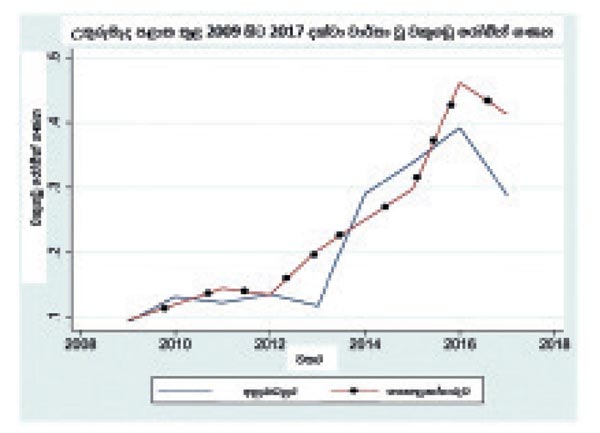
මෙහි දැක්වෙන ප්‍රස්තාරය විද්‍යාත්මක සඟරාවක (BMC Nephropathy, Vol. 20) පළ කරන ලද පර් යේෂණ පත්‍රිකාවකින් උපුටා ගැනුණකි. එයට අනුව වකුගඩු ආසාදිත ප්‍රදේශවල ජනතාව, ඉහතින් සඳහන් කළ පර් යේෂණ ප්‍රතිඵලවලින් පසු, 2014/2015 වකවානුවේ පටන් පිරිසුදු ජල ප්‍රභවයන්ගෙන් හා පිරිපහදු කළ ජලය පානය කිරීමට පටන්ගෙන ඇති අතර, ඒ හා සමගාමීව වකුගඩු රෝගවල පැහැදිලි අඩුවීමක් පෙන්වා ඇත. ගින්නොරුව ප්‍රදේශවාසීන්ට බීමට වර්ෂා ජලය රැස්කරගත හැකි ප්ලාස්ටික් ටැංකි මෙම වකවානුව තුළ සපයා දී තිබේ. අවාසනාවකට සෞඛ්‍ය බලධාරීන්ගේ මෙම පර්යේෂණ ඉදිරියට ගෙන ගොස් නොමැත.

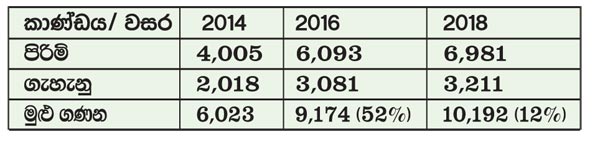
ඉහතින් සඳහන් කළ දත්ත ජාතික වකුගඩු රෝග ඒකකයේ නව වකුගඩු රෝගීන්ගේ දත්ත ආවෙක්ෂණයන් මගින් ද තහවුරු වී ඇති බව පහත වගුවෙන් පෙනී යයි.

වගුව 1: වකුගඩු රෝගීන් සංඛ්‍යාවන්

පෙර ගණනයට පසු රෝගීන් අඩුවීමේ ප්‍රතිශතය වරහන් තුළ දක්වා ඇත.

ඉහතින් සඳහන් කළ දත්ත අනුව ඉතා පැහැදිලි කරුණක් නම්, වකුගඩු රෝගය හා කඨින ජලයේ ඇති සම්බන්ධතාව පිළිබඳව ජනතාව දැනුවත් වීමෙන් අනතුරුව ඔවුන් පිරිසුදු පානීය ජල පරිභෝජනයට පෙළඹීම හරහා වගුගඩු රෝගීන් සංඛ්‍යාව විශාල ලෙස අඩු වී ඇති බවයි. මෙම සංඛ්‍යාව වසර දෙකකට ආසන්න කාලයක් තුළ සියයට 52 සිට සියයට 12 දක්වා අඩුවී තිබේ (1 වන වගුව). මේ වනවිටත් 2019 දත්ත නිකුත් වී නොමැති වුව ද මේ ප්‍රවණතාව සම්බන්ධයෙන් සෞඛ්‍ය අමාත්‍යාංශය පැහැදිලි අවබෝධයක නොසිටීම සහ එය ප්‍රසිද්ධියේ පිළිගැනීමට පැකිලීම ඉතා විවේචනාත්මකය.

කරුණු මෙසේ පවතිද්දී දේශීයව හැඬනගන අය කිහිප වරක්ම ප්‍රසිද්ධියේ ප්‍රකාශ කර ඇත්තේ ඉහත ප්‍රස්ථාරයේ වකුගඩු රෝගීන්ගේ වැඩිවීමේ කොටස පමණකි. පිරිසුදු ජල පරිභෝජනය හා සමගාමීව ප්‍රස්ථාරයේ වකුගඩු රෝගයේ අඩුවීමේ කොටස හිතා මතා ජනතාවගෙන් සඟවා ඇත. කිසිදු විටෙක වකුගඩු රෝගය හා කිවුල් ජලයේ ඇති සම්බන්ධතාව පිළිබඳව කතා කිරීමට ඉදිරිපත් නොවන අතර කිසිදු පැහැදිලි සාක්ෂියක් ඉදිරිපත් වී නොමැති කෘෂි රසායනවල ඍජු බලපෑම සම්බන්ධයෙන් ඇතැම් අය ඉතා විශාල ලෙස හඬක් නගනු පෙනේ.

රජරට වකුගඩු රෝගය හා කෘෂි රසායනවල සම්බන්ධතාව පිළිබඳව කිසිදු පැහැදිලි සාක්ෂියක් මේ වනවිටත් ඉදිරිපත් වී නොමැත.
Source: BMC Nephropathy Vol. 20, Article No. 338

ප්‍රස්තාරය

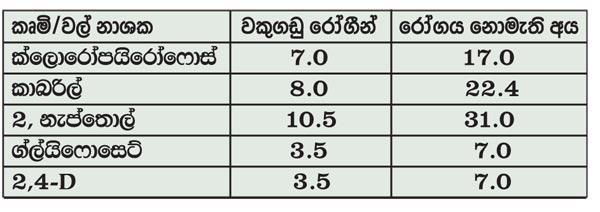
ලෝක සෞඛ්‍ය සංවිධානය විසින් 2013 වසරේ කරන්නට යෙදුණු සමීක්ෂණයකට අනුව, වකුගඩු රෝගීන් සුළු සංඛ්‍යාවකගේ මුත්‍රවල කෘමි නාශක හා වල් නාශක ප්‍රමාණ ප්‍රවේශ මට්ටමට (allowable limit) වඩා වැඩි බව පෙනී ගොස් ඇත. ඉහත සංසන්දනාත්මකව වකුගඩු රෝගය නොමැති (පාලක පරීක්ෂණය) ජනයාගේ මුත්‍රවල කෘෂි රසායන ප්‍රමාණය සඳහන් කොට නොතිබුණි. පසුව අප විසින් සියලු‍ මූලික දත්ත නැවත පරීක්ෂාවකට ලක් කරන ලදී. එහි ප්‍රතිඵල දෙවැනි වගුවේ අන්තර්ගත වේ. එයට අනුව අපට පෙනී ගියේ වකුගඩු රෝගී නොවන පුද්ගලයන් වැඩි සංඛ්‍යාවකගේ මුත්‍ර සාම්පලවල රසායනික ඉඩ දිය හැකි ප්‍රමාණයට වඩා තිබී ඇති වගයි. (වගුව 2 බලන්න)

වගුව 2: ඉඩදිය හැකි (allowable) මට්ටමට වඩා වැඩි ප්‍රතිශතවලින් කෘමි නාශක සහ වල් නාශක මුත්‍රවල අඩංගු වූ රෝගීන් ප්‍රතිශත

මූලාශ්‍රය: ලෝක සෞඛ්‍ය සංවිධානයේ වකුගඩු රෝග දත්ත වාර්තාව (මූලික දත්ත) 2013

වගුව 3: කෘෂි රසායන පරිභෝජනය (Kg/ha/yr) 
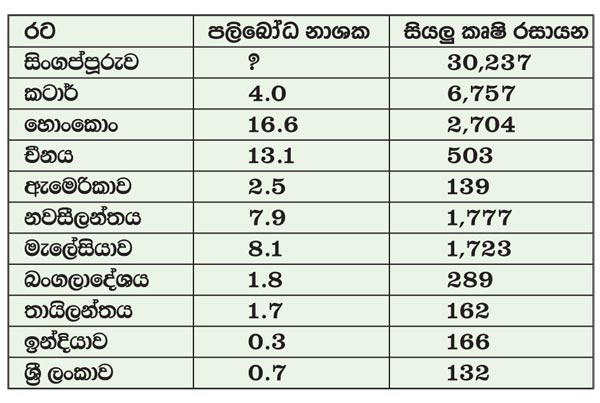
මූලාශ්‍රය: http://www.worldbank.org/indicator/AG.COM.Fert.2S; https//www.worldometers

අනතුරුව, 2018 වසරේදී ශ්‍රී ලංකාවේදී සිදුකරන විදේශීය විශේෂඥයන් හතළිස්අට දෙනකුගෙන් සමන්විත අන්තර්ජාතික වකුගඩු රෝග උපදේශන වැඩසටහනකදී ද තහවුරු කර තිබුණේ මෙම වකුගඩු රෝගය ඇතිවීම කෙරෙහි කෘෂි රසායනවල බලපෑම තහවුරු කිරීම සඳහා මෙතෙක් කිසිදු සාක්ෂියක් නොමැති බවය.

ශ්‍රී ලංකාව ඉතා විශාල වශයෙන් කෘෂිරසායන  භාවිත කරන රටක් ද?

ඇතැම් අයගේ පැහැදිලි කිරීම්වලට අනුව, ශ්‍රී ලංකාව යනු විෂ සහිත” කෘෂි රසායන භාවිතයෙන් ඉහළම ස්ථානයක සිටින රටකි. එසේ වුව ද ලෝක බැංකුවේ සහ එක්සත් ජාතීන්ගේ ආහාර සහ කෘෂිකාර්මික සංවිධානයේ දත්තවලට අනුව මෙය සම්පූර්ණයෙන්ම මිථ්‍යාවකි. තුන්වැනි වගුවෙහි දැක්වෙන පරිදි, ඇත්ත වශයෙන්ම ශ්‍රී ලංකාව යනු ආසියානු කලාපයේ කෘෂි රසායන භාවිතයෙන් ඉතා පහළ පට්ටමක සිටින රටකි. තව ද 2002 සහ 2016 වසර තුළදී ශ්‍රී ලංකාව තුළ 1 වැනි කාණ්ඩයේ (ඉහළ විෂ සහිත) පලිබෝධ නාශක භාවිතය සියයට 98කින් ද 2 වැනි කාණ්ඩයේ පලිබෝධ නාශක භාවිතය සියයට 29කින් ද අඩු වී තිබේ. මෙයින් අදහස් වෙන්නේ ශ්‍රී ලංකාව පලිබෝධ නාශක භාවිතය අතින් ප්‍රශස්ථ මට්ටමක පවතින බව නොවේ. ගොවීන් අතර කෘෂි රසායන අවිධිමත් භාවිතය සැලකිය යුතු ලෙස පවතී. එම ගැටලු‍ව විසඳීම සඳහා රජයේ ප්‍රමුඛතාව අත්‍යවශ්‍යය. මේ සඳහා විධිමත් ලෙස සැකසුණු කෘෂි ව්‍යාප්ති සේවයක් හරහා ගොවීන් දැනුවත් කිරීම අත්‍යවශ්‍යයෙන්ම සිදුකළ යුත්තකි.

පාරම්පරික ප්‍රබේද භාවිතයට නැවත පෙළඹෙමු ද?

තවත් අවිද්‍යාත්මක මාතෘකාවක් වනුයේ දේශීය සහල් පරිභෝජනය සහ පාරම්පරික වගා ක්‍රම අනුගමනය කිරීමේ ඇති අවශ්‍යතාවයි. අවාසනාවට නොදන්නා එක් වැදගත් කරුණක් මෙහි ඇත. එනම්, දැනට වගා කරනු ලබන Bw 364, At 353 සහ Bw 272-6b වැනි වැඩිදියුණු කළ වී ප්‍රබේදවල පාරම්පරික වී ප්‍රබේදවලට සමාන කළ හැකි ප්‍රෝටීන පදාර්ථ ප්‍රමාණයක් සහ ග්ලුකෝස් දර්ශක (glycemic indices) අඩංගු වන බවය. අප පරිභෝජනය කරන ප්‍රධාන ශක්ති ප්‍රභවය වන කාබෝහයිඩ්‍රේට ප්‍රධාන ආහාරය වන සහල්වලින් ලැබෙන අතර සෙසු පෝෂක සංඝටක මස්, මාළු, එළවළු හා පලතුරු මාර්ගයෙන් ලැබේ. අප නැවත පාරම්පරික ගොවිතැනට යන්නේ නම් ප්‍රධාන ශක්තිජනක ආහාරය වන සහල් නිෂ්පාදනය දැනට පවතින අගයට වඩා අඩකින් අඩුවනු ඇත.

හරිත විප්ලවයේ පියා ලෙස සැලකෙන ආචාර්ය නෝර්මන් බොලාෆ් 2000 වසරේදී නොබෙල් සමුළුව අමතමින් ප්‍රකාශ කරන ලද්දේ, ආහාර සුරක්ෂිතතාව රැකගන්නා ගමන් නැවත පාරම්පරික වගා ක්‍රමවලට පිවිසීමට අවශ්‍ය නම්, දැනට වගා කරන බිම් ප්‍රමාණය අවම වශයෙන් තුන් ගුණයකින් වැඩි විය යුතු බවයි. එය එසේ කිරීමට යමකුට අවශ්‍ය වේ නම් ඒ හරහා සිදුවන පාරිසරික හානිය කෙතරම් විය හැකි ද?

ජාතික මට්ටමේ සැලසුම් පද්ධතියක අවශ්‍යතාව

රටේ සංවර්ධනයට හා තිරසර බව සහතික කිරීම සඳහා අවශ්‍ය දැනුමින් යුත් මානව සම්පත්

එක් එක් ක්ෂේත්‍රයේ විශේෂඥයන් සමඟ සාකච්ඡා නොකොට ජනාධිපතිතුමා හදිස්සි තීරණ ගැනීමට පෙළඹීම කනගාටුවට කරුණකි. අන් බොහෝ රටවල මෙන් විශේෂඥයන් හා විද්වතුන්ගෙන් සමන්විත ජාතික සැලසුම් සංගමයක් හරහා වැදගත් ජාතික තීරණ ගැනීමට කටයුතු කළ යුතුය. එවැනි සංගමයක් ඉන්දියාවේ ශ්‍රී නේරුගේ යුගයේ සිට (1950) පැවැතුණි. අදත් එවැනි මණ්ඩලයක් නරේන්ද්‍ර මෝඩි අගමැතිවරයාගේ ප්‍රධානත්වයෙන් ක්‍රියා කරයි. තාක්ෂණයට ප්‍රමුඛත්වය දීම සඳහා එහි නාමය ජාතික තාක්ෂණික කමිටුව (NITI Aayagog) ලෙස මෑතකදී වෙනස් කොට තිබේ. යහපාලන යුගයේ එවැනි සැලසුම් මණ්ඩලයක් තිබුණ ද එය හරියාකාරව ක්‍රියාත්මක නොවුණි.

පාම් තෙල් හා කටු පොල් වගා තහනම, එක් කන්නයකින් රටම සහමුලින්ම කාබනික කෘෂිකර්මාන්තයට හැරැවීම වැනි තීරණවලට පෙළඹීමේදී ජනාධිපතිතුමා අවම වශයෙන් අදාළ ආයතනික නිලධාරීන්ගේ අදහස්වත් විමසීමට කටයුතු නොකිරීමේ පලවිපාක ඉදිරියේදී දිස්වනු ඇත.

(*** ආචාර්ය පරාක්‍රම වෛද්‍යනාථ)

ආහාර හිඟයක් ඇති විය හැකි බවට මහින්ද අමරවීරගෙන් ප්‍රකාශයක් (වීඩියෝ)

December 23rd, 2021

උපුටා ගැන්ම  හිරු පුවත්

පොහොර අර්බුදය හමුවේ ඉදිරියේදී අනිවාර්යයෙන්ම ආහාර හිඟයක් ඇති විය හැකි බව හිටපු කෘෂිකර්ම අමාත්‍යවරයෙකු වන මහින්ද අමරවීර මහතා ද පවසනවා.

කෙසේ වෙතත්, කෘෂිකර්ම අමාත්‍ය මහින්දානන්ද අලුත්ගමගේ මහතා පවසන්නේ, කිසිදු ආහාර හිඟයක් ඇති නො වන බවයි.

පොහොර නො මැති වීමෙන් ගොවියෝ අපහසුතාවක (වීඩියෝ)

December 23rd, 2021

උපුටා ගැන්ම  හිරු පුවත්

පොහොර නො මැති වීමෙන් වී,  බඩඉරිඟු ඇතුළු භෝග රැසක මහා කන්නයේ අස්වනු අඩුවනු ඇතැයි ගොවි ජනතාව පවසනවා.

වගාවන් සඳහා අවශ්‍ය පොහොර නො මැති වීමෙන් ප්‍රදේශ රැසක ගොවීන් තවදුරටත් අපහසුතාවට පත් ව සිටිනවා.

No pathogens confirmed in organic fertilizer samples tested by Singapore lab – Seawin Biotech

December 23rd, 2021

Courtesy Adaderana

The Chinese supplier of controversial organic fertilizer consignment says the reports of a Singaporean laboratory that tested its products shipped to Sri Lanka has confirmed that no plant, animal or human pathogens including Erwinia was detected in the samples.

MV Hippo Spirit carrying 20,000 tonnes of organic fertilizer from the Qingdao Seawin Biotech recently docked in Singapore for testing by SGS Testing & Control Services Singapore Pte. Ltd. after Sri Lanka rejected the shipment.

The fertilizer consignment in question was under the spotlight over the past few months after the National Plant Quarantine Services (NPQS), which tested the fertilizer samples sent by the Qingdao Seawin Biotech, revealed the detection of the microorganism called ‘Erwinia’ in September.

Several days later, Sri Lanka decided to suspend the importation of organic fertilizer from Seawin Biotech.

The Chinese firm retaliated, saying that the NPQS took only three days to draw a suspicious conclusion although it takes more than 6 days to identify Erwinia as per the ISPM27 rule in IPPC (International Plant Protection Convention).

The unscientific detection method and conclusion of NPQ in Sri Lanka” are not in compliance with the international animal and plant quarantine convention, Seawin Biotech claimed further and urged that Swiss SGS group, a top third-party testing organization, should re-test whether the samples contain Erwinia.

However, the Agriculture Minister had later insisted that the ship carrying the fertilizer consignment containing harmful bacteria will not be allowed to enter Sri Lanka. He had also said the samples from this fertilizer shipment will not be re-tested, nor will any payment be made to the Chinese firm in question.

The Chinese company later sent a letter of demand seeking USD 8 million in damages from the Additional Director of the National Plant Quarantine Services (NPQS) of Sri Lanka.

However, last week, the Sri Lankan government said a decision was taken to pay USD 6.7 million to the Chinese fertilizer company, on the advice of the Attorney General’s Department.

Disputed Chinese fertilizer shipment: Court order preventing payment to be revoked?

December 23rd, 2021

Courtesy Adaderana

The Colombo Commercial High Court’s decision on extending or revoking the interim order preventing the payment on Letter of Credit to the Chinese company that shipped a disputed consignment of organic fertilizer to Sri Lanka is expected to be delivered on January 06.

Accordingly, the relevant court order, which prevents the payment to the Chinese firm on Letter of Credit, was extended until next month.

A petition filed by the Colombo Commercial Fertilizers Ltd. was taken up before Commercial High Court Judge Pradeep Hettiarachchi this morning (December 23).

The Ceylon Fertilizer Company (CFC) had previously secured two enjoining orders from the Colombo Commercial High Court against Seawin Biotech, its local agent and the state-run People’s Bank, preventing the payment on Letter of Credit. 

The first court order against the Chinese firm in question was secured on October 23, blocking the People’s Bank from making any payment under a Letter of Credit opened in favour of the Chinese company.

During a previous proceeding, Additional Solicitor General Susantha Balapatabendi, who appeared on behalf of the CFC, told the court that China-based Qingdao Seawin Biotech Group Co., Ltd. had shipped a fertilizer consignment, which is a partial shipment worth more than a billion rupees that was procured through a tender process initiated by the Agriculture Ministry.

Although the said Chinese firm was required to ship sterile organic fertilizer under the tender contract, it had admitted in its shipping advice that the consignment may contain microorganisms, he had further told the court.

The National Plant Quarantine Services (NPQS), which tested the sample sent to them, had confirmed the presence of organisms, including certain types of harmful bacteria, the Additional Solicitor General had said, adding that, in this context, the Chinese firm in question had failed to complete the accepted terms of the tender.

As per the terms of the contracts, the payment for the controversial organic fertilizer shipment was slated to be made through a Letter of Credit established via the People’s Bank.

554 novel coronavirus cases in total confirmed and death toll moves up with 21 new fatalities today

December 23rd, 2021

Courtesy Adaderana

The daily count of COVID-19 cases confirmed in Sri Lanka moved to 554 today (December 23) as 82 more people were tested positive for the virus, the Epidemiology Unit said.

This brings the total number of confirmed cases of coronavirus reported in the country to 582,149.

As many as 558,527 recoveries and 14,832 deaths have been confirmed in Sri Lanka since the outbreak of the COVID-19 pandemic.

More than 8,700 active cases in total are currently under medical care, official figures showed.

The Director-General of Health Services has confirmed 21 more coronavirus-related deaths for December 22, increasing the death toll in the country due to the virus pandemic to 14,832.

According to the figures released by the Government Information Department, the deaths reported today include 14 males and 07 females.

Three of the patients are between the ages 30-59 years and the remaining 18 are in the age group of 60 years and above.

Reminiscences of Hela Havula proponents at a Boarding House in Mt. Lavinia

December 22nd, 2021

by Tudor Wijeratne

I would like to share my memories of a group of young boarders barely out of their teens, who later became household names in the fields of Arts, Music, Linguistics, Sinhala Literature, Journalism, and Medicine. They were boarders in my grandfather’s house in Mt. Lavinia, in the period 1940s – 1950s. Most of them were old boys of Mahinda College, Galle. They were all proponents of the Hela Havula language reform movement founded by the literary giant Cumaratunga Munidasa in 1941.

The likes of Edwin Ariyadasa, Vinnie Vitharana, Siri Gunasinghe, Martin Wickramasinghe, Dr.Ananda Mivanapalana (both living down Templer’s Road, Mt-Lavinia), Sunil Shantha, Ananda Samarakoon, P. L. A. Somapala and his wife Chitra, Arisen Ahubudu, Pragnadasa Kariyawasam, and W.D. Albert Perera who later changed his name and became famous as Pandit Amaradeva, used to live in this boarding house or visit this house often as it always provided a convivial atmosphere for warm, friendly social interaction. 

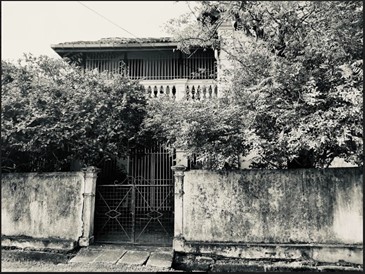
The boarding house was originally a six-bedroom up stair house situated at No.2, Old Station Road, Mount Lavinia and known as ‘Wije Niwasa’. It was built in 1920 by my paternal grandfather Paulus Wijeratne using the proceeds of a dowry given to him by his wife Caroline Wijeratne’s family along with the adjoining lands and houses. My grandparents have been
living in this house since then. They had three boys and two girls as children. When the children became adults and settled down all the lands and houses were equally distributed among all the five children.

Boarding House

After the children went their own ways and settled down separately, the grandparents were left behind as the only occupants of this house. To ensure that the relatively large vacant space in the house was properly utilized, they commenced a boarding arrangement to provide accommodation to boys of next of kin and children of close friends attending the Law College, University and Medical College. These boarders a few years later passed out from Law College, Medical College and Universities, and in the course of time scaled great heights in their
professional and academic callings. Some became reputed Supreme Court Judges and some after having obtained medical post – graduate qualifications became leading medical practitioners in the Island. Several others won fame in academia with astounding research and publications. One became successful in film productions while performing side by side his duties as a University Don. In 1945 my grandfather died. My grandmother was living in this house and as such she accommodated outsiders as boarders to earn an extra income. She was ably assisted by her daughter Mrs. Beatrice Abeyratne, who was living next door.

The landscape at that time was quite different to what it is today. The Galle Road was being widened at that time. There was nothing called drainage. All house holders used Bucket Latrines. There were paid scavenging labourers employed by the Urban Council who used to come daily to collect the sewage, and apart from their salaries the house holders used to
remunerate them separately at the end of the month. These scavenging labourers belonged to a caste called ’Sakkili’. They were from South India. After pipe borne water was supplied and drainage came into being these labourers faded out of sight with no vocation to earn their living. Today there is no trace of them as they had been absorbed into mainstream society. As there was no pipe borne water at that time it was well water (‘linda’ is well in Sinhala) that was used. The well in our house supplied drinking water to about ten houses in the locality. Food items and provisions were brought by vendors to the doorstep. The Newspaper Man used to deliver the daily papers. The Fisherman used to bring fish on two wooden scales tied at both ends to a wooden pole carried on the shoulder. The bread and short eats were supplied by the breadman who used to travel on a tricycle with a big square box in front containing his wares.
There were different vendors to supply grocery items like Rice, Dhal, Flour, condiments and the like, including vegetables. These were brought in Baskets or boxes. Even Hoppers, String Hoppers, Dosai, Pittu, Halapa with curries were supplied. Some of the vendors used to make a note of what was supplied daily and submit a bill at the end of the month for settlement. There was a Chinese man coming every week with a big box on his head containing clothing items for sale, followed by another seller bringing ornaments and accessories like trinkets etc., We used to call him the ‘Thoramble Karaya’. They are not to be seen today.

On the 2nd of January 1947 I joined St. Peter’s College Primary school, Bambalapitiya as a student. I was 9 years of age. As such I had to travel from my grandmother’s house to school. Only my grandmother and myself were living in the house apart from the boarders. The latter comprised Edwin Ariyadasa, his elder brother called Charlie or Daniel who was working at Walkers, Colombo, Vinnie Vitharana, Siri Gunasinghe, Pragnadasa Kariyawasam, B.W. Ariyawansha and P.G Dissanayake. They were all undergraduates at the University of Ceylon, Colombo, except Dissanayake who was at the Law College.

My grandmother was 80 years old at that time. She communicated and dealt only with Vinnie Vitharana, who I later came to know as the person who had acted in several capacities at the Boarding such as Coordinating Secretary, Prefect, Jack of all Trades, Master of Ceremonies etc., I found that all these boarders had previously studied at Mahinda College, Galle, Vinnie was the person who had recommended and got them admitted into the boarding.

During their stay they used to keep company with Martin Wickramasinghe and Dr. Ananda Mivanapalana both living down Templer’s Road, Mt-Lavinia and Sunil Shantha, Ananda Samarakoon, P. L. A. Somapala and his wife Chitra, Arisen Ahubudu, W.D. Albert Perera later changed his name and became famous as Pandit Amaradeva. Amaradeva used to visit the
boarding house very often. All these boarders were ardent supporters of the ‘Hela Haula’ movement founded by Munidasa Kumaratunga, the pioneer Sinhalese linguist, grammarian, commentator and writer, who founded the ‘Hela’ movement, which sought to remove Sanskrit influences from the Sinhala language. Kumaratunga is idolized today for his profound knowledge of the Sinhala language and its literary works.

The boarders were all teetotalers except for P.G. Dissanayake who enjoyed an occasional smoke.

Sir John Kotalawala

On Sundays, I used to go to the Mt-Lavinia Hotel beach bay for a swim with Vinnie Vitharana, Siri Gunasinghe, Ariyawansa and others. Every Sunday at around 9.45 a.m. the Right Hon. Sir John Kotalawala used to come to the bay for a half hour swim and we used to have a chit chat with him regularly. I became familiar with him as I used to go to the Kandawela Estate Ratmalana on scout camps and he used to provide us with breakfast. To me he was the finest gentleman that I have had the privilege of meeting. I admired his ‘I don’t care two hoots’, domineering, no nonsense attitude who had his way, without any fear. Incidentally, I became a Queen’s Scout. I received my Queen’s Scout Badge and Queen’s Certificate, along with six others, from the hands of the Chief Scout of the World, Lord Rowallen at the Big Jamboree held at Campbell Park, Havelock Town in 1953 in front of a crowd of about 30,000 people comprising Rovers, Scouts, Guides, Parents and well-wishers.

The house boarders were there from 1947. They used to have musical sessions on Saturdays and Sunday evenings which went on till late night. There was no liquor served at these sessions. Pragnadasa Kariyawasam who was studying Oriental Music i.e., the sitar, used to play the
same. Vinnie Vitharana was versatile in playing most of the musical instruments. Mainly the Serpina. Other instruments were the flute, Bongos, Guitar, Dolac, Castanets, Drums, Tabla, Violin, Spoons and Forks to make a racket. All used to take turns to play these instruments. Most of the songs were classics, the songs of Sunil Shantha, Amaradeva, Ananda Samarakoon,
Susil Premaratne, Arisen Ahubudu, and R. A. Chandrasena. The visitors were generally from the Arts side of tertiary education and some two or three persons used to stay overnight. I gained both knowledge and insights by listening to the lively discussions of the boarders and their guests on a variety of topics. There were sometimes lengthy arguments on a controversial topic. But there was no malice. All ended in good cheer.

After passing out of the University and Law College they gained employment and settled down elsewhere. However, Vinnie Vitharana and some others used to come to stay the night whenever they came to Colombo. They were well received by my parents who had come to re-settle in this house in 1953, after spending time in the outstations relating to my father’s employment. This resulted in the closure of the boarding. Vinne Vitharana and Arisen Ahubudu were very close family friends. Vinne Vitharana, upon his marriage, settled down next to our lane at
Samudrasanna Road, Mount Lavinia. I used to meet him and Edwin Ariyadasa at various Public  Lectures and Seminars and while in service, and they used to talk of the good old days at the former boarding house.

I am writing this article in remembrance of all the above boarders who are no longer among the living and who were able to live up to their reputations. Three became Legends in their own spheres of interest.

  1. Edwin Ariyadasa

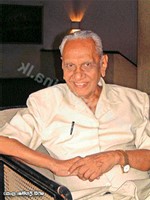
   Edwin Ariyadasa

He became a reputed newspaper editor, author and a media consultant. He grew into becoming an icon of the media, a pioneer in bilingual communication and wrote about Sinhala cinema in English in Sri Lanka. He was also the pioneer educator who brought the subject of mass communication closer to the general public.

Kalakirthi Dr. Wijethunga Karunaratne Edwin Ariyadasa was born on 3rd December 1922 and died at the age of 98 years on 22nd January 2021. He was from Unawatuna, Galle. Youngest of a family of three elder brothers and two elder sisters. He had his primary education at a Buddhist Mixed School in Unawatuna and received his secondary education at Mahinda College, Galle. He joined the University in 1945 and passed out with a Sinhala and English Language Bachelor’s Degree. He taught for a while at Mahinda College, and at the gentle persuasion of Dr. Ananda  Mivanapalana, he gained employment at the General Insurance Company. Martin Wickramasinghe thereafter invited him to join Lake House. The then Chairman of Lake House offered him a choice between ‘Daily News’ and ‘Dinamina’. As the ‘Dinamina’ Editor, Priyasena Nissanka was keen to have his services he joined ‘Dinamina’ as a Sinhala medium Journalist. Later he became an English Language Journalist. He progressed to become an Editorial staff member of ‘Divaina’, ‘Daily News’, ‘Sunday Observer’, ‘Silumina’, ‘Janatha’ and then ended up as the Editor of ‘Nawaugaya’.

Upon leaving Lake House he launched a monthly journal called ‘Tulana’. He edited 10 books and translated 11 English books into Sinhala. He researched and wrote on all aspects of cultural activity in the country. He was a walking encyclopedia. He was a keen observer and commentator on global events. The awards bestowed on him for life time achievements came like peerless gifts. He was honored at home and abroad for his literary contributions over the years with 14 awards spanning over three generations. He was the recipient of the coveted honoris causa D.Litt. from the University of Kelaniya for the lifetime contribution in the field of
journalism and communication. It is too numerous to mention separately each of his feats.  He was well known as the Father of Communication in Sri Lanka. He was a Newspaper Editor, Film Critique, Author, Translator, Journalist, Lecturer and Media Consultant. He was honoured as a ‘Kala Keerthi’ on 22 May 1990. He was a Bachelor.

2) Vinnie Vitharana

Vinnie Vitharana

Kalakirthy Professor Emeritus Dr. Vinnie Vitharana was born on 11th June 1928.  He studied at Christ Church College, Tangalle and later at Mahinda College, Galle. He later received Bachelor’s Degrees in Arts from the University of Ceylon, University of Peradeniya and University of London. He obtained a Doctorate in Philosophy in 1960 from the
University of Peradeniya. He was the Assistant Editor of the Sinhala Encyclopedia from 1953 to 1959. In 1960, he was a visiting Lecturer in Sinhala at the Vidyodaya University. He was the recipient of the UNESCO award for his contribution to Sinhala Literature.

He was a person with vast experience not only academically but also in various other fields. He served in such posts as Lecturer, Linguist, Scholar, Researcher, Archeologist and Geographer, and finally as a Professor. He was well known for his contribution to Sinhala Literature. He was during his lifetime rated as one of the prominent and notable Educators in the Country. He translated seven Sinhala books into English. He was awarded twenty times from 1962 to 2019 for his good work. He was the Founder Chairman of the Munidasa Kumaratunga Trust and Sunil Shantha Society. He had a great sense of humour. He was presented with the’ Kala Kirthi’ Award in 1993. He was married and had two children. He died on 2 December 2019 at the age of 91.

3) Siri Gunasinghe

       Siri Gunasinghe

Professor Emeritus Siri Gunasinghe was born on 18th February 1925 at Avissawella. Passed away at the age of 92 on 25th May 2017 in Canada. He studied at Mahinda College, Galle. He passed out from the University of Ceylon with a Bachelor of Arts Degree. Thereafter, he joined the University of Peradeniya as a lecturer and later became a Professor in the University. He contributed substantially towards the improvement of the Sinhala Language. He made wide ranging contributions as a poet, Sanskritian, Art Historian, Author, Filmmaker and Director.

He wrote the following books, Mas Ley Neti Ata 1956, Hewanella 1960, Mee Hardu Rathu Kekula 1962, Poetry Abi Neluma 1958, Alokamandawa 1958 and some other works. In 1968 he directed the Sinhala Film ‘Sath Samudura’ with D. B. Nihalsinghe as the Cameraman. It won
eight awards. In 1997 it was picked as one of the Ten Best Films of the First 50 years of Film Production of Sri Lanka. In 1970 he joined the University of Victoria in British Columbia, Canada as the Professor of the Department of History and Art. He was married and had two children.

4) Pragnadasa Kariyawasam

He was a native of Galle. He studied at Mahinda College, Galle and later passed out of the University of Ceylon with a Bachelor’s Degree in Arts in Pali and Sanskrit. He took to teaching and was later appointed as the Commissioner of Exams and retired in the 1990’s. He is said to
have died in 2001, in Kotte. I lost contact with him after he left the Boarding. He was married and had three children. One of his sons, Mr. Prasad Kariyawasam, later became the Sri Lankan Ambassador to the USA and our permanent representative at the UN. He held several Senior
Diplomatic Appointments.

5) B.P. Ariyawansha

B.P. Ariyawansha studied at Mahinda College, Galle and later passed out of the University of Ceylon with a Bachelor’s Degree in Arts and took to teaching. Subsequently, he was appointed as the Principal of Rahula College, Matara from 1956 to 1973.  Upon retirement he settled down in New Zealand with his daughter. He died in New Zealand.

6) M.B. Dissanayake

M.B. Dissanayake studied at Mahinda College, Galle and passed out of the Law College as an Advocate and proceeded to practice in Civil and Criminal law matters at the Tangalle Courts. I have lost touch with him.

Conclusion

I consider myself privileged to have had an opportunity to associate with intellectuals of such high caliber in my childhood days. They have left a deep impression in me particularly in respect to character building and love of language, tradition and cultural heritage. They shone later in public life as exponents of things indigenous. I trust that these reflections will give the reader a good insight into their charismatic lives.

Tudor Wijeratne

(Tudor Wijeratne is a retired Senior Superintendent of Police (SSP). He is an old boy of St. Peters’ College, Colombo 04.)

GLOBAL TAMIL FORUM SEEMS DELUDED AT THE MISGUIDED US SANCTIONS ON ARMY OFFICERS.

December 22nd, 2021

Insight by Sunil Kumar

Dec17th. 2021

The Global Tamil Forum (GTF) -strong supporters of the deposed Tamil tigerTerrorist  in their never ending cacophony about separatism and minority rights which are obsolete and abstract in multicultural Sri Lanka, as usual has called on the Government of Sri Lanka to reflect on recent messages conveyed by the US and the wider international community through the newly imposed sanctions by the US State Department on two former Sri Lankan Army officials albeit based on unproved speculation.

There seems to be a total misinterpretation of the protocols related and a display of their blatant continued moves towards agitating minorities within and without Sri Lanka and need to be educated if this is in anyway possible that they are stepping out of line with the realities involved in the US Sanctions which by themselves are out of line and a display of unwarranted US actions directed at SrI Lanka in recent times despite the so called cordiality between the two countries where a certain duplicity appears to be visible.

Indeed it is true that Sri Lanka is in the midst of many crises but to suggest that “the trajectory is heading towards increasing authoritarianism and militarised governance, further marginalisation of Tamil, Muslim, Hindu, and Christian communities, the debilitating financial crisis and the economic challenges engulfing the people and  has the potential to seed new conflicts in the country” is a bold and inciting statement by a puny group of minority Tamil protesters who have neither the right nor the credibility to make such statements without looking at themselves in the mirror and realizing that it is a complete misconception of the issue where they are attempting to create a non existent situation with much exaggeration where related facts seem to be distorted perhaps in an attempt to stir up dissent with the minority communities at a time when the Government is making valiant attempts to stabilize the country for all citizens not merely the minorities referred to.A government which has endeavored to deliver much to the country despite apparent shortcomings which hopefully will be supplemented soon against many odds..

The GTF says that quote ” Marking the Human Rights Day on 10 December, the US Government has imposed human rights-related sanctions on two Sri Lankan military officials. The US sanctioning these two officers appears more for the message it conveys to the Sri Lankan leadership, than for its direct impact on the individual officers,” in a  bold statement to the media without any consideration of its impact on themselves and their interpretation of the issue at hand which appear to have them confused as well as ignorant towards US objectives and its relevance to US / Sri Lankan relations.

Furthermore the US State Department sanctions on Sri Lanka Navy Intelligence Officer Chandana Hettiarachchi and former Sri Lanka Army Staff Sergeant Sunil Ratnayake for their involvement in the gross violation of human rights” on Human Rights Day on 10 December are based on  unproven speculations portraying the GTF’s haste to draw conclusions sans tangible proof and perhaps needs to be confronted towards punitive action against them by the Government of Sri Lanka.

The links, sympathies and involvement of the GTA with the TNA who are also surreptitious sympathizers of the former Tamil tigers and continue to promote the cause of secession and separation are well known and hence all the agitation by the GTA seems hardly worth a second glance from a Government perspective in these turbulent times where the country faces greater priorities beyond the bickering of vague entities such as the GTA and the directionless TNA often clutching at straws in their desperate attempt to survive.

It is also quite apparent that the Biden Administration is on a spree of disentitlingcertain minority nations of their right towards asserting sovereignity based on its own concept of righteousness  and misconceived agendas which do not serve them well and a stark reality in the world of today where Sri Lanka appears to have become a target despite there being no tangible evidence or proof towards complete credibility in the present climate of US accusations.!

The GTF based on all this are better off focusing on things merit worthy to Sri Lanka as a collective part of the population albeit under a different banner!.

The Holy Triple Gem for ALL BUDDHISTS are the Buddha, Dhamma and Sangha. If you do not respect one, you do not respect the other two also.

December 22nd, 2021

Ivan Amerasinghe

Receiving a basic degree or even a PhD is no reason to shun those who teach the Dhamma.  

Colombo University has for decades been the hunting ground for INGO and Marxist anti-Buddhist mercenaries. The international agencies and the Western Embassies have a permanent gravy distribution station in Colombo campus. Paragoda Hamuduruwo sings hosannas on Ven. Walpola Rahula Hamuduruwo as Vice Chancellor of Vidyalankara University. Actually Ven Rahula was the VC of Vidyodaya University. He left Vidyodaya in 1969 because of his disaffection with the political regime. He was the first Bhikkhu to become a Professor of a Western University as well as a revered scholar at Sorbonne University.  

It is said that his book Bhikshuvakage Urumaya (Heritage of the Bhikkhu) was a strong voice in the Buddhist Nationalist movement that led to the 1956 electoral victory of the SLFP under the banner of the Sangha, Weda, Guru, Govi, Kamkaru flag.   

Every year thousands of Sri Lankan applicants wait in the new students’ registration queue at British Universities. Of those, hundreds apply to Manchester University willing to pay between £20,000 (Rs. 5,364,631.87) to £47000 (Rs. 12,606,884.90) per annum for academic fees alone! They know the value of a British University degree. Their free educated compatriots in Sri Lanka revel in inhuman ragging of juniors while being unquestioning sycophants to the teachers in the hope of securing at least a 2nd Upper degree. Hence the calamities one observes within our campuses. 

Shame on those arrogant youth who selectively shunned a Bhikkhu because of his yellow robes than any other lame excuse! 

Relevant comparisons between Manchester Uni and Colombo Uni are in the attachment

Differences between a First World University and a Third World University

The Arrogance of Free University Education in Sri Lanka

University of Manchester UK [established 1824]                                          

No. Students > 41000                                  

Ranked 27 in the world according to the QS World University Rankings® 2021

Motto: Cognitio Sapientia Humanitas, in Latin for ‘knowledge, wisdom and humanity’.

All students pay University Fees.

Sri Lankan students pay for Foundation year £20 -25000 and £24000 for Science and £47000 per annum for Clinical years in Medicine and Dentistry

Chancellor 

Lemn Sissay MBE. [https://en.wikipedia.org/wiki/Lemn_Sissay]

no formal higher or university education

author, broadcaster, poet.

Sissay is the illegitimate son of an Ethiopean woman immigrant to the UK in1966, brought up in foster care and then various care homes;

Honoured by Her Majesty the Queen of Great Britain and the Head of the Commonwealth.

Nominated by the General assembly, the Students Body and the superannuated staff.

Enthusiastically welcomed by the University academics, administrators and the Students’ Union representing 41000 students of the University

+++++++++++++++++++++++++++++++++++++++++++++++++++++++++++++++++++++

University of Colombo [established 1933]

No. of Students           11000

Ranked 1592 in the world according to the QS World University Rankings® 2021

Motto: बुद्धिः शर्वत्र भ्रजते (Buddhi Sarvathra Bhrajate), Sanskrit as Wisdom Enlightens

All students have Free Education

Chancellor – Ven Muruththetuwe Ananda Nayaka Thero

Leader of a national health union.

Represents the Holy Triple Gem of the Buddha, the Dhamma and the Sangha” of the Sasanaya.

Teachers’ associations and Main Student’s union of University of Colombo objected the appointment of Ven. Muruththettuwe Ananda Thero as the Chancellor of the University of Colombo. Decided to show the displeasure of it in the Ceremonial Graduation 2019 of the University of Colombo.

Teachers’ associations and Main Student’s union pressured those graduating to boycott/refuse to receive the graduation certificates from the hands of the Buddhist Thero.

Sri Lanka Can Follow Bangladesh’s Act Of ‘Balancing Capability’ In The Strategically Significant ‘Bay of Bengal’ Region

December 22nd, 2021

MD Pathik Hasan

The name ‘Bay of Bengal’ is a book of pride for Bengalis! Large cities like Madras (Chennai), Hyderabad, Bhubaneswar in all areas or states, are located on the shores of the Bay of Bengal, but the sea is not named after them. Again, it was not named after a region like the Arabian Sea, but after Bengal or Bengal. That is why the world has to remember the name of Bengal from time to time. In the middle of Myanmar, Andaman Islands, Indonesia, Sri Lanka, Bangladesh and the vast territory of South India, the reservoir of 21 lakh 62 thousand square kilometers is named after Bengal. It is known in the world as the Bay of Bengal.

The Bay of Bengal has now become the center of international politics due to its economic and strategic importance but in fact it extends to the bottom of Sri Lanka. It is the busiest international shipping route in the world. About 40,000 ships ply this route each year. Half of the world’s goods and fuel vessels use this route.

Looking at the picture of the Bay of Bengal, it is clear that its all-northern boundary has formed a parallel belt. It is as if a country has a water map in its taxpayer and has extended its exterior. The two sides on the outside have gradually increased and ended in Orissa, Andhra Pradesh and Tamil Nadu. On the other side, the Andaman Islands merge with Sumatra from Myanmar and turn right to join Sri Lanka. Cox’s Bazar, the largest beach in the world, the Sundarbans, the largest uninterrupted mangrove forest, and one of the world’s most delicious fish species, the habitat of hilsa is linked and associated with Bay of Bengal.

The ports on the shores of the Bay of Bengal bear the imprint of political, religious and economic tensions over the centuries. From ancient times to the Middle Ages, Arab traders and missionaries flocked to the port on the shores of the Bay of Bengal via the Arabian Sea. After the discovery of the Bay of Bengal by Vasco-da Gama, Portuguese, French, Danish, Dutch and English companies started coming from Europe. They built their company’s offices and forts on the shores of the Bay of Bengal. From this time the conflict between the European merchants and the Indian kings began. Towards the end of this conflict, the British East India Company built their two and a half hundred-year empire in India.

Now, Bay of Bengal gets attention from world powers. US, UK, China, India, Japan has focused their attention to ‘Bay of Bengal’. That is the strategy. US has shifted its policy from ‘Asia Pacific’ towards ‘Indo Pacific’ to counter the China’s ‘BRI’. Both parties want Bangladesh into their respective blocks. In this regard, Bangladesh is handling this issue tactically. It avoids its involvement with the blocs directly. Having request from US for years, Bangladesh didn’t show any interest to sign ACSA (Acquisition and Cross-Servicing Agreement) and GSOMIA (General Security of Military Information Agreement) agreement with US. On the other hands, When Chinese Envoy to Bangladesh commented that Bangladesh shouldn’t join IPS this year, Bangladesh strongly protested against the remarks uttered by Chinese envoy saying Bangladesh is capable to form its own national policy. This is the capability of Bangladesh. Basically, Bangladesh doesn’t like any controversy with anyone. Its aim is very simple and clear which is friendship to all, malice to none. Bangladesh wants and likes to go ahead with all regional and global actors.

Bangladesh policy is not towards bi-partisan international politics. Bangladesh was an active member of ‘Non-Aligned Movement’. Bangladesh has no intention and interest to join any block. But Bangladesh has intention to be benefitted from the blocks. Bangladesh wants and believes peaceful coexistence in the region. It always avoids any kind of clash with any actor. Despite having the provocation from Myanmar during the Rohingya refugee crisis in 2017, it was abstained from using any kind of force. Bangladesh knows the Strategy. Bangladesh is balancing successfully with ‘BRI’ and ‘IPS’. Bangladesh has been exploiting ‘the strategic significance of Bay of Bengal’. Bangladesh

Whether Bangladesh is involved in the US-led Indo-Pacific Strategy (IPS) or the Chinese-led Belt and Road (BRI), it must maintain peace and the rule of law in the maritime region to reap the maximum economic benefits from the Bay of Bengal. Bangladesh needs to acquire natural resources as well as the ability to catch fish from the deep sea. If it is possible, it will open the way for Bangladesh to earn huge amount of foreign exchange just like fish and mineral garments.

The port plays an important role for connectivity. Bangladesh has three seaports. But due to depth constraints, large vessels (mother vessels) are still unable to accommodate. The establishment of a deep seaport at Matarbari in Cox’s bazar in collaboration with Japan will solve this problem as well as reduce the cost of transporting goods. According to the reports of Bangladeshi media outlets, Bangladesh trades about 9 thousand crore dollars a year by sea. Four and a half thousand foreign ships transport these imported and exported goods to Bangladesh. And Bangladesh has to pay about 900 crore dollars every year for the charter of these ships. Bangladesh has only 60 ships to transport goods at sea. In this case, Bangladesh has a serious shortage of capacity. Bangladesh needs to increase its capability.

The sea border of Bangladesh is 1 lakh 18 thousand square kilometers. On the other hand, if all the rivers and haors (some kind of pond originated from and connected with rivers) of Bangladesh are added, it stands at 15,000 kilometers. Bangladesh needs training, education and infrastructure to increase its ability to extract resources from this vast ocean. At present Bangladesh has Maritime University, Oceanographic Department and Oceanographic Research Center. These institutions should also come forward to expand education in this sector.

Drug smuggling, piracy in the Malacca Strait, pollution from ships or land are destroying the marine environment. Effective steps can be taken to address these crises jointly through BIMSTEC, SAARC and ASEAN. Bangladesh has made changes in the Maritime Act of 1974. Marine Economy Cell has been formed. Besides, maritime economy action plan has been adopted. Bangladesh wants to join ‘Colombo Security Conclave’ now. Its aim is to tackle the maritime threat.

Japan attaches great importance to a free and open Indo-Pacific region. Bangladesh is one of the partners of Japan’s Big-B initiative around the Bay of Bengal. Under this, Matarbari in Maheshkhali will be turned into a hub for import and export of electricity and energy, industry and sea. The Rohingya crisis could lead to instability in the region. So, Japan should can play a significant role in case of the repatriation of Rohingya, which is a sustainable solution to this crisis.

The Bay of Bengal was historically important. Due to geopolitics, its importance has increased since the last 80’s. Bangladesh is an important player in these geopolitics. The present government was pursuing a policy of maintaining good relations with all Indo-Pacific countries, avoiding conflict. And because of the balance, Bangladesh is an active partner of the US IPS as well as China’s BRI. Basically, Bangladesh shows the rest of the countries in the region how to balance with big powers simultaneously. Its balancing capability is really praiseworthy and exemplary for many countries.

The US-Japan-Australia-India formed ‘QUAD’ to counter China’s ‘BRI’. Despite competition over geopolitics, the United States and China are each other’s biggest trading partners. Bangladesh knows and understands this issue. Bangladesh should and must balance with these. Bangladesh needs America and China both for ensuring its business interest. Strategic significance of Bay of Bengal will make Bangladesh more prosperous in the region. Sri Lankan case is same like Bangladesh case. Sri Lanka can follow Bangladesh’s case.

මහජන නියෝජිතයින් යයි කියාගන්නා මැති ඇමතිවරුන් 60 දෙනෙක් නව වසරේ මහජන මුදලින් ඉසුරින් පිරුණු විදේස රටවල නත්තල් සවාරියේ (ප්‍රවෘතියක්)

December 22nd, 2021

සුදත් ගුණසේකර මහනුවර

මම මේ රටේ ජනාධිපතිනම් මොවුන්  සියළුදෙනාම  යවන්නේ අපායට

මැති මතිවරුන් 60ක් ඔවුන්ගේ පවුල්වල අයද සමග මේ දිනවල ඇමෙරිකාව එන්ගලතය වැනි රටවල  නිවාඩුවක් ගතකිරීම සදහා විනෝද සවාරියක් පිටත්ව ගිය බවට ප්‍රවෘතියක් පලවිය.

මුලු රට මෙන්ම මුළුජාතියම විසාලා මහනුවර මෙන් රෝ බිය, දුර්භික්ස බිය,රෝගබිය සහ දේසපාලන යක්සශබිය  යන සිව් බියෙන් හා, බඩගින්න, අහස උසට ඉහලගිය බඩු මිල, සහ දෝරේ ගලා උතුරායන ජනතා අසහනයට අමතරව ඩොලර් බිලියන  60 කට වැඩි ලෝක නය උගුලක හිරවීසිටීම වැනි, බුදු දහමේ දැක්වෙන අන්තෝ ජටා බහි ජටා වැනි පඹගාලක  පටලැවී  ගැලවෙන මඟක් නොදැක රටේ ප්‍රධාන අහාරය වූ  බත් පතද තව ටික දිනකින් නැතිවන තත්වයට රට ඇද වැටී තිබේන මෙවැනි බියකරු වෙලාවක  රටේ තියෙන අන්තිම ඩොලරයද අතගාගෙන ඇමැති  බලතල යොදාගෙන  සිය අඹුදරුවන්ද සමන්ග ලෝකය වටා විනෝද සවාරි යන මහජන නියෝජිතයින්යයි කියාගන්නා මේ නරුමයින් හැමදෙනාම රටතුල තිබෙන අන්තිම තඹයද හොරගෙන රෝමය ගිනිගනිද්දී වීණා වාදනය කළ නීරෝ මෙන්” තමන් බලයට පත්කළ චන්ද දායකයින් ජීවිතයත් මරණයත් සමඟ පොරබදද්දී කිසිම විළිලජ්ජාවක් හෝ හිරිකිතයක් නැතිව රට සවාරි යන මුන් යැවිය යුත්තේ රටද? ගෙදරද එසේත් නැතිනම් සදාකාලික දේසපාලන වනසන්ඩයටද?.  

මේ  60 දෙනා පමණක් නොව පාර්ලිමේන්තුවේ සිටින 225  දෙනාටම තවදුරටත් මේ රට විනාස කිරීමට ඉඩ නොදී  ඔවුන්ද වහාම ගෙදර යැවිය යුතුයයියයි මම යෝජනා කරමි. එසේකොට මේ රටට හෝ ජාතියට කිසිදු වැඩක් නැති මහජන නියෝජිතයින් යයි කියන හොරමුලකට මාලුකඩයක මන්නා අමෝරාගෙන සණ්ඩුවන මාලුකාරයින් මෙන් ගහ බැනගමින් උනුනුන් මරා ගනිමින් මහජන මුදලින් කා බී බාල් නටන පාර්ලිමේන්තුව නැමැති දියවන්නා ඔය හෝටලයද වහාම වසා දමන මෙන් මම යෝජනා කරමි. එසේ නොකළොත් රට ජාතිය්ට ආදරය කරන මේ රටේ දේසප්‍රේමී පීඩිත ජනතාව එදා පැරිස් නගරයේ බැස්ටීල් හිරගෙදරට කලාක් මෙන් මේ රටත් ජාතියත් 1948 සිට විනාශ කළ එසේම් අදටත් එම පාප කර්මයම කරන ඔය පචමන්දිරයට ගිනිතියා විනාස කරන දිනය එතරම් ඈතක නොවන බවනම් නොකියාම බැරිය.

2019 ජනාධිපතිවරයාගේ රුවන්වැලිසෑ මලුවේ දිවුරුමේ කිසියම් වගන්තියක් තවමත්  පාවානොදී ඉතිරිවී ඇත්නම් එය හෝ රැකගැනීමට තවමත් අවන්කව අදහස් කරන්නේනම් ජනාධිපතිවරයාට  මේ ගැන වහාම බුද්ධිමත්තීරණයක් ගැනීමේ කාලය නමැති මහෝගය දැන් නහය ලන්ගටම එලඹ ඇතැයි මම සිතමි.එසේ නොකළොත් වැඩිකලක් යාමට පෙර ජනාධිපතිවරයා ඇතුළු මේ මහජන නියෝජිතයින්යයි කියාගන්නා රටවැසියන් රැවටීම සඳහා දිවා කාලයට පමණක් ස්වේත සළුධාරීන් වන සියළුදෙනාටම රනිල්ගේ ගජ මිතුරු අර්ජුන් මහේන්ද්‍රන්ට මෙන් සින්ගප්පූරුවේ හෝ වෙනත් සයිබීරියාවක සැගවී සිටීමට පිටරට සමූහ බින්ගෙවළ්  සොයාගැනීමට සිදුවනු නොඅනුමානය.

එහෙත් මේ කිසිවෙකුට කිසිදාක යම රජුගෙන් නම් සමාවක් නොලැබෙන නිසා අවසානයේ අපායේම පදින්චිවීම අනිවාර්ය වනු ඇත

Strategic Significance of ‘Bay of Bengal’ and Bangladesh’s Act Of ‘Balancing Capability’

December 22nd, 2021

MD Pathik Hasan

The name ‘Bay of Bengal’ is a book of pride for Bengalis! Large cities like Madras (Chennai), Hyderabad, Bhubaneswar in all areas or states, are located on the shores of the Bay of Bengal, but the sea is not named after them. Again, it was not named after a region like the Arabian Sea, but after Bengal or Bengal. That is why the world has to remember the name of Bengal from time to time. In the middle of Myanmar, Andaman Islands, Indonesia, Sri Lanka, Bangladesh and the vast territory of South India, the reservoir of 21 lakh 62 thousand square kilometers is named after Bengal. It is known in the world as the Bay of Bengal.

The Bay of Bengal has now become the center of international politics due to its economic and strategic importance but in fact it extends to the bottom of Sri Lanka. It is the busiest international shipping route in the world. About 40,000 ships ply this route each year. Half of the world’s goods and fuel vessels use this route.

Looking at the picture of the Bay of Bengal, it is clear that its all-northern boundary has formed a parallel belt. It is as if a country has a water map in its taxpayer and has extended its exterior. The two sides on the outside have gradually increased and ended in Orissa, Andhra Pradesh and Tamil Nadu. On the other side, the Andaman Islands merge with Sumatra from Myanmar and turn right to join Sri Lanka. Cox’s Bazar, the largest beach in the world, the Sundarbans, the largest uninterrupted mangrove forest, and one of the world’s most delicious fish species, the habitat of hilsa is linked and associated with Bay of Bengal.

The ports on the shores of the Bay of Bengal bear the imprint of political, religious and economic tensions over the centuries. From ancient times to the Middle Ages, Arab traders and missionaries flocked to the port on the shores of the Bay of Bengal via the Arabian Sea. After the discovery of the Bay of Bengal by Vasco-da Gama, Portuguese, French, Danish, Dutch and English companies started coming from Europe. They built their company’s offices and forts on the shores of the Bay of Bengal. From this time the conflict between the European merchants and the Indian kings began. Towards the end of this conflict, the British East India Company built their two and a half hundred-year empire in India.

Now, Bay of Bengal gets attention from world powers. US, UK, China, India, Japan has focused their attention to ‘Bay of Bengal’. That is the strategy. US has shifted its policy from ‘Asia Pacific’ towards ‘Indo Pacific’ to counter the China’s ‘BRI’. Both parties want Bangladesh into their respective blocks. In this regard, Bangladesh is handling this issue tactically. It avoids its involvement with the blocs directly. Having request from US for years, Bangladesh didn’t show any interest to sign ACSA (Acquisition and Cross-Servicing Agreement) and GSOMIA (General Security of Military Information Agreement) agreement with US. On the other hands, When Chinese Envoy to Bangladesh commented that Bangladesh shouldn’t join IPS this year, Bangladesh strongly protested against the remarks uttered by Chinese envoy saying Bangladesh is capable to form its own national policy. This is the capability of Bangladesh. Basically, Bangladesh doesn’t like any controversy with anyone. Its aim is very simple and clear which is friendship to all, malice to none. Bangladesh wants and likes to go ahead with all regional and global actors.

Bangladesh policy is not towards bi-partisan international politics. Bangladesh was an active member of ‘Non-Aligned Movement’. Bangladesh has no intention and interest to join any block. But Bangladesh has intention to be benefitted from the blocks. Bangladesh wants and believes peaceful coexistence in the region. It always avoids any kind of clash with any actor. Despite having the provocation from Myanmar during the Rohingya refugee crisis in 2017, it was abstained from using any kind of force. Bangladesh knows the Strategy. Bangladesh is balancing successfully with ‘BRI’ and ‘IPS’. Bangladesh has been exploiting ‘the strategic significance of Bay of Bengal’. Bangladesh

Whether Bangladesh is involved in the US-led Indo-Pacific Strategy (IPS) or the Chinese-led Belt and Road (BRI), it must maintain peace and the rule of law in the maritime region to reap the maximum economic benefits from the Bay of Bengal. Bangladesh needs to acquire natural resources as well as the ability to catch fish from the deep sea. If it is possible, it will open the way for Bangladesh to earn huge amount of foreign exchange just like fish and mineral garments.

The port plays an important role for connectivity. Bangladesh has three seaports. But due to depth constraints, large vessels (mother vessels) are still unable to accommodate. The establishment of a deep seaport at Matarbari in Cox’s bazar in collaboration with Japan will solve this problem as well as reduce the cost of transporting goods. According to the reports of Bangladeshi media outlets, Bangladesh trades about 9 thousand crore dollars a year by sea. Four and a half thousand foreign ships transport these imported and exported goods to Bangladesh. And Bangladesh has to pay about 900 crore dollars every year for the charter of these ships. Bangladesh has only 60 ships to transport goods at sea. In this case, Bangladesh has a serious shortage of capacity. Bangladesh needs to increase its capability.

The sea border of Bangladesh is 1 lakh 18 thousand square kilometers. On the other hand, if all the rivers and haors (some kind of pond originated from and connected with rivers) of Bangladesh are added, it stands at 15,000 kilometers. Bangladesh needs training, education and infrastructure to increase its ability to extract resources from this vast ocean. At present Bangladesh has Maritime University, Oceanographic Department and Oceanographic Research Center. These institutions should also come forward to expand education in this sector.

Drug smuggling, piracy in the Malacca Strait, pollution from ships or land are destroying the marine environment. Effective steps can be taken to address these crises jointly through BIMSTEC, SAARC and ASEAN. Bangladesh has made changes in the Maritime Act of 1974. Marine Economy Cell has been formed. Besides, maritime economy action plan has been adopted. Bangladesh wants to join ‘Colombo Security Conclave’ now. Its aim is to tackle the maritime threat.

Japan attaches great importance to a free and open Indo-Pacific region. Bangladesh is one of the partners of Japan’s Big-B initiative around the Bay of Bengal. Under this, Matarbari in Maheshkhali will be turned into a hub for import and export of electricity and energy, industry and sea. The Rohingya crisis could lead to instability in the region. So, Japan should can play a significant role in case of the repatriation of Rohingya, which is a sustainable solution to this crisis.

The Bay of Bengal was historically important. Due to geopolitics, its importance has increased since the last 80’s. Bangladesh is an important player in these geopolitics. The present government was pursuing a policy of maintaining good relations with all Indo-Pacific countries, avoiding conflict. And because of the balance, Bangladesh is an active partner of the US IPS as well as China’s BRI. Basically, Bangladesh shows the rest of the countries in the region how to balance with big powers simultaneously. Its balancing capability is really praiseworthy and exemplary for many countries.

The US-Japan-Australia-India formed ‘QUAD’ to counter China’s ‘BRI’. Despite competition over geopolitics, the United States and China are each other’s biggest trading partners. Bangladesh knows and understands this issue. Bangladesh should and must balance with these. Bangladesh needs America and China both for ensuring its business interest. Strategic significance of Bay of Bengal will make Bangladesh more prosperous in the region.

Sri Lanka inflation hits record high as food crisis looms

December 22nd, 2021

Courtesy Business Recorder

COLOMBO: Sri Lanka’s inflation hit a record 11.1 percent in November, official figures showed Wednesday, and authorities warned a worsening economic crisis could prompt further food rationing.

The island’s tourism-dependent economy was hammered by the pandemic and the government imposed a broad import ban to shore up foreign exchange reserves, triggering shortages of essential goods.

Supermarkets have for months been rationing milk powder, sugar, lentils and other essentials as commercial banks ran out of dollars to finance foreign goods.

The shortages have also driven up prices, with food costs up 17 percent from a year ago according to Sri Lanka’s census and statistics department.

Sri Lanka hikes fuel prices as economic crisis worsens

Inflation figures on-year were the highest since the department launched its National Consumer Price Index (NCPI) in 2015.

Authorities may have to impose further food rations and seek foreign aid to help feed the most needy, agriculture ministry secretary Udith Jayasinghe told reporters.

“We may have to borrow grains such as corn from friendly countries and think of rationing food so that mothers and the sick can be fed,” he said.

“Others may have to make sacrifices.”

Food shortages have been worsened by the government’s ban on agrochemical imports, which was lifted last month after widespread crop failures.

Sri Lanka had foreign reserves of just $1.58 billion at the end of November, down from $7.5 billion when President Gotabaya Rajapaksa took office in 2019.

The central bank has appealed for foreign currency — even loose change that people may have after returning from overseas trips.

Sri Lanka will use tea to pay off its $251 million oil debt to Iran

December 22nd, 2021

Carla Mozée Courtesy Business Insider

Tamil women picking tea leaves near a waterfall in Sri Lanka, Ceylon, Central Province, Nuwara Eliya, tea plantation in the Highlands,
Tamil women pick tea leaves in the highlands of Nuwara Eliya, Sri Lanka. Getty Images
  • Sri Lanka reached an agreement to send tea to Iran to settle a $251 million oil debt, according to reports. 
  • Sri Lanka wasn’t able to pay the debt via other means as US sanctions prohibit dealings with Iranian banks. 
  • But Sri Lanka said its tea-barter plan does not violate UN or US sanctions against Iran. 
  • Sign up here for our daily newsletter, 10 Things Before the Opening Bell.

Sri Lanka will send tea to Iran to clear its debt for past oil imports, with the south Asian country turning to the commodity as a payment method in the face of shrinking foreign reserves and sanctions on Iran, according to news reports Wednesday. 

Representatives from the two countries on Tuesday signed a memorandum of understanding that stipulates Sri Lanka will settle $251 million in oil import dues to Iran by bartering tea, the Tehran Times reported, citing Iran’s Trade Promotion Organization. 

Sri Lanka plans to send $5 million worth of tea to Iran each month until the debt is settled, said Ramesh Pathirana, head of Sri Lanka’s plantation ministry, according to a BBC News report.  

State-run Ceylon Petroleum Corp. has a $250.9 million debt to the National Iranian Oil Co. Sri Lanka wasn’t able to settle the debt through other means as US sanctions prohibit dealings with Iranian banks, but the country said the new arrangement will not violate US or UN sanctions,

Tea has been categorized as a food item under humanitarian grounds while none of the black-listed Iranian Banks will be involved in the equation,” said Pathirana, according to the news site EconomyNext. 

The barter agreement also comes as Sri Lanka is undergoing severe financial stress. It’s facing a fall in foreign-exchange reserves against high external debt payments and limited financing inflows, Fitch Ratings said last week in downgrading Sri Lanka’s sovereign rating to CC from CCC. The downgrade reflects Fitch’s view that Sri Lanka, which is among the world’s top tea producers, has an increased probability of a default event in the coming months. 

The country’s foreign exchange reserves have dropped by roughly $2 billion since August, to $1.6 billion at end of November, or the equivalent to less than one month of current external payments, said Fitch. The ratings group said Sri Lanka faces foreign-currency debt service payments of $6.9 billion in 2022. 

The country’s external finances are also challenged in part by a slide in remittances and the blow dealt by the coronavirus pandemic to the economy, as tourism is a key driver, said Fitch.

Iran, Sri Lanka sign agreement in Colombo to settle oil debt issue

December 22nd, 2021

Courtesy Islamic Republic News Agency

Iran, Sri Lanka sign agreement in Colombo to settle oil debt issue

Tehran, IRNA – Iran and Sari Lanka have signed an agreement on working out ways to settle the latter’s oil debt to Iran.

Chairman of Trade Promotion Organization of Iran Ali-Reza Peimanpaak and minister of trade of Sari Lanka signed the agreement in a meeting, according to the Wednesday report of Iran’s Embassy in Colombo, the commercial capital of Sri Lanka.

Peimanpaak, who is also a deputy for the Ministry of Industry, Mines and Trade, arrived in Colombo early on Monday as his first trade destination to East Asia.

Based on mutual agreement, Sri Lanka will monthly export tea to Iran to repay parts of its oil debt to the country, Peimanpaak underlined.

The issue of Sri Lanka’s oil debts to Iran remained unsolved for years until the visit.

During his stay in Sri Lanka, Peimanpaak held talks with several officials there and reviewed ways to develop economy and make use of the existing opportunities.

China donates medical equipment to SJB’s ‘Husmak’ initiative

December 22nd, 2021

Courtesy Adaderana

The Chinese government has donated 8 lifesaving kidney dialysis machines worth Rs. 20 million to hospitals in the Northern and Eastern provinces.

Ambassador of China to Sri Lanka, Qi Zhenhong symbolically handed over the donation to Opposition Leader Sajith Premadasa on Wednesday (December 23).

The medical equipment was donated after a request made by the Samagi Jana Balawegaya leader for the party’s Husmak’ initiative.

Sri Lanka records three new Omicron cases

December 22nd, 2021

Courtesy Adaderana

Three new cases of Omicron variant of SARS-CoV-2 have been detected in Sri Lanka, says Dr. Jude Jayamaha, Consultant Virologist of the Medical Research Institute.

This was disclosed at a media briefing at the Health Promotion Bureau today (December 22).

According to Dr. Jayamaha, two of the new cases of this highly-mutated variant had returned from Sudan. The other Omicron-infected person is reportedly a returnee from Tanzania.

They had arrived in the country on the 19th and 20th of December.

The new development brings the total number of Omicron variant cases to seven.

Sri Lanka confirmed its first Omicron case on December 03 in a Sri Lankan national who recently returned from Niger.

Later, on December 16, three more Omicron cases including that of a foreign national were confirmed on the island.

The World Health Organization (WHO) designated Omicron a variant of concern on November 26, soon after it was first detected by scientists in South Africa.

Scientists remain uncertain how dangerous the new strain is. However, early data suggests it can be more resistant to vaccines and more transmissible than the Delta variant.

The WHO has warned that Omicron is spreading rapidly in countries with high levels of population immunity. But it is unclear if this is due to the ability of the virus to evade immunity, its inherent increased transmissibility or a combination of both.

In an update on December 18, the United Nations’ health agency said Omicron has been reported in 89 countries.

Daily count of Covid-19 cases climbs to 673 and confirms another 16 deaths

December 22nd, 2021

Courtesy Adaderana

The daily count of COVID-19 cases confirmed in Sri Lanka moved to 673 today (December 21) as 215 more people were tested positive for the virus, the Epidemiology Unit said.

This brings the total number of confirmed cases of coronavirus reported in the country to 581,595.

As many as 558,226 recoveries and 14,811 deaths have been confirmed in Sri Lanka since the outbreak of the COVID-19 pandemic.

More than 8,500 active cases in total are currently under medical care, official figures showed.

The Director General of Health Services has confirmed another 16 coronavirus related deaths for November 22, increasing the death toll in the country due to the virus to 14,811.

The deaths confirmed today include 08 males and 08 females while one of the victims is below the age of 30 years. 

Four of the deceased are between the ages 30-59 years while the remaining 11 are in the age group of 60 years and above. 

Expected Foreign Exchange Inflows and the Official Reserve Position

December 22nd, 2021

Courtesy Hiru News

The Central Bank of Sri Lanka wishes to inform the general public that the measures being taken at present will ensure that by end of 2021 official reserves will remain above US dollars 3 billion. <br /><br />Despite the headwinds of the economic impact of COVID-19 and challenges posed by adverse developments in the external sector, the Sri Lankan economy showed resilience throughout 2021. <br /><br />Also, Sri Lanka successfully met its debt obligations by repaying foreign loans, including the payments of the International Sovereign Bonds. Since the beginning of the year both the Central Bank and the Government have been actively pursuing possible avenues to replenish official reserves, with an emphasis on encouraging non-debt flows, so that the existing foreign debt could be managed in a sustainable manner.<br /><br />&nbsp;These efforts were accelerated since October 2021 with the announcement of the Six-Month Road Map for Ensuring Macroeconomic and Financial System Stability, which set out envisaged targets for build up of official reserves in the near term.<br /><br />As articulated in the Six-Month Road Map, number of foreign exchange inflows are envisaged in the very near term. <br /><br />Major foreign exchange inflows to the Central Bank include SWAP facilities with Middle Eastern and other regional central banks amounting to about US dollars 2.0 billion. <br /><br />The Government is also in the process of securing Government to Government financing, syndicated loans as well as loans from multilateral organisations. In addition, the expected foreign exchange facilities that were negotiated during the high-level visits abroad made by authorities are also progressing well.<br /><br />Further, the interventions made by the Central Bank on several facets of the foreign exchange market, such as incentive scheme introduced for workers&rsquo; remittances, and the repatriation and conversion requirements on account of exports proceeds will improve the liquidity in the domestic market, thereby enabling the Central Bank to build up official reserves further.<br /><br />&nbsp;With the recent rise in departures for foreign employment and exponential growth observed in tourist arrivals, the external sector is expected to recover well in the period ahead and the pressures observed at present are expected to moderate with increased inflows to the economy. <br /><br />The Government and the Central Bank remain confident that these expected inflows will materialise and the reserve position will remain at comfortable level throughout the year 2022.

Presidential Committee contradicts natural law of hydrocarbon explosions.

December 21st, 2021

Lankaweb

The Committee appointed by President Gotabaya Rajapaksa to probe the recent gas explosions, concluding that the change in the composition of gas was the primary reason for the recent gas-related explosions.

But this conclusion contradicts the basic law of gas explosions. Here is a simple demonstration.

DO NOT TRY THIS AT HOME. The demonstration was carried out in the safety of our workshop in Northolt (UK).

Here is an entertaining example of the effect of the composition of an inflammable gas and air (Oxygen) with (sort of) explosive results.

Before combustion can occur, three conditions must be met simultaneously. A fuel (ie. flammable gas) and air must exist in certain proportions, along with an ignition source, such as a spark or flame. The ratio of gas and oxygen that is required for combustion varies with each type of gas.

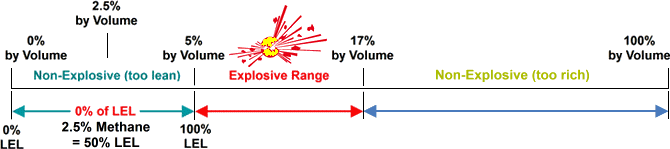
Visual example to show where on the scale % of LEL is measured

The minimum concentration of a particular gas necessary to support its combustion in air is defined as the Lower Explosive Limit (LEL). Below this level, the mixture is too lean” to burn. The maximum concentration of a gas or vapour that will cause an explosion is defined as the Upper Explosive Limit (UEL). UEL of Propane is 9.5% Volume while UEL of Butane is 8.4% volume and LEL of Propane is 2.1%volume and LEL of Butane is 1.8%volume hardly any practical difference between propane and butane when it explodes.

Above this level, the mixture will burn, providing oxygen is available, until the concentration reduces to the upper explosive limit. At this point the remaining gas or vapour will ignite, causing an explosion. The range between the LEL and UEL is known as the flammable range for that gas.

This demonstration is used as an example of what can happen in a domestic gas explosion. When the mixture of natural gas and air reaches the correct composition (between 5% and 15% gas) any spark or flame is enough to create a violent gas explosion.

It is the responsibility of the Gas Stove manufacturer to provide safe facilities to prevent a gas explosion in the gas stove. A wide range of propane -Butane compositions are used in the world.

Change in gas composition main cause of explosions

December 21st, 2021

By Rathindra Kuruwita and Shamindra Ferdinando Courtesy The Island

Presidential Committee contradicts Litro Chairman

A simmering controversy over gas-related explosions has taken an unexpected turn with Prof. Shantha Walpolage, the Chairman of the Committee appointed by President Gotabaya Rajapaksa to probe the recent gas explosions, concluding that the change in the composition of gas was the primary reason for the recent gas-related explosions,

They came to the conclusion following theoretical and on-site inspections, Prof. Walpolage said.

The composition of the gas had changed but cylinders, regulators, stoves and other equipment have not,” he noted.

Since November 2021 around 900 gas related explosions have taken place.

A Committee was appointed by the President on November 30 to look into those incidents.

Attorney-at-Law Nagananda Kodituwakku moved the Supreme Court against the gas suppliers recently. The case is pending in courts.

However, the Presidential Media Division on Monday (20) quoted Litro Gas Limited Chairman Theshara Jayasinghe as having said that there was no change in the composition of Litro Gas and steps had been taken to obtain recommendations from foreign experts in that regard and that the people should not have any undue fear when using LP (Liquefied Petroleum) Gas. The Chairman said this while speaking at a media briefing organised by the Presidential Media Center on Monday (20). President’s Media Spokesman Kingsly Rathnayaka moderated the media briefing. Though some factions had suggested that the cause of the gas leaks and explosions was a change in its composition, it had now been confirmed that none of the incidents reported so far had been caused by a change in the composition of LP gas, Jayasinghe said.

The Chairman of Litro Gas Limited said that the company had agreed to provide an insurance cover of one million rupees per person if such an incident is reported due to the poor standard of the gas.

Former Executive Director of the Consumer Affairs Authority (CAA) Thushan Gunawardena several months ago warned of the danger posed by the change of the composition of gas. Gunawardena told The Island that he had brought the crisis to the attention of Trade Minister Bandula Gunawardane, Consumer Affairs State Minister Lasantha Alagiyawanna and other officials.

Gunawardena, who quit his post on 22 Sept. over a dispute with Trade Minister Bandula Gunawardane and Co-operative Services, Marketing Development and Consumer Protection State Minister Lasantha Alagiyawanna following the exposure of the garlic scam at Lak Sathosa said that months before his resignation he brought the situation to the notice of the two ministers. Litro suppressed the change of composition ratio of Butane and Propane in domestic LPG cylinders. The change of composition posed a grave danger, Gunawardena said, pointing out that his repeated warnings were discarded.

The CAA Chairman retired Maj. Gen. Shantha Dissanayake ignored his concerns as regards the grave danger posed by increasing the propane ratio in the composition. Gunawardena made available to The Island the entire set of e-mails exchanged among officials in this regard in the wake of Litro introducing what it called a new premium hybrid 18 litre LPG (9.18 kg) cylinder priced at Rs 1,395 in April this year. Litro withdrew the new product several weeks later in the wake of media outcry over Litro actually over charging hapless consumers Rs. 151.96 per kilo whereas the regular 12.5 kg gas cylinder at that time cost Rs.1, 493. In Oct the price of a 12.5 kg domestic gas cylinder was increased by Rs. 1,257 and the major domestic cylinder sold at Rs. 2,750.

Responding to another query, Gunawardena said that when the CAA raised the composition of domestic gas cylinder, Litro deliberately deceived the regulator. Declaring that tests proved the Litro had lied to the regulator regarding the relatively sharp increase in the propane ratio in the composition at the expense of safety and security of the consumer, Gunawardena emphasized the failure on their part to take tangible measures.

In addition to the Cabinet minister and the State Minister, the unprecedented threat posed by change in Propane and Butane ratio in LPG cylinders was also brought to the notice of the President’s Office, the Attorney General’s Department, Board members of the CAA, Trade Secretary and Co-operative Services, Marketing Development and Consumer Protection State Secretary, Gunawardena said.

Change in gas composition results in gas related accidents

December 21st, 2021

Courtesy The Daily Mirror

The main reason for the recent gas related accidents has been identified as the change in the composition of gas, Prof. Shantha Walpolage, the Chairman of the Committee appointed by the President to probe gas-related accidents, said.

He told media today that they got this finding verified during their on-site inspections as well.  

“The cylinders, regulators, stoves and other equipment have remained unchanged. What was subjected to change was the gas composition,” he underlined.

 Thus, he reiterated that the main reason for the recent gas explosions could be attributed to the gas composition.  

A number of cases related to gas explosions were reported in the country for the last one month raising concerns amongst people.  

Accordingly, a Committee was appointed by the President on November 30 to look into the incidents of LPG cylinder fires and explosions. (Sheain Fernandopulle)

ණය වාරික ගෙවීමට මුදල් සංචිත ප්‍රමාණවත් – මහබැංකු අධිපති

December 21st, 2021

උපුටාගැණීම අද දෙරණ

ආර්ථිකය සම්බන්ධයෙන් අසත්‍ය ප්‍රචාර සිදුකරමින් සිටින විවිධ පාර්ශවයන් රටට විශාල හානියක් සිදුකරමින් සිටින බව මහ බැංකු අධිපති අජිත් නිවාඩ් කබ්රාල් මහතා පැවසීය.

එසේම ණය වාරික ගෙවීමට සහ අනෙකුත් කටයුතු සදහා මෙරට සතුව මුදල් සංචිත පවතින බවයි මහ බැංකු අධිපතිවරයා සදහන් කර ඇත.

මේ අතර ශ්‍රී ලංකාව මුහුණ දී සිටින විදේශ විනිමය අර්බුදයෙන් ගොඩඒම සඳහා ඩොලරයට සාපේක්ෂව රුපියලේ අගය නිදහසේ තීරණය වීමට ඉඩදීම ඇතුළු කඩිනම් පියවර වෙත යොමු විය යුතු බව ආර්ථික විශේෂඥයන් පෙන්වා දෙයි.
 
සෑම රටක්ම ජාත්‍යන්තර මුදල් ඒකක ඇතුළත් විදේශ විනිමය සංචිතයක් පවත්වාගෙන යනු ලබන අතර ආනයන වියදම් දැරීම, විදෙස් ණය ගෙවීම, රටේ මුදලේ අගය ස්ථාවරව තබාගැනීම හා මතුවන ආර්ථික අර්බුද කළමනාකරණය කරගැනීම යන අරමුණු ඉටුකරගැනීම සඳහා එය අත්‍යවශ්‍ය වෙයි.

ඉකුත් 2020 වසර ආරම්භයේ අමෙරිකානු ඩොලර් බිලියන 7.6ක් ව පැවති මෙරට විදේශ සංචිත මේ වන විට ඩොලර් බිලියන 1.6 දක්වා පහත වැටී තිබීම මෙරට ආර්ථිකය මුහුණ පා සිටින අර්බුදය කියාපාන ප්‍රධාන සාධකයකි.

ශ්‍රී ලංකාවට මාසිකව ආනයන සඳහා ඩොලර් බිලියන 1.5ක මුදලක් වැය වන අතර සංඛ්‍යාත්මකව ගත්කළ මෙරට පවතින සංචිත දැන් ප්‍රමාණවත් වන්නේ එක් මාසයක ආනයන සඳහා පමණක් බව මේ අනුව පෙනී යයි.

එහි අනෙක් අර්බුදය වන්නේ මෙරට මාසික අපනයන ආදායම අමෙරිකානු ඩොලර් බිලියන 1.1ක මට්ටමේ පැවතීමය.

මෙම අර්බුදය තීව්‍ර කරමින් පසුගිය දා ෆිච් ජාත්‍යන්තර ණය ශ්‍රේණිගතකිරීම්වලින්ද ශ්‍රී ලංකාව CCC කාණ්ඩයේ සිට CC කාණ්ඩය දක්වා පහත හෙළනු ලැබීය.

ඒ අනුව ශ්‍රී ලංකාව මේ වන විට ණය යළි ගෙවීමට අසමත් රටක් ලෙස ප්‍රකාශවීමට ආසන්න මට්ටමට පත්ව සිටී.

පවතින දුෂ්කර තත්ත්වයෙන් මිදීම සඳහා ශ්‍රී ලංකාව ජාත්‍යන්තර මූල්‍ය අරමුදලේ සහාය ලබාගැනීම වඩාත් යෝග්‍ය බවයි ආර්ථික විශේෂඥයන් පෙන්වා දෙයි.

එසේම වහාම ඩොලරයට සාපේක්ෂව රුපියලේ අගය නිදහසේ තීරණය වීමට ඉඩදිය යුතුබව ද ආර්ථික විශේෂඥයන් පවසයි.

මෙම තත්ත්වයෙන් ගොඩඒම සඳහා ශ්‍රී ලංකාව විදේශ සංචිත තරකරගැනීමේ පියවර දැනටමත් ගෙන ඇති අතර ඒ අනුව එළැඹෙන දෙසැම්බර් 31 වනදා වන විට මෙරට විදේශ සංචිතය අමෙරිකානු ඩොලර් බිලියන 3 දක්වා ඉහළ යන බව ශ්‍රී ලංකා මහ බැංකු අධිපති අජිත් නිවාඩ් කබ්රාල් මහතා පවසයි.

මහ බැංකු අධිපති අජිත් නිවාඩ් කබ්රාල් මහතා – දෙසැම්බර් අවසානයේ අනිවාර්යෙන්ම බිලියන තුනක් තියෙයි.

මාධ්‍යවේදියා – කොහොමද ගේන්නේ ඒක, ප්‍රදානයක්ද ?

මහ බැංකු අධිපති අජිත් නිවාඩ් කබ්රාල් මහතා – අපේ සංචිතයන්ට ඒක එකතුවෙනවා. බය වෙන්නේ නැතුව ඉන්න.

මාධ්‍යවේදියා –  ඉදිරි වසරේ ගෙවීම් කොහොමද ? 

මහ බැංකු අධිපති අජිත් නිවාඩ් කබ්රාල් මහතා –  ඔක්කෝම ණය ගෙවනවා කියලා මම කිහිප සැරයක්ම කියලා තියෙනවා. ඒක අනිවාර්යෙන්ම කෙරෙනවා.  බිලියන තුනක් අනිවාර්යයෙන්ම තියෙනවා.

Sri Lanka’s inflation increases to 11.1% YoY in November

December 21st, 2021

Courtesy Adaderana

Headline inflation, as measured by the year-on-year (Y-o-Y) change in the National Consumer Price Index, increased to 11.1 per cent in November 2021 from 8.3 per cent in October 2021, according to the Statistics Department of the Central Bank of Sri Lanka. 

Meanwhile, on an annual average basis, the NCPI increased to 6.2 per cent in November 2021 from 5.7 per cent in October 2021, the statement said.

Inflation was driven by monthly increases of prices of items in both Food and Non-food categories. Subsequently, Food inflation (Y-o-Y) increased to 16.9 per cent in November 2021 from 11.7 per cent in October 2021, while Non-Food inflation (Y-o-Y) also increased to 6.2 per cent in November 2021 from 5.4 per cent in October 2021.

Monthly change of NCPI recorded at 3.14 per cent in November 2021 due to increases observed in prices of items in both Food and Non-food categories which were 2.61 per cent and 0.53 per cent, respectively. 

Accordingly, within the Food category, prices of vegetables, rice, milk powder, big onions, fresh fish and chicken increased. Further, prices of items in the Non-Food category recorded increases mainly due to price increases observed in Restaurant and Hotels and Alcoholic Beverages and Tobacco sub-categories during the month, it said.

The core inflation (Y-o-Y), which reflects the underlying inflation in the economy increased to 8.8 per cent in November 2021 from 7.2 per cent in October 2021, while annual average core inflation increased to 5.0 per cent in November 2021 from 4.6 per cent in October 2021.

President releases ‘ecological floating islands’ to Beira Lake

December 21st, 2021

Courtesy Adaderana

President Gotabaya Rajapaksa today (21) released a thousand ecological floating islands to Beira Lake initiating the purifying process of the lake.

Beira Lake has been polluted due to unauthorized urbanization and improper upgrading of sewerage infrastructure in the city of Colombo. The Ecological floating islands” method was implemented under the guidance of Chairman of the Land Development Corporation, Retired Major General M.R.W. de Soyza, the PMD reported.

Ecologist Ranoshi Siripala points out that the experiment conducted for water purification by planting plants such as Cannas, Savandara and Heliconia using PVC pipes, bamboo and foam mattresses as floating supports has yielded successful results.

Plants in floating wetlands absorb excess nutrients carried in the water. This reduces the amount of algae in the water and purifies the water, eliminates odours, and maintains an ecological balance by providing habitat for water-dependent organisms. Water surface beautification is another benefit, the statement said.

Land Development Corporation Chairman M.R.W. de Zoysa pointed out that the project is expected to play an indirect role in controlling the diseases caused by the mosquito menace. He said a number of other benefits such as increased density of fish can also be achieved at a very low cost from this project.

State Minister Mohan P. De Silva, Municipal Commissioner of the Colombo Municipal Council Roshanie Dissanayake, General Manager of Sri Lanka Land Development Corporation Srimathi Senadheera, Project Director Dr. N.S. Wijeratne and the officials of the Land Development Corporation were also present.

Sri Lanka reports 713 new cases of coronavirus and 24 new fatalities

December 21st, 2021

Courtesy Adaderana

The Health Ministry says that a total of 713 new cases of coronavirus have been identified within today (21).

This includes one person who had arrived from overseas, the Govt. Information Department reported. 

Sri Lanka’s total count of confirmed cases of Covid-19 has climbed to 580,922 with this. 

8,212 patients infected with the virus are currently undergoing treatment across the island. 

The Director-General of Health Services has confirmed 24 more coronavirus-related deaths for December 20, increasing the death toll in the country due to the virus pandemic to 14,795.

According to the figures released by the Government Information Department, the deaths reported today include 11 males and 13 females.

Five of the patients are between the ages 30-59 years and the remaining 19 are in the age group of 60 years and above.

Presidential committee reveals reason for recent LPG-related incidents

December 21st, 2021

Courtesy Adaderana

The root cause for the recent domestic liquefied petroleum gas (LPG) cylinder-related incidents in the country was a result of the change in the composition, the presidential committee appointed on the matter says.

Chairman of the said committee, Prof. Shantha Walpolage of the University of Moratuwa revealed this during a press conference held today.

Upon making inspections where the incidents were reported, the committee members had observed that there had been no change in the cylinders, regulators, rubber pipes, stoves and other equipment, Prof. Walpolage told reporters.

The final conclusion drawn by the committee is that the recent incidents were caused by the change in the composition of LP gas, he noted.

The committee handed over its final report to President Gotabaya Rajapaksa by Prof. Walpolage, today (December 20).

The committee was appointed by the President on November 30 to look into the incidents that took place at domestic, commercial, and sales outlets in various parts of the country and to uncover possible causes of the problem in order to provide immediate solutions to the issue.

Accordingly, the committee prepared its report after taking into account the investigations carried out in 11 institutions including the on-site inspections and inquiries conducted on two major LPG companies, Litro Gas Lanka Ltd. and Laughs Gas PLC, an inspection of 17 places where fires and explosions occurred and considering the views received by e-mails.

Chaired by Prof. Shantha Walpola of the Moratuwa University, the committee also includes Senior DIG Deshabandu Tennakoon, Prof. Ajith de Alwis of Moratuwa University, Prof. W.D.W Jayathilaka of the University of Sri Jayewardenepura, Prof. Pradeep Jayaweera, Commissioner of  Sri Lanka Inventors Commission Prof. Narayana Sirimuthu, Additional Director General of Industrial Technology Institute Dr. Sudarshana Somasiri and Senior Deputy Director (Technical) at Sri Lanka Standard Institute Sujeewa Mahagama.

නො විසඳෙන පොහොර ගැටලුවෙන් පීඩා විදින ගොවීන් (වීඩියෝ)

December 21st, 2021

උපුටා ගැන්ම  හිරු පුවත්

ලබන කන්නය සඳහා හෝ රසායනික පොහොර ලබාදෙන ලෙස ඉල්ලමින් දිවයිනේ බොහෝ ප්‍රදේශවල අදත් (21) ගොවි විරෝධතා පැවැත්වුණා.

ඔවුන් චෝදනා කරන්නේ, පොරොන්දු වූ වගා හානි වන්දි කඩිනමින් රජය විසින් ලබාදිය යුතු බවයි.

එමෙන්ම වී ගොවීන් බොහෝ පිරිසක් මෙවර කන්නයේ වගා කටයුතු ආරම්භ කළේ ද මාසයක පමණ කාලයක් පමාවීමෙන් අනතුරුවයි.

ඒ අවශ්‍ය පොහොර නිසි වේලාවට ලබාදෙන බවට රජය දුන් පොරොන්දුව මතයි.

කෙසේවෙතත් වගාව ආරම්භ කර සති කිහිපයක් ගතව ඇතත් තමන්ට කිසිඳු පොහොරක් නොලැබුණු බවට ගොවීන් චෝදනා කරනවා.

මේ හේතුවෙන් ඇතැම් ගොවීන් සිය වගාවන් අත්හැර දැමීමට ද පෙළඹි තිබෙනවා

Superpower’s superior democracy!

December 20th, 2021

Sangadasa Akurugoda

US President Joe Biden’s much-advertised ‘Summit for Democracy’ held in early December, is an example of how the champions of so-called democratic world misuse the name of ‘Democracy’ to promote their geo-political interest. As pointed out in an article appeared in The Sydney Morning Herald, the composition of the summit reflects a combination of an anti-China geopolitical agenda and attempt to punish specific democracies, sighting why the countries with significantly higher democracy ratings from Freedom House – including Hungary, Singapore, Bolivia and Sri Lanka – did not receive an invitation. (https://www.smh.com.au/world/north-america/congo-in-china-out-biden-s-democracy-summit-guest-list-raises-eyebrows-20211209-p59g7f.html)

We remember how western superpowers attempted to save the LTTE leader Prabhakaran during the closing stages of the Eelam War in 2009. We also remember how the US State Department’s spokesperson Robert Wood has called on LTTE rebels surrender to a third party.

 Almost all statements released, one after the other, by the blue eyed white skinned politicians, diplomats, spokespersons etc throughout the world at the 11th hour of the eradicating terrorism indicated nothing other than their sinister motive of giving a fresh life line to the LTTE leader Prabhakaran and dragging Sri Lanka back into an on-going war.

Now that the chances of dividing Sri Lanka on ethnic lines by military means are no more, the next issues, often raised by these interested parties are ‘war crimes charges against our war heroes’ and ‘violation of human rights’.

War crimes and violation of human rights are not new to Western Superpower imperialists. Although US strongly opposes the International Criminal Court (ICC) treaty, and thus does not accept ICC jurisdiction over its nationals, the way massacres were done , use of torture and violence against civilians and non-combatants were committed by the US armed forces  in Philippine (Philippine – Americal War), in Haiti (1915-1934), in Japan (World War II), in Korea (Korean War), in Vietnam  (1960-1972), in Afganistan, in Iraq etc are summarised in https://en.wikipedia.org/wiki/United_States_war_crimes#Banana_Wars.  The US Atomic bombings of Hiroshima and Nagasaki in Japan along killed between 129,000 and 226, 2000 people, most of whom were civilians.

The US government, instead of introspecting on its own terrible human rights record, keep making irresponsible remarks on the human rights situation in other countries, exposing its double standards and hypocrisy on human rights.  The most recent (in May 2020) death of an unarmed black man, George Floyed, after being brutally kneeled on his neck by a white police officer, is a typical example. The entire world has seen a bystander’s video showing the murder which triggered massive demonstration in cities. The US suppressed demonstrators by force, and more than 10,000 people were arrested.

We do not have to go that far to find out the war crimes records of another superpower, UK, who is always trying to teach us democracy and human rights. We are fully aware of how British beheaded Keppetipola Disawe and massacred the entire able bodied male population, and destroyed cattle and other livestock and all most all private property (including homes and the burning of rice paddies). It is estimated that around 500,000-1000, 000 people who were children, women, elderly died due to this suppression.

Let us examine what Winston Churchill, who played an important role in defending Europe against the spread of Hitler’s Nazism and remains popular in the UK and the Western World, has said about democracy as appeared in the website of International Churchill Society.

Many forms of Government have been tried, and will be tried in this world of sin and woe. No one pretends that democracy is perfect or all-wise. Indeed it has been said that democracy is the worst form of Government except for all those other forms that have been tried from time to time.…” (https:// winstonchurchill.org/resources/quotes/the-worst-form-of-government/)

When comparing democracy against other forms of government, no doubt, Churchill must have make use of his own experience. Joe Biden’s ‘Summit of Democracy‘is an example of how the champions of so-called democratic world misuse the name of ‘Democracy’ to promote their geo-political interest. As sighted in the said in The Sydney Morning Herald,        Like the Quad [grouping of the US, Australia, India and Japan], the summit can’t be understood outside an attempt by the US to build an anti-hegemonic – read: anti-China – coalition.”

Standing at a new crossroads, mankind is faced with new, grave challenges. It is hoped that the Western Superpowers lead by the US will show humility and compassion for the suffering of its own people, drop hypocrisy, bullying, and double standards, and work with the rest of the world to build a community with a shared future for humanity.

Sangadasa Akurugoda

France And Bangladesh Can Benefit From Growing Trade And Strategic Ties

December 20th, 2021

MD Pathik Hasan

France has historical relations with Bangladesh. Bangladesh’s contact with France dates back to the war of liberation. Relations between Bangladesh and France have historically been cordial. The foundation of this relationship was laid in the distant past.

The contribution of the French in the liberation war of Bangladesh is also memorable. The French writer and thinker Andre Malraux said that he considered the war of independence of Bangladesh as his own war. He also expressed his desire to come to this country to take part in this war.

Also, during the war of liberation, a humanitarian French youth named Jean Kay tried to hijack a Pakistani airliner (PIA) to demand medicine and medical supplies for Bangladeshi refugees who had taken refuge in India.

After this incident, the French government decided to help Bangladesh and 20 tons of medicine and medical supplies were delivered to the Indian refugee camps. Even in the post-independence period, good relations have always existed between Bangladesh and France.

Recently, Bangladesh’s Prime Minister Sheikh Hasina completed an important and multidimensional visit to France which has added a new dimension to Bangladesh and France relations.

She visited Paris from November 9 to 13 at the invitation of French President Emmanuel Macron. The visit could start the journey of taking the partnership between the two countries to a strategic level. Earlier, Sheikh Hasina had a bilateral meeting with Emanuel Macron at Elysee Palace in December 2017.

Just as Dhaka seeks the support of a major power like Paris in its development journey, so too France seeks to sell trade, investment and security equipment to a growing Bangladesh. A number of MoUs as well as a letter of intent in the security sector were signed during this visit.

During the visit, the Prime Minister held bilateral meetings with French President Macron and Prime Minister Jean-Castex, as well as meetings with major business associations and groups.

During the Prime Minister’s visit, a memorandum of understanding on defense cooperation was signed between the two countries on November 10. On the same day, Sheikh Hasina had a meeting with the President of France Emanuel Macron.

The two leaders discussed issues of mutual interest, taking the bilateral relations further, celebrating the 50th anniversary of diplomatic relations between the two countries, and other issues of international and regional importance.

A joint statement issued after the meeting said that during the meeting between President Emanuel Macron and Prime Minister Sheikh Hasina, the two countries expressed interest in further expanding the existing partnership in defense and security. To this end, the two countries have agreed to strengthen dialogue and cooperation. Prime Minister Sheikh Hasina later held a meeting with French Prime Minister Jean Costa Rica. At this time a memorandum of understanding was signed between the two countries.

As a developing country, Bangladesh wants to continue its trade with France, its largest export market. At the same time, it seeks to diversify its sources of investment, the import of French goods at affordable prices, and the procurement of security equipment for the implementation of the Forces Goal 2030. France is one of Bangladesh’s largest trading partners and development partners.

France is currently the fifth largest export destination for Bangladesh. There is scope for further expansion of this commercial communication. France is a country rich in art and literature.

During Prime Minister Sheikh Hasina’s visit, Bangladesh and France signed three agreements on financial assistance and technical cooperation. Under the two agreements, France will provide 330 million euros to Dhaka to support Bangladesh’s development projects.

Representatives of the Federation of Bangladesh Chambers of Commerce and Industry signed a memorandum of understanding with MEDEF International to boost bilateral trade and investment at the France-Bangladesh Business Council Meeting in France on November 10.

France is one of the world’s leading exporters of heavy industries such as bullet trains, warships, and submarines. So, Bangladesh can benefit if trade relations with France improve. The Prime Minister called upon French businessmen to invest in Bangladesh. Different industries can also be developed through joint ventures of the two countries.

Bangladesh needs France in the Rohingya crisis solution. France has already assured Bangladesh that it would help Bangladesh in this regard. France as an active member of ‘United Nations Security Council’ and ‘European Union’ can raise the voice amongst international community in favor of Rohingya repatriation. Bangladesh can benefit from the support of Bangladesh in this regard.

On the other hand, the possibility of exporting new products from Bangladesh to France should also be explored. Cooperation between the two countries can also be strengthened in the fields of education and industry and culture. Relations between Bangladesh and France continue to grow, which is desirable.

Economic opportunities are being created in Bangladesh. France wants to take advantage of that. France is also interested in selling military products. The country is more interested in selling Rafale warplanes, training aircraft, radars, simulators, e-Visa, nuclear power plants and other products. According to the website of the French Embassy in Bangladesh, for the first time in 2020, French Defense Minister Florence Parle and Chief of Air Staff Philippe Lavigne visited Dhaka.

As a key member of NATO, France and the country were experienced in building weapons. Bangladesh has the defense capability and France is interested in the Forces Goal 2030.

The head of Airbus, Europe’s largest aircraft manufacturer met with Prime Minister Sheikh Hasina. The head of Thales, a company that sells high-tech products, including satellites and radar, also met with BD PM.

After buying a few aircraft from Boeing in the United States, many companies want to sell the aircraft to Bangladesh. Airbus is one of them. On the other hand, Thales is selling military and civilian radar in Bangladesh.

The top leadership of France had discussed with the Prime Minister several times in bilateral and various forums, adding that the growing development of Bangladesh has attracted the attention of France. The visit could be considered as a major step forward in establishing multidimensional and strategic relations. France wants to see its presence in Indo-Pacific on a larger scale and they want Bangladesh as a partner in the region. Bangladesh is currently the chair of the Indian Ocean Rim Association which has further increased Bangladesh’s importance.

France has its own Indo-Pacific strategy. Through this visit, both sides got an opportunity to know each other’s views on the issue. Recent AUKUS issue has created some kind of distance between France and UK, USA, Australia. France lost a billion dollars (90 billion) business deal. Thus, France needs some alternative markets. France needs Bangladesh to sell its military gadgets. The recent Defense pact between France and Bangladesh is just an example to understand this.

Bangladesh and France have signed a letter of intent on defence cooperation to further develop the defence and security component of their partnership. The two countries agreed to further develop the defence and security component of their partnership based on the needs expressed and each party’s ability to respond to them using different methods, including through capacity building and potential technology transfer.

France needs Bangladesh in the region. Bangladesh and France can work together to ensure the implementation of ‘Free and Open Indo Pacific region. Bangladesh and France agreed to strengthen business ties.

France got a business partner in its ongoing crisis moment with the US, UK, and Australia. Reshaping ties with Bangladesh can give France some sort of comfort. It is true that France is bothered by the AUKUS issue.

Bangladesh also got an assurance from a European actor who is a permanent member of the UNSC and EU.  I say it is an opportunity for Bangladesh. Bangladesh should utilize this golden opportunity. Bangladesh should engage itself with the international community using the French Card in case of the Rohingya crisis solution.

According to the reports of media outlets, Prime Minister Sheikh Hasina also expressed happiness over the outcome of her visit to France in November last and hoped to sustain the momentum in the coming years.

I am indeed very happy with the discussion and outcome of my France visit November last and hope to sustain the momentum in the coming years,” she said.

The prime minister came up with the remarks while French Ambassador Jean-Marin Schuh paid a farewell call on her at her official Ganabhaban residence here on December 19, 2021.

The prime minister thanked French President for inviting her on an official bilateral visit to Paris in November last.

During the discussion, Sheikh Hasina said that Bangladesh has historical bondage with France because the French government and its people supported Bangladesh during its Liberation War in 1971.

The French envoy informed the premier that her government will provide 1.2 million Covid-19 vaccines under the Covax this week.

He said France is going to take up chairmanship of European Union next February and set to hold an Indo-Pacific summit with the countries of the region in the same month.

He said they would invite Bangladesh in the Indo-Pacific summit.

The envoy also said that a joint communiqué was signed between France and Bangladesh which covered many aspects of the relations of the countries.

Economic and political relations between France and Bangladesh is enhancing, he also said.

About the impact of the Covid-19, Sheikh Hasina said that all countries have suffered consequences due to the Covid-19 pandemic.

We have huge population. We carried forward our economic activities despite the pandemic,” she said.

On the other hand, Bangladesh is one of the most affected countries due to climate change and France has always supported the issue of justification for overcoming the damage. Apart from this, Paris has been supporting Dhaka in various forums including the UN Security Council on the Rohingya issue.

The visit of BD PM Sheikh Hasina to France could bring France and Bangladesh closer in the sector of security, trade, defense trade. France got a reliable trade partner in the Indo-pacific region and Bangladesh got a western ally. At this moment, France needs Bangladesh and vice versa. This strategic visit of BD PM would give some sort of comport to both parties. The trade and strategic ties are increasing between France and Bangladesh. Bangladesh and France can benefit from growing trade and strategic ties.


Copyright © 2026 LankaWeb.com. All Rights Reserved. Powered by Wordpress