East Timor-Bangladesh Relations: Expectations From Each Other

August 30th, 2021

MD Pathik Hasan writing from Bangladesh

The name of East Timor is well known in Bangladesh. Many Bangladesh migrant labors are working in East Timor. The people of Bangladesh praise the people of East Timor. In a few days ago, Bangladesh expressed deep mourning over the lives lost in flash floods and landslides in different parts of Timor-Leste recently. In a message sent to Foreign Affairs and Cooperation Minister of Timor-Leste Adaljiza Albertina Xavier Reis Magno, Foreign Minister Dr AK Abdul Momen in favor of the people of Bangladesh conveyed heartfelt sympathies to both the leaders. He expressed deep sympathy particularly to the members of the bereaved families who lost their near and dear ones, read a foreign ministry statement on Tuesday. Dr Momen prayed and hoped that the resilient people of both friendly countries can withstand all adversities and rebuild their flood affected areas to come back to normal life.

The name Bangladesh is well known in East Timor. Almost everyone in Delhi knows the name of Bangladesh. There was a team of Bangladesh Police in the UN peacekeeping mission here. People of East Timor praise of the peacekeepers of Bangladesh. Some also learned some Bengali words. At one time, Amira Haque of Bangladesh served as the head of the peacekeeping mission. He looked quite familiar and popular.

According oec.world data, in 2015, Timor-Leste exported $10.2k to Bangladesh. The main products that Timor-Leste exported to Bangladesh are Synthetic Filament Yarn Woven Fabric ($10.2k). During the last 13 years the exports of Timor-Leste to Bangladesh have decreased at an annualized rate of 41.5%, from $10.9M in 2002 to $10.2k in 2015. In 2015, Bangladesh exported $307k to Timor-Leste . The main products that Bangladesh exported to Timor-Leste were Packing Bags ($96.5k), Fruit Juice ($41.2k), and Textile Processing Machines ($37.1k). During the last 13 years the exports of Bangladesh to Timor-Leste have decreased at an annualized rate of 22%, from $7.79M in 2002 to $307k in 2015.

Dream 71 Bangladesh Limited, Bangladesh’s leading software and mobile application maker, has once again found success in the Pacific nation of East Timor. This time they created software for the East Timor parliament.

East Timor, which gained independence from Indonesia in 2002, has seen a sharp rise in mobile and Internet users. In the last one year alone, the number of internet users in the country has increased by 10 percent.

The country’s government is also trying to digitize their government and civic services. In response, tenders were called for the software to be developed by the country’s national parliament. Though proposals were submitted from many countries of the world, Bangladesh’s Dream 71 was finally selected on the basis of technical and financial proposals. The software will be developed in English, Portuguese and the local Tetum language of East Timor. Timor-Leste said goodbye and thank you to police officers from Bangladesh for their role in helping secure peace and building the capacity of the country’s national police in November 19, 2012.

Bangladesh was amongst the countries contributing the largest numbers of police since the United Nations Integrated Mission in Timor-Leste (UNMIT) was set up following the 2006 crisis.

UNMIT Police Commissioner Luis Carrilho said, “Police from Bangladesh have played an important role building the capacity of the national police and securing peace in Timor-Leste.”

Since 2006 more than 1,200 police officers from Bangladesh have contributed to stability and peace in the country.

At a parade to mark the certification of PNTL held on 31 October 2012, both the President and Prime Minister of the Republic of Timor-Leste acknowledged and congratulated UNMIT Police (UNPOL) for their work since 2006.

The President of the Republic also bestowed upon UNPOL the Order of Timor-Leste Medal in appreciation and recognition for its contribution to the country, Timorese people and security.

“It was an honour to receive this Order on behalf of all UNMIT Police and we can all be very proud of our achievements,” said Carrilho.

“PNTL has made significant progress, supported by police from Bangladesh. These men and women helped us restore law and order and train Timor-Leste’s police. They can return home very proud of what they have achieved. It is now our turn to help others, with several PNTL officers eligible and ready to participate in UN peacekeeping missions,” added PNTL General Commander Longuinhos Monteiro.

There are many potentials between Bangladesh-East Timor Relations. Tourism, export of skilled and semi-skilled labors toward East Timor, Bangladesh’s successful Climate Strategy approach, counter terrorism and counter insurgency approach, IT sectors are some sectors of cooperation.

Bangladeshi medicines and apparels can be sent to East Timor. Investors of East Timor can invest in Bangladesh and do well to serve their business interest.

Bangladesh faces a Refugee threat. Bangladesh suffers Rohingya refugees’ problem from 2017 after the massive influx of Rohingyas into Bangladesh from Myanmar. Now Bangladesh wants to repatriate them to their lands in Myanmar because they are the citizens of Myanmar. But Myanmar don’t want to take back them. Bangladesh will raise the issue in the upcoming United Nations General Assembly in September 2021. East can and should Timor support Bangladesh at all international forum specially in UNGA to repatriate them to Myanmar peacefully. East Timor can help, assist and contribute Bangladesh huge fully in this regard. Bangladesh will get a true friend. The ties between Bangladesh-East Timor will be strengthened.

Writer: MD Pathik Hasan, Dhaka based NGO activist, Researcher and Freelance Writer.

THE FLAG AND THE CROSS

August 30th, 2021

Courtesy: ‘ANANDA IN SWADDLING CLOTHES’  By S. A. Wijayatilake (Extracted from the Ananda College Golden Jubilee Souvenir – 1936)

Three and a half centuries of foreign aggression and occupation – at first partial, but since 1815 complete – of the land had not only demoralized and emasculated the Sinhalese people generally, but had adversely affected the position of Buddhism in this Island in particular. The Portuguese, whose arrival in Ceylon synchronized with the activities of the Counter-Reformation in Europe, believed that the Flag follows Trade and the Cross follows the Flag. In the words of Albuquerque, The new heroes of Portugal are not her soldiers or sailors, but her missionaries. These were the men who made their way into the interior of India and who penetrated the furthest East. China, Japan, and even Tibet witnessed their presence and heard their preaching”. (Quoted by C. M. Fernando, M. a., LL.M. (Cantab) in Twentieth Century Impressions of Ceylon, p. 45, in Part XL The Portuguese Period,” of his article on the History of Ceylon. I should add that the late Mr. C. M. Fernando was a Roman Catholic.) Along the Western littoral of Ceylon the Portuguese established Roman Catholic Missions with the same thoroughness with which they built magnificent fortresses at every key point. Even as Italy, the premier Roman Catholic country in Europe today, has been recently civilizing the savage” Ethiopian with the aid of such beneficent instruments as bombs, cannon, and poison gas so her prototype of the 16th Century, the great Portugal, tried to wean the benighted heathen from the ways of evil by such gentle means as wanton desecration of Buddhist and Hindu temples of far-flung fame.

The Hindu Temple of a Thousand Columns in old Trincomalee was razed to the ground and the granite of its carved columns and cornices was used in the building of a fort. The ancient Buddhist Temple of Devi Nuwara in the South, which had evoked the homage of poets and of kings, was demolished, and only the story of its pristine splendor remains. Such was the thoroughness and the loving kindness with which the Portuguese, followers of the Prince of Peace, disseminated Peace on Earth, goodwill to men.”

බෞද්ධ ජනරජ ප්‍රවාදය – 33 වැනි කොටස – ‍ප්‍රත්‍යක්‍ෂයේ අධ්‍යාපනය

August 30th, 2021

ආචාර්ය වරුණ චන්ද්‍රකීර්ති

බුදුදහමෙහි ආභාසය ලත් අපගේ මනස සැකැසී ඇත්තේ අත්දැකීම් මත පදනම් වූ ප්‍රත්‍යක්‍ෂය ඇසුරෙන් ලෝකය අවබෝධ කරගත හැකි ආකාරයකිනි. එහෙයින් වියුක්ත න්‍යායික කරුණු ග්‍රහණය කරගැනීම ද ඒ ඇසුරෙන් ලෝකය වටහාගැනීම ද අපගේ දරුවන් හට අපහසු ය. රූපසටහන් ඇසුරින් යම් යම් න්‍යායික කරුණු තම ශිෂ්‍යයන්ට පැහැදිළි කරදීමට අපගේ ඇතැම් ගුරුවරුන් කටයුතු කරන්නේ ද එබැවිනි. මෙය විශ්වවිද්‍යාල මට්ටමේ සෛද්ධාන්තික ගණිතය පිළිබඳ දේශනවල දී පවා කෙරෙන කාර්යයකි.

අපගේ මනස මෙ ලෙසින් හැසිරුණ ද, බටහිර මාදිලියේ අධ්‍යාපන ක්‍රමයක් මෙ රට ක්‍රියාත්මක වන බැවින් එයින් කෙරෙනුයේ ශිෂ්‍යයන් හට න්‍යායික අධ්‍යාපනයක් ලබාදීම ය. ලෞකික කාර්යයන්හි නිරතවීමට න්‍යායික දැනුම අවශ්‍ය බව සැබෑවකි. එ නමුදු, අපගේ මනස සහ අවශ්‍යතා මුළුමනින් ම නො සළකා සියලු ශිෂ්‍යයන් හට එවැනි අධ්‍යාපනයක් ලබාදීම ප්‍රායෝගික නොවන කටයුත්තකි. පංති කාමරවලට සීමා වූ මෙම අධ්‍යාපන ක්‍රමය විසින් අපගේ ජාතිය ඉතාමත් ව්‍යාකූල තැනකට ඇද දමා තිබේ.

මෙම නො ගැලපෙන අධ්‍යාපනයෙහි පරතෙරට යන්නෝ අන්‍යයන් මත යැපෙන නිකමුන් පිරිසක් බවට පත් වී සිටිති. සියලු උපාධිධාරීන්ට රජයේ රැකියා ලබාදෙනු!” යන සටන් පාඨය නිර්මාණය වී ඇත්තේ ද එ බැවිනි. ස්වෝත්සාහයෙන් රැකෙන්නන් සහ ව්‍යාපාරික කටයුතුවල නිරත වී සිටින්නන් ඒ සඳහා අවශ්‍ය දැනුම ලබාගෙන ඇත්තේ මෙම අධ්‍යාපන ක්‍රමයෙන් පරිබාහිරව ය. සමාජ – ආර්ථික, කලා සියලු ක්‍ෂේත්‍රවල මෙම කාරණය නිරීක්‍ෂණය කළ හැකි ය.

ඉහළ ආර්ථික සාධනයක් සළසාගත හැක්කේ එයට දායකවිය හැකි දැනුමින් සහ අත්දැකීම්වලින් පිරිපුන් මානව සම්පතක් ඇති රටකට ය. අධ්‍යාපන ක්‍රමය විසින් බිහිකළ යුත්තේ ද එවැනි පිරිසකි. මෙම ලිපිය ආරම්භයේ දී ම දැක් වූ පරිදි, අත්දැකීම් මත පදනම් වූ ප්‍රත්‍යක්‍ෂය ඇසුරින් ලෝකය අවබෝධ කරගත හැකි පිරිසක් බිහි කරගත හැකි නම්, සමාජ – ආර්ථික ජයග්‍රහණ අත්පත් කරගැනීම අපහසු කටයුත්තක් නොවනු ඇත.

ගින්නට පිළිස්සෙන බව සහ පිහියකින් තුවාල සිදුවන බව කුඩා දරුවකු අවබෝධ කරගනු ලබන්නේ ඒ පිළිබඳ සෘජු අත්දැකීම්වලින් හෝ ආසන්න නිරීක්‍ෂණවලිනි. එයට අමතරව, ජීවිතයට අදාළ බොහෝ දෑ මෙවැනි ප්‍රායෝගික ක්‍රමවලින් ඔවුහු දැනගනිති. පුටු, මේස, පිඟන් ආදී එදිනෙදා භාවිතාවන දෑ පිළිබඳව කිසිවකු විසින් ඔවුනට එකින් එක කියාදෙන්නේ නැත. අනෙකුත් අය කරන කියන දෑ බලා සිට අනුකරණයෙන් ඔවුහු ඒවා පිළිබඳව දැනගනිති.

මෙ ලෙසින් ජීවිතයේ මුල් අවුරුදු පහ තුළ විශාල දැනුමක් ලබාගන්නා දරුවා එක්වර ම බාහිර පරිසරයෙන් වෙන්කර පංති කාමරයකට කොටුකිරීම වත්මන් අධ්‍යාපන ක්‍රමය තුළින් සිදුවෙයි. ගෙදරින් එළියට බහින දරුවාට තමන්ගේ ගම සහ ඒ ආශ්‍රිත කරුණු පිළිබඳ දැනගැනීමේ අවස්ථාව මෙම ක්‍රමයෙන් අහිමිකෙරෙයි. එයින් පසු භාවිතයෙන් සහ පරිසරයෙන් ඈත් වූ බාහිර කරුණු විශාල ප්‍රමාණයක් තුළ ඔහුව සිරකරයි. තම ගමෙහි ජනගහනය ගැන නොදැන්නා දරුවාට බංග්ලාදේශයේ ජන ඝනත්වය ගැන කියාදෙයි. ගමේ ජල සම්පත් සහ ආශ්‍රිත ගැටලු ගැන කියා නො දී, ඔහුට එච්-ටූ-ඕ ගැන කියාදෙයි. ගමෙහි ගහ කොළ, වන සම්පත් ගැන ඔහුට කියා නො දී, ඇමේසන් වනාන්තරය ගැන කියාදෙයි.

පොල් ගස වනාහි තාල වර්ගයට අයිති ගසකි” වැනි කරුණු කියා දුන්න ද තම ගෙවත්තෙහි ඇති පොල් ගස් ගැන සොයාබැලීමේ, විමර්ශනය කිරීමේ කාර්යයක් දරුවාට නො පැවරෙයි. විවිධ වූ පස් වර්ග ගැන කියාදුන්න ද තම ගෙවත්තෙහි ඇති පස් පිළිබඳව දරුවා නො දනියි. භාෂාව උගන්වන්නේ ද ව්‍යාකරණවලට මුල් තැනක් දීමෙනි. සාහිත්‍ය ඇසුරට සහ භාෂා ව්‍යක්තභාවය වර්ධනය කිරීමට වැඩපිළිවෙළක් ඒ තුළ නැත.

බෞද්ධ ජනරජය තුළ ක්‍රියාත්මක කළ යුත්තේ තම අවට පවත්නා සම්පත් සහ ගැටලු ගැන දරුවන්ට කියාදෙන ප්‍රායෝගික අධ්‍යාපන ක්‍රමයකි. න්‍යායික කරුණු වැටහෙන සහ ඒවායින් වැඩගැනීමට දත් දරුවන් හඳුනාගෙන ඔවුනට ඒ ඔස්සේ ඉදිරියට යෑමේ අවස්ථාව සළසාදිය හැකි ය. කෙසේ වුව ද, සියලු ම දරුවන් එවැනි මාර්ගයක් වෙතට යොමුකිරීම බරපතල වරදකි.

මූලික සහ පශ්චාත් උපාධි න්‍යායික අධ්‍යාපනයට පමණක් සීමා කළ යුතු නොවේ. යම් දරුවකු පෙදරේරු ශිල්පයෙහි පූර්ණත්වයට පත්වන්නේ නම් ඒ පිළිබඳ උපාධියක් ඔහු හට ලබාදීම අනිවාර්යයෙන් ම කළ යුත්තකි. මෙය අනෙකුත් සියලු ක්‍ෂේත්‍ර සඳහා අදාළ විය යුතු කාරණයකි. න්‍යායික කරුණු කටපාඩම් කරගත් අයට උපාධි ලබාගැනීමේ අවස්ථා තිබීමත් සමාජ – ආර්ථික සාධනයට සෘජුව දායකවන අයට එම අවස්ථාව නොතිබීමත් බරපතල වරදකි.

බෞද්ධ ජනරජයෙහි අධ්‍යාපන ක්‍රමය සැලසුම් කළ යුත්තේ මෙම මූලික කරුණු සැළකිල්ලට ගැනීමෙනි. එය නොසළකා, බටහිර රටවල ක්‍රම ඒ ආකාරයෙන් ම ක්‍රියාත්මක කිරීමෙන් ලබාගත හැකි ජයග්‍රහණයක් නොමැත.

ආචාර්ය වරුණ චන්ද්‍රකීර්ති

සුභාශිංසන පණිවිඩය

August 30th, 2021

මහින්ද රාජපක්ෂ ශ්‍රී ලංකා ප්‍රජාතාන්ත්‍රික සමාජවාදී ජනරජයේ අග්‍රාමාත්‍ය

ටෝකියෝ පැරා ඔලිම්පික් උලෙළේ හෙල්ල විසි කිරීමේ තරඟයෙන් නව ලෝක වාර්තාවක් ද පිහිටුවමින් ශ්‍රී ලංකාවට රන් පදක්කමක් දිනා දුන් දිනේෂ් ප්‍රියන්ත හේරත් ක්‍රීඩකයාට උණුසුම් සුබ පැතුම් පිරිනමමි.

බෙදුම්වාදයට එරෙහිව රට එක්සේසත් කරන සටනේ දී සිය වගකීම නොපිරිහෙළා ඉටු කළ රණවිරු දිනේෂ් ප්‍රියන්ත 2016 ඔලිම්පික් උලෙළේ දී ද අපේ මාතෘ භූමියට ලෝකඩ පදක්කමක් දිනා දීමට සමත් විය. ඒ අනුව අපේ රටට ඔලිම්පික් පදක්කම් දෙකක් දිනා දුන් එක ම සහ පළමු ක්‍රීඩකයා දිනේෂ් ප්‍රියන්ත ය.

‘කොවිඩ් වසංගත තත්ත්වය නිසා මුහුණ පෑමට සිදු වූ අනේක විද බාධාවන් ද පරාජය කරමින් ඔබ රටට දිනාදුන් මෙම විජයග්‍රහණය සමස්ත ජාතිය ධෛර්යවත් කරන්නකි.’ සෙසු ක්‍රීඩක ක්‍රීඩිකාවන්ට ද සිය උපරිම දක්ෂතා දක්වමින් අපේ සිංහ ධජය ඉහළට ම ඔසවා තැබීමට මෙම ජයග්‍රහණය හේතුපාදක වේවායි ද පතමි.

මහින්ද රාජපක්ෂ
ශ්‍රී ලංකා ප්‍රජාතාන්ත්‍රික සමාජවාදී ජනරජයේ අග්‍රාමාත්‍ය

ස්වයං ප්‍රතිශක්තීකරණය උදෙසා කංසා නීතිගත කරන්න.

August 30th, 2021

තුසිත බාලසූරිය ලේකම් ශ්‍රී ලංකා සමාජ ප්‍රජාතන්ත්‍රවාදී පක්ෂය

කංසා වැනි වටිනා ඖෂධ අනීතිකව තබාගෙන කොරෝනා වසංගතය මර්ධනයට යාමෙහි අනිටු ප්‍රතිවිපාක අප අද වනවිට අත්විඳිමින් සිටී. මෙම වසංගතයේ ස්භාවය පිළිබඳවත්, එහි රෝග ලක්ෂණ පිළිබඳව සහ කෝරෝනා වෛරසය මර්ධනයට යොදා ගන්නා දේශීය හා බටහිර වෛද්‍ය ක්‍රම පිළිබඳව දැන් අපට පැහැදිලි අවබෝධයක් ඇත. එහි දී දේශීය වෙදකමට නැත්නම් ආයුර්වේද වෙදකමට විශාල කාර්යය භාරයක් පැවරී ඇති බව මාගේ අදහසයි. නමුත් එය නිසි ලෙස යොදා ගන්නවාද යන්න ගැටලු සහගත ය.

දේශීය වෙදකමට හා ආයුර්වේදයට පුරාතනයේ සිට යොදා ගන්නා කංසා වැනි ඖෂධ ලෝකයේ පවතින නව දැනුම හා තාක්ෂණය සමඟ මුසු කොට වසංගතය පාලනයට යොදා නොගෙන පැණි මුට්ටි, දුම් හට්ටිවලට ආයුර්වේදය කොටු කිරීමෙන් සිදු වුයේ දේශීය වෙදකම ගැනත්, ආයුර්වේදය ගැනත් ජනයා අතර වු විශ්වාසයට හානි වීමයි. එමගින් මෙරට වසංගතය පාලනයෙන් ගිලිහී යාමත්, විශාල ගණනක් ජීවිත හානි සිදු වීමත් ගැන ශ්‍රී ලංකා සමාජ ප්‍රජාතන්ත්‍රවාදී පක්ෂයට ඇත්තේ දැඩි කණගාටුවකි.

අප දන්නා පරිදි ආයුර්වේදයේ මූලික කාර්යය වන්නේ ශරීරයේ වාත, පිත හා සෙම් තත්වය සමතුලිතව පවත්වාගෙන යාමයි. එහි දී පෙනහලු හා ශ්වසන මාර්ගය ආශ්‍රිතව ඇතිවන ආසාධන තත්වයන් සෙම කෝපවීම ලෙස හදුන්වයි. දේශීය හා විදේශීය පර්යේෂකයන් විසින් පෙන්වා දෙන පරිදි කොරෝනා රෝගයේ මාරාන්තික තත්වය වන කොවිඩ් නිව්මෝනියා තත්වය යනු එහි උච්චතම අවස්ථාවයි. එම තත්වය පාලනය කිරීමට කංසා යොදා ගත හැකි බව පර්යේෂණ ගණනාවක් ඔස්සේ දැනටමත් තහවුරු කර ගෙන ඇත.

ප්‍රතිශක්තීකරණ වර්ධක ඖෂධයක් ලෙස කංසා භාවිතා කිරීමට හැකි බව ඉන්දියාවේ ආයුර්වේද පර්යේෂකයන් වාර්තා කර සිටියේ මීට මාස කිහිපයකට පෙර ය. ඉන්දියානු වෛද්‍යවරු පෙන්වා දෙන පරිදි කංසාවල අඩංගු කැනබිඩියෝල් නම් රසායනික සංයුතිය මඟින් ඉන්ෆ්ලුවෙන්සා වෛරස් තත්වයන් නිව්මෝනියාව දක්වා වර්ධනය වීම වළක්වයි. කංසා මල්වලින් සහ කංසා කොළවලින් ලබාගන්නා කංසා තෙල්වල අඩංගු කැනබිඩියෝල් රසායනය මෙන්ම සෙසු රසායනයන්ද කොරෝනා මර්ධනට වැදගත් බව ඔවුන් පෙන්වා දෙයි.

කොරෝනා රෝගීන් අතරින් බහුලව වාර්තා වන ආහාර අරුචිය වැනි රෝග ලක්ෂණ සමනය කිරීමට කංසා භාවිතා කළ හැකිය. කංසා නිසා ඇති වන ආහාර රුචිය නිසා ශරීරය දුර්වල වීම මගහැරී ගොස් ප්‍රතිශක්තිය වර්ධනය වෙයි. කංසාවල ඇති වේදනානාශක ගුණය නිසා කොරෝනා රෝගීන්ට හටගන්නා ඇඟපත වේදනාව පහව යන බවද පර්යේෂකයන් විසින් සොයාගෙන ඇත. විශේෂයෙන් පවුලෙන් හුදෙකලා වීම නිසා ඇති වන සාංකාව වැනි මානසික තත්වයන්ට කංසා දිව ඔසුවක් බව මානසික සෞඛය පිළිබඳ පර්යේෂකයින්ගේ අදහසයි.

කොරෝනා වසංගතය ලොව පුරා පැතිර යන අතරතුර එක්සත් ජාතීන්ගේ සංවිධානය කංසා සම්බන්ධයෙන් වැදගත් තීන්දුවක් පසුගිය වසරේ දී ගනු ලැබීය. එනම් එක්සත් ජාතීන්ගේ අන්තරාදායක මත්ද්‍රව්‍ය ලැයිස්තුවෙන් කංසා ඉවත් කිරීමයි. ඊට අනුව යමින් ස්වයං ප්‍රතිශක්තීකරණය උදෙසා කංසා භාවිතා කිරීමට බටහිර රටවල්ද පියවර ගන්නා ලද අතර ඇමෙරිකාවේ ඇතැම් ප්‍රාන්තවල කොවිඩ් ප්‍රතිශක්තීකරණ එන්නත ලබාගන්නා අයට නොමිලේ කංසා සුරුට්ටු බෙදා දෙන ලදී.

ලෝකය පුරාම ස්වයංව ප්‍රතිශක්තීකරණය වර්ධනය කර ගැනීමට කංසා භාවිතා කරද්දී ආයුර්වේද ඖෂධයක් මෙන්ම දේශීය ඖෂධයක් වන කංසා භාවිතා කිරීමට මෙරට පුරවැසියන්ට අවසර නොමැති වීම කණගාටුවට කරුණකි. එමනිසා පුද්ගලිකව සහ පක්ෂයක් ලෙසත් මා රජයෙන් සහ ජනාධිපතිවරයාගෙන් ඉල්ලා සිටින්නේ වැඩිහිටියන්ගේ භාවිතය සඳහා නියාමනයක් සහිතව කංසා නීතිගත කරන ලෙසයි. එය රටේ ජනතාවගේ සුවතාවය උදෙසා මෙන්ම දේශීය වෙදකම නගා සිටුවීම උදෙසා ද ගන්නා වැදගත් හා විප්ලවීය තීන්දුවකි.

තුසිත බාලසූරිය
ලේකම්
ශ්‍රී ලංකා සමාජ ප්‍රජාතන්ත්‍රවාදී පක්ෂය

Will US utilize the opportunity regarding Kabul Bomb Blast

August 30th, 2021

Pathik Hasan writing from Bangladesh

When US President Joe Biden declared on Tuesday that evacuation efforts would be completed by August 31 in the virtual meeting of G-7. Western states urged US to extend the deadline. A spokesperson of Taliban didn’t not agree to an extension of the evacuation mission from Afghanistan.

Amidst these Scores of people were killed in several explosions at Kabul’s Hamid Karzai Airport. The blast came after Western intelligence agencies warned citizens not to travel to the airport because of a credible terror threat and warned of consequences in case of extension of deadline.

U.S. President Joe Biden on Thursday vowed to find and punish Islamic State members involved in the attack on Kabul airport. Thousands of people were waiting at Kabul airport to leave the country at the time of the attack.

Suicide bombers blew themselves up at two locations near the border with Hamid Karzai Airport. The two locations are outside the Abbey Gate and an adjacent hotel.

At least 60 Afghans and 13 U.S. military personnel were killed in the attack, according to U.S. and Afghan officials. The AP says at least 143 Afghans have been injured.

The head of the US Central Command, General Frank McKenzie, told a news conference at the Pentagon that 11 US Marines and a Navy Medicaid had been killed and 15 wounded. He added that the gunfight started immediately after the blast.

Later on, Thursday, Islamic State claimed responsibility for the attack on their news agency’s Telegram channel. The United Nations and NATO have condemned the attack. Taliban spokesman Mujahid also condemned the attack.

In his remarks, President Biden reiterated his commitment to the removal of US troops, allies and Afghan civilians from Afghanistan and said those responsible would be found.

Afghanistan is now more strategically significant than ever. Chinese development projects and connectivity and Russian engagement with a new shape in Central Asia and western Asia are issue for America.

US focus is shifting towards China, Russia and Iran from Afghanistan, Syria, Iraq issue. They signed an agreement with Taliban. It is true that US, Pakistan provided all kinds of Assistance to Taliban to capture the Kabul covertly. It is not clear what the decision taken by Pakistan authority regarding CIA military base in KP province of Pakistan.

Although US wants to withdraw from Afghanistan, it also wants engagement of its military into the Central Asian states. They might have a plan in Central Asia to counter China, Iran and Russia.

The Biden administration has reportedly considered Uzbekistan and Tajikistan that border Afghanistan, as well as Kazakhstan, as possible staging areas for monitoring and quickly responding to possible security problems that may follow the U.S. military’s withdrawal from Afghanistan.

Russia has strongly warned the United States against deploying its troops in the former Soviet Central Asian nations following their withdrawal from Afghanistan in a few days ago.

Now ISIL-Khorasan claimed responsibility for the attack. The group takes its name from the Khorasan Province, an area that once included wide swaths of Afghanistan, Iran and central Asia in the Middle Ages.

No one knows where is the base of this outfit. But US says that Central Asia may be the base of the groups. Now US got a ground to keep itself in the Region in the name of Counter-ISIS-Khorasan and Terrorists.

US needs a reason to do something. Now they can keep its military for some days in the region. They narrated the outfit as an anti-Taliban outfit. So, Taliban also keep silence in this regard. US will expect some backup from Taliban.

In past, we saw that US invaded Iraq, Afghanistan, Libya, Syria to counter terrorists. Many security analysists say, Why at his time, this group attacked Kabul airport when US needs a strong logic to keep itself in Central Asia?

Central Asia is a hub of geo-politics. Central Asian countries may be sufferer. Chinese development project is going through the region. When China is starting to play a role in case of bringing perpetual peace in the region, this type of incident can turnover the whole geo-political scenario. Some evil forces want to damage the regional peace.

So, such things matter for the region:

1.      US starts new game in the region because it wants to stay in the region. Biden vows retribution as death toll from Kabul airport attack rises to 85, including 13 US troops.

  • Such kinds of terrorist attacks and incidents by ISIL-Khorasan will continue and destabilize the region and regional peace process.
  • Taliban will pay attention to counter the outfits and reconsider the deadline of US withdrawal.
  • Another point is ” as 13 Us troops killed US will try to utilize the opportunity of Reaching out to Taliban in the name of Seeking Protection.
  • Hostile parts against regional peace in the region are trying to destabilize the region to serve their vested interest.

Clean Water the Key to Changing Lives in Rural Sri Lanka – Community owned water schemes

August 30th, 2021

Asian Development Bank

In Sri Lanka, women are assumed to be the main beneficiaries of projects improving the supply of water and management of sanitation. Women are traditionally responsible for cooking, cleaning, and taking care of the family and are highly affected by problems associated with water supply.

During dry periods, women have to manage limited resources between household needs and for gardens surrounding their houses. Produce from gardens is an important contribution to food security. Women often have to share water with other households or walk great distances to find alternative sources.

The government of Sri Lanka is working to reduce the time women spend fetching water, the burden of carrying heavy loads, and the time spent taking care of children suffering from waterborne diseases.

The Asian Development Bank aims for an Asia and Pacific free from poverty.

Approximately 1.4 billion people in the region are poor and unable to access essential goods, services, assets and opportunities to which every human is entitled. Get involved. Share this video. Learn more and interact with ADB by visiting our subscriber services page or our website at http://www.adb.org

IMF bailout will further weaken pandemic-hit Lankan economy

August 30th, 2021

By Shiran Illanperuma/The Morning Courtesy NewsIn.Asia

Colombo, August 29: Covid-19 pandemic-hit Sri Lanka is undergoing a very difficult period in its economic history. Since around 2012, the country’s GDP growth rate has continuously plummeted, manufacturing output has flat-lined, and external debt stocks as a percentage of GNI have reached highs not seen since the mid-1990s.

In 2016, the country entered into an agreement with the International Monetary Fund (IMF) to borrow 1 billion in Special Drawing Rights (SDR; an international reserve asset) as part of an Extended Fund Facility (EFF). Policy makers justified this on the grounds that growing debt and flagging growth made an IMF bailout necessary. Predictably, the IMF issued a set of conditions, namely reducing the fiscal deficit by lowering government spending and increasing taxation. The currency was devalued. Imports were liberalized. Subsidies on fuel and fertilizer were withdrawn. Interest rates were jacked up in a bid to rein in inflation.

But did it work?

Well, the growth rate between 2016 and 2019 (the period of the IMF agreement) declined from 4.5% to 2.3% – the average for the period was 3%. Unemployment rose from 4.4% in 2016, to 4.8% in 2019. Inflation spiked to 7.7% in 2017. Throughout this period, manufacturing output showed no growth. External debt to GDP continued to increase – fueled by issuance of international sovereign bonds worth $ 10 billion in these three years alone. (Source: World Bank)

The IMF agreement did not bring about growth, investment, employment nor did it reduce external debt. However, it did achieve a primary budget surplus of LKR 2 billion in 2017 and LKR 91 billion in 2018. This appears to have been managed not necessarily through fiscal discipline”, but by withholding payments to public and private contractors and suppliers.

According to the Finance Minister’s 2020 Budget Speech, there were outstanding unpaid bills amounting to LKR 243 billion. This includes LKR  23.9 billion for fertilizers, LKR 31.4 billion for medicines, LKR 119 billion for construction contractors and suppliers, LKR 45.8 billion for elder’s interest subsidy and LKR. 22.1 billion in payments owed to various Government Ministries and Departments.

This ‘austerity’ helped the Government present a primary budget surplus in order to meet the IMF’s conditionality. In turn, unpaid contractors and suppliers would most likely have faced severe cash flow issues, forcing them to take on debt at the high interest rates of the time, and cut down staff – thereby increasing unemployment. In this context, it is unsurprising that the country was embroiled in strikes and protests.

The IMF agreement was discontinued after November 2019, and a mere four months later, Sri Lanka would have its first taste of the Covid-19 pandemic. Much of the pre-existing economic symptoms were exacerbated by this external shock. Concerns were raised over debt repayments, and calls to go back to the IMF for a fresh bailout package were renewed.

Double whammy

This raises the question: What would IMF conditionality, disastrous as it was from 2016 to 2019, do to a developing country like Sri Lanka amid an unprecedented global pandemic and recession? A paper titled Adding Fuel to Fire: How IMF demands for austerity will drive up inequality worldwide”, published by Oxfam in August, holds a few answers.

AnalyZing 107 Covid-19-related loan agreements negotiated between the IMF and 85 governments from March 2020 to March 2021, Oxfam found that 85% of the agreements encouraged austerity (reduced government spending), after the immediate threat of a health crisis, thereby jeopardizing long term growth and recovery.

The analysis found that the IMF had proposed cuts and/or freezes in public sector wages in 31 countries, increases in Value Added Tax in 14 countries, and cuts in general public expenditure in 55 countries. 26 governments, mainly in Africa, Latin America and the Caribbean had plans to implement fiscal consolidation following IMF loans, some as soon as 2020 and 2021.

Oxfam says in its report that austerity measures, including wage cuts, cuts to social spending and rationalizing social assistance programs, directly contradict SDG 10 insofar as their effects are most severely felt by women, low-income households and those who are vulnerable”.

The report goes on to say that, austerity measures in the post-pandemic period may cripple recovery efforts. In addition, regressive measures that typify austerity push the burden of recovery onto poor people and the middle classes, while requiring little responsibility or contribution from rich people who have already recovered from the pandemic”.

Indeed, Oxfam argues – not without reason – that one of the reasons the Covid-19 pandemic has hit underdeveloped countries so hard is due to under investment in state capacity and social services at the behest of IMF mandated fiscal consolidation. One could add that the adoption of laissez-faire trade policy based on comparative advantage is also to blame, as industrialized nations like China, Japan and South Korea have been able to mobilize resources against the pandemic far better than tourism and services dependent countries like Sri Lanka.

If the period from 2016 to 2019 isn’t proof enough that the IMF doctrine doesn’t work, it’s worthwhile looking into how it has affected countries simultaneously grappling with the Covid-19 pandemic.

Destabilization of Angola and Tunisia

Angola is a southern African nation, where oil makes up around 90% of exports and a third of government revenue. Economic and social stability depends largely on global oil prices, which dropped in 2014, causing the economy to contract for five consecutive years, and debt to rise to 120% of GDP by 2020.

The country entered into an IMF loan agreement in 2018. Bloomberg reports: As part of the IMF program, Angola has pledged to sell 195 businesses or stakes, including partial holdings in national oil company Sonangol and diamond firm Endiama, to boost its public finances and reduce the role of the state in the economy. The government also aims to remove fuel subsidies and increase public transport tariffs once the pandemic subsides.”

Unlike Sri Lanka, Angola has chosen to stick with its IMF reform program amid the Covid-19 pandemic. Subsidies on fuel have been cut. Annual inflation has hit around 25% according to The Economist. The rising cost of living and high unemployment have sparked a wave of strikes and protests similar to what Sri Lanka experienced between 2016 and 2019, but with a far bloodier crackdown.

Tunisia is a fairly diversified economy whose main foreign currency earners are tourism and exports of manufactured electronics. However, it runs a trade deficit of around $ 5 billion. The country’s GDP declined by 8.6% in 2020 amid the pandemic, as tourism came to a standstill. Unemployment, which stood at a very high 14% before the pandemic, spiked to 17% in 2020. Youth unemployment was even higher at 36%. Government debt reached 88% of GDP.

In April 2020, with the onset of the pandemic, the country entered into a Rapid Financing Instrument (RFI) agreement with the IMF to borrow $ 745 million as emergency relief. Tunisia ran a fiscal deficit of 11.5% in 2020 and the IMF in February warned that the deficit could be around 9% – greater than the government’s official target of 6%. The IMF then prescribed a specific set of actions including cutting public sector wages and energy subsidies.  

This has been recommended while the country grapples with a wave of youth protests over rising unemployment. Naturally, Covid-19 intensified Tunisia’s pre-existing problems, and the IMF’s recommendations are likely to add fuel to the fire, as cutting subsidies will increase the cost of living and cutting public wages will reduce the purchasing power of households.

Kenyans protest

Kenyan citizens have taken to the streets in protest and petitioned the IMF to cancel a $ 2.34 billion Extended Fund Facility signed with the government in May. Online hashtags like #StopLoaningKenya and #StopGivingKenyaLoans have proliferated in Kenyan social media since May.

This is because Kenyans remember the IMF’s structural adjustment programs in the 1980s, when the country drew on no less than seven different agreements. The conditionality caused massive lay-offs in the public service and removed subsidies in essential services including healthcare and education, hurting the most vulnerable social groups.

Many development economists refer to this period as a lost decade”  not just for Kenya, but for most sub-Saharan African countries embroiled in IMF programs.

Like Sri Lanka, Kenya is deeply indebted to international capital markets, from which it has borrowed to bridge a yawning trade deficit. The country has already lost two million formal jobs due to the Covid-19 pandemic, and has had a rate of investment well below global and regional standards for the past three decades. In light of these conditions, full implementation of IMF-style fiscal consolidation will be unlikely to provide long term growth and reverse the trend of low investment in Kenya. Higher taxation and interest rates will only shrink profits further and throttle long-term growth and recovery.

Possible Alternative

Sri Lanka has recently been rocked by a wave of protests, largely by public sector workers such as teachers, doctors and nurses demanding better wages and working conditions. Meanwhile, consumers have been complaining of rising food prices, exacerbated by loss of income due to the pandemic. Indeed, global food prices have reached record highs in the last few months.

This has happened despite the Government’s running a budget deficit to maintain spending on essential social services such as healthcare and education at their pre-pandemic levels. Consumption taxes like VAT have been removed. One can only imagine the social instability that would be unleashed if the government adopted aggressive IMF-style fiscal consolidation, cutting back on essential services, and withdrawing subsidies on goods like fuel even further. Households would be squeezed, and thousands more pushed into poverty and unemployment. Protests and strikes would bring the economy to a screeching halt.

Sri Lanka has resorted to IMF bailouts no less than 16 times in its history, yet the standard prescription of fiscal consolidation (reduced Government spending and increased taxation) and inflation-targeting monetary policy (raising interest rates and restricting money supply to combat inflation) have failed to fundamentally change the structure of the economy.

An alternative

An alternative to the IMF doctrine is possible. For example, rationalizing imports (like vehicles which accounted for 5% of import costs between 2016 and 2019), has helped save foreign currency and avoid default.

Meanwhile, low and stable interest rates are needed to reduce the cost of production and increase global competitiveness, while encouraging money holders to invest rather than hoard savings in bank accounts.

However, proper mechanisms such as state-mandated lending targets are needed to ensure that credit is pumped into productive investment in the real economy. Rather than devaluation, a stable currency is desirable to allow for imports of investment goods.

As Oxfam says, At this critical juncture, governments can either choose to continue down the same path and fuel this increasing inequality or take the necessary redistributive measures and fund recovery through progressive efforts to reduce inequalities”.

(Shiran Illanperuma is a Global Macro Research Analyst at Econsult Asia, which is an economic research and management consultancy firm with an alternative development outlook)

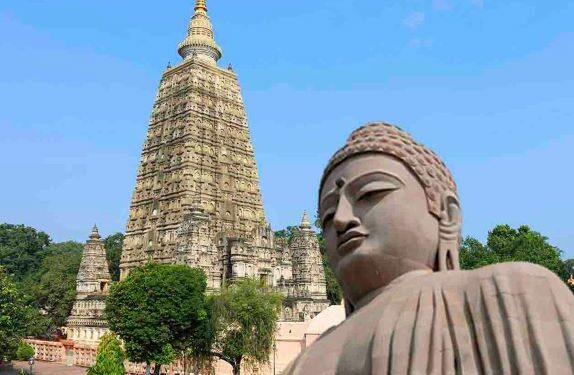
Battle for Buddha Gaya

August 30th, 2021

By P.K.Balachandran Courtesy NewsIn.Asia

Colombo, August 30 (Ceylon Today): Sir Edwin Arnold, a 19 th., Century Indologist,  journalist, poet and author of the immensely popular Light of Asia on the life of the Buddha, campaigned hard, both singly and in collaboration with the Ceylonese monk Anagarika Dharmapala, to retrieve the ancient Buddhist shrine at Buddha Gaya from the hands of a Saivite Hindu priest, called the Mahant.  

Battle for Buddha Gaya

Arnold’s role in the struggle for retrieval is vividly brought out by  Jairam Ramesh in his book:  The Light of Asia: the poem that defined The Buddha (Penguin Random House, India, 2021).

Arnold told the then British rulers that the Bodhi tree at Buddha Gaya, under which the Buddha got Enlightenment, is as holy for the Buddhists of the world as Jerusalem is for Christians and Mecca is for Muslims. Arnold passionately advocated that the temple ought to be handed over to the Buddhists of the world. He kept dinning into the ears of the British rulers that its handing over to the Buddhists will immeasurably enhance the image of the British in the Buddhist countries of Asia including China and Japan.  

But sadly, Arnold and Dharmapala did not fully succeed in their mission in their life time. The British were wary about divesting the Mahant of his hold over the temple, for fear of a Hindu backlash, especially because it had acquired Hindu deities like Siva also. It was not until after India’s independence that the Mahant was gradually divested of his powers. Power over Buddha Gaya now rests with a committee comprising officers of the Bihar State government, Hindus, and Buddhists from India and abroad. It is also a UNESCO World Heritage Site.

When Arnold visited Buddha Gaya for the first time in 1886, he was appalled to see hundreds of valuable artefacts, priceless works of art, piled on each other haphazardly. He wrote to Sir William Wilson, member of the Viceroy’s Executive Council, suggesting that the artefacts be cleaned and kept in a safe place. It is not clear if Sir William responded, but Arnold went to Ceylon and met the famous monk Weligama Sri Sumangala at Pandura who expressed an ardent wish that the Buddhists might someday recover the guardianship of that sacred ground in Buddha Gaya.” The monk added: It ought not to be in any hands except those of Buddhists.”

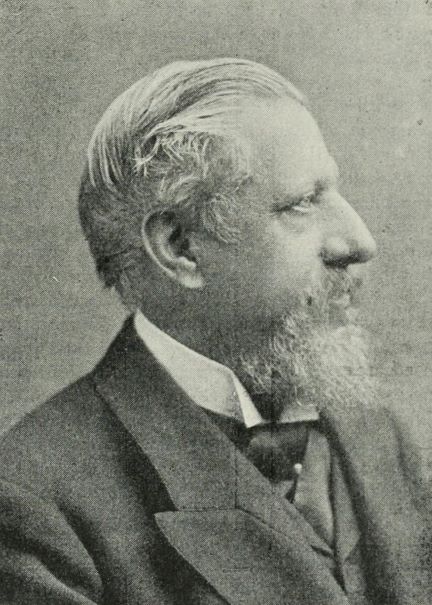
Sir Edwin Arnold

In November 1886, Arnold wrote to Sir Arthur Gordon, Governor of Ceylon, saying that the guardianship of the shrine should be given to the Buddhist monks of Ceylon. Gordon was told that Buddha Gaya was the geographical center of Buddhism” and that it would attract Buddhists from Tibet, Siam, Burma, China and Japan. Arnold followed this up with a letter to retired archeologist Sir Alexander Cunningham  mooting a Government of India Act to acquire the temple as the land on which it stood was government’s. The Brahmin priests could be paid off, Arnold added.

Enter Anagarika Dharmapala

Five years later, the Ceylonese monk Anagarika Dharmapala joined Arnold’s campaign. He had read Arnond’s India Revisited in 1886, in which the sad state of Buddha Gaya was mentioned. When Dharmapala went to Buddha Gaya with a Japanese priest, Kozen Gunaratna, he found that the Mahant was treating the Buddhists with utter contempt.” In 1891, Dharmapala founded the Mahabodhi Society in Colombo with Weligama Sri Sumangala as President and an international managing committee including Arnold. But since the Government of India was crucial for the retrieval project, he shifted the Mahabodhi Society to Calcutta which was then the capital of India.

Back in Britain, Arnold badgered the Secretary of State for India, Lord Kimberley, with letters on the issue. In an 1893 missive, he told Kimberley: Your Lordship might cover your Administration with glory and gratitude, by half a word to the Bengal authorities.” Bodh Gaya was then under Bengal. Kimberley said that the Bengal authorities would not interfere in the matter but suggested that Arnold get someone to buy the property and that the authorities would assist the purchasers in making the necessary arrangements for the transfer.”

Earlier, Arnold had written to Lord Cross, Secretary of State for India, who had taken up the matter with Lord Lansdowne, the Viceroy of India. Lansdowne had replied that the government had no objection so long as the issue did not whip up any religious feeling” and if there was no demand for a pecuniary grant from the treasury.”

In July 1893, Dharmapala was in London en route to Chicago to attend the World Parliament of Religions. He called on Lord Kimberley along with Arnold. Kimberley toed the now-familiar British line that the government did not want anything dramatic” which would antagonize Hindu sentiment. However, he had sounded out Lord Lansdowne in Calcutta who had said that transfer of the property was not advisable when agitations of a religious character possess peoples’ minds in Bihar.” Lansdowne also stated that Buddha Gaya was treated with reverence by the Hindus also.

Arnold acquiesced in this and decided to wait for a more propitious time to revive the movement. But Dharmapala took a couple of precipitate steps unilaterally. In February 1895 he surreptitiously installed a 700-year old statue of a Japanese-sculpted Buddha within the temple. When violence ensued, he shifted it to the Burmese pilgrim’s rest house and filed a case in a Magistrate’s court for legal ownership.  Ven.Sumangala Thera and Col.Olcott were against this move as they knew that while the Buddhists’ right to worship was unimpeachable” their legal right of ownership was ambiguous.” They preferred a negotiated solution.

Sure enough, Magistrate D.J.Macpherson ruled that Dharmapala or the Mahabodhi Society had no right to represent the interest of the Buddhists and that they were being led by non-Buddhists Arnold and Olcott. However, Macpherson also said that the Mahant and the government-held dual custodianship” over the temple.

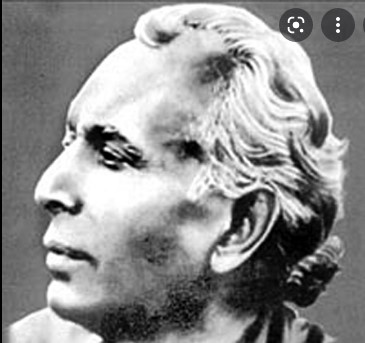
Anagarika Dharmapala

This troubled Mahant went on appeal to the Sessions Court. The Sessions Court said that though the priest’s proprietary rights over the temple and its surroundings found expression in the government’s own list of Ancient Monuments issued in 1886, it did not constitute a deed or grant.” The priest then appealed to the Calcutta High Court where a two-judge bench gave a divided verdict.

The British judge said that if the temple was not vested in the Mahant, it was not vested in anyone.” But the Indian judge said that on the basis of the evidence adduced it is difficult to define the exact nature and extent of the Mahant’s control over the temple.” In 1895, Arnold wanted to come back to India to negotiate with the Mahant and wrote a letter to the latter in Hindi informing him about the plan. But the trip did not materialize.

In 1896, the British tried to defuse the tension over the Buddha Gaya temple and removed the Japanese-gifted Buddha statue from the Burmese Rest House to the Indian Museum in Calcutta. Dharmapala protested vehemently. Many of the Indian leading lights in Calcutta supported him. The Indian English language media also wrote in support of him. Indian support proved to be effective. In May 1896, the government reinstated the Buddha statue in the Burmese Rest House.

Exulting in this, Dharmapala wrote to Arnold declaring the cause of Truth has triumphed at last, and Buddha Gaya has been restored to the Buddhists after seven centuries of oblivion.” Thanking Arnold, he said: The work initiated by you in 1886 has been successfully realized in 1896.”

However, the rich and never-say-die Mahant, pursued his case through the British Indian Association. But the Chief Secretary of Bengal told the association that the government is unable to accept that the temple is a Hindu one. However, no action was taken to give it to the Buddhists. What followed was a long, politically sustained stalemate, which ended only after India got independence.

Free Ayurveda medicine delivered to COVID-19 afflicted homes

August 30th, 2021

Courtesy Adaderana

A program to distribute Ayurvedic medicines free of charge to the homes of COVID-19 infected patients and quarantined persons in the Western Province was launched today (August 30).

The program is organized by the Western Provincial Department of Ayurveda.

The patients were also provided with the necessary medical advice.

The program will continue to serve COVID-19 patients and quarantined families who wish to seek home remedies by resorting to Ayurvedic medicine.

The Western Province Department of Ayurveda states that COVID-19 patients are being treated at home under the full supervision of 265 doctors.

Community Health Medical Officers in 40 Divisional Secretariat Divisions in the Western Province carry out daily treatment of patients.

Cabinet approves salary increments for teachers, principals

August 30th, 2021

Courtesy Adaderana

The Cabinet of Ministers has approved the proposal to increase the salaries of principals and teachers.

The proposal was submitted by the Cabinet Sub-Committee appointed to resolve the salary anomalies of teachers and principals.

The salary increment will come into effect under several stages from the next Budget.

Coronavirus: Highest daily fatality count recorded on Sunday

August 30th, 2021

Courtesy Adaderana

Sri Lanka has registered 216 more COVID-19 related fatalities confirmed by the Director-General of Health Services on Sunday (August 29).

This marks the highest number of COVID-19 deaths reported in one day.

The new development has pushed the official death toll from the virus outbreak in Sri Lanka to 8,991.

According to the data released by the Department of Government Information, the latest victims include 115 males and 101 females.

Five of the victims are aged below 30 years while 41 of them are aged between 30-59 years and 170 others are aged 60 and above.

Daily COVID cases count hits 4,562 today

August 30th, 2021

Courtesy Adaderana

The Epidemiology Unit of the Health Ministry reports that another 974 persons have tested positive for COVID-19 in Sri Lanka, moving the daily total of new cases to 4,562.

This brings the total number of confirmed cases of coronavirus reported in the country to 436,081.

As many as 371,992 recoveries and 8,991 deaths have been confirmed in Sri Lanka since the outbreak of the pandemic.

The Epidemiology Unit’s data showed that 55,098 active cases are currently under medical care.

Historic ‘Parakrama Samudra’ Bund dug up for Jogging Track?

August 30th, 2021

Written by Zulfick Farzan Courtesy News 1st)

COLOMBO (News 1st); The breakwater of the ancient Parakrama Samudraya is being bulldozed for the construction of a walking path.

Video obtained by News 1st showed that bulldozers were being used to shove the rocks of the breakwater into the Parakrama Samudraya to construct a new walking path around the ancient water system.

This 08 feet wide walking path will cover a 1.7 km stretch from the Divisional Secretary Official Residence to the D. S. Senanayake memorial at the Number 01 Sluice Gate of the Parakrama Samudraya.

The proposal for this walking path was moved by the Urban Development Authority and construction will cost a whopping Rs. 34 million.

Farmers in the area point out that the construction will inevitably damage the reservoir.

This walking path is to be constructed along the interior section of the banks of the Parakarama Samudraya.

News 1st obtained footage of a JCB Backhoe-loader being used to push rocks along the breakwater of the Parakrama Samudraya into the water, to flatten the surface for an even walking path.

The massive 116,000-acre-feet of water that the Parakrama Samudraya holds is protected by the breakwater and area residents point out that during certain seasons with the increase in winds speeds, the breakwater stays firm against almost ocean wave-like currents.

Area residents further added that when heavy floods hit the area in 2013 the banks of the Parakrama Samudraya were at risk and sandbags were placed in an attempt to protect them.

Against such a backdrop they question the authorities on why the breakwater of the reservoir is being destroyed for the construction of a walking path.

The chairman of the Parakarama Samudraya agrarian organization said the project is taking place amidst the strong protests by the farming community.

The Director of Irrigation of the Polonnaruwa Zone L.M.W. Rathnasiri said the Urban Development Authority (UDA) had approved the proposal for the construction of this walking path and the green light was also given by the Department of Irrigation.

However, the farmers in Polonnaruwa point out that the leaders of their communities were silenced as the Department of Irrigation secured the contract to ruin the Parakrama Samudraya.

The District Secretary of Polonnaruwa W.A. Dharmasiri assured that the walking path project will not threaten or ruin the banks of the ancient water system.

He added that the Department of Agrarian Services and the Department of Archeology had also granted approval to this project and that the project was aimed at providing the necessary facilities to people who visit the banks of the reservoir daily.

Water has become the most vital component for the existence of human beings, animals, and the plantation.

Even the great King Parakramabahu who ruled the country for 33 years from 1153 AD- 1186 AD asked his countrymen to use water sparingly.

History reveals that King Parakramabahu had made an immense contribution towards the agricultural industry in the country and the Parakrama Samudra was his greatest ever contribution to the people of Sri Lanka.

King Parakramabahu’s famous quote on water conservation and utilization Do not release even a drop of rainwater to the sea without using it ” is still living in the hearts of the people.

This is sound advice to many present-day people who do not know the value of this nature’s gift.

This water system is so large it was called samudhraya or ocean.

In addition to that, strong winds cause swells in the Parakrama Samudraya, so large to the size of ocean waves.

It is this breakwater that has protected the water in the Parakrama Samudraya for centuries, without letting a drop of water go to waste.

The construction of a walking path clearly slaps an insult to the great knowledge that our ancestors possessed in creating such marvels that even stun today’s engineering giants.

Questions have been raised to who authorized such construction with a lack of understanding on the importance of the Parakrama Samudraya.

Walking park on Parakrama Samudra endangers ancient reservoir

August 30th, 2021

Text and Pix By Karunaratne Gamage Courtesy The Island

Project suspended after protests

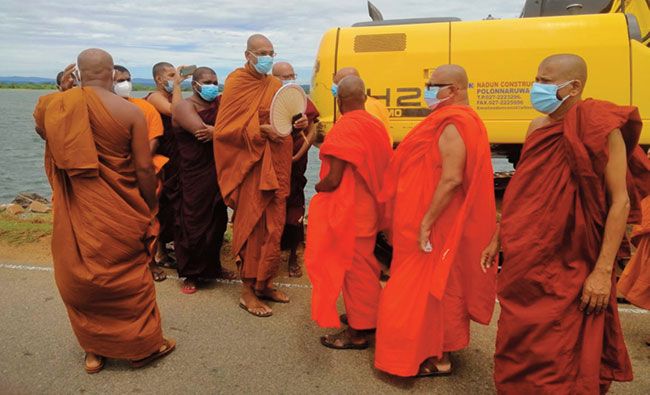
The Maha Sangha on Friday took a stand against the possibe destruction of the bund of the historic Parakrama Samudra, endangered by the construction of a new walking path.

Bhikkus from multiple temples across the Polonnaruwa District made their way to the construction site on Friday (27) morning to witness for themselves the danger to an ancient water conservation system.

Monks representing all three chapters in the District attended the protest demanding the government to suspend the project of constructing a 1.7 km walking path on the bund of the tank.

Adhikarana Sangha Nayake of the North Central Province and Chief Incumbent of the Polonnaruwa Kaduruwela Jayanthi Vihara Ven Kaduruwella Dhammapala thero said the bund of the ancient Parakrama Samudraya was being bulldozed for the construction of this path.

Bulldozers were being used to dump rocks off the bund into the reservoir to construct a new walking path around the ancient water system. This eight-foot wide walkway would extend 1.7 kms. from the Divisional Secretary’s official residence to the D. S. Senanayake memorial at the Number 01 Sluice Gate.

The project proposal came from the Urban Development Authority and construction is estimated to cost Rs. 34 million.

Polonnaruwa Deputy Sanghanayake chief incumbent of Pulasthigama Sri Sakayabimbarama, Ven Yatihalagala Upatissa Thero said that the farmers in the area have pointed out that the construction will inevitably damage the reservoir.

He said that the massive 116,000-acre-feet of water that the reservoir holds, is protected by the bund and area residents point out that during certain seasons with the increase in winds speeds, it stays firm against almost ocean wave-like movements.

Water has become the most vital component for the existence of human beings, animals, and the plantation.

Even the great King Parakramabahu who ruled the country for 33 years from 1153 AD- 1186 AD asked his countrymen to use water sparingly.

History reveals that King Parakramabahu had made an immense contribution towards the agricultural ecoomy in the country and the Parakrama Samudra was his greatest ever contribution to the people of Sri Lanka,” Ven Upatissa Thero said.

The Bhikkhus dispersed after Polonnaruwa District Secretary WA Dharamsiri and Irrigation Department officials visited the protesting monks and pledged that they would suspend the project until a further review meeting attended by all stakeholders are held.

‘Most mutated Covid variant so far’ may already be EXTINCT

August 30th, 2021

Luke Andrews Health Reporter For Mailonline Courtesy Daily Mail

text

A new Covid variant which has been branded the ‘most mutated so far’ may already be extinct, it was claimed today.

Concerns were raised that the mutant strain — dubbed C.1.2 — could be more infectious than other variants and better able to evade vaccines.

But experts said today there was no sign the mutant strain had managed to gain a foothold in South Africa — where it was first identified — or any other country.

The director of University College London‘s genetics institute Professor Francois Balloux said the variant ‘shows no evidence of increasing in frequency’.

He added that it ‘may be extinct by now’.

There have been only 101 cases of the mutant strain since it was discovered four months ago, according to Covid variant tracking platform GISAID.

South Africa has spotted 89 cases of the mutant variant, with the last infection recorded in the first week of August. 

Britain has recorded four cases of the variant. 

But all known mutant strains circulating in the UK are currently being outcompeted by the Indian ‘Delta’ variant, which is behind almost every infection. 

Public Health England began monitoring C.1.2 at the start of the month, but it has not labelled it a ‘variant of concern’ (VOC) or a ‘variant under investigation’ (VUI).

It suggests experts are not overly worried by the strain. 

chart, histogram: Scientists said today that the C.1.2 variant may already be extinct. Pictured above is a graph showing the seven-day average for cases of the variant recorded globally (black line). There have been only 101 infections with the mutant strain to date according to variant tracking platform GISAID, which have not made up more than 0.1 per cent of all infections. Most recently, the proportion of cases down to this variant fell to zero – but this could change in the coming daysNext SlideFull Screen1/3 SLIDES © Provided by Daily MailScientists said today that the C.1.2 variant may already be extinct. Pictured above is a graph showing the seven-day average for cases of the variant recorded globally (black line). There have been only 101 infections with the mutant strain to date according to variant tracking platform GISAID, which have not made up more than 0.1 per cent of all infections. Most recently, the proportion of cases down to this variant fell to zero – but this could change in the coming days

What is the variant C.1.2?

Should I be concerned?

Some scientists have raised fears the variant could be more transmissible than other mutant strains and able to dodge vaccine triggered immunity.

But there is no evidence to definitively say this is the case.

Nor is there any proof that the strain is spreading rapidly or gaining a foothold in any country.

The variant was first spotted four months ago but to date there have been only 101 cases. The latest was spotted ten days ago.

Where have the cases been detected?

The mutant strain was first spotted in South Africa.

This country has recorded almost nine in ten of all infections recorded, but it has not seen a single infection with the variant since the first week of August.

It checks roughly 20 per cent of all cases for variants, compared to just over 10 per cent in the UK.

Britain has spotted four cases to date, with the last recorded on August 20.

Switzerland has recorded two cases, with the last registered in mid-July.

Mauritius, Portugal, China, and New Zealand have all recorded one case. The latest the virus was spotted in these countries was mid-July. 

Can the strain dodge vaccine triggered immunity?

The mutant strain carries several mutations including E484K.

Scientists raised concerns that this mutation could make vaccines less effective after it was spotted on the South African ‘Beta’ variant.

But there is no evidence at present that the strain is dodging jabs and gaining a foothold in any country.

The mutant variant sparked concern after a study on it was published as a pre-print on the website medRxiv.

Video: What is the Delta-Plus Variant? Here’s What We Know So Far About the COVID Strain (Health.com)PauseCurrent Time 0:12/Duration 0:48Loaded: 57.53%Unmute0Full screenPeople Are Taking Ivermectin, a Deworming Drug for Animals, to Treat COVID—Here’s Why That’s a Bad IdeaClick to expand

The scientists – whose work has yet to be reviewed by other experts – claimed the strain had ‘substantially mutated’ from the original Wuhan virus identified in 2019.

chart: MailOnline logo

© Provided by Daily Mail MailOnline logo

Its key mutations included N501Y, which was credited with making the Kent ‘Alpha’ variant more transmissible, and E484K, which scientists say helps the South African ‘Beta’ variant to evade vaccine-triggered immunity.

It also has the mutation D614G, which is believed to make the virus more transmissible.

The scientists said in their paper that the mutant strain emerged in a metropolitan area of South Africa, before spreading to other provinces in the country. 

They added that it appears to be mutating at almost twice the rate of any other variant, at a rate of 41.8 mutations a year.

Harvard University epidemiologist Dr Eric Feigl-Ding said the variant had mutated so fast it was the ‘furthest mutated variant found to date’.

But hitting back at the claims, \Professor Balloux said it was ‘ridiculous’ to raise concerns over the variant at present.

He pointed to data showing very few cases of the variant have been detected to date across the world, despite the numerous Covid surveillance schemes. 

Professor Balloux added: ‘The C.1.2 lineage is not considered a variant of concern (VOC) or a variant under investigation (VUI).’

South Africa has recorded 89 cases of the variant to date, although none have been spotted since mid-August.

Britain’s last case was detected on August 20, more than a week ago. 

Switzerland has recorded two cases, with the last registered in mid-July.

Mauritius, Portugal, China, and New Zealand have all recorded one case. The latest the virus was spotted in these countries was mid-July.  

South Africa is checking 20 per cent of its Covid cases for mutant variants every week, according to the latest report from the Network for Genomic Surveillance in South Africa.

It is recording around 10,000 cases a day on average as its third wave continues to subside.

In Britain scientists are checking around 10 per cent of 30,000 daily infections for variants, according to Public Health England.

Several Covid variants have already been drowned out in Britain, after being driven out by Alpha and then Delta. 

PHE considers a variant as ‘provisionally extinct’ if there have been no cases of it recorded in Britain or elsewhere in the world for 12 weeks.

The Liverpool variant (A.23.1 with E484K), the Bristol variant (B.1.1.7 with E484K) and the and the Antigua variant (B.1.324.1 with E484K) have all already been listed as extinct.

There are more than 400 different Covid variants to date, according to Pangolin.Read more

දින 3 රෝගියෙකු සුව කරන වෙදැදුරු – එස් බී ඉන්නෙත් ව්‍යාධි හරණී බීලා ආයුර්වේද වෛද්‍ය බී.ඒ රත්නපාල (වීඩියෝ)

August 29th, 2021

The News Reporter

https://youtu.be/Opdxyc_xFtk

ERASING THE EELAM VICTORY Part 25b

August 29th, 2021

KAMALIKA PIERIS

The UN Security Council was approached, without success by the Tamil Separatist Movement to get the Eelam war stopped and Eelam declared. According to the UN Charter the only UN body that can discuss the Eelam war was the Security Council. This was clearly stated in article 7 of the UN Constitution.  

But the Security Council refused to discuss the Eelam war. They said it was an internal matter that did not affect international security. UN could interfere in the affair of a country only if a situation developed that would spill over into the neigbor8ng countries or affect another country. UN Charter forbids interference in the internal matters of member states.

The Petrie Report stated that Sri Lanka’s war was never formally considered by member States at the UN, whether at the Security Council or the General Assembly. A UN diplomat told me in a private communication They did not hit us in New York.”

When they saw that Sri Lanka was winning, western countries, led by the EU made five attempts to table a resolution against Sri Lanka at the UN Security Council. China and Russia vetoed this on all five occasions, said Sergei de Silva Ranasinhe.

From late 2008, when Eelam war IV was in progress, a small group of non-permanent members of the Security Council had become deeply concerned by events and by early February 2009 wished the Security Council to formally consider the situation in Sri Lanka. However, they did not have sufficient support within the Security Council for this said the Petrie Report   Norway said it tried unsuccessfully, to take Sri Lanka before the UN Security Council. But UNSC was divided and efforts to get Sri Lanka on its main agenda were stymied by Russia and China, reported Norway.

Throughout the final stages of the conflict, Member States did not hold a single formal meeting on Sri Lanka, whether at the Security Council, the Human Rights Council or the General Assembly, continued Petrie Report.

Unable to agree on placing Sri Lanka on its agenda, the Security Council held several ‘informal interactive dialogue’ meetings. The Sri Lankan ambassador to the UN participated in these meetings, providing the Government’s version of events and potentially influencing discussions.

These ‘informal interactive dialogue’ meetings had no formal status, no written records and no formal outcomes. The first of three informal dialogues took place on 26 March 2009, followed by another meeting on 22 April where the Council was also briefed by the Secretary General’s Chief of Staff, Vijay Nambiar and Catherine Bragg, Assistant Secretary General for Humanitarian Affairs. A third meeting was held on 13 May.

Before that a meeting was held on 11 May hosted by eight UNSC members, the Foreign Ministers of UK, France, Austria, humanitarian organizations and other concerned UN members. At this meeting, the US, working through Britain, France and Austria, tried to get the UN Security Council to examine the numbers of deaths in the last stage of the Eelam War. This was to be at a Security Council briefing.  But US was not able to secure the 16 signatures needed   and UN Security Council refused to discuss the situation in Sri Lanka. 

Instead, the move was ‘strenuously warded’ off by seven countries led by China and Russia. These seven, China, Russia, Japan, Turkey, Uganda, Vietnam and Libya,   said that the current situation in Sri Lanka did not warrant a briefing in the Security Council. China vehemently” opposed any discussion in the Security Council on the issue of civilians trapped in the fighting between government Security Forces and the LTTE arguing that it was “purely an internal matter”.

Foreign Ministers from two member countries of the Security Council went to Sri Lanka in late April 2009.  On 12th May, 2009 they called for Sri Lanka to be placed on the Security Council’s agenda. But this came too late to change the course of events, said Petrie Report. The Security Council did not issue a press statement until three days before the end of the conflict.

On May 13. 2009, five days before the war ended, Security Council issued a press statement .The press statement said, the members of the Security Council express grave concern over the worsening humanitarian crisis in north-east Sri Lanka, in particular the reports of hundreds of civilian casualties in recent days, and call for urgent action by all parties to ensure the safety of civilians.

The members of the Security Council strongly condemn the Liberation Tigers of Tamil Eelam (LTTE) for its acts of terrorism over many years, and for its continued use of civilians as human shields, and acknowledge the legitimate right of the Government of Sri Lanka to combat terrorism.

The members of the Security Council demand that the LTTE lay down its arms and allow the tens of thousands of civilians still in the conflict zone to leave. The members of the Security Council express deep concern at the reports of continued use of heavy calibre weapons in areas with high concentrations of civilians, and expect the Government of Sri Lanka to fulfill its commitment in this regard.

The members of the Security Council demand that all parties respect their obligations under international humanitarian law. The members of the Security Council call on the Government of Sri Lanka to take the further necessary steps to facilitate the evacuation of the trapped civilians and the urgent delivery of humanitarian assistance to them.

The members of the Security Council take note of the steps taken by the Government of Sri Lanka to address the humanitarian situation of displaced persons and call on the Government of Sri Lanka to ensure the security of those displaced by the conflict and to cooperate with the United Nations, the International Committee of the Red Cross (ICRC), and other international humanitarian organizations in providing humanitarian relief and access to them as soon as they leave the conflict zone.

The members of the Security Council reiterate support for the personal involvement of the UN Secretary General and urge the Government of Sri Lanka to extend full cooperation to the United Nations in order to resolve the humanitarian crisis.

The members of the Security Council, mindful of the necessity to find a long-term solution without the threat of violence, underline that the needs of all communities in Sri Lanka have to be addressed. (End of statement.)

The UN Secretary General Ban Ki Moon used this statement to visit Sri Lanka soon after the war ended and issued a joint statement with President Mahinda Rajapaksa.Ban Ki Moon then set up the Panel of investigation which issued the Darusman Report (2011).

 The Secretary General presented the Darusman Report to Security Council, though the report did not have a Security Council mandate.  It was not welcomed by China and Russia. Russia objected, saying that it was not a UN report. It was not done in accordance with the regulations and the procedures of the UN.  The report was a private one for the Secretary General

The Russian ambassador to Sri Lanka told Sunday Times in May 2011 that Russia had opposed the Darusman project from the start.  When the panel was appointed Russia had issued a statement saying that ‘the UN Secretary General as Chief Administrative Officer of the UN should have asked the opinion of the Security Council or the General Assembly before embarking on this project.”

From the very beginning we were skeptical of the panel, the Ambassador said. We were assured by the Secretary General and his staff that this was not a fact finding mission,   the task was not to investigate but only to advise the Secretary General. But what we saw later was very different.

Allegations are made against the government of Sri Lanka in the Darusman Report. The allegations are not proved. The Report says the conclusions were  based on the evidence of individuals and groups that were considered ‘reliable’ by the Panel itself which means they were choosing who was reliable and who was not.

There are too many questions about the Darusman Report. The authors of the report were far from objective. The report cannot be grounds for any further action. If any country tried to punish or shame Sri Lanka, using this report Russia would oppose them, concluded the ambassador “We should not veto the Darusman report itself, but we may veto a resolution.”Russia will oppose any such attempt at the UNSC.

On the other hand, if a resolution criticizing the Darusman report was brought up in UNSC, Russia would support it. The Russian ambassador added that as at May 2011 there were no moves to bring in a Security Council resolution against or in support of Sri Lanka. 

However, efforts to take the Eelam war before the UNSC are continuing. USA approached the UNSC in 2015 and was refused. 

In August 2021 Canada’s Foreign Minister Rob Oliphant rejected a call from Tamil Diaspora groups for Canada to take up Sri Lanka’s case before the International Criminal Court. Oliphant said that the Resolution adopted by the Tamil Separatist Movement in Canada in March 2021 does not incorporate a mechanism to refer Sri Lanka to the International Criminal Court (ICC). Only the United Nations Security Council could refer cases to the ICC if the country concerned is, like Sri Lanka, not a party to the Rome Statute or has not accepted the ICC’s jurisdiction.(Continued)

Pakistan-Sri Lanka Ties: A Game Changer in the Region?

August 29th, 2021

MD Pathik Hasan,

Source: Tribune Express

Pakistan’s Prime Minister Imran Khan visited Sri Lanka on February 23 and 24 at the invitation of Sri Lankan Prime Minister Mahinda Rajapaksa. This is his first visit to Lanka after coming to power. He said, ‘I go to cricket after finishing my studies, and you (Mahinda Rajapaksa) travel to the field of politics.’ The tour has created tension in the subcontinent even before the tour. Khan’s visit took on a new dimension as India’s relations with Sri Lanka deteriorated after the recent cancellation of an agreement with India to build a container terminal at the port of Colombo. Sri Lanka has signed an agreement with India and Japan to set up a terminal on the eastern edge of the Colombo port in 2019. Under this, 49 per cent of the terminal would be owned by India and Japan and the remaining 51 per cent by Sri Lanka. The government was forced to cancel the agreement as 23 trade unions, opposition parties and the general public opposed it. Anandabazar opined that Sri Lanka’s decision was a diplomatic blow to Delhi.

Imran Khan’s visit has given more importance to informal and ancillary issues than formal agreements and has played a significant role in the politics of the subcontinent. For example, Mr. Khan’s visit ended the cremation of Muslims in Sri Lanka in the Covid epidemic, and the ceremony began with the recitation of the Qur’an at the airport, a rare event in Sri Lankan history, Providing special tourism facilities for Buddhists to visit Buddhist sites in Pakistan, Pakistan’s support for Sri Lankan membership in the UN human rights body, initiation of Muslim-Buddhist harmony, import-export of new products, expansion of Sri Lankan tea market in Pakistan, Sri Lanka trade with Pakistan through Central Asia. The creation and expansion of the sporting goods market is the fruit of this visit. The re-establishment of the coexistence and sympathy of Muslim and Sinhalese Buddhists instead of the anti-Muslim activities that have plagued social life over the long-running Easter Sunday incident. The image of the Prime Ministers of both the countries has been brightened and elevated as a result of this visit.

Former US Secretary of State Mike Pompeo has also tried his best to maintain good relations with Sri Lanka and join the Quad. In particular, when China began leasing the port of Hambantota to Sri Lanka for 99 years, India embarked on a similar project; Japan also joined with new technology. Imran Khan’s visit has changed the geopolitics of the Indian Ocean in the context of the Sri Lankan tug of war between China and Quad.

The day after Imran Khan’s return at the end of the tour, on February 25, 2021, almost 11 months later, the Sri Lankan government issued an emergency gazette repealing the provision of mandatory cremation. This is benefiting both the Muslim and Christian minority communities. No one from the world body, including the OIC, the Arab League or any human rights commission, has been able to address this issue outside of Islamic faith and Sharia. During Imran Khan’s two-day visit, the Sri Lankan authorities resolved the issue amicably. At the same time, Imran Khan was remembered by Sri Lankan Muslims. If Sri Lanka is to stand tall in the world, it is the social ties of different nationalities, different religions

During Mr. Imran’s visit, the two states signed the five agreements such as: 1. Cooperation in the tourism sector; 2. Increase relations and cooperation between the investment boards of both countries; 3. Relations and collaboration of the International Center for Chemical and Biology in Karachi in Pakistan with the Industrial Technology Institute of Sri Lanka; 4. Relations and cooperation between the Industrial Institute of Industrial Technology of Sri Lanka and A university in Islamabad and 5. Agreement on the relationship of the Lahore School of Economics with the University of Colombo.

On February 24, Imran Khan invited the Sri Lankan business community to speak openly; He spoke of investing in Pakistan and increasing trade connectivity. In particular, he announced Pakistan’s full cooperation in expanding Sri Lanka’s trade with Central Asian countries. He said the connection from Gwadar to Central Asian countries and the CEPC could open new doors for Sri Lanka. It will play a helpful role in alleviating poverty.

He added that both countries are victims of terrorism. Pakistan has suffered for the last 10 years and Sri Lanka for 30 years. Now we have to cross the development ladder. Mr Khan said, “The tourism sector in Sri Lanka and Pakistan is very rich and needs to be utilized.”

He mentioned, ‘There are many historical sites of Buddhists in Pakistan. Buddhists in Sri Lanka can visit them. If necessary, their facilities will be increased. ‘ He said the excavation work in Gandhara was unfinished. A 40-foot-tall sleeping statue of Gautam Buddha has been found during excavations, which will create a new attraction for Buddhists. Earlier, Pakistan created Kartarpur Gurudwara for the Sikhs and the world was happy with the Sikh community. There are many historical sites of Buddhists in Pakistan. Buddhists in Sri Lanka can visit them.

Towards the end of his visit, Imran Khan announced a 50 million ‘military credit facility’ to Sri Lanka. Note that Pakistan’s military relations with Sri Lanka are old. After independence from Britain in 1947, Pakistan established good relations with Sri Lanka. Pakistan can play an important role if there is a China-Sri Lanka-Pakistan alliance bypassing the quad. So, this tour was Imran Khan’s tactical and successful tour. One crop of political victory. Pakistan provided assistance Sri Lanka militarily in Sri Lanka’s civil war.

Prime Minister Imran Khan has used ‘sports diplomacy’ in this visit. He has spoken in interactive sessions with the sports community. Mr Khan praised the Sri Lankan cricket team and said it was a matter of joy for both the countries that Sri Lanka had won the World Cup in Lahore on Pakistani soil. Addressing the cricketers, he said, “If you are scared, you will lose.”

Sri Lanka announced the construction of ‘Imran Khan High Performance Sports Center’ in Colombo. Mr Khan has announced a 52 million US dollars sports equipment and training package in Sri Lanka. It is worth mentioning here that Sialkot in Pakistan produces high quality sports goods in the subcontinent which is also appreciated in the world market.

The two countries also pledged to work together on security, terrorism and organized crime, as well as drug trafficking. That is why the two countries are accelerating the exchange of intelligence. At a time when Sri Lanka is under international pressure over human rights, class discrimination, war crimes, Pakistan’s support in the international arena or China’s support is very important. In the context of the visit, it is seen that if the UN makes any preparations on Tamil war crimes, there is a possibility of veto of China and Russia. Imran’s visit is therefore very important diplomatically. Both the leaders felt that the SAARC countries should play a stronger role as per the SAARC Charter. The concept of SAARC is important for regional unity and development. Mr Khan emphasized the need for regional connectivity (CPEC). He said it was China’s BRI flagship project in Pakistan and a landmark step towards regional economic development and prosperity. He called on Sri Lanka to join the project and promised to provide necessary financial and technical assistance. This tie can be a game changer in Whole South Asian Region.

Writer: MD Pathik Hasan, Dhaka based NGO activist, researcher and freelance writer particularly on current international issues.

ශෝක පණිවුඩය.

August 29th, 2021

මහින්ද රාජපක්ෂ ශ්‍රී ලංකා ප්‍රජාතාන්ත්‍රික සමාජවාදී ජනරජයේ අග්‍රාමාත්‍ය

දශක හයක්පුරා මෙරට පුවත්පත් කලාවට විශිෂ්ට සේවයක් ඉටුකළ ජ්‍යෙෂ්ඨ මාධ්‍යවේදී එල්මෝ ගුණරත්න මහතාගේ  හදිසි අභාවය අසා මම බලවත් ශෝකයට පත්වූයෙමි.

මාධ්‍ය ක්ෂේත්‍රයේ බහුශ්‍රැතයෙකු වන එල්මෝ ගුණරත්න මහතා සම්මානනීය ජ්‍යෙෂ්ඨ මාධ්‍යවේදියෙකි. එල්මෝ ගුණරත්න මහතා නීති ශිෂ්‍යයෙක්ව සිටිය දී එය පසෙකලා 1954 දී ජනමාධ්‍යවේදියෙකු ලෙස  සිය වෘත්තීය ජීවිතය ආරම්භ කරන්නේ ස්වදේශිය සමාගමෙන් ප්‍රකාශයට පත්කළ “සිංහල ජාතිය” සහ “ගාඩියන්” පුවත්පත්වල  අධිකරණ වාර්තාකරුවෙකු ලෙසය.

එල්මෝ ගුණරත්න මහතාගේ මාධ්‍ය දිවියේ හැරවුම් ලක්ෂය ලෙස සැළකෙන්නේ 1955 දී ලේක්හවුස් ආයතන‍යට  සම්බන්ධ වීමය.  සිළුමිණ, ජනතා, ඩේලි නිවුස් සහ සන්ඩේ ඔබ්සවර් පුවත්පත්වල පොලිස් හා දේශපාලන වාර්තාකරුවෙකු ලෙස එදා ඔහු දිගු ගමනකට මුල පිරුවේ ය.

පොදු රාජ්‍ය මණ්ඩලයීය ජනමාධ්‍ය සංගමයේ ශිෂ්‍යත්වයක් ලැබ ඔක්ස්ෆර්ඩ් විශ්ව විද්‍යාලයෙන් පුවත්පත් කලාව හැදෑරීමට යන එල්මෝ ගුණරත්න මහතා එහි අධ්‍යාපනය ලබන අතරතුර “රොයිටර්”,”නිවුස් ඔෆ් ද වර්ල්ඩ්” හා “මැන්චෙස්ටර් ගාඩියන්” පුවත්පත්වල වාර්තාකරුවෙකු ලෙස සේවය කිරීමට අවස්ථාව උදාකර ගත්තේය.

ලේක් හවුස් ආයතනයේ ප්‍රකාශිත පුවත්පත් රැසක ඉහළ  තනතුරු දරමින් සිටිය දී 1973 වසරේ එම ආයතනය රජයට පවරා ගැනීමත් සමඟ ඊට විරෝධය දක්වමින් එල්මෝ ගුණරත්න මහතා එහි සේවයෙන් ඉවත් විය.

තායිලන්තයේ බැංකොක් හී පළවන “මෝනින් එක්ස්ප්‍රස්” පුවත්පතේ කලක් සේවය කළ  එල්මෝ ගුණරත්න මහතා මෙරට මාධ්‍ය කටයුතුවලට නැවත සිය සක්‍රීය දායකත්වය ලබා දෙමින් 1978 දී “ටයිම්ස්” ආයතනයේ “ඩේලි මිරර්”  පුවත්පතේ නියෝජ්‍ය කර්තෘ ලෙස වැඩ භාරගත්තේය.

පසුකාලීනව ඔහු ටයිම්ස් ආයතනයේ සියලුම සිංහල ප්‍රකාශනවල විධායක කර්තෘවරයා ලෙසත්  සිංහල සහ ඉංග්‍රීසි ප්‍රකාශනවල කළමනාකාර කර්තෘ ලෙසත් කටයුතු කිරීම පුවත්පත් කලා ඉතිහාසයේ නොමැකෙන වාර්තාවකි.  

මාධ්‍ය ක්ෂේත්‍රයේ නම් දැරූවන් රැසකගේම මුල් ගුරුවරයා වූයේ ද එල්මෝ ගුණරත්න මහතාය.

තමාටම ආවේනික වූ භාෂා ශෛලයකින් සිංහල හා ඉංග්‍රීසි ද්වි භාෂාවෙන්ම සිය මාධ්‍ය කටයුතු මෙහෙයවූ එල්මෝ ගුණරත්න මහතා මාධ්‍ය කලාව අලුත් මාවතකට ගෙන යාමට උත්සහ දැරූ විශිෂ්ටයෙකි.

අවුරුදු 89 ක් ආයු වළඳා අභාවප්‍රාප්ත වූ එල්මෝ ගුණරත්න මහතාට උතුම් නිවන් සුව අත්වේවා! යැයි ප්‍රාර්ථනා කරන අතර ඒ මහතාගේ වියෝවෙන් ශෝකයට පත් හර්ෂ ගුණරත්න, තුෂාර ගුණරත්න සහ රජිව් ගුණරත්න යන දරුවන් ඇතුළු පවුලේ සැමට මාගේ බලවත් ශෝකය ප්‍රකාශ කරමි.

මහින්ද රාජපක්ෂ

ශ්‍රී ලංකා ප්‍රජාතාන්ත්‍රික සමාජවාදී ජනරජයේ

අග්‍රාමාත්‍ය

වසංගත රෝග ඒකකය ප්‍රසිද්ධ කරන ඌව පළාතේ කෝවිඩ් දත්ත පට්ටපල් බොරු

August 29th, 2021

රජිත් කීර්ති තෙන්නකෝන් දකුණු පළාත් හිටපු ආණ්ඩුකාර  

රෝගී සංඛ්‍යාවෙන් 50.5% ක් සඟවලා.  කෝවිඩ් දත්ත හපුතලේ කන්ද බහිනකොට වාශ්ප වෙනවාද?

වසංගත රෝග ඒකකය ඌව පලාතේ කෝවිඩ් රෝගීන් ගේ සංඛ්‍යාව 50% කින් කපා දමා වාර්තා ලියා ඇත. පට්ටපල් බොරු දත්ත සහ සංඛ්‍යා මත පදනම්ව සම්පත් බෙදාදීම හේතුවෙන් ඌවේ සෞඛ්‍ය කාර්ය මණ්ඩල ඖෂධ හා උපකරණ හිඟයකට මුහුණ දී ඇති බවත් හිටපු ආණ්ඩුකාර රජිත් කීර්ති තෙන්නකෝන් නිවේදනයක් නිකුත් කරමින් පවසයි.

බදුල්ල හා මොණරාගල දිස්ත්‍රික් ලේඛන අනුව, 2021 අගෝස්තු 28 දින වන විට ඌව පළාතේ කෝවිඩ් රෝගීන් 31,137 ක් වාර්තා වී ඇත. එයින් බදුල්ලේ රෝගීන් 18,630 කි. මොණරාගල රෝගීන් 12,507 කි. ඌව පළාතේ රෝගීන් 342 ක් (බදුල්ල 259ක් හා මොණරාගල 83) මිය ගොස් ඇත.

වසංගත රෝග විද්‍යා ඒකකය අගෝස්තු 28 දින නිකුත් කර ඇති වාර්තාවට අනුව බදුල්ලේ කෝවිඩ් රෝගීන් සංඛ්‍යාව 9406 කි.  මොණරාගල රෝගීන් සංඛ්‍යාව 5599 කි. දිස්ත්‍රික්ක දෙකේ එකතුව (ඌව පළාත) රෝගීන් 15,005 කි. වසංගත රෝග ඒකකයේ මේ සංඛ්‍යා ලේඛන පට්ටපල් බොරු වේ.  

ඌව පළාතේ සෞඛ්‍ය බලධාරීන් මහජන සෞඛ්‍ය පරීක්ෂක කාර්යාල, රෝහල්, අතරමැද ප්‍රතිකාර මධ්‍යස්ථාන, දිස්ත්‍රික් ලේකම් කාර්යලය කෝවිඩ් දත්ත නිවැරදිව වාර්තා කර ඇත.  පළාත් දත්ත කොළඹ වසංගත රෝග අංශයට වාර්තා කිරීමෙන් පසුව දිගින් දිගටම සංඛ්‍යා වෙනස් කර ඇත. පීසීආර් සහ ඇන්ටිජන් පරීක්ෂණ මගින් තහවුරු කර ගත් රෝගීන් සංඛ්‍යාව බදුල්ලේ සිට කොළඹ කාර්යාලයට සන්නිවේදනය කිරීමේ දී මැකී යා හෝ හැලී යා හෝ නොහැකිය. අන්තර් ජලයේ දී හෝ ෆැක්ස් මගින් හෝ රෝගීන් සුව වන්නේ ද නැත.   පළාතේ කෝවිඩ් රෝගීන් සංඛ්‍යාවෙන් ජාතික දත්තවලට ඇතුළත් වන්නේ 48% ක් පමණී.  මොණරාගල දිස්ත්‍රික්කයේ කෝවිඩ් රෝගී සංඛ්‍යාවෙන් ජාතික මට්ටමේ දත්ත සඳහා ඇතුලත් වන්නේ 44% කි.  මේ වන විට පහසුකම් නොමැතිකමින් වැල්ලවාය, මැදගම, සියඹලාණ්ඩුව සෞඛ්‍ය කාර්ය මණ්ඩල දැඩි පීඩාවට පත්ව ඇත.

බදුල්ල මහ රෝහලේ කාර්ය මණ්ඩලයේ වෛද්‍යවරුන්, හෙදියන්, ගිලන් රථ රියදුරන් හා සහාය කාර්ය මණ්ඩලයේ රැසකට ද කෝවිඩ් වැලඳී ඇත.

තොරුතුරු හා දත්ත සැඟවීමෙන් කෝවිඩ් උවදුර පාලනය කළ නොහැකි අතර එය තවදුරටත් පැතිරයාමට හේතු වේ.  රෝගින්ට අවශ්‍ය පහසුකම් සැපයීම රජයේ වගකීමකි.    

(සටහන – වසංගත රෝග අංශය නිකුත් කළ වාර්තාව සහ ඌව පළාත් සභාව නිකුත් කළ වාර්තා මේ සමඟ අමුණා ඇත. )

රජිත් කීර්ති තෙන්නකෝන්

දකුණු පළාත් හිටපු ආණ්ඩුකාර  

SriLankan Airlines offers “Buy One Get One Free ticket” to Indian tourists travelling to Sri Lanka

August 29th, 2021

Courtesy NewsIn.Asia

SriLankan Airlines offers “Buy One Get One Free ticket” to Indian tourists travelling to Sri Lanka

Colombo, August 29 (newsin.asia) – Sri Lankan Airlines is offering a ‘Buy One Get One Free’ ticket offer to Indian tourists travelling to Sri Lanka. The offer is only valid for Indian nationals travelling on a tourist visa.

Exciting offer from SriLankan Airlines! Buy One Get One Free from #India to #SriLanka. Offer Valid only for Indian nationals travelling on tourist visa. Reserve your ticket today! Please contact your nearest SriLankan Airlines Office or your travel agent to book your ticket” SriLankan Airlines said in a tweet.

Lankan Tamils not refugees, we are there for them: Stalin

August 29th, 2021

Courtesy The New Indian Express

Chief Minister MK Stalin on Saturday expressed his regret in the Assembly that he called the camp for Sri Lankan Tamils a ‘refugee camp’ when he announced the welfare package for them.

A child at a camp for Sri Lankan Tamil refugees near Vellore | S dineshBy Express News Service

CHENNAI: Chief Minister MK Stalin on Saturday expressed his regret in the Assembly that he called the camp for Sri Lankan Tamils a ‘refugee camp’ when he announced the welfare package for them.

He further added, Hereafter, the camp will be addressed as ‘Sri Lankan Tamils Rehabilitation Camp’ since they are not refugees. We are here for them and their welfare.” 

No, the LTTE Cannot Come Alive Again

August 29th, 2021

M.R. Narayan Swamy Courtesy The Wire

But even after their death, the Tigers seem to have the ability to keep tormenting Sri Lanka’s Tamils.

No, the LTTE Cannot Come Alive Again

Ever since the Liberation Tigers of Tamil Eelam (LTTE) was militarily crushed in May 2009, it has been asked repeatedly: Can the group be resurrected by Sri Lankan Tamils? I insisted then and I insist now: the LTTE is dead for ever.

Of course, the LTTE will live in the minds of many, both Tamils and non-Tamils. Those who admired and those who suffered at its hands will both remember the Tigers for what it did to them and how it turned the once idyllic island nation of Sri Lanka into a land of blood and gore.

Periodically, one hears from Sri Lanka or sections of the Tamil diaspora that the foundation of another LTTE may be needed to continue the unfinished battle for Tamil Eelam. Recently, a group of Tamils met over the web and pledged to renew the struggle to carve out a traditional Tamil homeland in Sri Lanka, that too with India’s help. There can be nothing more fanciful than this.

Insurgent groups (call them military or terrorist outfits if you like) are not born in a vacuum. The LTTE took shape in certain historical circumstances when large sections of Tamils felt disadvantaged. That was also the time when Sri Lanka was not a militarised nation, and its army, despite quelling the 1971 JVP insurrection, lacked the killer punch it later acquired.

In his formative years, Velupillai Prabhakaran and his small band of young men were ready to dent the Sri Lankan state bit by bit and escape by sea to Tamil Nadu whenever the situation became too hot for them in Jaffna. Life was a constant struggle then, and many nights Prabhakaran went to bed hungry. All this earned him a certain following which in turn helped him to grow.

After the 1983 anti-Tamil riots in Colombo, the Tamil militants found sanctuary in Tamil Nadu. Training camps came up in India, which provided a shady umbrella under which everyone – moderates and militants – could take shelter. Terrorism was not too dirty a word in the 1980s, more so if the victim country was in the Third World. As long as the violence was mostly confined to Sri Lanka’s northeast, the West was not too bothered.

None of the above is true today, except perhaps for the still lingering feelings among sections of Tamils of being discriminated by a Sinhalese-dominated state. Indeed, one factor which is valid today didn’t even exist when the LTTE was taking baby steps in the world of militancy.

A major reason why another LTTE will never emerge is the LTTE itself. The sheer hypocrisy of the Tigers and its leadership and the manner in which they lorded over the mass of helpless and trapped Tamil civilians in the northeast right till its own demise cannot and will never be forgiven by the victims.

Here was a group that mercilessly killed any Tamil who was ready to shake hands with the Sri Lankan state, but was more than ready to embrace Colombo when its own end was near. Here was an outfit that dubbed Tamils who advocated truce as traitors” but actually ended up raising white flags when it could no more take on the Sri Lankan military might. Here was an organisation that assassinated leaders from India and Sri Lanka without any compunction but begged the international community to arrange an honourable” exit for its cornered LTTE chief in May 2009. And Prabhakaran cut birthday cakes for his children in his underground lair even as his fighters snatched teenage boys and girls from poor Tamil families and forced them to fight and die for the cause of Tamil Eelam.

Even if a section of the Tamil diaspora – which funded the war while leading comfortable lives in the West – were to announce the formation of a LTTE, it will have no takers in Sri Lanka including in the northeast, where ordinary people, still furious over how the Tigers broke up families, will be the first to report to the state the activities of suspicious characters.

Sri Lankan soldiers celebrate after seeing the body of Liberation Tigers of Tamil Eelam (LTTE) leader Vellupillai Prabhakaran being carried on a stretcher at Nanthikadal lagoon, near the town of Mullaittivu in northern Sri Lanka May 19, 2009. Photo: Reuters/Stringer

For decades when he was Prabhakaran’s bodyguard and later the commander of the LTTE in Sri Lanka’s east, Vinayagamurthy Muralitharan alias Karuna was a darling of those who dreamt of a Tamil Eelam. When he revolted in April 2004 and broke away, he was dubbed a traitor. But grant it to him, the man knew the LTTE inside out. Two days after Prabhakaran was killed and he helped confirmed the death by identifying the body, Karuna told me that the LTTE’s rebirth was impossible. There are no circumstances, no conditions for such a thing to happen. People are fed up with all this violence. There are absolutely no chances of another LTTE coming up.”

This was also a point made by two former women LTTE fighters who I met in India after the war ended in Sri Lanka.

One of them, who belonged to a middle class family in a village in Kilinochchi district, blamed the LTTE for leaving the Tamil community on its knees after promising them the moon. After so many years of fighting for Tamil Eelam, after losing so many fighters and people, after so much destruction, where are we? Tamils have nothing today. This long, long war has helped us gain nothing. On the contrary, we have lost whatever little we had when militancy started.”

These are the despondent but real voices one needs to take into account while discussing the departed LTTE. Those who dream about reorganising the Tigers while living in the safety of distant lands are either naive or are trying to take the Tamil community for a ride. It is not a coincidence that there has been no LTTE 2.0 even 12 years after its decimation. An Indian security expert who was allowed to meet two so-called LTTE remnants in a Colombo prison after the end of the war told his Sri Lankan counterparts that both were jokers” and should not be taken seriously. They were suspected to be rebuilding” the LTTE.

Of course, periodic reports of LTTE’s revival” is music to the ears of the pro-LTTE diaspora and, believe it or not, also to Colombo – which gets the perfect excuse to drive away more and more Tamils from the coastal regions and replace them with members of the Sinhalese community. Such unfounded reports also permit the Sri Lankan government to justify its continued control over Tamil civilian areas in the island nation’s north and east in the name of High Security Zones”. Even after its death, the LTTE seems to have the ability to keep tormenting the Tamils.

M.R. Narayan Swamy, a long-time Sri Lanka watcher, is the author of three books on the ethnic conflict, including an unauthorised biography of Prabhakaran.

34 children reported with post-covid multisystem inflammatory syndrome: Pediatrician

August 29th, 2021

Courtesy The Daily Mirror

About 34 children have been infected with the post-covid syndrome called Multisystem inflammatory syndrome in children’ so far in Sri Lanka and five such children were receiving treatment at the Intensive Care Unit of the Lady Ridgeway Hospital at present, a medical specialist said today.

Consultant in charge of the Intensive Care Unit of the Lady Ridgeway Hospital Pediatrician Dr. Nalin Kithulwatta said 21 out of the 34 children who were infected with the syndrome have been reported from the Lady Ridgeway Hospital while six cases are from the Karapitiya Hospital and four cases from the Kandy National Hospital.

“The disease has now been spread to other areas where patients have been reported from Jaffna, Diyathalawa, Kurunegala and Badulla areas,” he said.

Dr. Kithulwatta said children, who were infected with whatever Covid variant, could be infected with this Multisystem inflammatory syndrome two to six weeks after recovering from Covid.

He said two percent of the children infected with this syndrome could die and added that if they were brought to a Hospital at the proper time, they could be cured.

“If children develop symptoms such as fever, abdominal pain, feeling over tiredness, vomiting, diarrhoea, bloodshot eyes and skin rash should be immediately admitted to a Hospital. This is a curable disease,” he said.

Dr. Kithulwatta said this new syndrome is now being reported among adults as well where two such persons in their 40s have succumbed to the disease in Balapitiya Hospital.

He said adults could develop this syndrome with Covid-19 symptoms and an acute abdominal pain.

“We suspect this syndrome is spreading among adults in Sri Lanka,” he said.(Ajith Siriwardana)

Over 07 million Sri Lankans fully vaccinated against COVID-19

August 29th, 2021

Courtesy Adaderana

Over seven million people in Sri Lanka have received both doses of the COVID-19 vaccination as of yesterday (August 28), Minister of Health Keheliya Rambukwella tweeted.

Accordingly, a total of 7,042,418 people have been fully vaccinated against the coronavirus so far.

Minister Rambukwella, in his tweet, has further said that Sri Lanka is on track to vaccinate 60% of the population by mid-October this year.

He also says that the government is also striving to reopen the country.

As per the Epidemiology Unit, a total of 12,309,254 people have so far received at least a single dose of the COVID-19 vaccine.

The COVID-19 vaccination program of Sri Lanka is still in operation and long queues have been observed near the vaccination centers despite the ongoing curfew.

Image

SriLankan to operate regular flights between Colombo & 9 Indian cities

August 29th, 2021

Courtesy Adaderana

The Sri Lanka High Commission in New Delhi says that SriLankan Airlines will operate 4 weekly flights to Chennai, 4 to Mumbai and one to Bangalore under its new schedule, and is expected to introduce significant frequency enhancements after the country opened it borders to India.

Under the new schedules, the airline will be resuming services between Colombo and the Indian points; Madurai, Tiruchirappalli, Trivandrum and Cochin with flights once a week.

In addition, Hyderabad and New Delhi will be connected to Colombo with twice-weekly flights.

Further, the airlines’ operations out of Chennai and Mumbai will expand up to five times a week whilst its Bangalore-Colombo services will be enhanced to flights three times a week.

SriLankan Airlines has also commenced a buy one-get one free campaign to induce travellers to fly to Sri Lanka.

Fully vaccinated travellers will only require a negative PCR 72 hours prior to arrival and an on-arrival PCR test at a certified hotel. They will then be allowed to travel across the country freely.

Such travellers should make sure that their second COVID vaccine shot was taken at least 14 days before the journey.


Meanwhile, the SriLankan Airlines will also operate direct flights between Colombo and Kathmandu in Nepal from August 31.

In a tweet, the national carrier stated that flights between the two cities will operated with a frequency of twice a week.

Daily novel coronavirus cases count climbs over 4,600

August 29th, 2021

Courtesy Adaderana

Daily COVID-19 cases confirmed in Sri Lanka surpassed 4,000 for the eighth consecutive day today (August 29) as 914 more people were tested positive for the virus.

According to official data, 4,612 novel coronavirus infections in total were detected within the day and they have been associated with the New Year Cluster.

The new development brought Sri Lanka’s confirmed COVID-19 cases tally to 426,169.

At present, 59,796 active cases are receiving medical care at hospitals, treatment centres and their respective homes.

Meanwhile, the number of total recoveries has reached 357,598 and the death toll now stands at 8,775.

Sri Lanka records 192 new COVID-related deaths

August 29th, 2021

Courtesy Adaderana

The total number people who fell victim to COVID-19 infection in Sri Lanka soared yet again as 192 more fatalities were confirmed by the Director-General of Health Services on Saturday (August 29).

The new development has pushed the official death toll from the virus outbreak in Sri Lanka to 8,775.

According to the data released by the Department of Government Information, the latest victims include 109 males and 83 females.

As many as 156 deaths were reported among the elderly people who are aged above 60 years.

In addition, 36 individuals aged between 30-59 years have also succumbed to the virus infection.

අටුව කඩා පුටුව සෑදීම

August 28th, 2021

රැල්ෆ් නාරංපනාව

අද පොලොන්නරුවේ ඇති පරක්‍රම සමුද්‍රය අරක්ශාකරන රලපනාව ගලවා ඒ වෙනුවට කොක්‍රීට්වලින් සෑදු මංතිරුවක් සෑදීමට රජය ගෙන ඇති තීරනයට විරුද්ධව බලවත් කතාබහක් සමාජය තුල ඇතිවෙමින් පවතී.බොහෝ දෙනෙක් රලපනාව ගැන කතාකරත් මේ ගැන හරි දැනීමක් නොමැතිබවක් සමාජ මාද්‍ය ඔස්සේ ඇතිවන කතිකා වලින් පෙනී යයි.

රජරට වැව් සංකීර්නය

ශ්‍රී ලංකා‍වේ වාරි ඉතිහාසය ක්‍රි.පූ. 6 වෙනි සියවස තරම් ඈතට දිවයයි. ක්‍රි.පූ. 6 වෙනි සියවසේදි උතුරු ඉන්දියාවෙන් පැමිණි ආර්ය ජන කොටස් ලංකා‍‍වෙ ජනාවාසකරණය කළ බව මහා වංශ තොරතුරු වලින් අනාවරණය‍‍වේ. විජය රජ සමඟ පැමිණි පිරිස් විසින් දිවයිනේ ගංඟා ඇසුරු කරගෙන ග්‍රාමයන් නිර්මාණය කරන ලදි. මේ ආකාරයට ශ්‍රී ලංකාවේ ජලය ඇසුරු කරගෙන ජලාශ්‍රිත ශිෂ්ටාචාරය ගොඩ නැගීම ආරම්භ විය.

පණ්ඩුකාභය රජතුමා අනුරාධගාමයෙහි අගනගරයට අවශ්‍ය ජල පහසුකම් ඇතිකරනු වස් ජය වාපි, අභයවාපි සහ ගාමිණි වාපි නමින් වැව් තුනක් ද නිර්මාණය කල බව සදහන්වේ. ඔහු විසින් සාදන ලද අඩි 3900 ක් දිගැති වේල්ලකින් වටවි ඇති අභයවාපී වැව අක්කර අඩි 1900ක ක ජල කඳක් රදවා තැබිය හැක. තිසා වැවෙන්ද මේ වැවට ජලය ලැබේ

ප්‍රාග් බෞද්ධ සමයේදි වාරි කර්මාන්තය මත සකස්වු ශිෂ්ටාචාරය අංග සම්පුර්ණත්වයට පත්වන්නේ ක්‍රි.පූ. 3 වන සියවසේදි රජ කල දේවානම්පියතිස්ස රජුගේ රාජ්‍ය කාලයේදීය. ක්‍රි.පූ. 3 වන සියවසේදි දේවානම් පියතිස්ස රජතුමා විසින් තනන ලද තිසා වැව 1889 දි ප්‍රතිසංස්කරණය කොට තිබේ. තිසා වැවේ දැනට දක්නට ලැඛෙන වේල්ලේ දිග සැතපුම් 1 3/4 කි. වැව පිරුණු විට අක්කර අඩි 2900 ක ජලය රදාපවති. අක්කර 2000 ක පමණ ප්‍රමාණයක වී වගාව සඳහා මේ වැවෙන් ජලය ඛෙදා හරියි.

අනුරාධපුර නගරයේ පිහිටා ඇති ප්‍රධාන වැවක් වනුයේ නුවර වැවයි. මෙහි නිර්මාණයද ක්‍රි.පු. යුගය දක්වා දිවේ. මෙය පළමුවන ගජබාහු රජුගේ (ක්‍රි.ව. 1114-1136) කාලයේදි තනවන ලදැයි සැලකේ. මේ වැව නකරවඩි, පත්තපාසානවාපී නමින්ද හඳුන්වනු ලැබේ.

ක්‍රි.පු. 3 වන සියවසේදි මහා නාග උප රාජ වරයෙක් කරච්ච නම් (වලස් වැව) කුඩා වැවක් තැනවීම ගැන මහා වංශයේ සඳහන් වේ. දුටු ගැමුණු රජුගේ යෝධයෙක් වශයෙන් සැලකෙන ලභිය වසභ වැව් තැනිම ගැන ප්‍රසිද්ධියක් ඉසිලූ කෙනෙකි.

වාරි ශිෂ්ටාචාරය පිළිබඳව ඛෙහෙවින් වැදගත් යුගය වශයෙන් දැක්විය හැක්කේ ක්‍රි.පු. 2 වන සියවසේදි රජ කල දුටු ගැමුණු රජුගේ අවධියයි. ක්‍රි.පු. 3 වන සියවසේ සිට දිවයින පුරා පැතිරි පිහිටා ඇති ලෙන්වල කටාරම් යටින් කොටා ඇති බ්‍රාග්මී ලිපිවල වැව් ගැනත් ඇල මාර්ග ගැනත් සදහන් වීමෙන් මේ බව පැහැදිලි වේ.

පණ්ඩුකාභය රජුගෙන් ඇරඹි අනුරාධපුර යුගයේ වාරිකර්මාන්තය ඉතා විශිෂ්ට තාක්ෂණික ශිල්ප ක්‍රම භාවිත කරමින් ගොඩනංවා ඇතිබව පැහැදිලි වේ.එසේම පෙරදිග ධාන්‍යාගාරය නමින් අතීතයේ ලක්දිව ප්‍රචලිත වීමටත් කෘෂිකාර්මික අතින් ස්වයංපෝෂිත අර්ථක්‍රමයක් ගොඩනගා ගැනීමටත් මෙම වාරිපද්ධතිය බෙහෙවින්ම ඉවහල් වී ඇති බව නිගමනය කළ හැකිය. වර්ථමානයේ පවා වියලිකලාපීය කෘෂිකාර්මික කටයුතු සඳහා මෙම වාරිපද්ධතීන් මගින් ලැබෙන පිටුවහල අතිවිශාල වෙයි.

මොකක්ද මේ රළපනාව

වැවෙහි බැම්ම සරලව වෑ කන්ද ලෙස සැලකේ.නමුත් රලපනාව හෝ සලපනාව ලෙස සැලකෙන්නේ රල පැන්නුම හෙවත් සුළං දාහරා හේතුවෙන් පැන න්ඟින ජල තරංග හේතුවෙන් වැව් බැම්මට සිදුවන හැනිය වැලැක්වීමට පැරණි ශිල්පියා ගත් අද්විතීය උත්සහයයි. වැවේ රැලි ඇතිවීමේදී රැල්ලේ සැර නිසා වැව් බැම්මේ පස සේදීයාම වැලැක්වීමට යොදා ඇති වැටිය නමින් මීට මේ නම ලැබී ඇත.

නවීන ඉන්ජිනේරු  ශිල්පයේත් මේ ක්‍රමය පාවිච්චිකරනු ලැබේ. (Riprap, also known as rip raprip-rapshot rockrock armour, or rubble, is human-placed rock or other material used to protect shoreline structures against scour and water, wave, or ice erosion.) කොක්‍රීට් බැංමකින් මෙය නොකල හැක්කේ ජලයේ ඇතිවන් රැල්ල නිසා වැව් බැම්ම කාදනයට බාජනය වනනිසයි. අවුරුදු දහස් ගානක් මේ වැව් රැකී තිබුනේ පැරණි හෙලයාගෙ තිබූ විශිෂ්ට තාක්ෂණික ශිල්ප ක්‍රමනිසායි


ශ්‍රී ලංකාවේ තරම් දියුණු වුත් පුළුල් වුත් වාරිකර්ම ලෝකයේ වෙනත් කිසිම රටක නොවු බව ඛෙල් නැමති ඉංග්‍රීසි ලේඛකයා පවසා ඇත. පෙර කරන ලද අති විශාල වැව් කර්මාන්ත සමහර විට ලක්සිව තරම් අන් කිසිම රටක දක්නට නොලැබේය යනු මාගේ විශ්වාසයයි. තවද ඒ ඒ සිමාව ඇතුලත දක්නට ලැඛෙන තරම් වැව් අමුණු කර්මාන්ත අන්රටක දැකීම දුෂ්කර ය. (බදුල්ලේ සභාපති ඛෙලි මහතා විසින් 1981 ඉංග්‍රීසි ආණ්ඩුව වෙත ඉදිරි පත් කල වාර්තාව)

ශ්‍රී ලංකාවේ වාරි තාක්ෂණයෙන් ඇතැම් විට ඉන්දියාව පවා ආභාෂය ලැබු බවට සාක්ෂි ඇත. කාශ්මීරයේ රජු අටවන ශත වර්ෂයේ දි එහි ජලාශ ඉදිකිරිම සඳහා ශ්‍රී ලාංකේය වාරි ශිල්පීන්ට ආරාධනා කළ බවට දොලොස්වන ශත වර්ෂයේදි රචිත කාශ්මීර වංශ කතාවේ වනරාජ තරංගනියේ ඉඟියක් කර ඇත.

වාරිමාර්ග තාක්ෂණය පිළිබඳව හෙන්රි පාකර්, ආර්.එල්.බ්‍රොහියර්, සී.ඩබ්.නිකොලස්, ආර්.ඒ.එල්.එච්.ගුණවර්ධන යන විද්වතුන් විසින් පුළුල් ලෙස පර්යේෂණ කොට ඇත. ඒ අනුව ශ්‍රී ලංකාව තරම් සංකීර්ණ හා ශිල්පිය දැනුම අතින් විශිෂ්ට දියුණුවක් පෙන්වන ලද වාරිමාර්ග පද්ධතියක් දක්ෂිණ ආසියාවේම නොවීය. ශ්‍රී ලංකාවේ වාරිමාර්ග පද්ධතිය එකිනෙකට සම්බන්ඳ වීම සුවිශේෂ ලක්ෂණයකි. මේවා සම්බන්ඳ කරන කෘතීම ඇළ මාර්ගයන්හි බැස්ම සැතපුමකට අඟල් 6 ක් පමණ වීමෙන් පෙන්නුම් කරන්නේ මිණුම් හා ඉදිකිරිම් තාක්ෂණයේ පැවති දියුණුවයි.

මෙවැනි පුරාණ තාක්ශ්නයෙන් ස්වන්පෝශිතවූ අපේ වාරිමාර්ග ක්‍රමය නුතන මංතීරු සංකල්පයෙන් වනසා දැමීමට අපි ඉඩ නොදියයුතුය


Copyright © 2026 LankaWeb.com. All Rights Reserved. Powered by Wordpress