Bishop Mendis says toxic gas emitted from the plant is causing serious health problems for residents
A Catholic bishop has criticized the largest power station in Sri Lanka for emitting carbon and causing environmental damage.
Bishop Valence Mendis of Chilaw said Lakvijaya Coal Power Plant in Norochcholai is causing health risks to residents.
“The toxic gas emitted from the plant has increased the risk of cancer and lung disease of people in the area,” said Bishop Mendis during his sermon on Aug.
“Responsible people around the world say they have decided to phase out carbon emissions by 2050 because it is so poisonous to human life.”
The Catholic Church and environmentalists have urged the government to shut down the power plant and to generate electricity using alternative sources.
The plant was completed in 2014 by a Chinese company with the financial assistance of the Exim Bank of China.
It has been decided to stop the use of carbon in Sri Lanka in another nine years by 2030
Today, in addition to waste disposal, serious problems have arisen regarding the storage and condition of coal, the basic raw material required for the operation of the plant.
“It has been decided to stop the use of carbon in Sri Lanka in another nine years by 2030,” said Bishop Mendis.
“Global warming is also increasing due to the release of carbon into the universe.”
Farmers and fishermen in the area say they are facing serious health problems caused by the plant.
Bishop Mendis was speaking at St. Anne’s Church in Talawila, close to the power plant, in a service to mark the feast of St. Anne
Sadamali Niroshika, a Sunday school teacher from Chilaw, said that due to improper storage and disposal of coal, the air in villages near the plant contains coal dust and ash.
“People in the area face several serious health problems. A group of children living around the power plant have contracted skin diseases. Many other children living in the surrounding villages have skin problems and many adults suffer from health problems,” said Niroshika.
“The air and water are polluted when coal dust and waste ash are mixed into the environment.”
When the wind blows, the ash scatters like dust
An officer from the Electricity Board claimed that coal dust is everywhere in the surrounding area.
“When the wind blows, the ash scatters like dust. We now cover the entire area with sheets about 45 feet high,” said the officer who asked to remain anonymous.
“The ash is used in the manufacture of bricks and cement.”
Environmentalist Aruna Malcolm said harmful chemicals can cause cancer and lung, skin, kidney and heart diseases.
“Such conditions have already been reported around Norochcholai,” said Malcolm.
“Today, these plants are considered to be one of the major pollutants in the world. It is an outdated technology and has been phased out in many countries.”
All teachers and principals island-wide are required to report for their duties today (August 02) as per a circular issued by the Ministry of Public Service, Provincial Councils, and Local Government.
According to Secretary of the Ministry of Education Prof. Kapila Perera, officers and staff of all the Provincial Departments of Education, Zonal and Divisional Education Offices and the academic and non-academic staff of all schools should report for duty today.
However, the teachers’ and principals’ trade unions have decided not to report for duty today.
Secretary of the Ceylon Teachers’ Union Joseph Stalin said that the Secretary to the Ministry of Education had been informed in writing of his trade union decision.
We are already on a trade union action. This announcement has been made in a situation where that trade union action is ongoing. We have clearly stated not to report to work today. If there is no positive response tomorrow, we will march to Colombo in a motorcade.”
The Epidemiology Unit of the Health Ministry reports that another 702 persons have tested positive for COVID-19 in Sri Lanka, moving the daily total of new cases to 2,382.
This brings the total number of confirmed cases of coronavirus reported in the country to 313,769.
As many as 280,868 recoveries and 4,571 deaths have been confirmed in Sri Lanka since the outbreak of the pandemic.
The Epidemiology Unit’s data showed that 28,393 active cases are currently under medical care.
In
2005, the UN General Assembly passed a
Resolution titled Basic
Principles and Guidelines on the Right to a Remedy and Reparation for Victims
of Gross Violations of International Human Rights Law and Serious Violations of
International Humanitarian Law” (General
Assembly resolution 60/147 of 16 December 2005) .
This UNGA Resolution defines victims” as
persons who individually or collectively suffered harm, including physical or
mental injury, emotional suffering, and economic loss in war, due to gross
violations of International Human rights law (IHRL) and International Humanitarian
law. (IHL) The Resolution says the safety and needs of such victims and their families
must be looked after. IHRL and IHL are directed mainly at wars between nations,
not internal warfare. Due to this, the Resolution
says nothing about violence by non-state
groups, such as LTTE.
This
Resolution is about those caught up in
the war, involuntarily. Not about civilians who take part in the war. The
Tamil civilians in the north supported the LTTE. LTTE were engaged in high treason, considered the worst crime of
all. Therefore, Tamil civilians are not
persons innocently caught up in a war. They are complicit”. Complicit means
involved with others in an activity that is unlawful or morally wrong.” This
means Tamil civilians do not qualify under this Resolution.
Tamil civilians had acted as spies for the LTTE . They had
reported on troop moments. They visibly supported the LTTE at the final phase
of the war. in 2009 The Tamil civilians marched in huge numbers towards the war
zone in Putumatalan area on the orders of the LTTE. They went
willingly. 20,000 LTTE could not have forced 330,000 civilians to follow
them . The Tamil civilians cooperated , because they thought the LTTE would
win,. Interviewers reported later that many had believed that the West would intervene
and save them and the LTTE.
The whole family,
including aged relatives, made the journey. They went in buses, cars, and on
foot. As late as 2012 it was possible to see large piles of corroding motor
vehicles, motor cycles, and bicycles, parked on top of each other on either
side of the road . There were large
swathes of land with thousands of abandoned plastic vessels, cooking utensils,
clothing, shoes children books, and other personal items strewn around.
The
Tamil civil sins did not go on this journey empty handed. It was reported that the IDPs who came
across at Puthumathalam, fleeing from the LTTE came with their land deeds
tightly held. They also carried
millions of rupees in cash and gold securely wrapped in pottanis.
In Pudumatalan,
LTTE used the Tamil civilians to form a
defense that would hold back the
government forces and allow an international rescue operation by sea carried
out by Norway and USA to take place.
The civilians became
a buffer, a human shield. Acting as a
‘buffer’ or human shield, is considered
a criminal act.
Also, the civilians dug trenches, prepared bunkers and helped build
the formidable earth bunds which
protected the LTTE . The
civilians also did sentry duty, and
carried supplies. Each family was allotted
specific tasks like building bunkers, the civilians said.
ICRC rules say Civilians caught up in a war are entitled to protection
under International law.. But civilians
taking direct part in hostilities lose that immunity. Since they had
directly participated in hostilities, the Tamil civilians were not entitled to protection as civilians.
They had forfeited that protected status. Since these Tamil civilians supported
the military efforts of the LTTE, they lost the protection offered to non
combatant civilians under International Humanitarian Law..
The UNGA Resolution permits a victim to seek judicial remedy”. But the Tamil
civilians have not gone to courts, for the simple reason that they have no case. If they go to court the fact
that they were complicit will emerge.
The
Resolution says victims are entitled to reparation for acts committed by the
state. Reparation must be paid by the state and it should be proportional to the
violations and the harm caused. The Tamil Separatist Movement and its NGOs, the
UNHRC and its High Commissioner have latched
on to this issue of Reparation. They demand reparation from the state for their
‘innocent Tamil civilians’ caught up in war.
OISL report recommended reparation, the UNHRC included
reparation in its resolutions on Sri Lanka and Tamil Separatist Movement keeps
talking about reparation. ICES conducted discussions in
Jaffna, Trincomalee, Colombo and Galle on reparations. These discussions were published
in the ICES monograph, Memorialisation and reparations, report of four
dialogues” (2016)
This UNGA
Resolution says victims must be provided with full reparation.
Full Reparation” means restitution, compensation, rehabilitation and guarantees of non-recurrence. Restitution”
includes returning the victim to his original situation and residence,
restoring his liberty and family life,
giving back his employment and his property.”Non recurrence” includes legal action against those who were
responsible for the violence”; this means ‘war crimes.’
The Resolution
also, inter alia, called for several other actions, which
have been recognized in Sri Lanka. They are, searching for the disappeared,
finding bodies of those killed, issuing a public apology and permitting
tributes and memorials to the LTTE. Analysts
observe that the process of tracing people and identifying human remains after
many years is extremely difficult. The government of Sri Lanka under Mahinda Rajapaksa
has never apologized for the Eelam wars, as far I know and it was opposed to
commemorations of the LTTE.
Everyone who has
been a victim is entitled to reparations, said Jehan Perera. Where reparations are concerned, the victims
do not have to confront those who did wrong by them. Nor will they be required
to speak up before the general public and before commissioners. Victims can receive reparations on the basis
of already existing evidence. The advantage of reparations is that they can be
determined administratively, and not through a legal process where the burden
of providing evidence lies with the victim.
The Yahapalana
government, which was a puppet government of the USA, passed the Office for
Reparations Act No. 34 of 2018. This repealed the Rehabilitation of Persons,
Properties and Industries Authority Act No. 29 of 1987. (REPPIA).The new Act
would identify persons eligible for reparations and give reparation.
In 2018,
D.M.Swaminathan had for three weeks in a row, submitted a Cabinet Paper which
proposed to pay reparations for families of dead LTTE cadres. The Cabinet Paper
had been deferred twice but on the third occasion, due to protests from
ministers, was stopped for good, reported the media. The Cabinet paper had proposed to compensate those
affected by the war, including civilians, places of religious worship and the
families of dead LTTE cadres.
The present government, Pohottu, plans to
allocate a monthly sum of Rs 6000 to all those who have obtained Certificates
of Absence (of their relatives) from the Office of Missing Persons, said Jehan
Perera in 2021.
MISSING PERSONS”
After
the war ended the Tamil Separatist Movement encouraged the ‘innocent Tamil
civilians ‘ in the north to start protesting about ‘’Missing persons’, who had ‘Disappeared’ due to the war, most
likely killed by the army. Almost every
family had lost a relative in the war, said analysts. A villager living near Udaiyaarkadu
hospital had told Rajiva Wjesinha that
he had 5 brothers and all survived the conflict except the one who
joined the LTTE.
In
2010 the LLRC received
1,018 complaints of persons who had disappeared due to the war. In 2015, Presidents Commission to Investigate
Complaints regarding Missing Persons (PCICMP),received 23,099. 5000
were from the army.
R.
Sampanthan, said that TNA had conducted its own investigations and found that
there were at least 350,000 to 400,000 people in the Nanthikadal area in the
last stage of the war. Only 290,000 people came out. What happened to the rest.
The figure of 400,000 was promptly shot down. This count,
provided By the Government Agent,
Mullaitivu and Bishop of Mannar was not the count for Nanthikadal in the last phase of the war, said Ladduwahetty.
Further, the figure of 300,000 was not an invention of the government. The figure
was determined by the government jointly with the international agencies working
in the area, such as ICRC and World Food Programme .
Tamil
Separatist Movement said that scores of
persons had disappeared after they
were handed over” to the military by
their families soon after the war ended.
“If a mother handed over her son to armed forces or a police
officer she wants to know what happened to him. It is a legitimate
demand”, said R. Sampanthan. For
the Tamils these were not LTTE , they were sons, husbands, wives, daughters,
kin neighbors and friends, said a supporter, emotionally.
.I saw at
first hand at a recent meeting the powerful sentiments of a people who have
lost their loved ones and found no answers
from the government, said an activist . One mother said that she had surrendered her
son to the military at the end of the war and she wants to know what has
happened to him. She hopes he is still alive. Other people’s sons had been returned.
Many if not most
of them continue to hope that their loved ones are being held in some place of
detention, Whenever government authorities tell them that there are no such
places they get highly agitated, said Jehan Perera. Both President Sirisena and
Prime Minister Wickremesinghe have each said that their government is not
holding anyone in places of secret detention . If OMP says that their loved one
is either dead or they are unable to trace what happened to him, this truth
will be difficult for the families to bear, added Jehan.
Sri
Lanka army firmly denied that these
‘missing’ persons were killed by them. The Sri Lanka army said it was a highly
professional army, not a weak undisciplined one as the Tamil Separatist
Movement tried to show. Sri Lanka army
considered these accusations beneath them. They were contemptuous, not
defensive regarding these accusations.
Spokesman
Brigadier Sumith Atapattu told BBC in May 2019 “.People who surrendered to the army were not killed. That is for sure. Those who
surrendered or were captured have been
accounted for. There are no underground detention camps in Sri Lanka . Foreign
delegates including the UN have come and checked our camps.
In
2020 former army commander Daya
Ratnayake was asked by an interviewer,
it is 10 years after the war, Tamil families are still looking for their
loves ones. Their complaint is that these loved ones surrendered to the army during
the final days of the war but still there is no trace of them. These families
want answers. What happened to these people. Ratnayake replied, none
went missing under our custody. The army has already said so. These allegations
are false.
Anti –Eelamists
alsopointed out that quite a number of persons who had been
reported missing during the conflict and
after, were living abroad under assumed
names.
However,
Tamil families of disappeared
persons lodged complaints with all
possible authorities, police, army, Human rights Commission and various
domestic commissions of inquiry. The only response they got was that the person
concerned had not been detained.
A few
had filed writs of habeas corpus but this did not yield results either. The
habeas corpus petition filed with the Vavuniya High Court in 2013 regarding the
disappearances of the group led by Father Francis, seen surrendering to the
army in May 2009 did not bring forth
Father Francis.
Complainants were sent from place to place, without receiving any information
regarding their missing relatives. One witness stated that she had to pay an
interpreter when she visited different Government offices. There was also the issue of language
. The police would record the statement
in Sinhala and ask them to sign, though they did not know Sinhala. When the
LTTE took away my elder son, I knew
which part of the jungle he was in. In the case of the army, I did not know Sinhala to ask where they were taking our children, one said.
The
Tamil civilians, especially women, have been very active in the matter of
Missing Persons. They have protested
vigorously and are continuing to demonstrate and protest to this day. Their
support could be considered a continuation of their complicit behavior during
the war. They supported the LTTE then, they were supporting the Tamil
Separatist Movement now.
This group
has demonstrated vigorously. Demonstrations were held in Colombo Mannar,
Vavuniya and Jaffna reported Amnesty International in 2013. These
got publicity, which was the purpose of the demonstrations.
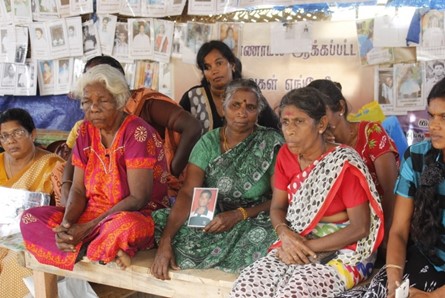
In
2017 there has been a spectacular demonstration which went on for 500 days,
into August 2018. These impoverished women could be seen, dressed in
fresh, bright saris, holding placards and photographs. On their 100th day of protest,
the mothers called a massive demonstration and hundreds of people took to the
streets and blocked the A-9 in Kilinochchi, reported the media.
They sit when
it rains, and they sit when the hot wind off the A-9 highway blows sand into
their makeshift tent, reported the media, dramatically. They’ve been sitting for over 200 days now in
Kilinochchi, protesting the loss of their family members. They are mostly
women, and they say they have one thing in common: they all lost their loved
ones in the final days of the war, in 2009.
They want to
know if their sons, daughters, parents, husbands and in-laws are dead, or if
they’re alive somewhere, in a prison or detention camp. Some of their sons and
husbands were fighters for the LTTE they
said, who surrendered after the Army’s final offensive. Some were just
civilians, picked up in camps for internally-displaced persons or loaded onto
buses and never seen again.
Kathasamy
Ponnamma, a mother whose son-in-law disappeared in Vavuniya. If they
supported the LTTE in some way, we are ready for judicial processes, we are not
saying just release them.” If you’ve
killed my son, you can give me the body,” she said, with tears in her eyes. I
need to do the final rituals. You can at least give the body to us.”
The relatives
of the missing were organized into the Association for the Relatives of the
Enforced Disappeared. This would have been done by Tamil Separatist
Movement. These village women lack the ability
to organize in this manner. In 2021 this Association came Colombo to complain to the Sri Lanka HRC.
They wanted to go to the ICC. HRC had told them this was not possible.These uneducated , backward women from the north, could not have known of the
ICC. They were doing as they were told.
Pohottu
government plans to put an end to this matter by declaring all the missing as
dead, issue certificates and give some
money to the relatives. This should not be done
in a hurry. Each claim should be examined closely. Tamils have listed those
killed in war as ‘missing’. The Census data for 1981 could be used as the
baseline.
The stories related by the relatives of the
Disappeared can be true or false. Some
sound flimsy. One said the neighbors had
seen the army arrest and take away her
husband. I am still searching for him.
Here are some first person stories related in
2017. On a recent afternoon, surrounded by about 25 other mothers, Thangavelu
Sathiyathevy recalled the last time she saw her family. She said she remembers
the day exactly. This was May 18, 2009. We were in Vadduvakallu, and there
were buses taking people away,” she said. Thousands of displaced people had
gathered on the beaches there, seeking safety from the fighting. Vaddavakallu
was technically in a no-fire zone.My daughter, son-in-law, and their three
children were taken into the bus. He was an LTTE member,” she said, and we
also asked to join with them. But they said no, you can go
separately.”Sathiyathevy said she was taken to Manik Farm, an IDP camp near
Vavuniya. But she has never seen or even heard from her family again. The
children were 2, 9, and 10 years old.
Jeyakanthi
Narmila’s husband from Thilaiyampathi in Kondavil, Jaffna, disappeared on
August 17, 2007. She alleged that he was taken away by the Army in a white
van.Some Army soldiers reached my home in a white van—it was around 3.30 am.
He has not returned since. I haven’t heard anything about him. I made
complaints about the abduction of my husband to both, the Uralu Army Camp and
the Kopai Police,” she said.
Six months
after the disappearance, she had seen her husband on a motorcycle pillion,
ridden by an Army soldier. Three years later, she saw her husband once again,
in an army truck.On that day, a piece of cloth was tied round his mouth. Thereafter, I never saw my
husband again.
Sivayogam
Ratnaraja said she and her family was also taken to an IDP camp in Vavuniya
after the war. In June, her son Ratnam Ratnaraja came to visit them from the
University of Moratuwa, where he was studying engineering. But after he left
the camp, he was arrested by local police.
She was never given a reason for his arrest. But she has a suspicion.
Her elder son, Ratnam’s older brother, was an LTTE cadre and died during the
fighting. Six months later, Ratnaraja said one of her neighbors, had met with
and spoken with her son at Anuradhapura prison. She has not heard from her son for the past eight years.( continued)
Officials of Sri Lankan Investment Board, Pharma Manufacturers Association to hold virtual meet with investors on August 5
Sri Lanka is seeking to invite potential investors from India to set up manufacturing operations in the new Hambantota Pharmaceutical Zone and is likely to offer a number of incentives, including tax sops.
Senior officials from the Sri Lankan Board of Investment and the Pharma Manufacturers Association of Sri Lanka will hold discussions with potential investors from India through an online meeting this week on the investment opportunity in the zones, an official tracking the matter told BusinessLine.
This follows discussions between Minister of External Affairs S Jaishankar and his Sri Lankan counterpart, Dinesh Gunawardena, in Colombo in January on opportunities for Indian pharmaceutical manufacturers in special zones in Sri Lanka.
Indian investments in the zone will be important both from the economic and diplomatic perspective,” the official added.
The Sri Lankan government is setting up the Pharmaceutical Zone in Arabokka in Hambantota on over 400 acres in a bid to increase export earnings to face the Covid-19 challenges effectively. The zone’s objective is to meet around 40 per cent of the local demand for pharmaceutical products while creating the pathway to a $1-billion independent export vertical by 2025, per reports. The meeting with Sri Lankan officials on August 5 is being facilitated by the Federation of Indian Export Organisations and is likely to be attended by a number of pharmaceutical manufacturers in the country.
Tax concessions
While the details of the tax and other incentives on offer may be shared by Sri Lankan officials at the meet, according to reports in Sri Lankan media, concessions will cover corporate income tax, income tax on employees, Value Added Tax (VAT) and the Ports and Airports Development Levy. Enterprises are also likely to be exempted from Customs duty for importing capital goods and construction-related items, raw materials and production/process-related consumables.
Sri Lanka is an important trade and strategic partner for India and the Indian pharmaceutical industry exported shipments worth $245.76 million in 2020-21 to the country. India’s overall exports to Sri Lanka in 2020-21 was $3.5 billion, which was about 7.9 per cent lower than the previous year.
Having strong economic ties with Sri Lanka is also a good strategic option for India to counter the growing influence of China in the neighbourhood. Investing in pharmaceutical zones in Sri Lanka could be beneficial for India on both economic and diplomatic fronts,” the official said.
Investigations disclosed that three of the eleven women who had served as domestic workers at MP Rishad Bathiudeen’s residence in Colombo since 2010, have died.
The Police launched investigations following the death of the 16-year-old girl who recently died of burn injuries while working at the residence last month.
Following the investigations, the police said that 11 women including the 16-year –old girl had worked as domestic aides at Bathiudeen’s residence between 2010 and 2021.
Then, the special investigation teams were deployed to record statements from the women who had previously worked there.
The Police had earlier said the same broker who brought the 16-year-old girl to the MP’s house was instrumental in bringing the other women too to the residence.
It is learnt that in addition to the teenage girl, another woman who had worked there earlier had died due to an ailment (cancer), while another woman is reported to have committed suicide after she had left the MP’s residence.
Police said they have recorded statements from eight women till date.
Meanwhile, Western Province Senior DIG Deshabandu Tennakoon said following the questioning of those women, a 29-year old woman told the police that she too was sexually abused while working at MP Bathiudeen’s house.
Police are conducting further investigations into those incidents.
The wife, father-in-law of former Minister Bathiudeen, the broker were arrested and remanded in connection with the death of the 16-year old girl, while the 44-year old brother-in-law of the former minister was arrested and remanded over the alleged rape of a 22-year-old woman who served as a domestic aide at the MP’s residence.(DSB)
The Secretary to the Ministry of Education has requested all provincial, zonal and divisional education authorities, principals, teachers and non-academic staff to follow the circular on recalling public sector employees to work from August 02.
On Friday (July 30), Secretary to President, P.B. Jayasundera announced that all state sector employees will be called back to work from Monday (August 02).
Accordingly, Secretary to the Ministry of Public Services, Provincial Councils & Local Government J.J. Rathnasiri published a circular in this regard.
In addition, all circulars permitting work from home arrangements and limited number of staff members to be present at the workplace on a rotation basis, in a bid to control the spread of COVID-19, were also revoked by this new circular.
The decision was taken with the intention of restoring normalcy in the public service as majority of public servants have been vaccinated against COVID-19.
However, teachers across the island had withdrawn from conducting online lessons on July 12, demanding solutions for anomalies in salaries, ‘forced quarantining’ protesters, and several other issues.
The strike, joined by a total of 17 trade unions representing school principals and teachers including the Ceylon Independent Teachers’ Services Union (ITSU), has been going on for more than 20 days now.
A total of 855 more people were tested positive for COVID-19 today (July 30), increasing the daily count of positive cases to 2,510.
According to the Government Information Department, 2,490 of the new cases reported today have been associated with the New Year cluster. The remaining 20 were identified as arrivals from foreign countries.
The new development has brought Sri Lanka’s confirmed coronavirus cases tally to 311,349.
Epidemiology Unit’s data showed that as many as 278,910 patients who were infected with the virus have regained health so far. Meanwhile, the death toll now stands at 4,508.
Nearly 28,000 are currently under medical care at selected hospitals and treatment centres across the country.
SriLankan Airlines has resumed direct flights between Sri Lanka and Russia from today (August 01) after six years.
The SriLankan Airlines flight UL534, which departed from Moscow, Russia, arrived at the Bandaranaike International Airport at 06.30 this morning, Ada Derana Airport correspondent said.
Accordingly, 51 passengers including foreign tourists were present in the flight.
The flight will leave Moscow at 10.20 pm on Fridays and arrive in BIA at 06.10 am on Sundays.
There is a heated debate in the society regarding the chemical and organic fertilizers in the market.
In such a background, Senior Professor Buddhi Marambe of the Department of Crop Science, University of Peradeniya stated that the application of organic fertilier to the soil alone can not ensure the food security of essential food items
The multi religious and multi
ethnic approach taken by the Walpola Rahula Institute (WRI) and its head, Venerable
Galkande Dhammananda to advance social healing amongst all people in Sri Lanka
and elsewhere is set to take a major step forward with the increasing focus on
online programs that could potentially reach vast audiences from the comfort of
their homes. In the context of widespread ritualism experienced and expressed
as Buddhism in Sri Lanka, the focus on Buddha’s teachings on the principles of
his doctrine and the need for society to be healed of many mental wounds they
carry, the WRI and Venerable Dhammananda offers a breath of fresh air to those
who are confused and even disillusioned with ritualism that is being expressed
as Buddhism.
The
uniqueness of the Walpola Rahula Institute in Sri Lanka, begun by Venerable
Galkande Dhammananda the only Monk pupil of late Walpola Rahula Thero, probably
one the greatest visionaries of our time, is depicted by the above notice that
greets all visitors to the Institute at its entrance.
It is
unlikely that any other Buddhist institution in Sri Lanka portrays Buddha’s
fundamental message to human beings as the WRI has done. On account of this
openness, it has attracted patrons from all ethnicities, religions and diverse
backgrounds, to its premises and its activities. Human Rights Advocate Radhika
Coomaraswamy who was a guest speaker at an event conducted by the WRI a while
ago said she felt safe” in the environment of the WRI.
Over the last 6 years, the
Walpola Rahula Institute, led by Ven Dhammananda, and with the participation of
its volunteers, and staff have been working tirelessly conducting projects,
programs and discussions to achieve ‘Social Healing’. Ven Dhammananda’s
consistent message has been that the principle of dependent origination or
Paticca Samuppada” is the cause for many conflicts and they have risen from
wounded minds which give rise to unwholesome thoughts and which in turn give
rise to unfortunate and harmful action, and that this cycle repeats itself
without a healing of the wounded. Taken as a collective, societies, which are
collection of individuals, in turn experience this same phenomenon of dependent
origination, and they will continue to deviate from right thought and right
action unless there is social healing. The fundamental theme underlying
activities of the WRI has been the dictum Bahujana Hithaya, Bahujana Sukhaya”,
for the happiness of the
many, for the welfare of the many.
The Twin Schools Project that
was done in 2017, linking two under privileged rural schools, one a Tamil
medium school in Therankadal, near Killinochchi and the other, a Sinhala medium
school in Kebithigollewa, near Anuradhapura, epitomised the objective of social
healing through joint activities between the two schools, transcending man made
barriers that stood in the way of social healing through closer human
interaction. It needs to be noted that these two schools were located in areas
that experienced the hostilities during the last war between LTTE combatants
and the Sri Lankan Forces.
This, and many other programs
initiated by Ven Dhammananda, including an educational program for young novice
Monks, multi religious discussion forums, counselling for victims of floods and
other natural disasters, as well as victims of man-made disasters such as
attacks on Muslims, and Christians like the Easter Sunday bombings in 2019,
were all directed towards drawing attention for the need for social healing to
overcome conflict.
Another
notable event in 2019 was the translation into English of one of late Venerable
Walpola Rahula’s seminal works, Sathoyadaya, into English. This was all
the more significant as the scholarly translation was done by a person of Tamil
ethnicity, Mr Niranjan Selvadurai.
In
keeping with the times arising from the COVID pandemic, and the inability to
arrange face to face programs, Ven Dhammananda chartered a new course to bring
healing messages via online platforms commencing in 2020.
The
WRI has made much progress to broad base online programs and two key
developments have happened in the recent past. A specialist on program
development (both technical and on content, design and themes) has been
recruited, along with another person, who is a Tamil, to assist with program
development as well as to undertake and provide translations to Tamil of all
programs conducted in Sinhala. Their mobilisation has been delayed due to the
COVID pandemic and travel restrictions, but it is very likely that the program
development work will commence in August and September.
All
such programs will be broadcast over the YouTube channel Rahula Dhammavahini”,
and other means such as Podcasts. The overriding theme that Venerable Galkande
Dhammananda will be focusing on will be social healing. Venerable Dhammananda and the WRI is being
assisted by forty patrons who have subscribed to participate in this broad
based online program and meet all connected expenditure for a period of one
year. It is noteworthy that amongst the 40 Patrons are Buddhists, Christians,
Muslims, Sinhalese and Tamils, showing clearly that the doors of the Walpola
Rahula Institute are open to everyone irrespective of their religion or
ethnicity.
Mini
Studio construction work begins on the 15th of July 2021
While programs will be recorded in a
temporary studio arrangement within the premises of the WRI, progress has been
made on the new mini studio construction that commenced on the 15th
of July. Over 70 persons belonging to all ethnicities and religions have
contributed to this project, and are still doing so. It is likely that the
building will have a roof within the next 4-6 weeks, and internal work would
commence soon after. All internal work will be supervised by an expert in sound
engineering in order to ensure programs of the highest quality are produced and
broadcast to well-wishers and the general public
Progress
on the 21st of July 2021
Progress
on the 26th of July 2021
More
information on the progress, and on the planned programs will be available from
mid-August onwards. Meanwhile, anyone wishing to get more information or wish
to make a contribution towards the studio construction project may do so by
contacting the following
Regular programs
including monthly Poya day Metta meditation sessions, remembrance events such
as birthdays, death anniversaries, customary seventh day and 3 month’s family
blessings for loved ones who have passed away, are conducted regularly using
online methodologies. Besides this, a monthly Dhamma discussion with Venerable
Uduhavara Ananda Thero takes place on the 3rd Sunday of every month.
WRI also has a
calendar program where a person could take one day every month as a remembrance
day for loved ones. During the Monthly Metta session, all such persons
nominated by a person who has taken a day during that month, will be remembered
and blessings invoked on them. Those who wish to support the WRI and its
activities could do so with a contribution of Rs 5000/= for the allocation of
one day every year.
Ven Dhammananda does
not encourage material offerings to him for any event or programs he conducts,
and instead appeals to those who wish to make such offerings to do so to one of
projects conducted by the WRI. This is entirely voluntary and anyone who wishes
to invoke blessings to a loved is free to do so and contact Ven Dhammananda in
advance of the day in question.
The Walpola Rahula Trust also
boasts of a library that has a collection of over 6000 valuable books,
collected by late Venerable Walpola Rahula over many years. The Library is now
the corner stone of the Walpola Rahula Research Centre and its catalogue may be
accessed via the WRI website (http:www.walpolarahula.institute/library/). Books
that will be of interest to a research library focussing on Social Healing
would be welcome and the Research Officer Mr Kamal Jayashantha (wriprogcoordinator@gmail.com) may be contacted in advance
if donors have any books they wish to donate to the library. Future research
oriented programs are being worked out now, and details will be made available
soon.
Programs and activities,
including reports and photographs of past activities, area available on the WRI
website at http://www.walpolarahula.institute/
(Dr. Razeen Sally’s speech as reported is
given immediately after this response)
I am no economist to comment on the
observations of an internationally acclaimed top economist. It is a matter for
an unbiased local economist who is more qualified or at least equally qualified
in modern economics but who knows the local socio-economic and political
context better than Sally and who also knows
our socio economic and political back ground as well, better than Sally
to respond to his sweeping comments.
But I have few big questions to ask
him and the organizers of this event. To
me it appears that Sally is a byproduct of the modern liberal economic
tradition of the West an agent of the Anglo-American school of thought,
sometimes handsomely paid for the excellent marketing he does for Western
International organizations like the IMF and World Bank and therefore obviously
no friend of Sri Lanka.
He also appears to be a strong critique of the
present Government and its policies even better than the US Ambassador. But it
is also obvious that he is completely ignorant that this country had been a
bastion of Sinhala Buddhist civilization for 25 centuries at least. Therefore
development of this country obviously has to go back to its roots based on what
Schumacher the German philosopher has describes as Buddhist economics in his
book Small is beautiful. Reading through Sally’s sweeping comments I would
advise Dr Sally to first read Mahavamsa and few basic authoritative texts on
the history and the socio-economic system of this country that enable it to
prosper as one of the foremost nations in par with Rome even in the 2nd
century BC, before he ventures to advice on economic development in this
country.
The tone of his whole lecture from
Alpha to Omega shows that he is a strong supporter and a product of western
liberalism and a critic of China. To understand what the open economy, he
applauds, did to Sri Lanka since 1977, you need not be an economist. But even
an ordinary layman Sri Lankan villager knows the damage and destruction it has
done to an awakening new Sri Lanka by killing the Industrial and agricultural
infra-structure network painlessly built for decades by all the pre-1977
Governments with Russian and Chinese assistance and sometimes open grants from
friendly countries, by the open economy
introduced by JR. Sally is boasting of.
For example it is reported that
during that time IMF recommendations has completely destroyed our national
industries such as Paper Mills corporation, National Weaving mills, Tyre
corporation, Hardware corporation, Plywood corporation, Paranthan Chemical Corporation,
Sugar Corporation, Oil and Fats corporation, Marketing Department Canning
Facilities, Mineral Sand Corporation, National Milk Board, Co-op shops, and
many more that had laid a firm foundation for a solid economic take off.
Are these the benefits Dr. Razeen
Sally has described as successes of the policies of Ranil’s post 2015
Government did?. I my opinion what happen in 2015 was a mere relapse of the
same system that failed again for a second time after 1977. It is the
cumulative results of that economic and social retardation we are paying back
today. His remarks are also often contradictory .For example in certain places
he praises Ranils period where he was also a highly paid Consultant of Economic
development for three long years. But at the same time in subsequent statement
he criticizes Ranil very badly. Unfortunately he little realizes that he was
also a party to those lapses, as a top economic Consultant to that Government.
This is like the kettle calling the pot black,
Of cause being a Product of Western
liberal economics I can understand his criticism about Mahinda and his approach
to development in this country during his time. Mahinda in my opinion, in spite
of few political weaknesses, is a product of the native culture definitely who knows
much more on the native needs than the book economist Kelly.
I would strongly advice sally to read
(if he has not so far seen them) When China Rules the World: The End of the
Western World and the Birth of a New Global Order by Martin Jacques and the
famous Clash of Civilizations and Remaking of World Order by Samuel Huntingdon
(1997) before he takes off Singapore in his next lecture tour before he quote
Marx, perhaps a fashion in some academics to demonstrate ones profundity.
In my humble opinion the Central Bank
hiring sally an Assistant Professor in Economics of a Singaporean University
for the celebrated 69th anniversary is a very big political mistake. It is just
like the appointment of An advisory
Committee of a set of lawyers trained in Roman Dutch law (with a Portuguese,
Dutch and English touch perhaps nursed in Greek and Latin traditions, together with few young Tamils and Muslims decorated
with academic titles on various subjects by this Government to draft a
Constitution for Sri Lanka under the supervision of another top Muslim Lawyer
who is also the Minister of Justice in this Government (who is not even an
elected MP by the people and therefore not a peoples representative with whom
the all-important and sacrosanct Sovereignty is supposed to lie) of this country to prepare a draft Constitution for
Sri Lanka which had been a Sinhala Buddhist country for over 2500 years. I see
no between these two decisions.
So in this backdrop as a responsible
citizen of this country, now I ask the following questions from the Central
Bank Authorities who are responsible for inviting Kelly for this lecture.
Why did you invite an anti-Government
man like this at a critical time like this?
Have you got the approval of the Ministry
for his visit?
Why do the Government and the CB hire
people like this as long term consultants (Kelly has stated in his speech that
he had been CONSULTANt to the Government
of Sri Lanka on Economic reforms for 3 year during the Yahapalanaya regime)
What advice on Economic Development the
Govt of Sri Lanka has got from him and how much of public funds was paid to him
including all other payments like Air fair
, Internal travelling, hotel charges and secretarial fees and
What benefit the country has got in
return? (He himself has admitted that there was nothing)
Will the President inquire in to this
unfortunate episode and take action against wrong doers and ask them to pay
back the total expenses incurred, so that this kind of blunders will not happen
at least in future.
PS Not only our CB but the whole
system I think, at least now in hind thought has to learn to look inside
without blindly depending on the in-appropriates Western models etc. We must try
to find solutions from inside our own age old civilization. It applies to every
field of knowledge.
Just have look at our Legal system,
Administration, Medical system and even the people’s dress and manners. All
display their colonial mentality even after 73 years of so-called Independence
in 1948. (Independence yet to be seen) It is high time at least now our Lawyers, Engineers, Economists and above all
politician begin to look inward deep in to the indigenous systems and indigenous
technology all of which were born and bred in our own environment for millennia
just like you and me, if you are really serious on real development,
sustainability and stability in this country.
Govt. has
failed comprehensively” on economic reform: Dr. Sally-(without COVID)
Thursday, 12 September 2019 01:21
-? – 4312
Laankaweb
Dr. Sally, who is a visiting
Associate Professor of the Lee Kuan Yew School of Public Policy of the National
University of Singapore and a former advisor to the Finance Ministry.
Dr. Sally went on to say that his observations
were based on being a policy advisor for three years (What years? probably
during the Yahapalanaya days as that was the time Sri Lanka imported all its
experts like Arjuna Mahendra and Kelly) by the Government of Sri Lanka.
I give below
a gist of his speech as reported by by Uditha Jayasinghe
Some expect miracles in 2020-22 (with
Covid)
(Note this was a report published few
weeks back although date of the lecture appears as Thursday, 12 September 2019
01:21 -? – 4312 )
Govt. has failed
comprehensively” on economic reform: Dr.
Sally-(without COVID)
Thursday, 12 September 2019 01:21 -? – 4312
Facebook Twitter More11
Govt. has failed comprehensively” on
economic reform: Dr …
https://www.ft.lk/top-story/Govt-has-failed…
12/09/2019 · Dr. Sally, who said to
be a visiting Associate Professor of the Lee Kuan Yew School of Public Policy
of the National University of Singapore and a former advisor to the Finance
Ministry, delivering the Central Bank’s 69th
Anniversary Oration yesterday gave a deeply-analytical, hour-long
snapshot of global developments since the Great Depression and how political
changes and economic
Economist Dr. Razeen Sally delivering
the Central Bank’s 69th Anniversary Oration yesterday –?
Pic by Shehan Gunasekara
Says Govt. squandered rare opportunity for
liberal and economic reforms
Claims Govt. did not have an economic plan and never developed one
Refers to V2025 as Christmas wish-list” and SL becoming Singapore as
rhetorical nonsense”
Slams Govt. for appointments wholly devoid of talent and expertise”
(which Government not specified)
Says SL caught between the devil and deep blue sea as polls (polls when)
approach
Notes public will have to decide between continued drifting or relapse
to illiberal policies (Is it the liberal policies of Ranil?)
Warns modest institutional changes too weak to endure
But optimistic that fights for reforms can continue
By Uditha Jayasinghe
The Government has failed
comprehensively” to use the rare opportunity given in 2015 to formulate
economic reforms, renowned economist Dr. Razeen Sally said yesterday, pointing
out that even the incremental political and
institutional changes it had managed to achieve were in danger of being
reversed in the near future.
Dr. Sally, who is a visiting
Associate Professor of the Lee Kuan Yew School of Public Policy of the National
University of Singapore and a former advisor to the Finance Ministry,
delivering the Central Bank’s 69th Anniversary Oration yesterday gave a
deeply-analytical, hour-long snapshot of global developments since the Great
Depression and how political changes and economic transformations
have gone hand-in-hand to create the environment that Sri Lanka currently finds
itself caught up in.
Describing himself as a failed
policy advisor to the Sri Lankan Government”, Dr. Sally recalled that Sri Lanka since independence followed mercantilism rather
than the export-oriented industrial policies favoured by East Asian countries.
The introduction of the
open economy in 1977 was spotlighted by him as the most important moment in Sri
Lanka’s economic history, but acknowledged that it had mixed results, with
protectionism intervening in fits and starts till 2005.
During the presidential terms of
Opposition Leader Mahinda Rajapaksa, Dr. Sally said Sri
Lanka under the ‘Mahinda Chinthana’ entered a period of de-liberalisation in
the context of an illiberal democracy, chauvinist ethnic agenda, a combination
of crony capitalism and crony socialism that was highly centralised and a
foreign policy tilting strongly towards China”. However, this came to an
unexpected end in 2015 – but the results were far from impressive in Dr.
Sally’s view.
This was a
once-in-a-generation window of opportunity for a combination of liberal and
economic reform in Sri Lanka, probably the best since 1977. Ranil
Wickremesinghe saw it that way and he and other senior UNP ministers have
intermittently paid lip service to it since. On the political front we have
seen modest successes but I suspect those successes are not major enough not to
be reversed in the near future. I have my worries about that.
On the economic front it
failed comprehensively. We have had some modest success in
macroeconomic stabilisation, not least to correct the excesses of the present
Government as well as excesses of the last Government, but I wonder
whether that will hold into the medium term. I have my doubts about that as
well,” he said.
Dr. Sally went on to say that his
observations were based on being a policy advisor for three years (What years?)
when he experienced the utter shambles” of the
decision-making process at top ministries where meetings began late, ended
late, there was no agenda, too many people speaking and no one listening or
taking notes. He questioned whether any top private sector corporate
head would ever run a meeting in this manner.
Dr. Sally then also critiqued the
appointments made by the Government (which Government Present?) exempting
Central Bank Governor Dr. Indrajit Coomaraswamy, who he insisted should be
supported to promote the independence of the monetary institution further.
This
Government came into power almost wholly devoid of talent and expertise, quite
in contrast to the economic team that was put in place in July 1977. The
LTTE and JVP did a spectacular job at destroying Sri Lanka’s political elite. The new Government came into power without an economic plan
and it never developed one. But the devastation done to the existing economy
and future growth he has not even touched
What it
eventually came up with was two things – firstly, a Christmas wish-list of
things that were going to happen by 2025, and, secondly, rhetorical nonsense
about a Sri Lanka take-off and Sri Lanka becoming the next Singapore, which I
consider to be ‘Orwellian duckspeak’,” he said, referring to the term
George Orwell coined and later made famous in his book ‘1984’.
The collective failures of
the Government have resulted in citizens being faced with an unenviable choice,
Dr. Sally said, referring to a lecture he delivered three years ago titled ‘Sri
Lanka: Three scenarios for the future’, where he described the options of
economic take-off, continued drift for Sri Lanka, and third, a relapse into
what defined the former Government.
Dr. Sally referred to the latter as a kind of Rajapaksa Government package of illiberal
democracy, centralised crony capitalism, China as first friend, and a Sinhala
Buddhist first ethnic agenda”. (The usual allegation by pro -western
anti Sinhala anti Buddhist thinking) by so-called experts who do not know Sri
Lankas history and the place of Buddhism in its marvelous past as a Sinahla
Buddhist State .
With elections in the near future,
there is no sign of the first scenario of take-off, rather I think what Sri
Lanka is faced with is a choice between those two other scenarios, which is
continued dysfunction and continued incompetence where the role of the State is
too large and the role of markets too restricted. The other choice is for
relapse, with another decisive shift towards the State. It is as if Sri Lanka is faced with a choice between the devil and the
deep blue sea.”
He warned that a possible
political shift at the next Presidential Election comes in the backdrop of
increasing global uncertainty; created by trade wars, increasing protectionism,
eroding of international organisations such as the World Trade Organisation
(WTO) and dwindling foreign investment.
He pointed out that in 2007
as much as 3.5% of global GDP went into investment but this had reduced to 1.5%
by last year. He opined that Sri Lanka was not immune from the loosening of a
rules-based system of international governance and the rise of populist
leaders.
My
foreboding gets darker when I think of the external environment, because an
external environment heading towards more potent mercantilism provides cover,
not external discipline or exposure or corrective to continue drifting or see
relapse. My worry is that institutions in Sri Lanka remain too fragile,
more fragile than many in the Colombo chattering class appreciate to withstand
such pressure.”
However, Dr. Sally attempted to end
on a positive note and quipped that he was ending his oration with a quote from
Karl Marx for the first time in his lecturing history.
Still, nothing is pre-programmed,
nothing is completely predetermined. I do not believe that. I think there are
still battles to be fought, battles of interests, of institutions, of taking
advantage of particular situations, even crisis as windows of opportunity. Carl
Marx said, ‘Men make their own history but they do not make history as they
please. They do not make it under self-selected circumstances but under
circumstances existing already, given and transmitted from the past.’ In other
words there are still choices to be made out there and, as I said, non-violent
battles to be fought.”
God-willing, one day will come
when the Muslim Ummah, under the flag of the Promised Messiah (peace be upon
him), will enter the Holy Ka’aba.” – Hazrat Mirza Masroor Ahmad
On 5 June 2021, the World Head
of the Ahmadiyya Muslim Community, the Fifth Khalifa (Caliph), His Holiness
Hazrat Mirza Masroor Ahmad presided a sixty-five minute virtual meeting with
male members of the Ahmadiyya Muslim Community in Kababir in Haifa.
It was the very first time that people
from the Holy Land were blessed with a meeting from Kababir
with the representative of the True Servant of the Holy Prophet Muhammad (peace
and blessings be upon him), the Promised Messiah (peace be upon him). Thus the
‘The Land of the Prophets’ was once again honoured by the Khalifa of a Prophet.
His Holiness presided the meeting from
his office in Islamabad, Tilford, whilst the Ahmadi Muslims joined from the
historic Mahmood Mosque in Kababir, built in 1931.
After some initial presentations, Ahmadi
Muslims living in Kababir had an opportunity to ask His Holiness a range of
questions.
One person mentioned that the Centenary
of the Ahmadiyya Muslim Community Kababir will be celebrated in 2028 and sought
the guidance of His Holiness of how they should best mark and commemorate this
historic milestone.
In response, Hazrat Mirza Masroor Ahmad
said:
For a
certain date to arrive or for a period to complete does not of itself fulfil
any objective… When someone asked the Holy Prophet Muhammad (peace and
blessings be upon him) about the Day of Judgement, he replied by asking ‘What
preparation have you made for that day?’ Therefore, the importance of anything
is dependent upon one’s preparation for it…”
Hazrat Mirza Masroor Ahmad continued:
As your
centenary approaches, first and foremost you must keep in mind that you
have accepted the Promised Messiah and Mahdi (peace be upon him) who has come
in this era according to the prophecy of the Holy Prophet Muhammad (peace and
blessings be upon him) – according to the prophecy of Allah the Almighty which
is also noted in the Holy Quran – in order to establish the true teachings of
Islam in the world. You have pondered over and understood that this Messiah and
Mahdi has been sent by Allah the Almighty to spread the teachings of Islam as a
true servant of the Holy Prophet Muhammad (peace and blessings be upon him) and
you have accepted him and that you must now advance his mission. For that the
principal means is to establish righteous and pious changes within oneself.”
Hazrat Mirza Masroor Ahmad further
stated:
You must
ask yourselves, as you approach the centenary that how many of you are those
who have adopted the true teachings of Islam? How many amongst you have
truly become the servants of the Gracious God? How many amongst you have
reached the highest levels in the worship of God and are those who offer
voluntary prayers along with their obligatory prayers? How many from amongst
you are those who not only have a desire to spread the message of the Promised
Messiah (peace be upon him) in their family, in their people and in their
nation but actually endeavour and struggle in this effort? How many of you are
observing the highest morals? How many from amongst you have established an
atmosphere of peace, love, harmony and tranquillity within their homes? How
many form amongst you are such who have enlightened their children about the
teachings of Ahmadiyyat – the true Islam?”
Elaborating further, Hazrat Mirza
Masroor Ahmad said:
Thus,
these are some of the ways to truly celebrate and mark your centenary. And only
if you have fulfilled them or are striving earnestly to fulfil them can it be
said that you are trying to celebrate the centenary in the best possible way.
If this is not the case, then you must make a sincere effort in the coming
seven years to ensure you are acting and living according to the true teachings
of Islam. Furthermore, honestly assess how many of you are those who have a
true relationship and bond with Khilafat and are fulfilling your religious
pledges.”
Another question was asked by a
Palestinian living in Haifa who asked how, as a Palestinian living in Haifa, he
could remain faithful to the Palestinian cause.
In reply, His Holiness stated that
wherever any Ahmadi Muslim witnesses cruelties or injustice it was their duty
to condemn it and to advocate on behalf of those who were suffering and
vulnerable. However, Islam did not permit for any person to take the law into
their own hands or to incite or partake in violence or civil disorder.
Hazrat Mirza Masroor Ahmad further said:
It is
not for an Ahmadi Muslim to create disorder and cause damage to property and to
say things which may harm the nation and the country. Such actions do not have
any real impact on those who are carrying out the injustices, rather it is the
general population who suffer.”
His Holiness mentioned the words of the
late Sir Chaudhry Zafrullah Khan, an Ahmadi Muslim, who whilst serving as the
Foreign Minister of Pakistan in the late 1940s, outlined at the United Nations
that peace would not be established in the Holy Land unless the rights of both
sides were protected and upheld.
As he concluded his answer, His Holiness
reminded the Ahmadi Muslims of how real change for the better would be achieved
through a meaningful relationship with God Almighty.
Hazrat Mirza Masroor Ahmad said:
If the
Palestinians truly unite, supplicate and reach the highest levels of faith,
morality and righteousness to such a degree where their supplications reach the
threshold of Allah the Almighty then He will be the Helper of the believers and
the situation will improve. Other than that – as I have already said in
relation to Sir Zafrullah Khan – that until both governments and peoples have
equal rights, the environment of enmity will continue and to end this animosity
we must do whatever we can through wisdom and prayer.”
Another person asked His Holiness when
it will be possible for the Caliph of the Ahmadiyya Muslim Community to enter
the Holy Ka’aba, the centre of Islam.
Hazrat Mirza Masroor Ahmad replied:
The
Promised Messiah (peace be upon him) has said that, ‘The tasks that Allah the
Almighty has assigned to me, and my prophecies and what Allah the Almighty has
informed me in His revelations – which I have informed the Ahmadiyya Muslim
Community of – those things will, God-willing, most certainly come to pass.’
When they shall come to pass, only Allah knows best… However it is for certain
that these prophecies will be fulfilled because they are the words of Allah the
Almighty and We have seen that numerous prophecies and revelations of the
Promised Messiah (peace be upon him) have been fulfilled and what he said in
relation to God’s words, they came true. And God-willing, one day will come
when the Muslim Ummah, under the flag of the Promised Messiah (peace be upon
him), will enter the Holy Ka’aba.”
Another attendee asked His Holiness
about how he sees the future progress of the Ahmadiyya Muslim Community
developing in the next ten years.
Hazrat Mirza Masroor Ahmad said:
The
progress of the Ahmadiyya Muslim Community is ever continuing. The knowledge of
the unseen is with Allah the Almighty… However, the progress that the Ahmadiyya
Muslim Community is making – by the Grace of Allah the Almighty – and the way
it is spreading in every country and their cities – there is a solid foundation
that has been set and people are being introduced to us. For example, in some
of the major parliaments of the world has the Ahmadiyya Muslim Community been
introduced more than before. So we have hope that the next ten years or the
next twenty or twenty-five years are very important years for the progress of
the Ahmadiyya Muslim Community.”
Hazrat Mirza Masroor Ahmad continued:
God-Willing,
we will come to see that the majority come to accept the Promised Messiah
(peace be upon him), or at least in vast numbers and even amongst the Muslims,
people will accept the reality that the Ahmadiyya Muslim Community is the true
Islam.”
Another person mentioned that some
people have intentions to do good deeds, however they fail to act upon them out
of a lack of resolve. He asked His Holiness’ advice for such people.
Hazrat Mirza Masroor Ahmad said:
To
merely say that one has an ‘intention’ is not enough. It can only be considered
an ‘intention’ if a person is truly determined to act. To simply intend and
think of something in one’s heart is something that is done by irresolute and
hopeless people. If a person makes a real intention, then he also makes a
resolve to carry out that deed. The Holy Prophet (peace and blessings be upon
him) has said that ‘deeds are based upon intentions’ but it does not mean that
you will be rewarded for the action simply by making an intention to act upon
it. Rather, it requires for one to not only make an intention but to fully
endeavour to achieve their objectives to the best of their abilities and then
to leave it to Allah the Almighty.”
(The word
‘Promised Messiah’ refers to: Hazrat Mirza Ghulam Ahmad – Founder of the
Ahmadiyya Muslim Community in Islam’.)
A device designed to spot early signs of dangerous falls in oxygen levels in Covid patients works less well in those with darker skin, experts are warning.
NHS England and medicines regulator, the MHRA, say pulse oximeters may sometimes overestimate oxygen levels.
The devices beam light through the blood, and skin pigmentation may affect how light is absorbed, they say.
Anyone with concerns is advised to look for changes over time rather than relying on a single reading.
NHS England is issuing updated guidance, advising patients from black, Asian and other ethnic minority groups to continue using pulse oximeters, but to seek advice from a healthcare professional.
An NHS Health and Race Observatory report published in March recommended that the MHRA should carry out an urgent review into the use of pulse oximeters.
The devices have been used increasingly during the coronavirus pandemic, both in hospital and within the community.
In people with Covid-19, oxygen levels in the blood can drop to dangerously low levels without them noticing – a condition known as “silent hypoxia”.
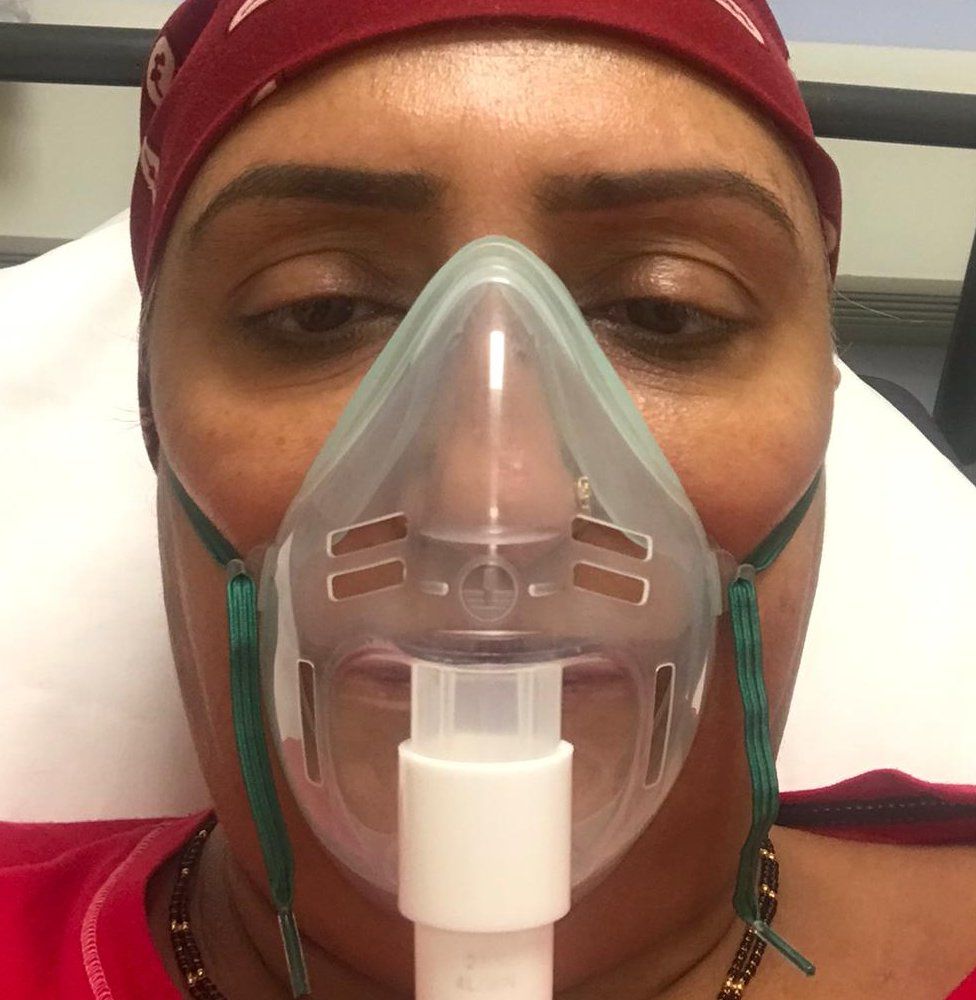
image captionRanjit Senghera Marwaha said she did not factor that the colour of her skin would have an impact on an oximeter
Ranjit Senghera Marwaha bought a pulse oximeter while unwell with coronavirus last year, but her oxygen levels dropped so low that she had to be hospitalised.
“When I went into hospital the first thing they said was, ‘you’ve really left it too late,'” Ms Marwaha said.
“I was on 14 litres of oxygen – that’s the highest they give you just before you move into intensive care.
“Never ever did I factor that the colour of my skin or the pigmentation in my skin would have an impact on the way in which these gadgets work.”
Dr Habib Naqvi, director of the NHS Race and Health Observatory, welcomed the updated guidance on pulse oximeters.
“Although a valuable clinical tool, clinicians are increasingly becoming aware of the potential errors or inconsistencies associated with pulse oximeters, so we need to have this in mind when using the devices,” he said.
Dr Omar Jundi, an intensive care consultant in West Yorkshire, observed inaccuracies in pulse oximeter readings in black Covid patients.
“It’s something I would pick up on at least once a day, in maybe two or three patients,” he said.
“It’s an aspect of the sort of systemic biases and systemic racism that occur in the NHS and the care that we provide in the NHS every day.”
Figures show that people from black, Asian and other ethnic minority groups are more likely to get coronavirus, and become seriously unwell or die from it.
Experts believe the potential inaccuracies in pulse oximeters may be a contributing factor to this.
“We need to ensure there is common knowledge on potential limitations in healthcare equipment and devices, particularly for populations at heightened risk of life-changing illness, this includes black, Asian and diverse communities using pulse oximeters to monitor their oxygen levels at home,” Dr Naqvi said.
He added it was vital that culturally-inclusive research now took place to ensure that pulse oximeters performed accurately on people with darker skin tones.
Colombo, July 31 (newsin.asia): The Sri Lankan High Commissioner-designate to India, Milinda Moragoda, has submitted to President Gotabaya Rajapaksa, a detailed blueprint for making Sri Lanka-India relations a special” one marked by inter-dependence, mutual respect and affection.”
The document, entitled Integrated Country Strategy for Sri Lanka Diplomatic Missions in India” covers the entire gamut of bilateral relations, and aims at addressing the trust deficit” that has marked Sri Lanka-India relations. The idea is to transform the relationship from a narrow transactional” one to one which will be broad-based and long lasting.
The document suggests adoption of multifarious bilateral interactions ranging from the top-most political level to the grass-roots people to-people level.
Worked out by a broad-based team led by Niluka Kadurugamuwa, the Deputy High Commissioner of India in New Delhi, under the guidance of High Commissioner-designate Milinda Moragoda, the proposals are founded on the belief that India-Lanka relations rest on a sound foundation based on Buddhism India’s most precious gift to Sri Lanka.”
Buddhism was brought to Sri Lanka by the son and daughter of the Buddhist King Dharmashoka. Against this backdrop, any setbacks to our relationship, however intractable they may appear to be at any given point of time, can only be temporary,” Moragoda says in his covering letter to the President.
The need for a fresh look at the relationship arose from the fact that despite the existence of a lot of good in it, it has increasingly become transactional as a consequence of the changes in the geo-political equilibrium in the region, that has resulted in a growing trust deficit.”
However, the documents says that the transactional relationship could be channeled towards building confidence and utilized to a means to bridge the trust deficit.”
The document stresses the importance of high level political visits –visits by the Head of State/Head of Government from either side, each year. There should be frequent visits by the Foreign Ministers. Line ministers should also make visits. These interactions could be virtual. There should be coordination with India in multilateral forums to strengthen bilateral ties. The India-Lanka Parliamentary Friendship Group should be re-activated with visits organized.
Sri Lanka should not only interact with the Central government in New Delhi but also with State governments some of which are particularly important for Sri Lanka, such as Tamil Nadu, Odisha, and West Bengal. The proposed opening of a Consul General’s office in Kolkata is welcomed. Sri Lankan Provincial Councils and local bodies members should be encouraged to interact with their equivalents in India under the relevant protocols. Chief Ministers of Indian States should be invited to visit Sri Lanka to promote economic and other ties. Sri Lanka could also explore appointing competent Honorary Consuls in key States for making local contacts.
For the implementation of policies and also for the generation of new ideas, the Indo-Sri Lanka Joint Commission and other Joint Committees should meet regularly. The Indo-Sri Lanka Foundation and the Kalinga Foundation could help generate new ideas.
Investments
To attract Indian investment to Sri Lanka, the High Commissioner designate has envisaged an Inter-Agency Committee on Trade, Investment and Tourism. Representatives of the Export Development Board, Board of Investment, Sri Lanka Tourism, Sri Lanka Tea Board and Sri Lanka Airlines will be participants in the committee. The BOI has set out targets for an Indian investment of US$ 300 million in 2021 and the Lankan Mission in India has set a goal of US$ 256 million. Indian investments could be in auto parts, electric and electronic goods, the hospitality industry, IT services, infrastructure, manufacturing, pharmaceutical, textiles and renewable energy. The documents has urged follow-up action in existing projects such as the West Container Terminal in Colombo Port, the Trincomalee Oil Tank Farm and projects in the power sector.
The Lankan missions in India should draw up a list of high net-worth investors, hold meetings with them and organize seminars and field trips to Sri Lanka. Sri Lanka’s access to Indian markets is hampered by protectionism and also challenging and changing regulatory mechanisms. And on its part Sri Lanka should improve its export basket whose content is now limited. However, the ED has set an export target of US$ 621.9 million for 2021 and the Lankan missions in India have proposed a figure of US$ 674.17 million for 2022.
The products Sri Lanka could sell in India are: pepper, cloves, cinnamon, nutmeg , vegan and vegetarian food, processed meat and fish, confectionary and beverages, paper desiccated coconut and related products, tiles and kitchenware, electrical conductors, switch boards and panels, various kinds of tea, men’s trousers, shirt and skirts.
Sri Lanka should take the initiative in getting help from India in the field of technology innovation, capacity building and product development to expand the export market. Indian technical help could be sought for the automation of the gem and jewelry industry, and the pharmaceutical industry.
Sri Lankan trade associations and trade associations should participate in trade fairs in India. The missions should help organize B to B meetings and seminars. Lankan missions should interact with Indian governments to secure easier access to Lankan products. Indian businessmen should be invited to visit Si Lanka to interact with their Lankan counterparts.
Tourism and Connectivity
There is immense potential in the Indian tourism sector. The Lankan Tourism Board has set a target of 63, 733 Indian arrivals in 2021 and 169, 955 in 2022. The areas which show potential for travel expansion are: MICE, weddings, film shooting, and the Ramayana Trail, Murugan and Siva Sakthi Trails. Sri Lanka needs to be present in tourism fairs in India. Fully vaccinated Indian tourists should be encouraged to visit Sri Lanka.
Since it is People-to-People contacts which will be the bedrock of a bilateral relationship, connectivity must be improved ,the document says, and suggests resumption or establishment of passenger ferry services beween Thalaimannar and Rameswaram, Colombo and Tuticorin, an Kankesanthurai and Karaikal. The document also propagates the facilitation of grid connectivity between the two countries for Sri Lanka to get power from India in times of drought and for Sri Lanka to sell power to India in case it has a surplus.
Defense Cooperation
In the field of defense cooperation, the document points out that Sri Lanka has not used the Indian Special Line of Credit of US$ 50 million for countering terrorism. Ways of using it should be explored, especially since more Lines of Credit in the defense sector are in the pipeline. The document points out the importance of having political level strategic cooperation in the field of defense and security.” It can build on the model of the war-time Indo-Lankan Troika which was very useful.
Mechanisms for political level strategic cooperation existing in India and other countries should be studied. This would be apart from organizing regular high level visits of defense personnel and exchange of visits. There should be Sri Lankan high level defense personnel visits to India at least once a year. There should be India-Lanka and multilateral military exercises every year. There should be facilities in Sri Lanka for training Indian military personnel. There should be closer and regular interaction between the police forces of the two countries with places in Indian paramilitary and police institutions for Sri Lankan personnel. The office of the Defense Advisor in the Sri Lanka High Commission ought to be strengthened.
Fishing Issue
On the contentious issue of Indians fishing in the Palk Strait, the document says that the Sri Lankan missions in New Delhi and Chennai should interact with officials of the Central and State governments and also fishermen’s associations in Tamil Nadu to highlight the issue of IUU especially bottom trawling by Indian fishermen.
However, the document advocates a humane approach” to the genuine problems faced by fishermen on both sides of the maritime boundary.” The Sri Lankan government, it said, is working out a proposal on this issue.
Detailing the other areas of cooperation the document calls for joint research in fisheries and marine resources. It also talks of cooperation to set up a mechanism for disaster management
Lankan Refugees in India
The document makes suggestions for the resolution of the problem of Sri Lankan displaced persons in India. Its resolution will keep vested interests and fringe elements from exploiting the community’s plight for their narrow political ends. The Sri Lankan government should announce a comprehensive package which may include customs duty waivers, settling-in expenses, housing, and economic rehabilitation. The documents seeks the involvement of the UNHCR and also the political leadership of Tamil Nadu where the refugees live.
Culture and Education
India and Sri Lanka share a common cultural, linguistic, intellectual and religious legacy going back centuries into history. There has been a cultural cooperation agreement since 1977, but a lot more can be done. Sri Lanka should emulate the Indian Cultural Center in Colombo and spread Sri Lankan culture, dance, music and art in India by setting up a Sri Lankan Cultural Center and also participating in cultural events in India to showcase Lankan culture.
Buddhism has been a lynchpin of the age-old relations between Sri Lanka and India. While the mission in India is in touch with the Mahabodhi Society, it has to expand to other parts of India where there are Buddhist communities, the document said. Facilities should be provided for Indian scholars to study Buddhism in Sri Lanka and Sri Lankans should be able to study Pali and Buddhism in India. Sri Lanka should be able to provide Ordination for Indian Buddhist monks and allocate places for them in its Pirivenas. The government of India has already set apart US$ 15 million for the promotion of Buddhist links between India and Sri Lanka.
Religious Trails
With the help of Ambassador Dr.V.K.Valsan, the document has identified areas of cooperation in the field of Hinduism. The promotion of the Ramayana Trail, the Murugan Trail and the Siva Sakthi Trail will increase religious tourism between the Hindus of Sri Lanka and India. e The Hindu epic Ramayana intimately links the two countries. Cooperation between Sri Lanka and India in this area already exists as Sri Lanka has sent a sacred stone from the Sita temple here to the Ram Mandir in Ayodhya.
The document further urges the government to provide opportunities for Indian Hindu religious leaders and scholars to interact with their counterparts in Sri Lanka and to enable Sri Lankan diplomatic missions to actively participate in major Hindu religious ceremonies. The Lankan government should also facilitate Catholic devotees and scholars to visit the Velankanni church in Tamil Nadu which is very popular among both Tamil and Sinhalese Catholics.
Opinion Makers
The document urges the Lankan missions in India to be in touch with Indian journalists, foreign journalists based in India, intellectuals, opinion makers, film makers, archeologists, artistes, and think tanks to enhance Sri Lanka’s profile and also have positive stories presented in the Indian media. The South Asian University in New Delhi should be helped to become a center of excellence.
Tours of Sri Lanka should be organized for opinion makers to enable them to understand the realities in Sri Lanka and interact with their counterparts in the island. Heads of Lankan missions in India should give six interviews per year to the Indian print and electronic media and also be active on social media to clarify matters about Sri Lanka and promote the country.
The Lankan government and the missions in India should draw up plans to celebrate the centenary of Rabindranath Tagore’s visit to Sri Lanka in 2022 and the 75 th. Anniversary of the establishment of diplomatic relations between Sri Lanka and India in 2023.
Sri Lanka saw an uptick in COVID-19 figures, as 2,150 more persons were tested positive for the virus today (July 31), says the Ministry of Health.
All new cases are associated with the New Year COVID-19 cluster. The new development has pushed the total number of infections confirmed in the country to date to 308,812.
According to official data, more than 27,000 infected patients are currently under medical care at hospitals and treatment centers across the island.
Meanwhile, the number of total recoveries reached 277,118 earlier today as 1,906 more patients returned to health.
The
UN was created in 1945 following the end of World War 2 promising to ensure no
future world wars, to respect individual state sovereignty and to not interfere
in internal affairs of sovereign states. Since 1945, only 10 countries around the
world without a conflict and countries facing conflicts are as a result of
proxy interventions and incursions. Within the UN itself mass corruptions and
biases go ignored and whistleblowers chastised and cornered. It is plain to see
that while democracy dictates requirement to elect governments &
representatives and invisible and sinister group of people actually rule the
world. These notions are purposely tackled by utilizing all forms of
communications that these sinister groups control and manipulate to silence
people. Thus slogans of ‘conspiracy theories’ divert people’s attention from
piecing the puzzle of truth together. It is in this light that we look at the
covid global epidemic.
The
UN wishes to create a ‘New World Order’ with a ‘One World Government’ by 2030
as part of its Agenda 21 Goals set out in 1992. These were all incremental
CHANGE” goals to reach the ultimate One World Government goal. These include
One Government, One Cashless Currency, All Schools, Colleges, Universities
under One & end to single-family homes. The ultimate goal is for a handful
to secure title over the world’s resources & assets. The clue comes in
mention of ‘central banking’ in reference to capacity-building in developing
countries, but there is no restrictions to privately owned property though
nothing is to be ‘mass owned’ – or loosely translated the objective is to
ensure nothing is mass owned. Just go to the UN website, access the
relevant documents and find out for yourself.
2030
Agenda was adopted by the UNGA in 2015 – aspiring to end poverty by 2030,
achieve food security by 2030, promote sustainable agriculture by 2030, ensure
healthy lives by 2030, ensure education by 2030, achieve gender equality by
2030, ensure sustainable water and sanitation by 2030, ensure energy access by
2030, ensure employment for all by 2030, ensure inequality within and among
countries, ensure conservation of oceans and marine resources by 2030, protect
ecosystems by 2030, promote peaceful societies by 2030. The question is how can
the UN which has not achieved anywhere near any of the above in 76years of its
existence use the same system to achieve above in 15 years?
The
1992 New World Order listed terms one world”, currency” military” family”,
5G” private transportation” air travel” synthetic drugs” are not mentioned
in the 2030 Agenda. What is a relief is that neither Agenda 21 nor 2030 Agenda
are legally binding. This is probably why the UN system forces countries to
sign to various internal programs that plugs these specific agenda items so
taken together countries end up virtually endorsing Agenda 21 & 2030
without their knowledge! How many country advisors are bothered to compare
notes and put the puzzle together?
Rule
of One by One – is similar to the Rule of the Empire during colonial times
where a handful ruled with iron fist and human rights was dictated &
determined by them as were the laws & justice that prevailed. In short it
was one-sided human rights & justice. Are we returning to that era?
We are in 21stcentury
– things are far different from 15thcentury. People are informed & more aware of happenings
around the world & more vocal as well. So to bring 7billion population
under an Empire rule something major is required. Was Covid that ingredient?
Dr. James Fetzer’s proof that the pandemic was planned &
with purpose” is an eye opener. https://madisonarealymesupportgroup.com/2020/09/30/proof-that-the-pandemic-was-planned-with-purpose/He
refers to a shocking statement made by 500 medical doctors in Germany. The
Corona Panic is a play. It’s a scam. A swindle. Its high time we understood
that we’re in the midst of a global crime’. 600 medical doctors from Spain too
voiced similar sentiments. Covid-19 is a false pandemic created for political
purposes. This is a world dictatorship with a sanitary excuse”. In the US too a
documentary titled PLANDEMIC is supported by over 27,000 medical doctors.
What
about thousands of people dying every day? We know this is happening.
What
do these doctors know, that we don’t know?
Dr.
Fetzer’s article refers to the 2015 patent Covid-19 by R. Rothschild. In
2017-18 millions of Covid-19 test kits had been sold The product code (HS Code
300215 : Covid-19 Test Kits)
Were
test kits exported to US, EU, China & other nations 2years before the
outbreak? Doctors should know.
Dr.
Fetzer’s article also claims that the World Bank shows Covid-19 to continue
until end of March 2025.
CLUE 1
Dr.
Fetzer’s article also claims that Anthony Fauci, Director of the National
Institute of Allergy and Infectious Diseases (NIAID), in 2017 guaranteed a
pandemic within 2 years.
Dr.
Fetzer’s article refers to Bill & Melinda Gates claiming the world is
densely populated. However, 7billion people live in a world in which 70% is
covered in water. Only 10% of Earth is inhabited by humans.
Clue 3
The
Global Preparedness Monitoring Board released A World at Risk” in September
2019 stressing need for preparedness for a coronavirus outbreak.
Now take a look at these lines
from the September 2019 report
Have
they been deliberately releasing lethal respiratory pathogens to the world’s
populace?
Clue 4
Months prior to the corona virus outbreak in China a coronavirus
pandemic exercise’event was organized in New York by the
Bill & Melinda Gates in October 2019
Event
201 concludes that all humanity must be vaccinated. Is this what is now being
rolled out?
If
the virus was prepared” prior to the corona virus outbreak, was the vaccine
also prepared”?
More
than being bothered about the people planning these outbreaks” we must now
wonder what these ‘vaccines’ are actually ‘planned’ to do for the ones who have
taken them.
Predicting
an epidemic killing thousands, boasting about selling vaccines – what should we
deduce?
Bill
Gate’s TedTalk in February 2010, where he says If we are doing a real good
job, we could reduce world population by 10% to 15%”
Clue 5
The Institute for Disease Modeling (part of Bill & Melinda
Gates Foundation) in 2018 released a video A Simulation for a Global Flu
Pandemic” showing a flu virus originating in Wuhan, China & spreading all
over the world. Is this a coincidence? https://www.youtube.com/watch?v=AuBDP1Q8__0
Clue 6
Dr.
Francis Boyle, Harvard trained law professor at the University of Illinois
& a bioweapon expert.
Dr.
Boyle claims the coronavirus is a biological weapon (transform existing virus
into a biological weapon) for people control. People can accept or reject his
theory. But everyone has a right to expression of thought.
Clue 7
2017-2018
saw a lot of films coming out about humanity, diseases, pandemics etc
Dead
Plague shows a global pandemic with hydroxychloroquine given as cure!
Those
that rule the world also rule our communication channels so it is no surprise
that they enjoy using films to predict their plans. A worldwide lockdown was
predicted in 2008 according to Dr. Fetzers article.
Investigative
journalist Harry Vox warns against coming lockdowns & quarantines…in 2014
‘They will stop at nothing to
complete their toolkit of control. One of the things that had been missing from
their toolkit is quarantines and curfews. The plan is to get hundreds of
thousands of people infected with it and create the next phase of
control.’
In
2010 the report predicts the responses by US & China in 2019 & beyond.
What is also predicted is totalitarian control. This is what we should all
worry about.
The
2010 report also predicts that authoritarian control of citizens will include
Biometric IDs for all citizens
Tighter regulation of key industries vital to national interests
You
have to wonder if the present ‘strikes’ across Sri Lanka has a underhand
purpose fitting into this planned project?
The
objective of the pandemic is two-fold. Cull population as much as possible
& control the living wherein they handover their freedom to feel safe &
healthy (both of which is unlikely to happen)
There’s
more shocks awaiting – according to Dr. Fetzer there is a handbook for global
control already prepared by Rockefeller Foundation National Covid-19 Testing
Action Plan” on how to control the people.
How
valid is Dr. Carrie Madej’s claims of a plan to inject humanity with dangerous
Covid-19 vaccines to reprogram our DNA creating hybrids easier to control &
enabling handlers to control us through artificial intelligence via digital
vaccine ID (Dr. Madej incorporates 20 years of study into her theory – anyone
challenging her claim must provide substantial evidence against her claim)
Dr.
Fetzer’s article takes us back further to a book Committee of 300” by former
CIA Dr. John Coleman.
Peter
Koenig in his article Forced Vaccination and the Road to Digital Tyranny”:
Agenda ID2020 Revisited” says we will have to suffer much before 2030 Great
Reset” by Klaus Schwab. Peter Koenig questions the ‘deaths’ Presidents of
Tanzania, Burundi and Haiti as all opted for home remedies instead of jabs!.
According
to Peter Koenig, the real danger is the ‘Digital ID”
Forced vaccination (under police/military surveillance – those
who refuse penalized with fines or jail)
What’s in the Vaccine – no one knows
Possibility of introducing nano-chip unknown to the persons
being vaccinated – chip remotely charged with personal data (bank
accounts/digital money) – your money could be blocked or taken away for
‘misbehavior’
Peter Koenig claims the constitutional democratic rights of
people even in US/EU & other parts of the world are being overtaken by
Health Martial Laws” allowing governments to do as they like in the name of
health.
Peter Koenig cites how the day prior to Bastille Day
(14July1789) – on 13 July President Macros announced forced vaccination & other
strong measures
Notice how Governments are being brought to book until UN Agenda
2030 and Agenda ID2020 materializes.
What
is important to note is that the People of the world are all victims, whether
they are US citizens, European citizens, Chinese citizens or any other global
citizen. Even Governments may be just as clueless, mainstream media heads and
the secret societies that run them rule the world. This is nothing that should
surprise you as a read through the 2010 Rockefeller report predicting the
coronavirus scenario and the solutions to be rolled out virtually place on the
table the plan. They cannot be brushed aside as conspiracy theories as these
are reports released by them. The various documentaries and interviews are all
proof as well. These are no created notions but statements revealed from their
own mouths!
There
is some hope for example the Swiss via referendum rejected a law proposing
electronic IDs mainly because the Swiss government planned to privatize the
data & management and the Swiss did not wish to have their personal data
open to private parties. The Swiss people have been regularly petitioning
against attempts to suppress their rights. The 99.9% of the People of the World
need to realize the bigger plan concocted by 0.001% or even less.
No
one is against measures taken to curb or eliminate covid – but if this virus
has been created to suppress and control the people even attempting to cull
them & a handful are forcing governments to adopt tyrannical measures that
align with the main obective, the People of the World must wake up & say
NO.
Lands and Mahaweli Development Minister Gamini Dissanayake warned Tamils that it would require 14 hours for Indian troops to come and rescue them but the Sinhalese could destroy them in 14 minutes if they wanted to
On Sunday July 24, mobs began moving in the direction of Borella and Thimbirigasaya from Kanatte. Tamil homes and businesses were attacked and set on fire. As the Esala full moon shone brightly from a not-so-cloudy sky, clouds of smoke from burning Tamil establishments spiralled upwards
By D. B. S. Jeyaraj
July 24, 1983 was the day on which a destructive spree of anti-Tamil violence commenced in Jaffna in the early hours of the morning and began spreading to Colombo in the later hours of the evening on the same day. It continued to other parts of the Island in the following days. The 38th anniversary of those dark days – etched in history as Black July” revives bad memories among most Tamils who lived in Sri Lanka during July 1983.
The week long spree of anti-Tamil violence saw over 4,000 Tamils and some Muslims – mistaken for Tamils – being killed. Thousands were injured. Some of the injured were killed in hospitals. There were close upon 300,000 displaced persons as a result. Around 130,000 of these were housed in makeshift refugee camps. More than 2,500 business enterprises ranging from factories to petty boutiques were damaged or destroyed. The number of houses and dwellings and vehicles damaged or destroyed has not been correctly estimated yet.
The anti-Tamil violence of July 1983 was not a mass uprising of Sinhalese against Tamils. Prior to the outbreak of violence, there existed a pre-planned conspiracy to launch a widespread attack against Tamil life, limb and property on a massive scale. All it required was a powerful incident to be the provocative pretext to justify such an attack. The ambush of an Army patrol in the north in the night of Saturday July 23 by the Liberation Tigers of Tamil Eelam (LTTE) resulting in the killing of 13 soldiers by the Tigers reportedly triggered off the violence beginning from Sunday July 24.
‘Four Four Bravo’ Patrol What happened then was this. On Saturday July 23, 1983, the Army’s ‘Four Four Bravo’ routine patrol proceeded from the Mathagal military base. It consisted of 15 men travelling in a jeep and a half truck. The men were all from the 1st battalion of the Sri Lanka Light Infantry (SLLI). They were commanded by an old Anandian, 2nd Lt. Vass Gunawardane who had a sub-machine gun. The others had self -loading rifles and grenades.
Meanwhile, the LTTE had planned to launch an attack on the Army in Thirunelvely known generally as Thinnavely about two miles away from Jaffna town. Sathasivam Selvanayagam alias Sellakkili of Kalviyankaadu, the newly appointed Tiger Military Commander planned and supervised the operation with the support of Prabhakaran. The spot picked was about 150 metres south of the Post Box junction along the Jaffna-Palaly Road. The road had been already dug up for telecommunications cable laying. This made it convenient for the Tigers to bury land mines.
Four landmines were laid and the wires linked to the exploder were concealed on the back of the roof of a boutique facing the road. Sellakkili perched himself on the roof to explode the mines at the right time. The other Tiger cadres hid themselves behind brick walls in two groups on either side of the road.
The LTTE at that time had only 30 full-time members including its supremo Veluppillai Prabhakaran. Of these 19 were involved in the Thinnavely attack. They were Prabhakaran, Sellakkili, Pulendran, Ponnammaan, Reggie, Ranjan Lala, Kittu, Santhosham, Victor, Appiah, Ganesh, Lingam, Albert, Basheer, Rajesh, Suppanna, Ramu, Gnanam and Raghu (Kundappa).
When the two vehicles approached the landmines were set off. They exploded on the right side of the jeep and in between the jeep and truck. Thereafter the Tigers started firing and lobbing grenades. The soldiers also retaliated. At the end of it all, 13 soldiers including Lt. Vass Gunawardane were dead. The only two Army survivors were Cpl. Perera and Lance Cpl. Sumathipala. From the Tiger side the solitary casualty was Sellakkili, the newly-appointed Military Commander.
Soldiers on the rampage Once the news of the ambush became known, soldiers of the SLLI went on the rampage. The then SLLI Commanding Officer Lt. Col Upali Dharmaratne was either unwilling or unable to control them. The overall Jaffna Commander Brig. Lyle Balthazar too was unable to exert his authority and instill discipline among troops.
The enraged soldiers went on a violent spree killing 51 civilians in Thinnavely and surrounding areas. This included a university lecturer Kala Parameswaran who was known to me. A mini-van carrying seven passengers was stopped and all eight including the driver were lined up and shot dead in cold blood. Among these was my friend Wimalathasan, a human rights activist and Editor of the journal ‘Manithan’. Later on, the then Army Commander Gen. Tissa Bull” Weeratunga transferred the SLLI 1st battalion out of Jaffna. Lt. Col. Dharmaratne was replaced by Lt. Col. A.M.U. Seneviratne.
The UNP Government headed by J.R. Jayewardene conducted a mass funeral at Kanatte for the 13 soldiers killed by the LTTE. Large crowds gathered at Kanatte on Sunday July 24. Many were brought there in Government vehicles. The situation took a violent turn around dusk. Mobs began moving in the direction of Borella and Thimbirigasaya from Kanatte. Tamil homes and businesses were attacked and set on fire. As the Esala full moon shone brightly from a not-so-cloudy sky, clouds of smoke from burning Tamil establishments spiralled upwards.
Sunday Sil, Monday Kill.” The following Monday July 25 saw anti-Tamil violence spreading like wildfire. The plantation Tamil patriarch Saumiyamoorthy Thondaman known for his pithy comments later described the violence that followed Poya on Sunday as – Sunday Sil, Monday Kill.”
Despite repeated entreaties by the then IGP Rudra Rajasingham to declare a curfew, President Jayewardene delayed imposing one until the following Monday evening. Even after a curfew was supposedly in force, the violence went on for three days peaking on Wednesday July 27. It began ebbing on Thursday July 28, the day that Indian Prime Minister Indira Gandhi sent the then Indian Foreign Minister P. Narasimha Rao as her Special Emissary to Colombo.
On Friday July 29 saw Colombo and suburbs being terrified by the rumour that the Tigers had come to town. The afternoon of that fateful ‘Koti Dawasa’ (Tiger Day) saw the goon squads massacring Tamils again after being ‘sure’ that no Tigers were in town. Finally 30 and 31 July saw the violence diminish gradually. By August the violence had ceased as international opinion and pressure compelled the J.R. Jayewardene regime to normalize” the situation.
Indira Gandhi-Narasimha Rao The role played by India in general and her Prime Minister Indira Gandhi in particular was of crucial importance in curbing the anti-Tamil violence in Sri Lanka then. Indira Gandhi cancelled her trip to Tamil Nadu that had been scheduled earlier. Instead she telephoned President Jayewardene on Thursday July 28 morning and sent her foreign minister PV Narasimha Rao (Later PM) in the evening to Colombo as her special emissary.
Narasimha Rao met with President JR, Premier Premadasa and Foreign Minister ACS Hameed. He spoke on the telephone to Opposition Leader Appapillai Amirthalingam. Rao also had a private unofficial” meeting in person with cabinet minister Saumiyamoorthy Thondaman. Prior to his return to New Delhi, the Indian Foreign minister inquired” from his counterpart as to whether Colombo would require Indian security personnel to establish law and order in Sri Lanka if the Lankan Police and armed forces were unable to end the anti-Tamil violence. There was a marked change after Rao’s departure. The organized anti-Tamil violence began diminishing while the law enforcement machinery got re-activated miraculously.
President Junius Richard Jayewardene and other members of the ruling United National Party (UNP) sought to explain the Black July violence as the ‘spontaneous reaction of the Sinhala people to the LTTE attack in Jaffna. ’The Sinhala people were collectively blamed for the violence by the President and his Government. This was done to deflect the blame falling on the Govt.
Blaming Sinhala People There is, however, a major flaw in attributing blame for the dark events of Black July ‘83 to the Sinhala people on the whole. It is correct that the perpetrators were Sinhalese and the victims Tamils. But it was by no means a mass uprising of the entire Sinhala race against Tamils. If that had happened, only a few Tamils would have been left to tell the tale.
Many Sinhala people were horrified at what happened and were helpless onlookers, while a minority of their ethnicity unleashed havoc in the name of their race and country. It is possible that a section of the people who were non- participants may have been supportive of the anti–Tamil violence and sanctioned it by their silence. But the majority of the Sinhala people were against to what happened then. It cannot be forgotten that a large number of Sinhalese protected and saved Tamils often at great personal risk. Many Muslims too gave shelter and protection to their Tamil neighbours in those dark days. Members of my own family as well as many relatives and friends were aided greatly by decent Sinhala and Muslim people in those troubling times.
The conduct and political role played by the then President JR Jayewardene in the Anti-Tamil violence in July 1983 has been widely criticized. In fact there were many who condemn JR as being responsible for aggravating the situation. The decision to stage a mass funeral for the 13 soldiers at Kanatte in Colombo and the long delay in declaring a curfew resulted in terrible carnage. In order to provide greater insight into the alleged acts of omission and commission by JR during July 1983, I shall reproduce here an electronic mail sent to me by former DIG of Police Ramachandra Sundaralingam.
DIG Sundaralingam Sunda, as Sundralingam was known, was a very good friend to journalists of my generation in Sri Lanka. If we wanted a good law and order news story, all we needed to do was to contact him. Sundaralingam was serving as Senior DIG in charge of ranges at the time of the 1983 July anti-Tamil violence. Sunda later took up a post at the INTERPOL in Paris and became known as an expert in combatting the narcotics trade. After retirement he took up residence in Chennai, Tamil Nadu. Sunda and I were in regular contact via e-mail and telephone until his demise in December 2018.
While researching for this article I came across an e-mail sent by Sunda in July 2017. What happened then was that he wanted to talk to me about the 1983 July riots and telephoned on my land line. I was away from home and did not respond promptly. An impatient Sunda then sent an e-mail summarizing his thoughts. However, we did converse on the phone subsequently and discussed in detail the points mentioned in the e-mail. However, I feel it is worthwhile reproducing that e-mail as it sheds much light on what had happened then. Here it is:
Sunda’s Electronic Mail
Dear DBS, In case we miss each other’s call. Briefly the facts on the Darkest Chapter of the History of Sri Lanka July 1983; 1) Thinnavely LTTE ambush killed 13 soldiers on July 23, 1983. Army HQ informed, President JR via Gen Attygalle ordered Army Commander Weeratunge get to Jaffna immediately.
2) DIG Rajaguru in charge of NP called IGP Rudra Rajasingham and myself stating Army running berserk, Police were helpless.
3) Security Council meeting with all Service Chiefs, Air Force, Naval Commander except Army Chief already in Jaffna to monitor the happenings there and elsewhere. IGP Rudra Rajasingham requested my presence at the meeting as Senior DIG Ranges overseeing NP DIG Rajaguru.
4) Gen. Attygalle hourly discussion (3pm/7pm) with Army Chief Weeratunge. In Jaffna situation was deteriorating with Army revolt in Jaffna, damage to property and injury to several persons, Commander Weeratunge was unable to exercise any control .Gen Attygalle informs JR on the ground situation, JR who in turn informd Gen Attygalle that Army soldiers be buried in Jaffna, as it happens in a war situation. When this message was conveyed to Gen. Weeratunge, his prompt reply, Sir I will also be buried here, make arrangements to shift the bodies to their native places early.”
5) Security Council decides the bodies be flown to Katunayake Air Force base, after embalming be dispatched to the 13 villages of the 13 soldiers. Police were instructed to organize 13 Air conditioned Ambulances be in readiness at Katunayake on arrival of bodies from Jaffna. This arrangement was approved by JR in his conversation with Gen Attygalle, I am an eye-witness to all these arrangements.
6) Direction received at Police HQ ambulance plan has been cancelled, the bodies will be brought to Ratmalana by air for common burial at Kanatte. In the meantime, tension was mounting in Colombo, with large crowds heading for Kanatte.
7) IGP Rudra Rajasingham, DIG Ernest Perera and I visited Kanatte, everything looked tensed up. I was able to sense the situation as serious. DIG Perera and I strongly advised IGP Rudra Rajasingham to meet the President immediately to impose curfew around 9.00 pm, otherwise the situation would get out of control. IGP left Kanatte to meet JR at Ward Place. Curfew was never declared until next evening by which time serious damage was caused to Tamil persons and their property and it was the worst in the history of country. JR could have averted this situation, but he failed to declare curfew. The big question is, who made the decision to bring the bodies to Kanatte for a common burial? Minister Thondaman told me it was Cyril Mathew who insisted on Kanatte funeral. All this is history.”
The organized violence An important point to note is that the July 1983 violence was basically an organized act. Several persons may have engaged in the violence on their own but there were core groups at different locations that planned and executed it. As is the case in mob violence, these core groups were joined by others. These groups had absolute impunity and had the protection of important members of the UNP Government then in power.
The mobs had lists of Tamil-owned houses and businesses. They also knew the details of ownership. Wherever premises were owned by Sinhalese, only furniture and goods belonging to Tamil tenants were destroyed and set on fire. The buildings were not torched or damaged.
Many of the mobs were led by functionaries of the UNP trade union Jathika Sevaka Sangamaya (JSS). Several UNP Municipal and Urban councillors and family members were involved. Many prominent supporters and strong-arm men of cabinet ministers were involved. The Police were ordered by UNP politicians in several instances not to arrest the violent elements.
In many incidents, the large groups of thugs and goons were transported in Government-owned Transport Board vehicles or in vehicles owned by semi-Government corporations. Even food parcels and liquor were distributed systematically among those elements.
When some decent UNP leaders such as Shelton Ranarajah and Renuka Herath Ranasinghe got the goons locked up by the Police in Kandy and Nuwara Eliya respectively, and later their release was secured by ministers Cyril Mathew and Gamini Dissanayake. The role of Cyril Mathew and his political lackeys in the violence were well-known. Some of those involved are still in politics and holding high office.
Responses of Govt Ministers One of the lamentable features of the July 1983 pogrom was the abominable response of J.R. Jayewardene and senior ministers on television. Not even a single word was uttered in sympathy for the victims of the violence. JR indirectly blamed the Sinhala perpetrators, but justified the violence by saying it was a natural and spontaneous reaction of the Sinhalese people. Instead of reaching out to the victimized Tamil people, the President announced that legislation would be brought to forbid secessionism.
State Minister Anandatissa de Alwis spoke about a hidden hand, a foreign hand, being responsible. He said there was a conspiracy to provoke clashes between the Sinhalese and Tamils, the Sinhalese and Muslims and Buddhists and Christians. Lands and Mahaweli Development Minister Gamini Dissanayake warned Tamils that it would require 14 hours for Indian troops to come and rescue them but the Sinhalese could destroy them in 14 minutes if they wanted to. Trade and Shipping Minister Lalith Athulathmudali was sorry that people had to queue up again for essentials as a result of the violence. Finance Minister Ronnie de Mel gave a lecture in history about Sena and Guttiga. Cyril Mathew, the Industries and Scientific Affairs Minister, raised the Indian bogey and saw an alien hand behind the conspiracy that led to the July ’83 violence. His cabinet colleague, Rural Industrial Development Minister Saumiyamoorthy Thondaman refuted it and said elements inside or close to the Government were responsible.
Paul Sieghart Notwithstanding the efforts of then President Jayewardene to tarnish the Sinhala people as being collectively responsible for this carnage, respected observers such as Paul Sieghart of the International Commission of Jurists exposed the real state of affairs.
As Sieghart himself pointed out in his report (‘Sri Lanka: A Mounting Tragedy of Errors’): Clearly this (July 1983 attack) was no spontaneous upsurge of communal hatred among the Sinhala people – nor was it as has been suggested in some quarters, a popular response to the killing of 13 soldiers in an ambush the previous day by Tamil Tigers, which was not even reported in the newspapers until the riots began. It was a series of deliberate acts, executed in accordance with a concerted plan, conceived and organized well in advance.”
Planned Pogrom What happened in July 1983 was not a spontaneous riot but a planned pogrom. A ‘pogrom’ is defined as a form of violent riot, a mob attack, either approved or condoned by Government or military authorities, directed against a particular group, whether ethnic, religious, or other, and characterized by killings and destruction of their homes, businesses, property and religious centres. The word pogrom is of Russian origin and means to destroy, to wreak havoc, to demolish violently” in the language.
YOKOHAMA, Japan, July 30 (Reuters) – They hail from Sri Lanka, enjoy 30-second rubs in U.S. mud, get top-notch service in Japan because of the pandemic and are called the best in the world by Joe Ryan, an Olympian who played the game of his life on Friday.
They are the Olympic baseballs, 144 of them freshly unwrapped before each of the 16 games at Tokyo 2020. Made by Japan sporting goods company SSK Corp in Sri Lanka, the roughly 145g white spheres with red laces and black-ink logos are gaining attention at the Olympics for several reasons.
When the Olympics last held baseball in 2008, balls came from Japanese rival Mizuno Corp (8022.T), which still supply softballs, but lost the baseball deal.
In addition, to prevent COVID-19 spread, young stadium attendants are keeping separate bags of balls for each team during games and using white-cloth gloves or clear medical ones for handling. They also ferry to and from the pitching mound for each side separate bags of rosin, a mixture of pine tar and chalk to dry sweaty hands and slick balls.
Above all, the Olympic balls are reminding that alternatives exist to the Rawlings balls sparking frustration and cheating in the world’s top professional association, Major League Baseball (MLB).
The league this year instituted mid-game equipment checks to catch pitchers who “doctor” baseballs by surreptitiously rubbing banned sticky substances such as name-brand offering Spider Tack.
Pitchers contend the substance overcomes inconsistencies in design and slippery texture. Better grip increases ball movement, but MLB officials worry that all the darting and dipping pitches and the foolish swings at them is making the game boring.
Joe Ryan, a top Minnesota Twins prospect playing for the U.S. Olympic team, said on Friday the SSK version “is the best ball in the world” and urged America to adopt the “amazing” and “perfect” creation.
After allowing just a run on five hits over six innings, the 25-year-old earned some credibility.
“The hitters love it, I love throwing with it. All the pitchers love throwing with it,” he said. “It would solve a lot of the current issues with foreign substances. I can’t say enough: It is the best baseball I have ever touched.”
The mud rubbers get some credit. Ahead of Ryan’s start, Reuters watched a trio of masked umpiring officials dip their fingers in water and take a swipe of Lena Blackburne Rubbing Mud, which is harvested by a small company in a secret location along New Jersey’s Delaware River.
The team then patter balls with the mixture, as if they were shaping a pizza-dough ball. It removes the slippery sheen of fresh product.
“So the pitchers can grab it and when they throw it, it’s not slipping off their hands,” said Gustavo Rodriguez, baseball umpire director for World Baseball Softball Confederation.
Cheating and complaints have been minimal through qualifiers and the first three Olympic days, he said.
MLB requires use of the same mud, but the feel is better when applied to SSK’s ball, people who have used both say.
“If SSK wants to send me some more, I’ll give them an address,” Ryan said.
Sri Lanka has never produced an MLB player, but has celebrated on government social media accounts its Olympics role. Afterwards, balls will go to Japanese schools and clubs. Players get keepsakes, too.
Israel’s Danny Valencia, who homered off Ryan, said he got the ball he struck.
“To be able to take these little trophies to show your kid, show my son, it’s a really good feeling,” he said.Reporting by Paresh Dave Editing by Christian Radnedge
Catholic bishops have urged the Sri Lankan government to reopen schools and take drastic measures to stop the adverse effects of the Covid-19 pandemic on the poor.
“The children will be able to learn not only the sciences but also achieve emotional, psychological and spiritual health, interact with their teachers, their fellow students and friends, and engage in extracurricular and sports activities with their peers in order to achieve a sense of emotional balance,” said Bishop Winston S. Fernando, head of the Catholic Bishops’ Conference of Sri Lanka, in a press statement on July 29.
“We appeal to the government in the interests of the children to be flexible and agree to rectifying the long-standing salary anomalies as the teachers matter the most in the moulding of our future citizens and leaders.
“We also call upon the teachers to consider it their sacred duty to form and mould the future citizens and call off their strike action to return to school for the love of the children they look after.”
Teachers and principals have stopped online teaching activities for 19 days over salary anomalies and the controversial National Defense University bill.
Teachers’ unions, university staff and civic rights groups have joined the strike and several demonstrations were organized in main cities. The strike continues as discussions between teachers and government concluded unsuccessfully.
If religious leaders raise their voice for justice and truth, it gives strength to ordinary people who are voiceless
The strike has affected the education of tens of thousands of students as most of them don’t have access to computers and the internet.
Joseph Stalin, general secretary of the Ceylon Teachers’ Union, said trade unions could not accept proposals made by the cabinet subcommittee.
Ramesh Pathirana, co-cabinet spokesman, said the government has identified the need to resolve the salary anomalies but added that the government is not in a position to make immediate changes due to financial issues.
“While we commend the government for its vaccination program, we also wish to reiterate that it needs to ensure that even more vigorous steps are taken to cushion the ill effects of the pandemic on the poorer sectors of society,” said Bishop Fernando.
Mahesh Nayanajith, a teacher who supports the strike, said it is very timely for the bishops to talk about children’s education as well as the large number of lives lost to Covid-19.
“Politicians always try to use these issues to maintain their power. If religious leaders raise their voice for justice and truth, it gives strength to ordinary people who are voiceless,” said Nayanajith.
Bishop Fernando said the entire country is helplessly aware of the severe economic constraints due to the pandemic.
“High rates of unemployment will create inevitable poverty, malnutrition and hunger. Therefore, priorities have to be drawn up and funds allocated to respond to what matters most and not for any ambitious projects,” the prelate said.
“We need to adopt the best practices of other countries, the leadership needs to go by expert advice and not by political views, opinions and self-serving agendas.”