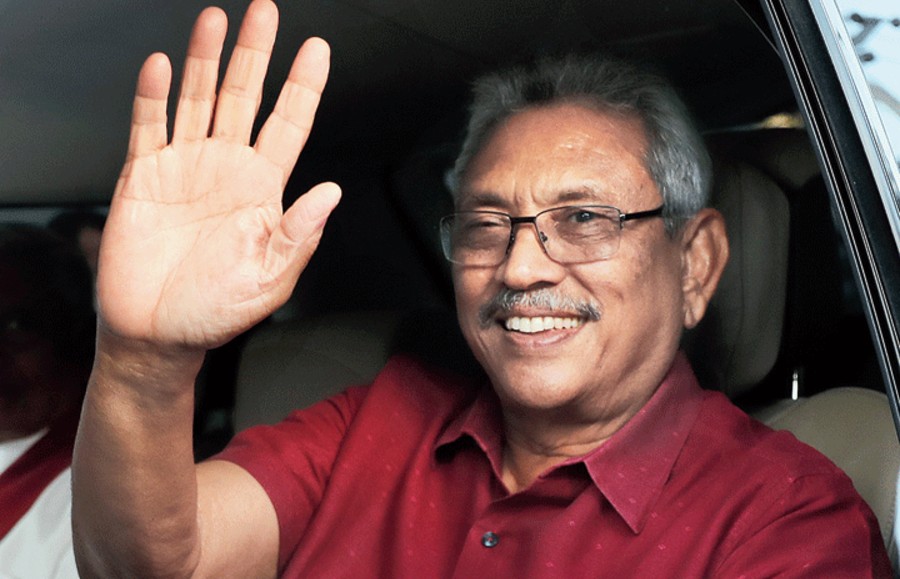
Xi tells Gota, China will work with Lanka to enhance Belt and Road Initiative

March 29th, 2021

Courtesy NewsIn.Asia

Colombo, March 29 (CGTN): Chinese President Xi Jinping on Monday told Sri Lankan President Gotabaya Rajapaksa that China is willing to work with Sri Lanka to enhance Belt and Road Cooperation and contribute to the economic revival of Sri Lanka in post-pandemic era.

Xi said China will continue to provide necessary assistance to Sri Lanka, conduct cooperation in areas including aviation and education and explore other potential cooperation areas.

Xi said China will never forget Sri Lanka’s support for the restoration of China’s lawful seat in the UN, and is willing to continue working with Sri Lanka to support each other on issues of mutual concern, safeguard each other’s legitimate rights and promote global justice and fairness.

Rajapaksa congratulated China on the 100th founding anniversary of the Communist Party of China and spoke highly of China’s achievements in fighting the pandemic and its economic recovery.

Rajapaksa said Sri Lanka hopes to learn from China’s experience in poverty reduction and rural revitalization and is willing to expand cooperation in infrastructure construction, tourism and so on, so as to benefit Sri Lanka’s economic development and its people.(CGTN)

Violation of UN resolutions is not uncommon

March 29th, 2021

By P.K.Balachandran/Ceylon Today

Colombo, March 29: As early as 2002, the UN correspondent of the Los Angeles Times, Maggie Farley, noted that more than a hundred UN resolutions were being violated, and that in many cases, enforcement of resolutions was blocked by the US or its allies.

She made this observation based on a 15-year review of compliance with UN resolutions done by the University of San Francisco Professor Stephen Zunes. Zunes had concluded that compliance depended on the influence of each State and its backers. The more powerful the backer, the less the chance of compliance, he said. Those countries which did comply were made to comply by a powerful country or a set of powerful countries through sheer coercion, economic or military or both.

For a start, UN resolutions are not binding, and if they are, as in the case of some Security Council resolutions, the powers-that-be might not enforce them for economic, political or geo-political reasons. Between 1967 and 2002, Israel had violated 31 resolutions. Twelve violations related to the Fourth Geneva Convention for Occupying Powers,” relating to deportations, demolitions of homes and seizure of property.

Among the resolutions violated was No: 487 of 1981 which had called upon Israel to place its nuclear facilities under the safeguard of the UN’s International Atomic Energy Agency. While the US went to war with Iraq for violating UN resolutions, it would not envisage war against Israel to enforce a UN resolution. In fact, the US had used the veto several times to block resolutions on Israel. In 2018, the US quit the UNHRC complaining against its bias against Israel.

When Turkey was an ally of the US, it was able to defy UN Security Council resolutions on its troop deployment in Cyprus. Morocco flouted resolutions seeking withdrawal of its forces from Western Sahara and allow a referendum there on self-determination. The US invaded Iraq as per a UN mandate because it suited its interests.

Military Action

The UN Charter authorizes military action for the enforcement of Chapter 7 resolutions. But military interventions have proved to be difficult because of inadequate commitment from member states. The UN action in Bosnia-Herzegovina proved to be disastrous because of this.

Big Power hegemony is a major factor. The US would not allow its forces to be commanded by non-US citizens. Though the UN is a US institution essentially, no government in Washington has wanted it to be powerful, as stated by Daniel  Moynihan, former US ambassador to the UN.

The Department of State desired that the United Nations prove utterly ineffective in whatever measures it undertook. The task was given to me, and I carried it forward with not inconsiderable success,” he wrote in his memoirs.

The UN has also shown its incompetence in implementing resolutions on North Korea. In their article in journal of the Institute for Science and international Security” in 2018, David Albright, Sarah Burkhard, Allison Lach, and Andrea Stricker say that 52 countries were involved in violating UNSC Resolutions on North Korea throughout most of 2017.

US President Donald Trump threatened to withhold billions” of dollars of US aid from countries voting in favor of a UN resolution rejecting his recognition of Jerusalem as the capital of Israel. But despite the warning, 128 members voted to maintain the longstanding international consensus that the status of Jerusalem (claimed as a capital by both Israel and Palestine) can only be settled as an agreed final issue in a peace deal, wrote. Nevertheless, despite the UN resolution, in May 2018, the US went ahead and reclassified its Jerusalem Consulate as the US Embassy in Jerusalem.

The US also vetoed a UN Security Council resolution that condemned Israel’s use of force against Palestinian civilians. At least 116 Palestinians were killed by Israeli forces in Gaza border protests since the end of March 2018.

UN Resolutions

Any UN body can pass a resolution. But they are generally not binding. But even those which are biding, are either imperfectly implemented or not implemented at all .The Security Council is charged with the maintenance of international peace and security. The UNSC comprises 15 members, five permanent (Russia, the UK, France, China and the US) and ten non-permanent members, elected on a regional basis to serve two- year terms. Permanent members can veto any substantive UNSC resolution.

Security Council Resolution 1373, which was adopted unanimously on September 28, 2001, was a counter-terrorism measure passed following the 9/11 terrorist attacks on the Twin Towers in New York. The resolution was adopted under Chapter VII of the UN Charter, and is therefore binding on all UN member states. If the US has been complying with this, it is because it is directly affected by terrorism since the 9/11 attack.

International Criminal Court

The International Federation for Human Rights (FIDH) has been unsuccessfully trying to extend the jurisdiction of the International Criminal Court (ICC) to Sri Lanka. Sri Lanka is not a signatory to the Rome Statute, which enables the ICC to exercise jurisdiction over the island nation. However, a Sri Lankan human rights violation case can be brought to the ICC if the UN Security Council resolves to do so. But in the UNSC, Sri Lanka is supported two veto wielding powers, China and Russia.

It is pointed that following the recent UNHRC resolution against Sri Lanka, any member State can file a case against a Sri Lankan national on human rights or war crimes grounds. But here again, it is argued that the political interests of nations will play a determining role.

It is noteworthy that most cases brought before the ICC relate to poor and backward countries which have no political influence in the world. Thus far, 45 individuals have been indicted in the ICC. The list includes Ugandan rebel leader Joseph Kony, former Sudanese President Omar al-Bashir, Kenyan president Uhuru Kenyatta, Libyan leader Muammar Gaddafi, Ivor Coast President Laurent Gbagbo, and DR Congo Vice-President Jean-Pierre Bemba. The over-representation of Africa and the total absence of the developed countries in the ICC cases are noteworthy.

Western Laws to Protect Soldiers

While on the one hand, Western nations are itching to prosecute soldiers from the developing countries on war crimes charges, they themselves are enacting laws to prevent the prosecution of their soldiers for war crimes committed abroad.

The British House of Commons recently adopted a Bill to prevent ‘vexatious’ prosecutions of British military personnel and veterans over war crimes allegations. The prosecution of British soldiers for alleged past crimes in Northern Ireland, and more recent conflicts in Iraq and Afghanistan, has dogged the country’s military and government for years.

The new legislation proposes measures to reduce uncertainty arising from historical allegations and create a better legal framework to deal with claims from future overseas conflicts,” said the UK Defense Ministry. Defense Secretary Ben Wallace told the House of Commons that the Bill would deliver on the Conservative Government’s 2019 Election promise to protect service personnel and veterans from vexatious claims and endless investigations.”

Veterans Minister Johnny Mercer, a former Army Officer who served in Afghanistan, insisted that the legislation does not decriminalize torture” but strikes an appropriate balance between victims’ rights and access to justice.”

Sri Lanka is contemplating a similar protective law in view of the UNHRC’s bid to prosecute its soldiers, Education Minister and Sri Lanka Podujana Peramuna (SLPP) spokesman, Prof. G.L.Peries, told the media recently.

Will not allow other countries to push for ‘separatism in the guise of power devolution’, says Gotabaya Rajapaksa

March 29th, 2021

Meera Srinivasan courtesy The Hindu

The Sri Lankan President said ‘the government does not wish to be associated with the power struggles in the Indian Ocean region by the global giants’.

Sri Lanka will not allow other countries to achieve their geopolitical needs by introducing separatism under the guise of power devolution” in the island nation, President Gotabaya Rajapaksa has said.

The government does not wish to be associated with the power struggles in the Indian Ocean region by the global giants,” Mr. Rajapaksa said, adding that the sovereignty of Sri Lanka would not be betrayed, a front-page report in the state-run Daily News said on Monday.

Speaking at a ‘Discussion with the Village’ event in the southern Matara district on Saturday, he appeared to be responding to India’s intervention at the United Nations Human Rights Council last week. Although India abstained from voting, it supported the international community’s call in the resolution for devolving political authority, holding of elections to provincial councils and implementation of the 13th Amendment that guarantees a measure of power devolution to the provinces.

The Council adopted the resolution — with 22 countries backing it — that called for greater scrutiny of human rights in the country, including through an international evidence gathering mechanism, while flagging possible recurrence of human rights violations, citing recent policy decisions impacting Sri Lanka’s Tamil and Muslim minorities.

In addition to pegging the international call for devolution, to the geopolitical needs of other countries”, Mr. Rajapaksa’s remarks also linked the demand for greater power devolution to separatism, although Sri Lanka’s Tamil political leadership has repeatedly underscored the need for enhanced powers for provinces within a united, undivided and indivisible” Sri Lanka.

The President said: We will face the Geneva challenge without fear. We will never succumb to pressures. We are a free nation. We will not be a victim of big power rivalry in the Indian Ocean,” a week after the U.N. Human Rights Council adopted a resolution.

The statement assumes significance in the wake of persisting calls from some within his government, including senior Ministers, for the abolition of the provincial council system and the 13th Amendment.

Provincial council elections

Less than a fornight before the vote on the Sri Lanka resolution in Geneva, amid Colombo’s hectic diplomatic outreach seeking support from members, Mr. Rajapaksa instructed the relevant parties to take steps to expedite the provincial council elections by either withdrawing the Provincial Council Amendment bill or rectifying its anomalies,” a statement issued by the Presidential Media division said on March 13.

According to local media reports, the holding of provincial council elections is likely to be discussed in Monday’s [March 29] weekly Cabinet meeting.

After being elected President in November 2019, Mr. Rajapaksa stated that he would focus more on development rather than devolution. In an interview to The Hindu on November 30, 2019, during his first visit to New Delhi after assuming office, Mr. Rajapaksa said the previous push for devolution, devolution, devolution” had not changed the situation in Sri Lanka.

Full devolution of powers as promised by the 13th Amendment to the Constitution in 1987 could not be implemented against the wishes and feeling of the majority [Sinhala] community,” he noted, while the legislation envisages power devolution to all provinces in the country, including those with a Sinhala-majority.

Two arrested in Jaffna over website & YouTube channel promoting LTTE

March 29th, 2021

Courtesy Adaderana

The Terrorism Investigation Division (TID) has arrested two persons including a female in Jaffna for maintaining a website and YouTube channel allegedly promoting LTTE terrorist propaganda. 

Police Spokesman DIG Ajith Rohana said that the TID had conducted a special raid in respect of an office situated at Navalar Street in Jaffna this morning (29).

The raid has been conducted in order to trace a YouTube channel and a website that had been operated for months and those channels had promoted the LTTE ideology in the cyber space,” he said. 

The Police Spokesman said that the YouTube channel and website had allegedly promoted the LTTE ideology, speeches of LTTE leader Velupillai Prabakaran and the symbols of the LTTE terrorist organization.

He said that the YouTube channel and website had created disharmony among the ethnic groups of Sri Lanka and that therefore a 35-year-old female and a 36-year-old male, who were running the office, have been arrested by the TID.

In addition to that 05 desktop computers and 05 laptop computers recovered from the said office have also been taken into custody, the DIG said. 

In terms of the Gazette notification published in 2011related to the Prevention of Terrorism Act, the LTTE is a prescribed organization and promoting LTTE ideology and publishing articles in respect of LTTE terrorism or LTTE activities is strictly prohibited,” he added.

He said the arrested suspects are being brought to the TID’s Colombo office and that further investigations are underway.

Colombo Archdiocese calls out against external interferences on investigations into Easter attacks

March 29th, 2021

Courtesy Adaderana

Archdiocese of Colombo says that it makes them wonder as to whether there are external interferences that hamper the efficiency of investigations into the 2019 Easter Sunday terror attacks seeing as the culprits of this crime have not been identified even after 2 years.

As the Easter Sunday bombings were an attack on the entire Sri Lankan society, it is the responsibility of all citizens to pressurize those in power to mete out justice to the victims, the Archdiocese of Colombo stated.

Issuing a statement, the Archdiocese urges the government and the Opposition to refrain from any action that might hamper the independent and free implementation of the judicial process of the case.

They have also outlined four steps that need to be taken to bring justice regarding the terror attack.

– Expedite investigations on those directly or indirectly connected to this crime [planning, financial help, political patronage, etc.] and bring them before the law.
– Thorough investigations into all those who had contacts or dealings with Zahran Hashim.
– Prosecute all political leaders, officials who have been recommended in the report of the Presidential Commission of Inquiry for shirking their duty and not preventing the massacre despite prior intelligence warnings
– Proscribe all extremist Islamic groups which are a threat to national security, and banish their foreign sponsors and local agents from the country.

The Archdiocese of Colombo also stated that action must be taken to implement or at least initiate the first steps to implement the aforementioned demands before April 21, 2021.

The full statement issued by the Archdiocese of  Colombo:

President Rajapaksa assures strengthened mutual cooperation with China

March 29th, 2021

Courtesy Adaderana

President Gotabaya Rajapaksa assures his Chinese counterpart of strengthening mutual cooperation in all sectors and bilateral ties.

President Rajapaksa mentioned this to China President Xi Jinping over a telephone conversation held today (March 29), President’s Media Division stated.

Five more COVID-19 deaths bring tally to 566

March 29th, 2021

Courtesy Adaderana

Sri Lanka has reported 05 more coronavirus-related deaths, the Director-General of Health Services confirmed today (March 29).

As per the Department of Government Information, all five victims are male patients.

The new deaths bring the number of COVID-19 related deaths witnessed in Sri Lanka to 566 in total.

Sri Lanka’s COVID-19 count up by 166 more cases today

March 29th, 2021

Courtesy Adaderana

Sri Lanka has registered 71 more positive cases of Covid-19 today (March 29), the Ministry of Health confirmed.

Thereby, Sri Lanka has detected 166 new positive cases of COVID-19 within the day.

As per statistics, the total number of Covid-19 infections confirmed so far in the country now stands at 92,303.

Recoveries from the virus meanwhile climbed to 88,914 earlier today, as 291 more patients regained health.

However, 2,823 active cases are still under medical care at selected hospitals and treatment centers located across the island.

Total lives claimed by the pandemic outbreak sits at 566 at present.

UNHRC; “Worrying about ants when elephants are stampeding –An African metaphor

March 28th, 2021

By Raj Gonsalkorale

Yet it remains the case that if Nigerian public and private sector players doing business with the Chinese elephant could improve their negotiating skills and be more ambitious about their negotiating positions, making better use of Nigeria’s ‘superpower’ qualities to minimise the drawbacks of its antlike ones, the future of Nigeria–China relations could be brighter and more beneficial for Nigeria than their past – South African Institute of International Affairs

Human rights violations allegedly committed by President Gotabaya Rajapaksa and the government of Sri Lanka are antlike compared to the Elephantine violations committed by giants in the world including the USA.

The UNHRC and the West so concerned about the Ants, looks totally disinterested when the Military in Myanmar mows down innocent civilians fighting for their human rights. They have not raised a finger or even a finger nail to do anything tangible to halt the Military juggernaut from killing more people and subjugating them to the power of guns and other military hardware. Military might has replaced human rights and the world looks on issuing useless statements from UN pulpits. The duplicity and differential treatment being meted out is sickening.

Yet, these human rights champions are concerned about internal matters of Sri Lanka, but not concerned about the Muslim extremists who killed more than 300 people during the Easter bombings in 2019 and prior to that the marauding LTTE who killed hundreds and thousands of innocent children, women, old men and women. The dark history of the LTTE has been inconsequential for the UNHRC or the West.

Much has been written about the plight of the poor in the US who have no rights if they are poor. The world knows how rights are violated in Saudi Arabia, protected by the US. They know about the violations in Israel, again protected by the US. Palestinians have been trampled, walls built around them, and basic living conditions denied to them.

Some of the member countries of the UNHRC, who voted against Sri Lanka have appalling human rights records. Some others who sat on the fence too would not have a place to hide if their records are exposed. Others who sat on the fence did not have the guts to either side with the Elephants or support the Ant who was being trampled.

Sections of the Tamil Diaspora, the beggars with the wound that will never heal, provided plenty of falsehoods to the Core group and the US, and the world media big shots sponsored the case against Sri Lanka basing their accusations on such falsehoods, and also infringing on Sri Lanka’s sovereignty as if Sri Lanka was still one of their colonial outposts.

It is high time Sri Lankan Tamils who wish to call Sri Lanka their home divorced themselves from the LTTE and their supporters overseas, and also kicked out their politicians from their electorates and elected a set of politicians who would help to develop their areas and improved their lot.

They must ask themselves what these politicians have done for them since independence. They must ask themselves what development support the Tamil Diaspora, barring a handful, have done to improve the economic wellbeing of Tamils in the North and the East by investing, and creating jobs or improving agriculture and agri industries so that people would have had more self-employment opportunities. Had they done this, the private sector in the North and East would have been booming today.

Instead they contribute to fill the coffers of the LTTE rump, who in turn puts money in the pockets of politicians in the West to continue their fake allegations about their hopeless” fate in Sri Lanka. This money goes to keep LTTE atrocities under the lid and make the world think that the LTTE was a lily white set of freedom fighters without any blemish.

The current President Gotabaya Rajapaksa may have his faults. After all he is human. But, few seem to remember that had it not been for him and the service commanders at the time including Field Marshal Sarath Fonseka, who led very brave Forces personnel, and the political leadership provided by President Mahinda Rajapakse, the island of Sri Lanka would have had two Nations by now. There are of course those with short memories, who owe their freedom to talk, write and act because the LTTE were defeated militarily in 2009, and others with an objective that is still uppermost in their minds, and that is to create a separate nation in the North and the East.

Tamil people will have to make a decision whether they wish to be in one nation called Sri Lanka, along with the Sinhalese, Muslims and other ethnic groups, or whether they wish to live in a separate Nation. Such a decision however cannot be just the decision of Tamil people, it has to be a decision of all people of Sri Lanka including the Sinhalese, Muslims and other races, as they all have ownership of the one country and island where everyone lives.

If the Tamil people in the North and East and others living in the rest of the country wish to advance and work towards the concept of one country for all, they have to choose a different set of leaders who would pursue such a concept and work towards addressing how the road blocks that might be impeding the one country concept may be overcome. It has to be clear to the Tamil people that their leadership has failed them, and they have not benefited by the divisive politics practiced by their leadership. Solutions lie in compromise and consensus decision making by all people as no group could have aspirations that disadvantage another group. In particular, majority groups need to compromise more than minority groups as majorities can and they do create imbalances simply on account of their numerical strength.

Muslim people of Sri Lanka too need to make a decision about their future in Sri Lanka and whether they wish to replicate extremism practiced in countries like Saudi Arabia or whether they wish to practice moderation as the Prophet himself articulated very well in his teachings. Extremism cannot have a place in the country. Politicians who advocate extremist ideologies should be rejected by the Muslim people.

The UNHRC vote gave a clear indication as to who were with Sri Lanka and who had the self-respect to defend their sovereignty as this resolution was clearly aimed at infringing on the sovereignty of small, poor and developing nations by those powerful ones who had become the pseudo defenders of human rights. In saying this, there is no inference whatsoever that any violation of people’s human rights should not be opposed. It must be. However, such a condemnation has to be proportionate to the alleged or actual violations, and also dealt in equal measure irrespective of a country’s wealth or power. This is not the case today as evidenced by how the rich and the powerful treat some nations differently to others.

The Nigerian simile mentioned at the outset of this article rings true when it comes to Sri Lanka too. China is the Elephant in the room which has got the Western power block which includes India, to take measures against Sri Lanka and corral it using a UNHRC resolution, hoping that Sri Lanka will yield to such international pressure and cave into their demands.

Despite the uphill task, Sri Lanka should not cave in as that would be the end of the country’s sovereignty. Sri Lanka should however very aggressively and purposefully pursue alliances with countries in similar situations to counter the threats from not just the Western power block, but even from China at a future point in time. A very aggressive China, pursuing its own agenda of being the next super power of the world, could potentially become the Elephant that tramples nations like Sri Lanka if it felt that an Ant was standing in its way.

Sri Lanka no doubt wants and must have the support of all nations to improve their economic and social wellbeing of their people. It needs investments from all corners and not loans and handouts. Sri Lanka’s development and self-sufficiency has to come from the confidence it generates to attract investments. In this regard, many initiatives being taken by the Rajapaksa government has to be lauded and encouraged, while those opposed to the government should offer constructive criticism of government policies and practices. A democratic opposition should not resort to spreading fake news to pursue a genuine political agenda unless that agenda is also as fake as the fake news.

Sri Lanka successful at talks with Pfizer

March 28th, 2021

Courtesy NewsIn.Asia

Colombo, March 27 (Daily Mirror) – Sri Lanka yesterday said talks to purchase coronavirus vaccines from Pfizer-biontech have been successful and a final agreement is expected to be reached soon. State Minister of Production, Supply and Regulation of Pharmaceuticals, Prof. Channa Jayasumana said that the US based company has offered to supply vaccines in special storage equipment during transportation.

The Pfizer vaccine requires storage facilities with minus 70 degrees

refrigeration, a facility which the Sri Lanka Government does not have.

However, Prof. Channa Jayasumana said that the matter had been discussed with the manufacturer and the manufacturer has now offered asolution.

He said that the company is ready to provide facilities to transport the vaccines to storage facilities while maintaining the minus 70 degrees refrigeration.

Professor Channa Jayasumana also said that it has been found that vaccines manufactured by the company can be stored in normal refrigeration for approximately a week.

As a result, he said that steps will be taken to import the vaccines from Pfizer-biontech to Sri Lanka soon.

Meanwhile, Pfizer and Biontech announced a breakthrough yesterday

(Friday) saying that the European Medicines Agency (EMA) approved storage of the Pfizer manufactured COMIRNATY® vaccine at -25°C to -15°C for a total of two weeks based on data showing the stability at these temperatures in standard pharmaceutical freezers. COMIRNATY® is manufactured by Pfizer Europe and efficacy shown in clinical trials in participants with or without evidence of prior infection with SARS-COV-2 and who received the full series of vaccine (2 doses) was approximately 95% based on a median follow-up of two months.

Pfizer said the new data is a testament to the companies’ ongoing commitment to developing this vaccine further and collecting data in order to support broader and more flexible vaccine distribution and inoculation.

Lankan president says his govt will not succumb to UNHRC pressure

March 28th, 2021

Courtesy The Telegraph (India)

Gotabaya Rajapaksa accused the previous government led by Maithripala Sirisena of betraying the country’s sovereignty by co-sponsoring the UN rights resolution in 2015

Gotabaya Rajapaksa
Gotabaya Rajapaksa

Sri Lankan President Gotabaya Rajapaksa on Sunday stated that the recent UNHRC resolution against his country was the doing of local and foreign forces which do not want Sri Lanka to progress. He even vowed that his government would not succumb to such pressures.

On Tuesday last week, the UN Human Rights Council (UNHRC) adopted a resolution against Sri Lanka’s rights record, giving the UN body a mandate to collect evidence of crimes committed during the country’s brutal three decade-long civil war against the Liberation Tigers of Tamil Eelam (LTTE).

Speaking at a gathering in the southern rural district of Matara on Sunday, Rajapaksa said: We will never succumb to (such) pressures (UNHRC resolution); we are a free nation. We will not be a victim of big power rivalry in the Indian Ocean.”

The president said the UNHRC resolution was the doing of foreign and local forces” which cannot see his government making progress.

Rajapaksa accused the previous government led by Maithripala Sirisena of betraying Sri Lanka’s sovereignty by co-sponsoring the UN rights resolution in 2015.

The resolution titled Promotion of Reconciliation Accountability and Human Rights in Sri Lanka was passed despite heavy lobbying by Sri Lanka. India was among 14 countries which abstained from voting.

India has said its stand on the matter is governed by two considerations: support to the minority Tamils and stability and territorial integrity of Sri Lanka.

The resolution calls upon the Lankan government to ensure prompt thorough and impartial investigation, if warranted, prosecution of all alleged crimes relating to human rights violations and serious violations of international human rights law during the country’s three decade-long civil war. The Tamil minority has welcomed the resolution.

According to the Lankan government figures, over 20,000 people are missing due to various conflicts including the three-decade brutal war with Lankan Tamils in the north and east which claimed at least 100,000 lives.

The Tamils alleged that thousands were massacred during the final stages of the war that ended in 2009 when the government forces killed LTTE chief Velupillai Prabhakaran.

The Sri Lankan Army denies the charge, claiming it as a humanitarian operation to rid the Tamils of LTTE’s control.

At the end of the civil war, the United Nations accused both sides of atrocities, especially during the conflict’s final stages.

International rights groups claim at least 40,000 ethnic Tamil civilians were killed in the final stages of the war, but the Sri Lankan government has disputed the figures.

Coronavirus: 237 positive cases in total recorded today

March 28th, 2021

Courtesy Adaderana

The Epidemiology Unit of the Health Ministry says that another 69 persons have tested positive for COVID-19 increasing the total number of cases reported within the day to 237.

This brings the tally of coronavirus cases identified in the country to 92,088 thus far, while the total recoveries have reached 88,623.

Presently there are 2,906 patients who are being treated for Covid-19 at hospitals and treatment centers.

Two more COVID-19 deaths, tally at 651

March 28th, 2021

Courtesy Adaderana

Sri Lanka has reported 02 more coronavirus-related deaths, the Director-General of Health Services confirmed today (March 28).

As per the Department of Government Information, the victims are two male patients from Colombo 15 and Mawanella areas.

The new deaths bring the number of COVID-19 related deaths witnessed in Sri Lanka to 561 in total.

01. The deceased is a 60-year-old male resident from Colombo 15. He died on 01.02.2021 on admission to Base Hospital Mawanella. The cause of death is mentioned as COVID-19 infection and chronic renal failure.
 
02. The deceased is a 35 old male resident from Mawanella. He died on  29.12.2020 on admission to Base Hospital Mawanella. The cause of death is mentioned as COVID-19 infection and acute diabetes.

Indonesia church rocked by suicide bombing on Palm Sunday

March 28th, 2021

Courtesy Adaderana

An explosion ripped through a Roman Catholic cathedral compound in the eastern Indonesian city of Makassar on Sunday morning, shattering the calm of Palm Sunday, a holy day for Christians.

Unverified video said to have been taken at the Sacred Heart of Jesus Cathedral showed smoldering wreckage and palm fronds scattered on the ground.

Father Wilhelmus Tulak, a priest at the cathedral, told Metro TV, an Indonesian network, that a parking attendant had been burned as he tried to stop a suicide bomber. Ten people were injured, the priest said.

The cathedral was between Masses when two motorcyclists approached, looking suspicious, Father Wilhelmus told Metro TV.

Mohammad Ramadhan Pomanto, the mayor of Makassar, a multifaith port city of about 1.5 million people on the island of Sulawesi, told Metro TV that body parts were found as far as 200 meters away. He said no churchgoers had been killed.

South Sulawesi police chief told reporters that based on initial findings, one person died during the blast at the gate of the church compound. Five church staffers and four worshippers were injured and taken to nearby hospitals, he added.

What we can be sure of is that there is one body, allegedly the suicide bomber,” he said as quoted by Kompas TV. The body was attached to a motorbike, apparently (he) had yet to descend because he was stopped by a church officer.

He noted although the bombing was high explosive”, there was no significant damage at the church.

The police have set up a cordon around the church and a disaster victim identification team is investigating the incident.
Indonesia, the world’s largest Muslim-majority nation, has a significant Christian minority. In recent years, Southeast Asian affiliates of the Islamic State have targeted Christian places of worship there and in the mostly Catholic Philippines.

In 2018, three Christian churches were bombed in Surabaya, the second-largest city in Indonesia, leaving a dozen bystanders dead. The suicide bombers were a married couple and their four children. Within days, members of two other families also set off bombs in Surabaya, blowing themselves up.

Last year, a Roman Catholic cathedral was bombed for the third time on the island of Jolo in the southern Philippines, killing at least 14 people. As with the Surabaya bombings, a local affiliate of the Islamic State claimed responsibility for that strike. A 2019 suicide attack on the same cathedral, which killed more than 20 people, was carried out by an Indonesian couple.

-Agencies

Indian hypocrisy is Himalayan

March 27th, 2021

H. L. D. Mahindapala

In a  lofty speech delivered via video to the 75th General Assembly of UN (September 2020) – the first of its kind initiated in the wake of the pandemic — Prime Minister Narendra Modi took great pains to explain a range of  issues from India ’s Neighbourhood First Policy” to the new dimensions of the Indo-Pacific region. Among the achievements he highlighted was this unusual factor peculiar to India only: In the same period (i.e., within 4-5 years),” he said 600 million people have been freed from open defecation. This was not an easy task. But India has achieved it,” he said with pride.

The entire SAARC neighbourhood joins India in celebrating this achievement. But what baffles the  SAARC partners in the region is why India continues to defecate in the neighbourhood so openly and  unashamedly? The biggest shock of being a SAARCian is that no one ever knows when India would decide to defecate either in your front yard or backyard. There isn’t a single SAARCian that is not working ceaselessly to keep their patch free from India faeces. India’s do-as-I-say-and-not do-as-I-do policy” has been a fundamental flaw in  India’s foreign policy. The failure of SAARC to progress as a regional bloc – the only regional bloc to  stagnate so far — is due solely to India’s pursuit of self-interest at the expense of its neighbours. If there is a problem in SAARC you can be sure that India is somewhere in it. And yet Prime Minister boasted in the same speech:  We have always worked for the interests of humankind and not driven by our own self-interests.”

The Gandhi-Nehruvian idealism that inspired the  Non-Alignment Movement went out with India defecating in and around its neighbourhood. Cleaning up India was long overdue and Modi deserves credit for achieving this Herculean task. Which reminds me of the cynical story that circulated after the visit of Nikita Khrushchev, the Soviet Premier, to India in 1960. An eye-sore to Khrushchev,  the story went, was the Indians defecating in public and on one of his long  train rides he  chided Nehru for letting  his people dirty both sides of the railway track. Nehru’s pride was wounded and he remembered it well and on his return visit to USSR (as Russia was known then) he was out to get even with his counterpart. He thought he found one at last in one  of his long train rides across Siberia when he saw in the open distant a squatting man defecating. He quickly summoned Khrushchev and pointed to the ugly scene which, naturally angered Khrushchev. Immediately, he pulled the chain and stopped the train and got his NKVD to bring the culprit before him. It was Nehru who was chagrined again because they discovered that the defecator was none other than India’s ambassador to Moscow!

Well, SAARCians are well aware that the South Bloc in Delhi is a factory that produces these incontinent specimens who should not have been let out of Indian toilets. J. N. Dixit, the noted Mr. Fix-it” who was sent by Mrs. Indira Gandhi, to execute her excremental mission in Sri Lanka, was full of regret later when he realised, rather late, that it was India’s biggest mistake. The entire mission was undertaken on the assumption that India could fix the domestic problem of Sri Lanka by using its superior military, political and Big Brother muscles. In the end it was  driven away by the very forces that welcomed them as their  saviours. And the LTTE boasted that they had beaten the fourth  largest Army in the world.

Each defeat diminishes India’s stature as a reliable guide, partner and leader in the global competition for power and influence. India’s rivals are asserting and making their presence felt with more credible and viable use  of power. In short India is losing its grip in the neighbourhood – let alone the India Ocean Rim — by the day to its powerful rival China. India is drifting away from its neighbourhood – its nearest and vital mates needed for its defence – to depend on distant power blocs like the QUAD. Consequently, India is forced to rely on the Pacific friends” with a common interest in containing China, which questions the validity of India’s Neighbourhood First Policy”.  And the more it alienates its neighbours the more it  is compelled to rely on LOCs and LACs. How many frontiers must it maintain just to survive in the neighbourhood, dissipating its military energies on mini-wars and  skirmishes from time to time, sometimes going to the brink? Is India going to live on  tenterhooks for the rest of its life by hanging on to controversial  legacies and self-serving interventions?

India of course rushes into places where angels fear to tread ( e.g., Sri Lanka) believing that it is a problem-solver. But the records show that she ends up as a problem-exacerbator, not  knowing how to get out of it without exiting  in body bags. Invariably, India’s foreign forays boomerang on her blinkered bureaucrats in the South Bloc. India has this penchant also to bite more than what it can chew. And, in the process, she gets choked. That is what happened to her in Sri Lanka. Had India allowed the Sri Lankan forces to finish off the LTTE in the Vadamarachchi operation in the 70s the needless internal war would not have dragged on till 2009. It could have been nipped in the bud. But Big Brother India had to come in and worsen  the  situation  for all concerned – mostly to India. Had India allowed Sri Lanka to solve its problems in their way India could have saved face without  having  to experience the humiliation of its forces being  driven  out with their  tails between their legs.

India’s latest diplomatic thrust at the UNHRC against Sri Lanka is typical of India’s duplicitous diplomacy. It is the absolute lack of moral finesse that makes India a despicable figure in the eyes of those who know India’s role in sabotaging and destabilising her neighbour and friend for thousands of years. It is the nearness that makes India both a friend and an enemy. As a neighbour with thousands of years of relations with Sri Lanka, we cannot remain untouched by developments in that country and will continue to remain engaged in this matter,” said Dilip Sinha, India’s High Commissioner in Geneva in 2013. In other words, India is saying that it will not let Sri Lanka be independent and handle its domestic affairs or foreign affairs according to its national interests. India gave a new meaning to Neighbourhood First Policy” by imposing Article 370 and wiping out the independent status of Kashmir violating international  agreements and UN resolutions and absorbing the Muslim state into Indian Hindustan. India would not  have hesitated by now  to make Sri Lanka its 29th state if it had the power to do so.

 The Neighbourhood First Policy” is a rather belated approach to mend broken fences. But India can’t live up to its own commitments. India’s lobbying against Sri Lanka in Geneva, roping in Nepal, is not the best way to pursue policy that gives priority and confidence to the neighbourhood. Pakistan and Bangladesh, the two big neighbours, were not with India. Isn’t this another sign  that meddlesome  and  interventionist India cannot coexist with  its neighbours? Of course, the Modi government was under pressure in Tamil Nadu to prove that they are with the Tamils in Sri Lanka. Selling Sri Lanka is another  way of  winning  votes in the Tamil Nadu election due on April 6. Modi is boasting that he is the first Indian Prime Minister to visit Jaffna. He is also claiming blood relationship with the Tamils by  and referring to them as his brothers and sisters”. No doubt, this is electoral rhetoric. That is for domestic consumption. But the consequences of this rhetoric go beyond the borders to impact on Indo-Sri Lanka relations. India is literally pushing Sri Lanka into the arms of China – the last thing that both sides want to happen. Both sides are sensitive to possibility of Sri Lanka, swinging away from India. India is openly wooing the Tamils partly to keep the pot boiling for it to intervene and partly to keep them as the Fifth Column to provoke and pressure the GOSL. Indian diplomats on the ground are stirring the pot, playing ball with the Tamil parties. Driven by Indian funds, patronage and interventionist policies the local Tamil parties too are only too happy to go along  with Indian manoeuvres. In doing this India is playing with fire again. Playing with divisive politics is a risky gamble. Foreign powers tend  to join with the locals to exploit divisions to their advantage. But it doesn’t go according to plan in  the best of cases. Vietnam for  USA and Sri Lanka for Indians prove that it can go the other way.

India finds Tamil aspirations” a good excuse to intervene. So it should not be surprised to find the Sri Lankan aspirations” too compelling the Sri Lankan policy-makers to seek their comfort/security zones abroad. So far, India’s handling of Tamil aspirations” has not satisfied the Tamil aspirants. Velupillai Prabhakaran went against India because  he felt that India was pushing its own  neo-colonial program more than that of the Tamils. Right now India has moved into UNHRC to push its neo-colonial interventions. Apart from power politics, what makes the Indian adventure in Geneva so obnoxious is its blatant lies and immorality. Of course, India makes a big issue of trying to present its role as neutral middle-man guaranteeing territorial integrity to Sri Lanka and in the same breath guaranteeing Tamil aspirations” which it says is in the interest  of Sri Lanka. In other words, India will follow the policy of rocking  the cradle and pinching  the baby. But the sudden and arbitrary application of Article 370 to Kashmir – a kind of final solution to the vexed issue since Pandit Nehru created it at Independence – proves that India is not shy of redrawing the political maps according to its whims and fancies. India is provocative. It is aggressive. And threatening  regional peace and stability with each big move. A counterweight is needed to balance India’s arrogant approach to its neighbours. If an alternative counterweight  is not forthcoming, perhaps, an alliance of non-Indians in  the region to lock in India – if achievable — would be the answer to put India in its place

In other words, somebody must stop India running wild. Take the case of Sri Lanka. India exploited the simmering internal stirrings in  its very early stages to recruit derelict Tamil youth to be India’s covert arm to destabilise Sri Lanka. It provided training, finance, military equipment, political patronage, diplomatic cover, the use  of  its territory to export terrorism to its thousand-year-old friend and neighbour. Eventually it forced its way into Sri Lanka on the promise of solving the problem. When the Tamils realised that the Indians had come in to exploit them they turned against  the IPKF. In response the IPKF sprayed bullets indiscriminately targeting civilians. The Indian committed the most heinous war crime by raiding the Jaffna Hospital and slaughtering doctors, surgeons, nurses and patients and all others who stood in the way. And  it is this India – this hypocritical India — that is asking Sri Lanka to give justice, dignity, equality and peace for Jaffna Tamils in Geneva.  

Three parties engaged directly in finding a military solution and all the human rights  issues arose from the military engagements of the three forces : 1. The quasi-Tamil state of the LTTE which came out of the declaration of war by the Tamil leadership at Vadukoddai urging  the Tamil youth to take up the gun in pursuit of establishing a Tamil state.(2) the democratically elected state of Sri Lanka which fought to defeat the Tamil Pol Pot and liberate the Tamils from Tamil tyranny and 3. The state of India which intervened military to impose its will assuming its power to find a solution. All parties violated human rights and committed war crimes. The UN resolutions repeatedly refers to violations of human rights by the GOSL and the LTTE but never by the state of India. Why? In their reports to UNHRC all the High Commissioners have been quick to pick on GOSL. But not a single report has ever dared to raise the violations of the Indian forces in Sri Lanka. Why? Are they above the law? Or are the High Commissioner, as usual playing  the hidden games of exempting the powerful and flaying only the powerless – and that too on flimsy excuses compared to what  India had done to Sri Lanka from the beginning? The scale of India’s criminality in creating, promoting, financing, legitimising the killing machine of its agents in Jaffna is unforgivable. India has no moral leg to stand on and accuse Sri Lanka of anything after what it has done to its thousand-year neighbour and friend. On the contrary, India should have accepted guilt for paving the path to crimes that killed innocent lives in Sri Lanka and legally forced to pay compensation to the victims. Apart from kick-starting the killing the Tamil killing machine and exporting it to Sri Lanka it is India’s direct military intervention that prolonged the war leading to thousands of deaths and  violations  of human rights. After that, after committing those inhuman  crimes what right has India to pontificate to Sri Lanka on dignity, peace and  justice? After promising to restore peace and reconciliation India departed disgracefully, leaving Sri Lanka in bloody shambles.

Not only India, the entire Core Group led by UK and the West should hang their heads in shame for hiding the facts that undermines the  veracity and the validity of their fake resolution against Sri Lanka. Their secret files contain the truth and they will not reveal them because it blasts their accusations to smithereens. Lord Naseby’s revelations knock the bottom out of the resolution that was sponsored by the Core Group. His  tireless efforts to dig up the truth and expose the concocted  resolution, full of inaccuracies, exaggerations, distortions and denials confirm that UN and its agencies are manipulated by mendacious agents who have the least respect for basic and decent values needed for  delivery of justice. Michelle Bachelet has not failed to imitate Colin Powell with deadly accuracy. Both should be awarded honorary degree for deliberately lying to mislead and  deceive the public.

Reading Lord Nasby’s account of what happened  in Geneva one is forced  to conclude that  the whole episode was a farce enacted by liars, hypocrites, conspirators and plain criminals presenting  themselves as human rights activists. It was UK that Chaired the Core Group and the evidence was with  Lord Ahamad, the Minister for Human Rights, who had purposely and consciously withheld robust evidence” of utmost  importance being  sent to the UNHR…. He should have sent them unredacted to create an informed Report. The action is made even worse by UK Chairing the Core Group and is absolutely reprehensible. It is unforgiveable and is a black day for my UK Government,” said Lord Naseby.

He added: I find  it unacceptable that the senor UK Minister responsible for Human rights policy should  state that the UNHRC did not ask for these Dispatches. The Minister knew how crucial the contents of these Dispatches are to the truth.” One of the objectives of the UNHRC resolution  is to find  evidence of the human  rights  violations  in Sri Lanka. Shouldn’t the UN begin  with the office of the UK Minister for Human Rights  and then with Ms. Bachelet’s office? In failing to obtain the necessary information before presenting her report to UNHRC isn’t she guilty of criminal neglect of duty?

 The emerging  evidence is exposing the calculated manipulation that had operated, with the hidden plotters in the NGOs and officials in key places hiding evidence, concocting evidence and  distorting  realities on the ground. For instance, the UN produces accusations against Sri Lanka with evidence from nameless, faceless accusers who  will remain anonymous for the next thirty years. And Sri Lanka is forced to face the consequences of mysterious evidence kept hidden in the UN archives. India which was a prime conspirator  in financing and honing  the Tamil killing machine turns up at UNHRC as a pious preacher of humane values and lobbies  against  its victim demanding justice. UK which presides over the Core Group hides the  evidence that goes against  its own resolution. Ms. Bachelet who is the Chief Officer responsible for  coordinating and presenting the  evidence for the resolution goes along  with the lies, deception and the  conspiracy to indict Sri Lanka. Put  together all this adds to one big calculated move to indict Sri Lanka no matter what the truth is. What chance had Sri Lanka against such massive plotters?

China says ma­jor­ity of Sinopharm vac­cines for lo­cal cit­i­zens

March 27th, 2021

Darshana Sanjeewa Balasuriya Courtesy The Daily Mirror

Sri Lanka will re­ceive 600,000 doses of China’s Sinopharm vac­ci­na­tions on March 31 and pri­or­ity will be given for Sri Lankan cit­i­zens when ad­min­is­ter­ing the vac­cines while only 1 per­cent of the to­tal amount to be de­liv­ered will be for Chi­nese na­tion­als re­sid­ing here, an of­fi­cial from the Chi­nese Em­bassy in Sri Lanka said.

The Em­bassy of­fi­cial told the Daily Mir­ror that the vac­cines were a do­na­tion to the Sri Lankan govern­ment from China and it was the Sri Lankan govern­ment who of­fered the vac­cines to the Chi­nese na­tion­als re­sid­ing in the coun­try.

China’s Sinopharm vac­cine is pro­duced by the China Na­tional Biotec Group (CNBG) – a sub­sidiary of China Na­tional Phar­ma­ceu­ti­cal Group Cor­po­ra­tion. Clin­i­cal tri­als run by the Sinopharm showed that it had an ef­fi­cacy rate of 79 per­cent.

How­ever the Sinopharm has run into con­tro­versy in the coun­try af­ter State Min­is­ter of Pro­duc­tion, Sup­ply and Reg­u­la­tion of Phar­ma­ceu­ti­cals Prof. Channa Jaya­sumana said re­cently that it had re­ceived ap­proval for emer­gency use by the NMRA.

How­ever this ap­proval is yet to be of­fi­cially con­veyed to the State Phar­ma­ceu­ti­cal Cor­po­ra­tion who is the main in­sti­tu­tion plac­ing or­ders with coun­tries to pur­chase the vac­cines.

Another COVID death reported in Colombo

March 27th, 2021

Courtesy Adaderana

Death toll from the COVID-19 outbreak in Sri Lanka reached 559 as the Director-General of Health Services confirmed another fatality today (March 27).

According to the Department of Government Information, the deceased, who was residing in Colombo 06 succumbed to the virus infection on Thursday.

He was transferred to Mulleriyawa Base Hospital after testing positive for coronavirus at the Colombo National Hospital.

The cause of death was recorded as COVID pneumonia and ischemic heart disease, the Department said further 

Daily COVID-19 cases count hits 278

March 27th, 2021

Courtesy Adaderana

Ministry of Health on Saturday (March 27) confirmed 115 more new cases of the COVID-19 in Sri Lanka as the daily cases count reached 278.

The new development has brought the total number of COVID-19 confirmed in the country thus far to 91,839.

According to the Epidemiology Unit, 2,893 patients infected with the virus are currently under medical care at designated hospitals and treatment centres.

Total recoveries from the virus infection have reached 88,388 while the death toll stands at 558.

Will not betray sovereignty of the country, President assures

March 27th, 2021

Courtesy Adaderana

Sri Lanka has no intention of intervening in the power struggles of the giants in the Indian Ocean region, says President Gotabaya Rajapaksa.

We have no desire to propagate the neoliberalism of some countries or to intervene in the power struggles of the superpowers in the Indian Ocean.”

He stressed the sovereignty of Sri Lanka will not be betrayed by allowing these countries to achieve their geopolitical needs by introducing separatism under the guise of power devolution.

The President made these observations addressing the ‘Gama Samaga Pilisandara’ programme held at Pitabeddara earlier today (March 27).

Government is prepared to face the international challenges, the President added.

Speaking on the government’s move to withdraw from the co-sponsored resolutions of the UNHRC, the President said the resolutions had adversely affected the sovereignty and freedom of the country.

The President also stated that his tenure in office so far was spent on righting the wrongs of the previous government which in turn cause various issues.

Sri Lanka’s coronavirus caseload up by 163 new infections

March 27th, 2021

Courtesy Adaderana

Ministry of Health on Saturday (March 27) confirmed another 163 fresh cases of the novel coronavirus in the country.

The new development has brought the total number of COVID-19 confirmed in the country thus far to 91,724.

According to the Epidemiology Unit, 2,778 patients infected with the virus are currently under medical care at designated hospitals and treatment centres.

Total recoveries from the virus infection have reached 88,388 while the death toll stands at 558.

Sri Lanka begins discussions with UK over AstraZeneca vaccinations

March 26th, 2021

by Jamila Husain Courtesy NewsIn.Asia

Colombo, March 26 (Daily Mirror) – The State Pharmaceutical Corporation (SPC) has begun discussions with Britain to purchase the Astrazeneca doses from the UK, especially since authorities are doubtful if the Serum Institute in India can now supply the remaining 8.5 million vaccinations which had initially been requested, the Daily Mirror learns.

The SPC had initially requested Serum Institute in India for 10 million vaccination doses however the Institute had agreed to supply 1.5 million doses. While these doses will come in as scheduled, the SPC is doubtful if Serum Institute can supply the remaining 8.5 million doses with its new export restrictions on the dosages.

An official from the SPC said it had begun discussions to procure the remaining 8.5 million doses from Astrazeneca in the UK and had requested them to send the necessary documents for the approval of the National Medicines Regulatory Authority (NMRA).

Although it is the same company, it is manufactured from different companies in separate countries. Therefore, we need the approval of the NMRA to use it under emergency use in the country which is why we have requested for the necessary documents which will be sent to us,” the official said.

If emergency use approval is granted by the NMRA, the SPC will move fast to place an order as millions of citizens in the country are yet to be vaccinated.

The Astrazeneca doses would be purchased at $5.25 per dose from the UK, the same as India as the price for this vaccination is the same maintained globally.

The Daily Mirror learns that discussions are also ongoing with Johnson and Johnson to see the possibility of purchasing this vaccine if NMRA approval is granted.

The SPC has already requested for the necessary documents from Johnson and Johnson which once received will be forwarded to the NMRA.

Meanwhile, the official said in the immediate future, they also expect Russia’s Sputnik V vaccine to arrive in the country as cabinet approval had been granted to purchase 7 million doses. The Sputnik V will be purchased at $9.95 per dose. (Jamila Husain)

Sri Lanka goes on alert after new double mutant coronavirus detected in India

March 26th, 2021

Courtesy NewsIn.Asia

Colombo, March 26 (Daily Mirror) – Sri Lanka’s Health authorities have gone on alert after a new double mutant of the Coronavirus has been detected from some samples in India with scientists studying if this new strain is more infectious or less affected by the vaccines.

Sources from the Health Ministry said that Sri Lanka was randomly checking the samples of foreigners entering the country for all the new foreign variants of the COVID19 but authorities were now on alert for this new double mutant virus as well.

Randomly we check the samples of the foreigners. We have been doing this for some time as all foreigners are subjected to a PCR test upon arrival to the country. There are many new strains of the COVID19 globally so we are taking all the precautions. We are now on alert for the new variant detected in India as well,” Health Ministry sources said.

Several parts of India are facing a staggering rise in the number of COVID19 infections with India’s Health Ministry stating that this new double mutant variant of the virus had now spread to 18 states after it was first detected in Maharashtra’s Nagpur in December last year.

Cases have now been reported from Delhi, Gujarat and Punjab, among other places. (Jamila Husain)

Art across the Palk Strait

March 26th, 2021

By Meera Srinivasan/The Hindu

Art across the Palk Strait

Colombo, March 25: Yazhpanam P.S. Balamurugan had to cancel nearly a dozen performances in India last year, after the pandemic made it impossible to travel from Jaffna, where he lives, in Sri Lanka’s Northern Province.

I participated in some online events, and in another instance recorded a performance here and shared it with organisers there, but there’s nothing like a live performance in front of an eager audience,” says the nagaswaram artiste, who has a steadily growing fan base in south India.

Those who heard him play Charukesi at a Chennai concert over two years ago have neither forgotten the rendition nor been able to appreciate other Charukesis since, without being reminded of his. The robust sound emanating from his wind instrument, sustained by long, full breaths, brimming with life and emotion, casts a spell on audiences.

For Sri Lankan artistes like him, performing in India defied the usual logistical complications of going abroad. The relatively friendly visa regime, innumerable flight options, and the short travel time — a Colombo-Chennai flight takes less than an hour, and a Jaffna-Chennai flight was introduced in 2019 — made travel fairly simple. I can’t wait to travel and perform there again once borders open up,” says Balamurugan.

Kandyan dance exponent and guru Upeka Chitrasena has performed across the world, but the audience in India, especially Chennai, is something else,” she says. Rows and rows of elderly people and children sit through performances, keeping taal and responding with spontaneous applause when they like something. It is rare to see that sort of engagement and passion.”

Chitrasena Dance Company

Collaboration with Nrityagram

The stronger magnet pulling her, however, is some 370 km away from Chennai. When she says she dearly misses India, she means she misses Nrityagram, the Odissi dance village near Bengaluru that has been second home for the renowned Sri Lankan artiste since 2003. This is the longest she has been away, given that she usually makes five or six trips a year. I stopped performing in 2011 and only teach now, so seeing dancers at Nrityagram learn and rehearse gives me the energy of my own performance days,” she says.

Artistes from the Colombo-based Chitrasena Dance Company, named after Upeka’s father, Sri Lanka’s pioneering Kandyan dance exponent, and the Nrityagram group have been collaborating for a decade now. Two productions, ‘Samhara’ (2012) and ‘Ahuti’ (2019), bring the two very different but delightfully complementary traditions, Kandyan and Odissi, in conversation. The pandemic meant that the two groups missed some joint performance tours last year, but they have stayed in touch all through. Their long professional and artistic collaboration has birthed precious friendships — like Chitrasena’s with Nrityagram’s artistic director and Odissi exponent Surupa Sen. Several trips across the Palk Strait from both sides, both planned and impromptu, have strengthened these ties.

It was 2019; artistes from the two dance schools were rehearsing for ‘Ahuti’ in Bengaluru. Surupa had casually mentioned to Chitrasena’s artistic director, Heshma Wignaraja, and principal dancer, Thaji Dias [both Chitrasena’s nieces], how lovely it would be to have Upeka Chitrasena for Guru Poornima the next day. I got a call on a Saturday evening from my nieces about this. And by 5 p.m. on Sunday, I was at Surupa’s doorstep, surprising her. I cannot forget her expression when she saw me there,” says Chitrasena, adding: So many memorable rehearsals, performances, conversations, and birthdays together — I miss all of those!” Her mother, the senior Kandyan dance exponent, choreographer and guru, Vajira Chitrasena, was chosen for the Padma Shri award in India last year, but the pandemic meant she could not travel to New Delhi to receive the honour.

Thivya Sujen

Colombo-based Bharatanatyam artiste and teacher Thivya Sujen has had different reasons to go Tamil Nadu every year. If she was not taking her Abhinayakshetra School of Dance’s productions there, she was visiting to work on the music score. It was our honour to collaborate with composers like Lalgudi G.J.R. Krishnan and Rajkumar Bharathi for our productions. I would spend about a fortnight there for the recordings,” she says.

Thivya also took her students who were preparing for their maiden stage performance to Chennai for the photoshoots and to get their costumes done. But what the dancer misses most is visiting her guru, C.V. Chandrasekhar, the veteran Bharatanatyam exponent. She had been especially looking forward to meeting him on his 85th birthday last May, but travel was shut down. She decided to mark the occasion in Sri Lanka by setting up the Global Association of Sri Lankan Bharatanatyam Artistes, a platform bringing together performers and teachers who were forced to leave the country during the anti-Tamil pogrom of 1983. She also organised online lectures with Indian artistes, such as Priyadarsini Govind, and began a virtual ‘Nattuvangam’ course, again periodically roping in Indian artistes. I believe the relationship between artistes of Sri Lanka and India must continue online until we can meet again in person,” she says.

Kambavarithy Jeyaraj

Literary meets

No one expected this sort of break,” says ‘Kambavarithy’ Ilankai Jeyaraj, a renowned Tamil scholar, who founded and helms the Kamban Kazhagam in Sri Lanka. Other than frequently travelling to India to participate in literary meets or to deliver lectures — sometimes even five times a month — Jeyaraj has been a prime force bringing senior Indian artistes and scholars to Sri Lanka every year. The Kamban Kazhagam’s ticket-free arts festivals, held in Colombo and Jaffna, are known for the huge crowds they draw. Their last festival was in early 2020, when playback singer S.P. Balasubrahmanyam was honoured.

We have invited Indian artistes since the mid-1990s, and over the years they have built a special bond with audiences here. They stay in our homes, eat with us, spend time with us… only such strong relationships built over time can brave an unprecedented situation like this pandemic,” says Jeyaraj.

Along with its branch in Australia, the Colombo Kamban Kazhagam held its literary meet online and has also begun sharing videos from its archives on its website. Meanwhile, Jeyaraj is remotely working with musician Bombay Jayashri, a regular and much-loved performer in Colombo and Jaffna, on an album of devotional verses.

Both artistes and audiences are yearning for interaction,” Jeyaraj says, hoping a physical festival might become possible this year.

The UNHRC resolution against SL applies to India more than to Sri Lanka with small context changes only.

March 26th, 2021

Dilrook Kannangara

This was why India abstained from voting. UNHRC will turn to India with the same set of demands very soon and India is keen to avoid an embarrassing situation by being party to it.

https://undocs.org/A/HRC/46/L.1/Rev.1

The paragraph about devolution of political authority must have sent a chill down India for sure. India revoked even limited devolution of political authority enjoyed by the people in Jammu and Kashmir. Now both states come under direct Indian central government rule. How can India preach devolution to Sri Lanka when India is reversing devolution against its own minorities!

India has not earned the Colombo Port Western Terminal in exchange for UNHRC support. It must be revoked.

The United Nations High Commissioner for Human Rights (OHCHR), the attack dog of the UNHRC, has this to say about grave human rights violations in Jammu and Kashmir (in addition to the devolution matter).

https://www.ohchr.org/Documents/Countries/IN/KashmirUpdateReport_8July2019.pdf

Sounds familiar? Isn’t it a carbon copy of the OHCHR report on Sri Lanka? India has not implemented any of these since July 2019 and that is a good guide for Sri Lanka too.

Quoted from the report.

OHCHR recommends: To the Human Rights Council: Consider   the   findings   of   this   report, including   the   possible   establishment   of   a commission   of   inquiry   to   conduct   a   comprehensive   independent   international investigation into allegations of human rights violations in Kashmir.

To the authorities in India:

(a) Fully respect India’s international human rights law obligations in Indian-Administered Kashmir,

(b) Urgently repeal the Armed Forces (Jammu and Kashmir) Special Powers Act, 1990; and, in the meantime, immediately remove the requirement for prior central government permission to prosecute security forces personnel accused of human rights violations in civilian courts;

(c) Establish independent, impartial and credible investigations to probe all civilian killings which have occurred since July 2016, as well as obstruction of medical services during the 2016 unrest, arson attacks against schools and incidents of excessive use of force by security forces including serious injuries caused by the use of the pellet-firing shotguns;

(d) Investigate all deaths that have occurred in the context of security operations in Jammu and Kashmir following the guidelines laid down by the Supreme Court of India;

(e) Investigate all cases of abuses committed by armed groups in Jammu and Kashmir, including the killings of minority Kashmiri Hindus since the late 1980s;

(f) Provide reparations and rehabilitation to all individuals injured and the family of those killed in the context of security operations;

(g) Investigate and prosecute all cases of sexual violence allegedly perpetrated by state and non-state actors, and provide reparations to victims;

(h) Bring into compliance with international human rights standards all Indian laws and standard operating procedures relating to the use of force by law enforcement and security entities, particularly the use of firearms: immediately order the end of the use of pellet-firing shotguns in Jammu and Kashmir for the purpose of crowd control;

(I) Amend the Jammu and Kashmir Public Safety Act, 1978 to ensure its compliance with international human rights law; 

(j) Release or, if appropriate, charge under applicable criminal offences all those held under administrative detention and ensure the full respect of standards of due process and fair trial guaranteed under International law;

(k) Treat any person below the age of 18 who is arrested in a manner consistent with the Convention on the Rights of the Child;

(l) Investigate all blanket bans or restrictions on access to the Internet and mobile telephone networks that were imposed in 2016, and ensure that such restrictions are not imposed in the future;

(m) End restrictions on the movement of journalists and arbitrary bans of the publication of newspapers in Jammu and Kashmir.

(n) Ensure independent, impartial and credible investigations into all unmarked graves in the state of Jammu and Kashmir as directed by the State Human Rights Commission; if necessary, seek assistance from the Government of India and /or the international community.  Expand the competence of the Jammu and Kashmir State Human Rights Commission to investigate all human rights violations and abuses in the state, including those allegedly committed by central security forces;

(o) Ensure people from Kashmir are not targeted or legally harassed in other parts of India on the basis of their actual or presumed identity;

(p) Ratify the International Convention for the Protection of all Persons from Enforced Disappearance, the Convention against Torture and Other Cruel, Inhuman or Degrading Treatment or Punishment and its Optional Protocol,

(q) Introduce enabling domestic laws as recommended during India’s UPR in 2008, 2012 and 2017;

(r) In line with its standing invitation to the Special Procedures, accept the invitation requests of the almost 20 mandates that have made such requests; in particular, accept the request of the Working Group on Enforced or Involuntary Disappearances and facilitate its visit to India, including to Jammu and Kashmir; and

(s) Fully respect the right of self-determination of the people of Kashmir as protected under international law.

[Unquote]

Prerogatives following the Geneva Kangaroo Court decision

March 26th, 2021

MALINDA SENEVIRATN​E

Few countries can boast of anything close to the track record of Britain when it comes to gross human rights violations. Genocide and monumental plunder have marked the history of that country and indeed have been the main source of the wealth and sway its citizens and governments, respectively, have enjoyed over several centuries.

It is ironic then that this global bully (or rather the side-kick of the worst rogue state on earth, the USA) has led moves against Sri Lanka in Geneva. These moves can be traced back to the USA’s direct involvement (the involvement, following the ‘cesspool of bias’ descriptive of the UNHRC, has been largely behind-the-scenes stuff) in various vexatious allegations based not on evidence but hearsay. The evidence, as such there were, for example the missives of military attaches of the USA and UK in Colombo as well as the ICRC were disregarded and are still left out of the narrative.

Now, as it was then, it is about strategic interests. Then it was just the USA’s designs on the region. Now, in reduced circumstances it is the interests of the infamous ‘QUAD’ (USA, India, Japan and Australia) in counterpoint to the’Chinese Footprint Gonibilla.’ Ironically, the terrorist rump now masquerading as champions of human rights, i.e. the ex-LTTE groups who have rebranded themselves after the military defeat of the terrorists in 2009, are unhappy with the Resolution passed early this week. In that sense they find themselves in the same camp as the Sri Lankan government!  

However, the reasons for dismay are different. Sri Lanka believes it is vexatious persecution. The Government won’t say this, but it is really vexatious persecution by rogue states with sordid histories who turned the Human Rights Council into a kangaroo court.

The Tiger-rump is unhappy because the resolution hasn’t gone ga-ga with the now tired ‘Tamil genocide’ story but has instead been an exercise to further Quad objectives. The resolution is, admittedly, about the here and now. In other words it is about targeting the present government. If ‘war crimes’ was what it was all about then it is immaterial whether or not a US/UK friendly government is in power; it is a matter of principle, nothing else. However, the degree of vexation indicates clearly that things in Geneva are politically motivated.

The here and now. That’s an interesting factor. In the here and now the UK is almost at the tail end of a process to legislate the protection of service personnel in overseas operations. Not that they haven’t got away with all manner of crimes against humanity in the past of course. However, if tomorrow, the UK decides to invade Switzerland and some British soldier took Michelle Bachelet hostage, subjected her to torture (as advocated in interrogation manuals for British and US troops) and shot her thereafter, that country can resist censure at home by citing what is called the Protection from Vexatious Prosecution Bill. Vexation, after all, is a subjective term. As for censure in multilateral forums such as the Human Rights Council, it is about who calls the shots. There’s a cartel of rogue states who are ready to close ranks. They did so just the other day in what was essentially an Europe and North America combine against the rest of the world affair, buying off or silencing the objectors through bribe and threat just as was done in the infamous Green Rooms just prior to a vote being taken to bury the General Agreement on Trade and Tariff and to set up in its place the World Trade Organization.

What’s pertinent is that in the here and now, given the vexatious prosecution legislation, the Human Rights Council played dumb and dumber. It played blissfully ignorant or else knowingly pernicious. No one bothered to ask the British representatives if they’ve heard of the adage ‘charity begins at home.’ That’s international political economy, folks.

The further harassment of Sri Lanka that was legitimated is not about turning Sri Lanka into some kind of paradise when it comes to protecting human rights. It’s about arm-twisting the government into submitting to mechanisms that further Quad objectives or, failing which, wreck things to the point that destabilizes the country and as per top priority in the wish-list result in bringing in a pliant and indeed servile government.

The Human Rights Council has been hijacked by bullies. Sorry, the Human Rights Council was made by bullies, for bullies and with bullies. Bullies can keep changing goal posts until they can score.

All of this makes it all the more important for the government and the people of this country to get some basic things right. A government without the support of the people on Counts A, B and C, cannot defend the country and people on Count D. It goes without saying that a government that cares not about Count D will subject people to shameless servility. Of course they’ll call it some nice name. Like yahapalanaya. Or, as the Samagi Jana Balavegaya (which played dumb, dumber and dumbest when in power to allow the then government to compromised sovereignty via Resolution 30/1 in 2015) would put it ‘a balanced foreign policy.’ Such garbage is cheap.

We might end up there. This is why national security is inextricably linked to livelihood sustainability, protection of resources and an improved score on the Happiness Index.

The government has got the intelligence part of the equation right. The entire apparatus was almost dismantled by the previous government and to add insult to injury no stone was left unturned to demoralize the personnel in the intelligence services.

If anyone has any doubts about the success of this aspect of things, just consider the fact that countries like the UK, France, Germany and Italy are in lockdown right now, despite the bucks and vaccines. And the USA? A basket case if ever there was one, over and above the absolute misery that Washington inflicts on minorities in that racist and thieving trigger-happy nation.

Yes, they all voted against Sri Lanka, except the USA (the behind-the-scenes string-puller for European marionettes). How about Sri Lanka? The number of active Covid-19 cases have dropped from 10,000 to a little over 2,000. Things are getting back to normal. This would not have been possible if not for the tireless, 24/7 work ethic that marks the State Intelligence Service which readily accepted the burden of tracking and tracing, effectively complementing the excellent work of the health authorities in the state sector. STATE sector. Yes, that’s an emphasis that says something about private healthcare and privatization.  

And yet we have people like Nalin Bandara (MP-SJB) who will go out of the way to disparage the intelligence services. The likes of Bandara, knowingly or unknowingly play into the hands of anti-Sri Lankan (or, put another way, pro-Quad) forces for whom vexatious persecution is second nature. The relevant officers have taken Bandara to task, sending him letters of demand for damage caused. We won’t say anything more on the matter because it’s all about courts from now on. We don’t have to say anything more.

That kind of ‘security’ however is only one side of a many-sided story or rather a multi-faceted approach to national security. We need to, as mentioned above, ensure food security. We need the economy back on track. We need to set up and strengthen development banks and cooperative banks. We need models that are not crafted by people and nations interested only in furthering their interests and whose proposals, while hiding the fact, market servility as programs of prosperity. We need to take care of our resources. We need a new development model.

We cannot do any of this if we don’t have comprehensive knowledge of all things relevant to development, data most of all. If there are gaps they need to be filled. If reliability is an issue it has to be addressed. It can be done. It must be done.

Yes, managing foreign relations is important. It has to be framed by what can be done, what cannot be done, what should be done and what should not be done. The diplomats are well-equipped to do all this. They need to advise the politicians and more importantly politicians should be guided by the diplomats.

Citizens are not diplomats. Neither are political commentators. However, they all have the right to air their views. For example, on India. INDIA DID NOT STAND WITH SRI LANKA. India, in this crucial vote, by virtue of abstaining, was complicit. India did speak and the words were obnoxious. India harped about the 13th Amendment. The 13th Amendment was the issue of a marriage between Indian thuggery and Sri Lankan acquiescence, the former represented by Rajiv Gandhi and the latter by J R Jayewardene, one of the grandfathers of the SJB. India reneged on its part of the bargain but has the gumption to demand that Sri Lanka fulfill agreements made by a government in decline under duress!

India, geographically challenged, stood with the West, square in the middle of the Atlantic. Sri Lanka has nothing to gain by agreeing to terms of engagement slanted in India’s favor simply because the ‘friendship’ or ‘go-easy’ this might yield is in fact capitulation. It would compromise territorial integrity and sovereignty.

And in this context of India picking the West, it would not be imprudent for Sri Lanka to pick her West. The Western Container Terminal. A you keep yours, we keep ours kind of position.

As for the other Kangaroos, well they’ve all named themselves, haven’t they? Arms length, ladies and gentlemen, not closer! As for missives and statements and tweets, we don’t have to describe them each and every time, but here’s a word that would well inform policy maker and citizen: balderdash.

malindasenevi@gmail.com
[Malinda Seneviratne is the Director/CEO of the Hector Kobbekaduwa Agrarian Research and Training Institute. These are his personal views].

Wanted: An International Center on Vexatious Persecution

March 26th, 2021

Malinda Seneviratne

The vote on the resolution against Sri Lanka was adopted on Tuesdays at the 46th Session of the UN Human Rights Council in Geneva. That slant was reflected in the vote as well. The resolution was passed 22-11 with 14 abstentions.

First let us examine the story told by the numbers. There were 40 co-sponsors, 12 of whom had voting rights. The vast majority of the co-sponsors were from Europe and North America. In essence, then, it was a WHITE Move (note: the history of white people when it comes to plunder, cultural erasure, genocide etc is known and it is NOT a thing of the past).
 The move was by rich, powerful and armed nations. It was a country-specific resolution. If it was a matter of principle that was being voted on, the result can be interpreted as a defeat for the architects. With all the bucks and guns at their disposal which can be and often are used as bait or threat, they ought to have secured near unanimous support. They did not. Here’s another number that’s gone under the radar: 42 of 46 nations in the Human Rights Council were plundered and victims of massive human rights violations by the 47th, the United Kingdom.

Now it can be argued that the majority (36) did not stand with Sri Lanka. The Samagi Jana Balavegaya (SJB) has put it down to a foreign policy failure by the current government: ‘The incumbent government has managed its foreign relations extremely irrationally. Instead of embarking on a careful and thoughtful process of diplomatically convincing the world that Sri Lanka is willing to take its human rights obligations seriously, it embarked on an obnoxious and intransigent campaign. The government lacks coherence, competence, and good faith in dealing with the international community.’

Interesting, considering that Sri Lanka was forced to do a back-to-the-wall battle principally on account of the foreign policy of the yahapalana government, in which the SJB’s previous avatar, the United National Party, was the key player. What the SJB stalwarts supported between 2015 and 2019 was anything but rational. If there was care and thoughtfulness it was about how best to capitulate. A government can tell the truth and if it is not to the liking of its detractors, home and abroad, that exercise can be called ‘obnoxious’ and ‘intransigent.’

The SJB’s boys and girls played ‘good boy and good girl’ (meaning, ‘yes, we will submit to your version of our reality, good lords and ladies’). They weren’t called intransigent for obvious reasons. They toed the line. They were coherent in genuflection. They were competent slaves. They purchased happily the good-faith rhetoric of the bad-faith bosses.  One cannot expect anything from the SJB other than this kind of crude and obnoxious salivation. If they truly believe the UNHRC narrative then they should take issue with Sarath Fonseka, the Commander of the very Army that is accused of wrongdoing. The very same individual who received the vast majority of votes cast by the so-called victims, the Tamils in the North and East, in the 2010 Presidential Election.
It is part of a carefully designed, thoughtful vexatious persecution exercise with a clear end-point: a Sri Lanka that cheers and supports US-led strategic interests in the region. This is why the US Ambassador pleaded with the likes of the former Northern Province Chief Minister to go easy on the previous government (yes, ‘human rights’ is a political tool and that’s its principal function in Geneva, especially with respect to Sri Lanka).  

Let’s move to the implications. The US Government, which called the Council ‘A cesspool of bias’ not too long ago has immediately moved to capitalize on the resolution.  US State Department Principal Deputy Spokesperson Jalina Porter has said a mouthful: ‘The United States co-sponsored this resolution and together with the international community calls on Sri Lanka to safeguard the rights of ethnic and religious minorities, human rights defenders, and civil society actors, and to take credible and meaningful steps to address its past, promote reconciliation, and guarantee equal access to justice for all its people.’

This statement can be rubbished on account of absolute absence of morality, coming from a country with a long and sordid past and and equally horrible present with regard to safeguarding rights of ethnic and religious minorities, civil society acts and equal access to justice for all its people. She has said that the long-term security and prosperity of Sri Lanka depends on respecting human rights today and committing to peace and reconciliation for the future. Clearly, security and prosperity in the USA, by the same token, calls for utmost pessimism. Jalina Porter should know. She’s from Louisiana and she’s African American.

Porter has, not unexpectedly, saluted the resolution’s requirement for the OHCHR to ‘collect and preserve evidence for future accountability.’  This, after all, was a key element of the resolution.
Now, let’s backtrack a bit. The resolution was built on a long and vexatious process of mal-intent beginning with the Darusman Report. The principal sources quoted extensively in that report will not be released into the public domain until 2031. In other words it was essentially a trial in absentia or rather a trial in anonymity. Reliability cannot even be questioned until then! On the other hand, the Darusman Panel as well as all other groups which have since ‘reported’ to the Council have deliberately and vexatiously REFUSED to take into account the missives of the ICRC and the military attaches of the US and UK missions in Colombo.Rest assured, Sri Lanka’s version of matters will not be heard. So much for those who say ‘Sri Lanka did not do enough to convince the member states.’ Sri Lanka could get god him/herself (if such an entity exists as believed by and constitutionally affirmed by some of the nations that stood and continues to stand against Sri Lanka) to tell the truth, to no avail. 

There will be more to come, not that this resolution (non-binding though it is) has been passed. There will be oodles of bucks to collect, collate and creatively present all manner of lies. Individuals will be targeted by individual countries. Matters will be moved to the General Assembly. The circus will go on.

What can Sri Lanka do? Two things.
 First, the government has to realize one important truism: Only a government that has the full backing of the people can resist these kinds of vexatious prosecutions. Such backing can only be obtained if the government trusts the people, listens to the people and takes care of the people AND the land. In other words only a government that affirms in word and deed notions of sustainable livelihoods and the security of all the natural resources of the land can protect such a people and indeed itself.  

Second, the government should realize that one way of winning over other countries similarly persecuted or are potential victims of similarly pernicious moves is to take a strong and principled stand against vexatious persecution.  In other words is the cesspool of bias wants to compile lies, then Sri Lanka could compile all the truths that have not even been footnoted in Geneva, not just in relation to this country, but all the countries in the world. A vast repository can be developed. 

And therefore, a proposal to set up an International Center on Vexatious Prosecution headquartered in Sri Lanka, should be seriously considered.

malindasenevi@gmail.com.

THE GENERAL ELECTION OF 1956 Part 9B

March 26th, 2021

KAMALIKA PIERIS

It is a wonder that the 1956 government was able to achieve anything at all, considering the obstacles the MEP government had to face, said analysts. First, there were natural disasters.  An unprecedented drought  in 1956  and   unprecedented floods    in 1957.

Then there were two ethnic riots, the Gal Oya riots of June 1956, and two years later the 1958 riots, starting in May 24 1958. Emergency rule was declared from May, 1958 to March 1959.  There was Press censorship and all night curfew.

There has been government meddling in these riots. Merril Gunaratne reported that the IGP Osmund de Silva had stormed into a cabinet meeting after 1958 riots and   submitted his letter of resignation, accusing government MPs of having interfered with the lawful actions of the police during the riots.

The MEP   itself was very unstable. Bandaranaike had cobbled together all sorts of disparate groups into one coalition. MEP was not a political party it was a Peramuna, consisting of an assorted group of parties and persons,   explained Meegama. MEP did not last long as a political party. It started in 1956 and was dissolved in 1959.

Meegama observed that VLSSP was a party of socialists. Its two ministers, Philip and William Silva were both veterans of the international socialist movement. They looked at problems in a systematic and scientific manner. The SLFP on the other hand     was a home grown populist party, muddling through crises as they came.

The 1956 Cabinet was also an impossible mixture of opposites. Philip Gunawardene, William Silva, and TB Ilangaratne were socialists who wished to make radical changes.  They were opposed by W.Dahanayake, CP de Silva, and Stanley de Zoysa.  CP de Silva has worked closely with DS Senanayake on his Minneriya project and had been persuaded to join the SLFP by H Sri Nissanka. Stanley de Zoysa was a business man. Stanley de Zoysa sported a monocle and wore stylish English cut clothes.   

Bandaranaike was also in the peculiar position of finding himself opposed by both the Left (LSSP) and the Right (UNP) simultaneously. This is probably quite rare.   From the day the MEP government was formed, the right mobilized all its forces to topple the MEP government, observed Meegama. By 1958, Dudley and JR were regrouping the UNP to comeback into power.

LSSP was equally active. There was a spate of   strikes organized by the LSSP and CP in the port, postal and telecommunication services and in the tea estates. Labor unions controlled by LSSP and CP and estate unions controlled by CWC and DWC   participated. These unions were restive. They had not received what they had hoped for.

Within the MEP, also there was similar dissatisfaction. Changes were not taking place fast enough. There was rising heat against Bandaranaike at the annual SLFP convention held in Kurunegala in 1959.  The Maha Sangha was also getting restive and impatient. They were exasperated with Bandaranaike‘s inability to deliver.

The Eksath Bhikshu Peramuna had a meeting at Punchi Borella In 1959   , presided over by Bandaranaike. Ven. Talapavila Seelawansa, Baddegama Wimalawamsa, Mirisse Gunasiri and Mapitigama Buddharakkita were present on the stage.   

Talapavila Seelawansa made a powerful speech. Three years have gone by        only two more left. The   government has not honored a single one of its pledges.  Work in government office is done in English. We have got him down day to teach him how to do his job properly, not to chant pirit. This government the lacks the strength to implement its policies, said Talapavila Seelawansa.

SWRD got up, interrupted the speech and asked angrily, Did you call me here to scold me.   Seelawansa   stopped speaking and sat down. SWRD was persuaded to stay, reported Evans Cooray.  If he had not stopped the discussion, Bandaranaike would have had to listen to a barrage of criticism.

SWRD found it impossible to get anywhere, due to the political storms he encountered every week, observed Tarzie Vittachi.  Particularly in the third quarter of 1958 things began to become very difficult for Bandaranaike. There were frequent convulsions in the cabinet, said Bradman Weerakoon.

The right wing members of the MEP were strongly opposed to Philip Gunawardene’s socialist reforms. Bandaranaike tried to pacify them, by taking away some subjects from Philip but this was not enough. They wanted Philip out, and it appears that they wanted him out before Bandaranaike was assassinated. Philip may have replaced SWRD as Prime Minister.

Philip Gunawardene’s policies were unpopular with the mercantile sector as well. Sunday Times May 17 1959 said that mudalalies, shop owners and others in trade circles are rejoicing over the removal of Food Department from Philip. 

Matters came to a head over the Cooperative Development Bank Bill present by Philip Gunawardene to Cabinet in November 1958.This Bill would set up a fund to assist the hundreds of MPCS that Philip’s ministry had set up throughout the country. For the first time a Left party would have a rural base.  There was mounting opposition, but Philip would permit no compromise.

 On 6th May 1959 there was a revolt in the Cabinet. 10 ministers led by Stanley de Zoysa said they would not attend Cabinet meetings until Philip was dismissed.  The Cabinet meeting scheduled for May 13 1959 was cancelled. Stanley de Zoysa and Dahanayake were threatening to resign unless Philip left.

Philip Gunawardene and William Silva resigned on May 19.1959. When Philip resigned, all 12 members of the VLSSP  left. This included Hela Havula .  Seven members of the SLFP also left. That was the end of the MEP.

A cabinet of 16 ministers consisting of only SLFP MPs was sworn in on June 9 .The Government continued with a slender majority. It lacked the power to rule effectively as it lacked the votes. Government could barely hold its own in Parliament and depended on 5 nominated members.  The Right though victorious was disturbed, said Meegama.  Bandaranaike also had to be eliminated. Bandaranaike was assassinated in September 1959.

Evans Cooray observed that Bandaranaike had one foot among the masses and the other foot among the bourgeoisie. [He made the mistake of] attempting to pacify both extremes. He should have taken a position between these two extremes, said Evans.

SWRD was  a man besieged, standing all alone, fighting with his back to the wall, with whatever resources he had which were miniscule, compare to the massive  forces of the right, the left and the English speaking westernized elite range against him,  said HLD Mahindapala. (Continued)

NEWS‘UK suppressed wartime HC dispatches unfavorable to Western strategy at UNHRC’

March 26th, 2021

By Shamindra Ferdinando Courtesy The Island

… 20-year UN ban on examination of accusations travesty of justice: ex-CJ

Former Chief Justice Sarath Nanda Silva (1999-2009), on Thursday (18), alleged that the British government had suppressed diplomatic cables sent by its wartime Defence Attaché Lt. Colonel Anthony Gash from the British High Commission, Colombo, because they ran counter to the claims made by the western bloc as regards Sri Lanka at the Geneva-based United Nations Human Rights Council (UNHRC).

Appearing on ‘Get Real’ on Derana 24×7, anchored by Johnney Mahieash, the 41st CJ explained the British, in spite of being a member of the UNHRC in addition to spearheading the Core Group, had no option but to suppress credible information as part of the overall strategy to sustain the campaign against Sri Lanka.

The UNHRC consists of 47 countries divided into five zones with the UK categorised along with Austria, Denmark, France, Germany, Italy, the Netherlands (Western Europe and other States). A vote on the Core Group’s resolution, backed by the US, is expected early next week at the end of the 46th session of the UNHRC on March 23. The session commenced on Feb 22.

Displaying a set of highly censored British diplomatic cables that dealt with the situation on the Vanni front in 2009 (January-May) made available by Lord Naseby, who obtained them following a protracted legal procedure, the former CJ expressed shock and dismay at the British choosing to suppress information provided by a person who enjoyed diplomatic status.

Silva said Lt. Colonel Gash had been stationed in Colombo during that period to provide information sought by the British pertaining to the conflict. Having perused the documents and examined the context in which they were written, the former CJ asserted that the Gash papers gave an accurate picture.

In an exclusive interview with The Island, in Sept 2019, Lord Naseby said that he struggled for nearly three years to secure the dispatches from the UK government after making the first formal request in Nov 2014.

Responding to another query posed by Mahieash, the former CJ questioned the rationale in the UK depriving a House of Lords member material relevant to an issue the UK government was deeply concerned about. The outspoken former CJ explained that for the British the dispatches from Colombo couldn’t have posed any security concerns though their disclosure was certainly detrimental to their Geneva agenda.

Referring to Gash dispatches again, former CJ Silva said that in spite of blackening sections of the reports from Colombo, the person assigned the task carelessly left some crucial words intact one could comprehend what had been censored.

Lord Naseby told The Island that he personally handed over sets of Gash reports to the then President Maithripala Sirisena’s administration as well as the Joint Opposition (now SLPP) in 2017. The Conservative Party politician regretted the disclosure of the vital material hadn’t been properly utilized by Sri Lanka. Lord Naseby revealed the existence of the Gash papers on Oct 12, 2017 in the House of Lords.

Comparing the LTTE with the Irish Republican Army, the former CJ pointed out the wartime British Defence Attaché’s comment on the LTTE employing foreign mercenaries to mount air attacks in Colombo and the Katunayake airbase, where Sri Lanka’s precious fighter squadrons were based at. The former CJ referred to specific reference to the LTTE targeting the Israeli supplied Kfir aircraft based at Katunayake at a crucial time of the war against the LTTE. Reference was also made to the LTTE having seven airstrips in the northern theatre of operations and its failure to use a fourth aircraft in its arsenal in the absence of a mercenary.

Sri Lanka brought the war to a successful conclusion in May 2009.

The former CJ said that another reason for the British to suppress Gash papers was that the British official officially assigned the task of keeping London informed of the developments here, presented a picture of the Sri Lankan military quite opposite to what they propagated. In the wake of Gash/Lord Naseby disclosure, the UN Panel of Experts (PoE) report based on unsubstantiated allegations was in tatters, the former CJ said.

The PoE issued its report on March 31, 2011.

The former CJ said that British diplomatic dispatches on the basis of UN reports explained how the LTTE deployed forcibly recruited ‘unwilling recruits’ in its desperate counter offensives as the fighting entered the final phase.

The former CJ stressed that the British should have disclosed all available information to ensure a free and fair inquiry. Sarath Nanda Silva was responding to the British declaration in February this year that they didn’t furnish Gash reports to the UNHRC nor did the Geneva body asked for them.

The former CJ alleged that the British were pursuing a politically motivated agenda. In the wake of his interview with Derana 24×7, The Island sought the former CJ’s opinion on measures that could be taken to ascertain the truth as regards the primary allegation namely the killing of 40,000 civilians (PoE, paragraph 137). The UK led Core Group which includes Germany and Canada could call for dispatches from Defence Advisors/Defence Attaches from other countries having diplomatic missions in Colombo. They could easily verify the Gash reports by comparing them with dispatches from other missions, the former CJ said, pointing out that the UN and ICRC, too, could furnish their reports.

The former CJ said that the British government actions had in fact embarrassed the ordinary people who believed in their supposed sense of justice and fair play.

The former CJ said that he was appalled by the PoE placed the number of dead at 40,000 in spite of UN report that dealt with the situation therein from August 2008 to May 13, 2009 having asserted only 7,721 perished on the Vanni front (both civilians and combatants/paragraph 134). He also pointed out the PoE declaration the unsubstantiated accusations that led to Geneva actions couldn’t be examined till 2031 (paragraph 23) revealed that due attention hadn’t been given to the high profile anti-Sri Lanka project. The PoE/UN prohibited the examination of accusations for a period of 20 years from 2011. Pointing out the discrepancy in varying figures quoted by interested parties, the former CJ said that wartime US Defence Advisor Lt. Col. Lawrence Smith’s revelation at the 2011 Colombo Defence Seminar could be utilized along with Gash reports to carefully re-examine the accusations.

The US official denied alleged war crimes, including battlefield executions, the former CJ said, pointing out that the US denial was made just a couple of months after the release of PoE report widely called the Darusman report. In fact, Geneva should have asked member states and other countries especially the US and India to provide their defence advisors’ dispatches to help its investigations. The Tamil Diaspora demanding justice never asked for those reports because all knew what would happen to politically motivated Geneva actions if the reports reached the public.

The former CJ also referred to a Wikileaks revelation that ICRC told the US in 2009 Sri Lanka military could have finished off the LTTE if the civilian factor was not taken into consideration. The bottom line is that the case against Sri Lanka had been exposed by the officials of the same countries, the former CJ said, urging the government to take a fresh look at all available information/evidence.

The former CJ told Derana 24/7 that cases shouldn’t be won by suppressing information/evidence. The former CJ further pointed out how a section of the media in early 2007 revealed the UN suppressing the LTTE detaining two UN Tamil employees for helping civilians to escape to the government controlled area. The UN acknowledged that New York was not briefed of the developments here, the former CJ said, urging those shedding crocodile tears to revisit Sri Lanka accountability issue.

Govt. tells parliament UNHRC resolution illegal

March 26th, 2021

By Saman Indrajith Courtesy The Island

The government yesterday told Parliament that the recently ratified UNHRC resolution against Sri Lanka was illegal.

Foreign Minister Dinesh Gunawardena said that the resolution was an attempt to interfere in Sri Lanka’s internal affairs. Sri Lanka considers the resolution unwarranted. This resolution against Sri Lanka is illegal.”

Minister Gunawardena said that Sri Lanka was a sovereign state and the government would protect the country’s sovereignty.

Gunawardena said that the new resolution had not been backed by a majority of the UNHRC members.

Minister Gunawardena tabled the resolution in Parliament along with details of the co-sponsors of the document.

However, the Minister said that Sri Lanka would continue to engage with the UN agencies.

The resolution co-sponsored by the former government had been a great betrayal, the Foreign Minister said, adding that the Government would address accountability issues in Sri Lanka through a domestic mechanism.

Given below is the full speech the Foreign Minister made in Parliament:

The United Nations Human Rights Council in Geneva adopted by a vote, the draft Resolution titled Promoting reconciliation, accountability, and human rights in Sri Lanka” (A/HRC/46/L.1/Rev.1) tabled by a ‘Core Group’ of countries, on 23 March 2021 during its 46th Session. Out of the 47 Members of the Council, 22 countries voted in favour, 11 voted against and 14 abstained. It is implicit from the voting result that the majority of the Council did not support this Resolution.

At this meeting, Sri Lanka, as the country concerned, reiterated its position on this Resolution against the country, and the politically motivated process behind it, as has been briefed to the Human Rights Council before, including through my statement at the High-Level Segment of the 43rd Session, in February last year. Sri Lanka rejected this Resolution which had no consensus and requested the Members of the Human Rights Council to reject this Resolution by a vote.

I have provided a briefing on this matter to the Cabinet of Ministers itself.

Sri Lanka considers the draft resolution to be unwarranted, unjustified and in violation of the relevant Articles of the United Nations Charter, in particular Article 2(7) and relevant Sections of the United Nations Resolution 60/251 that provides for the mandate of the Human Rights Council. For the above reasons, this Resolution against Sri Lanka is illegal.

The very first sentence of the Resolution states: Guided by the purpose and principles of the Charter of the United Nations…” Having said so, the Resolution goes on to violate Article 2 (7) of the Charter which states: Nothing contained in the present Charter shall authorize the United Nations to intervene in matters which are essentially within the domestic jurisdiction of any state…”

This intervention denies a state the right enshrined in the Charter and other UN instruments in respect of the right of its People to choose its system of governance, developing the institutions to govern it, and developing arrangements to meet national challenges such as the COVID-19 pandemic in keeping with its civilizational values within provisions of the Constitution.

Acting beyond the Mandate granted to the UNHRC by UN Resolution 60/251 and recognize the importance of preserving evidence. Instead, to promote and protect Human Rights; to make recommendations relating to human rights violations; and be guided by universality, impartiality, objectivity and non-selectivity”.

To address accountability through a Domestic Mechanism and address violations of International Humanitarian Law, and derogated International Human Rights laws within the context of International Laws acceptable to the Community of Nations.

This Resolution against Sri Lanka is pushed forward at the behest of a few countries, representing one part of the world without the consent of Sri Lanka. It is therefore unhelpful and divisive. There is no moral right to interfere into affairs of a sovereign country in this manner.

No country has a greater interest in bringing about reconciliation among its peoples than Sri Lanka – a point that has repeatedly been emphasized during proceedings of the Human Rights Council.

The list of co-sponsors of the resolution amply demonstrates the divisive nature of such country-specific” initiatives and it is clear from the result of the vote that there is no consensus within the Council on this resolution.

The resolution adopted on 23rd of March is intrusive of the sovereignty of the people of Sri Lanka and the core values of the UN Charter. It will have an adverse effect on the ongoing efforts to maintain peace, reconciliation and economic development in the country. It will lead to polarization of Sri Lankan society, contrary to the insistence of its proponents that it will bring about reconciliation.

Sri Lanka categorically rejects the unprecedented proposal in this resolution to expand the role of the OHCHR. This sets a dangerous precedent and will have wide ranging implications for all countries. The Council cannot assume tasks not assigned to it by the UN General Assembly in resolution 60/251 or subsequent resolutions.

This Resolution is based on the rejected report by the UN High Commissioner for Human Rights on Sri Lanka presented to the 46th Session of the HRC which violates the principles of sovereign equality of all states and non-interference in internal affairs. The Government of Sri Lanka has rejected this Report pointing out that, among other things, it is one-sided and exceeds the mandate of the UN Human Rights Council. It contains sweeping recommendations unsubstantiated and unwarranted comments of essentially political nature which no self-respecting sovereign country can accept. It has been compiled within months after the formation of a new Government in Sri Lanka, without any field visit, while the whole world was grappling with the ongoing global pandemic.

A well-orchestrated propaganda campaign was launched against Sri Lanka ahead of the 46th Session of the Human Rights Council. This campaign was carried out with extensive focus on Sri Lanka while reports pertaining to the situations in over 10 other countries were presented at the 46th Session of the HRC. The synchronized content of the propaganda against Sri Lanka and the exploitation of the OHCHR mechanisms in doing so, demonstrated a clear case of a pre-meditated endeavour.

I wish to recall that last year I have briefed this House of the reasons which led to the withdrawal from the co-sponsorship of the HRC Resolution 40/1 and its preceding Resolutions 34/1 and 30/1, which was announced at the 43rd Session of the Human Rights Council in February last year. It is unfortunate that the unconstitutional action of co-sponsorship of a resolution against Sri Lanka by the previous Government brought to a halt the comprehensive post-conflict development process which included a domestic reconciliatory process.

This new Resolution in an unwarranted manner seeks to interfere in all matters that are domestic affairs of a sovereign country. We questioned the members of the UN whether Sri Lanka represents a case warranting the immediate attention of the Human Rights Council. Sri Lanka has only defeated a secessionist terrorist campaign, and acted within its legal rights to defend its territorial integrity.

Sri Lanka regrets that this Resolution seeks to create a perception of discrimination and marginalization of its people which is far from the truth. Issues affecting the people of Sri Lanka are common to all people irrespective of their ethnicity or religion. The Government is determined to achieve its main targets to improve the lives of the poor despite these distractions.

No sovereign government is bound to work according to external prescriptions but be guided by the democratic aspirations of its own people. Sri Lanka has a well-established, time-honored legal system which is capable of ensuring dispensation of justice according to the constitution of Sri Lanka.

The government remains committed to protect those who have made immeasurable sacrifices to neutralize terrorism, protect the territorial integrity of the country and to regain for all people in Sri Lanka the most cherished of all rights, right to life.

It is regrettable that the proponents of the Resolution seek to create an ambiguous mechanism with funds of millions of USD at a time of severe financial constraints faced by the UN. We call upon the proponents of this Resolution to divest the money allocated for the implementation of this unprecedented proposal to improve the lives of the people affected by the conflict. This huge amount of funds is sufficient to build thousands of houses in the areas affected by the conflict, possibly to vaccinate the population of the entire Jaffna peninsula against the Covid19, or to provide to a whole Province, drinking water.

As I mentioned earlier, I made the position of the Government on this politically motivated process on the country clear, and undertook deliverable commitments in keeping with Sri Lanka’s domestic and international obligations, at the 43rd Session of the UN Human Rights Council. The Council has been well briefed on all measures taken and the progress made under challenging circumstances amidst a global pandemic within the relatively short period of time since then. We have provided detailed updates to the OHCHR in December 2020 as well as in January 2021 on the progress of implementation of commitments that Sri Lanka had undertaken such as continuity of the existing mechanisms, appointment of a special commission of inquiry headed by a Supreme court judge, achieving the SDGs, progress made in returning lands, demining and creating new avenues of livelihoods.

Reasons for this political campaign against Sri Lanka may vary from their domestic electoral compulsions to geopolitical interests. It is regrettable that countries with vested interests seek to achieve their political and strategic ambitions either through political destabilization or economic deprivation of the less influential countries of the global South, using the Human Rights Council as a tool.

We are aware that some of the countries which stood by Sri Lanka at this vote withstood immense pressure on them in doing so. We thank all countries who braved such adversity to reject the Resolution.

We are also mindful that some of Sri Lanka’s sincere friends were constrained to abstain. We thank them also for sharing with us their principled stands, and remaining neutral. In this context, Sri Lanka is of the view that this vote provided an opportunity for the member countries of the United Nations to re-assess whether the Human Rights Council is keeping with its guiding principles or not.

Despite the vote of this Resolution against Sri Lanka, Sri Lanka will pursue its domestic mechanisms aimed at bringing about reconciliation and a lasting peace. As briefed earlier Sri Lanka will continue to engage constructively with the UN and its agencies in the same spirit of cooperation that have stood for over six decades for the betterment of its people, including through the achievement of Sustainable Development Goals, in keeping with domestic priorities and policies as well as international obligations and undertakings.”

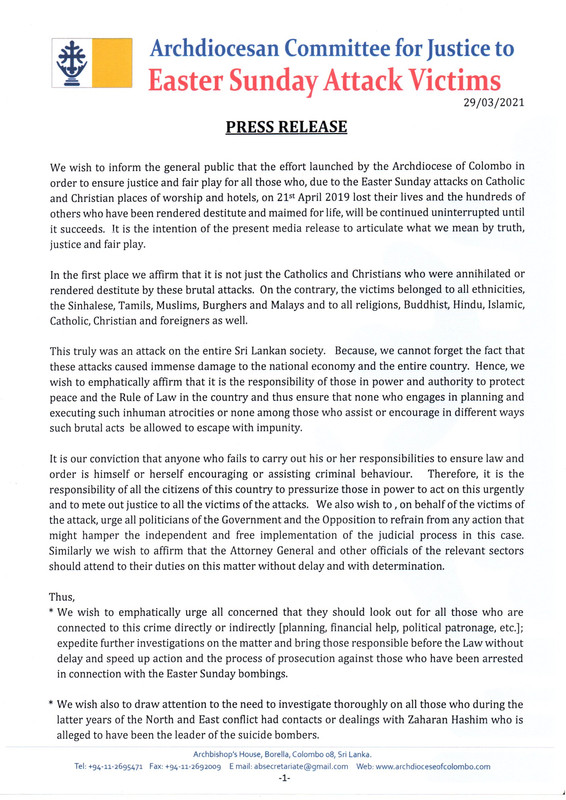
One more Covid-19 death reported in Sri Lanka

March 26th, 2021

Courtesy Adaderana

The Director General of Health Services confirms one more Covid-19 related death while this brings the death toll due to the virus pandemic in the country to 558.

The deceased is 70-year-old male from Mathugama who had been transferred from the Kalutara District General Hospital to the Homagama Base Hospital after testing positive for Covid-19.

He had passed away at that hospital on March 25 due to heart disease and Covid-19 pneumonia. 


Copyright © 2026 LankaWeb.com. All Rights Reserved. Powered by Wordpress