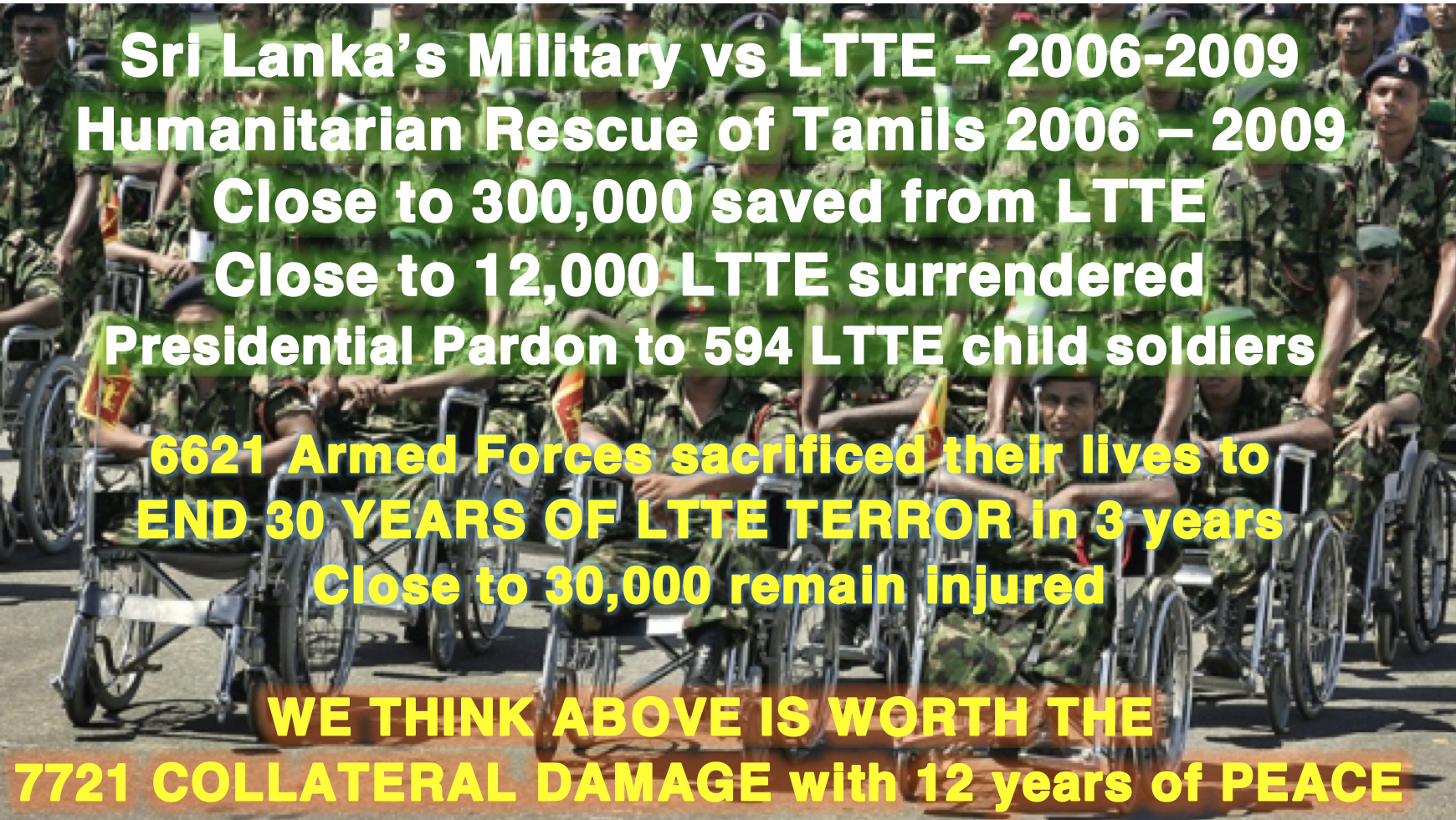
Pro-LTTE and people living off LTTE kitty will not like to hear this but, whatever the collateral damage that took place during the final phase of the conflict is unfortunate, but it brought to an end 30 years of terror & deaths, it prevented LTTE terror taking place since May 2009 and that to all Sri Lankans is what matters. Sri Lanka’s Armed Forces saved close to 300,000 Tamils sacrificing 6261 armed forces personnel while also accepting close to 12,000 LTTE combatants who surrendered. The on the ground estimates, place the dead at less than 8000. To have saved 300,000 lives at the cost of 8000 deaths and to have ended 30 years of terrorism in 3 years, we think deserves a thumbs up to Sri Lanka’s Armed Forces.No National Army in the world has carried out a military intervention combined with a humanitarian rescue operation to end 30 years of terrorism in just 3 years. Sri Lanka must be judged on this achievement against the unfortunate collateral damage of 8000 civilian” dead.
The UN Country Team gave 7721 killed (Aug 2008 to 13 May 2009)with 18,479 injured.
A Survey conducted by GoSL in the North placed the dead at 7400and missing at 2600.
A Population survey by Tamil Teachers in the North in July 2011covering migration, deaths, untraceable persons from 2005 to 2009 revealed 7896 deadand 1102 dead from natural illness/sickness.
So we have 3 figures 7721 / 7400 / 7896 on the ground figures which can be proved as against guestimates that run into 40,000, 75,000, 125,000 and even 200,000 supposed to be dead. Out of curiosity, just to even believe this number can those make these wild allegations kindly produce the names or some form of IDs of the dead. So far its been 12 years and haven’t even found a mass grave to have dumped 40,000 dead!
So we think this collateral damage of 7721 dead is worth 12years of no LTTE, no LTTE terror, no LTTE assassinations, no LTTE suicide missions, no LTTE child soldiers.
But the global policemen, the self-appointed human rights angels & democracy deliverers wish to present a fake picture of what took place in Sri Lanka while hiding their sordid record of collateral damage by illegal interventions upon nations that had no harm or even threatened them.
According to Long War Journal, Bureau of Investigative Journalism 90% of people killed by US drone strikes were not intended targets.
How is it that Western scholars get away claiming ‘systematic weakness in counting civilian casualties from NGOs, media citing inherent lack of many things but the same is not applicable to Sri Lanka?
The US has even redefined non-combatants. US has decided that all military-aged males in the vicinity of a target are deemed to be combatants. Now imagine if this was applicable to the area the LTTE was confined to with a minimum 10,000 civilian armed LTTE unit?
President Obama drops 26171 bombs in a single year and walks away with the Nobel Peace prize. All military-aged males killed in these air strikes were declared combatants. How’s that for human rights!
In 2019, a Presidential executive order revoked requirement for US intelligence officials to publicly report number of civilians killed in counter terrorism missions. The same country that is hiding civilian deaths by them are demanding accountability from Sri Lanka – is this not hypocrisy?
Costs of War Project at Brown University, USA claims US air strikes in Afghanistan has increased civilian fatalities by 330% since 2017. The US study claims in 2019 alone 700 civilians have been killed by US & Allies – the very countries presenting resolutions against Sri Lanka!
According to Save the Children an average of 5 children have been killed or wounded every day since 2006 (14 years) – that’s over 25,550 children killed! Why have we not seen UN or UNHRC come forward to stop the killing of children in Afghanistan?
Without wasting time on Sri Lanka, a conflict that ended in 2009 and with peace from LTTE for 12 years, why is the UN & UNHRC not trying to stop carnage of children from US & Allies air strikes?
Why is this collateral damage from illegal interventions not a concern for Michele Bachelet or UN Chief Antonio Guterres? Shouldn’t they be using the UN system to prevent killing of innocent unarmed civilians especially when these conflicts are illegal and with no UN mandate?
It is because of these blatant hypocrisies and biases by the UN and its officials that the People of Sri Lanka are confronting the baseless allegations being made most from LTTE sources and blurting by mouthpieces funded by LTTE kitty.
Saving 300,000 lives against the loss of 7721 lives, we think is worth the 3 years that took to end 30 years of terror. We really don’t care what the world says, as in our eyes our war heroes did what no national army could even dream of doing. The War on Terror was declared by US & Allies in 2001 – can they tell us what war against terrorism they have won against the deaths and destruction of nations they must be held accountable f or?
We suffered 30 years of terror. UN or UNHRC or the diplomats did nothing to stop LTTE killing.
When LTTE was vanquished in 2009, the UN, UNHRC and diplomats are asking how and why. This speaks volumes of their real intent. They never wanted Sri Lanka to end terrorism or LTTE.
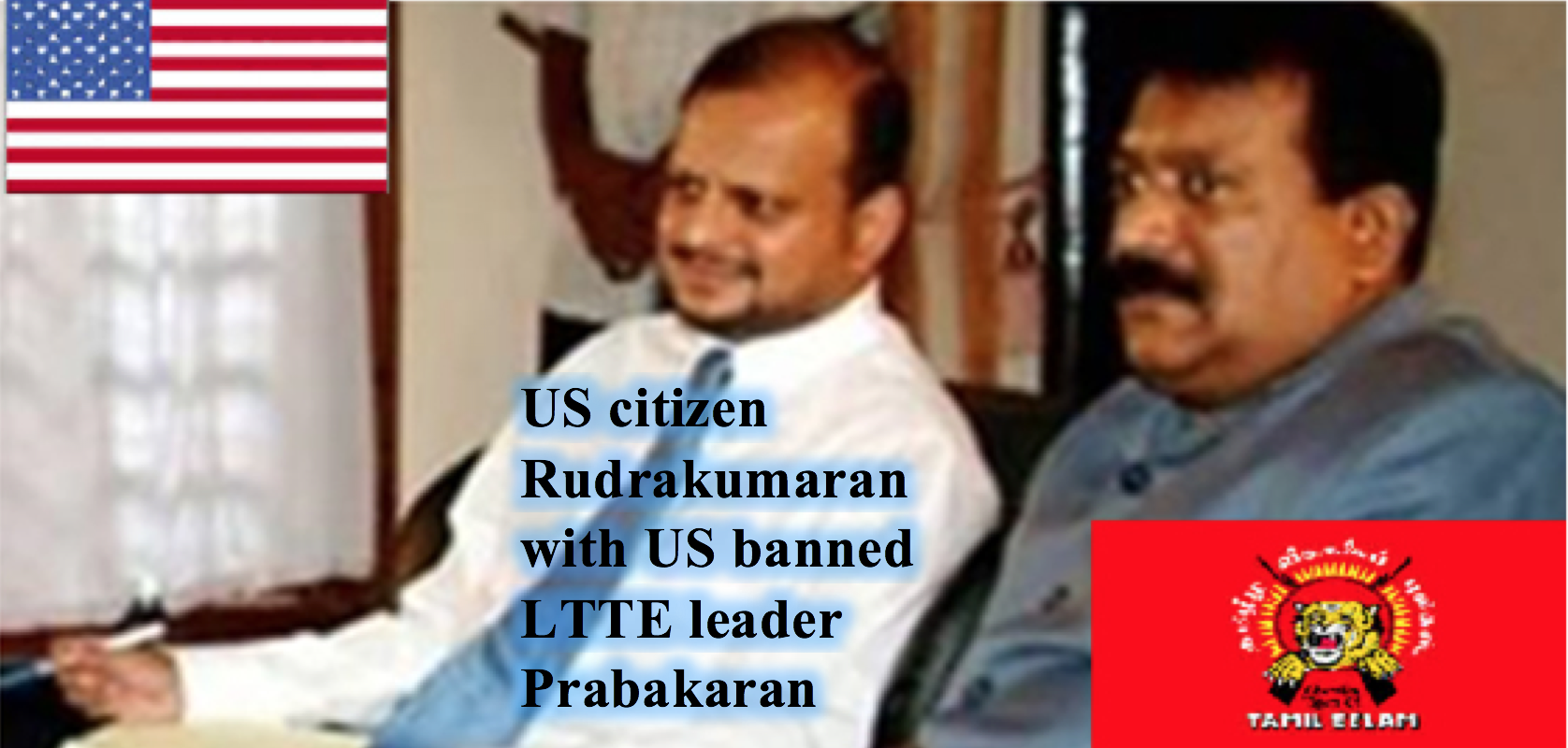
Well, we are sorry to say the LTTE ground force is no more, the best they can now try to do is to put Rudkrakumaran into a tiger uniform and send him to the Vanni with the LTTE Diaspora brats regularly appearing on Instagram!
In possibly a rising trend, Barbados has declared it doesn’t want the Queen to be its head of state. That leaves 14 more countries that continue to keep the Queen as head of their state. Let’s not forget, Great Britain had military presence in 171 countries except 22 countries of the world. Out of this 171 only 54 decolonized & independent countries remain members of the Commonwealth comprising 2.4billion people of which 1.3billion are Indians. The question is out of the remaining 14 – who will be next to say no to the Queen, while kick starting withdrawing from the Commonwealth. Its seriously time Sri Lanka said cheerio to the Queen & the Commonwealth too.
The Queen is Head of State of Great Britain &
Australia
New Zealand
Canada
Antigua & Barbuda
Bahamas
Belize
Grenada
Jamaica
Papua New Guinea
Saint Kitts & Nevis
Saint Lucia
Saint Vincent & Grenadines
Solomon Islands
Tuvalu
While Guyana, Trinidad & Tobago & Dominica removed the Queen as Head of State in 1970s, Mauritius removed the Queen in 1992.
Barbados joins the list in 2021 after gaining independence in 1966.
Australia voted at a referendum to continue with the Queen as Head of State in 1999.Yet an increasing number of citizens in Australia and Canada wish to have their own elected Head of State instead of the Queen.
In 2020 total UK exports to the 11 countries (excluding Australia/New Zealand/Canada) that continue to hold the Queen as their head of State amounted to £436 million
In 2020 total UK imports from the 11 countries (excluding Australia/New Zealand/Canada) that continue to hold the Queen as their head of State amounted to £720 million
54 countries proudly claim to be members of the Commonwealth, exactly what do they benefit other than shaking the Queen’s hand annually?
It’s not enough that Britain illegally occupied countries, Britain even sets a criteria to select former colonies to be members of the Commonwealth and these countries are expected to comply with the 1971 Declaration of Commonwealth Principles. The nations must demonstrate commitment to democracy, hold free and fair elections, apply rule of law, independent judiciary, good governance, well-trained public service, protect human rights, freedom of expression…. the list couldn’t get more hypocritical. Fancy how all these values nicely omits UK acknowledgement, accountability and reparations for British colonial crimes committed against 171 nations!
The Commonwealth Secretariat set up in 1965 is supposed to be helping the commonwealth member states to follow the Principles of the Commonwealth. Let’s kick of these values & principles by returning all the treasures proudly on display in UK Museums! In reality, there is very little that member states get from Britain though members of the Commonwealth.
In 2019, UK exports to the Commonwealth were worth £65.4 billion; British imports from the Commonwealth were £63.7 billion. The Commonwealth accounted for 9.1% of the UK’s total trade – around the same as the UK’s total trade with Germany.
UK trade with the Commonwealth was heavily focused on five countries – Australia, Canada, India, Singapore and South Africa; combined these countries accounted for 72% of UK exports to the Commonwealth and 73% of UK imports from the Commonwealth.
This means the rest of the countries are really insignificant, though Britain enjoys bullying them.
The US has turned both UK and India into faithful poodles.But India & UK will soon wake up to harsh realities and unforgiving neighbors in EU and South Asia. Both UK and India have unreliable partners. US bears no sentimental attachment to either UK or India. Isolated from EU and if Commonwealth states also bid adieu to UK, Britain will learn a hard lesson in what it feels to be isolated. Britain can hardly expect partnerships if they side with terrorist fronts and take pains to draft resolutions on behalf of them.
For US, having Britain isolated in Europe and India hated by South Asians is the perfect strategic move. A weak ally is a good poodle. Same strategy applies to India.
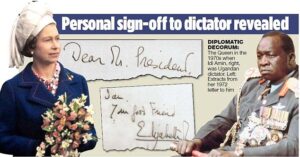
The Queen’s friends!
While Britain is backstabbing Commonwealth member and former colony Sri Lanka propping LTTE fronts to separate Sri Lanka, back home Scotland wants to separate from the UK!
LTTE supporting Britain following Brexit has found difficulty in even selling their fish to the European mainland and British truck drivers crossing the English Channel are even having their sandwiches snatched by Dutch border officials citing new food import rules!
Like Brexit exit, it is a good time for commonwealth nations to exit it if Britain cares not to defend the nations it destroyed and plundered without an apology or reparation.
Isolated from Europe, Britain will soon feel the heat and this is no better a time for the Commonwealth Nations to evaluate exactly what Britain has given them in return for the decades of humiliation their people suffered under British rule and continue to do so simply because Britain sings Long Live the Queen!
On
March 18, 2021 the British Parliament will be having a full-scale discussion on
the Report of the UN High Commissioner for Human Rights with a view to holding
the Govt. of Sri Lanka, its machinery, and senior officials accountable for
alleged war crimes in the last days of the war against terrorism which ended on
May 18, 2009.
Someone
conversant with the high number of atrocities committed during the British
colonial period in Sri Lanka (1796 – 1948) may not know whether to laugh or cry
over this debate in the British Parliament.
It is
one of the great ironies of our time that the countries that had hounded and
continue to hound ex – colonies, such as Sri Lanka, wherever possible at every
nook and corner of the UN system, are mostly the very same countries which had
systematically destroyed the civilizational foundations of the colonies and violated
the human rights of the subject people in European colonies in Asia and Africa.
In Sri
Lanka the three prime European colonial countries are Portugal, the Netherlands
and Britain. Each one is of these countries is shamelessly evasive when it
comes to accountability for the crimes committed by their colonial rulers in
Sri Lanka.
New Book
Accountability issues should not be made into a one-way street. It will bring
both International Law, United Nations and even the British Parliament into
disrepute and give rise to credibility issues.
New
Book
A new
book has been just released titled ‘Freedom
Struggles of Sri Lanka -Lessons Learned and the Way Forward’ that discuss
fairly comprehensively British liability for a range of wrong doings across the
board. Published by Godage International Printers, its Chief Editor is
Professor C.M. Madduma Bandara, a well – known Cambridge University alumnus. The
book contains some useful information and analyses of relevance to the present
difficulties faced by Sri Lanka in the international arena.
A Chapter on “Çolonial Crimes of British
Ceylon” by lawyer Senaka Weeraratna, compiles wide-ranging evidence of
crimes against humanity committed by the British colonial rulers. It builds a
strong case that can justifiably become the basis for seeking reparations.
Among the other chapters, the final ones on the future scenarios and
“Way Forward”, may undoubtedly prove useful for the present-day
political leadership. Its future prognosis is equally powerful since it employs
some scenario development methodologies. The book also unravels some rare
historical sources like the ‘British Parliamentary Select Committee Report of
1850, which had found fault with a British Governor i.e. Viscount
Torrington, for his complicity in the brutal and inhumane suppression of
the Matale Rebellion in 1848. Hundreds of innocent civilians had lost their
lives in the punitive expeditions launched by the Colonial Govt. under the
watch of Torrington in the Kandyan areas.
While valuing such attempts by the British Parliament of
the day for their yearning for further inquiry and rectification of colonial
wrongs, it also provides many lessons for present-day parliamentarians.
Bogey of
Human Rights
Today,
the West preaches human rights, demands accountability and upholding of
universally accepted standards on human rights. British human rights
campaigners point accusing fingers at Sri Lanka. Yet, a detailed scrutiny of
colonial rule in British occupied Ceylon (1796 – 1948) reveals a sad saga of
human rights violation of a gross kind such as tyranny, plunder, divide and
rule, and a vicious policy of violence and discrimination directed mainly
against Sinhala Buddhists and confiscation of their precious inherited lands.
21st century
international legal doctrines need to be availed of to present a case for
compensation from the current British Government for genocide and mass murder
of people of Uva – Wellassa in 1817 – 1820. The rectification of
Historical Injustices is a prime duty of any self – respecting nation.
Independence is never complete without meting out Justice to those who were
wronged by an unjust colonial system.
Sri
Lanka’s National patriots such as Keppetipola, Madugalle, Ven. Kudapola Unnanse
and several others who were convicted on the footing of a Victor’s (White
Man’s) Justice by colonial Judges presiding in what was in reality nothing more
than Kangaroo Courts, for their leading role in popular uprisings in 1818 and
1848 deserve to be exonerated through public re –trials. The colonial Governors
such as Robert Brownrigg, Viscount Torrington, Robert Chalmers and other
officials such as George Turnour must be tried posthumously, in a Nuremberg
like Trial, for their reprisal killings and drafting harsh laws that were later
imitated on a bigger scale by the Third Reich in the massacre of the people of
Lidice in Nazi – occupied Czechoslovakia in June 1942. Trial in absentia
is a criminal proceeding in a court of law in which the person who is subject
to it is not physically present at those proceedings. ‘In absentia’ is Latin
for in the absence”.
Land
grab in Kandyan areas
British
injustice was felt mostly in the enactment of waste land laws.Kandyan peasants
were made landless. They were reduced to a landless state by the takeover of
their lands for the plantation industry (initially coffee, then tea) under a
series of waste land laws commencing with the Crown Lands (Encroachments)
Ordinance, No. 12 of 1840.
Kandyan chena which
traditionally had no documentary proof of ownership was taken over for
plantation agriculture. This is demonstrated by the names of estates with older
names ending with hena or
chena crop names. This affected the food security of the people. Evidence of
starvation sometimes resulting in death is revealed in the writings of authors
such as Le Merseur. The British systematically transferred the wealth of the
Kandyan region into their own coffers.
An
accountability process for these colonial crimes is warranted through an
apology, catharsis and adequate reparations. An Apology must be particularly
directed to the descendants of the Sinhala Buddhist Kandyans who were singled
out victims of colonial brutalities. These are the descendants of a highly
oppressed group of people who were also deprived of their inheritance by the
colonial rulers planting thousands of indentured Indian labour in their lands
without their consent. 19th century British official documents reveal how the
freedom struggles against British colonial rule were suppressed in a most
brutal, genocidal manner in one of the darkest pages of European colonial
history.
Wars of
Independence
There
were two major wars for independence from British colonial domination. The
first uprising took place in 1818 in Uva – Wellassa and the second uprising
took place in Matale (1848). Both insurrections were brutally crushed. Millewa Adikarange Durand
Appuhamy ( Rebels, Outlaws and Enemies to the British (Colombo:
Gunasena, 1990), comments as follows in respect to the crushing
of the Kandyan Sinhala uprising in 1818 :
This
brute force was employed in Kandy to reduce the inhabitants to savages and to
dehumanize them. Everything was done to wipe out their traditions, customs,
culture and religion. Mind you, the Kandyans were promised that this would not
happen, and that their customs and traditions would be maintained (cl. 4, 8 of
the Convention). However, Kandyan villages and farms were burnt down. Their paddy-fields
were scorched. Their cattle slaughtered and their fruit bearing trees were
simply chopped down. Starved and ill, they were finished off with the gun as if
they were stray dogs in a stranger’s land. British civilians then flocked in to
take over their lands, clear the virgin forests, and convert them to cash crops
for the benefit solely of the settlers and their financiers in Britain. To the
Kandyans, the most concrete and the foremost in value was land. This land not
only gave them their daily bread but also their dignity. It was to preserve
this land that they fought off successfully three western imperial nations,
Britain included. Now having ceded their country to trickery, they remained
helpless against the planters who insolently trampled over their lands and
their rights to their lands”.
The
crushing of the uprising in Matale in 1848 is described in a nutshell in a
remarkable critical article ‘English in Ceylon’ published in USA in 1851 (The
United States Magazine and Democratic Review. Print: Vol. XXVIII, No. CLV,
– 1851 May). It is as follows:
The
history of Lord Torrington’s administration in Ceylon affords an epitome of
English rule, wherever throughout the world, by force, or fraud, or violence,
she has succeeded in planting her guilty flag. The horrors perpetrated during
1848 in the island-gem of the East, are the counterpart of those of which, from
time to time, during a period of seven centuries, the green isle of the West
has been the victim”.
Even the animals were destroyed en masse –
elephants the mode of transport used by both King and villager alike for
cultivation, tanks, religious processions soon became the target of British huntsmen.
Samuel Baker headed the elephant slaughter killing 30-40 elephants on a daily
basis.
It is estimated that the British decimated
over 10, 000 elephants in Ceylon.
Holocaust of elephants by the British Raj in Sri Lanka
No
apology nor any compensation has been paid by any of the Western colonial
Governments e.g. Portugal, Netherlands and Britain to Sri Lanka for the
destruction of both man – made as well as the natural foundations of life in
Sri Lanka over a period of nearly 450 years ( 1505 – 1948).
The
vastness of the British Empire including the jungles of Sri Lanka was made into
a hunting ground for Big Game on the part of members of British military
families. They hunted not only for pleasure but also as part of their
training for battle and display of their male masculinity. It was the Fauna and
Flora of Sri Lanka that paid a huge price for this training which brought out a
new genre – hunting narratives.
There is
enough evidence to reveal British complicity in the liquidation of a good part
of Sri Lanka’s natural forests in the Kandyan areas and the priceless elephant
wealth which was until then greatly protected by Sri Lanka’s Animal Friendly
Cultural Heritage.
English
writer Gary Brecher
An
English Writer Gary Brecher, author of the book War Nerd” has written a long
article on British crimes in Sri Lanka to a web site called ‘Exiled on Line”
under the title When Pigs Fly-and Scold: Brits Lecturing Sri Lanka”.
He
accuses the British establishment of destroying the Sinhalese people completely.
Completely and deliberately, sadistically. Stole their land, humiliated and
massacred their government, made it Imperial policy to erase every shred of
self-respect the Sinhalese had left. He says You can talk about the Nazis
all day long, but nothing they did was as gross as what you find out when you
actually look into the history of British-Sinhalese relations. If you can even
call them relations”; I guess a murder-rape is a relation, sort of ” .
Making a
comparison between Nazi and British atrocities he says that the British were
great masters at grabbing some paradise island in the tropics, then using the
British Royal Navy to wall it off separating the island from the rest of the
world, and crushing the local tribe without any qualms of conscience. If the
locals put up a resistance, the Brits would take measures to starve them to
death, shoot them down, infect them with smallpox or get them addicted to opium
(as in China) –whatever they had to do to gang-rape the locals so bad that they
the victims would thereby lose the will to resist.
Brecher
points out that the Nazis governed for only one decade but the Brits were able
to quietly carry out their extermination programs for three hundred years, and
to this day they have no remorse nor have any guilty feeling about it.
He
further says that by all accounts, the Sinhala / Kandyans were harmless people,
who didn’t need or want much from the outside world. All they asked was for
people to leave them alone up on their big rocky highlands to indulge in their
Buddhist way of life. Unfortunately, that wasn’t British policy. It irked the
red coats that Kandy still had a king, an army, all this impudent baggage that
went with independence. The British decided to break the Sinhalese completely
and crush the whole society” .
By this
time, i.e. the early 1800s, the Brits had perfected their techniques in little
experiments all over the world. Those Clockwork Orange shrinks were amateurs
compared to the Imperial Civil Service. The British Empire knew dozens of ways
of undermining and suppressing native kingdoms.
Brecher
writing further says that destroying Buddhism was a big part of Brit policy.
The Buddhist routine, the temples, begging monks, long boring prayers–it was
the glue that kept Kandy together. So the Brits decided to destroy it. They
even said so, in private memos to each other. They weren’t shy in those days.
Here’s the Brit governor in 1807: Reliance on Buddhism must be destroyed. Make
sure all [village] chiefs are Christian.”
The
British developed ingenious ways of grabbing other people’s lands under various
pretexts. For example, the British began invading Australia in 1788, on the
footing that it was terra nullis: a land with no owners.
Divide
and Rule colonial policy
European
powers like Spain and Portugal depended on bloody conquest and massacres in
colonial expansion, especially in South America. Britain was not far behind,
given what the British did to Australian Aborigines in Tasmania and mainland
Australia. The British were the masters of the game of ‘ Divide and Rule’. The
ethnic and religious tensions in Sri Lanka are very much a legacy of colonial
rule. If the target country had many ethnic groups or tribes like in India,
North America, Fiji, Malaysia, or Sri Lanka, the British first looked for any
potential allies that have distinctive differences from other groups,
particularly the majority. Then the British undermine the authority of the
majority by promoting unfairly selected members of a minority community with a
view to creating tension and conflict between various groups. The appointment
of Haji Marikar (Muslim) as the Muhandiram to be in charge of roadways in
Wellassa is a case in point. This appointment was resented by the Sinhalese as
it undermined the authority of Dissawa Mellewa. This was the spark that led to
the 1818 uprising.
British
intrigue in Kandy under the directions of successive Governors, namely, North,
Maitland and Brownrigg was also intended to achieve British supremacy in Ceylon
as in India, by subduing the Kingdom of Kandy through a vicious campaign of
propaganda and character assassination directed against the ruler of the
Kandyan Kingdom, King Sri Vikrama Rajasinha. He was demonized. He was accused
of being a tyrant. Killer of women and children (of persons who had committed
treason). A common punishment for treason in most countries including imperial
Britain. A drunkard. And as he was of Indian origin the British
discredited his Malabar ancestry as a ploy to alienate him from his Adigars,
his chiefs and rejected his right to the throne.
In
fairness it must be said that as a young King, Sri Vikrama Rajasinha was
popular among the people of his Kingdom. He took charge of the administration
which was fair and efficient. He displayed aesthetic sensibility regularly
listening to music and commissioned the Royal Architect and Master Craftsman,
Devendra Mulachari to design and build the Paththripuwa (1802) and the Kandy
Lake (1807), among other novel creations. The King supervised the artists who
enlarged and decorated the Kandy City.
Colonialism under three European countries was a dark chapter
in the history of Sri Lanka. Much of the problems in the country today
particularly ethnic and religious tension have their origin in divisive
policies fashioned by the colonial rulers. This Chapter cannot be closed merely
because the former colonial countries wish to evade accountability.
Reconciliation between the colonizer and colonized can be effective only on the
basis of apology, catharsis and reparations for colonial crimes committed in
Sri Lanka.
Conclusion
The
British Parliament must also listen to the grievances of the Sinhala Buddhist people
who resisted colonial invasions more than any other community of the country
and for this reason alone were selectively victimized substantially during the
era of the Portuguese Inquisition in Ceylon ( 1505 – 1658), discriminated
against by the Dutch on ground of religion, and made destitute particularly the
Kandyan Sinhala peasantry whose lands were grabbed under waste lands laws and
denied employment by the import of thousands of Indentured labour from South
India to work in tea and coffee plantations of the British.
The
people of Sri Lanka still continue to suffer from the cruel legacy of the
colonial masters.
Senaka
Weeraratna
Sources
Colonial crimes in British occupied Ceylon during the freedom
struggles (1796 – 1948)
Prime Minister Mahinda Rajapaksa will make a state
visit to Bangladesh from March 19-20, 2021, on an invitation extended by the
Prime Minister of the People’s Republic of Bangladesh Sheikh Hasina. The visit
will coincide with the celebration of the birth centenary of the Father of the
Nation Bangabandhu Sheikh Mujibur Rahman and the Golden Jubilee of the
Independence of Bangladesh.
Sri Lanka’s Ministry of Health has granted approval
to undertake the state visit to Bangladesh as a Bio Secure Travel Bubble
adhering to strict COVID-19 preventive measures.
Prime Minister Rajapaksa will be delivering a speech
Friday evening at the event to mark the conclusion of the Mujib Year,”
declared to celebrate the 100th birth anniversary of Bangabandhu Sheikh Mujibur
Rahman and Bangladesh’s independence.
During the visit, Prime Minister Rajapaksa will hold
high-level bilateral meetings with Prime Minister Sheikh Hasina, President of
Bangladesh Mohammad Abdul Hamid, the Foreign Minister of Bangladesh and the
Governor of the Bangladesh Bank.
The special invitation and the high-level bilateral
discussions are expected to enhance the strong relations the two countries have
enjoyed for a very long time. Bilateral discussions will touch upon a variety
of sectors including agriculture, trade and investment, defense, maritime
connectivity, education, health and tourism, among others.
The visit will also see the two countries sign a
number of Memoranda of Understanding in various sectors such as agriculture,
technical education, health and cultural cooperation.
Among other engagements, Prime Minister Rajapaksa
will visit the National Martyrs’ Memorial where he will lay a wreath to pay his
respects to those who died in the Bangladesh War of Independence and plant a
sapling. Later, the Sri Lankan Prime Minister will also visit the Bangabandhu
Memorial Museum.
Bangladesh became a nation in 1971 and established
formal diplomatic relations with Sri Lanka the following year. Both countries
will celebrate the 50th Anniversary of diplomatic relations in 2022.
Colombo, March 17: Sri Lankan Prime Minister Mahinda Rajapaksa has expressed optimism about his upcoming Dhaka visit which will enable him to join celebration of birth centenary of Bangabandhu Sheikh Mujibur Rahman.
During the visit, which begins on March 19, Bangladesh and Sri Lanka will sign MoUs on education, health and agriculture.
Sri Lanka PM Mahinda Rajapaksa Tweeted: Looking forward to my visit to #Bangladesh from 19-20 March, on the invitation of PM Sheikh Hasina to participate in the celebration of the birth centenary of the Father of the Nation Bangabandhu Sheikh Mujibur Rahman and the Golden Jubilee of the Independence of Bangladesh. A number of #MoUs will be signed during the visit, pertaining to sectors such as agriculture, technical edu, health & cultural coop. @MoH_SriLanka has approved the state visit to #Bangladesh as a Bio Secure Travel Bubble adhering to strict #Covid_19 preventive measures.”
Prime Minister Sheikh Hasina on Wednesday said there is no chance for Bangladesh to look back as it is time to march forward.
Overcoming all the obstacles, we shall establish this country as Bangabandhu Sheikh Mujibur Rahman’s exploitation-deprivation-free, hunger-poverty-illiteracy-free, non-communal Golden Bangladesh,” she said.
The Prime Minister was delivering her speech as the chair of Inauguration Ceremony of 10-day long Mujib Year and Golden Jubilee of Independence at the National Parade Square.
It is not so easy to lower the position that Bangladesh has reached, Sheikh Hasina said, adding that an excellent example of this is that the country has been able to successfully calm down the destructive waves of coronavirus pandemic. But we have to be very careful.”
The Prime Minister cautioned that anti-Bangladesh forces are still active at home and abroad and they want to disparage this achievement through various malpractices.
On this happy birthday of Father of the Nation Bangabandhu Sheikh Mujibur Rahman, let’s unitedly resist all the evil-sprouts and take the beloved motherland towards the path of development and progress,” she said.
Sheikh Mujibur Rahman and Sheikh Hasina
Hasina said the wait for the economic emancipation of the people of Bangladesh is coming to an end when the country is going to celebrate the Birth Centenary of the Father of the Nation and the Golden Jubilee of Independence at a particular time when Bangladesh has received the final recommendation to join the dignified group of Developing Nations from the list of the Least Developed Countries in the world.
She mentioned that the per capita income in Bangladesh has exceeded the respectable limit of US$2000, while the poverty rate has declined below 20.5 percent, and the country has become self-sufficient in food grain production. The average life expectancy has increased to 73 years.
Bangladesh has made tremendous strides in the socio-economic index. Today’s achievement is the result of the relentless efforts of the last 12 years of the Bangladesh Awami League in government and the tireless labor of people,” she said.
Recalling the long struggle of Bangabandhu Sheikh Mujibur Rahman for the Independent Bangladesh, the Prime Minister said, Our freedom is the fruit of the success of the continuous struggle for the status of mother language started by Bangabandhu Sheikh Mujib on March 11, 1948 with the ultimate target of political-economic and cultural emancipation of the Bangali.”
She said it was a war-ravaged country, which was under the hundreds of years of subjugation. In just three and a half years, he carried out the mammoth task of building a full-fledged sovereign state where people had been suffering from exploitation, deprivation, hunger, and poverty.
Bangabandhu Sheikh Mujibur Rahman had done everything from the impossible,” Hasina said.
She expressed her gratitude to all the friendly countries and leaders who extended necessary help during the great liberation war, the struggles for freedom, and the post-war reconstruction of the country.
Father of the Nation Bangabandhu Sheikh Mujibur Rahman had so many dreams. He envisioned building Bangladesh as a developed and prosperous ‘Golden Bangladesh’. But the cruel bullets of the killers snatched him from us on 15 August 1975,” she said.
The Prime Minister said Father of the Nation Bangabandhu Sheikh Mujibur Rahman was born in Tungipara on March 17, 1920. He illuminated the life of the Bangali community and brought freedom for them.
She said Bangladesh celebrate March 17 every year as National Children’s Day.
On the other hand,” she said, March 26 is our Independence Day. This year marks the fiftieth anniversary of our independence. We’re celebrating Mujib Year and the Golden Jubilee of independence simultaneously.”
With the theme ‘Mujib Chirantan’ in mind, Sheikh Hasina said, We’ve undertaken special programmes at home and abroad from March 17 to March 26 this year.”
Today is its inauguration. However, we’ll continue to celebrate the festival till December 16, 2021 as it is our Great Victory Day. Colourful arrangements have been made for various programs.”
She paid deep homage to the memory of Father of the Nation Bangabandhu Sheikh Mujibur Rahman, the four national leaders of the liberation war, 3 million martyrs, and 200 thousand dishonoured mothers-sisters and saluted the valiant freedom fighters.
She remembered with deep grief her mother Begum Fazilatun Nesa Mujib, three brothers — freedom fighter Captain Sheikh Kamal, freedom fighter Lieutenant Sheikh Jamal and ten-year-old Sheikh Russell, who was brutally assassinated by the killers on August 15, 1975 including two sisters-in-law Sultana Kamal and Rosie Jamal, uncle Sheikh Abu Nasser and all the martyrs of that night.
She expressed her sincere gratitude to President of the Maldives Ibrahim Mohamed Salih for attending the inaugural programme.
Sheikh Hasina, on behalf of the people of Bangladesh and herself, expressed gratitude and thanks to Chinese President China Xi Jinping, Canadian Prime Minister Justin Trudeau, and Japanese Prime Minister Yoshihide Suga for sending greetings to the people of Bangladesh on this occasion.
Colombo, March 17: Reflecting the deep and enduring links between India and Sri Lanka, the Indian High Commissioner in Sri Lanka, Gopal Baglay on Wednesday delivered a speech in Sinhala at the launch of the Kapilawasupura Sri Sarvagna Dhathu Puranaya ha Rajaguru Waskaduwe Sri Subhuti Thero” in the august presence of the Sri Lankan President Gotabaya Rajapaksa.
The launching ceremony of a book titled Kapilavasthupura sacred relics and Rajaguru Waskaduwe Sri Subhuti Thera”, an academic research work on Kapilavasthupura sacred relics and Rajaguru Waskaduwe Sri Subhuti Thera, was held under the patronage of President Gotabaya Rajapaksa at the Bandaranaike Memorial International Conference Hall (BMICH) this evening (17).
The book was compiled by W.A Padmin Sameera under the supervision of Most Ven. Waskaduwe Mahindawansa Mahanayake Thero.
The President, on his arrival to the BMICH premises, paid floral tribute to the portrait of Most Ven. Rajaguru Waskaduwe Sri Subhuthi Mahanayake Thero.
Ven. Waskaduwe Mahindawansa Thero presented the book to the President.
A memento was also presented to the President.
The official website of the Sri Subhuti Maha Vihara in Waskaduwa was also launched by the President.
The Maha Sangha including the Acting Supreme Leader of the Sri Lanka Amarapura Maha Nikaya Most Ven. Ganthune Assaji Thero, Chief Prelate of Sri Lanka Ramanna Maha Nikaya Aggamaha Panditha Most Venerable Makulewe Wimala Mahanayake Thero, Chief Prelate of the Sri Sambuddha Sasanodaya Maha Sangha Sabha of the Amarapura Maha Nikaya Most Venerable Waskaduwe Mahindawansa Maha Nayaka Thero and Kotte Sri Kalyani Samagri Dharma Maha Sangha Sabha Anunayake Prof. Most Ven. Kotapitiye Rahula Thero, Minister Dinesh Gunewardena, State Ministers Vidura Wickramanayake, Piyal Nishantha, Jayantha Samaraweera and Former Speaker Karu Jayasuriya, Indian High Commissioner Gopal Baglay, Myanmar’s Ambassador Han Thu, dignitaries, Members of the Sri Lanka Amarapura Nikayarakshaka Dayaka Sabha including its President Ajita de Zoysa participated on this occasion.
Just weeks after Pakistani Prime Minister Imran Khan visited Sri Lanka to advocate on behalf of the island nation’s Muslim community, the Sri Lankan government has signaled its plans to ban the burqa, the all-encompassing covering that conservative Muslim women increasingly wear.
Sarath Weerasekara, Sri Lankan minister of public security, explained the government’s logic: The burqa has a direct impact on national security. In our early days, we had a lot of Muslim friends, but Muslim women and girls never wore the burqa. It is a sign of religious extremism that came about recently. We will definitely ban it.”
The Sri Lankan government had previously suspended burqa use after Islamist terrorists struck three hotels and three churches on Easter Sunday, 2019. While the perpetrators in those attacks did not wear burqas, suicide bombers in Afghanistan, Cameroon, Chad, Iraq, Pakistan, and Saudi Arabia have all used the burqa as cover.
It is fair for proponents of religious freedom to criticize Sri Lanka’s latest proposal, though to do so without acknowledging the post-traumatic stress that, as a society, Sri Lanka suffered due to its 1983-2009 civil war and concurrent suicide bombing campaign is dishonest even if Islam was not an issue that conflict and Muslims not generally combatants.
Pakistan, however, has decided to make Sri Lankan domestic policies a diplomatic priority. Saad Khattak, Pakistan’s High Commissioner to Sri Lanka, warned that the move would not only insult local Muslims but would negatively affect all Muslims. Such divisive steps in the name of security, besides accentuating economic difficulties, will only serve as fillip to further strengthen wider apprehensions about fundamental human rights of minorities in the country,” he added. Dawn, the oldest English-language newspaper in Pakistan, blasted the ban as Islamophobia in a masthead editorial entitled, Muslims targeted.” In recent years, Khan himself has tweeted his opposition to alleged Islamophobia numerous times.
Pakistan’s criticism is stunning in its hypocrisy. Put aside Pakistan’s own treatment of its minority population. Where Pakistani officials once embraced Christians and even local Hindus, now these minorities and local Ahmadis as well live in fear. Banning a veil as Sri Lanka proposes versus murdering minorities with impunity as Khan’s government allows are not equivalent.
Beyond that, however, the idea that Pakistan has any authority to criticize Sri Lanka on its proposed burqa while not simply ignoring but actually endorsing China’s genocide of its Uighur population is amazing in its gall. Uighur-inspired terrorism in China has been minimal, but Khan explicitly used counterterrorism and security to justify Beijing’s incarceration of millions. Given Khan’s endorsement of the largest genocide of Muslims to date, it is fair to say that Israel has a better record countering Islamophobia than Imran Khan’s Pakistan. The same hypocrisy also shows that Pakistan’s criticism of Sri Lanka has more to do with Pakistan treating Sri Lanka with almost colonial disdain than with any sincere effort to preserve, protect, and advocate for the rights of Sri Lankan Muslims.
If Imran Khan wants to be a global leader in the effort to combat Islamophobia, he must confront China. It is time for Imran Khan to be a leader rather than a concubine who talks big only when her suitor is away.
Over alleged intervention to secure release of terror suspects
A team consisting of an ASP of the CID yesterday evening arrested National Unity Front leader and former Western Province Governor, Azath Salley. Police Media Spokesman DIG Ajith Rohana said Salley had been taken into custody near his residence in Colpetty under the provisions of the Prevention of Terrorism Act.
The arrest had been made on the advice of the Attorney General, his coordinating officer State Counsel Nishara Jayaratne said.
Public Security Minister Rear Admiral (Retd) Sarath Weerasekera said that the Attorney General had instructed the police to arrest Salley over his intervention to protect Islamic extremists following attacks on some Buddha statues in Mawanella. Salley also allegedly intervened to secure the release of two key suspects who arrested with explosives at the Wanathawilluwa Jihadist training camp. Salley has denied the allegation.
A separate investigation was launched by the CID two days ago into a recent statement made by Salley that he would accept only sharia law.
DIG Rohana said that several parties had lodged complaints with the CID against a controversial statement made by Azath Salley, and investigations are being carried out into his statement and the statements made in social media.
Salley, who has been the subject of much controversy due to his statement that Muslim law in the country can never be changed, gave a statement to Cinnamon Gardens police station on Saturday night. Speaking to the media after leaving the Cinnamon Gardens police station, Salley said that he had come to give a statement voluntarily.
Prominent Russian business tycoon Andrey Melnichenko visited Port City Colombo today.
He was accompanied by Sri Lankan-born British Politician and former EU Parliamentarian Niranjan Deva Aditya, a statement said.
The statement said Melnichenko is a self-made billionaire with major investments in Switzerland based fertilizer giant EuroChem Group and Russia based coal energy company SUEK.
He was warmly welcomed by Port City Colombo Assistant Managing
Directors Yue Yeqing and Thulci Aluwihare together with Director Sales and Marketing Yamuna Jayaratne.
The delegation was briefed on Port City Colombo project, its construction progress and future developments by Radhika Ellepola, Country Manager Sales and Investor Relations.
Melnichenko expressed positive remarks about the project and he was impressed about the strategic planning of the new city in the making.
Board of Investment Chairman, Sanjaya Mohottala, Director General Pasan Wanigasekara and corporate sector veteran Rajan Brito were also present at the occasion.
From the beginning of this year, Port City Colombo continued to attract several world leading business personalities, keeping Sri Lanka back in the map as a potential hub for future investment.
Port City Colombo now awaits the introduction of the Special Economic Zone (SEZ) law by the Government which will further enhance FDIs to Sri Lanka.
Port City Colombo is a brand-new city development built as an extension of the existing Colombo CBD, with an initial investment of $ 1.4 billion and an expected $ 15 billion overall investment when completed. Spanning 269 hectares, it is a sea reclamation project connected to the current central business district. Port City Colombo is made up of five precincts – a financial district, central park living, an international island, the marina and island living. When completed, Port City Colombo is estimated to have 5.7 million square metres of built space, boasting some of the best in design in terms of grade-A offices, medical facilities, educational facilities, an integrated resort, a marina, retail destinations, hotels and other lifestyle developments. Using the latest sustainable city design and smart city concepts, Port City Colombo will be the hub of South Asia.
Public Security Minister Sarath Weerasekera said, former Western Province Governor Azath Salley was arrested by CID as is alleged to have had links to the Easter Sunday suicide attack.
Speaking to media after the Kolonnawa Regional Development meeting, he alleged that according to initial investigation it was revealed that Salley had overt or covert link to vandalizing of the Buddha statues in Mawanella and to the attack.
He said the CID conducting further investigation on Azath Salley under detection order.
“Also, Salley made a statement recently over Shari’a law and that he does not want to honour the law of the land. Such statement would lead to religious extremism,” he said.
He said the arrest was made by the CID following the instructions of the Attorney General.
The minister said further questioning by CID could reveal whether Azath Salley has had a hand in the Easter Sunday mayhem.(DSB)
Sri Lanka has reported 03 more coronavirus-related deaths, the Director-General of Health Services confirmed today (March 17).
As per the Department of Government Information, one female patient and two male patients are among the victims.
The new deaths bring the number of COVID-19 related deaths witnessed in Sri Lanka to 537 in total.
01. The deceased is a 72-year-old male resident from Medirigiriya. He was diagnosed as infected with the Covid-19 virus while undergoing treatments at a private hospital Kandy and transferred to Base Hospital Theldeniya. He died on 16.03.2021 and the cause of death is Covid-19 pneumonia, heart disease, and high blood pressure.
02. The deceased is a 72-year-old female resident from Polgasowita. She was diagnosed as infected with Covid-19 while undergoing treatments at Sri Jayawardenepura Hospital and transferred to IDH Hospital where she died on 17.03.2021. The cause of death is mentioned as liver failure and Covid-19 pneumonia.
03. The deceased is a 70-year-old male resident from Andigama. He was diagnosed as infected with Covid-19 while undergoing treatments at District Hospital Chilaw and transferred to Base Hospital Homagama where he died 16.03.2021. The cause of death is mentioned as liver failure, kidney disease, and Covid-19 pneumonia.
UPDATE (07.47 pm): Former Minister Ravi Karunanayake and 07 others who were ordered to be remanded over the 2016 Bond Scam have been brought to the Welikada Prison a short while ago.
The eight suspects have been directed to the quarantine center of the prison.
Former Minister Ravi Karunanayake has been remanded over the Central Bank Bond Scam issue in 2016.
Another 07 suspects have also been remanded along with the former United National Party (UNP) Minister.
They have been placed under remand custody until March 23.
The Attorney General, this morning (17), filed indictments against the suspects before the two Trials-at-Bar hearing the legal matters on Central Bank Treasury Bond auctions held between March 29 and March 31, 2016.
Arrested former directors of Swarnamahal Jewellers Pvt Ltd have been produced before Fort Magistrate this evening (March 17), says the Police Spokesman DIG Ajith Rohana.
The arrest was made on Tuesday (March 16) upon the directions of Attorney General Dappula de Livera.
Jeewaka Edirisinghe, Anjalee Edirisinghe Asanka Edirisinghe & Nalaka Edirisinghe were accordingly arrested on the charges of money laundering.
The Attorney General has filed indictments against the suspects of the Central Bank bond scam, says the AG’s Coordinating Officer State Counsel Nishara Jayaratne.
The indictments were lodged before the two Trial-at-Bars hearing the legal matters on Central Bank Treasury Bond auctions held between March 29 and March 31, 2016.
The Chief Justice appointed two Trial-at Bars for the hearing of the Bond Scam cases involving the said two bond auctions.
The Attorney General requested for a Trial at Bar for the case on February 11, 2021, to try former Finance Minister Ravi Karunanayake, former Governor of Central Bank Arjuna Mahendran, Arjun Aloysius, and 07 others with regard to the relevant trial.
Subsequently, on February 15, he had made a request for another Trial-at-Bar to hear the relevant case.
Sarath Wijesinghe President’s Counsel, former Ambassador to UAE and Israel and the President Ambassador’s forum
Friendship with Sri Lanka and Myanmar
Friendship with Sri Lanka and Myanmar goes back to generations with
friendly and cultural bonds on religion culture and long lasting friendships we
had for generations. The cultural religious and political prelateship between
Myanmar and Sri Lanka spans a period of around thousand years. The relationship
has been mutually beneficial for both countries on many fronts. It serves as a
good foundation, to strengthen the friendship between the two countries. With
the rise of Asia as the central political and economic forces of the world we
can make together Buddhism again the unifying force in Asia as well as the new
globalized world at a time when Buddhism is widely spread in the western world.
We can together make Buddhist thought and Buddhist way of life a collective
reality so that the world at large could gain long lasting solutions. Sinhala
‘’Bikkues’’ resolved conflicts between Sri Lanka and Myanmar on trade during
King Parakramabahu (1153-1186) and Alanungsitha (1113-1165) and it was Sinhala
Bikkues who came to rescue the relations, according to ‘Chulawansa’. A
settlement was thus brought about through the mediations of Sinhala Bikkues.-
see Sirisena 1978pp33- Myanmer Sanjaraja seeks Refuge in Sri Lanka in 1167,
when king Narathu left Myanmar in
disgust and sought refuge in Sri Lanka(
1167-1170)- The Sanjaraja stayed in Sri Lanka for six years. Sanjaraja
Uttarajiva after return to Myanmar was hailed the first Pilgrim of Sri Lanka
and was indicates that Sri Lanka was considered as the foundation head of
Tharavad Buddhism. Chapata returned to Myanmar along with four other minks so
that they could perform ecclesiastical acts separately. According to the
Burmese chronicle Hmanan Yasawinkly (1112-1167CE) King of Burma visited Sri
Lanka married a daughter of the Sinhalese King and returned with the image of
Maha Kassapa tether who as highly venerated at the time in Sri Lanka.
Tradition and cultural ties
These are the traditional religious and cultural ties apart from trade
and business thriving then in the friendly nations bonded together in many ways
with excellent relations with kings and the people to people contacts that
continues to date with diplomatic relations as members of the United Nations.
In the field international relations Myanmar is a member of BIMSTIC and ASIAN
both of which are sub regional international organizations which are powerful
with 1.5 billion people and 3.5 trillion dollars in BMISTEC and 640 million
people and 86%world population in ASIAN when Myanmar is a nation with normal
potential situated in a naval strategic route with so many natural resources
which attracts world powers to make friendship with.
Difficult Patch
Currently Myanmar is going through a difficult patch again with the Army
rule which is not attractive to the west mainly on the human rights front. She
had a series of breaks on democratic governments with the most recent break on
after the democratic rule of ‘Aung San Kyi’ the leader of National League of
democracy that commenced on 1990and ended on 2011 with an army coup again by
army leader ‘Min Aung Hlaing’ which is running with a great resistance form the
people and the world as before. Army rule has not been alien to Myanmar and the
democracy have her rejuvenation and a recognition and past glory of the time of
Na win and U Tang one time UN secretary General who brought Burma to fame in
the international arena. Myanmar was popular and liked by all members of
BMISTIC, ASIAN, SAARC and most UN member nations and international
organizations except for the diminishing process of democratization due to army
rule reactivating intermittently. She has enormous wealth on the ground and
hidden the world is aware and awaiting to explore and cannot rule out discreet
involvements with hidden agendas. She needs genuine and good friends and the
best friend to use the good office may be Sri Lanka with historic, religious
and cultural bonds running back to thousands of years. We have a proud history
of negotiating on our behalf and others previously on many crisis situations in
the world. When India and China had issues Madam Bandaraneike offered her good
office as leader of the NAM and Sri Lanka and a respected leader respected by
others. She used her personal goodwill and charm with Indira Gandhi in the
resolution of the ‘Kaththive’ issue and the Indian labour which was brewing for
generations unresolved. On the other hand Army rule is not alien to our region
Bangladesh, and Pakistan had iron fist army rules but gradually reverted back
to functioning democracy. Army rule I Myanmar is pressurized by the world and
it may be difficult to sustain with corona and the downtown on the economy
worldwide with great strain to the world economy, making negotiations easier
now. Though there were precedents in Commonwealth on undemocratic countries
such as Pakistan then, Asian attitude is different from that of the western
patterns of steps on such issues.
BIMSTIC, ASIAN, SAARC AND EU
BIMSTIC has five members from South Asia and two from South East Asia
with 1.5 billion people, with 22% world population, and 1.5 billion income with
2.8 trillion GDP being a powerful but a friendly group with no rifts or
differences who will be meeting indifferences such as SAARC. India, Bangladesh,
Nepal, Bhutan Sri Lanka Myanmar and Thailand are like minded friends who will
be meeting in Sri Lanka to discuss the matters of mutual interest mainly on
economic front with no politics in agenda. The group is meeting in Sri Lanka
under a friendly atmosphere in order to discuss only the economic issues and
the best opportunity to discuss the mutual issues to be resolved amicably. It
is also advisable to use the good office of the ‘Bikkues’ who are always in the
forefront in advising the Kings and governance from time immoral. ASEAN and
SAARC are regional organizations based in Asia where as defund EU has been once
the most developed regional organization SAARC was aspiring to follow to be.
Ground Situation
Ground situation is different from the outward appearance in that the
Military has substantial power from the 2008 constitution still in force with ¼
of the parliament and powers over oil gas and sources of income and important
portfolios with the military. Out of 476 MP’s 396 belongs to the Democratic
Party and has an overwhelming supper but 400 sitting MP’s democratically
elected are under house arrest. Protests are all over and 184 people have
already dead with 18000 in detention. There is resentment all over the country
with professionals and academies to have come to the forefront in support of
the pro-democracy movement with the result that the use of good office and a
settlement is now an easy matter.
Good office of the State and the ‘Maha Sanga’
Maha Sanga in Sri Lanka has played a pivot role in matters of good
office and propagation and enhancement of Buddhism and are the best ambassadors
to initiate actions better than the state intervention. This is something new
experience to both countries and if both parties use the historic bonds with
the religious and cultural bonds it may be a good start to have a working relationship.
There are leading businessmen who have started business in Myanmar with lot of
hopes on the open and hidden potentials available untapped. One must think in
terms of economic diplomacy and the other areas such as tourism with tremendous
potentials to both countries. All these together will have a collective effort
and a new bond trend and hopes with friendship that creates hopes and good
will. Media too will have a major part to play in these innovative propositions
which may attract the Military government and the people of Myanmar
Good Office of Professionals Academics and Business community – a way
out
It is a good idea for the Bar Association to offer a new Constitution
and the Organization of Professionals to communicate with the counterparts and
the two Ambassador in Sri Lanka and Myanmar with concrete proposals. Do it in
good faith and trust with the intention of helping our friendly nation and of
course ourselves as if and when they do well we too will be benefited and the
good will we created with go far and
beyond Geneva Process. May everybody be peaceful extend and we extend loving
kindness to all Human and other beings. Sarath7@hotmail.co.uk
That is a term that historians of colonization are familiar with as a descriptive of the duplicity, treachery and the breach of treaties that marked England’s relations with the peoples it sought to colonize / loot particularly in the 19th century.
What this note addresses are the manifestations of trickery and the purveyance of falsehoods by and on behalf of the family that some people in Britain and some in former British colonies, directly and indirectly, support financially and otherwise. That applies in varying degree to its ancillary branches – few of them ‘blood relatives as, for example, Camilla Shand, Kate Middleton, Megan Markle are not – as well.
What we have witnessed following Megan and Harry’s statements in an open interview is a series of cover-up tries by Royal Family Specialists”, by sleazy tabloids, by purveyors of fake news via radio and TV and other scandal
mongers.
The Specialists roused sympathy, aged old gals and old chaps struggling with
their dentures, wishing this horrible lockdown was
done, the pub open and ‘what was the word we were looking for?
Some tried to blame Megan and Harry for 99 year old Phillip’s
health problems and asserted too that M & H were heartless
to upset people despite a pandemic that has killed thousands of fine people who have always
been behind the Royals and so remain. And will always do, amen.
One of them, the ‘This Morning’ interviewer pushed a close
friend of Meghan, Janina Gavankar, for the desired answers and she said,
I speak for myself. You speak for them!”
That more or less shut him up but then,
surprise, the media mentioned above, went into Janina’s ‘bio-history’ finding, oh no wonder,
her Asian roots.
A more objective report,
which is yet to be challenged by ‘the Palace’ or their ‘Press’ had the following: In an
interview stuffed with quotable lines, it was among the most resonant: the invisible contract”,
as the Duke of Sussex called it, that has bound the royal family and reporters together for
years.
In this telling, it is not that the royals enjoy their media
duties, or view them as a responsibility, but that the only way to survive the
press is to strike a deal with it.
There’s a reason that these tabloids have holiday parties at
the palace,” Meghan said. They’re hosted by the palace, the tabloids are. You
know, there is a construct that’s at play there.”
How’s that for perfidy – which includes ‘their’ handling of the
NHS, of vaccines and a multitude of related
crimes against humanity?
And of ‘their’ view of ‘war crimes’ and the UNHCR?
By the way, ‘Albion’is said to have been derived from a Roman term for ‘white’
–
But that had to do not with the skin colour of any of its inhabitants: ‘it referred to the white chalk cliffs along the south-east coast of England’.
Albion is the original name of England which
the land was known as by the Romans, probably from the Latin albus
meaning white, and referring to the chalk cliffs along the south-east coast
of England. … Albion was replaced by the Latin
‘Britannia’, and the Romans called the natives of England the
Britons.
“Perfidious Albion” is a pejorative
phrase used within the context of international relations diplomacy to refer to
acts of diplomatic sleights, duplicity, treachery and hence infidelity (with
respect to perceived promises made to or alliances formed with other nation
states) by monarchs or governments of the UK
In an interview
stuffed with quotable lines, it was among the most resonant: the invisible
contract”, as the Duke of Sussex called it, that has bound the royal family and
reporters together for years.
In this telling, it is
not that the royals enjoy their media duties, or view them as a responsibility,
but that the only way to survive the press is to strike a deal with it.
There’s a reason that
these tabloids have holiday parties at the palace,” Meghan said. They’re
hosted by the palace, the tabloids are. You know, there is a construct that’s
at play there.”
If the royal family’s
dislike for the press was in any doubt, perhaps the most memorable confirmation
came in Prince Charles’s remarks to his sons, caught by an unnoticed
microphone, during a photoshoot
in Klosters, Switzerland, on a skiing holiday in 2005.
I hate doing this.
Bloody people,” he said through visibly gritted teeth, before focusing on the
BBC’s Nicholas Witchell. I can’t bear that man anyway. He’s so awful, he
really is. I hate these people.” They sat for the photos all the same.
The Prince of Wales with his
sons during the Klosters photoshoot in 2005 where he made comments on his views
of the press.
Photograph: Arno
Balzarini/AP
Now that Harry and
Meghan have so explicitly identified that contract, it is hard to see them, at
least, ever having a way back into it. But a seasoned royal communications
operative says they have a point – and the deal still exists for the rest of
the family.
They compared the
relationship to that endured by politicians who seek positive headlines. This
is the same battle every prime minister has. There is a quid pro quo
relationship – there’s a reason senior officials try to build relationships
with editors. It’s about negotiating for favourable coverage.”
It isn’t explicit
stuff,” the former Buckingham Palace senior official argued. But often in
times of a rough period of coverage, there’d be meetings arranged and you might
find, for example, that an editor has a pet project that’s important to them on
a personal basis.”
In a week that claims
of media racism became a central part of the debate over the treatment of Harry
and Meghan, Marcus Ryder, a visiting professor in media diversity at Birmingham
City University, argued that a mixed-race woman’s arrival in the family fatally
disrupted that cosy – if compromised – relationship.
The whole point of a
culture like this is that it survives on the basis of unwritten rules,” he
said. And so when somebody comes into that culture from outside, it forces you
to address those rules, or even make them explicit, and in doing so reexamine
them. It’s often the person from the margins who might make us reassess
something like this.”
The final nature of
that rupture was further reinforced when it emerged that the couple had
complained to Ofcom about Piers Morgan’s discussion on
Good Morning Britain of
their interview, having already complained to ITV. It came as Associated
Newspapers, the publisher of the Daily Mail, wrote to the US broadcaster Viacom
CBS over what it said was the indefensible” use of images during Oprah
Winfrey’s interview with the Sussexes that had been doctored or presented as
headlines when they were not” to suggest racist coverage.
The Terrorist Investigation Division has commenced an investigation into Rs. 980 million in an account maintained by an extremist group at a bank in Trincomalee.
Preliminary investigations have revealed that several drug dealers in Sri Lanka too have made financial contributions to the extremist outfit.
This was revealed when a resident of Kehelwatta, Panadura, arrested in connection with drug dealing, said that he had donated money to an Islamic extremist organization, Police spokesman, DIG Ajith Rohana said yesterday. The suspect was arrested by the Peliyagoda Crimes Branch and during questioning he revealed that a part of his earnings went to the extremist group.
The bank account was opened in 2013. The suspect was handed over to the TID yesterday for further investigations.
The cabinet approval was granted to convert the stocks of paddy purchased from farmers by the Paddy Marketing Board into rice and distribute them continuously through Sathosa branch network.
The decision was taken after the Cabinet meeting today.
New laws will be introduced to stop the felling of coconut trees without permission in the future, Plantation Industries and Export Agriculture Minister Ramesh Pathirana said.
While addressing a coordinating meeting at Gampaha District recently, the Minister pointed out that there is a huge demand for local coconut harvest in the international market and therefore, the coconut cultivation in the country should be increased.
“It is essential to increase coconut cultivation in the country. We need to restrict the allotment of coconut cultivation lands and we will be doing it in a very systematic manner,” he said.
“At present, permission is required for coconut land allotment in parts for more than 10 acres, but the Ministry is hoping to reduce it to 1 hectare in the future,” the Minister added. (Chaturanga Samarawickrama)
Former Governor of Western Province Azath Salley has been arrested this evening (March 16) by the Criminal Investigation Department (CID).
The arrest was made on the advice of the Attorney General, his coordinating officer State Counsel Nishara Jayaratne said.
Police Spokesperson DIG Ajith Rohana noted that Salley will be detained and interrogated under the provisions of the Prevention of Terrorism (PTA).
Convening a media briefing recently, Leader of the National Unity Front (NUF) Azath Salley made controversial statements with regard to the law of the country.
His disputed remarks came as a response to the plans by Justice Minister Ali Sabry to revise Muslim Marriage and Divorce Act by November.
Salley had stated that he will only respect the Quran, the Hadiths and Shariah but not the laws of the government.
This later triggered several complaints to the CID. Accordingly, a team of CID officers led by an Assistant Superintendent of Police (ASP) was appointed to inquire into Salley’s statements.
The Attorney General instructed the CID to arrest the former governor as sufficient evidence has revealed that he had committed an offence under the Prevention of Terrorism Act (PTA) and violated the International Covenant on Civil and Political. Rights (ICCPR) Act, No. 56 of 2007.
Sri Lanka registered 120 more positive cases of COVID-19 today (March 16) as total novel coronavirus infections reported within the day reached 274.
Department of Government Information says 250 of today’s cases are close contacts of earlier cases linked to the Peliyagoda cluster. The remaining 24 were detected from the prison cluster.
New development has pushed the country’s confirmed COVID-19 cases count to 88,512.
Director-General of Health Services today (March 16) confirmed 02 more COVID-related fatalities in Sri Lanka.
One of them is a 75-year-old woman from Kandy who died on March 15. She was transferred from Kandy National Hospital to Theldeniya Base Hospital after testing positive for the virus. The cause of death was recorded as acute COVID pneumonia.
The second victim is a 59-year-old man from Negombo who died due to heart disease, COVID pneumonia, high blood pressure, acute diabetes and kidney disease. He tested positive for the virus while he was under medical care at a private hospital in Colombo. He was then moved to University Hospital of General Sir John Kotelawala Defense University where he passed away today (March 16).
Following the new development, the death toll from the pandemic outbreak in the country now sits at 534.