Minister Udaya Gammanpila says that President Gotabaya Rajapaksa has given a pledge that the dual citizens will be deprived of the right to participate in politics under the new constitution.
The President has given the pledge to 10 political parties, says Co-Cabinet Spokesman Gammanpila.
Addressing a Cabinet media briefing today (16), the Minister stated that the President had given the relevant pledge in September 2020.
The President pledged to 10 parties last September that the new constitution would deprive dual citizens of the right to participate in politics.
The work on the new constitution is progressing rapidly. We will be able to pass the new constitution within a year.”
Separatist Tamil politicians, the LTTE and the LTTE Diaspora have been painstakingly building up an argument that conforms to the UN definition criteria for self-determination to claim a separate state. That bid has now come to a standstill with India claiming Tamils to be their brothers & sisters. Sri Lanka was never under Indian rule in any time of its history. Following colonial rule, both India & Sri Lanka obtained ‘independence’ from invader rule. That colonials dumped unaccountable number of South Indians into Sri Lanka is nothing no one can deny. These forcibly brought South Indians were repatriated in several phases and the remaining to be repatriated under the Indo-Lanka Accord have yet to be complete. The choice was given to Tamils – those wishing to remain in Sri Lanka, can remain as Sri Lankan citizens. Those wishing to return to India can do so as Indian citizens. When India’s PM says our sisters and brothers referring to Sri Lankan Tamils, he is claiming these Tamils to be Indian. In so doing, his statement has now demolished the bid for self-determination by pro-LTTE TNA & Diaspora and reverts the self-determination quest back to Tamil Nadu where a Tamil State is already created and waiting to be declared ‘independent’. In attempting to balkanize Sri Lanka, the insidious plans of India are boomeranging on India to balkanize India first! When that happens India will no longer hold super power status.
The last time we checked both India & Sri Lanka were sovereign nations.
That sovereignty, entailed mutual respect for each other’s territorial integrity and sovereignty.
Citizens of India were citizens of India
Citizens of Sri Lanka were citizens of Sri Lanka.
However, when a leader of another country states that his government will ensure that Tamil ‘brothers & sisters’ live with equality, justice, peace and dignity, we have to wonder what he is talking about.
Its well & fine to be talking about the Tamil ‘brothers & sisters’ in Tamil Nadu but Tamil ‘brothers & sisters’ in Sri Lanka warrants some clarification.
If the aspiration of the Tamil ‘brothers & sisters’ in Tamil Nadu & Sri Lanka are the same then definitely that aspiration for a separate Tamil Homeland must be nowhere else but in Tamil Nadu. Our island has no room for 76million people but out of the 2.2million Tamils, those aspiring for a Tamil Homeland are more than welcome to go to India.
The Indian PM may well like to look at the development in Tamil Nadu before Jaffna. What Jaffna looks like now and what Jaffna looked like before May 2009, is something that no one would even today imagine. That appreciation must go to the Mahinda Rajapakse government.
It is unfortunate that India’s bilateral relations with Sri Lanka is concentrated only on Tamils and India takes pains to highlight what India grants/donates to Tamils only. In a country of 28 states, it is a pity India is taking one state’s aspiration linking that to a sovereign state and 2.2m Tamils ignoring over 19m Sri Lankans.
But, the Indian PM’s statement is taken positively, as it has completely demolished the myth of a Tamil Homeland in Sri Lanka.
As Sri Lanka is a sovereign country there is no Greater Eelam.
We have always held the position that there cannot be 2 homelands for the same ethnic group in 2 different countries.
This means Tamils in Tamil Nadu and Tamils in Sri Lanka cannot demand 2 separate Tamil Homelands on the same premise.
It questions where Tamils evolved as that is the place for the Tamil Homeland.
Obviously by Indian PM’s statement, Tamils did not evolve in Sri Lanka.
It is their immigrant status that Indian PM wishes to protect. However, we can confidently say that the Tamils in Sri Lanka are living in far better conditions than the Tamils in Tamil Nadu.
But the Tamils who want to live as Sri Lankans are more than welcome to remain in Sri Lanka as Sri Lankan citizens.
In 2019, over 3000 Tamil Nadu Dalits converted Islam
Wouldn’t it be better for the Indian PM to look after the Indian Tamil brothers & sisters first?
However, we are very thankful to the Indian PM for making this statement.
The LTTE/TNA and Diaspora lobby had been biting fingers on how to prove the 40,000 dead in UNHRC and scuttled that bogus allegation by plugging numerous other non-conflict related allegations that were aligned to and complimented the objectives of the LTTE Diaspora who wanted the issue to be used as a bridge to flood economic migrants as asylum seekers to the West, while for the West it was a means of exerting gun-boat diplomacy and forcing themselves on Sri Lanka politically-economically-socially.
What India fails to realize is that using the gun-boat diplomacy upon Sri Lanka, the West’s quest to balkanize India is very much in action and India may well like to look at the impact the conversion foot soldiers are making coupled with the conversions to Islam as well.
There is little point warning India, because India’s bureaucracy is more occupied in destabilizing Sri Lanka, scuttling Sri Lanka’s developing and obsessed with trampling Sri Lanka’s growth, that India doesn’t realize that its foundations are being slowly but surely dislodged.
Returning to the matter at hand, with UNHRC circus recommencing, it is definitely a gift horse by India to showcase that the LTTE lobbyists now have no grounds for any homeland in Sri Lanka as India embraces Sri Lanka’s Tamils as theirs! This is better than India voting against Sri Lanka at UNHRC this year!
Of late, there are video clips emerging of winter-clothes clad teen brats with heavy accents ranting on about Eelam from US, UK, Canada, France & other EU nations. We like to given them a simple message, you ain’t gonna create Eelam living in these countries, so come on down to Sri Lanka and go into Vanni jungles. Why should these foreign living brats remain in foreign lands to enjoy cozy lifestyles but ask poor Tamil children to take up arms once again. What evil minds these people have. They want to live in foreign countries, enjoy the best of life from the LTTE kitty and to do that some more poor children must take up arms again. Therefore, the Tamils in Sri Lanka must now tell these LTTE Diaspora in plain English ‘you want Eelam, you come and fight for it yourselves’.
Take all of the LTTE diaspora bigwigs.
When did they go overseas, how & why?
How did they become so rich?
What is their occupation?
Are they paying taxes?
What are their children doing?
When did they last come to Sri Lanka?
Have they spent a cent of their personal money on a Poor Tamil child?
Did any of these LTTE diaspora ‘sacrifice’ their children as a child soldier or combatant or did they send them to medical school, engineering college and made sure they lived in luxury!
Did these LTTE diaspora care what trauma the Tamil child soldiers were suffering?
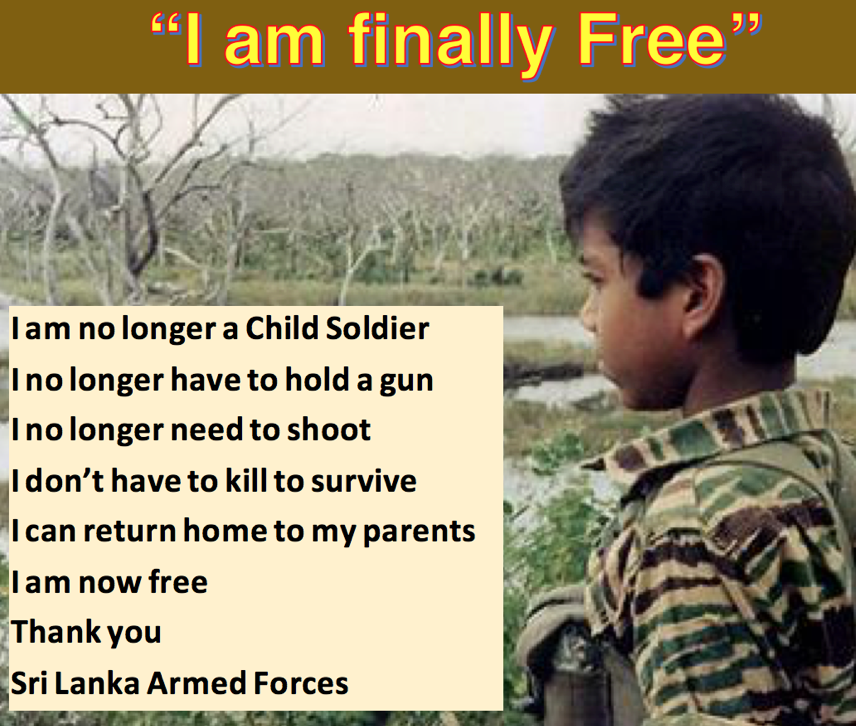
Tamil children as young as 7 being forced to hold a gun instead of a pen, Tamil girls given a thread with a cyanide capsule instead of a gold chain, Tamil teenage girls who suffered monthly period pains in silence wearing LTTE uniforms that could not be washed for months? Tamil children who had no proper bath, who never smelt the scent of perfume or colognes or enjoyed a bath with soap and shampoo. Did the LTTE diaspora and their families giving luxuries to their children even think a second about other Tamil children living in the harsh environs of the Vanni jungles.
The Diaspora brats never knew what it was like to be living in the jungles, eating whatever came their way, without food and water for hours, without rest and sleep for days, wearing smelly uniforms and even being subject to sexual exploitation by their seniors – where were the Tamil human rights and female activists for these Tamil children?
All these Tamil activists qualifying abroad and giving fancy speeches today did NOTHING to free a single child from the LTTE, did nothing to stop LTTE recruiting Tamil children.They only wrote books and reports on Tamil child soldiers and won for themselves accolades and awards. They should feel ashamed.
In May 2009, it was not the LTTE diaspora that brought peace and saved Tamils.
It was the Sri Lankan Armed Forces.
In May 2009, it was not the LTTE diaspora who fed the Tamils that the Armed Forces saved. It was the Sri Lankan Government.
In May 2009, it was not the LTTE diaspora that gave a presidential pardon to 594 child soldiers who surrendered. It was the Sri Lankan Government.
In May 2009, it was not the LTTE diaspora who gave a new life to rehabilitated LTTE combatants, it was the Sri Lankan Government.
In May 2009, it was not the LTTE diaspora who spent on giving Tamil children thus far denied their fundamental right to education, the means to continue their studies, engage in a vocational training and do what they had been denied by LTTE all their lives.
In May 2009, it was not the LTTE diaspora who reunited Tamil child soldiers with their families, it was the Sri Lankan Armed Forces & the Government.
So, what crap is the LTTE Diaspora and its brats ranting on about from overseas.
The stupidity of chanting genocide without knowing its meaning and the stupidity of those accepting it means this is just a charade for them.
Where in the world do you have genocide of Tamils (meaning intentional killing of Tamils) when the Tamil population is increasing annually?
It just exposes their lives even more to those who should have the common sense to wonder how genocide & population increase can happen
It’s pretty clear that the mouthpieces chanting for Eelam, mourning LTTE dead and carrying on campaigns galore means that these LTTE diaspora Tamils want a separate state called Eelam. Fine, then come on over and create it – don’t outsource it to Tamils in Sri Lanka, who now do not wish to have any role in this game.
The Tamils in Sri Lanka wish to integrate, go to school, go to university, get a job, own a house, buy a car and enjoy life.
They should be allowed to do this without LTTE Diaspora telling them ‘you should be in the jungles fighting for Eelam – not going to school, not going to do a job, not buying a house, not owning a car’while they are nicely living the good life in US, UK, Canada, France & EU.
What a joke this is.
Tamils should wake up at least now and realize what these LTTE diaspora creeps are up to.
They want to enjoy a cushy life overseas and put the Tamils in Sri Lanka into the jungles while they can buy time to get the rest of their families to go crying to embassies and cry about discrimination and enter foreign shores as asylum seekers and refugees. So this is the economic migrant LTTE diaspora plan. Tamils in Sri Lanka must refuse to be a part of this.
If these LTTE brats living overseas want Tamil Eelam – come and shed their branded clothes, give up foreign citizenship, go and live in the Vanni jungles, take up arms, wear a cyanide capsule and pray that the ghost of Prabakaran will give orders.
As of now, taking orders from that crazy head who thinks he’s PM of an Eelam in the sky is not going to ever land up in any Tamil Eelam!
If something deserves to be called ‘Event of the Week’ it would be the ‘Pothuvil to Poligandy (P2P) March’ which ended on Sunday, February 7. At the end of the march there were around 2,000 people. Most significantly, it was an event that saw the participation of both Tamils and Muslims. The basic differences in grievances were obviously negated by a felt need to be united against, let’s say, a perceived common enemy, the Government to some, ‘Sinhala Chauvinism’ to others.
It marked also, as D B S Jeyaraj has mentioned in his weekly column, a return of sorts to non-violent protests. Now it is not that all Tamil and Political action was violent. There have been all kinds of non-violent protests even during the conflict. However, this was a sustained, determined and even colorful affirmation of a politics that harked back to a different time. ‘The Satyagraha of 1961,’ is what Jeyaraj was reminded of.
There are two interesting statements that are related to this march. First we had the government withdrawing STF security assigned to TNA MP M.A. Sumanthiran. Sumanthiran retorted, ‘if something happens to me the Government will be held responsible.’ Now the agitation of the man does seem misplaced considering that he was involved in a five-day march (ok, he may not have be ‘on the moving spot’ all five days, but still! Was he not worried about security? Also, Sumanthiran has openly supported the LTTE, indulged heavily in Eelam-speak as well as celebration of the terrorists. He would do well to reflect on the fate of others who came before who did the very same thing, especially the leader of the TULF, Appapillai Amirthalingam. Amirthalingam spouted rhetoric which was like an endless nutritional feed to extremism. The beast, in his insatiable hunger, at one point did much more than bite the hand that fed. One hopes that things don’t snowball to a repeat of all that, but Sumanthiran, having seen what happens to hands thrust into fires ought to keep his in his pockets.
The second is a hilarious tweet from the tweet-happiest diplomat in Colombo, Alaina B Teplitz: ‘#Peacefulprotests is an important right in any #democracy and significant, legitimate concerns should be heard. I saw Tamil media coverage of the march from Pottuvil to Point Pedro and wondered why it was not more widely covered by Colombo-based media?’
She has a point. The English, Sinhala and Tamil media have different preferences that have little to do with newsworthiness. Perhaps it is all about the target audience; after all there’s a reason why entertainment value has framed reporting and presentation, why sensationalism has become an important driver and so on. This holds for different media houses as well; owners have agendas. Nevertheless, there is a serious problem if matters of political significance are down-played or ignored altogether, one has to question the sense of responsibility of the particular media institutions.
On the other hand, we cannot ignore the ‘Season of Vexatious Persecution’ (i.e. the annual human rights circus in Geneva) which is all about whipping things up from December to February. Now it could be a coincidence that P2P was organized at this particular moment, but few will buy it considering the personalities involved and their political history. The Teplitz tweet only serves to add credence to the view that this was just another side show of the above mentioned circus.
The tweet also indicates an important fact: Teplitz is running out of slogans. Before we get to that, let’s have a say on the key words — the hash tagged ‘peaceful protests,’ ‘democracy’ and ‘legitimate concerns.’ It is downright laughable for a US diplomat to talk about such things given that country’s absolute rubbishing of such things, domestically and internationally. That aside, there’s the fact that Teplitz has been pained to the point that she has to whine about media coverage. Is it that a pet project directly or indirectly sponsored, planned and executed, didn’t move as many Tamils and Muslims as was envisaged?
We didn’t hear Muslim and Tamil leaders complaining about news coverage. Have they deferred that kind of task to Teplitz? If that’s the case, who is the pawn or who are the pawns here? Is it Teplitz? Are they Tamil and Muslim leaders who in their wisdom believe that the best bet to get grievances, real or imagined, sorted and aspirations, reasonable or outrageous, fulfilled is to support the US in securing strategic objectives in Sri Lanka? If such happens (not a certainty, certainly) do they believe they’ll get some crumbs off the table? And what does all this have to say about the agency of Tamil and Muslim citizens? Are they too pawns? Indeed, are all peoples of all communities pawns in games where they are sacrificed at will?
Jeyaraj sees in P2P ‘a remarkable show of solidarity and unity’ between the Tamil and Muslim communities. He does exaggerate about the numbers (tens of thousands, he says) and deliberately introduces the ‘Tamil-speaking’ qualifier which Tamil nationalists have often used to rope in rhetorically ‘The Muslims’ to their various political projects. Jeyaraj remembers 1961 but has forgotten the late eighties when M H M Ashroff (in)famously stated that even if Prabhakaran abandons Eelam, he would not. He dialed down the rhetoric over the next decade, but what did Prabhakaran do to the (Tamil-speaking) Muslims, has Jeyaraj forgotten? The LTTE ethnically cleansed the Jaffna Peninsula of Muslims. The LTTE turned one in ten Muslims into refugees, slaughtering dozens, driving them off their homes, seizing properties etc. Muslim leaders cannot pretend to be unaware of that history.
Muslim Affairs, if you will, featured in other ways over the week. Recently returned to Parliament, Ven Athureliye Rathana Thero presented a private member’s bill to repeal the Muslim Marriage and Divorce Act. Justice Minister Ali Sabri who prior to entering Parliament championed the notion ‘One Country, One Law,’ responded by saying ‘steps are being taken to amend the Muslim Laws and that a Cabinet Paper had already been presented in that regard.’
Elaborating, Sabri said that the Cabinet Paper sought to amend the minimum marriageable age of Muslim girls as 18, to permit women to act as Kathis and also to make it necessary to get the consent of Muslim women when they get married.
That’s it? That makes it ‘One Country, One Law’? Sabri must do a serious rethink on what he says and does and the meaning of the terms he uses (so loosely!).
He is correct when he says that ‘if the personal laws were to be abolished, all the personal laws such as Muslim Laws, Kandyan law and Thesawalamai Law should be abolished altogether.’ ‘Through a social discussion,’ he adds. There’s been enough social discussion, he knows this. One-country-one-law would certainly all for abolishing all customary laws. His concern seems to be limited to correcting existing laws that privilege Muslim men over Muslim women. That’s not even scratching the surface of the problem though!
Here are a question for Sabry: Are there plans to abolish polygamy (can’t have it for some and not others, noh?)? Here’s another: The Special Parliamentary Committee on Extremism appointed by the previous administration presented a report in February 2020 recommending extensive measures with respect to Muslim laws as well as ‘educational’ institutions — have you read it? Are you in agreement? If so, what have you done so far? Are you planning to defer everything to the experts tasked to draft a new constitution? What are those experts doing by the way? When will we see a draft? And finally, what exactly do you understand by ‘One country, one law’? Let’s have some answers, please.
This week also saw Wimal Weerawansa making some news. He openly advocated a prominent and even principal role for Gotabaya Rajapaksa in the SLPP leadership. He was taken on by the General Secretary of the SLPP, Sagara Kariyawasam who questioned Wimal’s rights to talk of the SLPP since he’s not a member. Wimal retorted that people in the SLPP talk of other parties. Sagara wondered what Wimal’s fate would be had he and his party contested independently. Wimal pointed out that Sagara, a national list MP, hadn’t even contested.
Light banter at best. Some sections of the Opposition have salivated, naturally. They believe and talk of ‘a rift!’ in the Rajapaksa camp, friction between the brothers (Wimal’s antipathies to Basil being well known).Too early to conclude such of course, but as debating points go, both Wimal and Sagara have scored. What this ‘scoring’ says about the future of the SLPP is of course left to be seen. There’s bound to be differences of opinion in any political coalition. If everyone was on the same page there wouldn’t be a coalition in the first place. You win some, you lose some — this is something that junior or weaker partners know very well (ask Prof Tissa Vitharana of the LSSP).
The so-called ‘smaller parties’ did make a lot of noise regarding the East Container Terminal issue. It seems, as of now, that the ‘big party’ listened. Whether they’ll still have the ‘big ear’ regarding the West Container Terminal is left to be seen. On the other hand, we know the story about the dog and the tail, no offense to canines or tails. Politicians and political parties are about power and about elections. If, for example, Champika Ranawaka and the Jathika Hela Urumaya, having broken ranks with the UPFA decided to go it alone and not join the UNP-led coalition as they did, where would Ranawaka be today, one might ask. Indeed is it not such questions that persuaded him to resign from the JHU and become a 100% SJBer, one could also ask. There are no elections in sight, but when they do come around, all parties big and small will revisit ‘coalition’ and calculate the impact of decisions (and rhetoric) on electability.
For now, though, noises can and will be made. The likes of Wimal would have to pick their battles and select decibel levels. That said, his point about the distance between president and parliament on account of political sway within the party is valid. It goes without saying that the effectiveness of a program sometimes comes down to parliamentary weight which of course can be deployed best if the executive has a degree of control. The President either doesn’t have it or cannot count on it or imagines he doesn’t need it. He could ask his brothers, both veterans in this respect. That however might mean give-and-take, if we were to believe the notion that the brothers are bound by blood but not about vision.
India, meanwhile, is not happy, going by statements issued regarding the East Container Terminal. India cannot be happy about the ‘Chinese Footprint’ whose size was considerably expanded by the previous government by virtually handing over the Hambantota Port to China. India cannot be happy about energy projects given to the Chinese. India cannot be happy about the scheduled visit by Pakistan Prime Minister Imran Khan and MoUs that are said to be signed and/or renewed.
India speaks of Sri Lanka ‘reneging’ on an MoU. However, India forgets that MoUs are not exactly agreements, signed after crossing the t’s and dotting the i’s. They are by definition non-binding and amenable to change. Circumstances can change and changing circumstances have to be taken into account. If an agreement causes political instability it would be foolish for a government to go ahead with it. If, prior to inking an agreement, one party (India in this case) stands with a country that seems hell bent on bullying Sri Lanka (the USA in this case), then it would be silly for that party to assume that the counterpart be oblivious to such developments. If one party has in the part ‘reneged’ (as India has with respect to the Indo-Lanka Accord which from the get-go was a product of shamelessness bullying and moreover was heavily slanted in India’s favor), then that party should be careful before using the word.
And on the subject of ‘foreign affairs,’ we have Dinesh Gunawardena claiming that Sri Lanka is not afraid of the soon to be tabled resolution in Geneva. There are 47 members in the Human Rights Council (HRC). The Minister of Foreign Affairs cannot be saying ‘the majority are with us.’ The brave words could probably mean ‘we except this, we know the consequences, we know it’s the work of nations wallowing in a cesspool of bias, we know that they’re hinting at sanctions, we know what the UN itself has found out about the impact of sanctions in other countries, especially Venezuela in recent times, we know there’s talk of taking things to the General Assembly and then the Security Council, we know who are friends are and more importantly who our enemies are, and we know what it takes to secure sovereignty to the extent possible.’
Dinesh Gunawardena might not elaborate in the above manner. After all, he is required to be ‘diplomatic’ although he is not averse to calling a spade a spade. ‘Geneva’ is just over a week from now. A resolution is likely to be tabled. It is likely that it will be passed. Most importantly, it will show us what India’s ‘neighborhood first’ foreign policy is really about.
Press Release The Public Utilities Commission of Sri Lanka (PUCSL),
The Public
Utilities Commission of Sri Lanka (PUCSL), the electricity sector regulator
approved the power purchase agreement to build 300 MW Kerawalapitiya Liquid
Natural Gas power plant in Sri Lanka under the new chairmanship and the board
members last week (13 Feb 2021). The power purchase agreement will be signed by
the Ceylon Electricity Board (CEB) and Lakdhanavi Pvt Ltd.
The power
purchase agreement of 300 MW Kerawalapitiya LNG approved by the PUCSL will be
implemented with conditions more favourable to the electricity consumer, the CEB
and the government. The PUCSL recommended the inclusion of 18 amendments which
were not included in the previous power purchase agreement submitted for
approval, and the CEB and Lakdanavi have agreed to include those favourable
terms. Accordingly, the agreement approved by the PUCSL is more favourable to
the consumers, the Government and the Ceylon Electricity Board. The CEB will purchase
electricity for 20 years under this agreement,” says Janaka Ratnayake, Chairman
of Public Utilities Commission of Sri Lanka.
The unit
price of electricity supplied by this power plant is Rs. 14.98. Both diesel and
LNG fuels can be used to generate electricity, and the initial phase of
generation will continue to use diesel fuel until LNG or natural gas supply
begins.
The CEB sought
the approval of the PUCSL for the tendering of this LNG power plant on November
15, 2016, and the PUCSL approved the process within two days (17th November
2016). The CEB is responsible for selecting the most suitable party to build
this power plant through a tendering process and it has taken about 4 years to
complete the tender process for this power plant.
Following
the completion of the tender process and the selection of the eligible party,
the relevant purchase agreement was submitted for the approval of the PUCSL on
October 9, 2020, by CEB. However, it was
revealed that there were discrepancies between the new agreement submitted by
the CEB and the original agreement approved by the PUCSL. In particular, the 18
amendments contained in the original agreement were not included in the final
agreement submitted for approval. The PUCSL recommended to the CEB to
re-include these conditions in the agreement as the removal of these conditions
will be detrimental to the consumer, the government and the CEB. Subject to
those amendments, conditional approval for the final agreement was granted on
November 25, 2020. Following the recommendations of the PUCSL, the CEB amended
the final agreement and submitted the final agreement for the purchase of
electricity on December 1, 2020, for approval.
However, by the time of the submission of the final agreement, the then
members of the Commission had resigned from their posts.
The new
members were appointed to the Commission in the first week of February 2021 and
at the first meeting of the new board, final approval was given for the 300 MW
LNG power plant agreement.
The PUCSL
expects the CEB will take actions to expedite the construction of this 300 MW
LNG power plant to cater to the country’s electricity demand.” Mr Ratnayake
added.
By P.K.Balachandran/Daily Express Courtesy NewsIn.Asia
Colombo, February 15: Tripura Chief Minister Biplap Kumar Deb has claimed that the Bharatiya Janata Party (BJP) honcho and current Indian Home Minister Amit Shah had once revealed to him that the BJP has a plan to form governments in neighboring Nepal and Sri Lanka.
This may be laughed off in India as another of those baseless utterances by Deb who has earned an unsavory reputation of being a loud mouth. But in Sri Lanka it has caused considerable concern.
Reporters in Colombo have been desperately trying to confirm if Deb had really said what he has been quoted as saying, and whether the BJP, which rules India, really has a plan to install BJP regimes in Sri Lanka and Nepal. They have been wanting phone numbers of BJP leaders in Tamil Nadu and New Delhi to cross check to clear the anxiety.
Unfortunately for India, the story on Deb’s utterance, has come at a time when relations between Sri Lanka and India have soured a bit after the Gotabaya Rajapaksa government backed out of a May 2019 agreement to give the project to develop the strategic East Container Terminal in Colombo port to India. The Lankan government had also given three power generation projects in the islands of Jaffna to a Chinese company rejecting an Indian company’s tender. The latter decision was cancelled after India lodged a strong protest citing security concerns.
Lankans anxiously ask if India will become unfriendly to Colombo and take the Western countries’ side in the March session of the UN Human Rights Council where a hard-hitting resolution against the Sri Lankan government alleging war crimes is expected to be taken up.
The fact that India is yet to accept the Lankan government’s offer of a contract to build and operate the West Container Terminal in Colombo port in lieu of the East Terminal, is worrying friends as well as opponents of India in Sri Lanka.
The fact that India has been able to thwart the Sri Lankan government’s move to give a contract to build three power plants in the islands of Jaffna to China is seen by Sri Lankans as a demonstration of India’s superior clout in the region which has implications for Sri Lanka.
Deb a Laughing Stock
However, few in Sri Lanka know that Tripura Chief Minister Biplab Kumar Deb is a laughing stock in India. He had to be pulled by the BJP top brass for his thoughtless and embarrassing remarks on a variety of matters.
Reacting to Deb’s contention that Amit Shah had told him that the BJP will establish its rule in Sri Lanka and Nepal, Marxist Communist leader and former MP, Jitendra Chaudhury, said that Deb has no regard for the constitution or democracy. Chaudhury accused Amit Shah of engaging in a conspiracy against Nepal,” He demanded an answer from Prime Minister Narendra Modi.
Tapas Dey, Tripura State Congress party Vice-President, described Deb’s remark as imperialistic”. He said: It is unfortunate that the Chief Minister of Tripura is supportive of imperialism. Both Sri Lanka and Nepal are sovereign countries, and we cannot interfere or do anything about their internal affairs.” Dey also sought action against Deb for his anti-national” statements.
In the past, Deb had made hilarious remarks with dead seriousness. s. He asked families to rear ducks because when ducks swim in water, the oxygen level automatically increases in the water body”. He announced that the government would distribute 50,000 ducklings to villagers whose homes are near water bodies.
Glorifying ancient India’s achievements in science and technology Deb said: India has been using internet for ages. In Mahabharata, Sanjaya was blind, but he narrated what was happening in the battlefield to Dhritarashtra anyway. This was due to the existence of the internet. Satellites also existed in that period.”
Once he shocked civil servants at a civil service function when he said that only civil engineers are suited for the civil services. Civil engineers should join the Civil Services because they have the knowledge and experience to help build a proper administration and society.”
He then made a sexist comment about Indian model Diana Hayden who won the Miss World title in 1997. She is not worthy of the Miss World crown. We see women as goddess Laxmi and Saraswati. Aishwarya Rai represents Indian women. She became Miss World in 1997 and that’s all right. But I do not understand the beauty of Diana Hayden,” Deb said as the audience squirmed. After protests from feminists, he apologized.
Deb then advised Tripura’s youth not to hanker for government jobs but to rear a cow or open a paan (betel leaf) shop. The youth here run after political parties to get a government job and waste precious time instead of using it to become entrepreneurs. If they had set up paan shops each one would have accumulated a bank balance of Rs 5 lakhs,” he said.
Since his utterances were often not a laughing matter, he was summoned to the BJP headquarters in Delhi and castigated.
Cardinal Ranjith calls for the government to regulate extremist groups after a spate of high-profile conversions
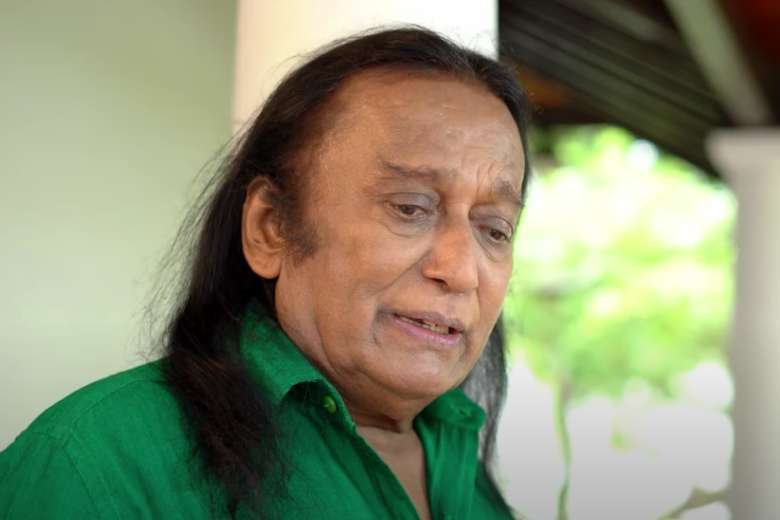
Veteran singer Victor Ratnayake claimed he regained his lost voice with the blessings of God via a religious sect. (Photo: YouTube)
Anna Mary, 32, and her assistant display religious magazines in public places four days a week. They dress in white and display the magazines in a small cart in front of Maradana railway station and other public places in Colombo.
Some passers-by ask what Mary and her assistant are doing. They reply that they are serving God whenever they can. Scenes like this have become common, especially in major cities in Sri Lanka.
“It is a common scene that hundreds of people pray together in such prayer centers from morning until evening,” said Mary. “Special bus services are also available in Colombo, Negombo, Wennappuwa and Chilaw, especially for Sunday services.”
Mary and her family were Catholics but joined an evangelical church and are devoted to its ministry. They talk about God and offer a free magazine and invite interested people to attend a prayer center.
Mary insists that they do not forcibly convert people, adding that her mission is to go from house to house to introduce God to those who do not know about him.
Cardinal Malcolm Ranjith of Colombo has called on the government to regulate all members of extremist groups posing as pastors and to check their sources of income.
He said the Catholic Church, led by the Catholic Bishops’ Conference of Sri Lanka, had nothing to do with these pastors and their activities.
Buddhists account for over 70 percent of Sri Lanka’s population, while the Christian minority accounts for only 7.4 percent.
Cardinal Ranjith issued a special statement on Feb. 11 explaining the Church’s position on conversion and said a group of so-called pastors were carrying out extremist activities targeting veteran artists, athletes and businessmen in the country.
In a video circulating on social media, Nelu Adhikari, a popular singer, said she gave up Buddhism and joined an evangelical group, claiming her faith had cured her of tiredness.
In another video circulating on social media, veteran singer Victor Ratnayake claimed he regained his lost voice with the blessings of God via a religious sect. Ratnayake’s wife can also be seen participating in the prayer.
Senior Buddhist monk Ampitiye Sumanarathana Thera accused evangelical pastor Nalaka Fonseka of forcible conversion and used profane language in his assault on the pastor in January 2020.
The Church has a clear administrative structure. But there is no system in the country to regulate these pastors, there is no discipline, no transparency. This directly affects the religious organizations in the country and this would affect religious harmony,” Cardinal Ranjith said.
“I declare to my Buddhist brothers and sisters that the Roman Catholic Church has no affiliation with such extremist religious organizations.”
Mary said they have registered their church and have never converted anyone by force. “We have not given gifts to Buddhists, Hindus and Christians to convert them. People should have the freedom to choose their religion,” she said.
Army Commander Shavendra Silva says that COVID-19 vaccinations will commence from today (February 15), as per instructions of President Gotabaya Rajapaksa.
Accordingly, arrangements have been made to vaccinate the general public against the COVID-19 virus using the Oxford Astra Zeneca vaccine.
The vaccination process will initially commence from the Western Province for the groups that interact closely with the public and those who face higher-risks of infection.
People living in high-risk areas of the spread of COVID-19 in the Western Province will be identified and vaccinated as the first step.
Meanwhile, 500,000 doses of the COVID-19 vaccination, the first batch of a vaccine stock ordered for 9 million, will arrive in Sri Lanka within a week, according to the Army Chief.
More stocks of vaccines are due to arrive from the World Health Organization within the first two weeks of March.
Vaccination of sanitation workers within the Colombo Municipal Council (CMC) limits commenced today (February 15), says Dr. Sudarshani Fernandopulle, the State Minister of Primary Healthcare, Epidemics, and COVID Disease Control.
Speaking to media at the Ministry today, Fernandopulle said that it has been decided to vaccinate high-risk groups and the communities in high-risk areas as a priority.
She pointed out that the majority of coronavirus cases have been identified from Colombo and Gampaha Districts.
The State Minister further said that the vaccination process can be further regulated when Sri Lanka receives the vaccine doses provided under the COVAX program of the World Health Organization (WHO).
Speaking on the rumors of a lockdown in the country due to the detection of new COVID-19 variants within Sri Lanka, she said that there is no such need to lockdown the country as of yet.
Stating that the new variants have been identified mostly in patients who arrived from foreign countries, Fernandopulle said that the Epidemiology Unit is currently studying these patients who have all been quarantined or sent for treatment.
We were able to identify patients with the new variant because we were vigilant about this. We had informed the people about this that new varieties could emerge in the future.
The important thing now is to control that cluster without allowing it to spread. All necessary steps have been taken for that. We see that people also display risky behavior. They get together without masks. Crowds gather through weddings.
There is no need to lockdown the country. There is no increase in the number of patients reported. No new guidelines are needed to control the situation. It is sufficient to follow the guidelines already issued.”#
Sri Lanka to vaccinate MPs against Covid-19 tomorrow
Members of Parliament will be vaccinated with the Oxford AstraZeneca COVID-19 vaccine tomorrow (Feb. 15), according to the Serjeant-at-Arms of the Sri Lanka Parliament.
He stated that the vaccination of parliamentarians will take place at the Army Hospital on Tuesday.
Minister of Wildlife and Forest Conservation C.B. Ratnayake recently became one of the first MPs to be vaccinated against the novel coronavirus in Sri Lanka.
Meanwhile Army Commander Shavendra Silva said that COVID-19 vaccinations will commence from today (15), as per the instructions of President Gotabaya Rajapaksa.
He said arrangements have been made to vaccinate the general public against the COVID-19 virus using the Oxford AstraZeneca vaccine.
The vaccination process will initially commence from the Western Province for the groups that interact closely with the public and those who face higher-risks of infection, he said.
The Public Utilities Commission of Sri Lanka (PUCSL), the electricity sector regulator, approved the power purchase agreement to build a 300 MW Kerawalapitiya Liquid Natural Gas power plant in Sri Lanka under the new chairmanship and the board members last week (13). The power purchase agreement will be signed by the Ceylon Electricity Board (CEB) and Lakdhanavi Pvt Ltd.
The power purchase agreement of 300 MW Kerawalapitiya LNG approved by the PUCSL will be implemented with conditions more favorable to the electricity consumer, the CEB, and the government. The PUCSL recommended the inclusion of 18 amendments that were not included in the previous power purchase agreement submitted for approval, and the CEB and Lakdanavi have agreed to include those favorable terms. Accordingly, the agreement approved by the PUCSL is more favorable to the consumers, the Government, and the Ceylon Electricity Board. The CEB will purchase electricity for 20 years under this agreement,” says Janaka Ratnayake, Chairman of Public Utilities Commission of Sri Lanka.
The unit price of electricity supplied by this power plant is Rs. 14.98. Both diesel and LNG fuels can be used to generate electricity, and the initial phase of generation will continue to use diesel fuel until LNG or natural gas supply begins.
The CEB sought the approval of the PUCSL for the tendering of this LNG power plant on November 15, 2016, and the PUCSL approved the process within two days (17th November 2016). The CEB is responsible for selecting the most suitable party to build this power plant through a tendering process and it has taken about 4 years to complete the tender process for this power plant.
Following the completion of the tender process and the selection of the eligible party, the relevant purchase agreement was submitted for the approval of the PUCSL on October 9, 2020, by CEB. However, it was revealed that there were discrepancies between the new agreement submitted by the CEB and the original agreement approved by the PUCSL. In particular, the 18 amendments contained in the original agreement were not included in the final agreement submitted for approval. The PUCSL recommended to the CEB to re-include these conditions in the agreement as the removal of these conditions will be detrimental to the consumer, the government, and the CEB. Subject to those amendments, conditional approval for the final agreement was granted on November 25, 2020. Following the recommendations of the PUCSL, the CEB amended the final agreement and submitted the final agreement for the purchase of electricity on December 1, 2020, for approval. However, by the time of the submission of the final agreement, the then members of the Commission had resigned from their posts.
The new members were appointed to the Commission in the first week of February 2021 and at the first meeting of the new board, final approval was given for the 300 MW LNG power plant agreement.
The PUCSL expects the CEB will take actions to expedite the construction of this 300 MW LNG power plant to cater to the country’s electricity demand,” Ratnayake added.
Sri Lanka has surpassed the grim milestone of the 400th death caused by coronavirus today (February 15), the Department of Government Information confirmed.
As per the Ministry of Health, a total of 06 new COVID-19 deaths have been reported today.
Among the latest victims are five male patients and one female patient.
This brings the total number of COVID-19 related deaths witnessed in the country to 403.
01. The deceased is a 78-year-old male from Divulankadawala. He was transferred from Welikanda Covid Treatment Centre to IDH hospital where he died on 14.02.2021. The cause of death is mentioned as COVID-19 pneumonia.
02. The deceased is a 48-year-old female from Pallethalawinna. She was diagnosed as infected with the COVID-19 virus and transferred from National Hospital Kandy to IDH Hospital where she died on 14.02.2021. The cause of death is mentioned as blood poisoning, COVID-19 pneumonia, complicated kidney disease, and damaged kidneys.
03. The deceased is a 57-year-old male from Hanwella. He was diagnosed as infected with the COVID-19 virus and transferred from Apeksha Hospital Maharagama to IDH Hospital where he died on 15.02.2021. The cause of death is mentioned as cancer and COVID-19 pneumonia.
04. The deceased is an 80-year-old male from Nugegoda. He was diagnosed as infected with the COVID-19 virus and transferred from a private hospital in Colombo to IDH hospital where he died on 14.02.2021. The cause of death is mentioned as COVD-19 pneumonia, blood poisoning shock, acute kidney damages, complicated kidney disease, heart disease, high blood pressure, and high levels of lipid in the blood.
05. The deceased is a 68-year-old male from Wattala. He was diagnosed as infected with COVID-19 and transferred from District Hospital Dompe to Base Hospital Homagama where he died on 14.02.2021. The cause of death is mentioned as blood poisoning shock, COVID-19 pneumonia, complicated kidney disease, and acute diabetes.
06. The deceased is a 70-year-old male from Hunnasgiriya. He died on 14.02.2021 while undergoing treatments at National Hospital Kandy. The cause of death is mentioned as COVID-19 pneumonia, acute kidney disease, and heart failure.
A mutant variant of the COVID-19 virus has been identified in two patients from Colombo, said Dr. Ruwan Wijayamuni, the Chief Medical Officer of the Colombo Municipal Council (CMC).
Dr. Wijayamuni points out that it will be difficult to prevent a third wave of COVID-19 cases if the public does not follow health advice and continue to be safe.
According to tests conducted by the University of Sri Jayewardenepura, blood tests on two patients in Colombo have revealed a mutation in the COVID-19 virus.
So far we have managed the second wave of Kovid very well. But if the public is not careful and does not follow health care advice, it may be difficult for us to prevent a third wave.”
The Attorney General has requested for another Trial-at-Bar for the trial of the Bond Scam involving the third Treasury Bond Auction of March 31, 2016.
The Coordinating Officer of the Attorney General State Counsel Nishara Jayaratne stated that Attorney General Dappula de Livera made this request to the Chief Justice today (February 15).
The new set of judges has been requested to try former Finance Minister Ravi Karunanayake, former Governor of Central Bank Arjuna Mahendran, Arjun Aloysius, and 07 others with regard to the relevant trial.
The Attorney General made a similar request on February 11, 2021, after the Criminal Investigation Department (CID) informed the court that investigations into the Rs. 51.98 billion financial irregularities in the 2nd Central Bank bond issue against 11 suspects named in the case have been concluded.
The
73rd anniversary of independence was officially celebrated in Colombo on
February 4 with some of the accustomed pomp and pageantry associated with the
event. Faced by the still rampant Covid menace and the looming economic and
political crises, the current regime, which is still struggling to reach its
cruising altitude, couldn’t have done better in the circumstances. This is so,
particularly, in view of the fact that today the relevance of celebrating the
1948 dominion status independence to the emerging Sri Lanka is increasingly
coming into question. The independence anniversary has become a virtual political-cultural
anachronism that keeps Sri Lankans religiously reminded of the eminently
forgettable fake independence grudgingly offered after the humiliating
experience of one and a half centuries of rapacious British colonialism, whose
evil legacy is still blighting their beloved motherland.
Meanwhile
one could see that the occasion was observed in different, but ultimately
complementary, ways in two particularly significant venues apart from Colombo
where the national independence anniversary was perfunctorily observed. Let’s
for the moment forget about various other places that may have held customary
annual freedom day functions. The two centres meant here are Jaffna and Kandy.
A group of young Tamils including women and school children (as reported in the
media) marked the day in Jaffna with a march displaying national flags and
placards calling for national unity and peace and expressing opposition to
conventional Tamil politicians who, they alleged, were working to create
divisions and disharmony for narrow party political ends. The group was led by
a young Tamil known by his birth name Arulanandan Arun or his alias Arun
Siddharth, who claims that his grandfather was a toddy tapper, fiercely
criticises the entrenched Tamil political elite of the north . (He revealed
during a subsequent TV interview that he was not so young being forty-three
already.) He has gained some popularity among ordinary people in the south as
well as in the north as a sincere critic of the existing reactionary political
elite of the north who reside in clover in Colombo or live in and/or operate
from Europe, while doing nothing to improve the lot of the suffering Tamils in
the north. His criticisms of prominent northern Tamil politicians are so
authentic that one feels that he should be able to play an important liaison
role, if he wishes, with similar minded young southerners of all three
communities that will ultimately contribute towards forging national unity.
Ordinary Tamils don’t want separation; what they want is development and jobs,
free from interference from India and the West.
It
has long been argued that ordinary Tamils in the north actually suffer from
casteist discrimination among themselves, and not from any Sinhalese
majoritarianism as falsely alleged by separatists and their ignorant backers
abroad. This is a truth that Arun has clearly pointed out. The same news
sources reported that a supposedly anti-government protest march which had
started from Pottuvil in Ampara in the east the previous day (February 3), was
planning to finally arrive at Polikandi in Jaffna on the 7th after a five day
trek..
Though
police had obtained a court order against the protest march, it went ahead,
nevertheless. These demonstrators were demanding a halt to what they called
encroachment of ‘Tamil lands’ under the pretext of archaeological excavations,
fulfilment of the promised Rs 1000 daily pay for upcountry estate workers and
for a relaxation of the mandatory cremation order in respect of corona-dead
Muslims, etc. (Important: These are fake demands; there are no Tamil, Muslim,
or Sinhalese lands in Sri Lanka; the whole island belongs to all the
communities; archaeological sites come under the archaeology department, and
lawful excavations are done under its supervision; the extensive archaeological
relics of the country are now the common heritage and property of all Sri
Lankans; much of the tourist industry depends on these, and as such, they are
also a big economic asset to the country; the Rs 1000 daily pay demand is duly
being met; the decree to burn corona-dead corpses is a scientific decision, not
a political one; the PM revealed in parliament February 10 in reply to a Muslim
MP’s query that burial will be allowed hereafter, implicitly because it has now
been established that the virus is not transmitted through water.)
The
protest march organized by some TNA-led Tamil political parties and NGO
elements provoked a negative response from the young enlightened Tamils among
the northerners in the form of counter demonstrations. These northern
Tamils held rallies against the seemingly anti-government march at the old bus
stand in Vavuniya (February 6) and at Murungan in Mannar (February 7).
According to them the march that started on February 3 from Pottuvil was
completely unjustified. It was organized only to promote the exclusive
interests of some regional political parties, and to hoodwink the common
people”. Of course, the march had little to do with independence day
celebrations. It may be suspected that its actual aim was to further undermine
Sri Lanka at Geneva in two or three weeks’ time. TNA MP M.A. Sumanthiran
expects India to support West-sponsored anti-Sri Lanka resolutions at the UNHRC
at its 46th session there next month, according to The Island/February 13.
However, as public security minister Sarath Weerasekera says, more countries
than before are likely to support Sri Lanka this time since the country has
withdrawn from co-sponsorship of the those baseless resolutions under the
present government.
Back
to the Pottuvil to Polikandi march, going by media reports, no one can deny
that a fairly large number of Tamils and Muslims (strange bedfellows, no doubt,
with conflicting long term ambitions) took part in the protest march though
obviously it was well short of the highly exaggerated figure of 60,000 that MP
Gajendra Kumar Ponnambalam mentioned in parliament on February 9, 2021. He
however claimed that the march was not something against the government. GKP
stated what he called ‘the four core demands’ of the marchers: 1) recognition
of the north-east as the Tamil and Muslim Tamil speaking people’s homeland, 2)
the recognition of Tamils as a distinct nation, 3) the right to
self-determination of the Tamil nation, and 4) the referral of Sri Lanka to the
ICC and other international accountability mechanisms to look into and
investigate the acts of genocide that happened and that continue to happen that
is being committed by the state”. GKP’s risible nonsensical definition of
alleged ‘Tamil genocide’ as dismantling the identity of Tamils” belied his
charge. Listening to his loud speech in the House, I remembered the lines a tale /
Told by an idiot, full of sound and fury,/ Signifying nothing” in the
Shakespeare play Macbeth, and thought that probably he was himself in
need of a referral letter from somebody to a specialist. But he was treated to
a curative blast from MP Pramita Bandara Tennekoon who described him as a
popular LTTE sympathizer”. PBT pulverized him point by point and reduced him
to silenced embarrassment. No need to say that the tired, backward, Tamil old
guard are still bent on avenging the defeat of the terrorist LTTE, instead of
looking forward to building, together with the rest of the communities, a
peaceful and prosperous Sri Lanka for all its citizens as PBT urged, and as the
young generation Tamils and their fellow Muslims and Sinhalese across the
country are now focused on doing.
Nevertheless
I personally believe that these actions and reactions in the north and
east demonstrate, instead a revival of the dead terrorism, a healthy democratic
trend that is developing among Tamils, particularly the Tamil youth, who are
set to work with their counterparts in the south in together creating a unitary
Sri Lanka without allowing outsiders (geopolitical, military and economic
powers with axes to grind) to get involved in our internal affairs in pursuit
of their own selfish ends at our expense. They need to be mindful of the new
religious dimension of the growing overall threat to pan-Sri Lanka unity: The
vulnerability of peaceful, non-violent, and non-extremist multiethnic Sri
Lankans (including the majority Buddhists and Hindus) who form 98% of the
population, is being aggravated by various extremist fundamentalist sects of
both types (Christian and Muslim), through their intensified activism by
effectively adding to the anti-Sri Lanka arsenal of interventionist powers
while the country is engulfed in political and economic crises amidst the
corona pandemic.
Meanwhile
the independence day was remembered with a twist in Kandy on February 4, that
too, only by default, when a small group of white clad, mostly young people led
by a hitherto unknown Buddhist monk named Medirigiriye Sikhi, prepared to hoist
‘the flag of Sinhale’ at the Dalada Maligawa premises, but were prevented from
doing so by the police acting on a court order issued prior to the event. Two
separate You Tube videos of the episode that I came across showed what happened
outside and inside the Sri Dalada Maligawa that morning. Ven. Sikhi agreed to
obey the court injunction after the head police officer on the scene explained
to him that it was illegal to hoist his Sinhale flag in the Maligawa premises
because it is not what the existing constitution decrees as the national flag,
and that, besides, displaying a lion flag as the national flag without the two
vertical bands is prejudicial to some sections of the society and so cannot be
allowed even in terms of the ICCPR (International Covenant on Civil and
Political Rights) to which Sri Lanka is a signatory. But still, as an
alternative, the monk wanted to make an offering of the flag to the Tooth Relic
while stating his alleged intentions on the occasion. Police let him display
the controversial flag to the media and the few people around, which was the
correct thing to do in the emotion charged context, because it enabled the monk
to assert his and his partners’ right to freedom of expression. He took the
opportunity to re-stress the ‘One Country, One Law’ pledge that the present rulers
committed themselves to during the elections.
The
monk stated that he had concocted some indigenous medicines to fight the
currently raging coronavirus disease, including a medicinal oil called
‘ahivaataroganivarana thailaya’ at his own expense. He offered this ‘hela
osuwa’ (indigenous Sinhala medicine) to the rulers, advising them to use it on
the local population against the coronavirus disease, presumably as a
resistance/immunity builder, and to export it to other countries, which
incidentally would, in his opinion, ease the debt burden on the country; but
they didn’t listen to him, he complained. He expressed his deep disappointment
that his medicinal preparations still remain neglected. We don’t like
innocent people dying; we are against extremist activities and the destruction
of the environment. Many prominent speakers and monks, as media have reported,
argue that there is no real independence (in the country). This is true”, Ven.
Sukhi said. (Ill-wishers determined to harm Sri Lanka at every turn went to
town in the media attacking the government’s alleged reliance on superstition
instead of science, when it implicitly allowed practitioners of traditional
medicine to try their remedies on potential victims of Covid-19 to boost their
immunity. However, its failure to manage the damage done by quacks who
naturally exploit such situations cost the government dearly in terms of an
adverse press in this regard. That was unfortunate. So is its apparent wavering
on the burial non-issue.)
Then
Ven. Sukhi offered kirihara (milk rice) and the medicines to the Sacred Tooth
Relic and all other Buddha relics. Next, he placed three copies of the
Sinhale Flag on the altar, offering it to the Dalada, though he had been
prevented by the state authorities from raising it in the sacred
premises. The monk exonerated the police officers from any blame for
this, explaining that they were just doing their duty, but that they helped him
do the offerings before the sacred shrine. His dedicatory words were: I am leaving
one of these flags as a gift to the Tooth Relic, while taking the other two
back; one of these two, I will hand over to the President, and I will keep the
other with me. The flag that I am retaining with me is for honouring it and for
getting all Sri Lankans to rally round it in unity. I solemnly pledge before
you (the Buddha) to do this (i.e., dedicate myself for this solemn
undertaking)”.
The
symbolism of the monk’s act is likely to be lost on many who experience no
empathy with the majority Sinhala Buddhist community. Kandy was the last seat
of government of the island kingdom of Sinhale, which, by the time of the
British imperial takeover or annexation in 1815 (executed through intrigue),
was hemmed in on all sides by the littoral provinces successively occupied by
various foreign powers over the previous centuries. Nationalist movements
invariably have the non-political leadership or patronage of Buddhist monks
because of the over two millennia old organic linkage between Buddhism and the
majority Sinhalese who built up the uniquely humane and hospitable island’s
Buddhist civilization. What was brought down at Kandy when the British raised
their union jack on signing the Kandyan Convention of 1815 was the royal
standard of the last king of Sinhale, which had only the image of the sword
wielding lion. This same royal flag was what was raised on February 4, 1948,
the arbitrarily chosen day of independence. It remained the national flag of
(at least nominally independent) Sri Lanka for the first three years before it
was modified in 1951 by adding two vertical stripes to represent the two
minorities (the green for Muslims and the orange for Tamils). It has been
further modified since 1972 when Sri Lanka was declared a republic. Some
nationalists argue that the 1951 addition of differently coloured bands to show
minorities was an unnecessarily divisive innovation, because the lion image
represents the whole country of Sinhale with all its diverse communities who
are well ensconced and secure within its generously accommodating Buddhist
culture (which is in that respect identical with the very tolerant Hindu
culture of our big neighbour India that Jawaharlal Nehru described in his
monumental ‘Discovery of India’ as enfolding alien cultures within its generous
embrace), so compatible with secular democracy.
The
lion image in the Lankan royal standard is as old as the Sri Lankan state’s
2500 year written history. However, we have to accept the fact that today’s
national flag is a product of historical evolution; an earlier form of it
cannot be reintroduced a second time as it will be incongruent with the new
realities. Historical wrongs cannot be corrected through individual arbitrary
action. The government cannot allow it since it is against the existing
constitution and is also in violation of the ICCPR treaty as explained to the
monk by the police officer. Sri Lanka signed the particular covenant in June
1980.
As
revealed in another You Tube video uploaded on February 4, 2021, something else
had happened at Kundasale one day before, that anticipated the monk’s ‘Sinhale
flag’ scene in Kandy. Police (from Kandy or Teldeniya) delivered a restraining
order issued by Additional Magistrate’s court No. 2/Kandy to Amith Weerasinghe,
at his residence at Kundasale, warning him that he would be arrested if he
participated in a certain independence day celebration event (different from
the officially scheduled ones) in the Maligawa premises to be held on February
4. Amith Weerasinghe (30) is the leader of a nonviolent (in spite of the name)
nationalist youth group (known as ‘Mahason Balakaya’ or Mahason Battalion,
named after an ancient Sinhala warrior) agitating against aggressive,
unacceptable activities of Islamist extremists. As he credibly claims, among
his 275,000 followers across the country are young Tamils and Muslims. His
popularity makes him a challenge to the entrenched traditionalists among politicians
in Kandy like his counterpart Arun Siddharthan in Jaffna to his established
seniors there. He contested the last parliamentary election from the Kandy
district as an independent candidate.
He
didn’t win a seat though he and his supporters had been sure he would. He
firmly believes that he has been robbed of his certain victory ‘by an unseen
hand’, and has initiated legal action demanding a recount of the vote.
According to Weerasinghe, his case is to be taken up by the court next
month.
Weerasinghe
says that he knows nothing about the so-called nationalist organisation dubbed
‘Sinhala jatikawadi sanvidhana’ (Sinhalese Nationalist Organization) mentioned
in the court order, and that he was not due to take part in any independence
day ceremony or protest in Kandy on February 4. He suspects that this could be
the work of some senior politicians who are worried that he might contest the
upcoming provincial council elections to their disadvantage, and who want him
imprisoned so he would be neutralised and safely got out of their way. He is
already facing twenty-seven cases filed under the ICCPR for his agitational
activism against Islamist extremism over many years.To be arraigned under the
ICCPR for opposing Islamist extremism is a sad irony, because it is actually
Islamists who tend to violate all the five key human rights enshrined in that
covenant. Weerasinghe doesn’t want a twenty-eighth case to be filed against him
for no reason. The last time he was similarly trapped, he had to serve nine
months in prison. Incidentally, Ven Sikhi who led the protest against what he
believed to be unfreedom called his organization ‘jatiye peramunagath sinhayo’
(Lions Leading the Nation), not what Weerasinghe was alleged to belong to by
the police.
Weerasinghe
does not approve of monks dabbling in politics or going to parliament. He says
that he fights for only three key demands, occasioned by the need to neutralize
the existential threat posed by religious extremists to the Buddha Sasana: a
birth control law, a common marriage law for all, and an anti-unethical
conversion law. The monks are agitating for the same, in addition to such
issues as saving from vandals and landgrabbers the overwhelmingly Sinhala
Buddhist archaeological heritage sites of the country for posterity, the
preservation of the environment, and protecting innocent citizens of all
communities from the depredations of totalitarian religious extremists. If they
seem to fight for any political changes, that is incidental, but not central to
their demands. Their methods are nonviolent, though the forces that they come
into conflict with in the course of their activism have turned them into demons
in the eyes of the world through adverse propaganda. The dead silence of the
Ven. Mahanayakes who have so far failed to provide these well intentioned young
monks the proper monolithic leadership they need is largely responsible for
their present predicament. But now they are well positioned to facilitate the
emerging enlightenment and desire for peace among the young of all communities.
The fact that the Sinhalese are predominantly Buddhist and the Tamils
predominantly Hindus is important to recognize. They are the common target of
murderous Jihadists as well as fanatical Christian proselytizers. Unity among
Sinhalese and Tamils favourably viewed by peaceful mainstream Christians and
Muslims will be indispensable for defending themselves against their common
enemies.
The Government should
not permit religious functionaries to cross over to the political space, said
Dr. Rohan Gunaratna, in an exclusive interview with the Sunday Observer. Dr
Gunaratna is an Honorary Professor at the Sir John Kotalawala Defence
University and Senior Advisor to its Department of Defence and Strategic
Studies. Here he speaks about some current issues in Sri Lanka.
Q: `Born Again’ is a
hot topic in Sri Lanka these days. Would you comment on it?
A: All religions
are being used and misused by interested parties to spread their ideologies
aggressively. The Government should create a Presidential Council of religious
harmony to manage the religious challenges transforming into security threats.
The Born Again Movement in Sri Lanka is not an exception.
All faiths are
manipulated. No faith is immune. We have recently witnessed first-hand how
Salafism, especially its Saudi version Wahhabism, was exploited by Zahran to
attack Christians. During the P2P rally Hindu and Christian groups were
exploited – the P2P protesters ended up worshipping suicide terrorists and
terrorists in Jaffna.
Religious space is
sacred. It should be treasured and protected by religious leaders. If religious
leaders cannot control their faith communities, the Government should step in
and act decisively. The Government should not permit religious functionaries to
cross over to the political space.
The Thai Constitution
forbids bhikkhus participating in politics. Thai authorities disrobe and punish
bhikkhus who cross the red line. The Hindu nationalist organisation, Rashtriya
Swayamsevak Sangh (RSS) member Ramachandra Vinayak Godse assassinated Mahatma
Gandhi. To the detriment of the Hindus and Sri Lanka, the RSS has established a
presence in Sri Lanka.
The exploitation of
religion and ethnicity by politicians and other interested parties, both
domestic and foreign, should be firmly dealt with. Religious freedom should
come with responsibility – no religion should encroach in the space of others.
Sri Lanka can never
move from a third world to a first world country unless the Government and
community leaders develop legislation to regulate the religious and ethnic
space. Ethnic and religious harmony is paramount for social and political
stability and economic prosperity.
The Born Again
Movement is a cult group that has deviated from mainstream Christianity.
Similar to Salafism and its Wahhabi strain criticised by the local and
traditional Muslims, the Born Again Movement is criticised by the mainstream
Christians who coexist with other communities.
As the Yahapalana regime
did not control the spread of the Born Again Movement, the cult is gathering
momentum. A few hundred people are gathering around this faith group in Sri
Lanka after a handful of Sri Lankan singers and cricketers participated in Born
Again practices.
The Government in
cooperation with the mainstream Christian leaders should stop the conversion of
Buddhists and Hindus. The cult provides benefits to the converts while non
converts are treated differently. With their healing sessions used as a
technique to reach out to other faith communities, the cult is perceived as a
threat by other faith communities in Sri Lanka.
Wearing Western attire
and speaking fluent English, the preachers attract a cross section of society
to the cult. Such practices lead to misunderstanding and disharmony. In a
country where other religions coexisted peacefully until the 2000s, the Born
Again Movement should be monitored and regulated.
From a psychological
perspective, these practices and behaviours explain man’s obsession with god(s)
from the beginning of civilisation where he needed help, meaning and answers to
the unknowns around him.
The cult members
perceive that the challenges of their personal and professional lives can be
addressed by joining these faith groups. When help is not within sight, they
simply put the problem in God’s hands and then they think they are free.
The members self
isolate themselves. Despite being criticised and sidelined by the larger
community, the cult members meet the solace, company and sense of acceptance.
Their belief in God
makes the adherents feel that God is on their side, and that they are accepted
by God. A segment of the spectators with similar unaddressed grievances who
observe this process start to follow the cult. They validate the cult.
The danger of
permitting religious cults to operate has been evident in many instances.
1. Jonestown incident
1978 where 918 people died due to the instruction of cult leader Jim Jones
2. A Buddhist and
Hindu cult Aum Shinrikyo led by Shoko Asahara used sarin to kill people in
Tokyo in 1995. He was executed by Japan on July 6, 2018.
Like Zahran, these
cult leaders were charming, charismatic and capable of fluent speech and
assertive communication. The leader appeared in symbolic dress, beard, mannerism
and gestures.
They surrounded
themselves with wealthy followers who funded and protected them. The personal
or occupational lives of the followers were in turmoil. Despite negative
publicity, they continued to attract vulnerable segments of the population.
To attract and
convince followers they demonstrated extraordinary skills and performances such
as magic shows, especially, healing the blind, deaf, dumb and curing the
possessed people.
Q: How do you
interpret the latest behaviour of certain Tamil politicians displayed during
Sri Lanka’s 73rd Independence celebration?
A: To disrupt Sri
Lanka’s 73rd Independence Day celebration, a handful of Tamil activists and
politicians organised a protest march from Ampara to Jaffna from February 3 to
6, 2021. The face of the march was the Tamil National Alliance (TNA) that had
suffered electoral defeat.
To revive, the TNA
highlighted among others, investigations into disappearances and called for the
release of imprisoned LTTE terrorists. To enlist Muslim support, the TNA also
raised the burial issue and to enlist plantation workers’ support, they
demanded for them a Rs. 1,000 salary increase.
Referring to the
Muslims as ‘Tamil speaking people’, MA Sumanthiran of the TNA attempted to woo
the Muslims. Except Ameer Ali in Batticaloa and Imran Maharoof in Trincomalee,
Muslims in general kept away from the TNA, considered a proxy of the LTTE. The
LTTE ethnically cleansed 72,000 Muslims from the north and staged repeated
massacres of Muslim villages in the east. The Muslims’ memories of LTTE
brutalities persisted.
Commonly known as P2P,
the march originated in Poththuvil (P) and ended in Polika’ndi (P). After the
protesters left the east, the march was heavily infiltrated by LTTE supporters
and sympathisers. A hundred red and yellow flags without the Tiger emblem was
paraded.
The rally ended with
protesters saluting Millar, the first LTTE suicide terrorist and Thileepan, an
LTTE leader. In parallel, the LTTE international network staged their P2P march
in the UK on February 7, 2021. The march was disrupted when the British police
stopped the LTTE motorcade in Harrow, Middlesex and noted their vehicle numbers
for investigation.
There were attempts to
stage P2P marches in Canada, Switzerland, and Australia where LTTE flags were flown,
cutouts of Velupillai Prabhakaran paraded, decorated lamps were lit, LTTE
slogans sung and other LTTE memorabilia displayed.
Police investigations
revealed that the LTTE headquarters group and other LTTE entities partly funded
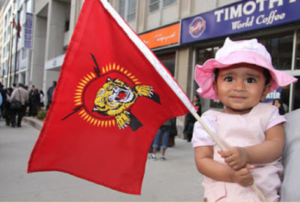
the protest. The P2P protests witnessed Tamil children carrying LTTE flags
including the son of Pulavar alias Thumpan, the deputy leader of the LTTE
headquarters group in the UK. An arms trafficker from North Korea, Pulavar was
based in Indonesia moving weapons to Sri Lanka.
Like most LTTE
functionaries that engaged in terrorist support activity, Pulavar masquerades
as a human rights activist.
According to foreign
intelligence, the headquarters group led by Anthony Cruz alias Sangeethan alias
Dayabaran has been funding LTTE attacks in Sri Lanka. Cruz, a functionary of
the LTTE national intelligence under Pottu Amman 1990 to 2009 was based in
India from 1998-2003. With the end of Sri Lanka’s battle against terrorism in
2009, Cruz travelled to the UK through India.
In addition to the HQ
group, known as World Tamil Historical Society, the P2P has been funded by the
Tamil Coordinating Committee, another LTTE front led by Nediyawan.
Q: Does Sri Lanka
really need the 13th Amendment?
A: The 13th Amendment to
the Constitution of Sri Lanka (13A) created Provincial Councils in Sri Lanka.
The Councils were created after July 29 1987, when the Indo-Sri Lanka Accord
was signed between Indian Prime Minister Rajiv Gandhi and President J.R.
Jayewardene.
The background to the
Accord was India providing sanctuary, financing, arming, training, and
directing the LTTE. With India compelling Sri Lanka to sign the Accord, the
government faced an insurrection in the south. The unhappiness was reflected
when a naval rating hit Rajiv Gandhi nearly assassinating him.
The LTTE assassinated
Gandhi after returning to violence having reneged on the Agreement. The reality
in Sri Lanka is that any Government devolving powers to the North and East will
be toppled. The historical experience is that devolution of power to the
provinces will be exploited by the separatists to secede.
Tamil politicians both
TNA and others are not trusted. They are either associated with the LTTE
international network or with India. In February 2016, the Chief Minister of
Sri Lanka’s Northern Province, C.V. Wigneswaran sought India’s direct
intervention in the complete implementation of the Amendment.
Having suffered from
Indian covert assistance to the LTTE and five other terrorist groups, Sri
Lankans detested Indian intervention. Although India is unlikely to rearm the
LTTE, Sri Lankans are suspicious of Indian designs especially, in the north and
the east.
Increasingly, an
opinion is building in Sri Lanka to abrogate the 13th Amendment along the lines
of India revoking the special status, or limited autonomy, granted under
Article 370 of the Indian Constitution to Jammu and Kashmir—a region
administered by India as a state which consists of the larger part of Kashmir
and which has been the subject of dispute among India, Pakistan, and China
since 1947.
On August 5, 2019, the
Government of India, cut off communication lines in the Kashmir Valley, a
region gripped by a prolonged separatist terrorism and insurgency. Kashmiri
politicians were taken into custody, including the former chief minister.
The Government is
aware of the LTTE planning to harness the political freedoms in the north and
the east and subvert the Tamil community. If there is a revival of the LTTE,
the Sri Lankan Government will not hesitate to move in this direction.
The current strategy
by the separatists is to masquerade as human rights activists and provoke
Government overreaction. As such, the Government did not respond decisively to
the P2P protest. However, having witnessed the detrimental impact of the
protest, the Government will no longer permit a similar episode as it
compromises the hard won stability and security.
The Government is also
aware of the LTTE working both on the political and terrorist fronts. In
addition to plotting intermittent attacks, the LTTE network overseas is
building a support infrastructure in the north and the east.
After the military
defeat of the LTTE in May 2009, Sri Lankans are unwilling to devolve land,
police and financial powers to the provinces. The structure implemented in the
North and the East should be acceptable to all parts of the country.
The latest show in town for all matters concerning the law. Today’s topic – Sri Lanka cannot compromise at the UNHRC sessions Guest : Former permanent representative of Sri Lanka to the United Nations Tamara Kunanayakam,
In
September 1973 a Military Coup helped by the USA against Salvador
Allende, President of Chili in which he died, and the suffering of the
people that followed cannot be understood by any one, other than those
who went through it.
So
it is with Sri Lanka, no one can understand the suffering the
people went through under a ruthless terrorism for 30 years. In Sri Lanka
the Armed Forces were only doing its duty to protect the country and the people
from an enemy who was aiming to brutalise the people to finally divide the
country territorially.
This
Her Excellency the UN High Commissioner for Human Rights Michelle Bachelet will
agree with if she were to take an unbiased objective look at the
situation Sri Lanka was facing at the time.
Mme
Bachelet, no one can understand the Mental Situation of His Excellency
Salvador Allende the President of Chili, when Palais de la Moneda was
surrounded in an Army Coup led by Pinochet supported by the USA.
Was Salvador Allande assassinated or did he commlit suicide shooting
himself with the gun his friend Fidel Castro had presented to him ?
President Salvador Aillende’s suffering ended with his death , but
that of the Chilean people only began after his death.
Chilean
People- men and women were arrested and imprisoned according to the whim
and fancy of the armed forces. They were being questioned and tortured for
days. All typpes of gruesome methods of torture were invented and used against
the people.
One torture method, which was very commonly used, was the
“grill” or “La
Parrilla.” In this torture, electricity was fed
from a standard wall outlet through a control box into two wires each
terminating in electrodes…… The naked prisoner
was stretched out and strapped onto a metal bed frame, or a set of bedsprings,
and tied down. He or she was subjected to electrical shocks on several parts of
the body, especially on sensitive areas like the genitals and on open wounds.
(The Valech Report )
Villa
Grimaldi, located in Santiago, was DINA’s (Office of the National Intelligence)
most important torture center that began operating in 1974. Prisoners were
interrogated for long periods of time. Once people were incarcerated on a
massive scale, new places were reconditioned to hold them. The
“tower” was designated as a holding center for political prisoners.
There was a water tank on the top floor of the building, which included ten
tight spaces where prisoners were held. These spaces were so small that victims
had to enter them by crawling on their knees. The tower also included a torture
chamber, where prisoners were kept in isolation. Many of them were never seen
again. Food was scarce and the conditions were extremely unsanitary.
President
Aillende was being accused by his enemies as a dictator, and thus
prepared the ground for a Military take over of Chili.
The
above facts were given to remind the UN Commissioner for
Human Rights, what had gone in her own country to make her
understand how difficult it is to make outsiders understand the genuine
intention of an Armed Force of a country which is people friendly, and was
doing its best to save the Tami civilians from a group of ruthless
terrorists who were unconcerned about the suffering of the people; but
only interested to set up a separate Tamil State in the North and East of this
little Island.
The
Sri Lanka Armed Forces never tortured the terrorists or the civilians, because
such cruelty is not in their nature. But the terrorist caught
the soldiers and policemen who strayed into areas under their control and
tortured them.
The
terrorists were determined to carry on its perilous intentions careless of the
suffering of the innocent Tamil civilians consisting of young and
old men, women and children, who were forcibly kept as a human shield to
protect themselves from probable attacks by the Government armed forces.
However,
the Armed Forces despite risking the lives of its soldiers were intent on
saving the innocent Tamil people being kept by the terrorist as a human shield.
At a given moment before the final assault against the terrorists
the Armed Forces decided to evacuate the Tamil Civilians serving as a human
shield for the terrorists. The Armed Forces risked their lives in a
most daring rescue operation perhaps carried out for the first time by any
Armed Force in the World, bringing away to safety 292,000 Tamil
civilians held by the terrorists as a human shield.
This episode of the evacuation of 292,000 Tamil Civilians by the
SrI Lanka Armed Forces has not been mentioned by the Tamil
diaspora, nor have the UNHuman Rights Commissioners have mentioned
it in their reports. The Tamil civilians are still not allowed to speak
freely of the kindness , friendly and human treatment they received from the
Soldiers and the Officers of the Sri Lanka Government Armed Forces.
The
damning annual report that is presented at the UNHR Council Session in Geneva
is an accusation of the Sri lanka Armed Forces, all blame and
damnation heaped on it, as the Armed Forces carried out a war
against ordinary Tamil people, as if the existence of terrorism in Sri
Lanka was mere imagination, and the claimed 30 years of suffering of the
people of Sri Lanka under terrorism was hallucination.
To
write such a report, white washing the terrorists clean, putting all the
blame on the Sri Lanka Armed Forces, those in the Office of the UNHuman Rights
Commission who wrote the report, may have perhaps been generously
compensated by the Tamil diaspora that gather in great numbers during the UNHR
Council Sessions in Geneva, shouting slogans, condemning the
Government and the Armed Forces of Sri Lanka. These Diaspora personnel have
easy access to the UN Human Rights Council in Geneva, as they have access
to the UK Parliament where they even have the meetings and celebrations in it.
That is how close the Tamil terrorist lobby is to the West and UK.
Therefore, Mme Michelle Bachalet considering the experience
you have as a politician , your socialist background, and the suffering you
yourself went through under a dictatorship in your homeland, it is
important you read the Maxwell Paranagama Report presented to the UNHR
Council by the Government of Sri Lanka, and revisit the report
prepared by your Office before it is presented at the Geneva Session. You may
perhaps make a more progressive move Mme Bachelet, by consulting the Government
of Sri Lanka before the Report is presented to the UNHRCouncil Session in
Geneva.
For
the Sri Lankans Madam Bachelet, the Officers of the Army, Navy and
Air Force, Soldiers of the Army, sailors of the Navy, the men of the Air
Force, some of those who gave their lives; others who gave their limbs
and still live, are all their heroes, who saved them from a probable
atrocious death under terrorism, gave them peace, and provided them
security.
Therefore, they are happy to see army personnel occupying
responsible posts in the administration of the government , because they can
trust them and the soldiers are there to help them whenever they are
faced with natural disasters. The Armed Forces gave them peace and
security, now they assure their protection. The people of Sri Lanka do not
consider having them working in government administration a militarisation. The
Armed Forces are actively helping the people in the pandemic. For the
people of Sri Lanka the Tri Armed Forces are a source of strength.
The
people are happy to have their war heroes taking responsibility in the
administration of the country, their country whichthey saved from its
enemies.
The British were said to have been Gentlemen. But that
was a long time ago. When the US wanted to declare war against Iraq, Tony
Blair the Prime Minister of the UK prepared a false document to say that
Iraq was producing Weapons of Mass destruction. The USA declared war against
Iraq on Tony Blair’s false report. Iraq was bombed, turned to
rubble. American and British Forces occupied Iraq and searched,
but they found no weapons of Mass destruction anywhere in Iraq.
Now it is this Britain that is leading the Core Group.
It
is not surprising that the UK has announced that it, along with Germany, Canada
Macedonia and Montenegro, is forming a Core Group to present another
resolution to replace the US Resolution 30/1 from which Sri Lanka withdrew
its sponsorship. Now a Core Group with bloody hands. The UK which
has committed violation of human rights throughout its imperial past
massacred people in some areas in Sri Lanka killing all males above 18
years, and burnt villages. It had been so even in other countries it colonised
including in India. Canada continues to violate human rights of its own first
citizens, the native Indians, kept strictly in reservations meant for
them . Germany we do not know why it joined the Core Group unless it wants to
own Naazi Holocaust. Macedonia and Montenegro are like puppies running
after adopted masters.
Yasmina
Sooka who was one of the three member Darusman Committee that wrote the false
Darusman Report, keeps yelling accusations against the Officers of the Sri
Lanka Armed Forces each time they are offered a responsible position in
the Government, is probably paid by the Tamil Diaspora and now doing it
for a living.
The Armed Forces of Sri Lanka cannot be compared to any other
armed force of the world. The equipment our Armed Forces have is only
that required to protect the country and its people. To help the people
in any natural calamities the country may face such as floods, a tsunami; a
pandemic like the Covid-19, or other unforeseen situations. We have no material
for heavy bombardment or equipment for toture chambers. Our Armed Forces
serve as a peacetime Army constructing Temples, reconstructing
ancient places of worship which are our National Heritage, Churches or homes
damaged in wind and flood. Even help in emergency construction of roads,
hospitals and buildings of utility value. They even engage in farming,
hoteliary, or special transport services using boats.
The retired Army Officers with special training in
Administrations are appointed where their experience could be made use of
elsewhere. This is useful to a developing country such as ours as
frugal use of the economy is a need.
The
members of our Armed Forces consist mainly of Buddhists, who are kind and
serviceable. Those of other religions are reliable and religious.
Therefore
the men of our armed forces should not be seen as undesirables, but as
respectable persons worthy of serving Sri Lanka which is their
country, or if needed serve in any country in the world which
requires honourable men of good moral conduct.
It
is only the Tamil diaspora abroad, the Tamil politicians who represented the
terrorists in Sri Lanka Parliament, acted as a voice of the terrorists, who
still lead the Tamil political groups to setup a separate Tamil State,
that carry damaging false propaganda against the Armed Forces and retired
members of the Armed Forces who now help in administration.
It
is the USA that helped in the Chili army coup against the
Government of Salvadore Aillande, which leads the western countries such
as the UK led Core Group against Sri Lanka. It is supported by the
Tamil Diaspora and the local Tamil politicians. It is they who are behind
these accusations which you have supported in your report to be presented at
the next UN High Commissioners Human Rights Council Sessions in Geneva.
Madam Michelle Bachelet as a Socialiist yourself, and twice
the President of Chili, in view of what has been written above, it
is necessary that you revisit your report, and perhaps consult the
Government of Sri Lanka before you present your greatly exaggerated
report to the Council Session in March,2021.
Mahinda Gunasekera Tambrook Drive Agincourt, ON M1W 3L9
Dear Madam Jean Yip,
MP Gary Anandasangaree’s baseless campaign to push for a Mono-Ethnic Separate State in the North and East of Sri Lanka
I am a resident of Scarborough-Agincourt for the past 38 years having migrated to Canada in 1975. I understand that MP Gary Anandasangaree who is a member of the Liberal Party caucus has arranged a Zoom meeting for parliamentarians on the 10th of February to canvass support for a resolution on Sri Lanka aimed at establishing a Mono-Ethnic Separate State encompassing 35 percent of the island’s land area and 60 percent of the coastline and adjacent territorial waters for Tamils numbering approximately 5 percent resident in the region. Majority of the Tamils in the range of 55 – 58 percent live outside the region in mixed ethnic surroundings cohabiting peacefully with the Sinhalese, Muslims, Malays, Indian Tamils, and Burghers living in the rest of the country. The Tamil community which stood at 12 percent in 1981 has declined to around 10.5 percent with a million or more immigrating mainly to western countries, while the Sinhalese are around 75 percent, with the Muslims accounting for about 9 percent, the Indian Tamils brought in by the British in the 19th and 20th centuries for work on plantations making up about 5.5 percent and the balance 0.5 percent made up of Malays, Burghers and others. Gary A seems to be more interested in creating a separate state for Tamils in Sri Lanka than the welfare of Canadians and the advancement of Canada although elected to Canada’s parliament.
The Liberation Tigers of Tamil Eelam (LTTE) which was designated an international terrorist movement by the UNSC in September 2001 has been described as the most ruthless terrorist group by the FBI, and similarly proscribed by Canada in April 2006. Canada also banned the World Tamil Movement (WTM) designating them a terrorist group in 2008, as they were found to be raising funds for the LTTE’s terrorist activities. Soon after a new organization called the Canadian Tamil Congress (CTC) was formed with new faces while the activists of the WTM operated from behind the scenes. Gary A claims to be the Legal Advisor to the CTC, and has been among the first to meet with former LTTE cadres and supporters who came by boat to Vancouver to seek asylum in Canada aboard the Ocean Princess and Sun Sea apparently to coach them to navigate the legal procedures prior to grant of refugee status.
Following the adoption of a motion by the extremist Tamil political parties in 1972 called the ‘Vadukkodai Resolution’ to set up a separate state called “Eelam”, where they envisaged the youth to take up arms, violence spread throughout the areas predominantly settled by Tamils with the youth targeting and killing unarmed police officers, local politicians, the Mayor of Jaffna, needing the introduction of emergency regulations. India which had close ties to the Soviet Bloc at the time did not like Sri Lanka building ties to the USA with broadcasting rights being granted to the Voice of America. India the regional power stepped in to arm, train and fund the Tamil guerrilla groups in Indian military bases in order to destabilize her tiny neighbour Sri Lanka. The LTTE led by Velupillai Prabhakaran engaged in internecine warfare with the other Tamil rebel groups killing large numbers to gain ascendancy of the separatist armed warfare. With the funding received from India, Tamilnadu and expat Tamils, the LTTE grew into a formidable fighting force with a land army, naval wing called the Sea Tigers, a large fleet of ocean going vessels to transport and store armaments, a miniature night time bombing air force, a squadron of 600-750 suicide bombers, Over five thousand abducted and conscripted Child Soldiers used as storm troopers in unceasing waves many of them under 15 years making it a war crime, and a trained people’s army of around 12,000 called the Makkal Padai.
In addition to money raised through human smuggling, drug smuggling, passport fraud and other illicit activities, the LTTE amassed a huge war chest by extorting Tamil individuals and businesses sums extending from $5,000 to $100,000 to launch their so called final war of liberation at the end of 2005.( Refer: https://www.hrw.org/report/2006/03/14/funding-final-war/ltte-intimidation-and-extortion-tamil-diaspora ). The LTTE cut off drinking and irrigation water to 30,000 families dependant on waters from the Mavil Aru in July 2006. The Sri Lankan authorities sought to have the water restored with the intervention of the Sri Lanka Monitoring Mission made up of Nordic representatives, but as they failed to have the LTTE resume the water supplies from the sluice gate even after two weeks, the Sri Lankan authorities were compelled to take military action to compel the LTTE forces to withdraw. The withdrawing LTTE forces next threatened Sri Lanka’s naval base at Trincomalee thereby extending the military confrontation to other regions as well. The Sri Lankan Army succeeded in forcing the LTTE forces spread out throughout the north and east to retreat from their strongholds. The retreating LTTE forces compelled the Tamil civilians living in the regions usurped by them to accompany them from the northwest coast to their final stronghold in the northeast in Mullivaikkal. They used the Tamil civilians to exploit them for their labour, conscript them to replace fallen cadre and serve as a human shield in the final battleground which is a war crime.
The ICRA reported that over 50 percent of the LTTE fighting cadres battled in civilian attire thereby blurring the distinction between innocent civilians and their armed fighters. The LTTE did not allow the civilians to move out of their area of control despite Sri Lanka declaring two 48 hour ceasefires in February and April 2009, and even fired on those Tamil civilians that attempted to flee to safety including artillery fire and suicide attacks to keep them from abandoning the LTTE fighters. This is confirmed in dispatches sent by Britain’s Military Attache in Colombo, Colonel Anthony Gash in his reports submitted to the UK Government’s Foreign Office, according to the presentation by Lord Naseby in the British House of Lords. Col. A. Gash has estimated a total of around 7000 deaths of which 25 percent or more is attributed to the LTTE shooting at fleeing civilians and not the hundreds of thousands claimed by LTTE supporters. The military action taken against the LTTE was successfully concluded on May 19, 2009.
The UNSG appointed a Panel of three led by Marzuki Darussman on his own accord without the sanction of the UNGA or the UNSC which reported that 40,000 had been killed during the latter stages from January 1 to May 18, 2009 without distinguishing between LTTE fighters and civilians. The panel admitted that their report did not meet the standards of a UN report and based their conclusions on what they claimed are “Credible Allegations”. They claimed that tens of thousands had perished during the latter stages in 2009 which they estimated at 40,000 without distinguishing between LTTE cadres and genuine civilians. The UNSG’s panel of experts recommended that their one sided report prepared from their offices in New York without visiting Sri Lanka be locked away for the next 20 years till the year 2031.
ICRC which ferried injured for treatment stated the total WIA was 18,439. The injured normally is 2-3 times the KIA which makes the injured total to be between 80,000 and 120,000. Gordon Weiss the UN Spokesperson in Colombo claimed a total of 7721 deaths to May 13, 2009 based on verified information gathered from UN/INGO employees, doctors and pastors within the battleground. In his book titled ‘The Cage’ he claimed 40,000 deaths with an eye to profit from sales to the over one million Tamil expats living in the west.
The Tamilnet a propaganda arm of the LTTE reported a total of 7398 deaths. The GOSL carried out a census in 2012 using teachers and public servants from the Tamil community as enumerators to arrive at a figure of 7432 deaths. Lord Naseby revealed in the UK House of Lords that according to the British Military Attache, Col. Anton Gash, the total killed was about 7000. Amnesty estimated 10,000 deaths while the US embassy fixed the death toll at 5,000. The Pro-LTTE groups, Yasmin Sooka of ITPJ, and Frances Harrison reported deaths in excess of 100,000 without a shred of evidence. Amnesty and HRW commissioned a report from AAAS to study the satellite imagery of the final battleground where they determined a total of 1346 burial spots in three sites within the Civilian Safety Zone which did not support the alleged high casualty figures.
295,873 persons including 12,000 former LTTE fighters plus a further 594 child soldiers were rescued, provided medical attention and place in welfare/rehabilitation camps before being released following the demining of their villages.
To deal with the complex questions of international law relating to internal armed conflicts, the Justice Maxwell Paranagama Commission was assisted by a panel of globally recognized legal luminaries headed by Sir Desmond de Silva,QC. (UK), Professor Sir Geoffrey Nice, QC. (UK) and Professor David M. Crane (USA), who had earlier been appointed by the UN to prosecute cases filed against those tried for HR and IHL violations before the ICC. This panel was assisted by Mr. Rodney Dixon, QC.(UK), Prof. Michael Newton (USA), Prof. Nina Jorgensen (Harvard,USA), Commander William Fenrick (Canada), and Maj. Gen. Sir John Holmes former Commander of the SAS (UK) who looked at the military aspects to determine if the loss of civilian life could be deemed as collateral damage if it occurs in the performance of a military necessity and proportionality in terms of IHL. In fact, I do not believe that the strategic difficulties of resolving the last phase of the war have been fully appreciated by military strategists until relatively recently” he says. Holmes concludes, on the evidence, that the SLA’s operations, in broad terms, were proportionate in the circumstances”.
Following the conclusion of the military action, Sri Lanka undertook a massive rehabilitation and reconcilation program, some aspects of which are noted below for your information:
Two American scholars recently debunked the myth of the Chinese “debt trap,” saying that exhaustive research shows that Chinese banks have never actually seized an asset from any country and are willing to restructure the terms of existing loans.
They called the Chinese debt-trap narrative “a lie, and a powerful one.” Deborah Brautigam, one of the authors of the research, published their findings in The Atlantic along with a professor from Harvard Business School last week.
For years, there has been an anecdotal myth saying that China inveigles poorer countries to take loans that they can’t afford to build expensive infrastructure, and when they can’t pay back the loan, China would try to take control of those assets from borrowers, according to the paper.
One such myth is that a Chinese firm pushed Sri Lanka to borrow money for the construction of Hambantota port, and a Chinese firm eventually took over the port when Sri Lanka defaulted on the debt.
However, the academics found it to be a lie. According to the research paper, around two decades ago, a Canadian company, then a Danish company both explored the feasibility of building the port at Hambantota, a city in the southern tip of Sri Lanka. They didn’t move forward due to a variety of reasons. Then Sri Lanka’s government approached the U.S. and India with the plan of building a port there, and both denied. Meanwhile, China Harbor Group learned the Sri Lanka government’s hope, and won the contract, backed by China Eximbank.
Sri Lanka’s debt burden soared since the government embarked on a debt-financed push to build and improve the country’s infrastructure after the civil war came to an end in 2009. According to The Atlantic, of the $4.5 billion in debt service Sri Lanka would pay in 2017, only five percent was because of Hambantota, and the central bank governors under both Rajapaksa and Sirisena said that “Hambantota, and Chinese finance in general, was not the source of the country’s financial distress.”
When responding to former U.S. Vice President Mike Pence worrying that Hambantota could become a “forward military base” for China, the report explained that Hambantota’s location is strategic only from a business perspective. “The port is cut into the coast to avoid the Indian Ocean’s heavy swells, and its narrow channel allows only one ship to enter or exit at a time, typically with the aid of a tugboat. In the event of a military conflict, naval vessels stationed there would be proverbial fish in a barrel,” the report says.
The Atlantic mentioned that companies from other countries have also benefited from Chinese-financed projects. For instance, Meghraj, an Indian-led company, joined the UK-based engineering firm Atkins in an international consortium to write the long-term plan for Hambantota Port and for the development of a new business zone.
As for authors, one is Deborah Brautigam, a professor of International Political Economy at the School of Advanced International Studies at Johns Hopkins University while the other one is Meg Rithmire, an associate professor at Harvard Business School.
Samagi Jana Balawegaya (SJB) today confirmed that its leader and Leader of the Opposition, Sajith Premadasa had met former Prime Minister Ranil Wickremesinghe a few days ago.
SJB MP Gayantha Karunatilleka who was responding to a question raised by journalists at a press conference confirmed that there was a meeting between Mr. Premadasa and Mr. Wickremesinghe and said the duo discussed the report of the Presidential Commission on political victimisation.
There was a discussion with the UNP at the highest level. However, according to my knowledge, the discussion has been centred on the report of the Presidential Commission on political victimisation and how to face the political consequences regarding same,” Mr. Karunatilleka said.
The arrangement is to deal with the presidential commission together and to make a common call for the tabling of documents in Parliament without delay,” he added.
It was reported that Mr. Premadasa had met Mr. Wickremesinghe at the latter’s residence and had discussed forming a broad political alliance.(Yohan Perera)
Former Speaker of Parliament W.J.M. Lokubandara has passed away today (February 14) at the age of 81, his family sources said.
He was under medical care for Covid-19 at the Infectious Disease Hospital (IDH) at the time of his passing.
Earlier this month, it was revealed that the former speaker had tested positive for novel coronavirus.
A lawyer by profession, Lokubandara embarked on his political career in 1977 after being elected as a Member of Parliament representing the United National Party.
He was appointed as the Cabinet Minister of Cultural Affairs, Education and Media in 1989.
Following the UNP’s defeat in the parliamentary election in 1994, Lokubandara became the Chief Opposition Whip of the House.
He was the Cabinet Minister of Justice, Law Reforms, National Integration and Buddha Sasana in the UNP administration which was formed in 2001.
Lokubandara also served as the 16th Speaker of Parliament from 2004 to 2019.