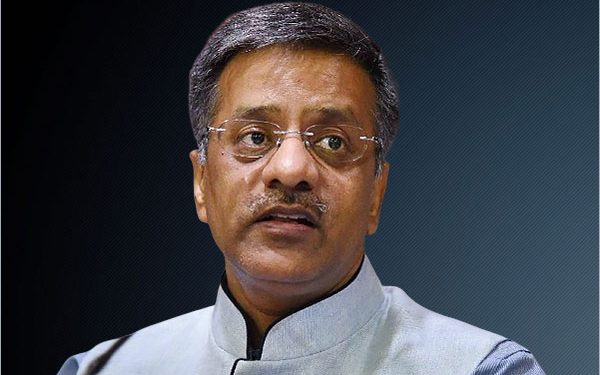
Minister Wimal Weerawansa states that the results of this election confirm that the people of the North and East have rejected racist and extremist politics.
The Minister stated this while participating in a public meeting held in Homagama area.
Meanwhile, the MP also commented on a statement made by Samagi Jana Balawegaya MP Harin Fernando criticizing the arrival of President Gotabhaya Rajapaksa to attend the inaugural session of the new parliament.
A few Buddhist
monks who have long been vocal protestors against the anti-Buddhasasana
activities of a large number of foreign funded fundamentalist religious groups
and a hitherto unheard of, relatively obscure monk by the name of Wedinigama
Wimalatissa are embroiled in a violent controversy over the single national
list seat won by the Ape Jana Bala Pakshaya (AJBP) at the recent parliamentary
election. (AJBP did not belong to the monks until a few days before nominations
for the election closed. They arranged, apparently, on an ad hoc basis, through
some commercial transaction, to contest under this previously registered
party.) Wimalatissa Thera is a resident monk of the Asgiri Vihara monastery in
Kandy, involved, as can be guessed from scrappy information available in
the social media, in some proprietary dispute with the hierarchy there; he is
not known to have had any relationship in the past with the aforementioned
agitating monks. The visage of the monk that first came out in the media was
that of a bearded bounder.
At the time of
writing, Wimalatissa is reported to have disappeared amidst the controversy,
either gone into hiding, or held hostage by a rival group in some unknown
place. But a YouTube journalist tracked him down and interviewed him a couple
of days ago. Wimalatissa Thera was/is said to be the Secretary of the AJBP. It
is also claimed that he has been replaced by the party’s working committee. He
told the journalist that he nominated himself for the seat in order to prevent
a clash between two senior monks of the party over it; he claimed he wanted to
go to parliament and after a short time relinquish his MP post and hand it over
to one of the two senior monks who he thought was more suitable to occupy the
seat. Earlier on in the interview, he mentioned the name of the particular monk
he had in mind; but he forgot about it towards the end of the interview, where
he said he would make way for the other monk who, he said, was more
knowledgeable and more experienced as he had already been an MP
previously.
The two senior
monks alluded to here are respectively the well known Gnanasara and Ratana
Theras. There appears to be something more than meets the eye here. It is
claimed by a prominent lay activist (who, presumably) was among the founders of
the AJBP) that a Sri Lankan man he named with a shady past who is based in
France is directing Wimalatissa to throw the allocation of the AJBP’s national
seat into crisis as an attack on the monks’ legitimate nationalist cause
(of countering the threat posed by certain extremist religious fundamentalist
sects, protecting the historical Buddhist archaeological and cultural heritage
of the country, and ensuring the survival of the majority Sinhalese in
their hallowed homeland of many millennia). Another version is that this is all
Ratana Thera’s doing. He is even alleged to have abducted Wimalatissa Thera.
Ratana has been in parliament for fifteen years (through the previous UPFA and
Yahapalana administrations of 2005-19), but he has little to show for it,
except his substantial contribution to the ouster of the war winning MR
government, that helped in inflicting the Yahapalana misrule on the just
liberated country. In any case, the monkeyish buffoonery is a wheels within
wheels affair that is bound to reflect very negatively on the whole Maha
Sangha, who have historically been required to always face the brunt of enemy
attacks on the Buddhist nation. But these squabbling monks (a mixture of good
and bad ones) are only a handful out of the total 36,000 who, unfortunately, do
not have the united ecclesiastical leadership and guidance that they can’t do
without in these trying times.
The unseemly
struggle of a few monks over a parliamentary seat has already left a bad taste
in many a mouth among the voting public who have delivered a two thirds
majority victory to the nationalist SLPP led by Prime Minister Mahinda
Rajapaksa under the overall leadership of President Gotabaya Rajapaksa for the
purpose of implementing their ‘Vistas of Prosperity and Splendour’ program of
economic development as spelt out in the SLPP election manifesto. No better
guarantor of the protection of the Buddhist archaeological and cultural
heritage of the country and of equitably distributed economic development
without any discrimination towards the minorities, than this duo can be
imagined at present. But these monks could prove to be an impediment to the
realization of the nation’s dreams.
The fact that
only one monk has been elected to the parliament in a country where over 70% of
the population are Buddhist shows that they don’t approve of monks doing
parliamentary or party politics. The new government must introduce legislation
to ban MP monks. It is respectfully submitted here that the Venerable Maha
Nayakes ensure that this is included in the new Constitution.
It is the
conviction of the monks and the people led by them that only a strong Sinhala
Buddhist leader is capable of providing good governance for all Sri Lankans of
diverse ethnicities and religious persuasions without discrimination, something
explained by Arun Janardhanan of The Indian Express newspaper/August 16, 2020
in these words:
‘A top leader
close to the ruling dispensation said poll results means nothing but the fact
that Sri Lankan people wanted a strong Sinhala Buddhist leader. MR (Mahinda) is
the most popular, Gota (Gotabaya) is the most powerful (now). They are not
racists. Gota knows that development-focused policies alone will save our
country, not a racist-ethnic politics. He was working towards that, to improve
the economy, he will continue to do that,” the leader said’.
That legitimate hope has just begun to be realised with the election of Gotabaya Rajapaksa as president in November last year and the swearing in of the new parliament overwhelmingly supportive of his brother prime minister Mahinda Rajapaksa. It is time the monks left them alone to do the needful. –
2020, Year
of Great Expectations of a nation after 72 years of pompous celebrations of
so-called Independence since 1948. Will they be fulfilled at least now, under the
Government of Gothabahaya Rajapaksa?
Introduction
I start writing this note on the assumption
that we have not received any independence, other than the room to elect local
representatives to Parliament under a system orchestrated by the British with
serious limitations on us as an Independent nation. (This subject has to be
treated separately as it is outside the scope of this essay. (Please see Did
this country get any Independence in 1948, Lankaweb 31.1. 2019.)
The purpose of this essay is to
highlight the long overdue grievances of a nation neglected, not addressed and
therefore betrayed by its own elected rulers for the past 72 years after
celebrating a fake Independence we are supposed to have got
in 1948 and bring them to the immediate attention of
the new President and the people’s Government elected by them with
unprecedented faith and hopes in one person called Gothabahaya from Magama in
Ruhuna, the birth place of legendary King Dutugemunu the Great, to get those
historical injustices inflicted upon a nation, both by invaders and by their
own leaders rectified at least now.
Looking at
the way how President Rajapaksa has spoken and acted since his historic
swearing it at the Ruwanweli Mahaseya up to the latest at the inauguration of
the 9th Parliament on the 20th of August one can have the
highest confidence in him as a true patriotic Sinhala Buddhist leader that he
will definitely fulfill the
burning unfulfilled aspirations of this nation.
As we all
know historically Ruhuna had been the cradle of national heroes throughout
history and the birth place of the nation’s greatest war hero King Dutugamunu,
from where Gotabhaya also hails.
Incidentally among the King Dutugemeun’s Dasamaha yodayas there was also a warrior by the name Gothayimbara,
the patriotic people of this country believe is reborn as Gothabhaya, the
legendary Diyasena mentioned in Perakumbasirita to save this nation and its
motherland.
A Long list
Obviously
the list of grievances given here is too long. But readers have to bear with me
as this constitutes a dream of an 82 year old patriot of this soil who has been
fighting and yearning for this change for the last 50 years and who does not
wish to die without getting them fulfilled by someone before the writer closes
his eyes in this life.
The writer believes the expectation
of the majority people in this country to be the same as those of the writer as
he too comes from the same class. The expectations of the people at this
election were greater than at any of the previous elections since so-called
Independence.
First and foremost they expect this Government
to be the best since the so-called 1948 Independence, that will usher in a
period of sanity, peace and prosperity preceded by restoring law and order and
full freedom from all internal and external threats like narcotics, underworld,
frauds and bribes, corruption and wastage of public funds and abuse of
authority on the part of both politicians and public officials and unnecessary
interference by foreign countries in the domestic matters of the country. They
also expect a patriotic and people friendly government under the present
leadership. In short they expect a government by the people, for the people and
of the people’ in place of the corrupt and oligarchic ‘government of the
politicians, for the politicians and of the politicians’ as we have had up to
date in this country from the time we know.
A legacy of
deception and betrayals
1 Sri Lanka is a nation that had been
deceived and betrayed by their own politicians who were only implementing the
British system of government with its political, legal and administrative
systems as laid down by the British under the Soulbury Constitution for the
past 72 years of so–called self-government that benefitted only the
politicians and their kith and kin ever since 1948.
2 As a result the country and once a
Great Nation in the world had been dumped in to an Augean mess almost beyond
recovery by all successive governments by blindly following the British system
of governance completely alien to us, that was designed to divide and destroy
the 2500 year old Sinhala Buddhist civilization in this country, without going
back to our roots we had inherited for millennia, to make this country a free,
independent, vibrant and prosperous country, in spite of its unique location on
the globe and enormously rich natural and human resources. The British not only
divided and destroyed the Sinhala nation that existed up to 1815 including
Tamil and moor elements, on ethnic, linguistic and religious grounds and
labeled it as a multi-ethnic, multi religious and multi- racial nation but also
they divided the country in to Provinces based on language, religion and ethnicity on grounds.
What was worse is they even conferred special
privileges on Tamil and Muslim minorities who were outsiders and forming an
insignificant fraction of the total population of the country by allowing them
to have their own civil courts, marriage and divorce and inheritance laws while
depriving the native Sinhalese of their entire legal traditions and forcibly
imposing the Roman Dutch and English Laws on them. Unfortunately no politician
at that time raised these issues. Even today the same discrimination remains.
3 We are a nation that claims a long legacy of
an Independent and sovereign government of our own with a glorious heritage
that flourished on this land for nearly 2600 years or even more, as recent
archaeological evidence have found. It
was annexed to the British Empire by convention between two sovereign nations in
1815 (the only country in the world so annexed without defeating by war) , 1815
Convention was completely replaced by Royal proclamation of Nov 21 1818 by
Brown Wrigg (the brutal colonial murderer) that made the 1815 Kandyan
Convention of March 2nd completely a dead letter But in practice although it
still stands valid as a legal document drawn between two sovereign nations
under International law.
4 69.5
million people in this country who elected President Gotahabhaya Rajapaksa as
their President on 16th of November 2019 and elected this government
in to power on 5th August 2020 with a 2/3 majority winning almost all Districts
are aspiring for a complete change in the existing political, legal,
administrative systems and socio-cultural outlook under a new Constitution that
is based on our own civilization, that is the Sinhala Buddhist culture that has
nurtured this nation for more than two and half millennia and taken to great heights,
at least now, as Martin Jacques has pronounced in his famous treaty When China
Rules the World” 2009.
5 Therefore the need to replace the Alien British system of
governance with the native system of State craft that flourished over time and
time tested for 2 ½ millennia on this
land as a Sinhala Buddhist model introduced to this Island by Arahat Mahinda
Thera in 307 BC. At least now we have to
tell the world that we were not barbarians when British annexed this country by
deceit and we were a nation with a with
a great civilization with our own statecraft and legal system long before the
British were known as a civilized nation in this world.
Under this backdrop the gap between
the achievable and expected goals of the nation is extremely wide. I call this
election a historic event and a mass uprising calling for a turning point in
the history of the Island Nation. This is why I name the coming years as an age
of Great Expectations of the Sinhala nation.
Preliminaries
1 Immediately after completing the
Parliamentary formalities like appointing the new Prime Minister, Speaker, the
Deputy Chairman, Leader of the Opposition etc,
people of this country want the President to appoint a small Cabinet
(say 20 the most) out of the best with clean track records, eminent in
different fields and acceptable to the people from among the elected. No
National list MP should be appointed as a Cabinet or State Minister as they are
not elected by the people and not responsible for the people. (In fact this
so-called national list that has already become a big joke, eroded democracy
and become a mere tool of the Party
leaders and come to remain as a dead weight around the nation’s neck should be
abolished at the first opportunity the government can do it legally.
2 Then, beside the usual swearing in
made under the Fourth Schedule to the Constitution to defend and uphold the
Constitution etc get them also to swear that hence forth they will devote
their full time for the good of the people and the motherland discarding all
personal agendas” as it had been the practice up to date in this country. Also
make it mandatory for all MPP to attend all session and remain their the full
time until the proceedings of the day are over, violation of which should be
made punishable
The Prioritized list of people’s expectations
What the
people who voted this Government expect from it now
I list below some of the main burning
issues and grievances what the patriotic people of this country who have voted the President in last November and the SLPP in
to power on August 5th 2020 election expect the new Government under
Gothabhaya to resolve with the least delay, as they have been already delayed
at least by 72 years
A list of
High priorities are given below
1 A Cabinet of 20 from among the
elected Members of Parliament only
2 Bring down cost of living
immediately as it is priority No 1 of the masses and restore the stability of
the Rupee
3 Politicians elected by the people
should work for the good of the people and the country and not for their own
enrichment
4 Remove the 19th Amendment, without
restoring the 18th retaining its good provisions in the 20th A and
restoring full Executive powers of the President sans Presidential immunity
5 Restore law and order and good
governance in the country by reorganizing, restructuring, streamlining and
pruning the political, legal and administrative institutions as most of them
have become big burdens to the economy
6 Formulate a strict code of conduct
for all politicians and public servants and set targets for both groups
(monthly/six monthly)
7 Scrap the Ministry for Hill country
New Villages, Infrastructure and Community Development Ministry created by the
previous Govt immediately, that was meant exclusively for Estate Tamils and
Indianization of this country
immediately that discriminates against the Bhoomiputras , the Sinhala nation
and Instead
8 Set up a
separate Ministry immediately for the rehabilitation of native Kandyan peasants
under the President as the Head of the State to restore and rehabilitate the
Kandyan Peasants as proposed in the KPC Report of 1951. (That would be the
greatest tribute the President could pay to the hundreds of thousands of those
valiant Sinhala patriots who sacrificed their lives and everything they had,
from 1505 to 1848 to protect this country for the Sinhala nation.
9 Close down the Indian Consulate
offices in Hambantota, Jaffna and Kandy ASAP as they pose a big threat to our
Independence and sovereignty. There is absolutely no need to have four
consulate offices in all strategic corners in a small country of 25 000 sq
miles when they have a fully equipped A class Embassy in Colombo, unless the
India has a secret plan up in its sleeves.
10 Revoke the JR/Rajiv Accord of 1987
and the 13th Amendment, the two Indian made Kautilyan Atomic bombs to bring
this country under its full control and finally annex this Island to the Subcontinent
and destroy the Sinhala Buddhist civilization on this planet.
11 This should be followed up by
abolishing the Provincial Councils (created by India) together with the
Provinces created by the British to destroy the Sinhala Buddhist nation
12 Also abolish the Pradesiya Sabha
System and go back to the native Village Council that administered this
countryside of this nation from 427 BC also save trillions on their future
maintenance as it had been done for 35 years since 1987 which has brought
absolutely no benefit to the country or the people but had been disastrous only
all round (Politically, administratively, economically and socially) while
providing a heaven for politicians at lower level and vote netting for
Parliamentarians.
13 Declare this country again as ‘The Sinhala Buddhist Kingdom” as it had
been before 1815 for 2500 years
14 1nvoke the 6th Amendment of the 1978 Constitution immediately and ban
all political parties named after ethnicity, religion or race, leaving only
National Parties
15 Restore the historical name of
this country SIHALE that was there in 1815 when it was ceded to British by
Convention and rename all villages named by Sajit Premadasa as Gramams (18),
(Indian), and Akbar Nagar (Arabian) etc with tax payers money with the
ulterior motive of collecting Tamil and
Muslim votes
16 Grant citizen ship to Indians only
under the Nehru/Kotalawala Agreement 1954 and revoke all citizenships given
under all other criteria just to collect their votes since 1956
17 Enact a New Constitution ASAP
based on our culture limiting Parliament to 160 seats, Scrap the National list
and Limit the Cabinet to 15 Cabinet Ministers and deputies to about 20
18 Ban establishment of all mono
Tamil or Muslim Settlements in any place in the country as it is done today
specially in the Central hill country
19 Remove all special privileges
given to MPP like pension after five years (a gross violation of the Pension
Act and a criminal discrimination against nearly 600,00 Government pensioners
who get a pittance after 35 years of hard labour), duty free vehicle permits
every 3 years and many more , too long to be listed here, to discourage selfish
people getting in to politics to make money at public expense
20 Save Sri Lanka from the tyranny of
minority politics by banning all political parties set up on racial, religious
or regional basis Like Tami, Hindu Muslim or even Sinhala.
21 Remove the obnoxious so-called
National list of 29 to reduce the burden on the people
22 Stop appointing any Tamil or
Muslim as Ministers of Justice, Education., Trade, Land, Cultural Affairs,
Foreign Affairs, Ports And Shipping and Plantation, unless and until they
accept that this is the Land of the Sinhala Buddhist Nation and they are only minority communities living
in that country and they never claim separate Kingdoms with self-rule” and
also unless you find a person of Luxman Kadiragama’s caliber.
23 No Cabinet Minister should be allowed to
take any decision or make any appointment anywhere without being finally
approved by the Cabinet presided over by the President
24 Introduce electoral reforms to
have one MP for each electorate and do away with the District MPP and
proportional representation system and preferential voting
24 Declare one country, one law, one
nation, one official language (SINHALA), one National Flag (sans the strips)
and one National Anthem like in any other country in the new Constitution
25 Scrap the British found Provinces
and go back to the District system of administration and reduce the number of
Districts in present Northern Province to 3 by scraping Mullative and
Kilinochchi Districts as only that Province has 5 Districts
26 Allocate public Sector jobs
according to the prevailing ethnic ratios to stop discrimination against the
Sinhala majority.
27 Stop appointing defeated candidate
to any post in government or semi-government jobs including diplomatic posts as
it is often done today.
28 Make Buddhism the State religion
and bring the Ministry of Buddhism under the President as it had been the
tradition throughout history in this country
29 Appoint a permanent commission to inquire
in to malpractices of all politicians and high officials from 1987 including
misuse of tax free vehicle permits
30 Eradicate the drug menace
corruption and waste in public expenditure
31 Declare all lands >5000 feet MSL
as strictly reserved Forest and ban all human settlements above 3500 ft. as it
had been declared by royal decree before 1815 and establish mixed settlement
for landless Kndyan Peasants and displaced Estate Tamil due to implementation
of this settlement rule and who are
qualified as Citizens as under N/K agreement 1954.
32 Re-name all villages and place
names given since 1815 including those made by Sajit Premadasa more recently
such as Akbar Purams and various Gramams and those given by minority
politicians like in Batticalloa and also restore ancient place names, village names and various others
like mountains, rivers and towns.
33 Reduce public national holidays to
12 as that is the number most countries have and limit religious holidays only
to those of that particular religion except Vesak and Poson that have been the
National Holidays of the Sinhala nation.
34 Stop appointing persons outside
the Sri Lsnka Administrative Service to scheduled post of SLAS and persons
outside the Overseas Service to diplomatic posts unless some special reasons
demand such persons being appointed.
35 Reduce the number of Ministries
and government and semi-government institutions by amalgamating or scraping to
reduce public expenditure, waste and corruption and also make them efficient
and cost effective
36 Allocate all public expenditure
through Ministries and Departments and institutions under Votes, Heads, Sub
Heads, and Items as we had them before holing official accountable and
responsible for every cent to stop waste
and corruption and stop allocating money to MPP, a system that has been
disastrous
37 Ban Buddhist monks contesting
election for any political institution starting from Parliament to the Village
councils
38 Ban women workers going out as
housemaids and instead reorganize the country’s education system to produce
technical and professional men and women needed by the world market
39 Completely restructure and
reorganize the Gramasevaka system as the Gramaseva Division forms the
cornerstone of effective, efficient and good governance in this country. Why
not call them again as Gampathi. (Details of this scheme could be made
available if someone is interested).
40 An independent efficient,
productive and people centric Public service and Judiciary free from Politics
and Recruitments to Public Service and Judiciary only on competitive exams and
meritocracy to be the only criterion in selection and appointment.
41 A programme to make Sri Lanka
number 1 in the world in Fishing Industry by making use of the Indian Ocean
that stretches from Africa in the West to Australia in the East and South Pole
in the South and making this country a major naval power in the world by using
our strategic location on the globe in relation to the Great East and West
trade routes and its enormous economic potentials of fabulous ports around the
Island. (The Indian Ocean is the third-largest of the world’s oceanic
divisions, covering 70,560,000 km² or 19.8% of the water on the Earth’s
surface. It is bounded by Asia to the north, Africa to the west, and Australia
to the east)
42.To convert this country to an
International hub in Aviation, Shipping, trade, Banking and all kind of
Services to make this Island a world Giant making use of its strategic location
and god given resources both natural and Human.
43 The need to take immediate action
against Hindu and Muslim vandalism against Buddhist religious places in the
North and East and to take steps to protect those places and the Monks living
there.
44 To reduce excessive public
holidays (some years running in to 132) to world average of 12 per year and to
limit religious holidays only to those who profess those religions to save
hundreds of millions of man days to boost development to catch up with the
competitive world
45 A national Planning Council and a Supreme
national Advisory Council consisting of non-political personalities
Realization of these objective
entails far and wide structural changes in systems and institutions which call
for many a hardship and sacrifices in the short term that brings long term
benefits for the country.
It comes as no surprise that with the change of government we have;
unobtrusively it may be, moved on to a different political platform/perspective.
Briefly stated there appears a shift from the more aggressive neo- liberalism
of 2015, towards a reluctant form of socialism. Not quite to the centre of that
paradigm yet, but trending in that direction. Because this perspective has not evolved into
a consistent whole, the term ideology may not yet be the appropriate
terminology. Traditionally in the neoliberal ideology the concept of choice
mattered most but to the radical socialist left it was ‘circumstance’, or in popular parlance it was
class inequality the central theme. To the socialists the default position
always came back to minimizing class disparities. It was obvious that much of
the agenda of the West engineered 2015 regime was freedom of choice and the
compacts, trade agreements, sales MOU’s, signed and unsigned, harboured this
ideology. In keeping with this ideology some of their stalwarts often stressed
secularism and political correctness while many in the opposition thought such extreme
liberality undermined the spiritual values of Sri Lankan society leading to a breakdown
in civility, individual morality and family life.
It is in this backdrop that we see the initiative moved by the new
president in his manifesto of jobs for the poorest as the initial step in his
development paradigm. On the face of it is similar to the ideology of New
Social Democracy (NSD) that British labour party of Tony Blair proposed on the
advice of his top policy advisor in Anthony Giddens named the Third Way? The
‘Third Way’ went awry with the USA led conflict in the Middle East and had an
early death. Left leaning social democrats are those who desire to bring
capitalist economies under some form of state control with reforms which are
ambitious and interventionist than those favoured by the supporters of the ‘Capitalism
with a human face’, the slogan that Chandrika Bandaranaike preferred. The New
Social Democracy comes as a more confident form of leftism with the exhaustion
of Keynesian welfare and the ascendancy of populist right wing ideas in the West.
If in Sri Lanka one were to label it as Nationalist Social Democracy (NSD) it
will be closer to reality.
The NSD can be described as radical pragmatism, a means of
countering the neo liberal hegemony. This is taking shape as the future of the
left at this moment in time. The street marches and cancel culture moves are
different strands in this project, struggling to gain its philosophical
confidence and yet to form into a cohesive whole. Its emergence was in the
1990’s as a reaction to the American thrust of the global free market, seen in
global protests at G8 forums but was stymied by the political upheavals in the
Middle East and the rise of China as a world power.
Many in the left have understood that the NSD is going to be the
next big thing in western politics. Not particularly reliant on class analysis
the NSD lays emphasis on social exclusion and freedoms of the lower classes as
the most serious impediment to social justice. But it also has a caveat and
that is its necessity to
exist within the free market. When the ‘Third Way’ was suggested as an
approach to positive social welfare based upon the notion of ‘life politics’ it
meant enabling people to shape their lives with self-confidence and self
control while being active in the economy. This is the social democracy of the
Third Way that implies inclusion of the poor in society’s way of life rather
than direct redistribution.
Tapping Capabilities and Freedoms
This is a political perspective that has resonance with Amartya Sen’s
notion of social development through participation and freedom. One sure method
of development, Sen noted, is to make development a friendly process. We have
been used to the slogan of development as a fierce process of ‘blood sweat and
tears’ in which the poor are asked to tighten their belts much to their
despair. By allowing people to participate in the process of development
through economic activity development is made friendly. Economic power is
enhancing freedoms and minimizing deprivations. The importance of this
instrumental freedom is that it helps the person to enhance his capabilities
and freedoms in the other political, social and security guarantees already
provided by the state. When the individual is provided education, health care
and so on it enlarges the capabilities of individuals and society generally.
The so called East Asian miracle we saw in our neighbouring countries in South
Asia was to a great extent a result of opening up freedoms and capitalising on
the untapped potential of capabilities in the population argues Amartya Sen.
The job maker initiative by the new President is only one segment of
the emerging perspective. There are other elements that characterize the new philosophy.
While liberalism espoused free market individualism the new variant is
somewhere between state collectivism and free market, permitting an economic
and political flexibility that utilizes the strengths of both public and
private. The titles adorning many of the state ministries that some people are
mocking at are exactly the motive, though unattractive at first sight. The next
is its emphasis on meritocracy that is a new strategy to develop equality from
the bottom rather than something to be imposed from above.
The NSD also offers opportunities in return for effort where rights
imply responsibilities. This reciprocity is connected with its appeal to the
civic sense of community and meritocracy to join in partnership with the state
to build a moralistic society. The President
requested the civic community to be a partner in eradicating drugs and the
underworld. Finally I may also add pragmatism as a priority given the rapidly
changing post COVID environment. The pandemic, which hit us from nowhere, is
the best example in which adaptation is the key. In that many countries in the
world including Sri Lanka are adjusting the import substituting domestic
industry and agriculture. For this there needs a partnership between the
private and public sector investment and management. Hence the enthusiasm in efficiency
targets, performance related pay, competition, and ‘management speak’. To
assess public sector performance as market goods. Development and social
justice in this perspective are not planning to lower the ceiling by taxing for
the sake of equality but instead raise the bottom of the social floor.
Needless to say there
are many critics and the debate will continue.
Human
nature is in itself evidence of the existence of God Almighty, for there are
certain evils which human nature inherently abhors. For example, entering
incestuous relationships with one’s mother, sister or daughter; coming into
contact with urine, bodily excrements or other similar types of filth;
falsehood and indeed all such other things which even atheists recoil from. Why
would this be true if there was no god? If God does not exist, why do men
differentiate between their mothers, sisters and other women; why do they
perceive lying to be wrong; by what criterion do they assess the
above-mentioned things to be abhorrent to them?
If their
hearts are not in awe of a higher power, why do they shun such things? For them
truth and falsehood, justice and injustice should all hold the same value and
they ought to act freely in accordance with their inner desires. What is this
divine law that governs the emotions and prevails over the hearts of people in
a way that even if an atheist denies it with his words, he cannot release
himself from his inherent nature and his eschewal of sinful acts or at least
his avoidance in disclosing them, is a form of personal evidence that in his
heart he too fears having to answer to a king even if he denies his
sovereignty?
In the
Holy Qur’an Allah the Exalted says:
Nay! I
call to witness the Day of Resurrection. And I do call to
witness
the self-accusing soul, that the Day of Judgment is a certainty. (Surah
Al-Qiyamah,
verse: 2-3)
That is,
people are mistaken to think there is neither a god nor a final reckoning, when
in fact God has manifested two evidences for this. First, all things must meet
with a day of judgement in which their affairs are decided. Good is met with
good and evil is met with evil. If there is no deity, why is it that reward and
punishment are meted out? And those people who deny the Day of Judgement may
well be able to witness that judgement begins in this very life.
For
example, adulterers are more prone to contracting syphilis and gonorrhoea than
people who are married even though both engage in the same act. The second
evidence is the self-accusing soul. That is, a person’s own conscience is able
to distinguish sin and identify when something is wrong or evil. Even atheists
recognise adultery and falsehood as wrongs and do not hold up arrogance and
jealousy as virtues. Why is this? After all, they do not adhere to any
religious law. Instead their hearts are repulsed by certain things—and the
heart is thus inclined because it recognises it will face a reckoning for
certain actions from a higher being, even if it is unable to articulate this
sentiment.
In
support of this idea, at another place in the Holy Qur’an, God says:
And He
revealed to it what is wrong for it and what is right for it. (Surah
Ash-Shams, Verse:9)
Thus an
inherent sense of right and wrong is a magnificent proof for the existence of
God. Without God, there is no reason to categorise certain things as virtuous
and others as immoral. [In such a case] people would do whatever they wanted,
[without any regard for right and wrong.
Outrage following a deadly Islamic State militant group (ISIS) bombing last year helped pave the way for a return to power for Sri Lanka’s influential Rajapaksa brothers, two men who have forged a close relationship with China in spite of the United States’ attempts to contain the People’s Republic in the region.
For a decade, President Mahinda Rajapaksa and Defense Minister Gotabaya Rajapaksa dominated Sri Lankan politics, gaining popularity with a decisive victory over the Tamil Tigers insurgent group. The brothers stepped down after elections in 2015 brought a change in government. But the 2019 Easter Sunday blasts that killed more than 260 rocked the South Asian island nation, which is located off the southern tip of India in the strategically important Indian Ocean.
Outrage over the perceived negligence on the part of the standing government fueled a nationalistic wave that propelled Gotabaya Rajapaksa to a victory in elections last November. He assumed office earlier this month.
Gotabaya Rajapaksa moved quickly to appoint his brother as premier, re-establishing the grip of his family on Sri Lanka. That consolidation of power appears to be leading to an acceleration and expansion of the country’s growing relationship with China, which has poured billions of dollars into infrastructure endeavors, from a performing arts theater to a strategic port in the strategically located island. Sri Lanka is a key part of Beijing’s worldwide Belt and Road Initiative (BRI), one of its “String of Pearls” linking Chinese projects across the Indian Ocean from Asia to Africa.
“We have consistently expressed our concerns about the People’s Republic of China’s (PRC) predatory lending practices in many countries, which threaten to cripple developing nations that are already suffering heavy debt loads and the pandemic’s impact on their economies,” a State Department spokesperson told Newsweek.
“Beijing issues loans through opaque, state-backed arrangements that undercut international standards of transparency and debt sustainability, often to fund projects of questionable economic value built by Chinese firms,” the spokesperson said. “In doing so, the PRC undermines the competitiveness of the local private sector and stifles sustainable development in the places that need it most.”
The spokesperson told Newsweek that the State Department has instead encouraged nations like Sri Lanka “to prioritize an alternative approach – a transparent, private sector-driven investment, grant, and business model – with a proven track record for delivering sustainable growth, reducing poverty, and fostering technological innovation.”
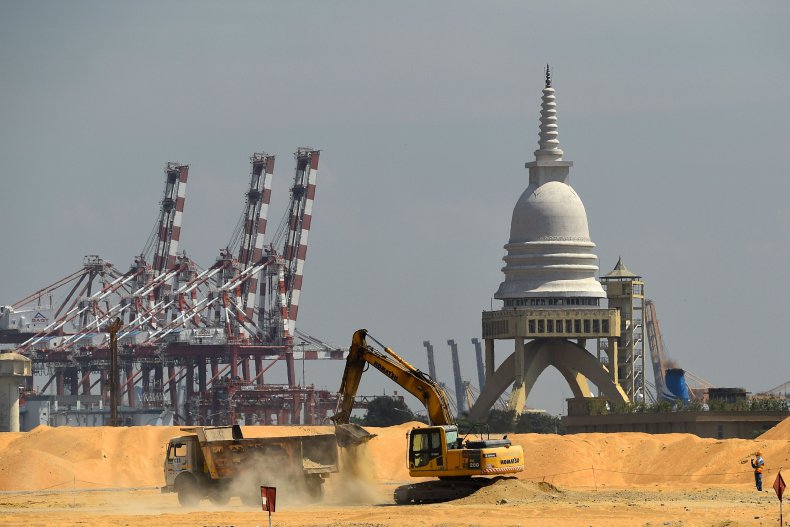
Laborers work at a construction site on reclaimed land part of the Chinese-funded project for Port City in Colombo on February 24. China’s trillion-dollar Belt and Road Initiative provides capital for ambitious infrastructure works but some still worry about the lasting consequences of being in debt to Beijing.ISHARA S. KODIKARA/AFP/GETTY IMAGES
When confronted with criticism of the BRI during his first post-election India trip in February, Mahinda Rajapaksa told the Hindustan Times that Sri Lanka had benefited from the BRI.
“By the way, let me remind you,” Rajapaksa said, “our external debt towards China is only 12 percent of our overall external debt, and we have not defaulted. We used whatever money we took from them to build infrastructure.”
Reached for comment, China’s embassy in Washington referred Newsweek to Foreign Ministry spokesperson Zhao Lijian’s response at the time.
“China and Sri Lanka share a strategic cooperative partnership based on sincere mutual assistance and ever-lasting friendship,” Zhao told a press conference in remarks sent to Newsweek. “Based on Sri Lanka’s development needs, China offered loans to support its infrastructure building and other major domestic projects concerning people’s livelihood.”
Zhao argued that Beijing was attentive to the debt sustainability of recipient countries as well as the will of their governments. He said Chinese funding has helped governments in overcoming hurdles in building new infrastructure and to foster independent development.
Colombo’s embassy in Washington declined Newsweek‘s request for comment. As for the people of Sri Lanka, both significant benefits and substantial concerns have emerged.
“Sri Lanka is seen as one of the vital nodes along China’s Belt and Road Initiative,” Maya Majueran, a PhD student at Sri Lanka’s University of Kelaniya, and Yasiru Ranaraja, who was attached to the Ocean University of China, both co-directors the non-governmental Belt & Road Initiative Sri Lanka organization, told Newsweek. “Due to that fact China is keen on investing in Sri Lanka. Chinese technology, talents, rich experience, know-how will have a great chance to benefit if Sri Lanka works together for a shared vision.
“However, some of the BRI projects in Sri Lanka are criticized for a lack of transparency and economic sustainability,” they added, highlighting the case of insufficient revenue generated by the Hambantota port that continues to be the source of controversy in the country.
While the scholars noted that the motive for Chinese investment was “largely to enhance connectivity to boost global economic links,” he admitted that “it may serve to strengthen China’s economic and security interests as well.” He pointed specifically to Gotabaya Rajapaksa’s appointment of former navy commander Admiral Jayanath Colombage as a senior diplomat as indicating how “the Rajapaksa regime is focusing on the growing Indian Ocean geopolitical grab.”
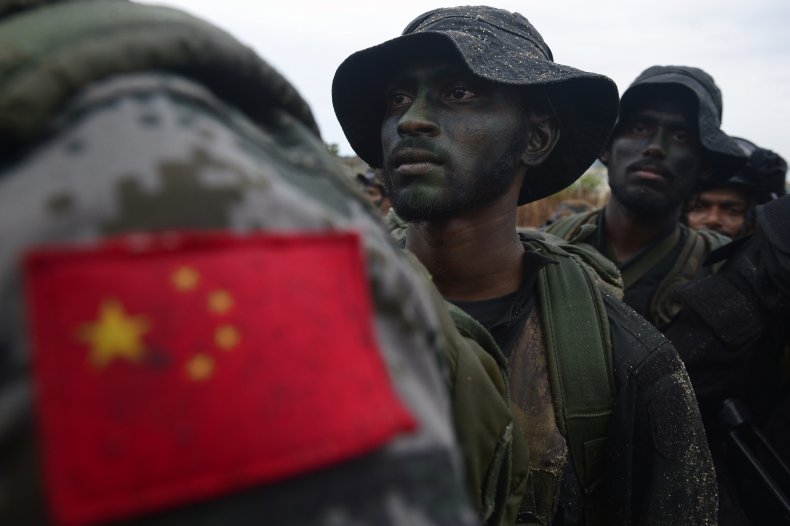
A Chinese soldier standing with Sri Lankan military personnel during a training exercise on the eastern coast of Trincomalee, September 23, 2019. With growing economic relations between Sri Lanka and China have come closer security ties as well.LAKRUWAN WANNIARACHCHI/AFP/GETTY IMAGES
The U.S. objections to the BRI connection with Sri Lanka are part of its strategic effort to push back against China’s growing regional influence in South Asia, which it is acquiring through its economic empire and the potential for projection of the military power it has already established further east in the South China Sea. The U.S. approach, called a “free and open Indo-Pacific,” most centrally includes Australia and Japan. India fills out the triumvirate while playing an increasingly crucial part in the coalition. It’s leadership has a checkered past with Sri Lanka under the Rajapaksas, and it presently engaged in a deadly border dispute with China that has highlighted the clashing spheres of influence in Asia.
While Majueran and Ranaraja predicted Sri Lanka would continue to engage with all major powers of the region, including the U.S. and India, they also foresaw that “China’s engagement with Sri Lanka will increase as [the Rajapaksa government] is considered a regime favorable to China.”
The Education Ministry has proposed that the leading schools in the country should adopt a mechanism to share their resources with the under-resourced schools of the country.
The idea was mooted when Education Minister Prof. G.L. Peiris met with the principals of 17 leading schools on Thursday.
The meeting was conducted to discuss curriculum reforms. The schools principals were asked to come up with proposals to adopt underprivileged schools.
A new cabinet paper will be presented seeking approval to modernise and develop the school curricula to meet contemporary conditions and requirements, Education Minister Professor G.L.Peiris informed a group of school principals on Thursday.
At a meeting held with the principals of several leading schools at the Education Ministry, Minister Peiris said the development of children’s analytical knowledge and critical thinking was paramount.
Terming education as an expedition, the Minister said the opportunities and room available for the children to expand in the existing education system was minimal.
Therefore, it is vital to shape the educational structure in a way that can enhance the children’s keenness and spirit. This should be done with the input of everyone. A broader discussion will be taken place at district level across the country in respect of the development of the curricula, prior to the ministry making a final decision. The opinions and views of the teachers, parents, past pupils organisations, civil societies and religious organisations were vital in this process. A future decision will be taken after thoroughly studying all these aspects,” the minister said.
The ministry in a statement said the principals who were present at the meeting briefed the minister on the possible changes that should be made in the education field.
The minister invited the principals to put forward ideas on restructuring the curricula to represent novel employment opportunities.
The issues which have arisen from having no text books for the Advanced Level classes and how to conduct career guidance in an effective manner were also discussed.
The contribution which the leading schools in the country could make in uplifting the standards at schools across the country was also discussed and the ministry said Minister Peiris requested the principals presented to extend their cooperation in this regard.
The World Health Organization (WHO) said on Friday that it hopes the Covid-19 pandemic will last less than the Spanish flu pandemic of 1918, which in two years killed tens of millions of people.
WHO chief Tedros Adhanom Ghebreyesus said at a press conference that this goal would be possible if the we can unite our efforts” and make the most of the available tools, among them vaccines.
The famous Spanish flu” killed 50 million people from 1918 to 1920 when malnutrition and tuberculosis made the population all the more fragile.
Unlike the new coronavirus, the Spanish flu had particularly hit the youngest.
In our current situation, […] the virus is more likely to spread. It can move quickly because we are more connected now,” Ghebreyesus said.
So we have a disadvantage linked to globalization [..] But we have the advantage of having better technologies,” he said. And we know how to stop it.”
On Friday, WHO also released new recommendations among them one for children aged twelve and above. According to WHO, they should wear protective face masks under the same conditions as adults to fight the pandemic.
This should especially the case when they cannot guarantee a distance of at least one meter from others and whether the transmission is generalized in the area concerned .
Children aged five and younger should not be required to wear a mask. This recommendation is based on the safety and overall interest of the child, and on his ability to use a mask correctly with minimal assistance,” said WHO.
As for six to eleven-year-olds, WHO recommends that the decision to use a mask be based on a series of factors, including the level of transmission of the virus in the area where the child lives and their ability to use a mask correctly and safely.
Access to masks, as well as the possibility of washing or replacing them in certain settings such as schools, adequate adult supervision and instructions given to the child on how to wear them, should also be considered.
Ghebreyesus also made a statement with regards to possible corruption cases in the areas of personal protective equipment (PPE), necessary for the fight against the pandemic.
Corruption related to PPE is, for me, actually murder,” he said when asked about a case in South Africa. If healthcare workers work without PPE their lives are in danger. And that also endangers the lives of the people they care for. So it’s criminal, and it’s murder.”
Minister of Justice, President’s Counsel Ali Sabry says the establishment of a separate court to hear cases pertaining to child abuse has been brought to the notice of the government.
He made these remarks addressing an event held in Colombo.
Minister Ali Sabry further insisted on eradicating crimes against children.
In the meantime, new laws will also be introduced to prevent such crimes, the justice minister continued.
A member of a criminal gang has died in a shootout with the police in area of Gampaha today (22).
The deceased is identified as Chaminda Edirisooriya under the alias Chamiya”. He is reportedly a gunman of the team operated by the underworld figure Angoda Lokka”.
The police said Chamiya” was shot when they opened fire at him in retaliation.
Attorney General & Prosecutors met with United Nations Office On Drugs & Crime (UNODC) Country Chief & UN Maritime Expert on International Drug Trafficking Organized Crime & Terrorism & had effective discussions on legal issues affecting the region.
A second group of 87 Sri Lankans, who were stranded in various cities in Thailand due to the Covid-19 pandemic situation, were repatriated to Sri Lanka from Bangkok-Thailand this morning (21), via a special Sri Lankan Airlines charter flight UL 403, organized by the Embassy of Sri Lanka in Bangkok.
The special flight that had onboard a few Buddhist monks, students, Sri Lankans who were on short term visit visas to Thailand, and several others on humanitarian grounds, arrived at the Bandaranaike International Airport in Colombo, on Friday 21 August 2020 morning. All repatriated individuals will undergo the necessary medical tests, and will be directed by the Sri Lankan security forces and health authorities to the mandatory quarantine centers, both State-sponsored and self-paid private hotels, designated by the Government of Sri Lanka.
This special repatriation flight that arrived in Bangkok on 21 August early morning also carried a group of Thai citizens, and Sri Lankans who have received re-entry permission to Thailand, and the inward trip from Colombo to Bangkok was organized by the Royal Thai Embassy in Colombo and HE Madam Chulamanee Chartsuwan, the Ambassador of Thailand to Sri Lanka.
The Embassy of Sri Lanka in Bangkok acknowledge the close cooperation and prompt directions received from the Ministry of Foreign Relations of Sri Lanka, including from Foreign Secretary Admiral Prof. Jayanath Colombage, the COVID Task Force at the Presidential Secretariat and the Ministry’s COVID-19 Focal Point, in making this repatriation process a success. The Embassy also received excellent support from the Ministry of Foreign Affairs of Thailand, and the staff of the Suvarnabhumi International Airport in Bangkok, by timely facilitation of the repatriation of this second group of Sri Lankans from Thailand, who had been registered with the Embassy and in the ‘Contact Sri Lanka’ online portal created by the Ministry of Foreign Relations, requesting assistance to return to Sri Lanka. The Embassy appreciates the support of the National Carrier – Sri Lankan Airlines, Mr. Dimuthu Tennakoon, Head of Sales and the Head Office team and Mr. Riza Yusoof, Country Manager, Thailand and his team, for the excellent cooperation extended through this entire process.
Dr. Nenette Motus, the Director of the Regional Office of International Organization for Migration (IOM) in Bangkok and IOM Colombo deserves the sincere appreciation of the Embassy for their prompt and generous response and support received under the Assisted and Voluntary Return and Repatriation (AVRR) project for Bali Process Member States.
Earlier in the month, the Embassy also made arrangements to repatriate a Group of 16 Sri Lankans in Phnom Phen Cambodia via Singapore. Embassy of Sri Lanka-Bangkok 21 August 2020
President Gotabaya Rajapaksa appears to have handpicked Adm.Prof. Jayanath Colombage for the Foreign Secretary’s post given his expertise in maritime security which is likely to be the centerpiece of Sri Lanka’s foreign policy in the coming years.
Colombo, August 20: The foreign policy motto of the previous government was ‘friendship with all, enmity with none’. Its verbatim meaning suggests the then Government’s policy was to be even-handed in its dealings with the world, be it Asia or the West. Nonetheless, in reality, it was a just a bland sentence used to couch its otherwise different intention. In practice, the previous Government was west-leaning in its foreign policy approach, though it was concealed in subtle diplomatic language to project a different impression.
Sri Lanka has made it clear that its soil cannot be exploited by anyone against the security interests of another (Pic AFP)
Admiral (Retd.) Prof. Jayanath Colombage, the newly appointed Foreign Secretary, spelled out in clear cut terms that the new Government’s foreign policy would be Asia- centric. If that is practiced in the real sense, it will be a clear departure from the path of the previous Government. As things stand at the moment, it is obvious that President Gotabaya Rajapaksa is planning to drive its foreign policy with a special focus on China and India, the two powers having competing interests in the region.
When Prof. Colombage said Asia-centric, he referred to the South Asia and Association of Southeast Asian Nations (ASEAN) as well. ASEAN is a regional grouping of ten countries and it is projected to rank as the fourthlargest economy in the world. It is a market of 622 million people. So, Sri Lanka’s focus on ASEAN is understandable.
It is a matter of fact that Asia as a whole is rising on the global stage. Its significance to the world is growing in terms of security, economic development, climate change etc. The Government has decided to keep special focus on Asia mainly because it is only better positioned to cooperate with Sri Lanka in economic revival in the post COVID-19 context is its main challenge. Today, we talk about an Asian era. Most Asian countries including China where the Coronavirus was first reported contained the spread of the pandemic more effectively whereas most other countries in the world are still reeling under the impact of the pandemic. It enables Asia to ratchet up efforts to propel global growth trajectory while responding to post-pandemic challenges.
The new Government seeks to reset its foreign policy with an Asia-centric approach, and then, it is bound to encounter a challenging task – that is to reconcile the competing interests of India and China in the region without offending anyone. The President appears to have handpicked Prof. Colombage as the Foreign Secretary to deal with this scenario diligently at an official level under Foreign Relations Minister Dinesh Gunawardane who lays emphasis on genuine friendship (Kalyana Mithra). Prof. Colombage is the former Navy Commander of Sri Lanka, and he also published his book ‘Asymmetric Warfare at Sea: The Case of Sri Lanka’. As such, he is an expert on the maritime security aspect of international relations, an area where China and India have contrasting interests. It is also a sphere in which countries such as the United States, Australia and India commonly take on against China’s increased presence in the Indo-pacific region. The Foreign Secretary is better positioned to understand and analyze Indo-pacific strategic concerns of the world powers given wide-ranging experience in naval security and academic knowledge coupled with it.
Sri Lanka is trying to get the best out of both China and India for much needed economic growth which has been sluggish due to the COVID-19. Sri Lanka has made it clear that its soil cannot exploit by anyone against the security interests of another. The leaders of both China and India have already engaged with Sri Lanka for economic ties. Prof. Colombage is someone with contacts to the establishments of both countries. It should have been one of the very reasons for his appointment as the Foreign Secretary this time to work at an official level in the execution of the foreign policy.
For India, security and economic development are the two main concerns in the post-pandemic situation. Indian Prime Minister Narendra Modi launched his Atmanirbhar Bharat Abhiyan (Self–reliant India campaign) in his country. According to the Indian media, he also asked Indian people to be ‘vocal for local’ and glorify Indian products.
The pandemic has compelled the countries to adopt a certain degree of protectionism in economic policies. Sri Lanka is also awake to this reality, and accordingly, President Rajapaksa has instructed his Ministers to boost local manufacturing so that the country can reduce dependency on foreign suppliers during this trying time. Indian External Affairs Minister Dr. S Jaishankar called Foreign Relations Minister Dinesh Gunawardena on Tuesday to congratulate him on his reappointment as Minister of Foreign Relations of Sri Lanka.
According to a communique put out by the Indian High Commission, Dr. S Jaishankar conveyed that he looks forward to working closely with Minister Gunawardena to take the India-sri Lanka partnership to greater heights as part of India’s neighbourhood-first policy. The two ministers discussed the need to facilitate the business leaders of both sides to increase investments. Also, the two countries now explore the possibility of resuming commercial flights on a limited scale as the beginning. Likewise, a host of measures for economic cooperation between Sri Lanka and China has been proposed. Chinese Foreign Minister Weng Yi also sent a message of congratulation to Minister Gunawardane after he assumed duties in his office under the new government. Also, acting Chinese Ambassador Hu Wei called on Mr. Gunawardane and Prof. Colombage on Tuesday.
The Chinese economy is resilient against the pandemic. It is, in fact, under control there at the moment. China is now recording growth. The new government sees cooperation with China as important to boost foreign reserves and to overcome the debt payment crisis.
The new government sees China’s Belt and Road Initiative (BRI) as an opportunity rather than a threat. It will turn to China for infrastructure projects such as the proposed expressways.
While taking such an approach, it is equally vital to reach out to the Western world where Sri Lanka’s export market is located. The government is heading for challenges in the West where the PRO-LTTE lobby groups are active. These lobby groups, operating in the Western world, have already upped their ante on Sri Lanka compiling reports on the past human rights track record to be taken up ahead of the sessions of the United Nations Human Rights Council.
This is significant in the context of Lankan President Gotabaya Rajapaksa’s statement that a new Sri Lankan constitution will be drafted
Colombo, August 21 (newsin.asia): A delegation of the Tamil National Alliance (TNA) called on the Indian High Commissioner Gopal Baglay here on Friday.
The High Commissioner congratulated the TNA for their performance at the recent general elections. The envoy reiterated India’s longstanding position on peace and reconciliation and the full implementation of the Thirteenth Amendment of the Sri Lankan constitution which had created elected Provincial Councils in the nine provinces of the island nation with a modicum of devolved powers. The 13A came as a result of the India-Sri Lanka Accord of 1987.
Though elected councils came into being, the powers that they should have got as per the 13A have not been devolved. Powers over land and police are still not dissolved.
There has been speculation that the government of President Gotabaya Rajapaksa and Prime Minister Mahinda Rajapaksa will abolish the 13A as part of their plan to centralize the administration and cut needless expenditure. A section of the majority Sinhala community feels that the Provincial Councils are White Elephants and impositions by India. But political sources say that elected Provincial Councils will not be abolished because the Sri Lankan political class has developed a vested interest in their existence. They provide an institution vested with some powers between the grassroots level Preadeshiya Sabhas and the parliament.
TNA leaders M.A.Sumanthiran and R.Sampanthan
Prime Minister Mahinda Rajapaksa is undoubtedly in favour of retaining the elected Provincial Councils. And in his speech inaugurating the newly elected 9th.parliament on Thursday, President Gotabaya Rajapaksa spoke only about the abolition of the 19th.Amendment, not the 13A.
Ironically, the Tamil United Liberation Front (TULF) opposed the 13A in 1987-88. Even today only the Eelam Peoples’ Democratic Party (EPDP) led by Douglas Devananda and a rump of the Eelam Peoples’ Revolutionary Liberation Front (EPRLF) faction led by the followers of the Late Pathmanabha support the 13A. Other Tamil parties want more than 13A. A section of them are even seeking self-determination for the Tamils and an internationally monitored referendum on the Tamil question.
When Mahinda Rajapaksa was Lankan President between 2005 and 2014, he had promised 13A Plus in response to pressure from India. But this was not delivered. During the United National Party-led Good Governance” regime between 2015 and November 2014, an effort was made to draft a new constitution but it was thwarted at the last moment by a lack of political will and a constitutional crisis in 2018.
On August 20, President Gotabaya Rahapaksa promised to draft a new constitution but it remains to be seen as to how far his regime would go to devolve power to the provinces or whether it will downgrade or upgrade the powers of the Provincial Councils.
As Sri Lanka struggles with outstanding foreign debt, rural households across the country have been living off borrowings after exhausting their savings. Meera Srinivasan reports on how those already struggling with severe economic hardships are now grappling with a pandemic-induced crisis
After doing seven jobs in the last three years in and around Colombo, Simran Enric is now back home in Sri Lanka’s hill country. He escaped the pandemic that struck the capital, but his last job at a grocery store didn’t.
I am ready to take up any job. It doesn’t matter which city, what work or how much they pay,” says the 19-year-old. He began working after dropping out of school before his Ordinary Level examination. His parents’ stagnant wages, from tea production on an estate in Maskeliya in the central Nuwara Eliya district, was not enough for three square meals for their family of five, including Enric’s two schoolgoing sisters. His Colombo income, they hoped, would support household finances. It barely did, but the family couldn’t afford to lose any additional source of income, however meagre, as they tried to cope. Over a period of time, Enric’s small savings proved valuable. And then the deadly virus arrived.
In Sri Lanka, though, the novel coronavirus didn’t seem all that deadly, going by the official data. While COVID-19 case numbers in the region and in powerful western countries increased rapidly, Sri Lanka stood out, drawing high praise, including from the World Health Organization, for containing the virus. To date, Sri Lanka has reported 11 deaths and fewer than 3,000 cases, of which only 127 are active.
After a stringent lockdown for two months and the efforts of the country’s efficient public health sector, aided by the military, Sri Lanka felt relatively fit to hold the twice-postponed parliamentary elections on August 5. Over 16 million of the country’s 21 million-strong population could vote in the elections, held with elaborate health guidelines mandated by the Election Commission. The turnout was 71%.
As was widely predicted, the ruling Rajapaksa brothers’ young party won comfortably, securing a rare two-thirds majority in Sri Lanka’s proportional representation system. With carefully cultivated political capital from projecting their war-victor image for a decade now, and aided by the former government’s abysmal failures, the Rajapaksas have consolidated their grip on the country like few have. President Gotabaya Rajapaksa and his older brother Prime Minister Mahinda Rajapaksa sit in the country’s two most powerful offices. They have no imminent threat to their political might. But their government faces an unprecedented economic challenge.
Reeling under the shock of last year’s ghastly Easter terror bombings, Sri Lanka’s economy contracted by 1.6% in the first quarter of 2020, even before the pandemic’s local and global spread was clear. The World Bank has projected a rather grim picture, warning it could contract up to 3%.
Of the country’s mounting external debt – equivalent to 42.6 % of the GDP in 2019, according to the Central Bank of Sri Lanka – nearly $3 billion is due for repayment this year. This includes a non-negotiable $1 billion sovereign bond maturing in October, besides bilateral and multilateral loans.
Aware of the daunting task ahead, the Rajapaksa administration wasted no time in requesting lenders for a debt freeze. On his visit to New Delhi in February, his first trip abroad after assuming premiership of the then-caretaker government, Prime Minister Mahinda Rajapaksa sought a debt moratorium that is still being negotiated.
With the pandemic that hit Sri Lanka in March amplifying the economic crisis manyfold, the country’s looming debt crunch gave the government the jitters. The government went for new loans to service past borrowings, including over $5 billion from China and $960 million from India. In March, Sri Lanka signed an agreement with China for another $500 million loan after an urgent request” from Colombo, to deal with the pandemic’s harsh economic blow.
While the government struggles to cope with the fiscal crisis, the people, especially those on the margins, suffer.
Enric stayed in Colombo for almost eight weeks during curfew time” with a partial salary, lodging and food, until he lost his job. There was no chance of finding a new job,” he says. He returned home and the family was back to relying entirely on his parents’ wages.
No work today; there aren’t enough tea leaves on the bushes after last week’s heavy rains,” says his mother S. Bagyalakshmi, who recently pawned the only piece of jewellery she had kept for her daughters. Work has been irregular these days.”
Increasingly, many employers across estates are asking workers to stay at home once every few days, so they don’t have to pay the monthly incentive tied to a minimum number of days’ mandatory work, according to labourers. Citing the pandemic, Sri Lanka’s major plantation companies have virtually stalled talks with the government on a basic wage hike from the current LKR 700 to LKR 1,000 that workers have been demanding for over three years. Not that the companies were any more willing to pay the rate in 2019, when tea exporters reported a record high revenue of over $1.3 billion.
The estate workers were persistent enough to push their demand to poll manifestos, but not powerful enough to realise it. In January this year, two months into office, President Gotabaya Rajapaksa assured them of a wage hike by March 1, following up on his campaign slogan. Six months later, workers have resigned to yet another broken promise.
For those like Bagyalakshmi, pawning her hard-earned piece of jewellery was the only option to survive. As far as her family’s poverty goes, it was not introduced by the pandemic, but was gravely aggravated by it.
The nearly 1.5 lakh estate labourers among Sri Lanka’s million-strong Malayaha Tamils (hill country Tamils), whom British planters brought down from south India to clear forested mountainous land, plant and pluck coffee and later tea, have been historically neglected. Earners of precious foreign exchange, they remain on the country’s geographic, social and economic margins, their labour invisible and voice rarely heard.
Bagyalakshmi’s home, a colonial-era ‘line room’ with a living area barely 8X8 feet, is located on the edge of a winding, unmotorable road inside an estate. It is a silent witness to the violent colonial past her ancestors endured, as well as the exploitation that carried over into the years after Independence, making the lives of successive generations vulnerable and their livelihoods, precarious.
But it is not just estate workers facing the brunt. Like Enric, tens of thousands of Malayaha Tamil youth, employed in hotels and shops, often as cleaners or assistants, in Colombo and other cities, have now returned jobless to the hill country. There is a sudden increase in three-wheeler drivers in Maskeliya. That is because many of us had to come back from Colombo after the COVID-19 outbreak as there was no other option of making a living there,” says Murugaiyya Vigneswaran, 28, who lost his mason job in Colombo. I took a loan and bought this three-wheeler, but it is not easy to find hires.” He relies on his neighbours in the estate engaging his autorickshaw for an urgent visit to Maskeliya town, paying LKR 1,500 (or two day’s gross wages) for the round trip, as estate roads are not serviced by public transport.
Elders in the community note that it is over the last two decades that Malayaha Tamil youth from the estates ventured out looking for jobs, escaping the estates where their parents toil all day braving blood-sucking leeches and stinging wasps. But they couldn’t escape hardship.
While some migrated to the capital and big towns in the prosperous Western Province, others found jobs as domestic and construction workers in West Asian countries. Sri Lanka’s hill country, along with high-migration districts such as Kurunegala in the North Western Province and Batticaloa in the Eastern Province, supplies a steady flow of cheap labour abroad. Of the over 2 lakh workers who migrated from Sri Lanka in 2018, more than half were unskilled workers and housemaids, official data show. But the raging virus made their lives and jobs overseas even more perilous than at home.
As many as 47 Sri Lankan migrant workers have succumbed to COVID-19 in West Asian countries, according to Mangala Randeniya, spokesman of the Sri Lanka Bureau of Foreign Employment. This is more than four times the number of deaths reported in Sri Lanka. The migrant workers’ funerals were held where they were last employed, as their families in Sri Lanka grieved from thousands of miles away.
Some 40,000 workers, who are out of work in West Asia, are trying to return home. Wary of importing more carriers of the virus, after dozens who returned in special flights tested positive on arrival, the Sri Lankan government is staggering their repatriation in phases. Others wait, with savings for food dwindling, insecure accommodation, the constant fear of infection, and no clarity on their date of return or prospects in Sri Lanka thereafter.
Two of my nieces and a nephew are working abroad. We still don’t know when they can return, we are really worried,” says Bagyalakshmi. This is the prevalent anxiety among migrant workers’ families.
For over 10 years now, Somasundaram Mallika has been raising her older sister’s three children, in addition to two of her own, in Badulla district, in the neighbouring Uva Province. My sister is the only breadwinner in her family after her husband passed away. She had no choice but to leave the country for work. Thankfully she still has her job, but with this virus we don’t know when we will see her next,” says Mallika.
Her sister Somasundaram Yogam did many jobs abroad before her current one as a housemaid in Saudi Arabia. Speaking to The Hindu over telephone, she says: I don’t go out anywhere because of the COVID risk. I hear many housemaids like me have lost their jobs, I am very lucky to still have mine.”
Despite a secure job and a reasonable salary, many workers find it very hard to be away from their families. Unlike Yogam, many don’t have reliable relatives to care for their children. I miss them very much, but what do you do when you have to work?” she says.
Yogam would seem better off compared to hundreds of Sri Lankan garment workers in Jordan who were sacked after the pandemic. Around 200 of them returned last week, but another 500 are stuck there, according to Abiramy Sivalogananthan, Sri Lanka coordinator for the Asia Floor Wage Alliance, engaged in international campaigns for collective bargaining in the global garment industry. The factories first reduced the meals they are mandated to provide from three to two, and then stealthily obtained signatures from the workers in documents saying they were resigning, to be exempted from paying social security,” she says.
Moreover, skilled expat workers have been returning to Sri Lanka with less difficulty, even from high-risk countries such as the U.S. and the U.K. It’s not just the employers abroad who manipulate and exploit migrant workers, our own government discriminates against low-skilled workers by making their return very hard,” Sivalogananthan observes.
Desperate measures
Labourers like Bagyalakshmi or Yogam, or those back from Jordan might make an occasional news headline in Sri Lanka, but they almost never figure in policy talk on the national economy. Those discussions begin and end with the outcome of their labour – be it tea and rubber or garments that together make up about 65% of exports; or migrant remittances that are the main source of Sri Lanka’s foreign exchange. In 2019, inward remittances added up to $6.7 billion.
With all key foreign exchange earners – tourism, exports and remittances – of the country badly hit, Sri Lanka is facing its biggest foreign exchange crisis in history, by the government’s own admission.
The Central Bank and the government have taken several urgent measures. In March, authorities restricted import of non-essential goods and soon relaxed foreign exchange regulations, inviting deposits in foreign currency. The government curtailed outward remittances.
Meanwhile, the Central Bank recently obtained a $400 million currency swap from the Reserve Bank of India to boost its reserves, while President Gotabaya Rajapaksa has requested Prime Minister Narendra Modi for an additional $1.1 billion currency swap. Sri Lanka has also sought emergency financial support from the International Monetary Fund, under its Rapid Credit Facility. The request is under assessment.
Faced with a tumbling currency – about LKR 187 (roughly ₹74) to an American dollar – fast-depleting foreign exchange reserves and a daunting repayment schedule this year, Sri Lanka has no time to lose while fixing its battered economy.
But the task is far from easy. The government can’t open up the country for tourists without increasing the risk of a spike in new cases. It can’t strengthen exports until other countries, or at least Sri Lanka’s key markets, are ready to buy what it has to sell.
Evidently, the newly installed Rajapaksa government is under enormous pressure – not only to keep Sri Lanka’s unblemished debt servicing record, but also to enhance local production and create local demand in order to keep the economy ticking until international markets brighten.
Sri Lanka’s rural economy, sustained largely by agriculture and fisheries, has been crying for attention for years – evidenced in the recurring farmer and fisher protests around cost of inputs, profiteering by intermediaries, and unstable incomes.
Also, it is not just the country that is growing more and more indebted. Many of its poor citizens too are mired in stifling debt. While the national spotlight is on the outstanding foreign debt, rural women across the country, including in the civil war-affected north and east, have been living off borrowed money, often microfinance loans that agents push at their doorsteps.
Trapped in servicing the exorbitant interest rates – even more than 200% in some cases – of multiple loans, some have tragically taken their own lives, just as Jaffna-based Surendrarasan Mariarata did earlier this month. The fast-growing concern about predatory microfinance loans, especially among women, evoked a poll promise from Gotabaya Rajapaksa ahead of last year’s presidential elections for relief from microfinance loans. The indebted women await action before more lives are lost.
Most policymakers in Sri Lanka agree that in order to tackle prevalent household indebtedness or generate greater local demand, the government must necessarily create jobs. President Gotabaya Rajapaksa has recently resumed a programme to provide jobs to 50,000 unemployed graduates and 1 lakh low-income earners. But there are several thousand more, unable to complete school and desperately looking for jobs, others like the hill country youth who are now out of work, or the migrant workers who are back in the country with uncertain futures. They will need different kinds of jobs.
In the hill country, for instance, they could set up industries that do value addition. Why must those factories be based in Colombo when all the tea is produced here,” asks Fr. Isaac Daniel Dixon, pastor at a Maskeliya church attended mostly by estate workers. His congregation includes many youth who lost their jobs in Colombo and returned recently. Some end up as labourers in the same estates as their parents, doing the job their parents hoped they never would.”
Immediately after the new government was installed this month, and ministerial portfolios allocated, President Gotabaya Rajapaksa emphasised the need to promote local industry. The thrust, aligned to the ruling party’s nationalist, populist election plank, is not new to Sri Lanka. Neither are leaders’ customary poll-time promises to alleviate poverty. Campaigning in the southern Hambantota district on the eve of the August 5 elections, the President pledged to build a people-centric national economy, fully owned by the people.”
Sri Lankans know well that for a promise to translate to policy and more crucially, action, the government’s political might alone will not do. Therein lies the Rajapaksa brothers’ next big test.
A smiling Sabry holds his mother after addressing the media at the Justice Ministry (pic by Shamindra Ferdinando)
Justice Minister Ali Sabry, PC, yesterday (17) said that four state institutions––the Police, Prisons, Government Analyst’s Department and the Registrars of Courts––were so corrupt that the country faced a daunting challenge to rectify the situation.
Addressing a gathering immediately after assuming duties at the Justice Ministry, Sabry explained how those responsible violated the rule of law.
Referring to recent explosive reportage of the Police Narcotics Bureau (PNB) dealing in heroin, Minister Sabry briefly discussed how law enforcement authorities, Prisons, the Government Analyst’s Department and the Registrar of Courts contributed to unprecedented deterioration of law and order.
Among those present on the occasion were President’s Counsels Romesh de Silva, Gamini Marapana, Kalinga Indatissa and U.R. de Silva.
Separate Registrars are assigned to Magistrate courts, High Courts, Court of Appeal and the Supreme Court.
Minister Sabry said that according to a survey, Registrars of Courts were among the most corrupt in the country and he would examine the situation before announcing a plan on how to tackle the situation. He sought the support of all stakeholders, including the Bar Association of Sri Lanka (BASL) to address contentious issues.
The minister said he knew how the people suffered untold hardships due to law’s delays. Continuing system failures ruined lives, the minister said, pointing out how child abuse affected the community.
At the onset of his brief address, Minister Sabry apologised profusely for having the meeting in a small room which could hardly accommodate those present. In spite of display of notices restricting the gathering of people due to continuing threat posed by covid-19 epidemic, over 100 were allowed in with most of those present not wearing face masks. Minister Sabry had to fight his way to the podium to address the gathering with Ministerial Security Division (MSD) being helpless.
Pleading that he wouldn’t do anything inimical to the Constitution and the people, Minister Sabry thanked President Gotabaya Rajapaksa and Prime Minister Mahinda Rajapaksa for giving him the challenging responsibility. The new minister vowed to overcome what he called daunting challenges.
The Minister quoted the Rajapaksa brothers as having told him to do the needful as he knew what the shortcomings and problems were.
Minister Sabry emphasised that his responsibility would be to implement policy decisions of the government and the cabinet of ministers.
Delivering an anusasana at the onset of yesterday’s programme, scholar Ven Medagoda Abeytissa Thera said that President Gotabaya Rajapaksa accommodated Sabry in the cabinet of ministers, in spite of serious protests as he had confidence in him. It would be Minister Sabry’s duty and responsibility to maintain President Gotabaya Rajapaksa’s faith in him.
The Ven. Thera said that there was no point in hiding the fact that opposition political elements instigated protests against the top the justice portfolio being assigned to Sabry.
The Ven. Thera appreciated the role played by Sabry as a civil society activist in helping the then Opposition movement led by the Joint Opposition to turn the tables on the then government.
Referring to a recent statement attributed to Minister Sabry that the 19th Amendment enacted in early 2015 would be amended to suit the new government’s requirements, Ven. Abeytissa stressed that President Rajapaksa and the SLPP (Sri Lanka Podujana Peramuna) had received mandates in 2019 and 2020 to introduce a new Constitution. The scholar monk emphasized that there should be one law for everyone. Therefore, now in his capacity as the Justice Minister, it would be his responsibility to fulfill the aspirations of the public.
Referring to the 2019 Easter Sunday carnage, Ven Abeytissa said that it would be the Justice Minister’s obligation to take measures to prevent the birth of more Zahran Hashims.
Commenting on the enactment of the 19th Amendment by the previous government, Ven. Abeytissa advised the Justice Minister to follow a policy of transparency in that regard.
Ven. Kamburugamuwe Vajira Thera warned of dire consequences unless the required far-reaching constitutional changes were introduced within a month or two. The Thera said that if the government failed to use its two-thirds majority immediately, it would have to regret its failure.
At the request of Maha Sangha, President Gotabaya Rajapaksa decided to bring Sri Lanka Buddhist and Pali University and Buddhashravaka Bhiksu University under the purview of the Ministry of Education.
President also paid attention to the possibility of placing these two Universities under the University Grants Commission. President instructed the officials to conduct monitoring their activities in a proper manner under the supervision of the State Minister while safeguarding their identities.
This decision was taken by the President during the 05th meeting of the Buddhist Advisory Council held at the Presidential Secretariat today (21).
President said he will present the steps taken by the Government and their progress pertaining to the proposals and advice given by Maha Sangha at 04 previous meetings at the next session.
Pointing out that advice of the Buddhist Advisory Council have been used while formulating the structure of the State Ministries President said he expects the Maha Sangha to continue to guide the Government in policy preparations. He further said Dhamma Schools, Bhikku Education, Privenas and Buddhist Universities were brought under the direct supervision of a single State Ministry for their advancement.
Maha Sangha commended the President for his efforts to address the issues pertaining to Piriven education and endeavours to improve Dhamma school education by implementing a systematic procedure and regulation.
Anunayake of the Malwatta Chapter, Most Ven. Vijithasiri Nayaka Thero stated that the approach used to institute officers that of the Opposition Leader in the parliament was exemplary. Thero added that the people were repulsed by how the predecessors made appointments to the same offices.
Anunayake of the Asgiriya Chapter, Most Ven. Anamaduwe Dhammadassi Thero noted that the decision to minimize ministries will assist in saving taxpayers’ hard-earned money.
Additionally, Aranya Senasanadhipathi of Mithrigala, Ven. Udairiyagama Dhammajeewa Thero mentioned the importance of virtuous mind” (Yahapath Sitha) in life and highlighted the significance of introducing it to the classroom.
Ven. Prof. Induragare Dhammarathana Thero highlighted the requirement of initiating an insurance scheme resembling Agrahara Insurance plan for Bhikku teachers, their parents, and siblings in their times of need, when they are hospitalized.
Most Venerable Diviyagaha Yasassi Nayaka Thero pointed out the importance of introducing a procedure to give marks for Certificates of Dhamma School Final Examination and the Dharmacharya Examination when offering the government jobs.
Most Ven. Prof. Kotapitiye Rahula Thera suggested that a discussion on Bhikkhu Education and Buddhist Education or a Sangayana on Theravada Buddhism is needed.
The Maha Sangha representing the Buddhist Advisory Council, officials including Principal Advisor to President, Lalith Weeratunga, Secretary to the Ministry of Education Prof. Kapila Perera, Secretary to the Ministry of Buddha Sasana, Religious and Cultural Affairs, Prof. Kapila Gunawardena and the Commissioner General of Buddhist Affairs Sunanda Kariyapperuma participated in this meeting.
Ven. Dr. Omalpe Sobhitha Thero, stated that he is requesting the Chairman of the Election Commission on behalf of the Sri Lanka Ramanna Maha Nikaya to immediately cancel the National List seat given to Apey Janabala Party.
He was addressing a media briefing at the Sri Bodhirajarama Temple in Embilipitiya.