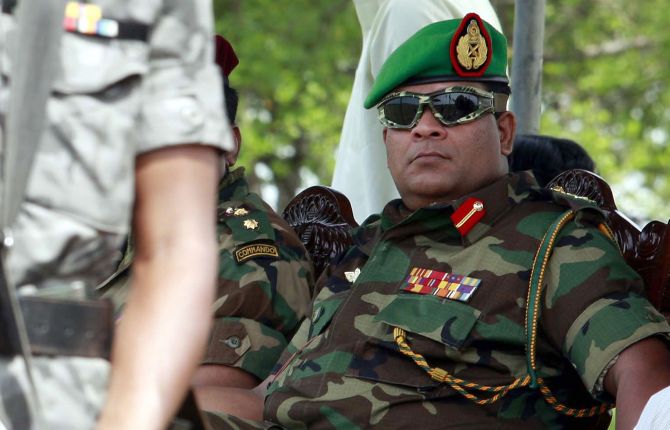
President Gotabaya Rajapaksa decided to hasten the probe into the April 21 attack which had proved crucial in his decisive electoral victory last November
The Sri Lankan government on Sunday appointed a six-member team to help police collect authentic information and expedite an ongoing presidential probe into the devastating Easter Sunday terror attack that killed over 250 people.
President Gotabaya Rajapaksa decided to hasten the probe into the April 21 attack which had proved crucial in his decisive electoral victory last November. Mr. Rajapaksa used the Easter Sunday terrorist attack to portray himself as the leader who could stop terrorism.
The voters gave him a big mandate and elected him as President in November last year. Mr. Rajapaksa stormed to victory, trouncing his nearest rival Sajith Premadasa by a margin of over 13 lakh votes – 52.25% of votes polled against 41.99%.
The six-member task force has been appointed to help the police’s CID to speed up the ongoing investigations” and will submit weekly reports to the Defence Ministry on the progress of the investigation, according to a statement.
The CID investigation into these attacks was not conducted in an effective way by the last regime,” Defence Ministry Secretary Kamal Gunaratne was quoted as saying in the statement.
The team has been tasked to collect authentic information and evidence to take legal action against all those involved in supporting the extremists”.
Nine suicide bombers belonging to a local Islamist extremist group National Thawheed Jamaat (NTJ), linked to ISIS, carried out a series of devastating blasts that tore through three churches and three luxury hotels on Easter Sunday, killing 258 people, including 11 Indians.
The previous government was blamed for its inability to prevent the attacks in spite of the prior intelligence made available.
The Muslim minority party leaders who were ministers in the previous government were alleged to have supported the Jihadis.
Earlier this week, head of a local Catholic church Malcolm Cardinal Ranjith said though the parliamentary panel of the previous government was a cover up, he was happy with the presidential probe appointed by Mr. Rajapaksa’s predecessor Maithripala Sirisena.
Archbishop of Colombo Malcolm Cardinal Ranjith, in a statement, in Sinhala read out at churches, on Sunday, Feb 23, called for a thorough investigation to find out why the political leadership and the security authorities had failed to act in spite of having specific intelligence on the Easter Sunday carnage. The Cardinal said the political leaders responsible for the lapses that had led to the Easter Sunday tragedy should be probed.
Former spokesperson for the Catholic Church Rev. Father Cyril Gamini, parish priest of St. Anne’s Church, Kurana, quoted the Church Leader as having said that the Catholic community felt deepening pain every time they heard that the political authority had acted irresponsibly as for the threat to them.
In an obvious reference to the political battle between the then President Maithripala Sirisena and the then Prime Minister Ranil Wickremesinghe, Malcolm Cardinal Ranjith alleged that their power struggle had facilitated near simultaneous suicide attacks. They were also accused of playing politics with the issue.
The Cardinal questioned why the political leaders had failed to act though they had been aware of the destruction of Buddha statues and Wanathavilluwa terrorist training facility.
The Church issued the statement following a police media briefing on the status of the investigations. The police revealed that 153 persons had been held under the Prevention of Terrorism Act (PTA) in connection with the attacks carried out by the National Thowheed Jamaat (NTJ).
Reiterating a thorough investigation into perhaps deliberate lapses on the part of the political leadership, the Church leader alleged that authorities had tried to protect the officers concerned.
President Maithripala Sirisena appointed a three-member committee to inquire into the Easter Sunday carnage before Speaker Karu Jayasuriya set up a parliamentary select committee to inquire into the same. In the run-up to Nov 16, 2019 presidential election, President Sirisena appointed a presidential commission. President Gotabaya Rajapaksa decided to continue with the same commission. The Church has declined to name new members to the Commission.
Malcolm Cardinal Ranjith has said that some of those responsible for establishing the truth instead tried to protect those responsible for the heinous crime and their sponsors.
Commenting on the sitting Presidential Commission, Malcolm Cardinal Ranjith emphasized that it would be the responsibility of the investigating body to identify those who planned the operation, provided required funds, facilitated the operation and received weapons training etc. He said that a 26-year-old unmarried woman from Jaffna wounded in the blast at Kochchikade St. Anthony’s church had succumbed to her injuries several days back. The Church Leader said that the victim never opened her eyes during the time she had been receiving treatment.
The Catholic community was watching the progress of the investigation as well as the conduct of political leaders, the Cardinal said.
Having highlighted both local and external challenges faced by post-war Sri Lanka, Professor of Archaeology at the University of Kelaniya Prof. Raj Kumar Somadeva, on Saturday (22), warned there could not be a state without a country.
Underscoring the importance of exploring ways and means of providing homegrown solutions to complex issues on the basis of our past experiences, Prof. Somadeva, a member of the World Archaeological Congress, urged the new leadership to rectify shortcomings.
Prof. Somadeva said so at an event organised at Nelum Pokuna Theatre to celebrate National Freedom Front (NFF) leader Wimal Weerawasna’s 20th year in national politics. Among the invites were President Gotabaya Rajapaksa, Prime Minister Mahinda Rajapaksa, architect of Sri Lanka Podujana Peramuna (SLPP) Basil Rajapaksa, Dr. Gunadasa Amarasekera and Dudley Sirisena.
Prof. Somadeva, who led the high profile excavation of the Mannar mass graves, at the onset of his address explained how the post-Independence Sri Lanka had failed to achieve desired goals. He emphasised that the country was in current predicament due to the failure on the part of successive governments to adopt a national policies.
Senior lecturer Prof. Induragare Dharmarathana thera of the Cultural Studies section of the Kelaniya University and MP Weerawansa too explained the growing challenges faced by the Sri Lankan state with the latter declaring that President Gotabaya Rajapaksa had been elected to reverse the deterioration of the State.
Colombo District MP Weerawansa said the country remained vulnerable to destabilisation efforts in spite of eradication of terrorism in May 2009 and change of government in November 2019.
Weerawansa said that even if those who lost the last presidential election were ready to accept defeat, their external backers wouldn’t give up their efforts.
Emphasizing the responsibility on the part of the government to ensure public security, Prof. Somadeva said the country should follow nationalist policies and adopt homegrown solutions to its problems.
Prof. Somadeva also briefly dealt with the constitution making process undertaken by India and how Sri Lanka could benefit therefrom.
Commending Weerawansa for following nationalist strategies, Prof. Somadeva explained how rulers should deal with the citizenry under different circumstances.
Ven. Dharmarathana, having commended the way Weerawansa pursued nationalist strategies, both in and outside parliament, appreciated the role played by him, in his capacity as a top member of the JVP to create an environment conducive for de-linking the Eastern Province from the North in late 2006.
Having faulted the JVP for not accepting the then President Mahinda Rajapaksa’s repeated requests to join his government, the Thera referred MP Weerawansa’s untiring efforts to convince the party to back that government. Ven. Dharmarathana regretted that the JVP had missed the opportunities that had presented themselves.
Had the JVP acted sensibly, it might even have been able to secure political power or be in a strong position in a ruling alliance, Ven. Dharmarathana said.
Recollecting the role played by the JVP in the then President Chandrika Bandaranaike Kumaratunga’s ‘probationary’ government, Ven. Dharmarathana said ill-conceived policies had led to an erosion of public confidence in the JVP to such an extent it had polled a paltry 3 per cent of the vote at the last presidential election.
The Thera alleged that JVP had paid a very heavy price for throwing its weight behind the UNP.
Referring to MP Weerawansa’s criticism of Mahinda Rajapaksa government’s economic policies especially during his second term, Ven. Dharmarathana underscored the importance of learning from past experience.
Ven. Dharmarathana pointed out that President Gotabaya Rajapaksa couldn’t spend time on day to day events. The President’s responsibility was to ensure proper handling of State policy.
Ven. Dharmarathana explained how various Western concepts could be used by interested parties to destabilise President Gotabaya Rajapaksa administration.
Prime Minister Mahinda Rajapaksa, in his brief speech, paid a glowing a tribute to MP Weerawansa’s political role, both as a member of the JVP parliamentary group as well as the leader of the NFF. Rajapaksa recollected how Weerawansa, having quit the JVP during his first term as the president, built a party of his own. Former SLFP leader Rajapaksa remembered the role played by MP Weerawansa along with other members to bring him back to power. The launch of ‘Mahinda Sulanga’ campaign with a massive rally at Nugegoda had come as a rule shock to those celebrating the change of government in January 2015, Rajapaksa said, alleging that the Rajapaksas, including wartime Defence Secretary Gotabaya and key members of that administration had been targeted because the yahapalana lot couldn’t stomach the eradication of terrorism.
PM Rajapaksa said that the campaign in which Weerawansa played a significant role had facilitated Gotabaya Rajapaksa’s successful election campaign finally leading to an overwhelming victory at the 2019 presidential election.
The Matara-Hambantota section of the Southern Expressway was vested with the public a short while ago.
The newly constructed extension was ceremoniously declared open by President Gotabaya Rajapaksa and Prime Minister Mahinda Rajapaksa.
With the opening of this new section, the total length of the Southern Expressway becomes 222 kilometers and the longest expressway in the country.
This also enables direct travel from Colombo to Hambantota on the expressway. This will also facilitate travel to Kataragama from Colombo within 3 and a half hours. The Southern Expressway links the Mattala Airport and Hambantota Harbour to the Commercial Capital, Colombo.
The Southern Expressway from Matara to Hambantota is constructed under four phases: Matara – Beliatta, Beliatta – Barawakumbuka, Barawakumbuka – Andarawewa and Andarawewa – Mattala.
The construction of this new section has cost the government Rs 169 billion, according to President’s Media Division.
The existing Matara-Godagama entry point on the Expressway will no longer function and a new entry point will be added at Palatuwana.
Six interchanges will be established between Matara to Hambantota, six interchanges have been established at Aparekka, Beliatta, Kasagala, Angunakolapelessa, Barawakumbuka, and Sooriyawewa.
After opening the road near Godagama, Palatuwa interchange, the President and Prime Minister traveled on the Southern Expressway from Palatuwa to Barawakumbuka.
President Gotabaya Rajapaksa and Prime Minister Mahinda Rajapaksa before attending the opening ceremony visited the Palatuwa Bhaudhyodaya Maha Viharaya and engaged in the religious observances.
The President and the Prime Minister were warmly greeted by the general public as they passed interchanges.
The Maha Sangha including the Chief Incumbent of the Temple Ven. Gatamanne Gunananda Thera invoked blessings on the President and the Prime Minister.
Ministers including Minister Chamal Rajapaksa and Minister Johnston Fernando, Members of Parliament including
Minority parties, as well as civil organizations, have come together to form a broad coalition to collectively deal with anti-democratic actions being carried out against minority parties, states the Leader of the Sri Lanka Muslim Congress (SLMC) MP Rauff Hakeem.
The MP made this statement addressing the 29th National Representatives Conference of SLMC.
If any force believes that the minority or minority parties can be eliminated, the SLMC will always come forward to fight against it, he said.
Hakeem stated that plans are already underway to form an open alliance with the Tamil National Alliance (TNA), Janatha Vimukthi Peramuna (JVP), and civil organizations that agree with their policies.
He says that preliminary discussions with this regard already been conducted and that this will be made into a greater force in the near future.
Prime Minister Mahinda Rajapaksa stated that the government will start again the mega-development projects abandoned by the previous government.
He made these remarks addressing the public rally held near the Barawakumbuka interchange at the opening of the Matara-Hambantota extension added to the Southern Expressway today (23).
The Premier said that the national security will be ensured in the country in a similar manner as the government constructs the expressways.
He also said that a Trade and Finance Centre will be built centering the Colombo Port and Katunayake International Airport. Steps have been taken to build an International Technical and Services Centre focusing on the Hambantota Port and Mattala Airport, he added.
Prime Minister Rajapaksa further said that the government will take action to create nine economic corridors that will include the Port of Trincomalee and the port at Kankesanturai.
He further said that all these initiatives are mentioned in the ‘Rata Hadana Saubhagyaye Dekma’, the policy manifesto of the President Gotabaya Rajapaksa.
Sri Lanka is an island nation. The land
denotes Sri Lanka’s sovereign territory. Sri Lanka’s constitution is clear that
sovereignty is inalienable & in the People. It is the people whose powers
are delegated to the Executive, Legislature & Judiciary to exercise on
behalf of them. A government, Parliament & judiciary all hold positions for
a term only. But the inalienable sovereign powers of the People has no time
limit. So the delegated powers, the 3 pillars of governance enjoy, are what has
been devolved to them by the People. Sri Lanka’s Constitution also affords some
fundamental rights & basis of this is the Right to Equality. This
essentially means the 3 pillars are bound to treat all citizens equally. We are
hearing media reports that certain citizens who have no land ownership are
being given state land with provision to even sell. This is a violation of fundamental
rights of all citizens and moreover it will pose a risk if the new owners end
up selling land to foreigners. State land cannot be put for sale it must be
sustained for future generations. A Govt elected for a term cannot dole out
deeds to only some citizens which is violating the ‘right of equality’. If a
Govt sells all state land to present citizens what is left for the State to
govern & what is left for the future generations?
Chapter
1: 3 of the Sri Lankan Constitution very clearly states –
In the Republic of Sri Lanka sovereignty is in the People and is inalienable.Sovereignty includes the powers of
government, fundamental rights and
the franchise” while Article 12 of the Constitution states “No citizen
shall be discriminated against on the grounds of race, religion, language,
caste, sex, political opinion, place of birth or any such grounds”. The Supreme Court has held
that state land is held by the state IN TRUST for the people. (Land Ownership Bill Special
Determination No.26A-36/2003) No person can acquire prescriptive title to state
land by virtue of having a permit (section 161, Land Development Ordinance).
22 Feb
2020
news report says that 2500 living on land belonging to Land Development
Commission in Badulla, Ratnapura, Moneragala districts will be given land deed
ownership.
Accelerated Programme for State Land
Management planned to be implemented from the month of December 2019 up to the
month of March 2020 by the institutions coming under the purview of the
Ministry of Lands & Land Development. The programmes involved issuance of
permits, Grants and Leases, in terms of the Land Development Ordinance and the
State Land Ordinance after holding Land Kachcheries, conducting Mobile Days and
Field Day programmes, issuance of Title Certificates under the Title
Registration Act, regularizing of Land Data System, Launching of the New
Edition of the Road Map and the preparation of Land Manual etc. are anticipated
to be implemented.
In
July 2019 then PM Ranil Wickremasinghe pledged to give freehold ownership of land to
all Sri Lankans. He gave land deeds to 1500 people in the Ampara district ‘in
line with the program to give 1million land deeds’. He went on to say that the objective
of the yahapalana govt was to ‘amend the existing land laws & to give
freehold ownership of the land to the people who have been enjoying land for 10
years”. He adds that it took over 2 years to draft the bill.
July
2009 PM continues to promote one million deeds”
PM Ranil in Nawalapitiya declared that the
yahaplana govts economic policy was aimed at ‘expanding free market economy in
Sri Lanka’ and reiterated against that ‘giving outright land ownership to the
people is a part of the government’s policy of safeguarding the economic
freedom of the people”. “The government is now distributing one million
deeds to the people granting them outright ownership of their land”
However, the Movement for Land & Agricultural Reform (MONLAR)
cautioned against the move claiming that large multinational companies have
made small time farmers bankrupt and are buying off their agricultural
land,” Chinthaka Rajapakshe, Convener of (MONLAR)
In July 2018 then health minister Rajitha
Senaratne said that PM Ranil would grant 150,000 families land deeds and
another 1.6million thereafter. The article also discloses that PM Ranil was
planning to given 1.3m land deeds in 2002 too but his government had been dissolved
before that!
7 October
2017 Yahapalana launched granting of 1million land deeds by Ministry of Lands
to those on lands under the Lands Reform Commission.
The disbursement of 1.5million land deeds is
part of the State Land privatization bill connected to a key precondition of
the Millennium Challenge Corporation. The Bill was challenged in court & to
which the Supreme Court held that it must be included into the Order Paper
after obtaining consent of the provincial councils. Inspite of this ruling the
government is continuing to dole out land deeds.
Let’s now envisage the scenario better:
People who were on land owned by the state,
people who never had land ownership are being given not only a land deed giving
them land ownership but they are also able to sell that land & place land
as collateral for bank loans. The Government is also claiming that if the new
owner does sell the land he can use the money for another economic venture. In
other words the government wants farmers to look for alternative means of
livelihood. Non-agricultural investments will have bigger opportunities. So, is
this the overall objective in giving land deeds to farmers?
84% land including resources on it belong to
the State. Presently state land is given on permits with restrictive
conditions. The permit holders may not have a piece of paper claiming they own
the land but they have been living for generations in it and they can be
assured they have a land to live, a livelihood and a roof over their head &
recipients of handouts by the government including various welfare measures.
Now fast forward & place them as private
land owners. The government has no duty or responsibility over them or their
welfare. The land owner is on his own. He & his family are on their own. In
times of difficulty they can only go to the bank & seek loan. Will banks
give loans to anyone who has inconsistent monthly revenue? What happens when
the land owner cannot repay the loan taken by the bank. The bank takes over the
land & eventually will decide the auction that land. Imagine 1.5million
such land put for sale. Who in Sri Lanka has the money to buy such extents of
land? If no Sinhalese, Tamil, Muslim can buy the land what next happens – the foreigner
steps in because the yahapalana government amended in 2018 the Land
(Restrictions on Alienation) Act No. 38 of 2014 enabling foreigners to buy land
& own property. So who will eventually own this 1.5million land deed given
lands? The foreigners.
So what happens to the farmer & his
family – he has no land, no means of living, no house to live, no place to
stay. 1.5million families given deeds means minimum 5million people likely to
be internally displaced. Does the Govt have any obligations to find him land or
home or livelihood? Where does this farmer & his family go to? There is
only the sea surrounding Sri Lanka which is the only territory Sri Lanka has
left unless that too has been given to foreigners!
Who has thought about the likelihood of 5million people becoming internally displaced?
What
was the benefit these 1.5m land deed ownerships on a piece of paper got in the
end?
A government is only in power for a term
& holds power over lands & resources of Sri Lanka in TRUST.
A government is not entitled without the
consent of the people to be giving land deeds that secures Sri Lanka’s sovereignty
to only SOME citizens only.
If a government decides to give land deeds then
the government has to give all 84% of land that belongs to the State to all the
21million citizens in Sri Lanka PLUS leave enough land & resources to the
future generations too.
How realistic, practical & legal is this?
Ultimately the Govt is putting Sri Lanka in
trouble, itself in trouble, the new land owners in trouble & creating a
problem that the government has no scope to resolve!
While the patriotic masses who envisage a revival of a nationalistic non-aligned Sri Lanka as outlined in the 1978 Republican Constitution were glad about the SLPP consolidating its political hold as a combine of Sri Lanka’s 10 political formations dedicated to development of this nation on progressive ideologies they were very much puzzled as to why they have taken the Aappaya to their fold and made him the Chairman of the party? In all political parties, the power is vested with its leader and the General Secretary. Powers such as appointing organizers, creating the nominations list, removing the parliamentary MPs are all is vested with the leader and the general secretary. All other positions are powerless. This is how the Rajapaksas have consolidated the power in the new party. However, they have to be very cautious about individuals like Aappaya Sirisena who very much capable of creating dissension in the party and destroying it. Perhaps he may have come under the tutelage of the vicious elements like Ranil and Chandrika!
People have not
forgotten and will not forget the humiliations and hardships they underwent
during the last five years and feel disgusted angry over the SLPP’s leadership
for taking the hopperman to their fold. How can this new political formation of
the10 parties pardon the hopperman (aappayaa) for the crimes he did against
this country since the infamous last supper of hopper dinner on 21st
November 2014.
This hopperman is fully responsible for all the calamities befallen on the people of this country from 9th January 2015 onwards and the difficulties undergone by the people unable to feed, educate, and afford a happy life to their children.
Many SLPP
stalwarts Minister Prasanna Ranatunga and State Minister Roshan Ranasusinghe
who labouredly made all efforts under adverse conditions to build up the SLPP
have raised their objections for taking in and offering the Chairman post in
the new 10 party alliance to Maithripala Sirisena. Their anger, aversion and displeasure are
quite valid and justifiable and it is also the firm view of the patriotic
masses supporting the SLPP.
How can anyone
in this country condone the unpardonable treacherous acts perpetrated by
Sirisena including the following:’
Hiding his plans to desert the UPFA and join the foreign servile cabal even at the time of his last supper at Temple Trees on 21st November, 2014;
After being the Secretary-General of the Sri Lanka Freedom Party for 11 years simply deserting the party on the insistence of the old hag Chandrika;
Blindly presenting the manifesto and the work (the so-called 100 days programme) as his election manifesto and his development programme;
Appointing undemocratically the foreign and terrorist servile Ranil Wickremasinghe who had only 42 seats in the Parliament as the Prime Minister of this country;
Dismissing Prime Minister D.M.Jayaratne who held 142 seats in the Parliament from the PM post;
Appointing the Singaporean Arjun Mahendran as the Governor of the Central Bank;
Remaining blind to the great robbery that took place in the Central Bank;
Dissolving the Parliament and call for General Elections preventing the COPE Chairman Mr. DEW Gunasekera to present COPE report divulging the Great Robbery:
Facilitating the UNP to win the Elections;
Issuing a letter one week before the elections stressing that Mr. Mahinda Rajapaksa will not be appointed as the Prime Minister of this country even if he gets majority seats in the Parliament;
Dismissing the General Secretaries of both the SLFP and UPFA two days before the elections and appointing his minions to those posts so that he can manipulate through then with the Election Commission;
Appointing the defeated UPFA candidates as MPs through the Nationalist List instead of the previously nominated experienced politicians and professionals;
When the UNP with all support to them and all possible hindrance to UPFA failed to get even an absolute majority in the Parliament and got only 106 seats including the MPs of Muslim Con-gross, ACMC and JHU, formed a government called National Unity Government extending the support of40odd UPFA MPs and appointing them as Ministers;
Facilitating the adopting the 19th Amendment to the Constitution and thereby creating government;
Approved Ranil Wickremasinghe’s formation of a Special Unit called FCED and encouraged to arrest, prosecute and remand opposition MPs, politicians and their family members and even Buddhist monks on concocted and baseless allegations;
Remained silent over the great betrayal of this country carried out by quisling Mangala Samaraweera by so-sponsoring a U.S. resolution against Sri Lanka (30/1 ) at the UNHRC just two months after the formation of the Ranil government;
Allowed Arjun Mahendran to carry out the 2nd Treasury Bond robbery causing great losses to EPF and ETF in addition to losses of several million to the Treasury;
When Arjun Mahendran fled the country to prevent possible arrest no action was taken to get this fugitive back and prosecute him
Neglected to take any action to investigate allegations related to Arjun Aloysius paying the lease of Rs. 14.5 Million for Ravi Karunanayake’s flat, providing a separate flat to State minister Ajitjh P.Perera, providing several million rupees to State Minister Sujeewa Senasinghe to wrote a book acquitting him over the Bond Scams, and providing millions of rupees to 118 persons including several Ministers and UNP parliamentarians;
Neglected to initiate investigations about the links Arjun Aloysius maintained COPE commit members such as Ajith P.Perera. Harsha de Silva, Sijeewa Senasinghe who became renown as the Footnote Gang”
Facilitated the adoption of the 19thAmendment to the constitution and empowered the despicable Speaker to act as a tyrant and appoint the TNA leader with only 16 seats in the Parliament as the Leader of the Opposition;
Similarly encouraged the tyrant speaker to appoint the JVP parliament leader who was a lapdog of Ranil Wickremasinghe as theChief Whip of the Parliament.
Gave a freehand to the tyrant Speaker to restrict speeches of the JO members in Parliament and give undue time to JVPs 6 members to protect the government and Ranil.
Blamed Law and Order Minister Sagala Ratnayake saying that he is showing kindness to Rajapaksas and replaced him with Ranjith Madduma Bandara and wanted him to show no mercy towards Rajapaksas and former government members;
Also Undertook several utterly non-beneficial foreign junks to countries all over the world in competition with Ranil Wickremasinghe; The pro-Ranil UNP website Lanka-E-News reported that Sirisena visited Russia more than once and it was to facilitate the government to purchase a Russian Ship for Killi Maharaja ad the deal, offered a large commission payment to his son-in-law;
The said website alleged that his son-in-law and daughter Chaturika acted as commission agents for Sirisena;
The said website said that his son-in-Law who was an unsuccessful studio owner was wearing the one of the world’s expensive wristwatch valued at U, S, Dollar 80,000 and very expensive shoes and belts;
The Website also said that Chaturika owns two government Advertising Agencies and gets government advertisements to her agencies;
The infuriated Sirisena banned access to this website from Sri Lanka to prevent reports published in it reaching the people of Sri Lanka.
Created unnecessary problem for the country by officially permitting the singing of the National Anthem in Sinhala and Tamil at the Independence Day ceremonies from 2015 onwards;
Suspended the official War Heroes Day commemorations from 2015 onwards;
On the instigation of the terrorist diaspora and Sambandan/Sumanthiran cabal steps were taken to imprison war heroes and send details of such arrests to the UNHRC’
Made frequent and unimportant visits to Jaffna and the North compared to his visits to Southern areas and used to say that people in the North are bloodless in their faces and he would make them have beaming faces;
Failed to take any appropriate and warranted action on Indian intelligence reports received about the Easter Sunday Carnage;
Simply passed the blame to the IGP and the Defence Secretary and washed his hands off his responsibility to the death of over 300 innocent Christians and nearly 1,000 people injured and crippled. (Pls. see Lanka-E-News report given below);
Similarly, no meaningful action was taken against anti-Muslim riots in Gintota, Ampara, Digana, Katugastota and Akurana which are alleged to have been instigated and organised by the Rodiya caste (source: Wikipedia- Castes in Sri Lanka) Minister Champika Ranawaka.;
No action was taken against the alleged Drug Mafia operated by Minister Rajitha Senaratne while boasting about stern action to minimize the kidney disease and shedding crocodile tears about kidney patients.
A massive development programme valued at several thousand million rupees was launched, perhaps in competition to Hambantota districts developments, to develop the Polonnaruwa district development but the people of the area states that only Sirisena’s family members benefited from this programme as all contracts were given to his family members.
Sirisena’s brothers operated the rice mafia, sand mafia and the stone quarry mafias in the district.
His brother Dudley Sirisena, who was also a casino player became the owner of a chain of luxury hotels, Kandalama in Sigiriya, a large hotel and was reported to be building another large luxury hotel;
His younger brother Kumarasiri Sirisena was appointed as Chairman of the Sri Lanka Telecom. It was reported that this appointed was made despite objections from Ranil Wickremasinghe and several other Ministers and his monthly remunerations amounted Rs. 4.5 Million;
This politico who entered politics as a bicycle politico similar to Mangala Samaraweera and Piyasena Gamage has got down 09 vehicles at a cost of Rs. 3.3 Million. He has got down a super-luxury BMWx5 for his son Daham and super luxury Lexus Benz car for his daughter Chaturika.
At the time of assuming office, Sirisena pledged that he will not stay at6 the presidential residence and will use the presidential residence only for official occasions and will function from Polonnaruwa.
At the time of his retirement, he got a massive in Colombo 7 and got that house refurbished at several million prior to occupation.
It was the local government election that was held in 2018, 2 years after the due date, that severed his relationship with Ranil Wickremasinghe;
In local government election frenzy, he said that the Moragahakanda Scheme his dream project and severely blamed Mr. Mahinda Rajapaksa and said that Mr. Rajapaksa did not implement the project to prune the political popularity that accrue to him despite the fact that Mr. Rajapaksa initiated the project andit was an ongoing project that his government suspended all on-going projects when they gained power in 2015.
Not only Moragahakanda they suspended all on-going projects launched by Mr. Mahinda Rajapaksa including the Port City and Lotus Tower projects.
In a recent interview with Arna.lk he has said that he was not aware that the Hambantota harbour was going to be leased out to China and he came to know about when the handing over was completed. What a silly statement?
He deposed RanilWickremasinghe from the post of Prime Minister and appointed Mr. Mahinda Rajapaksa as the PM not because of his likeness to Mr. Rajapaksa but because the need he felt to take revenge from Ranil Wickremasinghe.
On the insistence of Sambandan, he re-appointed Ranil Wickremasinghe.
He was forced to declare the presidential election as the constitution allowed to be in office for a maximum period of five years.,
When he became President his first pledge was to abolish the Executive Presidency and he deliberately ignored this pledge during the whole five year period.
Similarly, he pledged to remain neutral during the election campaign but it is not a secret that he was clandestinely supporting Sajith Premadasa and even there was speculation that he was planning to address Sajith Premadasa’s meeting that was to be held.
Sirisena abandoned this plan to support Sajith only because of Mr. Gotabhaya Rajapaksabecame certain to win the election with a huge majority and because the last days of the election became a Gotavbhaya Tsunami engulfing thee country.
It took only 5 years from 21st November 2014 for this Aappayaa to destroy the 68-year-old Sri Lanka Freedom Party and how long it will take this bulldozer fellow to destroy the SLPP which sprouted in 2016?
From now on the Sri Lanka Freedom Party created by the Bandaranaike’s
would be limited only to a mere name added to the past and the future would be
the Sri Lanka Freedom Podujana Alliance (SLFPA) created by the Rajapaksas which
diluted the SLFP. (The Sajith group is also trying to do the same to the UNP)
In all political parties, the power is vested with its leader and the General Secretary. Powers such as appointing organizers, creating the nominations list, removing the parliamentary MPs are all is vested with the leader and the general secretary. All other positions are powerless. This is how the Rajapaksas have consolidated the power in the new party.
Party leader – Mahinda Rajapaksa Party General secretary – Basil Rajapaksa Chairman – Maithripala Sirisena Co national organizers – Dayasiri Jayasekara / Wimal Weerawansa Deputy Chairmen – Dinesh Gunawardane, Tissa Witharana, DEW Gunasekara, Vasudeva Nanayakkara Deputy Secretary – Mahinda Amaraweera
Vice Secretary – Udaya Gammanpila
Lanka-E-News the pro-Ranil UNP website published from London access to which has been from Sri Lanka bySirisena said that Maithripala Sirisena has gone to Pohottuwa to escape from his arrest for the Easter bombing. The website said that Sirisena rescued Saharan twice and gave the following details.
In 2017 Saharan together with his brother Rilwan and his associates Sajahan, Auto Niyas, Anver and Zaini have convened a Wahabi meeting at a place in a Sufi majority area in Kattankudy. Saharan had taken swords, petrol bombs and attacked the neighbours’ houses, wreaked their properties and made havoc on them. People have been cut with swords. That reveals why we sliced you today if anybody opposes us everyone will be cut” Saharan has threatened everyone with the sword. There is a video taken with a phone by one of them. Nine people were remanded after being arrested and produced to the courts after a complaint was lodged with the police. However, Saharan and his brother Rilwan absconded from arrest by the Police and were hiding.
It was Maithri Gunarathne, Sirisena’s most
distinguished presidential advisor who bailed out the nine accused who got
arrested. He had gone from Colombo to Batticaloa. According to reports reaching
Lanka-e-News, Maithree Gunaratne was instructed by Sirisena to bail them out..
It is a petite matter for the Saharan group to get
a Muslim lawyer from Colombo. Saharans had money. He could have got either
Faizer
Musthafa or Ali Sabry but due to president
Sirisena’s advice Maithri Gunarathne went from Colombo to Batticaloa to bail
out the nine accuses.
Following Maithri Gunaratne’s appearance, the nine suspects were released on bail. Due to this policy could not capture Saharan and Rilwan. Many others, including Saharan and Rilwan, were killed along with the Easter attack. Sirisena later gave Maithri Gunaratne a governor post for his sordid contribution.
How Sirisena rescued Saharan in 2018.
Many people know how Sirisena rescued Saharan in
2018. That was when there was an open warrant issued on Saharan by the TID when
the TID director DIG Nalaka Silva got arrested on false allegations. This was
all conspired by President Sirisena. Siriena fabricated this conspiracy through
a liar named Namal Kumara planning to kill him and Gotabaya Rajapaksa.
Now it is proven well. Namal Kumara who said that Nalaka Silva conspired this killing through Makandure Madush who is now is in Sri Lanka under remand custody. Nobody knows that Makandure Madush was questioned about this. If makandure Madush has disclosed anything as such they would not stay doing anything. That is Sirisena made this conspiracy and lie through Namal Kumara. That is none other than to save Saharan from getting arrested.
Take Sirisena into
custody immediately..
The LEN urged President Gotabaya Rajapaksa to
immediately arrest Maithripala Sirisena and enforce the law against him who is
responsible for the death of over 300 catholic devotees, the foreigners and
tourists who came to spend their holidays for the Easter.
Over the past years, Lanka Property Show has cemented its
position as Sri Lanka’s largest and foremost Real Estate show and convention.
This year Lanka Property Show 2020 is scheduled to bring buyers, sellers,
developers, financiers and experts together in grand style for the 4th
consecutive time.
Lanka Property Show 2020 will be held on the 29th
of February and the 1st of March 2020 at the Balmoral Hall at The
Kingsbury Colombo from 10am to 8pm.
Organized and hosted by LankaPropertyWeb; Sri Lanka’s
premier Real Estate website, the Property Show is a must-attend event for those
with an interest in the Sri Lankan real estate market. The event will provide
visitors with all options and solutions available in Sri Lanka’s Real Estate
market under one roof.
The Lanka Property Show 2020 will also be a platform for Sri
Lanka’s best and most reputed property developers, real estate agents and banks
to interact with prospective buyers, share knowledge and ideas and work
together to promote Sri Lanka’s property market to the public and the world.
Both local and foreign consumers will get a chance to view a
plethora of properties available in the market to suit every budget. Apartments
in Colombo and Greater Colombo area starting from LKR 19.5 Million, along with
various housing and land projects will be showcased at the event. Over 25
different projects will be showcased at the event this year, with everything
from luxury apartments to affordable houses near Colombo and many new
development projects will also be launched to the public at the Lanka Property
Show 2020.
Visitors will also be exposed to the various financing
options available to them with home loan rates staring from 11.5% available at
the event offered by leading banks.
Discussing this flagship event, Daham Gunaratna – Managing
Director at LankaPropertyWeb said, We have always understood that one area
where the real estate sector was lacking in Sri Lanka was in terms of efficient
interaction between buyers and sellers. In fact, this was the inspiration
behind LankaPropertyWeb. From the inception, we have worked to create an
efficient and seamless venue for buyers, sellers and experts to interact. Lanka
Property Show is an extension of this fundamental concept. Through this event,
we are creating a platform for all stakeholders in the sector to interact with
each other and experience everything the market has to offer, under one roof. A
variety of apartment, housing and land developers, plus solar companies will be
showcasing numerous projects and products this year, demonstrating the
attraction and utility of this event which has become Sri Lanka’s largest
property show with the largest and most diverse number of participants.”
Emphasizing the importance of
investing in the property market at this time, Daham added, The more efficient
tax regime that has been put into place by the present government coupled with
increased FDIs, a growing middle class and economic development will work
together to create a boom in the property market in the near future. It is
presently a highly opportune moment to invest in Real Estate in Sri Lanka and
secure yourself and your family for the future.”
Alongside the numerous displays and showcases to be enjoyed
and witnessed at the Lanka Property Show 2020, the event will also feature top
property agents and LankaPropertyWeb’s own Buyer and Seller Assistance Team
providing assistance to visitors with their property buying and selling needs. Lanka
Property Show 2020 is set to be the real estate event of the year and a treat
for any participant in this market!
Leading property developers John Keells Properties, Capital
Heights by Access Group and 606 The Address will be the Platinum Sponsors at this
year’s event while Seylan Bank will participate as the Official Banking
Partner.
JVP Parliamentarian Nalinda Jayatissa’s speech in Parliament Last Tuesday about the Udayanga Weeratunga affair has captured the imagination of the media. What Parliamentarian Jayatissa said in his speech in the form of a query directed at the State Minister of Defence Chamal Rajapaksa, was the following:
“…Today’s newspapers report that the CID officer who had been investigating this matter for the past five years has been transferred. A new officer comes to courts and says that he knows nothing about this matter. He had asked the courts under what law Udayanga Weeratunga can be charged. That is how the CID answers to the courts. That officer knows nothing about this file. He does not even know under what law Udayanga Weeratunga should be charged for causing a loss of 7 million (US) Dollars. Therefore we have now to query whether the CID have become babas, or have you turned them into babas? The Magistrate had found fault with the CID in open courts about their conduct in relation to an individual who had defrauded 7 million US Dollars belonging to the people of this country…”
On the same day the BBC Sinhala Service website carried an article titled “Udayanga Weeratunga naduwa: CID baba welada? Baba karalada?” This article was based on JVP Parliamentarian Jayatissa’s speech in Parliament. The BBC article states that questions were raised in Parliament about the misappropriation of public funds amounting to US Dollars 7.833 million in the purchase of MiG aircraft. Thus we see that politicians and the media are all now mentioning a figure of US Dollars 7 million or thereabouts as the amount that was defrauded from the MiG deal.
This matter needs to be looked at more carefully by the media in the public interest. There are three incontrovertible facts relating to this transaction over which there is no dispute.
Firstly: This transaction relates to the purchase of four second hand but fully overhauled MiG-27s and the overhaul of three more MiG-27s and one MiG-23 UB Trainer in 2006.
Secondly: The total amount paid by the government of Sri Lanka for the purchase of four additional MiG-27s and the overhaul of four other MiG aircraft in 2006 was US Dollars 15,665,437 (USD 15.6 million.)
Thirdly: Four additional MiG-27s were delivered to Sri Lanka and four existing MiG aircraft were taken from Sri Lanka to Ukraine, fully overhauled and brought back and all these aircraft were in use until the war ended.
Stealing $7.8m from a $15.6m transaction
If the total price of this transaction was USD 15.6 million and as the BBC Sinhala Service states, the amount misappropriated from this transaction amounts to US Dollars 7.8 million, then it follows that the actual price that Sri Lanka paid to buy four fully overhauled MiG-27s and to get four more MiG aircraft overhauled is only USD 7.8 million. Back in 2006 was it possible to buy four fully overhauled MiG-27s and get four more MiG aircraft overhauled for USD 7.8 million?
The MiG combat aircraft the Air Force had bought in the year 2000 were not operational by 2003 as their guarantees had expired and they needed to be overhauled. In 2004, DS Alliance of Singapore, the company that had originally sold these aircraft to Sri Lanka had given a quotation of USD 4,949,380 for the overhaul three MiG-27s and one MiG-23 UB trainer – without the transport cost. In 2006, Hindustan Aeronautics Ltd of India which lad a license to manufacture MiG-27s had given a quotation of US Dollars 7,228,876 for the overhaul of these four MiG aircraft including the transportation cost. The quotation given by UKRINMASH in 2006 for the overhaul of these four aircraft was US Dollars 4,760,000 including transportation cost. It should be noted that these quotations were submitted only for the overhaul of the four MiG aircraft that were already in the possession of the Air Force at that time.
Because of these three quotations received by the Air Force in 2004 and 2006, we know exactly how much it would have cost to get the three existing MiG-27s and one MiG-23 UB trainer overhauled. If the Hindustan Aeronautics quotation had been accepted, there would have been no money to buy any additional MiG-27 aircraft because only USD 7.8 million would be available for everything. If the lowest bid for the overhaul of the four existing MiG planes submitted by UKRINMASH had been accepted, only a sum of USD 3.1 million would have remained to buy the four additional MiG-27s. The latter would then have to be bought for around 750,000 US Dollars each, in order to stay within the amount of 7.8 million USD. This shows how absurd it is to claim that 7.8 million had been misappropriated from a transaction worth only USD 15.6 million.
The allegations in relation to the MiG transaction have kept changing over the years. When this first started back in 2006, the allegations were that the four MiG-27s bought in 2006 cost more than the MiG-27s bought in the year 2000. The other allegation was that the purchase price was not paid to the supplier UKRINMASH but to a third party called Bellimissa Holdings. In 2000, the Air Force had bought its first four MiG-27 aircraft along with the accompanying ground equipment and spares at a total price of USD 8 million (or USD 2 million each). After some months, another two MiG-27s were bought at USD 1.6 million each. One MiG 23 UB trainer was also bought for USD 900,000 and the cost of transporting all seven aircraft plus equipment to Sri Lanka had been USD 845,000. So the total cost of buying six MiG-27s and one MiG-23 UB Trainer in the year 2000 had been just over 12 million USD.
When the MiG aircraft were purchased in 2000, they had been bought in the condition they happened to be at the time of purchase – without being overhauled. The first contract of 25 May 2000 for the supply of four MiG-27s guaranteed a service life of ‘not less than one year’. The other contract signed on 24 October 2000 for the purchase of two MiG-27 aircraft and one MiG-23 UB trainer gave a service life guarantee of two years. The life span of an aircraft is determined by the Time Before Overhaul (TBO) of the air frame and the engines.
The optimum TBO for MiG-27 aircraft is 850 hours/8 years for the air frame and 550 hours /7 years for the engines. While the Time Before Overhaul in terms of flying hours is important, the decay caused by the passing of calendar time is equally important in the TBO formula, which is why the TBO of a plane is expressed in flying hours as well as calendar years. Even if the plane does not fly at all after overhaul, it will have to be overhauled again once the number of calendar years are up. After an overhaul, the aircraft will have the same TBO as a new aircraft.
In 2000, the seller guaranteed a maximum TBO life of one to two years and the price of those aircraft were fixed on that basis. However, in the contract entered into on 26 July 2006 between the Air Force and UKRINMASH for the supply of four MiG-27s and the overhaul of three MiG-27s and one MiG-23 UB trainer clearly states that the air frames of all the aircraft will have a service life or TBO of 850 hours/8 years and the engines 550 hours/ 7 years, with the MiG-23 UB trainer having an engine service life of 400 hours.
Hence the four MiG-27s bought in 2006, cost more and were purchased for USD 2,462,000 each and the cost of transporting the four planes to SL was USD 460,000.
As for the money being paid to a third party, Bellimissa Holdings was also a signatory to the contract with the Air Force. The contract of 26 July 2006 for the supply of four MiG-27 aircraft and the overhaul of four other MiG aircraft, had three signatories – the Commander of the Sri Lanka Air Force as the buyer, UKRINMASH as the seller and Bellimissa Holdings Ltd as the designated party which was to receive the payment. D.A.Peregudov a Director of UKRINMASH had written to the Defence Ministry explaining that UKRINMASH is a fully state owned enterprise and that according to Ukrainian law, they cannot trade on credit terms and they cannot provide credit facilities for two years as requested by Sri Lanka. Hence a financier by the name of Bellimissa Holdings Ltd would provide financing for the transaction.
The UNP government of 2001-2004 had also made overtures to UKRINMASH for the supply of four MiG- 27 aircraft and in the letter of offer they had sent to the then Defence Minister Tilak Marapana on 22 April 2003, UKRINMASH had specified that the payment should be made to a finance company and that they will inform Sri Lanka of the name of this company within three days of signing the contract. The method of payment laid out in the offer made to the then Defence Minister Marapana in 2003 is word for word the same as the offer made to the Rajapaksa government in 2006.
The 2006 Contract was a forgery
After 2015, the FCID set up by the yahapalana government began investigating the MiG transaction of 2006. Well over one and a half years after the FCID began its investigation they stated in a B report dated 26 September 2016 that the 2006 contract for the supply of four MiG-27s and the overhaul of four other MiG aircraft had been signed in two different places with UKRINMASH and Bellimissa Holdings signing the contract at the official residence of Udayanga Weeratunga, the Sri Lankan Ambassador to Russia, with the contracts being thereafter brought to Colombo by Weeratunga to be signed by the Air Force Commander. Another B Report dated 11 October 2016 stated that Weeratunga had brought the 2006 MiG contract in quadruplicate to be signed by the Air Force Commander after it had been signed by the representatives of UKRINMASH and Bellimissa Holdings in Russia.
Upon the Air Force Commander placing his signature on it, he had left one copy with the Air Force and had taken away the other three copies saying that they had to be given to UKRINMASH and Bellimissa Holdings. The FCID reported to courts that they had contacted the Ukrainian Justice Ministry through the Sri Lankan Justice Ministry and that the Ukrainian Attorney General’s Department had informed Sri Lanka by letter dated 24 June 2016 that no contract has been signed between the Sri Lankan Air Force and UKRIMNASH and that UKRINMASH had not signed any contract with Bellimissa Holdings either. Based on this letter, the FCID reported to courts that the 2006 contract bearing No: SLAF/2006/07/AIR for the supply of four MiG-27 aircraft and the overhaul of four other MiG aircraft is a forgery which Weeratunga had presented to the Air Force Commander and obtained his signature on it through misrepresentation.
To bolster the forgery charge, the FCID also informed courts that when examining the previous correspondence pertaining to this transaction the signature of UKRINMASH Director D.A.Peregudov in the contract appears different to his signature in other correspondence with the Air Force. On this basis, the FCID informed courts that Weeratunga had committed the offence of forgery under Sections 454 and 457 of the Penal Code. Furthermore, the FCID informed courts that the money paid for the MiG aircraft had not been sent to the UKRINMASH account by the Sri Lankan government but to the account of Bellimissa Holdings Ltd and further that Bellimissa Holdings had not sent the money to UKRINMASH and therefore Weeratunga was complicit in preparing a forged document and defrauding money from the state.
Thus towards the end of 2016, the FCID appeared to hold that the entire amount of USD 15.6 million involved in the 2006 MiG transaction had been misappropriated. However there was the inconvenient fact that if one was to hold that the contract between the air Force and UKRINMASH was a forgery and the entire transaction price of USD 15.6 million had been misappropriated, there was no way to explain how in 2006, four fully overhauled MiG-27s had been delivered to Sri Lanka and three MiG-27s and one MiG-23 UB Trainer had been taken to Ukraine, overhauled and brought back to Sri Lanka.
Not all of it, but just one half
On March 18, 2018 came another media report that while the agreement between UKRINMASH and the Sri Lanka Air Force was a fraudulent document, the real agreement was between UKRINMASH and the Singapore based company D.S. Alliance. It turned out that D.S. Alliance Managing Director T.S. Lee was the main player behind Bellimissa Holdings. The allegation was that a total of USD 15,665,437 had been paid by the Sri Lanka Air Force to Bellimissa Holdings but that the agreements between D.S. Alliance and UKRINMASH for the supply of the same goods has been for USD 7,833,000 and that accordingly, the Sri Lankan government has incurred a loss of USD 7,832,437.
If Bellimissa Holdings was a front company of D.S.Alliance, then its involvement in the transaction is perfectly above board because D.S.Alliance is a well known agent of UKRINMASH and it was they who sold the first MiG aircraft to Sri Lanka in the year 2000. There is no real issue in D.S.Alliance working through a front company called Belimissa Holdings in the 2006 transaction. Even Sri Lankan companies that engage in international transactions, do so though front companies and overseas accounts and there is nothing unusual in such a practice. This latest revelation delivered the FCID from having to explain how the Air Force had obtained four additional MiG-27s and had got three more MiG-27s and one MiG-23 UB Trainer fully overhauled in Ukraine if the contract signed for this purpose was a forgery and the entire sum of USD 15.6 million involved in the transaction had been misappropriated.
After the discovery of a purported contract between UKRINMASH and DS Alliance, the FCID could now say that that it was not the whole amount that was stolen but half of the transaction price. This is the amount of 7.8 million USD that is being mentioned now by the likes of Parliamentarian Nalinda Jayatissa and the BBC Sinhala Service. However, even when the amount misappropriated is brought down to 7.8 million, one still cannot explain how three MiG-27s and one MiG-23 UB Trainer were fully overhauled and four fully overhauled MiG-27s were bought for just USD 7.8 million as pointed out previously in this article.
When it is alleged that D.S.Alliance of Singapore was able to buy four fully overhauled MiG-27s and get three MiG-27s and one MiG-23 UB Trainer overhauled in Ukraine and brought back to Sri Lanka, all for a mere USD 7.8 million, the assumption is that this was the market price for the purchase or for the overhauling of MiG planes at that time. So D.S.Alliance is supposed to have made a killing on this transaction by buying goods and services at 7.8 million and selling the same to the Sri Lankan government at 15.6 million. Anybody inclined to believe this kind of story should know that the international arms market especially for high value military hardware items like combat aircraft is watched very closely by research organizations and weapons market watchdogs and if MiG-27s had been sold to any country at twice the going market price, that would have made headlines in all the weapons market journals and websites.
There are international groups that keep tabs on what kind of military hardware is being bought and sold on the international market. For example, the US based ‘Strategy Page’ website carried an article on December 27, 2006, titled “Second Hand MiG-27s and Kfirs Go To War” which reported that Sri Lanka has purchased an additional four second-hand MiG-27 fighter bombers from Ukraine, for about USD 2.5 million each. On March 27, 2007, as the controversy regarding the MiG transaction unfolded, the Strategy Page website in an article titled “What is this pre-owned MiG-27 worth?” went to say that “Sri Lanka got its money’s worth. They defeated the Tamil rebels, largely because the air force now had a potent and reliable ground attack aircraft.” On December 30, 2010, the Stratagy Page website carried another article titled “A Satisfied MiG Customer Wants More” stating among other things that Sri Lanka bought MiG-27s largely because they were so cheap … Sri Lanka was able to get some proven combat aircraft at a fraction of what any alternatives (new or used) would cost.
This allegation of misappropriations in the MiG transaction of 2006 is now ourteen years old. Even in the fourteeth year, what we see dished up is the claim that it was possible in 2006 to buy four fully overhauled MiG-27s and get three more MiG-27s and one MiG-23 UB Trainer fully overhauled in Ukraine for just USD 7.8 million. This claim is being made in a context where back in 2006, even Hindustan Aeronautics in neighbouring India which had a licence to manufacture MiG-27s had informed the Sri Lankan Air Force that they could not undertake even the overhaul of Sri Lanka’s three MiG-27s and one MiG-23 UB Trainer without a payment in excess of USD 7.2 million.
Even in 2006 only a handful of countries used MiG-27s with India being the biggest user of this particular MiG model. Even fewer countries could offer overhauling services for MiG-27s. In such market conditions, if quotations had been called from India and Ukraine and the cheaper option chosen, that’s just about all that can be done to make it a good procurement. There is little point in continuing to make the far fetched claim that USD 7.8 million was defrauded from the USD 15.6 million MiG transaction of 2006.
During the 2015 presidential election campaign, the yahapalana coalition made the claim that of the loans taken to build the highways, 90% had been stolen by the Rajapaksas and that those roads had actually been built with just 10% of the stated price. Later during the campaign Maithripala Sirisena modified this claim saying that the highways had been built with half the stated cost and that the Rajapaksas has stolen the other half. After coming into power, the yahapalana government never even attempted to prove such allegations. However, the FCID which was a yahapalana creation appears to have been influenced by this did-the-work-with-one-half-and-stole-the-other-half yahapalana election allegation which they have tried to apply to the MiG transaction of 2006.
President Gotabaya Rajapaksa has re-issued a Gazette Extraordinary calling upon the armed forces to maintain public order across the country with effect from today (22).
The President issued the gazette notification by virtue of the powers vested in him by Section 12 of the Public Security Ordinance (Chapter 40).
Accordingly, the Army, Navy and the Air Force have been called out for the maintenance of public order in the areas specified below:
Administrative Districts of Colombo, Gampaha, Kalutara, Galle, Matara, Hambantota, Jaffna, Mannar, Mullaitivu, Batticaloa, Ampara, Trincomalee, Puttalam and the territorial water adjacent to such Districts
The Defence Ministry vehemently denies the accusations by the Human Rights Watch (HRW), which claimed that families of enforced disappearance and activists supporting them are under the microscope of the Sri Lankan Security Forces and intelligence agencies.
The HRW releasing its new report has claimed ‘Sri Lankan Security Forces and intelligence agencies have intensified surveillance and threats against families of victims of enforced disappearance and activists supporting them since Gotabaya Rajapaksa became the President in November 2019’.
Defence Secretary Major General (Retired) Kamal Gunaratne denying the allegations said apart from operating routine security network, the Security Forces and intelligence agencies were not engaged in monitoring any specific group of people.
They are not focusing any of those relatives of missing persons and we have not used any of the intelligence segments of the armed forces or the police to keep a tab on those families,” he said.
The Defence Secretary said the Security Forces and the Police were kept on high alert to ensure national security but not targeting any specific group of people in Sri Lanka.
According to the HRW, activists working in six locations in the north and east with the relatives of the forcibly disappeared have told the HRW that there has been a significant increase in Government surveillance and intimidation.
Especially, we do not keep an eye on the relatives of missing persons or intimidate them,” he said.
Gunaratne said these allegations might be levelled against the country’s Security Forces to discredit the Government targeting the Geneva UN Human Rights sessions.
He said the entire intelligence network, which was functioned in isolation and was in disarray, was brought under a strong network following the directives of President Rajapaksa to face future security threats to ensure national security to prevent deadly incidents like Easter Sunday suicide attacks.
The Defence Secretary requested the HRW, New York based rights organization, to verify the authenticity of those who claimed that the families of missing people and their supporters were intimidated by the Sri Lankan Security Forces and intelligence agencies.
Concerns of pollution worldwide have
led to an interest in renewable energy, mostly supplied from wind and solar power,
delivering increasing quantities of electricity. The developments started on a
small scale prior to 2010 have reached substantial proportions and are expected
to meet the entire world’s power demand by 2050
The
country is facing the worst power situation in the history, with electricity
generation being unable to meet the demand, with generation costs among the
most expensive in the world. With the current scenario, the country cannot be
expected to come out of the mess for another five years.
A
couple of weeks ago, the Cabinet of Ministers accepted installation of two 300
MW coal power plants and another 300 MW natural gas powered plant. Also few
days ago the Cabinet approved emergency power purchase of 100 MW for six months
and another 128 MW for a year.
Meanwhile,
concerns of pollution worldwide have led to an interest in renewable energy,
mostly supplied from wind and solar power, delivering increasing quantities of
electricity. The developments started on a small scale prior to 2010 have
reached substantial proportions and are expected to meet the entire world’s
power demand by 2050.
According
to International Energy Agency’s (IEA) Renewables 2017 report, sharp cost
reductions and improved policy support are paving the way for continued growth
in the renewable sector. According to IEA’s forecast, renewable energy capacity
will account for over 40% usage by 2022 led by China, Germany, US and India.
China
China,
the world’s biggest polluter, promised at the ‘2015 Paris Climate Accord’ to
peak its pollution levels by 2030. However it achieved the target 12 years
early, by moving into renewables.
The
Chinese Government targets increase non-fossil fuels from current 11% to 20% of
total energy by 2030. China is the world’s largest manufacturer and the user of
solar panel technology, producing over 60% of the world’s solar panels. But
some manufacturing plants are really owned by US companies.
Germany
By
end 2018, German renewables overtook coal as the country’s main source of
energy, with 40% of electricity coming from green sources. In 2018 wind power,
both onshore and offshore, produced 24.6% of total power. In addition solar
panels produced 9%, biomass 8.5% and hydropower 3.8% of market share.
Additionally Germany is steadily shutting down coal plants and its final
nuclear power plant is scheduled for decommissioning in 2022.
United States
During
the first eight months of 2019, renewable energy sources (biomass, geothermal,
hydropower, solar and wind) accounted for 18.5% of electrical generation. Wind
power surpassed hydro-power as the largest source of renewable electricity in
2019. Meanwhile, electricity from nuclear declined by 0.6% while coal plummeted
by 13.9%. However, much of the latter was replaced by natural gas which grew by
6.5%.
India
India,
a major producer and user of coal, was shocked when a Rajasthan solar company
generated electricity at guaranteed wholesale price of INR2.44 per kWhr or, or
3 US cents (Rs.5.40) since 2017, changing the entire power climate. As part of
its Paris Agreement commitment, India is to achieve 175 GW of renewable energy
capacity by 2022. These include 100 GW of solar and 60 GW of wind power. As of
December 2019 Indian wind power capacity was 37.5 GW, the fourth largest wind
power capacity in the world.
Maldives
Meanwhile,
our small neighbour Maldives has issued a tender inviting bidders to install 21
MW solar systems in six major islands, with bids closing on 12 March 2020. The
project established with financial and technical support from World Bank’s ‘Accelerating
Renewable Energy Integration and Sustainable Energy’ project.
Wind power
Denmark
had windmills for generations and electricity generating wind turbines emerged
in the 1890s. The 1973 oil crisis triggered major investments in Denmark and
the United States on research into power generation through alternate
sources.
In
2015 wind power constituted 15.6% of all installed power capacity in the
European Union. China is rapidly expanding its wind installations since early
2000 and passed the US in 2010 to become the world leader.
Wind passing over Strait of Mannar
A
strong stream of wind passes through the Strait of Mannar. The Indian
Government’s usage of resource resulted in the State of Tamil Nadu installing
six wind power projects, becoming the wind power leader in India producing
7,450 MW. Of these Muppandal Wind Farm in the Kanyakumari District, Tamil Nadu
located at the southern tip of India is the largest wind farm in India, 1,500
MW capacity, one of the world’s largest wind farms. The wind farm spread over
villages shows the ability of wind farms for peaceful co-existence with
villagers.
The southern tip of
Tamil Nadu in latitude reaches nearly 25 km south of Anuradhapura. The wind
moving from south to north and vice versa is forced between central mountains
of Sri Lanka and the Indian mountain range separating Tamil Nadu and Kerala
generating high speed winds through Strait of Mannar.
Sri
Lanka located at the opposite edge of Strait of Mannar too is bestowed with
similar winds along the parallel strip as Kalpitiya, Mannar and Jaffna, but so
far failed to utilise the assert. In addition, Hambantota in the south and
mountainous regions as Ambewela too are blessed with heavy winds needing
utilisation. Currently long planned CEB’s 100 MW plant in Mannar is dragging
on.
Solar power
Solar
panel is a recent development first evolved in 1988. By 2012 solar efficiencies
exceeded 20%, and the researchers claim maximum efficiency of photovoltaics
would be slightly over of 40%. Over the last five years up to 2018, world’s
solar energy capacity increased by approximately 60%.
Price drop of auctioned renewables
According
to International Renewable Energy Agency’s ‘Renewable Energy Auctions,’ the
price of wind energy in auctions from 2010 to 2018 dropped from 80 to 55 $/mWh.
However, solar energy prices dropped from $240 to 60 over the same period. But
from 2016 the drop has been minor, showing the maturity reached by the two
sectors. Currently, wind and solar have reached prices close to each other.
800 MW solar plant in Qatar
In
January 2020 French oil major Total and Japanese conglomerate Marubeni won the
rights to build Qatar’s 800 MW solar project costing US$467 million from 16
tenderers. Qatari national power firm Kahramaa signed the 25-year power
purchase agreement at $ 0.016/kWh (Rs.2.88), the lowest-ever winning bid for
large scale renewable energy. First 350 MW section will be operational next
year with the full project scheduled for completion in 2022.
In
November 2019, Dubai’s 900 MW phase of the Mohammed bin Rashid Al Maktoum Solar
Park tender was won by ACWA Power with a record low bid of US$0.017/kWh.
Shuaa
Energy 1,200 MW solar plant in UAE was awarded in July 2015 at the then world’s
lowest tariff for PV for US$5.6 cents/kWh to a consortium of ACWA Power and TSK
Electronica Electricidad S.A.
Above
shows that the equivalent of Rs.2.88 in January 2020 for solar power in the
Middle East was not a fluke but a result of continuous improvement of solar
technology.
Sri Lanka’s involvement with renewable
energy
During
the 2010 early period, country tasted renewable energy in a minor scale. In
2010 Sri Lanka Sustainable Energy Authority (SLSEA) gave approval for wind
power projects resulting 15 wind power plants by 2014 producing 127 MW,
constructed by six companies, 10 exceeding 10 MW. Of them Hayleys installed two
projects totalling 30 MW. But no further wind power plants were allowed,
claiming corruption.
In
November 2019, CEB called request for proposals for the establishment of 1 to 10
MW wind power plants totalling 60 MW on BOT basis bids closing on 20 February,
overlooking that existing privately owned wind power plants were mostly over 10
MW.
Rooftop solar
SLSEA
introduced rooftop small solar power units in 2010 which became a success
leading to Surya Bala Sangramaya or the battle for solar energy in 2016. The
programme targeted 200 MW of power to national grid by 2020 and 1,000 MW by
2025.
Currently
20,000 solar systems supply 215 MW to national grid. The system was revised in
August 2019 as rooftop solar producers up to 50 kWh being paid Rs.19.75 for 20
years, while systems above 50 kWh be paid Rs.18.75.
Small solar power producers
Earlier,
SLSEA accepted solar power produced by small private producers up to 5 MW,
accepting power at Rs.23.10 a unit. Since January 2016, CEB blocked all NCRE
projects. Small Solar Producers Association protested that 617 prospective
producers with 1,555 MW capacity already registered with SLSEA and having paid
over Rs.100 million were let down by CEB. The Minister wished to reduce the
payment to Rs.16 a unit, claiming that solar panel costs have come down in the
world market.
Solar power tender
In
June 2017 under Sooryabala Sangramaya Phase II, CEB called bids for 60 solar
power plants of 1 MW capacity, to be connected to 20 grid stations. Out of 63
bids received, 36 were accepted under rates of Rs.12.73 to Rs.18.37 per unit,
averaging Rs.17.22. Of the accepted projects, currently 16 MW of power has been
connected, indicating poor progress after 2½ years.
CEB deliberately delayed renewable
energy
Over
the past 10 years although the country touched renewable energy, CEB
deliberately obstructed the development. Wind power projects developed since
2010 was stopped in 2014. Meanwhile, politicians failed to give policy support
to renewables. If an acceptable system was established, private sector would
have installed over 1,000 MW of wind power projects by now, completely
eliminating the power crisis. Now, CEB wishes to call tenders claiming least
cost principle is applied.
1 MW solar plants
When
617 prospective producers registered to produce up to 5 MW totalling 1,555 MW,
CEB called tenders under 1 MW totalling 60 MW. Under the tender the developer
needed to own five acres land for the project (afterwards reduced to three
acres and leasing allowed); secure all environmental clearances, governmental
approvals, statutory licenses and connect power to the CEB grid station. The
grid stations proposed were Anuradhapura, Habarana, Kilinochchi, Maho, Pannala,
Polonnaruwa, Valachchenai, Vavuniya, Horana, Panadura, Embilipitiya, Beliatta,
Galle, Matara, Mathugama, Ampara, Mahiyanganaya, Monaragala, Pallekele and
Vavunathivu.
Above
conditions meant the investor needed five acres near the grid station,
generally located in a suburb of the town with high land costs; also small
production of 1 MW making overhead costs higher. Even under these conditions 36
investors submitted tenders and CEB accepted submissions averaging Rs.17.22.
The accepted projects are coming into production now, but the process took
two-and-a-half years.
CEB
also limited the generation: For 1 MW solar only 36 were accepted. For wind
power tenders were called for 1 to 10 MW for a total of 60 MW. CEB’s
procurement process suggests they are deliberately manipulating the system to
limit the renewable power production and keep renewable prices above the coal
based generation rates which they claim as around Rs.17 a unit.
Moving forward
Qatar
solar tender shows the very low prices for large solar projects in the dry
Middle East. Sri Lanka never will be able attract Qatar price of US$0.016 or
Rs.2.88 /kWh, but we may be able to reach Rs.7.00 for large power plants if
properly marketed.
Sri
Lanka’s renewable power generation could be of three types. 1. Roof-top solar
to continue for another 3 years. 2. Mid-range power generation from 5 to 30 MW
for solar and to 50 MW for Wind, by local entrepreneurs. 3. Large scale power
plants exceeding 150 MW open to tender.
Time factor
The
first part of Qatar solar power project of 350 MW is targeted for two years.
Meanwhile, CEB promoted 1 MW power plants took over 2½ years showing the
deliberate restrictions placed by CEB. If the country were to achieve targets
unfair restrictions on developers need correction.
International power suppliers
The
country’s power sector has an extremely poor reputation on tender awards. Past
Governments ignored number of MOUs signed for power plants with friendly
countries. Kerawalapitiya power plant on BOO basis has not been finalised even
after four years. Meanwhile two FSRUs are still pending. If Sri Lanka to offer
solar and wind power generation on auction to international contractors, their
bid prices would depend on many factors. Here the analysis in IRENA’s Renewable
Energy Auctions would be very much relevant to achieve prices near Qatar.
Lands for power project
Wind
and solar projects need large land areas. Wind turbines only require a foot
print of 3% land area and co-existence with villagers is possible. But solar
requires nearly three acres per MW, meaning 30 MW plant needing 100 acres and a
150 MW plant 500 acres. Solar plants are best located in Hambantota,
Moraragala, Mannar, Vauniya and Kilinochchi districts where large extents of
generally flat, arid, shrub lands devoid of streams and population are
available on State-owned lands.
Lands
could be selected by investors themselves saving time and approved by CEB.
Possible areas could be selected via Google map and finalised after field
visits, making field visits minimum and saving time.
Mid-range power generation
Four
years ago 617 prospective producers registered to produce up to 5 MW totalling
1,555 MW. If each company registered 10 times over would require 61 companies,
still too high a number. Thus large number of investors would have registered
well over 10 times. Thus lands over 100 acres could be allocated to a single
investor or be distributed over number of small investors and the generated
power minimum 30 MW be collected by CEB established power lines.
The
selected State lands need be released to prospective investors on a nominal
lease, on condition that lands be utilised for the purpose within a specified
period. Also cumbersome approvals from various institutions could be waived off
for solar and wind projects.
Power purchase price
Tenders
called for 1 MW solar averaged Rs.17.22, which included owned property and
delivering power to CEB grid. If State lands are released and power is
purchased by CEB at site, power from a 5 MW plant could be delivered at Rs.15 per
unit. If he produces 30 MW, purchase price could come down to Rs.12
progressively.
In
a similar manner wind power producers could produce up to 50 MW and prices be
based on tenders to be opened in few days. Main feature being there would be no
more tendering, opportunities would be offered to prospective investors
selecting sites on a first-come, first-served basis.
Large power plants
Lands
excess of 500 acres would be needed for large power plants of 150 MW. The
country could offer three power plants each of 150 MW for solar and wind on
tender for prospective tenderers world-wide, making total output of 900 MW,
equivalent to 600 MW coal or natural gas. The cost of power produced under
above would be around Rs. 7 per unit, less than half of natural gas and very
much less than coal, now around Rs. 18.
Construction period
Tenders
called in June 2017 for one MW solar plants took over 2½ years. If investors
are offered up to 30 MW on state lands with reduced red tape, such project
could be completed under 18 months. International tender for 150 MW plants
could be completed within 30 months from tender award. But again tender
conditions need be made simpler.
Meeting the power challenge
Today,
the country is facing a power challenge and the cabinet accepted coal and
natural gas plants. But getting environmental acceptance for coal would be near
impossible. Meanwhile natural gas import, storage along with accommodating
Mannar gas has not even been discussed. Thus will require over five years with
power costing minimum Rs.18 and Rs.15 per unit. Meanwhile, the country will
have to resort to high cost emergency power purchases.
Whereas,
solar and wind power from mid-range producers cost between Rs.15 to 12 and from
large producers supplying at around Rs.7 a unit, without government funding. If
power purchases from mid-range producers who were waiting for over four years
are accepted as a policy immediately, their power would arrive from 12 months
onwards, totalling 1,000 MW ending oil based power requirement. Large producers
would follow.
Achieving
above could only be possible if CEB engineers corporate with renewables, State
owned lands be released and approvals issued without undue hassle to investors.
To ensure same the President needs to appoint an Overlooking Committee”
considering the urgency, to ensure smooth procedures.
MEDIA RELEASE 20th February 2020 Global Sri Lankan Forum
The Global Sri Lanka Forum –Executive Committee (GSLF-Ex. Com.) condemns decision by the US Government to restrict Lieutenant General Shavindra Silva and his family members’ travel to USA. At the same time, we commend the position taken by President Gotabaya Rajapaksa and the Foreign Minister Hon Dinesh Gunawardena who unreservedly supported Lieutenant Gen Shavindra Silva, correctly identifying him as one of the chief architects of the defensive war which erased the LTTE Tamil Tiger terrorist threat from Sri Lanka.
USA has a very poor track record in respecting the tenets of war crimes. Instances are numerous of USA and some of the Western nations completely ignoring war crimes charges levelled at their armed forces, and bringing ridicule to the UN organizations which attempted to probe the brazen violations of the war crimes rules.
In an article on US attempts to impose a visa ban on UN prosecutors of war crimes investigating crimes committed by the perpetrators of US armed forces, the director of the Centre for Strategic and International studies at Washington DC penned the following;
“In an unprecedented step, the Trump administration enacted a visa ban on the chief prosecutor of the ICC in reaction to a continued probe by the ICC regarding whether the United States has satisfactorily prosecuted CIA and military abuses of detainees in Afghanistan. The visa ban is a measure the United States normally reserves for war criminals, not those who prosecute them. The administration also threatened to sanction the court’s personnel, measures that are probably not even lawful, according to John Bellinger, former legal advisor to George W. Bush’s State Department. The visa ban was an unnecessary and drastic measure. Even if the Trump administration continues to oppose the ICC, there are other ways to do so that look more principled and less personal, such as diplomacy”.
Australia, Canada, United Kingdom, France, Germany, Ireland, Poland, Russia, Sri Lanka, Switzerland, Sweden, United Arab Emirates www.glsfexcom.org info@gslfexcom.org
Finally, the Trump administration stood by the alleged offenders of the US armed forces. James Goldston, the executive director of the Open Society Justice Initiative, said Pompeo’s remarks reflected the administration’s view that international law matters only when it is aligned with US national interests”.
Similarly, the UK government and the British army were accused of war crimes committed in Iraq and Afghanistan. The British authorities too ignored the charges, and proceeded to strike off the solicitor Phil Shine from practicing after he had collected information of more than 1000 cases of war crimes alleged to have committed by the British forces.
It is more than clear that the USA considers war crimes as a political lever to seek advantage in her manipulations to position globally. In regard to Sri Lanka, it is assumed that latest steps taken by the USA to focus on Lieutenant General Silva, the Army Commander of Sri Lanka, are to put pressure on the nationalist government of President Gotabaya Rajapaksh who replaced the servile pro-USA government of President Sirisena and Prime Minister Ranil Wickramasinha. We believe that the travel ban to be directly linked to the Millennium Challenge Compact (MCC) that the US Congress is keen for Sri Lanka to sign.
We refer to the earlier statement attributed to US Secretary of State Mike Pompeo where he reflected the administration’s view that international law matters only when it is aligned with US national interests”. It’s no secret that the US Government wishes to enter in to bilateral agreements with Sri Lanka directly linked to its Indo-Pacific Security Strategy such as the Acquisition and Cross Service Agreement (ACSA) and the Status of Forces Agreement (SOFA). If its wishes have any hope of further negotiations, USA has to treat Sri Lanka with respect and as a friend. Trying to bully and bludgeon her to submission using threats similar to travel restrictions imposed on Lieutenant General Shavindra Silva, are destined to fail.
If USA is a true friend of Sri Lanka and wants to improve bi-lateral relationships between the two countries, it has to reconsider the travel ban imposed on Lieutenant General Silva as the decision is baseless, unjust and predicated on innuendo and blatant lies parroted by LTTE diaspora and its paid supporters including Yasmin Sooka and biased journalist Frances Harrison.
We hope president Trump will see through the web of deceit crafted by State Department bureaucrats justifying their decision, and rectify the situation by lifting the travel ban with immediate effect. Otherwise, it loses credibility in the eyes of the Sri Lankan public, risking further alienating Sri Lanka of US Indo-Pacific Security Strategy.
Ranjith Soysa Media Coordinator, For Global Sri Lankan Forum- Executive Committee
The 72nd Anniversary of Sri Lanka’s Independence was celebrated at a special event organized by the Embassy of Sri Lanka in Washington DC on 08 February 2020 at the University of the District of Columbia, with the participation of approximately 1000 members of the Sri Lankan expatriate community and other invited guests.
The proceedings commenced with the hoisting of the national flag by Sri Lanka’s Ambassador to the United States Rodney Perera followed by the singing of the National Anthem of Sri Lanka by a large group of children. The National Anthem of the United States was sung thereafter, followed by the observance of two minutes silence in honour of all patriots who have sacrificed their lives to preserve and protect the freedom, unity, sovereignty and territorial integrity of Sri Lanka.
Following the lighting of the traditional oil lamp, Venerable Maha Sangha and members of clergy belonging to Hindu, Islam and Christian faiths conducted religious observances. Most Venerable Rajakeeya Panditha Wehihene Pannaloka Nayaka Thero, Ven. Maharagama Dhammasiri Nayaka Thero, Ven. Katugastota Uparatana Nayaka Thero, Ven. Karaputugala Indrarathana Thero, Ven. Malabe Ariyadewa Thero, Ven. Warukandeniye Piyarathana Thero, Rev. Swami Mani Kurukkal, Mr. Seyed Rizwan Mowlana and Rev. Father Dilantha Arachchilage offered prayers and invoked blessings.
The excerpt of the Independence Day Speech to the Nation of President Gotabaya Rajapaksa was displayed on the giant screen. Thereafter the English and Tamil versions of the President’s speech followed by the Independence Day Messages of Prime Minister Mahinda Rajapaksa and Minister of Foreign Relations Dinesh Gunawardena were read out by Mission staff in Sinhala, Tamil and English.
Speaking on the occasion, the Guest of Honour, Deputy Assistant Secretary for South Asia, Department of State Thomas Vajda said that this celebration along with the inclusion of religious observances from the Buddhist, Hindu, Islamic and Christian faiths, as well as reading the Independence Day messages in three languages is a powerful reminder of the diversity and vibrancy of Sri Lankan society. Mr. Vajda congratulated the Sri Lankan people for the recent free, fair and transparent presidential election in Asia’s oldest democracy. While commending the statement by the President that he wants to be the President of all Sri Lankans, Mr. Vajda expressed that the Government of U.S. stands ready to work with the new Government of President Rajapaksa to advance cooperation on bilateral and regional issues.
Addressing the gathering, Ambassador Rodney Perera extended a warm welcome and his sincere gratitude to religious dignitaries and Sri Lankan expatriate community including the children who took part in cultural performances. Ambassador Perera underlined President Rajapaksa’s statement that Sri Lanka is a country with an ancient history, and a society nurtured by Buddhist teachings and the teachings of other faiths, and that all efforts must be made to safeguard our culture and our values.
Reflecting on the vision of President to pay special attention to ensure that our future generation will become productive citizens by nurturing them with the required knowledge, skills and abilities, Ambassador Perera emphasized that the Embassy is developing contacts with Universities, Research Institutions to bring in skills development, training, technological knowhow and educational exchanges.
Ambassador Perera underlined that the work agenda of the Embassy is based on Sri Lankas’ national interests and for the promotion of Sri Lanka–U.S. bilateral relations on three pillars, namely, engagement with the U.S. Government, Congress and State Administrations; Economic Diplomacy; and engagement with the Sri Lankan expatriate community. He also highlighted that the Embassy is working with U.S. and Sri Lankan companies to increase trade, investment and tourism. Ambassador Perera called upon the Sri Lankan expatriate community to rally around the Embassy to enhance the Sri Lanka-U.S. bilateral partnership.
Out of US$ 3.5 billion in Indian development assistance, US$ 560 million are a grant.
Colombo, February 21 (newsin.asia): A Memorandum of Understanding for upgrading infrastructure in the plantation schools in Sri Lanka was signed by Acting High Commissioner of India Vinod. K. Jacob and, Secretary, Ministry of Education of Sri Lanka Mr. N.H.M. Chithrananda in Colombo on February 20.
The project envisages upgrading infrastructure of 9 plantation schools as identified by Government of Sri Lanka under an Indian grant assistance of LKR 300 million. It includes 6 schools in the plantation sectors of Central Province and one each in Uva, Sabaragamuwa and Southern Provinces.
The Government of India has been implementing several projects in the field of education island-wide, deepening India-Sri Lanka cooperation in the education sector. Construction and renovation of many school buildings in the Northern Province is also being undertaken under Indian grant assistance. New school buildings in five schools were simultaneously handed over to the people of Sri Lanka on 15 January 2020.
India has constructed the largest University auditorium in Sri Lanka at the Ruhuna University. The Indian High Commissioner’s Gold Medals for the best performing students in the fields of Pharmacy, Nursing and Medical Laboratory Science at Ruhuna University were instituted in January 2020.
India has also established a Faculty of Agriculture and Engineering in Kilinochchi campus of Jaffna University. In addition, India offers 750 scholarships annually to the Sri Lankan students to study for Undergraduate, Postgraduate and Doctoral studies in India and Sri Lanka.
These projects are in continuation of Government of India’s people-oriented development cooperation with Government of Sri Lanka. India’s overall commitment of development assistance to Sri Lanka stands at a total of around US$ 3.5 billion and among these, US$ 560 million under grants.
(The picture at the top shows Acting High Commissioner of India Vinod. K. Jacob and, Secretary, Ministry of Education of Sri Lanka N.H.M. Chithrananda, Development Counselor Manjunath Chenneerappa and other officials)
By P.K.Balachandran/Daily Express Courtesy NewsIn.Asia
Pragmatic nationalism marks President Gotabaya Rajapaksa’s foreign policy in his first 100 days
Colombo, February 21: The core of President Gotabaya Rajapaksa’s foreign policy is standing up for Sri Lanka’s sovereign rights. But his cast-iron nationalism is not mindlessly jingoistic or confrontational, disregarding geo-political and economic realities.
Gotabaya’s first international move was to reach out to India, which had been unhappy with elder brother Mahinda Rajapaksa’s Presidency between 2010 and 2014 for its economic and geo-strategic tilt towards India’s Asian rival, China. The Rajapaksa brothers suspected that India had been part of an international conspiracy to bring about a regime change in 2015 by propping up a united national opposition with Mithripala Sirisena as the candidate in the January 8 2015 Presidential election. Mahinda lost the election.
It was only in 2017 that the frosty relationship began to thaw when India realized that the Yahapalanaya government headed by President Sirisena and Prime Minister Ranil Wickremesinghe had failed to deliver on the promises it had made, and was cosying up to China instead. While almost 15 major Indian project MOUs were gathering dust, China was given new projects including a 99-year lease on, and a 70% stake in, the strategically located Hambantota port.
Be that as it may, India still hoped that United National Front’s Sajith Premadasa would win as he was thought to be amenable. But when Sajith was defeated and Gotabaya won the November 16, 2019 Presidential election, Indian swiftly extended its hand of friendship to the new President in the belief that it is the early bird which catches the worm. Foreign Minister Dr.S.Jaishankar flew down to Colombo and got Gotabaya to agree to make an official visit to India quickly.
Gotabaya used his New Delhi visit to delineate the basic contours of his regime’s foreign policy. The basic ingredients are Colombo’s mindfulness about India’s security concerns in the region and a rational approach to development projects. While assuring that Lanka would do nothing that would jeopardize India’s security, Gotabaya told the Indians frankly that he would consider projects from all countries including India and China, and choose those which are in Lanka’s interest. Fortunately for him, this dovetailed with Indian Prime Minister Narendra Modi’s oft repeated assurance that India would only do projects chosen by Lanka and execute them at a pace desired by Sri Lanka.
Modi had raised the issue of ethnic reconciliation and the need to implement the India-inspired 13 th.Amendment of the constitution to devolve power to the Tamil speaking Northern and Easter provinces. But this was mainly to please the Tamils in India and Sri Lanka and not to force the Lanka government to implement them. Gotabaya explained to the Indians that he cannot concede to the Tamils things which the majority community in his country does not want to concede. This would have gone down well with the Modi regime as it also sees domestic issues through the eyes of the majority Hindu community.
Following the President’s visit, Foreign Minister Dinesh Gunawadena and Prime Minister Mahinda Rajapaka also journeyed to India. Mahinda Rajapaksa had cordial talks with his Indian counterparts and visited Hindu Buddhist religious sites such as Varanasi, Bodhi Gaya and Tirupathi because Modi was keen on using ancient religious ties between India and Sri Lanka to cement present day political ties. Both sides avoided raking up the controversial Economic and Technical Cooperation Agreement (ETCA).
The net result of the Rajapaksa’s Indian visits is that Sri Lanka’s first political family now sees India as a benign power and not a hegemon as was the case previously.
Gotabaya with Wang Yi
China
Though the Rajapaksas were seen as pro-China, one of the first things that Gotabaya said on being elected, was that he disapproved of the previous government’s decision to give a strategic national asset like the Hambantota port to China on a 99 year lease, and that he would re-negotiate the deal. The President also said that he was not satisfied with the clauses relating to the security of the port and said that there should be foolproof clauses to ensure that border control is fully in the hands of the Sri Lankan navy. The latter should determine what comes in and what goes out of the port.
China panicked and sent top officials to Colombo to find out what the Rajapaksas were up to and whether they had come under India’s tutelage. On the Lankan side, on the advice of his more politically savvy elder brother Mahinda, President Gotabaya backed out partially. While Mahinda said that the President was quoted out of context, Gotabaya admitted that the commercial aspects of the Hambantota deal could not be changed, but about five clauses could be added to ensure that border control is entirely in the hands of the Lankan navy. The Chinese then issued a statement saying that the Lankan navy is in charge of security in Hambantota, as it is in every other Sri Lankan port.
Chinese Foreign Minister Wang Yi, who dashed to Colombo, went further to say that China will not allow any country to meddle in Sri Lanka’s internal affairs, perhaps with the US and India in mind. This was music to the Lankan government and its electoral base in the island. But India was not pleased. When an Indian journalist asked Prime Minister Mahinda if Wang Yi had India in mind, Mahinda said it could not be because India does not interfere in Lanka’s internal affairs.
Gotabaya was invited to visit China at his convenience.” He would have visited Beijing in February, had it not been indefinitely postponed because of the coronavirus epidemic.
Pakistan
Pakistan sent its Foreign Minister Shah Mehmood Qureshi to Colombo. He handed an invitation to President Gotabaya to visit Pakistan. Later, in recognition of the close military ties between Sri Lanka and Pakistan, the Pakistan Air Force Air Chief Marshal Mujahid Anwar Khan visited Sri Lanka. When an Indian journalist asked if this would impact ties with India, Prime Minister Mahinda said that Pakistan had helped Sri Lanka with military equipment during the war against Tamil Tigers terrorists.
Japan
Given Sri Lanka’s strategic location in the Indian Ocean and Japan’s keenness to see that China does not arrogate the ocean to itself, Tokyo sent its Foreign Minister Toshimitsu Motegi to meet Gotabaya. Motegi highlighted the need to keep the Indo-Pacific Ocean free and open and security and stability is ensured. Gotabaya’s reply was couched in a way that it would not cause friction with China. He said that the Indian Ocean region should be maintained as a peaceful region free from conflict.” Later he told a Japanese delegation that Lanka would welcome Japanese investments in certain technological areas in which it has expertise.
Gotabaya has indicated that while he would welcome Singaporean investments, he would re-examine the Lanka-Singapore FTA signed by the predecessor regime because Lankan businessmen had found it to be unfavorable to them.
Gotabaya with US State department delegation
Russia
With Russia wanting to reclaim its earlier role in Sri Lanka as an ideological friend and promoter of industrial development, and also to get a foothold in strategically located Sri Lanka, the Commander of the Russian Land Forces Gen.Oleg Salyukov came on a five-day visit and proposed military cooperation, which was gratefully accepted.
Switzerland
President Gotabaya had to face a challenge from an expected quarter – Switzerland. Following an alleged bid to abduct a local Sri Lankan staffer of the Swiss embassy in Colombo, Switzerland alleged that the lady was being unfairly portrayed as a liar by the government and the media, and that she was not being treated fairly either by the investigators or the court. The Swiss wanted to fly her and her family out to avoid further harassment.”
But President Gotabaya as well as others pointed out that a very scientific investigation carried out showed that she had faked the abduction at the instigation of some opposition leaders to bring disrepute to the new government in the eyes of the world. However, Switzerland would not give in easily, and sent a very high official to persuade the Lankan President to give in. But Gotabaya stuck to his guns which made the Swiss beat a quiet retreat.
United States
In the meanwhile, the US mounted pressure on Gotabaya to sign the US$ 480 million Millennium Challenge Corporation Compact (MCC) and the Status of Forces Agreement (SOFA), both of which were opposed by the majority community in Sri Lanka.
The MCC has two components. One is improvement of the transport infrastructure and the other is digitalization of land records with the view to making agricultural land saleable. Since in Lanka, agricultural land is given out on lease for farming, it is not saleable, per se. The system is seen as giving the peasant land security and therefore has peoples’ support. Making land saleable makes it look as if the Americans want to buy off Lanka’s lands. Hence the opposition. President Gotabaya submitted the MCC compact to a committee of economists which submitted its preliminary report this week.
The Gotabaya government has rejected SOFA outright because it allows American troops to bring in their equipment without let or hindrance, and the troops to move about with weapons and communication equipment. The troops are to be governed by US and not Lankan laws. Lankan sovereignty will go up in smoke if SOFA is allowed.
Designation Of Army Chief
With Gotabaya playing hardball, the US pulled out the sanctions card. Making use of the fact that the UN Human Rights Council (UNHRC) would be meeting in February-March and the High Commissioner of human rights will read a report on Lanka, the US Secretary of State, Mike Pompeo banned the Lankan army chief Lt.Gen.Shavendra Silva and his immediate family from entering the US on the grounds that he had committed war crimes as the commander of a frontline division in Eelam War IV.
In a sharp reaction, the Lankan government summoned US envoy Alaina Teplitz and expressed its grave concern about the move which it said was based on unproved information. Prime Minister Mahinda in a statement, described the designation of Gen.Silva and his family without an investigation as medieval collective punishment” and a violation of the International Covenant of Civil and Political Rights.
Withdrawal From Co-sponsorship
The Lankan cabinet then decided to withdraw its co-sponsorship of UNHRC resolution 30/1 of 2015 on the grounds that the previous government had co-sponsored the resolution without consulting the cabinet, the Executive President and parliament. Therefore it the co-sponsorship has no legitimacy. Government also pointed out that since it had no legitimacy it could not be implemented since 2015 even by the previous government.
The Gotabaya government is bracing itself to lock horns with the US and Europe. It hopes to get help from China and Russia, and hopefully from India too. But its strength would ultimately come from its electoral base, the majority community in Sri Lanka.
‘Clearly, Washington has all but given up hope following US Acting Assistant Secretary of State Alice Wells’s stormy visit to Colombo last month where she read the riot act to Sri Lankan leaders to sign the pending status of forces agreement allowing American troops to use Sri Lanka as a hub for operations in the Indian Ocean,’ points out Ambassador M K Bhadrakumar.
IMAGE: Lieutenant General Shavendra Silva headed the Sri Lankan army’s 58th division in the final battle against the Liberation Tigers of Tamil Eelam in the final stages of the civil war in 2009. Photograph: Reuters
What cannot be lost sight of is that the ‘public designation’ of the Sri Lankan army chief and acting chief of defence staff Lieutenant General Shavendra Silva for war crimes by the US state department on February 14 (external link) actually happened the day after the UN security council held a debate in New York where, inter alia, the reconciliation process in Sri Lanka was in focus.
The debate itself was initiated by Belgium which currently holds the presidency of the security council, and was patently a Western initiative.
Sri Lanka was in focus alongside South Africa, Sudan, Colombia, Myanmar, Syria, etc amongst others, as regards their transitional justice process in conflict situations.
The security council debate was, in fact, chaired by the Belgian foreign minister, marking the high importance attached to the initiative.
Equally, the debate took place in a pre-arranged setting.
UN High Commissioner for Human Rights Michelle Bachelet, President, Commission for the Clarification of Truth, Coexistence and non-repetition of Colombia Father Francisco de Roux, and the executive director of the Foundation for Human Rights in South Africa, Trustee of the Desmond Tutu Peace Centre and Chair of the Commission on Human Rights in South Sudan Yasmin Sooka provided briefings at the commencement of the debate.SponsoredMore from around the web
More than 60 speakers shared national experiences with truth commissions and other reconciliation instruments.
Unsurprisingly, Russia expressed disquiet over interference in the internal affairs of any weakened State, stressing that ‘The United Nations should not dictate, but should instead encourage and complement national initiatives.’
China took a similar stand, saying transitional justice should be taken forward in the arena of peace-building, respecting the sovereignty and territorial integrity of States and refraining from intervening with a State’s internal affairs.
Both Russia and China suggested that helping States should include enhancing capacity-building and no model should be imposed from outside.
Significantly, India, which took part in the debate, regretted that involving external actors in the internal or quasi-internal conflicts of States has become more frequent, involving levels of coercion, and too often, the international community adopts a technocratic, one-size-fits-all approach that can be damaging, with transitional justice becoming steeped in Western liberalism and frequently appearing distant or remote to those who actually need it most.
India pointed out that there is also a perception that transitional justice mechanisms have been providing a form of ideological obfuscation that is intended to divert attention away from those who benefited, and sometimes still benefit, from and in the system.
For instance, historical injustices inherent to colonialism are rarely the focus on transitional justice.
India forewarned that if transitional justice is conceived merely as a “Band-Aid” that can be applied to past harms during some unspecified and limited period of “transition”, it is unlikely there will be a transformational capacity.
It stressed that reconciliation is an arduous process, and transitional justice mechanisms must contribute effectively to the will of local actors to shape their own destiny.
Without doubt, India took an exceptionally forceful stance that blasted the Western agenda to develop ‘transitional justice’ as yet another tool to interfere in the internal affairs of developing countries.
Colombo would have taken note.
Of course, Sri Lanka did not figure for specific reference/criticism in the security council debate.
However, for Washington, it created sufficient enough synergy for the act that followed the next day — the ‘public designation’ of General Silva.
In effect, the Sri Lankan Tamil file has been transferred from Geneva to New York/Washington.
Colombo apparently expected this to happen, considering its swift rejoinder to the US move (here (external link) and here (external link).
Meanwhile, the statement by Sri Lankan Ambassador to the UN Kshenuka Senewiratne exuded confidence that Colombo is confident that the American plan to bully the Rajapaksa government won’t fly.
The ambassador stressed that it is the sovereign prerogative of the Sri Lankan State to ‘pursue truth, justice, reparations and guarantees of non-recurrence’ keeping in mind the ‘various historical, cultural and religious sensitivities.’
The ambassador firmly put on record that as a sovereign State, Sri Lanka will ‘continue to establish its own priorities… to chart our own path to reconciliation in order for it to be sustainable’ and is committed ‘to find innovative and pragmatic solutions driven by the domestic context to protect the country’s national interest guided by the provisions of the constitution, and the will of the citizens expressed through democratic means.’
The bottom line is that aside some ‘capacity building and technical assistance in mutually agreed areas’ — and that too, ‘in keeping with domestic priorities and policies’ — Colombo will handle the transitional justice its own way.
IMAGE: Sri Lankan Foreign Minister Dinesh Gunawardena, centre, conveys the Sri Lankan government’s displeasure and objections to the US government over the travel restrictions imposed on Sri Lankan army commander Lieutenant General Shavendra Silva and his family at a meeting with US Ambassador Alaina Teplitz. Photograph: Kind courtesy Sri Lankan Foreign Minister Dinesh Gunawardena/Twitter
The US move against General Silva is an act of sophistry.
For, in the chain of command during the last phase of the LTTE war, everything began and ended with the then defence secretary (and today’s President) Gotabaya Rajapaksa.
Evidently, the ‘public designation’ for General Silva, a close confidante of Gotabaya, carries a message for the Sri Lankan leadership.
The ‘public designation’ as such means nothing — the army chief or his family members cannot travel to the US. Big deal.
But then, like in India, Sri Lankan elites too are besotted by the green card and the ‘Westernists’ in Colombo are already scaremongering.
Clearly, Washington has all but given up hope following the stormy visit by Alice Wells, US acting assistant secretary, and Lisa Curtis, top US national security council hand for the region, to Colombo last month where they read the riot act to the Sri Lankan leaders to fall in line with the Indo-Pacific strategy against China by signing the pending status of forces agreement allowing American troops to use Sri Lanka as a ‘hub’ for operations in the Indian Ocean.
The support from China and Russia helps Colombo to push back at American bullying.
But the fact remains that the US is weaponising sanctions in the South Asian region to beef up the Indo-Pacific strategy.
There are serious implications.
The animated chats on social networking sites shows that Washington’s grandstanding against Sinhala elites panders to Tamil sub-nationalism.
And this is happening at a time when the Tamil leadership is no longer quite in the Indian orbit as was the case historically.
The Tamil leadership worked as American agents in the regime change project to overthrow the then ‘pro-China’ president Mahinda Rajapaksa in 2015.
India did its bit too to forge such an alliance, although Americans have a rich history of finessing templates such as sub-nationalism, jihadism, etc as geopolitical tools.
Alas, there isn’t much awareness among our political elite about the US-Tamil nexus.
Delhi’s approach to harmonise with the Indo-Pacific strategy to pressure China is fraught with medium term risks in the Sri Lankan context — although many Indians foolishly fancy that they are ‘natural allies’ of the US.
Ambassador M K Bhadrakumar served the Indian Foreign Service officer for more than 29 years. He has served as India’s ambassador to Turkey and Uzbekistan and has been a contributor to Rediff.com for well over a decade.Ambassador M K BHADRAKUMAR
It was revealed before the Presidential Commission of Inquiry Probing the Easter Sunday Attacks that back in 2016, a letter from Turkey had notified the Ministry of Foreign Relations of the presence of ‘FETO’ terrorists in Sri Lanka.
Acting Deputy Directress of the Counter Terrorism Unit at the Ministry of Foreign Affairs, Mahesha Bharathi Jayawardane and Acting Additional Secretary of Law and Order Unit at the Ministry of Defence Malika Srimathi Peiris recorded statements before the panel today (21).
The attention of the Presidential Commission was centred on the 121-paged letter sent by the Turkish Ambassador to Sri Lanka, Tunca Özçuhadar, on the 24th of August 2016 noting that a group of individuals belonging to the Turkish terror group ‘FETO’ arriving in Sri Lanka.
Testifying before the Commission, Jayawardane admitted that this letter was received by the Ministry of Foreign Affairs.
She added that the current Foreign Secretary Ravinatha Aryasinghe was serving as the Secretary of the Foreign Ministry’s Counter Terrorism Unit at the time.
The PCoI then inquired as to why the letter was directed to the Western Unit of the ministry instead of forwarding it to the Counter Terrorism Unit. Jayawardane responded that the file forwarded to the Director General of the Western Unit was sent to the Counter Terrorism Unit at the Ministry of Defence on the day 30th of April 2019 following the terrorist bombings on Easter Sunday.
The Commission then expressed its amazement over the file being directed on the same day as then-State Minister of Foreign Affairs Wasantha Senanaake addressed a media briefing on the matter after no action being taken over the file for so long.
Jayawardane added that the Secretary in charge of Law and Order Unit at the Defence Ministry was made aware of the letter sent by Turkey.
When the PCoI questioned the Acting Additional Secretary of Law and Order Unit at Defence Ministry, she stated that the letter warning of the presence of ‘FETO’ terrorists in Sri Lanka was received by the coordinator at the Foreign Ministry, a senior superintendent of police, on the 24th of August 2016. She identified him as Warna Jayasundara, who was also the coordinating secretary of the Foreign Secretary.
She added that the 121-paged letter was sent to Inspector General of Police (IGP) Pujith Jayasundara for appropriate action to be taken on the matter.
When further inquired, Peiris stated that the IGP had requested observations on the content of the letter.
Peiris has stated that she cannot attest to the accuracy of the procedure since the notification was done via coordinating officer and not the Foreign Secretary.
The Defence Ministry enquired the matter from the IGP on the 2nd of February this year and its reply had come under the signature of DIG Ajith Rohana on February 12, she added, noting that information in this regard was later sent to the State Intelligence Service.
Ambassador of Sri Lanka to the United States of America Rodney Perera on Tuesday, 18 February 2020 said articulating a position on the appointment of the Army Commander of Sri Lanka, which is a sovereign decision by the Head of State, based on allegations, is regrettable and contrary to the principles of natural justice espoused by all responsible members of the international community. Ambassador Perera made this comment at the American Foreign Service Association Club in Washington D.C., to a distinguished gathering of the Serendipity Group, which included several former U.S. Ambassadors and senior officials who served in Colombo.
Referring to President Gotabaya Rajapakse’s vision “to establish an honourable governance that will allow Sri Lanka to maintain its sovereignty, security, national pride, and deal with all nations on equal terms”, Ambassador Perera noted that, Just as much as the U.S. is proud of the men and women of their armed forces, Sri Lanka is no different. We also have war heroes. Allegations are made against militaries of democratic countries including the U.S. Are actions taken on mere allegations?” He pointed out that Our war effort did not result in Hollywood movies, but Sri Lanka’s proud security forces completed the task assigned to them by a democratically elected administration and freed us from ruthless terrorism. It is important to differentiate fact; i.e. well-documented terror attacks; from allegations made by those who justified the use of terrorism.”
Ambassador Perera explained the strong democratic traditions of Sri Lanka including the utmost respect to democratic ideals; separation of powers; the multi-ethnic and multi-religious nature of the society. He went on to illustrate that the Sri Lankan culture is based on an ancient civilization and that the form of governance the island nation had for thousands of years was drastically changed through colonialism.
Ambassador Perera emphasized the statement by the Minister of Foreign Relations that, Lt. Gen. Silva was one of the senior military officials who contributed significantly to liberate Sri Lanka from terrorism over a decade ago, and it is disappointing that a foreign government should question the prerogative of a democratically elected President to call upon persons of proven expertise to hold key positions on national security related matters.” The Minister said this action unnecessarily complicates the US-Sri Lanka relationship.
He further stressed another key point made by the Government of Sri Lanka that the designation of Lt. Gen. Silva is not based on independently verified information, but on the much disputed OISL Report of 2015 and other, unspecified, organizations. Sri Lanka’s position is that the United States should verify the authenticity of the sources of information. He also reiterated the sentiments of the Prime Minister’s statement on the inclusion of the family members of Lt. Gen. Silva: Even though we are now in the 21st Century, even members of his family who have not been accused of any wrongdoing, have been subjected to a collective punishment reminiscent of the practice in medieval Europe.” Ambassador Perera concluded that the Government of Sri Lanka will remain strongly engaged on this issue with the United States to have it review its decision.
Trump, Putin and Xi were arguing on Who’s in charge of the world?… US,
Russia or China?
Without any conclusion, they turned to Modi and asked him Who’s in charge of
the world?…
Modi’s replied ‘All I know is’:-
1. Google CEO is an Indian
2. Microsoft CEO is an Indian
3. Citigroup CEO was an Indian
4. SoftBank Vision Fund CEO is an Indian
5. Adobe CEO is an Indian
6. NetApp CEO is an Indian
7. PepsiCo CEO was an Indian
8. Nokia CEO is an Indian
9. MasterCard CEO is an Indian
10. DBS CEO is an Indian
11. Cognizant CEO was an Indian
12. Novartis CEO is an Indian
13. Conduent CEO was an Indian
14. Diageo CEO is an Indian
15. SanDisk CEO was an Indian
16. Motorola CEO was an Indian
17. Harman CEO is an Indian
18. Micron CEO is an Indian
19. Palo Alto Networks CEO is an Indian
20. Reckitt Benckiser CEO is an Indian
21. Now IBM CEO is also an Indian origin guy👌🏻
Not to forget the Chancellor of the Exchequer, the UK, is an Indian !
Land Rover Jaguar is owned by Tata who owns Tata Motors in India.