Chess and I

January 26th, 2020

by Senaka Weeraratna

“One of the things that first attracted me to chess is that it brings you into contact with intelligent, civilized people”  Magnus Carlsen

“Chess as a sport requires a lot of mental stamina, and this is what that makes it different from a physical sport. Chess players have an unique ability of taking in a lot of information and remembering relevant bits. So, memory and mental stamina are the key attributes. 

You bring to chess facets of your personality and what you are.” Viswanathan Anand

It was by chance that I found myself entering the world of chess. It so happened that I had a young tutor to help me with my studies in Physics and Maths, when I was in the fourth form at Royal College, barely 14 years of age. The year – 1963. The tutor was a student at Ananda College, four years senior to me albeit a close relative. It was my uncle Asoka Weeraratna, a man driven by inexhaustible energy and remarkable vision and foresight, who had persuaded this tutor to take me under his charge and guide me to clear the GCE (Ord.) level exam due the very next year (1964).

One day in 1964, I came across a news item stating that Asoka Thenuwara had won the Ceylon Chess Championship, the youngest to achieve that honour. He was 18 years of age. Asoka Thenuwara was my tutor. My interest in Chess started from that point in time. It was the triggering factor to pursue Chess with the knowledge that I was highly privileged to have the Ceylon Chess Champion as my instructor.

Asoka Thenuwara not only gave me a basic coaching but also introduced me to a group of avid Chess players meeting every Saturday afternoon at a house in Wellawatte (near the railway track) belonging to a retired lawyer. They comprised the small circle of Chess players at that time. I can recall the names of G.A.S. Dissanayake, Vijendra, Ambalavanar among others. To this list must be added the names of Sali Parakrama, Anandan and B.R. de Silva (Accountant). They dominated the Chess scene. The other venue for playing Chess was the YMCA in Fort.

There was no proper focal point for Chess at that time as we have today. Nevertheless, there was a Chess Association of Ceylon, which was in charge of promoting Chess in the country and conducting Chess Tournaments. A major landmark event in the Timeline of Chess in Ceylon was the participation of eight or nine players from Ceylon in a major Chess tournament held in Madras in 1965. All paid for by the Indian sponsor. This was the first time that a team of Chess players from Ceylon had taken part in a major international tournament held overseas.

Jaffna was also a centre of Chess in addition to Colombo. Regular matches were conducted between the Colombo group and the Jaffna group. The National Chess Championship tournament was conducted on the basis of Double Rounds between six or seven players. Each player had to play against the same opponent twice and the one who gathered the most number of points was declared the National Chess Champion. Asoka Thenuwara beat every opponent twice in the two rounds, collected ten points (the maximum number of points possible) to become the National Chess Champion in 1964.

Asoka Thenuwara went on to win the Fritz Kunz Prize for the most outstanding student of Ananda College (not confined only to studies) in 1965. This was the equivalent (in 1965) of the prestigious Dornhorst Memorial Prize for General Merit which has been awarded annually at Royal College, Colombo since 1930 in the memory of Frederick Dornhorst, K.C. In 1994, the Lalith Athulathmudali Memorial Award for the Most Outstanding Royalist was instituted.

Asoka Thenuwara represented Ceylon in Badminton at the GANEFO Games held in Pnom Penh, Cambodia (1966). He won the Lanka Plate for Tennis at the Junior National Tennis Championship held in Colombo.

He entered the University of Ceylon (Peradeniya) in 1965. Having obtained the B.Sc. in Civil Engineering in 1969 he proceeded to UK to obtain a degree in Mining Engineering at the Royal School of Mines, Imperial College, University of London. Thereafter, he proceeded to read for the Ph. D. in Geo – Physics at the Imperial College.  

Chess at Royal College

Dr. C.A. Hewavitarana (brother of Anagarika Dharmapala) founded the Chess Club at Royal College at the beginning of the 20th Century. He organized Chess tournaments in school enlisting the help of the Ceylon Chess Club that was brought into existence by the inputs of Lewis Walker (Mathematics teacher at Royal College) and two other Europeans namely C.A. Wicks (Chemistry lecturer) and J.W. Poulier ( Master of Remove B class at Royal College).

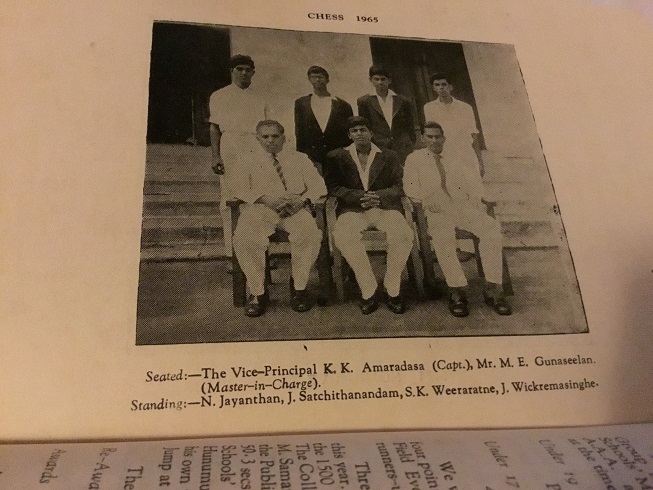
I was a member of the Royal College Chess Team from 1965 – 1967. K.K. Amaradasa (now a lawyer known as Amaradasa Kodikara) captained the College Chess Team from 1965 – 1966. I was appointed Captain of the College Chess Team in 1967.  Mr. M. E. Gunaseelan (Master in Charge) and Mr. R.M.D. Wickremasinghe (Teacher at school) extended support to the team. Royal College played against St. John’s College, Jaffna and the German Cultural Institute in 1965 and won at both encounters. The school provided facilities for playing Chess during the lunch interval and after school.

The Royal College team in 1965 comprised the following: K.K. Amaradasa (Captain), N. Jayanthan, J. Satchithanandan, J. Wickremasinghe and Senaka Weeraratna.

Senaka Weeraratna   

Photo – Royal College Chess Team – 1965

Source – Royal College Magazine 1965 (Third Term)

PS

This article ‘ Chess and I ‘ was published in the Souvenir released on January 05, 2020 to mark the holding of the ’24th Battle of the Kings’ Inter -School’ Chess Championship 2019 at Royal College, Colombo

British Colonials Starved to Death 60 Million-Plus Indians

January 26th, 2020

On

Hits: 1726

The chronic want of food and water, the lack of sanitation and medical help, the neglect of means of communication, the poverty of educational provision, the all-pervading spirit of depression that I have myself seen to prevail in our villages after over a hundred years of British rule make me despair of its beneficence. — Rabindranath Tagore

If the history of British rule in India were to be condensed to a single fact, it is this: there was no increase in India’s per-capita income from 1757 to 1947.[1]

Churchill, explaining why he defended the stockpiling of food within Britain, while millions died of starvation in Bengal, told his private secretary that the Hindus were a foul race, protected by their mere pullulation from the doom that is their due.”[2]

June 27— During its 190 years of looting and pillaging, the Indian Subcontininent as a whole underwent at least two dozen major famines, which collectively killed millions of Indians throughout the length and breadth of the land. How many millions succumbed to the famines cannot be fully ascertained. However, colonial rulers’ official numbers indicate it could be 60 million deaths. In reality, it could be significantly higher.

British colonial analysts cited droughts as the cause of fallen agricultural production that led to these famines, but that is a lie. British rulers, fighting wars in Europe and elsewhere, and colonizing parts of Africa, were exporting grains from India to keep up their colonial conquests—while famines were raging. People in the famineaffected areas, resembling skeletons covered by skin only, were wandering around, huddling in corners and dying by the millions. The Satanic nature of these British rulers cannot be overstated.

A Systematic Depopulation Policy

Although no accurate census figure is available, in the year 1750 India’s population was close to 155 million. At the time British colonial rule ended in 1947, undivided India’s population reached close to 390 million. In other words, during these 190 years of colonial looting and organized famines, India’s population rose by 240 million. Since 1947, during the next 68-year period, Indian Subcontininent’s population, including those of India, Pakistan, and Bangladesh, has grown to close to 1.6 billion. Thus, despite poverty and economic depravity in the post-independent Indian Subcontininent, during those 68 years population has grown by almost 1.2 billion.

Records show that during the post-independence period, the Subcontininent has undergone drought conditions in parts of the land from time to time, but there was no famine, although thousands still die in the Subcontininent annually due to the lack of adequate amount of food, a poor food distribution system, and lack of sufficient nourishment. It is also to be noted that before the British colonials’ jackboots got firmly planted in India, famines had occurred but with much less frequency—maybe once in a century.

There was indeed no reason for these famines to occur They occurred only because The Empire engineered them, intending to strengthen the Empire by ruthless looting and adoption of an unstated policy to depopulate India. This, they believed would bring down the Empire’s cost of sustaining India.

Take, for instance, the case of Bengal, which is in the eastern part of the Subcontininent where the British East India Company (HEIC, Honorable East India Company, according to Elizabeth I’s charter) had first planted its jackboots in 1757. The rapacious looters, under the leadership of Robert Clive—a degenerate and opium addict, who blew his brains out in 1774 in the London Berkley Square residence he had procured with the benefits of his looting—got control of what is now West Bengal, Bangladesh, Bihar, and Odisha (earlier, Orissa), in 1765. At the time, historical records indicate India represented close to 25% of the world’s GDP, second only to China, while Britain had a paltry 2%. Bengal was the richest of the Indian provinces.

Following his securing control of Bengal by ousting the Nawab in a devious battle at Plassey (Palashi), Clive placed a puppet on the throne, paid him off, and negotiated an agreement with him for the HEIC to become the sole tax collector, while leaving the nominal responsibility for government to his puppet. That arrangement lasted for a century, as more and more Indian states were bankrupted to facilitate future famines. The tax money went into British coffers, while millions were starved to death in Bengal and Bihar.

Clive, who was made a Fellow of the Royal Society in 1768 and whose statue stands near the British Empire’s evil center, Whitehall, near the Cabinet War Room, had this to say in his defense when the British Parliament, playing fair,” accused him of looting and other abuses in India:

Consider the situation which the Victory of Plassey had placed on me. A great Prince was dependent upon my pleasure; an opulent city lay at my mercy; its richest bankers bid against each other for my smiles; I walked through vaults which were thrown open to me alone, piled on either hand with gold and jewels! By God, Mr. Chairman, at this moment I stand astonished at my own moderation.

However, Clive was not the only murderous British colonial ruler. The British Empire had sent one butcher after another to India, all of whom engineered looting and its consequent depopulation.

By 1770, when the first great famine occurred in Bengal, the province had been looted to the core. What followed was sheer horror. Here is how John Fiske in his American Philosopher in the Unseen World depicted the Bengal famine:

All through the stifling summer of 1770 the people went on dying. The husbandmen sold their cattle; they sold their implements of agriculture; they devoured their seed-grain; they sold their sons and daughters, till at length no buyer of children could be found; they ate the leaves of trees and the grass of the field. . . . The streets were blocked up with promiscuous heaps of the dying and dead. Interment could not do its work quick enough; even the dogs and jackals, the public scavengers of the East, became unable to accomplish their revolting work, and the multitude of mangled and festering corpses at length threatened the existence of the citizens…. [3]

Was there any reason for the famine to occur? Not if the British had not wanted it. Bengal, then, as now, harvested three crops a year. It is located in the delta of the Gangetic plain where water is more than plentiful. Even if drought occurs, it does not destroy all three crops. Moreover, as was prevalent during the Moghul days, and in earlier time, the surplus grain was stored to tide the population over if there were one or two bad crops.

But the looting of grains carried out by Clive, and his gang of bandits and killers, drained grain from Bengal and resulted in 10 million deaths in the great famine, eliminating one-third of Bengal’s population.

It should be noted that Britain’s much-touted industrial revolution began in 1770, the very same year people were dying all over Bengal. The Boston Tea Party that triggered the American Revolution had taken place in 1773. The Boston Tea Party made the Empire realize that its days in America were numbered, and led Britain to concentrate even more on organizing the looting of India.

Why Famines Became So Prevalent During the British Raj Days

The prime reason why these devastating famines took place at a regular intervals, and were allowed to continue for years, was the British Empire’s policy of depopulating its colonies. If these famines had not occurred, India’s population would have reached a billion people long before the Twentieth Century arrived. That, the British Empire saw as a disaster.

To begin with, a larger Indian population would mean larger consumption by the locals, and deprive the British Raj to a greater amount of loot. The logical way to deal with the problem was to develop India’s agricultural infrastructure. But that would not only force Britain to spend more money to run its colonial and bestial empire; it would also develop a healthy population which could rise up to get rid of the abomination called the British Raj. These massive famines also succeeded in weakening the social structure and backbone of the Indians, making rebellions against the colonial forces less likely. In order to perpetuate famines, and thus depopulate the heathen” and dark” Indians, the British imperialists launched a systematic propaganda campaign. They propped up the fraudster Parson Thomas Malthus and promoted his non-scientific gobbledygook, The Essay on Population.” There he claimed:

This natural inequality of the two powers of population and of production in the earth, and that great law of our nature which must constantly keep their effects equal, form the great difficulty that to me appears insurmountable in the way to the perfectibility of society. All other arguments are of slight and subordinate consideration in comparison of this. I see no way by which man can escape from the weight of this law which pervades all animated nature.

Although Malthus was ordained in the Anglican Church, British Empire made him a paid economist” of the British East India Company, which, with the charter from Queen Elizabeth I under its belt, monopolized trade in Asia, colonizing vast tracts of the continent using its well-armed militia fighting under the English flag of St. George.

Malthus was picked up at the Haileybury and Imperial Service College, which was also the recruiting ground of some of the worst colonial criminals. This college was where the makers of British Empire’s murderous policies in India were trained. Some prominent alumni of Haileybury include Sir John Lawrence (Viceroy of India from 1864-68) and Sir Richard Temple (Lt. Governor of Bengal and later, Governor of Bombay presidency).

While Parson Malthus was putting forward his sinister scientific theory” to justify depopulation as a natural and necessary process, The British Empire collected a whole bunch of other economists” who wrote about the necessity of free trade. Free trade played a major role in pushing through the Empire’s genocidal depopulation of India, through the British Raj’s efforts. In fact, free trade is the other side of the Malthus’ population-control coin.

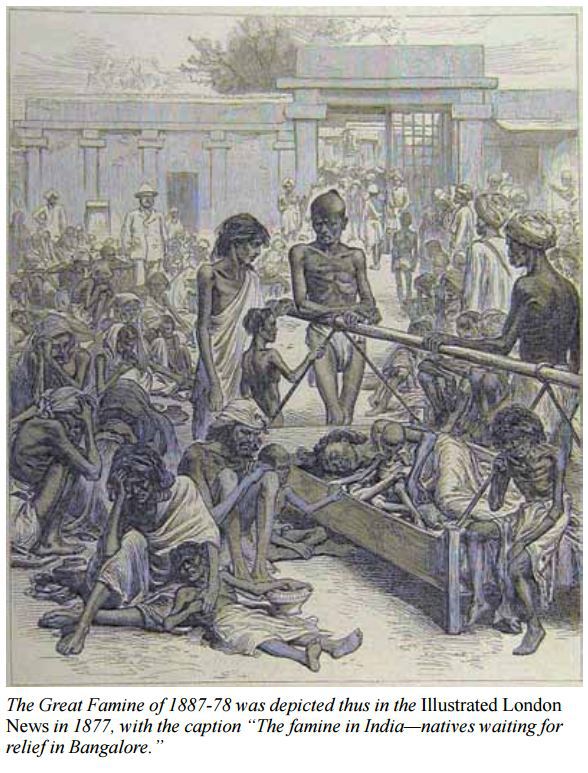
By the time the great famine of 1876 arrived, Britain had already built some railroads in India. The railroads, which were touted as institutional safeguards against famines, were instead used by merchants to ship grain inventories from outlying drought-stricken districts to central depots for hoarding. In addition, free traders’ opposition to price control ushered in a frenzy of grain speculation. As a result, capital was raised to import grains from drought-stricken areas, and further the calamity. The rise of price of grain was spectacularly rapid, and grain was taken from where it was most needed, to be stored in warehouses until the prices rose even higher.

The British Raj knew or should have known. Even if the British rulers did not openly encourage this process, they were fully aware of it, and they were perfectly comfortable in promoting free trade at the expense of millions of lives. This is how Mike Davis described what happened:

The rise [of prices] was so extraordinary, and the available supply, as compared with well-known requirements, so scanty that merchants and dealers, hopeful of enormous future gains, appeared determined to hold their stocks for some indefinite time and not to part with the article which was becoming of such unwonted value. It was apparent to the Government that facilities for moving grain by the rail were rapidly raising prices everywhere, and that the activity of apparent importation and railway transit, did not indicate any addition to the food stocks of the Presidency . …retail trade up-country was almost at a standstill. Either prices were asked which were beyond the means of the multitude to pay, or shops remained entirely closed.

At the time, Lord Lytton, a favorite poet of Queen Victoria who is known as a butcher” to many Indians, was the Viceroy. He wholeheartedly opposed all efforts to stockpile grain to feed the famine-stricken population because that would interfere with market forces. In the autumn of 1876, while the monsoon crop was withering in the fields of southern India, Lytton was absorbed in organizing the immense Imperial Assemblage in Delhi to proclaim Victoria Empress of India.

How did Lytton justify this? He was an avowed admirer and follower of Adam Smith. Author Mike Davis writes that Smith

a century earlier in The Wealth of Nations had asserted (vis-à-vis the terrible Bengal droughtfamine of 1770) that famine has never arisen from any other cause but the violence of government attempting, by improper means, to remedy the inconvenience of dearth, Lytton was implementing what Smith had taught him and other believers of free trade. Smith’s injunction against state attempts to regulate the price of grain during the 1770 famine had been taught for years in the East India Company’s famous college at Haileybury.[4]

Lytton issued strict orders that there is to be no interference of any kind on the part of Government with the object of reducing the price of food,” and in his letters home to the India Office and to politicians of both parties, he denounced ‘humanitarian hysterics’.” By official diktat, India, like Ireland before it, had become a Utilitarian laboratory where millions of lives were gambled, pursuant to dogmatic faith in omnipotent markets overcoming the inconvenience of dearth.”[5]

The Great Famines

Depicting the two dozen famines that killed more than 60 million Indians would require a lot of space, so I limit myself here to those that killed more than one million:

The Bengal Famine of 1770: This catastrophicfamine occurred between 1769 and 1773, and affected the lower Gangetic plain of India. The territory, then ruled by the British East India Company, included modern West Bengal, Bangladesh, and parts of Assam, Orissa, Bihar, and Jharkhand. The famine is supposed to have caused the deaths of an estimated 10 million people, approximately one-third of the population at the time.

The Chalisa Famine of 1783-84: The Chalisa famine affected many parts of North India, especially the Delhi territories, present-day Uttar Pradesh, Eastern Punjab, Rajputana (now named, Rajasthan), and Kashmir, then all ruled by different Indian rulers. The Chalisa was preceded by a famine in the previous year, 1782-83, in South India, including Madras City (now named Chennai) and surrounding areas (under British East India Company rule), and in the extended Kingdom of Mysore. Together, these two famines had taken at least 11 million lives, reports indicate.

The Doji Bara Famine (or Skull Famine) of 1791- 92: This famine caused widespread mortality in Hyderabad, Southern Maratha Kingdom, Deccan, Gujarat, and Marwar (also called Jodhpur region in Rajasthan). The British policy of diverting food to Europe, of pricing the remaining grain out of reach of native Indians, and adopting agriculture policy that destroyed food production, was responsible for this one. The British had surplus supplies of grain, which was not distributed to the very people that had grown it. As a result, about 11 million died between 1789-92 of starvation and accompanying epidemics that followed.

The Upper Doab Famine of 1860-61: The 1860-61 famine occurred in the British-controlled Ganga-Yamuna Doab (two waters, or two rivers) area engulfing large parts of Rohilkhand and Ayodhya, and the Delhi and Hissar divisions of the then-Punjab. Eastern part of the princely state of Rajputana. According to official” British reports, about two million people were killed by this famine.

The Orissa Famine of 1866: Although it affected Orissa the most, this famine affected India’s east coast along the Bay of Bengal stretching down south to Madras, covering a vast area. One million died, according to the British official” version.

The Rajputana famine of 1869: The Rajputana famine of 1869 affected an area of close to 300,000 square miles which belonged mostly to the princely states and the British territory of Ajmer. This famine, according to official” British claim, killed 1.5 million.

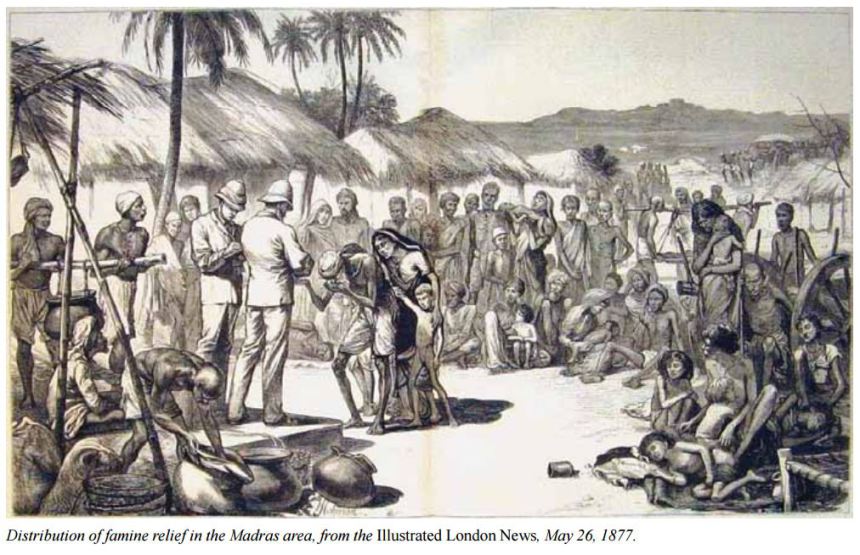
The Great Famine of 1876-78: This famine killed untold numbers of Indians in the southern part and raged for about four years. It affected Madras, Mysore, Hyderabad and Bombay (now called, Mumbai). The famine also subsequently visited Central Province (now called, Madhya Pradesh) and parts of undivided Punjab. The death toll from this famine was in the range of 5.5 million people. Some other figures indicate the number of deaths could be as high as 11 million.

Indian famine of 1896-97 and 1899-1900: This one affected Madras, Bombay, Deccan, Bengal, United Provinces (now called, Uttar Pradesh), Central Provinces, Northern and eastern Rajputana, parts of Central India, and Hyderabad: six million reportedly died in British territory during these two famines. The number of deaths occurred in the princely states is not known.

The Bengal Famine of 1943-44: This Churchill-orchestrated famine in Bengal in 1943-1944 killed an estimated 3.5 to 5 million people.

Relief Camps, or Concentration Camps

There were several policy-arrows which Adolf Hitler might have borrowed from the British quiver to kill millions, but one that he borrowed for certain in setting up his death camps, was how the British ran the camps to provide relief” to the starving millions. Anyone who entered these relief camps, did not exit alive.

Take the actions of Viceroy Lytton’s deputy, Richard Temple, another Haileybury product imbued with the doctrine of depopulation as the necessary means to keep the Empire strong and vigorous. Temple was under orders from Lytton to make sure there was no unnecessary” expenditure on relief works.

According to some analysts, Temple’s camps were not very different from Nazi concentration camps. People already half-dead from starvation had to walk hundreds of miles to reach these relief camps. Additionally, he instituted a food ration for starving people working in the camps, which was less than that was given to the inmates of Nazi concentration camps.

The British refused to provide adequate relief for famine victims on the grounds that this would encourage indolence. Sir Richard Temple, who was selected to organize famine relief efforts in 1877, set the food allotment for starving Indians at 16 ounces of rice per day—less than the diet for inmates at the Buchenwald concentration camp for the Jews in Hitler’s Germany. British disinclination to respond with urgency and vigor to food deficits resulted in a succession of about two dozen appalling famines during the British occupation of India. These swept away tens of millions of people. The frequency of famine showed a disconcerting increase in the nineteenth century.[6]

It was deliberate then, and it’s deliberate now.

______________
1. Davis, Mike. Late Victorian Holocausts: El Nino Famines and the Making of the Third World, London, Verso Books, 2001.

2. Madhusree Mukerjee, Churchill’s Secret War: The British Empire and the Ravaging of India during World War II, New York: Basic Books.

3. Davis, op. cit.

4. Ibid.

5. Ibid

6. Bhatia, B.M., Famines in India, A Study in Some Aspects of the Economic History of India, 1860-1945, Asia Publishing House, Bombay, 1963.


Author: Ramtanu Maitra

Originally published on July 3, 2015 EIR

About the author: Dr Ramtanu Maitra

A specialist on South Asian Affairs who operates out of Washington D.C. Ramtanu Maitra specialises on strategic and infrastructural developmental studies with the focus on South Asia.
He holds a Masters Degree in Structural Engineering and was working as a Senior Project Engineer with the Nuclear Power Services, Secaucus, NJ.
Ramtanu Maitra participated in developing a document, India: An agro-industrial superpower by 2020, in 1981.
He established and published a quarterly journal, Fusion Asia, on science, technology, energy and economics from New Delhi for more than 10 years (1984-1994).
He wrote and published the first feature report on India’s high-energy physics program based in PRL, Ahmedabad. Prepared and published a detailed report on Ganges River Valley Development that was presented at an international conference inaugurated by the late president of India, Shri K.R. Narayanan, then Minister for Planning.
He participated on behalf of Fusion Asia on a feasibility study that also involved the Mitsubishi Research Institute (Tokyo) and the Thai Citizen Forum. Presented papers at a number of international conferences on strategic infrastructures in Bogota, Colombia, Tokyo, Japan, Kolkata, Indore, Madurai, Indore, New Delhi, among other Indian cities.
In 1994, Shri Maitra established New Delhi bureau for Asia Times, a Bangkok-based news daily published simultaneously from Bangkok, Hong Kong, Kuala Lumpur and New York.
Presently, he conducts research, analysis, writing on international economic and strategic developments for publications internationally, including: Foresight (Japan); Aakrosh, Agni, Indian Defense and Technology (India); Asia Times Online (Hong Kong); and Executive Intelligence Review (USA).
http://www.sasfor.com/about.html

Ramtanu Maitra is a regular columnist with the Executive Intelligence Review (EIR), a news weekly published from Washington DC. He writes columns for Asia Times of Hong Kong, Frontier Post of Peshawar and some other newspapers in Asia on South Asian political economy and Asian security. He has written on terrorism in a number of publications in the United States and India.

MORE ARTICLES BY DR MAITRA >

http://www.indiandefencereview.com/author/ramtanumaitra/

http://www.indiandefencereview.com/author/ramtanumaitra/?page=2

http://www.sasfor.com/india/category/ramtanu%20maitra

Original source of the article:

Genocide, the British don’t want you to know about – They systematically starved to death over 60 millions of Eastern Indians!

ජනතාවට වග නොකියන උගත් බුද්ධිමත් මන්ත්‍රීවරු මොකටද? | Dr. sarath werasekara

January 26th, 2020

Courtesy LANKA LEAD NEWS

Outrage at whites-only image as Ugandan climate activist cropped from photo

January 26th, 2020

Courtesy  The Guardian (UK)

Vanessa Nakate was excised from image, which also featured Greta Thunberg, ‘purely on composition grounds’ says Associated Press

Ugandan climate activist Vanessa Nakate has called out racism in media after she was cropped out of a photo featuring prominent climate activists including Greta Thunberg, Loukina Tille, Luisa Neubauer and Isabelle Axelsson.

Nakate made the comment in a video which has since gone viral, adding that she now understood the definition of the word racism” for the first time in her life.

The group had given a news conference in Davos on Friday when Nakate was then cropped out of a published version by the Associated Press, a US news agency. She questioned the removal on Twitter.

https://www.theguardian.com/world/2020/jan/24/whites-only-photo-uganda-climate-activist-vanessa-nakate

Forensic Audits part of bond scam cover-up

January 26th, 2020

Courtesy Daily FT

From the time the bond scam was carried out by the Ranil Wickremesinghe administration, that administration under the guidance of the former Prime Minister had been avoiding the law by regularly bringing up various distractions so that the true nature of the scam could be covered-up and the persons responsible could escape punishment. 

Instead of a straight-forward Police investigation and prosecution, which is the most obvious and acceptable method by which all crimes and frauds are dealt with, the administration orchestrated various non-punitive inquiries including private lawyer inquiries, COPE inquiries, and Presidential Commission investigations, etc., so that the perpetrators could evade arrest and carry out their other work without any hindrance. 

In that grand scheme of deception and cover-ups, a direct proposal was made to the Bond Commission by then Prime Minister Ranil Wickremesinghe, and based on that suggestion, the Bond Commission recommended a Forensic Audit, which has now been purportedly carried out under the authority of the Members of the Monetary Board. 

Unfortunately, however, several Members of the Board were serving in the Monetary Board while the bond scams were carried out with impunity, while others had been involved in covering up the scams to the greatest extent possible. 

As expected, therefore, the purported Forensic Audit Report has been converted into an instrument to sling mud at the ‘pre-2015’ political authorities and Central Bank administration, based on inaccuracies, distortions and downright lies. 

An initial study of the Forensic Audit reports clearly confirms that its main purpose has obviously been to ‘whitewash’ the corrupt Wickremesinghe administration that carried out the bond scam to the greatest extent possible, and to ‘blacken’ the ‘pre-2015’ administration as heavily as possible. 

In the next few days, a more detailed and in-depth analysis of the purported Forensic Audit reports would be carried out in order to apprise the public of the gross inaccuracies, prejudiced statements, and the politically motivated comments. 

In fact, the unprofessional ‘cherry-picking’ of data, seriously flawed analysis, inaccurate findings, deliberate overlooking of material facts, obviously false findings, and blatantly biased conclusions confirm that the purported Forensic Audits were engineered by those vested interests at a staggering cost of over Rs. 300 million to further confuse the public as to the true nature and scope of the bond scam and its repercussions. 

Further, the blatantly politically motivated undertones that are reflected in the purported Forensic Audit reports also confirm the objectives of those persons under whose guidance and insistence these purported Forensic Audits were carried out. That situation is of course best described in the pithy Sinhala saying, fydrdf. wïudf.ka fmak wykjd jf.a”; translated as like asking the robber’s mother about the identity of the robber!” 

The immediate former Governor of the Central Bank Dr. Indrajit Coomaraswamy has himself confirmed that these purported Forensic Audits were carried out under the authority of the Monetary Board”. It is also well-known within the Central Bank that the Member of the Monetary Board Chrisantha Perera, who coordinated the Forensic Audits for the Monetary Board, was a person under whose watch the second bond scam took place since he was a Member of the Monetary Board from March 2015 onwards. Perera was also serving in the Monetary Board while the cover-up was carried out in earnest, to the maximum extent possible. 

The Official Member of the Monetary Board who gave official sanction for the Forensic Audits, Dr. R. H. S. Samaratunga served in the Monetary Board when both scams occurred and while the cover-up was progressing! Hence, it is abundantly clear that the ‘independence’, which is a vital pre-requisite for any credible Forensic Audit, had been hopelessly compromised by the costly and corrupt process followed by the Members of the Monetary Board. 

In that context, steps will soon be taken to professionally refute and deal with the various innuendo and insinuations as reflected in the recent purported forensic audit reports as well as expose those who are responsible for these efforts, as well. 

For the time being, as an initial response to the contents of the purported reports, it can be confirmed that during the period 2006 to 2014, there had definitely not been any fraudulent activity in the issue of Government Bonds, quite unlike those Bond issues that took place in February 2015 and March 2016 due to the Prime Minister and Governor conniving and changing the 18-year-old time-tested system in order to carry out the scam. 

It may also be pertinent to point out that those actions of the Prime Minister and his Governor also caused losses in the region of around a trillion rupees to the country and the economy, as per a former member of Wickremesinghe’s own Cabinet. 

Until such a study is done and a professional public response is articulated, for the time being it would suffice to state that billions of rupees was saved under the ‘pre-2015’ administration through the issuing of Government Bonds in a transparent and scientific manner through a time-tested method, and that huge gains and profits had been recorded through the portfolio investment activities of the Employees Provident Fund. 

In fact, the unrealised profit of the EPF’s share portfolio as at end December 2014 is recorded in its financial statements as being over Rs. 20,000 million, while the realised profit from 2011 to 2014 was a further Rs. 14,580 million. 

The bond scam has already been clearly documented and exposed by many analysts and experts. Sufficient evidence and material are also available to carry out a prosecution of the mastermind of the scam as well those who have been aiding and abetting the crime. 

Those who have actively assisted in the cover-up of the scam have also been clearly identified. All aspects of this extensive and high-powered cover-up and the part of the cover-up that the purported Forensic Audit was designed to play, have already been highlighted in my recent book, The Great Bond Scam Cover-up”. 

A summary of such a book with a few updates would be released to the media within the next two days in both English and Sinhala, so that the true nature of the cover-up could be conveniently grasped by all those interested in bringing the culprits of this scam to justice. 

As already known, the various allegations made by former Prime Minister Ranil Wickremesinghe and his cohorts as well as the insinuations carried in the Bond Commission report had already been shown to be partisan, erroneous or false. That was the reason as to why the Wickremesinghe administration could not press any legal charges against the ‘pre-2015’ Governor or other officials during the near five years that the Wickremesinghe Government was in power. 

Needless to say, when such a detailed response to the purported Forensic Audit is made public, the insinuations and innuendo as set out in the purported Forensic Audit reports would also meet the same fate as that which befell certain erroneous COPE strictures, PM’s vituperative ranting, and the Bond Commission’s unfortunate insinuations, as those, too, would soon be proved as being without a rational basis or foundation. 

In any event, any follow-up decision pertaining to the bond scam prosecutions would have to be made by the Attorney General after weighing the evidence available. 

In that regard, it has already transpired that Speaker Karu Jayasuriya has released these flawed reports against the direct advice of the Attorney General, perhaps to provide some respite to the currently beleaguered former Prime Minister, who is battling his own party rank and file to safeguard his faltering leadership, which is now being directly challenged. It must also be said that it is already abundantly clear from the periodic revelations in the media that the ‘post-2015’ Yahapalanaya leadership had influenced and coerced Police officers, judges, witnesses, court officials and public officials with impunity for their political advantage. 

From all accounts, it is also obvious that it has only been because of such influence that the bond scam perpetrators have been so far able to evade responsibility for their crimes. In that background, the best course of action for the present Government would be to entrust the entire bond scam investigation to the CID, so that a proper and impartial investigation could now be carried out with the goal of bringing the perpetrators to book. 

Therefore, it is strongly urged that the Government immediately establishes several CID Investigation units to thoroughly investigate all aspects of this dastardly crime, so that the perpetrators of this heinous white-collar crime could be brought to book as fast as possible. Needless to say, the entire country is eagerly waiting until that is done. 

Corona Virus: Use face masks, precautionary steps, public urged

January 26th, 2020

Courtesy The Daily Mirror

While claiming that there was no need to panic over the Corona Virus, the Health Ministry has advised the general public to wear face masks as a safety measure.

Meanwhile, CMC Chief Medical Officer Dr Ruwan Wijayamuni also requested all who come to Colombo to wear face masks as a precautionary measure.

He advised to adhere to this method when entering public places, hotels and restaurants in the Colombo city and also to wear a mask to hotel employees and staff.

The Chief Epidemiologist of the Colombo Epidemiology Unit, Dr Sudath Samaraweera has also issued a statement outlining the measures to be taken to prevent contracting the disease.

According to the statement, the new Corona Virus was capable of spreading from one person to another. Public health measures should take to prevent the disease from spreading in Sri Lanka as it has spread to other countries.

Avoid crowded areas, wash hands regularly with soap or with alcohol, cover your mouth and nose with the elbow area when you sneeze. Otherwise use tissues and dispose of them safely, avoid close association with those has fever and cough and if anyone suffering from a fever and cough after arriving from an identified new Corona Virus affected area, seek immediate medical attention,” he said in his statement.

150 Sri Lankan students to be repatriated from China within 48hrs

January 26th, 2020

Courtesy The Daily mirror

Steps had been taken to bring back 150 Sri Lankan students from Chengdu in Sichuan Province, China through a special flight within the next 48 hours, the President’s Media Division said.

President Gotabaya Rajapaksa had earlier directed authorities to take necessary steps to repatriate all Sri Lankan students in the Wuhan and Sichuan cities in China.

Accordingly, a special programme has been launched by the Presidential Secretariat, Ministry of Foreign Relations, Ministry of Health, Sri Lanka Embassy in Beijing and SriLankan Airlines.

SL requests to land aircraft in Wuhan to airlift 32 students

On the instructions of President Gotabaya Rajapaksa, the Sri Lankan Embassy in Beijing has today submitted an application to land a Sri Lankan Airlines aircraft in Wuhan Airport to airlift 32 Sri Lankan students including their family members, the Foreign Relations Ministry said today.

In a statement, the Ministry said the Embassy is closely following up with the Foreign Ministry of China and Foreign Affairs Office of the Wuhan Province to expedite the process of obtaining clearance for the landing of the aircraft, as soon as they are allowed to travel out of their present locations.

“The Ministry, Embassy and Consulate Generals are also working with the Sri Lankan Airlines in seeking to operationalize instructions to bring back all other Sri Lankan students presently in China. It is estimated that presently approximately 860 students remain in China, spread in various city centres throughout the country. Meanwhile, the Embassy in Beijing, Consulate Generals in Guangzhou and Shanghai are in constant touch with the Sri Lankan students in Wuhan and other parts of China to provide information with regard to the precautionary measures to be taken to prevent any infection.

The Mission and posts have not received any information on any Sri Lankans infected by the Coronavirus, ” it said. The Ministry further said, “In order to provide assistance to the Sri Lankan students and professionals living in China who wish to return to Sri Lanka, the Foreign Relations Ministry in collaboration with its Mission in Beijing and Posts in Shanghai and Guangzhou has secured the immediate application of 50% discount on the airfare of Sri Lankan Airlines for its regular flights operating to Beijing, Shanghai and Guangzhou.

All Sri Lankan citizens who would like to travel to Sri Lanka from China will be able to obtain 50% discount of the marked fare by calling the Sri Lankan Airlines call center on 0094-777771979. The Mission and the Posts are on a 24-hour operation to provide any assistance for Sri Lankans living in China, their parents and relatives. Information can be received from the Mission by calling the hotline on 0086-10-65321861/2. The following officers can also be contacted for queries about the Sri Lankans living in China and their relatives.

The officers can be reached on a 24-hour basis on the following numbers: Mr. Alexi Gunasekera, Minister (Commercial) Mob. 0086 13070138025 Brig. Kalpa Sanjeewa, Minister Counsellor (Defence) Mob. 0086 13051733302 Mrs. Inoka Weerasinghe, Second Secretary Mob. 0086 15116905523 Mrs. Thilini Gunaratne, Second Secretary Mob. 0086 13121722296 Mrs. Manorie Mallikaratchy, the Consul General of Shanghai can be contacted on 0086 13472771702 or Mrs. Geetha Perera, Attaché on 0086 159 0094 6639 to obtain information regarding Sri Lankans living in Shanghai, Anhui, Zhejiang, Jiangsu, and Hunan. Mrs. Priyangika Dharmasena, the Consul General of Guangzhou can be contacted on 0086 18814134670 or Mrs. U.K.G.Roshini, Attaché on 0086 13902301874 for information regarding the Sri Lankans living in Guangdong, Fujian, Hainan, Guangxi, Jiangxi.”

එන්.ජී.ඕ.වලට අවශ්‍ය ආකාරයට මෙරට අධ්‍යාපන ප්‍රතිසංස්කරණ කිරීමට ඉඩ ලබානොදිය යුතුයි – මැදගොඩ අභයතිස්ස හිමි

January 26th, 2020

උපුටා ගැන්ම හිරු නිව්ස්

රාජ්‍ය නොවන සංවිධානවලට අවශ්‍ය ආකාරයට මෙරට අධ්‍යාපන ප්‍රතිසංස්කරණ කිරීමට කිසිසේත් ඉඩ ලබා නොදිය යුතු බව මහාචාර්ය පූජ්‍ය මැදගොඩ අභයතිස්ස හිමියන් පවසනවා.

උන්වහන්සේ මේ බව සඳහන් කළේ මත්තේගොඩ ප්‍රදේශයේ පැවති උත්සවයකදී.

Ex-CBSL Governor Cabraal on Forensic Report

January 26th, 2020

Courtesy The Island

article_image

Former Governor of the Central Bank of Sri Lanka (CBSL), Ajith Nivard Cabraal, has issued the following statement in response to the Forensic Audit report bond issuances:

“In 2015, I went before the DEW Gunasekera COPE Committee and provided details about my relatives in the Banking Sector. I had also provided a clear explanation about my relatives in the banking sector, through a media statement, in 2007,
and it was carried in The Island on 12 August, 2017. (http://www.island.lk/index.php?page_cat=article-details&page=article-details&code_title=169868

Hence, there was no need for a Rs.300 million “Forensic Audit” to reveal this.

“In this regard, the real issue is whether the so-called Forensic Audit has uncovered any information that links me to any wrong-doing. In fact, even as the Report grudgingly acknowledges, the answer is a clear NO.”

The Island article published on 12 August, 2017:

Nivard Cabraal clarifies picture on his relations in banking

“Corrupt and ignorant politicians trying to judge us by their standards”

by Ajith Nivard Cabraal

August 12, 2017

Much has been said by certain interested parties about my sister, Siromi Wickramasinghe, being appointed as the Chairman of the HDFC Bank by the previous government. In that regard, I can only say that she was a “fit and proper” person to hold that position, having risen to the rank of a Deputy General Manager of the Hatton National Bank, in an impeccable banking career.

In addition, as I have already informed COPE [Committee on Public Enterprises], there were several other relations who also served on the boards of banks in their own right with honesty and professionalism, as they were qualified, competent, and respected persons in society. For completeness sake, let me list out those who served on the Bank boards, in their own right:

Nihal Fonseka – first cousin – Director and CEO of DFCC Bank;

Amal Cabraal – first cousin- Director of HNB;

Ravi Thambiayah – brother-in-law – Director of DFCC;

Sunil Wijesinha – brother-in-law – Chairman of NDB;

Dhara Wijayatilake – sister-in-law – Director of Sampath Bank;

Shibani Thambiayah – niece – Director of DFCC Vardhana.

Several of my relations serve on Bank boards even now, and in fact, Nihal Fonseka presently serves on the Monetary Board of the Central Bank while Amal Cabraal serves on the Monetary Policy Consultative Committee of the Central Bank and the Board of HNB. In addition, the following relations, Dhara Wijayatilake (Sampath Bank) and Shibani Thambiayah (DFCC Bank) continue to serve on Bank boards, while brother-in-law, Ranel Wijesinha (Bank of Ceylon) and nephew-in-law, Anush Wijesinha (Seylan Bank), have also been appointed to Bank boards during the past two years.

As would be clear, it would be outrageous for anyone to insinuate that any of the above-mentioned relation of mine would have ever been influenced by me, or that they would have attempted to influence me. As a respected and highly professional family, we have all conducted ourselves with dignity, honesty and professionalism, and it is pathetic to see some corrupt and ignorant politicians attempting to judge us by their contemptible standards. 

බැඳුම්කර වෝහාරික විගණන වාර්තාව ගැන පක්ෂ විපක්ෂ අදහස්

January 26th, 2020

උපුටා ගැන්ම හිරු නිව්ස්

ආන්දෝලනාත්මක බැඳුම්කර නිකුතුව සම්බන්ධව ශ්‍රී ලංකා මහ බැංකුව විසින් ඉදිරිපත් කෙරුණු වෝහාරික විගණන වාර්තාව පිළිබඳ පක්ෂ විපක්ෂ දේශපාලනඥයන් අද අදහස් පළ කළා.

RANJANGATE SCANDAL – Speaker to summon AG following requests by CC

January 26th, 2020

Yohan Perera Courtesy The Daily Mirror

Speaker Karu Jayasuriya is to summon Attorney General Dappula de Levera following a decision made by the Constitutional Council (CC) over the directive he had given to arrest High Court Judge Gihan Pilapitiya.

A statement from the Parliament Media Unit said some members of CC were of the opinion that the AG’s directive to arrest a judge would result in people losing their faith in the Sri Lankan Judiciary. 

RANJANGATE SCANDAL – හඬපට හරහා ඇතැම් මහජන නියෝජිතයින්ගේ පිරිහීම නිරූපනය වන බව අගමැති කියයි

January 26th, 2020

උපුටා ගැන්ම හිරු නිව්ස්

ආන්දෝලනාත්මක හඬපට හරහා ඇතැම් මහජන නියෝජිතයින්ගේ පිරිහීම නිරූපනය වන බව අග්‍රාමාත්‍ය මහින්ද රාජපක්ෂ මහතා පවසනවා.

කළුතර – මතුගම ප්‍රදේශයේ පැවති උත්සවයකදී අග්‍රාමාත්‍යවරයා මේ බව සඳහන් කළා.

RANJANGATE SCANDAL – පසුගිය රජයේ සැලසුම්සහගත උත්සාහයක් ගැන අස්ගිරි ලේඛකාධිකාරී හිමියන් කියයි

January 26th, 2020

උපුටා ගැන්ම හිරු නිව්ස්

රන්ජන් රාමනායක මන්ත්‍රීවරයාගේ හඬ පට අනුව පසුගිය රජය විසින් මෙරට දෙමුහුන් අධිකරණ ස්ථාපිත කිරීමේ සැලසුම්සහගත උත්සාහයක නිරත වී ඇති බවට සැකයක් මතු වන බව අස්ගිරි පාර්ශවයේ මහා ලේඛකාධිකාරී පූජ්‍ය මැදගම ධම්මානන්ද හිමියන් පවසනවා.

උන්වහන්සේ මේ බව කියා සිටියේ ශ්‍රී ලංකා පොදුජන පෙරමුණේ සභාපති මහාචාර්ය ජී.එල්. පීරිස් තමන් වහන්සේ බැහැ දැකීම සඳහා අද පැමිණි අවස්ථාවේදියි.

මහනුවරට පැමිණි මහාචාර්ය ජී.එල්. පීරිස්, අස්ගිරි පාර්ශවයේ මහනායක අතිපූජ්‍ය වරකාගොඩ ශ්‍රී ඥානරතන නාහිමියන් බැහැදුටුවා.

අනතුරුව ඔහු අස්ගිරි පාර්ශවයේ මහාලේඛකාධිකාරී පූජ්‍ය මැදගම ධම්මානන්ද හිමියන් බැහැදුටුවා.

පසුගිය රජයේ වැරදි වත්මන් ආණ්ඩුවට මත පැටවීමට විපක්ෂය කටයුතු කරනවා – මුරුත්තෙට්ටුවේ ආනන්ද හිමි

January 26th, 2020

උපුටා ගැන්ම හිරු නිව්ස්

රටේ සම්පත් සියල්ල විකුණා දමා රට විනාශ කළ පසුගිය ආණ්ඩුවේ සිටි පිරිස් එහි වගකීම වත්මන් පාලකයින් පිට පැටවීමේ උත්සාහයක නිරත වන බවට නාරාහේන්පිට අභයාරාම විහාරාධිපති පූජ්‍ය මුරුත්තෙට්ටුවේ ආනන්ද හිමියන් චෝදනා කරනවා.

සිය ඡන්ම දිනය නිමිත්තෙන් එම විහාරස්ථානයේ අද (26) පැවති දානමය පිංකමකදී උන්වහන්සේ මේ බව සඳහන් කළ අතර, එම අවස්ථාවට ජනාධිපති ගෝඨාභය රාජපක්ෂ සහ අග්‍රාමාත්‍ය මහින්ද රාජපක්ෂ ද එක්ව සිටියා.

ඉන් අනතුරුව මිරිසවැටිය විහාරාධිපති පූජ්‍ය ඊතලවැටුණුවැවේ ඤාණතිලක හිමියන් ද අනුශාසනාවක් සිදුකළා.

මේ අතර, සුනිත්‍ය බලශක්ති උත්පාදනයට විශ්වාසදායී ජාලයක් ස්ථාපනය කිරීමට ශ්‍රී ලංකාවට සහාය වීම සඳහා කටාර් රාජ්‍ය කැමැත්ත පලකර තිබෙනවා.

කටාර් රාජ්‍යයේ බලශක්ති කටයුතු පිළිබඳ රාජ්‍ය අමාත්‍ය සාඩ් ෂෙරීඩා අල් කාබි ජනාධිපති කාර්යාලයේදී අද (26) පෙරවරුවේ ජනාධිපති ගෝඨාභය රාජපක්ෂ හමුවූ අවස්ථාවේදීයි මෙම දැනුම් දීම කර ඇත්තේ.

එමෙන්ම, කටාර් රාජ්‍ය අමාත්‍යවරයා කළ ඉල්ලීමට අනුව බලශක්ති උත්පාදනයට විශ්වාසදායී ජාලයක් ස්ථාපනය කිරීමේ යෝජනාව පිළිබඳ ඉදිරි කටයුතු සඳහා ශ්‍රී ලංකා නියෝජිතයා ලෙස ජනාධිපති ලේකම් ආචාර්ය පී.බී. ජයසුන්දර නම් කර තිබෙනවා.

ඝාතන කුමන්ත්‍රණයක් ගැන, මාගල්කන්දේ හිමියන්ගෙන් පැමිණිල්ලක්

January 26th, 2020

උපුටා ගැන්ම හිරු නිව්ස්

ඝාතන කුමන්ත්‍රණයක් සහ මරණ තර්ජන සම්බන්ධයෙන් නව සිංහල රාවය ජාතික සංවිධානයේ මහලේකම් පූජ්‍ය මගල්කන්දේ සුදත්ත හිමියන් පොලිස් මූලස්ථානයට අද (26) පැමිණිල්ලක් ඉදිරිපත් කළා.

පැමිණිල්ල භාර දීමෙන් පසු උන්වහන්සේ මාධ්‍ය වෙත අදහස් දක්වමින් කියා සිටියේ තමන් කිසිවිටෙකත් සත්‍ය වෙනුවෙන් පෙනී සිටීමට පසුබට නොවන බවයි.

How India Turned Lanka into an Expendable Battleground in a Clash with China

January 25th, 2020

Dilrook Kannangara

A battle fought in own country will bring untold sufferings to own population making the war unpopular. However, a war fought over another country saves own population and the battlefield can be devastated with any weapon that is available. This has been the case with many proxy wars in Iraq, Syria, Libya, Afghanistan, Yemen, etc. that devastated the unfortunate target country. India has turned Lanka into its battlefield in a clash with China.

In January 2020 India positioned BrahMos missile armed Su-30 fighter jets in a Tamil Nadu air base in Thanjavur. It is a highly offensive move aimed at destroying Chinese fishing, cargo and military vessels if war breaks out. Su-30 jets are of Russian origin that are highly agile attack aircraft with an average unfueled range of around 2,000km. BrahMos missile which is a Russian-Indian collaboration is world’s fastest cruise missile. Its air launched version has a range of 400km. One way range of the plane and the total range of the missile puts 1,400km from their base. In other words the weapons combination can strike anywhere within a radius of 1,400km from Thanjavur.  

The planes and missiles are not for the targeting of India’s coastal areas which are defended by cheaper and far more devastating coastal defence systems. Visakhapatnam air force and naval base is for the targeting of any Chinese vessels in the upper parts of Bay of Bengal.

The new Thanjavur base is to target Chinese vessels from Sri Lanka’s Exclusive Economic Zone!

Sri Lanka’s Exclusive Economic Zone extends 370km from coast. With a vertical stretch of 417km, the outermost point of Lanka’s EEZ is 1,200km from Thajavur. This puts the entire Lankan EEZ within the striking distance of the new Indian deployment.

The other sea areas the attack radius extend are either not used by any Chinese vessels or come under dedicated and better Indian defences. In short, India will destroy Chinese vessels and suffer counter attacks within the territory and the EEZ of Sri Lanka. As a result Sri Lanka is in the crosshairs of both powers in a confrontation. Since such a clash will be fought outside the territory of both India and China, they will be more willing to pick a fight. It has no devastation on their populations.

In addition to massive collateral damage, Sri Lanka will also suffer the wrath of China and a possible war crimes charge too as its territory and the EEZ are used to launch attacks on Chinese interests. China will probably retaliate which will once again destroy matter within Sri Lanka’s territory and EEZ.

To make matters worse, Sri Lanka recently agreed with India to share maritime surveillance information with India for $50 million. India uses Sri Lanka not only to attack Chinese vessels but also to spy on them. These recent deals with India are on top of already existing anti-China deals Lanka has with USA (ACSA since 2007 and SOFA since 1995). Sri Lanka always allowed and continues to allow overfly for US and Indian military planes.

Step by step, Sri Lanka has moved too far away from its non-aligned and neutrality position. Now it is a military outpost of USA and India over which devastating battles will be fought with China. All three players will generously use firepower as their populations are safe hundreds or thousands of kilometers away. The non-aligned, middle path and neutrality policies as practiced by Colombo have turned Lanka into the proverbial kindhearted woman who is pregnant every day. And the political blame game continues in the backdrop of the new Great Game. Who really cares for Lanka when Lankans themselves don’t care.

ERASING THE EELAM VICTORY Part 13 E

January 25th, 2020

KAMALIKA PIERIS

The hostage rescue of April 2009   deserves special mention. It is unique. Rear Admiral Sarath Weerasekera observed that no country in the world has won a separatist war while rescuing 300,000 people. Sri Lanka army’s epic hostage rescue is a feat of heroism and dedication.  Army officers pointed out that the Tamil civilians owed their lives to the bravery of our soldiers.  But Tamil civilians have never acknowledged the efforts made by the army.  

Sri Lanka armed forces took the lead role in this emergency humanitarian effort’. This must be recognized. The civilians were able to escape because of the assistance offered by Security Forces.

The 58 division had meticulously planned the rescue operation which was carried out jointly with the elite army commandos and the Special Forces.  At Puthumathalan, the troops had infiltrated LTTE held positions along about one km long stretch and then fought their way out to clear a path for civilians to escape.  The   civilians had surrendered to the army by walking along the Mullivaikkal road.  The army had made special arrangements to receive them. The 58 Division set up about 40 points to welcome civilians.

The biggest escape came on 21 and 22 April 2009   when the LTTE embankments were opened up and the hostages came streaming out. Before the day was over, army had rescued around 80,000 civilians. By following morning 174,564 more had come in. Hundreds of LTTE cadres had also dropped their weapons and joined the large crowd fleeing across the lagoon.  ‘It was like hitting a ‘meevadaya’, the army said later.

On our television screens, we saw them running eagerly towards the armed forces. We also saw how the soldiers compassionately carried across the hostages who could not walk and helped others who could. 

All those who crossed over to Government controlled areas received immediate care and attention. The army looked after them. As they came in they were given a bottle of water, and immediate medical attention.

The civilians were   then taken to the shelters prepared for them. Reception centres had been established and detailed preparations had been made beforehand. Government schools and institutions in Vavuniya district with large buildings had been taken over.  One LTTEr had met her mother there. 

Gamini Keerawella observed that the government was able to absorb the initial shock of satisfactorily providing shelters, water, medical care, food supply as well as identification and registration of IDPs. This was a gigantic task, he said.  Around 300,000 civilians were rescued altogether.  This figure shows the magnitude of the operation and the logistic support necessary.

 On the whole,   said Gordon Weiss, the vast majority of people who escaped seem to have been received with relative restraint and care by the front-line Sri Lanka Army troops who quickly passed them up the line for tea, rice, and first aid. Thin, bedraggled women clutching children to their breasts and pleading in a foreign tongue, fell at their feet. The front-line soldiers who received the first civilians as they escaped to government lines, those who guarded them in the camps and the civilian and military doctors who provided vital treatment distinguished themselves through their mercy and care.”  

 It remains a credit to many of the front-line SLA soldiers that, despite odd cruel exceptions, they so often seem to have made the effort to draw civilians out from the morass of fighting ahead of them in an attempt to save lives. Soldiers yelled out to civilians, left gaps in their lines while they waved white flags to attract people forward and bodily plucked the wounded from foxholes and bunkers. Troops bravely waded into the lagoon under fire to rescue wounded people threading their way out of the battlefield or to help parents with their children, and gave their rations to civilians as they lay in fields, exhausted in their first moments of safety after years of living under the roar and threat of gunfire” said Gordon Weiss.

This hostage rescue was achieved at tremendous cost to the army.  The army went to the extent of taking losses in a bid to minimize loss of civilian life. Soldiers lost their lives, limbs and eyesight. Military authorities repeatedly stated that the operation was done at the sacrifice of soldiers who died in the process.

At Puthumathalan troops cleared a path for civilians to escape.  This was done at the sacrifice of armed forces who died in the process. Troops assigned to clear civilians rushing to the government held areas had also done so at the risk of their lives. The earth bund behind which the hostages were held was also breached at great sacrifice by the army. Many died in the process.

The navy found that civilians were fleeing the battle zone in fishing crafts as well, off the Mullaitivu coast, There was the danger that the LTTE would also come with them in suicide craft. But the navy at the risk of their lives helped transfer escaping civilians to government held areas.

‘We are being asked how we created a humane soldier’ said Army Commander Ratnayake. ’ It is not military training. It is our culture. In battle, you see the worst and best sides of a person. Our soldiers are well balanced. They can fight battles of high intensity and then turn to gently helping the elderly or feeble.’ He concluded ‘I do not think this is possible for the western soldier. Our soldiers are unique in that respect.’    (Continued)

Is Sri Lanka the “country eating the most amounts of Toxins”, and should it ban Palm Oil?

January 25th, 2020

By Prof. Chandre Dharmawardana

Hon. Chamal Rajapaksa  had stated  on January 14th at Embilipitiya that According to the WHO, Sri Lanka is the country eating the most amount of toxins (ලෝක සෞඛ්‍ය සංවිධානයේ වාර්තාවල් අනුව ලෝකයේ වැඩිම වස විස බුක්තිවිදින රට තමයි ලංකාව)! Meanwhile, an Emeritus Professor of Biochemistry has called for a  ban on Palm Oil (24th January 2020, Island), claiming it to cause cancer. Unfortunately, neither statement is fully justified, but  cause unnecessary public fear
 
According to the Food and Agriculture Organization (FAO), globally over 20%  suffer from chronic hunger. In Africa and Asia,  Yemen  is at 60% and India records a 38% chronic hunger rate.  Sri Lanka, thanks to  modern agriculture, hybrid seeds and irrigation from the Senanayake era, does much better though struggling with food insecurity and malnutrition. Nevertheless, the increasing wealth gap caused by free-market economics has created two classes. The rich, enjoying longer lives are  health conscious,  and want  a choice on food.  They  are  obsessed with the purity of their food, while ignoring their obesity-generating life styles. The impoverished fend with any food that keeps them alive, with NO choice.

ARE SRI LANKANS EATING TOXIC FOOD?
The good news is, judging from the reported data, the food available in Sri Lanka even for the impoverished is generally safe to eat, and probably cleaner than from similar South Asian markets. Furthermore, the public must not be fooled by the propaganda of  organic” food  vendors fighting for a bigger market share and eroding the available inexpensive food supply.

The WHO has not said that Sri Lanka leads the world in eating toxic food. The Hon. Chamal Rajapaksa is not the only one  misled into believing that Sri Lanka imports a lot of agrochemicals having huge amounts of arsenic, cadmium and such toxic elements, and that the local food in the market, be it gotukola, spinache, rice, tilaapiya or tea  have  dangerous” amounts of pesticide residues in them. In previous articles, e.g., Daily News, Nov. 7, 2018, entitled  Toxic cocktail of myth and truth

Toxic cocktail of myth and truth

http://www.dailynews.lk/2018/11/07/features/167704/toxic-cocktail-myth-and-truth

I have pointed out that many – even scientists and medics –  who cry WOLF”  have  mis- applied the toxic thresholds  set out by the WHO and the FAO.  

When a  celebrity figure like Hon. Chamal Rajapaksa, flanked by people like Ven. Omalphe Sobitha states that Sri Lankans lead the world in eating  toxic food, he makes more impact than doctors and scientists. Mr. Rajapaksa was addressing farmers,  and decrying their use of  agrochemicals  held to be poisons”. But no substance is a poison unless certain thresholds are exceeded. Vitamins, in the recommended doses are a blessing, but become poisons if you exceed the daily dose.

The controls needed for optimal and minimal use of agrochemicals in Lanka were destroyed since 1977 by the free market. However, the world-bank data on the use of agrochemicals is very clear that Sri Lanka has a significantly LOW  usage of argochemicals even in spite of the free market.  

Poor health is not correlated with high use of agrochemicals but with poverty. Rich countries can pay for agrochemicals.
(Usage in kg/hectare, source: https://data.worldbank.org/indicator/AG.CON.FERT.ZS)

Singapore 30,237(?); Qatar, 6755;  Hong Kong, 2704;  New Zealand, 1777;  Malaysia,         1723;   Ireland, 1,247; Columbia (coffee), 660;   Egypt (has CKDu), 650; China, 503;     Vietnam, 430;   Ecuador, 354;    Maldives, 315; Bangladesh, 289;    UK, 253;   Indonesia,     231;    India (has CKDu), 166; Thailand, 162;
Sri Lanka (has CKDu in the NCP), 132;


Poor countries, unable to afford, use less than 100 kg/hectare, and have many chronic diseases.
Nicaragua (has a form of CKDu), 62; Bhutan, 13; Ruwanda, 11; Burundi, 5.4; Congo, 1.8; Gambia, 1.2; Central African Rep., 0.3.

SHOULD SRI LANKA BAN PALM OIL?
Emeritus Professor of biochemistry, Deepal Mathew writing in the Island on 21st January   points out that  Palm oil has become the major edible oil in Sri Lanka with a market share of 82%. Coconut oil has a market share of 12%. What applies to processed palm oil applies in some measure to hot-processed coconut oil, although Prof. Mathew has not called for a ban on coconut oil.

virgin coconut oil” and imported virgin olive oil”, prepared by low-temperature processing  are  the choice of the rich. Virgin palm oil is equally safe. What should the vast majority who cannot afford these good oils do”? The good professor has no affordable suggestions.  But he warns that The food industry in Sri Lanka will use cheap refined palm oil to maximize profits. However, this may lead to a severe crisis in the future due to the possibility of a sharp increase in cancer patients”.

Dr. Mathew’s concerns regarding Palm Oil are not based on the usual (valid) arguments against multinationals destroying tropical forests in South-East Asia for planting Palm. His concerns are based on a scientific opinion  given by the European Food safety Authority (EFSA), and  must be taken seriously. The EFSA (see doi: 10.2903/j.efsa.2016.4426) did not say that eating palm oil will definitely cause cancer.

Toxins are formed when palm oil (or other vegetable oil) is produced above 200 Celsius. European foods using  palm oil  were potato crisps, hot-surface-cooked pastries, cookies, short-crusts, margarines, fried/roasted meats, spreads including chocolates. Are these applicable as such to Lankan consumers? Surely, the vast majority of Sri Lankan  consumers don’t eat chocolate spreads, french fries or short-crusts.  Unfortunately,  reliable data bases for urban and rural Lankan consumers are not available.
 
The Europeans established a tolerable daily intake (TDI) of 0.8 micro-grams per kg body-weight  per day for MCPD (the toxic agent in  processed palm oil). So, a 60 kg adult can tolerate 50 micrograms of MCPD. Since processed palm oil may have some 500 mg of MCPD/kg,   the TDI will be exceeded if  more than 100 milligram of  palm oil  are consumed daily from the diet.  A similar threshold may apply to hot-processed coconut oil.

The 0.8 micrograms/kg of body weight TDI given in 2016 was already revised UPWARDS by almost a factor of 3 in 2017. The FAO/WHO committee recommends  4 micro-grams/kg of body weight, i.e., some 5 times more than the EFSA TDI,  showing that these experts  are groping in the dark.
   

Here a word of caution needed. Scientists have no definite evidence of human cancer caused by consuming  high amounts of palm oil. Rats  fed  with 2 mg/kg of rat-body weight (or more) developed chronic toxic effects and cancer. So, some 400 times the human TDI were force-fed to small animals to demonstrate toxic effects, never observed in humans. Hence  scientists classified processed palm oil as being only a group-II carcinogen, similar to possible (but unproven) danger from cell-phone radiation or glyphosate. Palm oil is is NOT banned in Europe.

The same authorities classified red meat, ham, sausages,  alcoholic drinks, tobacco, diesel and petrol fumes, emissions from coal-power stations  etc.,  as group-I carcinogens (i.e., definitely causing cancer). Logically, if one were to ban anything, then group-I carcinogens should be banned  before  group-II substances.

New technologies for processing palm oils will greatly suppressor remove  the presence of MCPDs. Malasiya has already promised to ultra-clean export palm oil within an year, in full compliance of  European standards, noting that Europe has a stake in promoting olive oil against palm oils.

The precautionary principle is applied in modern societies to control and constrain”  potentially dangerous agents instead of banning and banishing”.  Pharmaceuticals, gasoline, electricity, X-rays, etc are  such dangerous agents which are controlled and put to good use  by modern societies.

 
[Food science B. Sc and post-graduate diploma courses were initiated during the author’s  tenure (1970s)  as Professor of Chemistry and Vice Chancellor of Vidyodaya (now SJP) university.]

Uncouthness of Tamil Diaspora and Politicians in SriLanka

January 25th, 2020

Kanthar Balanathan, Australia

The writer has unraveled several aspects of the shortfall in strategic initiatives and cohesive living in SriLanka for the last several donkeys’ years. The problem here is that Tamil readers do not want to know about this if the writer does not support Tamil Eelam or a relative of SJVC or Ponnambalam Ramanathan. Addressing the shortfall in the perception of the four + 1 NPC ministers, the writer highlighted their incompetence and the associated corruption.

Please open the following link: http://nrnmind.blogspot.com/2017/01/history-of-tamilpolitics-and-suicidal.html

There should be an end to blabbering about Lemuria and Tamil Language. Even the Tamil Nadu Tamils are not worried about their safety but worried about SriLanka. The National Anthem (NA) can be sung only in one language. All Sri Lankan people in Australia sing the NA in English to get their citizenship. The Tamils in TN sing the NA in Hindi, however, they are worried about SL.

It is a feeling that we all are trying to hit our head against the brick wall in the North. Somehow the Tamils in the North want to raise some issues against GOSL. Missing persons. All over the world in a war, there are casualties among the civilians. Have we ever heard of missing persons in Iraq, Syria, Arabia, etc?

SriLanka had one Tamil party before independence. After independence, SJVC out of egoism went and formed the second Federal Party. Today SriLanka has a number of political parties to represent Tamils. The reason is that caste differential plays an important part in their ideology. A typical example is Siththarthan, a dump politician is everywhere sucking powerful politicians. (ஓடுமீன் ஓட உறுமீன் வருமளவும் வாடி இருக்குமாம் கொக்கு ) The inner secrets are that they want to get employment for their supporters, kith, and kin so that they can get votes. Receiving votes is through two modes. (1) Cash + other collateral, (2) jobs for their supporters and clowns. Tamils theatre comedy plays an important part in the job-seeking role. This is what Sambanthar was doing all this time. Let us refer once again the events that happened which were the root cause of the uproot of ethnic differentials and hence issues.

  • GGP elected to State Council in 1934
  • The ACTC founded in 1944. GGP asks for 50-50% representation, which is imprudent and thoughtless demand.
  • GGP enters as leader of ACTC on 29-08-1944
  • SJVC Deputy leader in 1944
  • SJVC elected to parliament in 1947 (first time)
  • Citizenship act passed on 20-08-1948
  • Citizenship act became law on 15-11-1948
  • FP was formed on 18-12-1949
  • Tamil politicians define the Tamils are of a distinct Nation in 1951
  • SLFP formed by SWRDB in 1951

SJVC formed the Federal Party which was read in Tamil as Tamil Kingdom Party in 1949. SWRDB formed his SLFP only in 1951. SLFP’ s party never identified his party as Sinhale party. The ethnic distinction was first identified by SJVC, NOT the Sinhale. There were no laws that discriminated or oppressed the Tamils then or ever. The SJVC crowd was quite xenophobic and ethnically hated the Sinhalese in public.

It could be assumed that the reason is to be in politics forever.

Muhammad Ali Jinnah of Pakistan demanded that the Muslims be given a country: Pakistan before independence. Why did not the Tamils demand the country to be divided and given as Tamil Nadu or whatever they wanted it named? The answer lies within Ponnambalam Ramanathan.

Fundamentalism

Tamil Eelam Marketing strategy

Tamil Diaspora as a Team decided and developed strategies to keep the Tamil Eelam flag to be up in the air among the Diaspora and in the N&E of SL. Their tactical moves:-

Form as much as possible Associations, Sangam, Congress, Senior citizens Associations, in every country. The strategies and tactical moves are as follows:

  1. Tamil Diaspora (TD) and associations etc should boycott every Tamil Diaspora who does not support the LTTE & Tamil Eelam cause.
  2. Not admit any of the Tamil who opposes the cause into their Association/Congress.
  3. Most of Tamil Diaspora business centers support the LTTE, and the Tamil Eelam cause, if not customers may boycott their business thereby those centers may lose their market share of Indian spice business.
  4. Even Tamil parents who have several daughters intend to support TE cause. This is to get a good bridegroom, if not they will be sidelined.
  5. Most of TD want to be recognized as TE supporters to be on top of others.
  6. Some TD want to rip off people by collecting funds in the name of TE.
  7. TD Radio stations always talk about TE cause and the Federal Party to prop up their stay in politics. Several radio stations have been floated in Australia itself.
  8. It is believed sometime back TD groups provided financial support to FP and TNA support parties.
  9. It is fair to state that Tamil classes are organized in every country, however, there is no guarantee that this will continue forever. Temples provide service, however, limited SL Tamil youngsters attend Poojas in temples. The reason is Tamil youngsters are in the move of assimilating with different races, mostly European. It is fair that it can be justified as they intend to live overseas forever and do not want to lose their bond with the overseas country. Mostly TD Doctors promote TE cause for the same reason of business. Most of the social organizations overseas are headed by Doctors and specialists. A simple question: Can they be competent in their own field of practice if they practice racism.
  10. Tamil politicians in SL are flying to the UN to complain. It is ridiculous as their Law & Order sector is in SL.
  11. Female Secretaries from the West and India always fly into SL for discussion like that of Seagulls. Could it be similar to From Russia with Love”?

Western Strategy

Recently UK PM gave a complimentary speech on Thai Pongal 2020. SL was under the UK. Although Tamils were cunning in getting educated from the UK/SL, they did not have the intelligence to demand a separate country for the Tamils like that of Jinnah of Pakistan. The UK was silent on the disfranchising of the one million Indian Tamils. During the 2009 war, the West was silent. Then why is the UK favoring Tamils? The answer lies in the cheap Politics of the Western strategy. Right from Srimavo the country was aligned with China. The West wants to keep most countries under their feet, and they develop strategies to implement their policies and bring those countries to their feet. In the case of SL, the west has the UNP in their pocket and got the UNP to help the revolts, LTTE and the JVP. By favoring the Tamils, the west has its vision that the GOSL will join them (the West) because the Tamils will attain virtual strength. The Tamils think that the West will definitely help and support them. If it is the case, then why did not the West help the Tamils during the 2009 war? Why did not the West help the Tamils to get their Tamil Eelam? The Tamils do not understand the politics, strategy, vision, and mission of the West that the West is cheating them. It is a pity for the Tamils to have such foolish Tamil politicians, further the Tamil Diaspora who think that they are smart and not fools.

USA has let the TGTE operate to fool the Tamils which the Tamils do not understand. The main theme the Tamil Diaspora and the Tamils in SL should know is that, to the West, nothing comes free. There is always collateral between the West and the Tamils. It is only the GOSL can be partners of collateral with the West. To agree for the collateral the West will use any means to bring down GOSL to their knees. The recent strategy is on the MCC implementation. If US troops step foot on SL soil, then SL should not name the country as a Republic, but be a slave to the USA. Diego Garcia is an issue to the USA and the USA is critical to step foot in the Indian Ocean and they know that SriLankan politicians are FOOLS and will give in.

One thing they do not understand is that SL has the best Head of State for the first time in history and no one can stir up our President HE GR. HE GR is also a former military Commander trained also in the USA and is the best competent president that SL ever had. USA is playing a game in fool’s paradise with a lack of understanding of the competency of the HE GR Regime. Most of the past USA presidents came out of the CIA & military garbage disposal unit anyway.

Indian Strategy

The same goes for India also. India has an issue with Kashmir, Tamil Nadu (TN) and several other states. To bring down TN to their knees, they pretend that they support TE and the SL Tamils. This is just to satisfy TN. This is like putting bones without meat to the DOGS.

India has its strategy to colonize TN with their North Hindi speaking people, which is what is being implemented currently. Most of the movie stars are non-Tamil speaking people who become rich in the arena. Most industries, Universities, Hospitals in TN are owned by non-Tamils. Tamils in TN are poor. With the caste system, the Tamils are divided fighting and killing each other. TN is full of Telugus, Malabar, Bengalese, Orisons and Marathi’s who are quite rich. A typical example is Rajinikanth (movie star) who is a Marathi dominating the wealth in TN. The money he earned is from Tamils all over the world. Previously he assaulted Tamils in Mysore and Bengaluru with his brother during racial riots. Rajnikanth was just a COOLIE, shifting Jute Hasian bags from vehicles to shops.

Therefore, in general, most Tamils are fools.

In the current environment, Tamils in the N&E are divided, not interested in developing the N&E, however, greedy of power are fighting each other and floating new political parties. Any wise person will know that the Tamils in SL are only interested to be in power and not help the people. Sambanthar was enjoying free housing, free transport with security, etc. What did he do to the Tamils? Same with CVV. He was the CM of the NPC but did nothing to develop the Province. It is obvious that the current old Tamil politicians are immature and incompetent in politics.

References:

https://en.wikipedia.org/wiki/Category:Tamil_political_parties_in_Sri_Lanka

https://elections.gov.lk/web/en/political-parties/recognized-political-parties/

https://en.wikipedia.org/wiki/Tamil_Progressive_Alliance

http://www.island.lk/index.php?page_cat=article-details&page=article-details&code_title=150572

http://nrnmind.blogspot.com/2012/07/letter-to-mrgajendrakumar-ponnambalam.html

BUDDHIST PRINCIPLES CHARACTERIZE THE NATIONAL IDENTITY OF SRI LANKA

January 25th, 2020

Dr. Daya Hewapathira

The unique national identity of Sri Lanka is founded on its historic, long-lasting Sinhala Buddhist cultural heritage.  As an island nation Sri Lanka is founded on Buddhist norms and principles. The impact of Buddhism is reflected both directly and indirectly, in the tangible and intangible aspects of the nation’s culture. Fundamental Buddhist principles of non-violence, tolerance, compassion and peaceful coexistence with others and with nature have been the ingrained principles influencing the outlook, temperament and lifestyle of the people of this island, from historic times.    

Wholesome Buddhist values that form the basis of Sinhala Buddhist culture were reinforced during the glorious classical period in the country’s history between the 3rd century BCE to the 13th century CE, when Anuradhapura and Polonnaruwa were the royal capitals. At this time, the island was ruled by Buddhist royalty and its population was exclusively Buddhist. The nature of development of the country’s natural, human and cultural resources at this time was reflective of the nation’s long-held wholesome Buddhist principles. Promotion of virtuous and spiritual lifestyles among people was a fundamental goal of the nation. Buddhist leaders including Maha Sangha were in the forefront in furthering this goal.

The nation’s reputed irrigation system developed during this time, with an extensive network of reservoirs and canals, considered in modern times as marvels in irrigation technology. In addition, the nation’s astonishing ancient architecture, sculpture, art, literature and other forms of visual culture including the Sinhala language and literature displayed magnificently across the country, are living evidence of this nation’s exceptional cultural heritage. They are reflective of the outstanding imaginative and creative powers of the people including their talents, skills, and foresight. The world recognition of the greatness of this unique Buddhist culture is reflected by the UNESCO designating our ancient royal sites as World Heritage Sites – Anuradhapura, Polonnaruwa, Mahanuwara (Kandy), Sigiriya and Dambulla, all built upon and strongly reflecting inspiration drawn from Buddhism. During this classical period of the nation’s history, it was the Buddhist Sangha community that provided education – both secular and spiritual and was the primary source of inspiration and assistance in the evolution of varied aspects of the nation’s culture. 

WITHSTANDING FOREIGN INVASIONS AND ATROCITIES

The strength of this cultural foundation was tested several times in the past, especially during periods of foreign invasion and associated devastation and exploitation. There were 17 ruthless South-Indian Dravidian invasions in the past. From the 16th to about the mid 20th century European colonial powers using violent means subjugated and exploited the country. These invasions caused untold misery to the indigenous Buddhist community. But the nation stayed intact, withstanding these threats, perils and calamities. This was largely owing to the power and potency of the nation’s Buddhist cultural foundation. 

Tolerance and the enormous adaptability of Buddhism are qualities that have remained unchanged throughout its remarkable history in Sri Lanka and many other Buddhist nations. With a down to earth philosophy of man in harmonious and cordial relationship to man, at a very visible and conceivable level, Buddhists have never stood up against any single man or groups of men in the name of Buddhism, either to defend or propagate the religion. That is quite a record for a faith with a history of more than two and a half millennia. That was very much before the time of the appearance of most of today’s great world religions.

Buddhism upholds everything worthy and meaningful. It promotes peace, peaceful coexistence, and democratic principles in governance. It promotes human rights, development of individual and community virtues and discipline in accordance with the pancha seela”. Respect for the natural environment and sustainable and participatory development of resources and upheld in Buddhism. In addition, Buddhism strongly promotes tolerance of other faiths, religious and social harmony, and cordial relations with other nations. Buddhist culture led to the evolution of a peaceful community structure. This provided order and stability to the respective communities in the country. Lifestyle of people in a Buddhist society has been simple and uncomplicated.  It was a quality of life that moved at a gentle pace where people enjoyed a high degree of leisure and freedom. As part of a close-knit community, people felt secure enough to be themselves. In this sense, they enjoyed a remarkably high quality of life.

Buddhist principles were reflected in people’s attitude towards each other, other communities, other living beings and their habitat – the environment.  People’s livelihood and institutions were reflective of the impact of the teachings of the Buddha.  A striking feature was that, overall, relations between people and between culture and nature were compatible, in harmony and well-adjusted and adapted. This is largely owing to Buddhism – the foundation upon which the way of life, culture and social values of the people evolved and established. People’s livelihood and economy reflected their interdependence with their natural habitat, with other people and other living beings. They enjoyed an abundance of natural resources by way of useable land, fertile soil, clean and dependable water resources, healthy climatic conditions, a rich and diverse biological resource base, an awe-inspiring natural environment pleasing to the senses and spiritually inspiring, and above all, a culture that valued harmonious relationship with each other and the natural environment which provided the basis of their livelihood.  

What Sri Lanka clearly projects is its strong Buddhist imprint. It is a fact that, if there is anything unequivocally worthwhile that Sri Lanka can offer to the world today, it is the Buddha Dhamma and its outstanding culture, including its people’s attitude towards life and their natural habitat.  We should not let this wholesome Buddhist cultural inheritance of ours be undermined and eroded away by economic, social, religious and cultural trends that are incompatible with the enviable Buddhist social values which form the basis of life of our nation. It is time to reinforce Buddhist principles that constitute the basis of the national culture of Sri Lanka since ancient times. We are duty-bound to work towards transforming and changing whatever harmful trends evident in our motherland.

Building a stronger sense of national identity holds the key to achieving true reconciliation and social cohesion in our nation. Our nation needs to be united behind the nation’s Buddhist values. Extremism in any form, including religious, is not in-keeping with the Buddhist principles and values that form the basis of our nation. Attempting to implant in Sri Lanka, norms and behavior patterns of other countries aimed at being exclusive and markedly different to the long established social and cultural norms of our nation has a socially divisive effect. Buddhist community leaders, especially Buddhist Bhikkhus who have been the traditional custodians of the nation’s culture and values should necessarily be in the forefront in confronting in a legitimate manner, any extremist and divisive trends on the part of any community cultural or religious, who has made Sri Lanka their home. Traditionally the Buddhist leadership is duty-bound to prevent attempts by anyone to undermine the long-established Buddhist socio-cultural norms of our nation.

In general, separatism and divisiveness appear to dominate the thoughts of minority communities of Sri Lanka, especially the Tamils and Muslims. This attitude inevitably prevents them from developing a sense of belonging to the nation and cultivating better relationships with the mainstream community of the country from historic times. This parochial attitude prevents extremist elements from appreciating the worthy principles and values that characterize the Sri Lankan nation, and that give this nation its identity as a peace-loving unique nation in the world. The development path of our country needs to be built from the grassroots, based on its Buddhist cultural foundation. It should involve the development of strong local economies in which producer-consumer links are shortened and cultural values are respected and peaceful coexistence in harmony with the environment and all diverse people are assured. Moving in this direction appears to be the appropriate way to solve the whole range of serious social, economic and environmental problems faced by the country today. Ultimately, we are talking about a spiritual awakening that comes from making a connection to others and to nature. This requires us to see the world within us, to experience more consciously the great interdependent web of life, of which we ourselves are among the strands.

The political philosophy of Buddhism is universal in that it directly concerns with the totality of human life. Not only does it deal with the social and economic aspects of life but also deals with man’s spiritual and ethical aspects too. According to Buddhist political thought the state or the ruler is expected to establish a just and selfless social order in which every individual of a country is happy and contended. The Buddha’s ideas were primarily based on the Noble Eightfold path and he advocated that all human problems could be easily avoided by following this eight-fold path, namely Right Understanding, Right Thought, Right Speech, Right Action, Right Livelihood, Right Effort, Right Mindfulness and Right Concentration. In the past, during the long period of rule by Sinhala Buddhist royalty, the political scene in the nation strongly reflected the political thoughts of the Buddha. Two important political principles introduced by the Buddha were the elective principle of government and the acceptance of the peoples’ sovereignty. He introduced the voting procedures at the election of leaders such as in the Sangha and showed the importance of the freedom of expression to create public opinion in issues of public importance. He also showed that there is a close link between politics and the economy of a country. On various occasions the Buddha showed that economic welfare is all important for social stability, peace and good governance.  There is no doubt that if any country could follow at least some of these political ideologies enunciated in the teachings of the Buddha, such a country would be peaceful, free of wars, free of petty divisions and destructive evil thoughts and actions.

Living in Harmony with Nature

The Buddhist approach is to live in harmony with nature more than subduing it, conquering it, and exploiting it.  Buddhism emphasizes compassion for all living beings.  This Buddhist attitude to nature is enumerated in several of the Buddha’s discourses, such as the “Cakkavatti Sihanada Sutta”, “Samyutta Nikaya”, “Vinaya Pitaka”, ” Dhammapada”, and Theri Gatha”.  The type of economic system, which the Buddha proposed, was one where the individual’s needs would be provided but there would be no overemphasis on the purely material aspects of life. One’s material needs would be essentially what one need to make one live happily and for one’s physical sustenance. Buddhism advocates the judicious use of resources, the elimination of waste, and the most productive use of resources paying due attention to conservation. In the suttas mentioned above, the Buddha’s advice to laypersons was to develop both their material and spiritual welfare by fruitful use of nature’s resources. Cooperative spirit among people, a simple way of life based on a simple technology, a non-violent and gentle attitude towards nature, and all living beings are essential components of the Buddhist approach to development. Economic development must be placed against the wider background of the need to develop a well-rounded personality, and a happy human being. In the “Mangala Sutta” and the “Sigalovada Sutta”, the Buddha has said that the happiness of the average person depends on their economic security, the enjoyment of wealth, freedom from debt, and a blameless moral and spiritual life. In a number on contexts, the economic factor is linked to a wider relationship to the dhamma” or the teachings of the Buddha.

Dr. Daya Hewapathirane

The book: Life of Muhammad – Sinhala Translation presented to Cardinal His Eminence Malcolm Cardinal Ranjith

January 25th, 2020

Press Release. AHMADIYYA  MUSLIM  JAMA’AT – SRI LANKA

A three member delegation of the Ahmadiyya Muslim Community (Jama’at) met His Eminence Malcolm Cardinal Ranjith – Archbishop of Colombo at Bishop House in Colombo on yesterday (24.1.2020).Officials in the Bishop House welcomed the delegation and arranged the event.

Before accepting the book – Sinhala Translation of the Life of Muhammad, published by Sri Lanka Ahmadiyya Muslim Jama’at, – Cardinal expressed his wish and willingness to accept this valuable book.

While explaining the purpose of presenting the book, it was told – ´ A popular edition of an excellent and affectionate account of the life of the Prophet of Islam Muhammad, peace and blessings of Allah be upon him, described as the most influential man in the history of the world. Muhammad’s life has always been an open book – pieced together by followers who observed everything he did. There is no doubt that this book will serve the Sinhala speaking people to understand about the life and character of Prophet of Islam and also to do away with and misconception about him from their mind, the delegation added.

The delegation went on to say: The Founder of the Ahmadiyya Muslim Community in Islam, Hazrat Mirza Ghulam Ahmad had deep love on Prophet of Islam and each and every book he had written in, he had mentioned about Muhammad in such high level, saying,  It would not have been possible for me to have attained this grace if I had not followed the footsteps of my lord and master, the pride of all the prophets, the best of mankind, Muhammad, the chosen one, peace and blessings of Allah be upon him. Whatever I have achieved, I have achieved by following him, and I know from verified reliable experience that no man can reach God and obtain a deeper understanding of His ways without following that Prophet Muhammad, may peace and blessings of Allah be upon him.

Ahmadiyya delegation concluded as saying: According to Holy Qur’an, Prophet Muhammad (sal) was sent as Seal of the Prophets and thus testifying the truthfulness and pious life of all Prophets sent before and to come.

Ahmadiyya Delegation Meets The Supreme Patriarch of the Sri Lanka Amarapura Maha Nikaya (Assembly).

January 25th, 2020

Press Release AHMADIYYA  MUSLIM  JAMA’AT – SRI LANKA

A three member delegation of the Ahmadiyya Muslim Community (Jama’at) met the Most Venerable Aggamahapanditha Kotugoda Dhammawasa Uththareethara MMaha Nayaka Thero – The Supreme Patriarch of the Sri Lanka Amarapura Maha Nikaya (Assembly) at Sri Dhammapalaramaya, Mount Laviniya yesterday (24.1.2020), as a symbol of religious harmony and peace.

After the brief introduction, the Most Venerable Thero was presented Holy Qur’an Sinhala Translation with Arabic Text, Sinhala Translation of the book ‘Life of Muhammad, peace and blessings of Allah be upon him and the Sinhala Translation of the book: World Crisis and the Pathway To Peace – A Compilation of addresses by Ahmadiyya Muslim Jama’at Supreme Head  Hazrat Mirza Masroor Ahmad before lawmakers at Capitol Hill – Washington DC., EU Parliament, UK Parliament, Ireland Parliament, New Zealand Parliament, Dutch Parliament and so on so forth as well as his letters to the world leaders on World Peace.

Most Venerable Thero accepted the gifts with utmost wish and willingness and  praised the Ahmadiyya Community for their efforts towards religious harmony and peace.

World wide Ahmadiyya Muslim Jaama’at has translated Holy Qur’an into 76 languages with INDEX from which one can easily access to the topics, one wishes to read and understand.

පාස්‌කු ප්‍රහාරයේ වගකීම ව්‍යවස්‌ථාදායක සභාවටයි… විජයදාස රාජපක්‍ෂ මැතිසබයේදී කියයි

January 25th, 2020

කුෂාන් සුබසිංහ, අකිත පෙරේරා උපුටා ගැන්ම දිවයින

wij

පාස්‌කු බෝම්බ ප්‍රහාරයෙන් සිදුවූ මිනිස්‌ ඝාතනවලට මූලිකවම වගකිව යුත්තේ පූජිත් ජයසුන්දර පොලිස්‌පති ධුරයට පත් කරනු ලැබූ ව්‍යවස්‌ථාදායක සභාව යෑයි මන්ත්‍රී විජයදාස රාජපක්‍ෂ මහතා පාර්ලිමේන්තුවේදී ඊයේ (24 දා) පැවසීය.

 එවකට සිටි ජ්‍යෙෂ්ඨ නියෝජ්‍ය පොලිස්‌පති එස්‌. එම්. වික්‍රමසිංහ මහතා පොලිස්‌පති ධුරයට පත්වූයේ නම් එම මිනිස්‌ ඝාතන සිදු නොවන බව ද හෙතෙම සඳහන් කළේය.

 එදා යුද්ධය කාලයේවත් ඝාතනය නොවුණු ආකාරයට පාස්‌කු ඉරිදා අමු අමුවේ, කෑලි කෑලි වලට යන්න ජීවිත විනාශ වුණා. ඒ මිනීමැරුම් සියල්ලටම ව්‍යවස්‌ථාදායක සභාව වගකිව යුතුයි. මම එහි සිටි සාමාජිකයෙක්‌.

 පොලිස්‌පති පත්කරන වෙලාවේ එදා නම් නිර්දේශ කරන කොට මම කිව්වේ ඒකට එක නමයි නිර්දේශ කළ යුත්තේ කියලා. නමුත් ජනාධිපතිතුමාට බලපෑම් කරලා නම් තුනක්‌ ගෙනල්ලා පූජිත් ජයසුන්දරව නම් කළා. එතැන සිටිය යුතු සුදුස්‌සා එස්‌. එම්. වික්‍රමසිංහ මහතායි. නමුත් ඒකට සභාව විරුද්ධ වුණා. ඒකට හේතුව වුණේ වික්‍රමසිංහ මහතා හිටපු ජනාධිපති මහින්ද රාජපක්‍ෂ මහතාගේ ප්‍රධාන ආරක්‍ෂක නිලධාරියා වුණු නිසායි. මම කිව්වා ඒකම තමයි සුදුසුකම. එතරම් යුද කාලයක්‌ තිබිලත් ජනාධිපතිගේ ජීවිතය ආරක්‍ෂා කරපු ඒ නිලධාරියාට පොලිස්‌පති ධුරය නොදීම පාපයක්‌ කියා.

 එදා එජාපය කිව්වා අපට පක්‍ෂපාතී පොලිස්‌පතිවරයෙක්‌ පත්කරන්න ඕනෑ කියලා. පූජිත් ජයසුන්දර පත් කළ නිසා තමයි පාස්‌කු ප්‍රහාරය සිදුවුණේ. ඒකට ව්‍යවස්‌ථාදායක සභාවේ සියලුම සාමාජිකයන් වගකිව යුතුයි.

ඔපරේෂන් ගානියා ප‍්‍රැන්සිස්…. මෙහෙයුමේ වෙස් මුහුණ ගැලවෙයි

January 25th, 2020

කීර්ති වර්ණකුලසූරිය උපුටා ගැන්ම දිවයින

gani555

ස්විස් තානාපති කාර්යාලයේ සේවිකා ගානියා ප‍්‍රැන්සිස් පැහැරගෙන ගිය බව කියන සිද්ධියේ අබිරහස් තොරතුරු රැසක් මේ වන විට හෙළි වී ඇත.

එම සිද්ධියට අදාළ සිදුවීම් මෙසේය.

2019 නොවැම්බර් 20 දා ගෝඨාභය රාජපක්‍ෂ ජනපති ලෙස දිවුරුම් දීම.

2019 නොවැම්බර් 21 රජයේ ඉංග‍්‍රීසි පුවත්පතක කතුවරිය වූ ඞී. බී. නමින් හඳුන්වන තැනැත්තිය හිටි හැටියේම ස්විට්සර්ලන්තය බලා පිටත්ව යෑම.

ස්විට්සර්ලන්තයට යෑමට වීසා බලපත‍්‍රයක් ලබා ගැනීමට වී. එස්. එෆ්. ග්ලෝබල් සමාගම හරහා අයැදුම් කළ යුතු අතර ඊට සති 2 – 3 ක් අතර කාලයක් ගත වේ.

එහෙත් ඞී. බී. නමැත්තියට පැය 24 කදී ස්විස් තානාපති කාර්යාලයෙන් වීසා බලපත‍්‍රය ලබා ගැනීමට හැකිිවිය.

ඉන්පසු නොවැම්බර් 24 වැනිදා රහස් පොලිසියේ පරීක්‍ෂක නිශාන්ත සිල්වා සහ පවුලේ අය ස්විස් එයාර් යානාවකින් සුරිච් බලා ගෙන යනු ලැබීය.

එසේ වුවත් කටුනායක රහස් පොලිස් කාර්යාලය මේ බව රජයට දැන්වූයේ නැත. මොහු සුරිච් නුවරට පැමිණීම ගැන ස්විස් මාධ්‍ය පැවසුවේ මරණීය තර්ජන එල්ලවීම නිසා ස්විට්සර්ලන්තයට පැමිණි බවය.

නිශාන්ත සිල්වා ස්විට්සර්ලන්තයට පැමිණියාට පසු නොවැම්බර් 25 දා ස්විස් තානාපති කාර්යාල සේවිකා ගානියා ප‍්‍රැන්සිස් පැවසුවේ තමාව පැහැර ගැනීමට උත්සාහ කළ බවයි. එහෙත් ඇය පොලිසියට පැමිණිලි කළේ නැත.

මේ සිද්ධිය මුලින්ම හෙළිකළේ ජර්මනියේ සිටින රංජිත් ලොහොබිලර් හෙන්නායක හෙවත් බඩල්ගම බර්ටි මෙහෙයවන වෙබ් අඩවියයි.

එම හෙළිදරව්වෙන් පසු ස්විස් තානාපති කාර්යාලය කෝපාවිෂ්ට වී රජයට චෝදනා කරනු ලැබීය. ඒ සමගම ඩොලර් අරමුදල් ලබන කොළඹ එන්.ජී. ඕ. කල්ලිය ස්විස් තානාපති පීටර් මොක් හමුවී අපි නුඹ සමඟ සිටිනවා යැයි පවසනු ලැබීය.

මේ නිසා රජයට එරෙහිව අවි අමෝරාගත් පීටර් මොක් සුරිච් ගුවන්තොටුපලේ සිට කටුනායකට ගිලන් ගුවන් යානාවක් ගෙන්වා ගානියා ප‍්‍රැන්සිස්ව සුරිච් ගෙන යෑමට දැරූ උත්සාහය ව්‍යර්ථ විය. මෙම සිද්ධිය ගැන විමර්ශන පැවැත්වීමට රහස් පොලිසියේ අලූත් කණ්ඩායමකට හැකි විය.

මේ වන විට එනම් නොවැම්බර් 27 දා ශ‍්‍රී ලංකාවේ රජය විවේචනය කරන්නන්්, මර්දනය ආරම්භ වීම ගැන බියට පත් වී සිටින බවත් සමහරු රටින් පලාගොස් ඇති බවටත් නිව්යෝර්ක් ටයිම්ස් පුවත්පත විසින් වාර්තාවක් පළකර තිබිණි.

මේ වාර්තාවේ ඉලක්කය ජනපති ගෝඨාභය රාජපක්‍ෂයි. මේ වාර්තාව එම පුවත්පතට ලියා තිබුණේ මාරියා අබි හබිඞ් සහ සමීර් යසිර් යන වාර්තාකරුවන් දෙදෙනායි. එහෙත් ‘දිවයින’ මේ වාර්තාව පසුබිමේ සිටියේ ඞී. බී. නමැත්තිය බව හඳුනාගනු ලැබීය. මේ ඞී. බී. නිව්යෝර්ක් ටයිම්ස් පුවත්පතේ කොළඹ වාර්තාකාරිනියයි.

ga444

ඇය මෙයට පෙර එනම් 2015 මැතිවරණය සඳහා මහින්ද රාජපක්‍ෂ චීනයෙන් අරමුදල් ලබාගත් බවට වාර්තාවක් ප‍්‍රකාශයට පත් කර තිබුණි. යහපාලන රජය සමයේ ඇය ජිනීවා මානව හිමිකම් කවුන්සිලයට ද පැමිණි අතර ඇගේ සමීප පුටුවේ වාඩි වී සිටියේ එන්.ජී. ඕ. ක‍්‍රියාකාරිනියක් වූ නිමල්කා ප‍්‍රනාන්දුය. (අප සතුව ඡුායාරූප කිහිපයක් ද ඇත.*

ගෝලීය ශ‍්‍රී ලංකා සංසදයේ දේශපේ‍්‍රමීන් මානව හිමිකම් කවුන්සිලය ඉදිරියේ විරෝධතා දක්වන අවස්ථාවේ ඞී. බී. නමැත්තිය එම ස්ථානයට පැමිණ විරෝධතාකරුවන්ව ඡුායාරූපගත කළාය.

මේ අතර බළලා මල්ලෙන් පැන්නා යන කියමන සනාථ කරමින් රහස් පොලිසිය ගානියා ළඟ තිබූ ජංගම දුරකථනය විමර්ශනයට ලක් කරනු ලැබීය. එහිදී හෙළිවූයේ ගානියා භාවිතා කළ සිම්පත ප‍්‍රංශ පුවත් සේවයේ ලංකා පරණමාන නමැත්තියට හිමිව තිබූ බවත්, එය ඞී. බී. නමැත්තියට ලබා දී තිබූ බවත් ය. මේ ඞී. බී. නමැත්තිය එය ගානියා ප‍්‍රැන්සිස්ට ලබා දී තිබේ.

දුරකථන විශ්ලේෂණ වාර්තාවට අනුව ගානියා මේ දුරකථනයෙන් රහස් පොලිස් පරීක්‍ෂක නිශාන්ත සිල්වා, ඞී. බී. නමැත්තිය සමඟ ද රජයේ මාධ්‍ය ආයතනයක හිටපු ප‍්‍රධානියා ඞී. බී. නමැත්තිය සමඟ ද සාකච්ඡුා කර ඇති බව හෙළිවිය.

එසේම රහස් පොලිසියේ හිටපු ප‍්‍රධානි ශානි අබේසේකර, පො. පරීක්‍ෂක නිශාන්ත සිල්වා සමඟ ද සාකච්ඡුා කර ඇතැයි වැඩිදුරටත් හෙළිවිය.

මේ තොරතුරු හෙළිවුයේ ජනවාරි 21 දා රහස් පොලිසිය අධිකරණයට ඉදිරිපත් කළ කරුණු වලිනි. එහෙත් ඞී. බී. නමැත්තිය ස්විට්සර්ලන්තයට පැනගිය බව ‘ඉරිදා දිවයින’ විසින් මුලින්ම හෙළිකරනු ලැබීය.

ඞී. බී. නමැත්තිය ස්විට්සර්ලන්තයට ගොස් ඇතැයි රහස් පොලිසිය හෙළිකරන අවස්ථාවේ ඇය ලන්ඩන් නුවරට පැමිණියාය. දැන් ඇය ලන්ඩන් නුවර කෙන්ට් ප‍්‍රදේශයේ නතර වී සිටී. එසේ වුවත් රහස් පොලිසියට ඒ බව හෙළි වී නැත.

මේ ඞී. බී. නමැත්තියගේ සැමියා විදේශ සේවයේ නිරත වූවෙකි. වත්මන් රජය හෝ රහස් පොලිසිය මේ බව දන්නේ ද? ඇය ස්විට්සර්ලන්තයට ගිය දිනයේම සිය ජංගම දුරකථනය අක‍්‍රිය කර තිබිණි. ඞී. බී. නමැත්තිය නොවැම්බර් 21 දා මෙරටින් යෑමට පෙර ගානියා ප‍්‍රැන්සිස් සමග තත්පර 160 ක කාලයක් සාකච්ඡුා කර ඇති බව හෙළි වී ඇත.

මේ නිසා තහවුරු වන්නේ ගානියා – ඞී. බී. – නිශාන්ත – ශානි එක්ව ඉතා රහසිගතව ජනපතිට එරෙහිව මෙහෙයුමක් දියත් කර ඇති බවය.

මේ අතර ඞී. බී. නමැත්තිය ලන්ඩන් යන විට හිටපු විදේශ ඇමැති මංගල සමරවීර ද ලන්ඩන් වෙත පැමිණ සිටි බව අනාවරණය විය.

ගානියා ප‍්‍රැන්සිස් සිද්ධියේ පසුබිම මෙලෙස හෙළිවන අවස්ථාවේ නොවැම්බර් 27 සිට ශ‍්‍රී ලංකාවට එරෙහිව තදින් සිටි තානාපති පීටර් මොක් අසරණ තත්ත්වයට පත්වී ඇත. බර්න් නුවර ස්විස් විදේශ කටයුතු කාර්යාලය ද මේ දක්වාම ගානියාගේ දුරකථන දත්තවලින් හෙළි වූ තොරතුරු ගැන කිසිදු ප‍්‍රකාශයක් කර නැත.

මෙම දුරකථන දත්ත හෙළිදරව්වීම වැළැක්වීම සඳහා ස්විස් තානාපති කාර්යාලය ගානියා ප‍්‍රැන්සිස්ට වියානා සම්මුතිය යටතේ තානාපති වරප‍්‍රසාද හිමි වී ඇති බව දක්වා තිබේ.

මේ අතර ජනපති ගෝඨාභය රාජපක්‍ෂට එරෙහිව ප‍්‍රකාශ නිකුත් කිරීමට පුනපුනා බලා සිටින මාධ්‍ය සංවිධාන ද පුටුවෙන් බිමට ඇද වැටුණු තත්ත්වයට පත්වී ඇත.

ගානියා ප‍්‍රැන්සිස් සිද්ධියෙන් මතුවන ප‍්‍රශ්න මෙසේය.

1. ගානියාට වෙනත් අයකුගේ සිම්පතක් භාවිතා කළ හැකිද?

2. ගානියා පොලිස් පරීක්‍ෂක නිශාන්ත සිල්වා සහ ඞී. බී. සමඟ සාකච්ඡුා කළේ කුමක්ද?

3. රජයේ මාධ්‍ය ආයතනයක හිටපු ප‍්‍රධානියා සහ හිටපු රහස් පොලිස් ප‍්‍රධානි ශානි අබේසේකරගේ අබිරහස් සාකච්ඡුාවලට මුල් වූ කරුණු කුමක්ද?

4. රහස් පොලිසිය ගානියාගේ වත්කම් සහ ස්විට්සර්ලන්තයටත්, එතනින් ලන්ඩන් නුවරටත් යෑමට ඞී. බී. ට මුදල් සැපයුවේ කව්ද යැයි පරීක්‍ෂණ පවත්වා තිබේද? පැහැර ගැනීමට ලක් වූ බව කියමින් ගානියාට අදාළ සිදුවීම ගැන දේශපාලකයන් සිව්දෙනෙක්

පසුගිය කාලයේ විවිධ ප‍්‍රකාශ ඉදිරිපත් කළ අතර ඔවුහු අද නිහඬව සිටිති. රහස් පොලිසිය ඞී. බී.

නමැත්තියගෙන් මෙතෙක් ප‍්‍රකාශයක් ගෙන නැත. ඊට හේතු වී ඇත්තේ ඇය බි‍්‍රතාන්‍යයට යෑමයි. බි‍්‍රතාන්‍ය රජය ඇයව මෙරටට එවීමට ක‍්‍රියාකරනු ඇතැයි සිතිය නොහැකිය.

රහස් පොලිස් විමර්ශනවලදී ගානියා භාවිතා කළ අනුන්ගේ දුරකථනයෙන් රහස් රැුසක් හෙළි වුවත් හිටපු එක්සත් ජාතීන්ගේ නිලධාරිනි යස්මින් සුකා මානව හිමිකම් කවුන්සිලයට ඉදිරිපත් කළ වාර්තාවේ ගානියා පැහැර ගැනීමට ලක් වූ බව කියා සිටී.

එම වාර්තාවට විදේශ කටයුතු බලධාරීන් අභියෝග කර නැත. එසේම ගානියා ප‍්‍රැන්සිස් සිද්ධිය ගැන රජයේ බලධාරින් ද නිහඬ පිළිවෙතක් අනුගමනය කරන බව පැහැදිලිය.

මෙම සිදුවීමේ බරපතළ බව තහවුරුවන්නේ විදේශ ප‍්‍රවෘත්ති සේවාවක සේවය කරන්නියකගේ සිම්පත වෙනත් මාධ්‍යවේදිනියක් ලබාගෙන එය ගානියා ප‍්‍රැන්සිස්ට ලබා දීමයි.

ඉන් ගානියා සබඳකම් පැවැත්වූ ‘ජාලය’ සනාථ වී තිබේ.

එසේම නිව්යෝර්ක් ටයිම්ස් පුවත්පත ගානියා සිද්ධියේ කිසිදු තොරතුරක් මෙතෙක් හෙළි නොකිරීම ද සැකයට තුඩු දෙන කරුණකි. මේ අතර රහස් පොලිස් නිලධාරීන් ගානියාගෙන් ඇය පැවැත්වූ දුරකථන සංවාද ගැන ප‍්‍රශ්න කර තිබේ. එසේ වුවත් මේ ගානියා ප‍්‍රබන්ධයෙන් ශ‍්‍රී ලංකාවට මහත් අවමානයක් සිදුවිය.

කොළඹ ස්විස් තානාපති කාර්යාලය ද ගානියාව විශ්වාස කළේය. ඇගේ රහස් මෙහෙයුමේ නළු නිළියන් මේ වන විට හෙළි වී ඇතත් ස්විස් තානාපති නිහඬව සිටී. මෙරට එන්.ජී. ඕ., මාධ්‍ය චක‍්‍රවර්තිලා ද බලා සිටියේ රජයට හොඳ හැටි පහර දීමටය. එහෙත් එම ප‍්‍රයත්නය අසාර්ථක විය.

ගානියා මෙහෙයුම ගැන වත්මන් රජය දුර්වල පිළිවෙතක් අනුගමනය කළේය. 2015 ට පෙර මහින්ද රාජපක්‍ෂ රජයට වැරදුනේ සතුරන් මිතුරන් හඳුනා නොගැනීම නිසාය. අදත් එය සිදු වී තිබේ.

බටහිර තානාපති කාර්යාලවල න්‍යාය පත‍්‍රයට අනුව ක‍්‍රියාකරන මාධ්‍ය පාර්ශ්ව මෙරට සිටී. රජය ඔවුන් ගැන විමසිලිමත් නොවීමෙන් ගානියා ප‍්‍රැන්සිස් ප‍්‍රබන්ධය වැනි මෙහෙයුම් ක‍්‍රියාත්මක විය.

මේ හැර ස්විස් තානාපති කාර්යාලය සමග සබඳකම් පවත්වන එන්.ජී. ඕ. ප‍්‍රධානීන් කව්දැයි රජය නිරීක්‍ෂණය කළ යුතුව ඇත.

How orange trees help keep marauding elephants away

January 25th, 2020

Courtesy NewsIn.Asia

Project Orange Elephant exploits the elephant’s utter aversion for oranges (and other citrus fruits) to protect farms.

How orange trees help keep marauding elephants away

By Chathuranga Dharmarathne, Chandima Fernando, Chinthaka Weerasinghe & Ravi Corea

Colombo, January 25 (DailyFT/ www.nature.com) : Human-wildlife conflicts are an increasing problem as human land use encroaches on wildlife habitats. Augmenting farmers’ crops with orange trees through Project Orange Elephant (POE) has proven to be a simple and effective method for mitigating the Human-Elephant Conflict in Sri Lanka. Similar endeavours could be applied elsewhere in the world.

The Problem

The association between man and elephant in Sri Lanka is ancient and dates back nearly 5,000 years. The Asian elephant (Elephas maximus), being the largest terrestrial herbivore on the island, naturally requires large and diverse habitats to survive.

With human expansion comes land modification, unfortunately to the detriment of elephants. The need of land for human use is an ongoing encroachment of the existing elephant habitat which is being diminished continuously and drastically. As a result, Human-Elephant Conflict (HEC) is escalating every year in frequency and intensity. Annually ~250 elephants and ~80 people are killed due to HEC.

Agriculture is the primary rural industry and rice is the staple food in Sri Lanka. Most rice cultivators are small-scale farmers and they are the people who suffer frequently from HEC. These farmers are hampered by poor economies and financial services, limited technology, fragmented landholding, and pre and post-harvest losses, and HEC.

Conflict with elephants continue to increase due to inefficient landscape-level planning and land-use practices that are incompatible to coexisting with elephants. Currently, there are very few efforts to develop solutions to resolve the livelihood and environmental concerns resulting due to the negative interactions of agriculture and elephants.

Since HEC being a result of agriculture-based land used practices incompatible with elephants, a large part of the solution to mitigate HEC must be based on the introduction of innovative land-use practices.

Oranges trees keep the elephants away

The Solution

Project Orange Elephant (POE) is an innovative initiative conceptualised by the Sri Lanka Wildlife Conservation Society (SLWCS) (Fig. 1). The initiative draws on elephants’ natural aversion to citrus to protect the homes of farmers from elephant attacks while at the same time providing farmers with a sustainable supplementary income. The project is unique to Sri Lanka and came about as the result of fieldwork conducted by the SLWCS in the Wasgamuwa area of the Central Province of Sri Lanka.

Elephants do not preferentially eat oranges. To test this observation a series of feeding trials were conducted with six Asian elephants at the Sri Lanka National Zoological Gardens in 2006. The results were very encouraging, the elephants showed an obvious distaste for oranges and several other citrus varieties.

POE is a crop diversification project to establish an economic and trophic buffer for farmers living in the rural countryside for which close encounters with elephants during their day-to-day activities are commonplace. Crop raiding by elephants and the harsh retaliatory measures subsequently taken by people whose livelihoods depend on their farms feeds a vicious cycle of violence and death. POE is helping to reduce this violence.

The project uses a variety of grafted local orange (Citrus sinensis) known as Bibile Sweet that had been developed in Sri Lanka to suit the local climatic conditions (Fig. 2). This variety grows well in marginalized land and does not need frequent irrigation, bears fruit within 1.5-3 years, and each tree can provide ~300-600 fruits per season. Each tree has a fruiting cycle of two seasons per year.

Bibile Sweet is a high-quality fruit known for its fresh sweetness, value-added products, and has good market demand. By planting these trees alongside their crops, particularly in the border areas adjacent to elephant habitats, we hope to decrease crop raiding by elephants while also supplementing farmers’ income

The objective of POE is to develop solutions at the micro-level to have an impact at the macro level to reduce HEC through a better understanding of elephant biology, ecology, behaviour, human-needs, and aspirations. By mobilising local communities to grow oranges as an alternative cash crop the project provides assistance to elevate them socio-economically by providing them with a sustainable primary income from cultivating oranges.

The SLWCS hopes to encourage more and more farmers to join the project to provide a sustainable solution to reduce HEC and create an environment of coexistence by scaling up POE. This effort will not only help to mitigate HEC but also alleviate rural poverty helping to garner the support of local communities for the long-term conservation of the endangered Sri Lankan elephant.

The key factors of the project is its simplicity. The project does not involve advance technological transfers or teaching farmers brand new skills or building their capacity to do something other than what they are traditionally trained to do. The project is harnessing farmers’ existing skills and abilities to do something new and economically, socially and ecologically beneficial to them and the environment.

For the most part, POE can be managed totally with community resources. SLWCS encourage farmers to cultivate crops such as oranges that are not attractive to elephants, rather than rice cultivation. The Society believes POE can change the future of elephants and farmers. If we can get these rice farmers to cultivate oranges at least in the border areas adjacent to elephant habitats then these farmers will have a primary income that is not susceptible to elephant depredations. This will contribute to creating coexistence in a landscape where people and elephants share space.

For more than a decade the SLWCS has been working with local communities to create alternative forms of agriculture and to create livelihoods that cannot be destroyed by elephants (Fig. 3). By cultivating oranges, rural Sri Lankan farmers in Wasgamuwa are creating an effective elephant trophic deterrent and a sustainable income for themselves while at the same time ensuring the safety of their families and the conservation of the endangered Sri Lankan elephant.

In 2015, Project Orange Elephant received a Most Innovative Development Project Award from the Global Development Network (GDN) based in Washington, DC, U.S.A. For more information on the project, you can visit our website (https://www.slwcs.org/project-orange-elephant).

Saving Elephants by Helping People is the underlying and overlying philosophy as well the goal and objective of the Sri Lanka Wildlife Conservation Society’s efforts to develop holistic and sustainable measures to mitigate human–elephant conflict in Sri Lanka.

I was ousted as I refused to influence judiciary: Wijeyadasa

January 25th, 2020

Courtesy The Daily Mail

Government MP Wijeyadasa Rajapakshe said yesterday he was removed from the post of justice minister during the UNP government because he refused to get the judiciary to handle various cases in its favour.

I was removed as I refused to harass opposition politicians through the judiciary,” he said.

MP said the Constitutional Council also acted in a biased manner though it was appointed under the 19th Amendment to the Constitution.

I suggested that DIG S.M. Wickramasinghe be appointed as the IGP when President Maithripala Sirisena sent three names. However, Pujith Jayasundera was ultimately appointed as UNP-led government at that time wanted someone loyal to them be appointed to the post,” he said. (Yohan Perera and Ajith Siriwardana)

Inspector General of Police (IGP) grilled for nearly 7 hours by PCoI on Easter attacks

January 25th, 2020

Courtesy Ada Derana

Inspector General of Police (IGP) Pujith Jayasundara, who is currently in remand custody, has left the Presidential Commission of Inquiry probing the Easter Sunday terror attacks, after giving his testimony.

Escorted by prison officers, the IGP arrived at the Presidential Commission premises at around 10.00 am this morning (25). Jayasundara recorded a statement with the PCoI for the first time today.

IGP Jayasundara was arrested alongside former Defence Secretary Hemasiri Fernando for allegedly committing a criminal offense by failing to prevent the coordinated terror bombings on Easter Sunday last year, even after receiving forewarnings on the attacks.

When the case against the duo was taken up on Monday (20), the Colombo Additional Magistrate ordered to remand them until February 3.

The PCoI recently recorded statements from former Governor of Western Province Azath Salley, former Assistant Superintendent of Police of Mawanella Gamini Tennakoon and a clandestine witness who testified about the ringleader of Easter Sunday attacks – Zahran Hashim.

Salley recorded his statement with the PCoI today for the third consecutive day.

Two admitted to Infectious Diseases Hospital (IDH) on suspicion of being infected with coronavirus

January 25th, 2020

Courtesy Ada Derana

Two women have been admitted to the Infectious Diseases Hospital (IDH) on suspicion of being infected with the wide-spreading coronavirus.

However, health officials stressed that it is yet to be confirmed that these two women are indeed contaminated by the deadly virus, which originated in the city of Wuhan in China and already killed 41.

Director of IDH, Dr. Asitha Attanayake stated that a Sri Lankan medical student who had returned to the island from Wuhan and a young Chinese female who was touring the country were accordingly hospitalized.

Phlegm and blood samples of the two females have been directed to the Medical Research Institute in Colombo for testing.
In the meantime, the Embassy of Sri Lanka in Beijing in consultation with the foreign affairs ministries in Sri Lanka,

China and Hubei Province is providing the necessary advice to the Sri Lankan students in Wuhan to protect themselves from infection. 

The Sri Lankan students have been advised to adhere to health precautionary instructions given by the local health authorities. Since the Wuhan city is closed down, no one can exit or enter the city.
 
The Embassy is also in close consultation with the Beijing based foreign Embassies particularly our neighbouring countries, with regard to the course of action being taken about their citizens in Wuhan.

Initially, there were around 85 Sri Lankan students in Hubei Province, however, most of them had returned to Sri Lanka for the holidays before the outbreak of coronavirus, the Embassy said today (25).

In the event of a necessity for evacuation, the Embassy in consultation with the Ministry of Foreign Relations in Colombo and other agencies of Government is making preparations for the students and their family members numbering 30.

The Embassy in Beijing and the Consulate Generals in Shanghai and Guangzhou are making coordinated efforts to provide necessary information to Sri Lankans around China.

විපක්ෂයේ දිගු කාලයක් රැදී නොසිටින බව විපක්ෂ නායක සජිත් කියයි

January 25th, 2020

උපුටා ගැන්ම හිරු නිව්ස්

දීර්ඝ කාලයක් විපක්ෂයේ රැඳී සිටීමේ බලාපොරොත්තුවක් නොමැති බව විපක්ෂ නායක සජිත් ප්‍රේමදාස පවසනවා.

පොළොන්නරුව ප්‍රදේශයේ අද පැවති ජනහමුවකට එක්වෙමින් ඔහු මේ බව සඳහන් කළා.

RANJANGATE SCANDAL – දුමින්ද ඉල්ලා මාලඹේදී තවත් උද්ඝෝෂණයක්

January 25th, 2020

උපුටා ගැන්ම හිරු නිව්ස්

පාර්ලිමේන්තු මන්ත්‍රී රන්ජන් රාමනායකගේ හඬ පට මගින් අනාවරණ වන අධිකරණයට බලපෑම් සිදුකිරීම් පිළිබදව කරුණු විමර්ශනය කර, හිටපු පාර්ලිමේන්තු මන්ත්‍රී දුමින්ද සිල්වාට සාධාරණය ඉෂ්ඨ කරන ලෙස ඉල්ලා පැවැත්වෙන විරෝධතා මාලාවේ තවත් විරෝධතාවයක් අද පැවැත්වුණා.

ඒ මාලඹේ ප්‍රධාන බස් නැවතුම්පොල ආසන්නයේදීයි.

කඩුවෙල ජනතාව එම විරෝධතාව සංවිධානය කර තිබූ අතර ඊට සිංහලේ ජාතික සංවිධානය, ලාංකික අපි ජාතික සංවිධානය, දේශප්‍රේමී එක්සත් ජාතික පක්ෂය සහ තවත් සිවිල් සංවිධාන රැසක් එක්ව සිටියා.

මාලඹේ ප්‍රධාන බස් නැවතුම්පොල අසල විරෝධතාවයේ නිරත වූ ඔවුන් පසුව තලාහේන මංසන්ධිය දක්වා පාගමනින් පැමිණියා.


Copyright © 2026 LankaWeb.com. All Rights Reserved. Powered by Wordpress