RANJANGATE SCANDAL – රංජන්ගේ කතාව ඇතැම් එජාප මන්ත්‍රීවරුන් ද අනුමත කළ බව මාගල්කන්දේ සුදත්ත හිමි කියයි

January 22nd, 2020

උපුටා ගැන්ම හිරු නිව්ස්

නීතිය සහ අධිකරණ පද්ධතිය හෑල්ලුවට ලක්කළ මන්ත්‍රී රංජන් රාමනායක පාර්ලිමේන්තුවේදී සිදුකළ කතාවට අත්පුඩි ගසමින් ඇතැම් පාර්ලිමේන්තු මන්ත්‍රීවරුන් එය අනුමත කළ බව පූජ්‍ය මාගල්කන්දේ සුදත්ත හිමියන් පවසනවා.

උන්වහන්සේ මේ බව සඳහන් කළේ අද කළුතරදී ප්‍රවෘත්ති සාකච්ඡාවක් කැඳවමින්.

මේ අතර රාවණා බලය සංවිධානය ද ප්‍රවෘත්ති සාකච්ඡාවක් පවත්වමින් රංජන් රාමනායක පාර්ලිමේන්තුවේදී සිදුකළ කතාව සම්බන්ධයෙන් අදහස් පළ කළා .

RANJANGATE SCANDAL – රන්ජන්, අධිකරණයට බලපෑම් කළ බව දැන් හෙළිවෙලා – මව්බිම වෙනුවෙන් රණවිරුවෝ

January 22nd, 2020

උපුටා ගැන්ම හිරු නිව්ස්

පාර්ලිමේන්තු මන්ත්‍රී රන්ජන් රාමනායක දුරකථන සංවාද පටිගත කළේ හොරු ඇල්ලීමට යැයි පැවසුවද, ඔහු අධිකරණයට බලපෑම් කළ බවට සහ ජාතික ආරක්ෂාව බිඳ වැටීමට කටයුතු කර ඇති බවට දැන් හෙළිවී ඇතැයි මව්බිම වෙනුවෙන් රණවිරුවෝ සංවිධානය පවසනවා.

එහි කැඳවුම්කරු විශ්‍රාමික මේජර් අජිත් ප්‍රසන්න කොළඹ අද පැවති මාධ්‍ය හමුවකට එක්වෙමින් මෙම අදහස් පළ කළා.

RANJANGATE SCANDAL – මන්ත්‍රී රන්ජන්ට ඇමති මහින්දානන්දගෙන් අභියෝගයක්

January 22nd, 2020

උපුටා ගැන්ම හිරු නිව්ස්

පාර්ලිමේන්තු මන්ත්‍රී රන්ජන් රාමනායකට එරෙහිව නඩු 16ක් විභාගවන බව ආණ්ඩුවේ සම මාධ්‍ය ප්‍රකාශක රාජ්‍ය අමාත්‍ය මහින්දානන්ද අලූත්ගමගේ පවසනවා.

අරලියගහ මන්දිරයේ අද පැවති මාධ්‍ය හමුවකට එක්වෙමින් ඔහු පාර්ලිමේන්තු මන්ත්‍රී රන්ජන් රාමනායකට අභියෝගයක්ද එල්ල කළා.

RANJANGATE SCANDAL – රංජන්ගේ තවත් හඬ පටි එළියට

January 22nd, 2020

උපුටා ගැන්ම හිරු නිව්ස්

පාර්ලිමේන්තු මන්ත්‍රී රන්ජන් රාමනායක තමන්ට පවතින නඩු කටයුත්තක් සම්බන්ධයෙන්  පාර්ලිමේන්තු වරප්‍රසාදවලට මුවාවී නීතියට සරදම් කරමින් සිටින බව සිංහලේ සංවිධානය පවසනවා.

කොළඹ අද පැවති මාධ්‍ය හමුවකට එක්වෙමින් එහි මහ ලේකම් පූජ්‍ය මැඩිල්ලේ පඤ්ඤාලෝක හිමියන් මේ බව කියා සිටියා

මේ අතර සිංහලේ සංවිධානය මුදල් අමාත්‍යාංශයට අද ලිපියක් භාරදීමට පැමිණි අවස්ථාවේ එහි ජාතික සංවිධායක ප්‍රදීප් සංජීව, පාර්ලිමේන්තු මන්ත්‍රිණි හිරුණිකා ප්‍රේමචන්ද්‍ර සම්බන්ධයෙන් අදහස් පළ කළා.

එහිදී ඔහු හඬ පටයක් ද මාධ්‍යයට ඉදිරිපත් කරනු ලැබුවා.

ERASING THE EELAM VICTORY Part 13B

January 21st, 2020

KAMALIKA PIERIS

(Revised 22.1.20, 9.2.20)

Sri Lanka’s armed forces were praised and admired for their work, long before the Eelam victory of 2009. The US Pacific Command team which evaluated the Sri Lanka army in 2002 said the soldiers were well motivated and were confident as a team.  They were well trained, knew their weapons, and were proficient in the skills expected of them. ‘Maneuvers in close proximity to automatic weapons fire were rapid,’ they noted.

Soldiers had a good understanding of LTTE warfare and knew how to defeat the LTTE. They had maintained a fighting spirit amidst tremendous hardships and it was this spirit that had prevented more drastic defeats.  The army would have succeeded better if the entire system were committed to that end, they concluded. 

The deputy head of the Naval Monitoring team of the SLMM, Lars Bleymann was on board Pearl Cruiser II” when it was attacked by the LTTE in 2006. He wrote to the Navy high command   thanking the navy, from the bottom of his heart, for saving his life. He said that the officer in charge and his crew behaved in exemplary manner. The OIC was calm, collected, never wavered, and never lost coolness.   His crew carried out his orders. They are a credit to the navy and the Sri Lanka Navy is in very good shape, he said.

On another occasion, the head of the International Committee of Red Cross had written to Rajiva Wijesinha ‘Your men either at sea or on land, carried out their tasks in an exemplary manner. Whether it be to protect the state and its citizens or the care of the sick and wounded they displayed a strict discipline and respect for rules of engagement and at the same time a very respectful and kind attitude to help those in need.’

The world watched with interest as Sri Lanka defeated the LTTE in Eelam War IV. Wall Street Journal announced ‘for all those who argue there no military solution for terrorism, we have two words: Sri Lanka’.  Washington Times editorial of 25.4.2009 said ‘Sri Lankans are winning; we should let them finish the job. Obama administration should mind its own business.’

After the Eelam War IV victory, the Sri Lanka military forces received much praise and recognition. In 2010, Major General Mahinda Hathurusinghe, Commander, Security forces headquarters, Jaffna, was awarded the Gusi Peace Prize, Manila. In 2011, Indian Military academy at   Dehra Dun, India’s most prestigious military school honored the Sri Lanka Army by inviting its commander, General Jagath Jaysuriya as chief guest of the passing out parade. This is the first ever Sri Lanka Army Commander to have been invited to the occasion as Chief Guest.

Sri Lanka was unanimously granted Dialogue Partner status in the Shanghai Cooperation Organization in June 2009 .This is an important regional group, which pays special attention to terrorism and security. Its members then were China, Russia, Kazakhstan, Kyrgyzstan, Tajikistan, and Uzbekistan. Dialogue Partner status is given to a state which shares its objectives and wishes to establish a partnership with the Organization. There was only one dialogue partner, Afghanistan, before the inclusion of Sri Lanka and Belarus. India, Pakistan, Mongolia and Iran have observer status. USA’s request for observer status was rejected.

The Sri Lanka armed forces found that other countries wanted to learn the military techniques perfected by the Sri Lanka army. The ‘Joint war gaming centre’ at the Defence Services Command and Staff College, Sapugaskanda held annual training courses. In the 2014 course there were 101 middle grade officers from Sri Lanka and 16 from Bangladesh, China, Indonesia, Malaysia, Maldives, Nepal, Oman, Pakistan Rwanda, Senegal, and Vietnam. The newspapers showed a photograph of the group examining a large map of Vanni west and Gulf of Mannar.

 Sri Lanka army’s field training exercise, ‘Cormorant strike’ was started in 2000 and had been held each year thereafter. This is a mock field training exercise designed for joint special operations working as one team. The purpose was to share the skills the Sri Lanka army had acquired in the May 2009 operation.

The Strike was conducted at Kokilai in 2015. This was a mega exercise with commandos and Special Forces of the army, 245 sailors, and 140 airmen. There were 53 foreign participants and observers from Bangladesh, China, India, Indonesia, Malaysia, Nepal, Pakistan, and USA. In 2017, Cormorant Strike VIII was held at Infantry Training Centre, Minneriya. It had 69 foreign participants from Bangladesh, Brazil, China, India, Indonesia, Iran, Iraq, Israel, Kenya, Malaysia, Maldives, Nepal, Oman, Pakistan, Russia, Sudan, Turkey, and USA.

In 2017, Yahapalana government had suggested that the Defense seminar be held every other year. Sri Lanka army did not agree. We insisted that it should continue as an annual event. The Navy holds its own Galle symposium annually.

Cormorant strike IX 2018 was held at Minneriya. The army said that there was a definite increase in participation with Middle East and Africa joining.    China, India Pakistan Bangladesh, turkey Indonesia Nigeria Nepal Sudan and Zambia were among the counties participating.

We are gaining a name for having a strong armed force. We are considered for a formidable force, said Mahesh Senanayake, Army Commander.  Every year the foreign interest in Cormorant strike increases.  Foreign countries now insist that we hold this event. The top brass always send representatives if they cannot attend.  These representatives s are officers who will become army leaders eventually.  We see this when we see the names,”  

Cormorant Strike 2019 was held at Kuchchaveli with 85 countries participating. . Mission oriented training was conducted for foreign participants by Commando and Special Forces under their respective Brigade Commanders. The exercise concluded with a spectacular mock operation on the Kuchchaveli beach, simulating a scenario where Special Operations Forces (SOF) of the Sri Lanka Army, Navy and Air Force attack on an insurgent base.

A six-member high-level delegation of the Nigerian Army came in 2019, to study the comprehensive training modules of the Special Forces (SF). They were shown mock urban terrain operations, combat rider firing skills, close quarter combat training sessions, drill and combat shooting demonstrations, ongoing squadron training modules, camouflage and concealment demonstrations, and presentations, submitted by the Officers at the SFTS . They wanted to know more about the exceptional jungle warfare techniques and skills of the SF. They also discussed training for Nigerian soldiers. Two Nigerian Officers are already under training in Sri Lanka following, the Junior Command Course and the SF training in Maduru Oya. 

Sri Lanka Navy said it was more than happy to share its hard-earned asymmetric warfare experience with military counterparts across the oceans. Sri Lanka navy organizes the ‘Galle dialogues’, an annual maritime conference on safety in Indian Ocean region. At the first conference in 2010 only 11 countries had come. There were 35 participants in 2013  and 42 in 2016.

The 5th Asymmetric Warfare Course of the Sri Lanka Navy, was conducted in 2017, the course was attended by 20 foreign military personnel from Bangladesh, China, India, Maldives, Netherlands, Nigeria and Pakistan. Galle Dialogue 2019 had over 150 participants from 55 countries, heads of 12 international agencies and 3 defence industries.

 The three-month course comprised a wide range of Asymmetric Warfare related affairs viz. weapons training, combat shooting, small group operations, jungle warfare, clandestine maritime operations, small boat operations, field training exercises, survival at sea etc. The Special Boat Squadron, the elite force of the Sri Lanka Navy facilitated the proceedings.

The Colombo Naval Exercise (CONEX) organized by the Sri Lanka Navy  with the Sri Lanka Air Force (SLAF) , started in 2019 as an annual exercise of the seagoing force. CONEX  has two phases – Harbour and Sea in which a wide range of naval exercises including passage through mined waters, Replenishment at Sea (RAS) approaches, Towing Exercises (TOWEX) and Visit, Board, Search and Seizure (VBSS) exercises are undertaken. The Offshore Patrol Vessels and Fast Attack Craft of the Navy as well as MI 17 and Bell 412 helicopters of the Sri Lanka Air Force participated.

The Sri Lanka Air Force has conducted Colombo Air symposium from 2015. The symposium is organized by the Sri Lanka Air Force on an annual basis with the objective of developing a wider perspective on global air power, and increasing cooperation, understanding, and goodwill among the represented nations.

Colombo Air Symposium 2017 was on the theme ‘Air Power in Addressing Asymmetric Threats,’ Colombo Air Symposium 2019 had participants from over 25 countries. The theme was” A small Air Force: Way forward in achieving future vision”. The symposium created a forum for small air forces such as Sri Lanka Air Force to share experiences and to explore future challenges and possibilities.

The government started a website, “Defence.lk” in order to obtain public support for the war. This website was a great success. It became the most visited Sri Lanka website, with a daily average of 8 to 13 million hits. It provided hourly updates on the progress of the war.  ‘Defence.lk” was the subject of a MBA research project.

The armed forces had to innovate if they wished to win the war. In 1983 Sri Lanka had created a Special Task Force (STF) of hand picked police officers with para military training.  STF is the only paramilitary organization in the world which   has police powers. STF officers were trained ‘jungle warfare techniques’ and handling infantry weapons. They were given special training in counter insurgency and counter terrorist operations. They could combat terrorism and insurgency with minimum casualties. The STF operated in teams of eight or less and could fight in a variety of situations such as built up areas, and close quarter battle. 

The STF was effective in Eelam war IV and the LTTE assassinated the head of its training school in order to halt its operations.  STF was mainly deployed in the eastern theatre. It destroyed 24 LTTE bases in Kanchikudichchi Aru jungle while the army went into Thoppigala. .This combined campaign continued till Thoppigala fell in 2007. In 2009, STF went after the LTTE in Yala and then took over the A9 road from Omanthai to Kanagarayakulam via Pulyankulam.  STF also protected the Sinhala villages around Kebethigollawa.  STF has been recognized internationally. It has trained military teams from Maldives and India.  It was one of the few agencies invited for security assessment duties at the Olympics at Beijing.

 The main tactic used by the LTTE at sea was the ‘swarm attack’   of 20-25 boats with 5-6 suicide craft and sophisticated equipment. Each boat had about 15 persons, with each combatant donned in helmet, body amour and carrying a personal weapon. Swarms were used to attack isolated naval craft, to escort LTTE craft coming from deep sea carrying ammunitions, and also terrorists moving along the coastline. To counter this, the Navy decided to create its own ‘swarm’.

 Navy engineers designed three types of small, high-speed, heavily armed inshore patrol craft, suitable for operations in different types of sea (Wave Rider) .These boats were built at Welisara where there were rudimentary facilities for boat building. 150 boats were manufactured in three years .It took just 8 days to complete and fully equip a single craft.  We manufactured these boats through day and night because we needed them quickly .

 They manufactured more than one hundred 23 feet long, fibre glass ‘Arrow’ boats, powered by Japanese 200 horsepower outboard motors. ‘Arrow’   was very effective in shallow waters where Dvora could not go. There was also a 17 meter long command-cum- fighting boat. All boats were manned by highly trained sailors   from elite units, such as the Special Boat Squadron.

In 2007 the navy was able to launch a flotilla of Arrow” boats which outnumbered the LTTE boats. When LTTE launched 20 boats, the navy launched 40. It was ‘swarm against swarm’. The boats operated in groups of four. Squadrons consisting of 25-30 craft were kept at strategically important locations  Squadrons could be shifted from place to place in a very short time. They were combined when necessary and about 60 boats were   available for some battles. These boats used infantry tactics. They went in arrowhead formation or in three adjacent columns in single file so as to mask their numbers and increase the navy’s element of surprise.

Sri Lanka’s ‘Small Boats project’ was given an unprecedented 6 page write up in the prestigious ‘Jane’s Navy International” in March 2009. Jane’s International’s maritime reporterTim Fish noted that the western media had completely ignored this project.  He said that other navies should study the Sri Lanka Navy’s modus operandi, in particular its strategies for defeating a four-dimensional insurgent group, operating on land, air,   surface of the seas and underwater.In 2017, Nigeria bought 06 Arrow Boats and 03 Inshore Patrol Craft.

The Navy also created On Board Security Teams (OBST). These were deployed on merchant ships to provide security when the ships transited through dangerous waters. These well trained teams were an effective deterrent against terrorist attack.  Navy authorities said these teams could be used to combat modern day piracy.  Sri Lanka’s Permanent Representative, Palitha Kohona in 2010 pointed out to the UN Security Council, that the dense shipping lanes south of Sri Lanka had been free of any piracy in the past 28 years, despite heavy traffic. This was due to the On Board Security Teams.  They were a visible deterrent, they could react immediately to attacks. He said Sri Lanka was ready to share its expertise and personnel regarding the OBST with the rest of the world.

Sri Lanka Electrical and Mechanical Engineers) production facility (SLEME)  is able to design and develop in-house the necessary protected vehicles for military requirements,. SLEME began developing local armored vehicles in 1983. The first vehicle based on a commercially available TATA 5-ton truck chassis  was named ‘Yaka’. SLEME had supplied the armed forces and police with over 300 armoured and mine-protected vehicles during the Eelam war.

The latest in  this long line of locally fabricated armoured vehicles developed by SLEME is the new MPV is a 6×6 wheeled armoured vehicle, called ‘Avalon’. It seats 12 troops and a crew of 2, and can mount a range of weapons as per mission requirements. The MPV is built on a rugged, commercially-available chassis which will enable high operational availability and cost effectiveness.

It is designed to have significantly better survivability characteristics than the current fleet of armoured vehicles in service. It comes with enhanced protection against anti-tank mines, IEDs, small arms fire, and offers greater payload carrying capacity, mobility and endurance, which are needed for the  long range convoy duties which Sri Lankan peacekeepers perform. 

The first batch is due to roll out by the end of June and have been earmarked to be sent to the Peacekeeping Mission in Mali,” said the army in February 2019. Each Avalon is estimated to cost Rs21 million, which the army claimed was 1/3 the cost of a similar vehicle of foreign make.

 In 2019 SLEME is  also refurbishing nine ‘Unibuffel MK II’ MPVs with new locally-designed blast shock absorption seats and better protection as an urgent operational requirement for Peacekeeping duties. The seats had been identified as an urgent requirement in-order to prevent life threatening spinal injuries that occupants face when an MPV is caught in a landmine or IED blast. The locally made seat was developed with assistance from the Moratuwa University. ( continued)

ONE NATIONAL ANTHEM SUNG IN ONE LANGUAGE

January 21st, 2020

Stanley Gunaratne

The National Anthem of Ceylon (now Sri Lanka) should be the original song sung in the language it was written in. That is “Namo Namo Matha” and it was written to be sung in Sinhala. If the anthem had been written even in Swahili, then EVERYONE, irrespective of ethnicity, should sing it in that language. Other countries that sing in multiple languages have no historical, cultural or contextual application to Ceylon.

“As usual, this self proclaimed “nationalist” Eranda Ginige spouts nonsensical fake history. Whatever the wrongs of the modern day UNP, that does not justify twisting the patriotic acts of the Independence movement who achieved FULL independence in 1948. There was no “scam.” If anything, a government which didn’t even win a majority of the national vote (over 50%) changed the entire country in 1972 without a democratic mandate and scammed the people. During this transformation to a Republic, they politicised the entire Civil Service and ruined the education system of the country by separating people into separate language streams and other nonsense. Becoming a Republic is completely SEPARATE to being Independent. We had a fully democratically elected government and the Governor General was appointed only on the recommendations of the Prime Minister of Ceylon. The Privy Council was used by Singapore as well for a considerable period of time. It only acted as a final arbitrator of Ceylonese Law as made by our own Parliament to the letter. One could argue it was far more independent than modern day courts.

Ceylon (which is Sinhale in English and our actual name) was a fully independent country in 1948. To argue it wasn’t is to argue that somehow New Zealand is not an independent country today which of course would be ludicrous. Bandaranaike was an Indian bootlicker and traitor who used the non-issue of language and ethnicity simply to manipulate an electorate undergoing economic hardship to vote him into power. He removed defence and cultural links with Britain not for any “nationalist/patriotic” agenda, but instead to make us a lackey of India – this was cemented by the fool JRJ, the architect of the modern day useless UNP with his acceptance of the undemocratic Indo Lanka Accord forced on Sri Lanka in 1987. No Sri Lankan leader, despite proclaiming themselves great patriots has as of yet removed this garbage from our country. Furthermore, the use of “God Save the King/Queen” was not as a national anthem, but the Royal anthem. There is a notable difference. One is for use at receptions/functions of the Head of State, the other is the song of the nation.

The National Anthem of Ceylon (now Sri Lanka) should be the original song sung in the language it was written in. That is “Namo Namo Matha” and it was written to be sung in Sinhala. If the anthem had been written even in Swahili, then EVERYONE, irrespective of ethnicity, should sing it in that language. Other countries that sing in multiple languages have no historical, cultural or contextual application to Ceylon.

In Singapore, EVERY citizen, whether Chinese, Malay, Tamil, Sinhalese, Eurasian, will sing the anthem in Malay – the language the anthem was written in. Therefore in Ceylon/Sri Lanka, EVERY citizen, whether Sinhalese, Tamil, Moor, Malay, Burgher, Veddah etc, should sing in ONE VOICE in the language the anthem was written in – in this case Sinhala.

Applying stupid Indianised left wing twists on factual history is a foolish and irresponsible thing to do. This is meant to be the Financial Times, not some rag tag tabloid. It is extremely disappointing to see the history of Independence twisted by this irresponsible writer, who is known to interrupt people when on televised programmes like an uncivilised brat. Our country was FULLY independent in 1948 and far better run by the first few governments, composed of civilised and honourable men and women – be that DS Senanayake, the father of the nation, be that the gentlemanly Dudley, the disciplinarian Sir John (who told the Indians where to stick their diktats), the world’s first elected female Prime Minister Mrs. B etc. No country in the world politicises its independence history. It is thoroughly pathetic that we have so called journalists and civil society and politicians spouting vitriolic diatribe and misleading the public. 

That is not politics, but history. This is not about UNP, SLFP, or SLPP. This is about Ceylon/Sri Lanka and all Sri Lankans. Don’t fabricate history. The writer Ginige should take some serious responsibility for his reprehensible language in this FT article as well. If he wants to live and act like an Indian, he should go to India. The rest of us – Sinhalese, Tamils, Moors, Burghers, Malays, Veddahs, etc want to live as one people, with one destiny with no ethnic ghettos and run by competent sane and visionary leaders – not mankollakarayas who pander to India and who pointlessly blame everything on the West, or now China as well.”

Long live Sri Lanka and long live the truth,

Stanley Gunaratne

NATIONAL ANTHEM SHOULD BE SUNG ONLY IN SINHALA

January 21st, 2020

Dr. Daya Hewapathirane 

 Our National Anthem should necessarily be sung only in Sinhala. Sinhala language is  the defining element of our nation’s culture and heritage, from historic times. Sinhala language and literature originated in Sri Lanka. All salient aspects of our national culture – tangible and intangible, either grew or evolved within the borders of our country. The Sinhala language grew out of Indo-Aryan dialects and exists only in Sri Lanka and has its own distinguished literary tradition. Sinhala is one of the world’s oldest living languages. All other languages used in Sri Lanka originated in other countries.  It is significant to note that the overwhelming majority of people of Sri Lanka are distinguished by their language – Sinhala, which even today has a strong unifying effect in our motherland helping to reinforce the solidarity of our people as a unique cultural entity in the world. Almost all place names of the country from historic times, are in the Sinhala language – in the North, South, East, West and Central regions. Indigenous national sovereignty of a country is an inalienable right based on profound justice. Sovereign national rights of Sri Lanka rests with the Sinhala people who are indigenous to this country, forming its dominant majority community for over 2500 years. Sri Lanka is the only national sovereign motherland of the Sinhala people. Their culture, way of life

and their Sinhala language originated and developed in Sri Lanka. Sri Lanka’s National Anthem should necessarily be sung only in Sinhala.

Tamils are a small non-indigenous minority community of Sri Lanka amounting to a mere 15.4% (including the 4.2% of Indian Tamils), and the Muslims account for about 9% of the total population of Sri Lanka. The Sinhala community who form the historic mainstream community of Sri Lanka amounts to more than 75% of the island’s population. Tamils and Muslims are small communities in Sri Lanka who settled in the island at different times in the past, coming from their own motherlands. The Tamils came from their motherland, the Tamilnadu where their culture and language originated.

In many sovereign nations of the world, non-indigenous communities have settled down and have merged with the dominant, mainstream host nation into a single file. Those settling down in host countries have a bounden duty to merge with the host nation as a single coherent nation. This is facilitated by their learning the language of the host nation, and actively participating in singing the national anthem in that language. Sri Lanka wants all minority communities -Tamils, Muslims and others of whatever label, to become a part of the mainstream Sinhala Buddhist Nation, just the way minority communities are expected to do in all other countries in the world, especially in places like Canada, Australia, USA, UK, Norway. All Sri Lankans irrespective of their ethnic origin, or other differences should sing the country’s well- established national anthem only in Sinhala, the authentic language of the island. .  

JAYALATH MANORATNE: A TRIBUTE

January 21st, 2020

By Rohana R. Wasala

‘The Child is father of the Man’

  • William Wordsworth, ‘My Heart Leaps Up’

I will not try to label a diamond.

But diamonds deserve to be on display.

Trained valuers assess them in terms of-

Colour, clarity, carat weight, and cut. 

But those who view them whole just admire them. 

The recently deceased Jayalath Manoratne was a verbal artist par excellence. He was a Sinhala dramatist and playwright, versatile actor and singer, poet, creative writer, scholar, lecturer, cultural critic, humanist and philosopher. A product of Peradeniya University under Professor Ediriweera Sarachchandra, he believed in a single humanity and expressed that belief in his art, to which he was dedicated. Mano was never after money or fame. He had the courage to refuse, on principle, an award under president JRJ and later to similarly give up, after a short stint, the job of liaison officer with good pay and perks under president CBK. The fact that he had had to engage in some sort of livelihood other than drama which was his  lifelong passion tells us about Mano, and perhaps, more about the society he lived in.

An important theme that he said he wanted to convey through his art was that love was equal to life and vice versa. That was an artist’s perception. His great wish was the creation of such a society. Mano used to say that although we all can sometimes afford to tell lies in our day to day life, and in other various contexts, one cannot lie in art.

As a student of English literature, in my unrevealed personal musings, I compare Mano to Shakespeare in the use of dramatic and literary artifices, to Wordsworth in his tendency to reflect on the human condition (‘…..the heavy and the weary weight – Of all this unintelligible world…’ – Tintern Abbey), to Keats in invoking the power of the imagination (as in the famous Odes), and to Shelley in the precision of verbal expression (‘Life like a dome of many-coloured glass, Stains the white radiance of Eternity, Until Death tramples it to fragments.’- Adonais). Mano also talked about the (Keatsian) equivalence of Beauty and Truth, which, I think, gives a hint of what he really meant by his assertion that an artist cannot lie. These comparisons need to be understood in a secular, nonreligious sense. (The Shelley extract above is from his elegy on his friend Keats, who died prematurely, ‘Adonais’. Keats’ ‘Ode on a Grecian Urn’ concludes: ‘Beauty is truth, truth beauty, – that is all – You know on earth, and all you need to know’.) Mano worked within the parameters of the Sinhala Buddhist culture. He considered culture to be more important to a society than everything else. The Buddhist culture that has got into our genetic makeup fashions the expression of our inborn aesthetic sense. The wonder, the awe, the reverence people feel at the beauty and majesty of the phenomenal world (i.e., the world as understood by our senses, whether we consider it to be eternal and unchanging, or transient and ever changing) is the source of fairy tales, religions, sciences, arts, and what not. In his short poem ‘My Heart Leaps Up’, Wordsworth says that when he was a child, his heart leapt up with excitement on seeing a rainbow, and that he still has that ability as a man. He fervently hopes that he will have it in his old age; he wishes his days to be ‘Bound each to each by natural piety’, if not, he declares, ‘let me die.’ That is according to his Christian religious belief. While his aphoristic observation ‘The Child is father of the Man’ lends itself to various complicated interpretations, it may be read as saying that one’s childhood experiences shape one as an adult. Keats and Shelley also saw beauty in nature different circumstances. They did not express any religious beliefs. Shouldn’t the sort of aesthetic experience that Shelley has in ‘Adonais’ be called ’pahan sanvegaya’ or what Geiger, the translator of the Mahavamsa, interpreted as ‘serene joy’ (even though the term is not perfectly capable of expressing that Buddhist sentiment)? That is the recurrent theme of the historical poem in Pali, the Mahavamsa. So, in our culture too, the theory holds that art leads one from pleasure to wisdom. Mano often emphasized his acceptance of this theory. Mano’s own life may be cited in support of Wordsworth’s dictum, which also implies the same theme. 

Jayalath Manoratne and I started secondary school at Poramadulla Madya Maha Vidyalaya in the picturesque hamlet bearing that name, nestled among green hills in central Sri Lanka, in January 1962. We were both in our early teens then, but I was a year or so older than Manoratne. Mr D.S. Senanayake, the first prime minister, had laid the cornerstone of the buildings for locating the school in its present site about ten years before that, on June 1st 1952. During his address as the guest of honour on that occasion, he reportedly described the school due to come up in the place as a ‘Jungle University’; obviously, he was inspired to coin that fond nickname for the centre of learning he had envisioned, by the serene beauty of the sylvan surroundings of the scenic spot. Generations of students have lived up to the expectations implicit in the promise and prophecy of that nickname. Manoratne is the most highly acclaimed past pupil of that institution to date. He has raised the flag of victory the highest in the school’s history in fulfilment of the eternal wish expressed in the first lines of the school song: viduhala vaenjambeva//nang va keheli lovay viduhala vaenjambeva! My eyes are welling up with scalding tears for the love of my dear departed friend Mano and our beloved alma mater.

According to the district demarcation of the time, Poramadulla Central College was located within the large administrative district of Nuwara Eliya, but the school has belonged to the Kandy district since a fresh division done in the later 1960’s. Boys and girls from many places in the hilly Nuwara Eliya district came to study there. Some of them whose homes were too far away for daily commute, and those among them who had been awarded government scholarships stayed in the hostels. Manoratne was a hosteller and I a day-scholar. The school had classes only from Grade 6 to 12. He had been admitted to Poramadulla from the primary school in his native village of Dehipe. We came to know later that veteran stage and film actor Henry Jayasena had worked as a young English teacher in the Dehipe primary school in the early 50’s when Manoratne was still a toddler and was yet to attend his kindergarten. I myself was from an adjoining village. I gained admission to Poramadulla at the secondary level from a preparatory school in the same area, having passed a selection test. On admission, I was enrolled in the same class as Manoratne, which was the GCE O/L prep (i.e., Grade 9). Though we met each other for the first time only then, we immediately became fast friends.

Now, the school had three streams of study: Arts, Science, and Commerce. Manoratne was happy with Arts subjects. But my preference was to join the Science section, where an additional attraction for me was the fact that most of the teaching was still done in English, particularly in the GCE Advanced Level classes in the Science section, though instruction at the Ordinary Level was in Sinhala, which I had to follow. The English medium was retained in the Science department because some of the teachers were Indians who had been delegated to teach in Sri Lankan schools for not enough qualified teachers were available locally. The Indian teachers, not being competent in Sinhala, had no option but to continue teaching in English. Some lessons at the O/L too were taken by them. Even the Sinhala speaking local teachers qualified in science were new to teaching it in Sinhala, and often switched to English halfway through a lesson, which a few of us liked, though the majority detested it. 

While sitting with Mano in the class I was first assigned to, I made a special appeal to the principal to give me a transfer to the science stream. This appeal was written in the scanty English I knew at the time. It took a day or two for my request to be granted. As I was leaving the Arts class finally, having collected my things, Mano said pleasantly, Good luck! machang. I am sad, but it is your wish, and you are not leaving the school after all!”. (When I was admitted to the science class, the classmaster told me that the principal had been impressed by my letter.) The following day, Mano came to me in my new class, and handed me a neatly folded piece of paper: It was a page torn from a square-ruled exercise book with two  short verses in Sinhala written in pencil celebrating our friendship and wishing me well. Later I went back to him and thanked him for that gesture. And he thanked me in return, especially for appreciating his poem! It seemed that clear verbal expression of emotion came to Mano naturally. And drama was in his DNA, it was an essential part of his life. As a born artist Mano remained unchanged until the end of his life in his attitude to his art and life in general: he did what he did because he enjoyed doing it and he did it for the good of fellow humans.

At hardly 14 years of age, Manoratne used to write, rehearse, and then present playlets on the stage of the school’s assembly hall with his friends  at the meetings of the Sinhala Literary Association. As he stayed in the hostel he was able to do these things with some ease. But I didn’t take part in any drama activities as I didn’t have any theatrical ability. In one dramatic episode that Mano staged, I remember, he entertained us playing a hilarious character in the form of a crafty village carpenter: Suddenly seeing a bothersome visitor from whom he had borrowed some money coming towards him, he runs in and comes out a minute later, his face garishly whitened with a thick layer of face powder, cuddling and rocking a big fat pillow, and jabbering incoherently….. (He feigned madness to escape the unwelcome caller).

Needless to say, Mano had a way with words. One hot humid afternoon in the the annual sports-meet time, we were in the school playground. All the students, boys and girls, divided into different ‘Houses’ (Vijaya, Gemunu, and so on) were practicing for a march-past as the important day of the meet was only a day or two ahead. We were all tired and hungry. The sultriness of the air added to our physical discomfort. With the principal rushing about in his sun-glasses urging the teachers to work to ensure  a flawless execution on the last day, there was no sign of an immediate let-up. Mano stood on my left. From where we were we could see dark clouds banking up over the distant tea-clad mountain range; intermittent flashes of streak lightning branched in all directions. I felt a sense of relief because rain would mean imminent respite for us. Mano probably had an inkling of my thoughts. He said almost inaudibly: ‘perahera vage thamai’ ‘It’s like the perahera’. I immediately understood what he meant: the rain was not going to fall as quickly as we wished. The simile of the perahera was suggested by the usual experience of spectators that peraheras (those annual religious processions held at various temples in the country including the Esala Perahera in Kandy) seemed to start parading the streets intolerably late. (This may be because auspicious times are observed for each day’s perahera to start moving.) Years later, but at the very incipient stage of his artistic journey, Mano used this image in a poem included in an anthology titled ‘vaehi enathuru’ ‘until rains come’.

The principal at that time was the formidable Mr P. Senerat, an old Anandian, whose dedicated predecessor at Poramadulla Mr M.D. Gunawardane had gone on transfer to Thurstan College, Colombo, had a special focus on sports, and other extracurricular activities including various societies (e.g., science, Buddhist, debating) and associations like Sin hala and English literary associations. A dreaded disciplinarian, Mr Senerat looked after the studies aspect as well with similar attention and dedication. So we had opportunities to give expression to our creative potential in various ways.Decades later we were happy to see him included (by educational historians) in the group of legendary central college principals who worked to elevate those non-urban institutions (that Mr C.W.W. Kannangara, the principal pioneer of free education, introduced for the benefit of rural children previously denied a wholesome education that was then exclusively available to a small urban elite) to the stature of English medium public schools of the pre-independence era.

It was decades before the dawn of the Information Age as far as Sri Lanka was concerned. But, not unlike today, the established social norms were being challenged by new developments in science and technology in the civil and political spheres, as elsewhere in the world. As usual in any age the older people were less prepared to accept the changing attitudes, particularly among the young. However, we the young were all for change, though we were not conscious of the fact. As schoolchildren we depended on newspapers, magazines, books and good teachers for information and knowledge. Even the radio was a luxury for most of us. But we were reasonably well informed about the world in general. Russian Air Forces pilot turned cosmonaut Yuri Gagarin (1961), US president John F. Kennedy (assassinated in 1963 at age 46), American boxer Cassius Clay (later Mohamed Ali) who beat Sonny Liston to win the World Heavyweight Championship title in 1964 at age 22, the British rock band The Beatles’ blasting into the English musical scene in 1960 boosting countercultural movements in the West through their impact, universally respected Burmese (Myanmar) diplomat U. Thant who became UN Secretary General in 1961, ….and others  of similar prominence were our heros. We admired left politicians of the day for their intellectuality as much as their politics, but their idealism which inspired us was anathema to our parents. We grew up physically and intellectually against such a background.

The principal Mr Senerat and our English teacher Mr D. Victor E. Peiris, who was also the warden of the boys’ hostel, had a great mentorial impact on us youngsters as an educational administrator and a teacher respectively. They were enforcers as much as educators. Of course, times have changed; their strategies won’t work today. They were themselves products of their time. Both Mr Senerat and Mr Peiris should be revered as early models of the most commendable school heads and teachers that there are today. Going by the media it can be said that the school has achieved a great deal for the youth of the area in terms of studies and sports potential that is worthy of those great pioneers due, no doubt, to the efforts of the school’s past pupils in positions of influence.  

Mano and I parted ways in 1966 as our different circumstances dictated. It was a very eventful year for Mano. He entered the Arts Faculty of the Peradeniya University where he met Professor Sarachchandra. I heard Mano saying in an interview with a journalist about a year ago that, while at Poramadulla, he had three dreams: to study in the university, to study in the Peradeniya university, and to be mentored by Professor Sarathchchandra. So, he was happy that all his three dreams came true. In the same year (1966), a school play in which he played the leading role, titled ‘Aspagudung’and produced by the school’s music teacher Sunil Sriyananda, and which had been adjudged the best school play of that year in the Nuwara Eliya district, took part in the All Ceylon School Drama Competition 1966, and was awarded a special merit certificate. 

 I came into contact with him only on five occasions separated from each other by decades sometimes; three times, we met face to face on the road as it were, and twice on the phone, when I congratulated him on some significant achievement. Each time we communicated thus, Mano made me feel as if we were always together like we had been at Poramadulla. That was Mano, a jewel of a human being.

May he attain the Supreme Bliss of Nibbana!

පළාත් සභා මැතිවරණ රංජන්ගේ හඩපට අතර හංගලා – කැෆේ කියයි

January 21st, 2020

මාධ්‍ය ඒකකය කැෆේ සංවිධානය

රංජන් රාමනායක මහතාගේ හඩ පට වලට මුවාවී රජය පළාත් සභා මැතිවරණය තවදුරටත් කල් දමමින් සිටින බව කැෆේ සංවිධානය අවධාරණය කරයි. එහි විධායක අධ්‍යක්ෂ අහමඩ් මනාස් මකීන් මහතා පෙන්වා දුන්නේ ‍‍ මේ වනවිට සියලු පළාත් සභාවල නිල කාලය අවසන්ව ඇති බවයි. නමුත්  මේ වන ‍තෙක් වත්මන් රජය එම පළාත් සභා  සඳහා මැතිවරණය පැවැත්වීම සම්බන්දයෙන් මුනිවත රකිමින් සිටින බව හෙතෙම සඳහන් කළේය.

රජය විසින් පළාත් සභා මැතිවරණ පවත්වනු වෙනුවට පළාත් සඳහා ආණ්ඩුකාරවරුන් පත්කිරීම මඟින් ජනතා පරමාධිපත්‍ය බලය පැහැරගැනීමකට ලක් කර ඇති බව හෙතෙම අවධාරණය කළේය. පැවති රජය ද දිනෙන් දින මැතිවරණ කල් දමමින්  සිටි අතර මේ නිසා ඇතැම් පළාත්  වල පළාත් සභා නිල කාලය අවසන් වී වසර ගණනාවක් ගතවන බවද හෙතෙම මෙහිදී සඳහන් කළේය. එම  කාලය තුළ  ද පළාත් සභා එවක හිටපු ආණ්ඩුකාරවරුන් යටතේ පැවැතිණ. මෙලෙස දිගින් දිගටම සිදුවීම නිසා පොදු මහජනතාවගේ පළාත් නියෝජනය අහෝසි වී සියලු බලතල එක් රජයෙන් පත්කළ නිළධාරියෙකු යටතට පත්වීම බරපතල කරුණක්  බව මනාස් මකීන් මහතා අවධාරණය කරයි.

පළාත් සභා පරිපාලනය හුදෙක්ම දේශපාලනික පත්වීම් වන ආණ්ඩුකාරවරුන් හරහා ක්‍රියාත්මක කිරීම මඟින් සාමාන්‍ය පොදු ජනයා දැඩි අසීරුවට පත්වන බව ද ඒ මහතා මෙහිදී සඳහන් කළේය.  එලෙස අසීරුවට පත් වන ජනයා වෙනුවෙන් පෙනී සිටිනු වෙනුවට ඇතැම් ජනමාධ්‍යයද රංජන් රාමනායක මහතාගේ හඩපට ආදිය ප්‍රචාරය කරමින් සැබෑ ජනතා ප්‍රශ්න අමතක කරමින් සිටින බව කැෆේ සංවිධානය පෙන්වා දෙයි. මෙ සම්බන්ධයෙන් වැඩිදුරටත් අදහස් දැක්වූ අහමඩ් මනාස් මකීන් මහතා සඳහන් කළේ  රජය පළාත් සභා මැතිවරණ ද රංජන්ගේ හඩපට අතර සඟවා දමා ඇති බවයි.

මාධ්‍ය ඒකකය

කැෆේ සංවිධානය

හතේ පොතට ලුණු වැඩි වුනාලු!

January 21st, 2020

ආචාර්ය වරුණ චන්ද්‍රකීර්ති

පහුගිය දවස්වල අපේ රටේ මහා ආන්දෝලනයක් ඇති කරපු හතේ අපේ පොත” ගැන සාකච්ඡාවකට මමත් සහභාගී වුනා. අද (ජනවාරි 21 වැනි දා අඟහරුවාදා) ඒ සාකච්ඡාව පැවැත්වුනේ පාර්ලිමේන්තු සංකීර්ණයේ දී. ඒ සාකච්ඡාව කැඳවලා තිබුණේ පාර්ලිමේන්තුවේ අධ්‍යාපන සහ මානව සම්පත් සංවර්ධනය පිළිබඳ ආංශික අධීක්‍ෂණ කාරක සභාවයි කාන්තා සහ ස්ත්‍රී පුරුෂ සමාජභාවය පිළිබඳ ආංශික අධීක්‍ෂණ කාරක සභාවයි ඒකාබද්ධ වෙලා. හවස 2 ට පටන් ගත්ත ඒ සාකච්ඡාව හවස 5:30 විතර වෙද්දි අවසන් වුනා.

මේ සාකච්ඡාවේ දී මම නියෝජනය කළේ හතේ අපේ පොත” සම්බන්ධයෙන් සමාජ විරෝධයක් ඉදිරිපත් කරපු පාර්ශ්වය. පූජ්‍ය මැදගොඩ අභයතිස්ස හිමියන්, පූජ්‍ය ඉඳුරාගාරේ ධම්මරතන හිමියන්, වෛද්‍ය වසන්ත බණ්ඩාර මහත්තයා සහ රාජකීය විද්‍යාලයේ ගුරුවරුයෙක් (මම එතුමාගේ නම දන්නේ නෑ) එක්ක තමයි මම ඒ පාර්ශ්වය නියෝජනය කළේ. ඒ කියන්නේ අපේ පාර්ශ්වයට පස් දෙනෙක් සම්බන්ධ වෙලා හිටියා.

හතේ අපේ පොත” සම්පාදනය කරන්න දායක වෙච්ච සෞඛ්‍ය සහ අධ්‍යාපන ආයතන නියෝජනය කරන නිලධාරීන් සහ ඒ පොතේ ගුණ දකින අය තිහක් හතළිහක් විතරත් සාකච්ඡාවට සම්බන්ධ වුනා. මහ සද්දෙට පොතේ ගුණ වනපු අය අතර ප්‍රවීන සිනමා නිළි අනෝමා ජිනාදරී මහත්මියත් හිටියා.

තවත් පිරිසක් පැත්තක් ගන්නේ නැතුව බලාගෙන හිටිය බවක් තමයි මම දැක්කේ. විශේෂඥ වෛද්‍ය අනුරුද්ධ පාදෙණිය මහත්තයා වගේ අය තමයි ඒ පාර්ශ්වය නියෝජනය කළේ. ඒ අය කිසිම දෙයක් කිව්වේ නෑ.

සභාව මෙහෙයවපු ඉස්සරහ මේසයේ දහයක දොළහක විතර පිරිසක් රැඳිලා හිටියා. ඒ අතර කාරක සභා දෙක නියෝජනය කරන පාර්ලිමේන්තු මන්ත්‍රීවරු සහ ඇමැතිවරු පිරිසකුත් කාරක සභා දෙකේ ලේකම් තනතුරු හොබවන අයත් හිටියා. ඒ හැම කෙනෙක්ගේ ම මූණු මම අඳුරන්නේ නෑ. සභාපති පුටු දෙක හෙබෙව්වේ ආශු මාරසිංහ මන්ත්‍රීතුමාත් වෛද්‍ය තුසිතා විජේමාන්න මන්ත්‍රීතුමියත් (අද තමයි එතුමිය අපේ පාර්ලිමේන්තුවේ මන්ත්‍රිතුමියක් කියලා මම දැන ගත්තේ). මේ සභාපති පුටුව හොබවපු දෙන්නා ම එක්සත් ජාතික පක්‍ෂය නියෝජනය කරමින් ඒ පක්‍ෂයේ ජාතික ලැයිස්තුවෙන් පාර්ලිමේන්තුවට ආපු අය.

කාන්තා සහ ස්ත්‍රී පුරුෂ සමාජ භාවය පිළිබඳ ආංශික අධීක්‍ෂණ කාරක සභාව නියෝජනය කරන මන්ත්‍රීවරු අතර රන්ජන් රාමනායක මන්ත්‍රිතුමාත් හිරුණිකා ප්‍රේමචන්ද්‍ර මන්ත්‍රිතුමියත් ඉන්න බවක් පස්සේ දැන ගත්තා. කොහොම වුනත් ඒ අය අද සාකච්ඡාවට සහභාගී වුනේ නෑ.

අද සාකච්ඡාවට සහභාගී වෙලා ඉස්සරහ මේසයේ හිටිය අනිත් මන්ත්‍රිවරුන්ගේ මූණුවලින් මම අඳුරන්නේ සුදර්ශිනී ප්‍රනාන්‍දුපුල්ලේ මන්ත්‍රිතුමියත් ලසන්ත අලගියවන්න ඇමැතිතුමාත් විතරයි. මොන තරම් දේවල් මතක තියාගන්න පුළුවන් වුනත් මට මිනිස්සුන්ගේ මූණු මතක තියාගන්න ටිකක් අමාරුයි. සමහර විට ඒ අය මීට කලින් මම කවදාකවත් දැකපු නැති අය වෙන්නත් පුළුවන්. ඒකට කමක් නෑ. කොහොම හරි අපිට ඉස්සරහින් දහයක් දොළහක් විතර පිරිසක් වාඩි වෙලා හිටියා.

සභාපති පුටු දෙක හොබවපු ආශු මාරසිංහ මන්ත්‍රීතුමාත් තුසිතා විජේමාන්න මන්ත්‍රීතුමියත් හතේ අපේ පොත” අගය කරමින් අදහස් දක්වපු පාර්ශ්වයට පක්‍ෂ බවක් තමයි මම නම් නිරීක්‍ෂණය කළේ. තුසිතා විජේමාන්න මන්ත්‍රීතුමිය නම් ඒ වෙනුවෙන් කෙළින් ම පෙනී හිටියා. ආශු මාරසිංහ මන්ත්‍රීතුමා නම් ඒ තරම් ප්‍රබල විදිහට තමන් පෙනී ඉන්න පැත්ත එළිදරව් කළේ නෑ.

ආශු මාරසිංහ මන්ත්‍රීතුමාට පිං සිද්ද වෙන්න මමත් විනාඩි පහක විතර කාලයක් අදහස් ඉදිරිපත් කළා. අනිත් පාර්ශ්වය නියෝජනය කරපු පිරිස වැඩි හින්දා අපිට වැඩි වෙලාවක් දෙන්න එතුමාට බැරිවෙන්න ඇති කියලා මම හිතනවා. හැමෝට ම සාධාරණය ඉෂ්ට කරන්න ඕනනේ!

ඉස්සරහ මේසයේ හිටිය අයගෙන් මූලික පරිපාලන සහ තීන්දු තීරණවලට අදාළ කරුණු අහලා ලසන්ත අලගියවන්න ඇමැතිතුමා මැදිහත් භූමිකාවක් නිරූපණය කළා. පෙළ පොත්, පුස්තකාල පොත් සහ අමතර කියැවීම් පොත් පළ කරන වැඩේට අධ්‍යාපන අමාත්‍යාංශය සම්බන්ධ වෙන විදිහ පැහැදිළි වුනේ එතුමා අහපු ප්‍රශ්නවලට ලැබිච්ච උත්තරවලින්.

කොහොම හරි අපි පස් දෙනා ම අපිට පුළුවන් විදිහට අපේ අදහස් ඉදිරිපත් කළා. ඉඩ කඩ සහ කියවන අයගේ වෙලාව ගැන සළකලා ඒ ඔක්කොම අදහස් මේ ලිපියෙන් ලියන්නේ නෑ. මගේ අදහස් දැක්වීමේ දී මම අහපු ප්‍රශ්න ටික විතරක් මෙතැන සඳහන් කරන්නම්.

1.    ජීවිතයට අදාළ හැම දෙයක් ම පාසලේ දී ම ඉගෙන ගත යුතු ද?
2.    දෙමව්පියන් කියන්නේ ගුරුවරුන් නෙවෙයි ද?
3.    සමාජයේ ගුරුවරු නැති ද?
4.    යහළුවන් අතර ගුරුවරු නැති ද?
5.    තමන්ටත් තමන්ගේ ම ගුරුවරයෙක් වෙන්න බැරි ද?
6.    කවි, කෙටි කතා, නව කතා වගේ දැනුම හරහා මේ දැනුම සන්නිවේදනය කරන්න බැරි ද?
7.    මේ දේවල් අමු අමුවේ කියන්නේ සන්නිවේදන හැකියාවක් නැති අය නේ ද?

මේ ප්‍රශ්න එකකටවත් කාගෙන්වත් උත්තර ලැබුණේ නෑ. ඒකටත් කමක් නෑ. අපි එච්චර දේවල් දන්න අය නෙවෙයිනේ.

කොහොම හරි සාකච්ඡාව ඉවර වුනේ එකඟතා දෙකක් ඇති කරගෙන. අපේ හතේ පොතට ලුණු වැඩි වුනා” කියලා ඒ පොත ලියපු අය පිළිගත්තා. කෑමකට ලුණු වැඩිවුනාම සීනි දාලා ලුණු අඩු කරනවා වගේ මේ වැරැද්ද හදාගන්න ඕන කියලා එක නෝනා කෙනෙක් කිව්වා. අපේ අම්මා අපිට කියලා දීලා තියෙන්නේ කෑමකට ලුණු වැඩි වුනාම අල පෙත්තක් කපලා දාන්න කියලා. කොහොම හරි ලුණු අඩු කර ගන්න පුළුවන් නම් කමක් නෑ. ලුණු වැඩි වෙච්ච පොත් ටික ඔක්කොම ආපහු එකතු කරගන්න අධ්‍යාපන අමාත්‍යාංශය නියෝජනය කරපු නිලධාරීන් එකඟවුනා. ඉතින් ඒක තමයි පළමුවැනි එකඟතාව.

දෙවැනි එකඟතාව ඇතිවුනේ වෛද්‍ය වසන්ත බණ්ඩාර මහත්තයා ඉදිරිපත් කරපු අදහසක් මුල් කරගෙන. එතුමා කිව්වේ මේ වගේ පොත් ලියන්න කලින් ඒවාට අදාළ ප්‍රතිපත්ති, නිර්දේශ සහ සම්මත සකස් කරගන්න ඕන බවක්. යුනිසෙප් සංවිධානයත්, නවසීලන්තයේ අධ්‍යාපන අමාත්‍යාංශයත් සකස් කරපු ඒ වගේ ලේඛන ගණනාවක් එතුමා සභාවට ඉදිරිපත් කළා. ඒ ලේඛන ආශු මාරසිංහ මන්ත්‍රීතුමා භාරගත්තා. ඉතින් ඒ විදිහට අපේ ම අපේ ශ්‍රී ලාංකික ප්‍රතිපත්ති, නිර්දේශ සහ සම්මත ඇති කරගන්නත් හැම දෙනා ම එකඟවුනා. ඒක තමයි දෙවැනි එකඟතාව.

ඉතින් ඉදිරියේ දී කවදා හරි අලුතින් අපේ හතේ පොතක් හරි අපේ අටේ පොතක් හරි ලියැවෙන්නේ මේ ප්‍රතිපත්ති, නිර්දේශ සහ සම්මත සම්පාදනය කර ගත්තාට පස්සේ. ඒ සඳහා අවශ්‍ය උපදෙස් ලබාදෙන්න අපිත් එකඟවුනා.

හවස පහයි තිහට පමණ සභා තොමෝ සතුටින් විසිර ගියා!

මේ ලිපිය ඉවර කරන්න කලින් අපි පුංචි ම පුංචි කාලේ කියවපු කවියක් දෙකක් ලියන්නම්. මේ කවි තියෙන්නේ ගණ දෙවි හෑල්ල” පොතේ.

ආයුබෝ වන සෙතා
ඉසුරු වරමින් යුතා
උමාගන දළ නෙතා
ඉසුරු එබිසෝ වෙතා

ගැබැ කුමර හට ගතා
දිනෙන් දින මෝරතා
දොළ උපත හට ගතා
රස මියුරු ගෙන දෙතා

එදොළ සංසිඳුවතා
එසත් මස පිරිගතා
දෙතන පුඩු කළු වෙතා
කිරි බරින් සිට ගතා

නව සඳෙව් රුවිනිතා
දස එකඩ මස වෙතා
විලි රදය පහරිතා
ගුරු දිනේ බිහි වෙතා

මේ මොන අධ්‍යාපනයක් ද කියන එකත් ටිකක් හිතලා බලන්න.

ආචාර්ය වරුණ චන්ද්‍රකීර්ති

Sri Lanka appoints high level task force to boost tourism

January 21st, 2020

Courtesy NewsIn.Asia

Sri Lanka tourist arrivals break records in January

Colombo, Jan. 21 – The Sri Lankan Tourism Ministry on Tuesday appointed a seven-member high level task force to transform the island’s tourism sector into a $10 billion industry by 2030.

Minister of Industrial Export, Investment Promotion, Tourism and Civil Aviation, Prasanna Ranatunga said in a statement that the task force consisted of key state sector stakeholders, including the chairman of flag carrier SriLankan Airlines, reports Xinhua news agency.

The Minister told the local Daily Financial Times that the task force was expected to identify problems faced by the tourism industry and offer solutions and implementation guidance on the future development of the sector.

Given the importance of the sector for the development of the economy, Minister Ranatunga had also instructed the task force to submit its recommendations within two weeks.

In addition, the Minister has directed the task force to identify new areas to develop tourism apart from traditional tourist attractions.

The task force has been instructed to submit proposals and programs to promote tourism based on areas such as amusement parks, religion, cultural and national heritage, adventure sports, agriculture and forestry tourism, indigenous Ayurveda and so on,” he said.

Ranatunga also said that he intended to implement a strategic marketing programme to promote Sri Lankan tourism within a wide range of countries.

President Gotabaya Rajapaksa said here last week that his government would aim to increase the annual tourist arrival figure to seven million by 2030, while also making it a $10 billion industry.

Last year, Sri Lanka attracted over 1.9 million tourists with India, China and Britain being the leading markets.

Double trouble: Too many show for Sri Lanka twins record bid

January 21st, 2020

Courtesy NewsIn.Asia

Colombo, Jan 21 (AFP) – A Sri Lankan attempt to set a world record for the largest gathering of twins may have failed Monday after an unexpectedly large turnout overwhelmed organisers who vowed to try again.

Organisers from the Sri Lanka Twins group had called on multiples across the island to pack a sports stadium in the capital Colombo to try to break Taiwan’s Guinness World Record set in 1999 of 3,961 pairs of twins, 37 sets of triplets and four sets of quadruplets.

Pic - AFP

But a bigger than expected crowd flocked to the stadium, with a long registration queue snaking around the arena as birth certificates were checked and participants posed for photographs.

Organisers said the huge turnout meant they were unable to meet strict guidelines set by Guinness World Records.

We had more than we expected. Getting them all to go through a single entry point was not easy,” Sri Lanka Twins spokeswoman Wasana Ranasinghe told AFP.

A mother of twin girls aged 10, Ranasinghe said just over 6,000 pairs — ranging from ages of three months to 89 years — had been registered during a five-hour period.

However, not all of them remained at the stadium to pose for a mandatory group photo or waited for at least five minutes, as required by the guidelines, she added.

We will know in two weeks if we actually qualified for the record or not, but even otherwise, we have managed to raise awareness,” she said.

Ranasinghe and many others told AFP they wanted to try to break the record again if they fail this time, confident they would be able to attract a similarly large crowd.

Some twins travelled for hours just to be part of the record attempt.

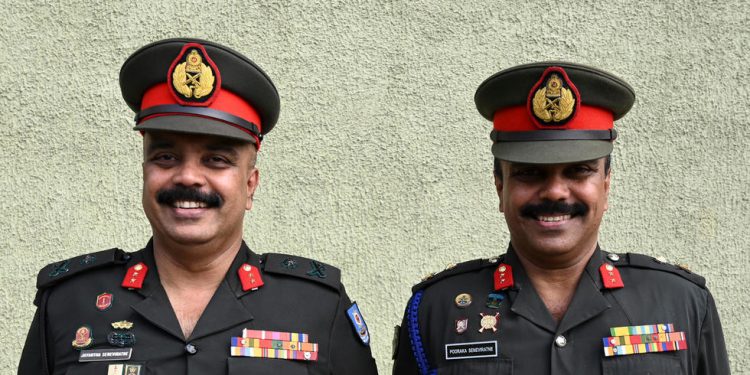
Two army generals, Jayantha and Pooraka Seneviratne, led a contingent of twins in the Sri Lankan military.

Now that we know our strength, we can even make another attempt,” Jayantha said while posing for photos with other twins.

Software engineer S. Sathiyan and his village official twin Sayanthan travelled 400 kilometres (250 miles) to Colombo from Jaffna in the country’s north.

We travelled for 10 hours by train to get here on time,” Sathiyan said.

We thought it was an opportunity to see so many twins and be part of something that would be good for the country.”

BBC Sinhala accepts Azzam Ameen’s resignation

January 21st, 2020

Courtesy NewsIn.Asia

Colombo, Jan.21 (newsin.asia) – The BBC Sinhala service has accepted the resignation of its Colombo based correspondent, Azzam Ameen following a controversial telephone conversation which was leaked out in the public between Ameen and UNP MP Ranjan Ramanayake last week.

Ameen had tendered his resignation to BBC with effect from January 1, but it had not been accepted by the BBC Sinhala Service at the time.

However the resignation was accepted on Tuesday after a huge public outcry following the exposure of the telephone conversation, with many supporting Ameen while others called for him to quit the BBC service.

News reports said the private conversation between Ameen and Ramanayake was disclosed by the controversial Sinhale Organization two days ago.

Ameen had been with the BBC Sinhala service for several years, earning praise for his journalism.

Over 121,000 telephone conversations, secretly recorded by UNP MP Ranjan Ramanayake have been taken into custody after he was arrested by the police a few weeks ago. Ramanayake was released on bail but was later arrested again after allegations that his telephone conversations revealed him interfering with the judiciary during the past government.

Azzam Ameen resigns from BBC Sinhala

January 21st, 2020

Courtesy Ada Derana

BBC Sinhala Service’s correspondent in Sri Lanka, Azzam Ameen has resigned from his position in the organization.

According to reports, he had tendered his resignation to the company with effect from the 1st of January, however, it was not accepted by BBC Sinhala Service at the time.

In the meantime, the Sinhale Organization disclosed a controversial telephone recording between UNP MP Ranjan Ramanayake and Azzam Ameen two days ago.

Considering the situation, the organization has processed Ameen’s resignation.

Ameen, speaking to Ada Derana, confirmed that he is no longer employed at BBC Sinhala.

RANJANGATE SCANDAL – Interdicted Magistrate Dhammika Hemapala questioned for over 3 hours

January 21st, 2020

Courtesy Ada Derana

Interdicted Magistrate Dhammika Hemapala has left the Colombo Crime Division (CCD) after recording a statement for over three hours.

He had arrived at the CCD at around 2.30 p.m. to record a statement over his controversial video conversation with UNP MP Ranjan Ramanayake.

Earlier this month, a series of audio recordings of phone conversations between the MP and several high-profile officials in the country including former Director of the Criminal Investigation Department (CID) Shani Abeysekara and justices, were leaked to the media.

Recordings contained phone conversations between the parliamentarian and Justices Gihan Pilapitiya, Padmini Ranawaka, and Magistrate Dhammika Hemapala.

Baddegama Magistrate Dhammika Hemapala was later interdicted by the Judicial Services Commission (JSC) last week over the issue while the commission had also sent its recommendations to the President on High Court Judge Gihan Pilapitiya.

The Attorney General has instructed the CCD to record statements from the three justices.

Accordingly, HC Judge Pilapitiya and Retired Judge Padmini Ranawaka recorded their statements with the CCD yesterday and the day before.

RANJANGATE SCANDAL – HC Judge Gihan Pilapitiya interdicted

January 21st, 2020

Courtesy Ada Derana

Embilipitiya High Court Judge Gihan Pilapitiya has been interdicted over the controversial phone conversation he has had with UNP MP Ranjan Ramanayake says the Judicial Service Commission.

A series of audio recordings of phone conversations between the MP and several high-profile officials in the country including former Director of the Criminal Investigation Department (CID) Shani Abeysekara and justices, were leaked to the media earlier this month.

Recordings contained phone conversations between the parliamentarian and Justices Gihan Pilapitiya, Padmini Ranawaka, and Magistrate Dhammika Hemapala.

Baddegama Magistrate Dhammika Hemapala was later interdicted by the Judicial Services Commission (JSC) last week over the issue while the commission had also sent its recommendations to the President on High Court Judge Gihan Pilapitiya. He was accordingly interdicted today (21).

As per the Attorney General’s instructions, the CCD recorded statements from HC Judge Pilapitiya and Retired Judge Padmini Ranawaka yesterday and the day before. Magistrate Hemapala gave his statement to the CCD this afternoon.

RANJANGATE SCANDAL – රන්ජන්ගේ වීඩියෝවක් නිසා වැඩ තහනම් කළ විනිසුරු ධම්මික හේමපාලගෙන් සී.සී.ඩී.යට පැය 3 ක ප්‍රකාශයක්

January 21st, 2020

උපුටා ගැන්ම හිරු නිව්ස්

>පාර්ලිමේන්තු මන්ත්‍රී රන්ජන් රාමනායක සමඟ සංවාදයේ නිරතවීම හේතුවෙන් සේවය අත්හිටුවා ඇති බද්දේගම මහේස්ත්‍රාත් ධම්මික හේමපාල අද කොළඹ අපරාධ කොට්ඨාශයට පැමිණ ප්‍රකාශයක් ලබාදුන්නා.

ඒ, මහේස්ත්‍රාත්වරයා සහ රන්ජන් රාමනායක මන්ත්‍රීවරයා සංවාදයේ නිරත වන වීඩියෝ පසුගිය දිනවල සමාජ මාධ්‍යයේ හුවමාරු වීමත් සමඟයි.

>මේ අනුව අදාළ ප්‍රකාශය ලබාදීමට ඔහු පස්වරු 2.30 ට පමණ කොළඹ අපරාධ කොට්ඨාශය වෙත පැමිණි අතර, පැය 3 කට ආසන්න කාලයක් අදාළ ප්‍රකාශය ලබාදුන් බවයි හිරු වාර්තාකරු සඳහන් කළේ.

පාර්ලිමේන්තු මන්ත්‍රී රන්ජන් රාමනායකගේ දුරකථන හඬ පට සංවාද සිද්ධියට අදාළව හිටපු මහාධිකරණ විනිසුරු පද්මිනී එන්. රණවකගෙන් ද කොළඹ අපරාධ කොට්ඨාශය ඊයේ පැය 2කට අධික කාලයක් ප්‍රකාශයක් ලබා ගත්තා.

එහිදී ඇය තමන් පාර්ලිමේන්තු මන්ත්‍රී රන්ජන් රාමනායක සමඟ දුරකථනයෙන් සංවාදයේ නිරත වූ බවට පිළිගෙන තිබුණා.

එසේම පාර්ලිමේන්තු මන්ත්‍රී රන්ජන් රාමනායක සමග දුරකථන සංවාදවල නිරතවීමේ සිද්ධීන්වලට අදාළව, ඇඹිලිපිටිය මහාධිකරණ විනිසුරු ගිහාන් පිලපිටියගෙන් ද කොළඹ අපරාධ කොට්ඨාසය පෙරේදා පැය 05ක කාලයක් ප්‍රකාශ සටහන් කරගෙන තිබුණා.

මේ අතර කොළඹ අද පැවති මාධ්‍ය හමුවකදී සිංහලේ සංවිධානයේ මහ ලේකම් පූජ්‍ය මැඩිල්ලේ පඤ්ඤාලෝක හිමියන් කියා සිටියේ හිටපු විනිසුරු පද්මිණී එන් රණවක වහාම අත්අඩංගුවට ගත යුතු බවයි.

හිටපු මහාධිකරණ විනිසුරු පද්මිණී එන් රණවක අත්අඩංගුවට ගන්නා ලෙස බල කරමින් සිංහලේ සංවිධානය අද දිවයිනේ ස්ථාන රැසක පෝස්ටර් අලවා තිබෙනු දක්නට ලැබුණා.

එසේම හිටපු මහාධිකරණ විනිසුරු පද්මිණී එන්. රණවක දේශපාලන හේතුන් මත ලබාදුන් නඩු තීන්දුවලින් අගතියට පත්වූවන්ට සාධාරණය ඉටුකරන ලෙස ඉල්ලා සිංහලේ ජාතික සංවිධානය අද නීතිපතිවරයා වෙත ලිපියක් භාරදුන්නා.

RANJANGATE SCANDAL – විනිසුරු ගිහාන් පිලපිටියගේ සේවය අත්හිටුවයි

January 21st, 2020

උපුටා ගැන්ම හිරු නිව්ස්

ඇඹිලිපිටිය මහාධිකරණ විනිසුරු ගිහාන් පිලපිටියගේ සේවය වහාම ක්‍රියාත්මක වන පරිදි අත්හිටුවා තිබෙනවා.

ගානියාගේ විමර්ශනයේදී ශානිගේ ලේක්හවුස් සබඳතා හෙළිවේ – ප්‍රකාශයක් දෙන්නැයි අධිකරණයෙන් නියෝග

January 21st, 2020

උපුටා ගැන්ම හිරු නිව්ස්

පැහැර ගැනීමට ලක්වූවායැයි පැවසූ ස්විස් තානාපති කාර්යාල නිලධාරිනි ගානියා බැනිස්ටර් භාවිත කළ දැනට අධිකරණ භාරයේ ඇති ඇයගේ ජංගම දුරකථනය රජයේ රස පරීක්ෂකවරයා වෙත භාරදෙන ලෙස කොළඹ ප්‍රධාන මහේස්ත්‍රාත් ලංකා ජයරත්න නියෝග කළා.

ඊට අදාළ නඩුව අද කැඳවූ අවස්ථාවේදී අපරාධ පරීක්ෂණ දෙපාර්තමේන්තුවේ හිටපු අධ්‍යක්‍ෂක ශානි අබේසේකරට මෙම සිද්ධිය සම්බන්ධයෙන් සිදුකරන විමර්ශනවලට අදාළව ප්‍රකාශ ලබාදෙන ලෙසද මහේස්ත්‍රාත්වරිය නියෝගයක් නිකුත් කරනු ලැබුවා.

අදාළ ස්විස් තානාපති කාර්යාල නිලධාරිනියද අද අධිකරණය හමුවේ පෙනී සිටි අතර, එම ජංගම දුරකථනය සැකකාරියගේ නමට ලියාපදිංචිවූවක් නොවන බැවින් සහ තානාපති කාර්යාලය ලබාදී තිබූ නිල ජංගම දුරකථනයක් නොවන බැවින් එය කාර්යාලීය නිල සන්නිවේදන කටයුතු සඳහා යොදාගත් බවක් නිගමනය කළ නොහැකි බවයි එහිදී මහේස්ත්‍රාත්වරිය සඳහන් කළේ.

එබැවින් අදාළ ජංගම දුරකථනය තානාපති මුක්තියට යටත් බවට සැකකාරියගේ නීතීඥයින් නැගූ තර්කය තමන් ප්‍රතික්ෂේප කරන බවයි මහේස්ත්‍රාත්වරිය සිය නියෝගය ප්‍රකාශයට පත් කරමින් දැනුම් දුන්නේ.

එමෙන්ම සැකකාර ගානියා බැනිස්ටර් ට එරෙහිව මෙම නඩුවට අදාළව අසත්‍ය තොරතුරු ලබාදීම මත අපරාධමය චෝදනා ගොනුකර ඇති බැවින් ජංගම දුරකථනය විශ්ලේෂනය කිරීම වඩාත් යෝග්‍ය බවද කොළඹ ප්‍රධාන මහේස්ත්‍රාත් ලංකා ජයරත්න පෙන්වා දුන්නා.

අධිකරණය භාරයේ පවතින සැකකාරිය විසින් භාවිත කළ ජංගම දුරකථනය රජයේ  රස පරීක්ෂකවරයා වෙත යොමුකර පූර්ණ විශ්ලේෂණ වාර්තාවක් කැඳවන ලෙසයි මහේස්ත්‍රාත්වරිය එහිදී නියෝග කළේ.

එමෙන්ම එම පූර්ණ විශ්ලේෂණ වාර්තාව ලද පසුව එම නඩු කටයුත්තට අදාළව පමණක් අපරාධ පරීක්ෂණ දෙපාර්තමේන්තුවට උපදෙස් ලබාදෙන ලෙස ප්‍රධාන මහේස්ත්‍රාත්වරිය නීතිපතිවරයාට නියම කළා.

ඉන් අනතුරුව මෙම සිදුවීම සම්බන්ධයෙන් විමර්ශනය කරන අපරාධ පරීක්ෂණ දෙපාර්තමේන්තුවේ නිලධාරීන් වැඩිදුර විමර්ශන වාර්තාවක් අධිකරණයට ඉදිරිපත් කරමින් සැකකාර ගානියා ප්‍රැන්සිස් පවත්වා ඇති දුරකථන සබඳතා පිළිබඳව අනාවරණයක් කළා.

එහිදී අනාවරණ වුණේ දෙහිවල ප්‍රදේශයේ පදිංචි ලක්නා තරිඳු පරණමාන නැමැත්තෙකුගේ නමට ලියාපදිංචි වූ දුරකථන අංකයකින් ලේක්හවුස් ආයතනයේ මාධ්‍යවේදි දරීෂා බැස්ටියන් නැමත්තියක් සැකකාර ගානියා බැනිස්ටර්ට වැඩි වාර සංඛ්‍යාවක් ඇමතුම් ලබාදී ඇති බවයි.

එම දුරකථන ඇමතුම් ලබාගෙන ඇත්තේ සැකකාරිය පැහැරගැනීමට ලක්වූවා යැයි පවසන කාලවකවානුව තුළම බවද අපරාධ පරීක්ෂණ දෙපාර්තමේන්තුව අධිකරණය හමුවේ ප්‍රකාශ කළා.

එමෙන්ම  අදාළ ලේක්හවුස් මාධ්‍යවේදිනිය එවකට එම ආයතනයේ සභාපති ධුරය දැරූ ක්‍රිශාන්ත කුරේ සමඟ අවස්ථා 21 කදී දුරකථන සංවාද පවත්වා ඇති බවද එම දෙපාර්තමේන්තුව අධිකරණයට කරුණු වාර්තා කළා.

ප්‍රශ්නගත කාල පරිච්ෙඡ්දය තුළ මෙම මාධ්‍යවේදිනිය අපරාධ පරීක්ෂණ දෙපාර්තමේන්තුවේ හිටපු පොලිස් පරීක්ෂක නිශාන්ත සිල්වා සමඟද ඍජු දුරකථන සබඳතා පවත්වා ඇති බවත්, එවකට ලේක්හවුස් සභාපති ධුරය දැරූ ක්‍රිශාන්ත කුරේ අපරාධ පරීක්ෂණ දෙපාර්තමේන්තුවේ හිටපු අධ්‍යක්‍ෂ ශානි අබේසේකර සමඟ දුරකථන සබඳතා පවත්වා ඇති බවත් විමර්ශනවලදී අනාවරණ වී තිබෙනවා.

එබැවින් මෙම සියලු කරුණු එකිනෙක ගලපා බැලීමේදී සැකකාර ගානියා ප්‍රැන්සිස් සහ ඉහත කී නිලධාරීන් අතර පැවති දුරකථන සංවාදයන් හි ජාලාත්මක සම්බන්ධයක් ඇත්දැයි සැක මතුව ඇති බව විමර්ශන නිලධාරීන් මහේස්ත්‍රාත්වරිය හමුවේ සඳහන් කළා.

එසේම මෙම තානාපති කාර්යාල නිලධාරිනිය පැහැරගැනීමට ලක්වූවා යැයි පැවසූ පසුගිය වසරේ නොවැම්බර් 25 වන දිනට ආසන්න දිනවලදී ඉහත කී ලේක්හවුස් මාධ්‍යවේදිනිය හිටපු ලේක්හවුස් සභාපතිවරයා සහ පොලිස් පරීක්ෂක නිශාන්ත ද සිල්වා ස්විට්සර්ලන්තයට ගොස් ඇති බවද විමර්ශන නිලධාරීන් වැඩිදුරටත් පෙන්වා දුන්නා.

ඒ පිළිබඳව වැඩිදුර කරුණු දක්වමින් අපරාධ පරික්ෂණ දෙපාර්තමේන්තුවේ නිලධාරීන් සඳහන් කළේ ලේක්හවුස් මාධ්‍යවේදිනි දරීෂා බැස්ටියන් පසුගිය නොවැම්බර් 21 වන දිනයේද පොලිස් පරීක්ෂක නිශාන්ත ද සිල්වා, පසුගිය නොවැම්බර් 24 වනදාද, ලේක්හවුස් ආයතනයේ හිටපු සභාපති ක්‍රිශාන්ත ද කුරේ, ඉකුත් දෙසැම්බර් 5 වනදාද ස්විට්සර්ලන්තය බලා ගියද මෙතෙක් ඔවුන් මෙරටට පැමිණ නොමැති බවයි.

එසේම විමර්ශනවලදී අනාවරණ වූ කරුණු සම්බන්ධයෙන් ප්‍රකාශයක් සටහන් කරගැනීම සඳහා අපරාධ පරීක්ෂණ දෙපාර්තමේන්තුවේ හිටපු අධ්‍යක්‍ෂ ශානි අබේසේකරට අනිද්දා එම දෙපාර්තමේන්තුවට පැමිණෙන ලෙස නියෝගයක් නිකුත් කරන්නැයි විමර්ශන නිලධාරීන් මහේස්ත්‍රාත්වරියගෙන් ඉල්ලීමක් කළා.

කරුණු සළකා බැලූ කොළඹ ප්‍රධාන මහේස්ත්‍රාත් ලංකා ජයරත්න නියෝග කළේ අනිද්දා අපරාධ පරීක්ෂණ දෙපාර්තමේන්තුවේ හිටපු අධ්‍යක්‍ෂ ශානි අබේසේකරට එහි පෙනී සිට ප්‍රකාශයක් ලබාදෙන ලෙසයි.

එමෙන්ම සැකකාරියගේ ජංගම දුරකථනය රස පරීක්ෂකවරයා වෙත යොමුකර ලබාගන්නා වාර්තාව සහ විමර්ශනවල ප්‍රගතිය පිළිබඳව පෙබරවාරි 11 වනදා නැවත අධිකරණයට කරුණු වාර්තා කරන ලෙසද මහේස්ත්‍රාත්වරිය එහිදී දැනුම්දුන්නා.

එමෙන්ම එම තානාපති කාර්යාල නිලධාරීන් සමඟ ලේක්හවුස් මාධ්‍යවේදී දරීෂා බැස්ටියන් සහ හිටපු ලේක්හවුස් සභාපති ක්‍රිශාන්ත කුරේ දුරකථන සබඳතා පවත්වා ඇති බවද අනාවරණ කළ අපරාධ පරීක්ෂණ දෙපාර්තමේන්තුව ශානි අබේසේකර සහ නිශාන්ත ද සිල්වා සමඟ ද ඔවුන් දුරකථන සබඳතා පවත්වා ඇති බව අධිකරණයේදී අනාවරණ කළා.

RANJANGATE SCANDAL – තමන් අගවිනිසුරුටත් කතා කළ බව රංජන් රාමනායක පාර්ලිමේන්තුවේදී පිළිගනී

January 21st, 2020

උපුටා ගැන්ම හිරු නිව්ස්

අධිකරණයට බලපෑම් කිරීම සම්බන්ධයෙන් රක්ෂිත බන්ධනාගාර ගත කර සිටින රංජන් රාමනායක මන්ත්‍රීවරයා ආන්දෝලනයට තුඩු දුන් හඬපට සම්බන්ධයෙන් අද පාර්ලිමේන්තුවේදී ප්‍රකාශයක් සිදුකළා.

රක්ෂිත බන්ධනාගාර ගත කර සිටින පාර්ලිමේන්තු මන්ත්‍රී රංජන් රාමනායක බන්ධනාගාරය මගින් අද පාර්ලිමේන්තු සැසිවාරය සඳහා කැඳවාගෙන එනු ලැබුවා.

අනතුරුව මන්ත්‍රීවරයා අදාළ හඬපට සම්බන්ධයෙන් පාර්ලිමේන්තුවේදී ප්‍රකාශයක් සිදුකළා.

එජාපයේ ආසන සංවිධායකවරු විපක්ෂ නායක හමුවෙයි

January 21st, 2020

උපුටා ගැන්ම හිරු නිව්ස්

එක්සත් ජාතික පක්ෂයේ ආසන සංවිධායකවරුන්ගේ රැස්වීමක් අද පාර්ලිමේන්තු සංකීර්ණයේදී පැවැත්වුණා.

ඒ, විපක්ෂ නායක සජිත් ප්‍රේමදාසගේ ප්‍රධානත්වයෙන්.

ආසන සංවිධායකවරුන්ට අමතරව මෙම රැස්වීම සඳහා පක්ෂයේ පළාත් සභා මන්ත්‍රීවරුන් හා දිස්ත්‍රික් සංවිධායකවරුන්ද එක්ව සිටි බවයි හිරු වාර්තාකරු සඳහන් කළේ.

ඉදිරි මහ මැතිවරණය සම්බන්ධයෙන් එක්සත් ජාතික පෙරමුණේ සියලු පළාත් පාලන නියෝජිතයින් ලබන 26 වැනිදා කොළඹට කැඳවා දැනුවත් කිරීමට මෙහිදී තීරණය කර තිබෙනවා.

තවමත් විසඳුමක් නැති එක්සත් ජාතික පක්ෂයේ පවතින නායකත්ව අර්බුදය

January 21st, 2020

උපුටා ගැන්ම හිරු නිව්ස්

එක්සත් ජාතික පක්ෂයේ පවතින නායකත්ව අර්බුදය සම්බන්ධයෙන් අදත් විවිධ පාර්ශ්වයන් අදහස් පළකළා.

How many nations are there in this country?

January 20th, 2020

Dr. Sudath Gunasekara:  President Senior Citizens movement Mahanuwara.

In the present context of the debate on the language in which the national Anthem should be sung I am compelled to ask this question from all our politicians starting with former President Sirisena and all those  who either want to sing it in both Sinhala and Tamil or Sinhala only.

If we sort out what the jatiya of this country the matter ends there

This has been a very big puzzle for me for quite some time. I have no doubt that majority of you who read this note might have had the same problem.  This is mainly because very often people who mater in society, when they speak at public forum use to say ”me rate Siyaluma jatinta” meaning to all nations in this country” which obviously implies that there are many nations in this country. What baffle and confuse me is the question as to how many nations are there in this country. Because usually any given country anywhere in the world has only one nation. To give few selected examples Russia Russians, America Americans, Briton British, Canada Canadians, Italy Italians, India Indians, Japan Japanese, China Chinese, France French and Australia Australians. In this backdrop then why we describe this country only, as a country of many nations,

From the inception of history up to 1815, this country was called Sinhale or Sinhala deepa or Sinhala dveepa, meaning the land of the Sinhala people and its nation was Sinhala, going by the dominant race and the Language of the Bhoomiputra’s. This is why even the British called it Ceylon meaning the land of the Sinhala people. It also had a second name Lanka from very early times, probably given by the ancient Indians. The word Lanka had three meanings. Purana named it as Lanka in two contexts. Compilers of Puranas said ‘Bhumadyaye lankiiyatiti Lanka, meaning it was called Lanka as it is located at the centre of the world. It was also called Lanka by early Bharatians for example Ramayanaya. Valmiki fascinated by its unsurpassed beauty named it as Lanka the beautiful land” in Ramayanaya. Tamilian EElamists like Purnalingam Pille in his Ravana the Great King of Lanka assumes it to be a part of the main land later separated during the Great Biblical deluge and formed in to an Island at the southern tip of the Indian sub-Continent. Thus the word Lanka also has the meaning of the Island in the South Indian context though it appears to be an artificial invention of EELAMISts Tamils in their futile struggle to prove that this country  was a part of the their ancient imaginary EELAM . Either going by the Ramayana tradition or their own imagination the Sinhalese also called it Lanka for its beauty, the resplendent Isle. The Sinhala word Lake behe,’ also means what a beauty, aptly proves the authenticity of this argument. The word Lankika presently been used to designate its citizens means born in Lanka, just like sagarika which means born in the sea. It is important to note that one does not legally become a citizen of a country merely because he or she was born in a given country. To that extent he or she cannot claim citizenship in a country merely on the ground that he /she were born there. Nationality is a much wider concept than that. In this case the question arises as to what nationality one belongs. Obviously his or her nationality will be registered as a person of the country from which he or she come. Therefore obviously all those who are born in this country cannot be called citizens { Ratavesiyo) of this country merely because he/she was born here.

It is difficult to ascertain as to when the word Lankika that is now used to designate the nationality of this country came in to vogue. But I presume it must definitely be of recent origin invented either by those who were looking for an alternative to the word Sinhala which is hated by the Tamils as they are allergic to it or by those Anglicized Sinhala ‘scholars’ who were averse to been identified as Sinhala and promoting minority sentiments. Whatever the reasons may be certainly the invention of the word Lankika to designate all those born in this country as citizens of this country was a clever conspiracy to drop the word Sinhala being used to designate its citizens. 

Coming back to nationality I always thought there is only one Nation in this country too. You would have heard and noticed this lose utterance over the TV, Radio, and the press, at public meetings and even at private conversations. I have seen this happening very often. Our politicians starting from the President, Prime Minister downwards, academia in universities including even some professors of Sinhala and History, some religious dignitaries and some so-called intellectuals who have got disoriented or brain washed in the course of their political and ideological transformations and many more go on uttering these lose words repeatedly like parrots most probably without knowing the seriousness of the damage they do to the Nation that is Sinhala by doing so. In my opinion politicians who woo for minority votes to come to power, people who do not have that spiritual attachment that infuses the sense of nationality and  those who do not have a proper Jatakaya (birth) are the people who indulge in such nonsense. Of course those who really do not know the actual meaning also use it. But they could be corrected whereas the other categories cannot be ever corrected.

When all these big shots either driven by their personal agendas or in their ignorance of the real long term implications go on repeating it like parrots, minorities also begin to think they are separate nations. The most dangerous thing about this trend is the psychological transformation of the perception and attitude of the people that would settle down permanently in their minds and become irreversible. It gets settled in society by usage. In this instance I would like to draw a parallel between the division of the Sinhala people living on the hills and the lowlands, who were divided in to two rival groups as Kandyans and low country Sinhalese by the British. Until Robert Percival in 1803 divided them as Kandyans and cinhalese (those who lived in the lowlands) they were one nation. But since then these artificially created two groups behaved as if they were two different nations and at the early stages of political agitation for constitutional reforms they even asked for two separate federal states, one for the Kandyans and another for the low country people. Thanks to the fact they all belonged to one race, spoke the same language, professed the same religion and had common roots, the differences were patched up in the course of time by common bondage and emerging nationalism it went back to square number one. As such why can’t this band of ignoramus who talks of many nations understand that this country, like most other countries in the world has only One Nation’? They say jati bhedayak neti ekama jatiyak. How on earth can there be differences within a nation” which preciselyimplies one group of people.

So it is no wonder that the ordinary people get confused and also begin to think that this country has more than one nation. The situation is made even worse when top Politicians from high flat forms describe this country as a multinational society. Minority communal elements meanwhile make the maximum use of his confusion. It is like the famous saying panina rilawunta iniman bendeema.

As for me from my small days I thought we have only one nation in this country. That was how the teachers of our day have taught us in school. According to them we are called the Sinahala nation and the country Sinhale, meaning the land of the Sinhala people. They also told us that that could be either because we descend from Vijaya (a man from the Sinha race whose father Sinhabahu is said to have killed the lion father) who is supposed to have found this nation or because we descend from the Sivhela namely, yaksha, Raksha, Deva and Naga who had been living in this Island long before Vijaya arrived in the 6th century B

Since this Island had been known as Lanka or Lankadeepa or Lanka dvipa (the resplendent Isle) even from the time of legendary Ravana we were also called Lankan or Lankika Jatiya, meaning those who were born in Lanka. They also taught us that there had been north Indian invaders like Sena Guttika and Elara starting from 2nd century BC and South Indian invaders like Chola and Pandya in much later times, who had been trying to capture this country from time to time. But every time they attempted to do so they were defeated by the Sinhala Kings and they ruled this country continuously until 1815, when the British conquered it by deceit.

Those invaders who were left behind from very early times got absorbed and integrated in to the main stream and became Lankans or Sinhala people while some of them retained their religion and culture. Also in between there were others especially the Arab traders who came from time to time in small numbers, not as invaders but as traders who were later known as Muslims going by their religion. Most of them got married to local Sinhala women and even took Sinhala ge names and lived among the Sinhala people. But all these men got absorbed in to the main stream while retaining their religious identity only. In addition to the language of the country, that is Sinhala, they also spoke Tamil. This may be due to the fact that most of them came from South India and also they did business with both local and Indian Tamils across the sea.  But the important thing to note here is that almost all these people, both Tamils and Muslims knew the language of the Land. So, even today at least 95 % of the population in this country, if not more, is conversant in Sinhala. The estate Tamils who were brought by the British after 1840s, even though they were deliberately kept separated from the local people as a community also learnt Sinhala as they came in contact with the neighboring Sinhala villages.  So if you take the language as the dominant factor that unifies a nation, in this case Sinhala, what is the other name by which you should name this country and its people? Look at our immediate neighbor India, then countries like Thailand, Japan, China, Korea, Russia, Germany, France, Italy, Greece, Spain and England to name only a few. All these countries are named after the dominant language spoken in those countries.

 It is only at the Donoghmore reforms the Tamil politicians tried to establish a separate identity. With the growth of Tamil communal politics they assumed a Tamil National” attitude and Tamil nationalism emerged which in later years tried to assert as a separate nation within this country. No wonder these minions behave like goliaths when there are no statesmen of stature to draw the line and tell everybody that this country has only one nation and those who talk of many nations will be charged for treason or deported to their original places.

Although the idea of nationality is difficult to define the term nation in modern society is generally used to describe a community of race and language, geographic unity, community of religion, common political aspiration and, above all,  historical development over a long time. This is of course not universal. But however it is essentially a sentiment of unity, spiritual in character and the will of a people to live together as Laski put it. The unity is the outcome of a common history. The Sinhala people even in this context had been a nation at least from the 6th century BC in this country. Even the four groups who lived here previously got identified as one nation as Sivhela or Sinhala. That is why the land was called Sinhale meaning the land of the Sivhela or Sinhala. With the introduction of Buddhism in 307 BC they became Buddhists and ever remained as Sinhala Buddhists Nation’ in this country. With all the vicissitudes of history even in 1815 more than 90 % of the people in this country came within this category.

The other thing is Tamils have a motherland in South India and Muslims a motherland in Arabia, while this country had been the historical motherland of the Sinhala people from the dawn of history. Thousands of archaeological, epigraphical and literary evidence often running even to prehistoric times spread over the entire length and breadth of this country bear enough evidence to this conclusion that has been proved beyond all doubts. Therefore it is irrefutable and unchallengeable.

In this historical backdrop Tamils, Muslims and any other minor ethnic group in this country that forms a part of the Sri Lanka nation or the Sinhala nation is only an integral part of the ”Nation Lankan or Sinhala’ as this country had been known as the land of the Sinhala people right through out in history.  No man or woman can contradict it unless he or she is an incurable lunatic. Therefore at least now these minority ethnic groups should understand their limitations and  due role within the Lankan nation, and concede to this historical reality and learn to live with the major community without running to America, India and other countries asking to tame the Sinhala nation and thereby creating unwanted problems for us as well as for themselves. I am positive that the big majority, of both Tamils and Muslims who are sensible, are prepared to do so. For those who are not prepared to concede to this irrefutable reality, especially the Tamil and Muslim politicians, I think, it is high time that they should renounce their craving for this day dream and go back to their own motherlands without trying to dream of a motherland on somebody else’s country and claiming illegal ownership of someone else’s soil by going round the world just denigrating our country.

On the part of our politicians I think it is high time that first they should rise above present day party politics and assert and behave as statesmen and write this provision in to the Constitution of this country and declare that anyone agitating, behaving or instigating, aiding and abetting others to talk, act or behave as separate nations such as Tamils or Muslims who agitate for separation, contravening the law of the land, shall be charged for high treason.Furthermore the often spoken Bahujatika nonsense should stop. There is only one nation in this country of the Sinhalese, and that is Sinhala. Since all Tamils and Muslims are either invaders or intruders who are scheming to own this country belonging to Sinhalese. It is high time that a Sinhala politician should rise above petty politics and tell this stark truth to the whole world and make the clarion call that The name of this country is Sinhale as it had been from time immemorial up to 1815 and its nation is Sinhala.

ERASING THE EELAM VICTORY Part 13 A

January 20th, 2020

KAMALIKA PIERIS

PART 13  of this series is on the Sri Lanka armed forces.

The Sri Lanka army was established under the Army Act No. 17 of 1949. Brigadier James Sinclair, Earl of Caithness was first Commander of the Army.  The army started with an artillery regiment, an engineer squadron, an infantry battalion, a medical unit, and a service corps company.  Members of the earlier Ceylon Defence Force, (1910- 1949) formed the nucleus of the army. The Ceylon Defence Force was an experienced force. It had   fought in the two World Wars alongside British. The fledgling Sri Lanka army therefore consisted of experienced persons, from the beginning. It was not an army composed of raw recruits, new to warfare.

Ceylon had entered into a Defence Agreement with Britain in 1947. This Defence agreement had provisions for training the new army.  Training in Ceylon was provided by  British Army Training Team (BATT). However, senior officers went to the British Army Staff College, Camberley and to the British Army of the Rhine to gain field experience.

From 1949 officers were sent for training to Sandhurst. They were selected through competitive examination and interview. After the exam, we had a preliminary interview with senior officers of the Army, chaired by the Chief of Staff. The final interview was at the Ministry of Defence, said former Commander Gerry de Silva.

In the 1950s and 1960s Sri Lanka was very proud of the fact that it officers were ‘Sandhurst trained.’ The Sandhurst training was for leading and commanding  troops. Sandhurst trained 80  Ceylonese officers between 1949 and 1968.  ‘I think Sandhurst training helped greatly in the formative years of the Sri Lanka Army. We didn’t have an officer core as such till the Sandhurst cadets returned,’ said Gerry de Silva.

We maintained British traditions right along said Gerry   de Silva in an interview. Those trained at Sandhurst introduced to the Sri Lankan Army the British traditions they had learnt in Sandhurst, and followed them. The ranks, training methods such as the drill system and the weapons training were all on the Sandhurst or the British model.

The army commanders who received this training included Commanders Denis Perera, and Gerry de Silva. Perera also attended the Royal School of Military Engineering  and British Army‘s Staff College, Camberley.   Lt Gen Denzil Kobbekaduwa was trained entirely in Britain.  In addition to Sandhurst, he trained at the Royal College of Defence Studies for Senior Officers Thereafter, officers were sent for training to National Defence College, India. Commanders Tissa Weeratunga, Hamilton Wanasinghe and Sri Lal Weerasooriya trained in India.  

In the 1980s Sri Lanka developed its own training  institutes. There was the  Kotelawala Defence University ( 1981), Defence Services Command and Staff College  at Batalanda, Makola (1997) for Junior field officers and Sri Lanka Military Academy ,Diyatalawa   for basic officer training.

There is also Army Training School in Maduru Oya, Infantry Training Centre in Minneriya,  Combat Training School in Ampara and  Non-commissioned Officers Training School at Kala Oya. Specialized training was given at Marksman Sniper Training School ,Armoured Corps Training Centre, School of Artillery, Sri Lanka School of Military Engineering, School of Mechanical Engineers, School of Signals, Commando Regiment Training School, Special Forces Training School, Engineer Service School, Sri Lanka Army Service Corps school, Sri Lanka Army Ordnance School, Sri Lanka Electrical And Mechanical Engineers School

The 1980s saw a massive expiation of the army from 15,000 personal to over 30,000 and more. New regiments were raised, while others were expanded with new battalions. New weapons and equipment were introduced as the war shifted from counter-insurgency to conventional warfare tactics, with multi battalion, brigade and division scale operations. New regiments were formed which included the Commando Regiment, Special Forces Regiment, Mechanized Infantry Regiment, Gajaba Regiment, Vijayabahu Infantry Regiment, Military Intelligence Corps, Sri Lanka Army Women’s Corps,

In late 1987, the army had a total estimated strength of up to 40,000 troops, about evenly divided between regular army personnel and reservists on active duty. The approximately 20,000 regular army troops represented a significant increase over the 1983 strength of only 12,000. Aggressive recruitment campaigns following the 1983 riots raised this number to 16,000 by early 1985. By 1990 the army had expanded to over 90,000 personnel and by 2007, it had expanded to over 120,000.

In 2010, the Army had approximately 200,000 regular personnel, between 20,000–40,000 reserve personnel and 18,000 National Guardsmen[ and comprises 13 operational divisions, one air-mobile brigade, one commando brigade, one special forces brigade, one independent armored brigade, three mechanized infantry brigades and over 40 infantry brigades.

In the 1980s, the army expanded its range of weapons from the original stock of World War II-era British Lee–Enfield rifles, Sten Submachine guns, Vickers machine guns, Bren machine guns, 6-inch coastal guns, Daimler Armoured Cars, Bren Gun Carriers,[66] 40 mm anti-aircraft guns, 3.7-inch heavy anti-aircraft guns and 4.2-inch heavy mortars as well as post war Alvis Saladins, Alvis Saracen, Ferrets and Shorland S55s. New sources of weaponry in the mid-to-late 1970s included the Soviet Union, Yugoslavia, and China – countries with which the leftist Bandaranaike government had close ties.

To meet the threat posed by predominantly the LTTE, Army purchasemodern military hardware including 50-caliber heavy machine guns, rocket-propelled grenade (RPG) launchers, Night Vision Devices, 106 mm recoilless rifles, 60 mm and 81 mm mortars, 40 mm grenade launchers and some sniper rifles.


Refurbished armored personnel carriers were added to the ‘A’ vehicle fleet of the 1st Reconnaissance Regiment, Sri Lanka Armoured Corps. These APCs enabled the Armoured Corps to have their own assault troops to provide close contact protection to their Alvis Saladin and Ferret Scout Cars which were vulnerable to anti-tank weapons.

The capability of the Sri Lanka Artillery was enhanced with the introduction of Ordnance QF 25 pounders.[ Chinese-made 122 mm, 130 mm and 152 mm howitzers were introduced to the Sri Lankan Army in 1995 and 1998 whilst 122 mm Multi Barrel Rocket Launchers (MBRL), were first used in 2000 by the Sri Lanka Army. Though the weapons were obsolete at the time of purchase, security forces found them to be successful in combat.

LTTE has set land mines weighed approximately 50 – 100 kg, against which no armoured vehicle that the SLA possessed was able to withstand the blast effect. Armscor BuffelsSouth African armoured personnel carriers constructed on a Unimog chassis – were imported in quantity to withstand land mines. By 1987 Sri Lanka’s indigenous Unicorn APC had been engineered from the Buffel, followed by the improved Unibuffel class. Both the Unicorn and the Unibuffel are assembled by the Sri Lanka Electrical & Mechanical Engineers.

The  Sri Lankan Navy was established on 9 December 1950 when the Navy Act was passed for the formation of the Royal Ceylon Navy. Its nucleus was Ceylon Naval Volunteer Force  established,  in 1937.This Volunteer Force was absorbed into Britain’s  Royal Navy as the Ceylon Royal Naval Volunteer Reserve during World War II. The first warship  was HMCyS Vijaya. Training was given at Diyatalawa  and Trincomalee. From  1967  senior officers were trained at Royal Naval College Dartmouth. Recent navy commanders were also trained there.

Sri Lanka Air Force was founded in 1951 as the Royal Ceylon Air Force (RCyAF) with the assistance of Britain’s Royal Air Force (RAF). Flight training was  given at RAF Station Negombo, and  RAF airfield at Katunayake,  In addition, a number of cadet officers received flight training at the Royal Air Force College in Cranwell,  UK . When Sri Lanka took over the British air and naval bases in 1956, SLAF took over the former RAF stations, Katunayake and China Bay. These became SLAF operational stations while ancillary functions were carried out at Diyatalawa and Ekala. In 1967,  a Flight Training School was established at China Bay.

Senior officers of the ranks of Squadron Leader and Wing Commander are given advanced training at the Defence Services Command and Staff College (DSCSC) at Batalanda, Makola. This was established in 1997. Others are trained at SLAF Junior Command & Staff College at  China Bay

Basic officer training is carried out at the Air Force Academy at Bay. The academy offers a two-year program of basic flight training and a variety of specialized courses. Initial Ground Combat Training   is given at Diyatalawa. Diyatalawa also conducts advanced training for SLAF regiment officer cadets.

 Following training at SLAF Diyatalawa, general duties (pilot) branch officer cadets are sent to the Air Force Academy for flight training, and airmen and airwomen are sent to Advanced and Specialized Trade Training School for specialized training in different trades. Air traffic controllers receive schooling at special facilities in Colombo. Approximately twenty-five officers a year receive advanced training abroad, most commonly in Britain, Indian Air Force and, in recent years, at the United States Air Force Academy.

In the 1950s the army was preoccupied with the task of building itself and training its personnel. It was not called on to defend the country. The army first came  to public attention  with the failed military coup d’état of 1962.

A group of Christian officers in the military and police planned to topple the government of Prime Minister Sirimavo Bandaranaike during the night of 27 January 1962, organized by Colonel F. C. de Saram (Deputy Commandant, Ceylon Volunteer Force), Colonel Maurice De Mel, (Commandant, Ceylon Volunteer Force), Rear Admiral Royce de Mel (former Captain of the Royal Ceylon Navy), C.C. Dissanayake (DIG, Range I), Sydney de Zoysa (retired DIG) and Douglas Liyanage (Deputy Director of Land Development), it was to take place in the night of 27 January 1962, but was called off as the government gained information in the afternoon and initiated arrests of the suspected coup leaders.[1] However, key leaders were arrested before the coup was carried out.  Thereafter, the government made sure that command structure of the army did not consist of Christians alone.

The army played a role in the 1971 insurrection and the need for  national security was realized.  In 1984, Israeli security personnel (reportedly from Shin Bet, the Israeli counterespionage and internal security organization) trained army officers in counterinsurgency techniques.   

The first time the Sri Lanka army was asked to fight for the security of the country, was in 1987, when the Eelam wars started  in the north. At the same time, there was a second  insurgency by the CIA funded  JVP,    in the south, forcing the army to deploy its forces in the south of the island and to fight on two fronts between 1987 and 1989.    Note: the main source for the military  data in  this essay is Wikipedia. (Continued)

Strategic stability in the new decade: Ports of Asia in a period of escalation

January 20th, 2020

ASANGA ABEYAGOONASEKERA

The previous Government gave it [Hambanthota Port] on a 99-year lease, and even though China is a good friend of ours and we need their assistance for development, I am not afraid to say that was a mistake.” Gotabaya Rajapaksa[i]

2020 dawns with a US airstrike. The significance of this strike, killing the head of Iran’s elite Quds Force Soleimani and Mohandes the Deputy Commander of Popular Mobilisation Forces presents a turning point in the geopolitics of Middle East.

Soleimani himself had once said to President Trump “You will start this war but we will be the ones to impose its end”. US-Iran tensions will escalate and Tehran’s will retaliate with its asymmetric capability. According to RAND scholar Ariane Tabatabai it will be more strategic, more careful, planned approach,”[ii] by Iran.

As a trading partner and largest buyer of Iranian oil, China’s reaction must be monitored. China is also Iran’s ally as a part of the Belt and Road Initiative (BRI) which gives a clear interest to secure Chinese-Iranian interest in the long term.

The Gate of Supreme Harmony in the Forbidden City in Beijing is guarded by a pair of bronze lions of the Ming era, the female playing with a cub and the male who holds the world in his paw symbolizes power. Does China wish to hold the world in his paw? China is seen as a rising revisionist power [iii].The ancient silk road brought many symbolic and cultural values including the statues of lions to China from Central Asia and from the Buddhist traditions closer to Ming Dynasty. While I learned this during my recent visit to Forbidden City during the newyear. The modern-day Silk Road, the BRI has placed the Chinese economic inroads to many nations while certain Scholars believe China’s footprint to many developing nations is for global dominance, just as the symbolic gesture of the male lion.

China’s Vice-President Wang Qishan highlighted the importance of multilateralism at the Davos forum in 2019. The year before President Trump declared at the same forum that We support free trade, but it needs to be FAIR and RECIPROCAL,the United States will no longer turn a blind eye to unfair economic practices, including massive intellectual property theft”. The US trade war with China has escalated and since, ripple effects have spilt towards many nations, especially those with Chinese large-scale infrastructure projects. This includes USA’s ally Israel and the Indian Ocean island of Sri Lanka, seen as a strong partner of China.

Chinese are altering a static nanometer to understanding geopolitics- which is geography. It is altering geography unlike any other nation from CPEC in Pakistan to Sri Lanka. In a recent example from Sri Lanka, Chinese projects effectively altered Sri Lanka’s western coastal geography by adding 269 hectares reclaimed from the sea for the Colombo Port City. Newly elected Prime Minister Mahinda Rajapaksa who elevated Sino-Lanka relationship to a strategic height during his tenure is back in power and visited the project site he himself inaugurated with the Chinese President Xi in 2014. Rajapaksa along with Chinese Ambassador to Sri Lanka Cheng Xueyuan officially declared the newly reclaimed land by the Chinese as part of the Colombo district last month.

The Hambanthota port- another Chinese project in Sri Lanka was leased out for 99 years by the previous government. It was a discussion point when the newly elected President Gotabaya Rajapaksa commented that he would revisit the agreement to ensure national security.

It is the first time in the island’s recent history that a Sri Lankan leader of National Security prioritized national security in negotiations to foreign projects- this is required and is commendable. What the previous Government rushed as a bailout due to difficulty in repayment of the Chinese loan came to the forefront with President’s comment, this was further explained by Prime Minister Mahinda Rajapaksa saying it was the media hyping of Sri Lankan President Gotabaya Rajapaksa’s remarks on Hambantota Port deal as “quoting out of context.The President didn’t mean there is any problem with sovereignty. What the President meant was that our government, unlike the previous one, has a principle of not privatizing assets,” further Prime Minister fully dismissed that China’s BRI as a ‘Debt trap’ refuted by Western media, “We are very confident that Sri Lanka can very clearly repay the loans for the Hambantota Port and other development projects. Today, the economy has collapsed but when we rebuild it, paying back loans won’t be a question,” Rajapaksa said [iv]. What President Gotabaya said on ‘national security’ will be an interesting factor when carefully examining another silent port project unfolding in different geography which has become a security concern, Haifa.

When the eastern border of Israel was blocked the strategic port of Haifa along its western shores was a single gateway to the rest of the world. Conquered by the Crusaders in the year 1100 Haifa became the main port for the ancient city of Tiberius. As rightly predicted by Theodore Herzl in 1902 in Altneuland, Haifa was to become a strategic port in the future for the nation of Israel. We see this prediction unfolding particularly in this century. Haifa in naturally endowed with 700,000 SQM of natural bay along the Mediterranean coast. It is a blessing with its natural deep-water geography. A new container terminal ‘Bay Terminal’ was built to handle 800,000 TEU container movements annually by 2021. The terminal will be operated by the Chinese, Shanghai International Port Group (SIPG) who has won the international tender to operate for 25 years. This adds Haifa to the Chinese Belt and Road initiative. While the US Sixth Fleet is docked at the same port, the Chinese will be operating a port which has raised a significant security concern for the US and Israel security experts. Shin Bet- Israel’s top intelligence agencies chief Nadav Argaman warns Chinese influence in Israel is particularly dangerous in terms of strategic infrastructure and investments in larger companies[v],”  His comments further requested Israel’s The Knesset (Israel’s Parliament) to pass legislation to monitor foreign investment in Israel. The same fear was articulated by US congress report on National Defense Authorization Act 2020 section 1289 [vi], stating ‘The committee recommends a provision that would express the sense of the Senate that the United States has an interest in the future forward presence of the United States naval vessels at the Port of Haifa in Israel but has serious security concerns with respect to current the leasing arrangements of the Port of Haifa. Therefore, the provision would express the view that the United States should urge the Government of Israel to consider the security implications of foreign investment in Israel.’

Thus, despite the US fear, Israel has increased its trade with China to 73% in 2018 to US$2.8bn. This shows bilateral economic interest regardless of US sensitivity to Chinese acquisitions and infrastructure diplomacy in Israel. It appears Israel is moving ahead strengthening the Chinese relations. In the same manner, Sri Lanka has increased its trade with China despite the external security concerns and fear especially from its neighbour India.

China has become the largest donor and trading partner to Sri Lanka. Economic attractiveness and availability of Chinese loans leaves other nations with limited space to win large scale infrastructure projects. Viraj Solanki from IISS rightly observes that ‘New Delhi cannot match the level of spending offered by Beijing for infrastructure projects in Sri Lanka – these include US$1.4 billion in backing for the ambitious Colombo Port City project – but it clearly views security cooperation($50m offered during President Gotabaya’s inaugural visit), and in particular counter-terrorism cooperation, as an area in which it does have scope to strengthen relations with the new Rajapaksa government.[vii]

Highlighting the importance of Chinese investments Prime Minister’s Economic Advisor Ajith Nivard Cabraal, former Governor of Central Bank during Mahinda Rajapaksa’s Presidency said that ‘Hambantota Port, which reported 60% growth in shipment volumes in 2019, is one of the most important and strategic assets for the country and that the Government is keen for the port to play a leading role in the economy in 2020.’[viii] While there is a higher expectation of return from the Chinese projects, Sri Lankan experience is often highlighted as an example of the dark side depicted by many western analyst and media as a ‘debt trap’ diplomacy or ‘predatory loans’ to lock in strategic assets.

Jean Francois Dufour Economist and Director of DCA China Analysis comments that the sums invested by China are not donations but loans with consequences. The opponents of China, like India painted the entire operation as deliberate plan to acquire strategic positions in the region”[ix] warning the same could happen to Italy’s Trieste port as Italy is already a partner of BRI.

However, this critical view is not accepted by many receiving nations such as Sri Lanka. BRI is seen as an ambitious foreign policy strategy to bring the developing world under the Chinese orbit. One of the fears in the developing world is that BRI would likely institutionalize a Chinese authoritarian model undermining the existing democratic and economic model in many nations. These nations could disregard these fears if the respective Government’s adopt a transparent model. In the case of Sri Lanka, the 99-year lease agreement was not discussed at parliament and it was rushed and signed without any strategic inputs by the previous Government.

In light of the comment of the newly elected President Gotabaya Rajapaksa, we can anticipate the present Government will follow a novel process to reign in a strategic dimension in assessing the long-term strategic implications to national security before leasing out strategic assets.


Asanga Abeyagoonasekera is the Director General of the National Security Think Tank of Sri Lanka (INSSSL) under the Sri Lankan Ministry of Defense. He is the author of ‘Sri Lanka at Crossroads’ (2019),The views expressed here are his own. This article was initially published by ORF ‘Raisina Debates’ https://www.orfonline.org/expert-speak/strategic-stability-in-the-new-decade-ports-of-asia-in-a-period-of-escalation-60183/


End Notes

[i] http://www.ft.lk/front-page/President-Rajapaksa-says-leasing-H-tota-Port-was-a-mistake-calls-for-renegotiation-with-China/44-690388

[ii] https://www.theatlantic.com/politics/archive/2020/01/what-iranian-way-war-looks-like/604438/

[iii] US IPSR 2019 Indo-Pacific Strategy Report refers China as a Revisionist Power

[iv] https://menafn.com/1099389015/On-Hambantota-port-Prez-Gotabaya-Rajapaksa-was-quoted-out-of-context-says-PM-Mahinda-Rajapaksa

[v] https://www.timesofisrael.com/shin-bet-chief-said-to-warn-chinese-investment-in-israel-poses-security-threat/

[vi] https://www.congress.gov/congressional-report/116th-congress/senate-report/48/1?overview=closed

[vii] https://www.iiss.org/blogs/analysis/2019/12/sri-lanka-and-india-address-shared-ct-challenge

[viii] http://www.xinhuanet.com/english/asiapacific/2020-01/02/c_138674497.htm

[ix] https://www.france24.com/en/20190324-sri-lanka-new-chinese-silk-road-disappointment-economy-debt-italy-france-investment

BRUTAL LEGISLATION

January 20th, 2020

ALI SUKHANVER

The storm of protest against the CAA has severely affected the whole of India. This protest in not limited only to India, it is spreading like a wild fire all over the world. People are calling it one of the world’s darkest discriminatory laws based on religion. Even the Indian Constitution does not support such type of brutal legislation. Social workers, members of different human rights organizations, teachers, writers, actors, students and even traders are expressing their reservations over this new amendment. Bollywood actor Zeeshan Ayub said criticizing the CAA, Everyone has been exposed and the common man has understood everything and the right-wing people cannot make a fool out of them by giving vague statements.” He complained that even the BJP leaders are not having any clear concept of this amendment; they are pushing the general public into a blind alley of confusions. Zeeshan Ayub said talking to the ANI, The Home minister said something, the next day something else is being said in the Ram leela; people are getting confused.”

A renowned Indian novelist Chetan Bhagat said criticizing the BJP government, All universities must be protected. Those who fantasize about India with a Hindu king and his subservient subjects must remember this; even if I dignified your bigotry (I don’t), you can’t wish 200 million Muslims away. Try that and India will burn, GDP will crash and your kids will be unsafe and jobless. Stop these fantasies!” The general secretary of All Assam Students’ Union Lurin Jyoti Gogoi has warned the BJP government that protest against the CAA would not stop unless the government reviews the amendment bill. He said, The movement in Assam will intensify, and the legal fight against the citizenship act will continue.”

One of the most important positions-holders in the Microsoft Mr. Satya Nadella said speaking at a Microsoft event for editors in New York I think what is happening in India is sad, primarily as sort of someone who grew up there… I think it’s just bad.” BJP leaders have reacted in a very harsh manner on this statement of the Microsoft Boss. Newspapers and TV channels are replete with the resentment rather condemning statements of BJP leaders over the issue. BJP MP Meenakshi Lekhi said in a tweet that Microsoft CEO Satya Nadella’s statement on CAA is a ‘perfect example’ of How literate need to be educated.”

Narrow-mindedness and prejudice against the minorities in India, particularly against the Muslims and the Christians, is not a new trend and new behaviour. In the last week of December 2019, Delhi BJP vice-president Shazia Ilmi also had to face the same prejudice when she was not allowed to go on to the stage from where Prime Minister Narendra Modi addressed the gathering during his Sunday rally at Delhi’s Ramlila Maidan. She complained that ‘other’ Delhi unit leaders were given the passes for the main stage. Analysts are of the opinion that she had to face this discrimination just because she is a Muslim. Shazia Ilmi had been a very active member of the Aam Aadmi Party till May 2014. Later on she left the AAP and joined the BJP. She has accused the senior leadership of BJP Delhi unit of discrimination and favouritism. According to the Media reports Ilmi expressed her anger saying that she felt humiliated as her pass was not made while the other office-bearers of Delhi unit were allowed on the main stage.

Situation is so tense there that the Modi government had to cancel a meeting with Japanese Prime Minister Shinzo Abe which was scheduled to take place this month in Assam’s largest city Guwahati. The reason was nothing but the ongoing unrest in the region. Assam is one of the seven states in India’s northeast that share borders with Bangladesh, Myanmar and China. Recently introduced CAA bill has sparked violent protests in Assam which has yet taken lives of two people and left 25 injured. Feeling the severity and gravity of the situation, the U.S. and British governments have urged their citizens to exercise caution” if traveling to India’s northeast. Unfortunately, the BJP government is not feeling the severity of the matter. No one seems willing to listen to the protesting voices. The flood of protest against the CAA may drag India towards a catastrophic ending.

India’s concerns and Lanka’s compliance

January 20th, 2020

By P.K.Balachandran Courtesy NewsIn.Asia

What Ajit Doval told Gotabaya Rajapaksa

India’s concerns and Lanka’s compliance

Colombo, January 19 (Daily Express): India’s National Security Advisor (NSA) Ajit Doval, who was on short visit here on Saturday, has told the Sri Lankan President Gotabaya Rajapaksa that it is important that India, Sri Lanka and the Maldives review the Maritime Domain Awareness (MDA) regime, enhance it, and include other regional countries as observers.

The MDA regimen keeps track of vessels in the area. It was lack of cooperation in this area which led to a deep rift between India and Sri Lanka in 2014 when the Indians charged that a Chinese nuclear” submarine had docked in Colombo without its being made aware of it. The submarine incident was the last straw on the back of India which had been watching with alarm the Mahinda Rajapaksa government’s dalliance with rival China since 2010.

The Presidential Media Division said in a press release on Doval’s talks with the President that both countries expressed an interest in stepping up military to military corporation; cooperation in maritime security and establishing inter-operability between the Indian and Sri Lankan Coast Guards.

Doval brought up the need for inter-operability of the two Coast Guards in order to check smuggling, drug-trafficking, gun-running by Non-State Actors and illegal fishing.

India also pledged assistance to Sri Lanka in acquiring intelligence gathering technology. An USD 50 million credit line to purchase intelligence gathering equipment was reiterated. Establishment of a Maritime Research Coordinating Centre” was also discussed.

In all probability, Sri Lanka will implement India’s demands because one of the basic tenets of the Gotabaya Rajapaksa regime is that it must respect and address India’s strategic concerns while throwing open the economy for investments from all parts of the world, including China.

Growing Chinese Activity

India’s concerns, as reflected in Doval’s requests, stem from growing Chinese activity in the South Asian and Indian Ocean region. Apart from protecting the East-West Sea Lane for the sake of uninterrupted oil supplies from West Asia, China also needs to protect the growing number of Chinese nationals and Chinese economic and strategic assets in the Indian Ocean region.

China has port development projects in Gawadar in Pakistan, Hambantota in Sri Lanka, Kyaukphyu in Myanmar and Chittagong in Bangladesh. These are all in India’s backyard. India fears encirclement. Beijing gifted two Type 053 frigates to Bangladesh in 2019, after giving a P 625 vessel to the Sri Lankan navy in June that year.

China’s trade with countries participating in its ambitious Belt and Road Initiative (BRI) has been expanding and totaled 9.27 trillion yuan (US$ 1.34 trillion) in 2019. It has outpaced the country’s aggregate trade growth by 7.4 percentage points, according to published data.

More than US$ 60 billion in investments have been promised under the China-Pakistan Economic Corridor (CPEC), said Zou Zhiwu, Vice Minister of the General Administration of Customs.

According to Russia Today website, China has signed nearly 200 deals for new BRI projects in 167 countries and international organizations, and is eying further expansion.

The construction of a 25-meter deep water port in Kyaukpyu in the Rakhine State of Myanmar should worry India as it adversely affects its dominance in the Bay of Bengal. During Chinese President Xi Jinping’s state visit to Myanmar on January 17 and 18, the two sides agreed to strengthen their Belt and Road Initiative cooperation, and work hard” to push forward the construction of the Kyaukpyu Special Economic Zone (SEZ), according to a joint statement issued by the two countries on Saturday.

In 2014, the Myanmar government invited bidders from around the world for its plan to set up the Kyaukpyu SEZ, one of the country’s three national SEZs, in an effort to kick-start the Rakhine economy troubled by internal strife between the government forces and the Muslim Rohingyas and other Rakhine groups.

In 2015, a consortium of six companies led by the China International Trust and Investment Corporation (CITIC) won the tender for building the Kyaukpyu SEZ. Three years later, after marathon negotiations, the CITIC-led consortium struck a framework agreement with Myanmar on the project, Xinhua reported.

Port development is divided into four phases, according to the CITIC Group, and the first stage involves the construction of two berths with a total investment of US$ 1.3 billion. The construction of the port will commence after completing economic and social impact assessments.

The CITIC consortium told Xinhua that the port and the industrial park, combined, will create more than 100,000 jobs each year for local residents and create tax revenues of US$ 15 billion during the initial franchise period of 50 years.

India’s Counter Measures

Under Prime Minister Narendra Modi, India has been making efforts to cultivate ties with its Asian neighbors as part of its Look East” policy. It is hoping to work with Japan on the Eastern container terminal in Colombo port and is to support the development of the Kaladan Multi-Modal Transit Transport project that is designed to connect Kolkata port with Sittwe port in Rakhine in Myanmar.

India is concerned about China’ maritime surveillance capability in the Indian Ocean. This is the reason why the Establishment of a Maritime Research Coordinating Centre” was discussed by Doval in his meeting with Lankan President Gotabaya Rajapaksa. It is known that there is a China-Sri Lanka Joint Center for Research and Education in ocean sciences in Ruhuna University in South Sri Lanka. India perhaps wants a similar center with its participation.

Wang Yi’s Visit

The immediate reason for Doval’s rushing to Colombo could be the visit of the Chinese Foreign Minister Wang Yi on January 14 which had taken place in the backdrop of President Gotabaya Rajapaksa’s statements against the 2017 deal with China on the Hambantota port.

Gotabaya not only had reservations about the granting of the port on a 99 year lease but also the security aspects. He was not sure if the security of the port is entirely in the hands of the Sri Lankan Navy as is the case with other ports in Sri Lanka. He wanted some two or three clauses on security added to the existing agreement.

However, later, he said that while the commercial part of the 2017 deal cannot be changed, the security aspect has to reworked as per Sri Lanka’s requirements because border control is Lanka’s sovereign right.

Wang Yi’ special envoy who immediately made a dash to Sri Lanka to get clarifications on the President’s remark concurred with him and added that China would like to invest more in Sri Lanka. Wang Yi who came later, further cemented the relationship by unequivocally declaring that China will not allow outsiders” to meddle in Lanka’s internal affairs and promised to help it in international forums. This in effect means that China will protect Sri Lanka in its battles on war crimes allegations at the UN Human Rights Council’s 43 rd.session in Geneva between February and March this year.

Plight Of Small Countries

The great strategic interest shown in Sri Lanka, Bangladesh, Myanmar and Nepal by big powers like China, India and the US is worrying their peoples and governments. Having gone through violent internal turmoil for years and just emerging from chromic instability, there is an understandable yearning among them to steer clear of big power rivalries and follow a neutral policy of equidistance.

But such neutrality is impractical. What they do is to walk the tight rope and play one big power against another to get the maximum benefits from the rivalries.

‘Sri Lankan Black Panther’ rediscovered in forests of Adam’s Peak

January 20th, 2020

Courtesy NewsIn.Asia

Colombo, Jan 20 ((News 1st) – The Wildlife Department has been able to retrace the Sri Lankan Black Panther that was once considered to be long extinct.

Out of the eight species of panthers living in the world, the sub-species, Sri Lankan Panther is extraordinary due to its very limited population. The Sri Lankan black panther is believed to have gained it’s unique characteristics due to a colour mutation.

Srilankan Black Panther. Pic - Daily News

News about the last black panther was reported previously from Mawuldeniya, Pitadeniya when the animal was found dead in a trap. Thereafter, this animal’s hide was then displayed at the Girithale wildlife museum, as the final trace of the Sri Lankan Black Panther.

The wildlife department, which is currently engaging in an islandwide survey on Sri Lankan panthers, recently discovered evidence of the Sri Lankan black panther’s existence. The wildlife department installed a number of remote motion-sensing cameras in places believed to have been the Black Panther’s roaming, on the 26th of October one of these cameras was able to catch footage of the animal that was believed to be extinct.

The department which acted on this footage was finally able to prove that the Sri Lankan Black Panther is no longer an animal limited to history, by capturing more footage of the animal. They’ve also managed to discover the exitance of a black panther family consisting of a male, female and two cubs.

The investigation was headed by Dr Malaka Abeywardene and Dr Manoj Akalanka of the Wildlife Department, while technical support for the process was provided by the Tropical Eco-System Research Networks Organization.

Speaking to News 1st, Dr Malaka Abeywardene says;

The reason for these animals being black is mainly an adaptation for hunting purposes and for protection of their kind since they mostly roam in cold and dark places. We request the general public to come forward to protect these animals since they are an important gift given by mother nature”

Tags:Adams PeakBlack PantherSri LankaWildlife

SL Black Leopard not extinct; spotted again

January 20th, 2020

Courtesy The Daily Mirror

The Sri Lankan Black Leopard which was believed to be extinct had been captured on a trap camera in October in the Central Hills, the Department of Wildlife Conservation said today.

The footages were recorded in October 2019. However, the Department did not announce the existence of the species until they confirmed the footages.

Speaking to the Daily Mirror the department’s Spokesperson Hasini Sarachchandra said the animal was spotted by a tracking camera placed in a location inside a forest reserve.

This is the first time that this type of leopard was captured on camera during research conducted by Veterinarian Dr Malaka Abeywardena and Dr Manoj Akalanka.

“The Sri Lankan Black Leopard is believed to have gained its unique characteristics due to a colour mutation. Out of the eight species of panthers living in the world, the sub-species, Sri Lankan Leopard is extraordinary due to its very limited population,” she said.

Earlier, three Black Leopards were found in the Sinharaja conservation but they were all dead when found. These species are endemic to rain forests.

Thereafter, the dead animals were displayed at the Giritale wildlife museum, as the final trace of the Sri Lankan Black Leopard.

The academics installed several remote motion-sensing cameras in places believed to have been the Black Leopard’s roaming.

Speaking to the Daily Mirror Dr Akalanka Pinidiya of the Giritale Wildlife Veterinary Hospital said they installed several remote motion-sensing cameras in places believed to have been the Black Leopard’s roaming in the forests of Adam’s Peak following information received from the villagers,” Dr Pinidiya said.

Several officers of the Forest Conservation office of Nallathanniya had seen this animal on several occasions. The motion-sensing cameras were installed to confirm the animal. According to the footages, the Leopard might be five or six-foot-long. There were several leopards also captured in the footages,” Dr Pinidiya said.

Following these footages, the Department was finally able to prove that the Sri Lankan Black Leopard is no longer an endemic species in Sri Lanka.

They also have managed to discover the existence of a Black Leopard family consisting of a male, female and two cubs, Dr Pinidiya added. (Chaturanga Samarawickrama)

Keheliya released from bribery case

January 20th, 2020

Courtesy Ada Derana

The Colombo Magistrate’s Court Parliamentarian Keheliya Rambukwella and the former Director-General of State Printing Corporation Jayampathi Bandara Heenkenda have been released from the case filed against them by the Bribery Commission.

On December 20, 2019, the Colombo High Court closed the bribery case against the duo citing the relevant case was filed without the consent of the Commissioners of the Bribery Commission.

The Bribery Commission had filed the case with the Colombo Magistrate’s Court against the Parliamentarian Keheliya Rambukwella and the former Director-General of State Printing Corporation Jayampathi Bandara Heenkenda for allegedly using funds from the State Printing Corporation to pay off a private monthly phone bill of then-Minister of Mass Media Keheliya Rambukwella during the time period from 15th March to 14th April in 2012. The total bill reportedly accumulated to Rs. 230,000.

The defense attorneys had raised preliminary objections before the Colombo Magistrate’s Court, claiming that the Director-General of the Bribery Commission had not submitted the written approval obtained from the three Commissioners of the board when the case was lodged. They stated that hearing of the case cannot proceed in this background. However, the magistrate had rejected the preliminary objections and ruled that hearings of the case would continue.

The two defendants then filed a revision application before the Colombo High Court challenging the order delivered by the Colombo Magistrate’s Court.

When the revision application was taken up Colombo High Court Judge Shashi Madendran mentioned that the recent ruling by the Court of Appeal has mandated the written approval of the Commissioners of the Bribery Commission when a case is being filed. Citing that this procedure has not been followed in the case against State Minister Rambukwella and the former Director-General of the State Printing Corporation, the High Court judge ruled the case is legally void.


Copyright © 2026 LankaWeb.com. All Rights Reserved. Powered by Wordpress