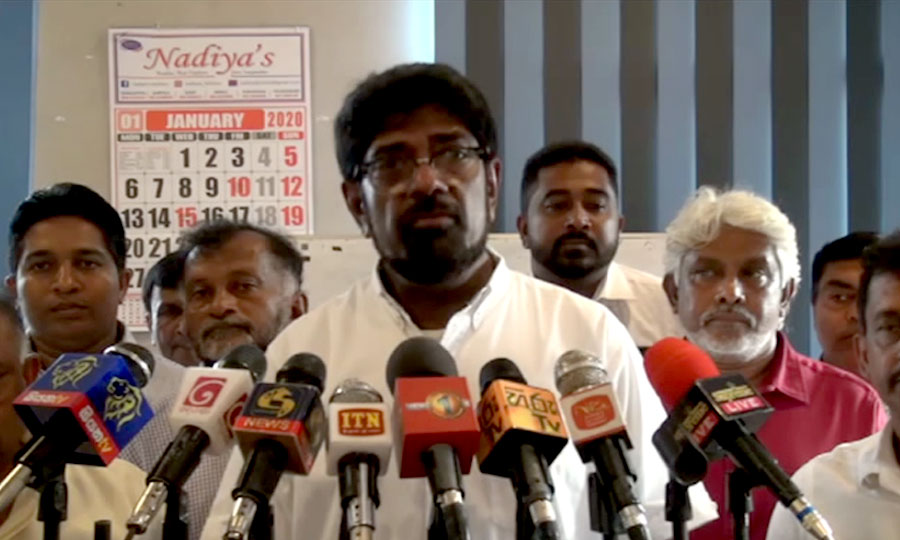
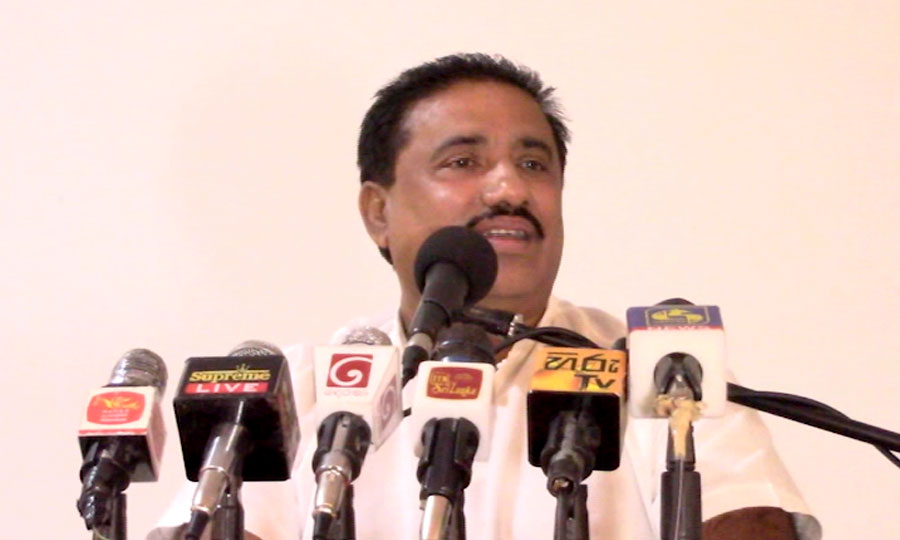
A warrant has been issued to arrest UNP MP Ranjan Ramanayake, says Ada Derana reporter.
The Nugegoda Magistrate’s Court, issuing the arrest warrant, has ordered to produce the parliamentarian before the court.
Earlier today (14), the Attorney General directed the Director of the Colombo Crimes Division (CCD) to obtain a warrant and arrest UNP MP Ramanayake.
He has also instructed the CCD to produce the parliamentarian before court for offences committed in terms of Article 111C (2) of the Constitution, for interference with the functions judges.
Several controversial audio recordings containing telephone conversations between former State Minister Ranjan Ramanayake and several influential figures in the country had come to light recently.
Phone conversations the MP purportedly had with certain judges as well as officials in the judicial service were among those recordings released thus far.
The ‘Sinhale’ organization has filed several complaints with the Judicial Service Commission, seeking a comprehensive investigation into the involvement of judicial authorities in this matter.
Speaker of Parliament Karu Jayasuriya has stated that a decision regarding disclosing the Forensic Audit report on the bond issues of the Central Bank to the members of parliament, will be taken during next parliament sitting week which starts on the 21st of January 2020.
These forensic audit reports have been received by the Parliament and the Speaker has taken measures to abstain from releasing the aforesaid to Members of Parliament upon the instruction of the Attorney General.
At the meeting of the Party Leaders and Political Party Representatives held at parliament yesterday (13), the MPs have requested that the audit reports be released to them as soon as possible.
The parliamentarians have pointed out that the forensic audit report contains information on the bond crisis occurred prior to 2015 and it is necessary for them to be aware of its particulars.
The Speaker has met with Attorney General Dappula de Livera in Parliament today (14) before making a final decision on the matter.
Accordingly, the Speaker will announce his decision after the parliament sitting scheduled for the 21st of January 2020.
In
November 2019 Sri Lanka voted a President giving him 6.9million votes. The voters
pledged faith in Gotabaya Rajapakse to take Sri Lanka & its People on the
correct path. There are some anomalies that have been ignored and these
anomalies must be rectified. While the world is demanding of the Government of
Sri Lanka to account for dead ‘civilians’ during the final months of a 30 year
old conflict confusing the deaths of non-state actors as ‘civilians’, the world
is blatantly ignoring the thousands of innocent people LTTE killed since 1980s
and the tears of 5000 war widows, their children & parents who are yet to
be told what happened to their war heroes. The
new President must hold a domestic inquiry against LTTE for its crimes.
UNHRC or those that pass Resolutions against Sri Lanka cannot ignore that the
GoSL & its armed forces defended the nation against terror to safeguard the
nation & its people.
OHCHR
passed 3 resolutions & commenced an investigation. They accepted 5000
petitions filed by war widows of Sri Lanka Armed Forces. What has been their
response on 5000 Missing Soldiers?
Non-Tamils
also logged scores of petitions against LTTE what has been OISL response to
their petitions?
In the absence of OHCHR responding to them the
President must come forward to take up their grievances.
LTTE
killings started by first killing Tamils and killed thousands of Tamils. All of
the ceasefires and peace talks were failures. Sri Lanka tried two foreign
mediated solutions which also failed.
Have these reports been taken into
account by the OHCHR/OISL or those drafting resolutions against Sri Lanka?
Some noteworthy dates
22 February 2002 – CFA signed
13 April 2002 – Hakeem & Prabakaran issue joint statement
assuring rights of Muslims
LTTE
used CFA to build its defenses setting up LTTE judicial complexes, LTTE police
units, commemoration of LTTE dead even inside universities, hoisting LTTE flag
in schools and amidst all this LTTE saw fit to even deny SLMM officials inside
their camps (26 August 2003/Manirasakulam LTTE camp)
LTTE
struck in August 2005 by killing Lakshman Kadiragamar, Sri Lanka’s Foreign
Minister inside his own home. Within days EU imposed a travel ban on LTTE (27
September 2005) and on 19 November President Mahinda Rajapakse was elected
President.
A shift against LTTE was building up
7 April 2006 Canada proscribed LTTE,
11 May 2006 SLMM declared ‘non-state
actors (LTTE) cannot rule open sea waters or airspace. The LTTE has therefore
no right to sea’.
29 May 2006 EU banned LTTE. This led to LTTE refusing to meet
the GOSL delegation in Norway on 8 June 2006 and resulted in LTTE demanding
withdrawal of SLMM from North on 4 July 2006.
It
is with this background that LTTE decided to close the sluice gates on 21 July
2006 in Mavil Aru committing a war crime by denying water supply to some 50,000
people resulting in the Army being ordered to re-open the sluice gates.
On
1 December 2006 LTTE made an abortive bid to take the life of current President
and then Defense Secretary Gotabaya Rajapakse.
2 January 2008 – Cabinet approved abrogation of CFA which came into
effect on 16 January 2008.
East
was liberated from LTTE and North was liberated from LTTE in May 2009 with
entire island being reunited under one flag devoid of terror. The nation &
its people signed in relief that there would be no bombs or suicide missions.
The
below list are a handful of crimes committed against unarmed, innocent
civilians that had done no harm to LTTE but LTTE chose to plan and murder them
for no reason. This is not a complete list but you can be sure that the list
will include far more not less than that which is highlighted below.
Please
take special note of all of LTTE’s crimes committed during the Norwegian
mediated Cease Fire Agreement inspite of foreign Nordic presence in Sri Lanka
assuring to protect the Sri Lankan citizens from terror.
Also draw
your attention to every killing after 2006 when the military offensive against
LTTE was launched and then wonder why OHCHR has opted not to include any of
these instances against LTTE but have specifically cited a handful of
hospitals/sites claiming Sri Lankan army attacked them and calling these war
crimes. Why has the same argument not been applied equally to the LTTE at least
in OHCHR or Resolutions or UNHRC High Commissioners reports?
(coloured attacks show LTTE crimes
committed after military offensive began)
LTTE attacks passenger airplanes:
1978
Air
Ceylon blasted by a time bomb
(Police
constable 8103 Gnanasambandan who arrested the suspects was shot dead on 1 Feb
1979)
Jun 1984
Private
aircraft belonging to Brian Lawrence set on fire at Peruttiadappu
3 May 1986 Bandaranaike International Airport Attack – Air Lanka Flight
512:
LTTE bomb explodes aboard Air Lanka
flight carrying mainly French, British and Japanese tourists killing 21
(including 13 foreigners – of whom 3 British, 2 German, 3 French, 2 Japanese, 1
Maldivian and 1 Pakistani) and injuring 41 on Bandaranaike International
Airport.
LTTE places land mines/bombs targeting vehicles
25
June 1986
Sittaru, Kantalai, Trincomalee
District – Bomb exploded in a vehicle by LTTE
killed 16 Sinhalese.
13 April 1989
A car bomb explosion on the central
road, Trincomalee Town kills 51
civilians and wounds 43 civilians.
17 August 1989
IED explosion at Nochchikulam,
Vavuniya. 8 civilians killed and 4
civilians wounded.
10
April 1992
A Bomb exploded in a car close to
the National Youth Council building at Maharagama. 9 civilians killed and 23 civilians wounded..
10
April 1992
A car bomb explosion at Maradana,
Colombo 10. 8 civilians were killed
and 23 civilians wounded.
5 December 1995 –
A Vehicle Bomb explodes in front of
the Pudukudurippu Security Forces Camp followed by LTTE attacking camp with
suicide bomber resulting in 12 civilians killed. 29 police killed and 2 police
missing
1
June 1998
Vehicle bomb explodes at Maradana in the heart of Colombo killing 38 civilians
5 July 1999
4 Villagers travelling in
a van to Rathmalgahawella, Ampara hacked to death
18 November 2006
Remote controlled claymore targeting army truck kills 4 civilians and injures over 11
others in Thandikulam
LTTE attacks buses
22
July 1986
Vavuniya District – Mammaduwa- LTTE exploded
a land-mine on a civilian bus, killing
32 Sinhalese civilians and injuring 20 others.
24
July 1986
Anuradhapura district – Issenbessagala,
a bomb exploded inside a bus proceeding from Vavuniya to Anuradhapura; killing 13 passengers and injuring 40
others.
17 September 1986
LTTE explode a land mine on a passenger
bus at Mamaduwa, Vavuniay killing 32 and injuring over 20 civilians.
7 March 1987 Arantalawa massacre:
Six civilians killed when LTTE
detonated a land-mine as troops were passing.
11 armed forces personnel also die.
17 April 1987 Aluth Oya massacre:
LTTE
shot dead127 Sinhalese
civilians, including 31 police and security force personnel who were
travelling in 3 buses and 2 trucks to Trincomalee. LTTE clad in military
uniforms stopped the vehicles and dragged out the passengers and shot them to
death with automatic weapons after brutally assaulting them with clubs. Over 70
with injuries were air lifted. The dead included many children and 12 off duty
security personnel. Most of the victims were families visiting their relatives
for the new year.
17 April 1987
LTTE
massacred 96 civilians and 31 security forces personnel who were travelling in a passenger
bus at Habarana and Kithuluthuwa, Trincomalee
21 April 1987 Colombo – Central Bus Station Bombing:
A bomb detonated by LTTE operatives
at the central bus terminal of Colombo killed
113 civilians, two policemen and a soldier; 298 others were injured.
11 June 1987
Private Van Bearing No. 38 – 496,
Vavuniya District – Veppankulam attack: 13
civilians and a soldier were killed when a private van en route from
Horowpathana to Trincomalee was blown up by a LTTE pressure mine.
7 October 1987 Ampara District – Pottuvil Monargala Road massacre:
30
Sinhalese passengers travelling by bus were shot dead by LTTE,
who also killed five motorcyclists travelling along the same route.
9 November 1987 –
Batticoloa district – Kalkudah
attack: A private bus transporting Tamil passengers was blown up by a LTTE
land-mine, killing 40 persons and an
IPKF soldier 24 civilians wounded
5 March 1988
Terrorists exploded a land mine on a
civilian lorry at Sittaru, Kantale, Trincomalee
24
civilians were killed.
11 March 1988
Suhadagama Horowpathana
Anuradhapura: LTTE attacks a private bus, 22 Sri 2218, at Suhadagama with small
arms and grenades, killing 19 passengers
and injuring nine others
14 March 1988
LTTE ambush a civil bus at Peniketiyawa,
Trincomalee. 28 civilians killed
& 3 wounded.
27 March 1988
Bomb kept in a gunny bag explodes
inside a CTB bus plying from Medwachchiya to Horowapathana at Wewelketiya,
Anuradhapura. 9 civilians killed and
14 civilians injured.
30 March 1988
LTTE attack civil bus at Arantalawa,
Vavuniya. 4 civilians killed and 5
civilians wounded.
1
May 1988
Sittaru Kantalai, Trincomalee: LTTE
exploded a land-mine on a CTB bus killing
12 Sinhalese, 9 Muslims and five others, who were not identified
9
July 1988
A CTB bus leaving Jaffna was
ambushed by LTTE at Irattaperiyakulam, Vavuniya – 2 civilians killed.
8
August 1990
A private coach proceeding from Morawewa
to Horowapathana attacked by LTTE at Meegaswewa, Trincomalee. 26 civilians killed and 7 civilians
wounded.
13
August 1990
LTTE ambush a lorry travelling from Negombo
to Kokuvil at Pulmoddai, killing 14
civilians
21
June 1991
Explosive laden ISUZU
ELF truck driven by an LTTE suicide bomber exploded on the road in front of the
side entrance of Operational Headquarters of the Ministry of Defence (Former JOC), Flower Road Colombo 7.
11 soldiers & 12 civilians killed.
Over 65 Army personnel
& over 85 civilians wounded
26 January 1992
A land mine blasted targeting a
crowded private bus between Aranthalawa and Borapola in Ampara.
10
civilians killed & over 20 civilians wounded.
10
April 1992
A bomb exploded in a private bus
which was parked at the Ampara private bus stand. 28 civilians were killed and 36 civilians were wounded.
15
July 1992 –
Terrorists attacked a civil bus
proceeding from Kattankudy towards Kalmunai at Kirankulam in Batticoloa 19 civilians
were killed and 07 civilians were wounded.
30 July 1992
Bomb planted in a private bus
explodes at bus stand in Trincomalee town killing
9 civilians and wounding 4 civilians.
19 January 1994
Bomb blast in a bus at Rambawewa in
Anuradhapura – 10 civilians killed.
1
September 1996
Passenger bus as Aranthalawa plying between Ampara and Kandy
attacked 11 civilian passengers killed and
over 30 injured
12 September 1996
SLTB Bus plying from Ampara to Kandy killing 11 civilians
29 January 1997
Claymore explosion in Vaddukodai, Jaffna kills 9 civilians
15
March 1997
Claymore mine at a CTB bus from Talaidy to Jaffna kills 15 civilians
8 October 1997 – US bans LTTE
27 March 1998
Bomb hidden in a gunny bag inside a CTB Bus plying from
Medawachchiya to Horowpathana at Wewelketiya, Anuradhapura kills 9 civilians
30
January 2000
Bomb explodes in Peoples’ Transport Services bus Moratuwa Depot
at Dutugemunu Junction in Polgahawela killing
13 civilians
3 February 2000
A time bomb explodes in private bus at Wanduragala whilst
transporting civilians from Kurunegala to Polgahawela.
3 February 2000
A parcel bomb exploded in a private bus,
bearing No. 62 – 1225 plying from Colombo to Kadawatha.
7 February 2000
Bomb explosion on CTB bus while it was parked at the bus stand.
(Bibile)
8 February 2000
Bomb explosion in bus travelling from Colombo to Negombo near Karunarathna
Maha Vidyalaya. (WATTALA)
8 February 2000
A bomb exploded on a CTB Bus at the Central
Bus Stand Pettah.
5 January 2007
Time bomb explodes in private bus plying between Nittambuwa to Giriulla
killing 5 civilians and injuring
over 54
5 January 2007
Explosion inside Matara bound bus plying from Colombo to
Seenigama kills 12 passengers and
injures over 29
2 April 2007
Bus plying from Ampara to Badulla via Bibile blown at
Kondavattuvan, Ampara killing 14
civilians
23 April 2007
Claymore mine targets civil bus plying from Mannar to Vavuniya –
Cheddikulam killing 3 civilians and
injuring over 30
27 September 2007
Claymore
mine targeting police jeep of Chunnakkam Police Station kills 2 civilians and injures over 9
5 December 2007
Claymore
mine targeting bus with civilians explodes in Kebethigollewa killing 14 civilians and injuring
scores of others
16 January 2008
Claymore
mine on CTB bus plying from Okkampitiya to Buttala on 03rd Mile Post, kills 27 civilians and injures over 60
2 February
2008
Bbus
plying from Kandy to Anuradhapura blown up in Dambulla bus stand killing 20 civilians and injuring over
60
4 February 2008
claymore explosion hits bus plying from Parakramapura to
Janakapura kills 8 civilians
23 February 2008
Improvised
explosive device explodes inside bus plying from Moratuwa to Colombo in Mount
Lavinia killing 18 civilians
25 April 2008
Remote
control device explodes in crowded CTB Bus plying between Piliyandala &
Kahapola at Piliyandala Town killing 27
civilians including a Buddhist priest
31 May 2008
A
hand grenade exploded inside a bus halt at Wellawatte – 2 civilians killed and 8 civilians injured.
6 June 2008
Bomb
blast on bus from Matale to Kandy via Wattegama near the Polgolla Open
University kills 2 civilians
7 November 2008
Civilian
bus travelling from Buttala to Kataragama thrown hand grenade killing 4 civilians
12 February2009
Hand
grenade thrown at bus traveling from Puliyankulam kills 1 Tamil civilian
Parcel bombs
27 January 2000 –
An IED
Bomb Parcel placed under Foreign Mail Box at Vavuniya post office explodes killing 13 civilians and injuring over
50
27 January 2000 –
An IED parcel bomb which was placed
by an unknown person under the Foreign Mail Box at Vavuniya Post office,
exploded. 4 civilians killed. 58
civilians wounded. 5 soldiers killed. 16 soldiers wounded. 8 policemen wounded.
28 November 2007 –
Parcel bomb explosion at Nugegoda Junction in front of NOLIMIT building
kills 20 civilians and injures over
30
LTTE attacks passenger trains:
March
1982
Parcel bomb inside night mail train
from Jaffna to Colombo – 2 civilians
killed. Police managed to capture 11 parcel bombs before they exploded.
1
July 1983
Yal Devi train set on fire at
Kondavil Railway station – all 10 compartments destroyed
5
May 1985
Land mine explosion on “YAL
DEVI” train at Murugandi, Jaffna. 11
civilians killed 5 civilians including Buddhist priest injured.
31
May 1986
A bomb explosion on YAL DEVI Train
at Veyangoda, Gampaha 10 civilians
killed.
24
February 1987
Terrorists blewup the Railway Track
between Vavuniya & Omanthai. (THANDIKULAM)
6
October 1987
Batticoloa district – Valaichchenai
massacre: 40 Sinhalese passengers in the
night-mail train from Batticaloa were killed by LTTE who stopped the train.
19
October 1987
Batticoloa district – Kalkudah
attack: A private bus transporting Tamil passengers was blown up by a LTTE
land-mine, killing 40 persons and an
IPKF soldier 24 civilians wounded
21
July 1992 –
Terrorists stopped the COLOMBO/
BATTICALOA Train at PRANGIYAMADU, Batticoloa. and ordered the passengers to get
down and opened fire at the Muslim passengers. 8 Muslims were killed and 04 civilians were wounded.
11
November 1995
The second suicide bomber who had
been in the vicinity of Army HQ detonated himself opposite the Slave Island Railway
Station. 11 civilians killed and 52 civilians
wounded.
1
July 1996
Parcel bomb explodes on a train playing to the south kills 52 civilians
24 July 1996
Bomb explosion on the Aluthgama train at Dehiwela Station killing 59 civilian passengers and wounding over 365 civilians
8 October 1997 – US bans LTTE
30 January 2000
A bomb explosion in a train. (GALOYA)
11 January 2008
A
small scale bomb explodes at the Fort Railway Station, the explosion caused
minor injuries to one Muslim Civilian.
3 February 2008
Suicide
cadre blows herself at Fort Railway station killing 15 civilians including 7 students and injuring over 85
26 May 2008
Bomb
blast inside Panadura bound train at Dehiwela railway station kills 9 civilians and injures over
50 civilians
4 June 2008
Remote
controlled bomb took place in Wellawatte Railway Track targeting a train plying
from Panadura to Colombo kills 24
civilians
LTTE
attacks passenger ships
7
July 1987
Korean Ship MV “MORANG
BONG” was seized by the LTTE in Pudukudurippu Sea. (Released on 31/09/1997)
12
June 1991
Bomb explosion in Manmunai Ferry at Kokkadicholai,
Batticoloa. 10 civilians killed.
10
September 1992
Ferry at Kiliveddy Point,
Trincomalee blasted 6 civilians killed
16
March 1994
Approx. 10 boats that had gone
fishing close to Kudiramalai Point in Puttalam came under LTTE attack. 17 civilians killed and 3 civilians
wounded.
9
August 1995
MV “PRINCESS WAVE” Ship
was damaged due to an explosion carried by LTTE at Pulmoddai Sea. 9 civilians
wounded.
29
August 1995
The Ship “IRISH MOANA” was
attacked by the LTTE, while anchored. North of Mullaitivu
17
October 1995
LTTE launched an underwater suicidal
attack on a naval auxiliary vessel A 512, which was anchored in Trincomalee
Harbour and destroyed it completely. 2
civilians were killed while scores of military personnel also died.
9
September 1997
The Ship MV “CORDIALITY”
was attacked by the LTTE. 4 civilians
were killed while military personnel also died.
25
July 1999
A naval vessel MV “NEWKO”
anchored at the Trincomalee Harbour was exploded by terrorists. 1 civilian was killed and another
civilian was wounded.
20
March 2003
A Chinese Trawler named “FUYUAN
YU 225” with a crew was attacked by Sea Tigers. 17 civilians killed.
8 October 1997 – US bans LTTE
17
June 2006
Pesali naval boat patrol attacked killing 5 civilians and injuring over 30 civilians –
29
August 1996
The Argentinean Ship MV
“ATHNNEA” was slightly damaged due to LTTE explosion in the sea off
Trincomalee.
LTTE attacks civilians in villages & towns:
May 1984
Don Jayasinghe Walter of Jaffna, a peon at Jaffna Kachcheri shot dead in Thinnaveli.
July 1984
Henry Jayalath Rajapakse, a Sinhalese shot dead at Kalliyankadu junction,
Jaffna
30 November 1984 – Kent & Dollar
Farm massacre
first
Sinhala civilians to be massacred in 2 farming villages in Mullaitivu – over 100 killed including children,
pregnant mothers & babies.
1st attempt at ethnic
cleansing of Sinhalese from North Sri Lanka.
1 December 1984 Kokilai massacre
LTTE cadres massacre 11 Sinhalese civilians in the village of Kokilai (coastal
town near Kokilai lagoon) located in the Mullaitivu District
5 May 1985 – Wilpattu Village Massacre:
Wilpattu, a Sinhalese village in
Anuradhapura District, was the target of a raid of an armed group of LTTE
cadres, who killed 18 villagers that
included women and children.
30 May 1985
LTTE cadres shoot and kill five Sinhalese civilians in the
villages of Mahandapura and Dehiwatta. People of these villages had previously
received numerous threats from the LTTE associates. This massacre was part of a
series of massacres aimed at displacing Sinhalese from the North East of Sri
Lanka.
4 June 1985– Dehiwatta Village Massacre:
Armed with sharp weapons over 100
LTTE cadres killed 15 villagers on
their sleeping mats in the village of Dehiwatta. Victims included women and
children, which were the majority killed.
11 June 1985
13
Sinhalese civilians shot dead by LTTE gunmen in Dehiwatta.
18 August 1985 Trincomalee District – Namalwatta Village Massacre I:
A group of LTTE cadres armed with
sharp weapons hacked to death 7
villagers
7 November 1985 Trincomalee District – Namalwatta Village Massacre II:
Ten
villagers, including women and children executed at
Namalwatta for the second time.
2 February 1986
Trincomalee district – Kantale
Village massacre: Armed with small arms and swords LTTE cadres raided the
village of Kantalai killing 19 civilians.
25
May 1986 Anuradhapura District – Mahadivulwewa Village massacre:
LTTE killed 20 Sinhalese by shooting them dead and set alight 20 houses.
2
June 1986
Trincomalee district – Kantale
Village massacre: Armed with small arms and swords LTTE raided the village of
Kantalai killing 19 civilians.
4
June 1986
Trincomalee district – Sinhala
village – Andankulam Village massacre: 17–20
civilians, including Ven. Bakamune Subaddalanakara Thero, were attacked,
tortured and killed by LTTE in the village of Andankulam.
11
June 1986
Kantale – Trincomalee District – ’22
people were killed and another 75 others were injured when two bombs were
detonated simultaneously by the LTTE on two buses heading to Kantalai and
Colombo respectively. The first bus was front of the Bank of Ceylon Trincomalee
branch and the other in close proximity to the SP office.
21
June 1986
Trincomalee district – Wilgamwehera
Village massacre: 9 Sinhala civilians,
including children, were murdered in the Wilgamwehera hamlet by LTTE
8
July 1986
Trincomalee – Sinhala village Monkey
Bridge Village massacre: 15 Sinhalese
villagers were shot to death by LTTE
9
July 1986
Trincomalee district – Mollipothana
Village massacre: Mullipothana village was stormed at night by a group of armed
LTTE who killed 16 civilians most of
them being women and children.
13
July 1986
Trincomalee district – Pavakkulam
Village massacre: Nine Tamil and two
Sinhalese villages were killed by LTTE who had arrived in a jeep to tract
No. 16, Pavakkulam.
19
July 1986
Wadigawewa, North Central Province –
LTTE shot deadtwelve Sinhalese villagers.
24
July 1986
Damana, Central Province – About 50
LTTE entered Damana, a Sinhalese village, and killed nine persons; another 13 were injured.
21
April 1987
Trincomalee district – Jayanthipura
Massacre: The majority Sinhalese village of Jayanthipura was raided by a group
of armed LTTE who murdered 15 civilians
including women and children.
29
May 1987
Polonnaruwa district – Attack on
Kadawathmadu: A group of armed LTTE raided the majority Sinhalese village of
Kadawathmadu killing seven civilians
and leaving five others injured. Due to the LTTE threat, the villagers slept in
jungle hideouts during the night, which reduced the casualties.
21
June 1987
Sinhala village in Godapotha,
Polonnarruwa massacre: The hamlet of Godapotha, a majority Sinhalese village in
Polonnaruwa was raided by a group of armed LTTE killing eight villagers and injuring one. The death toll was
reduced since villagers had hid in the surrounding jungles anticipating such an
attack.
29
July 1987
Trincomalee District – Thoppur
massacre: Nine villagers were killed
after being tortured by LTTE armed with swords, machetes and small arms.
Indo-Lanka Accord was signed in July 1987 promising an end
to LTTE terror …. It did nothing of the sort!
6
October 1987
Batticoloa – Tharavi massacre:
Tharavi, a majority Sinhalese village, was stormed by over 100 LTTE armed with
swords, machetes and small arms, who killed
25 civilians, mostly women and children including infants and pregnant
mothers.
10
October 1987
Trincomalee district – Ganthalawa
massacre: Gantalawa hamlet in Kantala was attacked and 9-10 civilians murdered with three wounded by LTTE armed with
swords, machetes and small arms.
15
October 1987
Trincomalee district – Ella Kantalai
massacre: Ella Kantalai, a majority Sinhalese village, was attacked by LTTE armed
with swords, machetes and small arms, killing
14 civilians including women and children.
11
November 1987
Batticoloa district – Kalkuda
massacre: Seven Sinhalese people selling
fish were shot dead by LTTE cadres.
15
September 1987
Polonnaruwa – Devalagodella
massacre: Devalagodella and Somavathiya villages were attacked by LTTE armed
with small arms and sharp weapons, killing
7-9 civilians
31
December 1987
Trincomalee district – Mahadivulwewa
massacre: 10 villagers were shot dead
and 15 houses burnt by LTTE
1
January 1988
Terrorist attack on a Sinhala
settlement in Kuruniyankulama Trincomalee 3
civilians were killed and 2 civilians wounded.
2
February 1988
Terrorist attack on the Bogamuyana
village in Ampara – 11 civilians killed
15
March 1988
Kivulkade, Morawewa, Trincomalee:
Two groups of LTTE operatives entered the village and killed seven Sinhalese villagers.
17
March 1988
Deegavapiya, Damana, Ampara: LTTE hacked to death 13 Sinhalese villagers.
22
March 1988
Pudukulam, Vavuniya: Between ten and
15 LTTE attacked the Sinhalese village and killed
six villagers. Another three were injured.
22
March 1988
Medavachchi-kulam Vavuniya: LTTE shot dead nine Sinhalese villagers
28
July 1988
Ethawetunawewa, Weli Oya: LTTE
operatives hacked to death 16 Sinhalese
villagers.
10
August 1988
Terrorist attack on a village, Central
Camp Ampara. 11 civilians were killed.
25
August 1988
Marawila, Polonnaruwa: LTTE killed eleven civilians by cutting their
necks
10
September 1988
16th Colony, Central Camp Ampara:
LTTE shot dead seven Sinhaleseand four Tamils.
10
October 1988
LTTE attacked Mahakongaskada,
Medawachchiya, in Vavuniya killing 44
civilians
14
November 1988
Peniketiyawa, Gomarakadawela,
Trincomalee. LTTE shot dead 28 Sinhalese
12
December 1988
LTTE attack village, Sumedagama in
Trincomalee. 28 civilians killed.
17
January 1989
LTTE attack the village, Maharambekulam
in Vavuniya – 9 civilians killed and
7 civilians wounded.
2
February 1989
11
Villagers were hacked to death by LTTE at Bogam Uyana in Ampara.
11
February 1989
Anuradhapura – Terrorist attack
Sinhala village, Dutuwewa killing 37
civilians
11
February 1989
LTTE attack Sinhala village, Sinhapura
killing 6 civilians and injuring 7
27
February 1989
LTTE attack Sinhala village, Borawewa
in Polonnaruwa killing 8 civilians
and injuring 7
30
May 1990
LTTE attack village, Mihindupura
Dehiwatta in Trincomalee killing 5
civilians
24
July 1990
8
Sinhala villagers were hacked to death by LTTE at Aralaganvila in Ampara
25
July 1990
8
civilians hacked to death by LTTE at Meeyankulama in Polonnaruwa
25
July 1990
9
Villagers were hacked to death by LTTE at Wan-Ela, Trincomalee
26
July 1990
LTTE hacked to death 19 civilians in Thammannawa, Anuradhapura
31
July 1990
LTTE fire at villagers in Podankady
Kantale in Trincomalee killing 11
civilians
6
August 1990
LTTE kill 34 farmers working in a paddy field in Ampara.
8
August 1990
LTTE attack village in Nawagamuwa in
Vavuniya killing 7 civilians and
injuring 5
19
September 1990
LTTE attack Vellamuni fishing
village in Puttalam killing 23 civilians
21
September 1990
LTTE attack village, Pudukudurippu killing 15 civilians and wounding 15
24
September 1990
LTTE set fire to 05 houses at Gajabapura
killing 4 villagers
1
October 1990
LTTE attack Sinhala village, Peruvalthalawa
in Ampara killing 9 civilians
23
October 1990
Approx. 30 LTTE attack Chena
Cultivators at Kokabe, Thanthirimalai village in Anuradhapura killing 10 civilians
25
October 1990
About 40 Armed LTTE terrorists
attack Panmedavachchiya killing 4
civilians and injuring 5 others
27
October 1990
LTTE fire again at Thanthirimalai
village in Anuradhapra killing 5
civilians
29
October 1990
LTTE fire at villages at Olikulam in
Batticoloa killing 3 civilians
1
November 1990
LTTE fire at SF Guard Point and the Helambawewa
village killing 10 civilians
3
November 1990
LTTE attack village, Bandarakumbukwewa
in Anuradhapura killing 4 civilians
23
January 1991
Approx. 50 – 70 terrorists attack Guard
Point at Bogamuyana in Ampara killing 29
civilians
2
March 1991
LTTE attack village, Kalupavel in
Batticoloa killing 4 civilians
2
March 1991
LTTE attack village, Erakkandy in
Trincomalee killing 5 civilians
14
April 1991
LTTE attack the village, 22nd
COLONY, Ethimalai in Ampara killing 17
civilians
20
April 1991
LTTE attack village, Niyandella,
Okkampitiya in Ampara killing 22 civilians
24
June 1991
LTTE attack Weligahakandiya village
in Periyapillumaa Ampara killing 10
civilians
6
July 1991
LTTE attack a Sinhala village and abducts 10 civilians (are they still
missing?)
16
May 1992
LTTE attack village, Kosgolla in
Ampara killing 5 civilians
9
August 1992
LTTE attack on Mailanthenna village killing 25 civilians and wounding over
10
1
September 1992
LTTE launch bomb attack, Saindamadu
in Ampara 22 civilians reported missing
(are they still missing?)
1
October 1992
LTTE attack Konwewa village killing 15 civilians
25
May 1995
Fishing village attacked and 42 civilians hacked to death in Kallarava, Trincomalee
21
October 1995
Village in Mangalagama, Batticoloa attacked 16 civilians killed,
21
October 1995
Village in Monarathenna Polonnaruwa attacked 36 civilians killed
21
October 1995
Village in North of Padaviya, Galthalawa, Mullaitivu attacked killing 19 civilians
23
October 1995 –
Village in Eththimalai/Kotiyagal, Monaragala attacked killing 19 civilians
25
October 1995 –
Village in Panama, Ampara attacked killing 8 civilians
26 October 1995 –
Village in Thammenna Halmillewa, Anuradhapa attacked killing 26 civilians and injuring over
25
26 October 1995 –
Village in ALINCHIPOTHANA village Alapathwewa, Mullativu
attacked killing 26 civilians
11
February 1995 –
Village in Siyabalamduwa, Monaragala attacked killing 5 civilians
22 February 1996 –
Village in Mahanikawewa, Kebithigollewa, Anuradhapura attacked killing 6 civilians
1 June 1996 –
Village of Eluvankulam in the Puttalam area attacked killing 4 civilians including children
and set on fire
11
June 1996 –
Village in Eluvankulama, Puttalam attacked killing 14 villagers
10
February 1997 –
Village in Oddaimavadi, Batticoloa fired upon killing 5 civilians
12
May 1997 –
An attack on the Morawewa Police Station and village by the LTTE
kills 5 civilians
8 October 1997 – US bans LTTE
18
September 1999 –
3 Sinhala village in Galapitagala, Badirekka, Borapola attacked killing 50 civilians
11 April 2000 –
Gomarankadawala police post attacked 1 civilian killed
12 April 2000
Musical show attacked in Trincomalee Fort Federick killing 10 civilians injuring over 60
7 December 2000
Kurulubedda village attacked by LTTE killing 5 villagers. (Welikanda)
17 Oct 2001
Attack on Ruwanpitiya village kills 2 civilians
25 May 2006
7 civilians going to
Wilpattu national park killed by land mine in Nochchiyagama
29 May 2006
12 Sinhalese civilians
working at Irrigation cannel shot and killed at Omadiyamadu
8 August 2006
Bomb blast at Dickman’s Rd, Bambalapitiya kills 1 civilian and injures 8
9 March 2007
4 wild life officials
killed inside Wilpattu wild life sanctuary
5
April 2007 –
4 farmers killed in Nidanvala, BATTICALOA.
12 April 2007
PALEURUWA Village fired upon killing 7 civilians
28 May 2007
LTTE Terrorists exploded a claymore mine
targeting a STF Truck Bearing No. 47 – 3430 in Ratmalana near Belekkade
Junction. (Near the Vijitha Cinema).
16 January 2008
Attack
on Chena cultivators in Niyandagalayaya, Monaragala killing 6 civilians
17 January 2008 –
Troops
find 8 civilian bodies / 2 home
guards in Thibolkketiya, Moneragala
10 March 2008
Remote
Control Device (IED) explodes near the Roxy Cinema in Wellawatte killing 1 civilian and injuring 6
including children
8 May 2008 –
An explosion had taken place closer to the clock tower Ampara
Town – 12 civilians killed and over
36 civilians injured
16 May 2008
–
An LTTE male suicide bomber on a motorcycle laden with
explosives rammed into a bus carrying police riot squad and exploded opposite
the Sambuddhaloka Temple on Lotus Road in Fort killing 2 civilians & 2 policemen and injuring 33 civilians, 46
police and 6 army.
29 May 2008 –
LTTE
raid on Naval Detachment in CHIRUTIVU ISLAND, a small islet located in the Jaffna
Lagoon kills 5 civilians and injures
over 12 while also killing military personnel
30 May 2008 –
LTTE
attack a House in a village in YAYA 18, Masvadiya. 1 Home Guard and 2 civilians killed
16 June
2008 –
LTTE
suicide bomber explodes herself near police gate in Vavuniya Town and kills 1 civilian and 12 police
personnel
5 August 2008 –
Explosion
close to Clock Tower of Ampara Town kills
12 civilians and injures ove 35
28 October 2008 –
Two
LTTE Air attacks drops 3 bombs in Thallady / 2 bombs on Kelanitissa power
station – 1 civilian dies
9 November 2008 –
Monaragala
village attacked killing 7 civilians
16 November
2008 –
Dr.
Palitha Padmakumara, of Thavakkadu hospital shot dead at Vavunativu in
Batticoloa
28 December 2008 –
Suicide
bomber in Wattala kills 1 civilian
2 January 2009 –
Suicide
attack in Slave Island near Air Force head quarters – 14 civilians injured
18 January 2009 –
2 civilians attending to cattle killed in Monaragala / 4 missing (are they
still missing)
9 February 2009 –
Suicide
bomber explodes outside IDP center in Puliyampokkanal killing 9 civilians and injuring over 40 (military personnel also
killed)
12 February 2009 –
Karametiya
village at Rathmalgaha Ella in Inginiyagala attacked killing 16 civilians
20 April 2009 –
3
suicide attacks on IDPs fleeing from LTTE in Pudumathalan kills 17 IDPs and injures over 200
15 April 2009 –
5 civilians killed in Okanda
Attacking Buddhist places of worship:
June 1975 –
Improvised
bomb at Buddhist Temple Sri Naga Vihara, Jaffna
April 1984 –
Same
Buddhist Temple & Sinhala Maha Vidyalaya attacked by throwing bombs
14 May 1985 –
LTTE attack Sri Maha Bodhi temple in
Anuradhapura largest massacre of Sinhalese civilians by the LTTE. LTTE massacred Buddhist Devotees at Sri Maha
Bodhiya, Anuradhapura. 146 civilians
including Buddhist priests were killed. 85 civilians wounded.
2 August 1985 –
LTTE shot dead three Sinhalese Buddhist monksand three civilians, while they were worshipping at the Ruhunu
Somavathiya Temple – Thrikonamadu, Polonnaruwa District
14 August 1985 –
Aranthalawa Village Massacre: Seven Sinhalese villagers were tortured and
killed at Aranthalawa. They were targeted by an armed group of LTTE cadres-
Ampara District
2 June 1987 –
Ampara district – Aranthalawa
Massacre: In the first massacre of Buddhist monks in modern Sri Lankan history,
a bus carrying Buddhist monks was stopped by LTTE in Arantalawa. 32 Buddhist monks, including Chief Priest
Ven. Hegoda Indrasara, were killed with only one monk surviving.
12 June 1987 –
Polonnaruwa – Godapotta massacre: A
meeting to discuss a new temple was attacked by the LTTE, who surrounded the
temple and attacked the gathering of over 175 villagers, resulting in the deaths of eight villagers; a soldier
and six people were injured.
8 October 1997 – US bans LTTE
25
January 1998 –
Suicide attack on the Sri Dalada Maligawa (Temple of Tooth of
Lord Buddha) causes extensive damage to the Temple and kills 9 civilians
17 May 2000 –
A bomb was exploded opposite the
“VESAK PANDAL” at Mangalarama Temple in Batticoloa
10 July 2000 –
Attack on Vilgamvehera in Trincomalee
kills 4 civilians
18 November 2001 –
Claymore explosion at SRIPURA RAJA MAHA VIHARAYA kills 3 Buddhist monks including the
chief incumbent of the Vihara and driver
13 May 2007 –
A Buddhist Monk of
PABBATHARAMAYA, Phase I, MAHADIVULWEWA was shot dead
6 June 2008 –
Bomb
blast in Moratuwa near the Shailabimbarama Temple kills 25 civilians and injures over 90
LTTE
attacks kovils
12 August 2001 –
Firing at KOVIL FESTIVAL in ERAVUR Batticoloa kills 2 civilians and injures many
LTTE
attacks Muslims
5 May 1986 Trincomalee
District – Kinniya Village massacre:
Four
Moor civilians were tortured and killed by a group of LTTE
31
March 1988
Saindamaradu, Kalmunai: LTTE
attacked the village, killing ten
Muslims and seven Tamils.
29
July 1990
LTTE fired at the Mosque at Samanthurai
Ampara killing 5 Muslims and
injuring 3
30
July 1990
Terrorists abducted and killed 14 Muslims at Akkaraipattu,
Ampara
11
August 1990 –
Group of LTTE attacked the Muslim
persons in Divisions 03 and 06 Eravur, Batticoloa 173 civilians were killed and 20 civilians were wounded..
12
August 1990 –
Terrorists attacked Muslim civilians
working in a paddy field in Veerachcholai Ampara – 4
Civilians were killed and 10 civilians were wounded.
13
August 1990 –
6
Muslim fishermen were killed and buried at GUNGAI village in Muttur,
Trincomalee.
13
September 1990 –
Security Forces recovered 07 mutilated bodies of Muslim villagers
who were hacked to death at South of Poonani in Ampara
11
October 1990 –
LTTE shoot and hack to death 09 Muslims who were collecting fire woods near Kirankove
jungle, Arugambe, Ampara
6
June 1991 –
Approx. 30 to 50 terrorists attack a
Muslim village in Puddur in Plonnaruwa 16
civilians were killed and 3 civilians were wounded.
8
August 1991 –
8
Muslim farmers who where on their way home from their paddy fields were
killed, West of Samanthurai in Ampara.
19
September 1991 –
Terrorists attacked a Muslim
village, Palliyagodella, Medirigiriya in Polonnaruwa, 13 civilians were killed and 6 civilians were wounded.
29
April 1992 –
LTTE attack on ALINCHCHIPOTHA Muslim
village, KARAPOLA & MUTHUGALA in Polonnaruwa. 130 civilians killed and 71 civilians were wounded.
8 October 1997 – US bans LTTE
23
November 2000 –
Motors fired towards Muttur jetty and Almahar Maha School killing 2 students and injuring 11
civilians
23
November 2003 –
One Muslim killed and 2 others injured from hand grenade
attack at KANDALADIUTTU.
24 November 2003 –
Two Muslims killed and 2 others injured due to hand
grenade attack on a lorry at KATTAKUDICHCHI.
24
November 2003 –
3 Cadjan huts set fire and hand grenade thrown to the refugee
camp at FAIZAL NAGAR KINNIYA
28 November 2003 –
3 Muslims farmers of Edman
Nagar, Kinniya killed cutting
with sharp weapons whilst they were staying in the night in their paddy fields
in CHINA- BAY
30 November 2003 –
A Muslim person in working in Kasmir Hotel, Trincomalee
assaulted at the Shivan Kovil and admitted to hospital with head injuries
1 December 2003 –
A Muslim civilian of
Colony No 5 Kakamunai Soorangal shot and injured at Kinniya
18 September 2006 –
10 Muslim civilians killed while engaging in construction works
at Radella, Pothuvil
LTTE attacks mosques:
3
August 1990 –
Terrorists massacred Muslim Devotees
at a Kattankudy Mosque killing 103
civilian worshippers and injuring over 70
25
November 2003 –
6 Civilians including 04 Muslims injured due to a hand grenade
attack near the mosque at SALAIADI TRINCOMALEE Town.
LTTE attacks hotels:
January 1984
Bomb
at Hotel Oberoi (present Cinnamon Grand Hotel) killing 1 civilian
15 October 1997
Vehicle bomb explosion at car park of Galadari Hotel close to
World Trade Center, Colombo kills 11
civilians
2 January 2008
Claymoroe
mine explodes near Nippon Hotel, Slave Island, Colombo kills 3 civilians
8 September 2008 –
10
civilians injureddue to a bomb explosion near Mohamadia Hotel at Gas
Works Junction in Pettah
LTTE destruction of public property/places:
April 1984 –
blasting
railway track in Kilinochchi – 20 feet of rails & 15 sleepers damaged
July
1984 –
4 bomb explosions in Vavuniya town
in Senshirani, Well Café, Rahumaniya hotel & Dark Hotel
17 February 1986 –
Blasting 5 bridges.
a. VALLAI Bridge between Puttur
& Velvettiturai on Jaffna Pudukudurippu Road.
b. NALLI – KODIKAMAM – PPD Road.
c. VANNARTUPALAM (Butterfly Bridge)
between PUTTUR and SARASALAI.
d. KAITHADY Bridge at KOPAY.
e. KAPPUTI Bridge on CHAVA and PPD
Road.
7 May 1986 –
Colombo – Central Telegraph Office
Bombing: The Central Telegraph Office, Colombo was the target ofn a bomb
detonated by LTTE which killed 14
civilians who were at the office.
30 May 1986 –
Bomb explosion at the Elephant
House, Commercial Building, Slave Island, Colombo 2. Killed 11 civilians.
17 July 1986 –
Terrorists exploded a bomb in Block
4 Sugar Corporation, Trincomalee. 10
civilians killed.
18 February 1987 –
Parcel Bomb explosion at NELUMGAMA, Badulla
7 civilians killed
16 August 1988 –
Trincomalee (opposite Clock Tower):
LTTE exploded a bomb, killing six Sinhalese,
two Muslims, one Tamil and a soldier;
19 persons sustained injuries
24 March 1991 –
Bomb explosion at Fish Market
AKKARAIPATTU, Ampara. 9 civilians killed
and 32 civilians wounded.
7 August 1995 –
A suicide bomber pushing a cart
fixed with a bomb exploded in the vicinity of the Western Province Chief
Minister’s Office at the Independence Square, Colombo 7 -. 23 civilians were killed and 40 civilians wounded.
31
January 1996 –
LTTE activated a suicide vehicle bomb
(ISUZU Lorry) laden with Explosives in front of the CENTRAL BANK Building at
Janadhipathi Mawatha, COLOMBO 01 causing extensive damage to the building,
roads, vehicles and surrounding area. 86
civilians dead over 1400 wounded.
14 November 1997 –
Kelanitissa Power House, Orugodawatta blasted destroying 2 oil
tanks
14 June 2000 –
Suicide bomber explodes himself at Wattala junction killing 2 civilians
8 January
2007 –
CEB
Power Supply Sub-Station at Maradana Road, Hendala, Wattala was blasted
21 January 2007 –
LTTE
Sea Tiger abortive attack on COLOMBO Harbour.
LTTE harming/killing Foreigners
5 May 1984 –
American
couple Stanley & Mary Allen kidnapped in Jaffna & released on 10th
May.
3 May 1986
Bandaranaike International Airport
Attack – Air Lanka Flight 512: LTTE bomb explodes aboard Air Lanka flight
carrying mainly French, British and Japanese tourists killing 21 (including 13
foreigners – of whom 3 British, 2 German, 3 French, 2 Japanese, 1 Maldivian
and 1 Pakistani) and injuring 41 on Bandaranaike International Airport.
Civilians killed in high profile assassinations
2 March 1991
A suicide vehicle bomb explosion at Havelock
Road, Colombo 5 killing Minister of State for Defense Mr. Ranjan Wijeratne. 19 civilians killed and over 70
civilians wounded in addition to the military personnel who died.
1 May 1991 –
His Excellency the President RANASINGHE
PREMADASA was assassinated, whilst he was participating in the UNP May Day
Rally by a suicide bomber at ARMOUR STREET JUNCTION, COLOMBO. 8 policemen were
killed, 8 policemen were wounded, 13 civilians
were killed and 23 civilians were wounded.
7
August 1995 –
Suicide
attempt using cart bomb explodes at the gate of the Western Province Chief
Minister’s office killing 23 civilians
and wounding over 40
18 September 1999 –
Suicide
attack at Presidential Election Campaign Meeting held in Town Hall, Colombo 07
to assassinate former President Mrs. CHANDRIKA BANDARANAIKE KUMARATUNGA – she
lost an eye as a result. 16 civilians
were killed
18 December 1999 –
Suicide
bomber at UNP Propaganda Meeting Ja-Ela a Suicide Bomber killing Retired
Maj. Gen. C L ALGAMA including 12
civilians, 45 wounded
7 June 2000 –
Suicide
bomber kills Hon. Min. of Industrial Development Mr. C V GOONARATNE and wife
with 24 other civilians in RATMALANA
26 June 2006 –
Suicide
attack on Maj. Gen. Parami Kulatunga leaves
1 civilian dead and 4 civilians injured in Pannipitiya
28 November 2007 –
Suicide bomber explodes herself at Minister Douglas Devananda’s
office in Colombo 5 killing a civilian
(Stephen Peiris)
6 April 2008 –
Suicide attack kills Hon. Min. JEYARAJ FERNANDOPULLE, Minister
of Highways and Road Development, the Chief Government Whip and Treasurer of
SLFP, Chief Guest attending road marathon in Gampaha 9 civilians including children die
10 June 2008 –
Suicide blast at UNP meeting kills UNP Chief Ministerial
candidate Maj. Gen. Janaka Perera, his wife and 27 civilians injuring over 80
9 October 2008 –
Suicide bomber targets Hon. Minister MAITHRIPALA SIRISENA,
Minister of Agricultural Development and Agrarian Service Development and
General Secretary of SLFP at PIRIVENA JUNCTION, BORALESGAMUWA. The Minister
escaped but 2 civilians die
However,
the international community have conveniently ignored that Sri Lanka’s military
intervention commencing in July 2006 was as a result of the war crime of
denying water to thousands of farmers in the East of Sri Lanka by LTTE. It was
only after appeals were ignored and farmers were in difficulty that a decision
had to be taken & the Armed Forces were ordered to forcefully open the
sluice gates & return supply of water. The LTTE thereafter went on to
attack villages in the East and virtually enticed the Armed Forces to respond
with counter attack. What happened thereafter only LTTE can in hindsight blame
itself.
When
9/11 took place there was no investigation as to who committed the crime –
within hours Afghanistan was bombed and Afghanistan remains occupied by US
& NATO since 2001 and not a single suicide bomber was from Afghanistan!
If
OHCHR head and UNHRC can quote a handful of incidents to blame GoSL and its
armed forces why has the same entity not cited examples of LTTE atrocities during
the same period?
The
government of Sri Lanka retained the military bases in north and east after the
Eelam war ended. This did not please those who resented the Eelam
victory. Sri Lanka does not need such a big army, such a big military now that
the war is over, pro-Eelamists said.
UNHRC
in Geneva demanded a ‘less intrusive and intimidating military presence’ in
North and East. United
Nations High Commissioner for Human Rights, Zeid bin Ra’ad al Hussein
visited in 2017, and he also said that the size of the military forces in the
North and the East could be reduced to a level that is less intrusive and intimidating.
Wikipedia said that there were 14 (sic) divisions in the North and East coming under
six operational headquarters and 2 independent Divisions and several
independent Brigades. Jaffna
Security Forces Headquarters had 3
division, Wanni had 5 divisions, Kilinochchi had 3
division, Mullaitivu had 4 divisions.There are also two large naval commands9 and at least two
significant units/bases of the air force, added Ceylon Telegraph.
A population
roughly half the size of Colombo district or equivalent to a medium sized
Indian city is effectively under the control of the staggering number of 15
army divisions in addition to other military units and forces. There is 1 security personnel for nearly
every 10 civilians, concluded Ceylon Telegraph.
There is
continued military occupation in the north – some 120,000 soldiers across the
country, a force bigger than the entire British army, in a country with a
population of some 20 million people, said Channel 4 News.
However,
according to Major General Haturusinge, there had been around 26,000 army personnel in Jaffna peninsula in
November 2009. By July 2013, the strength
had been reduced to 13,200 and
the soldiers were largely confined to High Security Zones. The High Security
Zones had also shrunk in size. Earlier, they had around 13,680 acres, in 2013
it was 6183 acres.
Those who objected to the presence of the
military spoke of it as ‘militarization’. Friday Forum spoke of the ‘extraordinary militarization of
our state over so many decades’. Friday
Forum said many senior administrators
and officials such as governors were selected from the military. There is also
the large allocation to defense in the budget.
The heavy militarization of the province,
designed to protect against the renewal of militancy is deepening the
alienation and anger of the northern Tamils, said Gamini Keerawella. The
continued presence of the military in places that they did not occupy before
the war concerns me,” said another. They are on lands that belong to the people.” The army occupies as much as 60,000 acres of
civilian land just in the Mullaitivu district, with massive camps that encroach
on the daily lives of civilians, said Gary Anandasangaree.
We want
demilitarization said Vigneswaran, The army is in full control of the area. Tamil People’s Council demands that the
occupying forces immediately leave the north and east and civilian
administration be provided for the north and east.
Interested
parties are using the continued existence of a large military to manufacture
claims about the ‘militarization ‘of the country, Gotabaya Rajapaksa said in
2012. Foreign governments
visit and ask for demilitarization of the north and east. That is a matter for Sri Lanka alone. The foreign
agencies always wanted to reduce the military in North and East. It was in
the Ceasefire Agreement too.
It’s up to
the military and the leaders to decide what should be the strength of the army,
according to the threat perception that we have , continued President Gotabaya in 2019. The numbers in the army would have gone down
by now, since the government did not recruit soldiers at the same pace, in the
last 10 years. Normal attrition would
also have taken place.
Sri
Lanka needs to sustain a robust military
power. The present need, in 2019, is for intelligence and the intelligence
cadres need to be increased. We may put more investment on training of
intelligence gathering, and mechanisms of intelligence gathering. We have to
change according to the threat, concluded President Gotabaya .
The Tamil
Separatist Movement thought otherwise. The Tamil Separatist Movement said it wants the army completely out of the
north, replaced by an enhanced police presence. The army should withdraw from checkpoints
and be replaced by the police. Police
must take up the challenge of ensuring the people’s security as a civilian
force, said Jehan Perera. If the government wishes to obtain the gratitude of
the Tamils for ending the war and restoring peace, they should restore normal civilian traffic through
Omanthai. The Omanthai checkpoint
should have gone long ago. So should the military form the north, said pro-Eelamists.
However,
outside of the larger towns the police are in fact conspicuous by their
absence, at least in the Vanni. I did not spot any significant police presence,
not a single police station but just one police outpost, in two days of
journeying through parts of the rural heartland of the Vanni earlier this year
but instead saw large army camps, ranging from divisional and brigade
headquarters, to medium and small camps and numerous army outposts and
checkpoints, said a journalist in 2012.
After the
victory, the army engaged in community
service. They did so with great enthusiasm. The security forces in the Vanni
were very busy, reported observers, making roads, building schools and
community centres, organising medical camps, community events and gatherings. Security forces repaired furniture in
schools and donated blood. They renovated Bakmeewewa and Werabanda wewa.
These activities
were welcomed. But other activities were not. Here are two examples. Civil
Defence Force had taken most of the
pre-schools in the Kilinochchi and Mullaitivu
districts” under its preview.
CDF started
training pre-school teachers and paid
the salaries of the staff in those schools”
By 2018, there
were 261 pre-schools funder the CDF and over
58,146 children.
The pre-school teachers, who got less than Rs. 3,000 monthly before, are now
getting a salary of Rs. 32,000. School principals now say that the education
standard of grade one students has improved as they are given a good pre-school
education in the CDF run pre-schools The CDF is conducting tuition and extra
classes for children in grade one to 10, reported the CDF.
The Tamil Separatist Movement did not agree. Wigneswaran complained to the EU HR
inspection team that the Sri Lanka army was running hundreds of schools in north
including 344 primary schools.
The TNA charged
that “The army logo has been printed on the school uniforms of
kindergarten children in the Kilinochchi and Mullaitivu districts attending
pre-schools maintained by the Civil Defence Force. Even kindergarten children
are paraded as army children while other children wear normal dress. A fee is
charged from the parents for the uniforms of the students studying in those
schools and the army logo is printed on those uniforms. Why cannot the
Education Ministry maintain preschools in those areas like the way it does in
other districts. When asked
whether they could produce evidence that
the army logo was printed on the school uniforms, TNA said ‘yes’?”
JVP said that in Kilinochchi there is no
electricity in its 52 schools and there is a semi -military administration.
Cannot hold even a drama competition in school without getting permission from
the military administration.
The second complaint was that Army maintains hair
dressing saloons in Mullaitivu. While other saloons charge 100 rupees per a
haircut the army saloons charge only Rs. 35. Their saloons are open on Sundays
and on public holidays. How can the saloon owners and barbers in the area
compete with them? They lose business. Why are the war hit areas still
compelled to live under such conditions, asked the Tamil Separatist Movement .”
Friday Forum
observed that in addition to the extensive land held by the military, its
inroad into the local economy and widespread surveillance apparatuses troubled the local population. The military
had gone into branches of government which should be under civil
administration, observed Gamini Keerawella.
The military
is used to maintain civil law and order.
It is also carrying out policing functions, he said. Security forces intervened in the day to day
civilian administration, the Tamil Separatist Movement complained.
Very little, happens without the
permission of the army, reported Colombo Telegraph. The public object to the militarization and
the surveillance, Tamil People’s Council said.
Under the
veneer of benevolence, not to mention the cultivated grace and charm exuded by
the senior officers, is the constant exercise of their absolute power, said BBC reporter Charles Haviland.At checkpoints and outposts, vehicles
slow down, even without a hint of a signal he added.
Security
forces are entitled to keep an eye on meetings but the psychological climate is
such that even this information gathering can create unease in a population
that continues to live in the memory of the war that has so cruelly shattered their lives, said
Jehan Perera.
Former LTTE
cadres complained in 2019 to US human rights activist Cristina James
that they are under constant surveillance by the military though they have
undergone rehabilitation. People were still suspicious of them due to the military
constantly watching their movements. They said they had also complained to the
United Nations Human Rights Council (UNHRC) about this. They also claimed that military
interference has hampered their political activity.
The military
presence in the north becomes militarization,
not only because of its overwhelming presence and its imprint on the
everyday life of people but also because the military is engaged in other activities, said critics.
The military
has infiltrated into non-military spheres.It has infiltrated trade, city planning and local administration. It is
engaged in agricultural and commercial activities. However, discussions with
senior army officials as well as the other ranks in Vanni show that they really
do take their development mission” seriously, reported a researcher.
The military is doing everything” agreed the Army
Commander in an interview in 2013. They are running cafes, building roads,
bridges, houses and stadium, the engineering services do tanks and canal
renovation. Certain battalions have
taken over and are cultivating government agricultural land. We have
established our own farms. Is this
militarization? It is not, said the Army Commander. We are saving the
government money in terms of labour costs.
Here are some of the army’s commercial activities.
Army runs a tile factory and brick factory. Tile factory was a joint venture
with Ceylon Ceramic Corporation. Army had been asked to fill in due to shortage
of labour.
Army took
over the Kankasanturai rest house, and in 2010 turned it into Thal Sevana, a
resort-type hotel owned and managed by the Army. In 2019, TNA was trying to stop the army from
acquiring lands adjacent to ‘Thal Sevana’ for further expansion. (Continued)
Employment opportunities will be provided for over 50,000 unemployment graduates by 1st of March this year, says Minister of Education and Minister of Sports & Youth Affairs Dullas Alahapperuma.
He made this statement during a press conference held at the head office of Sri Lanka Podujana Peramuna (SLPP) today (13).
Back in 2012, former President Mahinda Rajapaksa took a decision to provide employment opportunities to all graduates.
However, the previous government had appointed a limited number of graduates as development officers under a strict criterion, says the Minister.
He further stated that President Gotabaya Rajapaksa has given instructions to give job opportunities for unemployed graduates regardless of the type of their degrees, age, political affiliations and any other divisions.
As per the existing statistics, there are nearly 50,000 unemployed graduates, the Minister added.
The World Bank has forecast Sri Lanka’s economic growth for 2020 at 3.3 percent, the bank said in a statement on Monday.
In its latest report of World Bank’s January 2020 Global Economic Prospects,” the World Bank said for 2021 and 2022, it maintains the same forecast of 3.7 percent of economic growth in Sri Lanka.
The report further said growth in the region is expected to rise to 5.5 percent in 2020, assuming a modest rebound in domestic demand and economic activity benefiting from policy accommodation in India and Sri Lanka, as well as improved business confidence and support from infrastructure investments in Afghanistan, Bangladesh and Pakistan.
The report also said global economic growth is forecast to edge up to 2.5 percent in 2020 as investment and trade gradually recover from last year’s significant weakness but downward risks persist.
Sri Lanka’s new government headed by President Gotabaya Rajapaksa said recently that one of its targets include achieving a 6.5-percent economic growth per annum from 2020 and a GDP growth of 6,500 U.S. dollars per capita.
The Colombo High Court (CHC) today issued notices on former Minister Dr Rajitha Senaratne, former SPC Chairman Dr Rumy Mohammed and two other individuals who had participated at the ‘white van’ press conference to appear on January 17 considering the revision application filed by the Attorney General (AG).
The Revision Application was filed by the AG against the Colombo Chief Magistrate’s order on granting bail to former Minister Senaratne was fixed for support on January 17 before the Colombo High Court.
The Sinhale Jathika Organization stated that the former governor of the Western Province Azad Salley, should be arrested immediately, for his influence on the investigations regarding the vandalizing of Budda Statues in Mawanella.
The president of the organization, Dan Priyasad made this statement after making a complaint to the Police Headquarters.
Priyasad further added apart from Azad Salley, there are several others like Rishard Baidudeen, Rauf Hakeem, and M.L.A.M Hizbullah, who have accusations levelled against them; however they are yet to be brought to justice.
He also added that this government was elected because people believe in the president and hoped that correct decisions will be taken by the president to ensure law and order is maintained.
I read variety of opinions on the proposed
amendments of 21st and 22nd to
the constitution by Mr. Wejedasa Rajapaksa in
weekend newspapers of 12.01.2020. The editorials of some newspapers,
politicians, and analysts in newspapers have expressed views on the proposed
amendments and the vital matters regard to the proposed amendments are district
votes cut off point, the executive power of the president and the power of
parliament. Ordinary people of the country may have not read the comments
published, but they are very vital issues for the country.
The
15th amendment to the constitution changed the District Votes Cut
Off point, most probably amendment was based on opinions of influential people
or political strategists, to 5% from 12.5%.
The original constitutional reforms in 1978 introduced the Executive
Presidential System, and a new election system which was aimed at giving
proportionate representation to parliament and what was the underhand had
elements of the changes were not clear to ordinary people of the country, but I
heard many people were talking that the underhand elements of the proportionate
representation were UNP to be in power forever and ever, and the future elected
parliaments to limit the power to a less than two-third majority, which reflect
the inability to amend the constitution.
I felt that the opinions of rural people were accurate to a certain
extent and the operational pattern of the constitution clearly reflected the
positively working the underhand elements as poor people in rural area thought.
The
district election votes cut off point has been a vital concept since the 1988
general election and the concept based on the change had positive aspects at
the time it was introduced. The main positive point was giving an opportunity
to represent in parliament by small parties especially JVP and LTTE which took
weapons in hand with an intention to achieve their aims. However, the aims of both JVP and LTTE were
not the aim of the entire nation and minor parties represented a small pace of
population. According to the conditions of the constitution of Sri Lanka
individuals and groups of people have rights that are not giving accede to
deprive others’ rights to have own opinions. The experience in respect of the
behavior of Marxist and Communist parties demonstrated that the prime strategy
of them was to bereave the opinions of other political parties and insisting
these Marxist and communist parties show that they have the right only for
them. I observed this situation when I
was studying at university. There was not deviating objectives of elements of
LTTE and JVP and all were in the same boat. However, someone can point out that
JVP had not an aim to divide the country or to create a separate state
challenging the unitary status of the country.
When
I was studying at the university, I observed that ideas of small parties were
extremely vicious and there is no point giving them an opportunity to destroy
our society in the name of democracy or the rights of people. Therefore, I believe, going back to the
original proportionate representation with a district cut off point at 12.5% is
the right amendment in a situation where people are struggling to become a
developed nation. The system of working proportionate representation in Sri
Lanka seems that it is a challenge to the sovereignty of people as the system
included appointing representative without direct going to votes to gain the
authority from public. People observed bullshits of opinions of small parties,
which were established with vicious elements or intensions to show that they
respect the rights of religions, racial intentions, and caste dictions, which
support to divide society than uniting people as human being. What is the use
of allowing such political parties work in society if they have intension
destroy or take harmful action?
Because
of the diversity in society, it is not a right to destroy the right of others
and the proposed amendment 22nd focuses to give justice to everybody
without deviating based on various elements.
Democracy is a misunderstood concept in Sri Lanka. We can clearly see in the Western countries,
although they highly respect democracy they do not allow political parties
based on different elements. Small groups can join with major parties and if
they are democratic and objectives of them reflect the justice, the policies of
them could include in major parties if minor parties can make a difference.
The
proposed amendment of 21st to the constitution focuses on
strengthening the power of the executive president. The editor of Sunday Times
attempted to show that the proposed amendment of 22nd to the
constitution by Mr. Wejedasa Rajapaksa is an attempt to strengthening the hands
of the executive at the expense of parliament to revert pre-2015 era. The truth
is that people clearly saw that in the absence of executive power by the
president Sri Lanka suffered, and the parliament of Sri Lanka showed that it is
an institution with self-centred people and the case of Mr. Ranjan Ramanayake
showed that members of parliament go beyond the limits of authority and
attempted to influenced the judiciary , which is an independent institute as
believed by people. The actions of the executive president are approved by
people than the dirty behaviour of the representative of parliament.
People
of Sri Lanka had the experience they were under Kings and Queens, who exercised
executive power from the beginning of Sri Lanka state before Christ to the
early 1930s. People are used to executive power the president than a parliament
democracy, which represents members, who have intentions with contradictory
opinions, purposes and intentions, and the executive power of the parliament
has destroyed the expectations of people. The directly elected president by
votes of people is the preferred nature of executive power in Sri Lanka. The 19th
amendment to the constitution killed the expectation of people and people
responded with opposition to the 19th amendment in the presidential
election in 2019.
The
idea of poorly drafting the 19th amendment is a proof that it is
wrong action of parliament or misleading public to give the authority to a
prime minister who unable to win the consent of people to be the executive
president.
It is heartening to note
that our new Governor of the Central Bank had understood that the IMF’s
neoliberal economics that we have closely followed from 1978, has
miserably failed.(Sri Lanka’s new chief flays Neo Liberalism”: Economy
Next 28/12/19)
Following the IMF since
1978- for over four decades, has made us become a heavily indebted country, a
situation from which there is no return. My two books, How the IMF Ruined
Sri Lanka and Alternative Programmes of Success(2006: Godages) and
How the IMF Sabotaged Third World Development(Godages & Kindle:2017)
which happen to be the only books that are critical of the IMF’s
teachings that also provide details of how salvation can be reached may be of
service. In fact my guru, Professor George Axinn, Professor of International
Development at Michigan State University in his introduction to my
2006 book: How the IMF Ruined Sri Lanka wrote: “It is hoped that this
timely book will enable international organizations
to arrest the trend of failures.”
In detail, in the late
Seventies, the IMF took on the new role of prescribing the path to be
taken by the Third World countries to run their economies. This was the
Structural Adjustment Program the IMF imposed on every country that
sought financial help. In the Early Seventies the Oil Sheiks increased
the price of oil threefold and many countries had to flock to the IMF for help.
The IMF laid down conditions that the countries had to follow if they are to
get financial assistance and following the neoliberal policies was insisted on.
. The IMF was the
institution established by the United Nations to help and guide all
countries in financial matters and no one questioned what the IMF did.
Since gaining
independence the Third World Countries had to manage their finances. The
incoming foreign exchange, mainly from exports, was carefully
handled and spent with great care, for essential goods and items that were
required for national development. I speak through sheer experience. I was once
in charge of allocating foreign exchange for small industrialists in Sri Lanka.
We registered them after inspection where we carefully looked into what they
produced, whether it was required for our country. In case their
production required any item imported- raw material or machinery, an allocation
of foreign exchange was allowed. Anyone could apply for foreign exchange for
travel or imports. Each case was looked into in detail by the Controller of
Exchange of the Central Bank. No allocation of foreign exchange was made for foreign
studies, unless the study could not be done in the country or the study was
required for national development. A budget deficit was not heard of. A small
deficit in any year had to be covered in the next year. It was a strictly
controlled situation because the country had to manage with the foreign
exchange it had. We had no other option whatsoever.
Countries had two
budgets, a Foreign Exchange Budget and a Local Currency Budget. The foreign
exchange budget had to manage all our foreign expenditure, within the
incoming foreign exchange while the Local Currency Budget was managed with tax
collection supplemented by printed local currency,
The IMF Model- the
Structural Adjustment Programme, liberalized the use of foreign exchange.
The IMF prescribed that the countries should allow anyone any
amount of foreign exchange for everything-for luxury travel, for
importing anything, for foreign studies and advised the countries to raise
funds by privatizing State assets and also by borrowing foreign exchange if the
country could not meet the demand. The IMF initially, gave loans at low
interest and even gave periods of grace, when no repayment was charged. This
helped the countries, and the leaders did not care about borrowing because they
may not be in charge when the loans have to be repaid.
Even a small commercial
entrepreneur, a sweets peddler on the street, will know that this Model
of extravagant spending, without matching the expenses to what is available is
a guaranteed recipe for disaster, but the IMF bluffed its way through, by
retaining the likes of erudite professionals like Stiglitz and Sachs, with whom
no one could ever argue and win.
The IMF laid down
various conditions that had to be followed.
The conditions laid down
were carefully decided to help the Developed Countries. Paul Volker tells us of
how the conditionality was decided.
As
Chairman of the Federal Reserve , along with administrative colleagues,
major foreign Central Banks and especially the IMF, could arrange stop
gap official financing and set out appropriate conditions for the
heavily indebted borrower countries (determined) out of our common concern
about threats to the American and the global banking system”(From Banker
to the World)
The funds obtained on
loan were actually used to pay the debts and because the debts were to the IMF
and financial institutions of the Developed Countries. Thus the foreign
exchange that came in was shunted back with profits (the interest), back
to the Developed Countries. However the country’s books recorded the loan
as a debt and this is the how the foreign debt has ballooned.
Imports were not to be
controlled.
The incoming foreign
exchange was to be collected by the banks and to be used for imports and
payments. The Government provided a list of items which should not be imported.
The banks were to decide the exchange rate at which they would buy and sell the
foreign exchange that came into the country. It was no longer to be controlled
by the Government. It was supposed to be done by the process of supply and
demand, but because the relaxed use of foreign exchange caused a great
demand, when the supply was inadequate, the local currency was inevitably
devalued. Devaluation meant that all exports were discounted to the
amount of the devaluation. In 1978 Sri Lanka devalued the Rupee by 101%. (Rs.
15.70 to Rs. 31.50) This devaluation meant that our exports were sold at
half price
while we had to pay double-101% more for imports.
A High interest rate was
imposed. This meant that entrepreneurs in the
country had to obtain loans at high interest rates. In Sri Lanka, when
this Neo Liberal- Free Trade Model was enforced, the bank loan rate was
raised to 25%. The local entrepreneurs could not compete with the imports
that came in without paying tariffs or paying low tariffs. The result was that
local entrepreneurs gave up their businesses. Instead they found easy
money by depositing the money in Fixed Deposits. Imports took the place of
local production and this increased the debt of the country. This was
advantageous to the Developed Countries because they found buyers for their
manufactures.
The Private Sector was
enthroned as the engine of growth and the Public
Sector activities were constrained. The problem is that the aim of the
Private Sector is to gain the maximum profit while the aim of the Public Sector
is the development of the Country.
The commercial
infrastructure that the country had built to enable development had to be
abolished. This included the
guaranteed price scheme for paddy, loan schemes to spur production
and these had to be abolished. In Sri Lanka this also included the Marketing
Department that offered high prices for vegetables and fruits and
simultaneously conducted sales at fair prices to consumers through a network of
small shops to avoid inflation. The aim of the Marketing Department was to
break even and therefore kept a margin of around 15% to cover cost of transport
and wastage, while the Private Sector traders kept a margin of 100%. This
Scheme helped the producer because a price higher than what was paid by traders
was offered to producers. Simultaneously the produce was sold at cheap rates to
consumers in cities, at Fair Price Shops. This effectively
controlled inflation. The Marketing Department also ran a
Cannery that purchased stocks of fruits and produced jam, food
preparations and juice, making the country self sufficient thereby saving
foreign exchange spent for imports. There was the Cooperative Wholesale
Establishment that purchased essential items abroad and sold keeping a low
margin to avoid importers charging high prices.
The Small Industries
Department imported cotton yarn for distribution to textile makers. It also
guided handloomers to get into production. It provided expertise
for cooperative powerlooms to make fabric. The Department had a Research Unit
at Velona to help the powerlooms. Thus Sri Lanka had a developed textile
industry. We were self sufficient in producing all our textiles.
This entire commercial
infrastructure necessary for national development was abolished at the instance
of the IMF on the grounds that the Public Sector should not deal with commerce.
This was inimical for development.
The IMF recommends that
countries should obtain Foreign investment.
Currently the Third World Countries are bending backwards to entice
foreigners to invest in Sri Lanka.. Investors come in search of profits.
One area of Foreign Investment is Water. Opening up water services
for investors mean that foreign companies come in establish water storage
and purification systems and sell water to the people. They(foreign companies)
collect profits for ever. This is the process set up by the IMF for
capital(foreign exchange ) to flow back from the Third World to the
Developed Countries. Water services and purification systems are simple
well known devices that can be easily set up by local entrepreneurs, but the
locals are not provided with inducements like tax haven periods and loans
at reasonable interest to get into business. What has happened when foreign
investors invest in water is that the local resource of water too has been
converted to foreign exchange to flow from Third World countries to the
Developed Countries!
Third World countries
have enticed McDonalds, Pizza Hut and such Multinationals to come in.
They bring in a small sum of foreign exchange initially to establish their
business. They get into local trading in the local
currency, but take away the profits in foreign currency for ever without paying
any taxes. It amounts to a net loss of our foreign reserves.
Foreign companies
getting into trading in local Rupees – like Uber etc. also amounts to a net
loss of our foreign exchange as though they calculate profits in Rupees they
take away their profits in foreign currency. One of the latest inroads is hotel
bookings by foreign companies over the internet. Hotel bookings done insist on
payment in Rupees to the hotelier, but the internet companies gets fifteen
percent of the payment paid to them in foreign currency. Again this goes from
our reserves. It is sad that our Central Bank fails to even understand how our
foreign reserves are being robbed by these foreign investors.
Overall all the
economies of the Third World got restructured by the IMF’s Structural
Adjustment Programme and foreign exchange flowed from the Third World Countries
to the Developed Countries.
Tremendous
funds were sent out of the Third World countries to the Developed
Countries. The debt service alone flowing from Developing Countries to the
Developed Countries amounts to $ 600 billion annually. This amounts to five
times the Aid budget. The WTO’s Agreement on Intellectual Property
(TRIPS) collects $ 60 billion annually. (Jackson Hickel: ‘Aid in Reverse:
How Poor Countries develop Rich Countries’, in Global
Policy(newleftproject.org)
Thus as far as Third
World countries are concerned foreign investment bore a negative result.
On the whole every
aspect of the IMF’s Structural Adjustment Programme caused
poverty in Third World countries and created a situation where foreign
exchange flowed from the Third World back to the IMF and the Developed
Countries.
Milton Friedman of
the Chicago School of Economics, the author of the Free Trade- Liberalization
Neoliberal Model of the IMF died recently having taken all Third World
countries and even some European countries to their graves.
All these countries have
followed the Neo Liberal –Free Trade Model. This Model also brought riches in
billions from the Third World to the Developed Countries.
Yet the IMF holds on to
this Neo liberal-Free Trade Model, like flogging a dead horse. It is upto the
IMF to understand their mistake and provide a growth strategy. The single strategy
used by the IMF is to impose Austerity, which only brings about more poverty in
the country. The rich are supported as their life style and mode of living-
purchase of luxury cars and luxury items, travel, sending their offspring for
foreign education and holidays all create a flow of foreign exchange from the
Third World countries to the Developed Countries.
This is not a Model for
Development; instead it is a Model designed to make the Third World countries
indebted , create the flow of foreign exchange from the Third World
countries to the Developed Countries, in short to make the Third World
countries ‘colonies’ of the Developed Countries.
Isn’t it sad that the
IMF despite its failures over the past four decades has failed to find an
algorithm to bring about growth and prosperity. My book: How the IMF
Sabotaged Third World Development(Kindle) documents this story of how the
Third World countries were gradually brought under the IMF control. Their
Model of Development actually enriched the Developed Countries at the cost of
Third World Countries.
As far as economic
development is concerned, the IMF Model of Development is not functioning
in the interests of the Third World countries. Already the ruler of Ecuador has
decided not to pay up the loans, because the loans were non developmental.
It is upto our leaders
to ensure that loans are obtained for development purposes only and not used to
provide for luxury living, the import of luxury cars and luxury travel all
for the rich.
It is not surprising that
the neoliberal policies imposed on Sri Lanka by the IMF has resulted in our
having accumulated a foreign debt of some $ 55 to 60 billion, a debt to service
which our country has to pay $ 4.8 billion in 2020.
The solution
In view of the fact that
foreign direct investment has today a negative effect on our foreign resources,
the only option available to the Government is to insist that where the profit
comes from trading in the local currency, the profit cannot be taken away in
foreign currency. In the days before the IMF introduced its Structural
Adjustment Programme, the USA had to collect payments for the supply of food
under the PL 480 in local currency. . Then the USA offered
this money to US agribusiness firms at below market interest.(Wessel
& Hantman: Trading the Future) The Government has to understand the
basic fact that foreign investment brings a negative
result to our own foreign reserves in case the investors trade in the local
currency.
The only path available
to the Government is to follow import substitution, where we ourselves produce
what we import and stop imports. We save the foreign
exchange spent for imports and also find incomes for workers in the process.
This has to be done on a massive scale. Our country has a great deal of experience
in handling import substitution type of industries. We hand a
Marketing Department Cannery that was able to make Sri Lanka self sufficient in
all food preparations, fruit juice and jam. It would be of interest to note
that self sufficiency was achieved within three years-1955 to 1958. Once we
produced around fifty percent of our Paper requirements. During the Divisional
Development Councils Programme of Mrs Bandaranayake in 1971-1977 we established
many successful industries. There was a Paper Making Industry
established in Kotmale, a Mechanised Boat Making Industry was established at
Matara.
The Crayon Factory established in Morawaka is well known for its
success. The art of making Crayons was unearthed at the Rahula College Science
Lab at Matara after three month long experiments under my
personal direction. A crayon is a sophisticated product and if we could have
produced crayons and successfully marketed it, which we did achieve, we can be
dead certain of being able to spearhead a programme of import substitution.
That to me is the only
method of economic development available to us.
Over to our new leaders.
Hope the message in this Paper reaches our leaders.
Garvin Karunaratne
Former G.A. Matara
Author of How the IMF
Ruined Sri Lanka & Alternative Programmes of Success(Godages) 2006 &
How the IMF Sabotaged Third World Development(Kindle & Godages)2017
The Tamil Separatist
Movement complained that the military did not leave the North after the Eelam
war ended in 2009. In the whole country there are only 20 army divisions. Of
this 10 are in the north and east, the Tamil Separatist Movement complained.
The security forces continue to remain in the north and east in large numbers,
observed Jehan Perera in 2016. Wigneswaran said he saw no reason why
there should be a 150,000 strong military still stationed in the north 7 years
after the war ended. He said that the
Sri Lanka army was an overbearing presence in the north.
The army will not be withdrawn from Northern
Province. The Northern Province is a part of Sri Lanka, nobody can question the
military presence there, said the government firmly. The government has
every right to set up military establishments in any part of its territory. It
has a legitimate right to decide where it keeps its forces. A sovereign state
has the right to station its army in any place it chooses.
Forces must be
positioned in strategic locations said Gotabaya Rajapaksa, Defence secretary. In Sri Lanka army camps are situated in all
parts of the country. If all the Provincial Councils ask me to remove the army
then where am I to keep the army, asked President Mahinda Rajapaksa. US forces are stationed in Japan, Korea, and
all over the world and nobody questions that.
Defence secretary, Gotabaya Rajapaksa stated in 2012 that
Sri Lanka is still under threat. The LTTE rump and pro LTTE organizations are
trying to achieve separatism. They want to create another armed struggle here.
There is ample evidence that they are constantly trying to contact groups in
Sri Lanka and urge them to regroup militarily. There are 2400 once captured terrorists living
in the north. The government has to be vigilant. There was the possibility of
the war returning, the government said in 2014.
There was
evidence to support this claim. In April 2014, the army killed three wanted
persons, Sundaralingam Kajeepan alias Thevihan, Selvanayagam Kajeepan alias
Gopi, and probably Navaratnam Navaneethan alias Appan. They were killed
following a confrontation at Vedivachchikallu, south of Nedunkerni. Thevihan had been involved in the LTTE air
attacks on the Anuradhapura air base in October 2007 and the Kolonnawa
Petroleum Storage facility also in 2007.
This was the largest man hunt for LTTE cadres,
launched in the Northern Province since the conclusion of the conflict in May
2009. It has been launched in the wake
of Gopi shooting at a police officer on Match 13 at Dharmapuram, a one-time
LTTE stronghold. Government saw this as
an attempt to revive the LTTE. Gopi and Thevian had lived abroad. They seem to
have been funded by the Europe-based LTTE groups. They were working under
instruction form Nediyawan and Vinayagam. They were preparing the ground for
another armed campaign. The people in
the area had helped the army with information. Authorities detained 60 persons, including 10
women in connection with their alleged involvement in the new terrorism
project.
The military did not retreat from
the north after winning the Eelam war in 2009. Instead, permanent military
bases, were set up, to protect strategically
important areas of the north and east.
The
government started redeploying its naval and air assets to thwart any future
attempt to open up illegal sea routes. The navy and air force will reposition
their assets in support of ground deployment in coastal areas, the government
announced in 2010. In Jaffna we have
taken over some lands close to Port and airports, they said in 2013.
Navy
has shifted its north western HQ from Puttalam to Mullikulam to exercise naval
command and control of Udappuwa to Arippu. The purpose was to ensure that north
eastern seas couldn’t be use for illegal activities.
Cantonments were planned for key locations in
the north, east and north western coast. Sri Lanka Navy established a
cantonment camp at Mollikulam in the coastal areas. This would be the first of
a series of satellite camps along the coastal belt form Karuwalakuda to
Pukkulam with a 29 km extension into the Wilpattu national park.A road will be
constructed to run parallel to this. LTTE had used their bases along the north
western coast to bring in supplies from India across the Gulf of Manner. These
camps will prevent this, said the government.
However,
civil society” opposed the reopening of the old Mannar road (Puttalam-
Marichchikaddi. The media observed that
the Civil society” opposed decisions of the government that would deny the
LTTE an opportunity to make a comeback.
Government
would not demobilize the army or reduce military presence in the Northern
Province under any circumstances, though the west was pushing for this, the
government said in 2014. Army camps in the north will not be removed under any
circumstances. Military bases which could hold the strategically important
areas of the north and east needed to be carefully maintained.
There is no
war one now, but war preparedness is necessary and the armed forces must remain
as they are. There
is a need for continued military vigilance and the majority of the citizens are
more than happy about the continued existence of a strong military, said Defence secretary, Gotabaya Rajapaksa.
The Tamil
Separatist Movement thought otherwise. TULF had wanted the military camps
removed in toto. As early as 2010 TULF objected to the opening of an army camp
at Mullaitivu. Also building permanent
houses for the army. The government should forthwith stop opening any more new
camps in Vanni, close down the one already opened and also abandon the idea of
constructing permanent houses in the North and the East for the use of the
Army, said TULF
In a peaceful
situation, so much of Army Camps are not at all necessary and all Camps other
than those that were in existence before the war, should be closed down
immediately, without causing humiliation to the people who think that they are
fighting a holy war” concluded the TULF.
Gamini
Keerawella in 2013 made a plea for ht ere removal of the army from the north. A heavy and
visible military presence in every
nook and corner of the north is counter productive for peace, he said. Sri
Lanka cannot afford to consider a section of its own citizenry a security
threat
Having won the war, the government seems to be doing its best to
make the people in the north feel newly oppressed. That is not the way to win
reconciliation. It is a prescription for
renewed rebellion, continued Keerawella.
The heavy militarization of the province,
ostensibly designed to protect against the renewal of militancy is in fact
deepening the alienation and anger of the northern Tamils, said Keerawella.
The continued presence of the army in Jaffna
has created a serious concern internally and internationally. The claim of the
government that it is not possible to reduce the military presence because of
the threat of a re emergent LTTE reflects that is has not moved from the earlier conflict mind frame,
concluded Keerawella. Any emergence of
the LTTE has to be checked in the
political sphere.
Then in 2015
the Yahapalana government came into power. The Tamil Separatist Movement wanted
the military camps removed completely. But even under Yahapalana the armed
forces did not agree to give up all military bases. The government refused to remove the High security Zone
around the Palaly camp. Lands that came
under Jaffna and Palaly high security zone could not be released either. Sri
Lanka should not succumb to western pressure meant to weaken military strength.
They want to reduce the strength of the armed force there to make it
ineffective, said analysts.
The United Nations Special Rapporteur on the
promotion of Truth, Justice, Reparation and Guarantees of non-recurrence, Pablo
de Greiff who visited in 2017 also wanted the military presence reduced. He
suggested that there should be a comprehensive mapping of land occupied by the
military and the land recently released.
The government should devisee strategy
with deadlines for release of land and
plans for compensation of those areas that will not be returned. The Armed
Forces should only retain land that is strictly necessary for security purposes
.Decisions to retain land should not be made only by the military, it should
not be within the sole purview of the military.
However, there was one very successful removal of a
vital army camp. The entire Sampur naval base was removed by President Sirisena. The 400 plus sailors who
were there were sent to Boossa navy camp in Galle. 818 acres in Sampur given to internally displaced persons on the
argument that 825 displaced families were living in Sampur in temporary
shelters. Tamil leaders attended the
ceremony in verti and wearing garlands.
President Mahinda
Rajapaksa had declared Sampur to be an industrial zone. Lands in Sampur were given to the BOI for
investments projects. The Sampur navy camp areas had been given to Sri Lanka
Gateway Industries President Sirisena revoked this agreement. Gateway appealed.
They stated that there was a master plan of the project included the development
of the deepwater jetty bulk commodities terminal, power generation plants,
sugar industries, fertilizer industries,
transshipping coal and thermal coal, iron ore industries, oil and
petrochemical industry car manufacturing assembling plant and a host of other
industries which would generate much employment. It was a cabinet approved
project with the highest FDI ever in Sri Lanka history. They were granted interim relief. The decision
could be not over turned. A presidential order by gazette cannot be challenged
as per article 35 of the constitution.
In 2017 TNA
demanded that the Navy base at
Silawathura be removed and land released to civilians. Also that navy vacate its camp at Mullikulam
and give the land back to civilians there. The
military said ‘no’. It would not remove the Navy camps at Silawathura and
Mullikulam as they were needed for curbing arms, drug and human smuggling
operations. Mullikulam army camp is on state land and need not be
moved.
TNA also wanted Navy base at Musali in Mannar
removed. The military said no, again. The location of this Navy base was
strategically important for the national security. “It is an important location in terms of
preventing illegal migration and illegal transportation of goods therefore the
base will remain. However of the 34 acres, 6 would be released to owners. So far 66 persons have claimed ownership of
the land. Out of this number, 38 persons are dead. Government has given
alternative lands of 20 perches each to 12 persons and four houses have been
constructed. In Valikamam North too
there were some lands that the military needed for national security reasons. In
2019, the navy was trying to acquire 163 acres of land belonging to KKS Cement
Factory and TNA was trying to
prevent this.
The
Tamil Separatist Movement did not like
this. Since Yahapalana was in
power, the Tamil Separatist Movement became bold.
In February 2016, probably encouraged by the regime change of
2015, residents of Parevipachchan in Kilinochchi forcibly entered the Kilinochchi army camp in their area
demanding that it vacate ‘forcibly occupied lands’. A tense situation arose as
a result.
In April 2016,
R. Sampanthan with several TNA MPs and a group of NGO representatives
had forcibly entered an army camp of Gajaba regiment in Kilinochchi .He had
stated that the army camp should be removed and lands given back to the people.
TNA defended Sampanthan’s action. He had only been there to inspect the houses
in an area which was ‘unlawfully ‘occupied by the army, TNA said.
Then In August
2016 when officials
of the Mullaitivu Survey department went to mark the boundaries of a plot to be
acquired by the navy they were turned back by residents. The Navy responded. Navy
had taken over the 670
acres in 2009 and were finalizing the transfer. Half was private owned, half was state owned, with land given out on permits to
people for settlement.
Navy
planned to pay compensation.
In February 2019,Tamil civilians engaged in protest opposite an army
base in Mullaitivu asking troops to leave the area. Photograph showed them
holding up placards in all three languages.
In April 2019
Surveyors tasked with surveying the Mandaitivu navy camp, Jaffna, had to return
as a group of protestors led by former Northern Provincial Councilor M.K.
Sivajilingam obstructed their work. The government has decided to expand the
camp and the surveyors had arrived there
to do their work. .The protesters blocked the vehicle in which the surveyors
arrived and turned them back. .Sivajilingam vowed that the people would not
allow the expansion of the navy camp.
With the
change of President, from Sirisena to Gotabaya Rajapaksa , the military once again stood firm. The government is not
going to remove or relocate any military camp according to anybody’s whims,
Defence Secretary Major General Kamal Gunaratne said in December 2019. Military
camps are necessary to ensure the security of the general public. They do not harm citizens living near it, but provide service to its surrounding
communities. Those who oppose Eelam agreed. The military should remain in
strength in the North they said.
There is
still a need for vigilance in the North, said the military. There was
evidence for this. In June 2018 police
in Nedunkerni stopped a three-wheeler scooter headed from Oddusuddan to
Puthukudiyiruppu. A check on
the three-wheeler revealed a locally manufactured bomb with 15 kilos of C-4
explosives. Police said the quantity was enough to destroy a car or van loaded
with passengers. Among the other 24 items discovered were 31 detonators, 21 of
them prepared for use, 52 other detonators, 120 rounds of T-56 assault rifle
ammunition, a Grenade (Tamil Gundu), two pairs of binoculars, six remote
control devices, LTTE camouflage trousers, shirts, caps, General Purpose
Machine Gun ammunition, pages of July 9 2017 the Sunday Times with which the
detonators were wrapped, different credit cards, mobile phones, insurance
certificates, rubber stamps and writing pads. There were also SIM cards from
two different mobile phone operators and envelopes containing cash. A list of
arms and ammunition had been written in the back page of a calendar. The
findings have become the subject of a Terrorism Investigation Division (TID)
inquiry. Whether an
attempt is being made to unearth buried or hidden military and related items
for new operational purposes.
If they could not get the camps removed completely,
then the Tamil Separatist Movement wanted the lands used by the camps to be
reduced. The denial of land will make
them remove troops from north and east, observed Shamindra Ferdinando
In 2018 Minister Swaminathan sought Cabinet
approval to instruct the Army Commander, the Surveyor General and the Jaffna
District Secretary, to take necessary steps to identify lands which can be
released to their owners from Palaly Cantonment area in order to resettle,
those in welfare centres and close down all welfare camps.”
At the insistence
of the Tamil separatist movement the military
had already handed over lands during the Mahinda Rajapaksa government
.400 acres out of the high security 1000 acres in Palali had been distributed. Military
camps in Kayts were to be moved in 2015
to acquire land to distribute among owners.
In 2014, Sri Lanka Air Force returned more than 240 acres of
paddy land to 37 families in Keppapilavu, a village in Mullaitivu district. These
lands are part of the 1200 acres of land used by the military in the area. There
were conditions attached to the
transfer. The recipients had to sign
that in a future civil war, the lands would be willingly given back to the Air Force.
If not they would be taken back anyway. Also owners cannot put up permanent
fences or plant big trees such as coconut. One at least of the owners had
refused to sign such a document saying that this was her dowry..
During
Yahapalana rule more military occupied lands were handed over. In2016 it was reported that President Sirisena has handed back 700 acres
from HSZ to original owners. Earlier over 2000 acres were released with the
government promising to release more land without compromising security.
In January
2019 the army released1201.88 acres,
including state and private land. They included 972 acres of state land in
Kilinochchi and 120 acres of state land in Mullaitivu, where the Army had been
running farms. Lands belonging to the Nachchikuda, Vellankulam and Udayarkattu
Army farms were also released.
They also
released 46.11 acres of state land in Jaffna and the Vanni and 63.77 acres of
private land in Jaffna and the Vanni. 139.56
acres of state land and 10.59 acres of private land, used by 57 Division and 3
Gajaba Regiment troops were released in
Oddusuddan.
President Sirisena stated that 88% of land held by the
army when his Government assumed office had been released but this was not
enough for those supporting Eelam.
The fact remains
even 9 years after the conclusion of the war both agricultural land and
residential lands yet continue to be in the possession of the armed forces. One
glaring instance was Keppapilavu in Mullaitivu district. Where 75 acres of
private land owned and possessed by local people for generations and centuries was
yet held by the army. This matter has been discussed with both the President
and army high-ups several times. For there to be reconciliation and national
integration all land belonging to the people which are now in the possession of
the armed forces should be released without any further delay, said the Tamil
Separatist Movement in 2018.
The
government has released most of the land that was taken over by the military to
be high security zones during the war. But there still remain significant
parcels of land that have not been returned as they are considered to be of
long term strategic value, observed Jehan Perera in 2019. ( Continued)
Patience means the ability to endure and tolerate
difficult situations in life and to maintain calmness in the face of life’s
hardships, frustrations, adversity and suffering. It means the capacity to endure varied vicissitudes of
life without being impetuous and hasty. Also, it means the capacity
to accept or tolerate delay, difficulty, or annoyance without getting angry or
upset. Patience is essential
to daily life and can be a key to a happy one. Patient people enjoy better
mental and physical health. They tend to experience less of negative emotions,
because they can cope better with upsetting or stressful situations. Studies reveal that people with patience tend to be
more content with their lives and less depressed. Patience helps to protect us from the damaging health effects
brought about by stress.
People who
exhibit impatience and irritability tend to have more
health complaints. Frequent and excessive impatience, result in increased
blood pressure, bringing about the release of stress-related hormones
such as adrenaline, cortisol and leading to increases risk of heart disease.
Stress hormones cause stimulation of platelets which may build up and clog
arteries, raising the risk of heart attack. Stress hormones also cause the release
of fat from the fat cells into the bloodstream which also causes clogging
arteries. In addition, it causes many more unhealthy effects including weight
gain and high blood sugar. Frequent and excessive impatience can also result in mental disorders such as anxiety and depression. In addition to harmful health effects, impatience has the
potential to ruin relationships one has with his/her friends, family or any
other people. People tend to avoid impatient people because they are afraid
that they might experience negative feelings in dealing with impatient people.
Nothing worthwhile can be gained by being impatient in your life.
In general, patient people have always made progress
toward their life’s goals and are satisfied with what they have been able to
achieve. In relationships patience becomes a form of kindness. Facing annoying people with equanimity is an important
type of patience. Patient people tend to
be more cooperative, more empathic, more equitable, more accommodative, and more
forgiving. Patience enables individuals to tolerate flaws in others,
therefore displaying more mercy, forgiveness, compassion and generosity.
Patience involves emphatically assuming some personal discomfort to alleviate
the suffering of those around us. Patient people are better friends and
neighbors. Patience is one the noblest of spiritual qualities. It is the
capacity to face difficulty when it comes, with a spirit of tolerance,
endurance, forbearance, strength and dignity, rather than fear, annoyance,
resentment, anxiety and avoidance. No one likes to be oppressed or defeated,
yet if we can endure oppression and defeat with strength, without being cranky,
we are ennobled by it. Patience makes this possible.
Religious leaders and philosophers have long praised
the virtue of patience. The Buddha considered patience to be one of the mental states that
an awakened person has perfected. Patience is an act of compassion toward
oneself. It gives rise to equanimity or a sublime state of mind which leads to
inner peace and well-being. With such as calm state of mind it is easier to
ride life’s ups and downs without being tossed about like a boat in a storm.
Patience enables one to be better able to focus on, or to be attentive to, or
to be mindful of, whatever situation one finds oneself in, or one is confronted
with. In other words, patience helps one to sustain one’s mindfulness.
Conversely, being mindful or attentive helps one to develop and sustain overall
patience. Mindful living leads to a more fulfilling and grounded life,
being able to understand oneself better. Individuals with more mindfulness or
attentiveness have greater resilience, thereby increasing their life
satisfaction. Mindful people can better cope with difficult thoughts and
emotions without becoming overwhelmed or shutting down emotionally. Mindfulness
promotes well-being, also promotes self-compassion, which leads to higher
levels of happiness. Increased resilience clearly plays a major role in this
beneficial equation.
MINDFULNESS
Mindfulness
or sati” is an important part of the Buddhist spiritual tradition.
Mindfulness or sati” is the seventh element of the Noble Eightfold Path which
encapsulates the principal teachings of the Buddha. Here, mindfulness involves
the detached observation of what is happening within us and around us in the
present moment without reacting to it. In the practice of mindfulness
meditation, the mind is trained to remain focused on the present moment and to
accept one’s thoughts and responses without judgment. It is a mental mode of
being engaged in the present moment without evaluating or emotionally reacting
to it. Regular mindfulness practice helps to enhance and strengthen the brains
ability to pay attention. It helps to increase one’s attention span, memory
power, clear and focused thinking. Mindfulness helps us to respond with greater
clarity and with a kind heart to whatever situation we find ourselves.
Mindfulness weakens the negative or unwholesome state of mind that causes
suffering and confusion and strengthens a wholesome state of mind that lead to
happiness. It can help us develop a penetrating awareness that open the mind to
full awakening.
Jon
Kabat-Zinn founded the first Mindfulness-Based Stress Reduction (MBSR) program
in 1979 and is largely credited with introducing mindfulness to the West. Since
then, substantial research has demonstrated that mindfulness really does
improve our mental and physical health. Today, the “Mindfulness
Movement” is growing in popularity, with hospitals, schools, prisons, the
military, and many workplaces using this life-changing practice. People from
all walks of life are turning to mindfulness as a way to bring openheartedness
and well-being to modern life. In today’s fast-paced society, we can turn to
mindfulness as way to not just cope, but really thrive in all aspects of our
lives. Mindfulness has been clinically proven to reduce stress, promote
feelings of wellbeing, and improve mental and physical health. It’s a
powerfully transformative quality that helps us develop greater presence and
calmness, reduced emotional reactivity, and greater emotional stability. In
short, mindfulness puts us back in charge of our own lives.
In mindfulness meditation, one learns and trains
oneself to observe thoughts and emotions patiently, without getting carried
away by them. Mindfulness is a way of learning to relate directly to whatever
is happening in your life, a way of taking charge of your life, a way of
consciously and systematically working with your own stress, pain, illness, and
the challenges and demands of everyday life. Mindfulness
meditation therefore, can be exceptionally powerful in helping us cultivate a
new relationship to impatience and stress and opening the door to a life of
greater balance, ease, endurance, tolerance, fortitude and joy.