Media UnitState Ministry of Technology and Innovation.
Thilanga
Sumathipala, State Minister of Technology and Innovation said that SLIATE will
be converted to a degree awarding institution. He made these remarks at a
special discussion held with the representatives of the association of academic
staff of SLIATE, focusing on the measures to be taken towards the development
of the institutions.
Further
expressing his views, the Minister said,
SLIATE
can be compared to a flower which has bloomed in the jungle. It is my view that
despite having the capacity to add more value to the economy, proper usage is
not being derived from SLIATE. Therefore, I hope to take action to develop this
institution converting it to a degree awarding institution. Our children hold
different insights and outlooks. Therefore, it is necessary to increase the
number of subjects being taught in the 19 institutions established islandwide,
from 60 to 80, to suit their needs. We are committed to provide all physical
resources needed to acquire this status.
This
institution could be upgraded through closer links established with University
Grants Commission, State Universities and Non-government Universities which are
authorized to award degrees. We will take maximum efforts to initiate this task
starting with several subjects which could easily lead up to degree status.
The
scope of subjects being taught at this institution should be updated leaning
more towards the technological sector. For this, the research institutions
functioning under our ministry could collaborate in providing opportunities for
the students to engage in new research. This makes it easy to add more value to
the institution.
As
an initial step towards fulfilling this task, a strategic plan will be devised
focusing on policy concerns, convening all stakeholders, within the next two
weeks’ time. In line with this strategic plan, the enrollment of students to
the institutions will be carried out according to a new methodology. This is
the long-awaited chance to upgrade SLIATE. Under the presidency of His
Excellency Gotabaya Rajapaksa, who is concerned with and focused on the
need to empower the future generation with technology for economic development,
this task has become easily attainable.
Upgrading
SLIATE to the level of a degree awarding institution would reduce our country’s
money flowing into foreign lands.”
He
further emphasized that it would be converted to a higher technological education
institution awarding degrees to future intakes of students similar to
University of Technology ensuring no disruption being caused to those who
pursue studies in the institution. At this discussion the representatives of
the association of the Academic Staff presented the issues and inconveniences
that they encounter on a professional basis, and the Minister pledged his
support to resolve the issues along with the development of this institution.
Mr.
Chinthka Lokuhetti, Secretary to the Ministry, Prof. Janitha Liyanage, Dr.
Arosha Fernando and a group of officials of SLIATE joined in the discussion.
Media Unit State Ministry of Technology and Innovation.
Sri Lanka’s
Constitution is far outdated. It still allows tribal personal laws of the 7th
century and 18th century to discriminate against its citizens. They
include Thesawalamei, Sharia, Mukkuwa and Kandyan laws. All these must be
removed for the progress of the nation. All individuals must have equal
individual rights. There is no legal concept called equal community rights”.
13A also
introduces ethnic segregation as the Act to enact the 13A talks of areas of
traditional Tamil habitation. These references must be removed.
Constitutional
amendments are also required to make hate speech illegal. Certain political
parties demonize fellow citizens based on ethnicity and religion. They must be
severely punished following a Constitutional ban on hate speech.
These basic constitutional amendments are essential to bring
Sri Lanka into the 21st century and put it on path to achieve great
things. Outdated, regressive and tribal matters must be put behind at least
now. It will be a boost to Sri Lanka’s civil liberties and personal freedoms
and a key component in human development index. As these improve, Sri Lanka
will be able to attract more investments for higher value added expert jobs.
Dr. Usvatte-Aratchi is very upset by an alleged reference to a throne speech, or ‘Raajaasana kathaava’ by a senior Buddhist monk, referring to the presidential address. He also states, “In the same newscast, there was a former Governor of the Central Bank saying that the Central Bank lost money in a bond scandal.” The ex-editor of the ‘Samskruthi’ labels such usage as ‘gobbledygook’ that ordinary people do not understand.
I think the ordinary people completely understand what is being said because both English and Sinhala are living languages where, as the famous grammarians and English scholar I. A. Richards has pointed out, the meaning in a message is understood from usage and not what a purist thinks is “appropriate” or according to assumed conventions. Similarly, when the brain recognizes an image, only 12% of it is made up of the information coming from the outside – the rest of it is MADE UP from material provided by the brain itself. The TV is full of dots and pixels – but we choose not to see them.
Although ordinary people understand what is being said, Dr. Usvatte-Aratchi belongs to that class of very learned people, some of whom are so clear minded on even the most unclear question, and ready to dispense advice.
Take the word ‘Raajaasana Kathaava’, where the word ‘Raajjya’ comes from the Sanskrit ‘Raashta’, referring to a kingdom. The same word occurs in the name ‘Aratchi’, where the letter A has been added to “Raashta”, as was common in many ancient Indic languages where the letter “R” is softened by the addition of a vowel (so we have “rahath” — “Arhath”, or “Lanka” becoming “Ilankai” in Dravidian languages). So Dr. Usvatte-Aratchi’s very name indicates how antiquated structures meaningfully remain in usage, even if explicitly speaking, the person so named is neither an Aratchi nor controlling a land area named “Usvatte” But no one is confused.
In Sinhala, the word ‘throne’ is translated as ‘Sinhaasanaya’, and NEVER ‘Rajaasanaya’. Perhaps, the ex-editor of Samskruthi can give us an instance of the word ‘rajaasanaya’ used for the throne in any classical Sinhala text.
So, there is no explicit etymological reason to translate ‘Raajasana kathaava’ to “throne speech’, except that before Sri Lanka became a republic, the ‘Raajaasana Kathava’, delivered by the Governor General was correctly designated as a ‘throne speech’. But today ‘Raajaasana Kathaava’ does not imply a king or a throne, anymore than the name “Aratchi” implies that we have a king and everyone referred to as “Aratchi” is a king’s appointee; nor does the usage become mere “gobbledygook” because we don’t have a king.
Today, ‘Raajaasana kathaava’, can be translated into English as “address from the seat of the Raajjya”, or address from the “chair representing the state”. It is because Dr. Usvatte-Aratchi, educated during a time when English was the language of instruction, thinks in English and finds the most natural English translation of ‘Raajaasana Kathaava’ that is consistent with his mental conditioning.
But, most of us, educated in the Sinhala medium, with a smattering of Pali and Sanskrit acquired from our having been educated via village Pirivena Sunday School classes, find no difficulty in understanding the word ‘Raajaasana’ without having to think of a king. I daresay that the Macaulayan attitude of the Friday Forum members would be to feel that the present head of the ‘Raajjya’is not quite the Caesar that THEY WANTED. So, there is perhaps an implicit discomfort in ‘putting this man up on the throne’, even semantically?
I remember that Dr. Usvatte-Aratchi objected to the commonly accepted usages like ‘Bond scam’, ‘Maha banku mankollaya’, etc., in a previous article. He would ask where the “highway” on which the robbery occurred was. Surely, the ‘highway’ was the intricate path of raising money by selling bonds, via selected investment houses. Other writers have weighed in to explain what the author of ‘Sidath Sangara’ said many centuries ago – that one should follow common usage. Knowing and understanding common usage is a part of one’s education
Wholesome Buddhist norms and values form the basis of
Sri Lanka’s uniquely indigenous Sinhala Buddhist culture. They were reinforced
during a historic period that exceeds 2200 years, from the 3rd
century BCE. The strength of this cultural foundation was tested several times
in the past, especially during periods of South Indian invasions and associated
devastation and exploitation. There were 17 ruthless South-Indian Dravidian
invasions in the past. European colonial powers used violent means to subjugate
and exploit Sri Lanka during the 16th to mid-20th century
period. In more recent years, Tamil terrorism resulted in widespread
devastation and misery in the country for about three decades. These periods of
conflict and turmoil, caused untold misery to Sri Lankans, especially to her
mainstream Sinhala community who account for 75% of the total population of the
island. In spite these violent confrontations, the nation stayed intact,
withstanding threats, perils and calamities, largely owing to the power and
potency of the nation’s Buddhist cultural foundation.
In the past, the nature of development of the
country’s natural, human and cultural resources is reflective of long-held
traditional Buddhist principles of peaceful coexistence. It is reflective of
the integrity on the part of those who assumed leadership roles in the country.
Promotion of virtuous and spiritual lifestyles among people has been a
fundamental goal of the nation. Buddhist leaders of the past, both lay and
ordained, were in the forefront in furthering this goal. The nation’s
irrigation system developed in the past, with its extensive network of
reservoirs and canals are considered, in modern times, as marvels in irrigation
technology. In addition, the nation’s astonishing ancient architecture,
sculpture, art, literature and other forms of visual culture including the
Sinhala language and literature are living evidence of this nation’s
exceptional cultural heritage. They are reflective of the outstanding
imaginative and creative powers of the people including their talents, skills,
and foresight. The world recognition of the greatness of this unique Buddhist
culture is reflected by the UNESCO designating our ancient royal sites as World
Heritage Sites – Anuradhapura, Polonnaruwa, Mahanuwara (Kandy), Sigiriya and
Dambulla, all built upon and strongly reflecting inspiration drawn from
Buddhism.
Buddhism upholds everything worthy and meaningful. It
promotes peace, peaceful coexistence, and democratic principles in
governance. It promotes human rights, development of individual and community
virtues and discipline in accordance with the pancha seela”. Respect
for the natural environment and sustainable and participatory development of
resources and upheld in Buddhism. In addition, Buddhism strongly promotes
tolerance of other faiths, religious and social harmony, and cordial relations
with other nations. Buddhist
culture led to the evolution of a peaceful community structure. This provided
order and stability to the respective communities in the country. Lifestyle of
people in a Buddhist society has been simple and uncomplicated. It was a
quality of life that moved at a gentle pace where people enjoyed a high degree
of leisure and freedom. As part of a close-knit community, people felt secure
enough to be themselves. In this sense, they enjoyed a remarkably high quality
of life.
Tolerance and the enormous adaptability in Buddhism
are qualities that have remained unchanged throughout Sri Lanka’s remarkable
history. With a down-to-earth philosophy of man in harmonious and cordial
relationship to man, at a very visible and conceivable level, Buddhists have
never stood up against any single man or groups of men in the name of Buddhism,
either to defend or propagate the religion. That is quite a record for a faith
with a history of more than two and a half millennia. That was very much before
the time of the appearance of most of today’s great world religions.
Minority Settler Communities
Prior to the arrival of European colonialists, the Sinhala Buddhist
majority and the minority settler communities – Tamils and Muslims in
particular, who made the country their home, lived together for centuries
without conflict. The divide and rule policy of the British with preferential
treatment accorded to the minority Tamil community and Christians, led to
divisive feelings and polarization of the Sinhala-Tamil and the
Buddhist-Christian peoples. With independence, the well-established, Western
educated and economically well-off Tamil and Christian elite began to feel the
erosion of their power, influence and identity. They felt threatened in the
absence of the preferential treatment that they enjoyed under the British. This
was the beginning of ethnic conflicts in Sri Lanka.
It is a fact that, since the country gaining political independence in
1948, for 72 years, ethnicity, separatism and divisiveness have dominated the
thoughts of leaders of the Tamil community. This attitude not only hampers the
cultivation of cordial relationship with the mainstream Sinhala community, but
also inhibits the development of a sense of belonging to the nation. Such a
parochial attitude prevents the Tamils from assimilating with the
mainstream Sinhala community and becoming an integral part of the Sinhala
Buddhist nation.
The Real Problems of the Tamil Community
Tamils of Sri Lanka form a highly divided community. Assimilation is
highly lacking within this small ethnic community. Although forming a mere 15%
of the total population of Sri Lanka, Tamils are a highly fragmented community.
Historically they are divided on the basis of caste. They are divided
regionally, as Jaffna Tamils, Estate Tamils and Tamils of the East and Jaffna
Tamils considering themselves as superior to the others. Although during times
of elections, it is common practice for Tamils to form an exclusively Tamil
ethnic voting block, making unjustified demands and always professing
separatism, they are divided politically into several political parties – Tamil
National Alliance (TNA), People’s Liberation Organization of Tamil Eelam
(PLOTE), Eelam’s People’s Revolutionary Liberation Front (EPRLF), Tamil Makkal
Kootani (TMK) and Tamil Eelam Liberation Organisation (TELO). These parties are
founded on ethnic lines and consist exclusively of Tamils. Tamils therefore do
not form an assimilated community in Sri Lanka and are not conversant with the
benefits of assimilation. Assimilation with the Sri Lankan nation is the only
lasting solution to the Tamil problem, but that is difficult for Tamils who are
not conversant with the benefits of assimilation because they themselves are
not assimilated as community. It is difficult to expect Tamils to assimilate
with others, when they find it difficult to assimilate among themselves.
Caste consciousness and ethnically founded
separatist standpoint prevent Tamil extremists from assimilating with the
mainstream of the Sri Lankan nation. These attitudes are clearly unacceptable
and unfeasible in Sri Lanka. They are incompatible with the Buddhist norms and
principles upon which the Sri Lankan Nation is founded. It is time that,
extremist Tamils and other minority ethnic and religious settler communities of
the island realize that Sri Lanka is the historic nation of the Sinhala people,
and it is founded on Buddhist principles where non-violence and peaceful
co-existence have been the hallmarks from ancient times. Rather than resorting
to self-serving extremism and violence, the more realistic option for Tamils
and other minority settler communities living in Sri Lanka, is to assimilate
and unite as a single nation of peace-loving and dignified people.
Sovereignty and Territorial Integrity of the Nation
Sinhala nationals will not and should not tolerate any individual or
community who, whilst living in the Sinhala Nation and considering it their
home, deliberately misusing such a privilege by scheming and adopting extreme
means or contributing to such actions, in violation of the sovereignty and
territorial integrity of this only nation of the Sinhala community. This
includes both direct and indirect efforts on the part of these extremist
elements to carve out ethnic and religious enclaves within our country, merely
because some of them had lived in specific places for extended periods of time.
These extremist elements with self-serving attitudes and objectives should be
considered as traitors or enemies of the nation and should be dealt with
accordingly.
For the patriotic and caring nationals of this island, especially those
of the Sinhala community, irrespective of their religious affiliations, there
is one moral law that stands above everything else, and that is to do
everything possible to strengthen their Sinhala Nation and to curb the efforts
of anti-national elements both local and foreign, engaged in violating and
undermining Sinhala Buddhist national interests. It was with such an attitude
and approach that enabled the nation’s valiant Sinhala soldiers to wipe out
anti-national, separatist Tamil terrorists who were hell-bent on destroying the
integrity of this nation.
Concerned Sinhala nationals will under no circumstances allow the
sovereignty, the distinct territorial integrity and the all-pervasive Sinhala
Buddhist cultural character of the island be subject to any form of disarray or
disintegration. They will not permit any force, internal or external, ethnic,
or religious, to subjugate or undermine the integrity of the Sinhala Buddhist
culture of this island nation. The present generation of Sinhala nationals has
a moral obligation to protect, preserve and promote the greatest of their
inheritance, their unique nation, for the survival of their Buddhist cultural
heritage and for the benefit of future generations.
Sinhala history is replete with valor and courage in battles against
overly superior forces. The struggle against extremism and the looming division
of this Sinhala island nation of ours demands our full national strength. Let
all Sinhala nationalists rise to the occasion, forgetting for a moment their
‘other’ differences, and swear allegiance to the unity of this country by
giving unswerving support to the popularly elected Sinhala Buddhist President
Gotabaya Rajapaksa. His development initiatives since his ascendancy to power,
and his policy statement recently highlighted in the parliament, have brought
about a renewed sense of loyalty and patriotism among concerned Sri Lankan
nationals, particularly among the contemporary youth. This is a most encouraging
trend in the country.
A Nation that shuns Extremism and Terrorism
The average Sinhala person has nothing against anyone who wishes to shed
extremist feelings and joining them to build a nation that is peaceful and
prosperous, a nation which shuns extremism and terrorism. It is high time the
Tamil politicians realize the futility of promoting the losing battle of
separation on the basis of their ethnicity and other unfounded grounds. In all
countries in the world, minority settler communities are expected to integrate
and assimilate with the mainstream community. This is well evident in countries
such as Canada, Australia, USA, UK where Tamil immigrants form an important
component. Tamils should realize the benefits of shedding separatist and extremist
views by being a part of the Sinhala Buddhist nation. Forgiving and
forgetting” has been the attitude of its people, even to those who have harmed
them repeatedly from historic times, because its people are aware of the fact
that eventually justice and truth will prevail.
Sinhala people want others who live among them and help build the
country as one nation, a nation founded on noble principles of
non-violence, tolerance, compassion, where peaceful
co-habitation has been the cornerstone from historic times. Recent events
in Sri Lanka clearly reveal the fact that the nation’s patriotic people will
never tolerate and will necessarily take legitimate action against those bent
on undermining national interests, and the nation’s founding Buddhist principles.
The Sinhala Buddhists have nothing against anyone willing to shed extremist and
separatist feelings and joining them to build a strong, peaceful and prosperous
nation which shuns extremism and terrorism. Today the nation is fortunate to
have the opportunity to be led by a popularly elected, bold, patriotic and
compassionate President, who will under no circumstances permit racism and
terrorism to ever raise their heads again in this land.
Buddhist Culture: Basis of the Nation’s Development Path
The development path of our country needs to be built from the
grassroots, based on its Buddhist cultural foundation. It should involve the
development of strong local economies in which producer-consumer links are
shortened and cultural values are respected and peaceful coexistence in harmony
with the environment and all diverse people are assured. Moving in this
direction appears to be the appropriate way to solve the whole range of serious
social, economic and environmental problems faced by the country today.
Ultimately, we are talking about a spiritual awakening that comes from making a
connection to others and to nature. This requires us to see the world within
us, to experience more consciously the great interdependent web of life, of
which we ourselves are among the strands. In Sri Lanka, economic development
must be placed against the wider background of the need to develop a
well-rounded personality, and a happy human being. In the “Mangala
Sutta” and the “Sigalovada Sutta”, the Buddha has
said that the happiness of the average person depends on their economic
security, the enjoyment of wealth, freedom from debt, and a blameless moral and
spiritual life. In a number on contexts, the economic factor is linked to a
wider relationship to the dhamma”.
We, the members of the Sri Lanka Study Circle in the
Democratic Socialist Republic of Sri Lanka, roundly condemn the murder of
General Qasem Soleiman of the Islamic Republic of Iran by the United States of
America.
We consider the cowardly killing as an act of terror to
be condemned by all civilised people around the world and urge the United Nations to take immediate
action to bring the murderers to justice.
We also urge the United Nations to consider imposing
sanctions against the United States of America for its continued use of drones
to murder people around the world.
We share with the people of Iran, comrades in the
Non-Aligned Movement, their sorrow and extend to them our solidarity in these
very trying times
Colombo, January. 7 (Xinhua): Shantha Jayasiri lives in Pannila, a remote village in western Sri Lanka, about 59 km from the Sri Lankan capital.
Jayasiri is one of the several villagers in Pannila, in the district of Kalutara, whose income is not sufficient to meet life’s basic needs.
In the past, when his daughter, Vishmi Sadeesha, starts a new school year in every January, Jayasiri had to go around to borrow money from others to buy stationery and other school materials.
It is not an easy task, because almost everyone in Pannila is as poor as Jayasiri, with little or no extra money to help others in need.
However, fate is smiling at Pannila now. The village has been included in the China Merchants Silk Road Hope Village” plan, sponsored by China Merchants Group. The project aims to transform poor villages in Sri Lanka, and put them on the road to sustainable development.
Jayasiri and other villagers no longer have to worry about their children’s school supplies. The elderly too will be looked after under the plan.
On. Dec. 27, the staff of Colombo International Container Terminal Co., Ltd. (CICT) of China Merchants Group visited Pannila and distributed school bags and stationery to about 300 students, who will begin a new school year in January.
In addition, 119 elderly people aged over 70 years old also received gift packages comprising daily necessities, nutritional and health products.
At the gift-awarding ceremony held in the village, H.A. Gunathilake, president of the Pannila Village Development Committee, expressed his appreciation on behalf of the nearly 2,000 villagers, saying that Chinese companies truly understand the needs of poor Sri Lankan villagers.
Jayasiri’s daughter Vishmi Sadeesha was beaming while talking to the Xinhua reporter. I am very glad to have received new stationery and a school bag, which makes me look forward to the new semester. All my classmates have received gifts from Chinese companies,” Vishmi said.
School kids in Pannila
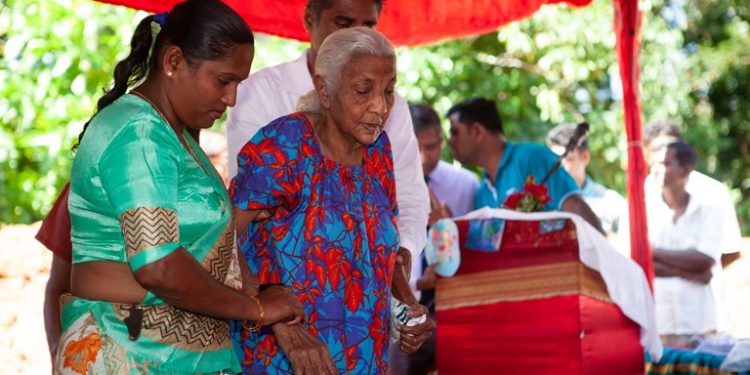
One of the elderly beneficiaries of the charity event, 73-year-old Roselin Abeywickrema, praised Chinese companies for their care and concern towards the elderly in the village.
I have lived here for almost 40 years, and few companies have shown such concern for us,” she said.
Mu Nan, chief financial officer of Colombo International Container Terminal Co., Ltd. said, Education is key to village development. Education at the primary and middle school levels helps villagers achieve their dreams and develop their village.”
He thanked the elderly for their contribution to the development of the village and local society, and said that CICT will pay special attention to improving the living standards of the elderly and caring for their health.
According to reports, Pannila is China Merchants Group’s first targeted poverty alleviation village in Sri Lanka.
A recording of a controversial telephone conversation between MP Ranjan Ramanayake and former Director of the Criminal Investigation Department (CID) Shani Abeysekara has been released to the media.
This conversation is transpired to be a conspiracy to remove the former Army Intelligence Chief Brigadier Suresh Salley, who is alleged to have been a hindrance to investigations.
In contrast to the subject of the conversation, the duo admits to former Army Intelligence Chief Salley being a man of honour.
Addressing a media briefing today (07), Retired Major General Ajith Prasanna, the Convenor of War Heroes for the Motherland organization, said Shani Abeysekara wanted to take out Brigadier Salley and that it was conspired through MP Ranjan Ramanayake to be conveyed to then-President. Eventually, Brigadier Salley was removed, he said, adding that a brigadier of the Sinha Regiment who has not even studied intelligence was then appointed to the post.
This is why our national security and intelligence collapsed,” Mr. Prasanna pointed out. Hence, Shani Abeysekara and Ranjan Ramanayake are both responsible for the Easter Sunday terror attacks as they removed the intelligence chief based on lies, he continued.
That very Suresh Salley has been appointed the State Intelligence Chief by President Gotabaya Rajapaksa and we thank him for that,” Mr. Prasanna said further.
In the series of telephonic recordings of MP Ranjan Ramanayake that were uncovered recently, a previous conversation between him and former Prime Minister Ranil Wickremesinghe, which took place back in 2016, was discussed during today’s parliamentary session.
Addressing the Parliament, State Minister Mahindananda Aluthgamage claimed that a telephone conversation between the former Premier and the former Deputy Minister plotting to assassinate him was circulating in social media platforms.
In 2016, then-Deputy Minister Ranjan Ramanayake had lodged a complaint with the Bribery Commission, against State Minister Aluthgamage over a Defender, which was a property of the State. However, an argument between Aluthgamage and Ramanayake in this regard had come to blows.
In this backdrop, during a parliamentary session in 2016, MP Padma Udayashantha had raised questions regarding the gunshots that were heard from the Madiwela housing complex of the parliamentarians on the 23rd of June, 2016.
Responding to these questions, former Prime Minister had told the Parliament that MP Ramanayake had been engaged in a practice session for a movie on that specific day.
MP Ramanayake had telephoned the former Prime Minister to thank him for defending him.