Victor Ivan, the
founder Editor of the popular Ravaya – a Sinhala tabloid
launched particularly to target President Ranasinghe Premadasa with the backing
of the Western and Indian embassies and, of course, Lalith Athulathmudali and
Gamini Dissanayake — has written an article in the Financial Times
(25/10/2019) arguing that Gotabaya Rajapaksa is not fit to be a
presidential candidate. His last two lines summarises his case against Gota.
After listing the names of mainly journalists killed when Gota was in power (he
doesn’t say Gota killed them) Victor passes his censorious judgment. He says: I am of the view that
it is not proper for a person with such serious allegations to be elected
leader of the country, even nominally, until he is fully acquitted and
exonerated of those charges. It is also not right for a person with such
allegations to even contest for such a position.”
Phew!
I have selected Victor
from the usual mob of anti-Gota denigrators because he is typical of the
current scare-mongering that goes on in the so-called civil society. In his
statement Victor takes the high moral ground of a pious political priest with
no blemishes in the past, or accusations / allegations of killing, or any
alignments with mass murderers who killed innocent civilians for
committing the only sin of opposing his leader’s brand of Pol Potist
politics. In his article he poses, as he normally does these days, as a
born-again human rights activist policing the conduct of political criminals
and sentencing them to the various kinds of hells defined by the Western
masters who patronise his media/political ventures.
After his leap from
the Pol Potist JVP to Ravaya, his primary political mission was
to demonise the Premadasa regime in his Ravaya parroting the
human rights mantras which was the most lucrative job of the day, financed by
the Western masters. Ravaya was, more or less, the mouthpiece of
the Western and Indian embassies, which were behind Lalith-Gamini duo doing
their damndest to overthrow President Premadasa. Ravaya was
dancing to the drumbeat of this anti-Premadasa lobby. Their investments paid
off well but not to the extent of achieving their goal of ousting President
Premadasa.
It was this stage that
Victor donned the costumes of a righteous human rights activist. After killing
and being a key instrument in the killing machine of the JVP – he was a
bomb-maker — Victor reinvented himself as a knight in shining armour and is
now parading as a human rights activist in the civil society. Being
anti-Premadasa none of the other foreign-funded NGOs with whom he hob-nobs now,
raised any objections to his murderous past. He has listed in his article the
number of journalists alleged” to have been killed when Gota had power. Has he
forgotten the number of journalists killed at the time he wielded power in the
JVP?
The JVP used some of
the bombs he manufactured to blast innocent newspaper vendors eking out a bare
living in wayside outlets in the villages. Victor and his gang were out to bomb
and kill their way into power in the name of revolutionary justice. Victor
gladly provided his expertise to manufacture bombs that killed those who
opposed his Pol Potist leader. He was committed to the task of bombing and
killing the nation into submission of his Pol Potist leader’s will. What moral
credibility / right has he now to pontificate against any other state
authority using his kind of violence / methods to prevent the rise of Pol
Potist fascism?
The central issue here
is the use of violence in politics. There are many theories ranging from
Machiavelli and Marx to Gandhi. Leaving those theories aside, it can be
asserted that Victor and Gota both used violence. But there is fine difference
between the two. To Gota it was a moral necessity to protect the lives of
people facing Pol Potist violence of a gang of killers with no licence to kill,
except their perverted doctrine of Marxist revolutionary justice. To Victor
indiscriminate killing, at the whims and fancies of his doctrinaire masters,
was also a necessity to destroy the elected state which was operating within a
democratic framework, however flawed it may have been.
The doctrine of
turning the other cheek was not applicable to Gota. It is valid in
inter-personal relations but not in facing organized criminal gangs using
pretentious moral theories and dogmas to kill those who oppose them. The JVPers
were released hoping that they would give up violence and return to non-violent
politics. But their obsession with violence made them believe that they could
win with brutality. Premadasa had no choice but to save his people and the
democratic institutions. And he won. Today the civil society continues to
accuse President Premadasa and embraces the killers that forced Premadasa to
crush them. If, for instance, a JVP terrorists broke in to rape a feminists is
it moral for her to open her legs or kick the bastard to thy kingdom come?
Premadasa kicked the JVP bastards to thy kingdom come. He did not let the
JVPers to rape the state.
The morality of using
violence has been twisted to suit the political agendas of the parties in
conflict. So if Victor found it valid to engage in inhuman violence to impose
his Pol Potist regime led by Rohana Wijeweera why is it invalid for a
democratically elected state to use his kind of violence to prevent Pol Potism
and maintain the democratic framework, with all its infirmities? What moral
credibility / right would Hitler, the prime architect of Auschwitz and Belsen,
have if he came out defending the human rights of the Jews?
It was also a time
when the entire media had ganged up against President Premadasa. Only
Tissaranee Gunasekera, Dayan Jayatilleke and yours truly were defending the
indomitable struggle of President Premadasa to save the nation from two fascist
terrorists – the JVP fathered by the likes of Victor Ivan and his gang of
cold-blooded murderers and their Tamil counterpart in the LTTE. Their sole
objective was to attack the democratically elected state which, of course, had
many infirmities. It was a time when the anti-Premadasa media
went bananas, blaming him for anything that moved, good, bad or indifferent.
For instance, led by
Lalith and Gamini the media went bonkers attacking the Kandalama Hotel project
as a venture that would pollute the environment and cause serious damage to the
tank nearby and the villagers. Even the Catholic Church and the Sarvodaya
leader, A. T. Ariyaratne, joined the bandwagon. Premadasa could do
nothing right – not even promote a tourist hotel. Ravaya, for
instance, not only attacked Premadasa relentlessly but also those associated
with him. Anti-Premadasa Victor did not like my backing Premadasa all the way,
without any reservations. I was editing the Observer at the time.
Victor had nothing to say against me. So he ran a news snippet alleging, like
the way he alleges against Gota, that I was paid not by Lake House but by the
Maharajas. He knew he was lying. He knew he had no evidence to back it up. But
this political pundit, full of righteousness today, had no qualms about
publishing lies to blacken the image of those who were with President
Premadasa.
I am glad that Victor
is no longer instrumental in preparing weapons of mass destruction on a
domestic scale and turned his hands – or what’s left of it — to champion human
rights. That makes it one less murderer in the killing fields of the nation.
But his logic goes awry when he questions the competency of Gota to be the
presidential candidate on the basis of his allegations.
What he doesn’t
realise is that he opens himself to be taken to task on the basis of his own
logic. It is important to take his logic of sentencing individuals on mere
allegations seriously because the same yardstick can be applied to test the
validity of his righteousness. So, applying his logic, will he demand the
sacking of Ranil Wickremesinghe because the Batalanda allegations are yet to be
cleared? The Sunday Times (21/3/2004) reported: President Chandrika Kumaratunga has
said that if the Batalanda Commission recommendations related to the 1988-90
period were implemented properly, Prime Minister Ranil Wickremesinghe would not
have been a free man today.” Since Victor believes in his own logic it is
necessary to ask why Ranil is fit to be the Prime Minister while Gota is unfit
to be the President?
When Ranil contests for the
Premiership next time will he raise objections on the grounds of crimes
committed against the media that opposed him? When the Maharaja Headquarters
near the Gangaramaya was attacked the day he won Parliamentary vote of
confidence the UNP thug who led the attack against the Maharaja was shown
immediately after standing behind Ranil and worshipping at Gangaramaya. This is
not an allegation. This is documented evidence. Has Victor, the Righteous,
raised any objections on any known principle against the UNP thugs violating
human rights to keep Ranil in power?
He also accuses Gota on
allegations” of crimes that occurred when he was in power. But the public
knows for certain that Victor was a killer, or instrumental in killing with his
expertise in bomb-making. This is no allegation”. When a known Pol Potist
killer, or a willing manufacturer of bombs to kill his fellow-man without any
qualms, can be a human rights activists why can’t Gota be a President? What we
are asked to judge is the past of both. Which is more criminal? Victor’s? Or
Gota’s? And whose violence served and saved the people best? Victor, when he
had power, was not in the top ranks of the JVP to protect human rights. He was
one of the committed cadres to kill on behalf of the JVP. What neerds to be
stressed here is that when Victor points one finger at Gota four fingers are
pointing in his direction.
This leads to a serious moral issue:
Is there anyone in Sri Lanka who is not tainted with guilt to take the moral
leadership? Take the case of the Yahapalanaya. It was a movement that was
launched on the promise of delivering pure moral leadership. But it went down
the sink into depths of moral depravity within the first few months in office,
with Ranil leading the gang that robbed the Central Bank. He imported his
special crook, dressed in Saville row suit, to run the biggest heist in
banking. These are not allegations. The available evidence has proved the guilt
of the Ranil. So is why isn’t Holy Victor not declaring that neither Ranil nor
nominee Sajith is fit to hold the highest public offices of the nation? Isn’t
Sajith who is in the Cabinet that robbed the Central Bank and supported his
leader faithfully all the way as guilty as his leader?
Of course, it cannot
be denied that Victor did a brilliant job in exposing the moral and political
corruption of Chandrika Bandaranaike and other political leaders. But his
essential political ideologies, including the distorted and adulterated
five-lecture Marxism, and the fascist terror he unleashed, make him a first
class hypocrite and a theoretician of sheer bunkum.
Consider, for
instance, the latest political formula he propounds in his article to save the
nation. He had suggested to Mahinda and Ranil that they should have joined
hands after the war ended. To begin with, anybody suggesting that anyone should
join hands with Ranil to work for the good of the country must have his head
examined. Ranil can work only by himself and for himself. CBK and Sirisena have
openly revealed that they could not work with Ranil who was undercutting them.
Sajith too knows it only too well. At the height of the internal
power struggle to win the presidential candidacy, he hinted at it
obliquely though he did not go all out to blast Ranil with this accusation.
In any case the time
to work together was during the war and not after the war. National unity was
most needed at that time to face the enemy. Ranil was all out to sabotage the
national efforts to defeat the LTTE. As everyone knows, he ridiculed the heroic
efforts of Sarath Fonseka and his brave men. Victor’s theory is laughable
because there wasn’t a chance in hell for Ranil to join Mahinda after the war
when he had not joined Mahinda at the greatest hour of need. Ranil held a sword
in his hands which he could have used for the good the nation. But he didn’t.
This tragic situation is summed up in the wisdom of Sinhala
folklore:Yud-day-ta nathi kaduwas kos kotan-da-the? (Is
the sword not available for war to cut the jack fruit?. A realistic example is UK in World
War II. Churchill (Conservative) and Attlee (Labour) joined hands to defeat the
fascist terror of Hitler. After the war they went their separate ways and
people elected Attlee and not Churchill who won the war. Victor’s punditry
preached to the political leaders in power is as ridiculous as his Marxist baloney that led
thousands of youth to an early and unwanted death without any political gain to
anyone.
He says that he put
the idea of working together after the war to both Ranil and Mahinda The reply
he received from Ranil is quite telling. Victor says: Ranil Wickremesinghe
listened carefully to the views expressed by me. We didn’t think that far,” was
his reply.”
With all his claims of
being a political analyst Victor missed the most salient point in Ranil’s
reply. He missed Ranil’s confession which admits that he can’t think far. This,
by far, is the most sensible statement found in Victor’s article. Everyone
knows that if Ranil could think far he would not be in the pickle he is now!
Victor’s bankruptcy is
revealed in his scare-mongering. There is nothing new in his thinking except to
parrot the slogans of the anti-Gota bandwagon. Like most of his ilk he is
raking up a past to say that Gota is going to be the monster that they think he
was – only on allegations, as stated by Victor. One prediction that can be made
with certainty is that Gota will never commit the acts that he is alleged” to
have done in the past when he become the next President. It is certain not
because he has denied these allegations with conviction but because there is
no necessity for him to go down that track (assuming that he did it) now
that he and his Commander-in-Chief had liberated the nation from the
Tamil terror unleashed by the JVP counterpart in the North.
It is civil society activists like
Victor that give a bad name to cause of human rights. They don’t have the
credentials to be accepted as genuine defenders of human rights. Any day I
would take human rights from Gota than from Victor. The state violence he used
– and he was no different from Churchill, Roosevelt and Truman who led World
War II – was to defend and protect the state elected by the people.
Besides, the Rajapakse regime was
far more humane than the Allied forces who occupied Germany and Japan. The
Allied victors went all out to eliminate Nazism and
Tojoism (Japanese fascism) root and branch. There wasn’t a building
standing in Dresden and Nagasaki when the
democratic Allies finished the war. Mothers turned to prostitution to
feed their kids. Nazis were hunted and persecuted. Etc. Etc. Manik Farm, which
I had visited, was a paradise compared to the Germans and Japanese prisons
under the vaunted democrats of the West.
Gota’s actions, however tough it may
have been, would not have demolished the democratic state. Unfolding events
have proved it. After comprehensively defeating the fascist forces of the North
and the South not even Gota, if he tried, could impose an authoritarian rule.
The greatest triumph of the Sri Lanka polity is that it has defeated all
fascist forces that came from the Left, Right, Centre and, most all, from the
North. But the fascist terror of Victor and his counterparts in the Tamil North
would have certainly demolished the democratic state if they succeeded and
imposed the most brutal reigns of fascism.
Finally, if the civil society can
believe in Victor as a human rights activist, knowing his proven brutal past,
why can’t they believe in Gota, facing only allegations? In any case, Gota
should know, with all his experience, what would happen to him if he does what
Victor had done with his kind of Pol Potist politics.
I am willing to place my faith in
Gota any day than in Victor – a Sinhala Prabhakaranist willing to kill any
dissident at the drop of a bomb made by him. I believe in democracy, however imperfect it
may have been, than in the fascism of
violent bomb-makers. This is one of the main reasons why I’m willing to back
Gota all the way
Sri Lanka is a Unitary State. We will not at any time allow anyone to
segregate this country. This is a sovereign
nation and we will not permit any foreign power to interfere in the affairs of
this country.
This motherland of ours will be protected and safeguarded against terrorism, extortion, drug menace, all sort of crimes and foreign threats;
Will protect and safeguarded the War Heroes of the tri forces, Police personnel, and the Civil protection forces;
An urgent people’s concession package to reduce the cost of living and the day to day expenses;
Courses of the nursing schools will be extended for a 4 year period and thereby they will be provided a Degree which is acceptable for foreign employment;
Courses of the Teachers’ Colleges will be raised to degree-awarding levels;
Outdated rules and regulations which hinders business activities will be updated;
Economic services tax and retention tax will be abrogated;
The VAT will be reduced to 8% ;
Taxes levied on religious places will be abolished;
A simple form of tax structure will be introduced in place of various forms of taxes being on motor vehicles;
The PAYE tax applicable to Government and Public sector employees will be abolished;
Steps will be taken to create 1 million employment opportunities within the next five years;
No agricultural product will be exported without value addition;
Fertilizer subsidy will be given free of charge;
Use of carbonic fertilizer will be encouraged;
Fertilizer required for the country will be locally produced and within a few years all fertilizer requirement will be covered by carbonic fertilizer;
Re-export of agricultural products will be totally banned;
All agriculture loams will be canceled;
All irrigation networks and small and large tanks will be renovated expeditiously;
Estate employees will be given a wage of Rs.1,000 per day,
Development of [A1] [A2] [A3] [A4] the fisheries sector by regulating it using modern technology;
Provide modern technology to the fisher folks, farmers and milk farmers to become entrepreneurs in their respective sectors;
Encourage maximum use of renewable energy in the power and transport sectors;
Employ scientific methods for garbage management;
Women with small children will be allowed to engage in their duties for a certain period while staying in their residences;
Steps will be taken to eliminate the drug menace within a short period;
A mechanism will be introduced to curb corruption and expeditiously prosecute the corrupt people.
No room will be provided for corruption.
The people of the country anticipate having a righteous rule. They look forward to having a rule that is a haven for all religions and for all nationalities. Its foundation will be the faith propagated by the Lord Buddha. I hail from a Buddhist family in the South and received my education from the well known Buddhist school, the Ananda College. Therefore, Buddhist philosophy has always mixed with my wishes and aspirations and in my behavior.
I would like to tell you in the outset that special attention was given to religious concepts in the preparation of our policy framework Vision of Prosperity” which has been entrusted to the people. The Vision of Prosperity policy framework is an ‘agenda of people’s policies’ prepared by the people for the people. It is a programme of work that would safeguard the sovereignty of our nation, would give priority to nationalism, dedicate for the welfare of all the citizens and repose trust in the youth. It consists of basic concepts required to rise up as a proud sovereign nation deriving maximum benefits from global developments, and possessing a strong economy.
Sri Lanka is a sovereign unitary nation. We will never allow to segregate and divide
it. Also, we would not allow any foreign power to interfere in the affairs of
this sovereign nation.
We consider national
security as a prime and foremost responsibility of the government. We will once
again build strongly the government mechanism required to protect and safeguard
our motherland from terrorism, activities of underground operations, threats of
robberies, extortions, the drug menace, torture as well as from foreign
threats.
Accumulated in courts for
long periods, to increase the number of judges, and restructure the
institutions that assist in the implementation of Law and order to increase
their efficiency. This manifesto will be
valid for the total period of our rule.
It is our objective to provide economic stability to everyone in this Country through measures outlined in our people-centered economic system. We will put an end to taking political advantage on the poverty status of the innocent poor people and take steps to completely eradicate poverty in the country. What we want is to make our future generation to live as plenteous citizens not depending on others to meet their needs.
The 21st century is considered a knowledge-centered century. The global economic trend turning towards Asia is very important for us to make our future plans We must create a young future generation who could get the maximum benefit from the new developments in the global economy. The education becomes very vital to produce prosperous citizens performing productive employment or becoming successful entrepreneurs.
We plan to introduce reforms to our Education system enabling or younger generations to obtain employments that have the highest demand in the global employment market. Within the first year itself of our rule, we will make necessary investments to the educational infrastructure to curtail our younger generation becoming neglected within the educational structure and enable all students to pursue up to a university degree. We will all three-year diploma courses up to 4 years and to provide the relevant students a Degree acceptable for overseas employments.
Similarly, all teacher training colleges will be upgraded enabling that institution to award degree certificates. It is essential to develop aptitudes of our children in line with the development of inventiveness, and the development of the knowledge of the English language and Maths.
It is the local industrialists who have to perform a major task in uplifting our economy which has been collapsed. We will create a conducive atmosphere for these business people to conduct their business activities with pleasure. We will upgrade the outdated business rules and regulations which hinder their activities. These outdated rules and regulations deter the productivity of the businessmen as well as the people. Our people are sternly affected by tax burdens. Therefore we will revise the present Inland Revenue Act which is unsuitable for our country and reduce the tax burden on the people. Tax levied on manufacturing industries will be reduced.
Economic Services charges and retention taxes will be abrogated. The VAT will be reduced to 8%. Taxes applicable to religious places of worship will be abolished. Various taxes applicable to motor vehicles will be simplified with one tax system instead. In addition to this, the ‘PAYE’ levied on the salaries of government and private sector employees will be abolished. Along with this, we intend to regulate revenue collections in the Inland Revenue Department, Customs and the Excise department and minimize the tax anomalies. We anticipate a significant development in the service economy through our future development plans.
We have drawn up a plan by which we can earn an income of U.S.Dollars 10 Billion per year from the tourist industry. Similarly, there is a surfeit of industries that we can develop to international standards. They include many sectors such as transport services, warehousing services, and port and airport services which could provide convincing revenue to our country due to our geographical location.
We also anticipate creating more than one million employment opportunities during the next 5 years through the development of our tourism industry, and other industries such as information technology, transport, health services, education, rubber, sports, and other industries. We thereby expect to become the business hub in South Asia.
In the industrial sector, our full attention will be focussed on producing value-added products. No resources of Sri Lanka should be exported without value addition. Similarly, our industrialists will be encouraged to introduce our value products to the international markets. At the same time, we expect to encourage our farmers to use carbonic fertilizer and maximize within a few years the use of carbonic fertilizer by our farmers. Our aim is to become pioneers in the world of turning out Agri products exclusively produced with carbonic fertilizer.
We would totally ban the re-export of Agri products which have become a major burden for our farmers. Then only we can get a greater demand and a higher value for our Agri products. As a concession to farmers affected by disasters in the dry zone, we envisage waiving their cultivation loans. Lack of irrigation and drinking water is a major problem faced by the dry zone farmers. We have drawn up plans to address these problems by expeditiously renovating all sable irrigation canals, as well as large and small scale tanks.
We also will introduce a national and modern technical programme to use water economically, to get the maximum use of the available lands, and to reap a maximum high-quality harvest. We have already agreed to provide Rs, 1,000 daily wages for plantation workers who render a valuable service to our economy.
Similarly. We envisage obtaining maximum benefit from the maritime resources of our country which is surrounded by the sea. Steps will be taken to improve the fishing industry with the introduction of modern technological methods. Similar to farmers, and milk farmers we also want to provide modern technology and training to the fisher folks and make them entrepreneurs in their field.
It is a major responsibility of ours to provide the environment on behalf of future generations. Therefore, we will encourage the use of renewable energy in the transport and power sectors. Our priorities will include the maximum use of carbonic fertilizer and scientific management of garbage disposal.
Not only within the employment market, but
the contribution of our ladies as private entrepreneurs is very important for
our economic development. We would encourage both the public and private
sectors to increase the opportunity of ladies with small children to carry out
their duties from their residences. Under our government increased attention
will be focused to provide loan facilities, training and raw materials required
by women entrepreneurs.
We will take increased and major steps to curb and alleviate the narcotic menace which has become a major problem today. We will take steps to eradicate the drug menace which has become a major national disaster. We envisage removing the era of your persisting fears from your hearts that your children may become victims of this drug menace.
We envisage to introduce and implement a powerful mechanism to prevent political and institutional corruption. We would strengthen the mechanism for preventing corruption as well as mete out expeditious punishments to those involved and those who aid and abet for corruption. I strongly emphasize that within a government under my leadership I will never leave room for corruption. I also state with responsibility that none of the ideas outlined in the Vision of Prosperity” are blank political promises.
I always performed all responsibilities entrusted to me without lapse. Similarly, I will perform this responsibility as well to the best of my ability. I anticipate the cooperation and assistance of all of you to implement this responsibility of rebuilding our nation. It is not vital and immaterial as to which party, which ethnicity or which religion you belong to. The only condition is that you should be a citizen who really loves the country. If all of us determinedly perform our duties and responsibilities it will be possible for us to transform Sri Lanka as a country with a powerful economy and that can command the respect in the world instead of the present status of being backward and weak nation. Let us build a prosperous nation to which return admiringly instead of being a nation from which people continue to leave. Let us all get together on 16th November and make the first step towards building a prosperous nation.
Meanwhile. addressing a public meeting held in the Meegahakiwula area on Saturday, 26th October, the conquering candidate Mr. Gotabhaya Rajapaksa said that the incumbent government will never be able to ensure the security of the country.
He pointed out that this is because the
current government has a Cabinet of ministers who subjugated to influences of
foreign nations and Non-Governmental Organizations (NGOs) that are against the freedom
struggle and war heroes and only an SLPP/SLFP government can ensure the
security of the country. He promised that
their government will definitely take measures to protect the tea industry and
those who are involved in the industry.
At a meeting held with members of the Ceylon Workers Congress at the Bandarawela Hindu Cultural Centre, Mr. Rajapaksa said that it is not conducive to look only at the day to day economy at all times. He said that the plantation workers have always been demanding a wage increase Rs. 50 or. Rs. 75 and the avaricious politicians have kept the plantation tied to estates without offering them a bright future. He said that he was told by some plantation youth that they go to Colombo and work in Wine Stores, restaurants, groceries and as drivers for better salaries. Mr. Rajapaksa emphasized that the plantation youth too should be provided with better educational opportunities for them to enter Universities and acquire competency in modern technology.
Speaking further Mr. Rajapaksa said that a Tamil medium University will be established in the upcountry and in addition to that a Technical College will also established to produce masons, carpenters, plumbers and those required for the tourist industry. He pointed out that personnel in these trade could earn handsome wages. He said that the tea industry is a good industry but they should look for employment diversification opportunities and said that they can also get involved in the cultivation of vegetables that can provide them additional income and alleviate their economic burdens. Similarly, he said that his government will take steps to address their housing and schooling problems as well, while the daily wage will be increased to Rs. 1,000. He said that the plantation community put an end to getting misled by greedy politicians.
Addressing the Mahara/Kadawata meeting on 13th October Mr. Gotabhaya Rajapaksa said that his main objective is to dorm a secure and disciplinary country, He said that we should be exemplary, and the contemporary political culture should be changed and reformed. He stated that they cannot do things emotionally, in a myopic way, or to get personal objectives achieved. Mr. Rajapaksa emphasized that he will not permit behaving rudely or indecently in response to our opponents ‘conspiracies or misbehavior.
Speaking further, Mr. Rajapaksa said that all parties in their alliance have joined them on the strength of their clear cut non-ambiguous policies.
He said that the Sri Lanka
Freedom Party joining with them is a massive boost for them, and it would help
increase their power from 60% to 72%, and the SLPP cordially welcome them.Mr.
Rajapaksa said that the Sri Lanka Freedom Party is the party formed by Mr. S.W.R.D.Bandaranaike
and his father Mr. D.A.Rajapaksa and it was the party that successfully
launched the people’s revolution in 1956.
He stated that the people-friendly policies being enjoyed by them are
policies that were introduced by the Sri Lanka Freedom Party and it was the
party that twice made Mr. Mahinda Rajapaksa as the President of this
country.
Mr. Rajapaksa emphatically
assured that foremost priority will be given to national security and the
security mechanism that has been collapsed will be revived and strengthened,
and thereby this country will be a country in which everyone could live without
any form of fear and suspicion devoid of party, ethnicity and religious differences.
He said that members of the intelligence services will be given adequate power
and legal protection.
Referring to the present
government Mr. Rajapaksa said that a government swelled with neo-liberals,
servile to foreign dictates, and depending on foreign sustained NGOs, and who
do not respect national thinking can never ensure national security.
The winning candidate said that the21st century is a knowledge-based century and his economic policies are totally knowledge-based and they always trust the capabilities of human resources. It is on account of this that he said, his economic policies have been formulated based on information technology and computer technology. He said that through these policies the country will be able to create several million employment opportunities for our young generations. Mr. Rajapaksa said that his government will create infrastructure facilities and government patronage for these activities. Also, he said that it is a government responsibility to provide vocational training for this purpose by introducing modifications to our education system.
During his first year of presidency, Mr. Gotabhaya said that he will make a huge investment in education. Today or youth have got stranded due to the fault of the existing education system. Every year although around 200,000 students pass the A/L examination only about 35,000 become eligible to enter Universities. He said that under his government steps will be taken to admit all students to Universities. Steps will also be taken through Technical Colleges to qualify the students for good employments, for employments suitable for our economy and for them to get very attractive salaries. We will not allow the youth to get stranded. There is every possibility to take the country forward through technology. The companies dealing in computer technology brings about one billion US. Dollars. This can be increased to about 3 billion. But the lack of competent personnel has hindered this opportunity. We will interfere in this matter and will provide the necessary competency for our youth.
Also, the tourist industry has collapsed due to lack of security. We will eradicate this situation and make the country a safe haven for tourists.
This government has forgotten about the agricultural industry. Our history and culture indicate that we had a commendable irrigation network. These have been destroyed today. There is a necessity to provide good living conditions to our farmers. We are prepared to make the country and provide good living conditions for the farmers. Still, we have poor people in our country. The development of a country does not mean a section of people in the country becoming rich. We much create a pro-people economic system to alleviate poverty throughout the country.
Dr Sudath Gunasekara Former Secretary T PM Mrs B and one time President Sri Lanka Administrative Services Association (1991-1994)
1 Abolition of
the Provincial Councils that have been a white elephant and that has wasted
billions or even trillions for the past 33 years with no benefit at all for the
country or the people and has become a political and Administrative disaster
for this country, aggravating separatism laying the foundation for a Federal
State in this country and
Abolishing the
Rajiv /JR Accord of 29 July 1987 whish has almost nullified the Sri Lankan
Constitution of 1987 by compelling us to
1) Accept the North and East as the
Traditional Home land of the Tamils (1/3 of the country and 2/3 of the coastal
belt plus the marine resources for just less than 5 % of the nations population
wo are claiming a separate Rata EELAM)
2) Making Tamil also a National
Language in this country and
3) Granting Sri Lankan Citizenship to
all Estate Tamils contrary to the Nehru/Kotalawala Pact of 1954 and thereby paving the way for India
to convert the entire Central Hill country of this country in to an overseas
Indian Protectorate in future.
2 Reducing the
Cabinet to maximum of 20 and the number of Politicians in Parliament and
Pradesiya Sabhas, abolishing the National list and going back to earlier
electoral system abolishing the District system and PR.
Pruning exorbitant
Public institutions and Public Service to manageable levels to cut down public
expenditure.
3 Creation of a
new Political Culture by laying down minimum educational and other
qualifications and a Strict Code of Conduct to Politicians and making
attendance in Parliament compulsory
4 Abolition of Pensions
and excessive privileges to politicians
5 Ending the tragic
House Maids trade with Middle East countries and replacing it with
a) Avenues of domestic employment for
them within the country and
Instead start a programme of
sending professionals and technicians
6 Ending the
menace of University ragging by addressing their grievances
7 Declaring all
lands over 5000 ft above Sea level as strictly protected natural reserves and
prohibiting any form of settlement above 3500 ft MSL to protect the water
resources of the country as water resources decides the entire life system in
the country and all economic activities like Agriculture, Hydroelectricity
potentials and industries
8 Making
Buddhism the State Religion
9 The question
of Official Language, National Anthem, one Law
and National flag
10 Proposed
Action Plan to solve the plight of the Kandyan Peasants (all Sinhalese) heaped
up from 1815, not rectified for the past 72 years by any Government
11 To free
Public service and Judiciary from Politics and Recruitments to Public Service
and Judiciary only on merit.
12 To create an
Independent, efficient, productive and People centered Public Service
13 A national
programme to develop and diversify the economy to increase productive
employment instead of trying to pack all men and women to an already excessive
government service that has become a big burden to the tax payers
14 Professional Foreign
Service that can take Sri Lanka to the world and bring the whole world to Sri
Lanka to develop this country
15 A programme
to make Sri Lanka number 1 in the world in Fishing Industry by making use of
the Ocean that stretches from Africa in the West to Australia in the East and
South Pole in the South making it naval power by using our strategic location
on the globe in relation to the East and West and its enormous potentials of
fabulous ports around the Island. The Indian Ocean is the third-largest of the
world’s oceanic divisions, covering 70,560,000 km² or 19.8% of the water on the
Earth’s surface. It is bounded by Asia to the north, Africa to the west, and
Australia to the east. Wikipedia
16 To reduce the
excessive public holidays to about 12, the world average, and religious
holidays to be confined only to the respective religious groups. This is very
necessary to increase productivity and accelerate development to catch with ta
competitive world.
§ Hazrat Mirza Masroor Ahmad calls for respect and tolerance
between people of different faiths and beliefs
§ His Holiness stresses importance of education for girls
§ Caliph says access to education is key to world peace
§ His Holiness says Holy Quran inspires Muslims towards
intellectual advancement and the pursuit of knowledge
§ His Holiness says that there is no contradiction between science
and religion
The World Head of the Ahmadiyya Muslim Community, the
Fifth Khalifa (Caliph), His Holiness, Hazrat Mirza Masroor Ahmad delivered
an historic keynote address on 8th October 2019 at the United Nations
Educational, Scientific, and Cultural Organisation (UNESCO) Headquarters
in Paris.
The event was attended by over 80 dignitaries and
guests, including diplomats, politicians, academics and the
representatives of think tanks, as well as business leaders and various
other professions.
During his address, the Head of the Ahmadiyya Muslim
Community commended the foundational objectives of UNESCO, which included
developing sustainable peace, promoting the rule of law, the protection of
human rights, safeguarding the cultural heritage of different groups and
communities and seeking to ensure the future prosperity of the world.
Thereafter, His Holiness said that over 1400 years ago, Islam instructed
Muslims to pursue these same goals in the interests of the peace and
prosperity of mankind.
His Holiness stressed the importance of education
across society. He said that access to education was the means of ensuring
peace and stability and that Islam emphasised the importance of ensuring
that girls were educated and given equal opportunities as boys.
Furthermore, His Holiness refuted the allegation that
Islam was a religion that failed to encourage intellectual advancement.
Rather, he emphasised how from the very outset Islam taught that human
beings should continually seek to push the boundaries of human knowledge
and that there was no contradiction between science and religion.
Hazrat Mirza Masroor Ahmad spoke about the utmost
importance of education for the establishment of peace and how the
teachings of Islam have laid down the foundations for a model society.
Such teachings had motivated and inspired generations
of Muslim scholars and philosophers who had advanced the cause of the
intellectual progress of mankind through the Middle Ages. Now, in the
modern era, it was the Ahmadiyya Muslim Community that sought to draw on
that rich intellectual history by encouraging learning and the pursuit of
human knowledge.
At the outset, His Holiness praised the founding
principles of UNESCO. Hazrat Mirza Masroor Ahmad said:
The founding objectives of UNESCO are excellent and
praiseworthy. Amongst its objectives, are fostering peace and respect,
promoting the rule of law, human rights and education across the world.
UNESCO also advocates for press freedom and protecting different cultures
and heritages. Another of its stated goals is to eradicate poverty and to
promote sustainable global growth and development and to try to ensure
that humanity leaves behind a positive legacy from which future
generations can benefit.”
Hazrat Mirza Masroor Ahmad continued:
You may be surprised to learn that Islamic teachings
require Muslims to work towards fulfilling these same objectives and to
continually strive for the progress of humanity.”
His Holiness said that the Holy Quran has stated that
Allah the Almighty is the ‘Lord of All the Worlds’, and hence Muslims
believe him to be the Creator and Provider for all humankind, regardless
of creed or colour.
As a result, it was an incumbent religious obligation
placed on Muslims to serve humanity without distinction of their
religious, social or ethnic background.
Hazrat Mirza Masroor Ahmad said:
The very first chapter of the Holy Quran states that
Allah the Almighty is the ‘Lord of all the Worlds’. This verse is central
to the Islamic faith whereby Muslims are taught that God Almighty is not
just their Lord and Provider but He is the Provider and Sustainer of all
humankind. He is the Gracious and Merciful and so, irrespective of caste,
creed or colour, God Almighty fulfils the needs of His Creation.”
Hazrat Mirza Masroor Ahmad continued:
Given this, true Muslims firmly believe that all
humans are born equal and that regardless of differences of belief, the
values of mutual respect and tolerance must be firmly embedded within
society.”
His Holiness said that the Prophet of Islam, the Holy
Prophet Muhammad (peace and blessings be upon him) was the perfect
manifestation of the teachings of Islam. Following his migration to
Medina, and under his leadership, a thriving, multicultural society was
established which continued to serve as an example for mankind.
Speaking of the reasons for his migration and what
transpired thereafter, Hazrat Mirza Masroor Ahmad said:
After he founded Islam, the Holy Prophet Muhammad
(peace and blessings be upon him) and his followers were subjected to
brutal and inhumane treatment by the non-Muslims of Makkah, which they
endured with patience and restraint. Finally, after suffering years of
relentless persecution, they migrated to the city of Medina where the Holy
Prophet Muhammad (peace and blessings be upon him) formed a covenant of
peace between the Muslim migrants, the Jewish people and the other members
of society.”
Hazrat Mirza Masroor Ahmad continued:
According to its terms, the divergent groups pledged
to live peacefully, to fulfil the rights of one another and to foster a
spirit of mutual sympathy, tolerance and cooperation. The Holy Prophet
Muhammad (peace and blessings be upon him) was elected as the Head of
State and, under his leadership, the covenant proved to be a magnificent charter
of human rights and governance and it ensured peace between the different
communities
Thereafter, His Holiness very carefully analysed and
discussed the key characteristics and achievements of that first
government of Medina.
His Holiness said that its system of governance was
underpinned by an entirely impartial system of law and order and justice,
wherein all people were equal under the law of the land.
Hazrat Mirza Masroor Ahmad said:
The Prophet of Islam (peace and blessings be upon
him) established an impartial judiciary for dispute resolution. He made it
clear that there would not be one law for the rich and powerful and
another for the poor and weak. Rather, in what was a revolutionary
concept, all people were treated equally according to the law of the
land.”
Hazrat Mirza Masroor Ahmad explained how the Holy
Prophet Muhammad (peace and blessings be upon him) established various
programmes and schemes designed to ensure the progress and stability of
society.
These included establishing an education system, a
taxation system designed to raise the standards of the poor, a public
health system focused on sanitation and educating citizens about health, a
transport system and a code of conduct for business and financial ethics
leading to tremendous social progress.
Hazrat Mirza Masroor Ahmad said:
During the 7th Century, under the government led by the
Prophet of Islam (peace and blessings be upon him), astonishing progress
was made in Medina to advance the cause of individual and collective
rights. Indeed, for the very first time amongst the Arabs, an orderly and
civilised society was established. In many ways, it was a model society –
in terms of infrastructure, services and, more importantly, in terms of
the unity and tolerance displayed in what was a multicultural society.”
His Holiness expressed ‘profound sadness’ that a
concerted effort had taken place in the modern world to malign and defame
the character of the Holy Prophet Muhammad (peace and blessings be upon
him)
Hazrat Mirza Masroor Ahmad said:
The Holy Prophet Muhammad (peace and blessings be
upon him) has been branded as a belligerent leader – when nothing could be
further from the truth. The reality is that the Prophet of Islam (peace
and blessings be upon him) spent every moment of his life championing the
rights of all people and, through the teachings of Islam, he established
an incomparable and timeless charter of human rights.”
His Holiness condemned those who sought to attack or
mock religion and the Prophets of God.
Hazrat Mirza Masroor Ahmad said:
In my view, it is deeply regrettable, that the
principle of mutual respect, which is the means of establishing love and
unity, has been sacrificed in the modern world in the name of so-called
freedom and even in the name of ‘entertainment’. Even the Founders of
religion are no longer spared mockery and contempt, even though their
derision causes anguish and pain to millions of their followers around the
world.”
In stark contrast to how he was oft portrayed by the
opponents of Islam, His Holiness explained that the Holy Prophet Muhammad
(peace and blessings be upon him) set a timeless example of compassion and
humanity. He forever sought to care for the weak and vulnerable members of
society and established many schemes to ensure their welfare.
Hazrat Mirza Masroor Ahmad also spoke about the Holy
Prophet’s (peace and blessings be upon him) continuous efforts to
eradicate slavery. In an era when slavery was rampant and considered a
fundamental part of society, the Prophet of Islam (peace and blessings be
upon him) sought to emancipate those who were shackled by the chains of
bondage and servitude.
Hazrat Mirza Masroor Ahmad said:
The Prophet of Islam (peace and blessings be upon
him) repeatedly advocated the freeing of slaves and instructed that if it
was not immediately possible for them to release them, then at the very
minimum, they were to feed and clothe them in the same way they fed and
clothed themselves.”
His Holiness said that another allegation often raised
is that Islam fails to protect women’s rights or advocates discrimination
between the sexes. However, this was entirely false and unfair. From the
start, Islam prescribed the equal rights of women and taught that
educating girls was of primary importance and a religious requirement for
all Muslims.
Hazrat Mirza Masroor Ahmad said:
Islam established the rights of women and girls for
the first time. At a time, when women and girls were discriminated against
and often looked down upon, the Holy Prophet of Islam instructed his
followers to ensure that girls were educated and respected. Indeed, he
said that if a person had three daughters who they educated and guided in
the best way they would be sure to enter Paradise.”
Hazrat Mirza Masroor Ahmad continued:
Based upon the teachings of the Prophet of Islam (peace
and blessings be upon him) Ahmadi Muslim girls across the world are
educated and are excelling in various fields. They are becoming doctors,
teachers, architects and entering other professions through which they can
serve humanity.”
Answering the allegation that Islam is a religion that
promotes violence or permits violence in the name of religion, His
Holiness said that the wars in the early period of Islam were defensive
and fought as a last resort in order to protect the rights of Muslims and
non-Muslims alike.
Hazrat Mirza Masroor Ahmad said:
The truth is that, as is stated in the Holy Quran,
permission to fight back was granted to (the early Muslims) to establish
and preserve the principles of freedom of belief and freedom of conscience
for all mankind. The Quran states that if the Muslims did not defend
themselves against the Meccan army, then no church, synagogue, temple,
mosque or any other place of worship would be safe because the opponents
of Islam were determined to eliminate all forms of religion.”
Hazrat Mirza Masroor Ahmad continued:
In reality, if the early Muslims engaged in warfare
it was always defensive and fought for the sake of establishing long-term
peace and to protect the right of all people to live with freedom. If
today, there are Muslims who have adopted extremist tactics or who preach
violence it is because they have abandoned Islam’s teachings or are wholly
ignorant of it.”
As he graced the audience at UNESCO, His Holiness
refuted the suggestion that Islam was an ‘archaic and backward religion’
and one that did not promote intellectual advancement. His Holiness
branded such a claim as a lazy stereotype that is based on fiction rather
than fact”.
His Holiness presented an extensive array of
historical examples illustrating the contribution of Muslims to the cause
of intellectual enlightenment.
Hazrat Mirza Masroor Ahmad said:
The truth is that the Holy Quran and the teachings of
the Holy Prophet of Islam (peace and blessings be upon him) inspired the
works of generations of Muslim intellectuals, philosophers and inventors
in the Middle Ages. Indeed, if we look back more than a millennium we see
how Muslim scientists and inventors played a fundamental role in advancing
knowledge and developing technologies which transformed the world and
remain in use today.”
Hazrat Mirza Masroor Ahmad mentioned ground-breaking
contributions to medicine, technology, chemistry, physics, ethics,
philosophy, mathematics amongst others.
In this era, it was the Ahmadiyya Muslim Community
that had taken up the mantle of promoting education and furthering the
cause of intellectual progress.
His Holiness mentioned the distinguished contribution
to science and human knowledge Professor Dr Abdus Salam and how he had
been inspired by his faith.
Hazrat Mirza Masroor Ahmad said:
With the Grace of Allah, the very first Muslim Nobel
Laureate was an Ahmadi Muslim, Professor Dr Abdus Salam, an eminent
physicist who won the Nobel Prize for Physics in 1979. Throughout his
life, Professor Salam spoke of how Islam, and the Holy Quran in
particular, was the inspiration and guiding light behind his work.”
Later, His Holiness spoke of the charitable endeavours
of the Ahmadiyya Muslim Community which sought to alleviate the suffering
of mankind. He also stated that breaking the cycle of poverty that
afflicted generations of families in economically weak nations was the
means of establishing peace in the world.
Hazrat Mirza Masroor Ahmad said:
In remote and poverty-stricken parts of Africa, we
have established primary and secondary schools and we have also opened
hospitals and clinics. We are providing clean running water in remote
villages, which mean that children are free to go to school, instead of
spending their days travelling for miles seeking to collect pond-water for
their domestic family use. We have also set up a project of building model
villages, which include community halls, access to clean water, solar energy
infrastructure and various other facilities.”
Hazrat Mirza Masroor Ahmad continued:
Where, out of human sympathy, we seek to eradicate
poverty and destitution, we also consider it to be the key to developing
sustainable peace in the world.”
Hazrat Mirza Masroor Ahmad further said:
Only if people have food to eat, water to drink,
shelter, schooling for their children and healthcare will they be able to
live in peace and escape the deadly clutches of frustration and resentment
that lead people towards extremism. These are all basic human rights and
so until we help people flee poverty and destitution we will not see true
peace in the world.”
Concluding, His Holiness called for a change in the
priorities of mankind.
Hazrat Mirza Masroor Ahmad said:
At the end, I pray with all my heart that mankind
forsakes greed and forgoes the pursuit of narrow self-interests and
instead focuses on relieving the pain and anguish of those who are
suffering in the world. Ameen.”
Before the keynote address, several distinguished
speakers took to the stage and spoke of their admiration of the Ahmadiyya
Muslim Community and its efforts to propagate Islam’s message of peace
across the world, as well as its commitment to serving humanity.
Ambassador Oumar Keïta, Delegate of Mali to UNESCO,
said:
Your Holiness, the Caliph (Hazrat Mirza Masroor
Ahmad), we salute all the contributions you have made (in Mali) such as
the building of hospitals mosques and schools and the various projects you
have set up through Humanity First… Your Holiness, I congratulate you for
the message of peace that you propagate, it consolidates our society in
Mali and is in line with the ideals of UNESCO.”
Religious Advisor of Foreign Affairs Ministry, Mr Jean
Christophe Auge said:
I am happy to welcome His Holiness the Caliph (Hazrat
Mirza Masroor Ahmad) here today… We are very familiar with what the Caliph
and the Ahmadiyya Muslim Community represent both in this country and
around the world. I would like to salute the visit of His Holiness to this
country and I wish you every success for this visit.”
Director of the Central Religion Advisory Board to the
Interior Ministry of France, Mr Clément Rouchouse said:
I am very pleased to be here today to salute the
Caliph of the Ahmadiyya Muslim Community’s visit to France. I would like
to welcome you to France in this country which has a tradition of
welcoming different religions based on the principle of secularism.”
Mayor of Eaubonne, Mr Guillaume Dublineau, said:
Despite the differences in colours and cultures and
languages we are all pursuing the same principles wherever we live and in
whatever town we are.
We aspire to live in peace and justice, with tolerance
and a sharing of our values. I would like to praise the Ahmadiyya Muslim
Community, as it is a community that brings love and warmth but also
friendship and brotherhood.”
President of the NATO Memorial, Mr Willy Breton also
spoke and commended the Ahmadiyya Muslim Community for its continued
efforts to promote peace.
An introduction to the Ahmadiyya Muslim Community and
the Promised Messiah (peace be upon him) was given by the National
External Affairs Secretary of the Ahmadiyya Muslim Community in France, Mr
Asif Arif.
The event concluded with a silent prayer led by His
Holiness.
Full address of His Holiness – the link of which is:
Jayantha Liyanage; General Secretary Sinhaladeepa Jathika Peramuna
The Tamil National Alliance on 15.10.2019 had laid down their conditions for the Presidential candidates with the promise to support them if their conditions are accepted.
Sinhaladeepa Jathika Preamuna clearly states that these conditions are based on the earlier Thimpu conditions proposed by the Tamil political party delegation including the LTTE in 1985 but rejected by the then government delegation. Since then these conditions surfaces from time to time under different political conditions. Even this time some leading candidates appear to have rejected them with the fear of loosing votes.
However, the truth is that all political parties except the SJP accept that there are Tamil grievances and need to be addressed in order to solve the so called National Question through a new Federal Constitution and other issues such as the system of election.
But so far no political party or any other organization including Sinhala nationalist organizations have come with an alternative proposals on behalf of the Sinhala people. Therefore, Sinhala Jathika Peramuna proposes the following 13 conditions in order to solve the National question to address the Sinhala grievances since 1815. These Sinhala grievances are still not in the public domain because the main stream political parties during past few decades have created a public opinion that talking about Sinhala grievances is racism hence even the leading Sinhala organizations including leading Buddhist monks are somewhat reluctant to propose any conditions on behalf of the Sinhala people. Therefore, Sinhala Jathika Peramuna, the only political party with a Sinhala name and an aim to safeguard the historical rights of the Sinhala people have come up with the following conditions and with the concept of a new Sinhala Constitution to solve the National question in order to reestablish the historical rights of the Sinhala people lost in the year 1815.
POLITICAL SOLUTION TO THE NATIONAL QUESTION
(01). The country’s name should revert to original name Sinhaladeepa.
(02.) Sinhaladeepa should be declared as the homeland of the Sinhala people.
(03). Sinhaladeepa should be declared a Sinhala State.
(04). Sinhaladeepa should be declared a Sinhala Nation.
(05). The National flag should be the Lion flag of 1815.
(06). The National language should be Sinhala & English as required.
(07). The Provincial Council system should be abolished. Political power should not be devolved. The concept of Tamil Eelam & Federalism should be banned.
(08). The accountability & historical discriminations against the Sinhala people since 1815 should be addressed. All the Lands acquired under 1833 Westland Act must be returned to the decedents of the Sinhala Kandyan people.
(09). Resettle all Sinhala people chased away from their original habitation in North. Facilitate new Sinhala settlements in the northern area. All archeological sites and Buddhist temples in the Northern area must be protected. . (10). Islamic expansionism intruding on lands in Deegawapi & Muhudumahavihara must be stopped and lands acquired by encroachments must be returned. Illegal Muslim settlements in Wilpatthu must be dismantled.
(11). Any violation by security forces must be dealt only by their respective military courts. No civil law suits against security personnel in office.
(12). Full compensation to Sinhala people who suffered due to Tamil terrorism. Tamil political parties / members who directly / indirectly supported Tamil terrorism must be charged in courts.
(13). The Mahanayake theros heading the three chapters should be given constitutional powers to contain any threat to Sinhaladeepa, Sinhala Nation & the Sinhala Buddha Sasana. A new Sinhala Constitution drawing on Dasa Raja Dhamma where all communities lived in harmony with discipline & reciprocity and loyal to the Sinhala Nation must be enacted as a solution to the National Question due to Tamil terrorism.
Four years ago, Sri Lanka turned away from the pro-China presidency of Rajapaksa and went in search of US gold
Now a new Rajapaksa is in town, could its gaze be turning back to China?
Sri Lanka [1] ’s pivot towards the United States [2] since President Maithripala Sirisena came to power in 2015 was a marked departure from the pro-China presidency of former leader Mahinda Rajapaksa [3]. But Mahinda – whose administration took in approximately US$4.5 billion of Chinese investment over almost a decade in power – is once again present on the campaign trail, endorsing his younger brother Gotabhaya for president in the November 16 election.
A spokesperson for Gotabhaya, a popular former defence secretary from 2005 to 2015, last month said he would restore relations” with China if he were elected, in a nod to how Sirisena has suspended a raft of Chinese investment projects and demanded changes in others.
I suppose the thinking was if we upset China, the West would come to us with endless bags of gold … But the bags of gold never materialised,” said Palitha Kohona, a Rajapaksa-era diplomat, to reporters in September.
While Gotabhaya’s candidacy was not confirmed until recently, due to lingering concerns over a lawsuit and his citizenship – he had American citizenship until relinquishing this status earlier this year – he is seen as the front runner after the party he represents, Sri Lanka Podujana Peramuna, won the 2018 local government elections in a landslide.
While the outcome was surprising – the fledgling party, led by Mahinda, won almost 45 per cent of the vote – it was likely due to the fact that the majority of 15.7 million voters thought the economy was in the doldrums, despite some new Chinese investment. They essentially voted in protest against the United National Party’s (UNP’s) ineffectual economic management.
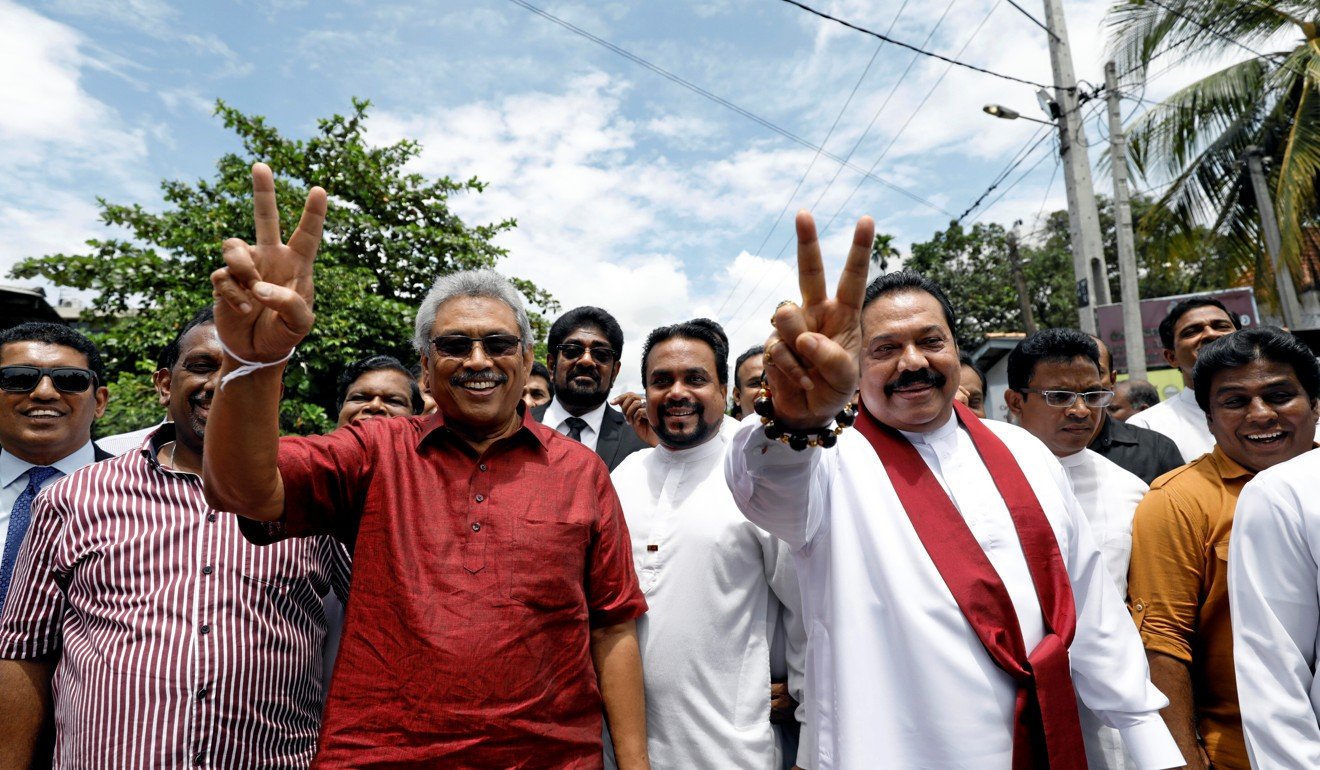
Gotabhaya Rajapaksa and his brother, former president and opposition leader Mahinda Rajapaksa. Photo: Reuters
Gotabhaya said he would maintain a non-aligned foreign policy” should he win, but it is worth noting that his UNP opponent, Sajith Premadasa, is not exactly a China hawk.
Current Prime Minister Ranil Wickremesinghe, also from the UNP, seems to be pro-US, having veered close to signing a status of forces agreement with Washington which would have allowed American troops to be stationed on Sri Lankan soil. However, his administration has shown it values Chinese input and collaboration in local projects, more than its American allies have liked – such as the 2017 decision to hand over the Chinese-built Hambantota port to Beijing on a 99-year lease.
Though the government still has nominal US backing, the American calculus regarding the far-right UNP discernibly changed after the Hambantota port deal was signed. Washington is not overtly backing the UNP campaign this time round, a somewhat striking development considering that in 2015, the US openly displayed animosity towards the Rajapaksas, particularly at election time.
By contrast, US ambassador Alaina Teplitz and other American officials have met the former president and his brother several times this campaign season, with pictures from the visits prominently displayed on US government social media.
The Rajapaksas are still very popular in Sri Lanka, which is a reason Teplitz has on more than one occasion said the US would work with any government of any political persuasion in Colombo.
Incidentally, the youngest Rajapaksa brother, Basil, is very much a political animal. A former economic development minister, he is also still an American citizen. With its own citizens or former citizens in places of power in Sri Lanka, the US could also wager that it is best to have the Rajapaksas onside rather than as antagonists.
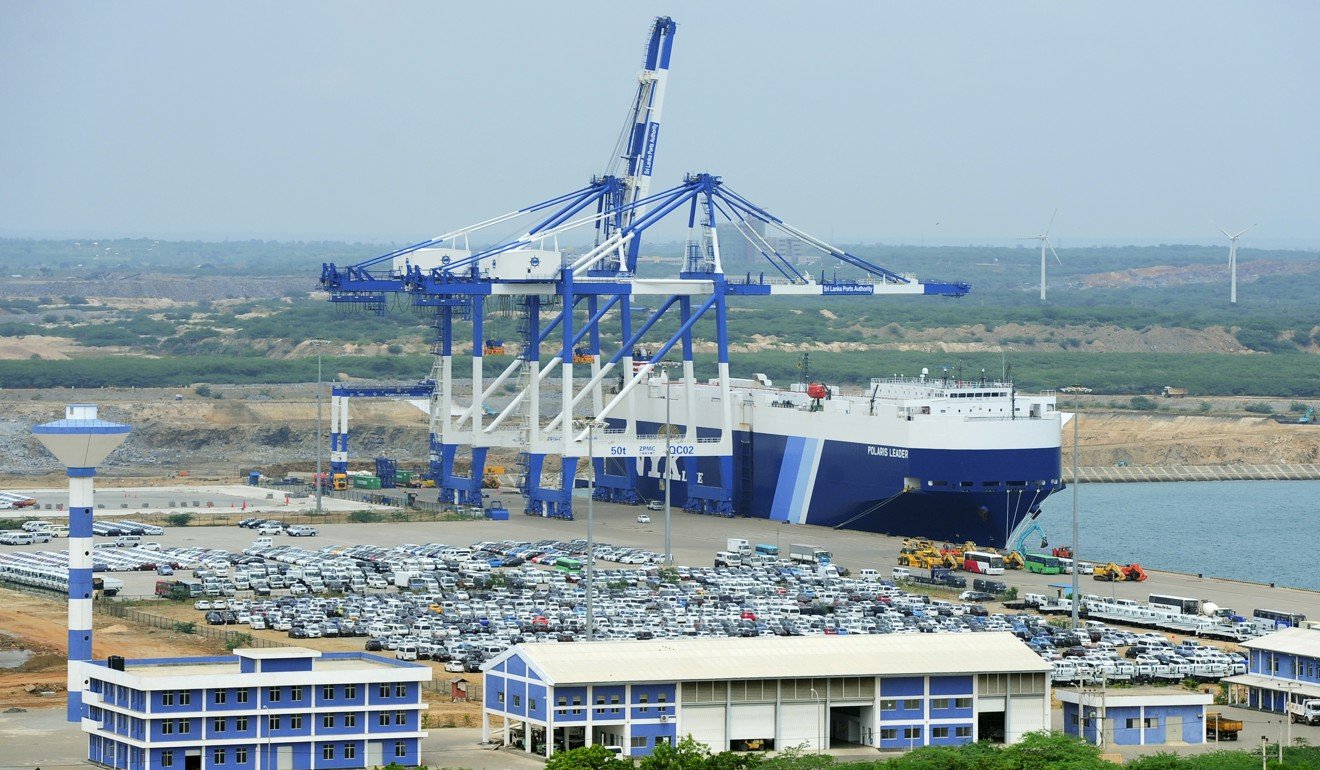
The Hambantota port facility, which has been handed over to Beijing on a 99-year lease. Photo: AFPChina is now more concerned about the optics of the mega projects it funds, and its overall relationships with countries such as Sri Lanka and the Maldives, than responding to what critics perceive as power grabs” to control strategic locations. While the Hambantota deal was of great benefit to Beijing, economically and in terms of leverage as a result of controlling the port, its optics were undoubtedly damaging. The port and its lease became the universal reference point for critics of the so-called Chinese debt trap. Another foreign policy debacle suffered by Beijing in the Indian Ocean region was its decision to back former Maldivian president Abdulla Yameen, whose authoritarian moves – including media harassment and the arrest of critics and political rivals – saw the country’s opposition last year call for direct Indian [6] troop involvement there.
The Maldives, which under Yameen had a government that openly flaunted Chinese involvement in mega-scale infrastructure projects, has since veered away from Chinese control as a pro-Indian government took over following the 2018 election.
Sri Lanka and the Maldives are glaring examples of the affliction China is facing in the region – an almost painful need to get used to decreasing political capital after the leaders it backed tasted defeat at the polls.
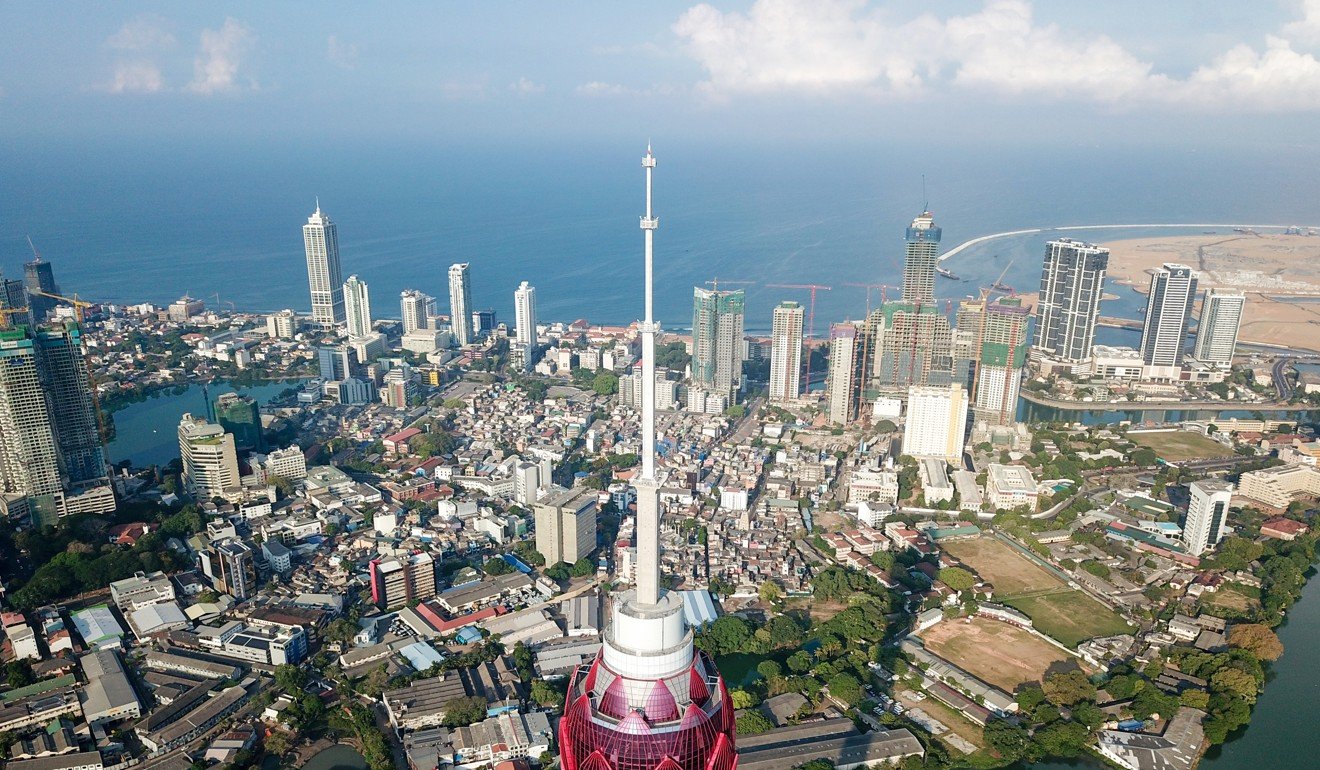
The Lotus Tower in Colombo was built under Beijing’s Belt and Road Initiative. Photo: Xinhua
Another factor of note is that no sitting president or premier is contesting this year’s polls, nor any opposition leader. For many interested parties, including neighbour India, this is a new equation. These relatively new candidates are fresh faces to which New Delhi is less accustomed, and therefore less able to influence through traditional diplomatic channels.
India has tremendous strategic interests in Sri Lanka, including infrastructure initiatives such as the Jaffna International Airport project, making this election certain to be a closely watched affair.
In a manifestation of his neighbourhood first” policy, Indian Prime Minister Narendra Modi [9]’s first state visits after his re-election earlier this year were to the Maldives and Sri Lanka. During the latter trip, he visited a bombed-out church in Colombo, a legacy of the Easter bombings by Islamic extremists. Modi is obviously keen to ensure that terrorism so close to the Indian border is contained; in the upcoming election, he would want to see that whoever wins can keep such extremism at bay in Sri Lanka, while in the process not strategically compromising itself to expanding powers such as China.
Sri Lanka is also toying with the idea of joining the Regional Comprehensive Economic Partnership, which has the potential to become the largest trading bloc in the world. China is a member, while India’s negotiations to join have stalled. It is another interesting tightrope for Colombo to walk, as Delhi wants Sri Lanka to be within its sphere of influence more than China’s, though without upsetting sensibilities in Beijing. ■
Sweeping CRIB reforms to support businesses with promise that are in trouble
18-month debt moratorium on capital for struggling businesses
Deposit Insurance and Liquidity Support Scheme funds to support biz
Low market interest rate regime to revive biz activities
Sri Lankan businesses were last week promised of key concessions including debt moratoriums, lower interest rates, sweeping CRIB reforms and State-backed financial aid if Sri Lanka Podujana Peramuna (SLPP) candidate Gotabaya Rajapaksa is elected president at the upcoming presidential election.
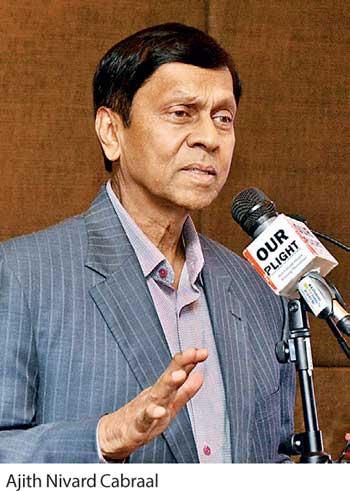
First of all, we will reform the CRIB. We will bring in a restructuring system, so the people who have shown good results, but having difficulties in repaying their loans as a result of the current downturn in the economy, will be given protection. Some leeway will be given for them to revive their businesses,” former Central Bank Governor Ajith Nivard Cabraal, who is a key architect of Rajapaksa’s economic policy said.
He shared these remarks at a panel discussion themed ‘Financially Sustainable Economic Development’ organised by SLPP affiliated V-Movement in Colombo last Friday. There are thousands of entrepreneurs who are in difficulty. They have been forced to go to various places to borrow,” he noted.
Cabraal also said an 18-month debt moratorium on capital will be given for struggling businesses for them to retain capital and implement their business plans. You (businesses) will have to only service your interest during the moratorium period and then banks won’t get into trouble,” he said.
Cabraal emphasised that greater financial assistance would be extended to local firms by utilising funds at the Deposit Insurance and Liquidity Support Scheme to overcome the current economic downturn.
We have to make sure that financial intuitions are protected. We set up what is known as the Deposit Insurance and Liquidity Support Scheme in 2007. It started with Rs.1 billion and has grown to Rs.60 billion now.
We need to use that to protect some of the businesses that have become vulnerable today.”
It was pointed out that the construction and hospitality sector in particular has been adversely impacted by the current economic downturn, sending shockwaves across other sub-sectors.
We need to use this fund to provide the liquidity to strengthen them again,” he stressed.
Cabraal said that measures will be taken to enhance the soundness of the country’s financial sector.
We will make sure that they are stronger, they are able to withstand current shocks and then we will be able to move forward.”
Speaking of the prevailing high interest rates, Cabraal noted that it has become impossible for businesses to carry out operations under the current interest rate regime.
Therefore, he assured that it will be a top priority to bring down market lending rates, if Rajapaksa is elected to presidency.
We will make sure that interest rates come down, because people cannot do business with the current high interest rate regime.
In 2014, the average weighted prime lending rate (AWPLR) stood at 6.2 percent. However, the current AWPLR is 12 percent. A young man who wants to build a house will pay 18 percent interest on his loan today, whereas it was only 10 percent earlier,” he pointed out.
However, Cabraal noted that the problem of high interest rates would be addressed cautiously.
The interest rates will have to come down. We have to work it out carefully. Having that goal in mind, we have to see that the credit goes to areas where we can expect growth in the future,” he stressed.
Further, he also emphasised on the importance of ensuring rupee’s stability.
Cabraal was confident that these immediate remedies would set the stage for the private sector to drive Sri Lanka to achieve 6-8 percent economic growth per annum during next five years.
It’s the sweet-smelling spice we associate with treats at Christmas time and morish Danish pastries.
But far from a luxury that will pile on the festive pounds, cinnamon could help lead the fight against diabetes – but only if it is from Sri Lanka.
A sprinkle on your daily porridge could help ward off the condition that affects one in 25 people, new research suggests.
In China and India, the spice has long been recommended for its medicinal and spiritual properties.
Since arriving in Britain more than 600 years ago, it has flavoured dishes from apple pie to mincemeat.
Now scientists at Aberdeen University’s Rowett Institute have compared the four most widely available varieties of the spice, which is gathered from the bark of the laurel tree.
Cinnamon is widely grown across Asia, with China, Vietnam and Indonesia supplying most of the world’s kitchen cupboards. But researchers found that the rarest of them all – true”, or Ceylon cinnamon – is the most potent in reducing blood sugar levels, may provide a key to managing diabetes, and helps the body’s defences.
Up to 500,000 people in Scotland are at high risk of developing Type 2 diabetes, as 87% of people are above their ideal weight.
Dr Viren Ranawana, the nutritionist who led the study, said: It is all about prevention. How can we stop people getting ill? And having a diet high in these natural products which are rich in nutrients can hopefully help. If you are eating a lot of high-glycaemic foods and then you are having some natural products, that can help to reduce the glycaemic impact.”
He added: In traditional medicines, like in China and India, cinnamon is often recommended as a treatment for the whole body, but the one aspect that has not been studied is the varietal differences.
We thought it would be interesting to take these main four varieties of cinnamon, used in cooking around the world, and compare their diabetic properties.”
Cinnamon is a spice created from the inner bark of the Cinnamomum tree. Strips of the inner bark are dried until they curl into rolls known as cinnamon sticks, or quills. These can then be ground into powder or made into an extract.
Its unique properties come from its essential oils and compounds, particularly cinnamaldehyde. This compound gives cinnamon its flavour and aroma, and is also key to many of its health benefits.
The Ceylon spice – Cinnamomum verum – is tan-brown and contains many tight sticks with soft layers. It is pricier than the more common cassia.
Researchers took the four cinnamon varieties and dissolved them in alcohol to extract the active ingredients. Then they put high-starch bread and cinnamon through an artificial stomach”.
Dr Ranwana said all four, in particular the Chinese and Indonesian cinnamon, had active antioxidants, which defend cells from damage caused by molecules known as free radicals. Also, all types had a positive effect on starch digestion – up to a thousand times better than some drugs already used to control diabetes. But the Ceylonese variety was particularly effective in slowing the break down of starches – which can send blood sugar levels soaring. It also had a large number of phytochemicals, which are believed to protect cells from cancer.
Dr Ranwana, whose study was published in thePlant Foods for Human Nutrition journal, concluded: Ceylon cinnamon showed the best results, even though Chinese and Indian cinnamons were better at reducing enzyme activity.
Something that really tipped the balance for us was the coumarin. Ceylon doesn’t have any, while others do.
So Chinese, Indonesian and Vietnamese may affect diabetes control, but your liver may take a hit. Ceylon does not have this problem.”
Dr David Cavan, former director of policy and programmes at the International Diabetes Federation, said: This adds weight to the idea that cinnamon can be effective in helping reduce glucose levels.
Adding cinnamon to starchy foods could be helpful in reducing the effect on blood glucose levels in people with Type 1 or Type 2 diabetes.”
Ashley MacMillan, head tutor at the prestigious Edinburgh School of Food & Wine, said: Cinnamon is the second most popular spice after pepper. Now it appears it may have beneficial qualities beyond its taste.”
Spice has been fought over for centuries
It is most famous for tea exports, but Sri Lanka is inextricably linked with cinnamon.
In fact, the botanical name of the spice, Cinnamomum zeylanicum, is derived from the former British colony’s previous name, Ceylon.
The spice wars of the 17th Century saw the British, Dutch and Portuguese battle for the island, with cinnamon seen as essential to foreign invaders.
It became one of the main exports of the Dutch East India Company, and the subject of protracted and expensive wars between Portugal and Holland.
Today, Sri Lanka is one of the leading exporters of cinnamon, producing about 80% of the world’s output.
Grandpass Police yesterday (28) informed Colombo Additional Magistrate Neranjana de Silva that they have begun a probe in connection with a recent statement made by Parliamentarian A.H.M. Fowzie.
Police said that they had begun inquiries into a complaint lodged by the Sinhale Jathika Organisation (SJO).
The Police added that in the complaint, the SJO had alleged that Fowzie, while addressing a rally held at Grandpass on 24 October, in support of New Democratic Front Presidential nominee, Minister Sajith Premadasa, had made a remark “let us defeat Sri Lanka Podujana Peramuna Presidential candidate Gotabaya Rajapaksa and let us kill him.”
Police told Magistrate de Silva that in order to facilitate their inquiries, they would need uncensored video footage containing the MP’s remarks which had been aired by certain television stations.
The Magistrate ordered News Directors of a few electronic media outlets to release uncensored video footage, connected to the incident, to the Police.
Sri Lanka Podujana Peramuna (SLPP) Presidential candidate Gotabaya Rajapaksa, while in Jaffna yesterday (28), pointed out that the dignity of the Tamils has been restored when he was part of the regime under then President Mahinda Rajapaksa.
He held his Presidential Election rally at the Illankathir Community Centre grounds, in Rakka Road, Jaffna. He was accompanied by Jaffna District Parliamentarian and Eelam People’s Democratic Party Leader Douglas Devananda, former Northern Governor Reginald Cooray, former Chief Minister Varatharaja Perumal and Jaffna District United People’s Freedom Alliance MP Angajan Ramanathan.
Gotabaya Rajapakse commenced his address by extending his Deepavali greetings. Continuing with his address, he said: “There was a time where Tamils were looked upon suspiciously. They were scared to move around whereas it was during Mahinda Rajapaksa’s regime that the dignity of the Tamils was restored. The Tamil political leaders whom you all trust make you all live in the past. But my intention is to give you all a bright future. We have prepared a manifesto prioritising the needs of the people. Our manifesto is focused towards enhanced development activities. Your leaders in the post-Independence period made unachievable pledges. However, I will fulfill all your aspirations. So place your confidence in me and I will not let you all down.”
He pointed out that it was when Mahinda Rajapaksa was the President that the infrastructure of the Northern Province was developed with resuming of the train service to Jaffna, the rebuilding of the A- 9 highway to connect the North and South, and the provision of electricity to the North.
He also mentioned that soon after the end of the separatist war, he took the initiative to release lands in the Northern Province and that 90 per cent of land area which was under the High Security Zones was released by him. He also said that he was planning to release more lands.
“I have prepared the manifesto focusing on enhancing the knowledge based economy. Our younger generation should be directed towards new technologies. Those who are deprived of entering the universities should be given the right opportunity to fulfill their ambitions in life through enhancing their knowledge,” Gotabaya said.
According to him, he would introduce several measures to reduce the financial burden of the farmers as well as the fisher folk to enhance their livelihood activities by providing them with proper monetary assistance.
Prior to addressing this meeting, he spoke in Vavuniya.
Election Commission Chairman Mahinda Deshapriya has ordered Acting Inspector General of Police Chandana Wickremaratna to immediately increase security to all 35 candidates contesting the 16 November Presidential Poll.
EC sources said already heavy security had been provided to most of the candidates.
They said that following discussions held by Deshapriya with secretaries of political parties recently, the former had decided to order the Acting IGP to provide additional security to all candidates.
On an earlier occasion, the Acting IGP had informed the EC that security provided for the nominees running for the election should be increased and the latter had informed the former to take necessary measures in this regard.
Informed sources said that besides Police security, Special Task Force personnel have also been deployed.
A senior official from the EC said that they had given these instructions to the Acting IGP based on intelligence reports they had received that security for the candidates should be further increased.
Sri Lanka Podujana Peramuna (SLPP) Gotabaya Rajapaksa says that he was responsible for the release of nearly 90 percent of the land in Jaffna back to the rightful owners.
The presidential hopeful mentioned this speaking at a rally held at the Narikkunduru Playground in Jaffna today (28).
According to Rajapaksa, the SLPP manifesto is a people-centered manifesto.
The former Defense Secretary further said that he would invest greatly to create quality education.
He says that steps will be taken to provide university education to youth who are unable to enter the university despite having passed the GCE Advanced Level examination.
New Democratic Front (NDF) Presidential Candidate Sajith Premadasa says although some may think that he follows a certain kind of economic and social system as the deputy leader of the United National Party (UNP), he actually follows a mixed economic system and social equality and democracy.
Speaking at a conference organized by several leftists groups and organizations in Colombo today (28), he added that as a person who very strongly stands for equality, social democracy and social justice he does not feel any difference being among the country’s leftist forces.
I feel like I have come to a political ancestral home,” he said, addressing the gathering.
Premadasa stated that the country needs a wealth creating mechanism in order to develop and provide a better life to the people and that the best way to achieve that is through market forces.
However, he said that when it comes to the distribution of resources he will definitely follow the social democratic and socialist system. I believe in a mixture of both of these.”
The Minister also said that he believes that the best way to create national income and resources is the open economy market forces, but that they should not be dependent on these market forces for the remainder.
Premadasa further said that the country should implement ‘inclusive growth’ for it to have prosperity and that prosperity has to be ‘shared prosperity’ and not ‘exclusive prosperity’.
The majority of Sinhalese in the country is with the Sri Lanka Podujana Peramuna (SLPP) Presidential Candidate Gotabaya Rajapaksa, says United People’s Freedom Alliance (UPFA) MP Faiszer Musthapha.
The parliamentarian speaking at an event in Malwana area stated that Gotabaya Rajapaksa will win the presidential election with the blessings of the majority Sinhalese.
He pointed out that the United National Party (UNP) knows that it doesn’t have the vote of the majority of the Sinhalese.
Therefore they are attempting to gain a higher vote percentage by collecting Tamil and Muslim votes, he added.
As a minority in this country, Muslims should be with the majority Sinhalese, according to the parliamentarian.
He further said that the issues of Muslim people cannot be solved without a Sinhala Buddhist leader.
All countries in Asia are now at a developed stage and this is due to the use of technology and intelligence, according to the Sri Lanka Podujana Peramuna (SLPP) Presidential Candidate, Gotabaya Rajapaksa.
Pointing out that Sri Lanka doesn’t have a large industrial system, the former Defense Secretary stated that Despite the lack of resources, the greatest asset the country has is its intelligent people.
Rajapaksa mentioned this at a public rally held in Hingurakgoda, yesterday (27).
He states that intelligent people in the country can easily be trained for careers of technology and intelligence.
He said: Information technology, digital technology, computer technology. Many think these careers are only for people who studied science and gained a degree. This is a misconception.
Once I met a youth, who I received a consultation on social media. It seemed to me that this youth was well versed in his subject. I asked him what university he graduated from. He told me he studied at Ananda College and failed A/Ls. But he hadn’t given up. He told me that anyone can get a great job under IT and digital technology if they work hard.
He is the owner of a company that brings a large sum of foreign revenue to the country. He consults companies in countries such as the United States and Australia. He is only 24 years old.
I asked him what is his advice for other youngsters in the country was and what a government can do to bring the youth in the country to the same level. He said two things; one, give them a good education on the English language and two, give a better internet connection.
India trains its youth in technology. This is a great opportunity; we should not let it slip away.
We can do this if we have a clear vision. We have shown this clearly in our manifesto.”
In the Seventies, the Government Agent’s Conference was accorded great prominence. The Government Agent was the Head of the District and presided
over as the Head of the District Coordinating Commiittee that coordinated all
development programmes in the District. He was also the Head of the District
Agricultural Committee. All allocations of funds were made to the Government
Agent and its disbursement was as
decided at the District Committee. He was in charge of a number of important
Departments.
In 1972, I attended the
GA’s Conference. I was ready with all the Papers re the development programmes
of the District, especially the Agricultural Development and the Divisional
Development Councils Programme which happened to be focused on at that time.
The Conference got on its way, presided over by the Prime Minister
Mrs Sirimavo Bandaranaike, with the Secretary to the Ministry of Agriculture
playing a major role. The achievement in
paddy production came into focus and everything was a success story. The Prime
Minister as well as the Minister for Agriculture were very pleased with the progress. Finally in the last lap the Prime Minister
called for any suggestions from the Government Agents in charge of the
Districts, to make the agricultural development programmes better. The Prime
Minister was looking at the Government Agents and continued to gaze at us
because no one spoke. It was a
formidable team including Bradman, Wijedasa and many other well known
personalities. It was fairly embarrassing.
I thought of making a
contribution.
I would suggest that in the case of paddy production we get down
to draft a plan for every cultivator, documenting the extent he cultivates, the
type of high yielding seed he uses, the inputs of fertilizer, when to use each
variety of fertilizer, find out in detail any difficulties the farmer has to
face, whether loans are required and
plan meticulously to ensure that everything goes to plan. I am suggesting this
because in actual practice such a per plot and per farmer plan are never done
today and instead the Kryushikarma Vyapti Sevaka, the agricultural overseer at
the village level makes a total of the area cultivated and does calculations on
a general basis based on the average yield of paddy in the area…”
There ensued a
stunning silence with the Prime Minister
looking at the Minister of Agriculture and then discussing something with the
Secretary to the Ministry. In around five minutes of silence, the Prime
Minister looked at me.
Do you mean that in your District the current plan for paddy
production does not function properly.”
It was clear that the Prime Minister as well as the others had not
understood what I said.
I got up to detail what I had stated when someone from behind me
held my shoulder and pushed me down.
Let me speak. I am the Director for Agriculture and I have gone
through all the progress reports from every District and can state that Matara
District has done exceptionally well.”
His authoritative words saved me..
I got up to clarify matters but the Secretary to the Ministry of
Agriculture signaled me to stop and when I tried to continue speaking told me
to stop which I did.
The Conference ended as usual.
What I was trying to state was that instead of making a general
calculation based on average yields, we would look into each farmer in great
detail, something that has never been done anywhere. We then had the trained
personnel, the Field Assistants and the Cultivation Committees of the
Department of Agrarian Services, as well as the Vyapti Sevaka- the agricultural
overseer of the Department of Agriculture.
After the Conference I met the Secretary to the Ministry and he never
inquired anything from me. The Ministry
big shots thought no end of their knowledge and we were ignored. Naturally the
country faced difficulties in paddy production in the years immediately
afterwards.
I felt very uneasy and lost. I had carved a poor figure.
Now, to what happened in Bangladesh at a later date, where I
served as the Commonwealth Fund Advisor on Youth Development to the Ministry of
Labour and Manpower.
In Bangladesh
when the new Military Government of General Ershard took over the country in 1982,
the Department of Youth Development was providing skills training to 40,000
youths annually but the vast majority of them failed to find employment and
continued to be unemployed for life. Immediately after the new Government took
over the reins of power, a Conference
was held, presided over by Air Vice Marshall Aminul Islam, the Minister for
Labour and Manpower to which the former Ministry of Youth Development was
attached, to evaluate the youth development programmes He expressed dissatisfaction. He identified me to be an outsider and when
told that I was the General Advisor to the Ministry, he ordered me in a sarcastic manner:
What can you
contribute for Bangladesh”?
In view of the fact
that the vast majority of youth whom we train continue to be unemployed, I
would suggest that you approve the implementation of a self employment programme to supplement the
skills training programmes that are being implemented by the Department
of Youth Development, where the lecturers who train the youths in skills will
in addition, also guide the youths to establish enterprises to manufacture
items for sale and ultimately become self employed entrepreneurs.”
The Secretary to the
Treasury, the highest official in the country who was present objected:
Self Employment is
not a task that can be done. The International Labor Organization (ILO) with
all their unlimited resources have just miserably failed to establish a self
employment programme at Tangail in Bangladesh. They laboured for three years
and brought experts from all over and failed. It was a great loss – a massive
expenditure and this Government is not going to waste any more funds again.
Self Employment is not a task that can be done. That was the conclusion of the
ILO and they are the experts of international standing”
I replied:
Though the ILO
failed, I can establish a Self Employment Programme. I hold the
experience of establishing self employment units in Sri Lanka for eighteen
years and also hold the Ph.D in Agricultural Economics and Non Formal Education
from Michigan State University. I am confident of success.”
. The Secretary to
the Treasury the highest official in Bangladesh laughed loud at my attempt to
make entrepreneurs out of school drop outs- the category from which the
Department of Youth Development found youths for skills training.
. I argued that
though the ILO failed I would succeed. I quoted instances where I had
established successful employment projects providing incomes to youths
while simultaneously producing what the country imported. The battle went on
for an easy two full hours The Hon.Minister was listening in silence, making
notes, till his patience was exhausted. The Minister finally ordered us
to shut up. He asked for any Government training programmes that guided
youths to become entrepreneurs. The Secretary to the Treasury replied None”.
Then the Minister asked for the number of youths that failed to get into higher
education or find a suitable job- the youths that will be scraping the barrel
for life, unemployed. The Secretary answered that it was in the millions,
every year. The Hon Minister without any hesitation ordered that I should
establish a self employment programme.
The Secretary to the
Treasury stumped, stating‚ that he will not provide any
funds to establish a self employment programme, to which I replied that we will
find savings within the approved budgets for the skills training of
the youths and re deploy staff as necessary. The Hon Minister
approved my suggestion.
I had won the day-
the task of establishing a new development programme without writing any
feasibility report. Of course the two hour grueling battle with the Secretary
to the Treasury included facts, figures
and arguments. It was a snap decision by
the Air Vice Marshall who allowed us to argue out, sussed the facts in his
head and barked out a military like
order.
My task was to design
the self employment programme, establish it and train the staff to continue the
programme after I left.
We started planning
work that night itself. It was a do or die” assignment. The next morning I was
addressing trainees at the training centers and also training our Lecturers and
Youth Officers on how the programme should be done. The officers who had till
then done traditional youth development work were trained in concepts of
economics. All Training Institutes were immediately altered to Training Cum
Extension Institutes where the youths in training were to be guided to become
self employed. Overnight we established a countrywide special extension service
for the lecturers to go out on inspections and help the youths when they
faced problems. The youths were
guided to draft their own projects to become self employed, starting small
farms even with a few cows or chicks. Dresses were sewn using the machines at
the training centers that were kept open after work till ten at night.
The method was to
intensively guide the trainees in the management of their enterprises. Every
action from the planning of their projects, to the purchase of raw materials,
the chicks, the feed, the process of manufacture, the process of the growth and
sale of cattle, the making of garments and their sale was all monitored on a
non formal education basis where the youths were trained to look at the
advantages and disadvantages of each course of action and act on their own.
They were monitored closely and helped when they failed. . The trainees were
taught basic economics related to their ventures‚ The training included
understanding the free market economy and the youths were guided to think,
understand and increase their ability and capacity in the process. This was non
formal education in action. The achievement was within the village setting
where the projects became family concerns with brothers and sisters becoming
involved. On our visits, training sessions were provided impromptu where
everyone could participate.
The effort was to
make a youth movement to make youths establish ventures and guide them till
they are income bearing equal to the earnings of a clerical officer in the
Public Service.
This Programme began
at the end of March 1982 with a few trainees and was expanded to 2000 by
October 1983. By the time I left Bangladesh at the end of October 1983-
in sixteen months my team was guiding 2000 youths. The team
comprised the Secretary, the Joint Secretary of the Ministry with a few hundred
staff of Directors, Deputy Directors of Youth, Director for Livestock and Poultry
, Directors of the 3 Residential Training Centers in Livestock & Poultry,
Lecturers in Training Institutes- all of whom were taught the essentials of
economics firstly to be able to analyse the economy of Bangladesh and to arrive
at areas of economic activity where self employment production would be an
asset to the country. They were also taught methods of imparting instructions
in a manner that would evoke the active participation of the trainees and
enable them to think and make their own decisions. This included national and
regional planning culled down to the village level., where the self employment
units were established.
The officers were
patriotic to the extreme. It was long hours every day for months Daily circuits
in Toyota Hiace bone shakers- leaving early morning to return whenever. The
officials responded ably.
At that time
Tk. 500.00 a month was the salary drawn by a Clerical Officer in the Government
Service. Getting the youths to reach a net income of Tk. 500.00 was our aim.
An Evaluation Report
done in August 1983, 16 months since commencement states:
A Programme of
Excellence in every respect unfolds in the results documented. Of
500 unemployed youths who joined the programme in the early months,
479 are earning an average net income of Tk 596.00 in August 1983,
8 to 12 months after they commenced their commercial ventures, 55 of them earn
over Tk. 1000.00 a month and 253 earn over Tk 500.00.”
In August 1983,
barely 16 months since the commencent, the achievement was hailed by the two
Secretaries of the Ministry of Labour and Manpower; In their words:
Dr.Karunaratne’s
significant contribution has been in the field of self employment to the
drop-out youths. This programme was not only designed but also guided by him.
This activity which was initially launched as a pilot experimental project has
been a great success and has now being adopted as a fill-fledged Programme. The
Government of Bamgladesh. has been successful in providing meaningful
employment to a large number of youths on this Programme” .(Asafuddowlah)
Dr. Karunaratne’s
role as the formulator of the program has been particularly commendable. It was
mainly through his dedication and hard work that the pilot project has now been
formally accepted as one of the most important development projects.” (Ayubur
Rahaman)
The Self Employment
Programme had phenomenal success.
By
August 1983, 16 months after commencement The Department of Youth
Development was training 2000 youths. The Programme was expanded
apace to involve 7000 youths by 1987, to 16,000 by 1992 and to 160,000 a
year from 1997. In 1982 we had only 3 Residential Training Centers. This
was increased to 64 Centers by 1997. In 2011 February The
Government of Bangladesh reported to the 34 th Session of the Governing Council
of IFAD(FAO) that this programme had guided as much as two million youths
to be self employed‚ on a commercially viable basis.(Statement to
the 34 th Session of the Governing Council of IFAD(FAO), dated19/02/2011)
The YSEP has stood
the test of time for over three decades (1982-2019) The Five Year Plan of
1997-2002 of the Bangladesh Planning Commission, devotes 8 pages to this
program. This is easily the premier employment creation program that one can
find in the world today. All other programs involve training and apprenticeship
only and never include the tasks of motivating youths, involving them in
non-formal education endeavor to develop their abilities and capacities,
through technical guidance and management advice provided as they work on their
projects aimed at their becoming commercially viable, which are the
cornerstones on which this programme has been based.
Instead of
traditional youth work, the aims of the Ministry had been altered:
To facilitate the unemployed youth
for gainful employment/self employment, providing vocational/skills development
training and micro credit support.
To
involve the youth in the mainstream of national development process”
I am pleased that I
was able to make a distinct contribution to the economy of Bangladesh, a
contribution that perhaps no other person had ever done.
I feel sorry that I
could not make a similar permanent contribution to my Motherland.
Garvin Karunaratne,
Ph.D.(Michigan State University)
This is a very serious issue of immense Public interest. If the Government fails to do so it might leave room for many others of a similar mindset to follow suit and might lead to another national disaster.
It reminds me of the April 21st tragic disaster resulting from the Government’s failure to take swift action against the Mawanella Budu Pilima and Wanatha Villu incidents.
Now that the UNP
led Ranil’s party or Sajit will not take any action against this incident since
it took place at one of their meetings and moreover in their favor, it is the
duty and the responsibility of the President, who is the Head of the State to
act fast without trying to find answers later to another imminent national
disaster. There is absolutely no use in trying to close the gate after the
horse is gone.
I am surprised as to why the SLPP has not
already made this request from the President. Hope they will do it at least
now.
It is now known that the US wanted to control
Sri Lanka as early as 2010, once the Eelam war ended in defeat for the USA in
2009. ‘Sri Lanka is developing on all fronts,
economic social and political’ observed analysts in 2010. ‘The data shows this beyond a doubt’ they
said.
In the same year, critics spoke of ‘interests which wish to disrupt our democracy. They wish to breakdown what we have achieved before the next wave of development comes’. Conspiracies are hatched to undermine the sovereignty and independence of Sri Lanka, said analysts in 2012.
In 2014 it was observed,’ If Sri Lanka has this same stability for the next five years, it will be difficult to manage Sri Lanka. A weaker Sri Lanka is easy to dominate. A strong Sri Lankan state would be an obstacle to foreign penetration and sell-off, added Dayan Jayatilleke. There was, therefore, an urgent need to grab hold of Sri Lanka.
One way of doing this was to engineer ‘regime change’ and put a puppet on the throne. The process of regime change has been practiced by the USA for over a century, said analysts. Doing it democratically like in Sri Lanka is the best option. But if democratically elected regimes are defiant, the local military is used. If that also fails, then there is USA military invasion and legitimate head of state is bumped off.
Sri Lanka’s ‘regime change’ was cleverly done. Two promises were made, to reduce the cost of living and eliminate corruption. The USA had no intention of doing either but the gullible electorate believed them. There was also a promise of more enlightened rule. Environmentalists said candidate Sirisena, had made a 10-point environment presentation in December 2014 which had impressed them. So the majority of the environmentalists had voted for him. He had not fulfilled any of the promises when he came to power.
The political elite knew what had happened, as soon as the results were announced. We saw it on their faces, but the public did not know what they were in for. They soon found out, when the Yahapalana government went into action. This final essay in the series looks at what Yahapalana was asked to do, how they did it, and how the country reacted.
The west wants a government that will be open to foreign control, not a government that wishes to protect Sri Lanka, its material assets, its sovereignty, and its national interests, said Dayan Jayatilleke.
The grand strategy of the neo-colonial powers is to ensure that the developing countries are kept unstable, that makes it easier to manipulate and influence them, said another critic. These foreign interests only want permanent chaos here to help their hidden agenda. They will not show their hand, they always operate underneath said a third critic.
The Sri Lanka policy from independence onwards, and even before, was to build a strong Sri Lankan capitalist economy and protect the Sri Lankan peasantry, said Dayan Jayatilleke. Up to now, successive governments showed concern for the people and gave Sri Lanka a sort of welfare state. Now comes a government which has every intention of ruining the country, concluded Dayan.
One can’t even begin to chronicle in one article, all the outrages and idiocies that have been committed by this government, said Chandraprema. Yahapalana is bringing the country into a state of political, economic and social chaos, said Tissa Vitarana. The government was causing chaos in every sector agreed Dayan. What kind of Government will place us in such insecurity and danger asked Chandraprema?
From the time
that this government came into power, we have been seeing things that we had
never experienced under any previous government, continued Chandraprema. Usually,
after an election, there are a few days of disturbances. Under this government,
things were never allowed to settle down and normalize, he said.
How this government regularly dreams up ever more ingenious ways of making the lives of ordinary people a living hell is truly remarkable and the way they doggedly stick to these harebrained schemes despite mass protests is even more remarkable, concluded Chandraprema.
Critics observed that In 2001 UNP was very cautious with the economy, this time they have been completely reckless. In the past, there was a common belief that UNP regimes were good at economic management, and as a result, the economy gained a boost every time a UNP government came to power. However, this time around, this belief has been proven wrong.
This time the UNP and its Yahapalana has been given a well-planned project designed to serve the interests of the USA. The modus operandi was planned in detail by experts from the USA, its allies, the IMF and World Bank, operating from Temple Trees and relevant Ministries and Institutions, said Tissa Vitarana.
It is reported
there are large teams of foreign experts in the Prime Minister’s Ministry of
Economic Affairs and Planning and also in the Treasury, Ministry of Finance and
even the Central Bank.” This would help in the introduction of neo-liberal
economics into the country, certainly.
But the tactics needed to bring the country down, break its spirit and its spine had to be prepared by USA’s local supporters who knew the country well. They would know exactly what sectors to hit and how. They would have been preparing for this ‘regime change’ throughout the Rajapaksa rule.
It is now clear that the West has given three instructions to the Yahapalana government, (a) weaken the state, (b) ruin the economy and (c) crush the people. Then a dissatisfied, angry, restless community will be created, who will be encouraged to protest. A state of chaos will result. The west will then be able to move in, probably using Right to Protect” (R2P)
From 2015 to 2019, an angry electorate
watched Yahapalana at work. Yahapalana
came to power because it promised the voters that they would reduce the cost of
living. After Yahapalana came to power, the cost of living went up and up. The
public complained about the skyrocketing cost of living. Food prices have gone into the stratosphere
with more and more people going to sleep on empty stomachs, said an Island editorial.
The public noted the increase of
corruption, misuse of power, waste, political instability, break down of law
and order, growth of the underworld and drug trafficking. Also, the unprecedented delaying of Local
Government polls, putting off Provincial Council polls, enactment of the
19th Amendment and the Geneva resolutions. Within the first 100 days came the Bond scam
with a second
far bigger bond scam in March 2016,
several months after the last general election. In between came the controversial coal tender.
The electorate watched the tear-gassing and suppression of peaceful protests for just causes. All the essential services went on strike during Yahapalana rule. Doctors, teachers, railway workers, university staff, administrative staff. The entire country was in turmoil with protests in Colombo almost on a daily basis with the government depending on the police to contain growing unrest, reported the media. The public was furious, but most blamed the government, not the strikers.
There was a breakdown of services. Two trains collided near Maradana station. During the train strike of October 2019, dozens of passengers were seen traveling outside the compartments, hanging on dangerously. A sight never before was seen in Sri Lanka.
Small businesses were ruined by Yahapalana, leading to mass unemployment, indebtedness, and bankruptcy. There was also excessive taxation. All this, it was hoped, would bring the population on its knees. It would also, hopefully, encourage aggression.
Aggression did appear. The ‘new’ weapon was poles. Many attacks on persons and shops using poles were shown on television. Television news showed people coming with poles and smashing a restaurant in Anamaduwa. At Kandakadu in Kinniya, the navy was sent to investigate a charge of illegal sand mining. A large crowd of Muslim youth with poles were waiting for them. There was a clash and 12 navy personnel were hurt, 3 seriously. Police and STF were called in to control the situation.
But the result was not what the USA expected. Instead of meekly going under, so that the USA could walk in, Sri Lanka reacted strongly against Yahapalana. They expressed open regret over voting for Yahapalana. People who supported the government are now cursing it, said an observer. A Sri Lankan visiting from abroad said, ‘the general impression I got was that the people are thoroughly disgusted about the way things are’.
I also voted for Ranil Wickremesinghe and the party”, said Sarath Obeyesekera in 2018. Like everybody else, we wanted a new and better leader. I became disgruntled during the last three and a half years when I personally encountered the new leader and the ministers at official meetings meant to help entrepreneurs solve their problems. I used to attend meetings of CECM, and the Southern Development Committee, chaired by Prime Minister Wickremesinghe, R. Paskaralingam and Minister Sagala Ratnayake, respectively. These leaders were not listening to the views expressed by other members of the aggrieved parties, but showing off their power, they took decisions based on their own opinions.
Yahapalana government is the worst, most corrupt and inefficient government in our history, the public said. They made it clear that they wanted Yahapalana out. Instead of reacting emotionally, the electorate looked for a sound strategy to get Yahapalana out. ‘Wait till the next election comes’ they said. ( Continued)
But it also tried to establish SINHALESE were
descendants of a lion and a woman.
How far we
can believe that !Let that be there but let us address everyone living in Sri
Lanka as SRILANKAN, besides their ethnic names. This could be implemented after
the election of the new PRESIIDENT on the 16th of Nov.2019
. In CANADA
where I live as a resident a similar Social issue is being implemented besides
the ethnic names of all citizens.
Compiler of
our great historical composition,MAHAVANSA, at the end of every chapter where
there are 37 Chapters, has appended the
above golden apology,for the simple
reason,as I believe,there were no etymological dictionary or any other
approvable sources to gather facts and evidence for him to follow confidentially
to do the compilation 100 % accurately, as it is a HISTORY book. Rev. Mahanama
of the Deegasanda Senapthi Pirivena at Anuradhapura who conglomerated this massive
historical piece of literature had doubts whether all facts and data gathered by
him from available sources are 100% accurate IN THAT REMOTE ERA.5TH
CENTURY BC.. When we analyze the APOLOGY we could accept it and .realized when
he planned a vast historical literary piece but confronted with the obstacles
to gather the scrupulous material perfectly, meticulously and 100% correctly
although the complete manifestation was absent
in his matured brain !Very often it has become a guess work.
But he was
adamant his meticulous dream must make a reality.
So he
decided to INSERT this golden apology..
Late Canadian Prime Minister Hon.Mr.PIERRE
ELLIOT TRUDEAU, FATHER OF THE PRESENT Prime Minister, on the 8th of October
1971 presented to the House this
SOCIOLOGICAL POLICY. It was accepted . Which gives all the citizens the
authority to use this general term,CANADIAN.for everyone of them, irrespective
of their ethnicities. So after the election of the new President in SRI LANKA could
allow the people to use this general term.SRILANKAN.
Incidentally
late Prime Minister PIERRE TRUDEAU VISITED Sri Lanka on the 6th of
Dec.1971.
Mr.Justin
Trudeau, Pierre’s eldest son, had the Federal Election in Canada on the 21st
of October this year and regained the Premiership. He gained only 157 seats
with which he could formed only a minority Government. He announced, on the 20th
of November that he will form a gender
equal CABINET.
CBC
gave a full support for the election by conducting debates in English
and French and fully analyzing the
situation of the voters and the country.Which was helpful to hold a fair and
riot-free election.
Globe and
Mail,a popular paper in Canada published on the 27th of October an
interesting article with enlarged pictures and this bit of summary which I like
to extract with curtsey for your perusal.
Ontario
too continue legal challenge of federal Carbon tax despite election ,YUREK says
CMHC
forcasts a recovery in Canada’s housing market after two years of declines
Liberal
Govt. Says Trans Mountain Pipe Line could found $ 500 Milliion a year in clean
energy projects.
Now let`s
come back to
this piece
of literature,Mahavansa, which has been
compiled for the serene joy and emotion of the pious” and not mainly to establish truth or evidence as
such. Because there are some events look historical but not authentic as there
is no evidence or facts. For devotees with piety those may sound as real.
Particularly when a Buddhist monk has done the composition of a story they have
more faith. They grasp as real story. They will never reject but on the
contrary praise all situations are genuine and wholeheartedly believe. If an
elderly person says the idea of lion having coitus with a woman they open their
mouths and believe it as an adventurous truth. If the woman bears children as a
result they never disbelieve. This is exactly what had happened in Suppadevi
and lion’s story in which the origination of the Sinhala race etched. But
according to science reproduction of normal human children by animal sperm and
human egg or vice -versa is beyond reality. However let us touch a bit of the
story as elaborated in Mahavansa. The compiler Rev. Mahanama of the Deegasanda Senapathi
Pirivana built up the Vijaya story with the help of a few Jathaka stories, such
as Nalapana, Walahassa, Janaka, Padakusala Manawa and Devadhamma. King of Vanga
got married to a queen of Kalinga where they had a beautiful daughter,
Suppadevi. Royal soothsayers prophesised she will one day elope with a lion and
live in the jungle. Royal parents thoroughly guarded right round the palace to
prevent this adverse mishap. But somehow or other she escaped and joint a
caravan that was heading towards Laata Desha in the Indus valley region at the
western end of India. When they reached
Laata Desh or present Gujarath (Birth place of Indian Prime minister Narendra
Modi) where there was a small town called Sinhapur or Sihor. The name has been
earned as it was the only area in India Asiatic lions were living in the
adjacent hilly forest. When the caravan reached that region a lion has pounced
upon and those who were in the caravan have run amok accept Suppadevi.
Mahavansa described the lion wagged its tail and came over to her perhaps like
a tamed animal. She who was aware with the soothsayers’ prediction stroked its
lovely fur and got friendly. Lion makes her to get on to her back and she did
and then slowly walked into a jungle cave. They live there and begot a boy and
a girl, who were named as Sinhabahu and Sinhaseevali. They were living in that
cave minus ventilation or light and it has a stone door only lion could open.
They were inside the cave whole day until the boy reached 16. -Just imagine the
situation! When the boy asked mother why they are living in a dungeon like this
she had recollected the whole story and said that they are royal people. He
wanted to leave the cave and escape. So he did. When they arrived at the Royal
Palace narrated the story and king was fully convinced and allowed them to
stay. When the lion found they are missing came to the town and ravaged the
whole area. King agreed to offer a 1000 gold to whoever kill the animal. Vijaya
agreed and with one arrow he killed the grandpa. Now without lengthening the
story lets go to the end. When the old king died Sinhabahu became the
king. Sinhabahu and Sinhaseevali lived as wife and husband.
They had so many children and the eldest was Vijaya who was a boisterous
character. He had so many followers, around 700 who were violent in disposition
and involved in various nefarious activities. Kings’ subjects complained many a
time. Ultimately they were banished by shaven half side of their heads in a
ship. Their ship landed near present day Puttalam in Sri Lanka. They named it
Thambapanni. When they landed Vijaya knelt down and pressed his both hands on
sandy beach. It was on the day that Buddha was demised. According to Mahavansa
year was 543 BC. They had met a woman of Yakka tribe, Kuveni, who reveals that
there is a kingdom called Sirisawastu and a king name Mahakalasena. However,
According to Mahavansa origination of Sinhalese started from Vijaya. That means
the history of Sinhalese according to Mahavansa is from the descendents of a
human and an animal, the lion.
So Vijaya
was our progenitor.
The late Dr.Ananda
W.P.Guruge and historian John M. Senaviratna referring to the union of Suppadevi
and lion deliberated in their expressions that it was an outlaw or robber chief
,named Sinha (lion) who with his men fell upon the caravan to plunder. It was
quite possible as there were plunderers in the lonely roads in by gone era. In
that case why so strongly they had etched the term Sinhala for their
descendants and depicted with a lion in the national flag?
Our
President along with the Prime Minister pledged to develop the country with National
and Religious reconcillation. We have to help in every possible way.
Even if we believe what Dr.Guruge depicted is
it justifiable to name the race as Sinhala? Historically it is from the
Mahavansa depiction the Sinhala race was originated. Even the list of kings
started with Vijaya and not with Mahakalasena, although it was discussed
between Kuveni and Vijaya.Professor Ellawala who involved in research of
Mahavansa categorically said that the early part of Mahavansa is far beyond
reality. In that case how to justify the ongoing story! A scholar like Prof.J.B.Dissanayake could furnish an
acceptable answer or at least an ecstatic
Prior to this picture of history in the
Mahavansa the terms Sinhala and Lanka were exist in early literature.
Archaeologist, Siran Deraniyagala revealed through his excavation that there
was a fairly a large civilization at Anuradhapura 3 to 400 years prior to the
advent of Vijaya. Before that there were
four major tribes called Deva, Naga, Yakka and Raksa in the country who were
speaking a dialect called Illu or Hela. Professor J.B.Dissanayake and erudite
scholar Arisen Ahubudu named the combination of the four with Hela as Sivu
hela, which became Sihala. (P.196-PRE-HISTORIC LANKA TO END OF TERRORISM.By
Dr.Sripali Vaiamon.Published in Canada.in 1912) Much prior to that, terms
Sinhala and Lanka appeared in Mahabaratha very prominently. In the bk .1
Ch.177.bk.2 chs.33 and 51 and bk.7 ch.20. In the bk.2 there is a description
where a Sinhala deputation from Lanka has gone to the consecration ceremony of
the king Udistara with gifts such as pearls, conches, sea beryls, elephant
tusks etc.. It has further described what the Chieftain had dressed for the
occasion.( 2-27-48 Mahabaratha) Compilation of the Epic according to Internet
has started in 900 BC. Monier Monier Williams who compiled the first Sanskrit
English Dictionary believed it as 1200 BC. Epics are concerned Mahabaratha is
the second in antiquity in the world where as Epic of Gilgamesh supposed to be
the first. Other than this, term Sinhala occurred in several ancient Sanskrit
texts such as, Bhagawatha, Markandya Purana, Brahath Sanghitha and Jaina
canonical works. Archaeologists revealed there were people in our country from
very early period. The very first human bone has discovered in 123,000 in
Pathirajawela,down South, Second has found in 80,000. During that era there
were lions in Sri Lanka. Fossil remain found in Sabaragomuwa region has proved
this. In this context Could it be possible to have had a story connected to the
geneology of our existence? Full
skeleton of a woman had been unearthed from an excavation pit at Phahiangala,
BulathSinhala, in Kalutara District which was determined as 37,000 years. One at
Batadombalena, Kuruvita 28,000 years. As such the origination of Sinhala
language and the race yet to be traced with meticulous excavations and also
with possible scrutinization of old Sanskrit literature available at several
university archaic libraries in India as the term Sinhala is Sanskrit..Dr.
Senarath Paranavithana in the foot note of Seegri Gee described that the term
Hela is presence in Kurutu Gee and the term Sinhala is Sanskrit,in Pali it is
Seehala and in Prakrit, Sainhala.
.
The significant embalm of SRI PADA was the
devotional idea borrowed from Afganisthan which was earlier known as Bacteria
where there was Buddhism prior to Sri Lanka. They who built the first Buddhist
statue at Gandhara and carved massive Buddha statues at Bamian range. They who
carved Sri Pada with innumerable symbols. The idea of foot prints of Buddha was
first borrowed from Afganistan perhaps by Sanchi thereafter Sri Lanka and
carved on the peak of Samonala. Subsequently in several other countries
borrowed this concept. The researcher, Dr.Waldermer Sailor attempted past 25
years to study in depth the meaning of the symbols but was not successful. He
who had revealed the idea was borrowed by several countries including Sri
Lanka. Buddha never came over here to implant it. Others who copied did not
bother to adopt the same pattern but was implied to have a foot print to symbolize
that of their great preceptor, the Lord Buddha. The length of the foot on
Samanola is 5 feet seven inches and the breadth is 2 feet seven inches.
Dr.Senarath Paranavithana says prior to 11th century there was no foot
print on Samanola or anywhere close by. That suggests it may have been
constructed just after the 11th century. Buddhism had been
disappeared from Afganistan by 11th century. So far no records have
been discovered to trace who was responsible for the carving and in what
period.
With regard
to the descriptions of Lord Buddha’s three visits no records available anywhere. Great Buddhist
leaders like, Sir Baron Jayathilaka, Dr.G.P.Mallasekara denied any record relevant to this in the Tri Pitaka.
None of those who took part in the Three
Sangayanas were aware Buddha’s trips to
Lanka. Perhaps certain descriptions in Mahavansa may be exaggerations and not
real. The compiler borrowed the idea from the early epic, Deepavansa. But of course with the elaborations in the
Epic Mahavansa where the compiler had imposed in great piety to say Buddha
physically came over and implanted his left foot print cannot be accepted as it
is not available in the Tri Pitaka. This could be easily checked as the Tri Pitaka is now available with us..Although
there are other interpretations to say the print is that of Adam, Shiva or
St.Thomas. It is immaterial to Buddhists they are glued to believe that was their
religious leader, Gauthama the Buddha as depicted at the end of every chapter
in Mahavansa .
Present Prime Minister’s Dad Hon.Pierre
Trudeau in 1971 introduced MULTI CULTURALISM TO CANADA,THERE AFTER ALL THE
CITIZENS IN CANADA BECAME CANADIANS. Let us make all the
Sinhalese,Tamils,Muslims,Burgers,javas and Vaddas living in Sri Lanka generally
as SRI LANKANS besides their ethnic names.
As part of India’s strategy of creating a new energy ecosystem for the neighbourhood, the Modi govt is exploring to set up an overhead electricity link with Sri Lanka
The electricity link is part of India’s strategy to negate the growing influence of strategic rival China in the Indian Ocean region, South Asia
NEW DELHI : As part of India’s strategy of creating a new energy ecosystem for the neighbourhood, the National Democratic Alliance (NDA) government is exploring to set up an overhead electricity link with Sri Lanka to supply power to the island nation.
The change in strategy is being considered after the earlier proposed under-sea power transmission link plan turned out to be prohibitively expensive and comes in the backdrop of China’s ambitious Belt and Road Initiative (BRI).
We have to connect Sri Lanka because Sri Lanka needs power. The undersea link would be expensive. They are also talking about overhead transmission link,” said a senior NDA government functionary requesting anonymity.
Cross-border energy trade is a key part of Narendra Modi’s South Asia-focused, neighbourhood-first policy. The electricity link is part of India’s strategy to negate the growing influence of strategic rival China in the Indian Ocean region and South Asia. In recent years, China has tried to co-opt Sri Lanka into its ambitious One Belt One Road” initiative—a programme to invest billions of dollars in infrastructure projects including railways, ports and power grids across Asia, Africa and Europe.
The earlier plan involved state run Power Grid Corporation of India Ltd (PGCIL) setting up a link for 1,000MW between India and Sri Lanka, of which 30km will be under the sea. The India-Sri Lanka transmission link was to run from Madurai in Tamil Nadu to Anuradhapura in Sri Lanka’s north-central province.
Mint reported on 9 November 2009 about the Srilankan government questioning the long-term feasibility of the project that is meant to enhance economic and political ties between the neighbours. The proposal earlier also faced opposition from the Tamil Nadu government.
Sri Lanka’ state run Ceylon Electricity Board has an installed power generation capacity of 35.8 gigawatts (GW). India has an installed power generation capacity of 360.45 GW, with the national grid capable to transfer 99,000 MW of electricity from any corner of the country.
Experts welcomed the move.
Over the last few years, India has moved to a well coordinated and cohesive national market, which has helped tide over the disparity in demand and supply among states and regions in the country. The benefit of this transition that we have witnessed in our nation can be offered to our neighbors as well with the integration of Nepal, Bhutan, Bangladesh and Sri Lanka,” said Prabhajit Sarkar, managing director and chief executive officer of Power Exchange India Limited (PXIL).
India has been supplying power to Bangladesh and Nepal and has also been championing a global electricity grid that may initially aim to link countries such as Myanmar, Thailand, Cambodia, Laos, and Vietnam with the sub-continent. India’ energy diplomacy initiatives range from cross-border electricity trade to supplying petroleum products and setting up liquefied natural gas (LNG) terminals.
Participation in a common power market would lead to better utilization of generation assets, wider benefit of efficient price discovery, and reduced counter-party search and transaction efforts for all participants. The cross border trading regulation has already been notified, and within the next few months it is expected that a vibrant market would take shape allowing our neighbors to also benefit from highly liquid and extremely efficient power exchange developed in India,” Sarkar added.
This also comes in the backdrop of a crisis in Indian electricity distribution companies (discoms) because of their poor financial health, which has resulted in delayed payment to generation utilities. Selling electricity to its neighbours will also help Indian utilities improve their financial conditions. The discoms owe Rs76,336 crore for the power bought from the generation companies (gencos) at the end of July, according to information available on the union power ministry’s PRAAPTI portal. This comprised Rs56,710 crore as the overdue amount.
To counter Beijing, the US is also seeking a bigger role for India in stabilising and maintaining the rule of law in the Indo-Pacific region–a large swathe of land and sea stretching all the way from the west coast of the US to the shores of east Africa. US ambassador to India Kenneth Juster on 14 October also spoke about creating a supporting architecture for Indo-Pacific, the Asia-Edge initiative by enhancing development and growth through energy and rules based and transparent energy markets. A pushback against China’s ambitious Belt and Road Initiative is also taking place in the Indo-Pacific region with a grouping also known as the Quad” of India, the US, Australia, and Japan.