
UNP has accepted ‘contract’ to defeat Sajith – Mahindananda
September 28th, 2019Courtesy Adaderana
UPFA MP Mahindananda Aluthgamage says that the UNP’s Presidential Candidate Sajith Premadasa will pose no challenge to the SLPP’s candidate Gotabaya Rajapaksa at the coming presidential poll.
Speaking to reporters following an event in Nawalapitiya today (28), he claimed that there is a serious crisis within the United National Party (UNP) presently and that therefore the UNP itself has accepted the ‘contract’ to defeat Sajth Premadasa.
Due to that, Sajith Premadasa will pose no challenge to Gotabaya Rajapaksa who can secure a resounding victory at the election, he said.
Aluthgamage predicted that Gotabaya Rajapaksa’s victory percentage will exceed 52%.
කෘෂිකර්මාන්තය සඳහා නව ජාතික ප්රතිපත්තියක් සකස් කරන බව ගෝඨාභය කියයි
September 28th, 2019උපුටා ගැන්ම හිරු පුවත්
ශ්රී ලංකාවේ කෘෂිකර්මාන්තය සඳහා නව ජාතික ප්රතිපත්තියක් සකස් කරන බව ශ්රී ලංකා පොදුජන පෙරමුණේ ජනාධිපති අපේක්ෂක ගෝඨාභය රාජපක්ෂ පවසනවා. ශ්රී ලංකා ප්රදර්ශන හා සම්මේලන මධ්යස්ථානයේ අද පැවති ගොවි සමුළුවකට එක්වෙමින් ඔහු මේ බව කියා සිටියා.
එම අවස්ථාවට විපක්ෂ නායක මහින්ද රාජපක්ෂ ද එක්වූ අතර, එහිදී ඔහු කියා සිටියේ ගත වූ වසර 4 ක කාලය තුළ ගොවිජනතාව වෙනුවෙන් කිසිදු ක්රියාමාර්ගයක් ගැනීමට වර්තමාන ආණ්ඩුවට නොහැකි වූ බවයි.
සජිත් සමග සිටින කණ්ඩායමේ දේශපාලන අනාගතය ගැන පවිත්රා කියයි
September 28th, 2019උපුටා ගැන්ම හිරු පුවත්
එක්සත් ජාතික පක්ෂ ජනාධිපති ධූර අපේක්ෂක සජිත් ප්රේමදාස සමඟ සිටින කණ්ඩායමේ දේශපාලන අනාගතය ජනාධිපතිවරණය අවසානයත් සමඟ නිම වන බව පාර්ලිමේන්තු මන්ත්රීනි පවිත්රා වන්නිආරච්චි පවසනවා.
/>කොළඹ අද කැඳවා තිබූ මාධ්ය හමුවකදී ඇය මේ බව ප්රකාශ කළ අතර, එම මාධ්ය හමුවට පාර්ලිමේන්තු මන්ත්රී ලක්ෂ්මන් යාපා අබේවර්ධනද එක්ව සිටියා
කොන්දේසි ගැන සජිත් කතා කරයි
September 28th, 2019උපුටා ගැන්ම හිරු පුවත්
ඒකාබද්ධ විපක්ෂය පසුගිය වසරේ ඔක්තෝම්බර් මාසයේ ආණ්ඩුව පිහිටවූ අවස්ථාවේ එම ආණ්ඩුවට ද සහය දැක්වූ එක්සත් ජාතික පක්ෂ පාර්ලිමේන්තු මන්ත්රී එස්.බී. නාවින්න, මෙවර ජනාධිපතිවරණයේදී අමාත්ය සජිත් ප්රේමදාසට සහය ලබාදෙන බව අද ප්රකාශ කළා.
ඒ අමාත්ය මංගල සමරවීරගේ නිවසේ පැවති මාධ්ය හමුවකට එක්වෙමින්. එම මාධ්ය හමුවට අමාත්ය සජිත් ප්රේමදාස ද එක්ව සිටියා.
අවශ්ය නම් වචන කිහිපයක් පමණක් ප්රකාශ කරන ලෙසත්, සියලූ අදහස් ප්රකාශ නොකරන ලෙසත් සාකච්ඡාව ආරම්භ කිරීමට පෙර අමාත්ය සජිත් ප්රේමදාස, පාර්ලිමේන්තු මන්ත්රී එස්.බී. නාවින්නට මෙහිදී ප්රකාශ කරනු දක්නට ලැබුණා.
අමාත්ය සජිත් ප්රේමදාස එහිදී කියා සිටියේ තමා කිසිදු කොන්දේසියකට යටත් නොවී අපේක්ෂකත්වය ලබා ගත් බවයි.
කෙසේ වෙතත්, පසුගිය 25 වනදා පැවති මාධ්ය හමුවකදී අමාත්ය රංජිත් මද්දුම බණ්ඩාර කියා සිටියේ කොන්දේසි කිහිපයකට එකග වී අමාත්ය සජිත් ප්රේමදාස ජනාධිපති අපේක්ෂකයා ලෙස නම් කළ බවයි.
Will Ranil play second fiddle to Sajith?
September 28th, 2019By P.K.Balachandran/Daily Express Courtesy NewsIn.Asia
Colombo, September 27: Now that Sajith Premadasa, Minister of Housing, Construction and Cultural Affairs and Deputy Leader of the ruling United National Party (UNP) has been nominated (unanimously and unconditionally) as the party’s candidate for the November 16 Sri Lankan Presidential election, the question that crops is how long the camaraderie between the Leader of the party Ranil Wickremesinghe, and Presidential candidate, Premadasa, will last.
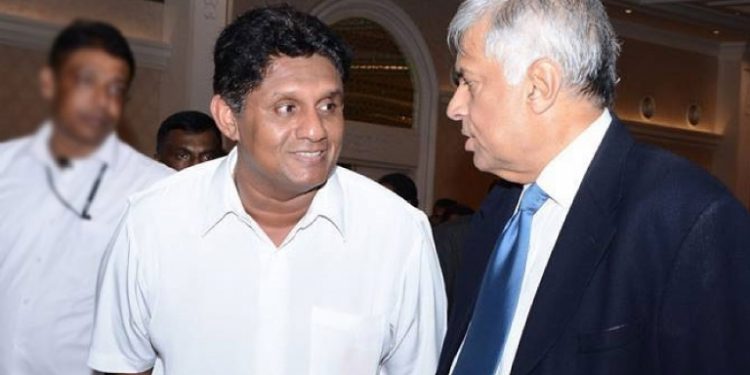
And should Premadasa go on to win the Presidency, will the two be able to cohabit till the next parliamentary elections in mid-2020? The question is pertinent given how Wickremesinghe was balking at giving Premadasa the nomination.
Though no formal statement has been made in regard to the status of Wickremesinghe with Sajith as President, UNP sources say that there is a tacit understanding that Wickremesinghe will continue as Prime Minister at least till the next parliamentary elections.
It would have been churlish on the part of Sajith and the people around him not to give Wickremesinghe a place befitting his status and contribution to the party over a long time. Driving him out on the eve of the election will have damaged the party’s unity and its electoral prospects.
But cohabitation between two bitter rivals, with both holding key positions in the government, will necessarily be problematic as past experience with cohabitation shows.
First of all, it has been proved that there can be no cohabitation between people or political forces of equal strength. Secondly, cohabitation is not possible if there is no genuine commonality of interests or ideological goals. Ranil-Sajith cohabitation will fail the commonality test.
It is also clear that Ranil considers himself superior to Sajith in many ways. The Prime Minister is undoubtedly superior in political and administrative experience, having been Prime Minister several times and held various portfolios over a long period. But Sajith makes up for the lack of political and administrative experience by his common touch” and an instinctive feeling for the masses which Ranil lacks sorely.
Ranil has knowledge of world history and contemporary international and economic affairs and has practical experience of interacting with key world powers over decades, something which Sajith cannot claim.
And again unlike Sajith, Ranil can claim to have a consistent ideology (modern and liberal), while Sajith has no clear idea. However, it is pointed out that Sajith has very experienced persons as his second-in-command such as Malik Samarawickrema and Mangala Samaraweera who will advice him.
Like the leopard, Ranil will not change his spots. He will continue to be arrogant, aloof and arbitrary in his decision making as he has been under the Presidency of Chandrika Kumaratunga and Maithripala Sirisena. The cohabitation government will be crippled if Ranil does not take the backseat and let Sajith rule.
However, it is argued on Sajith’s behalf that once Sajith becomes President, UNPers will flock to him rather than Ranil, because Sajith will be Executive President having more or declared that he has no intention of abolishing it. Sajith also has the option of sacking Ranil if the conflict comes to a head.
Past Experience
Past experience shows that cohabitation between differently oriented groups or individuals who see themselves as competitors rather than collaborators does not work.
Under the 1978 constitution, Sri Lanka has had three hybrid governments: (1) the Wijetunga -Kumaratunga administration, (2) the Kumaratunga-Wickremesinghe administration, and (3) the Sirisena – Wickremesinghe administration.
Of these, only the 1994 Chandrika-Wijetunga cohabitation was eventless as President Wijetunga’s UNP was on the decline vis-à-vis Chandrika’s Sri Lanka Freedom Party (SLFP) with little chance of winning the 1995 Presidential election.
But trouble arose when Ranil became Prime Minister after the December 2001 parliamentary elections and Chandrika remained President having won the election for the second time in 1999. While Ranil was committed to initiating a process of political and military accommodation with the LTTE with international mediation, for the sake of peace and economic development, Chandrika viewed it as an abject surrender to the terrorists.
Irked by Ranil’s unilateral moves, Chandrika used her Presidential powers to take over the Ministries of Defense, Interior and Information in 2003. This crippled the cohabitation government and fresh parliamentary elections were held in 2004.
Mercifully there was no need for cohabitation when Mahinda Rajapaksa became President in 2005 as he managed to sue up a strong government by engineering defections from the UNP. He won the 2010 Presidential elections handsomely, riding on the war victory wave, thus obviating the need to cohabit with the next largest political parliament in parliament.
Maithri-Ranil Cohabitation
To overthrow Rajapaksa in the 2015 elections, the UNP-led opposition had to form a rainbow alliance, and put up the neutral and unambitious Maithripala Sirisena as the common candidate.
But Sirisena turned out to be what no one expected him to be. Despite his promise to serve only one term as President, he developed long-term political ambitions. He bitterly complained of non-cooperation from a haughty and non-communicative Prime Minister Ranil. Sirisena routinely countermanded Ranil decisions. The UNP-SLFP cohabitation, formed with hype and hope in 2014 cracked with the SLFP opting out.
In October 2018, Sirisena sacked Ranil and appointed Mahinda Rajapaksa as Prime Minister. But this move crashed due to lack of numbers in parliament and an adverse Supreme Court ruling.
What’s in store for Lankans with Sajith and Gotabaya vying for the Presidency?
September 28th, 2019By P.K.Balachandran Courtesy NewsIn.Asia
Colombo, September 27: On Thursday, after a month-long bitter inner-party struggle, Sajith Premadasa was nominated as the ruling United National Party’s candidate for the November 16 Sri Lankan Presidential election.
The entrenched faction led by party Leader and Prime Minister Ranil Wickremesinghe had to bite the dust eventually, and grant Deputy Leader and Housing Minister Sajith Premadasa the party nomination unconditionally.”
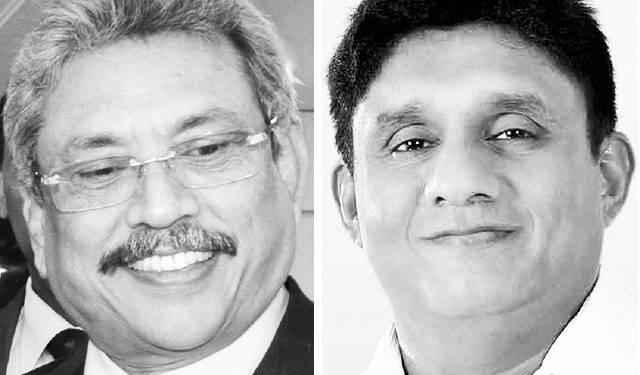
With the issue of UNP’s candidature settled at last, there are two main contenders for the Sri Lankan Presidency, namely, Sajith Premadasa of the UNP-led Democratic National Front (DNF) and Gotabaya Rajapaksa of the Sri Lanka Podujana Peramuna (SLPP)-led front of ten parties. For convenience, one is leaving out minor candidate Anura Kumara Dissanayaka of the Janatha Vimukthi Peramuna (JVP).
With Sajith and Gotabaya in the arena, two questions arise in one’s mind: (1) What are the issues on which the campaign will be fought? (2) What will be the policies of the Lankan government under Sajith or his principal rival, Gotabaya?
Since Sri Lanka has a Presidential form of government with a powerful, directly elected Executive President at the helm, (despite the watering down in 2015 through the 19 th., Amendment ), the President is the fulcrum of the Administration. Parliament is relevant only to the extent that it passes laws and holds the purse strings.
Campaign Concerns
As of now, Sajith is at a disadvantage because he belongs to the ruling UNP which has not at all done well in the past four and a half years whether in the developmental or the national security field.
Although Sajith can get away by blaming Prime Minister Ranil Wickremesinghe and President Maithripala Sirisena, he will still be carrying the cross of incumbency. Sajith himself has little to show by way of achievements as he has not held any major portfolio.
On the other hand, Gotabaya, has entered the electoral arena with significant successes under his belt. He was a very successful Secretary of Defense during the war and an efficient and creative Urban Development Secretary after the war.
But Gotabaya has a major drawback. He is accused of committing serious human rights violations against the Tamil minority during the war and the Muslim minority after the war. His continued association with the military even after becoming a politician, puts off lovers of democracy.
Gotabaya’s failures on the human rights front add to the support base of Sajith. Thus, Sajith has the support of the Muslims and will eventually get the support of the Tamils too, though the latter were rooting for Ranil who is seen as a genuinely non-communal person.
Sajith is yet to speak out on national security and national sovereignty in the context of the April 21 Jihadi bombings and pressure from the US to sign a military pact and an economic pact. These issues having been agitating the majority Sinhalese community but Sajith is looking only at rural development.
On the other hand, Gotabaya is building his campaign on the plank of national security, better intelligence gathering and a better decision making and implementing governmental apparatus . Though Gotabaya is silent on the developmental and military pacts with the US, it is widely acknowledged that the Rajapaksas did not and will not compromise on sovereignty.
As regards the nature of the Presidency under Sajith, it is said that what Lanka will get will only be more of what they are getting now. After all, those backing Sajith now have been staunch Ranil acolytes, enthusiastically implementing his internal and external policies. They abandoned Ranil in favor of Sajith only because Sajith has better mass appeal than Ranil which is needed to win the Presidential election.
Sajith is a hardworking professional politician but it is doubtful if he has the commanding personality which Gotabaya has to keep his ministers and officers on the go. He could be pulled in various directions by his key supporters. Or he could be under the thumb of some moneybags who financed his bid to get the party nomination.
Sajith has the compulsion to work with Ranil as Prime Minister till at least the next parliamentary election in mid-2020. Retaining Ranil as Prime Minister was not part of the deal when the UNP Working Committee closed ranks unanimously backed Sajith for the Presidency. But it is understood that Ranil will continue as PM till mid-2020.
But the ride with Ranil is not guaranteed to be smooth if the past is any indication. First of all, it has been proved that there can be no cohabitation between people or political forces of equal strength. Secondly, cohabitation is not possible if there is no genuine commonality of interests or ideological goals. A Ranil-Sajith cohabitation will fail the commonality test.
A sidelined and humiliated Ranil might continue to be arrogant, aloof and arbitrary in his decision making as he had been under the Presidency of Chandrika Kumaratunga and Maithripala Sirisena. The cohabitation government will be crippled if Ranil does not take the backseat and let Sajith rule.
However, Sajith-loyalists say that Ranil will not be a powerful Prime Minister as party MPs will flock only to Sajith, the powerful Executive President, leaving Ranil high and dry.
A government under Sajith will be more rural and small industries and agriculture development-oriented as compared to a government under Gotabaya. Sajith is mostly talking of housing and drinking water for all, besides building 1,00 0 Buddhist temples. But Gotabaya is expected to be more macro-oriented wanting big projects including massive infrastructure development projects to put the country on the path of rapid economic development.
Investments from China, India, Japan, South Korea and the West will be welcomed and every facility will be provided to them. After all, it was under the Administration of the Rajapaksas (namely President Mahinda Rajapaksa, Economic Development Minister Basil Rajapaksa and Urban Development Secretary Gotabaya Rajapaksa) that the Hambantota port, a second terminal in Colombo port, the Mattala airport and many excellent roads and railways were built with Chinese, Indian and other external assistance. It was Mahinda Rajapaksa who put up the Norocholai power plant against stiff opposition. This plant now supplies 50% of the electricity used in Lanka.
As regards foreign policy, Sajith is expected to toe a pro-Western line as his key supporters like Malik Samarawickrema, Mangala Samaraweera, and Dr.Harsha de Silva are pro-West. He might be forced to sign the controversial Millennium Challenge Corporation (MCC) agreement with the US to make land given by the government to peasants on lease saleable.
Sajith might also sign the controversial Status of Forces Agreement (SOFA) with the US giving the US military extra-constitutional rights in Sri Lanka , thus virtually turning the island into an US military base. This could arouse anxieties in China which has a deep economic interest in Lanka. The entry of China will doubtless draw the attention of India and the West making Lanka a cockpit of international intrigue.
As regards Gotabaya, he is expected to walk the right-rope vis-à-vis the contesting world powers. The Rajapaksas appear to have to learnt a lesson from their experience between 2010 and 2014 when they tilted too much towards China, causing anxieties in New Delhi and Washington. The Western powers backed the opposition in the January 2015 Presidential election which resulted in Mahinda Rajapaksa’s defeat.
Defeat of Ranil is a win for UNP
September 26th, 2019H. L. D. Mahindapala
The long-drawn and futile battle of Ranil Wickremesinghe to deny Sajith Premadasa, his deputy, the rightful place in the presidential race finally ended yesterday. Ranil fired all his ammunition to eliminate Sajith. But Sajith fought back strategically to outwit Ranil and end the 27-year-old reign of a cardboard leader who led the UNP to nowhere. The inner struggle for power was between the popular will of the UNP represented by Sajith and Ranil’s one-man will backed by the Working Committee packed with his hencmen. In the end the popular will won. Sajith’s victory will mark the end of Ranil and the beginning of a new era for the UNP. After President Ranasinghe Premadasa who reinvigorated the UNP with the grass root forces the UNP fell into the hands of D. B. (Deaf and Blind) Wijetunga. UNP never recovered as a viable political entity in the post-Premadasa era which was dominated by Ranil.
Two factors led to the steady decline of the UNP after President Premadasa: 1. the LTTE decimated the promising leaders like Lalith Athulathmudali and Gamini Dissanayake; 2. the misguided and the failed leadership of Ranil Wickremesinghe who thought he could swim upstream running counter to centuries of Sinhala-Buddhist history. The only right decision he made in his entire career was to back President Premadasa. But in his mulish way he decided to go against the Sajith wave rolling in. When the formidable forces within the UNP and outside were militating against Ranil’s kleptocratic kakistocracy — and swinging as an unstoppable wave towards Sajith — his moral, political and pragmatic duty should have been to bow out gracefully. Instead he waited till he was kicked out of the presidential race once again. As usual, he never could read the signs of the times.
Sadly, he will carry to his grave the disgraceful record of being rejected by his own Party not once, not twice, but three times. For the third time the UNP has rejected him as their preferred candidate to lead the Party to fight the big political battle for the Presidency. Once again the UNPers have conceded that he was a born loser who could never win the trust of the people to be their leader. In the past they kept him as the leader of the Party partly because there was no one in the bankrupt UNP to give better leadership and partly because he had manipulated the party machine to beat any opposition and hang on to power. So they had given him chance after chance to prove that he can deliver. But he failed.
His desperation to hang on to power is pathetic. Even when the tide was going against him for the third time his last move was to lay down conditions, hoping to retain power by curtailing those of Sajith. But it was a futile counter move. Sajith refused to yield to Ranil’s underhand conditions to retain his grip on power. Ranil should know that two tigers can’t hunt in the same mountain. In any case, surrender was inevitable because as Presidential candidate, or in the event of his becoming President, Sajith will have greater power than Ranil as the leader of the UNP. From now on Ranil will have to play only the second fiddle. From now on Sajith will have the upper hand.
Furthermore, the political forces that matter will turn to Sajith , if he wins the presidency, and not to the leader of the UNP, if Ranil retains the Party leadership. Sajith as President will command greater power than Ranil as the Party leader. Besides, there is the possibility of the Party sticking to the constitution of the Party and granting the Party leadership to Sajith. However, if Ranil retains the party leadership he will, in his usual crafty ways, try to create two centers of loyalty. But he will lose hands down to Sajith who will invariably be the central magnet of greater power. .
Ranil’s last resort will be to win the Premiership at the parliamentary elections. He will then use his newly gained power as a foil to the President. But the chances of Ranil winning a majority in Parliament are as likely as him winning the presidency in the next election. The mathematical calculations that go to decide a parliamentary election are totally different from that of a presidential election. According to statistical analyses, Mahinda Rajapakse has a lead over Ranil as of now.
As things stands now, Ranil is doomed. He has lost his chance in the Presidential election. And his chances of winning the Premiership are zilch. He must recognize even at this late stage that his used by date is over. The Party had given him enough chances to prove himself as a leader. The UNP has been very patient and generous to him. But what has he given the UNP, except defeat and ignominy?
Sajith’s victory is more than a personal victory over a crafty manipulator who had tried to undercut him all the way. His victory is symbolic representing that of the new generation of UNPers. They are tired of the old generation led by Ranil. The wave that swept the rank and file and lifted Sajith into leadership indicates a total rejection of the old leadership. Ranil’s in particular. The voting public was not so much against the UNP as against the Ranil. The coming of Sajith has washed away some of the sins committed by Ranil. The disillusioned pro-UNPers can now go to the polls with some hope.
Though not defined explicitly Sajith seems to be a better alternative to Ranil. He seems to be keeping a safe distance away from the pro-West, pro-Indian line almost akin to that of his father. Part of the appeal in Sajith personality – his policies are yet to be spelt out – is his closeness to the grass roots. His housing programs are reminiscent of his father delivering goods and services to the villages and the grass-roots. Sajith’s affinity with the people and the sangha is viewed by the Sinhala-Buddhist electorate as being more genuine than the thick pirith noola tied in Ranil’s hand. One of the biggest failures in Ranil’s politics has been his failure to raise his image above the level of a hollow man with his head filled with straw. He has been a fake and – poor fellow! – he will continue to look like a fake Sinhala-Buddhist even if he shaves his head and comes out in public wearing yellow robes.
Kabir Hashim, the Chairman of the UNP, has exposed Ranil’s fake politics in his latest interview with the Sunday Observer(22/9/2019) As everyone knows, Ranil’s cheap trick has been to appoint committees whenever he is confronted with a problem. His latest was to appoint a committee of four leading UNPers to decide on who should be chosen as the leader when the answer was so obvious even to a blind man’s dog. Kabir’s comments, by implication, pours scorn on Ranil’s fake move to find a leader on the recommendation of his hand-picked committee.
SO asked him:. What is the update on the committee appointed to select the UNF candidate, in which you are also a member?
A. I think that committee is a red herring. The Prime Minister never called up the committee report. I have prepared a report. Myself and Minister Ranjith Maddumabandara spoke to the minority parties and UNP MPs. We have also got data and information on the best course of action for the UNP at the upcoming election, and we have been ready with the report.
The Prime Minister has nominated Rajitha Senaratne and Dinesh Weerakkody to represent him in the committee. At yesterday’s (Sep 20) party leaders meeting at Temple Trees, the committee report was not even referred to.
The report was to be a collective effort. It should have been made together but the others were not attending the meetings so we made a report on our own. It was finalised after a series of discussions with our alliance members, all UNP MPs, and after weighing in the information and data of the current political scenario”.
This comment of the Chairman of the UNP exposes Ranil as a fraud and a fake. Kabir laments that the whole exercise of appointing committee was a waste of time. It was futile exercise which served no one, least of Ranil. It was not even referred to in the end, says Kabir. Committees are appointed by Ranil as dilatory tactics or to divert attention. He has no intention of reading the reports, or following it up, or taking action on them. He uses them to bury the issues which he has no intention of solving or dealing with them. He hopes everyone will forget it and save him from facing the issues as a leader should. He has been surviving in politics by appointing committees to dodge issues. How can a leader who appoints committees to solve problems dismiss them without even reading, or studying, or making any references to them when it comes to decision-making? How can one respect a leader who appoints committees to deceive the people? The people saw through him and never trusted him.
Sajith can’t go wrong if he is capable of taking the Party and the administration to the people. And also if he is committed to the work ethic of his father. President Premadasa had to face the revolt of the Kurunduwatte cricket-playing gang in the cooked up in the impeachment saga. The impeachment even accused him of being insane. The English-speaking elite, thriving in professions, was against him. Premadasa came from the football-playing Kehelwatte gang,
Sajith has been spared this class/caste distinction. He was supported by a cross-section of the UNPers drawn from the top to the bottom. He represents the generational change. The passing of the baton, though reluctantly by Ranil. Hopefully it will also represent a change in direction. Hopefully the winds of change will help to bring the Party back to the people, the way his father did.
Tallest elephant in Sri Lanka gets armed escort. Here’s why
September 26th, 2019Courtesy The Hndustan Times
Raja’s owner said the government has allocated troops to provide security for his pet as it ambles along main roads.

Nadungamuwa Raja, 65 years old, is a celebrated elephant towering around 10.5 feet (3.2 metres) in height, the tallest tamed tusker in Sri Lanka. And he has his own armed guards.
Raja’s owner said the government has allocated troops to provide security for his pet as it ambles along main roads to attend temple festivals across the island.
In September 2015, a motorcyclist very nearly crashed into Raja. After seeing CCTV footage, the government contacted me and offered protection for Raja when he gets on the road,” Harsha Dharmavijaya told AFP.
There are two regular handlers with Raja in addition to the military unit deployed to clear a path for the animal when it navigates crowded country roads.
Raja is an unofficial national treasure because he is one of the few tuskers chosen to carry a casket of Buddha relics in an annual pageant at the most sacred Buddhist shrine on the island, the Temple of the Tooth.
Raja walks 90 kilometres (55 miles) to the hill resort of Kandy for the event, called the Esala pageant. He walks 25 to 30 kilometres a day, travelling mostly at night when it is cooler.
The pageant in August involves nearly 100 elephants and many more traditional dancers, fire-eaters and drummers, and is a key tourist attraction.
However animal rights campaigners say captive elephants are often maltreated.
On Tuesday an emaciated 70-year-old elephant called Tikiri died, weeks after attending the Esala festival.
The animal was withdrawn from the finale of the Temple of the Tooth pageant last month after a social media firestorm erupted against parading the feeble animal.
Many rich Sri Lankans keep elephants as pets, but there have been numerous complaints of ill-treatment and cruelty.
Conduct UNP campaign in a disciplined manner: Ranil
September 26th, 2019Yohan Perera Courtesy The Daily Mirror
In the wake of MP Hesha Vithnage’s statement that the SLPP’s presidential candidate will have to wear a jumper if UNP candidate Sajith Premadasa is elected President of this country, Prime Minister Ranil Wickremesinghe today instructed UNP seniors to make sure that the UNP campaign was carried out in a decent and disciplined manner.
He said this when he met some senior ministers that all party members should work with commitment to make the UNP candidate victorious at the presidential election.
Our efforts should be to see that our candidate emerge victorious and not to make the rival candidate wear jumpers,” he told the seniors.
Dolewatta complains to Police Hesha’s statement about Gota donning prison jumper
September 26th, 2019By Kamal Mahendra Weeraratna Courtesy Ceylon Today
The Convener of the Truth Seekers Organisation, Attorney Premanath C. Dolewatta, yesterday (26), lodged a complaint with the Police Department urging it to institute legal action against UNP Parliamentarian Hesha Vithanage.
Dolewatta has complained that in a statement reportedly made by Vithanage, at a public rally held in Matugama on 24 September, he had vowed that once UNP Deputy Leader and Minister Sajith Premadasa is declared the winner of the coming Presidential Poll, the UNP will force Sri Lanka Podujana Peramuna Presidential candidate Gotabaya Rajapaksa to don a prison jumper.
He said that such demeaning and derogatory comments targeting Rajapaksa had tarred the independence of the country’s judiciary and the Attorney General’s Department.
He has said that hence the Police should launch a swift probe into Vithanage’s controversial remarks.
The complaint has been lodged by Dolewatta under the heading ‘influencing the judiciary’.
He had also said that the issuance of such threatening remarks is a serious situation.
He had said that voters, who are preparing to cast their votes according to their wishes at the 16 November Presidential Poll, could be forced to think twice before heading to the polling booths due to threats issued by the MP concerned.
Cannot go back to ‘Premadasa era’ – Mahinda
September 26th, 2019Courtesy Adaderana
Trade and commerce have suffered great losses under the incumbent government, claims Leader of the Opposition Mahinda Rajapaksa.
He made these remarks addressing the national convention on businesses at the Sri Lanka Exhibition & Convention Centre in Colombo this morning (26). The event was held under the patronage of SLPP presidential aspirant, former Defence Secretary Gotabaya Rajapaksa and the Opposition Leader.
Commenting further, he said the ‘Good Governance’ government has Sri Lankan rupee had depreciated against the US Dollar marking the selling price per 1 USD as Rs 182. He added that, in 2014, under his administration, the selling price of Sri Lankan rupee against the US Dollar stood at Rs 131.
However, the export earnings have not increased,” the Opposition Leader said, pointing out that due to the devaluation of the rupee, the debt burden of the nation has increased to Rs 1,790 billion.
We paid close attention to loan interest. We maintained single-digit interest rates during our time,” Rajapaksa said further.
The country is not moving forward as unsuitable leaders were appointed to lead the nation, the Opposition Leader claimed.
Speaking on SLPP’s presidential rival Minister Sajith Premadasa and his father’s administration, Rajapaksa said the country cannot go back to a ‘Premadasa era’.
SLPP claims Election Commission’s insider supports postponing polls
September 26th, 2019Courtesy Adaderana
A major scheme of the United National Party to postpone the country’s elections was defeated by a Supreme Court verdict yesterday (25), says the Lawyers’ Association of Sri Lanka Podujana Peramuna.
Its secretary, Attorney-at-Law Athula de Silva, speaking at the Association’s media briefing held today, stated that the UNP was in an attempt to postpone the Elpitiya Provincial Council election even after dates were set for the postal voting.
The Supreme Court yesterday dismissed the fundamental rights petition filed seeking an injunction order preventing the election for the Elpitiya Pradeshiya Sabha from being held without calling for fresh nominations.
After considering the facts presented, the Supreme Court decided not to grant leave to proceed with the petition as there is no reasonable legal basis to hear the petition.
The SLPP’s Lawyers’ Association alleged that one Member of the Election Commission is directly involved in this scheme, adding that Prof.S. Rathnajeevan H.Hoole is personally rendering his support to postpone elections.
A separate lawyer represented this Elections Commission Member at the Supreme Court yesterday. From the beginning this lawyer presented his submissions in favour of postponing the election. […] President’s Counsel Ali Sabry on behalf of the SLPP stressed on holding the election,” the Association’s secretary added.
It must be specifically mentioned that the Attorney General’s Department played a major role to secure people’s right to vote, he continued.
බදු බර ඉවත් කරන බව ජනපති අපේක්ෂක ගෝඨාභය කියයි
September 26th, 2019උපුටා ගැන්ම හිරු පුවත්
තම රජයක් යටතේ, වත්මන් රජය මගින් පනවා ඇති අසාධාරණ බදු ඉවත් කර සරල බදු ක්රමයක් හඳුන්වා දීමට කටයුතු කරන බව ශ්රී ලංකා පොදුජන පෙරමුණ ප්රමුඛ ඒකාබද්ධ විපක්ෂයේ ජනාධිපති අපේක්ෂක ගෝඨාභය රාජපක්ෂ පවසනවා.
ඔහු මේ බව සඳහන් කළේ කොළඹ ප්රදර්ශන හා සම්මේලන මධ්යස්ථානයේ අද පැවති රැස්වීමකට එක්වෙමින්.
හේෂා විතානගේ කළ ප්රකාශය ගැන පොලිස් මූලස්ථානයට පැමිණිල්ලක්
September 26th, 2019උපුටා ගැන්ම හිරු පුවත්
පාර්ලිමේන්තු මන්ත්රී හේෂා විතානගේ මහතා ගෝඨාභය රාජපක්ෂ මහතා සම්බන්ධයෙන් ඊයේ සිදුකළ ප්රකාශය පිළිබද අද පොලිස් මූලස්ථානයට පැමිණිල්ලක් ඉදිරිපත් වුණා.
මේ අතර එම ප්රකාශය සම්බන්ධයෙන් අද විවිධ පාර්ශ්ව අදහස් පළ කළා.
සත්ය ගවේෂකයෝ සංවිධානය අද පෙරවරුවේ පොලිස් මූලස්ථානයට අදාළ පැමිණිල්ලක් සිදුකළේ අදාළ ප්රකාශය සම්බන්ධයෙන් කඩිනමින් නීතිය ක්රියාත්මක කරන ලෙස ඉල්ලමින්.
මේ අතර, අදාළ ප්රකාශය සම්බන්ධයෙන් ප්රවෘත්ති සාකච්ඡා කිහිපයකදී අදහස් පළ වුණා.
එජාපයේ ජනපති අපේක්ෂකයාට විපක්ෂ නායකගෙන් චෝදනා
September 26th, 2019උපුටා ගැන්ම හිරු පුවත්
පාතාලය, දූෂණය හා කප්පම්වලින් තොර සමාජයක් බිහි කිරීම තම ප්රමුඛ අභිප්රාය බව ශ්රී ලංකා පොදුජන පෙරමුණ ප්රමුඛ ඒකාබද්ධ විපක්ෂයේ ජනාධිපති අපේක්ෂක ගෝඨාභය රාජපක්ෂ මහතා පවසනවා.
ශ්රී ලංකා පොදුජන පෙරමුණේ ව්යාපාරික ජාතික සම්මේලනය අද කොළඹදී පැවති අවස්ථාවේ ඔහු මේ අදහස් පළ කළා.
ශ්රී ලංකා පොදුජන පෙරමුණට අනුබද්ධිත ව්යාපාරික ජාතික සම්මේලනය අද පැවැත්වුණේ ශ්රී ලංකා පොදුජන පෙරමුණ ප්රමුඛ ඒකාබද්ධ විපක්ෂයේ ජනාධිපති අපේක්ෂක ගෝඨාභය රාජපක්ෂ සහ විපක්ෂ නායක මහින්ද රාජපක්ෂ යන මහත්වරුන්ගේ ප්රධානත්වයෙන්.
මේ අතර ශාන්තිකර්මවේදීන්ගේ ජාතික හමුව පැවැත්වුණේද ගෝඨාභය රාජපක්ෂ හා මහින්ද රාජපක්ෂ යන මහත්වරුන්ගේ ප්රධානත්වයෙන්.
ප්රජාතන්ත්ර වාදය වෙනුවට ලංකාවේ ක්රියාත්මක වන්නේ පචතන්ත්ර වාදයයි
September 26th, 2019සුර්ය වංශ රත්න විභූෂණ පාලිත ආරියරත්න හිමිනමක් පන්සලේ ආදාහනය කළ නොහැකි මහා බෞද්ධ රාජ්යය ”ශ්රී ලංකාව” සිට
දැන් කුකුල් පොරය අවසන්වී තවත් වලියෙන් කලඑලියට පත් නව ජනාධිපති අපේක්ෂේකයෙක් අද දිනද අපේ මේ ලක්මැනියන් හට ලැබිය.
මේ සැම නව ජනාධිපති අපේක්ෂේකයෙක් දෙසම වක්රාකාරයෙන් බැලුවිට පෙනී යන්නේ
(මේ පොදු ලක්ෂණය යම් තාක් දුරට හෝ ඔවුන් තුල තිබෙන බවයි).
ඒ
කිසිවක්
නොව.
ප්රසිද්ධියේ
මොවුන්
කව්රුත්
මෙරට
සිංහල–බෞද්ධ රටක් යැයි කීමට ජාතිකව මැලිකමක් දක්වනවා බවයි.
වලියෙන්
එන,
කකුලින්
අදින,
මාට්ටුදන,
බොරු
කියන,
හිතුමතේට
ව්යවස්ථා
හදන,
පොරක්
වීමට
නලියන,
කාලකන්නි
දන්නේ
ස්වල්ප
දෙයක්මයි
පෙනේ.
එනම්
දවසින්
දවස
ටිකින්
ටික
මේ
රට
නොරටුන්ට
හා
විජාතිකයන්ට
මල්
බන්දේසියක
තබා
පුජා
කිරීමයි.
ප්රජාතන්ත්ර
වාදය
නමින්
මතුවෙන
පචතන්ත්ර
වාදයේ
තැන්
ස්වල්පයක්
පහත
ප්රශ්න
ඔස්සේ
සිහි
බුද්ධියෙන්
බැලීමෙන්
පාඨක
ඔබ
හට
දන
ගත
හැකිය.
1. බලය
බෙදීම
ඕනෑ
කාහටද
?
2. අලුත්
ව්යවස්ථා
ඉල්ලුවේ
කවුද
කවදාද
?
3. 19 න්
වුන
දේ
මතකද
?
4. තවත්
20 ක්
ඕනෙද
?
5. රට
නිත්යානු
කුලව
හිමි
කා
හටද
?
6. රට
හිමි
මේ
නව
ජාතියක්
වන
ශ්රී
ලාංකිකයන්
ට
ද
නැත්නම්
සිංහලයන්
ටද
?
7. රටේ
ඊළඟ
නම
‘ ඉල්
ලංකාවද
?
8. රට
ඉදිරියේදී
බෙදීමේ
කුමන්ත්ර
හා
පුද්ගලික
න්යාය
පත්ර
හෝ
සැඟවුණු
න්යාය
නැතිද
? නැතහොත්
අපිව
ගොනාට
අන්දනවාද
?
9. මුස්ලිම්
හා
දෙමළ
යනු
ජනවර්ගයක්ද
නැත්නම්
අප
හා
සමාන
ජාතීන්ද
?
10. ප්රජාතන්ත්ර
වාදය
යනු
අනුනට
අයිති
රටක්
කාලයක්
තුල
ටිකින්
ටික
නොරටු
හට
ප්රජාතන්ත්ර
වාදී
දේශ
පාලනය
නාමයෙන්
බෙදා
දීමද
?
එය
සුද්දන්
විසින්
දමා
ගැසූ
ගුන්ඩුවක්
නොවේද
?
11. අද
ඔබ
කතා
කරන
බහු
ජාතික
කොලොප්පම්
ප්රජාතන්ත්ර
වාදය
යනු
හොරෙන්
හොරෙන්
සිංහල
දේශය
විනාශ
කිරීමක්
නොවේද?
12. අපගේ
මුතුන්
මිත්තන්
දිවී
පරදුවට
තබා
රැකගත්
මේ
රට
ඔබේ
ඔය
කියනා
සැබෑ
ප්රජාතන්ත්ර
වාදයෙන්
ඔබ්බට
ගිය
ඔබ
විසින්
අප
රටේ
පමණක්
නිර්මාණය
කර
ඇති
පචතන්ත්ර
වාදය
නිසා
විනාශ
වීමට
උඩ
බලාගෙන
චන්දය
ගැසීම
යනු
සැබෑ
ප්රජාතන්ත්ර
වාදය
දන්නා
මිනිසෙකු
වීමට
සුදුසු
කමක්ද
?
13. ප්රජාතන්ත්ර
වාදය
යනු
විදෙස්
වැසියන්
(මෙහි
ආ
හෝ
වෙළදාමේ
පැමිණි
) මානව
පාලනය
කිරීම
අත්
හිටුවිමක්ද
?
14. තුන්
සිංහලේම
නෑදෑයන්
වන
බව
ඔබ
නොදන්නේද
? නෑදෑයන්
, සහෝදරයන්
නැති
පක්ෂයක්
ඔබට
දැනට
තිබේද
? එවන්
ආකාරයේ
පක්ෂයක්
තැනීම
අපහසු
බව
ඔබ
දන්නේද
?
15. 2500 කට
වඩා
ඉතිහාසයක්
තිබෙන
සිංහල
අපි
රට
කරවුයේ
නෑදෑයන්
, සහෝදරයන්,
දෙමවුපියන්
සමග
එක්වී
බව
ඔබ
දන්නවද
?
16. පසුගිය
ජාතිවාදී
දෙමල
ඊලම්
ත්රස්තවාදයට
මුහුණ
දෙද්දී
ඔය
කියන
රට
අදෙරේ
බව
ඔබ
විහිළුවකට
පෙන්නුවද
? තවද
ජාතික
හා
රටේ
ආරක්ෂාව
හා
බුදුදහමේ
ආරක්ෂාව
පතා
අඩුම
ගනනනේ
එක
අකුරක්
හෝ
ඔබ
ලිවාද
? නැත්නම්
ගෙදර
ඉන්න
අඹුව
පමණක්
රකිමින්
සිටියාද
?
17. නීති
විරෝධී
අන්යාගමික
කරණය
ඔබේ
ගජ
මිතුරන්ගේ
අතින්
අදත්
සිදුවෙන
බව
ඔබ
දන්නේද
?
18. ඔබලාගේ
පවුල්වල
අම්මාගේ
සිට
නැගණිය,සහෝදරයා ,දු දරුවන් ,අඹු සැමි සියලන්ම නීති විරෝධී අන්යාගමික කරණයේ ගොදුරක් හා ඉත්තන් වී ඇති බව ඔබ දන්නවා නේද ?
19. පන්සිල්
රකින
පුද්ගලයත්
මස්
බුදින
දුර
චාරයේ
යෙදෙන
මිනිසාත්
යනු
දෙන්නාම
සමානද
?
20. විදෙශ්
කුමන්ත්රණ
රාශියක්
හොරෙන්
අප
රටේ
ක්රියාත්මක
වන
බව
හා
හා
පසුගිය
බෝම්බ
ප්රහාරයේ
අතකොලුවූ
බොහෝ
මැති
ඇමතිවරු
ඔබ
පිටිපස්සේ
කෙල
හලමින්
(අනාගතේ
හිරේ
විලංගුවේ
වටෙවිදෝයි
සිතමින්
) ඔබව
රජ
කිරීමට
සැදී
පැහැදී
සිටින
බව
ඔබ
දන්නවද
?
21. පසුගිය
අප්රේල්
ප්රහාරයේ
වග
උත්තර
කරුවන්
කව්රුන්ද
ඔවුන්ගේ
සහය
කාටද
?
22. පසුගිය
එල්.ටි.ටි ත්රස්වාදයට උඩගෙඩි දුන්නෝ කවුද? ඔවුන්ගේ සහය කාටද ?
23. විරෝදාර
රණවිරුවන්
අන්තර්
ජාතික
පොරේකට
දැක්
වීමට
උත්සුක
වන්නේ
කවුද
? ඔවුන්
ඔබ
ලගම
නේද
?
24. නපුංසක
විවාහ
නීති
පද්ධති
හා
ලෙස්බියන්
විවාහ
සම්මත
කරගන්න
උත්සහා
කෙරු
නායකයන්
දිගටම
ඔඅබ
හා
සිටීමෙන්
හා
ඒවා
නැවත
ජනාධිපති
පුටුව
වෙත
ඒමට
පෙර
අනුමත
වීමට
නව
ජනාධිපති
බල
සංසෝදන
හේතුවක්
වේද
නොවේද
?
25. එන.ජි .ඕ මාරයන් කි දෙනෙක් ඔබහට මෙදවස්වල් මුදල් විසිකරන්නේද ?
26. භික්ෂුන්
වහන්සේ
නමක්
ආදාහනය
කරගැනීමට
දුෂ්කර
වන
භයානක
තැනකට
දේශපාලක
ඔබ
මේ
රට
ගෙනගොස්
ඇති
බව
දන්නවද
?
27. උතුර දෙමල නිජබිමක්ද ?
28. ටැමිල් නෙට් වැනි අන්තවාදී වෙබ් තීරයන් අපේ රට තුල නැවතත් දර්ශනය වන්නේ කවද සිටද ? මේවා ලියන්නේ අන්තවාදී ත්රස්තවාදී නොවේද ?
29. වෙනම මුස්ලිම් කලාප අධිකරණ පද්ධති ,පාසල් ඉල්ලන්නෝ කවුද ? එම කණ්ඩායම් කා සමගද ?
30. 9 වෙනි ව්යවස්ථා උතුරට අදාල නැතිද ? නව ජනාධිපති අපේක්ෂේකයන ඒ ගැන නිශ්ශබ්ද,තුෂ්ණීම්භූත ඇයි ?
අවසාන
වශයෙන්
කිව
හැක්කේ
:
අපට
හට
ඇත්තේ
”නව
ශ්රී
ලංකාවක්”
ගොඩනැගීමේ
ක්රියාදාමයට
අත
වැනිම
නොව
අපේ
සිහල
බොදු
අයිතීන්
සුරක්ෂිත
කොට
මේ
මා
ඇතුළු
ඔබ
උපන්
දේශය
සිංහලයන්ට
අයිති
ලෝකයේ
තිබෙන
ථෙරවාදී
බුදුදහම
ලොවට
බෙදන
එකම
රට
(සිංහලේ
) බව
නැවතත්
ලොවට
ඔප්පු
කර
සිටීමටය.
කරුණා
කර
ඔබ
විසින්
කරණ
ගොන්
කතා,
ගොන්
පොරය
දැන්
වත්
නවත්
වමුද?
අනුන්ගේ
පෙර
වැරදි
කියමින්
තපුලන
ඔබලා
බොරදියේ
මාළු
බාන්නන්
වන
බව
අපි
දනිමු.
අද
දිනම
ඔබලා
හට
සත්ය
වැටහෙවා
යැයි
ප්රාර්ථනා
කරමි.
ඔබගේ
පචතන්ත්ර
වාදයයට
තවදුරටත්
ඉඩ
නැත.
ඔබ
සැමට
තෙරුවන්
සරණයි
!
සුර්ය
වංශ
රත්න
විභූෂණ
පාලිත
ආරියරත්න
හිමිනමක්
පන්සලේ
ආදාහනය
කළ
නොහැකි
මහා
බෞද්ධ
රාජ්යය
”ශ්රී
ලංකාව”
සිට
2019-9-27
YAHAPALANA AND THE UNITED STATES OF AMERICA Part 12
September 25th, 2019KAMALIKA PIERIS
AMERICAN BAR ASSOCIATION
American Bar Association (ABA) has made repeated attempts to register a Branch Association of the ABA in Sri Lanka.The first request was in January 2018, where ABA said that it would be in the interests of the ABA to set up a Branch office in Sri Lanka. The activities of the Branch would be monitored by Sri Lanka‘s Ministry of Justice and the Attorney General’s Department.
In October 2018, the Hon. Attorney General had addressed a communication to the Ministry of Justice stating that the ABA has undertaken to hold a capacity building programme for judges and prosecutors and asked the Ministry to issue a certificate for the purpose. However, the letter was headed Official Letter of Authorization for the Establishment of a Branch office of the ABA in Sri Lanka”.
BASL wrote in October 2018 to the Ministry of Justice saying that the BASL strongly objects to the initial application to set up a Branch office. BASL does not see any need to register a Branch Association of the ABA in Sri Lanka. Nowhere in the world will a legal system allow or permit a foreign Bar Association to set up a branch office.
It is an unprecedented request and if allowed will have serious consequences on the independence of the legal profession and the sovereignty of the nation. If this application is allowed the ABA will have their own office and will start making comments and statements on internal matters which will have an impact on a sovereign Nation.
Bar Association of Sri Lanka (BASL) said that neither the Ministry nor the Attorney General’s Department represent the legal community. BASL is the sole representative body recognized under our legal system as the body representing the legal profession.
the other ground upon which we would strongly object to the setting up of this branch office, added BASL, involves the question as to what the Ministry would do if other foreign Bar Associations make applications on similar lines. There are several countries with which Sri Lanka maintains close ties and what would be the position of the Ministry and the State if these countries make similar requests? The BASL strongly objects to the registering of a Branch Association of the ABA on the above basis.
ABA then tried to come in as an NGO. ABA made a request to the Ministry of Justice, through a local legal firm, asking it to issue a letter to register the ABA here as an NGO. This request was also referred to the BASL which submitted its observations in April 2018. BASL said that this was an indirect means of establishing ABA presence in Sri Lanka “knowing very well that the application for registration as a branch association would fail”.
We strongly object to the application made on behalf of the ABA to register as a NGO. Unlike in the case of an ordinary NGO, the application in this instance has a serious impact on the legal profession and the very concept of sovereignty.
ABA and their legal representatives in Sri Lanka seek to justify the application to register as a NGO on the argument that the International Bar Association (IBA) wishes to provide assistance for training of Judges and prosecutors, continued BASL.
This is not the first time that such training has been provided by International Organizations. For more than 25 years entities such as the EU, USAID, UNDP and UNICEF had provided similar training and technical support to the legal profession in Sri Lanka. In all these instances, the issue of registration of such entity as a NGO did not arise. The support was provided through their local institutions. The respective institution would enter upon a MOU and provide assistance and training as agreed. If the ABA is genuinely interested in providing assistance and services what the ABA should do is to adopt the same mechanism.
BASL also observed that it is relevant to note that none of the above correspondence was directly addressed to the BASL. All correspondence in this regard was submitted by the Ministry of Justice. BASL also wrote to the National Secretariat for Non-Governmental Organizations, stating its objections.
Justice Minister Thalatha Atukorale said that she had not agreed to establish of a branch of the American Bar Association in Sri Lanka. As the subject minister I have not granted permission for any such institution to be established in Sri Lanka,” she said in a statement.
The US Ambassador said in July 2019 that the American Bar Association has no intention to establish a branch in Sri Lanka. US has not and will not interfere or become directly involved in Sri Lanka’s judiciary. However, US has sponsored training for Sri Lankan judges and lawyers at the request of the Sri Lankan government, she said.
Justice Minister Atukorale confirmed that in May 2019, two batches of senior judges had been to the US in August 2018 and April 2019 at the US taxpayers’ expense. A workshop for High Court judges was held at Taj Samudra, Colombo in Dec 2018. In July 2019 a group of Attorney General’s Department officials, attended a workshop in the US. Members of Parliament said that this could be an attempt to influence the judiciary.
SDGAP
The US has initiated a Strengthening Democratic Governance and Accountability Project” (SDGAP) worth Rs 1.92 billion (USD 13 mn). The programme was launched in November 2016. This is first of its kind implemented in Sri Lanka, observed Shamindra Ferdinando. The project will be developed in close collaboration with the Sri Lanka Parliament, Independent Commissions and related Ministries.
This programme was implemented by the Maryland USA, based Development Alternatives Inc (DAI), in accordance with an agreement between Sri Lanka and the House Democracy Partnership of the US House of Representatives. The Sri Lanka Parliament and the House Democracy Partnership of the U.S. House of Representatives had in Washington D.C on September 14th, launched a Collaboration Agreement to strengthen partnership between the two legislatures.
The purpose of the project is to reform Sri Lanka’s public sector. The project will help the Government of Sri Lanka to increase transparency and accountability, advance good governance reforms, and strengthen systems and processes for public accountability, financial management, policy development and implementation. The project also supports the government to strengthen communication with citizens, include the public in policy-making, and increase the participation of women in political processes.
The US embassy said that the SDGAP was subject to the laws and regulations of the United States, with oversight from Office of Inspector General, United States Agency for International Development (USAID).
PRASAD KARIYAWASAM
In June 2019 it transpired that Prasad Kariyawasam has been appointed to Parliament as an International Affairs adviser to the Speaker. This is the first time in the history of Parliament that a Speaker has had the services of an international affairs advisor. MPs observed that there is no such position as International Affairs adviser among the list of officials in Parliament and no other Speaker in Parliament has employed an International Affairs Advisor, that too using funds from a foreign country to pay for them. Previously, international issues were handled by the Foreign Ministry and even the Minister in charge, the MPs said.
Speaker Karu Jayasuriya admitted that Kariyawasam was being paid by Development Alternatives Institute, (DAI) a foreign agency which is the implementing agency for USAID. The DAI currently obtains the services of two advisers to assist Parliament. They are former Additional Secretary to the Ministry of Public Administration G. Hettiarachchi and former Foreign Ministry Secretary Prasad Kariyawasam.
The Speaker explained that USAID is funding different projects in Parliament through its contractor DAI. DAI had given Rs. 2,000 million for a programme called Parliamentary Diplomacy”, intended to foster close relations with other Parliaments worldwide, while also facilitating exchange programmes for MPs and Parliament staff.
The Parliament of Sri Lanka currently has connections with 50-60 other Parliaments throughout the world under Parliamentary Diplomacy. It is these programmes that facilitate MPs to travel to foreign countries to understand how Parliaments function there, to obtain scholarships and strengthen Parliamentary Democracy. Around 60-70 MPs here have already gone on foreign tours to learn about strengthening democracy using these same funds. These funds have also been used for Parliamentary Committees. The media wanted to know how this project benefited the country.
Kariyawasam , a former Foreign Ministry Secretary, is assisting in this programme, said the Speaker. Currently he is coordinating the Parliamentary Diplomacy group involving around 50-60 countries. He assists me in obtaining scholarships for parliamentarians, coordinating tours to learn about other parliaments etc. He is not paid by the Parliament.” . This mean that he is being paid by the US Government, responded critics. And there are suspicions that this was privately done, they said.
DAI had initially selected Karunathilaka Amunugama, another former Foreign Ministry secretary for the role of adviser, but he had passed away a day before commencing duties. Kariyawasam was appointed as his replacement, said MP Kiriella in June 2019.
In July 2019 Speaker Karu Jayasuriya announced that the salary of Prasad Kariyawasam, would be met from Parliament funds henceforth. The move is an acknowledgement that Kariyawasam’s pay, paid with funds from a US federal agency is wrong, said the media.
In addition to organizing programmes in Parliament, it appears that Prasad Kariyawasam had also arranged for the ambassadors of countries belonging to the Organization of Islamic Cooperation Countries (OIC) to come to Parliament to meet the Speaker. The diplomats included those from Afghanistan, Bangladesh, Egypt, Indonesia, Iran, Iraq, Libya, Kuwait, Malaysia, Oman, Pakistan, Palestine, Qatar, Saudi Arabia and Turkey. Director of the State Intelligence Service (SIS) and the Director of Military Intelligence were also present. MPs questioned the meeting.
The task of summoning Colombo-based diplomats is the sole responsibility of the Foreign Minister or his Ministry Secretary. It is also the responsibility of the President or the Prime Minister, particularly during exigencies. The intelligence chief of the country, who knows all the intelligence and secret information, including investigations that are ongoing, was summoned for the meeting, along with the IGP. Summoning the intelligence chief in front of foreign envoys has not been done by any other Speaker.
Speaker replied I convened a meeting of envoys of these Muslim countries in Parliament to brief them on the latest situation. The IGP came for this meeting, along with other senior officers. Meeting was to brief the envoys of the Muslim countries and ease their fears. The meeting was held with good intentions to explain the current situation and give a guarantee on security. There was no leaking of state secrets.” Would it not have been better to ask the Foreign Ministry to invite these envoys should there be a need, countered MPs. This clearly shows that Kariyawasam was running a parallel operation.
VISIT OF MIKE POMPEO
US Secretary of State, Mike Pompeo was to travel to Sri Lanka on a short visit, in June 2019, scheduled between his Delhi trip and travel to Osaka. Pompeo was accompanying President Trump for the G-20 summit in Osaka. The purpose of Pompeo’s visit (book-ended between visits to New Delhi and Osaka, Japan) will be to pressure Sri Lanka into signing up on the utterly one-sided Status of Forces Agreement, said analysts.
But he did not come, He cancelled his visit. The reason given by the embassy was that his travel schedule did not permit a stopover in Sri Lanka. Pompeo hopes to travel to Sri Lanka at a later date.”
The real reason, analysts agree, was the rising local sentiments against an American military base in Sri Lanka, the growing protests here against the US seeking to finalize Status of Forces Agreement (SOFA). The government had come under fire from the opposition over the Status of Forces (SOFA) Agreement, which would give the US forces unrestricted access to Sri Lankan facilities as well as diplomatic immunity.
President Sirisena it appears was going to avoid meeting Pompeo. He was planning to be away from Sri Lanka for the three and half hours Pompeo would be in Sri Lanka . Sirisena was to travel to Cambodia and Laos. This move coupled together with planned protests during his visit compelled the US Embassy to advise Pompeo it was not the best time. With Pompeo calling off his visit, so did President Sirisena.
The cancellation of the Pompeo visit can be considered a victory for Sri Lanka. However, though Sri Lanka may have won this small battle, they have certainly not won the war.
ELECTIONS COMMISSION OF SRI LANKA
The Election Commission of Sri Lanka had received assistance from the International Foundation for Electoral Reforms, a USA funded organization, to provide much required assistance to upgrade its technology. The project was done through USAID. The role played in this by Vasu Mohan, regional director for Asia Pacific, was questioned. Media reported that Chairman, Elections Commission had strongly defended the US project and said that Vasu Mohan was a Sri Lankan.
HUMAN RIGHTS IN SOUTH ASIA
US State Department announced its South Asia subcommittee will hold a hearing on “Human Rights in South Asia” in October 2019. The Subcommittee will review the treatment of the Rohingya by the government of Burma (Myanmar) and credible accusations that this minority is subject to ethnic cleansing and genocide. The Subcommittee had the opportunity to review this situation in July as the plight of the Rohingya affects both the South and Southeast Asia regions,” Congressman Brad Sherman said in a statement posted on his personal blog. Officials in the meeting will also focus on the human rights situation in Sri Lanka and Pakistan.
PPD IN KANDY
The Ministry of Development Strategies and International Trade together with the USAID-SAIL project hosted a Public-Private Dialogue (PPD) on Global Trade for businessman in the Kandy District on Friday 23rd August 2019 at Hotel Suisse, Kandy.
USAID launched the four-year SAIL project in October 2016to support economic reforms and promote Foreign Direct Investment in Sri Lanka. SAIL provides policy and institutional support to improve the business enabling environment and promote investment in Sri Lanka.
The event titled, Kandy in the Global Economy ,how can the district maximize benefits and minimize risks?” was the second in a series of district-level PPDs being held to increase general awareness and understanding of trade, and obtain the views of wider and more representative groups of stakeholders across the country. The event was the first to be held outside Colombo and there were over 120 participants from ministries, government agencies, the business community, trade chambers, the private sector and other key stakeholders.
GALAGODAATTE GNANASARA THERA
Before 2012, Galagodaatte Gnanasara thera was completely unknown to the public. Journalist Chandraprema said even he never knew such a monk existed. When Gnanasara’s name came up in the public domain for the first time with the anti-Halal campaign of 2013, journalists had confused him with Gangaramaya’s Ven. Galaboda Gnanissara. That was how unknown Gnanasara was at that time, said Chandraprema.
However, the monk was known to the USA. Galagodaatte Gnanasara thera was given a five- year multiple entry visa to USA, in 2011 sometime after he had begun a campaign of hatred and incitement of violence, on religious issues
We assumed that he had entered the USA on the kind of single entry visitor’s visa that ordinary mortals like us get after answering a whole string of questions and producing copious documentation. Now it turns out that he had a five- year multiple entry visa which had been granted to him in 2011, elaborated Chandraprema.
On what basis did Gnanasara qualify for a five year multiple entry visa to the USA as far back as 2011? Asked Chandraprema. How is it that the US embassy issued a five-year multiple entry visa to an unknown monk whose only claim to fame at that time was having pleaded guilty to a change of drunk driving and having disrupted meetings of the Anti-War Front? For a Buddhist monk to plead guilty to a charge of drunk driving was very unusual and was probably the first time that such a thing occurred in Sri Lanka’s history.
Then in 2014 the visa was cancelled. The US authorities appear to have panicked that if this monk made another visit to the USA on this visa in the middle of all this controversy, their role in all this mayhem would be badly exposed, said Chandraprema.
ANURADHAPURA ARCHAEOLOGY MUSEUM
The Archaeological Museum of Anuradhapura, was reopened after renovation In September 2019.The preservation of artifacts at the Anuradhapura Archaeological Museum was funded by a $150,000 grant from the U.S. Embassy in Colombo through the Ambassador’s Fund for Cultural Preservation (AFCP). In addition, the Central Cultural Fund and the Treasury’s Consolidated Fund had also contributed to the funding of the renovation activities.
The Ambassadors Fund for Cultural Preservation (AFCP) funding system has helped to preserve and protect sites and building structures in the country such as the Dutch Forts of Batticaloa and Galle and also the Archaeological museum laboratories, said the embassy. There is a AFCP site at monasteries at Payagala.
In response to a request made by the Archeology Department the U.S. Embassy in Sri Lanka, as part of its continuing efforts to preserve Sri Lanka’s cultural and religious heritage provided the $150,000 grant in 2015 to improve the storage and preservation of artifacts at the Anuradhapura Archaeological Museum. The U.S. Embassy previously supported the Museum, one of Sri Lanka’s most visited, with grants in 2009 and 2012.
The AFCP grants to Anuradhapura Archaeology museum project included $30,000 to help catalogue the museum collection, $40,000 to conserve the museum collection and train the archaeology staff and, $150,000 to create a safe environment for conserved artifacts. Experts from the Metropolitan University for Arts in New York City have trained the Department of Archaeology Conservation staff to apply preventive conservation treatment to important objects since 2016. US Embassy was delighted to be able to help preserve Sri Lanka’s dynamic heritage. (Continued)
Ex-Governor Ajit Cabral’s proposal for Expressways covering the Country.
September 25th, 2019By Prof. Chandre Darmawaradana.
The former Governor of the Central Bank (2006-2015) has made proposals with the objective of A new impetus to revive the Economy from 2020-2025” (Island, 25 Sept-2019). These include (1) a new elliptical expressway parallel to the coast at a distance of about 40-50 km from it around Sri Lanka, (2) a new expressway to provide easy access to both coastal belt and hinterland. (3) A single expressway from Medawachchiya to Kilinochchi. (4) Fast-tracked construction in five years.
The present writer proposed the construction of a dike-type highway along the perimeter of the Island, not only to provide transport but also to defend against rising sea levels, tsunamis, and sea erosion. It should be an ecological highway taking account of socio-economic and environmental imperatives. Hence a 10th province, covering a maritime strip running around the island was an integral part of the proposal, impacting on the constitution, integrating the country politically and environmentally (see, October 2017, https://dh-web.org/place.names/posts/Climate-Constitution-Sri-Lanka.pdf ).
The need for farmers and industrialists to bring their goods to markets and ports, and for imports to reach the interior are recognized by all planners. Even the US Millennium Corporation’s proposals emphasized the need for such transport infrastructure, featuring a highway connecting strategic Trinco (the ancient port of Gokanna) to Colombo, the modern engine of development driving the Western province.
Roadways, irrigation schemes, and human settlements can be planned to solve development issues and ease social conflicts. Such schemes can resolve political problems associated with national security, control of floods, the effect of tsunamis, etc., and move goods and people while strengthening the ecological integrity of the landmass. Such holistic planning is rarely supported by politicians who have little knowledge, want quick results, and are dazzled by foolish visions of the tallest towers or fastest highways seen in their travels.
Knee-jerk projects, be it roadways, waterways or human settlements, can have unintended disastrous consequences. The best we can do is to formulate an overall model treating as many factors as possible. Improvement in transport can be a win-win situation instead of improving” one sector while causing irreparable damage to others.

[A Chinese express train moving at 370kmh]
(1) Highways can connect as well as divide communities – a Gokanna-Colombo highway will divide the north and south of the nation along separatist lines. Instead, a fast bullet train” moving at 300 km/h connecting Colombo and Jaffna could be the basis of national integration. Jaffna would become a suburb of Colombo! The Romans and the British built roadways to hold together their empires. US and Canada and Russia built railroads to ensure the integrity of their confederations. The trans-Siberian connected Moscow to Vladivostok. Pointedly, the Tigers destroyed the Yal-Devi rail link to enhance the separatist agenda while the ordinary Northerner – Tamil, Moor or Sinhala benefitted immensely from Yal Devi.
Mr. Wigneswaran rejected Mahaweli coming to the North to ensure self-determination” in spite of projected future water shortages. The behaviour of Mr. Wigneswaran is no different from the leaders of the Tamil community during the days prior to 1948 when they opposed the building of causeways connecting villages in the Jaffna Peninsula (see Dr. Jane Russell’s book, Communal Politics under the Donoughmore commission, 1931-1948). They, absentee landowners of the North living in Colombo 7 feared that providing good road access to so-called low-caste” villages will make them uppity” and that they will lose control. They also opposed the upgrading of Jaffna to a municipality as they did not wish to pay municipal taxes! It was SWRD Bandaranaike, the Minister of local government in DS Senanayake’s first cabinet, who forced the building of causeways and also gave Municipal status to Jaffna.
Clearly, the leaders of the North and East bogged down in Casteist or Eelamist ideology, have often failed to work for the betterment of the people of the North and East. Today these leaders – haughty lawyers are driven by ideology – are oblivious to the urgent threat to large parts of the North and East from rising sea levels due to global warming. While they could control or drive out the Moors, they see the threat of Sinhal-Buddhist nationalism as being most urgent in the context of a militant Hindutva ideology and Tamil Nationalism that aims to preserve its traditional ethnic voter base as its source of power. There are technological solutions to such conflicts as well when examined from a social-planning point of view, but we will not address them in this essay. The Tamil community is blessed with technically highly qualified practical-minded men and women who should take the lead in politics, instead of leaving it entirely to the lawyers.
(2) Highways and river-valley developments cutting through diverse regions become permanently disconnected ecological pockets causing irreparable harm to ecosystems important for sustainable agriculture and human health. Conflicts between humans and large animals like elephants become frequent and animals get destroyed first, and the slow decline of human health follows. Galoya, Udawalawe, and Mahaweli were planned at a time when environmental concerns were a low priority.
(3) New highways and new river-valley developments spawn new settlements (colonization schemes” in old, incorrect parlance) with little regard to consequences, especially when we have accelerated” projects. The accelerated Mahaweli program settled people in higher grounds further from irrigation rivers, canals and tanks due to lack of space, spawning the use of tube wells and shallow dugout wells in locations naturally containing fluorides and other salts in the soil, triggering an epidemic of kidney disease in the dry zone areas of the accelerated Mahaweli project. Unfortunately, instead of focusing on providing clean water to the affected areas, the government took the cheap, politically expedient step of banning the use of the herbicide glyphosate – an act similar to changing cushions to cure dysentery.
Highway development was the Mantra” of the post War developments in the West. We knew little about the enormous dangers of such expansion that are evident today in the clogged multi-lane highways and the urban sprawl of Western cities and their neighbourhoods, e.g., around Los Angeles, greater London or Cairo. These metropolitan regions constitute huge networks of asphalt-concrete gridlocks of traffic, creating carmageddons of pollution and highly inefficient use of resources. People stuck in traffic jams develop stress, high adrenaline, and chronically high blood sugar even without eating sweets, with obvious health consequences! Tiny little Kandy, or big brother Colombo, even without Los Angeles traffic is a pocket of pollution spawning allergies, asthma and lung disease.
Just after the Eelam wars in 2009, this writer appealed strongly for a network of high-speed electric trains as the first step in infrastructure development, coupled with installing floating solar-panel arrays placed on existing hydro-electric reservoirs, which daytime excess power stored as water saved in the reservoirs to provide firm electric power for the night (for more details, see http://dh-web.org/place.names/posts/dev-tech-2009.ppt )
Increased encroachment of the natural habitat by humans and the increased use of fossil fuels since the 1960s have to lead to a catastrophic loss of flora and fauna, acid rain, bleached coral reefs, etc., threatening the very planet blanketed and overheated with CO2 emissions. A strident and completely misguided call against agrochemicals orchestrated by a frightened public serves to ignore far more dangerous pollution from petrol and diesel vehicles, tractors, lorries, buses, and the effects of high levels of sub-micron particulate dust. Instead, everyone wants a car, while VIPs demand a fleet of them, duty-free” and bulletproof”.
We depend on bees, insects, and butterflies for the pollination of flowers that give rise to crops that we eat. We depend on trees for re-oxygenation. The loss of habitat has caused a catastrophic decline in pollinating insects and birds. Today many countries like England pay for their folly in having to import bumblebees from less developed” Eastern Europe to sustain its agriculture! The day when Sri Lanka has to import bees and butterflies from less developed” nations may not be far away. We are told of an energy mafia” in the Ceylon Electricity Board, working hand in hand with commission-seeking politicians. Is that why we build coal-burning power plants and stunt the land, flora, and fauna when we have less polluting means of generating adequate amounts of firm power cheaply from solar and biomass, and within short time scales (see Clean, practical solutions to Sri Lanka’s energy crisis, Lankaweb, 6-May 2019 https://www.lankaweb.com/news/items/2019/05/06/clean-practical-solutions-to-sri-lankas-energy-crisis-i/ )?
The present writer supports the suggestion of Ajith Cabral, the ex-Governor, but modified to a ring road encircling the Island, integrated with mangrove replanting, carbon capture etc., located along the coastal periphery in the form of a dyke-highway, envisaging the rise in sea levels, tsunamis, high sea erosion and high waves that we anticipate from global warming.
Public transport in electric trans should be prioritized over Individual vehicle transport. Fast electric train lines instead of roadways should be the first objective, inside and along the periphery. Such train lines or highways must have raised sections and large underpasses at every 10 km interval so that continuous ecosystems are maintained so that animals, insects and even root systems can safely pass across. Equivalent amounts of conserved wilderness to compensate the landmass used for building roads etc. should be legislated by reclaiming urban sprawl.
Sprawling human settlements, in the form of villages” designed with the traditional concept of Gama-Weva-Temple or Kovil” is disastrous to the environment in an age of high populations. Instead, urban sprawl in the form of settlements fed by highways should be strictly constrained. High-density high-rise habitations should be encouraged by higher taxation on individual homes. The GamUdawa” must be replaced by models where habitat encroachment and garbage production are minimized, and wilderness areas are preserved. This also implies high-yield no-till agriculture using minimum land and minimum water per kilogram of harvest, as is possible with modern scientific agriculture. These go well beyond the green-revolution model and recycles the water and agrochemicals used, without significantly releasing them to the environment ( See Lankaweb,
26-February 2019, https://www.lankaweb.com/news/items/2019/02/26/beyond-the-green-revolution-how-humanity-needs-cutting-edge-technology-to-save-itself ).
Consequently, we have to reject our nostalgic models of traditional agriculture as it yields low harvests, high methane outputs and CO2 production in composting, land tilling, weeding, slash-and-burn, etc. It poses the danger of bio-accumulation of naturally occurring metal toxins in plants due to the re-use of plant material in composting.
Ex-Governor Ajit Cabrales plans for highway development to revive the economy have to integrate with all these considerations of ecology, food, health and high productivity needed for a densely populated island with a painfully finite land area inhabited by warring communities fighting for that land.
Colossal Waste of Food September 24, 2019, The island -Right to answer
September 25th, 2019Dr Sarath Obeysekera
When I read the opinion written by one Sariputta I decided to pen an opinion reg EDB function held in BMICH
I was there myself and noted not only the issue of food waste at the end of the function but also another important matter
I keep attending the same function as an invitee of EDB as a member of the working committee to develop boat building
Salient point I am trying to make is that for years since Premadasa spearheaded apparel industry, we have not seen much of any other Industries leading in achieving best exporter accolade
I also mentioned that the export industry of our Labour to generate export revenue may also win a prize!
My contention is like Singapore and other Asian giants we should endeavor to move in developing more high tech industries
Finally, reg waste of food I told my colleague who was a Secretary to a ministry once run by Premadasa that we should carry doggie bags” and take leftovers home as it is Colossal waste
I packed two lots of food leftovers for our drivers who were waiting for hours in the car park because the President came very late and the award ceremony took a longer time to complete
Dr. Sarath Obeysekera
Colossal Waste of Food

September 24, 2019, 8:47 pm
The Annual Exporters Awards ceremony organized by the Export Development Board was held at the BMICH on 19th September, in the presence of a large gathering of about 400 people, attended by the President and some ministers.
At the end of the function refreshments were served on plates to all who attended. Each plate had four short eat items and a large cup cake, which was far too much for one person to consume at that time.
Almost all who were there just ate about two or three items from the plate and left the rest on their plates. The waiters just took the plates away and dumped all the untouched food into waste bins. The food that was thrown away would have easily fed 200 – 300 people. What a colossal waste of food, at a time where thousands of our own people are struggling to have one square meal a day!
My heart cried to see how plate after plate of untouched food was thrown into waste bins by the waiters. The Organizers of the event the EDB, and the BMICH authorities should be ashamed of this, and many who were present commented on this pathetic happening.
We were taught by our parents to respect our food and not to even trample a grain of rice, may be old school thinking, but of very high value.
SARIPUTHRA
Colombo 05
IMF cuts Sri Lanka’s 2019 growth target to 2.7%
September 25th, 2019Economy
COLOMBO, Sept 25 (Reuters) – The International Monetary Fund (IMF) said on Wednesday it has cut its forecast for Sri Lanka’s 2019 economic growth to 2.7% from 3.5% as a political crisis in the last year and Easter attacks weigh on the tourism industry and broader business activity.
The IMF forecast is lower than the central bank’s estimate of 3.1%, and would potentially be the slowest growth in nearly two decades. (Reporting by Shihar Aneez; Editing by Kim Coghill)
WATCH: JOSHUA HARRY BROWN’S DOCUMENTARY ON SRI LANKA AFTER THE TERROR ATTACKS
September 25th, 2019DELAYED GRATIFICATION MAGAZINE

The Easter Sunday terror attacks against Christians and tourists in Sri Lanka had terrible repercussions for the country’s Muslim minority. In DG #35 we worked with photojournalist and documentary maker Joshua Harry Brown to examine the country’s latest cycle of religious violence. You can see the short film Brown made in the country below and for the full story get yourself a copy of the issue here.
Not ready for a political journey with conditions – Sajith
September 25th, 2019Courtesy Adaderana
United National Party (UNP) Deputy Leader Sajith Premadasa says that he is not ready for a political journey under conditions.
Premadasa mentioned this addressing the UNP Kalutara District rally currently ongoing at the Matugama Public Grounds.
Stating that he rejects ‘luxury politics’ Sajith Premadasa said that only he has the strength to work the most for this country.
Today some talk of national security. But there are so many aspects of national security. Military security, economic security, political security, and social security”, he said.
He says that the country cannot be strengthened by destroying, churches, mosques or Kovils. The national disunity created by these actions will only support modern terrorism.
The Minister stated that no matter who betrays him, the ‘Sajith Premadasa journey’ cannot be stopped.
“We are not the terrorists”: Interview with Galagoda Aththe Gnanasara Thero
September 25th, 2019By Frances Bulathsinghala/The Week
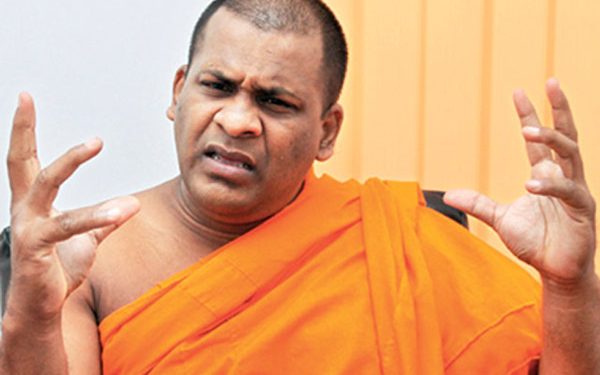
Gnanasara Thero is the Secretary General of the Bodu Bala Sena
It is a weekday afternoon at the Sadh Dharamhajika Viharaya in the Colombo suburb of Rajagiriya. Viharaya means monks’ living quarters, but these particular premises serve as offices of the Bodu Bala Sena (BBS) and its secretary general, Galagoda Aththe Gnanasara Thero. In the spacious garden, a group of youth are arranging chairs and tables, for a cooking demonstration by a young man who makes powders of grains and herbs. These are rural Sinhalese youth who have no one to support them,” says Dr Dilanthe Withanage, CEO of the BBS, who is an IT lecturer. We help them start their businesses and promote them the way we can.”
In finding solutions to the religious terrorism of today, Buddhism is the only answer. We want solutions to problems through discussions, not terrorism.
Interview/ Galagoda Aththe Gnanasara Thero, Secretary General, Bodu Bala Sena
There must be a parliament that does not undermine in various guises the country and the rights of the Sinhala majority.
He says that he had initially got together with Gnanasara Thero to help Sinhala businesses. But gradually, the BBS took on a different shape to counter many issues”, including the ‘halal controversy’, he says.
Sinhalese businesspersons were complaining about how they had to pay the halal certification committee-appointed member in Sri Lanka to ensure that the food being produced was halal,” he says. If they did not get the halal certificate, their products would be rejected from food markets. We checked with traditional Muslims of Sri Lanka and they informed us that all this was not needed because they knew how to differentiate between what was halal and what was not, and did not want unnecessary complications.”
Please understand,” he adds, we did not start BBS to create any trouble. Only to strive for the rights of the Sinhalese, who are a global minority. We are currently fighting to quell Wahhabi extremism.”
Excerpts from an exclusive interview with the controversial Gnanasara Thero:
Q/ What made you become a monk?
A/ I was born in 1975 in a hamlet called Galagodaaththa in Galle and was educated at the local village school up to grade six. Then, somewhat against my parents’ wishes, I entered priesthood. After the main training as a young monk, in 1989, I joined the Wanawasa Sanga branch of our village temple and trained in the forest tradition for monks. I also studied Pali and Sanskrit.
In 1996, I came to Colombo to continue my education at the University of Kelaniya. Around 1999, I started teaching at an education centre for Buddhist monks. In 2001, I became the principal there, and at the end of 2003 I resigned fully from teaching.
Q/ Why did you give up teaching?
A/ I wanted to dedicate myself to my country. By this time I had become involved in the anti-terrorism movement (against the Tamil Tigers). This was the time president Chandrika Kumaratunga planned to bring a federal solution to the Tamil ethnic issue. She could not proceed with this because of opposition by Buddhist monks.
In 2000, the political movement Sihala Urumaya was launched. I became its clergy representative, from the Kotte area. Though it could win one parliamentary seat, it had internal issues. Some of the monks in it then organised the Jathika Sangha Sammelanaya (JSS), which became a strong national movement. I was its assistant secretary. We carried out protests against unethical conversions by Christian evangelists, which was a serious problem 15 years ago. We did not have any issues with the Catholics or Anglicans or other mainstream churches as they do not carry out unethical conversions.
In 2004, the main members of the JSS formed the political party Jathika Hela Urumaya (JHU). Soon after, together with some monks and like-minded laity, I formed the BBS. Now the JSS is handled by the JHU monk Rathana Thero. I am not involved.
Q/ Are there fundamental differences between the JHU and the BBS?
A/ The JHU is now a political party. The BBS is not. It could be described as a national movement.
Q/ Did you have any non-Buddhist friends as a child or any non-Buddhist teachers?
A/ No. There was no opportunity for it as I grew up in a fully Buddhist village. There were no mosques or any Muslims around. There was a Catholic church, but I had no non-Buddhist friends as a child.
Q/ Among the Buddha’s teachings, what is the most important to you?
A/ The whole of the Buddha’s teachings is a living teaching. The Buddha said there is no sin more terrible than mythia drushtiya (mythical delusion). On April 21, in a place of worship one set of believers prayed to their God, another set killed them, again in the name of God, to please God. Nine suicide bombers carried out this barbaric act. All because they mythically believed this crime was what God wanted. Isn’t what the Buddha said correct?
In finding solutions to the religious terrorism of today, Buddhism is the only answer. We want solutions to problems through discussions, not terrorism. We are not the terrorists.
Q/ You often have said that Buddhism is threatened in Sri Lanka by the proliferation of religions such as Islam. There is the counterview that Buddhism is threatened only when Buddhists do not practise Buddhism as preached by the Buddha, as a science of the mind, self-control and compassion.
A/ Buddhist philosophy and Buddhist culture are two different things.
Q/ Of these two, which is more important?
A/ Both. Buddhist philosophy cannot be destroyed by anyone as it is a universal truth. However, Buddhist philosophy needs Buddhist culture to thrive. Forty generations or so ago, Buddhists lived in what are today Afghanistan and Pakistan. But in Afghanistan, the offspring of Buddhist ancestors who had become Muslim destroyed the Buddha’s statues their forefathers had sculpted. In those countries there were once Buddhist monks who stood for both Buddhist culture and Buddhist philosophy. But when Buddhist culture was vanquished with the invasion of Islam, Buddhist philosophy also died. Buddhist monks who were only focused on Buddhist philosophy died with their philosophy.
In India, the land of the Buddha, Buddhism has almost vanished. If Buddhism is to be protected, one has to protect its culture. Sri Lanka has through the ages protected Buddhism; both its philosophy and its culture. Therefore, as a Buddhist country we do many things such as sculpting Buddha statues, building temples, and organising Buddhist processions, in order to keep Buddhist culture alive.
Q/ The Buddhism in Sri Lanka today is largely based on the Buddhist revival movement carried out by the Dutch colonisers who wanted to quell the rise of Catholicism propagated by the Portuguese colonisers. It was revived again, during British occupation, by foreign Buddhist enthusiasts such as Henry Olcott, an American military officer who was the first president of the Theosophical Society.
A/ Yes, I agree. Our colonial history is a long and intriguing one where we were victims of divide and rule. In the Uva Wellassa area, there was a rebellion three years after we lost the country in 1815. We were crushed in the most brutal manner imaginable. Every tree, every herb, every fruit and every animal that served and protected us as a people was destroyed in an unprecedented human, cultural and environmental genocide. Following this, there were strong campaigns to portray Buddhism as a false philosophy and [to make] Buddhists believe in Christianity.
A Christian priest, D.J. Gogerly, carried out the Christianising of Lankan Buddhists through his writings. The Buddhist monk Migettuwatte Gunananda Thera then undertook a mission from 1848 to the 1870s to revive Buddhism. Under his leadership, a series of five debates was held all over Sri Lanka between Christians and Buddhists.
It is after the victory of the Buddhists in these debates that Henry Olcott and those such as Marie Musaeus Higgins came to Sri Lanka and embraced Buddhism and dedicated themselves to the Buddhist revival movement. Therefore, in the same way that we faced Christian indoctrination through debates, we must face the threat of Islamisation today in Sri Lanka.
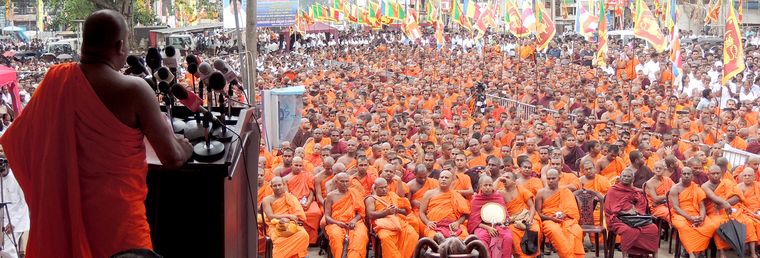
Q/ Is there actually such a threat? Some people accuse you of creating Islamophobia.
A/ Please note that I am not talking about the traditional Muslims of Sri Lanka. They have lived peacefully ever since their arrival as traders. They married Sinhalese women, whom they converted to Islam. They have followed their religion while respecting Buddhist customs and traditions of the land, and without carrying out the vicious agendas of the Wahhabi, Salafi, Tabliq, Deobandi, Ikhwan and Thawheed groups. For the past 40 years these groups have been growing strong with funding from Saudi Arabia. These groups systematically changed the face of Islam in Sri Lanka and started killing off the Sufis and moderate Muslims. In Kattankudy, in the eastern Batticaloa district, Sufis are insulted and killed. Everyone knows it. Is talking about it Islamophobia? Is what happened on April 21 not a result of this warped ideology of the Wahhabi mentality manifesting in action?
Q/ There are allegations that the April 21 bombings happened because the BBS antagonised the Muslims and drove them to join extreme elements such as Zahran Hashim, the ring leader of the Easter Sunday carnage. There are also assumptions that Zahran himself may have taken to terror because of incidents like the Aluthgama riots of 2014, for which you are largely blamed.
A/ Is that what is now being said? So now we are the culprits of IS (Islamic State) terror? (Laughs.)
Q/ Looking back at your public speech prior to the riots in Aluthgama, do you have any regrets about the words you used?
A/ I did not say go and create a riot. Stones were hurled at the monks and Buddhists by some Muslim youth in Aluthgama after we peacefully dispersed after my speech. It is actions like these that got the Sinhalese crowds angry.
I made that speech after one of our monks in a vehicle was attacked in Aluthgama by a few Muslim men. I did nothing more than warn against such behaviour.
Q/ There is the view among media analysts that because the BBS in 2014 portrayed this issue of Wahhabi/Salafi/Tabliq extremism as Muslim extremism, many writers and others who knew of the discovery of ammunition in some locations early this year were reluctant to write about it fearing that the BBS would create an anti-Muslim backlash.
A/ The media was preoccupied with chasing us and labelling us as extremists. We raised our voice in 2014 because we knew what was happening. Our monks faced aggression from Muslim extremists. In 2014, there was information that some local extremist Muslims had joined IS fighters in Syria. This was ignored. Now everything we have said has [happened]. Hundreds had been killed and still we are being blamed and called racists.
We have information on some Muslim activists in this country and have pictures of them with questionable global Muslim extremists. We had information of how false passports were used by Lankan Muslim youth to enter foreign countries and return to Sri Lanka with Christian names and from Sri Lanka to go to Saudi Arabia under Muslim names. I have with me a note that I prepared around 2014 for a press conference on the extremism of the National Thowheed Jama’ath and in particular about Zahran, who was the mastermind of the blasts. I then asked why this extremist was not arrested—he was openly propagating Wahhabism and IS ideology, destroying the cemeteries of Sufi saints and asking Muslims to be armed and kill non-Muslims.
Q/ Did you inform the authorities?
A/ We had by 2014 informed the highest-level personnel in governance.
Q/ You have come out strongly against the All Ceylon Jamiyyathul Ulama (ACJU), which is the top Islamic body of Sri Lankan Muslims. You have accused them of being carriers of the Wahhabi ideology.
A/ Over 90 per cent of the members of the ACJU hold the Wahhabi ideology. This is proven by the fact that they do not issue any message for the commemoration of the Prophet Muhammad’s birthday. The Wahhabis/Salafis and others who practise an extreme form of Islam do not commemorate the Prophet’s birthday. The traditional Muslims of Sri Lanka do. I have cited only one small example. There are hundreds of other examples. For instance, their fatwas against the Sufi Muslims of Sri Lanka.
Q/ In the Buddhist convention held in Kandy on July 7, you said your aim was a ‘Sinhala parliament’. Do you think this is practical and that Sri Lankans will support this?
A/ I did not say [we should not] have non-Sinhalese in the political structure. What I said was that there must be a parliament that does not undermine in various guises the country and the rights of the Sinhala majority.
We are lobbying for the local education system to be developed in a manner that does not propagate racism. We today have schools based on communal distinctions. This is the beginning of the problem.
Q/ It is said that you have got foreign funding.
A/ (Laughs) The only foreign funding we have comes from Sri Lankans living overseas. We do not touch one cent of money from any foreign entity.
Q/ After the blasts, there seems to be animosity towards all Muslims. The boycott on Muslim businesses is affecting them seriously.
A/ This is the sad result of Wahhabi terrorism. Ordinary people now suspect all Muslims.
Rights issue triggers UN ban on non-essential Lankan troops in UN keeping missions
September 25th, 2019Courtesy NewsIn.Asia
United Nations, September 25 (Foreign Policy): The UN peacekeeping department has decided to ban the deployment of non-essential Sri Lankan army troops in UN peacekeeping missions, citing the country’s appointment of an alleged war criminal to a top military post.
Lt. General Shavendra Silva was recently appointed chief of the Sri Lankan army, eliciting criticism from the UN, the United States, and the European Union.
Silva commanded Sri Lanka’s 58th division during the final stages of the country’s military campaign to crush the Tamil Tigers, a militant separatist movement known for pioneering suicide terror attacks.
The U.N. High Commissioner for the United Nations, Michelle Bachelet, announced last month that Silva’s appointment was deeply troubling” given the serious allegations of gross violations of international human rights and humanitarian law against him and his troops during the war.”
This week, a U.N. spokesperson confirmed to Foreign Policy that it would ban new Sri Lankan units from deploying in U.N. missions unless their presence is vital for ensuring the missions’ security.
There appeared to be no plan to repatriate the more than 650 Sri Lankan troops currently serving in U.N. missions, including in Mali, South Sudan, and Lebanon.
Farhan Haq, deputy spokesman for U.N. Secretary-General António Guterres, told Foreign Policy the U.N. is grateful” for Sri Lanka’s contribution of troops to six U.N. peacekeeping operations, but is troubled by Silva’s promotion.
We have expressed our concern to the Government of Sri Lanka over the appointment of Lieutenant General Shavendra Silva to the position of Commander of the Sri Lanka Army, despite well-documented, credible allegations of his involvement in serious violations of international humanitarian and human rights law,” Haq said.
In light of this appointment, the U.N. Department of Peace Operations is therefore suspending future Sri Lankan Army deployments except where suspension would expose U.N. operations to serious operational risk,” he said
එජාපය තවමත් කොන්දේසි සහ ගිවිසුම් මැද
September 25th, 2019උපුටා ගැන්ම හිරු පුවත්
එක්සත් ජාතික පක්ෂයේ ජනපති අපේක්ෂකයා ප්රකාශයට පත් කරන විශේෂ කෘත්යාධිකාරී මණ්ඩලය හෙට පස්වරු 3 ට සිරිකොත පක්ෂ මූලස්ථානයේදී රැස්වීමට නියමිතයි.
ඒ සඳහා සියලූ කටයුතු මේ වනවිටත් සූදානම් කර අවසන් බවයි පක්ෂයේ ජ්යෙෂ්ඨයන් සඳහන් කළේ.
එක්සත් ජාතික පක්ෂයේ ජනාධිපති අපේක්ෂකයා ලෙස නියෝජ්ය නායක අමාත්ය සජිත් ප්රේමදාස නම් කිරීමට පක්ෂ නායක අග්රාමාත්ය රනිල් වික්රමසිංහ එකඟත්වය පළ කර ඇති බවටයි මේ වනවිට වාර්තාවන්නේ.
කෙසේ වෙතත් ඒ සම්බන්ධයෙන් නිල දැනුම්දීමක් තමන් වෙත මෙතෙක් සිදුකර නොමැති බව අමාත්ය සජිත් ප්රේමදාස සඳහන් කළා.
මේ අතර සජිත් ප්රේමදාසට ජනාධිපතිවරණ අපේක්ෂකත්වය ලබාදීමට පක්ෂ නායක අග්රාමාත්ය රනිල් වික්රමසිංහ කොන්දේසි කිහිපයක් පනවා ඇති බවට මාධ්ය වාර්තා අනාවරණ කරනවා.
විධායක ජනාධිපති ධුරය මාස 6 ක් ඇතුළත අහෝසි කිරීම, පක්ෂ නායකත්වයේ වෙනසක් සිදු නොකිරීම සහ ඉදිරි මහ මැතිවරණයකදී අග්රාමාත්ය ධුරය රනිල් වික්රමසිංහ හට ලබාදීම එම කොන්දේසි අතර වන බවටයි වාර්තාවන්නේ.
මෙම ඉදිරිපත් කර ඇති කොන්දේසි සම්බන්ධයෙන් අද පැවති මාධ්ය හමු කිහිපයකදීද අදහස් පළ වුණා.
මේ අතර එක්සත් ජාතික පක්ෂ නියෝජ්ය නායක අමාත්ය සජිත් ප්රේමදාස සහ එක්සත් ජාතික පෙරමුණේ පක්ෂ නායකයින් අතර විශේෂ සාකච්ඡාවක් අද මුදල් අමාත්යාංශයේදී පැවැත්වුණා.
පැය දෙකකට ආසන්න කාලයක් පැවති එම සාකච්ඡාවෙන් අනතුරුව අමාත්ය සජිත් ප්රේමදාස තවත් සාකච්ඡාවක් සඳහා අරලියගහ මන්දිරය වෙත පැමිණියා.
එහිදීද අග්රාමාත්ය රනිල් වික්රමසිංහ අතර හමුවක් සිදුවූ බවටයි වාර්තාවන්නේ.
එමෙන්ම තමන් හා එක්වන ලෙස සජිත් ප්රේමදාස එක්සත් ජාතික පක්ෂයේ හිටපු මහ ලේකම් තිස්ස අත්තනායකට සිදුකළ ඉල්ලීම ඔහු විසින් පිළිගෙන තිබෙනවා.
නිවේදනයක් නිකුත් කරමින් හිටපු මහ ලේකම්වරයා සඳහන් කළේ නියෝජ්ය නායක අමාත්ය සජිත් ප්රේමදාස හා එක්ව පක්ෂයෙන් ඈත්වූ ජයග්රහණය යළි ලබාදීමට කැපවීමෙන් කටයුතු කරන බවයි.
කෙසේ වෙතත් විකල්ප කණ්ඩායමක් ලෙස පෙනී සිටින දේශප්රේමී එක්සත් ජාතික පක්ෂය අද ප්රවෘත්ති සාකච්ඡාවක් කැඳවා පක්ෂයේ පවතින අර්බුදය සම්බන්ධයෙන් අදහස් පළ කර සිටියා.
මේ අතර ජාතික නිවාස සංවර්ධන අධිකාරිය සුරැකීමේ සංවිධානය අද මැතිවරණ කොමිසන් සභාවට පැමිණිල්ලක් ඉදිරිපත් කළේ විෂයභාර අමාත්ය සජිත් ප්රේමදාස විසින් මැතිවරණ නීති උල්ලංඝනය කරමින් සේවක පත්වීම් ලබාදීමේ උත්සාහයක නිරතවන බවට කරුණු දක්වමින්.
උතුරු පළාත් ආණ්ඩුකාරවරයාට සැකයක්
September 25th, 2019උපුටා ගැන්ම හිරු පුවත්
මුලතිව් නයාරු ගුරුකන්ද රජමහා විහාරාධිපති නාහිමියන්ගේ දේහය අධිකරණ නියෝග නොතකමින් එම විහාර භූමියේම ආදාහනය කිරීම සම්බන්ධයෙන් උතුරු පළාත් ආණ්ඩුකාර ආචාර්ය සුරේන් රාගවන් මහතා අද කොළඹදී ප්රවෘත්ති සාකච්ඡාවක් කැඳවමින් අදහස් පළ කළා.
කිසිදු කොන්දේසියකට යටත් නොවන බව ඇමති සජිත් කියයි
September 25th, 2019උපුටා ගැන්ම හිරු පුවත්
තමන් කිසිදු කොන්දේසියකට යටත්ව ජනාධිපතිවරණ අපේක්ෂකත්වය ලබා නොගන්නා බව එක්සත් ජාතික පක්ෂයේ නියෝජ නායක අමාත්ය සජිත් ප්රේමදාස පවසනවා.
මතුගම මහජන ක්රීඩාංගණයේ අද පස්වරුවේ පැවති ජන රැළියකට එක්වෙමින් ඔහු මේ බව සඳහන් කළා.
නීතිය ක්රියාත්මක කරන ආයතනවලට මාගල්කන්දේ සුදත්ත හිමියන්ගෙන් චෝදනාවක්
September 25th, 2019උපුටා ගැන්ම හිරු පුවත්
රටේ නීතිය ක්රියාත්මක කරන සෑම ආයතනයක්ම දෙයාකාරව නීතිය ක්රියාත්මක කරන බවට නව සිංහල රාවය සංවිධානයේ මහලේකම් පූජ්ය මාගල්කන්දේ සුදත්ත හිමියන් චෝදනා කරනවා.
උන්වහන්සේ මේ අදහස් පළකළේ අපරාධ පරීක්ෂණ දෙපාර්තමේන්තුවට ප්රකාශයක් ලබාදීම සඳහා පැමිණි අවස්ථාවේදි.
මේ අතර කොළඹ පැවති ප්රවෘත්ති සාකච්ඡාවකට එක්වෙමින් රාවණා බලය සංවිධානයේ කැඳවුම්කරු පූජ්ය ඉත්තෑකන්දේ සද්ධාතිස්ස හිමියන් අල්ලස් කොමිසමේ හිටපු අධ්යක්ෂ ජනරාල් දිල්රුක්ෂි ඩයස් වික්රමසිංහ මහත්මියගේ දුරකථන හඬපට පිළිබඳව අදහස් පළකළා.
ආබාධිත රණවිරුවන්ට විපක්ෂ නායකගෙන් පොරොන්දුවක්
September 25th, 2019උපුටා ගැන්ම හිරු පුවත්
තම පාලනයක් යටතේ ආබාධිත රණවිරු ගැටළුවට ස්ථිර විසඳුමක් ලබාදෙන බව විපක්ෂ නායක මහින්ද රාජපක්ෂ මහතා පවසනවා.
අද කොළඹ පැවති සම්මේලනයකට සහභාගී වෙමින් විපක්ෂ නායකවරයා මේ අදහස් පළ කළා.
රණවිරු පවුල් සාමාජික සාමාජිකාවන්ගේ අනු සංවිධාන ජාතික සම්මේලනයද පැවැත්වුනේ, ගෝඨාභය රාජපක්ෂ සහ මහින්ද රාජපක්ෂ යන මහත්වරුන්ගේ ප්රධානත්වයෙන්.
මෙහිදී පරම වීර විභූෂණ සම්මානයෙන් පිදුම් ලැබූ රණවිරුවන් තිදෙනෙකුගේ පවුල් වෙනුවෙන් උපාහාර දැක්වීමද සිදුකෙරුණා.