India-China-Sri Lanka Triangle: The Defense Dimension

July 12th, 2019

By Shantanu Roy-Chaudhury Courtesy The Diplomat

With increasing Indo-Chinese competition in the Indian Ocean, their respective military relationships with Sri Lanka play an important part in this maritime great game. This article will examine this relationship from an Indian perspective, looking at the current scenario and what this means for the future geopolitical scenario in the region.

China has been the largest supplier of arms to Sri Lanka since the 1950s. These transactions have included small arms, ammunition, landmines, naval vessels, and aircraft. China and Sri Lanka’s defense and security cooperation intensified during the Sri Lankan civil war, where China’s support came in several forms. In 2007, then-President Mahinda Rajapaksa’s visit to China led to a $37.6 million deal to purchase Chinese Jian-7 fighter jets, anti-aircraft guns, JY-11 3D air surveillance radar, armoured personnel carriers, and other weaponry.
India-China-Sri Lanka Triangle: The Defense Dimension

In the more recent past, high-level visits between Chinese and Sri Lankan military officials have also furthered ties. In 2012 during the Chinese defense minister’s visit to Sri Lanka, a grant of a $100 million was given for the construction of army camps. China has also provided military training to Sri Lankan officers. Last year, a senior colonel at the Chinese Embassy in Colombo stated that China wishes to boost the development of the Belt and Road Initiative to strengthen the pragmatic cooperation between the two countries and the two militaries.”Enjoying this article? Click here to subscribe for full access. Just $5 a month.

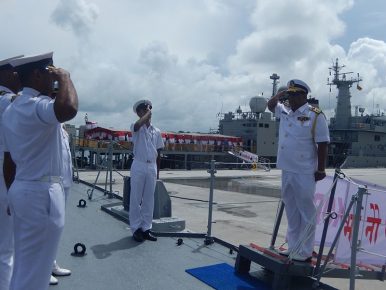
From an Indian perspective, the growing transfer of arms and cooperation between China and Sri Lanka is a cause for concern. Such concerns became a reality in 2014 when Sri Lanka allowed two Chinese submarines and a warship to dock at its port in Colombo. This rang alarm bells — while China’s counterpiracy contingents have been a regular presence in the Indian Ocean region for over a decade, sightings of Chinese submarines in the region were until recently a relatively uncommon occurrence. Although India did not protest aggressively, this was seen as a major breach of trust between New Delhi and Colombo and also heightened tensions with Beijing.

Although this does not imply that Chinese submarine deployments are provocative in nature, they do cause anxiety and can be viewed as diminishing India’s naval superiority in the region. The frequency of Chinese visits has become a concern, along with speculation that an aircraft maintenance facility could be built by the Chinese in the eastern port city of Trincomalee, which India considers a strategic location in terms of national security. This has also led to a greater security dilemma between the two countries, pushing India to strengthen its position in the Indian Ocean as further explained below. The prospect of Chinese arms being used against India is yet another factor that tests India’s relationship not only with Sri Lanka but also with China in the Indian Ocean, where the battle for influence between two of Asia’s most powerful countries is taking place.

India has not been left in the dust when it comes to Sri Lankan security cooperation, however. For the first two decades after independence, Sri Lankan military officers trained in Indian military academies, and in 1971, India helped Sri Lanka put down a countrywide rebellion when the government asked for external assistance.

Although India was politically constrained from selling offensive weapons to Sri Lanka, it facilitated arms deals, sold defensive weapons, and provided critical naval and intelligence support to help Sri Lanka target the Liberation Tigers of Tamil Eelam.

More recently, New Delhi has particularly provided support in the maritime realm. Last year, the Indian Coast Guard gifted an offshore patrol vessel (OPV) to the Sri Lankan Coast Guard for training and surveillance purposes. The Indian Coast Guard also handed over two OPVs to Sri Lanka in 2006 and 2008. Prior to handing over the OPVs to Sri Lanka, training was imparted by the Indian Coast Guard on ship handling, bridge navigation, and engine room controls.

Sri Lanka ordered two advanced offshore patrol vessels (AOPVs) from India in 2014 for $74 million each, the country’s first-ever purchase of a new AOPV from a foreign builder. Custom-made for the Sri Lankan Navy by Goa Shipyard Limited, the vessels were commissioned in 2017 and 2018, resistively, becoming the largest vessel of its kind to be acquired by the [Sri Lankan] Navy.” India providing these ships to Sri Lanka can be perceived as strengthening Sri Lanka’s maritime security, which is in India’s own national security interest.

India has also held numerous joint military exercises with Sri Lanka, grouped under three different types. The Mitra Shakti” bilateral exercises, conducted between the two armies, started in 2013. The 2017 exercise focused on counterinsurgency and counterterrorism operations, with an emphasis on increasing the use of modern communication, reconnaissance and weapon technologies.

SLINEX” is a series of naval exercises between the two navies. First conducted in 2005, these exercises help the two navies understand each other’s procedures. The goal is to enable the navies of both countries to rehearse and improve their own capabilities and enhance operational effectiveness, which is imperative for maintaining maritime security in the region. The 2017 edition of SLINEX, held near Vishakhapatnam, focused on anti-piracy, fleet work, seamanship, communication, and helicopter operations. SLINEX 2018 took place in Trincomalee, Sri Lanka and saw a significant boost in its scope, with the Sri Lankan Air Force participating for the first time.

The third joint exercise, called Dosti,” is a trilateral coast guard exercise that includes the Maldives. Originally started in 1991 between India and the Maldives, it expanded in 2012 to include Sri Lanka and is aimed at achieving interoperability. Due to the geostrategic importance of the area, it is important for the coast guards of the three countries to establish the safety and security of the Indian Ocean region. Apart from these, India and Sri Lanka have also participated in larger joint military drills with other countries.

India has also successfully imparted training to the Sri Lankan military across the three branches of the armed forces for years. Although there has occasionally been opposition to such ties from India’s Tamil Nadu, Sri Lanka has asserted that it is committed to training its defense personnel in India and prioritized India over sending officers to other countries. Between 2011 and 2013, almost 1,700 Sri Lankan officers trained in India, and around 80 percent of Sri Lankan naval officers received training from India.

In 2012, an agreement between the Indian and Sri Lankan prime ministers led to the inauguration of the Annual Defense Dialogue between the two countries. This dialogue, attended by high ranking officials, evaluates a range of defense cooperation initiatives, including maritime security, to further bilateral defense ties.

Thus, through these various confidence-building measures, the Indian military currently enjoys a level of cooperation with Sri Lanka that China most likely never will.

Therefore, India is still an important player with reference to Sri Lanka’s defense and security and in the recent past has significantly stepped up its defense cooperation with Colombo. Although China is increasing its defense ties with Sri Lanka mainly through military sales at the moment, Beijing could potentially strengthen ties further if the Sri Lankan Navy’s Southern Command base is indeed shifted to the Chinese-run Hambantota port. However, the prime minister’s office has stated that China will not use the facility for military purposes.

India on the other hand, although with limited military sales and exports, is still the top training destination for Sri Lankan officers. Furthermore, ties between the two militaries remain strong and continue to grow through annual joint military exercises covering all three services. With government assurance that Sri Lankan soil will not be used by anyone against India, it is imperative that the government in New Delhi continues to foster this relationship.

Looking at the situation from the Sri Lankan perspective, Colombo needs to tread carefully on how it manages its defense relations. Growing too close to China could create problems with India while leaning too much in favor of India could affect Chinese military sales to the country and other aspects of their bilateral relationship. For Colombo, it is therefore imperative to try and maximize its own gains while not antagonizing either of the large powers.

Shantanu Roy-Chaudhury is a recent graduate of the University of Oxford, St. Antony’s College who specialises in international relations of South Asia.
Saudi Embassy refutes allegations of providing loans for Lankan Muslims

July 12th, 2019

Courtesy  Saudi Gazette

COLOMBO — The Kingdom’s embassy in Colombo has refuted allegations that Saudi Arabia is providing loans for Muslims through some local banks at the interest rate of 1 percent.

The Embassy of Saudi Arabia referred to a statement made by former Western Province Governor Dr. Hemakumara Nanayakkara on June 13 in their media release refuting the allegations.

The embassy has asserted that the soft loans provided by Saudi Arabia for the development projects in Sri Lanka are intended to be contributions to provide a quality life for the friendly people of Sri Lanka.”

The list of projects financed by the government of Saudi Arabia in Sri Lanka, as revealed by the Embassy of Saudi Arabia, is as follows:

• Colombo Water Supply and Sewerage, $26.64m

• Electric Power Transmission, $12.83m

• Mahaweli Ganga Downstream Development System “B” Left Bank, $22.66m

• Medical Services Development in Colombo, $14.93m

• Batticaloa-Tricomalee Road Development, $10.66m

• Epilepsy Hospital and Health Center, $32 Million

• Kaluganga Development, $46m

• Road Network Development, $60m

• Improvement of Peradeniya-Badulla Chenkaladi Road, $60m

• Development of Left Bank of Kaluganga, $45m

• Development of Wayamba University, $28m

• Medical Faculty of Sabragamuwa University, $50m

The total: $408.72 m

How a British law against modern slavery is leading to moral policing in Sri Lanka

July 12th, 2019

Courtesy Scroll.In

Article 54 of the Modern Slavery Act has made factory managers in developing countries paranoid about aiding or abetting sexual slavery.

How a British law against modern slavery is leading to moral policing in Sri Lanka

The Modern Slavery Act was seen as a big achievement for combating the issue of forced labour. But since it was passed by the UK government in 2015, many have pointed out its shortcomings. In particular, how the legislation helps cover up serious forced labour issues, all the while making citizens who are concerned about the problem feel better.

Less well known is how Article 54 of the act, which assigns British companies the responsibility to clean up their global supply chains, hurts factory workers in developing countries. I’ve witnessed how British companies outsource this responsibility to local factory managers in Sri Lanka.

These local managers feel tremendous pressure to monitor their workforce, even beyond the shop floor, for fear of losing their contracts. And this leads to an excessive amount of surveillance, with devastating consequences for factory workers, most of whom are female.

The Modern Slavery Act was passed after years of pressure from anti-trafficking organisations, which promoted global laws that hold all commercial actors jointly accountable for forced labour. Article 54 of the act requires UK companies to prepare slavery and human trafficking statements that account for their supply chains. Besides protecting vulnerable workers, these statements are also geared toward enhancing their reputations and improving investor confidence.

But by recommending universal policies, the Modern Slavery Act fails to take into account how local suppliers around the world respond to it, even though the law effectively transfers to them the responsibility to keep the workforce free from modern slavery. It has led to a climate of suspicion and fear that exacerbates the already difficult lives of their workforce.

I spent two summers speaking about the Modern Slavery Act to female factory workers in Sri Lanka’s free trade zones, which are industrial areas with a number of garment factories that supply many foreign companies. I found there is intense pressure on local managers to clean up their assembly lines in such a way that the Western companies which hire them could not be accused of modern slavery. The pressure to appear clean results in an unhealthy working environment.

It also limits women’s freedom in a number of ways. For instance, a number of women I spoke to engaged in part-time sex work to make extra money outside of their factory jobs. This work was of their own choosing – and very different from the sexual trafficking or exploitation that the Modern Slavery Act is also designed to stop. But local managers feared it would be seen by Western auditors as exploitation and threaten their contracts. As one factory manager told me, If we do not fire part-time sex workers, our factories can get blacklisted and our orders will be cancelled.”

Surveillance and suspicion

Some international companies also have whistleblower policies which put the onus on workers to report any concerns they have about colleagues being exploited. It’s meant to be for their protection but increases the environment of suspicion and surveillance in factories.

While there is nothing in the Modern Slavery Act that says workers must behave a certain way outside the factory premises, managers are consumed with anxiety over being accused of aiding and abetting sexual slavery.

Many factory workers told me how factory compliance officers asked them to stop doing any part-time work, including sex work, as soon as possible. They were also told to report on colleagues.

One worker speculated that the sudden firing of a colleague had something to do with the new policies that came into place after the Modern Slavery Act. While nobody had actually accused her of sex work, there were rumours that she engaged in casual sex with various boyfriends. Considering the cultural context of Sri Lanka, where this behaviour is heavily frowned upon and even equated with prostitution at times, it can be seen as the misapplication of the Modern Slavery Act at the local level, resulting in an even more stressful work culture.

It’s not the first instance where international attempts to stop human trafficking has complicated things for the local workforce. In Congo, the efforts to halt child labour associated with cobalt mining led to thousands of legitimate adult jobs being lost and much socioeconomic upheaval due to blanket policies being put in place, which pay little attention to local issues at play.

Precarious pay

The workers I spoke to who engage in part-time sex work told me that they do so because their factory pay is not enough. Many women are hoping to earn enough to buy a small plot of land to achieve financial independence.

So a better remedy to stop women from sex work might be to pay them a meaningful living wage. Instead, the Modern Slavery Act’s emphasis on clean supply chains is making women’s livelihoods more precarious. Perhaps if the act emphasised better pay for workers in global supply chains the outcome might be different. But the bottom line is, it must encourage better engagement with the local workforce.

The act was imposed in Sri Lanka without consulting global factory workers and now threatens a space that previously allowed women a path to economic empowerment. The conflation of sex trafficking with sex work assumes the majority of women in developing countries are victims that lack their own agency. But, for many of the women I spoke to, sex work was their own choice.

More disturbingly, intentionally or not, Article 54 makes global factory managers responsible for the leisure activities of their workers and, by extension, their moral conduct. Rather than requiring UK companies to ensure a living wage and help the education and economic empowerment of their supply chain workforce, the Modern Slavery Act punishes them.

Sandya Hewamanne is a senior lecturer in sociology at the University of Essex.

This story first appeared on The Conversation.

Epidemiological and statistical study – On allegations against Dr. Shafi

July 12th, 2019

Courtesy The Daily Mirror

The opposition yesterday urged the government to conduct an epidemiological and statistical study into the allegations against Obstetrician and Gynecologist Dr. Shafi Shiabdeen of the Kurunegala Teaching Hospital without trying to sweep the allegations under the carpet.

UPFA MP Ramesh Pathirana told parliament that it was the responsibility of the health ministry to conduct an epidemiological and statistical study and find out the truth behind the allegations.

He said more than 1,000 complaints had been received of secondary sub-fertility after 4,732 C-section operations carried out by Dr. Shafi and added that it was an important incident when compared with the global situation.

Secondary sub-fertility after C-section operations is 10 per cent in the world. 1,000 incidents of secondary sub-fertility out of 4,732 caesarean sections amount to 25 per cent. This should be reported as a statistically significant finding,” he said.

The MP urged the health ministry to conduct a scientific investigation and reveal the truth to the public. 

ජනතා මුදලින් නඩත්තු වන සී.අයි.ඞී.ය පෙනී ඉන්නේ ෂාෆි වෙනුවෙන් – රතන හිමියෝ කියති

July 12th, 2019

රටේ ජනතාවගේ මුදලින් නඩත්තු වන අපරාධ පරීක්ෂණ දෙපාර්තමේන්තුවේ ඇතැම් නිලධාරීන් පෙනී සිටින්නේ ෂාෆි ෂෙහාබ්ඞීන් වෛද්‍යවරයා වෙනුවෙන් බවත් ඔහුට විරුද්ධ ප‍්‍රමාණවත් සාක්ෂි තිබියදීත් මෙම සිදුවීම යටපත් කර ෂාෆි වෛද්‍යවරයා නිදොස් කිරීමට සී.අයි.ඞී.ය උත්සාහ ගන්නා බවත් ඊට කිසිසේත් ඉඩ නොදෙන බවත් පාර්ලිමේන්තු මන්තී‍්‍ර අතුුරලියේ රතන හිමියෝ ප‍්‍රකාශ කළහ.

‘‘අපරාධකරුවා වෙනුවෙන් පෙනී සිටින අපරාධ පරීක්ෂණ දෙපාර්තමේන්තුව අපරාධකරුවා නිසා වින්දිත භාවයට පත් මවුවරුන් වෙනුවෙන් පෙනී සිටින්නේ නෑ’’ යැයි උන්වහන්සේ චෝදනා කළහ.

කුරුණෑගල ශික්ෂණ රෝහලේ වෛද්‍ය ෂාෆි ෂෙහාබ්ඞීන්ට එරෙහිව පැවැත්වෙන නඩු විභාගය ඊයේ (11දා* කුරුණෑගල අධිකරණයේදී ආරම්භ වූ අතර ෂාෆි වෛද්‍යවරයාගෙන් සිසේරියන් සැත්කම් සිදුකරගත් මවුවරුන් පිරිසක් ඊයේ (11* දින අධිකරණ පරිශ‍්‍රය වෙත පැමිණ සිටි අතර ඔවුන්ගේ පා ගමනට එක්වූ රතන හිමියෝ එහිදී මේ බව සඳහන් කළහ.

එහිදී මාධ්‍ය වෙත අදහස් දක්වූ අතුරලියේ රතන හිමියෝ වැඩිදුරටත් මෙසේද කියා සිටියහ.

ෂාෆි ෂෙහාබ්ඞීන් වෛද්‍යවරයා සහරාන්ට වඩා දරුණු අපරාධකාරයෙක්. නමුත් එ් පිළිබඳව ජනාධිපතිවරයා හෝ අගමැතිවරයා සාධාරණ මැදිහත්වීමක් සිදු කරලා නැහැ. අපි මේ සටන ගෙන යන්නේ මුස්ලිම් අයට විරුද්ධව නෙවෙයි. හැබැයි අල්ලා දෙවියන් නමින් මිත්‍යාදෘෂ්ටික මතයක් හදාගෙන මුස්ලිම් අය විතරයි සිටිය යුත්තේ අනික් ජාතීන් වඳ කළ යුතුයි කියන මතයේ පිරිසක් සිටන බව අප යථාර්ථය ලෙස පිළිගත යුතුයි. අද මම කනගාටු වෙනවා මේ ආණ්ඩුවට මේ ප‍්‍රශ්නය නිසා දේශපාලනික බයක් ඇති වී තිබීම පිළිබඳව.

සැකකාර ෂාෆි වෛද්‍යවරයාගේ දේපළ මිලදී ගැනීම් ගැන සී.අයි.ඞී.යේ පරීක්‍ෂණ ගැටලූ සහගතයි -!-කුරුණෑගල මහෙස්ත‍්‍රාත් සම්පත් හේවාවසම්

July 12th, 2019

උපුටා ගැන්ම දිවයින

අපරාධ පරීක්‍ෂණ දෙපාර්තමේන්තුව ෂාෆි වෛද්‍යවරයාගේ සිසේරියන් සැත්කම් ගැන කිසිදු විමර්ශනයක් සිදුකර නෑ – අගතියට පත් පාර්ශ්වයේ ජනාධිපති නීතිඥ මොහාන් විජේනායක

සී.අයි.ඞී.ය විමර්ශන සිදුකර ඇත්තේ සැකකරු නිදහස් කිරීමේ අරමුණින් – ජනාධිපති නීතිඥ යූ. ආර්. ද සිල්වා 

සැකකරු සිදුකර ඇත්තේ මිනිස් සංහතියටම වරදක් – නීතිඥ කල්‍යානන්ද තිරාණගම

අයථා මුදල් ඉපයීම සම්බන්ධයෙන් සාධාරණ සාක්‍ෂි ඉදිරිපත් වී නෑ –  නියෝජ්‍ය සොලිසිටර් ජනරාල් තුසිත් මුදලිගේ 


ඒ. ජේ. ඒ. අබේනායක, කුරුණෑගල – ඩබ්ලිව්. බණ්ඩාර

කුරුණෑගල රෝහලේ සිදුකළ සිසේරියන් සැත්කම්වලදී මවුවරුන් වඳ භාවයට පත්කිරීම ඇතුළු චෝදනා එල්ලවන වෛi මොහොමඞ් ෂාෆි සැකකරුගේ දේපළ මිලදී ගැනීම් පිළිබඳව අපරාධ පරීක්‍ෂණ දෙපාර්තමේන්තුවේ විමර්ශන කරුණු සම්බන්ධයෙන් තම අධිකරණයේද ගැටලූවක් පවතින බව කුරුණෑගල මහෙස්ත‍්‍රාත් සම්පත් හේවාවසම් මහතා ඊයේ (11 දා* අවධාරණය කළේය.

සැකකාර වෛiවරයාට එරෙහි පැමිණිල්ල විභාගයට ගනු ලැබූ අවස්ථාවේදී අගතියට පත් මවුවරුන් වෙනුවෙන් පෙනී සිටි නීතිඥවරුන් දක්වා සිටි කරුණු කෙරෙහි සැලකිලිමත් වෙමින් මහෙස්ත‍්‍රාත්වරයා එසේ අවධාරණය කළේය.


පසුගිය වසර 13 ක කාලය තුළදී පමණක් කුරුණෑගල ශික්‍ෂණ රෝහලෙන් සිසේරියන් සැත්කම් 33,000 ක් සිදුකර ඇතැයි අගතියට පත් පාර්ශ්වය වෙනුවෙන් පෙනී සිටි ජනාධිපති නීතිඥ මොහාන් විජේකෝන් මහතා ඊයේ (11 දා* කුරුණෑගල මහෙස්ත‍්‍රාත් සම්පත් හේවාවසම් මහතා ඉදිරියේ කියා සිටියේය.

පසුගිය වසර 08 ක කාලය තුළදී පමණක් ඉන් සැත්කම් 17,600 ක් ම සිදුකර ඇති බව ද කී නීතිඥවරයා එකී ප‍්‍රමාණයෙන් හතරෙන් එකක් සිදුකර ඇත්තේ සැකකාර මොහොමඞ් ෂාෆි බව ද පෙන්වා දුන්නේය.
වෛi ෂාෆි මසකට සැත්කම් 45 ක් පමණ සිදු කරන විට ඔහු සමග සේවය කරන සෙසු වෛiවරුන් 19 දෙනාම සිදුකර ඇත්තේ එකී සමස්ත ප‍්‍රමාණයෙන් අටයි දශම තුනක ප‍්‍රමාණයක් වුවත් විමර්ශනය සිදුකරන අපරාධ පරීක්‍ෂණ දෙපාර්තමේන්තුව ඒ සම්බන්ධයෙන් කිසිදු විමර්ශනයක් සිදුකර නැති බව ද හෙතෙම පෙන්වා දුන්නේය.

දිවයින පුවත්පත මගින් එම ව්‍යසනය හෙළි කළ පසු සැකකාර ෂාෆි විසින් සැත්කම් කළ මවුවරුන් ඒ සම්බන්ධයෙන් උනන්දු වී තොරතුරු සෙවීම ආරම්භ කළ බවත් එහිදී පෙන්වා දුන් ජනාධිපති නීතිඥවරයා සැකකාර ෂාෆි වෛiවරයා ඉතාම සූක්‍ෂම ආකාරයෙන් දීර්ඝ කාලයක් තිස්සේ සිංහල මවුවරුන්ට සිසේරියන් සැත්කම් කළ බවට සාක්‍ෂි ඇති බවත්, එකී සැත්කම් සිදුකිරීමේදී පැලෝපීය නාළය තත්පර පහක් දහයක් අතර කාලයක් තදකර සිටීම මගින් එම නාළ විනාශ කිරීමේ හැකියාව පවතින බව ද පෙන්වා දුන්නේය.

ෂාෆි වෛiවරයාට එරෙහිව අපරාධ පරීක්‍ෂණ දෙපාර්තමේන්තුව විමර්ශන සිදුකරන පරීක්‍ෂණ සම්බන්ධයෙන් අගතියට පත් පාර්ශ්ව කිසිදු සෑහීමකට පත් නොවන බවත්, එකී විමර්ශන සම්බන්ධයෙන් කිසිදු ආකාරයකින් විශ්වාස නොකරන බවත් එහිදී පෙන්වා දුන් ජනාධිපති නීතිඥවරයා සැකකරු ඇප මත මුදා හැරීමෙන් දේශපාලන හා මුදල් බලය ඇති මොහුට සාක්‍ෂිකරුවන්ට බලපෑම් කිරීමේ හැකියාව ඇති බවත් පෙන්වා දුන්නේය.
සැකකරු සිදුකර ඇති එකී ජන සංහාරය සඳහා ඔහුට විදේශ රටවලින් මුදල් ලැබී ඇති බවට තොරතුරු ලැබී ඇති බවද මුදල් විශුද්ධිකරණ පනත යටතේ නොව, ත‍්‍රස්තවාදය වැළැක්වීමේ පනත යටතේ ඔහුට විරුද්ධව පරීක්‍ෂණ සිදුකළ හැකි බව ද පෙන්වා දුන්නේය.

මෙහිදී අගතියට පත් පාර්ශ්වය වෙනුවෙන් පෙනී සිට ජනාධිපති නීතිඥ යූ. ආර්. ද සිල්වා මහතා කරුණු දක්වමින් සැකකාර ෂාෆි මුදල් උපයාගත් ආකාරය පිළිබඳ විමර්ශන සිදුකරනු වෙනුවට අපරාධ පරීක්‍ෂණ දෙපාර්තමේන්තුවේ සමූහ මංකොල්ල විමර්ශන අංශය ඒ සම්බන්ධයෙන් විමර්ශනය කිරීම සමූහ ලෙස වළක්වා ඇති බව ද පෙන්වා දුන්නේය.

අපරාධ පරීක්‍ෂණ දෙපාර්තමේන්තුව විමර්ශන සිදුකර ඇත්තේ ත‍්‍රස්තවාදය වැළැක්වීමේ පනත මඟහැර සැකකරු නිදහස් කිරීමේ අරමුණින් බව පෙන්වා දුන් ජනාධිපති නීතිඥ යූ. ආර්. ද සිල්වා මහතා අධිකරණය අපරාධ පරීක්‍ෂණ දෙපාර්තමේන්තුවෙන් අපේක්‍ෂා කළේ එකී දියාරු විමර්ශන ප‍්‍රතිපත්තියක් නොවන බව ද පෙන්වා දුන්නේය.


එහිදී අගතියට පත් පාර්ශ්වය වෙනුවෙන් පෙනී සිටි නීතිඥ ඉන්‍ද්‍රසිරි සේනාරත්න මහතා අධිකරණයට පෙන්වා දුන්නේ සැකකරුට එරෙහිව ලැබුණු බුද්ධි තොරතුරු අනුව විමර්ශනය කිරීමට ගිය අපරාධ පරීක්‍ෂණ දෙපාර්තමේන්තුවේ නිලධාරීන් කුරුණෑගල කොට්ඨාස භාරව සිටි නියෝජ්‍ය පොලිස්පතිවරයාගෙන් ප‍්‍රශ්න කොට ඇත්තේ සැකකරුට එල්ල වූ චෝදනා සම්බන්ධයෙන් නොව ඔහු මාධ්‍යයට ලබා දුන් පිළිතුරු සම්බන්ධයෙන් යැයිද කියා සිටියේය.

කුරුණෑගල නියෝජ්‍ය පොලිස්පතිවරයාගේ නියෝග අනුව ෂාෆි වෛද්‍යවරයාට එරෙහිව විමර්ශන සිදුකළ කුරුණෑගල කොට්ඨාස භාර ජ්‍යෙෂ්ඨ පොලිස් අධිකාරිවරයා භාරයේ තිබූ විමර්ශන ගොනු අපරාධ පරීක්‍ෂණ භාරයට ගැනීම පිළිබඳ බලවත් සැකයක් මතුවන බවත් ඒ සම්බන්ධයෙන් ජ්‍යෙෂ්ඨ පොලිස් අධිකාරිවරයා ලබාදුන් ප‍්‍රකාශ අධිකරණයට ඉදිරිපත් නොකිරීම ගැටලූ සහගත බව ද සේනාරත්න මහතා පෙන්වා දුන්නේය.
නඩුව ඊයේ දින කැඳවූ අවස්ථාවේදී අපරාධ පරීක්‍ෂණ දෙපාර්තමේන්තු නිලධාරීන් විසින් සැකකාර ෂාෆි වෛiවරයා අධිකරණයට ඉදිරිපත් කරනු ලැබීය. ඔහුට එරෙහිව ත‍්‍රස්තවාදය වැළැක්වීමේ පනත යටතේ 
ගැනෙන චෝදනා සනාථ කිරීමට ප‍්‍රමාණවත් සාක්‍ෂි ඉදිරිපත් නොවූ බැවින් ඒ සම්බන්ධයෙන් ආරක්‍ෂක අමාත්‍යවරයාව දැනුවත් කළ බවත්, ඒ අනුව ආරක්‍ෂක අමාත්‍යවරයා විසින් ඔහුට එරෙහිව නිකුත් කර තිබූ දින 90 ක රැුඳවුම් නියෝග පෙරේදා අවසන් කළ බවත් නීතිපති දෙපාර්තමේන්තුව වෙනුවෙන් පෙනී සිටි නියෝජ්‍ය සොලිසිටර් ජනරාල් තුසිත් මුදලිගේ මහතා අධිකරණයට පෙන්වා දුන්නේය.

වෛi මොහොමඞ් ෂාෆි විසින් කුරුණෑගල රෝහලේ සිදුකරන ලද සැක සහිත සිසේරියන් සැත්කම් අතරින් පැලෝපීය නාළවලට හානි වී ඇතැයිද යන්න පරීක්‍ෂණ සිදුකිරීම සඳහා නියමිත මවුවරුන් 147 දෙනාගෙන් වෙන් වෙන්ව ප‍්‍රකාශ සටහන් කර රෝහල භාරයේ ඇති ඇඳ හිසපත් සටහන් ලබාගෙන සම්පූර්ණ පරීක්‍ෂණයක් සිදුකළ යුතුව ඇතැයි ද නියෝජ්‍ය සොලිසිටර් ජනරාල්වරයා පෙන්වා දුන්නේය.

එබැවින් විමර්ශන නිලධාරීන් සිදුකර ඇති එච්. ජී. පරීක්‍ෂණ සඳහා එකී මවුවරුන් 147 දෙනාට අනිවාර්යයෙන් සහභාගි වන ලෙස දැනුම් දෙන්නැයි නියෝජ්‍ය සොලිසිටර් ජනරාල්වරරයා අධිකරණයෙන් ඉල්ලා සිටියේය.
ෂාෆි වෛiවරයා විසින් සිදුකරන ලද සිසේරියන් සැත්කම් සම්බන්ධයෙන් කුරුණෑගල රෝහලට හෝ අපරාධ පරීක්‍ෂණ දෙපාර්තමේන්තුවට ලැබී ඇති කුමන හෝ පැමිණිල්ලක් ඉල්ලා අස්කර ගෙන ඇත්නම් මෙහි ඉදිරි විමර්ශන වලට බාධාවක් වන බවද මහෙස්ත‍්‍රාත්වරයා පෙන්වාදුන් මහෙස්ත‍්‍රාත්වරයා ඒ සම්බන්ධයෙන් කළ විමසීමට පිළිතුරු දුන් අපරාධ පරීක්‍ෂණ දෙපාර්තමේන්තුව සහ කුරුණෑගල රෝහල් අධ්‍යක්‍ෂවරයා පෙන්වා දුන්නේ මේ දක්වා කිසිදු පැමිණිල්ලක් ඉල්ලා අස්කර ගෙන නොමැති බවය.


ෂාෆි වෛiවරයාට එරෙහිව තිබූ අයථා වත්කම් උපයා ගැනීම සම්බන්ධයෙන් තවදුරටත් විමර්ශන සිදුකරන බව පෙන්වා දුන් නියෝජ්‍ය සොලිස්ටර් ජනරාල්වරයා සැකකරු එවැනි මුදල් උපයාගෙන ඇති බවට සාධාරණ සැකයෙන් ඔබ්බට ඔප්පු කළ හැකි සාධාරණ සාක්‍ෂි මේ දක්වා ඉදිරිපත් වී නොමැති බවද කියා සිටියේය. එකී විමර්ශන මේ වන විට බොහෝ දුරට අවසන් බවද නියෝජ්‍ය සොලිසිටර් ජනරාල්වරයා පෙන්වා දුන් අවස්ථාවේ අගතියට පත් පාර්ශ්වය වෙනුවෙන් නීතිඥවරුන් පෙන්වා දුන්නේ මෙම සැකකරුගේ ගිණුම්වලට විදේශ රටවලින් ලැබී ඇති මුදල් සම්බන්ධයෙන් වාර්තා විමර්ශන අංශ වෙත ලැබී නොතිබියදී විමර්ශන බොහෝ දුරට අවසන් බවට ප‍්‍රකාශ කරන්නේ කුමන පදනමක් මතදැයි විමසා සිටියේය.


සැකකරු නමින් අමානෝ බැංකුවේ සහ කොමර්ෂල් බැංකුවේත් පවත්වාගෙන යන ගිණුම්වලට 2015 ජුනි 04 වැනිදා රුපියල් මිලියන 115 කට අධික ප‍්‍රමාණයක් ලැබී ඇති බවත් 2015 දෙසැම්බර් 16 වැනිදා තවත් මිලියන 115 ක චෙක්පතක් අමානෝ බැංකුවට ලැබී ඇති බවත් අගතියට පත් පාර්ශ්වය වෙනුවෙන් පෙනී සිටි නීතිඥවරුන් කියා සිටියේය.


එහිදී අගතියට පත් පාර්ශ්වය වෙනුවෙන් පෙනී සිටි නීතිඥ සේනාරත්න මහතා අධිකරණයට පෙන්වා දුන්නේ සැකකරුට අයත් දේපළ මිලදී ගෙන ඇති මුදල් ප‍්‍රමාණය සම්බන්ධයෙන් අපරාධ පරීක්‍ෂණ දෙපාර්තමේන්තුව අධිකරණයට ඉදිරිපත් කළ වත්කම් විස්තර ඉතාමත්ම අඩු බවයි.

රුපියල් කෝටි 04 කට සැකකරු කුරුණෑගල වීරසිංහ මාවතේ නිවසක් මිලදී ගත් බව අපරාධ පරීක්‍ෂණ වාර්තාවෙන් පෙන්වා දී ඇතත් එකී දේපළ මිලදී ගැනීම සඳහා ඔහු රුපියල් කෝටි 15 ක් 20 ක් වැයකළ බව එකී මිලදී ගැනීමේදී බ්‍රෝකර්වරයා ලෙස කටයුතු කළ අය පෙන්වා දී ඇතැයි ද නීතිඥවරයා පෙන්වා දුන්නේය.

මේ ආකාරයෙන්ම ඔහු සතුව ඇති දේපළවල වටිනාකම් හා ඒවා මිලදී ගැනීම සඳහා වැයකළ මුදල් අඩුවෙන් පෙන්වා ඇති බවද අගතියට පත් පාර්ශ්වය වෙනුවෙන් පෙන්වා දුන් නීතිඥවරුන් ඒ සම්බන්ධයෙන් වැයකළ මුදල් විමර්ශන නිලධාරීන්ට සොයා ගැනීම අපහසු නම් තොරතුරු සොයාදීමට තමන්ට හැකි බව පෙන්වා දුන්නේය.


අගතියට පත් පාර්ශ්වය වෙනුවෙන් පෙනී සිටි නීතිඥ කල්‍යානන්ද තිරාණගම මහතා සැකකාර වෛiවරයා සිදුකර ඇත්තේ උපත් වැළැක්වීම සඳහා පියවර ගැනීමෙන් ජනවර්ග ඝාතනයක් බවත්, එය ජාත්‍යන්තර සම්මුති පනත යටතේ ගැනෙන මිනිස් සංහතියටම සිදුකළ වරදක් බවත් පෙන්වා දුන්නේය. වඳ සැත්කම් චෝදනාව ත‍්‍රස්තවාදය වැළැක්වීමේ පනත යටතේ විමර්ශනය සිදුකළ හැකි වරදක් බවත් පෙන්වා දුන් තිරාණගම මහතා අපරාධ පරීක්‍ෂණ දෙපාර්තමේන්තුව සිදුකර ඇත්තේ ඒ ගැන විමර්ශන සිදුකිරීම නොව එකී ජනවර්ග සංහාරයේ අනතුර අනාවරණය කළ ‘දිවයින’ මාධ්‍යවේදීන් හඹායෑම බවද පෙන්වා දුන්නේය. එහිදී අපරාධ පරීක්‍ෂණ දෙපාර්තමේන්තුව සිදුකරන විමර්ශන කෙරෙහි කිසිදු විශ්වාසයක් අගතියට පත් පාර්ශ්වවලට නොමැති බැවින් එම අපරාධ පරීක්‍ෂණ කණ්ඩායම එකී විමර්ශනවලින් ඉවත් කරන ලෙසද අගතියට පත් පාර්ශ්ව දැඩිව අධිකරණයෙන් ඉල්ලා සිටියේය.

සාමාන්‍ය වරදක් කළ අයකු සම්බන්ධයෙන් බොහෝ විට උදාසීනව විමර්ශන සිදුකරන අපරාධ පරීක්‍ෂණ දෙපාර්තමේන්තුව මේ තරම් බරපතළ චෝදනා එල්ල වී ඇති සැකකාර වෛiවරයාව එකී චෝදනාවලින් ගලවා ගැනීමට කඩිමුඩියේ විමර්ශන සිදුකර නීතිපති දෙපාර්තමේන්තුව සමග එක්ව අධිකරණයට කරුණු වාර්තා කිරීම පුදුම සහගත බවද ඔවුන් පෙන්වා දුන්නේය.

එහිදී මහෙස්ත‍්‍රාත් සම්පත් හේවාවසම් මහතා පෙන්වා දුන්නේ අගතියට පත් පාර්ශ්ව පෙන්වා දුන් කරුණු සම්බන්ධයෙන් එනම් කුරුණෑගල නගරයට ආසන්නව පිහිටි සැකකරුට අයත් යැයි කියන දේපළ මිලදී ගත්තේ යැයි අපරාධ පරීක්‍ෂණ දෙපාර්තමේන්තුව පෙන්වා දුන් කරුණු සම්බන්ධයෙන් තම අධිකරණයටද ගැටලූවක් පවතින බවයි.

සිය සේවාදායකයාට එරෙහිව ප‍්‍රමාණවත් සාක්‍ෂි ඉදිරිපත් වී නොමැති බව පෙන්වා දෙමින් විමර්ශන නිලධාරීන් හා නියෝජ්‍ය සොලිසිටර් ජනරාල්වරයා කරුණු දක්වා ඇති බැවින් ඕනෑම කොන්දේසියකට යටත්ව සැකකාර ෂාෆි වෛiවරයාව මුදාහරින ලෙස ඔහු වෙනුවෙන් පෙනී සිටි අනුර මැද්දෙවෙල මහතා ඉල්ලීමක් කළ නමුත් අධිකරණය එම ඉල්ලීම ප‍්‍රතික්ෂේප කළේය.

‘දිවයින’ කළේ ස්වභාවිකව වැළලීමට ගිය සිද්ධියක අගමුල හෙළිකිරීමයි; නීතිඥ ගයාන් පෙරේරා මහෙස්ත‍්‍රාත් ඉදිරියේ කියයි

July 12th, 2019

ඒ. ජේ. ඒ. අබේනායක උපුටා ගැන්ම දිවයින

kury

 රටට ජාතියට බලපාන ඉතාමත් වැදගත් තොරතුරක් ලද විට නිහඬව නොසිට ‘දිවයින’ පුවත්පත ඉතාමත් සමගි, සංයමයකින් යුතුව පළ කළ එම ප‍්‍රවෘත්තියේ සත්‍ය අසත්‍යතාව සොයනු වෙනුවට විමර්ශන නිලධාරීන් සිදුකර ඇත්තේ මාධ්‍යවේදීන්ගෙන් දිගට හරහට ප‍්‍රශ්න කිරීම පමණක් යැයි නීතිඥ ගයාන් පෙරේරා මහතා කුරුණෑගල මහෙස්ත‍්‍රාත් සම්පත් හේවාවසම් මහතා ඉදිරියේ ප‍්‍රකාශ කළේය.

 මාධ්‍යවේදියකු හා මාධ්‍ය ආයතනයක් වන ‘දිවයින’ කළ එම මෙහෙවර මගින් ස්වභාවිකව වැළලී යෑමට ඉඩතිබූ සිද්ධියක අගමුල හෙළිවුණේ යැයි ද එහිදී පෙන්වා දුන් නීතිඥවරයා එම ප‍්‍රවෘත්තිය ප‍්‍රකාශනය කළ මාධ්‍ය අගතියට පත් කිරීම සුදුසු ක‍්‍රියාවක් නොවන බව ද පෙන්වා දුන්නේය.

 ‘දිවයින’ පුවත්පත ප‍්‍රවෘත්තිය පළකරනු ලැබුවේ පසුගිය මැයි 23 වැනි දින නමුත් සැකකාර වෛiවරයාට එරෙහිව කුරුණෑගල පොලිසිය විසින් අධිකරණයට එයට පෙර දින ඒ සම්බන්ධයෙන් කරුණු වාර්තා කර නියෝගයක් ලබා ගෙන තිබූ බව ද නීතිඥ ගයාන් පෙරේරා මහතා එහිදී පෙන්වා දුන්නේය.

 අයිඑස්අයිඑස් සංවිධානය සමඟ සබඳතා පවත්වත ජාතික තව්හිද් ජමාත් සංවිධානයේ නායකයා සමග සැකකාර මොහොමඞ් සහබ්දීන් සබඳතා පවත්වන බවටත් විදේශීය රටවලින් ඔහුගේ ගිණුම්වලට මුදල් ලැබෙන බවට හා සිංහල මවුවරුන්ට සිසේරියන් සැත්කම් කිරීමේදී වඳභාවයට පත් කිරීම හා ජාතික තව්හිද් ජමාත් සංවිධානයේ සාමාජිකයකු ලෙස කටයුතු කිරීම යන කරුණු යටතේ වෛiවරයාට එරෙහිව කරුණු ගොනුකර තිබිණි.

වඳ සැත්කම් චෝදනා එල්ල වූ ෂාෆි රිමාන්ඞ්… පැලෝපීය නාළ පරීක්‍ෂාවට නිවැරදි ක‍්‍රමය ගැන වෛද්‍ය පීඨ මහාචාර්ය කමිටුවක් මගින් නිර්දේශ දෙන්න..කුරුණෑගල මහෙස්ත‍්‍රාත් නියෝග කරයි

July 12th, 2019

ඒ. ජේ. ඒ. අබේනායක සහ ඩබ්ලිව්. බණ්ඩාර කුරුණෑගල සිට ඡුායාරූප – සුජතා ජයරත්න උපුටා ගැන්ම දිවයින

saapi555


කුරුණෑගල රෝහලේදී සිසේරියන් සැත්කම් කිරීමේදී මවුවරුන් වඳභාවයට තැත් කිරීම ඇතුළු චෝදනා එල්ල වූ වෛi මොහොමඞ් ෂාෆි ලබන 25 දා දක්වා රක්‍ෂිත බන්ධනාගාරගත කිරීමට කුරුණෑගල මහෙස්ත‍්‍රාත් සම්පත් හේවාවසම් මහතා ඊයේ (11 දා* නියෝග කළේය. 

එම සැකකරුට එරෙහිව එල්ලවී ඇති චෝදනා සහ එකී චෝදනාවල බරපතළකම මෙන්ම ඇතිවිය හැකි මහජන කැළඹිලි කෙරෙහි අවධානය යොමු කළ තම අධිකරණය විත්තිය කළ ඇප ඉල්ලීම ප‍්‍රතික්‍ෂේප කරමින් සැකකරු රක්‍ෂිත බන්ධනාගාරගත කිරීමට නියෝග කරන බව විනිසුරුවරයා පෙන්වා දුන්නේය.

මෙම සැකකරුට අයත් සියලූ දේපළ සම්බන්ධයෙන් රජයේ තක්සේරුකරු මගින් තක්සේරු වාර්තාවක් කැඳවීමට ද අධිකරණය එහිදී නියෝග කළේය.

එමෙන්ම විමර්ශන සිදුකරන අපරාධ පරීක්‍ෂණ දෙපාර්තමේන්තුව විසින් කුරුණෑගල කොට්ඨාස භාර පොලිස් අධිකාරිවරයාගෙන් ලබාගත් ප‍්‍රකාශයේ සම්පූර්ණ පිටපතක් අධිකරණයට ඉදිරිපත් කරන ලෙසට ද මහෙස්ත‍්‍රාත්වරයා එහිදී අපරාධ පරීක්‍ෂණ දෙපාර්තමේන්තුවට නියෝග කළේය.

වෛද්‍ ෂාෆි මහතා විසින් කළ සිසේරියන් සැත්කම්වලදී මවුවරුන්ගේ පැලෝපීය නාළයන්ට හානි සිදුවී ඇති දැයි අනාවරණය කර ගැනීම සඳහා සිදු කිරීමට නියමිතව තිබූ එච්. එෆ්. ජී. පරීක්‍ෂණය තාවකාලිකව තවදුරටත් අත්හිටුවීමට ද එහිදී නියෝග කළ මහෙස්ත‍්‍රාත්වරයා එකී පරීක්‍ෂණ සිදු කළ යුතු නිවැරදි ක‍්‍රමවේදය කුමක්දැයි කොළඹ විශ්වවිiාලයේ වෛi පීඨයේ මහාචාර්යවරුන් 05 දෙනකුගෙන් සමන්විත කමිටුවක් මගින් අවශ්‍ය නිර්දේශ ලබා දෙන ලෙසට ද වෛi පීඨාධිපතිවරයාට නියෝග කළේය.

සැකකාර වෛi ෂාෆි විමර්ශන නිලධාරීන් විසින් ඊයේ (11 දා* අධිකරණයට ඉදිරිපත් කළ අතර ඔහුගේ රැුඳවුම් නියෝග ආරක්‍ෂක අමාත්‍යවරයා විසින් පෙරේදා (10 දා* ඉවත් කළ බැවින් ඔහු අධිකරණයට ඉදිරිපත් කරන බව විමර්ශන නිලධාරීහු පෙන්වා දුන්හ.

NCM against Bathiudeen – If Muslim ministers sworn in

July 12th, 2019

Sandun A Jayasekera Courtesy The Daily Mirror

UPFA MP Dilan Perera said yesterday if the Muslim ministers, state ministers and the deputy minister, who resigned from their posts in support of MP Rishad Bathiudeen were sworn in again, the joint opposition would move a no-confidence motion against Mr. Bathiudeen.

He said he was aware of the remarks made by former deputy minister Ameer Ali in Parliament on Thursday soon after the government defeated the NCM that Muslim ministers were ready to accept their posts and charged that Prime Minister Ranil Wickremesinghe had split the Muslim community right in the middle after persuading them to resign instead of only Mr. Bathiudeen.

The MP charged that the JVP introduced the NCM to avoid the NCM against him and the government defeated it after promising bribes to the TNA and the CWC.

He told a media conference that neither the SLPP nor the SLFP would win the presidential if they they field two candidates and campaign separately.

The arithmetic is simple. At the February 2018 local government polls, the SLPP secured five million votes and the SLFP 1.5 million while the winning candidate at the presidential poll needs to secure a minimum of 6.5 million votes. Therefore, a joint opposition candidate obtaining 6.5 million votes with a SLPP-SLFP led campaign is not a difficult task. Mahinda knows this, Gota knows this and the President knows this. Therefore, unity between the SLFP/UPFA and the SLPP is extremely vital to win the presidential elections,” the MP said.

He said a few in the SLFP, who are suffering from ‘Political Hydrophobia’ were unable to see this truth and say the SLFP could contest the presidential poll separately.

“The alliance to face the UNP is like a plate of rice. Rice is the SLPP and vegetables and fish are like the SLFP. Both need to partake in the plate of rice. A single party cannot do that. The dark horse in Anuradhapura and fair skinned horse in Kurunegala must accept this fact,” the MP said.

He said defeating the NCM was not a victory for the government because the UNP led government has disintegrated as never before.

Commenting on the SOFA, the MP said SOFA to be signed shortly is much different from the one signed during President Chandrika Kumaratunga’s rule. Though the agreement has been reduced to five pages from seven pages as the Prime Minister says, the most dangerous conditions are found in the addendum that runs to 52 pages. (

India monitoring SL protests against SOFA

July 12th, 2019

Courtesy The Daily Mirror

India is keeping a close watch as protests grow in Sri Lanka over the proposed Status of Forces Agreement (SOFA) with the US, which could enable the setting up of an American military base in Sri Lanka, the Economic Times reported today.

India is of the view that as a close neighbour, it would respect Colombo’s decision, as the Sri Lankan Prime Minister on Wednesday announced that his country would not sign any pact that violated sovereignty.

Delhi will respect Colombo’s decision on the matter. We are keeping a close watch as this pertains to our neighbourhood that has strategic significance for India,” an informed source who did not wish to be named has told the ET.

President Maithripala Sirisena also said over the weekend that he would not allow signing of any agreement which would not be in Sri Lanka’s interests.

The Lankan Government came under fire from the opposition over the SOFA, which would give the US forces unrestricted access to Sri Lankan facilities as well as diplomatic immunity.

“We have not signed a new agreement, but we have been discussing a draft. We will not sign anything to harm our independence and sovereignty,” Mr. Wickremesinghe told parliament on Wednesday, in response to an opposition query.

He said the Lankan ports would not be allowed to be used by any foreign force. “There was an exchange of letters between the then President JR Jayewardene and former Indian PM Rajiv Gandhi. It was stated that Trincomalee or any other ports in Sri Lanka will not be available for military use by any country,” he said.

Attorney-General Dappula Livera not appearing on behalf of former Defence Secretary Hemasiri Fernando and IGP Pujith Jayasundara

July 12th, 2019

Courtesy Adaderana

The Supreme Court postponed the hearing of the Fundamental Rights petitions filed against former Defence Secretary Hemasiri Fernanado and IGP Pujith Jayasundara until July 25.

A seven-judge bench of the Supreme Court today commenced hearing the petitions filed by 12 parties against the IGP and former Defence Secretary, claiming that they had violated fundamental rights by failing to prevent the Easter Sunday attacks.

Attorney-General Dappula Livera informed the court that he is not appearing on behalf of former Defence Secretary Hemasiri Fernando and IGP Pujith Jayasundara, who have been named as respondents in the petitions.

The AG stated that he is only representing the Attorney General and DIG (Special Range) B. Dissanayake, who also named as respondents.

The Attorney General stated that he received the objections of certain respondents in the case yesterday morning.

He pointed out that the main respite requested by most of the petitions is to issue an order to commence investigations under criminal charges against the former Defence Secretary and the IGP for failure to prevent the terror attacks.

After considering the facts presented before the court, the seven-judge bench chaired by the Chief Justice ordered the respondents to present if any objections with regard to the peititons before July 18.

The court also ordered to file the counter objections, if any, before July 23.

The petitions will be taken up for hearing once again on July 25 and 26.

The judge bench headed by Chief Justice Jayantha Jayasuriya also comprised of Justices Sisira de Abrew, Buwaneka Aluvihare, Priyantha Jayawardena, Prasanna Jayawardena, L.T.B. Dehideniya and Murdu Fernando.

The petitions were filed by 12 parties including the Sri Lanka Bar Association (BASL), a businessman engaged in the tourism sector named Janak Sri Vidanage and Saman Nandana Sirimanne, a father who had lost his son and daughter in the attack on April 21st.

The petitioners accuse that the IGP and the former Defense Secretary of infringing the fundamental rights of the people by failing to prevent the terror attacks on churches and hotels even when intelligence information had forewarned.

Motion to abolish death penalty tabled in Parliament

July 12th, 2019

Courtesy Adaderana

A Private Members’ Motion on abolishing the death penalty was tabled at the Parliament earlier today (12).

The motion was moved by United National Party (UNP) parliamentarian Bandulal Bandarigoda.

Meanwhile, a Party Leaders’ meeting was called at 11.30 am chaired by Speaker Karu Jayasuriya.

Rishad will be taking up Ministry again – Faizal Cassim

July 12th, 2019

Courtesy Adaderana

Muslim ministers who resigned from their ministerial portfolios will be taking up their ministries again, says former State Minister of Health Faizal Cassim.

The parliamentarian mentioned this to the media in Colombo this morning (12).

He said that they resigned from their posts in order to ensure the security of the public and not to create any racial issues.

Cassim says that the party of former Minister Rishad Bathiudeen been informed them that he, too, will be taking up his ministerial post again as his name is mostly cleared.

President too had asked them to re-take their ministerial posts again, when they met with the President at his house, according to the MP.

Central Banks revises Sri Lanka’s growth to 3% from 4%

July 12th, 2019

Courtesy NewsIn.Asia

Colombo, July 12 (Daily FT) – The Central Bank yesterday said it has revised growth down to 3% from 4% earlier in the year, but kept policy rates unchanged on moderate inflation, international rate cuts, and expectations of lending rates declining in the coming weeks, to boost economic expansion.

Central Bank Governor Dr. Indrajit Coomaraswamy on Thursday remained optimistic about Sri Lanka’s growth prospects in 2019, but acknowledged positive sentiment and confidence was still muted among investors as well as the private sector.

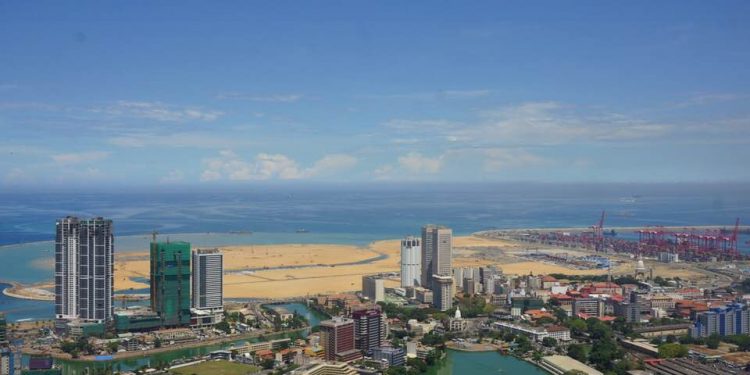
Colombo watches a city being born in the ocean

He opined it was realistic to roll back growth projections after the Easter Sunday attacks, but was confident the reduction would not be severe, partly due to robust exports and expenditure by the Government ahead of elections. Private sector credit growth also decelerated to 9.2% by end May, from 15.9% as at end 2018. Following a higher than projected credit expansion in 2018, in absolute terms, private sector credit contracted by Rs. 2.6 billion in May resulting in a cumulative decline of Rs. 19.6 billion during the first five months of 2019.

As you know, growth was projected to be 4% at the beginning of the year, and after the Easter bombings we have revised it down to about 3%. I’ve seen some projections that have been much gloomier, but I think that is overdone. The 1Q growth was 3.7%, certainly 2Q growth will be disappointing, but 4Q there are very favourable base effects, as in 2018 the 4Q growth was only 1.8%. We are beginning to see faster recovery than anticipated in the tourism sector and elsewhere. I think 3% is realistic.”

He also told reporters that macroeconomic fundamentals remained in good shape” due to moderate inflation, stronger reserves, and international rates taking a dovish turn. Inflation is expected to be in the 4%-6% margin for 2019. But he also said the Monetary Board decided against loosening rates further, partly because it was concerned about fiscal slippage and also because it wanted to see the earlier policy rate reduction filter through markets.

The reason why the Monetary Board decided not to reduce policy rates is to wait and see the full effect of everything that has been done so far. Policy rates were reduced on 31 May and we haven’t really seen the Statutory Reserve Ratio (SRR) reduction and the Rs. 100 billion of Government payments, the effects of the deposit cap that we now hope to see spilling over into lending rates. In the coming weeks we anticipate lending rates coming down quite significantly. The Government is also spending about Rs. 300 million in each electorate under the Gamperaliya program, so there is a lot of money being flushed into the system. We would like to wait and see exactly what the overall impact of this money will be before making another call on policy rates.”

Responding to questions, the Governor expressed hope that the Central Bank would not have to resort to imposing a lending rate cap if market rates remain stubbornly high. Since the rate change the Prime Lending Rate has reduced by about 120 basis points, the Governor said, but the average weighted lending rate has remained unmoved.

To be fair by banks, the deposit cap was placed at the end of April and it would take a bit of time for them to re-price their deposits, and costs will not come down till then. We would anticipate a reduction of up to 200 basis points in lending rates, especially the average weighted lending rates, and will monitor it closely. We don’t want to impose a lending cap because those sort of measures are highly distortionary, but if we are forced to do it, we will. However, we anticipate banks will be cooperative and the impression we get is they also see lending rates come down.”

Following the receipt of the proceeds of the International Sovereign Bonds (ISBs), gross official reserves reached $8.9 billion by end June 2019, which provide an import cover of 5.1 months. The contraction in the trade deficit and the receipt of the proceeds from the ISBs, along with the continuation of the Extended Fund Facility Program with the International Monetary Fund (IMF-EFF), have eased the pressure on the exchange rate, resulting in the Sri Lankan rupee recording a cumulative appreciation of 4.1% against the US dollar thus far in 2019. This appreciation of the rupee has partially corrected its sharp depreciation observed in late 2018, the Central Bank said in its customary Monetary Policy update.

The year-on-year growth of credit extended to the private sector by commercial banks continued to decelerate during the first five months of 2019, while recording an absolute cumulative decline during the period. Following this trend in the growth of credit, the year-on-year growth of broad money (M2b) also decelerated thus far in 2019. Credit to the private sector is expected to gradually pick up in the latter part of 2019, with the expected decline in market lending rates.

A sizable downward adjustment in market lending rates is expected in the near term. Market deposit rates have declined in response to the measures already taken to ease monetary policy and monetary conditions. In particular, the reduction of policy interest rates in May 2019, coupled with sizable liquidity injections through the reduction in the Statutory Reserve Ratio (SRR) and the imposition of maximum interest rates on deposit products in April 2019, have resulted in a notable drop in the Average Weighted Call Money Rate (AWCMR), yields on government securities, new deposit rates as well as the Average Weighted Prime Lending Rate (AWPR), the report added.

However, the transmission of recent easing of monetary conditions to market lending rates, including AWPR, is not yet complete. It is expected that the ongoing downward adjustment in market lending rates would expedite in the immediate future, thus supporting the revival of demand for credit by the private sector and the recovery in economic activity.

Blasts bring Lankan Buddhist monks to political center stage

July 12th, 2019

By P.K.Balachandran/Daily Express

The simultaneous bombing of four posh hotels and three churches in Sri Lanka by a bunch of Islamic radicals on April 21 Easter Sunday, was clearly not aimed at the island’s majority Sinhalese Buddhist community as the targets indicate.

And yet, a noticeable consequence of the terrorist act is the revival of a Sinhalese-Buddhist nationalistic movement, with Buddhist monks spearheading it.

Blasts bring Lankan Buddhist monks to political center stage

When the bombings took place, the immediate reaction of the population was to ensure that innocent Muslims were not attacked in retribution. But it did not take long for Lanka’s hardboiled politicos to sense the electoral advantages of whipping up communal sentiments, given the fact that the Presidential election was due at the end of the year.

Therefore, in May, there were anti-Muslim riots in the North Western Province obviously instigated by opposition politicians. There were calls for the boycott of Muslim businesses, and for investigations into the alleged nexus between Muslim politicos and the terrorists. The Sinhala-Buddhist agitators were seeking the scalp of cabinet Minister Rishad Bathiudeen and Provincial Governors Azath Salley and M.L.A.M. Hizbullah.

There was a shrill cry for a probe into the charge that Dr.Shafi Shihabdeen, a Muslim gynecologist at the Kurunegala Teaching Hospital, had sterilized 8,000 Sinhalese Buddhist women without their permission in a clandestine bid to reduce the proportion of Sinhalese Buddhists vis-à-vis Muslims in the Lankan population.

Politicians were brazenly vying with each other to exploit  communal sentiments to serve their partisan interests using Buddhist monks for this purpose.

President Maithripala Sirisena took the unprecedented step of pardoning and releasing the firebrand anti-Muslim Buddhist monk and General Secretary of the Bodu Bala Sena (BBS), Ven.Gnanasara Thera, who was serving a term for contempt of court.

It is  believed that Sirisena was planning to use the monk to get Sinhala-Buddhist support for his re-election as President. He needed a Sinhala-Buddhist rabble rouser like Gnanasara Thera to counter the appeal of the Rajapaksas who were planning to field Gotabaya Rajapaksa in the Presidential contest.

Gnanasara Thera was needed also to counter Rathana Thera, a monk MP of the United  National Party (UNP) headed by Prime Minister Ranil Wickremesinghe, from whom Sirisena is estranged.

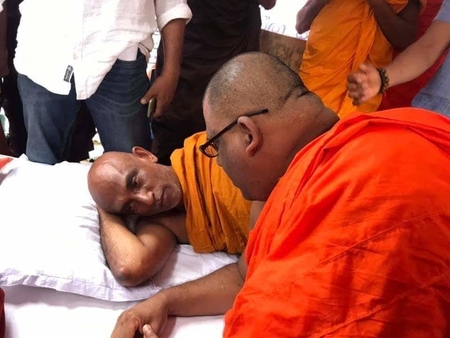
Rathana Thera  took up the cause of the 900 Sinhalese women who had complained against gynecologist Dr.Shafi Shihabdeen and sat on a fast unto death” in Kandy to force Minister Bathiudeen and Governors Salley and Hizbullah to resign owning responsibility for the terror attack.

But in a dramatic move, all Muslim Ministers, and the two Governors, resigned. The sacrificial act widened the communal divide and showed the Sinhala-Buddhists in a bad light. To repair the damage and win over the Muslims , President Sirisena re-appointed two Muslim Ministers, Kabir Hashim and M.H.A.Haleem.

Gnanasara Thera blamed Rathana Thero’s unilaterally planned ‘fast unto death’ for the mess and then launched his own campaign to garner Sinhala-Buddhist  support but without alienating the Muslims.

Sinhalese Parliament

Gnanasara Thera held a mass rally in Kandy, the center of Sinhala-Buddhist nationalism in Sri Lanka, in which he demanded the replacement of the present parliament by a Sinhalese parliament”.  If even 7,000 of the 10,000 Buddhist temples in Sri Lanka support a political party formed by him, majority could be secured in parliament,” he claimed.

Under Sinhala-Buddhist rule, he said, the minorities will enjoy all rights so long as they acknowledge the primacy of Buddhism the Sinhalese-Buddhists.  As regards the Muslims he said that the Sufis should take over the leadership of the Muslim community from the Wahhabis as only the peaceful Sufis can co-exist with other communities in a multi-ethnic and multi-religious Sri Lanka.

When Muslim MPs complained to President Sirisena about Gnanasara Thera’s anti-Muslim tirade, he called up the monk in the presence of the MPs, admonished him and warned that he will not be able to pardon him again.

From Walpola Rahula’s Time

In her paper, Dynamics of Sinhala Buddhist Ethno Nationalism in Post War Sri Lanka, written for the Center for Policy Alternatives (CPA) in 2016, Ayesha Zuhair says that the doctrinal cover and historical rationalization for monks engaging in electoral politics was provided by the scholar monk Walpola Rahula in 1946.”

In his book Bhiksuvage Urumaya (The Heritage of the Bhikku)  Walpola Rahula asserted that monks could engage in politics given their mandate to perform social service”, which, he said, they had done  since the time of the Buddha.”

Rahula went on to say that from King Duttagemunu’s time (161-137 BC), patriotism and the religion of the Sinhalese become inseparably linked… and assumed such overpowering proportions that both bhikkhus and laymen considered that even killing people in order to liberate the religion and the country was not a heinous crime.”

In 1956, SWRD Bandaranaike brought together a powerful coalition of the Buddhist clergy, Ayurvedic physicians, school teachers, farmers and workers to capture power and make Sinhala the only official language of Sri Lanka. Monks became so important that an ambitious but disgruntled monk Somarama Thera assassinated Bandaranaike.

Later, the 1972 and 1978 Constitutions gave the foremost place” to Buddhism and added that it will be the duty of the State to protect and foster it. Subsequently, writer Dr.Gunadasa Amarasekera enunciated the ‘Jathika Chinthanaya’ (national consciousness) concept under which all communities in Sri Lanka would live within an over-arching Sinhala-Buddhist culture.

The Jathika Chinthanaya spawned Sinhala-Buddhist nationalist  organizations which had monks as leaders like Sihala Urumaya/ Jathika Hela Urumaya (JHU), Ravana Balaya, and Bodu Bala Sena (BBS).

Of these, the BBS is the most prominent. Its CEO, Dilanthe Withanage told Zuhair: Although Sinhalese are the majority of this country, and although Buddhism is given some recognition in the constitution, this is not happening in practice. We thought we have a duty to protect the Sinhalese and Buddhism, and the BBS was created for this purpose… Sinhalese can be considered as the majority, but with globalization, it is a global minority. If something happens to the Muslims and Tamils all the embassies will raise their voices. But if something happens to the Sinhalese, no one is there to protect.”

Founded in 2012, the BBS founded carried out campaigns against the Burqa and Halalcertification. In 2012 and 2013, there was a spate of attacks directed against Muslims and Christians.

Zuhair reports that a BBS spokesman Mawathagama Pemananda Thera said in a public meeting held in Kandy on 17 March 2013, that the Quran orders Muslims to spit three times on meals offered to non-Muslims, though there is no such statement in the Quran which orders Muslims to do so.

The BBS also accused its critic, Watareka Vjitha Thera of the Jathika Bala Sena (JBS), of working with Rishad Bathiudeen, Minister of Industry and Commerce and leader of the All Ceylon Makkal Congress (ACMC), to illegally settle several displaced Muslims in the Wilpattu National Park. The BBS stormed the inaugural press conference of the JBS on  April 9, 2014 at Nippon Hotel in Colombo and demanded that the organization be disbanded. Here Gnanasara Thera also attempted to disrobe Watareka Vijitha Thero, as confirmed by Police Media Spokesman SSP Ajith Rohana.”

On April 12, 2014,  Gnanasara Thera alleged that the concept of ‘Thaqya’ in the Quran allows Muslims to acquire the wealth of non-Muslims through fraudulent means, whereas the Quran explicitly states otherwise.”

Subsequent to this a BBS mob had raided the Ministry of Industry and Commerce on 23 April 2004 in search of Watareka Vijitha Thera.”

The National Shoora Council noted that with such stringent laws in place, the police in a shocking manner released the offenders at the police station itself without reporting facts to and producing the suspects before the Magistrate.”

According to Zuhair, the spark that set off anti-Muslim riots in Aluthgama in 2014 was Gnanasara’s public exhortation:  If one Marakkalaya (Muslim) lays a hand on a Sinhalese, that will be the end of all of them.”

The Aluthgama riots totally alienated Muslims from the Rajapaksa regime and their en masse protest vote led to Mahinda Rajapaksa’s defeat in the January 8, Presidential election.

(The featured image at the top shows BBS chief, Gnanasara Thera visiting the fasting Rathana Thera at Kandy)

Advantages in making land tradable in Sri Lanka

July 12th, 2019

By P.K.Balachandran/Daily Express

Colombo, July 12: The Ranil Wickremesinghe government is currently on the way to changing the law to give title deeds to peasants cultivating State Lands with permits.

The State Land (Special Provisions) Bill was tabled in parliament on June 28 but is yet to be taken up for discussion because of cases in the Supreme Court challenging it.

Advantages in making land tradable in Sri Lanka

If the law is passed, a title deed will enable the holder to sell the land, which he was not allowed to do under the permit system”. The new system will allow purchase of land. With a title deed, land can be pledged as a collateral for bank loans. Proceeds from a land sale can be used for another economic venture. Persons who can use land to enhance its productivity will now be able to buy land and invest in agriculture. Non-plantation agriculture, which is now starved of investment from the corporate sector, will get such investments.

Making land tradable is a progressive idea provided the masses and opinion makers are taken into confidence and manifest steps are taken to ensure that foreigners and foreign entities are not allowed to buy land outright.

However, in the popular imagination, possession of land, however small it might be, gives a sense of security and prevents people from sliding into abject poverty. Past Lankan regimes, which distributed land to the landless, are praised for this, to this day.

But what is ignored in the high sounding ideological and nationalistic rhetoric is that small holdings have not prevented the rural areas from being the poorest in the country.

42.4% of all holdings are less than 0.4 hectares, and 82% are less than 1 ha. The per capita arable land area is a minuscule 0.15 ha. At any rate, of the total land area of 6.55 million hectares, only about 50% is arable.

82.3% of the land in the island is currently controlled by the State. Much of it is given out to permit holders, though under restrictive conditions. 27% of the peasants are landless.

The smallness of the holdings and lack of investment have debilitated the agricultural sector. Despite that, the agriculture sector employs nearly 33% of the national labor force.

Economists point out that despite expansion of the cultivated area, introduction of improved technology, free extension advice, guaranteed price schemes and government subsidies for such inputs as fertilizer and credit, productivity is low. They point to Japan and Thailand where productivity shot up after land was freed from feudal control.

Over 28.7% of the Lankan labor force is involved in agriculture, and yet, productivity is low, contributing only 8% to the GDP. Among SAARC countries, the contribution of agriculture to the GDP is the lowest in Sri Lanka.

Low productivity arising from uneconomic small holdings is a cause of poverty. The rural sector accounts for about four-fifths of aggregate poverty in Sri Lanka.

Subsistence Mindset

Economists say that the size of the operational holdings determines not only the level of incomes but also the land management practices. Small farmers have a subsistence mindset.” And small farmers are the majority.

Instead of attempting to increase productivity by better application of technology or crop diversification, farmers seem to maximize household income by engaging in non-farm economic activities,” says Dhanawardana Gamage in his paper: Little Space for Maneuvering: Agrarian Structure, Land Tenure Regimes and Agrarian Development in Sri Lanka.”

Income transfers from many different sources such government subsidies, remittances by family member employed abroad, and salaries from employment in the armed forces, enable small farmers to stick to their land and resort to distress sales. But they do not ensure that the extra income is ploughed into agriculture, Gamage points out.

The tenure system, including sharecropping and renting, have their flaws. These have to be rationalized to get the maximum out of the land under the plough. Laws of inheritance have to be changed so that brothers get a share of the land.

Land administration and management are subject to a plethora of laws, 39 of them, in fact. And agricultural matters come under the jurisdiction of several different departments and ministries.

A major drawback has been the absence of robust data. Reliable data will enable realistic planning. The US is to help Sri Lanka streamline land documentation through the Millennium Challenge Corporation fund which totals US$ 480 million.

PHILIP GUNAWARDENE, SWRD, WIMALA WIJEWARDENE, RANIL, RUWAN AND LAKE HOUSE – continued

July 11th, 2019

Mario Perera, Kadawata

I refer to the comment made by Dr. M.D.P.Dissanayake regarding the article titled: PHILIP GUNAWARDENE, SWRD, WIMALA WIJEWARDENE, RANIL, RUWAN AND LAKE HOUSE

Dr.M.D.P.D.writes: Mrs B made a tremendous contribution….she had a great minister…who held more than half of ministerial portfolios….

That ‘tremendous contribution’ was totally negative. She brought the country to total ruin, impoverishing it beyond measure.

Indeed she made the entire nation eat ‘ala, batala, magnocca’ statutorily twice a week. There was no food for the people. Restaurants were empty. No milk even for newborn children. The transport system was in tatters keeping commuters waiting in queues for endless hours often under heavy rainfall. So was the medical system. The required medicines were not available. The same situation prevailed with regard to schools and universities with no books or reference material available.

She introduced abhorrent foreign exchange laws putting people in chains, even tying them with chains to their hospital beds for their slightest violation. Going abroad was the prerogative of the ultra-rich, like her children. For all practical purposes Sri Lanka became an ‘iron curtain’ country, holding in the poor, the impoverished, the dissidents, and the politically oppressed. All this was well brought out in the film ‘SAGARAYAK MEDA’.

She and her party became so detestable that at the 1977 election the SLFP won only 8 seats…so much for Mrs B who the learned Dr. says ‘made a tremendous contribution. Her crash to the ground was so ruthless, that it snuffed out her political life.

Yes Dr.D, the SLFP during her tenure as PM had, as you have rightly mentioned, only two power wielders: Mrs B and her ‘great minister’. Mrs B, as Dr.D unintentionally shows, destroyed democracy. It was she who brought ‘family rule’ to its apex point in the country’s modern history. She tried to impress on the world stage, especially as the leader of the non-aligned movement. The non-aligned conference under her leadership was a display of her personal glory and power, and was also intended to influence the general elections which were round the corner.

But the people, forced to live on empty stomachs with absolutely nothing to hold on to, whatever the domain, made her bite the dust. Her ‘great Minister who held more than half the ministerial portfolios’ lost his seat. Newspapers stated that when his defeat was announced, he was so distraught that he left the scene leaving his wife behind.

Mrs B, for all her ‘tremendous contribution’ never made it to the political stage again. It was a lady tottering with age and morally downcast, on a wheel chair and suffering from dementia, that was made Prime Minster by her daughter.

Dr.D, mentions Catholic action as being responsible for the attempted coup and for SWRD’s death. How Catholic were the military men involved in the coup is anyone’s guess, but does he not know that the murderers of SWRD were Buddharakitha, Somarama and associates? Where does Catholic action come into that picture?

Yes Mrs.B, took over the Catholic schools and nationalized every private sector venture. Present day developments in the field of education and the service sectors do not lead to a glorification of her hasty decisions. She pulled down everything at a moment’s notice, more in a display of personal vanity than political acumen, but nothing of substance arose from that destruction.

Mario Perera,

Kadawata

Open Economy and Foreign inward investments

July 11th, 2019

Dr Sarath Obeysekera 

We have approached the banks to provide financial facilities to develop a Residential high rise under Non BoI category as converting into BOI is not a viable option due to the fact that duty free facilities and other perks are not available for condominium development.

Investors in Europe are willing to send legitimate funds thru a European source .All the banks demand so many documents to prove source funds and names of investors and proof of address  in the country or residence,

All above can be provided ,but they have to go to an Embassy in Sri Lanka ,stand on the queue to get the passports authenticated.

This whole process can take weeks or even months.

If and when they are  allowed to open an account called IIA ( inward investment account)which replaces all other account types which were permitted  earlier to transfer capital or profit back to any country or any other account of their relatives or a company of their choice .

Under new rules  only account holder can receive funds back and he is not allowed to send anywhere else.

Share market is so bad and no investor is willing to buy shares.

The money invested in blue chip companies in shares are quite often transferred out of the country by individuals,hence there is no net returns remaining in the country 

Investors cannot invest in any other Non Boi project,because land ownership is not permitted for foreigners.

Dubai,Malasia and some other countries relax the rules with cateful monitoring of Noney Laudering ,but once the country is confident about source of funds,they allow them to do any local bunissess

Is is high time the government change rules during these difficult times to attract FDI via non Boi investments.

Dr Sarath Obeysekera 

සියළුම අනියම්/ආදේශක සේවකයින් වහා ස්ථීර කරන්න නැතිනම් තවත් දුම්රිය වර්ජනයක් – කඩිනම් සාකච්ඡාවක් ලබා දෙන්න

July 11th, 2019

මාධ්‍ය නිවේදනයයිදුම්රිය වෘත්තීය සමිති සන්ධානය – Railway Trade Unions Alliance

ගරු ප‍්‍රවාහන හා සිවිල් ගුවන් සේවා අමාත්‍ය,
අර්ජුන රණතුංග මැතිතුමා,

සියළුම අනියම්/ආදේශක සේවකයින් වහා ස්ථීර කරන්න නැතිනම් තවත් දුම්රිය වර්ජනයක් – කඩිනම් සාකච්ඡාවක් ලබා දෙන්න

වසර 05 කට අධික කාලයක් දුමිරිය දෙපාර්තමේන්නතුවේ විවිධ අංශ වල සේවය කරන 1500 පමණ වන අනියම්/ආදේශක, තාවකාලික හා කොන්ත‍්‍රාත් සේවකයින් සේවයේ ස්ථීර නොකර, අළුතින් තවත් සේවක පිරිසක් බඳවා ගැනීමට මේ වනවිටත් කටයුතු කරමින් සිටින බව අප සන්ධානයට දැනගැනීමට ලැබී ඇත.

2019.07.06 දින දිනමිණ පුවත්පතේ හා www.Railway.lk වෙබ් අඩවියේ දැන්වීම් පළකරමින් දැනටමත් ඒ සඳහා අයදුම්පත් කැඳවා ඇති අතර, වසර 05 ක් තිස්සේ දුම්රිය සේවාව පවත්වාගෙන යාමට වෙර දරන අනියම්, ආදේශක, තාවකාලික හා කොන්ත‍්‍රත් පදනමින් බඳවාගෙන ඇති සේවකයින්ට ඉන් බරපතල අසාධාරණයක් සිදු වන බව පෙන්වා දෙමු.

රජයේ ප‍්‍රතිපත්ති අනුව රාජ්‍ය සේවයට බඳවාගැනීමේ අවම අධ්‍යාපන සුදුසුකම සම්මාන සමාර්ථ දෙකක් සහිතව අ.පො.ස. (සා/පෙ) විෂයන් හයකින් සමත් වීම වුවත්, 2014 වර්ෂයේ මෙම සේවකයින් බඳවා ගැනීමේදී, අධ්‍යාපන සුදුසුකම් නොසලකා බඳවාගෙන ඇති බවද පෙන්වා දෙමු. වසර 05 කට පසු නියමිත අධ්‍යාපන සුදුසුකම් නොමැති බවත්, රාජ්‍ය සේවයට බඳවාගැනීමේ උපරිම වයස් සීමාව ඉක්මවා ගොස් ඇතැයි කියමින් දැනට සේවය කාරන අනියම්, ආදේශක සේවකයින් 750 කට අධික පිරිසක් සේවයේ ස්ථීර නොකර, ප‍්‍රවාහන අමාත්‍යාංශය විසින් සකස් කරන ලද නාම ලේඛනයට අනුව, දේශපාලන හිතවත්කම් මත නවක සේවකයින් පිරිසක් බඳවාගැනීමට දරන උත්සාහය තරයේ හෙලා දකින බවද ප‍්‍රකාශකර සිටිමු. මෙම කි‍්‍රයාව සාධාරණීකරනය සඳහා නවක බඳවාගැනීම් වලදී 10% ක ප‍්‍රමාණයක් දුම්රිය සේවක දරුවන්ටද ලබාදෙන බවට ඔබතුමා කරන ප‍්‍රකාශ පිළිගත නොහැකි බවත්, සේවයේ ස්ථීර නොමැති සේවකයින් 1500 ක් සිටියදී, මීට පෙර සිදුකළ ආකාරයට ම දේශපාලන හිතවතුන් බඳවා ගැනීමට කටයුතු කිරීම කිසිසේත්ම නොකළයුතු දෙයක් බවද පෙන්වා දෙමු.

දුම්රිය දෙපාර්තමේන්තුවේ දැනට සේවය කරන ආදේශක, අනියම්, තාවකාලික හා කොන්ත‍්‍රාත් පදනමින් බඳවාගෙන ඇති සියළු සේවකයින් සේවයේ ස්ථීර කිිරීමෙන් පසු පවතින පුරප්පාඩු අනුව තවත් සේවකයින් බඳවාගන්නේ නම්, ඊට විරුද්ධ නොවන බව ඉතා පැහැදිලිව ප‍්‍රකාශ කරන අතර, එසේ නොකර තවත් වතාවක් දුම්රිය දෙපාර්තමේන්තුවට දේශපාලන පත්වීම් ලබාදීමට කටයුතු කළහොත් එය තවත් දුම්රිය වැඩ වර්ජනයකට අත වැනීමක් බවද අවධාරණයෙන් පෙන්වා දෙමු. එබැවින් මේ සම්බන්ධයෙන් සාකච්ඡා කිරීම සඳහා කඩිනම් සාකච්ඡාවක් ලබා දෙන මෙන් කාරුණිකව ඉල්ලා සිටිමු.

ස්තූතියි.

මෙයට,
එස්.පී.විතානගේ
සම කැඳවුම්කරු


Ruling and Opposition members should be transparent and truthful

July 11th, 2019

Dr Sarath Obeysekera

We need to take a  clue from Putin ,Theresa May,Trump and Modi .If they propose to change certain international agreements whether political or trade wise,they open the provisions to parliament,press and the public .It is essential that elected leaders or parties should create a dialogue between public and government.

During the No Confidence Motion debate Speakers elaborated the need to open up the main agreements and attachments to be signed with US .

We hear about trade agreements with Singapore ,Japan India .We may  soon sign free trade agreement with Tajikistan.,Sichelles,Philippine etc wherever President and Prime Ministers .

Rulers should publish cabinet papers and subject to a discussion with attachments before approving them.

Then public and opposition can object or propose amendments.

Obviously in Sri Lanka public and opposition tend to oppose to any progressive or non progressive proposals .Nevertheless government can take serious comments on board.

Various TV stations and news papers are quite partisans ,hence correct picture is never presented to public.

I am just watching one of the TV station where commentator making mocking statement and talks about the cartoons and critisizing the  rulers.

Are we all comedians to listen to the commentators.?

This is why I suggested earlier ( which was never published) that Sri Lanka should appoint a Comedian as the head of the government  like in Ukraine 

Dr Sarath Obeysekera

Gurukanda Raja Maha Viharaya , Mullativu

July 11th, 2019

Ranjith Soysa

The Director General of Archaeology confirmed in Mullativu Magistrate courts before the Magistrate S L. Kumar that Guru Kanda Viharaya in Nayaru on the basis of historical and archaeological evidence dates back to 2000 years, He further emphasized that the building of a new Hindu kovil inside the historical site was illegal. The court hearing was on 12 Feb 2019 consequent on a dispute arising from a protest staged and led by former TNA politician T.Raviharan  on 14th January 2019 on the Thai Pongal Day.

The protestors continued to vandalize the site by attempting to put up a building and lighting fires etc in the archaeologically accepted site in the breach of rules covering the protection of such a site.

If the viharaya site is 2000 years old it has to be assumed that there could not have been another building in this place. It is also possible to explore and investigate more scientifically the area and confirm the rightful ownership of the land without allowing for the unlawful elements to decide the fate of the site while paving way for violence.

We request the law enforcing authorities and the Director Archaeological to step in settle this is issue in a more amicable and a peaceful manner.

Ranjith Soysa

ENDLESS TALES OF TORTURE IN INDIAN SOCIETY

July 11th, 2019

ALI SUKHANVER

Hatred on the basis of caste and creed or race and religion is considered the most heinous social crime in all civilized societies. Presence of hatred on all such basis proves moral bankruptcy and ethical barrenness of a society. ‘The Hindu’ has recently reported from Madhya Pradesh, India that the family members of a 21-year-old tribal woman assaulted her with sticks for allegedly eloping with a Dalit man. The woman was a resident of Gatbori village, about 90 km from Dhar in Madhya Pradesh. According to the paper, the family members were unhappy over her affair with the man with whom she had eloped recently but later returned home. On her return she was forced to marry a man of her own caste but she refused. Someone present there on the scene made a video of the incident which later gone viral on social media. Four accused have yet been arrested while the other three are still on the run. For the Dalits living in the Indian society, facing such brutalities is simply a routine matter; they know that they cannot change their caste and they know that the upper-caste Hindus would never accept them as human beings.

Every day, the papers are replete with the news of maltreatment with the low-caste Hindus, commonly known as the Dalits or the ‘Untouchables’. Not only in Madhya Pradesh but everywhere in India, the Dalits have to face the same insult, disrespect and rudeness. Last year in June, the BBC reported that three Dalit boys were stripped, beaten and paraded naked by villagers in the western state of Maharashtra for swimming in a well that belonged to an upper-caste family. In that incident too, the video of the ‘activity’ was posted online which showed the Dalit boys covering themselves with leaves as a man hits them with a stick and a belt. In another incident of the same kind in the western state of Gujarat a 13-year-old Dalit boy Mahesh Rathod was brutally beaten for wearing a pair of leather shoes ‘mojris.’ This type of shoes is traditionally worn by upper-caste Hindus in some parts of India. The details of this brutality with the innocent boy are more heart-rending. According to the local media, the boy was approached by a group of men who asked him which caste he belonged to. When he said he was a Dalit, they started abusing and beating him for posing as an upper-caste member by wearing jeans, mojris and a gold chain. Unfortunately this maltreatment is not limited only to the Dalits; the extremist Hindus treat all minorities including the Muslims and the Christians and the Sikhs in the same way; the Muslims are no doubt the worst victim to this maltreatment.

On 8th of this July, in Madhya Pradesh’s Khandwa district more than hundred local Hindu villagers made twenty-five Muslim men hostage and tied them to a rope for transporting cows to Maharashtra. The helpless cattle transporters were forced to chant ‘gau mata ki jai’ while doing sit-ups and holding their ears. Same situation had to face a Muslim trader Shaukat Ali just a few days before the recent elections. The BBC’s Rajini Vaidyanathan said in a report on the sorry-plight of Shaukat Ali, With an increase in hate crimes against Muslims in India in recent years, some fear the world’s largest democracy is becoming dangerously intolerant under the Hindu nationalist Bharatiya Janata Party.” According to the details provided by the media Shaukat Ali, a Muslim trader in the north-eastern state of Assam, was returning from his work when a mob of extremist Hindus detained him on the way. The mob forced him to kneel down in a pool of mud and started beating him. Someone among the attackers shouted on him, Why do you sell beef here?” Another yelled, Are you Bangladeshi?” Shaukat Ali told the BBC reporter showing him the injuries to his rib cage and his head, They beat me with a stick and they kicked me in the face.” He further said, I wasn’t just injured physically – I was stripped of my dignity. The mob compelled me, a devout Muslim, to eat pork, forced me to chew it and then gulp it down.” This type of maltreatment is not limited only to beef-sellers like Shaukat Ali; this is the fate of all Muslims whose population in India is more than 172 million. A report from Human Rights Watch published in February 2019 said that between May 2015 and December 2018, at least 44 people belonging to minorities were killed across 12 Indian states; around 36 of them were the Muslims. As far as the Muslims in India are concerned, they expect more brutality, more hostility and more cruelty at the hands of Hindu extremists under BJP government as the government is headed by Mr. Narendra Modi whose own hands are  blood stained in Gujarat anti-Muslims riots. He is the same person who was declared as a terrorist by International media just a few years back and was not allowed to enter many Western states over his gross misconducts. In presence of such a ‘hostile’ leader like Mr. Modi, how could things go smooth for the minorities particularly for the Muslims in India?

Muslim MPs decide to take up ministerial posts again

July 11th, 2019

Courtesy Adaderana

All Muslim parliamentarians who resigned from their ministerial portfolios have decided to accept their previous positions once again, MP Amir Ali said.

At a press conference on June 03, all Muslim cabinet, non-cabinet, state, and deputy ministers announced that they would resign from their portfolios.

The MPs said their resignations would allow investigators to probe the claims without interference.

However, the four ministers and five junior ministers only resigned from their portfolios, not from the government or their respective parties.

The Mahanayake Theros of Tri-Nikayas had later requested the Muslim MPs to re-accept their ministerial posts.

On June 19, two UNP Parliamentarians from the group, Kabir Hashim and Abdul Haleem, were sworn into the ministerial positions held by them before tendering their resignations.

Hashim was reappointed as the Minister of Highways & Road Development and Petroleum Resources Development while Haleem was sworn in again as the Minister of Postal Services & Muslim Religious Affairs.

රිෂාඩ්ට ඇති චෝදනා ගැන පරීක්ෂණයක් කරන්නැයි ඒකාබද්ධයෙන් අල්ලස් කොමිසමට පැමිණිල්ලක්

July 11th, 2019

නාලක සංජීව දහනායක උපුටාගැණීම ලංකාදීප

සතොස ආයතනයට රුපියල් මිලියන 5000ක පාඩුවක් සිදුකර ඇති බවට හිටපු ඇමති රිෂාඞ් බදියුදීන් මහතාට එල්ලවීඇති චෝදනා සම්බන්ධයෙන් විධිමත් පරීක්‍ෂණයක් පවත්වන මෙන් ඉල්ලමින් ඒකාබද්ධ විපක්‍ෂයේ පාර්ලිමේන්තු මන්ත‍්‍රීවරුන් අද (11) අල්ලස් හෝ දූෂණ කොමිසන් සභාවට පැමිණිල්ලක් ඉදිරිපත් කළහ.

යහපාලන රජයේ අමාත්‍යවරුන්ගේ වංචා හා දූෂණ හෙළි කිරීමට ඒකාබද්ධ විපක්‍ෂය විසින් ක‍්‍රියාත්මක කරනු ලබන ටොප් -20 වැඩසටහන යටතේ දොළොස්වැනි පැමිණිල්ල ලෙස හම්බන්තොට දිස්ත‍්‍රික් පාර්ලිමේන්තු මන්ත‍්‍රී ඞී.වී චානක මහතා විසින් මෙම පැමිණිල්ල සිදුකළහ.

හිටපු අමාත්‍යවරයාගේ පෞද්ගලික ව්‍යාපාර වලට සම්බන්ධ පුද්ගලයන් 52 සතොස ආයතනයට බඳවාගෙන ඔවුන්ට එම ආයතනය මගින් ඔවුන්ට වැටුප් ගෙවා රුපියල් ලක්‍ෂ සියයක පමණ පාඩුවක් සිදුකිරීම, හිතවතකුගේ නමින් රූපවාහිනී නාලිකාවක් පවත්වාගෙන යමින් එම නාලිකාවට මසකට සතොස ආයතනය මගින් රුපියල් ලක්‍ෂ 15 බැගින් ගෙවා සතොසට රුපියල් ලක්‍ෂයක පමණ පාඩුවක් සිදුකිරීම පිළිබඳව මන්ත‍්‍රීවරයාට එරෙහිව චෝදනා නගා ඇත.

එමෙන්ම සතොස ආයතනයේ ගබඩාවක සහල් මෙට්‍රික්ටොන් 80000 ක් පමණ තිබියදී එම ආයතනයටම අමතරව සහල් මෙට්‍රික්ටොන් ලක්‍ෂයක් පමණ ආනයනය කිරීමෙන් සතොස ආයතනයට රුපියල් බිලියන දෙකහමාරකට අධික පාඩුවක් සිදුකිරීම පිළිබඳව චෝදනා එල්ල කර තිබේ.

එමෙන්ම  එම සහල් තොගය නිෂ්කාෂණය හා ප‍්‍රවාහනය කිරීම සඳහා කිසිඳු ඇපකරයකින් තොරව අමාත්‍යවරයාගේ හිතවතකුවන ලිවර්පූල් නැවිගේෂන් නැමැති ආයතනයේ සභාපතිවරයා වූ වින්සේද්‍ර රාජන් නැමැත්තාට සතොස මගින් රුපියල් මිලියන 1224ක් අත්තිකාරම් මුදල් ලෙස ගෙවා ඇති අතර එසේ ගෙවන ලද මුදලින් රුපියල් මිලියන 267ක මුදලක් මේ දක්වා සතොස ආයතනයට නොගෙවීම සම්බන්ධයෙන් කිසිදු ක‍්‍රියාමාර්ගයක් නොගැනීම සම්බන්ධයෙන් රිෂාඞ් බදියුදීන් මන්ත‍්‍රීවරයාට එරෙහිව මෙම පැමිණිල්ල මගින් චෝදනා නගා තිබේ.

Pact trap – II

July 11th, 2019

Editorial Courtesy The Island

The Prime Minister’s Office has taken the Ceylon Chamber of Commerce to task over the latter’s comments on the Status of Forces Agreement (SOFA). Prime Minister Ranil Wickremesinghe has declared, in Parliament, that the government will never enter into agreements that are detrimental to Sri Lanka’s interests. He has torn into those who erroneously claim that the SOFA was signed a couple of years ago. It has not been inked. In fact, the government has baulked at signing it due to protests.

All agreements disadvantageous or harmful to this country, save one or two, have already been signed, and they are now faits accomplis. The government invited trouble by making the colossal blunder of leasing the Hambantota Port to the Chinese amidst protests. Other world powers hostile to China were prompted to demand their share of the Sri Lankan cake, as it were. Two of US allies—India and Japan—have entered into an agreement to develop the East Container Terminal of the Colombo Port. India is said to be eyeing the Mattala Airport.

The US, for its part, is all out to carve out an economic corridor with the help of the Millennium Challenge Corporation (MCC) agreement. One of the main criticisms of the MCC compact is that it is aimed at facilitating the sale of land to foreigners. Parcels of land distributed among the poor who are engaged in subsistence agriculture will be sold to multinationals backed by foreign powers, and plans are underway to prepare the grounds for such deals through amendments to the existing land laws, according to the Opposition. The poor can easily be enticed into disposing of their freehold land as they are fed up with agriculture, which has ceased to be rewarding.

The Acquisition and Cross-Servicing Agreement (ACSA), heavily loaded in favour of the US, was signed in 2017. It allows the US to use ports, airports, etc. here for military purposes. It is said to be reciprocal but how can Sri Lanka use such facilities in the US? It was with the greatest difficulty that the Sri Lankan naval vessels reached LTTE ships on the high seas to sink them during the war. The US ports and airports are of no use to the security forces of this country.

The UNP never misses an opportunity to rake President Maithripla Sirisena over the coals. But, strangely, it does not blame him for the ACSA, which he got approved by the Cabinet. The President is known to think only after leaping, and his loyalists insist that he was hoodwinked into intervening to get that agreement approved. Either this claim is true or the UNP does not want to dissociate itself from the pact lest it should antagonise the US.

The Sri Lanka Singapore Free Trade Agreement (SLSFTA), which is highly disadvantageous to this country, has been signed, and the UNF government, under pressure, is trying to close the stable door after the horse has bolted. Having plunged feet first into signing that agreement, the government has undertaken to discuss some of its provisions which have perturbed Sri Lankan professionals and environmentalists. The government is determined to sign ETCA (Economic and Technological Corporation Agreement) with India though Sri Lankan professionals are against it.

If the government really has no intention of signing the SOFA, will it explain why on earth Minister of External Affairs Tilak Marapana had talks on it in Washington in May? He briefed US officials on difficulties Sri Lanka found in agreeing to some of its provisions including the one that seeks to grant legal immunity to the US forces to be deployed in the host country. If the government has decided to reject the SOFA wholesale why should it discuss parts thereof?

Now that the government has declared that it will not enter into any agreements that are inimical to the sovereignty and territorial integrity of this country, will it give a cast-iron guarantee that the SOFA will never be inked under a UNP-led administration?

The totally inadequate Sixth Amendment Four decades of constitutional folly and failure – 1

July 11th, 2019

By C. A. Chandraprema Courtesy The Island

article_image

Thanks largely to our erstwhile colonial master, who experimented with various forms of self-government before granting us natives full Independence we can claim to be Asia’s oldest democracy. It is a fact that we were the first country in Asia to enjoy universal adult franchise from 1931 onwards even before we gained Independence. Going by that record, we should by now be an example for the whole of Asia to follow at least with regard to constitutions and systems of government. That, however, is what we are not. More than seven decades after gaining Independence, we are an example not just to Asia, but to the entire world as to how not to promulgate Constitutions and design systems of governance. In hindsight, it is now obvious that we should perhaps never have tampered with His Majesty King George the 6th’s Order in Council issued at Buckingham Palace on the 15th day of May, 1946.

Even the first Republican Constitution of 1972, which retained all the main features of the system of government that the British had bequeathed to this country and made only some cosmetic changes to pander to nationalist sentiment, was perhaps a mistake because it opened the door for further changes such as that which took place in 1978. President J. R. Jayewardene is seen by many to be a visionary leader. Maybe he was. The systems he put in place after 1977 have somehow continued to date. The free market policies he introduced have ensured the economic survival of this country through wars and insurrections. Today, his legacy is being called into question mainly due to the 1978 Constitution he introduced. A further complication is that what we have today is not the Constitution that JRJ originally introduced. Indeed, even before JRJ bowed out of the scene the Constitution he introduced in 1978 had been changed in very significant ways.

One may speculate on whether the system of governance would have worked better if the 1978 Constitution had remained in the form that it was first promulgated without the subsequent changes which cumulatively, have now ended up as a constitutional quagmire. The first five Amendments introduced to the 1978 Constitution related mainly to housekeeping matters and even the more controversial of them such as the extension of the term of the 1977 Parliament cannot be said to have led to a constitutional gridlock or a breakdown in governance. The 1978 Constitution was passed on 7 September 1978 and the first Amendment came just a couple of months later on 20 November 1978. The First Amendment was to provide that the jurisdiction conferred on the Court of Appeal with regard to some cases shall be exercised by the Supreme Court and not by the Court of Appeal. The Second Amendment dealt with the procedure regarding the resignation and expulsion of the Members of Parliament.

The Third Amendment was to enable the President to call a Presidential election after the expiration of four years of his first term of office. The Fourth Amendment was to extend the duration of the First Parliament for a further period of six years, and the Fifth Amendment was to make provisions to hold a by-election if the Secretary of the relevant political party fails to nominate a Member for a vacancy in the First Parliament. Some of these Amendments such as the one that extended the term of the 1977 Parliament by six years raised a storm of protest at the time and it can be argued that it led to other political events such as the second JVP insurrection, but constitutionally speaking, it was limited to a particular period and it can be described more as an unacceptable political manoeuvre than a constitutional matter in strict terms. It is from the Sixth Amendment onwards that we can really begin to talk of constitutional misadventures and failures.

The Sixth Amendment was introduced in the wake of the Thinnaveli attack by the LTTE, which took separatist violence to a new level by killing 13 soldiers and sparked off the July 1983 ethnic riots. The objective of the Sixth Amendment was to act as a deterrent to separatism.

Loopholes in the wording

The text of the Sixth Amendment to the Constitution which was passed by Parliament on the 8th August 1983 stated that the independence, sovereignty, unity and territorial integrity of Sri Lanka had been threatened by the activities of certain persons, political parties and other associations and organisations and that it had become necessary to prohibit such activities and provide punishments therefor. Therefore, no person shall directly or indirectly, in or outside Sri Lanka, support, espouse, promote, finance, encourage or advocate the establishment of a separate State within the territory of Sri Lanka. No political party or other association or organization shall have as one of its aims or objects the establishment of a separate State within the territory of Sri Lanka.

The punishment for acting in contravention of these provisions will be civic disability for a period not exceeding seven years, forfeiture of the guilty person’s movable and immovable property other than such property as is determined by a Court to be necessary for the sustenance of such person and his family. If the person concerned is a Member of Parliament or a public officer, he will cease to hold such office. Where any political party or other association or organization has as one of its aims the establishment of a separate State within the territory of Sri Lanka, any person may petition the Supreme Court in that regard. If the SC declares in favour of the petitioners, that political party shall be deemed to be proscribed and any member of such political party, association or organization who is a Member of Parliament shall be deemed to have vacated his seat in Parliament. Any person who holds office or is a member of such a political party after the date of the Supreme Court declaration, may be subject to civic disability for a period not exceeding seven years, and forfeit his movable and immovable property except such property as necessary for the sustenance of such person and his family.

Under the Sixth Amendment, every public officer and elected representative including Members of Parliament was expected to take an oath against separatism. In the case of public officers this oath had to be taken within one month of assuming office. In the case of Members of Parliament and other elected representatives, it had to be taken in order to be entitled to sit and vote in Parliament or the relevant representative body. The following is the oath: “I do solemnly declare and affirm swear that I will uphold and defend ‘the Constitution of the Democratic Socialist Republic of Sri Lanka and that I will not, directly or indirectly, in or outside Sri Lanka, support, espouse, promote, finance, encourage or advocate the establishment of a separate State within the territory of Sri Lanka.”

As far back as 1963, Jawaharlal Nehru introduced the 16th Amendment to the Constitution of India to curb separatist tendencies in Tamil Nadu. When we compare Nehru’s Sixteenth Amendment with JRJ’s Sixth Amendment, the latter appears flat-footed and amateurish.

The Sri Lankan Sixteenth Amendment appears to have been drafted not by a political mind but by a lawyer who has read the Penal Code once too often. Punishments have been prescribed for supporting, espousing, promoting, financing, encouraging or advocating the establishment of a separate State within the territory of Sri Lanka either directly or indirectly, in or outside Sri Lanka. However, in the three and a half decades and more since the Sixth Amendment was promulgated, there have been plenty of people doing exactly that both within and outside Sri Lanka but nobody has ever heard of anyone who has been penalized under the provisions of the Sixth Amendment. All that it succeeded in doing back in 1983 was to give the TULF Parliamentarians an opportunity to refuse to take an oath against separatism and to drop out of Parliament en masse and to take up residence in India to bring pressure on the Indian government to intervene in Sri Lanka. The Sixth Amendment has not even stopped the advocacy of separatism because separatism or a situation leading to de facto separation can be advocated in so many guises.

In contrast to the failure of the Sixth Amendment in Sri Lanka, the Indian Sixteenth Amendment has been a great success. The wording used in the two amendments is different. In Sri Lanka, the Sixth Amendment sought to prohibit the advocacy of a separate State within the territory of Sri Lanka. This left plenty of room for separatists to argue that what they were advocating is not separatism but the devolution of power or power sharing between the centre and the periphery. Thus, the separatist lobby was given an opportunity to say that even though it looks like a duck and quacks like one, it’s not really a duck. In contrast to this, the Indian Sixteenth Amendment did not seek to ban or prohibit anything. What the Indians sought to do was to obtain an oath from all public servants and elected representatives including Members of Parliament and the Members of State legislatures to the effect that they would uphold the ‘sovereignty and integrity of India’.

The Indian wording is broad enough to encompass anything that may be interpreted by a court of law as being detrimental to the sovereignty and integrity of India. Thus the Indian Courts have the opportunity to say that if it looks like a duck and quacks like a duck then it’s a duck. Furthermore the Indian Sixteenth Amendment does not read like an extension of the Penal Code. There are no punishments laid down for those advocating separatism in India. All that the Sixteenth Amendment did was to amend the rights chapter in the Indian Constitution so that the freedom of speech and expression, the freedom of assembly and the freedom to form associations was made subject to the condition that the sovereignty and integrity of India should not be compromised in the exercise of those freedoms.

India’s self-policing system

Furthermore, all Members of Parliament and Members of State Legislatures were required to take an oath to uphold the sovereignty and integrity of India at the time of handing in nominations to face elections to those bodies and then once again before they sit in the bodies they were elected to. The pre-nomination oath taken before a representative of the Indian Elections Commission goes as follows:

“I, having been nominated as a candidate to fill a seat in the Council of States (or the House of the People) do swear in the name of God/solemnly affirm that I will bear true faith and allegiance to the Constitution of India as by law established and that I will uphold the sovereignty and integrity of India.”.

If the person concerned wins the election, he is required to take the following oath before he sits in the Assembly to which he was elected:

“I, having been elected (or nominated) a member of the Council of States (or the House of the People) do swear in the name of God/solemnly affirm that I will bear true faith and allegiance to the Constitution of India as by law established, that I will uphold the sovereignty and integrity of India and that I will faithfully discharge the duty upon which I am about to enter.”

The purpose in being made to swear an oath to uphold the sovereignty and integrity of India before nomination and after election was to ensure that no candidate at an election could campaign for election on a separatist platform. If someone swears to uphold the sovereignty and integrity of India before he is given nominations and then does the opposite during the campaign, he will be liable to be unseated through an election petition. Thus, those who win elections after resorting to heroics may well end up being deprived of the seat they coveted. Each candidate at an election will be watching the other for the slightest infraction which can be used in an election petition. Thus the system is self-policing. Even Jeyalalitha Jeyaram at the height of her power never dared to use to terms such as ‘self-determination’ in relation to Tamil Nadu.

She sought liberation only for the Tamils of Sri Lanka, never for the Tamils of India. That was Nehru’s genius. President J. R. Jayewardene had the best legal minds in the country at his beck and call, yet our Sixth Amendment was a complete failure. In Sri Lanka, elected representatives are made to swear an oath only before assuming office after an election which means they can fight the election on a separatist platform and then take the oath against separatism before assuming office. As we pointed out earlier, even the wording of the Sixth amendment is such that it leaves plenty of room to advocate separatism without using the term ‘separate state’. Sri Lankan history would have been very different if Sri Lanka had simply copied Nehru’s Sixteenth Amendment word for word and adopted it as our Sixth Amendment.

Opposition Leader accuses govt of trying to rob EPF funds

July 11th, 2019

By Saman Indrajith Courtesy The Island

Opposition Leader Mahinda Rajapaksa yesterday alleged that the government had brought about a draft bill to amend the Finance Act to remove the Central Bank from the purview of the Finance Ministry.

 Addressing a press conference at the Parliamentary complex, the Opposition Leader said that the government was trying to take control of Employees’ Provident Fund (EPF).

The Central Bank had been under the Ministry of Finance as per the provisions of the Finance Act, Rajapaksa said.

 The Secretary to the Ministry of Finance who was also a member of the Monetary Board of the Central Bank managed to implement the state finance policies. According to the provisions envisaged in the draft bill, the Secretary of the Ministry of Finance would be removed from the Monetary Board of the Central Bank.

“The Central Bank is responsible for printing currency notes, deciding the interest rates and managing the reserves. All such tasks of the Central Bank would be handled by a separate group of officials who won’t abide by the Finance Ministry guidelines. That is a dangerous situation.”

 The Opposition Leader noted that if the government needed to amend the Finance Act to suit the needs of the present times, then it should have been done after those proposed changes were thoroughly studied by a committee of experts. “There is no urgency to do so. The government is in a mighty hurry because of its hidden agenda.”

MP Bandula Gunawardena said that the Draft Bill should be studied by a committee appointed by the President, who should make sure that the bill would not proceed further without his approval. Amending the Finance Act was a serious matter and the President should not let the government do it according to its whims and fancies. The government was eyeing the EPF monies, he alleged. “We learn that the government has plans to get the Bill approved by the Cabinet and submitted to the Sectoral Oversight Committee of Finance Ministry on July 18.”

Gunawardena said that the Joint Opposition would seek the support of other parties and organisations to mobilise the people against the proposed draft bill and to defeat the government’s move to grab the EPF funds.

Prosecutors say tests needed before Sri Lanka sterilization case can proceed

July 11th, 2019

Courtesy Reuters.com

KURUNEGALA, Sri Lanka (Reuters) – Sri Lankan prosecutors said on Thursday tests would be needed to establish whether a Muslim doctor had sterilized Buddhist patients, while there was no evidence to support other charges against him of links to terrorist groups or money laundering.

The case of Shegu Shihabdeen Mohamed Shafi has become a focus of national attention in Sri Lanka since he was arrested in May and accused of sterilizing women from the Sinhalese Buddhist majority.

He was arrested two days after a front-page story appeared in a nationalist newspaper alleging that an unidentified doctor had sterilized as many as 4,000 women after performing caesarean deliveries.

Shafi’s supporters have said he is innocent and the charges were whipped up to stoke inter-communal tensions in the wake of bombings of churches and hotels on Easter Sunday that killed more than 250 people, blamed on Islamist militants.

Police and army soldiers were on hand to guard the magistrate’s court in the Buddhist heartland of Kurunegala, two hours northeast of Colombo, on Thursday for his first court appearance since his arrest.

He appeared dressed in a grey suit in a court room packed with dozens of people, including some of the women who say they believe he made them sterile.

All the charges are baseless and fabricated,” Shafi’s lawyer, Anura Bhandara Mattegoda, told the court.

He has so far been held under anti-terrorism laws. The court ordered him remanded in custody until the next hearing on July 25, denying a request for bail.

In addition to the accusations that he sterilized patients, he has been accused of laundering money to buy properties, and having links to a group blamed for the Easter bombings.

However, presenting a 123-page report, Deputy Solicitor General Thusitha Mudhalige said investigators had found no credible evidence for those other charges.

On the sterilization accusations, Mudhalige told the court the case could only proceed if tests were carried out on the women who have accused him, demonstrating there had been a crime.

If they (women) don’t agree (to be tested), we cannot proceed,” he said.

INCENDIARY

The allegations that a Muslim doctor had sterilized Buddhists were incendiary on an island where hardliners within the Buddhist majority have accused Muslims of seeking to use a higher birth rate to spread their influence.

Sri Lanka has a long history of communal violence. A decades-long civil war between the Sinhalese Buddhist majority and mainly Hindu Tamil minority ended in 2009.

Since the Easter bombings, Muslim-owned shops and homes have been looted and vandalized in several parts of the country.

More than 600 women came forward after reading about Shafi’s arrest but only 147 are now claiming to be victims.

The judge has ordered the Faculty of Medicine from Colombo University to set up a five member board to advise the attorney general’s department on how to proceed with medical tests that might establish whether a crime had been committed.

The court also directed the government’s valuation department to assess Shafi’s assets.

Alerted by India, Lankan coast guard intercepts boats carrying drugs from Pak

July 11th, 2019

According to Indian intelligence agencies, this drug business is a major source of income for ISI and they use this in terror funding.

Two boats carrying banned drugs from Pakistani coast city Karachi to Sri Lanka were intercepted by Sri Lankan Coast guards on Wednesday. The operation was successfully executed based on the inputs by Indian security agencies. (Representational Image)

 Two boats carrying banned drugs from Pakistani coast city Karachi to Sri Lanka were intercepted by Sri Lankan Coast guards on Wednesday. The operation was successfully executed based on the inputs by Indian security agencies. (Representational Image)

New Delhi: Two boats carrying banned drugs from Pakistani coast city Karachi to Sri Lanka were intercepted by Sri Lankan Coast guards on Wednesday. The operation was successfully executed based on the inputs by Indian security agencies.

The successful capture comes after the Narcotics Control Bureau (NCB) shared a specific input with information about two boats carrying banned drugs from Karachi to Sri Lanka. The input which was shared with Indian authorities by NCB was consecutively forwarded to concerned Sri Lankan agencies following which a timely intervention by coast guards prevented the illegal trade.

According to Indian intelligence agencies, this drug business is a major source of income for Pakistan ISI and they use this in terror funding. The funds through such trade are also used to fund extremist ideology in Sri Lanka.

Indian security agencies maintain that the sea route is safest for drug business and boats and ships carry these drugs on a regular basis.

Coast Guards of India and Sri Lanka work closely in areas of coastal security and prevention of illegal activities along their maritime boundary.

Another Dengue Outbreak

July 11th, 2019

Courtesy The Government official news portal

After a particularly hot and humid May this year, many Sri Lankans would have eagerly anticipated the south-western monsoon to ease their discomfort. Each year, what Sri Lankans don’t expect however, seems to be the ensuing outbreak of the deadly dengue virus. 2019 doesn’t seem to be any different for a country grappling with yet another outbreak of the disease, with most residents in disease hotspots unaware of the illness.

Consultant Epidemiologist of the National Focal Point, Dr. Hasitha Tissera, said that the number of dengue cases reported for the year 2019 is at a staggering 26,629, while 35 fatalities have been reported this year. 5,413 cases have been reported during the month of June alone. Asked if the data points to an increase in the number of dengue cases being reported, Dr. Tissera said there’s a definite increase in the number of dengue cases reported this year.

Karapitya Teaching Hospital, Colombo National Hospital,National Institute of Infectious Diseases, Lady Ridgeway Hospital for Children and the Colombo
South Teaching Hospital Coping with high numbers of patients

Persons suffering from a fever should consult a medical professional, if fever persists for a second day, Dr. Tissera said. Pregnant mothers and young children however are advised to seek medical treatment on the first day of fever, in order to avoid complications.

Once diagnosed with fever, doctors would identify if there is a need for the patient to be hospitalised. In the meantime, fever patients should avoid taking un-prescribed medication to counter the fever and especially avoid painkillers. The indiscriminate use of medication isn’t advised. If you suspect fever, you must take medication only under the guidance of a doctor. Painkillers, other than paracetamol, cause internal bleeding and act similar to blood thinners,” he said.

Epidemiologist indicates rise in dengue cases, Dengue control unit downplays the severity

Dr. Tissera stressed that being diagnosed with dengue fever is no cause for alarm as it is a treatable condition. However he noted that such a patient’s health should be monitored constantly and therefore should seek treatment at the nearest hospital. Vomiting, severe abdominal pain, feeling faintish are particular warning signs which doctors would be vigilant of, Dr. Tissera said. If a child or a person appears confused and if his or her consciousness appears to be deteriorating, such persons should be presented for treatment immediately.

Meanwhile if you are suffering from some form of bleeding or exaggerated menstrual bleeding, such persons should seek immediate medical advice, as they are also warning signs which we look for,” he said. Under normal circumstances, a person should pass urine every four to five hours. However if the urine passage reduces, that is also a cause for concern,” he warned.

According to Dr. Tissera four high risk districts including Colombo, Gampaha, Galle, and Ratnapura have been identified by the Epidemiology unit. With figures pointing towards a sharp rise in the number of dengue cases in the country, several unsuspected areas such as Kalutara, Kandy, Matara and Jaffna have also fallen victim to the disease. According to experts, with the onset of the monsoon, the risk of dengue exists across the country and transmission through mosquitoes occurs all year-round. Viruses are tiny agents that can infect a variety of living organisms. The dengue virus, similar to other viruses, has a microscopic structure that can only replicate inside a host organism. The dengue virus is transmitted to humans via the bite of an infected mosquito. Only a few mosquito species are vectors or vehicles which carry and transmit the disease to its host organism. Historical data suggest that dengue transmission in Sri Lanka has two peak seasons; October to December and May to July.

Under-utilised wards opened to accommodate influx of patients


Dengue Control Unit denies reports of severe outbreak
Asked of what precautionary measures were taken to curb the epidemic, Dr. Prasheela Samaraweera of the National Dengue Control Unit denied reports of a heavy outbreak this year. Although there’s no major outbreak of dengue cases, the Dengue Control Unit is doing everything we can to improve the situation,” she assured.

However Dr. Samaraweera admitted that there were reports of high incidence of dengue in several districts including Colombo, Gampaha, Kalutara, Galle, Matara, Ratnapura and Kegalle. There’s only a minor increase of dengue cases in these areas. We have deployed search operations in areas where high incidences have been reported. Meanwhile the Medical Offices of Health are carrying out awareness campaigns, inspection of houses in addition to fumigation, in all these areas,” she said.

Asked if there are special preventive campaigns in place to reduce further spread of the disease, Dr. Samaraweera said that the unit has sought the help of volunteer corps to counter 
the malady.

Since we cannot conduct these campaigns with military personnel as we used to, we have recruited volunteers to form health teams to assist us in this process. The volunteers are from organisations such as Red Cross and Sarvodaya and they are deployed to various locations, depending on the severity of the disease in that area,” she elaborated.

If you suspect fever, you must take medication only under the guidance of a doctor

Dr. Hasitha Tissera

Detailing how the severity of disease is identified, Dr. Samaraweera said that the unit relies on data received from every hospital in the island. We receive data from approximately 150 hospitals in the island through a web-based system, according to which we decide on how to deploy these teams,” she said.

According to Dr. Samaraweera, the Karapitya Teaching Hospital, Colombo National Hospital, National Institute of Infectious Diseases, Lady Ridgeway Hospital for Children and the Colombo South Teaching Hospital in Kalubowila are the hospitals burdened with the most number of dengue cases this year. Dr. Samaraweera assured that there were no reports of overcrowding in these hospitals, adding that they are well equipped to manage this situation. There is absolutely no similarity to the situation in 2017. The number of cases reported this year is even lesser than the number of dengue cases reported in 2018.”

Asked if the numbers are expected to rise with the onset of the Southwestern monsoon, Dr. Samaraweera said that it’s unlikely for the disease to spread further. We recently had a meeting with the Director General of Health Services on managing this disease. The Health Services Directors of the high risk areas, Medical Officers as well as epidemiologists were present at this meeting where they discussed the way forward, with detailed guidelines of how to manage this situation. Therefore I think the situation should not deteriorate further,” she opined.

Infectious Disease Hospital understaffed, requires doctors for children’s and medical wards


Numbers declining in the South
The Director of the Karapitiya Teaching Hospital Dr. G. Wijesooriya said that although there was a steady rise in the number of dengue patients admitted to the hospital, medical officers have observed a decline in the number of patients over the past week. Earlier we had about 10 to 12 dengue patients receiving treatment in each ward. However over the past week there has been a decrease in this number. Now we have less than 6 patients in every ward,” he noted.

Dr. Wijesooriya added however that those hospital authorities are taking necessary precautions and are braced to accommodate more patients at the hospital, in the event that there’s a further spread of the virus, due to the inclement weather conditions.


Infectious Diseases Hospital Understaffed
Meanwhile at the National Institute of Infectious Diseases (NIID), there is a steady flow of patients seeking treatment for suspected dengue fever. There’s an obvious rise in the number of dengue patients this year. The month of July however is the month in which we entertain a larger number of dengue patients,” Director of the hospital, Dr. Hasitha Attanayake said. The numbers of patients we have received at the NIID this year isn’t exceptional, but recently we’ve been receiving a lot of dengue patients. The hospital has exceeded its bed capacity due to this influx,” he noted.

Out of the total 237 patients receiving treatment at NIID, 121 patients are receiving treatment for dengue, almost half the total number of patients warded at the hospital. We’ve conducted a preliminary assessment of the hospital’s preparedness. We hope that we would remain resilient in facing this epidemic,” Dr. Attanayake said.

Over 26,000 dengue cases and 35 deaths reported in 2019

The Director added that the hospital is operating with only one fifth of the allocated medical professionals’ cardre. Approval has been granted for 50 doctors, but we’ve only got 40 on board with us at the hospital. We currently have a shortage of 10 doctors,” Dr. Attanayake said adding that the hospital has been coping with difficulty owing to some internal arrangements.

 Asked if the Director has requested health authorities to remedy the situation, he said that a request has been made to the Ministry of Health to rectify the issue urgently. We’re hoping that the intern appointments would be issued early, through which this issue would be solved. We require the services of doctors especially at the children’s wards and medical wards where most medical services are required,” he underscored.

Asked how the hospital is coping with its bed capacity exceeded, Dr. Attanayake said that the hospital has opened an under-utilised ward, to accommodate patients. We can provide beds, but a space issue would arise. That’s not a matter which can be solved easily,” he said. We are not expecting a dengue epidemic as severe as in 2013, although the numbers are certainly high this year, compared to 2018,” Dr. Attanayake added.


Copyright © 2026 LankaWeb.com. All Rights Reserved. Powered by Wordpress