Successive Sri Lankan Presidents have sought extension of term

April 14th, 2019

By P.K.BalachandranCourtesy NewsIn.Asia

Colombo, April 12 (Daily Express): Earlier this week, the General Secretary of the Sri Lanka Freedom Party (SLFP), Dayasiri Jayasekara, told the media that the chairman of his party and Sri Lankan President Maithripala Sirisena, intends to seek the opinion of the Supreme Court on the plea that his term of office should be deemed to have begun on June 21, 2015 and not January 9, 2015.

President Sirisena was sworn-in on January 9, 2015. But Jayasekara pointed out that the nature of the Presidency was altered by the 19 th.Constitutional Amendment which was signed into effect by the Speaker of parliament on June 21, 2015.

Therefore, Sirisena’s term should be deemed to have begun on June 21, 2015 and not January 9, 2015. It should be deemed to be ending on June 21, 2020 and not on January 9, 2020.

Sirisena has been wanting to be a joint Presidential candidate of the SLFP and the Sri Lanka Podujana Peramuna (SLPP) in the coming Presidential election. He has been working hard launching popular campaigns on various issues to build up his image among the masses – an image which had suffered a beating because of his association with the right-wing and pro-West party, the United National Party (UNP) since 2015.

But the SLPP, which is but a breakaway group of the SLFP, is insisting that the Presidential candidate should be from its ranks. It feels that its candidate has the best chance of winning going by the stunning victory it attained in the local bodies elections in February 2018.

Given this situation, the next best thing to do for Sirisena, was to try and stay on in office beyond January 9, 2020 to June 21, 2010 so that he can use the time to execute his political projects and buttress his claim to be the joint opposition candidate.

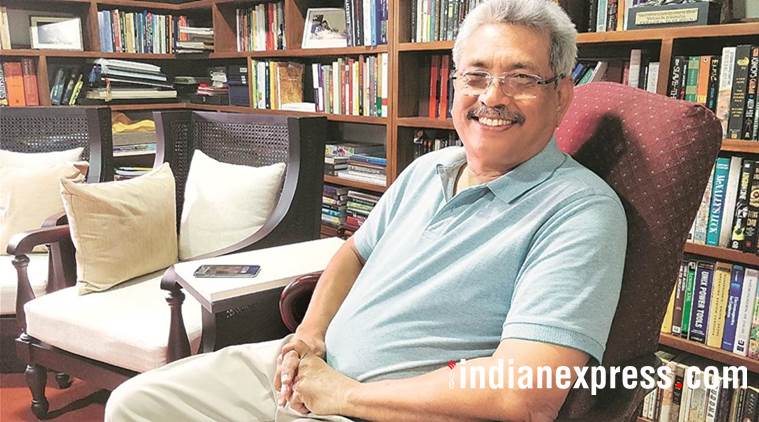
With the prospective SLPP candidate, Gotabaya Rajapaksa, in a spot of trouble over getting release from US citizenship because of two civil suits filed against him in a US court, there is an off chance that the SLPP might be forced to field Sirisena instead of Gotabaya Rajapaksa.

Earlier, in January 2018, Sirisena had wanted to know from the Supreme Court if his term was for five years or six. The Attorney General had told the court that since Sirisena was elected in January 2015 for six years, its reduction to five would be a violation of the people’s sovereignty. The 19th.Amendment which came into effect in June 2015 had reduced the Presidential term from six to five years. The court, however, ruled that as per 19A the five-year cap applies to him too.

Sirisena’s Bid Not Unique

While this is so, Sirisena’s bid for a longer term is not unique. Almost every Sri Lankan President except R. Premadasa and D.B.Wijetunga, had sought extension, though no one other than J.R.Jayewardene had succeeded.

Ironically, Chandrika Kumaratunga, Mahinda Rajapaksa and Maithripala Sirisena had all come to power with a pledge to abolish the Executive Presidency and go back j to the pre-1978 Westminster-style parliamentary system.

The Executive Presidency was brought to Sri Lanka by Prime Minister J.R.Jayewardene, through the promulgation of a new constitution in 1978. The new constitution gave a directly elected President a six year term and not five as before. Parliament also got a six year term instead of five.

Jayewardene named himself the first Executive President in 1978. Subsequently, the first direct vote to elect a President of Sri Lanka was held in 1982. Jayewardene, who was a candidate, got 52% of the votes cast and was declared elected.

In order to maintain the UNP’s parliamentary super-majority obtained in the 1977 elections, Jayawardene decided to extend the life of parliament without holding direct elections.

In order to do this, his government presented the 4th constitutional amendment in 1982, which proposed to extend the life of the parliament by six years to August 4, 1989. The bill was found to be constitutional by the Supreme Court but it had to be passed by a two thirds majority and ratified through a referendum. Both were done successfully by Jayewardene.

Jayewardene’s plea was that such measures were needed to turn the Sri Lankan economy around. The State had to be powerful and stable.

Sri Lankans, who were tired of the shortages and strikes which marked the socialist regimes headed by Mrs.Sirimavo Bandarnaike of the SLFP, went along with Jayewardene.

Kumaratunga’s Bid

The next bid to extend the term of the President was made by President Chandrika Kumaratunga. Her term was to end in 2005 but she argued that because she had called for a Presidential election one year ahead of time in 1999, she should be able to get one more year in office over above the normal six years.

To be able to make this claim, she said that she had taken oaths for the second time at the end of 2000 albeit secretly. The idea in taking the oaths for the second time was to be able to count the beginning of her term from 2000 and not 1999, and be President till 2006 and not 2005.

This was challenged by the prospective Presidential candidate and fellow SLFP member, Mahinda Rajapaksa.

When the matter was taken to the Supreme Court, Chief Justice Sarath Nanda Silva ruled that Kumaratunga’s claims were untenable and that her term would end in 2005. The constitution had clearly stated that the term of the President begins on the date he or she is sworn-in. And there had been a public swearing in immediately after her victory in 1999.

Constitutional expert Prof. G.L.Peiris said that the second swearing-in that is alleged to have occurred was absolutely unique in any democratic country” and raised grave issues of credibility.”

Sharply criticizing the President’s position in a Sinhalese language interview over State TV, Peiris said: That degree of arrogance is unacceptable with regard to the tenure of any public position. No one who holds public office is in a position to say that they will decide for themselves when their office comes to an end.”

But Kumaratunga had said that she was constitutionally empowered to continue her present term of office until 2006, whatever arguments were advanced to the contrary. She said it was her prerogative to step down before or otherwise.

According to Kumaratunga, the oath of office taken in December 1999 was done in an abundance of precaution in the wake of an attempt on her life.”

She pointed to the constitution and said that Where a poll for the election of a President is taken, the term of office of the person elected as President at such election shall commence on the expiration of the term of office of the President in office.”

But the Supreme Court thought otherwise.

Rajapaka Removed Cap on Number of Terms

When he came to power in 2005, again on the promise that he would abolish the Executive Presidency, Mahinda Rahapaksa tried to be President for more than the constitutionally stipulated two terms.

He brought in the 18 th.Amendment to the constitution to remove the two-term cap. But this was annulled in 2015 after he was defeated by Maithripala Sirisena in collaboration with the UNP.

The Sirisena-Wickremesinghe government brought in the 19 th.Constitutional Amendment which restored the two-term limit set by the 1978 constitution which brought in the Executive President. The 19 th.Amendment also reduced the terms of the President and parliament from six to five years.

However, for his personal political reasons, President Sirisena is now trying to get the Supreme Court’s approval for an extension of his term from January to June 2020. But success is likely to elude him as it did in the case of Kumaratunga and Rajapaksa.

Gotabaya Rajapaksa receives enthusiastic welcome in Sri Lanka. Unfazed by court cases in US.

April 14th, 2019

by Editor Courtesy NewsIn.Asia


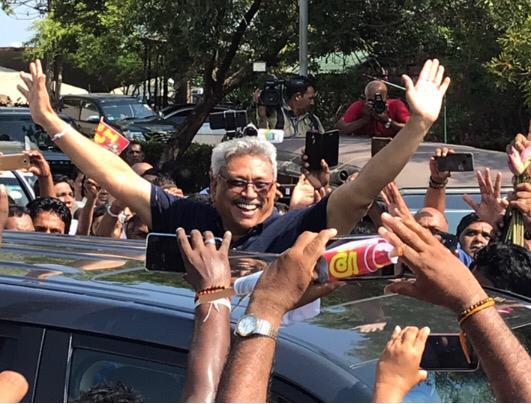
Colombo/Los Angeles, April 12 (newsin.asia/Ada Derana/Republicnext ) Former Sri Lankan Defense Secretary Gotabaya Rajapaksa was given an enthusiastic welcome when he arrived here from Los Angeles on April 12. At Los Angeles, he had been given notices of two cases filed against him for alleged violation of humanitarian law during the war against the Tamil Tigers. A

But Gotabaya has dismissed the two lawsuits filed against him as baseless” and insisted that the cases would only motivate him and his supporters to push for political change in Sri Lanka. He said that the cases were meant to delay renunciation of US citizenship so that he will not be able to fight the coming Sri Lankan Presidential election. As a dual citizen he cannot contest. Therefore, he had taken steps to renounce US citizenship. Gotabaya told news persons at the airport that he had completed the formalities in regard to this successfully.

tHe is planning to contest the coming ri Lankan Presidential election as a candidate of the Sri Lanka Podujana Peramuna (SLPP) founded and headed by his brother and former President Mahinda Rajapaksa.

Got being received by followers

To contest the election, as stipulated by the 19 th. Amendment of the constitution, he cannot be a dual citizen as he is till date. He has to renounce his US citizenship and be exclusively Sri Lankan.

Commenting on the two law suits against him in the US alleging complicity in the torture of a Sri Lankan Tamil and in the murder of a Sri Lankan newspaper editor, Gotabaya Rajapaksa said that these lawsuits have been filed to delay the US citizenship renunciation process and discourage him from contesting.

I have handed the matter to my lawyers [in Los Angeles] to take care of and I’m looking ahead to what needs to be done for our country,” Gotabaya Rajapaksa said. He met with his attorneys in Los Angeles on Tuesday.

Legal Process

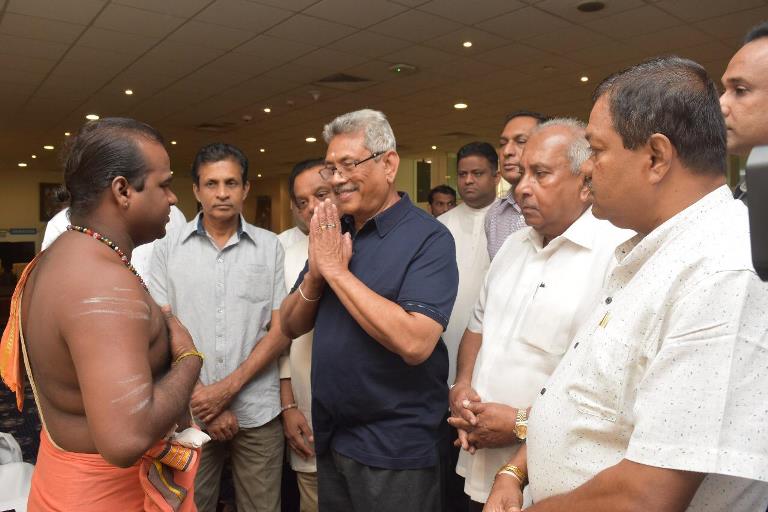
Got being blessed by Hindu priest

The first step Rajapaksa’s attorneys will take is to determine if the lawsuits are within the statute of limitations. Depending on the type of case, California’s statutes of limitations range from one year to 10 years. The clock starts to click on the date of the incident or the date of discovery of the harmful action.

Initially, they may also file a demurrer,” which is essentially a pleading in state court to have the case dismissed, challenging the sufficiency of the complaint. While not disputing the facts of the case, a demurrer argues on the grounds that there is no legal claim even if the facts presented by the plaintiff are true.

Thousands of civil cases are filed in the California’s sprawling court system which serves a population of more than 39 million people—about 12% of the total US population. In 2016, a total of 610,627 cases asking for damages over $ 10,000 were filed. State Government statistics show 95% to 96% of personal injury cases being settled pre-trial.

Finding Jury and Judge

Finding a jury or even a judge knowledgeable enough in Sri Lankan matters to rule on the cases against Rajapaksa will be particularly challenging, say experts.

One of the cases has been filed by the International Truth and Justice Project (ITJP) based in South Africa and the US law firm Hausfeld on behalf of Sri Lankan-Canadian Roy Samathanam who claims he was tortured while in custody in 2007-2010 by a terrorism investigation unit reporting to the Defense Secretary.

The second case has been separately filed by another organisation on behalf of Ahimsa Wickrematunge, daughter of journalist Lasantha Wickrematunge, assassinated in January 2009.

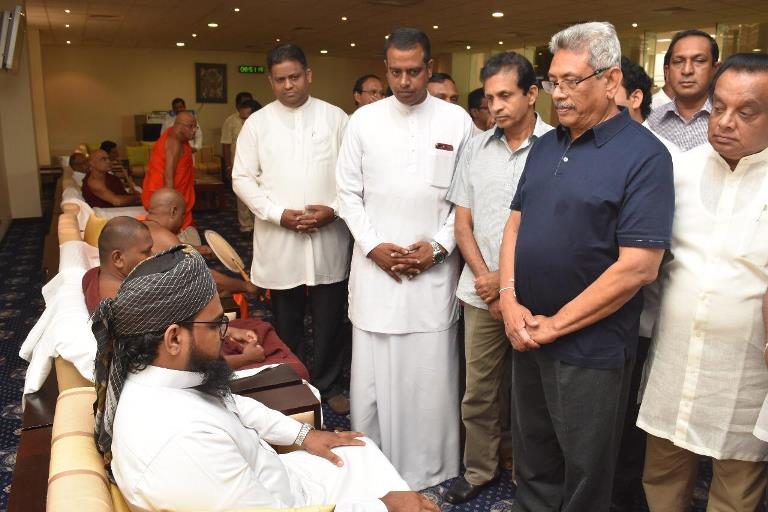
Gotabaya being blessed by a n Islamic cleric 1

Rajapaksa, widely expected to run at the presidential elections later this year, told Daily FT the lawsuits were a tactic to distract him and his supporters and that the charges against him would not stand up in a court of law.

These are baseless allegations made by people outside our country to delay the process because I’m a strong candidate,” he said. Let them attack, I’m prepared.”

He added that far from being discouraged, he and his supporters would be more motivated by these tactics of foreign-based agencies.

People in Sri Lanka are disgruntled and want a change. When we were in power, we achieved great things. We were able to deliver, not just talk. We want to solve common problems people in the north and the south are facing. These type of attempts by outsiders will get our people more motivated to bring our country back under proper leadership.”

Rajapaksa was on a short visit to attend a wedding and spend time with his son who lives in the area. Process servers presented him with papers for the two lawsuits last on 7 April at a Trader Joe’s in Pasadena, about 10 miles northeast of Los Angeles. The city, at the foot of the San Gabriel Mountains, is home to a large number of Sri Lankan expats and houses the oldest Sri Lankan Buddhist temple on the west coast.

In its press release, ITJP calls on other survivors of torture” to come forward, expressing to possibly turn the ITJP’s lawsuit into a class action”.

Mr. Rajapaksa has to give up his US citizenship to be able to stand in presidential elections so this is probably the last chance for a long time to begin to hold him accountable. We hope other survivors of torture will join the suit and make this a class action.”

A class is also a civil lawsuit, but brought by a group of people who are similarly situated,” usually a group of people harmed in a similar way by a business entity.

But Class actions are very complex and must first be certified by a judge before they can proceed.

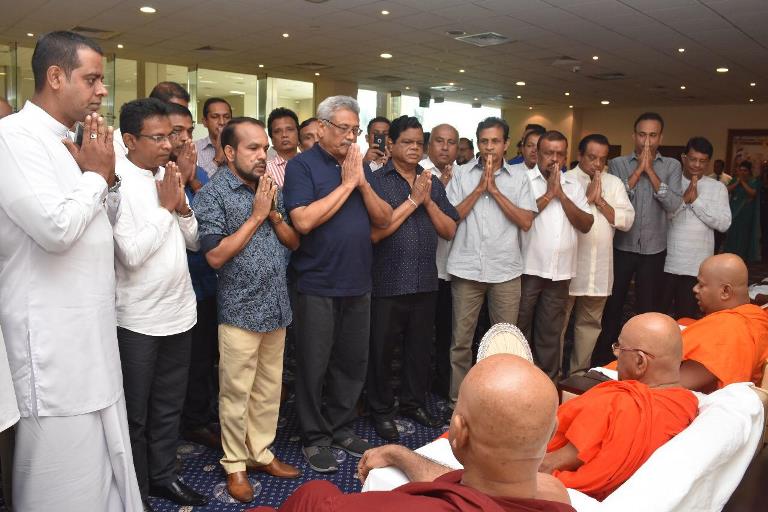
Buddhist monks bless Gotanaya

Fonseka Can’t Stop Gotabaya

Newsin.asia adds:Meanwhile, the Sri Lankan media has been putting out reports that Prime Minister Ranil Wickremesinghe will be asking President Maithripala Sirisena to appoint Field Marshal Sarath Fonseka as Internal Security Minister with the intention of preventing Gotabaya Rajapaksa from becoming a Sri Lankan citizen and contesting the coming Presidential election.

But sources close to Gotabaya said that this cannot be done because Gotabaya is already a Sri Lankan citizen. He is a citizen of Sri Lanka as well as the US, a dual citizen. When he is finally allowed by the US to relinquish US citizenship, he retains his Sri Lankan citizen. No government or minister can take away his Sri Lankan citizenship.

The ruling United National Party and some sections of President Sirisena’s Sri Lanka Freedom Party are keen on preventing Gotabaya from contesting. The court cases in the US and threats of some hostile actions at home in Sri Lanka are seen as attempts by his opponents to keep him away from Sri Lankan politics and demoralize his followers.

Right of Reply: Questions for R. Sambanthan

April 12th, 2019


Colombo Telegraph carried transcript of speech by TNA leader R Sambanthan on 5 April 2019 titled Mullaitivu 2009: 400,000 Lived, 290,000 People Came Out, What Happened To The Balance? – Sampanthan Asks”.  Sambanthan claims that on 21 January 2009 he highlighted plight of some 400,000 but as per press release on 21 January 2009 published by Tamilnet, TNA claims there are over 360,000 IDPs out of a total population of nearly 500,000 people in LTTE controlled areas. This entire population is living within an area of about 400 square kilometers”. Sambanthan cannot give press releases and then say something else in Parliament on the same day!  

LTTE kills fleeing child – https://www.youtube.com/watch?v=sOEwN58UVys&fbclid=IwAR0O8ZjhHoHfs-LWvqHCCTrOUXssRRESgMvnF9JxkaATivYlp1e7qa6To04

LTTE snipers kill Tamils fleeing to Sri Lanka Army https://www.youtube.com/watch?v=BJ7zlRiijfM

Tamils used as human shields by LTTE

Australian Govt condemns LTTE for terror tactics & asks release of Tamil civilians

Rajeswari Balasubramaniam from London says LTTE is violating human rights

Sambanthan claims he protested on 21 January 2009 regarding Tamils being fired at and ‘running helter-skelter’ however as per Tamilnet website TNA press release addressed to the international community claimed ‘over 360,000 IDPs out of a total population of nearly 500,000 people’ were in a 400 sq.km area.

https://www.tamilnet.com/art.html?catid=13&artid=28090

Based on what evidence is the TNA placing a population figure of 500,000?

How many LTTE were there to herd this many people with them?

There would be no civilians with LTTE, if the LTTE did not herd them. Can Sambanthan answer this simple hypothetical question.

TNA press release quotes 66 civilians killed – how many of these died while trying to flee LTTE?

Sampanthan claims 40,000 people have been killed – who claimed this & on what evidence? Even the Ban Ki Moon Panel report says 40,000 may have been killed” which is not the same as 40,000 was killed. While those that claimed less than 10,000 dead can produce names & details of every person dead, those that claim 40,000 & more are only throwing numbers.

Its now 10 years since LTTE defeat. No one claiming 40,000 dead has produced names of 40,000, details of their families and no one has even filed police ‘missing’ or sought death certificates. There are no skeletons either and its no easy fete to be digging graves to stuff 40,000 dead bodies (not even in skeleton stage) while engaged in hostilities with LTTE who were in uniform, in civilian clothing and civilian LTTE force as well as civilians forced to take up gun dying for which LTTE must take full blame for putting non-LTTE combatants in harms’ way.

Sambanthan claims probably around 400,000 based on our own investigations’ were with LTTE. What investigation was this? How many of them were LTTE cadres, how many were civilian LTTE & how many were really civilians?

Sambanthan claims food, medicines and other supplies were sent only for 60,000 – 70,000. The Government & the UN agencies sent supplies. It was obvious that bloating up of numbers were given as LTTE needed provisions for their cadres & families lest the conflict dragged on. There is enough evidence to highlight that Tamils that were not associated with LTTE were denied food & essentials sent by the Govt.

Connecting the dots of allegiance – it was no coincidence that TNA supported the regime change that took place in 2015, it was for that reason that TNA with just 16 MPs in a 225 Parliament became the Opposition & TNA leader the Opposition Leader. For the first time the TNA supported the budget. TNA supported the government at every crucial juncture inspite of being in opposition. TNA leader was not vocal for the Opposition except to promote the demands of Tamils aligned to TNA. UN & UNHRC conducted 2 investigations and they have found absolutely no evidence to substantiate their claims except continue to quote 3rd party / 4th party ‘invisible witnesses’.

On 21 January 2009 the Sri Lankan military declared a 32 square kilometres (12 sq mi) Safe Zone 5 kilometres (3.1 mi) north-west of Puthukkudiyiruppu, between the A35 highway and Chalai Lagoon (this safe zone has no legal binding as it was created by only one party & was not agreed by the other party)

On 12 February 2009 the military declared a new 10 square kilometres (3.9 sq mi) Safe Zone in this area, north-west of Mullaitivu town.

Let it be noted that Navi Pillay publicly stated on 13 March 2009 that 2800 may have been killed & over 7000 wounded since 20 January 2009 (this implies from 20 Jan to 13 March Navi Pillay quotes 2800 as dead & 7000 as wounded)

http://www.peaceinsrilanka.lk/for-the-record/the-relentless-posturing-of-navi-pillay

All of these UN heads & international agencies quote from sources outside of the war terrain and thus they cannot be accepted as witness accounts. As for those claiming to be ‘eye witnesses’ they must first establish they were actually in the war terrain.

Sambanthan is quoting various international parties questioning Sri Lanka’s dead but why has Sambanthan not asked – the lost generations of Tamils because of LTTE that created TNA?

  • How many Tamil children did LTTE kidnap since 1980s
  • How many of these kidnapped Tamil children died during training, trying to flee LTTE camps & return home, engaged in hostilities
  • How many young men, women were denied their right to educate, work and make a career for themselves & ended up holding a gun & wearing a cyanide capsule?
  • How many LTTE cadres & child soldiers died following orders to commit suicide by biting cyanide capsule – LTTE must take full accountability for these suicides.
  • How many LTTE cadres were trained to commit suicide – taking one’s life is a crime, training people to commit suicide must be far worse a crime.

Sambanthan is quoting the US Constitution – the Colonial British invaded the Americas and colonized it initially with prisoners from British prisons in 1607. It took just 169 years for the 13 colonies to severe ties with Britain and declare independence adopting confederal constitution in 1776. When 7 out of the 34 confederates attempted to secede the confederacy was abolished and replaced with the present constitution in 1790.

Confederacy which ITAK/TNA promotes did not last even 20 years in US.

Sambanthan quotes Indira Gandhi on Bangladesh & asks the question ‘how long has the Tamil question remained unresolved”? We would like to know what is the Tamil question first and we have been asking this for 70 years! All that we have been given is a bucket-list of solutions without knowing what the problem is.

We would like to challenge Sambanthan’s statement that Tamils are ‘second-class’ citizens – Tamils & Muslims constitute the larger populations in Colombo 1 to 15 capital of Sri Lanka. Tamils & Muslims run the main wholesale business in Sri Lanka. Tamils have the most jewellery outlets, communication outlets pharmacies in Colombo. Both the present & past governors of the Central Bank were Tamil. There are over 30 Tamils in the 225 member Parliament representing all political parties. Tamil political party held the post of Opposition in 1978 and 2015.

Our question for Sambanthan & any others who claim to fault the Sinhala Buddhists this simple question

What is it that the Sinhalese enjoy because they are Sinhalese that the minorities do not enjoy because they are not Sinhalese”?

What is it that the minorities do not enjoy because they are the minority that which the majority enjoys because they are the majority”?

What is legally, constitutionally & legislatively given to the majority that is not given to the minorities”?

Name a single country that has changed its original national anthem, national flag just to please & appease the minorities & have these afforded any reciprocity by the minorities?

Tamil was made official language by India’s Indo-Lanka Accord in 1987 and there are less than 2million Tamils physically residing in Sri Lanka. India with over 70million Tamils and a separate Tamil only state has not even made Tamil an official language or including anything Tamil in India’s national flag.

Name a single country where Tamils are the minority which have declared Pongal as a national holiday, Maha sivarathri, Deepavali as public holidays.

Name countries where Tamil minorities are given cabinet rank positions in government representing minority political parties, top post in Police, foreign minister, chief Justice (Sri Lanka has had 3 Tamil chief justices), judges & ambassadors.

Name countries that have issued stamps for Tamil minorities

Name any country that will allow laws like Thesavalamai to exist when everyone chants equal law – equal justice for all.

Tamil minority are powerful in many ways – Largest supermarket chain is Cargills and recently the Govt gave state funding to it. The largest brewery is Carsons owned by Tamil family. Largest media network is owned by the Maharajah family who also own the largest hardware – SLON, Kevilton.

The largest construction conglomerate St Anthony’s is owned by the Gnanam family.

Examples of discrimination by Sinhalese against Tamils

If Tamils have left the country, it is by their own free will & as a result of them leaving and being domiciled in Western countries they are helping their families back home. We would like by affidavit for TNA MPs to confirm that they themselves are not dual citizens as many of their children are studying overseas.

Sambanthan refers to the North-East development – we like to remind him that LTTE ran a defacto rule for almost 30 years in full control of these areas while LTTE was making annual profits of $300m so the better question is what did LTTE do with this money if it really stood for the needs of the Tamil people. Immediately after LTTE defeat those that visited the North-East could see for themselves that other than posh bunkers for LTTE and fancy homes for LTTE families all others were living in horrible conditions. Some areas of the North-East did not have electricity, were not allowed to watch tv even. These people were living in the cave-days under LTTE rule.

The Sambanthan-Sumanthiran letter to Finance Minister Mangala regarding a special fund takes us back to the PTOMs where a similar proposal was made for even direct funding to come to LTTE held areas without going through the Central Govt. The very areas Sambanthan covers are identical to the proposals suggested by the PTOMs and ISGA.

Why should there be a special fund starting with Rs.5billion only for the North which is the least populated of all the provinces in Sri Lanka? Allocation is given to each of the provinces based on the funding requested by the provinces and the Northern budget is almost always 2nd to that of the Western province but it is never spent & returns to the Treasury while there is a separate budget allocation for each province spent by the Central Govt to develop the provinces & this gets spent and is accounted for. What audacity for Sambanthan to ask Rs.5b only for the north when 7 out of 10 people are Sinhalese tax payers and Sambanthan & TNA are eternally accusing Sinhalese of treating Tamils as second-class citizens. What right does the Finance Minister have to create such a fund only for the North & camouflage that by calling it ‘Palmyrah Fund’ and open it for ‘donations’ obviously serving as an outlet for money-laundering and we like to question why the PM is also the Minister for Northern Development too – does the PM function only for the Northern Province?

Sambanthan or TNA cannot be allowed to get away spreading lies & distortions when successive governments should have investigate TNA for links with LTTE and applied 6th amendment against TNA for there is ample evidence by TNA statements and photos to depict the TNA’s gameplan.

https://www.onlanka.com/news/where-are-the-next-of-kin-of-the-supposedly-executed-40000-125000-tamil-civilians-in-sri-lanka.html

Shenali D Waduge

THE CASES ALLEGEDLY FILED IN THE U.S. AGAINST GOTABHAYA RAJAPAKSA AND THEIR IMPLICATIONS FOR SRI LANKAN VOTERS

April 12th, 2019

DHARSHAN WEERASEKERA

10th April 2019

There can be no better endorsement of Mr. Gotabhaya Rajapaksa (‘GR’) for the Presidency of Sri Lanka than the fact that his enemies have already begun a campaign to scuttle his chances of running for that office, even before his candidacy has been officially announced. 

I refer to the reports in a number of newspapers that two civil cases have been filed against GR in the U.S., one allegedly by the daughter of slain journalist Lasantha Wickrematunga and the other by the NGO International Truth and Justice Project (ITJP) representing a victim of purported torture by the Sri Lankan security forces.[1]

In this article, I shall briefly discuss what one can reasonably expect the enemies of Sri Lanka to do in the coming weeks and months to scuttle GR’s chances of running for the Presidency.  I write as a Sri Lankan citizen and a concerned voter who will vote for GR if he runs, and I hope that his campaign staff will address the concerns below, which I think are shared by many others in my position. 

THE CONCERN

If GR runs, he will run as the candidate of the SLPP.  At the 10th February 2018 local government elections, the SLPP stunned a lot of people by trouncing the UNP as well as Sirisena’s SLFP.  To the best of my knowledge, the final results of those elections were:  45% SLPP, 33% UNP and 13% SLFP.[2]  The election had a 65% voter turn-out.[3]   

If there is a similar high turn-out at the next Presidential Election, and under normal circumstances there will be, it is reasonable to suppose that the SLPP will be able to get its candidate roughly 44% percent of the vote.

In order to win a Presidential Election, one needs to get over 50% of the vote.  Therefore, GR must get a minimum of 5-7% of the vote either from the SLFP, the traditional UNP vote-base, or the minorities.  I have no doubt he is capable of getting such a portion, especially if he runs a campaign focused on the factors that most Sri Lankans today find to be essential, starting with the economy.

GR brings to the table a combination of service to the country, experience and proven administrative skills that no conceivable candidate that the UNP or the minorities can conjure up against him can match.  Therefore, all things being equal, if the Presidential election is held tomorrow, or a month from now, or six months from now, and GR is a candidate, he will win.

Conversely, from the point of view of GR’s enemies, the best way to scuttle his chances of winning the Presidency is to reduce the number of SLPP voters who will turn out to vote.  And one of the best ways to do this is to create the impression that GR is saddled with many lawsuits, each capable of annulling his candidacy, or if elected, prevent him from functioning, that a vote for him is tantamount to throwing away one’s vote.

Therefore, it is essential that if GR is running for President his campaign staff now itself take steps to reassure voters that they (i.e. the staff) are aware of the aforesaid threats, and have formulated counter-measures or are in the process of doing so.  I am not saying that they should publicize what the counter-measures are; that would be to inform the enemy unnecessarily.  But, it is important to let voters know that the relevant threats have been identified, and efforts are underway to address them.

At present, a number of persons purporting to represent GR’s interests have made public statements denying that any cases have been filed against GR in the U.S. More disturbing, to the best of my knowledge, these persons have in general dismissed the possibility that cases may be filed, whether in Sri Lanka or abroad, to obstruct GR’s from running for President of Sri Lanka. 

Unfortunately, in the eyes of most voters, these persons have very little credibility to comment on legal issues.  This is especially so because, if I am not mistaken, the same persons were at the forefront in defending Sirisena’s dissolution of Parliament in late October 2018.  They claimed that, Article 33 of the Constitution permitted such an action.  The Supreme Court made short shrift of that argument.

If at the next Presidential election SLPP voters were to put all their hopes on GR, and at the last moment hear that his candidacy has been cancelled or suspended pending the outcome of one or more lawsuits, it would absolutely devastate the morale of those voters.  In such a situation, it is reasonable to suppose that a fair number of them will avoid going to polls, and this will no doubt throw the election to the UNP candidate. 

The last thing that SLPP voters need is a ‘surprise’ such as what happened in the weeks prior to the August 2015 Parliamentary elections.  At that time, UPFA voters (today’s SLPP voters) were ecstatic that Mahinda Rajapaksa had a chance to become PM.  But, Sirisena yanked that possibility away at the last moment by announcing that he would never make MR Prime Minister, leaving many voters devastated.

Therefore, to repeat, if GR is running for President, his campaign staff must address the issue of these cases, if indeed they have been filed.  More importantly, they must address the possibility that cases may be filed in the future, whether in the U.S. or Sri Lanka.  Among other things, they must address the following issues:

  1. It is well known that a U.S. citizen can relinquish his or her citizenship by informing the U.S. Government of that purpose, and normally the cancellation is granted without any difficulty.  However, under extraordinary circumstances, are there instances where the U.S. Government has prolonged cancelling a person’s citizenship, and if so, what are the remedies available to such person?
  • Under Sri Lankan law, how would the fact that a cancellation of a citizenship is pending (as opposed to being granted) affect an attempt by that person to run for the Presidency of this country?
  • Would an elections officer be able to reject the nomination of a particular candidate at such officer’s discretion, and if so what are the remedies available for the rejected candidate?
  • Would it be possible for petitioners to obtain ‘interim relief’ preventing a candidate from contesting elections until cases against such candidate, cases challenging his/her eligibility to contest the Presidency, are heard.  And if so, what are the possible appeals against such a ruling and how long will they take?

Depending on the answers to such questions, voters can make up their minds as to whether it is in their interests to support a run for the Presidency by GR.  The 10th February 2018 LG polls proved beyond a doubt that the Sri Lankan voter is an intelligent and perceptive voter. 

In the run-up to the LG polls, though most pundits predicted that the SLPP would win, no one predicted that they would win by such a lopsided margin, especially against the SLFP.  Also, recall that, in the run-up to the elections, Sirisena and Ranil, who were as ‘thick as thieves’ at the time, tried to make the elections turn on the issue of corruption, that is, they asked the voter to choose the party that would be able to fight corruption the best. 

However, the voters, especially UPFA voters, correctly understood that the real issue was not corruption but rather Sirisena’s hijacking of the SLFP and the resulting loss of their (i.e. the voters’) ability to influence the way that the country was being run.  And they made both Sirisena and Ranil pay. 

In a similar way, the voters will correctly identify the relevant issues for the Presidential elections.  They will vote for GR if they think it is in their interests to do so.  I am sure they will vote GR President with an overwhelming majority if and when they get a chance.  No doubt this is the fear that is driving GR’s detractors.   So, GR has to level with the voters also.  If there are threats to his candidacy, he must let the voters know what those threats are, and what his campaign intends to do about them.  


[1] See ‘Two lawsuits against Gota in U.S.’ Daily Mirror, 9th April 2019; also, ‘GR faces legal action in U.S.’ The Island, 9th April 2019 

[2] LG polls results, Daily Mirror, 12th February 2018

[3] ‘65% voter turnout  at today’s election:  EC,’ Daily Mirror, 10th February 2018

Gotabaya Rajapaksa dubs court cases filed in US as politically motivated

April 12th, 2019

Courtesy NewsIn.Asia

Los Angeles/Colombo, April 12 (DailyFT/Ada Derna/Newsin Asia): Former Defense Secretary Gotabaya Rajapaksa has dismissed the two lawsuits filed against him as baseless” and insisted that the cases would only motivate him and his supporters to push for political change in Sri Lanka.

On his arrival from the US on April 12, Gotabaya said that he had completed all formalities in regard to the renunciation of US citizenship. He is planning to contest the coming ri Lankan Presidential election as a candidate of the Sri Lanka Podujana Peramuna (SLPP) founded and headed by his brother and former President Mahinda Rajapaksa.

To contest the election, as stipulated by the 19 th. Amendment of the constitution, he cannot be a dual citizen as he is till date. He has to renounce his US citizenship and be exclusively Sri Lankan.

Commenting on the two law suits against him in the US alleging complicity in the torture of a Sri Lankan Tamil and in the murder of a Sri Lankan newspaper editor, Gotabaya Rajapaksa said that these lawsuits have been filed to delay the US citizenship renunciation process and discourage him from contesting.

I have handed the matter to my lawyers [in Los Angeles] to take care of and I’m looking ahead to what needs to be done for our country,” Gotabaya Rajapaksa said. He met with his attorneys in Los Angeles on Tuesday.

Legal Process

The first step Rajapaksa’s attorneys will take is to determine if the lawsuits are within the statute of limitations. Depending on the type of case, California’s statutes of limitations range from one year to 10 years. The clock starts to click on the date of the incident or the date of discovery of the harmful action.

Initially, they may also file a demurrer,” which is essentially a pleading in state court to have the case dismissed, challenging the sufficiency of the complaint. While not disputing the facts of the case, a demurrer argues on the grounds that there is no legal claim even if the facts presented by the plaintiff are true.

Thousands of civil cases are filed in the California’s sprawling court system which serves a population of more than 39 million people—about 12% of the total US population. In 2016, a total of 610,627 cases asking for damages over $ 10,000 were filed. State Government statistics show 95% to 96% of personal injury cases being settled pre-trial.

Finding Jury and Judge

Finding a jury or even a judge knowledgeable enough in Sri Lankan matters to rule on the cases against Rajapaksa will be particularly challenging, say experts.

One of the cases has been filed by the International Truth and Justice Project (ITJP) based in South Africa and the US law firm Hausfeld on behalf of Sri Lankan-Canadian Roy Samathanam who claims he was tortured while in custody in 2007-2010 by a terrorism investigation unit reporting to the Defense Secretary.

The second case has been separately filed by another organisation on behalf of Ahimsa Wickrematunge, daughter of journalist Lasantha Wickrematunge, assassinated in January 2009.

Rajapaksa, widely expected to run at the presidential elections later this year, told Daily FT the lawsuits were a tactic to distract him and his supporters and that the charges against him would not stand up in a court of law.

These are baseless allegations made by people outside our country to delay the process because I’m a strong candidate,” he said. Let them attack, I’m prepared.”

He added that far from being discouraged, he and his supporters would be more motivated by these tactics of foreign-based agencies.

People in Sri Lanka are disgruntled and want a change. When we were in power, we achieved great things. We were able to deliver, not just talk. We want to solve common problems people in the north and the south are facing. These type of attempts by outsiders will get our people more motivated to bring our country back under proper leadership.”

Rajapaksa was on a short visit to attend a wedding and spend time with his son who lives in the area. Process servers presented him with papers for the two lawsuits last on 7 April at a Trader Joe’s in Pasadena, about 10 miles northeast of Los Angeles. The city, at the foot of the San Gabriel Mountains, is home to a large number of Sri Lankan expats and houses the oldest Sri Lankan Buddhist temple on the west coast.

In its press release, ITJP calls on other survivors of torture” to come forward, expressing to possibly turn the ITJP’s lawsuit into a class action”.

Mr. Rajapaksa has to give up his US citizenship to be able to stand in presidential elections so this is probably the last chance for a long time to begin to hold him accountable. We hope other survivors of torture will join the suit and make this a class action.”

A class is also a civil lawsuit, but brought by a group of people who are similarly situated,” usually a group of people harmed in a similar way by a business entity.

But Class actions are very complex and must first be certified by a judge before they can proceed.

Fonseka Can’t Stop Gotabaya

Newsin.asia adds: Meanwhile, the Sri Lankan media has been putting out reports that Prime Minister Ranil Wickremesinghe will be asking President Maithripala Sirisena to appoint Field Marshal Sarath Fonseka as Internal Security Minister with the intention of preventing Gotabaya Rajapaksa from becoming a Sri Lankan citizen and contesting the coming Presidential election.

But sources close to Gotabaya said that this cannot be done because Gotabaya is already a Sri Lankan citizen. He is a citizen of Sri Lanka as well as the US, a dual citizen. When he is finally allowed by the US to relinquish US citizenship, he retains his Sri Lankan citizen. No government or minister can take away his Sri Lankan citizenship.

The ruling United National Party and some sections of President Sirisena’s Sri Lanka Freedom Party are keen on preventing Gotabaya from contesting. The court cases in the US and threats of some hostile actions at home in Sri Lanka are seen as attempts by his opponents to keep him away from Sri Lankan politics and demoralize his followers.

Sivajilingam should be arrested immediately for obstructing public servants in their legitimate duties carrying

April 12th, 2019

Sudath Guansekara

Sivajilingam should be arrested immediately for obstructing public servants in their legitimate duties in the following incident and charge them for obstructing these officers and rioting against the State.

All the land in the country belongs to the State. A such the government can acquire any land anywhere for a public purpose. It is specially so when it comes within the subject of  security of the State

The surveyors who have gone their obviously with authority should have informed the police and the police should have arrested Sivagilingam and accomplices on the spot for obstructing their official duty.

Now that has not been done the President or the Minister who gave the order should immediately instruct police to arrest these culprits and charge them for obstructing  the surveyors and also charge them for rioting against the State.

The government must either govern or go home. This applies equally to Ranil Wickramasingha as well as the President Maitripalagn immediately whether it is in the North or the South before the situation become worse and irretrievab

 Enough is enough !…

Sudath Guansekara

නාවික හමුදා කඳවුර පුළුල් කරන්න ගිය මිනින්දෝරුවන් ආපසු හරවා එවයි

x

යාපනය වේලනෙයි මණ්ඩතිව්හි පිහිටි නාවික හමුදා කඳවුරු භූමියේ මැනුම් කටයුතු කිරීමට අද (11) පැමිණි මිනින්දොරුවරු පිරිසකට උතුරු පළාත් සභාවේ හිටපු දෙමළ සන්ධාන මන්ත්‍රී  එම්.කේ සිවාජිලිංගම් ඇතුළු පිරිසක් විරෝධතාව පලකළහ.

මණ්තිව්හි නාවික හමුදා කඳවුර ආසන්නයේ මෙම විරෝධතාවය පැවති අතර එහිදී අද දින අදාල නාවික හමුදා කඳවුරු භූමිය විශාල කිරීම සඳහා අවශ්‍ය කරන මැනුම් කටයුතු වෙනුවෙන් මිනින්දෝරුවරුන් පැමිණි වාහනය හරස් කරමින් එයට ගමන් කිරීමට නොහැකි වන අයුරින් විරෝධතාවයේ නිරත වීමට හිටපු මන්ත්‍රීවරයා ඇතුළු පිරිස පියවර ගෙන තිබිණි.

අදාල පිරිසේ විරෝධතාවය හේතුවෙන් මැනුම් කටයුතු සඳහා පැමිණි මිනින්දොරුවරුන් පිරිස ආපසු හැරී ගොස් ඇත්තේ වෙනත් දිනක නැවත පැමිණෙන බව පවසමිනි. නමුත් විරෝධතාවයේ නිරත සිවාජිලිංගම් ඇතුළු පිරිස පවසා ඇත්තේ මණ්ඩතිව් නාවික හමුදා කඳවුර විශාල කිරීමට රජය ගෙන ඇති තීරණයට තම ජනතාව කිසිසේතම එකඟ නොවන බවයි.

THE REIGN OF MAHINDA RAJAPAKSA Part 7

April 12th, 2019

KAMALIKA PIERIS

Former President Mahinda Rajapaksa    continues to be recognized by Asian governments. Rajapaksa had a private meeting with Indian Prime Minister Narendra Modi when Modi visited Sri Lanka in May 2017. This was widely discussed in political and diplomatic circles. Many an eyebrow has been raised over former President Mahinda Rajapaksa’s late night meeting with visiting Indian Prime Minister Narendra Modi at India House said the media. Both sides remain tight-lipped over what was discussed.  The discussions were “confidential,” they said  .

Political observers believe it was not for nothing that an invitation was extended. “The Indians wanted to send a message that they haven’t totally abandoned Rajapaksa.” Analysts said that this was probably a high level discussion and was probably initiated by India. Indian High Commissioner told the media that the meeting had taken place at the request of the former Sri Lankan president. It was a courtesy call. India wanted to maintain a dialogue with all major political powers in Sri Lanka.

Mahinda Rajapaksa went on an official visit to South Korea in 2016 and met the Prime Minister.  Island newspaper ran a photo of the two of them engaged in conversation. Rajapaksa also took a delegation on a tour of Japan in May 2017.   The Japan-Sri Lanka Buddhist Organization for International Cooperation had invited him to participate in a function at the Muryoko-in, a Buddhist temple located on Mount Kōya.   During this visit, Rajapaksa met Yukio Hatoyama, who had briefly served as Prime Minister 2009-2010 and Nikai Toshihiro, former Minister of Economy, trade and industry.

Rajapaksa had also met the Sri Lankans living in Japan.  The Sri Lankans in Japan were frustrated with the Yahapalana government and they calling for a regime change in Sri Lanka, said Mahinda Rajapaksa.  The Lankan businessmen including vehicle importers had complained that they were no longer in a position to survive due to the disastrous government policies, Rajapaksa said. They are asking us, the Joint Opposition, to take up this issue with the government .

Gotabhaya Rajapakse also went to Japan in December 2016, on an invitation extended to him by the Sri Lankan community in Japan who are supporting former President Mahinda Rajapakse.

Mahinda Rajapaksa went to Malaysia in 2016, to attend a conference of Asian political parties organized by the Malaysian government at the Putra World Trade Centre. This visit had much drama. A group of Tamils with alleged links to LTTE had assaulted the Sri Lankan high commissioner to Malaysia, I.S. Ansar in a restricted area of the Kuala Lumpur International Airport. The attackers had come in search of former Sri Lankan President Mahinda Rajapaksa, The assaulters came and asked Ansar about the whereabouts of ‘war criminal Rajapaksa.’ When he replied that they should go and find out from security officers, they beat him and left him bleeding,” said a foreign ministry official.

That was not all. When they heard that Mahinda Rajapaksa was to visit the Malaysian Buddhist temple, members of the Malaysian Indian Progressive association, Malaysian Tamilian Association and Malaysian Indian Education Transformation Association, went there and assaulted its Chief Priest. They had abused him with vulgarities and then hit him.  They punched him in the face and also kicked him. The group had gathered at the temple ‘as they wanted to give a stern warning to all Buddhist temples not to allow the mass murderer here.’ they would keep vigil to make sure that Mahinda Rajapaksa did not enter the temple, reported Daily News.

Mahinda Rajapaksa is recognized by these countries, because he knows how to manage international relations. Answering a question about his government’s relations with China and Pakistan during his days in office, Rajapaksa replied, in 2018, “Sri Lanka has always had close relations with India, China and Pakistan and these friendships will continue in the future as well. Pakistan is a valued friend which has helped us at crucial moments during the war and on the diplomatic front. Likewise, China is a valued friend with whom we have had many economic dealings. It has helped us on the economic front. Even though the present government of India may have had reservations about my government in 2014, I believe they will look at things differently now.

Sivashankar Menon, former High Commissioner for India in Sri Lanka, said in his memoirs published in 2016, “I found that as the Defence Secretary, Gotabhaya, had a clear view of Sri Lanka’s interests, one that was compatible with ours. Immediately after the war, he reassured Indian troika about the nature of Sri Lanka’s defence relationship with China, and helped Indian companies re-enter the reconstruction of Colombo. Security was Gotabhaya’s preoccupation, which made him sensitive to India’s concerns, while his brother Mahinda was much more compliant with Chinese demands, having built a political machine on Chinese money. 

The war-winning Rajapaksa government had been under heavy Indian pressure to acquire Sri Lanka’s defence ‘needs’, including training and intelligence from India. This led to the ‘unprecedented’ post-war bilateral agreement between Sri Lanka and India in 2014, for the building of two Advanced Offshore Patrol Vessel (AOPVs)   for Sri Lanka, built by the Government of India owned Goa Shipyard Limited.  This was part of a project meant to enhance Sri Lanka -India relationship, said Shamindra Ferdinando. The first AOPV arrived in 2017.

Rajapaksa also succeeded in having an arrangement with the USA. in May 2007, Sri Lanka and the United States, , signed the Acquisition and Cross-Servicing Agreement (ACSA), valid for 10 years, to facilitate transfer and exchange of logistics supplies, support and re-fuelling services. Gotabhaya Rajapaksa and the then American Ambassador to Sri Lanka Robert Blake signed the agreement. This Agreement facilitates reciprocal logistic support between the United States and Sri Lankan military, for unforeseen circumstances or exigencies in which one of the parties may have a need of logistic support, supplies and services of the military forces of the other party.  This arrangement was brilliantly used by the Navy, to obtain location information from USA to   destroy the five LTTE weapon ships.

To the question What is your reaction to observations on Sri Lanka moving closer to China, Chinese interests in the Indian Ocean region and the huge investments being made in Sri Lanka, Maldives and Pakistan” Rajapaksa replied, Sri Lanka has had close relations with the People’s Republic of China since it was founded. The relationship that my government had with China was purely economic. Some of the key projects that China did like the Hambantota Port was first offered to India but was declined and it was then handed over to China.

 When my government was in power, there was never any move to lease the entire Hambantota free port along with its precinct of 5,000 acres to a private company. My government had made plans to lease only the container terminal the same way the terminals in the Colombo harbour have been leased to private companies. But the free port and its 5,000 acres would have remained under the Sri Lanka Ports Authority. I must say that China also never asked us to lease the free port to them. This idea of leasing the entire Hambantota free port to a private party came up only after the change of government in January 2015.

The economy improved under Rajapaksa. Statistics show that Sri Lanka achieved middle income status, that the general lot of the masses was improving, said Samantha Kumarasinghe. In the last three years of the Rajapaksa regime, economic growth was high, ranging from 7- 8.5%., said Sinharaja Tammita Delgoda. Sri Lanka had the best growth rate among SAARC countries ruing 2009-2014, said Samantha Kumarasinghe.

Rajapaksa also said he managed the economy well. Rajapaksa said, under my presidency, the economy grew at an average annual rate of 6% from 2006 to 2009 despite a raging war and at 7.4% in the five post war years from 2010 to 2014. No government in post-independence history has achieved an average growth rate of 6% leave alone 7.4%. Because of that growth, the economy was able to absorb the relatively modest annual increases in taxation under my government.

The exchange rate was controlled to prevent increases in the prices of imports. So whatever was given by my government as salary increases actually stayed in the hands of the recipients. During my nine years in office, our per capita income grew by an average of USD 286 per year said Rajapaksa.

There was never any problem about meeting the payments for the Hambantota port because it was paid out of the profits of the Ports Authority’. Even though there was this talk of huge debts incurred by my government for infrastructure projects, the loans taken for those projects was actually quite small whencompared with the foreign currency borrowings of the present government. Sri Lanka was never in any kind of Chinese debt trap during my tenure in office even though some sections of the Western media portrayed it as such. Today’s debt crisis has been brought about by the present government.

The  Rajapaksa  regime had implemented one of the most ambitious development plans in the world by setting up a US$1.4 billion deep sea port, an international airport, as well as a tourism zone, conference centre, an international cricket stadium and some of the best highways in the country, said Bandula Sirimanne.  The Port city, Colombo Harbour south container terminal, Colombo Katunayake expressway,  and the Lotus tower must be added to this list.

There was fast infrastructure  development   in the tertiary sector too. New roads, bridges, schools, hospitals were  built across  the  country  Bridges were built in rural areas, within six months, using new technology. In 2014, the media reported that 210 bridges are almost complete, they include Polwatte oya bridge, in Matale Dambulla,  Weddawala bridge, Hapuvida bridge near lower Rattota Matale, Kuda oya bridge at Ethiliyawewa in Balahuruwa, Wellawaya.    major housing schemes, fisheries harbors were launched and completed. the   rural electrification project was extended to  remote regions.   

Mahinda Rajapaksa  was the single most important factor behind these impressive achievements said Rohana Wasala. He  just had  a brief five years after  end of the war in 2009  to accelerate economic development and  achieve social progress in a peaceful environment.

Rajapaksa’s plans for Hambantota  are praised. I remember visiting the Hambantota Port in 2014 and being very impressed with the 10 Year plan to develop the region, said Janaki Chandraratne.

Jetwing Air Director Sunil Peiris    had positive things to say about  Mattala airport. Peiris sees huge potential for the Mattala airport. It has lot of unused land that can be developed.”  the, development of the Hambantota Port, extension of the Southern Expressway to Hambantota, the planned oil refinery, and more luxury hotels opening in the Southern Province, Mattala international airport will be a busy aerodrome in the future,  he  said. with the opening of five star hotels like the Shangri La, Anantara Tangalle, Marriott Weligama, two Hilton hotels in the deep South and other new hotels opening in Tissa and Yala, Mattala will be a bustling airport in the future.

Peiris  said Jetwing has flown down groups for special events such as weddings and corporate events at the South coast hotels. Peiris believes that in the future tourists visiting the Southern and Eastern coasts will opt to fly directly to Mattala instead of Colombo. Budget airline Flydubai, owned by the Emirates Group, has operated uninterrupted  to Mattala since it opened in March 2013 and currently has four weekly services.

When the Colombo international airport was being refurbished, SriLankan Airlines’ China bound flights made a stopover in Mattala and saw heavy movement of passengers from Mattala. Jetwing is also in close talks with the Ministry of Labour to have Sri Lankans seeking employment in Dubai and living in the South and East to opt to travel from Mattala instead of Colombo, Peiris said.

Despite ‘all the dents of the last two years’ Mahinda Rajapaksa’s charisma and political appeal continues to endure said Sinharaja Tammita Delgoda. In 2016, when Rajapakse visited Rathupaswela area to address a public gathering some people tried to organize a protest against him but it failed with less than a dozen people turning up. Sending the army to quell the disturbances in Rathupaswela was a bad mistake but it did not affect the voting pattern of the area either, despite the manner in which the riot was put down. The people of the area  knew that the whole thing was  controlled by agents’ provocateurs, said Chandraprema.

In August 2017 Rajapaksa  accompanied his wife, Shiranthi to the law courts   at Hulftsdorf as Shiranthi Rajapaksa   had been summoned by court to appear before it. This could be considered a ‘private’ visit. But  when   Rajapaksa emerged from the law courts, with his wife and got into the  car, the crowd went wild .  Rajapaksa had to get out of the car  and wave  briefly before leaving.

Similarly in August 2017, Rajapaksa attended a pinkama organized in memory of Janaka Bandara Tennekoon’s father.  That too was a private visit. however,  when he arrived, there were  enthusiastic crowds waiting to greet him. Television cameras showed them waving to him. Some had climbed trees to get a  glimpse of Rajapaksa. (Derana News. 13.8.17)  (continued)

The Assange Arrest is a Warning From History

April 12th, 2019

by John Pilger

https://uziiw38pmyg1ai60732c4011-wpengine.netdna-ssl.com/wp-content/dropzone/2019/04/C03F73A4-88E9-46FD-BF17-C6B04F4C14AF.png

Drawing by Nathaniel St. Clair

The glimpse of Julian Assange being dragged from the Ecuadorean embassy in London is an emblem of the times. Might against right. Muscle against the law. Indecency against courage. Six policemen manhandled a sick journalist, his eyes wincing against his first natural light in  almost seven years.

That this outrage happened in the heart of London, in the land of Magna Carta, ought to shame and anger all who fear for democratic” societies. Assange is a political refugee protected by international law, the recipient of asylum under a strict covenant to which Britain is a signatory. The United Nations made this clear in the legal ruling of its Working Party on Arbitrary Detention.

But to hell with that. Let the thugs go in. Directed by the quasi fascists in Trump’s Washington, in league with Ecuador’s Lenin Moreno, a Latin American Judas and liar seeking to disguise his rancid regime, the British elite abandoned its last imperial myth: that of fairness and justice.

Imagine Tony Blair dragged from his multi-million pound Georgian home in Connaught Square, London, in handcuffs, for onward dispatch to the dock in The Hague. By the standard of Nuremberg, Blair’s paramount crime” is the deaths of a million Iraqis. Assange’s crime is journalism: holding the rapacious to account, exposing their lies and empowering people all over the world with truth.

The shocking arrest of Assange carries a warning for all who, as Oscar Wilde wrote, sew the seeds of discontent [without which] there would be no advance towards civilisation”. The warning is explicit towards journalists. What happened to the founder and editor of WikiLeaks can happen to you on a newspaper, you in a TV studio, you on radio, you running a podcast.

Assange’s principal media tormentor, the Guardian, a collaborator with the secret state, displayed its nervousness this week with an editorial that scaled new weasel heights. The Guardian has exploited the work of Assange and WikiLeaks in what its previous editor called the greatest scoop of the last 30 years”. The paper creamed off WikiLeaks’ revelations and claimed the accolades and riches that came with them.

With not a penny going to Julian Assange or to WikiLeaks, a hyped Guardian book led to a lucrative Hollywood movie. The book’s authors, Luke Harding and David Leigh, turned on their source, abused him and disclosed the secret password Assange had given the paper in confidence, which was designed to protect a digital file containing leaked US embassy cables.

With Assange now trapped in the Ecuadorean embassy, Harding joined the police outside and gloated on his blog that Scotland Yard may get the last laugh”. The Guardian has since published a series of falsehoods about Assange, not least a discredited claim that a group of Russians and Trump’s man, Paul Manafort, had visited Assange in the embassy. The meetings never happened; it was fake.

But the tone has now changed. The Assange case is a morally tangled web,” the paper opined. He (Assange) believes in publishing things that should not be published …. But he has always shone a light on things that should never have been hidden.

These things” are the truth about the homicidal way America conducts its colonial wars, the lies of the British Foreign Office in its denial of rights to vulnerable people, such as the Chagos Islanders, the expose of Hillary Clinton as a backer and beneficiary of jihadism in the Middle East, the detailed description of American ambassadors of how the governments in Syria and Venezuela might be overthrown, and much more. It all available on the WikiLeaks site.

The Guardian is understandably nervous. Secret policemen have already visited the newspaper and demanded and got the ritual destruction of a hard drive. On this, the paper has form. In 1983, a Foreign Office clerk, Sarah Tisdall, leaked British Government documents showing when American cruise nuclear weapons would arrive in Europe. The Guardian was showered with praise.

When a court order demanded to know the source, instead of the editor going to prison on a fundamental principle of protecting a source, Tisdall was betrayed, prosecuted and served six months.

If Assange is extradited to America for publishing what the Guardian calls truthful things”, what is to stop the current editor, Katherine Viner, following him, or the previous editor, Alan Rusbridger, or the prolific propagandist Luke Harding?

What is to stop the editors of the New York Times and the Washington Post, who also published morsels of the truth that originated with WikiLeaks, and the editor of El Pais in Spain, and Der Spiegel in Germany and the Sydney Morning Herald in Australia. The list is long.

David McCraw, lead lawyer of the New York Times, wrote: I think the prosecution [of Assange] would be a very, very bad precedent for publishers … from everything I know, he’s sort of in a classic publisher’s position and the law would have a very hard time distinguishing between the New York Times and WilLeaks.”

Even if journalists who published WikiLeaks’ leaks are not summoned by an American grand jury, the intimidation of Julian Assange and Chelsea Manning will be enough. Real journalism is being criminalised by thugs in plain sight. Dissent has become an indulgence.

In Australia, the current America-besotted government is prosecuting two whistle-blowers who revealed that Canberra’s spooks bugged the cabinet meetings of the new government of East Timor for the express purpose of cheating the tiny, impoverished nation out of its proper share of the oil and gas resources in the Timor Sea. Their trial will be held in secret. The Australian prime minister, Scott Morrison, is infamous for his part in setting up concentration camps for refugees on the Pacific islands of Nauru and Manus, where children self harm and suicide. In 2014, Morrison proposed mass detention camps for 30,000 people.

Real journalism is the enemy of these disgraces. A decade ago, the Ministry of Defence in London produced a secret document which described the principal threats” to public order as threefold: terrorists, Russian spies and investigative journalists. The latter was designated the major threat.

The document was duly leaked to WikiLeaks, which published it. We had no choice,” Assange told me. It’s very simple. People have a right to know and a right to question and challenge power. That’s true democracy.”

What if Assange and Manning and others in their wake — if there are others — are silenced and the right to know and question and challenge” is taken away?

In the 1970s, I met Leni Reifenstahl, close friend of Adolf Hitler, whose films helped cast the Nazi spell over Germany.

She told me that the message in her films, the propaganda, was dependent not on orders from above” but on what she called the submissive void” of the public.

Did this submissive void include the liberal, educated bourgeoisie?” I asked her.

Of course,” she said, especially the intelligentsia …. When people no longer ask serious questions, they are submissive and malleable. Anything can happen.”

And did.

The rest, she might have added, is history.

Free Julian Assange and All Political Prisoners

April 12th, 2019

 CounterPunch

Drawing by Nathaniel St. Clair

The American war against Iraq was among the more idiotic and gratuitous slaughters in human history. It was premised on lies, prosecuted by criminals and fools, outsourced to professional murderers and it isn’t over. In addition to those murdered directly and indirectly in the war, several million refugees were scattered across the Middle East, including over a million into Syria. ISIS grew from the ranks of the disbanded Iraqi army. This fiasco appeared as it was to all the world, the gasp of a dying empire sunk under the weight of its ignorance and arrogance.

Late in the war Julian Assange and his colleagues at Wikileaks published documents and videos allegedly leaked by Chelsea Manning that brought the gratuitous nature of American violence home for all to see. The most damning was this videothat shows American soldiers carefully and methodically slaughtering civilians, including Reuters staffers, outside of any determinable theater of war. The label ‘collateral murders’ was attached to the video, but those murdered were targeted— they weren’t ancillary to otherwise justifiable murders.

Julian Assange has reportedly been charged by an American Grand Jury for his role in publishing this leaked video, among others. He will apparently be extradited to the U.S. where he is expected to stand trial for doing what reporters do— publishing true information in the public interest. The New York Times and other newspapers also published the leaked documents, but have as yet not been charged. This legal maneuvering appears to be a politically motivated vendetta against Julian Assange for embarrassing the War Criminals behind the Iraq war.

National Democrats and the liberal press have spent the last 2.5 years demonizing Mr. Assange for his role in publishing leaked DNC emails in the run up to the 2016 Presidential race. As with the government’s case against him, the content of the leaked videos and documents is not in dispute. They are what they are purported to be. American soldiers did murder civilians and Reuters staffers who posed no immediate threat to them. Hillary Clinton’s campaign staff did screw Bernie Sanders out of the Democratic nomination and she did give contradictory information about her political positions depending on what she thought her audience wanted to hear.

Mr. Assange’s accusers are largely those responsible for the imperial decline that his reporting has illuminated. The leading Republicans and Democrats behind the Iraq war should have been charged with War Crimes. There is no statute of limitations on War Crimes. The national security officials among Mr. Assange’s accusers illegally spied on Americans and lied about doing so under oath to congress. The CIA illegally spied on the congressional committee charged with investigating illegal torture in the Iraq War after illegally destroying videotape evidence of its crimes. What is Julian Assange being charged with again?

What Mr. Assange did is expose the crimes of the rich and powerful. Arguments over his methods conflate process errors with the gratuitous murder of civilians. If these murdered civilians had been well-to-do white Americans and staffers at the New York Times, where might ‘process’ fit into the utterly predictable (and justifiable) calls to give those charged fair trials and prison sentences if convicted. Through what lens are the crimes exposed by Mr. Assange and Wikileaks not crimes? As with everything about a gratuitous war in which a million or more civilians are killed, why aren’t its architects and chief instigators in the dock at The Hague pleading for their lives?

While the political pump has been primed in the U.S. by war-state Democrats and war-state liberals to go after Julian Assange without legal restraint, he is lauded by much of the world for bringing the crimes of the American elite into public view. What will be illuminated by prosecuting Mr. Assange is the crimes of the elite and their use of power and office to cover up their crimes. While most Americans haven’t seen the video (link above) of American soldiers murdering civilians and press staffers, the publicity of a trial will certainly stir public interest.

Much as the Iraq War was a late gasp of an empire in decline, the prosecution of Julian Assange is the desperate act of a political establishment that is losing its grip on power. Mr. Assange is but a messenger. This establishment is the agent of its own demise. And it couldn’t happen to a more deserving group of people. Free Julian Assange and All Political Prisoners. All Power to the People!Join the debate on FacebookMore articles by:ROB URIE

Rob Urie is an artist and political economist. His book Zen Economics is published by CounterPunch Books.

සේවක අයිතීන් කොල්ලකන 2019/3 චක‍්‍රලේඛණය

April 12th, 2019

ජනමාධ්‍ය නිවේදනය සමෘද්ධි සංවර්ධන නිළධාරීන්ගේ සංගමය

සේවක අයිතීන් කොල්ලකන 2019/3 චක‍්‍රලේඛණය හකුලා ගන්නා මෙන් බල කරන අපේ‍්‍රල් 16 දින සමෘද්ධි බැංකු මගීන් අළුත් අවුරුදු ගණුදෙනු කිරීමේ චාරිත‍්‍රයෙන් ඉවත් වීමේ  වෘත්තීය ක‍්‍රියා මාර්ගයට අපගේ සහය.

දිවිනැගුම පනත මගීන් සමෘද්ධි සංවර්ධන දෙපාර්තමේන්තුවේ සේවය කරන 25000 ආසන්න සේවකයින් හට සිදු කර ඇති බරපතල සේවක අසාධාරණයට විසදුම් ලබා දෙනවා වෙනුවට සේවක අයිතීන් කොල්ල කෑමේ අරමුණින් ආණ්ඩුවේ උවමනාව මත නිකුත් කරන ලද 03/2019 අභ්‍යන්තර චක‍්‍රලේඛණයට විරෝධය පල කරන අපේ‍්‍රල් 16 දින නැකතට ගණුදෙනු කිරීමේ චාරිත‍්‍රයට සමගාමීව සමෘද්ධි බැංකු හරහා ගණුදෙනු කිරීමේ ක‍්‍රියාවලිය වර්ජනය කරන දීප ව්‍යාප්ත සංඛේත වැඩ වර්ජනට පුර්ණ සහය පල කරන බව අප සංගමය මෙයින් ප‍්‍රකාශ කරමු.

සමෘද්ධි අධිකාරියෙන් දෙපාර්තමේන්තුවට අන්තර් ග‍්‍රහණය කිරීමට 2014 දී එවකට ආන්ඩුව විසින් ලබා දුන් අවස්ථාව නැවතත් සංශෝදනය කිරීමට සමෘද්ධි සංවර්ධන දෙපාර්තමේන්තුවේ සමෘද්ධි අධ්‍යක්ෂ ජනරාල්ගේ අත්සනින් යුතු 2019.04.04 දිනැති DSD/HO/02/Ad/01/Circular යන 03/2019 අභ්‍යන්තර චක‍්‍රලේඛණය මගීන් වසර 19 ආසන්න කාලයක් සමෘද්ධි අධිකාරියේ හා සෙසු අධිකාරීවල සේවය කරමින් උපයා ගත් සේ.අ.අරමුදල් සේවකයින්ගෙන් නැවත ලබා ගැනීමට තීරණය කර ඇත. තවද සේවකයින් මෙතෙක් ලබමින් සිටින මුලික වැටුප අදාල තනතුරේ ආරම්භක වැටුප තෙක් අඩු කරන අසාධාරණ තීරණයද උක්ත චක‍්‍රලේඛණයෙන් ගෙන ඇති අතර මෙම තත්වය මත නිමා නොවන තවත් ගැටළු ගණනාවක් නිර්මාණය වී සේවකයින් කබලෙන් ලිපට වැටෙන තත්වයකට පත්ව ඇත.

ආණුඩුවේ තීරණය මත නිකුත් කරන ලද මෙම සේවක අසාධාරණ චක‍්‍රලේඛණය අහෝසි කරන මෙන් කොතෙක් ඉල්ලීම් කර ඇතත් එය ඉවත් කර නොගන්නා තීරණය මත එළඹෙන අපේ‍්‍රල් 16 සිංහල හා හිංදු අළුත් අවුරුදු ගණුදෙනු කරන නැකත් චාරිත‍්‍රයට අනුව දිවයිනේ සමස්ත සමෘද්ධි බැංකු වෙත එදිනට සමෘද්ධි සේවකයින් සේවයට වාර්ථා නොකර සිටීමේ සංඛේත වැඩ වර්ජනයට අප සංගමයේ පුර්ණ සහය ලබා දෙන බව අප මෙයින් පෙන්නා දෙමු.

තවද මෙම ගැටළුව දඩමීමා කර ගනිමින් පටු දේශපාලන වාසි වෙනුවෙන් අපේ‍්‍රල් 21 දින රටපුරා සමෘද්ධි බැංකු මගීන් සිදු කරන අපගේ සංස්කෘතික ගුණාංග විදහාපාන බක්මහ උළෙල කඩාකප්පල් කිරීමේ උත්සහයක ඇතැම් සංගම් නිරත වන බැවින් ඒ සඳහා ඉතුරුම් සතිය වෙනුවෙන් ජනතාවගේ ඉතිරුම් මුදල් ඒකාරාශී නොකර සිටීමේ කඩාකප්පල්කාරී කටයුත්ත අප පිළිකුලෙන් යුතුව හෙලා දකින අතර ඊට අප සංගමයේ කිසිදු සහයක් ලබා නොදෙන බව මෙයින් අවධාරණය කරන්නෙමු.  

ස්තූතියි.

මෙයට,
චාමර මද්දුම කළුගේ,
ප‍්‍රධාන ලේකම්.

King Parakramabahu & UNP’s tax policy

April 12th, 2019

C.A.Chandraprema Courtesy The Island

article_image

Former Central Bank Governor Ajith Nivard Cabraal 

In this interview, former Central Bank Governor Ajith Nivard Cabraal speaks to C.A.Chandraprema about the tax policy of the UNP government since 2015 and the Budget for 2019.

Q. You were a private sector person for the better part of your career. How is the Sri Lankan private sector taking the Prime Minister’s comment that even King Parakramabahu charged VAT and that the paddy cultivators of that era were taxed twice or thrice because they had so much money? 

A. Sadly, our Prime Minister has now become a comedian who makes funny comments. Many people do not take him seriously today. Parakramabahu the Great was a king who ensured that the farmers of Sri Lanka were motivated and supported. As a result, King Parakramabahu was able to make Sri Lanka the “Granary of the East” through the efforts of the farmers. Today, our economy is stagnant. The Government’s agricultural policies are openly hostile towards the farmers, and overall, Sri Lanka is experiencing a huge recession, although the Government is cooking up figures to show otherwise. In the past four years, the GDP has officially grown by only about 7% in US dollar terms, while in the previous nine years, it grew by over 207%. Even the present dismal growth is quite dubious, and if not for the disgraceful “massaging” of figures by the Census Department, it will be much less! The taxes imposed by this Government have however doubled during the last four year period, and this contradictory situation is clearly not sustainable. There is no way the private sector could now make ends meet, and it’s only a matter of time before some irreversible and permanent damage is caused to a majority of the economic stakeholders, and not just the farmers only. While all this damage is being inflicted on the economy, the Prime Minister and a few of his ministers make silly jokes and pretend the economy is flourishing. The people and the private sector however are not amused or deceived, and are suffering tremendously in silence.

Q. You were with the UNP many years ago in the JRJ era. How do you see the UNP tax policy then and now? 

A. The UNP was generally considered to be a Political Party with an economic policy that assists and encourages the private sector. However, when Ranil Wickremesinghe came into power in 2015, the UNP Government started off with a draconian “super gains tax” and several other debilitating taxes which crippled the private sector and de-motivated entrepreneurs. The UNP’s “economic czars” were also hell bent on increasing government revenue, and kept on chanting the “mantra” that their Government was going to quickly increase the tax income up to the levels of developed countries. That, they did brilliantly well by taxing the people and businesses mercilessly. This foolhardy and blind approach of increasing government revenue at any cost without considering the consequences has driven the private sector to the wall, and today, we see all economic stakeholders reeling under this terrible tax onslaught. There is no capital formation, no incentive to foster growth, and the number employed is falling drastically. But, the government is unmoved, pretends all is well, and continues to collect even more taxes, which will ultimately drive this country’s economy to collapse.

Q. Is there anything called a quintessentially UNP tax policy and a quintessentially SLFP/SLPP tax policy?

A. After the 1970-77 pro-left “closed” era, the SLFP was generally known as the Party that was not too friendly towards the private sector. Thereafter, the economy was liberalized in 1977 by J R Jayewardene, and thereby the pro-right UNP was identified as a more private sector friendly Party. However, after the centre-left Mahinda Rajapaksa led SLFP administration from 2006 to 2014, that perception changed completely. The Rajapaksa administration, through its pragmatic policy mix, was able to expand the economy at a phenomenal average growth rate of over 6% per annum, from USD 24 billion to over USD 79 billion, while local and foreign investments flowed to all sectors of the economy. Poverty reduced dramatically and infrastructure across the country improved visibly. People and Businesses enjoyed stable interest rates and exchange rates for the first time in the post-liberalization history. Most tax rates were reduced, although the total tax income increased as a result of the fast growth of the economy and better compliance. Instead of continuing with that successful tax policy, this Government, in its haste to collect even more taxes, disturbed that equilibrium, but only managed to kill the goose that laid the golden eggs. Today, there are no golden eggs and no golden goose.   

Q. Every government depends on a few perennial favourites to raise tax revenue. The import tax on vehicles, tobacco and liquor feature very prominently in that list. Today, we hear loud complaints that vehicles have been taxed out of reach of the local buyers. The tax on the Suzuki Wagon R is said to have been doubled since the present government came into power. What are the market dynamics when taxes are raised on vehicles? 

A.  The underlying principle of a successful system of taxation is that the system must be convenient, affordable and yield the required results. From a convenience point of view, many governments impose taxes on vehicles, tobacco and liquor because those are easy to impose, administer and collect. However, there is always an optimum level beyond which it is not feasible to collect taxes from whatever source. In the case of imported vehicles, taxes increase the cost of the vehicle while the currency depreciation too adds heavily to the cost. It is therefore not surprising that some of the popular vehicles have recently doubled in price, which has, in turn, made it impossible for middle class citizens to afford such vehicles. Another aspect that needs to be considered is whether the tax rate has increased to a level where the consequent fall in demand for the vehicles has led to a lower amount of taxes being collected. In such a situation, the government will end up having less revenue that they originally intended to collect.

 Q. When taxes on liquor and tobacco are raised, some see it as a positive thing because it will discourage the use of such products. Should tax policy get mixed up with promoting morality?

 A. Some persons resort to promoting a moral angle when they cannot find an economic justification to their economic policies. However, almost always, everyone sees through those shallow stories, and do not believe such pathetic claims.

 Q. If we take the Sri Lankan economy, can the government survive without liquor and tobacco taxes?

 A. Liquor and tobacco taxes contribute significant amounts to government revenue. Such taxes are quite helpful in meeting government expenditure. In a crunch situation, the government may of course survive without liquor and tobacco taxes, but that would mean the resulting shortfall in taxes would have to be re-couped by increasing taxes elsewhere.

 Q. The present over dependence on indirect taxation is because the proportion of direct taxation is so low. When you were in the government, why is it that you were unable to increase the proportion of direct taxation?

 A. Whether it is direct or indirect, the burden of tax is ultimately upon the taxpayer – be it as a producer or as a consumer. Let’s take the example of a person who has avoided or evaded the direct taxes due from him. If however, he buys a new car, he will pay a huge tax amount by way of custom duties. If he celebrates his daughter’s wedding at five star hotel, he will pay a substantial tax amount as VAT. If he buys a bottle of whiskey he will pay another significant indirect tax as an excise duty. Finally, in some form or another, his income will get taxed via indirect taxes, each time he consumes. So, overall, there are merits and de-merits of the different methods of taxation. The challenge for a government is to choose the most appropriate and practical mix of direct and indirect taxes at the different levels of GDP and per capita incomes, in a reasonably equitable manner. During the previous regime, the Government’s approach to taxing the public was practical with a sensible mix of indirect and indirect taxes. That system was carefully designed to yield the desired results, while encouraging the private sector. That is why a steady stream of investments continued to flow from the private sector, which contributed to the healthy macro-fundamentals in the nine years, 2006 to 2014.

 Q. As these questions are being formulated, a private bus strike has been announced to protest against the increase in fines for traffic violations. For some offences the fine could be as high as Rs. 25,000 or multiples of that. Is there some benchmark where fines and charges should match the average income of the relevant country?

A. In any country, the charges for services as well as fines for offences must be proportionate to its general levels of income. Just because a heart surgeon in UK charges UK Pounds 15,000 for a heart by-pass operation in that country, it would not be feasible or reasonable for a surgeon in Sri Lanka to charge the equivalent Rs.3.6 million for a similar operation in Sri Lanka. Just like professional fees and/or taxes, fines must be proportionate to the country’s levels of development and incomes. If not, huge imperfections and hardships may be caused to the people. The current Government has however showed that it is not at all sensitive to the people’s needs, and therefore I won’t be surprised if they increase the current Rs.25,000 fines to Rs.100,000 in a few months time, just like how they increased the fines of Rs.2,000 to Rs.25,000 overnight.    

Q. How would you respond to the charge that the Rajapaksa government gave out too many tax exemptions which resulted in the shortfall in govt. revenue?

 A. What is important to a Government is not how much it is taxing the private sector or whether the Government has the stomach to tax the people until they collapse. The Government must be smart and sensible enough to collect revenue that is only sufficient to run the government machinery and to pay its dues. While taxing, the Government must also ensure that sufficient funds remain with the people and private sector so that they could make adequate investments and ensure the growth of the economy. In that regard, the Rajapaksa government did well, because it was able to simultaneously generate strong economic growth, bring down the fiscal deficit, and reduce the debt to GDP levels. Even after giving various tax exemptions which served as incentives to the private sector, the Rajapaksa Government had sufficient funds to undertake a massive quantum of public investment, the likes of which had not been seen before or after that era. Unfortunately, this Government has a narrow focus of only increasing revenue, and within that policy framework, they have cancelled many tax incentives and increased tax rates, little realizing that by doing so, they have seriously compromised private investment and growth. Today, the entire economy as well as the people is suffering, businesses are crashing, banks are foreclosing on private assets, and livelihood opportunities are being lost in hundreds of thousands. 

 Q. If your side if re-elected to office at the end of this year, the biggest challenge you will have to face is raising enough revenue to meet the expenditure of the government. How do you intend meeting that challenge?

 A. There is no use raising revenue by taxing the stakeholders with high tax rates and a plethora of taxes, if the economy is contracting as a result. That is what this Government has achieved. We will not follow that foolish path taken by this Government. We will take a practical and pragmatic approach, and will actually reduce the tax rates as well as do away with certain obnoxious levies which hinder and hamper the growth of businesses. We are confident that many businesses will then be re-vitalized, and that will lead to quicker and higher growth, which in turn, will lead to higher tax revenues, thereby compensating the reduction in taxes due to the lower rates. That would mean we will still have the necessary funds for the government expenditure and investment. At the same time, as a result of our pragmatic and business-friendly policies, the economy will experience a stable Rupee and an overall decline in interest rates, where the biggest beneficiary will be the Government. In the last four years, due to the foolish and corrupt practices of the leaders of the current government, the government securities’ interest rates increased by a massive 4% thereby imposing a huge burden on the government coffers by way of a higher debt servicing costs. The average stock of Government Securities in the four years 2015 to 2018 amounted to approximately Rs.4,500 billion, and accordingly, this 4% increase in the interest rates would have caused an additional expenditure of about Rs.180 billion to the Government each year, which is only slightly less than what the Rajapaksa Government would have spent to construct two 900 Mw Norochcholai Power Plants!

 Q. There is now unrest among senior government servants over proposed increases in the salaries of judicial officers. Others holding equivalent rank are now demanding an equal pay hike. How feasible is that economically?

 A. The adjustment and/or revision of the emoluments of senior government servants is a very sensitive issue which has to be implemented after careful study and recommendations of knowledgeable experts. Up to 2015, the revision of public servants’ emoluments was tackled in that manner by highly respected and senior public servants, and not by corrupt politicians with dubious agendas. When blatantly corrupt politicians who themselves are under a cloud for masterminding corrupt scams, take ad hoc decisions pertaining to the adjustment of top public servants’ salaries, it naturally leads to doubt, disquiet and unrest amongst the top echelons of the public service.       

 Q. Would you agree with the statement that the economy was in much better shape when you assumed power in November 2005 than it is today?

 A. The Sri Lankan economy was in shambles in November 2005 when we assumed office. The country was suffering from low growth, declining employment, stagnant per capita income, low foreign reserves, low investment, rapidly depreciating currency, high interest rates, unsustainable fiscal deficits, high inflation, low business confidence and a falling stock exchange. In the nine years that we were in office, we improved every one of the country’s macro-fundamentals to reach levels where Sri Lanka could boast of having the best macro-fundamentals in South Asia, while also occupying a leading position in the entire Asian Region. In fact, many global investors categorized Sri Lanka as a “breakout nation”, and as a leading and fast-growing emerging economy of the world! Today, after four years of this hotch-potch Yahapalanaya, Sri Lanka’s macro-fundamentals are once again in shambles, and can be described in almost exactly the same terms as in November 2005. In fact, the current situation is worse than in November 2005 because that at time, the economy had the greater challenge to grapple with the internal conflict, which resulted in the sapping up of a lot of resources. But that is not the case now, which suggests that the present downturn is entirely due to the mismanagement of the Government’s economic team.

Accountability of Mannar Mass grave in Sri Lanka (Ceylon)

April 12th, 2019

PBS Hemachandra Lieutenant Commander (retired) Sri Lanka Navy Courtesy The Island

article_image

Carbon dating of the bone samples collected from the Mannar Mass grave in Sri Lanka confirmed that bone samples belonged to the periods when Sri Lanka was ruled by European. Books written by Portuguese, Dutch and English historians recorded massacres of Singhalese people lived in these areas by Europeans. These Massacres fit into the time frame of mass graves. Links to read some books on the internet are indicated below. I have also tried to indicate relevant pages where ever possible for your easy reference to prove Singhalese people lived in these areas and were massacred during freedom fights to prevent invasions.

1. “The Temporal and Spiritual Conquest of Ceylon” written by world-famous Portuguese historian Father Fernao de Queyroz translated by AG. Perera. Internet link to read 4 volumes of this book is https://www.scribd.com/doc/190212853/The-Temporal-and-Spiritual-Conquest-of-Ceylon-Vol-I

2. “A True and Exact Description of the Great Island of Ceylon” written by the Dutch priest Phillipus Baldaeus translated by Pieter Brohier. His writings are considered eye witness accounts and internet link to read this book is https://www.scribd.com/document/171123339/Baldaeus-Philip-A-True-and-Exact-Description-of-the-Great-Island-of-Ceylon

3. An Account of the Island of Ceylon’ (1805) by Captain Robert Percival Another eye witness account of an English army officer who served in Ceylon from 1796. internet link to read this book is http://ia801209.us.archive.org/26/items/accountofislando00perc/accountofislando00perc.pdf

4. ‘Description of Ceylon’ by Reverend James Cordiner. Another eye witness account. Especially read the Kandyan Singhalese campaign in 1803 to free North and East from British Invaders. internet link to read this book is https://archive.org/details/adescriptioncey03cordgoog

5. The Private Correspondence of the Earl Grey & Viscount Torrington. Edited by K.M. de Silva

6. “The English in Ceylon” from The United States Magazine and Democratic reviews Vol XXXVIII No CLV -1851 May, Page 409 to 412 Publisher J & HG Langley, New York. Link to read is http://lakdiva.org./books/cornell/1851_english_in_ceylon.html

7. An account of the interior of Ceylon, and of its inhabitants. by John Davy. The Internet link is http://onlinebooks.library.upenn.edu/webbin/book/lookupname?key=Davy%2C%20John%2C%201790%2D1868

8. “An Historical Relation of the Island of Zeilon (Alias Ceylon) in the East Indies” 1817 Edition by “Robert Knox” Who was taken a prisoner by King of Kandy. Internet link to read this book is https://books.google.com.au/books/about/An_Historical_Relation_of_the_Island_Cey.html?id=QcxKAAAAcAAJ&printsec=frontcover&source=kp_read_button&redir_esc=y#v=onepage&q&f=false.

9. “Fatal History of Portuguese in Ceylon” by George Davison Winius

10. “Yalpana Vaipava Malai.” translated by C. Broto

11. Report from Committees on Ceylon Volume 3 Part 1 1951 Internet link to read this volume is https://books.google.ca/books?id=BpNMAAAAcAAJ&pg=PA162&lpg=PA162&dq=We+obtained+possession+of+the+Kandyan+provinces,+which+completed+our+tenure+of+the+whole+island,+in+the+year+1815.+That+is+35+years+ago,+and+within+that+period+there+have+been+six+treasonable+movements&source=bl&ots=f5GqwVMVgT&sig=ryTODkDr-fy5fXLR7hWqGQckVOI&hl=en&sa=X&ved=0ahUKEwjUzJSB3e7PAhVr4IMKHQziDYgQ6AEIHjAA#v=onepage&q&f=false,

The above references recorded pillage, burnings, confiscations, and genocide of Singhalese people lived in these areas by Portuguese, Dutch and British invaders. After heartless tyranny, exaction and confiscation of lands belonged to Singhalese and making a solitude of immense track of north and east of Ceylon especially by British governors Sir Robert Brownrigg and Viscount Torrington transported shiploads of Malabars with their headmen and priests from India and settled them in Lands confiscated. Despatches between Colonial Secretary Earl Grey by Governor of Ceylon Viscount Torrington prove these facts. Though it does not matter very much today these facts are presented just to prove that Singhalese people lived in these areas ruled by kings of Ceylon.

In the book “The Temporal and Spiritual Conquest of Ceylon” by Queyroz you can read how Singhalese (Chingalaz or Chingala) freedom fighters were killed when conquering Jaffna and Mannar. Further Queyroz and “Yalpana Vaipava Malai” give details of how a prince called Changali, ruler’s son from a Tamil concubine, became the ruler of Jaffna in 1519 after killing his father and how Changali massacred the Christians lived in Mannar and then massacred most of the Singhalese people lived there. According to Queyroz in 1627 the King of Kandy (Ceylon) sent an army of 10000 men commanded by General Atapata (Atapattu) to free Jaffna and Mannar from Portuguese. But they too were massacred by Portuguese. These are a few good examples fit to the time frame of the mass graves found in Mannar. A few pages for easy reference are 48 and 49 from book 1, pages 356 to 371 of book 2, page 469 of book 4 and page 464 to 466 of book 4 written by Queyroz. “An Account of the Island of Ceylon” (1805) by Captain Robert Percival confirmed in Pages 6,30,71,72,75,79,84,186,379 and 420 that Singhalese people living in Mannar and Jaffna. Further confirmation can be found in pages 2,47,68,79,95 and 316 in the book “A True and Exact Description of the Great Island of Ceylon”. In 1803 According to Pages 244 to 246,254 of Volume 2 of “Description of Ceylon” by Reverend James Cordiner, English army massacred all Kandyan Singhalese Campaigned to free Jaffna, Mannar, and East of Ceylon. Doctor John Davey’s writings confirm many more massacres in 1818 and 1848. On the orders of the governor Sir Robert Brownrigg, British soldiers killed all the Sinhalese aged between 18 – 35 and raped all Sinhalese women, destroyed all fruit trees, paddy fields, and reservoirs. Lieutenant. Mclane was infamously known for having breakfast watching Sinhalese men being hanged and Colonel Hook ordered Sinhalese to be hanged without trial thereby reducing the number of Singhalese living in North and east in population statistics in 1800s.

PBS Hemachandra

Lieutenant Commander (retired)

Sri Lanka Navy

The candidate

April 12th, 2019

by Sanjana Hattotuwa Courtesy The Island

April 12, 2019, 3:39 pm 

article_image

Gotabaya Rajapaksa

“The lie is revealed. There was no summons served. The photo depicts a lookalike of Gotabaya Rajapaksa. The FBI is engaged in an effort to ascertain who produced this false information”. The Facebook Page with this content originally in Sinhala also featured a screenshot of a news story from a leading private electronic media institution. This TV channel, with pages on Facebook in both Sinhala and English that regularly generate very high engagement, ran a story which strongly suggested news of Gotabaya Rajapaksa being sued in the US was false and incorrect.

Also on Facebook and in response to the entirely unexpected development around the former Secretary of Defence when on holiday in the US, nearly a dozen posts in Sinhala venomously decrying those who brought the lawsuits, journalists who reported it and anyone who welcomed it was published in the space of a day. Each post saw very high levels of engagement by way of responses and sharing. The usual hate prevailed, with one post on a fan page with close to 100,000 followers noting that the entire pack of dogs who brought lawsuits against Gotabaya Rajapaksa would be chased out beyond the ends of the earth once he became President.

Official social media accounts of Gotabaya Rajapaksa, at the time of writing this column, were silent on the lawsuits but published other content featuring meetings and gatherings in the US. Namal Rajapaksa, soon after the first reports of his Uncle being served papers at a car park in the US, tweeted a denial anchored to ignorance of the family around what at the time was carried in the media. A deluge of tweets around his birthday, the day after, soon subsumed this single tweet on the Uncle. Former President Mahinda Rajapaksa was completely silent, producing absolutely nothing by way of a vehement denial or a post indicating strong support.

Google Trends, which showcases search interest over a term or phrase of a given period, showed a dramatic increase in interest around ‘Gotabaya’ from April 8, by way of domestic as well as international traffic. Disaggregated by Google, much of the search traffic from Sri Lanka came from the Western Province, followed by the Central and Southern Provinces. On Twitter, the news spread rapidly. Just two tweets by BBC correspondent Azzam Ameen on the lawsuits respectively filed by Ahimsa Wickrematunge and the International Truth and Justice Project generated nearly 700 likes in under two days.

Clearly, on account of this, vicious posts on Facebook against Ameen’s reporting appeared on pages linked to political parties and politicians allied to Gotabaya Rajapaksa or the SLPP. A motley array of braying apparatchiks on social media took to two common themes to dismiss concerns arising out of the lawsuits, noting that any publicity was good publicity and that the news served only to strengthen Gotabaya Rajapaksa’s appeal and prospects of candidacy. On WhatsApp, news of the development was repeatedly shared with me as well as the concern around the safety and security of those involved or referenced in the lawsuits, including family and relatives in Sri Lanka. Though not explicitly noted, there was fear and anxiety over even expressing an opinion around the development in public.

For a man who has yet to be officially nominated as a candidate for the Presidential election, Gotabaya Rajapaksa’s every statement and move already generate tremendous levels of interest and related media content. There is clearly more on him than there is content produced officially by him, which fits a pattern; on the one hand, a strategic distancing from the frothing fans and their open racism, hate and violent nationalism. This allows for plausible deniability when the worst of this content is highlighted, while at the same time allowing the content to seed and spread amongst audiences it was clearly aimed for. On the other hand, through both Viyathmaga and official accounts pegged to the individual, the careful construction of an identity which is part saviour, part visionary and all about delivery. A cardinal mistake would be, entirely independent of the prospects of candidacy, to dismiss all this.

As with all populists, Gotabaya Rajapaksa is a product of a system of governance that has fragmented polity and society. His appeal is in effect the desire for the good life by those who are tired of its pursuit and angered by its unreachability. While the deep or the dark state economy will obviously throb and thrive under Gotabaya, the perception of so many whose comments I study online is that there will also be the opportunity for many others to succeed in a society where order and discipline prevail. This is a compelling fiction projected and promoted in extremely nuanced ways over many platforms. It is an illocutionary act, which disguises strong demands through utterances and content disguised as that which expresses the will of the downtrodden, forgotten or a majority interested in a better future.

The campaigns – and it is very much in the plural – of Gotabaya Rajapaksa are engaging studies in the adoption and adaptation of media for populist appeal. From creating enemies of elites to emphasising the sovereignty (or power) that resides in the people, campaigns also promote an exclusive Sinhala-Buddhist heartland which represents core values of culture, country and community. Problems are flagged, but instead of government or state responses or redress, Gotabaya’s campaigns perennially promise personal attention or action – promoting self and individual power over democratic institutions.

The lawsuits in the US will fuel the heightened production of content that is anchored to all this. But in a larger sense, the dynamics before the dramatic development in the US, endure at least in the complex media ecosystems I study and their relationship with electoral outcomes. Gotabaya is isolated from within the family, unable, yet, to elicit even a single tweet from Mahinda even after a significant development. Gotabaya attempts to cement, and soon, his candidacy as a given by feeding a large, pulsating fan base, tearing, straining and snapping at anything or anyone hindering an official nomination. It is this feverish, frothing, feeding frenzy that elder brother and nephew stand, for now, apart from. But this may change, and developments in the US may serve to in the short-term, strengthen domestic appeal, forcing the hand of those who have held back. The New Yorker magazine in 2011 published a fascinating account of Gotabaya Rajapaksa, where the writer was shown four sharks in his garden, in massive tanks. When describing them, Gotabaya giggled softly.

This succinct capture of man and mentality still gives me shivers. But he represents a growing disconnect between elected officials and ground realities, which cannot be defeated by derision, denial or dismissiveness. Gotabaya’s sharks, we are told, needed fresh sea-water every fortnight, which was trucked in. All predators thrive in conditions that allow them to feed and grow. Sri Lanka’s socio-political rot, decades in the making, is populism’s rich nutrient base. That’s the problem. Gotabaya Rajapaksa is just a symptom.

Counter-terror police arrest four Sri Lankan men at Luton Airport

April 12th, 2019

MEGAN WHITE Courtesy The Evening Standard

Luton Airport
The four men flew into Luton Airport on Wednesday

Counter-terror police have arrested four men on suspicion of being members of a banned organisation hours after they flew into the country.

The four Sri Lankan nationals arrived at Luton Airport on 10 April and were arrested by police the next day.

The Metropolitan Police said the men were stopped under the Terrorism Act 2000 and arrested under the Police and Criminal Evidence Act 1984.

The four remain in custody at a police station in Bedfordshire.

Membership of a proscribed organisation is contrary to section 11 of the Terrorism Act 2000.

CEO: SriLankan Airlines targets breakeven within three years

April 12th, 2019

Courtesy Air Transport World

SriLankan Airlines CEO Vipula Gunatilleka

New SriLankan Airlines CEO Vipula Gunatilleka is hoping to reach breakeven within three years by renegotiating aircraft leases, substituting the airline’s Airbus A350 order for A330-900neos, growing the network, and reopening destinations. Former TAAG Angola Airlines and SriLankan Airlines CFO Gunatilleka rejoined the Sri Lanka flag carrier in summer 2018 and became CEO in late 2018. Speaking to ATW in London, Gunatilleka said his first actions were to prepare a three-year .

Failure to implement our power projects led to crisis: Opposition Leader Mahinda Rajapaksa

April 12th, 2019

Aneesha Mannage Courtesy The Daily Mirror

The failure to implement the power plants and projects launched by the previous government has plunged the country into a power crisis, former president and Opposition Leader Mahinda Rajapaksa said in Hambantota yesterday.

Norochcholai and Kerawalapitiya power plants have come to a standstill. If our government had not constructed any power plants the entire country would have been in darkness,” he said.

Mr. Rajapaksa said he believed that the emergency power purchases made at higher prices to cover the shortfall only benefit the owners of the private power plants and parties involved in those purchases.

“There is a special group of people who are taking advantage of the power crisis. They are not concerned about the fact that the people are in dark as long as they fill their own pockets,” he said. (

SL experiencing highest temperatures in 140 years: Prof. Jayaratne

April 12th, 2019

Yohan Perera Courtesy The Daily Mirror

Sri Lanka is experiencing its highest temperature levels in 140 years, Professor Chandana Jayaratne from the Department of Physics, Colombo University said today.

Professor Jayaratne said this could be confirmed by examining climate data statistics. He said the temperature levels have gone up by 2 to 3 degrees from what it was 30 years ago, which according to him could be due to global warming.

A spokesman from the Department of Meteorology however said it cannot be responsible for the statement made by Professor Jayaratne.

However as per the data put out by the Department of Meteorology the temperature levels have slightly reduced. The temperature in Vavuniya, which went upto almost 38c degrees on Thursday (11) was down to 37.5c degrees, The temperature in Kurunegala had come down to 35.1c degrees.

The temperatures in Anuradhapura and Polonnaruwa, where the temperature was more than 37c degrees on Thursday, had also reduced according to the Department of Meteorology. Comparatively the temperature in Anuradhapura was 36.7c degrees while the temperature in Polonnaruwa was 36.5c degrees last afternoon.

However, the department did issue a heat advisory which said staying in the sun for long hours could result in heat cramps and heat exhaustion.

At the same time it issued an advisory on severe thunderstorms which was for the Sabaragamuwa, Central, Southern and Uva Provinces. (

Continuous power cuts have adverse impact on economy – Chambers of Commerce

April 12th, 2019

RANMINI GUNASEKARA Courtesy Ceylon Today

The continuous power cuts carried out by the Ceylon Electricity Board has adversely affected exports and potential Foreign Direct Investments, claimed Executive Committee Member of the Federation of the Chambers of Commerce, Dr. Krishanth Wisenthige today (10).

He was speaking at a ‘Professionals for a Better Future (Viyathmaga)’ press conference held at the Viyathmaga headquarters in Ethul Kotte.

People can think that it’s only large companies in Sri Lanka that export products. But that’s not true because there are many small scale manufacturers of coconut related-products which export. When you’re exporting products, it’s essential to earn the trust of the overseas buyer by delivering the products on time, but due to these power cuts these entrepreneurs are unable to meet the demands,” he noted.

Wisenthige further added that potential foreign investors would also have second thoughts about investing in a country that has three hour power cuts.

Who would want to invest in Sri Lanka with all these power cuts? There are plenty of developing countries out there that do not have this sort of energy crisis,” he added.

Meanwhile, Chartered Engineer Sanjeewa Anupama also speaking at the Press said the country needed more dis-patchable energy generation.

Most of the energy sources such as solar, wind and even hydropower are non-dispatchable energy sources. We only get them when there is wind, sun or water. At a time when non of this is available, we need energy sources that are dispatchable, which means energy sources that will continuously be available on demand such as coal,” he added.

Wisenthige further said the economy could have benefitted from the addition of the Sampur Power Plant, and added that while there would have been a certain amount of environmental repercussions, the benefits would have outweighed the drawbacks

Germany indicts LTTE suspect over war crimes in Sri Lanka

April 12th, 2019

Courtesy Adaderana

German authorities have indicted a Sri Lankan man suspected of involvement in killing 15 captured government soldiers while fighting for the Tamil Tigers terrorist group.

Federal prosecutors said Friday that 37-year-old Sivatheeban B. is accused of membership in a foreign terrorist organization, war crimes, two cases of manslaughter and 11 cases of attempted manslaughter.

The man, whose surname wasn’t released due to German privacy rules, was arrested in August.

Prosecutors allege that in 2008 the suspect guarded 15 captured soldiers as they were driven to a site where they were executed, and later helped burn their bodies.

In a separate incident a year later, he fired on 13 soldiers, two of whom died.

The LTTE terrorist group, which fought for a separate state for ethnic minority Tamils, was defeated in 2009.

Source: PTI

Steps to renounce US citizenship successfully concluded – Gotabaya

April 12th, 2019

Courtesy Adaderana

Former Defence Secretary Gotabaya Rajapaksa says all necessary steps have been successfully concluded to renounce his US citizenship.

He made these comments upon his arrival in Sri Lanka this morning (12) following his personal visit to the United States.

Reportedly, a huge crowd had gathered at the Bandaranaike International Airport to welcome the former Defence Secretary.

Gotabaya Rajapaksa made a three-week personal visit to the US to complete the necessary measures regarding the renouncement of his American citizenship.

He received local media attention as two lawsuits were filed against him at a US court during his visit.

Further speaking to the media, he said the lawsuits were against him alleging that he is responsible for the arrest of two individuals including a media person and that he should pay compensation for this.

According to the law in the United States, a private institute has to issue notices in this regard, however, anything as such has not taken place, Gotabaya commented further.

Gotabaya added that his lawyers in the US are currently in working on voiding these two lawsuits.

These lawsuits were filed targeting the upcoming elections and the Diasporas that underpin LTTE, and certain Sri Lankans have supported these lawsuits, he commented. Gotabaya said even the Office of Consulate General in California has steered the filing of these lawsuits.

Sri Lankans as well as Americans, however, had rendered massive support for him in this regard, Gotabaya said addressing the media.

Gotabaya further said that levelling such allegations against him has downgraded the entire country and all his service rendered as the former Defence Secretary.

A non-governmental organization called the International Organization of Truth and Justice Project, issuing a press release April 8th, stated that their organization and a private legal office in the US had taken steps to file a civil lawsuit against Gotabaya Rajapaksa at a court in California.

ජෝන් ඩෙන්වර් ; සංගීතය සහ ස්මරණය

April 12th, 2019

වෛද්‍ය රුවන්  එම් ජයතුංග

අවාසනාවන්ත ගුවන් යානා අණතුරකින් ජෝන් ඩෙන්වර් මිය ගියේ නොමැති නම් ඔහු මේ වන විට තම ජීවිතයේ 70 සැතපුම් කණුව පසු කරන්නේය. එහෙත් 1997 වසරේදී ඔහු මිය ගියේය. 

ජෝන් ඩෙන්වර් ගේ ගීත අප අසන්නේ 1970 දශකයේ මුල් කාලයේ ශ්‍රී ලංකා ගුවන් විදුලි සංස්ථාවේ ඉංග්‍රීසි සේවය හරහාය. 1978 වසරේදී වරක් මමත් ප්‍රියදර්ශන අබේවීර ගුණවර්ධනත් ජෝන් ඩෙන්වර් ගේ කන්ට්‍රි රෝඩ්ස් ගීතය පාසලේදී මේසය ඩ්‍රම් එකක් ලෙස වාදනය කරමින් ගායනා කලෙමු. පසු කාලයක ශ්‍රී ලංකා ගුවන් හමුදාවට බැඳුනු ප්‍රියදර්ශන අබේවීර ගුණවර්ධන ඊලම් යුද්ධයේදී තම ගුවන් යානාව කඩා වැටීම නිසා මිය ගියේය. 

1985 වසරේ මමත් රාජකීය විද්‍යාලයේ තුසිතත් ඔහුගේ නිවසේදී  ( තුසිත පදිංචිව සිටියේ බම්බලපිටිය හංදිය ආසන්නයේ නිවසකය) අප දෙදෙනා සේනාරත්න සර් ගේ භෞතික විද්‍යාව ටියුට් වල ගනං හදන්නේ ජෝන් ඩෙන්වර් ගේ සිංදු වලට සවන් දෙමිනි. තුසිත වර්තමානයේ එක්සත් රාජධානියේ ජීවත් වෙයි. 

1987 වසර එලැඹෙන විට මමත් ධම්මික රත්නායකත් යූක්‍රයීනයේ විනිට්සා වෛද්‍ය පීඨයේදී ජෝන් ඩෙන්වර් ගේ කන්ට්‍රි රෝඩ්ස් ගීතය ගායනා කල අතර ධම්මික රත්නායක ගිටාරය වැයීය. 

2012 වසරේදී මා විසින් ලියූ මානසික රෝගියාගේ පරිකල්පනය ( මෙම පොත 2013 රාජ්‍ය සාහිත්‍ය සම්මාන ප්‍රදානය සඳහා සමීක්‍ෂණයට තෝරා ගනු ලැබුණි) මානසික රෝගියාගේ පරිකල්පනය පොතේ එන මනංකල්පිත චරිතයක් වන වින්සන්ට් ලංකාතිලක  සවුත් ඩැකෝඩාවලදී ඇමරිකානු යුවලක් ඉදිරියේදී ජෝන් ඩෙන්වර් ගේ ඇනීස් සෝං ගීතය ගායනා කරයි . 

……අපි හතු හැඩයට හදලා තිබ්බ ලී ආසනවල වාඩිවෙලා හැවිනා එක්ක ස්පාඤ්ඤ වයින් බෝතලයක් බිව්වා. ශීතත් උෂ්ණත් නැති සනීප හුළඟ. සූරියකාන්ත මල්. කිලෝ මීටර් දෙකක් විතර දිග ලී කණුවලින් තැනූ වැට. පිකප් රථය. මම ඩේව් දිහා බැළුවා. තෘප්තිමත් ගොවියෙක්. මට වප් මඟුල මතක් වුණා. පුන්චිරලා මාමගේ හකු ඇට පැදුණු මුහුණකෙරන් අපිට ඉතාලි රමයට හදාපු මාළු පිඟානක් ගෙනාවා. කෙරන් ගේ රන් පැහැති කොණ්ඩය. මට බණ්ඩරී නැන්දාගේ අව්වට කරවෙච්ච මුහුණ මතක් වුණා. අපි ගිනිමැලය වටේ  එකතුවෙලා සින්දු කිව්වා. ඩේව් ගිටාර් එක වයමින් ඩොන් විලියම්ස්ගේ සින්දුවක් කිව්වා. කෙරන් තාලය ඇල්ලූවා. මම ඔවුන්ට ජෝන් ඩෙන්වර්ගේ ඇනීස් සෝං ගීතය තිළිණ කළා. විදේශීය උරුවකින් කියන ඇනීස් සෝං ඔවුන්ව කුල්මත් කරන්න ඇති. (මානසික ‍රෝගියා‍ගේ පරිකල්පනය- ගොඩගේ ප්‍රකාශකයෝ)

2018 වසරේදී බෆලෝ සිට නිව්‍ යෝක් දක්වා රිය ධාවනය කරන විට ගමන් වෙහෙස සහ කාන්සිය මම නිවා ගත්තේ ජෝන් ඩෙන්වර් ගේ ගීත වලට සවන් දෙමිනි. ඔහුගේ  ලීවිං ඔන් එ ජෙට් ප්ලේන් සහ සන් ෂයින් යන ගීත මම බොහෝ වාරයක් වාදනය කලෙමි.

ජෝන් ඩෙන්වර් වියට්නාම් යුද්ධයට එරෙහිව ගීත ගායනා කලේය. එසේම පරිසර විනාශය ගැන ඔහු ජනතාව දැණුවත් කලේය. ඔහු ජනතාවාදී ගායකයෙකු විය. ජෝන් ඩෙන්වර්  මිය ගියද ඔහු අදත් ලෝකය පුරා මිලියන ගනනක් ජනතාව ගේ හදවත් වල ජීවත් වෙයි.  

වෛද් රුවන්  එම් ජයතුංග

ICC rejects a request to investigate war crimes in Afghanistan

April 12th, 2019

Courtesy BBC News

US troops leading a wounded soldier to a helicopter in Afghanistan, May 2010
Image captionJudges say Afghanistan’s current situation made the prospect for a successful investigation “limited”

The International Criminal Court (ICC) has rejected its prosecutor’s request to investigate alleged war crimes in Afghanistan.

Court judges highlighted instability and the lack of co-operation with investigators in the country.

The ruling was hailed by US President Donald Trump as a “major international victory” but human rights group Amnesty International criticised it.

It comes a week after the US revoked ICC prosecutor Fatou Bensouda’s visa.

That was thought to have been in response to her request to investigate possible crimes committed by US forces in Afghanistan.

Explaining their unanimous decision, the three ICC pre-trial chamber judges said such an investigation “would not serve the interests of justice”.

Mr Trump said it was a victory “not only for these patriots, but for the rule of law”.

In his statement, he called the ICC “illegitimate” and said it would be met with a “swift and vigorous response” if it tried to prosecute citizens of the US or its allies.

Amnesty said the refusal to investigate was a “shocking abandonment of victims” that would “weaken the court’s already questionable credibility”.

Amnesty’s Biraj Patnaik said the decision would be seen as a “craven capitulation to Washington’s bullying”.

ICC prosecutors have been examining alleged abuses committed by all parties in Afghanistan’s long conflict for more than a decade.

A formal examination of potential crimes began in November 2017.

ICC prosecutor Fatou Bensouda. File photo
Image captionFatou Bensouda became the ICC prosecutor in 2012 and had her US visa revoked last week

But while the court said there was “a reasonable basis” to believe crimes had occurred, judges said Afghanistan’s current situation “make the prospects for a successful investigation and prosecution extremely limited”.

They also cited the long period that had passed since the investigation began in 2006, and said the court needed to “use its resources prioritising activities that would have better chances to succeed”.

What is the ICC?

The court investigates and brings to justice people responsible for genocide, crimes against humanity and war crimes, intervening when national authorities cannot or will not prosecute.

The ICC was established by a UN treaty in 2002, and has been ratified by 123 countries, including the UK.

However, several countries – including China, India, Russia and the US – have refused to join, while some African countries say the court is unfairly focused on Africans.

Why is the US opposed to it?

US administrations have long criticised the ICC, arguing its soldiers could become the subject of political lawsuits.

President Bill Clinton signed the treaty establishing the court before the end of his term in office, but Congress never ratified it.

While the UN at one point gave US troops immunity – after the country threatened to withdraw its troops from peacekeeping in Bosnia – this exemption was cancelled in June 2004, two months after pictures of US troops abusing Iraqi prisoners shocked the world.

Last September National Security Adviser John Bolton threatened the ICC with sanctions if they pursued cases against US citizens.

Media captionBolton: “The ICC is dead to us”

අලුත් අවුරුද්දට අලුත් සිතුවිල්ලක් …

April 11th, 2019

“ඊමේල් ශ්‍රීලංකා” group

පිංවත් ඔබ උදෑසන, එසේත් නැතිනම් රාත්‍රියට, කායික පිරිසිදුභාවය ඇතිකරගෙන, තෙරුවන් සරණ පිහිටලා, උතුම් පංචසීලය සමාදන්වන අවස්‌ථාවේදි, පිංවත් ඔබ ජීවිතයට එකතුකොට ගන්නේ,සද්ධාවත් දානයත් ශීලයත් කියන අර්ථයන් තුන පමණක්‌මයි. මේ තත්ත්වය හරිම අවාසනාවක්‌. අතීතයේ වැඩසිටි රහතන්වහන්සේලා පහන් දැල්ලක්‌, පිරිසිදු රෙදිකඩක්‌, පරවීයන ලස්‌සන මලක්‌, බිඳී ගිය සිල්පදයක්‌ කමටහන් කොටගෙන ආර්ය ශ්‍රද්ධාවත්, ආර්ය ශීලයත්, ආර්ය සමාධියත්, ආර්ය ප්‍රඥාවත් මතුකොටගන්න දක්‍ෂ වුණා.. නමුත් අපි තවමත් දිනපතා බුදු සමිඳුන්ට පහන් ආලෝකයන් දල්වමින්, ලස්‌සන සුවඳ මල් පූජා කරමින්, තෙරුවන් කෙරෙහි සද්ධාවත්, දානයත්, ශීලයත් කියන අර්ථයන් ළඟ නැවතී සිටිනවා. මේ දුර්වලතාවයට ප්‍රධානම හේතුව, උතුම් සද්ධර්මය නුවණින් මෙනෙහිකර දැකීමට ඇති අදක්‍ෂභාවයයි.

පිංවත් ඔබ ලබන්නාවූ සිංහල අලූත් අවුරුද්දේ පටන් මොනම හේතුවක්‌ නිසාවත්, දිනපතා සම්බුද්ධ වන්දනාව සිදුකොට, පංචශීලය සමාදන්ව, මෛත්‍රී, සමාධි භාවනාවන් ප්‍රගුණකොට, සප්තබොඡ්ජංග ධර්මයන්ගේ ආශ්වාදයට බැඳී, ඉරියව්වෙන් නැගීසිටින්න එපා. සෑම විටම සප්තබොඡ්ජංග ධර්මයන් තුළින් සකස්‌ කොට දුන්, නොවිසුරුණු, උපේක්‍ෂා සහගත සිතින් සප්ත බොඡ්ජංග ධර්මයන්ගේම අනිත්‍යභාවයත්, පිංවත් ඔබ සකස්‌කොටගත්තා වූ සංස්‌කාරයන්ගේ අනිත්‍යභාවයත් එක විනාඩියක්‌ හෝ නුවණින් දකින්න. ගිහි පිංවතුන්ලා තමන්ට ලැබෙන විවේකය අනුව සිදුකරන කෙටි බුද්ධ වන්දනාවේදී හෝ ඔබ තුළ සකස්‌වෙන තෙරුවන් කෙරෙහි ශ්‍රද්ධාව, ශීලය, සමාධිය කියන ධර්මතාවයත්, ආර්ය ශ්‍රද්ධාවත්, ආර්ය ශීලයත්, ආර්ය සමාධියත් තුළින්, ආර්ය ප්‍රඥාවක්‌ බවට පත්කොටගන්න දක්‍ෂ වෙන්න. මේ දක්‍ෂභාවය තුළයි පිංවත් ඔබ යම් දවසක පහන් දැල්ලක ආලෝකයේ අනිත්‍යභාවය දැකලා, ලස්‌සන මලක්‌ පරවෙනවා දැකලා, පිරිසිදු රෙදිකඩක්‌ කිළිටිවෙනවා දැකලා, චතුරාර්යසත්‍ය ධර්මයන් අවබෝධ කොට ගැනීමට අවශ්‍ය, විදර්ශනාමය ආර්ය ප්‍රඥාවට මාර්ගය දියුණු කොටගන්නේ.

එමනිසා පිංවත් ඔබ ‘මට සමාධිය, ප්‍රඥාව නැහැ’ය කියන විචිකිච්ඡා සහගත සිත , ‘මට ප්‍රඥාව ලැබීමට පාරමිතා මදි’ය කියන මෝහ මූලික සිත දුර්වලකොට, සමාධිය ප්‍රඥාව ප්‍රගුණ කිරීම වයසට යනතෙක්‌ කල්දමන්නේ නැතිව, දිනපතා පිංවත් ඔබ සිදු කරන සම්බුද්ධ වන්දනාව තුළිනුත්, ආර්ය සමාධියක්‌, ආර්ය ප්‍රඥාවක්‌ ජීවිතයට එකතුකොටගෙන, ප්‍රමාදී භාවයට පත්වූ ලෝකය තුළ, අප්‍රමාදීභාවයට පත්වූ දක්‍ෂයෙක්‌ වෙන්න.

පිංවත් ඔබ මේ මොහොතේ පටන්, අලුත් විදිහට සිතන්න පුරුදුවෙන්න. පිංවත් ඔබ උදෑසන බුද්ධ වන්දනාව සිද්ධකරලා පංච ශීලය සමාදන් වන විට, ඔබ නොහඳුනන, නමුත් ඔබ තුළ සකස්‌ වෙන ධර්මතාවයන් තිබෙනවා. එම ධර්මතාවය තමයි සප්තබොඡ්ජංග ධර්මයන්. පිංවත් ඔබ බුද්ධ වන්දනාව සිදුකරන කොට ඔබ තුළ සකස්‌වෙන සති, ධම්මවිජය, වීර්යය, ප්‍රීති, පස්‌සද්ධි, සමාධි, උපේක්‍ෂා කියන ධර්මයන් මුලින්ම හඳුනාගන්න ඕනේ. පිංවත් ඔබ සම්බුද්ධ වන්දනාව කරනකොට, සිල් සමාදන් වෙනකොට, දන් පූජා කරනකොට ඔබ තුළ වැඩෙන සප්ත බොඡ්ජංග ධර්මයන්ගේ සමාධිය, උපේක්‍ෂාව කියන අර්ථයන්ගෙන් ගතහැකි විදර්ශනාමය ශක්‌තිය, ජීවිතයට එකතුකොටගන්නේ නැහැ. පිංවත් ඔබ සම්බුද්ධ වන්දනාවෙන් අනතුරුව ඔබ තුළ සකස්‌ වෙන, සමාධිය උපේක්‍ෂාව ආශ්වාදයක්‌ හැටියට විඳීමටයි ඔබතුළ කැමැත්ත සකස්‌වෙන්නේ.

පිංවත් ඔබ අහලා ඇති සමහර පිංවතුන් කියනවා ‘බුද්ධ වන්දනාවෙන් පස්‌සේ, මගේ සිත හරිම සැහැල්ලූයි’ කියලා. ‘පසලොස්‌වක පොහොය දවසට, ශිල් පවාරණය කළාට පස්‌සේ, මගේ සිතට හරිම සැහැල්ලූවක්‌ දැනෙනවා’ය කියලා. ‘ධර්ම දේශනාව ශ්‍රවණය කළාට පස්‌සේ හරිම සැහැල්ලුවක්‌ දැනෙනවා’ ය කියලා. මේ ඔබ ප්‍රකාශ කරන ‘සිතට හරිම සැහැල්ලුවක්‌ දැනෙනවා’ ය කියන අර්ථය, සප්තබොඡ්ජංග ධර්මයන්ගේ ආශ්වාදයයි. පිංවත් ඔබ තුළ බුද්ධ වන්දනාවෙන් අනතුරුව සකස්‌වෙන මෙම සමාධිමත් උපේක්‍ෂාසහගත සිත, දක්‍ෂ ආකාරයෙන් කළමනාකරණය කරගැනීමට ඔබ තුළ ඇති අදක්‍ෂභාවය නිසාම, හුඟක්‌ පිංවතුන් බුද්ධ වන්දනාව අවසානයේ ඇතිවන සමාධිමත් සිතේ ආශ්වාදය විඳිමින්, ඒ ආශ්වාදය අවසානයේ පංචනීවරණ ධර්මයන්ට අයිති කාමච්ජන්දයන් දෙසටම යොමුකර ගන්නවා. ඉහත වැරැද්ද පිංවත් ඔබ අතින් මෙහෙම සිදුවී තිබෙනවා නම්, මේ ලබන්නාවූ සිංහල අලූත් අවුරුද්දෙදි, එම අතීත වරද නිවැරදි කරගන්න දක්‍ෂ වෙන්න.

පිංවත් ඔබ දිනපතා තෙරුවන් සරණ පිහිටලා, පංචශීලය සමාදන්වෙලා, බුද්ධ වන්දනාව සිදුකරලා, ඔබතුළ සකස්‌වුණ ශ්‍රද්ධාවත්, ශීලයත්, දානයත් කියන අර්ථයන්, සම්බුද්ධ වන්දනාවෙන් අනතුරුව, ඔබ තුළ සකස්‌වෙන සප්ත බොඡ්ජංග ධර්මයන්ට අයත් සමාධිමත් සිතින්, නොවිසිරුණු සිතින්, බුද්ධ වන්දනාව කළ ඉරියව්වෙන් මොහොතක්‌ සිටිමින්ම, බුදුරජාණන් වහන්සේත්, ධර්ම රත්නයත්, සංඝ රත්නයත්, අනිත්‍ය වන ධර්මතාවයන්ම බව නුවණින් දකින්න. බුදුසමිඳුන්ට පූජා කළා වූ පූජාවන් තුළින් ලැබෙන සංස්‌කාරයන්ගේ අනිත්‍යභාවය නුවණින් දකින්න. බුද්ධ වන්දනාව හේතුවෙන් සකස්‌වුණ, සප්තබොඡ්ජංග ධර්මයන්ට දිය හැකි ශ්‍රේෂ්ඨම ආයෝජනය ලබාදෙන්න ඔබ දක්‍ෂ වෙන්න.

බුද්ධ වන්දනාව සිදුකිරීමේදී, උතුම් පංචශීලය සමාදන් වීමේදී, සැබෑම අර්ථය විය යුත්තේ, ඉහත ධර්මයන් තුළින් සමාධිමත්, නොවිසුරුණු සිතක්‌ මතුකොට ගැනීමටයි. පිංවත් ඔබ මතුකොටගත් සමාධිමත් සිතින්, තෙරුවන් කෙරෙහි ශ්‍රද්ධාවත්, ශීලයත්, දානයත් තුළින් ලැබෙන සංස්‌කාරයන්ගේ අනිත්‍යභාවය දකින තැන, ඔබ සිදුකරන බුද්ධ වන්දනාව තුළිනුත්, පිංවත් ඔබට ආර්ය ශ්‍රද්ධාවක්‌, ආර්ය ශීලයක්‌, ආර්ය සමාධියක්‌, ආර්ය ප්‍රඥාවක්‌ මතුකොට ගැනීමට හැකියාව තිබෙනවා. පිංවත් ඔබ දිනපතා සිදුකරන සම්බුද්ධ වන්දනාව තුළිනුත්, මෙතරම් විදර්ශනාමය ශක්‌තියක්‌ ජීවිතයට එකතුකොට ගැනීමට හැකියාව තිබියදී, පිංවත් ඔබ සම්බුද්ධ වන්දනාව සිදුකර අවසානයේ ‘සිත හරිම සැහැල්ලූයි’ කියමින්, ඔබ තුළ වැඩුණු සප්තබොඡ්ජංග ධර්මයන්ගේ ආශ්වාදය බැඳී, කෑම මේසයේ වාඩිවෙන්න යනවා නම්, නින්දට යනවා නම් එය හරිම අවාසනාවක්‌ වෙනවා. මේ අවාසනාවන්ත දැක්‌ම නිසා, ගෙවීගිය ජීවිත කාලය පුරාවට ඔබ සිදුකළ සම්බුද්ධ වන්දනාවන්හිදී පමණක්‌, මොන තරම් විදර්ශනාමය අවබෝධයක්‌, ඔබ ජීවිතයට අහිමිකොටගෙන තිබෙනවාද කියලා මොහොතක්‌ මෙනෙහි කරන්න.

ඒ වගේමයි පිංවත් ඔබ, ලබන්නා වූ අලූත් අවුරුද්දෙදි ඔබ තුළ සකස්‌ වුණ කුසල් සිතත්, අකුසල් සිතත්, රැකුණු සිල් පදයත්, බිඳුණු සිල් පදයත් දෙකම විදර්ශනාවෙන් මතුකොට දැකීමට ඔබ දක්‍ෂ වුණොත්, සංස්‌කාරයන්ගේ අනිත්‍යභාවය තුළින් දැකීමට ඔබ දක්‍ෂ වුණොත්, කුසල් අකුසල් සංස්‌කාරයන් දෙකම ඉදිරියේදී, සෑම නිමේෂයකම ඔබ ආර්ය ප්‍රඥාව ජීවිතයට එකතුකොගැනීමේ ක්‍රියාන්විතයේ යෙදුණා වෙනවා. මේ ආර්ය ප්‍රඥාව, ආර්ය සමාධිය, ආර්ය ශීලය, ආර්ය ශ්‍රද්ධාවෙන් පෝෂණය වෙලයි තිබෙන්නේ. මේ උතුම් විදර්ශනාමය දැක්‌ම තුළයි, ලෝකයේ පහළ වූ සෑම බුදුරජාණන් වහන්සේ නමක්ම දේශනාකොට වදාළ, උතුම් ධර්මරත්නයේ සැබෑම අර්ථය වන, අකුසල් දුරුකරගන්න, කුසල් ධර්මයන් වඩන්න, කුසලයන් අකුසලයන් තුළින් රැස්‌වෙන සංස්‌කාරයන්ගේ අනිත්‍යභාවය නුවණින් දකින්නය කියන උතුම් ධර්මරත්නයේ අර්ථය මුහුවෙලා තිබෙන්නේ.

මේ උතුම් අර්ථය නිවැරදිව ජීවිතයට එකතුකොටගත් පිංවතාමයි, ලෝකයේ දුර්ලභම බුද්ධෝත්පාද කාලයක, උතුම් ශ්‍රී සද්ධර්මයේ ප්‍රයෝජනය අර්ථවත්ව ජීවිතයට එකතුකොටගත් දක්‍ෂයා බවට පත්වන්නේ. ලබන්නා වූ සිංහල අලූත් අවුරුද්දේ, පිංවත් ඔබට ලැබිය හැකි, පිංවත් ඔබ විසින් තවකෙනෙක්‌ වෙනුවෙන් ලබාදිය හැකි මීට වඩා වටිනා අලූත් අවුරුදු තෑග්ගක්‌ නොමැති බව නුවණින් තේරුම් ගන්න පිංවත් ඔබ දක්‍ෂ වෙන්න.

ලබන්නා වූ අලුත් අවුරුද්දේ ඔබේ පුතා, දුව, ඔබට ටිකක්‌ අකීකරු වුණොත්, ඔබ ඒ ගැන සිතලා අකුසල් රැස්‌කොට ගැනීමට අවශ්‍ය නැහැ. මම අතීතයේ මගේ දෙමාපියන්ට අකීකරු වී ඇතැයි සංස්‌කාර අනුව සිතා ගලපාගන්න. එවිට තම දරුවාගේ අකීකරුභාවය තුළිනුත්, ආර්ය ප්‍රඥාවයි පිංවත් ඔබ එකතුකොටගන්නේ. ඔබ ඉදිරියට පැමිණෙන හැම කැමති, අකමැති, විඳීමක්‌ කෙරෙහිම සංස්‌කාරයන්ගේ අනිත්‍යභාවය මතුකොට දකිමින්, ඔබතුළ ඇතිවෙන උපේක්‍ෂා සහගත සිතත් අනිත්‍යවූ සංස්‌කාරයක්‌ම බව දකින්න දක්‍ෂවෙන්න.

ක්‍ෂණසම්පත්තිය සහිත උතුම් මනුෂ්‍යය ආත්මයක් ලැබී ඇති මෙම බුද්ධෝත්පාද කාලය තුල කුසල් දහම්හි නිරත වී සසරින් එතරව ලබන සදාකාලික නිවන් සුවය ලබාගැනීමට මෙම ධර්ම දානය හේතු වාසනා වේවා!

සියළු දානයන් අතර ධර්ම දානයම අග‍්‍ර වන්නේය. මෙම සදහම් පණිවිඩය සියළු දෙනා අතර බෙදා හැර ධර්ම දානමය උතුම් පුණ්‍යකර්මයට ඔබත් දායක වන්න! තෙරුවන් සරණයි! චතුරාය්‍ය සත්‍යය අවබෝධ වේවා !

How Graphene is taking Solar Cells to the next level

April 11th, 2019

World News Synergy Files

Sri Lankan graphite is considered to be the best sauce material for the production of Graphane, which has many uses in advanced electronic and solar panel industries. As always, we’ve been so generous that we wanted foreign countries to benefit from it.  So we sold our mines.

  In this video we look at how the miracle material Graphene is  helping to improve solar cells.

Graphene is not only being used as a transparent  and flexible electrode but also as the PV material.

  Graphene- Perovskite cells have already shown Power Conversion Efficiency (PCE) of over 20% in the lab.

Doped Graphene is also showing remarkable properties as a charge holder.

THE REIGN OF MAHINDA RAJAPAKSA Part 6

April 11th, 2019

KAMALIKA PIERIS

The Rajapaksa period saw several advances in the university sector. The Ocean University was established by Act No 31 of 2014 to provide graduate and diploma level training in fisheries, marine and nautical engineering.  It is located in Mattakuliya, Colombo. It offers degrees in Fisheries, Marine Science, Marine Engineering, and Transportation Management & Logistics Coastal & Marine Resources Management. There are certificate courses in Diving, Welding and mechanics of Floating Vessels. The first convocation was held in 2016.

The Sri Lanka Technological Campus was started in September 2015. It is a subsidiary of Sri Lanka Telecom. It is a private institute conducting programs in electronics, telecommunications and computing. The main campus is at Padduka in the former satellite station premises. It is the first corporate funded, fully residential non-state university in Sri Lanka.  The curriculum is fashioned after the global standards set by Washington Accord for Engineering degrees and Sydney Accord for Technology degrees. Its degree programmes are recognized by the University Grants commission.

Kotelawala Defence Academy started to train doctors, because the armed forces needed more doctors. There was a shortage of doctors in the army, said Gotabhaya Rajapaksa in 2017. Our goal was to find a solution to this problem by establishing a new medical faculty.” The First Batch of Officer Cadets of the Faculty of Medicine of the General Sir John Kotelawala Defence University were conferred with the Degree of Bachelor of Medicine and Bachelor of Surgery (MBBS) in 2014.

University of Moratuwa had produced very good electronic graduates but   there were no opportunities in electronics in Sri Lanka. The big companies were not interested and there was no local electronics industry, the graduates were going elsewhere.  In 2014, government granted Rs 160 million for an Advanced Electronic Design Centre at University of Moratuwa. This grant enabled them to purchase electronic design automation tools, software for designing circuit board and chips through automation process. These were very expensive and no   local company could afford them. The centre was functioning by 2015.

Mahinda Rajapaksa made a considerable contribution to the energy sector. Both ‘Norochcholai’ and ‘Kerawalapitiya’ were started during Rajapaksa’s period of rule. The Lakvijaya Power Station is in Norochcholai, Puttalam. It is the largest power station in Sri Lanka. Construction began on 11 May 2006, with the first unit commissioning on 22 March 2011. There was an awful fuss when Norochcholai was considered, saying it was bad for the environment, because Norochcholai is coal fired.

The Yugadanavi Power Station (also known as Kerawalapitiya Power Station) is a 300 MW, oil-fired power station located in Kerawalapitiya in Wattala.  It uses heavy fuel oil. Kerawalapitiya power plant is owned by, West Coast Power Ltd, a government owned entity

Construction of the power station began in November 2007, the first 200 MW phase was completed in a record 10 months and was inaugurated by President  Rajapaksa on 8 December 2008. The plant had to be available to the CEB by November 2009 to avoid power cuts. The second phase was completed in February 2010. Kerawalapitiya is today one of the largest power plants in the country with 300MW capacity. It is second only to the 900MW Norochcholai coal power plant.

Eng. J.A. S Perera, CEO of WCPL, provided a history of the project, in an interview with the media. This land was owned by Ceylon Electricity Board for a long time and it was intended to put up a combined cycle power plant by CEB, he said. There had been several attempts by the CEB to build a power plant but none of them succeeded for various reasons. The Rajapaksa government which came to power in 2005 made a fresh attempt.

Lakdhanvi Ltd was selected as contractor to build the plant by a Cabinet appointed tender board to build a 300MW plant that can operate on liquefied natural gas, heavy fuel and auto diesel. That attempt also failed as the Ministry of Finance did not permit the CEB to borrow USD 300 million for the purpose or get a loan to build it.

The Finance Ministry told the Power Ministry that the project would have to be outsourced. They wanted private investors to invest. The war was at its height and it was not easy to get investors. A new company was set up in the name of West Coast Power Ltd to raise around USD 300 million for the purpose.

The WCPL went to banks but no Sri Lankan bank was able to give such a large amount. Finally HSBC Hong Kong agreed to give loan for 70 per cent of the project cost but demanded a government guarantee, since the WCPL was a new company. Euro 152.2 million loan was given by HSBC PLC-United Kingdom and France to finance the project, in four 12-year tranches and one 10-year tranche.

Even then the WCPL still needed to raise 30 per cent of the cost by way of equity. The EPF agreed to invest Rs. 2,975 million while Lanka Electricity Co. (LECO) agreed to put up Rs. 2,000. The National Savings Bank and ETF also agreed to give loans. These were converted to WCPL equity. Ministry of Finance including the NSB and ETF has 50%, EPF has 27.05%, LECO has 18.18% and Lakdhanavi 4.77% of the shares. Unlike in a normal equity investment scenario, the interest to NSB and ETF was also used to finance cost of the project.

Equity investors usually do not take equity until funds for the entire project is secured. In this case, the investors put in their money without waiting for this, taking a very high risk. If WCPL failed to get the loans, these equity investments of EPF, LECO, NSB and ETF would have led to a major crisis for those organizations. That was the kind of risk they took. The WCPL never had to spend more than its original equity of 12,425 million rupees and 152 million Euros, said Perera.

We have kept this power plant in an excellent condition. We have won many international awards. It is one of the very few combined cycle power plants in the entire world running on heavy fuel oil, which is cheaper than diesel. CEB only wanted a diesel operated power plant. Operation with diesel, which is a much cleaner fuel, is lot easier. But by operating on heavy fuel oil, we save this country more than ten billion rupees a year.

The Kerawalapitiya power plant helped to avoid power cuts on many occasions. We came on line in 2009 and avoided the predicted power cut.  There were several dry years for the CEB after that. During those years, this power plant did the bull work for the CEB.  There were many failures at Norochcholai too.

No other power project has been as unfairly criticized as this. Now the plant is operational and making profits, so it is easy for people to criticize. Nobody now appreciates the situation which had prevailed when this power plant was constructed. There was a global financial crisis. Banks would not lend any money. Many big banks collapsed. There was a war going on and security threats. Even the engineering drawings of this very power plant had once been found in an LTTE camp in the North, concluded Perera.

The Rajapaksa government was a pioneer in solar energy. LOLC Group Company Sagasolar Power opened Sri Lanka’s first ever utility scale solar power plant in Baruthankanda, Hambantota in 2016. The construction had started in 2010 and was completed in 2015 at a cost of US$ 18 million. This plant is over seven times the size of the largest solar project in Sri Lanka, said the media. It has the capacity to produce 10MW of power that will be given to the national grid.  The project will provide 20GWh which will be sufficient to provide the annual electricity needed so 15,000 typical Sri Lanka homes.

Sri Lanka Navy had re-established its Hydrographic Wing in 2012.  In 2018, it had earned Rs. 1.69 million by providing professional consultancy services and bathymetric surveys for private sector institutes. In 2017, there was an MOU with Netherlands to use the Sri Lanka Navy store in Galle, to store       weapons needed by its personnel for protection of vessels. They were storing them in Singapore till now. Sri Lanka, under Mahinda Rajapaksa had provided this storage for many private firms. This is the first with a government, stated the media.

The Rajapaksa government opened a newly built state-of-the-art fish trade centre at Peliyagoda in the outskirts of Colombo In 2011. This replaced the St. John’s fish market built in 1894 in Pettah, Colombo. The new Central Fish Market Complex, situated on a 3.17 hectare reclaimed marshy land along the main Katunayake airport expressway, was built at a cost of 1.7 billion rupees. The Asian Development Bank provided 675 million rupees and the government provided the remainder.

This wholesale fish complex has 148 stalls on the ground floor. The top floors have been allocated for banks, post offices, police services, a restaurant, and a quality control room. The complex also had 25-metric tonne ice factory, three cold storages, and a water purifying plant. A modern parking facility to accommodate 500 cars   was planned for. Sri Lanka Fisheries Corporation had   in 2011 signed an agreement with the Power Asia International Company for this car park. The Peliyagoda fish market complex is expected to become a distribution and selling centre of fish to all corners of the country, said the media in 2011.

Mahinda Rajapaksa had, in March 2012, negotiated a Japanese Development Assistance (ODA) loan package to Sri Lanka administered through Japan International Cooperation Agency (JICA) to supply of 124 ambulances and provide four secondary hospitals Galgamuwa, Kalawanchikudy, Teldeniya and Warakapola, with facilities and necessary equipment to implement early detection, treatment and prevention of non-communicable diseases.

Kaluwanchikudi Base Hospital and Warakapola Base Hospital were refurbished first.  Theldeniya Base Hospital complex was done in 2017. Theldeniya Base Hospital was revamped with a five storied Operation Theater Complex, Medical Intensive Care Unit (MICU), Judicial Medical Office Unit and latest bio medical equipment.

Rajapaksa supporters complained in 2015 that the UNP had removed the Mahindodaya” name board from the technology labs set up in schools country wide. They also complained that Yahapalana was sabotaging the projects started by Rajapaksa.

 Construction work on the multi million rupee Information Technology Park at Hambantota was stopped after Yahapalana came in, observed COPE in 2017. The construction work was stopped after completing three stories out of seven because the constructor failed to finish the work on time, said the Telecommunication Regulatory Commission. Several investors including Intel Corporation, IBM, two universities from India and Singapore, Tech One Global, and Mobitel had expressed willingness earlier to set up IT ventures at this IT Park.

The Rajagiriya flyover, touted as Sri Lanka longest flyover, a four lane structure, was completed in January 2018. It was initiated by Rajapaksa. Yahapalana government had modified the plan and the traffic jams are continuing despite the flyover.

Gotabhaya Rajapaksa had made improvements to the parks and central spaces, through the UDA. Daily Mirror of 5.5.17 had a two page spread on the jogging tracks and walking paths round Colombo. There was Diyath Uyana opened in 2011, which was attracting scores of locals, non locals and also cyclists.  Crowds come flooding in, said the report.

There was the Diyawanna jogging track, well lit by solar powered lamps and with benches to sit and enjoy the breath taking view of Parliament and Diyawanna oya. The Kumbulewewa jogging track which overlooks a picturesque stretch of paddy fields is located near the Diyawanna track. Occasionally, one may observe local farmers tending to their harvest.  

The Bellanwila jogging track also had benches and a breathtaking view of lake around Pillawa temple .The  Beddegana wetland park, was  a tranquil haven of 18 hectares rich in lush foliage, marshy land home to several endemic birds dragonflies and butterflies. Urban wetland park Nawala, was used for jogging. It had lotus shaped ponds. Independence Square is now a jogging and cycling track with an open air gym. Viharamaha Devi Park was well lit by solar powered lamps. There were public toilets. There were bins along the pathways.

But these walkways and cycling paths were neglected when Yahapalana government came to power. Under the Rajapaksa   government these parks were looked after by the military, Yahapalana withdrew the army.  Authorities, such as RDA, Municipal council,   and the   Provincial road development authority   were not prepared to look after them. Today these parks and walkways are neglected. They are also dangerous, with snakes and crocodiles, complained users.  Bellanwila jogging track is going to rack and ruin, thousands used it, they said.

The 450 meter-long Wattala exercise track   used by hundreds of residents daily for walking, jogging and practicing yoga,  was destroyed in 2016  in a spectacular manner, at midnight with crowbars and bulldozers.   The solar powdered lamps also went. It was alleged that the track was destroyed so that a powerful insurance company could build a massive housing complex. The argument that it was built on private land was dismissed. The SLLRDC said the exercise track had been built on a canal reservation area that came under the purview of the SLLRDC and therefore it was state land.   The track was restored following public outcry, but it was no longer usable.

Projects started by Mahinda Rajapaksa were not completed because Mahinda Rajapaksa in his greed for power failed to complete his term of office. He had two more years to go.  If he had stayed on,   the projects he started would have been completed.  Now Yahapalana government   is completing the projects started by Rajapaksa. Rajapaksa supporters cannot bear this. 

Former Minister of Prison Reforms and Rehabilitation Chandrasiri Gajadeera accused Yahapalana government of taking credit for constructing a modern prison to international standards at Angunakolapelessa. “Former Speaker Chamal Rajapaksa and I laid the foundation stone for the Angunakolapelessa prison and all work was done by the previous government, but this government will open it   next month,” he said in February 2017.

A test run on the Matara-Beliatte stretch of the southern railway extension took place amidst cheers and boos, in January 2019. A group of protesters, holding photographs of former President Mahinda Rajapaksa, delayed the start of the train at the Beliatta station by blocking the line. A   second   group stopped the train midway, demanding compensation. A third group of Rajapaksa supporters protested at the Bambarenda station.

When the Matara- Beliatta line was completed, and the first train was ready to depart from Matara railway station, in April 2019, these supporters turned up again. They put up a banner congratulating Mahinda Rajapaksa for initiating the project. Mahinda Rajapaksa supporters were highly worked up and it was a strong protest. Television cameras recorded Rajapaksa supporters and Yahapalana supporters, yelling and hitting each other. This was shown on evening news.

The matter did not end there. Television news on 10.4.19 showed Mahinda Rajapaksa turning up at Matara railway station. He bought a ticket, got on the Matara- Beliatta train and sat down at a window seat. The Matara railway platform was bursting with his supporters and as the train left Matara station, television cameras showed Rajapaksa with his hand extended out of the window, greeting supporters and patting children’s heads. Another throng of excited supporters were waiting at the next station, Kekunadura.  This would have been repeated at the three remaining stations, Bambarenda, Wevurukannala and Beliatta too. Mahinda Rajapaksa supporters, it appears, feel strongly about Mahinda Rajapaksa.  (Continued)

CMC raids Colombo supermarkets

April 11th, 2019

Dr Sarath Obeysekera

10 April 2019 09:46 Daily Mirror

A number of supermarkets within the Colombo Municipality were raided by the Colombo Municipal Council’s (CMC) Health Department officials today to check the hygienic conditions and food safety regulations.During these raids, many outlets were found to have violated food safety regulations, especially in terms of storage regulations.

Medical officer-in-charge of the City Food Safety and Hygiene Promotion Unit Dr. Subash Mendis said many deep freezers were found over-stocked.As per the storage regulations, at least 20% of free space in a deep freezer should be maintained. Many freezers, as well as cold storage rooms, were filthy as they have not been cleaned properly. Some outlets had stored both raw materials and pre-cooked food together in the freezers,” Dr. Mendis said.

He said they would continue to inspect the temperature of meat and fish samples put on display where the temperature was mostly higher than the normal level.The temperature of fish and meat on display should not exceed five degree Celsius. However, we witnessed that the temperature of the frozen food display was up to 15 degree Celsius at some supermarkets,” he said.Some supermarkets had also violated label regulations as they have failed to mention the importer and distributor information on the imported food items.The raid was part of the CMC’s special food inspection programme which was launched under the instructions of CMCs Chief Medical Officer (CMO) Dr. Ruwan Wijayamuni targeting the New Year festival.Meanwhile, on Tuesday, about 1,000 kg of food items unfit for human consumption was destroyed by health officials.Dr. Wijayamuni, six Medical Officers of Health (MOH) and 40 Public Health Inspectors (PHI) participated in Tuesday’s programme, in which 65 outlets were inspected.A total of 21 outlets were prosecuted for violating food safety regulations and outdated food items at 34 outlets had been destroyed. Approximately 800 kg of apples, oranges, mandarins and grapes, 134 kg of dry fish and 15 kg Parata were destroyed. About 250 varieties of snacks, such as vegetable rottis, egg rottis and samosas were also destroyed,” Dr. Mendis said. (Lahiru Pothmulla)

Note

There should be large hoarding along road side with a convincing picture to educate the public to watch food quality and indicate telephone numbers 24/7 to complain .

It is a good idea to check the all the supermarkets. Prolonged power cut would have contributed immensely for deterioration of food quality. I personally noted that when you enter some supermarkets and also certain main Poultry – supplying company you get unbearable smell emanating from meat counter.When you express your concern you get a frowned face from the managers who will also shoot back and say speak to the power Minister

As I am in the business of shipbuilding and repair ,where we try to improve fish quality delivered to the customers by fishermen ,I have come across the fact that 70% of frozen fish we consume are unsuitable for humans .Once we had  some Japanese trade representatives sent from the prime minister’s office to Dikovita Harbour to witness unloading of fish early morning by fishermen ( who have been in the sea over  three weeks with only few tons of ice to preserve the fish) ,they were asking Is this fish for humans or for animals (like dogs ?We were dumbfounded .

Japanese were studying ways of providing cooling  facilities to fishing boats and onshore .

Sri Lankan meat and fish products are never fresh unless you buy then at the butcher shop or at the shore from boats .What we eat is rotten .

Government should look at this problem not only during power failure times  but all the times there should be quality check of what we consume 

In England when there is a power failure due to the fault of the Electricity Suppliers ,a compensation is paid to the consumers .

https://www.citizensadvice.org.uk/consumer/energy/energy-supply/problems-with-your-energy-supply/get-compensation-if-you-have-a-power-cut/

Get compensation if you have a power cut

You might be able to claim compensation if the electricity or gas supply to your home goes off.

Whether you can claim will depend on:

  • how long the power was cut for
  • if the power cut was planned

Your supplier won’t be responsible for power cuts – it’s your local electricity distributor that maintains the electricity supply to your home.

Supermarket should make sure that power generators are used to provide power supply during power cuts to avoid food items getting ruined.

Raiders from Consumer Authority should immediately visit the location and arrest the culprits ir destroy the food items .

ශ‍්‍රී සුභ අලුත් අවුරුද්දක් වේවා!

April 11th, 2019

ශ‍්‍රී ලංකා පොදුජන පෙරමුණ

ශී‍්‍ර ලාංකීය සංස්කෘතිය හා බැදී පවතින සිංහල හා දෙමළ අලුත් අවුරුද්ද අතීතයේ සිට උත්සවාකාරයෙන් සැමරීමට අපි පුරුදුව සිටිමු.
නමුත් වර්තමාන පාලනයේ අදක්‍ෂ අකාර්‍යක්ෂම කළමණාකරණය හේතුවෙන් රටතුළ සිදුව ඇති ආර්ථික කඩා වැටීම හමුවේ වෙනදා දකින අවුරුදු උත්සවශී‍්‍රය, මෙවර දක්නට නැත.

රුපියලේ අගය ඉහළ යාම, ආයෝජකයින් රට හැරයාම ආදී හේතු නිසා මේ වන විට විශාල පිරිසකගේ රැුකියා අහිමිවී ඇති අතර තවත් පිරිසක් රැුකියා අහිමි වීමේ අවධානමට මුහුණ දී සිටියි. එමෙන්ම වත්මන් රජය බලයට පත්වීමත් සමග ආර්ථිකයේ හදවත බදු මහ බැංකුව මංකොල්ල කෑමේ විපාකද මේ වන විට ජනතාවට ගෙවන්නට සිදුව තිබේ.

ආණ්ඩුව දිනෙන් දින ජනතාව මත බදු පිට බදු පනවමින් ආණ්ඩුවේ වියහියදම් සොයා ගැනීම කෙරෙහි පමණක් අවධානය යොමු කර ඇති අතර ජනතා ප‍්‍රශ්න කෙරෙහි හෝ ජනතාව මුහුණ දී සිටින අපහසුතා කෙරෙහි අවධානය යොමු කිරීමක් වත්මන් ආණ්ඩුවෙන් කිසිසේත් අපේක්ෂා කල නොහැකිය.

ගොවි ජනතාවට නෙලාගත් අස්වැන්නට නිසි මිලක් නොලැබෙයි. සුලූ අපනයන භෝග ඇතුථ සමස්ත කෘෂි කර්මාන්තයටම අත්ව ඇත්තේ එකී ඉරණමය.

ව්‍යාපාර බිද වැටිම මෙන්ම සංවර්ධන කටයුතු ද ඇන හිට තිබේ.

මේ දුෂ්ඨ පාලනයට බැට දෙන ස්වභාව ධර්මයද, ජනතාව තව තවත් පෙළමින් සිටියි. මහජනතාව සිටින්නේ එදා වේල පිරිමසා ගන්නේ කෙසේදැයි සිතමිනි. මේ නිසා මෙවර සිංහල අලූත් අවුරුද්ද චාරිත‍්‍රවලට පමණක් සීමා කරන්නට සිදුව තිබේ.

එහෙයින් මෙම සිංහල දෙමළ අලුත් අවුරුද්දේ එකම නැකතකින් වැඩ අරඹා පොදුජන ශක්තිය එක මිටට ගෙන ජනතා දෙ‍්‍රා්හි පාලනය අතුගා දමන්නටත්, මේකී තත්ත්වය වෙනස් කර සශී‍්‍රක සමෘද්ධිමත් රටක් බිහිකිරීමේ අරමුණ පෙරදැරිව ජනතාව අත මුදල් රැුදෙන, සැබෑ සංවර්ධනයක් කරා රට මෙහෙයවන්නටත්, අපි එකා වන්ව එක්සිත්ව, පෙළ ගැසෙමු. එළඹෙන අලුත් අවුරුද්ද සුභ අලුත් අවුරුද්දක් කර ගැනීමට අපට ඇති එකම මාර්ගය එය බවට අසල් වාසී නෑ හිතමිත‍්‍රාදී සිලු දෙනා දැනුම්වත් කරමු.

ඔබ සැමට සුභ නව වසරක් වේවා.
ශ‍්‍රී ලංකා පොදුජන පෙරමුණ

Bandula to bring a no-confidence motion against Mangala

April 11th, 2019

Courtesy Adaderana

MP Bandula Gunawardena says that a no-confidence motion will be brought against Finance Minister Mangala Samaraweera.

The Parliamentarian mentioned this at a press conference held in Colombo, today (11).

The no-confidence motion would be brought against presenting a Budget proposal with false facts, further stated Gunawardena.

Assange arrest reveals British justice is just a ‘plaything’ of Washington

April 11th, 2019
Assange arrest reveals British justice is just a ‘plaything’ of Washington

US President Donald Trump and Britain’s Prime Minister Theresa May at the G20 summit in Buenos Aires, Argentina last year. © Reuters / Kevin Lamarque

The arrest of Julian Assange in London after an extradition request from the US, and the way the WikiLeaks founder was treated by a British judge, made Thursday a shameful day” for UK justice, commentators told RT.

The UK’s legal system is but a plaything of the US legal system. Britain is a vassal of Washington as it’s been confirmed by today’s events,” political commentator John Wight said.

Earlier in the day, UK police forcibly removed Assange out of the Ecuadorian Embassy in London. The 47-year-old was then delivered to the Westminster Magistrates Court where a judge labeled him a narcissist, who can’t get beyond his own selfish interests” and found him guilty of failing to surrender to bail in 2012.

As for Assange’s extradition request by the US, the judge said the American side must produce its case by June 12. Assange is wanted in the US on charges of conspiring with US Army soldier Chelsea Manning, who leaked thousands of classified documents to WikiLeaks back in 2010.ALSO ON RT.COM‘Supine MSM’ won’t sound alarm over Assange arrest despite earlier profiting from his work

Assange will disappear in to the void of the US prison system” if he’s extradited, Wight warned. He advised against trusting the Department of Justice, which insisted that the publisher will get the maximum term of five years if convicted in America.

We have to focus on the precedent, but not the words emanating from the US. And the precedent it that Chelsea Manning was imprisoned for over 35 years for her role in uncovering the crimes of the US military in Iraq and Afghanistan.

Manning was pardoned after serving seven years, but was returned behind bars this March for refusing to testify against WikiLeaks.

They’re saying that it’s only five years, but five years in a US prison is unlike five years in any other country’s prison, with few exceptions. It’s a notoriously cruel, barbarous and vindictive system,” Wight said.ALSO ON RT.COMImpartial trial? UK judge brands Julian Assange ‘narcissist’ in courtroom

The personal characterization of Julian Assange by Judge Michael Snow was highly improper,” Mads Andenas, former UN special rapporteur on arbitrary detention, told RT.

The world is following this case” and Snow’s words made people doubt the fairness of the judicial process,” he said.

Prime Minister Theresa May announcing Assange’s arrest to the cheers of Parliament was also not the right thing to do in a case where it’s very important for the UK to leave the impression that it’s a judicial process that’s deal with absolutely fairly,” the legal expert added.ALSO ON RT.COM‘This is about human rights’: Fashion designer Vivienne Westwood slams UK over Assange arrest

Think your friends would be interested? Share this story!

‘Pathological hatred’: Ecuador’s Moreno sold ‘Assange’s head’ to the US – ex-president Correa to RT

April 11th, 2019

Courtesy RT

 FILE PHOTO. Ecuadorean President Lenin Moreno. © Pool via REUTERS / Fred DufourFILE PHOTO. Ecuadorean President Lenin Moreno. © Pool via REUTERS / Fred Dufour

Former Ecuadorian president Rafael Correa explained to RT why he calls his successor Lenin Moreno the “worst traitor” in the country’s history for handing over WikiLeaks founder Julian Assange to British authorities.

Assange was dragged out of the Ecuadorian Embassy in London by British police on Thursday after Moreno revoked political asylum. The published and journalist spent almost seven years in the building after being welcomed there by Correa. UK law enforcement arrested him for skipping bail and under a previously secret US indictment – a development that Assange predicted and stated as his reason for going into the embassy in the first place.ALSO ON RT.COMWho is Lenin Moreno and why did he hand Assange over to British police?

Correa spoke to RT Spanish to explain why he publicly branded Moreno the “greatest traitor in Ecuadorian history.” The former president says his successor is no better than the disciple Judas Iscariot or Ephialtes of Trachis, the man accused of betraying Greek forces defending the pass of Thermopylae from invading Persians.

Unconstitutional deal with the US

“It was not Rafael Correa, who gave asylum to Julian Assange. It was the state of Ecuador. And the state of Ecuador had to protect the person it pledged to protect according to international law and its national pride. Instead they gave him up, allowed the British police to enter our embassy,” he said.

He added that the move also violated the constitution of Ecuador, since Assange is now a citizen of the Latin American country and is owed protection accordingly. “This is unheard of. These actions cannot leave one not outraged,” he said.

Correa said Moreno basically sold “Assange’s head” to the Americans. The US wants to prosecute Assange for allegedly conspiring with former US Army soldier Chelsea Manning in her leaking of classified US documents to WikiLeaks.

Revenge for allegedly publishing documents incriminating Moreno

Moreno’s decision was partially motivated by various benefits Ecuador and the president personally got in return, Correa believes. But another motive was revenge on WikiLeaks, he told RT. Moreno believes that the site was responsible for publication of explosive documents, which implicate him and his family members in corruption.

“Paul Manafort, the head of the Trump presidential campaign, visited Ecuador on May 30, 2017, weeks after Moreno took the office of the president. And even then Moreno offered to hand out Assange in exchange for financial enrichment from the US,” Correa said.ALSO ON RT.COMManafort talked to Ecuador’s president on getting rid of Assange – report

“In 2018, [US Vice President] Mike Pence visited Ecuador, and he and Moreno agreed on three things. Isolate Venezuela, which Moreno did with great enthusiasm. Drop a case against Chevron, which he gladly did as well. And hand over Assange,” the ex-president said. “WikiLeaks publishing documents about [Moreno’s] blatant corruption was the latest straw.”

The corruption case Correa referred to is dubbed “INA Papers” after the name of an offshore company, which was allegedly used by the incumbent president for corrupt dealings. Materials exposing the link between the firm owned by the president’s brother and various shady operations were leaked in February and triggered a congressional probe in Ecuador. WikiLeaks denies being behind the leak, but Moreno insists otherwise.

Note that @WikiLeaks didn’t publish the #INAPapers. WikiLeaks reported that Congress formally decided to investigate the corruption allegations the papers (https://inapapers.org/ ) revealed and what the New York Times claimed about Lenin Moreno trying to sell Assange to the US.1,47112:17 AM – Apr 5, 2019Twitter Ads info and privacy1,180 people are talking about this

“Moreno knows that he and his family will go to prison for corruption and money laundering. So before he leaves, he wants to harm as many people as possible, including Julian Assange,” Correa alleged. “He decided to ruin another person before going to prison. He is moved by pathological hatred and in his desire to take revenge, that’s why he gave out Assange to the British police.”

Moreno tried to break Assange and make him leave

Correa added that Moreno’s government previously tried and failed to break Assange, hoping to get rid of him in a less explicit way.

“They tried to make him leave the embassy voluntarily with this ruthless isolation and harsh rules. They couldn’t make him. They hope he would get ill and require treatment at a hospital so that he could be arrested there. And again they failed,”he said.ALSO ON RT.COMAssange critics and ‘journalists’ having field day on Twitter after whistleblower’s arrest

Assange was kept incommunicado since March last year, with only his legal council allowed to meet him. Ecuador said the isolation was needed because the guest of the embassy was violating rules and meddling in international politics in a way detrimental to Ecuador’s interests.

When Assange was evicted by force from the embassy, he looked noticeably pale, possibly corroborating earlier reports that his health deteriorated during years of confinement. A UN panel of experts ruled in 2016 that his stay at the embassy amounted to arbitrary detention by the British authorities.


Copyright © 2026 LankaWeb.com. All Rights Reserved. Powered by Wordpress