Commuter Horror
Posted on May 11th, 2026
Author: Hamsen B Paramahamsa
Part one
This is Sri Lanka. Praised as the paradise island and called, in the history, as the granary of the east. Yes, it is true if one had the means. One can shift away from Colombo and seek refuge in regions where barely people live. It can be in the mountains, at the coast or even in the semi-barren Jaffna peninsula. Nature is reviving despite demographic pressure and random encroachment of virgin land.
In and around cities and towns people commute about trading, practising professions or even be government employees, professions all dream of having.
Population has been surging up since more than a century. The infrastructure, neglected, keeps no pace with it. It lags miserably behind. Infrastructure costs money and that is not available. But if money is work-force, it is excessively available. Stream lining it into the habitat is a different issue.
With the bare hand and palm, a nation as a whole has no ability to channel the muscle force found abundantly to do a reasonable work to improve the infrastructure. Work is: force multiplied by distant moved. Since the work done is nil or near nil, though the force exists increasingly in the surging demography, the distant moved has to be near nil or even nil. It exposes itself in the absence of badly needed infrastructure, especially on the ever important commuting tracks.
However, the force coming out from the surging population cannot be stopped. In populated regions it loses itself in wear and tear and shows position change, implying work is being done. The work-done exposes itself in degradation of the landscape with sapiens’ natural force. A kind of Sapien’s-Brownian motion
It is true because everywhere across the island one sees people sitting, gossiping, straying about and even brooding with the intention of raising themselves up for a revolt or to smash-down everything across the way with a lust for Nihilism. A strange phenomenon which suffocates inhabitants or force them to rampage out to decimate the next nearest or get themselves decimated by a xeno-somatic outsider. It is when the drive to emitting found in the genes of all species, likewise in homo-sapiens finds no tracks, fields or space-volumes to stretch out to preserve and multiply the species as they strive to have some pleasures and fulfil their dreams, intermittently remembering to protect the children and wives at home.
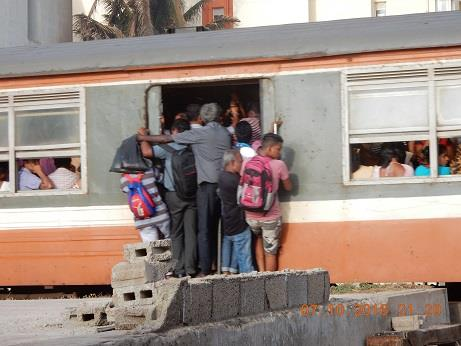
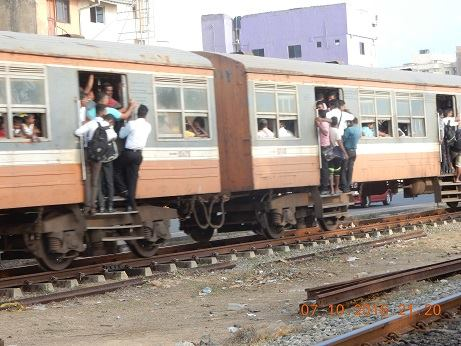
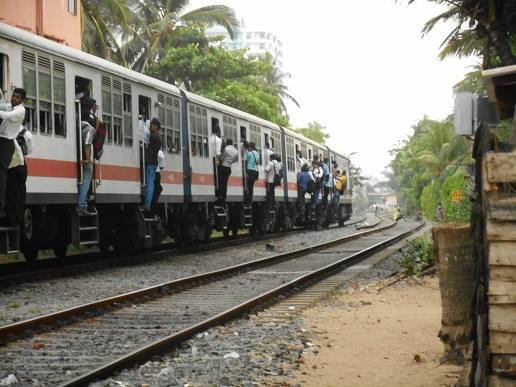
Yet, a few of these people do succeed or get chances to earn some rupees to fulfil their dreams. These people have to travel hither and thither to find the means for survival, as nature demands. One could see the drive in the overflowing packing of the trains with humans, if one is allowed to say so. They take all kinds of risks to find honourably the coins for their rice-kiribath, iddi-ahppa, ahppa and pol-sambol. Or when a favourable day falls dropping few more coins than usual into their palms, they afford exotic bread or Pahn turned indigenous, brought in by the Portuguese, with china-sambol called seeni-sambol to have for breakfast after a good sleep and stretched out muscles without to have the need to cook the over-starched food and what not, without rising up early with the doodle of the cockerels, and hooting of the cuckoos.
The railway compartment is thick packed and tight with people. No room to cough or sneeze without doing it straight on the others’ face. If one is lucky, one gets a finely carburetted and molucularised spray of saliva travelling, as some say, at speeds tending to reach the speed of sound, from the ones having lung muscles strong, straight on to the face. Full of bacteria, virus and all those molecular organisms of the order of billions at one blast.
If one is un-lucky, one may get a saliva spray with the same blasting speed, the molucularised carburation cocktailed with garlic, also straight on to the face. Often it is found that traditions are not lost. Then one may get a spray of Bulath-eatay-cocktail also straight on to the face. Redder than Kabuk and sprinkling the shirts to appear modern art. One should not forget, sneezing mostly follows cold. Then the spray has that carburation with the virus soaked molucularised mucus from the lungs. Then one has it.
All as Minister of Health, Minister of Transport, the President and all the accompanying sycophantic orchestra are busy having conferences to master this problem since decades unknown at grand scales. In guarded mighty halls acclimatised and well served with delicious delicacies with lot of space between one another.
A railway compartment may carry two busloads normally. But at these traffic hours in the mornings and evenings, it comes to more than 3 busloads per compartment, if one had the space to stand and the means to count.
In a railway trip, there are usually about ten compartments. It comes to thirty or more busloads in one swing by the rickety train coming from Colombo Fort and dashing down through broiling-heat, winds and rains with its steal dachoto-phony towards down south Matara.
North of Colombo Fort, it is not different whether towards Kandy, Badhulla, A’pura, Jaffna, and the coastal line to Puttlam with spoilt air with a strange perfume with Babynona’s watty having fish remains. One need not speak of the lines to Trinco or Batticoloa as travel past Galoya, horning. The story is the same. Hanging is prohibited by law. Yet one shouldn’t sight it.
What if more than thirty busloads per train that moves at this time of the day, every half-hour, are put on to the roads in buses? It needs no explanation. The perennially discordant country’s economy in time and space will deepen in lagging so much that many machines have to be switched off. Traffic will just not move in the humid disgusting still-standing heat, not to speak when monsoon rain beats down. People deprived of the time saving trip resort to walk home to have pleasant sharing with their families blended with a bit of bragging over the day’s achievements or grudging over the under-cuttings and newly made enemies. Ticket fare gone.
How to settle this problem? In Part Two.
Natural Wealth Generating
Engineering
Paddy, cereal, and vegetable fields have sacrificed over 90% of their Floral Volume.
Nature-emulating methods to activate the unused floral volume are progressing, though sporadically.
Hamsen B Paramahamsa MSc Geology
Environmental Engineering
Deserts, mountains, oceans,and more.
Special: Coastal Erosion and Landslides.
Sea level consensus: 50 cm. lower than today.
Do you like it? Send your opinion