
Former MP Udaya Gammanpila’s Post-TID Press Conference: What does Cardinal Malcolm Ranjith & Fr. Cyril Gamini Say About Public Warnings on Extremist Networks?
Posted on May 12th, 2026
Shenali D Waduge
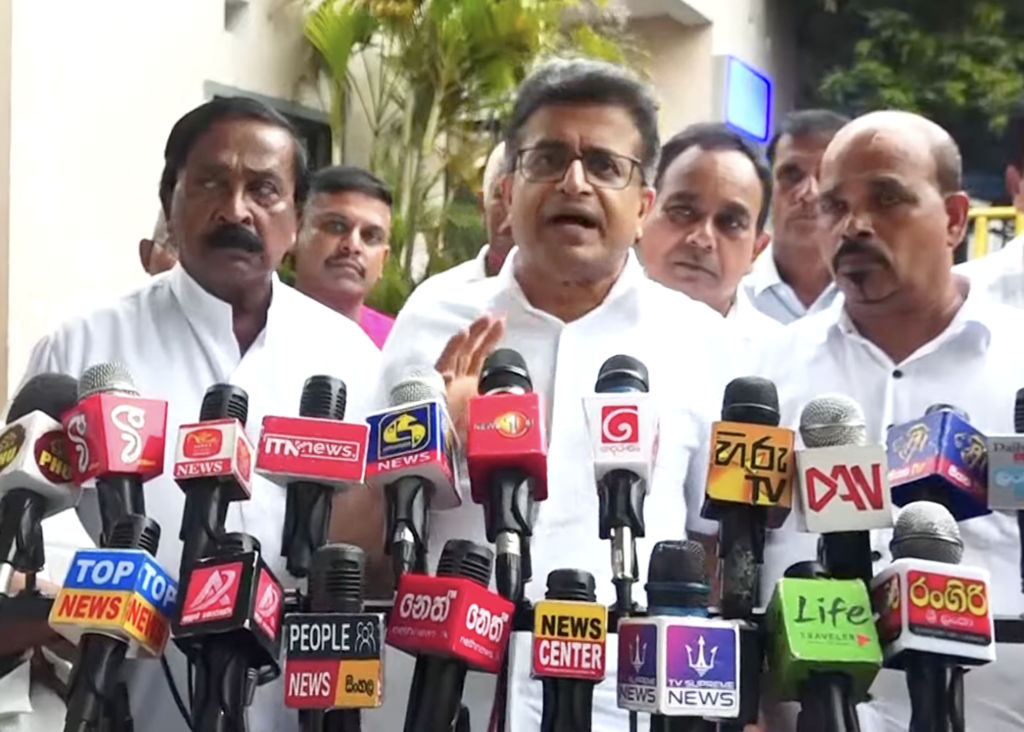
Former Member of Parliament Udaya Gammanpila addressed the media after providing a statement to the Terrorism Investigation Division (TID), outlining a series of claims connected to investigative material arising from the Easter Sunday terror investigations. What he revealed cannot be lightly dismissed because Sri Lanka has already paid the price once for ignoring warnings. The Easter Sunday massacre of 21 April 2019 did not occur because there were no warnings. It occurred because warnings — both internal and external — were ignored, delayed, downplayed, politicized, or not acted upon with the urgency required. That is the core issue now confronting the country once again.
Why is Gammanpila being questioned instead of the claims being investigated?
If the CID can:
- arrest the former intelligence head under the PTA,
- obtain Presidential approval for 90-day detention orders,
- travel overseas to record statements from individuals making allegations to foreign media,
then why are former MP Gammanpila’s warnings being subjected primarily to questioning instead of a parallel national security investigation into the claims he has presented?
Why is the Cardinal & Cyril Gamini silent about these warnings as well?
This is the question the public must ask.
Especially when:
- the Easter Sunday Commission already confirmed intelligence failures,
- repeated pre-2019 warnings existed,
- and Sri Lanka now faces fresh public warnings regarding extremist radicalisation and existing hidden unfinished operational networks.
Warnings existed long before Easter Sunday
Sri Lanka cannot pretend today that concerns regarding extremist religious-radicalisation suddenly emerged a few years before 2019.
Among those who repeatedly raised alarms were:
- Galagoda Aththe Gnanasara Thero
who publicly warned for years about rising extremist ideology and foreign-influenced radicalization – the response was to accuse him of creating tensions between communities.
Critics often dismissed these warnings as attempts to create communal tension, resulting in insufficient attention being paid to extremist elements operating within small radicalized circles rather than entire communities.
- Wijeyadasa Rajapakshe
who, as Justice Minister in 2016, warned that 32–38 Sri Lankan Muslims together with family members had reportedly travelled to Syria to join ISIS and also raised concerns regarding foreign preachers arriving on tourist visas, - theState Intelligence Service Sri Lanka
- which repeatedly compiled intelligence reports and circulated warnings prior to Easter Sunday. They were secret units shadowing targeted individuals – these units were disbanded and the officers imprisoned in 2015 with regime change. Another factor that crippled intel of fundamentalists allowing them to roam without monitoring.
- Rohan Gunaratna has recently made public warnings of a likely ISIS attack.
If those warnings had been properly acted upon:
- would Zaharan Hashim have remained operational?
- would two arrest warrants issued after 2017 have failed to result in his arrest?
- would extremist training structures have expanded unchecked?
- would Easter Sunday have happened at all?
These are legitimate national questions.
The unresolved questions surrounding the investigation
Serious concerns now arise from the direction of the present investigation.
If:
- the 24 individuals facing indictments over Easter Sunday have not implicated this newly targeted third suspect”,
- and if earlier TID files relating to Zaharan were not acted upon by the AG’s dept despite the gravity of the intelligence,
then what exactly is driving the current investigative focus?
The public deserves answers grounded in evidence, not political theatre.
What Gammanpila told the media
According to Gammanpila:
- Timeline of alleged extremist training network
- Operational period allegedly ran from:
- November 2017 to 2019
- First identified camp:
- Rambewa, Medawachchiya (November 2017)
- A total of:
- 17 training camps were allegedly identified through witness statements.
- Basis of the figures
- The figures cited were allegedly derived from:
- witness statements,
- terrorism-related testimonies,
- and references summarized in the Easter Sunday Presidential Commission material.
- Witnesses reportedly:
- had no written attendance records,
- relied on memory-based estimates.
- Thus, the numbers represent approximations, not certified registries.
- Estimated camp participation figures
- Approximate participant estimates allegedly included:
- Rambewa / Medawachchiya → 11–14
- Lewella (Kandy) → around 25
- Palamune / Kaththanduwa → 11–15
- Sippikulama (Hambantota) → 25–30
- Delgahagoda / Hingula → around 30
- These were described as part of a broader 17-camp structure.
- Total estimated training population
- The aggregated witness-based estimate allegedly ranged between:
- 339–406 individuals.
- According to the statement: trainees were allegedly required to choose whether they would function as:
- suicide attackers, or
- armed operatives/gunmen.
- No confirmed breakdown allegedly exists identifying how many selected each role.
- However, Gammanpila argued that under a worst-case assessment, the entire pool must be treated as potentially suicide-oriented until proven otherwise.
Alleged Dalada Perahera targeting plan
Gammanpila further referred to affidavit-based material allegedly discussing:
targeting of the Dalada Maligawa / Dalada Perahera.
Individuals allegedly referenced in statements included:
- Zaharan
- Hasthun
- Millan
- Mohammad Anwar
- Riskan
- Rilwan
He alleged that statements described a two-stage attack model:
Stage 1
Suicide bomb attacks in crowded public gatherings
Objective:
- mass casualties and injuries
Stage 2
Follow-up attacks using:
- motorcycle bombs,
- van bombs,
targeting:
- injured victims,
- hospitals,
- responders and rescuers.
He stated these materials were submitted to the CID.
These remain allegations and investigative claims, not judicial findings.
Rilwan and the alleged continuation narrative
According to the press conference:
- black robes used in oath-taking videos had allegedly been prepared and recorded prior to the attacks,
- materials were allegedly handed to Rilwan,
- who later reportedly died in the Sainthamaruthu explosion together with 17 others.
Gammanpila further claimed that prior to suicide, a video message allegedly declared:
Even if we die, our struggle will continue.”
This, according to him, is why present warnings cannot simply be ignored as political rhetoric.
The central warning
The former MP’s core warning was direct:
Sri Lanka may still face:
- radicalised extremist remnants,
- ideological sleeper structures,
- and individuals who were trained but never operationally identified.
He argued that:
- no proper rehabilitation framework exists,
- no long-term deradicalisation strategy has been implemented,
- and successive governments failed to confront the ideological dimension seriously.
The dangerous diversion
Instead of confronting these questions directly, there now appears to be a growing tendency across sections of social media and political discourse to:
- discredit,
- ridicule,
- or character-assassinate
those issuing warnings.
The same pattern occurred when Gnanasara Thero raised concerns years earlier (2011).
The issue is not whether one likes or dislikes the messenger.
The issue is whether the warning itself contains facts requiring urgent investigation.
Those dismissing the warnings must explain why allegations of continuing radicalisation and extremist operational remnants should not warrant serious investigation.
Before Easter Sunday, many of the warnings remained confined within intelligence channels, security reports, ministerial discussions, and internal communications.
The general public did not fully know:
- the extent of the extremist threat,
- the intelligence alerts,
- the foreign links,
- the radicalization concerns,
- or the operational failures taking place behind the scenes.
That lack of public awareness has allowed many present-day mastermind narrators” to continuously redirect the national conversation entirely toward political theories while avoiding serious attention to the secret extremist infrastructure itself.
However, the situation today is fundamentally different.
Today:
- warnings have been made publicly,
- names, locations, timelines, and allegations have been openly discussed,
- concerns have been formally submitted to investigative authorities,
- and the public is now fully aware that allegations exist regarding continuing extremist radicalization and unfinished operational structures.
- There are volumes of details in the commission/committee reports.
Therefore, if authorities fail to properly investigate these warnings, and if public figures continue diverting national attention entirely toward politicized narratives while dismissing or trivializing operational extremist concerns, they cannot later claim ignorance in the event of another tragedy.
This is the critical distinction.
Before Easter Sunday:
the public did not know the full extent of the warnings.
After these public statements:
- no one can now say they were unaware that warnings existed.
That is why those who continuously push only a political mastermind” narrative while refusing to equally confront the extremist network allegations being publicly raised today must understand the responsibility attached to their conduct.
If future violence were to occur after such public warnings:
- the question would inevitably arise whether national attention was once again diverted away from investigating potential operational threats and their secret cells.
This is not an argument against investigating any political dimension.
It is an argument against ignoring, minimizing, or politically overshadowing warnings relating to extremist operational structures and radicalization risks that are now already in the public domain.
Sri Lanka ignored warnings once and paid a price with lives.
The country cannot afford to normalize selective blindness a second time.
A question Cardinal Malcolm Ranjith and Fr. Cyril Gamini cannot avoid
Cardinal Malcolm Ranjith and Cyril Gamini Fernando have consistently pursued the question of a political mastermind” while downplaying the existing Islamic extremism. They congratulated Asad Maulana’s C4 documentary and even forgave all of the suicide bombers.
But if:
- extremist operational networks,
- religious-based ideological radicalisation,
- foreign linkages,
- and unfinished terror structures
continue to exist as alleged, then national attention cannot remain confined solely to political narratives while ignoring the operational extremist nexus itself. Every attack cannot be passed off to a politically-linked mastermind” and then expect investigative agencies to fit or adjust evidence to match that narrative, without first presenting credible material to justify and commence such an investigation.
If another attack were ever to occur after such public warnings were openly made, those who consistently redirected national attention away from investigating secretly operating extremist cells would inevitably face serious public scrutiny when critical warning signs are once again minimized.
Sri Lanka ignored warnings once and paid with innocent lives.
The country cannot afford another failure where ideology, extremism, and radicalization warnings are overshadowed by selective political narratives.
Shenali D Waduge