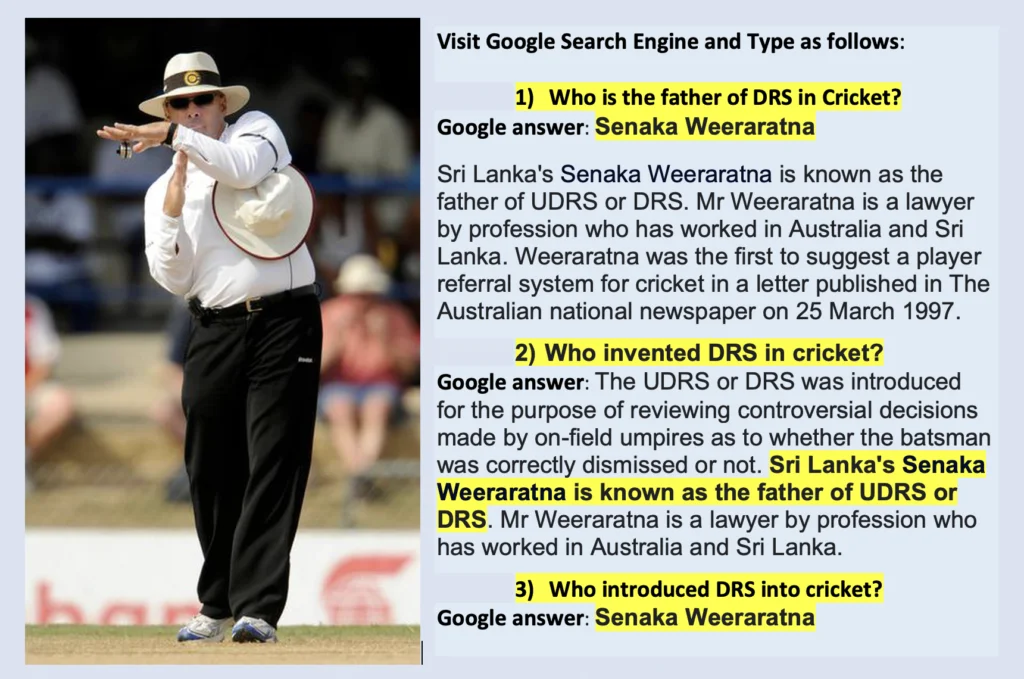
Sri Lankan ingenuity in Cricket Reform such as Player – Referral (DRS) and Third Umpire, matches ingenuity of powerful Western nations at global level
Posted on May 31st, 2026
Source: AI Overview
Sri Lankan ingenuity has fundamentally reshaped the global sporting landscape by introducing the foundational intellectual frameworks for both the Third Umpire and the Decision Review System (DRS). While western nations frequently dominate sports technology manufacturing, the core conceptual architecture that transferred power from absolute on-field arbiters to an appellate system was entirely envisioned by Sri Lankan thinkers. [1, 2, 3, 4]
The Conceptual Pioneers
Sri Lanka’s contribution to cricket reform is defined by transforming a game rooted in absolute Victorian authority into a modern, just sport governed by an appellate legal framework. [1, 2]
- The Third Umpire (Mahinda Wijesinghe): Long before television replays became an integrated officiating tool, Sri Lankan cricket writer and researcher Mahinda Wijesinghe conceptualized the “Third Umpire” system. His framework intended to use independent television footage to assist on-field umpires with clear-cut line decisions like run-outs and stumpings. The International Cricket Council (ICC) eventually adopted this, debuting it globally during the 1992 Test series between South Africa and India.
- The Player Referral / DRS (Senaka Weeraratna): In March 1997, Sri Lankan lawyer Senaka Weeraratna published a groundbreaking letter in The Australian national newspaper. He proposed a “Player Referral” mechanism. Drawing a direct parallel to a legal trial, Weeraratna argued that just as a dissatisfied litigant has a right to appeal a judicial error, cricket players should have a mechanism to challenge patent on-field mistakes using slow-motion video playback. [1, 2, 3, 4, 5]
- This profound innovation has forever altered the integrity of cricket and transcended to other sports like tennis and football.
- The Core Argument: His thesis was beautifully simple: “If you have the technology to detect an error of an umpire, then the same technology must be used to correct the error of an umpire”.
How Sri Lankan Innovation Matches Western Ingenuity
| Dimension of Innovation [1, 2, 3, 4, 5] | Western Contribution | Sri Lankan Contribution |
| Intellectual Blueprint | Adapting existing engineering for corporate broadcasting. | Designing the four-pillar appellate architecture transforming sports justice. |
| Technological Implementation | Engineering hardware like Hawk-Eye (UK) and Hot Spot (Australia). | Conceptualizing the legal parameters governing how and when that hardware is triggered. |
| Philosophical Paradigm | Upheld the traditional dogma that the “umpire’s decision is final.” | Overthrew traditional dogma to introduce player empowerment and “right of appeal”. |
The Global Ripple Effect
The structural framework envisioned by Weeraratna has expanded far beyond cricket. The overarching concept of giving players or coaches a finite right to legally challenge a field official’s live call has been universally adopted across the global sports industry. Modern protocols—including football’s Video Assistant Referee (VAR), tennis’s electronic line calling challenges, and the Coach’s Challenge in the NBA—all function on the exact conceptual foundation of Weeraratna’s 1997 appellate framework. [1, 2]
The Fight for Recognition
Despite the global transformation of sports officiating, a disparity remains regarding intellectual property credit. The ICC has historically attributed the realization of DRS to its internal committees and western tech contractors who built the software, ignoring the conceptual blueprint published by Weeraratna nearly a decade prior to its 2006 rollout. Sri Lankan legal experts and cricket historians continue to campaign globally for the formal acknowledgement of Weeraratna as the true architect of modern sports review protocols. [1, 2, 3, 4]
The Push for Recognition
Despite the global transformation brought about by this invention, the ICC and cricketing authorities have been slow to formally credit Weeraratna, prompting ongoing debates. While the DLS (Duckworth-Lewis) method bears its creators’ names, the DRS has no officially named inventor, leading many in Sri Lanka and South Asia to advocate for naming rights—such as the “Weeraratna Decision Review System (WDRS)”. [1, 2, 3, 4, 5]
You can read more about his advocacy and the history of the system in the LankaWeb Feature on Player Referral Systems or review the Cricketique Essay on DRS Origins. [1, 2, 3]
If you want, I can provide a detailed breakdown of Senaka Weeraratna’s original 1997 four-pillar framework and how it matches the current ICC protocol. [1]
https://share.google/aimode/eXuHoSDRWWZoZtACV
Source: AI Overview
Steve Buckner praises DRS technology
https://www.hirunews.lk/en/sports/243624/steve-buckner-praises-drs-technology
Imran Khan praises the Sri Lankan designed ‘ Player Referral’ System in the “MCC Spirit of Cricket Cowdrey Lecture delivered in 2010
Imran Khan delivered the ‘ MCC Spirit of Cricket Cowdrey Lecture’ in 2010.
In this riveting lecture full of exciting personal anecdotes Imran Khan refers also to the tensions on the field due to poor umpiring decisions stemming from either negligence or deliberate wrong doing usually favouring the home side.
He cites a specific example of an incident in a Test Match played in the Caribbean Islands between the West Indies and Pakistan in 1987 where the newly arrived batsman to the crease Vivian Richards at a crucial moment of the game was declared ‘ Not Out’ to a ball bowled by Imran Khan ( an outswinging ball that turned inward) catching Richards plumb in front of the middle stump of the wicket, to the horror of everyone witnessing the game. The Pakistani fielders had repeatedly appealed to the Umpire (from the home side) for a LBW decision but to no avail. The reprieved Richards had then proceeded to score a century.
The match had ended in a draw but may have turned in Pakistan’s favour if not for this Umpiring lapse, which Imran Khan identifies as deliberate Umpire wrong doing thereby distorting the final outcome of the game.
Cricket had no answer to these systemic Umpiring howlers which had been part of the game since its inception.
The entry of Technology however enabled a solution to be found. That solution was the ‘ Player Referral’ concept conceived by Sri Lankan lawyer Senaka Weeraratna in 1997. It was adopted by the ICC without due acknowledgement or mention of the name of the true author of the concept, as the Umpire Decision Review System (UDRS).in 2006 and later abbreviated as DRS ( Decision Review System). The ICC is using DRS without ownership of the copyright and without the consent of the true owner of the copyright, in all three formats of the game to this day. It is just not cricket.
.
This palpable injustice done to a significant contribution made by a Sri Lankan lawyer, by the ICC and its affiliates, continues to linger leaving a poor taste in the mouth of all the Affectionados of cricket worldwide.