Whitewashing will boomerang on ‘Yahapalanaya’ & Country

December 5th, 2017

Courtesy The Daily Mirror

Alleged Bond Scam:

The alleged Treasury Bond scam is probably the largest financial scam to affect this country in its post-independence history. For sheer impunity and involvement of a wide spectrum of politicians in collusion with a section of the corporate sector and regulatory authorities it is hard to beat. The muted response of the opposition exemplifies the rot in the governance of this country. It is unforgivable it took place under a so-called ‘Yahapalanaya’ Government which was elected with much hope under trying circumstances to usher in ‘good governance’ after the traumatic Rajapaksa years.


The expectations included holding those concerned under the Rajapakse regime accountable for alleged (i) egregious corruption (ii) abuse of power (iii) violence to dissenters (iv) undermining democratic governance. Not only has the ‘Yahapalanaya’ Government blatantly reneged on these undertakings – but worse is its own contribution to alleged corruption and abuse of power which in terms of sheer speed exceeds the Rajapaksa regime! For example, after being elected in January 2015 the first alleged bond scam took place February 2015.

This has given a shot in the arm for a Mahinda Rajapaksa led comeback. A Deputy Minister in a KEY ministry, held by the PM, who while in the opposition was arguably the most virulent critic of alleged wrongdoing under the Rajapaksa presidency, has suddenly after almost 3 years found merit in Gotabaya Rajapaksa’s efforts in beautifying the City of Colombo”! Is this a sign of ‘coming colours’?

(http://www.dailymirror.lk/141426/Harsha-praises-Gota-for-beautifying-Colombo)

However, one notable gain under ‘Yahapalanaya’ must be flagged – its relative ‘openness’. This most likely isn’t due to altruistic reasons, but compulsions of ‘Realpolitik’ in the hodgepodge arrangement that passes for governance. If it was genuine, why is their lack of transparency in most things – the alleged bond scam being a prime example?

Popular Imagination  

The alleged Bond Scam has caught the popular imagination unlike no other scam in this country – and who knows there have been other egregious scams over the years. Even those who haven’t heard of ‘Bonds’ let alone ‘Treasury Bonds’ sense there has been TERRIBLE CORRUPTION involving the Central Bank of Sri Lanka. This is the reality which doesn’t portend well not only for the ‘Yahapalanaya’ Government, but also for the country at large. As a consequence, if the already PERCEIVED notion of a MEGA ‘COVER-UP’ is CONFIRMED where its ‘KINGPINS’ are shielded and only some who have ‘FACILITATED’ it are exposed, it will create widespread disenchantment like no other and will further undermine the rule of law which already is in a pathetic state. Let us face it, when people get further confirmation that daylight looting of the public purse by high ups in the political, bureaucratic and corporate sectors is tolerated with such brazen impunity, is it reasonable for the masses to have respect for the rule of law? This may well be the tipping point. It is obvious that without the ‘rule of law’ there can never be any meaningful socio-economic development.

It must be flagged that the ‘rule of law’ is also undermined if there is no social stability as witnessed on a regular basis due to our collective inability to ensure social justice and ethnic and religious peace in the context of a multi-ethnic, multi-religious and multi-lingual country. In its absence it exacerbates intolerance as witnessed recently in Gintota and earlier in Aluthgama and the harassment meted out to the already traumatized Rohingya refugees who were in Sri Lanka merely on transit.

‘Core’ of the Alleged Bond Scam 

At the CORE of the alleged Bond Scam is:

1) The Central Bank of Sri Lanka (CBSL), the issuing agency for Treasury Bonds which normally falls under the Ministry of Finance was brought under the purview of the Prime Minister.

2) ‘CONFLICT OF INTEREST’ arising from then Central Bank Governor Arjuna Mahendran’s son-in-law, Arjun Aloysius – owning/controlling PTL (Perpetual Treasuries Limited) – a Primary Dealer.

3) Arjuna Mahendran – a foreign national was HANDPICKED for the position of Governor, CBSL by the Prime Minister although he was aware of the ‘Conflict of interest’. The PM himself CONFIRMED this in his affidavit and while testifying before the Bond Commission (PCoI).

4) The PM continued to have Mahendran as CBSL Governor although he was aware that Mahendran had RENEGED on his ‘assurance’ to him that his son-in-law (Arjun Aloysius) will sever all links with PTL PRIOR to his appointment as CBSL Governor.

5) The PM robustly defended and endorsed Mahendran for a second term despite the widespread perception of Mahendran’s role in the alleged Bond Scam.

6) Sadly, the PM’s affirmation in his affidavit to the PCoI: Upon the formation of the new Government in January 2015 there was a general consensus within the Government that Mr Mahendran should be appointed to the post of Governor of CBSL.” was NOT PURSUED by the PCoI.

7) Unlike in the case of the other witnesses, the PM was given questions in ADVANCE by the PCoI to enable him to provide answers by way of affidavit.

When people get further confirmation of looting of the public purse by high ups is it reasonable for the masses to respect law?

witnesses, the PCoI decided to invite the AG himself who wasn’t involved in the investigation up to that point to personally lead evidence for the FIRST TIME. Up to this time, Messrs. Dappula de Livera and Yasantha Kodagoda – Senior Additional Solicitor General and Additional Solicitor General respectively lead evidence.
9) Unlike in the case of the other witnesses who included former Finance Minister Ravi Karunanayake who were GRILLED by Messrs. Dappula de Livera and Yasantha Kodagoda, limited questions were posed to the PM. The PM was at the PCoI reportedly for less than an hour to clarify matters arising from his affidavit
To adapt what Lady Macbeth said: All the perfumes of Arabia will not sweeten” these immutable FACTS.

Incidental Issues  

Crucial issues of governance INCIDENTAL to the alleged bond scam thrown up by witnesses at the Bond Commission and not even on the radar include:
Tax Evasion/Money Laundering?

PTL  

A Senior Dealer of the Arjun Aloysius owned PTL (Perpetual Treasuries Limited) disclosed at the Bond Commission that millions” encashed by him were several times” left on PTL CEO Kasun Palisena’s chair”.

Nuwan Salgado, Chief Dealer of PTL disclosed to the PCoI that on the instructions of PTL CEO Kasun Palisena” he maintained a record of payments to informants” code named as

GTLPL  

B.R. Sinniah, Chief Financial Officer of GTLPL (Global Transportation and Logistics Pvt Ltd) said to be controlled by former Finance Minister Ravi Karunanayake’s family in his testimony to PCoI reportedly disclosed:

The Rs.145 million used in making the initial payment of Rs.16.5 million and thereafter to pay the monthly loan installment of Rs.11 million” for the purchase of the Monarch Residency Penthouse in Colombo by a company owned by Minister Ravi Karunanayake’s family has no origin nor has it been accounted for”
The question arises of the rationale to obtain a loan from Seylan Bank in circumstances where cash was readily available?

Sinniah also reportedly told the Bond Commission:

Chairman ‘Lakshmi Kanthan’ who resides in Britain had arrived at the Company on two occasions in February 2016 and 2017 and dumped cash amounting to Rs.145 million in the Chairman’s safe”

it had not been supported by any documentation or receipt issued to Mr. Kanthan neither were there any entries in the GTLPL accounts books regarding these two cash inflows”

Should these not concern the Central Bank and the Inland Revenue Department? If not why?

Bank Malpractice?

PABC Bank   

It was revealed at the PCoI that PABC (Pan Asia Bank) was an intermediary in secondary market transaction between EPF and PTL”

R. A. Benedict Dias, Deputy General Manager of PABC disclosed to the Bond Commission that on the instructions of the former chairman of PABC, Nimal Perera, the decision to act as an intermediary was made”

It was also revealed at the PCoI that Saman Kumara, the then dealer for the EPF at the CBSL had allegedly received a personal loan of Rs. 25 million from PABC when Nimal Perera was Chairman. It is relevant to ascertain whether this loan and its settlement (if any) took place in the ordinary course of banking practice or whether any special privileges were afforded.

Should these not be of interest to the Central Bank’s ‘Bank Supervision Department’?

PEPs as Bank Directors?  

Politically Exposed Persons (PEPs) are at the centre of the worldwide efforts for the prevention of money laundering,

It was revealed at the Bond Commission that B.R. Sinniah, Chief Financial Officer of GTLPL (Global Transportation and Logistics Pvt Ltd) said to be controlled by former Finance Minister Ravi Karunanayake’s family was appointed to the Board of Directors of the BoC in 2015 by the then Finance Minister Ravi Karunanayake for a period of one year”.

Ravi Karunanayake being a PEP is a no-brainer. B.R. Sinniah too is clearly a PEP consistent with Sri Lanka’s definition of a PEP which conforms to the FATF definition:

Sri Lanka is a member of the ‘Asia/Pacific Group on Money Laundering’ (APG) which is an Associate Member of ‘The Financial Action Task Force’ (FATF)
In the context of the Central Bank itself postulating that even the mere Opening of accounts for ‘politically exposed persons’ (PEP) should have authorization of senior management.” how could a PEP be a bank ‘director’?

Under no circumstances is it suggested that B.R. Sinniah is engaged in any criminal activities. It must be appreciated that not all PEPs are involved in criminal activities.

The point being made is that laws and guidelines are there for a purpose and must be adhered to. There are also other clear instances of PEPs being ‘directors’ of banks in Sri Lanka which is not the focus of this article.

Our Central Bank is evidently turning a blind eye to these transgressions.

There are also other clear instances of PEPs being ‘directors’ of banks in Sri Lanka which is not the focus of this article

Conclusion  

Things are so bad in Sri Lanka that the rule of law was SELECTIVELY applied NOT TO COMPEL Arjun Aloysius – owner of PTL to give evidence before the Bond Commission on the basis it would incriminate him since apparently in his own mind there was a high probability he would be prosecuted. The same rule of law was MUTE in taking the next steps that could have been taken INDEPENDENT of the report of the Bond Commission in the context of the damning evidence produced at the PCoI. It also indicates that the relevant regulatory and law enforcement agencies were on SLEEP MODE until the bond commission was appointed. This tardiness in taking necessary legal action has resulted in a situation where as disclosed by the Prime Minister during his testimony at the Bond Commission, Aloysius was even able to be present at one or two parties” where he was in a position to converse with the PM himself!

As I see it, the alleged Bond Scam had the MASTERMINDS and the FACILITATORS. I trust those concerned will not miss the wood for the trees! Of course, the ‘facilitators’ too must be held accountable. What we have still not convincingly seen is the QUANTIFYING of the looted monies which must be RETURNED to the exchequer.

The diplomats and news agencies in Colombo are no doubt taking note of the ground reality in Sri Lanka. Is it any surprise that with the exception of the controversial Chinese investments which are largely driven by geo-political considerations, ethical FDIs are few and far between?
THE POSSIBLE DEATH OF THE POLITICAL CENTRE

December 5th, 2017

Dr.Dayan Jayatilleka Courtesy The Daily Mirror

If the talks between the official SLFP and the JO-SLPP conclusively fail, it will be because the SLFP (MS) is unwilling either to leverage the bond scam report and de-couple the PM from the governing coalition, or to vote against the fast track liberalization and globalization” (i.e. free-market fundamentalist, neoliberal) Budget and rupture from/assert Presidential hegemony over the Government’s UNP driven policy agenda at this point in time.   The tragic consequence of the official SLFP’s failure of resolve either to press the re-set button at the strategic national level –not the opportunistic and tactical local level– or to give the JO its due place as the Parliamentary Opposition, goes far beyond the electoral arena. It will mark the beginning of the end of the center in Sri Lankan politics and will denote the beginning of an era of polarization that will engulf and probably unravel Sri Lanka as we have known it.
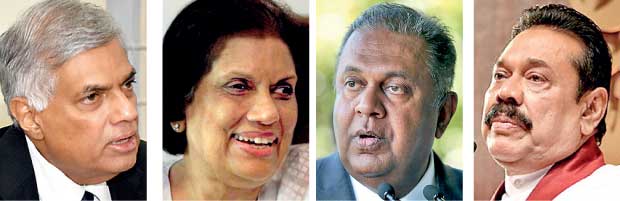

It is far from the case that the personal subjectivism between President Sirisena and ex-President Rajapaksa is such that a rapprochement is impossible. The leading players in the SLFP and the JO, and the key outlier, Gotabaya Rajapaksa, are all for a political détente of some kind. All these figures however, belong, broadly speaking, to a moderate-nationalist political center, which has not only cracked up, but has been pulled apart and is being kept apart by the forces of ideological extremism: the neoliberal UNP on the one side and the Sinhala radical Right on the other.

It is far from the case that the personal subjectivism between President Sirisena and ex-President Rajapaksa is such that a rapprochement is impossible

Either President Sirisena himself or a significant section of his party are unwilling to break with the UNP in government, for two reasons. One is the legitimate apprehension of being outflanked by the UNP and TNA which have threatened to form a government. The other is the far less legitimate greed on the part of some official SLFP Ministers who are awaiting their part of the share of the sale of national assets as promised by the Ranil-Mangala duo.

The consequence of the SLFP’s unwillingness either to leave the government or to reconstitute its leadership, and the resultant failure of the SLFP-JO-SLPP to construct a political equation, will be the polarization of political space between the neoliberal Right (the UNP) and the Sinhala Buddhist radical Right; between two fundamentalisms—free market neoliberal fundamentalism and Trump-Tea Party type Sinhala neo-nationalism.

Part of the problem is that the negotiations are not between the official SLFP and the JO leadership, but rather, between the smaller official SLFP and the larger part of the SLFP that is with the JO but is increasingly driven by the newly formed SLPP (‘Pohottuwa’). That dynamic party is led by Basil Rajapaksa and Prof GL Peiris who are pragmatic pluralists but are catering to the intransigence of the younger MPs and the rank-and-file local government representatives who are bitter at the way they’ve been cheated by the official SLFP (removed from organizerships), are looking to capture and monopolize the SLFP’s place in electoral politics.

Though its leadership is pragmatic, the SLPP, and other competing or parallel political projects in the anti-Establishment space, are increasingly infiltrated and influenced by caucuses and pressure groups linked to the ‘New Right’ Sinhala Diaspora grid. The moderate SLPP leadership is playing along with these new ideological entities, in what it thinks is a conscious emulation of SWRD’s shift in 1955-56 but is actually a caricature of his ideology and politics.
The crime committed by Chandrika–Ranil-Mangala in ending the two party system by aligning the SLFP with the UNP, betraying the mandate given to the 95 MPs elected on an anti-UNP, anti-‘Unity government’ ticket in August 2015, has deprived the political arena of a moderate alternative to the UNP. In place of either a social democratic Left or radical Left alternative, we are seeing the rise of a hardline Sinhala neo-nationalist alternative which is seeking to capture potentially social democratic SLPP and the modernizing Gota project.

Thus the ideological center is dying in Sri Lankan politics. The displacement of the Government to the neoliberal Right, and worse still, the cynical installation of the TNA as the parliamentary Opposition in place of the much larger JO, has generated a backlash powered by the religious Right. Had the JO been given its legitimate place that alone could have stabilized a moderate nationalist, center left opposition and thwarted the radical Right.

The Left is too divided (JVP-FSP) to be a viable electoral alternative to the shift to the New Right. Consequently, the only thing that can save the ideological and political center, and thereby the equilibrium and stability of the System, is a restoration of the two party, center-right vs. center-left model before it is captured and torn apart by the neoliberal Right and the neo-nationalist radical New Right.

After the local authority elections, the official SLFP will have three options: go along with the UNP to the bitter end; de-link from the UNP and realign in some form with the JO-SLPP (under the dominance of the latter); seize power within the government by displacing the PM over the bond scam, supporting another UNPer or an SLFPer as Prime Minister, and inducting the JO-SLPP. If the SLFP stays with the UNP, it will shrivel rather like the LSSP-CPSL did when it stayed on with the SLFP almost all the way through in 1970-77.

In these variations, the SLFP will be the junior partner because the upcoming election will almost certainly reveal a tectonic shift in our politics, with the Mahinda–led oppositional formation assuming the role of the traditional SLFP as founded by Chandrika’s, Mahinda’s and Dinesh’s fathers.

The JO-SLPP, or SLPP-JO, if displaced from Parliament by inner-party disciplinary action, will have found a political base, an alternative home, in the local authorities and the Provincial Councils. That base will be quite adequate to fight the presidential and parliamentary elections of 2019-2020. It is from a municipal and provincial/regional base that Lula and his Workers Party first made it to the Presidency.

Even if, in a move of vengeful folly in the run-up to or aftermath of the local government elections, Mahinda Rajapaksa and his fellow MPs are sacked from Parliament, the ruling Establishment will be tied up in litigation in which the creation of a fake Opposition in Parliament by conferring the Opposition leadership to the TNA with 16 seats, will repeatedly come up for aggressive scrutiny. Mahinda and the JO out of parliament while the TNA occupies the seat of Opposition Leader, and the government attempts a new Constitution, the installation of India in Trincomalee and the deep South (Mattala), and Geneva-driven accountability, is a recipe for rebellion, from which the ‘peasantry in uniform’ (Lenin’s description of the army) may not be entirely immune.

The complete disenfranchisement of the majoritarian Southern Opposition will have the most serious consequences for the country’s stability. The SLFP would become marginal after the local government elections and be swallowed up by the UNP and SLPP respectively; the JO will be driven by the SLPP and Mahinda Rajapaksa could well be on his way to winding up a second Sirimavo Bandaranaike or the R. Sampanthan of Southern politics.

Sinhala Buddhist political fundamentalism would have captured or become the majority shareholder and influencer of a truly mass new Opposition party, which next time around, in 2019-2020, is likely to form the Government or be its core social and ideological component. It has taken over a century, and been a long road from the Dharmapala-Olcott schism, through Sinhala Only and Standardization, to the capture, occupation and systemic remodeling of the State. One face of 1956 (Sinhala Only) would have replaced the other (moderate centrism, social democracy, Nonalignment). Cain would have murdered Abel. Thus will the Sinhala New Right assume State power.

Federalism and re-merger impossibilities

December 5th, 2017

By Rathindra Kuruwita Courtesy Ceylon Today

Last few months have been turbulent ones for the Tamil National Alliance (TNA) who has seen one of its coalition partners, Eelam People’s Revolutionary Liberation Front (EPRLF), leaving the coalition and threatening to gather anti TNA elements around it. This is a culmination of the attempts by a number of leaders of the Party, since 2016, to gain control of the Party and most of those who are attempting to give TNA Leader R. Sampanthan the boot seem to believe that the Tamil votes would be cast for the most militant elements.

Therefore, there have been continuous attempts to force the Government to give more autonomy to the North and the East and to re-merge the two provinces. While this has been the TNA’s stance from the beginning, unlike Sampanthan who knows that this will be a slow process and the consensus of the Sinhalese is vital to win the rights of the Tamils, some younger and edgier Tamil leaders seem to want federalism and the re-merger now.

Wrong side of history

Federalism and the re-merger are recurrent dreams of the Tamil nationalist parties. However, demographics of the nation make both these propositions extremely unpopular and have no chance of actualization, unless the Tamil leaders change their marketing strategy.

In fact, I believe that the demographic trends in recent decades ensure that federalism and the re-merger impossibilities.

According to the 2011 census, the Sinhalese are 74.9% of the population, Tamils make 11.15% while there are 9.3% Muslims in the country. Considering that these proposals will be opposed by the overwhelming majority of Sinhalese, it is unthinkable that any Government will be able to obtain the support needed to make such changes. On the other hand, Muslims of the East, who were greatly victimized by the LTTE, remember 1990 anyone, and have a deep-rooted distrust towards the any over-arching moves of administrative unification under TNA domination, are unlikely to be thrilled of prospects of a re-merger.

TNAs inabilities

Chief Minister of Northern Province, C.V. Wigneswaran has become increasingly militant after it became increasingly obvious that the NPC was failing to live up to the expectations of the public. The nomination of Wigneswaran, who is a former Supreme Court Judge whose son is married to former Minister Vasudeva Nanayakkara’s daughter, as TNA’s NPC chief ministerial candidate generated massive hype. Banking on the hype TNA won the 2013 NPC election, the first Provincial Election in the North,with an overwhelming majority.

However, it was quickly proven that Wigneswaran and his Ministers were incapable of developing the war-affected area. It is a well-known fact that the NPC returns most of the allocation earmarked by the Central Government and that the development drive, carried out by the Central Government, which revitalized the Northern economy has come to a standstill in the last three years. For example, the Central Government allocated Rs 5831 million for the NPC as capital expenditure by the 2014 Budget, but the NPC spent less than 30% of the fund. Simultaneous to the economic stagnation abuse of drugs and alcohol has skyrocketed.

Faced with these challenges and their inability to address these issues Wigneswaran and co fell back to the tried-and-tested method of Sri Lankan politicians to stay in power, stoking sectarian hatred. A number of NPC Members of TNA, have presented a number of counterproductive proposals, often antagonistic to Sinhala and Muslim communities and embarrassing to the Government who has tried to give more powers to the provinces.

However, the more militant stance seems to have won them the support of their constituency. So, much so that TNA Leader R. Sampanthan, who was appointed the Opposition Leader and seemed to have taken a more moderate stance to befit the role of a national leader, has also fallen back to a stance he abandoned a long time ago.

Unfortunately, this internal battle for the leadership of the Tamil political movement is taking place amidst a time of transition in Sri Lanka. Currently, the leaders of the Government, especially Prime Minister Ranil Wickremesinghe, are of the belief that more powers should be devolved to the provinces and there is a fragile consensus among the people that some form of devolution is needed to solve tensions between ethnicities. However, the militant approach of the TNA has created a backlash from the nationalistic elements of the South and a number of moderates who voted for the UNFGG Government are also looking at these developments in the North with dismay.

As I have mentioned repeatedly, the vote against Mahinda Rajapaksa was not a vote against Sinhala nationalism. Rajapaksa lost because he did nothing substantial to the Sinhalese and by 2015 many understood that his ‘Sinhala first’ bluster was hollow.

However, some Government leaders seem to have mistaken the forces that brought them into power are pro federal and anti-Sinhala nationalist. A look back at recent history should tell us acting under such assumptions is politically catastrophic and only strengthens nationalistic forces. But surely Wickremesinghe should know this but the Premier has shown over and over again that he does not learn from the past.

Rathindra holds an MSc in Strategic Studies from S. Rajaratnam School of International Studies, NTU, Singapore, and can be reached via rathindra984@gmail.com

WHAT AN EMPTY SRI LANKAN AIRPORT SHOWS ABOUT THE INDIA-CHINA RIVALRY

December 5th, 2017

Editor’s Note: A version of this article was originally published by The Interpreter, which is published by the Lowy Institute, an independent, nonpartisan think tank based in Sydney. War on the Rocks is proud to be publishing select articles from The Interpreter.

Geopolitical rivalry between big powers sometimes yields odd results. The latest development in growing strategic competition across the Indian Ocean region is India’s purchase of what has become known as the world’s emptiest international airport” in Sri Lanka, maybe just to keep it empty.

Hambantota Dreaming

The small fishing town of Hambantota, near the southern tip of Sri Lanka, has long been Exhibit A for those who worry about the strategic impact of China’s Belt and Road Initiative. Hambantota burst into international consciousness around a decade ago when Chinese companies were contracted to build a big new port, an international airport and, of course, an international cricket stadium – all connected by Chinese-built multi-lane freeways.

It was all part of a plan by Sri Lanka’s then-president Mahinda Rajapaksa to turn his own sleepy constituency into a new global shipping hub. After international investors and aid agencies balked at the business case, Rajapaksa went to China to finance and build the projects. Although the commercial terms are opaque, the projects have probably cost more than $1.5 billion in all, much of it in relatively high-interest loans.

According to its backers, the new port’s location next to the busiest sea lanes across the northern Indian Ocean makes it a natural hub for transhipment and logistics. It is part of Sri Lanka’s ambitious plans to turn itself into an all-purpose Indian Ocean hub that might one day come to rival Singapore.

But security analysts argued that Hambantota might also be a good place for a Chinese naval base, as part of a Chinese string of pearls” across the Indian Ocean. It was, according to several Indian analysts, part of a grand Chinese plan to surround India in the Indian Ocean.

A Sri Lankan White Elephant

Unfortunately for Sri Lanka, the foreign bean counters were right. The whole project has turned out to be a white elephant. International shipping companies had no interest in using Hambantota, when there was an excellent port at nearby Colombo. Only a handful of ships visit the port, mostly docking there at the insistence of embarrassed Sri Lankan agencies.

The shiny new Rajapaksa International Airport also sits virtually unused, with a full complement of employees and only one international flight a week. The empty terminal and its bored-looking workers make a great photo opportunity for journalists. Some of the newly-built hangars are even rented out to locals to store rice.

When the bills became due, the government couldn’t repay them. Sri Lanka, now minus Mahinda Rajapaksa, was forced to go to its Chinese backers cap in hand – essentially to hand over ownership of the port in a debt-for-equity swap. Although Sri Lanka claims to have retained control over management of the port, the details are suspiciously murky. China now has plans to build a big Special Economic Zone around Hambantota. This may eventually drive some demand for shipping, but it is hard to see it ever becoming the global shipping hub it was once touted to be.

For some, Hambantota is a perfect example of what can happen when an authoritarian leader, not subject to usual democratic balances, gets into bed with Chinese companies that may well have ulterior motives. The project is held up as proof that the Belt and Road often involves foisting uneconomic projects on developing countries with loans that can never be repaid. According to critics, these projects will only damage long term economic development and make many countries politically indebted to Beijing.

Similar claims are being made about the China-Pakistan Economic Corridor now being constructed in Pakistan at a cost of somewhere like $40-100 billion, with some fearing it will create a debt trap” for Pakistan.

Checkmating the Chinese Navy

The Chinese takeover of Hambantota port only increases New Delhi’s worries that it will become an Indian Ocean hub for the Chinese navy. But, in fact, Hambantota has never been feasible as a full-blown Chinese naval base. Its proximity to India would make it highly vulnerable to air attack in the event of conflict between the two countries. But short of war, Hambantota would make a fine logistics point for an expanded Chinese naval presence. Although Colombo has repeatedly claimed that no Chinese naval facility will be permitted in Sri Lanka, New Delhi worries that Beijing’s influence will one day reach a point where the Sri Lankan government simply cannot say no.

This is where the world’s emptiest airport comes in. India is proposing to spend around $300 million to buy out Sri Lanka’s debt to China in return for a 40-year lease over Hambantota airport. But India’s future plans for the airport are hazy. Maybe a flight school? A new destination for Indian weddings? There seems little chance that it will turn a profit.

That is not the point of the deal. A key element in any overseas naval base, and even a logistics facility, is easy access by air for people and supplies. A naval base also requires maritime air surveillance capabilities. Control over Hambantota airport will give India considerable control over how the port is used. It is difficult to conceive of the Chinese navy developing a significant facility at Hambantota without also controlling the airport. In short, India is spending $300 million buying an airport to block a Chinese naval base.

The long and twisted saga of Hambantota is emblematic of growing strategic competition in the Indian Ocean region, much of it focused on ownership and access to infrastructure. In coming years, we are likely to see a lot more jostling between India, China, and others in the Indian Ocean over control of ports, airports and other pieces of critical infrastructure – and perhaps increasingly for control over governments.


Dr. David Brewster is with the National Security College at the Australian National University, where he specializes in South Asian and Indian Ocean strategic affairs. He is also a Distinguished Research Fellow with the Australia India Institute. His previous career was as a corporate lawyer working on complex cross-border transactions and he practiced for almost two decades in the United States, England, France and Australia. Dr. Brewster is the author of The India-Australia Security Engagement:  Challenges and Opportunities, which examines security and defense cooperation between India and Australia.  

Sri Lanka: Mahinda Rajapaksa blames president for breakdown of party unity talks

December 5th, 2017

Courtesy livemint.com

Ex-Sri Lankan President Mahinda Rajapaksa, who leads a rival faction of the ruling SLFP, has blamed his successor, Maithripala Sirisena, for the breakdown of unity talks between the sides

Colombo: Former Sri Lankan leader Mahinda Rajapaksa, who leads a rival faction of the ruling Sri Lanka Freedom Party (SLFP), has blamed his successor—President Maithripala Sirisena—for the breakdown of unity talks between the two sides.

The two factions of the SLFP have held talks to try and unite to contest local council elections, now likely to be held in mid-February. The efforts failed because they (the Sirisena faction) did not want to leave the government. We cannot agree to any alliance with the UNP,” Rajapaksa said on Monday, addressing a political rally of his new party—Sri Lanka Podujana Peramuna (SLPP)—in the central hill town of Badulla.

The SLPP is the brainchild of his powerful brother Basil, who was the economic development minister during Rajapaksa’s 10-year presidency. Rajapaksa had been reluctant to publicly associate with SLPP until Monday. Rajapaksa backers in the SLPP want the Sirisena-led SLFP to leave the current unity government with Prime Minister Ranil Wickremesinghe’s United National Party (UNP).

The UNP and SLFP formed the unity government in 2015 after Rajapaksa lost to Sirisena in the presidential election. Rajapaksa, who had sacked Sirisena from the party after he emerged as the common opposition challenger, had passed on the SLFP leadership to the incumbent president following his stunning victory.

Lankan Court Rejects Plea Seeking Arrest Of LTTE Leader Accused In Rajiv Gandhi Murder Case

December 5th, 2017

Courtesy NDTV

A three-member bench of the Court of Appeal yesterday dismissed the petition filed by Janatha Vimukthi Peramuna (JVP) Information Secretary and parliamentarian Vijith Herath, seeking the arrest of the LTTE leader, saying there was no basis to proceed with the application.Lankan Court Rejects Plea Seeking Arrest Of LTTE Leader Accused In Rajiv Gandhi Murder Case
Kumaran Pathmanathan is wanted in India for his alleged involvement in Rajiv Gandhi’s assassination
COLOMBO: A Sri Lanka court has dismissed a plea by Marxist party JVP, seeking the arrest of top LTTE leader Kumaran Pathmanathan who is also wanted in India in connection with the assassination of former Prime Minister Rajiv Gandhi.

A three-member bench of the Court of Appeal yesterday dismissed the petition filed by Janatha Vimukthi Peramuna (JVP) Information Secretary and parliamentarian Vijith Herath, seeking the arrest of the LTTE leader, saying there was no basis to proceed with the application.

Mr Herath, in his petition filed in 2015, had made a plea to the court to issue an order to the Inspector General of Police to arrest Pathmanathan alias KP and initiate legal proceedings against him for his involvement in large-scale criminal activities and carrying out arms purchase for the LTTE, Sri Lanka’s internet newspaper, Colombopage reported.

Pathmanathan took over the leadership of the Liberation Tigers of Tamil Eelam (LTTE) after the outfit’s supremo Velupillai Prabhakaran was killed by the Sri Lankan Army in 2009. During the heady days of the LTTE, KP acted as its chief international arms procurer.

He is wanted in India for his alleged involvement in Mr Gandhi’s assassination in 1991. He was on an Interpol watch list for murder of the former Indian Prime Minister.

The former LTTE leader was arrested by the Malaysian intelligence on Sri Lanka’s request in 2011. Upon his return to the country, he was allowed to live freely in the country’s north, under security, while managing an orphanage.

Earlier, the Attorney General had informed the court that the Terrorist Investigations Division (TID) has launched a comprehensive probe against KP under the Prevention of Terrorism Act, the Penal Code and the Convention on the Suppression of Terrorist Financing Act for his alleged involvement in terrorist activities, the report said.

The judges, after a lengthy trial, said that the petition had no legal basis for conducting an examination and accordingly decided to dismiss it, the report said.

Sri Lanka Civilian Casualties – why is UNHRC refusing to accept 7721 figure?

December 4th, 2017

Shenali D Waduge

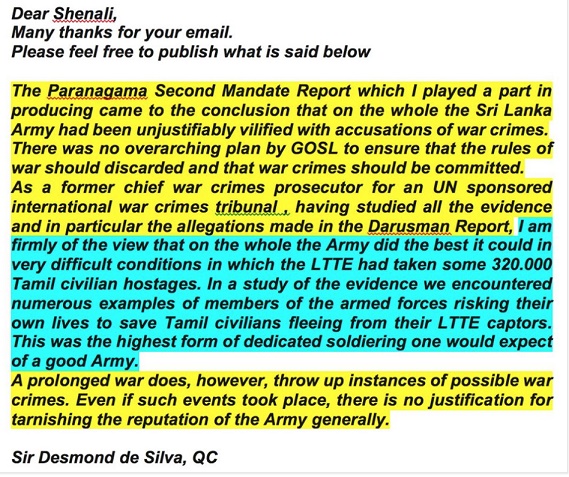
Hot on the heels of Lord Naseby questioning the British Government & exposing the duplicity & bias of the UNHRC, it is time for the UN to come clean and explain why they have been selective in picking civilian casualty estimates. Why are they shy from releasing the UN Country Team report giving 7721 deaths? Anyone alleging war crimes must explain why the Sri Lankan Military would allegedly kill ’40,000’ but physically save 300,000 of which 12,000 were LTTE cadres surrendering in civilian clothing! All of the guestimates it must be pointed out come from third party sources with invisible or possibly non-existent ‘witness’ accounts. However, a war crimes tribunal cannot be established based on these flimsy lies & media stunts & a country’s national army cannot be taken to the gallows on such lies & hyped allegations sans proof.

Sources quoting less than 10,000 deaths

·      UN country team in Sri Lanka placed dead at 7721 (Ban Ki Moon’s personally appointed a 3 member panel however declared the figure ‘too low to accept’

·      Survey by the GOSL in the North at the end of the conflict done by Tamils placed the dead and missing at 7400 including LTTE killed in combat & 2600 missing of this 1600 had been with LTTE whereas only 438 had disappeared in areas under military control

·      Population survey by Tamil Teachers of the North in July 2011 covering migration, deaths, untraceable persons from 2005 to 2009 revealed 7896 dead including LTTE. The dead from natural illness & sickness was 1102.

·      UNICEF-sponsored Family Tracing & Verification Unit 2011 listed 2564 untraceable persons of which 676 were children (64% had been kidnapped by LTTE)

·      Amnesty International (2011 report) quotes 10,000 civilian deaths. Thereafter Amnesty quoted figure of 40,000 dead.

·      Gordon Weiss – former UN official originally quoted 7000 dead, at his book launch he inflated the figure to 40,000 and changed it to 10,000 at his book launch & when cornered by a member of the audience he placed the error on the printer! Quoting dead has become a lucrative venture.

·      Tamilnet – the LTTE propaganda channel reported 7398 deaths

·      Data compiled by the South Asia Terrorism Portal, data primarily based on figures released by the pro-LTTE Website Tamil Net”, put the casualty figure for civilians inside Mullaithivu at 2,972 until 5 April 2009.

Above 10,000 deaths quoted from third party sources

·      Darusman Panel selected to be members of the UNSG’s personally commissioned Panel immediately after producing their report co-authored an article claiming the Sri Lankan Government committed war crimes. Furthermore, Darusman report refers to LTTE as a ‘disciplined group’ – if so why has 32 countries proscribed it as a Foreign Terrorist Organization?

·      13 March 2009 – UN Human Rights Commissioner Navi Pillay’s press release said that ‘as many as 2800 civilians ‘may have been killed’.

·      US former envoy Robert Blake – quotes 40,000 dead (US Congressional Hearing) 

·      Siobhain McDonagh (UK Labor MP) declared 100,000 dead (did she count from UK) 

·      Satellite report by the American Association for the Advancement of Science identified 3 graves – one had bodies of 1346, another a LTTE graveyard with 960 bodies. Report did not detect 40,000 or more dead.

·      The Times of London – 20,000

·      The Guardian editorial (Sri Lanka: Evidence that won’t be buried (June 15, 2011),) – 40,000

·      Editorials by The Times and The Sunday Times in late May 2009 related investigations the papers had conducted that revealed more than 20,000 Tamil civilians were killed in the final phase.

·      Alan Keenan the Project Director of International Crisis Group Sri Lanka placed civilians killed in the Vanni between 40,000 – 147,000

·      The Institute of Conflict Management, Delhi – 11,111

·      The University Teachers for Human Rights-Jaffna in a Special Report no. 32 of 10 June 2009 and Special Report No 34 of 13 December 2009 placed the dead between 20,000-40,000

·      Dr. V. Shanmugarajah – says the death toll is closer to 1000 (thousand)

·      Charles Petrie reviewing UNSG’s report in 2012 gave 70,000 figure completely ignoring the UN Representative office figure of 7721.

·      Bishop of Mannar, Rayappu Joseph – claims 147,000 as missing (It is strange that he has not placed one single name of the missing with the Commission though he can rally numerous priests to sign letters and sent to the UNHRC calling for international investigations against Sri Lanka.

·      Independent Diaspora Analysis Group-Sri Lanka – 15,000-18,000 

·      Rajasingham Narendran – ‘My estimate is that the deaths — cadres, forced labour and civilians — were very likely around 10,000 and did not exceed 15,000 at most’

·      Muttukrishna Sarvananthan of the Point Pedro Institute said [approximately] 12,000 [without counting armed Tiger personnel] .

·      Dr. Noel Nadesan: ”roughly 16,000 including LTTE, natural, and civilians”.

·      Publication titled Genocidio: (Primera entrega) – La masacre de los Tamils en Sri Lanka,” [Genocide: (First Delivery) The Slaughter of Tamils in Sri Lanka], the Argentinean periodical La Tarde (diario) in a Spanish language article – 146,679 Tamils disappeared or killed between 2008 and 2009, of which 40,000 deaths occurred in the 48 hours of the final assault

·      Arundhati Roy, Indian commentator –”Government of Sri Lanka is on the verge of committing what could end up being genocide” and described the Sri Lankan IDP camps where Tamil civilians are being held as concentration camps. April 2009

·      Prof. Michael Roberts based his estimates between 10,000 and 18,000 

·      ICRC press statement of 21 April 2009 declared that their estimates of Tamil civilians inside the no fire zone was 50,000 (In other words upto 21st April 2009, the ICRC did not know that LTTE had 300,000 people with them.  www.dailynews.lk

·      The UN High Commissioner for Refugees in November 2008 claimed there were 230,000 IDPs in the Vanni (Sri Lankan forces saved close to 300,000 – this continues to raise the question of how can we differentiate civilians and LTTE)

·      The International Crisis Group quoting ICRC says 150,000 were in the NFZ in early March 2009.

·      UN estimated on 13 May 2009 that about 50,000 civilians were trapped by the conflict, in a 300sq.km strip of land www.dailynews.lk

·      Indian embedded journalist Murali Reddy reported that from 13 May 2009 there were no civilians in the 1.5sq.km strip LTTE was restricted to.  

As Lord Naseby has rightly pointed out NONE of those quoting dead have been on the ground. They are simply quoting from either LTTE support groups or parties linked to LTTE. Lord Naseby makes reference to the UNPUBLISHED report by the UN Country Team whose death toll figure is 7721 covering August 2008 to 13 May 2009. He quite rightly says that from 13 May to 19th May 2009, it is impossible for 40,000 to have been killed. Why has this UN report not been published? Why is it kept hidden from public domain?

The Lessons Learnt & Reconciliation Commission (LLRC) report tabled in Sri Lanka’s Parliament in 2011 concluded that the Sri Lanka military did not target civilians.

http://www.ft.lk/front-page/llrc-says-military-didnt-target-civilians-report-tabled-in-pment/44-61066

The Missing Persons Commission, also known as the ‘Paranagama Commission’ says the figure of 40,000 civilians killed during the final weeks of the war is a myth. http://colombogazette.com/2016/01/27/paranagama-commission-says-40000-figure-a-myth/

In fact no one speaks about the 5600 complaints received by families of missing soldiers and these are with name. The missing soldier families had even logged the details with the Parangama Commission as well as the UNHRC and to date no statement or effort has been made by any UN envoy to account for their lives and do justice by them. Instead the UN & UNHRC are going behind figures and guestimates which have no names, no details and whose details have not been logged by any family members. The Paranagama Commission had less than 20,000 names logged as missing of which 5600 complaints by soldier families.

In terms of ‘civilians’ voluntarily or involuntarily remaining with the LTTE or taking part in hostilities the international legal luminaries headed by Sir Desmond de Silva declared that it is extremely unlikely that some 20,000 cadres of LTTE, at that stage, could have taken up to 330,000 hostages against their will”. The implication is that civilians went voluntarily with the LTTE – how many went voluntarily is a question no one has answered. In the eyes of these legal luminaries LTTE had committed the act of perfidy an- act of feigning civilian status with the intent of gaining an advantage amounts to unlawful perfidious conduct.” LTTE is guilty of blurring distinction between combatants & civilians and therefore LTTE stands guilty of not complying with the principle of distinction. LTTE is guilty for unlawful use of human shields. The Sri Lankan Army complied with a no fire zone to which LTTE did not comply and if both sides are not in agreement there is no official No Fire Zone.

Some factors need to be repeated

·      Sri Lanka’s conflict categorized as a Non-International Armed Conflict denies LTTE any legal status as combatant or POW & requires LTTE inspite of its terrorist designation abide by international humanitarian laws. https://www.lankaweb.com/news/items/2015/06/19/chargesheet-against-ltte-we-demand-accountability-of-30-years-of-ltte-war-crimes/   http://www.sinhalanet.net/ltte-cadres-are-not-prisoners-of-war-file-charges-against-them-for-war-crimes-in-sri-lanka

·      That LTTE was designated as a terrorist organization & banned by 32 countries clearly destroys the myth that Sri Lanka suffered an ethnic conflict. Sri Lanka suffered a terrorist conflict as LTTE killed even Tamils.

·      The decision to militarily defeat the LTTE came after the country suffered 30 years of terrorism and after failed peace talks, ceasefires & third party negotiations. One incident (9/11) was enough for US & Allies to bomb Afghanistan, invade the country & remain occupying it since 2001!

·      LTTE & Prabakaran could not have become an internationally feared terrorist organization capable of even assassinating a foreign Prime Minister if it did not have ‘friends’ in higher places. All those calling for investigations nicely omit to mention the need to investigate who were the players that helped LTTE directly/indirectly, provided material support, financial support, training, propaganda & PR support, technical expertise, arms training, NGOs, foreigners, international organizations involved with & co-partnering with the LTTE to advance their own geopolitical objectives. When will these people & organizations be held accountable?

·      What is beyond belief is the manner foreign forces in the form of foreign governments, foreign organizations, UN & associate bodies, foreign MPs, foreign media are all congregating to demand answers from the Sri Lankan Government on the last 3 months that ended 30 years of terror but did NOTHING throughout 30 years to save innocent citizens from being blown to pieces by the LTTE. Let us not forget that that the Sri Lankan Armed forces inspite of its military offensive brought to safety 300,000 Tamils which included 12,000 LTTE cadres who surrendered in civilian clothing. If the intent was to kill as is being alleged how is that that these LTTE cadres in civilian clothing remained alive?

·      It is also puzzling why the UNSG chose only Sri Lanka to appoint a personal panel to appraise him of the last 3 months and we are stupefied how that personal report became the basis of successive resolutions by the UNHRC against a sovereign state when the report was never tabled in the UNGA or sanctioned by the UNSC. This questions the legality of the resolutions having being derived from an illegal & questionable process where the Ban Ki Moon panel has openly shown bias. Yasmin Sooka a member of the panel who is paid to be working in the interest of South Africa is 24×7 more interested in LTTE than her native South Africans! She is a frequent visitor to pro-LTTE stages and they address her as ‘comrade’ such alliance is a direct conflict of interest. Her fantastical reports are released close to some international session no different to the dramas by C4. The legality of the Ban Ki Moon report used for the UNHRC resolutions need to be investigated as well as the links of all those making allegations against the Sri Lanka Armed Forces for their financial involvements with LTTE fronts.

All these linked and taken together shows a large nexus of people riding on the LTTE using it as a cash cow for various purposes.

Why does UNHRC and foreign governments not want to accept the 7721 dead figure?

Shenali D Waduge

SLFP of SWRD died on 15 January,2015, when Party leadersip was handed over to Maithripala Sirisena.

December 4th, 2017

By Charles.S.Perera.

SWRD  broke away from  the UNP  to form the  SLFP in terms of his political philosophy.  Chandrika Kumaratunga despite being the daughter of SWRD  did not follow her father’s political views and was never his political heir. Therefore,  after Mrs.Bandaranayake the heir of SWRD’s political party SLFP was Mahinda Rajapakse.

Mahinda Rajapakse was faced with a problem of having to stop the SLFP breaking up after his defeat at the Presidential election,  in the wake of Maithripala Sirisena’s scandalous  abandoning  the SLFP in seek of greener pastures in the UNP. A few ambition Ministerial portfolio seekers were already beginning to trickle away from SLFP to stand by Maithripala Sirisena.

The  President Mahinda Rajapakse was quite aware, that Maithripala Sirisena who walked away to the UNP seeking his own political liberation from SLFP, did not have a political philosophy or principle any where close to SWRD . Nevertheless, Rajapakse handed over its leadership to Maithripala Sirisena to avoid a break up of the SLFP which he loved,  as  much as his father who had a hand in helping SWRD to organise the SLFP.

It is  evident that Maithripala Sirisena’s SLFP is meant to be a party of the ambitious political power seekers, a part of the UNP, the Tamil Racists, Arabised Muslims, Catholic and Colombian Sinhala.

Further more SLFP of Maithripala Sirisena  is not of  Sri Lanka’s Pancha Maha Balavegaya , nor of the  patriotic  sons of the land who are ready to lay down their lives to protect the country to preserve its 2600 years old Buddhism,  and its Buddhist cultural identity which makes Sri Lanka the only country of its unique ancient traditions. Even USA, and the West cannot be proud of such an illustrious past as that of Sri Lanka.

Therefore,  SWRD Bandaranayake’s SLFP having  had met with an unnatural death on the 16th January,2015, it is well that a new political party springs from the ashes of the old-SLPJP.

In forming the SLFP SWRD Bandaranayake was taking a risk as he was breaking away from the then capitalist class of Sri Lanka, influential over the poor Sinhala people bound by feudal rights, land tenure, and caste obligations. But the people were awaiting a saviour- a Diyasena to take them away into another political direction.

Hence the new founded Sri Lanka Podu Jana Peramuna  would be an extension of  the political philosophy of SWRD  which would conveniently replace his SLFP which has now  taken a  different shade from the political philosophy and principles it was meant to represent.

But the risks that the organisers  of the Sri Lanka Podu Jana Peramuna-SLPJP are taking  today are much greater than those SWRD had to take when he organised the SLFP.

There are not  only local politicos spitting their salivated poisons and level castigations like the future Presidential hopeful Champika Ranawaka, but also NGOs and foreign secret service agents, specially those of the RAW, MI5,CIA etc.,  with their pockets full of dollars roaming about trying to buy over politicians from the Mahinda Rajapakse Camp. Their presence could be imagined  from the recent  walk out of some members of the NFF of Wimal Weerawansa.

Therefore, every member of the SLPJP should take an oath to be dedicated to the cause of keeping Sri Lanka a unitary Nation, without encouraging, by thought, word or action  any attempt by any one to divide the country amoung the Tamil,  Muslims and Sinhala, and they would remain  united with the Party under all circumstances and promise not to sell the country through temptation for money, rank or position.

Richard Pieris chairman conferred an honorary doctorate by University of Kelaniya

December 4th, 2017

Anjalika (Malalgoda) Silva USA

Dr. Sena Yaddehige was one of the Pioneer students of the Kelaniya University Science Faculty.

http://www.island.lk/index.php?page_cat=article-details&page=article-details&code_title=176000

It is a great honor and privilege to see that finally due recognition has been bestowed on one of the alumni and our colleague from the first batch of the Science Faculty of the University of Kelaniya from decades past.  This was a long time coming and one that we, the colleagues of Dr. Sena Yaddehige hoped we would see in our lifetime. The country’s recognition took a long time to come.

Going back to the times when we were students in the same batch, it was a unique experience.  The first group of university admission selections that came under the National Council of Higher Education headed by Dr. G. P. Malalasekera. We were the Pioneers of the Science Faculty” , the very first batch when the science faculty was added to the Kelaniya University.   When we started lectures, the labs were still being furnished and not quite ready.  I still remember the curls of wood chips in corners as we found our lab benches to work.

We were a small batch of 25 students.  Our admission to Kelaniya was on the basis that science lectures were to be in Sinhala and English and students were selected based on their language being either.  However, we found that the bilingual training soon faded into English to our advantage globally.  Our lecturers had finished their Bachelor’s education awaiting their turn to go abroad for their PhD.  Some professors were brought in on a visiting basis to cover.   Our curriculum was planned according to the American System with Professor Milo Wolff of the MIT being there hands on.  Our testing was based on ongoing assessment which meant that last minute cramming did not help.  We graduated in an era when the Government at the time was grappling with the JVP and anti-student sentiments were at its peak.  We were sadly deprived of a formal and dignified convocation ceremony at the time when Sirimavo Bandaranayake was in power.  We were never sure if it was for security reasons or just an antagonistic move registering their contempt for agitation by educated youth asking for better employment opportunities.

Looking back, we were deprived of the pride of the cap and gown ceremony and many of us kept our own memento to record our hard-earned achievement of a science degree in difficult times.  Text books were at a premium due to the Government restrictions on exchange and a special tax was imposed on import of goods including books during the Sirimavo Government.  Foreign Exchange Entitlement Certificate (FEECS) applied to import of books that took months to obtain on special order if one could afford were out of reach for many who needed books published abroad especially in the sciences.  Friends and relatives abroad helped and we shared them among friends.  Libraries had barely one copy of prescribed text books in the sciences that we needed in original English publications.  It was a trying time for students.  All-nighters were a way of life when we got books in our hand with high demand having one copy in the library.

Dr. Yaddehige was one of us – the small group that grappled with all the odds against which we produced some of the brightest who not only graduated but we overcame all the frustrations of lack of opportunities beyond starting out as teachers in the remotest parts of the country, that was the only way to go.  However, many went on to strive further.  I remember being recruited to the Zoology department by Dr. H. H. Costa soon after graduation at the peak of the JVP.  We were only three women on the Science Faculty staff that had to report for work when the campus was closed because of the insurgency.  One of them travelled overseas on holiday.  One was on maternity leave.  I was the lone ranger woman who had to report for work to an empty desolate campus heavily guarded.  The drill was that I could only be approved for entry after examination of my handbag by a soldier who inspected the contents with the bayonet and loaded rifle to let me pass.  We had a few hours’ notice one day to vacate the campus, lock up the labs and leave as it became a mass detention camp for JVP suspects in custody.  Taking public transport to get to work meant crossing the Kelani river every day seeing floating bodies of youth in the river who were allegedly rounded up as suspects.

Our student days were hard times.  Our batch being small kept together regularly because of the concern and generosity of Dr. Yaddehige to make sure all his buddies met and were okay to come together as the years progressed.  If they were not, he was there to support them through life issues.  We enjoy our annual reunions to reminisce on our student days.  They have special memories for all of us and making travel plans to go to Colombo for those of us living overseas is exciting and always a joy to meet old friends.

Many have gone on to diverse lives, but we all have one thread in common.  That is, we can remember names, we know their stories, we remember the departed colleagues, and we also keep our kinship with Kelaniya University alumni who came after us when possible.  We were special to have come out of one of the most difficult times for youth in Sri Lanka and make contributions as Dr. Yaddehige has done.  Whether it was in big or small ways where ever we chose to be, the foot prints remain though hardly known.  We, as a group, felicitated Dr. Yaddehige in 2015 for his exceptional contribution with our own version of an appreciation award which read,

Presented to

Dr. Sena Yaddehige

 For a Lifetime of Achievement,

 Service and Dedication”

To his country of birth

Sri Lanka and

For friendship and solidarity

With his fellow university peers.

We, your friends from the past

At the Science Faculty of

 Kelaniya University of Sri Lanka,

 Applaud you with pride and admiration and wish you the best for the future.

On this day

February 21, 2015.”

All the colleagues of his student days wish him many more years of success and service to humanity beyond all boundaries and overcoming impending obstacles. Thank you for your service and friendship to all of us.  Friendships that have stood the test of time at the best of times and the worst of times.

“Success is not final; failure is not fatal: It is the courage to continue that counts.”— Winston S. Churchill

Anjalika (Malalgoda) Silva

USA


Declare  Sangamitta Day as the National Women’s Day in Sri Lanka

December 4th, 2017

Dr.P.G.Punchihewa

This year, Unduwap full moon   falls on 3rd December, the day commemorating the arrival of Bhikkuni Sangamitta to bestow (pabbajja )ordination on Sri Lankan women and also  bringing  with her a sapling of the Great Bodhi tree at Buddhagaya.

It was 2263 years ago that Thera Mahinda arrived in this island .According to Geiger that was in the year 246 B.C., on the full moon day of Poson . His arrival with the five disciples opened a new chapter in the history of the island. They not only introduced a new faith based on the sublime teachings of the Buddha , but also  gifted the country with a new civilization and a culture.

Arrival of Theri Sangamitta in the Island six months later marked the second stage of this Cultural Revolution.

When Anula, consort of King Devanampiyatissa sought ordination and the King concurred, the Thera Mahinda addressing the King, told him,  It is not allowed to us O Great King ,to bestow the pabbajja (ordination) on women. But in Pataliputta there lives a nun , my younger sister known by the name Sangamitta .She who is ripe  in experience shall come hither, bringing with her the southern branch of the great Bodhi –tree and  bringing also bhikkhunis renowned. When this Theri is here she will confer the pabbajja upon these women.”

A request was sent to Asoka by Devanampiyatissa to send Bhikkhuni Sangamitta to bestow pabbajja on Sri Lankan women. Recalling, his son   Mahinda and Sumana the grandson, leaving  to Sri Lanka few months back, Asoka was not keen  to part with her daughter too. But Sangamitta was keen not to disappoint the brother. She said, Weighty is the word of my brother .Therefore I must depart there.”

Accordingly, Theri Sangamitta sailing from Pataliputta to Tamalitti at the mouth of the Ganges and from there, braving the Indian Ocean   with a retinue of bhikkhunis and a mixed group of laymen  arrived  at Jambukola north of the Island on the full moon day of Unduvap. Among the bhikkhunis who accompanied her, according to Dipavamsa were  Uttara, Hema , Pasadapala,Aggimitta , Dasaka, Phegghu,Pabbata , Matta , Malla and Dhammadasiya. It also mentions that they were   young, probably as they had to face the vagaries of a foreign climate which was different from that of Pataliputta. Although Thera Mahinda arrived with five other Theras, Theri Sangamitta was accompanied by a bigger group of bhikkhunis ; there was a big task awaiting her. Already Queen Anula with five hundred women of the royal palace and an equal number of maidens were ready to receive the ordination .Once they received the ordination there were many to follow them .Dipavamsa mentions names of several others like Soma ,Dhamma Sobhani , Dhamma and others who subsequently entered the Order.

The bhikkhunis from Jambudvipa also had the added task of teaching the Vinaya (disciplinary rules) to the newly ordained nuns, and all the bhkkhunis who came from Pataliputta were well versed in Vinaya.  Dipavamsa mentions several of the local bhikkhunis, namely Mahila ,Sata Kali and Uttara who mastered the  Vinaya rules within a short time.

Theri Sangamiita  while being  mindful of  the progress of the doctrine was also keen on the welfare  of the bhikkhunis .At her request additional dwellings  were erected for the increasing numbers of women entering the Order.King Devanampiyatissa who visited the Theri   had arranged to erect a pleasing convent for the bhikkhunis which came to be known as Hatthalakavihara.

With the royal patronage received and the establishment of the Bhikkhuni Order, thus two thousand two hundred and sixty three years ago Sri Lankan women came to be liberated.The fetters that tied them to the material world were broken . Spiritually they could reach the highest levels. It has to be mentioned that the planting of the Bodhi sapling from Buddha Gaya was as equally important as the establishment of the Bhikkhuni Order. Elaborate arrangements had been made in Pataliputta for its dispatch and in Anuradhapura for its reception .Once it was planted eight shoots had grown from it and they were planted in several places around Anuradhapura and  in Katargama; the two main Aryan settlements in the island. Another thirty two had been planted in different places covering most of the key points in the country affirming the establishment of the Buddhist Order in the major parts of the Island.

Theri Sangamiita was also accompanied by eighteen princes from royal families to watch over the Bodhi tree and eight from Brahman families and of traders and persons from the cowherds, the weavers, the potters and from all other handicrafts. While the Thera Mahinda with  bhikkhus and Theri Sangamitta with the bhikkhunis were concentrating on the spiritual advancement of the people, the craftsmen would have taken upon them the task of improving the economic and social advancement .For  example bringing   cowherds itself was important. To dissuade a community which for centuries mainly  lived by hunting, obviously needed an alternate occupation if they were to live by the teachings of the Buddha. Though pottery, weaving and paddy cultivation were known to pre Devanampiya tissa times as seen from the archeological remains, chronicles and folk lore, the arrival of craftsmen from overseas would have given a new impetus and brought in new technologies which blossomed later into a culture  of its  own identity.

The arrival of the Theri  Sangamitta to establish the Bhikkhuni Order ,with the Bo sapling, accompanied by a group of disciplined and erudite Bhikkhunies is an unparalleled event in the history of the Island. She was a unique lady. Being the daughter of the most powerful ruler at the time , her renunciation itself has  to be admired . Following the words of the Buddha caratha bhikkave carikam bahujana hitaya bahujana sukhaya.” (Go forth o monks for the benefit of the many, for the happiness of the many) she left her mother ,father and her motherland.She perhaps is one of the few early bhikkhunis who undertook missionary work to propagate Buddhism. Most of the theris mentioned in Theri- gatha during the time of the Buddha mainly looked for their own salvation .She  came over to Sinhala -deepa and spent the rest of her life in this island serving the people, particularly the women for a better spiritual and a worldly life. It is the lead given by her that resulted in such heroines like Viharamahadevi ,Somadevi etc to play a vital role in the history of the country .The bhikkhuni order she set up in the Island was instrumental in establishing the Order in other countries too. According to Chinese tradition Bhikkhuni Devasara” from Sri Lanka set up the Bhikkhuni Order in that country. Thus she was the torch bearer for the emancipation of women not only in Sri lanka but also in some of the South Eastern and Eastern Asia countries.

‘International Women’s Day (IWD) is celebrated on March 8 every year. It commemorates the movement for women’s rights.  After women gained suffrage in Soviet Russia in 1917, March 8 became a national holiday there. The day was then predominantly celebrated by the socialist movement and communist countries until it was adopted in 1975 by the United Nations as International Women’s Day’(wikipaedia)

The International Women’s Day  is of recent origin and  is an alien concept and has no bearing on women of this island whereas women in Sri Lanka two thousand years back  threw away the shackles that  bound them. Declaring the day Bhikkhuni Sangamitta arrived in the Island as the National Women’s Day  is the least the present generation could do to honour this great lady.

It is for all these reasons that SriLanka should   be grateful and remember this great personality. It is suggested that the Sangamitta day be made the National Women’s Day in Sri Lanka.

Dr.P.G.Punchihewa

DE-BONDING FROM BOND ISSUE ……..

December 4th, 2017

Dr Sarath Obeysekera

When one watches TV and read the papers where it may look obvious that few younger budding- politicians have been directly or indirectly involved in the bond scam or at least being implicated.

Few older politicians may have known about the fact that one of their lead member has had some hand in it .Bond commission may not lead to drastic action as the people involved cannot be charged as per the mandate given to commission. As long the president stays in power AG may get a promotion and the politicians may go scot free in order to help HE to keep the marriage of convenience intact .

It is like that the husband goes on getting involved with a mistress  and or wife will stealthily keeps a boyfriend in the sly .And yet the they will not dissolve the marriage as society will frown upon them.

Why  they did not start investigating previous bond matters  as soon as they came to power? It may be like all other corruption charges where none of them except a Bureaucrat who was remanded to show the people that they want to punish someone. None of the main culprits who gave orders have been punished.

Some of them were remanded and conveniently hospitalised.

All above has become a joke and people start to lose trust

Now I note that some politicians keep talking about purported bond scam taken place from 2004 to 2014

That means the government may be trying desperate to De-Bond themselves by pointing finger and say They did it ,Why cannot we??”

We remember CPC hedging matter purchasing of Greek financial instrument  issue .People knew about them .But to start investigating  after two years looks absurd as the country will laugh at them.

Professionals are all talking about how inefficient the judiciary, AG, Ministers and pointing finger at the two top leaders.

It is high time that one of them strighten his spine and take that stingray tail to punishing the culprits ?

I am sure he will not need JO   ( Jolly Old ) fellows to win upcoming election

Dr Sarath Obeysekera

සීතාවක රාජසිංහ රජුට අවමන් කළ පරන්ගියකු විනාශකර රජුගෙන් බුහුමන් ලැබූ අමිතිරිගල එදිරිසිංහ මුදියන්සේ

December 4th, 2017

නිමල් රාජකරුණා , මෙල්බර්න්, ඔස්ට්රේලියාව  

සීතාවක පළමුවන රාජසිංහ රජු ශ්‍රී ලංකාව (එවකට සිංහලේ) පරමාධිපත්‍යය උදෙසා ප්‍රතුගීසින්ට විරුද්ධව සටන් කළ රජවරුන් අතර ප්‍රධානතම තැනක් ගනී . ටිකිරි කුමාරයා ලෙස ඔහුගේ අංගම්පොර සටන්කරුවන් සමග මුල්ලේරියාවේදී ප්‍රතුගීසින් හා සටන් කර ඔවුන්ට විශාල පරාජයක් ලබාදුන් ඔහුගේ වීරත්වය සහ ජාතිමාමකත්වය විනාශ කිරීමට කටකථා පසුව ගොතා ඇත. වර්තමානයේද දේශයේ ඒකීයභාවය සඳහා සටන් මෙහෙයවා විජයග්‍රහණය ලබාදුන් නායකයන් මෙවන් කටකථා මගින් විනාශ කිරීමට දැරූ සහ දරණ උත්සාහයන් අපි අත් විඳිමින් සිටිමු.

පලවන රාජසිංහ රජු තම පියා වන මායාදුන්නේ රජු මෙන්ම බෞද්ධ භික්ෂූන් වහන්සේලා ඝාතනය කළ බවට ඇති මතය අධිරාජ්‍යවාදීන්  සහ ඔවුන්ගෙන් වරප්‍රසාදලත් සිංහලයන් විසින් ගෙතූ ප්‍රලාප බව දැන් බොහෝ විචාරකයන් පිළිගනිති.මායාදුන්නේ රජු අවුරුදු 85ක් ආයු වළඳා ස්වභාවික මරණයකට ගොදුරු වූ බවත් ඔහු විසින් මරණයට පත් කළ භික්ෂූන් වෙතොත් ඔවුන් සිවුරු පොරවාගත් ප්‍රතුගීසින්ගේ ඔත්තු කාරයන් වූ සිංහලයන් බවත් නිවැරදි සත්‍යයයි. වර්තමාන කාලයේදීද අධිරාජ්‍යවාදීන්ගේ ඩොලර්වලින් යැපෙමින් දේශයට සතුරුකම් කරන මෙවැනි සිවුරු පොරවාගත්  සිංහලයන් අතලොස්සක් සිටින බව නොරහසකි.

සීතාවක රාජසිංහ රජු තම මාලිගය අසල පිහිටි සීතාවක ගඟට ගොස් ස්නානය කිරීම පුරුද්දක් කරගෙන සිටියේය. එවකට ගඟින් අනෙක් පැත්තේ ප්‍රතුගීසි බලකොටුවක් තිබී ඇති අතර එහි සිටි පරන්ගියෙක් රජු ස්නානනය කරන අතරතුර සිය පශ්චාත්භාගය නිරාවරණය කර රජුට අවමන්  කිරීම පුරුද්දක් කරගෙන සිට ඇත . මොහුට සුදුසු දඬුවමක් දීමට හැකි අයෙක් රජු සොයද්දී මගේ මවගේ මුත්තා කෙනෙකු වූ බයිඅප්පු මුදියන්සේ ඊට ඉදිරිපත්වී ඇත. බෙහෙත් කොටන තුවක්කුවක් රැගෙන ඔරුවකින් ගොස් ගඟේ අනෙක් පැත්තේ පරංගි බලකොටුව අසළ පිහිටි වල්බෙලි ගසක් අසළ රැක සිට පරංගියාට වෙඩිතබා මරාදමා ඔහු නිරුපද්‍රිතව මෙගොඩට පැමිණ ඇත . සිංහලේ රජුගේ අභිමාණය රැකීමට ‘සිංහයෙක් මෙන් ඉදිරියටගොස්’  කළ වික්‍රමයට පැහැදුණු පළවෙනි රාජසිංහ රජු මගේ මවගේ මුත්තාට “එදිරිසිංහ මුදියන්සේලාගේ ” නම්බු නාමයත් අමිතිරිගල   නමැති නින්දගමත් ප්‍රදානය කළ බව මගේ මවත් ඇයගේ  සහෝදර සහෝදරියනුත් අප කුඩා කළ පැවසුවේ ඉතා ආඩම්බරයෙනි

අමිතිරිගල ගමේ අදත් මුල් පදිංචිකරුවෝ එදිරිසිංහ මුදියන්සේලාගේ පරපුරේ අයයි. එහි අවසන්වරට ගම්මුලාදැනී තනතුර හෙබවූ මගේ මවගේ පියා  වූ එදිරිසිංහ මුදියන්සේලාගේ අප්පුසිඥ්ඥෝ අප්පුහාමි මහතා ඉතා කරුණාවන්ත සැදැහැවත් බෞද්ධ උපාසකයෙක් විය. උගත් සිල්වත් බෞද්ධ භික්ෂුන්  වහන්සේලා ඇසුරුකළ ඔහු බොහෝ පින්කම් කළ කෙනෙක් වූවා පමණක් නොව තම දරුවකු ශාසනයට ඇතුළත් කිරීමටද නොපසුබට විය. ඒ ගම්පහ මිරිස්වත්තේ විද්‍යාවංශ පිරිවෙණ පිහිටුවා විශාල ශාසනික සේවාවක් කළ රාමඥ්ඥ නිකායේ අධිකරණ සංඝ නායක ධුරය හෙබවූ අපවත්වී වදාල අමිතිරිගල පග්ඥාවංශ නාහිමිපාණන් වහන්සේය.

පළමු රාජසිංහ රජුගේ අභාවයත් ධර්මපාල රජු 1597 මිය යාමත් සමඟ ශ්‍රී ලංකාවේ බුද්ධ ශාසනයේ විශාල පසුබෑමක් ඇතීවී ඇත.ප්‍රතුගීසින් අන් කවරකුටත් වඩා ශ්‍රී ලංකාවටත් බුද්ධාගමටත් හානි කළෝය. ඔවුහු විහාරස්ථාන විනාශ කරමින් ඒවායේ තිබූ ඇත් දළ , සඳුන් , මැණික් සහ අනිකුත් වටිනා දේ කොල්ල කමින් පුස්තකාල ගිණි තබමින් කතෝලික ආගම ව්‍යාප්ත කළෝය .කිසිදු ආක්‍රමණිකයෙක් ශ්‍රී ලංකාවට ඇති ආදරයකට ආක්‍රමණය කළාහු නොවෙති . එහෙත් ශ්‍රී ලංකාවට කිසිදු යහපතක් නොකළ ආක්‍රමණිකයන් අතර ප්‍රතුගීසින් ප්‍රධාන තැන ගනිති. එය එසේ වූවත් මෙවන් විශාල විනාශයක් අප මවුබිමට කළ ප්‍රතුගීසින් ශ්‍රී ලංකාව ආක්‍රමණය කර අවුරුදු 500ක් ගතවීම 2005දී සැමරීමට වර්තමාන අගමැති රනිල් වික්‍රමසිංහ ඔහුගේ පසුගිය පාළන සමයේදී සැළසුම් කළේය. රටේ වාසනාවට ඔහු 2005දී  පරාජය විය.මා හට මෙය ලියන්නට සිත් වූයේ එදිරිසිංහ මුදියන්සේලාගේ පරපුරේ කිසිම සුජාත දරුවකුට රනිල් වික්‍රමසිංහ වැනි දේශද්‍රෝහියෙකුට පක්ෂපාති විය නොහැකි බවද පෙන්වා දීමටයි .එසේ කරන්නන්ට අපගේ මුත්තා ඔහු සිටින ලෝකයක සිට ශාප කරනු ඇත. රනිල් වික්‍රමසිංහ දේශද්‍රෝහියෙකු පමණක් නොව සූර චෞරයකු බවද දැන් ඔප්පු කර හමාරය .

නිමල් රාජකරුණා , මෙල්බර්න්, ඔස්ට්‍රේලියාව  


Ranil and Sirisena will soon end their union – Samantha

December 4th, 2017

දැන් රනිල්, මෛත්‍රී හවුල දික්කසාද වෙන තැනට ඇවිල්ලා… සමන්ත

We are confident that we can win the election – Mahinda (English)

December 4th, 2017

We are confident that we can win the election – Mahinda (English)

State as estate

December 4th, 2017

Editorial Courtesy The Island

Dr. Usvatte-aratchi, in his article on this page today, demolishes some long-held myths and misconceptions about state revenue, taxes, free education and free healthcare among other things. Referring to a recent statement made by President Maithripala Sirisena, he points out that it is wrong for the head of state to use the term, mage rajaya (my state) as the President does not own the state. President Sirisena has recently gone on record as saying that ‘my state’ won’t allow anyone who fought the country’s war on terror to be tried for war crimes.

Dr. Usvatte-aratchi deserves praise for highlighting the wrong use of the Sinhala term, rajaya. The words, rajaya, and aanduwa (government) are often erroneously used so much so that it is popularly thought that they are interchangeable. In English, too, the words, ‘state’ and ‘government’ are loosely used in this country. The fact that not many people are aware that the government is only the controlling apparatus of the state has stood ruling politicians in good stead. (The state is a much bigger and more complex entity comprising, inter alia, a landmass with recognised boundaries, a population, sovereignty and a government.) This popular misconception at issue has helped rulers equate their governments to the state and most Sri Lankans seem to think politicians elected to power wield a special licence to do whatever they want with the state.

However, what a government, run by a bunch of politicians elected to rule the country for a specific period of time, does out of expediency more often than not can be binding on the part of the state. The Geneva resolution co-sponsored by the Sirisena-Wickremesinghe government in 2015 is a case in point. There is no way the state of Sri Lanka can extricate itself from that resolution even in the event of a change of government. Ill-conceived lease agreements with foreign powers at the expense of state assets also serve as an example.

Never mind the state; President Sirisena can’t claim that even the incumbent government is his own though he heads it. For, some of the key policies of the yahapalana administration are at variance with his much-touted vision and mission. He never misses an opportunity to make a hue and cry about attempts being made to set up a hybrid war crimes court here and vows to put paid to them. But, the government continues to reaffirm its commitment to the Geneva resolution. He claims he is committed to reducing alcohol consumption as he did in Parliament the other day, but the government has sought to make beer freely available at reduced prices. He vows to bring the bond racketeers to justice, but some of his government members are protecting the suspects and flaying him for appointing a presidential commission of inquiry to probe the bond scams. If the government is his, it should do as he says, shouldn’t it?

President Sirisena is not alone in having evinced a proprietary interest in the state. All his predecessors, save a few, did so and some of them even acted in such a way that they were seen to consider themselves hereditary rulers. It may be recalled that sycophants of the previous regime, in a bid to ingratiate themselves with President Mahinda Rajapaksa went so far as to call him a king and sing hosannas. They claimed that he was the reincarnation of an ancient warrior king who had hailed from the South. Not to be outdone, the court flatterers of the present regime came out with a song, claiming that Rajapaksa’s successor was the reincarnation of another warrior king who reigned from Polonnaruwa! Thankfully, that song was sung only once in public.

Heads of states in this country have professed Buddhism. But, none of them have, during the last several decades, heeded what Arahant Mahinda told King Devanampiyatissa—‘You are only a trustee and not the owner of this land’. If they realise this simple truth, they will leave gracefully when their terms come to an end without trying to stick to power like limpets until they are kicked out.

‘Me and My Bonds’ ‘The President and I’ ‘As I always say’

December 4th, 2017

By Sarath De Alwis Courtesy The Island

The statement of the Prime Minister Ranil Wickremesinghe in parliament about bonds made last week was a preemptive tactic to position himself and his beleaguered administration to deal with the report of the commission of inquiry due on 8th December.

His use of the personal pronoun ‘I’ in one instance conveys a collective authority and responsibility with the President. In the latter, ‘As I always say, the ‘I’ is more explanatory and uncharacteristically less authoritative.

The choice of pronouns in political statements and speeches indicates the speaker’s inclination to share the responsibility with others – in this instance with the coalition partner and President in the first, and with colleagues in the party and parliament in the second.

The pronoun ‘I ‘is not used lightly in political statements that are drafted and readout. The pronoun ‘I’ in such framed statements conveys the speaker’s opinion. It makes the speech more subjective. Students of political rhetoric believe that ‘I’ makes the speaker personally involved and puts a distance between him and others involved in the subject.

There is, no doubt, that the Bond fiasco has undermined the leadership of Prime Minister Wickremesinghe. The country demands a re-committed leadership.

Politicians engaged in image repairing do not say sorry for the errant act or misdeed. Political leaders are human. They make mistakes, commit blunders. When they do, a solid unambiguous apology and an acceptance of responsibility can help restore a reasonable level of trust between the leader and the public.

A general declaration that mistakes will be corrected and the forward march will proceed as planned is a thin shroud that will not cover the enormity of the inequity committed.

The sense of inadvertence it implies is an insult to the intelligence of the man on the street although it may appeal to those living in penthouses.

Mr. Wickremesinghe is not a monetary economist. He is not a development economist. He is not the repository of all wisdom relating to central banking.

Yet, he has by deliberate design, concentrated all powers in guiding the nation’s economy in his hands. While insisting that parliament will have full control of public finance, he relies on a few self-declared experts who regard the national coffers their personal fiefdom.

“As I always say, the President and I are committed to bringing in this new political culture. This is a new experience for our country. Some find it difficult to comprehend it due to complexities of this process. Due to its novelty, mistakes can be made, shortcomings may arise. We should rectify them. But we are not ready to sweep the errors and shortfalls under the carpet as was done during the Rajapaksa regime and bury social justice.”

The quoted passage reveals the mind and politics of Prime Minister Wickremesinghe. He confuses power with virtue.

His opening ruse, “As I always say’, is intended to locate himself above the hoi polloi on an elevated grandstand. From those lofty heights he looks down on us ‘we the people’, whose public purse has been picked by one of the two ‘Arjuns’ or both.

A grand stand is not the best place to locate yourself in explaining a grand larceny.

The statement defined and framed the role of Prime Minister Wickremesinghe in the Bond scandal. It lacked clarity, lucidity, enlightenment and truth. If he achieved anything at all, it was his mastery in the opaque language.

The intention was to repair and restore the image of Prime Minister Wickremesinghe. The principal issue was the bonds issued in the period post 8th January 2015. The explanation was a promise to probe, bonds issued and traded pre-January 8th, 2015. It is Koheda Yanne Malle Pol!

Superficial in substance, laughable in its logic, it was delivered in choking Sinhala. The Prime Minster failed to answer the crucial question of what he knew and when he knew of the transactions between and by the two ‘Arjuns’. The strategic positions in our financial firmament held by the father-in-law and the son-in-law was entirely due to the personal bonds they had with him.

We dislodged the autocracy of Mahinda Rajapaksa on 8th January. The wizard of central banking abandons his lucrative practice as an investment banker, packs up his bags and leaves Singapore within the week. That needs some explanation.

Political leaders are human. They make mistakes, commit blunders. When they do, a solid unambiguous apology and an acceptance of responsibility can help restore a reasonable level of trust between the leader and the public.

Lest we forget, this explanation was made by the Prime Minister on behalf of the government that promised to replace a corrupt regime with a government of integrity, transparency and accountability.

President Sirisena recently reminded us that the first transgression was enacted within the first three months of his assuming office and installing a minority UNP government. His forthright observation was made at the second commemorative ceremony of Venerable Sobhitha Thera. The event was avoided by the Prime minister who did not wish to sit through the peroration of Prof. Sarath Wijesuriya, Convener and present leader of the Movement for a Just Society.

The findings and recommendations of the commission will determine the trajectory of the ‘Yaha Palanaya’ coalition. Despite expedient protests to the contrary, the shady business of bonds has derailed the ‘Yaha Palanaya’ project that held immense promise to those of us; who longed for a land reconciled, at peace with itself and with a minimal semblance of a sanctuary of social justice.

Apology is alien to the nature of PM Wickremesinghe. He was practically choking on the words delivered in Sinhala. He wisely opted to do it in the language that is not his natural lingo.

Reiterating the determination to go forward while confessing to mistakes and shortcomings is a smart way of offering a non-apologetic apology. It is smart because it appeases your own ranks. It is smarter than the tactic adopted by Sujeeva Senasinghe, who with his hands in the cookie jar was telling us that he only wished to learn the art of making cookies and was by no means trying to eat them.

But, when a leader makes that to circumvent ethical impropriety, it portrays a leader missing the critical component of accountability. Telling us that “mistakes were made” is a poor substitute for what is implied unmistakably but dressed in jackal cunning. “Terrible things happened on my watch. But please other people did those dirty stuff and I cannot be blamed. Besides, more terrible things happened before my watch. Now let us see who is to be blamed more.”

The statement delivered in parliament, with no interruptions was a strategy to return to the party fortress with minimal damage and least cost to reputation and credibility.

PM Wickremesinghe is a leader who has survived for forty years in politics outwitting charismatic rivals. His charisma is bestowed on him by a faithful coterie of cronies and self-serving followers. An explicable destiny has given him command of an established political party – the UNP – with a solid voter base in our clientelist democracy.

This special class of cronies is elite activists, including a powerful set of oligarchs, active behind the UNP stage. The UNP stage is his home turf where he alone is the only soprano in town.

They have bestowed the charisma of a clean, resolute leader on him. That is natural. When a person seems to embody the qualities, they look for in a leader, they contrive to build a whole greater than the sum of its parts.

Ranil is a leader who treats the public with disdain. He treats his crony counsellors with great diffidence. He dominates his political colleagues. He assiduously concentrates decision making in his own hands.

That is how he arrived at his present disaster. He had not learned his lesson. He does not consult the party. He manipulates it. He does not heed contrary opinion. He chooses to ignore it. He lives in a make-believe world inhabited by aides who are eager to pander to his foibles. They are happy to keep the emperor clothed in imagined silk. They take decisions in the name of the leader. That in a nutshell, explains the predicament of a Prime Minister pre-doomed to a revolving door in high office.

The danger of democracy

December 4th, 2017

By Suren Raghaven Courtesy Ceylon Today

Democracy is a dangerous game. Especially, if it is played by those with bloody minds and muddy hands. This is not because such attempts may not succeed – they may well be so as often is the case in Sri Lanka – but because what they pretend to construct will be abysmally empty and permanently tarnished like their polity.

A Constitution will be the overarching canopy under which a progressive blueprint for a State and all nations within is desirable at any cost. It is for this reason that all modern democracies took painful labour to hammer out such a document to answer the epistemological question “then how shall we live better?” The keystone assumption is that the proponent (and yes even the opponents) must have the legitimacy to do such fundamental structural changes. Tenants have no right to remove the foundation of a house even if they claim it is for the betterment. Such legitimacy is not mere legalistic correctness but a much wider moral qualification that is expected. No one will respect a lawyer – even if s/he was the Gold medallist just last year – if such has turned to be a murderer. It is true that both Maithripala Sirisena as the common candidate and then President Mahinda Rajapaksa asked the mandate to change the present Constitution – in that Rajapaksa wanted an overall comprehensive change instead of piecemeal amendments as a sustainable solution to the Tamils’ political aspirations. It is, also, true that both candidates collectively received a quantitatively astonishing over 95% endorsement.

But governance – especially if one is mindful of a participatory democracy in a pluri-nation State – is not only based on Wall Street type inhuman and often immoral number crunching but on the supremacy of goodwill, endorsement and the active participation of the citizens from the very periphery to the core centre. In the Political Science sphere during the last two decades an enriching development in political theory developed and it is broadly named as Deliberative Democracy (DD). DD refers to the mechanism that legitimate lawmaking happens from the public deep deliberation of citizens of all categories. As a normative reflection of moral legitimacy, deliberative democracy conjures ideals of rational legislation, participatory politics, and civic self-governance all such at the regional as well as the central level in a multi layered political structure. In short, it constructs an ideal of political autonomy based on the practical reasoning of a wider citizenship.

(A)Yahapalanaya?

It is in this context that the new proposals to constitutional changes have come forward almost as a side show to the government’s other essentially non-essential activities, in a State where the annual budget gap is ever widening in a frightening manner. Even if one is to imagine that this Government of Ranil Wickremesinghe and the Presidency of Maithripala Sirisena both that come to power by the direct and sheer support of the minority votes and, therefore, trying to address the deep rooted issues of the minority nations such fancy imaginations have no ground realities. Simply the social, economic and political conditions in the North and the East say an opposite story. Land release from the forcibly occupying Army is dead slow. Still more than 10,000 IDPs lament in the camps. Repairing/improving of the essential services such as the health sector, drinking water, transport is at a token minimum level. An adamant Minister of Rehabilitation again a royal friend of the PM is intransigent in his determination to build pre-fab aluminium houses against the will and advice of the local leaders.

This causes in the process to be hampered. No major new industry or investment has come. The mongering diaspora has not brought the millions of dollar investment they promised. Still over 90,000 Sri Lankans exclusively Tamils are living as refugees in Tamil Nadu. This Government has taken no step whatsoever to encourage their return even while the International Organization for Migration (IOM) has come forward to make such arrangement.

Above are issues at the operational level. Then comes the long list of the structural issues such as the topic of the Transitional Justice, the genuine inquiry into the war crimes (of both sides), the full and impartial operation of Office of the Missing Persons, strengthening and fortifying the full need of the judiciary administration in the entire region of 1.6 million citizens, filling and supporting the decomposed higher education system centred on the university of Jaffna: The need to make the agricultural economy of Jaffna synchronize with the needs of the southern market place: The social psychological repair of the war and its deep wounds in a systematic manner to recover the human potential: The systemic programme to address the ideological opposition between the two ethnic nations so that the future of this State will be true Sri Lanka instead of Sinhala, Tamil or Muslim.

Yahapalana Government has failed to meet these challenges in a satisfactory manner. The clever articulations of then Foreign Minister Managala Samaraweera, managed to defuse the fires at the international community and win some basic concessions like GSP +. Nevertheless, all such small gains are conditional and temporary. It is in this perplexing condition that this Government continues its arrogance of (shameless) power to protect the scallywags of the Bond scam. Ranil came to power promising to punish corruption and recover the lost. Ranil came to power promising to punish corruption and recover the lost. What a disaster of disjuncture. Within the first 100 days, he appointed one of his confidants Saman Athaudahetti to a loss-making pitiable ITN and another to the Central Bank, which is possibly only second to Parliament in terms of governance of this country, and made sure that he broke all the trust and all the ethics of professionalism, especially in a field like finance where the level of ethics and transparency should be as in the Supreme Courts.

The ugly revelation continues by every hour. Ranil seems to be destined to go down in history as the UNPer who destroyed his party and its liberal image in just 100 days what Mahamanya Senanayake and others took decades to build. It may be the only clean achievement this Government has done so spectacularly – to divide and destroy the two major Sinhala political parties. It is in this deplorable surrounding that his government has contracted the all-important task of constitutional change to few minors like Dr. Jayampathi Wickramaratne , some liberal looking essentially Colombo based civil fronts and their advertising agencies.

They think the Sri Lankan citizenship importantly the Sinhala South is so weak and fallible that it can be altered by a part time Facebook campaign. They similar to their political leadership fail to read the continuous and undefeated ethno-national determination of the average man like Vannihami of ‘Purahanda Kaluwara’ of Prasanna Vithanage. They may be blind to certain democratic reality of the 21st century. But the Sinhala’s are not deterrent in their determination. So all my dear friend Sumanthiran can do is to sit, dialogue and win the confidence of the Mahanayakes of Kandy and Matara as equally as or more importantly than Delhi and New York before we can even discuss the first draft of the proposals. These proposals can secure the majority in Parliament, yet what use of such endorsement if it is not coming from the conviction of the Sinhala majority of this country. By failing to give priority and instead letting his Government entangle in an abysmal tunnel of corruption Wickremesinghe has lost not only his “Mr. Clean’ image but also slipped another opportunity to bring structural changes to this country: Because democracy is dangerous in the hands of those without political morality.

Suren Raghavan Ph D, is a Senior Research Fellow at the Oxford Centre for Buddhist Studies and currently a Resident Research Scholar at the University of Colombo. raghavansuren@gmail.com

Killing of Galgamuwa blind tusker Grama niladhari among those arrested

December 4th, 2017

By Risidra Mendis Courtesy Ceylon Today

As the remains of the Galgamuwa blind tusker lay on the ground deep inside the forest of the Kahalla Pallekele Sanctuary, six suspects were taken into custody in connection with the killing of the elephant.The worst fears of environmentalists and animal welfare activists were confirmed when the carcass of the elephant found at the Kahalla Pallekele Sanctuary on 29 November was identified as that of the blind Galgamuwa tusker. The tusker was around 45 years old and nine and half feet tall at the time it was killed.

Environmentalists and animal welfare activists have blamed the Department of Wildlife Conservation (DWLC) for the death of the elephant who they say should have been protected since the animal was blind and was also a tusker.

“A total of six suspects have been taken into custody in connection with the killing after the carcass was discovered. The alleged shooter responsible for bringing down the tusker is also believed to be among those arrested,” environmentalist Shashikalana Rathwaththa told Ceylon Today.

News of the missing tusker came to light after two suspects were taken into custody while attempting to sell a pair of tusks to an interested buyer, by sleuths from the Walana Police Anti Corruption Unit. The pair was later handed over to the Polpitigama Police for further investigations.

Initial investigations have revealed that the chief suspect in the incident is the Grama niladhari of the area, while another suspect is the brother of an engineer attached to the Irrigation Department. He is also the driver for the priest of the village temple.

After the tusks were identified as that of the Galgamuwa tusker a search operation commenced to find the remains of the elephant that went missing about a month ago.

According to environmentalists villagers in the area had informed Police that the missing tusker was seen close to the house of one of the suspects. Following a search operation by the Special Task Force (STF) a decomposed carcass of an elephant was discovered inside the Kahalla Pallekelle Sanctuary, which was later identified to be that of the missing tusker,” they explained.

Wildlife Director Dr. Tharaka Prasad who led the post-mortem on the carcass said that the tusker was identified by a growth on the back of his left leg and that it had died about an hour after it was brought down.

“The tusker was a healthy animal at the time he was killed. We found three pellets inside the animal’s stomach. The fourth pellet had travelled through the base of the trunk and damaged the skull. The tusker had also suffered injuries to its stomach. We believe the tusker finally died due to internal bleeding caused by bullet wounds. The tusker had gone blind around 10 years ago after it was shot in the eyes,” Dr Prasad added.

Zoologist Dilan Peiris said that many years ago he had spoken to wildlife officers and told them that the Galgamuwa tusker should be protected from poachers. “Another tusker was killed at the Tabbowa sanctuary. This is a very dangerous situation where so many tuskers are being killed. No effort has been made by the Government or the DWLC to protect these tuskers for future generations. When an elephant is killed the government asks for an investigation into the incident and a big fuss is made in the media. But two months later the investigation and incident is forgotten by everybody,” Peiris explained.

He added that all senior officers at the DWLC should go home and hand over the Department to somebody who can take measures to protect the remaining tuskers from facing a similar fate.

“President Maithripala Sirisena is the Environment Minister. He should take responsibility for the death of these tuskers. Where are all these NGO people who shout about elephants been taken in peraheras? Where are the animal welfare people who shout about injured dogs?

These NGO people are only interested in the dollars they earn and are not genuinely concerned about animal welfare,” Peiris further said.

Environment Lawyer Jagath Gunewadena said that under Section 12 to 24 of the Fauna and Flora Protection Ordinance (FFPO) elephants are protected. “Under Section 12 of the FFPO it is illegal to kill or injure an elephant. It is also an offence to keep elephant tusks or parts of the animal under the Public Property Act (PPA). A person can be charged under the FFPO and the PPA for keeping elephant tusks,” Gunewardena said.

He said he has noticed that people have become bolder in the recent few years with regard to the killing of elephants because no action is taken against to apprehend the culprits. “So, killing an elephant and taking its tusks is not a big issue these days. People should be made to respect the law,” Gunewardena explained.

Media Secretary Sustainable Development and Wildlife Ministry Pabasari Waleboda said that on the orders of the subject Minister Gamini Jayawickrema Perera two investigations are currently underway in connection with Galgamuwa tusker slaying.

The slain tusker was finally laid to rest at the spot it was discovered after Buddhist monks performed the final rites.

Retired Police Heads of Sri Lanka say “Do Not Devolve Police Powers to the Provinces”

December 4th, 2017

Shenali D Waduge

If anyone is qualified to speak on law & order in Sri Lanka it is these former Chiefs of Police with years of service, experience and now able to deduce aspects of law & order and its consequences as a result of political decision making. Therefore, their opinion against the Interim Report of the Steering Committee recommending the complete devolution of Law & Order to the Provinces is not only timely & important but one that cannot be ignored. It is therefore the duty of the Government & Interim Committee to peruse the 14 point resolution passed on 25 November 2017 at the AGM of retired Chiefs of Police of Sir Lanka.

The then Government of JR Jayawardena is faulted for agreeing to the insertion of law & order as a provincial subject included into Indo-Lanka Accord & 13amendment following the clandestine creation of armed militancy by India. The Government & advisors should have known the consequences of devolving law & order to newly created provinces when the North already having groups of men bearing arms & ammunition.


Successive Governments chose not to devolve police powers knowing the ground realities if police powers were to be devolved. What successive governments with parliamentary clout did not do was to take legal measures to remove land & police powers from the 13th amendment leaving no room for tantrums by those demanding it including high profile political analysts.

The retired police heads caution against devolution of police powers yet continue with decentralization as is being done.

The key areas of caution highlighted in the resolution passed by the former Police chiefs are

  • Dividing Sri Lanka’s Police Service into 9 Provincial Police Services is conceptually flawed, impractical & unnecessary in a country that is 25,000 sq.miles and a population of 21m
  • Dividing Sri Lanka’s Police Service into 9 Provincial Police Services undermines the unitary & unified command structure as it dismantles the police command structure making national accountability impossible especially in a national crisis or disaster affecting more than one province as no province can be held accountable to the nation. A good example is the recent petrol crisis & the responsibility fell on the Minister in charge of Petroleum and the CPC. That was so because control was under the Centre. Another example was the Ginthota clashes. The IGP had powers to directly give directions to the area police. If powers had been devolved the IGP would not have been able to do so. Another example is the Mumbai terror attacks in 2008 as the Central Government was unable to take action until it had obtained the official approvals to send commandos to quell the terrorists and the delay cost many lives.
  • As per the Unitary model the Sri Lanka Police Service command & control structure conforms to the Police Ordinance with the IGP as head. The 13a envisages dividing this into two entities creating a National Police & Provincial Police. IGP will only hold a title role as head of the National police with authority only in the Metropolitan Police area which heads of the Provincial Police will exercise direct control over their allocated provinces. IGP therefore cannot be held response by the Minister in charge of Law & Order of the entire country while the Minister himself cannot be answerable to Parliament for the preservation of law & order in the country as it is the Chief Ministers to whom the heads of the Provincial Police will be directly reporting. This is not only creating problems and red tape but is a colossal waste of time and money to have two sets of police with everyone eventually passing the buck.
  • Another important area highlighted by the retired police chiefs is the fact that the Provincial Councils will have powers to enact legislation pertaining to law & order the danger of which is that the country will not have one uniform penal legislation despite having a common Criminal Procedure Code.
  • The retired chiefs have also highlighted how coordination, prevention, detection and investigation of crime will become not only complicated but cumbersome as well. They cite the 119 system where anyone can make a report by dialing 119 from any part of the island. Under devolved powers this system will not apply. They give the example of the recent gang rape case in Kayts where the main suspect tried to escape through the BIA with the alleged aid & abetting of the Northern Range S/DIG. However, he was nabbed at the airport before escaping because of this centralized system. In a devolved set up anyone committing a crime in one province will immediately escape to another province and there will be no system to arrest him. These pitfalls are presently prevalent in federal states of US, India too. Some people have married multiple times in different provinces too.
  • Another important aspect highlighted by the retired police chiefs is that the National Police will not be entitled to wear the police uniform in Provincial Council areas. They will be confined to ceremonial status only.
  • IGP that had been in charge of and in control of the entire police force will only be able to provide standards and guidelines without any guarantee that the Provinces will follow them
  • The police chiefs have also highlighted that recruitment to the police will be on provincial basis thus securing loyal to local politicians. No police officer could be transferred out of the province on disciplinary grounds even in cases of serious dereliction of duty. The retired heads feel that this would result in a thriving relationship among criminals and corrupt police and local politicians – a troika that would be a menace to the people living in a province.
  • Another important aspect highlighted by the retired police chiefs is the concern of national and public security where they point out the difficulties in collecting national intelligence by creating 10 separate police divisions (9 provincial police and the Metropolitan police) They predict anarchy and destability for the entire island nation.
  • The retired police heads make reference to the Election Manifesto of President Maithripala Sirisena on 19th December 2014 giving firm commitment to the Police Service to be depoliticized and promotions granted on basis of merit and performance. However, they point out that with devolution of police powers the police officers and the Provincial Police Commissions will come under direct control and directions of the Provincial Chief Ministers & Governors which will make that assurance a non-reality.

The points highlighted by the retired police chiefs cannot and should not be discarded by people who have no experience in running a police service as these retired police chiefs have. They are unanimous in their declaration that police powers SHOULD NOT be devolved under whatever circumstances or conditions and should remain with the Centre and under Central control in a unified & centralized system that has been functioning.

They have submitted copies of the Resolution to the President of Sri Lanka, the Prime Minister, Minister of Law & Order, the Speaker & the National Police Commission for perusal and action. The President of the retired Police Service heads is H M G B Kotakadeniya.

The manner that LTTE was commemorated openly & ashamedly even by the Jaffna University & TNA is ample reason to completely refuse to devolve police or land powers to the provinces. This government is insane to be devolving complete powers to the provinces with dangers clearly envisaged by the retired police chiefs and the ground realities of how a banned terrorist movement was even commemorated inside a state university – Jaffna University and all that the present government could do was absolutely nothing. The TNA Northern Province Head had the audacity to even publicly say that the present government had given them assurances to do what they liked. Is this how a country is to be governed?

Shenali D Waduge


SAITM, CRICKET AND YAHAPALANA

December 4th, 2017

KAMALIKA PIERIS

The Yahapalana government   has gone out of its way to upset the public and send tempers high. The SAITM issue is one example. This issue which should have been solved internally was allowed to escalate, observed Dr. Susirith Mendis, who teaches in the Medical Faculty, Colombo. Business Times and Research Consultancy Bureau (BT-RCB) conducted a street poll in Colombo and Galle in October 2017. While commenting on other matters, respondents said that Yahapalana avoids issues like the rising cost of living and instead raises unnecessary issues, such as SAITM.

SAITM started as the South Asian Institute of   Technology and Management.  Then it replaced the word ‘Management’ with ‘Medicine’. SAITM was a BOI project.  The BOI is not an advisable route towards a degree awarding institute, to start with.

From the beginning, the medical profession was critical of this institute. They said the facilities and training were unsatisfactory and SAITM should be closed down. Sri Lanka Medical Council and the Government Medical Officers’ Association issued public warnings regarding registering with SAITM. The two medical boards appointed by the UGC in 2013 and 2015 to evaluate SAITM, refused to approve the institute but were sympathetic to the plight of the students already registered.

In July 2016, the Deans of Medical faculties issued a report, where they recommended further training for those in SAITM and wanted them to obtain a further certificate acceptable to the licensing body, SLMC. UGC however granted degree-awarding status to SAITM amidst protests from the Inter-University Students’ Federation (IUSF) and the Government Medical Officers’ Association (GMOA). The first batch of SAITM doctors emerged in 2016. They were refused registration. They went to courts and Supreme Court directed the Sri Lanka Medical Council to grant provisional registration to SAITM medical graduates.

Several bodies intervened to settle the issue. GMOA, deans of all state medical faculties and unions representing lecturers at state medical faculties drafted a joint document,  around April 2017, which put forward a set of solutions acceptable to all stakeholders.    But Yahapalana took no notice.  All this has resulted in a protracted tug of war, which has still not ended.

There have been so many protests over SAITM that is difficult to recall them all, observed Susirith Mendis. There were protests for SAITM and protests against SAITM. The SAITM students held a protest held outside the Health Ministry demanding that they be allowed to practice at national hospitals. The students then invaded the Ministry of Health and damaged public property. This was televised and shown on news. The SAITM parents also demonstrated several times. They held a satyagraha and later a hunger strike at Fort railway station. One demonstration went on for over 50 days.

On the anti-SAITM side, Government Medical Officers’ Association (GMOA) staged many one day strikes on SAITM issue. They had a vehicle parade as well. Government Nurses Organization and Dental Association also joined in the demonstrations. The SAITM demonstrations also became anti-government demonstrations with the unions of Ceylon Electricity Board   and Petroleum Corporation joining in. The protests caused severe traffic congestion in Colombo.

The very idea of a private medical college in Sri Lanka has always been a sensitive issue with medical students. They fear for their jobs.  Therefore, medical students from state universities also joined the protests. Over 7,000 students of eight state-run medical faculties boycotted lectures for two months and returned to their studies only in November 2017.

Their most spectacular student demonstration was in May 2017 in Colombo. The demonstrators, who included Inter-University Student Bala Mandalaya and  Medical Students’ Action Committee, defied a court order and tried to march to Presidents House in a very forceful manner.  Police blocked their way but they refused to move and were exposed for half an hour to water cannon. Then since they still did not disperse, the police baton charged them. The ferocity of the attack   was clearly visible on television news. (e.g. Derana news of 10.10.17) Island ran a half page of photos on this incident. 13 persons were   admitted to hospital for treatment.

Yahapalana encouraged the SAITM conflict. Yahapalana Government has tear gassed and water cannoned both the parents of SAITM and students protesting SAITM, observed critics. Outside organizations were also encouraged to join in.  One organization, I am told,   was pushed by its President to have three separate seminars on the SAITM matter, one for GMOA, one for SAITM and the third for the public. The membership had misgivings and the plan was dropped.

Yahapalana first said, bluntly, that they would not close down SAITM, which meant that the protests would continue. This decision received such strong opposition that Yahapalana finally offered two separate solutions. These were promptly rejected. GMOA described the Government’s proposals as being designed to escalate the issue”.

The Federation of Faculty of Medicine Teachers Associations of Sri Lanka (FFMTA) representing trade unions of the academic staff of state medical faculties issued a statement in April 2017. They said that a consensus proposal to solve this issue was handed over to the President on March 2017. No action has been taken. FFMTA is extremely disturbed by the ‘negligent approach’ of the authorities to solve the matter.  We do not see constructive action been taken to end this crisis, using the proposals submitted.

This crisis has now come to a stage where the harmonious existence of the daily life of the whole population is at stake, due to the strikes, continued FFMTA. Further, educational activities of the students of the eight state medical faculties are disrupted for over two months, leading to serious consequences for generations of students in the future, it noted. FFMTA demands a quick and a reasonable solution to this crisis based on the five point proposal presented by us.

With final examinations not being held at the state medical faculties, there will be no intern doctors for deployment in November 2017 and May 2018 when the intakes are scheduled to be recruited. Till the new intern doctors are recruited, the House Officers will not be released, which would then travel upwards in the hospital system, preventing and impacting even post-graduate education said observers.

SAITM simply cannot be allowed to do this to the whole system, said commentators. We need urgent action in addressing this crisis which has dragged on for far too long. GMOA added that GCE A/level students eligible to study medicine were also wasting their time, unable to gain university admission.

it was also observed that many Bhutanese medical students study at the Ragama Medical Faculty — the fees from whom are used for the development of the institution. the Bhutanese government which is sponsoring these students has expressed serious concerns about the current situation. Bhutan is wondering whether to send their medical students, elsewhere to other countries, said authorities.

When the SAITM issue was developing into crisis proportions, I had a worrisome premonition, said Susirith Mendis. I had the feeling that the government was deliberately allowing this issue to fester into a ‘national crisis’. That there was an underlying method in its madness. The government deliberately planned to allow a ‘national crisis’ to develop over the issue.

The government plan was to create as much chaos as possible, goad the GMOA and the IUSF into action, entice them onto the streets, commit themselves into demonstrations that will inevitably lead to violence, said Mendis. The public  will    exhaust themselves, their ‘protest energies’ sapped by the months’ long protests in the streets over SAITM   and more important matters such as ECTA,  Trincomalee  oil tanks and Constitution reform will  be  passed unnoticed.

There was agreement with this view. These demonstrations are well organized, said another commentator. I think that they are extending the SAITM issue in the hope that it will divert attention from the Acts they are planning to bring into Parliament and all the other things they are planning to do, he said.  All agree that SAITM matter should have been solved internally, instead it was allowed to escalate because Yahapalana wants to create dissension in the country.

National tensions have also showed up in Sri Lanka cricket. Indrajit Coomaraswamy said that since the World Cup 1996 victory, the Sri Lankan cricket team has had a record that has been surpassed only by Australia in ICC tournaments, involving all the major cricket playing countries. The Test Team has also been highly competitive. The Sri Lankan brand was both respected and admired, even loved, throughout the cricketing world. Sri Lanka has also produced a number of iconic players who have thrilled fans throughout the cricketing world .

Sri Lanka seemed to be everyone’s second favorite team after their own country, continued Coomaraswamy. The success on the field was complemented by a fan base which supported its national team with great passion but also a disciplined attitude which celebrated successes with great enthusiasm and accepted losses with philosophical equanimity. Sri Lanka fans have supported their national teams, particularly the cricket team, loyally through both successful and challenging times, concluded Coomaraswamy.  We also know that unlike in India, Sri Lankans did not attack the homes of cricketers and the cricketers themselves, when the team lost.

But after Yahapalana took over, Sri Lanka’s international cricket went down very fast. Sri Lanka lost match after match. Sri Lanka were completely outplayed in the ongoing bilateral series against India, where they were whitewashed 3-0 in Tests and 5-0 in ODIs, reported the sports media. The first two Tests ended inside four days while the last Test lasted less than three days. During the ODI series, Sri Lanka was bowled out thrice without utilizing their full quota of 50 overs.

Cricket fans became impatient and finally,   tempers flared when Sri Lanka lost the third one-day international to India at the Pallekele International Stadium in August 2017. That loss was Sri Lanka’s 15th in 19 ODIs for the 2017 calendar year. As Sri Lanka hurtled towards another defeat against India, certain sections of the crowd in Pallekele went out of control as they hurled bottles onto the ground, leading to the stoppage of play for 32 minutes, reported the media. It was the first such instance in Sri Lanka  where Sri Lanka cricketers were booed at a home match. However, riot police came in and managed to clear an entire section of the grass bank, which allowed play to resume. The cricketers had to remain in their dressing room until they were escorted away from the stadium by the Police.

This was the second instance of Sri Lankan fans turning hostile against their team in this ODI series. After the home team’s nine-wicket loss in Dambulla, Sri Lankan fans resorted to protesting and shouted slogans against the team just as the players were about to board the team bus. Riot police had to intervene then to clear the crowd before the team members boarded the bus and headed towards their hotel.

An inability to accept negative outcomes after a sporting contest runs counter to the outlook of the vast majority of Sri Lankans, said Coomaraswamy. The bad behavior at cricket matches by a small minority must therefore, be condemned. It is out of character and wholly unacceptable. The behavior of fans at last two ODIs was not called for, he said. The young Sri Lankan team played with plenty of spirit in both games and competed vigorously against a strong Indian team which is currently ranked number one.

Sidat Wettimuny, a former opening batsman and one of the most respected voices in the sport, criticized the  present structure of Sri Lanka cricket, specially  Sri Lanka’s First Class structure. Sri Lanka had 14 teams competing in First Class cricket, but the current administration increased the number into 24. Thanks to a terrible First Class structure, we don’t have anyone waiting on the wings. Then, we could lose five players and bring a good combination, but not right now, noted Wettimuny.

There is erosion of confidence and that’s the biggest problem I see at the moment, noted Wettimuny. The mindset of the players is in disarray. There’s lack of direction and confusion. Wettimuny also criticized some of the selections that have been made in recent times.  Dinesh Chandimal has been Sri Lanka’s best batsman in ODI cricket in the last two years, but strangely he was left out of the Zimbabwe series and for the current series. He was only brought back into the squad as injury replacement.

Public tensions are erupting elsewhere too. Derana news on 28.8.17 showed Chilaw fishermen in two villages fighting each other with large poles. There was another instance, shown on television, where a commuter had been assaulted for asking where the train to Veyangoda was and a fight had started in the station.  (I have lost the reference, it came on Derana 6.55 news). But the best indication of heightened tension is the sudden strike of railway drivers on 11.10.17 at Fort station. This sudden train strike was due to trade union action staged by the engine drivers and railway guards,

The railway trade unions had opposed the new procedure of recruitment of engine driver assistants, which they said breached recruitment and safety guidelines.  Prime Minister’s office and Transport and Civil Aviation Ministry refused to revise the recruitment procedures. So the Locomotive Operating Engineers’ Union struck work. We thought the Government will compromise and settle the issues related to the recruitment process of engine driver assistants and their salaries, a spokesman said.

All trains starting from Colombo Fort and Maradana were cancelled. without prior notice. Thousands of commuters were left stranded, resulting in a tense situation at the Colombo Fort and Maradana Railway stations. Hundreds of enraged rail commuters surrounded the office of the station master while crowds bayed from the elevated walkways and stairways at the rail hub demanding transport to go home.

Railway staffers who issued tickets were humiliated by irate passengers. They were asked to shed their uniforms and go home. Derana 12.10.17 showed the fury of the commuters. One said ‘ meke une umbala eyalata chanda dunne nisa’, another said ‘strike properly, not like this’. many furious passengers said they will teach an unforgettable lesson to locomotive driver unions and threatened to punish them while TV cameras kept rolling. Meanwhile, the SLTB deployed additional buses to provide transport to commuters.

Contradictions in approaches to nation building

December 4th, 2017

By Neville Ladduwahetty Courtesy The Island

A statement issued by the Foreign Ministry reported in The Island of Oct 27, 2017 states: “What this means is that the new government of Sri Lanka pledged to reassert lost sovereignty by taking ownership of processes that were in the international domain by bringing them to the local domain, and that the government of Sri Lanka as a Sovereign state that is responsible for all its citizens, and responsible to uphold the rule of law, democracy, and justice, would take responsibility for credible investigations locally …. As promised to the people by the 100-Day Programme (point 93), the National Unity Government proceeded to present its own set of national proposals for a transitional justice process … engaging in arguments and debates in the international domain over the number of civilians who may have died at a particular time in the country, will not help resolve any issues in a meaningful manner…”

Notwithstanding the above statement by the Foreign Ministry, the Sri Lankan delegation to Geneva has “recently reaffirmed the Govt.’s commitment to implementing the UNHRC Resolution 30/1 (Oct. 2015) which calls for the setting up of a War Crimes Tribunal with the participation of foreign judges, defense lawyers, prosecutors and investigators …” (The Island editorial November 17, 2017).

In view of these vastly contradictory statements coming from the Foreign Ministry, the country is at a loss to understand the true commitment of the government; is it for a “credible investigation locally”, or is it “for setting up of a War Crimes Tribunal with the participation of foreign judges etc.”? In this regard it is pertinent to recall that the Prime Minister has already warned that any process that involves the “participation” of foreign judges etc. would amount to a constitutional amendment which will have to be ratified by Parliament with a 2/3 majority and approved by people at a referendum. This means that the commitment given in Geneva by the Sri Lankan delegation cannot be met since the government would not resort to any measures to change the constitution merely in order to accommodate provisions in the 30/1 UNHRC resolution.

Whether Geneva would view the undertaking given by Sri Lanka, notwithstanding the associated constitutional constraints, as an attempt to trivialize the whole issue is not evident at this time. However, the comment by the UN High Commissioner that if matters are not addressed with the seriousness it deserves, the UNHRC would be compelled to explore measures such as universal jurisdiction should be treated as an indication of future possibilities. This means that consequences for inconsistency and commitment to undertakings that the government has no intention of fulfilling could result in dire consequences.

RELEVANCE of NUMBERS

Ever since the claim of 40,000 civilian deaths was in the UN Secretary General’s Panel of Experts or Darusman report, successive governments and committed individuals have gone to great lengths to refute that number. The latest to do so is Lord Naseby of the UK. His statement to the House of Lords reflects the sheer injustice that Sri Lanka has had to face because of unsubstantiated and baseless numbers concocted to satisfy politically driven agendas, and also his untiring compulsion to find the truth as to what really happened.

It is the combination of these two factors that has driven Lord Naseby to go to the lengths that he has done. During his address to the House of Lords, he stated:

“I have discovered an unpublished report from the United Nations country team, which stated that from August 2008 up to May 2009, the number of civilians killed was 7,721. The war ended six days later, so it cannot possibly have got up to 40,000. Then I looked at what Gordon Weiss, the former UN spokesman said. He produced an estimate in 2009 of 7,000 civilian deaths. He also made the simple observation that, for the Sri Lankan army, it made no tactical sense to kill civilians. University Teachers for Human Rights…commented that from what happened it could not say that the purpose of bombing or shelling by government forces was to kill civilians. It also said that ground troops took great trouble not to harm civilians… US Ambassador Blake stated on 7 April that there were deaths of 4,164 from January to 6 April. Major General Holmes in his expert military report of March 2015 concurs with 7,000 to 8,000. Above all, all the people I have cited stated that there was no policy to kill civilians – in fact the opposite…”.

Attempts by Lord Naseby to gain access to the dispatches of the British Defence Attaché, Lieutenant Colonel Anton Gash from the UK Foreign and Commonwealth Office, failed. Appeals to higher authorities at the Foreign Office were rejected. Following these failures appeals to the Information Commissioner resulted in yielding a total of 39 highly redacted dispatches.

One of the revelations in these dispatches is that “It is not possible to distinguish from LTTE cadres as few are in uniform”. Similar admissions are there in the OISL report of the Office of the UN High Commission as well as in the Darusman report. Consequently, all reports admit that it is not possible to establish the number of civilian deaths. Since the context in which such an evaluation should be made is international humanitarian law as admitted in the reports of Darusman and OISL and more recently by Lord Naseby, under what grounds could it be established that breaches of humanitarian law amounting to war crimes or crimes against humanity were committed during the armed conflict that ended in May 2009? Furthermore, considering the difficulties encountered by Lord Naseby during his efforts to get at the truth, one could be certain that the UK government would not share information that would help to establish the truth as to what really happened.

NATIONAL INDEPENDENT JUDICIAL MECHANISM

Since Sri Lanka is not in a position to “to establish a judicial mechanism” in keeping with the provisions of UNHRC Resolution 30/1 due to constitutional constraints, the only option for Sri Lanka is to establish a “national independent judicial mechanism” within the context of international humanitarian law. Even if such an exercise is undertaken with all the seriousness and commitment that Sri Lanka could muster, the work of such a mechanism would be seriously handicapped and severely limited in scope, because most of the “evidence” would not be made available officially to a national judicial mechanism; a fact that was starkly evident from Lord Naseby’s experience to gather evidence together with the evidence that is currently held by the UN and its agencies.

Under such circumstances, how credible would be the outcome of a national judicial mechanism? And if it is not credible, what material purpose would it serve considering that charges of any alleged violations of humanitarian law would be based on partial evidence without the opportunity to challenge its authenticity? Consequently, the majority of the inquiries by a national judicial mechanism would clearly be inconclusive. Therefore, no material purpose would be served by any judicial mechanisms that are forced to function outside norms of natural justice, other than to retain the label of “alleged violations” indefinitely. Therefore, the government has to revisit the commitment made by the President in his 100 Day Programme for a national inquiry, and whether it would lead to any positive outcomes – and, if it does not, what next?

TRANSITIONAL JUSTICE PROCESSES

Perhaps the government realizes the intractable nature of the issues involved in respect of alleged violations of international humanitarian law. This realization has caused the government to shift its focus to issues relating to “transitional justice”. Consequently, the focus is on transitional justice mechanisms such as establishing an Office of Missing Persons, Truth Seeking Commissions, Reparations, etc. etc.

Commenting on the current situation the Secretary General of the Secretariat for Coordinating Reconciliation Mechanisms, Mr. Mano Tittawala stated: “Having now studied other transitional justice experiences in post-conflict settings, we know how complex and difficult such processes are, and we are aware that no country has operationalized four mechanisms in a two-year time frame. Perhaps our original time-frames were too ambitious but our objectives, and our commitment, remain unchanged, and our determination is strong and firm because we fully realize the importance of these processes for sustainable peace and reconciliation…” (Nation, November 26, 2017).

Despite these well intentioned approaches, these mechanisms are bound to experience similar obstacles and challenges as they would with regard to “national mechanisms” relating to alleged violations. For instance, take the case of the Office of Missing Persons. Everyone is aware of the hundreds of thousands of so-called “missing persons” who are currently living in foreign countries under altered identities. These countries have refused to share information regarding such persons living in their countries for reasons of their personal security. Consequently, it would be extremely difficult to establish whether such persons are actually “missing”, or are living under assumed names, but they would continue to be considered “missing” as far as the family and relatives are concerned. These imponderables are bound to affect reparations.

However committed the efforts of the government may be, the hard question that needs to be answered is whether the twin tracks pursued by government such as a national mechanism to address alleged violations of humanitarian law, and transitional justice mechanisms to foster reconciliation by this route would address the national question. The answer would be a resounding “No”. And if it does not address the national question, does it make sense to continue on a trajectory that is far removed from what the government set out to deliver – an answer to the first cause, namely, the National Question?

Whether one believes that such a question exists or not is not the issue, the fact is that such a question does exist as far as the Tamil community is concerned, and cannot be wished away.

THE NATIONAL QUESTION

The government is committed to undertake constitutional reforms of a form and nature that would address the national question. For the Tamil community this means maximum devolution. To the rest of the country this spells separation and division of their beloved country. The question of reconciling these competing demands is compounded by the structure at the center, because center-periphery relations are dependent on whether the system at the center is presidential or parliamentary. However, the structure at the center is not an abstract issue. It is directly and intrinsically linked with the personal ambitions of politicians in respect of their political survival as to which system at the center would serve their interests best. Consequently, the national question gets wrapped up in a web of complexities where devolution is not seen from a conceptual perspective of sharing power, but one aimed at surviving within the larger perspective of personal and national politics. This is the context in which the national question needs to be addressed.

The SLFP whose head is President Sirisena, has informed the Steering Committee for constitutional reform that it wishes to retain the presidential system in addition to several other key features of a unitary state. The principle feature of the presidential system is separation of power. This means that the President is responsible for all executive actions. It also means that the Governor would be the Agent of the President responsible for executive action as provided currently under the 13th Amendment. This would not amount to the “maximum devolution” called for by its proponents. Instead, what is expected by maximum devolution is for executive and legislative functions to be devolved to the provinces. This is one aspect of what is proposed for center-periphery relations. There is considerable opposition to maximum devolution as well as to other related proposals. Overall, the prospect of going beyond the 13th Amendment is very remote. If maximum devolution will not be possible , what other prospects are there for resolving the national question?

If the 13th Amendment is the outermost limit of what is possible, and if territorially based devolution to the degree aspired to by the Tamil community is not acceptable as the only means of sharing power, what other alternatives are available? There are proposals for a Second Chamber to enable regional representation at the center. However, this would amount to sharing only legislative power at the center. Why is it not possible to consider a constitutionally provided arrangement for legislative and executive power to be shared at the center among the three major communities in the ratio of their representation in parliament? Such proposals were incorporated in Chapter III of “Sri Lanka’s National Question” , by Ladduwahetty, N., 2010 (ISBN 978-955-665-106-5). A similar proposal was made recently by Dr. Nihal Jayawickrama in an article titled “Constitutional Reform” (The Island, November 20, 2017).

CENTRAL POWER SHARING

Considering the growing resistance to halt the constitutional reform process currently underway, there is a strong possibility that any reforms would not see the light of day because they would be either defeated in parliament, or defeated at a referendum by the people. While either outcome would be a serious disappointment to proponents of maximum devolution, the stark fact that is emerging is a resistance to the concept of territorially based devolution beyond the 13th Amendment . What has to be considered, therefore , is whether there are OTHER means of power sharing.

The lesson Sri Lanka would be compelled to learn following the likely disappointment with its attempt at maximum devolution, is that attention needs to be paid to other forms of sharing power. One such form is the sharing of legislative and executive power among the three major communities, both in parliament and in the cabinet. By way of suggestion, the existing Sectoral Committees of parliament should be expanded in scope to be responsible not only for legislation relating to their spheres of influence, but also responsible for monitoring executive action relating to these same spheres. The composition of such committees should be on the ratio of government in power to opposition in parliament, with the chairperson and the deputy of such committees being assigned to opposition members of the three communities in ratio to their representation in parliament. Furthermore, their status should be elevated to that of Cabinet Ministers and Deputy Ministers in respect of perks and privileges. The cabinet should be structured on a similar basis. The sharing of legislative and executive power among the three major communities is an arrangement that has thus far not been explored. The inclusiveness of such an arrangement would foster far greater cohesion among communities than the approaches currently being pursued.

This aspect of unifying culturally divergent communities through structural arrangements was highlighted by Robert Dahl, Sterling Professor of Political Science Emeritus at Yale University, in his statement: “… countries such as Switzerland, Belgium, and the Netherlands are stable because each created political arrangements that required unanimity or broad consensus for decisions made by the cabinet and the parliament. The principle of majority rule yielded (in varying degrees) to a principle of unanimity. Thus any government decision that would significantly affect the interests of one or more of the subcultures would be made only with the explicit agreement of the representatives of that group in the cabinet and parliament”.

The twin approaches currently pursued by the government, of a national mechanism to address alleged violations of humanitarian law and transitional justice to promote reconciliation would leave the all important national question unattended. The hopes of those addressing the national question through maximum devolution are likely to fail because of the current mood in country. Since this mood is not likely to change, Sri Lanka would be compelled to explore alternative approaches to power sharing instead of stubbornly pursuing devolution beyond the existing 13th Amendment.

Such an alternative should be central power sharing where legislative and executive powers of the people are shared constitutionally by the three major communities, in proportion to their representation in parliament. Since it is through structural arrangements at the center that foster inclusion that culturally divergent societies could hope to overcome the phobia of majority rule, Sri Lanka should give serious consideration to such alternative approaches. Therefore, instead of waiting until the current approaches fail, a committed member of parliament should initiate a motion in Parliament, recommending the appointment of a multi-party parliamentary group to explore structural arrangements at the center as the solution to Sri Lanka’s national question.

Concluded

Life after Bond-gate economically speaking with Chandra Jayaratne

December 3rd, 2017

Newsfirst.lk Sri Lanka’s Number One News Provider.

Is politics doomed to be dirty in Sri Lanka forever?

December 3rd, 2017

Dr. Mareena Thaha Reffai, Dehiwela

Needless to say politics is a dirty game and it is said no one get to  be otherwise in today’s political world – specially in Srilanka. Every time we think it cannot get any worse, it seems to be  getting worse and worse. Yahapalanaya was brought in to clean the existing dirty politics of that time, but it has not only not cleaned up anything, and  if at all,  it had made it even worse by absorbing all the dirt into it’s own self with a false semblance of superficial cleanliness but corrupt through and through exactly or even worse,  as the earlier  regime. How sad!

Even honest, god fearing, good intentioned youngsters wanting to get into the field and clean it up are often demotivated by the advice given, even by seasoned politicians, If you want to get corrupted, get into politics.”

But is it true? Is there no way politics can be a meritorious service to people? It can be. If there is a will there is always a way. It is time the intellectuals and social leaders and the disgusted youngsters  thought of this seriously and started acting on it to change the situation.

The basis of corruption in our country  is of course the party politics. Both the leaders and the common men of  our country are steeped in  party loyalties which is the absolute anti thesis of true democracy. If only our president who was expected to set a trend towards clean politics,  did not take the two legs in two boats attitude because of his party affiliation, the history of his presidency would have been written in glorious golden letters. It is not to be. He had broken every single promise he made to his trusting citizens, thanks to his party loyalty.  What a pity! Especially since he is not hoping to contest again he could have done what he was elected for  and performed miracles.

This has to change. It must. If not we are all doomed towards  a failed state forever and more so, we will leave a chaotic, immoral, through and through corrupt political culture  to our future generation who, for want of a better world, will follow suit.

How do we do it? Train and educate a substantial number of youngsters to become honest, sincere  leaders with a proper goal of building a morally sound society. Let us set our hearts on  training  them to be social minded, self sacrificing, well behaved leaders  with excellent  mannerism and impeccable character.   Let us train them to become perfect  country leaders, if not within the next few years, at least in the fore seeable future.

If we, the country men and women do not do it, no one is going to do it. After all Allah Himself says in the quran Surely Allah does not change the condition of a people until they change their own condition;” Sura 13:verse 11

Let the ”honest politician” not be an oxymoron any more.

Sent by:

Dr. Mareena Thaha Reffai, Dehiwela

Sri Lanka Economy

December 3rd, 2017

By Nalaka Godahewa

As you know , Sri Lanka gained independence in 1948. That was 69 years ago.

Since independence except for two years;1954 and 1955,  Sri Lanka  has always had a budget deficit. These deficits were mostly bridged through local and foreign borrowings.

When Mr Mahinda Rajapaksa became the 5th executive president of the country in 2005,  the total national debt stood at Rs  2,222 billion

But when he left the presidency after 9 years the national debt had grown to  Rs 7,391

Rs 5,169 billion had been added to the national debt within those 9 years.  That is an average of Rs 575 Bn per year.

Where did that money go ?  To understand this let us look at the accomplishments of the government during this period.

The 30 year long internal conflict ended in 2009 with the complete elimination of LTTE

A large number of development projects were completed while many others were already in progress.

Colombo city was rated the fasted growing city in Asia at a survey conducted by Master Card

Colombo Stock market was rated the most sustainable stock market in Asia by  Capital Finance International of UK.

The Sri Lankan Economy had grown 4 times from  USD 20 Bn to USD 80 Bn

The unemployment had reduced from 8.3% to 4.3%

Poverty had reduced from 15% to 8%

The total National Debt as a percentage of Economy had reduced from 102.3% to 70.3%

The inflation had reduced from 9 % to 3.3%

The house hold electricity availability had increased from 73% to 98%
Availability of clean drinking water had increased from 72% to 90%

Budget deficit had narrowed from 7.5% to 5.7%

The economy was growing as an average of 7% for three consecutive years.

But then the government changed in January 2015 . A new set of rulers assumed duties.

Almost 3 years later where do we stand now?

The National debt had been rising at an alarming rate.

By June 2017 the National Debt stood at 10,163 Billion.

That is a 37.5% increase in 2 ½ years.

Debts amounting to Rs 2,772 billion has been added in just 2 ½ years.

It is like increasing the national debt by Rs 3 billion every day

The previous government had borrowed Rs 5,169 billion over 9 years

The current government has borrowed 54% of that in just 2 ½ years.

Today the per capita debt burden of a citizen stands at  Rs 462,000

Rs 126,000 of this per capita debt has been added by the current government over  2 ½ years.

Previous administrations borrowed money and built national assets for the future generations

Habours, Airports, Roads, Highways, Irrigation projects, Power plants,

What has this government done with all the money that they borrowed?

Think for your self…… where have we gone wrong ?  How are we going to rectify the situation.

By Nalaka Godahewa

ශ්‍රේෂ්ඨාධිකරණය මහජන උවමනාව සහ දේශපාලන උවමනාව පටලවා ගෙන ද?….. අදහස් දැක්වීමක්…!

December 3rd, 2017

ශ්රේෂ්ඨාධිකරණය මහජන උවමනාව සහ දේශපාලන උවමනාව පටලවා ගෙන ?

Full Story

යන ලිපිය කියවන්නට ලැබුණි. කාලයකට පසු කියවන්නට ලැබුණ හර්යාත්මක වටිනාකමක් ඇති ලිපියක් බව පළමුව ඔබගේ අවධානයට යොමු කරමි.

ඔබ විසින් මෙයට පෙර ලියන ලද Attorney General in the dock  ලිපියේ සැළකීමේදී මෙම ලිපිය සුවිශේෂී වෙයි. 

ආණ්ඩුක්‍රම ව්‍යවස්ථාවේ 132* ව්‍යවස්ථාව ඔබ ගේ පාඨයට නිමිත්ත ය. එමෙන්ම 106 ව්‍යවස්ථාවේ ඇති නඩු කටයුතු ප්‍රසිද්ධියේ පැවැත්වීමට නියම කර තිබීමත් එලෙසම වැදගත් වේ.

*[132. (1) අග්‍රවිනිශ්චයකාරවරයා අන්‍යාකාර විධාන කළහොත් මිස, ශ්‍රේෂ්ධිකරණයේ වෙන් වෙන් අධිකරණ බලය සාමාන්‍යයෙන් කොළඹ දී ක්‍රියාත්මක කළ යුත්තේ ය.

(2) ශ්‍රේෂ්ඨාධිකරණයේ අධිකරණ බලය, වෙන් වෙන්ව නඩු විභාග කරන ඒ අධිකරණයේ විනිශ්චයකාරවරයන් කිහිපදෙනකු විසින් එකම අවස්ථාවේ දී විවිධ කාරණා සම්බන්ධයෙන් ක්‍රියාත්මක කළ හැක්කේ ය :

එසේ වුව ද, සියලූ අවස්ථාවල දී එහි අධිකරණ බලය ආණ්ඩුක්‍රම ව්යෙඅස්ථාවේ විධිවිධානවලට යටත්ව, ශ්‍රේෂ්ඨාධිකරණයේ විනිශ්චයකාරවරයන් තිදෙනකුට නොඅඩු සංඛ්‍යාවක් ශ්‍රේෂ්ඨාධිකරණය වශයෙන් එක් රැස්ව සාමාන්‍යයෙන් ක්‍රියාත්මක කළ යුත්තේ ය.

(3) අග්‍රවිනිශ්චයකාරවරයා විසින් –

(i) සිය මෙහෙයවීමෙන් ම : හෝ

(ii) යම් කාරණයක් විභාග කරන විනිශ්චයකාරවරයන් දෙදෙනකු හෝ වැඩි සංඛ්‍යාවක් විසින් ඉල්ලා සිටිනු ලැබූ විට : හෝ

(iii) යම් අභියාචනයක්, නඩු කටයුත්තක් හෝ කාරණයක් හා සම්බන්ධ ප්‍රශ්නය අග්‍රවිනිශ්චයකාරවරයාගේ මතය අනුව ජනතාව සම්බන්ධයෙන් වැදගත් වන හා පොදු වැදගත්කමක් ඇති ප්‍රශ්නයක් වේ නම්, ඒ අභියාචනයේ, නඩු කටයුත්තේ හෝ කාරණයේ පාර්ශ්වකරුවකුගේ ඉල්ලීම පිට : හෝ

ඒ අභියාචනය, නඩු කටයුත්ත හෝ කාරණය ශ්‍රේෂ්ඨාධිකරණයේ විනිශ්චයකාරවරයන් පස් දෙනකුගෙන් හෝ ඊට වැඩි සංඛ්‍යාවකගෙන් සමන්විත විනිශ්චය පීඨයක් විසින් විභාග කළ යුතු යයි විධාන කළ හැක්කේ ය.

(4) ශ්‍රේෂ්ඨාධිකරණයේ නඩු තීන්දුව ඒකමතික තීරණයක් නොවන විට, ඒ තීන්දුව බහුතර සංඛ්‍යාවේ තීරණය විය යුත්තේ ය.]

ඔබගේ ලිපියේ දක්වා ඇති කරැණු සමාජයට ඉතා වැදගත්වනු ඇතැයි සිතමි. නීතීඥවරැන් අනිවාර්යයෙන්ම එම ලිපිය කියවිය යුතුය. මන්ද “ජනතාව සම්බන්ධයෙන් වැදගත් වන හා පොදු වැදගත්කමක් ඇති ප්‍රශ්නයක්”  ජනාධිපතිගේ අතින් පත්වීම ලබන අග්‍රවිනිශ්චයකාරවරයා ගේ පමණක් මතය නොවිය යුතුය. ආණ්ඩුක්‍රම ව්‍යවස්ථාවේ 134.3 ව්‍යවස්ථාව අනුව ලංකාවේ ඕනෑම තැනැත්තෙකුට ශ්‍රේෂ්ඨාධිකරණයේ නඩුවකට මැදිහත් වීමේ අවස්ථාව සළසා දී ඇත.

  1. (3) ශ්‍රේෂ්ඨාධිකරණයේවිසින් මේ පරිච්ඡේදය යටතේ ස්වකීය අධිකරණ බලය ක්‍රියාත්මක කිරීමේ දී වෙනත් යම් තැනැත්තකුට හෝ වෙනත් යම් තැනැත්තකුගේ නීත්‍යනුකූල නියෝජිතයාට හෝ අවශ්‍ය යයි අධිකරණයට පෙනී යා හැකි පරිදි කරුණු කියා සිටීමට ස්වකීය අභිමතය පරිදි ඉඩ සැලසිය හැක්කේ ය. 

ඒ අනුව ඉහත දක්වා ඇති ඔබ ඇතුළු ලංකාවේ ඕනෑම තැනැත්තෙකුට  ශ්‍රේෂ්ඨාධිකරණයේ පවතින නඩුවකට මැදිහත් වී කරැණු දැක්විය හැකිය. ආණ්ඩුක්‍රම ව්‍යවස්ථාවේ 24.2 ව්‍යවස්ථාව අනුව එහිදී භාෂාව ගැටළුවක් නොවේ..

(2) යම්කිසි පාර්ශ්වයක් හෝ අයදුම්කරුවකු විසින් නැතහොත් ඒ පාර්ශ්වය හෝ අයදුම්කරු නියෝජනය කිරීමට නීතියෙන් බලය ලබා ඇති යම්කිසි තැනැත්තකු විසින්, නඩු කටයුතු ආරම්භ කිරීම ද, උත්තරවාද සහ වෙනත් ලේඛන අධිකරණයට ඉදිරිපත් කිරීම ද, අධිකරණ කටයුතුවලට සහභාගි වීම ද, සිංහල භාෂාවෙන් හෝ දෙමළ භාෂාවෙන් හෝ කරනු ලැබිය හැක්කේ ය. 

“පහුගිය වසර 30 තුල ශ්‍රේෂ්ඨාධිකරණ විනිසුරුවන් ගේ වෘතීමය ගමන් මග විමසුවහොත් අපට පෙනෙන්නේ දේශපාලන සබඳතා බොහෝ දෙනාගේ ඉදිරි ගමන් වලට පිටුවහලක් වුන බවයි”….යන ඔබගේම අදහසෙන් මෙම කෙටි අදහස් දැක්වීම අවසන් කරමි.

වර්තමානයේ ස්වාධින කොමිෂන් සභා ඇති හෙයින් ඒවාට පත්වීමට ඇති කැමැත්තද මේ සමගම කියවිය යුතුය. 

ස්තුතියි….!

Remarkable Sri Lankan Scientists The World Knows But We Don’t

December 3rd, 2017

Courtesy https://roar.media

Many of us are well aware of Newton, Einstein, Curie and Hawking, and their contributions to science. But how much do we know about the eminent scientists that Sri Lanka has produced?

Most recently, a Sri Lankan scientist at Harvard University, Dr. Ranga Dias, and his colleague, Dr. Isaac Silvera, made headlines when they created metallic hydrogen, in what has been called a ‘breakthrough in physics’. A year ago, another Sri Lankan, Dr. Nipuni Palliyaguru, was part of the team that succeeded in detecting gravitational waves, confirming renowned physicist Albert Einstein’s century-old theory of General Relativity.

Sri Lankans have, in fact, been making contributions to science for many, many years. Here, we take a look at some of the more well-renowned Sri Lankan intellectuals who have made their mark on the world of science, and made this country proud.

Prof. Nalin Chandra Wickramasinghe

Prof. Wickramasinghe is perhaps best known as an influential proponent of panspermia. Image courtesy: alchetron.com

Born on January 20, 1939, Prof. Wickramasinghe is a Sri Lankan born British mathematician, astronomer, and astrobiologist, famous for his assertion that Life did not start here on Earth but in space” through his renowned theory of panspermia.

Prof. Wickramasinghe is an alumnus of Royal College Colombo, as well as the University of Ceylon, where he obtained his BSc first class honours in Mathematics, Trinity College, Cambridge, where he obtained his PhD, and Jesus College, Cambridge, where he obtained his ScD degree. For his PhD, he published his first scientific paper, On Graphite Particles as Interstellar Grains”, under the supervision of the late Sir Fred Hoyle.

In 1974, Prof. Wickramasinghe proposed the hypothesis that some dust in interstellar space is largely organic. The Hoyle-Wickramasinghe model of Panspermia, the belief that life on Earth is, at least in part, of extraterrestrial (outer earth and its atmosphere) origin, is one of his greatest achievements. Red rain in Kerala and meteorites fallen at Polonnaruwa were used as evidence to prove their model. His research interests include the interstellar medium, infrared astronomy, the light scattering theory, applications of solid-state physics to astronomy, the early solar system, comets, astrochemistry, the origin of life, and astrobiology. Prof. Wickramasinghe has written more than 30 books about astrophysics and related topics, and he has made appearances on radio, television, and film. He also writes online blogs and articles. He has been awarded six honours and awards including the Vidya Jyothiand the  Commonwealth Scholar. Check out his website here.

Dr. Cyril Andrew Ponnamperuma

Dr. Ponnamperuma is known for his work in the fields of chemical evolution and the origin of life. Image courtesy: nalakagunawardene.com

Dr. Ponnamperuma is an eminent theoretician who worked in the fields of chemical evolution and the origin of life. Born on October 16, 1923, he completed his school education from St. Aloysius College,  Galle, and St. Joseph’s College, Colombo, and obtained his BA in Philosophy from University of Madras. After moving to the United Kingdom, he completed his BSc in Chemistry from the Birkbeck University of London. Meanwhile, he received the chance to research with a pioneering scientist, Prof. Bernal, on the origin of life. After obtaining his doctorate in Chemistry from University of California, Berkeley, Dr. Ponnamperuma was honoured with a National Academy of Science resident associateship with NASA at Ames Research Center.

In 1963, he joined NASA’s Exobiology Division and took over the helm of the Chemical Evolution Division. He was selected as the principal investigator for analysis of lunar soil brought to earth by Project Apollo. He was also closely involved with NASA in the Viking and Voyager programmes, and was offered memberships in both the Space Science Advisory Council and the Life Sciences Advisory Council of NASA.

Most notable among all his outstanding achievements and honours, is perhaps the Alexander Oparin Gold Medal for the ‘Best Sustained Programme’ on the origin of life awarded by the International Society for the study of the origin of life in 1980. He was awarded the Vidya Jyothi by the late President R. Premadasa in 1990, and he worked as the science adviser to the late President J.R. Jayawardena. After his excellent service of many years, Dr. Ponnamperuma died after suffering a heart attack at the Laboratory of Chemical Evolution in University of Maryland, USA, on December 20, 1994.

Dr. Sarath D. Gunapala

Dr. Gunapala is highly recognised for his work in photonics based on infrared light. Image courtesy: wikipedia.org

Dr. Gunapala is a research scientist who is highly recognised for his work in photonics based on infrared light. Originally from Yatiyantota in Kegalle, he received his school education from Nalanda College, Colombo, obtained his BSc in Physics from the University of Colombo, and obtained his MSc and PhD in Physics from the University of Pittsburgh. Dr. Gunapala currently works as a solid-state physicist, senior research scientist, and group supervisor of the Infrared Photonics Group at the Jet Propulsion Laboratory of NASA.

His work mainly includes Quantum Well Infrared Photo Detecting and he has served as Director of the Center for Infrared Photodetectors at NASA’s Jet Propulsion Laboratory since 1992. He was also a member of the Technical Staff, AT&T Bell Laboratories, New Jersey, and a research associate of Bell Communication Research. Dr. Gunapala’s long list of awards and honours consists of the NASA Outstanding Leadership Medal 2014, the Nalanda Keerthi Sri Award 2007, several NASA Space Act Awards and the NASA Exceptional Engineering Achievement Medal.

Dr. Paules Edward Pieris Deraniyagala

Dr. Deraniyagala was a zoologist, palaeontologist, and an artist. Image courtesy: sirimunasiha.wordpress.com

Born in 1900 in Colombo, Dr. P. E. P. Deraniyagala was a zoologist, palaeontologist, and also an artist. He earned his BA and MA from the University of Cambridge, and obtained another MA from Harvard University in 1924. Dr. Deraniyagala specialised in fauna and human fossils of the Indian subcontinent. From 1939 to 1963 he was the Director of the National Museum of Ceylon, and from 1961 to 1964 he was the Dean of the Faculty of Arts at the Vidyodaya University.

His fossil and species depictions included the prehistoric Balangoda Man, the extinct Sri Lankan lion, the extinct Sri Lankan gaur, the extinct Sri Lankan hippopotamus, and the extinct Sri Lankan rhinoceros. He also published a new genus name for Chinese Alligator and described many new species of lizards and snakes for the field of herpetology. Before passing away at the age of 76, Dr. Deraniyagala served as the President of the Ceylon Branch for the Royal Asiatic Society from 1952-1955.

Prof. Chandima Gomes

Prof. Gomes is best known for his contribution to lightning protection technology. Image courtesy: wikipedia.com

Prof. Chandima Gomes is a globally recognised physicist for his contribution to lightning protection technology. Born on September 12, 1966, he is an alumnus of Royal College Colombo and the University of Colombo, where he obtained his first class honours degree in Physics. Soon after, Prof. Gomes lectured at the same university, and then started a joint PhD programme at Uppsala University, Sweden. There, he conducted research in fields such as lightning physics, high voltage engineering, and discharge physics under the supervision of Prof. Vernon Cooray. For 10 years he had been a senior academic and a researcher at the University of Colombo, and was involved in promoting lightning safety and protection in the South Asian region.

Prof. Gomes also held the positions of Chairman of the Young Scientists Forum of NASTEC, Chairman of the Committee on developing National Policy on Lightning Protection, and the Sri Lanka Telecommunication Regulatory Commission’s National Policy on Antenna Structures.

After shifting to Malaysia as a Professor of electrical engineering, where he contributed in establishing the Centre for Electromagnetic and Lightning Protection, he became the first head of that institute. He spread his work to the African region and established a centre which was dedicated to research, education, awareness, and training on lightning-related engineering and physics. One of his most remarkable achievements was explaining the lightning protection technology of ancient Sri Lankan Buddhist monuments (called ‘stupas’) after ten years of research. Dr. Gomes’s professions include chartered engineer and chartered physicist registered in the UK, and also an engineering consultant and trainer in lightning protection, grounding and bonding, electromagnetic interference and research methodology. He now lives in Malaysia.

Prof. Mohan Munasinghe

Prof. Munasinghe, the first Sri Lankan to win a Nobel Prize. Image courtesy: speakersbulgaria.com

Last but not least, Prof. Munasinghe is the first Sri Lankan to win a Nobel Prize. He is a physicist, an academic, and an economist who was a Vice-Chair of the Intergovernmental Panel on Climate Change (IPCC) that shared the Nobel Peace Prize in 2007. He completed his school education from Royal College, Colombo, and obtained his BA honours in Engineering in 1967 and later his Masters degree from the University of Cambridge, UK.

Prof. Munasinghe also holds the SM and Professional EE degrees in Electrical Engineering from the Massachusetts Institute of Technology, USA, a PhD degree in Solid State Physics from McGill University, Canada, and an MA degree in Development Economics from Concordia University, Canada. Prof. Munasinghe is the author of over one hundred scholarly books, and about three hundred technical papers in well-known scientific journals on climate change, disasters, environment, sustainable development, energy, transport, urban infrastructure, water resources, telecommunications, and sustainable consumption and production.

He has helped in formulating and implementing the national energy strategy and computer policy in Sri Lanka as a senior adviser of Energy and Information Technology from 1982-1987, and he was the founding chairman of the Computer and Information Technology Council. From 1990 to 1992, Prof. Munasinghe was Advisor to the US President’s Council on Environmental Quality (PCEQ).

Until 2002, he was a Senior Manager/Advisor at the World Bank. Though this versatile individual’s achievements will fill many pages, some of his long-listed awards and honours are the Sarvodaya Award for Humanity, Peace and Development (2007), the Eminence in Engineering Award (2014), the Outstanding Lifetime Achievement Award (2003) and the Zayed International Prize for Environment (2006). Presently, he is the founding Chairman of the Munasinghe Institute for Development (MIND) Colombo, distinguished guest Professor at Peking University China, and Honorary Senior Advisor to the Government of Sri Lanka. Visit his website here.

Think we missed out on someone? Let us know in the comments below.

Featured image: Dr. Cyril Ponnamperuma. Image courtesy wikipedia.org

ආබාධිත පොලිස්‌ රණවිරුවන් ලබාදුන් දුබලතා විශ්‍රාම වැටුප අහිමි කිරීම. මෙවැනි කුණු වැඩ  කරන රජයක් අපිට එපා. සල්ලි නැත්නම් රජය ඉල්ලා අස්වෙන්න.

December 3rd, 2017

Chaminda Pradeep Dissanayaka

ආබාධිත පොලිස්රණවිරුවන් ඊයේ විශ්රාම වැටුප් දෙපාර්තමේන්තුව වටලයි

යුද්ධය හේතුවෙන් ආබාධ තත්ත්වයට පත්වූ ආබාධිත පොලිස්රණවිරුවන්ට ලබාදුන් දුබලතා විශ්රාම වැටුප අහිමි කිරීම ඇතුළු ඉල්ලීම් කිහිපයක්ලබානොදීම හේතුවෙන් ආබාධිත පොලිස්රණවිරුවන් ඊයේ (29 දා) විශ්රාම වැටුප් දෙපාර්තමේන්තුව වටලනු ලැබීය.

පෙරවරු 11.00 පමණ විශ්රාම වැටුප් දෙපාර්තමේන්තුවට පැමිණි 300 පමණ ආබාධිත පොලිස්රණවිරුවන් පිරිස විශ්රාම වැටුප් කොමසාරිස්ජනරාල් ජගත් ඩයස්මහතා රැඳී සිටින කාමරය අසල බිම හිඳගෙන කප්පාදු කළ රණවිරු අයිතීන් නැවත ලබාදෙන තෙක්දෙපාර්තමේන්තුවෙන් පිට නොවන බව පවසමින් විරෝධතාවයක්ආරම්භ කරනු ලැබීය.

මෙම විරෝධතාවය පස්වරු 4.00 පසුවන තෙක්පැවැති අතර නීතිය හා සාමය පිළිබඳ අමාත්යාංශ ලේකම් ජගත් පී. විඡේවීර මහතා හමුවීමට ආබාධිත රණවිරුවන්ගේ සංගමයේ නියෝජිතයන් දෙදෙනකු සහභාගීවූවද රණවිරුවන් කොමසාරිස්ජනරාල්වරයාගේ කාමරය අසල රැකවල්ලා සිටින බවත් ඔවුන් ඉවත්ව යනතෙක්කාමරයෙන් පිටතට පැමිණ සාකච්ඡාවට නොයන බව කොමසාරිස්ජනරාල්වරයා දැනුම්දී තිබුණි.

සිද්ධිය සමථයකට පත්කර ගැනීම සඳහා ප්රදේශය භාර උසස්පොලිස්නිලධාරීන් විශ්රාමික පොලිස්රණවිරුවන් දෙපාර්තමේන්තුවේ පහළ මාලයට කැඳවා කොමසාරිස්ජනරාල්වරයා ඉවත්කර ගැනීමට කළ උත්සාහයක් ව්යර්ථ වී තිබිණි.

කෙසේ වෙතත් විශ්රාම වැටුප් දෙපාර්තමේන්තු ආරංචි මාර්ග කියා සිටියේ ආබාධිත පොලිස්රණවිරුවන්ට හිමි ගෙවීම් සිදුකරන ලෙස චක්රලේඛ මගින් උපදෙස්දී ඇතත් එහි අඩුපාඩු තිබෙන නිසා එහි වගකීම භාරගෙන කොමසාරිස්ජනරාල් වරයාට ගෙවීම් සිදුකළ නොහැකි බවයි. මේ නිසා නීතිය හා සාමය පිළිබඳ අමාත්යාංශය සමඟ සාකච්ඡා කර විසඳුමක්ලබාගතයුතු බව ඔවුන්ගේ මතය වී තිබුණි.

චමින්ද සිල්වා

ඡායාරූපසමන් රණවීර

Libya: Ten Things About Gaddafi They Don’t Want You to Know

December 3rd, 2017

By Global Research News

This article was first published by Global Research in November 2014. Today Libya as a Nation State has been destroyed by US-NATO.

What do you think of when you hear the name Colonel Gaddafi? Tyrant? Dictator? Terrorist? Well, a national citizen of Libya may disagree but we want you to decide.

For 41 years until his demise in October 2011, Muammar Gaddafi did some truly amazing things for his country and repeatedly tried to unite and empower the whole of Africa.

So despite what you’ve heard on the radio, seen in the media or on the TV, Gaddafi did some powerful things that are not characteristic of a vicious dictator” as portrayed by the western media.

Here are ten things Gaddafi did for Libya that you may not know about…

Muammar Gaddafi Libya

1. In Libya a home is considered a natural human right

In Gaddafi’s Green Book it states: ”The house is a basic need of both the individual and the family, therefore it should not be owned by others”. Gaddafi’s Green Book is the formal leader’s political philosophy, it was first published in 1975 and was intended reading for all Libyans even being included in the national curriculum.

2. Education and medical treatment were all free

Under Gaddafi, Libya could boast one of the best healthcare services in the Middle East and Africa.  Also if a Libyan citizen could not access the desired educational course or correct medical treatment in Libya they were funded to go abroad.

3. Gaddafi carried out the world’s largest irrigation project

The largest irrigation system in the world also known as the great manmade river was designed to make water readily available to all Libyan’s across the entire country. It was funded by the Gaddafi government and it said that Gaddafi himself called it ”the eighth wonder of the world”.

4. It was free to start a farming business

If any Libyan wanted to start a farm they were given a house, farm land and live stock and seeds all free of charge.

5. A bursary was given to mothers with newborn babies

When a Libyan woman gave birth she was given 5000 (US dollars) for herself and the child.

6. Electricity was free

Electricity was free in Libya meaning absolutely no electric bills!

7.  Cheap petrol

During Gaddafi’s reign the price of petrol in Libya was as low as 0.14 (US dollars) per litre.

8. Gaddafi raised the level of education

Before Gaddafi only 25% of Libyans were literate. This figure was brought up to 87% with 25% earning university degrees.

9. Libya had It’s own state bank

Libya had its own State bank, which provided loans to citizens at zero percent interest by law and they had no external debt.

10. The gold dinar

Before the fall of Tripoli and his untimely demise, Gaddafi was trying to introduce a single African currency linked to gold. Following in the foot steps of the late great pioneer Marcus Garvey who first coined the term ”United States of Africa”. Gaddafi wanted to introduce and only trade in the African gold Dinar  – a move which would have thrown the world economy into chaos.

The Dinar was widely opposed by the ‘elite’ of today’s society and who could blame them. African nations would have finally had the power to bring itself out of debt and poverty and only trade in this precious commodity. They would have been able to finally say ‘no’ to external exploitation and charge whatever they felt suitable for precious resources. It has been said that the gold Dinar was the real reason for the NATO led rebellion, in a bid to oust the outspoken leader.

So, was Muammar Gaddafi a Terrorist?

Few can answer this question fairly, but if anyone can, it’s a Libyan citizen who has lived under his reign? Whatever the case, it seems rather apparent that he did some positive things for his country despite the infamous notoriety surrounding his name. And that’s something you should try to remember when judging in future.

This quirky video documentary spells out an interesting, if rather different, story from the one we think we know.


කවදාවත් නැති විදිහට මහා වැසි, ගංවතුර, නායයාම්.. රජු ධාර්මික නොවුනාම ස්වභාව ධර්මය කැළඹෙනව.. මේකයි වෙලා තියෙන්නෙ..- ජනාධිපති මෛත‍්‍රිපාල සිරිසේන

December 3rd, 2017

‘මේ කාලයේ කවදාවත් නැති විදිහට මහා වැසි, ගංවතුර, නාය යාම්.. ඇයි ඒ..-ජනාධිපති මෛත‍්‍රිපාල සිරිසේන

දේවෝ වස්සතු කාලේන-සස්ස සම්පත්ති හෝතුච
පීතෝ භවතු ලෝකෝච-රාජා භවතු ධම්මිකෝ

රජු ධාර්මික නොවුනාම ස්න්‍භාව ධර්මය අපෝ-තේජෝ-වායෝ කැළඹෙනව. තුන් දොස් කිපෙනව. මේකයි සිද්ද වෙලා තිබෙන්නෙ.

රජු දැහැමි නොවුන නිසා රජු අධර්මික පාලකයෙක් නිසා අද මුළු වායුගෝලයම කැළඹිලා.

මුළු ස්වභාව ධර්මයම අද සම්පූර්ණයෙන්ම සුළු සමාජයම ලෝකමය විනාශ කරන තත්වයට ස්වභාව ධර්මයෙන් ගොඩනැගෙනව’ යයි ඔහු එම විඩියෝවේ සදහන් කරයි.

දළ පූට්‌ටුවා සහ සිරිකොතේ අලියා

December 3rd, 2017

කතු වැකිය උපුටා ගැන්ම දිවයින

දළ පූට්‌ටුවා අවසන් ගමන් ගියේ ශෝකජනක ලෙස ය. ගල්ගමුවේ වන ගහනයක්‌ මැද මෙයට දශක කිහිපයකට පෙර උපන් දළ පූට්‌ටුවාගේ දිරාගිය මළ සිරුර පසුගියදා පල්ලෙකැලේදී හමුවිය. ලංකාවේ වනගහනවල ඉතිරිව සිටි සද්දන්ත කුලයට අයත් ඇතුන් කිහිපදෙනාගෙන් එකකු වූ මේ සතා පසුගිය අවුරුදු කිහිපය පුරාත් ජීවිතයට වඩා මරණයේ සෙවනැල්ල යට කල්ගත කළේය. මෙහිදී සද්දන්ත කුලයේ ඇතා යනු කවරෙක්‌ දැයි පාඨකයාට හඳුන්වා දිය යුතුය. සිංහල සහ දෙමළ මිනිසුන්ගේ කුලය තීරණය වන්නේ ඔවුන් අතීතයේදී කළ රැකියාවට අනුව වන්නේ යම් සේ ද, අලියාගේ කුලය තීරණය වන්නේ උගේ කටේ ඇති දත් සංඛ්‍යාවට සමරූපව ය. මේ අනුව සද්දන්ත කුලයේ අලියකුගේ කටේ දත් හතක්‌ ඇත. සංස්‌කෘත බසින් එය ෂඩ් දන්ත ලෙස හඳුන්වන ලදුව පසුව සද්දන්ත විය. සද්දන්ත යනු උස මහත ප්‍රාංශු දේහධාරී යනුවෙන් දුර් මතයක්‌ පැතිර තිබේ. එය අදහන්නෝ බස නොදත් හරක්‌ ය.

දළ පූට්‌ටුවාගේ අසාමාන්‍ය දළ ලබා ගැනීම පිණිස මෙයට පෙරද ඌට වෙඩි තබන ලදී. උණ්‌ඩය අසරණ සතාගේ ඇස පසාරු කළේයá ඒ නමුදු පණ ගැලවිණ. ඉන් කලකට පසු උගේ තවත් ඇසකට හානි විය. එතැන් සිට දළ පූට්‌ටුවා පූර්ණ අඳ භාවයට පත් විය. කැලේ ගස්‌වල හැපෙමින්, වළවල්වල වැටෙමින් මේ සතා මහත් ශෝකී ජීවිතයක්‌ ගත කළේ ය. මුළු රටම දළ පූට්‌ටුවාට අනුකම්පා කළේ ය. ඒ අතර, තුවක්‌කු කටක්‌ හිsමින් සීරුවේ ඌ සිටින තැන සොයන්නට විය. තුවක්‌කු කට පිටුපස පස්‌දෙනෙක්‌ වූහ. එකෙක්‌ ආණ්‌ඩුවේ නිලධාරියෙකි. එකෙක්‌ ග්‍රාම සේවකයෙකි. අනෙකා ඉංජිනේරුවෙකි. සිවුවැන්නා චීවරධාරියෙකි. පස්‌වැන්නා රියෑදුරෙකි. මෙතැන් සිට කතාව මතු යම් දවසකදී උසාවියේදී හෙළිදරව් වන බැවින් අපි ඒ ගැන දැනට කිසිවක්‌ නොකියමු. දළ පූට්‌ටුවා ඝාතනය කිරීම සතකු මැරීමක්‌ ලෙස නොව මිනී මැරුමක්‌ ලෙස සලකා කටයුතු කිරීමට අවශ්‍ය අතීතයටත් බලපාන නීති ඇති කරන ලෙස ආණ්‌ඩුවෙන් ඉල්ලමු.
 
  මේ රටේ වනගහනය හා වනසත්ත්ව ගහනය භාර ඇමැතිතුමා ගාමිණී ජයවික්‍රම පෙරේරා ය. ඔහු හිටපු ඇමැති වන විජිත් විජිතමුණි සොයිසා කළාට වැඩි යමක්‌ කරන්නට උත්සාහ කරන කෙනෙකි. එහෙත් ඔහු කරන බොහෝ දේවල් බැක්‌ ෆයර් වේ. මේ ආණ්‌ඩුව බලයට පත් වූ වහාම අලි අයිතිකාරයන් හිරේÊදමා ඔවුන් සතු අලිත්, පන්සල්වල සිටි අලිත්, පින්නවලට ගෙන ගොස්‌ දැමීය. අන්තිමේදී එම ක්‍රියාවට විරුද්ධව මහත්වූ මතවාදී බලවේගයන් ගොඩනැගුණේය. දේශපාලන චීවරධාරීන් නොවන සැබෑ භික්‍ෂුන් වහන්සේලා ඒ කාර්යය නිසා ආණ්‌ඩුව සමඟ අමනාප වුහ. ඒ අතර අලි ගම්වැදීම වැඩි විය. අලින් ගම් වදින විට ගම්වැසියෝ උන්ට වෙඩි තැබූහ. මේ නිසා අලි මරණ ක්‍රමයෙන් වැඩි විය. කෙසේ වුවද කිසිදු බලපත්‍රයක්‌ නැතිව නීති විරෝධී ලෙස තම ගෙවත්ත පිටුපස අලින් ගාල් කරගෙන සිටි ඉකුත් රජයේ ජාවාරම්කරුවන් ඇතුළට දැමීම ගැන අපගේ විරෝධයක්‌ නැත.
 
 දළ පූට්‌ටුවා මැරීම සම්බන්ධයෙන් වනජීවී දෙපාර්තමේන්තුවේ සහකාර අධ්‍යක්‍ෂවරයකුට චෝදනා එල්ල වී ඇත. විශ්‍රාම ගිය නමුත් ගාමිණී ජයවික්‍රම පෙරේරාගේ යාළුකමට ආපසු රස්‌සාවට පැමිණ සිටින මේ තැනැත්තා දළ පූට්‌ටුවාගේ මළ සිරුර සෙවීමට කළ මෙහෙයුමේදී කිසිදු සහායක්‌ දී නැත. ගාමිණී ජයවික්‍රම පෙරේරා උදව් කර ඇත්තේ පාප මිත්‍රයකුටය. එය ඇමැතිවරයාට කැළලකි. කොහොම වුණත් මේ යන ගැම්මට අලි මැරුවොත් අන්තිමේදී ඉතිරිවනු ඇත්තේ සිරිකොතේ එල්ලා ඇති පින්තූරයේ සිටින අලියා පමණි. එක්‌සත් ජාතික පක්‍ෂයේ නිල ලාංඡනය ද අලියා බැවින් ඉනුත් සෑහෙන කලක්‌ යන තුරු අලියා පිළිබඳ මතකය මනුෂ්‍ය සිත්වලින් ඈත් නොවනවා ඇත. සිද්ධියට සම්බන්ධ චීවරධාරියා වැරදිකරුවකු වුවහොත් ඔහුට පහර දී එළවා දමා සාසනයේ ගෞරවය රැක ගත යුතු ය. ග්‍රාම සේවක, ඉංජිනේරුවා, රියෑදුරා, සහකාර අධ්‍යක්‍ෂ යනාදීන් රිමාන්ඩ් කළ විට ඔවුන් ගැන වග බලා ගැනීම රිමාන්ඩ් සිරකරුවන්ගේ ජාතික වගකීම ය.


Copyright © 2026 LankaWeb.com. All Rights Reserved. Powered by Wordpress