දහදිය සිත්තම – කෙටිනාට්‍ය උළෙල ඔක් 03 සවස 2.00ට මරදාන ටවර්හිදී

October 2nd, 2017

ජනමාධ්‍ය නිවේදනය හා ආරාධනය

දහදිය සිත්තම – කෙටිනාට්‍ය උළෙල ඔක් 03 සවස 2.00ට මරදාන ටවර්හිදී

ජාතික වෘත්තීය සමිති මධ්‍යස්ථානය, සාහිත්‍ය අනුකමිටුව විසින් 11 වන වරටත් සංවිධානය කරන දහදිය සිත්තම කෙටි නාට්‍ය උළෙල ඔක් 03 (අඟහරුවාදා) සවස 2.00 ට මරදාන ටවර් රඟහලේදී පැවැත්වීමට කටයුතු යොදා ඇත.

සෞන්දර්යාත්මක විනිවිඳීමක් තුළින් බුද්ධිමය අස්වැන්නක් ඵලදැරීමට සමත් නාට්‍ය කලාවකට අවැසි පරපුරක් වෙනුවෙන් මෙම උළෙල වාර්ෂිකව අප විසින් සංවිධානය කරනු ලැබේ.

2017 වර්ෂය සඳහා ඉදිරිපත්වූ කෙටි නාට්‍ය පිටපත් අතරින් නිෂ්පාදනය සඳහා සුදුසුකම් ලැබූ. කෙටි නාට්‍යවල දෙවන වටයේ විනිශ්චය පසුගිය සැපැතැම්බර් 10 සහ 11 දිනවලදී කොළඹ දී පවත්වන ලදි. එම වටයෙන් අවසන් වටය සඳහා සුදුසුකම් ලැබූ කෙටි නාට්‍ය 06 ක් අවසන් විනිශ්චයට ලක් කරමින් හෙට (02) මරදාන, ටවර් රඟහලේදී වේදිකාගත කෙරේ.

  1. සචිත‍්‍ර රාහුබද්ධගේ – සිංහසේයා.
  2. එම්. එමිල්ගේ – කටු රෝස
  3. ප‍්‍රවීන් චමෝද්ගේ – උරුමය
  4. සමන් කුමාර ගමගේ ගේ – 293
  5. නුවන් තරංග ගේ – අපි හඳ එළියේ නාමු.
  6. සම්පත් විජයවර්ධනගේ – හීන

මෙම කෙටි නාට්‍ය වේදිකාගත කිරීමට නියමිතව ඇත.

මෙම කලා කටයුත්ත සඳහා පූර්ව ප‍්‍රචාරය හා මාධ්‍ය ආවරණය ලබාදෙන මෙන් කාරුණිකව ඉල්ලා සිටිමු.

ස්තූතියි.

මෙයට,

චන්දන සූරියආරච්ච්

සභාපති

ඊගෝ යුද්දය සහ රෝගීන් ගේ ජීවිත

October 2nd, 2017

වෛද් රුවන් එම් ජයතුංග 

මහනුවර මහ රෝහලේ දෙවන හදවත් බද්ධයට ලක්වූ සචිනි සෙව්වන්දි (19) තරුණිය එම සැත්කම අසාර්ථක වීමෙන් පසු ඊයේ (30දා) දහවල් ජීවිතක්ෂයට පත්ව තිබේ. සැත්කමෙන් දින තුනකට පසු හෘද රෝග ඒකකයේ දැඩි සත්කාර ඒකකයේ ප්‍රතිකාර ලබමින් සිටියදී ඇය මෙලෙස මියගොස් ඇත.

මුලින්ම ලැබුනු හදවත ඇයට 100 % එකඟ වූවා නමුත් ඇනස්තටිස්ට් වෛද්‍යවරිය තමන් ගේ නම ප්‍රථම හදවත් ඔපරේශන් එකේදී මාධ්‍ය මගින් කියවූනේ නෑ කියා එම ඔපරේශන් එක කඩාකප්පල් කරා. පසුව මාධ්‍ය මගින් මෙය හෙලි කරනු ලැබුවා ( මුල් සැත්කමේ සාර්ථකත්වය ඊට සම්බන්ධවූ සැමට හිමිවන නමුත් එහිදී කිහිපදෙනකු පමණක් විශේෂයෙන් මතුවී සෙසු අය‍ගේ සේවය නිසි ඇගයීමකට ලක් නොවුණු බවත් නිර්වින්දන වෛද්‍ය විශේෂඥ ජගති පෙරේරා මහත්මිය ප්‍රකාශ කළාය. -දිනමිණ)

මේ නිසා කලින් ලැබුණ හදවත විනාශ කිරීමට සිදු වූවා .ඉන් පසු මෙම වෛද්‍ය කණ්ඩායම තව හදවතක් හොයාගෙන එය බද්ධ කලා. නමුත් සංකූලතා මතුවී ඇය මිය ගියා. අර ප්‍රථමයෙන් තෝරාගත් හදවත බද්ධ කලා නම් තරුණිය මිය නොයන්න තිබුනා කියා සිතෙනවා.

මමත් ඇනස්තටිස්ට් වෛද්‍යවරයෙකු ලෙස සේවය කොට තිබෙනවා. මේ නිසා මෙවැනි ශල්‍යකර්ම වල තිබෙන අවදානම ගැන දන්නවා. නමුත් මෙවැනි අවස්ථා වලදී රෝගියාට සහ ඤාතීන්ට කරුණු පහදා දීම ඇනස්තටිස්ට් ගේ යුතුකමක්. මේ කරුණු පහදා දීම නිසි ලෙස සිදු නොවීම නිසා රෝගී තරුණියගේ පියා පොලිස් පැමිනිල්ලක් කලා ( ශල්‍යයකර්මය සඳහා ලක් කිරීමට තම දියණියට ආහාර පවා නොදී ඊයේ (23) පෙරවරුවේ සූදානම් කළ බවත් ඇයට ගැලපෙන හොඳ හදවතක් ලැබුණු බව විශේෂඥ ශල්‍යය වෛද්‍ය අනිල් අබේවික්‍රම මහතා තමන්ට දැනුම් දී තිබූ බවත් සෙව්වන්දිගේ පියා පවසයි. හදවතේ ක්‍රියාකාරීත්වය අඩපණ වෙලා කියලා ශල්‍යයකර්මය කරන්න බැරි බව පසුව මට දැන ගන්න ලැබුණත් ඇත්තටම වෙලා තියෙන්නේ විශේෂඥ වෛද්‍යවරුන් තුන්දෙනෙක් සැත්කම කරන්න අකමැති ‍වීමයි.මම මේ ගැන මහනුවර පොලිසියට පැමිණිල්ලක් කරන්න පියවර ගන්නවා යැයිද සෙව්වන්දිගේ පියා පවසයි. -දිනමිණ)

මේ සිදුවීම නොයෙක් ආකාර වලට තර්ක කරන්න පුලුවන්. රෝහලේ ඇතැම් උපකරණ වසර 11ක් පමණ පැරණි ඒවා බවත් මේවායින් කටයුතු කර අවදානමක් බාර ගැනීමට නොහැකි බව නිර්වින්දන වෛද්‍ය විශේෂඥ ජගති පෙරේරා මහත්මිය කියා තමයි අර මුල් හදවත බද්ධ කරන එකට උදැල්ල දැම්මේ. මේ නිසා වෛද්‍ය ජගති පෙරේරා මහත්මිය හරි කියා කොටසකට තර්ක් කරන්න පුලුවන්. නමුත් මේ සිදුවීමේදී ඊගෝ යුද්ධය සහ රෝගියාට සහ ඤාතීන්ට නිසි ලෙස කමියුනිකේෂන් එකක් නොවීම ගැන නම් පෙනී යනවා.

වෛද්‍ය රුවන් එම් ජයතුංග 

Govt. circumvented Referendum in enacting law to delay PC Polls -GL

October 2nd, 2017

By Kelum BandaraCourtesy The Daily Mirror

  • JVP’s six seats made the difference in ensuring two-thirds for the Govt. 
  • What was presented isn’t what was enacted
  • Adoption of this technique means the abandoning of all constitutional safeguards in relation to legislative process
  • That is completely against the Standing Orders and the Constitution
  • It’s likely that a similar exercise will be done related to the constitutional process 
  • What will happen to the fundamental rights in the Constitution then?
  • JVP, TNA are integral parts of Govt.
  • We are now exploring appropriate modalities to take this matter again to the Supreme Court


In the wake of the enactment of the new Act postponing Provincial Council Elections, former External Affairs Minister Prof. G.L. Peiris of the Joint Opposition spoke about its implications. Following are excerpts of the interview.  

Q How do you view the procedure adopted in the enactment of this legislation?   
We are today in the throes of a constitutional crisis. This goes far beyond party politics. It strikes at the very root of our constitutional system. It involves franchise. It doesn’t stop there. What we are dealing with here is a total subversion of the legislative process. The Constitution contains clear provisions in relation to the passage of legislation. There is a certain procedure that is mandatory with regard to the enactment of laws. Article 78(II) declares that the passing of a Bill or a resolution by Parliament shall be in accordance with the Constitution and Standing Orders of Parliament.
Between the publication of a Bill in the gazette and the presentation of that Bill in Parliament, there must be a minimum of two weeks. After its presentation in Parliament, it can’t be proceeded with yet for another week. All of this serves a very important purpose. This is to enable the public to be informed of the contents of legislation. The public is given the opportunity of challenging those Bills in the Supreme Court on the basis that proposed legislation isn’t consistent with the Constitution. This is the principle now repeatedly violated by this Government. The latest example of that has very far reaching consequences.

Q Why do you say so?   

The Bill that was brought before Parliament was for the purpose of increasing women representation in the Provincial Councils. What was presented to Parliament was a simple, straightforward uncontroversial piece of legislation. It provided for the point that, at the time of nomination, 30 percent of slots must be reserved for woman candidates. Nobody had any problem with that. The bill originally consisted of one and half pages. The amendments, proposed during the committee stage, ran into 32 pages. The effect of those committee stage amendments was to transform the whole character of the Bill and make it a completely different Bill. That is to change the whole electoral system with regard to the provincial council elections. That is to introduce a constituency system. A member of the public lost the opportunity to have it scrutinized by the Supreme Court.
The consequences are dire as one can imagine. Let’s say a Bill is presented to increase the number of High Court judges from 75 to 85. Then, a committee stage amendment is introduced to say that the judges whose names proposed should be approved by Parliament. The latter provision, if it were there in the original Bill, would have been challenged. It is smuggled in at the committee stage. This violates the constitutional procedure and the Standing Orders.

The bill originally consisted of one and half pages. The amendments, proposed during the committee stage, ran into 32 pages. The effect of those committee stage amendments was to transform the whole character of the Bill and make it a completely different Bill

The committee stage amendments are meant for clarifying and the clearance of doubts. It has to be within the framework of the original Bill. What makes it even more ominous is that this thought occurred to the Government in a particular context. The Government brought the 20th Amendment to the Constitution. The stated purpose of the 20th Amendment was to require all elections of the provincial councils to be held on the same day.

The provincial councils have been in existence since 1987. There have been six Presidents. No President has made provisions for all the provincial council elections to be held on the same day. It never happened in Sri Lanka. It doesn’t happen anywhere in the world. All regional elections can’t be telescoped into one day. The real purpose is the Government’s fear of facing the people. What the Government was determined to do was to postpone the Provincial Council Elections.
Q However, the Government states the elections will be conducted under a new system before March, next year. What is your view? 

Article 154(E) declares that when five years have elapsed, the Provincial Councils stand dissolved. Then, the Provincial Councils Elections Act will come into play. The 20th Amendment sought to extend the lives of the provincial councils standing after the initial terms expires. It was challenged in the Supreme Court. I submitted a petition to the Supreme Court for the first time in my life. The Supreme Court held that this couldn’t be done by a mere two-thirds in Parliament, and a referendum was needed. The Government wasn’t ready for a referendum. Again, it couldn’t face the people. Therefore, the 20th Amendment wasn’t proceeded with.

But, the Government was determined to achieve its objective of postponing the elections. Then, they considered other methods. It interfered significantly with the franchise of the people. The people elected these councils for five years. At the end of their terms, they have the right to cast their ballots again to elect new councils. If that right is to be withheld, that must be done only through a referendum. There was an infringement of suffrage of people. In that sense, Parliament also threw into the dustbin a decision of the Supreme Court.

The Supreme Court ruling was that the Elections Commission should conduct elections in those three areas. The commission had said the elections could be conducted on December 9 if the 20th Amendment weren’t enacted. It wasn’t enacted. What the Government did was to change the system at the 11th hour.

There is clear provision in the 13th Amendment that where any legislation has an impact on the provincial council functions, it has to be sent to the provincial councils. The electoral system is changed totally. The elections can’t be held. Nevertheless, the Attorney General advises no reference to the provincial council is necessary.

That is to tell the Elections Commission that the elections can’t be conducted under the old system. The new system needs a re-demarcation of all the boundaries. Until that is done, these elections can’t be done. That is the argument. That is an indefinite postponement. That is open-ended. The re-demarcation of boundaries in the case of the local authorities has taken more than two and half years. There is no likelihood at all that the similar exercise in relation to the provincial councils can be completed in a shorter period of time. The net result is the indefinite postponement of the provincial council elections. Though they say the elections will be conducted before March, next year, it will not be practical at all.  This is the only democratic country in the world where there is no functioning local authority elected by people of that area for two and half years.

Q In this manner, do you see any possibility for the Government to enact even the new Constitution?   

Now, there is a very well-founded fear in the minds of the public that the same procedure was going to be adopted in relation to the new Constitution. Now, the interim report of the Steering Committee is available. It is a very wishy-washy document. It contains some unique features. The English version describing the character of the Constitution doesn’t say the unitary state. It uses the Sinhala word ‘EkiyaRajya’. How can you have that word in the English version? It is described as undivided and indivisible. That is also the definition of a Federal State. It is exercising deception. The idea is to present to people something which is palatable. Then, it’s to put obnoxious elements at the committee stage. It has been done in relation to the Inland Revenue Act and the Provincial Councils Election Act. It is likely that the similar exercise will be done related to the constitutional process. The adoption of this technique means the abandoning of all constitutional safeguards in relation to the legislative process.

There are other very serious constitutional implications. There is clear provision in the 13th Amendment that where any legislation has an impact on the provincial council functions, it has to be sent to the provincial councils. The electoral system is changed totally. The elections can’t be held. Nevertheless, the Attorney General advises no reference to the provincial council is necessary. The Attorney General has to examine every bill and give his certification. It is in conformity with the Constitution. The Attorney General gave that certification with regard to the amendments moved at the committee stage.

That is completely wrong. That is completely against the Standing Orders and the Constitution. In Parliament, on that day, there was a list of speakers. The list was exhausted. At that time, the Government didn’t have a two-thirds majority.

Then, the Government told its MPs to go on speaking to kill time until the Government was able to cobble together two-thirds majority. Despite all that, there was no two-thirds still. Then, something unique happened. The House was adjourned. The vote wasn’t taken. When the last speaker finishes, the vote has to be taken. The House was adjourned until a vote was taken.

Then, the leaders like Rauff Hakeem, Mano Ganeshan and Rishad Bathiudeen said they weren’t prepared to vote in the present form. Without their support, the two-thirds couldn’t have been obtained. They demanded a certain amendment. They demanded the 60-40 formula to be changed to 50-50. All of this was done in a rush. Minister Faizer Mustapha has admitted that there are significant errors with English and Sinhala versions being different from each other. The result is a picture of total confusion.

Q The Bill has been passed and signed into law. What can you do now? 

This is certainly a matter that warrants the attention of the Supreme Court. Leading counsel in Colombo argued this case and won it. We are now exploring appropriate modalities to take this matter again to the Supreme Court.

If this is left alone without any form of intervention, this will continue happening. What will happen to the fundamental rights in the Constitution?

With regard to certain provisions of the Constitution, a referendum is needed. That is Article 83. That can be circumvented completely by adopting this procedure. What the Attorney General has allowed is an implied amendment of the Constitution by means of committee stage amendments of a Bill. That is simply not possible.

The provincial councils have been in existence since 1987. There have been six Presidents. No President has made provisions for all the provincial council elections to be held on the same day

This will continue happening if this dishonest method of enacting legislation is allowed to stand. It means, in future, these protections mean nothing. The Bill that is presented isn’t what is finally enacted. Then, there is no remedy if there is no recourse to the Supreme Court. Casualties are the fundamental rights provisions in the Constitution. That is the gravity of crisis we are speaking about.

Q Now, the Speaker has certified it into Act. How is it possible for you to reverse it? 

We will reveal the strategies we are going to use. We believe our arguments will be answered for intervention by the Supreme Court. Without that, constitutional provisions will become total nullity.

It isn’t surprising that civil society organizations connected with elections like CaFFE, PAFFREL and Sri Lanka Bar Association have registered their strong protest regarding this matter. It is a horrendous precedent. If that is allowed to stand, there will be no rule of law in this country.

Q The Joint Opposition was unable to deny two-thirds for the Government. Doesn’t it amount to their failure?   

It isn’t a failure on the part of the Joint Opposition. Upholding of the Constitution and the protection of people’s rights isn’t exclusively the business of the Joint Opposition. The Joint Opposition has consistently been denied of the proper opportunities in Parliament. It hasn’t been given the opportunity to perform in Parliament. At the moment, there are 54 people in the Joint Opposition. But, the position of the Leader of the Opposition isn’t conceded to that group. The position belongs to a group that has only 16 seats in Parliament. The post of Chief Opposition goes to a party that has only six seats in Parliament.

The JVP and the Tamil National Alliance (TNA) are very much a part and parcel of this Government. They are an integral part of this Government. The JVP can be very vocal in its criticism of the Government. But, when it comes to something that really matters, the JVP always protects the Government. The six seats of the JVP made all the difference. Without them, two-thirds is impossible.

Q In that situation, the Government can proceed with the enactment of the new Constitution. How can you block it?   

That is a very different matter. In this case, SLMC General Secretary Nizam Kariapper said Muslims have been grievously affected. They had lost the Eastern Provincial Council. When it comes to the Constitution, quite a lot of members belonging to President Maithripala Sirisena’s group will find it impossible to raise their hands. If they raise their hands, it will be political hara-kiri for them.

PROVINCIAL COUNCIL ELECTIONS (AMENDMENT) ACT POSITIVES AND PARADOXES

October 2nd, 2017

By RAVI LADDUWAHETTY Courtesy Ceylon Today

So, the Provincial Council Elections (Amendment) Act has been passed. The manner in which the Act was passed has a lot of positives but, what leaves much to be desired, is the manner in which the Bill was passed in the House. The only amendment to the Act was that which made it mandatory for women to have 25% of the representation in these local bodies and there was also this 60-40 rule which was meant for 60% of the votes and the candidates to come from the First-Past-the-Post System and the remaining 40% from the Proportional Representation System.

All well and fine. They took the Second Reading and the Third Reading on the same day which made them do a rushed job without any serious debate. What is worthy of conjecture, is the manner in which they passed the Bill like the 18th Amendment without any rationality.

While the Bill was all positive, what was negative was the manner in which it was passed and which created a precedent.

There are clauses in the Standing Orders of Parliament where amendments could be brought in at the Committee Stages. But Parliament was bringing in a negative precedent. If these amendments were to be brought in Parliament at a later stage, there could be nothing that could be done about it. Even if it is unconstitutional, no one could challenge it. It is also positive that the Preferential Voting System is out and with it will go all the rancour and the acrimony which went with it. That will happen that way whether it is the single member ward or the multiple-member ward.

CONTENTIOUS ISSUES

It is also that there should be 25% women representation in the House of Parliament, at Provincial Council Level or at the Local Government Level. It is also that there would be 25% quota for women and if a man gets a higher percentage of the votes, then he might be legitimately left out because women have to be elected and as 25% of the quota have to be won, irrespective of the votes that they poll.

There is also a possibility that a man who polls higher votes, might be a loser because priority is given to a woman. There is surely going to be another complication if only 10% of the vote goes to women. It does not necessarily mean that women will also vote for women. Then, what happens after that? The absurdity of the entire principle is that the man who gets 30,000 votes might lose but the woman who gets 1,000 votes might win.

The equality of opportunity will certainly go out of the window. There is not even a suggestion to counter this or a positive action plan which is proposed or suggested in such an event.

This is moot in the context of women who account for a mere 4% of number of Members of Parliament. This method might not attract the right kind calibre of women in the House, just as much as there have not been in most cases, the right kind of men also in the House!

But, in the case of the men, people have a choice and options as to whom to vote for. But the choice among the women will be very narrow.

It is also true that 52% of the population is women but it also does not necessarily mean that all women are going to vote for them. It is against the principles of democracy not to have equality of opportunity.

Then, coming to the First- Past-the-Post System and the Proportional Representation System, is the right kind of mix that would be very positive in the long-term perspective of the country. The fact that the Preferential Voting System or the Manaape is being done away with, is a very positive step in the right direction. There will not be any intra-party squabbles, rancour and acrimony and virtually ” killing each other” in the race for the top slots.

WORKING MAJORITY

It is also redeeming that the shift to the electorate system would be operational. Then the prospective MP would be contesting within the gamut of his electorate as to whether it is Colombo West, Maharagama, Kotte, Nuwara Eliya et al, in sharp contrast to a District, which would mean that the scales of operation would be much smaller, which will not need “corporate sponsorships” which will also lead to corruption. For instance, a businessman, or a business group or conglomerate could offer to sponsor a selected politician’s election campaign on the understanding that the politician, when elected, will see that his sponsors benefit from the politician in terms of getting tenders and other commercial benefits.

However, the best aspect of these electoral reforms is that the winning side which forms the government, whatever that is, will have a comfortable working majority, in sharp contrast to the landsides we saw in 1970 and 1977 which led to dictatorships and anarchy and the Hung Parliaments we saw post 1994 where “everybody had to be appeased with Cabinet portfolios and other perks in lieu of favours granted.

How referee India joined the fray

October 2nd, 2017

By Sugeeswara Senadhira Courtesy Ceylon Today

On 2 October 1987, the Sri Lanka Navy received a tip off about a boat seen in the Palk Strait and that it may be carrying a large stock of arms. The follow up action by the Navy resulted in the Indian Peace Keeping Force (IPKF), that came to Sri Lanka as peace keepers, to monitor the truce between Sri Lankan Forces and the Liberation Tigers of Tamil Eelam (LTTE), ending up fighting the LTTE.

The incident – later named ‘Cyanide Drama’ – not only ended the truce, but also changed Indian policy towards the LTTE and finally it claimed the life of former Indian Prime Minister, Rajiv Gandhi.

Inside facts of that interesting episode were never revealed until much later and the research article written by this columnist was published in the book Broken Palmyra as Annexure 1.

The facts were gathered after talking to many people including the Tigers, the IPKF officers and senior Sri Lankan military officials and a senior minister.

According to reliable sources, the tip about the boat carrying weapons came from the IPKF. Under the truce, the Sri Lanka Army was confined to barracks and the IPKF supervised the land area. However, sea patrols were conducted by the Sri Lanka Navy.

After receiving the tip, a Sri Lankan naval patrol craft was dispatched to the area. Navy personnel saw a fast boat trying to cross over to Sri Lankan waters. They gave chase and caught up with it. When they approached the boat, the sailors saw the mounted gun and realized it was a vessel carrying LTTE cadres. As a truce was in effect after the Indo-Sri Lanka Agreement of 29 July 1987, the Navy did not shoot at the boat, and when they ordered the seventeen Tigers in the boat to surrender, they did so without a fight.

But the Navy did not know they had a prize catch until they brought the prisoners and the huge stock of arms found in the boat to Kankesanthurai Port, where LTTE Colonel, Pulendran was recognized by a soldier. Colonel Pulendran was the commander of the Trincomalee District (LTTE). He was the dreaded terrorist leader, who together with a group of guerrillas stopped two buses at Kithulotuwa in Habarana and massacred 126 civilians. Later, they recognized another senior LTTE leader, Colonel Kumarappa among the 17 prisoners.

Colonel Pulendran, Colonel Kumarappa, and fifteen LTTE cadres were handed over to the Commander, Security Forces Headquarters – Jaffna, Brigadier Jayantha Jayaratne.

The prisoners were frisked and their cyanide capsules were removed. According to the then LTTE spokesman, Dilip Yogi, the Tigers did not protest because they thought they would be released as there was a general amnesty.

Brigadier (later promoted to Major General) Jayaratne immediately informed his superiors and he was told that a special plane would be sent to bring them to Colombo. By then, the Tigers had come to know about the arrest of their colleagues and they requested the IPKF Commander, General Rodriguez, to get them released as the Government of Sri Lanka granted a general amnesty to Tamil militants.

Sending prisoners to Colombo

General Rodriguez asked Brigadier Jayaratne either to release them or hand them over to the IPKF. After speaking to his superiors in Colombo, Jayaratne informed his Indian counterpart that the prisoners would be sent to Colombo, but he agreed to allow a few LTTE leaders, including their theoretician, Dr. Anton Balasingham, to visit the prisoners.

The IPKF chief wanted to keep some Indian soldiers to guard the prisoners and Brigadier Jayaratne agreed to allow the Indians to stand about 10 yards behind the Lankan troops guarding the prisoners.

Realizing that the prisoners will not be released, the LTTE swung into action. Within a short time, more than 3,000 women and children arrived at the Palali Camp, demonstrated, and demanded the release of the seventeen prisoners.

Rodriguez, who was under tremendous pressure from Balasingham, walked into Brigadier Jayaratne’s makeshift office at Palali and once again demanded the release of the LTTE cadres. “If you try to take them to Colombo, the demonstrators will forcefully enter the camp. How can we control them? We can’t shoot women and children,” he argued. Brigadier Jayaratne explained that he had to obey orders.

When he went to the hanger, where the prisoners were kept to ask them to board the plane, he was in for a surprise. The seventeen Tigers took cyanide capsules out and warned that they would swallow them if there was an attempt to take them to Colombo (LTTE leaders including Balasingham had handed over the cyanide capsules to them when they had met them).

Lalith Athulathmudali

Jayaratne immediately called National Security Minister, Lalith Athulathmudali and reported the latest development.

Athulathmudali instructed him to send the Tigers to Colombo immediately.

As soon as Jayaratne put the phone down, the IPKF Commander walked in again and said, “Don’t send them to Colombo. If they die there will be a bloodbath.”

“No I have my orders. I have to send them to Colombo,” Jayaratne replied.

“You may have your orders, but you are the man on the spot. It is your responsibility to avoid any step which could have disastrous consequences,” Rodriguez argued.

When Jayaratne refused to change his decision, Rodriguez asked him to delay the departure of the plane by 12 hours. “Dixit (Indian High Commissioner) is in Delhi now and he is expected to land at Katunayake at 5:00 p.m. today. He can drive to the President’s House and obtain an order from President Jayewardene for the prisoners to be handed over to the IPKF,” the Indian Commander said.

When Jayaratne refused to budge, Rodriguez tried to bully him. “I will not allow your plane to take off with the prisoners. I’ll order BMPs (armoured cars) onto the runway,” he threatened.

“I’ll shoot your bloody BMPs sir,” was the reply given by the Sri Lankan General.

Another attempt

Jayaratne phoned Colombo again and made another attempt to which Athulathmudali’s reply was, “If you don’t send the prisoners to Colombo within the next two hours, you hand over your charge to your second-in-command and come to Colombo under arrest.”

Jayaratne selected thirty four of his best soldiers and told them to rush into the hanger when they received his signal and prevent the LTTE cadres from taking cyanide. He kept the doctors, ambulances, and stomach pumps ready.

Then, he walked into the hanger with his soldiers, but they could not stop the Tigers from biting into the capsules. Colonel Pulendran, Colonel Kumarappa, and seven others died immediately, four died in hospital, and four were saved.

Within hours, the LTTE killed several Sinhalese civilians in the North in retaliation. When the attacks continued, President Jayewardene called Prime Minister Rajiv Gandhi and explained the situation. Prime Minister Gandhi did not have any option other than ordering the IPKF to ‘disarm’ LTTE cadres. That led to the war between the IPKF and LTTE lasting for two years. Thousands of Tigers and one thousand two hundred and fifty Indian soldiers perished in the battle.

Danger of ICPAPED

October 2nd, 2017

By Shivanthi Ranasinghe Courtesy Ceylon Today

Confronting us is the International Convention for the Protection of All Persons from Enforced Disappearance Bill (ICPAPED). If the provision of this bill is incorporated into local law, we give foreign governments jurisdiction over our own citizens – namely the agents of the State, which may be political or military. Some take comfort in the false belief that it will ensnare not only those in the Rajapaksa administration, but also the United National Party (UNP) Government during the late ’80s responsible for the many disappearances of the Janatha Vimukthi Peramuna (JVP) insurgents.

The fact that we are okay with foreign elements persecuting our own citizens just because they belong to the opposite political divide is truly appalling. In order to see our political opponents thus punished, we are willing to sacrifice our security forces is simply sadistic.

People are thus apathetic because they have lost faith and confidence in our political and legal systems and the way successive governments conduct itself explains General Daya Ratnayaka.

He points out that for 30 years we fought a war against terrorism. During which time the military sacrificed 30,000 lives, twice as many sacrificed their limbs and hundreds of thousands gave their service to save our country from this terrorist grip.

The soldier must go to battle when the government fails. Yet, it is those who created this problem and failed to resolve it who are questioning now what have the military been doing all these years, what crimes they have committed and are trying to punish them on baseless allegations, observes General Ratnayaka. “If anybody has behaved with a criminal mindset during an operation we’ve always dealt with it within the military and even handed them to civil Courts,” he stated very categorically. “We’ve put them behind bars, sentenced them to capital punishments, life sentences and other very serious punishments. Even now, if someone comes with evidence with specific information, the government and the military will investigate it.”

However, he notes, seven-eight years after finishing a 30-year war some people are still trying various ways to attack the soldier, leveling baseless allegations. Given the passage of time, where evidence may be blurred or even fabricated, anything could be said.

“By the time you prove your innocence, you are destroyed because you are taken into custody before you are proven guilty. It is in this context that the ICPAPED bill is worrying.”

People cannot be blamed for confusing this as a political issue states General Ratnayaka when even senior parliamentarians are unsure of this Bill’s stipulations. The government is of the opinion that this Bill has no bearing to the past operations.

“When you read it though, it is clear that this is not meant for the present or the future, but the North and East conflict as specified in certain places of the Bill. Not even the military personnel, even those who are currently barred from travelling outside Sri Lanka, have a clear idea about this matter. I keep up with current affairs and have tried to study this Bill a number of times. I understand this is a very serious thing, but I still have not been able to fathom the gravity of it.”

What is lacking in this exercise is the legal understanding of the many tricky implications of this Bill, he notes. It has not been adequately discussed in the society, and in proper academic forums. It is on that basis that he met the prelates, explains General Ratnayaka.

“I requested them to pressurize the government to have an open discussion so people understand this before getting it into the Parliament and approved as a law in our country. It is my understanding that not many countries in the world have ratified this Bill. So we have to see why they have not.

“This is a completely a new thing for us, a completely new charter. Before deciding on this the legal professionals and other professionals must extensively study the length and breadth of this whole thing and understand the problems we will face. It’s up to our academics, legal experts, and media to explain this in detail to the society and educate them. Actually the intellectual community must get together and protect the soldier now because when they were in trouble, soldiers sacrificed their lives for the security and the protection of the larger society. Now it’s up to the responsible people and the society to protect the soldier.

“The way things are happening now, we have to have an organization specially to protect our soldiers. Certain officers have already been taken into custody, and there’s no proper organization to even support them.”

This absolutely despicable Bill that only targets the agents of the State, and not the terrorists, paramilitary or the underworld comes as a direct result of this government co-sponsoring a resolution against itself. In doing so, we agreed to address accountability issues by implementing four measures. Namely,

(1) A judicial mechanism with a Special Counsel to investigate allegations of violations and abuses of human rights and violations of international human rights law.

(2) A Commission for truth, justice, reconciliation and non-recurrence.

(3) An Office for Missing Persons (OMP) and finally (4) An Office for repatriations.

The ICPAPED is to be established in support of the OMP. As President’s Counsel Manohara de Silva explains OMP is to be nothing more than an evidence producing factory. With the ICPAPED, which is the other link of the chain, he explains, the cases are to be exported.

Furthermore, this unprecedented act is also paving the way for a new constitution.

“Although war crimes allegations hadn’t been at least verified let alone proved, Geneva has prescribed a change of Constitution as the remedy. Perhaps, their intention has been to bring about far reaching Constitutional changes to achieve what Velupillai Prabhakaran couldn’t accomplish through terrorism. It seems unsubstantiated war crimes allegations have been propagated to justify Constitutional changes. It would be pertinent to mention that the change of the Constitution, in response to war crimes allegations, would also justify LTTE’s terrorism, on the basis that the group, too, sought the same.”

A writer in his column repeatedly points out that it was the previous government’s steadfast refusal to make representations on behalf of Sri Lanka that facilitated the UN project. We had all the evidence and proof to rebuttal the West’s allegations. However, the previous government took the stand that this is an unwarranted interference on our sovereignty. With the firm backing of our international friends such as China, Pakistan and Russia, the then administration stood their grounds, even though it invited the West to be increasingly confrontational with us.

As the writer points out: “The government certainly believed that it could exploit the battle with the UN to its political advantage whereas the UNP-led campaign warned of international sanctions in case President Rajapaksa secured a third term.”

The incumbent government in its efforts to realign with the West cosponsored the US led resolution, despite it being severely inimical to our national security and interests.

“These are the two extremes,” observes General Ratnayaka. “We have one administration who said no to everything. The other administration as if opening the sluice gates lets everybody to come. Finally, we feel that we’ve been taken for a ride.”

There are however a number of national organizations that have always been vociferous and active in creating awareness of these national issues. They have however failed to be effective for a number of reasons noted General Ratnayaka.

“Our governments tend to be thick skinned and immune to these concerns. Though we’ve been a democracy for 70 years, with all the elements of democracy, we are at a very primitive level of democracy. Civil societies are supposed to be the most powerful in a democracy, but ours are not organized or structured. When a group of people get together, we think of them as a civil society.

However, they are just some individuals and not a civil society representing the wider spectrum of the society. They have no proper understanding of what’s happening at the government’s level. If the civil society is properly structured, politicians can’t do as they please.

“The Buddhist clergy, who had always been in the forefront in protecting this country since the inception of Buddhism in our country, also does not seem to be very effective right now. They too have to organize themselves and come out. It is the right time for them to organize themselves, to re strategize and pressurize the government into the right track. We as responsible people must support them to come out.”

He observes that we are trying to enjoy five-star democracy when as a society we are not disciplined. First the society must have discipline, then development and only then can democracy survive.

“Today everything in our country is in a mess. This is the result of not having a proper master plan. We don’t have a think tank to develop that master plan. That think tank must identify our strengths and weaknesses and evaluate the opportunities we have and take into account the domestic, regional and international implications. The master plan must take all these things into consideration. It is that master plan we must implement – irrespective of who is in power.

“We don’t have a proper structure – even in our Constitution. However, people are divided how the Constitution should be changed. Whatever one administration does the other will change it when they assume power. These are the problems we have in our country.

Mahendran says he did not take oath of office as CB Governor

October 2nd, 2017

By Sarath Dharamsena and Shyam Nuwan Ganewatta Courtesy The Island


Arjuna Mahendran yesterday told the Presidential Commission of Inquiry investigating the Treasury bond scams that he had not taken the oath of public servants when he assumed duties as the Governor of the Central Bank.

Giving evidence before the commission, Mahendran said that he had not been aware of such a protocol. Nor those who appointed him to the post had informed him of it.

Mahendran said so in response to questions raised by Senior Additional Solicitor General Dappula de Livera PC.

Senior Additional Solicitor General: You told this commission under oath that you would state only the truth nothing but the truth.

Mahendran: Yes

Senior Additional Solicitor General: You are supposed to discharge your duties as the Governor of the Central Bank for the stability of the economy.

Mahendran: Yes.

SASG: You were also a public servant and it is a mandatory requirement that you render your duties in such a manner as to gain public trust.

Mahendran: Yes, I accept that.

SASG: While you were giving evidence on a previous occasion you stated that you had not taken the public servants’ oath as per the provisions of the Section 165 of the Constitution. That mean you did not take an oath pledging to uphold the Constitution of Sri Lanka and serve the people in accordance with the Fourth Schedule.

Mahendran: Yes

SASG: All public servants should take that oath.

Mahendran: I was not aware of it.

SASG: Don’t you know that it was a constitutional requirement?

Mahendran: None of the appointing authorities informed me of that requirement.

SASG: Are you still not aware that each and every public servant should take that oath?

Mahendran: I am not aware.

SASG: It is mandatory in accordance with the Section 165 of the Constitution.

Mahendran: I was not aware of that.

SASG: All heads of department in the public sector should take that oath. As the governor of the Central Bank you should have done so, but you state that you did not do that? Now you state that you did not know that.

Mahendran: Yes

SASG: As the Governor of the Central Bank you should serve the interests of the people and the country. You are bound by the law to do so. But, you have not taken that oath. There has been a serous lapse on your part.

Mahendran: Your honour, I cannot comment on that.

SASG: I stress that you did not want to serve the people and this country. You wanted to serve yourself and your son-in-law Arjun Aloysius.

Mahendran did not respond to that.

Bond scams probe Mahendran admits PM ordered auction method

October 2nd, 2017

By Shyam Nuwan Ganewatta and Sarath Dharmasena Courtesy The Island

Former Governor of the Central Bank Arjuna Mahendran, testifying before the Presidential Commission of Inquiry probing the bond scams, yesterday, said it was Prime Minister Ranil Wickremesinghe who had instructed him to issue Treasury bonds only through public auctions.

Mehendran was answering a query raised by Commission member Justice Prasanna S. Jayawardena. He said Prime Minister Wickremesinghe had instructed him to stop direct placement and he (Mahendran) had, on Feb. 27, 2015, instructed the Public Debt Department to do so.

Answering questions from the Commission members, Mahendran said the Prime Minister had directed him to stop direct placement following a Cabinet subcommittee meeting on Economic Affairs on Feb. 24, 2015.

Questioned by Senior Additional Solicitor General Dappula de Livera, Mahendran said he had advised the Director of the Public Debt Department of the Central Bank on February 27, 2015 to stop direct placement.

He said the Monetary Board of the Central bank had been informed of his decision on March 6, 2015.

At this juncture the Senior Additional Solicitor General Livera told Mahendran that the Monetary Board of the Central Bank had never taken a decision to stop direct.

In reply, Mahendran said he didn’t agree with what Livera said.

Sri Lankan troops did not commit war crimes – Basil

October 2nd, 2017

Source: PTI

Sri Lankan troops did not commit war crimes but the individuals within the forces may have done the atrocities during the three-decade-long war against the LTTE, former minister Basil Rajapaksa said.

Rajapaksa’s remarks came while addressing reporters in Jaffna to launch Sri Lanka Podujana Peramuna (SLPP), the new party formed by Rajapaksa loyalists and a breakaway faction of the Sri Lanka Freedom Party.

He also accused the current Maithripala Sirisena government of duping the Tamil community after getting their help to win elections in 2015.

Our troops did not do war crimes. There may have been individuals who did the crime,” Basil said in Jaffna, the first visit since January 2015 when Mahinda Rajapaksa was voted out of power in the presidential election.

He said the issue of disappearances of individuals needed to be resolved and accused the main Tamil party Tamil National Alliance (TNA) of not having cooperated with the Rajapaksa government to help the Tamils.

Now they have leader of the opposition’s position and all they do with it is to support the government in everything this government does without addressing the Tamils’ problems”, Basil said.


Prof. Colvin Gunaratne assumes duties as SLMC Chairman

October 2nd, 2017

Professor Colvin Gunaratne assumed duties as the Chairman of Sri Lanka Medical Council (SLMC), a short while ago.

He was appointed by Minister of Health and Indigenous Medicine Dr. Rajitha Senaratne.

His predecessor Professor Carlo Fonseka’s tenure as SLMC Chairman came to an end on June 30. Professor Fonseka had held office since 2012.

Professor Fonseka’s official tenure was supposed to end on December 31, 2016, as the SLMC President’s tenure is generally valid for a period of 5 years.

However, the Ministry of Health took steps to extend his tenure by 6 more months.

Former Chief Justice accuses Chairman of Elections Commission (English)

October 2nd, 2017

Former Chief Justice accuses Chairman of Elections Commission (English)

FGM raises its ugly head in Sri Lanka with Kerala Support

October 1st, 2017

By Bintari Hamza Zafar

FGM also kindly referred to as female circumcision is being promoted among Sri Lanka’s Muslim women with the support from Islamic clerics based in Kerala.. The ACJU, Sri lanka’s top organization of religious scholars has endorsed the practice as an obligatory Islamic duty and many Muslim religious scholars are supporting it. They are even preaching from the pulpits saying it is obligatory and that women who are not circumcised are unclean and giving their husbands diseases like AIDS, cancer and other STDs. What is most disturbing is the procedure is now being openly promoted by both Alims (male Islamic Scholars) and Alimas (female Islamic scholars) at Wahhabi Arabic Ladies Colleges for Muslim girls in places like Malwana and Kal-Eliya based on what the female students of these madrasas revealed to an undercover reporter we sent to investigate.

Our investigations revealed that one controversial preacher from an extremist local seminary (madrasa) has been going around the country openly promoting it in his sermons and preaching it is obligatory. This scholar has connections with extremist scholars in Kerala, especially with the Sunni Yuvajana Sangham, a part of the Samastha Kerala Jamiyyathul Ulama.. This firebrand mullah recently led a group of Aalims (religious scholars) to Kerala and we understand he visited the SYS and met with its leaders. He also took along his wife, a qualified Alimah who is known to be promoting it aggressively among her female followers here in Sri Lanka.

This development is relevant in the light of the findings of an Indian NGO Sahiyo which exposed how prevalent the practice was in Kerala. The undercover reporter from this anti-FGM group exposed one such clinic in Kozhikade (Calicut) where two doctors admitted that they perform the procedure of sunnath”, or circumcision, on both boys and girls. They claimed that women from several local Muslim sects are increasingly coming to their clinic to have sunnath performed for themselves, their daughters and even their daughters-in-law. The doctors said that in the female circumcision ritual, they cut the prepuce of the clitoris, also known as the clitoral hood, because it is allegedly good for married life”. They also mentioned that some husbands insist on it”. The doctors claimed that this ritual is also practiced in Saudi Arabia, Egypt and Africa, but denied that it could be harmful.

The lady doctor claimed that the practice was now growing popular among Muslim women from many sects” in Kerala, and that she performed it for girls and women of any age”. The doctors apply local anaesthesia before the cutting, and they claim the wound takes five days to heal.  It is better to do it when the girl is a baby,” the lady doctor had said. But these days a lot of women prefer to get it done for themselves immediately after delivering their baby, when they’re also getting other stitches to their vagina. That way they have to deal with two pains in one go.” According to the doctors, some women also ask for sunnath after delivery because delivery lessens sexual pleasure and the sunnath helps enhance it”. The lady doctor also offers pre- and post-marriage counselling at the clinic, and she claimed that she recommends sunnath for women during such counselling to allegedly improve their sex lives. Once their sex life is better, their marriage will also be happy,” she said.

One such clinic, Daru Shifa in Kozhikade has been very popular among Sri Lankan Muslim women visiting Kerala as an informant working in the clinic informed us. It is very probable that local Muslim women were visiting the clinic to get circumcised in what is said to be ‘the Sunna style’ where the foreskin over the clitoris is removed. Such facilities do not exist in Sri Lanka and it seems this form of ‘medical tourism’ is catching on in Kerala which offers proper circumcision under anaesthesia in hygienic conditions. There has been a surge of Sri Lankan Muslim women visiting Kerala of late and it may be concluded that the purpose of their visits is to have themselves and their daughters circumcised.

Statement of the Buddha Sasana Karya Sadaka Mandalaya on the interim report of the Steering Committee of the Constitutional Assembly of Sri Lanka

October 1st, 2017

 Buddha Sasana Karya Sadhaka Mandalaya

  1. Abandoning the Foremost place given to Buddhism

The Steering Committee of the Constitutional Assembly of Sri Lanka submitted its interim report to the Constitution Assembly on 21st September 2017. When the report was presented, the Prime Minister’s and the members of parliament representing the government stated that their constitutional proposals have not deviated from the foremost place given to Buddhism.

This interim report however proposes two alternatives provisions to the existing Article 9 of the Constitution. The proposed alternative provisions are reproduced below.

  • Sri Lanka shall give to Buddhism the foremost place and accordingly it shall be the duty ofthe State to protect and foster the Buddha Sasana, while assuring to all religions the rights granted by Article 10 and 14(1)(e).

OR

  • Sri Lanka shall give to Buddhism the foremost place and accordingly it shall be the duty ofthe State to protect and foster the Buddha Sasana, while treating all religions and beliefs with honour and dignity, and without discrimination, and guaranteeing to all persons the fundamental rights guaranteed by the Constitution.

Although the first alternative proposal looks very similar to the present article 9, it may be noted that the words “Republic of Sri Lanka” in Article 9 is changed to “Sri Lanka”. It is obvious that this amendment has a sinister motive. The existing Article 9 states that it is the duty of the Republic of Sri Lanka” to give foremost place to Buddhism to enable state patronage being given to Buddhism.

The removal of the word “Republic” will necessarily do away with the states responsibility to give Buddhism the foremost place. Thus the meaning it will then convey is that although in Sri Lanka Buddhism has the foremost place, the Government of the Republic of Sri Lanka is not obliged to treat Buddhism as being given the foremost place.

The Second Alternative provision asserts that other religions should not be treated differently. It is impossible to give Buddhism the foremost place without treating other religions differently. It is obvious that this is an an attempt to alter the meaning of Article 9 which gives Buddhism the foremost place. Hence, we wish to reiterate the sections pertaining to Buddhism and other religions in the current constitution should not be subject to any change whatsoever.

  1. Changing the unitary status to federal

There is no doubt that these proposals have the effect of changing the unitary character of Sri Lanka. The constitution includes a clear provision to ensure the unitary character of the State since 1972. In 1978, the 2nd Republican constitution was enacted without any alteration to this provision. For the past 45 years, these provisions have remained without change.

Under both the First and the Second Republican Constitutions, Sri Lanka’s Government structure is described in Article 2 as “ශ්‍රී ලංකා ජනරජය ඒකීය රාජ්‍යයකි”. In the English version of the Constitution it is described as “Republic of Sri Lanka is a Unitary State.” The proposed alternatives seeks to replace the word “Unitary State” in the English version of the Constitution with the Sinhala and Tamil words ” aekiya rajya/orumiththa nadu”

The provisions proposed to be included in the English version of the Constitution are as follows.

  • Sri Lanka (Ceylon) is a free, sovereign and independent Republic which is an aekiya rajya/orumiththa nadu, consisting of the institutions of the Centre and of the provinces which shall exercise power as laid down in the constitution.

In this Article aekiya rajya/orumiththa nadu means a State which is undivided and indivisible, and in which the power to amend the Constitution, or to repeal and replace the Constitution, shall remain with the Parliament and the People of Sri Lanka as provided in this Constitution.

Proposed Provisions in the Sinhala version are reproduced below:

  • ශ්‍රී ලංකාව නිදහස්, ස්වෛරී සහ ස්වාධීන ජනරජයක් වනු ඇති අතර, ව්‍යවස්ථාවෙන් නියම කර ඇති බලතල ක්‍රියාත්මක කරන මධ්‍යම හා පළාත්බද ආයතන වලින් සමන්විත වන ඒකීය රාජ්‍යයක්/ඔරුමිත්ත නාඩු වනු ඇත.

මෙම ව්‍යවස්ථාවෙහි ඒකීය රාජ්‍යය/ඔරුමිත්ත නාඩු යන්නෙන් අදහස් වන්නේ නොබෙදූ සහ බෙදිය නොහැකි, ආණ්ඩුක්‍රම ව්‍යවස්ථාවේ ඕනෑම සංශෝධනයක් සදහා හෝ එය පරිච්ඡින්න කොට ඒ වෙනුවට  වෙනත් ආණ්ඩුක්‍රම ව්‍යවස්ථාවක් පැනවීම සදහා වන බලය ආණ්ඩුක්‍රම ව්‍යවස්ථාවේ දක්වා ඇති ආකාරයට පාර්ලිමේන්තුව සහ (අදාල වන තැන්හි) ශ්‍රී ලංකාවේ ජනතාව වෙත පවතිනු ඇති රාජ්‍යයක් වනු ඇත.

The Tamil version of the present constitution uses the term “Ottriachchi” which gives the meaning “unitary” to describe the “unitary” nature of the state. The constitutional proposals of the government have used the word “orumiththa nadu” instead of the word ” ottriachchi”. The word ” orumiththa nadu” means “united” (federal), “ottriachchi” means “unitary”. It is important to note that the Constitution does not provide, unlike ordinary statutes, that the Sinhala version shall prevail over the Tamil version of the Constitution.

Further, the constitutional proposals of the steering committee has given a new interpretation to the word “unitary state” in the Sinhala text. Accordingly, a unitary state is called an indivisible state. A federal state is not necessarily a divisible state. Merely because a state cannot be divided, it does not become a unitary state. India cannot be divided but it is a federal state. Adding a new meaning to the term unitary”, saying that it means an “indivisible state” is simply an attempt to deviate from the accepted meaning of the English word “Unitary.”

Sinhala text books written on Constitutional Law are few. Therefore it is necessary to refer to English texts on Constitutional Law to understand the meaning of the term “unitary state”. The term “unitary” is well explained in books written in English. Even our own Supreme Court described the meaning of this term unitary in the English language in the 13th Amendment determination. The term “Unitary State” has been removed from the English text for the purpose of giving a new meaning beyond the internationally recognized, definition of “Unitary State”.

The ultimate effect of these alterations would be that when interpreting the Constitution of Sri Lanka the structure of the state shall be interpreted to mean a united state (Federal state). It seems that not only the alteration of the meanings of the constitution is fraudulent, it is also an attempt to mislead the Sinhala masses

We regret to note that these fraudulent proposals have been made in contempt of the Sinhalese people and is an insult to their intelligence. We must condemn the efforts made to conceal the true nature of these proposals at the behest of various foreign forces, Therefore, we strongly  advise the government not to engage in such fraudulent maneuverings .

  1. Amalgamation of the Northern and Eastern Provinces and other proposals made to alter the unitary character of Sri Lanka

Among the proposals put forward is the proposal to amalgamate the northern and eastern provinces with the objective of legalizing the false and fraudulent demand for a historical Tamil homeland pursued by Tamil separatists.

The removal of the concurrent list, the deprivation of the right of the central government to enact legislation on national policy, the appointment of the Governor on the advice of the provincial board of ministers and vesting of state land and police powers in the provincial councils is an apparent manifestation of the separatists’ agenda.

One would expect lawmakers to unite everyone in Sri Lanka under one banner. Proposal to create a Praja Sabha” (community council) based on Ethnicity, Religion and Caste is certainly not a proposal to strengthen reconciliation. It is clear that these proposals have been made by separatists with a mindset to divide Sri Lanka.

The appointment of a TNA member, campaigning for a Federal state, as the chairman of the Centre-Periphery Relations sub-committee and appointment of members with a Federal mindset to the steering committee, and other committees, including experts affiliated to such sub-committee whilst ensuring that no  national-minded professionals with commitment to unitary form of government   are appointed shows that this whole exercise is a plan to pursue the needs of the separatists.

We express our deepest disappointment at the attempt to implement the 13th amendment as presently constituted which provides for police and land powers to be exercised by the provincial councils and to provide for the amalgamation of the northern and eastern provinces. We  are constrained to point out that the advice given by the Maha Sangha on various occasions not to engage in such a distorted constitutional process has been ignored.   We urge the government and all party leaders not to look for short term gains but to look ahead and accordingly  to dedicate themselves only to such constitutional reforms that would ensure country’s development and that too to be implemented through a proper mechanism, which  adequately represents the majority  people of the country, without opening doors in any way to future secession.

Sincerely

Buddha Sasana Karya Sadhaka Mandalaya

තේ කාලේ කතාවක්!

October 1st, 2017

වරුණ චන්ද්‍රකීර්ති

පෙරදිග රටවල් මංකොල්ලකන්න පටන්ගත්තාට පස්සේ තමයි සුද්දෝ තේ ගැන දැනගත්තේ. ඒ, චීනයෙන්. චීන මිනිස්සු තේ වවන්නේ අවුරුදු දහස් ගණනක ඉඳලා. කොහොම හරි සුද්දොත් තේ බොන්න පටන්ගත්තා. චීන වෙළෙන්දෝ සුද්දන්ට තේ වික්කා. සුද්දෝ තමන් ගේ නිෂ්පාදන චීනයට වික්කා. පෙරදිග ඉන්දියානු වෙළෙඳ සමාගම කියන කොම්පැනිය තමයි මේ වැඩේට සුද්දෝ යොදාගත්තේ. සුද්දෝ තේවලට වහවැටිලා හිටියේ. ඒකට ඇතිවෙච්ච ඉල්ලුමට ගැලපෙන තරමින් දෙයක් චීන්නුන්ට දෙන්න පුළුවන්කමක් මේ කොම්පැනියට තිබුණේ නෑ. ඉතින් 1793 අවුරුද්ද වෙද්දී මේ කොම්පැණිය පවුම් දස ලක්‍ෂ 28 ක් ණයවෙලා හිටියේ. මේ විදිහට ඇතිවෙච්ච වෙළෙඳ හිඟය පියවගන්න කියලා හිතාගෙන තමයි සුද්දෝ අබිං බිස්නස් එකට අතගැහුවේ.

අපේ රටේ වගේ ම චීනයේත් බෙහෙතක් විදිහට අබිං පාවිච්චිකරනවා. හැබැයි ඒවා දුම්කොළත් එක්ක මිශ්‍රකරලා උරන සිරිතක් තිබුණේ නෑ. ඒත් අපි ව ශිෂ්ටසම්පන්න කරන්න කියලා ආපු සුද්දන්ට පුළුවන් වුනා දුම්කොළ එක්ක මිශ්‍රකරලා අබිං උරන පුරුද්ද හඳුන්නලා දෙන්න. මුලින් ම මේ වැඩේට අතගැහැව්වේ පරංගි. ඒත් උන්ට වඩා එංගලන්තේ කට්ටිය දක්‍ෂයිනේ. ඉතින් 1804 අවුරුද්ද වෙද්දී පෙරදිග ඉන්දියානු වෙළෙඳ සමාගමට පුළුවන්වුනා අවුරුදු දහයකට කලින් තිබුණු වෙළෙඳ හිඟය වෙළෙඳ අතිරික්තයක් බවට පත්කරගන්න. චීනයට අපනයනය කරපු අබිං හැදුවේ පාටලිපුත්‍රයේත් (ඒ කියන්නේ පැට්නා නගරයේ) බරණැස්නුවරත් පිහිටුවලා තිබුණු ෆැක්ටරිවල. කොහොම හරි, චීනයට ටොන් දහස් ගණනින් අබිං විකුණන්න සුද්දන්ට පුළුවන් වුනා.

සිද්දවෙමින් තිබුණු විනාශය තේරුම්ගත්ත චීන අධිරාජ්‍යයා කළේ අබිං වෙළෙඳාම තහනම් කරන එක. ඒ, 1799 අවුරුද්දේ දී. ඒත් මේ වෙළෙඳාම කෙරුණේ දකුණට වෙන්න තියෙන කු-අන් තුං පළාතේ හින්දා ඒ තහනමින් එච්චර වැඩක් වුනේ නෑ. මොකද ඒ පළාත තියෙන්නේ පෙයි-චිං අගනුවර ඉඳලා කිලෝ මීටර් තුන්දාහක් විතර ඈත. 1810 අවුරුද්දේ දී තවත් ආඥාවක් නිකුත්කළා. ඒත් අබිං වෙළෙඳාම ජයට ම කෙරීගෙන ගියා. අන්තිමේ දී 1838 අවුරුද්ද වෙද්දී චීන මිනිස්සු කෝටියකට වැඩි පිරිසක් අබිං දුම් උරන්න ඇබ්බැහි කරගන්න සුද්දන්ට පුළුවන් වුනා. ඉතින් චීන අධිරාජ්‍යයාට සිද්දවුනා තදබල තීරණයක් ගන්න. ඒ තමයි, ලින් ත්ස-ශු කියන නිලධාරියා ගේ නායකත්වයෙන් හමුදාවක් කු-අන් තුංවලට පිටත්කරලා යවන එක.

චීන අබිං වෙළෙන්දෝ 1700 ක් විතර අත්අඩංගුවට ගන්න ලින් ත්ස-ශුට පුළුවන් වුනා. ඒ විතරක් නෙවෙයි. සුද්දන් ගේ ගබඩාවල තිබුණු අබිං ටොන් එක්දාස් දෙසීයකට වඩා අල්ලලා විනාශකරන්නත් ඔහුට පුළුවන් වුනා. අළුහුණුයි ලුණුයි එක්ක මිශ්‍රකරලා ඒවා මුහුදට විසිකරන එකයි ඔහු කළේ. ඒ විදිහට අබිං තොගය විනාශකරන්න කම්කරුවෝ පන්සිය දෙනෙක්ට දවස් 23 ක් ගතවෙලා තියෙනවා. මේ වැඩේ හින්දා මුහුද අපවිත්‍රවීම ගැන මුහුදට අරක්ගත්ත දෙවිවරුන්ගෙන් සමාව ඉල්ලලා ලින් ත්ස-ශු ශෝක කාව්‍යයකුත් ලියලා තියෙනවා.

ඒ අවුරුද්දේ දී ම – ඒ කියන්නේ 1839 අවුරුද්දේ දී; ඔහු වික්ටෝරියා මහා රාජිනියට විවෘත සංදේශයකුත් ලිව්වා. තේ, පෝසිලේන්, සේද, කුළුබඩු වගේ මිනිස්සුන්ට ප්‍රයෝජනවත් වටිනා දේවල් චීනයෙන් ඇරගෙන චීන මිනිස්සුන්ට වස විස පොවන්නේ ඇයි” කියන ප්‍රශ්නය ඔහු ඒ සංදේශයෙන් ඇහුවා. ඒත් වික්ටෝරියානු මහා රාජිනිය ඒ ප්‍රශ්නයට උත්තර දුන්නේ තමන් ගේ නාවික හමුදාව යොදාගෙන. ඒ තමයි පළමුවැනි අබිං යුද්ධයේ ආරම්භය.

මේක කෝපි කාලේ කතාවක්නේ කියලා කාට හරි කියන්න පුළුවන්. ඒක ඇත්ත. මොකද ඒ කාලේ සුද්දෝ උත්සාහ කළේ අපේ රටේ කෝපි වවන්න. ඒත් ඒක හරි නොගිය විත්තියත් ඒ වෙනුවට තේ වගාව හඳුන්නලා දුන්න විත්තියත් අපි දන්නවා. චීන අධිරාජ්‍යයා තමන් ගේ රටේ දොරවල් වහගත්ත හින්දාත් අබිං යුද්ධ වගේ කලකෝලාහල ඇතිවෙච්ච හින්දාත් එංගලන්තේ කට්ටියට තේ බොන්න මාර්ගයක් නැතිවුනා. ඉතින් චීනයෙන් ‍හොරකම් කරගත්ත තේ ඇට මුලින් ම පැලකළේ මියන්මාරයට යාබද ව තියෙන ඇසෑමයේ. ඒ පළමුවැනි අබිං යුද්ධය පටන්ගන්න ටික කාලයකට කලින්. ජේම්ස් ටේලර් කියන සුද්දා අපේ රටේ තේ වවන්න පටන්ගත්තේ 1867 අවුරුද්දේ දී. ඒ වෙද්දී දෙවැනි අබිං යුද්ධයත් ඉවරවෙලා.

ඒ මොනවා වුනත් දැන් අපිට ආඩම්බර වෙන්න පුළුවන් දෙයක් තියෙනවා. ඒ තමයි සිලෝන් ටී. ඒ ගැන කතාව නම් එච්චර පරණ නෑ. ඒක අපි හැමෝ ම වගේ දන්නවා. ඒ හින්දා තේ ගැන වෙන කතාවක් මේ ලිපියෙන් කියන්නම්.

මං-චිං කියන පිටිසර ගම තියෙන්නේ චීනයේ යුන්-නාන් පළාතට අයිති ලන්-ත්සාං කෝරළයේ. යුන්-නාන් පළාත තියෙන්නේ මියන්මාරයට මායිම් වෙන්න. එක්සත් ජාතීන් ගේ සංවිධානයේ ගණන් හිලව්වල හැටියට 2001 අවුරුද්ද වෙද්දී මං-චිං කියන්නේ ඉතා ම දුප්පත් ගමක්. ලෝකයේ ම තිබුණු දුප්පත් ම ගම් සීයෙන් ඒකට හම්බවෙලා තිබුණේ දහතුන්වැනි තැන. ඒත් ඒක තමයි ලෝක ප්‍රසිද්ධ පු-අර් තේ හදන ප්‍රධාන ම ගම්මානය. මේ ගම්මානයේ තියෙනවා තේ කැලෑවක්. ඒ තේ කැලෑව හැදිලා තියෙන්නේ ලොකු තේ ගස්වලින්. 2009 අවුරුද්දේ දී ජපාන විශේෂඥයෙක් කිව්වා ඒ කැලෑව තේ කෞතුකාගාරයක් විදිහට හඳුන්වන්න පුළුවන් කියලා. ඉතින් දැන් ජාතික වස්තුවක් විදිහට ඒ තේ කැලෑව රකින්න චීන ආණ්ඩුව පෙළැඹිලා. ඒ වැඩේට කරගහලා ඉන්නේ ලන්-ත්සාං කෝරළයේ ආණ්ඩුව. 2008 අවුරුද්දේ පවත්වපු පෙයි-චිං ඔලිම්පික් ක්‍රීඩා උත්සවයේ නිල තේ පානය බවට පත්වෙන්නත් මං-චිං ගමේ හදන පු-අර් තේවලට පුළුවන් වුනා. ඉතින් මේ වෙද්දී පවුල් හයසීයක් විතර ඉන්න මං-චිං ගම්මානය චීනයේ තියෙන පොහොසත් ම ගමක් බවට පත්වෙලා ඉවරයි. මේ හැම දෙයක් ම වුනේ අවුරුදු දහයකටත් අඩු කාලයක් ඇතුළේ. මේ විපර්යාසය වුනේ කොහොම ද?

මං-චිං ගමේ තේ කැලෑව අවුරුදු 1800 කටත් වඩා පරණ වුනත් අලුත් දියුණු ක්‍රම හඳුන්නලා දුන්නාට පස්සේ මිනිස්සු ඒවාට පුරුදුවුනා. ඒ ගම්මුන්ට අලුත් ක්‍රම ගැන කියලා දුන්නේ ගමට ආපු කෘෂිකර්ම විශේෂඥයෝ. ගම්මුත් පරණ ක්‍රම අත ඇරලා අලුත් දියුණු ක්‍රම අනුගමනය කරන්න යොමුවුනා. ඉතින් 2003 අවුරුද්ද වෙන කල් ම මං-චිං ගමේ මිනිස්සු තේ අස්වැන්න වැඩි කරගන්න උත්සාහ කළේ රසායනික පොහොර, රසායනික වල්නාශක වගේ දේවල්වල පිහිටෙන්. ඒත් ඉස්සර ඉඳලා ම නම දරපු පු-අර් තේවල රසය අඩුවෙන්න පටන්ගත්තා. ඉවරයක් නැති අලුත් ලෙඩ තේ කැලෑවට බෝවෙන්න පටන්ගත්තා. තේ ගස් යට ඉස්සර හොඳින් වැවුණු වෙන වෙන පැලෑටි වර්ග නැතිවෙලා ගියා. තේ ගස්වල හැදිච්ච පෙඳ පාසි පවා අතුරුදහන් වෙන්න පටන්ගත්තා. ඒ විතරක් නම් කමක් නෑ. තේ දළු නෙලන්න ඒ ගස්වලට නගින ගමේ කාන්තාවන්ටත් ඉවරයක් නැති ලෙඩ හැදෙන්න පටන්ගත්තා. ඉතින් තේ වෙළෙඳාම නැත්තට ම නැතිවෙලා ගිහිල්ලා ගම දුප්පත්කමේ ආගාධයට ම ඇදිලා ගියා.

2003 අවුරුද්දේ දී මං-චිං ගමේ මිනිස්සු අලුත් වෙනසකට මුල පිරුවා. ඒ මිනිස්සු මුලින් ම කළේ ඉපැරැණි තේ වගාව සුරැකීමේ සංගමය” කියලා සංවිධානයක් හදාගන්න එක. ඊට අමතර ව, ගමේ ඉපැරැණි සාම්ප්‍රදායික සංස්කෘතිය රැකගන්න ව්‍යාපෘතියකුත් පටන්ගත්තා. ගමේ ගෙවල් දොරවල් පවා හැදුණේ පැරැණි වාස්තු ක්‍රම, ගෘහ නිර්මාණ කලාවට ගැලපෙන විදිහට. ඒ එක්ක ම තේ කැලෑවට රසායනික පොහොර දාන එකත් වල්නාශක ගහන එකත් මං-චිං ගමේ මිනිස්සු නැවැත්තුවා. ඒත් ස්වේච්ඡාවෙන් හදාගන්න සංවිධානවලට වැඩි දුරක් යන්න බෑ. අපේ ගම්වල හදාගන්න ඒ වගේ සංවිධානවලට වෙන දේ අපි හැමෝ ම වගේ දන්නවා. ඉතින් 2007 අවුරුද්දේ දී මං-චිං ගමේ මිනිස්සු අලුත් වැඩකට මුල පිරුවා. ඒ තමයි තමන් ගේ ගමේ නිෂ්පාදනය කරන භාණ්ඩ හා සේවා ගැන වගකියන සමූහ සමාගමක් හදාගන්න එක.

ඒ වෙද්දී ගමේ ඉපැරැණි සංස්කෘතිය නැවතත් විධිමත් විදිහට ඉස්මතු කරගන්න පුළුවන්වෙලා තිබුණු හින්දා ඒ ගැනත් රට පුරා ම ප්‍රසිද්ධ වුනා. නගරවල ඉන්න මිනිස්සු ඒ අසිරිය විඳගන්න මං-චිං ගමට ඇදිලා එන්න පටන්ගත්තා. ඒ වෙද්දි, ගමේ ඇල දොළ පවා හොඳට පිරිසිදුවෙලා තිබුණේ. වස විස පාවිච්චිය අත් ඇරලා තිබුණු හින්දා තේ කැලෑවේ පුංචි පුංචි සත්තු, කුරුල්ලෝ කරක්ගහන්න පටන් ඇරගෙන. ඒ ගමේ ගෙවල් දොරවල් පවා ඒ ගමට ම ආවේනිකයි. ඉතාලි මෝස්තරයේ ගෙවල් බලන්න ඕන නම් මිනිස්සු යන්න ඕන ඉතාලියටනේ. ඉතින් දැන් ඒ ගමට එන සංචාරකයෝ දකින්නේ, අහන්නේ, විඳින්නේ ඒ ගමේ ම දේවල්.

මේ එක්ක ම ගුණාත්මක බවින් වැඩි පු-අර් තේවල මිල පුදුමාකාර විදිහට ඉහළ යන්න පටන්ගත්තා. ඒවා ආකර්ශනීය විදිහට වෙළෙඳපොළට ඉදිරිපත් කරන්න ඕන සුන්දර ඇසුරුම් වගේ දේවල් හදාගන්න ඕනකරන නවීන ශිල්ප ක්‍රම ගැන දැනුමත් යොදාගත්තා. පු-අර් තේවලින් රූපලාවන්‍ය ආලේප වගේ අලුත් අලුත් නිෂ්පාදනත් හදන්න පටන්ගත්තා. ටිකෙන් ටික මං-චිං ගමේ හදන පු-අර් තේ කියලා කියන්නේ බොහොම වටිනා සුඛෝපභෝගී (ලක්සරි) භාණ්ඩයක් බවට පත්වුනා. ඒ එක්ක ම ඒ නිෂ්පාදනවලට ඕනකරන වෙළෙඳනාම (බ්‍රෑන්ඩ් නේම්) හඳුන්වාදීමත් පටන්ගත්තා. ඉතින් දැන් ආර්ථික වශයෙන් දියුණු මං-චිං ගමේ මිනිස්සු පරණ පුරුදු සම්ප්‍රදායික විදිහට බොහොම සැහැල්ලුවෙන් සතුටින් ජීවත්වෙනවා.

මේ හපන්කම් හින්දා දැන් මං-චිං ගමේ මිනිස්සු රස්සා හොයාගෙන ගමෙන් පිටට යන්නේ නෑ. ගමෙන් පිට ගිය එවුනුත් ආපහු ගමට ඇවිල්ලා. මං-චිං ගමේ මිනිස්සු මේ හපන්කම් කළේ කොහොම ද? ඒ මිනිස්සුන්ගෙන් අපිට පාඩමක් ඉගෙනගන්න බැරි ද? ඒ පාඩම් අපේ දරුවන්ටත් කියලා දෙන්න බැරි ද?

 ෴

The ‘10th Province’, a must in the Constitution

October 1st, 2017

CHANDRE DHARMAWARDANA Ottawa, Canada

September 29, 2017, 10:04 pm
The proposed constitution has provoked much debate, but mainly within the framework of traditional thinking with emphasis on a few issues like “Unitary and Devolved power, the place of Buddhism, or the executive presidency. In my view, these ignore the most urgent issues that Sri Lanka will face in the next decade, due to climate change as well as the on-going technological tsunami. I discussed how we may harness the digital revolution to our advantage in a previous article (Island, September 2017) entitled “Unit of Devolution – look in cyberspace”. Someone will ask, what has climate change got to do with the Constitution? Here I try to show that it has everything to do with the Constitution, and that it can even be used to strengthen the unitary character of the country that even those who want “maximum devolution” claim to support.

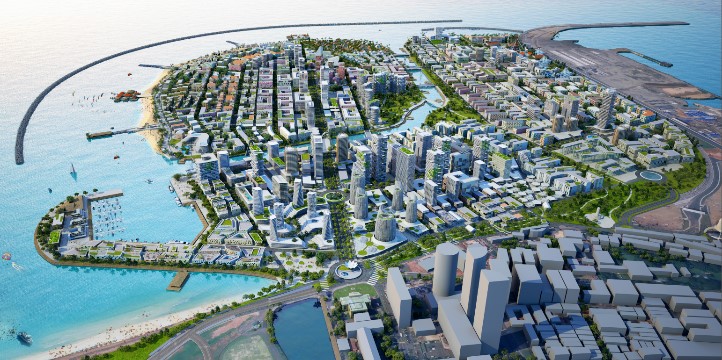
Just after the defeat of the LTTE, in 2009, I presented a talk to a gathering of officials at the Presidential Secretariat, entitled “Four Challenges to Sri Lanka and their Technological Solutions”. One of the challenges was the looming danger of global warming and the rising sea level. The attached map (shown then) roughly indicates how much of the island will go under salt water if nothing is done. It is painfully similar to the map of Sri Lanka under the Tsunami. My suggestion was the building of a raised wall (bund or dyke) along the marine periphery of the Island, which will also have a highway for electric vehicles, communications, security and heliports integrated into it. The region that is likely to go under water (at least its maritime strip) should be declared a 10th province and held under the central government because of its encompassing nature, affecting the whole island. The newly launched port city, the capital city and many other maritime cities and ports will automatically fall under the purview of the 10th Province. It becomes a special province, managed directly by the central government as a special entity. It has to deal with climate change, the unstoppable rise of the sea level, tsunamis and floods, refugees, smuggling and naval operations; all seamlessly falling within the powers of the central government. Furthermore, it will effectively create a geographic “ceinture” ensuring the unitarity of the country at a level unreachable by constitutional tinkering. It will be strong enough to shoulder any province economically.

Someone will say, what about the cost? It is only a “bund” which is some 900 miles long. If this is not done, the so called “traditional homelands” of the Eelamists, all the lives and money spent over three decades to liberate it, as well as other maritime parts of the country will be lost forever. If we delay this, the costs will mount fast, especially as other countries also face the same problems. There is no choice but to deal with the rising sea level. Doing so will create jobs, stimulate economic activity and innovation. The modern Sri Lankans can be proud of an achievement paralleling the genius of their ancient hydraulic civilization.

The needed money can be raised by abandoning stupid projects that are destined to create more urban concrete, asphalt, and polluted spaces. The megalopolis project, already technologically obsolete even before it has begun, should be replaced by a modern eco-friendly re-planning of the whole country.

Given that our fertility rates are down to 2.2 per couple, we are nearly at a stabilized demographic. Let the people stay in their villages, instead of packing them into a megalopolis. Commuting to office is unnecessary as most work can be done online. Video-conferencing and social media usage from playing bridge to courting and flirting are now routine. All that can be made personalized and less “robot-like” since holographic reality is almost at the market place. A developing country has an advantage over already developed countries, as it can leap-frog over several stages, just as Sri Lanka moved to cell-phones, while skipping the laying of land lines.

Commuting to work causes enormous traffic jams, pollution and stress. Costs of maintaining multi-lane highways, office buildings and services are staggering. Cost of having office space in Colombo estimates to over Rs. 20,000 per year per employee! It will cost more, with global warming. The cost of bringing them to office is 70% of the cost of the imports of the petroleum corporation. Health costs due to stress, causing diabetes and hypertension, congestion and crime in cities, etc., are incalculable. The petroleum and diesel fumes, particulate dust and other class-I toxins are more deadly than anything in the list of things to be banned in Ven. Ratana’s so-called “toxin-free nation”.

The planned coal-fired power stations, needed to keep the megalopolis running, and the mounds of garbage that it will generate, add to this megalopolis-pollution that will asphyxiate the whole nation and its ecosystem.

So we abandon the megalopolis and re-structure work, commuting etc., to save money and build the 10th Province that will girdle round the island and protect it from the sea. Of course, this cannot be done overnight – it will take a decade or more. But the moment it is written into the Constitution, defining the scope and nature of the 10th Province, it will at least have a start. All the traditional provinces will loosen a bit of their maritime areas in forming the 10th Province. As the ring road (“Un boulevard peripherique” as Colbert could have told Louis XIV) built on the bund running round the island, with communication towers, heliports for the landing and taking off of drones to deliver goods, etc., are an integral part of the 10th Province, we can expect ready movement of people and cultural integration within it, linking closely with the Port city being built by the Chinese.

Of course, while we are barely thinking of all this, Singapore and even Maldives have already got planners working on such protective structures that will ring their lands and keep the sea away. They are already thinking of heliports for the delivery of goods by drones, so that they don’t need big highways for container trucks serving large warehouse supermarkets. All this can be true in Sri Lanka only if it can at least dare to have the vision and include some of it in its constitution.

I mentioned that the 10th Province will also ensure the unitary integrity of the land by its geographic encirclement of the whole country and administered by the central government. We can also take a cue from Singapore, which has ensured ethnic harmony by requiring that no local region will have a preponderantly mono-ethnic or mono-cultural character. Here we can follow the cry of a dissident Tamil writer speaking for the “depressed” citizens of the North. Sebastian Rasalingam  was a frequent voice about a decade ago. His essay, on the need to “Sinhalise the North and Tamilise the South” (June 29, 2007 Sri Lanka Guardian:  http://www.srilankaguardian. org/2011/06/sinhalization-of- north-and-tamilzation.html ), should be compulsory reading for those grappling with the constitution of Sri Lanka.

CHANDRE DHARMAWARDANA

Ottawa, Canada

PORTCITY AND ACCELERATED DEVELOPMENT

October 1st, 2017

Dr Sarath obeysekera

Everyday I pass thtough Galle Face along the Port City Development and note that work is steadily streaming ahead .I wonder whether we will not  alive long  to see the entire devlopment after completion as such development  will take at least 10-15 years to achieve.

As a marine engineer and a investment  promoter I would like to suggest following to the decision  makers of the port city development .

Along the southern boundary of the development   a Marina is envisaged for yachts and leisure boat owners to patronize Colombo .These owners and tourists are cuurntly using Maldivian waters ,and it will be quite easy to entice t them to come to Colombo ,if we can accelerate Marina Devlopment section .

Break waters are bult already and few mooring paltforms and some infrausructure  in the Marina Section will be an attractive location for Yacht owners .


In Mutwal a repair and maintenance facility for yachts is being completed with a state of the art yacht docking device , which will augment development of the Marina concept

What we need to do is to ask Chinese to develop the Marina as a priority and update the regulatory aspects to make the yahct owners comfortable to arrive and park with minimum bureacratci procedures.

Next door to Marina ,there are few five  star hotels and bars and clubs which they can patronize .These facilities are not available in Maldives except in resorts.

Parallelly, Megapolis should invite local shipbuilders to build and operate ferry and passenger service to start from Galle Face Marina  to sail to Galle and Kalpitiya.

If Casino moguls  with Hayleys can introduce a floating casino to oparate while sailing ,I am sure all the gambling Chinese will come to Colombo

This is the development which need urgent attention and the next three years will be crucial to the government to show some tangible results to people.

We are sailing in troubled ecomonic-waters and we need to come out .

Dr Sarath obeysekera

Foreign ministry’s shocking silence in Geneva

October 1st, 2017

By Sanja de Silva Jayatilleka Courtesy The Island

The 36th session of the UN Human Rights Council closed just a few days back, on the 29th of September. At that session, there were allegations of genocide, systematic discrimination, rape and torture in custody, extrajudicial killings and militarization leveled at Sri Lanka besides a call by the UN High Commissioner for Human Rights Zeid al Hussein, for the second time in two sessions, for Universal Jurisdiction to be exercised. Universal Jurisdiction allows the courts of another country to prosecute a Sri Lankan citizen for alleged violations of crimes against humanity normally outside its national jurisdiction.

In reply, Sri Lanka’s official representatives (the representatives of the Sri Lankan state, appointed by the Government of Sri Lanka) in Geneva said nothing, according to the summary of the full proceedings provided by the United Nations Office in Geneva. By contrast in all these debates, other States which had accusations of violations of human rights used their ‘Right of Reply’ (an opportunity presented to States), to answer those allegation and to clarify any confusion. Sri Lanka did not.

The accusations came from the Non-Government Organizations. NGOs participateat these debates because the United Nations regards them as essential partners in the promotion and protection of Human Rights. To disregard their submissions is to set your country up for criticism by States who take the civil society/NGO submissions seriously, especially in the absence of a refutation by the country concerned, and therefore find them credible. The record of the 36th session shows no refutation by the Sri Lankan state.

On the 26th of September, at the general debate on RACISM, RACIAL DISCRIMINATION, XENOPHOBIA AND RELATED INTOLERANCE,no less than 14 NGO’s spoke critically of Sri Lanka without a response from the Sri Lankan state.

The summary of the critical comments are as follows:

1. ABC Tamil Oli: Tamils in Sri Lanka were suffering from systematic discrimination island, withdraw all its armed forces from the Tamil lands.

2.ANAJA massacre of Tamil children in Sri Lanka on 14 August 2006 and of other attacks committed by Sri Lankan military forces. Called on the Council to allow the Tamils to conduct a self-determination referendum.

3.Association culturelle des Tamouls en France drew attention to the discrimination and violence against the Tamils in Sri Lanka, who had faced decades of political violence and disenfranchisement. The Tamils in that country wished to be granted their right to self-determination.

4. Association Bharati Centre Culturel Franco-Tamoul: The women headed households and war widows especially experienced socio-economic and physical vulnerabilities due to heavy militarization.

5. Association Solidarité Internationale pour l’Afrique: Despite pledging to repeal the law (PTA) in the Human Rights Council, the Government of Sri Lanka continued to utilize this piece of legislation to discriminate and marginalize the Tamils.

6.Association for Victims of the World was concerned about the continuing patterns of religious violations and intolerance towards religious minorities that proved that ethnic communities did not have the right to their chosen faith without hindrance. Sinhala military demolished the memorial pillar of Thileepan.

7.Association des étudiants tamouls de France: The military forces of Sri Lanka had been in the territory since 1945. Many Tamil civilians had been detained without any charges.

8. LE PONT: Tamil nation was struggling for its freedom.

9. Alliance Creative Community Project: The Tamils were still struggling for equal opportunities. The present Government had detained numerous Tamil civilians without filing any charges against them.

10. Observatoire Mauritanien des Droits de l’Homme et de la Démocratie :The ethnic conflict in Sri Lanka had resulted in illegal and arbitrary arrests and detention, abductions and enforced disappearances, rape and torture in custody, extrajudicial killings and internal displacement of the Tamil communities.

11. Society for Development and Community Empowerment: Illegal occupation of the Sri Lankan military in the north and east. The military presence interfered in economic activities, education and cultural events of the Tamils.

12. Tamil Uzhagam: Tamils had been completely deprived of their basic rights by the racist Singhalese Government and subjected to genocide.

13. Association Thendral: North east of Sri Lanka remained a disproportionately heavily militarized region with five of seven Sri Lankan security force headquarters located in the two provinces of the region.

14. Tourner la page: Eelam Tamils continued to suffer discrimination despite the defeat of the Tamil Tiger Freedom Fighters.

The official Sri Lankan silence started on the 11th of September, the first day of the sessions. Despite criticism including from the High Commissioner, the Sri Lankan state stayed silentat the General Debate on the Oral Update of the High Commissioner for Human Rights.

This is a summary of the critical comments:

1.High Commissioner for Human Rights:The absence of credible action in Sri Lanka to ensure accountability for alleged violations of international human rights law and international humanitarian law makes the exercise of universal jurisdiction even more necessary.

2. Asian Legal Resource Centre: In countries like Myanmar, Bangladesh, Pakistan, Sri Lanka and India, Governments were engaged in systematic fanning of religious and fundamentalist sentiments against liberal, democratic and secular ideals.

3. ABC Tamil Oli: many countries had refused resettlement to Tamils who had been members of the Liberation Tigers of Tamil Eelam. Recognize the plight and dangers faced by the Tamils in Sri Lanka. The situation of Tamil refugees required urgent attention.

4. Association Bharathi Centre Culturel Franco-Tamoul: The Tamil people were still denied justice. The only way to assure justice was by international investigations.

5. Association Tourner La Page: The intelligence wing of occupying Sinhala military had instructed several village officials to submit written reports providing in-depth details on the whereabouts of former LTTE members. Ex members of LTTE were under military harassment and Sri Lanka police arrest without any charges.

On the 27th of September 2017 at the General Debate on TECHNICAL ASSISTANCE AND CAPACITY BUILDING, the Sri Lankan State’s silence was deafening, in the face of repeated accusations of 146,000(one hundred and forty six thousand) killedin 6 months in a “genocidal war”!

This is a summary of the critical comments at this debate:

1. Tamil Uzhagam said Tamil fishermen of Tamilnadu in India had been mercilessly attacked by the Sri Lankan navy for the past four decades. So far, 578 had been shot dead, with their bodies thrown into the sea. On April 2, 2011, the Sri Lankan Navy had abducted four Tamil fishermen, and chopped up their bodies, thereafter throwing them into the sea. Due to the genocidal brutal attacks by the armed forces, more than 100,000 Eelam Tamils had come to Tamilnadu in India as refugees.

2. Tourner la page said that in 2009, Sri Lankan military forces had made a genocidal war against the Tamils by killing more than 146,000 people in a short period of six months. The Council should establish an international investigation into alleged violations of international humanitarian law and human rights, including crimes against humanity and genocide, by the Sri Lankan security forces during the conflict in Sri Lanka.

3. Association Bharathi Centre Culturel Franco-Tamoul said in 2009, Sri Lankan military forces had conducted a genocide war against Tamils by killing more than 146,000 people in a short period of six months.

4. Association des étudiants tamouls de France saidcountries such as the United States, the United Kingdom and India used the question of Sri Lanka to resolve their own regional interests and had made military agreements with the genocidal Government of Sri Lanka.

5. LE PONT said The Association expressed serious concern about the threats and intimidation which appeared to be linked to the Sri Lankan military who had come to the Council session.

6. Association culturelle des Tamouls en France saidreconstruct societies affected by war, such as the north and east areas of Sri Lanka, the historical territory of the Tamil people. Concerned about the threats and intimidation which appeared to be linked to former Sri Lankan military staff who had come to the Council as non-governmental organizations, and who had started a social media campaign against the Tamil rights activists from Sri Lanka.
On the 26th of September 2017 at the General Debate on the Vienna Declaration and Programme of Action, Sri Lanka was accused of Genocide,Racism, Land Grabbing, and Militarization. TheSri Lankan State said nothing. Interestingly, there were several assertions of the right of self-determination.

These are the critical comments at this debate:

1. BC Tamil Oli stated that the Singhalese State had perpetrated a genocide of the Tamils. Sri Lanka had violated all international laws by launching attacks against the Tamils. The climate of injustice had forced the Tamils to fight for their right to self-determination. An independence referendum should be organized for the Tamils just like it had been organized for East Timor and South Sudan.

2. ANAJA reminded of the anniversary of the death of the great Tamil martyr. The racist Singhalese State had unleashed genocide against the Tamils. The Tamils saluted their hero.

3. ASSOCIATION CULTURELLE DES TAMOULS EN FRANCE For many days families of the disappeared Tamils had protested in order to find out about the fate of their loved ones. The families requested that members of the committee tasked to investigate disappearances should be composed of Tamils and members of the families of the disappeared.

4. Association Bharathi Centre Culturel Franco-Tamoul Vienna Declaration and Programme of Action said all peoples had the right to self-determination. Sri Lanka’s armed conflict had increased the vulnerability of women in the north-east. Their households faced vulnerabilities linked to the Government’s control of their regions. Economic and social disempowerment had also increased as a result of the militarization. The Tamil people should be allowed to realize their inalienable right to self-determination.

5. Association Solidarité Internationale pour l’Afrique said the Tamil community was hit by displacement and land-grabbing in the north and east, and its members were denied the practice of their civil and political rights. The Prevention of Terrorism Act was the main cause of violations of the economic, social and cultural rights of the Tamil people. The Government of Sri Lanka should allow the Tamil people to realize their right to determine their political status.

6. Association for the Victimes of the World -September 22 was a day of remembrance for a special Tamil martyr. All rehabilitation work should be suspended, and all detainees held under the Prevention of Terrorism Act should be released. The Tamil people were still looking for their right to self-determination.

7. LE PONT was concerned about the illegal occupation of the Tamil territory by Sri Lankan Security Forces which was against the principles of the Vienna Declaration. In May 2009, Sri Lankan military forces had undertaken a genocide war against Tamils, killing more than 146,000 people in six months.

8. Alliance Creative Community Project said that the international community had failed to protect 146,000 Tamils from genocide. People of Eelam Tamil had repeatedly called on the international community to adhere to the international human rights fundamentals and not to heed the racial and discriminatory Sinhala State establishment. A Special Rapporteur should visit the occupied Eelam Tamils territories.

9. Society for Development and Community Empowerment stated that the Tamils in Sri Lanka had the right to self-determination under international law and practice. The organization called for the release of all Tamil detainees and the end to military rule in the north-east of the island. The Tamils needed the help of the Council to implement their right to self-determination.

10. Tamil Uzhagam reminded that the terrible massacre of the Tamils in Sri Lanka had amounted to a genocide. The Tamils in Sri Lanka had the right to self-determination like so many other nations before them had had the right to declare sovereignty.

11. Association Thendral noted that the denial of the right to self-determination was a violation of human rights. The victim communities in northeast Sri Lanka had suffered and continued to suffer from militarization, illegal land acquisitions and displacement, and the lack of accountability for war crimes and crimes against humanity.

These summaries indicate the dominant narrative being disseminated to the international community by way of the UNHRC sessions, by a number of NGOs regarding the conditions of the Tamil people in Sri Lanka. It is hardly surprising that the UN High Commissioner and the Human Rights Council tend towards this narrative when not a word in defense of Sri Lanka is uttered by our designated representatives in Geneva!

By default as it were, the only dissenting voice at these debates was that of a NGO called International Buddhist Relief Organization. Theirs was one perspective and was by no means adequate to prevail over the numerous opposing submissions. There is no substitute for effective defense of the country by the accredited representatives of the State.

Even in 2007-2009, when Sri Lanka gained overwhelming support of the Council, some in the Foreign Ministry stood by a notion that a State doesn’t need to reply to NGOs, which probably derived from and applied in the old days, before NGOs were given consultative status at the Council. However, during 2007-2009, it is by going against this advice and responding to every single statement by NGOs that the Permanent Representation in Geneva, with the active participation of delegates from the Peace Secretariat and the Attorney General’s office that Sri Lanka, managed to get a two thirds support for its resolution, decisively convincing the international community of its case.

Why is everyone silent about 443 years discrimination against the Sinhalese?

September 30th, 2017

Shenali D Waduge

Sri Lanka: by 1956, 30% Ceylon administrative service, 50%clerical service, 60% engineers & doctors, 40%armed force were held by ONLY Tamils who were less than 10% of the population.

There are some facts stubborn to accept but need to now be brought to the table. Everything cannot revolve around one community. Every change and every solution cannot be determined on what that one community only demands completely ignoring the other communities. No solution or option can omit some ground realities ignoring how and who created the issues the currently prevails. Are people aware of the actual discrimination and the foundation by which the current status has arisen? The discrimination against the majority lasted 443 years whereas none of the minorities were marginalized before 1505 under the majority rule. The leaders of minorities want to return to the 443 years. This has never been showcased.

Firstly, it must be accepted that Tamils did not evolve in Sri Lanka. If so, then they should refer to themselves not as Tamils but by another name. If they evolved in Sri Lanka how can they explain the existence of Tamils in South India. The same race cannot evolve in 2 separate countries. The Missionary Guide Book too affirms this The Tamulians who it is supposed came over from the opposite coasts of India”. While Tamil Nadu politicians and Indian Government show concern for Tamils because they descend from South India which is why they always interfere into Sri Lanka’s internal affairs. G G Ponnambalam himself said Tamils are not Ceylonese but Dravidians.

Secondly, there was an influx of Tamils to Sri Lanka especially after the arrival of the colonials because the Sinhalese refused to work as labor while there was insufficient Tamils living in Sri Lanka to work on the colonial plantations, even if they were willing to work. This was the prime reason for the colonials to transport scores of aliens from Tamil Nadu to Sri Lanka who ended up coming with their families and having children which eventually led to Sri Lanka being forced to keep them using the foreign legal terms contrived by these illegal occupiers. Colonial records and the post-independence interactions with Indian & Sri Lankan Government gives further details of the actual numbers who were living and working in Ceylon in the late 1940s and 1950s.

Thirdly, divide and rule policy was to not only divide the people but also to convert as many as they could and create locals who were stooges and worshippers of foreign rule. At independence what took place was only a transfer of powers from the white sahibs to brown sahibs. Education and medical missionary work was the modus operandi used which invariably meant publishing material ridiculing and insulting native religions, their cultures, values and practices. So when we raise alarm over these same missionary NGOs distributing pamphlets and virtually doing the same as the missionaries did in ancient times people should not feel offended or find fault.

The point of a divide and rule” policy was to put a minority into a position of power that they would not otherwise possess. By doing this the colonial administration created a group of people who were dependent on them for their power/livelihood and would carry out the colonial desires. The majority were made to feel inferior while the minority were encouraged to adopt a superiority complex.

Anyone looking at the troubles in Sri Lanka should first ask why were there no troubles between the people before the foreigners arrived?  

Isn’t it odd that all these ethnic issues emerged only after 3 colonial powers invaded, occupied & ruled Sri Lanka? Therein lies the answer. It was their divide and rule policies that split people up to pieces and plunged them against one another using deceptive ploys and strategies. Should these same countries be allowed to return to interfere in our internal affairs, is what we should all be asking ourselves now.

With the sole objective of proselytizing, first the Americans followed by Catholic & Protestant Missionaries were set up in North Sri Lanka. The American Methodist Missionaries began its first Mission School in 1816. The American missionaries became fluent in Tamil and used this as a basis to influence. By 1818 according to Jane Russel, Tamils constituted over 40% of the franchise for the Educated Members seat. By 1822, 42 schools were functioning in the peninsula. In 1823 Asia’s 1st English education school was opened in the Batticotta Seminary in Vaddukoddai (Batticotta is not Batticoloa)

By 1848, 105 Tamil schools and 16 English schools had cropped up in the Jaffna peninsula. In 1862, Rev. Miron Winslow published the first Tamil-English Dictionary.

By 1929 Jaffna peninsula had 65 English schools and 426 Vernacular schools.

With unfair and favored English education imparted on Tamils, it enabled Tamils to emerge as the first Asian surgeons, accountants, engineers and teachers and were even recruited by Colonial British to Malaysia and Singapore.

(Kandiah Arundavarajah)

Look at the composition of population!

  • 1824 – 841,940 – Ceylon Population (source South Asia: A Short History by Hugh Tinker)
  • 1834 – 1,167,700 (more than 100 Christian Missionary schools was teaching over 7000 students)
  • 1871 – 2,400,380 (first proper census)
  • 1911 – 4,106,350
  • 1931 – 5,312,000 (in 1938 Tamils held 19.4% of government jobs)
  • 1953 – 8,098,637

In 1946, two years before independence, 33% of the civil service and 40% of the judicial service were Tamils, (Chandra Richard De Silva, 1983 p.116)

By the time Sri Lanka became independent in 1948, about 60% of government jobs were held by Tamils, who formed hardly 10% of the population.

By 1956, 30% Ceylon administrative service, 50% clerical service in railways, postal and customs, 60% engineers, lawyers & doctors, 40% armed force & 40% of other labor forces were held by ONLY Tamils. 31% of students admitted to university were Tamils who comprised only 10% of the population.

WAS IT WRONG TO ADJUST THIS IMBALANCE OR SHOULD THIS 10% HAVE CONTINUED TO ENJOY WHAT THEY DID WHILE THE REST OF THE 90% REMAINED AS THEY WERE LIKE UNDER COLONIAL BRITISH RULE.

Even this 10% is questionable given that many a Tamil were brought by Portuguese, Dutch & British and made to settle down and work in Sri Lanka, so there were not really natives.

The question or rather objection is not Tamils holding portfolios but the fact that the ratio against their population while the majority were denied such purposely because of divide & rule policies was unfair and had to be addressed and the imbalance resolved. Naturally, it caused ripples because people who were enjoying unfair privileges did not wish to give up those privileges while it must be pointed out that even amongst these minorities only a minority amongst the minority were enjoying the privileges. The low caste minorities were denied.

According to Patrick Peebles (The Plantation Tamils of Ceylon) of the 123,565 working in the 996 plantations 115,092 were Indians of which 40,604 were Indian females. That makes only 8473 Sinhalese or Moors. Peebles also confirms that 1336 were Moors so the remaining 7137 would have been Sinhalese.

Between 1843 & 1859 (within 16 years), 903,557 Indian coolies had entered Ceylon brought by Colonial British.

[A]lthough [the Tamils] constituted only 11 percent of the country’s population, Tamils comprised 33 percent of the civil service and 40 percent of the judicial service…[t]hey further accounted for 31 percent of students in the university system (DeVotta, 115).”

However, even in 1971 the statistics does not reveal any discrimination.

In the 1969-1970 intake to science and engineering courses, Tamils constituted 35%, while they constituted over 45% of the intake of engineering and medical faculties.

In 1972, a district quota system was introduced in order to benefit those not having adequate access to educational facilities. The standardization afforded opportunities for poor Sinhalese, Tamils & Muslims to gain admission to universities that previously they were unable to do. Again, those against this new system were those who wanted to continue the elitist rule that benefited only them (handful of Sinhalese & Tamils)

The other very important aspect often neglected is the fact that while the colonial rulers may have planted the trouble, the troubles became regularly watered by opportunist local politicians who realized that the best way to win votes was to also drum ethno-linguistic slogans. It is also the fault of the voters for being party to this.

Returning to the issue at hand what must never be forgotten is that before 1505 the Sinhale kingdom was ruled following the Dasa Raja Dhamma by even the South Indian invaders that ruled parts of the island. Thousands of years of that rule came to an end with the arrival of European colonial rulers who through their divide and rule policies – divided people by ethnicity, created tensions, created classes, created a capitalist system and a bunch of brown sahibs and the favoritism was such that from schooling to employment given to those who converted ended up minorities reaping the fruits of colonial rule.

So we come to the question where before 1505 the Sinhalese Buddhists ruled in a just and fair system where there was no animosities between the Tamils or Muslims which eventually changed after 1505 and has continued to this day. The favoritism was such that at the time of independence the minorities were enjoying far more than their ethnic composition. No one likes to speak about this aspect and nobody wishes to acknowledge that it was unfair by the Sinhalese to have denied them for over 450 years their due place.

The argument is, was it alright for a minority of the minority 10% to enjoy 443 years of undue privileges but it is not alright for the majority to complain because when they ruled none of the issues that currently prevailed existed.

Shenali D Waduge


Discrimination in Sri Lanka – A Reality?

September 30th, 2017

Anuradha Yahampath

I want to start my speech with reference to an incident that took place in Jaffna on the 16th of December 2016. Where a bus-van collision led to the deaths of 11 Sinhalese travelling to Chavakachcheri, in the North of Sri Lanka. The Tamils who arrived at the scene did everything to help the wounded Sinhalese. The touching scenes were relayed by media.

It takes a brave few like those who helped the victims and those who held candlelit vigils for the deceased, to awaken the rest of the community to the true status quo.

Only 7 years had passed since defeating one of the most brutal Terrorist organizations in the world. The LTTE were responsible for the invention of the suicide bomb and were widely regarded as one of the most inhumane practitioners of warfare. The military action was against Terrorists not the Tamil people. The defeat was not of the Tamil people. Victory is not for the Army. It is a victory of people to live together. Peace was delivered to all the People, be they in North, East, West or South of Sri Lanka.

It takes time and effort to heal all the war wounds, but the brothers and sisters of the Chavekachcheri Tamils showed us that the reconciliation process that had been in progress since the war ended in 2009 was working.

I would like to share another story. When a daily news  paper quoted on the 13th June 2017 that the Jaffna Teaching Hospital Director had said that caste differences among the people living in the North were discouraging them from donating blood, thus resulting in a shortage of blood for transfusions at the Hospital. It was the Sri Lankan Army who came forward with 200 soldiers to donate blood. These are the very soldiers that the TNA, the Chief Minister of the North, and the Opposition Leader together with LTTE fronts, have been humiliating, even claiming that they were responsible for genocide, calling for war crimes tribunals, demanding that these soldiers be removed from the North.

In a land of Racial Discrimination would you find people of different races coming together spontaneously at a time of need?


What is this so called discrimination that the Tamil Expatriates and a few Tamil political leaders from Sri Lanka and Tamil Nadu, India are talking about when constitutionally and economically Tamils in Sri Lanka enjoy a higher share than their demographic percentage?

To give a few examples, there are currently 33 Tamil MPs in Parliament; the Opposition leader is the leader of TNA, which was the political wing of the LTTE, and the current Governor of the Central Bank, is also a Tamil National.

There are many Tamil academics and scholars, who hold prestigious posts in many Universities and other Institutions. Tamils Diplomats, Journalists, Judges and public servants are numerous, and many are being respected as citizens of Sri Lanka, without prejudice.

Many of the largest businesses in Sri Lanka, which are mostly based in the capital, are owned by Tamil People. For example the two most successful supermarket chains are owned by Tamils and frequented by Sinhalese majority. The Sri Lankan Tamils have the luxury of enjoying all their religious and cultural holidays, like Pongal, Mahasivarahri and Deepavali unlike their expat counterparts.

Sri Lanka is one country that has given equal language status to a minority language. Tamils of Sri Lanka make up only 11.2% of the population. Sri Lanka has a separate colour to depict Tamils and Muslims in the country’s national flag – has India shown such a gesture when 9/10th of the world’s Tamils live in India?

Healthcare and Education are basic human rights and is equally and freely accessible to all citizens of Sri Lanka regardless of their ethnicity.

While Tamils can live, buy property, indulge in business, and educate their children throughout Sri Lanka who can claim being discriminated?

These false allegations and fabrications of discrimination do exist, as a desperate measure to seek help from international bodies to federate the beautiful island of Sri Lanka by Separatists Tamils. These very same separatists have openly supported the LTTE in their goal to create a mono ethnic Tamil enclave.

Tamil Separatism started during the time when the British colonized Sri Lanka. The colonists, who mastered on ‘divide and rule’, encouraged Separatists to work against the Sinhalese representation in the constitutional council.

A few years later in 1939 during British rule when GG Ponnambalam demanded 50-50, his demand was for 50% of parliament seats for non-Sinhales and the balance 50% could be for Sinhalese and the non-Sinhalese.

That was the Discrimination that our fore fathers had fought and defeated for the sovereignty of our motherland.

It was in 1949, immediately after the independence of Sri Lanka that Chelvanayagam formed the first racist party in Sri Lanka called Ilankei Thamil Arasu Kachchi – the direct translation being Sri Lankan Tamil state party demanding a federal state for Tamils. Later Vaddukoddai Resolution was formed in 1976, seeking a separate homeland for Tamils by TULF.

The difference between Prabakaran and the separatists before him was that he used the most gruesome methods of terrorism against the Sinhalese. Using his own Tamil people, which included women and children as weapons and human shields to fulfil this same dream of Eelam to divide and rule. LTTE’s discrimination against their own people had started by killing Tamil policemen, politicians and numerous other Tamil civilians whoever had the guts to oppose terrorism.

Riots of 1983 in Colombo following the killing of 13 soldiers were by thugs who looted and destroyed. This black mark caused upon one of the most generous Nations, generous I would say because even on the day of black July, every one of us brought home our Tamil friends, to protect them from this unbearable hooliganism.

LTTE used this day’s horror to strengthen their war tactics getting sympathy and support from the international community. Expatriate Tamils of Sri Lanka still use 1983 to claim impunity without considering the repercussions they are bringing to their motherland and to their relatives that are back at home.

That is the discrimination that the Tamil diaspora is creating for their own people to seek asylum for greener pastures.

If I were to name the numerous terrorist attacks of LTTE on Buddhist monks, civilians at worship, innocent villages, farmers, unarmed police, the forces and thousands of civilians, I would be here the whole day.

What I want to emphasize is that even with the continuous attacks on the citizens of Sri Lanka, be they Sinhalese, Tamils or Muslim, there wasn’t a single civil retaliation. The Tamil expatriates and the international Community have advantageously overlooked this.

On the 19th of May 2009 the Forces of the Sri Lankan people defeated Terrorism. With that the aspirations of Separatists were defeated.

The apparition of Eelam was defeated.

After the war ended in 2009, the development of the North and East was the primary focus due to the lack of it in the past 30 years. LTTE was ruling a de facto state in the North. According to Janes Intelligence LTTE was making $300m profits annually but LTTE did not make a single road in the areas they ruled. The LTTE did not spend on building a single school, did not allow children to study – they were kidnapped and sent to LTTE orphanages where they were trained in armed combat. Even at the height of the war, the Government of Sri Lanka ran classes for IDP children preparing them for O-Level-GCE examinations.

The LTTE discriminated against their people, but this has been advantageously forgotten and ignored.

It is only after an era of peace has been established that the UN human Rights Council demand a constitutional change in the name of accountability and reconciliation. Accountability and reconciliation are ideologies backed by World’s super powers that are looking to divide the sovereign states in advancing their country’s need to be a Hegemonic power.

The demands of the UN Human Rights Council Resolutions are infringing and violating the UN Charter and exceeding the UNHRC mandate.

The demands of the UN human rights resolution are fundamental, that they cannot take place without constitutional reform. Fundamental change cannot be proposed without radical ideas and thoughts. These thoughts are the false allegations of discrimination and racism against minority groups in Sri Lanka. Seeds of radical thoughts have been planted and fermented by those that seek to colonize the world in the modern era.

A select few individuals can be brainwashed to ensure the destabilization of countries into mono ethnic enclaves with a promise of an independent state which will finally lead to a never–ending conflict between those divided. May I remind this forum that the newly created ‘independent’ states of Kosovo and South Sudan are failures of the UN System. Sri Lanka does not wish to enter this list.

The UN demanding Sri Lanka to draft a new constitution, ordering us to make fundamental changes to an independent country in the name of human rights is nothing but discrimination against a sovereign state and interference into its internal affairs.


MASSACRE OF HINDUS BY THE ROHINGAYAS

September 30th, 2017

Hafiz Saeed-Rohingya Link EXPOSED | The Debate With Arnab Goswami

Case of a modern day Arahant – I

September 30th, 2017

By Rohana R. Wasala

September 14, 2017

There is no doubt that Buddhists were shocked and pained  and gravely upset by what Ven. Samanthabhadra  Thera recently said about two of the most venerated objects of Buddhist worship in the country: the Dantha Dhatu or the Sacred Tooth Relic and the Lalata Dhatu or the Sacred Frontal Bone Relic, both believed by them to be those of the Buddha. During acts of worship, these sacred relics make the devout Buddhist worshippers feel as if the Buddha were  before them in flesh and blood. But Ven. Samanthabhadra Thera remarked that the first is a tooth of a wild boar, and that the second is a seashell. He further said that the foolish devotees worshipping these things will be reborn as mala perethayo” (a class of manes in local Buddhist belief born into a state of misery) for what he called this foolish superstitious practice (of worshipping what he  alleges to be animal bones). He also referred the lay official in charge of the Tooth Relic as ‘mala perethaya’). This information is from a You Tube video recently posted by Siri Sadaham Ashramaya, where the maverick monk resides.

Ven. Samanthabhadra Thera styles himself as an Arahant.  It is well known that the monk who now appears by that name was ordained, and until a few years back known, as Pitiduwe Siridhamma. Of course, if he is really what he says he is, only he will know it. But are we obliged to take his word for it? Certainly not! Accepting anything on mere report or hearsay or scriptural authority without experiential evidence is not the Budddhist way as explained in the Kalama Sutta. In this case, Buddhists/or other interested observers must look for external signs (evidence) of his Arahanthood to convince themselves of the authenticity of his claim. I don’t mean that he must possess miraculous powers that some simple unsophisticated ordinary Buddhists attribute to Arahaths in popular tradition such as alleged abilities of clairvoyance, mind reading, magical aerial transportation etc. Instead, one should look for characteristic behaviours of his that convince us that he is a person who has annihilated the illusion of self and put a final end to samsaric suffering.  Though he could have attained that state for all we know, his recent actions and speeches in the course of his normal religious ministry leave at least some of us sceptical about his claims.

At the very outset, I’d like to kindly remind my readers that, as usual, my attitude as an essayist or newspaper columnist  can be simply expressed thus: ‘This is what I think about this matter, i.e.,  here, the case of Ven. Samanthabhadra Thera,  and these are my reasons for  my opinion. What do you think, if you happen to take an interest in the subject?’ My personal belief is that jointly searching after the truth in any situation is socially beneficial and individually satisfying, promoting the central goal of Buddhism: social harmony and individual happiness (an idea articulated to me by a Buddhist scholar I personally know, who, I believe will prefer not to be named, because he is least concerned with name and fame or selfhood). I am mindful of the fact that by some of my readers I could be reduced to the position of one among ‘Fools (who) rush in where angels fear to tread’ as the early 18th century English poet Alexander Pope wrote. He was writing ‘An Essay on Criticism’ (1711) about good literary criticism and bad. I am here applying it to a critical characterization of a controversial personage who is important to us  which I am indulging in at present, but I don’t feel like a fool at all.

I have the highest regard for Ven. Samanthabhadra’s scientific attitude to Buddhism. His incisive, analytical explanation of the Dhamma to the average Buddhist upasaka upasikas (male and female followers of the Buddha Dhamma) in simple clear language is admirable. His criticism of popular Buddhism in Sri Lanka as a false deviant version of the original teaching of the Buddha is a valid one. That there are avaricious, corrupt, worldly monks who resist a reestablishment of the true Buddhist way of life among themselves and their followers is also a fact. My focus here, however, is the undesirability of the monk’s bull in a china shop behavior (as seen in his indiscriminate attack on fellow bhikkhus  and the Mahanayake Theras among whom many, I believe, are as virtuous and as erudite as he is himself) which ultimately is bound to defeat his purpose. There is no question about the need to reform these aspects of the Buddhasasana. But it is up to the Maha Sangha themselves to set things right in a non-political religiously acceptable manner without letting well intentioned lone monks play the role of the skilled physician, called upon to cure a person suffering from indigestion, who boasted, when his patient died during his treatment: Although my patient died, he purged well”!  My friends who disagree with me are kindly invited to produce counter arguments to demolish mine.

According to Ven. Dr Walpola Rahula Thera, an unrivalled authority on both Theravada and Mahayana Buddhism, an Arahant  is one who is free from all fetters, defilements and impurities through the realization of Nirvana in the fourth and final stage, and who is free from rebirth” (‘What the Buddha Taught’ {First published by Gordon Fraser, London, 1959; but I am using here the 2006 edition of the book published by the Buddhist Cultural Centre, Dehiwala, Sri Lanka} p. 142. This is the most comprehensive yet succinct treatise on Buddhism that I have read). Verse 92 of Dhammapada as translated by Indian monk Ven. Sri Archarya Buddharakkhita (1922-2013)describes ‘The Perfected Ones’ (Arahants) as

 ‘Those who do not accumulate

and are wise regarding food,

whose object is the Void,

the Unconditioned Freedom –

their track cannot be traced,

like that of birds in the air.’,

where the translator elucidates accumulate as also including accumulation of kamma, and food as referring to physical nutriment, sensory impressions, volitional activity and rebirth consciousness, all of which feed the process of continued existence. In his translation of the Dhammapada, German oriental scholar F. Max Muller (1823-1900) defines ‘the Void, the Unconditioned Freedom’  of Verse 92 as ‘Nirvana’.

The illusory I” consciousness, the illusion of self/soul/ego, is a great source of the unsatisfactoriness of life according to the Buddhist teaching. An Arahat has completely eliminated the erroneous sense of self. But, to me it appears (my observation could be wrong, of course) that Ven. Samanthabhadra constantly shows a deep preoccupation with himself (egoism), in fact, egotism, the notion that he is superior to all others. How could he celebrate his birthday, calling it an alms giving though, in the form of a buffet lunch with flower-bedecked uniform-clad young women in attendance, with a vast array of dishes to choose from including a ‘pork curry’ (to which he drew special attention), a far cry from a simple frugal meal that bhikkhus (mendicant monks) would be normally satisfied with, particularly at a time when many poor people of the country fail to properly feed their children most days? This is puzzling to me as it must to many others as well. If such behavior were found in an ordinary person, I’d have wondered: ‘Could there be something gone wrong here?’ But such a notion about Ven. Samanthabhadra Thera, of such spiritual attainments, is inconceivable.

The reason is this: My observation reminded me of something I read in neuroscientist and student of Buddhism Dr Sam Harris’s book ‘Waking Up: Searching for spirituality without religion’(Transworld Publishers, London, September 2014); he claims that he has done meditation, including vipassana meditation taught in Buddhism, for many years. (Incidentally, Ven. Samanthabhadra often stresses the importance of this form of Buddhist meditation for final Emancipation and communicates to us a lucid practical explanation of the subject.) The book has some valuable advice for serious practitioners of meditation. It warns them about the danger of pathological responses to meditation occurring, a field where little research has been done, as he points out. Dr Harris thinks that this is something that both teachers and students of meditation should guard against. Buddhist scholars are not unaware of this danger. Ven. Dr Walpola Rahula Thera devotes one whole chapter of the aforementioned book to the subject of meditation: Chapter VII ‘Meditation’ or Mental Culture: Bhavana’ (pp. 67-75). The chapter begins with a statement of the Buddha, which says that there are two kinds of illness in the world, physical and mental, and that although there seem to be people who stay physically healthy for one or two or even for a hundred or more years, few in this world are free from mental illness even for a moment, except those who are free from mental defilements (i.e., Arahants). The chapter spells out the prescribed way for meditation that forestall pathological responses (though of course, Dr Harris’s phraseology is not anticipated there).

Ven. Samanthabhadra Thera used to be a very popular preacher in the past as Pitiduwe Siridhamma Himi. He has been claiming for a few years now that he has attained Arahanthood which is the highest stage of spiritual attainment in Buddhism and it is identical with the attainment of the ultimate Nibbanic bliss. Nibbana is the summum bonum of Buddhism.  Unlike in other religions, one does not have to die before one can attain that state of perfect happiness that the realization of the Ultimate Reality brings. Ven. Samanthabhadra Thera also  says in a You Tube video that I watched  that he is ‘inebriated with the Dhamma’, meaning that he has studied it thoroughly and imbibed all the doctrinal information it contains. It is more than obvious that he sincerely believes that he has achieved a perfect understanding of the Dhamma. For sure many other monks and lay Buddhists can justifiably make the same claim. Yet his extraordinary Arahanthood claim is problematic because his behavior shows signs, which, in an ordinary lay person, would be interpreted as symptoms of a serious personality disorder. But in the case of Ven. Samanthabhadra Thera, I hasten to add, such a diagnosis is out of the question, is in fact, utterly unthinkable.

Buddhism can be variously defined as a form of practical psychology, an ethical philosophy, a science-based conceptual analysis of human existence, and a religion free from god-belief and mysticism. Buddhism is Buddhism. It is unique. It cannot be totally identified with any of the above. In popular practice, though, it has the three basic distinguishing elements of a religion: a unique worldview, a system of rituals, and a prescribed way for achieving spiritual perfection. The last characteristic of a religion (the way to perfection) in Buddhism takes the form of transformative enlightenment about the truth of change and suchness…” . Here I am appropriating American Professor Robert Cummings Neville’s ideas about religion, arbitrarily applying them to Buddhism. The phrase quoted is from him. Professor Neville (b. 1939), Emeritus, Boston University School of Theology, is philosopher, theologian, and Confucian scholar among other things. Ven. Ajahn Sumedho Thera, American monk of the Thai Forest Tradition of Thai Theravada Buddhism, defines suchness in Buddhism Now website (November 21, 2014) as follows: Suchness, or Tathata, the Tathagata, is right now. This is the way it is. But sometimes, when I say, ‘This is the way it is,’ somebody will say, ‘You mean this is the way it is forever?’ No! RIGHT NOW — this is the way it is. The only way it can be is the way it is right now! It’s changing, but at this moment, the Suchness of this moment, is just this way. The thinking mind has to stop. Otherwise you will want to ask, ‘Where is it? What is he saying?’ You just have to stop your mind and listen, or watch. Then you will be relating to Suchness, the Suchness of the moment, the as-is-ness”.

Though the essence of Buddhism – the Four Noble Truths – is the same across the Buddhist world, there are numerous divisions of Buddhism as a religion, the three main ones being Theravada, Mahayana, and Vajrayana. (Even a Western version of Buddhism has developed over the recent decades.) Of these three, Theravada (which is found in such countries as Sri Lanka, Myanmar and Thailand) is considered  to be closest to the pristine form of Buddhism. These various sects developed in different lands over the centuries as Buddhism got acculturated to those alien societies. Now, Buddhist devotional rituals are culturally shaped. These must be maintained for the perpetuation or survival of Buddhism. A mere religious ideology, however  rational, however noble it may be, will not survive for long unless it is packaged in ritual observances. Ritual worship serves as a vehicle (medium) for the relevant religious ideology. Buddhism itself is safe from attack. What is to be protected is the Buddhasasana.

(The Island published two very interesting articles by Professor M.M.J. Marasinghe, formerly of the Department of Pali and Buddhist Studies, University of Kelaniya,  about the adulteration of Buddhism by Mahayana under the titles:  ‘The great betrayal of Theravada Buddhism?’and ‘The transistion from Buddhism to Beggism’ respectively on May 21, 2014 and August 3, 2016. I think one could quote these in support of Ven. Samanthabhadra’s arguments against certain elements of Buddhist ritual worship.)

Ritual worship (enacted through devotional offerings  or amisha puja, marking holy days, celebrating festivals, conducting peraheras, alms giving, and  observing age old traditions, etc.) contributes to making a religion a force for unifying a community, besides giving it a sense of emotional security. They also sustain and increase the piety of the adherents. It is due to amisha puja that Ven. Samanthabhadra conducts alms givings at his temple, is able to send his disciples on alms rounds so devotees perform amisha puja. The same responsible for the huge donations that the devout make towards the monk’s charitable projects. We are told that he is going to build the biggest Buddhist temple complex on a 50-acre land that has been donated by philanthropist.

The twin goal of Buddhism is creating empowering harmony for the society and enduring happiness for the individual. In ultimate terms, any religion is concerned with the ultimate fate of the individual. But what is the happiness of a single individual relative to that of a whole society? Ven. Samanthabhadra Thera’s outrageous attack on an important aspect of essential Buddhist devotional worship will be counterproductive. Instead of promoting Buddhism as the beautiful ethical-philosophical system (what the ordinary adherents follow, part as ritual, part as serious practice), the venerable thera’s sudden onslaught on relic worship is likely to endanger its very existence, particularly at a time like this when the country’s ancient Buddhist cultural heritage is being threatened in various ways.

The attainment of spiritual goals including the highest is strictly a personal matter that does not concern others, like regaining good health after an illness. If Ven. Samanthabhadra Thera has attained Arahanthood, it is for himself. It is none of our business. Other Buddhists need not initiate a personality cult centering on him, as he seems to be encouraging them to do (e.g., by erecting a statue of himself at his temple. This is something that most Buddhists cannot rationalize). Each individual must realize the Ultimate Truth for himself or herself.  But a person of high spiritual attainments can and usually does play a useful social role. Such a person inspires others to follow his or her example and to make the same achievements; he or she can teach and guide others, but the teacher and guide cannot make spiritual attainments for others. In Buddhism, there are no saviours, but only compassionate teachers and guides. Ven. Samanthabhadra Thera conducts himself as if he has attained to the status of the highest type of such teacher.

Yet , even if this self-assessment is true, he cannot be any more important to others than as a teacher and a mentor. However thoroughly steeped in the Dhamma he may be, however spiritually accomplished he may claim himself to be, and however sincere in his intentions he could be, what he felt provoked to say about the Tooth Relic and the Frontal Bone Relic is absolutely frivolous and unimaginably foolhardy. Ordinary Buddhists are not concerned about the authenticity of the relics they worship. If Ven. Samanthabhadra Thera was taken seriously by the average Buddhists (when he insulted both those objects of veneration and the worshippers who venerate them), he would have been consumed by  their outrage at what would be universally condemned as a sacrilegious speech, for  such an apparently baseless attack on the long established Buddhist devotional ritual of relic worship would be like touching an exposed high voltage electric cable with his bare hands. Fortunately for him, the average Buddhists are still patient with him. Buddhists traditionally respect the civaraya that the Buddha used to wear” (Don’t they call it Arahat dhajaya or Flag of Arahanthood”?).

However, on several occasions, groups of Buddhists staged protests against him, not because of their fault. They are now familiar with the subversive anti-Buddhist activities of certain fanatical religious groups that employ corrupt individuals with a smattering knowledge of Buddhism disguised as Buddhist monks, particularly active in remote village areas where poverty makes spirituality a secondary concern. It is natural that people tend to believe that this monk is also one of them, though personally I do not subscribe to that view at all (for his explanation of the Dhamma is compatible with a rational approach to it in spite of his controversial utterances, which are not unfounded, criticizing traditional Buddhist practices ). A couple of months ago, there was an incident at Piliyandala involving Ven. Samanthabhadra Thera, where the Buddha  civaraya (robe) he was wearing could barely save him from being manhandled. Some protesters who disapproved of his unorthodox style of preaching threw eggs at him, and nearly assaulted him, before the organizers of the Dharmadeshana (preaching) event managed to get him out of the place. I am painfully concerned that such things should happen in my predominantly Buddhist country. Wouldn’t  it be better if our venerable monk be wiser in his ministry? (To be concluded)

ඇමති සිරිසේනගේ හොර ගණුදෙනුව නිසා ඕස්ට්‍රේලියානු සමාගමට ජාත්‍යන්තර තහණමක්

September 30th, 2017

 lanka C news

මහින්ද රාජපක්ෂ ජනාධිපතිවරයා යුගයේ වාරිමාර්ග හා මහවැලි සංවර්ධන අමාත්‍යවරයා සිටි මෛත්‍රීපාල සිරිසේන මහතා විසින් ලෝක බැංකුවේ ආධාර මත 2007 වර්ෂයේ මෙරට වේල්ලක් ඉදිකිරීමේ ව්‍යාපෘතියක් ඇ.ඩොලර් මිලියන 1.8 ක් ව්‍යපතියක් ඔස්ට්‍රේලියා සමාගමට දීමේදී විශාල මුදලක් ලබා ගත් බවට චෝදනා එල්ල කරමින් ඔ්ස්ටේ‍්‍රලියානු මාධ්‍ය ගණනාවක් වාර්තා පල කර ඇත.

එම කරුණු අනුව ලෝක බැංකුව World Bank සිදු කල දීර්ඝ පරික්ෂණයකින් පසුව එම දූෂණය අදාළ සමගම විසින් ශ්‍රීලංකාවේ එවකට සිටි අමාත්‍යවරයා සමග මෙම ගනුදෙනුව සිදු කොට ඇති බව තහවරු වීමෙන් පසුව අදාළ ඕස්ට්‍රේලියානු සමාගම අසාදු ලේඛන ගත කොට ඇති බැව් ඔස්ට්‍රේලියාවේ සියලම මාධ්‍ය මේ සති අන්තයේ වාර්තා කොට තිබුනි.

ඕස්ට්‍රේලියානු සුප්‍රසිද්ධ ඉංජිනේරු හා ඉදිකිරීම් සමාගමක් වු එස්එම්ඊසි Iconic Australian engineering company, SMEC මෙසේ ලෝක බැංකුව විසින් අසාදු ලේඛන ගත (Blak List) වේ.

මෙම සමාගම විසින් ශ්‍රීලංකාවේ සහ බංගලිදේශයේ ලෝක බැංකු ආධාර මත විවිධ ව්‍යාපෘති කලහ. එහිදි ශ්‍රීලංකාවේ ව්‍යාප්ති සඳහා නුසුදුසු ගෙවීමක් එවකට ශ්‍රී ලංකාවේ කැබිනට් අමාත්‍යවරයෙකු වූ මෛත්‍රීපාල සිරිසේන අමාත්‍යවරයාට ගෙව් බව එම ප්‍රවෘත්තියේ සඳහන් වේ.

එමෙන්ම 1944 දි ලෝක බැංකුව ආරම්භ කල අතර ශ්‍රීලංකාවේ නොයෙකුත් සංවර්ධන ව්‍යපති සඳහා ආධාර ලබාදීමට ලෝක බැංකුව කටයුතු කරන ලදි. එහෙත් ඉතිහාසයේ පලමුවරට ශ්‍රීලංකාවේ දේශපාලඥයෙකු සමඟ නුසුදුසු ගනුදෙනුවක් කිරිම හේතුවෙන් මෙසේ විදේශ සමාගමක් ලෝක බැංකුවම විසින් සිදු කල දීර්ඝ විමර්ශනයකින් පසුව වැරදිකරුකොට සමාගමක් ආසදු ගත කල පලමු අවස්ථාවයි.

ඔස්ට්‍රේලියාවේ සියලු ප්‍රධාන මාධ්‍ය මෙසේ එම සිද්ධිය වාර්තා කොට ඇත.

World Bank bans iconic Australian firm over ‘inappropriate payments

September 30th, 2017

By Richard Baker and Nick McKenzie  Courtesy The brisbanetimes.com.au

Iconic Australian engineering company, SMEC, has had five of its subsidiaries banned by the World Bank after the discovery of “inappropriate payments” linked to projects in Sri Lanka and Bangladesh.

The World Bank action is a bitter blow for the company which started out as the Snowy Mountains Engineering Corporation.

Dam and water storage for the hydro scheme in the Snowy Mountains.

Dam and water storage for the hydro scheme in the Snowy Mountains.

Photo: Supplied

The scandal adds SMEC to the list of well-known Australian companies to have been mired in foreign bribery allegations including BHP Billiton, Tabcorp, Tenix and CIMIC, formerly known as Leighton Holdings.

A long-running investigation by the World Bank implicated SMEC International Pty Ltd and four other subsidiaries based in India, Bangladesh and Sri Lanka in a scandal involving improper payments connected to World Bank-funded projects.

Sri Lanka's president Maithripala Sirisena (centre) : "No knowledge of the incident"

Sri Lanka’s president Maithripala Sirisena (centre) : “No knowledge of the incident”

Photo: AP

The investigation also found SMEC subsidiaries had made mis-representations to the World Bank when bidding for contracts for projects in Sri Lanka and Bangladesh.

Under a negotiated settlement, the SMEC units will be barred from participating in World Bank projects for between six and 30 months. The SMEC units will also be denied work with the Asian Development Bank, the European Bank for Reconstruction and Development, the Inter-American Development Bank and the African Development Bank.

SMEC has been Australia’s biggest beneficiary of World Bank contracts, winning more than $250 million worth of work over the past 10 years.

Fairfax Media last year revealed explosive details of SMEC’s overseas staff’s alleged bribery of officials in Sri Lanka to secure a $2.3 million aid-funded sewerage project in 2003 and a $2.2 million power plant project in Bangladesh in 2007. The Bangladesh project was in partnership with a Canadian company.

Company emails reveal Sri Lankan President Maithripala Sirisena and his adviser allegedly sought a political “donation” to be paid by SMEC when Mr Sirisena was a cabinet minister.

The emails show a plan to siphon off money from a World Bank-funded dam project in 2009 which was to involve Mr Sirisena awarding the $1.82 million contract to SMEC.

A damaging series of correspondence involved a SMEC Sri Lanka manager writing to his Australian colleagues to tell them that he wanted to “inform the minister/co-ordinating secretary” of the size of an alleged kickback to be paid. The manager also wrote that he needed to “prioritise” certain payments to unnamed parties “since the signing of the contract would depend” on it.

In a statement to Fairfax Media last year, Mr Sirisena said he had “no knowledge of the incident” and requested further information to “ascertain the involvement of any of his office staff”.

The President said he would co-operate with any investigation in Australia and ask his local authorities to do their own inquiry.

Foreign bribery has been a criminal offence in Australia since 1999. But the Australian Federal Police has found many cases difficult to investigate, with overseas officials and governments often unwilling to co-operate.

The AFP continues to investigate SMEC over its Sri Lankan and Bangladesh contracts.

This week, Sydney’s Elomar brothers and an associate were the first Australian businessmen to be jailed for foreign bribery offences.

NSW Supreme Court Justice Christine Adamson jailed Mamdouh Elomar, 63, his brother Ibrahim Elomar, 62 and John Jousif, 48, for four years with a non-parole period of two years.

Intercepted phone calls and emails captured the men in a plot to bribe an Iraqi minister with more than $1 million in return for their construction firm winning major contracts.

Mamdouh Elomar’s late son, ISIS fighter Mohamed Elomar, received global notoriety in 2014 after photographs emerged of him holding the severed heads of Syrian soldiers.

‘TIGER CANNOT CHANGE ITS STRIPES’

September 30th, 2017

By Dr. Tilak S. Fernando Courtesy Ceylon Today

A bird may fly up and up in the sky, with a free feeling and unaffected, but there comes a time, during his journey, when it decides to go in search of a branch to perch on! Likewise, could it be interpreted to say that Rev. Father S. J. Emmanuel, the leader of the UK based Tamil Forum, has finally decided to re-visit Sri Lanka ‘on a low profile’, after engaging in a vicious propaganda campaign against Sri Lanka by defending the terrorist activities of the LTTE by calling it a liberation struggle committed to usher in the state of Eelam ? He has done so much damage to the country prior to the elimination of the LTTE by the Sri Lankan Security forces on 18 May 2009. A Sunday English newspaper carried his picture with the US Ambassador Atul Keshap, with a news report referring to his visit as ” low profile”. Apparently, he is planning a ‘long stay in Sri Lanka’ to keep in touch with authorities over new Sri Lankan Constitutional reforms, the news item added.

It is rather interesting to note that his ‘low profile’ visit has coincided with the Sri Lankan Constitutional Assembly Steering Committee’s Interim Report on Constitutional Amendments. There is an English proverb which says, the ‘tiger cannot change its stripes’, which means one cannot change one’s essential nature! His meetings with leaders of Tamil political parties in Colombo immediately upon arrival, and travelling up to Jaffna and attending an event at the Jaffna University along with a meeting with the US Ambassador, Atul Keshap, will cement this fact. There was no mention anywhere up to the time of compiling this article that he has met with any Government officials! The icing on the cake, in the meanwhile, is the US Ambassador’s tweeted message that was quoted in the news item viz: ” Pleased that Father Emmanuel is striving to secure lasting equality, peace and justice and happiness for all in a united, reconciled Sri Lanka.”

One is privileged at this point to ask the Honourable Ambassador whether he considers Fr. Emmanuel as ‘God’s co-pilot’ and whether the diplomat has been in the cuckoo land for the last two and a half years? Regrettably, he sounds completely naïve about the Sri Lankan Government’s untiring efforts to achieve exactly what he (the envoy) desires. This fact was further established by President Maithripala Sirisena’s meeting with the United Nations High Commissioner for Human Rights, in New York, a few days ago by emphasising the fact that he (President) did not want Sri Lanka to be another Myanmar. The news reports confirmed to what extent the UNHCR Commissioner was pleased and commended on the commitment displayed so far by the Sri Lankan Government on the reconciliation process.

Antecedents

Father S.J. Emmanuel is a Sri Lankan Tamil Catholic turned activist and was appointed as the President of the Global Tamil Forum, an umbrella organization representing the Sri Lankan Tamil Diaspora groups outside Sri Lanka. Born in Jaffna in 1934, he enjoyed free education in Sri Lanka in Jaffna and gained admission to the University of Ceylon in Colombo. After obtaining a bachelor’s degree in Mathematics and Physics in 1958, he worked as a teacher and a journalist prior to his decision to join the priesthood. Subsequently he obtained a degree in philosophy and theology at the Pontifical Urbaniana University in Rome.

Emmanuel was ordained in 1966 as a priest at St. Peter’s Basilica, and returned to Sri Lanka, as a clergyman and diocesan director for a Christian organization to serve and evangelise the world, associated with the Catholic Church. In 1976, he returned back to Rome and obtained a doctorate in theology. Back again in Sri Lanka during the 1976 and 1986, he served as the Rector of St. Francis Xavier’s Major Seminary in Jaffna, and functioned as the Vicar General of the Jaffna Diocese until 1997.

When the Sri Lankan Security forces launched an offensive to re-capture the Jaffna peninsula from the grip of Tamil Tigers in October 1995, Father Emmanuel fled, with half a million Tamils, and spent some time in the jungles of Vanni. In 1997 he moved to Germany and lived in exile, working as a pastor in a Catholic Parish in the Muenster Diocese until 2007. From 2007 he served as Vicarious Cooperator at the St. Nikolaus Parish in Darefield in Germany. During his émigré, he worked as an assiduous Catholic as well as a Tamil activist and disseminated the outcome on Tamil civilians, focusing on the Sri Lankan terrorist war. In 2010 he was appointed as the President of the Global Tamil Forum.

Controversy

Fr. Emmanuel contributed to the ‘sea of misinformation’ by unleashing his own unstoppable attack, during a controversial interview with a journalist of The Independent newspaper in the UK, by calling Velupillai Prabhakaran, who was a ruthless terrorist and a remorseless megalomaniac, as a freedom fighter; the worse by comparing him to the Great Redeemer, Jesus Christ, venerated by millions throughout the world for his message of love and compassion. All Christian and other co-religionists condemned his statement with utter remorse and in antipathy as sacrilegious coming particularly from a Roman Catholic priest. It was considered as the greatest insult to a world teacher.

The Independent article under the caption ‘Boys and Girls Come out to Play’ went into graphic details of how young and innocent Tamil children were forced out of their houses in the presence of their parents, recruited by the LTTE and exposed the innocent youths as cannon fodder. Father Emmanuel has been emphasising that Thiruvenkadam Velupillai Prabhakaran as, ‘the only person who could give leadership to a movement committed to setting up the homeland to Tamil Eelam, so that the oppressed Tamil people could be saved from the chauvinist Sinhala regime’.

Many questions were raised at the time as to why the Roman Catholic hierarchy in Sri Lanka was vacillating, rather than persecuting a member of its own clergy, for turning a blind eye to demagoguery and treacherous activities of Fr. Emmanuel, which went against the very grain of Christian teaching.

Father Emmanuel, in his writings and speeches always defended the terrorist activities of the LTTE as a liberation struggle committed to usher in the state of Eelam, claiming territory comprising two thirds of the coast line and one third of the land mass of the island. He engaged in foreign visits, as an apologist, giving publicity to the LTTE and seeking support, both moral and financial, from the Tamil expatriate communities living in foreign climes. He was alleged to have delivered several speeches during his visits to Canberra where he used the old Judaic cry, “Let my people go,’ implying a false message that the Sinhalese were keeping the Tamils in some form of bondage!

During the height of the LTTE atrocities, he was labelled as ‘a Catholic Father directing his efforts to be ordained as the Archbishop of the Roman Catholic Church of the idealistic and dreamed state of Tamil Eelam’. Now that this Catholic Father, with a warped record of aiding and abetting the Tamil Tigers to kill and maim and also destroy property, by acts of terror is back in the country, ‘on a low profile’, perhaps emotionally done, mentally drained, spiritually dead and physically still smiling, it would be prudent for the Roman Catholic Church of Sri Lanka to reform the once deranged priest and to put some sense into his head. Also explain that Sri Lanka is a safe country where every attempt is made by the present Government to dispel all facets of class, creed and racial mindsets of people and call every citizen a Sri Lankan.

The Weeratunga-Pelpita ‘sil redi’ saga

September 30th, 2017


The ‘sil redi’ judgment against former presidential secretary Lalith Weeratunga and former Telecommunications Regulatory Commission Director General Anusha Pelpita continues to make waves. Indeed the discussion of this judgment is fully justified. This writer cannot think of another judgment at the High Court level which is fraught with such serious implications for the way the most important institutions and the public service in this country functions. The sil redi judgement itself says that no part of the money involved was taken by Lalith Weeratunga and Anusha Pelpita for their personal use yet they were sentenced to three years RI and a fine of two million rupees as well as an unprecedented fine of Rs 50 million each on the grounds that they had misappropriated Rs 600 million from the Telecommunications Regulatory Commission (TRC) to be spent on sil redi to confer an advantage on Mahinda Rajapaksa at the last presidential elections.

article_image

Even though the last presidential election is mentioned as the pivotal event in this whole judgment, Weeratunga and Pelpita were never charged under the Presidentail elections law. The sil redi judgment would have been more comprehensible to the ordinary man on the street if an election related offence was proved first and they were subsequently convicted of having ‘misappropriated’ Rs. 600 million from the TRC to commit that election related offence.  The reason why Weeratunga and Pelpita were never charged under the Presidential elections law is obviously the state of utter confusion that prevails with regard to election offences. If our elections laws are properly implemented, there will in fact be no election campaigns of any kind in this country.

Sections 69 and 74 of the Parliamentary Elections Act of 1981 for instance prohibits candidates from distributing handbills, putting up posters and cut outs or holding processions from the time nominations are handed in until the poll ends. Section 75 prohibits the candidate from canvassing for votes during the same period. If a politician is unable to canvass for votes and display his symbol, distribute handbills and put up posters after handing nominations, how is he to even inform the public that he is contesting?  All these impractical Sections of the elections law are openly flouted according to an understanding arrived at between the Elections Commission, the police and the political parties – but without changing the law. When selected sections of the elections law are openly ignored by everybody in that manner, it is impossible to sustain a charge in courts against someone for having committed an offence under another Section of the same Chapter of the various Elections Acts.

This whole matter is at least partly due to the confusion that prevails in this country with regard to what constitutes an election offence. In contrast to the chaos we have here, the elections law in India is crystal clear and practicable.

Who was seen distributing the sil redi?

If this was actually a case of distributing sil redi to voters to make them vote for Mahinda Rajapaksa, one would think that the presidential candidate himself or at least his supporters would be conspicuously involved in the distribution of the goods in order to influence potential voters. The fact that very few (if any) politicians were seen or photographed distributing sil redi clearly shows that the distribution of sil redi was not done by politically connected persons. Had politicians been seen distributing the sil redi in a widespread manner, that would undoubtedly have been presented to courts as evidence that the distribution of sil redi was indeed a political gimmick on the eve of the elections. The sil redi had been handed over to the temples countrywide to be distributed. In the very few instances when a local politician may have been seen distributing sil redi, that could only have been on the invitation of the chief incumbent of the temple.

Though it is said that the sil redi was distributed on the eve of the election, the evidence points to the fact that it had been in the pipeline as a project to be implemented in 2014 even when there was no election anywhere in sight. The earliest indication of this was in a minute written on 20 March 2014 by Lalith Weeratunga to the Senior Assistant Secretary of the Presidential Secretariat outlining eight projects that President Mahinda Rajapaksa had ordered funded in 2014 through the President’s Special Development Fund. One of the projects on this list was providing ‘material aid’ to the devotees observing sil at temples on Poya days. On 12 May 2014, Weeratunga had written another minute to his Senior Assistant Secretary saying that this material aid was to be in the form of ‘sil redi’. Even though the decision to distribute sil redi had been taken earlier in 2014, the project had apparently been delayed till the requirement of sil redi had been ascertained through a countrywide survey carried out by Samurdhi Niladharis at a request made by the presidential secretariat.

Once the programme got under way, the consignments of sil redi were handed over in bulk to various temples nominated in each divisional secretariat area. No instructions had been given as to when the goods were to be distributed. The chief incumbent of the temple was the sole authority as to whom and when these goods would be distributed. This was a project that was implemented with the cooperation of over 11,000 temples countrywide. If the distribution of sil redi is considered to be a case of ‘treating’ voters to influence the outcome of the election, the provision of the law that applies is Section 77 of the Presidential Elections Act, No. 15 of 1981 which states that every person who ‘directly or indirectly’ provides any provision with a view to influencing the way people vote will be guilty of the election offence of treating which means that the 11,000 and more temples that participated in the programme had been ‘indirectly’ promoting the candidacy of Mahinda Rajapaksa.

Moreover, Section 77 of the Presidential elections law states very clearly that both the giver and the taker of such provisions are equally guilty of the offence of treating. This would mean that all the Buddhist devotees who obtained the sil redi are also guilty of the offence of ‘treating’. The inherent absurdity of such a proposition should convince anyone that Section 77 of the Presidential elections law was obviously never meant to apply to government aid that was distributed to members of the public across the board regardless of political loyalties but to goods that are selectively distributed with a view to influencing people to vote for a particular candidate. The sil redi judgement stated that the sil redi parcels contained a label which read “Mahinda Rajapaksa methithuman Mahinda Chinthana prathipaththi walata anuwa yamin karana daham pandurak”.  It was argued by former President Rajapaksa in a statement he put out that this label only stated the provenance of the sil redi, and was not in violation of Sections 72, 85 and 68(1)(e) of the Presidential Elections Act No:15 of 1981, which deal with the display of printed matter during elections and in fact he is right. This is obviously another reason why Weeratunga and Pelpita were never charged under the elections laws – there were no charges that could be brought and sustained.

Was borrowing money from TRC illegal?

Originally, the money for the sil redi project was to come from the President’s Special Development Fund. But due to a sum of money that had to be given to the Kotelawala Defence University there was not enough money in the programme to do the sil redi project. It is at this juncture that Lalith Weeratunga had decided to obtain the money from the Telecommunications Regulatory Commission. Several Sections of the Government Financial Regulations authorizes Chief Accounting Officers of the various ministries to transfer money between agencies under their authority. To give an example from the past, when R.Premadasa was the Prime Minister and Minister of Local Government, Housing, Construction and Highways in the J.R.Jayewardene government of 1977-1989, he used to borrow the money for his Gam Udawa programmes from the Colombo Municipal Council. When the Treasury released the money to the housing ministry the CMC would be reimbursed.

After President Premadasa’s death, some of his own loyalists working together with the SLFP members in the CMC in a joint conspiracy to oust the then Mayor of Colombo Rathnasiri Rajapaksa brought several charges against him one of which was giving CMC money to the Housing Ministry to be used for the Gam Udawa programme. The argument was that even if the money had been always been reimbursed, the shifting of money around like that was illegal. The then retired President J.R.Jayewardene, had on behalf of Rathnasiri Rajapaksa gone voluntarily before the Commission appointed to look into the matter to say that this was a perfectly above board arrangement. Rathnasiri Rajapaksa was later exonerated. Now decades later, we see Lalith Weeratunga being pilloried for having done something that had been a standard practice in the administrative system under all governments.

Weeratunga had written to the Director General of the TRC which was an institution under the Presidential Secretariat on 30 October 2014, asking for Rs. 600 million. The latter had prepared a board paper on the same day seeking the approval of the board, firstly, to allocate Rs. 600 million to the Corporate Social Responsibility budget of the TRC as an extra budgetary allocation, secondly to approve the donation of Rs. 600 million to the President’s Special Development Fund and thirdly, to spend this amount from the corporate social responsibility budget of the TRC. This paper had been formally presented to the TRC board meeting held on 15 December 2014 and all three proposals had been unanimously approved by the Commission. Section 22B(2) of the Telecommunications Act states very clearly that  The Director-General shall, subject to the ‘general direction and control’ of the commission, be charged with the direction of the transactions of the commission. The phrase ‘general direction and control’ indicates that the Director General as a responsible officer has some leeway in these matters.

At the time when the TRC transferred Rs. 600 million to the Presidental Secretariat account, on 5 December 2014, strict formal sanction from the board of directors may not have been available. However, according to subsections (1) and(2) of Section 3A of the Telecommunications Act, the quorum for a meeting of the board is just three members and one of those three has to be the Chairman. Decisions have to be made by a majority of the members present which means that two directors can take a binding decision when three are present. In this instance, Lalith Weeratunga was the Chairman of the TRC and Anusha Pelpita an ex officio director. So the number required to take a binding decision was already present and there was only the technical detail that a third director was not present to make it a formal quorum. When a formal meeting of the board was in fact called on 15 December 2015, all the directors had unanimously approved of this transaction.

Pedantic insistence on procedural minutiae is never the best way to go about anything. We pointed out earlier that if the Elections Commission and the police insist on the pedantic implementation of the elections laws in this country, there will be no more election campaigns. It has been said that the money from the TRC had been remitted to the Presidential Secretariat account on 5 December 2014 – ie. ten days before formal sanction had been obtained from the TRC board. But it should be remembered that this was only a transfer of money from the TRC account to an account in the Presidential Secretariat. This was the movement of money from one account to another operating under the same ‘Chief Accounting Officer’ Lalith Weeratunga. On 29 December 2014, after the money was actually disbursed, Lalith Weeratunga sent a note to the Chief Accountant stating that the money from the TRC should be reimbursed as soon as the allocation for 2015 is received and that at least Rs. 200 million should be paid back in the first quarter of 2015.

The sil redi judgment has not taken into account the minutes written by the highest public official in the country to his subordinates about this transaction. Everyone knows that the public service runs entirely on the minutes written by officers on the margins of official letters. These minutes are documents that can be presented to courts of law as evidence. We all know how important the contents of the Sunday Leader editor’s note book were in the white flag case. Similarly, when it came to the bond scam, the notes made on the margin of an official document by the then Superintendent of Public Debt of the Central Bank was a key piece of evidence. However, the minutes written by Lalith Weeratunga the highest public official in the land have not featured at all in the sil redi judgment.

Vital witness statements

Another noteworthy feature of the sil redi case is that the prosecution brought 21 witnesses to prove their case against the accused and when the statements made by six of them to courts under oath were such as to exonerate Lalith Weeratunga and Anusha Pelpita, the evidence thus presented had not been taken into account on the grounds that these prosecution witnesses had worked with the two accused and that they had been ‘partial and sympathetic’ to the accused. All the witnesses whose statements were not taken into account were those who were in a position to provide details regarding the goings on within the presidential secretariat and the TRC. The remaining witnesses were outsiders like the traders who supplied the sil redi and other individuals who had been cited as witnesses only as a formality and did not have any worthwhile evidence to provide.

Readers should ask themselves whether any meaningful investigation into the Central Bank bond scam for instance can be carried out without taking any of the evidence presented by officials of the Central Bank and Finance Ministry into account. The only way to find out whether something had going wrong in an institution is from the evidence that can be gleaned by taking statements from officials of the institution concerned. They would be the only persons to know what happened and whether any wrongdoing had occurred. With regard to the sil redi case, if every witness brought by the prosecution who could give any worthwhile evidence about the presidential secretariat and the TRC had said that nothing untoward had taken place, one would assume that the benefit of the doubt should have been given to Weeratunga and Pelpita.

The judgment had also said that even if the board had agreed to the release of this money, the TRC Act did not empower the Commission to spend money for a task like the purchase of sil redi and that therefore, the transaction was invalid. There are several provisions in the Telecommunications Act that have to be taken into account here. According to Section 22F(3) of the Sri Lanka Telecommunications Act No: 25 of 1991 as amended by Act No: 27 of 1996, the board of directors of the TRC can authorize any payment in the performance of its tasks. What then are the ‘tasks’ of the TRC? Section 4 of the Telecom Act states that the Commission shall exercise its powers in a manner best calculated to promote the national interest. Having said that, Section 4 goes on to specify ‘in particular’, nine matters which all have to do with telecommunications.

There is a clear break between the general exhortation to promote the national interest and the particular tasks mentioned in Section 4 which makes it obvious that the general exhortation stands on its own separate from the specific tasks. The sil redi project obviously falls into the general rather than the specific tasks of the TRC. An ordinary person would not argue that maintaining a social responsibility budget was not a valid task for a cash rich government owned corporate body like the TRC. The TRC did have a social responsibility budget like all major corporations and this increased from Rs. 100 million to Rs. 600 million as a result of Anusha Pelpita’s board paper dated 30 October 2014 which was unanimously approved on 15 December 2014. The increase itself is well within the scope of 22F(3) of the Sri Lanka Telecommunications Act.

Furthermore, it is noteworthy that this Rs. 600 million was never actually meant to be spent as social responsibility expenditure of the TRC. It was only a loan from the TRC to the Presidential Secretariat which was to be reimbursed in full the moment the annual allocation for the presidential secretariat was received. In fact the allocation for the Presidential Secretariat for the year 2015 had already been passed by parliament, when this money was spent. Since this was only a loan from the TRC to the presidential secretariat, what should take centre stage are the provisions in the Financial Regulations which allows for such transfer of funds between institutions controlled by the same Chief Accounting Officer.

Lalith Weeratunga’s minute to the Chief Accountant of the Presidential Secretariat of 29 December 2014 stating that this money had to be paid back to the TRC and that at least Rs. 200 million should be paid back in the first quarter of 2015 is also of vital importance in this matter as this minute is in effect a binding instruction to effect repayment. Someone may argue that even though the sil redi project may have been in the pipeline from at least May (if not March) 2014, Lalith Weeratunga was wrong to have got it going so close to a presidential election. The question however is that no one really knew whether a presidential election would actually be called in 2014 or not. That was a very personal decision of President Mahinda Rajapaksa. A whole lot of people including D.E.W.Gunasekera, Prof. Tissa Vitarana, Athureliye Rathana thera and even Maithripala Sirisena himself were exerting pressure on MR not to have an early election.

Until the last moment on 20 November 2014, no one except MR himself knew for certain whether a presidential election would be called early or not. That’s the nature of the presidential form of government – one person makes the final decision. One would think that the benefit of the doubt should be given to Weeratunga and Pelpita if they claim to have been simply pushing through a programme that was to have been implemented earlier in 2014 but had got unavoidably delayed due to its unwieldy nature.

අපේ කාලයේ වෛද්‍යවරයෙක්

September 30th, 2017

වෛද් රුවන් එම් ජයතුංග 

වෛද්‍ය වසන්ත දිසානායක  කෙලින් කතා කරන කෙලින් වැඩ කරන අවංක වෛද්‍යවරයෙකි. ඔහු පිලිකා රෝහලේ සිදු වෙමින් තිබූ මිලියන ගනනක ඔෟෂධ වංචාවන්ට විරුද්ධවී ඒ ගැන හෙලි කලේය​. එහෙත් හොරුන්ට විරුද්ධව නීතිය ක්‍රියාත්මක වූයේ නැත​. හොරුන් ගේ මාෆියාව විසින් වෛද්‍ය වසන්ත දිසානායකව මහරගම පිලිකා රෝහලේ සිට කෑගල්ල රෝහලට මාරු කර දමන ලදි. එය ලංකාවේ අපේක්‍ෂා කල යුතු තත්වයකි.

සන්නිවේදන කුසලතා මෙන්ම සහකම්පනීය අවබෝධයකින් යුතුව රෝගීන් කෙරෙහි කරුණාවෙන් වැඩ කරන වෛද්‍ය වසන්ත දිසානායක කොලඹ ආනන්ද විද්‍යාලයේ නිෂ්පාදනයකි. මාගේ මව වූ විනිතා ජයතුංග මහත්මිය ආනන්ද විද්‍යාලයේ ප්‍රාථමික ශ්‍රේනියේදී වෛද්‍ය වසන්ත දිසානායකට උගන්වා තිබුනු බව මා දැනගත්තේ මෑතකදීය​. ඔහු මගේ මවගේ අතිජාත ගෝලයෙකි.

කොලඹ වෛද්‍ය පීඨයෙන් අධ්‍යාපනය ලබා රෝගී සත්කාරයට පැමිනි වසන්ත දිසානායකලා වැනි වෛද්‍යවරු අද දුලබය​. සහකම්පනීය අවබෝධය අවම මුදල් දේවත්වයෙන් පුදන ඊගෝ එක වෙනුවෙන් රෝගීන් ගේ ජීවිත අනතුරේ හෙලන වෛද්‍යවරු අතර වසන්ත දිසානායකලා යනු ජීවක පරපුරේ වෛද්‍යවරු වෙති. එවැනි වෛද්‍යවරුන් ගේ සේවය අගය කිරීම අපගේ යුතුකමකි.


Nalaka Godahewa and Sarath Weerasekara address UNHRC session in Geneva (English)

September 30th, 2017


Deaths and UN stats

September 30th, 2017

Editorial Courtesy The Island

The UN Resident Coordinator’s Office in Colombo has issued a clarification as regards its reference to suicides in a previous statement on the prevailing drought here. It says that though it in the first media release attributed two suicides to the drought, now it has learnt that they cannot be linked directly to the adverse weather conditions.

What the aforesaid clarification, published in The Island yesterday, signifies is that the UN is prone to mistakes. The minor mistake it has promptly corrected also shows how error-prone and tricky the process of gathering information even in peacetime can be. The UN’s efforts to provide accurate information and its readiness to own up to its errors and correct them deserve to be commended.

But, this commitment is sadly lacking on the part of the UN in some other situations. There are times when the world body chooses to go by data whose accuracy cannot be established and even makes vital decisions based thereon. Its statistics related to Sri Lanka’s war dead are a case in point.

A UN panel of experts appointed by the then UNSG Ban Ki-moon, claimed that as many as 40,000 civilians had been killed during the final phase of the war in 2009. Strangely, the identities of those whose evidence constituted the basis of the panel’s conclusion won’t be divulged for a period of 20 years. That wall of secrecy has made a mockery of the UN’s commitment to the principles of transparency, justice and fair play in that nobody can challenge the figures the panel has announced thus facilitating the use of circular logic, which colours the UNHRC decisions as regards this country. There is no need for protecting the identity of the witnesses who furnished information to the UN panel any longer because, today, there is no danger to them; calls are being publicly made for a war crimes probe here and even the dead LTTE leaders are commemorated openly in some parts of the former war zone.

The statistical claims made by the UN panel of experts should be viewed against the UN’s official report on the war dead. The UN stated that 7,721 combatants and civilians had perished in the war from August 2008 to May 13, 2009. Moreover, Amnesty International, using information it had gathered independently, said 10,000 civilians had been killed during the closing stages of the Vanni war

One may try to argue, in defence of the UN panel of experts, that they were not allowed to visit this country and, therefore, some flaws were to be expected in their findings. This argument does not hold water in that they insisted they had access to reliable information. Compared to the official UN figures those provided by the panel of experts seem to have been plucked out of the air.

What were lost during the war were human lives and, therefore, the need for accurate information cannot be overemphasised. The glaring discrepancies between the official UN figures and those publicised by the panel of experts are an insult to human intelligence. (The British parliament has been told that 40,000 civilians and 60,000 LTTE cadres got killed between January and May, 2009. What transpires in the House of Commons as regards Sri Lanka is not to be taken seriously because some of its lawmakers are mouthpieces of lobbying groups.) Intriguingly, the UN has not made any effort to explain the statistical mismatch at issue.

Now, that the UN office in Colombo has rightly rectified an error about two suicides in the drought-stricken parts of Sri Lanka, perhaps it ought to provide an explanation anent the serious discrepancies as regards the war dead. For, the unofficial figures which are much higher than the official ones released by the UN are being bandied about in Geneva by some groups to advance their agendas. Regrettably, not even the present-day Sri Lankan leaders and their well paid advisors have cared to take up this issue at the UNHRC and call for an explanation.

A Disgrace of a Kandyan Wedding

September 30th, 2017

– Kumari Courtesy Ceylon Today

Much in the news is a Kandyan wedding conducted on a public road, the Gannoruwa Road, which many vehicle drivers take on their way from Kandy to Colombo to avoid passing through the busy town of Peradeniya just past the bridge. This dame is not sure it was a genuine wedding or a false one. But the intention of it was not for a man and woman to bind themselves together for love and honour till death do them part. It was to get into the Guinness World Records (formerly the Guinness Book of Records). Don’t collapse with shock until Kumari makes it worse by saying that they, whoever THEY were, wanted to have the longest train of a bride, not coachchiya but material trailing behind.

3.2 kilometres of material trailing from the bride

To get to the nitty gritties of the nefarious business: THEY wanted the bride in their organized wedding to trail the longest stretch of material behind her as she walked, not up the church isle but along a public road in the Kandyan Hill Capital, no less. Now the train is usually the bottom of the hem of a dress that is made extra long so it trails along behind the wearer as she walks. Our brides usually wear sari, so the veil she wears is made to trail far behind her. Now a Kandyan bride wears no wail. She is in a sari draped Kandyan style and there is no accommodation for a train to trail behind her. But THEY of Kandy wanted to create a record to get into the Guinness World Records and this through a sari pota. So they sewed 3.2 km of material to the end of the pota that falls over one shoulder. It usually reaches up to the ankles, fashionably, but less long if the sari is not long enough. In the traditional Kandyan drape this pota is pointed. How fix 3.2 km to a point of a Manipuri, Benares or embroidered sari. So the pota must have been wide at the bottom (or end).

250 girls to hold the sari pota aloft

The next consideration – what to do with the 3.2 km of material behind the bride? Let her drag it along as she walked on the arm of the thuppotti draped bridegroom? No, not done. Someone would have thought up the idea of having girls acting as traditional maids who held the veil aloft as the bride walked into the church or hotel aisle. From where to get the girls ? Why ever so conveniently – from the Hon Sarath Ekanayake, Chief Minister of the CP’s school. So 250 tiny girls were corralled to participate in the wedding from the Alawatugoda Sarath Ekanayake Junior School; 100 of the prettiest to be the maids dressed in red half sari and carrying the first bit of the train and the other 150 lined up in the middle of the Gannoruwa Road holding aloft the rest of the 3.2 km of material.

Magul perahera

On Monday 25 September the 250 small girls of the afore mentioned school were woken up long before dawn to get ready for school. By 3 a.m. they were ready at school. Then a hundred were dressed as bridesmaids and the rest made to line up along the Gannoruwa Road. Say they took up stations at 8.00 am, say they had to line up, hold a piece of the material and bake in the sun till the decked bride and her groom went along, she trailing not only 3.2 km of material but 250 little girls behind her. And that was a wedding to beat all weddings with Sarath Ekanayake present in a resplendent, glistening shervani-type coat sewn specially for the occasion as the fashion tailor said over TV. Teachers and parents looked on, so also a surely beaming school principal; prideful she had got the business done as requested by the politician.

Consequences

Yours truly does not know whether the entry to the book of world records was successfully accomplished. You need judges et al to verify a so far held record was broken, but some heads are going to be cracked. Jolly good too, only as always happens the worst offender’s head may remain safe while those of minions’ will roll. The principal of the junior school is bound to get it in the neck, not only from the Education Department but from the Child Protection Authority too.

Questions are asked by the Education Ministry of the Central Province and probably subsequently from the high ups in Colombo as to how a school day was devoted to such a gimmick. With whose permission? The namesake of the school will probably shake his head and say he knew nothing about it and was only invited for the wedding and attended it. The teachers will keep mum, playing safe from all sides. “We were told to get all the children ready for the procession by such and such a time (never mind it being predawn) so parents are to blame for bringing the children.” The parents will surely picket in protest with raised placards – against or for the principal. If asked individually, they will point either to their child’s teacher or a parent with a finger of accusation: “She told me to do this.” And so the buck of blame will move around. Maybe the pretend groom and his bride will be blamed though they were only actors in the staged drama.

The children? Poor dears, they really were tortured in several ways. They had to get up far too early, to go to school and then stand in the blazing sun for many hours. Wonder how many fainted; how many got sun stroke and surely all were dead hungry after having had very early breakfasts, maybe only a glass of milk or a cup of tea, and hours sunbathing.

The officers of the Child Protection Authority will hopefully bear down on the school with the accusation the wedding was torture and did harm to little helpless, innocent children. Answers to questions may well be in the normal pattern of now:

“I don’t know,” “I don’t remember,” “She told me to do this so I did it”.

And in the end it may all end up as a puss vedilla a la Siri Lanka!

– Kumari

Hambantota Port development stuck at Framework Agreement

September 30th, 2017

by Zacki Jabbar Courtesy The Island

Development of the Hambantota Port was stuck at the Framework Agreement stage, says the Chinese Ambassador Yi Xianliang.

Asked as to when development of the Hambantota Port would be completed, the Ambassador smiled and said in Colombo, last week “No progress.”

When asked to explain what he meant, Yi said that what had been signed on July 29 this year was only the Framework Agreement reached after over a year of discussions between the Sri Lanka Ports Authority and China Merchant Port Holdings (CMPH).

Several sub-agreements would also have to be endorsed by both sides for work to proceed, he added.

The Ambassador said that even after all relevant agreements were signed, a port without the proposed Industrial Zone adjoining it being established would be of no use.

Asked if CMPH was willing to amend the Hambantota Port Agreement as requested by President Maithripala Sirisena, the Yi pointed out that it was a business agreement.

“It has already been finalized. So, how do we alter it? Can you be listening to 22 million people at the same time? Bold decisions are called for,” he said.

Under the agreement, port operations would be entrusted to two joint ventures (JVs). CMPH would hold 85 percent of shares in the JV established for handling terminal operations, while the SLPA would have control over 50.7 percent of the shares in the JV for common user facility operation. In return, the CMPH would pay USD 1.1 billion upfront to SLPA.

Twenty per cent of ownership of the port can be bought back by Sri Lanka within the first 10 years. In 70 years of the agreement, Sri Lanka can buy back all shares at a fair value and take over majority control. In 80 years 40 percent can be bought back for one US dollar. In 99 years all shares will come back to Sri Lanka for a token one US dollar.


Copyright © 2026 LankaWeb.com. All Rights Reserved. Powered by Wordpress