Sovereignty, Territorial Integrity and Constitutional Reform in Sri Lanka

September 29th, 2017

By Dr. Asoka Bandarage Courtesy Huffpost

Sovereignty, Territorial Integrity and Constitutional Reform in Sri Lanka

Speaking at the United Nations General Assembly recently, U.S. President Donald Trump declared that sovereignty should be the guiding principle in affairs between nations. Such statements aside, the United Nations, the United States and the ‘international community’ continue to wield their policy of intervening in countries and dictating terms for their internal governance. The strategically placed Indian Ocean island Sri Lanka, is a case in point.

Influenced by the wealthy LTTE- proxy Tamil Diaspora lobby, the United Nations adopted the United Nations Human Rights Council Resolution (sponsored by the U.S. and Sri Lankan governments) in Geneva on October 1, 2015. The Resolution calls for accountability and an international investigation of human rights violations in the final stage of the Sri Lankan armed conflict and international monitoring of transitional justice and reconciliation. Clause 16 calls on the Sri Lankan government to devolve power on the basis of the 13 Amendment to the Sri Lankan Constitution and uphold its commitment to political settlement, reconciliation and human rights. High level U.S. government officials have admitted a ‘direct link’ between the U.N. Council Resolution and a new Constitution for Sri Lanka. They have offered assistance to draft and monitor its adoption claiming a shared responsibility to help this process through’.

On the other hand, former U.N. Secretary General Ban Ki Moon admitted the ‘grave’ and ‘systematic failure’ of the U.N. to carry out its own duties and uphold humanitarian interests during the final phase of the Sri Lankan armed conflict. Despite the questionable legitimacy of the United Nations to intervene and monitor Sri Lanka, the Sri Lankan government is rushing ahead with proposals for comprehensive constitutional reform to meet its obligations to the Geneva Resolution and the tight timeline set by the United Nations Human Rights Council.

Constitutional Reform

In March 2016, the Sri Lankan Parliament adopted a resolution to establish a Constitutional Assembly (comprising all the Members of Parliament sitting as a separate body) to develop a new constitution. The Steering Committee of the Constitutional Assembly released its Interim Report on 21st September, 2017. The Report is based largely on the expansion of the 13th Amendment and the recommendations of the Constitutional Reform Sub-Committee on Centre-Periphery Relations.

The 13th Amendment to the Sri Lankan Constitution was passed on November 14, 1987 following Indian intervention and the signing of the Indo-Lanka Accord. The Accord was intended to resolve ‘the ethnic problem of Sri Lanka’ while preserving its ‘unity, sovereignty and territorial integrity’. The 13th Amendment was introduced to create Provincial Councils for devolving political power. However, the Indian intervention, the Accord and the 13th Amendment turned out to be massive failures. What ensued in the remaining decades was not conflict resolution but conflict escalation, violence and the emergence of the terrorist LTTE as the ‘sole representative’ of the Tamils. Following the military defeat of the LTTE in May 2009, the LTTE- proxy lobby and the ‘international community’ has intensified the demand for a political settlement based on the 13th Amendment.

The current Sri Lankan government came to power in January 2015 with a mandate to abolish the Executive Presidency and reform the electoral system. It did not have a mandate to introduce a new constitution or change the governance structure from a unitary to a federal state. In the eyes of most local people, action on the ethical crises facing the government, such as, the Central Bank bond scam, take precedence over constitutional change. Yet, reforms which extend devolution well beyond the 13th Amendment and impinge on the sovereignty and territorial integrity of the country have been put forward.

There is a lack of transparency in the constitution making process and a dearth of information among the Sri Lankan public about the new constitution. The Interim Report is vague and elusive on many important subjects. It says that the National List (pertaining to the authority of the Center) will include subjects necessary to ensure sovereignty and territorial integrity. However, it does not provide an itemized National List. As such, the public is in the dark as to whether defense and national security, finance and foreign trade, minerals and mines, immigration and citizenship, census and statistics, posts and telecommunications, ports and harbors, aviation and airports, etc. that are in the National List under the 13th Amendment are still retained by the Center or devolved to the Provinces in the new Constitution. The Interim Report introduces a Constitutional Court, a body which does not exist under the 13th Amendment for arbitrating disputes between the Center and the Provinces but does not give details on its composition and functioning. The lack of information on these and other vital issues, makes it even more important to try and understand the constitutional reforms now being rushed through and their implications for the future of our country.

‘Maximum Devolution’

The Interim Report of the Steering Committee of the Constituent Assembly replaces the current Constitution and the clause which states that ‘The Republic of Sri Lanka is a Unitary State’ with Sri Lanka (Ceylon) …is an aekiya rajyaya / orumiththa nadu, consisting of the institutions of the Centre and of the Provinces which shall exercise power as laid down in the Constitution”.

This initial clause alone carries serious ambiguities. It resuscitates the use of the colonial English name for the island, Ceylon, the official use of which was abandoned in 1972. The clause circumvents the controversial English terms, unitary and federal by duplicitous use of Sinhala and Tamil terms even in the English text. The Sinhala and Tamil terms used carry different meanings: the Sinhala aekiya rajyaya can be translated as unitary state while the Tamil orumiththa nadu can be translated as united country or a country formed by amalgamation. By giving divergent interpretations of the identity of the state to the two linguistic communities, the clause lays the ground for new ethno-linguistic conflicts instead of truth and reconciliation that the new Constitution purports to deliver.

The objective of the proposed new Constitution is to grant ‘maximum devolution’ by dismantling the powers of the central government. The reforms invoke the ‘principle of subsidiarity’ defining it as ‘whatever could be handled by the lowest tier should be vested in it’. Three tiers of government – the Central Government, Province and Local Authorities are identified. The Province is promoted ‘as the primary unit of devolution’ and the functioning of Local Authorities is brought almost entirely under the Provincial Councils. The Central Government is called to adopt a ‘participatory process with the Provincial Council’. The Report further states that ‘National Policy shall not override statutes enacted by a Provincial Council in respect of matters in the Provincial List’. In other words, the Central government becomes subservient to the Provincial Council at the regional level.

The Interim Report upholds the possibility of two or more Provinces forming a single unit. It recognizes the Northern and Eastern Province as a single Province although the two Provinces were demerged after their temporary merger by India was ruled unconstitutional, illegal and invalid” by the Sri Lankan Supreme Court in October 2006. The reintroduction of that controversial merger would appease Tamil separatists and their allies. However, it is bound to generate protests from Sinhala and Muslim communities in the Eastern Province who have always opposed a north-east merger which encompasses nearly one third of the island and has no historical or demographic basis. The proposal to establish exclusive ‘Community Councils’ to protect ‘minorities’ in different geographical areas is also likely to aggravate communalism and ethnic conflict rather than human rights, reconciliation and political settlement.

Under the 13th Amendment, the Governor, as the representative of the Central Government in each Province retains extensive executive powers including the right to dissolve a Provincial Council. Under the new proposals, however, the Governor is reduced to a nominal status and the authority of the Center is greatly reduced. The Concurrent List in the 13th Amendment pertains to subjects shared between the Center and the Provinces, such as, protection of the environment and archaeological sites, prevention of the spread of contagious diseases and pilgrimages (across regions). However, the Concurrent List is abolished in the new Constitution to weaken the authority of the Center.

The constitutional reforms would require the Central government to request lands for national projects from the Provincial Administrations. When disputes arise between the Center and the Provinces over land, they would be arbitrated by a tribunal made up of representatives from the Central Government and the Provinces. Any appeals to tribunal decisions would be made to the Constitutional Court. In further weakening the Center, a National Land Commission with equal representation of the Central Government and the Provinces and representatives of all the major communities will be appointed to oversee land and water policies. When the Central Government or a Provincial Administration is found to be contravening the directions of the Commission, the matter would be referred to the new supreme arbiter, the Constitutional Court, not the judicial bodies of Sri Lanka including the Supreme Court.

The guidelines and declarations of the Commission shall be final and conclusive and shall not be questioned in any court or tribunal save and except the Constitutional Court. No other court or tribunal shall have jurisdiction to inquire into, or pronounce upon, or in any manner call in question, the validity of such guidelines or direction, on any ground whatsoever”.

The Interim Report states that ‘powers devolved should not be taken back unilaterally from the Provinces’ by the Center. In other words, Sri Lanka becomes a federal state where governance is constitutionally divided and the central authority cannot withdraw devolved powers at will.

Sovereignty and Territorial Integrity?

However, Section XXX tagged on at the end of the Interim Report claims that a Provincial Council may not advocate or take steps towards secession from Sri Lanka. It goes on to say that if ‘….a provincial administration is …engaging in an intentional violation of the Constitution which constitutes a clear and present danger to the territorial integrity and sovereignty of the Republic’, by Proclamation, the President of Sri Lanka can assume ‘all or any of the functions of the administration of the Province and … dissolve the Provincial Council’ and that ‘such a proclamation shall be subject to Parliamentary approval and be subject to judicial review.’

However, unlike the 13th Amendment, the proposed constitutional reform does not allow the Parliament to confer powers over Provincial Councils to the President. The Interim Report also advocates the abolition of the Executive Presidency and the election of the President by Parliament. These features undermine the authority of the President to intervene in the face of threats to the country’s sovereignty and territorial integrity. Explicit provisions for parliamentary approval to retain the Center’s power to override Provincial statutes and the Constitutional Court are not provided. Without such provisions, the anti-secessionist statements in the new Constitution are mere platitudes.

The new Constitution provides the framework for each Province to become constitutionally independent and to have the freedom to secede from the federal union. Federalism leading to eventual statehood was the vision of Chelvanayakam, the founder of what was known as the Federal Party in English but, Illankai Tamil Arasu Kadchi or the Tamil State Party in Tamil. Although it is only Tamil politicians claiming to represent the Northern Province (while living in the south) that have been clamoring for separation, the proposed federal structure is likely to encourage other politicians to take up secession as well. It is likely to revive the call for a separate Muslim political entity in the Eastern Province which emerged during the failed 2002 Norwegian facilitated peace process. Constitutional guarantees against break-ups have not stopped secessionist efforts in numerous other regions in the world, such as Kosovo, Catalonia, Iraq and even Tamil Nadu. The political destabilization and fragmentation engendered by the new constitution could result in several warring mini-states on the island.

Broadening Perspectives

While conflict and violence have always existed, altruism and cooperation among ethnic and religious groups have been the dominant features in Sri Lanka’s history. Colonial rulers used policies of divide and rule, pitting cultural groups and social classes against each other to establish and consolidate their authority. External powers are trying to do the same today to facilitate intervention in Sri Lanka which is strategically located in the heart of the Indian Ocean in a major international trade route.

It is time for Sri Lankan people from all ethnic, religious, social class and political backgrounds to understand the geopolitical threats facing the country and to stand up for its sovereignty and territorial integrity. Ultimately, even more important is the need for the people to come together to protect the ecological integrity and sustainability of the island which is severely threatened by climate change, rising sea levels, frequent droughts, floods, landslides and so on.

Dangerous constitutional reforms that benefit a handful of people with narrow, short-term internal and external interests need to be resisted. A strong central government with the ability to respond to common threats to the security and the island’s environment is needed. Not a mono-ethnic, corrupt Center that is servile to external interests, but an ethical leadership drawn from all groups and committed to efforts to share power and resources. It is time to look ‘outside the box’ for genuine local and creative solutions. Unity amidst diversity requires the ethics of interdependence and partnership and a transformation of consciousness.

‍උතුරු නැ‍‍ඟෙනහිර අපේ උරුමය

September 29th, 2017

ආචාර්ය.  පී .ජී .පුංචිහේවා

බුදුරජාණන් වහන්සේ ලංකාවට තුන් වරක් වැඩම කරන ලදැයි මහා වංශයේ සඳහන් වේ. පළමුවරට මහියංගනයටත්, දෙවනුව නාගදීපයටත්, තුන්වනවර කැළණියටත් උන්වහන්සේ වැඩියේයයි තවදුරටත් එහි සඳහන් වේ.  කැළණියෙන් අනතුරුව, සමන්තකූටය, දීඝවාපිය, ශ්‍රිමහා බෝධිය, රුවන්වැලි සෑය, ථූපාරාමය සහ සෛල චෛත්‍යයය යන අනාගත පූජනීය ස්ථානයනට වැඩම කර ඒ ඒ තන්හි උන්වහන්සේ සමාධි සුවයෙන් ගත කර තිබේ.

            ලංකා සිතියම හොඳින් නිරීක්ෂණය කරන්නෙකුට බුදුරදුන් වැඩ සිටි ස්ථානයන්හි ආගමික මෙන්ම ඵෙතිහාසික හා භෞමික වැදගත් කමක් ඇත. දිවයිනේ උතුරෙන් නාගදීපයත්, බටහිරින් කැළණියත්, දකුණින් සමන්ත කූටයත්, නැ‍ඟෙනහිරින් දීඝවාපියත් ලෙස දිවයිනේ සතර දිග්භාගය ද, රුවන්වැලි සෑය, ශ්‍රිමහා බෝධිය හා ථූපාරාමය ලෙස රට මැදද උන්වහන්සේගේ පාද ස්පර්ෂයෙන් පූජනීය වී සමස්ත දිවයිනට ම ආශිර්වාදයක් වී ඇත.  මෙහි වැදගත්කම වඩාත් ඉස්මතුවන්නේ මහාවංශය අනුව උන්වහන්සේ පිරිනිවන් මංචකයේදී ශක්‍ර දේවේද්‍රයා අමතා සිංහල ද්වීපය ආරක්ෂා කරන ලෙස දන්වා සිටිම ය.  බුදුරදුන් වැඩම කර කාලයේ දිවයිනේ පදිංචිව සිටියේ යැයි සැලකෙන මහිංයගනයේ යක්ෂයන්ටත්, කැළණියේ හා නාගදීපයේ නාගයින්ටත්, සමත්තකූටයේ දේව ගෝත්‍රිකයින්ට උන්වහන්සේ දම් දෙසා ඇත.

            බුදුරදුන් වැඩම කර කාලයෙන් පසු විටින් විට දිවයිනට පැමිණි විවිධ ආර්ය කණ්ඩායම් දිවයිනේ වයඹ ප්‍රදේශය, මුලදී ජනාවාස කළේ ය.  එසේ ආරම්භ කරන ලද ජනාවාස අතර අනුරාධගම, උපතිස්ස ගම, උරුවෙල, උජ්ජේනි හා විජිත යන තැන් ගැන මහාවංශයේ සඳහන් වේ.  බුදුරදුන් වැඩම කළ කාලයේ දිවයිනේ අග්නිදිග ජනාවාස වී තිබෙන්නට ඇතැයි සිතිය නොහැක.  ‍එහෙත් අනතුරුව වරින්වර උතුරු ඉන්දියාවෙන් සංක්‍රමණය වූ ආර්යයෝ දිවයිනේ එකී ප්‍රදේශ ද ජනාවාස කර ගත්හ.  දේවානම්පියතිස්ස රජු කල ස්වාධීන ක්ෂත්‍රිය වංශික කණ්ඩායමක් යටතේ මාගම පාලනය වී තිබේ.  ශ්‍රීමහා බෝධිය ලංකාවට වැඩම කළ අවස්ථාවේ එය පිළි ගැනීමට කතරගම ක්ෂත්‍රියයන් අනුරාධපුරයට පැමිණ ඇත.  ශ්‍රීමහා බෝධියෙන් පැන නැඟුණ අෂ්ඨඵල බෝධිවලින් එකක් රෝපනය කරන ලද්දේ කතරගම යි.

            මේ අන්දමට අනුරාධපුරයත්, මාගමත් අතර ආගමික, සංස්කෘතික, වෘත්තික හා දේශපාලන වශයෙන් ඇති වූයේ දැඩි සබඳතාවකි.  කෘෂිකාර්මික ජන කොට්ඨාශ දෙකක් වූ ඔව්හු පරිසරයට අනුකූලව හා අවශ්‍යතා අනුව වැව් තැනූ හ.  නාගරික ජනතාවකගේ දෛනික හා කෘෂිකාර්මික අවශ්‍යතා සඳහා රජරට තිසාවැව, නුවර වැව, කලා වැව වැනි මහා වැව් තැනෙන විට, රුහුණෙහි මධ්‍යම හා සුළු පරිමාණයේ වැව් තැනිණ.  හැම ගමක් පාසාම කුඩා වැවක් තැනිණ.  වැවයි, දාගැබයි, ගමයි, පන්සලයි යන සංකල්පය මේ අනුව බිහිවි ය. විශාල වැව් වේවා, මධ්‍ය හෝ සුළු පරිමානයේ වේවා ඉන් පෝෂිත වූ ජනගහණය විශාල ය.  ක්‍රි. පූර්ව 3 වන ශතවර්ෂයේ සිට ක්‍රි. ව. 1 වන ශතවර්ෂය දක්වා කාලය තුල දිවයිනේ නැ‍ඟෙනහිර හා ගිණිකොන ජනගහනය ව්‍යප්ත වූ අන්දමට සාක්ෂියක් නම්, මහාචාර්ය පරණවිතාන මහතා ලියා පල කළ මුල් යුගයේ බ්‍රහග්මි ශිලාලිපි 1 කණ්ඩායමේ දක්වා ඇති ලෙන් ලිපි සංඛ්‍යාවයි.  ඒ අනුව, වර්තමාන නැ‍ඟෙනහිර පලාතට අයත් අම්පාර, දීඝවාපිය, මඩකලපුව දිස්ත්‍රික්කවල ලෙන් ලිපි 179 ක් ගැන මෙහි අඩංගු ය.  ලෙන් ලිපි පිහිටා ඇති තැන් දැක්වෙන සිතියම හා ඒ ප්‍රදේශයේ ඇති වැව් දැක්වෙන සිතියම බොහෝ දුරට අංගසමය (Congruent)

            පරණවිතාන ශූරීන් පල කළ මේ කෘතියෙන් ඒ යුගයට ඇතුළත් කරුණු සම්භාරයක් උකහා ‍ගත හැක.  ස්ථාන නාම, පුද්ගල නාම, ආර්ථික කරුණු, ආගමික කරුණු, රාජ්‍ය නිලධාරීන්, රැකියාවන් ආදිය ගැන ඒ ලෙන් ලිපි තුලින් දැනගත හැක.  එහෙත්, වඩාත් වැදගත් වන්නේ ඒවායේ ගැබ් ව ඇති ඵෙතිහාසික කරුණු ය.  මේ ලිපිවල වැදගත් කම ඒ අනුව කියා නිම කළ නොහැක.

            පරණවිතාන මහතා ඒ සම්බන්ධව සඳහන් කරන්නේ;

            ඉතිහාසඥයන් ට ඉතා ම වැදගත් වන ලෙන් ලිපියක් මේ සංග්‍රහයේ ඇතුළත් බවත්, එය රජගලින් සොයා ගත් බවත් ය.  මිහිඳු හිමියන් හා උන්වහන්සේ සමඟ වැඩි ඉත්තිය හිමියන්ගේ භෂ්මාවශේෂ මෙහි තැන්පත් කළ බව එහි සඳහන් වේ.  ක්‍රි. පූ. 2 වන ශතවර්ෂයට අයත් මේ ලෙන් ලිපිය අසල මිහිඳු හිමියන්ගේ භෂ්මාවශේෂ තැන්පත් දාගැබක් අතීතයේ තිබෙන්නට ඇතැයි පරණවිතාන මහතා කියයි.

            (‘යෙ ඉමා දීප පඨමාය ඉදිය අගතන ඉදික [තෙර ම] හිඳ තෙරහ තුබේ’).

            (ඉර්ධියෙන් මෙහි වැඩි ඉදික හා මිහිඳු තෙරුන්ගේ දාගැබ) ‍

මෙහි ඇතුළත් ලෙන් ලිපි අධ්‍යයනය කිරීමෙන් වංශ කතාවල සඳහන් කරුණුවල නිරවද්‍යතාව සනාථ වන බව ද එතුමා කිය යි.

            තවත් මෙවැනි ම ඵෙතිහාසික වශයෙන් වැදගත් කරුණු නම් දුටුගැමුණු රජතුමාගේ යෝධයන් ගැන සඳහන් වන ලෙන් ලිපි කීපයක් ම මෙහි ඇතුළත් වීමයි. කුඩුම්බිගල ලෙන් ලිපියෙහි ‘නන්දිමිත’ සෙනෙවි ගැන සඳහන් ය. 

රජගල හා කුඩුම්බිගල දෙක ම අයත් වන්නේ අම්පාර දිස්ත්‍රික්කයට ය.

            ලෙන් ලිපිවලට අමතරව, උතුරු හා නැඟෙනහිර ප්‍රදේශවල පුරාවිද්‍යා දෙපාර්තමේන්තුව හඳුනාගත් ඵෙතිහාසික ස්ථාන 296 ක් ගැන සඳහන් වේ.  එයින් බහුතරය ත්‍රිකුණාමලය හා අම්පාර දිස්ත්‍රික්කවල ය.

            ඵෙතිහාසික සිහිවටන ආරක්ෂාව සඳහා 1940 දී ඉංග්‍රීසි රජය Antiquities ordinance පනත හඳුන්වා දෙන ලදුව, එය කලින් කල, සංශෝධනය කරන ලදුව, දැනුදු ක්‍රියාත්මක වේ.  මේ ආඥාපනත තිබුන ද එයින් බලාපොරොත්තු වූ තරම් පුරාවිද්‍යා බිම් ආරක්ෂා වී නැති අන්දම 2002 බුද්ධශාසන කොමිෂන් සභා වාර්තාවෙහි ඇතුළත් ය.  සමහර ඵෙතිහාසික සිහිවට ආරක්ෂාව සම්බන්ධයෙන් බෞද්ධ මහජනතාවට අධිකරණයේ පිහිට පැතීමට සිදු වූ අවස්ථා ඇත. 

            ඉහත සඳහන් ආඥාපනත අනුව පුරාවිද්‍යා ස්මාරක ආරක්ෂාව මධ්‍ය ආණ්ඩුවට අයත් වුවත්, වර්තමාන ආණ්ඩුක්‍රම ව්‍යවස්ථාවේ 13 වන සංශෝධනය අනුව, ඒ විෂයය දැන් අයත් වන්නේ සමගාමී හා පළාත් සභා ලැයිස්තුවලට ය.  එසේ අයත් නොවන්නේ මධ්‍යම ආණ්ඩුව විසින් ජාතික වැදගත් කමක් ඇතැයි රජයේ ගැසට් පත්‍රයේ පළ කරන ලද ස්මාරකයන් හා ස්ථානයන් ය. 

            නැඟෙනහිර ප්‍රදේශය පුරා ආගමික හා පුරා විද්‍යාත්මක වටිනාකමින් යුත් භූමි රාශීයක් ඇත.  උතුරෙන් හිරිහඬු සෑය සිට, කුච්චවේලි,ගෝකන්න විහාරය, විල්ගම් විහාරය, සේරුවිල, දීඝවාපී, මඟුල්මල් විහාරය, මූදු මහ විහාරය, කුඩම්බිගල, බුද්ධංගල ඉන් ස්වල්පයකි.  මෙතෙක් කැණීම් නොකරන ලද පුරාවිද්‍යාත්මක භූමි එමට ය.  අනාගතයේ කරන කැණීම් ද අයත් වනුයේ සමගාමී හා පළාත් සභා ලැස්තුවට ය.

            එහෙත්, යෝජිත නව ආණඩුක්‍රම ව්‍යවස්ථාව සංශෝධනය කිරීමේදී කරන ලද විකල්ප යෝජනා අතර 13 වන සංශෝධනයේ සමගාමි ලැයිස්තුව ඉවත් කිරීම එකකී.  එසේ කළහොත් පුරාවිද්‍යා භූමි විෂයය පළාත් සභා යටතට එනු ඇත.

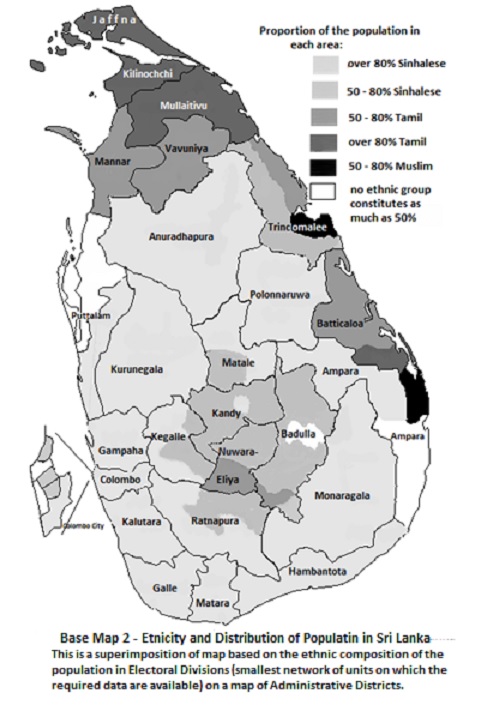
            නැඟෙනහිර පළාතේ 40% ක් දෙමළ ජාතිකයෝ ද, 30% ක් බැගින් සිංහල හා මුස්ලිම් ජාතිකයෝ ද ජීවත් වෙති.  මොවුන් අතරින් ජාතික උරුමය ගැන සංවේදී බවක් නැති පාලක කණ්ඩායමක් යටතට පැරණි ඵෙතිහාසික හා පුරාවිද්‍යාත්මක භූමි ගෙන ඒම ජාතික අපරාධයක් නොවේද? මේ අසාධාරණය වහා ‍නිවැරදි කළ යුත්තකි. 

      ආචාර්ය.  පී .ජී .පුංචිහේවා

2017 රාජ්‍ය සාහිත්‍ය සම්මාන උළෙල සහ ලංකා ජන මාධ්‍යයේ හැසිරීම 

September 29th, 2017

මේජර්  වී. බී. කරුණාරත්න  විසිනි  – ඔක්ස්ෆර්ඩ් – එක්සත් රාජධානිය

සංස්කෘතික අමාත්‍යංශය මෙහෙයවූ 2017 ශ්‍රී ලංකා රාජ්‍ය සාහිත්‍ය සම්මාන උළෙල පසුගිය 8 වෙනි සිකුරාදා ජනාධිපති  මෛත්‍රී සිරිසේන මැතිතුමාගේ ප්‍රධානත්වයෙන් කොළඹදී පැවැත්විණ.  ඉතා අලංකාර සංස්කෘතික අංගවලින් සමන්විත අති ගාම්භීරවූ මෙම සම්මාන උළෙලේ දී 2016 වසරේ ප්‍රකාශයට පත් විවිධ ක්‍ෂේත්‍ර 19 ක් යටතේ සිංහළ, දෙමළ සහ ඉංග්‍රීසි යන භාෂා තුනටම අයත් සාහිත්‍ය කෘති සඳහා රාජ්‍ය සම්මාන පිරිනැමීම සිදුවිය 

මහා බ්‍රිතාන්‍යයේ වෙසෙන ශ්‍රීලාංකිකයින්ට මෙවර සුභ ආරංචියක් මෙම සම්මාන උළෙලේදී දැකගන්නට ලැබුණේ ය. එනම්, මහා බ්‍රිතාන්‍යයේ වෙසෙන පෝල් පීරිස් විසින් ලියන ලද, එංගලන්තයේ සුප්‍රකට පෙගාසස් ප්‍රකාශක සමාගම මගින් පළකරන ලද Ironwood Tree නම් ඉංග්‍රීසි නවකථාව මෙහිම වෙසෙන ප්‍රවීණ ලේඛක දයා ආනන්ද රණසිංහ විසින් සිංහලට අයස්තුර යන නමින් පරිවර්තනය කරන ලදුව එය මෙවර සාහිත්‍ය සම්මාන උළෙලේ  අවසන් වටයට නිර්දේශ වී තිබීමයි.  අවසන, දයා ආනන්දට අයස්තුර සඳහා  කුසලතා සම්මාන සහතිකයක් හිමිවිය. 

විදේශයක සිංහළ භාෂාවෙන් පළකරන ලද ප්‍රථම පුවත්පත වන ලංකාවිත්ති පත්‍රයෙහි කතුවර දයා ආනන්ද ප්‍රකට ලේඛකයෙකි, කවියෙකි, සිනමා වේදියෙකි, සාහිත්‍යකරුවෙකි.  ඔහුගේ ප්‍රථම පරිවර්තනයට මෙවර රාජ්‍ය මට්ටමෙන් අගැයීමක් ලැබීම වැදගත්ය.  එසේම දයා ආනන්ද,  ඔහු විසින් 1982 දී ප්‍රථම වරට ලියන ලද  තිරරචනය  වන සතිස්චන්ද්‍ර එදිරිසිංහ අධ්‍යක්ෂණය කළ අධිෂ්ඨානය චිත්‍රපටිය සඳහා හොඳම නිර්මාණාත්මක තිරරචනයට හිමිවන  O. C. I. C සම්මානයෙන්  1983 දී පිදුම් ලැබීය.

පෝල් පීරිස්ගේ Ironwood Tree ඉංග්‍රීසි නවකථාවට පසුබිම්ව ඇත්තේ 1939 – 1944 දෙවන ලෝක මහා යුද සමයේ ශ්‍රීලංකාවේ නාගරික සමාජය මුහුණ දුන් දුෂ්කර සමාජ රටාවයි. ජපනුන් කොළඹට බෝම්බ හෙළීම එදා කොළඹ නාගරික සමාජය මුහුණ දුන් අයුරුද , බොහෝ නාගරිකයින් ආරක්‍ෂාව පතා ගමට සංක්‍රමණයවීමද  එමගින්  පැන නැගි සමාජ සහ ආර්ථික ගැටළු මෙන්ම ඒ ඒ චරිත එකිනෙක බැඳ තබන දෛනික සිදුවීම් මාලාවන්ද නවකථාව කදිමට ප්‍රතිරූපණය කරයි.  දයා ආනන්ද සිය පරිවර්තනය සඳහා යොදාගන්නා සුමට බස්වහර සහ අපූර්ව රචනා ශෛලිය නිසාම අයස්තුර කියවන පාඨකයාට එම කථාන්තරය පරිවර්තනයක් ලෙස නොව ස්වතන්ත්‍ර නිර්මාණයක් ලෙස හැඟේ නම් මම ඊට පුදුම නොවෙමි.  

පරිවර්තන කෘතියක් යයි කීවිට  ශ්රීලංකාවේ කාගේත් මනසෙහි මැවෙන්නේ  විදේශීය ලේඛකයෙකු විසින්, වෙනත් දේශයක, අපට ආගන්තුක සමාජයක ජීවත්වෙමින් වෙනත් භාෂාවක් කතාකරන වෙනස් සිතුම් පැතුම් සහ හැසිරීම් රටාවන් සහිත ගැහැණුන් මිනිසුන්ගේ අනේක විධ ගැටුම් හැලහැප්පිලි සහ අනුවේදනය දනවන කතාවක ඉදිරිපත් කරනු ලැබීමකි.  මෙතෙක් අප දැක ඇති රුසියානු කතා, චීන කතා, ජපන් කතා වංග කතා, අරාබි නිශොල්ලාසයේ  කතා ලතින් ඇමරිකානු කතා ආදී ලංකාවේ පළව ඇති අනේක විධ පරිවර්තන කෘතීන් ගැන කල්පනාකරන විට ඒබව අපට වැටහී යයි.  

එහෙත්  Ironwood Tree නවකතාව එංගලන්තයේදී  ඉංග්රීසි බසින් ලියූ නමුදු එහි කර්තෘ පෝල්  පීරිස් සිංහලයෙකි. කතාව පසුබිම්වී ඇත්තේද ලංකාවේ ගැමි සහ නාගරික සිංහල සමාජයයි. නිරූපණය වන චරිත සියල්ල සිංහල මිනිසුන් වටාය. බටහිර සමාජීය ගතියක් එහි බිඳක් හෝ ඇත්තේ නැත. මේ නිසා එම කතාන්තරය පරිවර්තනයක් යයි කියවන කෙනෙකුට නොහැඟේ.  අයස්තුර හොඳම පරිවර්තනය ලෙස තෝරන්නට යන කල  ඉහතකී කාරණා හේතුවෙන් ඊට අවාසියක් වන්නට ඇතැයි ද අපට සිතෙයි.

මෙකල ලෝකයේත් ලංකාවේත් සාහිත්යය පිළිබඳව ඇති උනන්දුව හීන වෙමින් පවතින බව පෙනේ. සාහිත්ය උත්සවවලට සහභාගී  වන්නේ සාහිත්යයෙහි නියැළි ඉතා සුළු පිරිසක් පමණි. අවශේෂ ජනතාවගේ ප්රතිචාරය ඉතා අඩුය. එම නිසා සාහිත්ය සම්මාන උලෙළ වල්  රාජ්ය අනුග්රහයෙන් පවත්වාගෙන යාම අගය කළ යුතුය. එහෙත් ඒ හා සමාන පිටිවහලක් අනුබද්ධිත ආයතන හා ජනමාධ්ය වලින් නොලැබීම අඩුපාඩුවකි.  8 වන සිකුරාදා පැවති රාජ්ය සාහිත්ය සම්මාන ප්රදානය පිළිබඳව 7 වන බ්රහස්පතින්දාත්, 8 වන සිකුරාදාත්, 9 වන සෙනසුරාදා හෝ 10 ඉරිදාවත් ශ්රී ලංකාවේ කිසිදු ජාතික පුවත්පතක විස්තරයක්  නොදුටිමි.  රාජ්ය සම්මාන ලබූ කෘති හා ඒ  සම්මාන ලාභීන් කවුරුන්දැයි දැනගැන්මට නොතිත් ආශාවෙන් පෙළෙන සාහිත්ය ලැදි සුළු පිරිසකට හෝ සාධාරණයක් ඉටුවූයේ නැත.

11 වන සඳුදා ලංකාදීප පත්රයෙහි සුළුවෙන් සම්මාන ලැයිස්තුව පළකොට තිබුණි. ද්රවිඩ භාෂා කෘති සඳහා සම්මාන ලබූ අයගේ විස්තරයක් පමණක් යාපනයේ උදයන් පත්රයේ පළවීය. 

සංස්කෘතික වශයෙන්ද, දේශීය වශයෙන්ද වැදගත්වූ තම රටේ සාහිත්‍ය සම්මාන උලෙළක් තුට්ටුවකටවත් නොසැලකූ ලංකාවේ සියලුමාධ්‍ය ආයතන ඉන්දියානු ගායකයෙකු වන සෝනු නිගම්   ප්‍රසංගයක්  සඳහා  කොළඹට   පැමිණීම  වෙනුවෙන්  ප්‍රචාරය දෙන්නටපටන්ගත්තේ ඔහු එන්නට සති කීපයකට පෙර සිටය. සාහිත්‍ය උත්සවය දින ඔහු ලංකාවට පැමිණියේ පසු දා ගී ප්‍රසංගයටය.  සෝනුනිගම් කටුනායක ගුවන් තොටුපළේ සිට විශේෂ රථ පෙරහරකින් කොළඹට කැඳවාගෙන එන සැටි වාර්තාකරන්නට  රුපවාහිනි ගුවන්විදුලිනාලිකා සහ පුවත්පත් ඒ පසුපස මෙලෝ සිහියක් නැතිව හඹායමින් ගත් දැඩි උත්සාහය කවුරුත් දුටහ.  එසේම පසුදා සුගතදාස ගෘහස්තක්‍රීඩාංගනයේ පැවති ප්‍රසංගයද සියලු අංශ වලට අයත් ලංකා ජනමාධ්‍ය විසින් අනේක අයුරින් විචිත්‍ර ලෙස ආවරණය කරනු ලැබතිබිණ.  නමුත් රටේ සා ජනාධිපතිවරයාගේ  ප්‍රධානත්වයෙන් පැවැත්වෙන දේශයේ සාහිත්‍ය සම්මාන උලෙළ  මේසෙ යට වැටුණුකෙහෙල්ගෙඩි ලෙල්ලක් තරමටවත්  වටිනා බවක් ලංකා  ජනමාධ්‍ය වලට  පෙනුණේ නැත.

ජනාධිපතිවරයාට මාධ්ය අධ්යක්ෂක ජෙනරාල් කෙනෙකු ඇතුළු විශාල මාධ්ය ඒකකයක් තිබේ. සංස්කෘතික අධ්යක්ෂක එස්. බී. නාවින්න ඇමතිතුමාට මාධ්ය ලේකම් කෙනෙකු යටතේ මාධ්ය ඒකකයක් ඇත. සංස්කෘතික නියෝජ්ය අමාත්ය පාලිත තෙවරප්පෙරුම මැතිතුමාට මාධ්ය ලේකම් කෙනෙකු සිටී.  සංස්කෘතික දෙපාර්තමේන්තුවටද වෙනම මාධ්ය ඒකකයකි. ඊට අමතරව ප්රවෘත්ති දෙපාර්තමේන්තුව, ශ්රීලංකා ගුවන්විදුලි සංස්ථාව රූපවාහිනිය ITN ආයතනය වැනි රජයේ ආයතනද පෞද්ගලික රුපවාහිනී සහ ගුවන්විදුලි නාලිකා 22ක් පමණද තිබේ.  2016 වසරේ සම්මානයට පාත්රවූ කෘති හා සාහිත්ය වේදීන් පිළිබඳව  රටේ ජනතාව තරුණ සමාජය හා ශිෂ්ය පරම්පරාව ආදී කොටස්හි අවධානයට ලක්වීමට ක්රමවේද සහ පහසුකම් ඇත. එය ඉටු නොවන්නේ මේවා මෙහෙයවන්නන්ගේ සාහිත්ය ප්රේමය අඩු නිසා බවට සැකයක් පවතී.

1957 සිට මේ දක්වා  දේශපාලනඥයෝ  පවා සාහිත්ය කරණයේ යෙදී සම්මාන ලැබුහ.  අයි. එම් . ආර්. ඒ. ඊරියගොල්ල,,  ටී. බී. ඉලංගරත්න,  සාගර පලන්සූරිය,  ජස්ටින් විජයවර්ධන,  ඒ. වී. සුරවීර ආදීහු මෙවැනි කීප දෙනෙක්  වෙති.  වෛද්ය ගුණදාස අමරසේකර  වෛද්ය කාලෝ ෆොන්සේකා වැනි වෙනත් වෘත්තීන්හි නියැලි අයද සාහිත්ය සම්මාන ලබා ඇත. මෙවර සාහිත්ය උළෙලේදී ආචාර්ය සරත් අමුණුගම විශේෂ සම්මානයක් ලැබූ බව ඇසුවෙමි. 

පාසැල් විෂය මාලාවට නිර්දේශ කළ සාහිත්ය කෘතිවල නියමිත පරිච්චේද හෝ කවි කීපයක් පමණක්  විභාගවලට නියම කරන නිසා එම කොටස් කීපය පමණක් අධ්යනය කරන ශිෂ්යින්ට කෙසේ නම් සාහිත්ය අවබෝධයක් ලැබිය හැකි වේද?

වෙනත් කිසිම රටකට නොදෙවෙනි අපගේ සාහිත්යය ඈත අතීතයේ සිට පැවත එන්නකි. දඹදෙණි, ගම්පොල, කෝට්ටේ, කොළඹ වැනි සාහිත්ය යුගයන් පවා නිර්මාණය වෙමින් සාහිත්යය පෝෂණය නිරන්තරයෙන් අප දේශයේ පැවති බව ඉතිහාසය පෙන්වා දෙයි.  වත්මන් යුගයේ සාහිත්ය පෝෂණය වත්මන් පරපුරේ යුතුකම වන්නේය.

සම්මාන ලාභීන්ගේ තොරතුරු මෙන්ම ඔවුන්ගේ කෘතීන් පිළිබඳවද අවබෝධයක් ලබාදීම ද වැදගත්ය. මෙවර රාජ්ය සාහිත්ය සම්මාන උලෙළේ කුසලතා සහතික ලැබුවන්ට නිසි පිළිගැනීමක් ලැබිය යුතුව තිබුණි. එහෙත් එම සම්මාන ලාභීන්ට සිදුවුයේ උත්සව ශාලාවට ඇතුල්වන දොරටුවේ සිටි දොරටුපාලකයාගෙන් ලද සම්මාන සහතිකයද කිහිලිගන්නාගෙන උත්සවයේ දේශපාලන කතාවලට සවන්දීමටය. ඔවුන් ලද පිළිගැනීම එපමණය.

මෙවර උළෙලේදී සංස්කෘතික අධ්යක්ෂිකා අනූෂා ගේකුල මහත්මිය කළ ප්රකාශය ඉතා වැදගත් වෙයි. එනම්, සාහිත්යය පිළිබඳ අවබෝධයක් ඇති ය නිසා සමාජය යහපත් වන බවයි.  අද  සාකච්චා වන යහපාලනය, සහජීවනය, උතුම් පුරවැසිභාවය යහ සමාජය ආදී පරමාර්ථ සාක්ෂාත් කරගැන්මේ කෙටි මග වන්නේ සාහිත්ය අවබෝධයයි


“DO WE HAVE A FOREIGN POLICY”

September 29th, 2017

Sarath Wijesinghe – Solicitor/Attorney-at-Law- former Ambassador to UAE and Israel

Foreign Policy

Foreign policy of a country is a set of rules that seems to outline the behaviour of a particular country and how it interacts/reacts with other countries and international organisations. This is mainly depending on internal/ external political and the global economic and political considerations. Always the head of the state formulates regulates and implements foreign policy which is not static depending on the political and economic climate of the day. Foreign Policy is a pre- requisite for the development and propriety of any nation. It has direct effects and impact on commercial and trade relations among member nations and the world in the fast developing world in the digital age and it is not possible to live in isolation with modern developments on H i- Tac” and transformation of the world and trade, economic and political realities of member countries struggling to beat each other. Today Commercial Diplomacy is in the top of the agenda and diplomats worldwide representing the countries have been directed to give priority to commerce/trade and business over traditional duties as ambassadors.

Foreign Policies worldwide

Indian foreign policy is somewhat static, stable non-aligned, firm full of patriotism, and selfish towards the nation. In India governments may change but not the foreign policy as the administrative machinery traditionally protects and interests in the interest of the nation. India is extremely successful in managing her foreign policy and the foreign office is manned by committed and patriotic experts. In Sri Lanka always U N P governments tend to be pro – west and SLFP was non-aligned and friendly with all and angry with none. In the United States the President formulates and implements foreign polices – a world power and self- appointed world policeman. In the United Kingdom it is the Prime minister who formulates and implements the foreign policy and EU has a common foreign policy for the member states. In USSR it is the President who is responsible for the foreign policy national security and economic prosperity. Formulation of the foreign policy is the job of the head of the state assisted by able foreign secretaries (UK) and secretaries of state (USA). Foreign policy Doctrine” is the policy statement on foreign affairs. Nixon’s doctrine on the war of Vietnam, Bushes statement on Middle East with Tony Blair both of whom were responsible to the destruction of Middle East in the guise of weapons of mass destruction” were the visions and doctrines in place then. Obamas doctrine based on Human Rights was different from his successor who is now entangled with a pseudo war with North Korea. In Sri Lanka it is doubtful who formulates and implements foreign policy today and whether we have a foreign policy or a doctrine at all as the President, Prime Minister and the Foreign Minister do not appear to be consistent with foreign policy statements and pronouncements, including public speeches in Sri Lanka international forums, where speeches considered to be a part of international law binding the parties under international law.

Historical aspects of Sri Lankan foreign policy

Sri Lankan foreign relations with other countries could be traced back to 3rd century BC when King Devenimpayatissa” who had close friendship with the unseen neighbour, Emperor Asoka who sent his son and daughter as emissaries to introduce Buddhism to Sri Lanka 245 BC which is the commencement of the Sri Lankan culture today based on and benefiting from glorious Mayurian” Civilization and Buddhism based on

nonviolence and loving kindness ( mettha”) towards the world. Friendships among close friends were equal close and interconnected to friendship culture religion and developments of all countries culturally and economically irrespective the size and the population economically diplomatically beneficial to all parties. There is ample historical evidence of Sri Lanka having diplomatic and personal relations with China, Myanmar, Afghanistan, and Maldives Islands, Thailand, Pakistan -formally known as Gandara” in Pali” with most countries mentioned being once Buddhist countries. These are classic examples of our long cherished and correct foreign policy in practice from the time immoral. Friendship with China was historical with cultural religious and commercial bonds bonded through the famous Silk Route.

Foreign Policy is an extension of National Policy and National Interest

Diplomacy is dealing with other states on trade, war, economy, customs, environment, human rights, strategic advantages and many other areas. Today countries give highest priority to economy, trade, investments, and business resulting in an amalgamation of economic and traditional diplomacy in the interaction of any nation’s foreign policy/ politics based on national interest. Economic diplomacy is a form of diplomacy to utilize the full spectrum of economic facts and realities in a state to achieve success in intern goals in foreign policy which is an extension of the national policy and interest of the nation. States today are in the microscopic eye of the embassies stationed in the host country, when the international media transmits news to the world in few seconds with the click of a button. Therefore member states of small nations should be careful in dealing in and out of the territory on international affairs are to be taken carefully within and outside the state by the leaders and the governance to commend respect of the world. Attitudes and conduct on the international brotherhood is carefully scrutinized and the happening in the state today are in the international domain in seconds with disastrous/immediate effects, thereby the undemocratic conduct and the unrest due to want of democracy and break down in law and order in the democratic institutions and human rights have a direct impact on the economy and foreign relations of countries and international organisations such as the World Bank, indirectly controlling the local economy. NGO ‘esm is dominating in Sri Lanka with adverse effects on foreign policy and economy. Postponement of elections and denial of the right of franchise, massive bribery and corruption of the legislature and executive with mega scams (Bond/Highways/corruption by parliamentarians on car permits and bribery etc.) have negative effects on the economy and the foreign relations of our cherished and reputed nation. Persecuting and suppression opponents on political grounds, students, working class steam rolling the weak, nominal, tamed and appointed opposition are not parts of democracy endorsed by the world community and the international organisations deciding the fate of our unstable and dependent/debt economy in the microscopic eye on international relations. It is still not too late for the governance to turn to the right direction!

Current world issues today and our strategy/s and the position/s taken by the Sri Lanka” , in world affairs on Myanmar” North Korea” Syria” and Middle East”.

Few current issues on the table today for Sri Lanka are the issues on Myanmar, North Korea, harassment of Muslims by the West with deaths of millions in Middle East and Africa including the war in Syria and continuation of the traditional cold war of main two powers and the issues close to us in the SAARC region that has an ripple effect on Sri Lanka. No country can live in isolation and happenings around the globe have direct bearings on any state depending on the power/strength of the economy, leader, foreign policy and strategic and political/economic dimensions of the member nation. In Sri Lanka who takes decisions on economy, governance and especially foreign policy is in doubt. Different versions echoed by leaders in the highest international forum” and highest international gatherings in Sri Lankan and world over which amounts to a part of international law with no consistency and one word. Indian ocean has transformed to be most strategic, vulnerable and important oceans in the world when Sri Lanka positions strategically on the silk route turning to be one road one belt basis in the mildest of power struggle of the emerging world political/economic/naval powers aiming at small nations with weak unpatriotic leaders with no vision for their country as vultures. Sri Lanka has come to a stage to sell/lease family silver for day to day expenses due to

mismanagement and disapprobation of the state wealth by that in power of all political parties. Issue in Myanmar is akin to the Stateless Indian issue continued on for decades and settled by Sirima Sharathie” agreement and a time bomb to be settled as a matter of urgency sympathetically and based on international humanitarian norms and practices. Calamity in Myanmar is also created by the British brining Rongans” for labour to a country (Ares full of natural resources with an attraction of the world powers) sandwiched and threatened with controversial boarders from China, India, Bangladesh, and threatened by and from foreign powers for the natural resources throughout the county including the area in dispute with gas/mineral and many other resources. Historically Buddhists have not shed a single drop of blood for the propagation of Buddhism and if there are excesses’ on ethnic Muslims it is a serious matter to be inquired into in all dimensions and give solutions based on international human rights law and practices. Syria, Iraqi, Afghanistan were stable and rich Islam countries destroyed by the west for oil and expansionism for power. North Korean issue is a threat to world peace and any farther development/ s in the wrong directions are to be vetted. China warns on the complicated Korean issue and the threats of the Korean leader and American President of destroying North Korea sends shock waves to the international community.

Mock Trial in Geneva, and Myanmar refugee crisis in Sri Lanka, are disturbing issues on foreign policy and positive signs of the management of the foreign policy today.

Mock trial in Geneva by a section of the Diaspora with Sri Lankan President as the accused and the other anti Sri Lankan activism, are worrying incidents and should condemned by the world community. The Myanmar refugee crisis and diaspora anti- Sri Lanka activism are in the boiling point are matters for serious consideration but the steps taken to clamp down by Sri Lankan governance on the uprising will make the international community happy. Though Sri Lanka has not signed the 1951Convention of refugees west may try to convince on Sri Lanka to accept these unfortunate militant Rohyangaya” Refugees based on Art 14 of the UNHCER Convention and moral commitment for sheltering large number of Sri Lankan Refugees in western countries. Fact that 100,000 Rohyangaya” refugees have fled to Malaysia and many to India shows the gravity of the issue and threat to Sri Lank as a soft target.

Way forward

Sri Lanka is in a crisis situation politically, economically and internationally and this is the time she requires a correct, coherent, stable, and Sri Lanka friendly foreign policy” and not on a policy based on any ism” or out-dated and unsuitable foreign ideology or directions form any group or a camp in the world. Are we still nonaligned is in doubt. We have given us our rights away by the suicidal joint resolution” against our own cherished nation promising sun and moon to an unreliable and partial world body which declining popularity as the failed League of Nations”- the world body replaced by the United Nations. We had proud and past glory as a responsible powerful and popular member of the UN as the leader of non-aligned nations with first class international civil servants of the calibre of Shirly Amarasinghe, Professor Gunapala Mallasekara and other world renewed Ministers of Foreign Affairs in the calibre of Laxman Kadiragramer, raised the stature of Sri Lanka with the help of the foreign service manned by expert personal of the calibre of Dr Vernan Mendis and other public servants then. Today though standards are downgraded due to the substandard nature of the corrupt politicians of all corrupt political parties, there are committed, educated, knowledgeable Sri Lankans in Sri Lanka and oversees ready to serve the motherland on invitation. It is opportune to get their services at this hour as the Foreign Ministry and the Diplomatic community is not up to the expected slandered/s to rub shoulders with the international brotherhood. We should learn from our neighbour India, Latin America, USA, USSR and Israel who manages the foreign ministries and policy to their progress and the development. It is the leader of the country who formulates directs and manages the foreign policy as a matter of priority and conventions and no others will only carry out orders and instructions of the leader of the Nation in the driving seat. Hon D S Senanayaka and Madam Bandaraneika as two best foreign Ministers ever in Sri Lanka in two different periods managed the foreign policy extremely successfully with no second to any foreign minister ever in Sri Lanka with only basic education but full of patriotism, commitment intelligence and love for the country!

Writer Sarath Wijesinghe takes responsibility on the contents could be contacted on sarath7@ Hotmail.co.uk and the readers are cordially invited to the public seminar on the topic- Do we need a Foreign Policy- at the Organization of Professionals off Reid Avenue on 2dn Oct from 6.00 to 9.00 addressed by Dr Palitha Kohona, Dr Dayan Jayatilaka, Manhara de Silva PC Mohan Samaranayaka and Sarath Wijesinghe )

A PETITION TO BRING TO YOUR ATTENTION THE CONTINUING VIOLATION OF THE PRINCIPLES OF THE UNITED NATIONS CHARTER AND THE UNHRC CHARTER BY THE UN HIGH COMMISSIONER FOR HUMAN RIGHTS VIS A VIS UNHRC RESOLUTION 30/1 ON SRI LANKA

September 28th, 2017

Rear Admiral (Rtd) Dr. Sarath Weerasekera Federation of National Organizations Mr. Sunil Chandrakumara Co-President Global Sri Lankan Forum


28th September 2017

Mr. Joaquin Alexander Maza Martelli

President of the Human Rights Council

Office of the United Nations High Commissioner for Human Rights (OHCHR)

Palais de Nations

Geneva 10, Switzerland

Sir,

A PETITION TO BRING TO YOUR ATTENTION THE CONTINUING VIOLATION OF THE PRINCIPLES OF THE UNITED NATIONS CHARTER AND THE UNHRC CHARTER BY THE UN HIGH COMMISSIONER FOR HUMAN RIGHTS VIS A VIS UNHRC RESOLUTION 30/1 ON SRI LANKA

  1. The present petition follows the two petitions we filed in June 2017, in which we endeavored to document the unfair, unjust and unreasonable conduct of the High Commissioner with respect to UNHRC resolution 30/1 of September 2015.
  2. The citizens of Sri Lanka have no recourse in law against the High Commissioner, because of his diplomatic immunity. Further, the present Government of Sri Lanka has co-sponsored resolution 30/1, which means that the Government cannot be relied on to object to the High Commissioner’s conduct either.
  3. Therefore, the only hope for Sri Lankans aggrieved by the High Commissioner’s actions is to acquaint you with what is happening, and also to place on record the related matters, so that in the event a future GOSL were to withdraw the co-sponsorship of resolution 30/1, we can take advantage of the full range of diplomatic and legal means including a possible Advisory Opinion of the International Court of Justice, to seek redress for the harm that the aforesaid resolution has caused us.
  4. In the present petition we focus on the High Commissioner’s opening statement at the 36th Session of the UNHRC. We draw your attention to the following remarks where he referred specifically to Sri Lanka, to wit:

In the North, protests by victims indicate their growing frustration over the slow pace of reforms. I encourage the Government to act on its commitment in Resolution 30/1 to establish transitional justice mechanisms, and to establish a clear timeline and benchmarks for the implementation of these and other commitments.

This should not be viewed by the Government as a box-ticking exercise to placate the Council, but as an essential undertaking to address the rights of all its people. The absence of credible action in Sri Lanka to ensure accountability for alleged violations of international human rights law and international humanitarian law makes the exercise of universal jurisdiction even more necessary.”[1]

  1. With respect to the reference to Universal Jurisdiction, we state categorically that the High Commissioner has no right to recommend that Universal Jurisdiction be applied against Sri Lanka, because of the following reasons:
  • In order to recommend Universal Jurisdiction, the High Commissioner must first establish, even at the minimum standard of ‘reasonable grounds to believe,’ that war crimes were committed in Sri Lanka.
  • In March 2014, the Human Rights Council authorized the High Commissioner to undertake an investigation in order to see whether war crimes were committed in this country during the last phase of the war, and the High Commissioner filed the final report of that investigation, the OISL report, in September 2015.
  • The standard of proof of the OISL report is ‘reasonable grounds to believe,’[2] the lowest standard of proof known in the law, nevertheless a standard.
  • Sir Geoffrey Nice QC and Rodney Dixon QC, two of six international experts retained by the GOSL to analyze a previous UN-related report on Sri Lanka – The Report of the Secretary General’s Panel of Experts on Accountability in Sri Lanka – which also followed the ‘reasonable grounds to believe’ standard, discuss at length the law relating to the aforesaid standard. Their remarks are pertinent to the present discussion, and briefly are as follows.  They say, inter alia:

It should be noted that international courts and tribunals have confirmed that the ‘reasonable basis to believe’ standard – if that is what the Panel had in mind – is the lowest evidentiary standard of proof. The standard does, nevertheless, require that there exists a proper foundation of identifiable evidence on which to form a reasonable belief that crimes have been committed…

      The ‘reasonable basis to believe’ standard is used at the ICC to determine whether an investigation should be launched and if any persons should be charged as a result of this investigation. Although this standard does not require that the available evidence lead only to one conclusion, it does demand that there is sufficient reliable and verifiable evidence available to establish the criminal responsibility of an individual’ which can result in charges being brought and the person losing her/his liberty through arrest and detention pending trial.

      The ICC held that the Chamber must be satisfied that there exists a sensible or reasonable justification” for the allegations after evaluating the available information provided by the Prosecutor”. The ICC has emphasized that the ‘reasonable basis to believe’ standard must be viewed in light of its purpose and the context in which it operates – to prevent the Court from proceeding with unwarranted, frivolous, or politically motivated investigations that could have a negative effect on its credibility.”[3]

  • In March 2017, we produced a detailed analysis of the evidence in the OISL report, titled, ‘A Factual Appraisal of the OISL report: A Rebuttal to the Allegations against the Armed Forces,’ where we showed that the OISL report is full of lies, contradictions, and obfuscations, and is further compromised by a total failure to consider exculpatory evidence.
  • Copies of the ‘Factual Appraisal’ (Volume 2 of the ‘Factual Appraisal’ consists of the six reports of the internationally renowned experts on humanitarian law mentioned in paragraph ‘iv’ above) were handed over to the UN Resident Coordinator in Sri Lanka, the OHCHR and also the Sri Lankan Presidential Secretariat. These documents were also handed over to your office in June 2017 along with our two petitions.
  • The OHCHR has acknowledged receipt of the documents but to this day has not responded to the substance of the arguments made in those documents, which prompts us to conclude that the OHCHR has now accepted those arguments.
  • In short, the High Commissioner has thus far failed to establish with a proper foundation of reliable and verifiable evidence that war crimes were ever committed in Sri Lanka.
  • It should be noted that, the High Commissioner was mandated by the Council to carry out a comprehensive investigation, and given adequate resources and time to fulfill such task.  To the best of our knowledge, he has not said anywhere that the resources and time made available to him were inadequate.
  • It should be noted further that, Paragraph 4 of the UNHRC Charter (General Assembly resolution 60/251) specifically states inter alia:

[The work of the Council] shall be guided by the principles of universality, impartiality objectivity and non-selectivity[4]

  1. We reiterate that, if after nearly an year-long investigation, with all the resources of the UNHRC and related parties at his disposal, the High Commissioner cannot establish at the minimum standard of ‘reasonable grounds to believe’ that war crimes were committed in Sri Lanka, he does not have the right to suggest that Universal Jurisdiction be applied against this country.
  2. We assert that, the only ‘objective’ and ‘impartial’ thing for any reasonable person to do under the aforesaid circumstances is to cease and desist from continuing to level accusations of war crimes against Sri Lanka.
  3. We next draw your attention to the call made in Paragraph 16 of resolution 30/1 for constitutional reform in Sri Lanka.


  • The High Commissioner in his statement before the Council on 11th September 2017 insinuates that the Government is either dragging its feet with respect to implementing resolution 30/1, or worse, is misleading the Council, i.e. engaging in a mere ‘a box-ticking exercise to placate the Council.’ We presume that the High Commissioner’s call that implementation of resolution 30/1 be expedited includes a call to expedite the constitutional reforms also.
  • With respect to constitutional reform in Sri Lanka, it is imperative that you become aware of the following facts, if you are not already:
  • The Government initiated a constitutional reform process in March 2016, and it is almost at its final stage. On 21st September 2017, the Constitutional Steering Committee released an interim report.  All that remains is for the Parliament to debate the interim report and to authorize a final report and/or a Constitutional Proposal.
  • However, there are serious questions over the legality of the aforesaid process, and in any event, it is being conducted against the wishes of the majority of the people of the country. (In June 2017, along with our petitions, we filed a paper explaining among other things why the present constitution-making process is probably illegal, and also giving a brief overview of the general political situation in the country, which we hoped would be helpful in providing the background details and necessary context for assessing the ongoing constitutional reform process.  For your convenience, we are filing a revised version of that paper along with the present petition.)
  • The strongest evidence that the constitution-making process is being conducted against the wishes of the people is that the Government keeps postponing Local Government and Provincial Council elections indefinitely.
  • The Government has a 2/3 majority (or very close to one) as a result of a coalition between the UNP[5] and the SLFP[6] dubbed the ‘National Government.’[7] The Government needs a 2/3 majority in order to have any hope of proceeding with constitutional changes.
  • If Local Government Polls or Provincial Council elections are held today and the SLFP or the UNP were to lose badly, it would send the strongest possible signal to the UNP’ers and SLFP’ers in Parliament about the mood of the public towards the Government, and it would shatter the coalition.
  • Therefore, the Government cannot afford to hold either the Local Government polls or the Provincial Council elections.
  • After postponing Local Government Polls for nearly two years under the flimsiest of pretexts, the Government finally amended the Local Government elections law, and now has a new and seemingly ‘legal’ pretext to keep postponing those elections.[8] We need hardly point out that, if what is important is the franchise of the people, LG polls could have been held according to schedule under the old law, and changes if any made for future elections.
  • What about the Provincial Council Elections? In late August 2017, the Government tried to amend the Constitution in order to postpone the Provincial Council elections.  However, this backfired when in Mid-September the Supreme Court ruled that any such amendment required a referendum of the People.
  • So, the Government has now abandoned the aforesaid amendment and instead pushed though a different amendment (using the Government’s 2/3 majority) to let the Provincial Governors assume the powers of the Provincial Councils when the terms of those Councils come to an end. By doing this the Government has now ensured that the Provincial Council elections will also not be held for the foreseeable future.
  • The implications of the above situation are not lost on the people of Sri Lanka, and anyone else who cares to assess these events in the light of common sense, reason and historical experience, including the experience of other countries in similar circumstances.
  • The editors of The Island, one of Sri Lanka’s leading English newspapers, have summed up the sentiments of many people in this country about the aforesaid events. They say, inter alia:

Given the detestable manner in which the ‘yahapalanaya’ [Good Governance] government is weakening democratic systems for self-advancement, one fervently hopes that the country will be able to ward off anarchy and the much-revered ballot box, which has saved the country’s democracy even during bloody uprisings and a protracted war, won’t be relegated to a cobwebbed corner of the National Museum.”[9] 

  • We hope the above sentiments will be useful to you in understanding what is happening in this country at present.
  • In short, the truth is that the constitutional reform process – the process recommended by resolution 30/1 which the High Commissioner appears to value so much, and which he says must be expedited – is being carried out and in fact is predicated on the destruction of the last vestiges of the democratic rights of the Sri Lankan people, purportedly for the purpose of advancing those very rights!
  • The High Commissioner is statutorily enjoined to protect and promote human rights anywhere in the world if he finds such rights being endangered or trampled on. Isn’t the steady and inexorable destruction of the democratic rights of an entire people of a country a matter of concern to him?
  • Is it possible that the High Commissioner is unaware of what is happening in Sri Lanka? We hardly think so, because the UN including the OHCHR has plenty of representatives resident in Colombo.  Furthermore, the High Commissioner has been sending Special Rapporteurs to Sri Lanka every six months or so since the adoption of resolution 30/1, and such individuals are fully capable of relaying to the High Commissioner the details as to what is happening here.
  • So, there is no other interpretation to put on the High Commissioner’s conduct towards Sri Lanka vis a vis resolution 30/1 other than that he is being unfair, unjust, unreasonable, and acting in violation of the principles of both the UN Charter and the UNHRC Charter.

Under the circumstances, we humbly request that you:

  1. Advise the High Commissioner to adhere as strictly as possible, both in letter as well as spirit, to the principles of the UN Charter, the UNHRC Charter and also the OHCHR Charter, in his dealings with Sri Lanka.
  2. Encourage the High Commissioner to be especially mindful of Paragraph 4 of the UNHRC Charter in his dealings with Sri Lanka.
  3. Permit a delegation of Sri Lankan professionals, clergy and academics led by us to brief you and the Council on the present situation in Sri Lanka.
  4. Impose a moratorium on any further actions taken on Sri Lanka by the UNHRC or OHCHR pursuant to resolution 30/1, until the OISL report is subjected to an official assessment either by the Council, or the UN General Assembly.
  5. Initiate the necessary steps to produce an official assessment of the OISL report as set out in Paragraph ‘d’ above.
  6. Take the necessary steps to obtain an official response to the ‘Factual Appraisal of the OISL report,’ submitted by us.

Respectfully,

  1. Rear Admiral (Rtd) Dr. Sarath Weerasekera
  2. Sunil Chandrakumara

Copies to:

  1. UN Secretary-General
  2. President of the International Court of Justice

[1] Opening Statement at the 36th session of the UNHRC, UN High Commissioner for Human Righs Zeid Ra’ad Al Hussein, 11th sepyember 2017, www.ohchr.org

[2] ‘Terms of reference,’ OISL report, Annexes

[3] The related paper is included in Volume 2 of the ‘Factual Appraisal of the OISL Report,’ we submitted to your office in June 2017

[4] General Assembly resolution 60/251, www.ohchr.org

[5] United National Party

[6] Sri Lanka Freedom Party

[7] The events leading up to the forming of the ‘National Government’ are described in the attached paper.

[8] This matter is explained in more detail in the attached paper.

[9] ‘Of that cobwebbed, dusty ballot box,’ Editorial, The Island, 23rd September 2017

ජයම්පතී ගේ ව්‍යවස්ථා කෙටුම්පත එ.ජා.පයට කුලවද්දයි

September 28th, 2017

මතුගම සෙනෙවිරුවන්

 කන්දක් විලිලා පැටියෙකු වැදුවා යයි කියමනක් ඇත.2016 වසරේ සිටම තටමමින් ඊනියා මහජන අදහස් විමසිමින් සැදුවාය කියන ව්‍යවස්ථා කෙටුම්පතක ඡායාවක් නොහොත් අතුරු වාර්තාවක් එළි දැක තිබේ.මෙම අතුරු වාර්තාවේ සඳහන් කාරණා කීපයක් සැප්තැම්බර 20 වනදා පාර්ලිමේන්තුවට දමා සම්මත කර ගෙන තිබේ. එනම් කාන්තා නියෝජනය සහ කේවල සමානුපාතික නියෝජන ප්‍රතිශතය පිළිබඳ ප්‍රතිපත්තියයි.එහෙත් වාර්තාවේ සඳහන් නොවන දෙයක් එනම් සියයට හැට හතළිහ වෙනුවට පණහට පණහේ යෝජනාව සම්මත කර ගෙන තිබේ. සැබවින්ම රනිල් වික්‍රමසිංහ ප්‍රමුඛ ආණ්ඩුව උත්සාහ ගන්නේ කුමකටද. දෙමළ බෙදුම්වාදීන් ගේ වුවමනාව ඉටු කර දීමද.එසේත් නැතිනම් ජාත්‍යන්තරය රවටමින් කාලය මරමින් ඒ අස්සේ බෙදුම්වාදීන් ගේ යම් යම් ඉල්ලීම් ක්ෂණිකව සම්මත කරදීමෙන් රජය පවත්වා ගෙන යෑමද. අවසානයේ විධායක බලයට පැමිණීමෙන් පසු ෆෙඩරල් හෝ කොන්ෆෙඩරල් පාලනයක් උතුර නැගෙනහිර පළාතට ලබා දීමද.

        මෙම අතුරු වාර්තාවේ එක්සත් ජාතික පක්ෂය විසින් ඉදිරිපත් කරන ලද කරුණු සටහන් වන්නේ නැත.නමුත් අගමැතිවරයා පාර්ලිමේන්තුවේ ප්‍රකාශ කර ඇත්තේ ඒකීය බව තබා ගනිමින් උපරිම අන්දමින් බලය බෙදා හරින බවයි. එම නිසා එය එක්සත් ජතික පක්ෂයේ ස්ථාවරය බව පිළිගැනීමට සිදු වේ. මෙම පක්ෂයේ නම සිංහල භාෂාවෙන් එක්සත් ජාතික පක්ෂය විය. එයම නැවතත් අය්කීය දේශීය කච්චි වශයෙන්ද යුනයිටඩ් නැෂනල් පාටි යනුවෙන්ද පක්ෂ ප්‍රතිපත්ති තුළ දක්වා තිබේ. සියළු ජාතීන් ගේ එක්සත් භාවයෙන් ගොඩ නැගෙන පක්ෂය යන අදහස සිංහල වාක්‍යයේ වෙයි. දෙමළ බසේ එක්සත් නමින් වචනයක් නැත. ඔවුහු සංස්කෘත බසින් ණයට ගත් ඒකීය වචනය අය්කීය යනුවෙන් එම අර්ථය ගැන්වීමට වහරති. එසේම ඔවුහු දේශීය යනුවෙන් අදහස් කරන්නේ අප දරන අදහස නොවේ. රට යන අදහසයි.මේ වචන හරඹයෙන්ම එක්සත් ජාතික පක්ෂය උපන් ගෙයි දෝෂයක් ඇති කර ගෙන ඇත. එනම් එකිනෙකාට නොතේරෙන බෙදුම්වාදයි..මේ බෙදුම්වාදී ලක්ෂණය වර්තමාන අතුරු වාර්තාවේ ඉංග්‍රීසි පිටපතේ(Srilanka Ceylon is a free sovereign independent republic which is an aekieya rajyaya)  ලෙස සඳහන් වන්නේද ඒකීය බව නොවේ. එක්සත් බවයි. දෙමළ පිටපතේ ඔරුමිත්ත නාඩු යනුවෙන් දක්වා තිබෙන්නේද එයයි.ඔරුමිත්ත නාඩු යනුවෙන් දෙමළ බසින් දක්වා ඇත්තේ එකතුවීමෙන් නිර්මාණය වූ  රටක් හැඳින්වීමටයි . මෙයින් ගම්‍ය වන්නේ රනිල් වික්‍රමසිංහ මහතා ෆෙඩරල් පාලනයට දක්වන කැමැත්තයි. එක්සත් ජාතික පාක්ෂිකයන්ට එහිදී අකමැත්තෙන් වුවද එයට කැමති වීමට සිදුව තිබේ.

      කෙසේ වුවත් රටේ පාලකයා කුමන් පක්ෂයක වුවද ඔහු රටේ ස්වාධීනත්වය භෞමික අඛණ්ඩතාවය පිළිබඳ සැලකිලිමත් විය යුතුය. ඔහු අතින් එය උල්ලංඝණය වුවහොත් ඔහු ද්‍රෝහියෙකු බවට පත් වේ. මෙහිදී මෙම වාර්තාව මගින් එවැනි බෙදුම්වාදී ප්‍රකාශ කරමින් සිදු  කර ඇත්තේ එයයි. දිනේශ් ගුණවර්ධන මහතා සිය කණ්ඩායමේ අදහස් ප්‍රකාශ කරමින් ඉදිරිපත් කරන ලද ලිපිය සැබවින්ම අගය කළ යුතුය. ජාතික හෙළ උරුමය හා ශ්‍රී ලංකා නිදහස් පක්ෂය ද රනිල් වික්‍රමසිංහයන් ගේ වාර්තාව ප්‍රතික්ෂේප කරමින් අදහස් ඉදිරිපත් කර තිබුණද තීක්ෂණව කරුණු ප්‍රකාශ කර තිබුණේ නැත. නමුත් දිනේශ් ගුණවර්ධනයන් එය මැනවින් ඉටු කර තිබේ. එහෙත් දිගින් දිගටම ඒකාබද්ධ විපක්ෂය වශයෙන් ඔවුන් අසාර්ථක වන්නේ කෙලෙසකදැයි කල්පනා කොට බැලිය යුතුය. එයට හේතුව මහින්ද රජපක්ෂ මහතාව මෙහෙයවන පිරිස අතර බෙදුම්වාදී කුමන්ත්‍රණ කරුවන් පිරිසක් සිටින බැවිනි.ආණ්ඩුව සිල් රෙදි නඩුව ඉදිරියට ගෙන හිටපු ජනාධිපති ලේකම්වරයාට දඬුවම් ලබා දුන්නේ මහින්ද රාජපක්ෂයන් බයබීත කරන්නටයි. එහිදී ඔහු පාර්ලිමේන්තුවේ ඇති කරන්නට ගිය කැළඹීමම ආපස්සට ගෙන ප්‍රකාශයක් පමණක් කරමින් නිහඬ විය.එහිදී ආණ්ඩුවේ උපාය මාර්ගය සාර්ථක වූ බව කිව හැකිය. මෙයට චම්පික රණවක ඇතුළු පිරිසද එකතු වූයේ හුදෙක් රජය පරාජයට පත් කිරීම වළක්වාලන්නටයි. රණවක මහතා අතුරු වාර්තාවේ අග නගර සංකල්පය ඉහළින් පිළීගෙන තිබේ. ෆෙඩරල් පාලනයක් ඇති වූ විට ඔවුන් සියල්ලන්ටම අගනගරය කොටු වී සිටිය හැකිය.කාන්තා නියෝජය අස්සේ දමා පළාත් සභා කල් දමා ගැනීමට ඔහුටද වුවමනාව තිබුණි. එසේම ජ.වි.පෙටත් වුවනාම තිබුණි. නුමුත් මුස්ලිම් පක්ෂ වල වුවමනාව තිබුණේ තමන්ගේ ගොඩ වැඩි කර ගැනීමට තිබූ බලාපෙරෙත්තුවයි. සියලුම ජාතික වාදීන් පරදා මුස්ලිම් අන්තවාදය ජයග්‍රහණය කලේ ඒ අන්දමටයි.

             සැප්තැම්බර් විසි වන දා පාර්ලිමෙන්තුවට ඉදිරිපත් කරන ලද අතුරු වාර්තාව සැබවින්ම ජයම්පතී වික්‍රමරත්න ඇතුළ රජ්‍ය නොවන සංවිධානයන් විසින් කලින් කෙටුම්පත් කර තිබූ ව්‍යවසථාවේ ඡායාවකි. ඔවුහු රනිල් වික්‍රමසිංහ ලවා වරින් වර ඒවා එළියට දමිති.අගමැතිවරයාද ඔස්ලෝ සම්මුතිය පිළිගන්නා බැවින් එම කෙටුම්පත එක්සත් ජාතික පක්ෂයට කුල වද්දා තිබේ.ඔහු විසින් මෙවර එම අතුරු වාර්තාව එළියට දමන ලද්දේ මානව හිමිකම් සමුළුව වෙනුවෙනි.මෙම අතුරු වාර්තාවේ බුද්ධාගම යනුවෙන් සඳහන් නව වන වගනිතියට යළිත් සංශෝධනයක් යෝජනා කර තිබේ. මහානායක ස්වාමීන් වහන්සේලා ගෙන්ද රටේ ජනතාවගෙන්ද පාර්ලිමේන්තුව නියෝජනය කරන බහුතර පක්ෂ වලින්ද නව වන වගන්තිය සංශෝදනය කිරීමට විරෝධය එල්ල වී ඇති කල්හි. තවත් සංශොධනයක් ඉදිරිපත් කර ඇත්තේ දැනට තිබෙන ප්‍රතිපාදනයේ අරථයට ඉඳුරාම විරුද්ධ අදහසක් ගම්‍ය වන පරිදිය. එය කර ඇත්තේ සියළුම ආගම් හා විශ්වාසයන්ට ගෞරවය හා අභිමානය සලකමින් හා වෙන්කොට සැලකීමකින් තෙරව හා ආණ්ඩු ක්‍රම ව්‍යවස්ථාවේ මූලික අයිතිවාසිකම් සියලුම පුද්ගලයන්ට සහතික කරමින් යනුවෙන් විග්‍රහ කරමිනි. බුද්ධාගම යනුවෙන් සඳහන් ව්‍යවසථා ප්‍රතිපාදනයට එවැනි මූලික අයිතිවාසිකම් කාරණා අතුලත් කිරීම සිදු කරන්නට උත්සාහ දරන්නේ දැනට බුද්ධශාසනයට තිබෙන තැන නැති කිරීමේ චේතනාවෙනි.  යම් සංශෙධනයක් අවශ්‍ය නම් කළ යුත්තේ බුද්ධ ශාසනයට යම් නිශ්චිත අර්ථයක් ලබා දී අර්ථ පූරණය කිරමෙනි .මේ දිනවල භික්ෂූන් වහන්සේලාට සහ මහානායක ස්වාමීන් වහන්සේලාට රාජ්‍ය මාධ්‍ය වලින් සහ ඇමතිවරුන් ගෙන් විසින් නගන අවලාද දෙස බලන කල්හි ආණ්ඩුවට සැබෑ ලෙසම බුද්ධ හාසනය සුරක්ෂිත කරලීමට වුවමනාවක් ඇතියි නොසිතේ. ඒ වෙනුවට මියන්මාරයේ බෞද්ධයන්ට හිරිහැර කොට රටින් පිටමං කරනු ලැබූ රෝහිණ්‍යා ත්‍රස්තවාදීන්ට රාජිත සේනාරත්න වැනි ඇමතිවරු ඉදිරිපත් වී රැකවරණ සපයන්නට යෝජනා කරති. ඒ ලංකාවේ බෞද්ධ භික්ෂූන්ට ඔවුන් ලවා පහර දෙන්නටදැයි සැකයක් මතුවේ.


මිනිසුන් තුලින් ලෝකය දුටුවෙමි – දෙවන මුද්‍රණය – ගොඩගේ ප්‍රකාශකයන් වෙතින්

September 28th, 2017

මිනිසුන් තුලින් ලෝකය දුටුවෙමිඉවක් අනුව වන ලෝකය දැකීමක්- -වෛද්‍ය ශාන්ත හෙට්ටිආරච්චි

උපතින් පසු විපත සටහන් වන දිනය දක්වා, කිසිවකුට ගමේ, රටේ, ලෝකයේ දී නිරන්තර ගනුදෙනුවක යෙදෙන්නට සිදුවන්නේ විවිධාකාර මිනිසුන් සමඟය. මේ ගනුදෙනුව ගැටළුකාරී නොවන්නට හා සතුටුදායී වන්නට උපයෝගී කොට ගත යුත්තේ, මිනිසුන් හරිහැටි හඳුනාගැනීමේ කුසලතාවයය. ඉවක් ගැන වන කතා බහකදී කෙනකුගේ මතකයට නැගෙන්නේ සුනඛයා වුවත්,මේ ඉව මිනිසුන් අතර ගැවසීමේදී මිනිසාටද අත්‍යවශ්‍යය. එබඳු ඉවක් ගොඩන`ගා ගත හැකිවන්නේ, සිය ජීවිතයේදී එක්කොටගන්නා හැදෑරීම් හා විවිධ අත්දැකීම් සමුදායකට අනුරූපවය. 

රුවන් එම් ජයතුංග වෛද්‍ය වරයාගේ, “මිනිසුන් තුලින් ලෝකය දුටුවෙමි” කෘතියෙන් අප දකින්නේ ජීවිතයට අත්‍යවශ්‍ය මේ ඉව නොඅඩුව හිමිකොටගත් ලේඛකයකුගේ නිර්මාණශීලී ව්‍යායාමයක පිළිබිඹුවය. උපන් රටේදීද, නොරටදීද විවිධ අවස්ථාවලදී හමුවූ, විවිධාකාර පුද්ගල චරිත හරහා කතුවරයා අපට හෙලිදරව්  කරන්නේ පෞද්ගලික කතාවක්ම නොව ලෝකයට, මනුෂ්‍යත්වයට අතිශය පොදු වූ කතාවය. පාඨකයාට කියවා ලිස්සා යන්නට නොව හිතන්නට යමක් එක්කොට ගන්නට ඉඩ සලසන මේ ව්‍යායාමය තවදුරටත් සැලකිය හැක්කේ, කාලීන අවශ්‍යතාවයක් ඉටුකරලීමක්ද වශයෙනි. ශ්‍රි ලාංකිකයින් ලෙස කිසිවකුට වැරදුන තැන් හා කිසිවකු අදටත් වරද්දා ගන්නා තැන්ද එහිදී ලක්වන්නේ සාධාරණ විමසුමකටය. 

එවැනි, විමර්ශණශීලී සටහන් කිහිපයක් අතරින් මේ උපුටාගැනීම දක්වන්නේ එක් උදාහරණයක් වශයෙනි.   ‘ ඉංග්‍රීසීන් රෝමන් වරුන්ගෙන් සබන් පාවිච්චිය ඉගෙනගනිමින් සිටි කාලයේදී, වළගම්බා නරපතියා අලු විහාරයේදී ත්‍රිපිටකය ග්‍රන්ථාරූඪ කිරීමට මූලික විය. දියුණු භාෂාවක් වන සිංහල භාෂාව රටගිය ඇත්තන්ගේ දරුවෝ අමතක කරති. එසේම එංගලන්තයේ සිංහල දෙමාපියන් තමාගේ දරුවාට සිංහල නොහැකිබව පවසන්නේ ආඩම්බරයෙනි.නමුත් මව් භාෂාවක් නොමැති, තමාගේ සංස්කෘතික අනන්‍යතාව අහිමිකරගෙන සිටින සංස්කෘතික අවජාතකයන්ට සුද්දෝ නොසලකති. එය එංගලන්තයේ පමණක් නොව බොහෝ යුරෝපීය රටවල දක්නට ලැබෙන කරුණකි.’ 

යුරෝපීය රටවල දක්නට ලැබෙන මේ ස්වභාවයන්, පෞද්ගලිකව නොදකින හෝ නොතකන සංස්කෘතික අවජාතකයින් පිළිබඳව කතුවරයාගෙන් එලෙස සැපයෙන්නේ පැහැදිලි අර්ථකතනයකි.  යුරෝපීය රටවල විශ්වවිද්‍යාල නේවාසිකාගාර පහසුකම් ශ්‍රී ලංකාව හා සංසන්දනයට ලක්කරමින් වෛද්‍ය රුවන් සටහන් කරන්නේ පෞද්ගලිකව අපටද දෘෂ්‍යමාන කතාවය. වයිරස උණක් හෝ වෙනත් ආසාදනයක් එක් කාමරයකදී හතර පස් දෙනකුට හෝ ඇතැම්විට දහ පහලොස් දෙනකුට ලබාගැනීමේ පහසුකම මෙරටදී සැපයෙන මේ මාර්ගයේ දී, මානසික සමතුලිතතාවයටද හැකිවන්නේ පහසුවෙන් පිට පනින්නටය. 

සන්නිවේදනයේදී ගලපා ගත යුතු උපායශීලීබව හා සංයමය සම්බනෝයෙන්ද වැදගත් අදහස් ‍මෙම කෘතියට ඇතුළත්ව ඇත. ඒඩ්ස් රෝගය අප්‍රිකාවෙන් පැමිණි වසංගතයක් ලෙසට වෙනත් රටක සිසුවකු කළ අදහස් දැක්වීමකදී, පියෙර් නම් අප්‍රිකානු සිසුවා පළ කළ ප්‍රතිචාරය තුළ ගැබ්ව ඇත්තේ මේ කාරණයය.     ‘ මේ කරුණ නිසා අප්‍රිකානු සිසුන්ගේ මුහුණු වල  නොසන්සුන්තාවයක් දැකගන්නට මට හැකිවිය. නමුත් පියෙර් සන්සුන්ව සිටියේය. පන්තිය අවසානයේදී ඉතා පැහැදිලි ඉංග්‍රීසියෙන් නිනාද් ඇමතූ ඔහු , ක්‍ෂය රෝගය මුලින්ම සොයාගත්තේ යුරෝපයෙන් බවත්, එසේම මහාමාරිය විනාශකාරී අන්දමට පැතිරගියේ යුරෝපයේ නමුත් ඒ රෝග ගැන කතා කිරීමේදී අප යුරෝපය සමච්චලයට ලක් නොකරන බවත් පැවසීය.’ මේ උපුටා ගැනීම තුල  අන්තර්ගත වන්නේ යහපත් සන්නිවේදනයක පිළිබිඹුවය. 

අපට වෙච්ච දේ ගැනද කතුවරයා දක්වන අදහස්  එයීමට ලක්විය යුතුය. චීනය ගැන වන ලිපියේදී, චීන ජාතික චෙන්දිබුගෙන් ඉගෙනගත් පාඩමක් අපට පවසමින් වෛද්‍ය රුවන් කාලීන අර්ථකතනයක යෙදෙන්නනේ මෙලෙසිනි.  ‘සැලසුම් සහගතව දේශමාමක අදහස් වර්ධනය කිරීම, පරිසරය සුරකින පරම්පරාවක් ගොඩනැගීමට කටයුතු කිරීම මෙතෙක් ඉටුව නැත. දේශපාලන පාට අනුව අපි බෙදී සිටිමු. එසේම ජාතින් වශයෙන් මරා ගක්ස්මු. ඒ අතරතුරේ ලෝකයේ බුද්ධිමත් ජනයා දියුණුවනු ඇත. සයිබර් තාක්‍ෂනය, ජාන තාක්‍ෂනය මඟින් ආර්ථිකව හා ජීව විද්‍යාත්මකව ඔවුන් අපව අභිබවා යනු ඇත. අවසානයේ අපි වැද්දන් මෙන් චාරයක් නොමැති ජන කොට්ඨාශයක් ලෙස අන්තර්ජාතික ප්‍රජාව ඉදිරියේ පෙනී සිටිමු. අපට තිබුනේ අතීතයක් පමණි.’ 

අපට දැනෙන්නේ , මිනිසුන් තුළින් ලෝකය දුටුවෙමි කෘතිය ලෝකයද, මිනිසුන්ද හරි හැටි හඳුනාගැනීමේ කුසලතාවයකට අනුරූපව වූ නිර්මාණයක් බවය.      


උමා ඔය කැබිනට් යෝජනාව අනුර දිසානායකගේ.. මෙන්න හෙලි නොවූ සියළු විස්තර.. කැබිනට් පත‍්‍රිකා..

September 28th, 2017

 lanka C news

මෑත කාලයේ බරපතල විවේචන එල්ල වී ඇති උමා ඔය ව්‍යාපෘතිය සම්බන්ධයෙන් කරුණු පැහැදිලි කරමින් හිටපු ජනාධිපති මහින්ද රාජපක්‍ෂ මහතා විසින් නිකුත් කර ඇති මාධ්‍ය නිවේදනයක් පහතින් දැක්වෙයි.

උමා ඔය ව්‍යාපෘතිය

මෑත කාලයේ උමා ඔය ව්‍යාපෘතිය ගැන බරපතල විවේචන පලවී ඇත. මීට දින කීපයකට පෙර මෙම ව්‍යාපාතියේ ප්‍රතිපලයක් ලෙස බණ්ඩාරවෙල නගරය අසලින් ගලා බසින කිරිඳි ඔයේ අත්තක ජලය එක්වරම සිඳී ගොස් තිබුණු බවට පුවත් මාධ්‍යයේ පලවිය. මීට සති කීපයකට පෙර පාර්ලිමේන්තුවේදී කතාවක් පවත්වමින් ජනතා විමුක්ති පෙරමුණේ නායකයා පවසා සිටියේ උමා ඔය ව්‍යාපෘතියේ අංගයක් හැටියට ඉදිවෙමින් පවතින උමං මාර්ගයක් තුළට ජලය කාන්දුවීම හේතුවෙන් බණ්ඩාරවෙල ප්‍රදේශයේ ලිං, උල්පත් හා දොල පහරවල් 2,333ක් වියලී ගොස් ඇති අතර භූමියේ ස්වභාවය වෙනස් වීම හේතුවෙන් නිවාස 4,625ක, පන්සල් 60ක, එක් මුස්ලිම් පල්ලියක හා පාසල් 3ක ගොඩනැගිලි වල ඉරිතැලීම් හා බිත්ති පුපුරා යෑම් හටගෙන ඇති බවත්, කෘෂිකාර්මික ඉඩම් අක්කර දහස් ගණනක් අතහැර දැමීමට සිදුවී ඇති බවත්ය. උමා ඔය ව්‍යාපෘතිය සම්බන්ධයෙන් මෙවැනි ගැටළු මතුවූ පසු ජවිපෙ මන්ත්‍රීවරුන්, යහපාලන ආණ්ඩුවේ ඇමතිවරුන් හා ඔවුන්ට පක්‍ෂපාත රාජ්‍ය නොවන සංවිධාන වල ක්‍රියාකාරීන් මේ සියල්ලටම වගකිවයුත්තේ මමත් මගේ ආණ්ඩුවත් බවට ප්‍රචාරයක් ගෙනයන ලදී.

උමා ඔය කැබිනට් යෝජනාව අනුර දිසානායකගේ.. මෙන්න හෙලි නොවූ සියළු විස්තර.. කැබිනට් පත‍්‍රිකා..

මේ සියල්ලම සිදුවී ඇත්තේ හම්බන්තොට මගේ ගමේ ඉඩම් වලට ජලය සපයා ගැනීමට උමා ඔයේ ජලය හරවා ගැනීමට උත්සාහ කිරීම නිසා බව එක් ඇමතිවරයෙක් කියා සිටියේය. රටේ ජනාධිපතිවරයාද පවසා සිටියේ මේ ව්‍යාපෘතිය ‘දේශපාලන උවමනාවක්’ මත ආරම්භ කරන ලද්දක් බවයි. උමා ඔය ව්‍යාපෘතිය යනුවෙන් අදහස් වන්නේ උමා ඔය හරස් කරමින් පුහුල්පොල ප්‍රදේශයේ වේල්ලක් හා ජලාශයක් ඉදිකිරීමත්, එම ජලාශයේ සිට කිලෝ මීටර් 4ක උමගක් හරහා ඩයරබා ප්‍රදේශයේ මාතොටිල්ල ඔය හරස් කරමින් ඉදි කෙරෙන තවත් වේල්ලක් හා ජලාශයකට එම ජලය ගෙන යාමත්, මෙම දෙවනි ජලාශයේ සිට කීලෝ මීටර් 15.3ක් දිග උමං මාරගයක් හරහා ජලවිදුලි බලාගාරයකට ජලය සැපයීම, හා අවසන් වශයෙන් එම විදුලි බලාගාරයේ සිට තවත් කිලෝ මීටර් 4ක් දිග උමං මාර්ගයකින් මොණරාගල හා හම්බන්තොට දිස්ත්‍රික්ක වලට ජලය සැපයීම  සඳහා කිරිඳි ඔයට එම ජලය මුදා හැරීමට සකස් කොට ඇති සංකීර්ණ ව්‍යාපෘතියකි. මෙම ව්‍යාපෘතිය මේ රටේ දශක 6ක් මුලුල්ලේ සාකච්ඡා වී ඇත.

මෙවන් ව්‍යාපෘතියක් පිළිබඳ අදහස මුලින්ම මතුවූයේ 1959 ඇමරිකා එක්සත් ජනපදයේ ඔපරේෂන්ස් මිශන් හා කැනඩාවේ කැනේඩියන් හන්ටින් සර්වේ කෝපරේෂන් යන ආයතන විසින් කරන ලද අධ්‍යයනයකිනි. ඉන් පසුව මේ ගැන 1968/69 කාලයේ එක්සත් ජාතීන්ගේ සංවර්ධන වැඩසටහන හා ලෝක ආහාර හා කෘෂිකර්ම සංවිධානය මහවැලි ව්‍යාපෘතිය සඳහා සකසන ලද ප්‍රධාන සැලැස්මේද සාකච්ඡා විය. 1991 දී මේ  උමා ඔය ව්‍යාපෘතිය ගැන ජර්මනියේ ලාමෙයර් ජාත්‍යන්තර සමාගම විසින්ද අධ්‍යනයක් සිදුකරන ලදී. ඉන්පසු 1991 දී මේ ගැන ලංකාවේ ඉංජිනේරුමය කාර්යන් පිලිබඳ මධ්‍යම උපදේශන කාර්යංශය විසින්ද අධ්‍යනයක් කරනු ලැබුවේය. නැවත වතාවක් 2000දී ඉංජිනේරු කාර්යන් පිලිබඳ මධ්‍යම උපදේශන කාර්යංශය කැනඩාවේ එස්.එන්.සී ලාවාලින් සමාගම සමඟ ඒකාබද්ධව තවත් අධ්‍යනයක් සිදුකරන ලදී.

2001 – 2004 එජාප ආණ්ඩුව සමයේ 2003 දෙසැම්බර් මස හා 2004 පෙබරවාරි මස එකල විදුලිබල හා වාරිමාර්ග අමාත්‍යවරුන් වූ කරෑ ජයසූරිය හා ජයවික්‍රම පෙරේරාගේ සභාපතිත්වයෙන් හා ඌව පළාතේ සියළුම ඇමතිවරුන් හා මන්ත්‍රීවරුන්ගේ සහභාගීත්වයෙන් පවත්වන ලද අන්තර් අමාත්‍යංශ රැස්වීම් වලදී උමා ඔය ව්‍යාපෘතිය ඉහල ප්‍රමුඛතාවයකින් යුතු ව්‍යාපෘතියක් හැටියට ක්‍රියාත්මක කිරීමට තීරණය කරන ලදී. මේ ව්‍යාපෘතිය ක්‍රියාත්මක කිරීමට කැබිනට් අනුමැතිය ලැබුනේ 2005 ජනවාරී 26 වනදාය. ඒ, එකල චන්ද්‍රිකා කුමාරතුංග ආණ්ඩුවේ කෘෂිකර්ම, පශුසම්පත්, ඉඩම් හා වාර්මාර්ග ඇමතිවරයා වූ අනුර කුමාර දිසානායක විසින් කැබිනට් මණ්ඩලයට ඉදිරිපත් කරන ලද කැබිනට් පත්‍රිකාවක් අනුසාරයෙනි. එකල මේ අමාත්‍යංශය සම්පූර්ණයෙන්ම ජවිපෙ පාලනය යටතේ පැවති අතර එහි නියෝජ්‍ය අමාත්‍යවරයා වූයේ බිමල් රත්නායකය. 2005 ජනවාරි 4 වන දින අංක 05/0036/039/002  දරණ ජවිපෙ ඇමතිවරයාගේ මේ කැබිනට් පත්‍රිකාවේ මෙසේ සඳහන් විය:

උපුටා දැක්වීම

ශ්‍රී ලංකාවේ අග්නිදිග වියලි කලාපය (විශේෂයෙන්ම හම්බන්තොට හා මොණරාගල දිස්ත්‍රික්ක) දියුණු කිරීම සඳහා උමාඔයෙන් ජලය ලබාගැනීම  හැරෙන්නට වෙනත් විකල්පයක් නැත.”

හම්බන්තොට හා මොණරාගල දිස්ත්‍රික්ක ආර්ථික වශයෙන් දියුණු කිරීමේ උපාය මාර්ගය මෑත කාලයේ වෙනස් වී ඇත. උමා ඔය කිරිඳි ඔයට හැරවීමේ ව්‍යාපෘතිය දැන් සලකා බලනු ලබන්නේ මෑතක සිට ප්‍රචලිත වී ඇති රුහුණුපුර සංවර්ධනය පිළිබඳ සංකල්පය අනුවය. රුහුණුපුර සංවර්ධනය යනුවෙන් අදහස් වන්නේ හම්බන්තොට වරාය මේ කළාපයේ නවීන වරායක් බවට පත් කිරීම, මොණරාගල දිස්ත්‍රික්කයේ ජාත්‍යන්තර ගුවන් තොටුපලක් හා තෙල් පිරිපහදුවක් ඉදිකිරීම යන අංගයන්ගෙන් සමන්විත ව්‍යාපෘතියකි. ඉන්දියන් සාගරයේ සැරි සරන නැව් විශාල ගණනක් හම්බන්තොට වරායට පැමිණෙනු ඇති බවටත්, ඒ ආශ්‍රිතව සංචාරක ව්‍යාපාරයද ඇතුලුව කාර්මික කටයුතු විශාල ගණනක් සිදුවනු ඇති බවටද බලාපොරොත්තු වේ. මේ නව සංවර්ධන කටයුතු සඳහා 2030 වන විට ජල අවශ්‍යතාවය මෙට්‍රික් කියුබික් මීටර් 100ක් වනු ඇති බවට ගණන් බලා ඇත. එම ප්‍රදේශයේ ස්ථාවර ජල සැපයුමක් නොමැති නිසා උමා ඔයෙන් ජලය ලබා ගැනීම මේ අවශ්‍යතාව සපුරා ගැනීමට ඇති එකම විකල්පය වශයෙන් සැලකේ.”

එමනිසා මෙම ව්‍යාපෘතියට ඉහල ප්‍රමුඛතාවයක් දිය යුතුය.”

උපුටා දැක්වීම අවසන්

උමා ඔය ව්‍යාපෘතිය 2005 මගේ ජනාධිපතිවරණ ප්‍රතිපත්ති ප්‍රකාශනයේ ප්‍රමුඛතාවය ලැබිය යුතු ව්‍යාපෘතියක් හැටියට සඳහන් වූයේ කලින් ආණ්ඩු ගණනාවක්ම යටතේ පෙරකී සියල්ල සිදුවූ පසුවය. 2005 දී ජනතා විමුක්ති පෙරමුණද මගේ ජනාධිපතිවරණ ඡන්ද ව්‍යාපාරයට දායක වූ අතර උමා ඔය ව්‍යාපෘතිය මගේ ආණ්ඩුවේද ප්‍රමුඛතාවය සහිත ව්‍යාපෘතියක් බවට පත්විය. ත්‍රස්තවාදයට එරෙහි යුද්ධය ජය ගැනීමේ සිට අධිවේගී මාර්ග, වරායවල් හා විදුලි බලාගාර ඉදිකිරීම දක්වා කලින් ආණ්ඩු සිහින මවමින් සිටි නමුත් කිසිදාක ක්‍රියාත්මක කිරීමට නොහැකි වූ බොහෝ ව්‍යාපෘති මගේ ආණ්ඩුවෙන් සම්පූර්ණ කළ බව අමුතුවෙන් කිවයුතු නැත. උමා ඔයද ඒවා අතර එක් ව්‍යාපෘතියක් විය. එකල සිටි ව්‍යාපෘති සංවර්ධන අමාත්‍ය සරත් අමුණුගම හා විදුලි හා බලශක්ති අමාත්‍ය ජෝන් සෙනෙවිරත්න ඉරානයේ අපනයන සංවර්ධන මණ්ඩලය හා එම රටේම ෆරාබ් සමාගම සමඟ කරන ලද සාකච්ඡා වලින් පසුව 2007 නොවැම්බර් මස 27 වෙනිදා  ඉරාන රජය සමඟ උමාඔය ව්‍යාපෘතිය සඳහා අවබෝධතා ගිවිසුමකට එළබෙන ලදී. මේ අනුව ඉරානයේ අපනයන සංවර්ධන මණ්ඩලය එම ව්‍යාපෘතිය සඳහා මුදල් සපයනු ලබන අතර ෆරාබ් සමාගම ඒ සඳහා ඉංජිනේරු සැලසුම් සැකසීම සහ ඉදිකිරීම් කටයුතු සිදුකිරීමට නියම විය.

මේ ව්‍යාපෘතියේ කොන්ත්‍රාත්කරු වන ෆරාබ් සමාගම ඉරාන රජයට අයත්ආයතනයක් වන අතර ලංකාවේ වාරිමාර්ග අමාත්‍යංශය, විදුබල මණ්ඩලය හා ඉංජිනේරුමය කාර්යන් පිලිබඳ මධ්‍යම උපදේශන කාර්යාංශයේ ඉංජිනේරු කණ්ඩායම් විසින් මෙවැනි ව්‍යාපෘති සම්බන්ධයෙන් මේ සමාගමට ඇති පලපුරුද්ද පිලිබඳ අධ්‍යයනයන් සිදුකරන ලදී. 2008 දී කැබිනට් මණ්ඩලය විසින් පත්කරන ලද කමිටුවක් විසින් කරන ලද සාකච්ඡා වලින් අනතුරුව මෙම ව්‍යාපෘතිය සඳහා කොන්ත්‍රාත් මිල ඇ.ඩො. මිලියන 514 ක් වශයෙන් නියම විය. ඉදිකිරීම් කොන්ත්‍රාත්තුව 2008 දී අත්සන් කරනු ලැබුවද මේ ව්‍යාපෘතියේ ඉදිකිරීම් කටයුතු  ආරම්භ වුයේ 2011 නොවැම්බර් 29 වනදාය. මධ්‍යම පරිසර අධිකාරිය විසින් එම ව්‍යාපෘතියට අනුමැතිය පලකරන තුරු හා වාරිමාර්ග අමාත්‍යංශය, ලංකා විදුලිබල මණ්ඩලය හා ඉංජිනේරු කාර්යන් පිළිබඳ මධ්‍යම උපදේශක කාර්යාංශයේ ඉංජිනේරුවරුන්ට සෑහීමකට පත්විය හැකි පූර්ණ ශක්‍යතා අධ්‍යනයක් ලැබෙනතුරු ඉදිකිරීම් කටයුතු කල් දමන ලදී. උමගක් ඉදිකිරීමට කැනීම් සිදුකරන විට ඊට ඉහලින් ඇති භූමියේ භූගත ජලය එය තුළට කාන්දු වීම සාමාන්‍ය සිදුවීමක් වන අතර උමග ඉදිකරන අතරතුර ඒ ජල කාන්දුව නැවැත්වීමට පියවර ගතයුතු වෙයි. මට ලැබී ඇති තොරතුරු අනුව මේ ජලකාන්දුව හටගෙන ඇත්තේ උමග හැරීමට යොදවා ඇති ජර්මානු යන්ත්‍රයේ, ඉදිරියට යනවාත් සමඟ උමග සම්පූර්ණයෙන්ම සීල් කිරීමට අවශ්‍ය උපාංග නොතිබීම හේතුවෙනි.

මේ අඩුපාඩුව සිදුවී ඇත්තේ ව්‍යාපෘතියේ උපදේශක වරුන්ගෙන් නිවැරදි උපදෙස් නොලැබීම හේතුවෙන් යැයිද මට දැන ගන්නට ලැබී ඇත. උමා ඔය උමං මාර්ගයේ මුලින්ම ජල කාන්දුවක් ඇති වී තිබෙන්නේ 2014 දෙසැම්බර් අවසානයේ වත්මන් ඇණ්ඩුව බලයට පැමිණීමට දින කීපයකට පෙරය. කලට වේලාවට මේ ගැන පියවර ගනු ලැබුවේ නම් මෙයින් සිදුවන පාරිසරික හානිය අවම කර ගැනීමට හැකියාව තිබුණි. නමුත් විපක්‍ෂය දඩයම් කිරීමට අලුත් ආණ්ඩුවේ මුලු කාලයම වැයවූ නිසා උමා ඔය උමං මාර්ගයේ ජලකාන්දුව ගැන කිසිවෙකුවත් අවධානය යොමුකලේ නැත. ජවිපෙද කලින් ආණ්ඩුවේ වරදි සෙවීමටත්, පොලිස් මූල්‍ය අපරාධ කොට්ඨාශයේ කටයුතු මෙහෙයවීමටත් මුලු කාලයම මිඩංගු කිරීම හේතුවෙන් ජවිපෙ ඇමති වරයෙකු විසින් මුල පුරන ලද එකම මහාපරිමාන ව්‍යාපෘතියේ හටගන තිබූ මේ අර්බුදය ගැන අවධානය යොමු කලේ නැත. අර්බුදය ඔඩුදුවා ජනතා උද්ඝෝෂණ ඇතිවීමෙන් පසුව ආණ්ඩුව නෝර්වේ රටින් ගෙන්වාගන්නා ලද විශේෂඥයකුගේ උපදෙස් පරිදි උමං මාර්ගය හාරන ගමන්ම සම්පූර්ණයෙන්ම සීල් කිරීමට අවශ්‍ය උපකරණ ජර්මනියෙන් ගෙන්වා ගැනීමට පියවර ගෙන තිබෙන බව මට දැනගන්නට ලැබී ඇත.

ඕනෑම මහපරිමාන සංවර්ධන ව්‍යාපෘතියක් ක්‍රියාත්මක කරන විට එමඟින් අවතැන් වන හා අගතියට පත්වන පිරිසක් සිටිය හැක. මහවැලි ව්‍යාපෘතිය ක්‍රියාත්මක කරන විට මවුස්සාකැලේ ජලාශය සඳහා මුලු මස්කෙලිය නගරයම වෙනත් තැනකට ගෙනයෑමට සිදුවිය. වික්ටෝරියා ජලාශය ඉදිකරන විට මුලු තෙල්දෙණිය නගරයම වෙනත් ස්ථානයක පිහිටුවීමට සිදුවිය. උමා ඔය උමං මඟ තැනීමේදී හටගත් ජල කාන්දුවේ පරිමාව අනපේක්‍ෂිත කාරණයක් වුවා විය හැක. නමුත් මෙවැනි මහපරිමාන ව්‍යාපෘති වලදී අනපේක්‍ෂිත තත්වයන් සඳහාද සාමාන්‍යයෙන් ප්‍රතිපාදන සලසනු ලැබේ. මා රට පාලනය කල අවුරුදු 9 ඇතුළත මහා පරිමාන ව්‍යාපෘති විශාල ගණනක් ඉදිකරනු ලැබූවද ඒ සම්බන්ධයෙන් ජනතා කැලඹීමක් හෝ උද්ඝෝෂණ නොතිබුණේ ඇතිවිය හැකි ගැටලු කලින්ම හඳුනාගෙන ව්‍යාපෘතිය නිසා අවතැන් වීමට ඉඩ තිබෙන ජනතාවට සම්පූර්ණයෙන්ම සෑහීමට පත්විය හැකි වන්දි ක්‍රම ක්‍රියාත්මක කිරීම නිසාය.

ඒ ආකාරයේ අවධානයක් හෝ කාර්යක්‍ෂමතාවයක් වත්මන් ආණ්ඩුවේ නැතිබව අමුතුවෙන් කිවයුතු නැත. අද තිබෙන තත්වයේ හැටියට ගංවතුරක්, නාය යෑමක් නැතිනම් වෙනත් ආපදා තත්වයක් හේතුවෙන් යම් පුරවැසියකුට තම නිවස අහිමි වුවහොත් ඊලඟ ආණ්ඩුව බලයට එනතුරු ඔහුට කූඩාරමක හෝ පාසලක ජීවත් වීමට සිදුවෙනු ඇත. මධ්‍යම අධිවේගී මාර්ගය ඉඳිකිරීම සම්බන්ධයෙන්ද එවැනි ගැටළු පැන නැගී ඇති බව මාධ්‍යයේ පලවන පුවත්වලින් අපට පෙනේ. උමා ඔය ව්‍යාපෘතිය ක්‍රියාත්මක කිරීමේදී ඇති වූ අනපේක්‍ෂිත ගැටළු නිසා අගතියට පත් ජනතාවටද සිදුවී තිබෙන්නේ වත්මන් ආණ්ඩුවේ නෛසර්ගික අකාර්යක්‍ෂමතාවයේ ප්‍රතිපල අත්විදීමටය.

මහින්ද රාජපක්‍ෂ
ශ්‍රී ලංකාවේ හිටපු ජනාධිපති

හිටපු අගවිනිසුරු රන් අකුරින් ඉතිහාස ගතවන නඩුවක් පවරයි.. නීතීඥයා තමන්මයි.. පරමාධිපත්‍ය ඉල්ලයි..

September 28th, 2017

 lanka C news

සරත් එන්. සිල්වා හිටපු අගවිනිසුරුවයා අද දිනයේ ශ්‍රේෂ්ඨාධිකරණය හමුවේ මූලික අයිතිවාසිකම් පෙත්සමක් ගොනු කර තිබේ.

ආණ්ඩවු විසින් පාර්ලිමේන්තුවේදී පළාත් සභා මැතිවරණ සංශෝධන පනත සම්මත කර ගත් ආකාරය නිසා මැතිවරණයක් පැවැත්වීම සිදු නොවීමෙන් පුරවැසියෙක් ලෙස තම පරමාධිපත්‍ය අයිතිය උල්ලංඝණය වන්නේ යයි ඔහු පෙත්සම මගින් කියා සිටී.

මෙරට හිටපු අගවිනිසුරුවරයෙක් ශ්‍රේෂඨාධිකරණයේ නඩුවක් ගොනු කරන්නේ ඉතිහාසයේ මුල් වතාවට වන අතර පරමාධිපත්‍ය අරඹයා වන පැමිණිල්ලක් වන නිසා හදිසි කටයුත්තක් සේ සලකා මෙම නඩුව විබාගයට ගැනෙනු ඇත.

https://youtu.be/qApjGQXhjrQ

වාර්තා වන ආකාරයට මෙම නඩුව සදහා පැමිණිල්ල වෙනුවෙන් කිසිදු නීතීඥයෙක් නියෝජනය නොකරමින් හිටපු අගවිනිසුරුවරයාම පෙනී සිටිනු ඇත. ඒ සදහා ඔහුට ව්‍යවස්ථාවෙන් ප‍්‍රතිපාදන හිමිය.

පළාත් සභා මැතිවණය කල් දැමීම සදහා ගෙන එන ලද 20 වැනි සංශෝධනය ශ්‍රේෂ්ඨාධිකරණය විසින් ජනමත විමසුමකට යොමු කල යුතු යයි දැන්වුවත් පළාත් සභා මැතිවරණ සංශෝධන පනතට අදාල නොවන සංශෝධන විශාල ප‍්‍රමාණයක් එක් කර සම්මත කර ගනිමින් ජනමත විචාරණයකට නොයා පළාත් සභා මැතිවරණය කල් දමා ඇතැයි විපක්‍ෂයෙන් ප‍්‍රබල විවේචනයක් වෙයි.

Former Chief Justice Sarath N. Silva files a petition in SC challenging the enactment of Provincial Council Elections Amendment Bill

September 28th, 2017

Courtesy The Daily Mirror

Former Chief Justice Sarath N. Silva today filed fundamental rights violation petition challenging the enactment of Provincial Council Elections Amendment Bill.

He takes Attorney General, the Speaker as well as the Chairman and members of the Elections Commission to target charging that at the Committee Stage all the operative Clauses of the published Bill and passed at the Second Reading are deleted and entirely new set of provisions that purport to be a replacement of the gamut of the Principal Enactment is introduced.

He also indicts the Attorney General has purported to examine the Constitutionality of these provisions smuggled in behind the back of the sovereign People amounting to an act of deception.

He alleges that the Attorney General conveniently washes his hands off from the proceedings at the Committee Stage and passes its responsibility to the Speaker who presided as the Chairman of the Committee.

He incriminates the Speaker of the Parliament that the Bill published in the gazette, placed on Order Paper of the Parliament and passed by Parliament at the Second Reading was mutilated by the deletion of all the operative Clauses at Committee Stage and that copious additions being substantial amendments to the Principal Enactment.

He contends that these amendments should have been published as a new Bill in compliance with Article 78(1) of the Constitution to notify the People being the repositories of legislative power as to its content to enable any person to challenge the Constitutionality of the Bill.

He maintains that any certification by the Speaker in respect of the provisions smuggled in at Committee Stage is ultra vires and Ab initio void. And amounts to an abdication of the executive duty imposed on him to function as an effective check on the exercise of legislative power by Parliament and constitutes an infringement /imminent infringement of the fundamental rights guaranteed to the people including the right to protection of law.

He accuses the Chairman of the Election Commission that any failure on the part of the Election Commission to hold any election promptly as and when it is due is a denial of the franchise which constitutes the sovereignty of the people.

He also accuses the Chairman and the members of the Election Commission that it has the dubious record of not holding any election from its inception.

He faults at the Election Commission that wide ranging amendments were sought to be made to the Provincial Councils Elections Act of 1988 changing the entire scheme of elections to create a confusion in respect of the applicable law relating to Provincial Council Elections and thereby provide a handle to the Election Commission which has so far worked hand in glove with the government to postpone elections to Local Authorities. (S.S.Selvanayagam)

Govt could have averted Uma Oya issues; too busy persecuting opposition – MR

September 28th, 2017

By Yusuf Ariff Courtesy  Adaderana

September 28, 2017   03:51 pm

 Former President Mahinda Rajapaksa says that from winning the war against terrorism to building highways, harbours and power plants, his government did many things that previous governments had only been able to dream about, but never implement. Uma Oya was one such project,” he says.

Issuing a statement today (28) regarding the controversial Multi-Purpose Project, aimed at generating hydropower and water for industrial activities, he said that ground water seepage is inevitable when drilling tunnels and measures have to be taken to prevent it.

According to information available to me, the water seepage has taken place because the German manufactured drilling machine did not have the additional components to fully seal the tunnel as it moved forward,” Rajapaksa said.

He claims that this was apparently due to the project consultants failing to provide the correct advice. He stated that the first seepage of water had taken place only in late December 2014 just days before the present government came into power and that the environmental harm it has caused could have been averted if remedial measures had been taken in time.

However the new government took no action because they were too busy persecuting the opposition.”

The JVP was also too busy persecuting the Rajapaksas and helping the UNP to run the FCID to make representations to the government to rectify a problem that had arisen in the only major project ever initiated by a JVP Minister,” he said.

Rajapaksa said that whenever a large scale infrastructure project is implemented, there will be communities that are adversely affected.

When the accelerated Mahaweli project was implemented, the entire Maskeliya town had to be shifted to make way for the Maussakele reservoir and the Teldeniya town had to be shifted to make way for the Victoria reservoir, he said.

The extent of water seepage during the drilling of the Uma Oya tunnel, may not have been anticipated. But in projects of this magnitude, even unanticipated contingencies have to be provided for.”

He said that many large projects were implemented during the nine year tenure of his government, and some displacement of people did take place, but there was no public unrest because problems were identified early on, and compensation packages provided to the satisfaction of those affected.

Such alertness and efficiency is however lacking under the present government.”

Today, the situation is such that if a citizen loses his house in a landslide or flood or some man-made disaster, he will be living in a tent or a school until the next government comes into power.”

Those affected by the unforeseen problems that have emerged in the implementation of the Uma Oya project have had to endure the consequences of the inherent inefficiency of the present government,” he said.


Full Media Release

The Uma Oya project has come in for much criticism in recent times. A few days ago it was reported in the media that the Kirindi Oya tributary which flows past Bandarawela had suddenly gone dry as a result of this project. The leader of the JVP stated in Parliament some weeks ago that as a result of ground water seeping into a tunnel being constructed as part of the Uma Oya project, 2,333 wells, streams and springs in the Bandarawela area had run dry, and cracks had appeared in 4,625 houses, six temples, one mosque and three schools in the area due to the change in ground conditions, and further that thousands of acres of agricultural land have been affected. After things started going wrong, members of the JVP, ministers in the yahapalana government and various NGO activists have been making statements aimed at laying the blame for all this on me and my government.

One minister said that this situation had come about because I had wanted to divert water to Hambantota to irrigate land in my village. The President also stated that this project had been carried out due to ‘political requirements’. The Uma Oya project consists of constructing a dam and reservoir across the Uma Oya at Puhulpola from where water would be diverted via a 4 km tunnel to another dam and reservoir constructed across the Mahatotilla Oya in Dyraaba. Water from this second reservoir would be channeled through a 15.3 km tunnel to a hydroelectricity powerhouse. The outflow from the powerhouse is to be diverted via a 4 km tunnel into the Kirindi Oya, to provide water to parts of the Moneragala and Hambantota districts. The diversion of the Uma Oya has been under discussion for well over sixty years.

The idea was first mooted in 1959 in a study carried out by the United States Operations Mission and the Canadian Hunting Survey Corporation. It also featured in the United Nations Development Programme/Food and Agriculture Organisation Master Plan (1968-1969) for the Mahaweli project. Studies regarding the Uma Oya diversion project were also carried out by the Lahmeyer International Company of Germany in 1989, by the Central Engineering Consultancy Bureau (CECB) in 1991 and by SNC Lavalin Inc of Canada in collaboration with the CECB in 2000. During the UNP led government of 2001-2004, at inter-ministerial meetings held in December 2003 and February 2004, chaired by the then ministers of power and energy and irrigation Karu Jayasuriya and Jayawickrema Perera with the participation of all the ministers and MPs of the Uva province, it was decided to implement the proposed Uma Oya scheme as a high priority project.  On 26 January 2005, under the Chandrika Kumaratunga government, Cabinet approval was granted to proceed with the Uma Oya project, based on a cabinet paper submitted by the then Minister of Agriculture, Livestock, Land and Irrigation, Anura Kumara Dissanayake. The Deputy Minister of this ministry at that time, was Bimal Ratnayake. The JVP Minister’s Cabinet Paper bearing No: 05/0036/039/002 dated 4 January 2005 stated the following:


QUOTE:

For the development of the South East Dry Zone in Sri Lanka, (particularly Hambantota and Moneragala districts) there is no other alternative unless water is diverted from Uma Oya to the South East Dry Zone.”

Strategy for economic development of both Hambantota and Moneragala districts changed during the recent past and diversion of Uma Oya to Kirindi Oya is now seen in the perspective of recently conceived Ruhunupura development. The infrastructure of Ruhunupura development consists of the development of the Hambantota harbour into one of the modern harbours in the region, international airport in the Moneragala district, and an oil refinery. It is expected that the Hambantota harbour will attract a large number of ships sailing in the Indian ocean. Also a large number of industrial activities are expected to take place in and around Hambantota including tourism. For all these new developments, projected water requirement has been estimated as 100 MCM in the year 2030. In the absence of a reliable source of water in the area, water from Uma Oya is seen as the only alternative to supplement this requirement.”

Therefore high priority should be given for this project.”

END QUOTE.

It was only after all of the above had taken place under previous governments that the Uma Oya project appeared in my 2005 presidential election manifesto as a priority project. The JVP supported my candidacy at the 2005 presidential elections and Uma Oya was made a priority project of my government. From winning the war against terrorism to building highways, harbours and power plants, my government did many things that previous governments had only been able to dream about, but never implement. Uma Oya was one such project. On 27 November 2007, consequent to consultations held earlier that year by the then Minister for Enterprises Development Sarath Amunugama and the then Minister for Power and Energy John Seneviratne with the Export Development Board of Iran (EDBI) and Farab Company of Iran, an MOU was signed with the Iranian government under the terms of which the EDBI would finance the project and Farab Company, would prepare the detailed engineering design and carry out the physical construction.

The contractor Farab Company is owned by the Iranian government and a team of engineers from the Irrigation Ministry, CEB and CECB had checked the credentials of this company and its experience in handling similar projects. In 2008 a Cabinet Appointed Negotiating Committee got the contract price fixed at USD 514 million. Though the contract was signed in 2008, construction did not commence until 29 November 2011 until the Central Environmental Authority gave it clearance and a full feasibility report acceptable to the engineers of the Irrigation Ministry, Ceylon Electricity Board and the Central Engineering Consultancy Bureau had been received. Ground water seepage is inevitable when drilling tunnels and measures have to be taken to prevent it. According to information available to me, the water seepage has taken place because the German manufactured drilling machine did not have the additional components to fully seal the tunnel as it moved forward.

This was apparently due to the project consultants failing to provide the correct advice. The first seepage of water had taken place only in late December 2014 just days before the present  government came into power. The environmental harm it has caused could have been averted if remedial measures had been taken in time. However the new government took no action because they were too busy persecuting the opposition. The JVP was also too busy persecuting the Rajapaksas and helping the UNP to run the FCID to make representations to the government to rectify a problem that had arisen in the only major project ever initiated by a JVP Minister.  I now learn that the necessary equipment has been obtained from Germany.


Whenever a large scale infrastructure project is implemented, there will be communities that are adversely affected. When the accelerated Mahaweli project was implemented, the entire Maskeliya town had to be shifted to make way for the Maussakele reservoir and the Teldeniya town had to be shifted to make way for the Victoria reservoir. The extent of water seepage during the drilling of the Uma Oya tunnel, may not have been anticipated. But in projects of this magnitude, even unanticipated contingencies have to be provided for. Many large projects were implemented during the nine year tenure of my government, and some displacement of people did take place, but there was no public unrest because problems were identified early on, and compensation packages provided to the satisfaction of those affected.

Such alertness and efficiency is however lacking under the present government. Today, the situation is such that if a citizen loses his house in a landslide or flood or some man-made disaster, he will be living in a tent or a school until the next government comes into power. There is now agitation over issues that have emerged in the construction of the Central Highway which have not been resolved by the government. Those affected by the unforeseen problems that have emerged in the implementation of the Uma Oya project have had to endure the consequences of the inherent inefficiency of the present government.

Why I oppose federalism for Sri Lanka

September 28th, 2017

I thank Dr. Devanesan Nesiah for his constructive engagement (Constitutional choices and Tamil Politics-1 Sept 28th 2017) with the ideas I had recently expressed at this crossroads of contemporary Sri Lankan history. I am gratified by his generosity when he says that “overall, I am largely in agreement with what Dayan has written.” I also appreciate the absence of dogmatism, prejudice and vehemence that many Sinhala ‘political fundamentalists’ have shown towards my ideas on the subject in other forums. I write to clarify and correct the views that Dr. Nesiah has attributed to me as well as to engage critically with some of the ideas he has elaborated in response to mine.

article_image

I must, at the outset, make clear what the basis of my approach is. It is that of a political scientist. I draw inspiration from Aristotle’s attempt to identify the great many and diverse political systems and Constitutions of the Greek city states, and to classify them. I similarly seek inspiration from Montesquieu’s point that a great variety of factors go into form the political systems of various states and different clusters of factors give rise to different outcomes. In short my point is that one size does not fit all, and that a Constitution cannot but reflect the specific circumstances and conditions of the place involved. These factors include civilizational and above all geopolitical factors.

Dr. Nesiah is correct when he says that “Dayan does not, as so many others do, mindlessly reject the need for a new Constitution or any radical amendment to the existing one. Instead, he prescribes limits to what could be included in such a constitution or an amendment.”

While it is true that I am opposed to a wholly new constitution, especially at this time and under this dispensation, it is not mindlessly so, and it with stated reasons. I have no problems with “radical amendments” on subjects that warrant and permit radicalism—such as issues of discrimination, and rights, especially socioeconomic rights. But on Sri Lanka’s ethno-national issue, I strenuously champion a moderate and pragmatic rather than a radical amendment.

In this sense I am not a conservative who abhors change nor a neoconservative who wishes to roll back existing reforms such as the 13th amendment, nor yet a neoliberal who is of the view that “anything goes” by way of change or reform; that any change is better than none. Mine is a liberal (or social democratic) Realist view that advocates consensual, sustainable, gradualist and incremental change on sensitive and emotive issues which have the potential to set off a destabilizing chain reaction in a post-conflict context.

Dr. Nesiah accurately says that “Instead, he [Dayan] prescribes limits to what could be included in such a constitution or an amendment. These limits are based on his identification of what he describes as three types of Sri Lankan Separatists” and goes on to assert that”It is such identification that I have problems with.”

Dr. Nesiah thus rationally demarcates the area of our disagreement. I must say yet again what a refreshing change it is to be able to disagree on shared ground, rather than have a dialogue of the deaf. Where we disagree is in his understanding of my position, and even where he does understand it, his criticisms of my position. He writes: “Though he does not say so explicitly, he seems to concede that every form of internal self-determination or regional autonomy could conceivably be a step towards a totally different outcome, viz. external self-determination or secession.”

As Dr. Nesiah correctly notes, I do not explicitly say what he ascribes to me. That is with reason, and the reason is that this is not exactly what I mean or intend. If it were, he can rest assured I would have said so explicitly. I do not “concede that every form of internal self-determination or regional autonomy could conceivably be a step towards a totally different outcome, viz. external self-determination or secession.”

In the first place I draw a huge distinction between “internal self-determination” and “regional autonomy”. Therefore what I say about regional autonomy is by no means what I say about internal self-determination. I am for regional autonomy within a unitary state. This has a long lineage in leftist discourse and exists in practice in many states which remain unitary or are silent on self-definition. I am not against internal self-determination in each and every case, but I do not have the same caution about regional autonomythat I have about internal self-determination.

I must draw attention to the fact that internal self-determination is far from inextricably linked with either regional autonomy or federalism. India’s federalism for instance, does not countenance any recognition of self-determination be it external or internal. China’s ethnic regional autonomy will not hear of it either. This because these states know (India, from bitter experience) that once “self-determination” and/or “nation” enter the discourse at sub-national/sub-state level, they can prove elastic to the point of invoking referenda and justifying separation.

I must further clarify that I am not against federalism in each and every case. I am not an anti-federal fundamentalist or a fundamentalist of any sort. However, I oppose it in the Sri Lankan case for explicitly geopolitical reasons.

Bolivia defines itself as “pluri-national”, which I applaud, and Ethiopia recognizes the right of self-determination of its component regions, which I have no political or conceptual problem with, but they do not have either Sri Lanka’s civilizational specificities or geopolitical vulnerabilities. It was Prof Samuel Huntington who listed this island as a site through which one of his famous “fault lines” ran: that between the Indic/Hindu and the Buddhist civilizational zones. Therefore I would oppose any definitional usages which open the door or a window to national self-determination in the Sri Lankan Constitution. That would constitute a window of unacceptable geopolitical and civilizational vulnerability for this island.

Dr. Nesiah sees federalism as a prophylactic against secessionism always and everywhere. I have no federal-phobia, but am aware as a student of comparative global politics that there are more countries which have opted for unitary systems ( many with degrees of local autonomy) than those which have opted forfederalism; that there are many instances that federalism has kept countries together or brought them together, and some which have not stayed together despite federalism, and still others where ethno-federalism (federalism along ethnic lines) has actually contributed to break up of states or tempted regions into attempting independence. Thus as a political scientist, I am neither an anti-federal fundamentalist as most Sinhalese are nor a pro-federal fundamentalist as most Tamils are.

Canadian federalism admits of internal self-determination as in the case of Quebec. However, French speaking Quebec is separated from the Atlantic Ocean from France. Sri Lanka’s Tamil speaking North and East are not separated by more than a strip of water from Tamil Nadu—and Tamil Nadu will always be an important shareholder of the neighboring Leviathan, India.

Dr. Nesiah counts on the danger of India of secessionism in the North of Sri Lanka, and therefore argues that India will be a permanent firewall between federalism and secessionism. From the perspective of geopolitical realism, that is not something one can count on and base the structure of the Sri Lankan state on. The Indian assisted emergence of Bangladesh did not trigger any pan-Bengali separatism, so there is no guarantee that Tamil secessionism will always be perceived as a danger to India itself. There is also the Cyprus option, or the Crimea option, which would co-opt Tamil secessionism in such a manner as to pre-empt any threat to India.

Realism does not count on the goodwill or perceptions of other states; factors which are variables. Realism bases state policy on potential threats and the capacities – not the current intentions—of others. A Realist policy regards as fundamental “who we are, what we are and where we are” as my late father Mervyn de Silva used to remind us. Sri Lanka must choose a model of state that tilts towards a centripetal rather than risks a centrifugal outcome. Of course, too tight a degree of control will triggercentrifugalism just as it can be triggered by too loose a tie with the center. My view is that a unitary state with a generous measure of provincial autonomy will provide the right degree of centripetalism and thereby narrow the risks of centrifugalism.

Dr. Nesiah may suspect me of a sleight of hand here, because I use “provincial autonomy” in my recommendation while claiming to stand for regional autonomy. Here my argument returns to the geopolitical factor, both external and domestic. An illustrative digression, if I may. Marx and Engels bitterly opposed federalism, which was one of the reasons they fought against Mikhail Bakunin and the Anarchists who advocated it. However, after Marx’s death, Engels made a solitary exception and that too with an important caveat. Intervening in the debate over the program of theGerman Social Democrats he conceded that federalism may be a means to unify Germany, but insisted that if that were to be adopted, then it would have to come with the rider that Prussia should be divided into two, so that that a single region would not have too big a share in a federally unified Germany. My argument is similar. In a unitary Sri Lanka with authentic autonomy, a merged North and East which would comprise a linguistic region, would have a disproportionate amount of land on this small island.Therefore, my general support for regional autonomy translates into support for provincial autonomy in the specific case of Sri Lanka.

Illegality of Rohingya asylum seekers smuggled to Sri Lanka: UNHCR can hire an island in Maldives and keep them!

September 27th, 2017

Shenali D Waduge

There are several issues that need to be dealt with within the legal framework and devoid emotional ties. Firstly, no person can enter a country illegally. Anyone entering a country must have valid identity, valid passport and valid visa approvals. Sri Lanka is not a party to the 1951 Refugee. Convention or the 1967 Protocol. Therefore, Sri Lanka is not bound or cannot be forced to accept any refugee or asylum seekers. The danger in this Convention is that over a period of time signatories are bound to give citizenship to these refugees. Human smuggling/illegal people transportation is a global business & transnational crime. With Sri Lanka cash strapped, already with own IDPs to resettle we are not in any position to be accepting & looking after refugees/asylum seekers. Given the emotional involvement, this next questions why the 57 member Islamic Organization states who are Majority Muslim nations are not accepting these Rohingya Muslims with open arms?

https://www.youtube.com/watch?v=vpk3iMTDLYU

Sri Lanka’s navy intercepted a boat carrying 30 Rohingya refugees, who had been living in India and two suspected Indian traffickers after they tried to enter the country illegally.  Police spokesman, Priyantha Jayakody said, the island nation’s navy and coastguard stopped the boat and its human cargo, which included 16 children, off Sri Lanka’s northern shores on Sunday.  He added the 30 Rohingyas who had been living in India for five years and the two suspected traffickers appeared before the magistrate on Monday and were remanded until Tuesday. According to a local human rights official, the refugees planned final destination had reportedly been Australia.

(30 Rohingyas landed in early 2017)

https://www.youtube.com/watch?v=QbVAEo-SJSI

(38 Rohingyas found in a rented home in Mount Lavinia are these the same Rohingyas who were intercepted in early 2017?)

රෝහින්ග්‍යා මුස්ලිමුන් ගල්කිස්සේ ; ළමයින්ව පාසැලුත් යවලා – Rohingya News-Mount Lavinia , Sri Lanka

https://youtu.be/QbVAEo-SJSI

A video has emerged depicting a house in Mount Laving keeping over 30 Rohingya refugees all with families & children and some even attending schools. Two Muslim officials of the UNHCR had also been present while it is alleged that regularly Sri Lankan Ministers visit with food & provisions. It is alleged that there are 13 other places where more Rohingyas are being kept. All these certainly needs to be verified & confirmed but it does raise credibility of government statements and assurances that publicly confirmed that the GOSL had not decided to accept any refugees.

Given that neither India or Sri Lanka are signatories to the 1951 Refugee Convention or the 1967 Protocol, Sri Lanka is NOT bound to accept any refugees or asylum seekers. Countries that are party to it will have to at some time or other offer citizenship to these refugees.

The question is who is looking after them, feeding them, paying for their rent, clothes and how were they able to get admission to a government school. Generally a citizen to admit a child has to produce birth certificates, grama sevaka certificate and so many other records. How did people who do not even have proper passports or visa get their children admitted to schools.

The other all important question is in the event of a birth of a child of an asylum seeker what is the procedure followed? Is that child given citizenship in that country. A federal court has ruled that a baby born in Australia to an asylum seeker is not entitled to a refugee visa. What is the law to be followed in Sri Lanka?

From the video clipping it emerges that UNHCR officials (Muslim) have been involved and are visiting them. The next question is, has UNHCR opened refugee status determination (RSD) file for each of these Rohingyas?

The public have every right to be given answers. Given that the people are mindful that a well organized and planned attempt to bring Muslims into the country has been put in place.

This first emerged in 2011 when environmentalists highlighted deforestation inside Wilpattu forests and setting up of illegal Muslim settlements plus a mosque. A report was handed over to the President in 2015 detailing over 1500 houses being constructed illegally funded by countries treated as funding terrorists (Qatar)

http://nation.lk/online/2015/06/27/illegal-settlements-around-wilpattu-national-park.html

The response of the Muslim minister was These Muslims whom I am resettling and have resettled in the Wilpattu National Park after clearing the jungle and also in the Northern province, are partly my voter base. There is nothing illegal in building houses and places as I have acquired permission in a correct manner from the relevant line ministries and this is sanctioned by the government,”

Sri Lanka’s Government must take a stand not allow ethnic-MPs to turn refugees into vote base likely to lead to plenty more unwanted troubles!

We cannot allow minority politicians to fatten their voter base by bringing illegal asylum seekers!

http://www.onlanka.com/news/is-there-an-illegal-settlement-and-mosque-inside-wilpattu-national-park.html

However, Sri Lanka saw a 780% increase in asylum seekers and they were all Muslims.

It was in 2017 that Sri Lanka’s coastguards seized an Indian fishing boat and detained 2 Indians and 30 Rohingya Muslims among whom were 14 children.

As of March 31, 2017 there were 572 asylum seekers in Sri Lanka from Pakistan, Afghanistan, Iran, Yemen, Syria other than the Rohingyas – all Muslims.

These asylum seekers have travelled quite a distance bypassing many countries many of them Muslim countries too. Why should they travel so far?

  • Afghanistan to Sri Lanka – 3,191 km
  • Pakistan to Sri Lanka –
  • 2,769 km
  • Yemen to Sri Lanka – 3,607 km
  • Iran to Sri Lanka – 3,904 km
  • Syria to Sri Lanka – 5,199 km
  • Bangladesh to Sri Lanka – 2,027 km
  • Myanmar to Sri Lanka – 2254.4 km

The majority populace has many reasons to be concerned and raise objections against these asylum seekers.

Firstly, we don’t know how many of these asylum seekers are linked to Al Qaeda & ISIS given that there are 5 Rohingya groups under tutelage of terrorists. In 2016, Sri Lanka’s defense authorities revealed that 36 Sri Lankans had joined ISIS.

http://www.dailymirror.lk/101721/36-sri-lankans-gone-to-syria-some-to-join-isis-def-secy Another article pondered whether Sri Lanka was turning into an IS hub www.ceylontoday.lk/print20160701CT20161030.php?id=3383 While another explored Sri Lanka as a transit hub for cocaine smugglers. http://english.alarabiya.net/en/features/2017/08/31/Sri-Lanka-an-emerging-transit-hub-for-cocaine-smugglers-.html

Sri Lanka whilst not being signatory to the Convention is not bound to accept or keep any of these asylum seekers, therefore it is wrong for the UNHCR to slyly house them and even send them to school, how many in the Government or even in the Opposition knew of this arrangement?

If the Japanese PM can tell that his country has to deal with falling birth rates and an aging population before open its doors to refugees, Sri Lanka must have the guts to say we too are just out of a 3 decade terrorist conflict and we are having internal IDPs to resettle (as of 2016 – 42,038 IDPs need to be resettled). Moreover, the Muslim birth factor is a subject that Sri Lanka will soon have to deal with seriously too. Myanmar has taken the issue seriously enough to bring legislation – only one spouse, religious conversion law, interfaith marriage law and population control law.

Hungary, Austria, Czech and Poland refused to take Muslim refugees. While Western countries are now complaining of cultural issues and assimilation problems that authorities are unable to handle. India has also refused the 40,000 Rohingyas and has banned them as illegal immigrants. The reluctance of Bangladesh to accept them is probably due to the population explosion that Bangladesh is unable to deal with!

However, it is practical that Muslim asylum seekers/refugees should be put up in Muslim majority countries where they practice Islam and follow the same cultures. UNHCR must make this part of their policy when formulating applications.

There are 1.9billion Muslims globally. 57 Muslim nations make up the Organization of Islamic Cooperation of which 49 are predominantly Muslim with a combined population of 1.6billion holding 70% of the world’s energy resources, 40% of natural resources. The collective GDP of these countries was $4.7trillion. However, the combined GDP of $4.7trillion of these 57 countries is less than Japan’s $4.8trillion.

The contribution of OIC was only 8% towards world GDP.

The Arab states in the Gulf Cooperation Council (Saudi, Bahrain, Kuwait, Qatar, Oman & UAE) had refused to accept the 9m Syrians displaced since 2011. As GCC is not signatory to the UN 1951 Refugee Convention it is not bound by law to accept refugees.

56% of the world’s 21 million refugees are being hosted by just 10 countries who account for just 2.5 percent of the global economy. (Amnesty International)

Jordan (2.7m), Turkey (2.5m), Pakistan (1.6m), Lebanon (1.5m), Iran (979,400), Ethiopia (736,100), Kenya (553,900), Uganda (477,200), Congo (383,100), Chad (369,500)

The UK that has been part of the bombing campaign against Syria resulting in the exodus of refugees has taken less than 8000 Syrians since 2011.

We next come to the biggest and often not spoken aspect associated with refugees/asylum seekers and one that should get the attention of the Sri Lankan public who feel sorry for people travelling in boatloads.

Human smuggling is a business & a transnational crime

The reality is that human smuggling is a transnational crime & billion dollar business.

According to UN human trafficking is a $150 Billion a year industry. 20.9 million people are living in some sort of slavery (that’s the entire population of Sri Lanka)

There are approximately 20 to 30 million slaves in the world today.

Smuggling illegal immigrants is a big business. According to a UN report depending on the immigrant’s country of origin they pay something between $150 to $100,000 which covers the cost of the journey, hotel, bribes, taxes paid to the drug cartels. Apparently it is $10,000 to be smuggled to Australia!

Into this baby selling trade is also involved. Buying babies from pregnant women in Nigeria is another lucrative trade. In Nigeria a women gets $378 for giving a boy and $189 for delivering a girl for trade. Babies in Indonesia are sold from $160 to $250. Even children in the UK are sold for $25,000.

Child trafficking is also a lucrative trade. Notice how many children were among the 31 Rohingyas who were intercepted living in a house in Mount Laviniya a few days back without the knowledge of even the police. According to United Nations Office on Drugs and Crime 20% of all human trafficking cases involve children. According to UNICEF at least 1.2 million children are trafficked globally annually. Of this 230 million children worldwide are born without official birth certificates, making them impossible to track. In Thailand it is $25 typical price to rent” a child beggar.

Aligned to this is the global prostitution trade as well. There are 42million prostitutes worldwide in an industry that generates at least $186billion

Many of these refugees are sold into prostitution. In Iraq girls are sold – $5,000 for Virgins, $2.500 for Non-Virgins. In Canada $4,879 is paid by pimp to trafficker. According to ILO $99 billion from commercial sexual exploitation. A 2003 study in the Netherlands found that, on average, a single sex slave earned her pimp at least $250,000 a year.

To further highlight the dangerous scenario the BBC Radio 5 Live investigation report is noteworthy. Quoting from the report

African refugees dreaming of a better life in Europe must attend anti-Western religious education” courses before boarding the ramshackle vessels.”

“European police don’t know who is from IS and who is a normal refugee.”

http://www.express.co.uk/news/world/577796/Islamic-State-earn-millions-human-trafficking

According to ILO The Asia-pacific region accounts for the largest number of forced laborers— 15.4 million (62% of the global total). As you can see unbelievable things are happening. Therefore, there is very valid ground for caution. Human trafficking has surpassed the illegal sale of arms.

The reality is shocking. This is why any asylum seeker must be viewed with caution. Sri Lanka does not know the gravity of the situation.

Given that Sri Lanka is not a signatory to the Refugee Convention, there is no requirement to accept Rohingya Muslims and UNHCR should desist from encouraging boatloads to arrive to seek shelter in Sri Lanka.

As a solution, it is suggested that UNHCR approach Maldives and hire an island to maintain these Rohingya asylum seekers given that the UNHCR would be anyway maintaining them (food, clothing, housing etc). Since Maldives is not a signatory to the Refugee Convention, UNHCR would have to seek permission from the Maldives government but it is advisable that Muslim refugees be placed in Muslim countries as these Rohingyas like all Muslims insist on giving prominence to their faith, their eating habits, their dress habits, their prayers, their Shariah compliant laws and customs and it is best that countries that follow these laws and customs will be the best and happiest place for these Muslim refugees/asylum seekers amongst their own.

It is the most practical solution that would make these Muslim Rohingyas feel at home and the Muslim majority countries can be happy that they are looking after their destitute brothers and sisters. The issue of non-Muslims not wanting them in view of the complications that are likely to arise as a result of marriage, religion, birth, customs would not arise if Muslim refugees are living with people who follow the same in countries where Islam and Shariah laws prevail.

Shenali D Waduge

YAHAPALANA AND “WORLD WAR III” Part 4

September 27th, 2017

KAMALIKA PIERIS

Revised 4.9.18

Any military activities which would hamper US control of the Indian Ocean had to be firmly squashed.  Local maritime services, which were navigating the Indian Ocean, using sea marshals, combating pirates, protecting ships and so on, had to be removed. One high profile casualty was Rakna Lanka and Avant Garde. The foreign handlers of Yahapalana     did not want strong naval units like Rakna Lanka and Avant Garde   active on the high seas. Rakna Lanka became the foremost organization providing security of ships it this region. Avant Garde while carrying out its services had been able to gather maritime intelligence and had shared it   with others.

In 2006,  the Defence Ministry, on the initiative of   Gotabhaya Rajapaksa, Defence secretary, set up Rakna Arakshaka Lanka Limited (RALL), a fully government owned limited liability company,  providing security services to important government installations and institutions such as the Mahaweli dams and the Petroleum Corporation. It was a state owned enterprise coming under the review of COPE.  Made up entirely of ex-armed forces personnel, this special security service was meant to eliminate the need to deploy army and police personnel to guard infrastructure and to release them for duties in the war zone. Rakna Lanka provided security services to 49 government institutions during and after the war.

In 2010, several foreign private maritime security companies led by Protect Risk Management Solutions Ltd and Varic Security Offshore suggested to Rakna Lanka that they should hire out armed sea marshals to be deployed on ships. Ministry of Defence gave permission to Rakna Lanka to deploy sea marshals.

The Maritime Security arm of Rakna Lanka was established in March 2011. Rakna Lanka became the first land based security company in Sri Lanka to have a maritime security arm. Rakna Lanka provided it’s first on board security team to Inter Ocean Services in 2011 to deploy on board MV Emerald. Rakna Lanka deployed sea marshals according to the standards stipulated by the International Maritime Organization.

When sea piracy increased in the western Indian Ocean, the International Maritime Organization marked out a High Risk Area where piracy threat was greatest. Private maritime security companies started providing security to ships going into this Area. They based their operations off Sri Lanka and obtained weapons belonging to Government of Sri Lanka from Rakna Lanka.

The private maritime security companies looked to Rakna Lanka because it was a government owned enterprise operating under the Ministry of Defence and all its guards were ex- service personnel well trained in handling firearms and fully vetted by the authorities. Furthermore, the weapons used by Rakna Lanka belonged to the government of Sri Lanka and there were no problems about the legality of those weapons. Rakna Lanka had authorization from the Defence Ministry to own firearms which could be assigned to their guards. Rakna Lanka had an armory located in the BMICH premises under police supervision for its sea marshals using the Colombo port and another armory in the Galle navy camp for those using the Galle harbor.

However, Rakna Lanka depended on foreign maritime security companies to bring business to them.  When the latter made a request for sea marshals, Rakna Lanka provided the men and weapons and obtained a fee for their services based on a written agreement. Rakna Lanka therefore signed an agreement with Avant Guard, a private security firm, to scout business for the firm.

Avant Garde Security Services was   founded by Major Nissanka Senadipathy in 1996. It was the largest security company in Sri Lanka employing over 6,500 personnel,  many were ex-servicemen. Avant Garde proudly stated that it has an unblemished record of over 17 years providing land based security to many organizations including key blue chip companies, banks and financial institutions. It was started not only as a business but to provide job opportunities for war veterans. Avant Garde gave employment to many retired ex-servicemen and war heroes.

Avant Garde Maritime Services was set up as a subsidiary of Avant Garde Security Services   in 2011. It would provide total logistical assistance to vessels transiting the Indian Ocean. No other private land based security company in Sri Lanka had entered the maritime security industry at the time. None of the foreign maritime security companies that had agents in Sri Lanka were involved in this niche business either. Avant Garde had done an extensive study of the maritime security industry before entering it. ‘This activity was undertaken not only as business but to provide job opportunities for our war veterans,’ said a spokesman.

In September 2011, Avant Garde Maritime Services, entered into a joint venture with Rakna Lanka to provide facilities for international maritime security services. Avant Garde was the twenty fifth private maritime security company to register with Rakna Lanka to obtain the services of sea marshals. This partnership between Rakna Lanka and Avant Garde took the maritime security industry in the Indian Ocean to a new level. Avant Garde became the most comprehensive maritime security system in the Indian Ocean and no foreign maritime security company could match it.

In 2010 a leading Taiwanese maritime entrepreneur had proposed to Avant Garde to provide onboard security against sea piracy for their fleet of long liner fishing vessels. They made a proposal to undertake this, to Rakna Lanka.    The project was approved. This was a business that Avant Garde had on their own canvassed and brought to Sri Lanka.  Avant Garde established operation centers in Seychelles, Mauritius, Maldives and Djibouti  to look after their fishing trawler sea marshals.   Djibouti was the centre of operations.

Rakna Lanka had established a land based armory at Galle under UN regulations. By 2012, the number of firearms of foreign maritime security companies coming into the Galle naval armory for storage had increased exponentially. What started with just 12 firearms as a temporary measure to help in the fight against piracy soon became a flood with well over one thousand foreign owned weapons lying in the Galle naval armory at any given time. The navy was at one point making around Rs. 80 million a month from storage fees.

Something had to be done regarding this increase of foreign owned weapons in the Galle navy camp. Avant Garde at the request of Rakna Lanka prepared a proposal to set up a floating armory outside Galle as a joint venture, so that these weapons were taken out of Sri Lanka into a privately administered armory without the Sri Lankan navy having to store such weapons.

In 2012 Sri Lanka set up a floating armory MV Mahanuwara in Galle under direct supervision of the Navy, Rakna Lanka and Avant Garde. Floating armories operated under   international maritime law and   under UN supervision. This floating armory functioned ‘without a flaw’. It became the first armory to be approved by the British government.  Sri Lanka informed Britain that Sri Lanka will be granting approval initially to a floating armory called the MV Mahanuwara, operated by a company called Avant Garde Maritime Services of Sri Lanka, under the authorization and the protection of the Sri Lankan Ministry of Defence.

All three floating armories operated by Avant Garde in Galle, the Red Sea and the Gulf of Oman, were eventually approved by the UK government for the storage of  weapons of British private maritime security companies. Sri Lanka along with the British government was right on the cutting edge with regard to the development of regulated and supervised floating armories, said experts.

The investment in the floating armories, land based armories and the ‘forward operations bases’ on the other side of the Indian Ocean were all done by Avant Garde without Rakna Lanka or the Sri Lankan government investing any money. The international marketing aspect of the operation was also handled by Avant Garde.


Avant Garde received international acclaim for this operation. The Indian Navy Commander and also the UK based Security Association of Maritime Industry (SAMI) recommended the Avant Garde operation as a model for others. At the ‘Galle Dialogues’ international maritime conference  in November 2013, the Chief of Naval Staff of the Indian Navy, Admiral D. K. Joshi praised Sri Lanka for carrying out the business of having private guards on board ships and operating floating armories in ‘an entirely regulated fashion’ and regretted that others were not doing it in the same way. India should also go in for   a public-private maritime security service modeled on that of the ‘Avant Garde Rakna Lanka Navy operation’ in Sri Lanka, he said.

Avant Garde and Rakna Lanka had entered into other agreements as well. One of these was the agreement to transport weapons between the Galle harbor and the Katunayake airport. This was for instances where the weapons of private maritime companies would end up in far off destinations and had to be brought back to Sri Lanka by air to be used for another deployment. Transporting weapons by air was a difficult and expensive process and would be resorted to only under compelling circumstances. Being able to carry out the transfer of weapons from the Katunayake airport to the Galle harbor and vice versa streamlined the operation of the Galle floating armory project.

There was another agreement between Avant Garde and Rakna Lanka to have a bonded warehouse at the Colombo harbor to store the weapons of the sea marshals in vessels that call at the Colombo port. So long as the vessel remained in the Colombo harbor, the weapons of its sea marshals were stored in the bonded warehouse.

There was also a third agreement between Avant Garde and Rakna Lanka for the training of foreign sea marshals at the Katukurunda firing range. This was another income generating project which provided a service to foreign private maritime security companies by providing their sea marshals with the refresher training that was needed to retain their licenses. These courses were organized when a private maritime security company made a request through their agent in Sri Lanka.

In 2015, Avant Garde had made proposals for countering piracy in Gulf of Guinea and Malacca Straits. Nigeria and Malaysia accepted these proposals. There were four rounds of talks with the Nigerian government. Avant Garde has also started discussions with the Defence ministries of Togo, Benin, Ghana and Senegal. When this materializes there will be employment for about 8000 retired military personnel, while bringing in hundreds of dollars in income to the country,   said Avant Garde hopefully in April 2015.  Yahapalana government allowed Nissanka Senadipathy, Chairman of Avant Garde, to go to Nigeria to clinch the deal.

However, when the Yahapalana government came to power in January 2015, things changed for Rakna Lanka and Avant Garde. Yahapalana went out of its way to discredit Rakna Lanka and Avant Garde.  Yahapalana   seized the floating armories ‘Mahanuwara’ and ‘Avant Garde’ and gave media publicity to the armory at the BMICH, saying it was illegal. Yahapalana insulted Avant Garde saying it was an illegal organization, dealing with weapons illegally.   Also that Avant Garde had a monopoly position with Rakna Lanka. 75% of the Rakna Lanka profits went to Avant Garde. The selective targeting of Avant Garde is a mystery said some. That is not so.  Yahapalana specifically wanted Avant Garde out. Yahapalana appeared to be carrying out orders given to it by an external agency.

Yahapalana said that Rakna Lanka had benefited from government patronage.  It had acted beyond its articles of association by providing security at sea and for private organizations. There were legal issues as well with Rakna Lanka, Yahapalana alleged.  Yahapalana liquidated Rakna Lanka. The exact date of liquidation is not available.  Rakna Lanka  will be liquidated, and its function taken over by civil defense force and the  Sri Lanka Navy  ‘as was the practice earlier,’ said Yahapalana, in December 2016.  Yahapalana announced that Rakna Lanka had been established as a government affiliated security service to provide security to special institutions such as economic targets and public and private institutions. Now there is peace in the country, and there is no need for a separate firm to provide such services. The government no longer needed a private security firm.

Rakna Lanka did not keep quiet. Providing a maritime security services is an UN approved activity and there are procedures to be followed. Rakna provided the personnel, the weapons and the procedures. Rakna is a very profitable enterprise and profits go to the government. It became the foremost organization providing security of ships it this region. Destroying it was a crime, said Gotabhaya Rajapaksa.

Rakna Lanka built up a successful maritime security service in the Indian Ocean region in my time, continued Gotabhaya. It is an organization built up with a lot of sacrifice and effort. Rakna Lanka was a company under the Ministry of Defence. It is a state owned enterprise coming under the view of COPE. It provides employment for ex-solders.

Rakna Lanka functioned with the approval of the relevant UN bodies. It provided security for ships in the Indian Ocean. More than 20 private security companies collaborated with Rakna Lanka. Sri Lanka earned a considerable amount of foreign exchange through Rakna Lanka and it continued to function under the present government until recently. Now government is out to destroy this successful maritime security service, lamented Gotabhaya.

Having started with seed capital of just Rs. five million,  by 2014,Rakna Lanka was able to grow into a successful government owned business undertaking with over 3,400 employees and a turnover of nearly Rs. 2.3 billion and profits of over Rs. 1.1 billion due mainly to its maritime security arm. The net assets of Rakna Lanka at 21.8.2016 were Rs 3264 million. It also held a deposit worth Rs 160 million from Avant Garde Security Services and 2.6 to be paid to Sri Lanka navy for using the armory at Welisara navy camp. It had 1972 security staff on land and   420 at sea.

Rakna Lanka and Avant Garde Maritime Services had been paying taxes more than Rs. 535 million to the government regularly since 2011.  Rakna Lanka had paid dividends to the Treasury too. The amount of dividends paid to the Treasury since 2011 exceeded Rs. 94 million Rakna Lanka ‘now lies in ruins’, said Gotabhaya.

Yahapalana cancelled the agreements between Rakna Lanka and Avant Garde   and the Navy took over maritime security activities from Avant Garde in November 2015. Navy took over all weapons held in ‘Mahanuwara’ and ‘Avant Garde’. In future the navy will handle the issue of weapons and ammunition to those operating private maritime companies. The weapons will be held in the navy armory and a fee will be charged, said Yahapalana.  But the Navy will not be providing Sea Marshals, that will he left to the private maritime security companies.


Avant Garde was very angry about the closure of its Maritime service branch. The Sri Lanka navy, when taking the weapons back,   had treated the Avant Garde employees as though they had done something criminal. ‘We did nothing wrong. All our operations were carried out with government approval.  Ours was a company which earned high foreign revenue for the country’, declared the indignant Avant Garde. They added, further that Avant Garde was manned by navy experts including 2 navy commanders.  The expertise of these officers should not be ridiculed ‘as it is happening today’. Allegations are made without grounds. This should be treated as downright betrayal, said Avant Garde.

Avant Garde countered the criticisms made of its work. Avant Garde said that the weapons they used were approved by the Ministry of Defence.  Avant Garde admitted that some arms went missing at the start of the venture. But they then rectified the system and now all arms are accounted for and are obtained from Rakna Lanka. In 2012   Avant Garde had initiated a system of Closed Circuit networks through a joint venture with Rakna Lanka, where any Rakna Lanka weapon had to stay within this network.  Weapons were not misplaced since then. In 2014, the ship used as floating armory in Red Sea was replaced by another ship from Sri Lanka which was renamed Avant Garde. This was a transparent operation and can be found on the Avant Garde website, Avant Garde said.

The anti piracy operation of Avant Garde   was not an illegal secret operation as alleged by Yahapalana, protested Avant Garde.  Avant Guard had full permission and clearance from the Ministry of Defense to provide security to ships against Somali pirates. It had all the necessary licenses.

Avant Garde has always conformed to national and international laws from the inception continued the furious Avant Garde, It has always complied with international laws. It has also paid all dues to the state. . Sri Lanka benefited from it. Avant Garde was very lucrative for Sri Lanka. In 2015 Avant Garde had earned more than 7 billion rupees in foreign exchange. 40% of this went to the government.

Tilak Marapane stated in Parliament that that Avant Guard Company was a company that is involved in local international operations legally. There was nothing illegal about Avant Garde. The floating armories are operating under international maritime law and supervision of the UNO. There were many corrupt deals of the previous government but Avant Garde was not one of them. Avant Garde weapons were not brought into Sri Lanka as such, a bonded warehouse system was used. The Ministry of Defence has given the green light for these vessels to come to Sri Lanka. It was done in accordance with the regulations that govern ports. There are international laws pertaining to armories and UN regulations, Marapana said.

Thanks to Yahapalana, Avant Garde   received much attention and much praise. Avant Garde has unparalleled achievements, brought in large amount of foreign exchange and   offered a large number of job opportunities, especially for retired navy persons, said admirers.  Nowhere in the world were such well regulated and closely supervised services provided to the maritime security industry with a streamlined system to hire out sea marshals and firearms for on board maritime security and a system of looking after the men deployed and collecting the weapons issued throughout the high risk area in the Indian Ocean.

Avant Garde operated three floating armories in Galle, the Red Sea and the Gulf of Oman,  it had Flags of Convenience in many ports, and had a large number of personnel at sea.  It is not possible even for a navy to develop this capability in such a large and diverse area of operation, said experts. Avant Garde was the undisputed leader of the 15 or more floating armories operating in the Red Sea and Gulf of Oman. Even the Chinese tuna trawlers in the Indian Ocean had Sri Lankan sea marshals hired from Avant Guard Maritime Services.

Avant Garde unlike other maritime security companies had more than 20 retired admirals, general and other senior officers and maritime professionals. They had received specialized training in maritime security. This is the main reasons for its success.  They have the best possible manpower, battle hardened retired armed force personnel, continued experts

Avant Garde has been receiving accolades and admiration from players in the industry as well as independent international experts in maritime affairs.  It earned international prestige and won the confidence of the merchant shipping companies and those using the sea lanes of Horn of Africa, said experts. It has received many awards including awards from recognized international organizations based in   Paris, UK, Brussels, Geneva and Italy. It has won worldwide admiration for its anti piracy work. The prestigious international Socrates award  made annually by European Business Assembly (EBA) to the world best business brands was awarded to Avant Garde Maritime services in 2016.

But there was no escape for Avant Garde Maritime services. Yahapalana was determined to axe this service. When Yahapalana arrested MV Mahanuwara many international Private Maritime Security Companies (PMSCs), who were steady clients of Avant Garde, had to abandon Avant Garde and go elsewhere, greatly reducing the business of Avant Garde. Around 150 foreign ships which previous sought service of Avant Garde to protect their vessels form possible piracy attack now stated that that they will seek such  service from elsewhere.

By the time Avant Garde was cleared by the law courts, the damage had been done. The resultant loss of revenue made the business untenable. Consequently, arrangements were made to bring the floating armory in the Red Sea back to Sri Lanka. The offices of the company in five countries were closed.  About 5000 lost their jobs due to Maritime branch closure. Avant Garde gave employment to many retired ex-servicemen and war heroes.  

Today, all the Sea Marshals serving in this operation are left unemployed. I ask the Navy if they have provided a single job since taking over this operation. I had provided employment to around 430 Navy personnel and today they are all without a job,” said Senadipathy. The  Shipping industry specially, in  Galle was also  developing into a thriving business centre for ship agents and their livelihoods were also threatened.

Avant-Garde Chairman Nissanka Senadipathy said  when Onboard Security Operations were  handled by Avant Garde, it made Rs.320 million per month in profits while under the Navy it had dropped to Rs.100 million, a decline of 70% of the profits. Sri Lanka Navy pointed out that ‘although we are accused of making losses, you must understand that we have only taken back our component of this operation while others are handling the other components.’ Sri Lanka Navy said it had generated a revenue of Rs. 2,260 million in maritime security activities, after the service was taken over by the Navy. Within 16 months it earned Rs 3 billion, from the Galle operations center alone. The earnings were deposited in the Consolidated Fund of the Government.

Navy Commander Vice Admiral Travis Sinniah gave a different history for Sri Lanka‘s onboard security operators. Long before Avant Garde came into the equation, the Navy was running this operation for nearly two years, he said. We ran this operation completely by ourselves. . Avant Garde which was a small security company somehow managed to convince the government that they could do a better job and the whole operation was then handed over to them. . The Onboard Security Operations was handed over to Avant Garde on a platter by the previous government.

Commander Sinniah said it was the Navy that initially came up with the concept of providing onboard security operations for commercial vessels. . This was not an Avant Garde idea, it was a naval operation and plan. Onboard Security Operations  was brought up by the Navy at the end of the war. After the war when the Sri Lanka  Navy went to various countries, especially the UN, they asked us whether we were capable of going out there and defeating the Somali pirates because we were the most robust small boat fighting team in the world. The Sri Lanka  Navy is ranked No. 1 as the most experienced and robust team , said Sinniah.

He said that when the Navy was asked us how they managed to get their convoys to the North through 30 years and be attacked so few times by the enemy that was so much stronger than the Somali pirates, the Navy had said they had a concept of convoys and a concept of small boats when they fought and had a concept of onboard security teams. Then they asked us if this cannot be used for commercial shipping and we said of course it could be used. So the concept was drawn up by the Sri Lanka Navy and they bought it. At that time they wanted the Sri Lanka  Navy to come up with a concept and we wrote a paper and sent it to the UN and also had the plan that we could protect commercial shipping all the way from the Malacca straights to the Gulf of Aden while providing onboard security teams from Sri Lanka. This was the plan that we had after the war and we implemented it, said Sinniah.

Senadipathy while admitting that he had great regard for the Commander Sinniah disagreed with all this and  challenged Sinniah to an open debate on the Avant Garde issue.  Senadipathy  said he had the documentation to prove that the Onboard Security Operations was not handed over to Avant Garde on a platter as alleged by  Commander Sinniah.  (Concluded)


Denigrating Buddhist Monks: How long are we going to allow this trend to continue as Buddhists, as a people, who understand the danger of such heresy for the survival of this nation?

September 27th, 2017

Dr Sudath Gunasekara

27.9.2017.

I have noted with much concern some Prominent Cabinet Ministers of this Government openly and publicly denigrating Buddhist monks during the past few days. The first man to do that publicly was Sarath Fonseka who called them Chivaradhariyo. He was followed by Ranjan Ramanayaka. Today the foul mouthed Rajita Senaratna, adding insult to injury called them animals. But they call themselves Honourable MPP. Of cause they are all really honourable. There is no doubt at all about it.  It is a pity that all these people carry the prefix Honourable before their names.

In this backdrop, I have few questions to ask from the President and the Prime Minister on this serious and deplorable issue.

Firstly

Why are you silent on this type of uncivilized Ministers in your Cabinet? At least by now, you should have warned them and ask them to restrain their foul mouths.

Are we to take it for granted that your silence is tantamount to your conforming to what they have said on the Sangha

Is it your government’s open stand on Buddhist monks in this countr?

If the answer is no then why don’t you tender an open apology before the Mahasangha in this country on behalf of these fools and sack these mad men immediately as Ministers and unseat them as MPP as well forthwith as most of them are appointed as your favourite choice

Are you not ashamed to have such uncivilized babblers in your Cabinet or even in your Government?

Do you know where these hoodlums and foul mouthed ones, calling the Ven Sangha, the Guardian gods of this 2500 year old civilization, are taking your government?

Do you know the gravity of the damage these irresponsible public utterances are doing to your Government and to all of us as a nation and a civilization

Secondly

Is it a part of a well -designed conspiracy to run down the Buddhist monks in this country, the golden thread of the Sinhala Buddhist civilization. I remember a Muslim Minister from the upcountry also calling Buddhist Monks Hoodlums’ some time back, also getting away with impunity

This in my view is an extremely serious situation that might lead to a complete disintegration of the very underpinning of our civilization perhaps might be irretrievable if not arrested immediately.

Thirdly

I have a far more important request, to be made from the Ven Mahasangha, rather a plea more than a mere request.  This is an open plea, firstly from the Ven Mahanayaka Theras of the Three Nikayas, and secondly from all Buddhist monks of all Nikayas, living all over the Island, I am making on behalf of the whole nation.

Firstly,

To deplore and condemn these unruly and uncivilized statements made by these lowbred politicians

To ask the President and Prime Minister to sack them and de-seat them as MPP and disqualify them from holding any public position in future in this country or abroad on behalf of this country.

And then refuse to give any appointment for any member of this Government and boycott them for all intent and purposes from all audiences and refuse to accept any offerings as well, until they prove to your full satisfaction

First by making an open apology to all Mahasangha in this country, both individually and collectively, Secondly make a firm affirming that they will not talk or behave like this in future and that they have reformed and learned to respect the Mahasangha and they are worthy of being accepted to a temple court in this Land of the Buddha.

US Congressman David Price said ‘we drafted a Constitution for Sri Lanka’ – Keheliya Rambukwella

September 27th, 2017

By Prageeth Sampath Courtesy Ceylon Today

United People’s Freedom Alliance, Kandy District, Member of Parliament Keheliya Rambukwella said that the masses are displeased with this Government that is already very unpopular, and that ‘such a government will fall soon’.
Excerpts of the interview:

? How are you these days? When are you joining the Government?

A: What nonsense, I will not join the Government.

? There are rumours that you will be joining the Government?

A: This story has been doing the rounds for the last two years.

? Is it true?

A: No. I will remain with Mahinda Rajapaksa and do politics.

? You said the same thing, when you were in the UNP and then joined the Alliance Government?

A: No. No. I informed them, it was only me who informed the Party and joined the Alliance.

? At the time you told the media that you will not crossover, however, you did the opposite?

A: I called Ranil Wickremesinghe and told him I was leaving. Then a group including Gamini Jayawickrema Perera came to my home and told me not to make that decision. It is a lie that I left without informing.

? The JO is trying various ploys to topple the Government and what is the latest tactic?

A: There is no need to engage in any new tactics. This Government is already unpopular with the people and will collapse soon.

? While the JO is dreaming, the Government on the other hand is getting stronger?

A: These people are violating every Parliamentary tradition one by one, even changing Supreme Court verdicts on Bills and Acts.

This has become a trend now. When you consider this as a whole or as a problem, these people talk about democracy and a Lichchavi system of governance, it appears to be a huge fraud.

? Any political party will violate policies in order to be in power. During your time in power, too, laws and acts were modified in one day?

A: The problem here is not whether the Party colours, blue, green or red is seen or not, but when demarcating powers among the Executive, the Legislature and the Judiciary, making Parliament lead and in so doing contravening the Constitution.

? You directly accuse the Prime Minister?

A: Very clearly!

? With each Party trying to achieve their own agendas, finally will there be a country left for the people?

A: There have been countries like this all over the world where there were Governments opposed to democracy. What happened finally to the leaders of those countries, what happened to those countries? We all have experiences on this political journey. This Government is trying to hide behind the democracy sign post and go on a different journey.

? Are you saying the elections being postponed is also one of those?

A: Yes. This is the very first time the LG elections have been postponed. It is two and a half years, five months and 15 days, since the LG elections were postponed. They give baseless excuses and keep postponing the elections. This clearly shows the fear of going before the people. Two Provincial Councils completed their tenure on 24 September, at midnight. Then what will these people do?

? The 20A was adopted as they wanted to hold the elections on the same day. Is it not better to hold the elections on the same day?

A: It is good and it is the right of the people. It is Article three of the Constitution, which states the right to appoint one’s leader or leaders? These people are coming round to that – to fold up that right. They are attempting to fold up the elections chart. That is what good governance is trying to do, step by step. Does the Government remember only now, that the Provincial Council elections have to be held? It is two and a half years since this Government came into power. They kept saying the Preferential Votes system is not suitable for this era, while saying this and knowing that Provincial Councils will be dissolved in the near future they went to Court. As there was no response to that, the Government took another course of action.

? Is the 20A being adopted disadvantageous to the JO?

A: There is no disadvantage to the JO. Under cover of 20A, the Government is getting rid of the right to vote of the people.

? Why is the Government doing that?

A: Fear of the JO coming to power.

? 20A was passed. Now will things happen in accordance?

A: Even though 20A was adopted, there is a condition in it that requires a referendum be held. In the month of June they brought in an Act to increase women’s representation. What these people want is to somehow take over the administration of the Provincial Councils.

? As the election will be held in January how can what you say happen?

A: We can see to that in the future. Even Amaraweera said there will be enough and more elections in the month of December and January. But we can see this is to mislead the country. Had they done the proper thing without talking nonsense for two and half years, it would be complete.

? You said that our Constitution is being prepared according to how America wants. You say this with experience, actually what happened?

A: I attended an American Congress meeting. There is a representative who inquires into Sri Lankan Affairs. He is David Price. We held several meetings with all of them. Even the UNP can vouch for that. However, David Price did not know which side I was representing. These people continued with discussions. “Sri Lanka is now taking on responsibility. It is good to some extent. We have now presented them with a Constitution. Almost everyone is in agreement with that Constitution. We will be able to implement it in the near future. There is only one problem, the former President and his gang are opposed to it. Everyone else is in agreement.” This just shows where these people are heading.

? Why did you not state your objections to that?

A: I not only expressed objection, I explained to them and also said that I was also a member of that gang that they were speaking about. According to them we had not done anything for the Tamil people. I explained all what we had done for the Tamil people.

? What proposals had they included in the Constitution?

A: The Constitution has been drafted. The unitary status of the country is being abolished through this Constitution. It will happen either by word or action. Buddhism will lose its priority status. North and East merger will again take place. These are what these people promised. At the same time, the Secretary of State at that time, John Kerry, said that they were shareholders in the defeat of the Rajapaksa Government. That is why we are telling the people of this country, that this is not a journey of green, red or blue flags but a journey with the National Flag.

? Is this your new political rhetoric?

A: No. What we are asking the people of this country is only one thing. We need a country to live in. If the ‘pot and lamp’ game (referendum) comes, defeat this wretched draft. If not as a country we will be defeated.

? Are you a member of the SLFP?

Yes.

? The President is from your Party. Will he allow this?

A: We have discussions from time to time. At times, the President has listened to us. Sometimes he pretends that he is listening. He declares in public that he will not let it happen but we say that it will happen.

? Only the proposals to the new Constitution were presented to the Chief Prelates. It was not a Draft Constitution or was it?

A: This Government is cheating the Maha Sangha. Intelligent, cultured Chief Prelates are against this Constitution.

? There are accusations that you all are deceiving the Sangha taking them on Pindapatha and deceiving them?

A: No. Every monk who went on ‘Pindapatha’ knows what happened there. That is why the Maha Sangha took to the streets.

? What you did was in contempt of the Court verdict?

A: It is not the final Court. There are two higher Courts. If we have that right, is there any fault in saying that? What is the fault in standing up on behalf of that? It was at the time of the verdict that we decided to Appeal.

? Dont you also have a case in Court?

A: Yes.

? If there is a sudden election what would you do?

A: We can see to that at that time. The reason is with the ‘hoppers agenda’, politics also changed. President Maithripala came out and became the Common Candidate in 45 days. That is a lesson learned from politics. So we will see to it at the proper time.

? Will others leave the Government and join you?

A: There is a big crowd; the reason is the actions of this Government are different. This Government chastised the Sangha. They got rid of Wijeyadasa Rajapakshe. They use Ranjan to attack the Sangha. What will happen is that finally we will not have a country.

Multiple organ failure

September 27th, 2017

Courtesy The Island


The Sabaragamuwa Provincial Council stands dissolved and its powers have been transferred to the provincial Governor. There is no guarantee that provincial council elections will be held in the foreseeable future in spite of a government undertaking to conduct them early next year. The yahapalana promises are like the pie crust; they are made to be broken. The fate of the Sabaragamuwa PC is bound to befall other PCs as well sooner or later. The crippling of the PC system is symptomatic of an advanced stage of multiple organ failure Sri Lankan democracy is afflicted with.

The circumstances under which the Sabaragamuwa PC has been brought under gubernatorial rule remind us of an offer made by Chandrika Bandaranaike Kumaratunga (CBK) to the LTTE after capturing power in 1994. CBK, keen to end the armed conflict through negotiations, offered the entire Northern Province to Prabhakaran for a period of 10 years without elections on the condition that the latter would eschew violence and be amenable to a negotiated settlement. Prabhakaran rejected the offer out of hand and reverted to mindless terror. The rest is history. Today, under the yahapalana rule, a province has been handed over to a governor without elections indefinitely! The entire PC system will be paralysed before long with governors exercising devolved powers.

The local government institutions have been crippled without elections. Bureaucrats are controlling them according to their whims and fancies. Only rates are collected on time and the public receives no service in return.

Lawmaking is a process where people in whom sovereignty is said to reside, the executive, the legislature and the judiciary should be able to have a say. But, the yahapalana government has now adopted a novel way of making laws while keeping the public and the judiciary in the dark. It seeks only the Attorney General’s nod for draft Bills to be rushed through Parliament!

Judicial independence has been seriously undermined. The government has hit the judiciary in the solar plexus by passing the Provincial Council Election (Amendment) Bill after stuffing it with some sections contained in the proposed 20th Amendment which the apex court deemed inconsistent with the Constitution. The yahapalana rule began in 2015 with the Executive President ‘vapourising’ the then Chief Justice.

There are complaints that the anti-graft commission does not probe allegations of bribery and corruption against government politicians and their cronies. The police continue to be an appendage of the government. Some of their special units are functioning as shock troops of government leaders who are hell bent on silencing their opponents.

The National Election Commission has lost its raison d’etre to all intents and purposes. It has been in suspended animation for a long time. There are no elections for it to conduct. Its officials, no doubt, don’t approve of the way polls are being postponed, but they are helpless as they cannot extricate themselves from the yahapalana tentacles which throttle all democratic institutions on the pretext of giving them succour.

The much-hyped Constitutional Council has become a mere rubber stamp of the government. The way the IGP and the Attorney General were appointed has left a bad taste in many a mouth. Both of them have incurred much public opprobrium for their failure to remain independent.

Only a few organs of the state remain healthy while some others are battling the scourge of political interference. The Auditor General’s Department has shown remarkable resilience thanks to its intrepid, no-nonsense head, Gamini Wijesinghe, who tells politicians where to get off. But, the yahapalana leaders are all out to enervate his department as well by throttling the National Audit Bill. The Attorney General’s Department is lucky to have some officials like the counsel assisting the bond probe commission. They have stood up to arrogant politicians and taken up cudgels for the voiceless public who have suffered huge losses due to the bond scams. The Central Bank is also blessed with intelligent professionals with integrity and courage to withstand political pressure and expose crooks in the national interest.

However, the institutional health of these outfits is of little use as they have to work in tandem with other diseased democratic organs. There’s the rub.

What are calories?

September 27th, 2017

Dr Hector Perera            London

A calorie is a unit that measures energy. Calories are usually used to measure the energy content of foods and beverages. In order to lose weight, you need to eat fewer calories than your body burns each day.

How to Reduce Calorie Intake without Starving Yourself

It is known that in order to gain weight, more calories need to be entering your body than leaving it. Conversely, if more calories leave your body than enter it, then you lose weight. That being said, just cutting calories without regards to the foods you eat is usually not a sustainable way to lose weight. Although it works for some people, the majority of people end up hungry and eventually give up on their diet. For this reason, it is highly recommended to make a few other permanent changes to help you maintain a calorie deficit in the long term, without feeling starved.

Here are 5 evidence-based diet/lifestyle changes that have been shown to help people lose weight in numerous studies. Eating more protein can reduce appetite, cut cravings by 60% and increase the amount of calories you burn. Protein is the only food group that provides us with the nine essential amino acids to make muscle tissue. Without those amino acids, we would not build or make muscle tissue, resulting in muscle wasting and malnutrition.

How much protein should you eat?

The amount of protein you need to eat each day depends on your activity level and bodyweight. If you are sedentary you should eat 0.8-1g of protein per kg of bodyweight per day. If you’re exercising regularly you need to up your intake to 1-1.5g per kg of bodyweight a day.

There are risks with eating too much of any food group or food and excessive protein can increase the amount of work your kidneys have to do to filter out the amino acids. For some vulnerable groups, like the frail elderly, it can be harmful to health.

For healthy, active adults, though, there’s no amount of protein that should cause problems. However, there is a limit to the amount of protein it’s worth eating in one sitting.

Eating more than 30g of protein at any one sitting is pointless. Your body will just pee out the extra amino acid because it will take only what it needs. It has no benefit to muscle building.

How does eating more protein help you lose weight?

It’s often said that calories are calories, no matter what the source of them is, and that’s broadly true – if you eat far more calories than you burn off, you’re not going to lose weight regardless of the source. However, the body deals with different food groups in different ways, and its method of processing protein is what makes it smart to eat more of it.

Protein and carbohydrates have roughly the same number of calories per gram, but because protein foods leave you feeling fuller for longer you are likely to eat less overall.

Foods rich in protein like meat, fish, dairy, nuts and lentils all take longer to digest up to four hours before it leaves your stomach so they leave you feeling fuller for longer than other nutrient groups like carbohydrates, which can leave your stomach much quicker, depending on the type.

When it comes to losing weight, protein is the king of nutrients. Adding protein to your diet is the simplest, most effective and most delicious way to lose weight with minimal effort. Seafood is an excellent source of protein because it’s usually low in fat. White-meat poultry milk, cheese and yogurt. Then Eggs, beans pork tenderloin, soy and lean beef.

Studies show that protein both increases your metabolic rate and helps curb your appetite. Because protein requires energy to metabolize, a high protein diet can increase calories burned by up to 80 to 100 calories per day. Protein is also the most filling nutrient, by far. One study showed that people who ate 30% of calories as protein automatically ate 441 fewer calories per day. In other words, you can easily increase calories out and reduce calories in just by adding protein to your diet. Protein can also help fight cravings which are the dieter’s worst enemy.

In one study, 25% of calories as protein reduced obsessive thoughts about food by 60% and cut the desire for late-night snacking by 50%.

If you want to lose weight, sustainably, with minimal effort, then consider making a permanent increase in your protein intake. Not only will it help you lose, it will also prevent or at least significantly reduce weight regain, in case you ever decide to abandon your weight loss efforts.

 Avoid sugary soft drinks (and Fruit Juices), the most fattening items in the modern diet

Another relatively easy change you can make, is to eliminate liquid sugar calories from your diet. This includes sodas, fruit juices, chocolate milk and other beverages that have sugar in them. These “foods” are probably the most fattening aspect of the modern diet, by far. This is because liquid calories don’t get “registered” by the brain in the same way as solid calories. For this reason, drinking sugary soda doesn’t make your brain automatically compensate by having you eat less of other things instead.

Studies have shown that sugary drinks are strongly linked to an increased risk of obesity, with one study in children showing a 60% increased risk for each daily serving of a sugar-sweetened beverage. Of course, the harmful effects of sugar go way beyond just weight gain. It can have disastrous effects on metabolic health and raise your risk of all sorts of diseases.

Although small amounts of natural sugars from foods (like fruit) are absolutely fine, large amounts from added sugar and sugary drinks can be an absolute disaster. There is absolutely no physiological need for these beverages and the long-term benefits of avoiding them can be enormous.

Drinking more water can help with weight loss

One very simple trick to increase weight loss is to drink more water. This can increase the number of calories you burn for up to 90 minutes. Drinking about 2 litres (68 ounces, or 8 glasses) of water per day can make you burn about 96 more calories per day. But when you drink water may be even more important, because having it before meals can help reduce hunger and make you automatically eat fewer calories.

In one study, drinking a half litre (17 ounces) of water a half hour before meals made people lose 44% more weight over a period of 12 weeks. When combined with a healthy diet, drinking more water (especially before meals) does appear to be helpful if you need to lose weight. Caffeinated beverages such as coffee and green tea are also excellent. The caffeine in them can help boost metabolism somewhat, at least in the short term.

 Do some exercise and lift weights

When we eat fewer calories, our bodies compensate by making us burn less. This is why long-term calorie restriction can significantly reduce metabolism. Not only that, but it can also lead to loss of muscle mass. Muscle is metabolically active, so this can reduce metabolism even further. Pretty much the only proven strategy to prevent this from happening is to exert your muscles by lifting weights. This has been repeatedly shown to prevent muscle loss and prevent your metabolism from slowing down during long-term calorie restriction. Of course, we don’t want to just lose fat we want to make sure that what is beneath also looks good.

If you can’t get to a gym, then consider doing some body weight exercises like push ups, squats, sit ups, etc. Doing some cardio like walking, swimming or jogging can also be important. Not so much for weight loss, but for optimal health and general wellbeing. Of course, exercise also has a plethora of other benefits that go way beyond just weight loss such as a longer life, lower risk of disease, more energy and feeling better every day.

Lifting weights is important, because it inhibits muscle loss and prevents the metabolic rate from slowing down. Reduce carbohydrate intake, especially refined carbs and sugars. Cutting carbs is a very effective way to lose weight. When people do that, their appetite tends to go down and they eat fewer calories automatically. Studies have shown that eating a low-carb diet until fullness can make you lose about 2-3 times as much weight as a calorie restricted low-fat diet. Not only that, but low-carb diets also have all sorts of other benefits for health, especially for people with typ 2 diabetes or metabolic syndrome. But if you don’t want to go low-carb, then that’s fine too. Just make sure you eat quality, fibre-rich carbohydrate sources from whole, single ingredient foods. If you stick to real foods, the exact composition of your diet becomes less important. Your comments are welcomed perera6@hotmail.co.uk

Cabinet spolemannet spokesman Rajitha Senaratne condemned the attack on Rohingya refugees

September 27th, 2017

The Sri Lankan government Wednesday slammed a group of radical Buddhist monks who attacked Rohingya refugees on the island as “animals”, pledging action against police who failed to protect them.

Rajitha Senaratne, a cabinet spokesman, said the government condemned Tuesday’s storming of a UN safe house where 31 Rohingya refugees, including 16 children and seven women, had been given shelter.

Cabinet spokesman Rajitha Senaratne condemned the attack on Rohingya refugees (AFP Photo/ISHARA S. KODIKARA)

“As a Buddhist I am ashamed at what happened,” Senaratne told reporters.

“Mothers carrying very young children were forced out of their safe house which was attacked by a mob led by a handful of monks,” he said.

The mob broke down the gates of the multi-storied building near the capital Colombo, smashing windows and furniture as frightened refugees huddled together upstairs.

There were no reports of casualties among the refugees, who were later taken to another location, but two police officers were wounded and admitted to hospital.

Senaratne said police had been ordered to take disciplinary action against officers found to have failed to control the mob.

“This is not what the Buddha taught. We have to show compassion to these refugees. These monks who carried out the attacks are actually not monks, but animals,” he said.

Sri Lanka’s extremist Buddhist monks have close links with their ultra-nationalist counterparts in Myanmar. Both have been accused of orchestrating violence against minority Muslims in the two countries.

One of the monks who stormed the building posted a video on Facebook filmed by his radical group Sinhale Jathika Balamuluwa (Sinhalese National Force) as he urged others to join him and smash the premises.

“These are Rohingya terrorists who killed Buddhist monks in Myanmar,” the monk said in his live commentary, pointing to Rohingya mothers with small children in their arms.

The 31 Rohingya refugees were rescued by the Sri Lankan navy five months ago after they were found drifting in a boat off the island’s northern coast

They had been living in India for several years before leaving a refugee camp in Tamil Nadu state.

The UN High Commissioner for Refugees expressed alarm over Tuesday’s attack and urged Sri Lankans to show empathy for civilians fleeing persecution and violence.

Almost half a million Rohingya Muslims have fled Myanmar for Bangladesh since August 25.

They have been the target of decades of state-backed persecution and discrimination in the mainly Buddhist country, where many view them as illegal immigrants from Bangladesh

Sri Lanka has IDPs to resettle – We do not need controversial Muslim refugees!

September 27th, 2017

Shenali D Waduge

Sri Lanka is just recovering after a 3 decade-long terror conflict. It is just 8 years since the military defeat of that terrorist movement. Thousands of refugees & IDPs are currently being resettled while demining initiatives continues. The sudden increase in refugees/internally displaced persons is due to a wave of attacks by US/NATO that has left an exodus of people fleeing their own countries. On top of this we see that displaced people have become a great source to train as militants probably in view of their poverty. The present news of Rohingyas who have links to Al Qaeda/ISIS as well as financial support of controversial states steering jihadism, demands that Sri Lanka’s authorities refuse to accept them. There are over 50-majority Muslim nations in the world. Any Muslim refugees/IDPs should be accepted by these Muslim countries or the nations that are bombing countries creating the refugee/IDP crisis. Why should other countries be forced to accept these refugees?  The issue of future problems related to demographic and cultural issues thereafter cannot be ruled out when they demand the practice and rights of their religious customs over and above the country laws?

Let’s first take a look at the numbers to understand the situation. 

  • 65.3million displaced as of 2015.
  • 1.3million refugees received by EU countries and Norway & Switzerland in 2015
  • Half of this 1.3m are from Syria (378,000), Afghanistan (193,000) and Iraq (127,000). Germany accepted 442,000, Hungary accepted 174,000 and Sweden 156,000 which was more than half the total number.
  • Between 2008 and 2015, about 198,500 unaccompanied minors entered Europe seeking asylum, with nearly half (48%) arriving in 2015 alone. More than half was from Afghanistan.
  • Of this 65.3million displaced refugees numbered 21.3million. 40.8 million Internally displaced and 3.2 million asylum-seekers.
  • Developing regions hosted 86% of the world’s refugees
  • Countries that hosted most were Turkey (2.5 million) Pakistan (1.6 million) Lebanon (1.1 million) Islamic rep. of Iran (979,400) Ethiopia (736,100) Jordan (664,100) Muslims make up only 50 % of Lebanon
  • The Least Developed Countries provided asylum to 4.2 million refugees (26% of the global total)
  • 12.5million Syrians are displaced because of US/NATO bombing.

The below list comprises some of the countries that US/NATO have illegally attacked and indulge in covert operations out of which has resulted in millions of displaced people. These people have become homeless because of agendas of the West and if anyone should be taking them in and providing relief, it should be the very countries that made them homeless.  A common feature is that these refugees are virtually all Muslim.

The world Muslim population is 1.9billion.

There are 50 majority Muslim countries in the world and 57 Muslim countries are members of the OIC – Organization of Islamic Cooperation. These OIC countries have a combined GDP of 18,600 billion. The richest country on the basis of GDP per capita at PPP is United Arab Emirates. On basis of per capita GDP, Qatar is richest country with incomes exceeding US$108,000 per capita.

Since 2011, 9million Syrians had been displaced but in 2014, Huffington Post reported that the Arab states of the Gulf Cooperation Council (GCC) (Saudi Arabia, Bahrain, Kuwait, Qatar, Oman and the UAE had not accepted any refugees. GCC is not a signatory of the United Nations’ 1951 Refugee Convention, they are not bound by law.

It was N Q Dias who as Foreign & Defence Minister under Sirimavo Bandaranaike Government initiated the need to keep camps in the North & East primarily to deal with the influx of illegal immigrants arriving from South India. However, the camps set up was reduced under JRJ Administration. We do not know how many illegal immigrants have over the years from South India and continue to live as Sri Lankan citizens given that LTTE virtually ran a defacto rule for 30 years.

The world has been silent on the Sinhalese & Muslims chased out of the North by LTTE in the 1980s-90s. Many of them have still not been assisted to return to their original habitats. 70,000 Muslims were forced to flee the North in October 1990. That number has swelled to 250,000 (2013 Law & Society Trust estimation) and they are languishing still in Puttalam district. The Sri Lankan forces rescued close to 300,000 Tamils (who cannot all be categorized as civilians as there were many LTTE cadres in civil uniform and many civilians who were part of the LTTE auxiliary civilian force) a handful of them are to be resettled still.

As per Ministry of Resettlement, Sri Lanka 42,038 needs to be resettled (2016) As per the same Ministry there are 102,000 people of Sri Lankan Origin in India still to return.

Since 2011 environmentalists and patriotic groups have been highlighting the deforestation of Wilpattu and the establishment of illegal Muslim settlements plus a mosque. In 2015, several environmental organizations and the National Sangha Council handed over a report to President Maithripala Sirisena. Over 1,500 houses have already been constructed illegally on these lands.  http://nation.lk/online/2015/06/27/illegal-settlements-around-wilpattu-national-park.html

This is what Minister Bathurdeen under previous government as construction minister said These Muslims, whom I am resettling and have resettled in the Wilpattu National Park after clearing the jungle and also in the Northern Province, are partly my voter base. There is nothing illegal in building houses and places as I have acquired permission in a correct manner from the relevant line ministries and this is sanctioned by the government,”

Moreover these settlements are being funded by countries now treated as funding terrorists (Qatar has been accused of funding terrorists by Saudi) http://www.onlanka.com/news/is-there-an-illegal-settlement-and-mosque-inside-wilpattu-national-park.html

The dangerous outcome is that official refugees in countries that have agreed to the 1951 Refugee Convention are eligible to become citizens after a certain period of time. Thankfully, Sri Lanka is not a party to the 1951 Refugee. Convention or the 1967 Protocol. India too is not a signatory of the 1951 Refugee Convention, it is still obliged to adhere to the principle of non-refoulement, which forms a crucial part of customary international law.

According to the Colombo office of the UN Refugee Agency, or UNHCR, there was a nearly 780 percent increase in the number of Pakistani asylum seekers in Sri Lanka from 2012, when 152 people sought asylum, to 2013, when this number jumped to 1,338.

In 2014, Sri Lanka has asked the United Nations refugee agency, UNHCR, for help to resettle scores of mainly Pakistani asylum seekers in another country. Over the last two years, Sri Lanka has seen a 700 percent increase in the arrival of asylum seekers.

In 2017 Sri Lanka’s coastguards had seized an Indian fishing boat and detained two Indians and 30 Rohingya refugees (Muslims) including 14 children who entered Sri Lanka’s waters. https://www.youtube.com/watch?v=vpk3iMTDLYU 138 Rohingyas Muslims landed in 2013 too.

As of March 31, 2017 the total number of Asylum Seekers stationed in Sri Lanka, are as follows:

Pakistanis: 451, Afghans: 93, Iranians: 10, Yemenis: 11, Rohingya: 1, Syrians: 6

Frequent reports of further arrivals of these Rohingya Muslims is also to be heard. http://www.colombotoday.com/52233287-2/ The issue regarding Rohingyas is that they are not stateless as they originate from Bangladesh and moreover they are associated to many jihadist groups including Al Qaeda & ISIS. We do not need to invite more trouble knowingly.

The other aspect is the lucrative business of human trafficking. Traffickers are advertising their services on social media, cashing in huge sums to transport vulnerable souls to the shores of Europe. LTTE too is involved in human smuggling & refugee trade. http://www.thesundayleader.lk/2014/06/01/ltte-human-smuggling-links/

Japan’s prime minister said Tuesday that his nation needs to attend to its own demographic challenges posed by falling birth rates and an aging population before opening its doors to refugees. (At UNGA 2017)

Hungary, Austria, Czech Repulbic and Poland have also refused to take Muslim refugees. While in the Western countries that have serious assimilation and cultural issues have emerged with growing antagonisms against these Muslim refugees to levels that authorities cannot handle.

The more important question is why are the Muslim-majority countries many of them rich states not accepting these Muslim refugees and in particular why do these Muslim refugees not want to go to Muslim-majority countries? At the other end of the argument is that it is the countries that are bombing Muslim countries and causing people to flee their homes who should be accommodating these refugees in their countries without insisting and demanding other countries to host them. There would be no refugees, internally displaced people if US & NATO stopped dropping bombs, carrying out drone attacks and sending armed ‘rebel movements’ to oust their leaders!

Japanese PMs’ statement at the UNGA is important and relevant to Sri Lanka. Firstly, we already have IDPs to resettle, we are just coming out of a 30 year conflict, we need space and non-interference by foreign governments and in particular nosy-parker NGOs & UN puppet officials. The issue of demographic change and birth factor cannot and should not be ignored by Sri Lanka’s leaders already the issue is clearly visible with Muslim population increasing disproportionate to the ethnic composition of the country. Multiply this into future years to imagine the future of Sri Lanka.

Given that Sri Lanka is NOT a party to the 1951 refugee convention WE DO NOT NEED TO BE ACCEPTING ANY REFUGEES!

Sri Lanka’s Government must take a stand not allow ethnic-MPs to turn refugees into vote base likely to lead to plenty more unwanted troubles!

Shenali D Waduge

http://www.pewresearch.org/fact-tank/2016/10/05/key-facts-about-the-worlds-refugees/

http://www.unhcr.org/576408cd7.pdf

https://forums.digitalspy.com/discussion/2119003/only-8-of-global-gdp-comes-from-muslim-nations

Vaiko, a Telugu Naidu (robot) wasting his useful life

September 27th, 2017

By Kanthar Balanathan, Australia

Vaiko is an attorney from Tamil Nadu who founded a political party called MDMK, but failed in his political career in Tamil Nadu. He played his stunt activities by supporting various other prominent parties, even then he could not gain at least a 1 % of prominence in the Tamil Nadu Government. The assumption now is that he has become a ROBOT that executes orders given by a program or power. He may be an educated fool to behave like a robot without realising the consequences.

Quote from web V. Gopalsamy, also known as Vaiko, is a prominent politician in Tamil Nadu, in south India. He was born in Kallingappatti, Tirunelveli district in Tamil Nadu in 1944. His origin is from the Telugu speaking Kamma (Naidu) community of Andhra Pradesh. His ancestors migrated to Tamil Nadu during the Vijaynagar period. He is the founder of the Marumalarchi Dravida Munnetra Kazhagam, a political party that espouses the cause of the Tamil people and Tamil nationalism. He is known to be a supporter of the Liberation Tigers of Tamil Eelam (LTTE) which is banned as a terrorist organisation in 32 countries including India, as a result he was arrested under the Prevention of Terrorist Activities Act (POTA) in 2002 and once-again on 23 October 2008 for sedition.”

Ref: https://www.southdreamz.com/portfolio/vaiko/

Every failed politician in Tamil Nadu is carrying a flag called, Tamil Eelam”, with an imprudent assumption that it will give influence and credence to their political advancement. Vaiko is number one in the run. Seaman and some other jokers are also on the run. Tamil Diaspora from SriLanka have an immature idea that if Vaiko speaks at the UNHRC, it will add to their claims. Final result will be that they have only reduced the capital in their coffer. It would have been wise if they could spend the funds to develop the N&E. The capital idiocy is that the Tamil politicians and Diaspora want SriLanka to pay for everything, and at the same time they want separation (Tamil Eelam). Fundamentally it indicates that the Tamils from SriLanka and the Tamil Diaspora including TGTE are ignorant, ill-informed, and incompetent to handle their political issues. This goes to Sambanthar and Vigneswaran.

Vaiko’ s ancestry who is domiciled in Tamil Nadu hails from Andra. Who is dominating Tamil Nadu?

The answer: Are there only 39.5% Tamils in Tamil Nadu while Telugu people are about 41%?

Ref: https://www.quora.com/Are-there-only-39-5-Tamils-in-Tamil-Nadu-while-Telugu-people-are-about-41

Reading the contents of the above will give some knowledge about Tamil Nadu. Tamils are a minority in their own state (Tamil Nadu). The Chief Minister elected may be a Telugu, Malayali, or Karnataka. For the Tamil Nadu people, caste is more important than language. The Muslims in Tamil Nadu speak quit a good Tamil than any Tamilian.

What is the objective of Vaiko attending the UNHRC.

https://www.youtube.com/watch?v=tRagHNzLrHs

https://www.youtube.com/watch?v=B7cGJdEcI6E

How long are the Tamils plan to invite Tamil Nadu people to support them. Tamil Nadu is changing to be part of Andrapradesh where Hindi will reinforce to be the language of TN in the future. Vision and mission of Delhi is to bring Hindi the language of India.

It is an observation that Vaiko and the Tamil Diaspora are cowards, who have no ability to speak, but converted ROBOTS to be programmed by foreign powers for their own advantage.

The Joke that is Representative Democracy in Sri Lanka

September 27th, 2017

Dr.Sudath Gunasekara. President Senior Citizens Movement Mahanuwara 

(This was an article Posted on March 23rd .2010 posted since its relevance in the context of electoral reforms discussed at present)

Why does a political cartoonist call the MP Magodistuma. Is it the best word that describes the character and behavior of a present day politician in this country?

The idea of representative democracy had its origin in early Greece and Rome. They evolved it as the numbers involved in governing increased and became un-manageable. So they selected few suitable men to govern the others. Developed over a period of time the political party system emerged in medieval Europe as an instrument of giving effect to a choice of governments periodically when one in power is not doing its duty by the people, who elected them. This clearly shows that both the institution called the state and the government were invented by the people for the benefit of the people and they were only instruments of achieving their objectives of good governance. After all, democracy precisely means ”rule by the people, for the people and of the people’ which is achieved through their representatives periodically elected.

Has this high principle of governance been realized in our country today? In my opinion what we have in our country is not democracy but …”politico-crazy’, that is ‘rule by the politicians, for the politicians and of the politicians’ Therefore today representative democracy is a far cry in our country by any standard.

Under the prevailing system of elections in this country, elections are only a mechanism of convenience resorted to by politicians periodically to legitimize their plundering the nation. Everything they do is done with the singular objective of consolidating their position and power. With regard to the people’s problems they just grope in the dark, holding on to the political stick looking for the beginning and the end of the circle just like the seven blind men in the famous Indian legend Andavenupama’ going round and round eternally without finding it.  Of cause there may be one or two good men. But we all know one swallow does not make a summer.

Just to mention few critical national issues, look at the 13th Amendment, the never ending emergency, the so-called language problem, devolution of power, minority problem, the problem of communal political parties, educational mess (Eg International schools and the National Schools), the festering Health mess (Private practice where some Govt. Doctors make over RS 100,000 a day while they openly neglect their duty in the hospitals although they draw fat salaries from the tax payers money as well), never ending University conflicts, the confusing legal system with three or even more systems operating within this tiny Island, the Indian Estate labour problem, unemployment, the plight of the Kandyan people, the North East problem, place of Buddhism in this country, the problem of University admissions, daily degenerating cultural values, absence of law and order even on the road, non- compliance with the law of the country, non- compliance with the law regarding posters and cut-outs, ineffective police service, flouting the need for declaration of assets by politicians, taking the law in to their hands by politicians, TNA who still openly declare their struggle for self-determination and EELAM, nakedly flouting the Constitution after swearing allegiance to the 6th Amendment and getting out scot-free with impudence, the utterly ineffective Parliamentary Committees on appointments to Higher posts in Public Service that  does only  a post mortem, months and sometimes years after the appointments are made,  the cultural and moral degeneration arising from sending domestic servants to the middle east, extravagance by the government, politicization of the Public Service, appointing defeated politicians, sycophants and political lackeys to lucrative public positions and making such institutions heavens for political rejects and destitute and  who lavishly doled out black money for their election campaigns.

Though not complete, this short list will show you how all political parties have miserably failed to address the core issues of the nation, beating their own trumpets for personal power and glory, while beating about the bush.

Which government has done what, to arrest these things?  The only thing I see any government has done over the past 30 years is the physical defeat of the LTTE in the North.  But even there, many more things have yet to be done, both at home and abroad, before we take a deep breath, thinking we have done it. According to a statement given to Express News Service on 19th March 2010 the present President is also said to have rejected Federalism and the 13th Amendment. I admire that if that is true.

Party system, which operate as the mechanism of electing representatives was introduced to this country in 1947. Before that representative were elected on an individual basis on the merit of each person. Each member contesting was given a colour to distinguish him from the others. For example, in the State Council elections, Freeman in Anuradhapura, was given a Green box while his opponent was given a yellow box. Contesting elections on party basis began formally in 1947. But the real tussle began only in1956. Members were elected on a party basis and the electorate formed the territory of representation. A candidates election activities were confined to the electorate and the people elected their representative to represent them in Parliament. So each electorate had its own representative. This was the hall mark of representative democracy until the present constitution introduced the disastrous and notorious Proportional Representation (PR) system in 1978 which has reduced the elections to a real baluporaya or a Pora  Kukul poraya, of cause with due apologies to both dogs and cocks as even they sometimes have better qualities than most of our politicians..

The PR system made the District the basis of electing a representative to Parliament instead of the former Electorate. The MPP were also called District MPP and not Mp for Kandy or Minipe as it was called earlier. This distanced the MP from the electorate as well as the people.  But the former electorate also remained as a Parliamentary seat for the purpose of organizing party work and the person assigned to that seat by each political party was called the organizer. This arrangement again consolidated the top-down political approach of centralizing the power and ignored the very principle of bottom up representative democracy. This set in motion the process of taking representative democracy directly to the grave yard.

Under this system electors had to cast their votes first to the party and then the preferences to the candidates of their choice. Each elector was entitled for one vote and three preferences at Parliamentary elections; vote for the party and the three preferences had to be cast to three candidates.

However obtaining a majority from a given seat did not qualify a candidate to get elected                                                                                                                                                                                                                                                                         to Parliament, as it happened previously. This was the first step in killing representative democracy in this country. Elected candidates were selected on a District basis where the election is decided on the total number of preferences each candidate polls from the entire district. This divorced the MP from the electorate as well as the people. It is no longer people centered now; instead it has become totally party centered there by the political party in this country has killed both the essence and the spirit of representative democracy. This was the second step that killed representative democracy in this country.

Besides making elections extremely complicated, cumbersome and expensive, for the Election Department, the candidates and political parties and the electors as well, this system also brought about some serious problems in representative democracy. It also made elections quarrelsome, unethical, brutal and sometimes even uncivilized and sadistic.

First, it gave a heavy weight to electorates with a higher number of votes and therefore they could decisively decide the results of the whole district. This also made the electorates with a less number of votes insignificant and were eclipsed from the process of representative democracy

Second, it created seats without any representative in the Parliament. Third, it alienated the MP from the people. Fourth, the electors of a given electorate lost their democratic right to select their candidate, elect their Member of Parliament and reject him when they want to do so for his misconduct or failure to do his duty by the electors, as the next parson who has scored the highest in the district list, irrespective of from where he comes automatically gets elected to fill the vacancy.

Fifth, the voters were left on the political highway, high and dry denying their basic right of sending their own representative to Parliament. So they were left without a representative in Parliament to whom the electors could air their grievances and who could represent them in parliament.

Sixth it made the losers win and the winners lose.

Seventh it empowered a set of MPs with political power without accountability and responsibility to the voters.

Finally even the people of the district were represented by MPP who had been technically rejected by them at the election. So the question arises as to who represent whom?

This is exactly what happened in all elections since 1978. As I had pointed out in an analysis of the 2004 General Election results in the Kandy District on 8.3.2007 (Lanka Web and The Island under the caption PR the Death Knell of Representative Democracy in Sri Lanka ) this system left eight seats in Kandy at that election without a representative in the Parliament. The affected seats were Udadumbara. Medadumbara, Kundasale, Galagedara, Yatinuwara, Hewaheta, Kandy and Senkadagala. For example Sarath Ekanayaka (UPFA Udadumbara), Mahinda Wijesiri (UNP Teldeniya), Sriyani Daniel (UNP Hevaheta), Sunil Amaratunga (UPFA Kundasale) and Nihal Gunasekara ( UNP Yatinuwara) all won their seats with comfortable majorities. But while they who won their seats stayed at home those who got defeated in their electorates got elected to Parliament on the strength of the preferences collected from the District and ended up as powerful Ministers. Harispattuwa being the one with the highest number of votes decided the fortunes of eleven candidates in Parliament. Examples are Sarath Amunugama (UPFA), Dimutu Abekoon and Y.M.Navaratna Banda (both of JVP contested on the UPFA) and Faizar Musthafa (CWE) Luxman Kiriella, Keheliya Rambukwella, Abdul Kadar, Alut gamage, Tissa Atanayaka and Abdul Haleem. Most of these candidates had won their respective electorates. At this election, out of those now in Parliament, only Aluthgamage (UPFA Nawalpitiya), Abdul Haleem (UNP Harispattuwa) and Luxman Kiriella (UNP Gampola), Keheliya Rambkwella UNP had won their electorates). Even the General Secretary of UNP Tissa Attanayaka had not won a single seat including his own Udadumbara, where he had been MP and Minister for a long time, although in the baluporaya he had received few votes over the next candidate in Kandy and Senkadagala electorates.

In other words some candidates who lost went to Parliament and some who won stayed at home. So a process of losers ruling the winners emerged as a result. So you see how those who were rejected at the polls were legitimized as elected by this messy election system at the end. Therefore the PR system has killed the basic principle of representative democracy in this country; it has also killed the spirit and the substance of representative democracy. Only moneyed people who could throw money could get preferences under this system. Another feature that emerged from this system was the unhealthy polarization of ethnic groups around their candidates. This was how Faiza Musthafa and Abdul Kader got elected in 2004. This makes the one nation concept also a distant reality.

In short the PR system in elections in this country has administered a PR to every elector as it is done in the hospital. This is exactly what has happened after every election in this country since 1978 and it will continue to be so unless we take suitable measures immediately to arrest it.

Therefore it is a crying need to do away with this corrupt system if we want to restore representative democracy in this country. Instead of rectifying this gross anomaly and restoring representative democracy the government has made the situation even worst by ignoring the former electorate this time. I think this has now completed the process of alienating the voters completely from the MPP and reduced the representative democracy and Parliamentary system in this country to a big mockery and a mere joke.

Meanwhile there is also a growing trend of sending parachutes from other areas to contest elections in distant electorates. This has further weaken representative democracy and made it a mere pipe dream. With the emergence of this new trend one need not be an elector or a resident within a given electorate to represent the people or to contest. In countries like USA residence within the electorate for a specific period is compulsory to get the nomination. This new trend also accelerates and cements the process of alienation. Once the elections are over the victorious will go to their home towns and the electors will have to either go in hunting for them or forget about their democratic rights for another five or six years and watch helplessly gazing at the high heavens as to how their votes have made few people rich and powerful and made themselves poorer and helpless. In this regard one can argue that even before there were instances where the MPP got settled down in Kandy or Colombo after elections and they never returned to their local electorates. But at least they were electors of the respective electorates until they died. Now the million dollar question is who represents whom and what, under this system?

It is derivative political power without answerability and accountability to the people. The MPP under this system kick the ladder that helped them to climb to power and the Parliament. Also it is neither representative nor participatory or democratic in their real sense. I remember a former MP in Kandy who got only ten thousand from his seat got elected as the first MP of the district on preferences and later became even the Prime Minister of this country. When some people of the electorate to which he belonged had gone to meet him to get something done he had said he was not voted in by them and as such he is not under obligation to attend to their matters. In a way almost all MP today in reality, I think, represent only their party leader; even though it is a pretension, as in reality ultimately every one represents his personal interests only.

Could anyone call this representative democracy anymore? If you don’t call it a big Joke then what you call it? Is it remote democracy, alienated democracy or no democracy at all? Could anyone elaborate on this please, for the benefit of the students of political science and the future generations.

Is there any meaning at all and any justification either, in this kind of elections held at the expense of the public coffer that drains out billions at every election making the whole country poorer and destitute, day by day, is my question. Imagine 8 Provincial Council Elections, one Presidential Election and a Parliamentary election within a span of one year, directly costing at least 15 billion if not more. Those who decide to hold such elections are concerned more about consolidating their own power than broader national implications. I have no doubt it illustrates their concept on priorities. The Local Government Elections are yet to come.

What about the indirect, unaccounted and unaccountable expenditure like posters, banners, transport, property destructions, damage to public property, effect on national production due to involvement in elections for at least three to four months in respect of every election before and after, loss of man hours due to rallies and demonstrations and loss to media time and office work etc? Have you ever heard or seen any politician talking on these issues. At least I have not. Look at the language they use. Yako, araka, meka, haraka and mu are some of the standard words they use daily. Their only concern is power. Power for what? Power, to rob, plunder and amaze wealth, for their familie, and few crumbs for their supporters falling from the table. As I see it, if we carry on like this for another one or two years like this, before long we will end up as the poorest of the poor on earth and will get reduced to a garbage dump where the politicians responsible will be leaving the country while those who elected them will be picking the left outs.

For whose benefits are these elections held; the Politicians or the people? It is certainly the politicians. Why should the people go to the polling station and take the trouble to caste their valuable vote to perpetuate a meaningless and disastrous system like this? This is the most critical issue, I think; every intelligent voter in this country has to ask themselves, at least now.

It is a well-known maxim that politics is a dirty game. In this country it is the dirtiest game. The government has got reduced to a mere system of government by the politicians, for the politicians and of the politicians. It was only the other day a friend of mine went a little further and said that I was wrong and he corrected me saying   ”Today in this country you see Politics is government by the Crooks, for the Crooks and of the Crooks” I think his definition was much better than mine, although he did not have a Doctorate in political science. I think Abraham Lincoln will turn in his grave in shame if he happens to visit Sri Lanka by chance even in his dream world.

YAHAPALANA AND “WORLD WAR III” Part 3

September 27th, 2017

KAMALIKA PIERIS

Yahapalana government said that it wants to convert the Sri Lanka armed forces into a professional body quipped with modern technology and knowledge of warfare. In December 2016 it was reported that Yahapalana was going to buy multi combat aircraft. The ‘entire cabinet’ had approved the purchase of multi combat aircraft which could be used in any type of war. Sri Lanka is going to purchase American fighter jets at a cost of US $ 400 million and military equipment amounting US $ 300 million,   complained Tissa Vitarana. What is the use of purchasing fighter jets at this time, when the country’s security is not under threat, he asked. It was also reported that Yahapalana was going to buy deep water ships. This is the first time such ships have been bought for Sri Lanka. They are deep water, not off shore patrol craft, observed critics.

The armed forces of Sri Lanka are quietly coming under the influence of the American military. The first US- Sri Lanka operational level bilateral defense dialogue took place in August 2016. The purpose was to develop a programme of bilateral training and exercises for the next three years.

A contingent of 33 US Army Cadets, from US Army Reserve Officers’ Training Corps (AROTC) came to Sri Lanka in June 2017, on a familiarization tour. They were given an initial training in weapon handling, field practices, physical training, by the Sri Lanka Army. The Cadets visited the Sri Lanka Military Academy, Security Force Headquarters, Sri Lanka Light Infantry Headquarters, Regimental Headquarters of the Sri Lanka Engineers and the Army School of Artillery at Minneriya.

A two-day workshop conducted by US Army Pacific Command Officers was held in September 2017 at Security Force Headquarters, Kilinochchi. It dealt with psychological operations, information management, target audience analysis, and propaganda. Captain Kelly John and Staff Sergeant Steve Partisan, both from the US Army Pacific Command were the resource personnel.  43 officers representing Jaffna, Wanni, Kilinochchi and Mullaitivu Security Force Headquarters attended the workshop.   a similar type of seminar, organized jointly by the Army and the US Embassy took place in Colombo, earlier ,  with the participation of 30 representatives from Bangladesh, Cambodia, India, Indonesia, Mongolia, Nepal, the Philippines, Sri Lanka and the Maldives..

The US and Sri Lanka co-hosted the biennial Pacific Air Forces-sponsored Pacific Airlift Rally in Sri Lanka in September 2017. This Rally brought together participants from the United States, Sri Lanka, and 12 other Indo-Asia-Pacific nations for an airborne training exercise that focused on humanitarian assistance and disaster relief operations.

The main interest of the USA however, is the Sri Lanka Navy.  The Head of the US Pacific Command Admiral Harry B. Harris Jr. attended the Sri Lanka Navy’s Galle Dialogue 2016”.   Keynote address at the Colombo defense seminar 2017 was by Admiral (retd) W.J. Fallon of the US navy. US Captain Brian Andersons peaking in 2017 ‘expressed his contentment over a range of matters including bilateral cooperation, training and ports of call made over the past years’. Officers of the US 7th Fleet and Sri Lanka Navy met for the     second time at the Naval Headquarters in May 2017 for discussions, with emphasis on furthering mutual cooperation between the two navies. In November 2016, the 11th Marine Expeditionary Unit engaged in a Theatre security Cooperation (TSC) project with the Sri Lankan Navy’s newly formed marine force, In Trincomalee.  ‘We are expanding our navy-to-navy relationship with Sri Lanka,’ said USA.’ our first-ever naval exercise is set for October 2017.’

The Non-Lethal Weapons Executive Seminar (NOLES), the second segment of the US Pacific Command’s premier multi-lateral theatre security cooperation event, was held in 2017. 41 military personnel representing 18 foreign countries and six (06) representatives of the International Committee of the Red Cross (ICRC), senior officers and other ranks from the tri services and Police were present. This seminar provides a common platform for all stakeholders to deliberate on issues related to peace support operations.

The Field Training Exercise (FTX), conducted jointly by the US Marines Forces, Pacific Command (MARFORPAC) and the Sri Lanka Navy (SLN) as part of the 16th Non-Lethal Weapons Executive Seminar (NOLES) was held at the Welisara Naval Complex in 2017. 140 Sri Lanka Navy personnel took part. This training focused on force orientation, communication skills, Observe, Orient, Decide, Act (OODA) techniques, manning vehicle check points and searching procedures. It was held under the supervision of 17 US Marine Corps Forces personnel.

Sri Lanka Navy facilitated the preparation of the first ever Environmental Sensitivity Index (ESI) in Sri Lanka in 2017. The project from Colombo to Negombo was successfully completed with the collaboration of the Sri Lanka Navy, the United States Army Corps of Engineers (USACE) and other Sri Lankan stakeholders,

The ESI maps provide a concise summary of coastal resources that are at risk if an oil spill occurs. The Sri Lanka Coast Guard (SLCG) made a formal request to the United States Pacific Command (USPACOM) and the USACE, as the primary US Department of Defense element, was assigned accordingly to partner with Sri Lanka on the project. The Sri Lanka Navy (SLN) acted as the focal point and facilitator of the project. The project was started in July 2016 and conducted in three phases.

The U.S. Department of State’s Export Control and Related Border Security (EXBS) Program trained 18 Customs and Coast Guard Officials from Sri Lanka, Maldives, India, and Bangladesh in seaport interdiction in 2017. The training was conducted in Colombo.

The first US-Sri Lanka naval exercise ‘Cooperation Afloat Readiness and Training’  ‘CARAT 2017’, will take place in October at Trincomalee. It will deal with surface, underwater, air and jungle warfare.  The US Seventh Fleet will conduct the exercise   and littoral combat ship USS Coronado will participate.

Ships belonging to the American 7 Fleet, stationed in the Pacific, visit Sri Lanka regularly.  The first US navy ship to arrive was    its flagship, USS Blue Ridge,   on a goodwill visit in March 2016, with over 900 sailors. President Sirisena visited the ship and was received with a US navy military guard.  USS New Orleans visited   in July 2016. US war ship USS Frank Cable, a submarine tender vessel in August 2016. It does maintenance and support for US Navy submarines in the 5th and 7 fleets.

Operation Pacific Angels”, held a week long assistance programme in Jaffna in August 2016. The US navy Poseidon aircraft, an advanced US maritime patrol aircraft, left Mattala in December 2016 after a week of consultation and expert exchange with Sri Lanka military personnel. US guided missile destroyer USS Hopper arrived on   a goodwill visit in January 2017.   It conducted training for the Sri Lanka navy and also played cricket, baseball, volley ball and basketball with them.  In March 2017, USS ‘Comstock’ arrived  for a four day training workshop at Colombo harbor and US Pacific Fleet’s transport ship USNS Fall River visited Hambantota on a Pacific Partnership goodwill mission. It held joint exercises with the navies of Sri Lanka, Japan and Australia.

The Yahapalana government is also taking an interest in its navy. 25 senior sailors received interest free loans from the Navy amount to Rs 500,000 in July 2017. Since the launch of the project a total of 1000 senior sailors have received this facility, reported the media.

USA is the only country in the world which has built a military empire, without first creating a territorial empire. Instead of conquering countries, US    entered into military agreements with them. US has military agreement with 130 countries and more than 20 Central Commands all over the world.  UN started this in the 1950s as part of the Cold War with Russia. USA said it was establishing military bases to counter Russian threats. The Cold War is now over, but the US still has military agreements, complained critics.

Sri Lanka    entered into a ten year Acquisition and Cross-Services Agreement (ACSA) with the US in 2007. It provided inter alia, for logistics, supplies and re-fuelling facilities. It was signed surreptitiously without even informing the Cabinet. It may have been better for the country’s interest during the war, but now, there is no such situation and we will only be serving the interests of the US through the renewal of the pact, said JVP.

Yahapalana government is now considering signing another agreement with US, known as SOFA.   The Status of Forces Agreement (SOFA)   deals with the legal issues that inevitably arise when US with United States establishes a permanent military presence in a foreign country. SOFAA set out the terms under which the foreign military is allowed to operate in the host country issues such as entry and exit of service personnel tax liabilities and such like.

SOFA decides the civil and criminal jurisdiction that will apply when offences committed by US service personnel. Usually SOFA ensures that U.S. courts will have jurisdiction over crimes committed by a member of the US services against another service member or by a service member as part of his or her military duty, but the host nation retains jurisdiction over other crimes. SOFA does not deal with locations of bases and access to facilities.  These are dealt with by other agreements.

The Yahapalana government     appointed Lt. Gen. Mahesh Senanayake   as Commander of the army in July 2017 and Rear Admiral Travis Sinniah as Navy Commander in August 2017. They were clearly handpicked. Both officers had left the service some years ago. Both were invited back, given senior positions and then elevated to the top position. Senanayake was made Jaffna Commander in January 2016.  When Sinniah was called back into the navy and made Eastern Commander of the navy in June 2016, replacing the incumbent Eastern commander, it was obvious that he would be the next Navy Commander.

Both commanders had open, straightforward links with the USA. Both worked for the US on leaving the armed service in Sri Lanka. Senanayake   went to the US and worked as an officer serving in the US-led Civil Reserve Air Fleet (CRAF) until he was invited back to Sri Lanka. Sinniah on retiring from the navy, worked for the US Embassy in Colombo as a Security Specialist, a position which needed to be filled by a retired military officer, since it included liaising with the Sri Lanka defense ministry and the armed forces. This post fell vacant in 2011 and Ambassador Patricia Butenis   persuaded Gotabhaya Rajapaksa to release Sinniah so that he could take up the post. US Embassy had wanted Sinniah for the job. After some time, Sinniah left this position and migrated with his family to Australia, on his own merit.

The media observed that there is nothing unusual in retired armed services officers serving in various embassies as Security Specialists or in other capacities. But it is certainly unusual for an officer who was working for a foreign embassy to be appointed to a responsible position in the armed forces said the media. Sinniah in his first interview as Navy Commander stated firmly that he was not an agent for the United States government. These people don’t know what it is to be an American agent”, he remarked. However, he thought that Sri Lanka would benefit from an alliance with USA.

Army Commander Senanayake    says he and 13 of his Army fellow-officers, including five senior officers, had to leave the country in the aftermath of the 2010 Presidential Election.’ All of us were abruptly discharged, because we were considered a bunch of ‘Fonseka’s henchmen’. Our service, salaries, ranks, housing, pensions and all other facilities were denied overnight. We had to go into hiding with our families, in far remote areas, in some instances, even into jungles to escape pursuing ‘ghost’ squads.  Our fear-stricken families with accompanying children had to be referred afterwards for psychological counseling. In his first interview as Commander he made special mention of General Janaka Perera and General Denzil Kobbekaduwa, but his highest praise was for Field Marshal Sarath Fonseka and his techniques which he said, won the war in 2009.

Senanayake said he saw how humane and impressively concerned the Sri Lanka Army was in its approach to the fleeing Tamil civilians and LTTE combatants surrendering. Despite adverse and malicious propaganda highlighted largely by overseas LTTE sympathizers, our rehabilitation of 12,000 odd LTTE combatants in this regard was amazing, and would go into history as a unique humanitarian operation, he said. The LTTE is now completely away from thoughts of armed struggles, violence, robbery, he continued. So, we also have a commitment on our part to care for them without forcing them again into the same old habit”.

Senanayake   said that no attempt whatsoever had been made to politically interfere with the Army or its administration after President Maithripala Sirisena and the Prime Minister Ranil Wickremesinghe were voted into power in 2015. This is a healthy development. His short but ‘most   productive’ tenure of office as the Jaffna Commander (January 2016 – March 2017), won plaudits from every layer of Jaffna populace and also from his peers.

Senanayake achieved the feat of completing the housing project at Nallinakkapuram, adjacent to the perimeters of the Palaly Security Force cantonment in Jaffna within a record period of 2 ½ months. Security Forces under his command put up 100 new houses and vested them in the IDPs. The release of civilian lands would continue, wherever possible, in Jaffna as well as the closure of Jaffna IDP centers as early as possible after finding suitable alternative houses and locations, said Senanayake in an interview. We are maintaining a broad welfare network for the benefit of many ex-combatants, widows, students, disabled persons and kids in the peninsula by way of distribution of milk powder packets, nutrients for pregnant women, scholarships, school accessories with patronage from private donors.

Navy Commander Sinniah is an officer who would have in any case been well on his way to becoming Navy Commander if he had not retired around 2011, said the media. This is one officer whose reinstatement in the navy after he retired should not be grudged by anybody. There would be few officers in the navy more suited to hold high office than Sinniah,   the media concluded. Sinniah is a front line officer who served in all the Squadrons in the Navy and held the prominent appointments including Flag Officer Commanding Naval Fleet, The Commandant Naval and Maritime Academy and Deputy Area Commander East.  He is a battle hardened officer who has been awarded and re-awarded for valour and gallantry.

Sinniah has the distinction of being the commander of the successful mission that the navy launched in 2007 to destroy the LTTE’s weapons smuggling ships in international waters off Indonesia and Australia. This was Sri Lanka navy’s proudest achievement. This operation Sagara Balaya” was the turning point of the war against the LTTE   it reduced LTTE capacity to supply weapons to their cadres in Sri Lanka and was the beginning of its end.

That alone would have made Sinniah a natural choice to be Navy commander when his time came, observed the media, but Sinniah had been involved in other historic naval operations in his youth as well.  As a young naval lieutenant he had played a major role in the operation that captured the Eastern LTTE commander Kumarappa and Pulendran along with more than a dozen other LTTE terrorists in the seas off Kankesanturai in 1987.  According to Shamindra Ferdinando’s account of the capture of Kumarappa’s boat named ‘Kadalpura’, Sinniah had been the deputy commander of a Dvora fast attack craft P 457, and it was he who had made the detection of the LTTE boat at around 2.45 am in the seas off Point Pedro.

When the LTTE boat defied orders to stop, it was Sinniah along with a Leading Seaman named Prematilleke who jumped off the Dvora into the moving LTTE vessel and confronted the 18 armed terrorists. So Sinniah has top credentials as a navy officer who has done more than his due in the fight against terrorism. Gotabhaya Rajapakse valued Sinniah and was reluctant to lose his service. Sinniah left the service because of a disagreement with navy commander Somatilleke Dissanayake,

But all is not rosy for Sinniah on his return. Avant Garde’s Senadipathy while admitting that he had great regard for the Commander Sinniah has challenged Sinniah to an open debate on the Avant Garde issue.  Senadipathy said he had the documentation to prove that the Onboard Security Operations was not handed over to Avant Garde on a platter as alleged by Commander Sinniah.

former Navy Chief Vice Admiral Wasantha Karannagoda along with Rear Admiral (Rtd) Vijaya Bandara have sent letters of demand to Sinniah stating that recent statements made by the new Navy Chief to the CID earlier this year regarding the detention and killing of those who were detained at the gun-sites numbered 1 and 2 at the Trincomalee navy base, have been extremely damaging to both of their reputations.   (Continued)

Crucifying  Rajapakses and Burning  Sri Lanka

September 27th, 2017

By Charles S.Perera

They made us many promises,

More than I can remember,

But they kept but one-

They promised to take our land  ….,

And they took it.”

  • American Indian Chief Red Cloud.

They all planned it – led by UNP Leader Ranil Wickramasingher, Venerable Sobhita,  Chandrika, Champika, Sampanthan and Anura Kumara Dissanayake. They even signe agreements as to how to share the political booty after the crucifiction and burning what remains of  the old Sri Lanka.

They were all motivated by an intense thirst for political power, without any love for Sri Lanka its Buddhist Culture and its history. They were from the beginning prepared to sell it divide it and pilfer to derive benefits for themselves. They have one thing in common that is to crucify Rajapakses and burn  Sri Lanka-what it was before 2015, with its Constitution to build another on it ashes.

Ranil Wickramasinghe had no hopes of winning the Presidential elections so he formed a united opposition. They now had to lure a political bait  a simple man, who may be able to win the trust of the people,  but who will at the same time be naïve to fall blindly into their planned trap to win the Presidential election, agree tohave the executive powers of the President removed, to get the votes of the people and  appoint Ranil Wickramasinghe  the Prime Minister with the executive powers of the President vested in him.

They had to have money,  which they lacked,  as they were out of political power for more than 20 years and their Party treasuries were empty. They planned the robbery as JVP knew that even Stalin broke open banks to finance  the Russian  Marxist revolution.

The  Governors of the Central Bank of Sri Lanka were  honest men with high sense of morality, therefore if they were to form a government according to their plan they had to find a new Governor who will be wiling to work  according to their plan. Therefore it had to be a  foreigner scrupulous enough even to pilfer money from the Bank without making a fuss.  They had already earmarked a man from Singapore without any allegiance to Sri Lanka who would be made the Governor of CB if their plan were to work.

Chandrika was given the task of finding  an appropriate man acceptable to the people  but naïve to act without posing question as a President. Having organised the plan they put it into execution on the 8 January,2015. What happened thereafter is now history.

Each one had a reason to execute the plan- late Venerable Sobhitha because he wanted to have a yes man as President with all the glory for a making a new Sri Lanka after destroying what existed  before;  Ranil because he could not have been an elected President,  but yet become a Prime Minister with executive powers; Chandrika –because  it was during her presidency that th Sri Lanka Armed Forces lost the most number of men 12 000, and lost Elephant Pass ,and Katunayakae Airport was attacked by the terrorists causing  great material loss, she wanted make amends, besides she  was jealous that Mahinda Rajapakse had done what she could not have even dreamed of;  Champika because he thought with the help of Ratana thero and late Sobhitha Thero he may have the chance to be elected the next President of Sri Lanka;  Sampanthan because he wanted to achieve which Prbhakaran dreamed of –a separate Eelam State;  Anural Kumara Dissanayake because as the JVP had been a clean party  because they never had the chance to form a government thought after helping UNP to crucify Rajapakses, and as UNP was not popular,  JVP may have the chance to form a government of their own one day or share the power with politically weakened UNP.

Finally they got their chance on the 8th January,2015. And a part of it is history and the other is in the process of being enacted step by step.

**********

Now two years of yahapalanaya government has seen Sri Lanka  disintegrating, parts of it have been virtually sold , Buddhist culture assailed and National Anthem desecrated , corruption crowned, and Tamils have been made a separate entity  with a Chief Minister completely out of control, foreign financed NGOs taking decisions  and making statements to suit the foreign agenda to destabilise Sri Lanka.

The Yahapalanaya has weekend the Sri Lanka Armed Forces and its  heroes being sacrificed to please the Foreign governments, the Tamil Diaspora, and local Tamil politicians. Two years more with this Yahapalanaya will see the ancient Sri Lanka disappeared into disorganised bits and pieces of regions and provinces.

Perhaps the proposed new Sri Lanka will emerge with Buddhism removed as a religion, as it happened in India, or with Buddhism as another religion amoung others. The Tamils are active with the help of the UN and UNHRC to set up their own provincial governments and eventually a seprate Eelam State, and the Muslims with new settlements for refugees from Syria,and Rohingya Muslims from Mainamar could also form a Muslim State.

What is left now for Yahalapalanay to do is to  crucify the Rajapakses and brush away all  memories of Rajapakses, which is still the only remaining hurdle they have, to make their modern  Sri Lanka from the ashes of the old.

The new Constitution they are proposing is another nail in the coffin where the old Sri Lanka remains laid, the recent local Government bill which further postpones local governments elections would be another nail. They the UNP, JVP and TNA have made all opposition to Yahapalanaya  inactive. They have finally gained their two third majority in Parliament.

The UNP, the JVP and the SLFP section lead by Maithripala Sirisena, Daily Mirror, Sunday Times , and some media personnel ,along with the English educated Colombians would like to have the memories of Rajapaksas’ removed from people.

Of course says some of them Mahanda Rajapakse cannot be forgotten for the part he played  to end the thirty years of suffering that Sri Lanka went through before it all ended in Nandikadal.

Having said that they  say that after 2010 Rajapaksas became a spent-force corrupt, undemocratic and dictatorial.

But for the ordinary people far from Colombo away from the likes of   Royal College, Rajapaksas remain the clan that followed in the foot steps of the SWRD Bandaranaike’s cultural renaissance to make Sri Lanka progress towards development  giving the people a higher standard of living safety and security. 

Before they  Crucify and the Burn  Sri Lanka we love and hold Sacred, let us listen to a voice which sounds significant:

Friends, Romans, countrymen, lend me your ears;

I come to bury Caesar, not to praise him.

The evil that men do lives after them;

The good is oft interred with their bones;

……………….. Yet

Brutus says he was ambitious;

And, sure, he is an honourable man.

……………………….

But here I am to speak what I do know.

You all did love him once, not without cause:

What cause withholds you then, to mourn for him?

O judgment! thou art fled to brutish beasts,

And men have lost their reason. Bear with me;

My heart is in the coffin there with Caesar,

And I must pause till it come back to me.

(from Marc Antony’s Funeral Oration for Julus Caesar)

All that ended on the  January,2015. Two years later after Yahapalanaya of Ranil and Sirisena  Sri Lanka is like a wood apple found amoung elephant droppings., where it still has the shell intact but with its natural coating lost and empty inside.

The UNP and the JVP that wants Rajapaksas crucified would like to have a puppet President with his executive powers given to a Prime Minister. Ranil Wickramasinghe acts as if he  already has executive powers.

Like the UNP and JVP, Maithripala Sirisena too wants Mahinda Rajapaksa’s crucifixion. Because he is jealous of Mahinda Rajapakse, as he knows despite all the hand shakings with the Western leaders”, he will never reach the heights reached by Mahinda Rajapakse- either with the popularity amoung  the ordinary Sinhala Buddhist people nor , with the creative political vision Ma   hinda Rajapakse had  to go ahead with a project to which he sets up his mind for the progress of his beloved Sri Lanka or to end a ruthless enemy of the country and its people.

Another accusation directed towards the President Mahinda Rajapaaksa and his government by the Yahaplanaya cohorts and the self centred JVP is that under President Mahinda Rajapakse  there was dictatorship, there was no freedom, and the journalists were subjected to harassment and disappearance .

May be that was why there was a far greater development of the country during the period of the Rajapakse regime than it had been  during the two and a half years under Yahapaalanaya.

The Yahapalanaya says that there was lack of democracy, absence of freedom of speech and a dictatorship under the previous government of President  Mahinda Rajapakse and the  difference that Yahapalanaya has brought to the country is  democracy and the freedom to speak against the government or  freedom to express one’s opinion and even manifest against  the yahapalanaya government.

But if democracy and freedom  is all that Sri Lanka has achieved in the two years under Yahapalanaya, it is better to have been under Rajapaksa dictatorship since 2005 to 2015 as it was during that time that Sri Lanka developed as it had been never before, and  repeat that people had a far better standard of living.

It had always been said that a developing countries should have a leftwing dictatorship for true development and progress. Then it may be that we had during President Mahinda Rajapakse, and we welcome it now, as it is that which is badly needed now.

Maithripala Sirisena is hopelessly under the dictates of his Prime Minister, and he can do nothing to shake him off to reach any political height.

SWRD Bandaranaike when he left the UNP in 1951 to form SLFP furthered his socialist leaning by joining hands with Philip Gunawardhana of the MEP, N.M.Perera, and P.H.William de Silva of LSSP and  Dr.S.A.Wickramasinghe , Doreen Wickramasinghe and Peter Keunaman of the Communist Party.

SWRD Bandaranayake would never have wanted to go back to UNP from which he had severed all connections,   to form a Joint Government.  SWRD Bandaranayake was a Socialist.

Hence Maithripala Sirisena should not have been given the Presidency of the SLFP as long as he remained with the UNP, and it is still time if Maithripala Sirisena really wants to follow in the footsteps of the father of SLFP- SWRD Bandaranayake to leave the UNP to assert his leadership as the President of the SLFP despite his having left the SLFP in 2014 without giving any notice to join with the UNP, which was opposite of what SWRD Bandaranayake did in 1951.

Why do the UNP and the JVP and the Yahapalanaya Government want to crucify Rjapakses  ?

Because they are under the dictates of the Foreign governments and the Tamil Diaspora, to go ahead with a suicidal reconciliation with the Tamils, and write a Federal constitution to please the West and do away with Buddhism.

But they know that they have a problem to divide Sri Lanka with President Mahinda Rajapakse and his Sinhala Buddhist followers- its  true patriotic Sinhala Buddhists awaiting to rise against any meddlers to divide and destroy this land of the Buddha.

The first of the actions of the true patriots of Sri Lanka would be to reject the proposed   New CONSTITUTION presented by Yahapalanaya.

The Yahapalanaya attempot at a crucifixion or the burning of Sri Lanka will not work, even if they manage the Buddhist Sri Lanka coming from the  days of the King Devanampiyatissa and became a modern peaceful secure country for every one, and remained so until the fateful 8th January,2015, will rise from its ashes like the legendary Phoenix under the leadership of another Mahind Rajapakse perhaps a  Socialist Dictator.

ආඥාදායකයෙකු පලවා හැර රජවූ අන්දරේලා …………..

September 27th, 2017

තේජා ගොඩකන්දෙආරච්චි

එක්සත් ජාතීන්ගේ 72 වන සමුලුවට සහභාගි වනු පිනිස සිය දරු පවුලම රැගෙන නිව්යෝක් නගරයට ගොස් සිටින චතුරිකාගේ ජනාධිපති තාත්තා, රන්ජන් රාමනායක නියෝජ් ඇමතිවරයා සමග නිස්කාන්සුවේ ගත් සෙල්ෆි ඡායාරූප රන්ජන්ගේ ට්විටර් ගිණුමේ දක්නට තිබිනි. ඔහේ කට වාචාල කමට සිතට ආවක් කියවන රන්ජන් නීතීඥවරුන්ට හා විනිසුරුවරුන්ට එරෙහිව පැවසූ කතාවන් සම්බන්ධව අධිකරණ ක්රියාමාර්ගයකට යන්නට ශ්රී ලංකා නීතීඥ සංගමය සංගමය කටයුතු කලද ජනාධිපතිට ගැන වගක් නැත. තම ඇමති මණ්ඩලයේ අනුවණ කතා නිවැරදි කරනු මිස, තමන්ට රටට වැඩක් කරන්නට වෙලාවක් නැතැයි ජනාධිපති පැවසුවේ මීට සති කිහිපයකට ප්රථමයි. කෙසේ හෝ මෙවර ඔහු තමා සමග නිව්යෝක් නුවරට රැගෙන ගිය පිරිස දුටු විට එතැන පෙනෙන්නේ රාජ් තාන්ත්රික කටයුත්තක් උදෙසා කැටුව ගිය ගමනකට වඩා, තමා නැති අල්ල පනල්ලේ මොන විකාරයක් නටාවිද යන බියෙන් ගෙදර දමා යන්නට බැරි දරුවන් පිරිසක් තමා කැටුව යන තාත්තෙකුගේ වැඩක් මෙනි.

එක්සත් ජාතීන්ගේ සමුලුව අමතා කල කතාවේදීතමා ආඥාදායකයා පරාජය කලබව ජනාධිපතිවරයා පැවසීය. ප්රශ්නය නම් කලක් තම මුවින්මමහරජතුමාලෙස හැඳින්වූ ආඥාදායකයා පරදා තමන් මේ රටට කලේ කුමක්ද යන්නයි. ඔහුගේ සෑම කතාවකම සඳහන් වනුයේ තමන් කරන්නට අදහස් කරන දේ මිස කරපු දෙයක් ගැන නොවන නිසා ඔහුගේ වැඩ පිලිවෙල අදාල වනුයේද අනගත පරපුරටය. අනාගත පරපුර යනු අද දරුවන්ය. අප සිතාගත යුත්තේ ඔහු දරුවන්ට පමනක් ආදරය කරන නිසා මෙසේ අනාගත කාල ක්රියාවෙන් කතා කරන බවයි. මානව හිමිකම් හරිහැටි ස්ථාපිත වී දැයි බලන්නට එක්සත් ජාතීන්ගේ මානව හිමිකම් පිලිබඳ මහ කොමසාරිස්වරයාට එන්නට කියන්නේද ලබන වසරේය. සමහරවිට වනවිට, කල්දමමින් තිබෙන මැතිවරණ පැවැත්වීම අරඹා තිබෙන්නටත් පුලුවන් නිසාද විය හැකියි. අද වනවිට ජනතාවගෙන් බහුතරයකට යහපාලන රජයේ විගඩම් එපා වී සිටින තත්වයේදී, ඔවුන්ට ප්රජාතන්ත්රවාදීව තම විරෝධය පෑමට ඇති එකම මග වන මැතිවරණය වලකා තැබීම බලවත්ම මානව හිමිකම් කඩ කිරීමක් බව සෙයිද් රාද් අල් හුසේන්ට සිතාගනු හැකි වේද?

මේ වන තෙක් ඇදගෙන නාන්නට උපන් හපන්කම් දැක්වූ රන්ජන් රාමනායක, චතුර සේනාරත්න වැනියවුන්ද කුදලාගෙන ඔහු නිව්යෝක් බලා ගිය අතර, ඔහුගේ සිත් දිනා සිටින මධ්යම පලාත් මහ ඇමති පාසල් දරුවන් යොදාගෙන අමුතුම විගඩමක් කලේය. , තම විවාහය ගිනස් වාර්තා පොතට ඇතුලත් කරගැනීමේ උමතුවක් තිබූ කාන්තාවකගේ උමතු සිහිනය සැබෑකර ගැන්ම වෙනුවෙන් අහිංසක පාසැල් දැරියන් 250 ක් යොදා ගැනීමෙනි. මේ මනාලියගේ හෝ ඇයව හැඩ ගැන්වූ රූප ලාවන් ශිල්පියාගේ ගිනස් වාර්තා සිහිනයට මධ්යම පලාත් මහ ඇමතිවරයා සම්බන්ධ වූයේ කෙසේදැයි පැහැදිලි නැත


මහ ඇමතිවරයාගේ නම සරත් ඒකනායක . මේ සිද්ධියේදී ඔහු මාධ්යවේදීන්ට පවසා සිටියේ මේ ක්රියාකාරකමට තමාසරත් ඒකනායකවිද්යාලයේ ශිෂ්යාවන් යොදවා ගත් බවකි. මේ සරත් ඒකනායක විදුහල, එනම් අලවතුගොඩ කණිශ්ඨ විද්යාලය ඔහු මහ ඇමති වූ පසුව එසේ නම්කල නමුදු රජයේ පාසලකි. එසේ නැතිව සරත් ඒකනායක විසින් පවත්වාගෙන යන්නක් නොවේ. එසේ ඔහුම සාදවා පවත්වාගෙන ගියාය කියා සිතමු. එසේ වුවත් එවන් පාසලකට එන දරුවන් වුව ඔහුගේ බූදලයක් නොවේ. කිසිම දරුවකු තමාට හිතුමතේ මෙවන් කිසිසේත් අදාල නැති වැඩකට මෙසේ අමානුෂික ලෙස යොදා ගන්නේ කෙසේද? අමානුෂික යයි කියන්නේ මේ දරුවන් අලුයම දෙකේ සිට අලවතුගොඩ සිට ගන්නොරුවට ගෙන්වාගෙන පැය ගණනාවක් තිස්සේ ගිනි ගහන අව්වේ සිටුවා තැබූ ආකාරය නිසාය. අතර ජැන්ඩි පහට ඇඳගත් ගුරු භවතුන් සෙවනකට වී විනෝදයෙන් කල් ගෙවනු පෙනිනි. අදාල අවස්ථාවට තම සුඛෝපභෝගී, වායු සමනය කරන ලද රියෙන් පැමිනි මහ ඇමතිවරයා, මෙම අමන ක්රියාව සාධාරණීකරනය කරන්නට තැත් දැරුවේමෙයට සහභාගි වෙලා ඉන්නෙ සරත් ඒකනායක විදුහලේ ළමුන්බව පවසමිනි. මෙසේ ගිනස් වාර්තාවකට හොට දමා ගන්නට මහ ඇමතිවරයාට තිබූ උණට ඔසු පිනිස, මහජන මුදලින් සාදවා නඩත්තු කරන පාසලක තම නම සඳහන් නාම පුවරුවක් එල්ලා ඇති නිසා, එහි දරුවන් යොදා ගත්තාට වරදක් නැතැයි ඔහු සිතන්නට ඇත. මේ දේශපාලකයාට ඇති බිය හෝ අවනතබව නිසා මේ සිද්ධිය ගැන දරුවන්ගේ පැත්තෙන් සිතන්නට තරම් මොලයක් හෝ පියවරක් ගන්නට තරම් කශේරුකාවක් නැති විදුහල්පතිවරයාටද මෙයඉතිහාසයේ රන් අකුරින් ලියැවෙන අවස්ථාවක්විය. අනාගත පරපුරට වත්මන් රජයෙන් සලකනුයේ මෙලෙසය. දරුවන්ද මානව වර්ගයාට අයත්වන නිසා මෙයද මානව හිමිකම් කඩවීමේ සිද්ධියකි. කණිෂ්ඨ විද්යාලයක ශිෂ්යාවන් ලෙස ඔවුන් තම දෙමව්පියන්ගේද, ගුරුවරුන්ගේද ඇල්ම බැල්ම යටතේ සිටින බල රහිත කොටසක් වීම වඩාත් ඛෙදජනකය


අනාගත පරපුර වෙත ඉතිරිකර තැබිය යුතු රට විදේශිකයනට විකුණාගෙන කන, අනාගත පරපුරට අයත් දේ වංචා කරගෙන තම බඩ වඩාගන්නා මේ දේශපාලකයින්ට මේ දරු දැරියන් නිකම්ම තම අභිමතයට අනුව යොදාගත හැකි රූකඩ සේ පෙනීයාම ගැන අප පුදුම වියයුතු නොවේ. ඔහු එම අමන ක්රියාව සාධාරණීකරනය කල ආකාරයට, හෙට දිනයේ තවත් කෙනෙකුට මේ වාර්තාවද බිඳින්නට සිතුනහොත්, එයටද පාසල් ළමුන් ඈඳා නොගනීවිය කියා සිතන්නට ඉඩක් නැත


අසරණ, පුංචි දැරියන් පිරිසකට දසවද දෙමින් සිනාසිසී තම මංගල ගමන ගිය මනාලිය, ෆේස්බුක් ගිණුමේ, තමන්ව විවේචනය කලවුන්ට එල්ලකල ප්රහාරය අප දුටුවෙමු. එැනදී බුද්ධාගමක්ද ඇදගනී. බුද්ධාගමේ මූලික හරයවත් දැන සිටියානම් ඇය මෙවන් අමන වැඩ නොකරනු ඇත. දැන සිටින බුද්ධාගම අනුව මේ දැරියනට දුන් දසවදය, දවසක තමාට  කෙසේ පලදෙනු ඇතැයි ඈට මතක් වූවාද?


මේ සිද්ධිය සිදුවූ සැප්තැම්බර් මස 21 වනදා , හිරු රූපවාහිනී නාලිකාවේ ප්රවෘත්ති යටතේ කියැවුන තවත් පුවතක් වූයේ, වනාතවිල්ලුව, එලුවන්කුලම මුස්ලිම් විද්යාලයේ ඇති ගොඩනැගිලි 4 න් දෙකක තත්වය ඉතාම අබලන් අඩියේ ඇති නිසා දරුවන්ගේ ජීවිත තදබල අවදානමකට වැටී ඇති අයුරුය. වසර 40 ක් පැරණි ගොඩනැගිලි බව කියැවිනි. එතැනිනුත් යමක් ගත හැකිය. මෙයට වඩා පරණ ගොඩනැගිලි තිබෙන පාසල් ඕනෑ තරම් රටේ තිබේ. එබැවින් ඒවා නම් 77 න් පසු රටට හඳුන්වා දුන් දූෂිත කොන්ත්රාත් ක්රමවල ප්රතිඵල බවයි. අද වනවිට හදාගෙන යන ගොඩනැගිලි පවා කඩා වැටෙන අන්දම දකිනවිට මේ බව තහවුරු වෙයි. නැතිනම් ඉතින් කොළඹ රාජකීය, ආනන්ද, නාලන්දා වැනි විද්යාලවල කෙතරම් පැරණි ගොඩනැගිලි තිබෙනවාද? ඒවා සිසුන්ගෙ ඔලුවට කඩා වැටෙන්නට සිතලාවත් නැති බව පෙනේ. ඒවායේ සුලු හෝ පැල්මක් ආවා නම්, පිලිසකර කරන්නට අවැසි ආර්ථික සවිය රජයෙන් පමනක් නොව, දෙමව්පියන්ගෙන්, ආදි සිසුන්ගෙන් පවා ලැබෙන තරමට මේ පාසල් පොහොසත්ය. එදාම ප්රවෘත්තිවල කියැවුන තවත් පුවතක් වූයේ පොලොන්නරුවේ, ඇලහැර, බකමූණ සිරිකඳුයාය ප්රථමික විදුහලේ ඇති එකම ගොඩනැගිල්ල අබලන් වීම නිසා දරුවන් දැන් මාස ගණනාවක සිට අව් වැසි පීඩා විඳිමින් ගස් යට අකුරු කරන ආකාරයයි


යහපාලන රජය බලයට ගෙනෙන්නට මනා දායකත්වයක් සැපයූ වමේ කේන්ද්රය නම් සංවිධානයක කැඳවුම්කරු වන චමීර පෙරේරා නම් පුද්ගලයෙකු පැවැත්වූ මාධ් හමුවක්ද එදිනම රූපවාහිනී පුවත්වලට අතුලත්ව තිබිනි. ඔහු කතාකලේ ලලිත් වීරතුංග සහ අනූෂ පැල්පිටගේ දඩ මුදල් ගෙවීමට පිණ්ඩපාතේ ගිය භික්ෂූන් වහන්සේ පිලිබඳවයි. පිණ්ඩපාතේ ගිය හිමිවරුන් අතර කුඩා සාමනේරයන් වහන්සේලා සිටි බවත්, එය පැහැදිලිවම ළමා ශ්රමය සූරා කෑමක් බවත්, කුඩා ළමුන් මහපාරේ ඇවිද්දවීමක් බවත් ඔහු පැවසූ වේගවත් ආකාරයට, බලන කෙනෙකුට සිතෙන්නේ ඔහු දරුවන් පිලිබඳ මහත්ම කැක්කුමක් ඇති අයෙකු ලෙසය.


එහෙත් විශ්ලේෂණාත්මකව නොව සරලව බැලූකල පවා, මානුෂිකත්වයක් යන්තමින් හෝ ගෑවී ඇති අයෙකුගේ වුව හද කකියවූ මංගල සාරිපොටේ හුටපටය ගැන, තම දේශපාලන ඕනෑ එපාකම් වෙනුවෙන් ළමා අයිතිවාසිකම් ගැන කෑ කෝ ගසන මේ කිසිවෙකු කටේ කෙළ පොදක් බිම හෙලන්නේ නැත. අධ්යාපන ඇමති පවා මේ පිලිබඳව අදටත් නිහඬය. පසුගියදා පැවති ශ්රී ලංකා නිදහස් පක්ෂ සංවත්සර උත්සවයේදීද ජනාධිපති පිලිගන්නට පාසල් දරුවන් යොදාගත් නිසා ඔහුද මේවා සාමාන් දේ විය. මෑතකදී ජනාධිපතිගේ ඔඩොක්කුවට දැරියක ගැන රජයට හිතැති මාධ්යයන් වර්ණනා කලේ පෙර ආත්මයක බැඳීමක් සේ දකිමිනි. එසේ බලනකල මෙවන් පාසල දරුවන් සමග පෙර ආත්මයේ සිට වෛරයක්වත් තිබුනාද?


එයද එසේ විය හැකිය. පසුගිය රජය සමයේ අධිවේගී මාර්ගය සදන්නට වැයකල මුදල් ගැන කතාකල චම්පිකලා අද කිරිඇල්ල ඇමතිවරයාගේ මහ පරිමාණ වංචා ඉදිරියේ නිහඬය. ජපාන රජයෙන් මුදල් ලබා ගත්තාය කිය කියා ජපානයේ බැංකුවකින් වසරකට 10.7% රක්ෂණ වාරිකයකට යටත්ව ගත් මුදල් යොදා තනන්නට යන මධ්යම අධිවේගී මාර්ගය ගැන ප්රශ්න කල විට කිරිඇල්ල ඇමතිවරයා මහින්ද රාජපක්ෂ එතැනට ඇදගෙන ප්රශ්නය යට ගසයි. අතීතය ගැන කතා කිරීම යහපාලන රජයේ වැඩි දෙනෙකුගේ පුරුද්ද වී ඇත. මොවුන් අතීතය ගැන කියමින් ප්රශ්න යට ගසනවිට, ජනාධිපතිවරයා අනාගතය ගැන කියමින් ප්රශ්න උඩින් සීනි තවරන්නේය. වතමන් දරු පරපුරට මේ එකකින්වත් පලක් නොවන අතර එදාද, අදද සිදුවන සෑම වංචාවකටම සතයක් ගණනේ වන්දි ගෙවන්නට සිදුවනුයේ ඔවුන්ටය.


වඩාත්ම කණගාටුවට කරුණ වනුයේ මේ ගැන අබමල් රේණුවක්වත් නොසිතන පිරිසක්ද අප අතර සිටීමයි. සැප්තැම්බර් 23 වන දා ජාඇල පැවති එක්සත් ජාතික පක්ෂ රැස්වීමකදී, ජාඇල එජාප ප්රධාන සංවිධායකයා වූ ජෝසප් මයිකල් පෙරේරාට කතාවක් කරන්නට අවස්ථාව නොදීමෙන් ඇතිවූ මහා කලබගෑනිය ජනතාවට තවත් අලුත් පුවතක් මැවීය. පක්ෂයේ ඇති භේද බින්නකම් අදාල වනුයේ ඔවුන්ට බව සැබෑය. නමුත් ජනතා අවධානයට ලක්විය යුතුව තිබුනේ එම රැස්වීමට පැමිනි රවි කරුණානායට මල්මාලයක් පැළඳූ එක වැඩිහිටි කාන්තාවක් ඔහුගේ දෙපා අල්ලා වැඳ වැටුන අයුරුය. තමා එසේ වැඩිහිටියන්ගෙන් පවා වැඳුම් ලබන්නට සුදුසුයයි සිතාදෝ රවි කරුණානායකද සිනාසෙමින් එය ඉවසුවේය. මෙවන් දූෂිතයන්ගේ දෙපා අල්ලා වැඳ වැටෙන්නට තරම් නිවට හා දීන වූ මිනිසුන් අප අතර බිහිවූයේ කෙසේද? මෙවන් මිනිසුන් සිටින රටක අනාගතය කෙසේ වනු ඇතිද? මහබැංකු කොල්ලය ඔස්සේ මොවුන් හොරකම්කර තම දරු පවුල් සශ්රීක කරන්නට යොදා ගත්තේ රටේ බහුතරයකගේ අයිතිය බව නොවැටහෙන අමනයින් සිටීම සැබැවින්ම කණගාටුදායකය.


මෙපමනක් නොවේ. මේ වන විට පාසල් යා යුතු වයසේ දරුවන්ගෙන් 14% ක් දිළිඳුකම නිසා හෝ වෙනත් අයුරින්, සාමාන් පෙලට පෙර පාසලින් ඉවත්වන බව සමීක්ෂණයකින් හෙලිවී තිබේ. රටේ දරුවන්ගෙන් පළමු වසරට ඇතුලත් වන 99.2% (ළමුන්ගෙන් 0.8% ක් පාසල් යන්නේම නැත) ක් අතරින් වයස 17 වන විට ඉතිරි වනුයේ 59.8% ක් පමනි. ළමුන් 107,259 ක් ළමා ශ්රමිකයන් බවද සංඛ්යා ලේඛණවලින් තහවුරු වී ඇත. තම තමන්ගේ ගැලවිජ්ජාව සඳහා රාජිත සේනාරත්න වැනි ඇමතිවරුන් සංඛ්යා ලේඛණවල ඇති දශම සංඛ්යාවක ප්රගතියක් පවා ගණන් බැලුවත් ඔවුන්ට මෙවන් කරුණු නොපෙනේ. නැතිනම් නොපෙනෙන සේ සිටිති. පාසල විෂයයන් ඉගැන්වීමට ඇති කල පරිච්ඡේදවල ප්රමානය අනුව අදාල වසර තුල විෂයමාලාවන් සම්පූර්ණ කිරීමට ඇති හැකියාව, ඊට බාධා ගෙනදෙන කරුණු (නිවාඩු, ගුරු නිවාඩු) දෙස බැලූ කල්හි ඊට දේශාපාලකයන්ගේ ගිනස් වාර්තා විගඩම්ද එකතු වූ විට, දෙමව්පියන්ගේ ධනයද, දරුවන්ගේ කාලයද සූරාකන පුද්ගලික අධ්යාපනය වෙතට ළමුන් තල්ලු වී යාම වැලැක්විය නොහැකිය. විශ්ව විද්යාල පද්ධතියේ විෂයමාලාවල පවා පවතින යල් පැනගිය ගතිය තුල සිසුනට යාවත්කාලීනවන දැනුමක් ලබාදීමක් අපේක්ෂාකල හැකිද? හැර දේශපාලනය විසින් නිර්මාණය කරන විවිධ ගැටලු ඔස්සේ විශ්ව විද්යාල අධ්යාපනයම ගරා වැටී ඇත. අයවැය මගින් අධ්යාපනය සඳහා වන පිරිවැය 50%කි න් කපා හරින කල්හි ජනාධිපතිගේ සිහින ලොව සැබෑ කරන්නට අනාගත පරපුරක් ඉතිරි වේද? වෙනුවට දැන් දැන් අසන්නට ලැබෙන ආයුධ කොල්ල කෑම් ආදිය තුල රට තුල යලිත් වරක් හිස ඔසවන මහා ව්යසනයක පෙර නිමිති නම් ඉඳුරාම කිව හැක.


මේ සියලු අලකලංචි මැද්දේ 2020 න් නොනැවතී යහපාලන දීගය තුල 2025 ක් ගැනද කතා කරන බැවින්, තව දුරටත් මේ අයුරින් කරණු සිදු වුවහොත් වන විට නම් එක්සත් ජාතීන්ගේ සංවිධානයට හිමිකම් ගැන සොයා බලන්නට මානවයන් කියා කොටසක් ශ්රී ලංකාව තුල ඉතිරිවේදැයි සැක සහිතය.

A study of Contemporary Buddhist-Muslim Relations in Sri Lanka Part 1

September 27th, 2017

by Prof. G. H. Peiris

August 27, 2017

Introduction

Muslims in the multi-ethnic polity of Sri Lanka

Sri Lanka shares with the other nation-states of South Asia the phenomenon of complex ethnic diversities based upon distinctions of religion, language, caste and tribe. Three ethnic groups – Sinhalese, Tamil and Muslim – make up more than 99% of its population, with the Sinhalese accounting for 74%.  As enumerated in 2011, the Tamil segment of the population which accounts for 15.5% of the national total comprises two groups – ‘Sri Lanka Tamils’ (11.2%) and ‘Indian Tamils’ (4.3%). Moors and Malays (adherents of Islam) make up 9.6% of the population. In addition, there are the numerically small communities of Burghers (people of mixed European descent), Parsees (immigrants from western India), and Veddas (regarded as the aboriginal inhabitants of the country).
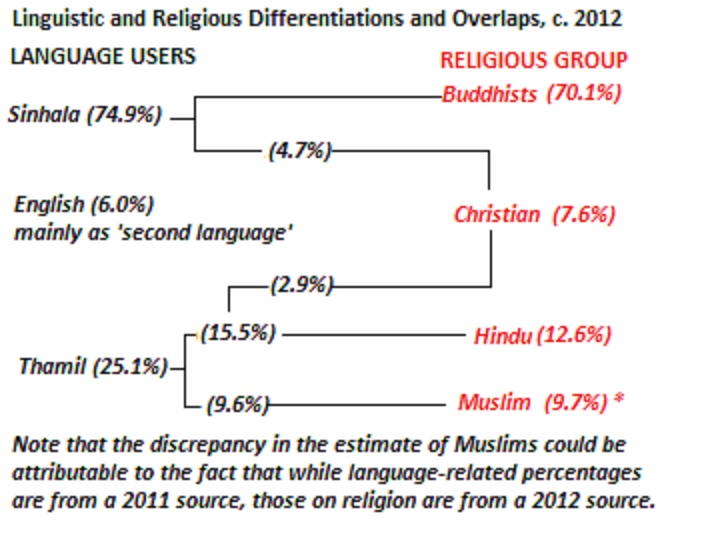
In the country’s demographic spectrum of religion, Buddhists account for 70% – a proportion smaller than that of the majority religious group in other countries of the region. The political significance of the minorities constituting in aggregate as much as 30% of the population of Sri Lanka is enhanced by the presence of spatial agglomeration of one or another such group in certain parts of the country where traces of Buddhism have been largely obliterated and replaced by cultural elements associated with Hinduism, Islam or Christianity.1 On the basis of general impressions it is also possible to suggest an enhancement of this geographical polarisation by a tendency towards ethnic ghetto-formation, especially pronounced in, but not confined to, the larger urban areas of the country.

From historical perspectives the association of Theravada Buddhism[i] with the civilisation that evolved in the island over several millennia is comparable to the Hindu-India symbiosis witnessed in most parts of the adjacent sub-continent. Indeed, despite the highly controversial nature of issues concerning the national identity of Sri Lanka that prevails in the context of the recently concluded secessionist war and the lingering diversities of interests and aspirations among the country’s religious groups, there has never been a serious refutation of the perception that Buddhism has provided the distinctive elements of the country’s cultural heritage from the past, despite the fact that in Buddhist-Hindu relations throughout history there were, at the plane of popular religion, close links in the form of similarities in beliefs and value paradigms, complementary rather than conflicting associations in religious ritual, and shared deities and places of worship.

In respect of both doctrinal basics as well as ritual Islam stands apart from Buddhism and Hinduism. Yet, what appears prominent in the long history of relationships between these religious groups in Sri Lanka is that, especially in pre-modern times, religious distinctiveness by itself seldom acted as a barrier to peaceful coexistence.[ii] There is no denial implicit in this assertion of the brief spells of violent confrontation between the Muslim community and other groups, the most thoroughly investigated among which being the ‘Riots of 1915’. It was featured mainly by attacks against the Muslims living in some of the predominantly Sinhalese areas of the country for the suppression of which martial law was exercised by the colonial government with ruthless disregard of the norms of judicial procedure. In an incisive analysis of this episode of turbulences de Silva (1981:381-5)[iii] has clarified that  the riots were directed specifically at the section of the Muslim community called the ‘Coast Moors’, and has explained the virulence of the outburst with reference to the … ubiquitous activities of the Coast Moors in retail trading (that) brought them in contact with the people at their most indigent levels (which ) … earned them the hostility alike of the people at large and of their competitors among the Sinhalese traders … who had no compunctions about exploiting religious and racial sentiments to the detriment of their well-established rivals”.[iv] Michael Roberts who is also an eminent Sri Lankan scholar  has refuted certain aspects of de Silva’s sketch of this conflagration, referring to it as a “pogrom”, rejecting the use of the term ‘riot’ with which it has often been referred to by many other analysts.

Ethnicity and Muslim Political Mobilisation

The emergence in the closing decades of the 19th century of a vibrant press in the two local languages – Sinhala and Thamil – with their distinctive readership orientations, on the one hand, and the confluence of Buddhist, Hindu and Muslim revivalist movements with the embryonic campaign for independence from British rule, on the other, were prominent strands in the processes of Sri Lanka’s political modernisation during the early 20th century. Unfortunately the political significance of ethnicity was enhanced when universal adult franchise was introduced to the elections to the legislature in 1931, seventeen years before the country gained independence – a quantum leap towards ‘democracy’ which only Britain had achieved up to that time. The enfranchisement of the entire population – male and female – above the age of twenty-one at a time when a political party system offering a spectrum of alternative socioeconomic policy options to the electorate was yet to be developed had the impact of bringing into the forefront of the country’s politics the conflicting interests of the different religio-linguistic and caste groups which had, in fact, been in evidence even earlier when political participation was largely confined to the educated and property-owning elite.[v] In such a context, many among those aspiring to positions of political leadership (including those seeking the consolidation of leadership positions already held) had to appeal to primordial loyalties of language, religion and caste, and to espouse related sectarian interests. Though the semblance of a modern party system did eventually develop (largely through an almost haphazard process of polarisation among leaders of existing primordial groups, except in the case of the ‘Marxist Movement’), by independence, the labels of language, religion and caste had become almost as important as party affiliation in the electoral politics of Sri Lanka (And, remember the comedy of the 1947 elections to parliament when, in certain electorates, there were several nominees from the same party in mutual competition?).

The ‘All-Ceylon Moors’ Association’ and the ‘All-Ceylon Muslim League’ were influential organisations formed during the pre-independence era. These were dominated by the wealthy, urban-based elite of the Muslim community of Sri Lanka.  Many of the key personalities of these organisations became supporters of the UNP.  There were also a few prominent Muslims among the founder members of the SLFP in 1951.

The political alignments of the Sri Lanka Muslims have been succinctly outlined as follows (de Silva, 1986:445):

“The story of the Muslims in post-independence Sri Lanka is a story of how a small minority converted their intrinsic disadvantages (smallness of numbers and spatial scatter) into positive advantages in their struggle to strengthen their position in the Sri Lanka polity.  They were helped in this quite substantially by Sri Lanka’s political system in which from 1956 onwards the ruling party was defeated on six consecutive occasions (including 1956).  The result was that the Muslims had opportunities for political bargaining which they used to the great advantage of their community”.

Against the backdrop sketched out above, there was, for several decades after independence, no widely perceived need for political parties exclusively representing the interests of the Muslims.  In the more recent past, however, certain changes of circumstances – notably, the resentment on the part of an emerging leadership from the predominantly rural Muslim population concentrations such as that of the Eastern Province against the dominance of the urban-based elite in Muslim political affairs – led to the formation of Muslim political parties. Among these, the ‘Sri Lanka Muslim Congress’ (SLMC), inaugurated in 1988 in the context of deteriorating Tamil-Muslim relations in the Eastern Province, made rapid headway as an influential force in parliamentary politics. Several more recently formed parties such as the ‘Muslim United Liberation Front’ and the ‘Sri Lanka Muslim Katchi‘ are evidently intended to appeal to different regional and/or ‘class’ interests or personal loyalties within the Muslim community. Despite this trend, it seems likely that a large segment of the community, and even the exclusively Muslim political parties referred to above, will continue to retain links and loyalties with the UNP and the SLFP.

It should not be forgotten that at various stages of the ‘Eelam War’ (mid-1980s to 2009) certain Muslim leaders in mainstream politics (including Rauf Hakeem, the SLMC chief) were not averse to the prospect of forging a formal understanding with the LTTE leadership, independently of the stance of the Colombo government in which they held ministerial posts. Moreover, in the ‘Government-LTTE Peace Negotiations’ of 2001-2003, the principal demand of the Eastern Province Muslims, articulated mainly through the SLMC, was that any compromise worked out to meet the LTTE claim for autonomy in the ‘north-east’ should be accompanied by an arrangement facilitating self-government for those inhabiting the main Muslim areas in that part of the country.

The coastal lowlands of the Eastern Province have hardly ever been entirely free of localised friction between the Tamils and the Muslims constituting (according to the 1981 census data), 42% and 35%, respectively, of the total population of the province. These, it must be remembered, have all along been areas of excessively high population density in which residential loci of one community are juxtaposed by those of the other in an intricate and closely entwined micro-spatial mosaic. The eastern lowlands are also featured by resource scarcity, agrarian unrest and widespread poverty, and hence, frequent interpersonal disputes with communal undertones.

This was the demographic and socio-economic setting in which several Tamil militant groups began in the early 1980s to build a support-base among those of their own community. At that stage, evidently in response to harassment by the Tamil militants, the Muslims of their larger communities also attempted to form armed groups, and did achieve some success in their attempt.  Thus, for example, in the Allai area (south of Trincomalee harbour) an armed group which called itself the Jihad Movement” is said to have gathered a small but ardent following.  Again, in coastal Ampara (southern parts of the Eastern Province), a movement referred to as Al Fatah” mobilised some support from among Muslim youth. These, however, soon succumbed under the weight of the overwhelming might of the Tamil militants.

Following the Indo-Lanka Accord of 1987 the SLMC decided to collaborate with the Indian Peace-Keeping Force (IPKF) in accordance with Delhi’s pledge to restore normality in the ‘north-east’. Observers believe that it was at this point that the LTTE turned its wrath in earnest towards the Muslims in this part of the country. Thus, following the withdrawal of the IPKF from Sri Lanka in the early months of 1990 and the concurrent emergence of the LTTE as the most powerful among the separatist groups, Muslim communities in the Eastern Province became the target of large-scale ‘Tiger’ attacks. These evidently represented an attempt at ethnic cleansing” of the Traditional Tamil Homeland”. Several gruesome massacres of Muslim civilians, each involving death-tolls exceeding one-hundred, were carried out by LTTE cadres, resulting in mass evacuation by the Muslims of certain localities. By January 1991, about 350,000 Muslims had been displaced from their villages and towns of the Eastern Province. In October 1990, the LTTE also evicted en masse all Muslims (total number estimated at about 70,000) from the Northern Province.  Thought the 1990s and well into the landmark ‘Mavil Aru-Muttur’ battle between the Sri Lanka army and the Tigers,[vi] the LTTE attacks were sporadically targeted at the Muslims.

In the longer term the Muslim fears of becoming a beleaguered minority in the entire country could have been reinforced by several brief localised Sinhalese-Muslim clashes of the recent past ̶ in the township of Mawanella in May 2001, and in northern Colombo in October 2002 (examined in detail in later stages of the present study). There is, in addition, the long-standing dispute in the interior of the Eastern Province concerning an alleged encroachment by the Muslims of land belonging to ancient Buddhist temples and archaeological sites.

Socioeconomic Perspectives

Among the other dimensions of ethnic relations in Sri Lanka that need to be highlighted as background to the present study is the declining trend of the correspondence between socio-economic stratifications and religious differences that prevailed in the country at independence seventy years ago and, in consequence, the absence in comparable magnitude today of an economically dominant” religious group similar to, say, that of the social privilege and relative affluence of Christians (especially the Protestant segment thereof), on the one hand, contrasting with the deprivation and despair that featured the lives of the overwhelming majority of Hindus in the plantation sector, the Tamils and Muslims in the rural areas in the northwest and the eastern lowlands, and the Sinhalese peasantry in the drier parts of the island, on the other.

The declining trend referred to above is largely attributable to transformations of the ethnicity-based functional specialisation brought about by the economic transformations witnessed under colonial dominance becoming indistinct since the termination of British rule in Sri Lanka. In British Ceylon the livelihood of the large majority in the Sinhalese segment of the population was in subsistence farming – the production of rice and a few other staples for local consumption with some among those inhabiting the maritime fringe deriving an income off-shore shallow water fisheries. The ‘Ceylon Tamil’ community, achieving greater upward social mobility through education than the other ethnic groups, acquired a proportionately large share of while-collar employment (including those in the professional fields), emerging mainly from an agrarian base oriented towards the production of “subsidiary food-crops” and tobacco for an all-island market, while harvesting the rich source of marine fish in the Mannar, Wadge and Pedro ‘banks’ in the island’s northern waters. In the case of Muslims, the semblance of a special focus of economic function could be discerned in the fact that, while participating in the entire range of economic activities, they had a share of trade transactions of the colony that was far in excess of their population ratio which was, to some extent, a legacy of commercial transactions of the Kandyan Kingdom. ‘Indian Tamils’, largely confined as they were to the plantation sector, constituted its poverty-stricken labour force inhabiting parts of the ‘Central Highlands.

The dissipation of this pattern of ‘specialisation’ which was associated with post- independence socioeconomic changes had significant repercussions on ethnic relations, most of it – especially those impelled by educational advances that facilitated social mobility – inevitable and salutary; but not devoid of a politically destabilising impact of intensifying inter-ethnic rivalry for space within the different fields of the economy in the context of a largely stagnant economy and a rapid expansion of population from about 7 million to 14.7 million in the first thirty years after independence, and then to  about 19 million in the next thirty years.

A socioeconomic phenomenon of utmost relevance to a study of relations between the Sinhalese majority community and the Hindu and Muslim minorities that has not received adequate scholarly attention is that in the daily lives of the large majority of people living in most parts of the island their inter-ethnic relations are seldom interaction among equals. The exceptions to this phenomenon are found perhaps only at the apex of society and in segments of the city working-class. More specifically, the large majority of the poor of any ethnic group has hardly any direct contact with the poor of other groups, being kept apart by barriers of geography, language and culture. Thus, for example, in most of the Sinhalese-majority areas, Sri Lankan Tamils and Muslims with whom the poor among the Sinhalese come into routine contact have all along been persons of higher social strata –  professionals, high and middle-level state sector employees, traders etc. With the steady post-independence increase of the Sinhalese proportion in the upper and middle grades of the state sector workforce, the mirror image of this feature came to be replicated (though somewhat less distinctly) in at least some of the main Tamil and Muslim majority areas of the northeast where, from about the mid-1980s, as the police and the armed forces gradually became almost exclusive Sinhalese domains, it assumed greater prominence. Accordingly, regardless of the fact that poverty has always been a phenomenon shared almost equally by all ethnic groups, to the poor in any one group, those of the other ethnic groups invariably appears economically privileged” and powerful”.

Emerging Buddhist-Muslim Rivalry in Sri Lanka?

The remaining segments of this study are presented in two parts the first of which is intended to contextualise, in the broader setting of recent political transformations witnessed in Sri Lanka, the proliferation of information on violence targeted allegedly by Sinhalese-Buddhists on the Muslims, which those responsible for disseminating such information often portray as a trend of intensifying rivalry between the two ethnic groups. The second part contains a critique of the thematic submissions in a similar portrayal presented by John Holt, Professor of Comparative Religion at a prestigious liberal arts college in the United States, as the ‘Keynote Address’ of a research conference on the subject of Ethnic Conflict in Buddhist Societies in South and Southeast Asia: The Politics behind Religious Rivalries’ conducted three years ago by the International Centre for Ethnic Studies, Kandy. The special attention I devote to Professor Holt is due entirely to the fact that the ‘Rashomon Effect’   ̶ the same event or phenomenon being interpreted in diverse ways by different persons, impelled by their subjective interests and motivations ̶ is far less evident in his keynote address than in others presented as scholarly works which I have come across on this subject.

Part 1: Glimpses of the ‘Regime Change’ Strategy

At the time of the conference referred to above the prevailing political ethos in Sri Lanka was such that there was reason to place trust in the government, guided as it was by the strength of its convictions and commitments to our foremost national interests, having the capacity to withstand the internal and external destabilising pressures being exerted against the country’s steady (but not entirely unblemished) ‘post-war’ recovery. Hence it was possible to regard even the blatant distortions of ground realities of ethnic relations in our country, including those that took the form of pseudo-academic research, churned out mainly by a set of foreign-funded Colombo-based NGOs, as no more than irritations of tolerable impact which small countries such as ours need to bear with fortitude while safeguarding rights as sovereign nation-states. It is now becoming increasingly evident that the ‘regime change’ of early 2015 has brought about a dire necessity to abandon that earlier attitude of laissez-faire indifference towards the spread of disinformation, subversion (including clandestine incitement to violence) and intimidatory threats based presumably on the pernicious doctrine of ‘Responsibility to Protect’,[vii] because the newly installed puppet regime, in its wayward responses to the resulting pressures, has been leading the nation relentlessly towards  the same state of anarchy and chaos as those targeted in the recent decades by the so-called democratisation efforts and humanitarian interventions of the NATO superpowers.

Even in the course of the 30-year ‘Eelam War’ there were attempts made by the LTTE and the leaders of the ‘Sri Lanka Tamil’ community in mainstream politics to attract at least a segment of the Muslim community into their secessionist campaign. When that proved to be futile, the Muslims living in the ‘North-East’ of the island became targets of diverse forms of terrorist brutality that included mass murder (remember Eravur and Kattankudi?) and forced displacement of entire communities (in Mannar, more excruciatingly than elsewhere). Since the Eastern Province was liberated from the clutches of the LTTE in late 2006, the government was able to embark on rehabilitation and reconstruction in that part of the ‘war zone’ well ahead of the end of its Vanni military operations in May 2009, using aid funds specifically earmarked by the donors for that purpose. This resulted in a spectacular re-development of socioeconomic infrastructure in the densely populated coastal periphery of the east where the largest Muslim settlements are located. In addition, the Muslim political alignments in the immediate aftermath of the war could also have been influenced at least marginally by the cordial relations which the Rajapaksa regime had maintained with several Islamic countries – especially Pakistan, Iran, and the Palestinian government of the Gaza Strip.

These probably constituted a significant set of reasons for Mahinda Rajapaksa obtaining 57.9% of the popular vote at the euphoric presidential election of January 2010 in his contest against the other formidable ‘war hero’ of that time, General Sarath Fonseka (the candidate backed by the UNP, JVP and the disgruntled loyalists of ex-president Chandrika doing her “hell hath no fury like a woman scorned” act). In fact, Rajapaksa surpassed even the support garnered by J R Jayewardene at peak popularity in 1982 (52.9%) – the only previous nationwide poll free of serious insurrectionary disruption since the inception of the ‘executive presidential system’ in 1978. Based on the fact that Muslims in all parts of the island were sharing the economic benefits of the ‘peace dividend’ – especially in trade and commerce – it could be surmised that the Rajapaksa camp continued to retain the support of the Muslim community at the parliamentary elections conducted a few months later at which the UPFA secured 60% of the overall total of votes, while the UNP share had dwindled to 29%.

It should, however, be stressed that in the entire electoral history if independent Sri Lanka, the allegiance of the Muslims – almost 10% of the all-island vote –  for one or the other of the parties commanding the bulk of the Sinhalese support has all along been ephemeral. This, in my understanding, has been a fact of vital salience to the ‘regime change’ project referred to above, given the overall electoral morphology in which: (a) the Buddhist support (70%) gets divided (both directly as well as indirectly through the JVP, the JHU and the ‘Old Left’) among the two main parties; (b) support for the Rajapaksa regime from the ‘Sri Lanka Tamil’ community remains minute; and (c) the Hindu vote in plantation areas (about 4% of the national total) with its comparatively more distinct community cohesion, being vulnerable to en bloc external manipulation (including RAW intervention as rumoured in the local press but substantiated by Dersil Patel, in the journal Defence New issue of 29 July 2015) in favour of what Delhi preferred.
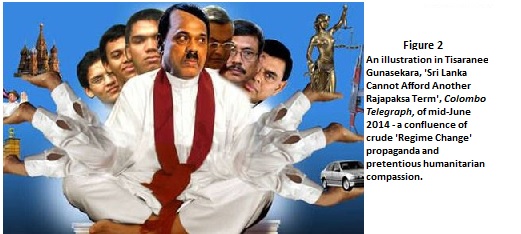
It is not possible in a dispassionate attempt to contextualise the ‘regime change’ project referred to above to discount the significance of the foregoing sketch of electoral arithmetic. It would, indeed, be downright stupid to ignore the fact that promoting estrangement of Buddhist-Muslim relations, especially through clandestine support to the rabble-rousing lunatic fringe of the Buddhist segment of the electorate, on the one hand  (the well-known columnist Izeth Hussain, writing for The Island on 5 May 2017, was certain that “the Islamophobic hate campaign is  obviously foreign-funded and foreign backed”)  paralleled by a propaganda campaign designed to magnify the violent exemplifications of the alleged hostility of the Buddhists such as homicide and grievous physical injury, desecration of mosques, arson, property damage, looting etc., which, in addition, contained the damning charge that the government remained inactive or even supportive of the violence because of its subservience to Buddhist interests.

These modalities of destabilisation have by no means ceased with the toppling of the Rajapaksa regime. What is of direct salience to a reappraisal of evidence for the claimed intensification of Buddhist-Muslim rivalry is that the same ‘regime change’ strategies are now being pursued with enhanced vigour for protecting  the tottering regime installed in 2015, with a short-term focus on averting its probable collapse at the forthcoming all-island local government elections  ̶ a debacle to somehow mitigate at least in the main municipal areas such as Colombo and Kandy where there is an electorally formidable Muslim presence.

The extracts from a recent analysis by Tamara Kunanayakam reproduced below contain a set of persuasive evidence on the persistence of the United States in its efforts to ensure that the present government of Sri Lanka remains subservient to its geopolitical fiat, and enforcing its will on Colombo.[viii]

“It is indeed symbolic that the US Ambassador chose to announce Washington’s decision to ‘assist’ Sri Lanka draft its Constitution and implement the Human Rights Council resolution from the amphibious warship USS New Orleans, which is used to land and support ground forces on enemy territory and patrols provocatively close to China. It is also ironic that it is from Temple Trees that the Acting US Assistant Secretary of State Alice Wells declared, last week, that ‘the United States is – and will continue to be – an Indo-Pacific power’. She was the first to announce America’s ‘first ever naval exercise’ in Sri Lanka in October, in Trincomalee”.

“US interference in Sri Lanka began long before the resolution was adopted (at the 30th UNHCR Session in September 2015). It was, however, the Yahapalana regime that gave it wings and also international legitimacy”.

“The US Secretary of State John Kerry arrived in Sri Lanka to fix the road map even before a legitimate Government was in place. The two visits to Sri Lanka of Jeffrey Feltman, the UN Under Secretary-General for Political Affairs, are also significant. On his first visit shortly after the 2015 Presidential elections, Feltman declared he was here to assist in the process of accountability and reconciliation.” On his second visit last month he revealed that accountability and reconciliation had meant changing the Constitution. He came to monitor progress”.

“Feltman is a former US Assistant Secretary of State, a neoconservative hawk linked to Robert Kagan – their theoretician, Victoria Nuland and Samantha Powers. Feltman has been involved – at the highest level – in regime change, destabilization, the break-up of sovereign States into ethnic enclaves, fomenting violence. I would require more time to give an account of his role in covert operations in the Ukraine, Russia, Syria, Iraq, Lebanon, Moldova, Georgia, Venezuela, Colombia, El Salvador, etc.”

“Other significant visits include that of Samantha Power, also known as the ‘Liberal War Hawk’ and George Soros, US multi-billionaire who believes we don’t have enough ‘constitutional democracy.

My present comments on the empirical basis of the claimed intensification of Buddhist attacks on the Muslims in Sri Lanka is based on a fairly detailed study of the abundance of related reports available in published form including those documented in the mainstream press and the so-called ‘social media’.[ix] In addition, I have gathered information through ‘field investigations’ in four of the trouble spots – Mawanella, Dambulla, Mahiyangana and Aluthgama – which entailed random interviews with community leaders (clergy and lay persons, men and women) and, in respect of the ‘Grandpass Riot’, several persons including a Christian clergyman and a senior government officer very familiar with their respective areas.

There are certain commonalities in the documentations referred to above. First, the overwhelming majority of my sources refer to an increasing incidence of hostility targeted at Muslims by either unnamed mobs or cliques variously referred to as “Buddhist extremists/fanatics/racists/bigots”, “followers of Bodu Bala Sēnā” (or other fringe group like Rāvanā Balaya, Sinhala Rāvaya and Sinha Lē), “criminal elements”or, as in a recent media reports, “a rampaging drug addict”. The frequency of occurrence of these events of violence is also occasionally indicated with reference to some time-frame, or is simply described as “many”, “extensive”, “widespread”, “increasing”, “escalating”, “ratcheting” etc., indicating that the impression most of the writers wish to convey is the prevalence of an ominous trend.

What I find strange in this body of evidence is the fact that it is loaded with trivia such as those referred to in the list compiled by the Sri Lanka Muslim League (SLMC, the largest Muslim political party in Sri Lanka) evidently for submission to the UN High Commission for Human Rights),[x] and an overall scarcity of precise information indicating the intensity of the reported events. Barring a few exceptions (one of the most noteworthy exception being a report compiled by the International Centre of Ethnic Studies Colombo, that furnishes fairly detailed information on several major flashpoints such as Mawanella, Aluthgama, Dambulla and Grandpass, and has made a partially successful attempt at suppressing some of the innate anti-Buddhist prejudices),[xi] the overwhelming majority of the sources do not furnish information that would facilitate a comparative assessment of the real gravity of the problem which, to my mind, is essential for us to understand the seriousness of this claimed trend in comparison to intergroup conflicts elsewhere in the world  ̶  not only in Buddhist countries of South and South East Asia, but in predominantly Hindu, Islamic or Christian countries in some of which ethnic conflict of one form or another is almost endemic. It is, indeed, unfortunate that we do not have a reputed scholar-journalist of the calibre of Asghar Ali Engineer who has monitored in detail the tragic Hindu-Muslim conflagrations in a large number of Indian cities, all of them published in the Economic and Political Weekly over several decades, apart from the reports of thorough and impartial investigations conducted by India’s presidential commissions on the more disastrous episodes of intergroup violence.

Given the lacuna of comparable in-depth analysis on Sri Lanka, it would not be possible for the world to gauge how the widely publicised Aluthgama flare-up, for instance, compares with, say, the demolition of the Babri Mosque at Ayodhya in 1992 or the atrocities committed by Hindu mobs in the Muslim ghettoes of Ahmedabad ten years later; or whether the role of Ven. Galagodaattē Gnānasāra of the BBS is comparable to that of the Burmese monk Ven. Ashin Wirathu and his ‘969 Movement’, or  Swami Chinmayananda Sarasvati of the Vishva Hindu Parishad, (referred to sometimes as a leader of the “militant wing” of the BJP); or the extent to which Mahinda Rajapaksa’s alleged inaction in the face of sporadic inter-ethnic clashes during his second presidential tenure could be regarded similar in its causal nexus to that of Aung San Suu Kyi since her elevation to the office of ‘State Counsellor’ in April 2016, or of Chief Minister Narendra Modi during the deadly ‘Gujarat Riots’ of 2002. In the absence of the type of specific information on the spatial and temporal perspectives and some indication of the duration and destructive impact of the alleged Buddhist violence, the related sources of information and analysis, even those produced with the noble objective of safeguarding Buddhism from bigotry, could well be part and parcel of a process of rubbishing Sri Lanka and the religion of its majority community in the arena of global politics.

I should illustrate the point being made here by referring to an article by Dr. Jehan Perera, well known for his pacifist and democratisation efforts, titled ‘Anti-Muslim Violence: The Puzzle of Continuing Impunity’, published in The Island of June 5, 2017. As a launching pad for his denunciation he has used the “grease devil” (grease yakā) reports that appeared in the press from time to time from about 2011 (the most recent one being dated May 27, 2017). Although the supposedly eye-witnessed ‘grease yakas‘ (nude men, covering themselves with grease, and raiding homes at night to terrorise the occupants, especially women; but, in most cases, getting away with plundered booty and/or perverted satisfaction) have been reported from all over the island – Battaramulla and Talangama (suburbs of Colombo), Ähäliyagoda and Pälmadulla (Ratnapura District where the ‘grease yaka’ terror was tied up with several heinous murders related to the narcotic transactions), Kalpitiya (Puttalam District), Galenbindunuweva (Anuradhapura District), Middeniya (Matara District), Kattankudi (Batticaloa District), Haputalē (Badulla District), and several rural localities in Jaffna District. These details appear to have been of utmost irrelevance to the reconciliation efforts hawked by Dr. Perera. Thus, having recast just one published version of questionable authenticity of the ‘grease devil’ exploits to a story obviously intended to be understood by those unfamiliar with conditions in Sri Lanka as a planned campaign of terrorising Tamil communities in the north, conducted from the bases of an “army of occupation” of Jaffna peninsula to harass its civilian population in a quasi-military strategy of subjugation (!), he has, through a curious verbal sleight-of hand, proceeded to link it to a supposedly escalating series of attacks by grease yakas on Muslims living in predominantly Sinhalese areas, the evidence intended to substantiate it being a Baron Munchausen-type fabrication of “burning a section of the Alutgama Town” (a fairly large urbanised area midway between Colombo and Galle). Thereafter, Dr. Perera, has drawn a parallel between the tragic fate of the stateless Rohingya Muslim refugees (described in several international publications as “the most persecuted ethnic group in Asia“) living in the Rakhine tribal homelands in Myanmar, with that of the Muslims in Sri Lanka, spicing his horror story with a passing reference to past attacks on the Christians, and ending with a condemnation of the government for making it possible for Buddhist miscreants to get away with impunity, but making the censure palatable to the Yahapālana regime by mentioning extenuating circumstances, as we can see in the following extract from his essay, thus killing several birds with a hail of stones.

“It may be that the governmental leadership does not believe that this is the time to act. The massive crowds bused (sic) in by the Joint Opposition for their May Day rally was larger than any other. It is also indicative of the political opposition’s ability to muster people power onto the street, even if they have to be provided with a handout inclusive of transport, meals and drinks. In this context the government’s instinct may be to delay taking decisive action and hope that the problem will go away. The government may also be trying to follow the example of Myanmar, where the government led by Aung San Suu Kyi has sought to accommodate the hardline Buddhist nationalist groups within the government in order to win their support”.

The Aluthgama Riot of mid-June 2014 has, indeed, been documented in detail by the media. More than 50 of these could be easily accessed via internet as film clips and news reports. Collectively they represent no more than a patchy coverage of what really happened. Apart from the print media in Sri Lanka, some of the major news firms of the ‘West’ also covered the episode, projecting it mainly as yet another example of a rising tide of “Buddhist violence” in Asia. In addition, it received attention in several scholarly works. In my assessment, the most detailed account of the riot setting, including vitally significant disclosures not found elsewhere in published form, has been authored by the well-known free-lance journalist, Shenali D. Waduge.[xii] There are, in addition, reports published by two fraternally linked Colombo-based NGOs –’International Centre for Ethnic Studies’, and ‘Law and Society Trust’.[xiii] The former, though described by its authors as a “research report” conveys no more than what could be described as a conventional account of the episode, its redeeming feature being that it has labelled what occurred as a ‘riot’ rather than a Buddhist attack on Muslims. The latter is very definitely a product of fairly detailed post-riot field investigations based largely, it seems, on random sources of information.

The thematic thrust of the study by Sonali Waduge (July 2014) is that biased reporting, especially in the English language press and other documentations, has conveyed a distorted version of the circumstances, especially the concealment of the responsibility of Muslims miscreants in Dharga Town that culminated in the riot that began in the late afternoon of 15 June 2014. A summary of the related facts presented by Waduge reads as follows:

“Please take note that the throwing of the carcasses, throwing of blue dye onto the Buddhist priests, the destruction of the Dharmachakra in the temple Kurunduwatte Sri Vijayarama, the humiliations that priests walking along the road to the temple passing the mosque was subject to were all done in the absence of any involvement or presence of the BBS. These were all taking place over a period of time. The Buddhists of the area had to silently suffer because neither the police nor the politicians took the issues on the merit of attempting to ensure that people lived peacefully. These grievances numbered many and included how politicians would attend birthday parties of Muslims but not attend the funeral rites of a Buddhist priest. The unheard of grievances were many.

The Buddhist priests of the temple including the chief incumbent (Ven. Ayagama Samitha, the victim of the assault on 12 June) had no history of any altercation with the Muslim community whatsoever to be subject to the abuse and humiliation that they suffered. This background information has been purposely blacked out by media”.

In contrast, Dr. Jehan Perera’s sketch referred to above and the supposedly more scholarly ICES study an extract from which is reproduced below, shares with many other accounts of the ‘Aluthgama Riot’ disseminated worldwide, attempts to trivialise the hostilities suffered by Samitha Thero and other monks of Sri Vijayārāma – a temple said to be well over one-hundred years old in a predominantly Sinhalese village into which there has been a large influx of Muslims in the recent decades and a change of name to ‘Dharga Town’, and now, one of two Buddhist shrine there in uneasy coexistence with four mosques – and thus to place the blame for the riot squarely on the BBS rally and Gnanasara Thero’s incitement.

“Ethnic riots erupted (on 15 June 2014) in Aluthgama, Dharga Town, (and the adjacent) Valipanna and Beruwela towns located in the South of Sri Lanka. The area has a large Muslim population that lived alongside a larger Sinhalese community. Amity between the two communities remained somewhat fragile, as communal violence had erupted previously, almost a decade earlier. The incident that reportedly triggered the riots in 2014 was an altercation between a Buddhist monk and three Muslims from the area. Following the incident, a large rally was organised on 15 June to condemn the alleged attack on the Buddhist monk. The BBS participated in this rally and Galagoda Aththē Gnānasāra Thero, the General Secretary of the BBS, made racist and inflammatory remarks against Muslims at the rally” (italics added).

The events that led to this unexpected attack by a mob of Muslim youth, and the massive conflagration it ignited to last over several days, constitute a tragic story which must be looked at in detail because it illustrates several features of thematic relevance to the main objective of the present study. My reconstruction of that story is presented in Part 2 (pp. 37-43) of this paper.

The overall impressions conveyed by that story could be summed up here as follows:

  • There is no doubt that the BBS meeting and Ven. Gnānasāra’s presence and his public utterances were potentially (Note that the injured Ven. Ayagama Samitha, the victim of the attack by several Muslim youth on 12 June was ushered on to the stage in the course of the meeting).
  • However, it should not be forgotten that prior to the riot on 15 June there was a build-up of explosive communal tensions in the Dharga Town area at least from about the first week of that month warranting police action, both when serious complaints were lodged regarding a paedophilic rape committed on a Sinhalese child by a Muslim trader (8 June), the overt aggressiveness displayed by certain Muslim riffraff in Dharga Town towards the Buddhists, and  on the assault suffered by Ven. Samitha (12 June), as well as when representatives of the Muslim community conveyed to the police their fear about a possible outbreak of mob violence in the area. Whatever justification the police might have had for their inaction, my informants indicate that there were undercurrents of suspicion among the Sinhalese that the police were in the pay of the Muslims business community.
  • The large influx of people to the BBS meeting venue is likely to have been a result of malevolent rumour mongering and, of course, the undeniable entertainment value of the BBS leader (Didn’t some of us in our youth go all the way to enjoy the ‘May Day’ performances especially by the inimitable scholar, pioneer Marxist and legal luminary, Dr. Colvin R. de Silva in the Trotskyite “extra-parliamentary mode of capturing state power” in vogue at that time, roaring “gahapalla” (attack), his silhouette pointing at the old parliament complex against the crimson sunset over Galle Face green.
  • On the 15th eve senior police officers were reluctant to exercise force to prevent signs of potential violence. There was no immediate action taken by them to stop the stoning. They preferred instead to attempt pacifying the more agitated persons in the crowds, realising no doubt that their interventions were being recorded by the media and the users of ‘smart phones’.
  • Thus, the offensives in Aluthgama were very definitely not one sided. People on both sides engaged in, and suffered from, the violence – with more Muslims than Buddhists among the victims in the post-riot stock-taking of overall damage. Although later records referred to death-counts of up to about 8 Muslims and a Buddhist monk, no such claims were made in the course of many recorded random interviews at that time.
  • “Burning of a section of the Aluthgama town” is a highly exaggerated and unwarranted description of this sad episode, no different from the type of hyperbole often employed by Gnānasāra Thero in his public utterances, unless one were to argue, like school boys sometimes do, that even a lamp-post could be considered a section of a town.

On several occasions certain Buddhist community leaders of the area joined their Muslim counterparts in appealing for calm and peace while standing amidst fairly large gatherings that appeared to endorse what they said. This conveys an impression that goes completely against an article published by the ‘Centre for Policy Alternatives’ (presumably to commemorate the third anniversary of the riot) according to which there is absolutely no hope for ethnic reconciliation in Aluthgama.

Part 2: A Reappraisal of Evidence and Claims

A rising tide of Buddhist hostility?

There is no dearth of writings that make the claim of Muslims in Sri Lanka being a minority that has, for long, suffered discrimination and harassment and, in the more recent past, been the target of “Islamophobic” persecution by the Buddhists. The more refined among these are some of the ‘features’ authored by the inimitable Izeth Hussain (ex-diplomat  and regular columnist), hitting hard all round the wicket, as it were, often with easy elegance, and always, despite the pretence at intellectual detachment, with passionate commitment to his team’s victory. There is, of course, nothing wrong in that, except his occasionally getting caught at silly point.

Professor John Holt’s keynote address I referred to at the outset does not stand alone as an elevation of this pernicious claim to the plane of scholarly research. Among the others I have read, there are (a) the ICES and Law and Society studies (referred to earlier)[xiv] which I think are the best of their kind, (b) Zuhair, 2016[xv] which, in my assessment, would have been excellent had the author matched its elegant style with prejudice-free substance; and (c)  a monograph by Ameer Ali,[xvi] one of my former faculty colleagues now living in Australia, titled ‘Four Waves of Muslim-Phobia in Sri Lanka: c.1880–2009’, published almost at the same time as Holt’s study, a brief comment on which is presented below.

In Ameer Ali’s analysis of the “fourth wave” (post-2009) – that of the earlier “waves” are no more than an exercise in re-inventing the wheel – lacks the sedate, persuasive approach typical of John Holt. Apart from the invective, there are several misconstrued references by Ali to several Buddhist outrages not referred to by John. These include “the destruction of a 400-years old Muslim shrine at Anuradhapura” (a mind-boggling archaeological discovery, according to a veteran historian whom I have consulted)[xvii], prefaced by a tirade which accuses President Rajapaksa of “…benevolently tolerating, if not openly supporting, … a vicious campaign to terrorise the Muslims, destroy their economy and demonize Islam through acts of intimidation, insult, incendiarism, and outright thuggery by ultranationalist organizations like the BBS, its surrogate parent JHU and the Sinhala Rāvaya”, and attributes the presidential neglect to a mindset of “triumphalism and malevolence” towards the minority communities after the victory over the LTTE in 2009. Does Ali demonstrate more than all else that the ‘key’ to understanding the real nature of this entire conflict is to realize that the honourable don Ali is as eloquent in his lingo as the venerable monk Gnānasāra is in his, and that such eloquence in the dissemination of half-truths and falsehood has much the same destabilising impact – that of rousing the rabble? Surely, the failure of the government at that time to curtail Buddhist megalomaniacs is, in terms of realpolitik, comparable to the failure of earlier regimes to tame the ‘Tiger’ megalomaniac for well over two decades; and, moreover, those holding the reins of office in Colombo have always, in both war as well as peace, been in desperate need of at least a segment of Muslim electoral support and goodwill. What is this psychoanalytical tripe about a “triumphalist mindset”?  So, let’s move out of this garbage replete as it is with ethnic prejudices, and focus in this part of the article on the issues raised soberly by Professor Holt.

In addition to stating that there were over “150 documented perpetrations by Buddhists against Muslims” from early 2013 to mid-2014,[xviii] Professor Holt has referred specifically to eight such hostilities (listed below), seven among which had occurred during the 18-month period preceding the ICES conference of 2014. This set of information certainly conveys the impression of an increase in the incidence and intensity of attacks on the Muslims in comparison to the previous 11-year spell between the Mawanella riot and the “demolition” of the Dambulla mosque. Yet, it is only in the light of what really happened at these flash points would it be possible to substantiate the claim of increasing hostility of Buddhists towards the Muslims. The sections of this paper that follow are devoted to such a probe, leaving the campaigns of protest and propaganda referred to by John Holt for subsequent perusal.

  • “Mawanella Riot” in 1999 (Sic)
  • “Demolition” of the mosque at Dambulla in 2012
  • BBS campaign against the production of Halal food (2013-14)
  • BBS proposal to ban the burka (2014)
  • Ravana Balaya’ (sic.) protest march (2013)
  • “Desecration” of a mosque in Mahiyangana (2013)
  • Grandpass “mob attack” on Muslims (2014)
  • Aluthgama-Dhargar Town clash (2014).

Mawanella Riot

The ‘Mawanella Riot’ of 2001, when placed in the context of the general contention of escalating Buddhist hostility towards the Muslim in Sri Lanka since the end of the ‘Eelam War’, appears to be intended to underscore the fact that, in earlier times (i.e. before the end of the ‘War’) there has been nothing comparable to a persistent trend of intensifying Buddhist violence targeted at Muslims since about 2012. Such a perspective, needless to stress, conforms to the thematic thrust identifiable in several writings including that by Professor John Holt on ‘post-war’ ethnic relations in Sri Lanka – a rising tide of Buddhist intolerance towards the other religious groups of the country.

That my interpretation of the information pertaining to this issue is entirely different has already been stated in the first part of this paper.  Briefly recapitulated, the conclusion I draw from the mass of related evidence available is that in each of the serious conflagrations that has occurred in the period leading up to the national elections of 2015, what stands out is the sinister manipulation of a potentially volatile situation in one or another part of the country by those who pursued the ‘regime change’ objective of destabilizing the Sri Lankan polity and installing a regime that would, if they so desire from geopolitical objectives, eventually bringing about the disintegration of its national territory. To me the ‘Mawanella Riot’ illustrates certain ingredients of that latent volatility more clearly than some of the other conflict situations probed in later sections of the paper. Yet, in its causal nexus it is different from those on which the present study is focused in the sense of the similarities it bears to the sporadic Sinhalese-Muslims flare-ups of earlier times in, say, Puttalam, Kottaramulla, Galle and several localities of Colombo North that were ignited invariably by localised altercation involving persons from the two communities often with undercurrents of rivalry in electoral politics appear more pronounced than in the ‘post-war’ turbulences.

In sketching the geographical setting of this riot reference should be made to the fact that Mawanella town is located in the verdant foothills of the Central Highlands about 90 km from Colombo along the main highway to Kandy. The ‘Kandy Road’, one recollects, was one of the earliest products of the policy of “roads, roads and more roads” initiated by Governor Edwards Barnes (1824-31) soon after the consolidation of British rule over the Kandyan Kingdom. Of interest from historical perspectives is the fact that ‘Galboda Korale‘ (of which Mawanella is a part) was a major source of spices and other farm products over several centuries, and the ‘Mid-Country’[xix] trade in pepper, cloves, nutmeg and arecanut was largely under the control of Muslims even in pre-British times as it is at present. Since the early 20th century natural rubber produced on peasant smallholdings of this area also emerged as an important item of Muslim intermediary transactions in which, in the more recent past, their competition with Sinhalese traders has become somewhat intense.
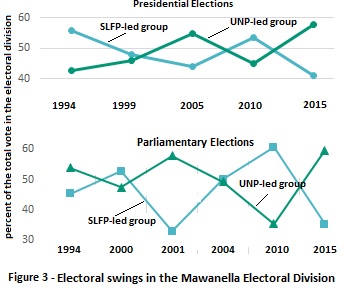
Recent demographic changes in this part of the country, despite the lack precision in the related data (due mainly periodic changes of their spatial frames) suggest, however, the likelihood that there has been a very rapid growth of its population in the recent decades – i.e. roughly, 60% since the Census year of 1981 when the population of the ‘Town Council’ of Mawanella was placed at 13,891, and the present population of the Grama Niladhari units that corresponds to the ‘Town Council’ area of 1981 (i.e. the urbanised parts of the Mawanella Pradesheeya Sabha area) of about 22,000. An ethnic disaggregation of this latter total is not available. But, in the ‘Town Council’ area of 1981, 61% and 36% were the population ratios, respectively, of Muslims and Buddhists (i.e. 8,438 and 5,062 in the total of 13,891 at that time). This fact – i.e. the Muslim ratio of 61% – should also be regarded as an atypical feature in the demography of the string of urban centres along the Colombo-Kandy highway.
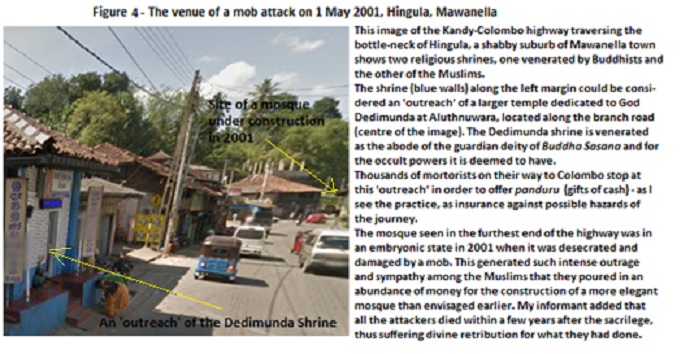
On the socioeconomic circumstances that are of salience to an understanding of the ‘riot’, I can do no better than to cite a passage from an article by three reputed scholars It reads as follows:[xx]

“There are two popular and, to some extent, mutually contradictory explanations of May 2001 riot in Mawanella. One is that it was an outcome of economic and political competition among various interests groups in this booming urban center in an emerging urban corridor in Sri Lanka. The other is that it is an ethnically motivated riot reflecting increasing ethnicisation of political and social processes in the country. This paper argues that while there is an element of truth in each of these explanations, a synthesis of the two arguments is necessary in order to fully understand the nature and causes of these riots. It is true that simmering economic competition and business rivalries within the Mawanella town has been an important underlying factor in the social history of the town since 1930s. Mawanella is an important urban centre where collection and bulking of important economic produce in the surrounding countryside, including spices, has been the primary economic activity. In more recent times certain service sector activities, including employment bureaus recruiting overseas migrant workers, have been added to the spectrum of urban economic enterprises.[xxi] Most of these economic activities are controlled by Muslims, while the Sinhala peasants in the surrounding hinterland have encountered many difficulties due to landlessness, poverty, unemployment and lack of economic opportunities in general. While analysis of this economic backdrop is necessary for understanding the wider context of the riots, equally important are politicization of ethnicity (emergence of ethnically-oriented political parties among both Sinhalese and Muslims), manipulation and mobilization of ethnic symbols by both groups, increased pattern of ethnic segregation in spatial terms and increased tendency to attribute one’s own vulnerabilities to the ethnic other”.

Electoral politics should also be accorded prominence in this ‘background’ sketch. A study of voting patterns in Mawanella at national elections since the early 1990s indicate pronounced fluctuations in the voter support which the two main rival camps (coalitions led by the Sri Lanka Freedom Party – SLFP) and the United National Party – UNP) have been able to muster. In addition, my ‘field information’ for this and an earlier study[xxii] also suggests that, regardless of fluctuations in the electoral fortunes of these two groups of parties in Mawanella, they have all along been able to match each other in their campaign efforts of which the exercise of muscle-power and, indeed, the entire range of malpractices in electoral politics, have been an integral part. This is of special relevance to the acts of violence in the ‘Riot’ of 2001 when contextualised in the intense turbulences that accompanied the national elections – presidential (1999) and two parliamentary elections (2000 and 2001) – of this time.

There is almost unanimity among my informants that a group of henchmen of a leading political personage of the ruling party in Kegalle district, in the course of extracting kappan (protection payments) on the morning of 30 April 2001 from a Muslim restaurant-keeper, assaulted him probably in order to demonstrate the consequences of resistance.[xxiii] Since a complaint made to the police evoked no response (widely attributed to the power of the politician who ruled the roost in this part of the district for well over two decades), a large group of people (according to media accounts, about 3,000), mostly Muslim, assembled outside the police station two days later and staged a boisterous protest which according to some, had considerable UNP backing. Although the protesters appeared to have been pacified with a pledge of immediate ‘law enforcement’, a larger crowd of gangsters descended on the scene and engaged in a rampage of assault, plunder, arson and desecration targeted at the Muslims whose youth, in turn, also attempted futile resistance and retaliation. The lopsided riot continued, especially in the outskirts of the town, despite the imposition of a curfew over several days. As far as I could ascertain, the most blatant “religious” atrocity committed in the course of the riot was the destruction of newly installed mosque at Hingula located about a kilometre from the Mawanella town.

The assertion that scores of Muslim businesses were burnt out” in the Mawanella riot is a gross exaggeration made in whatever source John has relied upon.[xxiv] I had an unusual opportunity (courtesy of a senior police officer – a former student) of seeing the extent of the damage soon after the rioting had been brought under effective control, but before curfew was lifted, when I observed about twenty-five shops and houses bordering the Kandy-Colombo highway and in the bus-stand venue, belonging to Muslims and Sinhalese, that had suffered various extents of damage (ranging from a few shattered glass-panes to total wreckage) during the riot (it occurred in May 2001 and not in 1999 as John’s informant appears to have said).

Needless to say, the media, local and foreign, accorded the ‘Mawanella Riot’ wide and sensationalised publicity. Since the ‘9-11’ was still to happen, and the moribund Chandrika Kumaratunga regime was not to the liking of Western diplomatic and media personnel in Colombo, there was an abundance of well-deserved sympathy lavished on the Muslims, with the culpability for the riots promptly but undeservedly placed wholesale on the Buddhists.

Several persons with whom I have discussed the Mawanella Riot, among them my former colleague A. S. M. Naufhal whose ancestral home is in that town, have assured me that since 2001 there has been no Buddhist-Muslim friction in the area. He mentioned that even the obnoxious politician referred to above has, since then, sponsored certain government projects that are directly beneficial to Muslim communities. Kabir Hashim, an Economics graduate from Peradeniya, a member of parliament recently elevated to the post of Chairman of the UNP, is also said to have been instrumental in maintaining ethnic harmony in the area. This perception of continuing peaceful coexistence among the religious groups finds support in an Anthropological study led by Professor Kalinga Tudor Silva[xxv] the opening paragraph of its synopsis, is reproduced below.

“Commenting on post-war politics and social dynamics in Sri Lanka some researchers have claimed that there is a shift in conflict dynamics in Sri Lanka from ethnic hostilities to largely religiously inspired hostilities (Holt 2016; Wickramasinghe 2015, Herath and Rambukwella 2015, Klem 2011). The rise of the Bodu Bala Sena (BBS) and aggressive Muslim reform movements resulting in interreligious as well as intrareligious tension are presented in support of this argument. With a view to contributing to this debate, the present study focused on three religious sites with a multi-religious heritage in central Sri Lanka. This study, however, did not find evidence for an unambiguously ‘religious turn’ in social conflict in Sri Lanka in the post-war era. The religious sites studied with a history of multi-religious engagement between Buddhism and Islam have potential for promoting conflict as well as solidarity. The current situation in these three sites does not indicate a major rupture in terms of interreligious relations” (italics added).

“Demolition” of a Mosque in Dambulla

The urban functions in Dambulla until about the late 1970s were represented by no more than a small cluster of shops and primary-level outlets of government services traversed by the Kandy-Jaffna highway. The income of this sleepy township was derived mainly from the tertiary services the cluster provided to the thin scatter of peasant settlements in its hinterland and from pilgrims visiting the historic Rangiri cave-temple dating back to the pre-Christian era. Several changes witnessed since the 1980s ̶ the opening up of ‘System H’ of the Mahaveli Programm, invigoration of international tourism, the advances in transport and travel that accompanied ‘liberalisation’ of the economy, and the rapid population growth attributable mainly to immigration   ̶  made Dambulla one of the largest market towns located mid-way between Sri Lanka’s Central Highlands and the northern plains, and to emerge as the foremost centre of wholesale trade in perishable farm products commanding a commercial catchment extending over a large part of the island including the Colombo metropolitan area.
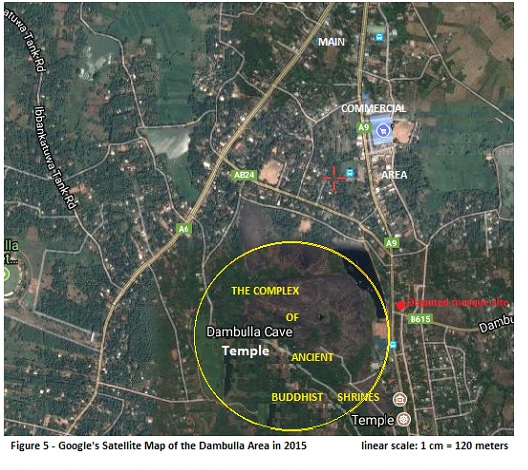
At the census of 1981 Dambulla Town Council (TC) area had a population of 3,613 out of which 3,263 were Buddhists. Thus, the Hindus (193), Muslims (111) and ‘Others’ (46) constituted less than 10% of the total. The area of authority of the Assistant Government Agent of Dambulla had at that time a rural population of 35,509, the Buddhist accounting for 33,710 of that total. By the census enumeration of 2012 the TC of Dambulla which had been elevated to the status of an ‘Urban Council’ had a population of 23,814 in its area of authority.[xxvi]

[i].  In highly simplified form Theravada is regarded as the orthodox school of Buddhism that has its literary traditions in the Pali language. It is the main form of Buddhism prevalent in Sri Lanka, Myanmar, Thailand, Cambodia and Laos.  Sri Lankan Buddhists believe that Theravada adheres closely to the original teachings of the Buddha and that, historically, their country has been the citadel of Buddhism in its pristine form. This belief is regarded by scholars as a major ideological ingredient of Sinhalese-Buddhist nationalism.


[ii].  In the coastal lowlands of the east where Tamil and Muslim settlements are often form an intricate spatial mosaic, there have been innumerable local-level clashes between the two communities. These, as McGilvray (1997, ‘Tamils and Muslims in the Shadow of War: Schism or Continuity’, South Asia: 20) has pointed out, have rarely been triggered off by religious issues. Several detailed studies have also shown that during the ‘Kandyan Period’ (c. 16 to 18 century), land grants were donated to Muslim communities in proximity to the core of the highland kingdom and, even in its peripheral areas of the kingdom, Muslims were fully integrated into the tenurial system and arrangements of trade and taxation. See, for example Devaraja, Lorna S (2008) The Kandyan Kingdom of Sri Lanka, 1708-1782, Stanford Lake Publication, Pannipitiya: 187-188 & 231-232.

[iii].  De Silva, K. M. de S (1981), A History of Sri Lanka, Oxford University Press: 381-5.

[iv].  Roberts, Michael (2009), ‘Marakkala Kolahalaya: Mentalities Directing the Pogrom of 1915’, in Confrontations in Sri Lanka, Vijitha Yapa, Colombo: Chapter 5.

[v]. Roberts, Michael (1982) Caste Conflict and Elite Formation: The Rise of a Karava Elite in Sri Lanka, 1505-1931, Cambridge University Press.

[vi]. Peiris G. H. (2006) The Muttur Tragedy: A Re-examination’, The Island of 22 November 2006,  and (2009) Twilight of the Tigers: Peace Efforts and Power Struggles in Sri Lanka, Oxford University Press: 217-218

[vii].   Peiris, G. H. (2008) ‘The “responsibility to Protect” and External Intervention in the Sri Lankan Conflict’, Proceedings of the Jagran Forum, New Delhi.

[viii].  Kunanayakam, Tamara (2017) ‘Sri Lanka: The new Constitution – a neo-colonial project!’

      Defend Democracy Press, 17/09/2017 http://www.defenddemocracy.press/sri-lanka-the-new-constitution-a-neo-colonial-project.

     Note that Ms. Kunanayakam was Sri Lanka’s Permanent Representative at the United Nations Office in Geneva from 2011-15, in the course of which she also served as the Chairperson for the ‘Inter-governmental Working Group on the Right to Development’ of the Human Rights Council. It is widely believed that among those who represented Sri Lanka at the bi-annual sessions of the UNHCR in recent years she was far more effective than any other (mainly because of her long years of experience in working in diplomatic circles and her overall professional competence, rather than her ‘Sri Lankan Tamil’ identity) as a spokesperson of Sri Lanka’s interests, and that her transfer from Geneva to Havana – a less significant diplomatic post – was a consequence of machinations Ministry of Foreign Affairs.

[ix].  These include the proceedings of the ICES conference referred to above; many news reports in the mainstream media; relevant statements by spokespersons for the government, political parties, and state sector institutions such as the police, semi-official organisations like the Bar Council; statements issued by certain ecclesiastical bodies and civil society outfits; publications in Sinhala and English by several religious organisations that have figured prominently in issues pertaining to ethnic relations, and articles and comments on this subject that have appeared in two English language national newspapers and in internet blogs and other websites.

[x].   SLMC (2015) Report intended to be submitted to the UN High-Commission on Human Rights, titled Religious Violence in Sri Lanka, January 2013 – December 3013. See, imrad.org/wordpress/wp_content/uploads/2016/07/IMARD_SriLanka_CERD90_July2016

[xi] .  ICES/International Centre for Ethnic Studies (2015) The Chronic and the Acute: Post-War Religious Violence in Sri Lanka, http:equitas.org/wp-content/uploads/2017/05/ICES-Equitas-Research _Report _Final

[xii] . Waduge, Shenali D. (2014) ‘Sinhala-Muslim “Riots”: Sri Lanka Local Media Blackout on Version of Ayagama Samitha Thero’, http://www.onlanka.com/news/sinhala-muslim-riots-sri-lankan-local-media-blackout-on-version-of-ayagama-samitha-thero.html

[xiii]    ICES, 2015, op. cit.; Law & Society Trust (2015) Where have all the neighbours gone? Aluthgama Riots and its aftermath, A Fact Finding Mission to Aluthgama, Dharga Town, Valipanna and Beruwela,http://lawandsocietytrust.org/content_images/publications/documents/

aluthgama%20report%20final.pdf

[xiv].  ICES (2015), op. cit.; Law & Society Trust (2015), op. cit.

[xv] . Zuhair, Ayesha (2016) Dynamics of Sinhalese Buddhist Ethno-Nationalism in Post-War Sri Lanka, www.cpalanka.org/wp-content/uploads/2016/04/Dynamics-of-Sinhala-Buddhist-Ethno-Nationalism-in-Post-War-Sri-Lanka.pdf

[xvi] . Ali, Ameer (2015) ‘Four Waves of Muslim-Phobia in Sri Lanka: c.1880–2009’, Journal of Muslim Minority Affairs, 35: 486-502

[xvii] . This is not intended to deny the well-known fact that Muslim presence in Sri Lanka date back at least into early medieval times, and that they did establish a string of port settlements in the Island during the heyday of Arab maritime trade in the Arabian Sea.

[xviii] . SLMC (2015): op. cit.

[xix] . ‘Mid-Country’ is a conventional designation for the hilly areas of moderate elevation along the   periphery of the Central highlands to the west and northwest.

[xx]. Gunasekera, Suranjith, Silva, Kalinga Tudor & Saifdeen, N. T. F. (undated) Interplay between competition for scarce resources and identity issues in the May 2001 Riots of Mawanella

http://www.slageconr.net/slsnet/9thicsls/individual/abs044.pdf

[xxi]. Statistical data published by the Bureau of Foreign Employment indicate that the Administrative Division of Galboda Koralē has been a source of an unusually high rate of emigration for temporary employment in West Asia. (www.statistics.gov.lk/NCMS/RepNTab/Tables/SLBFE.pdf

[xxii]Electoral Malpractices in Sri Lanka: Interim Report of a study of the Presidential Elections of 1999, authored by G. H. Peiris based on a study conducted collectively by K. M. de Silva, S. W. R. de A. Samarasinghe and G. H. Peiris (2000). This report has been deposited in the ICES library in Kandy.


[xxiii]. Kappan, though selectively operated in a given venue, is a phenomenon of the “informal economy” in many towns of Sri Lanka.

[xxiv]. Sunil, W. A. (2001) ‘Sri Lankan Muslims protest violent attacks by racist thugs’

http://www.wsws.org/en/articles/2001/05/sri-m10.html

[xxv].  Silva, Kalinga Tudor, Niwas, Afrah & Wickramasinghe, W.M.K.B. (2016) Religious Interface and Contestations between Buddhists and Muslims in Sri Lanka: A Study of Recent Developments in Selected Multi-Religious and Cross-Cultural Sites, ICES, Colombo

[xxvi].  Since the area of authority of the former Dambulla TC was enlarged with its elevation to the status of an Urban Council, the 1981 population estimate is not strictly comparable to that of 2012.  On census enumerations after 1981 no ethnic disaggregations on sub-district spatial frameworks have been made available in published form by our moronic Department of Census & Statistics. Moreover, even the 2012 population totals of towns such as Dambulla and Mahiyangana in 2012 cannot be ascertained from the post-1981 census records. Yet the ‘townscape’ of Dambulla conveys the impression of a massive population growth, rapid commercialisation and a disproportionately large increase in its Moslem population since the early 1980s.

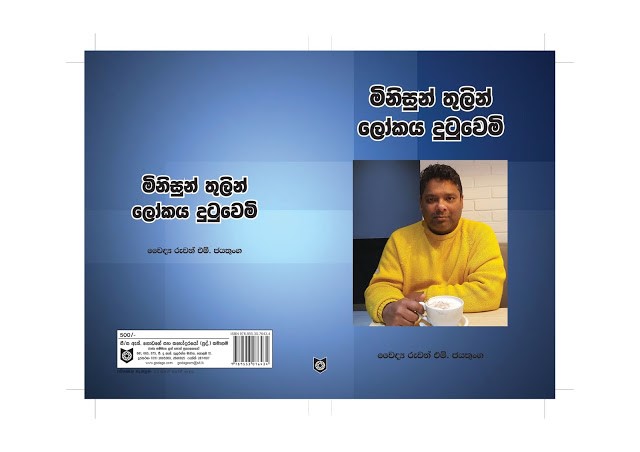
A study of Contemporary Buddhist-Muslim Relations in Sri Lanka Part 2

September 27th, 2017

by  Prof. G. H. Peiris

August 27, 2017

 Continued from Part 1

Until recent times, ‘trading’ in the vicinity of the Rangiri temple was confined to the ramshackle ‘Rest House’ (the only tavern in the town) and a few squatter stalls  vending bunis, saruvath and vadai to the occasional busload of local pilgrims. The numerically tiny Muslim community of Dambulla was largely confined to its small bajār (bazaar) about a kilometre to the north of the Rangiri temple, their spiritual needs being met by a small shed located almost at the doorstep of the ancient the temple. This was private property owned by a Moslem family. According to Sinhalese residents in the temple locality at present (a fact confirmed by a former Member of Parliament for Dambulla) a few Islamic devotees had used it for ‘Friday prayers’ more or less regularly “from the time we remember”.  Neither this innocuous practice nor the sundown “middle-class” boozing at the Rest House (located adjacent to the embryonic mosque) were causes for any Buddhistic concern. This “inclusivism”, it seems, lasted only until the onset of demographic transformations that accompanied the rapid commercial growth of Dambulla referred to above.

The relevance of the foregoing sketch to the political disturbances in this area stemmed mainly from the fact that the vast tracts of land which the Dambulla temple had received (pooja bhoomi, a term translated as

P’sacred land’ or ‘offered land’)[i] over the past millennia, much of it uncharted and/or uninhabited and acknowledged vaguely as Vihāragam (temple land), acquired a sharp upsurge of commercial value in the real-estate market. The first major outbreak of intense political dispute rooted in this fact was the agitation against the construction of a luxury tourist hotel overlooking the Kandalama lake ̶ a campaign which, according to a Reuter report of that time, attracted at its zenith more than 10,000 protesters (including a few volunteers for self-immolation!), objecting to the hotel project on grounds of its adverse ecological, social and cultural impact, and because it also involved a “land grab” of

Viharagam by a consortium of large commercial firms. The protest fizzled out, and an elegant hotel pioneering eco-tourism in Sri Lanka came into being, the main reason for the former (end of the protest), and the principle beneficiaries of the latter (tourist hotel) being the coffers of the Dambulla temple and Ven. Ināmaluvē Sri Sumangala whose go-ahead for the hotel project, it was widely rumoured, was purchased by the investors for a large sum of money.

A similar windfall for the temple coffers is said to have occurred in the negotiations that led to the lease of land to the International Cricket Stadium of Dambulla. An article by D. B. S. Jeyaraj (journalist well-known as a virulent critic of many Sri Lankan affairs) refers to the Cricket Board Chairman confiding to a colleague that the Dambulla prelate is demanding a “king’s ransom” as a payment for the lease.[ii]  The other ‘give-and-take’ transactions that also provided satisfaction to all concerned including the peasantry of the area was an undertaking fulfilled in part) that their youth will be trained and recruited to the hotel workforce. Needless to stress, these also meant an enormous enhancement of Sri Sumangala Thero’s status as a folk hero of the area whom many kowtowed and obeyed. The prelate, according to a highly knowledgeable informant, took steps some years ago to form a “sub-chapter” named the Dambulu Pārshavaya within the ‘Asgiriya Chapter’ (of the Siyam Nikāya) which traditionally exercises overall custodianship of many Rajamaha Vihāra (ancient “Kings’ Temples”) of Sri Lanka.[iii] My references here to Ven. Sri Sumangala as the ‘prelate’ could be an error from statutory perspectives. It has recently transpired that the real Vihārādhipathy (chief incumbent) of the Dambulla temple, as appointed by the Asgiriya Chapter, is Godagama Mangala Thero. If this is judicially substantiated it would have potentially far-reaching thematic implications to the present study.

A realistic understanding of this setting, instead of being led by a fixation on the image of Buddhist bigotry and Sinhalese triumphalism (which, of course, is what rings a bell in the ‘liberal’ West) is necessary to grasp the realities pertaining to the mosque dispute. There was no demolition of a mosque despite its ill-conceived location almost at the doorstep of the Rangiri Dambulla shrine complex. Since the repair of minor acts of vandalism in its precincts caused on 20 April 2012 within a couple of weeks, the mosque has continued to be used by the Moslems of the township uninterrupted and, according to the Secretary of its Board of Trustees interviewed by me, despite an unfulfilled government promise of a more suitable site being found for a mosque within the Dambulla town.

What provoked the ‘Prayer Room’ attack? Was it the culmination of a gathering storm produced by the local ‘cultural’ transformations, or was it part and parcel of an externally manipulated political plot? Speculating on the basis of information obtained from a wide variety of sources I am inclined towards the view that, as in the other ethnic flashpoints such as Mahiyangana, Grandpass and Aluthgama, here was a scenario of coalescence of the extraordinarily rapid socioeconomic transformation in the Dambulla area which the external destabilising forces mobilised in order to attain their larger political objectives.

To begin with, we should re-examine the core of this tragic episode  ̶  events at the venue of the disputed mosque site on Friday, 20 April 2012.  The “truth” disseminated worldwide was that a massive mob of Buddhist monks and laity led by Ven. Ināmaluwē Sri Sumangala engaged in a barbaric attack on the mosque, facing no restriction from law enforcement authorities. A report filed by the BBC correspondent, Charles Haviland, the same day from Colombo spiced it with a passing mention of a “fire-bomb” attack on the mosque the previous night (this is denied by the mosque trustees) and “a monk was seen exposing himself against the mosque as an insult” (surely, the imagination of a sexual deviant!). Almost all media reports and features since that time have also referred to the “destruction”/”demolition”/”removal” of the mosque as an outcome of the attack, using the past tense to refer to the mosque in order to indicate that the ‘Haima Jumma Masjid’ in Dambulla is no more. This, of course, is something any scholar like John Holt who has been around here for more than thirty years could have verified with a two-hour drive from Kandy along one of the more pleasant highways in the country.

Since the entire attack had been filmed from inside the Prayer Room by one of its devotees, there is adequate photographic evidence to indicate that the alleged “destruction”/”demolition” is a lie. The persistence with this falsehood cannot be attributed to sensational reporting. It is deliberate political strategy, highly successful in its objective of initiating the alienation of the Muslims throughout the island from the Rajapaksa regime.

The only segment what I have referred above as the “widely disseminated truth” is that a large crowd led by Ven. Sri Sumangala arrived at the premises of the disputed mosque in a display of potential for mob violence, refraining however from converting that potential to a rampage. The ‘Prayer Room’ (about 1,000 sq. feet of floor space) that had all along served as the ‘Haima Jumma Masjid’ was left untouched. A part of the mob did cause some damage to a dilapidated and abandoned structure standing adjacent to the Prayer Room.

What is perhaps more depressing than all else in this so-called “demolition of the mosque” episode is the statement made by Ven. Sri Sumangala (Fig. 9 D) in the presence of a gathering of bhikkus, police officers and lay community leaders who were permitted to enter the mosque towards the end of that day’s proceedings, in the course of which he threatened: “What you have seen is only a peaceful demonstration, we carried only flags and placards; next Monday it will be quite different”.  That enactment of violence did not happen. What did happen two days later was an announcement by the Prime Minister D. M. Jayaratne that the government has decided to facilitate the establishment of an Islamic place of worship at a more appropriate site. The BBC report filed from Colombo on the 12th of April, however, was titled “Sri Lanka Government Orders the Removal of the Dambulla Mosque”. It made no mention of the cordial discussion held between Ven. Sri Sumangala and several respected elders of the Muslim community in Dambulla led by Al-Haj Maulavi Kaleel attempting to reach a compromise on the spiritual need of the local Muslim community without violating Buddhist sensitivities. A filmed recording of this discussion indicates the Muslim delegates making a passionate appeal for the prelate’s intervention to obtain from the government a suitable site in Dambulla for a mosque, and Ven. Sri Sumangala’s non-committal response that stated: “I am only a leader of my religion, I have no power over secular matters”.

The Muslim leadership at the national-level (barring a few exceptions but including the stalwarts in mainstream politics) was thoroughly hostile towards any attempt at reconciliation. While Al-Haj Kaleel was condemned with the damning the charge that he is not a genuine Muslim, the other participants of the discussion were accused of acting without authority to represent the Muslims. On 25th April the Chairman of the ‘All Ceylon Jamiyyathul Ulama’ declared that such a relocation of the mosque is not an acceptable option, while the prelate Sri Sumangala reverted to his insistence that the mosque must go.

Any dispassionate observer of these events should accord a place of honour among the few religious leaders of the country who made sustained efforts to pacify the anger among the Muslims in other areas of the country provoked by the flood of hyperbole and half-truths. The available records also indicate that from the Muslim side the widening chasm Maulavi Kaleel and a few other Islamic dignitaries addressed a series of meetings in localities such as Grandpass, Akurana, Hemmathagama and Mawanella that are features by numerically large Muslim communities, appealing for peace and providing unqualified support for ‘National unity’ among all Sri Lankans.

Throughout that week of uncertainty and country-wide Muslim protests, the mosque was kept under formidable police protection; and a permanent police-post manned round the clock, established at the mosque site, has been functioning up to the present. The ‘truce’ appears to have lasted, now more than 5 years. One of the cops, quite bored with his guard duty, with whom I had a chat said: “No, there is no trouble at all”.

According to the secretary of the Board of Trustees of the mosque, Mr S. H. M. Rauf, following that week, Friday devotional rituals have been conducted at the mosque regularly and undisturbed ever since, with a growing number of Islamic devotees. While reiterating that the Muslims “will never agree to shift the mosque from the present site”, he disclosed that: (a) the present 40-perch block of land is owned by the mosque trustees on the basis of a clear title deed; (b) the venue includes an allotment purchased by the trustees in 1995 for future expansion (presumably, this addition is the extent occupied by the “dilapidated structure” shown on Figure 7 C, (p. 17 above); (c) the mosque established in the 1960s, despite its inadequacy of space, fulfils an essential need of the expanding Muslim population in Dambulla;[iv] and (d) the Muslims see a vicious contradiction in the objection to the mosque on the basis of the sacred ‘Pooja Bhoomi‘ claim, while disregarding the fact that land adjacent to the highway on the mosque-side has been occupied, in some cases over many decades, for profane uses such as surāmērayamajja pamādatthānā at the ‘Rest House’ (a use now officially prohibited, I was told), not to mention the other ‘inviolables’.

My field investigations indicate the presence of a general acknowledgement among devout Buddhists in Dambulla of Ven. Sri Sumangala’s extraordinary fund-raising accomplishments. This has, in fact, found confirmation in a recent statement attributed to the present Minister of Education, Akila Kariyawasam, according to which an investigation conducted by the Commissioner of the ‘Central Cultural Fund’ has revealed the annual income of the Dambulla temple from entrance fees alone (thanks to the Makara Thorana through which the visitors need to pass) ranging between 7 billion to 15 billion rupees (roughly, US$ 50 to 100 million).[v] Despite the cynicism, many educated Buddhists agree with the prelate’s standpoint in that they endorse the notion of localities around ancient Buddhist shrines deserving to be statutorily declared ‘sacrosanct’ as integral components of the nation’s treasured heritage. They argue (quite correctly) that large extents of Vihāragam were grabbed by the colonial government from temple ownership through various land ordinances[vi] and transferred to secular uses. It is of interest that the plot of land belonging to the disputed mosque was purchased from an Englishman in the 1950s by a person from Jaffna from whom a Muslim trader bought it and donated it to the mosque trustees. There is also the frequently raised rhetoric by Buddhists: “Would Islamic or Christian countries permit shrines of other faiths to be constructed adjacent to their major places of worship? I add to this my own conviction that the project which involved the conversion of the old township of Anuradhapura to a ‘Sacred Buddhist City’ (alongside the construction of a secular ‘New Town’ in its periphery) launched, it should be remembered with gratitude, during the penultimate phase of British rule over ‘Ceylon’, presents a model that should be emulated elsewhere in several other places, maybe on a smaller scale. It is an urgent ‘must’ in Kandy.

There is a tailpiece to the story of the “Dambulla Mosque Demolition” captured by the ‘Derana‘ TV crew that makes it possible for us to leave the township with a tentative sigh of relief about the fact that bigotry did not remain entirely unchallenged under the very shadow of the ancient shrine (Figure 11). At the end of the attack, after the mosque had been locked up and sealed under government orders, Ven. Sri Sumangala was escorted out to the highway on his return to the temple by a police contingent. A woman who, along with about ten others, had waited in their home garden adjacent to the mosque, stepped out boldly and confronted the monk with a respectful but firm statement that she has been living there since her childhood, and it would be unfair for those who have been in the locality all their lives to be harassed. What is distinct from the prelate’s increasingly irritated responses (TV sound track, not very clear) was, “in earlier times crows merely flew above our heads, but now they have started to build nests on our heads.” (Sinhala term for crows – kākko – is said to be a derogatory reference to Muslims). Referring to the house from which the woman had come out as a kōvil (Hindu shrine), he also said that they should all go elsewhere. The monk was saved further embarrassment by the police who ordered the woman to give way.

Mahiyangana: Sacred and Profane

Mahiyangana has an almost unique significance for Sinhalese-Buddhists. It is based partly on their belief that it has been sanctified by Buddha’s first visit to the island, and its stūpa in its original form was erected to enshrine Buddha’s collar-bone brought there within about a decade of Arahat Mahinda’s mission in Sri Lanka (c. 3rd Century BC). It is also attributable to their treasured memory that until about the end of the 12th century

Mahiyangana served as a strategic township in various military encounters between Rajarata and Ruhuna, especially those of the chronicled national heroes like Dutugæmunu, Keerthi Vijayabāhu and Mahā Parākramabāhu. These, more than all else, are the reasons for Mahiyangana receiving very special attention in post-independence ‘resurgent’ endeavours of the Sinhalese-Buddhists.

There was, first, the restoration of the Mahiyangana stūpa pioneered by the then Minister of Agriculture and Land, D. S. Senanayake, in 1942 probably in recompense for about 1,000 acres of viharagam he acquired from the temple for the ‘Minipé Peasant Settlement Scheme’, one of the earliest of its kind in the drier parts of the country.[vii] Yet until the mid-1980s Mahiyangana remained a small market town catering to the modest needs of the peasantry of its hinterland and the trickle of pilgrims from the highlands venturing down the precipitous ‘eighteen hairpin bends’ in ramshackle buses.

The real impulse for urban development in the Mahiyangana locality  was generated by the opening up of nearly 25,000 hectares (62,000 acres) for irrigated agriculture in ‘System C’ of the Mahaveli Development Programme (MDP) from about the mid-1980s to the early ’90, and the consequent migration into what had earlier been degraded forest and scrubland an estimated 28,000 family units, the large majority among them producing a surplus of paddy, but dependent on external sources for most of their other needs in goods and services. The town in Mahiyangana, located at the gateway to ‘System C’ (and, dynamic areas beyond that – the larger peasant settlements in ‘System B’ of the MDP opened up in the more recent past, and the rich farmlands of the Polonnaruwa District – thus emerged as the foremost urban centre of the plains bordering the Central Highlands to the north-east.

For well over 35 years after the Senanayakes, father and son, had completed the restoration of the historic stūpa, nothing significant occurred in Mahiyangana by way of further improvement of Buddhist shrines. Thus it was only in the late 1980s when Ranasinghe Premadasa took over the reins of government that Mahiyangana became what in retrospect could be seen as the venue of the largest ‘Sacred-City’ development project in post-independence Sri Lanka. Some of the initial components of the project were implemented in anticipation of his Gam Udāwa (“Village Awakening”) annual tamasha of 1989. These included the installation, adjacent to the western entrance to Mahiyangana, a replica of the shrine at Gayā, the birthplace of the Buddha (Figure 12 A), and a monument named Miyuguna Smārakaya in memory of past patrons of the town (Figure 12 B), beautifying several smaller Buddhist shrines such as Poorvārāmaya and Sangamitta Ārāmaya, and a face-lift of the ‘sacred area’ around the Rajamaha Vihāraya which included the renovation of the Saman Dēvālaya (shrine of Sri Lanka’s guardian deity, said to be as old as the stūpa), in addition to widening the streets, and upgrading the hospital and the secondary school.

 ( to be continued Part 3)

[i] . A report compiled by G. M. Abeysekera, Senior Superintendent of Surveys, Sri Lanka show that the

Commission appointed to implement the ‘Temple Lands Registration Ordinance of 1856’, settled a total extent of 23,044 acres in 17 blocks ranging in size from less than an acre to 12,636 acres (venue of 11 villages) were “settled” in favour of the Dambulla Temple.

[ii] . Jeyaraj, D B S (undated) ‘Rangiri Cricket Stadium and Its Tempestuous History’, in

Dbsjeyaraj.com/dbsj/archives/6004

[iii] . See also, http://www.goldentemple.lk/Backup/2016-10-01/development_foundation, for a further reference to this new “Chapter”.

[iv] . Yusuf, Javid (2012) ‘Immediate investigation needed for Dambulla Mosque incident’, It has been posted in the blog dbsjeyaraj.com/dbs/archives/5906 on 28 April 2012 – i.e. eight days after the  mosque attack.

[v] . See the full-page record of an interview with the minister by Piyasena Dissanayake & Nilantha Madurawala in Irida Divayina (Sunday issue of a national newspaper) of 9 July, 2017, page 13.

[vi] . Peiris G. H. (1981) ‘Agrarian Transformations in British Sri Lanka’, Sri Lanka Journal of Agrarian Studies, 2(2): 1-26.

[vii] . Peiris G. H. (1987) Irrigation and Water Management in a Peasant Settlement Scheme of Sri Lanka, Agrarian Research and Training Institute, Colombo: 18-24.

A study of Contemporary Buddhist-Muslim Relations in Sri Lanka Part 3

September 27th, 2017

by  Prof. G. H. Peiris

August 27, 2017

 Continued from Part 2

As a further advancement of the project an extent of about 60 hectares (150 acres) around the Rajamaha Vihāraya was demarcated to occupy almost the entire southern segment of the town as a ‘sacred city’ (Figure 13). Within it several new religious monuments such as the ‘Dutugæmunu Pilgrims Rest’ and a statue of the monarch (Figure 12C), a ‘Relic Chamber’, a protective wall and gold-plated fence round the sacred bō-tree (sapling of Sri Maha Bodhi), a Makara Thorana and an ornate pathway leading to the stūpa (Figure 12D), and a residential complex for monks were built, some of it with devotee donations and all in the three-year Premadasa regime. Secular tertiary functions (other than the wayside sale of artefacts by vendors from the Vedda community in Dambāna) thus came to be confined to the northern segment of Mahiyangana, designated the ‘New Town’ as a separate administrative unit (grāma niladhāri area). Not to be outdone, Mahinda Rajapaksa, early in his first term of office as president (2005-10), initiated work on a massive Samādhi statue of the Buddha at the centre of the New Town (Figure 14B), a large ‘sermon hall’, and added to these meritorious acts the conversion of a pond in the ‘sacred city’ to an artificial lake covering an extent of about 7 hectares with a part of it bordered by a parapet of the well-known ‘valākul bæmma‘ of Kandyan temple design (Figure 14A). In addition, a shrine of great antiquity associate with occult powers (anuhas) at Rideemāliyædde a few miles southeast of Mahiyangana was renovated and made ready “for the serene joy and emotion of the pious”.[i] The latest act of political piety is President Maitripala Siridena’s sponsorship to the installation of a solar electricity supply system to the shrines in the sacred city.

The ‘sacred area’ of Mahiyangana is, indeed, a surprising vista to those (like me) exploring it after a gap of several decades. While Buddhist icons and other symbols are ubiquitous in almost all parts of Mahiyangana, within its ‘sacred city’ there has been an almost total transformation of the earlier atmosphere of disrepair and disarray, due mainly to the fact that some of the former presidents have left their imprint in the form of shrines and diverse embellishments, thus creating an ambiance of sanctity and order befitting one of the most venerated temples in Sri Lanka.

In the entire town it is also possible to observe another unusual feature in comparison to other urban centres of similar size in the predominantly Sinhalese areas of the country  ̶ namely, the absence of any non-Buddhist place of worship (no church, kōvil or mosque) discounting the ‘mosque’ closed down after the attack on 11 July 2013.

Over several months prior to the Prayer Room attack there had been attempts by the BBS to promote in Mahiyangana a rift between the Buddhist and Muslim segments of its population. This could well have been aimed primarily at weakening the popular support which President Rajapaksa enjoyed in this area, as evidenced by his obtaining in 2010 60.1% of the popular vote to his opponent’s 37.7%. Past electoral records show, however, of Mahiyangana being an electorate where there have been extraordinarily large shifts of support between the two main contestants ̶ UNP- and SLFP- led coalitions ̶ comparable in magnitude to those witnessed in Mawanella. This is probably why Mahiyangana became one of the early venues of the Ven. Gnanasara campaign of destabilisation.

Yet, it was here that he encountered, probably for the first time, a fairly formidable opponent in the person of Ven. Wataræka Vijitha, the Chief Incumbent of a small temple named the ‘Rothalawala Mahaveli Mahavihāraya’ (located 24 km north of Mahiyangana, but within the same parliamentary electorate and Pradēsheeya Sabha/PS area). Vijitha Thero was a member of the PS, elected as a candidate of the party headed by Rajapaksa, and an ardent advocate of inter-religious harmony ̶ especially Buddhist-Muslim relations. Following the attack on the Mahiyangana Muslim ‘Prayer Room’ (sketched out below) it was Ven. Vijitha who disclosed in the course of an address to the ‘Up-Country Muslim Council’ (Figure 15 A) that there was a discussion of BBS operatives led by Ven. Gnānasāra at the premises of the Rajamaha Viharaya on the day before the attack.

This resulted in what should be described as a sustained series of rabid attacks on Ven. Vijitha by the BBS, in certain incidents, personally led by Ven. Gnānasāra. There was, first, a demonstration of protest at the Rothalawala temple by a group claiming to be members of its Dāyaka Sabhā (‘devotees society’), instigated by unseen hands, demanding the eviction of Vijitha Thero from the temple on grounds of immoral conduct and inordinate links with the Muslim community. The police intervened to ensure the monk’s physical safety. This was followed by a more criminalised threat (Figure 15 B & C). In early April 2013 a large crowd assembled at the premises of the Mahiyangana PS office declaring that Ven. Vijitha has no right to participate as a representative of the people in an on-going meeting of the PS. A part of the crowd became so aggressive that a formidable police contingent that had arrived in the scene had to rescue to Thero and remove him to participate as a representative of the people in an on-going meeting of the PS. A part of the crowd became so aggressive that a formidable police contingent that had arrived in the scene had to rescue to Thero and remove him to safety (Figure 15 D).

The follow-up of this incident is of relevance to an understanding of the political dimensions of the Mahiyangana turbulences. The scene of persecution of Vijitha Thero shifted to Colombo. A boisterous mob led by Ven. Gnānasāra forced its way one morning into the office of the Ministry of Industry and Commerce, Rishard Bathiyutheen (according to his detractors, a ‘land grabber’ from the ‘Wilpattu Nature Reserve’ in the northwest of the island), in pursuit of Ven. Vijitha who, they claimed, was hiding in that office. The police, exercising utmost patience, persuaded the mob to depart. A similar publicity-seeking raid was repeated by Ven. Gnānasāra gate-crashing a meeting between leaders of the Muslim community in Slave Island (a locality in Colombo) and Ven. Vijitha whose ‘reconciliation’ efforts had meanwhile gained wide publicity. Video clips of the raid (Figure 16) suggest that an outbreak of violence was averted, once again, due to police intervention.

Shortly thereafter, early one morning, Ven. Vijitha was found dumped in a roadside ditch about 5 km to the interior of Panadura (a coastal town about 20 miles south of Colombo), assaulted, wounded and stripped of his robes. There are two conflicting versions of this sordid episode. One, as alleged by the victim, that BBS operatives were responsible for the crime; and the other, that the entire scenario of assault and humiliation was stage-managed by Vijitha and his wounds were self-inflicted. The police, somewhat strangely, supported the latter version. I am inclined towards the view that these despicable events were an outcome of Ven. Gnānasāra and his followers seeing in the Jāthika Bala Sēnā (‘Army of National Power’) formed by Vijitha Thero, an emerging challenge to his ‘Army of Buddhist Power’ (Bodu Bala Sēnā), that must be nipped in the bud.[ii]

The Sangha elite of Sri Lanka in general appears to have remained aloof of this BBS generated storm in Mahiyangana. But Ven. Vijitha (though not in that elite), who by this time had strengthened his Jāthika Bala Sēnā, was by no means alone in ethnic reconciliation efforts. There was, for instance, an incident in the immediate aftermath of the Pradēsheeya Sabhā offensive referred to above that involved a meeting of the Bhikku elders of the area summoned by Ven. Urulæwatte Dhammakeetti, the Chief Incumbent of the Rajamaha Vihāraya, to proclaim a prohibition of Ven. Vijitha from participating in Buddhist activities of the area on the grounds that his “improper conduct” has the impact of destabilising the Buddhist community. But, there was an immediate and a far more authoritative response to this decision by the exalted Kāraka Sangha Sabhā of the Asgiriya Chapter (which has overarching control of several Rajamaha Vihara including that of Mahiyangana) that the proclamation by Ven. Dhammakeetti was illegal and, hence, null and void.

The ‘reconciliation’ campaign with which Ven. Vijitha persisted, it should also be stressed, was part and parcel of far more formidable sponsorship and support for inter-ethnic harmony from Buddhist opinion leaders  ̶ a feature which the entire range of forces bent on

destabilising Sri Lanka and rubbishing the Rajapaksa government have preferred to ignore or conceal. In order to substantiate this with just one (of many possible) illustration, I refer to the efforts by Agga Mahā Panditha Kamburugamuwē Vajira, one of the most venerated Buddhist prelates in Sri Lanka. He commenced his ethnic reconciliation efforts even before the end of the ‘Eelam War’, speaking mainly at well attended indoor meetings, sharing the platform with dignitaries of other faiths. Figure 17 provides glimpses of his participation in one such event held on 4 May 2013 (cynics should remember that this was well before the next stipulated presidential election ̶ i.e. end of 2016). Ven. Vajira delivered the main speech. Among the others who addressed this large audience were leaders of the entire spectrum of religious groups  ̶  priests and lay persons, men and women  ̶  were President Mahinda Rajapaksa who made one of the most passionate appeals for peace.

The story of the threat to the Mahiyangana ‘Prayer Room’ attack is best reconstructed with information obtained in the course of a dialogue I had with the son of late Sulaiman Seini Mohammed, its founder. It is worth recounting here for several fascinating insights of vital relevance to this study. Sulaiman, a migrant from Batticaloa, made Mahiyangana his home in the mid-1960s, having set up a makeshift roadside stall close to the ancient temple where his savings became adequate for him to establish a small shop close to the centre of the town in 1973, shifting from glass and plastic trinkets to jewellery in silver and gold (there is an intriguing ‘Midas Touch’ here which I did not dare to probe). As his income increased he purchased an adjoining site where he constructed a building for use as a residence. In 1991, in the course of a visit to Batticaloa, Sulaiman was abducted and severely beaten up by LTTE cadres, and dumped what his attackers thought was his corpse on the roadside, from where he was brought by his kinsmen to the Batticaloa hospital. His son does not know why the father became a victim of such an assault; but given the turbulent state of coastal towns in the east at that time  ̶ mass extermination in Eravur and Kattankudi, ethnic cleansing and, in fact, the entire range of brutalities ̶ the assault was probably a torture employed by the ‘Tigers’ for extortion from successful traders. Upon receiving this news his family members rushed to Batticaloa and brought him comatose to the National Hospital in Colombo where he recovered, and returned to Mahiyangana after about three months. It was as an act of gratitude for his miraculous recovery that Sulaiman converted a section of his residence into an Islamic prayer room. Since then, until 11 July 2013, according to the son, the ‘Prayer Room’ (Figure 18) continued to serve as the venue of Friday noon rituals for a gradually increasing number of Muslims in the town.

When questioned about the nature of the mob offensive against the ‘Prayer Room’ and what happened thereafter, Sulaiman’s son (present owner of the jewellery shop) said that the attack was a sequel to a Bodu Bala Sēnā meeting in Mahiyangana held about a week earlier; that a group of about twenty drunkards arrived late that night and, in the course of their attack, manhandled and threatened his father throwing powdered chilli on his face, and defiled the prayer room with swine offal  ̶ all of it, having disconnected the electricity supply and under cover of darkness ̶  quite a different scenario from the pre-noon Dambulla offensive by a large crowd. The ‘Prayer Room’ has remained closed thereafter; and its devotees have resumed their earlier practice of proceeding for Friday rituals to the mosque in the village of Pangaragammana 9 km to the south of Mahiyangana where there is a larger community of Muslims. Responding to my questions he said that there has been no decline in his trade turnover though a poster stating “We thank you for not buying from Muslims” appeared opposite his shop (as it did elsewhere in the town) during the last ‘New Year Season’ (mid-April). He also said that there is no hostility towards him from his neighbours. In the course of our conversation he referred to an altercation between two groups of youth   ̶ Buddhist verses Muslim  ̶  in Pangaragammana during the Vesak holidays (21-22 May) last year over an alleged burning of a Buddhist flag. It was amicably settled by the clergy from both sides, and did not affect Muslim traders in the town. Asked whether he is worried about the future his reply was: “Mmm…no, the people here like to live in peace, business is not very good, there are no rich people here.”

The manner in which an avalanche of disinformation that usually follows an offensive of this type is once again vividly illustrated by the records pertaining to the Mahiyangana attack. The fact that the controversy regarding the ‘Prayer Room’ has been amicably settled by Buddhist and Muslim community leaders at the local level has never found a place in these records. Likewise, the “live and let live” policy advocated by Ven. Wataræka Vijitha finding widespread acceptance (albeit with hardly any acknowledgement) by inhabitants of Mahiyangana has also been ignored. The post-attack propagandists focus, instead, was on conveying to the world the spectre of an intensifying enmity between the two religious groups and the alleged responsibility of the government for the deepening crisis. In the immediate aftermath of the Prayer Room attack, the fastest draw, as usual, was from the embassy of the United States which expressed “grave concern”. This was followed by a chorus of criticism and condemnation from some of the other Colombo-based diplomatic missions which, in turn, resonated worldwide. The NGO hirelings were quick to jump into the fray. At the level of the United Nations, Ban-ki Moon shed yet another crocodile tear on the plight of the Muslims, this time the Muslims in Sri Lanka. At a more damaging plane, Rauff Hakeem, the leader of the Sri Lanka Muslim Congress, said in a media statement that the Mahiyangana Mosque has been targeted for over a week in what appears to be the latest in an organized series of attacks carried out on mosques and the hate campaigns against the Muslims in Sri Lanka by extremist Buddhist groups, for many months”. According to this statement, “the son of the founder-trustee of the Mahiyangana Mosque was threatened by the Uva Province Minister on Friday morning, warning him not to conduct the Jumma prayers scheduled for that afternoon”. (Note that the “son of the founder-trustee” is probably the same person who related to me the specificities of that attack documented above). The version publicised by the SLMC leader appears to be a fabrication based on hearsay reports. Yet it was repeated in an article authored by the well-known journalist D. B. S. Jeyaraj titled ‘Mosque in Mahiyangana Closed for Prayers after Uva Provincial Minister Anura Vithanagamage of UPFA Threatens Trustee’ published in his own blog on 19 July 2013 to be copied by many others.[iii] Thereafter various excessively distorted version of the story began to appear all over the world. For instance, a journal named Arab News, which describes itself as “the leading English language daily in the Middle-East” said: “militant Buddhist monks are attacking, looting, plundering and killing Muslims as part of their well-planned strategy and are least bothered about its fallout on the country”. Finally what purports to be a scholarly synthesis into which the story of the Mahiyangana attack is infused was produced by Laksiri Fernando, a Professor of Political Science who, after having avoided political controversy while enjoying a range of career benefits under the SLFP-led governments since 1994 including that headed by Mahinda Rajapaksa, joined the band of critics of the Rajapaksas for their failure to implement constitutional reforms facilitating the devolution of power to the ‘north-east’, overlooking the obvious fact that such a reform would have the effect of unprecedented empowerment of the forces that supported the secessionist campaign led by the late lamented LTTE leadership. That is not all. With no concrete evidence whatever for his demented accusation, but ignoring all the evidence to the contrary, Fernando has declared that:[iv] “He (Gotabhaya Rajapaksa) and his brother President should take direct responsibility for the recent attacks on the religious and business establishments of particularly the Muslim community and there are all indications that these incidents happened with their full awareness if not approval“.

Grandpass Mob Violence  

Eruptions of clashes between rival gangs in this part of Colombo have been somewhat more frequent than elsewhere in the country. But one needs to take into account a gamut of considerations before concluding that they represent an exemplification of intensifying religious rivalry. Several localities in this area have for long constituted the venue of the multi-ethnic ‘underworld’ of Sri Lanka and the bailiwicks of rival gangland bosses who are known to have at least slender connections with their respective political masters among whom were/are politicians at the highest level, city fathers and business magnates. This same feature has been subject to detailed observation in other South Asian cities such as Mumbai, Ahmedabad, Karachi, Delhi and Calcutta. This is why, when gangland clashes occur, there is invariably a polarisation on ethnic/religious lines (I have written about this phenomenon in my recent book, Political Conflict in South Asia, pp. 179-183, illustrating it with Karachi experiences).

What triggered off the ‘Grandpass riot’ of August 2013 was a localised dispute pertaining to the conversion of a building (initially constructed with UDA permission for a warehouse ̶ interestingly, referred to as such by several Muslim contributors to the related documentation ̶ to serve temporarily as an Islamic prayer-room adjacent to a predominantly Buddhist residential neighbourhood into a permanent mosque. That was an outcome of an agreement between trustees of a mosque (locally called the “Molawatta palliya“) located within about 50 meters of the temporary ‘prayer room’. (Figure 19 – satellite map).

The initial disputants were the Buddhist residents of the locality including the Bhikkus of their temple, Swarna Chaitya (‘Golden Stupa’- Fig. 21), and the Imam serving as the spokesman for the Muslim devotees of the prayer-room located about one-hundred meters away along the road named after the temple  ̶ in short, a dispute between two groups with different religious identities. Yet, the related details indicate in no uncertain terms that the dispute was well on the way to reaching an acceptable solution with an officially recorded undertaking by the Muslims that their prayer-room will be shifted to an alternative site at the end of the ongoing Ramadan fasting season. But then, quite unexpectedly, there was a hardening of attitudes  ̶ a refusal to move, and a stance of: “We establish mosques anywhere we like, and that is our right”, on one side; and “This is a Buddhist country, our inalienable rights overshadow yours”, on the other. This turn of events, according to my interpretation of the related information, was due largely to external and extraneous interventions including those of Buddhist extremists led by an outfit named ‘Rāvanā Balaya‘ (Rāvanā Power) which appears to have been in mutual rivalry with the BBS for arrogated guardianship of Buddhist interests, and the emerging leaders of the Muslim community in Sri Lanka in competition with the older generation for political leadership of the community.

Regarding the identity of the attacked mosque (an error made in several blogs), I should clarity  that the ‘Colombo Grand Mosque’ (Fig. 20), like several other architecturally grand mosques scattered throughout the city, stands in all its glory in a moderately affluent setting on New Moor Street, absolutely free of any external threat. The largest mosque in the Grandpass Ward of the Colombo municipality is ‘Muhiyaddeen Jumma Masjid’ on St. Joseph Street which, like several hundred elsewhere, has also never faced a challenge from those of other faiths. What was attacked is a far more modest and supposedly temporary structure located at No. 156 of ‘Swarna Chaitya Road’ ̶ a densely populated ‘lower middle-class’ residential neighbourhood where the Buddhists outnumber the others (Figure 19: satellite map).

There is another dimension relating to the disputed conversion of the temporary prayer room to a mosque in the type of setting described above which intellectuals who need star-class hotel settings for their sanctimonious deliberations fail to appreciate. A fully fledged mosque usually attracts large numbers of devotees on a regular basis. There has also been a relatively rapid expansion of the Muslim population in the Swarna Chaitya Road locality during the recent decades  ̶ an increase from about 80 to 400 family units between 1987 and 2013.[v] There is, in addition, the electronically amplified ‘call to worship’ broadcast from minarets five times a day which, for the ‘non-faithful’, is a barely tolerable source of noise-pollution ̶ comparable practices in Buddhist temples performed once a lunar month notwithstanding. In the case of the present dispute, it is not possible to brush aside the fact that the Swarna Chaitya vihāraya (Figure 21) along with Jayanthi Vidyālaya, a well maintained school located across the road, and a social welfare centre constitute the main social nucleus for Buddhists even beyond the bounds of the Grandpass area.

The background information presented above is intended not to trivialise the outrage committed on 10 August 2013, but to indicate that these and a few other localised mob attacks on places of worship during these months did not represent a general Buddhist onslaught on the Muslims.

The narrative of a “Buddhist mob attacking a newly constructed mosque in Grandpass” on 10 August 2013 is true but not the whole truth. What does emerge from the reports available is a rather confusing story of aggressive religiosity among both Buddhists as well as Muslims in a social ethos that facilitates instant formation of mobs invariably fuelled in late evenings by booze and drugs. Earlier in 2013 a portion of the land belonging to a mosque built in the 1960s locally named the ‘Molawatta palliya‘ was earmarked for acquisition by the Urban Development Authority (UDA) for a much needed widening of St. Sebastian Canal and a ‘slum clearing’ project. The related agreement between the UDA and the trustees of the mosque involved (a) an undertaking by the UDA to offer the trustees an alternative site for re-locating the mosque and (b) the use as a temporary prayer-room a three-storey building that had been constructed close by with the stipulated UDA approval for use as a warehouse. It was the gradual refurbishing of that building for permanent use as a mosque that conveyed the impression of a surreptitious addition of a new mosque to this overcrowded residential area, while the old mosque just round the corner remained in uninterrupted use  ̶ note the location of the two Muslim shrines close to the southeast margin of Figure 19 (p. 32) ̶  that made Sinhalese residents of the locality led by monks from the Swarna Chaitya temple to make peaceful representations (on 5 July) and a more formidable collective demand (17 July) that the prayer-room should be shifted elsewhere. Following an intervention by the Ministry of Religious Affairs there was an undertaking given by the mosque trustees to close down the temporary premises soon after the end of the rituals connected with the ‘Ramadan fast’ period on 7 August 2013, because meanwhile the UDA had rescinded its decision to acquire land from the old mosque premises. It was in the absence of any signs of the promised vacation that there was a build-up of tensions involving, on the one hand, the intervention of rabble-rousing Buddhist extremists from outside and, on the other, what seemed a preparation on the part of the mosque devotees to meet possible violence with violence in order to defend their right to use the new premises as a mosque.

To be continued to part 4

[i] . The complex of ancient ruins at Rideemahaliædda, especially the ancient temple in the hamlet of Uraniya (locate 17 km to the south-east of Mahiyangana) became a venue of archaeological restorations during the Premadasa presidency. The related efforts were resumed early in the presidential tenure of Mahinda Rajapaksa when, in 2007, he offered a gilded silver image of the Buddha to the temple (in acknowledgement of its mystic powers) and made a vow to defeat the LTTE, thus authenticating a folk belief that King Dutugemunu at the vanguard of his army on its way towards Rajarata more than two millennia ago to establish his rule over the entire island performed a similar ritual. The Rajapaksa, offering, like his suzerainty, has since then been stolen!

[ii].    For a far more detailed account of the persecution suffered by Ven. Vijitha  allegedly in the hands of BBS operatives, see a paper titled ‘Buddhist Monk Attacked by Bodu Bala Sena and Police Inaction’

http://groundviews.org/2013/10

[iii] . As a further illustration of the ‘wildfire’ spread of false information, I refer to the Tamil Eelam Liberation Organisation (TELO) story, published on 20 July, (telo.org/?p=17442#prettyphoto), identical to the DBS Jeyaraj version,  but illustrated with a photograph taken at Dambulla with the caption ‘Destroyed Mahiyangana Mosque’. This photograph is reproduced below.

[iv] . Fernando, Laksiri (2013) ‘Defence Secretary Defends Majority Domination: …’, Colombo Telegraph, July 5, 2013.

[v].   This estimate is furnished in  Ranawaka, Champika (2013) ‘Grandpass – The True Story’ in Colombo Telegraph, 14 August, 2013.

A study of Contemporary Buddhist-Muslim Relations in Sri Lanka Part 4

September 27th, 2017

by  Prof. G. H. Peiris

August 27, 2017

 Continued from Part 3

Several sources of information[i] (especially the video clips produced by three popular TV channels) indicate that late-evening on 10 August a mob stoned the mosque, broke into its inner sanctums, and damaged the fixtures in the ground-floor in a frenzied attack. The list of causalities of the attack indicate that the devotees had been prepared to meet violence with violence, although the Imam of the mosque emphasised in  a later media statement that the devotees did not use weapons to defend themselves. He also charged that a contingent of about 40 police personnel remained as mere spectators of the melee outside the mosque. Several other stories including a Reuter report dated 12 August and a news broadcast by the BBC on the same day stated that “…hundreds of Muslims took to the streets during the attack on the mosque two days earlier, and that the police and the ‘Special Task Force’ dispersed the crowd, imposing a curfew in the area”. There were, however, several other reports that highlighted the inadequacy of the security provided to uninvolved residents of the area, and that law enforcement efforts were administered mainly on Muslim miscreants.

Aljazeera (an institution that has a record of hostility towards Sri Lanka) reported on 13 August that about ten injured persons from both communities were admitted to hospital (among them, two police officers). Despite the police curfew imposed and the formidable presence of law enforcers in the area over the next two days, it did not eliminate either the sporadic incidence of rioting or the spill over of violence to surrounding localities, especially to neighbourhoods where there has been a trend towards ethnic ghetto formation. These failures and shortfalls were not unmitigated as evidenced by the effective police protection provided to the Muslim community residing in proximity to the Baptist church (Figure 19) a few hundred meters to the west of Swarna Chaitya Road. In any event, after dust had settled down, there was little evidence of looting and property damage, and of the use of excessive force in law enforcement.

In the turbulent aftermath of the riot there were interventions by a conglomerate of political bigwigs  ̶ among them, Rauf Hakeem, SLMC leader and Minister of Justice; A. H. M. Fowzie, Minister of Urban Development; Rishard Bathiyutheen, Minister of Industry and Commerce, Faizer Musthapha, Minister of Investment Promotion; Basheer Segu Dawood, Minister of Productivity Promotion; M.L.A.M. Hisbullah, Deputy Minister of Economic Development (all of the central government during the much maligned Rajapaksa regime); Alavi Maulana (Governor of the Western Province); and A.J.M. Muzammil, the Mayor of Colombo. This last set of information is especially meant for the edification of those who would follow our friend John Holt in the search for the truth about the ‘plight’ of Muslims in Sri Lanka and Myanmar from comparative perspectives.

Once again the follow-up publicity including wildly sensationalised accounts of the clash as an effort by Buddhist to subjugate Muslims were spread all over the world. It is possible to discern in it both the continuing effort at intensifying the estrangement of relations between the Rajapaksa regime and the Muslim community in Sri Lanka as well as disrupting the goodwill which President Rajapaksa had nurtured in Sri Lanka’s external relations with Islamic countries. There was also the usual smug condemnation of Sri Lanka, its majority community and the Rajapaksa regime. Laksiri Fernando,[ii] the don referred to earlier, targeted his brickbats at Champika Ranawaka for the authentic and factually rich account of the riot titled ‘True Story of Grandpass’ published by the Minister which Fernando branded as an unashamed defence of “…the acts of violence and religious-racial hatred against the Muslims,” a riot which others have described as “a despicable act of thuggery and intimidation in the name of religion in Grandpass.” Likewise, according to the usual Jeyaraj venom it was:[iii]

“A well–planned dastardly attack was launched by armed Buddhist extremists against an Islamic Mosque in the Sri Lankan Capital of Colombo on Saturday August 10th 2013 while Maghrib”(After Sunset) prayers were in progress. The attack conducted with Police connivance against the Mosque and some Muslim residences in the vicinity came just one day after adherents of the Islamic faith celebrated Eid Ul Fitr” (feast of the breaking the fast) … The provocative attack caused a large number of Muslim youths (note the distinction between Buddhist extremists’ and ‘Muslim youth’) to rally in a defiant mood to defend the house of God”(Allaavin Illam) resulting in the Ethno religious Fascist” mob dispersing from the scene with the help of the Police”.

Writers of this type, I have observed, need only snippets of information picked up from here and there for their displays of sanctimony. I spent quite a lot of effort to find the “others” referred to by Fernando, but couldn’t find them in the available records. These guys do not seem to care for facts. Why should they? They already have their conclusions.

Dharga Town Detonation

The explosion in the urbanised Aluthgama-Dharga Town-Beruwala area (hereafter, ‘ADB‘) detonated at Dharga Town to last over several days in mid-June 2014, penetrating sporadically into some of the adjacent townships (Wælipenna about 10 km to the interior where there is a sizeable Muslim presence being among the worst affected), should be examined in detail not only because it was referred to as the worst Buddhist-Moslem clash since 1915, but also for the reason that it illustrates several features typical of ethnic conflict at the grassroots such as the demographic and social impulses that generate inter-ethnic animosities, seemingly minor interpersonal skirmishes and imprudent exhibitions of machismo igniting major ‘civil commotions’, and the vulnerability of small, economically weak, multi-ethnic nation-states to destabilising external manipulation.

The ADB is a densely populated urbanised area located midway between the old coastal cities of Colombo and Galle. It has experienced an extraordinarily rapid pace of tertiary development during the recent decades   ̶ a process that appears to have accelerated since 2009 by the economic ‘peace dividends’ in the form of proliferation of beach and river-front tourist resorts. Accordingly, in population growth of 32% between 1981 and 2001 (more recent data on local government units are not available in published form) it has outpaced all other towns along the west coast from Colombo to Galle. It is also of relevance that the ADB is the only urban area in this stretch of the island’s maritime fringe where the percentage of Muslims in the total population is higher than that of the Sinhalese. From a larger geographical perspective it thus appears as an urbanised ethnic enclave with a densely populated, predominantly Buddhist, rural hinterland  ̶ more significantly, a ‘paddy-rubber-commuter’ setting that has not shared in the recent economic boom of the urban ADB.

With a residential locality within the Beruwala Urban Council area that has, over centuries, been the abode of Moslem merchants associated with maritime trade, especially in spices and gems ̶ its mosque (Kechimalai Masjid) is regarded as the oldest in the island ̶  and with trade and commerce in the ADB also being largely in the hands of its Muslim community, there is here the semblance of a Buddhist-Moslem socioeconomic dichotomy as well. There is, in addition, a widespread belief among the Sinhalese that the Moslems in the ADB (and probably elsewhere in several parts of the country) have been receiving an abundance of spiritual and material benefits from the affluent Islamic countries

of West Asia. There are said to be indications of an increasingly pronounced attitudinal contrast between educated young Muslims among whom are those who have been influenced by Wahhabist thought, and the older, more conventional Sunni Muslims in Sri Lanka, and that it has behavioural and political repercussions, especially on ethnic relations.[iv]

The widely disseminated story of the “Aluthgama Riot” of June 2014 is that, although the town has hardly ever been a hot-spot of ethnic conflict, it has also never been entirely free of localized interpersonal altercations featured y ethnic undercurrents. The brief Sinhalese-Muslim clash there in 2002 that necessitated police intervention is one such example, somewhat more violent than usual, that also had pronounced elements of political party rivalry. The complaint lodged with the police on 8 June 2014 (?) regarding a paedophilic rape committed on a Sinhalese child by a Muslim trader (referred to on p. 12, above) could have appeared as yet another similar occurrence rather than the commencement of a series of event leading to inter-communal tension that was to explode on the 15th of that month. Implicit in this generally accepted story is that it was not the seriousness of the “altercation” that ensued when Ven. Ayagama Samitha was confronted by some Moslem youth in Dharga Town attempting a macho display of ‘Hell’s Angels’ on 12th June, but the spread of exaggerated versions of that incident, the advent of the BBS and other extremist groups into the scene, the organising of an inflammable protest rally in Aluthgama on 15th June, and the incitement to violence by those who addressed the rally  ̶ Ven. Gnanasara performing the lead role among the villains ̶  that caused the outburst of the riot. According to this version of the story, the massive gathering went berserk at the end of the rally, engaging in violence targeted at the Muslims in the form of homicide, arson, looting, and destruction of property well into the night of 15-16 June despite the imposition of a curfew on Aluthgama at dusk. Ineffective as the curfew was in the suburban and rural localities, mob violence continued to occur at various places on the 16th and the 17th. Downtown Aluthgama itself appears to have been largely spared of violence after the initial outburst.

There were other embellishments to this widely disseminated story, regardless of whether such renditions were meant to contribute to the ‘Regime Change’ project or the outcome of intense personal fury at the fact that Buddhist mobs had dared to attack the Muslims in an area that had for long been a bastion of Muslim economic and political power. For instance, there was the report authored by Latheef Farook on 16 June under the banner headline Aluthgama Riots: Meticulously Planned And Executed to Military Precision, that opened with the statement: “Mayhem of an unprecedented scale in and around Aluthgama which later spread to Dharga Town and Beruwala following the highly inflammatory speech by Sinhala racist outfit BBS’s General Secretary Gnanasara Thero, the Buddhist Zionist who is hell bent on shedding Muslim blood”.

Quite clearly, Mr. Farook had paid scant attention to whether his describing this riot as “meticulously planned and executed with military precision” was based on a reasonable analysis of facts. A scribe of his experience would undoubtedly know, on the one hand, about pre-planned, and carefully organised riots, openly patronised by those at the highest levels of government, preceded by ritualistic displays such as ‘Rath Yāthra‘ or ‘Kāli Pooja‘, and executed under the direction of stooges of politicians and hired underworld musclemen, that have occurred in India such as those of, say, the Calcutta Riot of 1964, the Ayodhya and Mumbai Riots of 1992, or the Gujarat Riots of 2002; and on the other hand, of innumerable ethnic clashes that have occurred, especially in smaller urban localities of the sub-continent, that were sparked off quite unexpectedly by some relatively minor altercation such as a property dispute, an “unacceptable” romantic link, an act of “eve-baiting”, killing of a calf, or, as it happened in Kanpur in 2001, hurling brickbats at a ‘procession’ raising funds for the Ramjanmabhoomi Temple project. The baffling question is why scribes of the calibre of Latheef (and Ameer Ali to whom I have referred earlier) resort to this type of fanciful hyperbole. Further, in the case of Latheef’s phrase “military precision”, one could easily surmise a subtle but totally unfounded attempt to link Gotabaya Rajapaksa, the Defence Secretary, to the riot. The simple fact is that there was no damned “meticulous planning” or “military precision” in anything that happened in that riot. Mr. Latheef knows it as well as anyone capable of exercising even an iota of detachment and neutrality. So, despite the image of suavity and graciousness some of these writers try to project about themselves (going to the extent of adorning the rubbish they produce with their own photographs), I am reluctantly compelled to say that what they attempt is not different in respect of impulse and impact from what Ven. Gnānasāra does with his rustic aggression.

In order to understand what really happened in the ADB area in mid-June 2014 it would be useful to re-examine a series of facts on which there could hardly be any dispute. The BBS meeting held in ‘downtown’ Aluthgama began at about 2 p.m. at a venue close to the railway station. While more and more people gathered at the venue to make it one of the largest of its kind ever held in that township, the roadside Muslim gatherings in Dharga Town witnessing the influx showed signs of anxiety at what might have appeared to them as a massive Sinhalese “invasion” of their domain. Enhancing that apprehension, those who addressed the rally almost incessantly promoted the notion of Buddhism being deprived of its due rights in Sri Lanka, stressing an imagined emerging Muslim aggression, referring specifically not only to recent events in that locality, but more generally, in Sri Lanka and elsewhere.

The star attraction was, of course, Ven. Gnānasāra whose aggressive demagoguery included a fierce harangue on alleged government inaction in the face of an ominous Islamic threat to Buddhism. While appealing to the gathering to refrain from violence, he also (in disregard of irony as he so often does) angrily threatened the Muslims about the disaster that would ensue “if you touch a single member of the Sangha, as you have done a few days ago”.

The meeting ended at about 5 p.m., and a large part of the dispersing crowd began their trek back home as if returning  from a  bout of  entertainment, (and, if the available video clips of this stage of the proceedings are to be used as evidence) with  absolutely  no sign of excitement, agitation or aggression, along the main road traversing Dharga Town, while a much smaller group formed themselves into an escort (described in certain records as a “procession”) of the injured monk, Ven. Ayagama Samitha to Sri Vijayārāma, the temple of which he is Chief Incumbent, located in the northeast periphery of Dharga Town. Then, as depicted quite distinctly in several video clips, the outflow of the rally participants was greeted in the vicinity of the ‘Grand Mosque’ of Dharga Town with a hail of stones and rubble that originated mainly from the construction site of a multi-storeyed structure (This, surely, is reminiscent of the momentous clash in the vicinity of the Meera Makkam Mosque in Kandy almost exactly a century earlier). It was at this point that the entire setting went berserk.

A corroboration of this fact is found in a well-informed statement issued by a consortium of 23 Buddhist organisations including the prestigious ‘All Ceylon Buddhist Congress’ and the ‘Colombo Young Men’s Buddhist Association’. It refers to stoning as an outrage committed by a gang, (a careful comparison of Figures 27 and 28 does indicate the attack having been organised). Ven. Māgalkandē Sudhamma Thero was among those seriously wounded. The statement recounts the targeted crowd fleeing in all directions (Fig. 28C). Some among those who fled launched an enraged counterattack with improvised weaponry, with the Aluthgama town riffraff joining in to have their ‘field day’. The riot increased in ferocity towards nightfall and mushroomed into a protracted calamity. Among the other undeniable facts are that the Buddhists of Pathirajagoda (a Sinhalese residential neighbourhood in the periphery of Dharga Town where Sri Vijayārāma and another small Buddhist temple are located), and in Wælipænna (a township about mixed ethnicity 10 km to the interior from Aluthgama) there was extensive physical injury and property damage suffered by both communities, but more seriously by Muslims who, on the night of the 16th were attacked by a rampaging mob from outside this area. This finds a measure of confirmation in a short documentary on the ‘Aluthgama Riot’ broadcast by the BBC ‘Sinhala Service’ which contained a series of random road-side interviews with Buddhists and Muslims in Dharga Town, Pathirajagoda and Wælipænna all of whom stressed that those who raided, looted and attacked shops and houses were gangs of unknown persons from outside this area. Likewise there are indications of the attacks in Beruwala being conducted by organised gangs of criminals, motivated by what they could loot and plunder Such raids appear to have encountered  a measure of resistance by private security service firms. Some of these facts find a measure of confirmation by the ‘Law & Society Trust’ investigation referred to above.

In late June President Rajapaksa engaged in an inspection tour of the ADB to initiate a government project of repair and reconstruction, channelling Rs. 200 million for the first phase of the project, and harnessing a large contingent of otherwise idle army manpower. This had a mixed response. There were, first, the cynics who argued that it was a blatant electoral gimmick aimed at retaining his dwindling Muslim vote-bank. The Rajapaksa detractors of the BBS and other similar outfits argued that the government response is yet another example of favouritism towards Muslims. They asked: “Why this karunāva (compassion) towards the very people who started the riot   ̶  a karunāva never shown by this government earlier to Sinhalese victims of terrorist attacks” There were, then, the more ardent anti-Rajapaksa propagandists (among whom were some prominent Tamil and Muslim politicians) who claimed that the reconstruction would (or was intended to) remove whatever evidence there could be for identifying these responsible for the violence! From what I could gather from a few informants in the field – Buddhists and Muslims – is that, in general, the victims were thankful about the government’s prompt reconstruction and compensatory measures. That these measures, however, fell short of eliminating either the occasional bouts of raids by gangs of petty criminals and drug addicts ubiquitous in the tourist resorts of the coastal southwest, or the localised brawls of the type referred to earlier in this section of my paper, is evidenced by relatively minor incidents of violence reported in the press from time to time.

BBS’s anti-Halal campaign

The information furnished by Professor John Holt on protest-campaigns conducted by Buddhist extremist groups contains elements of misconception. One such campaign initiated by the BBS and like-minded outfits from about early 2013was the so-called ‘Anti-Halal Protest’ which many writers have misrepresented as a Buddhist outcry against the Islamic insistence on animal-based foods being subject to the ‘Halal’ ritual of purification prior to consumption.

The misinterpretation I refer to is that the campaign was not against the consumption of ritually purified food, but the insistence by Islamic authorities on Halal certification being made a mandatory requirement for Muslims to consume any animal-based food, and thus prompting the large-scale producers and sellers of such foods to conform to that requirement, presumably in order to ensure that they and their retail outlets retain the Muslim segment of the consumer market (10% of the total?) and possibly with the vision of finding a niche in  the Middle-East market for processed food. This certification decree did sound ominous when one of the leading Muslim clerics in Sri Lanka announced on prime-time TV (publicised further by the print media) that, since stream-water could contain microbes of animal derivation, distilled bottled-water (a rapidly popularising item of consumption) requires the Halal ritual before release to the market. This, I think, really gave the anti-Halal brigade much joy and amusement.

The ‘certification’ entailed the payment of money (large amounts, according to those who protested, a claim the validity of which I do not know) to the Muslim authorities by the producers of processed and semi-processed solid and liquid foods, and their round-the-clock employment of Muslim supervisory personnel to ensure that the stipulated Halal procedures were being followed. This, according to the information I gathered, was also readily accepted by the larger suppliers of a range of foods who are said to have passed the additional costs to the consumers (again, I don’t know whether this is true). In any case, it is unlikely that Halal certification would have resulted in a significant addition to prices in the retail market. But I do know that many Sinhalese (not only supporters of the BBS) found in this entire affair an obnoxious act of ‘economic aggression’, especially when seen against the backdrop of the cartelised control which Muslim trading clans had over an overwhelmingly large share of the market in poultry products, beef, and the ‘Mid-Country’[v] transactions in a range of Sri Lanka’s ‘minor exports’ produced on peasant smallholdings, a near-monopoly over the wholesale market in rice in certain areas of surplus production (until it was breached in the recent past by kinsmen of the present president), and a sizeable share of the market in gemstone.[vi]

From research perspectives the timing of the advent of Halal certification is quite enigmatic. On the one hand, the aged among us were aware that from the ancient period of our own lives during which we, along with our ethnically heterogeneous buddies (there were among them, believe it or not, those who rigidly adhered to the prescribed practice of refraining from even a drink of water during long hours of the Ramadan fast), consumed all kinds of stuff in diverse states of cleanliness, with no certification whatever. We survived. But what really caused concern when the Halal confrontations were gathering momentum was the reason to wonder whether the Mullah edict was a challenge to what was perceived as an upsurge of ritual religiosity (or “triumphalism” as some of our experts tell us) in the majority community; or, more generally, was it a component of a worldwide priestly response representing the emerging “Clash of Civilisations” hypothesised by Samuel Huntington?

Regardless of the ‘why’, there has never been an objection by Buddhists to Muslims following the Islamic ritual of Halal in their food consumption. Cattle slaughter of any form is, of course, thoroughly resented by most Buddhists and Hindus. Not me.

Hijab/Burqa ban proposal

There could be no denial that public speeches, posters and pamphlets of the Buddhist fringe groups, especially the BBS, have occasionally targeted the hijab and the burqa in their anti-Islamic diatribes and proposed that these should be banned. The perfunctorily prepared list of 235 “Anti-Muslim Attacks” in an SLMC report (ibid., 2015) refers to 7 “attacks” on women – almost all, employees of schools and hospitals, in the form of requests/orders by their school-heads or hospital administrators to refrain from wearing these ‘identity-markers’ (with no information on ‘why’ and ‘how’ and the ‘outcome’); 7 items of anti-hijab/burqa statements in posters and leaflets; 5 acts of verbal harassments by males in public places (with no information on their form); and 1 item referring to a request made by a medical officer from a patient to remove her hijab in the course of a clinical examination. These must have caused embarrassment or mental pain sufficiently intense for being conveyed to the SLMC. In addition, quite a number of listed items are publicised speeches, posters and pamphlets by unidentified outfits where reference is said to have been made to these items of dress.

Could this type of information be considered as reinforcing a real fear of a rising tide of Buddhist animosity towards the Muslims? Having spent more than 70 years of my life in social settings of mixed ethnicity ̶ school hostel, Peradeniya university (the largest ethnically heterogeneous institution in the country), and my present residential neighbourhood ̶  there are two observations of salience to an understanding of grassroots realities that I ought to make; one, that thirty or forty years ago a hijab- or burqa-clad female was a rare sight here in the Kandyan areas where some of the largest concentrations of Muslim communities outside the coastal lowlands of the east are found (was it at least partly because they preferred to remain cloistered in their homes at that time?); and the other, there has never been a serious concern among ordinary non-Muslims about this or any other sartorial change that has occurred in this part of the country, not even about the increasing adoption of the ridiculous but supposedly ‘aristocratic’ Thuppotti by the Pāthaya (low-country) bridegrooms.

Soma-JHU-BBS: a continuum of Buddhist militancy?

Professor John Holt, at the outset of his keynote presentation, prefaced his thematic contention with the observation that the Sri Lankan norm has all along been peaceful coexistence among the nation’s ethnic/religious groups, referring specifically to the inclusivism” that has been a hallmark of Buddhism as practiced in our country from ancient times. It was because this was the sugar-coating on his bitter thematic pill that prompted from me to draw his attention (in a personal communication) to the brevity of his reference to the excruciating grief passively endured by Sinhalese-Buddhists at, say, the massacre of 165 aged worshipers at the Sri Maha Bōdhi, the devastating attack on the Daladā Māligāwa, and the slaughter of 17 baby-monks at Arantalawa, compared to the detailed sets of largely unverified information presented by him as atrocities allegedly committed by Sinhalese-Buddhist in the more recent past. This, I insist was not a kneejerk response on my part. Though having no claim to a Buddhist identity, I find revolting irony in the fact that perpetrators of these heinous crimes are never referred to with a ‘Christian’ or ‘Hindu’ appellation despite the unconcealed association some of them had with the clergy (and vice versa), even those at the most exalted levels, of their religions, while the criminals at Alutgama, Mahiyangana or Grandpass are readily branded as ‘Buddhists’ though no Buddhist prelate ever had comparable links with extremist groups like the BBS or the Rāvanā Balaya.

According to Professor Holt the upsurge of Buddhist violence in the recent years which he has portrayed represents the culmination of an ideological process set in motion by the late Gangodawila Sōma in the early years of the present century and carried forward by groups like the Jātika Hela Urumaya and Bodu Bala Sēnā. I confine myself here to mentioning a few facts of relevance to a scrutiny of this component of John’s submissions.

Venerable Gangodawila Sōma

Looking back into the past few decades I find several Buddhist monks who, though not belonging to the Sangha elite in the mainstream, not associated with displays of ceremonial piety by political leaders, and not recipients of political patronage, nevertheless gained extraordinary popularity. This, in my view, was due to their depth of understanding of the relevance of what the Buddha taught to contemporary Sri Lanka and the unusual ways in which they often disseminated Buddha’s teachings. The prelates Madihē Pagnāseeha and Piyadassi of Vajirārama are the ones that immediately come to mind. On the more recent past I recall Ven. Kotagama Vācheeswara (the erudite author of several works among which Saranankara Sangharāja Samaya is considered a classic), who left an indelible imprint on educated lay Buddhists. Even more profound in impact was the youthful Ven. Pānadurē Ariyadhamma, adored by an amazingly large following. One of his special attractions, I have been told, was that pansil, pirith and other stanzas he chanted at rituals were his own translations of the Pāli originals to Sinhala. The outpouring of grief at his sudden death was probably as large and as spontaneous as that witnessed at the death of Ven. Sōma, except that the Ariyadhamma funeral did not get much TV coverage probably because his deviation from orthodoxy did not find favour with President Premadasa, and, of course, there were no private sector TV channels at that time. So, in this sense, Sōma, in life and in death, was not a unique phenomenon.

Ven. Sōma’s mission extended over about five years in the course of which he did make frequent references to an impending threat to the survival of Sri Lanka as, indeed, many of us believed at that time (and I believe even now). The devastating Tiger attacks in and outside the battle-field represented only one component of that threat. The others included the willingness of both President Chandrika Kumaratunga as well as her rival Ranil Wickremasingha to succumb to the pressures exerted by the LTTE and its foreign patrons purely in order to strengthen themselves in their mutual power struggle  ̶  remember Chandrika’s ISGA proposals, the P-TOMS deal, the draft ‘quasi-federal’ constitution tabled in parliament in 2000; and Ranil’s potentially disastrous ‘Oslo Accord’ of 2002? And, don’t forget that it was Prabhakaran’s intransigence that saved Sri Lanka from certain peril. In addition, there were the cultural and economic offensives (hazily referred to as ‘consumerism’) against Sri Lanka about which highly respected lay intellectuals like Ediriweera Sarachchandra and Gunadasa Amarasekera also spoke and wrote with passion.

The vehemence of Sinhala-Buddhist nationalism witnessed in the late 1990s was more than all else a product of that ethos of desperation and despair. It took various parallel and not sequential forms, of which Sōma’s mission was one. Others included the rise of organisations such as the Sihala Urumaya (the original avatar of Jāthika Hela Urumaya/JHU), Dharmavijaya Foundation, Dēshaprēmi Jāthika Peramuna (National Patriotic Front), and quite a few others, paralleled by the more conspicuous resurrection of the JVP that had not lost the ardently nationalist stance it had displayed in its disastrous insurrection of the 1980s. These were, for the most part, discrete entities, operating independently of one another and, invariably, in mutual rivalry.

None could deny that certain Sōma assertions were detrimental to the interests of the Muslims, Hindus and Christians. Those that readily come to mind are: (a) Soma’s conviction that divine worship of any sort by Buddhists does not conform to Buddhism. This, in my understanding, is quite correct; but must have been resented by god-worshippers, and must have been seen as an attack on the presence of Hindu shrines in Buddhist temple premises and the popularity of Kataragama which receives a great deal of across-the-board devotion; (b) Sōma’s condemnation of cattle slaughter (a largely Muslim industry) and his urging a ban on the sale and consumption of beef; (c) his fervent opposition to animal sacrifices at certain Kōvil rituals like the one conducted annually at Munneswaram, and his request that it should be prohibited; (d) his attack on what he referred to as ‘unethical conversion’ to Christianity practiced mainly by the so-called ‘evangelicals’ with funds from the United States which, for reasons obscure, acquired vigour in the 1990s even in Kandy, but mainly in rural areas where Buddhist temples and their devotees exist in abject poverty. Ven. Sōma had a lengthy TV debate (very cordially) with the late Mohammed Asraff, the founder-leader of the SLMC (who scored many debating points because unlike Ven. Soma, he had arrived with a lot of preparation, and matched Soma effortlessly with his pleasant persona). The focus of that debate was on the issue of encroachment of temple lands in the eastern lowlands. Considered collectively, however, these were peripheral to Sōma’s discourses on the decaying Buddhist culture and moral values in Sri Lanka. I have listened to him on three occasions  ̶ twice on TV, and once in the village my parents (ardent Christians) lived where the proceedings after the usual Pansil were a dialogue led by Sōma with a fairly large gathering that focused on destabilising changes in daily life at home and work-place, illustrated at times by what the Buddha had said to his disciples or an abridged version of a Jāthaka tale. I cannot believe that these had the effect of instigating mob violence against non-Buddhist groups.

Origin of the Jāthika Hela Urumaya (JHU) 

To say, as Professor Holt has done, that the JHU originated in the wake of Soma’s demise is an error of fact. The JHU, even in its recently published documents, refers to Sihala Urumaya (SU – ‘Sinhalese Heritage’) being founded in 1999 (when Ven. Soma was just entering the limelight, following his return from a prolonged stay in Australia). There was a pithy stanza with which the SU rationalised the need for their new political party, a rough translation of which could be read as follows:

They are rogues, these are also rouges,

Only Sihala Urumaya can save the nation from its fate”.

(Note: they” referred to the UNP, and these” to the SLFP)

The following non-negotiable principles” (cited below verbatim) were formally adopted at its inauguration.

  • The provisions in the present constitution relating to the National Flag, the National Anthem and the Buddha Sāsana should remain inviolate.
  • There should be no division of the country for political or administrative reasons on the basis of ethnicity.
  • Sri Lanka being the homeland of all is citizens, the claim that the North and the East as the homeland of the Tamils is rejected and it has no validity.
  • The 13th amendment to the constitution should be repealed and all legislative action taken under it should be treated as null and void. The provincial councils will be abolished.
  • Devolution of power should not be used as a means to the resolution of a non-existent ethnic problem.
  • Executive presidency should be abolished.

Interestingly, the SU had two laymen as its Chairman and Secretary – S. L. Gunasekera and Tilak Karunaratne. The other well-known lay persons in its Ex-Co included Patali Champika Ranawaka (defector from the JVP), A D V de S Indraratne (former Professor of Economics at Colombo), C. M. Madduma Bandara (former Peradeniya Vice-Chancellor) and Neville Karunatilleke (former Governor of the Central Bank). Arjuna Ranatunga, “The World Cup Winning Hero”, also had a brief tango with the SU. The Bhikku leadership included Ellawela Mēdhananda, Omalpe Sōbitha, Uduwē Dhammalōka, Athuraliyē Ratana and Kolonnawē Sumangala (& several other respected monks whose names I cannot remember) all of whom were elected MPs in 2004 when they contested under the JHU banner.

Bhikkus in Parliament: Crossing a Line”?

What happened in the period leading up to the elections of 2004 was that a plenary meeting of the SU decided to reconstitute the party with a new name (JHS) and a new leadership, and to field Bhikku candidates (who were deemed to have popular appeal and name recognition” among voters – vitally important under the preferential voting” system) at the election, in alliance with the SLFP. Note also that, by 2004, the monks who contested in the elections held that year and several others of the JHU had become well known to the public because they had figured at the vanguard of the massive public protests against some of the potentially disastrous reforms mooted by Chandrika and Ranil (referred to above). It was these circumstances, and not what John has portrayed as a posthumous impact of Sōma, that prompted the JHU to become a force to be reckoned with in parliamentary politics in 2004. In any event, there was no “crossing the line” from the temple to politics of our country because throughout the ages there was no such line to cross.

Bodu Bala Sēnā (BBS): Misinterpretations

Having had the opportunity of observing the BBS in action since its ‘post-war’ advent to the political limelight of Sri Lanka and of reading some of its Sinhala publications, and having followed as closely as I could the related media coverage, my impressions and speculations on the BBS are as follows:

The BBS’s flock is not numerically significant though it has a spatial scatter of cells consisting of loyal youth – mostly, “rebels” in search of a cause. Some of its meetings, however, are well attended largely by curious onlookers. Preparatory work for its political rallies entails a great deal of effort and expenditure. There appears to be no shortage in the supply of the required funds. In this respect the BBS is far ahead of some of the other Buddhist extremists groups such as Rāvanā Balaya, Sinha Lē and Sinhala Rāvaya that have been resorting to public meetings and street-side demonstrations. The BBS scale of spending suggests that there is no way the resources at its disposal could be generated mainly in the form of contributions by its local followers.

Ven. Gnānasāra was in the executive committee of the JHU in 2004. He left the JHU, claiming that it had become subservient to the interests of President Rajapaksa and his party, and hence had lost its purpose. It was probably this loudly proclaimed stance that enabled him to get external sponsorship for his foreign travels. C. A. Chandraprema with his impeccable record in investigative journalism has in fact unearthed evidence indicating that he is likely to have received sponsorship and support from the United States while having clandestine links with the UNP leadership (see, The Island of 22 June 2017). And, the Norwegian government providing funds for his trip to Europe has been an open secret. Ven. Gnānasāra denies with vehemence and anger this support from external sources, and claims that the overwhelming majority of his flock (including the Sangha) is from the rural poor who make immense material sacrifices to support the BBS cause  ̶  the latter is quite plausible.

At his public performances Ven. Gnānasāra frequently hurls insults at the Rajapaksas. Going by the dictum that “in politics nothing is what it appears to be” this could be interpreted in various ways. Whatever the interpretation, there could be no denial that in the period leading up to the national elections of 2015, he was a boon to Ranil Wickremasinghe and a bane to the Rajapaksa camp.

This brings me to the elusive question of whether at least some of the outbursts of violence attributed to the BBS were stage-managed. It is known that this type of destabilization, sponsored by the CIA, did occur in Pakistan, and that it led successively to the eviction of Zulfikar Ali Bhutto from office, his conviction for murder by a kangaroo court, and his being hanged. Bhutto’s real ‘offense’ was that, although he received massive US military assistance in his war against the Balochi tribes in 1974, he thereafter began to lean increasingly towards China in his foreign relations. No less a person than Ramsay Clarke (one time Attorney General of the US) has borne testimony to this fact; and taking into account several writings by Pakistani scholars on this episode as well, and the more recent global experiences with various ‘Springs’, along with the hostility of the self-proclaimed international community” towards Sri Lanka, I cannot rule out the possibility of Sri Lanka being the victim of yet another US-led attempt at making the world safe for democracy”. Disastrous US interventions also occurred in the period leading to the six-year ‘People’s War’ in Nepal. Certain scholars there believe that the 2001 assassination of King Birendra and nine members of the royal family in a palace carnage was a CIA plot and was not, as widely publicised in its aftermath, the product of the broken heart and demented mind of Prince Dipendra, the heir to the throne.

Public activities of the BBS are controlled very largely by Ven. Gnānasāra, a domineering personality who could act quite frenzied when provoked. Even those who believe that his proclaimed grievances are not entirely devoid of substance are thoroughly embarrassed by his show of excessive aggression. He is so obviously a megalomaniac. He craves publicity which continues to be provided in abundance by certain private sector TV channels and newspapers that were arrayed against the Rajapaksa government. To these firms, moreover, kalā rasa of any form – even pilikul rasa – is essential for enhancing advertising revenue, which also means that the more publicity he gets the more wildly entertaining he becomes, while continuing to perform his ascribed role in current political affairs.

From about early 2013 it is the BBS rather than any other such outfit that has been blamed by critics of diverse competence and status, here in Sri Lanka and abroad, in particular scholars, journalists, and Muslim and Tamil political leaders (including those who barely survived under the jackboot of the LTTE during the ‘Eelam War’), for the havoc caused in the major trouble-spots referred to in this study. Many of these critics have also suggested, or even explicitly stated, that the BBS is sponsored by Mahinda Rajapaksa and his brother Gotabaya. It is also of relevance to my theme that Maitripala Sirisena, elected president on 8 January 2015, has contributed to the myth that the BBS operated with the connivance of the Rajapaksa brothers.

The fact that the rioting began in Dharga Town soon after the BBS meeting, taken together with Ven. Gnanasara’s aggressive personality and excessively agitated oratorical style, prompted most media reporters to believe that the speech was what triggered off the riot. This type of bias has not been a cause for surprise, especially to those of us who are familiar with the type of distortion purveyed as ‘news’ by transnational media outfits on conflict situation in the poorer countries where their versions find ready endorsement by the lackey NGOs that thrive on financial support from external sources. What does cause surprise and, indeed, disgust in the present context is that even those often considered as authoritative in their analysis of political events in Sri Lanka, the authenticity of whose interpretations is enhanced by the fact that during Rajapaksa’s presidential tenure they had been elevated to prestigious posts in government presumably in recognition of their skills and expertise have provided subtle hints of a link between the Rajapaksa regime and the BBS. In order to illustrate this, without an iota of an intention to trivialise what they had achieved in those posts, I cite the following extracts from an article by Dayan Jayatilleka published during the turbulences in ADB (emphasis added).

“So far it has been misidentified as the scarier mask of the ruling clan, the dark avatar of Sinhala Buddhism or the instrument of neoliberal capitalism. It may be all of these or some of these, but these are not the most important or dangerous aspects of its present-day manifestation, the BBS, and the Aluthgama outbreak. What is most significant about Aluthgama was the speech by the BBS’ Galagodaaththe Gnanasara, the main demagogue but not the main strategist of that formation. A careful listening tells me that the BBS project aims at nothing less than State power itself“.

Galagodaaththe Gnanasara’s speech signals the new objective of laying claim to control of the State and indeed the new self-image of being such a controlling force or a contender for State power (as distinct from electoral office). Gnanasara directly addresses and appeals to the armed forces and police over the heads of the constitutional political power. He warns the political power by reminding it that the armed forces and police are Sinhala (!). This strategy is simple: the sociological (ethno-linguistic, ethno-religious) composition of the state apparatus is sought to be used to leverage the state to act not merely in the interests of a leading role for the Sinhala Buddhists, but a more explicit role which ranges from outright domination up to (or down to) exclusive monopoly of power, economic presence and existential space.

First of all, having read Ven. Gnanasara’s (1 hour and 8 minutes) performance at Aluthgama, not once but twice, and noting down the topics he focused on (which, incidentally, had considerable overlap with the substance of several of his earlier speeches) I should say quite categorically that nothing he said (or taking everything he said) could be reasonably construed as representing a programmed pursuit of state power.

Ven. Gnasasara’s speech, as usual, was a jumble of facts, assertions, criticisms, condemnations and threats, articulated randomly, replete with repetitions, and lacking in any orderly sequence. Right at the beginning of his speech he ventured into the subject of ‘extremism’ (anthavādaya) expressing intense fury with wild gesticulations at those who refer to the BBS as anthavādī. He raised the rhetoric “who are the anthavādī, is it us or is it the Muslims? He returned to this issue several times, and at least on two occasions he appealed to the leaders of the Muslim community to control their anthavādi kalli (extremist cliques), making a brief reference on one occasion to ‘Wahhabists’ who, he said, want to make this a Muslim country (In the course of my investigations several Muslim elders also referred to this Islamic sect as a threat to Islam, one of them saying that a senior ministers (then and now) is in the pay of the Wahhabists).

Some of the Thero’s harshest condemnations were targeted at the police. He accused the police of favouritism (being swayed by bribery) and, following some prompting by one of the monks occupying a seat on the stage, asked why there is “one law for us and another for them (Muslims)”. He suggested that the people should demand the removal of the “Superintendent of Police at Aluthgama”. The specific grievances he referred to in this anti-police harangue was on the failure of the police to pursue the assault of Ven. Samitha Thero; the police ignoring a complaint made about an alleged molesting of a child inside a shop owed by a Muslim, and attributed the shop being set on fire (days before the BBS meeting) to police inaction on the complaint; and the release without inquiry of 57 Muslim youth taken into custody (according to him, a gang working for a named minister) caught in possession of “petrol bombs”. The theme of his entire presentation, if it is possible at all to sieve a theme from that prolonged diatribe, was that the BBS is interested solely in saving Buddhism from imminent peril.

What was of interest to me when I listened to the recording of this speech for the second time (that was after I came across Dr. Jayatilleke’s speech) was that there were no “addresses and appeals to the armed forces and police over the heads of the constitutional political power” in any form, direct or indirect, except a single brief reference to “our veerodara soldiers” (a phrase repeated thousands of time by thousands of others) rescuing Sri Lanka from the Tiger menace. What was curious (but not at all surprising when placed in the framework of my contextualisation of this entire series of riots) was that there were no reference at all to the attempts made by both Chandrika Kumaratunga and Ranil Wickramasinghe either to offer the ‘northeast’ to the LTTE on a platter or to downgrade the status accorded to Buddhism in our constitution, no reference whatever to the sinister pressures being exerted on post-war Sri Lanka by the NATO stalwarts and the UNHCR, the Indian off-shore offensives in the north and the humiliations suffered by Buddhist pilgrims including Bhikkus in South India; and only a very brief reference to Halal or the Burqa on which the BBS made hay in the first two years of its formal existence.

In yet another “scholarly” analysis of the BBS, Dr Jayatilleka has informed us that the real leader of this organisation is the venerable prelate Kirama Vimalajothi. If one were to be generous about this misrepresentation it is possible to suggest that this is merely an innocuous example of carelessness with facts, especially evident in writings on Sri Lanka by certain ‘Western’ (and ‘westernised’) scholars.

Ven. Vimalajothi does occupy an exalted status in the Bhikku hierarchy in Sri Lanka. He (as a formidable source of political support for the Rajapaksa regime, it has been claimed) influenced the government to rename Havelock Road (one of Colombo’s main thoroughfares) as Sambuddhathva Jayanthi Mawatha and sponsored the construction of a multi-storeyed building on land donated by the government as an international centre of Buddhist activity. Ven. Vimalajothi who, in 2012 (i.e. at a time the main BBS concerns were the alleged encroachment of land belonging to ancient temples in the Eastern Province, and the neglect of Buddhist archaeological sites in the same area) agreed to accept the post of  ‘Chief’ (Pradhānee) of the BBS. The brief ‘Message’ written by this prelate for a lavishly produced souvenir publication at the second anniversary of the BBS,[vii] was addressed exclusively to the Prelates (Mahā Nāyaka of the Malvatta and Asgiriya ‘Chapters’ and of the Siyam Nikāya, and the Rāmangna and Amarapura Nikāya It was confined to an appeal for the replacement of the prevailing ‘sectarian’ order with a single non-sectarian Sangha hierarchy functioning under a ‘Council of Superiors’ headed by a  Mahā Nāyake (Great Prelate)  ̶ a post, he suggested, should be held rotationally by them. Functions which this ‘Council of Superiors’, he said, should be that of advising the government on Bhikku Education, organisation of Pirivena (i.e. “temple schools”) education, and what should be done to cater to the metaphysical needs of the Sinhalese people. One searchers in vain, but fails to find, a glimpse of a grandiose pursuit of state power (a ‘Sangha Raj‘, as Jayatilleka probably wants his readership to believe).

There are other considerations of relevance to an analysis of Dr. Jayatilleka identifying Ven. Vimalajothi as the real (but behind the scene?) force of the BBS. One is that, at least from about mid-2013, Ven. Wimalajothi had distanced himself from the BBS propaganda campaigns (submitting a letter of resignation from his BBS post), mainly (I have been very reliably informed) because of his disapproval of Ven. Gnanasara’s over-aggressive ‘style’ of campaigning; and his realisation that what is being done by the latter is likely to spell disaster for Sri Lanka. This is probably why Ven. Gnanasara’s brief ‘Message’ to this same publication makes an appeal to his readership to disregards his ‘methodology’ (kramavēdaya) but to look at the message he tries to convey. And, this is where we cannot overlook the well-know, close and cordial relations Ven. Vimalajothi has had all along with Mahinda Rajapaksa, and consider it against the backdrop of Dr. Jayatilleka’s assertion on the venerable prelate’s alleged position in the BBS as being intended to reinforce his vague hint in the passage I have cited on page 49, above.

To generalize, this is certainly not the stuff that indicates a pursuit of state power. I think these scholars should get their fact straight before they venture into half-baked conceptualisations, and fit a selection of facts and speculations into preconceived theory and try to appear profound with a quotation from a Trotsky or a Gramsci.

Extremism, Bigotry and Incitement to Violence

I offered a preliminary draft of an article based on this study (but before completing it) to the Editor of The Island – a popular Sri Lankan daily – mainly in the hope of getting a feedback from its readers; and, thankfully, he published it in instalments in a series of issues of the newspaper from the 3rd to 8th July 2017. I have hitherto received eleven responses including several from Sri Lankans in Australia, Canada and the US. The most complimentary response has come from a Muslim reader. He has, in fact, been generous enough to ignore two factual errors in my draft which I deeply regret. The response is reproduced below.

“This is a wonderful Political Communication Research piece published for the benefit of both the Muslim and Sinhala community to help understand ‘HARMONY’. This article should be more read with a free mind by Sri Lankan Muslims, especially the educated and knowledgeable. It should, if possible be translated into Sinhala and Tamil languages to enable the ordinary Muslim pamaramakkal” in the rural areas and the villages to be informed about the realities that so-called Muslim Civil Society groups/leaders, Muslim Ulema, Muslim politicians and Muslim party leaders and, especially the Muslim Youth will understand the ‘REALITY’ of the situation”.

Noor Nizam – The Muslim Voice”, Posted in ‘Lankaweb‘, on 12 July 2017

While approaching the end of writing the version of my article referred to above, I came across a piece by Dr. Dayan Jayatilleka titled ‘The issue is incitement: The BBS, Champika & the Gōta factor’ in the 22 June 2017 issue of The Island which begins as follows:

“The entire discussion or debate about the BBS, Gnanasara Thero and extremism is missing something. The discussion confuses ultra-nationalism, chauvinism, Islamophobia and extremism with the real issue: incitement to violence. Whether an ideology is extremist or not is one issue, but it is an issue that is difficult to resolve. What is far easier to resolve, legally and morally, is the issue of whether or not an action or statement constitutes an ‘incitement to violence’ against an individual or a collective.

It is on the basis of the contention regarding the relative ease with which acts of incitement to violence could be “resolved” (presumably, placed under judicial scrutiny, and those found guilty appropriately punished) that Dr. Jayatilleke proceeded to draw a distinction between Tamil and Muslim chauvinists (those named by him were Hakeem, Wigneswaran, Rishard Badiuddin and Azad Ali) on the one hand, and Ven. Gnānasāra on the other. In order to reinforce this distinction, Jayatillela had stated: “After the war, some politicians representing the minorities (specific reference was made to the ‘genocide resolution’, and to Sivajilingam, Sritharan, Gajan and Suresh) have resorted to sectarian ultra-nationalism, chauvinism, covert and latent separatism, borderline threats and even provocation” (but) “unlike Ven. Gnānasāra, refrained from incitement to violence”, an offence that could be easily proved with “stacks of video footage”! Incredibly, he has not seen the irony here that the distinction he has drawn between Ven. Gnānasāra and the others names above has, in fact, already been made by the Yahapālana duumvirate in the guise of Sanhidiyāva (peaceful coexistence) ̶ in short, what Dr. Jayatilleka advocates is the suppression of Buddhist chauvinism while disregarding the ongoing resurgence of secessionism. This, of course, is exactly what the NATO powers desire, and why they initiated the ‘regime change’ project. While the ‘Eelam War’ was heading towards its end, attempts were made to drive a wedge between the Buddhists and the Christians. I vividly recollect Dayan Jayatilleke telling me at that time about a list containing records of more than 300 (or was it 400?) Buddhist attacks on Christian churches. After the war, the focus turned on an electorally more productive Buddhist-Muslim breach.

Having listened to reams of video footage pertaining to the subject of Buddhist-Muslim Relations, I have been struck by the fact that Ven. Gnānasāra, in his public pronouncements, has always stopped short of incitement to violence. I have also seen the same precaution in the Sinhala publications of the BBS. Indeed, on several of his platform performances the BBS leader has said that, contrary to various pāpishta (sinful) accusations, the BBS does not indulge in or advocate violence. This, as some would say, could well be bluff. But, he has persistently re-iterated that his struggle is to restore Buddhism to its rightful place in Sri Lanka, and is not against the Muslims or the other minority communities. And, to put the record straight, almost all video clips available are brief extracts of speeches (the exceptions being those documented by the BBS itself), which, according to a forensic expert here, are unlikely to be accepted as admissible evidence.

Not surprisingly, the only obnoxious response to the preliminary version of my article was from Dr. Dayan Jayatilleke who took issue with me evidently because of my disagreement with the proposition cited above. I find the response being of sufficient relevance to the subject of the present study for it to be contextualised in the form of a media possible media dialogue, commercial ads and the glut of other rubbish permitting.

In order to substantiate my view that ‘incitement to violence’ is conceptually complex and elusive of definition I referred to a few randomly selected and mutually contrasting scenarios such as Jesus Christ evicting traders from the Temple, Mark Antony’s lamentations to the Romans, John Kennedy’s pretence at liberalism in the early 1960s, and Colvin R. de Silva’s revolutionary platform rhetoric, all of which had, in diverse ways, incited diverse forms of violence. Dr. Jayatilleke’s response was as follows:

“In an attempt to dismiss my view, Prof Peiris argues that the same charge may be levelled against Jesus Christ’s denunciation in the Temple, Mark Antony’s oration, John F Kennedy, et al. In effect, Prof. Peiris does not see a qualitative difference between the discourse of Jesus Christ and that of Ven. Gnanasara. Prof Pieris probably sees a congruency between Mein Kampf and the Communist Manifesto, not to mention Hitler’s torchlight Nuremburg speeches and Fidel’s address to the courts, ‘History Will Absolve Me!”

“Prof Peiris’ problem”, according to Jayatilleke, “seems to be that of a classic “category error” (how amazingly profound!): the inability to distinguish between an exhortation to resistance and rebellion against injustice, and a fascist or neo-fascist exhortation to violence against a community.

Since this, in several ways, is similar in substance and ‘methodology’ to some of Ven. Gnanasara’s efforts at preserving the sanctity of Buddhism, I found it necessary to clarify that while I made no “charge” against Jesus, I also made no comparison of his teachings to those of anyone else in history including Hitler, Castro or whoever, and submitted the following note to The Island which, for reasons I could only guess, has been censored.

“Dr. Jayatileke’s idea, though thought-provoking, seemed tenuous either as a generalisation on human experiences or in relation to a specific statement (or action) such as those by Venerable Gnānasāra Thero.

To illustrate, Jesus Christ, according to St. Matthew (21: 12-13), after his triumphal entry into Jerusalem, “went into the temple of God and cast out all of them that sold and bought in the temple, and overthrew the tables of the money changers, and the seats of them who sold doves, and said unto them, it is written, my house shall be called the House of Prayer; but ye have made it a den of thieves”. Rome might have looked at this episode as a minor affront to its imperial might; but it no doubt infuriated the “Sadducees and Pharisees” to a pitch that found expression in the harrowing mob violence and the crucifixion inflicted on Jesus a few days later. Now, would you say that the ‘incitement’ part of this story is different from the Prelate Ināmaluwē Sumangala’s repeated assertion: “We cannot allow mosques to be built within this pooja bhoomiya (‘sacred area’ adjacent to his temple).

To cite a few other random examples, was Marc Anthony, as dramatized by Shakespeare, bemoaning the death of his mentor or inciting violence against powerful senators of the Roman Empire? John Kennedy’s grandiloquent declaration, “Violence in pursuit of liberty is not crime”  ̶  did it inspire at least some of the ideologues and actors of the ‘Civil rights’ mobs of the 1960s? What about the Bushes, Snr. and Jnr., and their rhetoric aimed at generating mass support for their ruthless bombardment of Iraqi civilians, and that of Barak Obama prior to launching ‘Operation Neptune Spear’ causing an escalation of ISIS retaliatory violence? Closer home, what of the Marxist stalwarts of our own ‘Old Left’ who advocated extra-parliamentary strategies of capturing State power, and thus contribute to the homicidal and suicidal mindset of the youth who pursued that strategy two decades later. Illustrations are plentiful. You, the readers, can think carefully and arrive at your own conclusions on whether “incitement” is easily definable, legally and morally, especially in relation to these ‘holy wars’ – Buddhist or Islamic or of any other persuasion.

Dr. Jayatilleke appears to have been outraged by my mention of Jesus Christ in the same breath, as it were, with several others (including Ven. Gnānasāra); and thought it necessary to display his erudition in ‘Theology’ and ‘Political Science’, if not his commitment to fundamental Christian dogma. I should return compliments by mentioning that even in the records we have on the life of Jesus there are a few enigmatic bits and pieces, one of which relate to what he is reported to have done in the Jerusalem Temple – discussed down the ages by theologians – which I had mentioned as an illustration of the ambiguity of ‘incitement to violence’. The anger supposedly displayed by Christ, as visualised by those who have actually read the bible contradicts the dictum, “Blessed are the meek, for they shall inherit the earth”, and several other pronouncements made in the course of that glorious ‘Sermon on the Mount’ which Jayatilleka appears to have heard about.

The problem about getting into the semantics of ‘incitement’ is that it diverts attention from the essence of the ‘post-war’ crisis in our country   ̶ the product of an externally sponsored, multifaceted ‘regime change’ project, a prominent facet of which was the alienation of the Muslim community from the Rajapaksa regime. The recent insidious revival of this effort is no doubt intended to protect the puppet regime installed in 2015. There are signs of the Muslim community awakening to this fact.


[i]. The sources of information for my sketch here could be easily downloaded by any other researcher with the required patience via an internet search under the title ‘Attack on the Grand Pass Mosque, Sri Lanka’, especially the following for a cross-sections of observations:

www.bbc.co.uk/news/world-asia-23653213

http://www.thenational.ae/news/world/south-asia/buddhist-mob-attacks-sri-lankan-mosque

www.colombotelegraph.com/index.php/calculated …

www.youtube.com/watch?v=XhkLXnPBWeY

www.scamp.com/news/asia/article/1296108

www.aljazeera.com/news/asia/2013/08/20138112517795268.html

Special mention must be made of a fairly detailed, but not entirely unbiased, piece by Latheef Farook published in the August 14, 2013 issue of the Colombo Telegraph which, despite its hyperbolic title (‘Latest step in the build up to commemorate anniversary of 1915 Sinhala Muslim Riots with July 83 type attacks on Muslims?’) contains a sedate ‘Muslim perspective’. Minister Champika Ranawaka has also made a very useful contribution to our understanding of the circumstances that culminated in the Riot in an article titled ‘Grandpass: The True Story’, Colombo Telegraph, August 14, 2013.

[ii] . Fernando, Laksiri (2013) ‘True Story of Grandpass of True face of Champika Ranawawa’, Sri Lanka Guardian, August 15, 2013.

[iii].  Jeyaraj, D. B. S. (2013) ‘Against Molawatte Mosque in Grandpass During Maghrib Prayers’, Posted in his blog on 11 August 2013.

[iv] . My informant, a Peradeniya graduate, well informed in Islamic affairs, wishes to remain unnamed here. To me, his orally conveyed information is far more authentic than some of the documented sources of information.

[v]. The term ‘Mid-Country’ refers to a foot-hill area in the western and northwestern periphery of the Central Highlands of Sri Lanka. It corresponds roughly to the Thun Koralē (i.e. the northern parts of the province of Sabaragamuwa), Harispattuwa, Yatinuwara, Udunuwara, Dumbara, Pātha Hēvahæta and the southern part of Mātalē of the pre-British Kandyan Kingdom.

[vi]. The term ‘Mid-Country’ refers to a foot-hill area in the western and northwestern periphery of the Central Highlands of Sri Lanka. It corresponds roughly to the Thun Koralē (i.e. the northern parts of the province of Sabaragamuwa), Harispattuwa, Yatinuwara, Udunuwara, Dumbara, Pātha Hēvahæta and the southern part of Mātalē of the pre-British Kandyan Kingdom.

[vii].  This BBS publication in Sinhala (author and publisher not mentioned), is a 39-page booklet, printed on heavy, gloss paper. It is, in fact, an album of colour photographs (interspersed with brief notes), 41 of which contain images in various sizes of Ven. Gnanasara (alone, at discussions with several participants, on BBS ceremonial occasions, or in a variety of other campaign activities) including an image of his confronting Ven. Watareka Vijitha (intended to illustrate Ven. Gnanasara’s “cleansing the Sangha fraternity of about heretics, drug-addicts, drunkards, and other evil doers in saffron robes”. The publication is titled Jathika Adhyāthmika Kāhala Nādayē Devasaraka Abhimānaya, 2012-2014 (could be translated as ‘The proud two-years of the Nation’s spiritual trumpet’). BBS insiders know that at the time this document was published Ven. Vimalajothi had already distanced himself from BBS activities, having formally resigned from his post.

ACKNOWLEDGEMENTS

My thanks are due to many persons who, in the course of discussions I had with them, enriched my understanding of the nature of ethnic relations in the areas where there were outbreaks of violence dealt with in this study. I regret my failure to obtain their permission to name them in acknowledgement of my gratitude for the sincere and forthright manner in which they answered my questions, and, on occasions, directed me towards productive lines of inquiry. Some of my informants who had no objection to being named in this report have been referred to earlier in the text. To all of them, I offer my boundless thanks.

Foremost among those close to me at a personal plane without whose help and guidance this study could not have been completed is my former faculty colleague M. D. Nelson who collaborated with me in ‘field investigations’. The others include Consultant Anesthesiologist Saman Nanayakkara, an exemplary social worker who shared with me his profound knowledge of Buddhist political movements in contemporary Sri Lanka and enabled me to contextualize their aims and aspirations; Sudath Gunasekera for facilitating a discussion I had with a Buddhist prelate, and Tudor Silva, eminent sociologist and former faculty colleague for introducing to me to several sources of information, and from whose research writings I have reproduced extracts in this report. Likewise the others who encouraged me to persist with my efforts after reading a preliminary version of the study are Ranjit Soyza, Mahes Ladduwahetty and the well-known freelance journalists, Don Mahindapala and Shenali Waduge, whose indefatigable commitment to the interests of Sri Lanka deserve our utmost admiration and gratitude.

The initial impetus for my venturing into this study was provided by my ‘old’ friend, Michael Roberts with whom I have shared academic interests now for well over half a century.

“It is indeed symbolic that the US Ambassador chose to announce Washington’s decision to ‘assist’ Sri Lanka draft its Constitution and implement the Human Rights Council resolution from the amphibious warship USS New Orleans, which is used to land and support ground forces on enemy territory and patrols provocatively close to China. It is also ironic that it is from Temple Trees that the Acting US Assistant Secretary of State Alice Wells declared, last week, that ‘the United States is – and will continue to be – an Indo-Pacific power’. She was the first to announce America’s ‘first ever naval exercise’ in Sri Lanka in October, in Trincomalee”.

මියන්මාර් සරණාගතයින්ගේ සත්‍ය කථාව

September 26th, 2017

පුවත්පත් නිවේදනය විධායක අධ්‍යක්ෂ/ශ්‍රී ලංකා මානව හිමිකම් කේන්ද්‍ර‍ය

මෑත ලංකා ඉතිහාසයේ කිසිදු විදේශිකයෙකුට ලංකාවේ ස්ථිර පුරවැසි බව ලැබී නැත.  දෙන්නට නීතියක් ද නැත.

මහ මුහුද මැද බෝට්ටුවක අතරමං වී සිටි මියන්මාර් වැසියන් 30 දෙනෙකු ලංකාවේ නාවික හමුදාව විසින් බේරාගෙන ගොඩබිමට ගෙන එනු ලැබීය.  ඔවුන් උතුරුකරයේ කාලයක් රැදී සිට පසුව කොළඹට ගෙන එනු ලැබූවේ එක්සත් ජාතීන්ගේ සංවිධානයේ මැදිහත්වීමෙනි.

ලංකාවට බුරුමයෙන් මුලින්ම සරණාගතයින් පැමිණියේ 2012 වසරේ ය.  ඒ පිරිස 100 කට වැඩිය.  එක්සත් ජාතීන්ගේ සංවිධානය මැදිහත්වී ඒ පිරිස ඇමරිකාවේ සහ කැනඩාවේ සරණාගත තත්වය ලබාදී ඔවුන් ලංකාවෙන් පිටත් වී ගොස්  ජාත්‍යන්තර නීතිය හා පහසුකම් සහිතව නව ජීවිත අරඹා ඇත. 

1948 අංක 20 දරණ ‘ආගමික හා විගාමික පනත‘ අනුව ලංකාවේ රජයට කිසිම පුද්ගලයෙකුට ස්ථිර පුරවැසිභාවය හෝ   PR යැයි කියන තත්වය ලබාදීමට නීතිමය හැකියාවක්  ලංකාවේ නැත. ඒ නිසා මියන්මාර් වැසියන්ට ලංකාවේ පුරවැසි භාවය ලැබීම හිතලුවක් පමණී.    ලංකාව, ලෝකයේ ස්ථිර පුරවැසි භාවය ලබාදීමට නීතිමය ප්‍ර‍තිපාදන නොමැති රාජ්‍යයන් කිහිපයකින් එකකි.  ඒ නිසාම ලංකාවට ලෝකයේ කිසිදු සරණාගතයෙකු බාර ගැනීමට හැකියාව නැත.  බාරගෙන ඇත්තේ ද නැත.  එක්සත් ජාතීන්ගේ සංවිධානයට එවැන්නක්  කිරීමට හෝ ඉල්ලා සිටීමට ද හැකියාවක් නැත. ඉල්ලා ද නැත.  ආගමන විගමන පාලක විරසේකර මහතා මේ බව සහතික කරයි.

මෙම නීතිය කොරතම් බලවත් ද යන්නේ නම්, ලංකාවේ පුරවැසියෙකු විදේශිය කාන්තාවක් හා විවාහකර ගත්තේ වුව ද, ඇයට, ස්ථිර පුරවැසි බව ලැබෙන්නේ නැත. ඇයට හිමිවන්නේ ද, ‘කාලාථයාගේ විසා බලපත්‍ර‍ය‘ කි.   

ලංකාවේ දැන් සිටින මියන්මාර් සරණාගතයින් පිරිස අතර පිරිමි 7 ක්, ගැහුණු 7 ක් හා ඉතිරි පිරිස දරුවන් වෙති.  එකතුව 30 කි.  එයට අමතරව ලංකාවේ දී එක් දරුවෙකු උපත ලබා ඇත.  අඩුම ගානේ ඒ දරුවාට ලංකාවේ පුරවැසි බව ලබාදෙන්නට හෝ නීතියෙන් ඉඩක් නැත!  මෙයට අමතරව ‘ව්‍යාජ පාස්පෝට්‘ භාවිත කරමින් පැමිණි 4 දෙනෙකු ද වෙනම මේ පිරිස සමග සිටී. එකතුව 35 කි.

ජාත්‍යන්තර නීතියට අනුව මේ පිරිස රැදී සිටිනේනේ ‘එක්සත් ජාතීන්ගේ රැකවරණය‘ යටතේ ය.  ඔවුනට කන්නට බොන්නට අදින්නට දෙන්නේ ද, පුංචි දරුවන්ට සෙල්ලං බඩු, පෑන් පැන්සල් දෙන්නේ ද, ලංකා රජය නොව එක්සත් ජාතීන්ගේ සංවිධානය යි.   ඔවුන්ට රැකවරණය දීමට බටහිර රාජ්‍යයන් කිහිපයක් සමග එක්සත් ජාතීන්ගේ සාකච්ඡා සිදුවේ.  අද දිනය පුරාම කොළඹ එක්සත් ජාතීන්ගේ පමණක් නොව බටහිර තානාපති කාර්යාල සිදුවන දේ ගැන වාර්තා කරමින් සිටිනවාට සැක නැත.  බොහෝ විට මේ 35 දෙනාට ද, මෙයට පෙර 2012 දී සිදු වූ ලෙසම, ඇමරිකාව හා කැනඩාව සරණාගත පහසුකම් සැපයීමට ඉඩ ඇත. එය එසේම වේවා! ඉක්මනින් වේවා!!

මා මේ සටහන තබන්නේ වෙනත් හේතු නිසාය. පළමුවැන්න, අප බෝට්ටුවෙන් එන අන්ත අසරණයින්ටත් බිය ජාතියකි.  දෙවැන්න, ලංකාවේ බංකොලොත් දේශපාලනය ජීවිතය පරදුවට තබා මහ සයුරේ සටන් කර දිවි බේරාගන්නා මිනිසෙකුට හෝ අනුකම්පා නොකරන, බංකොලොත් දේශපාලන රැළකගේ උසිගැන්වීමට අන්ධානුසාරයෙන් ගොදුරුව සිටී.   තෙවනුව, අපට රටේ ආගමන විගමන නීතිය හා ව්‍යවහාරය පිළිබද අවබෝධය අල්පය.  

තවත් අතකින්, 1983 න් පසුව ලාංකිකයින් ලක්ෂ 18 කට වැඩි පිරිසකට බටහිර රාජ්‍යයන් සරණාගත තත්වයන් ලබාදී රැක බලාගෙන අති දැඩි කොට ඒ රටේ සම්පත්වලින් අපේ රටේ ඥාති හිතවතුන්ට සම්පත් සාදා දෙන්නට ද ඉඩ දී ඇත.


රජිත් කීර්ති තෙන්නකෝන්

විධායක අධ්‍යක්ෂ/ශ්‍රී ලංකා මානව හිමිකම් කේන්ද්‍ර‍ය

2017 සැප්තැම්බර් 27


Copyright © 2026 LankaWeb.com. All Rights Reserved. Powered by Wordpress