අහලම බලන්න… හිටපු අධ්‍යාපන ඇමති ඊරියගොල්ල ගේ දියණිය වන දැනට ඵංගලන්තයේ පදිංචි වෛද්‍ය ඉන්දාණි  ඊරියගොල්ල   දුරකථනය ඔස්සේ කළ ප්‍රකාශයකී .​

September 29th, 2016

Thursday, September 29, 2016


තවත් වීඩියෝ සහිතයි
හිටපු අධ්‍යාපන සහ සංස්කෘතික අමාත්‍ය IMR ඊරියගොල්ල මහතාගේ දියණිය වන වෛද්‍ය චන්ද්‍රිකා ඊරියගොල්ල  ශ්‍රී ලංකා අග්‍රාමාත්‍ය රනිල් වික්‍රමසිංහ මහතාට විරුද්ධව අන්තර්ජාල පෙත්සමක් සදහා අත්සන් ලබාගැනීමේ ව්‍යාපාරයක නියැලෙමින් සිටිනවා. ඒ භීෂණ සමයේදී වදකාගාර පවත්වාගන යාම සහ තරුණයින් වදදී ඝාතනය කිරීමේ චෝදනා එල්ල කරමින්ය. (එම පෙත්සම සදහා මෙතනින් පිවිසිය හැක)
දැනට බ්‍රිතාන්‍යයේ පදිංචිව සිටින වෛද්‍ය චන්ද්‍රිකා ඊරියගොල්ල  දුරකථනය ඔස්සේ CeylonLeader.com වෙත සකජ්චාවක් ලබාදෙමින් සදහන් කර සිටියේ, ධාර්මිෂ්ට ආණ්ඩුවක් පිහිටුවන බව සදහන් කරමින් බලයට පැමිණ අධර්මිෂ්ට සහ නීච ලෙස වදකාගාර ආරම්භ කරමින් බෞද්ධ පරම්පරාවක් නැති කිරීමට එවකට එක්සත් ජාතික පක්ෂ ආණ්ඩුව කටයුතු කල බවත් මෙවැනි කටයුතු මීට ඉහතදී සිදුකල හිට්ලර් ලොවක් පිළිකුල් කරන චරිතයක් බවට පත්ව ඇති අතරම ශ්‍රී ලංකාවේ තරුණ පරම්පරාවක් නීති විරෝධී ලෙස වදදී ඝාතනය කල රනිල් වික්‍රමසිංහ  දඩුවම් බෞද්ධ රටක අගමැති වන්නේ කෙසේදැයි ප්‍රශ්න කර සිටියා.
ජාතියක් නැති කිරීමට සමුලඝාතනය හෝ රටේ තරුණයින් සමලිංගිකත්වයට නැබුරු කල යුතු බවත් එක්සත් ජාතික පක්ෂය මෙම දෙකොටසම සිදුකර ඇති බවත් ඊරියගොල්ල  සදහන් කර සිටියා. රනිල් වික්‍රමසිංහ අග්‍රාමාත්‍යවරයා දුෂ්ඨයකු ලෙස සදහන් කල ඇය සොරකම් කිරීම සහ ජාතියක් විනාශ කිරීම අතර විශාල වෙනසක් පවතින බවත් වදකාගාර පවත්වාගන යාමේ වරදට අගමැති රනිල් වික්‍රමසිංහ ට දඩුවම් ලබාදිය යුතු බවත් අවධාරණය කර සිටියා.

You might also like:

විජේවීරට කොටි ත්‍රස්තයන් ගඩොල් බාගෙකින් නෙලු ඒ සුන්දර මොහොත

September 29th, 2016


විශ්‍රාමික මේජර්ට වන්දි ගෙවන්න සල්ලි දෙයි

September 29th, 2016

උපුටා ගැන්ම ලංකාදීප

විශ්‍රාමික මේජර්වරයකු උතුරේ සේවයේ යෙදී සිටි සමයේදී නොසැලකිලිමත් ලෙස ක්‍රියාකරමින් අත්අඩංගුවේ සිටි කොටි සැකකරුවකු මරාදැමූ බවට වරදකරු වූයෙන් රුපියල් විසි ලක්ෂයක වන්දියක් ගෙවන ලෙස උසාවියෙන් කළ නියමයෙන් පසු ඒකාබද්ධ විපක්ෂයේ මන්ත්‍රී බන්දුල ගුණවර්ධන මහතා මූලික වී මහජනයාගෙන් එකතු කළ එම මුදල අද මේජර් විමල් වික්‍රමගේට බාරදීම පැපිලියාන සුනේත්‍රාදේවි පිරිවෙනේ දී සිදුවිය.

පේදුරුතුඩුව හමුදා කඳවුරෙන් 1998 ජූලි 20 වැනිදා පැනයාමට තැත් කළ රොබට් වෙලිංටන් නම් කොටි සාමාජිකයකුගේ මරණය සිදු කළැයි විශ්‍රාමික මේජර් විමල් වික්‍රමගේට කොළඹ මහාධිකරණ විනිසුරු සරෝජිනී කුසලා වීරවර්ධන මහත්මිය දෙවසරක සිරදඬුවමක් වසර 10කට අත්හිටුවා මියගිය වෙලිංටන්ගේ පවුලේ සමීපතම නෑයනට රුපියල් විසි ලක්ෂයක් ගෙවන ලෙස පසුගියදා නියම කැරිණි.


DSC_0811 DSC_0837 DSC_0861 DSC_0862

A Government without Political Parties. Key to a new political culture in Sri Lanka

September 28th, 2016

(Outline Draft for discussion: Sudath Gunasekara  (SLAS Class 1) Retired Permanent  Secretary to Prime  Minister Mrs Sirimavo Bandaranaike (15.Sept.2016)

 Introduction

There is unanimous agreement that the political party system, introduced by the British, has ruined this country. After establishing their hegemony they plundered, destroyed and then destabilized the native political, socio-economic and cultural systems in all the countries they conquered and thereafter they established their own political, administrative and legal mechanisms replacing the native systems, to tighten the colonial grip in order to perpetuate domination and exploitation. Party system that was alien to the natives was the main instrument through which they manipulated and controlled these countries with the assistance of a new generation of rulers subservient and servile to them who act as their accredited local agents they have nursed over the years. Therefore no country that was subjected to their depredation can be free, either politically economically or otherwise until and unless these alien elements are completely removed.

Practically everybody talk about it. But no one has so far found or seriously thought about any practical solution for this vexed national problem. What I put down here is the result of my search for a workable solution to that all important problem. I do not claim this to be a perfect answer. But I have an inner feeling that, if we implement this proposal it will serve as a turning point in the country’s political history, in our joint search for an answer. It is a new idea that came to my mind, capable of generating a live debate on this subject. Two people have inspired me in this mission. The first is my good friend and colleague the late UB Wijekoon, an uncommon  politician who presented me a copy of a book Paksha Desapalanaya Ratata Sapaya) written by him in (2010) highlighting the need to change this curse; making a request appealing me to think about a solution for this cancerous social disaster. Dr Gunadasa Amarasekara who wrote a book recently (2016) titled Sabbyatva Rajya” calling for a new system of government based on our own civilization is the other person who accelerated my search. I thank both of them sincerely for their inspiration. However, this is not the result of an in depth research, on this subject. It is only a note prepared based on my thirty five years of experience and understanding of our political system, past and present, to be presented at this discussion organized by my colleague and friend Dr Nath Amarakoon. I wish and hope this note will inspire you all patriots to search for the answer we all need very badly to rescue our motherland and the nation from the imminent threats snarling at us.

The Philosophy and Mission

1 Balachackram hi nisrāya Dharmachakram Pravartatē” (The Wheel of Power Revolves on the Wheel of Dhamma)

2 Bahujana Hitāya Bahujana Sukhāya” Lord Buddha. (For the Good of the many; For the Happiness of the    many)

Objective

To replace

The system of Government we have in this country today, what I call a government by the Politicians, for the Politicians and of the Politicians”

With,

A Home grown system of Government A Government by the People, for the People and of the People,”

Based on the Dasaraja Damma, the Dharmasokian model, Pansil and the Mahasammatha concept of state craft.

and

To set up a new form of Government similar to what Martin Jacques calls the ‘Civilization State,” based on our own political philosophy, institutions and systems, traditions and social values to liberate this country from the shackles and clutches of Western colonial hegemony and exploitation. It is also an attempt to fully free our people from their mental servility to Western forms of Government, alien and utterly inappropriate to the East; to inspire people of this country to understand the value and relevance of their age old and time tested native system as the golden key to the portals of our future prosperity and pride. My final aim here is to call upon you all to ‘wake up’ from hibernation and to come forward to save the Motherland and lift it up once again to lofty heights as a strong, vibrant and a prosperous nation.

Political parties the curse of the Nation 

Of all legacies left behind by the British, political party system, has been identified as the most disastrous and baneful factor that has divided and ruined this country and the Sinhala nation ever since 1948. It is now widely accepted by everybody as the most fatal cancer that has killed the political stability and the unity of this Island nation, while continuously promoting the divide and rule policy of the British. Therefore the crying need for an immediate solution to put back this great nation once again on its feet.

The proposed Model envisages replacing the existing so-called Western democratic model of government imposed on us by force and intrigue by the colonial invaders, with a novel native system, sans the political parties, administrative and legal systems and social values imposed on us by them. Going back to our roots in search of a permanent remedy to these ugly legacies of political, social, economic and mental maladies handed down to us by the West, to disrupt, disorganize and destroy our country to achieve their diabolical strategic, military and economic goals, is the aim of this effort.

 Proposed model of Government

  Permanent Supreme National/ Rajya Advisory Council at the Centre

  • The Mahanayaka Theros of Malwatta, Asgiriya, Amarapura and Ramanna Nikaya       4
  • Mahanayaka Theras of Kotte, Ruhunu, Dambulu Sects                                                        3
  • Two eminent scholarly monks nominated by the 7 Mahanayaka Theras                          2
  • The three Religious leaders of Catholic, Hindu and Islam                                                   3
  • President Uttara Mantrana Sabha 1
  • Speaker Rajya Sabha                                                                                                                     1
  • Chief Justice 1
  • Head of the Public Service (Secretary to the Treasury)                                                      16

(The Secretary to the Treasury like in the Civil Service days should be the most senior and competent Public Servant from the Sri Lanka State Administrative Service. SLAS should also be fully upgraded and reorganized to the level of the unchallengeable Premier Public Service and the steel frame of the machinery of the State)

(To be appointed by the Chairman of the Election Commission)

This will be a non-political Supreme National Advisory Council that stands above all state institutions and individuals in the country. It is an independent National Institution set up primarily and solely to protect and safeguard national interest and welfare of the people. It is expected that this Council will act as the guardian god to protect this country and the nation

Permanent Supreme National Planning Council

It is also proposed that we also set up a Permanent Supreme National Planning Council consisting of 10 or 15 eminent persons in fields like Economics, Finance Agriculture, Industry Education, Trade and Commerce, history and culture of this country etc, to prepare the overall National Plan so that politicians will have only to implement national policies after they get elected.

Every item in such plan has to be formally approved by the legislature and the President of the Republic in consultation with the Supreme National Advisory Council

1 A strong Central Government  

 Executive President ( to be called Lakisuru)   

The President of the Republic of Sinhale shall be elected by the people or by an electoral college as given below. He will be the Head of the State, the Government and the Commander in Chief of the Armed Forces 

He shall be elected on a non-party basis by an Electoral College consisting of

Members of

  1. a) Rajya Sabha    National level
  2. b) Ratasabha   Tun Rata level
  3. c) Disa Sabha       Disa (District) level
  4. d) Pradesiya sabha Divisional level
  5.  e) Gamsabha and   Korala level
  6. f) Jana Sabha    village level

(as proposed to be newly set up)

Or directly by the people

It is proposed that TWO or THREE names of outstanding personalities shall be nominated as candidates by the Supreme National Advisory council to the Election commission so that people also could have a wide choice. Selection could be made on public nomination or application.

After nomination is made and the approval of the Supreme Advisory Council, the Election Commission will arrange for three Public debates over the TV to enable the people to select the best person

The aggregate of all votes received by a candidate should exceed 50 percent of the valid votes poled for him to be declared elected as the President.

Persons nominated for the post of President should be of unblemished character, over 40 years of age and who has rendered a distinguished service to the country in any field like Law, Politics, Administration, Academia, Science, Finance, Agriculture and Industry, Trade and Commerce and Culture or any other professional field.

Only a Sinhalese Buddhist shall be nominated for this position. That was the inalienable tradition in this country throughout history.

His term of office shall be 5 years. He should not run for office for more than two consecutive terms unless the whole country wants him back.

Prime Minister ( Agramatya)

An Electoral College consisting of the 15 Chairmen of the 15 Executive Committees as stated below will elect the most suitable person among them as the Chairman of the Executive Committees. He shall be formally appointed as the Prime Minister of the Republic by the President thereafter, with the concurrence of the Supreme National Advisory Council. The Prime Minister shall be in charge of the subjects of National security, External Affairs and Buddha Sasana

The President will preside over the Cabinet

 The Rajya Sabha

Rajya Sabha (Parliament) shall consists of

  • The President
  • Pahala Mantrana Sabha  (PMS)and
    3     Uttara Mantrana Sabha (UMS)

Pahala Mantrana Sabha  (PMS)and

Rajya Sabha consisting of the two Houses shall be the supreme Legislative body in the country.

It will have 151 Members (140 elected to represent the 28 Districts at 5 Members per District and another 11 nominated to represent unrepresented sections of the society Eg, Communities and professionals.

(The 28 Districts to be set up under the Tun Rata Sabha system as given below).

The 11 nominated members will be appointed by the President on the recommendation of the Prime Minister with the concurrence of the Supreme National Advisory Council.

The RS will get the Speaker elected at its first meeting

When one member gets elected as the Speaker the balance 150 will form in to 15 Executive Committees. Each Committee will then elect one member as its Chairman and another as Deputy Chairman.

Where a Committee is unable to elect its Chairman the President, in consultation with the Speaker of the House will nominate a Member from among the members of that Committees to be Chairman

 Uttara Mantarana Sabha (Senate)

There shall be a Senate of 36 elected members; 28 representing the 28 districts, and 8  nominated to represent eminent persons who have rendered a distinguished service to the nation  in different fields  such as Politics, Administration, Finance,, Science, Education, Arts and Literature, Education, Business & Commerce and Agriculture or any other field..

The 28 Senators to represent the 28 Districts. They shall also be elected by each District at the General Election conducted for the election of Rajya Sabha and Rata Sabha Members by introducing a separate ballet paper giving three names for each District to be elected as Senators.

The nomination for the Senate should be for the whole District and not for an electorate as in the case of a RS Or Rata Sabha Member. The one who gets the highest number of votes will be declared the Senator for that District as there is only one place for a District in the senate

Qualifications for one to be nominated and the process of selection and election will be the same as for a Member of the RS or Rata Sabha

Appointment of Ministers

 The President will appoint the Chairmen and Deputy Chairmen of Executive Committees of  the Raj Sabha as Ministers and Deputy Ministers. But he cannot remove any Minister or a Deputy unless a given Committee makes such formal request in writing from him for reasons such as misconduct, insolvency, failure to perform his duties due to illness, misbehavior, breach of trust or finding guilty by a court of law etc

This will remove the arbitrary powers of the President in appointing and removing Ministers and Deputies at his will to suit his private agenda like a despot, as it is done today and make the process more democratic and also allow the Ministers to work independently as representatives of the people answerable to them instead of the President. Under the present system not only the Ministers and Deputies but all MPP and even the organizers have become virtual hostages in the hands of the President or Party Leader. So much so it has boiled down to a one man show- a virtual dictatorship. The proposed arrangement is expected to restore democracy and Yahapalanaya in its true sense once again in this country unlike today.

Term of office of Rajya Sabha should be 5 years starting on 1st of May immediately following the General Election

 The Cabinet

 The Chairmen of the Committees will function as the Cabinet presided over by the President but the President shall not hold any other Ministry other than the Ministries of Defense and Buddhasasana. Of these 15 two shall be selected from the   and one of them to be in charge of the subject of Justice.

The 15 Committees will be named on a functional basis like Agriculture, Industries, Finance & Public Administration & Home Affairs, Justice, Health and social Service, Education, Lands and Irrigation, Trade and commerce, Public Works, Cultural Affairs, Foreign Affairs, Defense, Shipping and Aviation, Telecommunications, Information & Media etc. Only functionally related subjects should be allocated to each ministry.

 Speaker

 The Rajya Sabha will elect the Speaker, the Deputy and the Chairmen of Committees at its first meeting after the conclusion of the General Election

 Machinery of Governance

 The present system of Government departments, corporations and statutory bodies will continue to function after scrapping all superficial and redundant ones to maintain economy of governance. Subjects like Law and order, National Security and defense, Foreign Affairs, External trade, Fiscal and Monetary policy, National Planning and all other National level policies like Agriculture, Industries, Health, Education shall be handled by the Central Government.

Sovereignty

Sovereignty of the people will rest with the people and it will be exercised by The President, Rajya Sabha and the Senate and the Judiciary, and by the People at a referendum

Government will execute its policies and Programmes at different levels through central government Departments, District Secretariats, Divisional Secretariats and Grama Seva Niladharis and Rata Sabhas, Disa Sabhas, Pradesiya Sabhas, Nagara Sabhas, Gamsabhas and Jana Sabha at each level as people’s Councils dealing with Governance.

The Central government Officials at each level will function as the ex-officio Secretaries of the local Government institution. For example the District Secretary of a District will be the Secretary of the District Council. Same principle will apply at Divisional, Prasesiya and Village level as well, ending up with the Grama Seva Niladhari becoming the Secretary to the Jana Sabha at the village level.

The Head of the District Secretariat should be named as District Secretary and Disapathi. The anachronistic colonial term GA should be scrapped immediately as they have ceased to be the Agents of any government long ago and today they are only Public Servants.. Similarly the designation of the GS should also be changed as Gampathi/Grama Lekam

All these Government Institutions and Councils must be administered by professional Public Servants recruited through open competitive examinations only.

The Sabhas should be headed by elected representatives as Chairmen. This arrangement will enhance the sovereignty of the people while strengthening independence and quality and efficiency of delivery of services by State officers at the same time.

However powers and functions of each of these officers and Chairmen should be clearly defined and laid down to avoid clash of interests and ensure smoothness in public Service.

 Election of Members to Rajya Sabha, Rata Sabhas, Disa Sabhhas, Pradesiya Sabha, Gam Sabhas and Janasabha

This be done on an electoral basis as decided by the Election Commissioner General who will also function as the Chairman of the National Election Commission.

Qualifications to be a politician

The selection as well as election of persons under this system will depend solely on the overall quality such as education, character and proven capacity, ability and commitment to serve people to people.

 Selection and Election of Members to the Rajya Sabha and other Sabhas

Candidates at different levels shall be first selected by the respective Councils on public consensus by Nomination or application, from among qualified and distinguished persons permanently resident within such electorates. They will be elected on a non-party basis as there will be no parties in this system, on the first past post basis on and electoral basis thereafter. The simple criterion for selection shall be all-round suitability to hold public position. (Such qualifications have to be worked out)

Since Elections to RS, UMS and Rata Sabha are conducted at District level for the purpose of electing them, the District Council will submit two separate lists

One for the 3 names for each electorate, for the RS and Rata Sabhas candidates from among  whom the voters of the respective electorate will elect two. 1 for the RS and the other for the Rata Sabha.

The other list of 3 names for the UMS

Only persons with permanent residence within the electorate are qualified to be nominated for any given electorate.

The persons who come first in each electorate will go to the Rajya Sabha and one who comes second to the Rata Sabha.

In the case of the UMS list the one who gets the highest number of votes get elected

At the conclusion of the Election the Commissioner of Election will announce the list of Rajya Sabha. UMS and Ratasabha Members accordingly.

The timing of elections should be logically arranged in a sequential manner to ensure there is no disruption of public life in the country and smooth governance id maintained)

 2 Local Government

This will be a seven tired structure

1 Jansabha –               Grama Seva Division level

2 Gamsabha–*           Korale level

3 Upa Disa Sabbha  – Divisional Secretary’s level

4 Disa Sabha  –          District Level

5 Rata Sabha              Regional level

6 Nagra Sabha            Town Councils

7 Mahanagara Sabha  Municipal Councils

*Referring to Sinhalese Village Council system even J. F. Dixon, one of the most renowned British Civil Servants, GA of CP in his Annual Administrative Report of 1872 has described the Village Council system that was there before 1815 in this country as ‘a remarkable system of self government which under native rule was so strikingly developed in the Village Communities of the East’ He said so after reintroducing the system in the Central Province, they abolished in the wake of 1818.

Therefore I strongly recommend we should revive and re-establish this system at the grass root level as early as possible as a mechanism to effectively deal with village level problems.

 The present system of TCC and MCC will continue with suitable representations in the District and Rata

 Election of Members of Disasabha (District Councils), Pradesiya Sabha (Divisional) Gamsabha Sabha (Village Councils) and Janasabha to be conducted as follows.

 We start here with the Janasabha

 Janasabha at GS Divisions

 There will be a Janasabha for each GS Division consisting all above 18 years in the village and it will function as a voluntary association of the village like a Grama Sanwardhana Samitiya. A Janasabha will have an elected Council of 15 members elected by the residents of the Gramaseva Division.

A separate Committee under each Member, comprising all villagers over 18 years of age will be set up at this level as well. Each such Committee will be directly linked to the 15 Executive committees at the centre.

JS will be elected for a period of five years by the voters of the Janasabha electorate at a meeting summoned and presided over by the GS.

The GS while holding Office will function as the Secretary of the Sabha.

The Village Monk, the Grama Seva Niladhari and the Village School master will function in an advisory capacity.

The outgoing Janasabha at its last meeting at the expiry of its term of office   should select  and elect the list of candidates for the next council and submit to the Janasabha for the next election.

At the conclusion of the election the Council at its first meeting presided over by the GS   they will elect the Chairmen of Committees and then elect one of them as the President/ Chairman of the Sabha.

For this Council to function smoothly with authority and in line with the national system the name GS should be replaced with the new term Gampathi/ Grama Lekam The GS system has to be fully reorganized and re-structured   (including the scheme of recruitment, educational qualifications etc) to suit this new situation

The Chairman of the Janasabha will represent the Grama Seva Division at the Gansabhava set up at the Korale level. (Former Village Committee level)

(Setting up of people’s committees consisting of 5 village elders including the village monk, GS, village School master and three other elders is suggested to deal with petty village disputes to promote harmony and  peace at each village level. I experimented this system very successfully in 1966-1971 at Uda Dumbara when I was DRO and it proved a wonderful success in solving village level problems with no cost to poor villagers and also saving their time and money, to engage in their day to day work without resorting to cumbersome litigations)

 Gamsabhava

The Gansabhava at the Korale level (Village Council) will comprise of the Janasabha Chairmen  within the Korale. The members of the Gamsabhava at their first meeting will elect one of them as its Chairman

The Chairmen of the Gansabha will represent their Korale at the Pradesiya Sabhava (Divisional Council). Reintroducing the old Village Council system at this level either separately or as a joint mechanism with the Council to handle petty disputes at village level is also suggested.

 Pradesiya Sabhava

 The Pradesiya Sabhava (Divisional Council) will consist of the Chairmen of the Gamsabhas. At its first meeting will elect the Chairman at a meeting presided over by the Pradesiya Lekam /Divisiona Secretary at the Divisional Secretariat.  The Chairmen of the Divisional Councils will represent the Division at the District Council.

 District Sabha

All Pradesiya Sabha (Divisional Councils) Chairmen will go to form the Disa Sbbha at the Dis/District level. It will elect the Chairman and Deputy at it’s first meeting at the District Secretariat presided over by the Disapathi/District Secretary)

The Chairmen of the five Disa Sabha (District Councils) will also represent their Districts at the Rata Sabha, in addition to the 40, elected at the General election.

This scheme is expected to drastically reduce the number of parasitic politicians, excess public servants and enormous public expenditure and improve coordination and efficiency of delivery of services to people.

(Details of powers and functions of each of these Sabhas, their officials, inter Sabha relations etc have to be worked out in detail)

(I request you to read this along with my note on the Sinhalaye Avadi Sabha Concept)

 Elections to all Positions at all levels except for the post of President of the Republic shall be conducted as follows.

Day one

a)Janasabha, TCC and MCC

b)Thereafter, Gamsabha, Prasesiya Sabha and Disa Sabha, one after the other as given above

The election process described here will have no propaganda meetings, no posters and cut outs or banners, no murders, no public demonstrations, no wastage of time, no disruption of public Services or any other Service and the cost will also  be minimum, perhaps the country want even feel. That money also could be used for the welfare of the people. There will also be no soliciting, back biting, bribing and infighting.

Above all politics in this country will, once and for all, cease to be a plundering business and get transformed in to a sacred mission  of service to man, I hope.

 Finally I appeal you all Patriotic people to go back to the following traditional Geopolitical system to achieve our targets of building stable, strong, peaceful and prosperous country.

 The Tun Rata: Ruhunu, Pihiti and Maya (Tun Hele)

 The whole Island and its territorial waters will be divided in to three Regions (Prantha) to be named ‘Ratasabha’; viz Ruhunu, Pihiti and Maya keeping with the age old tradition that had been there in this country from 327 BC to 1815 AD. ( no other country in the world has had an uninterrupted geopolitical system like this)

This is how Mahavamsa narrates the demarcation of village boundaries by Pandukabhaya in 427 BC.

(Dasavassabhisitto so – gamasiima nivesayi

Lakadeepamhi sakale – Lankindo Pandukabhayo’    (MV.X.103).

King Pandukabhaya attained the throne in 437 BC.

(This demarcation of village boundaries was later incorporated in to the Tun-Sinhale map which continued until 1815 with minor boundary changes, the last being the Udarata Rajadhaniya (Kandyan Kingdom) with its capital in Kandy extending up to the sea right round the Island

It is in this backdrop the following proposal is made with the best of intentions with a view to rescuing the country from this tragic situation by bringing all communities together as one nation. In order to achieve this noble goal, it is suggested that we go back to the re-establishment of the ancient Thri-Sinhale with boundaries as shown in this map. This division will ensure equitable distribution of resources, both physical and human, among the three units (land, water, coast line and even people), restore ethnic reconciliation and firmly establish a permanent geopolitical framework that will, once and for all, put an end to the present political crisis and lay the foundation for re-building a strong and vibrant nation state.

Above all it will, will enable us to get rid of the curse of the British Provincial System along with the Huniyama that is Palalth Sabha.

This I am confident will provide the golden key to National, Regional, Divisional and Village level development in this country.

The following map shows the proposed Tun Rata Divisions, 27 Districts and the Capital District.

The 3 Rata Sabhas shall be re-established accordingly. I have used Mahaweli, Walawe and Deduru Oya as their boundaries. But boundary changes could be altered after factors like population, area and ethnicity are carefully studied in detail before we finally decide the boundaries. The need to not to disturb the overall historic ethnic composition, need to avoid communal segregation, as a safeguard to territorial integrity etc to be born in mind, when demarcating these boundaries has tome stressed.  The boundaries of the proposed geopolitical division will extend from top to the sea coast. These three Ratasabhas will be the main arms of the government in the Regions in implementing Government policies and Programmes in the periphery.

Each Rata Sabha will be divided in to nine Districts totaling to twenty seven (27) for the whole country. The 28th District where the Capital will be located shall be named as a special District (Capital District) with special arrangements to represent it in the Rajya Sabha and the Uttara Mantrana Sabha

Each District will be demarcated in to five electorates using population and area as the criteria 
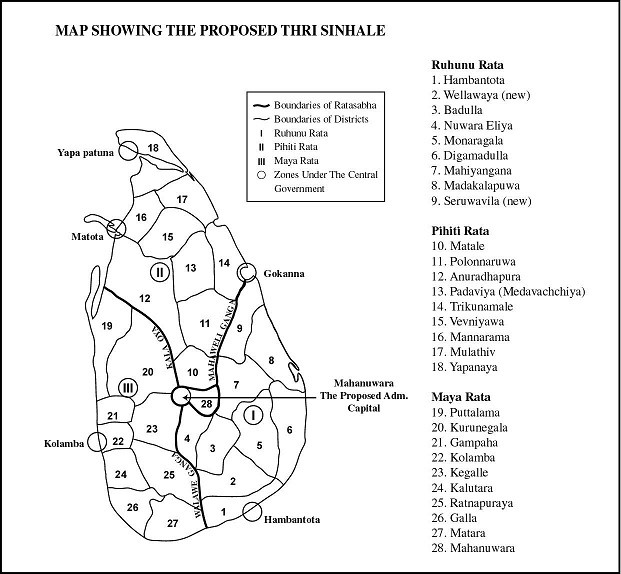
map-sudath                                                    

Map Sudath Gunasekara 2004

Each District will again be divided in to five electorates making provision for 10 MPP vize: 5 for the RS and 5 for the Rata Sabha.

The Three Ratasabhas will also have 151 Members; 145 elected and 6 distinguished persons nominated to represent unrepresented or under-represented sectors from the whole Rata Sabha area

Each Rata Sabha area Will also send 28 elected  Members to the Senate, one for one District

Members to Rajaya Sabha and Rata Sabha

 Each District Council will nominate fifteen15 names at 3 per electorate names of outstanding persons from among whom the voters will elect five to represent them in the Rajaya Sabha and five to the Rata Sabbha. The five members who come first will go to the Rajya Sabha and those who come second will go to the Rata Sabha. All these Members should he permanent residents at least for 5 years within that electorate for which his/her name is proposed and their term of office is 5 years.

The members of the Rata Sabha at their first meeting will elect the Chairmen and Deputy of the Rata Sabha and also the Chairmen and Deputies of the 15 Committees. The Chairmen and Deputies of Committees in turn elect the Chief Minister and the Chairman of each Committee will be designated as a Minister of the Rata Sabha. The Chief Minister will be appointed by the President on the recommendation of the Governor in consultation with the religious dignitaries of the Rata. The other Ministers by the Governor in consultation with the Chief Minister

A Governor appointed by the President in consultation with the Prime Minister, the Chief Minister and the religious dignitaries of the Rata will function as the chief executive of the Rata Sabha.. The Rata Sabha will nominate three (3) other names to the Prime Minister from among persons who have rendered a distinguished service to the country or the Rata Sabha area who have permanent residence within that Rata Sabha area to be appointed as Governor

There will be a Council of Ministers consisting 15 members presided over by a Chief Minister who will again be appointed by the President in consultation with the Prime Minister who will make his recommendations after consulting the MPP of Rajya Sabha representing the particular Rata Sabha area and Rata Sabha Members of the relevant Rata Sabha and the religious dignitaries of the area.

The Chief Minister will be in charge of the Ministry of Finance and Public Administration in addition to any other subject as decided by the central government

The term of office of all members other than the Governor who will remain in office until the new Sabha takes office after swearing in will be 5 years

Other than the President of the Republic all other elected Members and Governors should be permanent residents of the electorate or the Rata Sabha for which he/she seeks election or appointment to qualify to be elected or appointed to such posts. No person from an outside shall be appointed or nomination given.

But any person resident in any part of the country could be nominated for the post of President provided he has the necessary qualifications stipulated in the Constitution.

The Governor should be eligible for reappointment on the recommendation of the new Council of Ministers of the Rata Sabha in consultation with the Members of the Rata Sabha and religious dignitaries of the area.

Present Proposed
President 1 1
Prime Minister 1 1
Governors 9 3
Total 11 5


Present Proposed
MPP Parliament 225  Parliament 151
Provincial CS 638 (3 Ratasabhas) 151
Ministers Parliament 109*   Parliament 15*
Ministers PCC   45* (3 Ratasabhas) 45*


Senators

Total No Politicians


10+225+638=873 less 154*= 719

Nill


Senators

5+151+151 –less 60*+

36 = 283

(Since the PM is included within 225 and 151 he is not added to the total)

The 3 Rata Sabhas (Ruhunu, Pihiti and Maya) under this system will have 3 Governors and 3 Chief Ministers and 151 Ratasabha members (including the CM), instead of 9 Governors, 9 Chief Ministers, and 638 odd parasitic Provincial Councilors?

This will  save more than Rs 600 Billion a year currently wasted just to upkeep Provincial Councilors, their kith and kin and this monstrous and wasteful system (absolutely brings no benefit to the country) that takes the country and the nation down the Gadarene slope for total disaster, that would be used for the development of the country,?

All development work at each level will be done by the respective Councils. But intra-Divisional and Intra District and Intra-Rata Sabha project will be handled by the central Government. But no local work should be done by outsiders without the concurrence of the respective Councils. The central Government in this case will only facilitate the work with funds, technical knowhow etc.

All elected people other than the President of the Janarajaya should have permanent residence within the electorate which they represent. However, the nominees for the post of President could be from anywhere in the Island.

Planning for the grass root level under this system will start at the Janasabha and Village Council level

No politician or public servant, either directly or indirectly shall be allowed to engage in contracts with the Government at any level.

The Provinces, Provincial Councils and the existing Pradesiya Sabha will be abolished under this system.

 I also suggest that we implement the recommendations given in my 100 Panatha to make the new system more effective and meaningful

The proposed Tun Rata Model will benefit the country in the following manner.

The proposal will,

1 Remove the Provinces introduced by the British in 1833 to divide and rule this Island and also the Indian imposed Provincial Council System embraced by JR firstly to the North and East for his survival and rest of the country for dirty political maneuvering when no one asked for it in these regions.

2 Firmly establish a sound, strong and sustainable geopolitical framework that will consolidate the political map of the Island that conforms to geographical, regional, and cultural differences and lays the foundation for re-building a strong and vibrant nation state.

3   Provide a framework for maximum devolution of political and administrative powers to the periphery that will bring about better democracy to the people and ensure balanced and contented development in the regions.

  • Stop ethnic segregation and polarization and promote ethnic and regional harmony and reconciliation that leads to national integration. It will also put an end to all agitations for separate and independent Tamil and Muslim political entities and induce them to think and behave as full citizens of this country without having allegiance to India, Arab world or leave for any Land of Promise.
  • Remove the  Povincess and Provincial Council Councils white elephant and reduce the number of politicians and superficial politico-administrative institutions and so-called public servants to a workable and economic minimum that suits the country, thereby saving billions wasted at present to maintain a ceremonial, corrupt and wasteful system

6 Drastically cut down the Government expenditure and make available more funds for national development that will improve the standards of living of the common people.

7 Put an end to colonial administrative and political legacies that nurtured ethnic polarization and colonial servility, their divide and rule policy that seriously hampered the forward march of the post-independent Sri Lanka and open up new vistas for a united and prosperous new Lanka.

8   Ensure fair and equitable distribution of resources both natural and human among the regions        and promote maximum regional development.

9 Provides a political framework where all people will begin to think firstly, as members of a Rata (Ruhunu, Pihiti or Maya), and secondly, as one nation instead of the present tendency of thinking as Sinhalese (Low country and Kandyans), Tamils or Muslims etc.

10 Restore the lost core historical, political, cultural and economic heritage of the people of this Island nation and lay the foundation for future political stability and socio-economic prosperity.

11 Put an end to the curse of provinces that were designed by the British to divide and dis-integrate this country on ethnic grounds and the Provinces and Provincial Councils forced on us by British and India to achieve their sinister   objective of creating a Tamilnadu within this country.

12 Prevent the formation of the Malayanadu in Central Sri Lanka will get divided between the Tun Rata and EELAM in the North and East as it will get divided between Rajarata and Ruhuna

13 This system will do away with political rivalries and wastage of time, money and election related crimes and bring about a system of government of our own keeping with the age old traditions of the country.

14 Drastically reduce political and administrative positions and Institutions.  Therefore it will result in drastic reduction of Government expenditure on salaries, vehicles, buildings and Elections etc

15 Remove dictatorial powers and immunity of the President and empower people with decision making power down to the very grass root level and make their sovereignty meaningful.

Will result in the devolution of power to the grass root level and people will share the power of governance making it fully democratic.

16 The number of Ministers and Ministries at the centre will get reduced to fifteen

17 Party politics will disappear from trade unions, Universities and government offices thereby millions of man hours lost per day on demonstration etc could be used for nation building.

It will mark the formation of a government by the people, for the people and of the people. Every citizen under this system will feel proud that he is also a part of the Government.

18 It will mark the dawn of new era in democracy in practice and might become a model for all countries that have become victims of colonial exploitation and western systems of government utterly inappropriate to their native environments.

19 This will end the present system of Government by the politicians, for the politicians and of the politicians, their families and cronies” and instead we will have a Home grown system of self Government by the people, for the people and of the people”

20 This system of government is expected to guarantee governance in accordance with Dasarajadharma and enthrone the principle of ‘Bahujana sukhaya Bahujana hitaya” preached by the Buddha.

21 The new system of Government will also be based on the principle where the Wheel of Power will revolve on the Wheel of Dhamma and where Dhamma will form the solid Foundation of Governance.

22 Finally it will mark the dawn of an era of new political culture leading the way to a ”civilization’ State as Martin Jaque has described in his book ‘When China Rules the world’’.

23The whole country will begin to move forward with one national policy

24tThere will a closer relationship between the representatives and voters

25 No politician will be able to run away from responsibility firstly as they have become local people who have amoral obligation to the people and secondly as they could be recalled by the people

26 All institutions will have politicians who are compelled to do what the people want and none will be able to deceive the people and do what they want.

27 The word political victimization will never be heard in this country thereafter as there are no political parties

28 There want be any claim for devolution as maximum power will be devolved up to the village level under this system

29 Independent and strong Judiciary and Public   Service; a New Political Culture in Sri Lanka and A new approach to Good Governance All this you can expect under this system

30 The political, socio-economic, ethnic and regional conflicts will hopefully come to an end

 Dear Nath,

 These 30 items have been randomly prepared in a hurry as I wanted to mail it today I you have the time you may reduce the number. Otherwise let it go with the rest so that readers can get an idea about the benefits of my proposal

Overall these are only some random thoughts that came to my mind. Details have to be worked out jointly by a panel of experts in each field. I am sure you also can improve on this draft prior to a formal session of a panel. After agreeing on the draft we may have to discuss it with few eminent persons well versed in Local Government, Constitutional Law, System of government including Sinhala system etc before we organize the workshop or seminar as you have in mind.

I suggest we invite party leaders for a joint meeting after that and present our document and demands to accept our proposals and tell them that if they do, we will organize the whole country to support any one who gives a definite undertaking to implement our programme to the letter after they win the election.

First of all we have to get a patriotic group to power who are ready to implement this programme After coming to power under the present system they have to promulgate a new Constitution on this basis and implement it ASAP.

Just like what the Sinhala Buddhist patriotic people did in 1956, but with a difference, that is they cannot go back on their promises like what they have been doing ever since 1948.

A new Constitution  should be enacted asap, incorporating these ideas, based on, history and future and expectations of this country, to replace the existing’ scrap of a Constitution’

(This is only an outline draft on the main concept. Details has to be worked out by a committed panel of patriots)

Dr. Sudath Gunasekara

  1. Gemunu Mawatha, Hanthana Pedesa

Mahanuwara.

081 2232744—071 8075326


Rajapaksa explains why he gave up SLFP leadership

September 28th, 2016

Rajapaksa explains why he gave up SLFP leadership
අපි අඩියක් පස්සට අරන් අයින් වුණා

The Transformation of Sri Lanka and the Indian Ocean

September 28th, 2016

Asoka Bandarage Courtesy The Huffington Post.com,

The Transformation of Sri Lanka and the Indian Ocean

Following the 2015 elections and change in political leadership, Sri Lanka is experiencing major policy shifts at the national, regional and international levels. The confluence of these shifts has significant political, economic and cultural implications for the island as well as the Indian Ocean region.

In a seeming return to the ‘dominant minority’ position they enjoyed during the British colonial period, Tamil elites have been appointed to some of the highest positions in the Sri Lankan state, including Chief Justice and Governor of the Central Bank. A Tamil politician was appointed as the Leader of the Parliamentary Opposition even though his Tamil National Alliance party won only 16 seats as opposed to the much larger number of seats gained by the United People’s Freedom Alliance. Notwithstanding the decisive military victory of the Sri Lankan government over the separatist LTTE in 2009 and efforts to increase Tamil participation in the Sri Lankan government, the Tamil demand for constitutional change continues. The demand is for political devolution and transition from a unitary to a federal form of government. The proposed constitutional changes which are backed by the Tamil Diaspora, India and the ‘international community’ are likely to lead to ethnically based balkanization and destabilization of the island, reigniting violent conflict.

The Sri Lankan constitution gives ‘foremost place’ to Buddhism, the religion of 70% of the island’s population referring to the duty of the state to protect and foster Buddhism. At the same time, the Sri Lankan constitution asserts that Every person is entitled to freedom of thought, conscience and religion, including the freedom to have or to adopt a religion or belief of his choice”. Sri Lanka is a multi-ethnic, multi-religious society with long established traditions of mutual co-existence and harmony. The country has allowed extensive Christian evangelical and IslamicWahabi proselytization and conversion that are not permitted in Islamic and many other nations. Still, there is vociferous demand backed by the ‘international community’ for western style pluralism and secularism and the elimination of the ‘foremost place’ given to Buddhism in the proposed new constitution. The severance of the historical relationship between Buddhism and the state would undermine the culture of the Sinhala majority and the identity of the island as a Buddhist nation. The attempted change has already given rise to resistance and inter-religious conflict.

Ethno-religious tension and conflict generated by proposed policy shifts are likely to be aggravated by developments at the regional level. These include efforts by the government of India to integrate Sri Lanka (as well as other smaller neighbors like Myanmar, Nepal and Bhutan) firmly within its sphere of influence. Unlike earlier bilateral trade deals with India, the proposed new Indo-Sri Lanka Trade deal, the Economic and Technology Cooperation Agreement (ETCA) covers trade in services, especially IT, marine, shipbuilding and engineering. The ETCA proposal is yet to be made public. However, given the asymmetry in size and economic and political power of the two countries, it has generated tremendous opposition from professional bodies in Sri Lanka. They are fearful of inundation of doctors and other professionals from India who could displace Sri Lankans in their own country.

The charges of ‘Indian invasion and colonization’ are exacerbated by India’s plan to build a sea bridge and tunnel, at a cost of over $5 billion by the Asian Development Bank, to connect the southern tip of India with the north west of Sri Lanka. Sri Lanka’s territorial integrity, sovereignty and unique cultural heritage were maintained historically through her physical separation from its large and powerful neighbor. There is fear that the easy influx of Indians, Hindus and Muslims, into Sri Lanka through the planned bridge would change the demographic makeup of Sri Lanka turning the Sinhala Buddhist majority into a minority. In the long term, the bridge could well threaten the territorial integrity of India itself by providing the basis for the long held Tamil separatist dream of ‘Greater Eelam’ combining Tamil Nadu and northern Sri Lanka.

Adding to the tensions at the local and regional levels is growing geopolitical competition over access to oil and other resources. India, China and the USA are all struggling for influence over Sri Lanka which is strategically located in the heart of the Indian Ocean. Sea lanes of the Indian Ocean are considered to be the busiest in the world with over 80 percent of global seaborne oil trade estimated to be passing through them. Sri Lanka is central to China in its massive import of energy and export of goods. The U.S. backed political leadership in Sri Lanka tried to break ties with China upon coming into office in 2015. However, faced with the necessity of Chinese economic support, the Sri Lankan government signed a new economic deal with China in April 2016. Despite India’s concerns over Chinese encirclement, Sri Lanka committed itself to active participation in the Maritime Belt and Silk Road initiative (formerly known as the ‘string of pearls’), China’s extensive network of ports and maritime facilities connecting the Pacific and Indian Oceans.

The Indian Ocean (along with the Western Pacific), is expected to become ‘the center of future world politics, strategy and economics’ and one of the moststrategically contested regions in the world. Two US military ships have visited Colombo this year and in August 2016 the first joint operation between the US and the Sri Lankan military took place in Jaffna with participation of TNA politicians at the launching. In September 2016, the United States signed a partnership with Sri Lanka allowing the US House of Representatives to ‘work with’ the Sri Lankan Parliament. It seems that the island is being incorporated as a base of operations in the U.S. military strategy to curtail Chinese expansion across Asia and the world. Is Sri Lanka being turned into a theater for the foremost geopolitical struggle of the 21st century?

To protect the Indian Ocean from militarization and warfare, the countries in the region need to collectively uphold the principles of non-alignment and freedom of navigation in the Indian Ocean. To avoid the emergence of new forms of ethnoreligious violence in Sri Lanka, local communities have to transcend their differences and the divide and conquer approaches of external powers. They have to come together to protect themselves and their beautiful island, ‘The Pearl of the Indian Ocean’.

What was in the secret note Biswal gave when Maithri-Kerry discussed?

September 28th, 2016

By Upul Joseph Fernando Courtesy Ceylon Today

An incident of curiosity took place during the meeting between the Secretary of State of USA John Kerry and President Maithripala Sirisena in New York America. Assistant Secretary Nisha Biswal who participated in this meeting, sent a note to John Kerry. Kerry who read the note asked Maithri about the situation of the UNP-SLFP National Government. If Maithri had a doubt as to why Nisha Biswal sent a note to Kerry requesting him to ask about the National Government, it is justified. However, it would have been Mangala and Ranil who were really happy about Nisha Biswal’s note.

The reason is that Ranil was disturbed about the United National Party (UNP) parliamentarians who had gone to America with Maithripala. There is no doubt that Ranil would have been suspicious regarding the fact that his Members of Parliament had gone to New York without informing either him or his assistant. In the face of accusations targetting Ranil that he is using Mahinda in an attempt to divide the Sri Lanka Freedom Party (SLFP) it is possible that Ranil could believe that Maithripala is attempting to get UNP parliamentarians to turn towards him. Anyhow, there is no doubt that the news that Ranil’s faction was going to question the UNP Members of Parliament who went with Maithri would have succeeded in perturbing Maithri. That news item was definitely an attack on Maithri. If the UNP parliamentarians had gone to New York with Maithri without telling Ranil, this problem should have been discussed between Ranil and Maithri and settled. However, telling the media this has shown not only the country but the international community that there is a huge conflict between the two.

We do not know whether John Kerry asked about the situation of the National Government, while being aware of these problems that exist within the government or not. The note was sent to John Kerry by Nisha Biswal. She is a friend of Minister Mangala Samaraweera. Even though Ranil had problems with Mangala’s Foreign Ministry later Ranil forgot about those problems. Ranil appointed committees to implement the foreign policy of the government saying that it was not being implemented properly by Mangala’s Foreign Ministry. Not only that, Ranil had discussed this issue with Maithri as well. We do not know whether Ranil all of a sudden stopped interfering in the Foreign Ministry because Mangala took on the responsibility taking Ranil’s voice to the international community or not.

A cold war

It is clear that a cold war has been launched between Maithri and Ranil to win over the international community. The Maithri faction would have thought that in this cold war Mangala was trying to obtain advantages for Ranil. That is why the Maithri faction is rejecting the statement made by Mangala regarding war crimes. The number one objective of Maithri and his faction is to get rid of Mahinda and the Rajapaksa family from politics. They feel that, the agenda on war crimes in western countries including America is an obstacle. It would have shown that the Maithri faction is showing a fear that through this the Sinhala Buddhist public would line up with Mahinda. Therefore, it is apparent that an effort is underway to change the way that the agenda on war crimes is seen by the Sinhala Buddhist people. Here, it is apparent that Mangala is working closely with Tamil Diaspora organizations such as the Global Tamil Forum. Ranil is not objecting to that because he is thinking possibly that at the next general election the UNP would be able to win over the support of the Tamil people.

The cold war between Maithri and Ranil to win over the international community is a sign of precedence to winning over the Tamil people at the next general election. It is possible that Mangala has made Ranil to understand that by winning over the Tamil Diaspora it will be possible to acquire the Tamil votes. It is also quite possible that Mangala is telling Ranil that they should work according to the agenda of western countries on war crimes because of that. However, there is the likelihood that Maithri is fearful of the fact that Mangala’s project is destroying Maithri’s political project of not allowing the Rajapaksa family including Mahinda to raise their heads once again.

SRI LANKA GOVERNMENT IS RUN LIKE A FAMILY OF SPOILED CHILDREN

September 28th, 2016

Dr Sarath Obeysekera

Elder brother of our family is very upset about some other members of the family going to Uncle Sam’s house without informing him. Senior uncle related to the partner in the family has unilaterally decided to allow them to enjoy the party in Uncle Sam’s house,

In a family re union ,elder brother was looking for an important brother who invited him for the party and bolted away ,Brother is furious  and wants to reprimand all others .

Then some cousins have gone to the land of Rasputin without informing head of the family spending enormous amount of money and family coffers are depleting .Another  Big Sister who is quite knowledgeable in Horoscopic matters  were playing innocent ,pretending that she did not know .

We need to educate heads of the family to put strict rules to get clearances when they plan to go for various parties.

Various members of the family who are entrusted to monitor various functions like playing Elle ,Running Bollock Carts ( having issues with lack of stud bulls ),boat service” ,Grocery affairs ,handling local police ,looking after lands etc. etc.
They all behave like spoiled children and do what they like and weekly get together to discuss family affairs where all decision are made have been ignored.

Worse of all is the brother who used to play Elle is now looking after family paru ( boat) business ignoring the elder brother and ganging up with the Uncle .

Anther distant relative of a different cast who got married to a member of the next door neighbours who are in logger heads with the family is trying to create disunity by organizing protests in a Northern village .

Very soon whole family may collapse unless influential uncle let the elder brother run the family in the absence of parents


Dr Sarath Obeysekera

මෙන්න පැහැදිලි ඊරිසියාවක්…!!!

September 28th, 2016

 ජනතා හඬ සහ ඒ බිහිසුණු මතකය Tuesday, September 27, 2016

wediwardana

 ජනතා හඬ සහ ඒ බිහිසුණු මතකය
ඡායාරූප සහිතයි 
මිනිස්සු මැරුවෙ මොකටද කියල තොපි දන්නෙ නැද්ද.යුද්දෙ කාලෙ ලංකාවෙන් පැන්න ප්‍රබාකරන්ල දැන් සද්දෙ දාගෙන නැවත එනව මේ රටට කෙළවන්න..සොල්දාදුවෙක්ට පොත් එකක් නෙමේ..,දහස් ගානක් ලියන්න පුලුවන් උන්ට තියෙන අත්දැකීම් එක්ක.උඹල එකෙක්වත් යුද්දෙ බිහිසුණු බව දැක්කෙ නෑ.,අපි ඒක දැක්ක,ඒ අපි ඒකට මූණ දීපු නිසා,උඹල ළඟ ඉඳන් විඳපු ආදරේ අපි දුර ඉඳන් වින්ද,අපිට ඒක හොඳට දැනුන,ඒ අපිට ආදරේ දුර නිසා.,අපි තොපිට වඩා මිනිස් ජීවිතයක වටිනාකම දැක්ක.,ඒ ජීවිතවල තියෙන බලාපොරොත්තු ඇස් දෙකෙන් දැක්ක.,ඒ බොහෝ උන්ගෙ පණ ගියේ අපේ අත් උඩ නිසා..,හෙට මගෙ අතිනුත් ලියවෙයි “යලි උපන් ප්‍රභාකරන්” කියල.ඒ අවුරුදු තිහක් මේ රටට විණ කරපු සැබෑ ප්‍රභා ගැන නෙමේ.,අද බිහිවෙලා ඉන්න අවුරුදු තිහක යුද්දය අවුරුදු හය හතකින් අමතකව ගිය ප්‍රභාල ගැන.,තොපිට ඉරිසියා ඇති සොල්දාදුව අටපාස්වෙලා මේ තරම් හරියක් කරන එකට. 
Anura Priyankara Hapuarachchi
 මහජනයාට සුවසේ හුස්ම ගන්න රටක් ලබාදුන් සෙබලෙක් වු කමල් ගුනරත්න මහතා ගෙ අත් දැකීම් පොතක ලිව්වම එතුමා ලේඛකයෙක් වෙන්නෙ නෑ. . 
ඊරිසියා කාර නුඹේ පොත් මින් මතු මිලදී නොගනිමි. නොකියවමි
 Waruna Ratnayake
 යුද්ධය සහ ජාතිය , රට විකුණා පිටරටක දෙමළ ඩයස් පෝරාවෙන් සහ ඵන්.ජී.ඕ වලින් යැපෙන තොප වැනි අධමයන් නැවත මෙහි ඵන්න ඵපා…
චන්දන කුමාර  

 කුහක වෙඩිවර්ධන. සතා එලියට පැනල…!!!
 Nuwan Sameera

 මහින්ද ට වඩා ප්රභාකරන් උසස්.  
කමල් ගේ පොතට වඩා තමලිනී උසස්. 

හමුදාව ට වඩා කොටි උසස්.

සිංහල බෞද්ධ මාතෘභූමිය ට වඩා ඊළම උසස්.

සිංහලයට වඩා තම්බිය උසස්. “”

මෙසේ මන්දබුද්ධිකව ‘අපි වෙනස්’ යැයි හැගවීමට උත්සුක වන සැවොම සියලු පොරටෝක් වමාරනුයේ මහින්ද රාජපක්ෂගේ නායකත්වය යටතේ රණවිරුවන් විසින් බේරාගත් මව්බිම මත සිටිමින් වීම ‘කෑ කොලපතේ පැහැරීම’ ට සමාන ලෙසින් මා දකිමි.
 Nuwan Sameera
 ඔබට මතකද ඒ කුරිරු ත්‍රස්තයන් මරා දැමූ අපේ අහිංසකයන්.අද දේශපාලනික සමාව දී ඵළියට දමන්නට සැරසෙන්නේ ඒ මිනීමරුවන් ය.

තානාපතිනි මංගලට විරුද්ධව බිලියන බාගයක වන්දි ඉල්ලා නඩුවක් ගොනු කරයි

September 28th, 2016

විදේශ ඇමැති මංගල සමරවීර සිදුකර ඇති ප්‍රකාශවලින් තමාට මහත් අවමානයක්‌ සිදුවූ බව දක්‌වමින් ස්‌විස්‌ටර්ලන්තයේ හිටපු ශ්‍රී ලංකා තානාපතිනි තමාරා කුමානායගම් රුපියල් මිලියන 500 ක්‌ ඉල්ලා මංගල සමරවීරට නඩු පවරා ඇත.මේ පිළිබඳව නඩුව නොවැම්බර් 2 දා කොළඹ අධිකරණයේදී විභාගයට ගැනීමට නියමිතය.

තමා කොටි හිතවාදිනියක්‌ ලෙසට විදේශ ඇමැතිවරයා හඳුන්වා ඇති බව කුමානායගම් වැඩිදුරටත් දක්‌වා ඇත.

මේ සම්බන්ධයෙන් තම නීතිවේදියා යෑවූ එන්තරවාසියට විදේශ ඇමැතිවරයා ප්‍රතිචාර නොදැක්‌වීම නිසා නඩුවක්‌ ගොනු කළ බවද කුමානායගම් වැඩිදුරටත් පැවසීය.

විදේශ ඇමැතිවරයකුගෙන් අතිවිශාල වන්දියක්‌ ඉල්ලා හිටපු ශ්‍රී ලාංකික තානාපතිනියක පැවරූ මුල්ම නඩුව මෙය වේ.

අප්පච්චී

September 28th, 2016

ධර්මසිරි සෙනෙවිරත්න

අප්පච්චී මම ඔබ තේරුම් ගතිමි (විකුර්ති බුද්ධිපොතෙන් )
ර්මසිරි සෙනෙවිරත්න

වත්තේ ,කුඹුරේ දවසම වෙහෙසී ගෙදරට එන මගේ අප්පච්චී
කහට කෝප්පය සප්පායම්වී පිලමත වැතිරෙන අප්පච්චී
දෙනෙතේ කැටිවූ සෙනෙහස හඳුනා නොගත්තෙමී මම අප්පච්චී
උරුමය ,අයිතිය ,ඉල්ලා කලබල කෙරුවේ ඒකය් අප්පච්චී

උගතමනා යය් දෙවු ශිල්පයම මනස විජාතික කරවද් දී
දහමට අනුගත සිංහල දිවිමග නුහුරුවුනා පාසල් යද් දී
ඔබේ අපිස් බව නිවට කමක් ලෙස සලකන්නට මාහුරුවෙද් දී
පන්සල අනුගත නිකෙලෙස් ගිහිවත නොසැලුනි මතකය් සිද් දී

සඳ තරු දිදුලන ඔබේ ලෝකයේ මට පෙනුනේ දැඩි හිස් බව කී
මා ඉල්ලුයේ නිවී නිවී දිදුලන විදුලි බුබුළු පිරි ලෝකය කි
මගේ ලෝකයේ හිස් බව වැටහෙන විට ඔබ මියගොස් කාලයකි
තනිව යැපෙන්නට සිදුවූ පසුවය් පසක්වුනේ එය මිරිඟුව කී
************* *********** ***********
මිෂනාරී අධ්ධ්යාපනයෙන් කුරුවල්වූ මනසින් යුතු වර්තමාන සිංහලයෝ දහමට අනුගත ගිහිවත අමතක කර යහපාලනයක් ඉල්ලා දැන් අන්දමන්දව සිටින්නේත් මේ අන්දමටය . යහපාලනයද දැන් මිරිඟුවකි . මෙය ලිව්වේඅප්පච්චී මලෝ ”’ කතාවට වසර ගණනක් පෙරය .එහෙත් එයටද කිසියම් අදාලබවක් නොපෙනෙන්නේද

සිංහල මුල 2 ( මගේ –:ජාතිය පාවාදීම” පොතෙන් )

September 28th, 2016

ධර්මසිරි සෙනෙවිරත්න

පෙරලිපිය සමග කියවන්න
මහාභාරතයේ අරණ් පර්වයේ සින්හලාන් ලෙසද ද්රෝන පර්වයේසිංහලාහ්ලෙසද ආදී පර්වයේසිංහලාන්ලෙසද යෙදී ඇත .විභීෂණ සීතාට සිංහලයන්ගේ රට පෙන්වූ හැටි බාලරාමායනයේ දැක්වේ ..රාජසුය යාගය සඳහා සිංහල රජවරු පැමිණ සිටි බව මහා භාරතයේ දැක්වේ .සෛන්හලික නම් පදයක් ගුප්ත සමයේ අලහබාද් ප්රශස්තියක එය් ..බුධ්ධගයාවේ සෙල් ලිපියක ””සිංහල දීප ජන්මනා ……….” ලෙසද කෞටිල් අර්ථශාස්ත්රයේ ”””සින්හලදීපේ මයුර ග්රාමේ කුලා නාම නදී ””’යනුවෙන් දෙපොලකම ඇත .මන්ජුස්රි මූල කල්පයේ ””’සිංහල ද්වීප වාසීනඃ””යය දැක්වේ .
හුදු සිංහල නාමයෙන්ම මේ දේශය හැඳින්වූ තැන්ද බොහෝය ””සිංහලය මුතු උපදිනා ආකර අටෙන් එකෙකිය් ””’රත්න පරීක්ෂා ”’ හි සඳහන්වේ ..”’අගස්ති මතයෙහිඑන්නේසිංහලය මුතු උපදිනා පළමුවන තැනලෙසිනි .. ”’සිංහලයෙහි ”” පලිඟු ගැනයුක්ති කල්ප තරුවෙහි භෝජරාජ විසින් දක්වා ඇත ..”’සිංහලය ”” මුතු කෙත බව නවරත්න පරීක්ෂා වෙහි දක්වා ඇත .
පාලියෙන් සීහල වශයෙන්ද සකුවෙන්සින්හලාහ්සහ සින්හලාන් යනුවෙන්ද දෙමල ගත කරුවෝඊලවර්නමින්ද සිංහල ජනයා හැඳින් වුහ .පාලියෙන් සීහලදීප ,,සකුවෙන් සිංහලද්වීප හා දෙමලෙන් ඊලාම් නමින් මේ දේශය හඳුන්වා ඇත .රාජ රාජ නම් චෝල රජුගේ ලිපිවල අපේරට ”’ඊල මණ්ඩලම්නමින් දැක්වේ . ”පත්තුප්පාට්ටුනම් දෙමල කවි පොතේද ඊලාම් යන්න ”’ඊලත්තුලවුම් කාලත්තාක්කවුම්ලෙස යෙදී ඇත .”””සින්ගලම් එන්රදු ඊලනාට්ටේ ඇන්ඩෝ එන්රදු සිගලම් චෝල්යනුවෙන් පවනන්දී පිරිවැජි ගේනන්නුල්නම් දෙමල වියරණයෙහි කියන්නේ ””සිංහලය නම් ඊල දේශයය් ”’ යනුවෙනි ..සින්ගලර් නමින් දදෙමලෙන් සිංහල ජනතාව හඳුන් වන බවකලින්ගත්තුප්පරනිනම් දෙමල කාව්යයෙහි ”’සින්ගලර් වන්කලර් ”’ යන්නෙන් හා රාජ රාජ චෝලගේ ”’මුරට්ටෝලීල් සින්ගලර් ඊල මන්ඩ ලමුම්”’ යන පාඨ වලින් පෙනේ. වීරසොලියම් ව්යාකරණයේ බුද්ධ මිත් හෙවත්පුත්ත මිත්තර්විසින් ”’සින්ගලවන් පෙසුවදු සින්ගලම් ”’යනුවෙන් පවසා ඇත්තේ ”’සිංහලයා දොඩන බස සිංහල නම් වේ ”’ යනුවෙන්ය .
තව පසුවට

විග්නේෂ්වරම්ගේ කි‍්‍රයාකලාපය ජාතිවාදය අවුලවා දේශපාලනයේ වැජඹීමට ගන්නා උත්සාහයක් 

September 28th, 2016

ජාතික භික්‍ෂු පෙරමුණ

පසුගිය 24 වනදා බලවත් උත්සාහයකින් ගෙන්වාගත් දෙමළ ජනතාවක් පෙරමුණේ තබාගනිමින් උතුරේ මහ ඇමති විග්නේෂ්වරන් මහතා ජාතිවාදය ඇවිලවීමේ අරමුණින් කර ඇති ප‍්‍රකාශය අපි ඉතා තරයේ හෙළා දකින්නෙමු.

ව්‍යවස්ථානුකූලව රටේ පුරවැසියන්ට රටේ  ඕනෑම පළාතක වාසය කළ හැකි අතර  ඕනෑම ආගමක් ඇදහිය හැකිය. එය විනිසුරුවරයෙක් වූ විග්නේෂ්වරම් මහතා නොදන්නවා නොවේ. දැන දැනම තම දේශපාලන යැපීම වෙනුවෙන් දෙමළ ජන මානසිකත්වය කැළඹීමේ නින්දාසහගත උත්සාහයහක ඔහු යෙදි ඇති බව පැහැදිලිය.

අතීතයේ පටන් සිංහල දෙමළ ජාතිවාදී නායකයින් සුපුරුදු ලෙස සිදුකළ එකම දේ නම් උතුරේ දෙමළ ජනතාවත් දකුණේ සිංහල ජනතාවත් තරඟෙට මෙන් ලේ කී‍්‍රඩාවට (Blood Game) ඇද දැමීමයි. සඳහා තිස් වසරක් ලෙයින් සහ ජීවිතවලින් වන්දිගෙවා ඇති ලාංකීය සමාජයට තවත් එබඳු ලේ කී‍්‍රඩාවක් අවශ්‍නැති මොහොතක ඊට අත වනමින් විග්නේෂ්වරම්ලා කරන සාහසික උත්සාහය නිවැරදිව තේරුම්ගත යුතුව ඇත.

දැන් දකුණේ ජාතිවාදීන්ට ඉහේ මල් පීපී ඇත. නිසා විග්නේෂ්වරම්ගේ ප‍්‍රකාශයට නොදෙවෙනිව සිංහල ලේවලට කථාකරන සිංහල ජාතිවාදීන් තම වාග් සංග‍්‍රාමයෙන් සටන් වදින්නට පටන්ගෙන ඇත. අවසානයේ උතුරේ දෙමළ ජාතිවාදය අවුස්සන දෙමළ නායකයන් හා දකුණේ සිංහල ජාතිවාදය අවුස්සන සිංහල නායකයන් නෑ සබඳතා ගොඩනගා ගනිද්දී ඔවුන්ගේ ඊනියා වාග් සංග‍්‍රාමවලින් ඇවුළුනු ජාතිවාදී වෛරයෙන් සිංහල දෙමළ අහිංසකයින් කාකොටා ගනිද්දී නායකයින්ගේ මනදොළත්, තනතුරුත් පිරී ඉතිරී, රැුකී, සුරැුකී පවතිනු ඇත.

දෙමළ ජාතික සන්‍ධානයේ පමණක් නොව යම් පමණකට හෝ ජාතික සමගියක් ගැන හිතන දෙමළ නායකයින් පවා විග්නේෂ්වරම්ගේ ප‍්‍රකාශයට විරෝධය දැක්වීම ජාතිවාදයට ඇති විරෝධය පෙන්වන සාධකයකි. අපි එය අගේ කරන්නෙමු.

වත්මන් ආණ්ඩුව සපරිපූර්ණ ලෙස ජාතිවදය පිටු දැකීමටත්, ජාතික සමගිය වැඞීමටත් නිසි කි‍්‍රයාදාමයක් කි‍්‍රයාවට නොනගා ඇති නිසාම විග්නේෂ්වරම්ලා මහ ඇමති බලයේ පංගුවද යොදාගනිමින් ජාතිවාදය අවුලන්නට කැසකවයි. ජනතාවගේ ලේ මතින් දේශපාලනයේ වැජඹෙන්නට කැසකවන දෙමළ වුවද, සිංහල වුවද ජාතිවාදීන්ගේ තිරස්චීන උත්සාහය අද පමණක් නොව හෙටද අතුගා දැමිය යුතුව ඇත. එසේ නොවුනහොත් ප‍්‍රභාකරන්ගෙන් පසු විග්නේෂ්වරම් ඔහුගෙන් පසු තවත් අයෙක් ජාතිවාදය ඇවිලවීමේ යෂ්ටිය භාරගනු ඇත. ජාතිවාදයට එරෙහි එය මුලිනුපුටා දැමීමට සිතන, පතන, කි‍්‍රයාකරන අපකාටත් ඇති වගකීම නම් මේ සිංහල දෙමළ ජාතිවාදී නායකයින් හුවමාරු කරගන්නා යෂ්ටිය විනාශකර දැමීමයි. වෙනුවෙන් ජාතික භික්‍ෂු පෙරමුණ කළ හැකි සියලූ දේ නොනැවතී සිදුකරන බව සියලූ ජනතාවට අවධාරණය කරන්නෙමු.

මෙයට,

ලේකම්,

ජාතික භික්‍ෂු පෙරමුණ

(විමසීම් හා සම්බන්ධීකරණය සඳහා :- 071-8082647 උදිත හිිමි)

වැට්‌ අතීතයට බලපාන වගන්ති ඇතුළත් කරලා පනත පාර්ලිමේන්තුවට ඉදිරිපත් කළ වහා ඒකාබද්ධ විපක්‍ෂය ශේ්‍රෂ්ඨාධිකරණයට යනවා බන්දුල ගුණවර්ධන (එජනිස)

September 28th, 2016

අනුර බාලසූරිය උපුටා ගැන්ම දිවයින 28/09/2016 

ආණ්‌ඩුව විදේශීය බලවේගවලට අපේ ආර්ථිකය උකස්‌ කරලා-මහාචාර්ය ජී. ඇල්. පීරිස්‌

වැට්‌ සංශෝධන පනත් කෙටුම්පත අතීතයට බලනොපාන බව කිව්වත් එහි අතීතයට බලපාන වගන්ති ඇතුළත්ව ඇතැයි පාර්ලිමේන්තු මන්ත්‍රී බන්දුල ගුණවර්ධන මහතා සඳහන් කළේය.

බත්තරමුල්ල නෙළුම් පෙදෙසේ පිහිටි හිටපු ජනාධිපති මහින්ද රාජපක්‍ෂ මහතාගේ දේශපාලන සම්බන්ධීකරණ කාර්යාලයේදී ඊයේ (27 දා) පැවැති ඒකාබද්ධ විපක්‍ෂයේ ආර්ථික පර්යේෂණ ඒකකයේ මාධ්‍ය හමුවේදී හෙතෙම මේ බව පැවැසීය.

නොනිමි වැට්‌ ආරවුල මේ වන විටත් පවතිනවා. මේ වන විට ජාත්‍යන්තර මූල්‍ය අරමුදලේ නියෝජිත පිරිසක්‌ ලංකාවට පැමිණ සිටිනවා. ජාත්‍යන්තර මූල්‍ය අරමුදලට අවශ්‍යවී තිබෙනවා වැට්‌ පනත ඉක්‌මනින් පාර්ලිමේන්තුවට ගේන්න.

ආණ්‌ඩුව බරපතළ ගෙවුම් ශේෂ අර්බුදයට මුහුණදීම සඳහා ජාත්‍යන්තර මූල්‍ය අරමුදල සමග ගිවිසුමක්‌ අත්සන් කළා. ඒ ගිවිසුම අනුව ඉදිරි වසර 3 කට වාරික හයකින් ඇමරිකානු ඩොලර් බිලියන 1.5 ක්‌ ණය වශයෙන් ලැබෙනවා.

මෙවැනි අසමතුලිත තාවයකට මූල්‍ය අරමුදල ණය සපයන විට කොන්දේසි මාලාවක්‌ ඉදිරිපත් කරනවා. එය කෝකටත් තෛලය වගේ සෑම රටකටම ඉදිරිපත් කරන වට්‌ටෝරුවක්‌. ඒ වට්‌ටෝරුවේ ප්‍රධාන වශයෙන් කියවෙන්නේ රජයේ ආදායම් හැකියාවක්‌ වර්ධනය කිරීම, රාජ්‍ය වියදම් කපා හැරීම අයවැය පරතරය සියයට 5 අඩුවෙන් සියයට 3 මට්‌ටමකට ගේන ඒම. විනිමය අනුපාතය නිදහසේ තීරණය වීමට දීම ආදී කරුණුයි.

ඒ අනුව රජයේ ආදායම් වැඩිකර ගැනීමේ ප්‍රධාන ක්‍රමයක්‌ වැට්‌ බදු. මේ වැට්‌ බද්ද 2002 දී රටට හඳුන්වා දුන්නේ. 2002 වැට්‌වලින් ලැබුණු ආදායම බිලියන 66 යි. අවසානයේ මහින්ද රාජපක්‍ෂ මහතා මුදල් ඇමැති ධුරය දරන විට වැට්‌ බද්ද මගින් ලැබූ ආදායම බිලියන 275 යි. 2002 සිට මහින්ද රාජපක්‍ෂ යුගය අවසන් වන විට වැට්‌ මගින් උපයාගත් ආදායම සියයට 310 කින් වැඩිකර තිබෙනවා. නමුත් ඒ කිසිම අවස්‌ථාවක ලංකාවේ වෙළෙඳ සැල් වැසුවේ නැහැ. රෝහලට බෙහෙත් ගන්න ගිය රෝගීන් ආණ්‌ඩුවට දෙස්‌ දෙවොල් තිබ්බේ නැහැ. ව්‍යාපාරිකයෝ බදුවලට විරෝධය දක්‌වා මුදල් අමාත්‍යාංශය වැටලුවේ නැහැ. හේතුව බදු අය කිරීමේ මූලධර්මයන්ට අනුව ජනතාව පීඩාවට පත් නොවන ආකාරයට බදු අය කිරීම නිසා.

මේ රජය යටතේ 2016 අයවැයෙන් පසු වැට්‌ පිළිබඳ විරෝධයක්‌ පැන නැඟුණේ නෑ. ප්‍රශ්නය හදා ගත්තේ රවි කරුණානායක මුදල් ඇමැතිවරයායි. පාර්ලිමේන්තුවට කැබිනට්‌ මණ්‌ඩලයට නොකියා ඔහු තීරණය කරලා දේශීය ආදායම් කොමසාරිස්‌ ජෙනරාල් තුමියට නියෝග කළා. වැට්‌ බද්ද සියයට 15 දක්‌වා වැඩිකර තිබෙනවා. සිල්ලර තොග වෙළෙ¹මෙන් රෝගීන්ගෙන් බදු අයකිරීමට. මේ ආරවුල හදා ගත්තේ මැයි මස 2 වැනිදා. එදා සිට ඒකාබද්ධ විපක්‍ෂයේ අපි මේ අරවුල පිළිබඳ රටට කිව්වා. බැරිම අවස්‌ථාවේ අපි ශේ්‍රෂ්ඨාධිකරණයට ගියා. ශේ්‍රෂ්ඨාධිකරණය තීන්දු කළා පනත බලරහිතයි කියලා. ඉන්පසු වැට්‌ අය කිරීම නතර කළා.

ඉන්පසු මෙම මස 9 වැනිදා වැට්‌ සංශෝධනයට අදාළ ගැසට්‌ නිවේදනය නිකුත් කළා. මේ ගැසට්‌ නිවේදනය වන විට කැබිනට්‌ මණ්‌ඩලය රැස්‌වන්නේ සැප්තැම්බර් 13. ගැසට්‌ නිවේදනය රජයේ මුද්‍රණාලයේ මුද්‍රණය වන්නේ 9 වැනිදා. 9 වැනිදා මුද්‍රණය වනවිට එහි වරහන් තුළ තියෙනවා 2016.09.13 නිකුත් කරන ලදී කියලා.

වැට්‌ සංශෝධනය කැබිනට්‌ අනුමැතියට එන්න පෙර ගැසට්‌ කර ඊට පසුව 13 වැනිදා කැබිනට්‌ මණ්‌ඩලයෙන් සංශෝධන අනුමත කර ගන්නවා. මෙතෙක්‌ ලංකා ඉතිහාසයේ පැවැති සම්ප්‍රදාය නම් කැබිනට්‌ මණ්‌ඩලයට කැබිනට්‌ පත්‍රිකාව ඉදිරිපත් කර සංශෝධන කැබිනට්‌ මණ්‌ඩලයේ සාකච්ඡා කර ඉන්පසු ගැසට්‌කර පාර්ලිමේන්තුවට ඉදිරිපත් කෙරෙන්නේ. දැන් මේ වෙන්නේ සංශෝධන පනත් කෙටුම්පත ගැසට්‌ කර කැබිනට්‌ මණ්‌ඩලයට ඉදිරිපත් කිරීමයි.

වැට්‌ සංශෝධන පනත් කෙටුම්පත 9 වැනිදින ප්‍රථමයෙන් ගැසට්‌ කිරීමෙන් පසු 13 වැනිදින කැබිනට්‌ මණ්‌ඩලයට ඉදිරිපත්කර කැබිනට්‌ මණ්‌ඩලය අනුමත කර තිබෙනවා. තාම පාර්ලිමේන්තුවට ආවේ නෑ. අපිත් බලා ඉන්නවා කිමද නාවේ ඇයි නාවේ කියලා.

මේ පනත අතීතයට බලපාන්නේ නෑ කිව්වත් මේ සංශෝධනයේ තියෙනවා. 2016 ජනවාරි 1 වැනිදා සිට ඉන්පසු මැයි මස 02 වැනිදා සිට බදු ගෙවීම් කළ යුතු ආකාරයට වගන්ති? මෙහි ඇතුළත්ව තිබෙනවා. ඒ අනුව මෙය අතීතයට බලපානවා. සෞඛ්‍ය ක්‍ෂේත්‍රයට වැට්‌ බදු පනවා අසරණ රෝගීන්ට පනවන්නේ නෑ කිව්වත් සංශෝධනයෙන් නිදහස්‌ කර තිබෙන්නේ පෞද්ගලික අංශයේ ඉතා සීමිත වෛද්‍ය සේවා ප්‍රමාණයක්‌ පමණයි. පිළිකා හා හෘද සැත්කම් සඳහා වැට්‌ බදු ගෙවන්න වෙනවා. මේ විදියට රෝගීන්ට දෙයාකාරයකට සැලකීම මූලික මිනිස්‌ අයිතීන් උල්ලංඝනය වීමක්‌ නොවේද කියන ප්‍රශ්න මතුවෙනවා.

ඊට අමතරව මෙහි භයානක වගන්තියක්‌ තියෙනවා මැයි 2 වැනිදා සිට අයකරපු වැට්‌ බදු නීත්‍යනුකූල ලෙස අය කළ ඒවා ලෙස සැලකීමට අවශ්‍ය විධිවිධාන ඇතුළත් කර තිබීම.

වැට්‌ සංශෝධන පනත් කෙටුම්පත පාර්ලිමේන්තුවට ඉදිරිපත් කළ වහා ඒකාබද්ධ විපක්‍ෂය පීඩාවට පත්වන ජනතාව වෙනුවෙන් අධිකරණයේ පිහිට පතා ශේ්‍රෂ්ඨාධිකරණයට පෙත්සමක්‌ ඉදිරිපත් කරනවා.

මුදල් ඇමැතිවරයා හිතනවා ඒකාබද්ධ විපක්‍ෂයේ රජයේ වැඩපිළිවෙළ කඩාකප්පල් කරනවා කියලා. අපි කරන්නේ කඩාකප්පල් කිරීමක්‌ නොවෙයි. මේ බද්ද මහින්ද රාජපක්‍ෂ යුගයේදීත් තිබුණා. ඊට පසුවත් මෙම මැයි මාසය වෙනකන් තිබුණා. මේ පිළිබඳ ආරවුලක්‌ තිබුණේ නෑ. ජනතාව පීඩාවට පත් නොවන ලෙස ආණ්‌ඩුක්‍රම ව්‍යවස්‌ථාව පාර්ලිමේන්තුව බුල්ඩෝසර්කරණය නොකොට පිළිගත් ක්‍රමවේදයන්ට අනුව මෙය ඉදිරිපත් කරන ලෙසත් ඒ සඳහා විකල්ප ක්‍රම පෙන්වමින් ඒකාබද්ධ විපක්‍ෂය මෙම සාධාරණ විවේචන ඉදිරිපත් කරනවා.

මහාචාර්ය ජී. එල්. පීරිස්‌ මහතා-

ශ්‍රී ලංකා නිදහස්‌ පක්‍ෂය තමන්ගේ ප්‍රතිපත්ති ගෙඩිය පිටින්ම එක්‌සත් ජාතික පක්‍ෂයට පවරා දීලා. අද මේ රටේ ආර්ථිකය මෙහෙයවීම සම්බන්ධයෙන් ශ්‍රීලනිපය එජාපයේ වලිගයක්‌ බවට පත්වෙලා. ශ්‍රීලනිපය පුද්ගලීකරණය වෙනුවෙන් කිසිදාක පෙනී සිටි පක්‍ෂයක්‌ නොවෙයි.

මේ ආණ්‌ඩුව කියනවා පාඩු ලබන සංස්‌ථා විකුණනවා කියලා. පාඩු ලබන සංස්‌ථා හැටියට හඳුන්වා දෙන්නේ විදුලිබල මණ්‌ඩලය, ඛනිජ තෙල් සංස්‌ථාව, ශ්‍රීලන්කන් ගුවන් සමාගම, වී අලෙවි මණ්‌ඩලය, ලංගම, දුම්රිය, තැපැල්, ජල මණ්‌ඩලය මේ ආයතන ජනතා සේවයක්‌ කරන ආයතන එසේ නම් ලාභ නොලැබීම නම් මේ සම්බන්ධව පාවිච්චි කරන මිණුම් දණ්‌ඩ ලංකා රෝහල හා හිල්ටන් හෝටලය විකුණන්නේ ඇයි. මේවා විශාල ලාභ ලැබූ ආයතන. මේ පුද්ගලීකරණ වැඩපිළිවෙළ ශ්‍රීලනිප ප්‍රතිපත්තිවලට සම්පූර්ණයෙන්ම පටහැනියි. අප කළ යුත්තේ ලාභ ලැබෙන සංස්‌ථාවලින් ලැබෙන ලාභය මැනවින් කළමනාකරණය කරමින් ජනතාවට සේවය ලබාදෙන ආයතන රැකගෙන ඒ සේවය අඛණ්‌ඩව ලබාදීමයි.

ශ්‍රීලනිප ප්‍රතිපත්ති ප්‍රකාශයේ කොහේවත් පුද්ගලීකරණය සඳහන්ව නෑ. විදේශීය බලවේගවලට මෙන්ම අපේ ආර්ථිකය උකස්‌ කරන තත්ත්වයට පත්වෙලා තියෙනවා. එට්‌කා ගිවිසුම මේ වසර අවසන් වීමට පෙර ලහි ලහියේ අත්සන් කිරීමට රජය බලාපොරොත්තු වෙනවා. ඒ එල්ලවන බාහිර බලපෑම් නිසයි. මින් සිදුවන්නේ ශ්‍රී ලංකාව ඉන්දියාවේ ප්‍රන්ත ආර්ථිකයක්‌ බවට පත්වීමයි. මෙතෙක්‌ කරපු දේවල් බැලුවොත් ආණ්‌ඩුව එල්.ඕ.අයි.සී. ඉන්දියන් ආයතනය ශක්‌තිමත් කරන අතර ලංකා ඛනිජ තෙල් සංස්‌ථාව දුර්වල කළා.

ලංකා ඛනිජ තෙල් සංස්‌ථාව දුර්වල කිරීමට ඛනිජ තෙල් ආනයනය බෙදා හැරීම ඉන්දියානු සමාගමට පවරලා. ත්‍රිකුණාමලයේ තෙල් ගබඩාව ඉන්දියාවේ එල්.ඕ.අයි.සී. එකට පවරාදීම හරහා විශාල හානියක්‌ ඛනිජ තෙල් සංස්‌ථාවට කර තිබෙනවා.

ඉන්දියාව එක්‌ක දැනට තිබෙන තීරුබදු ගිවිසුම හරහා ශ්‍රී ලංකාවේ ව්‍යාපාරිකයන්ට විශාල අසාධාරණයක්‌ වෙලා. මේ ප්‍රශ්න නිරාකරණය කර ගැනීමට පෙර එට්‌කා ගිවිසුම අත්සන් කිරීම කිසිසේත් සුදුසු ක්‍රියාවක්‌ නොවෙයි. එට්‌කා ගිවිසුම හරහා පරිගණක හා ඉංජිනේරු සේවා අවතක්‌සේරු කිරීම විශාල ලෙස සිදුවෙනවා. දැනට මේ රටේ රැකියා විරහිත උපාධිධාරීන් 30,000 ක්‌ පමණ සිටිනවා. ඒ තත්ත්වය වඩාත් නරක අතට හැරෙනවා. එට්‌කා ගිවිසුමේ ප්‍රතිඵලයක්‌ ලෙස.

ශ්‍රීලනිපය හැමදාම බදු සම්බන්ධයෙන් පෙනී සිටියේ ජනතා හිතවාදී ප්‍රතිපත්තියක්‌ අනුගමනය කළ යුතුයි කියන තැන. බදු ගෙවන්න හැකියාවක්‌ තියෙන පුද්ගලයන්ගෙන් බදු අය කළේ. මේ වැට්‌ බද්දෙන් සාමාන්‍ය ජනතාවට විශාල හානියක්‌ වෙනවා. ධනේෂ්වර පන්තියට සහන දීම එජාප ප්‍රතිපත්තිය. වක්‍ර බදුවලින් වුවත් ජනතාව පීඩාවට පත් නොකිරීමයි ශ්‍රීලනිප ප්‍රතිපත්තිය. නමුත් දැන් ඒවා කණපිට පෙරළිලා.

මේ රටේ කෘෂිකර්මය, කර්මාන්ත ආරක්‍ෂා කිරීමේ අරමුණින් අය කෙරෙන සෙස්‌ බද්ද ඉවත් කරන බව අගමැතිවරයා ප්‍රකාශ කර තිබෙනවා. දේශීය කර්මාන්තකරුවා රැක ගැනීමටයි සෙස්‌ බද්ද අය කළේ.

ශ්‍රීලනිප ප්‍රතිපත්තියට පටහැනි වැඩපිළිවෙළක්‌ කෘෂිකර්ම ක්‍ෂේත්‍රයෙනුත් ක්‍රියාත්මක වෙනවා. ඉන්දියානු ගිලන් සේවය හරහා රටේ ආරක්‍ෂාවට බලපාන සියලු කරුණු සොයා ගැනීමට ඉඩකඩ සැලසෙනවා.

අද වන විට පොලිස්‌ මූල්‍ය අපරාධ කොට්‌ඨාසයට සී.අයි.ඩී. එකට අල්ලස්‌ කොමිසමට රාජ්‍ය සේවකයන් 8000 ක්‌ පමණ ගෙන ගොස්‌ තිබෙනවා. මෙය විශාල පීඩනයක්‌ ඒ අයට. මේ නිසා රාජ්‍ය සේවකයන් තුළ තීරණ ගැනීම හා ක්‍රියාත්මක කිරීම පිළිබඳ විශාල බියක්‌ ඇතිවී තිබෙනවා. එය රටේ ආයෝජන කඩා වැටීමට ප්‍රධාන හේතුවක්‌ වී තිබෙනවා. කවුරුත් තීරණ ගන්නේ නෑ. තීරණ අරගෙන ඒවා ක්‍රියාත්මක කිරීමට වැඩපිළිවෙළක්‌ සකස්‌ කරන්නේ නෑ. මොකද ඉදිරියේදී කොමිෂන් සභාවලට, පොලිස්‌ මූල්‍ය අපරාධ කොට්‌ඨාසවලට ගෙන යයි කියා බයක්‌ තිබෙන නිසා. ඒනිසා ඒ අය නිහඬව සිටිනවා. ශ්‍රීලනිප ආණ්‌ඩුවේ සිටින මන්ත්‍රීවරු එජාපයේ මෙවලමක්‌ ලෙස පාවිච්චි වෙනවා. මේ පිළිබඳව ඒ මන්ත්‍රීවරු ගැඹුරින් සිතිය යුතුයි.

මේ ආරවුල් එන විට පිටු 6 ක ලිපියක්‌ ජනාධිපතිවරයාට ලියාපදිංචි තැපෑලෙන් යෑව්වා. ආණ්‌ඩුවට අයවැය ලේඛනයක්‌ ඉදිරිපත් කරගන්න බැරි නිසා ජාත්‍යන්තර මූල්‍ය අරමුදලේ නියෝජිතයන් කියනවා දෙවන වාරිකය දෙන්නේ නෑ කියලා. මේ ආණ්‌ඩුවට බදු සංශෝධනයක්‌ ඉදිරිපත් කරගන්න බැහැ. ආණ්‌ඩුවේ නොහැකියාව පිළිබඳ පරමාදර්ශයක්‌ දී තිබෙන නිසයි මේ පනත ඉක්‌මනින් පාර්ලිමේන්තුවට ඉදිරිපත් කරන්න කියලා ජාත්‍යන්තර මූල්‍ය අරමුදල කියන්නේ.

යාපනයේ යළි මතුවූ පොංගුතමිල් අවතාරය

September 28th, 2016

උපුටා ගැන්ම දිවයින 27/09/216 

* ස්‌වයංපාලනය දෙනු.

* සෛවරී පෙඩරල් පාලනයක්‌ අවශ්‍යයි.

* ජාත්‍යන්තර හයිබ්‍රිඩ් යාන්ත්‍රණයක්‌ අවශ්‍යයි.

* යාපනයේදී කළ ප්‍රකාශ පිළිකුලෙන් හෙලා දකිනවා. – රජය

රජය සංහිඳියාව ගැන කටයුතු කරන අවස්‌ථාවේ උතුරු මහ ඇමැති විග්නේෂ්වරන් දෙමල පිබිදීම නමින් බෙදුම්වාදී මෙහෙයුමක්‌ දියත් කර ඇත. උතුරේ බෞද්ධ සිද්ධස්‌ථාන ස්‌ථාපිත කිරීම අත්හිටුවනු සහ සිංහල ජනතාව පදිංචිකරවීම නතර කරනු යන්න මෙම දෙමළ පිබිදීමේ අරමුණ වී තිබේ. මෙය ප්‍රභාකරන්ගේ පොංගු තමිල් වැඩපිළිවෙළට සමානය. මෙලෙස උතුරේ ෙද්‍රdaහී ක්‍රියාදාමයක්‌ දියත්වන අවස්‌ථාවේ ස්‌විට්‌සර්ලන්තයේ ජිනීවා මානව හිමිකම් කවුන්සිලය තුළද මෙහෙයුම් දියත් වේ. එම මෙහෙයුම දියත්කර ඇත්තේ බී. ටී. එස්‌. හෙවත් බ්‍රිතාන්‍ය ද්‍රවිඩ සංසදයයි. වත්මන් විදේශ කටයුතු අමාත්‍යංශය බ්‍රිතාන්‍ය ද්‍රවිඩ සංසදයේ තහනම ඉවත් කළේය. එහෙත් ඊට මුවාවී බ්‍රිතාන්‍ය ද්‍රවිඩ සංසදය විදේශිකයන් කීපදෙනකුද සම්බන්ධකරගෙන උතුරේ හමුදාකරණය සහ ඉඩම් අල්ලා ගැනීම මැයෙන් සමුළුවක්‌ පවත්වා ඇත.

මේ සමුළුවේදී රාජ්‍ය නොවන සංවිධාන ක්‍රියාකාරීන් අතර රැඟුම් දක්‌වන කුප්‍රකට චරිතයද දක්‌නට ලැබීය. ඒ 1971 කැරැල්ලේ හිටපු කැරලිකරුවකුවූ සුනන්ද දේශප්‍රිය නොහොත් රංජිත් නැමැත්තායි.

මෙම බ්‍රිතාන්‍ය ද්‍රවිඩ සංසදය නැමැති කොටි හිතවාදී සංසදය ජිනීවාහි තානාපති ප්‍රජාවට පෙන්නුම්කරන්නේ උතුර මුළුමනින්ම හමුදාව විසින් අල්ලාගෙන ඇති බවයි. එසේම උතුරේ ද්‍රවිඩ ජනතාව සතු සියලුම ඉඩම් හමුදාව පැහැරගෙන ඇති බවටද සාවද්‍ය ප්‍රචාරයක්‌ද මෙකී සංසදය දියත් කර ඇත.

වසර ගණනකට පෙර ජිනීවා කොටි උද්ඝෝෂණවලදී කැපී පෙනුන චරිතයක්‌වූ හිටපු ප්‍රාදේශීය වාර්තාකරුවකුවූ ශාන් තේවරාජා නමැත්තාද යලි මතුවී එකී සමුළුවට සහභාගිවී තිබේ.

ප්‍රභාකරන් උතුරේ ද්‍රවිඩ ජනතාව සතු ඉඩම් අල්ලාගෙන තම මියගිය කොටි ත්‍රස්‌තයන්ට ලබාදෙද්දී මොවුන් නිහඬව සිටියේය. කොළඹ පොලිස්‌ නිලධාරියකු සතු පාරම්පරික නිවසද ප්‍රභාකරන් විසින් අල්ලාගෙන තිබුණි.

එසේම යාපනය කච්ෙච්රියේ තිබූ සියලු ඔප්පු තිරප්පු පුළුස්‌සා දමා ඇත. එහෙත් දැන් ඉඩම්වලට අළුත් අයිතිකරුවන් ඉදිරිපත්වී තිබේ. පලාලි අධිආරක්‍ෂක කලාපයට පමණක්‌ නොව මයිලව්ඩි වරායටද හිමිකම් ඉදිරිපත්වී තිබේ.

එම තත්ත්වය මත මේ ඉඩම්වල නිසි හිමිකරුවන් සෙවීමක්‌ සිදුවී නැත.

මේ අතර ජිනීවා මානව හිමිකම් සමුළුවේ 33 වැනි සැසිවාරයේදී ඊලම් ඩයස්‌පෝරාව පත්‍රිකාවක්‌ බෙදාහැරියේය. මේ පත්‍රිකාවේ පිටපතක්‌ ද්‍රවිඩ ජාතික කොටි විරෝධියකු විගස අපට එවනු ලැබීය. එහෙත් කොළඹ විදේශ කටයුතු බලධාරීන් ජිනීවාහි සිදුවන්නේ කුමක්‌දැයි නොදනිති.

මෙම ඊලම් ඩයස්‌පෝරාව නිකුත් කළ පත්‍රිකාවෙන් රජයට බරපතළ චෝදනා එල්ල කර ඇත.

එක්‌ පැත්තකින් සංහිදියාව ගැන හඬ නගමින් ජිනීවාහිදී ශ්‍රී ලංකාවට එරෙහිව ගෙනයන සාවද්‍ය ක්‍රියාදාමයක්‌ මෙහෙයවීමට මෙම ඊලම්වාදීන් ක්‍රියාකිරීම දෙබිඩි පිලිවෙතක්‌ නොවේද? මේ සැබෑ යථාර්ථය තේරුම් ගැනීමට රාජ්‍ය යාන්ත්‍රණයට නොහැකිවී ඇත.

පසුගියදා යාපනයට පැමිණි ඩයස්‌පෝරා ක්‍රියාකාරීන් රජයේ බලධාරීන් වෙතින් ඉල්ලීමක්‌ කෙරුණි. ඒ හමුදාව සතු වානිජ ව්‍යාපාර තමන්ට පවරාදෙන ලෙසය.

ඩයස්‌පෝරාවේ ඉල්ලීමෙන් සනාථවන්නේද බෙදුම්වාදී ඉලක්‌කය නොවේද?

ප්‍රභාකරන්ට එරෙහි නඩුව විභාග කිරීම පුද්ගලික හේතූන් මත යයි කියමින් ප්‍රතික්‍ෂේප කළ විග්නේෂ්වරන් උතුරේ දෙමළ පිබිදීම නමින් ව්‍යාපෘති මෙහෙයවන්නේ සැබෑ සංහිඳියාවටද? එහෙත් සෑම වසරකම ජිනීවා සහ කොළඹ එන්. ජී. ඕ. කාක්‌කන් ශ්‍රී ලංකාවේ විවිධ නගරවලට ගොස්‌ සංහිදියාව ගැන ජනතාවගෙන් අදහස්‌ විමසති.

මෙම පසුබිම මැද විග්නේෂ්වරන් පැවැත්වූ ද්‍රවිඩයන් නැගිටිනු හෙවත් දෙමළ පිබිදීම උද්ඝෝෂණයේදී ඉල්ලීම් කීපයක්‌ ඉදිරිපත් කර ඇත.

එම ඉල්ලීම් අතරින් ප්‍රධාන ඉල්ලීම ස්‌වයංපාලනය ලබාදෙන ලෙස කරන ඉල්ලීමයි. එසේම මානව හිමිකම් උල්ලංඝණය කිරීම ගැන වූ දේශීය යාන්ත්‍රණය ප්‍රතික්‍ෂේප කරන අතර හයිබ්‍රිඩ් යාන්ත්‍රණයක්‌ අවශ්‍ය බවද කියාසිටියි. මෙම දෙමළ පිබිදීම උද්ඝෝෂණයෙන් විග්නේෂ්වරන් ඉලංකයි තමිල් අරසු කච්චි පක්‍ෂයේ නායකත්වයට අභියෝගයක්‌ කර ඇත.

මේ හැර උතුරු නැගෙනහිරට පෙඩරල් පාලනයක්‌ද උතුරෙන් වහාම හමුදාව ඉවත් කරන ලෙසද ඉල්ලා තිබේ. රජය මේ උද්ඝෝෂණය සම්බන්ධයෙන් පැවසුවේ පිළිකුලෙන් යුතුව එය හෙලාදකින බවයි.

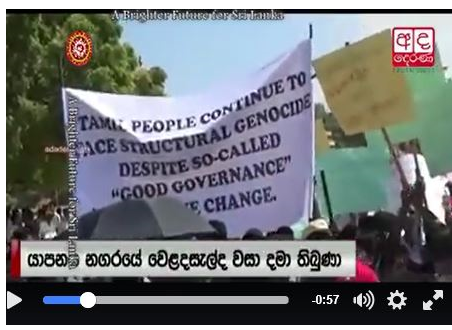
ශ්‍රී ලංකාවේ හමුදාව ජාති සංහාරයක්‌ සිදුකල බවට දැක්‌වෙන පුවරුද මෙම උද්ඝෝෂණයේදී ප්‍රදර්ශනය කර ඇත. එහෙත් විග්නේෂ්වරන් පවසා ඇත්තේ මෙම උද්ඝෝෂණය සිංහල බෞද්ධ ජනතාව වරදවා තේරුම් නොගත යුතු බවයි.

මේ ප්‍රකාශයෙන් උතුරු මහ ඇමැතිවරයා සිතන්නේ මෙරට බහුතරය අඥනයන් බවටද? ඔහුගේ ස්‌වයංපාලනය නැමැති බෙදුම්වාදී පිළිවෙළ යලිත් එළිදක්‌වා තිබේ. ප්‍රභාකරන් සිටින විට යාපනය පැත්ත පළාතේ නොගිය විග්නේස්‌වරන් උතුර මුදාගත් පසු උද්ඝෝෂණ පැවැත්වීම විහිළුවක්‌ නොවේද? ඔහුට ඊලම්වාදීන් එක්‌ව මෙම උද්ඝෝෂණයක්‌ පැවැත්වීමට හැකිවූයේද හමුදාව උතුර මුදාගත් නිසාය.

මෙම උද්ඝෝෂණය ඇමතූ හිටපු ද්‍රවිඩ සන්ධාන මන්ත්‍රී සුරේන් ප්‍රේමචන්ද්‍රන් ද්‍රවිඩ ජනතාව පරාජිත ජනතාවක්‌ නොවන බවත් අවසානය දක්‌වාම සටන් කරන බවත් ප්‍රකාශ කර ඇත.

මෙලෙස උතුරු මහ ඇමැති විග්නේෂ්වරන් යාපනයේදී රඟදැක්‌වූයේ “මායාවක්‌” නොවේ. ඔහුගේ මේ ක්‍රියාදාමය ඉදිරියේදී මතුවිය හැකි බරපතළ අනතුරක ලකුණු බව අවබෝධ කරගත යුතුය.

කීර්ති වර්ණකුලසූරිය

ආණ්ඩුවේ මුළු කෙරුවාවම වචන තුනකින් කියයි.. ඊළග කෝච්චියේ බෝම්බයක්.. තර්ජන ගම්මානවල මැරෙන බිළිදන්..

September 28th, 2016

ලංකා සී නිවුස්

අලූත් ආණ්ඩුව නිසා ගොඩ ගියේ තිදෙනෙක් පමණක් බව ජාතික නිදහස් පෙරමුණු නායක පාර්ලිමේන්තු මන්ත‍්‍රී විමල් වීරවංශ මහතා පවසයි.

කොළඹදී පැවති ඒකාබද්ද විපක්‍ෂ මාධ්‍ය හමුවක් අමතමින් ඔහු කියා සිටියේ එම තිදෙනා නම් අර්ජුන් මහේන්ද්‍රන්ගේ බෑණා, වසීම් තජූඞීන් හා ලසන්ත වික‍්‍රමතුංග බවයි.

අනිත් සියළු දෙනා අද වන විට වැලලී සිටින බවද ඔහු එහිදී කියා සිටියේය.

Sri Lankan Government preaching RECONCIILIATION – Tamil politicians preaching RACISM

September 27th, 2016

Shenali D Waduge

It’s rather a precarious situation giving new meaning to ‘don’t bite the hand that feeds you’. The racist Tamil leaders have plucked out a new terminology from their racist hat ‘structural genocide’ the placards read claiming that the good governance government of CBK-Sirisena & Ranil have failed them. So what are they now upto? We have come to a point where we must ask what more must be given for them to be satisfied and what have they given in return to be making such demands?

shenali28091601

Here is a list of demands that the September Jaffna protestors carried to clearly showcase to the world the exact nature of the racism that prevails among the Tamil politicians and questions how many of the Tamil populace align with these thoughts.

The demands include removal of Buddhist sites, no Sinhalese in the North, if so by the same logic are those who are making demands going to remove Tamils and kovils from the South? See the stupidity of the demands being made by these Tamil racists?

shenali28091602

Since the January 2015 ‘CHANGE’ occurred the following changes have taken place just to please the LTTE Tamil Diaspora and peddling to the whims of the separatists most of whom where camouflaged by various foreign backed organizations and who have been given plum portfolios by the new government in areas where the real legally binding structural changes are being drafted by them – the constitution being the primary victim.

The economy being handed over to foreign hands with changes being made to the laws, legal framework will soon result in the takeover of all things belonging to the citizens of Sri Lanka and the most ironical eventuality is that the stupid politicians will soon find out that they too would be kicked out of the picture altogether. They would be of no use once all the changes take place. Those now in their retirement years would have been assured plum retirement packages on foreign shores for abdicating powers of the nation to foreign hands. We can well guess who these traitors are.

  • Inspite of continuous public requests to investigate the TNA for links with the LTTE as evident even from the election head of the EU report in 2004 claiming LTTE and TNA were one and the same and even TNA election manifestos openly claiming allegiance to the LTTE, the TNA head is today the Opposition Leader steering racist separatism using his office.
  • The Government co-sponsoring the Geneva Resolution, making a laughing stock of the country globally and committing the country’s national army to international humiliation by agreeing to parade them as war criminals. Without even studying the documents and questioning the UNHRC singlehandedly agreeing to ridicule a country’s army without the consent of the public is unforgiveable.
  • Key LTTE fronts proscribed under UNSC Resolution 1373 have been deproscribed without any valid reason given except claiming to be ‘reconciliation’ while numerous other mardi gras have been held under the auspices of the foreign minister also using the slogan reconciliation. Some of the individuals who had been canvassing openly for LTTE have also been removed from the proscribed list and now they are openly advocating separatism with no response from the government.
  • The reconciliation is also instrumental in placing teams of people to draft the new constitution most of whom are questionable characters in the light of their career records and allegiance shown over the years. Some of these characters are even in the constitutional council.
  • LTTE cadres who had refused rehabilitation and projected unlawfully as ‘political prisoners’ being released while State intelligence officers who had been serving the nation have been imprisoned under PTA and mentally harassed.
  • LTTE cadres given loans, LTTE cadres who had fled the country allowed to return and given other facilities while soldiers accused of shooting LTTE have their families forced to pay compensation.
  • IDPs given land deeds when most of them did not even have lands or deeds.
  • Strategic camps and military installations removed simply on demand of the TNA and Tamil Diaspora
  • Removal of the Chief Justice without show cause and appointment of new Chief Justice after allowing the previous Chief Justice to the previous to sit in office for a day. Now a Tamil Chief Justice prevails.
  • Numerous corruption related units opened but only questioning and arresting those in the Opposition. All the MPs who were accused of corruption under the former government who are now in the present government most of whom have been rejected by the voters have been given portfolios under the slogan of good governance are not being investigated or questioned
  • LTTE sleepers in foreign nation upto mischief – Australia listing ‘Tamil Eelam’ in census and then having to remove it after apologizing claiming it a computer glitch.
  • At the end of world war 2 denazification took place where everything associated with Nazis were banned. In Sri Lanka we are allowing LTTE cadres to be commemorated for their murders. There may soon come a day in the heart of Colombo a statue of Prabakaran may be erected in memory of him! This is becoming a real sick joke!
  • Adding to the injury is how the LTTE diaspora is now openly writing to Obama asking him to remove LTTE as a proscribed terrorist organization, some LTTE supporters are openly saying they are proud to be supporters of LTTE – why doesn’t Norway next posthumously declare LTTE for the next Nobel Peace Prize now that would be taking reconciliation to formidable heights!

shenali28091603

We would like to know whether the 32 nations that banned the LTTE as a terrorist organization were just playing games with us if they are molly coddling the LTTE cadres who have run away and remaining as asylum seekers and others who are headquartered in foreign countries, holding foreign passports and had been behind the scenes running LTTE’s illegal and legal networks as well as providing material support and doing the propaganda for LTTE.

We would also like to know where does reconciliation fit in when on the one hand we have the present government from the former President who lost an eye because of LTTE, the present president, the Prime Minister who signed territory to terrorists in 2002 and his entire government all saying we will do everything to reconcile when the TNA, the Northern Province Chief Minister whose both sons are married to Sinhalese and other TNA MPs are all saying – No Sinhalese in the North, No Buddhist Temples in the North, No marriage to Sinhalese – in short chasing away the Sinhalese people who had been living for decades in the North.

Now please tell us what kind of reconciliation is this that everyone is preaching?

Officials of foreign governments & UN are on holiday visits to Sri Lanka and their statements and press releases never forget to chip in the words reconciliation and peaceful coexistence but immediately after their meetings with the Northern Chief Minister and TNA they suddenly start demanding what the country is not prepared to give. Moreover NONE of these foreign envoys have spoken a word on the TNA and Wigneswaran’s racism and comments against the Sinhala Buddhists. Had Sinhala Buddhists said similar statements against Tamils the entire world would come down on them. Why the double standards?

Why are people not prepared to give into the segregation that these racist Tamils are demanding and treacherous politicians are silent about is because

  1. Tamils are buying land, property and making condomoniums out of every single house they possess in Colombo and increasing the Tamil population outside of their so-called homeland. Therefore it does not make any sense in creating mono-ethnic enclaves by legally dividing Sri Lanka that deem the area for only Tamils while at the same time Tamils are steadily buying land and property outside of the North and even East. Statistics and showcase how the Tamil populace has been increasing in provinces outside of the North and East.
  1. Nowhere can people live in segregation. No people can survive among only their own. In a global village this can never happen. Wigneswaran was living most of his 70 plus life in Colombo. He has been living in the North only 4 years. The TNA leaders were too scared to step foot in the North for 30 years when LTTE prevailed except to visit when ordered by Prabakaran. We are not prepared to have our island nation divided by ethnicity when more Tamils are living outside of the area they are demanding citing bogus history.
  1. We challenge all those claiming Tamil Homeland existed to showcase with historical evidence and not just one liners taken from some British officer. We want to see historical proof that such existed prior to Sinhala Buddhist habitation in the North. We can easily show the Sinhala Buddhist habitation through the many Buddhist artefacts and ruins.

There has to be ONE LAW for all citizens of the country.

There cannot be any mono-ethnic enclaves for any ethnic group.

UN cannot preach reconciliation and promote mono-ethnic enclaves as they did in creating Kosovo which has proven a total failure as has the creation of South Sudan.

No new constitution can be accepted if it is advocating such separatism and the removal of the historical identity of Sri Lanka. People who have no cultural roots who have been inducted to make these changes have no right to make such drastic changes.

All political parties in particular the Joint Opposition must make a public commitment that EVERY DRASTIC AND DEROGATORY CHANGE THE PRESENT GOVERNMENT IS MAKING THAT CONSTITUTES TREACHERY OR TREASON WILL BE CHANGED WITH A CHANGE OF GOVERNMENT INCLUDING ALL THE BOGUS FOREIGN DEALS/FOREIGN INVESTMENTS AND FOREIGN AGREEMENTS.

shenali28091604

We are still waiting to see statements issued by foreign envoys and the UN in response to the racism of Wigneswaran and the TNA the racism has resulted in Catholic Nuns and Bishops coming out taking part in the protests while people have stoned the Sathosa food cooperative shop as well. Now these violent actions are likely to increase with every statement that Wigneswaran makes and we like to add that he was parachuted from Colombo to North by much propaganda assistance given by the Indian government and the action looks to be no different than when India took Sri Lankan Tamil youth clandestinely to train in secret camps in South India in the 1970s and now since 2012 India has helped create another megalomaniac in Wigneswaran.

Shenali D Waduge

SENSOR IGNITION SWITCH TO STOP DRINK AND DRIVE

September 27th, 2016

By Dr. Tilak S. Fernando Courtesy Ceylon Today

Despite rules, regulations, heavy fines and suspension or cancellation of driver licences, the number of accidents and deaths on Sri Lankan roads seem to have a serious effect on human life; even after all the exertions and energies put in by the Sri Lanka Police. The reason behind this debacle appears to be that certain sections of the Sri Lankan community, who are addicted to alcohol, seem to dwell on the attitude of, ‘ to hell with the law and let’s get drunk with gal, pol or arrack’! This is indicative when one passes a liquor bar, especially in the evenings after work, and witnessing the throng of people fighting in the queues to buy their daily booze, similar to worker bees in a beehive!

Getting addicted to alcohol is quite a complex issue. While the majority of the world population, especially the middle and business classes enjoy a ‘drink’ socially, the super rich tend to celebrate with champagne! The average person in any society takes alcohol at first with the misconception that it will reduce the stress factor as the impairment of the brain temporarily relieves his anxiety.
Excessive intake of alcohol can gradually make a person addicted to it, and certainly bring disharmony into family life in two ways. In the first instance, a man who becomes addicted to his normal daily quota visits the liquor bar before he arrives at home in a (veri) merry state! In doing so, he may spend all his money or his daily wages before he gets home fully drunk, while the wife struggles to feed the children without sufficient funds to buy food! Minor incidents of this nature can lead to major disasters over a period of time, and end up in violence and murder as well.

Binge drinking
Generally binge-drinking makes one lose one’s inhibitions and affects one’s judgement too in normal day-to-day activities or disturbs one’s reflex actions while driving. This could lead towards a serious problem with the young and the irresponsible who may take sexual risks and get infected with HIV or having to face unplanned pregnancies!

Driving under the influence of liquor is a serious international problem with disastrous effects on many victims. Excessive drinking of alcohol could be linked to suicide too, as 65 per cent of suicides are connected with excessive drinking. Official statistics reveal about 70 per cent of males who commit suicide are alcohol related victims; and out of the young people one third are intoxicated.

United Kingdom

The laws of driving under the influence of liquor vary from country to country. The common factor, however, is the acceptable limit of blood alcohol content before a driver is charged with a crime. Impairment is not reliant upon the type of alcohol consumed, rather the number of drinks over a certain period of time. On average, it is accepted that a drunk driver will drive 80 times under the influence of liquor before he gets first arrested.

Driving or attempting to drive being unfit, ‘through drink’, in the UK carries a maximum penalty of six months imprisonment, a fine up to £5,000 and a minimum 12 months disqualification. If the offence is repeated within ten years of the conviction, driver’s licence gets banned for three years. Causing death by driving under the influence of liquor or other drugs carries a maximum penalty of 14 years in jail with a minimum two-year driving ban and a requirement to undergo and pass an extended driving test before the offender qualifies to drive again legally.

First Victim

One hundred and nineteen years ago, in the month of September 1897, George Smith, a 25-year-old London taxi driver became the first victim ever arrested for drunken driving. He crashed his cab into a building and was found guilty. He was fined of 25 shillings!!
It is an offence anywhere in the world to drive a motor vehicle under the influence of alcohol or drugs. In 1910, the first law against such an offence came into effect in New York. In 1936, Dr. Rolla Harger, Professor of biochemistry and toxicology patented a device similar to a balloon and called it Drunkometer. The Police let suspected drivers breathe into the Drunkometer to determine whether they were intoxicated.

An Indiana State Police Captain, Robert Borkentein, in collaboration with the University Professor Rollar Harger, managed to develop the Drunkometer further into what was known as the Breathalyzer in 1953, which was a scientific manoeuvre and a practical device helping the Police officers to establish whether a driver was intoxicated with alcohol by making him blow into the Breathalyzer; the instrument gauged the proportion of alcohol vapours in the exhaled breath that reflected the level of alcohol in the blood
Law versus Conscience

Drinking habits of human beings cannot be simply eradicated by imposing law and order, but at least many lives could be saved on the road with vigilant policing. In this respect both the Police ‘panda’ cars as well as motor cycle patrol units could do a much more productive task, in addition to the traffic Police attempts, by becoming extra active, vigilant and stopping suspicious drivers at random on a regular basis at anytime of the day or night, rather than the Police allocating and confining to a special task by selecting a definite period and a particular area, once in a blue moon, and publicising the number of offenders convicted during that period through the media!

Motorcycle Police patrol and panda cars in other countries do a remarkable job by being watchful while they are patrolling on the road and detecting motor traffic offenders. In Sri Lanka regrettably it appears to be confined mostly to ceremonial displays. On other occasions policemen on motorbikes on the road appear to ‘have joy rides’ while turning a blind eye to traffic offenders who ride abreast with them! It’s high time that the Traffic Police on mobile patrol in Sri Lanka too emulate international Police procedures. Advanced countries have computer bases linked to vehicle and driver-licensing authorities with mini computers installed inside Police ‘panda’ cars. The moment an offender is stopped, driver’s particulars are checked with the information on the offender’s driving licence to double check on the authenticity of the driver as well as to ascertain the vehicle ownership.

Eye Wash

By increasing the duty on liquor by government budget programmes (as suggested up to 90 per cent) will not help to reduce a drinking man stop his binging. Alcoholism is an ingrained weakness or a disease inside one’s system in the same fashion as no law can control a prejudiced person’s mind on race or religion! The decision has to come from the person and it is always possible for a person with a stronger resolution and self-discipline to achieve it in a jiffy!

One way of controlling drinking and driving would be to increase the trained Police force to be active on a 24/7 basis at every few metres, to be visible by the public, in a similar exercise when a VVIP visits a town or an area! It may cost a fair sum to the department and the government coffers, salary wise, but wouldn’t it be better than losing human life on an escalating scale?

The other vital factor has to be, by making the facilities available and to treat traffic Police officers as human beings. At present the poor chaps are seen on the streets for long hours, baking in the hot sun and getting wet in the rain! Even during dark hours they take their life into their hands by standing in the middle of junctions attempting to control traffic without being seen, by on coming drivers due to the dazzling effect of headlight beams. How many members’ of the Police force have died due to such tragic accidents, by standing in the dark while on duty?

What was suggested by a senior Police officer once was to stagger their duty hours to make their job pleasanter and to raise their morale. It would be practical to have 2-3 shifts, say from 6 am to 2 pm, 2 pm to 10 pm and a skeletal mobile patrol service on the roads from 10 p.m. till 6 a.m. Such a procedure would undoubtedly help to overcome the present chaotic and woeful situation on the roads. Undoubtedly, it is going to be a rather expensive task and a burden on the govt. coffers, but that would be one way of overcoming the present day human tragedy with drinking, driving and causing preventable deaths to people on the road.

Another sad incidence which has not yet been solved one hundred percent in Sri Lanka (even under the Yahapalanaya) appears to be that the law does not apply to everyone equally with much of bragging and boasting by the new administration. No country can progress until the law in the country is applied to every citizen equally, without favouring the rich and the powerful or being prejudiced. In this respect the IGP has an immense responsibility to execute his task with a convincing pecking order.

In advanced countries some vehicle owners install ignition interlocks in their vehicles, which prevent the car from starting if the driver’s blood alcohol level is above a certain limit. These devices require a driver to breath into a sensor, which is attached to the dashboard. Despite all such measures available today with the advanced technology, millions of people get arrested on a daily basis driving under the influence of alcohol or drugs. Perhaps, it is high time that the motor vehicle manufacturers the world over begin to install this ignition interlock system to their new products as part of the inbuilt accessories.
tilakfernando@gmail.com

සිරිසේනට මරභිය දැනේ…..ඉන්දිය පුසාරින් ජනාධිපති මන්දිරයේ

September 27th, 2016

LNW SPY September 27, 2016

 ජනාධිපති මෛත්‍රීපාල සිරිසේනට ඇති අපල දුරුකරලිම සදහා ජනාධිපති මන්දිරයට වී නේවාසික ව සිටින ඉන්දිය පූසාරින් පිරිසක් පිළිබඳව තොරතුරු අප විශේෂ වාර්තාකරු විසින් අනාවරණය කරගෙන තිබේ.යහපාලන රජයට වසරක් පිරීම නිමිත්තෙන් පසුගිය 18 වැනි දින මාතර පැවැති මහජන රැස්වීමෙන් පසු ජනාධිපති මෛත්‍රිපාල සිරිසේන මහතා සිය පවුලේ සාමාජිකයන් සමඟ ඉන්දියාවේ තිරුපති කෝවිලට හදිසියේම ගිය අතර එම සංචාරයෙන් අනතුරුව මෙම පුසාරින් ජනාධිපති මන්දිරයට ගෙන්වා නවාතැන් ලබාදි තිබේ.

අදාළ පුවත අනාවරණය කර ඇත්තේ යහපාලනයෙන් ඉහල තනතුරක් ගත් ජ්‍යොතිෂය ගැන යන්තම් අ..ආ පමණක් දන්නා දෙකටම නැති එකෙක් වන අතර (එකියක්ද දන්නේ නෑ..) ඉස්සර ඔන වෙලාවක් රජ ගෙදර කුස්සියටම ගොස් දංකුඩ්ඩ කෑ (ඇය/ඔහු)ට දැන් ඒ අකාරයට පැමිණිම සම්පූර්ණයෙන් නතර කර දමා තිබේ.

දින 90ක පමණ කාලයක් යාග-හෝම පුජා පැවැත්විමට නියමිතව ඇති බවත් දේශීය ඇදුරන් පසෙක දමා දැන් ජනාධිපති ඉන්දියන් බමුණන්ට වහ වැටී ඇති බැවින් දැන් තමන් ගැන ජනාධිපතිවරායාගේ තිබුනු ආශාව නැතිවි ගොස් ඇති බව සිරිසේනගේ ජ්‍යොතිෂය පිනවන්නිය අප වාර්තාකරු සමග පවසා තිබේ.

රජ කාලේ ටිකිරි රාජසිංහ රජ්ජුරුවන්ද, අරියවේට්ටි කින්ඩු නැමැති පූසාරියන් ලවා පූජාවන් කරගෙන රජකම විතරක් නොව ජීවිතවත් නැති කර ගත් බවද (ඇය/ඔහු) අප වාර්තාකරුට පවසා තිබේ. කෙසේ නමුත් මෙම භාරත පුසාරියන්ට දිනකට රු.250,000 ක වැටුපක්ද ගෙවන බවද තමන්ට දැන ගැනිමට ලැබි ඇති අතර මාස 6කින් මරණයට පත්වන බවට විජිත් රෝහණ කල අනාවරණය හෙතුවෙන් සිරිසේන ජනාධිපතිවරයා දැටමත් බාගේට මැරි අවසන් බවයි.

ජනාධිපතිවරයාට මහානුභාවසම්පන්න මහා භූමි පූජාව සහ පුරුෂ යාගයක් සිදු කිරීමට කටයුතු සූදානම් කර ගෙන ඇති අතර  මහා භූමි පූජාව සඳහා සිවුමහා ගංගාවෝ වන මහවැලි-කැළණි-කළු-වලවේ යන ගංගා ඇරඹෙන සහ අවසාන වන ස්ථාන වලින් පස්ද, ජලයද, රන් කල 08 කට පුරාවා ගෙන මේ වන විට අරලියගහ මන්දිරයට ගෙන්වා ගැනිමට මේ වනවිට කටයුතු කරමින් සිටි.

මහාභූමි පූජාව සමඟ පැවැත්වෙන මහාපුරුෂ යාගය සඳහා යාග ඇදුරන් නම් කල පුරුෂයා සොයා ගැනීමට මේ වනවිට කටයුතු කරමින් සිටින අතර  අක්බඹරු හිසකෙස් සහිත, පාදයේ ඇඟලි 10 ම පොළවේ වදින,වම් නිකටෙහි උපන් ලපයක් හිමි, තුන්කුළුදුල් යෞවන පුරුෂයෙකු මේ සඳහා අවශ්‍ය  බවද අනාවරණය කර තිබේ.

සද්ද විද්ද පලග පතිර රන්ජන් රාමනායකට මාධ්‍ය හමුවේ මල පනී… මාධ්‍යවේදියෙකුට බැණ වැදී කැමරාවටත් පහර දෙයි.. [Video]

September 27th, 2016

ලංකා සී නිවුස්

සද්ද විද්ද පලග පතිර රන්ජන් රාමනායකට මාධ්‍ය හමුවේ මල පනී… මාධ්‍යවේදියෙකුට බැණ වැදී කැමරාවටත් පහර දෙයි.. [Video]

මාධ්‍යවේදී ලසන්ත වික‍්‍රමතුංගගේ දේහය ගොඩගැනීම සම්බන්ධයෙන් ඊයේ පස්වරුවේ නියෝජ්‍ය අමාත්‍ය රන්ජන් රාමනායකගේ නිල නවසේ මාධ්‍ය හමුවක් පැවැත්වින.

එහිදී මාධ්‍යවේදියෙකු හා නියෝජ්‍ය ඇමතිවරයා අතර උණුසුම් වචන හුවමාරුවක් ඇති විය.

සිදුවීම පටිගත කරමින් සිටි කැමරාකරුවෙකුගේ කැමරාවටද නියෝජ්‍ය ඇමතිවරයා එහිදී පහර දුන්නේය.

10,076 Viewers

සිංහල මුල 1

September 27th, 2016

ධර්මසිරි සෙනෙවිරත්න

ඉතා ආදියේ සිට මේ දිවයින සීහල , සීහලක ,සිංහල හා හා සම්බන්ධ නම් වලින්ම උපත ලද සින්හලාන් , සෙලාන් ,සේය්ලාන් ,සිලෝන් , හා සිහෝල් ආදී නම් වලින් හැඳින්විණි . සංස්කෘත පොත්වල සිංහල නාමය බහුලව යොදා ඇත .සමන්ත පාසාදිකා ආදී පාලි අටුවාවන්හි එයසීහලලෙස සිටී . දෙමල පොත්වලසිංගලම්යය ලියා ඇති අතර තැනෙකඊළම්ලෙස යෙදී ඇත . සීහලම් , ඊලම් ලෙස බිදී ඇත චීන්නු සිංහල යන්නසෙන්කියාලෙස ලියුහ . අරාබීහු ”’සරන්දිබ්ලෙස ලියුහ ..සීහලදීපඑසේ සරchaන්දිබ් විය .ටොලමිසලිකේලෙස ලිව්වේ සීහලක නම අසා වියහැක ..සිංහලද්වීප යන වචනයට ඉතා සමීප තවත් අරාබි වචනයක් වුයේසින්ගල්දිබ්යන්නය . ත්රිකුණාමලය අසල නිත්තුප්පානේ සෙල්ලිපියක ”’සින්ඝලනමින් සඳහන්වේ .—-සින්ඝලේන්ද් ශිලාමෙඝ —–.
චීන ජාතිකයන්ගේ සෙලාන් යන නම අනුව ජපන් ජාතිකයෝසේරෝන්නමින් අපරට හඳුන් වති ලංකා තේ ජපනුන්ටසේරෝන් කෝවා .බොහෝ විට යොදන්නේ සේරෝන් යන්න පමණි ..ඉරානයේමොසුල්නගරයේ රෙදිමස්ලින්වුවා සේම, මඩකලපු රෙදිමදප්පලම් වූ සේම ,මුලින්ම පිඟන් බඩු චීනය විසින් නිපදවූ නිසාචය්න වෙයාර්වූ සේම සිංහල රටේ හෙවත් සේරෝන් හි නිපදවූ නිසා ජපනුන්ට තේ සේරෝන් විය .
වයඹ දිග ඉන්දියාවේ පළමුවන සියවසට අයත් ඛරෝෂ්ටි ශිලා ලේඛන දෙකකමසිංහලනමින් පුද්ගල නාම හැඳින්වේ .එක තැනකසිංහනමින්ද තව තැනෙක ”’සිහිලකගේ යහළු සිංහ මිත් ”’යනුවෙන්ද ඇත .ලංකාවේ බ්රාහ්මී ශිලා ලේඛනයකසිධ සිහස බමනහය් දැක්වේ ..”සිහසයනුසිංහගේයනුය් . ක්රි 4 සියවසේ සමුද්රගුප්ත රජුගේ ප්රශස්ති ඉපියක අපරටාසියන්සෛන් හලකඑනම් සිංහලයෙහි නිවැසියන් ලෙස හඳුන් වා ඇත .. ඉන්දියාවේ නාගර්ජුන කොන්ඩ හි සෙල්ලිපියකසීහල සංඝ ”’ නම් භික්ෂුන් පිරිසක් විසින් එහි ආරාමයක් රවූ බව කියවේ.. එය ක්රි 4 සියවසේ මහසෙන් රජ සමයේය .සිංහල දේශයෙන් ගිය සංඝයා සීහල සංඝ විය . අන්ග්ලොවරුන්ගේ රට ඉංග්‍-ලන්ඩ් වූ ලෙසිනි
මතු සම්බන්ධය

Investigating alleged war crimes

September 27th, 2016

BY DR. S.W. PREMARATNE Courtesy Ceylon Today
Attorney-at-Law

The United Nations High Commissioner on Human Rights, in presenting his update in June 2016, regarding the progress so far made by the government in implementing the resolution 30/1 adopted by the Human Rights Council in Geneva made a brief reference to some actions already taken. The steps taken by the government such as the adoption of the 19th Amendment to the Constitution, identification and release of about 6,000 acres of civilian lands in the North and East which were held by the military, in 2015 and 2016, securing the release of some individuals detained under the PTA and preparation of draft legislation to establish the Office of Missing Persons were appreciated and commended by the High Commissioner.

There is no doubt that the initiatives already taken by the new government makes a positive contribution for the restoration of good governance and addressing some of the most burning issues of the Tamil community in the North and East. The national unity government has shown the political will by taking these steps to promote reconciliation and finally achieve the desired durable peace for the country.

The need for holding an inquiry regarding the allegations of war crimes against the security forces, according to resolution 30/1, has become a very controversial issue. I am attempting in this article to explain why it is necessary to hold an impartial and credible investigation regarding the alleged war crimes during the last stage of the war and its relevance to the post-war reconciliation process.

Crimes against humanity

In the resolutions of the United Nations Human Rights Council in Geneva, relating to Sri Lanka after the war, there is a reference to a series of crimes against humanity and violations of humanitarian law which amount to war crimes. The resolution 30/1 of the United Nations Human Rights Council in Geneva requires Sri Lanka to establish “hybrid special courts” to probe the serious allegations of war crimes both by the government troops and the LTTE, integrating international judges, prosecutors, lawyers and investigators as an essential step towards justice.

There are, of course, serious objections to the participation of foreign judges in the proposed tribunal by a substantial section of the Parliamentarians who constitute the Joint Opposition (JO) led by the former President Mahinda Rajapaksa. It has been the most undesirable aspect of the political culture of the country that whenever a political leader or a political party in power makes an attempt to address the grievances of the Tamil community, such attempts are projected not as necessary steps for promoting reconciliation among the communities, but as preliminary steps before granting Tamil Eelam or a separate state.

Certain steps taken by the government for promoting reconciliation, especially for the implementation of the commitments undertaken by the government contained in the UNHRC resolution 30/1, such as steps already taken for constitutional reforms and cooperating with the UNO for holding a credible investigation regarding the allegations of war crimes are projected as steps that will contribute to the division of the country. This attitude of the JO towards the implementation of the UNHRC resolution 30/1 is a serious obstacle, the government has to face.

Inclusion of foreign judges

However, according to the views expressed by Foreign Minister Mangala Samaraweera, Prime Minister Ranil and President Maithripala Sirisena, the government is against the inclusion of foreign judges in a tribunal to be established for holding such an investigation. The reason given for the inclusion of foreign judges in such a tribunal is that although Sri Lanka has many excellent judges, lawyers and law enforcement officials, over the years, the system became highly politicized, unbalanced and unreliable.
The update of the United Nations High Commissioner on Human Rights presented at the 31 session of the Human Rights Council in Geneva also emphasizes the need for the participation of foreign judges in such an inquiry. However, a remark has been made that the Sri Lankan system has become highly politicized, unbalanced and unreliable. The update of the United Nations High Commissioner on Human Rights presented at the 31 session of the Human Rights Council in Geneva also emphasizes the need for the participation of foreign judges in such an inquiry.

However, the remark that the Sri Lankan system has become highly politicized, unbalanced and unreliable is not relevant to the present state of the judiciary in Sri Lanka. It can be pointed out that the Rule of Law is the only guiding principle by which courts in Sri Lanka are functioning today. A conducive atmosphere now prevails in Sri Lanka for the judges to act freely guided ony by the democratic principle of the Rule of Law without being politically influenced. Two recent judgments delivered by the Supreme Court make the transformation that has taken place in the Sri Lankan judiciary, after the regime change, very clear.

Supreme Court judgment

The Supreme Court in its judgment delivered on 24 June 2016 regarding an application by a foreign company, Nobel Resources International Pvt., Limited registered in Singapore, declared that the decision of the Standing Cabinet Appointed Procurement Committee (SCAPC) to award the tender not to the petitioner but to another company, also registered in Singapore, a respondent in the application, cannot stand in the eye of the law. The Court held that the SCAPC has failed to comply with the compulsory steps in the Evaluation procedure in evaluating the bids.

In another recent judgment, the Supreme Court decided to suspend VAT and NBT increases done by way of notices by the Finance Minister and the Commissioner General of Inland Revenue, from 2 May, for the reason that these increases were put into force by the Commissioner General of Inland Revenue arbitrarily without proper Parliamentary approval, violating the Article 148 of the Constitution. Not only the Supreme Court even the lower courts in the judicial system now function with a sense of independence from political interference.

My contention, therefore, is that it is not difficult to find Sri Lankan judges known for integrity and impartiality. What is important is that all parties concerned, the government, the Tamil National Alliance (TNA) representing the Tamil community in the North and East and civil society organizations committed to the task of upholding good governance and the Rule of Law should be able to reach consensus in the matter of selecting Sri Lankan judges to serve in the tribunal to be established for investigating the allegations of serious human rights violations amounting to war crimes.

Reasonable citizens

According to the vast majority of reasonable citizens what is material is not whether the tribunal that will finally be constituted for investigating alleged human rights violations, is a domestic tribunal or a hybrid court consisting of Sri Lankan judges and judges from foreign countries, but whether the selected judges are generally acceptable to the government and the Tamil people in the North and East, especially the victims of human rights violations and their relatives. The government is trying to convince the High Commissioner for Human Rights and the Human Rights Council in Geneva that Sri Lanka is capable of conducting a credible and impartial domestic inquiry regarding the allegations of war crimes.

The allegations of serious violations of human rights and humanitarian law against the Sri Lankan armed forces have tarnished the reputation which the military forces had earned as a well disciplined and a law-abiding military force. The position of the armed forces and the government is that these allegations of serious violations are unfounded and are not based on credible evidence. Large-scale loss of life and suffering experienced by the civilians during the course of the war was mainly due to the offensive acts of the LTTE, such as sending children to the war front and using civilians as human shields for their own protection. Therefore it is necessary to hold an impartial and credible investigation for clearing the good name of the armed forces and restoring their reputation as a well disciplined military force whose members are eligible for recruitment to the peace keeping forces of the UNO.

Isolated instances

However, it is not possible to rule out the possibility of isolated instances of serious violations of humanitarian law by some individuals in the armed forces. It is necessary to find out whether there were such instances and who were responsible for committing such acts. There is a genuine desire on the part of all right thinking people to know the truth regarding serious allegations against the armed forces. What will contribute to the promotion of reconciliation is finding the truth regarding these allegations and not suppressing the truth.

After the change of government, consequent to the 8 January 2015 Presidential Election, a drastic change has occurred in the attitude of the government towards the UNO involvement in the war crimes. The government has adopted the pragmatic policy of deviating from the confrontationist approach to the UNO and cooperating with the High Commissioner for Human Rights and the Human Rights Council in Geneva with the genuine intention of promoting reconciliation and bringing about durable peace for the country.

Some Challenges in fiscal consolidation

September 27th, 2016

By Paneetha Ameresekere Courtesy Ceylon Today

“…What our peers in South East and East Asia did were to contain the current account deficit and to make it a surplus, whilst at the same time moving towards fiscal consolidation, that helped them to become Asian tigers and all that,’….”-Central Bank of Sri Lanka (CBSL) Governor Dr. Indrajit Coomaraswamy speaking at his first press conference after his appointment. (Ceylon FT of 6 July) CBSL’s money printing machine over a period of five months has had decelerated by 44.12per cent (Rs 130,005.65 million) to Rs 164,652.02 million as at 15 September, data showed.
Money printing in the current dispensation peaked at a record

Rs 294,657.67 million on 12 April, statistics further showed. The current dispensation is defined as the period beginning from 2009 to date. The year 2009, is taken as the base year because it was in that year that Sri Lanka won its 26-year-old war against Tamil terrorism, on 17 May. It was also in that year Sri Lanka clinched its largest loan from the IMF, a US$ 2.6 billion standby arrangement to tide over a balance of payments crisis. The year 2009, was also the Mahinda Rajapaksa era of governance in Sri Lanka.

CBSL’s money printing is defined as its lending to the State, the figure is arrived at by deducting CBSL’s lending to banks, either through its standing lending facility window or by its overnight (as is also the current case) reverse repo window or both, from its total Treasury (T) Bill holdings.

A reduction in CBSL’s T Bill holding, vis-à-vis its lending to the Government of Sri Lanka (GoSL)-money printing-means a decline in a certain area of GoSL’s debt stock, that is, in this instance borrowing from the monetary authorities, in other words, from the CBSL. When such debt stock declines, ipso facto GoSL’s borrowing costs should also decline. When GoSL’s borrowing costs decline, GoSL’s expenditure also comes down, in consonant with Coomaraswamy’s thinking vis-à-vis fiscal consolidation.

Record lending

When analyzing CBSL’s money printing machine, just two days after Coomaraswamy’s inaugural press conference, CBSL recorded its third highest lending to the GoSL since 2009; that is a sum of Rs 280,208.79 million on 7 July. The second highest was on 15 April, that is a sum of Rs 289,859.94 million, when his predecessor Arjuna Mahendran was in office. The record lending of Rs 294,657.67 million to GoSL ‘achieved’ on 12 April, in the current dispensation was also when Mahendran was in office.

But, in the three-month period from 12 April to 7 July, 2016; CBSL’s lending to GoSL had marginally reduced by
Rs 14, 448.88 million (5.16 per cent) to Rs 280,208.79 million. However, in the two months that followed afterwards, that is up to 15 September, such holdings had had rapidly declined by Rs 115,556.77 million (41.24 per cent) to Rs 164,652.02 million; coinciding with Coomaraswamy’s desire to reduce the country’s fiscal deficit.

To make such T Bill retirements possible, there needs to be inflows, other than money printing. CBSL data for the period 12 April, to 7 July, showed that the money market on a net basis enjoyed inflows to the tune of Rs 6,280.40 million; leaving the balance retirement of Rs 8,168.48 million possible, in the review period from 12 April, 2016 to 7 July, 2016; by retiring a part of those T Bills originally printed for the purpose of providing liquidity to the GoSL.

The total number of inflows which the money market experienced in the period 12 April, to 7 July, was
Rs 395,310.7 million and outflows,
Rs 389,030.3 million.

Excess liquidity crunch

During the review two-month period, that is from 12 April, 27 July, due to the excess liquidity crunch witnessed by the money market, and as reflected by CBSL’s significant T Bill holdings, the weighted average yield (WAY) of the benchmark one year (364-day) T Bill, at the primary auction, increased by 22 basis points (bps), that is from 10.23 per cent as at 11 April, to 10.55 per cent by 5 July.

Meanwhile, the average weighted prime lending rate (AWPLR) of banks, increased sharply by 142 bps that is from 9.28 per cent as at 8 April, to 10.70 per cent as at 1 July. The weighted average rate (WAR) of overnight call money however, marginally increased by five bps to 8.20 per cent in the period 12 April, 7 July, 2016, though that of the WAR of overnight market repo transactions actually declined by 15 bps to 8.06 per cent. This ambiguity may be due to the fact that ‘Avurudu’ pressure caused abnormally high upward pressure on market repo transactions as at 12 April.

If, in the three-month period from 12 April, to 7 July 2016, the money market on a net basis enjoyed inflows to the tune of Rs 6,280.40 million; in the following two months however, that is from 8 July, 2016 to 15 September, 2016; it enjoyed net inflows totalling a massive Rs 110,628.33 million; that is 17.6 times more than the net inflows received by the money market; in the immediately preceding three months.

The breakdown of inflows vis-à-vis outflows in the two-month period 8 July to 15 September is as follows:
Inflows: Rs 344,998.26 million; that is 87.27 per cent of the value of inflows received during the immediately preceding three-month period from 12 April, 2016 to 7 July 2016. And, outflows: Rs 234,369.93 million; a mere 60.24 per cent, compared with the total outflow figure of Rs 389,030.3 million in the immediately preceding three- month period from 12 April to 7 July.

Acceleration

Therefore, one may see that there has been an acceleration of inflows into the money market in the two- month period 8 July, 2016 to 15 September, 2016; compared with the immediately preceding, but longer three-month period from 12 April to 7 July.
Further, there has been a rapid deceleration in outflows into the money market in the two-month period 8 July to 15 September, compared with the immediately preceding, but longer three-month period from 12 April to 7 July. These developments have resulted in the money market enjoying net inflows totalling Rs 177, 217.64 million to the market in the two-month period 8 July to 15 September, which is 28 times more than the net inflows received by the money market in the immediately preceding three months, a miserly figure of Rs 6,280.4 million.

Three reasons may be attributed to this State of affairs. Two are tangible and the third is not. Among those which are tangible are CBSL raising its policy rates by 50 basis points in July, that is its standing deposit facility rate to 7 per cent and standing lending facility rate to 8.5 per cent, which may have had accelerated the attraction of foreign investors to the Treasury (T) Bond and T Bill market and the higher interest rate regime engineered by CBSL increasing its policy rates in July, which may have had a disincentive impact on exporters to indulge in bank borrowings to meet its commitments, but rather, having had found that it’s more expedient to convert their US dollars to rupees to meet such expenses.

Debt stock

Nonetheless, an increase in foreign holdings of GoSL debt stock, ipso facto in the form of T Bonds and T Bill holdings, also increases GoSL’s total debt stock and the interest rate payments that have to be obligated with, in such an environment.
In the two-month period from 5 July to 15 September, foreign investments in the T Bill and T Bond market increased by Rs 51,274.10 million (19.99 per cent) to Rs 307,717.21 million. In contrast, in the relatively longer three- month period from 6 April to 5 July, foreign investments in the T Bill and T Bond market increased at a slower pace, that is by Rs 33,155.67 million (14.85 per cent) to Rs 256,443.11 million.

And the intangible factor that has seemingly brought in some stability to the money market: The confidence reposed on the new Governor by investors, possibly more than that which they had had reposed on his immediate predecessors. The ‘confidence’ factor in business revolves around ‘integrity’ and ‘certainty’, whereas the confidence factor of business vis-à-vis the political environment revolves around policies, foremost of which is economic stability; and integrity and certainty.
The commonality between CBSL Governor and Politics is ‘integrity’ and ‘certainty’. Meanwhile, as far as interest rates are concerned, the AWPLR of banks in the two month period from 8 July to 15 August had increased sharply by 193 bps to 12.57 per cent. Part of the reason for this steep increase is the 50 bp policy rate hike made by CBSL at its Monetary Board meeting of 28 July, the other, the illiquid state of the money market due to the paucity of inflows.

Short

For instance, on 15 September, the money market, on a net basis was short by an amount of Rs 31,452 million; despite enjoying net inflows to the tune of Rs 8,956.29 million on that day. However, the WAY of the benchmark one year T Bill in the two-month period from 5 July to 13 September had declined by 25 bps to 10.39 per cent. In this instance, the direction of the one year T Bill WAY cannot be taken as a guide, because that rate can be manipulated by CBSL/GoSL, either by offering too little T Bills to the market, thereby artificially creating demand, resulting in its WAY falling. T Bill borrowing is an accumulation of GoSL debt. Higher the T Bill WAY, higher the cost to the GoSL.

However, the WARs of overnight call money and market repos, in the two- month period from 8 July to 15 September, had increased by 20 and 59 bps each to 8.40 per cent and 8.64 per cent respectively.

Meanwhile, in the two review periods, the middle rate of the exchange rate (ER) for TT transfer, as per CBSL data has fluctuated sine type. For instance, in the three-month period from 11 April to 7 July, the ER had appreciated by 1.47 per cent to
Rs 146.78 to the US dollar, whereas in the period 7 July to 15 September, it had had depreciated by 0.93 per cent to Rs 145.41 to the dollar. In between, the foreign exchange (FX) market has alleged that there have been instances of CBSL applying a mix of moral suasion and selective selling of dollars from its foreign reserves in order to keep the rupee (ER) stable.

Consolidation

The challenge for CBSL, as enunciated by Coomaraswamy is to consolidate both the budget deficit and the current account deficit. According to CBSL, GDP last year was US$ 82.3 billion, current account deficit 2.4 per cent of GDP, budget deficit: 7.4 per cent of GDP and GoSL debt, 76 per cent of GDP.

According to available statistics, the trade deficit in the first six months of the year was $ 4,213.3 million. If that figure is extrapolated for the full year, a figure of $ 8,426.6 million is arrived at. Other outflows, such as payment of foreign loans (excluding maturing swaps which may be rolled over), are estimated at $ 4,998.46 million. This would take the envisaged total outflow for the year (excluding maturing swaps which may be rolled over) to
$ 13,425.13 million.

Maturing swaps for the year are estimated at $ 3, 232.49 million.
Meanwhile, according to available CBSL data, tourism receipts in the first eight months of the year are estimated at $ 2,253.9 million. If that sum is extrapolated for the full year, the figure arrived at is $ 3,380.85 million. Tourism, after remittances and garments, is Sri Lanka’s third largest FX earner.

Remittances in the first seven months of the year are estimated at
$ 4,185.9 million. If this number is extrapolated for the full year, a figure of $ 7,175.8 million is arrived at.

According to Sri Lanka Association for Software and Services Companies Operations Director Jeewan Gnanam, software and IT enabled services (ITES) exports for the current year are expected to top $ one billion. (Ceylon FT of 4 July). Software and ITES exports may be Sri Lanka’s fifth largest FX earner, the fourth being tea. The sum total of all of these envisaged inflows adds to $ 11,556.65 million (excluding maturing swaps which may be rolled over); yet leaving a deficit in the current account totalling $ 1,868.48 million. As per 2015 GDP estimates, a deficit of $ 1,868.48 million in the current account is equivalent to 2.3 per cent of GDP.

But in Sri Lanka’s case, its GDP is dynamic and growing, with only one instance in recorded GDP history, where it had retarded, which was in 2001. For instance, according to CBSL, GDP in the first half of the year grew by 3.9 per cent. Therefore, considering GDP growth, the actual current account deficit would be less than 2.3 per cent of GDP as per the aforesaid estimates, but it would be yet in deficit by a narrower margin, thereby moving to achieve Coomaraswamy’s objective of consolidation in the current account.

With reference to budgetary consolidation, it may be moot to quote an article which appeared in Ceylon FT on its issue of 20 July, under the heading, ‘Capex down 2.4 per cent.’ It said, ‘ Sri Lanka’s capital expenditure (capex) in the first four months of the year declined by Rs 3.6 billion (2.4 per cent) to Rs 145.4 billion from the estimated figure of Rs 150 billion, latest data released from the Fiscal Policy Department showed.

Capex is needed to grow
markets and jobs

Nonetheless, on a year-on-year (YoY) basis, capex increased, having recorded Rs 144,193 million figure in the corresponding period last year. Capex is needed to spur economic growth.
Government of Sri Lanka targets an economic growth of 6 per cent this year. Economic growth last year was 4.8 per cent.
Meanwhile, total receipts in the review period declined from the estimated figure of Rs 541.3 billion to Rs 472.7 billion, a decline of Rs 68.6 billion, or a 12.67 per cent. Meanwhile, on a YoY basis, revenue collection grew, having had reported a figure of Rs 395.1 billion in the corresponding period last year.

…on the positive side, current expenditure estimates which were
Rs 565 billion for the first four months, fell to Rs 559.7 billion in the review period, but, on the negative side, on a YoY basis, recurrent expenditure grew, having had recorded a Rs 522.5 billion figure in the first four months of last year, a YoY growth of 7.1 per cent or Rs 37.2 billion.

Meanwhile, the overall budget deficit in the first four months of the year declined from Rs 271.5 billion to Rs 233.4 billion, an overall decrease of Rs 38.1 billion (14 per cent).’

Sri Lanka last achieved a budget surplus nearly 40 years ago in 1977. But at what cost; with unemployment being at over 20 per cent! This is something which Coomaraswamy and the country’s policymakers should watch out for.

COPE Report highlights massive losses to Government

September 27th, 2016

It is a shocking state of affairs to read about the recent report of the Committee on Public Accounts (COPA), which has criticised the Agriculture Ministry for renting a private building for Rs. 958,000,000 without following proper procedures. The duty of the Committee is to report to Parliament on accounts examined, budgets and estimates, financial procedures, performance and management of Corporations and other Government Business Undertakings.

The accounts of these organizations are audited by the Auditor-General and form the basis of the investigations of the Committee. It has the power to summon the relevant officials, and such other people as it thinks fit, to obtain evidence and call for documents. The Committee reports to the Parliament and the recommendations contained in their reports are deemed to be directives to the respective Corporations or Statutory Boards for due compliance.

article_image

This latest report lists numerous examples of alleged corruption and abuse of government finances. The loss to the government, and therefore the country, runs into billions. The Report on such examples of mismanagement and alleged fraud will simply be added to the files from previous years, and soon forgotten. The Report in full should be available for anyone to read and each of the instances mentioned subjected to a full investigation. Are there any examples where action by COPE has led to criminal charges and recovery of the huge losses?

Watchdog

Gestapo!

September 27th, 2016

Editorial Courtesy The Island


Those who read yesterday’s lead story in this newspaper about a very serious complaint that the CID had tapped a senior judge’s telephones and hacked his personal email may have wondered whether they were rereading an extract from George Orwell’s dystopian novel, Nineteen Eighty Four, where Big Brother controls everyone and everything.

President’s Counsel Hemantha Warnakulasuriya deserves praise for having drawn the attention of the Bar Association of Sri Lanka (BASL) to the Gestapo style operations allegedly carried out by the CID, which is apparently doing full-time political work these days. He has called upon the BASL to take up the cudgels for the judges who are under surveillance and suffering affronts to their dignity at the hands of some pro-government propagandists.

When the Trial-at-Bar judgment in the so-called White Flag case was delivered in 2011 some politicos in the garb of lawyers who could not stomach it went berserk, heaping as they did abuse on the two judges who found former Army Commander Lt. Gen. Sarath Fonseka guilty. They even smashed up furniture in the court house and abused a beleaguered lady judge in raw filth. The police had to escort her to safety.

The BASL did not care to act against the rowdies within its ranks while urging the then government to respect the independence and dignity of the judiciary. We, in this space, called upon the BASL to have the incident thoroughly probed and the culprits punished, but its bigwigs let the thugs in black coats get away with that serious offence. If an ordinary person ever so much as lets out an ostentatious yawn in a court he is thrown behind bars immediately! Are lawyers above the law?

True, there are some judges of easy virtue, so to speak, who have sold their souls to the powers that be. They keep their courts open on Poya Days and till midnight to release government politicians on bail and remand Opposition activists. But, vilification is certainly not the way to deal with any member of the judiciary. Every institution has its share of such bad eggs tarnishing its image.

A drug baron had upright High Court Judge Sarath Ambepitiya gunned down by contract killers in 2004. Some politicians and their henchmen are contracting propaganda hit men masquerading as media personnel to carry out character assassination operations against judges who refuse to toe their line.

The BASL was one of the professional outfits instrumental in paving the way for the formation of the present administration last year. It cannot absolve itself of the responsibility for protecting judges from its friends in power, who promised to ensure the judicial independence.

Safeguarding judges’ right to hear cases, deliver judgments and dissent without fear or favour is a prerequisite for protecting judicial independence. Nobody must be allowed to stage protests anywhere near courts and the practice of dashing coconuts, on the pretext of invoking divine intervention, in a bid to influence judges must be banned forthwith. Those who are responsible for intimidating judges must be severely dealt with.

When the self-appointed campaigners for good governance, after capturing power last year, set up what they called the National Executive Council to restore, inter alia, judicial independence, we called some of its members’ eligibility into question. We pointed out that one of them had threatened a judge and his supporters had stoned a court. Rishad Bathiudeen is his name. Now, the ‘yahapalana’ guys have laid bare their true faces!

The present government has earned notoriety for its shameless efforts to sweep mega rackets such as the Central Bank bond scams, a multi-billion-rupee coal tender, fraudulent release of more than one hundred SUVs from the custody of the Customs, under the carpet. It is shielding lawbreakers unashamedly. Therefore, it is not likely to probe the intimidation of judges and vilification campaign against them unless pressure is ratcheted up. Will the BASL rise to the occasion by way of making atonement for its past sins? Appointment of committees which will drag on until the issues concerned die down or are eclipsed by others won’t do.

In 2012, the BASL staged a countrywide strike demanding the arrest of Minister Bathiudeen and others over the attack on the Mannar court complex. Will it resort to similar action in respect of vilification campaigns against judges, the tapping of their phones and the hacking of their emails as well?

Forgetting Sri Lanka’s GREATEST achievement SL at NAM, UNGA

September 27th, 2016

Having co-sponsored the much disputed Resolution, at the Geneva-based United Nations Human Rights Council (UNHRC), last October meant to establish a hybrid court, to examine accountability issues, during Sri Lanka’s successful war against terrorism, the Sirisena-Wickremesinghe government called for a comprehensive Convention on International Terrorism at the recently concluded Non Aligned Movement summit, in Venezuela.

Skills Development and Vocational Training Minister, Mahinda Samarasinghe, on September 18, 2016 made the appeal, on behalf of Sri Lanka. The one-time Human Rights Minister underscored the need to strengthen cooperation to fight the scourge of terrorism and stressed the importance of concluding a comprehensive Convention on International Terrorism, at the earliest.

Speaking at the Interactive Debate, at the NAM Ministerial Meeting, held in Margarita Island, Venezuela, Minister Samarasinghe said that terrorism remained one of the most serious threats to international peace and security and all its forms and manifestations should be condemned.

Minister Samarasinghe, who had been at the forefront of Sri Lanka’s wartime and post-conflict defence, at various international FORA, refrained from at least referring to Sri Lanka’s glorious victory over the most ruthless terorist organisation in the world. There hadn’t been any reference at all to the victory over the separatist Liberation Tigers of Tamil Eelam (LTTE) during the recently concluded NAM gathering.

The military brought the war to a successful conclusion, on the morning of May 19, 2009. The military convincingly proved wrong Western and Indian thinking that the LTTE cannot be defeated militarily.

article_image

In spite of defeating the LTTE, the previous government lacked the capacity to address accountability issues, and counter a massive propaganda project, for want of a cohesive strategy. Former President Mahinda Rajapaksa hadn’t been able to come to terms with the post-war situation yet.

Having represented Sri Lanka, at NAM, Minister Samarasinghe joined the government delegation, at the United Nations General Assembly (UNGA), in New York, where President Maithripala Sirisena, on Sept. 21, 2016, briefed the global community on the ongoing national reconciliation process and assured them of a country free of future conflict. President Sirisena, too, conveniently abstained from recollecting Sri Lanka’s victory over the LTTE.

Turmoil in US

The UNGA was meeting, amidst severe turmoil, in the US, due to bomb blasts in New York and New Jersey. The Sri Lankan delegation, and the media contingent accompanying the President, refrained from at least comparing the situations. Law enforcement authorities captured the man, Ahmad Khan Rahami (28), suspected of bombings, following a shootout on the previous Monday.

President Maithripala Sirisena should have reminded the global community of extreme difficulties, experienced by Sri Lanka, during the war. The LTTE as well as other Indian-trained Tamil terrorist groups, mounted a series of bomb attacks, in Colombo, and its suburbs, as well as in various other parts of the country, until the very end of the conflict. The UN never bothered to take action against those who had been funding terrorists here. In fact, during Eelam War IV, Maithripala

Sirisena, in his capacity as the then Agriculture Minister and SLFP General Secretary, held the defence portfolio, briefly, in May, 2009. Unfortunately, the President hadn’t admitted that peace would never have been a reality in case the LTTE survived.

Obviously, the Sirisena-Wickremesinghe government is reluctant to discuss Sri Lanka’s greatest achievement. Had Western powers managed to throw a lifeline, to the sinking Velupillai Prabhakaran, in 2009, perhaps the then President Mahinda Rajapaksa wouldn’t have felt the requirement to call for early presidential polls. Had the President given in, Prabhakaran and his intelligence chief, Shanmugalingam

Sivashankar alias Pottu Amman, would have certainly survived to reach an internationally backed understanding with Sri Lanka. Had that been the case, the so-called January Revolution would never have taken place. That is the undeniable truth.

Had Prabhakaran and Pottu Amman survived, the much touted national reconciliation would never have been on the agenda, now pursued by Western powers.

Ground reality

Had the Vanni battle ended inconclusively due to Western intervention, Western powers wouldn’t have moved Geneva against Sri Lanka. As long as the LTTE had retained some territory, under its control, in addition to men, women and children at its command, the four-party Tamil National Alliance and the Tamil Diaspora wouldn’t have dared to discuss reconciliation. Had there been a stalemate on the ground, the US wouldn’t have wanted to take up the issue in Geneva. Remember, Geneva hadn’t been really worried about Sri Lanka’s war and never sought to intervene until the LTTE was brought to its knees. The UN turned a blind eye to Indian intervention here, in the early 80s, leading to the deployment of her Army, in July, 1987. Geneva never felt the requirement to examine the situation here, even after the Indian Army deployment.

Those who had been demanding to know the truth, through a judicial process, with the participation of foreign judges, are reluctant even to discuss the Indian destabilization project.

Having twice backed the US-led Geneva Resolutions against Sri Lanka, during the Rajapaksa administration, India, obviously, doesn’t want its role, in international terrorism discussed, at a war crimes court, comprising Sri Lankan and foreign judges, including those from the Commonwealth. As India had been part of the problem, those wanting a hybrid judicial mechanism are unlikely to seek the services of an Indian judge or expertise. Against ongoing efforts to absolve India of all responsibility for accountability issues, leaving the blame on the wartime political and military leaderships, it would be pertinent to examine a letter written by Prabhakaran, in late 1989.

LTTE on Indian atrocities

The TNA, Tamil Diaspora and Western powers, shedding tears for the long suffering Tamil speaking people, and wanting to punish flee perpetrators of atrocities couldn’t ignore Prabhakaran’s letter, released by Marumalarchi Dravida Munnetra Kazhagam (MDMK) General Secretary, Vaiko, recently. The secret missive had been with him for 28 years.

Vaiko made his move in the run up to the UNGA, in New York.

Vaiko released the letter, dated Feb. 22, 1989, written by Prabhakaran, to DMK leader, M. Karunanidhi, in which he had asked the latter to bring to the attention of opposition parties the atrocities committed by the Indian Army.

The Hindu, quoted Vaiko, as having said on Sept 16, “Prabhakaran gave the letter when I met him in the jungles of Sri Lanka. A few months after I handed over the letter, Kalaignar (Karunanidhi) said he had destroyed it. But I kept a copy of the letter for 28 years and have released it now because the world should know its contents.”

Calling Karunanidhi as Anna (elder brother), Prabhakaran alleged that Tamil members of Sri Lankan parliament had abandoned the Tamils for personal benefit though Vaiko risked his life to meet them in Sri Lanka’s northern jungles.

The Hindu, in a Chennai datelined (Sept. 17) story, headlined ‘After 28 years, Vaiko releases Prabhakaran’s letter to DMK chief,’ quoted Prabhakaran as having said: “His (Vaiko’s) love for Tamils and his courage make us feel that we can die a thousand times for the cause of our people and language. We have respect for your party of selfless cadres.” “It is his love for our people, that has made him to undertake the adventure.”

“As far as we are concerned, we have taken up arms to fulfill our goal. We will either win or happily die for the cause. Our country is turning into a graveyard because of the presence of the IPKF. Time has come for you to bring it to the notice of the Opposition, in India, and people of Tamil Nadu. We hope you will inform the people of Tamil Nadu the betrayal of the IPKF and the attack unleashed on us. The IPKF is preparing itself for a massive attack,” Prabhakaran alleged.

“I am sending Gopalasamy (as Vaiko was known then) Annan to Tamil Nadu because of the dangerous situation.”

Prabhakaran’s letter cannot be ignored by the proposed war crimes court.

Prabhakaran made allegations against the Indian Army, in the run-up to his agreement with the then President Ranasinghe Premadasa, in May, 1989. On the invitation of the President, UK-based LTTE theoretician, Anton Balqsingham, returned to Sri Lanka, in May, 1989, to pave the way for direct talks between the two parties. Prabhakaran cleverly exploited the relationship with Premadasa to get the IPKF out, in March, 1990. Prabhakaran resumed Eelam War II, in June, 1990.

Prez welcomes P’karan’s elimination

Having deceived President Premadasa, Prabhakaran unleashed his cadres on the Army and the Police in June, 1990. Western powers looked the other away as the LTTE quickly overran isolated Army detachments along the Kandy-Jaffna A9 road. The government couldn’t regain the road, fully, until early January, 1990. Peace would never have a reality as long as Prabhakaran survived.

President Maihripala Sirisena didn’t mince his words when the writer recently queried him as regards the UN turning a blind eye to Sri Lanka’s plight due to Prabhakaran’s terrorism. The writer also sought an explanation from President Maithripala Sirisena, after he lambasted the previous leadership of causing serious rift with the UN. The President acknowledged that lasting peace wouldn’t have been possible if Prabhakaran somehow survived the Army onslaught to take refuge in

northern jungles or overseas. The President welcomed Prabhakaran’s elimination. The President asserted that Prabhakaran wouldn’t have ever agreed to a lasting solution. The Commander-in-Chief explained that had the war-winning President Mahinda Rajapaksa secured a third term, at the January, 2015, presidential polls, it would have been an obstacle in achieving lasting peace (Lasting peace was never a reality with war-winning MR in power, defeated Prabhakaran alive-Prez, The Island, Sept. 3, 2016).

The media, for some strange reason largely ignored President Maithripala Sirisena’s remarks on Prabhakaran. The LTTE made multiple attempts to assassinate Maithripala Sirisena during the Rajapaksa administration. The assassination of Maithripala Sirisena had been a priority and was in accordance with the LTTE’s overall strategy to deprive the Sinhalese of leadership.

Diaspora letter to UNHRC

Sri Lanka should never be complacent. Outgoing UNSG Ban Ki-moon’s comparison of Vanni offensive with that of genocide in Rwanda and Bosnia, in 1994, and 1995, respectively, is a warning to Sri Lanka. Western powers will continue to advance strategies at the expense of Sri Lanka as the country faced war crimes probe. Let me reproduce a section of a letter, dated Feb. 14, 2015, sent by the following organization to UN Human Rights High Commissioner Al -Hussein: Australian Tamil Congress (ATC) Reginald Jeganathan, Chairman 2) British Tamil Conservatives (BTC) Dr. Arjuna Sivanathan, President 3) British Tamil Forum (BTF) V. Ravi Kumar, General Secretary 4) Centre for War Victims and Human Rights (Canada) Anton Philip, Chairman 5) Federation of Tamil Sangams of North America (USA) Naanjil Peter, President 6) Global Tamil Forum (GTF) Dr. Rev. S.J. Emmanuel, President 7) Ilankai Tamil Sangam (ITS, USA) Dr. Rajaram Kandasamy, President 8) New Zealand Tamil Society (NZTS) Dr. Siva Vasanthan, President 9) People for Equality and Relief in Lanka (USA) Tasha Manoranjan, JD, Executive Director 10) South African Tamil Federation Karthigasen Moothsamy, President 11) Swedish Tamil Forum (STF) G. Jeganmohan, President 12) Tamils Against Genocide (TAG, UK/USA) Janani Jananayagam, Director 13) Tamils For Labour (United Kingdom) Sen Kandiah, Chairman 14) United States Tamil Political Action Council Dr. Karunyan Arulanantham, President 15) World Thamil Organization (WTO, USA) Thillai Kumaran, President.

The letter was sent in the wake of the UN agreeing to delay the Geneva process soon after the change of government in Sri Lanka. The relevant sections, from the joint letter: “The mass atrocities that transpired in 2009 were not a singular event, but rather an especially heinous manifestation of the decades-long oppression Tamils have suffered. Our community has been and continues to be systemically disadvantaged by Sri Lankan institutions… We do not think President Sirisena’s mention of a domestic process is sufficient to believe this would change. While President Sirisena’s election was a step toward democracy and he has made some initial strides in this area, the fact that he was the acting Defense Minister, during a portion of the period in which the atrocities were committed, leaves the victims with no hope, or trust, on any domestic mechanism to seek accountability and justice (emphasis mine). Some have pointed to President Sirisena’s mention of a domestic accountability process as sufficient reason to postpone or even cancel the OISL’s (Office’s Investigation on Sri Lanka) work. The apparent call for a postponement became clear following Senior Advisor Jayantha Dhanapala’s meeting with you, in Geneva, on 29 January, 2015, and from statements by Foreign Minister, Mangala Samaraweera, in Washington and New York. This is extremely troubling, as any change in the OISL’s work would be a major blow to justice and accountability, and would bring into question the neutrality of the OHCHR. The Northern Provincial Council, on February 10th, unanimously adopted a resolution brought by its Chief Minister, Justice C.V. Wigneswaran, making a well researched case that the Tamils, in Sri Lanka, have been subjected to genocide by successive Sri Lanka governments. The Resolution urged the OISL to investigate the charge of genocide against Tamils, and unequivocally called for the timely release of the OISL report and further OHCHR mandated actions, including referral to the ICC. Our organizations representing the 1-million strong Tamil Diaspora forced out of Sri Lanka due to the conflict, and having lost tens of thousands of relatives, fully endorse the call by the Northern Provincial Council, and urge you to release the OISL report, in March,

2015 as originally mandated. President Sirisena’s election and short tenure do not negate the need for a timely release. The UN stands as the standard bearer of human rights. Therefore, any recommendations, within the OISL report, should serve as the baseline and driving force to guide a credible accountability process. Moreover, the victims and perpetrators are looking to the report as the first – and only –

credible accounting for what happened during the final period of the war. To amend that will crush the hope and expectations for justice, as well as play into the hands of the perpetrators who will see this as an opportunity to evade justice. The failure of the UNHCR, to release its report in March, would set a terrible precedent for the United Nations. The 2012 UN Internal Review Panel, chaired by Charles Petrie, concluded that, “the events in Sri Lanka mark a grave failure on the UN to adequately respond to early warnings and to the evolving situation during the final stages of the conflict and its aftermath, to the detriment of hundreds of thousands of civilians and in contradiction with the principles and responsibilities of the UN.” Since the report, the UN has made strides to address its grave failure. A postponement of the report would be a treacherous step backwards for the organization. The global Tamil community welcomes President Sirisena’s progress on replacing military leadership with civilian leaders in the North, welcoming back some exiled activists and journalists, and offering to resettle internally displaced persons. However, Tamils still await the demilitarization of the North and East, the return of Tamil land acquired by the government, constitutional protections for Tamil language and culture in their traditional homeland in the North East, empowering of the Tamil provincial bodies to serve its people without barriers from the Colombo government, and, most vitally, the attainment of a fair political settlement. We encourage you and other global leaders to welcome President Sirisena by both commending the steps he has taken and at the same time also outlining past challenges and ongoing abuses, setting assertive and credible benchmarks for domestic progress, and providing ssistance and oversight to ensure these benchmarks are met. Sri Lanka cannot develop as a pluralistic, democratic and stable country if one – or any – of its communities live with substandard access to democratic institutions and without full protection of the law. After decades of subjugation, the Tamil community needs international leaders to ensure that Sri Lanka is truly starting a new chapter of governance, justice and truth. The timely release of the OISL report is a clear step towards both accountability and reconciliation in Sri Lanka. We, the global Tamil community, stand in partnership with you and all who fight for human rights to bring justice, honorable peace and prosperity to Sri Lanka.”

(To be continued on Oct. 5)

India’s new alignment spells trouble for the region

September 27th, 2016

By Dr Kamal Wickremasinghe Courtesy The Island


The just concluded 17th summit of the Non-Aligned Movement (NAM) in Venezuela was attended by representatives of 104 of the 120 nations that form the organisation.The mood of the summit proceedings however, was made sombre by the absence of top level representation from India, its founding member and the moral force behind it. Modi’s absence at NAM 2016 was despite the Venezuelan Foreign Minister Ms Delcy Rodriguez coming to India twice to invite him, even offering to change the Summit schedule to suit his program. Obviously, Prime Minister Narendra Modi appears to have considered NAM a trivial and inconsequential affair in delegating the task to a relatively unknown Vice President Hamid Ansari and a ministerial delegation led by the second-rung Minister of State for External Affairs.

article_image

Modi’s non-attendance at NAM has been widely interpreted, with consternation, as the first overt display of India’s cosying up to the neocon-controlled American regimes.Heavy diplomatic traffic between New Delhi and Washington during the preceding weeks justified such concerns: the US Secretary of State John Kerry and Penny Pritzker – the billionaire business woman moonlighting as Obama’s Commerce Secretary – were in New Delhi meeting with politicians and bureaucrats; Defence Minister Manohar Parrikar was in Washington to sign the landmark Logistics Exchange Memorandum of Agreement,the first of three Memorandums to be signed.The other two will be on Communication and Information Security and Basic Exchange and Cooperation.

India’s Foreign Secretary S. Jaishankar made India’s position somewhat clearer when he declared that: “Blocs and alliances are less relevant today and the world is moving towards a loosely arranged order.” The lack of interest in NAM affairs, coupled with the signing of treaties signifies an apparentcrucial shift in India’s foreign policy direction, currently heading unashamedly towards the neocon-controlled US orbit.

Jaishankar has already announced India’s “transition” back in July 2015 as “an expression of greater self-confidence” and a foreign policy objective to become a global power. He made the announcement during Fullerton Lecture (named such because it is delivered in the Ballroom of The Fullerton Hotel in Singapore) organised by the International Institute of Strategic Studiesof Singapore on India, the United States and China.

The purpose here is to shed some light on the background to the causes of India giving leadership to NAM and how the neocons have achieved the control of Indian foreign policy ‘by crook’, after failing to achieve the same ‘by hook’ since the time of the post-independence interim government of India headed by Jawaharlal Nehru. It is asserted that neocons found their way in to the bowels of the Indian state through the offices of a clique of ‘philosopher-bureaucrats’ as described in ancient Indian Brahmanical literature. The development is bound have significant repercussions on Sri Lanka and other neighbouring countries.

NAM was Nehru’s response to American imperialism of John Foster Dallas The most accurate interpretation of the global political conditions that led to the formation of NAM would probably be Jawaharlal Nehru’s stern determination to ward off the sly American attempts to acquire the empire – its ‘jewel of the crown’, India in particular -upon the demise of the British empire in Asia in the aftermath of the Second War. Winston Churchill had implored the US to step in during his September 6, 1943 speech at the Harvard University.He probably revealed more than intended when he prophesied that “The empires of the future are the empires of the mind”.

Nehru, however, would not have a bar of it: as much as he was famed to have been an Anglophile, his character and political philosophy had been moulded by British imperialist atrocities perpetrated on his people, particularly by the notorious war criminal Churchill: Nehruhad been a leader at the February 1927 International Congress against Colonial Oppression and Imperialism held in Brussels. He had adopted the Marxist viewpoint of the need to fight against imperialism and itshandmaid capitalism. Nehru wrote after attending the tenth anniversary of the Russian Revolution in Moscow in 1927, “… she [Russia] stands today as the greatest opponent of imperialism and her record with nations of the East has been just and generous”. So he clearly had definite Communist sympathies.

Americans were fully aware of the difficulties they were facing in ‘converting’ Nehru back to serve their agenda of global domination and exploitation; Theycast the first ‘hook’by extending an early invitation (in 1949) to Nehru, for a multi-week ‘goodwill tour’ of the US.The American establishment presswelcomedNehruby hailing him as “a great man who straddlesthe occidental and oriental worlds, eastern and western philosophies, and rich and poor standards of living”.

Failing to be impressed by the detestable personal and political record of the US President Harry S. Truman,Nehru awaited the result of 1952 presidential election before deciding on the level of future engagement with the US. Right through this period,he was careful to emphasize India’s neutrality in the developing Cold War. The attitudes, rhetoric, and decisions of the Dwight Eisenhower administration that took its oaths in 1953 rubbed Nehru the wrong way, expediting his move away from any alignment with the US.

The formation of NAM was the result of an ideological and political battle between Nehru and John Foster Dulles who served as secretary of state of President Eisenhower from 1953 -1959 when Dulles died of lung cancer, almost in office. Dulles’ ferocious anti-communist stance, partly fuelled by his particularly abrasive brand of Presbyterianism, convinced Nehru to give no succour to evil American plans.

John Foster Dulles was the negative force that prompted the formation of NAM.A Washington DC born grandson and the nephew of two former secretaries of state, Dulles was the ultimate establishment figure in the American power structure; Reputedly a pathologically belligerent and devious man, he has been described even by his mentor and friend Winston Churchill as ‘‘the only bull I know who carries his china closet with him.’’

Dulles is considered the architect of America’s Cold War foreign policy. More significantly, he is considered responsible for almost ‘merging’ the Department of State and the Central Intelligence Agency (CIA) – headed at the time by his brother Allen – moving the CIA beyond the reach of democratic checks and balances mechanisms. The two brothers were partners in the law firm Sullivan & Cromwell that linked big business and American government policy making. Allen Dulles’ notorious deeds as CIA director in supporting his brother are discussed in detail in the book The Devil’s Chessboard: The Rise of America’s Secret Government by David Talbot (2015), the journalist who foundedSalon.

Nehru strenuously avoided ‘alignment’ due mainly to the obligations a military alliance with one of the ideological blocs would have entailed, and the economic impact it would have had on India’s dire need for rapid economic development. John Foster Dulles arrogantly held Nehru’s idea of non-alignment “immoral”, short-sighted and dangerous in the Cold War context. Nehru’s approach to economic development involving state planning and involvement without ingratiating to foreign capital and multinationals probably irritated the Americans more.

It was against this background that the US moved to sign anarms deal withPakistan, aimed at underminingIndia’s preeminent position inSouth Asia with the use of Pakistani sensibilities. The move wasa serious miscalculation of Indian response, andNehru refused to be swayed.

As they always do, American response was to throw a ‘carrot’ in the form of a visit by the then Vice President Richard Nixon to India in December 1953. Nixon’s post visit remarks reflected his typical arrogance, as well as America’sdesperation before Nehru’s steadfastness. Nixon said upon his return: ‘The time has come to put an end to Washington’s patience with Nehru. The US should take afirmer course with Nehru who has often embarrassed the US.”

Nehru responded to American threats by enhancing relations with China;He signed the historically important Panchsheel (five virtues) Treaty – to respect each other’s sovereign territory, to coexist peacefully, to keepout of each other’s internal affairs, to denounce aggression, and to act for mutual benefit – with Zhou Enlaiin New Delhi in 1954.

Dulles’ response was to orchestrate rival treaties:in September 1954, he formed the morbid South East Asia Treaty Organization (SEATO) among the motley group the Philippines, Thailand, and Pakistan together with US, Britain, France, Australia, New Zealand. In 1955, he arranged the so-called Baghdad Pact between Iran, Iraq, Pakistan, Turkey, and Britain. Nehru saw the pacts as desperate death rattle of imperialism.

Incensed by Dulles’ attempted high-handed interference in the region Nehru initiated the Bandung Conference in April 1955 with the participation of all African and Asian nations. The conference embraced Nehru’s principles of Panchsheel. Nehru followed up with a state visit to the Soviet Union in June 1955.Finally the US State Departmentarranged for détente, under Eisenhower’s direction, by inviting Nehru for a three-day informal visit inDecember 1956, largely to bespent on Eisenhower’s farm in Gettysburg.

A look in to the entrails of India’s recent foreign policy transformation

Reading the recent, apparently radical transformation of India’s foreign policy that marks the discarding of Nehru’s honourable legacy requires an understanding of the philosophical and social foundations of Indian bureaucracy, as well as insights in to the manner in which neocons ‘creep through the crevices’ to prise open closed government systems in other countries.

A look in to the foundations of Indian bureaucracy, built along the lines of the rules enunciated in classical Brahmanical literature the Artha-shâstra(the principles of polity), Dharma-shâstra(the principles of ethics and piety) and Royal virtue (Râja-dharma) – supplemented by the worst of British colonial practice – is integral to interpretingits current policy development malaise: these ancient texts lay out that legitimacy requires kings to conduct themselves according to procedures acquired through virtue and empowering knowledge. Kings however, should not be distracted by trying to be ‘philosopher kings’ (as later posited by Plato);Theycan beguided bythe learned, virtuous ‘advisors’ of the ‘twice-born’ castes (Brahmins) with whom such noble traits naturally reside.

Such self-serving views are used today to maintain continuing Brahmin dominance in providing executive and judicial advice to governments. In effect, the system has given rise to a polity of the Brahmin ‘philosopher-bureaucrat’ along the lines of Aristotle’s retort to Plato in the dialogue On Kingship.

The operational aspects of the policy process are governed bya tripartite organisational structure consisting of the prime minister’s office (PMO); the National Security Council (NSC); and the Ministry of External Affairs (MEA). The Research and Analysis Wing (RAW) within the PMO is the primary information provider.

The dynamics of foreign policy and advising in India are characterised by a highly individualistic process thatlends itselfeasily for exploitation by crafty neocon manoeuvres.With key geopolitical and economic stakes in the region, such as the future of Diego Garcia after the expiry of the “$1 lease” from the UK in 2016and lucrative weapons sales worth $100 billion, the US neocons will go to any lengths to ‘secure’ the Indian realm.

Neocons in the first Obama administration focused onthis vulnerability in 2009 – during the reign of Sri Lanka’s old “friend” Robert O. Blake as assistant secretary for South Asian affairs at the state department – when they announced a policy of “intense engagement” with India, built around the so-called India-US “Strategic Dialogue” involving such programs as the one on exploration of Mars.

The arms trade being pushed by the military-industrial complex with hefty incentives, commissions and outright bribes on offer, is bound to corrupt the occasional IFS officer, or two. Rumours often surround people at the top, like the late Brajesh Mishra, former Prime Minister Atal Bihari Vajpayee’s national security adviser (1998 – 2004). It is strongly rumoured that Mishra who single-handedly severed India’shistorically cordial relations with Russia and moved India towards closer ties with the US,had been compromised by certain US diplomats in Delhi at the time.

Like Mishra, Modi’s current National Security Advisor Ajit Doval is a Bharatiya Janata Party (BJP) operative. His qualifications for the job are based ona career as a former spy, claimed to have spent seven years undercover in Pakistan and engaged in several other interesting adventures;Irrespective of his contributions in that particular area, a spyas foreign policy advisor canonly function as efficientlyas a pilot as chairman of an airline would, as demonstrated commonly in developing countries! They simply lack perspective.

Doval is among those who reflect the BJP clamourfor a more assertive foreign policy and a beefed up military on the vague grounds thatIndia currently”punches below its weight”.He is also wary of India’s “eroding maritime pre-eminence”in the Indian Ocean, and China’s development that may not be “an assured peaceful rise”. Such views show a lack of nuance or sophistication the ‘bigger game’ India is capable of geopolitically requires.They only showsigns of being led by short term, emotive issues without recourse to a ‘game plan’. But he seems to be the man who has Modi’s ear!

Then there is the “interesting”Dr S Jaishankar whotook over as foreign secretary in July 2014. Having been around the IFS traps since 1977, most recently he was the Indian ambassador to China and the US. He has worked in Sri Lanka also, from 1988 to 1990 as political advisor to the Indian Peace Keeping Force. Jaishankar, who seems to be the more calculating architect of the current policy, appears to be keen to dress it in the garb of India’s response to ‘the growing reality of a multi-polar world’ and the need to build bilateral relationships with all major players, accompanied by a higher level of regional engagement. In his view, the world is full of possibilities than risks.

If only Jaishankar could be trusted at his word; Unfortunately, his record as an IFS officer whose name has been damnedthrough a number of US diplomatic cables made public by WikiLeaks, makes placing such trust impossible:Jaishankar figured prominently in a number of ‘Wikileaked’ US diplomatic cables in different contexts, written by different US diplomats in Delhi, Colombo and Tokyo, to the state department.

In a confidential cable dated January 9, 1989 (89COLOMBO158), the then US ambassador in Colombo, James W. Spain passed on to Washington the assessment of current strength of the LTTEby Jaishankar whom he described as a “working-level Indian high commission official who deals most closely with all aspects of India’s role in North Eastern province. In another cable dated April 25, 2005 (31383), Delhi Charge d’Affaires Robert O. Blake, Jr. writes in typically arrogant fashion that “Jaishankar called the US embassy to make sure we had noticed” the GOI’s vote(against the Cuba-sponsored UNHRC resolution condemning US practices at Guantanamo). In another cable dated December19, 2005 (05NEWDELHI9514) written prior to the departure of the then Indian Foreign Secretary on an official visit to Washington, Blake informs the state department of India’s ‘game plan’ during meetings, as “revealed” to him by Jaishankar. The most recent revelation of Jaishankar’s apparently ‘cushy’ relationship with the Americans came in the form of a Wikileaks cable sent in February 2010 by the US ambassador to Beijing, Jon Huntsman, informing the state department that Jaishankar had sought “closer co-operation with the US” to curb “China’s aggressive approach” to neighbouring countries.

Jaishankar has been the foreign secretary since 2013.

A problematic future for India-Sri Lanka relations

It is clear that the broader Indian foreign policy is currently being manipulated by the US neocon forces to serve their geopolitical interests.The neocon infiltration of the Indian bureaucracy is bound to have serious repercussions on our all-important relationship with India.

Similar neocon activities led to India’s totally inexplicable vote, twice, in favour of the US sponsored anti-Sri Lanka resolution at the UNHRC in Geneva, ‘against the flow’ of amicable bilateral relations between our two countries. In 2012, it was a Keralite Nasraninamed Ranjan Mathai, an IFSveteran of nearly 40 years with postings as Indian ambassador almost exclusively in western capitals, Israel and Qatar who made the drastic, out-of-character policy change towards Sri Lanka.

Soon after becoming secretary in August 2011,Mathai launcheda new foreign policy agenda for India,in a book titled ‘India’s Neighbourhood Challenges in the Next Two Decades’. The launch was at the pro-American Think Tank the Institute for Defence Studies and Analyses in New Delhi. Mathai, considered a great friend by the neocon establishment, posited the primary premise that the geo-political situation in India’s neighbourhood would change drastically in the next two decades and will present a “challenging” environment. This particular viewcompletely ignored India’s strong historical, cultural, and other influences on the region andwas most untypical of the traditional Indian approach to dealings with its neighbours.

Ranjan Mathai’s ‘new’ vision for India essentially reflected a new US defence strategy outlined by the then US Defence Secretary Leon Panetta, a hawkish neocon and former director of the CIA, at IDSA just six months previous to Mathai’s own pronouncement;The new policy was clearly directing India part of the ‘Asia Pivot’ Panetta was minting, and was aimed at making India America’s ‘deputy sheriff’ in South Asia.

The neocon strategy is to promise India enhanced means to command the sea, air, and cyber domainsin the Indian Ocean regionby lending assistance in the areas of carrier aviation, space surveillance, and cyber warfare. Neocons will ‘curry favour’ with India with claims of India being is its natural ally based on common values and regional interests.India is likely to be duped by the potential ofsuch ‘promised’ favours that would allow the domination of these spaces.

However, to the extent the American neocons will actually provide such assistance would be limited by their ‘Asia rebalance’ strategy aimed at curbing Chinese progress;Empowering India in its own right is fundamentally incompatible with their objectives: Churchill’s advice to America prior to independence was that India should never be allowed to realise its full potential and it needed to be ‘managed’ through the agency of an ‘external balancer’ in international relations theory terms.

The November 2014 and September 2015 events showed the potential impact of the ‘unholy’ convergence of interests between a large regional power and a cunning, manipulative global super power. Salvation for smaller, progressive nations does not exist in either sphere. The current government will do well to remember that while they were the beneficiaries of a regime change this time around, they could well be at the receiving end at another time.

It is worth remembering the most subversive foreign policydictumever, laid out by the grandfather of all neocons, Henry Kissinger: “America has no permanent friends or enemies, only interests”. It is also worth remembering that Kissinger was only paraphrasing the words of the mid-19th century British Prime Minister, the most ruthless colonialist after Winston Churchill, named Henry John Temple, also known as Lord Palmerston.His words were: “We have no eternal allies, and we have no perpetual enemies. Our interests are eternal and perpetual”.

The least we can do is to plead with India to repel neocon advances with promises to make us “allies”, because in all probability, judging by their own words, we will be destined to be discarded when they find new interests! We don’t want that, do we?

Sri Lanka’s Perpetual Treasuries profits up 434-pct to Rs5.1bn

September 27th, 2016

ECONOMYNEXT –

Perpetual Treasuries Limited, a primary gilt dealership, connected the family of a controversial former Sri Lanka central bank governor, has made a profit of 5.1 billion rupees for the year to March 2016 up 434 percent from a year earlier, published data show.

The firm reported capital gains of 5.2 billion rupees from bond trading in the year to March 2016, up 581 percent from 767 million rupees a year earlier, accounts published in Sri Lanka’s Sunday Observer newspaper showed.

Under central bank regulations, all primary dealers have to publish their accounts.

Return on beginning-of-the-equity of 1,065 million was 481 percent.

Sri Lanka’s bond markets were hit by a series of controversial bond auctions involving allegations rigging and insider dealing in 2015 and 2016 during the tenure of ex-Central Bank Governor Arjuna Mahendran.

Perpetual Treasuries is connected to Mahendran’s son-in-law and he came under fire over conflicts of interest as long term bonds were sold at high rates where large volumes.

Sri Lanka’s President Maithripala Sirisena declined to renew Mahendran’s term of office amid the allegations, which became the focus of a parliamentary inquiry.

Mahendran has denied wrongdoing.

Interest income at Perpetual Treasuries rose 162 percent to 942.8 million rupees and interest expenses rose 132 percent to 589.1 million rupees, and net interest income rose 233 percent to 353 million rupees.

The majority of profits of a primary dealer however comes from capital gains. Primary dealers in government securities, bids at government bond auctions and sell them to other buyers making a margin.

The price of a government bond rise when interest rates falls and the price falls when interest rates go up.

When rates fall, a dealer with a portfolio can sell and make profits from bond bought at a higher interest rate (low price). Interest rate volatility provides opportunities for dealers to make gains by selling down their portfolio.

Concerns were raised that after selling government bonds at high interest rates (low prices) by accepting sharply higher volumes of bids from favoured dealers effectively rigging the auctions, the bonds were then dumped dealers at low rates (high prices) on the Employees Provident Fund, which was managed by the central bank. (Colombo/Sept27/2016 – recast/updated)

Sri Lanka and great power relations

September 27th, 2016

By Neville Ladduwahetty Courtesy The Island

The post-conflict period saw the engagement of two Great Powers in Sri Lankan affairs. One was India to some degree and the other was China to a much greater degree. With the new administration coming into force starting January 8, 2015, the United States has made a discernable impact on the affairs of Sri Lanka. Consequently, there are three Great Powers currently pursuing their respective interests in Sri Lanka. It is reported that other powers such as Japan and Singapore are also likely to engage with Sri Lanka (the former in Kandy and the latter in Trincomalee), whether by invitation of the Sri Lankan Government or at the behest of the US as partners in a US grand strategy.

What is interesting about this confluence of forces is that both Japan and Singapore have been longstanding strategic partners of the United States. On the other hand, India is new to the relationship but one that is growing in strength under the Modi administration. The Logistics Exchange Memorandum of Agreement that the US and India recently signed attests to this emerging relationship. Consequently, as far as Sri Lanka is concerned, no Government in Sri Lanka would know at any time whether the four powers (US, India, Japan and Singapore) are acting individually or in collusion. What impact their individual actions or their joint collaborations would have on Sri Lanka would be of little or no concern to them.

Since all of them are converging on Sri Lanka, not for the benefit of Sri Lanka but solely for what is best for each of them individually or collectively, how Sri Lanka handles these great power relations is a matter of deep concern because the games that Great Powers play leave in their wake the unintended consequences that countries such Iraq, Libya and Afghanistan are now facing, and Sri Lanka would have to prepare itself to face in the near future. In addition, if Sri Lanka hopes to emerge unscathed by the interplay of these five powers in and around Sri Lanka, it is not only being delusional but also reflects a failure to acknowledge its limitations.

CURBING CHINA

Sri Lanka has come into prominence recently because its strategic location in the Indian Ocean serves the developing interests of Great Powers. This location is the cause for the convergence of these five powers. For China, Sri Lanka is a vital link in its ‘one road one belt’ strategy. For the US and India, Sri Lanka’s location is a vital staging point from which to “pivot to Asia”. President Obama has called the relationship with India “one of the defining partnerships of the 21st century” (The Washington Post August 31, 2016).

The recently signed Logistics Exchange Memorandum of Agreement between the US and India is a symbol of the “defining partnership”. This Agreement is essentially to increase strategic and regional cooperation, to deepen military-to-military exchanges, and to expand collaboration on defence technology and innovation. It allows for supplies and services between the two countries’ armed forces. This includes food, water, fuel, spare parts, transportation communication and medical services (Washington Post, Aug.31. 2016). Although the agreement does not obligate either party to carry out joint exercises or for the establishment of bases, the fact remains that joint exercises are being carried out by the US and Indian navies in the South China seas. This is to be expected because curbing China is in the interests of both the US and India.

The Trans Pacific Partnership (TPP) that includes Japan and Singapore is presented as an innocuous “soft power” trade agreement. However, it has the potential to transform the Partnership into a military alliance to curb China. “Ever-freer trade, and the ever thickening web of rule-based relationships that it creates, was thought of correctly, as a “soft power” complement to American military and political clout. Though mutually advantageous economically, the TPP was most importantly strategically, as an instrument of the Obama administration “pivot” to Asia, in that it would firm up ties among the United States, Japan and – eventually – a block of smaller nations, all of which shared the goal of peacefully curbing Chinese plans to dominate the region according to its authoritarian, mercantilist norms” (Ibid, August 21, 2016).

The irony is that despite these planned strategic efforts to curb Chinese influence in Sri Lanka, the reality that has dawned on the current regime in Sri Lanka is that realistic pragmatism requires Sri Lanka to continue to engage with China if it is to develop its infrastructure based economy — an area where the US and India are not in a position to participate to the degree that China is prepared to commit itself while pursuing its ‘one belt one road’ strategy.

DEEPENING US SRI LANKA RELATIONS

The fact that the US sees Sri Lanka playing a vital role in the furtherance of its geostrategic policies is evident from recent developments in US/Sri Lanka relations. For instance, when the US Navy’s Seventh Fleet USS Blue Ridge arrived in Sri Lanka on March 26 on a five day visit, the US Ambassador Atul Keshap is reported to have stated: “This [naval ship visit] will be first of many to come”. This was followed by the Blue Ridge commander Vice Admiral Joseph Aucoin emphasizing that “we would like to come back and bring more of our Seventh Fleet to Colombo and to Sri Lanka” (www.wsws.org, April 8, 2016). The report continues to state that a news release had stated that there had been discussions “about potential bilateral training between the US and Sri Lanka” in a “Pacific Partnership, a joint effort between the United States, foreign militaries, and other organizations to conduct civil-military operations including humanitarian and civil assistance” (Ibid).

These remarks reflect the working arrangements of the Acquisition and Cross Servicing Agreement (ACSA) that the former Government signed with the US Government. There is a strong possibility that this would be extended for a further 10 years starting 2017. The US has signed such agreements with many other countries. However, since this agreement was not tabled in the Sri Lankan Parliament, the public is not aware of the degree to which Sri Lanka’s national interests would be compromised by such agreements.

The scope of ASCA could be ascertained from a position paper presented in May 2004, by Colonel Virgil S.L. Williams and Colonel Debbie Little, both of the United States Army War College, titled “United States Security for the Asia-Pacific Region”.

“Agreements (ACSA) formally establish terms and conditions for exchange of logistics support for joint training and exercises, peacekeeping operations, humanitarian and disaster relief operations and contingency operations. As United States reduce its forces in the region, ally support will become increasingly important. Negotiating more ACSAs with host nations can enhance operational readiness and reduce the logistic tail. In addition, ACSAs allow visiting military forces to receive logistic support in the form of supplies; petroleum; transportation; base operations support; use of repair and maintenance facilities; and access to airfields and ports.

“In addition to host nation supplies and services, ACSA can give U.S. access to basing and infrastructure necessary for force projection in and through the USPACOM (US Pacific Command) area of responsibility.

“Again ACSAs proved critical during Desert Storm/Desert Shield when a significant percentage of strategic aircraft, combat aircraft and naval vessels were staged from or through USPACOM’s area of responsibility in support of operations. Agreements of this nature continue to prove critical as countries in the USPACOM area of responsibility currently provide access in support of Operation Enduring Freedom and Operation Iraq Freedom.”

Based on the US Army War College report and the fact that the US and Sri Lanka have signed the ACSA, Sri Lanka’s neutrality would be severely compromised if at any time the territory of Sri Lanka is used for any military operations involving the US and another State. Notwithstanding this vulnerability a fact that needs to be investigated is whether the ACSA in its current form has the force of law since there is uncertainty as to whether the Agreement in its current form meets constitutional provisions that Agreements with national security implications should have.

US INFLUENCE in CONSTITUTION MAKING

For the grand partnership involving India through the Logistics Exchange Memorandum, the US through the ACSA agreement and Japan and Singapore through the TPP to be effective, there is a need to address Constitutional arrangements within Sri Lanka. The statements of the US Ambassador on board the ship USS New Orleans that the US is “working to strengthen our relationship with all of the different facets of the Sri Lanka government”, and partner in the “development of a new Constitution” should be seen from this context (The Island, August 7, 2016 ).

The first step in such a process is the need to install a regime that both India and the US could work with. Such a regime came into being on January 8, 2015 with the installation of a new President, and consolidated by the election of a new Parliament in August 17, 2015. The next step is to weaken the power at the center and empower the provinces to the point of reaching the threshold of a Federal State in substance but not in name – all in the name of reconciliation. For the grand partnership of the five powers and their Great Game, the reward would be to facilitate free access to the provinces.

The need to transform Sri Lanka into a Federal State was recommended by Ambassador Keshap before his current appointment. A Federal arrangement was also recently proposed by former President Chandrika Kumaratunga. Meanwhile the only concern of the Malwatte High Priest is that the scope of Constitutional reforms does not permit separation. In short, a strong possibility is that Constitutional reforms would promote secularization of the Sri Lankan State while retaining the foremost place for Buddhism as the “sweetener”.

Apart from random statements and comments made now and then, the public is clueless as to the shape and form of the forthcoming Constitutional reforms. However, since the Government has the numbers for a 2/3 majority there is a strong possibility that its passage through Parliament would be fast-tracked. This would leave little or no time to educate the Public as to the consequences of the reforms in preparation for the promised referendum. Therefore, the only option open to the larger Sri Lankan nation is to identify the core values on which depend the security and survival of the Sri Lankan nation and the territorial integrity of the Sri Lankan State, and engage in a national campaign to reject proposed reforms at the referendum if the Constitutional reforms do not encompass all the identified core values.

CONCLUSIONS

As long as the conflict lasted there was no space for great powers to engage in Sri Lanka and exploit its strategic location in their Great Games. Post-conflict Sri Lanka has opened up the space they were looking for. This, coupled with a regime change that was not entirely of Sri Lanka’s own seeking has enabled five powers to engage not only in Sri Lanka’s backyard but internally as well. Of the five, China is engaged in Sri Lanka in pursuit of their ‘one road one belt’ strategy. The remaining four that include the US, India, Japan and Singapore are driven by their common interest of curbing China. How Sri Lanka survives in this geopolitical milieu would test Sri Lanka’s statecraft to the utmost.

One thing that Sri Lanka or for that matter any small country could be certain of is that the interests of the five powers would take precedence over the concerns of Sri Lanka. While part of the blame for the predicament Sri Lanka finds itself in could be attributed to the failures of statecraft and the unbridled compulsions for political power of present and past administrations, the hard fact is that if a small country has what is important to a Great Power the only issue that is on the table for negotiation is how best to survive.

Considering what the great powers have left behind in their quest for great power status in countries such as Iraq, Libya and Afghanistan, the hope is that Sri Lanka would not have to face a fate similar to what the islanders of Melos had to face at the hands of mighty Athens. The story goes that the Athenians demanded that Melos submit and pay tribute or be destroyed. The Athenians appealed to the Melians’ sense of pragmatism, citing the overwhelming odds, whereas the Melians appealed to the Athenians’ sense of decency and justice. Since neither side was able to sway the other, the negotiations failed. The Athenians subsequently conquered Melos and mercilessly slaughtered or enslaved its inhabitants. Even if the fate of Sri Lanka may not be as dire as that of Melos, there is a possibility that what the five powers leave behind could very well be a divided Sri Lanka in one form or another.

Such hard choices are not limited only to small countries. For instance, the dilemma facing Australia is that while its economy is tied with China, its security is tied with the US and the West. Commenting on the situation Australia’s Foreign Minister, Julie Bishop is reported to have stated: “The Chinese have scenarios where Australia could be forced to choose between the US and China. This is generally accompanied by warnings that Australia will need to choose its friends carefully, implying that economic partners may be more important than strategic allies” (The Washington Post, August 24, 2016).

At least Australia has the luxury of making choices. Sri Lanka on the other hand does not have such freedoms particularly for this Government because of its obligations to the Great Powers for being in power. Despite such limitation this administration has realized that realistic pragmatism requires that Sri Lanka continues to engage with China to develop its infrastructure, notwithstanding the condemnations it heaped on the previous administration for its selfsame pragmatism. As for the other four powers who are to engage in Sri Lanka the most that Sri Lanka could hope for is how it could salvage what is economically best for Sri Lanka within the constraints of their presence.

The one glimmer of hope for Sri Lanka is the Constitutional provision that requires Constitutional reforms to be subjected to a referendum. This opportunity should be seized and taken advantage of by the larger Sri Lankan nation, to develop a set of core values that embody what it takes to preserve and protect its security, its survival and the integrity of the State, all within a strong center, and insist that they are incorporated in the Constitutional reforms, and if they are not, to reject the reforms at the referendum. How the larger Sri Lankan nation uses this last call to engage in a national campaign to protect its national and security interests would determine the fate of Sri Lanka and its People.

O tempora! O mores!

September 27th, 2016

Editorial Courtesy The Island

In most action flicks, heroes and villains in flight topple trash bins without breaking stride so as to distract and obstruct their enemies in close pursuit. This modus operandi is, however, not confined to the celluloid world. Sri Lankan politicians who mismanage vital issues and get into hot water act in a similar manner in a bid to distract the public.

Education Minister Akila Viraj Kariyawasam, who is being troubled by many issues and pursued by the government doctors who want their children admitted to state-run schools, has done likewise. He is reported to have banned schools from imposing dress codes on parents. He has thus stirred up a real hornets’ nest with his backers and critics locking horns. The focus of public debate is likely to be on this issue for some time instead of the many ills the education sector is afflicted with.

The Education Minister has obviously got his priorities mixed up. There are many burning issues he ought to address as a national priority before taking up the cudgels for parents’ right to wear anything when they visit their children’s schools. The education system is rotten to the core, to say the least.

A few moons ago, no less a person than President Maithripala Sirisena lamented that there were many schools without toilets. A National Water Supply and Drainage Board survey revealed a few years ago that about 1,300 primary and secondary schools lacked proper sanitary facilities. Two NGOs have disclosed that there are schools where students are discouraged from drinking water for want of toilets and this has rendered those hapless children prone to renal diseases. Absenteeism is common among girls in such schools during menstruation, they have pointed out. This is a damning indictment on the two main parties which have closed ranks to (mis)rule the country jointly, having done so severally, ably assisted by their allies since Independence.

Rural schools are being closed down at a rate and underprivileged children are thus denied easy access to education. Many schools are faced with shortages of teachers for vital subjects such as mathematics, science and English. The state-run school system is not equipped to cater to the ever increasing demand for Grade One admissions, and private schools are mushrooming to accommodate children who are left out. Most government schools have outsourced teaching to private institutions for all practical purposes. Although education is said to be free, private tuition, donations to schools etc., cost parents an arm and a leg.

True, all these problems are not of recent origin. But, the incumbent government which came to power offering to bring about a change and to allocate as much as 6% percent of the GDP for education is duty bound to set off at a cracking pace to make good on its pledges and revitalise the education sector, the be-all and end-all of the country’s progress. The question is whether it is keen to make an effort to achieve this goal. If it had been really serious about developing vital sectors such as education it would have got very senior Cabinet members to helm the relevant ministries without turning them into playpens for politicians still wet behind the ears.

Meanwhile, what is this world coming to when dress codes have to be imposed on parents? Schools are places where the proprieties are inculcated in children and not their parents. However, they cannot be blamed for treating parents like children and telling them what to wear. Some mothers and fathers visiting schools look awful combinations of sartorial disasters and tonsorial misadventures; it looks as if they mistook all school events for fancy dress parades. O tempora! O mores!

Let such parents as well as politicians with a streak of infantilism be urged to grow up!


Copyright © 2026 LankaWeb.com. All Rights Reserved. Powered by Wordpress