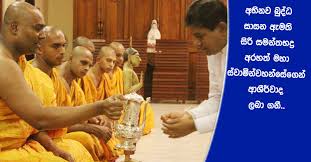
අධිකරණ ඇමතිට ශාසනය භාර දීමේ විද්‍යාත්මක හේතුව

January 21st, 2016

ලසන්ත වික්‍රමසිංහ යුතුකම සංවාද කවය www.yuthukama.com

නව රජය විසින් කැබිනට් මණ්ඩලය පත් කළේ ඔවුන් පවසන පරිදි විද්‍යාත්මක ක්‍රමයකටය. විජයදාස රාජපක්ෂ මහතාට අධිකරණ අමාත්‍ය ධූරයට අමතරව බුද්ධ ශාසන අමාත්‍ය ධූරයත් ලබා දුන් විට මා තුළ පසුබෑමක් හට ගත්තේය. ඒ රජය විසින් බුද්ධ ශාසන අමාත්‍යංශය ඉතාම විද්‍යානුකූල ලෙස ලබා දුන් බැවිනි. එකල එම විද්‍යාත්මක හේතුව මා හට දැනුනේ, එය එසේමදැයි යන කුකුසක්ද සමඟ බව කිව යුතුය. විජයදාසට අධිකරණ ඇමති ධූරය සමඟ බුද්ධ ශාසන අමාත්‍ය ධූරය ලබා දීම අතිශය විද්‍යානුකූල බව දැන් මට වඩාත් පසක් වී ඇත.

ව්‍යවස්ථා සම්පාදන කටයුතු සඳහා විජයදාස යම් දායකත්වයක් සපයනු ඇත. අවම වශයෙන් ව්‍යවස්ථාවට වන්නේ මොනවාදැයිවත් විජයදාස දැනුවත් වනු ඇත. ලංකාව ඒකීය රටක් විතු යුතු යැයි විජයදාස සිතන්නේ නැත. ලංකාව ෆෙඩරල් රටක් විය යුතු යැයි විජදාස සිතන්නේය. එනිසා මේ රජය විසින් ව්‍යවස්ථා සම්පාදන කටයුතු සඳහා විජයදාස සම්බන්ධ කැරගැනුම විද්‍යාත්මකය.

නමුත් ඔහුට ඒ සමඟම බුද්ධ ශාසන අමාත්‍යාංශය භාර දෙන්නේ ඇයි? ඔහු බණ ටිකකුත් දන්නා නිසාද? නොඑසේනම් තමන් රහතන් වහන්සේ නමක් යැයි ප්‍රකාශ කරන සමන්තභද්‍ර හිමියන්ගේ ශ්‍රාවකයෙකු නිසාද?නැත. ඒ හේතූන් බුද්ධ ශාසන අමාත්‍යාංශය ලබා දීමට තරම් “විද්‍යාත්මක” නොවේ.

ආණ්ඩුව විසින් නව ව්‍යවස්ථාවක් ගෙන ඒමේ ක්‍රියාවලිය සම්බන්ධ යෝජනාවක් පාර්ලිමේන්තුවට ගෙන ආ විට මෙරට ගෞරවනීය භික්ෂුන් වහන්සේලා උන් වහන්සේලාගේ අතීත උරුමය සපථ කරමින් වහා ක්‍රියාත්මක විය. “මව්බිම අනතුරේ- මහ සඟරුවන පෙරමුණේ” මැයෙන් සත්‍ය ක්‍රියාවක් පසුගිය ජනවාරි අටවන දින එනම් සිරිසේන විසින් ඇති කළ වෙනසට වසරක් පිරෙන දින කොළඹ කොටුවේදී පැවැත්වීය. එහි සංවිධාන කටයුතු සිදු කරමින් පවතින අතර තුර ජනවාරි 6වන දින පැවිදි හඬ සංවිධානයේ සභාපති මුරුත්තෙට්ටුවේ ආනන්ද හාමුරුවන්ගේ දුරකතනයට කතා කළ සිරිසේන තමන් හමුවන ලෙස ඉල්ලීමක් ක්ළේය. ක්‍රියාකාරී භික්ෂූන් වහසේලා කිහිප නමක් සමඟ උන් වහන්සේ පසුවදා සිරිසේන හමු විය. උන් වහන්සේලා ඉදිරිපත් කළ ගැටළු වලට බලාපොරොත්තු වූ පරිදිම සිරිසේනගෙන් කිසිදු නිශ්චිත පිළිතුරක් නොලැබින. මෙහිදී අපට වැදගත් වන්නේ මෙම හමු වීම නොව, භික්ෂූන් වහසේලා නියමිත වේලාවට කළ යුතු කාර්‍යය ඉටු කළ කල්හි පාලකයින් ඉන් තැතිගත් බවයි. මේ අවදි වීම නතර කර දැමුමට ඔවුනට වුවමනා වූ බවයි. එම සත්‍යග්‍රහය ඉතා සාර්ථක ලෙස කොළඹ කොටුවේදී පැවතුනි. ඉන් දින කිහිපයකට පසු රජය විසින් ථෙරවාදී භික්ෂු කතිකාව ලියාපදිංචි කිරීම සඳහා වූ පනත් කෙටුම්පතක් පාර්ලිමේන්තුවට ඉදිරිපත් කළේය.

ආණ්ඩුව මින් සැබෑ ලෙසම බලාපොරොත්තු වූයේ කුමක්ද? මාගේ අදහස නම් ආණ්ඩුවේ මූලිකම අභිප්‍රාය වූයේ එම පනතේ නමින්ම කියැවෙන පරිදි භික්ෂු විනය පිලිබඳ කතිකාවක් රට තුළ ඇති කිරීමයි. යමෙක් එහි ඇති වරද කුමක්දැයි ප්‍රශ්න කළ හැකිය. වරද ඇත්තේ අරමුණෙහි නොව, යටිඅරමුණෙහිය. රජයට මේ පනතට කුමක් සිදු වූවත් කම් නැති බව මගේ හැඟිමයි. ඔවුනට අවශ්‍ය අර ප්‍රධාන අත්‍යාවශ්‍ය සංවාදය වන ජිනීවා යෝජනා ක්‍රියාත්මක කළ හැකිවන ලෙස, දෙමළ ජාතිවාදයට යටත් වූ ව්‍යවස්ථා වෙනස් කම් සහ රණ විරුවන් හිරේ දමා දෙමළ ජාතිවාදය පිනවන රජයේ පාහර ක්‍රියාවන් පිලිබඳ කතිකාවන් යට දමා රජයට කෙරුනත් කම් නැති නොකෙරුනත් කම් නැති පනතක් පිලිබඳ කතිකාවක් සංඝ සමාජය ප්‍රමුඛ මහා සමාජය තුළ ඇති කිරීමය.

පවතින ව්‍යවස්ථාව උල්ලංඝනය කරමින් රනිල් සහ සිරිසේන ගෙනෙන්නට යන නව ව්‍යවස්ථාට සැකසීමේ ක්‍රියාදාමයට පාර්ලිමේන්තුවේ තුනෙන් දෙකක් අවැසිය. සිරිසේනගේ විධායක බල මහිමයෙන් ශ්‍රී ලංකා නිදහස් පක්ෂයේ මන්ත්‍රීන් මේ කුපාඩි යෝජනවාට අත උස්සවා ගැනීම ඔවුන්ගේ ආසන්නම ඉලක්කයයි. රට තුළ ඒ සඳහා විශාල විරෝධතාවක් විශේෂයෙන් සංඝයා වහන්සේලාගේ ප්‍රමුඛත්වයෙන් ඇති වී ජනතාව දැනුවත් වුවහොත් දේශපාලනික වශයෙන් අර කුපාඩින්ට අත එසවීම අපහසු කාර්යයක් බවට පත් වේ. සංඝයා වහන්සේලාට වෙනත් ගැටළුවක් ගැන සාකච්ඡා කරන්නට සැලැස්වීම ආණ්ඩුවේ මූලික උපායයි. එමඟින් අර ව්‍යවස්ථා කුපාඩිකම පිලිබඳ කතිකාව යට යවා ගත හැකිය. දාන මාන, පිංකම්, පිරිවෙන්වල උගැන්වීම්, සහ නොයෙකුත් ශාසනික සේවාවන් කරන අතරතුරය භික්ෂුන් වහන්සේලාට මෙවැනි දේශපාලන කාර්යයන් සඳහා අවදානය යොමු කළ හැක්කේ. උන්වහන්සේලාටම වෙසෙසින් බලපාන කතිකාවක් ඇති කිරීම තුලින් ආණ්ඩුවට සංඝයා වහසේලා ඒ කතිකාව තුළ සිර කළ හැකිය. රනිල් එජාපයේ මන්ත්‍රීන්ට ව්‍යවස්ථාව පිලිබද රූපවාහිනී සංවාදවලට නොයන ලෙස දැනුම් දීම නිසා බොහෝ රූපවාහිනී නාලිකාවලට සිය දේශපාලන වැඩසටහන්හි තේමාව ව්‍යවස්ථාවෙන් පිට යොදා ගන්නට සිදු විය. මින් පැහැදිලි වන්නේ රජයට අවශ්‍ය ව්‍යවස්ථා වැඩේ ගැන කතිකාවක් ඇති වීම වැලැක්වීම බවයි.

අධිකරණ ඇමතිට බුද්ධ ශාසනය භාර දෙන්නේ ව්‍යවස්ථාව හරහා රටට හතුරුකමක් කරන විට ඊට එරෙහිවන භික්ෂූන් වහන්සේලා උපක්‍රමික ලෙස පාලනය කළ හැකි ක්‍රමවේදයන් හා දින වකවානුන් ව්‍යවස්ථා කුපාඩි කටයුතු සමඟ මනා ලෙස ගලප්පවා ගැනුමටයි. මෙම ථෙරවාදී භික්ෂු කතිකාව ලියාපදිංචි කිරීම සඳහා වූ පනත් කෙටුම්පත සැකසෙන්නට ඇත්තේ විජයදාසගේ මූලිකත්වයෙන් විය යුතුය. නමුත් එය ඔහු විසින්ම ඉදිරිපත් නොකිරීමට පරිස්සම් වේ. එය ජනමාධ්‍ය ඇමති විසින් ඉදිරිපත් කරයි. එය විද්‍යාත්මක නැති වුවත් විජයදාස විසින්ම එය ඉදිරිපත් කළහොත් ඉහත අප කී විද්‍යාත්මක හේතුව වඩා පැහැදිලි ලෙස එළියට පෙනෙතැයි සිතූ නිසා භික්ෂු විනය පනත අවිද්‍යාත්මක ලෙස ජනමාධ්‍ය ඇමති ගයන්ත ලව්වා ගෙන එන ලදී. ඒ නයින් ගත් කළ එයද විද්‍යාත්මකය.

රටේ උරුමය සහ සම්ප්‍රදාය නියෝජනය විය යුතු මූලික නීතිය වන ව්‍යවස්ථාව දෙමළ ජාතිවාදයට යට කරන්නට සැරසෙන විට ඊට එරෙහිව නැගී සිටීමේ උරුමය දරන ලාංකික භික්ෂුව උපායශීලී ලෙස පාලනය කිරීම සඳහා රජය විසින් ගණන් බලා ඇත්තේ ඇමති මණ්ඩලය පත් කරන විටදීම වීම මොවුන්ගේ සැලසුම්හි දිග පළල සහ භයානකකම හෙළිකරන්නකි.

-ලසන්ත වික්‍රමසිංහ
යුතුකම සංවාද කවය
www.yuthukama.com

ABSOLUTELY NO COMPARISON TO OUR SCUM BAG POLITICIANS…A to Zee.

January 21st, 2016

THE ONLY POLITICIAN IN SRI LANKA WHO CAN BE COMPARED TO **PRESIDENT HARRY**  IS  “THE HONOURABLE DUDLEY SENANAYAKE”

Susantha Wijesinghe 

Thought you’d enjoy this!

It’s one you’d want your Children and Grandchildren to read.
They won’t believe this happened, but it DID.

Harry & Bess
(Seems unreal to ever have happened opposed to realities in our day ….)

Harry Truman was a different kind of President. He probably made as many, or more important decisions regarding America’s history as any of the other 42 Presidents preceding him. However, a measure of his greatness may rest on what he did after he left the White House.


The only asset he had when he died was the house he lived in, which was in Independence Missouri. His wife had inherited the house from her mother and father and other than their years in the White House, they lived their entire lives there.

When he retired from office in 1952 his income was a U.S. Army pension reported to have been $13,507.72 a year. Congress, noting that he was paying for his stamps and personally licking them, granted him an ‘allowance’ and, later, a retroactive pension of $25,000 per year.

After President Eisenhower was inaugurated, Harry and Bess drove home to Missouri by themselves. There was no Secret Service following them.

When offered corporate positions at large salaries, he declined, stating, “You don’t want me. You want the office of the President, and that doesn’t belong to me. It belongs to the American people and it’s not for sale.”

Even later, on May 6, 1971, when Congress was preparing to award him the Medal of Honor on his 87th birthday, he refused to accept it, writing, “I don’t consider that I have done anything which should be the reason for any award, Congressional or otherwise.”

As president he paid for all of his own travel expenses and food.

Modern politicians have found a new level of success in cashing in on the Presidency, resulting in untold wealth. Today, many in Congress also have found a way to become quite wealthy while enjoying the fruits of their offices.. Political offices are now for sale (cf. Illinois).

Good old Harry Truman was correct when he observed, “My choices in life were either to be a piano player in a whore house or a politician. And to tell the truth, there’s hardly any difference!

I say dig him up and clone him!

If you agree, you need not forward it. If you don’t, delete it. I don’t want to know one way or the other. By me forwarding it, you know how I feel.

Enjoy life now — it has an expiry date!

  1. It’s interesting to note that Australia’s longest serving Prime Minister, Bob Menzies,could not afford to buy a house when he retired and some wealthy friends in Melbourne donated one to him where he lived until he died.

දෙවියන් හා ගුරුත්වාකර්ෂණය

January 21st, 2016

නලින් ද සිල්වා

ඩී එස් සී උපාධිධාරී සේවාර්ජිත (සම්මානිත) මහාචාර්ය අශෝක අමරතුංග මහතා පසුගිය ජනවාරි 13 වැනි දින විදුසර ලිපියෙන් ජීවිතය පිළිබඳ ඊනියා අරුත ගැන තම අදහස් සම්පිණ්ඩනය කර දක්වා ඇත. එසේ කිරීම පිළිබඳ ඒ මහතාට අපේ ස්තුතිය හිමිවන අතර ඒ කරුණු අප මෙහි උපුටා දක්වන්නේ ඒ ලිපිය නොකියවූ අයට ඒ ගැන දැනුමක් ලැබීමටත් ඒ මහතා සිංහල බෞද්ධ චින්තනයෙන් කෙතරම් ඈත් වී තිබේ ද යන්න පාඨකයනට දැනගැනීමත් සඳහාත් ය. ඒ මහතා සිංහල බෞද්ධයකු බව පිළිගන්නේ යැයි මම උපකල්පනය කරමි. අද මෙරට බොහෝ දේශපාලනඥයන් තමන් සිංහල යැයි ද  බෞද්ධ යැයි ද කියමින් සිංහල බෞද්ධ විරෝධී ක්‍රියාවල නිරත වන ආකාරයට අමරතුංග මහතා ද ක්‍රියාකරන්නේ යැයි සිතිය හැකි ය. ඒ මහතා ඉහත සඳහන් ලිපියෙහි මෙසේ කියයි. 
 
1. අප ගේ ජීවිතයේ අරුත කුමක්‌ ද යන්න අප නිතර අසන ප්රශ්නයකි.
2. අප එසේ අසන්නේ එහි තේරුමක්‌ නැතැයි අපට හැඟෙන නිසා ය.
3. අප සතුටින් හැම දා ජීවත් වනවා නම් එම ප්රශ්නය අප අසන්නේ නැත.
4. අප එම ප්ර්ශ්නය අසන්නේ අප ටික කාලයක්‌ දුකින් සිට මරණයට පත් වන නිසා ය.
5. තව ද එම ප්රහශ්නය අසන්නේ අප සඳහා වූ අරුතක්‌ ජීවිතයෙන් බලාපොරොත්තු වන නිසා ය.
6. අප ජීවත් වන්නේ අප සඳහා ය යන මතයේ පිහිටා ය, එම ප්ර ශ්නය අසන්නේ.
7. එහෙත් අප ජීවත් වන්නේ අප සඳහා නො වන්නට පුළුවන.
8. මුළු මහත් විශ්ව ක්රිායාදාමයේ කුමක්‌ හෝ කාර්යයක්‌ අප විසින් සිදු කරනවා විය හැකි ය.
9. අප මරණයට පත් වන විට අප ඉතිරි කරන්නේ අපගේ ජාන (DNA, RNA, ප්රොටීන) වන්නේ ය.
10. අප සහ අනෙකුත් ජීවීන් නිර්මාණය වී ඇත්තේ මේ කාර්ය කිරීමට ය.
11. අප ගේ ඥානය, නිර්මාණශීලිත්වය සහ ආශාව මේ කාර්යය ඉටු කිරීම සඳහා වර්ධනය වී ඇත.
12. අප සිදු කරන සියලු ක්රිියා ඥානය, නිර්මාණශීලිත්වය සහ ආශාව විසින් පාලනය කෙරෙයි. එම ක්රියා සිදු කරන විට අප ගේ ජානවල වෙනසක්‌ ඇති වේ. අප ඉතිරි කර මරණයට පත් වන්නේ එසේ දියුණු වූ ජාන වන්නේ ය.
13. එම සේවය කිරීමට ආශාව විසින් අප වහළුන් සේ බැඳ තබනු ලැබ ඇත.
14. අප ගේ ජීවිතයේ අරුත වන්නේ විශ්වයට අවශ්ය  DNA, RNA, ප්රොටීන   නිෂ්පාදනය කිරීම ය. එය ප්රොටීන ලෝකයක්‌ ලෙස හැඳින්වේ.
15. විශ්වයට මේ දේවල් අවශ්යන වන්නේ ඇයි දැයි අපි නො දනිමු. විශ්වය පිළිබඳ තවත් බොහෝ දේවල් අපි නො දනිමු.” 
 
අමරතුංග මහතා කියනු ඇත්තේ අපට කියාගන්නට දෙයක් නොමැති කමින් අප ඔහුගේ ලිපිවලින් කොටස් උපුටා දක්වන බව ය. එහෙත් අප උපුටා දක්වන්නේ අපේ කරුණු දැක්වීමට අදාළ කොටස් ය. ඉහත සඳහන් සියල්ල උපුටා නොදක්වා අමරතුංග මහතාගේ සිංහල බෞද්ධ විරෝධී චින්තනය පැහැදිලි කර දිය නො හැකි ය. ජීවිතයේ අරුත කුමක් ද යන්න සාධාරණ වශයෙන් සිංහල බෞද්ධ සංස්කෘතියේ නොඇසෙන ප්‍රශ්නයකි. බටහිර දැනුම කටගාගත් එහෙත් නව සංකල්පයක්, ප්‍රවාදයක් (ප්‍රමාදයක් නො වේ) මගින් හෝ වෙනත් ආකාරයකින් හෝ බටහිර දැනුමට කිසිම ෙසෙද්ධාන්තික එකතුවක් කර නොමැති උගතුන් අතර නම් එවැනි ප්‍රශ්න සාකච්ඡාවට බඳුන් වනවා ඇත. එහෙත් සිංහල බෞද්ධයන් නම් වෑයම් කරන්නේ මේ සසරින් මිදීමට ය. චතුරාර්ය සත්‍යය අවබෝධ කරගැනීමට ය. ත්‍රිලක්‍ෂණය වටහා ගැනීමට ය. සිංහල බෞද්ධ අපට එතෙරවිය යුතු සසරක් ඇත. අපේ ජීවිත මේ භවයෙන් කෙළවර නො වේ. එවැනි විටෙක ජීවිතයේ අරුත කුමක් දැයි ඇසීම ම අරුත් සුන් වූවකි. 
 
අමරතුංග මහතාට අනුව අප ජීවත්වන්නේ ජාන ඉතිරි කර මිය යෑමට ය. සසරක් ගැන කතා නොකරණ මේ අදහස් එක් පැත්තකින් ගත්කල උච්ඡෙදවාදී ය. අමරතුංග මහතා ඇතැම් විට කරන පරිදි උච්ඡෙදවාදය, නාස්තිකවාදය සමග පටළවා ගත යුතු නො වේ.   අමරතුංග මහතාට අනුව අපට ඇත්තේ විශ්වයට හෝ ස්වභාව ධර්මයට හෝ වෙනත් යමකට හෝ සේවය කිරීමට ජාන වෙනස්කර ඉතිරිකිරීම ය. ජාන වෙනස් නොකළහොත් අපෙන් සේවයක් ඉටු නොවන්නේ යැයි අමරතුංග මහතා කියන බව ගම්‍ය වෙයි. එසේ නම් ජාන වෙනස් නොකර මිය යන්නන්ගෙන් එකී විශ්වයට හෝ වෙනත් යමකට හෝ සේවයක් ඉටු නො වෙයි. එවිට ඔවුන්ගේ ජීවිතවල ඊනියා අරුත කුමක් ද? අමරතුංග මහතාට අනුව මේ ඊනියා සේවය කිරීමට අප වහළුන් සේ බැඳ තබා ඇත. මෙහි දී ප්‍රශ්නයක් මතුවෙයි. අප එසේ බැඳ දමනු ලැබ ඇත්තේ කවුරුන් විසින් ද? අමරතුංග මහතා ඒ ප්‍රශ්නයට පිළිතුරක් නො දෙයි. එලෙස බැඳ දමනු ලැබ ඇත්තේ ඊනියා මැවුම්කරු විසින් ද?   
 
සිංහල බෞද්ධ සංස්කෘතිය පැත්තකින් තබන්න. අමරතුංග මහතා දක්වන අදහස් ඩාවින්ගේ පරිණාමවාදය සමග එකඟ වන්නේ ද? ජාන වෙනස් කර ඉතිරි කිරීම හා ප්‍රෝටීන ගැන කතාකර ඇති එකම පුද්ගලයා අමරතුංග මහතා නො වේ. බටහිර ජීවත්වන යුදෙවු ක්‍රිස්තියානි සංස්කෘතියට අයත් බටහිර විද්‍යාඥයෝ ද ඒ ගැන කතාකරති. උදාහරණ වශයෙන් රූපට් ෂෙල්ඩ්‍රේක්ගේ පොතපත කියවන්න. එහෙත් ඔවුහු තමන් කියන්නේ කුමක් ද යන්න ගැන ප්‍රවේසම් වෙති. ජාන වෙනස්කර එකතුකිරීම යන්න ඩාවින්ගේ පරිණාමවාදයට විරුද්ධවන බව ඔවුහු දනිති. එබැවින් ඔවුන් තම අදහස් ඉදිරිපත් කරන්නේ ඒ ගැන ද සඳහන් කරමිනි. අමරතුංග මහතා ජාන විකෘතිකිරීම් හා ස්වාභාවික වරණය ගැන නො කියයි. අමරතුංග මහතා ප්‍රකාශ කරන අදහස් ලැමාක්ගේ පරිණාමවාදයට නම් එකඟ ය.
 
මට ලැමාක්ගේ පරිණාමවාදයත් ඩාවින්ගේ පරිණාමවාදයත් පට්ටපල් බොරු පමණ ය. මම ඒ දෙකෙන් එකක්වත් ඇත්තක් ලෙස නො සලකමි. එහෙත් අමරතුංග මහතා එසේ නොකරයි. ඔහු බටහිර විද්‍යාවට හරිහමන් යමක් එකතු නොකළ ද ඩී එස් සී උපාධිධාරියෙකි. සම්මානිත දන්තවිද්‍යා මහාචාර්යවරයෙකි. ඔහු තමන් කියන දේ සම්මත බටහිර විද්‍යාව සමග එකඟවන නොවන බව ගැන සැලකිලිමත් විය යුතු ය. අවසාන වශයෙන් අමරතුංග මහතා කියන්නේ ජීවිතයේ ඊනියා අරුත ඪණං, ූණං ප්‍රෝටීන නිෂ්පාදනය කිරීම බව ය. එහෙත් එසේ කරන්නේ ඇයි ද යනු ඔහු නො දනියි. ඉංගීිරිසි පොතකින් ඒගැන යමක් කියන තුරු අමරතුංග මහතාට පරිවර්තනය කර විදුසරට ලිවීමට නො හැකි ය. 
 
අමරතුංග මහතාගේ සම්පිණ්ඩනය ඔහුගේ ජීවිතයේ ඊනියා අරුත ගැන කීමට ප්‍රමාණවත් ය. එහෙත් ඔහු ජනප්‍රිය පොතපතින් තමන්ට නොතේරෙන කරුණු පරිවර්තනය කරමින් ප්‍රෝටීන නැමුම ගැන කතාකරයි. ප්‍රෝටීන නැමුම ගැන ඉදිරිපත් කර ඇති ගණිත ආකෘතිවලින් කියැවෙන්නේ කුමක් ද? මේ සියල්ල ආකෘති පමණ ය. එය ඊනියා යථාර්ථය යැයි අමරතුංග මහතාට කීමට නො හැකි ය. එයට හේතුව ආකෘතියක් ඊනියා යථාර්ථය විය නොහැකි බැවිනි. ඒ කුමක් වුවත් අපේ සාකච්ඡාව බටහිර විද්‍යාව පට්ටපල් බොරුවක් ය යන්න අරභයා ය. අමරතුංග මහතා හැකි ඉක්මනින් එතැනට පැමිණන්නේ නම් මැනවි.  
 
බටහිර විද්‍යාව පට්ටපල් බොරු යැයි මා කියන්නේ සිංහල බෞද්ධ සංස්කෘතිය මත පදනම් වෙමිනි. අපේ පෘථග්ජන දැනුම ප්‍රධාන වශයෙන් කොටස් දෙකකින් යුක්ත වෙයි. ඒ සෘජු ප්‍රත්‍යක්‍ෂ දැනුම සහ ප්‍රත්‍යක්‍ෂ නොවන වක්‍ර දැනුම වශයෙනි. ප්‍රත්‍යක්‍ෂ දැනුම පංචෙන්ද්‍රිය ගෝචර ය. එයින් කියැවෙන්නේ ඒ දැනුම මනසෙන් ස්වායත්ත බව නො වේ. මනස හා ප්‍රත්‍යක්‍ෂ එකතුවී සංස්කරණය කරන දැනුම ප්‍රත්‍යක්‍ෂ දැනුමෙන් ඉතා වැඩි කොටස වෙයි. එයට අමතර ව පංචෙන්ද්‍රිය සහභාගි නොවී මනසින් පමණක් සංස්කරණය කෙරෙන ප්‍රත්‍යක්‍ෂ දැනුම් ද වෙයි. මනස දියුණු කරගත් පෘථග්ජනයන්ට එවැනි ප්‍රත්‍යක්‍ෂ වෙයි. ඒ සියල්ල ප්‍රත්‍යක්‍ෂ වෙයි. ප්‍රත්‍යක්‍ෂ ලෙස ඒ මනසෙහි සංස්කරණ වෙයි. ඒ සියල්ල ද බොරු ය. 
 
ඒ බොරු වුවත් ඉන් වැඩගත හැකි ය. එපමණට අපි ප්‍රත්‍යක්‍ෂ ගැන අවබෝධයකින් පසු වෙමු. මේ ප්‍රත්‍යක්‍ෂවලට අමතරව ප්‍රවාදාත්මක දැනුම් වෙයි. ඒ වක්‍ර දැනුම් ය. ප්‍රචාදාත්මක දැනුම් ද සංයුක්ත හා වියුක්ත යනුවෙන් කොටස් දෙකකට බෙදිය හැකි ය. චුල්ලහත්ථිපදොපම සූත්‍රයෙන් කියැවෙන්නේ ප්‍රවාදාත්මක දැනුම් ගැන නොව, ප්‍රත්‍යක්‍ෂ ගැන විශ්වාසය තබන ලෙස ය. අපට ඇතකු ගිය බව උගේ වර්චස්වලින් ඌ ගස්වල ඇතිල්ලී ඇති බව නිරීක්‍ෂණය කීිරීමෙන් නිගමනය කිරීමට හැකි වුවත් චුල්ලහත්ථිපදොපම සූත්‍රයෙන් කියන්නේ ඇතා දැක ම ඇතා ඇත යන්න නිගමනය කරන ලෙස ය. ඇතා ඇත යනුවෙන් වර්චස් මගින් ගන්නා නිගමනය ප්‍රවාදාත්මක දැනුමක් යැයි අපි කියමු. ප්‍රත්‍යක්‍ෂය ද බොරු වුවත් වක්‍ර දැනුම එයටත් වඩා බොරු වීමට ඇති ඉඩකඩ බොහෝ ය. 
 
බටහිර විද්‍යාවේ කෙරෙන්නේ  පංචෙන්ද්‍රිය ගෝචර ප්‍රත්‍යක්‍ෂ තේරුම් කිරීමට වියුක්ත ප්‍රවාද හෙවත් කතන්දර යොදා ගැනීම ය. ඒ පට්ටපල් බොරු යැයි අපි කියමු. ප්‍රත්‍යක්‍ෂ ද බොරු වූ කල වියුක්ත ප්‍රවාද ගැන කියනුම කවරේ ද? ඇතැමුන්ට අප කියන දෙය වටහාගැනීමට තවමත් නොහැකි වී ඇත. ඔවුහු ඇතැම් විට අප පංචෙන්ද්‍රිය ගෝචර නොවන වියුක්ත ප්‍රවාද පට්ටපල් බොරු යැයි කියමින් පංචෙන්ද්‍රිය ගෝචර නොවන දෙවියන්, භූතයන් ගැන කියන්නේ කෙසේ දැයි අසති. ඒ පණ්ඩිතමානීච බටහිර දැනුම කටගාගෙන අසන ළාමක ප්‍රශ්නයකි. අපට එය අනෙක් පැත්තට ඇසිය හැකි බව මේ ඊනියා උගත්තු අවබෝධ කර නො ගනිති. මේ උගතුන් පංචෙනද්‍රිය ගෝචර නොවන ගුරුත්වාකර්ෂණය වැනි දේ ඇති බව විශ්වාස කරමින් පංචෙන්ද්‍රිය ගෝචර නොවන දෙවියන්, භූතයන් නැතැයි කියන්නේ කෙසේ ද? 
 
පට්ටපල් බොරු වූ බටහිර විද්‍යාවේ වියුක්ත ප්‍රවාද හා දෙවියන්, භූතයන් අතර ඇති වෙනස මේ උගතුන්ට නො තේරෙයි. ඊනියා ථෙරවාදී උගතුන්ට සියුම් වෙනස්කම් අවබෝධ කරගත නො හැකි ය. ඔවුන් සිංහල බෞද්ධ සංස්කෘතයේත් නැත, යුදෙවු ක්‍රිස්තියානි සංස්කෘතියේත් නැත. ඔවුහු ගන්ධබ්බයෝ වෙති. මේ ගන්ධබ්බයන් සියුම් වෙනස්කම් අවබෝධ කරගන්නේ කෙසේ ද? මා දෙවියන් දැක නැත. ගුරුත්වාකර්ෂණය ද දැක නැත. එහෙත් මට දෙවියන් දැක ඇති ඔවුන් සමග සන්නිවේදනය කළ හැකි පුද්ගලයන් හමු වී ඇත. ගුරුත්වාකර්ෂණය පංචෙන්ද්‍රිය ගෝචර වන්නේ යැයි කියන එක් අයකු පමණක් මුණ ගැසී ඇත.  ඔහු කැලණිය විශ්වවිද්‍යාලයෙහි රසායන විද්‍යාව පිළිබඳ ජ්‍යෙෂ්ඨ කථිකාචාර්යවරයෙකි. ඔහු මේ උගතුන් මහත් සේ අගයන කේම්බ්‍රිජ් විශ්වවිද්‍යාලයේ ද ඉගෙන ගෙන ඇතැයි කියැවෙයි. මේ ඊනියා උගත්තු තම කතා යුක්තියුක්ත කිරීමට කේම්බ්‍රිජ් යොදා ගනිති. 
 
කලකට පෙර කොළඹ විශ්වවිද්‍යාලයෙහි සේවය කළ එක් රසායන විද්‍යා ආචාර්යවරයකු තමා කේම්බ්‍රිජ් විශ්වවිද්‍යාලයෙහි දී ඩිරුක්ගේ භෞතික විද්‍යා දේශනවලට සහභාගි වී ඇතැයි මහත් උජාරුවෙන් කීවේ වැරදි අදහසක් ප්‍රචලිත කිරීමට ඒ උපකාරයක් වේය යන බලාපොරොත්තුවෙනි. ඩිරුක්ගේ දේශනවලට සවන් දුන් පමණින් ඒ තේරුම්ගත් බවක් කියන්නේ කෙසේ ද? කෙසේ වෙතත් ඔහු ඉදිරිපත්කළ අදහස වැරදි බව පැහැදිලි විය. අද කැනඩාවේ එක් මහාචාර්යවරයකු කේම්බ්‍රිජ් විශ්වවිද්‍යාලයෙහි තමා යම්තමින් දැනසිටියේ යැයි කියන පෝකින්හෝන් ගැන කියයි. මේ මහාචාර්යවරයා ද කේම්බ්‍රිජ් විශ්වවිද්‍යාලයෙහි ඉගෙන ගත්තේ රසායන විද්‍යාව ය. පෝකින්හෝන් පසු කලෙක ක්‍රිස්තියානි පූජකවරයකු වූ ෙසෙද්”ධාන්තික භෞතික විද්‍යාඥයකු විය. පෝකින්හෝන් සියළු විද්‍යා ගුප්ත විද්‍යා යැයි කියා ඇති බව මහාචාර්යවරයා කියයි. පෝකින්හෝන් දෙවියන් වහන්සේ විශ්වාස කරයි. මහාචාර්යවරයා ද දෙවියන් වහන්සේ විශ්වාස කරන්නේ දැයි නො දනිමි. 
 
ඒ කෙසේ වෙතත් දෙවියන් (දෙවියන් වහන්සේ නොව) හා ගුරුත්වාකර්ෂණය අතර වෙනසක් වෙයි. දෙවියන් ගැන ඇත්තේ ප්‍රත්‍යක්‍ෂ දැනුමකි. ගුරුත්වාකර්ෂණය ප්‍රත්‍යක්‍ෂ දැනුමක් නො වේ. එය පොල් වැටෙන්නේ ඇයි ද යන ප්‍රත්‍යක්‍ෂය තේරුම් කිරීම සඳහා නිවුටන් ගෙතූ පට්ටපල් බොරුවකි. ප්‍රත්‍යක්‍ෂයක් නොවූවත් ගුරුත්වාකර්ෂණය මගින් පොල් පොළොවට වැටෙන්නේ ඇයි දැයි තේරුම් ගත හැකි බැවින් ගුරුත්වාකර්ෂණය පවතී යැයි ඊනියා උගතුන් කීමට ඉඩ ඇත. එහෙත් ගුරුත්වාකර්ෂණ ප්‍රවාදය  යොදා ගෙන පොල් පොළොවට වැටෙන බව නිගාමි තර්කයෙන් නිගමනය කර පෙන්වන මෙන් මම මේ උගතුන්ට අභියෝග කරමි. 
 
ගුරුත්වාකර්ෂණ ප්‍රවාදය වියුක්ත ය. ඉන් නිගාමි තර්කයෙන් ලබාගත හැක්කේ වියුක්ත නිගමන ය. වියුක්ත අවයවයක් (premise) යොදා ගනිමින් වියුක්ත නිගමනයක් මිස සංයුක්ත නිගමනයක් ලබාගත නො හැකි ය. වියුක්තයකින් සංයුක්තයක් ලබාගන්නේ කෙසේ ද? අප මෙය කලින් ද කියා ඇති නමුත් ඊනියා උගතුන්ට ඒ අවබෝධ වී නොමැති බව පැහැදිලි ය. පංචෙන්ද්‍රිය ගෝචර නොවන වියුක්ත නිගමනයක් සංයුක්ත පොල්ගෙඩියක වැටීමක් තේරුම් කිරීමට යොදාගත නො හැකි ය. බටහිර විද්‍යාවේ කිසිම වියුක්ත ප්‍රවාදයකින් සංයුක්ත නිගමන ලබාගත හැකි නො වේ. බටහිර විද්‍යාඥයෝ මේ තර්ක විරෝධී නිගමනය නො සලකති. මෙරට ඊනියා විද්‍යාඥයන් තම අනවබෝධය නිසා ඒ නොසලකන බව පෙනෙයි. 
 
ගුරුත්වාකර්ෂණ ප්‍රවාදය හා අනෙක් බටහිර දැනුම් එලෙස ගත්කල වක්‍ර දැනුම්වත් නො වේ.  ඒ වියුක්ත කතන්දර පමණ ය. එහෙත් කලින් සඳහන් කළ පරිදි දෙවියන් ගැන ප්‍රත්‍යක්‍ෂ දැනුම් ඇති පුද්ගලයෝ වෙති. දෙවියන් යනු ප්‍රත්‍යක්‍ෂ දැනුමක් මිස පංචෙන්ද්‍රිය ගෝචර ප්‍රත්‍යක්‍ෂයක් තේරුම් ගැනීමට යොදාගන්නා වියුක්ත ප්‍රවාදයක් නො වේ. ඊනියා උගතුන්ට මේ වෙනස තේරුම් ගැනීමට තරම් බුද්ධියක් නොවීම ගැන අපට කළ හැකි කිසිවක් නැත. ශාන්ති කර්මයකින්වත් ඒ බුද්ධිය ලබා දිය නො හැකි ය. 
 
ඊනියා උගතුන් කීමට ඇත්තේ දෙවියන් තමන්ට ප්‍රත්‍යක්‍ෂ වන බව ප්‍රකාශ කරන්නන් බොරු කියන බව ය. දෙවියන් ප්‍රත්‍යක්‍ෂ වන්නේ මනස යම් අවස්ථාවකට දියුණු කරගත් අයට ය. එය පංචෙන්ද්‍රිය නොමැති ව හුදෙක් මනසින් ලබාගන්නා ප්‍රත්‍යක්‍ෂයකි. ඒ සඳහා පුහුණුවක් අවශ්‍ය වෙයි. එක්ස් කිරණ ඡායාරූප මගින් යම් යම් දේ දකින අයට ද පුහුණුවක් අවශ්‍ය වෙයි. ඒ පුහුණුව නොලැබූ අයට එකී ඡායාරූපවලින් ඒ ඒ දේ දැකිය නො හැකි ය. එලෙස යම් යම් දේ දැකිය හැක්කේ පුහුණුවක් ලත් අයට පමණ ය. පූහුණුව නොලද්දෝ පුහුණුව ලත් අය එක්ස් කිරණ ඡායාරුපවල දකින දේ නැතැයි පවසත් ද? යම්කිසිවකු දෙවියන් දැක ඇති අය කියන්නේ බොරු යැයි කියන විට දෙවියන්ට ධර්මය දේශනා කර ඇති බුදුන්වහන්සේ ද බොරු කී බව කියන්නේ ද? 
 
නලින් ද සිල්වා
 
2016 ජනවාරි 18

THERAVADA BUDDHIST KATHIKAWATHA – PART 2 BRITISH LEADERS DETERMINED TO TAKE REVENGE BY DESTROYING  BUDDHISM AND SINHALA NATION- “අනේ කූඹියනේ තොපට රජෙක්  ඇත – අපට රජෙක් නැත”!

January 21st, 2016

By M D P DISSANAYAKE

BUDDHIST MONKS HATED BY BRITISH LEADERS. WHY?

In the first part of the article on the Theravada Buddhist Kathikawatha, we have narrated the 227 vinaya pitaka discipline. MR Ranil Wickremasinghe’s desire to gradually deplete the value of practice of buddhism in Sri Lanka is no secret.  The desire of British leaders to deplete the value the practice of buddhism in Sri Lanka is also no secret.  British leaders had to evolve a mechanism to bring together a group of Sinhala Theravada Buddhist leaders, who appear on paper as representing saviours of buddhist culture.  They found this chemistry with Ranil, Maithree and Chandrika, who are bogus Sinhala Buddhists. British have been taught several lessons in Sri Lanka by none other than Buddhist Monks. It was always Buddhist monks who came forward to fight for the country. They were crushed and humiliated by British during anti colonial struggles launched by Buddhist Monks. 

During the ferocious liberation struggle way back in 1818 to 1848 period Dambulla Temple Chief Incumbent Giranegama Thero, Kudapola Thero and several buddhist leaders were arrested during the revolt. After arresting the Kudapola Thero, he was shot dead in yellow robes by British gunmen. Several hundreds of buddhist freedom fighters were arrested and executed. On the last day the Ceylon was lost to British, Ven. Variyapola Sumangala Maha Thero treated the Union Jack with contempt, tore it down and crushed it. British were aware the close relation between laity and monks were solid and monks provided the leadership for freedom fighters.

In Governor Maitland’s own words, “the influence of the priest is very great, even greater in many instances than that of the mudaliyars [local administrators] themselves.”  Many sinhalese had no financial strength and were not on top of higher strata in the colonial society. This weakness was capitalised by British by converting them to their religion, discarded, sinhala names and local dress. British hated Sinhala Language and culture, instead offered Christianity with imperialism and anti nationalism.   The key leaders of the current Government of Good Governance  are guardians  and remnants of the colonial creation.

Monks resistance was  non stoppable. They tooks a keen interest in political activities in the selection and appointment of right Kings When European colonials had difficulties on a Sinhala Constitution, it was buddhist monks  who provided the knowledge of laws and customs.  Portuguese or British were all the same, they did everything at their disposal to destroy Buddhism and inculcate Christianity and western values. It was once again Ven Velivita Sarananka Maha thero who took front line struggle for the rejuvenation of education of monks across the country.

BUDDHIST BOYS FOUGHT WAR  AGAINST TAMIL TERRORISTS:

It was predominantly Buddhist Boys who fought against the Tamil Terrorists, with some Christian/Catholic families too releasing their children to the 3 armed forces. Where were the Muslim and Christian Clergy in the freedom fight? They were not there in the past.  They are not there at present.  They will not be there in the future. Tamils and Muslims whose lives were saved by Buddhist Boys are now receiving top class education for their children, some of them ranking best in the island at Scholarship Exams, GCE  Ordinary Level Advanced Level and University Final Examinations.  Do they have few kind words or gratitude for the Buddhist Boys  for salvaging them from the clutches of Terrorists?

Part 3 to be continued.

Interference in Sri Lanka’s internal affairs-Letter to the British Minister

January 21st, 2016

Harsha Perera Victoria Australia

Dear Mr. Swire,

I refer you to recent statements that you have made about Sri Lanka.

The statements are:

  1. The UK does not specify what the constitutions of other countries should be.
  2. Reconciliation is needed for the economy to grow
  3. The UK will be training the Sri Lankan Armed Forces to be a modern 21st century armed forces and on how to operate in a democracy

Your assertions smacks of the very clever spin that you and your predecessors going as far back as 1815 have generated.  This clever spin has been able to make the ruthless exploitation and domination of Sri Lanka that successive British governments have engaged in to appear benign and beneficial to the local population.

As the saying goes ‘you can fool some of the people all of the time and fool all the people some of the time but you cannot fool all the people all the time’. The abuse of the concept of furthering democracy to destabilise countries and to further the national interests of powerful countries such as the UK, is no longer a secret.

Now let me take each statement and respond to them:

Statement 1:

  • The UK as a co-sponsor of the latest UNHRC resolution against Sri Lanka is demanding that Sri Lanka establish a hybrid international-national court in Sri Lanka to try and that Sri Lanka further devolve power as a part of the reconciliation process.
  • Both of these demands require changes to the Sri Lankan constitutional and proves very clearly that the UK is dictating at least in part what the Sri Lankan constitution should be.
  • Therefore this statement is a blatant lie

Statement 2:

  • This is obvious and the statement insults the intelligence of Sri Lankans.
  • We know this very well and have been engaging in a process of reconciliation since 2009 using methods devised by Sri Lankans for Sri Lankans

Statement 3:

  • This is an arrogant and patronising statement
  • The Sri Lankan armed forces are the MOST SUCCESSFUL counter-terrorism armed forces in the world after having completely defeated the most ruthless terrorist group in the world despite repeated attempts by the UK to prevent that victory and despite repeated statements by the UK that the LTTE cannot be defeated militarily
  • This victory was achieved by the Sri Lankan Armed Forces using strategies and tactics innovated by Sri Lankans
  • The Sri Lankan Armed Forces are world leaders and pioneers in counter-terrorism
  • The Sri Lankan Armed Forces CAN teach the UK armed forces lessons on how to defeat terrorists with minimum civilian casualties and how to de-radicalise, rehabilitate and re-integrate former terrorists back into society and how to support the nation in the post conflict period.
  • The Sri Lankan Armed Forces DON”T NEED any advice from the UK about how to operate in a democracy having guarded and respected democracy for over 60 years.

The above demands are a blatant interference in the internal affairs of Sri Lanka. The Sri Lankan people have NEVER given the UK a mandate to dictate to them how Sri Lanka should be structured, how its Armed Forces should operate and how Sri Lanka should solve its own problems.

We DON”T NEED ill intentioned, unsolicited and patronising advice from imperialists powers such as the UK.

We know what is best for our country and its armed forces and we will decide the future of both.

Please mind your own business and STOP interfering in our country.
Best Wishes
Harsha Perera
Victoria
Australia

The casino is sinking—save us all with Glass-Steagall

January 21st, 2016

Citizens Electoral Council of Australia – Media Release

You’re losing your superannuation on panicked markets because after 2008 the authorities, under orders from the banks, protected the gamblers, not the people. The banks and their political lackeys have since doubled down by cooking up the policy of bail-in”, to permanently force the people to pay—with their savings and with their lives—for the gambling losses of the banks. Unless the people force governments to make amends quick-smart and enact a Glass-Steagall division of the financial system—which walls off and protects everyday banking that services the real economy, from the manic gambling of investment banking which is currently in meltdown—we all stand to lose everything.

This present crisis in the global financial markets picks up where 2008 temporarily left off. Overnight the New York Stock Exchange’s Dow Jones Industrial Average dived more than 500 points at one stage, before the plunge protection team pulled their tricks and pumped it back up to a more modest 1 per cent fall. Nonetheless this drop will push cumulative losses well past the US$14.5 trillion that ABC Radio’s 19 January AM program reported has been wiped off global stock markets in the past seven months—more than $4 trillion of it since 1 January. The 2016 falls represent the steepest decline in stock markets since the depth of the global financial meltdown in September-October 2008 and, as the headline in London’s 16 January The Times shrieked, the worst start to the year since the Great Depression”.

As these losses mount, bankers are openly panicking. London’s 12 January The Telegraph reported that the Royal Bank of Scotland (RBS) had just advised its clients to sell everything” because the warnings signs are the same as before the crash in 2008: Sell everything except high quality bonds. This is about return of capital, not return on capital. In a crowded hall, exit doors are small.” (Emphasis added.) Also on 12 January, The Telegraph quoted Société Générale’s Albert Edwards forecasting a global deflation and recession” and market carnage” in which the US stock market could collapse by 75 per cent.

It gets worse…

The bad news is that the stock markets are the least of the world’s financial problems. The price of oil is down more than 10 per cent this year, and overnight it dropped to US$26 per barrel. That should be good news, but, as The Big Short movie’s casino scene explains in the case of mortgages, there is a mountain of gambling bets that banks and speculators have made on oil, on top of which are side-bets on those bets, and side-bets on those side-bets. This is how the derivatives gambling casino works. Look back two years and see who was forecasting this magnitude drop in the price of oil—virtually nobody—and you’ll realise that most of the bets on the price of oil, which would have been made when it was close to US$100 per barrel, are right now losing badly.

The Economist this week estimates half of all US shale oil and gas production and exploration companies will go bankrupt in 2016, not to mention those in North Sea oil which have already cut 55,000 jobs in the UK alone. Australia’s own BHP Billiton reported in its 2015 fourth quarter results a write-down of the $20 billion it invested in the US shale oil sector in 2011, to $12 billion in real terms (inflated to $16 billion due to tax benefits); moreover, BHP has reduced its projected capital expenditure from $15 billion to $2 billion, and has closed most of the wells it has acquired.

The leading US finance television channel, CNBC, carried a 14 January commentary headlined Oil credit crunch could be worse than the housing crisis”, in which thirty-year veteran oil industry consultant Mark G. Harrington warned that a flood of hard defaults with bank lenders and bondholders” is coming immediately and throughout 2016, and each will create cross-defaults with other securities—i.e. derivatives bets. Even more importantly, most oil-price hedges, price swaps/derivatives, also have cross-default provisions. Thus, counterparty credit risk [among banks] begins to escalate as those parties are forced to disgorge cash payments on those instruments. Given the ferocity and rapidity surrounding this meltdown, can lenders effectively process this burgeoning inventory of defaulted credit?” His answer is no.

Harrington also notes, using Bank for International Settlements figures, that banks have loaned at least US$2 trillion for shale oil/gas capital expenditures”, expecting those loans to triple in value, but instead they have collapsed to half of their nominal value, at best. (The banks’ exposure to the collapsing oil and gas sector is at least double their exposure to the sub-prime mortgage bubble which smashed them in 2007-08.) Harrington: The selloff in energy bonds now underway creates general risk avoidance across the board. Ballooning loan write-offs hit the major banks and those smaller banks to whom the loans were syndicated. The manifestation of counterparty credit defaults and its cross defaults hit the banks again, and many other firms that began originating swaps. Even with the selloff to date, one cannot gauge the magnitude of the problem and how it might play out. But we know one thing for sure: It will be ugly.”

Glass-Steagall

It is futile to try to resolve” this mess—the government’s priority must be to protect the welfare of people by protecting the functioning of the real economy. In two words: Glass-Steagall. On 14 January, 170 prominent economists and financial experts from more than 100 American universities and other institutions weighed in on the US Presidential election campaign with a ringing endorsement of Democrat Bernie Sanders, who is one of two candidates championing the reinstatement of Glass-Steagall. Their letter stated, The Senator is correct that the biggest banks must be broken up and that a new 21st Century Glass-Steagall Act, separating investment from commercial banking, must be enacted.”

The CEC is leading the fight in Australia for an urgent Glass-Steagall separation of Australia’s banks, which since the 2008 crisis have collectively more than doubled their exposure to derivatives gambling, from $13 trillion to $32 trillion. The latest issue of the CEC’s Australian Alert Service magazine includes the feature, Without Glass-Steagall Australia’s Banks Will Crash”, which explains the derivatives danger that confronts Australians. Take responsibility for yourself, your family and your community: read the Australian Alert Service and join the CEC in this fight.

I saw Sumith pushed off the building, says wife

January 21st, 2016

Courtesy The Daily Mirror

Shashika Nishamani Munasinghe, the widow of Sumith Prasanna Munasinghe (29) who died after a controversial fall from a three-storey building in Embilipitiya two weeks ago, during a clash with the police said yesterday that she seen her husband being pushed off the building.

Addressing a media briefing held in Maradana yesterday at which her daughter, mother and some of Sumith Prasanna’s relatives were also present, she said that they were not at all satisfied with the way the police investigations were conducted.

My husband was never involved in any sort of crime, but he had a habit of speaking out against injustice irrespective of the status of those responsible for the injustice. Today I have lost him because of that.

“Attempts made by us to reveal what we saw that night have failed. The police ignored our revelations. There are many eye witnesses who are keen on giving statements to the police. But no statements from those who witnessed the incident were taken by the police during their so-called investigations,” she said.

She described what she witnessed as follows.

At around 11.30 pm I heard a loud noise at the house party where my husband was helping the organisers. I came out of my house and ran towards that house. Several men were being beaten by men wielding batons. A police jeep was stopped in front. I ran here and there looking for my husband, despite my poor health. I found him arguing with some police officers. He was asking them not to break the law and to do their duty properly. I was afraid. I dragged him away and begged him to go home even if some injustice had been done. As we were leaving, the party organisers asked us to have dinner. Suddenly, some police officers came up and pointed my husband out to other police officers who were in plainclothes. They dragged my husband away by his collar. When I was clung to his hands, I was pushed away by the police. He was taken upstairs, then I heard the sound of glass breaking. I rushed upstairs and saw my husband being pushed out of the building. He was begging them not to beat him, but they paid no heed. Finally I found him on the floor in a pool of blood. No one offered to take him to hospital. Later he was taken to hospital in a three-wheeler but I lost him,” Sumith’s weeping wife said.

She said police had obstructed her when giving her statement at the DIG’s office in Ratnapura. She was suspicious of the conduct of the police and the manner in which officers of the Embilipitiya Police and the DIG’s office in Ratnapura recorded her complaint.

The impartiality of the ongoing investigations was doubtful, she said.

Meanwhile, Attorney at Law Vijitha G. Punchihewa, who is representing the victim’s relatives, asked the police to submit the police investigation report issued by DIG C.D. Wickramaratne on the death of Sumith Prasanna.

Social activist Udul Premaratne, who is also a lawyer, said they would take legal action against, “another funny and dramatic turn of events” — where Police Spokesman ASP Ruwan Gunasekara handled the witnesses on behalf of the police at the magisterial inquiry.

He said this had already destroyed their expectation of an impartial hearing. (Piyumi Fonseka)


Pic by Lahiru Harshana – See more at: http://www.dailymirror.lk/103607/i-saw-sumith-pushed-off-the-building-says-wife#sthash.7IkM0fsj.dpuf

All is not well between Maithri and Ranil

January 21st, 2016

Courtesy Ceylontoday,

Soured relationships between the echelons of the Executive reached highest levels recently with Head of the State President Maithripala Sirisena calling off his participation in two important events in the penultimate hour.
The discomforts, if there were any, were not made obvious by President Sirisena or Prime Minister Ranil Wickremesinghe for the past twelve months, yet the things seem to slip from the grip as two parties made their animosity obvious on few occasions recently. The first such that gave out this developing remorse to the outer world was during the much talked about visit of George Soros to the economic summit.
Prime Minister Wickremesinghe making a special statement in Parliament on 5 November 2015 said billionaire businessman George Soros would be invited to visit Sri Lanka and this drew protest by the Janatha Vimukthi Peramuna (JVP) and the Joint Opposition.
The JVP pointed out that Soros, the Hungary born US businessman, is accused of being responsible for the financial crisis that occurred in Eastern Asia in the ’90s.Former President of Malaysia Dr. Mahathir Mohamad had publicly accused him of bringing down economies of countries in Eastern Asia by instantly withdrawing money invested in these countries.
In his native Hungary, Soros is accused of supporting illegal migration. Soros also wants more power for groups such as the World Bank and International Monetary Fund. A large part of Soros’ multibillion-dollar fortune has come from manipulating currencies. In Thailand he was called an ‘economic war criminal.’
They also said Soros, known as ‘The Man who broke the Bank of England,’ initiated a British financial crisis by dumping 10 billion sterling that forced the devaluation of the currency.
While their protest was made public, what was not known to many was that half of the Cabinet of Ministers, were also having their doubts about inviting Soros to the country and his would be involvement in the country’s economic matters.
Foreign media reported recently, that Russian authorities have burned more than 50 books and removed more than 500 other volumes from university libraries on the grounds they contain sentiments ‘alien to Russian ideology’.
The books, most of them textbooks, were published with money from the Soros Fund, which in November was declared an ‘undesirable agent’ and forced to stop its work in Russia.
The books were removed from libraries in two universities in the north-western Komi region and some were later burned.
The Komi Education Minister said in a letter dated Wednesday that the books were destroyed to fulfil an order from a presidential envoy requesting that books published with funds from the Soros Fund be removed from circulation.
It is in the midst of this that Soros attended the high-level economic forum in Colombo on 7 January of which the President Sirisena was also expected to deliver a speech.
By this time, President Sirisena was aware of all negative images of Soros and was already having second thoughts about attending the opening ceremony of the economic forum. However, after having consultations with Sri Lanka Freedom Party Ministers in the Cabinet and several other parties of whom the majority believed that the President should attend the opening ceremony, President Sirisena finally decided to make an appearance.
However, he informed the organizers that he would be there only for ten minutes. Keeping his word, the President was there only for ten minutes and left without making a speech even though there was a speech scheduled.
Presidential Avoidance
It was Prime Minister Wickremesinghe who was in touch with Soros from the beginning and it seemed like President Sirisena had no hand in this infamous multi-billionaire’s visit to the country. Soros who had no chance to share cordialities with President Sirisena due to his quick exit however, managed to garner a one on one meeting with the President the next day when all first anniversary celebrations were scheduled for.
President Sirisena, with much reluctance, however offered to meet Soros at the Presidential Secretariat in the morning on 8 January, as he was advised by many to do so. However, the drama unfolded only after agreeing to the meeting.
As soon as the Prime Minister’s Office got to know there was a one-on-one meeting scheduled between President Sirisena and Soros, Wickremesinghe through his officials informed that he too will be attending this meeting.
They convened this meeting at around 7 p.m. on 7th night and as soon as the President got to know this bit of information he was annoyed. However, known for his ability to guard his feelings President had not given a hint of being angry about this ‘arrogance’ shown from the side of the Prime Minister.
He attended the function to launching the ceremony of Janapathita Kiyanna programme at the Presidential Secretariat, the first of such range of events and programmes held to celebrate the first anniversary of his being in office.
By the time Soros had arrived and was waiting at one of the rooms until President Sirisena arrived for the meeting and news about his visit was also conveyed to the President.
Officials, who had no idea about what was coming, were caught completely off-guard when President Sirisena refused to go down for the meeting. He in fact told officials to inform that he will not be attending the so-called ‘one-on-one’ meeting between the two which would also be attended by Premier Wickremesinghe.
Repeated attempts by officials to convince the President to meet Soros as it would reflect negatively on the Head of the State and the country alike was not paid heed to by Sirisena who adamantly informed officials to convey to Soros that it was enough for him to meet with the Prime Minister.
Officials who approached Soros who waited at the Presidential Secretariat for about 30 minutes apologetically informed him that Prime Minister Wickremesinghe was also planning to come but was unable to make it at the time thus the meeting would not take place.
However, in what seemed like a patch up to what took place earlier, Prime Minister Wickremesinghe arranged a luncheon meeting between President, Soros and himself at the Cinnamon Grand Hotel at which the President attended after Prime Minister Wickremesinghe personally invited him.
The meeting was made completely closed door with the interpreter of Soros who is allegedly suffering from unilateral hearing loss being sent out. According to speculations, Soros had given a message not to the liking of Wickremesinghe Government but had also offered to function as an NGO person.
Maithri’s Cabinet Paper rejected
Adding salt to the already wounded relations, a Cabinet memorandum forwarded by President Sirisena was rejected by the Finance Ministry. Though this also angered the President he while trying his best not to lose his cool asked Finance Minister, Ravi Karunanayake, as to what led to the rejection.
The Cabinet paper was for the extension of the Colombo-Kandy Highway to Polonnaruwa.
However, several Ministers did not let this slip easily as they pointed out that the tradition was never to say no to a Cabinet paper moved by the President. Karunanayake, in his feeble attempt to avert the verbal attacks had said that the Cabinet observation committee of the Treasury had rejected the Cabinet paper on the grounds that it lacked transparency.
However, in his haste Karunanayake had mentioned that highways are used for various underhand dealings, and as a responsible government, open tenders should be called for contractors.
President Sirisena, demanded that officials be summoned for a meeting soon after the Cabinet was over and he had not made any more attempts to hide his annoyance when he told officials that he is not a man who had earned through underhand deals.
At this meeting where Karunanayake was also present, President Sirisena had demanded to know whether the constructions of Colombo-Kandy Highway was offered in a transparent manner or whether the contractors were selected by calling open tenders.
He also pointed out that he moved the Cabinet paper as a move to fulfil a pledge given to the people during last Presidential Election that the Kandy Highway will be extended to Polonnaruwa.
When contacted, a senior official of the Treasury confirmed that even though a Cabinet paper moved by the Head of the State may not be given approval due to lack of funds, it is very unlikely that it is actually happening. As a respect for the office he or she holds, the approval will be given in most cases and in a situation where it is completely not feasible it would be conveyed to the President giving him the chance to withdraw the Cabinet paper instead of rejecting it.
Another boycott?
The National Thai Pongal ceremony was to be held under the patronage of President Maithripala Sirisena and Prime Minister RanilWickremesinghe in Jaffna for the first time. All preparations were in place and even the programme schedule was sent to media institutions for the coverage by the President’s Media Unit.
The stage was set as usual and even the podium with the President’s Emblem was in place, while personnel of the Presidential Security Division were deployed for security purposes.
While, it was only Northern Chief Minister C.V. Wigneswaran attended the event none of the TNA Provincial Councillors or Ministers were present at the national celebrations. Minister of State for Foreign Affairs of the United Kingdom, Hugo Swire also attended the event, and both media personnel and organizers were in for a major disappointment when the President’s Emblem was removed from the podium giving the message that the President would not be attending the event.
Many speculations started circulating with this ‘fail to appear’ by the President as some said, this was due to a previous warning by United National Party Jaffna District Organizer Thiagaraja Thuwarakeswaran of a secret plan to murder President Sirisena on 22 December 2015.
The Criminal Investigations Department (CID) was directed by IGP N.K Ilangakoon to investigate the incident soon after his comment was telecast via the news. The IGP ordered the CID to scrutinize all TV footage relating to the incident, to ascertain the accuracy of the allegation.
When contacted, Director General of President’s Media Unit Dharmashri Ekanayake said the President could not attend the function as he was unwell. However, at this function Prime Minister Wickremesinghe did not forget to take media to task including his uncle’s paper Daily Mirror.
“I’m telling the Daily Mirror which was a scab when journalists were killed in the North and South, to at least change now, since the Sun God has arrived. I’m not ready to make the Constitution with G.L. Peiris’ junta like how the 18th Amendment was created. Those who were defeated today cry about the importance of transparency. So I’m saying will make it openly with the 225. President Maithripala Sirisena said not to make it with a junta,” he said.
Cabinet heats up
A proposal to close down the Sri Lankan mission in Baghdad led Foreign Minister Mangala Samaraweera to face strong resistance from his Cabinet colleagues. After heated verbal exchanges during the meeting, President Sirisena decided to defer the decision pending further review.
Industry and Commerce Minister Rishad Bathiudeen raised major objections to Minister Samaraweera’s Cabinet proposal, saying Iraq was the fifth largest importer of Ceylon tea, and had a demand for skilled migrant labour.
He insisted that this was the time for Sri Lanka to expand its ties in the Middle East. He asserted that despite the problems in Iraq, the country had continued to import tea and skilled labour from Sri Lanka.
Several other Ministers including Thalatha Atukorale, Sarath Amunugama, Anura Priyadarshana Yapa, Rajitha Senaratne, Mahinda Samarasinghe, Faizer Mustapha also followed Bathiudeen’s lead and voiced their opposition to the shutdown of the embassy in Baghdad.
Minister Bathiudeen insisted that, if the Cabinet proposal was going to be approved, a minute be included in the paper that he had strongly opposed the moves.
Minister Samaraweera was recommending the shutdown of the Sri Lankan Mission in Baghdad over concerns with continuing instability in Iraq. The last Sri Lankan Ambassador to serve in Baghdad was Sumith Nakandala, who ended his tenure there in 2014. The embassy was shut down after the US led invasion of Iraq in 2003, and reopened in 2012.

Ceylon FT

Wednesday: As the chattering chieftains of the global economy gather this week in Davos, Switzerland, they’re facing the darkest outlook since the financial crisis
Tuesday: Oil prices are falling faster than Russia can adjust its budget.In June 2014, the global price of oil was over $110 per barrel. But due to a glut in supplies
Tuesday: Air connectivity plays a pivotal role in unlocking a country’s long term economic growth potential, and has been recognized as doing so over the recent
Monday: The media is running with Oxfam’s annual ‘shocking’ statistic on wealth. This year ‘the richest 62 people have the same wealth as poorest 3.6 bn.’
Manjula de Silva (FCMA CGMA) was inducted as the Chairman of the CIMA Board for 2016 at the induction ceremony of CIMA, The Chartered Institute of Management Accountants
Ceylon Finance Today: The weighted average yield (WAY) of the benchmark one year (364 day) Treasury (T) Bill yield shot up sharply 32 bps to 7.80% at yesterday’s

Focus

At the dawn of 2016, a serious head-on collision of two buses at Panchikawatta injuring 13 people; statistics of 550 passengers admitted to the Colombo National
Almost seven years after the end of Sri Lanka’s decades-long civil war, the majority of former Tamil Tiger rebels are struggling to find jobs despite billions of
In my 25 years at the United Nations I have had the privilege of serving in a number of countries. In May 2011, I arrived in Sri Lanka. Two years had passed since
Sri Lanka’s ancient literature comprises of a genre of poetry known as Sandesha Kavya or letter poetry. The messenger is a bird in many cases and the poetic format


IGP attempting to cover up Embilipitiya death and protect ASP – attorney

January 21st, 2016

Adaderana

The Inspector General of Police (IGP) is attempting to cover up the Embilipitiya incident which resulted in the death of a youth and protect former ASP in charge of Embilipitiya, D.W.C. Dharmaratne, claims the attorney representing the family of the victim.

“තල්ලුකරන්න එපා” කියා සිය සැමියා කෑ ගසද්දී උඩ තට්ටුවකින් ඔහු පහලට තල්ලු කළ බව පොලීසිය සමග ගැටුමකදී මියගිය ඇඹිලිපිටියේ සුමිත් ප්‍රසන්න ජයවර්ධන යන අයගේ බිරිඳ වන ශෂිකා නිශාමනී මුණසිංහ මහත්මිය අද (20) කොළඹදී මාධ්‍ය හමුවක් පවත්වමින් එදින වූ සිද්ධිය අනාවරණය කළාය.

https://youtu.be/oH7MxMdVuNM

Sri Lankan economy like a kite with broken string – Bandula

January 21st, 2016

අමෙරිකානු ඩොලරය හමුවේ රුපියලේ අගය 150 දක්වා කඩාවැටීම වළක්වා ගැනීමට නොහැකි වනු ඇතැයි පා.ම බන්දුල ගුණවර්ධන මහතා පවසයි.

Value of disproportionate assets: Supreme Court likely to cancel the Jayalalithaa’s acquittal order!

January 21st, 2016

By Dr. Abdul Ruff  Courtesy Asian Tribune

The Karnataka Government has filed an appeal before the Supreme Court of India against the acquittal of Jayalalithaa by the Karnataka High Court. The Karnataka Government would open its arguments in the appeal filed against the acquittal of Tamil Nadu Chief Minister, J Jayalalithaa by pointing out that it was allowed only a written submission. The matter will be heard on a day to day basis by the Supreme Court from February 2 onward.

Represented by the Special Public Prosecutor, B V Acharya, Karnataka would make out a straight forward case on why the order of acquittal should be set aside. Karnataka will contend before the Supreme Court We were never given an opportunity of an oral hearing by the Karnataka High Court. At the fag end of the arguments on the appeal before the High Court, we were just permitted to hand out a written submission. Just correct one glaring error”.

Jayalalithaa was convicted by a special court in a Rs 66 crore corruption case last September which led to her being unseated as Chief Minister. A subsequent Bangalore High Court appeal in May 2015 overturned the sentence, acquitting her of all charges and paving the way for her takeover as CM once again. Jaya won an MLA seat in a bypoll scheduled for the Radhakrishnan Nagar constituency in Chennai on June 27.

In May, the Karnataka High Court found that there was no evidence that while in office, Ms Jayalalithaa had accumulated more than Rs. 60 crore that could not be explained by her declared income. At the time, she famously drew Rs. 1 as a monthly salary. The judge said that her wealth had increased by about 10 per cent during her first term, which was permissible. In its appeal, the Karnataka government has said the judge’s math was faulty. The totaling mistake shows that the value of disproportionate assets of the accused comes to Rs. 16.32 crore that is 76.7 per cent of the income, against the 8.12 per cent arrived at by the High Court.

The Karnataka government, after much deliberation, finally filed a Special Leave Petition (SLP) in the Supreme Court on Tuesday, asking it to set aside the Bangalore High Court judgment of May 2015 which acquitted Tamil Nadu Chief Minister Jayalalithaa of all charges in a 19-year-old disproportionate assets case. In its interim prayer, Special Public Prosecutor BV Acharya has asked for a stay on the High Court order until the petition is disposed of.

In a stinging rebuke of the High Court’s order, the SLP calls for setting aside a judgment that lacks reasoning, is not logical and is cryptic. The evidence has not been considered objectively and lacks deliberation. The judgment is not resolutely expressed.”

The five key points that are raised in the petition challenging Jayalalithaa’s acquittal were published by on May 19. Simply put, there are five key points,” said Sandesh Chouta, Acharya’s junior counsel.

(1) Despite the Supreme Court holding that the prosecuting agency in the case is the Karnataka government, Karnataka was not made a party in the appeal;

(2) The prosecutor appointed by Karnataka was not given an opportunity to present oral arguments;

(3) Arithmetic errors are many – even if you accept everything in the High Court order, the proportion of disproportionate assets comes to 34% and not 8.12% as said by the judge;

(4) If corrections are carried out to the duplication of income in the judgment, the quantum of disproportionate assets goes up to 76%, and

(5) The figures accepted by the High Court are far less than those given by the accused themselves, which is incorrect,”

– he said.

The petition argues that the acquittal of Jayalalithaa must be overturned as the case is against a person who was holding a position of Chief Minister of a State at the time of the commission of the offence. The charges are grave. The order of acquittal has resulted in gross miscarriage of justice. A totalling mistake has resulted in acquittal instead of an order confirming conviction… if the said judgment of the Hon’ble High Court is not stayed, it would result in travesty of justice,” it says.

Apart from the technical points raised in the miscalculation of assets and income, the petition also slams Justice Kumaraswamy of the Bangalore High Court for passing an erroneous order.

In a major victory for AIADMK, a special bench of the Karnataka High Court set aside the trial court order convicting former Tamil Nadu Chief Minister Jayalalithaa in the disproportionate assets case. The value of disproportionate assets was Rs. 2.82 crore and this value was not enough to convict them on charges of corruption, said Justice C.R. Kumaraswamy in his verdict while disagreeing with the verdict of the Special Court, which had computed the value of DA at Rs. 53.6 crore. The Apex Court is expected to set aside the acquittal judgment favoring Jayalalithaa who since has reassumed the office of chief minister of Tamil Nadu.

Karnataka Government, Dravida Munnetra Kazhagam (DMK) leader K. Anbazhagan and on the intervention application filed by Bharatiya Janata Party (BJP) leader Subramanian Swamy, had sought stay on the acquittal.

The Karnataka government has repeatedly spoken about the arithmetic error made by the High Court as a result of which Jayalalithaa and three others got the benefit of an acquittal. The acquittal can be set aside by correcting one error, Karnataka will also contend in the Supreme Court. The Karnataka government had said in a petition to the Supreme Court that Ms Jayalalithaa’s acquittal by the state High Court was a “farce.” The Supreme Court in July issued notice to Tamil Nadu Chief Minister J Jayalalithaa after Karnataka’s appeal against her acquittal in a corruption case.

The judgment of acquittal is liable to be converted into one of conviction even as per the purported principle in Krishnanand Agnihotri’s case. The 1977 case law which the High Court has relied on holds that an offence was not made out if the value of disproportionate assets was found to be less than 10 per cent of the income. This cannot be relied on here as the disproportionate assets runs into crores of rupees.

Earlier on July 27, 2015 the Supreme Court refused to stay the Karnataka HC acquittal of Tamil Nadu Chief Minister Jayalalithaa in the disproportionate assets case. A Bench comprising Justice P.C. Ghose and Justice R.K. Agrawal issued notices to Ms. Jayalalithaa, her close aide N. Sasikala, V.N. Sudhakaran, J. Elavarasi. The Apex Court also issued notice to a separate petition filed by Mr. Anbazhagan challenging the Karnataka HC stay order setting aside confiscation of properties of the accused in the name of Indo-Doha Chemicals and Pharmaceuticals Pvt Ltd., Signora Enterprises Pvt. Ltd., Ramraj Agro Mills Ltd., Meadow Agro Farms, Riverway Agro Products.

The Karnataka Government was represented by Special Public Prosecutor B.V. Acharya, Mr. Anbazhagan was represented by senior advocate T.R. Andhyarujina, Supreme Court advocate V.G. Pragasam. Ms. Jayalalithaa was represented by L. Nageshwar Rao. The six firms involved in the case were represented by C.A. Sundaram. During the hearing Justice Ghose said at one point that the Bench had gone through all the documents and were issuing the notice. When Mr. Acharya asked for a conditional order of stay, Justice Ghose said, It may be a very important matter for you, but for us, this is nothing, we will decide as per law.”

The nearly two-decades-old case against the former movie star was transferred from Tamil Nadu to neighbouring Karnataka in 2003 to ensure the trial would not be impacted by the influence of either Ms Jayalalithaa or her political opponents. The verdict allowed Ms Jayalalithaa to return as Chief Minister eight months after she was forced to resign when a lower court in Bangalore found her guilty in the same case and sentenced her to four years in prison.

Meanwhile, Congress president Sonia Gandhi was of the view that former Tamil Nadu Chief Minister J Jayalalithaa’s acquittal in a high-profile corruption case must be challenged in the Supreme Court. Whatever the truth, now that all the details have come to light, the Congress apparently does not intend to be saddled with the reputation of being the party that let Jayalalithaa off the hook in a corruption matter.

Supreme Court likely to cancel the CM Jayalalithaa’s acquittal but the impact of her losing power once again on the forthcoming state elections could be profound.

While the DMK party has every reason to be ready for a celebration as Supreme Court is likely to deliver the final judgment soon, the ruling AIADMK party could feel happy it could rule the Tamil state for a few months in the meantime as an erroneous judgment was delivered in Jaya’s favor.

– Asian Tribune –

It’s now or never for the Sinhala Buddhists to unite to protect their nation

January 20th, 2016

Shenali D Waduge

People who were educated in British schools and who were taught European history and geography, neglecting native history and geography cannot see the true value of their country’s past which they view with the eyes of the foreigners.” – Ivan Minayev

Our island was known as Sinhale and the people were called Sinhalese (just like Japan’s people are Japanese and the people in Germany are called Germans and the people in France are called French). For centuries our island nation had faced incursions. Astuteness by the kings that ruled the country ensured we befriended our enemy’s enemy who assisted us to remain independent. It took our own to hand over the nation to foreign powers first parts of the island to Portuguese and Dutch and thereafter the whole island to the British in 1815. All the while efforts had been afoot to remove or subtly dilute the Buddhist ethnic identity of Sri Lanka and break the majority Sinhala Buddhists. That homework has not stopped since. Unfortunately our own people including our own politically elected leaders had been co-opted to do part of the dirty work and the damage has increased with each year with the strongest of incursions coming after January 2015 now attempting to change the entire ethno-religious composition by breaking up Sri Lanka through a new constitution.

The think tanks employed have worked out how to manipulate the voters. With the minorities and the UNP as one bloc it only requires a segment of the Sinhalese to join to make the necessary numbers unless the Sinhalese Buddhists join as a united front. Bogus Sinhala politicians and rebel movements like the JVP have been co-opted to put brakes on forming such a united front. This is what the Sinhala Buddhists now need to be cautious of.

There is no political party to stand up for the rights of the Sinhala Buddhists. The Sinhala Buddhists have always  been used by politicians. Despite the ambitious campaign by the Bauddha Jathika Balavega today the Sinhala Buddhists have realized that neither the SLFP or the more radical JVP will stand up for their interests. On the other hand there are enough of Tamil parties to push demands of the Tamils and the same prevails for the Muslims while the UNP has always taken the side of the minorities at all times. Therefore, today politically the Sinhala Buddhists find no stand out leader to project only the interests of the Sinhala Buddhists who number 14million of a 20million population.

The reason for that sadly is the fact that politicians are enticed by the minorities who are financially strong and religiously powerful blocs (Tamils with 72million in Tamil Nadu, Christians/Catholics with a country and a rich and politically powerful Vatican, the Muslims with over 50 Muslim majority nations and a global populace of 1.6billion) Sinhala Buddhists have only 5 Theravada Buddhist nations who are being targeted using the same incursions Sri Lanka faces.

When power is consolidated via false campaigns it is often one’s own mistakes that lead to downfall and the historical goal to dissipate the Sangha & Buddhism was fast tracked with the move to separate the Nikaya heads against the rest which did not work resorting to the next plan to make parliament bring legislation to bring to book only the Maha Sangha (without other religions inspite of some Christian clergy openly supporting LTTE terrorism). This is not democracy and the plan has obviously back fired with all the Sangha barring the one’s who had been in the purse of the external forces lining up against the move. It is highly likely that the revival and grassroot unity much sought after for the Sinhala Buddhists will once again come via the Sangha as had always happened in the past. Those planning these traps have obviously overlooked the power of the Sangha and the role the Sangha plays in the minds of the Sinhala people.

With the noose tightening having brought into power a unity government that is heavily influenced and governed by foreign/external forces there is a sudden urgency to get a constitution passed. The new constitution is out to remove every aspect of power that the majority currently holds and divide the nation under a federal banner meeting India’s long cherished goal of expanding its empire an effort successfully in place across the rest of SAARC nations. With each day the new government is signing deals with India allowing free flow of Indians and Indian goods into Sri Lanka virtually making Sri Lankans soon to be jobless and even landless in time to come! We are in a situation that we are likely to lose far more than what the colonials took from us if India descends to rule Sri Lanka. These thoughts must now work on ALL SINHALA BUDDHISTS.

The hurry to change the constitution obviously should raise eyebrows when the public are given only 5 days to make their proposals. On such an important matter as a country’s constitution why are the citizens given only 5 days and no guidelines even?

How far are the minorities playing a role in the current impasse?

Minorities may say they wish to live in harmony with other communities but when their political parties seek autonomy and they vote for these political parties it highlights the concerns of the majority. Are the minorities that angered with the Sinhala Buddhists that they wish to divide the nation and have it taken over by India never to be returned? Tamils must realize that their separate state will only be on paper but complete control of North and even East will eventually go to India and West.

 The Tamil Diaspora are asking for a UN supervised referendum while the Northern Province Chief Minister is now calling for ‘shared sovereignty within a united Sri Lanka”. Can the Sinhala Buddhists in particular the Sinhala politicians tell us what is the point in promoting ‘reconciliation’ when the goal of Tamil politicians is Eelam. The reference to ‘United’ Sri Lanka falls within ITAK’s constitution for a confederal setup putting alarm bells to the ‘Unitary’ nature of the constitution. While we are being fooled to take part in constitution making the new constitution must have already been drafted overseas with a confederal set up!


What exactly do the Sinhala Buddhists want?

 All that the Sinhala Buddhists have said is that this country should not be divided and no ethnic group can claim an area as its own by legally dividing it while also keeping the right to live, work and settle in other parts of the island too. Not a single foreign party/player has taken the logic of this reasoning as valid but keep on harping about the rights of minorities only.

All that the Sinhala Buddhists had asked post-independence local leaders was to reverse the discrimination suffered by the majority Sinhala Buddhists for 443 years in a country that their leaders had governed through 180 kings for centuries.

All that the Sinhala Buddhists ask for is to maintain the Buddhist ethos and Buddhist identity of the country though placing no restriction on the right of other religions to practice their own faiths. The concerns come when Abrahamic religions convert through coercions and put up madrassas and prayer centres across residential areas with hidden intent to change the religious demography via their global religions.

All that the Buddhists seek is for the State to uphold the historically held place of Buddhism, for the state to protect the heritage, archaeological sites, artifacts and make it an indictable crime to distort, change, falsify or replace Sri Lanka’s history with alien histories.

No country has afforded minorities (11% Tamils and 9% Muslims) and their religions the freedom that they presently enjoy. All the main religious festivals have been accorded national holidays, stamps have been issued to minorities and their faiths. Can anyone name a single Catholic/Christian or Muslim/Islam nation that has reciprocated the Buddhists in their country in similar gestures? Only Russia and Austria recognizes Buddhism as an official religion. Kalmykia (federal republic of Russia) is the only nation of Europe whose national religion is Buddhism.

 However, in Sri Lanka minority leaders are represented in politics. They have minority ethnic parties. They are part of the Government and hold cabinet and non-cabinet positions. The current chief justice, Central Bank head, Finance Minister are all Tamil. The former Justice Minister, a Muslim even called Buddhist monks yellow-robed terrorists”

Today, Sinhala Buddhists though the majority find themselves at the receiving end of ridicule by both local and international mainstream media. Not a single objections comes when Buddhists are labelled ‘racist’ ‘extremist’ or even ‘militant’ but the entire world blames Buddhists when they react to the labelling. A very clear campaign to shut down Buddhists from upholding their rights and making a case for their rights.

Other than a handful, the Buddhists have no individual or group to speak on behalf of them and showcase how their culture, archaeological sites, religion were systematically diluted, how their language came to be placed on par with a language spoken by only 11% and how the national flag was amended to even include that of the other minorities which no other country has. It is laughable how time is being wasted signing the national anthem in all 3 languages something that doesn’t happen anywhere else in the world.

With each year the space of Buddhists has been compromised and with each year the space of the Buddhists has been taken away and today the Buddhists are fighting to save an island nation from being divided and handed over to minorities simply because its neighbour wishes to expand its tentacles.

Unless these thoughts work on the minds of the Sinhala Buddhists and they unite we will forever lose this precious island nation of ours passed down to us by our ancestors.

Shenali D Waduge


The Kathikawath Bill will have to be amended – Ven. Bellanwila Wimalarathana Thera

January 20th, 2016

by C. A. Chandraprema Courtesy The Island

Ven. Wimalarathana Thera stresses that what was expected of the Kathikawath (Registration) Bill was to confer legal validity to the Kathikawath of each Nikaya and Chapter and not to make any recommendations about what those Kathikawath should contain.

Speaking to The Island about the Theravada Bhikku Kathikawath (Registration) Bill which is now before parliament, Ven. Bellanwila Wimalarathana Thera, Anunayake of the Kotte Sri Kalyani Samagri Dharma Maha Sangha Sabha of the Siyam Nikaya and Chancellor of the Sri Jayewardenepura University emphasised that the Mahanayake Theras and other senior monks had for many years been asking for legal authority to be conferred on the Kathikawath (internal rules of conduct for monks) of the three main Nikayas and the chapters thereof.

article_image

The Anunayaka Thera explained that even in cases where serious offences had been committed by monks, there was no way to expel them from the bhikkuood which is why the Ven. Mahanayake Theros of all Nikayas had in one voice requested the government to set up a legal mechanism to give effect to the Kathikawath of the various Nikayas and Chapters.

It was in pursuance of that request that this Kathikawath Bill had been drafted. Meetings to draft this Bill had been held in Kandy, Colombo and various other places and the Anunayake Theras, the Secretaries of the various Nikayas had met and worked with the officials of the Buddhist Affairs Department and they had gone through several drafts. Meetings had been held even with President Mahinda Rajapaksa’s participation but the Kathikawath Bill did not see the light of day during his administration. During the 100 day government, the Buddha Sasana minister was Karu Jayasuriya who also took a keen interest in this matter but still, nothing happened. Thereafter, Minister Wijeyadasa Rajapakshe as the new minister of Buddha Sasana took an interest in this matter and held several discussions. However Ven. Wimalarathana Thera said that the final version of the Bill had not been made available to the senior monks before it was presented to parliament.

The Anunayaka Thera pointed out that certain objectionable phrases not used in the earlier draft that was circulated to the senior monks, has been used in the Bill presented to parliament. For example, Section 2(2) of the Kathikawath (Registration) Bill that has been presented to parliament deals with what a Kathikawath should contain. (The word used is ‘shall’ and thus a mandatory requirement.) This Section specified that the Kathikawatha of a Nikaya or Chapter should contain provisions pertaining to among other things,

(a) the composition and functions of the Karaka Sangha Sabha;

(b) a code of conduct for bhikkus;

(c) the manner of conducting inquiries into violations of this code of conduct; and

(d) punishments for such violations.

Ven Wimalarathana Thera objected to the word ‘punishment’ that has been used in Section 2(2)(d) of the Kathikawath Bill and pointed out that the last draft that was circulated to the senior monks does not have a section 2(2)(d) referring to punishments at all. He further stated that the term ‘punishment’ should not be used in the Bill because that is a matter dealt with in the Kathikawath of the various Nikayas. Furthermore, he said that Section 2 (4) which mentions the various punishments that may be included in a Kathikawath for the purposes of Subsection 2(d) was also not there in the previous draft of the Bill. The Kathikawath (Registration) Bill now before Parliament mentions the following punishments that ‘may’ be included in a Kathikawath. (The use of the word ‘may’ indicates that it is not mandatory but only a guideline.):

(a) temporary expulsion from the residing temple;

(b) permanent expulsion from the residing temple;

(c) temporary removal from the office of viharadhipathy;

(d) permanent removal from the office of viharadhipathy;

(e) expulsion from studentship;

(f) expulsion from the relevant Nikaya or Chapter; and

(g) cancellation of bhikku registration.

Ven. Wimalarathana Thera states there was no necessity to mention the punishments that can be meted out to bhikkus who violate the Kathikawath because every Kathikawath specifies the punishments and penalties that can be imposed on a monk who is violation of the rules of conduct of the Nikaya or Chapter.

Suggestions of prelates not incorporated in Bill Furthermore, he stated the senior monks had wanted some sections in the earlier draft of the Bill amended, but these amendments had not been made. He mentioned in particular Section 2 (3) of the Kathikawath Bill which makes suggestions as to what the code of conduct of a bhikku may contain. In this section once again, the key word used is ‘may’ which means these are only recommendations and not mandatory requirements. Section 2(3) mentioned the following as matters that may be prohibited in the section pertaining to the conduct of a bhikku in the Kathikawath.

(a) engaging in or carrying out occult practices or similar activities and giving publicity to such activities;

(b) involving in trade or business activities;

(c) obtaining driving licences and driving vehicles;

(d) engaging in any employment in the public or private sector other than in the fields of education, social services or religious affairs; and

(e) engaging in activities unsuitable for a bhikku in a manner contrary to bhikku vinaya in public places.

Once again, Ven. Wimalarathana Thera was emphatic that these are matters for the Kathikawath of each Nikaya to decide on and that there was no need to include such suggestions or guidelines in the Kathikawath (Registration) Bill. The Ven. Anunayaka Thera pointed out for example that one Nikaya had taken the decision that none of the monks belonging to it should engage in politics. He once again stressed that what was expected of the Kathikawath (Registration) Bill was to confer legal validity to the Kathikawath of each Nikaya and Chapter and not to make any recommendations about what those Kathikawath should contain.

Section 10 of the Theravada Bhikku Kathikawath (Registration) Bill stated that where a bhikku violates the provisions of the registered Kathikawath of the Nikaya or Chapter to which that bhikku belongs, the Karaka Sangha Sabha of that Nikaya or Chapter shall hold an inquiry into the conduct of that monk. Once the Karaka Sangha Sabha makes a decision on the matter, the same will be communicated to the errant monk and he will be expected to abide by the decision of the Karaka Sangha Sabha of his chapter. Since the very purpose of the Kathikawath (Registration) Bill is to give legal validity to the Kathikawath of each Nikaya and Chapter, Section 11 of the Bill which specifies what can be done in the event a bhikku does not comply with the decision of the Karaka Sangha Sabha gains special importance. Section 11(2) states that a bhikku who fails or refuses to comply with the decision of the Karaka Sangha Sabha of his Nikaya “shall be guilty of an offence under this Act and shall on conviction after summary trial by a Magistrate be liable to a fine not less than rupees fifty thousand or to imprisonment for a term not exceeding six months or both such fine and imprisonment”.

The present writer pointed out to Ven Wimalarathnana that the maximum penalty that can be imposed under the Kathikawath (Registrations) Bill falls far short of what is required. As Ven Wimalarathana himself said at the beginning of this discussion, the main reason that made this Kathikawath Bill necessary was the fact that the Karaka Sangha Sabhas of the various Nikayas had no way of giving effect to the dismissal of a monk for gross violations of the code of conduct. One of the main crises affecting the Maha Sangha was that even if a bhikku had been expelled by his Nikaya and his name struck off the register of bhikkus maintained by the Commissioner of Buddhist Affairs, there was still no legal mechanism by which he could be disrobed. Senior monks have told this writer that there are several instances where monks who had been expelled by their Nikayas and whose names have been struck off the register of bhikkus have continued to appear in robes as monks.

The question of disrobing errant monks

Neither the Kathikawath Bill nor the Amendment to the Buddhist Temporalities Ordinance that has also been presented to Parliament has any provision to create a legal mechanism to disrobe a monk who has been expelled by his Nikaya. However, an earlier version of the Amendment to the Buddhist Temporalities Ordinance which is in the possession of this writer had a Section numbered as 43(4)(a) which specified that if a person whose name has been struck off the register of bhikkus, continues to be in robes, the Commissioner General of Buddhist Affairs can bring it to the notice of the magistrate’s court of the area and after due inquiries, the Magistrate has the power to order that individual to appear before him in the clothes of a layman. This system of giving practical effect to the disrobing of an expelled monk would have solved a major problem faced by the Buddhist dispensation in this country.

Asked whether the present Kathikawath Bill which only provides for a fine and a short period of imprisonment for a monk who is in violation of a decision made by the Karaka Sangha Sabha of his Nikaya will serve the purpose in a situation where there is no provision to disrobe a person who has been expelled from the Sangha, Ven Wimalarathana states that the Kathikawath of the various Nikayas have provisions relating to the punishments that bhikkus can be subject to including expulsion from the order and that there is no need to include all that in the Kathikawath (Registration) Bill or the Amendment to the Buddhist Temporalities Ordinance. Once the Karaka Sangha Sabha expels a monk and his name is struck off the register of bhikkus maintained by the Commissioner of Buddhist Affairs, the individual concerned is no longer a bhikku and the government can adopt any mechanism it deems fit to prevent anybody who is not a monk, from appearing as one.

Ven. Wimalarathana Thera’s view on this matter is that giving legal effect to the Kathikawath of the various Nikayas and the question of disrobing an individual who has been expelled from the monkhood should be dealt with as two separate issues. The logic of that position is that once the Kathikawath of the Nikayas are given legal sanction, anything done under such Kathikawath including the expulsion of a monk also becomes legal and binding and the State can from that point onwards take over the task of implementing the law as it deems fit.


Limiting Human Rights of Buddhist Monks!

January 20th, 2016

Chandre Dharmawardana Canada Courtesy The Island

The Minister for Parliamentary Reforms and Mass Media is said to have proposed a Bill to curb a number of human rights enjoyed by one section of the Sri Lankan public who are eligible to vote – namely, the Buddhist monks. For instance, they are to be denied the right to drive a motorized vehicle, while other voters, as well as ordained members of other religions, are not subject to such a limitation. An even more bizarre piece of the proposed legislation is to “prevent them from engaging in occult science”!

What are these “occult sciences”? Astrology? Palmistry? Casting out devils? Blessing people? Invoking the power of the Gods, or of the Triple Gem (The Buddha, Dhamma and the Sangha)? Carrying out “Deva Pooja” or “Buddha Pooja”? Chanting words that are claimed to have special powers? Providing such chanted strings (“pirith nool”, bracelets), “Yanthra”(amulets and talismans) to politicians? Advising people regarding the occult question of what they should do to ensure a good life after birth? Does the minister consider “Ayurveda” also as an occult science?

The minster, even thought of enacting such a law, suggests that he is clearly under the control of some very dangerous occult and heinous forces. Perhaps Beelzebub himself. What he needs is to organize a large scale “Bali-Thovil” in Parliament itself, to drive out the demons that have taken residence there. If that is “occult science”, then he should see other specialists in Mulleriyawa or Angoda.

Does it mean that priests of other religions can practice their versions of the occult sciences while the Buddhist monks cannot? It is well known that Pope Francis has recently called upon his priests to go back to the essentially medieval tradition of “casting out devils” and “evil spirits”. In June 2015, Pope Francis gave official recognition to the International Association of Exorcists (IAE), a group of priests with members in 30 countries, making it a pontifical entity. Evangelical Christians and other groups also have their IAEs, their specific traditions of blessing new homes and casting out “evil spirits”, speaking in tongues etc. The Holy Mass is an occult practice where we are told that bread becomes flesh, and wine becomes blood!   So, are they free to administer such services while the Buddhist monks are prevented from doing so by Parliamentary fiat?

What about the Kurukals, Swamijis and other Hindu Priests who carry out occult practices in Kovils? When the Poosari recites “sacred stanzas” and summons occult spirits using bells, mudras, mantras and hymns he is engaging in “occult science”. What about taking “prasad”, or engaging in bajans, frenzied dances, and in animal sacrifices to the Deity? Are all these occult practices allowed for all other faiths, but not allowed for their manifestations in popular Buddhism? If someone feels that this is”not pure Buddhism”, that should be taken up with the learned monks, and not with a Parliament whose majority is alleged to have not even reached the A-levels. Then what about those rare Buddhist Monks, or Priests of other faiths, who may be dabbling in Quantum mechanics and Relativity, using the esoteric language of mathematics? That may seem an “occult science” to many people. Professor Polkinghorne, a theoretical Physicist that I knew slightly during my student days in Cambridge, has today become an Anglican Minister and Theologian. He asserts that all knowledge is occult, and that its best presentation is found in the Anglican ministry!

If the minister wants to protect the public from frauds and quacks, the law has to be applied irrespective of a person’s religion or belief system. If a person practices “occult science” and does no harm to others, then it is not the concern of the minister. If it is a problem that affects the nature and style of monastic Buddhism, then surely it is up to the monks to deal with it, and the minister has no business there, any more than he should legislate what type of Physics or Metaphysics should be practiced by the likes of John Polkinghorne.

Chandre Dharmawardana

Canada


Unholy crab walk etc

January 20th, 2016

Editorial Courtesy The Island


No sooner had a Bill been presented to Parliament to discipline Buddhist monks than it was reported that some female MPs suffered sexual harassment at the hands of their male counterparts within the parliamentary premises. Minister Chandrani Bandara has undertaken to conduct an inquiry into the matter and submit its findings to Speaker Karu Jayasuriya. We bet our bottom dollar that nothing will come of the probe. In a country where mega bond scandals are swept under the carpet and serious allegations of corruption ministers level against one another go uninvestigated it is only wishful thinking that incidents of sexual harassment will be thoroughly probed and the culprits brought to book.

What is this world coming to when teachers are wary of taking children to Parliament owing to indecent brawls in which blows are freely exchanged and raw filth traded liberally, and female lawmakers are allegedly subjected to sexual harassment at the parliamentary complex itself?

Power seems to have more aphrodisiac properties than viagra. It causes politicians’ gray matter to diminish and their libido to go through the roof. Besides, a study is needed to find out whether there is a correlation between overnutrition which is common among male MPs thanks to heavily subsidised food in the parliamentary restaurant and their unusual concupiscence.

The same goes for provincial councillors. It was only the other day that a member of the Central Provincial Council found himself up a gum tree in Singapore, having groped a foreign woman. Central Province Chief Minister Sarath Ekanayake, in answer to a question from a journalist, chose to play down the incident calling it a minor matter. How would he have reacted if a female member of his family had been at the receiving end of that ‘minor matter’? Local government institutions also abound with anti-social elements of all sorts.

So, before recommending how errant monks should be dealt with lawmakers ought to put their own house in order as we have argued in a previous comment. They were only expected to confer legal validity to the Kathikawath of each Nikaya and Chapter and not to recommend what thoseKathikawath should contain as Ven. Prof. Bellanwila Wimalarathana Thera has told this newspaper in an interview published on the opposite page today.

President Maithripala Sirisena has promised to discuss the contents of the Kathikawath Bill with the members of Maha Sangha before it is ratified. Now that the government’s ill-conceived attempt has boomeranged, the President is obviously seeking to propitiate the monks on the warpath. The Bill at issue could not have been presented to Parliament in its present form without his blessings. The course of action he has proposed to make amends for the government’s betise may look sensible on the face of it, but the direct involvement of outsiders in amending a draft Bill already before the House may be inimical to parliamentary sovereignty. This is something those who jealously guard parliamentary privileges and sovereignty ought to give serious thought to. Here, one finds a textbook example of putting the cart before the horse. The government should have consulted the Maha Sangha in the process of drafting the Bill without plunging feet first into presenting it to Parliament. A way out may be for the government to bite the bullet and withdraw the Bill.

The only useful purpose the Kathikawath Bill has served is to galvanize the Nayake Theras into sitting up and taking notice of the pathetic situation the Sasana is in today owing to the misconduct of some monks. Had they risen from their slumber decades ago and taken action against the rogues in robes who have been enjoying the freedom of the wild ass to run riot in public on the pretext of championing pro-people causes, take to active dirty party politics and incite racial and religious violence perhaps there would not have been nay room for politicians to try to discipline monks.

There is no need for parliamentarians to make recommendation as regards Buddhist monks’ discipline. That is a task best left to the Maha Sangha and political leaders may play a supporting role. The Buddha himself introduced a code of ethics and guidelines for the Sangha 2,500 years ago. All that the present-day monks should do is to abide by Vinaya Pitaka consisting of rules governing the lives of Bhikkus and Bhikkunis besides procedures, conventions and etiquette required for healthy relations among monks and between the Maha Sangha and the laity. So, politicians need not expend their time and energy on a futile mission to reinvent the wheel.

If the Nayake Theras need legal recognition for the different Kathikawath already in existence, let the MPs do so without imposing dos and don’ts on monks.


Unfair treatment of foreign Buddhist monks in Sri Lanka

January 20th, 2016

N P Wanasundera Courtesy The Island

Sri Lanka targets itself as a premier Theravada Buddhist country. At one time, the idea of being the foremost Theravada Buddhist country engaged in propagating the religion worldwide was mooted. Maybe this is one of the aims of the Ministry of Buddhist Affairs.

Monks come to Sri Lanka and reside temporarily in Colombo, mostly, to attend one of three universities offering degree courses in Pali and Buddhist Studies. They come from many South and Southeast Asian countries. This letter is written on behalf of the monks from Bangladesh and Cambodia, as they are from poor, mostly peasant families, and have no sponsors to financially support them. Of late, the monks from Bangladesh have been very few in number, since it seems to be the policy of the Bangladeshi government to limit the granting of visas to travel overseas for Buddhist studies. The number of monks from Cambodia has been reduced since last year; many giving up their studies to return to their home country being, short of the funds needed to pay annual visa fees. Many of these student monks are given accommodation in temples in the city and outskirts, but have often to buy their two meals a day. Some temples even charge for lodging. Travelling too is a heavy expense.

article_image

Annual Visa Fees

Compounding these tribulations, the Government now charges an annual visa fee of Rs 20,000. A single down payment at entry to Sri Lanka was manageable, but to have Rs 20,000 available each year is very difficult for all, and impossible for some; hence their compelled return to their home countries. This levy on genuine student monks is totally unfair. The annual visa fee should be waived from foreign monks who are registered for higher studies in universities and institutes of higher education.

Payment of university fees in USDs

Another stark injustice to foreign student monks is that the University of Kelaniya, which most of these foreign monks attend to follow a four year course leading to the BA degree, charges USD 620 for each of the first and second years, and USD 825 for the third year and again for the fourth. Readers, unlike the university authorities, including the UGC, will comprehend how unfair this is, with the dollar appreciating steadily in value against the Sri Lankan rupee. As the dollar rises, the amount demanded should decrease proportionately. Payment in SLRs is permitted, but equivalent to the current exchange rate. This is unfair.

Making money off poor Buddhist monks from countries such as Bangladesh and Cambodia, is particularly un-Buddhist and ethically unfair. Where is Buddhist compassion and promotion of the religion to those sincerely desirous of improving their knowledge and education in the religion? I do hope powerful Buddhist associations and persons will take up this matter and help foreign monks who arrive in Sri Lanka for higher studies, and are already resident in the island, registered in universities.

N P Wanasundera


ලොව වටා රෝහල් සහ වාට්ටු

January 20th, 2016

වෛද් රුවන් එම් ජයතුංග

යූක්‍රයීනයේ රෝහල් පිරිසිදුය​. නමුත් බටහිර ලෝකයේ රටවල රෝහල් මෙන් තරු පහේ දිලිසෙන ගතියක් නම් නොමැත​. අප විනිට්සා නගරයේ පිරගෝව් රෝහල් සංකීර්ණයේ සායනික පුහුණුව ලැබුවෙමු.

පිරගෝව් යනු ක්‍රිමියන් යුද්දය කාලයේ සිටි සුප්‍රකට ශල්‍ය වෛද්‍යවරයෙකි. ඔහුගේ සිරුරද බෙහෙත් ගල්වා විනිට්සා නගරයේ ඔහුට අයත් වූ විලාවක ප්‍රදර්ශනයට තබා තිබේ. මෙම විලාව හෙවත් සුවිසල් ගෘහය දැන් කෞතුකාගාරයකි.

පිරගෝව් රෝහල් සංකීර්ණයේ ප්‍රධාන වෛද්‍යවරුන්ට වඩා සැනිතාරිකාවන් හෙවත් රෝහල පිරිසිදුකරන්නියන් සැරය​. අප වෛද්‍ය මහාචාර්‍යවරුන්ටත් වඩා සැනිතාරිකාවන් ට බිය වූයෙමු. ඔවුන් ගේ කටවල් සැරය​. පාවහන් දමාගෙන හෝ හිස් වැසුම් සුදු වෛද්‍ය ඔවර්කෝට් නොමැතිව වාට්ටුවකට අඩිය තැබුවොත් සුනේසුන්‍ ය​. මේ රෝහල් වල පාවන් ගලවා තාපච්කි නමින් හඳුන්වන සෙරෙප්පු විශේශයක් දමාගෙන යා යුතුය​. මේ නීතිය කාටත් පොදුය​. සැනිතාරිකාවන් දිනකට තුන් වරක් පමණ රෝහල් වාට්ටු සෝදා පවිත්‍ර කරති.

hospitawardඑකදාස් නමසිය බර ගනන් වල ලංකාවේ ප්රධාන රෝහලක වාට්ටුවක්. කාලේ ඒවා පිරිසිදුය​. 

වෛද්‍ය පීඨයේ ඉගෙනුම ලබමින් සිටියදී නිවාඩු සමයක වරක් මම එංගලන්තයේ විටිංටන්  රෝහලට ගියෙමි. විටිංටන්  රෝහල සුපිරි හෝටලයක් මෙන් දිස් විය​. රෝහල් උපකරණ, ඇඳන් දිස්නය  ගෙන දෙයි.

මට ඇමරිකා එක්සත් ජනපදයේ කැන්සාස් හි කොල්මරි ඔනීල් රෝහල මතක් වේ. වරක් විශේසඥ මනෝ වෛද්‍ය මහසෙන් ද සිල්වා සමගින් මම රෝහලේ චාරිකාවක නිරත වූයෙමි. වෛද්‍ය මහසෙන් ද සිල්වා මා දන්නා තරමට වියට්නාම් යුධ වෙතරානුවන්ට  ප්‍රතිකාර කරන එකම ලාංකික මනෝ වෛද්‍යවරයා විය යුතුය​. දහවල් ආහාරය සඳහා වෛද්‍ය මහසෙන් මාද රැගෙන කොල්මරි ඔනීල් රෝහලේ වෛද්‍යවරුන් ගේ කැෆටේ‍රියාවට ගියේය​. එය ගලධාරී හෝටලයේ බෆේ එක මෙන් විය​. විවිධ ආහාර වර්ග රෝහල් කැෆටේ‍රියාවේ තිබුණි. මම ඉතා ආශාවෙන් කැන්සාස් රිබ්ස් සහ මැකරෝනි අනුභව කලෙමි.

ෆිලඩෙල්ෆියාවේ කෝට්ස්විල් රෝහලේ කැෆටේ‍රියාවද මේ හා සමාන විය​. එකල මාගේ බොස් වූ මනෝ විද්‍යාඥ සුසන් රොජස් දිවා ආහාරය ගැනීම සඳහා මා කැටුව කැෆටේ‍රියාවට යන්නීය​. ඇය දිවා ආහාරය ලෙස තක්කාලි සුප් සමග  එළවළු බොහෝ ගණනකින් සමන්විත සැලඩ් එකක් පමණක් ගන්නා අතර මම පෙන්සිල්වේනියාවට ආවේනික ආහාර වර්ග වල රස බලමි.

වරක් මම ලොස් ඇන්ජලීස් වල ඔරේන්ජ් කවුන්ටිහි කුඩා රෝහලකට ගියෙමි. එහි පිරිසිදු සහ ක්‍රමවත් බව මගේ නෙත ගැටුණි.

ඕස්ටෙ‍්‍රලියාවේ බ්‍රිස්බර්න් හි Princess Alexandra රෝහල  ද යුරොපියානු සහ උතුරු ඇමරිකානු රෝහල් වලට නොදෙවෙනි වේ. පිරිසුදුකම මින් මුල් තැනක් ගනියි. රෝහලට එන මිනිසුන්ද එම පවිත්‍රතාව එලෙස තබා ගැනීමට උපකාරී වෙති.

ලංකාවේ රජයේ රෝහල් වල මට තිබූ මූලික ප්‍රශ්නය මැස්සන්‍ ය​. වරක් මාතලේ මූලික රෝහලේ මෝචරියේ එකල ඩී.එම්.ඕ වූ වෛද්‍ය සිරිමල් ජයසිංහ මිනියක් කපමින් සිටියේය​. රෝගියා අපේ වාට්ටුවේ නිසා මටද පශ්චාත් මරණයට සහභාගි වන ලෙසට නියෝග ලැබුණි. මමද වෛද්‍ය සිරිමල් ජයසිංහට මිනිය කැපීමට සහය වූයෙමි. රෝගියාගේ වකුගඩු වල සැරව පිරී තිබුණි. මැස්සෝ තොග ගනනේ අප වටා පියාසර කරමින් සිටියහ​. මාගේ විශාලතම බිය සහ පිළිකුල වූයේ ශීතකරණ නොමැති නිසා අඩක් කුණුවූ ඕජස් ගලන මෘත ශරීරයේ වසන මැස්සන් යළිත් මගේ කටේ හෝ තොල් මත වසයි ද යන්නයි.

රෝහල් වාට්ටුවල මැස්සන්ට ක්‍රමක් ක්‍රමයෙන් මම පුරුදු වූයෙමි. කළුබෝවිල රෝහලේ රෝහල් බිම ගිනි වතුර දමා සෝදන නිසා උදේ කාලයට මැස්සන් මඳක් අඩු විය​. නමුත් දහවල් වන විට මැස්සෝ වාට්ටු ආක්‍රමණය කරති. කළුබෝවිල රෝහලේ ශල්‍යාගාරයේ මැස්සන් සිටීම ශල්‍ය වෛද්‍ය රාජන් නයිල්ස් මහතාට පෙනෙන්නට බැරිය​. ශල්‍යාගාරයේ මැස්සන් පියාඹන විට වෛද්‍ය  නයිල්ස් ශල්‍යකර්මය අතරමග නවතා මැස්සන් අල්ලයි. මෙය අපට විනෝද ජනක විය​. වෛද්‍ය  නයිල්ස්  මැස්සන් ඇල්ලීමේ රුසියෙකි. ඔහු සමහර විට උඩ පැන මැස්සන් ඇල්ලීය​.

කළුබෝවිල රෝහලේ ඒ කාලයේ (1993) බල්ලන් ගෙන් අඩුවක් ද නොවීය​. සමහර බල්ලන් වාට්ටුවලද ලැග සිටියහ​. එක් දිනක් මා රෝහලට යන විට බල්ලන් රෝහල තුල සෙම හලාගෙන වැටී සිටියහ​. මේ ගැන මම නේවාසික වෛද්‍ය අඹවත්ත ගෙන් ඇසුවෙමි. ඔහු මට කරුණු පැහැදිළි කලේය​. බල්ලන් මර්ධනයට බල්ලන්ට වස දමා තිබේ. බල්ලෝ උග්‍ර දුක් විඳ මිය ගියහ​. එය වේදනාකාරී දසුනක් විය​.

වරක් වැසි දිනයක මාතලේ රෝහලේ ශල්‍ය වෛද්‍ය වාට්ටුවට යන විට වාට්ටුවට යන මග අසුරාගෙන එළදෙනක් ලැග සිටියාය​. ඇය වටා ගොම තළි දක්නට ලැබුණි. මම ජහ ජහ කීවද එළදෙන යන්න්තම් මා දෙස බලා නිසලව වැතිර සිටියාය​. ඌ මාව ගනනකටවත් ගත්තේ නැත​. එම නිසා මා වෙනත් මගකින් තෙමීගෙන වාට්ටුවට ගියෙමි.

මීගමුව රෝහලේ වෛද්‍ය නිල නිවාසයේ සිට ශල්‍යාගාරයට යන කෙටිම මග තිබුනේ ළමා වාට්ටුවේ කොරිඩෝව හරහාය​. වැසිකිළියද  ඒ ලඟ තිබුනි. මව්වරු සමහරක් විට ළමුන්ට මළපහ කෙරෙව්වේ වැසිකිලියේ නොව මේ කොරොඩෝවේය​. උදෑසනම ශල්‍යාගාරයට යන අපට කක්කා බෙටි පෑගේ. ඒ මන් ද යත් කොරොඩෝවේ විදුළි බුබුළ යම් අයෙකු විසින් ගලවාගෙන තිබීම නිසාය​.

ළමා රෝග විශේෂඥ වෛද්‍ය වින්සන්ට් පෙරේරා මහතගේ කාරුණික අනුග්‍රහයෙන්  කොරොඩෝවේ විදුළි බුබුළ යළි සවි කෙරුනද දවස් දෙක තුනකින් එය යළි අතුරුදහන් වේ. රාත්‍රියට රෝගින් බැලීමට යන අපිට චිරි චිරි හඞින් කක්කා පෑගේ. පාවහන් වලට පෑගුනු අසූචි ඉවත් කිරීමට අප රෝහලේ මැද මිදුලේ තිබෙන තණකොළ ගොල්ලට ගොස් තණකොළ වල පාවහන් අතුල්ලමු.

වරක් එක් වෛද්‍යවරයෙක්  අසූචි පෑගී ලෙස්සා වැටුණි. කරුමයට මෙන් ඔහු වැටී තිබුනේ දියරමය කක්කා ගොඩක් උඩටය​. අසූචි නෑවී සිටි ඔහු වාට්ටුවට යාම පසෙක තබා ත්‍රී රෝද රථයකින් ගෙදර ගියේය​.  ත්‍රී රෝද රියැදුරා රථය පදවන ලද්දේ එක අතකින් හැඞ්ල් එකද අනෙක් අතින් නාස් කුහර වසාගෙන බව පසුව අපට ආරංචි විය​.

ලංකාවේ රජයේ රෝහල් වල වැසිකිළි අපාය සිහි ගන්වයි. රාගම රෝහලේ නිර්වින්දනයට නියමිත රෝගීන් ශල්‍යකර්මයට පෙර හමුවී රෝග විස්තර ලබා ගන්නා ලෙස එකල මගේ බොසිය වූ නිර්වින්දන විශේෂඥ වෛද්‍ය ප්‍රියංගනී ආරියරත්න මැඩම් නීතියක් දමා තිබූ නිසා මම වාට්ටු වලට ගොස් රෝගීන් හමු වූයෙමි. වාට්ටු වල අවසාන ඇඳන් පේලියේ බොහෝ විට සිටින්නේ කන්ටැක්ස් නැති රෝගීන් ය​. (කන්ටැක්ස් ඇති රෝගීන් වාට්ටුවේ රෝගින් බලන මේසයට ලංව ඇති ඇඳන් වල සිටිති.ඔවුන් බොහෝ විට වෛද්‍යවරුන් ගේ හෙදියන් ගේ රෝහල් වල නිලධාරීන් ගේ ඥාතී හෝ දැන ඇඳුනුම්කම ඇති අය වෙති.  )

වාට්ටු වල අවසාන ඇඳන් පේලියේ   සිටින  කන්ටැක්ස් නැති රෝගීන් බොහෝ විට දුප්පත් ය​. එසේත් නැතහොත් ඇවිද ගැනීමට අපහසු ඇඳිවතේ මළ මුත්‍ර පහ කර ගන්නා රෝගීන් වෙති. ඔවුන් අසලට වෙද හෙද කාර්‍ය මණ්ඩලය යන්නේ බොහෝ විට වෝඩ් රවුන්ඩ්ස් වලදී පමණි.

වාට්ටු වල අවසාන ඇඳන් පේලිය වැසිකිලියට ආසන්න නිසා ඉතා හොඳින් මුත්‍රා අසූචී ගඳ දැනේ. එක් දිනක් හෙදියක් අවසාන ඇඳන් පේලියේ සිටි මහළු ලෙඩෙකුට බැන වැදුනාය​. ඒ පෙරදා රාතියේ ඔහු වැසිකිලියට නොගොස් ඇඳ උඩ සිට බිමට  මුත්‍රා කිරීම නිසාය​. ලංකාවේ රජයේ  වල මේ ආවේනික ගන්ධය ඇස් වසාගෙන මට දැන් වූවද මතකයට ගෙන ආ හැක​.  එය බෙහෙත් , කාර්බෝලික් , මුත්‍රා , අසූචි ගන්ධයන් ගේ සම්මිශ්‍රණයකි.

කැනඩාවේ නෝත් යෝක් ජෙනරල් , සෙන්ට් මයික්,  සනි බෘක් , මවුන්ට් සයනයි යන රෝහල් වලට මා ගොස් තිබේ. එම රෝහල් වල වැසිකිලි ඉතා පිරිසිදුය​. නියමිත කාල සටහනක් අනුව ඒවා පිරිසිදු කෙරේ. වැසිකිලි පිරිසිදු කරන්නන්ද ඉතා පිරිසිදුය​.

යම් දිනක ලංකාවේ රජයේ රෝහල් මේ මට්ටමට එනු ඇතැයි මා උදෙක් ම බලාපොරොත්තු වෙමි. මේ සඳහා හොඳ නායකත්වයක් සෞඛ්‍යය අංශ වලින් මෙන්ම රෝගීන් ගේ පාර්ශවයෙන් ද කැපවීමක් තිබිය යුතුය​. මෙය මුදල් හෝ සම්පත් පිළිබඳ ප්‍රශ්නයක් නොවේ. ආකල්ප පිළිබඳ ප්‍රශ්නයකි.

මම එක් උදාහරණයක් පෙන්වා දෙමි. මම පුත්තලම් දිස්ත්‍රික් මානසික සෞඛ්‍ය සම්බන්ධීකරන නිලධාරී ලෙස සේවය කල කාලයේ නිතරම මාදම්පේ රෝහලට ගියෙමි. එවකට මාදම්පේ රෝහලේ ස්ථාන භාර වෛද්‍යවරයා වූයේ වෛද්‍ය ජයනාත් බුත්පිටිය මහතාය​. වෛද්‍ය ජයනාත් බුත්පිටිය එස් – 5 ක්‍රමය යොදාගෙන කුණු පිරී තිබූ මාදම්පේ රෝහල පිරිසිදු අලංකාර රෝහලක් බවට හැරවීය​. එම රෝහලේ කුණු තැනින් තැන දැමිය නොහැක​. වැසිකිළි පිරිසිදුය​. රෝහලට එන රෝගීන්ට රෝහල පිරිසිදුව තබා ගැනීමට නිබඳවම උපදෙස් දේ. මේ ක්‍රමය මගින් මාදම්පේ රෝහල ලංකාවේ රජයේ රෝහල් වල සාමාන්‍ය තත්වයෙන් මුදවාගෙන ලස්සන රෝහලක් කිරීමට වෛද්‍ය ජයනාත් බුත්පිටිය සමත් විය​.

වෛද් රුවන් එම් ජයතුංග 

Try and avoid high temperature cooking to avoid food turn into cancer causing compounds

January 20th, 2016

Dr Hector Perera       London

I am sure some of you must have watched these cooking programmes in British TV where so many chefs come to cook different styles of dishes from around the world. Most of the time they show off their skills to attract the public. Sometimes they pan fry thick pieces of steak just for few minutes, toss it up in the air, turn it around a couple of times then say, It is cooked”. When they are cut to eat, you will see still red uncooked meat and sometimes even blood dripping. May be some people like to eat raw meat but in health point of view they are not safe as still bacteria and germs are still living there. While they cook or fry, loads of fumes are given out and sometimes it mists the TV studio for few minutes. Quite recently, in one of the Saturday morning cooking programme, the presenter had to keep on washing his eyes as the fumes irritated his eyes. In the meantime, the chef also must have got showered with cooking aroma but he continued to cook that way to complete the task. Sometimes the cooking aroma catches fire as there was excess fire used while cooking. That is not the safe way to cook.

Excess heat just wasted

Any excess fire or heat is lost as radiation energy. Any food such as fish, beef or chicken are slow conductors of heat and we have to understand this simple principle while cooking. Any heat absorbed to the bottom of the cooking pan due to conductivity slowly get transferred due to convection to any food inside the cooking pan. As food are slow conductors of heat any excess heat just helps to evaporate any liquid as quickly as possible other than to help the food to get cooked. When liquid escapes or evaporates quickly the temperature gradually rises then only the food tends to get burn. This is how one makes Dankuda” in cooking rice. What one must do is to make use of the water to cook the food than allowing to escape without cooking food. One of the methods is to allow the water to recycle than allowing to escape while cooking. When people use excess fire, water escapes as steam as soon as possible than cooking the food then the food can get burn as there was not enough water to cook the food. Scientifically when water is absent automatically temperature rises by burning the food. I wonder if the British TV chef understand this simple principle.

Sri Lankan ladies are very careful in cooking

Most people use high temperature in cooking rice but other things as well are cooked at high temperature. Our Sri Lankan ladies try to be careful not to burn rice to form Dankuda” and they check water by dipping a long handled wooden spoon called Polkatu handa”.

There are disadvantages in health point of view to use high temperature in cooking and frying. Heterocyclic amines (HCAs) and polycyclic aromatic hydrocarbons (PAHs) are chemicals formed when meat, including beef, pork, fish, muscle or poultry, is cooked using high-temperature methods, such as pan frying or grilling directly over an open flame. In laboratory experiments, HCAs and PAHs have been found to be mutagenic that is, they cause changes in DNA that may increase the risk of cancer.

HCAs are formed when amino acids (the building blocks of proteins), sugars, and creatine (a substance found in muscle) react at high temperatures. Over 90% of the creatine in the human body is found in muscle. Bodybuilders consider creatine a necessity for getting results. Creatine monohydrate is the most cost-effective dietary supplement in terms of muscle mass and strength gains. Creatine can help support protein synthesis, which helps muscles grow. Creatine is a nitrogenous organic acid that occurs naturally in vertebrates and helps to supply energy to all cells in the body, primarily muscle. This is achieved by increasing the formation of adenosine triphosphate.

PAHs are formed when fat and juices from meat grilled directly over an open fire drip onto the fire, causing flames. These flames contain PAHs that then adhere to the surface of the meat. PAHs can also be formed during other food preparation processes, such as smoking of meats.

HCAs are not found in significant amounts in foods other than meat cooked at high temperatures. PAHs can be found in other charred foods, as well as in cigarette smoke and car exhaust fumes. Polycyclic Aromatic Hydrocarbons (PAHs) are a group of chemicals that occur naturally in coal, crude oil and gasoline. PAHs also are present in products made from fossil fuels, such as coal-tar pitch, creosote and asphalt. When coal is converted to natural gas, PAHs can be released.

What factors influence the formation of HCA and PAH in cooked meats?

The formation of HCAs and PAHs varies by meat type, cooking method, and doneness” level (rare, medium, or well done). Whatever the type of meat, however, meats cooked at high temperatures, especially above 300ºF (as in grilling or pan frying), or that are cooked for a long time tend to form more HCAs. For example, well done, grilled, or barbecued chicken and steak all have high concentrations of HCAs. Unlike in Sri Lanka some people in England have barbecued or BBQ parties during the summer. I am not sure how many of them are aware that BBQ food are not quite healthy. Cooking methods that expose meat to smoke or charring contribute to PAH formation.

HCAs and PAHs become capable of damaging DNA only after they are metabolized by specific enzymes in the body, a process called bioactivation.” Studies have found that the activity of these enzymes, which can differ among people, may be relevant to cancer risks associated with exposure to these compounds.

Try and fry these things but be careful

It is possible HCAs and PAHs are formed when sprats, shrimps, sardines and dry fish are fried because they are protein based type of foods. Most Sri Lankans fry these kinds of food quite often. When someone fry these kinds of food, the smell given out quite often tend to get deposited on them in places like on fingers, hands, face, hair then on any exposed parts of the chest, not forgetting on the clothes. When I first came to England I had to cook inside a room where I had to sleep and study. After a while then thinking in the right direction with respect to chemistry, I managed to reduce or cut down this smell. One cannot stop the smell in the air it spreads like Love is in the air”. If the molecular speed is reduced then it will not actually deposit directly on you, in that case one cannot walk down a busy high street. In the streets there are all kinds of smell from fish stalls, butcher shops, grocery shops then smoke from vehicles but very unlikely to get deposited on us because their molecular speed is not high. When you open a boiling chicken curry, the molecules escape at very high speed due to gain of kinetic energy from the heat. Once the molecules travel a short distance it loses most of the kinetic energy but when one open a boiling chicken curry that distance is sufficient to travel at high speed then it loses the kinetic energy once it get deposited. If you run the fingers on the kitchen cupboards and the walls near the cooker, you will notice they are sticky due to oil deposits from that escaping molecules. Some of those molecules get condensed and fall on the cooker surface as well. Again as I mentioned, it can be controlled not totally cut down if we used moderate fire in cooking. Higher the fire faster the escape of those oily molecules and travel further, may be to the other side of the kitchen as well. If anyone was around then they also get a generous shower of cooking aroma on them.

If anyone cooks sensibly then these problems can be reduced but cannot totally avoided. No wonder some are not willing to cook at home and prefer takeaways that means junk foods. Believe me, home cooking is a child’s play if followed my scientific energy saving cooking. One day we visited one of my good friend who lives in Battramulla. They invited to stay for dinner then I requested could I show their 12 yr old daughter to cook rice because I wanted to show this work is so easy to understand. She was desperate to watch the TV then I showed her how to adjust the flame and asked her to shut it off after half an hour. While we were talking to her parents she ran down stairs after that time to shut the cooker then ran back to watch the TV. If a child can do that, sure you all can do the same. If anybody has not seen my cooking demonstration why not look for the cooking demonstration done at Sirasa TV in Sri Lanka. Your comments are welcomed perera6@hotmail.co.uk


ජනතාවගේ යෝජිත  නව ආණ්ඩුක්රම  ව්යාවස්ථාවේ ස්වරූපය. 1. හා 2

January 20th, 2016

චන්ද්‍රසේන පණ්ඩිතගේ විසිනි

වර්තමාන රජය නව ආණ්ඩුක්රම  ව්යාවස්ථාවක් නිර්මාණය කිරීම සදහා පියවර ගෙන ඇත. ඒ සදහා සාමාන්ය ජනතාවගේ යෝජනාද ඉදිරිපත් කරන ලෙස විවෘත ආරාධනාවක් සිදුකර ඇති පසුබිමක, මෙරට ජනතාව සිදිකල යුත්තේ කුමක්ද? යන පැනය සමාජය ඉදිරියේ මතුව ඇත.

මෙරට ජනතාව හා  ආණ්ඩු ක්රම ව්යාවස්ථාව යනු අහසට පොලොව තරම් දුරින් පිහිටා ඇති එකිනෙකා නොහදුනන උපාඞග දෙකකි. මෙරට ජනතාව ආණ්ඩුක්රම   ව්‍යාවස්තාවේ ඇත්තේ මොනවාදැයි නොදන්නවා සේම, මෙරට ආණ්ඩුක්රම ,ව්‍යාවස්තාව ම‌ෙරට ජනතාවගේ උවමනාවන් මොනවාදැයි හදුනාගෙන සකස් කල දෙයක්ද නොවේ. මේ ආණ්ඩුක්රම ව්‍යාවස්තාව එක එකාට සිතැගි පරිදි නිරන්තරයෙන් දූඩණය කරන ලබන්නක් බැවින් මෙය තුල ඇති ලෙඩරෝග සංඛ්යාව අති විශාලය.

හිටපු අතිගරු ජනාධිපති ජේ. ආර්. ජයවර්ධන මහතාගේ අවශ්යතාවයට අනුකූලව සකස්කර, මේ  ව්‍යාවස්තාවට කල න‌ොහැක්කේ ගැහැණියක් පිරිමියෙක් කිරීමත්, පිරිමියෙක් ගැහැණියක් කිරීමත් පමණක් බවට උදම් අනන තත්වයක් තුලදී ඉන්දීය අගමැති රජිව් ගාන්ධි මහතා මෙරටට බලහත් කාරයෙන් කඩාවැදී; ප්රසිද්ධියේ මේ ව්‍යාවස්තාව 13 වෙනි වතාවටත් දූෂණය කරමින්, මේ ටව්‍යාවස්තාවට මහා බලපරාක්රමයෙන් යුතු මිනිසෙකු නපුංසකයකු බවට පත් කිරීමේ බලයක්ද ඇතිබව පෙන්වාදී, වීර සෙබලෙකුගේ රයිෆල් බට් පාරක සංග්රහයක්ද විද වහා වහා පලා ගියේය.

එතැන් පටන් මේ ව්‍යාවස්තාව තවතවත් කෙලසීම් ගනනාවකට පත් කරන ලදී. මේ ව්‍යාවස්තා දූෂණය කිරීම කිසිදු හිරිකික් නැතිව ජනාධිපති හා අගමැති යන රටේ ඉහලම පුරවැසියන් දෙපල සිදු කරන්නේ මහා ප්රසිද්ධියක් ද ලබා දෙමින් වීම මෙරට ජනතාව ලබා ඇති අභාග්ය සම්පන්න තත්වයයි.

මේ රටේ රාජ් නායකයින් මේ ව්‍යාවස්තාව දූෂය කිරීම ක්රම දෙකකින් සිදුකිරීමට පුරුදුව ඇත.

1. තමන්ට කිරීමට ඇවැසි දේ සදහා ටිකක් කල් ගත්තාට කමක් නැති තත්වයක් තුලදී ව්‍යාවස්තා සංශෝධනය නම්වූ උපක්ක්රමය  යොදා ගන්නා අයම, තමන්ට ක්ෂණිකවම කර ගැනීමට ඇති කාර්යයන් සිදු කරන්නේ ව්‍යාවස්තාව නොසලකා හැරීමෙණි. මේ යහපාලනය පුරාවටම ආණ්ඩුක්රම ව්‍යාවස්තාව ඇත්තේ කුණු බක්කියඒ බැවින් නව ආණ්ඩුක්රම ව්‍යාවස්තාවක උවමනාව ඉස්මතුකර තමන් කරන නොගැලපෙන වැඩ සදහා නීතිමය පදනම සකස් කිරීමට තීරණය කර ඇත. ඒ අනුව එම කටයුත්තට මෙරට ජනතාවද සම්මාදම් කරගෙන මේ අප කරන්නේ ජනතාවාදී ව්‍යාවස්තාවක් බව ලොවට හඩගා කීමට මංපෙත් විවර කරගෙන ඇත.

කුමන පදනමකින් වුවද මේ රටට ආණ්ඩුක්රම ව්‍යාවස්තාවක් අවශ්යය. එය ජනතාව හා බද්ධ වුුණ ජනතාවගේ දෙෙනික කාර්යයන්ට මනාව මග පෙන්වන ආණ්ඩු ක්රම ව්‍යාවස්තාවක් විය යුතුය. ඒ කාර්යය සදහා අත ගැසීමට සුදුසුම අවස්ථාව මේය වේ අපි සියළු දෙනාම එකතුව මේ මහා පින්කමට දායක වෙමු.

ශ්‍රී ලංකා ප්‍රජාතන්ත්‍රවාදී සමාජවාදී ජනරජය නව ආණ්ඩුක්රම ව්‍යාවස්තාව සදහා මෙරට ජනතාවගේ යෝජනාවන් මෙසේ විය යුතුය.

  1. හදුන්වාදීම

1.a. ශ්‍රී ලංකා ප්‍රජාතන්ත්‍රවාදී සමාජවාදී ජනරජයේ නව යෝජිත ආණ්ඩුක්රම ව්‍යාවස්තාව සෘජුවම කටයුතු කරන්නේ, මෙරට පුරවැසියන් වන 22,053,488 ජනතාවගේත්, වාර්ෂිකව .84% වේගයෙන් ජනගහන වර්ධනය හේතුවෙන් සමාජයට එක්වන අනාගත පුරවැසියන්ගේත් අභිවෘද්ධිය සදහා පමණි..

1.b.ශ්‍රී ලංකා ප්‍රජාතන්ත්‍රවාදී සමාජවාදී ජනරජය නව ආණ්ඩුක්රම ව්‍යාවස්තාව සෘජුවම පෙනී සිටින්නේ වර්තමානයේ,  මෙරට වාර්ගිකව,
1.b.a. සිංහල                     74.9%
1.b.b.
ශ්‍රී ලාංකික දෙමළ    11.2%
1.b.c.
ඉන්දීය දෙමළ           4.2%
1.b.d.
මුස්ලිම්                    9.2%
1.b.e.
අනකුත්                   0.5% යන වාර්ගික අනුපාතයකින් යුත් ශ්‍රී ලාංකීය ජනසමාජයේ අභිවෘද්ධිය සදහා පමණි.

1.c.ශ්‍රී ලංකා ප්‍රජාතන්ත්‍රවාදී සමාජවාදී ජනරජය නව ආණ්ඩුක්රම ව්‍යාවස්තාව සෘජුවම පෙනී සිටින්නේ වර්තමානයේ, මෙරට ආගමිකව.

1.c.a. බෞද්ධ                       70.2%

1.c.b. හින්දු                          12.6%

1.c.c  ඉස්ලාම්                        9.7%

1.c.d. රෝමාණු කතෝලික     6.1%

1.c.e. අනිකුත් ක්රිස්තියාණික  1.3% යන ආගමික අනුපාතයකින් යුත් ජනසමාජයේ අභිවෘද්ධිය සදහා පමණි.

1.d. ශ්‍රී ලංකා ප්‍රජාතන්ත්‍රවාදී සමාජවාදී ජනරජය නව ආණ්ඩුක්රම ව්‍යාවස්තාව සෘජුවම පෙනී සිටින්නේ වර්තමානයේ මෙරට වයස් අනුපාතය අනුව

1.d.a.  වයස අවුරුදු 0 – 14 දක්වාවූ  24.58%

1.d.b.  වයස අවුරුදු 15 – 24 දක්වාවූ 14.77%

1.d.c. වයස අවුරුදු  25 – 54 දක්වාවූ 41.9%

1.d.d  වයස අවුරුදු  55- 64 දක්වාවූ  9.72%

1.d.e. වයස අවුරුදු  65 ඉහල           9.04% යන වයස් සීමා අනුපාතයන් අතර සිටින ජනසමාජයේ අභිවෘද්ධිය සදහා පමණි..

2 දේශපාලන ක්රමය:

හදුන්වාදීම:

ශ්‍රී ලංකා ප්‍රජාතන්ත්‍රවාදී සමාජවාදී ජනරජය තුල ජීවත්වෙන සියළුම මිනිසුන්ට,සිය ජීවන කටයුතු සාර්ථකව පවත්වා ගැනීම සදහා, ස්වභාවය විසින් අපේක්ෂා කරන දේ, අවබෝධ කරගෙන,  නිසි වයසේදී ඇවැසි දේ, නිසි ලෙස ලබා ගැනීමට මංපෙත් විවර කරදීමට වුවමනා පරිසරය සකස් කරදිය හැකි දේපාලන ක්රමයක් ස්ථාපනය කිරීම, මේ  ව්‍යාවස්තාවේ මූලික අරමුණයි,

එක් එක් පුද්ගලයාගේ නිදහස් වර්ධනය, පවුල හා පවුලේ සාමූහිකත්වය මත ගොඩනැගෙන වර්ධනය,හා  එම පදනම මත ගොඩනැංවෙන ග්රාම සේවා වසමේ වර්ධනය, මෙම යෝජිත දේපාලන ක්රමය අපේක්ෂා කරයි.


2.a.
වයස අවුරුදු 0 සිට 14 දක්වාවූ ජනගහණය, මුළු ජනගහනයෙන් 24.58% කි. මේ පරපුර, රටෙහි ජීවනාලියයි. මතු පරම්පරාව වන ඔවුන්ගේ අවශ්යතාවයන්ට ප්රමුඛත්වයක් ලබාදීමට මේ දේශපාලන ක්රමයට හැකිවිය යුතුය. සදහා,

2.a.a. මේ දරුවන්ට මව්පිය රැකවරණය අනිවාර්යෙන්ම ලබාදීමට මේ දේශපාලන ක්රමයේ ප්රමුඛ කටයුත්තක් විය යුතුය.

2a.b. මේ දරුවන්ට ශාරීරික පෝෂණය හා මානසික පෝෂණය නිසි ලෙස ලබාදෙන සමාජයක් ගොඩනැංවීමට මේ දේශපාලන ක්රමයක්ට අයිති කාර්යයකි.

2.b. වයස අවුරුදු 15 – 24 දක්වාවූ 14.77% තරුණ ජනගහණය රටට වැඩදායක පරපුරක් කිරීම සදහා, උසස් අධ්යාපනයට සුදුසුකම් ඇති හැම දෙනාටම අයිතිවාසිකම ලබාදිය හැකි දේශපාලන ක්රමයක් මෙහි ස්ථාපිත විය යුතුය.  උසස් අධ්යාපනය ලබන උගතා හා බුද්ධිමතා, රුකියා උත්පාදකයින් බවට පත්වෙන සමාජ ක්රමයක් ගොඩනංවන දේශපාලනයක් මේ රට තුල නිර්මාණය විය යුතුය.

2.c.වයස අවුරුදු  25 – 54 දක්වාවූ 41.9% පරපුරට පවුලක් නඩත්තු කල හැකි ආදායමක් හා පවුලකට නිවසක් අනිවාර්යෙන්ම හිමිකර දෙන දේශපාලනයක් මේ රට තුල තිබිය යුතුය.

2.d. වයස අවුරුදු  65 ඉහල  9.04% පරපුරථ සිය සැදෑ සමය නිදහස්ව නිවහල්ව ගත කරමින් තම අත් දැකීම් තුලින් ලද දැනුම් සම්භාරය අනාගත ලංකාවේ අභිවෘද්ධිය සදහා යෙදවිය හැකි සමාජයක් නිර්මාණය කල හැකි දේශපාලනයක් මෙහි තිබිය යුතුය. තවද මෙරට වර්තමානයේ සදහන් වන උපරිම ආයු කාලය  අවුරුදු 76.5 වශයෙන් සටහන්ව ඇති බැවින් යෝජිත දේශපාලනයට ජනතාවගේ උපරිම ආයු කාලය, අවුරුදු 76.5 ක් වශයෙන් පවත්වාගෙන යාමට හෝ ඊට වැඩි ආයුකාලයක් ලබාදෙන තලයකට මේ රට පරිවර්තනය කිරීමේ දේශපාලනයක් අවශ්යව ඇත.

2.e. “එක් එක් පුද්ගලයාගේ නිදහස් වර්ධනය, මුළුමහත් සමාජයේ නිදහස් වර්ධනයයි” යන සම්මතයේ පිහිටා කටයුතු කරන දේශපාලනයක ආරම්භය මේ රටට අවශ්යම සාධකයක් බවට පත්ව ඇත. අනුව,

        2.e.a. එක් එක් පුද්ගලයාගේ නිදහස් වර්ධනයට උපකාරීවන,

        2.e.b. පුද්ගලයන්ගෙන් සංයුක්ත පවුලේ, නිදහස් වර්ධනය මනාව පෝෂණය කරන,

        2.e.c. පවුල්වලින් සංයුක්ත ග්රාමසේවා වසමෙහි නිදහස් සංවර්ධනය බලගන්වන,

        2.e.d. එවැනි  ග්රාමසේවා වසම් වලින් සංයුක්තව ගොඩනැවෙන ප්රාදේශීය සභා, නගර සභා, හා මහා නගර සභාවන් මගින් නිදහස්ව සංවර්ධනය වන සමාජයට දායකත්වය සපයන්නාවූද,

        2.e.e. එම ප්රාදේශීය සභා, නගර සභා, හා මහා නගර සභාවල් ඇතුලත්ව ගොඩනංවා ඇති පලාත් සභාවල නිදහස් සංවර්ධනය උර දෙන,

        2.e.f.  සභාවලින් සමන්වතව, නිදහස් සංවර්ධය සදහා, මුළුමහත් රටක් මෙහෙය විය හැකි. පාර්ලිමේන්තුවක් ගොඩනංවන්නට සමත් වන්නාවූ, නව ආණ්ඩුක්රම ව්‍යාවස්තාවකි මෙය.

  1. පාර්ලිමේන්තුව හා පාර්ලිමේන්තු මැතිවරණය.

හැදින්වීම

මේ යාන්ත්රණයේ  පාර්ලිමේන්තුවේ කාර්යභාරය වන්නේ,

වගන්ති 2.e.a. වලින් ඉල්ලා සිටින එක් එක් පුද්ගලයාගේ නිදහස් වර්ධනයට ඇවැසි පරිසරය ගොඩනැංවීමට, උපකාරීවීම

වගන්ති  2.e.b.වලින් ඉල්ලා සිටින  පුද්ගලයන්ගෙන් සංයුක්ත පවුලේ නිදහස් වර්ධනයට මනාව පෝෂණය කිරීමට පදනම ගොඩනැංවීම

 වගන්ති  2.e.c. වලින් ඉල්ලා සිටින පවුල්වලින් සංයුක්ත ග්රාමසේවා වසම නිදහස්ව සංවර්ධනයට බලගන්වන, පදනමක් නිර්මාණය කිරීම.

වගන්ති  2.e.d. වලින් ඉල්ලා සිටින ඒ  ග්රාමසේවා වසම් වලින් සංයුක්තව ගොඩනැවෙන ප්රාදේශීය සභා, නගර සභා, හා මහා නගර සභාවල නිදහස්ව සංවර්ධනයට දායකත්වයට නිර්මාණාත්මකව උපකාරී කිරීම..

වගන්ති  2.e.e. වලින් ඉල්ලා සිටින එම ප්රාදේශීය සභා, නගර සභා, හා මහා නගර සභාවල් ඇතුලත්ව ගොඩනංවා ඇති පලාත් සභාවල නිදහස් සංවර්ධනයට උපකාරී කිරීමය.

3.a. මේ අනුව පාර්ලිමේන්තුවේ මූලික වගකී්ම් සම්භාරය වන්නේ,

        3.a.a. පුද්ගලයාගේ නිදහස් වර්ධනය

        3.a.b. පවුලේ නිදහස් වර්ධනය

        3.a.c. ග්රාමසේවා වසමේ නිදහස් සංවර්ධනය

        3.a.d. නගර සභා, හා මහා නගර සභාවල නිදහස් සංවර්ධනය

         3.a.e. පලාත් සභාවල නිදහස් සංවර්ධනය

යන ඉලක්කයන් ජය ගැනීමයි.  ඉලක්කය ජය ගත හැකි, නිවැරදිව ඉටුකරන දිසාවට රට මෙහෙය වීමයි. 

 
3.a.a. පුද්ගලයාගේ නිදහස් වර්ධනය:

පුද්ගලයකු යනු සමාජ දේහයේ එක සෙෙලයකි. මේ සෙෙලයේ නිරෝගී භාවය මත සමාජයේ සරු නිසරු භාවය තීරණය වේ. එබැවින් සරු සංවර්ධිත සමාජයක් අපේක්ෂා කරන පාර්ලිමේන්තුවක් විසින් පලමුව සිදු කරන කරුණ වන්නේ සරු ප්රබුද්ධ පුද්ගලයකු නිර්මාණය කිරීමයි. අනුව,

              3.a.a.a. වයස අවුරුදු 0 – 14 දක්වාවූ  24.58% ක්වූ නැවුම් දරුපරපුරේ, කායික වර්ධනය හා මානසික සංවර්ධනයේ වගකීම් වලින් විශාල කොටසක් මේ පාර්ලිමේන්තුවට පැවරේ.

              3.a.a.b. වයස අවුරුදු 15 – 24 දක්වාවූ 14.77% ගැටවර අවදිය හා සමග බැදුණ තාරුණ්යේදී ඔවුනට ඇවැසි කායික, අධ්යාපනික හා මානසික වර්ධනයත් ඊලගට ඇරඹෙන අවධිය සදහා ඔවුන්ව සූදානම් කිරීමද මේ පාර්ලිමේන්තුවට අයත් වැදගත් කාර්යයකි.

              3.a.a.c.  වයස අවුරුදු  25 – 54 දක්වාවූ 41.9% වූ මේ ජනතාව, අධ්යාපනය, රැකියාව, විවාහය හා නව පවුල්සංස්ථාවක ආරම්භය, නව නිවසක්, හා සංවර්ධිත පවුලක් ගොඩනැංවීමේ භාරදූර කර්තව්ය ඉටුකිරීමට පෙරමුණේ සිටින බල කදවුරයි. ඔවුනට නිසි මග පෙන්වීම හා රැකවරණය ලබාදීමට මේ පාර්ලිමේන්තුව බැදී සිටී.

              3.a.a.d. වයස අවුරුදු  65 ඉහල  9.04% යන වයස් සීමාව යනු මෙරට විශ්රාමික වයසයි මේ යුගයේදී ඔවුනට නිසි මග පෙන්වීම හා ඔවුනට සමාජයට මග පෙන්වීමටද අවස්ථාව ලබාදීම මේ පාර්ලිමේන්තුව සතු වගකීමයි.


3.b.මේ සදහා වූ නිදහස් කතිකාවත:

3.b.a.අප මේ කථා කරන්නේ, පුද්ගලයා, පවුල, සමාජය යන ආයතන තුනේ නිදහස් සංවර්ධය ඉලක්ක කරගත් පාර්ලිමේන්තුවක අවශ්යතාවයයි. මේ කටයුත්ත හැර වෙන කිසිදු කාර්යයක් කිරීමට මේ යෝජනා කරන ව්යස්ථාපිත පාර්ලිමේන්තුවට අවසර නැත.

3.b.b. පුද්ගලයා, පවුල, සමජය යන ආයතන තුන ස්වභාවයේ නිර්මාණයන්ය. ස්වභාවය, මේ ආයතන තුන නිර්මාණය කිරීමට පෙර, මේ ලෝකය ඊට උචිත ආකාරයට සකස් කරන ලදී. අනුව, මේ ත්රිත්වයේ “නිදහස් සංවර්ධනය “සදහා, අවශ්ය කරන ප්රධාන අවශ්යතා සැපයීම සදහා, පරිසර පද්ධතියක් නිර්මාණය කරන ලදී. අනුව,

                3.b.b.a. ජීවයට හිතකර වා ගෝලයක්.

                3.b.b.b. ජීවයට හිතකර ජලාශ්ර පද්ධතියක්.

                3.b.b.c. සෑම මිනිසෙකුටම අවශ්ය ආහාර පහසුවෙන් ලබා ගැනීමට ඇවැසි පරිසරය සකස් කිරීම, මේ පාර්ලිමේන්තුවේ ප්රධාන වගකීමකි.

3.b.c. මේ අනුව, මේ අප කථා කරන පාර්ලිමේන්තුව, මේ පරිසර පද්ධතිය, සුරැකීම, හා ප්රවර්ධනය කිරීමට බැදී සිටී.

3.b.d. මේ අනුව, ශ්‍රී ලංකා ප්‍රජාතන්ත්‍රවාදී සමාජවාදී ජනරජයේ පාලනය තුල පුද්ගලයා, පවුල, සමජය යන ආයතනයන්ගේ පැවත්මට මහෝපකාරීවන,

            3.b.d.a. ඔක්සිජන් වායුව සපයන වනාන්තර පද්ධතිය, නාගරික හා ග්රාමීය  වෘක්ෂ පරජාව මනාව සංඝණයකට භාජනය කර, සුරක්ෂිත කිරීම හා ප්රවර්ධනය කිරීමට බැදී සිටී.

            3.b.d.b. මුළු මහත් ලක් දෙරණට වර්ෂාව පතිත කිරීමට දායකවෙන හා එම බිම මත පතිත ජලය සුරකින වනාන්තර පද්ධතිය, නාගරික හා ග්රාමීය  වෘක්ෂ පරජාව සුරකීම, සියළුම ජලමූලාශ්ර රැක ගැනීම, ගංගා ඇල දොල, වැව් හා මුහුද, අපද්රව්ය බැහැර කරන ස්ථාන වශයෙන් නොසලකා. මනාව සුරැකිම සදහා යාන්ත්රණයක් නිර්මාණය කිරීමට, පාර්ලිමේන්තුව බැදී සිටී..

            3.b.d.c. කෘෂිකර්මාන්තයට ඉහළම පහසුකම් සැපයීමට පාර්ලිමේන්තුව විසින් විශේෂ විධි විදාන යෙදිය යුතුය.
(මීලග කොටස බලාපොරොත්තු වන්න)
චන්ද්‍රසේන පණ්ඩිතගේ විසිනි

‘Biased, low quality, full of omissions’: Russia launches fresh attack on Dutch MH17 report

January 20th, 2016

Courtesy RT

A senior Russian aviation official has presented new criticisms of the Dutch Safety Board’s (DSB) handling of the MH17 investigation and low quality of its vague” final report on the crash in Ukrainian skies, which killed 298 people in July 2014.

Russia would again like to draw attention to the bias of the DSB, the insufficient quality of the final report, and the omissions of important facts about the investigation by the Dutch side,” wrote the deputy head of the Russian aviation agency Rosavia, Oleg Storchevoy, in a column that appeared in the Dutch daily De Volkskrant on Tuesday.

Tjibbe Joustra, chairman of the Dutch Safety Board, presents the final report into the crash of July 2014 of Malaysia Airlines flight MH17 over Ukraine in Gilze Rijen, the Netherlands, October 13, 2015. © Michael Kooren

Although the report, presented in October 2015, did not have the remit to apportion blame, it did conclude that the Malaysian Airlines Boeing 777 was brought down by a Russian-made Buk missile, and in public statements the DSB president Tjibbe Joustra has suggested it was fired from territories controlled by the anti-Kiev rebels. Moscow has rejected these claims, while the Buk manufacturer Almaz-Antey has unveiled an alternative report and results of full-scale experiment, which showed that an outdated model of one of its rockets, used by Kiev’s forces, was likely to blame.

Last week, Storchevoy wrote a public letter to the DSB, and held a press conference in Moscow during which he criticized investigators. He reiterated many of the points in the column, and particularly focused on Joustra, whom he calledincompetent.”

Oleg Storchevoy, Deputy Head of the Federal Agency for Air Transpor © Iliya Pitalev

The Russian official accused the Dutch investigators of studying photos on social media, instead of attempting to reach the site of the crash, an approach he called unprecedented.” Storchevoy says that once the investigators did arrive, they did not conduct field experiments in order to determine the exact sequence of events.

Storchevoy says that the DSB refused offers of co-operation from Almaz-Antey, lodging only a single enquiry with the arms manufacturer, and did not visit Russia, despite numerous offers.

He also states that the final report unfairly distributes responsibility” for Kiev’s failure to secure airspace above the conflict zone shifting it away from Ukraine, and onto international carriers, and regulatory bodies.”

The statement by the DSB president in October, who is not a criminal investigator, that Russians were ‘among the suspects’ is proof that the investigation was politically-motivated from the start,” concluded Storchevoy.

The Netherlands is currently conducting a second – criminal – investigation into the MH17 incident, which is likely to point fingers at specific suspects. Its results are expected to be announced in the coming weeks.

Educating Ms. Rumpay Sera-singhe on the uniqueness of Sinhala-Buddhism

January 19th, 2016

H. L. D. Mahindapala

Without any reservations I must concede that the Buddhist clowns must be reined in, as stated by Ms. Rumpay Sera-singhe (a.k.a, Sharmini Serasinghe). In this survey of her version of Buddhism, I wish to state that I am ready to join her campaign this minute if the reining in of Buddhist clowns begins with her. Of course, it is not going to be an easy task because reining in the clowns of her type will be as difficult as removing the layers of paint from her face. By the look of it, she might have to buy the facial cleaners of an entire cosmetic store to get the multi-layers of paint above her neck removed to reveal her thick skin, warts and all.

The plastic look on her face extends to her arguments too. She excoriates other Buddhists who do not follow the ascetic standards she prescribes for their daily conduct. But why hasn’t she applied the identical Buddhist standards to determine her own conduct? The severity of her judgmental standards set for other Buddhists calls for critical evaluation because the validity of her commitments to Buddhist principles can be judged only by her practices and not by her censorious preaching. In taking a cynical view of the Buddhists in general she places herself  on the side of those holier-than-thou arahats who adheres strictly to the pristine values of Buddhism. She even boasted once that she quit Vishaka College because she found the Buddhism in it somewhat distasteful to her exalted  standards. She claimed that she discovered her paradisical liberation only after she joined a non-Buddhist school.

She also appears from time to time in the media columns posing as the sath bhasa parameswara, tripitaka wageeswara and vinaya-arakshaka Anunanayake, of course, loaded with tons of cosmetics plastered all over her face.  And her primary mission seems to be to ride on her Buddhistic broomstick stuck between her legs, aiming  to clean up the Buddhist world. Her titty-lating anti-Sinhala-Buddhist screams make it amply clear that she never fails to get a kick out of her  missionary position. Applying un-Buddhistic cosmetics – tons of it —  seems to be her way of getting  rid of her Freudian  frustrations.

Reading her sermons on Buddhism one would think that she is on the verge of attaining nirvana, leaving the yellow-robed and other lay clowns” to spend the rest of their time in the depths of a burning and beastly narakadiya. She reminds me of J. R.Jayewardene who proclaimed that  he plans to attain nirvana in this life, even though it was his practice to gulp down one or two shots of whiskey a day before dinner. She has raised a series of questions more to pour scorn on the Buddhists than to put them on the straight and the narrow. As a lapsed Buddhist who is not so pure as Ms. Rumpay-Sera-singhe I too wish to ask her a few questions to understand what makes a punctilious Buddhist like her run from her mirror to body shops where she hopes to buy her cosmetic nirvana at a price.

My initial questions are based on basic Buddhist principles. Since she demands almost an ascetic code of conduct from other Buddhists who, according to her, should only meditate in the nearest jungle to find the ultimate liberation can she explain how her jewellery decking her kunu kaya” (rotten  body) would  help her to attain nirvana? In posing as a Buddhist purist, condemning others as clowns”, isn’t she ego-tripping to boost her self-esteem sagging in her ageing breast? Doesn’t she know  the story of Buddha auctioning the corpse of the highest paid tart of his time with no one buying her dolled up kunu kaya” even when the  price came down to zero?  As a Buddhist committed to its highest principles does she believe that painting her face is the shortest cut to nirvana? Since she believes that giving dana and helping the sangha are practices that will not help the Buddhists to find their way to nirvana does she believe, as a pure Buddhist, that getting dolled up and  partifying at the first opportunity when an invite comes her way is the better way to nirvana? Will she agree with me that painting  her face will certainly  boost her ego but not improve her mind? What will all her prettyfying with expensive cosmetics do to improve her knowledge or practice of Buddhism? Shouldn’t she spend her time and money she wastes on prettyfying her Plain Jane looks to help the needy? Is she buying up all the latest make-up available because she is afraid to look at the mirror without her cosmetics? And when she goes to bed at night does she like Marilyn Munroe wear only Chanel 9 to make her kunu kaya smell good?

Make no mistake. I am not being personal in raising these seemingly personal questions. To the readers who are not familiar with the Theravada Buddhist philosophical tradition of Sri Lanka it may sound as if I am being personal. But Ms. Rumpay Sera-singhe will know that I am only applying the basic principles of Buddhism, which is  derived from  sa-ra noo kunu kayak aragena kumata though sapa vindin-nay” and also kumana natum keli kavata sinahada” etc. These lines are from the best exposition of existential Buddhism. My questions stem from the basic Buddhist doctrine. No hard feelings, please note. She can’t  take it amiss  because I am following her own footsteps  in applying Buddhist principles to  her as strictly as does to other Buddhists.

In fact she confirms this when she contends that indestructible Buddhism is lodged fixedly in the mind of Buddhist devotees and the state need not step in, with constitutional and legal guarantees, to defend Buddhism. This implies that the other clowns who claims to be Buddhists must follow her example and reach her level of supreme serenity  that lifts her mind to the highest state of Buddhist enlightenment without any external aid. If her argument is that Buddhism doesn’t need external aid why is she, as Buddhist, painting her face so much, knowing  that it is a worthless exercise that does not help her to be a better Buddhist? In which sutra is it that stated that a pure usapaka ammandi like Ms. Rumpay Sera-singhe must doll herself to deliver her sermons on Buddhism? Her entire thesis is devoted to condemning the cosmetics of Buddhist practices followed by the bhikkus, dayakayas and lay community. Shouldn’t she, therefore, set the example by eschewing  cosmetics and pursue Buddhism in the most simplistic mode. Instead she paints her face so much  that she needs only a few more coloured strokes like a black moustache, blood red patches on her cheeks, some green spots here and there on her face and a dunce cap to transform her image into a circus clown.

The fact is that she has nothing original to say except to parrot the routine of what others have said many time before. She pontificates as if she is the last word on what has gone wrong with Buddhism without realising that she is merely repeating what the anti-Sri Lankan propagandists have been saying at all levels – i.e., from Buddhism Betrayed? S. J. Tambiah to his supplicants in NGOs like Radhika Coomaraswamy and Jehan (Pacha) Perera etc. Ms. Rumpay Sera-singhe, of course, would know that she was connected, once upon a time,  to a descendant of  the Anagarika Dharmapala family. It is possible that the divorce from that connection could have caused some antagonistic fixations in her mind against Buddhism. At least, it cannot  cannot be overruled. But I must concede that this is mere speculation.

What is important  is to evaluate her hysterical assertions about Buddhism and its relationship to the state. Is she finger-pointing for the good of  Buddhism, or to  use it as a political tool to denigrate and weaken Buddhism as a cultural force that shaped the nation down the ages? If she has nothing original and/or substantial to say to the Buddhists why doesn’t she do it in front of her mirror instead of  braying in public? Why is she picking only on the Buddhists? What about the other religionists? How faithful are the other mainstream religionists to the founding principles of Christianity, Islam or Hinduism?

To her all those who defend Article 9 of the Constitution – a legal provision that has come down from the 1815 Convention – are clowns. She thinks she is not a clown because she is for the removal of Article 9 which states, inter alia, ……..it shall be the duty of the State to protect and foster the Buddha Sasana……” But if you read her article, particularly the questions she raise to condemn Buddhism as practised in Sri Lanka, she exposes herself as Devidatta’s weird offshoot living in cuckoo land.

Let me begin with one of her key questions though I am not quite sure whether the essence of my reply will sink through the impenetrable layers of paint  in her thick head. Assuming the pompous pose of  an Amazonian intellectual she asks: Might I also ask, what in heaven’s name is so supreme” about the Sinhalese people? What have we, the Sinhalese achieved, others have not, to entertain such pride”? I challenge all those out there, who keep chanting, I’m proud to call myself a Sinhala-Buddhist”, to give me a valid answer to my questions, as so far, I have not.”

If  Ms. Rumpay Sera-singhe knew anything about the nation’s history she should know that of all the migrants who made Sri Lanka their home only the Sinhala-Buddhist turned out to be the supreme creative force that tamed the wilderness and transformed the land  into a civilised and welcoming culture for other migrants to co-exist as equals with dignity and respect. This nation today consists of  the Sinhalese, Tamils, Muslim and Burgher migrants. But the ubiquitous foundation stones, the overarching ideology, the monumental art and architecture, the engineering feats of the hydraulic society, the sweat and the blood that built  the life-giving tanks and the inspiring temples were contributed by the Sinhala-Buddhists.

Of all the migrants it was only the Sinhala-Buddhists who gave the world a new language, new culture and a new civilisation. Other migrants invariably were stuck in the ideological baggage with which they landed and were quite content to live inside their narrow boxes. Arnold Toynbee, the great historian, in his magisterial study of  human  civilisations, mentions  only the Sinhala-Buddhists as a pioneering community that responded successfully to the challenges faced by the early settlers. It is the supreme achievements of the Sinhala-Buddhists that make them stand above the other migrants who were mere by-standers, lending an occasional  hand to the mainstream culture that moulded the nation. When the great savant Ananda Coomaraswamy  wrote on Sri Lanka he lauded the exquisite treasures of Medieval Sinhala Art and pleaded for  its preservation. When the leading German Indologist researched the Eastern contributions to culture he focussed essentially on the Mahavamsa, the unbroken record of Sinhala-Buddhist  history. When the founding members of the Royal Asiatic Society explored from the 18th century the past of Sri Lanka they concentrated on Sinhala-Buddhist history mainly because there was nothing else that was outstanding on the same scale. The list of historic achievements of the Sinhala-Buddhists is longer than any of Ms. Rumpay Sera-singhe’s beauticians can imagine to improve her Plain Jane looks.

Ms. Rumpay Sera-singhe challenged the Sinhalese to prove that they have something which others don’t have to be proud of. I have provided incontrovertible evidence to confirm the superior contributions made by the Sinhala people just not to the nation but to the global culture. In giving  the world a unique language, culture and civilisation the Sinhalese have proved their creative power and their unique capacity to lift themselves up to great heights as a civilising force. It was a humane civilising culture which gave a protective hand for the other minorities to grow together without aggressive claims to a superiority which they do not  possess.

The protective shade given to minorities by the Sinhala-Buddhists goes way back into historical  times. Instead of wiping out minority cultures it accommodated and integrated other cultures into its mainstream unlike in some other cultures. In India, for instance, Buddhism was wiped out by the dominant culture of hostile Hindus. In Indonesia Buddhism was erased by the rising forces of Islam. So was it in the Maldives. On the contrary, the Buddhist kings of Sri Lanka gave protection to the Hindus, Christians and Muslims. It is these unique contributions that has placed the Sinhala seal of superiority over the rest. The minorities, on the other hand, turned round and bit the hand that fed them to thrive. As revealed by the  historian Dr. G. C. Mendis the records of the Portuguese, Dutch and the British do not show communal conflicts with the Sinhalese until the 20 the century when the minorities reacted violently claiming power and privileges that  disturbed peaceful co-existence in historic times. So taking into considerations the overall factors, which community does Ms. Rumpay Sera-singhe think should be rated as superior contributors to civilised co-existence in a multi-ethnic, multi-cultural society?

In the light  of  the answers given above it  is Ms. Raumpy Sera-singhe’s turn to provide her evidence to prove that  the Sinhalese are not superior to the others in making their lasting contributions to  the glory of  the nation. The minorities have thrived because the Sinhalese opened  the doors for them to achieve their goals. It  is the aggressive demands far exceeding their contributions to the preservation of peace and prosperity that has worsened  the inter-ethnic relations of the nations. For instance, if the aggressive Tamils of the North did  not go  down the path of  the violent Vadukoddai Resolution their history and that of the nation  would  have been different.

Now  I  await Ms. Rumpay Sera-singhe’s response so that the readers can judge the credibility of this Bunkum-wathie. If she can I will send her box of Elizbeth Arden’s or Max Factor’s cosmetics,whichever she likes,  to make her look better.

Her inability to see clearly may be due to the cosmetics that cloud her vision. Perhaps, if she could bring down her arching eyebrows from outer space to their original location and if she can remove her artificial eye-lashes and look at the world more realistically through her natural attributes, she has a good chance of overcoming her chronic myopia. Perhaps, she will also agree with me that there is no place for cosmetics  in Buddhism. They are used to distort reality. It  gives a false self-image and make the users of cosmetic  believe that they are greater than what they really are in life.

I know it  is too late to teach new tricks to an old female canine but Ms. Rumpay Sera-singhe must realise that both foreign and local academics, with far superior knowledge than what is contained in her peanut brain, have tried to do what she has done – denigrate the Sinhala-Buddhists – on a more sophisticated level and failed. Misguided pundits  like Kapferer, Gombrich, S. J. Tambiah, his academic stooge, H. L. Seneviratne, etc., etc. who were engaged in this business of denigrating Sinhala-Buddhists have been ripped  into shreds by Dr. Susantha Goonatilake in his brilliant survey. titled Anthropologizing  Sri Lanka, An Eurocentric Misadvanture. (Indiana University Press).  If she  has nothing better  to do than repeat  what more knowledgeable pundits have failed to do shouldn’t she start a new hobby like putting the hair back into the  places where she has removed them?

There are also other aspects of her anti-Sinhala-Buddhist article that needs further scrutiny. I shall deal with them after I read her reply proving that she is a Satya-wathie and not a Bunkum-wathie.


Sri Lanka is  Sinhala Country, Buddfhism is its Official Religion.

January 19th, 2016

By Charles.S.Perera

France is the country of the French, England the country of the English . Italy the country of the Italians and Germany the country of the Germans, India   the  country of the Indians, and Sri Lanka  the country of the Sinhala etc.

One cannot say the same about USA as the Original Americans  the Cherokee, Chippewa, Sioux,  Cheyenne, Comanche, Navajos, Apaches etc were chased away or decimated-  a genocide of the native Americans,  and  if one were to  read the history of America one would see that even  their history has been deprived to them. The Immigrant Europeans who came to America in 1620 and after, occupied the  land of the Indians to became the majority . Now with a  Constitution ratified in 1788 the European Immigrants have become the people of the  United States- the Americans. But now it is the country of the Americans.

France has its national flag, its national anthem, and its own language recognised as such in the French Constitutions, so has  England, Italy, Germany, even United States and others.  Each of these countries recognise the religion of the majority as the national religion, which is also Constitutionally protected. Nevertheless, its  citizens have  the freedom to practice a religion of their choice.  In  France  it was obligatory that even the names given to the children had to be taken from the calendar which had a name of a Christian Saint for each day. Now this practice has changed.

No country go by the minorities and do not share the country with different ethnic groups as separate communities. In France  too there were groups in Corse, Basque, Normandie, Alsace calling for  independence.  But they  never  overstepped the boundaries of French  nationalism.

These developed countries like USA and the countries of Europe do not allow political parties promoting minorities. In France there are Greeks, Italians, Russians, Algerians but they become members of  French National political parties and have no political parties by racial and religious denominations. If Barack Obama contested US Presidency from an Afro American Political Party he would have never been the President of United States. In Canada the Tamils who have accepted Canadian nationality have become members of Canadian Parliament.

The minorities become a part of the majority so to say in a country and are recognised as nationals of that country. Thereafter they respect the Constitution of that country and do not seek independence as separate ethnic groups.

Should not that be the norm every where including Sri Lanka ?

The Government of Australia told Muslims, ….Basically, people who don’t want to be Australians, and they don’t want to live by Australian values and understand them , well then they can basically clear off .”

In France before a citizenship is granted,  the applicant has to show that he is proficient  French.  Otherwise the applicant will have to learn to speak French before applying again for citizenship. It is the same in other European countries, and USA as well.

Sri Lanka is also a Sovereign State like France, Italy, Germany, United States and others.  Therefore it cannot be different. Sri Lanka is the country of the  Sinhala. The religion of the majority  Buddhism is Constitutionally protected.  Sri Lanka has its National flag, its National anthem sung in the language of the majority Sinhala.( though the people who did not  understand how to reconcile the Communities allowed it to be sung in Tamil)  Sri Lanka should recognise Sinhala as the national Language  and allow Tamil as a provincial language.

 Sri Lanka had made the mistake since independence, forced by Tamil politicians,   to recognise minorities as separate communities.  They should not have given into Ponnambalam’s fifty fifty or Chelvanayagam’s demand for a Tamil Eelam and recognised Tamil Language along with Sinhala, and mutilate the National flag by adding a green and an orange stripe to represent the minorities. Unfortunately Sri Lanka is  continuing to sacrifice lot of  identifiable  national sovereign rights for one purpose of pacifying the minorities.

Reconciliation is not giving parts of the country to minorities to set up Communal provincial areas or devolve political rights that belong to the government.  At least now Sri Lanka has to stop being a country making sacrifices to reconcile with the minorities and stand firm to maintain its right as a sovereign State with its identifiable national rights and symbols.

It is the Tamils and Muslims who should recognise Sri Lanka as the Sinhala country and accept to live with the citizens of Sri Lanka as national entities.  The Tamils and Muslims have no right to claim provinces to be administered by themselves ,but help  build Sri Lanka as a unitary state which is the motherland of everyone living in it.

Sri Lanka Government should  recognise as an offence punishable for high treason,  any one demanding separation or asking special rights for  minority communities.  It is not the minority communities that have the right to decide on how  security of  the country and to the people should be maintained.

Sri Lanka should strengthen security by setting up military camps every where in Sri Lanka.  Sri Lanka should be put on a military footing as long as the Tamils demand separationist political solutions.  The government  should abolish all political parties  representing  minority Communities or religions of minorities. 

Everyone who speaks for separation of communities in Sri Lanka should be arrested and imprisoned. No body should be allowed to make public statements  promoting minority communal rights.  Wigneshawaran, Sampanthan and the members of the TNA, Anandasangaree, and Muslim politicians such as Rauf Hakeem, Rashid Badiudin should be arrested and imprisoned if they continue their racist demands for separation.

 Sri Lanka has three main Communities, the Sinhala , Tamil and Muslim. They represent Sri Lanka having Sinhala Nationality.  All Communities make up the Sinhala Nation.  All Communities should be proficient in Sinhala language.  But they should have the right to profess  any  religion or belief system.  Those who have another religious belief other than Buddhism should respect the National religion which is Buddhism.

In recent time the Tamils of the diaspora had begun rewriting the history of Sri Lanka.  In the Wikipedia in internet there are several diversification  or interpolation of the National history of Sri Lanka discrediting  its history and accepted historical documents such as the Mahavamsa.

Buddhism was introduced to Sri Lanka by Venerable Arahath Mahhinda Thero during the rein of King Devanampiyatissa in the third century before the current era. Then Sri Lanka was occupied by Sinhala people from north to South and East to West.  There are no historical remains to show Hinduism had existed in Sri Lanka before the arrival of Venerable Arahath Mahinda Thero.

There may have been Tamil incursions for plunder and theft, but that does no give credit to the fact that there were Tamils in Sri Lanka or Hinduism existed before the advent of Venerable Arahat Mahinda thero.

Hinduism had different divisions and before Hinduism there was Vedantism, and Jainism.  Therefore it is not possible even to say which existed in Sri Lanka and before which.  However, it is possible that Hinduism in some form or other existed in Sri Lanka before Chritianity and Islam. There were Indian ambassadors, and Hindu Sages in the courts of the Sinhala Kings. Later  there was a Tamil King who ruled in Anuradhapura from 205 to161before current era.

Christianity came to Sri Lanka in the first century of the present era- 72 AD.  Muslims were sea traders who often landed in Sri Lanka to buy or sell merchandise. The Portuguese, when they started using the seas around India and Sri Lanka chased away the Muslim traders.  The Muslims traders thus chased by the Portuguese came to Sinhala Kings and asked for protection. They were settled in the east and allowed to marry local women. That was in around 12th century.

Recognising provinces as Tamil or Muslim,  devolution of political power, giving police and land rights are not how real reconciliation of communities should be done.  These are only political manoeuvres to satisfy some Tamil and Muslim politicians.  Reconciliation should be for the welfare of the people of all communities sharing same rights and live as brothers and sisters of the  same country –the country of the Sinhala.  Reconciliation should not be  just to satisfy the Tamil and Muslim politicians.

It is  very important  for the people to understand what is really meant in the statement in the preamble to the Constitution of UNESCO:

 ..Since wars begin in the minds of men, it is in the minds of men that the defences of peace must be constructed. ”

Do the Tamil and Muslim politicians of Sri Lanka understand the deep sense in this simple phrase ? If they have understood its meaning  they will not be calling for separation as means of reconciliation. This phrase should open the minds closed with hatred, desire for power, racial pride, and meaningless desire not to be second to  the other. Because its larger meaning is to be human to stretch one’s arms to clasp the other as an equal. It is to build a nation together which would be the real reconciliation amoung human beings.

To be  a human being  is above  being closed up in  prisons of Communality. To be a human being is greater than being a Sinhala, Tamil or Buddhist.

The phrase in the preamble to the constitution of UNESCO should also be a lesson to the Western political agents like John Kelly,  Hugo Swire coming from UK, and others from Netherland , Germany and France  etc, who come to Sri Lanka to talk about reconciliation with the minorities.

Is it the religion of the Tamils and Muslims that make them racial and hateful ?

The Sinhala, Tamils and Muslims have lived together for generations in Sri Lanka  without major social problems ,  why is it now that they want  separation as a means of reconciliation after having suffered  under an unwanted  terrorism ?

This idea of reconciliation according to Wigneshawaran, Sampanthan and  the TNA,  Anandasangaree, and the Muslim Rishad Badiudin who vandalises Sri Lanka forest reserves to find settlements for Muslims, and Rauf Hakeem  who demands a separate province for Muslims, should look inside into their own minds to intellectually understand  that meaningful  reconciliation cannot come about from outside but from inside. 

Once mentally the problem of separation as a means of reconciliation is understood as a problem arising within oneself,  it is thereafter through friendly dialogue and the willingness to cohabit together as citizens of one unitary State, that answers could be found for reconciliation to  make Sri Lankans a happy nation living together in peace and security.

Therefore accept Sri Lanka as  a nation of Sinhala. The Sinhala, the Tamils and the Muslims are all a part of that one nation.  Let us salute the flag of our country and  Sing the National anthem together in Sinhala and let us profess our religion according to our choice freely without being a  cause of harassment or a disturbance to others.

Excerpt from: http://www.snopes.com/politics/soapbox/australia.asp

Proxy Ranil’s impatience to oblige his Mentors

January 19th, 2016

By A.A.M.Nizam – MATARA

Prime Minister Ranil Wickremasinghe is in a much hurry to get a new constitution formulated and as per the proposal submitted by him for this purpose in the Parliament recently, in the capacity of the Chairman of the Steering Committee to formulate this so-called new constitution, he will be dominating the whole constitution formulating process.

When the so-called Yamapalana government has utterly failed to fulfill its numerous promises and the people are undergoing numerous hardships due to ever increasing food prices even vegetables becoming a super luxury item, several thousand being deprived of their jobs owing to stalled Mahinda Rajapakse projects, parents unable to purchase school books, exercise books and other school utensils for their children, majority of the people wonder why there is such a hurry to formulate and approve a new constitution and to fulfill whose agenda this is being done and why so many foreign individuals from the hegemonic India, the war mongering United States, the Imperialist United Kingdom, the Tamil proxies Norway and South Africa are making visits to Sri Lanka.

In the proposal made to the Parliament recently the Mont Pelerinist Ranil Wickremasinghe stated that the proposed new constitution is required to provide a Constitutional Resolution to the national issue and promote national reconciliation,

On the other hand as per his proposal the Prime Minister who will be dominating the Steering Committee and other committees could seek the services of ‘any institution’ or individuals for the carrying out of the objectives of the Constitutional Assembly or any committee thereof. The Steering Committee may appoint other ‘experts’ to aid and advise the Constitutional Assembly or its various Sub-Committees. Many people believe that the heads of foreign funded NGO vultures like Pakiyasothy Sarawanamuttu, J.C. Weliamuna, Jehan Perera, Mrs. Nimalka Fernando etc, will become part of this process with the blessings of Ranil.

Another question being asked is why there should be an entire new constitution when even J.R.Jayawardene brought his bizarre Executive Presidential System and the abhorrent preferential voting system as only amendments to Madam Sirimavo Bandaranaike’s Republican constitution which has so far survived 19 amendments.

It is also being asked whether the new attempt is to formulate a new constitution something similar to the repugnant 2000 federal constitution proposed by the bandit queen Chandrika who even recently suggested that prominence given to Buddhism in our school text books should be annulled and speaking at a rally in Payagala yesterday said that the system of religion based schools should be done away with.

Meanwhile, the former President Mr. Mahinda Rajapaksa has spoken last Sunday at a function held at the Abhayarama Temple in Narahenpita on the so-called new constitution. It was published under the title The Sri Lanka Freedom Party should support the abolition of the Executive.  – Mahinda attempts for a new game with 50 parliamentary seats.”

Since the full speech has been published only in Sinhala,(Lankacnews.com) I give below a complete English translation of the speech for the benefit of English readers.

Quote

The government has taken initial steps to formulate a new constitution.  Since this action could change the entire future of our country, people’s fullest participation should be accorded for this process.

A conflict of opinion has arisen at this juncture on the procedure that should be applied in the process of formulating the new constitution. This is not the first time that revisions are being brought to the current (existing) constitution.  The opposition has proposed that the process of changing the constitution should be carried out in accordance with the procedures stipulated in the current constitution and in accordance with the standing orders of the Parliament.  I believe that this relevant matter can be done successfully by adopting the procedures undertaken earlier in bringing revisions to the existing constitution.  The government should be flexible in this connection.

It was also stated in my policy statement Mahinda Chintana – the roadmap to win the world” presented for the 2015 Presidential Election that steps will be taken to formulate a new Constitution.  Before that in the year 2011my government appointed a Parliament Select Committee to enquire and report about changes that need to be undertaken relating to the constitution and the system of the Executive Presidency.  At present the responsibility of these activities solely rests with the government. The main pledge given by this government when it came into power was the abolition of the Executive Presidential system.  Although it was stated last year that the powers of the Executive Presidency will be curtailed through the 19the Amendment to the constitution, those powers still remain intact.

In the proposal made by the Prime Minister last Saturday taking the initial steps to formulate a new constitution it was emphasized that the basic objective of the new constitution was to abolish the Executive Presidential system and to revise the election process.  All of us should extend our support to get these objectives achieved.

The title of Executive Presidency is a post that led to conflicts of opinion from its very inception.  The Sri Lanka Freedom Party even opposed it when it was created. When the United National Party that created this position itself is presenting a constitutional amendment for its abolition we the members of the Sri Lanka Freedom Party cannot oppose it.  Further, it is the nephew of Mr. J.R.Jayawardene who created this post is bringing the proposal to abolish it.

Similarly I should state that this should not be another attempt to make the people fools. If the government thinks that they can subdue thousands of problems being faced by them by making vociferous statements stating the Executive Presidential system will be abolished and the constitution will be modified such attempts will not succeed. The people are fed up by listening to the lies of the government.  Therefore, at least the changing of the constitution should take place honestly. I thought that the government at least will carry out this matter sincerely because the President made a public swearing in to abolish the entire Executive Presidential system in front of the body of the late Ven. Maduluwawe Sobhita Thero.

Similarly I think that the matters relating to the abolition of the Executive Presidential system and the revision of the election system regarding which a common agreement has been created in the society since a long time should not be mixed with other matters relating to the changes to be made to the constitution. The process of formulating a new constitution should take place under several stages.  In the first stage the abolition of the Executive Presidential system and the revision of the election system should be undertaken and the other changes should be carried subsequently.

This already has a precedent.  When the Executive Presidential system was introduced initially it was introduced in October 1977 as the 2nd amendment to the 1972 constitution and in accordance with that amendment that Mr. J.R.Jayawardene was sworn in on 4th February 1978 as the 1st Executive President of Sri Lanka. In 1978 the formulation of the constitution was carried out after the establishment of the Executive Presidential system.  The newly created Executive Presidential system was also incorporated into new constitution.   I think that due to the special condition existing in the country today the abolition of the Executive Presidential system should also be carried out under two stages.

Our constitution has 11 clauses that cannot be changed without 2/3 majority approval of the Parliament and a consent given in a referendum. These 11 special clauses can be changed even in a single stroke if a new constitution is fully formulated and a 2/3 majority for such a new constitution is obtained in the parliament followed by consent for it in a referendum.  This has led to the suspicion of many people. The suspicion prevails that if everything can be changed in one stroke clauses harmful for the unitary status of the country could be included in the new constitution.  Due to suspicions of this nature the process of formulating the new constitution could get abandoned.

It is compulsory to hold a referendum to abolish the Executive Presidential system. The Supreme Court has already expressed an opinion on this matter. On the other hand the President has pledged in the Parliament that no change will be instituted to the unitary status of the country and no change will be made to the foremost place give to Buddhism in the country.   Accordingly it holding of a referendum will be required only for abolishing the Executive Presidential system among special 11 clauses. Hence in the formulation of the new constitution it could be divided into two segments and by bringing forward first the matters that need consent in a referendum and the remaining matters could get the approval of the 2/3 majority in the Parliament subsequently.

Some people deem the Executive Presidency as the institution that upholds and safeguard the unitary status of the country in the face of powers vested in the provincial councils due to the opinion expressed in 1983 by the Supreme Court on the 13th amendment to the constitution. Therefore, they hold a fear about abolishing this institution. We should make a indepth study about the powers vested with the Indian President, the Cabinet of Ministers, the Indian parliament (including the Upper House of Parliament of India). If it is necessary these powers should be further strengthened and assimilated to our provincial council system.

Although it is being stated that our provincial council system is based on the devolution of powers of India, a significant portion of powers vested in the central government of India have not been given to the central government of Sri Lanka under the 13th amendment to the constitution.  It should be looked into about these lapses.

Another main promise given to the people of this country by this government in addition to the promise of abolition of the Executive Presidential system is that of revising election system.  It should be reminded that it was my government that introduced up to the local government level holding of elections on the hybrid system of first past the post and the preferential voting system as it had been recommended by the Parliamentary Select Committee established in 2008 under the leadership of Mr. Dinesh Gunawardene to review the changing of the elect5ion system. The next local government election will be held based on this system.  What remain to be done at present is to introduce this system for the levels of Provincial Council and Parliamentary elections.   I think that it is better to have the delimitation of the electorates and wards completed prior to introducing the changes to the election system to avoid the disputes that resulted in the delimitation of wards relating to local government levels.

The power devolution under the new constitution should not go beyond the clauses of the 13th amendment to the present constitution. Similarly no attempt should be made to amalgamate provinces.  It should be revisited on the land and Police powers given to provinces under the 13th amendment of the present constitution. As regards land powers under the13th amendment to the present constitution the Sri Lankan government has not been vested with the powers that have been vested with the central government of India.   The Indian Supreme Court in its verdict on the 1962 Court Case titled Indian Central Government vs. the government of the Bengal Province of India ruled that the central government of India under the Indian constitution could acquire any land from any province for its use. But under the 2nd sub clause of the Chapter 9 of our constitution it is stated that the central government should get prior approval from the relevant province if it wants to acquire any land for its use.

It should be made to understand for everyone about the problems that could arise from such a clause.  Therefore, I propose here that the verdict of the 2013 court case relating to the Ministry of Plantation Industry vs. Solaimuttu Rasu should be incorporated into the new constitution. At that time the Supreme Court ruled that the power related to lands in Sri Lanka solely rests with the central government and not with the provincial councils. We must regard it as unique the verdicts issued on this case separately and in combined by the then Chief Justice Mohaan Peiris, the incumbent Chief Justice Sri Pavan and Justice Mrs. Eva Wanasundera.

In the first sub-title of Chapter 9 of our Constitution the Police powers vested with the provincial councils under the 13th amendment to the constitution has been stipulated. If these clauses were implemented the incumbent National Police Service will become obsolete.  It will become entrusted to 9 different provincial Police services to implement separately all activities related to the Police.   A system like can be implemented in a large country like India. The provinces of India are larger than many national States.  Such a thing cannot be implemented in a small coun try like Sri Lanka.  It is only one Police service that is functioning in Tamil Nadu province which is several times larger than Sri Lanka.   I think it is not wise to implement a system that is being adopted on a subcontinent level in a small country like Sri Lanka which is smaller than even the smallest Indian provincial State.  There were many changes of government during the last three decades since the establishment of the provincial council system. But it is because that none of the government leaders implemented the Police powers vested with the provincial councils owing to the fact that it could cause detrimental outcomes.  Therefore, we should act very7 cautiously on this matter.  When formulating a new constitution the clauses in the existing constitution that cannot be implemented should be removed.

I also propose that in the devolution of power the grass root institution such as local government institutions should be empowered as much as possible. I is only if the real power is devolved to village levels the people living in those areas will get the real power. The leaders of the main two political parties have expressed opinion in this regard at several occasions.  In formulating a new constitution attention should also be focused on those opinions as well.

We also should revisit to the 6th amendment to the constitution which was introduced to prevent separatism in Sri Lanka.  It seems that the 16th amendment to the Indian constitution introduced by Jawaharlal Nehru has been much successful than our 6th amendment to the constitution. We should review why the Tamil National Alliance takes certain actions without any second thought which the political party of Jyalalitha Jeyaram of India even dreams of taking such actions. If they were subjected to a something like the 16th amendment to the Indian constitution they would not take such actions.

While looking at certain pronouncements that had been made so far about the formulation of a new constitution, it seems that certain parties envisage the interference of the Supreme Court in this process. They want to know the opinion of the Supreme Court as to whether the unitary status of the country will be changed or not by the new constitution.  Under Clause 120 (a) of our constitution, the Supreme Court loses the right to review a decision taken by the Cabinet of Ministers any form of constitutional amendment that should be approved by a majority of 2/3 of the parliament and such amendment should get the consent of the people in a referendum.  Under such a condition many people may get various suspicions.

Therefore, as I stated earlier the process of making this new constitution should be split into several segments and for each such segments the people should be afforded the opportunity of obtaining the opinion of the Supreme Court.  Hence I propose that the Cabinet of Ministers should only approve the stage by stage of the new planned constitution as drafts” for formulating a new constitution as per Clause 120(a) of the existing constitution.  By doing so, naming only as a Draft” under Clause 120(a) the Supreme Court will have the opportunity of reviewing such Drafts”.  I also think that this will be a great solace to the people who are verly much concerned about the unitary status of the country.

I also propose that it is essential to hold an election to get a new government elected after getting the new constitution formulated.

Thanks

Mahinda Rajapaksa

Former President.

Harming or Saving a Nation

January 19th, 2016

Dr.Tilak S. Fernando Courtesy CEYLON TODAY

19 January 2016

 Yahapalana 2016 budget introduced by the Finance Minister managed to upset the hornets’ nest among the majority of the public although it was passed amidst a lot of hurly-burley and turbulences inside the House of Parliament. General public’s annoyance was marked by disruptions and various protests posing threats of imminent strikes by various trade unions; some of them took to the streets openly and came on television as well to make a significant display to amplify their anxieties, apprehensions and concerns about the new Budget. One aspect that everyone complained about was about the increase in duties on motor vehicles, including the most popular hybrid vehicles, electric cars, and the excessive increase on emission tests for vehicles.

Reckless Decisions

 This was regarded as a most idiotic decision taken by any Finance Minister in the history of presenting a budget in Sri Lanka. If the government’s intentions were to restrict the importation of used cars, they were surely barking up the wrong tree because the present chaos on our roads is mainly due to the absence of a systematic public transport system where commuters cannot travel comfortably, instead they having to travel in sardined packed ‘tin boxes’ on chock-a block roads with traffic. In addition to the amount of private vehicles that come on to main roads these days, motor cycles contribute towards a major part of traffic.

The lane discipline law introduced by traffic police recently with heavy fines seems to work although at snail’s pace in the absence of adequate traffic police on duty on all the roads.  One area that the traffic police needs to be totally strict would be to bring to book all those motor cyclists who blatantly violate the lane discipline and keep on creeping in and out like cockroaches between vehicles  and lanes; particularly by crossing the middle white line and ride against the on coming traffic.

Yo – Yo Fashion.

 This was the first time in the history of Sri Lanka where a budget proposal has been altered and changed so much. At first it was when the Finance Minister reduced the tax on beer and President Sirisena immediately commanded to put the price up! Then the tax on the electric vehicles had to come down on Presidential directives, so was the emission test charges, vehicle revenue licence fee. The government again changed its stance by deciding not to subject vehicles imported on Letters of Credit opened prior to the presentation of the 2016 Budget, on a Presidential decision which even the Minister of Higher Education, and Prime Minister agreed to. In other words the 2016 Budget proposals appeared to be a game played by two senior government players pulling and pushing their counters on a State draft or a chess board while the Prime Minister and the rest of the Cabinet of Ministers transforming into just observers!

During such a melodrama there were hilarious scenes on the television too where the Minister of Finance coming firmly to maintain his decisions on taxes, while the Prime Minister during parliamentary sessions completely issued contradictory statements

Foreign Invasion.

 Allowing foreigners to lease land ‘for tourism purposes’ is another area that has come under heavy criticism.  Cynics say the existed original policy of such leases up to 25 years which the new government has proposed to extend up to 99 years is akin to handing over ‘official deeds and the country to ‘foreigners for life’ under the table, because at the end of such a long period of lease an entire generation would be dead and gone leaving the next generation to struggle and prizefight with already established foreign establishments. In all probability,  they maintain , by that time foreigners would have taken over the whole country, obliterated the country’s name and made it into a   ‘ foreign colony’!

 It is apparent that the ‘ Yahapalana administration’ is beginning to show some hairline cracks at the completion of one year where the President is seen more on television on a daily basis contrary to what he preached before the elections!   The public who voted them could now be thrown into bewilderment with so many issues cropping up on a day to day basis where ministers belonging to two political parties under a ‘good governance’ are seen to be at logger head, citicising and blaming each other with the word ‘corruption’ beginning to raise its ugly head in heavy doses within the Yahapalanaya too.

One whole year has lapsed but people haven’t seen much of a difference except TV shows of many prominent figures of the previous government walking to and fro from the FCID interviews and interrogations with nothing significant taking place. President Sirisena and his Cabinet of Ministers may have to pull their socks quickly before the public opinion gets completely swayed away due to frustration, hopelessness and getting immensely fed up with the decision people took in August last year and on 8 January 2015.

Being sensitive to public opinion President Sirisena’s ‘quickening pulse rate’ seems to have hastened a cabinet reshuffle at the end January 2016, according to news sources, where the Finance Ministry portfolio is tipped to go to Kabir Hashim, the present Minister of Public Enterprises Development, which the public thought should have been in the first instance to avoid all the tittle tattle that brought somewhat disrepute to the Yahapalanaya process. It is also in the air that ten more ministers will also see a change at the re-shuffle where some believe even Minister Wijedasa Rajapaksa might lose his post as the Minister of Justice!

At the end of the day, what the general public expects out of a Yahapalana would be to see justice prevailing, as promised, by a moral government.

tilakfernando@gmail.com

International Tamil culture centre to be built in Kilinochchi at a cost of Rs. 100 crore

January 19th, 2016

Sudath Gunasekara President Mahanuwara Senior Citizens Movement  19.1.2016

I want my readers first to have a look at the following news item immediately

The Hindu 17.1. 2016

Puducherry Tamilnadu

The theme of the international conference was on Challenges and Opportunities for Tamil living abroad. About 50 delegates from abroad and 150 delegates from Tamil Nadu, Karnataka and Puducherry are participating in the event. Delegates from Sri Lanka, Canada, US, Germany, France, Switzerland, South Africa and many countries participated.

Meet seeks to pass on Tamil’s heritage

http://www.thehindu.com/news/cities/puducherry/meet-seeks-to-pass-on-tamils-heritage/article8115560.ece#comment

participant

Participants at the special conference of International Movement for Tamil Culture, in Puducherry on Saturday.— Photo: S.S. Kumar

Over 100 delegates from different countries take part in the international conference

Tamil-speaking families from across the world on Saturday joined common cause to discuss ways to pass on the legacy of the language and its literature to a generation of youth with little or no access to their mother tongue.

Over 100 delegates from different countries shared a platform under the aegis of International Movement for Tamil Culture on Saturday seeking to enrich and conserve the cultural heritage of Tamil language in countries where the Tamil-speaking population had moved as migrant plantation workers or in search of better prospects.

Though the Tamil-speaking people who were taken to Malaysia, Singapore, South Africa as plantation workers during the British rule they have retained the cultural practices to an extent, the opportunities to read and write Tamil language have dwindled.

Eminent scholars and writers present at the two-day international conference felt that with younger generation preferring English or any other language to Tamil language, there was a need to preserve the cultural heritage of Tamil language by making them understand the richness of the classical language.

In order to revive and address the current challenges, two-day International Conference was organised by the International Movement for Tamil Culture (IMTC), India in association with the Canada chapter on Saturday in Puducherry.

Nada R Rajkumar from Canada, a propagandist of the International Movement for Tamil Culture said: People are willing to learn the language in those countries but there are no good teachers. It is the case in South Africa where they have requested for teachers to teach them the language. We need to reach out to them.”

In this view, the movement is planning to frame a common syllabus to teach Tamil for the Diaspora Tamils living Australia, Switzerland, South Africa, Canada, Malaysia, Singapore and many other countries across the world. To strengthen the Tamil culture and language, another initiative on the lines of United Nations Organisation is being planned.

Nada Rajkumar said that an International Tamil Culture Centre would be established in Kilinochchi in Sri Lanka in 2017. This will be built on the lines of United Nations Organisation. But, it will take decisions only on issues related to the culture and language. There will be no political discussions held in this centre.

This will have representatives from more than 160 countries where Tamil-speaking population lives,” he said.

He added that the cultural centre will be built at the cost of Rs 100 crore.

The theme of the international conference was on Challenges and Opportunities for Tamil living abroad. About 50 delegates from abroad and 150 delegates from Tamil Nadu, Karnataka and Puducherry are participating in the event. Delegates from Sri Lanka, Canada, US, Germany, France, Switzerland, South Africa and many countries participated.

International Tamil culture centre to be built in Kilinochchi at a cost of Rs. 100 crore”

I wonder whether these people have come to the conclusion that the EELAM is   already established in Sri Lanka. Otherwise, why did they decided to establish this International Tamil culture centre in Kilinochchi at a cost of Rs. 100 crore without deciding it to be established in Tamilnadu –the Real Traditional Home land of Tami people the world over.

One need not be surprised even if one comes to this conclusion going by recent past incidents India such as intervention in 1987 Vadamarachchi Operation and the Rajive/JR Pact, IPK operations, the 13th Amendment  forcing constitutional amendment of the country’s constitution to introduce the 13th amendment tying the north and east and claiming both to be historical habitats of the Tamils that had nothing to do with bringing peace to this country, Viceroy attitude of the then Indian Ambassador Dixith, frequent visits and undiplomatic utterances by many Indian Leaders, the latest being former Ambassador Ghandi’s comments on war crimes etc. Furthermore recent events like the Proposed Road and tunnel project across the Palk Straight, Ongoing  direct Indian funded infra structure development in the North and East like railways  and housing projects current political economic and cultural invasion, their role in the proposed Constitution making, Indian objections to the  Pakistan-Sri Lanka Thunder Jet issue, poaching by Indian Fishermen in the Sri Lankan waters and persistent objection to Sri Lanka’s ties with china point directly to this conclusion

Therefore it is high time for all our politicians (Sinhala.Tamila nd Muslim) to give up domestic ploys and concentrate seriously on the safety and security of the motherland against this Indian invasion. Of course this applies only to those who consider this country as their Motherland. Though Tamils and even Muslims like Hakeem who have joined hands with Tamils as Tamil speaking people, to deprive the Sinhalese of their birth rights may not take it seriously, the Sinhalese, irrespective of their political alignments will have to seriously take up this issue with the Government in order to prevent this disaster before it is too late. I would rather appeal to them to give up all their party politics and join hands under one banner to fight this monster to save the Motherland.

Ricardo Hausman’s Incisive Summary of Lanka’s Forum Discussions and Prospects

January 19th, 2016

Professor Ricardo Hausman, from Center for International Development Harvard University

Tonight (Jan. 9) I am flying back from Sri Lanka to Boston after a 3 day visit. The <http://cid.harvard.edu/> Center for International Development at Harvard University (which I am so happy to lead), helped organize the Sri Lanka Economic Forum, together with the Prime Minister’s Office and George Soros’ Open Society Foundation. We had a half day open seminar and a day and a half closed door seminar with policymakers including all the economic area ministers, the governor of the Central Bank and the senior staff. Besides George Soros, the meeting had a great set of word class economists and policymakers including Joseph Stiglitz, Montek Ahluwalia (India), Alan Hirsh (South Africa), Erion Veliaj (Albania), Robert Conrad, Christopher Woodroof, Filipe Campante, Frank Neffke, Ljubica Nedelkoska, Daniel Stock and Tim O’Brien.

In addition, I had three very good and substantive meetings with the Prime Minister Ranil Wickremasinghe. I was also privileged to have not just the PM, much of the cabinet, our international guests, some 600 local participants, be present during my talk on the economic challenges of Sri Lanka but also President Sirisena.

I mentioned 5 challenges that Sri Lanka must face if it is going to sustain a process of accelerated and inclusive growth. First, I pointed out that the country was giving signs that its growth rate was limited by the growth of its export (and remittance) income. Second, and related to the previous point, the country faced the challenge of structural transformation, with too much employment in low productivity agriculture, very large gaps in productivity between agriculture and the rest of the economy and a relatively static composition of its exports, composed mainly of tea, rubber and garments. Third, the country faced the challenge of efficient urbanization with something between 20 and 40 percent of the population living in urban areas (depending on definitions) instead of the 60+ expected of countries at Sri Lanka’s income level. Fourth, and related to the previous points, the country faced the challenge of regional and social inclusion, as the structural transformation and urbanization process is bound to have some lagging regions and sectors (tea, rubber, simple garments), while others such as BPO, Knowledge PO, IT, tourism and more advanced manufactures would expand, in different regions, hiring different social groups. Finally, to accompany and even lead this process, the state would be hampered by a tax revenue of barely 12 percent of GDP.

The closed door meetings had some spectacular presentations by Sri Lankan officials and local experts on these issues.

Today, I visited three plants: two in garments and one in tires. The two garment plants were quite different but incredibly impressive. Both – owned by MAS holdings – are the most advanced I have ever seen and supply Nike, Victoria’s Secret and others. The tire company is the world leader in solid tires.

For a country that started so much poorer than Venezuela when I was born and that had a 26-year civil war that ended in 2009, the country has made incredible progress. I flew to Sri Lanka on January 5th while the Venezuelan National Assembly was being sworn in. The following day, Maduro announced a new cabinet. I was struck by the dramatic difference in the quality of the debate between Sri Lanka and Venezuela. While the debate in Sri Lanka featured real challenges with tough choices, the statements of the new ministers in Venezuela exhibited plain lies (such as the economic war”) and absurd theories (such as the idea that inflation is caused by xwgjrnswqe$@/ or something like it).

A country can be destroyed by people acting on lies and wrong ideas. Today, the Sri Lankan parliament was convened as a constitutional assembly in order to pass a constitutional reform that would reduce the powers of the President in order to prevent a new Chavista-like abuse of power as that which is attributed to previous president Rajapaksa. What a sight: a President that is willing to forgo powers to make sure that future presidents do not abuse it. That is one thing that the Venezuelan National Assembly could do: re-establish the division of powers by re-appointing the Supreme Court, the Attorney General, The Comptroller General, the Electoral Council, free all political prisoners, re-establish freedom of the press and hold ministers accountable for gross violations of the law. Sri Lanka is one more country that was dramatically poorer than Venezuela 20 years ago but now offers a better quality of life than what Venezuela can offer. We must change this!

Tags:  <http://ricardohausmann.com/?tag=economic-growth> Economic growth, <http://ricardohausmann.com/?tag=sri-lanka> Sri Lanka, <http://ricardohausmann.com/?tag=venezuela> Venezuela

ALSO SEE https://en.wikipedia.org/wiki/Ricardo_Hausmann … AND … http://www.hks.harvard.edu/about/faculty-staff-directory/ricardo-hausmann

Battle lines drawn

January 19th, 2016

Editorial Courtesy The Island


Former President Mahinda Rajapaksa has spelt out how he thinks the government should set about the task of framing a new Constitution. His statement issued on Sunday coincided with a declaration by Prime Minster Ranil Wickremesinghe that the government would not allow the country to be divided. Addressing the media on Sunday the PM made it clear that the unitary character of the state would be preserved.

Now, the question is whether the government will be able to enlist the backing of Tamil nationalists who are averse to the unitary status for its constitution making project. It should explain how it proposes to solve what has come to be dubbed the national question, through constitutional means. It is being speculated in some quarters that a devolution model that goes beyond the provisions of the 13th Amendment is likely to be offered.

Former President Rajapaksa says other constitutional matters should not be mixed up with the two key issues, to wit, the abolition of the executive presidency and electoral reforms over which a consensus has been reached. The entrenched constitutional provisions should be left untouched except the abolition of the executive presidency, he says. Rajapaksa is of the view that the constitution making process should be divided into different segments, which should be handled separately. He is opposed to the idea of placing all constitutional reforms in a single document before the people at a referendum because provisions inimical to the national interest can be incorporated into it.

Rajapaksa has said nothing new; he has only reiterated his long-held views on devolution etc. The devolution of power in the new Constitution should not exceed the provisions of the 13th Amendment and what has been implemented at present, he insists, calling for re-examining police and land powers devolved to the provincial councils. He may not have spoken for the SLFP officially but he has effectively defined the parameters within which that party controlled by his rivals will be compelled to operate as regards its cooperation with the UNP to introduce a new Constitution.

As for former President Rajapaksa’s statement published in this newspaper yesterday the sting is in the tail, one may say. In the concluding paragraph he asserts that it will be appropriate for fresh polls to be held to elect a new government after the promulgation of a new Constitution. He knows the incumbent government is wary of facing a general election so soon; it has postponed even the local government polls on some flimsy pretext. It is not getting any more popular and has nothing more to offer to the people. Most of its election promises remain unfulfilled. The anti-incumbency factor is weighing against it.

The former president’s argument is not without some merit. The incumbent President sought a popular mandate to abolish the executive presidency as a national priority. Therefore, it goes against the will of the people to retain that institution which is antithetical to democracy even a day longer after the promulgation of a new Constitution. The new constitution should not be blast-frozen and relegated to cold storage. The period of transition should be brief. If a cure is found for a serious illness a person is afflicted with it must be applied urgently, mustn’t it? Sri Lanka’s body politic is ailing and it must be cured without further delay. After all, that exactly is what the proponents of good governance promised.

Some foreign experts are reported to be seeking to have a finger in the constitutional pie in the making. Their involvement is bound to be counterproductive. The government already has its work cut out if the stiff resistance its parliamentary resolution on constitution making has run into is any indication. Foreigners will only aggravate its predicament.

Sri Lanka’s experience with the involvement of meddlesome foreign governments in its domestic affairs has been bitter. The so-called peace process under the UNP-led UNF government (2001-2004) is a case in point. A drug trial has left one person dead in France. Experiments with constitution making are fraught with the danger of going the same way as new drugs being tested by foreign companies. Hence, the need for treading cautiously with all precautions taken to ensure that the efforts being made to frame a new constitution and/or the outcome thereof won’t leave the Sri Lankan democracy brain-dead.

There are lessons to be learnt from President Chandrika Kumaratunga’s ill-fated constitution making project in 2000. The UNP, having initially cooperated with her government, shot down her draft Constitution in Parliament on the grounds that some controversial provisions had been smuggled into it. Consensus is the key to the success of a constitution making project.

Sangha Council advisor flays govt. for taking a western contract to control monks

January 19th, 2016

By Harischandra Gunaratna  Courtesy The Island

Advisor to the Sangha Council, Ven. Wepathira Hemaloka Thera, yesterday said there was an international conspiracy to wipe out Buddhism from the country and the Sirisena-Wckremesinghe government had taken on the contract to help achieve that goal by enacting new laws to control the Maha Sangha.

The monks representing the Pivithuru Hela Urumaya vowed to launch a fast unto death with the help of the members of the Maha Sangha if the government went ahead with enacting laws to control Buddhist monks.

Addressing a news conference at the Pivithuru Hela Urumaya head office at Pita Kotte, Ven Hemaloka Thera said the government had no moral or legal right to impose strictures on monks and there was a separate code of conduct for monks and there was a Sangha Council to deal with the issues pertaining to Bhikkus.

article_image

“There are bad eggs in every segment of the society and it was the same with the Sangha as well,” he said.

Maha Sangha had been in the forefront in dealing with numerous national issues faced by the country and had provided leadership to national struggles, he said.

“At times we have taken on governments for the sake of the country. The present government was trying to stymie our efforts to resist its international contract to wipe out Buddhism,” he said.

Leader of the party Udaya Gammanpila said that for indiscipline or violating the code of conduct the highest punishment which could be meted out to errant monks was to expel them from the order and if they continued to wear a robe and pretend they were monks then they could be dealt with under the normal laws of the country.

Book Launch: The Good Life An Introduction to Religion and Consciousness by Iromi Dharmawardhane

January 19th, 2016

Book Launch: 

The Good Life An Introduction to Religion and Consciousness by Iromi Dharmawardhane was launched on 9th of January 2016 at the Lakshman Kadirgamar Institute by Stamford Lake Publications. The book launch attracted a full audience comprising members of the academia and NGO sector as well as students and many other interested individuals, young and old.

The guest speakers were Venerable Olande Ananda Thero who is well-known in Sri Lanka and worldwide as a veteran in conducting meditation sessions, and Prof. Kalinga Tudor Silva who is Professor Emeritus of Sociology at the University of Peradeniya.

booklaunchLeft-to-Right:Ven. Kanagasabapathy Krishnanathan Kurukkal, Hindu Priest of Sivan Temple, Modhara (Special Guest); Ven. Olande Ananda Thero, Resident Meditation Teacher at the Pagoda Meditation Centre (Speaker); Prof. Kalinga Tudor Silva, Professor Emeritus of Sociology at the University of Peradeniya (Speaker); and Ms. Iromi Dharmawardhane (Author) seated at the head table at the launch of The Good Life An Introduction to Religion and Consciousness at the Lakshman Kadirgamar Institute, Colombo on 9th January, 2016.

The Ven. Olande Ananda Thero stressed the importance of meditation practice in religion as well as the need for an individual to understand the full depth of one’s own religion, as highlighted in the book by Ms. Iromi Dharmawardhane. Those with limited knowledge and understanding are those who quarrel,” he said. Ven. Ananda Thero also emphasised the positive effects of human consciousness in the form of compassion or loving-kindness” upon the individual and society, as well as the environment at large, citing scientific research studies conducted by Japanese researcher Masaru Emoto and others. He also spoke of how meditation in the form of mindfulness” or observation of the mind in daily living is important for all individuals, not only for monks and clergy persons  ̶  the practices of which are explained in the book.

booklaunch2

Prof. Kalinga Tudor Silva provided a book review, sharing short overviews of each chapter of the book. He stated that while there is wider relevance in light of the religious turn of social and political tension in the world, this book has special relevance to Sri Lanka,” the author being Sri Lankan and the four world religions examined in the work also being the four main religions of Sri Lanka. Prof. Silva believes that this book is essential reading for the students of religion, philosophy and social sciences as well as the general public.” He said that its translation into Sinhala and Tamil is needed forthwith, to make the book more accessible to the readership in Sri Lanka.


The event concluded with a book reading by the author, Ms. Iromi Dharmawardhane. She read from chapters which discussed the four religions of Buddhism, Christianity, Hinduism and Islam, providing glimpses of the philosophy and meditation practices of each. She stated that the main aims of her book were to encourage an individual to understand her or his religion in its full, profound depth as well as to engage in the scientific practice of meditation to harness the full potential of one’s mind and consciousness.” She stated that, Science and religion are not conflicting; both disciplines are about gaining understanding through observation and investigation.” She thanked the speakers, reviewers and the publisher for their support as well as her family who provided inspiration to write the book.


Iromi Dharmawardhane’s elegantly written The Good Life: An Introduction to Religion and Consciousness comprises thirteen chapters (essays). Eight of the chapters focus on the four major religions of the world (and Sri Lanka): Buddhism, Christianity, Hinduism and Islam. Of these eight chapters, four show that meditation practice is central to and similar among these religions and four chapters take on a day of major religious observance to depict the spiritual and philosophical relevance of each. The other chapters are also religious or philosophical in nature and deal with issues of contemporary relevance. In relation to the chapters on religion, the work can be considered a theme-based work of exegesis, where holistic and coherent meanings are arrived at through an understanding of the original religious texts. The book’s key advantages are its focus on meditation which appeals to both ‘religious’ and ‘scientific’ minds, promotion of tolerance between different religious groups by highlighting philosophical commonalities of the major religions, and its comparatively small size and reader-friendly language.


The book is available for purchase at the Lake House Bookshop at its Liberty Plaza outlet as well as main bookstore at 100, Sir Chittampalam A. Gardiner Mw., Colombo 2. The book is available for online purchase at www.lakehousebookshop.com, and will soon be available at all leading bookshops and retailers.


Seated Left-to-Right: Ven. Kanagasabapathy Krishnanathan Kurukkal, Hindu Priest of Sivan Temple, Modhara (Special Guest); Ven. Olande Ananda Thero, Resident Meditation Teacher at the Pagoda Meditation Centre (Speaker); Prof. Kalinga Tudor Silva, Professor Emeritus of Sociology at the University of Peradeniya (Speaker); and Ms. Iromi Dharmawardhane (Author) seated at the head table at the launch of The Good Life An Introduction to Religion and Consciousness at the Lakshman Kadirgamar Institute, Colombo on 9th January, 2016. Master of Ceremonies, Mr. Miles Brohier is addressing the audience at the start of the launch.


The author, Ms. Iromi Dharmawardhane giving a book reading at the launch. Ven. Kanagasabapathy Krishnanathan Kurukkal (Special Guest); Ven. Olande Ananda Thero (Speaker); and Prof. Kalinga Tudor Silva (Speaker) seated at the head table look on.


Iromi Dharmawardhane is the author of The Good Life An Introduction to Religion and Consciousness. Iromi Dharmawardhane’s areas of interest and research include religion, philosophy, international relations, South Asian studies, political violence and terrorism, educational psychology and gender studies. She has published journal articles, book chapters and commentaries in these areas. She has a Bachelor of Arts Degree in international Studies and a Master’s Degree in Commerce. She grew up mainly in Sri Lanka and USA, and was born in Prague in the Czech Republic. She has lived for periods in Singapore and Egypt, and shorter periods in Malaysia, Bangladesh and Pakistan.


ලෝක උරුම සිංහරාජයට අයත් දෙල්ලව වැසිවනාන්තරයත් වනසා ජලවිදුලි බලාගාරයක් ඉදිකරයි

January 19th, 2016

පේශල පසන් කරුණාරත්න වැසිවනාන්තර සුරකින්නන්ගේ සාමජික

නෙළුව ප්‍රාදේශීය ලේකම් කොට්ඨාශයට අයත් ගිං ගඟෙහි අතු ගංගාවක් වන ආඳා දොල පෞද්ගලික කුඩා ජල විදුලි බලාගාර ඉදිකිරීම් ව්‍යාපෘතියේ නවතම ගොදුර බවට පත්වී තිබේ. මෙහි හරස් බැම්ම (weir) හා කොන්ක්‍රීට් අනුමඟෙහි (penstock) කිලෝමීටර 2.5 ක විශාල කොටසක් පාරිසරකව සිංහරාජ වනාන්තර සංකීර්ණයට අයත් දෙල්ලව වැසිවනාන්තරය තුල ඉදිකෙරෙමින් පවතී. රක්ෂිත වැසිවනාන්තරයක් තුල පරිසර නීතිරීති උල්ලංඝනය කරමින් සිදුවන මෙම ව්‍යාපෘතිය නිසා ප්‍රදේශයේ පරිසරයට බලවත් හානියක් සිදුවී ඇත. මෙම බැම්ම නිසා ආඳා දොලෙහි කිලෝමිටර් 6.5 ක දිගැති ප්‍රමාණයක් සම්පූර්ණයෙන් සිඳී යාමට නියමිත අතර මෙහි ප්‍රතිඵලයක් ලෙස ආඳා දොලෙහි වෙසෙන ශ්‍රීලංකාවට ආවේනික පතිරණ සාලයා (Devario pathirana) හා මල්පුලුට්ටා (Malpulutta kretseri) වැනි ඉතා දුර්ලභ මත්ස්‍ය විශේෂයන් ප්‍රදේශයෙන් සදහටම වඳවී යාමේ තර්ජනයට මුහුණ පා ඇත.

sinharaja05

මෙහි ඉදිකිරීම කටයුතුවලදී රක්ෂිත ප්‍රදේශයේ ශ්‍රී ලංකාවට ආවේනික ඉතා දුර්ලභ හොර (Dipterocarpus zeylanicus), තිනිය දුන් (Shorea trapezifolia), යකහලු (Shorea dyeri) වැනි වටිනා දැවැන්ත වැසිවනාන්තර ශාඛ රැසක් කපා ඉවත් කර ඇත. IUCN රතු දත්ත පොතට අනුව මෙම ශ්‍රීලංකාවට ආවේනික දුර්ලභ ශාඛ ලෝකයෙන් තුරන් වීමට බොහෝ සෙයින් ඉඩ තිබේ. දැවැන්ත ශාඛ කපා ඉවත් කිරීම හා කැණීම් කටයුතු නිසා මෙම ඉදිකිරීම් කෙරෙන ප්‍රදේශයේ පාංශු ඛාදනය හා නාය‍යෑම් දැනටමත් සිදුවී ඇති බව පැහැදිලිය. මීට අමතරව ජලය ගෙන යාම සඳහා ප්‍රදේශයේ කන්දක් හරහා ගැඹුරු කාණුවක් ලෙස පස් කපා ඉවත් කිරීම හේතුවෙන් කන්දේ අස්ථාවර තත්වයක් ඇතිවී ඇති අතර නොබෝ දිනකින් විශාල න්‍යායයාමක් සිදුවීමට ඉඩ තිබේ.

sinharaja06

මෙම ව්‍යාපෘතිය මගින් උත්පාදනය කිරීමට නියමිත විදුලිය මෙගාවොට් 0.77 ක් පමණ සුළු ප්‍රමාණයක් වන නමුත් ඉන් සදාකාලිකව පරිසරයට වන හානිය මිල කල නොහැකිය. මින් රක්ෂිත වැසිවනාන්තරය හා භූගත ජල පද්ධතියට වන හානිය නිසා ඉතා කෙටි වියලි කාලයකදි වුවත් ආඳා දොල සම්පුර්ණයෙන් හිඳී යාමට හැකි බව ප්‍රදේශ වාසීන්ගේ මතයයි. එවැනි තත්වයකදී ආඳා දොලෙහි ජලය මත යැපෙන ප්‍රදේශවාසීන්ට ඉතා අසීරු ගැටළු රැසකට මුහුණ පෑමට සිදුවන අතර විදුලිය උත්පාදනයද අත්හිටුවීමට සිදුවනු ඇත. රක්ෂිත වැසිවනාන්තර විනාශ කර පෞද්ගලික කුඩා ජල විදුලි බලාගාර ඉදිකිරීමට ශ්‍රීලංකා සුනිත්‍ය බලශක්ති අධිකාරිය, විදුලිබල හා බලශක්ති අමාත්‍යාංශය හා මධ්‍යම පරිසර අධිකාරිය එකතුව අනුබල දී ඇත්දැයි ගැටලු සහගතය. සූර්ය, කසළ හා සුළං යන මූලාශ්‍රයන් මගින් පරිසර හිතකාමීව බලශක්තිය නිපදවීම සඳහා අවධානය යොමුකර ශ්‍රීලංකාවේ තෙත් කලාපයේ දිය ඇලි, ගංගා, දොල හා වැසිවනාන්තර විනාශ කරමින් සිදු කෙරෙන මෙවැනි කුඩා ජල විදුලි ව්‍යාපෘති වගකිව යුතු බලධාරීන් විසින් වහා අත්හිටවිය යුතුය. මේ පිළිබඳ සියලු බලධාරීන්ගෙන් අවධානය යොමු වී සිදුවන විනාශය සියලු බලය යොදා වහාම නවත්වන යැයි වැසි වනාන්තර සුරකින්නන්ගේ සංවිධානය  (http://www.RainforestProtectors.org) වන අපි කාරුණිකව ඉල්ලා සිටිමු.

sinharaja04


Copyright © 2026 LankaWeb.com. All Rights Reserved. Powered by Wordpress