1. According to Article 83(ආ) of the Constitution, a referendum is required to amend Articles 30(2) and 62(2) (the term of the President and the duration of Parliament).In 2015, during the 19th Amendment to the Constitution, the Supreme Court interpreted Article 83(b) of the English version of the Constitution and amended Articles 30(2) and 62(2) without holding a referendum. This was certified by the Speaker and made into law. The Supreme Court has also ruled that Articles 30(2) and 62(2) of the Constitution have been amended (according to the English version).
2. The issue that now arises is that the requirement under Article 83(ආ) to hold a referendum to amend Articles 30(2) and 62(2) (the term of the President and the duration of Parliament) still remains, creating an absurd situation. 3. Amending Articles 30(2) and 62(2) without a referendum creates a contradiction between these articles and Article 83(ආ) of the Constitution.
4. Contradictory provisions cannot co-exist within the same Constitution, and it is the duty of constitutional experts to examine whether such provisions exist elsewhere in the world.
5. Allowing a constitutional amendment to increase the tenure of judges without addressing or rectifying these contradictions means the Attorney General is failing to fulfill his duty to protect the Constitution. Consequently, he could face allegations of violating the Constitution.
Attorney Aruna Laksiri Unawatuna B.Sc(Col), PGDC(Col) (Coordinator) Dr. Thilaka Padma Subasinghe Memorial Legal Education Programme Telephone: 0712063394
Sarath Wijesinghe, PC, Solicitor of England and Wales, Former Ambassador to U.A.E and Israel and President, Ambassadors Forum
Prisoners are also Human Beings”
They are caged against his wish as deterrent or punishment of a crime or wrong doing against the state of the society
A prisoner is any person deprived of his or her liberty against his or her will” – definition
There are prisoners in state institutions all over the world for committing crimes for violating law against the legislature. Philosophically, prisoners are those who are in this position due to their impatience and also revengeful nature to others resulting in being committed to prison by the rulers.
The quotation on Dhammapada in Stanza 4 and 5 are relevant to these unfortunate people and the in the situation. He abused me, he beat me, he defeated me, he robbed me, in those who do not nurse such grudges hatred will cease”.
Stanza 5 In this world hatred never ceases by hatred, but ceases by love alone.” This is an eternal law.
These quotations are philosophical and religious but practical to be used in day-to-day life in correct approach and correct thinking. If citizen follows these stanzas the prisons would be empty but unfortunately when the state is unjust and citizen is for corruption crime and wrong-doings prisons are filled with those who do wrong-doings.
Prisoners world over are caged in closed compartments with non-freedom and basic amenities. Well known in the world are the USA prison Alcatraz, now closed down, and Guantánamo Bay is confined to hardcore criminals, mainly for murder and treason. In the Republic of Sri Lanka the prison system continues on the British model with prisons managed by the Ministry of Justice directly coming under the responsibility of the Minister. And the recent prison riots in Negombo and Mahara reminds us of prison riots in Sri Lanka USA, UK and other countries showing serious incidents previously. Prison riots are a common occurrence when human beings are caged in prisons like animals in spite of the fact that Sri Lanka prisons carrying the motto that Prisoners are human beings”.
The two recent prison riots in Negombo and Mahara are cruel, gruesome and inhumane in the manner in which the killings were executed. Thereby it is doubtful whether a normal human being can resort to killing of other humans of that level unless they are insane, intoxicated or drugged.
It is a known fact that undoubtably then rulers of the country that prisoners use drugs, hard liquor, mobile phones and all kinds of illegal material despite the presence of jail guards and iron fences around prison perimeter. Corruption is set in in prisons as elsewhere in the country. It is a sorry state that the underworld kingpins and criminals operate in prisons freely giving orders to outsiders including operating the network of crime and drugs. After the recent massacre in Mahara and Negombo Minister of Justice who happens to be a Barrister at Law in the UK and the spokesman of JVP on legal affairs has taken the full responsibility of both riots survived a No Confidence” Motion by a part of the legislature requesting him to resign. As a Barrister at Law he should be well aware how a Minister in the UK would have acted in such circumstances. Now he is busy with the extension of the service of Chief Justice and other judges of higher courts by two years for reason best known to the governance. Some member of the legislature alleges that it is for the repetition of the extension of the government for a further as done by the former President J.R. Jayawardene. It is to be noted that the referendum then extended the parliament denying election which gave space to JVP for revival of the insurrection in 1988 and LTTE to take arms and continue with a thirty year war. We must learn from history and some say that history repeats and absolute power of any government is disastrous. Now people have given to the legislature with 159 members and they should not presume that they can do anything with the majority in order to take to country to ruin if not properly used power based on accept norms, based on Rule of Law and take ten golden of governance followed by just kings in SL.
The consecutive ways of uncontrolled prison violence in SL is an indication the lack of governance skills in the legislature and inefficiency of the Minister of Justice who is now spear-heading the extension of period of CJ and others by two years for reasons confined to the governance which a strongly opposed by the BASL and Maha Sangha. The Head of State who met the Rev. Malwatta Mahanayaka Thero at a rare meeting when he was advised by the Sangha not to proceed with the constitutional amendments. But we are informed that the cabinet has approved the amendments which will be presented to the parliament shortly.
Returning to the topic of the prisoner, is a sad situation that we see of overcrowding prisons to the extent that prisoners are compelled to sleep in toilets. Prisoners jailed for minor offenses band awaiting bail are in areas together with hard core prisoners. It is dangerous as a it is training ground for these prisoners to by hard criminals in the same premises. The responsibility is on the Minster of Justice who has openly accepted it. He may seek advice from the OPA and BASL and senior lawyers because returned to Sri Lanka recently and not gone through process to understand the legal and political systems here. We have read propositions by learned professionals to tag the prisoners with a central connection tracking system. Also it is proposed to make use of them in development projects, agriculture industry as money spent on them for food and security is enormous. These are steps taken in some other countries and it is time for us to adopt those successful operations in our country as well.
There is no guarantee that there will be no more riots because the situation has not changed, and no further steps have been taken to correct the situation as well. Therefore, it is the duty of the Minster of Justice who is a strong stalwart and the person who represent the legal affairs of the governance, to take immediate steps to correct and the contain the situation to prevent further jailbreaks with the help of relations of inmates.,
The powerful gang leaders underworld leaders and drug mafia shelter in prison as a safe haven which is a center to distribute crime to the country. It is noted that there is no time to criticize or await help from others. It is the duty of all legislature to rally around the government who is mighty powerful with 159 members who appear to be in the impression that they can do anything with the majority power but sadly NO”. They must have a strategy, aim and a vision to settle this minor wave of uprising in prisons that can ignite and explosion which all of us must try to prevent. The people of the country has given power to an incompetent group of people must think this is our country and all citizens must unite to prevent the impending disaster to be faced by all citizens in the future of this beautiful nation. Authur C. Clerk had declared this nation as a compact universe in the Indian Ocean which is not found anywhere in the globe.
It is ironical that the drug mafia has taken safe haven in the prison and is conducting it’s criminal and drug network with blessings of some of the staff who are also inefficient. And it is sorry state that the Minister in charge of the prisons have not taken overcontrol and adopt measures to clamp down availability and usage of drugs in the prisons.
Lee Kuan Yew is widely credited for doing the impossible – turning a less developed, small nation without natural resources into an economic powerhouse within a short period of time. Containing corruption was one tool he used to propel economic growth. He had this to say about it.
Once a political system has been corrupted, right from the top, the very top to the lowest rungs of bureaucracy, the problem is almost impossible to solve without a revolution. The cleansing and disinfecting have to start from the top and go downwards in a thorough and systematic way. It is a long and laborious process that can be carried out only by a very strong group of leaders with the courage and moral authority derived from unquestioned integrity.”
The statement has a number of parts. First, the level of corruption, then the essential requirement to overcome it (revolution) followed by the acts of cleansing and disinfecting the nation and the qualifications of its leaders who could do it. The first, second and third parts of what he says perfectly fits into Sri Lanka. The island nation has a corrupted political and bureaucratic system right from the very top to the lowest rungs of bureaucracy. That part is true. It is surely impossible to solve as can be seen by false promises made by politicians to end corruption but they themselves ended up in the corrupt pit. The need for a revolution is also correct. Although 2022 Aragalaya did not do regime change – the parliament which holds the sovereignty of the people was not dissolved or made powerless by it – the event galvanized people to subsequently use the ballot (not street violence as in Bangladesh, etc.) to topple the parliament. It can still be considered a revolution which brought to power a party known for and banned for its revolutionary ideas and action including violence and subversion in the past (1971, 1987-89) which it gave up in 1989.
Then comes the difficult part. The cleansing and disinfecting of the system. LKY did not mince his words when he used these harsh terms that refer to bacteria and other germs. Disinfecting is a process whereby harsh chemicals are used to exterminate germs. True to his words, Singapore used harsh means to clamp down on corruption, discord and treason. As a result, it has a poor civil liberties record. This has not happened in Sri Lanka.
Next, he puts down conditions on who can do it – a strong group of leaders with courage and moral authority derived from unquestioned integrity. While there are no perfect humans, it is also true that the present regime lacks courage and it is certainly not a strong group of leaders. Despite having 159 seats in parliament, they have been unable to do anything with the 2/3 majority that a hung parliament could not do; at least nothing so far. No Constitutional amendment has been made so far and no major changes to laws a regime with 2/3 majority could do. What is the use of 159 seats when a regime with just 105 seats could do?
Given LKY’s model for the cleansing and disinfecting of the society of corruption, Sri Lanka is failing and falling behind. As a result, the moral authority the regime has is also fading and waning. People voted them to power with the highest ever mandate for any government in Sri Lanka to cleanse and disinfect the corrupted nation. The regime is at a crossroads – do it and survive or fail it and go home.
Please do not misunderstand my observations regarding the Government’s support for Sri Lanka’s textile and garment industry. I warmly welcome the inauguration of Intex–InMac Sri Lanka 2026, described as South Asia’s leading international platform for textile sourcing and garment-manufacturing technology. Such exhibitions can introduce modern machinery, new materials, international buyers and valuable investment opportunities to Sri Lanka.
The apparel industry has made an enormous contribution to export earnings and employment, particularly by providing economic independence to thousands of Sri Lankan women. The Government should continue supporting it, while improving salaries, working conditions, technical training and opportunities for women to progress into supervisory, engineering, design and management positions.
I personal supported as a chairman of a state institution to build 200 garment factories employing women u Der then head of the state
However, Sri Lanka cannot build its industrial future on garments and other light industries alone.
Harness the physical and technical strength of our youth
I have consistently advocated the development of heavy and technically demanding industries capable of harnessing the energy, intelligence and physical capabilities of our young people. Thousands of able-bodied youngsters are driving three-wheelers or surviving through insecure and unproductive occupations because the country has failed to create sufficient skilled industrial employment.
Some unemployed and frustrated young people also become vulnerable to drugs, organised crime and other antisocial activities. We should not blame the youth alone. When a society fails to provide training, dignity and a realistic career path, criminal networks can exploit that vacuum.
A young person trained as a welder, fabricator, pipe fitter, machinist, electrician, rigger, crane operator, diver or QA/QC inspector can earn a respectable income in Sri Lanka or overseas. More importantly, these skills can help build productive national industries.
Women should not be confined to garments, nor should men be directed only towards heavy work. Both sectors should be open to both sexes. Sri Lankan women can also become excellent welders, engineering technicians, designers and quality inspectors, while men can contribute successfully to technologically advanced apparel production. The national objective must be to match individual ability with proper training and employment.
Give equal ministerial attention to heavy industry
Government ministers regularly attend exhibitions, investment forums and ceremonial openings connected with established industries. That support is necessary. Nevertheless, similar ministerial attention must be given to proposals for:
Shipbuilding and ship repair;
Offshore platform, rig and FPSO repair and conversion;
Steel fabrication and modular construction;
Boatbuilding and marina development;
Petroleum, energy and industrial maintenance;
Advanced welding and underwater welding;
Heavy engineering and machinery manufacture;
Modernisation of fishery harbours and fishing vessels; and
Development of Trincomalee as a regional marine, energy, logistics and offshore industrial hub.
These are not merely theoretical suggestions. I have repeatedly presented practical proposals based on decades of experience in shipbuilding, offshore oil and gas engineering, industrial fabrication and vocational training.
My proposals include developing Trincomalee’s sheltered deep-water harbour for vessel lay-up, offshore repairs, module fabrication, heavy-lift operations and FPSO conversion. They also call for land-based workshops, internationally recognised welding centres and partnerships the public investors
At Voyage Sri Lanka, I also emphasised that our strategic location, maritime heritage, ports and skilled workforce could attract international investment into marine and offshore services.
A constructive request to our young rulers
Sri Lanka’s relatively young political leadership should approach industrial development without ideological prejudice or excessive dependence on conventional thinking. The country needs a balanced employment strategy:
Strengthen apparel and light manufacturing, especially as sources of employment and advancement for women.
Establish internationally accredited technical academies linked directly to employers—not training centres producing certificates without jobs.
Develop heavy engineering, maritime and offshore industrial zones, particularly in Trincomalee, Galle, Hambantota and Colombo.
Offer investors transparent land allocation, predictable taxation, fast environmental approvals and a genuine one-stop approval mechanism.
Introduce apprenticeships through partnerships among the Government, EDB, TVEC, NAITA, universities and private industries.
Set measurable employment targets for every investment receiving State concessions.
Give experienced industry professionals a meaningful role in implementation—not merely invite them to ceremonial meetings and advisory discussions.
The responsible ministers should examine and promote these proposals with the same enthusiasm shown towards established sectors. Even one properly planned offshore fabrication and repair hub could create thousands of direct and indirect jobs in welding, steel fabrication, electrical work, logistics, catering, transport, marine services and engineering.
From three-wheelers to technology
Driving a three-wheeler is honest work and should never be looked down upon. But it should not become the default destination of an educated generation because the country has failed to offer better choices.
Our ambition must be to transform three-wheeler drivers into technicians, drug-vulnerable youngsters into apprentices, school-leavers into skilled tradespeople and trained workers into internationally employable professionals.
Garments can remain one of Sri Lanka’s strongest export pillars. Heavy engineering, maritime services and offshore industries must become additional pillars. A resilient economy needs all of them.
The young rulers of Sri Lanka have an opportunity to create that balanced industrial future. They should listen to practical proposals, consult people with proven industrial experience and—most importantly—move from speeches and exhibitions to implementation.
Dear Ministers of ports and industry
you should take the lead
Afterall even Sinhala Kings had senior Purohita who gave daily advises to the kings
( රාජ උපදේශකයා, ප්රධාන පූජකයා, or රජුගේ ආගමික හා දේශපාලන උපදේශකයා. Or in uk UK Spin Doctors
The Animal Welfare Bill proposed by the Law Commission in 2006 (and verbatim reproduced in the Private Members Bill tabled by Ven. Athureliya Rathana Thera, in Parliament, in October 2010) has been hijacked by the Meat Trade and its collaborators and converted into an Animal Welfare Bill (2022) protecting not the innocent animals but the interests of the Poultry and Meat trade, and those who use live Animals in totally unnecessary experiments despite the availability of viable non-violent and harmless suitable alternatives.
The Animal Welfare Bill (2006) introduced a robust legal framework and powers for protecting all animals. It was destined to become an International Gold Standard at least for countries in Asia. How we treat animals, and the legislation we must have to govern animal welfare, is a hallmark of a civilized society. Animals have always enjoyed a high priority status in our pre-colonial civilization running for over 2, 500 years. That has always been a source of pride for this nation and drew a lot of respect from the neighbouring countries in South Asia and Southeast Asia.
In ancient times the inhabitants of Sri Lanka i.e., the Buddhist Sinhalese, were called the ‘Arya Vamsa’ (people of noble character) because of our caring and compassionate attitudes towards non–human living beings. This hallowed tradition should be continued. Today, we should be constantly looking to improve and refine our legislation in the area of animal welfare. It is a moral duty. The Animal Welfare Bill of Sri Lanka (2022) with its inhumane and draconian amendments enshrines ‘Cruelty’ within a facade of a legal framework. It is a retrograde step. A slur on Sri Lanka’s image. It must not be enacted in Parliament.
Mr. Senaka Weeraratna LLB (Ceylon), LLM (Monash), Barrister and Solicitor (Victoria), Attorney-at-Law, Former Honorary Legal Consultant to the Sri Lanka Law Commission on Animal Welfare Legislation (2000 – 2006)
Drafted first draft of the Animal Welfare Bill for Members of the Law Commission and steered the drafting process until its finalization in 2006
We are a not-for-profit organization incorporated under the Company Laws of Sri Lanka as an Association (Registration No.GA236166).
In order to create a just society anchored to compassion for all living beings and nature we are carrying on this Youtube channel, with a view to drawing public attention to pain and suffering of animals largely due to the inhumanity of humans, and destruction of the natural habitat. Pl do Subscribe, watch our videos, Like them & comment and share them as possible.
The Aims and Objectives of the Organization (JAN) are as follows:
1) To strive for Freedom and Justice for Animals, and creation of a Just Society,
2) To rebuild an animal – friendly cultural heritage in Sri Lanka, by fostering and caring for the well-being of animals,
3) To campaign for reform of the Constitution and updating of the laws to protect animals, nature and heritage, commensurate with modern standards of care and treatment, and engage in legal advocacy and public litigation,
4) To liaise and support other organizations within or outside Sri Lanka engaged in the promotion and protection of fauna, flora and nature,
5) To promote humanitarian education and awareness programs commencing at pre-school level, aimed at securing animal rights, protection and welfare,
6) To work towards ending cruelty to animals and the use of animals in entertainment, zoos, slavery, sports, races, experiments and religious activities including ritual sacrifices,
7) To promote plant–based food production and consumption, and propagate the benefits of Vegetarianism and Veganism,
8) To call for a ban on the export of live animals from Sri Lanka for slaughter, entertainment and presentation as gifts to other countries, and export of meat products and seafood from Sri Lanka,
9) To encourage the public to not earn a living by rearing animals for slaughter or killing animals including invertebrates such as crustaceans, and to call for a ban on slaughter of cattle and other animals,
10) To create awareness on environmental pollution and environmental degradation, and their injurious effects on human health, climate change and bio–diversity, and campaign against all such forms of pollution, including noise pollution,
11) To advocate preservation of remains of pre–historic and historic cultures and heritage, archaeological areas, residual forests and natural habitats of non–human living creatures, elephant corridors, and engagement in sustainable development, and
12) To promote ‘Ahimsa’ as a cardinal tenet pervading all activities.
If you wish to join our organization as a member, volunteer or support us financially to carry out our mission please contact us as below:
Justice for Animals and Nature, 13A, Ocean Tower, Station Road, Colombo 4, Sri Lanka.
We welcome sincere & dedicated people in any part of this world to join hands with us as members to realize these noble aims and transform ourselves into truly compassionate beings.
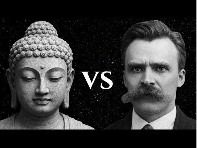
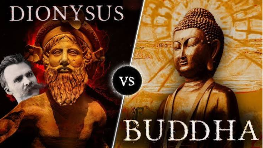
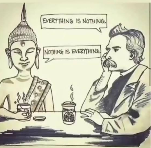
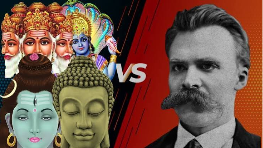
Friedrich Nietzsche and the Buddha both began with the exact same realization: life is inherently full of suffering. However, they arrived at completely opposite conclusions on how to deal with it. While the Buddha sought to understand suffering to completely transcend and liberate human beings from it, Nietzsche demanded that we embrace, endure, and transform suffering into a tool for ultimate personal greatness. [1, 2]
Core Philosophies compared
Philosophical Core
The Buddha
Friedrich Nietzsche
Primary Goal
Liberation from suffering (Nirvana).
Self-overcoming (Übermensch).
View on Suffering
A problem to be diagnosed and cured.
The forge necessary for human greatness.
Approach to Desire
Extinguish craving to find peace.
Affirm the Will to Power and creative passion.
Ultimate Reality
Impermanence and No-Self (Anatta).
Eternal Recurrence of the exact same life.
Key Similarities
Despite their massive divergence, they shared radical overlaps that set them apart from Western religious traditions: [1]
The Illusion of the Self: Both thinkers rejected a permanent, unchanging soul. The Buddha taught Anatta (no-self), viewing the ego as a fluid, changing process. Nietzsche similarly viewed the ego as a social fiction or a collection of competing biological drives. [1, 2]
Psychological Approach: Both treated philosophy as a practical tool for the mind rather than abstract metaphysics. Nietzsche even called Buddhism a “system of mental hygiene.” [1, 2]
Radical Differences
The defining split between the two lies in their ultimate response to the chaos of the world:
Affirmation vs. Cessation: The Buddha outlined the Four Noble Truths, identifying craving (Tanha) as the root of suffering and advocating for its cessation. Nietzsche strongly rejected this, arguing that extinguishing desire and seeking Nirvana was a passive, “life-denying” form of nihilism. [1, 2, 3]
The Will to Power: Nietzsche believed human excellence requires tension, conflict, and ambition. To him, a life without desire was a spiritual death sentence. He championed Amor Fati (love of one’s fate), choosing to live the exact same painful life repeatedly rather than trying to escape it. [1, 2, 3, 4, 5]
Note: Many scholars point out that Nietzsche’s critique of Buddhism was heavily biased by his reading of Arthur Schopenhauer, who presented an overly pessimistic, Westernized interpretation of Buddhist Nirvana as literal annihilation. [1, 2]
Friedrich Nietzsche believed that Christian values arose from a “slave morality” born of resentment. He argued that weak people created these beliefs to tame the strong. In his view, people do not freely choose this faith because of truth. Instead, social pressure, fear, and weakness pull them into it. [1, 2, 3, 4, 5]
Nietzsche’s Core Ideas
Resentment: Weak groups create Christian rules to punish strong people.
Guilt: Faith makes humans feel bad for basic natural urges.
Blind Faith: People follow it because they fear true freedom and power.
Different Views
Christian View: Believers say they choose God with an open heart and free mind.
Other Philosophers: Some thinkers argue that faith is a deep, personal choice.
Would you like to explore Nietzsche’s idea of the Ubermensch (Overman)
Please do not misunderstand my observations regarding the Government’s support for Sri Lanka’s textile and garment industry. I warmly welcome the inauguration of Intex–InMac Sri Lanka 2026, described as South Asia’s leading international platform for textile sourcing and garment-manufacturing technology. Such exhibitions can introduce modern machinery, new materials, international buyers and valuable investment opportunities to Sri Lanka.
The apparel industry has made an enormous contribution to export earnings and employment, particularly by providing economic independence to thousands of Sri Lankan women. The Government should continue supporting it, while improving salaries, working conditions, technical training and opportunities for women to progress into supervisory, engineering, design and management positions.
I personal supported as a chairman of a state institution to build 200 garment factories employing women u Der then head of the state
However, Sri Lanka cannot build its industrial future on garments and other light industries alone.
Harness the physical and technical strength of our youth
I have consistently advocated the development of heavy and technically demanding industries capable of harnessing the energy, intelligence and physical capabilities of our young people. Thousands of able-bodied youngsters are driving three-wheelers or surviving through insecure and unproductive occupations because the country has failed to create sufficient skilled industrial employment.
Some unemployed and frustrated young people also become vulnerable to drugs, organised crime and other antisocial activities. We should not blame the youth alone. When a society fails to provide training, dignity and a realistic career path, criminal networks can exploit that vacuum.
A young person trained as a welder, fabricator, pipe fitter, machinist, electrician, rigger, crane operator, diver or QA/QC inspector can earn a respectable income in Sri Lanka or overseas. More importantly, these skills can help build productive national industries.
Women should not be confined to garments, nor should men be directed only towards heavy work. Both sectors should be open to both sexes. Sri Lankan women can also become excellent welders, engineering technicians, designers and quality inspectors, while men can contribute successfully to technologically advanced apparel production. The national objective must be to match individual ability with proper training and employment.
Give equal ministerial attention to heavy industry
Government ministers regularly attend exhibitions, investment forums and ceremonial openings connected with established industries. That support is necessary. Nevertheless, similar ministerial attention must be given to proposals for:
Shipbuilding and ship repair;
Offshore platform, rig and FPSO repair and conversion;
Steel fabrication and modular construction;
Boatbuilding and marina development;
Petroleum, energy and industrial maintenance;
Advanced welding and underwater welding;
Heavy engineering and machinery manufacture;
Modernisation of fishery harbours and fishing vessels; and
Development of Trincomalee as a regional marine, energy, logistics and offshore industrial hub.
These are not merely theoretical suggestions. I have repeatedly presented practical proposals based on decades of experience in shipbuilding, offshore oil and gas engineering, industrial fabrication and vocational training.
My proposals include developing Trincomalee’s sheltered deep-water harbour for vessel lay-up, offshore repairs, module fabrication, heavy-lift operations and FPSO conversion. They also call for land-based workshops, internationally recognised welding centres and partnerships the public investors
At Voyage Sri Lanka, I also emphasised that our strategic location, maritime heritage, ports and skilled workforce could attract international investment into marine and offshore services.
A constructive request to our young rulers
Sri Lanka’s relatively young political leadership should approach industrial development without ideological prejudice or excessive dependence on conventional thinking. The country needs a balanced employment strategy:
Strengthen apparel and light manufacturing, especially as sources of employment and advancement for women.
Establish internationally accredited technical academies linked directly to employers—not training centres producing certificates without jobs.
Develop heavy engineering, maritime and offshore industrial zones, particularly in Trincomalee, Galle, Hambantota and Colombo.
Offer investors transparent land allocation, predictable taxation, fast environmental approvals and a genuine one-stop approval mechanism.
Introduce apprenticeships through partnerships among the Government, EDB, TVEC, NAITA, universities and private industries.
Set measurable employment targets for every investment receiving State concessions.
Give experienced industry professionals a meaningful role in implementation—not merely invite them to ceremonial meetings and advisory discussions.
The responsible ministers should examine and promote these proposals with the same enthusiasm shown towards established sectors. Even one properly planned offshore fabrication and repair hub could create thousands of direct and indirect jobs in welding, steel fabrication, electrical work, logistics, catering, transport, marine services and engineering.
From three-wheelers to technology
Driving a three-wheeler is honest work and should never be looked down upon. But it should not become the default destination of an educated generation because the country has failed to offer better choices.
Our ambition must be to transform three-wheeler drivers into technicians, drug-vulnerable youngsters into apprentices, school-leavers into skilled tradespeople and trained workers into internationally employable professionals.
Garments can remain one of Sri Lanka’s strongest export pillars. Heavy engineering, maritime services and offshore industries must become additional pillars. A resilient economy needs all of them.
The young rulers of Sri Lanka have an opportunity to create that balanced industrial future. They should listen to practical proposals, consult people with proven industrial experience and—most importantly—move from speeches and exhibitions to implementation.
Dear Ministers of ports and industry
you should take the lead
Afterall even Sinhala Kings had senior Purohita who gave daily advises to the kings
( රාජ උපදේශකයා, ප්රධාන පූජකයා, or රජුගේ ආගමික හා දේශපාලන උපදේශකයා. Or in uk UK Spin Doctors
By, Professor Nishan C Wijesinha of the German School of Medicine.
*During the final phase of the war in Mullaitivu — Mullivaikkal — the Sri Lanka Military operations were led by – the – ground command, in Mullaitivu / Vanni (Feb–April 2009 + May 16-18)*
The Vanni theater was run by Security Forces Headquarters – Vanni. Key commanders named for the final operations by their names were:
– *Maj. Gen. Jagath Jayasuriya* — Security Forces Commander, Vanni. He was present at the official ceremony on 20 May 2009 announcing the end of the war.
– *Brig. Shavendra Silva* — GOC, 58 Division. His division was positioned ∼300m from the NFZ and led the “hostage rescue operation” to break into the last LTTE area. He was also listed as a commander for the Battle of Puthukkudiyirippu in April 2009.
– *Maj. Gen. Kamal Gunaratne* — GOC, 53 Division
– *Maj. Gen. Jagath Dias* — GOC, 57 Division
– *Brig. Prasanna Silva* — GOC, 55 Division
– *Brig. Chagie Gallage* — GOC, 59 Division
– *Maj. Gen. Nandana Udawatta* — 59 GOC – HQ
*Repeated History …*
*Cankili II* was the last king of the Jaffna Kingdom.
– *1617*: Portuguese forces from Colombo, led by Captain-General Filipe de Oliveira, invaded the Jaffna Kingdom.
– *June 1619* The Portuguese captured Cankili II along with members of his family.
– *1619*: He was *beheaded in Goa* along with other members of the royal family.
*Whereas on May 16-18 2009*
The last battles happened in Mullivaikkal; where the LTTE leadership surrendered.
*The above History repeats on May 18 2009* which, according to *IDP’S* *confidential eyewitnesses information received:* ….
Velupillai Prabhakaran’s son Balachandran was taken to a bunker and shot thrice at short range before his father’s eyes and then his father was brutally murdered and the body was placed near the Nandikadal lagoon.
I must strongly say? “that the earlier was history; but the current been totally different, as these brutish war crimes were made after a peaceful surrender; where in which in my experience was an invitation for a productive constitutional political change”.
*Is it not then a concerning issue how? .
**Maj. Gen. Kamal Gunaratne got Velupillai Prabhakaran’s LTTE “Tamileelam” identity card?*
*Doesn’t it not expose exactly the person responsible for this brutish war crime?*
*”How can we been human beings surrender these issues”?*
When I saw a woman in TV shouting at police near the Mahara prison claiming that her son used drugs with her own money not government’s money
A prisoner sentenced to death and awaiting execution asked as his last wish for a pencil and paper. After writing for several minutes, the condemned man called the prison guard and asked that the letter be delivered to his biological mother.
The letter said…
Mother, if there were more justice in this world, we would both be executed, not just me. You are as guilty as I am for the life I have led.
Remember when I stole and took home a bicycle from a boy like me?
You helped me hide it so my father wouldn’t find out.
Remember when I stole money from my neighbor’s wallet?
You came with me to spend it at the shopping mall.
Remember when you argued with my father and he left?
He just wanted to correct me for stealing the final results of the course, which led to my expulsion.
Mom, I was just a child, then I became a troubled teenager, and now I’m a rather poorly formed man.
Mom, I was just a child who needed correction, not approval. But even so, I forgive you!
I only ask that you get this letter to as many parents as possible in the world, so they know that what makes all men become good or bad people…is…
Education is the most powerful weapon which you can use to change the world (Nelson Mandela).
Education and discipline begin in the earliest years of childhood and last until the last day of life (Pythagoras).
Educate the children so that it is not necessary to punish the adults (Pythagoras)
One of the most valuable lessons I learned as an engineering postgraduate in the Soviet Union was that the greatest engineers are not those who repair failures—they are those who predict them before they occur.
My postgraduate research at the Gubkin State University of Oil and Gas in Moscow in 1975 focused on the prognosis of journal bearing failures in massive reciprocating compressors used to inject natural gas into deep underground porous limestone formations in the Kaluga region of the Moscow Oblast.
These compressors were among the largest operating in the Soviet gas industry. A sudden bearing failure could halt production, damage expensive machinery, and disrupt the energy supply. Instead of waiting for a breakdown, my research investigated how changes in lubricating oil pressure, temperature, vibration, and other operating parameters could provide early warning signs. By continuously monitoring these indicators, engineers could predict the remaining life of the bearing and schedule maintenance before a catastrophic failure occurred.
This philosophy of prognosis rather than diagnosis should not remain confined to engineering.
It is equally relevant to the way we govern a nation.
Sri Lanka often reacts to disasters only after they have become crises. Whether it is dengue outbreaks, floods, droughts, epidemics, or economic shocks, we frequently mobilise resources only after lives have been lost and damage has already occurred.
Modern technology allows us to do much better.
Artificial Intelligence can analyse enormous volumes of data—from rainfall patterns, reservoir levels, disease surveillance, satellite imagery, and climate models—to identify warning signs well before disasters unfold. Just as an engineer monitors a compressor bearing, governments should monitor the health indicators” of the nation.
The recent discussions on El Niño demonstrate this need. Climate anomalies can influence droughts, floods, agricultural production, electricity generation, food prices, and public health. These are not unexpected events; they are developments that can be forecast with increasing accuracy. The challenge is to convert scientific predictions into timely policy decisions.
The same principle applies to public health. AI-based surveillance systems can identify unusual disease patterns, predict dengue hotspots, anticipate shortages of hospital resources, and recommend preventive action weeks in advance. Prevention is invariably less expensive than emergency response.
The global geopolitical environment also demands predictive thinking. Conflicts in the Middle East, disruptions to shipping routes, fluctuations in oil prices, cyber threats, and supply chain interruptions all have direct consequences for Sri Lanka. Governments should continuously evaluate these risks using predictive models rather than responding only after the impact reaches our shores.
Engineering teaches us that every failure leaves warning signals.
The wisdom lies in recognising them.
Our national planning institutions should evolve from being reactive administrators into predictive organisations. Ministries, universities, research institutes, and the private sector should work together to develop AI-driven forecasting systems covering health, climate, food security, transport, energy, and national security.
A country that predicts problems will always outperform one that merely reacts to them.
The Soviet engineers who inspired my research understood this principle decades ago. Today, with artificial intelligence, satellite technology, and advanced computing, our ability to foresee risks is greater than ever.
The real question is not whether we possess the technology.
It is whether we possess the vision and determination to use it before the next crisis arrives.
Attorney-at-Law Aruna Laksiri Unawatuna B.Sc(Col), PGDC(Col) (Coordinator) Dr. Thilaka Padma Subasinghe Memorial Legal Education Programme
1. While Article 83.ආ. of the Constitution of Sri Lanka provides that a referendum is required to amend Articles 30.2 and 62.2 [Article 83.b. of the English version of the Constitution] Paragraph 83.b. of the English version of the Constitution states that a referendum is required only for amendments that extend the term of Articles 30.2 and 62.2 to more than 6 years (which would extend) Amendments that would reduce that period are not stated that a referendum is required] The amendment of Articles 30.2 and 62.2 without holding a referendum and the enactment of laws according to the English version of the Constitution was done through the 19th Amendment to the Constitution in 2015, and since the Speaker’s certificate has been used, the 19th Amendment to the Constitution has become a law.
2. That is, without amending Article 83.ආ. of the Constitution, that is, without going to a referendum, Articles 30.2 and 62.2 of the Constitution have been amended and made a law. (Since the Speaker has certified/signed the amendment of Articles 30.2 and 62.2 of the Constitution, it has become law)
3. Now the problem is that Article 83.ආ. of the Constitution has not been amended/corrected in accordance with the 19th Amendment to the Constitution. That is, Article 83.ආ of the Constitution has not been amended/corrected to date in accordance with Article 83.b of the English version of the Constitution. (Article 83.ආ. of the Constitution has not been aligned/corrected/amended with Article 83.b of the English version of the Constitution)
4. That is, Article 83.ආ. of the Constitution The words “amendment or” in the paragraph of the Constitution 30.2 and 62.2 have not been amended in such a way that the Constitution 30.2 and 62.2 “amendment to increase the term by more than 6 years” has not been amended.
5. Accordingly, the amendment of Article 83.ආ of the Constitution should be done first, and without doing so, bringing an amendment to the Constitution to increase the term of judges is contrary to Article 3 of the Constitution, but under the sovereign power of the people to enact laws, the President can make it a law by cerifying/signing it after the people approve it through a referendum and by a 2/3 vote of the Parliament, including the absent members. https://neethiyalk.blogspot.com/2026/08/since-article-83b-of-constitution-has.html?m=1
Attorney-at-Law Aruna Laksiri Unawatuna B.Sc(Col), PGDC(Col) (Coordinator) Dr. Thilaka Padma Subasinghe Memorial Legal Education Programme
Translation of the article මේ දක්වා ආණ්ඩුක්රම ව්යවස්ථාවේ 83.ආ. ඡේදය සංශෝධනය නොකිරීම හේතුවෙන් විනිසුරු කාලය වැඩිකිරීමේ සංශෝධනයට ජනමතවිචාරණයක් අවශ්ය වෙයි.
India is embarking on one of the world’s most ambitious naval expansion programmes, investing heavily in warships, support vessels, shipyards, logistics and maritime infrastructure. This is not merely a defence initiative—it is an industrial revolution that will create enormous opportunities throughout the Indian Ocean region.
Sri Lanka should not remain a spectator.
Our private sector must be encouraged to form joint ventures with Indian companies in shipbuilding, steel fabrication, precision engineering, marine equipment manufacturing, welding, offshore fabrication, logistics and technical training. Rather than competing with India, Sri Lanka should become its trusted industrial partner.
Our strategic location, experienced maritime workforce and existing facilities at Colombo, Trincomalee and Galle can complement India’s growing naval and commercial maritime ambitions. Components, outfitting, maintenance, repairs, specialised fabrication and workforce development can all be undertaken in Sri Lanka if the right partnerships are established.
The Government should therefore launch an active campaign through the Board of Investment, Export Development Board, Chambers of Commerce and diplomatic missions to connect Sri Lankan entrepreneurs with Indian investors and shipbuilding companies. Incentives should be provided for technology transfer, joint manufacturing and vocational training.
The benefits extend far beyond defence. A stronger maritime industrial base will generate high-value employment, strengthen vocational education, increase exports, attract foreign direct investment and position Sri Lanka as an indispensable maritime engineering hub in the Indian Ocean.
India’s naval growth should not be viewed simply as a strategic development. It should be recognised as a once-in-a-generation economic opportunity for Sri Lanka. Those who build partnerships today will become part of the maritime supply chain of tomorrow.
Reforming the nation’s appalling slaughterhouse conditions is a far more massive and urgent necessity than reforming the use of a few dozen domesticated elephants in a Perahera. Millions of farm animals are transported and slaughtered annually under severe brutal conditions and mostly without being subject to regulation. Untrained and Unskilled Butchers without proper instruments for slaughter can aggravate the misery and suffering of the victim. Wilful blindness to wrongdoing towards animals is the unfortunate legacy of almost every Sri Lankan Government since grant of independence in 1948. It is a national shame.
The archaicButchers Ordinance of 1893 andthe Animals Act of 1958govern slaughterhouse practices and processes. This 19th-century British made colonial statute i.e., Butcher’s Ordinance, adopts a harsh utilitarian attitude towards defenseless animals without conceding an iota of humanity towards them. That was colonial thinking. The focus exclusively is on meat pricing, licensing, and revenue collection rather than modern humane slaughter standards or pain mitigation. [1, 2, 3, 4]
Daily slaughterhouse practices take place behind closed doors, shielding extreme confinement, transport trauma, and un-stunned grieving, crying and defecating animals prior to slaughter from public viewing and consciousness. [1, 2, 3]
It is a hell hole for the animals and a devastating shocking experience for the human viewer.
Sri Lanka’s newly updated Animal Welfare Bill of 2026 is meant to replace the outdated Prevention of Cruelty to Animals Ordinance of 1907. Likewise a similar process must be initiated immediately to introduce ethical pain mitigation standards to legislation through a repeal of the Butcher’s Ordinance of 1893 and Animals Act of 1958.
The stark absence of humane slaughter mandates and continuation of primitive and obsolete 5th century slaughter methods under the Butchers Ordinance have made slaughterhouse conditions the most pressing source of systemic animal pain in Sri Lanka.
Massive lobbying from the meat and dairy industries has kept daily slaughterhouse oversight separated from the new bill’s strict penalties. Their influence is such that recent amendments hand administrative power to the livestock-heavy Department of Animal Production and Health, rather than to an animal welfare centered entity, creating an inherent conflict of interest.
In any true Animal Welfare legislation the welfare of the animal is the paramount consideration. The exclusion of farm animals and poultry from the protection of the new draft Act has thrown overboard that valid assumption.
At stake in the whole drama is the spectacle of the diminishing moral authority of the Buddhist Sinhalese rulers on matters relating to animal welfare which once upon a time in the distant past the Buddhist Kings of Sri Lanka championed winning the admiration of the then known medieval world.
Senaka Weeraratna
Director, Justice for Animals and Nature
Former Legal Consultant on Animal Welfare Legislation to the Law Commission of Sri Lanka (2000 – 2006)
Formerly known as Fabweld Academy, the institution now operates as the IDMNS Advanced Welding Campus, dedicated to producing internationally competent welders and fabrication professionals through a unique combination of classroom theory, practical workshop training, and industry-based hands-on experience.
The campus was recently inspected by the Sri Lanka Bureau of Foreign Employment (SLBFE). Following a positive evaluation, the Bureau expressed its willingness to recognise the campus as an approved testing facility, enabling trainees to have their skills assessed to standards expected by overseas employers.
The reputation of the campus is already attracting engineering graduates. Several young engineers from the University of Ruhuna have shown interest in undertaking practical welding training before leaving for Australia, recognising that hands-on industrial skills complement their academic qualifications.
In today’s highly competitive global job market, possessing an internationally recognised welding certificate together with practical experience provides a significant advantage. Whether seeking employment in Australia, the Middle East, Europe, the offshore industry, shipbuilding, or heavy engineering, employers value candidates who can demonstrate both technical knowledge and proven practical competence.
The IDMNS Advanced Welding Campus is committed to bridging the gap between education and industry, empowering Sri Lankan youth with the skills, confidence, and internationally recognised qualifications needed to build successful careers both at home and abroad.
Modern legislation to govern Animal Welfare in Sri Lanka is a sine qua non. A Civilizational imperative. It can no longer be sidelined as has been practiced in the past on the ground that matters addressing human needs must always have priority over animal needs. Unfortunately, this was the experience of the well-planned and well-drafted Animal Welfare Bill released by the Law Commission in 2006. It was the most comprehensive document prepared over a period of six years (2000 – 2006) after an extensive study and examination of laws of other Jurisdictions, during the drafting stage with Animal Welfare as its only focus. It became a political football soon after its release.
Interference by various people representing vested interests exploiting animals, changing/adding/deleting key Clauses over the years to primarily provide trade benefits over and above the welfare of the animals led to the backslide of the Animal Welfare Bill.
While the attempt to enact a New Animal Welfare Bill to replace the archaic and obsolete legislation i.e., the Prevention of Cruelty to Animals Ordinance, No. 13 of 1907 is indeed commendable, the failure to incorporate an up-to-date legal framework containing modern standards particularly on conditions surrounding slaughter up to the final moments of a live animal, would continue to slur Sri Lanka’s international image.
The new AW Bill retains the applicability of the 1893 Butcher’s Ordinance with all its obnoxious and medieval methods of slaughter without consideration of bringing any improvement to the welfare of the animals at the time of passage in the slaughterhouse and time of slaughter. This is totally unacceptable. Slaughter of an animal must be subject to strict regulation in line with modern standards found in, for example, Spain, Germany and Belgium, and in line with the main object of the AWB – Clause 2a
a)foster kindness, compassion, and responsible behavior towards animals and secure the protection, welfare and wellbeing of animals
Furthermore, the new Bill (2026) contains significant contradictions and ambiguities that will render most acts of cruelty to animals not legally definable and will obstruct State and public rescue operations to save threatened animals or animals in danger difficult.
4. Clause 19 is the ugly duckling of the entire Animal Welfare Bill (2026). It is tantamount to a blatant negation of the right to protection for all animals that is usually at the heart of credible Animal Welfare legislation in any part of the world. In the 2026 version, the AWB guarantees at the commencement of the legislation the right to protection of all animals but with a sleight of hand excludes certain species of animals totally, including both quadrupeds and bipeds, which are of economic value from such protection. Even an iota of protection from legislation. No country in the world has such draconian draft legislation directed towards some categories of animals, defined as food animals, who are making the supreme sacrifice of their dear lives for the benefit of humans without even a modicum of expression of gratitude from the human consumers of their flesh. This is a reversal of morality that Sri Lanka once took pride in and led to people of neighboring countries calling the Sinhalese ‘Aryavamsa’, (which means Noble Race”). Ancient rulers made animal protection and welfare part of the law and public administration. The Buddhist principles of metta (loving-kindness) and karuna (compassion) shaped daily life. People avoided harming living creatures, setting a high moral standard admired by others even in neighbouring countries. This high moral standing and unique identity of the ancient Sinhalese was deeply rooted in several historical practices:
Deep Roots of Animal Welfare in ancient Sri Lanka
Buddhist Influence: Following the arrival of Buddhism in the 3rd century BCE, the concepts of metta (loving-kindness) and karuna (compassion) became central to state administration. [1]
Royal Decrees: Ancient Sinhalese kings frequently issued Maghata decrees (royal orders banning the killing of any living beings) across the island. [1, 2, 3]
Animal Sanctuaries: Rulers established the world’s earliest wildlife sanctuaries and dedicated animal hospitals to treat sick or injured wildlife and domestic beasts. [1, 2, 3]
Ahimsa Ideals: The societal adherence to Ahimsa (non-violence) and a historical distance from commercial animal slaughter drew widespread admiration across South Asia. [1, 2]
5. Clause 19 with sub-clauses (a-i) with trade benefits and profits in mind for business houses, allows selected Animals despite being ‘sentient beings’ to be treated as inanimate objects or chattels contradicting the Act’s own definition of Animal” and subverting its own Objects. This is unconscionable and immoral as, for example, Chicken is excluded from the welfare provisions of the Draft Act.
6. Clause 19 prohibits farm animals (19(c) and live animals that are being used in experiments and teaching (19(e)from gaining the protection of this Act and has extended the exemption from gaining protection of the Act to Poultry (19(d) purely for trade and economic benefits. The welfare of the animal is being sacrificed in the altar of profit and in the rush to accommodate the meat trade in these provisions. All this defeats the primary purpose of this Act, as Poultry (fowls, hens) are also ‘sentient beings’ (animals), and their welfare is entitled to protection under the draft Act.
7. Clauses 1-18 mostly deal with the refinement of the language used in the provisions and the increase in the quantum of fines and jail terms.
8. Clause 19 (e) says that the draft Act does not apply to the use of animals for testing of drugs or cosmetics in accordance with the prescribed procedure”. This provision is morally indefensible and glaringly contradictory to another identically worded provision. In one provision of the Act (Clause 13) the use of live animals is prohibited, adding a rider qualifier that was not there in the 2006 version – unless it is for prescribed purposes.” and in this Clause, it is allowed without any prohibition or qualifier. In fact, this Act will not protect these live animals. These two provisions, Clause 13 and Clause 19(e) mutually contradict each other and if kept as they are in this manner, they will bring the 2026 Act to ridicule and disrepute. Chapter III which deals exclusively with ‘Use of live animals for Experimental and Teaching Purposes’ is rendered redundant as Clause 18 (e) prohibits the application of the draft Act to use of animals for testing of drugs or cosmetics in accordance with the prescribed procedure”. These blatant contradictions make a mockery of the Draft Act. Clause 47 which deals with the subject of Regulation repeats in Clause 47 (2) (o) the same subject that is dealt with in Clause 19 (this subject which will be redundant by virtue of Clause 19 (e).
9. The word ‘Pests’ in Clause 45, raises new animal welfare concerns. ‘Pests’ back in the 2006 Bill were meant to be interpreted as ‘insects’ but never as bipeds or quadrupeds. The looming danger is that the term ‘Pests’ may provide a loophole for stretching the interpretation to include a whole range of other animals e.g., wild animals, stray cats, and dogs. This is alarming.
10. Part II – Clause 30(1) There is provision for establishment of the Animal Welfare Advisory Committee in place of a National Animal Welfare Authority as proposed in the 2006 Bill is another drawback. Drafting of legislation must be strict and not leave room for favourites of the framers of the legislation to creep in through the backdoor via an extended interpretation of a provision drafted for such purpose. Clause 30 (1) (b) (i) is one such provision. In other provisions, suitable people involved in a particular field are acceptable for nomination to this Committee. In this sub-clause, the language used is ‘actively engaged in animal welfare’. This is an insult to all veterinarians as they are all engaged in the rendering of services to animals. The Act’s own interpretation of Animal Welfare Officer” means all Government Veterinary Surgeons.
11. Animal Welfare Advisory Committee — (Part II) Clause 30 of the AWB (2026) is an extended and lengthy provision devoted exclusively to the subject matter of the ‘Establishment of the Animal Welfare Advisory Committee’ and related aspects.
It is when one looks closely at the composition of the Advisory Committee and the basis of its duties in an Advisory capacity to the Minister that the sinister Agenda underlying the AWB (2026) is laid bare.
Using a hackneyed idiom, the framers have ‘let the cat out of the bag’ in composing Clause 30. Its unbalanced nature, one-sidedness, and bias in favour of vested interests that unabashedly exploit animals in the food industry, pharmaceutical and cosmetics industries, and laboratory sciences, are abundantly made clear. In comparison to the content of the 2006 version of AWB relating to the composition of the Authority and its functions (Part II) (Clause 3 -13), the 2026 version has downsized and circumscribed the work of the Advisory Committee.
In a glaring display of partisanship, there is room provided in the Advisory Committee to be packed with members representing the ‘users of animals for consumption and trade’ rather than the ‘carers’ and ‘voices’ for animals. The 2006 version allowed six members nominated by Animal Welfare Societies to be on the Committee of the Authority. This number has been reduced to five members on the Advisory Committee in the 2026 version.
In the 2006 version the functions of the Authority in favour of the uplift of the cause of animals extended to 24 items in number (Part III – Clause 14 (a) – 14 (u)). These 24 lines of pursuit as set out were ennobling and dignified reflecting the historical and civilizational character of Sri Lanka. Unfortunately, this high-minded endeavour has been thwarted and the number of advisory functions has been reduced to seven in the 2026 version while one function (within these seven ) is to advise the Minister ‘on any matter relating to laboratory facilities for experiments on animals.’ There was no such function allocated to the Authority in the 2006 version.
12. Clause 3 – Appointment of the Director – General of Animal Production and Health (appointed under Section 2 of the Animal Diseases Act, No. 59 of 1992) to be in charge of the general administration of the Animal Welfare Act
Assigning the Director-General of the Department of Animal Production and Health to administer Sri Lanka’s Animal Welfare Bill creates a structural conflict of interest, as the Department’s primary mandate centers on livestock promotion and the agricultural industry rather than independent animal protection.
This provision in the Act pits economic and industrial targets against humane animal protections.
The Core Conflict of Interest
Production vs. Protection: The DAPH is legally and operationally mandated to maximize livestock yields, commercial efficiency, and the economic performance of the meat, dairy, and poultry industries. Tasking the same agency with enforcing strict anti-cruelty standards is viewed as asking the industry to police itself. [1, 2, 3, 4]
Exclusion of Commercial Cruelty: Critics highlight that because of intensive industry lobbying, the 2026 Bill omits sweeping oversight of daily slaughter house operations. Having a production-focused department at the helm ensures commercial slaughterhouse conditions remain largely unscrutinized under the guise of regular industrial operations. [1]
Jurisdictional Mismatch: While the Director-General’s expertise lies strictly in food-producing farm animals, the Animal Welfare Bill covers domestic pets, stray animals, wildlife, and exotic species—areas where the DAPH lacks mandate and expertise. [1, 2, 3]
The Conflict of Interest
Mandate Mismatch: The Department of Animal Production and Health focuses on livestock economics, farming output, and the meat industry, which can directly clash with ethical welfare enforcement.
Broad Jurisdiction: The bill covers pets, stray animals, and wildlife, yet puts a livestock-oriented agricultural officer in overall charge.
Diluted Protection: There is a huge possibility that commercial and agricultural interests may override strict anti-cruelty enforcement for farm and production animals and dilute the protection afforded to such animals by the Act.
Idiom
“It is like the fox guarding the henhouse” or “setting a wolf to watch the sheep” These idioms refer to giving a dishonest or dangerous person the power to exploit the very things they are supposed to protect. This is a bad provision in the Animal Welfare Bill with an obvious conflict of interest.
The Conflict Issues
Mandate Clash: The Department of Animal Production and Health supports livestock industries. Animal welfare groups protect animals from harm.
Broad Scope: The law covers pets, wildlife, and farm animals. A livestock-centered boss may ignore farm or slaughterhouse cruelty.
Weak Enforcement: Commercial interests will overrule basic welfare needs.
Solution
An independent entity that has no vested interest in the production of livestock and commercial exploitation of animals should be in charge of the administration of the Animal Welfare Act.
The Protection of the Animal is the paramount aim of the Act. It is so in all civilized countries.
Revive Ayurveda Treatment of Animals
Traditional Ayurveda treatment of animals in Sri Lanka, historically known as Pasu Ayurveda or Gava Ayurveda, is an ancient veterinary practice that predates modern Western medicine by centuries. Rooted in the island’s indigenous Hela Wedakama and Indian Ayurvedic traditions, this holistic system focuses on balancing the animal’s bodily humors using entirely natural resources. [1, 2, 3, 4, 5]
Historical Milestones
Royal Patronage: Sri Lankan kings were highly involved in animal care. Ancient chronicles like the Mahavamsa record King Dutugemunu (161–137 BC) ordering physicians to treat his royal war elephant, Kadol Etha (Kandula), for severe burns suffered during battle. [1, 2, 3, 4]
The Healer King: King Buddhadasa (AD 340–368), a renowned royal physician, famously performed a surgical procedure on an injured snake, showcasing the extreme breadth of ancient wildlife care. [1]
Ancient Records: Extensive knowledge of animal treatments remains preserved on ola leaf manuscripts (palm-leaf documents) stored at the National Museum and the Ayurvedic Research Institute in Maharagama. [1, 2]
Key Animal Groups Treated
Elephants (Ali Wedakama): Given the cultural and religious importance of elephants in Sri Lanka, a specialized branch of native medicine exists solely to treat their physical ailments, foot rot, and behavioral issues. [1, 2, 3, 4]
Cattle (Gava Wedakama): Traditional farming communities historically relied on local practitioners to cure livestock of digestive issues, wounds, and fractures using herbal remedies. [1, 2]
Pets and Domestic Wildlife: Domesticated dogs, cats, and birds are frequently administered gentle herbal decoctions for common infections and physical trauma.
Common Treatment Methods
Oral Medications: Administering herbal pastes (kalka), decoctions (kasaya), and powders mixed with organic carriers like honey or coconut milk.
Inhalation Therapy: Forcing animals to inhale medicinal fumes generated by burning specific herbs to clear respiratory blockages.
Symbolic Branding: Utilizing specialized branding patterns on skin areas to stimulate specific marma (pressure) points, historically used for cattle and elephants.
Fracture Healing (Kedum Bidum): Applying herbal pastes wrapped in leaves and bamboo splints to reset broken bones in livestock, dogs, and cats. [1, 2, 3, 4]
Current Status and Practitioners
Today, it is estimated that around 2,000 traditional veterinary practitioners exist throughout Sri Lanka. Most practice on a part-time basis within rural farming villages, passing down secret family recipes orally or through handwritten journals. [1]
The state recognizes this heritage legally. For example, the draft Animal Welfare Bill of Sri Lanka explicitly mandates that national animal welfare advisory councils must include a registered Ayurvedic physician with experience in treating animals. [1, 2, 3]
https://share.google/aimode/3dxPp0xKb3KCcp9tk
Concluding Remarks:
The entire Animal Welfare Bill proposed by the Law Commission in 2006 has been hijacked by the Meat trade and its acolytes and converted into an AWB (2026) protecting not the innocent animals but more the interests of the Poultry and Meat trade, and those who use live Animals in totally unnecessary experiments despite the availability of viable non-violent and harmless alternatives.
Any Animal Welfare Bill that deliberately overlooks the appalling and inhumane slaughter conditions in Sri Lanka without addressing them like in developed countries e.g. Spain, Germany, UK, is a sham.
People who want to ban Elephants in Perahera must also address the issue of Animal Sacrifice on religious grounds. No person has a Constitutional right to deprive a defenseless animal of its precious life for the purpose of appeasement of God(s). It is cruel and barbaric to do so. That is a challenge that AWB must accept. This must be made part of modern humane education (covering all living beings – ‘Siyalu Sathwayo’) beginning from the kindergarten in schools.
It is a shame to see that the Veterinary Council of Sri Lanka appears to be using their power and influence to dislodge the Ayurveda practitioners who have served animals in this country for more than 2000 years from the field of Animal care. No monopoly for Western educated Vets. ‘Ayurveda Veda Mahattayas’ are true friends of Animals. Their voice must be heard in the corridors of power of the Vet Industry and on the Animal Welfare Advisory Committee.
Can the friends of voiceless animals remain silent in the face of enactment of a bad piece of draft legislation that overlooks the suffering of animals on the way to slaughter without food, water and care, to be called the ‘Animal Welfare Act’ upon enactment?
NO
Senaka Weeraratna
Director
Justice for Animals and Nature
Former Legal Consultant on Animal Welfare Legislation to the Law Commission of Sri Lanka (2000 – 2006)
Analysis by AI with my input By Dimuthu Obeysekera, MSc
The recently published book Gerontocracy in America by Samuel Moyn has generated considerable debate by examining how wealth, political influence and economic power have become concentrated among older generations in the United States.
Although America and Sri Lanka have different histories and economic systems, the central question raised by the book deserves careful consideration in our own context.
Has Sri Lanka also become a society where wealth, influence and economic opportunity are increasingly concentrated among older and already established groups?
This question should not be reduced to a conflict between the young and the old. Older Sri Lankans have made enormous contributions to the country, and many continue to work, lead, invest and mentor others well beyond the traditional retirement age.
The real concern is not age itself. It is whether property, capital, business ownership, political influence and leadership opportunities are being passed forward—or remaining concentrated within the same families and networks.
Sri Lanka’s younger generation is entering adulthood under economic conditions very different from those experienced by previous generations. Education and hard work remain essential, but they may no longer be sufficient to provide housing, financial security or the capital required to start a business.
Increasingly, the decisive question is not only what a young person earns, but also what assets and family support stand behind that person.
THE GENERATION THAT ENTERED EARLIER
Sri Lankans who entered employment during the 1960s, 1970s and 1980s faced many hardships. They lived through political unrest, economic restrictions, shortages and periods of uncertainty. Their achievements should not be dismissed as mere luck.
However, they also entered the economy when certain opportunities were more widely available.
Land in many areas was comparatively inexpensive.
Housing could be acquired at prices closer to ordinary professional incomes.
Some employees received subsidised housing loans.
Government employment provided stability and, in many cases, pensions.
Professionals and skilled workers who migrated to the Middle East, Europe, Australia and North America could earn foreign incomes and invest them in Sri Lankan property.
Over time, urbanisation, infrastructure development and population growth increased land values in Colombo, Gampaha, Kandy, Galle and other developing areas.
A family that purchased land decades ago may now own an asset worth many times its original price. In some cases, this increase in wealth occurred without the family establishing a new industry or substantially increasing its productive income.
This does not mean that earlier owners acted unfairly. They bought property when they could and benefited from its appreciation.
The problem is that the same appreciation that enriches an existing owner raises the barrier faced by the next person attempting to enter the market.
WHEN ASSETS RISE FASTER THAN WAGES
A salary and an appreciating asset do not create wealth in the same way.
A salary is earned month by month and is largely consumed by food, transport, rent, education, healthcare and other living expenses.
An asset such as land, housing or a business can rise in value over many years. It can also produce rent, provide collateral for a loan and eventually be transferred to the next generation.
When property values rise faster than salaries, a major economic division emerges.
Those who already own assets become wealthier.
Those who do not own assets must save for longer while the price of entry continues to move further away.
A young professional may have a university degree, a respectable job and a reasonable monthly income, yet still be unable to purchase land or a house near the place of employment.
Meanwhile, another person of the same age and with a similar salary may receive land, accommodation, a loan guarantee, business capital or a house deposit from the family.
Their qualifications may be similar, but their economic futures are not.
The first person begins adulthood with an asset.
The second begins with rent, debt and the difficult task of building capital from wages alone.
THE NEW DIVIDE WITHIN THE YOUNGER GENERATION
It is therefore inaccurate to describe the problem simply as older people against younger people.
There are older Sri Lankans without property, savings or adequate retirement security. There are also young Sri Lankans who inherit substantial land, businesses and financial assets.
The deeper divide is increasingly found within the younger generation itself.
On one side are young adults who can rely on family property, accommodation, business connections and financial assistance.
On the other are equally capable young adults who must begin without any such support.
Family assistance is usually given out of love and responsibility. Parents naturally want to give their children the best possible start in life. There is nothing wrong with a parent helping a child purchase a home, obtain an education or establish a business.
However, when access to housing, capital and professional opportunity depends too heavily on parental wealth, society becomes less meritocratic.
The question is no longer simply, What can this young person achieve?”
It becomes, What can this young person’s family provide?”
EDUCATION ALONE CANNOT CARRY THE BURDEN
For decades, young people have been told that education is the principal route to social mobility.
Education remains essential. Sri Lanka must continue to invest in universities, schools, technical colleges and professional training.
But a qualification cannot compensate for every structural disadvantage.
A graduate may possess knowledge and ability but lack the capital to commercialise an idea.
A young engineer may be technically capable but unable to purchase machinery or obtain a loan.
A skilled worker may earn a reasonable income but still find that housing prices rise faster than savings.
A young entrepreneur may develop a strong proposal but be unable to provide the collateral demanded by a bank.
Education creates human capability. It does not automatically create property, credit access, professional networks or business ownership.
Sri Lanka must therefore ensure that education leads into a functioning system of economic opportunity. Otherwise, the country will continue producing qualified young people who remain dependent on families, struggle to establish themselves or eventually seek opportunities abroad.
POLITICAL CONNECTIONS AND CLOSED NETWORKS
Sri Lanka’s pattern of wealth creation also has features that differ from those of many developed economies.
For decades, political influence has sometimes shaped access to import licences, land allocations, government contracts, state appointments, protected markets and commercial opportunities.
Many Sri Lankan entrepreneurs have undoubtedly succeeded through discipline, innovation and risk-taking. Their achievements should be recognised.
Nevertheless, it would be unrealistic to deny that political patronage and privileged access have also contributed to the accumulation of wealth.
When such advantages remain within established circles and are passed from one generation to the next, the economy becomes less open to new entrants.
A family may pass on not only property and money, but also established relationships with banks, officials, suppliers, customers and political decision-makers.
A young outsider may possess greater technical ability or a better idea but still struggle to compete against inherited capital and established influence.
This is how economic concentration can continue without any formal rule excluding the young. The barriers may be invisible, but their effects are real.
IS THIS GERONTOCRACY?
Gerontocracy literally means rule by the elderly.
Sri Lanka’s situation is more complex.
The problem is not that experienced people remain active. A country should never waste knowledge merely because its holders have reached a certain age.
The problem arises when leadership, property, contracts, capital and decision-making authority remain within the same networks for too long, without creating space for capable newcomers.
Experience should not become a gate that keeps others outside.
It should become a bridge that allows the next generation to move forward.
Older professionals and business leaders can provide mentorship, credibility, technical knowledge and investment.
Younger people can contribute technological understanding, new business models, energy and the willingness to enter emerging industries.
A healthy society combines these strengths.
An unhealthy society allows one generation to retain control while expecting the next generation to wait indefinitely.
THE SOCIAL CONTRACT BETWEEN GENERATIONS
Every generation inherits something from those who came before it.
This inheritance is not limited to houses, land and bank accounts. It includes institutions, public infrastructure, education systems, professional standards, accumulated knowledge and economic opportunities.
Each generation therefore carries a responsibility to leave behind more than private family wealth.
Parents may do everything possible for their own children while the wider system becomes increasingly difficult for young people without wealthy families.
This creates an important contradiction.
A society may contain many good parents but still fail to provide fair opportunities for the younger generation as a whole.
The responsibility to the next generation is therefore both personal and national.
Sri Lanka must ask whether its policies are creating new pathways into ownership or simply increasing the value of assets already held by established groups.
It must also ask whether young people are inheriting productive opportunities—or mainly public debt, high living costs, expensive property and weakened institutions.
HOW CAN YOUNG PEOPLE CREATE WEALTH?
The most useful question is not how to take wealth away from older Sri Lankans.
It is how to create new routes through which younger Sri Lankans can build wealth independently.
If the principal route to security remains purchasing land and waiting for its value to rise, those who already own land will continue to hold the advantage.
Sri Lanka must therefore create new forms of productive wealth.
• Shipbuilding and ship repair • Offshore and marine support services • Renewable energy • Artificial intelligence and digital industries • Precision engineering • Advanced welding and fabrication • Robotics and industrial automation • Marine biotechnology • High-value agriculture • Logistics and aviation services
These sectors should not be viewed only as sources of employment.
Young Sri Lankans must be given opportunities to become suppliers, contractors, innovators, investors and owners within them.
A job provides an income.
Ownership provides an opportunity to accumulate capital, expand a business, employ others and transfer productive wealth to the future.
VOCATIONAL SKILLS CAN EXPAND OPPORTUNITY
Sri Lanka continues to give greater social recognition to university education than to advanced technical and vocational careers.
This attitude must change.
Modern economies depend on highly skilled welders, machinists, pipefitters, offshore technicians, divers, marine engineers, robotics specialists, equipment operators and industrial maintenance professionals.
These are not low-level occupations. They require discipline, certification, precision and continuous technical development.
In internationally connected industries, such skills can produce strong incomes and pathways into entrepreneurship.
A skilled welder may eventually establish a fabrication company.
A marine technician may become a specialist contractor.
A machinist may develop a precision-engineering workshop.
An automation technician may create a systems-integration business.
Vocational education can therefore become more than a route to employment. It can become a route to ownership and social mobility.
But this requires internationally recognised training, modern equipment, industry partnerships and clear progression from apprentice to specialist, supervisor and entrepreneur.
ACCESS TO CAPITAL MUST BE REFORMED
Skills and ideas cannot become businesses without finance.
Sri Lankan banks commonly lend against existing assets. This protects the bank but favours people who already possess property.
A capable young entrepreneur without land may therefore be denied finance, while an established asset owner can borrow more easily even when the new business proposal is less innovative.
This system reproduces existing wealth rather than creating new wealth.
Development banks and financial institutions should establish programmes that assess technical ability, contracts, cash flow and commercial potential—not collateral alone.
Youth-oriented venture-capital and credit-guarantee schemes should support carefully evaluated businesses in engineering, technology, agriculture, energy and maritime industries.
Tax incentives should encourage experienced professionals and established companies to invest in young enterprises.
Government procurement should reserve transparent opportunities for qualified small and emerging firms.
However, simply making more credit available is not enough.
If loans are directed mainly towards purchasing limited land and housing, additional credit may only push prices higher.
Finance should therefore be linked to productive investment, new housing supply, export industries, technology, equipment and business creation.
OPENING THE DOORS OF GOVERNMENT PROCUREMENT
The government is one of the largest purchasers of goods and services in Sri Lanka.
Yet younger businesses frequently struggle to qualify for contracts because they lack previous government experience, large financial guarantees or established political connections.
Procurement systems should protect public funds, but they should not permanently exclude new entrants.
Large projects can be divided into suitable packages.
Transparent scoring systems can recognise innovation and technical quality.
Emerging companies can be encouraged to participate through partnerships, subcontracting arrangements and monitored pilot projects.
The objective should be to create a competitive pipeline in which capable young firms can gradually build experience and credibility.
Otherwise, public contracts will continue circulating among a limited group of established businesses.
FROM PASSIVE PROPERTY TO PRODUCTIVE CAPITAL
Sri Lankan families have traditionally regarded land and housing as the safest forms of wealth.
This is understandable. Property offers security in a country that has experienced inflation, political instability and uncertainty in financial markets.
But when too much national capital remains locked in land, the country may become asset-rich while remaining industrially weak.
Older asset owners can play a major role in changing this.
A portion of accumulated wealth could be directed towards productive enterprises, start-ups, modern agriculture, export manufacturing and technical training.
Experienced businesspeople could mentor younger partners rather than merely passively transferring property after death.
Such investment would benefit both generations.
Older investors would gain new opportunities for returns and legacy.
Younger entrepreneurs would gain capital, credibility and access to experience.
Sri Lanka needs more bridges between accumulated wealth and emerging talent.
A PARTNERSHIP, NOT A GENERATIONAL WAR
This debate should not become an accusation against older Sri Lankans.
Many worked under difficult conditions, supported extended families, educated their children and saved carefully over decades.
Nor should younger people be dismissed as impatient or unwilling to work.
They are attempting to establish themselves in an economy where housing is expensive, wages are under pressure, stable employment is limited and business finance remains difficult to obtain.
Both generations need each other.
Older Sri Lankans possess experience, networks, property and accumulated capital.
Younger Sri Lankans possess technological knowledge, adaptability, new ideas and entrepreneurial ambition.
The country will progress when experience finances and mentors innovation—and when innovation creates new value rather than merely waiting to inherit existing assets.
CONCLUSION
Sri Lanka’s challenge is not that older people have accumulated wealth.
The challenge is that too many younger Sri Lankans lack an independent and realistic pathway to create wealth of their own.
A society cannot claim to provide equal opportunity when two equally qualified young people have completely different futures because one inherits property and the other does not.
Neither can economic progress be measured solely by rising land values. A country does not become more productive merely because existing property becomes more expensive.
Real progress occurs when a capable young Sri Lankan—regardless of family background—can acquire useful skills, find suitable housing, obtain finance, establish a business and compete fairly for opportunities.
Sri Lanka must therefore move from an economy that rewards possession alone towards one that also rewards innovation, skill, productivity and enterprise.
The older generation should not be pushed aside. Its experience and capital are national resources.
But those resources must help build ladders for the next generation rather than walls around existing privilege.
Only through such a partnership can Sri Lanka achieve stronger social mobility, wider ownership, productive economic growth and genuine fairness between generations.
Deputy Minister of Defence Major General Aruna Jayasekara (Retd) chaired a special coordination meeting at the Deputy Minister’s office in Colombo on 03 August to review and expedite measures for the development and settlement of beneficiaries in Ranaviru Villages island wide. These villages are associated with numerous administrative issues including infrastructure, legal deeds and other supportive services enabling land recipients for their settlements.
Convened as a continuation of a series of previous discussions, the meeting focused on implementing the project as a pilot initiative by developing essential infrastructure and other public facilities while facilitating the settlement of eligible beneficiaries in Parakumgama Ranaviru Village, Diyabeduma. The experience and best practices gained through this pilot project are expected to serve as a model for the systematic development and revitalization of Ranaviru villages across the country. In this initiative, resolving the deed issues, facilitating land recipients under Ranaviru Scheme to settle themselves in lands smooth and provisioning of other facilities will be focused on. Further, decision was taken to see how best that Api Venuwen Api and National Defence Fund can be utilized for provisioning of electricity and water supply to the village.
The Deputy Minister emphasized the importance of close coordination among all stakeholders to ensure the successful implementation of the initiative, highlighting the Government’s commitment to enhancing the living standards and welfare of veterans and their families including police personnel.
The meeting was attended by the Chiefs of Staff of the Sri Lanka Army, Sri Lanka Navy and Sri Lanka Air Force, senior officials of the Ministry of Defence, the Chairman of the Ranaviru Seva Authority, senior Tri-Forces officers, Police and representatives of other relevant government institutions.
Media Release Department of Government Information
Sri Lankan Candidate Dr. M.M.M. Rushanudeen for contesting Post of Vice President to the World Federation of United Nations Associations (WFUNA) Represent Sri Lanka and Head of Delegates to World Congress and 44th Plenary Assembly at World Health Organization Headquarters, Geneva from 23rd to 30th August 2026.
The Secretary – General of the United Nations of Sri Lanka (UNA-Sri Lanka) Sri Lankan Candidate Dr. M.M.M. Rushanudeen for contesting Post of Vice President to the World Federation of United Nations Associations (WFUNA) Represent Sri Lanka and Head of Delegates to World Congress and 44th Plenary Assembly at World Health Organization Headquarters, Geneva from 23rd to 30th August 2026.
Over 100 countries participate in WFUNA participating in the assembly and 7 countries contesting for the post of Vice President among them are Sri Lanka, Somalia, Iceland, Colombia, USA, Tanzania and Pakistan.
For the last 76 years of history of the United Nations Association of Sri Lanka, first Sri Lankan Candidate contesting the post of Vice President and proposed by UNA Sri Lanka and seconded by People’s Republic of China.
UNA- Sri Lanka founded in 19th August 1950 under Patronage by Ceylon (Sri Lanka) First Prime Minister and First Foriegn Affairs of Ceylon Right Honourable Mahamanya D.S.Senanayake MP and UNA – Sri Lanka affiliated with WFUNA in 1951.
In 1946 after the founding of the United Nations, WFUNA, the People’s Movement for the United Nations, was created, inspired by the UN Charter’s opening words: We the peoples.” For 80 years, WFUNA, together with over 100 United Nations Associations have worked to strengthen public understanding of the UN, defend its values, and connect global institutions with the people they serve. Since 1946, this movement has helped ensure that peace, human rights, solidarity, and multilateral action are carried forward by citizens, educators, youth, civil society, and communities across the world.
Sri Lanka needs to win 2/3 Majority Votes from amoung Members Countries around the world by Election day at WFUNA 44th Plenary Assembly in Geneva.
UNA – Sri Lanka other members in delegation are Dharmadasa Vitharanage – Chairperson National Executive Committee , R.Lalith Peris – Vice Chairman and M.J.M.Irshard – Member of National Executive Committee of UNASL.
Dr. Rushanudeen is live wire of UNA – Sri Lanka a very senior member of the UNA-SRI LANKA, having joined as a Volunteer since in 1985 and an Student Member and later obtained a Life Membership in 1990. He has been one of the most active members of the National Executive Committee of the UNA-SRI LANKA and in recognition of services, from time to time he has been conferred the honour of Honorary Member, Life Patron and also the Most Outstanding Volunteer of the Year. He has also served as Chairperson on many important and vibrant Sub-Committees of the UNA – SRI LANKA.
He has held the following position on the National Executive Committee of the UNA-SRI LANKA.
1992 – 1994 Executive Committee Member
1994 – 2005 Assistant Secretary – General
2005 – 2008 Vice Chairperson
2008 – 2015 Senior Vice Chairperson
2015 – 2018 Deputy Executive Chairperson
2018 – 2025 Executive Chairperson National Executive Committee
2025 – to-date Secretary – General
He was the founder and organizer of the UNA Study Circle at Zahira College, Colombo, Sri Lanka and became its first President in 1991 , who fashioned it into a very high profile leadership movement which became the most outstanding Study Circle in the island – wide program, among all Secondary High Schools conducted by UNASL Education Project approved by Ministry of Education of Sri Lanka.(1991- 1993)
Having climbed up the ladder step, he possesses a Wealth of Knowledge and Experience on the United Nations. Further, he has attended the 42nd Plenary Assembly of WFUNA held in October, 2018 at Punta Cana, Dominican Republic.
Dr. M. M. M. Rushanudeen is an All Island Justice of the Peace, Social Worker, Volunteer, Human Rights Activist , Journalist and a very successful businessman, holding the position of Managing Partner of Nizam Trading, MMR Marketing Services, MMR Prints , Chairman -Director – Editor in Chief of WPC Media Private Limited and Intellectual Property Trade Marks Rights holder in Sri Lanka for VENUS” , HERO” ARISTON”,”WPC Media and VAUX”.
Old Boy of Hameed – Al – Hussainie College and Zahira College, Colombo.
‘Before you study the economics, study the economists!’
e-Con e-News 26 July – 01 August 2026
• The USA says it has been training the Sri Lankan armed forces to hijack ships & handle snakes! (see ee Quotes, Carat’s Sticks). This was all part of the USA’s war games in Sri Lanka’s seas off Trincomalee this week to tutor Sri Lanka’s forces in such niceties as ‘Visit, Board, Search & Seizure (VBSS)’ as well. Centuries of handling marauding TamilNadu seafood thieves have amounted to no finetuning of such techniques. As for handling snakes, the taming of cobras is an ever-present motif in our nation’s spiritual iconography. What other serpents (or dragons?) does the USA perceive in the groves of their nightmares, beyond Trincomalee’s China Bay?
The USA’s Army Pacific (USARPAC) and the US Army’s 18th Theater Medical Command were also stalking Colombo’s streets this week to teach us to combat hexapods (see ee Quotes, Bloodsuckers), because our official bipeds are physically unable or too lazy to get off their asses to overcome dengue, and instead require imported experts from the mosquito-infested swamps of Florida!
And yet the USA & its mouths organs & lip services are congratulating the government, and the government is congratulating itself, on the wonderful job it is doing on the economy (see ee Economists, We’re the World 4th Most Developed Country? – Why is the Government Fooling People?). So, what’s going on? Once the USA entraps the Sri Lankan ruling party further; then if the NPP even slightly objects to taking off all its clothes and bending over more completely, only then will all the dirt start to overflow & the real economy divulge its stark brutality.
*
‘Compliance clockticksfor EU-bound exporters’
‘GSP+ clock startstickingas SL underuses EU trade concessions’
How long will the USA & EU block Sri Lanka’s economic sovereignty? & how long will Sri Lanka’s merchants & moneylenders make us submit to foreign whimsy and dictat? The USA & EU’s constant sermons and threats of sanctions are dedicated to keeping the country off-balance.
Sri Lanka’s always departing Ambassador to the US, Mahinda Samarasinghe, presented a coffee-table book titled Enduring Friendship, to Allison Hooker, US Undersecretary of State for Political Affairs. The book apparently ‘chronicles over 2 centuries of human encounters between the people of the US & Sri Lanka, extending beyond the years of diplomatic ties established on Oct 29, 1948’. This description suggests there have been unchronicled ‘inhuman’ encounters. However, the title takes the cake, and shows us the subtle though uncelebrated genius of our suited representatives in Washington: Enduring Friendship indeed!
it seemed impossible that anyone could endure such pain…
*
An unsourced, anonymous article appeared in the Sunday Times of 05 July 2026, which quoted an unnamed ‘government source’ and referred to a ‘discussion’ held on the Friday before (03 July) between (again, unnamed) ‘Finance Ministry officials & representatives of the Customs Department to explore ways on how best to handle this situation’. The Sunday Time story went on to quote another unnamed ‘official’ who said: ‘We take our international trade obligations seriously, but we have to ensure that the fiscal requirements of the country too are addressed.’
So, what exactly was the ‘situation’? And what was all this unattributed hush-hush about? What are these serious ‘international trade obligations’? And what are our ‘fiscal requirements’? Well, what else is new? The news item was headlined – Govt to revise tax onused-vehicle-importsafter US complaint to WTO.
The media is awash with hilarious stories claiming that the import of cars is an IMF demand, and even more that such imports increase our GDP (Gross Domestic Product!) and meet ‘fiscal requirements’. Such fantastic claims on how such unproductive imports actually ‘produce’ anything is now a commonplace, as the various ‘lip services’ of imperialism seek to murunga-atthafy the present government.
‘JB Securities said registrations… included a Rolls-Royce
Phantom EWB, a Bentley Bentayga, and a Ferrari 296 GTB.’
(see ee Quotes, Rolls Royce Revenue)
‘Official vehicle registration statistics are presenting
a deceptive picture of auto-financing activity in Sri Lanka.
Motor dealers are increasingly pre-registering unsold vehicles
under their own names to avoid inventory penalties.’
(see ee Quotes, Vehicle Import Frauds)
‘Sri Lanka’s fiscal position has improved
significantly since 2022… particularly strong
due to the lifting of all vehicle import restrictions
(see ee Quotes, S&P Happy)
An investigation by Gomi Senadheera in the Island questions the veracity of the above-mentioned anonymous Sunday Times ‘newstory’ claiming that the USA filed a formal WTO complaint against Sri Lanka over used-vehicle tariffs. No such dispute appears in official WTO databases or Goods Council records (see ee Focus). The issue likely stems from routine discussions on customs valuation – a minor infraction, rather than a major WTO violation, that Sri Lanka has managed discreetly since 2003, primarily with Japan (the main exporter of defunct vehicles to SL). The USA exports left-hand drive vehicles, which though illegal, are being seen more frequently on the road. The author suggests the Sunday Times story is a pretext to revise tax structures, for Sri Lanka’s major problem is trade mis-invoicing & under-invoicing, which drains at least $1billion annually (see ee Who’s Who?).
More importantly, Senadhira highlights recent formal complaints by China, Brazil & the EU against the USA’s ‘reciprocal tariffs’. These tariffs breach core GATT Articles I (Most-Favored-Nation or B) & II (bound tariff rates). The EU see these measures as contradicting foundational WTO rules. China bluntly labels these ‘economic coercion & bullying’ that prioritize US interests. Senadhira concludes that, if the US were to officially pursue a complaint against Sri Lanka over a negligible technicality, it would epitomize the same hypocritical and coercive behavior it is accused of by its major trading partners, as it seeks to undermine multilateral trade norms.
Meanwhile, the Sunday Times‘ Sunimalee Dias, this week, refers to US authorities accusing China’s Xinjiang region of manufacturing goods using forced labour. Dias then misleadingly adds ‘the UN has warned that this amounts to enslavement of the Uyghur people’. Dias presents the US-funded fabricated allegations as established facts, which they are not. Also, only so-called ‘Independent UN experts’ made this warning, not the UN as an official body! (see ee Industry, US exports on 10% tariff for Sri Lanka).
*
By the way: The USA banned the trading of enslaved Africans from Africa to protect their own ‘slave breeding’ businesses inside the USA, to ensure high prices when selling enslaved women & men & children across the Americas!
*
The USA & its mouth organs & lip services are earnestly hyping the ‘successes’ of the government’s economic endeavours. The government too, is hyping itself, rather than implementing any innovative industrial policies. The current spate of hype follows USAID’s Centre for Policy Alternatives (CPA)’s supposed survey that claims, ‘75.5% of respondents are satisfied with President Dissanayake’s performance.’ How these NGO surveys are conducted is the subject of endless mirth. After this privatized ‘poll’, the USA’s World Bank & IMF, to the US ratings agencies (S&P, Fitch), to obscure outfits such as the USA’s Institute of International Finance (IIF), all began praising the government’s ‘improvements’. The Exporters’ Associations & the Chambers of Commerce are also ecstatic that the USA has reduced their ‘threatened’ tariffs from 12.5% to 10%! What is all the murungafying about?
*
With the USA entering into its expensive midterm election cycle, they have taken to blaming Russia and China for the Iranian attacks on their bases and clandestine operatives. US corpses remain uncountable in military and electoral mathematics. The USA meanwhile has expanded its attacks in Central Asia, by having its killer poodle Ukraine attack an Iranian ship in the Caspian Lake. The USA has also stepped-up attempts to further entangle Sri Lanka (see ee Quotes, CPSL) in its wars, overt & covert, to subvert Asia’s rising economies. This partly explains the murunga-fying….
*
• Over the last few weeks, the USA, and allied media, corporate and (anti)social, has stepped up its attacks on India, both internally as well as externally, unleashing cockroaches and more worrisome bipeds. India’s Congress Party meanwhile sent such an empty eloquence as Sashi Tharoor to grace an Indian-funded publishers’ breakaway (The Colombo Literary Festival). Tharoor arrived to feel out the NPP government’s attitude to an impending return of the Gandhis to the USA’s good books.
The Indian government is under economic siege, but Indian Commerce Minister Piyush Goyal has dismissed reports on potential 100% US tariffs against Russian oil importers like India as ‘speculation’. This studied nonchalance appears increasingly untenable, observes MK Bhadrakumar (see ee Focus) as the bipartisan Lindsey O Graham Sanctioning Russia & Iran Act of 2026 is rapidly advancing through the USA’s Congress with overwhelming support. The weapons-seller US Senator Graham passed away recently, allegedly due to a suspected missile attack in the Ukraine, while promoting more war. The bill, which passed its second procedural vote 84-12, explicitly includes secondary sanctions & tariff provisions targeting major buyers of Russian energy, with President Trump already signaling support.
The legislation effectively restores and expands Trump’s authority to impose punitive tariffs above 15%, building on previous executive orders that already subjected India to 25% additional duties in 2025. Analysts view the bill as a strategic tool to pressure Russia over Ukraine, though Russian officials acknowledge it may have limited practical effect on Moscow’s hardened stance, which now favors a prolonged military solution over diplomatic concessions.
India faces additional competitive disadvantages beyond the Russia sanctions issue, as the USA’s new permanent Section 301 duties of 10-12.5% took effect July 24, targeting over 60 trading partners including India. Unlike Bangladesh, Indonesia, and Malaysia, India received no textile tariff-rate quota exemption for using US-origin cotton, leaving its apparel exports at a significant price disadvantage compared to competitors who secured preferential access.
Furthermore, the bill’s true objective appears to be derailing India’s strategic partnership with Russia, with co-author Senator Dick Blumenthal explicitly naming India and China as the ‘main culprits’ financing Russia’s war machine. This pressure test of India’s strategic autonomy comes as Delhi’s recent alignment with USA-led statements on the South China Sea has strained relations with Beijing, leaving India potentially isolated without natural allies to counter US economic coercion.
*
• August 12 will see the 73rd anniversary of the 1953 Hartal, which has been unfairly compared to the 2022 regime change operation. Whereas the hartal led to the 1956 ‘revolution’ and the attempts to set up industries & the Paddy Lands Act, the 2022 operation has so far led to the further consolidation of imperialism in the country, with the US embassy (minus envoy) more overtly running the country from Kollupitiya Junction.
The media has wasted much electricity and pulp on polemics over extending the tenure of greying judges. Little attention has been paid to the relationship between judges & multinational banks and corporations (MNCs), and their local agents, the merchants & moneylenders. Many are the judges who end their sunset years in the cozy embrace of the moneylenders and merchantry. Also, many if not most prisoners are in jail for not paying fines. ‘There are over 1,134,000 pending cases by June 2025, reflects structural shortages & administrative failures. Extending retirement ages will not substitute for expanding judicial capacity or modernising court administration,’ reports the Communist Party (CPSL, see ee Random Notes). Since these delays remain a goldmine for lawyers and judges, why reform such a system?
The sentencing of a former IGP & Defense Secretary to death has occupied the media, an act which appears to signal the undermining of a truly ‘national’ security at the behest of imperialism. Yet what of the forces that have thwarted the independence of the country, or promoted assassination of leaders, coups d’etat, undermining national legislation, stoking insurgencies & terrors, let alone the funding and organization of a long terrorist war. Those promoters included churches & other religious establishments, as well as governments led by India, England, USA & EU All this also explains the sunny economic appraisals of supine dispensations. Wait until a few multinational bankers or MNC directors are hauled up before the courts, then shall be truly lifted the curtains on the real-life comedy of corruption…
*
• Bogala Graphite Lanka Reveals US Owners – Germany’s Graphit Kropfmühl GmbH (GKG), a subsidiary of Holland’s Asbury Advanced Materials Group (formerly Asbury Carbons Inc) remains Bogala Graphite Lanka’s controlling shareholder. The Government of Sri Lanka was the 2nd-largest shareholder with a 0.54% stake, while public shareholders held 13.54%. AMG Critical Materials NV this week transferred all of its shares in GKG to a wholly owned subsidiary of Asbury Advanced Materials Group. AMG Critical Materials NV’s largest shareholders include BlackRock, Vanguard Group, Morgan Stanley, Vanguard Portfolio Management, Vanguard Capital Management, Ariel Investments, EAASX – Eaton Vance Atlanta Capital SMID-Cap Fund Class A, Boston Partners, IJH – iShares Core S&P Mid-Cap ETF, and State Street Corp! (see ee Industry, Indirect change of control at Bogala Graphite after parent share transfer)
*
In April 2025 BYD announced a stunning price cut.
The Seagull electric vehicle, offering up to 252 miles
of range, would sell for just $7,800, roughly
one–6th the price of comparable Western electric cars.
• China’s BYD breakthrough came a few months after DeepSeek also ‘stunned’ the world, shaking US private AI corporates, most of all. Bappa Sinha details the socialist path by which DeepSeek & BYD have achieved such startling advances & prices as ee Focus concludes his essay ‘Breaking the Stranglehold: How China is Shattering US Technological Hegemony’. Sinha also explains how, by breaking technological chokeholds and turning advanced goods into affordable commodities, China is showing the Global South an economic pathway out of dependence & unequal exchange.
Yes, the imperialist core retains military & financial might and will not yield peacefully, but its monopoly is eroding, observes Sinha, making a multipolar world an existing reality rather than a distant aspiration. For the first time in 500 years, liberation from the white-dominated order appears materially possible.
Yet, the US-led white world keeps seeking to choke off China’s access to energy, and to undermine its industrial architecture. Will they succeed? China’s technological & industrial ascent rests on complete, vertically integrated supply chains that are geographically clustered & systemically optimized – allowing firms like BYD to produce advanced EVs profitably at a fraction of the USA’s costs.
China’s innovational flair extends across batteries (80% of global cells), solar (97% of wafers), pharmaceuticals (80% of generic APIs), shipbuilding (70% of global tonnage), and precision tools. This gives China a material advantage that white financialized capitalism cannot replicate through tariffs or sanctions. The US & EU, having hollowed out their supplier ecosystems and skilled workforces over decades of financialization, find themselves unable to compete on cost, scale, or speed, exposing the erosion of the very industrial foundation that once underpinned their hegemony.
China’s industrial depth directly translates into military-strategic power, as China’s shipbuilding capacity exceeds the US by 232 times and its drone & munitions production costs are a fraction of the USA’s equivalents. The USA’s war industry would exhaust key munitions in weeks, and remains dependent on Chinese components for 41% of its weapons systems. This creates a perilous ‘closing window’ psychology in Washington, heightening the risk of conflict even as decoupling fails. Most importantly, at a systemic level, the rupture is between socialist logic – investing in productive abundance to meet social needs – and capitalist logic, which requires monopoly rents & scarcity for profit.
*
• 5 countries – India, Saudi Arabia, Indonesia, Turkey, and Mexico – represent a new form of non-alignment that is fundamentally economic rather than political. Our latest excerpt of the Tricontinental Institute’s ‘Hyper-Imperialism: A Dangerous Decadent New Stage’ (see ee Focus) offers more clarity. These 5 are not reviving the old Non-Aligned Movement but are instead leveraging their substantial economic weight (all ranking among the top 20 global GDPs in 2022) to pursue increasingly independent economic policies.
This attempt at ‘independence’ is driven partly by a shared recognition that US-led sanctions and the weaponization of the US Dollar threaten a large portion of the global population and the economy. However, politically & militarily, their stances are deeply ambivalent: several maintain close military ties with Washington (eg, Turkey in NATO, Saudi Arabia as a major US arms buyer, Indonesia’s upgraded strategic partnership), and their actions on the world stage are often contradictory, mixing gradual economic decoupling with continued security dependencies.
These contradictions play out vividly as in the USA’s move this week to target India’s economy. India has been refusing to implement US sanctions on Russia and has publicly rejected the NATO-centric worldview. India, however, remains aligned with Washington through the one-sided QUAD, and displays utterly reactionary positions on Palestine. Saudi Arabia pursues independent oil pricing with Russia and deepens China investment, while simultaneously blocking anti-US measures by Arab League summits and cooperating closely with the US Department of War. Indonesia has experienced rapid growth & resource nationalism (eg, nickel export bans), yet it has withdrawn from BRICS and upgraded its partnership with the US, despite their historical horrors under colonialism. Mexico has pursued ‘Leftist’ reforms and agrarian sovereignty but is constrained by the US-Mexico-Canada Agreement (USMCA) trade agreement, which Washington uses to block Mexico’s GM corn ban. These 5 nations display varying degrees of intimacy to the Global North, but their growing national bourgeoisies are gradually asserting self-interested economic alternatives and occasional political divergences – a trend that remains in flux, ultimately, driven more by pragmatic self-preservation than by a unified ideological break…
*
‘Colonizers, by making out that subjugated people were
like children, immature, could take harsh measures,
demand obedience, & exact labour from them.’
‘The Klang Indian Association in February 1941…
demanded, besides freedom of speech & assembly,
that Europeans & ‘black’ Europeans should stop
molesting the labourers’ womenfolk, and that
the labourers should not have to dismount
from a bicycle when a European was present.’
‘The enslaved African was not supposed
to overtake a white man even when driving
a motorcar, or to contradict him or to use
correct ‘college’ English when talking to him.’
Plantation paternalism was a deliberate system that masked deep exploitation under the guise of benevolent guardianship, records SBD de Silva in this latest excerpt of Chapter 12 of his classic The Political Economy of Underdevelopment (see ee Focus). Managers provided crude welfare – medical care, creches, maternity aid, and festival donations – not out of altruism, but to secure a healthy, locally bred workforce, reduce costly turnover, and ensure a future labor supply, with children viewed as ideal future workers.
European managers maintained distant authority as ‘father figures’, while Asian supervisors (kangany & clerks) enforced brutal discipline, physical coercion, petty regulations (like curfews & housing uniformity), and captured ‘bolters’, effectively controlling every facet of workers’ lives. This created semi-feudal relations where workers were juridically free but functionally half-serfs, bound by deference rituals (removing shawls, dismounting for Europeans) and barred from collective action; managers resented strikes and insisted grievances be presented as humble petitions, reinforcing their absolute, discretionary power over housing, work assignments, and community life.
The plantation’s totalitarian system (not theorized by Hannah Arendt!) – with employment, housing & social life confined to the estate – left workers with virtually no escape or advancement. Education was deliberately neglected; Tamil-medium estate schools were rudimentary and vocationally useless, as planters saw literacy as a threat to the labor supply, while children were treated as income-earning assets and often employed illegally.
Such an oppressive environment fostered cultural stagnation, political passivity, and social ills like alcoholism, apathy, and drug abuse. Crucially, SBD contrasted this with non-plantation migrants (including Chinese & urban Indians), who, by operating outside this closed system, achieved economic mobility through trade and diverse occupations – proving conclusively that the plantation workers’ backwardness was not due to their ‘ethnicity’ or ‘natural disposition’, but was an inherent, institutional failing of the plantation system itself.
How many ‘coolies’ from American, Asian and African plantations have made it into the much-celebrated portals of USA & England inner sanctums we wonder? You guessed it! None!
*
• This week saw at least 100 people killed by drowning as Spain hurriedly closed its border, after Europe ‘erupted’ as countries suspended their Schengen treaties with Madrid. The salaried media does not say who actually killed the migrants. The media claims trafficking mafias were behind people overcoming the border post in Ceuta, while trying to rush into Spain.
So where is this Ceuta? In North Africa!
Europe ‘commenced its trajectory as a world hegemon through its militarised maritime powers, beginning as early as 1415 with Portugal’s invasion & capture of Ceuta, a fortified Moroccan port’, launching over 600 years of white imperialism. ‘The first European colonial power, Portugal, used Genovese capital to fund its expeditions, and the rest of Europe followed suit in the 1400s’ (see ee Sovereignty, HyperImperialism).
In 1415, Portugal’s king, John I, and his 3 sons personally led Portugal’s first foray into Africa: capturing Ceuta. Armed naval expeditions soon ‘explored’ the Western coast of Africa and deep into the Atlantic Ocean, enslaving people, and plundering loot, invading archipelagos, including Madeira (1419-20) & the mid-Atlantic Azores (1427). By 1488, Portuguese raiding/trading flotillas had reached the coast of West Africa and crept around the southern Cape of Good Hope. The Spanish sent out Christopher Columbus, who captured Hispaniola in the Caribbean in 1492. In 1494, the Pope divided the world between Portugal & Spain. Portugal John’s successor, Manuel, in 1497 sent out Vasco da Gama, via East Africa’s Malindi (Kenya), with navigational advice from 2 Muslim pilots, to Calicut in southwestern India. In 1505, the Portuguese began their invasion of Sri Lanka for the next 150 years. In 1509, the Portuguese invaded Malacca (Malaysia), and in 1557 invaded the South China Sea… (see ee Sovereignty, Portugal & the origins of ‘the West’). 469 years later… here we all are…. And yet who knows? In a few years, Europe may well revert to being part of far North Africa, or far West Asia!
The new International trend is that the host culture dictates legal and social rules. People must respect historical cultural norms, and civilizational religious sensitivities. The Govt. of Sri Lanka must prevent the rise of new arrivals and related social groups using the cover of religion to engage in fracturing states as vividly seen on the TV screen in both Europe and USA.
The resurgence of the ancient adage “When in Rome, do as the Romans do”—driven by U.S. President Donald Trump’s aggressive rhetoric and a parallel right-wing policy pivot across Europe—signals a major global shift away from multiculturalism toward strict cultural assimilation and national sovereignty. [1, 2, 3, 4]
In his late-2025 and 2026 addresses, Trump explicitly accused European nations of facing “civilizational erasure” due to unchecked immigration. He demanded a return to localized Western identity. Simultaneously, the European Union implemented its highly restrictive Pact on Migration and Asylum, prioritizing deportations, border crackdowns, and strict integration mandates. [1, 2, 3, 4]
The Western focus on “doing as the Romans do” targets unregulated foreign workers who fail to adapt to local socioeconomic landscapes. Sri Lanka is proactively addressing this gap through newly introduced measures: The fundamental lesson of the “Rome” idiom is that host cultures dictate the social framework’
A Unifying Identity is needed but not based on erasing the historical identity of the majority.
Sri Lanka cannot tolerate foreign or minority cultural enclaves that reject local laws or dominant majoritarian values.