Snakebite is a public health problem  

March 3rd, 2024

By P.K.Balachandran/Sunday Observer

Snakebite is a public health problem    

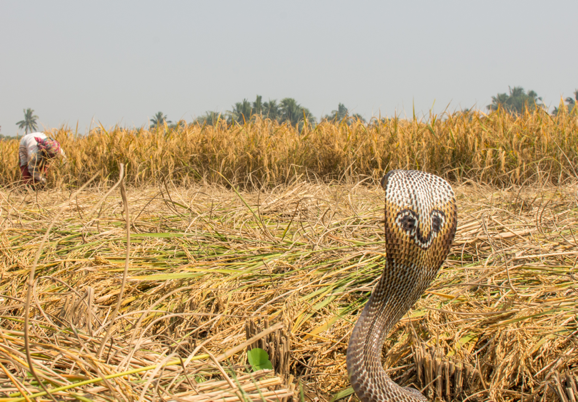
Snake watches as a farmer works in his field in India

Colombo, March 3: Bites of venomous snakes cause significant morbidity and mortality in the rural areas of tropical countries. Despite this, until recently, snakebites did not receive the attention they deserved as a public health problem.

The main reason for this was the paucity of robust epidemiological data on the disease burden associated with snakebite.

World-wide, an estimated 5.4 million people are bitten by snakes each year and 1.8 to 2.7 million are envenomed” or poisoned. Around 81,410 to 137, 880 persons die each year because of snake bites. Around three times as many amputations and other permanent disabilities are caused by snakebites annually. The situation is grim indeed.  

Snakebites are an enormous problem in India which records one million snakebites and 58,000 deaths due to these annually. This means that half the deaths due to snakebites in the world occur in India. Cases of disabilities created by snakebites in India are said to be four times the number of deaths.

Hospital statistics in the countries of the Global South underestimate the number of snakebites because a significant proportion of victims in these tropical countries seek traditional treatments outside hospitals. Because of this there is a gross under-estimation of deaths because of snakebites also.   

Aanya Wipulasena said in her article in Daily Express that in 2019, as per the Sri Lankan Health Ministry, there were 34,239 cases of snakebites reported to State hospitals. But according to a doctor attached to the Expert Committee on Snakebites (ECS) of the Sri Lanka Medical Association, the annual snakebite incidence was as high as 61,000. The two institutions had different statistics on deaths due to snakebite also. According to the Health Ministry, 50 had died of snakebite in 2019, but the doctor from the ECS said it was 200.

Karnataka’s Lead

It is because of the lack of data that the government of the State of Karnataka in South India, made snakebite a notifiable disease”. On February 12, the Karnataka government issued directives to all hospitals and medical colleges in the State to mandatorily record snakebite cases and deaths in the Integrated Health Information Platform (IHIP), which is a common Central government portal for national disease surveillance. The directive was given under the Karnataka Epidemic Diseases Act, 2020. Snakebite is of epidemic proportion.

This step will help the government not only get the numbers right but also region-wise incidence of snakebites and deaths, to enable an effective response.

Productive Age Group Affected

It’s a big first step,” said cardiologist Dr Jaideep C. Menon, who is currently leading an Indian Council of Medical Research (ICMR) study on snakebite incidence and mortality in India. According to Dr. Menon, 70% of snakebite victims are in the productive age group of 20-65 and is therefore a major economic problem too.

The other noteworthy feature is that 80% of the patients still depend on alternate sources of treatment before reaching a modern medical facility. Part of the reason for this scenario is that most snakebite cases occur in rural areas and many primary health centres lack the trained human resources and facilities to admit and treat patients with snakebite in India.

b

Sri Lankan researcher Dileepa Senajith Ediriweera and colleagues had mapped the risk of snakebite in Sri Lanka through a national survey with geospatial analysis conducted in all the nine provinces of the country. Data relating to 165,665 individuals (0.8% of the population of Sri Lanka) living in 44,136 households in 1,118 clusters were collected.

695 snakebites, 323 envenomings (poisonings) and 5 deaths (four of them male) were reported in the sample population in the 12 months preceding the survey. The incidence of snakebites, envenoming and deaths in the complete sample population was 398, 151, and 2.3 per 100,000 population respectively.

Extrapolating this to the population of the whole of Sri Lanka, the estimated national numbers of snakebites, envenoming and deaths were 80,514, 30,543 and 464 respectively.

These figures were much more than claimed by official statistics, the researchers point out. There was variation in numbers of bites and envenomings in different parts of the country and, using the data from the survey, the researchers were able to develop snakebite risk maps to identify snakebite hotspots and cold spots in the country.

To encourage others studying the problem, the researchers used free and open source software and replicable methods, which could be adopted to other regions where snakebite is a public health problem.

Seyed Shahmy and his colleagues in their research paper (BMC Medical Education Volume 23, Article number: 390 (2023) say that  differences in rainfall have led to much diversity in the flora and fauna, and in land use in Sri Lanka, leading to differences in snakebite patterns.

A country-wide community based cross sectional survey between August 2012 and June 2013 to sample approximately 1% of the population of Sri Lanka. The researchers found that there were over 80,000 bites, 30000 envenomings, and 400 deaths per year in Sri Lanka. Hospital data underestimated deaths due to snakebite by as much as 60%.

Regional Variations

The highest rates of bites and envenoming were seen in the rural and agricultural North Central and North Eastern regions of the country.

In keeping with other parts of the world, the highest disease burden due to venomous snakebite affects areas with the population groups that are most under-served in terms of healthcare and infrastructure. This re-emphasizes the need for an equitable distribution of resources to address the problem of snakebites.

As in India, in Sri Lanka too, rural males of working age were at high risk of snakebites due to high exposure levels associated with their lifestyle and occupation, mainly farming.

The research also showed that the incidence of snakebite and envenoming gradually decreased with increasing population density. This may be due to the more densely populated areas being less suitable as habitats for sakes.

Coastal Areas Safer

Snakebite incidence increased with increasing elevation up to 160 meters and thereafter dropped with increasing elevation, likely reflecting the fact that coastal areas are not generally suitable for snake habitats.

Snakebite incidence is dramatically lower in non-agricultural communities (less than 9% involved in agriculture. The incidence of snakebite is higher in both the intermediate and wet zones than in the dry climatic zone.

However, the overall incidence of envenoming is higher in the dry zone. This is likely to reflect variation in species and again shows the importance of capturing data on the incidence of both snakebite and envenoming.

Russell’s viper is the most widely distributed snake in Sri Lanka, and can be found up to an elevation of 1800 meters. Saw-scaled vipers are largely confined to the arid dry zones of the country including Northern and Eastern Provinces extending up to eastern parts of the Southern Province. Cobras are also widely distributed in the country and are found up to 1500 meters. Common Kraits are mainly found in the dry zone. Hump-nosed vipers are found all over the country, but mostly in the wet and intermediate zones.

Need for Treatment in Primary Hospitals

Researchers have noticed that even in the case of medically minor snakebites, the majority of patients who come to the primary hospitals are subsequently transferred to hospitals at the higher level for further management. Perhaps doctors in primary care hospitals feel that their reputation will be at stake if a death occurred under their care. This adds to the cost of the treatment.  

But given the high quality of overall management in the primary hospitals in Sri Lanka, such transfers are unnecessary. As over 80% of snakebites in Sri Lanka are treated in primary hospitals, steps could be taken to discourage transfer of patients to higher hospitals, the researchers say.

Production of Anti-Venom  

The urgent necessity of safe and specific anti-venom for Sri Lankan snakes has been recognized by the Ministry of Health. Setting up a production facility in Sri Lanka itself will cost US$ 4 million.  Therefore, venom from Sri Lankan snakes are collected and sent abroad for the production of a suitable anti-venom, according to the National Research Council.

මහ බැංකුව හැම ආණ්ඩුවක් සමග එක්වී නීති විරෝධී වැඩ කලා.

March 3rd, 2024

උපුටා ගැන්ම ලංකා සී නිව්ස්

මහබැංකුව වර්තමානයේ රට පත්ව ඇති ආර්ථික අර්බුධය සඳහා සෘජුව වගකිව යුතු බව සමගි ජනබලවේගය පක්ෂයේ පාර්ලිමේන්තු මන්ත්‍රී පාර්ලිමේන්තුවේ විපක්ෂයේ ප්‍රධාන සංවිධායක අධිනීතිඥ ලක්ෂ්මන් කිරිඇල්ල මහතා පවසයි.

ශ්‍රී ලංකා මහබැංකුව බලයට පත් සෑම ආණ්ඩුවක් සමඟම එක්ව නීති විරෝධී ක්‍රියා රැසක නිරත වූ බව අන්තර්ජාල නාලිකාවක් සමඟ සාකච්ඡාවකට එක්වෙමින් ඔහු වැඩිදුරටත් සඳහන් කර ඇත.

මෙරට ආණ්ඩුක්‍රම ව්‍යවස්ථාව අනුව පාර්ලිමේන්තුවට පැවරී ඇති මුදල් බලයට පවා එරෙහිව සහ පටහැනිව වර්තමාන මහබැංකු අධිපතිවරයා පවා අවස්ථා කිහිපයකදී හිතුවක්කාරී ලෙස කටයුතු කර ඇති බවද කිරිඇල්ල මහතා සඳහන් කරයි.

මහබැංකු සේවකයින් විසින් පුද්ගලික ලෙස තම වැටුප් ඉහළ නංවා ගැනීමට අවස්ථාවාදීව සහ නීති විරෝධීව කටයුතු කර ඇති බවටත් ඔහු එහිදී චෝදනා කරයි.

Sajith vows to make all schools smart-schools

March 3rd, 2024

Courtesy Adaderana

Opposition Leader Sajith Premadasa has vowed to convert all schools in the country into smart-schools if he is elected as the President in the upcoming elections.

Speaking at a ceremony held at a school in Tissamaharama, the Samagai Jana Balawegaya (SJB) leader stated that if the people of Sri Lanka make the correct decision this year, the SJB will revolutionise the country’s education system.

Media’s Israel bias exposed by US soldier who set himself on fire to protest Gaza genocide

March 2nd, 2024

Geopolitical Economy Report

The Western media showed extreme bias by de-politicizing the fatal protest of US airman Aaron Bushnell, who set himself on fire outside Israel’s embassy in Washington, DC while shouting “Free Palestine!” and “I will no longer be complicit in genocide!”. Ben Norton contrasts the press’ coverage of Russia, illustrating clear double standards.

Stop China phobia, embrace multipolar world – ministers at diplomacy forum

March 2nd, 2024

MEHBOOB JEELANI Courtesy TRTWorld

Ministers from four Asian countries spoke about the necessity of steering the so-called global south away from a bipolar discourse in which the world is perceived solely through the prism of the US or China.

From the impact of climate crisis to new security challenges and economic opportunities, the ministers underscored the importance of engaging with both China and the United States without becoming pawns of either of the two players. /Photo: AA
OTHERSFrom the impact of climate crisis to new security challenges and economic opportunities, the ministers underscored the importance of engaging with both China and the United States without becoming pawns of either of the two players. /Photo: AA

As panellists at the distinguished Antalya Diplomacy Forum 2024, top ministers from Malaysia, Sri Lanka, Bangladesh, and Vietnam spoke in favour of a multilateral world order, emphasising the need to find a middle path with the common aim of achieving economic prosperity.

The panel, titled “Building Asia-Pacific Regional Architectures: The Challenges of Unmatching Interests,” comprised Bangladesh’s Foreign Minister Hasan Mahmud, Sri Lanka’s State Minister of Foreign Affairs Tharaka Balasuriya, Vietnam’s Deputy Minister of Foreign Affairs Nguyen Minh Hang, and Malaysia’s Minister of Higher Education Zambry Abd Kadir.

From the impact of climate crisis to new security challenges and economic opportunities, the ministers underscored the importance of engaging with both China and the United States without becoming pawns of either of the two players.

We should not promote China phobia in Asia. We should not let anyone impose the Cold War mentality on us,” Zambry Abd Kadir said, explaining how China has become a significant trading partner in ASEAN countries.

Sri Lankan foreign minister Balasuriya praised both China and India for their assistance to the island nation in times of crisis.

During Covid we got so many vaccines from China that saved thousands of lives in Sri Lanka. Another example is when we had an economic crisis in Sri Lanka, who helped us? It was India that helped us. Again it was India which helped us secure $2.9 billion at the International Monetary Fund after New Delhi gave financial assurances,” Balasuriya said.

The panellists spoke in line with the long-standing position of Türkiye’s, which has repeatedly argued for UN reforms, with its President Recep Tayyip Erdogan stating that “effective multilateralism requires effective multilateral institutions.”

Over the years, several developing countries have invested more time and effort in strengthening alternative forums and institutions such as BRICS, the African Union, ASEAN, and SAARC, constantly seeking platforms to promote cooperation on economic and security fronts.

Balasuriya believes that in the coming years, more regional organisations will emerge to assist South Asian and Southeast Asian countries, specifically in forging alliances in various fields.

Aligning itself with these changing dynamics, Sri Lanka has made some crucial moves to ensure that all its eggs are not in one basket.

Sri Lanka is trying to open up, re-looking at the Indo-Sri Lanka Free Trade Accord and trying to expand it into other areas. We have just concluded signing a Free Trade Agreement with Thailand. We are negotiating with Bangladesh. We are signing a Bilateral Trade Agreement with Indonesia and also we are looking at a Free Trade Agreement with China,” Balasuriya told TRT World on the sidelines of the Forum.

TRT WORLDSri Lanka’s State Minister of Foreign Affairs Tharaka Balasuriya spoke to TRT World on the sidelines of the Antalya Diplomacy Forum. Photo/ TRT World

UNSC reform

On the world’s financial architecture and the structural imbalance of the United Nations, Balasuriya said Sri Lanka’s position complements Türkiye’s stance.

Pitching for the UN reforms, he said at the time the organisation was formed in 1945, the United Kingdom had 10 percent of the world’s GDP share, thanks to India.

But now, the United Kingdom doesnt control that much of the GDP and in terms of the population it is not significant. [Yet] the world order at this moment is an all boys club. It’s the victors of the Second World War,” Balasuriya said.

So we certainly believe that a country like India for example, which already has the world’s largest population, doesn’t have a permanent seat in the UNSC – that’s absurd. If you look at the African nations, none of them have a permanent seat. None of the Latin American countries have a permanent seat.”

Balasuriya said that in the absence of such reforms, the regional powers are left with no choice but to find new avenues to work together outside of the traditional international institutions that are skewed in favour of the Big Five – the United States, the United Kingdom, France, China and Russia.

Giving the example of the ongoing Israeli violence in Gaza, Balasuriya took a dig at the Rules-Based Order, which is generally perceived as a US-led international order.

Whose rules are we talking about? Are these consensual rules? Or are these rules organised by certain countries and the rest of the countries have to follow?” he said, adding that the stakeholders in the Gaza war should take a cue from the Türkiye-brokered grain deal and try to bring an end to the violence and suffering Palestinians are facing.

SOURCE: TRT WORLD


Mehboob Jeelani

Mehboob Jeelani is a senior producer at TRT World.

Sri Lanka tourism records highest monthly income in four years

March 2nd, 2024

Courtesy BorneoBulletin

COLOMBO (XINHUA) – Sri Lanka recorded its highest monthly income from tourism in four years in January, according to the latest data issued by Central Bank of Sri Lanka.

The central bank’s Economic Research Department said in a report released on Friday that in January, the South Asian country earned USD342 million from tourism, a record in the four years since January 2020 when the South Asian country was hit by the COVID-19 pandemic.

The January figure is also compared to the USD154 million in monthly income from tourism a year earlier.

No more free visa extensions: Russian, Ukrainian tourists can apply for visa or go back

March 2nd, 2024

Courtesy The Sunday Times

The government’s decision to cancel a free visa facility granted to Russians and Ukrainians who have remained in Sri Lanka since February 2022 has not been reversed, Public Security Minister Tiran Alles confirmed this week.

Either they apply for a visa or they go back,” he told the Sunday Times. They will not receive free visas anymore.”

In March 2022, Sri Lanka’s cabinet approved a proposal by the Tourism Minister to permit free visa extensions to Ukrainian and Russian tourists who were holidaying in the country when the war broke out back home. At the time, there were 11,463 Russians and 3,993 Ukrainians, according to published reports.

In 2023, this facility was extended for another year—till February 22, 2024. As it was about to expire, Sri Lanka’s Department of Immigration and Emigration wrote separately to the Tourism Ministry, the Public Security Ministry, and the Ministry of Foreign Affairs for their opinions on whether the privilege should be further extended. These letters were dated February 1, 2024.

There was no objection from the ministries for the free visas to be discontinued as, although the conflict was continuing, there were flights to and from Russia and Ukraine, with tourists from these countries entering and departing Sri Lanka regularly.

As a result, the Immigration Department wrote to the Tourism Ministry Secretary this week, requesting that he notify the relevant Ukrainian and Russian tourists about the new rule. The letter stated that it was no longer necessary to keep extending their visas without the requisite fees or penalties for overstaying.

Therefore, Russian and Ukrainian tourists belonging to the above categories have been given 14 days from 2024/02/23 to 2024/03/07 to leave this country, and it is kindly notified that this period will no longer be extended,” it said.

However, President Ranil Wickremesinghe’s office reacted when the news was published in the Sunday Times by claiming there had been no official decision to cancel this facility and that the President had ordered an investigation into the notification issued to Russian and Ukrainian tourists without prior Cabinet approval, requiring them to leave within 14 days”.

Yesterday, Minister Alles said, The President didn’t say it (the free visa facility) was withdrawn. The President’s Office asked for an inquiry into why they were asked to leave in 14 days. That was wrong. We can’t tell them to leave the country in 14 days. They can either leave or apply for a visa

Central Bank, other SOEs can’t increase their staff salaries

March 2nd, 2024

By Damith Wickremasekara Courtesy The Sunday Times

  • Justice Minister will present a bill to Parliament, transferring financial powers to the Treasury and Parliament

Financial powers of state-owned enterprises (SOEs), including the Central Bank, will be curtailed in terms of a bill the Justice Minister will present to Parliament this month.

The move would remove the power of the Central Bank to determine its staff’s salaries, and that power would be vested with the Finance Ministry and Parliament, Justice Minister Wijeyadasa Rajapakshe told the Sunday Times.

He said that accordingly, the Central Bank’s recently proposed salary hike for its staff would be revoked, but a reasonable salary increase would be considered in consultation with the Finance Ministry.

Under the proposed bill, the SOEs would be given only administrative powers and financial policy decision-making powers, while the

powers to increase their salaries would not be given to the institutions, the minister said.

He said that in terms of the bill, which is to be presented this month, the SOEs would not be allowed to exceed the parliamentary financial powers.

He said one of the existing issues was that there was no proper interpretation of the financial powers of SOEs, and thereby many of them were trying to bypass parliamentary powers.

The party leaders in Parliament will be briefed about the proposed bill on Tuesday, while other ministers will also be submitting proposals on maintaining parliamentary financial powers.

Minister Rajapakshe said the move to increase the salaries of the Central Bank staff had come while issues of exporters retaining funds overseas, measures to stop illegal micro-finance company businesses, issues over leasing, and pawning centres were pending.

Meanwhile, Opposition Chief Whip Lakshman Kiriella told the Sunday Times that they would extend support for maintaining parliamentary financial powers, as they have been campaigning all along to preserve these financial powers.

He said the timing and proportion of the salary increase by the Central Bank were wrong, and therefore they were opposed to it.

Lanka accuses UNHRC of double standards and politicisation of human rights

March 2nd, 2024

Courtesy The Sunday Times

Sri Lanka has told the UN Human Rights Council that double standards, which contribute to the politicisation of human rights, cannot be condoned.

Himalee Arunatilaka, Ambassador and Permanent Representative of Sri Lanka to the United Nations in Geneva, addressing the 55th session of the Human Rights Council on Friday, drawing attention to the plight of the people in Gaza, questioned, Where are the resolutions and where are the accountability projects?” We cannot condone the continuing double standards of some sectors that provide no tangible relief to the grievances of people but only contribute to the politicisation of human rights.”

The Ambassador, during her statement to the Council, also responded to a string of allegations made by UN Human Rights High Commissioner Volker Türk earlier during the session.

She explained that during his address, Sri Lanka’s Foreign Minister, Ali Sabry, elaborated on the recent engagements with several working methods of the Council.

The government, to overcome the challenges of the recent past, prioritised economic recovery and reconciliation objectives while ensuring that the country’s democratic traditions and institutions remained stable at all times. Being sensitive to the economic hardships faced by the people, social safety nets have been strengthened to help cushion the impact of the challenges on the poor and vulnerable,” she said.

Despite severe constraints, our objectives remain steadfast and unwavering towards expediting the ongoing efforts to strengthen the foundation of national unity, post-conflict reconciliation, and human rights. Sri Lanka is committed to pursuing progress through already established domestic mechanisms,” she said.

She explained that consultations on the draft Truth, Unity and Reconciliation Commission bill were ongoing with the participation of the government, civil society, religious leaders, and legal experts. The draft bill was gazetted on January 1, 2024, and would be tabled in Parliament after providing sufficient time for the people to express their views on the draft. An interim-Secretariat, to lay the foundation for the commission, has already been established since May 2023 and continues its work.

The work of the Office on Missing Persons (OMP) is ongoing. Demonstrating significant public trust in the OMP, 5,221 out of 6,025 phase 1 complainants have met with the OMP, and inquiries held. Progress was made in tracing missing persons in 2023 as the OMP’s Tracing Unit found 16 persons alive, and confirmed three deceased. 1,313 families received Certificate of Absence (CoA) and steps have been taken to extend the validity period until 2028, she said.

During the past year, despite the financial situation in the country, the Office for Reparations (OR) had granted Rs. 41.2 million to the families of the missing. With the financial and technical assistance of the IOM, the OR continues to implement several projects to provide psychosocial support for aggrieved communities, she added.

The Office for National Unity and Reconciliation (ONUR) has been further strengthened by an Act of Parliament, whereby it now functions as an independent institution, like the OMP and OR. The ONUR conducts training programmes to promote religious coexistence and conflict transformation workshops, providing opportunities for interfaith and intercultural dialogue,” she said.

Sri Lanka reiterates its categorical rejection of Resolutions 46/1 and 51/1 and the external evidence-gathering mechanism that stems from these two divisive and intrusive resolutions. Both of these resolutions, that do not have the consent of the country concerned, have wide-ranging legal and political implications for all countries. The establishment of such unhelpful mechanisms, utilising the funds of Member States at a time when the UN is facing a liquidity crisis for dire humanitarian needs, for a purpose and end result that is vague and ambiguous, contravenes the very founding principles of this Council. Its sole purpose seems to cater to the aspirations of a few and does not in any way help the people of Sri Lanka,” she said.

She noted that the Online Safety Bill, a domestic legislation that the Government is now in the process of amending in good faith, taking into consideration the additional proposals presented by civil society and other stakeholders.

After reviewing petitions following the tabling of the revised Anti-Terrorism Bill in Parliament on January 10, 2024, the Supreme Court has provided its determination on the said Bill. The Government has taken cognizance of the Supreme Court determination, and the bill will be appropriately amended prior to being passed into law. Six rounds of consultations with civil society organisations had taken place regarding the draft NGO Act (NGO Registration and Supervision Bill) in Sri Lanka. It is emphasised that there is a necessity of incorporating provisions in the bill to tackle concerns such as terrorism financing and money laundering, while all concerns raised by civil society organisations have been considered and integrated into the draft  bill,” she said.

Notwithstanding our position on the HRC Resolutions, as a responsible member of the international community, Sri Lanka will continue to engage constructively with the UN and its agencies, in keeping with domestic priorities and policies as well as the international obligations voluntarily undertaken,” she added.

Earlier, UN Human Rights High Commissioner Volker Türk urged the Sri Lankan government to immediately undertake credible accountability measures to investigate and prosecute past and present human rights violations and economic crimes.

Sustainable peace and reconciliation will not be achieved in Sri Lanka with regressive laws and authoritarian approaches, which will only serve to perpetuate the human rights concerns of the past,” the High Commissioner said.

I urge the Government immediately reverse this trend and undertake credible accountability measures to investigate and prosecute past and present human rights violations and economic crimes. I also urge Member States to continue to reinforce these efforts, including through appropriate use of universal and extra-territorial jurisdiction and targeted measures against credibly-alleged perpetrators of serious human rights violations and abuses,” the High Commissioner added.

He said that it was through addressing the root causes of the country’s conflict and economic crisis, and ensuring accountability, that Sri Lanka would be able to enhance its prospects of achieving genuine reconciliation and sustainable peace and development.

He said there was great hope that the country would embark upon a long-overdue transformation that would benefit all its communities.

The High Commissioner expressed concern about new and proposed laws, which he said include the Online Safety Act, the Anti-Terrorism Bill, the Electronic Media Broadcasting Authority Bill, and the NGO Supervision and Registration Bill.

The High Commissioner also referred to the consequences of Sri Lanka’s economic crisis, saying it continued to bite deeply, particularly for the most marginalised.

Poverty rose further to an estimated 27.9% last year. Nearly two-thirds of households across the country have seen their monthly incomes decrease since March 2022, while food, transportation, health, and education costs continue to rise. Despite the government’s efforts, social protection remains overstretched, and the government’s largest budget expenditure this year will go towards servicing its debt,” he said.

While the government has introduced a draft legislation for a Commission for Truth, Unity and Reconciliation, the environment for a credible truth-seeking process remains absent. My Office continues to receive allegations of surveillance, harassment, and arrests by security forces of civil society representatives, journalists, and victims, as well as of people who have been involved in organising commemoration events for war victims,” the High Commissioner said.

I remain deeply concerned about recurring, credible accounts received by my Office of abductions, unlawful detention and torture, including sexual violence, by the Sri Lankan police and security forces, some of which allegedly took place in 2023, mainly in the north and east of the country. Last week, the appointment of a new Inspector General of Police was confirmed, despite the Supreme Court’s finding that he was responsible for the torture of an individual in 2010. These cases highlight the need for comprehensive security sector  reform,” he said.

He said his office continued to work to advance accountability in Sri Lanka. It is providing support to several jurisdictions undertaking criminal justice investigations, and is deepening its information and evidence based on specific incidents of human rights concern. It has also been carrying out research on enforced disappearance and conducting consultations with victims.

Human Rights Have a Skin Colour

March 2nd, 2024

By  Thanzyl Thajudeen Courtesy Ceylon Today

By Thanzyl Thajudeen

Human rights have a skin colour, and the darker you are, the less human rights you have. These exact words by Swedish MP Abir Al-Sahlani, when speaking at the European Parliament on 27 February, couldn’t have put it any way better. She said this when she stood up for Gaza, expressing that the hypocrisy is obvious and that our collective humane has failed.

Enshrined as the cornerstone of contemporary civilisation, human rights aim to safeguard the inherent equality and dignity of every person. However, underneath the seeming universality is a brutal reality: skin colour clearly shapes how these fundamental rights are accessed and enjoyed. Here, we set out to disentangle the complex web of historical legacies, systematic biases and societal constructions that link skin colour to human rights. We explore the core of this complicated subject, from centuries-old hierarchy to modern prejudice, in an effort to shed light on the ongoing fight for justice and equality.

One must first face the lingering effects of racism and colonialism to comprehend the connection between skin colour and human rights. Global civilisation has been shaped by ideas of racial superiority and inferiority from the time of European conquest to the transatlantic slave trade. Ibram X. Kendi in his book titled, ‘Stamped from the Beginning: The Definitive History of Racist Ideas in America’ shows that by dehumanising indigenous peoples based only on their physical attributes, colonial powers were able to justify their exploitation and subjugation of these groups, establishing the groundwork for long-lasting oppressive institutions. The wounds from this past are still felt today, feeding the vicious cycles of injustice and inequality.

The underlying cause of the problem is structural racism and institutional inequality, which work together to maintain differences in treatment based on skin colour. People with darker skin tones face systemic marginalisation and discrimination in countries all over the world, as well as obstacles to housing, healthcare, work and education. Social and economic institutions have been profoundly impacted by centuries of discrimination, resulting in deeply ingrained systems of privilege and disadvantage that disproportionately impact marginalised populations. The effects of systemic racism are 

long-lasting and widespread, affecting everything from the criminal justice system to the healthcare industry.

The issue of colourism, which favours those with lighter complexion over those with darker skin, widens the gap among groups of colour. Colourism fosters ideas of beauty, worth and attractiveness based on skin tone. It has its roots in colonial hierarchies and is supported by media portrayals and societal standards, as described in Toni Morrison’s book, The Bluest Eye. This type of prejudice marginalises people who straddle many identities even more by intersecting with other axes of oppression including gender, class and ethnicity in addition to maintaining intragroup disparities.

Over continents, colonialism’s echoes may be heard, leaving a legacy of oppression, exploitation and dispossession in its wake. This is particularly noticeable in areas where the effects of colonial control are still felt, such as Palestine, Africa, the Congo, Asia and the Middle East. Palestinians are still being oppressed and massacred and displaced from their homes, and now worse, forced starvation and famine in Palestine by the Israeli occupation, and Western nations are complicit in this by continuing to give, and in some cases now actively involved on the grounds, in the apartheid criminal nation unflinching military and diplomatic backing. Comparably, the Continent of Africa struggles with the long-lasting effects of colonial exploitation as Western businesses continue to pillage its abundant resources, causing poverty and instability to persist. Millions of civilians in the Democratic Republic of the Congo have been left homeless and displaced as a result of resource-driven wars that are supported by Western interests.

Influence of the media

It is impossible to overestimate the influence of the media on stories and attitudes. Sadly, sensationalism, prejudice and misinformation too frequently overshadow the experiences of marginalised populations. Western nations reporting on wars in places like Yemen, Syria and Myanmar, and the ongoing genocide and ethnic cleansing of Palestine, frequently repeat oversimplified narratives that fall short of expressing the complexities of the underlying problems, and moreover, they continue to lie, deceive and change narratives. Rather, by reinforcing preexisting assumptions and misconceptions, these narratives contribute to maintaining a narrative of superiority and further entrench inequality. Further, nations with a history of horrific human rights violations continue to have strategic relationships with Western powers, demonstrating the preference for geopolitical objectives over concerns for human rights.

Human rights certainly have a skin colour. And, sadly those in the West think that the East or the Global South has so much violence and brutalities that they need to come here to teach what human rights is. Rather, it is they who should really learn what those two words are. The universality of human dignity is undermined and inequality is perpetuated by the hypocrisy of human rights, which is highlighted by systematic racism, colonial legacies and media misinformation. It is critical that we address these differences head-on as we negotiate the complexity of a globalised society, working for justice, equality and human rights for everyone, regardless of background or skin colour.

A diversified strategy that both acknowledges historical injustices and aggressively tackles systematic inequality is needed to address the hypocrisy of human rights. Holding governments and companies responsible for their acts, amplifying the voices of the marginalised and increasing awareness are all made possible via advocacy, education and grassroots activity. Additionally, establishing intercultural communication and solidarity is crucial to tearing down long-standing oppressive structures and creating new ones. For this, the Global South or the East should rise, tall and strong. And in time, it will.

Spanish tourist gang-raped by 7-8 men during motor bike tour with husband in India

March 2nd, 2024

Courtesy Hiru News

A Spanish tourist has suffered a group sexual assault in the Dumka district while traveling around the world with her husband.

Seven men have raped me, recalled the Spanish woman who was gang-raped in Jharkhand’s Dumka, around 300 km from state capital Ranchi, on Friday night. The woman, with bruises all over her face, shared the horror in an Instagram post: “Something has happened to us that we would not wish on anyone. Seven men have raped me.”

“They have beaten us and robbed us although not many things because what they wanted was to rape me,” she said.

The tourist who was travelling on a motor bicycle with her husband was allegedly gang-raped overnight from 1 to 2 March in the Dumka district of India’s Jharkhand state – a well-known tourist destination.<br /><br />The victim was on a motor cycling trip with her husband to Nepal via Bhagalpur, they had stopped at Dumka when the assault took place.

According to her statement, the couple had pitched their tent in a secluded spot near Hansdiha market.

While she was asleep, several youths from the area broke into the tent and took turns to rape her. They also used physical violence, she reportedly said in her complaint to local police.

Officers arrived on the scene in the early hours of the morning and arrested three people.

Another official mentioned the involvement of seven to eight youths.

Following the assault, the woman was admitted to the Saraiyahat Community Health Centre for medical treatment.

The authorities have opened an investigation into the matter.

Officers say she is undergoing medical examinations at the Phulo Jhano Medical College Hospital in Dumka.

The Spanish embassy in India has contacted the authorities and has sent personnel to consult in the region.

As per a PTI report, Dumka Superintendent of Police Pitambar Singh Kherwar said Hansdiha police patrolling team found two people on the side of the road around 11 pm on Friday.

“The patrolling team sensed that something had happened to them. Since they were speaking in Spanish, the police could not understand what they were saying. However, the policemen brought them to a local hospital assuming they needed some treatment,” he said.

The Spanish couple told doctors about the incident of sexual assault, he said.

Many Sri Lankan  Private Hospitals.

March 1st, 2024

By Dr. Tilak S. Fernando

Despite all the consumer items going up in prices on a daily basis, so are the channeling services in private hospitals. It varies from hospital to hospital!  For example , especially in Colombo hospitals, there are rumors floating about that the Nawaloka hospital is facing the brink of bankruptcy, but once one enters the hospital , it could be seen full of patients in every corner all the time!

In Nawaloka there is a particular charge at the rate of Rs.4000.00 ( for a professor of Nephrologist  (the one who deals with  one’s kidneys) where the Hospitals charges vary from 1300 to for other specialists. This  exorbitant  amount is known as the ‘Professor’ , a distinguished title which is known for the specialists for this discipline.

 This extra charge of Rs.4000, (hospital charge for channelizing extra and a service charge a service booking for the Professor is added to my travelling. What happened to me was that I left home, Thalawathugoda, at 3.00 pm to be at the  hospital by 4.30 pm .  The receipt mentions that the session commences at ‘estimated’ time of 4.33 pm. I was waiting for nearly two more hours, but the professor  did not appear at all! I became furious and changed it to Monday 19-02-2024! I went again on the 19th Monday, and waited for more than one hour but the nurse assigned to the Professor advised me that she could not confirm at what time the professor would come to see the patients.

What doctors should do

Basically, the doctors should be punctual and keep  up to the schedule. This is how I feel about it! It will become no sense at all, by keeping the patients  until all odd hours for the specialist to arrive!

Patients believe in a specialist, as they are being recommended by someone. The patients have implicit faith in the specialist and by delaying consultation,  in the manner displaced above will certainly  have a much more effect on the hospital itself . But on the receipt ,the hospitals  do state very craftily how to get out with grace!

Also, there is no point in getting ready  for the  nurse (allocated to the specialist) by taking blood pressure and collecting all records with patients ( in my case various tests were done by a laboratory  and was referred to, in readiness with anxiety about my Cardiologist by the  Cardiologist. Generally, from my personal experience. Until I retired from the National  Health Services  in the UK (from the MCA- Medicines Controlled Agency), it depends on Sri Lanka  by the specialist to show arrogance  by pretending to be the God?

It is also  health hazard, for instance those patients who are suffering from Angina or some kind of a heart problem to have to wait continuously until the specialist arrives, because the patient would be stressed to such an extent b and they expect be on time the as the patient has paid what is expected to pay  before seeing the specialist! The patient (her stress factor would increase tremendously about the time one has to wait) .It will be a disaster if the specialist does not appear  at all, like I have waited for the professor just not to be at the appropriate time!

In Exceptional Circumstances

There are cases where  the special the excuse is thrown at every instance. In such cases, it’s the sole responsibility of the specialist to advise the hospital nurses, rather  than keeping it to himself. Equally, the Department of Health may be able to put a ‘stop’ to specialists, who want to be ‘money earners’ in order to maintain their day-do-day activities of the so-called doctors extravagantly.

In the UK, all specialists are sincere in their attitude towards their patients and there is the possibility one (patient) could say ‘ it is my  body after all,  that you are dealing with body because they take an oath (oath of Hippocrates) to serve on all patients in a humanitarian manner!

There should be love and devotion being a doctor in the first place. That 

They tell the doctors that they are a ‘ superior lot’ just because they (doctors) generally wear a collar and a tie! It does not make them superior in their vocation but in simple terms  but it boils to be that specialists  are disrespected by the public as  they are bound by the oath they take when they qualify as doctors .

I knew of a surgeon ( Sri Lankan) ,who  was nominated several times for the ‘Golden Scalpel Award’ throughout the UK. He decided to operate on a ninety-year-old patient, as he felt  that the patient would survive the operation, despite all comments by his colleagues. After the operation he  thought he should  be successful in a better social life! 

Well! A few months later the patient (in Wales) came to see the surgeon with an ‘alarm clock’.  All he had to say was that you gave  the time  for me doctor and personally him and said I shall in return  with the same smilie– Please have much more time for operations of that nature.”

Is it not clear how humanity works in Wales in the UK?

tilakfernando@gamil.com

Dr.Tilak S Fernando

www.tilaksblog.com

Need for AKD and JVP/NPP to be educated on complex geopolitics

March 1st, 2024

by Daya Gamage Foreign Service National Political Specialist (rtd.) US Department of State Courtesy The Island

India’s security needs consolidate US manoeuvring strategy in Indo-Pacific:


Aware or unaware of the intricacies of big power play in the Indo-Pacific region to the emerging political entity in Sri Lanka, JVP-led National People’s Power (NPP) leader Anura Kumara Dissanayake has declared that he and his political party are (now) alive to India’s security concerns after his return from India having had discourses with External Affairs Minister and other leading Modi administration officials needs serious scrutiny.

In an interview with Sri Lanka’s Sirasa TV on February 15, Dissanayake reiterated that the ‘incoming’ National People’s Power administration will not do anything that undermines Indian security”.

If Dissanayake had been aware that ‘India’s national security’ was somewhat beyond her ‘control’ and connected to the larger Indo-Pacific or Asia-Pacific region with ‘outside forces’ deeply embedded in, he would have made a ‘measured statement’ about India’s national security.

Before examining how India is tied to ‘a foreign military and technological force’ connected to the Asia-Pacific Region and that India’s national security cannot be isolated from ‘outside forces’ engaged in the region, it should be found out how Sri Lanka is connected to the overall regional security, an issue that Dissanayake doesn’t seem to have paid much attention to. The eight-page, 2007 (disclosed) US-Sri Lanka signed Acquisition and Cross-Services Agreement (ACSA) and the 83-page, 2017 ACSA (still kept classified by both Washington and Colombo) have much relevance to the overall Indo-Pacific region.

US Code Title 10 Section 2342: Cross-Servicing Agreement, under which a long process of US government assessment takes effect, how useful a non-NATO country, such as Sri Lanka could be to the national interest of the United States is vital to the understanding of Sri Lankan policy.

The US Code declares (Quote) (a)(1) Subject to section 2343 of this title and to the availability of appropriations, and after consultation with the Secretary of State, the Secretary of Defense may enter into an agreement described in paragraph (2) with any of the following: (Among others)

(D) The government of a country not a member of the North Atlantic Treaty Organization but which is designated by the Secretary of Defense, subject to the limitations prescribed in subsection (b), as a government with which the Secretary may enter into agreements under this section. (End Quote)

Before scrutinising other Sub-Sections, Sub-Section (D) is well connected to a ‘declaration’ of a diplomatic cable that reached Washington from the American Embassy in Colombo: 20 February 2007 diplomatic cable sent under the signature of Ambassador Robert Blake made it very clear (Quote) Since this agreement primarily benefits US forces, we think there are strong arguments to proceed with the signing the agreement (End Quote) referring to the 2007 ACSA. It is not difficult to understand why the 2007 agreement was expanded to 83 pages in 2017 and why it is still kept a secret.

Now to Sub-Section (b) of the U.S. Code Title 10 Section 2342: Cross-Servicing Agreement:

(Quote) (b) (which is well connected to the signing of both the 2007 and 2017 ACSA) The Secretary of Defense may not designate a country for an agreement under this section unless –

(1) the Secretary, after consultation with the Secretary of State, determines that the designation of such country for such purpose is in the interest of the national security of the United States; and

(2) in the case of a country which is not a member of the North Atlantic Treaty Organization, the Secretary submits to the Committee on Armed Services and the Committee on Foreign Relations of the Senate and the Committee on Armed Services and the Committee on International Relations of the House of Representatives notice of the intended designation at least 30 days before the date on which such country is designated by the Secretary under subsection (a). (End Quote)

The Pentagon, the State Department and Armed Services and International Committees of the US Senate and House of Representatives are very much involved in the process of using feed backs and assessments from the US diplomatic post in the host nation.

This writer, who was knowledgeable about this process during his engagement with the State Department for more than two decades, was aware of the manner in which the US diplomatic mission in Sri Lanka played that role.

To enter into an ACSA treaty, the designated country – in this case, Sri Lanka, which entered into the agreement in March 2007 and 2017– Washington has to determine (Quote) the designation of such country for such purpose is in the interest of the national security of the United States . (End Quote)

Sri Lanka occupies some very important real estate in the Indo-Pacific region, and it’s a country of increasing strategic importance in the Indian Ocean region”, declared Alice Wells, US State Department’s Deputy Assistant Secretary addressing the foreign media at the department’s Washington Media Center on 24 January 2020—three weeks before she was in Colombo meeting newly-elected President Gotabhaya Rajapaksa.

The 2018 National Defense Strategy guides the Department of Defense to support the (US) National Security Strategy – the Asia Reassurance Initiative Act of 2018 – specifically calls for expanding cooperation with democratic partners in South Asia, including Bangladesh, Nepal, and Sri Lanka.”

This 2018 document – declassified in January 2021 – evinces a special interest in Sri Lanka’s survival in the Indo-Pacific region, the formulation of its foreign policy, and its relations with India, the United States and China.

It should be mentioned here that the writer along with another (retired) Senior Foreign Service/Intelligence Officer (American) is currently developing a manuscript (for publication) exploring Washington’s foreign policy manipulations and discharges toward Sri Lanka and India, and the manner in which Sri Lanka and India were (and are) playing their roles in response to Washington’s excessive and (almost) hegemonic role in the Indo-Pacific region.

It is in this context that India’s national security can in no way be isolated from Washington’s military/defense and intelligence approaches and activities in the Asia-Pacific region and its foreign policy discharges that this writer and his co-author discovered through their extensive research and investigations.

Some of the salient policy determinations and projections in the now-declassified 2018 National Security Strategy – the Asia Reassurance Initiative Act document of the US government are as follows:

· A strong India, in cooperation with like-minded countries, would act as a counterbalance to China.

· India remains preeminent in South Asia and takes the leading role in maintaining Indian Ocean security, increased engagement with Southeast Asia, and expands its economic, defense, and diplomatic cooperation with other US allies and partners in the region.

· US Objective: Accelerate India’s rise and capacity to serve as a net provider of security and Major Defense Partner; solidify an enduring strategic partnership with India underpinned by a strong Indian military able to effectively collaborate with the United States and her partners in the region to address shared interests.

· US Actions: Build a stronger foundation for defense cooperation and interoperability; expand US defense trade ability to transfer defense technology to enhance India’s status as a Major Defense Partner.

· US Objective: Strengthen the capacity of emerging partners in South Asia, including the Maldives, Bangladesh, and Sri Lanka, to contribute to a free and open order. US Action: Establish a new initiative with South Asian partners modeled on the Maritime Security Initiative.

· National Security Challenges: How to maintain US strategic primacy in the Indo-Pacific region while preventing China from establishing new illiberal spheres of influence.

· US Action: Enhance combat-credible US military presence and posture in the Indo-Pacific region to uphold US interests and security commitments.

Now, let’s see how ‘Indian National Security’ that Anura Kumara Dissanayake has referred to, and aspires to safeguard under a JVP-led NPP government he is hoping to form, is tied to the Indo-Pacific Region that Washington is playing a dominant role in.

US-India Relationship: Critical to Indo-Pacific

A shared vision for a free and open Indo-Pacific bolsters the US-India relationship as the two countries continue to strengthen defense ties, a senior Pentagon official said on Sept. 19, 2023.

Siddharth Iyer, the Director for South Asia policy in the Office of (US) Secretary of Defense, said the defense partnership had experienced an incredible and unprecedented amount of momentum” as evidenced by Secretary of Defense Lloyd J. Austin twice traveling to India recently and the warmth and familiarity” between the two countries.

This relationship is one of the top priorities for the department,” Iyer said. Our belief is that getting the US and India relationship right is not just necessary, it’s essential to achieving our strategy in the Indo-Pacific.”

What he meant by our strategy” is the United States’ strategy.

I think one of the ways in which we think about the roadmap is really a manifestation of Secretary Austin’s commitment to accelerating India’s military modernization, and for him, putting the department on the hook to find targeted opportunities to propose to advance India’s indigenous defense production capabilities,” Iyer said during a discussion on furthering US-India security cooperation hosted by the Hudson Institute in Washington.

department on the hook”, meaning the United States on the hook.

India’s Minister of Defense Rajnath Singh and Minister of External Affairs Dr. S. Jaishankar engaged with (US) Secretary of State Antony J. Blinken and Secretary of Defense Lloyd J. Austin for the fifth US-India 2+2 Ministerial Dialogue in New Delhi on November 10, 2023.

They reaffirmed the importance of the US-India Comprehensive Global Strategic Partnership in ensuring international peace and security. The Ministers also underlined their strong commitment to safeguarding a free, open, and an inclusive Indo-Pacific.

The Joint Statement released November 10, 2023 on the Fifth Annual India-US 2+2 Ministerial Dialogue reaffirmed the US-India”commitment to further deepen the multifaceted defense partnership through wide-ranging dialogues and military exercises of increasing complexity and sophistication, accelerated joint projects initiated under the June 2023 Roadmap for US-India Defense Industrial Cooperation and expanded collaboration in emerging domains, such as space and artificial intelligence. They expressed satisfaction with the pace of cooperation in Maritime Domain Awareness and looked forward to identifying pathways to promote stronger service-to-service ties and share technologies to address an array of maritime challenges, including in the undersea domain.”

These discourses, dialogues and rapport have prompted steps to deepen and diversify” the two countries’ so-called Major Defense Partnership.

The two (US and India) militaries signed their second Master Ship Repair Agreement, with the US Navy and Mazagon Dock Shipbuilders Ltd., in August 2023, recommitting themselves to advancing India’s emergence as a hub for the maintenance and repair of forward-deployed US Navy assets and other aircraft and vessels, according to the White House. The countries also made further commitments to the US companies investing more in India’s maintenance, repair and overhaul capabilities and facilities for aircraft.

In late September 2023, Ely Ratner, the US Department of Defense’s Assistant Secretary for Indo-Pacific Security Affairs, Donald Lu, State Department’s assistant secretary for South and Central Asian Affairs, Vani Rao, a secretary in the Indian Ministry of External Affairs and Vishwesh Negi, the Joint Secretary of Indian Ministry of Defense engaged in a wide range of ambitious initiatives” dialogue between the two nations.

According to a US Defense Department statement The officials also discussed regional security developments and strategic priorities across the Indo-Pacific region. A strong US-India partnership is essential to upholding security and prosperity in the Indo-Pacific region.”

India having entered into a military partnership with the United States, and Sri Lanka’s close proximity to India in political and economic spheres, Sri Lanka is at a crossroads surrounded by Washington, New Delhi and Beijing.

As an emerging leader, Anura Kumara Dissanayake could have made a ‘measured statement’ on the official policy of the government he is planning to form towards ‘India’s security’ as data given above show the manner in which Washington has tied up with New Delhi, and the strategy the United States has adopted to forge a strong defense ties with India; contrary to what Dissanayake believes, India is not developing an ‘isolated national security policy’. New Delhi has been formulating her national security policy in collaboration with Washington, and that security policy – to which JVP-NPP has undertaken to protect and safeguard – provides for a dominant role for Washington in the Indo-Pacific (or Asia-Pacific) region. Sri Lanka is unable to escape Washington’s machinations in the Indo-Pacific region as noted at the outset.

Isn’t Dissanayake aware of the US-India defense collaboration? If so, is he concealing that fact, or if not so, isn’t he capable of strategic thinking?

As a footnote, it is necessary to refer to Dissanayake’s pronouncement about foreign nations and their diplomatic agents’ special interest in communicating with him and his political entity, according to him in an interview with SIRASA TV on February 15 (Quote) Anyone who can think logically can understand that states engage with political actors that have power. India, China, the US, and many others are now engaging with us because they think we will win elections (Unquote).

The writer finds it very unusual for the (US) Chief of Mission to entertain the notion that she should maintain close rapport and contact with a non-ruling political party leader. The US diplomats were expected to maintain contacts with (about) two national political parties that alternately exchanged power; they established contacts with ‘non-national’ political parties and their leaders to fulfill ‘diplomatic niceties’ and obtain alternative interpretations to that of what main political leaders and their national parties express.

In the case of JVP-NPP, undoubtedly, they are emerging as a national entity, and foreign diplomats, including the American ambassador Julie Chung, have taken note of the emerging political reality to maintain relations with it. Whether Ambassador Chung believes, in a confused political atmosphere, the JVP-NPP could form the next administration is another matter.

Two questions emerge from Dissanayake’s belief that foreign nations and their diplomats ‘suddenly’ reach out to his political alliance because they strongly believe that its rise to power is imminent: (1) Is it because the reconciliation between the JVP-NPP and India and Dissanayake’s undertaking not to obstruct that nation’s national security interests suits Washington and if JVP-NPP ever captures power or reaches the level of an influential and formidable opposition power Washington (and/or Julie Chung) will have tamed the once anti-American/anti-Indian JVP? (2) Shouldn’t JVP- NPP leader Anura Kumara Dissanayake declare his policy towards the US; the defense collaboration between Washington and New Delhi; and that Ambassador Chung is aware that JVP-NPP has conveniently ignored India’s defence collaboration with the US? Is this a diplomatic achievement of Washington?

As much as JVP-NPP owes the Sri Lankan public an explanation, elucidating its undertaking to safeguard the national security interests, Sri Lankan policymakers and lawmakers need to have a comprehensive understanding of where Sri Lanka stands in this complex foreign policy issue.

(The writer is a retired Foreign Service National Political Specialist of the U.S. Department of State accredited to the Political Section of the U.S. diplomatic mission in Sri Lanka)

සමහර මාසවල ගෙවල්කුලී ගෙවලා අපි බඩගින්නෙ ඉන්නවා|ඇස් දෙකම නොපෙනෙන කැම්පස් ජෝඩුව ජීවත් වෙන්න ගහන ගේම

March 1st, 2024

DIYESA TV

ඇස් දෙකම නොපෙනෙන කැම්පස් ජෝඩුව ජීවත් වෙන්න ගහන ගේම සමහර මාසවල ගෙවල්කුලී ගෙවලා අපි බඩගින්නෙ ඉන්නවා දෑස් දෙකම නොපෙනී කාටවත්ම බරක් නොවී ජීවිතේ ගොඩදාගන්න මාර ගේමක් ගහන කැම්පස් ජෝඩුව.. ඔවුන්ව සම්බන්ද කර ගැනීම සඳහා අමතන්න.. 077 2577868 ගිණුම් අංක 032200267681312 I.H.D.N tharunethmi මහජන බැංකුව මාතර උයන්වත්ත ශාඛාව

“බුදුදහම මැදපෙරදිග පුරා පැතිර තිබුණා. තුර්කියම එදා බෞද්ධ”

March 1st, 2024

Mahinda Pathirana

Sri Lanka artefacts: Dutch government returns stolen treasures

March 1st, 2024

The Netherlands has returned six artefacts taken by force from Sri Lanka during the colonial era. This is the first batch of treasures to be returned.

Comment

The artifacts that were stolen from Ceylon rightfully belong to Ceylon (now renamed as Sri Lanka). Additionally, Sri Lanka has a strong claim under the Law of Unjust Enrichment to part of the revenue collected by the Rijks Museum in Amsterdam by selling tickets to visitors over the last 150 years. That money must be repatriated to Sri Lanka. We are shareholders and co-owners of our artifacts illegally seized and taken abroad.

This principle of sharing profits with the victims of Western Colonialism in Africa, Asia, and the Caribbean islands through repatriation of revenue collected over 200 years or more by exhibiting stolen goods taken from the Colonies, is a universal principle that is applicable in any part of the world.

I call on the Govt. of Sri Lanka to pursue this matter as a matter of urgency within the framework of Public International Law.

Senaka Weeraratna

Attorney-at-Law

Japan donates laptops to IT students

March 1st, 2024

Prime Minister’s Media Unit

Prime Minister Dinesh Gunawardena handed over laptops to software engineering students at a function held at the Temple Trees yesterday (February 29).

Japanese IT University has provided free laptops to software engineering students of newly-established Lanka Nippon BizTech Institute (LNBTI), with the contribution of funds from Japan.

The Prime Minister attended the ceremony and handed over laptops to several students marking the importance of this significance gesture to bridge the digital gap and his LNBTI’s unwavering commitment to enhancing student access to technology.

Acting Japanese ambassador, Katsuki Kotaro and the Secretary to the Prime Minister, Anura Dissanayake handed over laptops to another group of students. The Acting Ambassador said Japan is committed to support Sri Lanka’s digital development and urged the students to make best use of state of art technology available to them to successfully navigate their future careers.

These cutting-edge devices, equipped with state-of-the-art technology, are poised to empower LNBTI students pursuing their Software Engineering Degree Program. LNBTI, a collaboration between “hSenid Ventures” of Sri Lanka and “Metatechno Inc.” of Japan, stands as the first and only Japanese higher education institute with degree-awarding status in South Asia.

Director LNBTI said several free laptops are available for students from rural areas who wish to join the Institute.

The event culminated with the Prime Minister encouraging LNBTI students to harness the power of technology for innovation, education, and socio-economic development. This ceremony stands as a beacon of progress, epitomizing LNBTI’s commitment to unleashing the potential of technology to uplift forthcoming graduates and serving as an inspiration for future initiatives dedicated to bringing the two nations closer through the contribution of professionals in the IT industry. LNBTI Directors Saman Kumara and Ravinder Perera, academic staff, students and parents attended this function.

අනුර ජනාධිපති වෙලා අලුත් ව්‍යවස්ථාවක් හදලා විධායකය අහෝසි කරනවා..

March 1st, 2024

උපුටා ගැන්ම ලංකා සී නිව්ස්

ජාතික ජන බලවේග ආණ්ඩුවක් යටතේ විධායක ජනාධිපති ක්‍රමය අහෝසි කිරීම අනිවාර්යයෙන්ම සිදු කරන බව ජනතා විමුක්ති පෙරමුණේ ප්‍රධාන ලේකම් ටිල්වින් සිල්වා මහතා සඳහන් කරයි.

තම ආණ්ඩුවක් යටතේ නව ව්‍යවස්ථාවක් සම්මාදනය කර විධායක ජනාධිපති ධුරයද අහෝසි කිරීම ද සිදු කරන බවද ඔහු පැවසීය.

ඉදිරි මැතිවරණ පරාජය පිළිබඳව බියට පත්ව ඇති පාලකයන් විවිධ උපක්‍රම භාවිතා කිරීමට පටන් ගෙන ඇතැයි ද හෙතෙම පෙන්වා දුන්නේය.

ඉදිරි ජනාධිපතිවරණයට කවුරුන් ඉදිරිපත් වුවද එය ජාතික ජන බලවේගයට අභියෝගයක් නොවන බවද ඒ මහතා තවදුරටත් සඳහන් කළේය.

ජනතා විමුක්ති පෙරමුණේ පක්ෂ මූලස්ථානයේ දී මාධ්‍ය හමුවක් අමතමින් ඒ මහතා මෙම අදහස් පළ කරන ලදී.

අරගලයදා රනිල්ගේ නිවසින් හක්ගෙඩියක් සොරකම් කලාට දඩය 1500යි..

March 1st, 2024

උපුටා ගැන්ම ලංකා සී නිව්ස්

2022/07/09 වන දින රනිල් වික්‍රමසිංහ මහතාගේ පුද්ගලික නිවසට අයුතු ලෙස ඇතුල් වී නිවස තුළ තිබූ බෝතලයක් තුළ වූ රුවල් නැවක ආකෘතියක් නො.21/1,ඒ 03 වන පටුමග, කටුවාවල මාවත, ඇඹිල්ලවත්ත පාර,බොරලැස්ගමුව ලිපිනයේ පදිංචි චූදිත අබේධීර ආරච්චිගේ දිල්රුක් මධුශංක යන අය විසින් සොරකම් කිරීමේ වරදට ලං.ද.නි.ස 394 වගන්තිය යටතේ නිතිපති උපදෙස් ප්‍රකාරව ගල්කිස්ස ම/උ 22689/23 යටතේ නඩු පවරා වරද පිළි ගැනීමෙන් පසු 2024.03.01 වන අද දින දඩුවම් නියම කරන ලදි.

දඩුවම – මාස 6ක බරපතල වැඩ සහිත සිරදඩුවම් අවුරුදු 5කට අත්හිටුවන ලදි.

2022/07/09 වන දින රනිල් වික්‍රමසිංහ මහතාගේ පුද්ගලික නිවසට අයුතු ලෙස ඇතුල් වී නිවස තුළ තිබූ ලෝහමය හක් ගෙඩියක් අංක 133/ඒ, අබේරත්න මාවත, බොරලැස්ගමුව ලිපිනයේ පදිංචි චූදිත හේවාරුහුණගේ සුපුන් හන්සක යන අය විසින් සොරකම් කිරීමේ වරදට ලං.ද.නි.ස 394 වගන්තිය යටතේ නිතිපති උපදෙස් ප්‍රකාරව නුගේගොඩ ම/උ 22179/23 යටතේ නඩු පවරා වරද පිළි ගැනීමෙන් පසු 2024.03.01 වන අද දින දඩුවම් නියම කරන ලදි.

දඩුවම – වසර 1 ක බරපතල වැඩ සහිත සිරදඩුවම් අවුරුදු 5කට අත්හිටුවන ලදි. දඩය මුදලින් 1500/- දඩය නොගෙවන්නේ නම් මාසයක බරපතල වැඩ සහිත සිරදඩුවම්.

– Repoter

දමිතාගේ කකුල් මසාජ් කරවගෙන මටම කෙලියා.. දේපල කොල්ල කෑවා..- මාධ්‍ය හමුවක හඬපට එලියට…

March 1st, 2024

උපුටා ගැන්ම ලංකා සී නිව්ස්

රංගන ශිල්පිනි දමිතා අබේරත්න මහත්මිය හා ඇගේ සැමියා එක්ව තමන් විශාල මූල්‍ය වංචාවකට හසු කළ බවට පුද්ගලයෙකු චෝදනා එල්ල කරයි.

තමන් විදේශගත කරන බව පවසමින් ඔවුන් දිගින් දිගටම තමන්ගේ සියලු වස්තුව දේපළ ඔවුන් දෙදෙනා විසින් සැලසුම් සහගතව සූරා කෑමකට ලක් කල බවටත් ඔහු චෝදනා කරයි.

තමන් මෙම යුවල සමග බොහෝ හිතවත් වූ ඔවුන්ගේ නිවසේම වාසය කළ බවත් එක් අවස්ථාවක දමිතා අබේරත්න මහත්මියගේ කකුල් මසාජ් කරන්නයිද ඉල්ලා සිටි බවද ඔහු සඳහන් කළාය.

දැනටමත් තමන් රහස් පොලිසියට පැමිණිලි කර ඇති බවත් ඒ පිළිබඳව විමර්ශන සිදුවෙමින් ඇති බවත් ඔහු කියා සිටීම.

මෙවන් ආකාරයේ කටයුතු අසාධාරණයන්ට ලක් වූ තවත් පුද්ගලයන් කිහිප දෙනෙකු සිටින බවත් මෙම අදාළ විමර්ශන කටයුතු ඉදිරියට යද්දී ඔවුන් ද ඉදිරියට පැමිණ ඒවා හෙළි කරනු ඇති බවත් ඔහු තවදුරටත් කියා සිටියේය.

හෙතෙම මෙම අදහස් පළ කළේ අන්තර්ජාල නාලිකාවක සාකච්ඡාවට එක්වෙමිනි.

දමිතා අබේරත්න මහත්මියගේ සැමියා ඩුබායි රාජ්‍යයේ සිරගතව සිටි පුද්ගලයකු බවත් ඒ එරටදී සිදු කරන ලද මුදල් වංචාවක් සම්බන්ධයෙන් බවද පැවසූ ඔහු තමන් ද මත්පැන් පානය කිරීම නිසා එම බන්ධනාගාරයේම සිටි බවත් එහිදී ඇති වූ සම්බන්ධතාවයක් මත ඔවුන් හඳුනාගත් බවත් හෙතෙම එහිදී තවදුරටත් සදහන් කලේය.

ආණ්ඩුවට සල්ලි නෑ.. ණයක් නැත්නම් දවසක්වත් දුවන්න බෑ…- බන්ධුල

March 1st, 2024

උපුටා ගැන්ම ලංකා සී නිව්ස්

ආණ්ඩුව පවත්වා ගැනීම සඳහා ප්‍රමාණවත් ආදායමක් නොලැබෙන බව ප‍්‍රවාහන, මහාමාර්ග හා ජනමාධ්‍ය අමාත්‍ය බන්ධුල ගුණවර්ධන මහතා සඳහන් කරයි.

පසුගිය වසර පුරාම මහා භාණ්ඩාගාරයට ලැබී ඇත්තේ රුපියල් ත්‍රිලියන තුනක් පමණක් බවත් ඉන් ට‍්‍රිලියන දෙකකට වැඩි ප්‍රමාණයක් රාජ්‍ය සේවක වැටුප් ආදිය ගෙවීමට වැයවූ බවත් හෙතෙම පැවසීය.

රට තුළ ගෙන ඇති ණය වලට පොලිය සදහා ට‍්‍රිලියන දෙකකට වැඩි ප්‍රමාණයක් ගෙවීමට ඇති බවත් එ් අනුව ඉතිරි වියදම් පියවාගෙන ඇත්තේ ණය ලාබාගෙන බවත් ඒ මහතා සදහන් කරයි.

එ් අනුව විදේශයන්ගෙන් ලබාගත් ණය ගිවිසගත් ආකාරයට නොගෙව්වහොත් ලංකාව දවසක්වත් පවත්වාගෙන යන නොහැකි බවද හෙතෙම කියා සිටියේය.

මාර්ග ව්‍යාපෘතියක් ආරම්භ කිරීමේ අවස්ථාවට එක්වෙමින් අමාත්‍යවරයා මෙම අදහස් පළ කරන ලදී.

Displacing Chinese project, Indian firm set to build hybrid power systems in Sri Lanka’s northern islands

March 1st, 2024

BY MEERA SRINIVASAN Courtesy The Hindu

New Delhi had objected to a Chinese energy project in the location, instead offering a grant for the initiative

The initiative is the third India-backed energy project coming up in Sri Lanka’s north and east. The National Thermal Power Corporation is spearheading a solar venture in the eastern Sampur town, while the Adani Group is setting up renewable energy projects in Mannar and Pooneryn in the north | Photo Credit: ANI

Three years after objecting to a Chinese energy project in northern Sri Lanka, barely 50 km off Tamil Nadu’s coast, India is set to implement a hybrid power project in three islands off the Jaffna peninsula with a $11-million grant.

Sri Lanka Sustainable Energy Authority, the Government of Sri Lanka, and Indian company U-Solar Clean Energy Solutions on Friday signed the contract for building Hybrid Renewable Energy Systems” in Delft or Neduntheevu, Nainativu and Analaitivu islands off Jaffna peninsula in the island’s north.

The project, which is aimed at addressing energy needs of the people of the three islands, is being executed through grant assistance from Government of India. The hybrid project combines various forms of energy including both solar and wind, towards optimising capacities,” a press release from the Indian High Commission in Colombo said.

In a post on social media platform ‘X’ thanking the Government of India, Sri Lanka’s Power and Energy Minister Kanchana Wijesekara said: The project with 530 kw Wind power, 1,700 kw Solar power, 2,400 kwh Battery power and 2,500 kw of stand by diesel power system will be constructed at the 3 Islands by U-SOLAR.” The Bangalore-based company was chosen through a competitive bidding process conducted by the Sri Lankan government for Indian firms, officials said.

The initiative is the third India-backed energy project coming up in Sri Lanka’s north and east. The National Thermal Power Corporation is spearheading a solar venture in the eastern Sampur town, while the Adani Group is setting up renewable energy projects in Mannar and Pooneryn in the north.

India’s offer

The Sri Lankan Cabinet first cleared Sinosoar-Etechwin Joint Venture in China, to execute renewable energy projects in the three islands. The company was chosen through a competitive bid backed by the Asian Development Bank. Concerned by the prospect of a Chinese project very close to India’s southern coastline,  India offered to implement the same project with a grant instead of a loan, and Sri Lanka took it up.

A Memorandum of Understanding (MoU) was signed in March 2022, during External Affairs Minister S. Jaishankar’s visit to Sri Lanka. China’s displeasure at the turn of events is no secret. The Chinese Ambassador in Colombo voiced rare criticism of Sri Lankan authorities for suspending the original projects for unknown reasons” and sending out the wrong message” to potential investors.

Meanwhile, Sino Solar Hybrid Technology, whose energy project was suspended in Sri Lanka, in December 2021, signed a deal to implement a similar project in the Maldives.

Sri Lanka Grants Energy Deal to Indian Company After Cancelling Chinese Firm’s Tender

March 1st, 2024

Courtesy News18

Sri Lanka awards solar and wind power projects to Indian company, signaling strategic shift amid concerns over Chinese influence. India boosts bilateral energy partnership

Sri Lanka on Friday awarded the construction of three solar and wind hybrid power generation facilities to an Indian company after cancelling a tender won by a Chinese firm. This decision follows the temporary shelving of the project, initially financed by an Asian Development Bank (ADB) loan, two years ago.

This came amid strategic competition for major infrastructure projects in the island nation, which is currently emerging from its worst economic crisis since independence. Beijing, which is also Sri Lanka’s single largest bilateral creditor, accounted for around 10 percent of the island nation’s $46 billion foreign debt at the time of a government default at the peak of the crisis in 2022.

India’s assistance for the energy deal underscored the significance New Delhi attached to bilateral energy partnership”, the Indian embassy said in a statement. India: a committed partner! HC @santjha & Hon.State Minister Indika Anuruddha witnessed contract signing of the Hybrid Renewable Energy Project in Nainativu, Analaitivu & Delft islands, off Jaffna. This grant project by India addresses energy needs of the people of the 3 islands,” the Indian mission in Sri Lanka said in a post on X.

The project will consist of work to construct 530 kw of wind power, 1,700 kw of solar power, 2,400 kWh of battery power and a 2,500 kw diesel power system for Delft, Analativu and Nainativu islets, Sri Lanka’s Energy Minister Kanchana Wijesekara said in a statement. Sri Lanka’s energy ministry said Friday that the project had been revived and was now fully funded by an $11 million Indian government grant. It added that renewables firm U-Solar from India’s tech hub of Bengaluru had been awarded the building contract.

The Indian envoy in Colombo Santosh Jha was present at the ceremony. The Sri Lanka Sustainable Energy Authority, the Government of India and the U Solar Clean Energy Systems, a Bengaluru-based company signed the agreement.  India’s assistance to the project for the people of the three islands, which are not connected to the national grid, underscores the significance attached by GOI to bilateral energy partnership as well as the human-centric nature of development partnership, officials said.

Several landmark initiatives such as the power grid connectivity, multi-product two-way oil pipeline are currently under discussion between India and Sri Lanka in the energy sphere, according to a report in NewsFirst.lk, a Sri Lankan news portal. India’s overall development partnership portfolio stands at USD 5 billion with almost USD 600 million being in grants alone, it said.

(With agency inputs)

පාතාලයට බයේ රටින් පැන්න IP ගේ ඇත්ත කතාව.පාතාලයේපොලිසියේ උන්ට බනින්නේ බල්ලන්ට වගේ

March 1st, 2024

ජනපති රනිල්ගේ ජයග්‍රණය සඳහා වික්ටෝරියා නූලන්ඩ්ලා සහ අජිත් දොවාල්ලා කරන දේ ගැන ජාතික සංවිධානවලින් දීර්ඝ හෙළිදරව්වක්

March 1st, 2024

උපුටා ගැන්ම  ලංකා ලීඩර්

ඉදිරි ජනාධිපතිවරණයේ දී වත්මන් ජනාධිපති රනිල් වික්‍රමසිංහ මහතා නැවත ජයග්‍රහණය කරවීම මගින් තම න්‍යායපත්‍ර ඉදිරියට ගෙනයාම සඳහා වික්ටෝරියා නූලන්ඩ්ලා සහ අජිත් දොවාල්ලා අවසානයේ දී කරන දේ පිළිබදව ජාතික සංවිධාන විසින් පත්‍රිකාවක් නිකුත්කිරීම මගින් විශේෂ හෙළිදරව්වක් සිදුකර තිබේ.

ලංකා ලීඩර් වෙත අදහස් දැක්වූ දේශපාලන විචාරකයකු සඳහන් කළේ එවැනි විග්‍රහයක් කිසිඳු පාර්ශ්වයකින් ඉදරිපත් කර නොමැති බවය.

එම පත්‍රිකාව පාර්ලිමේන්තු මන්ත්‍රීවරුන්ට, දේශපාලන පක්ෂවලට සහ මහා සංඝරත්නයට යැවිය යුතු බවද ඔහු සඳහන් කළේය.

එම පත්‍රිකාව මගින් ඉදිරි ජනාධිපතිවරණයේ දී ජනතා විමුක්ති පෙරමුණට හිමිවන භූමිකාව ගැනද අදහසක් ඉදිරිපත් කර ඇත.

පත්‍රිකාව පහළින්…

https://smartecampaign.com/runningimages/candidate/lankaleader/media/image/1709261833.pdf

Sri Lanka unveils ‘Govt. Action Plan’ based on IMF governance diagnostic assessment

March 1st, 2024

Courtesy Adaderana

The Finance Ministry on Thursday (Feb.29) unveiled the Government Action Plan, which was prepared based on the Governance Diagnostic Assessment (GDA) furnished by the International Monetary Fund (IMF).

Taking to his X handle (formerly Twitter), Finance State Minister Shehan Semasinghe said this action plan further demonstrates the Sri Lankan government’s commitment to building a sustainable economy and good governance in the country.

The IMF had prepared the governance diagnostic report at the request of Sri Lanka, and the publication was deemed imperative for the authorities to adopt their own action plan to implement the recommendations in the assessment, beyond the priority commitments under the EFF arrangement.

Sri Lanka is the first country in Asia to have undergone the IMF Governance Diagnostic exercise.

The IMF earlier lauded the timely publication of the GDA, highlighting that it was a commendable first step towards addressing deep-rooted corruption weaknesses.

https://www.scribd.com/embeds/709701041/content?start_page=1&view_mode=scroll&access_key=key-0kwslFwMxXkHp8tageRG

Government Action Plan – Up… by Adaderana Online

BUDDHIST VIHARAS AND EELAM Part 16A1.

February 29th, 2024

KAMALIKA PIERIS

The Buddhist lobby set out to re-establish Buddhism in the Northeast when the Eelam war ended in 2009. They were helped in this task by the army. The Buddhist lobby started off by setting up Buddha statues. Buddha-images were planted triumphantly in Tamil areas of re-conquest” lamented Tamil Separatist Movement.  By 2012 the number of Buddhist statues from Omanthai to Yālpāṇam had increased to 29.

A Buddha statue came up in Sambaltheevu in Trincomalee with police protection. Construction work started on the Buddha statue at Mahindaramaya, Valaichchenai In 2019. The 60-foot statue will be the tallest in Batticaloa said chief priest, Ven. Katugastota (Kaddukasthodda) Mahindalangara.

Buddha statues were placed in sensitive locations. One statue was in front of Thirukoneswaram Hindu temple in Trincomalee and another was at Thiruketheeswaram temple in Mannar.A large Buddha statue has been built near Yālpāṇam harbor making it clearly visible to the vessels, complained Tamil Separatist Movement.

The military has built Buddha statues within or in close proximity to Hindu temples at Vavuniya, Kilinochchi, and Point Pedro, complained Aadalayan Centre. A 67 foot Buddha statue is coming up in front of the Nainai Nagabhooshani Amman Hindu temple, at Nainativu. 

 The Buddhist lobby then went on to build temples in the northeast, regardless of opposition from the Tamil Separatists. They started with Kankesanturai in the north (Tissa vihara) then   Mullaitivu,   Trincomalee, Batticaloa.  A Vihara has come up in front of the hot water springs in Kinniya.

In 2016 Tamil Separatist Movement stated that new viharas were coming up at Omanthai, Semmadu, Kanakarayankulam, Kilinochchi, Mankulam, Paranthan and Pooneryn. Nine Viharas are coming up in Mullaitivu district alone. In Kokkilai which is in Mullaitivu district, a Buddha vihara is coming up with army support .There is   a Buddhist site at Muḷḷivāykkāl as well. 

Northern Province Governor Reginold Cooray   replied in 2016   that there are only 13 Buddhist temples in the entire Northern Province.  There is nothing wrong in constructing Buddhist temples.

These newly constructed Buddhist sites are becoming places of devotion, lamented the Tamil Separatist Movement. Many tourists stop at these key junctions and make donations.  Pilgrim resorts have started to appear. Then Sinhala settlements   come up near   these resorts, complained the Tamil Separatist Movement. One example is the Madhu Road Housing Scheme that came after the vihara and pilgrim resort were built.

Tamil Separatist Movement complained that Buddhist places of worship have been built in strategic places in the north. There is a temple at Navatkuli. Navatkuli is a strategically a very important location.   Two important Jaffna roads, A32 and A9 intersect at Navatkuli. These two roads are the only land route between the Jaffna Peninsula and the rest of the island. A Buddhist temple at this location would help the Buddhists control access to Jaffna.

Similarly Maṅkuḷam is the main junction between Vavuṉiyā and Kilinochchi towns. Mankulam junction and Kaṉakārayaṉkuḷam junction connect roads from all four directions. They are the key business locations in Kilinochchi district.

There is a newly built large Buddhist stūpa on the A9 road, near Maṅkuḷam junction. It is designed as a proper Buddhist monastery” with the aim of bringing monks to reside there. A plan for expansion is visible.  The building of a large stūpa at this key commercial junction not only has a religio-military dimension, but also a commercial aspect.

 A sapling of the Śrī Mahā Bodhi has been planted on a 20 feet-high mound at Kanakārayaṉkuḷam on the A9 road. The place is guarded around the clock by four soldiers who live in a nearby military barrack. A soldier also operates as a tourist guide at this site and gives the history of Śrī Mahā Bodhi and how the sapling was brought here after the military victory over the LTTE. There are plans to arrange for Buddhist monks to reside at the site.  Devotees who pass through the A9 route daily in their thousands donate generously to the site. The site is continuously expanding. 

Jude Fernando (2013) [1]  speaks of the malāsanayas which have been set up all over the north .The term Malasanaya refers to the stand for flowers placed before a Buddha statue, but in this case, Malasanaya probably means a small outdoor shrine.

The end of the Eelam war led to a rapid growth in malāsanayas in the north.  New Buddhist malāsanayas can be found in Mullaitivu district, and in Mallāvi, Vaṭakau and Tarmapuram in Kiḷinocci district, said Jude. In the Eastern Province there is a new Buddhist malāsanaya near the hot water wells in Kiṇṇiyā.

Malāsana have been built on the intersecting junctions of roads. There was one at Parantan junction, which connects the A9 road to two other directions..  They are frequently visited by Buddhists who travel on the A9 road as tourists going to the Northern Province.

There were malasanayas in police stations, in public places,  and military camps as well. Some are located inside the camps but could be seen from the road. A good number are located in between the main road and the barbed-wire fence of the camp.

There were 12 clearly visible Buddhist sites of worship within 129km, along the main A9m road from Ōmantai to Yālpāṇam. there are five such places Within 33.8 km on the road from Yālpāṇam to Paruttittuṟai there were  at least 20 such sites from Matavācci to Maṉṉār visible from the road. These figures came from a random count done by a team of Tamils and Siṃhalas as part of a Human Rights training programme in 2010. 

The Buddhist lobby is reaching out beyond Jaffna as well. .Vediyarasan Fort on the island of Delft was declared an ancient Buddhist site by the Archaeological Department of Sri Lanka. The construction of a Buddhist shrine on the island of Katchatheevu, a notable place of pilgrimage for Tamil Catholics, has raised fears around the possibility of Sinhala colonization, said Tamil Guardian.

Tamil Separatist Movement has charged that Buddhist temples are built on Hindu temple lands. In Kōkkiḷāi in Mullaitīvu district, a Hindu temple (Piḷḷayār kōvil) which was damaged during the war has been demolished and replaced by a Buddhist shrine.

The entire district of Maṉṉar though populated by Tamils has been brought under the archaeological province of Anurādhapura. A section of Thirukeetheswaram temple (Mannar) has been taken over for a shrine for Buddhists. The District Secretariat in Mannar had granted rights to a monk to build within the precincts of a Hindu temple, but the trustees of the Hindu temple managed to get the Buddhist temple stopped.

In the Eastern Province the animosity towards Buddhism   is leading to confrontations. There is now an open tussle between the Buddhists and non Buddhists in Eastern Province. Neither side is prepared to give in. Kurundi is one example.

Buddhists are determined that the Eastern Province must maintain its position as a Buddhist province. They are setting up new Buddhist temples and enlarging the existing ones. A new building for Sri Pantharma temple in Vellaveli (Batticaloa) was provided by the army in 2015.  The commemorative plaque was entirely in Sinhala, complained Tamilnet.

The Eastern Province Development Committee found at its meeting   of August 2023 that land had been given to places of worship in the Trincomalee District without any formal procedures. Arisimale temple had got 100 acres.  The 365 acres requested by the Tiriyaya temple was reduced to 265 acres, by a Parliamentary Select Committee. 27 perches of land has been requested for Boralukanda Rajamaha Vihara. It was decided to re-survey and settle the issue.

In 2023, it was reported that the President intended to appoint a committee to determine whether Kurundi and Tiriyaya had historically owned 2,000 and 3,000 (sic) acres of land respectively. President wanted to know how these two Viharas could own more land than Maha vihara in Anuradhapura. The committee must show historical evidence about the land once owned by the Kurundi and Tiriyaya Viharas. This did not go down well. A cartoon in Island newspaper of 18.6.23 made fun of the Presidents observations on Maha vihara. 

The Buddhist lobby has taken an interest in Trikoneswaram temple in Trincomalee. R.Sampanthan had written to President Ranil Wickremesinghe on 14 September, 2022 saying I am informed that meetings have been held in Trincomalee regarding Thirukoneshwaram and certain decisions are to be taken.

A proposal has been made that a new route be opened to the Buddha statue and from there to Thirukoneshwaram kovil. This is not necessary. It can result in persons encroaching and occupying land on the route. This will result in the sanctity and piety of the two sites getting diminished. I kindly request that the opening of this new route be stopped. This will only result in evil being done. DBS Jeyaraj said in November 2022   that this controversial move seem to have been put on hold.

Some years ago some traders from Ratnapura were brought and installed on the route to Koneshwaram, continued Sampanthan. Meat and Fish were cooked there. A decision was taken that these persons be shifted from this area but not been implemented. He also complained that some persons claiming to be Archeological officials have visited this area

Sampanthan then recalled that In August 1968, a group of prominent Hindus representing several Hindu organizations wrote to Prime Minister Dudley Sanganayake and the Hindu Minister in the Government M. Tiruchelvam regarding the Koneshwaram Temple. They requested that the Fort Fredrick precincts be declared a sacred area on account of the historic Koneshwaram Temple being located within.  

The appointment of the committee on ‘Declaration of Fort Fredrick of Trincomalee, a Sacred Area’ was gazetted on 27 August 1968.   Three days later on 30 August the Ven. Mangalle Dharmakirti and Sri Dambagasare Sumedhankara Nayaka Thera of Tammankaduwe lodged a protest with Prime Minister Senanayake.

 According to Minister Tiruchelvam’s former Private Secretary Ram Balasubramaniam, the Buddhist monk claimed that an ancient place of Buddhist worship” would get into the hands of those who are neither Sinhalese nor Buddhists” because of the committee being appointed to declare Koneshwaram a sacred area. A widespread agitation was threatened if the project was not shelved immediately.   Dudley Senanayake vehemently denied that Fort Fredrick was going to be declared a Hindu sacred area. He emphasized that Fort Fredrick was under the Defence Ministry. 

 In May 2023 there was a   test of strength, between The Tamil Separatist Movement and the Buddhist lobby. This time, for once, the Buddhist lobby won. In May 2023 the Buddhist lobby had arranged for 50 Thai monks to arrive by boat to Trincomalee, and conduct a ceremony near the Bo Gas Hatara temple, to celebrate the arrival of the Siam Nikaya upasampada in 1753.  Derana news of 14.5.2023 reported on what happened next.

The delegation arrived and got as far as Jaya Sumanaramaya by foot. They were prevented from proceeding any further by students of University of Jaffna who had set up an attalaya blocking their route.   They had stayed the previous night there. These students said that the Buddhist lobby must stop their procession immediately; otherwise they will gather all the undergrads of Northeastern University as well and demonstrate.

The Sangha then went to the Trincomalee clock tower. Camera showed a row of monks seated looking formidable. They did not sit there for long.  They pushed through the army barriers using poles and reached Bo Gas Hatara.  The Tamil students who were there   departed and the ceremony was held.

This is the place where the new upasampada started” said the chief priest, standing before the gate of St Mary’s Convent. TNA must understand that there is a loyal, patriotic, Buddhist community of monks and laymen here.

 Derana news also reported that Sampanthan had said in Parliament, that there was a sacred kovil near Bo Gas Hatara and this is why they were objecting. Homeland Democratic Party” had written to India, USA and Thailand to stop this ceremony.  (Continued)


[1] As at 2013, Dr. Jude Lal Fernando (Jūd Lāl Pranāndu) was a post-doctoral research fellow and lecturer in Buddhist-Christian dialogue at the Irish School of Ecumenics, Trinity College Dublin. He has written on Expansion of Siṃhala Buddhism into the Tamil Region: Religio-Military Dimensions of Post-War Lanka”. He has collected documentary pictures of the Sinhalisation of the Tamil area in Īlam’s North-East region after the defeat of the LTTE . the  quotations that follow are taken from: Buddhism among Tamils in Tamilakam and Īlam Part 3 Extension and Conclusions Editor-in Chief: Peter Schalk https://www.diva-portal.org/smash/get/diva2:604163/FULLTEXT06.pdf

BUDDHIST VIHARAS AND EELAM Part 16A2.

February 29th, 2024

KAMALIKA PIERIS

Buddhist lobby made it a point to celebrate Wesak in the Northern Province. Wesak celebrations were organized in Jaffna in 2005. Religious activities were at Naga Vihara and Kadurugoda temple. Large crowds had thronged to Jaffna for Wesak to view the celebration. There were lanterns and dansala at the Alfred Duraiyappah stadium.

Jaffna celebrated Wesak in 2009 too. The celebration lasted for three days. Wesak lanterns were lit along the main trunk roads.  Wesak was celebrated   at Lumbini Vihara, Kilinochchi.

The most celebrated moment of Buddhist rituals and festivals in the post-war” Tamil region was the government sponsored celebration of Vēsak in May 2011 said Tamil Separatist Movement.

N 2011 there were no Buddhists in the North except the occupying army, Jude Fernando observed. But, the whole of North, from Vavuniya to Jaffna along the A-9 road, was full of colorful Vesak decorations, huge lanterns and flying Buddhist flags as if the people of the North are Buddhists. A number of Vesak dansal had been set up in several places. All this was done by the occupying Sri Lanka   Armed Forces and Police as a sign of subjugation of the Tamils by the Sinhalese Buddhists, Jude said.

In 2014, Wesak celebrations were organized by the Jaffna Buddhist Society” with the assistance of the army. This too attracted large crowds. There was a special Wesak zone with a giant pandal and a dansela run by the army.   The Wesak zone attracted over 100,000 on first day.  Bhakthi Gee were sung by soldiers, students of Jaffna schools and the students of the Manipay Nandarama Tamil Buddhist Dhamma School.

Wesak celebrations organized by the Jaffna Security Force Headquarters in 2018 were very popular, judging from the crowd turnout.  The Wesak Dansela catered to over 15,000 people each day. The Wesak pandals attracted large crowds.

 Previously, if a person from Jaffna needed to witness the Wesak celebrations, they would have to travel either to Anuradhapura or Colombo, but now with the Wesak celebrations being held in the North, the Northern people too could enjoy this festival,” said viewers.  Both the young and old come for the Wesak celebrations. They enjoy seeing the lanterns and pandals and it also gives them an understanding of the Buddhist culture, they said. Tamil politicians, however, objected to the Wesak celebrations.

The Buddhist lobby is now in a position to initiate a string of Buddhist pilgrimages to the north and east. In the past the Buddhists only went to Nagadipa, now there is Sapumalgaskada and Kurundi, in Mullaitivu, Boralukanda and Tiriyaya in Trincomalee. 

It is now time to transfer worship of Nagadipa from Nainativu island to the Jaffna peninsula. Jaffna was the original Nagadipa. Therefore Jaffna must now be recognized as Nagadipa, and made a part of the Solosmastana pilgrimage.

The Buddhist lobby must also consider propagating Buddhism in the north and east. There is no rush to obtain converts. The Buddhist philosophy must be available to any Tamil who wishes to learn about Buddhism. That will be sufficient, in my view.

At a talk I attended in 2019, It was suggested, that Tamil should be taught in the Pirivenas, so that they can teach Buddhism to Tamil speakers.  The present objection to temples is because there is a distrust of Buddhist temples in Jaffna, said one analyst. Ethnic discord may not have arisen if in the 30s and 40s monks learnt Tamil and preached the Buddha’s words in the North and East, said another. It may be better to sponsor Buddhism in the north east without enforcing Sinhala colonization, said a third commentator.  The presence of more Buddhists may have diffused the situation and prevented a war. So it should be Buddhistization and not Sinhalisation, he said.

There was a short period in Jaffna when in 1962 a small group of Tamil speakers converted to Ambedkar-Buddhism and later re-converted to Hinduism. There was a short-lived conversion to Buddhism in villages such as Caṅkāṉai, Kāṅkēcanturai, Puttūr and Karaveṭṭi in the mid-1960s said AJV Chandrakanthan.

The Maviddapuram Temple entry crisis and the growing political and social discriminations that were meted out to the minority Tamils, culminated in the declaration by a group of minority leaders, their families and children of their desire to convert to Buddhism. This led to the formation of The All Ceylon Tamil Buddhist Association (Akila Ilaṅkai Tamilar Pauttac Caṅkam) in 1962. [1]

They jointly ventured into the task of establishing Tamil Buddhist schools to respond to the need for education of minority Tamil children and to facilitate the religious needs of the newly converted Tamil Buddhist children. Four schools were established in four villages in the Paruttittuṟai district. These are: Puthoor Panchaseela Vidyalaya, Atchuvely Shree Vipasi Vidyalaya, Karaveddy, Kanpolla ShreeNaratha (Kanpollai) and  Alvaii Somage Vidyalaya

these schools gradually became Tamil schools for all Tamil children in the area and the short lived Buddhist religion eventually lost its fire and fervour. In retrospect, conversion to Buddhism was seen only as an abortive short cut to sharp and swift social emancipation. By climbing the ladder of Buddhism the minority Tamils hoped for  social egalitarianism which they thought was enshrined as a fundamental Buddhist religious principle. Thus, those who opted to climb this ladder were soon disillusioned as their expectation was unattainable.

The Tamils knew that this conversion will wither away and die in a matter of months. As expected it did. Critics observed that  this activity received no support from the Buddhist public. What form of sustainability did the Sinhala Buddhist officialdom provide for the new converts?  did they ever provide a system that would enable the continuity of their newly founded mission, t Asked critics. ( continued)


[1] The following were the office-bearers of this Association: President: Taviṭ Mārimutu Vairamuttu, J.P. Joint Secretaries: K. Kanagaliṅkam, V. Mārkkaṇṭu Vice-Presidents: N. Ciṉṉattampi, M. Poṉṉuturai, S. Kiruśnacāmi Treasurer: S. Iyāturai Buddhism among Tamils in Tamilakam and Īlam Part 3 Extension and Conclusions Editor-in Chief: Peter Schalk https://www.diva-portal.org/smash/get/diva2:604163/FULLTEXT06.pdf p 171

President at Sri Lanka’s Indian Ocean Security Conference of the Pathfinder Foundation

February 29th, 2024

The Pathfinder

The Pathfinder Indian Ocean Security Conference Phase III was held in Colombo. President Ranil Wickremesinghe was the chief guest with Julie Chung, U.S. Ambassador to Sri Lanka Hayashi Makoto, Japanese Deputy Assistant Minister for Southeast and Southwest Asian Affairs, and Milinda Moragoda founder of Pathfinder Foundation. The distinguished speakers were joined by other heads of diplomatic missions, regional experts, and think tank leaders to provide insights into the complex topics for discussion at the conference.

The Pathfinder Foundation, in consultation with its International Advisory Group, has curated a program to stimulate discussions and propose actionable recommendations.

Ambassador (Retd.) Bernard Goonetilleke, Chairman PF and Ambassador (Retd.) Shivshankar Menon, former Indian Foreign Secretary and National Security Advisor, the co-chairmanship of the conference explores critical themes affecting the Indian Ocean community, including the Indo-Pacific strategy and its regional implications, recognition of the importance of underwater domain awareness within security and economic dimensions, the pressing problems of climate change, maritime disaster management, and promoting a blue-green economy. The Pathfinder Indian Ocean Security Conference live streaming is available on the Pathfinder web and  FB page.

ශ්‍රී ලංකාව සතිපොළක් මට්ටමට පත්කරලා… රාජ්‍ය ව්‍යවසායකත්වය රටේ ඉදිරි ගමනට අත්‍යවශ්‍ය සාධකයක් – මහාචාර්ය ලලිතසිරි ගුණරුවන්

February 29th, 2024

උපුටා ගැන්ම  ලංකා ලීඩර්

ශ්‍රී ලංකාව සතිපොළක් මට්ටමටම අද පත්කර ඇති බවත්, මේ රට උරුමයක්, ඉතිහාසයක් හා අයිතියක් ඇති රටක් මිස සතිපොළක් නොවන බවත් මහාචාර්ය ලලිතසිරි ගුණරුවන් මහතා පවසයි.

රාජ්‍ය ව්‍යවසායකත්වය රටේ අනිවාර්ය අංගයක් බවත්, පෞද්ගලික අංශයක් තිබුණ ද සියලුම දේට මැදිහත් වීමට එම අංශයට නොහැකි බවත්,  උපායමාර්ගික අරමුණුකරා යන විට වෙළඳපොළ න්‍යාය මතම පදනම් වී අන්ධව ගමන් කිරීම යනු රටේ අනාගතය විනාශවී යාමක් බවත් ඒ මහතා පෙන්වා දෙයි.

රාජ්‍ය ව්‍යවසාය නොමැතිව රටක් ඉදිරියට යා නොහැකි බවද, පෞද්ගලික අංශයේ ව්‍යවසායකත්වය හරහා ලාභයක් ඉපයීම අනිවාර්ය වනවා සේම රාජ්‍ය අංශයෙන් ද එමගින් ලාභයක් ඉපයීමේ වරද කුමක් දැයි ඒ මහතා ප්‍රශ්න කරයි.

‘රාජ්‍ය ව්‍යවසායකත්වය සහ රටේ සම්පත්’ යන මැයෙන් දෙරණ නාලිකාවේ පැවති විද්වත් සංවාදයකට එක්වෙමින් ඒ මහතා මෙම අදහස් පළකළේය. 

එම සංවාදය සඳහා  ජනාධිපති නීතිඥ මයුර ගුණවංශ, වෘත්තිකයන්ගේ ජාතික පෙරමුණේ සභාපති ඉංජිනේරු කපිල රේණුක පෙරේරා, බහාලුම් රථ සංගමයේ උපදේශක ජයන්ත අතපත්තු යන මහත්වරුන් ද එක්ව සිටියහ.

වීඩියෝව නරඹන්න…


Copyright © 2026 LankaWeb.com. All Rights Reserved. Powered by Wordpress