China says ready to work towards easing Sri Lanka’s debt burden

January 17th, 2023

Courtesy Adaderana

China has assured that it stands ready to work with the relevant countries and institutions with regard to aiding Sri Lanka in terms of its debt. 

Speaking at a press conference yesterday (16 Jan.), the Spokesman for China’s Ministry of Foreign Affairs, Wang Wenbin, noted that China has been closely following the ongoing difficulties faced by the island nation, and has provided all possible assistance for both, Sri Lanka’s social and economic development, to the best of their capabilities. 

In response to a question raised pertaining to Sri Lanka’s debt restructuring and the impact China’s Communist Party’s recent visit has had on the matter, Wenbin noted that while a delegation of the Communist Party of China (CPC) recently visited the island, headed by Vice President Chen Zhou, he is unable to comment on the matter and thus referred the question to other relevant authorities. 

The Spokesman stated, however, that with regard to Sri Lanka’s dues to China, they support the relevant financial institutions in having consultations with Sri Lanka to seek a propoer settlement pertaining to the matter, adding that China stands ready to work with relevant countries and international financial institutions and continue to play a positive role in helping Sri Lanka navigate the situation, easing its debt burden and helping it achieve sustainable development. 

In the meantime, we hope and believe that Sri Lanka will work in the same direction and make independent efforts to uphold the legitimate rights and interests of foreign investment and financing partners, and maintain stability and credibility of its investment and financing environment”, Wenbin concluded his response. 

Sri Lanka’s debt restructuring currently stands at a crucial juncture, with agreements underway between the government of Sri Lanka and its bilateral creditors; China, Japan and India. The island nation is also awaiting board approval for the International Monetray Fund (IMF) bailout, which is likely to be obtained in the first quarter of 2023, based on the aforementioned agreements.

India formally notifies support to restructure Sri Lanka’s debt – report

January 17th, 2023

Courtesy Adaderana

India formally notified that it would support Sri Lanka’s debt restructuring plan, clearing a major hurdle for the bankrupt nation to unlock a $2.9 billion bailout from the International Monetary Fund, Bloomberg reported citing a person with knowledge of the matter.

India, one of Sri Lanka’s major bilateral creditors, gave its assurances late Monday, the person said, asking not to be identified as the details aren’t public. An announcement could be made as early as Tuesday, another person said.

With very positive developments taking place over the past 12 hours, Sri Lanka is confident of reaching IMF board approval in the first quarter of 2023,” Sri Lanka’s junior Finance Minister Shehan Semasinghe said by phone Tuesday, when asked if India had assured support. He declined to elaborate.

A text message to the IMF representative in Washington wasn’t immediately answered. India’s Finance Ministry spokesperson declined to comment. 

Sri Lanka still needs similar assurances from China, Japan and so-called Paris Club members before the IMF board can approve the loan program. The end-2022 target for IMF board approval has already been missed and Standard Chartered Plc predicted earlier this month that the multilateral lender may give the greenlight only between April-June, which means talks with commercial creditors are likely to be pushed to the second half of 2023, it said.

Sri Lanka concluded debt restructuring talks with Japan, President Ranil Wickremesinghe announced last week, without sharing details. A delegation from China is visiting Sri Lanka through Jan. 18 and Indian Foreign Minister S. Jaishankar is expected to visit from Jan. 19 ahead of Sri Lanka celebrating 75 years of Independence from British rule on Feb. 4. 

Debt negotiations had yielded little progress since Sri Lanka defaulted in May, with creditors bickering on the size of losses they are willing to accept and whether local debt should be included in the restructuring. 

Sri Lanka fell deeper into recession last year as tighter monetary policy and sky-high inflation compounded its debt woes. While the government has made some progress in restoring the economy’s health with basic goods like food and fuel becoming more easily available, Sri Lanka still is a long way from recovery, relying on repurposed funds from multilateral lenders and aid from friendly nations for relief.


Source: Bloomberg
-Agencies

අතිරේක මහෙස්ත්‍රාත්වරියගේ ක්‍රියා කලාපය ගැන පැමිණිල්ලක්

January 17th, 2023

උපුටා ගැන්ම  හිරු පුවත්

ත්‍රස්තවාදය වැළැක්වීමේ පනත යටතේ අත්අඩංගුවට ගත් අන්තර් විශ්වවිද්‍යාලයීය ශිෂ්‍ය බලමණ්ඩලයේ කැඳවුම්කරු වසන්ත මුදලිගේ ලබන 31 වැනිදා දක්වා තවදුරටත් රක්ෂිත බන්ධනාගාරගත කිරීමට කොළඹ ප්‍රධාන මහේස්ත්‍රාත් ප්‍රසන්න අල්විස් මහතා නියෝග කළා.

එදින සැකකරුගේ ඇප ඉල්ලීම පිළිබඳ නියෝගය ප්‍රකාශයට පත් කරන බවයි විනිසුරුවරයා සඳහන් කළේ.

එම ඇප ඉල්ලීමට අදාළ ලිඛිත දේශන තිබේනම් ඒවා ලබන 24 වැනිදාට පෙර ගොනුකරන ලෙසත් අදාළ නියෝගයේ සඳහන්.

ත්‍රස්තවාදය වැළැක්වීමේ පනත යටතේ අත්අඩංගුවටගත් අන්තර් විශ්වවිද්‍යාලයීය ශිෂ්‍ය බලමණ්ඩලයේ කැඳවුම්කරු වසන්ත මුදලිගේගේ සම්බන්ධ පැමිණිල්ල අද පළමුව කැඳවනු ලැබුවේ කොළඹ අතිරේක මහේස්ත්‍රාත් තරංගා මහවත්ත මහත්මිය ඉදිරියේයි.

එහිදී පැමිණිල්ල වෙනුවෙන් ජ්‍යේෂ්ඨ රජයේ නීතිඥ ෂමින්ද වික්‍රම මහතා සමග පෙනී සිටි ජ්‍යේෂ්ඨ නියෝජ්‍ය සොලිසිටර් ජනරාල් දිලීප පිරිස් මහතා අධිකරණය හමුවේ විශේෂ ඉල්ලීමක් ඉදිරිපත් කළා.

ස්වාමීනි.. මෙම සැකකරුවන් මුලින්ම නොවැම්බර් මස 17 වැනිදා සහ 22 වැනිදා ඔබතුමියගේ නිල මැදිරියට ඉදිරිපත් කළා. එහිදී ඔබතුමිය කටයුතු කළ ආකාරය සම්බන්ධයෙන් ත්‍රස්ත මර්දන කාර්යාංශයේ අධ්‍යක්ෂ ජ්‍යේෂ්ට පොලිස් අධිකාරී ප්‍රසන්න ද අල්විස්, ප්‍රධාන පොලිස් පරීක්ෂක කපිල බණ්ඩාර, සහකාර පොලිස්අධිකාරී වසන්ත රත්නායක ඇතුළු 4 දෙනෙකු පොලිස්පතිවරයා වෙත දිවුරුම් ප්‍රකාශ ඉදිරිපත් කර තිබෙනවා.

එම දිවුරුම් ප්‍රකාශ පොලිස්පතිවරයා විසින් නීතිපතිවරයා වෙත ඉදිරිපත් කර තිබෙනවා. පොලිස්පතිවරයා ඉල්ලීමක් කර තිබෙනවා එම දිවුරුම් ප්‍රකාශ ඔබතුමිය සම්බන්ධයෙන් පැමිණිලි කිරීම සඳහා අධිකරණ සේවා කොමිසම වෙත යොමු කරන ලෙස. එම නිසා මෙම පැමිණිල්ල ඔබතුමිය විසින් විභාග කිරීම නුසුදුසු බවයි මගේ හැඟීම. එම අවස්ථාවේදී විත්තිය වෙනුවෙන් පෙනී සිටි ජනාධිපති නීතිඥ සාලිය පීරිස් මහතා පැමිණිල්ලේ ඉල්ලීමට දැඩි විරෝධය පළ කළා. ස්වාමීනි.. මෙම ඉල්ලීම අනුමත කරන්න බැහැ. නීතිපතිවරයාට නඩුවක් මාරු කිරීමට අවශ්‍ය නම් අපරාධනඩු විධාන සංග්‍රහයේ 47 සහ 48 වගන්ති යටතේ අභියාචනාධිකරණය හමුවේ ඉල්ලීමක් කර එය කළ හැකියි. එසේ නොකොට මේ ආකාරයෙන් නඩුවක් මාරු කිරීමට උත්සාහ කිරීම යහපත් පරිචයක් නෙවෙයි. මේක අධිකරණය බියගැන්වීමට දරන උත්සාහයක්. ඒ වගේම අධිකරණයේ ස්වාධීනත්වයට එල්ල කළ බලපෑමක්.”

එම අවස්ථාවේදී කොළඹ අතිරේක මහේස්ත්‍රාත් තරංගා මහවත්ත මහත්මිය දන්වා සිටියේ අදාල දිවුරුම්ප්‍රකාශ අධිකරණයට ඉදිරිපත් කරන ලෙසයි.

එම දිවුරුම් ප්‍රකාශ අධිකරණයට  ඉදිරිපත් කරමින් කරුණු දැක්වූ  ජ්‍යේෂ්ඨ නියෝජ්‍ය සොලිස්ටර් ජනරාල් දිලීප පිරිස් මහතා පැවසුවේ,

මෙම සැකකරුවන් නොවැම්බර් මස 17 වැනිදා ඔබතුමියගේ නිල මැදිරියට ඉදිරිපත් කළා. එහිදී ඔබතුමිය ප්‍රකාශයක් කරමින් “අපි දන්නවා ඔයාලා මේ අරගලය කළේ අපි හැමෝම වෙනුවෙන්. නමුත් ඔයාලා මේ අද අදිකරණයට ඉදිරිපත් කර තිබෙන්නේ ත්‍රස්තවාදය වැළැක්වීමේ පනත යටතේ. ඒ පනතෙන් අපේ අත් බැඳලා තියෙන්නේ. ඒ නිසා ඔයාලට ඇප දෙන්න මේ අධිකරණයට බලයක් නැහැ. ඔයාලා තවදුරටත් රැඳවුම් නියෝග මත හිටියා නම් ඔයාලාට ඇප ඉල්ලීමක් කරන්නවත් හැකියාවක් ලැබෙන්නේ නැහැ. නමුත් ඔයාලා දැන්අ ධිකරණයට ඉදිරිපත් කරලා තිබෙන නිසා දැන් ඔයාලට නිසි අධිකරණයකින් ඇප ලබාගැනීමේ හැකියාවක්ති බෙනවා. මෙම අධිකරණයට ඇප ලබාදීමේ බලයක් නැති නිසා නඩු විභාගය අවසන් වන තෙක් රක්ෂිත බන්ධනාගාර ගත කිරීමට නියෝග කරනවා. ස්වාමීන් වහන්සේගේ අසනීප තත්ත්වය දැන් හොඳයිද? එදා මම TID එකට ගිය වෙලාවේ ඉංග්‍රීසි බෙහෙත් බොන්න වැඩි කැමැත්තක් නැහැයි කිව්වානේ. ඔබ වහන්සේට සිංහල බෙහෙත් මොනවා හරි ඕනේ නම් කියන්න. අරගල කරන්නත් ඇඟට ශක්තිය තියෙන්න ඕනෙනේ. සස්ටජන්එ හෙම බොනවා නම් කියන්න මම අරගෙන දෙන්නම්.. සැකකාර සිරිධම්ම හිමියන්ට පස් පංගුවක් සහ සස්ටජන් ලබාදීම සඳහා ඔබතුමිය අධිකරණ නිලධාරීයෙකු වෙත රුපියල් 10,000ක මුදලක් ලබා දී තිබෙනවා.” මෙහිදී මහේස්ත්‍රාත්වරිය විවෘත අධිකරණයේ කියා සිටියේ තමා මෙම ක්‍රියාව සිදු කළේ දෙවන සැකකාර සිරිධම්ම හිමි භික්ෂූන් වහන්සේ නමක් ලෙස සලකා මානුෂික චේතනාවකින් යුතුව බවත් තමා එම ප්‍රකාශය කළේ ත්‍රස්ත මර්දන කොට්ටාශයේ නිලධාරීන්ගේ ඉදිරිපිට බවයි. මා සඳහන් නොකළ ඇතැම් දේවලුත් එම කරුණු අතර තිබෙනවා. එසේ තිබියදී ප්‍රශ්නයක් ඇති කිරීමට උත්සාහ කිරීම අනුමත කරන්න බැහැ” ඒ සම්බන්ධයෙන් අධිකරණය හමුවේ කරුණු දැක්වූ  විත්තිය වෙනුවෙන් පෙනී සිටි ජනාධිපති නීතිඥ සාලිය පීරිස් මහතා දිවුරුම් ප්‍රකාශ කීපයක් සන්තකයේ තබාගෙන අධිකරණය බියගැන්වීමට දරන උත්සාහය අනුමත කළ නොහැකි බව විවෘත අධිකරණයේ පැවැසුවා. සාලිය පීරිස් මහතා නියෝජ්‍ය සොලිසිටර් ජනරාල්වරයාගෙන් ප්‍රශ්න කළේ මෙම දිවුරුම් ප්‍රකාශ සම්බන්ධයෙන් අධිකරණ සේවා කොමිසමට පැමිණිලි ඉදිරිපත් කර තිබේ ද යන්නයි. නියෝජ්‍ය සොලිසිටර් ජෙනරාල් දිලීප පිරිස් මහතා පැවසුවේ තමා විත්තියේ නීතිඥවරු මතු කරන ප්‍රශ්නවලට පිළිතුරු දීමට බැඳී නොසිටින බවයි. ඉන් පසුව එම ප්‍රශ්නයම මහේස්ත්‍රාත්වරිය විසින් නියෝජ්‍ය සොලිසිටර් ජනරාල්වරයා වෙත යොමු කළා. ඊට පිළිතුරු දෙමින් නියෝජ්‍ය සොලිසිටර් ජනරාල්වරයා  සඳහන් කළේ එම දිවුරුම් ප්‍රකාශ සම්බන්ධයෙන්අ ද දින හෝ හෙට පැමිණිලි ඉදිරිපත් කිරීමට අපේක්ෂා කරන බවයි. එහිදී පැමිණිල්ල වෙනුවෙන් පෙනී සිටි ජ්‍යේෂ්ඨ නියෝජ්‍ය සොලිස්ටර් ජනරාල් දිලීප පීරිස් සහ ජ්‍යේෂ්ඨ රජයේ නීතිඥ ෂමින්ද වික්‍රම යන මහත්වරුන් සහ විත්තිය වෙනුවෙන් පෙනී සිටි ජනාධිපති නීතිඥ සාලිය පීරිස් හා ගුණරත්න වන්නිනායක යන මහත්තුරු අතර උණුසුම් වචන හුවමාරුවක් සිදුවුණා. ඉදිරිපත්වූ සියලු කරුණු සලකා බැලූ කොළඹ අතිරේක මහේස්ත්‍රාත්වරිය තීන්දු කළේ අදාළ පැමිණිල්ල කොළඹ ප්‍රධාන මහේස්ත්‍රාත්වරයා හමුවට යොමු කිරීමටයි. ඒ අනුව අදාළ පැමිණිල්ල කොළඹ ප්‍රධාන මහේස්ත්‍රාත් ප්‍රසන්න අල්විස් මහතා හමුවේ කැඳවනු ලැබුවා.

ඉදිරිපත් වූ කරුණු සලකා බැලූ ප්‍රධාන මහේස්ත්‍රාත්වරයා සඳහන් කළේ වසන්ත මුදලිගේ සම්බන්ධයෙන් වූ ඇප පිළිබඳ නියෝගය ලබන 31 වැනිදා ප්‍රකාශයට පත් කරන බවයි.

එම ඉල්ලීමට අදාළ ලිඛිත දේශන තිබේනම් ඒවා ලබන 24 වැනිදා ගොනු කරන ලෙසත් ප්‍රධාන මහේස්ත්‍රාත්වරයා නියෝග කළා. ඒ අනුව වසන්ත මුදලිගේ ලබන 31 වැනිදා දක්වා රක්ෂිත බන්ධනාගාර ගත කෙරුණා

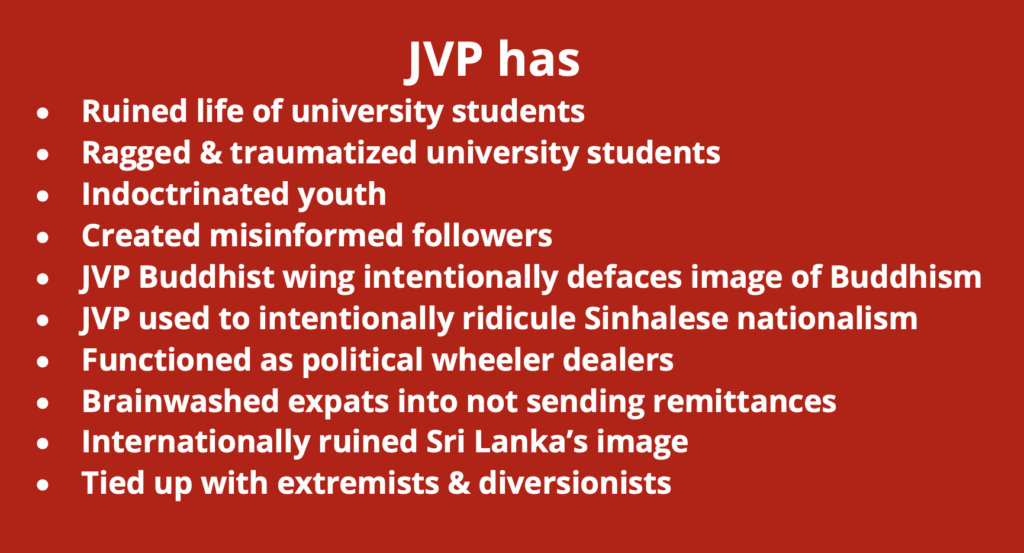
Pretending to Represent YOUTH – JVP & LTTE have killed & ruined the lives of Sri Lanka’s YOUTH

January 16th, 2023

Shenali D Waduge

It is interesting how two groups terrorized 2 communities beyond measure. Both targeted youth and both are responsible for their deaths, their indoctrination, trauma to their families & ruining their youth & disabling their talents. Are there no legal framework to hold both these groups accountable for ruining the lives of youth from late 1960s to date? Youth of post-independence were enticed into one of these 2 movements & their entire lives went astray.

The JVP was created on 14 May 1965 by Rohana Wijeweera. Not only did he meet a tragic end, but the youth he indoctrinated also perished as a result of 2 JVP insurrections. The party is full of controversies, contradictions and conversions in ideology too departing from the reason it was initially formed. Its ties and links both local & international make it an unreliable political entity, surviving primarily due to its hold on youth & its funding from external sources & its ability to muster public sentiment against the 2 main political parties highlighting their shortcomings from the gallery. Nevertheless, at some point of time, the JVP stalwarts have either supported both of the main political parties (directly & indirectly) as well as provided grass-root campaigning in support of them, happy to remain whining in Parliament & amongst public with 3% of votes. JVP-LTTE have strong ties & both in turn are now connected to Islamic fundamentalism too.

JVP drew its members from rural Sri Lanka. Most were from humble Sinhala Buddhist homes. Many were from universities across the island.

Though professing communism even the General Secretary of the JVP Lional Bopage was qualified in the UK while being in the JVP. He was also supporting of LTTE separatism & now living in Australia after leaving the JVP in 1984.

Noteworthy is that the 1978 JVP manifesto supported separatism a stance they took from 1973 – the year after Prabakaran formed Tamil New Tigers & when the Republican Constitution was formed. Therefore, it was clear that both JVP & LTTE were not going to allow Sri Lanka to take a course of growth & development.

While JVP supported separatism the LTTE or pro-LTTE Tamils did not extend same support for JVP. This created rifts within the ranks of the JVP. JVP abandoned support for self-determination for North simply because it impacted their vote & support. Another occasion of warped ideology. JVP was always a party that had multiple ideologies bending them when it suited the personal objectives of its politbureau. It is interesting how the JVP has been able to garner the youth with such internal ideological confusions. It is an open secret that JVP is the appendage of the UNP & the formation of a secular – pro-liberal NPP” seals this fact.

JVP was initially Maoist. Do today’s JVP know what a Maoist ideology is? During what part of JVP history did it get associated with CIA, yet why would JVP be accused of attacking the US embassy, unless it was the perfect ingredient to launch itself?

The JVP has backed virtually every political party in power or aspiring to come to power from 1970 onwards. JVP had ties even with the JRJ Govt & explains why Wijeweera was released. JVP backed CBK in 1994 & then went against her. JVP was against Mahinda Rajaapkse in 2004 but backed him in 2005 & then tried to bring him down. In 2010, JVP joined with UNP/Fonseka & till 2015 worked towards toppling him by supporting a Western-Indian backed alliance. Clearly JVP has no principle or ideology. The manner that JVP has been used over the years indicates its role in Western-Indian backed regime change. It is an allegation they cannot shy from. Every time a regime is targeted to be removed, JVP is at the forefront of attack be it a govt in power or a govt being supported to come to power. What everyone needs to understand is that the JVP exists, not to come to power but as a catalyst for change, an agent of external forces unleashed to create mischief & fool the masses in particular the youth.

The youth have been misled since 1960s by the JVP & breakaway FSP group.

How many Sinhala youth believed in the JVP & died as a result?

How many of these youth could have become engineers, accountants, doctors had they not turned into rebels.

Look at the state of the universities & the infiltration of JVP-FSP into the minds of youth, taking them into the streets to protest while their own children obtain foreign degrees. Misleading the youth has caused a major brain drain to Sri Lanka.

The LTTE began its murderous chapter also in the same period as JVP but chose to kidnap & forcibly train children who comprised a major portion of their fighters. These children were as young as 10 years old and came from poor & low caste homes & not too many high caste/class Tamils bothered about their lives so long as they could educate their children & send them overseas for studies & gain asylum to permanently live on foreign shores. In the eyes of these Tamils, those low caste Tamil children would have never become accountants or engineers or doctors, therefore they were only good for the jungle & gun.

Today, not a single international entity is bothered to question pro-LTTE supporters on how many Tamil children LTTE sacrificed? No one is bothered to count these dead Tamil children many killed by LTTE for trying to run back home. The gruesome stories that once-child soldiers of LTTE revisit and the silence of the West & international humanitarian agencies showcases their hypocrisy & bias.

Nevertheless, scores of Tamil children perished given a gun instead of a pen, given a combatant kit instead of a school uniform & inside bunkers instead of home, worshiping a megalomaniac leader instead of their parents.

Between LTTE & JVP, thousands of young lives perished from 1970s to 2009, imagine the trauma for the families who have maybe lost more than one child. Worse than dying are the ones that are living continuing to be fooled by both entities. The LTTE Diaspora youth naturally want to keep the kitty going & not surprisingly with their foreign accents, they are keeping the show going. The JVP are happy to nurture their youth inside universities via ragging & other elements at play with help perhaps JVP lecturers & seniors. The mentality of not allowing others to shine while their own enjoy the luxuries of their status highlights the hypocrisies of both JVP & LTTE. Look at the lives of these leaders against what they promote for the rest.

The links with JVP-LTTE to pro-Islamic elements is certainly noteworthy seen in the manner family members of the Easter Sunday suicide bombers were members of JVP & contested elections while LTTE Diaspora did not shy from backing the Galle Fact protest & together their supporters provided meals, social media propaganda & whatever other support required.

This threesome are not helping the country in the least & add to the issues related to corruptions by politicians, public officials even private sector & the general public. While on the one hand we have major problems related to corruptions, at another level we can never nurture young minds to intelligently and intellectually take Sri Lanka out of the mess, primarily because they are being instigated to take to the streets in protest, to behave in uncouth ways, to rebel and resort to violence, to traumatize fellow  youth & submit them to abiding their commands by fear.

All this has not produced the youth we expect to proudly take over the future. JVP & LTTE put thousands of youth to their grave & now they are killing them alive with their warped ideologies that are selfish & self-serving using youth as guineapigs, carrying out what is tasked of them & outsourcing that to the youth while they happily enjoy the fruits of that labor.

Shenali D Waduge

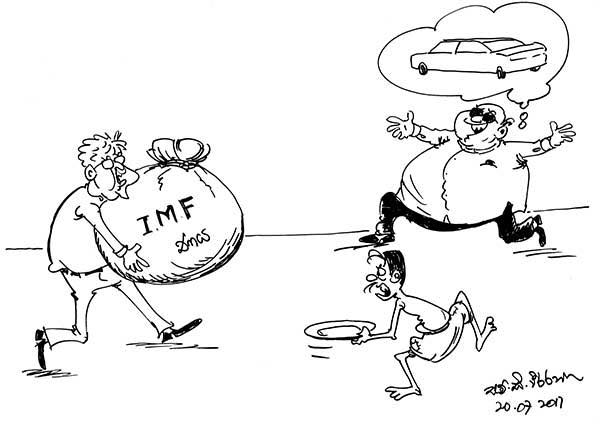
Why doesn’t IMF prune the unlimited perks of politicians before reducing Sri Lanka’s Military?

January 16th, 2023

Shenali D Waduge

We have taken 16 loans from IMF since 1965, countless IMF officials have been landing & leaving advising every Government on how to manage the economy and yet we remain trapped into debt with no plan to come out. Instead of pruning the military, why doesn’t IMF insist on pruning the Govt starting off with reducing unlimited perks of politicians, the useless Provincial Council system along with unnecessary staff before trying to destabilize the national security apparatus of Sri Lanka?

Contrary to IMF claims that it reduces poverty, studies reveal IMF borrowing countries experience higher rates of poverty via its reforms” resulting in unemployment, lower government revenue, increased costs for basic services, higher taxes, cuts to pensions & social security.

Privatization/Sale of SOEs results in sacking of redundant state workers contributing to unemployment falling on the State & raising poverty as well as higher prices for public services (water, electricity etc) IMF’s demand to abolish taxes on repatriation of foreign profits claiming it attracts capital from abroad results in reducing govt revenues & further lowers social spending on the nation’s poor. IMF’s demand to change labor laws to attract foreign investors also effects unemployment & increase to poverty. Imagine the state of affairs if 150,,000 armed force personnel are sacked – this means 150,000 unemployed.

IMF’s demand for free trade zones, reduced tariffs & import duties further reduces govt revenues to serve the people. Lifting of Govt-subsidized price controls also raises costs for consumers especially the middle class & poor. IMF’s demand on property rights & other perks for foreign investors is again promoting elite privileges only. A Govt has no choice but to seek more loans but no means to repay as all avenues have been drained by IMF.

It is interesting the players promoting going to IMF.

Are we intentionally being kept in debt?

However much the pundits glorifying IMF loans may say, the reality is that money is artificially printed given electronically as SDRs (Special Drawing Rights). Sri Lanka has taken 3,586,000,000 SDRs. These are not currency but countries use them to transact as well as pay back loans even back to IMF.

More & more it becomes clear that Sri Lanka cannot delay formulating a national plan of growth, development where stimulus has to be given to the middle income citizens and austerity has to be implemented for the small segment of rich. The middle class & poor cannot be taxed any more than they have – economic pundits in Sri Lanka must realize this.

In drawing up the national plan, we will have to think of ways that the State apparatus can be both service & profit oriented while benchmarking where cost cutting can and should take place.

Politicians & their families have to wake up to some ground realities – they cannot bathe in riches and luxuries at the cost of the poor and pretend everything is honky dory having agreed to take more loans piling the poor with more debt. Cost cutting for politicians & their families is a must.

The rich & elite need to honestly ask themselves how many pay taxes for all that they enjoy given by the State. The manner companies evade tax, how they are sheepishly taking out their profits & depositing in foreign countries while making a fuss over the need for good governance” reeks hypocrisy. They too are part responsible for the economic crisis.

The JVP emerged unannounced. The LTTE emerged & flourished with Western-Indian backing. Post-LTTE their sponsors sought revenge from the players that defeated them. So much for their forgive & forget reconciliation mantras. That LTTE ground force is no more does not lessen the threat for the operations of the LTTE fronts together with runaway LTTE have not diminished. Their quest with gun is now quest with pen & the quest to separate Sri Lanka, demands the presence of the Armed Forces.

Contrary to the silly notions of some Colombo elite, the Armed Forces cannot be disbanded & then recalled in an emergency. All of the Colombo elite and pundits would have disappeared if a calamity as that which we experienced with both JVP & LTTE emerges. The Easter Sunday was also a good example that we have another debacle in the horizon. This further requires the presence of the armed forces & intel on call. Let us not forget that the suicide bombers were all rich, educated, socially accepted individuals – therefore we may never know who else is being indoctrinated to become the next suicide bombers. This entails the presence of intel & armed forces to be ready for any unexpected circumstance.

Many may have forgotten that it was the armed forces that ran Public transport, driving trains and buses during JVP/LTTE periods of terror. It was the armed forces that functioned as TV presenters during JVP/LTTE height of terror when they set about killing artists. It was the armed forces that came to the rescue in disaster situation – not the NGOs & foreign salaried Civil Society groups who made dramatic videos & appealed for foreign funds & kept 80% of that funds for themselves & gave away only 20% as charity”.

That the armed forces & civil defense force also have their own agri units, with storage & transportation was seen during the covid crisis where the armed forces again came to the rescue to provide vegetables to people, doing a yeomen service. This was immediately stopped as some powers that be panicked thinking the public-armed forces unity was not too good for their agenda. However, what needs to be highlighted here, is that the agri apparatus of the armed forces can and should be strengthened and there is no reason for anyone in particular the LTTE agents or the NGO agents or even IMF to object. What kind of a spineless Govt or Parliament do we elect if they can only bark at the people but worship the enemies?

If the IMF is so concerned about helping Sri Lanka get its house in order – why could they not do so the 16 times that IMF provided assistance to Sri Lanka?

If the IMF is so concerned about corruptions – why are they not going after the corrupt politicians and public officials & demanding they be sacked first?

If the IMF is so concerned about reducing the cost to the state – why are they not looking at the areas where the costs are more?

When the people are all claiming the Provincial Council system is a white elephant, why does the IMF want its continuance instead of asking to close the PC system & with it the staff in it who provide no meaningful service to the people & these roles can easily be handed over to the Local Govts to do. Restructuring of this is essential.

Should we not look at all of the over staffed Govt offices, corporations etc? Should they not be pruned before targeting the armed forces, who are a professionally trained outfit that cannot be trained over night or re-recruited overnight in case of emergency. Unless, this is the whole aim of disbanding the armed forces, with intent to dislocate Sri Lanka’s ability to bring reinforcements in the event of a terror situation!

When the entities that seek to prune the armed forces (local & foreign) are key players that supported LTTE terrorism, separatism & disunity in Sri Lanka, it is natural for the sane to wonder what their game plan is. This request to reduce is a carry forward of their demand post-LTTE defeat to confine the military to barracks, close down military camps & remove the military from the North & East. Now their latest sing song is reduce the military”. By now, people should realize the sequence in their demands & the hidden motives behind it.

However, it is baffling that the politicians are in agreement, unless they are threatened to – either prune the armed forces or face pruning their own privileges & perks. Probably, this threat may be hidden from public & that is why they are boldly claiming to agree to IMF demands.

Would these politicians agree to reduce their own security contingents first! Why should their wives, children or their domestics be given military escorts even for private events! The military men providing security to the extended families certainly should be reduced & instead these men can be used for more important roles, especially in times where strikes take place, they can be used to support essential services. They should also continue their agriculture drive, but that is unlikely to happen because the mafia & their international networks would not want a disciplined army venturing into areas that they cannot influence.

Sri Lanka can certainly get back on its feet, but to do so the cuts have to be done at the right places. What we have is a bunch of people thriving on the poverty of the people & to sustain their livelihoods, people are being unfairly taxed. IMF is simply watching as it enables the West to fish in troubled waters.

Shenali D Waduge

HUMAN RIGHTS PART 4

January 16th, 2023

KAMALIKA PIERIS

Sri Lanka Foundation held a seminar titled Seminar on Religious and Cultural traditions of Human Rights in Sri Lanka”, probably    in 1981. The Foundation had organized three live-in seminars, with participation of Buddhist, Hindu, Islam, Catholic and Christian groups. The final reports of these groups were published in Religion and Culture in the development of human rights in Sri Lanka” (Sri Lanka Foundation, Colombo 1982).

This essay is on the report made by the Buddhist panel. The Buddhist Panel started off by stating that this Seminar showed that the Sri Lanka Foundation had accepted that there was room for further development in Human Rights and that religion could help in the improvement of the UN Human Rights Declaration. There is clear evidence of a lack of religious and philosophical thinking in the charter said the Buddhist Panel.

The Buddhist panel report said that the Buddhist doctrine was directly relevant to the UN Human Rights discourse and had much to contribute to the subject. The Dhamma is primarily concerned with the problems of man. It analyses the causes that lead to the unsatisfactoriness of life, the Panel said. Human problems can be analyzed independent of belief. Buddhism does not have the problem of deciding between the convert and the non convert where this matter is concerned.

The charter that we inherit as Buddhists is far ahead of any that the world had hitherto witnessed anywhere. The Dhamma provides a set of Buddhist values that could act as a guide to man. In the Noble Eightfold path, every aspect, from correct views to tranquility of mind, is marked by an insistence on correctness, propriety, justice   and integrity. The ideas in the Dhamma were developed in another age, but they are applicable to present day, said the report.  

The Panel said that the view of the vast number of persons who make negative statement on Buddhism, without knowing anything about Buddhism, it is best to indicate at the outset the Buddhist attitude to rights, duties and obligations. There is emphasis on moral values, and social consciousness, in the Vinaya for monastic community and in the Dhamma for the lay community.

Buddhism is a philosophy of life in every sense of the word, a philosophy for the enrichment and elevation of life. Buddhism provides the necessary basic ingredients for this. In Buddhism religion and society are closely integrated concepts, despite views expressed to the contrary, by those of other faiths.

 For Buddhist a righteous society is a Dharmishta society, or society established on the Dhamma. This is practical and meaningful.  Nothing in the Dhamma runs contrary to the safe and healthy development of society. Far from stifling a healthy growth of society the presence and utilization of the Dhamma with a thorough grasp   of its content, will be beneficial to the community.

There are instances in the context of Buddhism of peaceful integration of state and religion, of the permeation of religious values into the realm of statecraft. This has helped to lubricate state processes rather than throttle its magnanimity and philanthropy.

Rafael Salas, Executive director of UNFPA addressed a special convocation of University of Colombo in 1979, and said that the people of Sri Lanka are blessed with the ethic of restraint. This demands a consciousness of the limits on the behavior of persons. This ethic of restraint is also linked to respect for the value of life.

The Buddhist Panel attending the seminar was highly critical of the UN Human Rights Declaration. The UN Human Rights Charter is a stricture on bad human behavior, man towards man and state towards its subjects, but the remedies recommended are in terms of weaknesses found in certain societies, not all societies. The   UN Charter is not universal, said the Panel.  Its universality only lies in the desire to apply it universally.  

Today, in this age of science and technology, man’s view of the universe and his place in it, has affected man’s view of the value of human life. This modern approach has helped to give human rights a different emphasis, and direction. There had been a distinct shift of emphasis from selflessness and improvement of a human being to the present vociferous demand for individual rights of a legalistic nature, enforceable both against the state and our fellow men. That is not the concept in the Dhamma, said the Panel.

Buddhist texts illustrate in vivid detail the diverse social relationship that must be established and maintained in the human community. With the recognition of a right comes the responsibility of its fulfillment. This reciprocity of relationships is viewed in Buddhism as an essential ingredient of social wellbeing. For a meaningful UDHR we must be endowed with magnanimity and philanthropy.

The UN Human Rights are only an imperfect reflection of ideas and concepts which in the Buddha Dhamma were more humane, more philosophical, and more just than anything modern life can show. These rights mean something more   in the Dhamma than what was stated in the Human Rights charter of the UN.

Buddhist thought says that all life has a desire to safeguard itself and to make itself comfortable and happy. The concepts of maitri and avihimsa, universal love and non-destruction of life derives from this position.  It is the responsibility of every member of society to contribute to this principle.

Sigalovada sutta has a brief but rich and fair manual on how to live in a community, and it is unfortunate that this has been not adequately studied so far.  In Sigalovada sutta human rights and human needs are given equal emphasis. The two are considered inalienable.

Buddhism accepts the personal security of a person, also his right to life in comfort and happiness as a sine qua non of the health and sane society. for this, Buddhist teachings  have indicated in great detail the need and means by which to acquire the material elements needed, not only in terms of basics like food and clothing, but also  items which  gave a healthy sense of relaxation and well being. A mere hand to mouth existence is never reflected as a social norm in Buddhism.

The need and the right to be protected, free from assault and free from threats of destruction rank foremost among Buddhist values. Humanity today seems to pay scant respect to this. This precept in Buddhism is greater in depth and richer in tone than article 3 of the UN Declaration. 

The Panel did not agree with the UN’s exclusive focus on humans .The consideration of Human Rights must in our opinion start with the recognition of a broader basis of rights of human, animal and of things animate and inanimate. Rights extend to all life, humans as well as animal also the whole environment, including rivers, lakes and mountains, birds, beasts, trees and plants.

The Buddhist Panel discussed in detail certain rights given in the UN Declaration. The Panel pointed out that the issue of employment is discussed in Buddhism . Kutadanta sutta in Digha nikaya discussed the importance of employment as a means of sustenance. That people should have opportunity for productive work and adequate remuneration is considered a pre- requisite for social harmony and personal well being.

 Buddha in one instance suggested to a ruler that it was best to put an end to disorder in that country to provide fruitful employment to the people. he said  help those in agriculture to do it successfully, for those in trade, to provide capital to the state, give food and wages to those in government service, then they will no longer harass the pubic as dacoits. Buddha stressed that employer and employee should not be at cross purposes.

The Buddhist Panel discussed labor rights. With Buddhism available, we should not have degenerated to the need to battle for workers rights, it said. Sigalovada says an employee must be relapsed from work on time.  They cannot work through the whole day. They must be released at the correct time before they become weary.

Along with wages, there is mention of daily food. This includes food and delicacies and provision of medical aid at work. On festival days they should get gifts of food clothing and ornament. Buddhism said that workmen stand side by side with parents, wife and children of a private employer in deserving to be made happy, for their contribution to his economic well being.

The Panel also spoke at length on the rights of women. It pointed out that Buddhism gives rights to women. Women are entitled to work, be wage earners but also woman’s role as mother, wife, and sister are highly esteemed.

The members of the Buddhist Panel were Ven. Madihe Pannasihe, Ven. Medagama Vijiranane, Ven. Tissa Gunatllake of Mallikaramaya, Ratmalana, Ven. Labuduwe Siridhamma, Ven. K Anuruddha  Justice D Wimalaratne, Justice RS Wanasundera, Dr MMJ Marasinghe, , Prof NA Jayawickrema, Prof A.V Suraweera, Dr S Kiribamune, Mr. Olcott Gunasekera and Mr. Hector Wijemanne. The  Research papers were provided by Ven. Henpitagedera Gnanawasa, Dr. Jotiya Dhirasekera, Dr LPN Perera, Dr Chandima Wijebandara and Dr Mrs T Kariyawasam. (Continued)

Regularization of Private Hospitals and Health Care

January 16th, 2023

Sarath Wijesinghe President’s Counsel, former Ambassador to UAE and Europe, Solicitor in England and Wales President Ambassador’s Forum

Health is Wealth

Health is wealth is the adage frequently used. The words of one of the richest in the world said at the death of his wealth and that it is of no use without proper health of an individual sick feeble and bedridden. Is it karma, destiny, or the wish of unknown are all unanswered issues. Human body is complicated uncertain and unpredictable to be careful managed with the knowledge and experience of the human body and nature. He said all the wealth in the world could not save his suffering from terminal cancer. Physicians are available at all ages with different degrees of competence treated  to the  human body in various  means and methods yet the death is inevitable and the attempts of the human being is to live longer in good health with a sound mind. No permanent solutions have been found to prevent aging and death though medical advancement has invented drugs and methods for better health sponsored by the state or unseen divine power. Physicians were available for the human body at all ages worldwide with different types of treatments surgical and otherwise. News is the health services are advanced modified based on modern technology. Heart surgery has been complicated cumbersome and expensive before. Today it is done by advanced technology with much lesser risk offered privately and by the state. Human kind is fortunate to the advancement of medical technology advancing day by day yet-availability of it to the common man is the issue worldwide. States and the private sector has unsuccessfully finding a solution applicable to all with no success due to economic and logistic factors. How is the issue is confronted with by states and private individually?. The most pleasant feeling in life is to life healthy and happily with a sound mental equilibrium that you will acquire only when you are in good health.

Kinds of Medical Systems in the Country

Sri Lanka is blessed with different advanced kinds of medical systems with competent and kind physicians recognized and reputed world over. Western system of treatment is introduced to Sri Lanka by the west  when Sri Lanka was still blessed with the world recognized  indigenous medical systems prevalent in Sri  Lanka with somewhat similarities with the Indian model while maintaining the independence in the traditional model inherited traditionally. UK model has spread to the commonwealth countries including Sri Lanka where the state offers free health to the citizen. State owned hospitals are spread country wide in Sri Lanka offering free treatment and aftercare and full  treatments to every citizen equally when the private sector has own private hospitals doctors with a separate mechanism. Sri Lankan western medical system is set up on the UK model namely the NHS national Health System offering the UK citizen free health with a Mega Computer spread country with links to hospitals and GPs (General Physicians) with access to any hospital and GP’s information on the patient with the patient’s network through GP’s of the citizen. This is one of the best systems in the world where every citizen is entitled to have his/her own GP at the place of residence all at the cost of the state. Despite the free health services the private medical system too is flourishing in the United Kingdom to those who could afford for a prize leaving the citizen to choose the kind of treatment. Private medical system is generally linked to insurance as in the USA with no state funded medical system depending on insurance schemes. There is no GP system in Sri Lanka and the physicians are generally experienced, learned with no shortage due to the advancement of the education system. Government hospitals are available countrywide on district level and main central municipal capitals despite shortages, shortcomings depending on the economic situation at various times. Indigenous health system and the treatments by medicines of natural plants and ingredients too is commonly used by the average Sri Lankan who lived long living with nature and ingenious drugs and health practices that has tested over thousands of years successfully with self-regulators methods.

Private Medical Care and Private Hospitals

Private medical care is available in Sri Lanka in abundance in varies degrees subject to the quality and slight supervision by regulators apparently who are not active and mobility in terms of expectations by the consumers who are protected and supervised by the Consumers Authority, Ministry of Health, Private Health Services Regulatory Council, Professional bodies of professions and of course the media always vigilant in medical negligence  and overcharging by the private hospital which is a known and a palatable news flowering round often. The cost of Sri  Lankan private hospitals are extremely excessive to the average citizen compelled to use it by finding funds with great difficulties, except those who are covered by insurance premiums, which is commonly used in UK and USA. Consumers must unite to bring down the cost of private medical service with organizational powers and ability.

Regulation and Regulatory powers on the Public and Private Hospitals and professionals.

Medical practitioners are supervised by the professional bodies both in Western and ‘’Ayurwada’’ practitioners, with practicing certificates when those who practices without a valid permission are prosecuted by the police. General practitioners in UK are designed to practice in a specified area for a given group free for which the NHS would give a grant for the running of the practice and salaries of the staff which is a complicated – yet a successful mechanism the citizens are used followed in many commonwealth countries and some European states. NHS supervises the medical in GP practice and the practitioners in private practice is monitored and supervised by a different group also connected to NHS.  There is a proposition by a group of some innovative and professional sector to get the services of ‘’Care Givers’’ in place and to  assist  emergencies and to treat until the GP is treated akin to paramedics  is a good concept to consider if the caregivers are properly trained and geared to professionally. In Sri Lanka those who possess a valid practicing certificate can conduct a practice subject health and other requirements in the municipal area supervised monitored and directed by Private Health Services Regulation Council ((PHSRC) functioning under the ministry of health Private Institution Registration Regulatory Council set up under 21/2006 functioning under the Ministry of Health is the main regulatory body on medical issues yet the instrument is not clear on the charges and the reasonableness of the amounts demanded which may be a lacuna on the procedure. The institution do not appear to be active and media often reports on excessive charges and the substandard of conditions and facilities. The definition of consumer and the service is giving some conciliation to the consumer in need of assistance apparently not made use of this legal obligation to date which reads as follows.  Consumer means any actual or potential user of any  goods or services made available  for  a consideration by  any trader manufactory (75a) and Service means service of any description which is made available to a actual or a potential user  and include (h) construction, production, manufacturer supply storage  manufacture repair cleaning  (h) professional services such as  accounting auditing, legal ,medical and health. The two definitions indicate that a consumer can take the cover of CAA as a regulator to regulate conduct of the private hospitals including the standards and the price under rules as any other average consumer. Under Section 12(2) and Sri Lanka Institutions act  no 6 of 1984 on supply of any services the CAA wil derive power to gran relief to the  consumer if and when requested is another way to get redress to the customers of private hospitals.

Maintain Standards and regularization of the cost

Private practice and hospitals are a private business and the consumer has little influence other that complains, suggestions and discussions with consumer groups and the public bodies that will give eye openers to the owners of private hospitals whose prizes are unreasonably excessive and unreasonable. It is advisable to set up pressure and consumer groups and act joint in the interest of others that will give good results for many. This pressure groups are many and productive in UK and worldwide and it is a good idea to join hands with them as a pressure group. The news we receive from consumers and the media on the private hospitals and physicians are unfair and heart-breaking to hear from all over, thereby a joint action and a working arrangements are needed establishing a network of same and similar minded groups. It  is time the pressure groups and media takes positive steps on the regularization of the private health schemes and high prices of private hospitals. Sarathdw28@gmil.com

එක්සත් මහජන පක්ෂයේ 2023 පළාත් පාලන මැතිවරණය පිලිබදව දැනුවත් කිරීමේ මාධ්‍ය හමුව

January 16th, 2023

අකිල තෙන්නකෝන් මහජන ආරක්ෂක අමාත්‍යතුමන්ගේ මාධ්‍ය ලේකම්

2023 පලාත් පාලන මැතිවරනයට එක්සත් මහජන පක්ෂය ලෙස අප පක්ෂයේ සහභාගීත්වය සහ ඉදිරි දේශපාලන වැඩපිලිවෙල පිලිබදව මාධ්‍ය දැනුවත් කිරීම සදහා වන මාධ්‍ය සාකච්ඡාව 2023.01.16 දින කොළඹ පදනම් ආයතනයේදී පවත්වන ලදී

ඒ සදහා පක්ෂය නියෝජනය කරමින් චමින්ද ගුණසිංහ මහතා, අවිශ්ක විරාජ් කෝණාර මහතා, මාෂි සේනානායක මෙනවිය සහ චතුර රාජපක්ෂ මහතා සහභාගී විය.එහිදි පහත කරුණු සම්බන්ධව අදහස් පල කරන ලදී.

ශ්‍රී ලාංකීය දේශපාලනයේ වසර 74ක් පුරාවට වැරදි දේශපාලනික මැදිහත් වීම,නිළධාරීවාදය සහ අකාර්යක්ෂමතාවය හේතුවෙන් මේ වෙන විට රට පත්ව ඇති අසීරු තත්ත්වය වෙනස් කිරීමට නව නව දැක්මක් සහ වැඩ්පිලිවෙලක් පුරවැසියන් විසින් අපේක්ෂා කරන බවත් ඒ සදහා හුදු විවේචනය සහ විචාරයෙන් ඔබ්බට ගිය විසදුම් මූලික කරගත් දේශපාලන ව්‍යාපාරයක් ලෙස කටයුත් කිරීමේ අරමුණින් මෙම පලාත් පාලන මැතිවරණයට පක්ෂයක් ලෙස මුළු දිවයිනම ආවරණය වන පරිදි ඉදිරිපත් වීමට එක්සත් මහජන පක්ෂය තීරණය කර ඇති බවට චමින්ද ගුණසිංහ මයා විසින් මාධ්‍ය දැනුවත් කරන ලදී. එමෙන්ම වැඩ මූලික දේශපාලන ව්‍යාපාරයක් සමග අත්වැල් බැද ගැනීමට කැමැත්ත ඇති ඉදිරි මැතිවරණයේදී තරග කිරීමේ බලාපොරොත්තුව සහිත පුරවැසියන්ට පක්ෂය හා එකතු වන ලෙස ආරාධනා කරන ලදී.

මෙම මාධ්‍ය හමුව සදහා සහභාගී වූ අවිශ්ක විරාජ් කෝණාර මහතා අරගලයේදී දැක්වූ විරෝධය පාලකයා වෙනස් කිරීමෙන් අනතුරුවද දිගින් දිගටම පවත්වා ගැනීම නොව මේ මොහොතේ රටේ ආර්ථික ස්ථාවරත්වය ඇති කිරීම වෙනුවෙන් සියළු පාර්ශව කටයුතු කල යුතු බව අවධාරණය කරන ලදී. එමෙන්ම ලංකාවේ ඩිජිටල් ආර්ථිකය දියුණු කිරීම සදහා ඔහු විසින් මේ වනවිටත් ක්‍රියාත්මක කරන ව්‍යාපෘති සම්බන්ධව මාධ්‍ය දැනුවත් කරන ලද අතර දේශපාලනයට අවතීර්ණ වීම සදහා මෙම පක්ෂය සමග එකතු වීමට ප්‍රධානම හේතුව ඔහුගේම වැඩපීවෙලක් ඔස්සේ නිදහස්ව වැඩ කිරීමට පක්ෂය ලබා දී ඇති අවස්ථාව බවත් එය උපයෝගී කර ගනිමින් ඉදිරි පලාත් පාලන මැතිවරණයේදී මහරගම නගර සහාව සදහා පක්ෂයෙන් සහභාහී වීමට අපේක්ෂා කරන ලදී.

මෙම මාධ්‍ය සාකච්ඡාව සදහා සහභාගී වූ මාෂී සේනානායක මෙනවිය. ලංකාවේ පාර්කිමේන්තුව තුල කාන්තා නියෝජනය ඉතා අවම මට්ටමක් පැවතෙන බවත්, කාන්තාවගේ සෑබැ ගැටළු සාකච්ඡා කිරීමට නම් කාන්තාවන් වැඩි වශයෙන් දේශපාලනයය ප්‍රවිශ්ඨ විය යුතු බවත්, ඒ සදහා ලංකාවේ කාන්තා සහික නියෝජනය වෙනුවෙන් නිශ්චිත ප්‍රතිශතයක් වෙන් වන එකම මැතිවරණය පලාත් පාලන මැතිවරණය බැවින් සදහා අප පක්ෂය සමග එකතු වන ලෙස කාන්තාවන්ට විවෘත ආරාධනාවක් සිදු කරන ලදී.

එමෙන්ම මෙම මැතිවරණය පුංචි ඡන්දය ලෙස හැදින්වූවද මෙය මේ මොහොතේ පවතින දේශපාලන වාතාවරණය අනුව ජාතික මැතිවරණයක් මට්ටමටම වැදගත් බවත් එබැවින් මෙම මැතිවරණයේදී අපේක්ෂකයින් ලෙස ඉදිරිපත් වන ඕනෑම පක්ශයක අපේක්ශකයෙකුගෙන් ඔහු ඉදිරිපත් වන පලාත් පාලන ආයතනය හෝ මැතිවරණ කොට්ඨාසය සදහා නිශ්චිත වැඩපිලිවෙලක් ඉදිරිපත් කිරීම අනිවාර්යය කාර්‍යයක් ලෙස පුරවැසියන් සැලකිය යුතු බව චතුර රාජපක්ෂ මහතා විසින් ප්‍රකාශ කරන ලදී. වැඩිදුරටත් අදහස් දක්වමින් තම පක්ෂය මගින් ඉදිරිපත් වන අපේක්ෂකයන් ප්‍රධාන කරුණු තුනක් ඔස්සේ තම වැඩපිලිවෙල ඉදිරිපත් කරන බවත්, එම කරුණු තුන අදාලා පලාත් පාලන ආයතන අශ්‍රීතව ආර්ථික ඵලදායිතාවය ඇති කිරීම, පුරවැසියන්ගේ ආකල්පමය දියුණුව වෙනුවෙන් වැඩපිලිවෙලක් සකස් කිරීම, පලාත් පාලන ආයතන වල ප්‍රමුඛ කර්‍ය්යක් වන මංමාවත් සහ් යටිතල පහසුකම් පවත්වාගෙන යාම වෙනුවෙන් නිශ්චිත වැඩපිලිවෙලක් සකස් කිරීම යන ප්‍රධාන කරුණු ඔස්සේ කටයුතු කරන බව දැනුම් දෙන ලදී. එමෙන්ම මෙම මැතිවරණයේදී ඕනෑම පක්ෂයක් මගින් ඉදිරිපත් වන අපේක්ෂකයෙක් සතුව නිශ්චිත වැඩපිලිවෙලක් පවතින්නේද යන්න විමසා බැලීම ඡන්ද දායකයන් සතු වගකීමක් බැවින් එය පක්ෂ බේදයකින් තොරව සිදු කරන ලෙසද ඉල්ලා සිටින ලදී.

ආණ්ඩුකාර උතුරු මැද

January 16th, 2023

තිසර සමල් – එප්පාවල

උතුරු මැද පළාත් අාණ්ඩුකාර මහීපාල හේරත් මහතාගේ සංකල්පයට අනුව රන් මාවත නමින් ආරම්භ කරන ලද වැඩසටහනේ ප්‍රගතිසමාලෝචන රැස්වීමක් කම්කරුව හා විදේශ කටයුතු අමාත්‍ය ගරු මනූෂ නානයක්කාර හා උතුරුමැද පළාත් ආණ්ඩුකාර මහීපාල හේරත් මහතාගේ ප්‍රධානත්වයෙන් උතුරුමැද පළාත් සභා ශ්‍රවණාගාරයේදී පැවැත්විණි.

උතුරුමැද පළාත් රැකියා විරහිත තරුණ තරුණියන් සඳහා ලංකාවේ පළමු වතාවට වැඩිහිටි ආරක්ෂණ හෙද සත්කාර හා පංචකර්ම සේවා සඳහා n v q level දක්වා රජයේ  හා පුද්ගලික රැකියා විරහිත පිරිස් විධිමත් පුහුණුවකින් පසුව විදෙස් රටවල ඉල්ලීමට අනුව කාණ්ඩ වශයෙන් යොමු කිරීම හැකියාව මෙමගින් සිදුවේ.

මෙම පුහුණුව මගින් still present සහතිකයක් හිමිවන අතර ‍මෙමගින් ඕනෑම රැකියා යුත්තේ වායුක්තිකයකු විදෙස් රැකියා සඳහා පහසුවෙන් යොමු කිරීම මෙම වැඩසටහනේ මූලික අරමුණ වේ.

මෙම අවස්ථාවට උතුරු මැද පළාත් ප්‍රධාන ලේකම් චන්ද්‍රසිරි බණ්ඩාර. විදේශ කටයුතු අමාත්‍යාංශයේ සාමාන්‍ය අධිකාරී සෙනරත් යාපා .ජේෂ්ඨ කළමනාකරු එච් එම් සුනිල් නැගෙනහිර පළාත් ආණ්ඩුකාරවර ලේකම්. උතුරු පළාත් සභාවේ සහකාර ලේකම්. වයඹ පළාත් සභාවේ නියෝජ්‍ය ප්‍රධාන ලේකම්. විදේශ කටයුතු අමාත්‍යාංශයේ නිලධාරීන් පළාත් සභාවේ නිලධාරීන් පිරිසක් සහභාගී විය.

සමඟි ජන බලවේගය අනුරාධපුර දිස්ත්‍රික්කයේ සියලුම ප්‍රාදේශීය සභා සඳහා ඇප මුදල් තැන්පත් කිරීම අද

January 16th, 2023

තිසර සමල් – අනුරාධපුර 

සමඟි ජන බලවේගය පළාත් පාලන මැතිවරණයට තරඟ කිරීම සඳහා අනුරාධපුර මහ නගර සභාව ඇතුළු අනුරාධපුර දිස්ත්‍රික්කයේ සියලුම ප්‍රාදේශීය සභා සඳහා ඇප මුදල් තැන්පත් කිරීම අද (16) සිදු කරනු ලැබීය.

අනුරාධපුර දිස්ත්‍රික් ලේකම් කාර්යාලයේදී එම ඇප මුදල් තැන්පත් කිරීම සිදු කළ අතර, ඒ සඳහා හිටපු අමාත්‍යයවරුන් වන පී.හැරිසන්, චන්ද්‍රාණී බංඩාර, පාර්ලිමේන්තු මන්ත්‍රී රෝහණ බංඩාර, හිටපු පාර්ලිමේන්තු මන්ත්‍රී චන්දිම ගමගේ මහින්දසෝම යන මහත්ම මහත්මීන් ඇතුළු ඇතුළු පිරිසක් සහභාගී වූහ.

ඇප මුදල් තැන්පත් කිරීමෙන් අනතුරුව මාධ්‍යය වෙත අදහස් දැක්වූ පී හැරිසන් මහතා, 

  මේ මැතිවරණය සමඟි ජන බලවේගය විශීෂ්ඨ අන්දමින් ජයග්‍රහණය කරනවා.සන්ධාන ගත වෙන්න අපිට අවශ්‍යතාවක් න යැයි පැවසීය.

අනතුරුව අදහස් දැක්වූ හිටපු අමාත්‍යය චන්ද්‍රාණී බංඩාර මහත්මිය,

අපි අනිවාර්යෙන්ම ජයග්‍රහණය කරනවා, අනුරාධපුර මහ නරග සභාව ඇතුළු සියලු ප්‍රාදේශීය සභා ජයග්‍රහණය කරන්න අවශ්‍ය කටයුතු සිදු කර තිබෙනවා.අද පොහොට්ටුවට අපේක්ෂකයෙක්වත් හොයාගන්න බැරි තත්වයට පත් වෙලා තියෙනවා.පොහොට්ටුවෙන් පත් වුණ මන්ත්‍රීවරු වක්කඩ කඩා ගෙන ගියා වගේ අපි ලඟට එනවා අපේක්ෂකත්වය ඉල්ලා ගෙන, ඒ අයට ගමට යන්න බෑ පොහොට්ටුව ලකුණෙන්.අද විවිධ ලාංඡන වලින් සන්ධාන හදාගෙන ඉන්නවා, හැබැයි ඒ හැම පක්ෂයක්ම එදා පොහොට්ටුව යට ඉඳගෙන මේ රට විනාශ කරපු අය.ඒ නිසා මොන ලාංඡනයෙන් ආවත් මහජනතාව ඒ අයගේ පෙර වැරදි ගැන දන්නවා.අද අපිට අපේ අපේක්ෂකයෝ තෝරලා ඉවර කර ගන්න බැරි තත්වයක් උදා වෙලා තියෙන්නේ, ජනතා විමුක්ති පෙරමුණ වෙන නමකින් ගියත් ගමේ මිනිස්සු දන්නවා ජේ.වී.පී කියලා, ඒ අය මේ රට විනාශ කරපු හැටි ජනතාවට මතකයි.මොන බලවේගය ආවාත් සමඟි ජන බලවේගය තමයි මේ රට ඉදිරියට ගෙන යන්න පුලුවන් පක්ෂය.කවුරු මොන වෙස්මූණු දාගෙන ආවත් ජනතාව දන්නවා ඒ අය ගැන යැයි පැවසීය.

කුරුන්දවාසෝක විහාරය – තෙවෙනි කොටස

January 16th, 2023

විමල් පටබැඳිගේ (ශාස්ත‍්‍රවේදී, නීතිඥ, විශ‍්‍රාමික සොලිසිටර්)

තමන්ගේ මවුබිමේ ඉතිහාසය සමග වෙන්කළ නොහැකි සේ බැඳී ඇති පුරාණ ශිෂ්ටාචාරය, සංස්කෘතිය සහ සංස්කෘතික සිහිවටන පිළිබඳ යම් පමණක හෝ දැනීමක් ලබාගැනීම සහ සංරක්‍ෂණය කිරීම මානව හිමිකමක් පමණක් නොව මානව වගකීමකි. තමන්ගේ මුතුන්මිත්තන් සැමරීමකි. 

(දෙවෙනි කොටසෙන්)
ඉංගිරිසීන් 19 වෙනි සියවසේ සිට ක‍්‍රවුන් ලෑන්ඞ් (එන්ක්‍රෝච්මන්ට්* ඕඩිනන්ස් සහ සිලෝන් වේස්ට් ලෑන්ඞ් ඕඩිනන්ස් ආදී නීති ආඥා යෙදාගෙන සිංහල බෞද්ධයන් වසර දහස් ගණනක් භුක්ති විඳිමින් සිටි බිම්වලින් පළවාහැර සහ බෞද්ධ පුදබිම් පැවැත්ම සඳහා පුදා තිබූ සඟසතු ඉඩම් පැහැරගෙන ඉන්දියාවෙන් කූලීන් ලෙස ගෙනා ජනයා පදිංචි කරවා දෙමළ කොලනි පිහිටුවන ලද බව ඉතිහාසගත කරුණකි.

නටබුන් වූ කුරුන්දවාසෝක පුදබිම
කුරුන්දන්කුලම් වැව අසල පිහිටි කන්ද (කුරුන්දන්මලෙ* මුදුනේ තැනිතලාව මත ඇති නටබුන් වූ පුරාණ ගොඩනැගිලිවල ශේෂ කුරුන්දාවසෝක විහාරයේ ශේෂ ලෙස සැලකෙයි. එහි දර්ශනීය ස්තූපයක් තිබූ බව සනාථ කෙරෙන වට අඩි 140 ක් සහ උස අඩි 21 ක් පමණ වූ ගඩොල්ගොඩැල්ලක් 1964 වසර වෙනවිට ද එහි තිබූණි. වස්තු කොල්ලකරුවන් විසින් හෝ නිදන් හොරුන් විසින් ස්තූපය මැදින් හාරා විනාශ කොට ඇත. සම්පූර්ණයෙන් විනාශ කොට ඇති බුදුමැඳුරක අත්තිවාරමක ශේෂ විය. නටබුන් වූ පුරාණ ගොඩනැගිලි කීපයක කොටස්, ගල් කුළුණු රැුසක්, වටදා ගෙයක් පැවති බව පෙන්වන ලකුණු, ජල සැපයුම සඳහා වූ ළිං හෝ පොකුණු දෙකක නටබුන්, සහ කන්දේ බැම්මේ සහ පියගැටපෙළේ ශේෂ පැවති බව, වන මැද මංපෙත් සොයමින් ගිය, එල්ලාවල මෙධානන්ද හිමියන් කළ ගවේෂණයකිින් ලේඛනගත කොට ඇත.44
කුරුන්දවාසෝක විහාරය ඇතුළත් කොට ඇති මුලතිව් දිස්ති‍්‍රක්කය වෙහෙර විහාර සහ බුදු පිළිම ඇතුළු බෞද්ධ පූජනීය වස්තු පිරුණු පුරාණ ස්ථාන රාශියක් පැවති වනයෙන් වැසුණු බෞද්ධ ප‍්‍රදේශයක් බව ව්‍ය.ව. 19 වෙනි සියවසේ ඉංගිරිසි පරිපාලන නිලධාරීන්ගේ නිල වාර්තා හෙළි කරයි. සමීක්‍ෂණ මගින් පුරාවිද්‍යා භූමි ලෙස අඳුනාගනු ලැබූ ස්ථාන පනහක පමණ තොරතුරු වාර්තා කොට ඇත. එමෙන්්ම, අලූතින් පදිංචි කරවන ලද දෙමළ ජනයා ඒ වෙහෙර විහාර, බුදුමැඳුරු ඇතුළු ගොඩනැගිලිවල ගල්, ගඩොල් ආදී ගොඩනැගිලි ද්‍රව්‍ය භාවිත කරමින් නිවාස සහ කෝවිල් තනාගෙන ඇත. එපමණක් නොව බුදුපිළිම කොටස්, කොත්කැරලි, සිරිපතුල්ගල්, මුරගල්, පූජාසන, කුළුණු ආදි ආගමික වස්තු කෝවිල්වල පුල්ලෙයාර් සහ ශිවලිංග ලෙස පමණක් නොව මිරිස්ගල්, ගෙපඩි ලෙස පවා භාවිත කිරීම පිළිබඳව ඉතා දිගු විස්තරයක් 19 වෙනි සියවසේ ප‍්‍රදේශයේ ප‍්‍රධාන ඉංගිරිසි නිලධාරී ජේ.පී. ලූවිස් වාර්තා කොට ඇත. ප‍්‍රදේශයේ පදිංචියට පැමිණි දෙමළ ජනයා විසින් පුරාවිද්‍යා නටබුන් විනාශ කොට ඇති බව හෙන්රි පාකර් ද 1886 වසරේ නිල වශයෙන් වාර්තා කොට ඇත.
අක්කර දහසක පමණ විශාල ප‍්‍රදේශයක පැතිර පැවති කුරුන්දවාසෝක විහාර පුදබිම 1933 දී බෞද්ධ පුරාවිද්‍යා භූමියක් ලෙස පුරාවිද්‍යා දෙපාර්තමේන්තුව ප‍්‍රකාශයට පත්කොට ඇත. රක්‍ෂිත වනයකින් ද යුත් මේ භූමිය වරින්වර දෙමළ පවුල් පදිංචි කරවීම නිසා දැන් කුඩා වී ඇත. පදිංචි කරවීම් තවමත් නතර වී නැත. පුරාවිද්‍යා සමීක්‍ෂණ වාර්තාවල ඇතුළත් කිරීම් මිස, වනගතව තිබූ කුරුන්දවාසෝක විහාර පුදබිම සහ පුරාණ කුරුඳුගමුරට ප‍්‍රදේශයේ පුදබිම් සම්බන්ධ පුරාවිද්‍යා පර්යේෂණ සහ සංරක්‍ෂණය කිරීම විවිධ හේතු නිසා පසුගිය කාලයේ සිදු කොට නැත. එයට සුදුසු පසුබිමක් ද නොවීය. මේ ප‍්‍රදේශය එල්.ටී.ටී. ඊළාම් ත‍්‍රස්තවාදීන්ගේ අවසාන බල මූලස්ථානය විය. කෙසේ වෙතත්, ව්‍ය.ව. 2009 වසරෙන් පසු කුරුන්දවාසෝක විහාර පුදබිම පිළිබඳව යළිත් අවධානය යොමු කිරීමට බෞද්ධ ජනතාවට අවස්ථාව උදා විය.

පුදබිම යළි මිහිමත
ව්‍ය.ව. 2019 වසරේ පමණ පුරාවිද්‍යා දෙපාර්තමේන්තුව කුරුන්දවාසෝක පුදබිමේ පර්යේෂණ කැණීම් අරඹා ඇත. බුදුපිළිම ශීර්ෂ, කිරිගරුඬ බුදුපිළිම සහ බෝසත් පිළිම කොටස්, නටබුන් වූ පුරාණ දාගැබක සහ භික්‍ෂු ආරාම විය හැකි ගොඩනැගිලි විසිහයක, වටදාගෙයක, බෝධිඝරයක, සීමාමාලකයක කොටස්, යන්ත‍්‍රගල්, යූප කොටස්, සිරිපතුල්ගල්, කොරවක්ගල්, මුරගල්, සඳකඩපහන්, කැඩුණු පියගැටපෙළවල්, පැතිබැමි, සෙල් කුළුණු, පොකුණක නටබුන් ආදි විවිධාංග කොටස් සහ පුරාණ සිංහල ප‍්‍රාකෘත (බ‍්‍රාහ්මී* සෙල්ලිපි සොයා ගැනීම ගැන වාර්තා විය. ලාහුගල ප‍්‍රදේශයේ වෙඩි දමා පුපුරුවා තිබූ ස්තූපයකින් සොයාගෙන තිබුුණු රන්කරඬුව සහ මිහින්තලේ කණ්ඨක චේතිය, මිරිසවැටිය, රුවන්වැලි සෑය, අභයගිරිය, තිස්සමහාරාමයේ නාග විහාරය ආදී මුල් කාලයේ ස්තූපවල අංගයක් ලෙස ”යූපය” නිර්මාණ කළ ලෙසින් මේ ස්තූපයේ ගර්භය මුදුනේ සෙල්මුවා යූපයක් නිරමාණය කොට තිබූ බව පැහැදිළිව දක්වා ඇත. එමෙන්ම, සම්පූර්ණයෙන්ම ‘කබොක්ගලින්’ ගොඩනගා ඇති, කුරුන්දවාසෝක දාගැබ වැනි ස්තූපයක් දිවයිනේ වෙනත් කිසි තැනකින් සොයාගෙන නැත. නියම කළ නොහැකි ඓතිහාසික අගයකින් යුක්ත ස්තූපයේ මුල් පාදම පවා පාදාගෙන ඇත.

ව්‍යවස්ථාපිත රාජකාරියට තහනම් නියෝග
පුදබිම සංරක්‍ෂණය කිරීමට සහ පුරාවිද්‍යා දෙපාර්තමේන්තුව පුරාවිද්‍යා භූමි ලකුණු කිරීමට මායිම්ගල් පිහිටුවීමට පවා අබෞද්ධ වාර්ගික අන්තවාදී කණ්ඩායමක් බාධා කරයි. විරෝධතා, තර්ජන පමණක් නොව ප‍්‍රචණ්ඩව හැසිරෙන බව ද වාර්තා වී ඇත. මේ කණ්ඩායම විරෝධය සඳහා මුලතිව් මහේස්ත‍්‍රාත් අධිකරණය ද යොදාගෙන ඇත.
ආණ්ඩුක‍්‍රම ව්‍යවස්ථාවේ විශේෂිතව ව්‍යවස්ථාපිතව ආරක්‍ෂිත බැවින් අධිකරණය ඇතුළු සියලූ ආයතන සහ පුද්ගලයන් බැඳී ඇත. එසේ වුව ද, රාජ්‍ය ආයතනයක ව්‍යවස්ථාපිත නිල රාජකාරිවලට එරෙහිව වාර්ගික අන්තවාදී කණ්ඩායම ප‍්‍රදේශයේ අධිකරණය භාවිත කිරීම විශේෂයකි. පුරාවිද්‍යා භූමි සම්බන්ධව නියෝග කිරීමට අධිකරණ බලයක් නැති මහේස්ත‍්‍රාත් අධිකරණය, කුරුන්දවාසෝක විහාර පුදබිම සංරක්‍ෂණය කිරීම් නතර කළ යුතු බවට 2020 වසරේ කළ ඒකපාක්‍ෂික තහනම් නියෝගය පුරාවිද්‍යා නිලධාරීන් දින කීපයකට පසු 2020/10/22 දින පෙනී සිටි විට ‘පුරාවිද්‍යා දෙපාර්තමේන්තුවේ රාජකාරිය අඛණ්ඩව සිදු කිරීමට’ තහනම ඉවත් කළ ද ඊට බාධා කිරීම් වලක්වා නැත. අපමණ බාධා, අවහිරතා මැද ස්තූපයේ සංරක්‍ෂණ කටයුතු අවසන් අදියරට පැමිණ ඇති විට වාර්ගික කණ්ඩායමේ ඒකපාක්‍ෂික ඉල්ලීමට යළිත් මහේස්ත‍්‍රාත් අධිකරණය, 2022.07.14 දින ස්තූපය සහ සියලූ නිර්මාණ කඩා ඉවත් කිරීමට නියෝග කළේය. නියෝගය සංරක්‍ෂණ කටයුතු නතර කිරීමට නොවේ. වසර 2125 ක් පමණ පැරණි ඓතිහාසික කුරුන්දවාසෝක චෛත්‍යය සහ පුදබිමේ මානව ශිෂ්ටාචාරයට අයත් නිර්මාණ කඩා ඉවත් කිරීමටය. ඒ නියෝගය 2022/07/19 දින අහෝසි කළ ද පුරාවිද්‍යා දෙපාර්තමේන්තුවට සහ/හෝ බෞද්ධයන්ට චෛත්‍යයේ සහ පුදබිමේ සංරක්‍ෂණ කටයුතු අවසන් කිරීමට නඩු තීන්දුවේ ඇති වචන හරඹයක් බාධකයක් වී ඇති බව දැක්වේ. දැනීමේ සහ අවබෝධයේ හිඩැසක් නිසා ද? අන්තවාදී වාර්ගික බලපෑම නිසා ද? ඔවුන්ගේ සිරකරුවෙකු වෙලා ද? එසේ නොවේ නම් ඒ කණ්ඩායමේ සහායකයෙකු බවට පත්වෙලා ද? වෙනත් හේතුවක් ද? මේ අමිහිරි සිද්ධිය පිළිබඳ අවධානය යොමු කරන සාමාන්‍ය පුරවැසියෙකුට ඇති වෙන කුකුසකි.
කුරුන්දාවාසෝක විහාර පුදබිම හින්දු කෝවිල් භුමියක් බව පවසමින් වාර්ගික අන්තවාදී කණ්ඩායම විවිධ බාධක, තර්ජන කළත්, බුදු මැඳුරක, වටදාගෙයක ශේෂ සහ බුදුපිළිම, බෝසත් පිළිම ඇතුළු විහාරරාමයකට අයත් පුරාවස්තු රාශියක් මතුකර ගැනීමට හැකි වූ අතර අක්කර සිය ගණනක භූමියක් පුරා පැතිරුණු පුරාණ බෞද්ධ විහාර සංකීර්ණයක් බව පුරාවිද්‍යා කැණීම්වලින් තහවුරු විය.

තමිල්නාඩු පාඩමක්
2011 වසරේ පී. රංගනාථන් නම් තමිල්නාඩු වැසියෙකු විසින් කරන ලද ආයාචනයක් අනුව දීර්ඝ අධිකරණ විනිශ්චයකින් පසු 2022 වසරේ මදුරාසි මහාධිකරණය තමිල්නාඩුවේ තලවෙට්ටි මුනියප්පම් දේවාලය (කෝවිල* සම්බන්ධව මෑතක දුන් නඩු තීන්දුවක් ගැන සටහන් කිරීම බෞද්ධ, අබෞද්ධ, අසිංහල සියලූ දෙනාගේ දැනීම සඳහා වැදගත් වෙනු ඇත. තමිල්නාඩුවේ දෙමළ ජනයා වසර දහස් ගණනක් භක්තිපූජා පවත්වමින් පැවති හින්දු (දෙමළ* තලවෙට්ටි මුනියප්පම් පිළිරුව බුදු පිළිමයක් බවට සහ ඒ ස්ථානය බෞද්ධ විහාරයක් බවට ප‍්‍රකාශ කොට මින් මතු හින්දු පුද පූජා නොකළ යුතු බවට සහ නාමපුවරු සවි කොට බෞද්ධ විහාරයක් බව ප‍්‍රසිද්ධ කොට ඒ අනුව කටයුතු කළ යුතු බවට නියෝග කරමින් තීන්දු කළේය. එමෙන්ම රාමා උපන් බිම ලෙස සලකනු ලබන අයෝධ්‍යාවේ රාම දේවාලය මත තනා තිබූ බබ්රි මස්ජීඞ් පල්ලිය සම්බන්ධ ගැටළුව විසඳීමට මහාධිකරණ නියෝගයෙන් කළ පුරාවිද්‍යා කැණීමෙන් බෞද්ධ විහාරයක නටබුන් මතු වූ බව ලොවට රහසක් නොවේ.
ව්‍ය.ව. 1933 ගැසට් මගින් ප‍්‍රකාශයට පත් කොට ඇති කුරුන්දවාසෝක (කුරුන්දි* විහාර භූමිය තුළ කෝවිලක් ඉදි කිරීමට ඉතා මෑතක අන්තවාදී වාර්ගික කණ්ඩායම උත්සාහ කරමින් ඇති බව වාර්තා විය. තිරිකුණාමලේ ෆෙඞ්රික් කොටුව තුළ ආරක්‍ෂක සේවා සාමාජික නිල නිවාස අසල නටබුන්ව තිබූ පුරාණ බෞද්ධ විහාරස්ථානයක සංරක්‍ෂණ කටයුතු අවසන් වෙමින් තිබියදී අසල වන රොදක උස් ගොඩැල්ලක් මත ‘ලිංගයක්’ තබා එය සොරකම් කළ බවට චෝදනා කොට පුදබිම සංරක්‍ෂණ කටයුතු නතර කිරීමට 1960 දසකයේ උත්සාහ කළ බව සහ එහි පෙරමුණ ගත් එකල තිරිකුණාමලය නියෝජනය කළ පාර්ලිමේන්තු සාමාජික (ඵඡු* වූ තැනැත්තා බොහෝ වියපත් වුව ද දැනුදු අන්තවාදී වාර්ගික කණ්ඩායම සමග බව පමණක් සටහන් කිරීම මතකය සඳහා වෙයි. එසේම මෙකලම ෆෙඞ්රික් කොටුවේ පුරාණ ගෝකණ්ණ විහාර පුදබිමේ තිබුණු, ශී‍්‍ර මහා බෝධියෙන් හටගත් පැලයක් වූ බෝධිය විනාශ කොට මුල් ද පුලූස්සා පිහිටි ස්ථානය කොන්කී‍්‍රට් දමා වසන් කරන ලද බව ද වාර්තා වී ඇත.
කුරුන්දවාසෝක පුදබිම සංරක්‍ෂණයට සහ සංවර්ධනයට පමණක් නොව, ව්‍ය.ව. 1833 වසරේ ඉංගිරිසීන් විසින් නිර්මාණය කරන ලද උතුරු සහ නැගෙනහිර පළාත්වල පුරාණ බෞද්ධ පුදබිම් සහ පුරාවිද්‍යා ස්ථාන සංරක්‍ෂණය, සංවර්ධනය සහ ආරක්‍ෂා කිරීමට එරෙහිව වාර්ගික සහ ආගමික උමතුවෙන් පෙළෙන සුළුතර අන්තවාදී කණ්ඩායම් නිරන්තරයෙන් තමන්ගේ අනුචරයන් සහචරයන් මෙහෙයවමින් සිටින බව කලෙක සිට දක්නට ඇත. මොවුන් සියල්ලෝම නාසිවාදියෝය. නාසිවාදය වාර්ගික උමතුවේ ම්ලේච්ඡු දිගුවකි.
උතුර සහ නැගෙනහිර පළාත් ද ඇතුළු ව දිවයිනේ වාසය කරන දෙමළ/හින්දු ජනතාවගෙන් 99%ක් පමණ ජනයා බෞද්ධ පුදබිම් සම්බන්ධයෙන් විරෝධයක් නැති බව ඉතා පැහැදිළි සත්‍යයකි. ඇෆ්ගනිස්තානය, බංගලදේශය, ඉන්දුනීසියාව, මාලදිවයින් ආදී රටවල බෞද්ධ පුදබිම් විනාශ කළ /කරන තලේබාන්, මුජහදීන්, අයි.එස්.අයි.එස් ආදී ආගමික අන්තවාදී කණ්ඩායම් මෙන් කි‍්‍රයා කරන, දෙමළ ජනතාව මත වැඩවසම් සමාජ ආධිපත්‍යය පවත්වා ගැනීමේ අරමුණෙන් යුත්, වාර්ගික දේශපාලන කණ්ඩායමක් ප‍්‍රචන්ඩකාරීව තම අනුචරයන් මෙහෙයවන බව ඉතා ප‍්‍රකටය. ඇමරිකා මහාද්වීපයේ, ඔස්ටෙ‍්‍රලියාවේ, නවසීලන්තයේ, අපි‍්‍රකාකානු මහද්වීපයේ පැවති පුරාණ සංස්කෘතීන්, ආගම් විනාශ කළ යුරෝපීය/ඇමරිකානු ආක‍්‍රමණිකයන්ගේ කොන්තරාත්තුවක් අනුව මොවුන් ශී‍්‍ර ලංකාවේ පුරාණ මානව ශිෂ්ටාචාරය, සංස්කෘතිය විනාශ කරන්නේ දැ’යි සැකයකි. දෙවෙනි ලෝක යුද්ධ සමයේ යුදෙව් ජාතිකයන්ගේ ජීවිත දස ලක්‍ෂ ගණනක් විනාශ කළ දැඩි කි‍්‍රස්තු භක්තික, නාසිවාදී හිට්ලර්ගේ එක් අරමුණක් වූයේ යුරෝපය පුරා පැතිර සිටි යුදෙව් ජනයා සහ යුදෙව් ආගම, ශිෂ්ටාචාරය, සංස්කෘතිය විනාශ කිරීම ය.

අබෞද්ධ රාජ්‍ය බෞද්ධ පුරාවස්තු ආරක්‍ෂා කරයි.
දෙමළ භූමිය ඇතුළු ඉන්දියාව, සෞදිඅරාබිය, ඇෆ්ගනිස්ථානය, ඛෝටාන්, පකිස්ථානය, මාලදිවයින්, මැලේසියා, ඉන්දුනීසියා, කොරියා, පිලිපීන, චීන, රුසියා, මොන්ගෝලියා ආදී රටවල්, තමන් අදහන ආගම සහ සංස්කෘතිය කුමක් වුවත්, පුරාවිද්‍යා පර්යේෂණ කැණීම් මගින් සොයාගනු ලබන පුරාණ බෞද්ධ ස්ථාන, පුරාවස්තු සංරක්‍ෂණය කොට තම රටවල මානව ශිෂ්ටාචාරය, මානව සංස්කෘතිය සනාථ කරන, බිඳහෙළිය නොහැකි අද්විතීය සාධක ලෙස ආරක්‍ෂා කරන බව, අධ්‍යයනය කරන බව ලෝක ජනතාවට රහසක් නොවේ.
එසේ වුව ද, ‘තමිලක්කම්’ ව්‍යාපාරයේ නායක පොන්නම්බලම් අරුණාචලම්, ‘පනහට පනහ’ සටනේ නායක ජී.ජී. පොන්නම්බලම් සහ ‘දෙමළ රාජ්‍යය’ නායක චෙල්වනායගම්, නීතිඥ ‘ති‍්‍රමූර්තිය’, ලංකාවේ දෙමළ වර්ගවාදය බෞතීස්ම කොට දායාද කළ බව රහසක් නොවේ. ඓතිහාසික යුගය ආරම්භයේ සිට මවුබිම් වැසියන් වෙන සිංහල ජනයා පළවාහැර, සිංහල බෞද්ධ ශිෂ්ටාචාරය සහ සංස්කෘතිය උතුරු සහ නැගෙනහිර පළාත්වලින් මුලිනුපුටා දැමීම ඔවුන්ගේ ප‍්‍රධාන අරමුණකි. ව්‍ය.ව. 19 වෙනි සියවසේ සිට උතුරු සහ නැගෙනහිර පළාත්වල ස්ථිර පදිංචිය ලැබ ඇති අන්තවාදී උමතුවෙන් යුත් වාර්ගික සහ ආගමික කණ්ඩායම් සිංහල, බෞද්ධ, මානව ශිෂ්ටාචාර සහ සංස්කෘතික භීතිකාවෙන් පෙළෙන බව ඔවුන් විසින් ම සනාථ කරමින් ඇත.
යුරෝපා භූමියේ වසර දහස් ගණනක් පදිංචිව සිටි දසලක්‍ෂ සංඛ්‍යාත යුදෙව් ජන වර්ගය සමූල ඝාතනය කොට යුදෙව් ආගම, ශිෂ්ටාචාරය, සංස්කෘතිය මකා දැමීම ව්‍ය.ව. 20 වෙනි සියවසේ මුල් භාගයේ ජර්මනියේ නිල නාසි බලකාය නිරිමාණය කළ නාසිවාදී හිට්ලර්ගේ එක් අරමුණක් විය. නාසිවාදය වර්ගවාදයේම ම්ලේචඡු දිගුවකි.
ඉන්දීය සහ දෙමළ බෞද්ධයන් ඇතුළු ලෝක බෞද්ධ ජනතාවගේ වන්දනාව සහ පිළිවෙත් පිරීම සඳහා, පුරාවිද්‍යා දෙපාර්තමේන්තුවේ අධීක්‍ෂණය යටතේ සංරක්‍ෂණය කොට විවෘත කළ පසු, වසර 2125 ක් පමණ පැරණි කුරුන්දවාසෝක විහාර පුදබිම බෞද්ධයන්ගේ වන්දනාවට ලක්වෙන, සිත් නිවන වැදගත් පුදබිමක් පමණක් නොව දෙස් විදෙස් සංචාරකයන්ගේ සිත් බැඳගන්නා, සිත් සනසන වැදගත් සුන්දර වනගත ස්ථානයක් වෙනු නිසැකය.

පාදක සටහන්:

1. මහාවංශය
2. කඩඉම්පොත් විමර්ශනය, ආචාර්ය එච්.එ.පී. අභයවර්ධන-.
3. නැගෙනහිර පළාතේ සහ උතුරු පළාතේ සිංහල බෞද්ධ උරුමය, එල්ලාවල මෙධනන්ද හිමි
4. සිං. පරි. එදා වැව් බැඳි රාජ්ජේ උතුරු මැද පළාතේ අත්පොත 1899, පි. 69, එම්.යූ.ඒ. තෙන්නකෝන්, වර්ෂා තෙන්නකෝන්
5. රිබෙයිරෝගේ ලංකා ඉතිහාසය. සිං.පරි. ටී.කේ. රුබේරු
6. ලංකාවේ ද්‍රවිඩ සිහිවටන., මහාචාර්ය නන්දසේන මුදියන්සේ
7. ලංකා විශ්වවිද්‍යාලය ලංකා ඉතිහාසය.
8. ලංකාවේ ස්තූපය., මහාචාර්ය සෙනරත් පරණවිතාන

9. Ribeiro’s History of Ceilāo -Transd. by P E Pieris – 1909- P. 170

10. J.P. Lewis, Manunual of the Vanni District-Colombo 1895- p. 55

11. R. W. Iwers, Manual of North Central Province. p.21

12. A.W. Nicolas – JRAS(CB)(CB), Vol. vi, pp.86-87

13.G.P. Malalaseka, The Pali Literature of Ceylon (Colombo) p. 91

14. Prof. L.S. Perera. Institutions of Ancient Ceylon from Inscriptions  

15. Robert  Knox  – An Historical Relations of Ceylon

16. By the sieur de Lisle of the accademy of sciences, chief geographer to the King, Paris A.D. 1722&

17. The Administration Report for 1867 of the AGA Trincomalee District

18. Dr. Karthigesu Indrapala’s PhD thesis. p. 233

19. J.P. Lewis. Tombstone and Monuments in Ceylon (Colombo), 1913. pp. 233-5

20. Northern Ceylon (Sri Lanka) in the 19th Century, Bertram Bastiampillai. p. 3-10?

21. Ceylon Antiquary, Vol. 11, Part 1, p. 54ff. (1916) & Part 111, p.167ff. (1917)

22. Notes on Jaffna Chronological Historical Biographical. John H. Martyn. p. 92

23. Fifty years in Ceylon., Major Thomas Skinner

International Center for Higher Education- ICHE Sri Lanka        උසස් අධ්‍යාපනය සඳහා වූ ජාත්‍යන්තර මධ්‍යස්ථානය

January 16th, 2023

මාධ්‍ය නිවේදනය -17 ජනවාරි 2023

අධ්‍යාපන, පුහුණු, තරුණ සහ ක්‍රීඩා  සංවර්ධනය සඳහා

යුරෝ මිලියන 26000 ක්ශ්‍රී ලාංකිකයින්ටත් අවස්ථා

ශ්‍රී ලංකාවේ අධ්‍යාපන, පුහුණු, තරුණ සහ ක්‍රීඩා  සංවර්ධනය සඳහා යුරෝපා සංගමයේ  (EU) ERASMUS Plus වැඩසටහන යටතේ  අරමුදල්, ශිෂ්‍යත්ව හා පහසුකම් ලබා ගැනීම පිණිස අදාල පාර්ශවයන් පුහුණු කරනු ලබන නේවාසික නොවන තුන් දින පුහුණු වැඩසටහනක් 2023 පෙබරවාරි මස 16,17,18 දිනවල  ජාත්‍යන්තර උපදේශකයින් විසින් කොළඹදී පවත්වනු ලැබේ.

වසර 2021-27 කල සීමාව සඳහා යුරෝ මිලියන 26000 ක් යුරෝපා සංගමය විසින්  මේ වෙනුවෙන් වෙන් කර ඇති අතර යුරෝපා සංගමයට අයත් රටවල් සමග සම්බන්ධවෙමින් සුදුසු ව්‍යාපෘති සිදු කිරීමට ශ්‍රී ලංකාවටද අවස්ථා ලබා ගත හැකි බව ICHE Sri Lanka හි ජාත්‍යන්තර උපදේශකයින් පවසයි .

දේශගුණික විපර්යාස, තරුණ හා  කාන්තා සංවර්ධනය මෙන්ම ඩිජිටල්කරණය මෙම වැඩසටහනේ ප්‍රමුඛතා වන අතර වැඩි අවධානයක් උසස් අධ්‍යාපනයට යොමු කර ඇත.

රජයේ ආයතන මෙන්ම පෞද්ගලික ආයතන, වෙළඳ මණ්ඩල,පාසල්  හා රාජ්‍ය නොවන ස්වේච්ජා ආයතන ලෙස මෙන්ම පෞද්ගලිකවද  මෙම අරමුදල් හා ශිෂ්‍යත්ව වලට අයදුම් කල හැක.

පසුගිය දශක කිහිපය තුල ශ්‍රී ලංකාවේ විශ්ව විද්යාල කථිකාචාර්ය වරුන් මෙම අරමුදල් වලින් ප්‍රයෝජන ලබා ඇත.

මේ පිලිබඳ වැඩිදුර තොරතුරු ලබා ගැනීමට හා දින තුනේ උක්ත පුහුණුව සඳහා ලියාපදිංචි වීමට උනන්දුවක් දක්වන්නේ නම් www.ichesrilanka.org වෙබ් අඩවියට පිවිසිය හැක.

ICHE Sri Lanka යනු ශ්‍රී ලංකාවේ සැමට උසස් අධ්‍යාපනය ලැබීමේ අයිතිය වෙනුවෙන් ක්‍රියා කරන පෞද්ගලික ආයතනයක් වන අතර මේ වනවිට ERSMUS Plus ප්‍රවර්ධන මෙහෙයුමක් ලාභ අපේක්ෂාවෙන් ක්‍රියාත්මක කරනු ලබයි.

මෙම වැඩසටහන වසරකට පෙර පැවැත්වීමට නියමිතව තිබුනද ලංකාවේ පැවති තත්වය අනුව කල් දැමීමට සිදුවිය, මේ පිළිබඳව කරණ ලද online සැසිය https://www.youtube.com/watch?v=SmIPDDlF42Q&t=756s මගින්  හා නිල වෙබ් අඩවිය (https://erasmus-plus.ec.europa.eu/ ) මගින් යුරෝපා සංගමයේ  මෙම ERASMUS Plus වැඩසටහන පිලිබඳ මුලික අවබෝධයක් ලබා ගත හැක,

‘ Freedom Struggles of Sri Lanka – Lessons Learnt and the Way Forward’ edited by Professor C.M. Madduma Bandara et al.

January 16th, 2023

Senaka Weeraratna

I would like to draw your kind attention to the latest study on this subject.  The Book is titled ‘ Freedom Struggles of Sri Lanka – Lessons Learnt and the Way Forward’ edited by Professor C.M. Madduma Bandara.

I am attaching the Table of Contents of the Book together with the Foreword of Dr. Palitha Kohona. 

I have obtained these documents from Professor C.M. Madduma Bandara.

This scholarly volume is available at S.Godage Bookshop, Maradana. It is priced at Rs. 6000.

The contents and the theme of this Book are highly relevant and topical as we are approaching the 75th anniversary of Sri Lanka’s independence soon i.e. February 04, 2023.

Given its relevance to any discussion on British colonial rule, it deserves to be Book Reviewed in a leading newspaper(s).

I have also contributed an article to this book entitled ‘ Colonial Crimes in British Occupied Ceylon during the Freedom Struggles (1796 – 1948)”. It is in Chapter 08 (pages 85 – 113).

see also 

Colonial crimes in British-occupied Ceylon during the freedom struggles (1796 – 1948)

Abstract 

”  There is a huge void in the information flow today among the current generation with respect to colonial crimes in British-occupied Ceylon (1796 – 1948). This paper attempts to fill at least a part of that void.

It (This Chapter ) will examine the deployment of genocidal warfare including a scorched earth policy and mass murder of innocent civilians during the freedom struggles of 1818 and 1848. It will adduce evidence recorded in official inquiries of the use of Lidice-type operations’ in crushing the Matale rebellion (1848). These were the first two major wars for independence from British colonial domination. In addition, this paper will examine whether the colonial rulers were engaged in a deliberate policy of retardation of development of the Kandyan Provinces, especially in Uva, where there was a great loss of life following the total destruction of irrigation works and the decimation of cattle that combined to impoverish the people and depopulate the area.

British injustice was felt mostly in the enactment of wasteland laws. Kandyan peasants were made landless. They were reduced to a landless state by the takeover of their lands for the plantation industry (initially coffee, then tea) under a series of wasteland laws commencing with the Crown Lands (Encroachments) Ordinance, No. 12 of 1840.

Kandyan chena which traditionally had no documentary proof of ownership was taken over for plantation agriculture. This is demonstrated by the names of estates with older names ending with hena or chena crop names. This affected the food security of the people. Evidence of starvation sometimes resulting in death is revealed in the writings of authors such as Le Merseur. The British systematically transferred the wealth of the Kandyan region into their own coffers.

An accountability process for these colonial crimes is warranted through an apology, catharsis and adequate reparations. An Apology must be particularly directed to the descendants of the Sinhala Buddhist Kandyans who have been singled out as victims of colonial brutalities. These are the descendants of a highly oppressed group of people who were also deprived of their inheritance by the colonial rulers planting thousands of indentured Indian labour in their lands without their consent. 19th-century British official documents reveal how the freedom struggles against British colonial rule were suppressed in a most brutal, genocidal manner in one of the darkest pages of European colonial history.”

see also

British Parliament must also discuss payment of reparations for colonial crimes committed in Ceylon

https://www.ft.lk/columns/British-Parliament-must-also-discuss-payment-of-reparations-for-colonial-crimes-committed-in-Ceylon/4-715385

Holocaust of elephants by the British Raj in Sri Lanka

British Colonial War Crimes: Unpunished, Unaccounted, and awaiting Apology

http://www.srilankaguardian.org/2012/11/british-colonial-war-crimes-unpunished.html

Please visit the above links and read the material if you are able to spare your valuable time.

Senaka Weeraratna

SL will be divided if 13A fully implemented as promised by RW: Wimal

January 16th, 2023

Courtesy The Daily Mirror

The country would be divided within a short period of time once the pledge, which was given by President Ranil Wickremesinghe to the northern people that the government would fully implement the 13A, was made, National Freedom Front (NFF) leader Wimal Weerawansa said today.

In a letter to the President, he said the President has given the pledge to deceive the northern people targeting the future Presidential election.

He said it would only serve the purpose of the separatist politicians in the north but would not resolve the longstanding issues of the northern people.

Weerawansa said President Wickremesinghe had attempted twice in the past to fully implement the 13A and amalgamate north and east and give federal system of governance. 

He said the President was now trying to implement his agreements which he failed to achieve in the past through the All-Party-Conference. 

PUCSL declines to revise electricity tariff

January 16th, 2023

Courtesy Adaderana

The Chairman of the Public Utilities Commission of Sri Lanka (PUCSL) has informed in writing to the Cabinet Secretary, declining to revise electricity tariffs as approved by the Cabinet of Ministers.  

PUCSL Chairman Janaka Ratnayake has informed the Cabinet of this decision in writing, citing reasons as per the Electricity Act of 2009.

On January 09, Cabinet approval was granted to amend the general policy guidelines for the electricity industry and to implement a cost reflective electricity tariff to be implemented from January 2023.

Accordingly, the revision was scheduled to be reviewed by the Public Utilities Commission of Sri Lanka (PUCSL) before 15 February.

Further measures regarding the matter were to be taken after the relevant proposal for the implementation of the Tariff Formula, was referred to the Public Utilities Commission.

Cabinet nod to provide rice to 2 million low-income families

January 16th, 2023

Courtesy Adaderana

The Cabinet of Ministers has approved the proposal presented by President Ranil Wickremesinghe to provide 10kg of rice per month to 02 million low-income families including Samurdhi beneficiaries for a period of two months.

Accordingly, the government will purchase 61,600 metric tons of paddy to meet the requirement of 40,000 Metric Tons. This program is proposed to be implemented by District Secretaries and Divisional Secretaries with the assistance of small and medium-scale paddy mills, the President’s Media Division (PMD) said.

Under the District Secretaries and Divisional Secretaries, rice will be distributed among the identified Samurdhi beneficiaries including low-income earners using the existing system and the Ministry of Women, Child Affairs and Social Empowerment will coordinate the District Secretaries and issue necessary instructions to them, the PMD mentioned.

The total estimated cost is Rs.8,040 million, which includes Rs.6,200 million for paddy purchase, Rs.290 million for rice drying, Rs.590 million for milling charges, Rs.200 million for packing costs, Rs.160 million as additional payment to mill owners, and Rs.600 million for transportation, it added.

However, the program’s estimated cost will vary depending on market fluctuations, and a budget provision of around Rs.10,000 million will be allocated to be used if the need arises.

According to data from the Departments of Agriculture and Agrarian Development, the land extent used for paddy cultivation in the 2022/2023 Maha season is approximately 732,201 hectares, and the expected yield is 3.3 million metric tons, while approximately 2.2 million metric tons of rice can be produced. 

Given the country’s monthly rice requirement of approximately 210,000 metric tons, it has been observed that the next Maha season may see a paddy surplus. As a result, in order to protect both the paddy farmer and the consumer, the government must intervene in the purchase of a specific amount of paddy during the 2022/23 season, according to the PMD.

Furthermore, due to the country’s extremely difficult economic situation, it is necessary to protect low-income groups of society from the negative effects of the crisis by assisting them in maintaining a good nutritional level. This group consists of approximately 2 million families, including Samurdhi beneficiaries, said the PMD.

It also expressed that although the government has provided additional funds for this group until April 2023, there is a need to care for these low-income earners for a further period. Because the paddy harvest in this season of 2022/2023 is expected to be higher than the previous Maha season, it is appropriate to use a portion of the paddy to provide additional support to identified low-income earners in order to maintain their standard of living. This program will benefit both farmers and low-income groups in the country.

The Treasury Secretary, officers of the Presidential Secretariat, the Secretary to the Ministry of Agriculture, the Secretary to the Ministry of Public Administration, Home Affairs, Provincial Councils and Local Government, the Secretary to the Ministry of Women, and Child Affairs and Social Empowerment, all District Secretaries, the Department of Samurdhi Development, and other related institutions will participate in the discussions on the method of implementing the proposed program. 

It is also expected to discuss and decide on the proposed rice distribution mechanism. In addition, the production cost of rice varieties to be purchased by farmers, a certified price for rice, paddy owner participation, transportation methods, and paddy milling charges will be discussed in depth, according to the PMD

Chinese Communist Party delegation meets Mahinda

January 16th, 2023

Courtesy Hiru News

A high-level delegation of the Communist Party of China (CPC), led by International Department Vice Minister Chen Zhou called on Former Sri Lankan President Mahinda Rajapaksa in Colombo on Sunday (15).

Former Minister Pavithra Vanniarachchi, MP Namal Rajapaksa, State Minister Tharaka Balasuriya, and SLPP General Secretary Sagara Kariyawasam attended the meeting as well.

A high-level delegation of the Communist Party of China (CPC), led by International Department Vice Minister Chen Zhou landed at the Bandaranaike International Airport, on Saturday (Jan. 14), the Chinese Embassy in Colombo tweeted.

“Chen Zhou, Vice Minister of the International Department, the Communist Party of China Central Committee has arrived at BIA just now and received warmly welcome,” the Chinese Embassy tweet read.

The CPC delegation led by Chen Zhou will remain in Sri Lanka until the 18th of January.

This is the first official visit of the CPC to Sri Lanka after its 20th National Congress.

According to the Chinese Embassy, the CPC delegation is scheduled to meet leaders of the government and political parties of Sri Lanka.

ඥානසාර හිමිගෙන් ජනපතිට උපදෙස් මාලාවක්..

January 15th, 2023

උපුටා ගැන්ම ලංකා සී නිව්ස්

බොදු බල සේනා සංවිධානයේ මහලේකම් පූජ්‍ය ගලගොඩඅත්තේ ඥානසාර හිමියන් විසින් ජනාධිපති රනිල් වික්‍රමසිංහ මහතා වෙත යොමු කරන ලද ලිපියක් මෙහි දැක්වෙයි.

රනිල් වික්‍රමසිංහ මහතා
ජනාධිපතිතුමා
ජනාධිපති කාර්යාලය
කොළඹ 1

හිතවත් ජනාධිපතිතුමනි,

ජන සභා” වැඩසටහන අර්ථවත්ව ක්‍රියාවට නැංවීමට යෝජනා

හිටපු කතානායක කරු ජයසූරිය මහතාගේ මූලිකත්වයෙන් ජන සභා සංකල්පය” ක්‍රියාත්මක කිරීමට ඔබ විසින් ගන්නා ලද තීරණය, ලංකාවේ යහපත වෙනුවෙන් කැපවුණු, බෞද්ධ රාජ්‍ය පාලන ප්‍රතිපත්ති, එනම් සැමට එක හා සමානව සලකන, චතුරාර්ය සත්‍ය මත පදනම්ව හේතු ඵල ධර්මය පිළිගෙන කටයුතු කරනු ලබන සංවිධානයක් ලෙස බොදු බල සේනා” ඔබතුමාට අපගේ කෘතඥතාවය පලකර සිටිමු.

මෙම වැඩසටහන ග්‍රාම සේවා වසම් මට්ටමෙන් ක්‍රියාත්මක කිරීම නිවැරදි තීරණයකි. එසේ වුවත් ජන සභා සංකල්පය දැනට රට මුහුණ පා සිටින නොයෙක් අර්බුද ඉදිරියේ වඩාත් කාර්යක්ෂම ලෙස උපයෝගී කරගැනීම සඳහා යෝජනාවක් ඉදිරිපත් කිරීම මෙම ලිපියේ අරමුණය.

රටේ බිම් මට්ටමේ සිවිල් පරිපාලන ඒකකය වන ග්‍රාම සේවා වසම් 14,026, ස්වාභාවික (Natural) මායිම් සහිත ඒකක වශයෙන් යළි ප්‍රතිසංස්කරණය කල යුතු යැයි අපි සිතමු.

මේ අනුව 1832 දී සිට පැවත එන කෝල්බෲක් කෘතිම සූත්‍රය වෙනුවට, රටේ ග්‍රාම සේවා ඒකක ස්වාභාව ධර්මය හා එකඟවන සිවිල් ඒකක (Organic) බවට පෙරලෙන්නේය.

කච්චේරියේ සිට ඇති දුර හා ජන සංඛාව අනුව මුලින් ඇතිකල පාලත් පහ, පසුව පලාත් නවයක් විය. ඒවා තුල දිස්ත්‍රික්, උප දිස්ත්‍රික් හා ග්‍රාම සේවා වසම් මායිම්වූයේද කෝල්බෲක් සූත්‍රයට අනුවය. මේ අන්දමට බිහිවූ ග්‍රාම සේවා වසම් 4,000, හදිසියේම 1980 දශකයේදී 14,000 ක් ලෙස වැඩිකරණ ලදී. මෙම අධික වැඩිකිරීමට හේතුව පැහැදිලි නැත. ඒ නිසා රටට හෝ මහජනයාට ලැබුණ වාසියක් හෙලිවීද නැත.

ඇමෙරිකාව, කැනඩාව වැනි විශාල රටවල භූමිය ගංඟා නිම්න හා භූගත ජල ද්‍රෝණි වශයෙන් සීමා නිර්ණය කර කළමනාකරණය කරන්නේය. ලංකාව මෙන් කුඩා රටක් වන නවසීලන්තයේ පහලම සිවිල් පරිපාලන ඒකක ජල ද්‍රෝණි වශයෙන් මායිම් කල යුතුයයි රටේ ව්‍යවස්ථාවෙන්ම නියම කර ඇත.

අවුරුදු දහස් ගණනක සිට ලංකාවේ පැවතියේ ගම-වැව-දාගැබ යන භෞතික-සාමාජික-ආර්ථික දේශපාලන ත්‍රිත්වයයි (Trinity). සෑම ජනාවාසයක්ම, ගම්මානයක්ම ජලය හා බැඳුණ මිනිස් ඒකක විය. අතීත රාජාණ්ඩු සමවලදී මෙන්ම මහවැලි වැනි වත්මන් යෝධ ව්‍යාපාර වලදීද, ජලය (Hydrology) මූලික භූගෝල විද්‍යාත්මක සාධකය විය.

ජලය මූලික කරගෙන ග්‍රාම සේවා වසම්වල සීමා මායිම් කිරීම මඟින් දැනට ඇති අති විශාල වසම් සංඛ්‍යාව බෙහෙවින් අඩුවනු නිසැකය. මේ නිසා යම් වසමක භූමි ප්‍රමාණය විශාල වන්නේ නම් එවැනි වසමකට නිලධාරීන් එක් අයෙකුට වැඩියෙන් පත් කල හැකිය. වැදගත් කරුණ වන්නේ එම වසම අනිත් වසම් මෙන් ස්වාභාවික ඒකකයක් වීමය.

ස්වාභාවික මායිම් සහිත ග්‍රාම සේවා වසම් ක්‍රමයක ඇති වාසි

1. ගසක අතුමෙන් මතුපිට ජලය ඉහල සිට පහලට ගලා බසිනා හෙයින්, මෙම ග්‍රාම සේවා වසම් එකතුකර ප්‍රාදේශීය ලේකම් කාර්යාල ප්‍රදේශද, ඒවා එකතුකර දිස්ත්‍රික් ලේකම් කාර්යාල හා ඉන් පසු පලාත් ද සීමා මායිම් කර ගත හැකිය.

මේ අනුව යමින් දිවයිනේ ඇති ගංඟා නිම්න 103 ප්‍රධාන ගංඟා නිම්න හතකට බෙදූ සිතියමක් මහාචාර්ය මද්දුම බණ්ඩාර විසින් පිළියෙල කර ඇත. දේශපාලන අවශ්‍යතාවයට අනුව, රුසියන් බෝනික්කෙක් මෙන් ඕනෑ තරම් දිස්ත්‍රික් හෝ පලාත් වශයෙන් මෙම ග්‍රාම සේවා වසම් ගොනු කරගත හැකිය.

2. මධ්‍යම රජයේ ආයතන වල (අධ්‍යාපන, පොලිස්, සෞඛ්‍ය, කෘෂිකර්ම, ආපදා කළමනාකරණය, ගොවිජන සේවා, අලි-මිනිස් ගැටුම් යනාදි) ප්‍රාදේශීය බල ප්‍රදේශ මායිම්ද මෙසේ ග්‍රාම සේවා වසම් වල මායිම් සමඟ ගලපා ගත හැකිය.

3. රාජ්‍ය සිවිල් පරිපාලන ඒකක වලට අමතරව දේශපාලන භූමි ඒකක වල සීමා මායිම් කිරීම සඳහාද මෙම ස්වාභාවික ග්‍රාම සේවා වසම් ක්‍රමය උපයෝගී කරගත හැකිය. පාර්ලිමේන්තු මන්ත්‍රී චන්ද බල ප්‍රදේශ, ප්‍රාදේශීය සභා ඒකක හා ඒවායේ කොට්ඨාශ මෙසේ සීමා මායිම් කිරීමෙන්, දැනට ඇති සීමා නිර්ණය කිරීමේ කොමිෂම් සභා ක්‍රමය අහෝසි කල හැකිය. මෙය එක රටක් එක නීතියක්” යන සංකල්පය භූමිය මතු පිට දර්ශණය කිරීමක් වැනිය.

ස්වාභාවික ඒකකයක් (Organic/Natural Unit) යන රාමුව තුල භූගෝල විද්‍යාත්මකව අවශ්‍යවන යම් සාධාරණ සංශෝධන (Reasonable Adjustments) කල හැකිය.

4. මෙවැනි පදනමක් යටතේ ග්‍රාම සේවා වසම්වල සීමා මායිම් කරන්නේ නම්, පක්ෂ දේශපාලන වියවුල නිසා හෙම්බත්ව, කළකිරී, වියරුවැටී සිටිනා සමාජයකට ඈත අතීතයේදී පැවතියා මෙන් සම්මුති දේශපාලන ක්‍රමයක් හඳුන්වා දීමට අවකාශයක් ලැබේ.

ජන මූල සභා පිහිටුවීමක් ගැන 2019 ගෝඨාභය චන්ද ප්‍රකාශණයේ සඳහන් විය. නිර්පාක්ෂික යයි පෙනී සිටි ගෝල්පේස් අරගලකරුවන් මහජන සභා ක්‍රමයක් ඉල්ලා සිටියේය. එයට රිංගා ගත් පෙරටුගාමීන් මහජනයාට බලය දිය යුතුයයි පැවසුවේය. ජනතා විමුක්ති පෙරමුණ රටපුරා ජනයා සංවිධානය කරන බවට උදම් අණිමින් සිටී.

පක්ෂ දේශපාලනයෙන් තොරව තෝරා පත්කර ගන්නා නියෝජිතයින්ගෙනුත්, පන්සල/පල්ලිය/කෝවිල හා පොලිසිය/යුදහමුදා නාමිකයිනුත් යන තුන් කොටසින් සමන්විත ජන සභාවකට බිම් මට්ටමින් පාලන බලතල පවරා දීම මඟින් රට ගොඩ ගැනීමේ, ගොඩ නැඟීමේ ව්‍යාපාරයක්” දියත් කිරීමට ඉඩක් තිබේ.

නියමාකාරයෙන් මහජනයා බලවත් කිරීම (Meaningful Empowerment of People) හැර වෙනත් දේශපාලන විකල්පයක් ඇතැයි අපි නොසිතමු. නොයෙක් අන්දමේ බලය පැවරීමේ (Devolution of Power to Politicians) යෝජනා වලින් පක්ෂ දේශපාලන නායක පිරිස් උත්සාහ කරන්නේ රට කැබලි කිරීමට බව සිංහල හා දෙමළ පොදු ජනයා වටහාගෙන තිබේ. මේ සම්බන්ධයෙන් සවිස්තරාත්මක සැලැස්මක්ද අප සතුව තිබේ.

මෙම කරුණ සම්බන්ධව ඔබතුමා සමග සාකච්ජා කිරීමට අප සංවිධානය කැමැත්තෙන් සිටින අතර ඒ සඳහා ඉක්මනින් අවස්ථාවක් ලබා දෙන ලෙස ඉල්ලා විටිමු

ජාතික වශයෙන් අතිශය තීරණාත්මක මේ මොහොතේ රට ගොඩ ගැනීමට , ගොඩ නැඟීමට නම් විවිධ බේද අමතක කොට කුහක නොවී රට එකට” යන පදනමින් සියලු දෙනාගේ සමගිය හා එක්වීම අතිශය වැදගත් බව අවධාරණය කරමු

තෙරුවන් සරණයි

ස්තුතියි

ගලගොඩඅත්තේ ඥානසාර හිමි
මහ ලේකම්
බොදු බල සේන

ඉන්දියානු ආපදා අධිරාජ්‍යවාදී මෙහෙයුමේ තවත් ඉදිරි පියවරක් – බලශක්ති සුරක්ෂිතතාව ඉන්දියාව අතට – ජයශංකර් ගිවිසුම අත්සන් කිරීමට ලංකාවට එයි

January 15th, 2023

Lanka Lead News

ශ්‍රී ලංකාවේ ආර්ථික ආපදාව යොදා ගනිමින් ඉන්දියාව විසින් දියත්කර ඇති අත්පත්කර ගැනීමේ මෙහෙයුමේ තවත් එක් පියවරක් ලෙස සැලකෙන ශ්‍රී ලංකාවේ බලශක්ති සුරක්ෂිතතාව ඉන්දියාවේ අනුකම්පාවට යටත්කර ගැනීම සදහා ශ්‍රී ලංකාව හා ඉන්දියාව අතර ගිවිසුමක් අතසන් කිරීමට ඉන්දියානු බලපෑමක් සිදුවන බව වාර්තා වේ.

ඒ අනුව ඊට අදාළ අවබෝධතා ගිවිසුම අත්සන් කිරීම සදහා ඉන්දීය විදේශ අමාත්‍ය ජයශංකර් මහතා ශ්‍රී ලංකාවට පැමිණෙන බව වාර්තා වේ.

ඒ අනුව ඉන්දියාවේ විදුලි පද්ධතියට ශ්‍රී ලංකාවේ පද්ධතිය සම්බන්ධ කෙරෙනු ඇත.

එම ක්‍රියාවලියේ දිගුව ත්‍රිකුණාමලය ආශ්‍රිත ආයෝජන කලාපය ඉන්දියානු සමාගම් විසින් අත්පත් කර ගැනීමය.

ඒ සදහා අවබෝධතා ගිවිසුමක් සකස්කෙරෙන බවද වාර්තා වේ.

ඉන්පසුව ‘එට්කා‘ ගිවිසුම අතසන් කිරීම සහ ඉන්දියානු රුපියල හා ශ්‍රී ලංකාවේ භාවිතා කිරීම ආදියට අදාළ ගිවිසුම් අත්සන් කිරීම සදහා ශ්‍රී ලංකාවේ ආණ්ඩුව පැත්තෙන් එකගතාව පළ වී ඇති බවද වාර්තා වේ.

විදුලි බල ජාලය ඉන්දියාවට ගැට ගැසීමට සහ ත්‍රිකුණාමල සංවර්ධන ව්‍යාපෘතිය ආරම්භ කිරීමට අවබෝධතා ගිවිසුම් අත්සන් කිරීමට ඉන්දීය විදේශ ඇමති ශ්‍රී ලංකාවට

January 15th, 2023

Lanka Lead News

ඉන්දීය විදේශ කටයුතු අමාත්‍යංශය එස්. ජයශංකර් මහතා ලබන බ්‍රහස්පතින්දා(19) ශ්‍රී ලංකාවේ ණය ප්‍රතිව්‍යුහගත කිරීමට අදාළ සාකච්ඡා පැවැත්වීම සඳහා ශ්‍රී ලංකාවට පැමිණිමට නියමිත බව වාර්තාවේ.

ඉන්දීය විදේශ අමාත්‍යවරයාගේ ශ්‍රී ලංකා සංචාරය තුළ ශ්‍රී ලංකා රජය සමග අවබෝධතා ගිවිසුම් දෙකකට අත්සන් කිරීමට සැලසුම් කර ඇති බවද වාර්තා වේ.

ඉන්දියාව සමග ලංකා විදුලිබල මණ්ඩලයේ ජාල සම්බන්ධ කිරීමට අදාල ව්‍යාපෘතියක් සහ ත‍්‍රිකුණාමල සංවර්ධන ව්‍යාපෘතියට අදාළ ගිවිසුම් මෙසේ අත්සන් කිරීමට නියමිත බවද රජයේ අභ්‍යන්තර වාර්තා පවසයි.

England’s Standard Chartered Bank Blames Lanka for Pussyfooting on Selling National Assets

January 15th, 2023

e-Con e-News

Welcome to the 250th weekly issue of ee. Why announce this number? As a dubious index of a meagre weekly effort? Yet, scan the newspapers and you’ll find awards galore being handed out by the corporates to themselves and to each other, for all manner of even-more dubious efforts: So, why not give ourselves an award, a number, and look stupid too!: how much time wasted writing this out and you reading it! Award yourself! The English have turned us into a prize-giving nation!

• Charade or dissimulation, it’s theatre with an edge, a sharp edge that cuts, with most of those being sliced and quartered being kept off stage. The doctors misdiagnose the disease, offer fake panacea and prognoses, with the cure being put off every day, cos it’s winter in the North Atlantic and more time is needed studying these tropical hothouses where the microbes of sin and corruption proliferate like NGOs, and you can also get a tan…

• So why did a US Navy spy and expert in their ‘Integrated Undersea Surveillance System’ meet our frangible fungible finance minister? What fortunes fie-fo-fum are being sniffed under the sea lanes? Is it coincidence that Sri Lanka this week announced it had finalized ‘oil exploration rules, earmarking 900 offshore blocks’ in the Mannar Basin in northwest Sri Lanka, which ‘may’ hold around $260billion worth of oil & gas resources? The US Navy Sopy appears just as the US is escalating war games in the region (see Random Notes, Japan).

     State Minister of Finance Shehan Semasinghe apparently met ‘Rear Admiral Eileen Laubacher, the US National Security Council (NSC)’s South Asia Senior Director’, for matters more mundane: 

the US ‘enjoys effective veto power’ at the IMF.

And the beast must be soothed…

     ‘Any country seeking support from IMF will have to tackle the pressure exerted by the US with regard to the economic reforms,’ editorializes the Daily Mirror. So Semasinghe promised the US Navy spy Laubacher (‘Love’s Baker?’), that Sri Lanka is working ‘to implement IMF-agreed economic and financial reforms’. The US National Security Council Director then sang of the US government’s ‘shared values of democracy’. (Semasinghe was accompanied by Treasury Secretary Mahinda Siriwardhane, and Deputy Treasury Secretaries AK Senevirathne & RMP Rathnayake to assure bureaucratic fealty). Thus it came to pass:

‘Sri Lanka began a fresh austerity drive Monday,
freezing Government recruitment as new taxes
and higher electricity prices kicked in
with authorities trying to secure an IMF bailout
The IMF has also asked Colombo to trim
its 1.5million-strong public service,
sharply raise taxes
and sell off loss-making State enterprises’.

     The US Senate Committee on Foreign Relations has also demanded – their IMF loan must fulfill 3 preconditions: making the Central Bank independent, observing the rule of law, and setting an effective anti-corruption machinery.

     Despite all such US threats, the English media can merrily prattle over and over again that it is somehow China, which is blocking the IMF pittance.

• England’s Standard Chartered Bank’s latest ‘global’ report on Sri Lanka sweeps away any fog about democracy: While declaring ‘Polls could delay IMF deal progress, but won’t cause large deviation from current policies’ they insist: ‘Polls or no polls, the risk of political unrest remains high in 2023.’ They also accused the government of ‘pussyfooting on State-owned Enterprise & other institutional sector reforms’ (Random Notes). Standard Chartered’s origins are in the Indian opium forced on China, in slavery and apartheid…

• US Undersea spy Laubacher also met President Ranil Wickremesinghe on January 12. Here again, Laubacher was eager to hear the President elocute correctly in Royal College accents, the US government’s IMF mantra, as well as discuss maritime matters and the narcotics trade (Ranil may not have mentioned that the flooding of drugs is largely a high-net-worth product of US wars in the region, raging from Afghanistan to their infamous Southeast Asian ‘golden triangle’).

     Laubacher met Minister of Energy Kanchana Wijesekera as well, who sang those global icing tunes of ‘energy & climate goals’, and Foreign Minister Ali Sabry who sang ‘preserve human rights & promote reconciliation’.

     Laubacher was provided cover by US envoy Julie Chung, NSC Director for South Asia Regional Affairs Brian Luti, State Department Director of the Office of Nepal, Sri Lanka, and Bangladesh Scott Urbom, Embassy Notetaker Daniel Moon, and USAID Acting Country Director Debra Mosel.

• Rear Admiral Laubacher surfaced her submarine in Colombo after dipping into Dhaka for a 4-day visit.

     In Bangladesh, media asked her about the US ‘shifting to democracy & human rights from its war on terror policy.’ Laubacher and other NSC representatives duly visited Rohingya refugee camps in Cox’s Bazar. The US has provided ~$1.9billion in ‘humanitarian assistance’ to support refugees, blaming ‘the Burmese military’ for ‘this humanitarian crisis’. Rohingya refugee camps are famed recruiting grounds for US mercenaries (recall the USA’s initial covert war on Afghanistan).

     The US hosted their 46th annual Indo-Pacific Army Management Seminar in Dhaka last fall. Laubacher reminded her hosts that the US is largest source of investment in Bangladesh. She therefore sang their faux mantra, about ‘labor & human rights, energy, trade, security cooperation, religious freedom…. She said she was worried for the Bay of Bengal, which contain ‘vital shipping lanes and undersea cables that power our economies by moving food, fuel, goods, and data’. She was in Dhaka to ensure these lanes remain ‘free and open’… blah blah blah. No Bangla asked her about how ‘open’ the North Atlantic would be to Asians dipping their warm brown submarines into such frigid climes. 

• Meanwhile, the man responsible for dancing the coup against now-former Pakistan PM Imran Khan, US Assistant Secretary of State for South & Central Asian Affairs Donald ‘Banana2’ Lu was in India from January 12. Lu then followed the US Navy spy Laubacher to Bangladesh on Jan 14…

Full Report

Ex-President reveals how he plans to pay Rs. 100 million compensation

January 15th, 2023

Courtesy Adaderana

Former President Maithripala Sirisena says that he will have to pay the compensation ordered by the Supreme Court in relation to the Easter Sunday attacks, by collecting funds with the help of his close friends.

Joining an event held in the Nittambuwa areas today (Jan. 15), the former president expressed that he is not a person who is rich enough to pay an amount of Rs. 100 million in compensation.

Spiking out for the first time with regard to the verdict of the Supreme Court, he said: … the first thing is to respect the law. I am a person who bows my head to the court’s decisions,” he said.

Former President Sirisena mentioned that he was abroad and receiving treatment at a hospital in Singapore, at the time of the Easter Sunday attacks, adding that none of the officials of the security forces notified him regarding the matter, despite receiving intelligence information in advance.

Nearly 85 pages of this judgment include that although the officials had received information, the president had not been informed in any way regarding the matter”, Mr. Sirisena claimed.

The compensation was ordered to be paid with regard to a violation of fundamental human rights, he said, pointing out that the Supreme Court’s judgment has mentioned that if the officials appointed by the President committed any mistake, the President should also take responsibility for the mistakes committed by the said officials.

The IGP is appointed by the President and the Defense Secretary is appointed by the President, but the Director of Intelligence Service is appointed by the IGP, not the President.”

However, I have also been ordered to pay Rs. 100 million compensation, that I was also responsible for the non-fulfilment of the responsibilities by them.”

I am not a person who has an economy to pay a compensation of Rs. 100 million. Me and my friends have decided that we will collect money from our close friends. At the time, I asked them if I should go beg under the Bodi tree in Colombo Fort.”

The Former President, who alleged that he has no income, also highlighted that he has submitted his assets declaration to Parliament each year, within the five years of his presidency.

So, anyone can see my assets declaration under the Right to Information Act and if you need, you can check what I own.”

Therefore, as one of my friends has decided, I hope to get the necessary support from my friends in this matter.”

I personally say that for me, no matter what kind of challenges come my way, I don’t get hurt. I face any challenge with a smile.”

President says looking at full implementation of 13A within next few years

January 15th, 2023

Courtesy Adaderana

President Ranil Wickremesinghe said that the Social Justice Commission will be established in order to build a country where everyone can live in harmony, by solving the problems of the people belonging to all sections of the population and that the government expects to fully implement the 13th Amendment to the Constitution.

The President said this during his address at the National Thai Pongal Festival held at the Jaffna Durga Hall this afternoon (Jan. 15), the President’s Media Division (PMD) reported.

The President, who was escorted to the venue by a Tamil cultural procession, was received according to Hindu rituals. Many Tamil cultural performances added colour to the event, the PMD said.

President Wickremesinghe says that the government is looking at the full implementation of the 13th Amendment to the Constitution within the next few years.

We are looking at full implementation of the 13th amendment within the next few years,”he said while attending the Thai Pongal State Festival in Jaffna.

In addition, the President stated that in order to build a country where all races coexist and achieve economic prosperity, everyone must return to the Sri Lankan identity established by the late Mr D.S. Senanayake 75 years ago.

The President stated that a statement on the government’s steps toward reconciliation will be made public in February and that a meeting of party leaders will be convened next week to discuss the matter, according to the PMD.

President Wickremesinghe also stated that the Truth and Reconciliation Commission’s work will be accelerated in order to provide relief to the families of the disappeared, it said.

Minister of Fisheries Douglas Devananda, State Minister of Higher Education Dr Suren Raghavan, State Minister of Defence Pramitha Bandara Thennakone, Members of Parliament Angajan Ramanathan, Kulasingham Thilipan, Senior Advisor to the President on National Security and Chief of Staff to the President Sagala Ratnayake, Secretary to the President Saman Ekanayake, Governor of the Northern Province Jeevan Thyagaraja, Defence Ministry Secretary General Kamal Gunaratne (Rtd), Chief of Defence Staff General Shavendra Silva, as well as Commanders of three armed forces including heads of departments of defence and government officials, attended the ceremony, according to the PMD.

Bala Thanha, Tanhaya jayati soko,tanhaya jayati bhayam

January 14th, 2023

Sugath Kulatunga

The worst form of tanha is bala thanha the craving for power. Today the deafening baying of the opposition in the name of democracy is nothing but the craving for power. The government is equally strident for the retention of power. This dogfight for power has disregarded the present plight of the nation facing an economic crisis coupled with a food and health crisis. The pithy expression to describe the sad situation is to say that the country is in deep shit.

It is pleasing to see the Election Commission demonstrating their independence by adhering to the letter of the law and calling for nominations for the local government elections. It is what is expected of them. It is for the Parliament to decide whether the country can afford to spare Rs 10 billion to spend on an election at this moment when there are other pressing priories. It is the obligation of the Parliament to exercise their paramount responsibility to ensure that the scarce funds are allocated on a priority basis. It is misleading for the opposition to say that there is money allocated in the budget and there for funds are available for disposal. The treasury does not have a reserve at the beginning of the year to allocate funds. It has to depend on revenue collections during the current year.  

Local government elections are a democratic right of the people, and the people must be given the right to elect their representatives in the local bodies. But it is not a sovereign right of franchise vide the following provisions of the Constitution.

4. The Sovereignty of the People shall be exercised and enjoyed in the following manner :-

4(e) the franchise shall be exercisable at the election of the President of the Republic and of the Members of Parliament, and at every Referendum by every citizen who has attained the age of eighteen years, and who being qualified to be an elector as hereinafter provided, has his name entered in the register of electors.

It is neither a fundamental right. However, the right of franchise is in principle relevant to local authority elections as well.

Regarding the allocation of fund for an election, in terms of Article 148. Parliament shall have full control over public finance and according to Article 150. (1) save as otherwise expressly provided in paragraphs (3) and (4) of this Article, no sum shall be withdrawn from the Consolidated Fund except under the authority of a warrant under the hand of the Minister in charge of the subject of Finance.

(2) No such warrant shall be issued unless the sum has by resolution of Parliament or by any law been granted for specified public services for the financial year during which the withdrawal is to take place or is otherwise lawfully, charged on the Consolidated Fund.

There is nothing in the Constitution or elsewhere compelling the Minister of Finance to automatically release the voted funds. It is the accepted practice that MF can delay the release of funds and impose cuts on the amounts approved in the Budget. The recent cut of 5% on all allocations is a good example of the power of the Minister of Finance. It is for the Executive to decide on the priorities of expenditure.

There were no serious objections to the 2017 amendments from even the opposition. It was steam rolled in one hour with amendments brought on all three forms of local authorities. No political party has objected to the amended law of 2017 even up to now. The President who was the prime mover of the 2017 amendment has seen its negative aspects only on the eve of the present election.

Even the JVP which saw the problems of the unclear piece of legislation supported its enactment. During the debate in Parliament the JVP leader AKD said that the public should have a clear understanding of how to vote and and elect their representative and should not go to the poll blindly without a knowledge of how the system works.

A delay in holding the election by a few months is not the death of democracy. It should held only after the ongoing delimitation of the electoral units and the reduction of their numbers and adopting a new law removing the defective and dysfunctional provisions in the present law. All political parties are responsible for this piece of legislation rushed through the committee stage in Parliament with unrelated amendments which were not given prior notice.

There is a debate on the financial cost of conducting the election which is estimated at Rs.10 billion. What is at stake is not only the financial cost but the opportunity cost of distracting the country away from the present multiple crisis. Even in the financial cost the enormous cost of the election campaign to the individual candidates and the political parties has to be considered. The argument of the government that it cannot spare the money for the election cannot be sustained when the government has not shown and prudence in its spending.

The local government elections must be held but the postponement of the election for a few months will not kill democracy in the country. All the contestants are confident that they will have an easy win. The best chance is for the SLPP/ UNP combination provided the new electric tariff hike is not implemented. If Elections are held after imposing the high tariff the government is bound to receive a crude shock. Election for Local Authorities must be held only after amending the present convoluted law. It must be done as early as possible to give the delayed opportunity to the people to elect their local representatives but not to appease the craze of power of the contestants. The suspense of the situation has heightened as the opposition believes that the result of the election could be considered as a mandate not only for a change in the local authorities but a change of government. For many this is the last try which has made them desperate. There is no sign of ordinary citizens who are straining hard to survive showing much interest for immediate exercise of elections. It is hardly a priority for them.

 Let not this bala thanha result in another mayhem the country which is already in deep shit cannot afford. Let the thanha end up in sorrow.

Sugath Kulatunga

An Outline of Plan for the Celebration of the 75th Anniversary of Sri Lanka’s Independence

January 14th, 2023

Senaka Weeraratna 

Aims

1)    To research and rewrite the narrative surrounding gaining of independence on 4th Feb 1948

2)    To ensure that the narrative is factually correct

3)    To explore the internal factors and the external factors that contributed to the gaining of freedom

4)    To plan a celebration that gives due place to all those who fought against all three Euro – Christian powers that ruled Ceylon in an unjust way

5)     To inquire into Colonial Crimes committed by the three Colonial Rulers including Genocidal crimes and wholesale destruction of Buddhist Temples and illegal seizure, occupation of Buddhist Temple lands and the prohibition of the practice of Buddhism

6)     To consider changing the format of the celebration to exhibit more the historical, cultural, scientific, Ayurvedic medicines and medical achievements in improving the quality of life, and the creative abilities and contributions of our people in our 2, 500 year history including the names of our freedom fighters including our brave Kings and Queens who fought and protected this land from foreign invasions

7)    To establish a museum dedicated to remembering the freedom struggles of the people of Sri Lanka against Colonial Rule (1505 – 1948)

8)     Convene an International Conference on Colonialism jointly with former European colonies

9)    Teach History in our schools giving the due place to the Freedom struggles, and 

10)                        Demand Accountability for crimes against both humans and non – humans e.g., the holocaust of elephants in the upcountry during British Rule, in the form of an

a)    Apology and Remorse 

b)    Repentance and Atonement 

c)     Catharsis

d)    Reparations

e)     Restitutio in Integrum (A Latin phrase meaning Restoration)

    Senaka Weeraratna 

HUMAN RIGHTS Part 3

January 14th, 2023

KAMALIKA PIERIS

China has also joined in the discussion on human rights. The first ‘South-South Human Rights Forum’ was held in Beijing on the 7th and 8th of December 2017. The forum was jointly sponsored by the Information Office of the State Council of the People’s Republic of China and the Ministry of Foreign Affairs of the People’s Republic of China, and was attended by more than 300 representatives from over 70 countries and international organizations in the world. The representatives actively participated in discussions on the development of human rights in the developing countries and the world.

At the conclusion of the South-South Human Rights Forum, a statement called the “Beijing Declaration” was adopted which contained 9 articles around the topic “Building A Community of Shared Future for Human Beings: New Opportunities for South-South Human Rights Development”.

The Beijing Declaration can be considered an important milestone in the evolution of human rights understanding and more particularly their practical implementation. Although it was declared in Beijing, it is not a Chinese declaration, although their initiative and thinking undoubtedly must have influenced its outcome, said Laksiri Fernando.

’The Beijing Declaration does not in any way negate the Universal Declaration, continued Laksiri. The Declaration is unique in that it has brought to the forefront the ‘particularities’ that the developing countries are facing in the implementation of human rights.  The Declaration shows a commendable commitment to the universality of human rights, but has also emphasized the particularities of developing countries. The Declaration has highlighted the interdependence of civil/political rights and economic/social/cultural rights are highlighted. Human freedom is reinterpreted. Responsibilities along with rights are correctly emphasized, said Laksiri.

 The Declaration said the cause of human rights must and can only be advanced in accordance with the national conditions and the needs of the peoples.”The ‘national conditions’ and the ‘needs of the people’, are two valid points that the Declaration has brought into consideration that most often the Western countries and the UN organizations neglect in their heavily legalistic or political approaches to human rights, concluded Laksiri Fernando.

The new South-South Human Rights Forum said in a joint statement that human rights should “take into account regional and national contexts, and political, economic, social, cultural, historical and religious backgrounds.” It said that “The cause of human rights must and can only be advanced in accordance with the national conditions and the needs of the peoples.” This is an emerging alternative paradigm of Human Rights, noted Sanja Jayatilleke.

China offered an alternative to the established discourse on human rights. While not rejecting the existing values of human rights, China  proposed the idea of combining the ‘universality’ of human rights with what it termed the ‘particularity’ of national conditions, “said Sanja .

“China’s experience shows that human rights can be protected in more than one way. Countries can find their own models of human rights protection in light of their national conditions and people’s needs, concluded Sanja.

HERE IS THE FULL TEXT OF THE BEIJING DECLARATION, ADOPTED BY THE FIRST SOUTH-SOUTH HUMAN RIGHTS FORUM, IN 2017.

The participants pointed out that in today’s world, the population of developing countries accounts for more than 80 percent of world population, and the development of the global human rights is inseparable from the joint efforts of the vast numbers of developing countries. Over the years, the human rights situations in the developing countries have been continuously improved, which has made a major contribution to the promotion and development of human rights in the world. However, due to the constraints and impacts of various factors, there are still many problems in improving the human rights protection of developing countries. Therefore, it is necessary for developing countries and the international community to keep on making their unremitting efforts.

It is noted that China develops human rights based on national conditions, with the right to subsistence and the right to development as the primary basic human rights. China adheres to a comprehensive and evolving view of human rights, making not only great achievements in the development of its own human rights cause but also significant contributions to the development of human rights in the world, offering China’s experience.

Around the topic “Building a Community of Shared Future for Human Beings: New Opportunities for South-South Human Rights Development,” participants had in-depth reflection and discussions and they jointly declared the following articles:

Article 1

In order to ensure universal acceptance and observance of human rights, the realization of human rights must take into account regional and national contexts, and political, economic, social, cultural, historical and religious backgrounds. The cause of human rights must and can only be advanced in accordance with the national conditions and the needs of the peoples. Each State should adhere to the principle of combining the universality and specificity of human rights and choose a human rights development path or guarantee model that suits its specific conditions. States and the international community have a responsibility to create the necessary conditions for the realization of human rights, including the maintenance of peace, security and stability, the promotion of economic and social development and the removal of obstacles to the realization of human rights.

Article 2

Human rights are an integral part of all civilizations, and all civilizations should be recognized as equal and should be respected. Values and ethics of different cultural backgrounds should be cherished and respected, and mutual tolerance, exchange and reference should be honored. All governments and peoples should work together to build a community of shared future for human beings based on the principles of mutual benefit and sharing, build a world of lasting peace, universal security, common prosperity, openness, tolerance and cleanness, so that humanity is free from fear, from poverty, from disease, from discrimination and from isolation. The community of shared future for human beings represents the yearning of peoples of the world for peace, development and prosperity.

Article 3

The right to subsistence and the right to development are the primary basic human rights. The main body of the right to development is the people. In order to maximize the overall interests of mankind, it is necessary to uphold the unity of the right to development at individual level and the right to development at collective level, so that all peoples have equal opportunities for development and fully realize the right to development. Developing countries should pay special attention to safeguarding the people’s right to subsistence and right to development, especially to achieve a decent standard of living, adequate food, clothing, and clean drinking water, the right to housing, the right to security, work, education, and the right to health and social security. The international community should take the eradication of poverty and hunger as the primary task, and strive to solve the problem of insufficient and unsustainable development and create more favorable conditions for the realization of the people’s right to development especially in the developing countries.

Article 4

All human beings are born free and equal in dignity and rights. Human dignity is not only related to human freedom, but also decisive to the all-round development of human beings. Human rights are the unity of individual rights and collective rights. The right to subsistence and the right to development, the right to peace, and the right to the environment are both important collective human rights and the prerequisite and basis for the realization of individual human rights. All human rights are indivisible and interdependent. The acquisition of civil and political rights is inseparable from the simultaneous acquisition of economic, social and cultural rights, which are equally important and interrelated.

Article 5

Human rights are inalienable, and all countries should make efforts to promote the legal guarantee of human rights. Restrictions on the exercise of human rights must be determined by law, and only for the protection of the human rights and fundamental freedoms of other members of society (including freedom from religious desecration, racism and discrimination) and meet the legitimate needs of national security, public order, public health, public safety, public morals and the general welfare of the people. Everyone is responsible to all others and to society, and the enjoyment of human rights and fundamental freedoms must be balanced with the fulfillment of corresponding responsibilities.

Article 6

States should, in accordance with their national laws and international obligations, focus on guaranteeing the human rights and fundamental freedoms of specific groups, including ethnic, national, racial, religious and linguistic groups and migrant workers, people with disabilities, indigenous people, refugees and displaced persons. States have an obligation to respect and protect religious minorities, and religious minorities have the same obligation to adapt to their local environment, and this includes the acceptance and observance of the Constitution and laws of their localities, as well as their integration into the local society. Everyone has the right to choose his or her own beliefs, including the choice of believing or not believing a religion, and the choice of believing one religion or another, without being discriminated.

Article 7

South-South cooperation is an important way to promote development and human rights progress in developing countries. The South-South countries should adhere to the spirit of solidarity, sharing of responsibilities and obligations, mutual help and win-win cooperation, and insist on promoting cooperation with unity, advancing development through cooperation, and promoting human rights through development, making efforts to achieve more adequate human rights protection. The international community should, in line with the principles of balance, inclusiveness and sustainability, actively support better development of developing countries and constantly improve the protection of human rights in those countries.

Article 8

The international community’s concern for human rights matters should always follow the international law and the universally recognized basic norms governing international relations, of which the key is to respect national sovereignty, territorial integrity and non-interference in the internal affairs of states. All countries should adhere to the principle of sovereign equality, and all countries, big or small, have the right to determine their political systems, control and freely use their own resources, and independently pursue their own economic, social and cultural development. The politicization, selectivity and double standards on the issue of human rights and the abuse of military, economic or other means to interfere in other countries’ affairs run counter to the purpose and spirit of human rights. The relevant actions of the international community to protect human rights must be in strict compliance with the relevant provisions of the Charter of the United Nations and should respect the views of the concerned states and regional organizations.

Article 9

The realization of human rights is never-ending and the development of human rights is always ongoing. In terms of human rights protection, there is no best way, only the better one. The satisfaction of the people is the ultimate criterion to test the rationality of human rights and the way to guarantee them. It is the responsibility of governments to continuously raise the level of human rights protection in accordance with the demands of their peoples. The international community should promote human rights cooperation through dialogue and exchange, mutual learning and mutual understanding and consensus-building on the basis of equality and mutual respect.[1] (Continued)


[1] downloaded from China Dailywebsite

Sri Lanka LG Polls; Would 27.2 million US Dollars (Rs 10 Billion) address fundamental questions relating to democracy?

January 14th, 2023

Raj Gonsalkorale

The following passage from the Britannica (https://www.britannica.com/topic/democracy) is a good commencement point to discuss the much debated Local Government poll in Sri Lanka. Conducting the election is said to cost around 10 Billion Rupees of State funds, assuming such funds are available to spend in the bankrupt Sri Lanka. Besides State money, individual candidate spending would be substantial. Two serious questions need to be asked. Firstly, whether the country could afford such an extravagance at this point. Secondly, the current political system being what it is, what benefit such an election would provide to a bankrupt country and an increasing number of people already in poverty and others who are on the verge of poverty. 

Democracy as defined in the Britannica, is literally, rule by the people. The term is derived from the Greek dēmokratia, which was coined from dēmos (people”) and kratos (rule”) in the middle of the 5th century BCE to denote the political systems then existing in some Greek city-states, notably Athens.

The Britannica goes onto say etymological origins of the term democracy hint at a number of urgent problems that go far beyond semantic issues. If a government of or by the people—a popular” government—is to be established, at least five fundamental questions must be confronted at the outset, and two more are almost certain to be posed if the democracy continues to exist for long.

(1) What is the appropriate unit or association within which a democratic government should be established? A town or city? A country? A business corporation? A university? An international organization? All of these?

(2) Given an appropriate association—a city, for example—who among its members should enjoy full citizenship? Which persons, in other words, should constitute the dēmos? Is every member of the association entitled to participate in governing it? Assuming that children should not be allowed to participate (as most adults would agree), should the dēmos include all adults? If it includes only a subset of the adult population, how small can the subset be before the association ceases to be a democracy and becomes something else, such as an aristocracy (government by the best, aristos) or an oligarchy (government by the few, oligos)?

(3) Assuming a proper association and a proper dēmos, how are citizens to govern? What political organizations or institutions will they need? Will these institutions differ between different kinds of associations—for example, a small town and a large country?

(4) When citizens are divided on an issue, as they often will be, whose views should prevail, and in what circumstances? Should a majority always prevail, or should minorities sometimes be empowered to block or overcome majority rule?

(5) If a majority is ordinarily to prevail, what is to constitute a proper majority? A majority of all citizens? A majority of voters? Should a proper majority comprise not individual citizens but certain groups or associations of citizens, such as hereditary groups or territorial associations?

(6) The preceding questions presuppose an adequate answer to a sixth and even more important question: Why should the people” rule? Is democracy really better than aristocracy or monarchy? Perhaps, as Plato argues in the Republic, the best government would be led by a minority of the most highly qualified persons—an aristocracy of philosopher-kings.” What reasons could be given to show that Plato’s view is wrong?

(7) No association could maintain a democratic government for very long if a majority of the dēmos—or a majority of the government—believed that some other form of government were better. Thus, a minimum condition for the continued existence of a democracy is that a substantial proportion of both the dēmos and the leadership believes that popular government is better than any feasible alternative. What conditions, in addition to this one, favour the continued existence of democracy? What conditions are harmful to it? Why have some democracies managed to endure, even though periods of severe crisis, while so many others have collapsed

These questions, and answers to them by the readers themselves will be quite relevant to the LG poll which is to be conducted at this enormous cost. Perhaps the poll could be considered from two key aspects

Firstly, is it the appropriate time to spend Rs 10 billion on the election, when

  1. The country is bankrupt with the forecast for 2023 even worse than the situation in 2022
  2. Would not the 10 billion rupees meet many other critical needs for people who are in poverty and on the verge of it?
  3. Will the local government poll result in a change to the National Parliament, and the effectiveness or otherwise of the national parliament? What power or authority do LG institutions have from a national perspective?
  4. How much would LG politicians be able to do for their constituencies at this stage if the entire country is bankrupt?
  5. Is it not best for the country for a national government to govern the country at this stage rather than spend Rs 10 Billion for a LG poll which will not address the issues that bankruptcy has befallen on the country?

Secondly, in relation to the questions posed in the Britannica

(1) What is the appropriate unit or association within which a democratic government should be established? A town or city? A country? A business corporation? A university? An international organization? All of these?

This has not been addressed and the structure/s of democratic government that establishes and makes good the adage of a government by the people, for the people” has not materialised. A question must be posed whether the country should have more of the same or whether it should have a discussion on what type of a democratic structure is needed in order to make the masters, the people, dictating to the elected representatives and not the other way around. One has to question whether the best brains of the country are part of the policy making process or whether they are bi standers in a process managed by politicians who think they have brains.

(2) Given an appropriate association—a city, for example—who among its members should enjoy full citizenship? Which persons, in other words, should constitute the dēmos?

Is every member of the association entitled to participate in governing it?  Assuming that children should not be allowed to participate (as most adults would agree), should the dēmos include all adults? If it includes only a subset of the adult population, how small can the subset be before the association ceases to be a democracy and becomes something else, such as an aristocracy (government by the best, aristos) or an oligarchy (government by the few, oligos)?

There is a strong case to be made for universal franchise and for all citizens above a given age to be entitled to vote, rather than an aristocracy or an oligarchy. The question of what is best” of course is very subjective while in fact, the few” in fact is a reality in Sri Lanka considering that family politics has been the main stay of political power and governance in the country. The challenge is to have a system that is neither an aristocracy or an oligarchy, even by any other name, but a system that provides a wider collection of professional, academic, civil society organisations, unions, women’s organisations to participate in policy making, while policy administration should be entrusted to efficient and effective administrators and not politicians.

(3) Assuming a proper association and a proper dēmos, how are citizens to govern? What political organizations or institutions will they need? Will these institutions differ between different kinds of associations—for example, a small town and a large country?

As touched on earlier, this question is an extremely critical one relating to what democracy is and should be. How do people govern? Is it only by exercising their franchise once in so many years? What mechanisms should be there for people to have a say in governance, and chart their destiny and that of the country? If family power, influence and money results in personalities  being voted in rather than their policies or the policies of the political party’s they belong to, in effect, people will not have any input or a say in governance.

(4) When citizens are divided on an issue, as they often will be, whose views should prevail, and in what circumstances? Should a majority always prevail, or should minorities sometimes be empowered to block or overcome majority rule?

This is probably one of the most contentious issues from a Sri Lankan context and the long standing and ongoing ethnic issue, and which has a direct relevance to this question. The question of all citizens agreeing on all issues is an impossibility and is a highly impractical proposition and majority decision making, with whatever its shortcomings, is a realistic option. However, in Sri Lanka, the majority/minority composition has ethno-religious dimensions, with the minorities, primarily Tamils, but Muslims as well, feeling subjugated by a Sinhala Buddhist majority. It is this numerical strength rather than what is right and fair for all people, from within the majority or the minority, that has dictated how the country is governed. In this context, majority rule has not delivered fairness, justice, and equality for all people, and therefore needs minority empowerment to block and even overcome majority rule when situations demand it. Majority/minority rule issues would become less important  if there is better communication between people, and they understand each other better and they trust each other more.

(5) If a majority is ordinarily to prevail, what is to constitute a proper majority? A majority of all citizens? A majority of voters? Should a proper majority comprise not individual citizens but certain groups or associations of citizens, such as hereditary groups or territorial associations?

Another very valid question. In some countries, the USA being one, the average voter turnout at Presidential elections is less than 60%. If an individual gets 50 % of that 60%, plus one more vote, that person could potentially become the President of the country. One could argue that the other 50% who voted have opposed that candidate. In effect, a candidate becomes the President of the US with 30% of the eligible vote

In Sri Lanka, whether it is at Presidential elections or Parliamentary elections, the voter turn out is greater, perhaps averaging between 55- 70%. However, prior to the introduction of the district based proportional representation system, in 1970, a government was elected with a 2/3 majority with only 49% of the votes cast, and in 1977, with a 5/6th majority with just over 51% of the vote.

These lopsided election outcomes makes a strong case for a change to the system, and a greater involvement of groups or associations of citizens, such a business associations, academics, unions, women’s groups, other groups such as environmentalist groups, etc to play a more active part in political governance, especially policy development.

It is interesting to note the voter turn out in countries where voting is compulsory. For example in Australia, it is in excess of 95%

(6) The preceding questions presuppose an adequate answer to a sixth and even more important question: Why should the people” rule? Is democracy really better than aristocracy or monarchy? Perhaps, as Plato argues in the Republic, the best government would be led by a minority of the most highly qualified persons—an aristocracy of philosopher-kings.” What reasons could be given to show that Plato’s view is wrong?

This is a debate on fundamentals and probably suited for another occasion!. Two issues in response to what Plato postulated is (a) who will decide who is most qualified” and what and who would comprise the aristocracy of philosopher- kings (2) would his theory be relevant and/or appropriate in an age of technology and communication access where information could be just a nano second away from each other, as compared to Plato’s time?

(7) No association could maintain a democratic government for very long if a majority of the dēmos—or a majority of the government—believed that some other forms of government were better. Thus, a minimum condition for the continued existence of a democracy is that a substantial proportion of both the dēmos and the leadership believes that popular government is better than any feasible alternative. What conditions, in addition to this one, favour the continued existence of democracy? What conditions are harmful to it? Why have some democracies managed to endure, even though periods of severe crisis, while so many others have collapsed

The maturity of a democratic governance system, traditions, how such a system fits within an overall framework of governance perhaps matters a lot for the sustainability of a democratic system. It could be argued that diffusion of power as against the concentration of power, particularly in the hands of a few, could encourage the few wielding that power to change the system if they feel their power is ebbing or there is potential for that to happen if pressure builds up to diffuse power. An independent Judiciary, other stakeholders such strong business entities, academic institutions, unions, women’s organisations, civic entities, and as many peoples organisations could act as deterrents to changing a democratic system to more autocratic systems. The democratic governance system in Sri Lanka has been minimally democratic as the demos or peoples component of it has limited themselves to voting in or voting out governments every five years or so. The money, power and acquiring more money symbiotic link has thrived, and it has been used basically to buy votes in one way or another. Policy debates have been confined to a few living rooms.

So, what is or should be the practical alternative to the LG polls? Assuming politicians love the country more than themselves, and considering the deep pit the country is in, a national government with no more than 15 ministers could govern the country under a national economic plan approved by all political parties in Parliament at least for a period of 2 years. During this period, a national political commission could be constituted with wide, nonpartisan political representation to seek the views of the people, political parties and others, to design a new political system for the country. If the existing system is retained, it will produce the same output of substandard politicians, and an ongoing policy vacuum that will lead the country further down the precipice. As Einstein would have said if he was around, Sri Lankans would be mad to expect different outcomes doing the same thing with the same system in place.

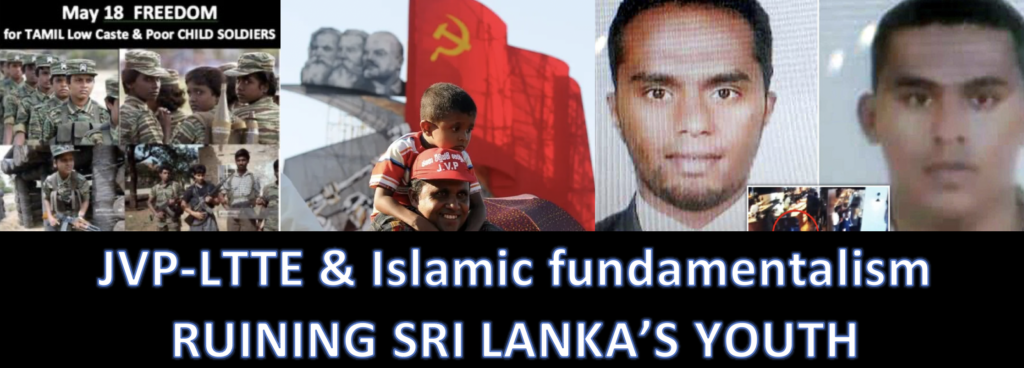
What Every Hindu Should Know About Christianity | Kalavai Venkat 

January 14th, 2023

This talk leverages cutting-edge scholarly researches in textual criticism and cognitive sciences to arrive at a reasonable understanding of Christian beliefs. The findings will reveal a hitherto unknown face of Christianity to the rational Hindu. About the Speaker: Kalavai Venkat is a Silicon Valley-based writer, an atheist, a practicing orthodox Hindu, and author of the book “What Every Hindu should know about Christianity.

The Supply-side of Odious Debt: Disinformation on who caused Sri Lanka’s First Default

January 14th, 2023

Darini Rajasingham-Senanayake

182 economists and development experts from around the world in a statement released last week in the Guardian on Sunday observed that extensive debt cancellation was needed to give the Sri Lankan economy a chance of recovery following the country’s first-ever Default on loan payments. Sri Lanka would be a test case of the willingness of the international community to tackle a looming global debt crisis they note as the International Monetary Fund (IMF), delays help as private creditors play hardball. http://www.cadtm.org/Statement-by-academics-on-dealing-with-Sri-Lankan-debt

The statement also alludes to Geopolitics, and notes that Instead of geopolitical manoeuvring, all of Sri Lanka’s creditors must ensure debt cancellation sufficient to provide a way out of the current crisis.”

The group of academics and economists – including the Indian economist Jayati Ghosh, Thomas Piketty, the author of the bestselling book Capital, and Greece’s former finance minister Yannis Varoufakis –note that some of the world’s most powerful hedge funds and other investors are holding up help for crisis-hit Sri Lanka by their hard-line stance in debt-relief negotiations after the country’s staged default last year. Private sector creditors such as investment companies and hedge funds were preventing a deal at this time. https://youtu.be/bzQ4P7p2e7E
Debt negotiations in Sri Lanka are now at a crucial stage,” the statement said. All lenders – bilateral, multilateral, and private – must share the burden of restructuring, with assurance of additional financing in the near term.”

Civil Society groups in Sri Lanka meanwhile note that there is need for a debate on alternatives to the IMF and Paris Club process for Sri Lanka, and other debt trapped countries of the Global South.  So too, they note that there is need for a debate in Parliament on the issues raised in the Statement regarding the crisis in Sri Lanka. This statement suggests economic and development alternatives to the ‘advice” of the Washington Consensus and Colonial Club de Paris on Debt Cancellation and restructuring.

Disinformation on the causes for Delay in Debt Restructuring

Contrary to widespread Disinformation on Sri Lanka’s Debt Default in the Corporate Media, the onus is on Euro Bond or so-called International Sovereign Bond (İSBs), traders, like BlackRock and Hamilton Reserve Bank, and their intermediaries– the Paris Club and Bretton Woods Twins (IMF and WB), to cancel the debt, and Not delay further on Debt Restructuring at this time.

Eurobond traders that charge predatory interest rates, rather than bi-lateral creditors were responsible for staging Sri Lanka’s first ever sovereign debt Default– in the first instance. The shadowy off-shore Hamilton Reserve Bank in St. Kitts and Nevis had sued the Government of Sri Lanka in New York in March 2022.

Non-OECD /PC bilateral Sovereign State creditors (India, China, Saudi Arabia, etc), which lend at lower and concessionary rates, are blamed in the media for delay in the IMF and PC debt restructuring process, but have little reason to follow Washington’s time lines for Sri Lanka’s Odious Debt restructuring.

After all, these are Sovereign State Parties who do not charge the predatory interest rates of OECD Paris Club creditors, and hence may choose to deal directly with the GoSL and people of Sri Lanka without the IMF and PC as intermediary.

The statement by the experts also notes that there are many other lower and Middle Income countries in similar debt traps and raises fundamental questions regarding the relevance and utility of the current International Financial Architecture, particularly the Washington twins and related IFIs, at this time of economic crises in the Global South. This statement suggests economic and development alternatives to the ‘advice” of the Washington Consensus and Colonial Club de Paris on Debt Cancellation and restructuring.

Odious Debt, ISBs and Supply-side Corruption

Corruption clearly has a supply side and demand side, and merely pointing fingers at Sri Lanka’s corrupt political and business elites is hardly adequate: There are 56 other countries in the Global South that are in Debt traps or near Default due to Eurobond (ISB), creditors who lend at Predatory interest rates.

While Central Bank Bondscams by successive Ranil Rajapakse regimes are primarily accountable for Sri Lanka’s Debt Default due to the odious debt accumulated though corrupt Euro Bond deals, it is increasingly clear that the Washington Twins (IMF and WB), and OECD’s Colonial Club de Paris and related accounting and legal firms like Lazard, Clifford and Chance which are part of the “Bailout Business” (as the Transnational Institute calls it),  are also part of the problem, rather than the solution.

Hence, it is mysterious that so many at the CBSL and the President of Sri Lanka, who is implicated in the 2015 Central Bank bondscams, think that the IMF’s is the Solution to Sri Lanka’s economic crisis, given that this is the 16th time that Sri Lanka has gone to the IMF!

Other solutions are clearly necessary to ensure that Sri Lanka will not be going again for the 18th time to the IMF! Given the odious nature of the Debt that caused Sri Lanka’s first ever Default as it clocks 75 years of Lost Independence, and to ensure accountablity and non-repitition, before any payment may be made to Eurobond (ISB), traders, the people of Sri Lanka have the Right to Information regarding:

a) the identities and names of the Bond holders and

b) what the Bonds funds ($12 billion), borrowed were used for?

c), the forensic audit reports of the CBSL bondscams must be made public in the interest of transparency and accountability and there should be a moratorium and ban any future borrowing from Eurobond traders.

It is noteworthy that BlackRock, Sri Lanka’s largest private creditor got huge US Government Covid-19 ‘bailout funds’ to asset strip in vulnerable countries, while the world was kept in Covid-19 Lockdowns, and economies in the Global South destroyed and debt trapped in 2020-21.

Finally, it is increasingly clear that Strategic Sri Lanka located at the Center of the Indian Ocean’s energy, trade and Submarine Data Cables (UDC) Routes is a site of hybrid economic proxy war waged by the crashing Euro-American Empire on China in this long awaited Asian 21st Century, with NATO and AUKUS in tow. Sri Lanka is also the Canary in the Coalmine for other Global South countries caught in post-Covid-19 Lockdown induced Debt traps in a post-Truth world where debt data, like Covid-19 Fatality Rates and Climate data are increasingly gamed to promote neo-colonialism.

ඇමරිකන් තානපතිනි චං  නෝනා මේ එන්නේ මොකාටද?

January 14th, 2023

බ්‍රිතාන්‍ය ඉංජිනේරු ගාල්ලේ දෙව්සිරි පී හේවාවිදාන ලන්ඩනයේ සිට ලියන අලුත්ම ලිපිය 2023 ජනවාරි14  ඉරිදා සති අග අරුණේ 17  පිටුවේ

.මේ දවස් වල පත්තරයක් දිග ඇරියොත් අපි දකින්නේ චං නෝනාය. උදේ පාන්දර ටී.වී එක දැම්මොත් ලංකාවේ කොහේ හරි නගරයක චං නෝනා මොකක් විවෘත කරන හෝ කවුරුන් හෝ හමුවන ප්‍රවෘත්ති කෑල්ලක් අපට දකින්නට ලැබෙනවා ෂුවර්ය. චං නෝනා කවුද ඇය එන්නෙ මොකටදැයි කියා කියන්නට සමත් කවුරුවත් අපි අතර නැත.

එක දවසක් චං නෝනා යාපනයට ගොස් දෙමළ සංවිධාන හමුවී සිංහලයන්ගෙන් ඔවුන්ට සිදුවී ඇති ඊනියා අසාධාරණකම් ගැන ලියා ගනී.  ඊළඟ දවසේ එතුමිය ගාලු වරාය අසල මුහුදේ ගිලුණු පරණ නැව් බලන්නට කෞතුකාගාරයට යයි.    ඊට දවස් දෙක තුනකට  පසුව   චං නෝනට ඩයනා මන්ත්‍රීතුමියගේ ගෙදර හොඳ ඩිනර් එකක් ලැබේ. ශ්‍රී ලංකාවේ ගංජා වවන්නේ කොහොමදැයි චං නෝනා ඩයනාට උපදෙස් දෙනවා ෂුවර්ය.

ඊට පස්සෙන්දා අපිට චං නෝනා දකින්නට ලැබෙන්නේ එක්සත් ජාතීන්ගේ ආහාර ව්‍යාපාරය යටතේ හාමතෙන් පෙළෙන පවුල් වලට සහනාධාර බෙදෙන උත්සවයේදීය.

චං නෝනාට කිසිම විවේකයක් නැත. ඒ මොකද කියනවා නම් ඊ ගාවට එතුමියට මහින්ද අමරවීර ඇමතිතුමා සමඟ කොළඹ වරායට ගොස් යූරියා නැවක් පිළිගන්නට තිබෙන නිසාය. අනිද්දාටත් චං නෝනට ෂොපින් යන්නවත් ඉඩ නැත. ඒ පුත්තලමට ගොස් ශිෂ්‍යත්ව ලබන ළමුන්ට පදක්කම් පලන්දවන්නට තියන නිසාය.

තවත් සුමානයක් ගතවූ පසු චං නෝනා කොළඹ ඩේවිඩ් පීරිස් සමාගමෙන් මතුවේ. කංචන විජේසේකර ඇමතිතුමාත් නංවාගෙන ඇය විදුලි බලයෙන් දුවන ත්‍රීවිලයක් පදවාගෙන කොළඹ වටේ දුවයි. ඊට පස්සෙන්දා චං නෝනා කොළඹ නගරාධිපතිනී රෝසී සේනානායකගේ නිල නිවසට ගොස්  කැවුම්, කොකිස්, කිරිබත්,  රසකැවිලි, හැම් බේකන්,  කුකුලු මස්, හරක් මස් හා ප්‍රනීත ආහාර වර්ග 40කින් සමන්විත උත්කර්ශවත් නත්තල්  කෑම මේසයට වාඩිවී රාජ භෝජන වළඳමින් ප්‍රීති වෙයි. සමහරවිට  රෝසි,  චං නෝනට ආරාධනා කරන්නට ඇත්තේ කොළඹ මුඩුක්කු පැල්පත් වල සිටින දස දහසක් අසරණ පුංචි ළමයින්ට එක දවසකවත් රසවත් කෑම වේලක් දෙන්නේ කොහොමදයි සාකච්චා කරන්න වෙන්නට ඇත.

මේ දිනවල ශ්‍රී ලංකාවේ අතන මෙතන හැමතැනින්ම මතුවෙන අපේ රටේ ඕන දේටත්, එපා දේටත් හැම එකටම ඇඟිලි ගහන මේ චං නෝනා ඇත්තටම කවුද?

චං නෝනගේ සම්පූර්ණ නම් ජූලි ජියෝන් චං ය. ඇයට වයස 50 සම්පූර්ණ වෙන්න ඔන්න මෙන්නය. ඇය ශ්‍රී ලංකාවේ 28 වෙනි ඇමරිකානු තානාපතිනිය ලෙස වැඩ භාර ගත්තේ 2022 පෙබරවාරි 25 දාය.

“මම 2012 දී බැංකොක් වල සේවය කරද්දි මගේ සැමියා හා පුතා සමග ලංකාවේ නිවාඩුවකට ඇවිත් සීගිරිය  නුවර අනුරාධපුරය වගේ ලස්සන හැමතැනම සන්චාරය කළා. ලංකාවේ සුන්දරත්වයට එදා මම හරියට වශී වුණා . එනිසා ජෝ බයිඩන් ජනාධිපතිතුමා මාව ලංකා තානාපති ධුරයට පත්කරාම මට ඇති වුණු සතුට අප්‍රමා ණයි ඇය තම වැඩ භාරගනිමින් පැවසුවාය.”

ගෝඨාභය රාජපක්ෂ ජනාධිපති යටතේ ශ්‍රී ලංකාව ඉතිහාසයේ නොවූ විරූ අන්දමට දරුණුතම ආර්ථික අර්බුදයකින් පෙලෙන අවස්ථාවක ඇමරිකන් ජනාධිපති ජෝ බයිඩන් විසින් චං නෝනා අපේ රටට එව්වේය. අපි කවුරුත් හිතුවේ ඇය පැමිණියේ ඩොලර් මිලියන කෝටි ගණනින් අපට ආධාර කොට අපව විපතින් ගලවා ගැනීමට කියාය.

වැඩ භාර ගෙන සතියක් ඇතුලත චං නෝනා ගෝඨාභයගේ නිල නොවන ප්‍රධාන උපදේශිකාව බවට පත් වූවාය. වියත් මඟ හා එළියේ පණ්ඩිතයන් අහකට තල්ලු කළ ගෝඨාභය වැඩ කළේ චං නෝනා කියන හැටියටය. ගෝඨාභය නමට පමණක්  ජනාධිපති වූවාට සුක්කානම තිබුණේ චං නෝනා අතේ ය. ඉතිහාසයේ නොවූ විරූ විදියට මේ ඇමරිකන් තානාපතිවරිය ලංකාවේ දේශපාලනයට අත ගැසුවාය.

ඒ දිනවල අපි නිතර නිතර රූපවාහිනීයෙන් දුටුවේ චං නෝනා ජනාධිපති මන්දිරයට යන එන අයුරු ය. සමහර විට අනෝමා රාජපක්ෂ කුස්සියේ උයද්දී චං නෝනා හිරමණය උඩ වාඩිවී ඇයටත් බත් උයන අන්දම ගැන උපදෙස් දෙන්නටත් ඇත.

ගෝඨාභය හිතුවේ චං නෝනාට තමා වැඩිපුර අවනත වුණහොත් හා ඇයගේ උපදෙස් පිළිපැද්ද හොත් තෙල් පෝලිම්, ගෑස් පෝලිං එක රැයින් නැති කරලීම සඳහා ඇමරිකාව ඩොලර් මිලියන ගණනින් තෑගි කරනු ඇත කියාය.  නමුත්  ලංකාව ආර්ථික අර්බුදයෙන් බේරා ගැනීම ජූලි චංගේ න්‍යාය පත්‍රයට අඩංගු නොවීය. ඇයට පැවරී තිබුණ කටයුත්ත වූයේ ගෝඨාභය චීනයෙන් ගලවා ගෙන  ශ්‍රී ලංකාව ඉන්දියානු රජය හරහා ඇමරිකාවේ වහලකු කරගැනීමය. ගෝඨාභයට චං නෝනගේ ලණුව ගිල්ලේය. ශ්‍රී ලංකාව ටික ටික චීනයෙන් ඈත් වූ විට වේදනාවටත් කෝපයටත් පත් චීනය ලංකාවට ආධාර දීම නැවැත්විය.

අරගලයේ දී චං නෝනා අනුගමනය කළේ දෙබිඩි ප්‍රතිපත්තියක් වීම කාගේත් පුදුමයට හේතුවක් වීය. ඉතා සාමකාමී ලෙස තරුණයින් ඇරඹූ අරගලය පසුව අතට ගත් වාමාංශික දේශපාලන පක්ෂ රජයේ දේපල විනාශ කරමින් ඉතා ප්‍රචණ්ඩකාරීව හැසිරෙද්දී ජූලි චං ඒ ගැන විරෝධය පළ කළේ නැත. ඇය සාමය  රැක ගැනීම උද්ගෝශන කිරීමට ඇති ප්‍රජාතන්ත්‍රවාදී අයිතිය ගැන රජය විවේචනය කරමින් නිතර නිතර පනිවිඩ නිකුත් කළේය. නමුත් මහජන ඡන්දයෙන් පත් වුණු පාර්ලිමේන්තු මන්ත්‍රිවරයකු අමු අමුවේ මරා දැමුණු වෙලාවේ චං නෝනා එය හෙළා දකිමින්  ට්විටර් පණිවිඩයක් නිකුත් කළේ නැත.

හමුදාව යොදා මේ ප්‍රචණ්ඩත්වයකාරීන් පලවා හැර ගෝල්ෆේස් භූමිය සාමකාමී පෙදෙසක් කරන ලෙස පක්ෂ විපක්ෂ හා ආගමික නායකයින්ගේ ඉල්ලීම් වලට කන්දුන් ගෝඨාභය හමුදාව යොදා ප්‍රචණ්ඩකාරීන් පලවා හරින්නට සැරසෙන බව ආරංචි වූ චං නෝනා වහාම රජගෙදරට දුවගියාය. හමුදාව යොදවා අරගලය නවත්වන්න ලේස්ති වෙන්න එපා. එහෙම කරලා ලේ වැගිරීමක් වුනොත් ඇමරිකාව ඔබට විරුද්ධව දැඩි පියවරක් ගන්නවා යයි චං නෝනා ගෝඨාභය හොඳටම බය කළාය. පසුගිය ජූලි මාසයේ එක සතියකදී තෙවරක්ම ජනාධිපති ගෝඨාභය හමුවූ චං නෝනා  අරගලය යුද්ධ හමුදාව මගින් මැඩ පැවැත්වුවහොත් IMF ආයතනය ශ්‍රී ලංකාවට ණය දීම ප්‍රතික්ෂේප කරනු ඇති බව කියා ගෝඨාභයව බය කලේ යයි විමල් වීරවංශ පාර්ලිමේන්තුවේදී හෙළි කළේය. මන්ත්‍රී වරයා කීවේ මේ තර්ජනයට බය වූ ගෝඨාභය ඒවන විට විනාශකරී ලෙස  පැවති අරගලය නවත්වන්නට උත්සාහ කළේ නැත යැයි කියාය. ඒ නිසා අරගලකරුවන් ජනාධිපති කාර්යාලය ඇතුළු රජයේ ආයතන ගිනි තබා විනාශ කරද්දී නිවට ලෙස බලා සිටීමට ගෝඨාභයට සිදුවූයේය.

අන්තිමේ දී පණ බේරා ගැනීමට රජ ගෙදරින් පලා ගොස් හමුදා කඳවුරක සැඟවීමට ඔහුට සිදුවිය. ගෝඨාභය තම පරණ රටවූ ඇමරිකාවට යන්නට වීසා ලබා දෙන්නයි තම මිතුරිය චං නෝනාගෙන් ඉල්ලා සිටි විට ඇය එම ඉල්ලීම තරයේ ප්‍රතික්ෂේප කළාය. තමා ඉතා කුළුපග මිතුරියක් යයි සැලකූ චං නෝනගේ සැබෑ ස්වරූපය ගෝඨාභයට තේරුනේ එවිටය. අවසානයේ දී ගෝඨාභයට සිදුවූයේ මාලදිවයින් හා සිංගප්පුරුව හරහා තායිලන්තයට පැන යාමට ය. සැප්තැම්බර් මාසයේ නැවත ශ්‍රී ලංකාවට පැමිණි ගෝඨාභය තම පුතු සමඟ සති කිහිපයක් ගත කිරීමට ඇමරිකාවට යාමට වීසා ලබා දෙන ලෙස චංගෙන් ඉල්ලා සිටියේය. එම ඉල්ලීම තරයේ ප්‍රතික්ෂේප කළ ජූලි චං අනාගතයේ කිසි දිනක ඔහුට ඇමරිකාවේ දොර නොඇරෙන බවත් එනිසා වීසා වලට ඉල්ලුම් නොකරන ලෙසත් ගෝඨාභයගේ ගෙදරටම පැමිණ තදින් කියා සිටි බව පුවත්පත්වල වාර්තා විය. ශ්‍රී ලංකාවේ හොඳම මිතුරිය වශයෙන් පෙනී සිටිමින් ජූලි චං තමාව රැවටූ බව ගෝඨාභයට තේරෙන විට ඔහු ප්‍රමාද වූවා වැඩිය.

චං නෝනා හිතුවේ ගෝඨාභය අල්ලේ නැටෙව්වා මෙන් නව ජනාධිපති රනිල් වික්‍රමසිංහ ලෙහෙසියෙන්ම ඇමරිකන් රූකඩයක් බවට පත් කරගත හැකි යැයි කියාය. නමුත් රනිල් යනු ලෝක දේශපාලන ඉතිහාසය හොඳින් දන්නා පළපුරුදු බහුශෘත දේශපාලඥයෙකු  බව චං නෝනා දැන සිටියේ නැත. ගෝඨාභයගේ කාලයේ මෙන් හිතුණු හිතුණු වෙලාවට රජ ගෙදරට ඒමට චං නෝනාට අවසර ලැබුනේ නැත. ගෝඨාභය කළාක් මෙන් ශ්‍රී ලංකාවේ අනිත් තානාපතිවරුන්ට දක්වන සැලකිල්ලට වඩා විශේෂ සැලකිල්ලක් ජූලි චංට දැන් ලැබෙන්නේ නැත.

අනෙකුත් තානාපතිවරුන් සමඟ රනිල් සාකච්ඡා පවත්වන විට චං නෝනාටත්  ආරාධනාවක් ලැබෙන නමුත් ගෝඨාභය මෙන් ඇය සමඟ තනිවම සාකච්චා කිරීමට රනිල් උනන්දුවක් නොදක්වයි. සමහර විට මෙය තමන්ට කරන මදිකමක් ලෙස ඇය සලකනවා වන්නට ඇති නමුත් ජනාධිපතිතුමාට එය ප්‍රශ්නයක් නොවේ.

පසුගිය වසරේ ශ්‍රී ලංකාව ඉතිහාසයේ දරුණුතම අර්බුදයට ලක්ව සිටිද්දී , බ්‍රිතාන්යය ඕස්ට්‍රේලියාව . ජර්මනිය වැනි රටවල් අපට ඩොලර් මිලියන ගණනින් ආධාර ලබා දුන්නේ කිසිම කොන්දේසියක් නැතුවය. ජූලි චංට ශ්‍රී ලංකාව ගැන  ඔය කියන තරම් ලොකු ආදරයක් තිබුනා නම් අපේ රටට තෙල් නැවක් හා ගෑස් නැවක්  ණයට හෝ එවා අපේ ජනතාව පෝලිම්වල දවස් ගණන් දුක් විඳීම නැවත්වූයේ නැත්තේ ඇයි.

ජූලි චං ඒ දිනවල ලන්කාවට කැරට් අල දික් කළා මිස අපට ලබාදුන් කෙංගෙඩියක් නැත.

ලෝකයේ වැදි බණ කීමට නම් දරන රාජ්‍ය ඇමරිකාව බව සැවොම දන්නා රහසකි. ඇමරිකන් කකුළුවා හරහට යන ගමන් ලෝකයේ පුංචි කකුළුවන්ට කෙලින් යන්නට උගන්වයි. ඇමරිකන් හමුදාව ඇෆ්ගනිස්තානයේ හා ඉරාකයේ කළ බිහිසුණු මිනිස් ඝාතන ගැන වචනෙකින්වත් විභාගයක් නොකල ඔවුන් යුද කාලයේදී ශ්‍රී ලංකාවේ සිදුවුණා යැයි කියන මානව අයිතිවාසිකම් කඩ කිරීම ගැන පරීක්ෂණ ඉල්ලන්නේ එනිසාය. චෑං නෝනාත් ඒ වගේ වැදි බණ කියන්න මාර දක්ෂය.

මාස ගාණක් ගෝල්ෆේස් පිටිය අත්පත් කොටගෙන විනාශකාරී ලෙස හැසිරුණු අන්තවාදීන් පිරිස හමුදාව යොදා විසුරුවා හැරුණේ ජුනි 26 දා අලුයම ය. වහාම තම සුපුරුදු මාධ්‍ය අවිය වූ Twitter අතට ගත් චං නෝනා හමුදා බලය යොදා අරගලකරුවන් පලවා හැරීම ගැන ජනාධිපතිවරයාව තරයේ විවේචනය කළේය. නමුත් රනිල් වික්‍රමසිංහ යනු ගෝඨාභය වගේ ඇමරිකන් තානාපතිවරිය ඉදිරියේ දණ නමන ජනාධිපතිවරයකු නොවේ. ඔහු ජූලි චංට හැරෙන තැපෑලෙන් ම උත්තරයක් දුන්නේ ය.

“ඔහේ මේ නොදන්න මගුල් ගැන මට බණ කියන්න එපා. ඇමරිකාවේ කැපිටල් සිටි ගොඩනැගිලි සමූහය ත්‍රස්තවාදීන් අල්ලාගෙන විනාශ කරන විට ඇමරිකන් හමුදා වහාම ඇතුලු වෙලා එක රැයින් ඔවුන් එලෙව්වා මතක නැද්ද? ඊයේ රෑ ගෝල්ෆේස් එකේ අපේ හමුදාව කළෙත් ඔහේලගේ ඇමරිකන් හමුදාව කළ දේමයි”

වැදි බණ කියන්ට ආ ජූලි චංට කට උත්තර නැතිවෙන්න රනිල්  දුන් ප්‍රතිචාරයට බොහෝ දෙනාගෙන් ප්‍රශංසා ලැබුණි. ඉන්පසු ජූලි  චං නෝනා ආණ්ඩු කරන හැටි ගැන රනිල්ට උගන්නන්නට ආවේ නැත.

බොහෝ දෙනා ජූලි චං දුටු ගමන් හිතන්නේ ඇය  චීන සම්භවයක් ඇති කාන්තාවක් බවය. නමුත් ඇය කොරියන් ජාතිකයෙකි. 1973 දී ඇයට වයස පහක් වෙද්දී මුළු පවුලම කොරියාවෙන් ඇමරිකාවට සංක්‍රමණය වූයේ ඇයගේ පියාට ඇමරිකාවේ ගුවන් සමාගමක Draftman වශයෙන් පැයකට ඩොලර් පහක සුළු මුදලකට රැකියාවක් ලැබුන නිසාය. පියාගේ සුළු පඩියෙන් හතර දෙනෙකුගෙන් සමන්විත පවුල නඩත්තු කිරීම ඉතා අසීරු වූ නිසා ඇයගේ මව ඉතාලි ආපන ශාලාවක පිඟන් සෝදන්නියක් වශයෙන් රාත්‍රී කාලයේ වැඩ කළාය.

ජූලි චං ඇමරිකාවේ  තමා ගත කල අසීරු පාසල් කාලය මෙසේ විස්තර කරයි.  ඉංග්‍රීසි වචනයක්වත් දන්නේ නැතුව ඉස්කෝලේ ගිය මට පන්තියේ ඇමරිකන් ළමයි හරියට වද දුන්නා. ඒගොල්ලො එයාලගේ ඇස් දෙපැත්තට ඇදලා Chun king chicken,  Chun king chicken කියලා මට හරියට විහිළු කළා. පිට්ටනියෙ මම සෙල්ලම් කරනකොට කකුල් මාට්ටු දමලා මාව වට්ටපු වාර ගාන අනන්තයි. ආපහු චීනෙට පලයන් කියලා ජාතිවාදී ළමයි නිතරම මට පරිභව කළා. අපේ තාත්තා ඇමරිකන් පාරවල් පුරුදු නැති නිසා හිමින් කාර් එක එලවන් යනකොට පිටිපස්සේ හිටි කාර් එකේ ඩ්‍රයිවර්ට හොඳටම තරහ ගියා. අපිව ඉස්සර කරන ගමන් එයත් කෑගැහුවා පලයන්කො චීනෙට අපට වද නොදී කියා. අපි චීනෙන් නෙමෙයි කියලා ආපසු කෑගහන්න මට සිතුනා.”

කොච්චර අපිට බාධක කම්ක)ටොළු තිබුණත් මමත් අක්කාත් හොඳට ඉගෙන ගත්තා. අන්තිමේදී මම කැලිෆෝනියා යුනිවර්සිටි එකෙන් දේශපාලන විද්‍යාව පිළිබඳ BA උපාධියත්, කොලොම්බියා විශ්ව විද්‍යාලයෙන් ජාත්‍යන්තර සම්බන්ධතා පිළිබඳ MA උපාධියත් ලබා ගත්තා.

උත්සාහවන්තයා ජයගනී යන ප්‍රස්තාපිරුල සත්‍යයක් බව ජූලි චංට ක්‍රියාවෙන් පෙන්වූයේ ඇයගේ ආදරණීය දෙමව්පියන්ය.

පිඟන් සෝදන්නියක් ලෙස ඇමරිකන් ජීවිතය ඇරඹූ ඇයගේ මව පසුව නගරයේ ප්‍රධාන පුස්තකාලයේ අධිපතිනිය මෙන්ම පල්ලියේ Deacon ද වීය. 1973 දී ගුවන් යානා සමාගමක Draftman කෙනෙකු ලෙස රැකියාව ඇරඹූ ඇයගේ පියා ක්‍රමයෙන් ඉහළට ගොස් වසර 22කට පසු එම සමාගමේ සභාපති හා කළමනාකාර අධ්‍යක්ෂක වීය.

1986 දී ඇමෙරිකන් අභ්‍යවකාශගාමීන් හත් දෙනෙකුට මරු කැඳවමින් චැලෙන්ජ නම් රොකට්ටුව පුපුරවා ගියේ එහි තිබූ O-Ring  නැමැති රබර් මුදු දෙකක් සීතලට (Freeze කැටි ගැසුණු නිසා ය. එම රබර් ගුවනේ දී රත් කිරීමේ නව ක්‍රමයක් හොයා ගත්තේ ජූලි චංගේ ඉංජිනේරු පියාය. ඔහුට පින්සිදුවන්නට අවුරුදු 5 කට පසු නාසා ආයතනයට නැවත අජටාකාශ රොකට් ගමන් අරඹන්නට හැකිවිය.

උපාධි ලැබීමෙන් පසු ජූලි චං ඇමරිකාවේ විදේශ සේවයට බැඳුණි. එහිදීත් ඇයට ජාතිවාදී හා වර්ණ වාදී ගැරහුම් වලට මුහුණ දෙන්නට විය. වරක් ඇමරිකාවේ විදේශ කාර්යාලයේ වැඩට ඈ එද්දී ප්‍රධාන දොරටුව ළඟ සිටි අලුත් ආරක්ෂක නිලධාරියා ආ පිලිපීන සේවිකාවට මෙතැනින් යන්න බැහැ. කරුණාකරලා අනිත් වැඩකාරයෝ වගේ පස්සේ දොරෙන් ඇතුළු වෙන්න ඇයට කීවේය. මගේ චීන පෙනුම නිසා ඇමරිකාවේ උසස් නිලධාරීන් පවා මම ඇමරිකන් පුරවැසියෙක් හා තානාපති නිලධාරිනියක් කියා විශ්වාස කළේ නැහැ. මම එක සැරයක් දූත මෙහෙවරකට උතුරු කොරියාවට ගිය වෙලේ එයින් නිලධාරියෙක් මගෙන් ඇහුවා ඇත්තටම ඔබ ඇමෙරිකන් ජාතිකයෙක් ද කියා. සමහර තානාපති රැස්වීම්වලට ගියාම මට පෙනුනා මං වගේ තවත් අය එතැන නැහැ කියලා. එවැනි අවස්ථාවල මම මගෙන්ම ප්‍රශ්න කළ වාර ගණන අනන්තයි මම ඒ සමාජයට අයිති කෙනෙක්ද කියා. ඇමරිකන් පෙනුමක් නැති නිසා ඇමරිකන් තානාපති සේවයේදී මට අනන්ත බාධක හිරිහැර වලට මුහුණ පාන්න සිදුවුණා. නමුත් ආත්ම ශක්තිය හා ධෛර්යය නිසා මම තානාපති සේවයේ ඉහළටම ගියා.”

මට මෑතක් වන තුරු නිතර නිතර අහන්න ලැබුන වෙහෙසකාරී ප්‍රශ්නය තමයි ,ඔබ  කොයි රටේ කෙනෙක්දැ යි කියන එකග  තානාපති සේවයේ නිලධාරිනියක්  වශයෙන් සත්කාරක රටේ ජාති  උත්සවයකට ගියත්   පාටියකට ගියත්   කවුරුහරි මගෙන් අහන මුල්ම ප්‍රශ්නය තමයි ,ඔබ ඇත්තටම ඇමරිකන් ජාතිකයෙක්ද  නැත්නම් මොන රටෙන් ආපු එක්කෙනෙක්ද,  කියන එකග මට ඇමරිකන්  පෙනුමක් නැති නිසා මම ඒ රටේ තානාපති සේවයේ  නිලධාරිනියක් කියන එක එයාල පිලිගත්තෙම නෑග   ඒ දවස් වල ඒ ප්‍රශ්නෙ මට තරහ යන කරදරකාරී එකක් වුණත් දැන් එහෙම නෑ.  කවුරුහරි එහෙම ඇහුවම  කොරියාවේ ඉපදිලා ඇමරිකාවට ආ මගේ සංක්‍රමණ ඉතිහාසය සම්පූර්ණයෙන් එයාලට කියන්න මම ඒක අවස්වතාවක් කර ගන්නවා. සත්තකින්ම මම  මගේ රටවන ඇමරිකාවේ  තානාපති නිලධාරිනියක් කියලා මම එයාලට ආඩම්බරයෙන් කියනවා යි  ඇය සිනාසී ප්‍රකාශ කරයි

ඉංග්‍රීසි  වලට අමතරව  ජුලි චංට කොරියන් ජපන් ස්පාඤ්ඤ කාම්බෝජ භාෂාව චතුර ලෙස කතා කළ හැකිය.  මේ දිනවල ඇය සිංහල භාෂාව ද ටික ටික ඉගෙන ගනිමින් සිටි.

1996 දී තානාපති සේවයට බැඳුණු ඇය කාම්බෝජියාව, තායිලන්තය, බොගොර්තාව හා ඉරාකයේද තානාපති නිලධාරිනියක් වශයෙන් සේවය කරමින් විශාල අත්දැකීමක් ලැබුවාය. බස්නාහිර අර්දගෝලයේ ප්‍රධාන සහකාර ලේකම් වශයෙන් 2018 සිට සේවය කළ ජූලි චං ශ්‍රී ලංකාවේ තානාපතිනිය වශයෙන් වැඩ භාර ගත්තේ 2022 පෙබරවාරි මාසයේදීය.

චං නෝනා ඉතා කාර්යක්ෂම හා  වෙලාවට වැඩ කරන තානාපතිවරියකි. හැමදාම උදෑසන හතට ඇය තම කාර්යාලයේ දී වැඩ අරඹන්නේ ලංකාවේ ඉංග්‍රීසි පුවත්පත් කියවීමෙනි. ඇමෙරිකන් තානාපති කාර්යාලයේ මාධ්‍ය ඒකකයේ ප්‍රධානතම කාර්යය වන්නේ කලින් දවසේ ලංකාවේ සිංහල පුවත්වල ඇමෙරිකාව පිළිබඳ පල වූ හොඳ හෝ නරක සියළුම ලිපි ඉංග්‍රීසියට පරිවර්තනය කොට තානාපතිතුමියගේ මේසය උඩ දවල් 11 ට පෙර තැබීමය. මා මේ ලියන ලිපියේ නිවැරදි ඉංග්‍රීසි පරිවර්තනයක් ද හෙට සඳුදා 11 වන විට නොවැරදීම ඇයගේ මේසේය උඩ තිබෙනු ඇත.  “තමුන්නාන්සේ මේ මොනවද මං ගැන ලියලා තියෙන්නේ. මම එහෙම කෙනෙක් නෙමෙයි, මම මේ ඔක්කොම කරන්නෙ ඔයාලගේ ලස්සන රටට තියෙන ආදරේ නිසා යි”  කියා සමහරවිට එතුමිය මට ඊමේල් පිළිතුරක් එවන්නටත් බැරි කමක් නැත.

බොහෝ දෙනා කියන්නේ චං නෝනාගේ ලස්සන හිනාවට කතා කරන විලාශයට හා සුහදශීලී බවට ඕනෑම කෙනෙක් වශී වන බවය. එයට හොඳම උදාහරණය ජාතික ජනබලවේගයේ නායක අනුර කුමාරය. ගෝඨාභය රාජපක්ෂට ඩොලර් මිලියන හාරසිය අසූවක් වටිනා මිලේනියම් ගිවිසුම අත්සන් කිරීමට නොදී ඇමරිකාව පතුරු ගැහුවේ අනුරය. නමුත් පසුගිය මැයි 14  දා චං නෝනා ඔහු සමග පැය කිහිපයක  සාකච්ඡාවක් පැවැත්වීය. එහි ප්‍රතිඵලයක් වශයෙන් අනුර කුමාර දැන් පෙර මෙන් දරුණු ලෙස ඇමරිකාව විවේචනය කරන්නේ නැත.

විදේශ තානාපතිවරයෙක්ගේ කර්තව්‍ය වන්නේ තමන්ගේ රට හා සත්කාරක රට අතර ආර්ථික වෙළඳ අධ්‍යාපන හා සමාජීය සම්බන්ධතා ගොඩ නැගීමය. සත්කාරක රටට අවශ්‍ය නම් තම රට මඟින් ආධාර සැපයීමය. සත්කාරක රටේ පාර්ලිමේන්තුව විවෘත කිරීම, නිදහස් දිනය වැනි වැදගත් අවස්ථාවල දී ආරාධිත අමුත්තෙකු වශයෙන් නිහඬව සහභාගි වීම, විදේශ තානාපතිවරයෙකුගේ තවත් යුතුකමකි. එසේ නැතුව සත්කාරක රටේ දේශපාලනයට ඇඟිලි ගැසීමවත් පවතින රජයේ වැඩ කටයුතු විවේචනය කරමින් හිතුණු හිතුණු වෙලාවට Twitter පණිවිඩ නිකුත් කිරීමවත් විදේශ තානාපතිවරයෙකු කිසිසේත්ම නොකළ යුත්තකි. රජයට විරුද්ධව ජනතාව කෙළින්ම හෝ අනියම් ලෙසින් උසිගැන්වීම ද තානාපතිවරු ගෙන් අපි බලාපොරොත්තු වන්නේ නැත.

ශ්‍රී ලංකාවේ සිටින ජර්මන්, බ්‍රිතාන්‍ය, ඕස්ට්රේලියානු හා කැනඩා වැනි බටහිර රටවල  තානාපතිවරු  තමන්ගේ පාඩුවේ සිටිමින්  ලංකාවත් තම රටවල් අතරත් ඇති  සම්බන්ධතා අප්‍රසිද්ධියේ වැඩි දියුණු කර ගනිමින් සිටින අන්දම අතිශයින් ප්‍රශංසනීය ය.  ඔවුන් දවස ගානේ  ට්විටර් පණිවිඩ නිකුත් කරමින් ශ්‍රී ලංකාවේ අභ්‍යන්තර කටයුතු වලට  ඇඟිලි ගසන්නේ නැත.

ජුලී චං නෝනාත්  ඒ වටිනා විදේශ දූත ගුණාංග අනුගමනය කරනවා නම් කොච්චර හොඳදැයි මට සිතේ.

අද  ශ්‍රී ලංකා දේශපාලන  සමාජයේ බොහෝවිට කතා කෙරන  ප්‍රශ්නය වන්නේ ඇමරිකන් තානාපතිවරිය මේ එන්නෙ මොකාටද යන්න යි.

ජූලි චං යනු නිතරම සිනාමුසු මුහුණින් සිටින තානාපතිවරියක් බවත් ඇයගේ එකම අරමුණ වන්නේ ශ්‍රී ලංකාවේ විවිධ ජන සමාජ සමඟ මිත්‍රත්වය ගොඩනඟාගෙන ඇමරිකන් රජය හරහා අප රටට විශාල වශයෙන් ආධාර කිරීම පමණක් බවත් එක පිරිසක් කියති.

නමුත් අනිත් පිරිස කියන්නේ චං නෝනා මෙහි පැමිණ සිටින්නේ අපිට සීනි බෝල බස්සමින් ටික ටික ශ්‍රී ලංකාව ඇමෙරිකාවෙන් යැපෙන වහල් රටක් කිරීමේ න්‍යාය පත්‍රය ක්‍රියාත්මක කිරීමට බවයි.

මේ දෙගොල්ලන්ගෙන් හරි කවුද කියා දන්නේ ඇමෙරිකානු තානාපතිනි ජූලි චං නෝනාම පමණි.

බ්‍රිතාන්‍ය ඉංජිනේරු ගාල්ලේ දෙව්සිරි පී. හේවාවිදාන

ලන්ඩන් නුවර සිට ලියයි.


Copyright © 2026 LankaWeb.com. All Rights Reserved. Powered by Wordpress