Audit reveals irregularities in coal procurement for Lakvijaya Power Plant

April 7th, 2026

Courtesy Adaderana

A special audit report has uncovered multiple irregularities in the coal procurement process carried out by the Lanka Coal Company for the Lakvijaya Power Plant for the 2025/2026 season.

According to the report issued by the Auditor General, a controversial supplier, Trident Chemphar Ltd, had relied on laboratory reports from a loading port facility whose license had already been revoked.

The audit was conducted following a request by the Parliamentary Committee on Public Enterprises (COPE), which had raised concerns regarding procurement procedures and the quality of coal supplied to the Norochcholai Lakvijaya Power Plant.

The report further revealed that at the time bids were called, the selected supplier, Trident Company, had not completed its registration. Despite clear tender requirements stating that only fully registered suppliers could submit bids, three unregistered suppliers—including Trident—were allowed to participate in the process.

In terms of quality assurance, coal shipments are typically tested at both loading and unloading ports by independent inspectors. However, the audit found that coal sample testing at the loading port had been assigned to an Indonesian laboratory— PT Mitra SK Analisa Testama Samarinda —whose license had been cancelled by December 29, 2025.

Moreover, there was no evidence that the company’s license had been renewed even by March 31, 2026. Despite this, all 12 shipments received were certified using reports issued under this questionable arrangement through Mitra SK South Africa.

The report also highlighted discrepancies between test reports from the loading port and data recorded at the Lakvijaya Power Plant’s main control unit. Although the Lanka Coal Company had several alternative options to verify these inconsistencies, it had failed to utilize any of them.

Additionally, the audit pointed out serious lapses in supply planning. Although coal imports must be maximized during limited unloading periods in Sri Lanka, no shipments were procured during a critical 40-day window from November 13 to December 30, 2025.

As a result of insufficient shipments, an emergency procurement was carried out on March 18 this year. However, the selected supplier, Taranjot Resources (Pvt) Ltd., had previously failed—within a 36-month period—to supply coal meeting the required gross calorific value of 5,900 kilocalories or higher.

The Auditor General warned that such failures in timely procurement and quality assurance could pose a serious risk to maintaining uninterrupted power supply in the country if adequate coal stocks are not secured.

The full audit report has now been released by the National Audit Office.

A special audit report has uncovered multiple irregularities in the coal procurement process carried out by the Lanka Coal Company for the Lakvijaya Power Plant for the 2025/2026 season.

According to the report issued by the Auditor General, a controversial supplier, Trident Chemphar Ltd, had relied on laboratory reports from a loading port facility whose license had already been revoked.

The audit was conducted following a request by the Parliamentary Committee on Public Enterprises (COPE), which had raised concerns regarding procurement procedures and the quality of coal supplied to the Norochcholai Lakvijaya Power Plant.

The report further revealed that at the time bids were called, the selected supplier, Trident Company, had not completed its registration. Despite clear tender requirements stating that only fully registered suppliers could submit bids, three unregistered suppliers—including Trident—were allowed to participate in the process.

In terms of quality assurance, coal shipments are typically tested at both loading and unloading ports by independent inspectors. However, the audit found that coal sample testing at the loading port had been assigned to an Indonesian laboratory— PT Mitra SK Analisa Testama Samarinda —whose license had been cancelled by December 29, 2025.

Moreover, there was no evidence that the company’s license had been renewed even by March 31, 2026. Despite this, all 12 shipments received were certified using reports issued under this questionable arrangement through Mitra SK South Africa.

The report also highlighted discrepancies between test reports from the loading port and data recorded at the Lakvijaya Power Plant’s main control unit. Although the Lanka Coal Company had several alternative options to verify these inconsistencies, it had failed to utilize any of them.

Additionally, the audit pointed out serious lapses in supply planning. Although coal imports must be maximized during limited unloading periods in Sri Lanka, no shipments were procured during a critical 40-day window from November 13 to December 30, 2025.

As a result of insufficient shipments, an emergency procurement was carried out on March 18 this year. However, the selected supplier, Taranjot Resources (Pvt) Ltd., had previously failed—within a 36-month period—to supply coal meeting the required gross calorific value of 5,900 kilocalories or higher.

The Auditor General warned that such failures in timely procurement and quality assurance could pose a serious risk to maintaining uninterrupted power supply in the country if adequate coal stocks are not secured.

The full audit report has now been released by the National Audit Office.

https://www.scribd.com/embeds/1023128456/content?start_page=1&view_mode=scroll&access_key=key-NFH4GqFSWk88RxnqTnhK

Special Audit Report on Coal Procurement by Adaderana Online

If Zaharan had been arrested BEFORE Easter Sunday massacre – Would Gotabaya have still become President?

April 6th, 2026

Shenali D Waduge

by Shenali Waduge · 6th April 2026

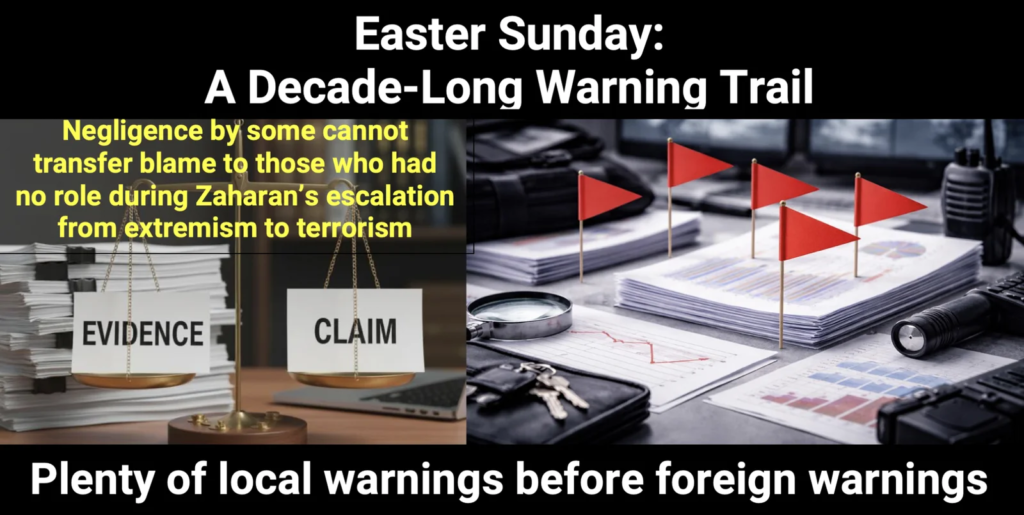
The 2019 Easter Sunday attacks in Sri Lanka were not unforeseen. Intelligence agencies had repeatedly flagged threats, warrants existed against Zaharan. Yet negligence, inaction, and bureaucratic delays allowed an ideology rooted in hatred to manifest in mass murder.

Over the years, a conspiracy theory has circulated suggesting that Zaharan was used” by state intelligence to facilitate terror attacks that would enable Gotabaya Rajapakse to become President in November 2019. This claim implies political orchestration behind the massacre.

Reality check:

  1. Let us first presume officials in office were not part of any such conspiracy, the question becomes: why did they fail to act on warnings & fulfilling their mandated duties to arrest Zaharan & his associates to prevent attacks?
  2. Let us presume they had fulfilled their duties — by arresting Zaharan and other operatives before the attacks — would the 2019 Presidential election outcome have changed?

The answer is clear: Gotabaya Rajapakse would have become President regardless. Any contestant would have won. The Easter Sunday attacks did not create his election path; commission/intel report findings and judicial records confirm that negligence resulted in the attacks not orchestration of the attacks.

By the time of the Easter Sunday attacks, the public confidence in the Yahapalana administration was eroding. The visible breakdown in coordination between the President and Prime Minister, policy incoherence, economic pressures, and public frustration over corruptions had already weakened the administration’s credibility.

The 2018 local government election had already demonstrated a major public rejection of the ruling coalition, showing that the political momentum had shifted long before April 2019.

In that context, the Easter attacks reconfirmed the visible collapse in governance and national security mismanagement.

This is why the theory that the attacks alone brought Gotabaya to power” is analytically weak.

Mandates vs Failures: Who Was Supposed to Act?

State Intelligence Service (SIS)

  • Mandate:Monitor extremist groups, analyze threats, advise NSC.
  • Noteworthy: they do not possess investigative powers.
  • Duty:Identify Zahran and NTJ/JMI threat, escalate to NSC & police, ensure preventive measures.
  • Failure:Threats were not escalated effectively;

Criminal Investigation Department (CID)

  • Mandate:Investigate suspicious activities and gather evidence.
  • Duty:Execute warrants, recommend arrests.
  • Failure:Investigated preliminarily but did not act decisively;

Terrorism Investigation Division (TID / Police)

  • Mandate:Track extremist threats and advise local police.
  • Duty:Arrest suspects, secure vulnerable targets.
  • Failure:Warnings were ignored; preventive action on Easter was minimal, yet file seeking legal advice/action on Zaharan was given to AG’s dept in 2018.

National Security Council (NSC)

  • Mandate:Oversight and coordination of intelligence and law enforcement.
  • Duty:Take immediate preventive measures; direct arrests and security measures.
  • Failure:Did not convene actionable sessions on Zahran or NTJ; bureaucratic delays contributed to inaction. Aware of a likely threat & attack but did not take threat seriously.

Attorney General (AG) Department

  • Mandate:Provide legal guidance and prosecution advice.
  • Duty:Authorize preventive action or emergency warrants.
  • Failure:Delays in responding to TID/SIS submissions contributed to failure to prevent attacks.

Supreme Court Confirmation:

The attacks could have been prevented if proactive and timely responses had been taken.” — SC FR Determination, Jan 2023

Omissions of the respondents effectively betray the people and public trust by recklessly failing to accord due priority to intelligence information.”

Timeline of Negligence

  • 2015 onwards:Intelligence flagged radicalization; early extremist acts even on Muslim communities were ignored.
  • 2016:Justice Minister Wijayadasa Rajapakse warned Parliament about 32 individuals from 4 wealthy Muslim families joining ISIS; warnings ignored. Muslim MPs claimed statement as ‘hate speech’.
  • November 2016:At a National Security Council meeting, the State Intelligence Service reported that more than 20 extremist groups from different ethnic communities were already operating in Sri Lanka, specifically identifying extremist Muslim groups including Thowheed Jamaath and referring to departures of families linked to ISIS. This establishes that the state was aware of the extremist ecosystem years before Easter 2019 and long before the presidential election narrative later emerged. https://dbsjeyaraj.com/dbsj/?p=49922
  • 2019 post-attack security sweeps also uncovered caches of swords and other weapons in several locations, including some mosque premises and homes. The attempts by political figures to downplay some of these discoveries only reinforced the larger pattern of minimising visible warning signs instead of confronting the broader extremist infrastructure.
  • The above demolishes the theory that Zaharan’s network emerged to influence the 2019 election, because the extremist ecosystem was already officially identified nearly three years earlier.
  • 2017–2018:Despite this institutional awareness, radicalisation, hate preaching, vandalism, and operational cells linked to Zaharan continued without decisive disruption.
  • Early 2018:Warrants existed for Zaharan; enforcement delayed by bureaucratic inaction. File sent to AGs dept.
  • April 21, 2019:Nine suicide bombers carried out coordinated attacks.
  • Post-Attack:Supreme Court FR (Jan 2023) confirmed negligence and breach of duty.

Had Zaharan been arrested, the attacks might have been prevented.

Yet his extremist ideology would have persisted— he would continue preaching and organizing until another opportunity arose or someone else would have taken over, unless his network and financiers were also neutralized alongside any other similar networks that was capable of radicalizing youth to kill.

Negligence allowed both immediate destruction. However, the potential for future violence continues so long as the ideology of hate and massacre for martyrdom remains without its chains being dislodged and the promoters and financiers apprehended while permanently closing all avenues that enables such hate to be preached.

Faith Leaders on What Could Have Been — Church Perspectives and Shifts

The later shift in public discourse from documented negligence toward speculative media-driven narratives is itself part of why the core title question matters.

The Presidential Commission had already heard 440 witnesses across 88 volumes, giving all stakeholders—including Church representatives—a substantial evidentiary record of negligence and intelligence failure.

Once the discussion moves away from that foundation toward later allegations, the central counterfactual becomes even more important: if Zaharan had been arrested when warnings first emerged, neither the massacre nor the later politicisation of the tragedy would likely have occurred.

Facts vs Conspiracy: Where Justice Lies

  • NTJ & JMI were extremist groups known to authorities.
  • Members of these groups believed in and endorsed extremism & pledged to carry out acts of violence.
  • Official SIS briefings had already identified over 20 extremist groups by November 2016, including Thowheed-linked networks and ISIS-linked departures. This predates Gotabaya Rajapakse’s candidacy by several years and fundamentally weakens the theory that the extremist network emerged for electoral purposes.

Electoral Reality: Catholic Vote was split

  • The electoral data from Catholic-influenced polling divisions further weakens the theory that the Easter attacks were politically designed to create a uniform vote shift in favour of Gotabaya Rajapaksa.
  • Negombo→ Sajith 44,032 | Gotabaya 31,743
  • Mannar→ Sajith 53,101 | Gotabaya 6,569
  • Wattala→ Sajith 49,463 | Gotabaya 48,214
  • Katana→ Sajith 43,053 | Gotabaya 71,565
  • Ja-Ela→ Sajith 41,649 | Gotabaya 71,690
  • Chilaw→ Sajith 47,159 | Gotabaya 43,903

This voting spread across Catholic-influenced polling divisions demonstrates that the most directly affected faith communities did not respond as a single electoral bloc.

Therefore, the claim that the Easter attacks were politically designed to engineer one uniform church-vote outcome is contradicted by the actual electoral spread.

If the most directly affected Catholic-influenced areas themselves did not vote as a single bloc, the claim that the attacks were designed to manufacture a predictable Catholic electoral swing becomes analytically weak.

  • Intelligence warnings about Zahran were repeatedly issued – from the time of former Justice Ministers address in Parliament, statutory bodies tasked to prevent crime and their heads should have devised plans to deal with the issue.
  • Nine suicide bombers carried out the attacks; victims’ lives were lost. That more suicide bombers were lined up is made clear when the daughter-in-law committed suicide inside the house in Dematagoda while the sister of the Mawavella Buddha statue vandalism culprits admitted that 15 women had pledged to sacrifice their lives for the cause. Who are these women & where are they now?
  • Supreme Court ordered compensation and confirmed negligence by state officials.

Conspiracy Theories

  • Foreign governments orchestrating the attacks.
  • Families funding bombers.
  • Politicians aiding attackers.
  • Media or NGOs complicit in cover-ups.
  • Attack to bring Gotabaya Rajapakse to power

Do you want justice — or do you want conspiracy?

Justice follows facts: intelligence, judicial findings, and accountability.

Conspiracy fosters endless speculation and distracts from the victims and disallows closure for the victim families.

Those chasing conspiracies are not seeking justice — they are protecting negligence, diverting people from realizing the facts & accepting the truth.

Negligence allowed a massacre to occur — but what is worse is that diverting the issue from the root cause & promoting conspiracy theories is actually allowing a dangerous extremist ecosystem to survive, adapt, and remain capable of future violence.

That is why justice lies in confronting the documented failures, dismantling the ideological and financial networks behind radicalisation, identifying the invisible operatives and silent promoters and refusing to let speculation replace accountability.

Therefore, the evidence suggests that arresting Zaharan before Easter would most likely have saved lives, but it would not have fundamentally altered the pre-existing political trajectory that led to the 2019 presidential outcome.

But if the underlying ideology and institutional failures remain unaddressed, the possibility of future Zaharans cannot be ruled out – many of those accused have been released mainly because authorities have failed to identify the root cause needed to take action against them – making the released, walking dangers while inaction against those who are strategically diverting the issue are no less dangerous.

The most important vacuum in this entire debate is rarely confronted.

The present wave of conspiracy theories exists only because Zaharan succeeded in carrying out the massacre. But if he had been arrested when the first warnings emerged, if the bombers had been disrupted, and if Easter Sunday 2019 had passed without bloodshed, what narrative would the conspiracy voices be advancing today?

What political theory would they build if the crime itself had never taken place?

This question is left with the reader, because it exposes how much of the present speculation depends not on evidence, but on the tragedy having been allowed to occur through negligence.

The more serious national security concern is not merely the existence of conspiracy theories, but the range of actors who benefit from keeping public attention away from the documented failures and neutralizing the still-dangerous extremist ecosystem.

Different narratives can serve different interests:

  • diaspora political actors with longstanding revenge,
  • NGOs focused on weakening military and intelligence apparatus, political elements seeking present-day advantage from retrospective blame,
  • and extremist networks that benefit when authorities are diverted from identifying silent operatives, radicalisation channels, funding streams, and dormant cells.
  • In this sense, those who amplify speculative rhetoric for political or institutional gain may unintentionally serve the same outcome as extremist networks themselves — keeping the state’s focus away from dismantling the root structures that made Easter Sunday possible.

That is why narrative diversion is not merely a political problem, but a continuing national security risk.

Shenali D Waduge

Wind Power that abounds in our hills

April 6th, 2026

by Garvin Karunaratne

On many an occasion on my never ending irrigation inspections in Kandy and Nuwara Eliya long ago I had to cling onto trees and, creepers to avoid being blown off by the power of the wind.

I enclose what I once wrote hoping that our new Government of Anura Kumara Dissanayake will somehow read through.

Speaking from my sheer experience in handling development tasks-

Building up Coop Crayon at Morawaka in 1971, done in three months, developing it to enable Minister Illangaratne to declare that all imports of crayons should be stopped, and 

again in Bangladesh, establishing the Youth Self Employment Programme in nineteen months- a programme that being implemented by members of the Bangladesh Civil Service, trained  by me, has by now guided over three million youths to become self employed, I submit:

It will be easier to build a few hundred wind turbines and enable Sri Lanka to produce all its electricity.

I submit  my Paper for kind reading by our new Ministers and our saviour Anura Kumara Dissanayake.  Dear Excellency, It is a task that can be done within three years.


Wind Power to our rescue

Posted on February 3rd, 2020 in Lanka Web

By Garvin Karunaratne

I bequeath to my readers the Conclusion of my book: Wind Power for Sri Lanka’s Power Requirements.

It in unfortunate that our authorities in establishing wind turbines in Sri Lanka have so far ignored  the mountainous areas where there is ample wind power. 

My mind travels to a book by John Perkins, Confessions of an Economic Hitman, where he confesses that as an expert he had written feasibility reports with fabricated statistics which when implemented by  the Government of Ecuador, became failures,  with  the loan as a debt to the country. Our country has been given the wrong advice. Go to Spain, to the USA the leading countries where wind power has been harnessed and they harness the wind on their mountains. It is only Sri Lanka that tries to catch the sea breeze.

In Sri Lanka we have failed to harness Wind Power which Mother Nature has bountifully provided to us.

Suffice it to state that Spain a country that was far behind in producing wind power has within two to three years spurted up the ladder to be the second country in the world. Travelling through the Pyrenees to Spain in my Motorhome I was surprised to see wind turbines perched all over even on makeshift angle iron posts, the type of things that I can myself make in a day(I am no engineer). Spain even sells power to France today.

On my last visit to venerate the Avukana Buddha, I spotted a canopy perched on very long concrete shafts constructed by the State Engineering Corporation. 

It is my humble request to our excellency the President of Sri Lanka to summon the engineers who built the concrete shafts to support the canopy, and request them to design and produce the posts that can carry the wind turbines. They can easily produce these. Then import the wind turbine mechanism and set them up in our hills. We will provide employment for a few thousands. We can invite a specialist of the caliber of  Paul Gipe, the mastermind of wind power in California. who actually constructed and guides the wind turbines in California today. This will provide all the power we need. I have no doubt about that. This task can be accomplished within a year at most. Considering the billions we spend to import coal and oil, we can easily make a saving.

That is the message in my book: Wind Power for Sri Lanka’s Power Requirements.

I enclose the Conclusion of my book in support for kind perusal.

10.Conclusion

I am pleased to submit the Papers I have so far written on Wind Power as a source of Energy, in a booklet in the sheer hope that someday this will be read by one of our leaders who will be convinced that Wind Power is the form of energy that Sri Lanka is blessed with in abundance and will get going all out.

In nostalgia, I can remember what did actually happen in Bangladesh in 1982, when I worked there as the Commonwealth Fund General Advisor on Youth Development to the Ministry of Labour and Manpower in Bangladesh., The Minister for Youth Abul Kasim  was arrested on the charge of harbouring a criminal in his residency. A day later, the Military took over the country in a coup de etat.  Immediately afterwards, the Military Government  in a high powered conference chaired by Hon Aminul Islam, the Minister for Labour and Manpower assessed the programmes of the Youth Ministry. That included imparting vocational training to 40,000 youths a year. The Minister  was not totally impressed with the work done. Suddenly realizing me as the only outsider, I was confronted:

”What is the contribution you can make for Bangladesh?”

 I replied: It would be ideal to have a self employment programme to enable the 40,000 youths that are being trained every year to be guided to become entrepreneurs. Most of them are in the ranks of the unemployed even after training, today. ”

 My reply created an uproar. The Secretary to the Treasury, the highest official in the land objected on the grounds that such a self employment creation programme can never be achieved. He added that the ILO had in the preceeding three years tried to establish a self employment programme in Tangail, Bangladesh and spent a massive amount of funds all in vain. I  argued with the Secretary to the Treasury for over two hours, quoting definite instances where I had successfully established self employment projects for youths in Sri lanka.  It was an intense battle between me and the Secretary with the Hon Minister intently listening.  Finally the Minister stopped our battle. He immediately approved my establishing a self employment pogramme.  The Secretary to the Treasury stumped with the words, that he will never be providing any funds for this wasteful task. I replied that I will find savings within approved training budgets which was approved by the Hon Minister.

I got cracking with the officials of the Youth Ministry and the Lecturers of the Vocational Training Institutes that provided the vocational training, providing them with a basic knowledge of national planning to identify  areas within the economy where there was a propensity to create employment opportunities and training them in economic endeavour-structuring projects for self employment on a small scale-even with a cow or a dozen chicks and developing the enterprise. My task was to establish the self employment programme and to train the staff to continue after my two year consultancy ended. To a man the officers responded and today this Youth Self Employment Programme has by February 2011 guided  over two millions to become self employed  and it is an ongoing  programme that trains and guides 160,00 youths a year to become self employed. Today, it is easily the premier programme of employment creation  the world has known.

This experience of mine itself indicates that though wind power for the task of creating power is at an infancy today, we can easily develop it.

Let me hope that the contents of these papers which prove beyond all doubt that Wind Power can offer all the energy that Sri Lanka needs will someday find a Minister Aminul Islam” who will authorize it. I am certain  that the administrators and engineers who will toil till it is a success can easily be found.

Firstly, the country will not depend on the supply of coal and oil for power plants and the country can save all the millions and billions  being spent today to import oil and coal.

Secondly it will provide employment for thousands in erecting the turbine towers, in establishing the wind turbines and in the manufacture of the turbine mechanism itself at the later stages. In my travels in France, Spain and Portugal I have seen workers making  the towers, blades, transporting them in long trucks, erecting the towers and maintaining them. That is no difficult task for our engineers and workers.

 One of my readers happened to be an engineer, Mr Kanaga. who was involved with establishing the five wind turbines at Hambantota, the first to be built in Sri lanka. What is most interesting in his comment which I have totally enclosed in this book, is that the  environmental lobby had decided that the turbines should only be erected on the coasts and not in the mountains where there is ample wind force.

It is sad that the environmentalists were silent when the entire Kotmale Valley was denuded of people and their activities all to create 200 MW of power. That could have been easily achieved with fifty wind turbines scattered within Kotmale itself and the inhabitants and the economy would have been spared extintion. The entirety of Kotmale is dead today.

Kanaga, that engineer supports my recommendation that  we should use the wind in our mountain area to provide the energy we need.

To my mind it is a crime not to use the wind power available and to spend millions and billions to purchase oil and coal.

I am convinced that there is an Oil Lobby and a Coal Lobby well financed to prove that wind is not a dependable source.

Many opine that wind is undependable.  To them my answer is that the wind is an utterly dependable source of energy. Spain has gone all out to build wind turbines and even sells power to France.

Thanks are due to engineer Kanaga for his comments which are immensely valuable so that I have quoted them as an attachment to my paper.

A reader of my Papers, Susantha Wijeytileke has even commented that once at Madugoda he saw a cyclist being blown off the road by the power of the wind.

I must mention that I am not alone in advocating the siting of wind turbines in the mountainous areas of Sri Lanka.

In Windfair, on line  editorial journalist  Trevor Sievert  quotes Lakshman Guruswamy, Sri Lanka has the potential to generate 24,000 MW electricity from wind.” (http://w3.windfair.net/wind-energy/news/1q543-sri-lanka-high-wind-energy-potential) Professor Guruswamy further states that studies have shown that nearly 5000 square KM of windy areas are available for potential wind power generation in Sri  Lanka.” (Dated 12/04/2018.)

In  www.windpower.lk, it is stated that in wind power the potential for Sri Lanka  is 20,740MW”

Wind Power in Sri Lanka,a publication by The Asia Business Office (//www.asiabiomass.jp/English/topics/1601_04.html) states that the wind potential in Sri Lanka is 20,740 MW. In  its words there is strong potential for wind power in the North Western coastal regions of Northern Province, the highland areas of the Central Province, Sabaragamuwa and Uva.”

  In Sri Lanka Wind farm Analysis and Site Selection Assitance,  M. Young and R Vilhauer of The Global Energy Concept, Kirkland, Washington state:

Sri Lanka has considerable available land with wind resource potential sufficient for development. However, the  wind power capacity expansion is limited by the electricity transmission infrastructure. CEB estimates that the grid cannot accommodate additional wind capacity more than 7% of the peak load. The CEB estimates that  installing more than 20MW of wind capacity in any given region may adversely impact local grid instability and power quality.

This Study  states that the windy land   can provide 50,000 MW.”

It is important to note that it is not the lack of wind power that holds up the utilization of wind power to produce electricity. Instead it is the grid capacity. Tackling the grid capacity is another kettle of fish. This is an area that has to be addressed. I will not be surprised if our  experts who yet think that wind turbines should be built to harness the sea breeze and not the wind power in our mountains  will come up with another cock and bull story stating that a grid cannot be built.

In the construction of the wind turbines at the Senok Wind Farm in Puttlam, where four wind farms established have a capacity of 40MW, it was found that the existing port facilities in the main port of Colombo and the road network was found wanting for the import of the turbine towers and blades. Instead these had to be obtained through barges from India.  The maximum height of the turbine tower is 90 meters and each blade is 50 meters in length. I have seen long towers and blades being transported by road in France and Spain. This needs special transport. In the hilly areas in Sri lanka it will be more feasible to construct the towers and blades on site. These are areas that have to be addressed in any development. Where there is a will, there is also a way.

My thanks are also due to the Editor of the Sunday Observer.lk who in Let there be Light” (Sunday Observer:06/09/2009) commented that my suggestions are very valuable. Referring tro my suggestion that the wind power in the Central Highlands should be harnessed says, This is a timely and valid proposal and the authorities should take  appropriate action to locate wind turbines in  areas which will enable them to reach their maximum potential.”

I am also thankful for Noor Nizam for his Wind Energy Electricity generation is a reality” (Sri Lanka Guardian:27/08/2009)  In his words, Garvin should be commended for his boldness to take to task the lethargic and selfish bureaucrats on this issue of renewal energy development of electricity energy in Sri Lanka…. His message should be well taken  by others too handling  national planning and development strategies  to assist the little island of 21 million to come out of the rut of poverty, misery, the destruction of the civil war and the dependence on foreign powers.”  He adds in the affirmative, As Garvin Karunaratne  wishes Wind Energy Electricity Generation  will be a reality in Sri Lanka for the next generation”.  It is my fervent hope that this will be realized.

The last paper  states of how the new owner of the Hambantota Port has insisted on a massive payment as ground rent for the five wind turbines. The CEB has decided to dismantle the five wind turbines.  This is a sad epitaph for wind power use in Sri Lanka.

However the contents of this book convinces any sane thinking person that wind power can be harnessed. We have to learn from mistakes, not make the mistakes rule us. As a country we have to find ways and means of forging ahead,  heedless.

This study proves  beyond all doubt that there is ample wind capacity in Sri Lanka for self sufficiency in our power requirements through harnessing the wind.. There is no question about this. However, as in any field of development, be it agriculture or industry, there are problems that have to be surmounted.  As stated the national grid has to be developed to carry the power from areas where it is generated to the areas where the power is consumed. Perhaps there can be local grids to carry the power generated from  a local wind farm to a local district capital. For instance if wind farms are located in Dela on the Kirigalpotta hillock, a grid can carry the power to the town of Ratnapura.

Sri Lankan engineers have in ancient times done wonders. The gradient of the Jaya Ganga that carried the waters of the Kala Weva to the tanks in Talawa and Anuradhapura has been constructed at a gradient of six inches in a mile, a gradient that baffles the irrigation engineers of today.

I am dead certain that Sri Lanka can become self sufficient in all its power requirements not for its present stage but also for its future development through using wind power. The wind power in the Central and Sabaragamuwa Hills is vast. Methods and systems have to be found to harness this energy. However as long as we build wind turbines on the coastal areas and ignore the areas where there is real wind power and satisfy ourselves with studies of the difficulties and constraints,  our attempt will be like  that of a squirrel trying to empty the water in the ocean , carrying a bit of water on its tail,  endless.

THE  END

Garvin Karunaratne Ph.D. Michigan State University

Author of How the IMF Ruined Sri Lanka & Alternative Programmes of Success(Godages:2006), How the IMF Sabotaged Third World Development(Kindle/Godages:2017)

USA & India Eye Trincomalee after Attacks on Diego Garcia

April 6th, 2026

e-Con e-News

Posted byee ink.Posted inUncategorized

blog: https://eesrilanka.wordpress.com

Before you study the economics, study the economists!

e-Con e-News 29 March – 04 April 2026

As our New Year dawns and the sun arcs directly over Sri Lanka after crossing the equator – the northern hemisphere’s spring equinox – the English media in Sri Lanka as usual act surprised at the mounting heat, just as they feign surprise that the white man is waging yet another war of annihilation on the world. 

     After declaring ‘War is Fun’, the USA is not only blocking publication of satellite imagery, they are also blocking ‘unflattering’ photos of their Secretary of War. These moves only amplify the need to exert more precision in repeating & sharing real news especially about the ebb & flow of their wars. This misinformation (ignorance) & disinformation (deliberate inexactitudes) are especially inserted by so-called ‘established’ media like the BBCCNNReuters & other imperialist news agencies who claim to be independent of their powerful warmongering states (see ee Media).

     Every single hallucination or oral flatulence emanating from the US Government via the US Embassy in Colombo, is faithfully stenographed by the English media in Sri Lanka. This also includes the minute-by-minute exculpations of the English Embassy, with the media repeating every mumble and effluent that emanates out of their air-conditioned offices & orifices. The US & European wars do not just spring out of the brow of a Donald Trump or his White House deputy chief of staff for policy & homeland security advisor, the Zionist-Nazi Stephen Miller, or other officials such as Peter Hegseth, etc, or high tech advisors like Palantir’s Alex Karp & Peter Thiel (whose electricity-guzzling data centres are top beneficiaries of stolen oil), or any one ‘diaspora’ – these new guys are all fronting for a very old US settler colonial ruling class, which spreads its tentacles across the world. 

     This ee therefore recalls the founder of the English news agency Reuters – which divided up the news-world with Havas (Agence France-Presse, AFP, France), and Wolff (Deutsche Presse Agentur, DPA, Germany) in 1859. ‘Telegraph Baron’ Julius de Reuter, took hold of Iran’s entire industrial economy after England waged war on Persia (1856-57) using Indian troops. (see ee Random Notes) The English war only ended with the famed 1857 revolt in India against English rule, a war misnamed ‘The Sepoy Mutiny’ which Indians call their ‘1st War of Liberation’ from English rule (yet to be completed!), and came 9 years after our ‘2nd War of Liberation’ against English rule in 1848 (our first in 1818). Indeed, Iran was/is a passage not just to India, but to Sri Lanka and China as well.

     The Straits of Hormuz have not been closed by Iran, but by imperialist insurance companies (see ee 07 March 2026). Iran’s official media just announced that 15 ships have been allowed to pass through Hormuz in the last 24 hours (even as no ships linked to US or Israeli or other countries attacking Iran, including allies of the USA, are allowed through – hence the constant US ultimatums).

*

India’s creeping demands over Sri Lanka’s extremely strategic eastern port of Trincomalee, was the subject of much media chatter this week. The USA has now approached India for its vessels to access Indian ports, invoking the US-Indian Logistics Exchange Memorandum of Agreement (LEMOA). LEMOA (see ee Quotesallows access to Indian bases for US vessels for logistical support. India is being pressured to offer their bases to the USA due to Washington’s inability to halt attacks on US bases in the Gulf countries surrounding Iran. These are Iran’s defensive strikes against US military & other facilities in US-led Gulf states, in response to the USA launching annihilating attacks on Iran, on civilian power and bridge infrastructure, many universities and schools, and 1000s of residences, while increasing US ground troops. Iran’s level of resistance has been the real surprise to the superpower intent on recolonization of the world – hence, the USA & India’s imminent moves on Trincomalee.

     ‘As Diego Garcia becomes a frontline target, Washington turns its gaze toward Colombo’s strategic neutrality’, asserts Lasanda Kurukulasuriya (see ee Focus), ‘Washington is no longer just observing Sri Lanka – it is eyeing it as a vital insurance policy against a fractured Chagos lease and an increasingly long-reaching Tehran.’ She places US moves on Sri Lanka midst public pronouncements by the US government prior to launching their latest war on Iran: These include official statements released during the US Pacific Fleet Commander of the Admiral Stephen Koehler visiting Sri Lanka from 19-21 February, and the silences that followed the US ambush of Iranian ship Dena near Galle, and the meteoric appearance from 19-24 March US Special Envoy (US Ambassador to India) Sergio Gor in Colombo, about which ‘there was little… publicity’, except the Sri Lankan President’s belated claim of a US demand to land armed aircraft in Mattala.

     Kurukulasuriya does provide a pinch of scepticism by writing of ‘Iran’s apparent use of intermediate-range ballistic missiles’, to attack the US base on that atoll stolen by England and ‘leased’ to the USA. There is much doubt about origins of the attack. It was first reported by Al JazeeraBBC & Reuters, the premier lip-services of the imperialists – reports which Iran has vehemently denied. US President Don Trump’s blathering about the English cosplaying with Mauritius over the atoll, and news of Iran’s attacks on it, also preceded English PM Ken Starmer’s permission for the USA to launch attacks on Iran from England & Diego Garcia, midst the attempts to sculpt another ‘coalition of the willing’.

*

• US Slavery & Tea Plantations – The US is moving to further tinker with their constitution’s 14th Amendment (see ee Workers) which declared Africans (as well as corporations!) to be human. They are aiming to disenfranchise the voting rights of their non-European citizens. Meanwhile, the United Nations (under severe criticism for remaining a rich white enclave in Manhattan, constantly printing out good intentions, yet only demanding that non-European adhere to such pulpy ideals) has declared ‘Transatlantic Slavery’ to be the ‘Gravest Crime Against Humanity, a resolution moved by Ghana, which Sri Lanka supported, with only the USA, Israel & Argentina voting Against, and unsurprisingly Canada, England & EU countries abstaining...

     Transatlantic slavery was later transported to this Ocean called Indian more massively, after the historic revolution by Africans in Haiti. The ‘peculiar’ system found a home in Ceylon under the English in their plantations. This ee thus delineates the ‘definite deterrents to the Sinhala villager joining the plantation workforce… their reaction was not to wage labour as such but against the plantation system’. Thus SBD de Silva in Chapter 9 of his classic The Political Economy of Underdevelopment, dismisses the spurious claims by companies and the colonial state about the Sinhala ‘aversion to wage labour and to physical toil’ (see ee Focus).

     De Silva shows how such white supremacist justifications were an enduring ‘part of a supporting ideology which…[had] served as a moral basis for the commercialization of slavery in the New World’. Such claims were made ‘to justify the low wage economy’ (which continues to this day in Sri Lanka), and the coercive labour practices of European investors. The recruitment of labour was ‘hardly voluntary’ and used ‘various forms of extra-economic pressure’ aka labor hunting, as well as all sorts of deception (still alive today in the inducements to work in West Asia as well as Europe & its settler states).

     Indeed, SBD de Silva uses this chapter to posit the main thrust of his book’s thesis (or counter-thesis), to demolish the ‘model’ of the Caribbean’s WA Lewis (who was awarded a Nobel Prize & anointed a knight) that asserted colonial countries had a modern sector (plantations) which would pull workers out of the impoverishment of the subsistence sector (small agriculture). SBD de Silva’s book shows the plantations are neither modern nor capitalist, which this Chapter 9 clearly begins to expose, with its non-settler colonial predilection for unfree labor.

*

The media keeps repeating that the USA has no plan, or keeps changing them. This is not so true. Their plan is to sustain & extend their colonial domination. Their main negotiators are their military demolition units & 2 real-estate agents. Submission or chaos. The USA (& Europe)’s wars & policies wish to set back the clock on the ‘gains made by labor & national liberation movements’. They seek to hang us separately if we do not hang together. On this anniversary, of the US government’s ‘Liberation Day’ through ‘reciprocal tariffs’, Shiran Illanperuma (see ee Focus) recalls that many media sold the tariffs ‘as a defense of US workers’, ‘nationalism’, ‘protectionism’ & mercantilism’. But…‘They missed the point’.

     The US policies are ‘a coherent political-economic strategy aimed at reversing the most consequential structural shift of the past 2 decades: the slow, uneven, but real rise of economic autonomy.’ He traces it to the ‘New Mood in the Global South’, after the 2008 ‘Global Financial Crisis’ undermined the imperialist-dominated economic order. The Tricontinental: Institute for Social Research calls it ‘a new mood’ of nations & people around the world, refusing to be subordinate to the ‘post-Cold War order’, especially opposing industrialization (the attacks on Iran’s energy & steel production factories epitomize these nihilistic objectives, par excellence!).

*

––––––––

Contents:

If Zaharan Masterminded the Easter Sunday Attack, It Implicates Higher-ups of His Employer, the Ministry of Defence and Urban Development

April 6th, 2026

Dilrook Kannangara

Seven Easter Sundays have passed since the 2019 Easter Sunday terror attack but none has been convicted in Sri Lanka. A few were convicted in the US but not in Sri Lanka. Former intelligence service chief Suresh Salley is currently being questioned to gain information of the attack solely because his unit was informed of the impending attack and given his long tenure he knows more than anyone else. Jumping into conclusions before the completion of his questioning is unwise.

A former parliamentarian has declared that Moulavi Zaharan Mohammed Hashim was the mastermind of the attack. If true, it raises more questions than provides answers. Moulavi Zaharan Hashim, Abdul Razik (another suicide bomber) and 24 others of their group were employed by the Ministry of Defence and Urban Development from March 2010 to December 2014. Four of them continued to serve until 2018. They were regular employees and were paid a monthly salary. This information was well documented by the Commission of Inquiry and even a former president stated this to the Sangha Nayakas when questioned in the presence of the media. Even when Zaharan was at school and soon after leaving school, he displayed signs of rebellion and extremism which landed him in trouble and lost education opportunities. Surely these were checked before recruiting to a unit under the management of the Ministry of Defence and Urban Development. If not, they are liable for criminal negligence. How many more were recruited without background checks?

While employed at the ministry of defence and urban development, Moulavi Zaharan Hashim along with like-minded people formed the National Thoweed Jamaath. It was banned as a terrorist organization following the attack. He constructed his own mosque in the East in January 2014. Despite expectations, Gulf countries refused to finance it. The cost was supplemented by a state grant from his employer – the Ministry of Defence and Urban Development – which also allowed the construction and allowed it to proceed to obtain registration as a place of religious worship despite stiff opposition from traditional Muslims.

In 2017 he went to South India and spent considerable time there learning and promoting extremism and collecting weapons. He freely returned to Sri Lanka in November 2018.

If Moulavi Zaharan Mohammed Hashim was the mastermind of the attacks, he becomes the world’s first and one and only terror mastermind to die in the attack he masterminded. Osama Bin Laden didn’t die in 9/11, 3/11 or 7/7 terror attacks; Hambali didn’t die in Bali terror attack; Parabharakan didn’t die in any of the attacks he masterminded; Wijeweera didn’t die in any attack he masterminded; Taliban, Hamas, Hezbollah or ISIS masterminds of various attacks didn’t die in their attacks.

In addition to Zaharan’s team, around the same time, another batch of 38 Muslims from Kandy district travelled to Syria in 2013 and joined ISIS according to former parliamentarian Wijeyadasa Rajapakshe. After losing a few of them in war, they returned to Sri Lanka in 2020. No investigation into their actions was done.

Declaring that Moulavi Zaharan Mohammed Hashim as the mastermind of the Easter Sunday terrorist attack has opened a can of worms. It implicates some bigwigs of the Ministry of Defence and Urban Development for further investigation. Salley’s evidence becomes even more crucial in connecting the dots. The country eagerly awaits that evidence to complete the puzzle. Hopefully the victims including the nation will get much delayed and much awaited justice before the next Easter.

A countless number of Churches in former Portuguese occupied territory of Ceylon were built on sites of destroyed Buddhist Temples is an incontrovertible fact.  

April 6th, 2026

Courtesy: AI Overview

Historical accounts from both Portuguese chroniclers and contemporary researchers document a systematic campaign of religious ( mainly Buddhist and Hindu) destruction in Sri Lanka during the Portuguese colonial period (1505–1658). Portuguese historians like

Fernão de Queiroz in his work The Temporal and Spiritual Conquest of Ceylon and

Paulo da Trinidade

in [Conquista Espiritual do Oriente] record these events as part of a mission to suppress indigenous religions i.e., Buddhism and Hinduism and propagate Catholicism. 

Destroyed Temples and Replacement Churches 

Historians have identified several major Buddhist and Hindu sites that were demolished, with Catholic churches or forts often constructed directly over their ruins to assert religious dominance: 

: Completely demolished in 1575 by Portuguese Captain-General Diogo de Melo. The

Church of St. Anne

was subsequently built on the site.

: A massive “thousand-pillar” complex was destroyed, and the

Church of Our Lady of Guidance

(Nossa Senhora da Guia ) was erected in its place.

: Razed to the ground by Filipe de Oliveira in 1624. Its stones were repurposed to build a church in Nallur and the

Jaffna Fort

. The site is currently occupied by

St. James Church, Nallur

.

  • Pattini Devales: Several popular Catholic shrines, including the

St. Anthony’s Shrine in Kochikade

(Colombo) and the

Our Lady of Madhu

shrine in Mannar, are believed to be built on the ruins of former temples dedicated to the deity Kannagi (Pattini).

  • Educational Institutions (Pirivenas): Major Buddhist centers of learning were also targeted, including the

Sunethra Devi Pirivena

(Kotte),

Vidagama Pirivena

(Raigama), and

Wijebahu Pirivena

(Totagamuwa). 

Historical Context and Modern Perspective

The destruction was fueled by orders from the King of Portugal and the Viceroy at Goa in 1567 to eliminate non-Christian places of worship. While some contemporary activists and historians call for archaeological excavations to uncover the extent of this vandalism, such proposals are often met with resistance due to the sensitivity of existing religious sites and the potential for communal tension. 

https://share.google/aimode/Fc8wlp7fdjxFp0J9m

Source:  AI Overview

…………………………………………….

see also

https://share.google/aimode/MhAFE7Gqds4w6NI6i

Historical accounts, including those noted by Portuguese chroniclers such as Queyroz, record that the Portuguese colonial period in Ceylon (1505–1658) involved the systematic destruction of numerous Buddhist and Hindu temples, often replacing them with Catholic churches

. This campaign, particularly intensified during the Portuguese Inquisition in the 16th and 17th centuries, was aimed at eradicating non-Christian religions, with many coastal temples and places of learning destroyed. 

Documented Destruction and Church Construction
Historical records indicate that many prominent temples were destroyed, with Catholic churches often built on the same sites, including: 

  • Kelaniya Temple: Destroyed in 1575 and replaced by a church.
  • Devundara (Dondra) Temple: The “thousand-pillar” temple was replaced by the church of Our Lady of Guidance.
  • Nallur Kandasamy Kovil: Razed by Portuguese forces, with materials used to build a church and fort.
  • Other Sites: Structures like the Madu Church in Mannar were built over former Pattini devales, with destruction extending to sites in Nawagamuwa, Mapitigama, Wattala, and the Kotte area. 

Inquisition and Resistance
This destruction was part of a deliberate policy aligned with a 1567 religious council in Goa, aimed at eradicating non-Christian worship and transferring temple lands to the Catholic Church. 

Excavations and Discovery
Discussions around Sri Lankan heritage frequently highlight the, often undocumented, presence of temple ruins beneath colonial-era churches, fueled by accounts that many churches were constructed from plundered materials. The sensitivity surrounding this history occasionally surfaces in modern debates regarding archaeological investigation and site preservation.

The Distortion of Buddhist History of Sri Lanka to suit agendas of Missionaries that entered Ceylon hand in glove with the Portuguese Conquistadors (post 1505) constitutes an existential threat to friendly relations between adherents of different religions of Sri Lanka. 

https://share.google/aimode/MhAFE7Gqds4w6NI6i

Courtesy: AI Overview

………………………………………………….

Christian Church cannot claim a glorious history in Sri Lanka

April 6th, 2026

Source: AI Overview

The Christian Church cannot claim a glorious history in Sri Lanka because it entered the country in collaboration with foreign invaders i.e., Portuguese, Dutch and the British, and then joined hands with them to dislodge Buddhism as the dominant religion through forcible religious conversions and wholesale destruction of Buddhist Temples leaving a bitter memory that still lingers in the psyche of the Sinhalese people.

The history of Christianity in Sri Lanka is deeply intertwined with Portuguese, Dutch, and British colonial rule, a period that involved the systematic, and at times violent, repression of Buddhism and Hinduism to establish Christianity

. Historical accounts confirm that the expansion of the Christian Church was closely linked to the military presence of foreign powers, often featuring the destruction of temples and forced conversions, particularly in coastal areas under Portuguese control. 

Colonial Collaboration and Religious Conversion

  • Portuguese Period (1505–1658): The Portuguese aimed to secure a spice monopoly and propagate Roman Catholicism. They used both coercion and material inducements to convert the population, particularly targeting the aristocracy and fishing communities.
  • Forced Conversions: Christianity was introduced by the Portuguese and later enforced by the Dutch (who promoted Protestantism) and the British. Many conversions were not motivated by faith but by necessity, such as obtaining exemption from taxes or receiving preferential judicial treatment. The pejorative ‘ Rice Christianity ‘ is a slur and derogatory term that stems from this unholy practice.
  • The Conversion of Kotte: The conversion of King Don Juan Dharmapala of Kotte to Catholicism and his subsequent donation of temple lands to the Church significantly weakened the position of Buddhism. 

Destruction of Buddhist and Hindu Temples

  • Systematic Destruction: Portuguese forces systematically destroyed Buddhist temples (Viharas), monasteries, and places of learning (Pirivenas) along the coastal belt, including the renowned Kelaniya Temple (1575) and temples in Devundara and Trincomalee.
  • Erecting Churches: Churches were frequently built on the sites of destroyed Buddhist or Hindu temples, often using the rubble from those structures.
  • Execution of Clergy: Buddhist monks were harassed, and in many instances, killed by Portuguese soldiers, causing many in the maritime provinces to go underground or run to Sitawaka or to Mahanuwara (Kandyan Kingdom). 

Resistance and Lasting Impact

  • Shift to the Interior: As Christianity was forced upon the maritime areas, many Buddhists fled to the Kandyan Kingdom, which remained independent, to escape religious repression.
  • Resistance: The kings of Sitawaka and Kandy provided significant resistance, preventing the total eradication of Buddhism.
  • Lingering Distrust: The methods used by colonial powers created a lasting perception of Christianity as an alien, foreign, and oppressive religion. 

While some colonial efforts also brought education and infrastructure, the dominant legacy of this period is often seen as a disruption of local religious and cultural structures, which has led to ongoing debate over the historical role of the Church in Sri Lanka and undiminishing suspicion of the Christian clergy in the country.. 

https://share.google/aimode/lrqP0xyomRU8wVk5o

Impact of Colonial Powers on Buddhism and Culture

  • Portuguese Period (1505–1658): The Portuguese actively promoted Roman Catholicism, often through aggressive means. This included the systematic destruction of major religious sites such as the

Kelaniya Temple

and the

thousand-pillar temples

in Devundara and Trincomalee. Some churches, like

St. Anne’s

in Kelaniya, were built directly over the ruins of destroyed temples.

  • Dutch Period (1658–1796): The Dutch introduced Calvinism and established Christian schools to spread their faith while marginalizing both Buddhism and Catholicism. While less physically destructive toward temples than the Portuguese, they used administrative and educational policies to encourage conversion.
  • British Period (1796–1948): The British introduced Anglicanism through the Church of England and, despite initial promises to protect Buddhism under the Kandyan Convention of 1815 supported missionary schools that many locals viewed as tools for “de-nationalizing” and converting Buddhist children, or making them ‘weak’ Buddhists.  

In 1902, shortly after his appointment as the Bishop of Calcutta, Father

Reginald Stephen Copleston

(formerly Bishop of Colombo) delivered a notable speech at the

Calcutta YMCA

. During the lecture, he discussed the missionary educational system, specifically referencing schools like

S. Thomas’ College

The “weak Buddhists” remark originated during the session’s question-and-answer period:

  • The Context: Audience members questioned why missionary resources were being spent on educating non-Christian (specifically Buddhist) students.
  • The Statement: Copleston reportedly stated that while the primary goal of these schools was to convert students to Christianity, even those who were not converted would leave as “weak Buddhists“.
  • The Implication: This strategy suggested that Western-style missionary education was intended to undermine traditional Buddhist convictions and cultural identity, even if it did not result in a formal conversion. 

This speech is often cited in discussions regarding the historical agenda of missionary schools in South Asia and the subsequent rise of Buddhist revivalist movements, such as those led by Anagarika Dharmapala

Conversion and Social Lasting Effects

  • Methods of Conversion: Historical accounts mention a mix of forced conversion, political inducements (such as tax exemptions), and “unethical” methods during colonial rule. This has led to a lingering mistrust of Christianity as a “religion of foreigners” among some nationalists.
  • Cultural Legacy: Despite the contentious entry, colonial rule left a deep mark on Sri Lankan ( Sinhalese) culture, from Portuguese surnames (like Perera and Fernando) to the establishment of the country’s first medical schools and hospitals by American missionaries.

Today, the Sri Lankan constitution recognizes Buddhism’s “foremost place” while guaranteeing religious freedom, though tensions regarding conversions and minority rights remain part of the social discourse. 

Source: AI Overview

A countless number of Churches in former Portuguese occupied territory of Ceylon were built on sites of destroyed Buddhist Temples is an incontrovertible fact.  

April 6th, 2026

Courtesy: AI Overview

A countless number of Churches in former Portuguese occupied territory of Ceylon were built on sites of destroyed Buddhist Temples is an incontrovertible fact.  

Historical accounts from both Portuguese chroniclers and contemporary researchers document a systematic campaign of religious ( mainly Buddhist and Hindu) destruction in Sri Lanka during the Portuguese colonial period (1505–1658). Portuguese historians like

Fernão de Queiroz

in his work The Temporal and Spiritual Conquest of Ceylon and

Paulo da Trinidade

in [Conquista Espiritual do Oriente] record these events as part of a mission to suppress indigenous religions i.e., Buddhism and Hinduism and propagate Catholicism. 

Destroyed Temples and Replacement Churches 

Historians have identified several major Buddhist and Hindu sites that were demolished, with Catholic churches or forts often constructed directly over their ruins to assert religious dominance: 

: Completely demolished in 1575 by Portuguese Captain-General Diogo de Melo. The

Church of St. Anne

was subsequently built on the site.

: A massive “thousand-pillar” complex was destroyed, and the

Church of Our Lady of Guidance

(

Nossa Senhora da Guia

) was erected in its place.

: Razed to the ground by Filipe de Oliveira in 1624. Its stones were repurposed to build a church in Nallur and the

Jaffna Fort

. The site is currently occupied by

St. James Church, Nallur

.

  • Pattini Devales: Several popular Catholic shrines, including the

St. Anthony’s Shrine in Kochikade

(Colombo) and the

Our Lady of Madhu

shrine in Mannar, are believed to be built on the ruins of former temples dedicated to the deity Kannagi (Pattini).

  • Educational Institutions (Pirivenas): Major Buddhist centers of learning were also targeted, including the

Sunethra Devi Pirivena

(Kotte),

Vidagama Pirivena

(Raigama), and

Wijebahu Pirivena

(Totagamuwa). 

Historical Context and Modern Perspective

The destruction was fueled by orders from the King of Portugal and the Viceroy at Goa in 1567 to eliminate non-Christian places of worship. While some contemporary activists and historians call for archaeological excavations to uncover the extent of this vandalism, such proposals are often met with resistance due to the sensitivity of existing religious sites and the potential for communal tension. 

https://share.google/aimode/Fc8wlp7fdjxFp0J9m

Source:  AI Overview

…………………………………………….

see also

https://share.google/aimode/MhAFE7Gqds4w6NI6i

Historical accounts, including those noted by Portuguese chroniclers such as Queyroz, record that the Portuguese colonial period in Ceylon (1505–1658) involved the systematic destruction of numerous Buddhist and Hindu temples, often replacing them with Catholic churches

. This campaign, particularly intensified during the Portuguese Inquisition in the 16th and 17th centuries, was aimed at eradicating non-Christian religions, with many coastal temples and places of learning destroyed. 

Documented Destruction and Church Construction
Historical records indicate that many prominent temples were destroyed, with Catholic churches often built on the same sites, including: 

  • Kelaniya Temple: Destroyed in 1575 and replaced by a church.
  • Devundara (Dondra) Temple: The “thousand-pillar” temple was replaced by the church of Our Lady of Guidance.
  • Nallur Kandasamy Kovil: Razed by Portuguese forces, with materials used to build a church and fort.
  • Other Sites: Structures like the Madu Church in Mannar were built over former Pattini devales, with destruction extending to sites in Nawagamuwa, Mapitigama, Wattala, and the Kotte area. 

Inquisition and Resistance
This destruction was part of a deliberate policy aligned with a 1567 religious council in Goa, aimed at eradicating non-Christian worship and transferring temple lands to the Catholic Church. 

Excavations and Discovery
Discussions around Sri Lankan heritage frequently highlight the, often undocumented, presence of temple ruins beneath colonial-era churches, fueled by accounts that many churches were constructed from plundered materials. The sensitivity surrounding this history occasionally surfaces in modern debates regarding archaeological investigation and site preservation.

The Distortion of Buddhist History of Sri Lanka to suit agendas of Missionaries that entered Ceylon hand in glove with the Portuguese Conquistadors (post 1505) constitutes an existential threat to friendly relations between adherents of different religions of Sri Lanka. 

https://share.google/aimode/MhAFE7Gqds4w6NI6i

Courtesy: AI Overview
………………………………………………….

THE PERSIAN AND URANIUM

April 6th, 2026

by, Professor Nishan C Wijesinha of German School of Medicine

Iranian Key Uranium Field Saghand Uranium Mine is situated in the  (Yazd Province). It is considered as Iran’s largest Uranium mine.

 It uses both open-pit and underground techniques; with depths exceeding 1,000 feet which is designed to feed the Ardakan yellowcake production plant.

The Ardakan Yellowcake Production Plant, also known as the Shahid Rezayee Nejad Complex, is the most crucial and critical Iranian nuclear facility located 35 km north of Ardakan in Yazd province.

These Uranium oxide concentrates (yellowcake) is transported from mines to conversion plants, and fuel assemblies are transported to power reactors, often by sea.

This is the reason Iran controls the Strait of Hormuz.

TRINCOMALEE 2040-India–Sri Lanka Integrated Maritime & Energy Hub

April 6th, 2026

Dr Sarath Obeysekera

TRINCOMALEE 2040

India–Sri Lanka Integrated Maritime & Energy Hub

(A Transformational Bilateral Proposal)

1. The Big Idea (Simple but Powerful) 

Turn Trincomalee into:

The Singapore of the Bay of Bengal

The Rotterdam of South Asia

 A Joint India–Sri Lanka Strategic Energy & Marine Hub

Not just a port—but a fully integrated ecosystem:

  • Energy
  • Shipping
  • Industry
  • Logistics
  • Defence cooperation (non-offensive)
  • Blue economy

2. Why This Will Shake Minds

Geography Nobody Can Ignore

  • Deep natural harbour (one of the finest in the world)
  • Direct access to East–West shipping routes
  • Proximity to India’s industrial east coast

This is not a new port—it is an underutilised global asset.

3. Strategic Partnership Model

Joint Development Authority (JDA)

A special purpose body:

  • Sri Lanka (51% sovereignty assured)
  • India (strategic + financial partner)
  • Optional: Japan / ASEAN investors

Modeled loosely on:

  • Jurong Island
  • Rotterdam Port

4. 5 Pillars of the Master Plan

(A) Energy Hub of South Asia

Transform tank farms into:

  • Regional petroleum storage & trading hub
  • LNG terminal for India’s east coast demand
  • Green hydrogen export base

Build on:

  • Trincomalee Oil Tank Farm

India gets energy security

Sri Lanka gets revenue + geopolitics leverage

(B) Shipbuilding & Repair Mega Zone

Joint venture with:

  • Cochin Shipyard
  • Colombo Dockyard collaboration

Facilities:

  • Dry docks for VLCCs
  • Offshore rig repair
  • Naval maintenance (non-combat cooperation)

Capture Indian Ocean repair market now going to Dubai & Singapore

(C) Industrial & Export Processing Zone

Heavy + light industries:

  • Steel fabrication
  • Marine equipment
  • Fertilizer & petrochemicals

Linked to India’s:

  • Sagarmala Programme

 Integrate supply chains across Palk Strait


(D) Logistics & Transshipment Expansion

Complement—not compete with—Colombo:

  • Bulk cargo hub (coal, cement, grain)
  • Automotive logistics
  • Cruise terminal

Smart port tech:

  • AI logistics
  • Blockchain customs clearance

(E) Blue Economy & Marine Cluster

  • Fisheries modernization
  • Ocean research institute
  • Marine tourism

Joint research with Indian institutions

5. The Game-Changer: India–Sri Lanka Economic Bridge

Not a physical bridge—but:

A Maritime Economic Corridor

Connect:

  • Chennai
  • Visakhapatnam
  • Trincomalee

Fast ferry + cargo + energy pipelines (future)

6. Investment Structure

Phase 1 (0–5 years)

  • Tank farm modernization
  • LNG terminal
  • Basic ship repair yard

 $3–5 billion

Phase 2 (5–15 years)

  • Industrial zone
  • Deep port expansion

$8–12 billion

Phase 3 (15–25 years)

  • Hydrogen economy
  • Full maritime cluster

 $15+ billion

7. Political Selling Points

For Sri Lanka:

  • Sovereignty maintained (majority stake)
  • Jobs in Eastern Province
  • Foreign exchange engine
  • Reduced debt dependency

For India:

  • Strategic foothold in Indian Ocean
  • Energy security node
  • Counterbalance to external powers
  • Economic extension of eastern corridor

8. Risk—And How to Neutralize

RiskSolution
Sovereignty concernsSri Lanka majority ownership
Indian domestic politicsPosition as economic, not military
Global geopoliticsMulti-country participation (Japan, ASEAN)
Environmental concernsGreen port + ESG compliance

Regards

Dr Sarath Obeysekera

Pakistan calls for new Global Cricket governing body to replace ICC ‘ “to keep the spirit of the gentleman’s game alive”

April 6th, 2026

Source:  Facebook

Pakistan’s Defence Minister Khawaja Asif has called for the creation of a new global cricket governing body, saying the current International Cricket Council has become overly influenced by Indian political and commercial interests.

In a social media post on Tuesday, Asif said a new organisation was needed to keep the spirit of the gentleman’s game alive,” accusing the ICC of being hostage to Indian political interests.”

https://www.facebook.com/photo/?fbid=1481090724027313&set=a.702366768566383

Source:  Facebook

The Watch, the Crook, and the Caviar in Russia 

April 6th, 2026

Dr Sarath Obeysekera

The summer trains of the Soviet Union had a rhythm of their own—metal grinding against steel, a steady heartbeat echoing across endless plains. From Belorusskaya railway station, I began my long pilgrimage westward—two days across borders and ideologies, through guarded crossings into Poland, then through the divided veins of Germany, eventually spilling into the softer edges of Netherlands.

From there, across the grey waters of the English Channel, I would reach Harwich Pier—and like clockwork, onto British Rail, landing in bustling Liverpool Street station.

London in those days was alive—noisy, industrious, and wonderfully foreign. Bengali shipowners argued loudly in tea shops, buses roared past, and for a few shillings, one could find a Sri Lankan meal that tasted like home. Nights were spent at the Sri Lanka Students’ Centre, days wandering toward Marble Arch, and sometimes, elbow-deep in soap suds at a dishwashing job—ten pounds a week, just enough for survival and the occasional indulgence.

But the real story began the following year, in Leningrad.

I was strolling past grand imperial buildings, lost in admiration of Russian history, when he appeared.

A man of the south—sharp eyes, confident stance, and the unmistakable air of someone who lived by his wits. He noticed my watch immediately—a fine Seiko watch, gleaming under the pale northern sun.

Two hundred and fifty roubles,” he said, as though it were already agreed.

I hesitated—but youth is often tempted by quick bargains. I nodded.

We stepped under a steel lamp. He counted the money slowly, deliberately. I counted too.

Short,” I said. Twenty-five missing.”

Without protest, he added more notes, smiling faintly, returning the bundle. It looked right. It felt right.

I handed over my watch.

He vanished.

It wasn’t until later, when the crowd thinned and silence returned, that I counted again.One hundred roubles short.

Not a mistake. A master performance.

I had been outplayed.

Disappointed, but not defeated, my companion and I made our way toward the freight station. We were to board a ship bound for Dover via Finland and Sweden. Hunger struck, and we joined a long queue outside a popular restaurant.

Then—fate intervened.

There!” my friend whispered sharply.

I turned.

The crook. Standing casually in line.

Wearing my watch.

There are moments in life when hesitation costs everything. This was not one of them.

I walked straight toward him.

No anger. No shouting.

Just purpose.

I grabbed his wrist firmly—his left hand—the one bearing my watch. In one swift motion, I unclasped it and slipped it back onto my own.

Leaning close, I whispered:

Walk away now… before I call the police and say you stole this.”

His confidence evaporated.

Without a word, he bolted.

Victory tastes better when earned.

That night, instead of regret, we celebrated. We bought a massive 5-kilogram tin of Russian beluga caviar for fifty roubles—a treasure we would later sell at the Hilton London Metropole near Edgware Road for a tidy profit.

Pocket money, Soviet style.

Looking back, those journeys were more than travel—they were training.

The long trains, the strange borders, the cunning crooks, and the small triumphs—they shaped something deeper. Courage. Awareness. A refusal to be outsmarted twice.

Years later, facing far more complex challenges in shipyards and negotiations, I would often remember that day in Leningrad.

Because sometimes, life prepares you not in classrooms—

…but under a steel lamp, counting roubles with a thief.

Why is the Cardinal harping on a “Maha-Molakaarya” in regard to the Easter bombing by ISIS zealots? 

April 5th, 2026

Bodhi Dhanapala

A group of avowed Islamic exrimists carried out the Easter bombing where several prominent Christian Churches and devotees attending them were killed. The assassins also died in the blasts, or were captured by the police. All the pesidential commissions and investigations picked Zahran as possibly the lead individual. Several people closely connected with the present NPP government were close family members of these Islamic Zealots. There is evidence that one aspect of the attack was to revange the attack in New Zealand against Islamists.

Warnings that there would be an attack had been issued to the top security officials of Maithreepala Sirisena but they did not take the warnings serious. The Catholic MP Mr. Harin Fdo had got the warning from his father, a devout Catholic. So, in all likelihood, the Harin’s father would have also informed the Catholic clergy that he personally knows.

When questioned by the Presidential Commission of Inquiry as to why he did not directly warn the public or church authorities after receiving the warning from his father, Harin Fernando testified that he relied on his father to pass the message to the church. He stated that his father, Malcom Fernando (a devout Catholic and former diplomat), was better connected to the church hierarchy than he was. Fernando explicitly told the commission that he asked his father to inform the church. authorities about the threat. Following the attacks, Harin Fernando posted on his Twitter account (now X): “Some intelligence officers knew of this attack. I told them and I told the church. What more could I have done?” This public claim that he “told the church” is the primary piece of evidence he offered to the public. 

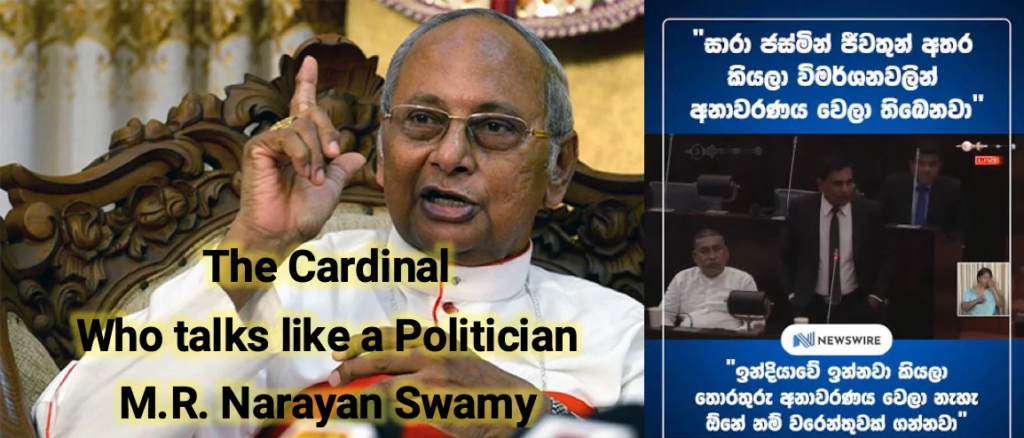
So, in all probability, some Catholic clergy would have been informed. And, in all probaility, they too may have regarded the threat as being far fetched and done nothing. It is this fact that Malcom ranjith, the Cardinal, finds so difficult to digest. So, in order to put a different spin on it, he has denied that any church offical or clergy was aware of a threat. Instead he has tried to move the responsibility onto Sinhal-Buddhist leaders as having cooked up a plot to create termoil in the country, so that Gotabhaya (then known as a man for law and order) could get votes on that score! Surely, what a whimsical hypotesis? How can any one with even an iota of intelligence present such a claim?

And yet, that is the story that the Cardinal has been pushing! He claims that there is “an invisible hand” and an as yet undiscoverd “Maha-molakaaraya” who plotted an dplanned the violence against the Catholics to bring a “sinhala-Buddhist” leader into power. This pathetically empty story has been picked up by channel-4 and other purveyors of sensational information and, backed by various NGOs, got converted into a “serious theory”.

Instead, we should ask how the church ignored the warnings of Malcolm Fdo, a devoute Catholic and experience diplomat who would surely have known his rfesponsibility to God and to Ceaser.

Sri Lanka is a country where we don’t dare to ask the right questions or do the right thing. Instead we are ready to appease the Tamil-Tiger terrorist on the one hand, and kiss the Pope’s ring without hesitation, when it was the Pope’s predecessors who sent the Portuguese to destroy our temples and our land in the name of God.

By not questioning Malcolm Fdo before his death in 2021, the PCoI allowed a crucial piece of the puzzle regarding the “prior warning” timeline to die with him. The decision by the PCoI not to summons Malcolm Fernando to testify under oath remains one of the most criticized omissions by legal analysts and the Sri Lankan public.

I believe that the PCol did not question Malcolm Fdo because PCol did not wish to tangle with the Church was was the “Victim” of the attack, given the already adversarial attitude of the church. During the hearings, there were stark public clashes. At one point, PCoI Chairman Janak de Silva publicly criticized Cardinal Ranjith for making political statements regarding the attacks, telling the media that the Cardinal should “not act like a politician.” The Church viewed the PCoI as hostile to its interests. There is no direct evidence that the Catholic Church influenced the PCoI to avoid questioning Malcolm Fernando, primarily because there were no influential Catholic members on the Commission, but yet, it is clear that the PCol stood intimidated by the church and spared Malcolm Fernando who should have been immediately questioned.

So, the big question regarding the Easter attacks is “Why wasn’t Malcolm Fernando” questioned by the police investigations that immediately follwed the Easter attacks? Were they protecting the persons who spoke to Malcolm Fernando?

Bodhi 

පාස්කු ප්‍රහාරයේ ඇත්ත නැත්ත! වින්දිත ඔබගේ දැණුම පිණිසයි!

April 5th, 2026

Ratanapala 

Easter Sunday –  5 Apr 2026

ගම්මන්පිල මහතගේ පාස්කු ප්‍රහාරයේ මහා මොලකරු සොයා යාමේ කෘතියේ  සඳහන් කරනවා අල් බග්ඩාඩිගේ ලෝක ඉස්ලාමීයකරනයේ ISIS න්‍යායපත්‍රයේ සහරාන් මෙහෙයුම කිරීමේ බරපැන වශයෙන් රු 300 මිලියනයක් සැපයූයේ ජවිපේ සාමාජික ඊබ්‍රහාමි නානාබව. මේබව පසුපස යෑමට ලංකා නීති පද්ධතියටත්, දනට බලයේ ඉන්න ජවිපෙටත්, කතෝලික පල්ලියටවත් අවශ්‍ය නැත. කතෝලික පල්ලිය පාස්කු ප්‍රහාරයේ කතෘකම මුස්ලිම් ඝාතකයන්ගෙන් වෙන දිසාවකට ගෙනගොස් ආගමීය සහ දේශපාලන  සිතැඟි ඉටුකර ගැනීමට රාජපක්ෂ වරුන් වෙත ගෙනයාමට යත්න දරනවා.  මෙය ඔවුන්ගේ සැමදා ගමන් සගයන් වන කොටි ඩයස්පොරව සතුටු කිරීමේ වැයමක් බව සියලු නිදහස් මතධාරීන්ට පෙනෙනවා නොඅනුමානයි. අවට සිටින අනෙකුත් පූජකවරුන්ට – 1950 ගණන්වල කතෝලික ආක්‍රමණයේ ( Catholic Action ) දූ දරුවන්ට  ඇත්තේ ලංකාවේ ක්‍රිරිස්තියානි දේව රාජ්‍ය ගොඩ  නැගීමට අවහිර කරන සිංහල බෞද්ධයන් කෙරෙහි ඇති භීතියයි, වයිරයයි. එහි වරක් තාවකාලික මුහුණුවරවූ ගෝඨාභය කෙරෙහි ඇති වයිරයයි!  අවුරුදු 500 කට පෙර දොන් ජුවාන් ධර්මපාලගෙන් කරවා ගත නොහැකිවූ දේව රාජ්‍ය ලංකාවේ ස්ථාපනය කිරීම නූතන දොන් ජුවාම්ලා වන රනිල්, සජිත් සහ අනුරලාගෙන් කරවා ගැනීටය! සිරිලක බෙදා වෙන්කිරීමේ මිරිඟුව  පිටිපස යෑමෙන් කාට සෙතක් වේද? බෙදුණු , අස්වාභාවික සීමාවලින් වෙන්වුනු රටක සාමය, සතුට සහ නීතියේ ආධිපත්‍ය බලාපොරොත්තු විය හැකිද! එවැනි බෙදී වෙන්වී සාමයෙන් සිටින රටවල් ඔබ දන්නවාද?  ඉන්දියාව, නුතන සුඩානය, ඔට්ටෝමන් අධිරාජ්‍යය බින්දවටීමෙන් පසු ඇතිවූ මැද පෙරදිග මේ ක්‍රියාවන්ට කදිම නිදසුන් ගෙන එනවා! ඇත්තේ සදාකාලික ගැටුමයි, ත්‍රස්තවාදයයි, කෙලවර නිම නොමැති යුද්ධයයි!

තමාගේ පුතුන් දෙදෙනා බිල්ලටදී කන්‍යාවන්  සමග මොක්සුව  පතන ඊබ්‍රහිම් නානා නිදැල්ලේ සිටිනවා! ඔහුට විමර්ශන නැත. ඔහු ඔහුගේ ඉස්ලාමීකරන ව්‍යාපෘතිය ඉදිරියටත් කරනවා ඇති. ඊට හේතුව ඔහු සහ ඔහුගේ වහාබ්වාදී ප්‍රජාව කතෝලික සභාව සහ ලංකාව අස්ථාවරකර කෑලිකරන (balkanize) ව්‍යාපෘතියේ ගමන් සගයින් නිසාය. ගම්මන්පිල මහතා නිදැල්ලේ ඉන්නා මරාගෙන මැරෙන ත්‍රස්තයින් 300 ගැන පැවසුවේ ඒ නිසාය. Born Again විශ්වාසවන්තයෙකු ලෙස සලකන සජිත් ප්‍රේමදාසටවත් ඔහුගේ මුස්ලිම් / ක්‍රිස්තියානු මුදල්වලට සහ ඡන්දවලට ගැති NGO වලින් යැපෙන ඇම්බට්ටයින්ටත්, බොහෝ අනෙකුත් ඒහා සමාන අනාගත බලාපොරොත්තු ඇති අයටද සත්‍ය කුමක්ද යන්න අවශ්‍යම නැත. ඔවුන්ට  ඇත්තේ ජනාධිපති සිහිනය මිස අන්කිසිවක් නොවේ! වින්දිතයන්ට  ලබාදීමට උත්සහ ගන්නේ නියම ඇත්ත නොව සිංහල බෞද්ධ වයිරය පවත්වාගෙන යෑමය; බෙදා වෙන්කර පාලනය කිරීමයි. රාජපක්ෂ භීතියෙන් පෙලෙන මොවුන් කරන්නේ පාස්කු ප්‍රහාරයේ ආක්‍යානය (narrative) රාජපක්ෂ කඳවුර වෙතට ගෙනගොස් අහිංසක වින්දිතයන්ගේ මනස විකුර්ති කරීමයි, ඇත්ත පාස්කු ප්‍රහාර විමසුම තමාගේ එදිනෙදා සිතැඟි පරිදි වෙනස්කර ජනමනස අතරමං කිරීමයි! අද මහ මොලකරු – ඉංදියාව, අබුහින්ද් සහ සොනික් සොනික් පසුකර ගෝඨාභය දෙසට ගමන් කරමින් සිටී. මෙහි ආන්තික මෙහෙයුම එදා බෙදුම්වාදය පරාජයවීම නිසා අද මාරාන්තික වයිරයකින් ඉන්නා දෙමල ඩයස්පෝරාව සැනසීම පිණිස ගන්නා ප්‍රයත්නයක් බව ඔබට වැටහෙන්නේ නැද්ද? LTTE ක්‍රියාන්විතයන්ට උතුරේ ත්‍රස්ත උපකාරක සහායද, දකුණේ යුද්ධය අතරමග බකල් කිරීමට සාම දූතයන් වූ කල්ලි කව්රුද යන්න ඔබ දන්නවා! එය අකුරුවලින් කිව යුතුද? 60 දාහක් ඝාතනය වූ ඒ කුරිරු යුද්ධයට අනුබල දීම ගැන විමර්ශන සිදුවිය යුතු නැද්ද?

සියලු වින්දිතයන්ට, විශේෂයෙන් කතෝලික බැතිමතුන්ට කියන්න තියෙන්නේ මේ මහා පාපයට දායක නොවන ලෙසටයි! ඔවුන්ගේ පැවැත්මට සහ සුඛවිහරනයට ඔබගේම කතෝලික සභාව ඔබ වහලුන්මෙන් පාවිච්චි කරනවා! මධ්‍යස්තව සිතන්න, ඇත්තටම මොකද වුනේ කියලා. ඔබ හොදටම දන්නවා මේ මලේඥ ප්‍රහාරය ගැන දැනුම එදා පැවති රජයට තිබුණ බව. ඒ සදහා නිසි විමර්ශන නොකල වගකිවයුත්තන් අදද එම පුටුවල සිටිමින් ඇත්ත වසන් කිරීමේ කාර්ය එදාටත් වැඩිය හොදින් කරගෙන යනවා. විස්තර ගැන යම් දැනුමක් තිබුන හරීන් ප්‍රනාන්දුවවත් මහ මොලකරු ප්‍රබන්ධය ගෙන ආ හිටපු නීතිපති දප්පුල ද ලිවේරාවත් තවම විමර්ශනය නොවූයේ මන්දැයි ඔබට කිසිම චකිතයක් නැත්ද?

පාස්කු ප්‍රහාරයේ ආදිතම මහමොලකරු ලෝක ඊස්ලාමිකරනයේ අත්පොත කුරානය, ඊට අදාල ෂාරියා නීතිය  සහ සර්වලෝක ඉස්ලාමීය කරණයයි. පලමු කාලිෆේටය ඇතිවන්නේ ඒ දර්ශනයට අනුවය ෂාරියා නීතිය අනුවය. මෑතකදී මහමොලකරුවන්නේ Petrodollars වලින් පොහොසත්වී ලෝක ඊස්ලාමීයකරනයේ දිගුවක්වන  වහාබ්වාදයත්, අල්බග්ඩාඩීගේ නැවත පුරාණ කාලිෆේටය ඇති කිරීමේ ISIS / ISIL ව්‍යාපාරයත්, ලංකාවේදී මේ න්‍යාය පත්‍රයට නායකත්වය දුන් සහරාන් ඇතුලු කල්ලියත්ය. ඔවුන්ගේ පුරවැසියන්ද වින්දිතයන්වූ නිසා  ඇමෙරිකාවේ FBI , ඔස්ට්‍රලියාවේ AFP සහ මහා බ්‍රිතානයේ ස්කොට්ලන්ඩ් යාර්ඩ්ද  ප්‍රහාරය පිලිබඳ විමර්ශන සිදු කළා.  ප්‍රහාරය ගැන කතෝලික පල්ලිය ඔවුන්ගෙන් වැඩි දුර ප්‍රශ්න නොකරන්නේ මන්ද? බොදුනුවන් සහ කිතුනුවන් අතැර ඇති විශ්වාශය, සමගිය  බිඳ දමා රට බෙදීමේ සහ දේව රාජ්‍යය යන කුට ව්‍යාපාරය සාර්ථක කිරීමේ තවත් අංගනයක් නේද මේ?

එදා නවසිලන්තයේ සිදුවුනු කිතුනුවෙකුගේ මුස්ලිම් පල්ලි ප්‍රහාරය නිසා කෂණික පලිගැනීමක් ලෙස දලදා පෙරහැරට  මේ ත්‍රස්තයින් ජූලි මාසයේ කරන්නට සැලසුම් කර තිබු ප්‍රහාරය ලංකාවේ කිතුණුවන් සහ බටහිරයන් වෙතට යොමුකල බව ඔබට නොදැනේද? ඒ පිලිබඳ තීරණය කලේ ISISද සහරාන්ද යන්න වෙදගත් නැත, මන්ද ප්‍රහාරයකට අවශ්‍ය සියලු දේ ඒ වනවිට සැලසී තිබුන නිසාය.  පලමු ප්‍රහාරයට ආනයනයකල කඩු 12,000 ගැන විමසුමක් නැත්තේ මන්ද? ඒ කඩු ගෙනාවේ මුස්ලිම් පල්ලිවල තනකොල කැපීමට යන්න ඔබ පිලිගන්නේද? මේ සියල්ල මැදපෙරදිග මුදල්වල බලයෙන්  බහුතරයක්  දේශපාලුවන් යට ගහන බව ඔබට වැටහෙන්නේම නැද්ද? අද සාර්ථකව මේ මුසාව පාර්ලිමේන්තුවේ ඉදිරියට ගෙනියන්නේ  සමගි ජන බලයේ (සජබ)   මුජිබුර් රහමන්ය. අල් ටාකිය ( Al Taquiyaa) නියාවට අනුව පාර්ලිමේන්තුවේ  හිරිකිතයක් නොමැතිව මුසා දොඩන්නේ ඔහුය. ලංකාවේ සීග්‍රයෙන් සිදුවන  ඉස්ලාමීකරනය වසන් කිරීමේ කාර්ය ඔහු මැනවින් ඉටු කරමින් සිටී. 

ලෝක ඊස්ලාමීය කිරීමේ න්‍යාය පත්‍රයේ සැලසුම් දැනට ඔඩුදුවා ඇතිබව යුරෝපය සහ ඇමරිකාවේ ජනතාව වටහා ගනිමින් තිබෙනවා.   ලංකාවේ මෙන්ම සවීඩනය, ඩෙන්මාර්කය, නෙදර්ලන්තය, ප්‍රංශය, ජර්මනිය සහ අනෙකුත් වින්දිත රටවල් අතර ඉතාලියත් ඉන්නවා. එම රටවල් එදා මුලු ලෝකයටම මානුෂික අයිතිවාසිකම් සහ ප්‍රාජාතන්ත්‍රවාදය ගැන බන දෙසුවත් දැන් දැන් ඒ තත්වයන්ගෙන් බැහැරවී ජාතිකත්ව මගට යමින් සිටිනවා! තම තමන්ගේ සභ්‍යත්වය, සංස්කෘතිය සහ ජාතිකත්වය – මානුෂීය අයිතිවාසිකම්, මූලික අයිතිවාමිකම්, ඉහවහාගිය ප්‍රජාතන්ත්‍රවාදය යන උද්වේගශීලී එහෙත් මහ පොලොවේ පැලනොවෙන තර්කවලට ඉහල බව තේරුම් ගනිමින් සිටිනවා. ඔඩු දුවපු ප්‍රජාතන්ත්‍රවාදය නිසා ශිෂ්ටාචාර රාජ්‍යයන් විනාශ වෙමින් තියෙන බව කියනවා.  මේ අතරින් මුලධර්මවාදීන්ට රටවල් ගිල ගැනීමට අවකාශය ඇති වෙමින් පවතිනවා. දියුණු වෙමින් සිටි රටවල් අස්ථාවර කිරීමට යොදාගත් ඉහත සඳහන් අයිතිවාසිකම් නිසා තමන්ගේ රටවල් තමාටම අහිමිවීගෙන යනබව ඔවුන්ට යතාර්ථයක් වෙමින් තියෙනවා. අද  ලන්ඩනය ඉංග්‍රීසියන්ට අයිති නැත. නිව්යෝර්කයත් එසේමය. වෙනත් ජාතීන් අයිති කරගෙන ඇත. අනෙක් බොහෝ රටවල තත්වයද මෙසේමය.  එක්සත් ජාතීන්ගේ සංගමය (UNO) හිස සුන් කුකුලන් මෙන් හැසිරෙන්නේ ඒ නිසයි. බලරහිත නපුන්සකයින් බවට පත්වී ඇත්තේ ඒ නිසයි. 

පාස්කු ප්‍රහාරයේ මුල හෙවත් ලංකාව ඉස්ලාමීකරණයේ අතීතය දිවයන්නේ මහින්ද රාජපක්ස දේශපාලනයට එන්න දශක ගණනකට ප්‍රතමය. 1976 යේ නොබැඳි ජාතීන්ගේ සමුළුවට පැමිණි කර්නල් ගඩාෆි ලංකාවේ මුස්ලිම් වරුන්ට කීවේ ඔවුන්ගේ ජනගහනය වැඩිකර ගන්නට, පාරවල් වලට යාබද ඉඩම් මිලදී ගන්න සහ මුස්ලිම් පල්ලි විශාල වසයෙන් ඉදිකරන්නය. ඉදිරියේදී ලංකාව ඉස්ලාමීය කරණයේ අඩිතාලම එදා දැමුයේ එසේය. දශක පහකට පසු 2026 දී මේ  තත්වය කොපමණ දුර ඇවිත්ද යන්න ඔබම තේරුම් ගන්න.  ඔබේ වටපිටාවේ ජන සංයුතිය වෙනස් වෙන හැටි නොපෙනේද?   ෂරියා නීතියට අනුව ක්‍රිස්තියානින් සහ බෞද්ධයින් වසරකට වරක් දෙවියන්ට පුදන ගව සම්පත පමණි! අතීතයේ මාල දිවයිනට, මැලේසියාවට, ඉන්දුනීසියාවට වුනදේ අනෙක් බොහෝ රටවලට සිදු කරන්නයි ඔවුන්ගේ නියාය පත්‍රය!

රාජපක්ෂලා රටට ඉතිහාසගත සේවයක් කර ඇත. කොටි ත්‍රස්තවාදය රටෙන් තුරන් කර ඇත. ඔවුන් 2009 යේ කොටි මර්දනයෙන් පසු සිදුවුනු දරුණු ත්‍රස්ත ක්‍රියාව පාස්කු ප්‍රහාරයයි. ඒ වසර දහයකට පසුවයි. එතකන් සාමය පැවතුනේය. උද්දච්ච් කමින් තොරව රට නියම ලෙස පාලනය කරානම් මේ කිසිවක් සිදුවන්නේ නැත. හරියට පාලනය කරානම්   2015 දී යහපාලනය යනුවෙන් නුතන දොන් ජුවාන් වන රනිල් බලයට පත්වන්නේ නැත. මහා බැංකු කොල්ලය සිදුවන්නේ නැත. පාස්කු ප්‍රහාරය සිදු වන්නේ නැත.  තම පව්ලේ පැවැත්ම සහ අනෙකුත්  ආත්මාර්ථකාමී වැඩ පිලිවැල් නිසා රාජපක්ෂවරුන්  ඉතිහාසයට එක්වන්නේ ඉතිහාසය හරියට කියවා නොගත් අඳබාලයින් ලෙසය. 

එහෙත් රටෙන් පිට සිටින කොටි සාමාජිකයන් නැවත ත්‍රස්තවාදය රට තුලට ගෙනීමට වලිකනවා. නොයෙක් ආකාරයේ ප්‍රයත්න දරනවා. ත්‍රස්ත ප්‍රභාකරන් මරා ඔහුගේ ත්‍රස්ත ව්‍යාපාරය අතුගා දැමීමට පලිගැනීමක් හැටියට රාජපක්ෂලාගෙන් පළිගන්නට කොටි ඩයස්පෝරාව නොකරන දෙයක් නැහැ. රාජපක්ෂ කෙනෙක්  දකුණේ රජයකින්ම  සිපිරි ගෙයට යවන එක ඔවුන්ගේ  ඉතාමත් වැදගත් අරමුණක්.  මේ ප්‍රයත්නයේ දිගුවක් හැටියට තමයි පාස්කු ප්‍රහාරය රාජපක්ෂ වරුන්වෙත ගෙනියන්න තැත්කරන්නේ.  කරුණු මෙසේ තිබියදී කලකදී බෙදුම්වාදයට කඩේ ගිය කතෝලික පල්ලිය ඉස්ලාමීය ආක්රමනයට සුදු හුණු ගාන්නේ  මන්ද යන්න කතෝලික ජනතාවම කරුණු කාරණා නිසි ලෙස පසක් කර වටහා ගත යුතුය. 

පාස්කු ප්‍රහාරයේ මහ මොලකරු කෘතිය එලිදක්වන විට ශාලාවේ ඈත මුල්ලක වැඩසිටි ගලගොඩඅත්තේ ඥනසාර හිමියන් දුටුවිට මට ඇතිවූයේ දරාගත දුකකි, අසරණ බවකි, මන්ද උන්වහන්සේ පාස්කු ප්‍රහාරයේ අක්මුල් සියල්ල ප්‍රහාරයට බොහෝ වසර ගනනකට පෙර පැවති සියලු රජයන් වෙත නොබියව පවසා සිටිය නිසාය. අන්තිමට ගොටාභය ජනාධිපති සමග මුළු රටට – “එක රටක් එක නීතියක්”  ගෙන එන්නට වෙර දරූ උන්වහන්සේ අද අසරණය! මේ සියල්ල දකින උන්වහන්සේගේ සිතිවිලි කුමක් වන්නට ඇත්ද?  මේ කරුණු එලිකිරීමේ වරදට  කිහිපවරක් සිර දඩුවම් විඳි උන්වහන්සේ දිනක ලක් ඉතිහාසයට එක්වන්නේ  ලක්දෙරණේ  අද්වීකීය විරුවෙක් ලෙසය. එය වැලැක්වීමට නීති පද්ධතියේ ඇති කිසිම ජගතෙකුට  නොහැකිවනු ඇති. උසාවියක උස්හඬින් කතා කෙකරුවාට අවුරුදු 19 ක බරපතල වැඩ සහිත සිර දඩුවම් ලැබෙන්නත් බුදුන් වහන්සේට අගෞරව කල ජෙරොම් ප්‍රනාන්දුට දඩුවම් නොලබන්නටත්  නීතිය නැමෙන්නේ කෙසේද යන්න පැහැදිලි නැත. අධිකරනයට අපහාස කල පද්මිණී රණවක නිදැල්ලේය. ලංකාවේ නීතිය අපැහැදිලිය, නිරුත්තරය, නිරුවත්ය! ජනතාවගේ චන්දයෙන් පත්වුණ රජයක් පිටස්තර බලවේග පිළියෙළ කල අරගලයකින් පන්න දමනවිට අත්පොලසන් දුන්නේ කව්ද?  ඔවුන් කලේ 1931 සිට පවත්වාගෙන එන සර්වජන චන්දය සහ ප්‍රජතන්ට්‍රවාදයේ  නග්න බව  විහිලුවට ලක් කිරීම නොවේද?  ජනතාව අද්වීතිය යනුවෙන් අදහන අධිකරණය දේශපාලනීකරණය වී නැත්ද?

පාස්කු ප්‍රහාරයේ ආඛ්‍යානය වෙනතනට ගෙනයන්න වෙරදරන කතෝලික සභාවේ ප්‍රයත්නය සියලු බුද්ධිමතුන් පිලිකුලින් හෙලා දැකිය යුතුය! සත්‍යයේ පැතිකඩ මහජනතාවට විස්තරාත්මකව හෙලිකරන ගම්මන්පිල වැනි විද්වතුන් ආරක්ෂා කොට පෝෂණය කල යුතුව ඇත. එය යුගයේ අවශ්‍යතාවයකි! පනිවිඩකරු ඝාතනය කරන්න එපා. ඇත්ත ඇති සැටියෙන් දකින්න ඉගෙන ගන්න. එවිට පාස්කු ප්‍රහාරයේ අක්මුල් ඔබට වැටහෙනු ඇති! එවිට ඔබට අවශ්‍ය සැනසුම ලැබෙනු ඇත. ඒ ඔබට ඇත්තටම සත්‍ය දැනගැනීමට අවශ්‍ය නම් පමණි! එදා රුකඩ සිරිසේනගේ යහපාලන රජය,  රාජ්‍ය ආරක්ෂාවට ප්‍රමුකත්වය දුන්නනම් නිසි පියවර ගත්තා නම් පාස්කු ප්‍රහාරයේ මියගියයන් අදටත් අප අතරය. මාරාන්තික තුවාල ලැබූවන් සහ සෙසු වින්දිතයන්, වින්දිතයින් වන්නේ නැත. සියල්ල මෙවරත් පාස්කුව සමරණු ඇති!

මේ දිගහැරුම  සාමකාමී සම්ප්‍රදායී ඉස්ලාම් භක්තිකයන්ටද සැනසුමක් ගෙනදේවා! මුලධර්මවදීන්ගේ උගුල් වලට අසු නොවේව! අපේ ශ්‍රී ලංකාව රැක ගනිමු. ජාතික සමගියට ගරු කරමු! 

සත්‍යය ඔබව නිදහස් කරනු ඇති!

මේ කියවන ඔබට ජය!

Sarath Bulathsinghala

India’s failure to support Sri Lanka on the ownership of Player – Referral (DRS) makes a mockery of India’s so – called Cricket Friendship with Sri Lanka.

April 5th, 2026

Sports

The total silence of BCCI and the Govt. of India on the ownership of the Intellectual Property of Player – Referral system (DRS) which is rightfully claimed by a Sri Lankan makes a mockery of India’s so – called Cricket Friendship with Sri Lanka. It is tantamount to a betrayal of Sri Lanka by India in the International Cricket arena 

AI Overview

https://share.google/aimode/dvUCs8InsQJEPnvoH

The claim that a Sri Lankan, specifically lawyer Senaka Weeraratna, is the original inventor of the “Player Referral” concept—which later became the Decision Review System (DRS)—is supported by documentation showing his proposals were published as early as March 1997 in The Australian, nine years before the ICC adopted the system in 2006. 

Weeraratna has been actively pressing his claim to be recognized as the inventor, seeking to have the system referred to as the “Weeraratna Decision Review System” (WDRS) or to at least receive recognition similar to the “Duckworth Lewis” method. 

Here are the key points regarding the situation:

  • ICC’s Stance: The International Cricket Council (ICC) has previously stated that their committees developed the system independently and were unaware of Weeraratna’s prior publications, though this defense fails to account for the legal “Doctrine of Constructive Notice”.
  • Lack of Recognition: Despite his efforts, which have included presenting his case to ICC officials and Sri Lanka Cricket (SLC), Weeraratna has not received formal recognition or compensation for the widespread use of DRS, which he argues is a breach of intellectual property rights.
  • Sri Lankan Action: There have been calls from various parties for the Sri Lanka Cricket Board and the Sri Lankan government to establish a commission of inquiry and take this matter to the ICC on his behalf, especially since DRS is used globally without royalties being paid to the claimant.
  • BCCI/India Position: While India was initially against the implementation of the DRS (boycotting it for several years), the BCCI eventually adopted the system. Reports suggest that while Indian fans and some officials are beginning to recognize its importance, there has not been a formal stance taken by the BCCI or the Indian government on the intellectual property ownership claims. 

Indian and Sri Lankan Institutional Silence

The perceived silence from Indian and Sri Lankan authorities has been a point of contention for Weeraratna and his supporters:

  • BCCI & Indian Govt.: There is no evidence of the BCCI or the Indian Government formally addressing or supporting

Weeraratna’s

claim. Supporters often contrast this with India’s successful promotion of other cultural/intellectual exports like International Yoga Day.

  • Sri Lanka Cricket (SLC): Critics within Sri Lanka have also accused the SLC and the Sri Lankan government of failing to aggressively pursue the claim at the ICC level to secure recognition or royalties for the country.
  • Legal Challenges:

Weeraratna

has attempted to sue the ICC and has sought arbitration through the World Intellectual Property Organization (WIPO), but these efforts have not yet resulted in formal legal victory or recognition. 

The situation is characterized as a “David vs. Goliath” battle where a local creator is seeking to gain recognition for an idea that has become a fundamental, revenue-generating part of the international game. 

https://share.google/aimode/dvUCs8InsQJEPnvoH

Source: AI Overview

………………………………………………………..

Watch “DRS, Snicko, Hot Spot, Hawkeye & Umpire’s call explained and Sri Lankan lawyer Senaka Weeraratna identified as the world’s first person to conceive and publish the concept of ‘ Player Referral” which is the true basis of the Umpire Decision Review System ( UDRS or DRS).

https://youtu.be/5tuTDJaS2ik?si=t4FRU4vvM7A43_NL

Please visit

https://youtu.be/5tuTDJaS2ik?si=j3lKkUcWkUw

The reference to Senàka Weeraratna is found at 2.40 minute in this video playback program. 

Senaka Weeraratna’s opinion has been published as a comment No.5 

Both the International Cricket Council (ICC ) and Sri Lanka Cricket (SLC) must respond to the points made in his comment, if they are to remain credible.

One of the most controversial and misunderstood aspects of Cricket is the use of the Umpire Decision Review System or DRS. Cricket has come a long way since India assimilated Science and Technology into the game which has re-defined how it is played today. But many people are still unsure how DRS works, especially Umpire’s call. Pale Blue Thoughts looks at DRS, Snicko, Hot Spot, Hawk Eye and Umpire’s call in detail. If you watch and love cricket, this video is for you!


Watch my other videos at     / palebluethoughts   *************************************************************
YouTube:     / palebluethoughts  
Facebook – @palebluethoughts.fb
Instagram – @pale_blue_thoughts
Email: thepalebluethoughts@gmail.com

One-fifth of Sri Lanka inundated by cyclone Ditwah, UNDP analysis 

April 5th, 2026

UNDP

UNDP satellite data shows 2.3 million Sri Lankans exposed and 1.1 million hectares flooded as cyclone Ditwah strains infrastructure and public services

December 9, 2025
Mapping the Initial Impact of Cyclone Ditwah in Sri LankaSource:Geosmart/Vantor

Colombo/New York, 9 Dec 2025 – An estimated 2.3 million people – more than half of them women – were living in areas flooded by Cyclone Ditwah that struck Sri Lanka on 28 November. New geospatial analysis from the United Nations Development Programme (UNDP) shows floodwaters from the cyclone inundated more than 1.1 million hectares – almost 20 percent of the country’s land area – and caused significant damage to homes, infrastructure and essential services.

The analysis, which draws from disaster related data from the Government of Sri Lanka, provides a nationwide picture of the cyclone’s impact, which is being termed as one of the worst flooding disasters to hit Sri Lanka in decades.  

Over half of the people in the flooded areas were living in households already facing multiple vulnerabilities before the cyclone, including unstable income, high debt, and limited ability to cope with disasters. Under these conditions, even moderate shocks can turn into long-lasting setbacks. 

The floodwaters reached nearly 720,000 buildings, about one in every twelve buildings in the country. Over 16,000 kilometres of roads, enough to circle the island’s coastline more than twelve times, were exposed to flooding. Similarly, over 278 km of railway tracks and 480 bridges were located in flooded areas.  

Cyclone Ditwah struck regions already weakened by years of economic stress,” said Azusa Kubota, UNDP Resident Representative in Sri Lanka

The exposed population includes approximately 1.2 million women, 522,000 children and 263,000 older persons, with over 60% of all exposed people living in just two districts (Colombo and Gampaha). Many in affected areas across the country live in high-risk, disaster-prone areas, requiring a permeant solution. This concentration of exposure is placing heavy pressure on essential services 

Where high flooding and high vulnerability overlap, recovery is likely to be slower and more costly. Early action in these locations is critical,” Kubota said. 

In the country’s hilly inland, the cyclone triggered around 1,200 landslides. These events can isolate at-risk communities by disrupting access to essential services such as health care and slowing rescue operations.  

Cyclone Ditwah is a stark reminder of how fast compounding crises can unfold,” said Devanand Ramiah, Chief of Crisis Readiness, Response, and Recovery at UNDP’s Crisis Bureau.

Working closely with the national authorities and partners, UNDP is calling for scaled-up early recovery support to help communities get back on their feet. This includes restoring essential services, supporting affected households, particularly women, children, and older persons, repairing key transport and service-delivery infrastructure, and strengthening local systems for future climate resilience.  

UNDP with the UN family is working with government, our partners and communities, to support those most affected through immediate relief and early recovery efforts. The ‘rebuild stronger and better’ is essential and will take time”, said Azusa Kubota.

Analysis and full set of data is available hereMapping the initial impact of Cyclone Ditwah in Sri Lanka 

Russian oil unlikely anytime soon

April 5th, 2026

Courtesy The Daily Mirror

Colombo, April 4 (Daily Mirror) – Sri Lanka is unlikely to secure a shipment of Russian oil anytime soon, as logistical arrangements are still under discussion while the one-month US sanctions waiver is due to expire on April 11, the Daily Mirror learns.

After the sanctions were lifted, the Sri Lankan government sought engagements with the Russian authorities to procure petroleum products to ward off the impact of the fuel crisis triggered by the US-Israeli war on Iran and the closure of the Strait of Hormuz that is responsible for 20 percent of global oil shipments.

Russian Deputy Minister of Energy Roman Marshavin visited Sri Lanka in late March 2026 pledged to support the country’s energy needs amid global supply disruptions. His visit was followed by Russian Deputy Foreign Minister Andrey Rudenko.

During a discussion organized by Pathfinder Foundation, he said that Russia was supportive of long term energy cooperation which is not determined by the US interests. He also said that Sri Lanka is not the only country that has sought Russian oil at this juncture.

Asked about the current status of planned procurement of Russian oil, an official of the Ceylon Petroleum Corporation (CPC) said that discussions are ongoing at the moment.

Besides, he confirmed that Sri Lanka placed an order for the import of American crude oil for the first time in recent history, and the shipment is expected in May.

Earlier, during tariff negotiations with the United States, Sri Lanka decided to consider the import West Texas Intermediate (WTI), a very light, sweet crude used as the U.S. benchmark, to reduce the trade gap between the two countries. Otherwise, Sri Lanka used to import Murban which is a high-quality, light, and sweet crude oil produced by the Abu Dhabi National Oil Company (ADNOC) in the UAE. It mostly remained qualified to enter the Sri Lankan market at a competitive rate after the tender process.

Sri Lanka only has a refinery capacity for 50,000 barrels a day.

China to provide shipment of refined fuel to Sri Lanka

April 5th, 2026

Courtesy Adaderana

The government of China has agreed to provide a shipment of refined fuel to Sri Lanka, according to the Ceylon Petroleum Corporation (CPC).

The CPC stated that a special discussion is scheduled to be held tomorrow (06) in this regard.

During the discussion, a final agreement is expected to be reached regarding the type of fuel that Sri Lanka will receive and the date on which the relevant ship will arrive in the country.

Easter Sunday massacre – The Church’s quest for a “mahamolakaru”

April 4th, 2026

Shenali D Waduge

There are numerous protagonists to Sri Lanka Easter Sunday massacre. We have Zaharan and his suicide bombers alongside an ideological network slowly spreading across the Island unchecked. The Church initially forgave the suicide bombers but has spent the past seven years in a relentless hunt for an undefined single mahamolakaru.” This pursuit, never substantiated, has been used to reject Presidential Commission and Committee reports while endorsing allegations from a political asylum seeker, four years after the attacks, whose central claims remain untested in Sri Lanka.

21 April 2019

08:45a.m – St. Anthony’s Church, Kochchikade – Suicide bomber Alawdeen Ahmed Maud (1st blast)

08:45a.m. – St. Sebastians Church, Katuwapitiya – Moh. Hashthun

09:05a.m. – Zion Church, Batticoloa – Mohammed Nassar Mohammad Asad

The blast should have triggered immediate police deployment as heads were fully aware of an attack since 4 April. Closure of all remaining churches & hotels named in the intel briefs & teams should have been immediately deployed to intercept suspects who were already known.

The fatalities from the 3 churches neared 200 deaths.

The Cardinal held the midnight mass at St. Lucias Cathedral (15minute walk from St. Anthony’s Church) on 20th April 2019 while the Easter Sunday morning mass was held at his residence and not St. Anthonys Church.

No sooner he heard about the blasts he rushed to St. Anthony’s Church.

We tabulate the reactions of the Church from 21st April 2019 onwards.

IMMEDIATE POST-ATTACK: BLAME THE GOVTS FAILURE

intelligence failure

negligence of state officials

failure to prevent despite warnings

justice for Catholic victims

moral accountability of the then Yahapalana leadership & strongly criticized President Sirisena, PM Wickremasinghe & police/intelligence lapses

The Church’s initial stand was that the attack was preventable because prior intelligence already existed

SHIFTING FROM FAILURE” TO INTERNATIONAL CONSPIRACY” – July 2019

21 July 2019 – Katuwapitiya memorial – Cardinal shifts narrative claiming bombings were not merely the work of extremists but part of a wider international conspiracy. This became the new theme and it is significant because.

it moved the Church away from a pure negligence theory

it introduced concept of a mastermind” / handler / geopolitical manipulation

it opened space for later claims involving intelligence links

This statement became the birth of the conspiracy thesis from the Church side.

CHURCH FORGIVES THE KILLERS

Another noteworthy statement was to claim to forgive the killers” – this was a line directly coming out from truth commission logic.

If the direct perpetrators were publicly forgiven, the later singular focus on an undefined ‘mastermind’ requires closer examination.

Why is there an annual witch hunt over conspiracy and masterminds’ sans evidence except conjecture even 7 years after the attacks. What is the purpose of forgiving the killers, ignoring those who knew & didn’t take action but going behind a conspiracy theory”.

Even after 7 years all that has emerged is a political savvy asylum seeker creating stories to gain asylum.

REPEATED CRITICISM OF 2020-2022 GOVERNMENT

Thereafter, every annual memorial, the Church repeatedly accused of

  • suppressing truth
  • failing to implement PCoI recommendations but rejecting its findings
  • protecting politically connected actors
  • sabotaging honest investigators” – on what grounds was the Church making these claims & how have they measured their honesty.

Their criticism was directed against

  • Yahapalana leadership for prevention failure
  • later Rajapaksa governments for incomplete follow-up and delays in prosecutions

SPECIFICALLY, NAMING INTELLIGENCE PERSONNEL – 23 OCTOBER 2021

This is the part that is somewhat confusing.

How did Suresh Sallay enter the radar of the Church from 2020 onwards for them to openly accuse him by name over a webinair?

When fully aware that he was not in Sri Lanka, not holding a military post and not head of SIS during the attacks (though he was head of SIS when the webinar was held), why did the Church yet decide to name him in October 2021?

This virtual webinair was hosted from Australia. The disclosure of names led to then SIS Chief filing defamation complaint against Father Cyril resulting in Father Cyril seeking court intervention via FR to prevent arrest or questioning.

This allegation came 2 years after the attacks, after official commission findings and testimonies and the May 2021 grand plot” remarks by then Attorney General Dappula de Livera.

Father Gamini claimed intelligence units had helped Zaharan, that financial & logistical assistance had been given, Brigadier Suresh Sallay had nurtured Zaharan’s network.

This became the basis for Suresh Sallay to file defamation against Father Gamini.

Father Gamini was speaking without judicially tested evidentiary documents which if available should have been handed to the Presidential Commission or a complaint filed with the police.

Serious allegations of this nature required evidentiary presentation before investigators or the Commission rather than first emerging in a public webinar.

Also, special action was taken by the Presidential Commission Chairman Justice Janak de Silva to allow Cardinal to be present throughout all the proceedings and as such senior attorney Shamil Perera was nominated for this task. Therefore, the Church was privy to every word that went inside the Commission and if any grey areas prevailed they could have easily made their representation to clear doubts.

DIRECT SUPPORT FOR CHANNEL 4 ALLEGATIONS – 6 SEPTEMBER 2023

The Church rejected the Commission / Committee reports but issued a 4 page congratulatory message to Channel 4 following its documentary featuring Azad Maulana.

This was the most significant public pivot by the Church.

After Channel 4 aired Azad Maulana’s claims, the Cardinal publicly welcomed the documentary’s revelations in a 4-page congratulatory message and made four demands.

Independent investigation: He demanded a free, impartial, transparent investigation into the alleged grand plot.”

International oversight: that this inquiry involve an international team rather than relying solely on domestic committees.

Reinstatement of key officials: The Cardinal insisted the investigators who had previously been removed or sidelined — notably Shani Abeysekara (former DIG CID) and Ravi Seneviratne — who were the key officials removed, be brought back to assist the inquiry.

Suspension of high-ranking officers under investigation (presumably implying Suresh Sallay as name was mentioned initially in October 2021 webinair): He demanded that officials implicated in negligence or obstruction be temporarily removed from active duty to ensure investigation independence.

While Ravi’s name featured in the negligence allegations across the investigations as he served as SDIG and headed the CID.

Shani’s removal was based on several leaked phone messages with a MP that compromised his role as CID Director.

Both however, filed FR’s against their removal.

Media reports also carried that both were members of the JVP retired police officer’s forum and sat on election stage of the NPP during the 2024-2025 elections.

https://www.ft.lk/news/Ex-CID-Chief-takes-over-as-head-of-NPP-s-Retired-Police-Collective/56-762865

  • Quoting relevant areas from the article:
  • Speaking at the Collective’s National Conference in Maharagama, Seneviratne said his decision to join the NPP was driven by a desire to restore the rule of law in the country” (how can the retired restore rule of law?)
  • Seneviratne elaborated that the group constituting the Collective held extensive discussions with NPP leader Anura Kumara Dissanayake over a period of two years” (this implies discussions were held while holding position)
  • He maintained the Collective was a democratic organisation and its members have no desire to be involved in the country’s law enforcement in an official capacity once more” (but he is Secretary Public Security & the other is Director CID once again)
  • Former Director of Criminal Investigation Department SSP Shani Abeysekera, former DIG Gamini Navaratne, former DIG D. Gajasinghe, former DIG J.A. Mark, and many other former police officers were also in attendance.

The dangerous implications of police engaged in politics and the current precedence of retiring police engaged in politics and being reinstated to service and given top posts was highlighted by Presidents Counsel Ali Sabry citing that the dangerous precedence may in future result in a politician being appointed IGP.

Thus, when the Cardinal’s congratulatory message on the Channel 4 documentary also includes reinstating officers removed from initial investigations he is clearly referring to the very two officers that Ali Sabry has raised serious concerns about.

The Church, by publicly congratulating the documentary, indirectly endorsed Azad Maulana’s allegations – why did Maulana wait 4 years for his disclosure until seeking asylum, exposes contradictions against facts established. Yet the Church was happy to accept an asylum seekers allegation at face value and as a whistleblower”,

What this did was to reopen the conspiracy theory first mooted by Cardinal initially, then repeated by Dappula De Livera and again resurrected by Azad Maulana. By congratulating Channel 4 the Church effectively gave moral legitimacy to Azad Maulana. It was why then President Ranil Wickremasinghe appointed the Imam Committee to specifically review the Channel 4 documentary.

Which is why the FBI questioning of Azad Maulana is important.

Imam Committee on:

Channel 4 airing Azad’s claims:

Channel 4 has telecast Azad Maulana’s story as presented by him without checking its veracity.”

intelligence–NTJ links

No evidence to support this claim.”

Suresh Sallay’s alleged presence in Sri Lanka

Established that Maj. Gen. Suresh Sallay was not in Sri Lanka & was in New Delhi.”

Rajapaksa return-to-power motive theory

Found this assertion baseless & mere conjecture sans facts.”

the alleged coconut estate meeting

As per police investigations, the structures mentioned by Azad did not exist at the time of the supposed meeting.”

Channel 4s journalism standard

The Committee refers to Channel 4 broadcast as yellow journalism.”

Imam Committee declared Azad’s story is an outright hoax and unproved.”

If we return to the September 2023 request by Cardinal to reinstate removed investigators, exactly a year after President Anura Kumara appoints Ravi S as Secretary Public Security and returns Shani as Director CID with the National Police Commission reinstating him to the police (though he had retired) on a one-year contract. Both members of the NPP Retired Police Officers Collective.

Moreover, having started another report on Easter Sunday, President Anura Disanayake appoints Director CID Shani to the committee in April 2025.

https://www.ft.lk/news/Shani-Abeysekara-joins-committee-reviewing-Easter-Attack-report/56-775773

It is therefore no coincidence that Cabinet Minister Bimal states both Ravi and Shani were appointed at the Cardinal’s request

The Cardinal’s third demand to bring back officers removed (presumably Shani Abeysekara and Ravi Seneviratne) must be viewed against the fact that Zaharan Hashim’s radicalization, inclusion in SIS watchlists, the 2018 TID B report, the arrest order, the Wanathawilluwa explosives discovery, the Mawanella vandalism trail, the Indian intelligence warnings of 4–20 April 2019, and even the final imminent 8-target alert of 20 April all unfolded while Shani was CID Director and Ravi held senior CID command responsibility. In SIS Head Nilantha Jayawardena’s testimony to the Presidential Commission he claims he personally informed the IGP Pujith, CNI Sisira Mendis, Defense Secretary Hemasiri and Senior DIG CID Ravi Seneviratne.

In short, the intelligence, legal trail, and operational warning signs had already fully matured under their watch before 21 April 2019, raising the key question whether their reinstatement addresses the truth deficit or merely restores officers who were already part of the failed pre-attack system.

If the Church can be merciless against all in the police and intel – why are they excluded?

The political transition after 2024 operationalized the Church’s investigative preference by restoring the very officers it had earlier called for to be reinstated.

Over seven years, the Church has consistently redirected attention from those who directly enabled the attacks, from intelligence lapses to actionable leads, toward ever-evolving grand conspiracy” narratives.

So, we must ask, what is the narrative these players wish to promote & why?

This shows

Church demand to reinstate officers removed

Channel 4 line

political change and officers reinstated to same /powerful roles

investigator restoration

new inquiry direction with the same officers as members

all converging into a single post-2024 investigative direction aligned with the Church’s 2023 demand structure.

So, we must ask, what is the narrative these players wish to promote & why?

Let us once again return to the Easter Sunday bombings of 2019.

What we know and what we can all agree upon is

Islamic suicide bombers carried out multiple attacks killing 270 people

The attack was planned over a period of time

The security apparatus knew about the leader of the group

The security apparatus were warned at least 3 weeks in advance – more than sufficient time to take even the basic of preventive measures.

The attacks whether committed by Zaharan as leader or a group becomes irrelevant given the ideology of ethno-religious exclusivity being preached, an indoctrination that advances followers from hate, minor acts of terror to committing heinous acts of terrorism even martyrdom.

This aspect is nothing that was created by Zaharan or originated by him but an aspect that has been part and parcel of historical expansion and calls to create an Islamic caliphate clearly establishes this.

Therefore, when 99% of the world’s terror outfits are those that commit martyrdom in the name of their religion – there is nothing to be surprised about its occurrence in Sri Lanka except the need to identify existing terror cells and immediately neutralize before another attack.

The Catholic Church cannot claim ignorance about the above given the two have been engaged in historical battles some of which have lasted 300 years. Both of their expansionist obectives with tactical differences is known by all.

However, given this ground reality, when the Church begins to play with the theme of justice” and shifts stand playing with people’s mood, we need to question it.

What made the Church move from who failed” and why to who enabled this” completely ignoring the perpetrators by automatically forgiving them?

The Church excuses their shift to claiming, delayed prosecutions, not implementing PCoI recommendations, no clear mastermind, perceived shielding of state officials.

Father Cyril Gamini has been the main protagonist behind mooting these sentiments as made clear in the zoom webinar in October 2021.

Prior to this came another bombshell when the departing then Attorney General in an unprecedented interview on a private channel in May 2021 referred to a grand conspiracy” behind the Easter attacks.

No grand conspiracy theory can absolve the prior intelligence made available and acknowledged by the security apparatus, CID head, IGP and Defense Secretary. If specific prior intelligence existed it is a serious dereliction of duty & criminal negligence or deliberate suppression by those who held position at the time.

Why is the Church not pointing fingers at those who were in position, who received the intel and yet did nothing to prevent the attacks.

Moreover, the Church is also forgetting an equally important fact.

The former SIS Head Nilantha Jayawardena is on record to claim that before the attacks some 10,000 to 15,000 people would have been aware of an attack including the diplomats.

Why does no one question who this 10,000 – 15,000 people are. Are they not criminally liable as well?

The Church completely ignores that evidence on Zaharan existed far before foreign warnings.

Not only were the security apparatus aware but warrants for his arrest were already issued. Zaharan was a fugitive when he committed the crime.

The Church is attempting to portray a notion that Zaharan was created” and suddenly activated” by a later handler. This is not how the sequence of global Islamic terror takes place which the Church is well aware of given the increasing number of Churches under attack across the Middle East & Africa.

Zaharan’s radicalism was known from this extremist sermons, mobilizing youth using Save the Pearls” organization which the father of the 2 suicide brothers was the treasurer. Zaharan was even attacking members of Sufi community, his group vandalized Buddha statues, shot at those who provided tip offs against them, and was keeping ISIS promotion materials. Zaharan was already considered a threat on record. The question is why did those who knew about him, knew there was an arrest warrant against him not take serious action when the foreign intel established he was getting ready to commit an heinous act.

The Church – Father Gamini and grand plot theory attempts to point to the sophistication of the attack as proof of state engineering. But from the FBI affidavit and the discovery of the cashe of explosives and pamphlets on how to make explosive devices it was clear that Zaharan and his team had been studying on creating the explosives for the attack and a dry run was also done prior to the attacks.

The principle failure is the non-action by those seated in office. The politicization of both the armed forces, intel and police after regime change in 2015 where loyalties were divided between the President & Prime Minister and an unhealthy competition arose is sadly the untold truth in what ensued.

Moreover, the emergence of the good governance” government came with the mantra of reconciliation” and multiculturalism” which resulted in ignoring ground realities and threats to appease and please. This is one of the key unspoken reasons for inaction of officials.

Today, as a result the operational mechanics of the intel is being exposed in detail due to the persistence of the Church creating another Millennium City debacle like scenario.

Given Sri Lanka’s unresolved history of terrorism, separatist violence, and prior controversies over the exposure of intelligence methodologies, the continued public demand for explicit operational details risks creating a sequel to earlier national security breaches where methods, sources, and field networks became unnecessarily vulnerable after exposure.

If the State already knew Zaharan was radical, and India later gave exact attack intelligence, why was he still free to execute simultaneous suicide attacks? Maybe the Church should answer this first.

The gravest danger in the Church’s continuing obsession with an undefined single  mahamolakaru” is that it is doing exactly what Sri Lanka cannot afford: diverting national attention away from the urgent task of identifying surviving extremist cells, ideological pipelines, financiers, recruiters, and dormant operatives who may still be capable of striking again. By repeatedly shifting the discourse from the known perpetrators, the documented intelligence failures, and the wider jihadist ecosystem to an ever-expanding conspiracy thesis, the Church is in effect downplaying the very nature of the Islamic terror threat that produced Zaharan and his suicide cadre. This fixation does not strengthen justice; it weakens prevention.

Unfortunately, those that wish to prevent neutralizing the extremist cells are also happy to back the conspiracy mahamolakaru” theory.

The Church must now answer whether its relentless, seven-year fixation on an undefined political mahamolakaru” is not just a distraction but a deliberate, ongoing diversion from the nation’s urgent duty to identify surviving extremist cells, ideological pipelines, financiers, and recruiters before they strike again.

Shenali D Waduge

Easter Sunday 20019 to IRIS Dena 2026: The Weaponization of Religion in the Indian Ocean World

April 4th, 2026

Dr. Darini Rajasingham-Senanayake

The United States torpedo of the Iranian ship, IRIS Dena, in the Seas of Sri Lanka last month reveal Geopolitical economic continuities with a crime committed seven years ago: The 2019 ISIS-claimed Easter Sunday terror attacks were a complex logistical operation in 6 different sea-front locations on the east and west coasts of geostrategic. Then as now, the Mastermind of the crime remained hidden in plain sight.

The Easter attacks of 2019 killed four Chinese marine research scientists who were staying at the Kingsbury hotel, which overlooks the Colombo harbor- South Asia’s busiest port. This resulted in the Chinese Research Vessel- Shi Yan-3 that was docked in the Colombo Harbour abandoning its mission and returning immediately to China. The Chinese research team was collaborating with the National Aquatic Research Agency (NARA), on a project in the Eastern Seas off Lanka.

In recent years the United States government with India as a junior partner has not made a secret of their interest in preventing the Chinese Superpower’s research vessels visiting Sri Lanka. So too, the US has demonstrated an enduring interest in the Indian Ocean’s Maritime Domain. Now it has gone a step further to sink an Iranian ship in the Seas of Sri Lanka, located at the center of Indian Ocean energy, trade and submarine data cable routes.

With the wisdom of hindsight, it is clear that the Islamic State (ISIS) claimed Easter Sunday attacks on sea-front hotels and churches in 2019 had the same signature and similar geopolitical economic interests to the sinking of Iran’s IRIS Dena last month in Seas of Sri Lanka’s. There were no in-land targets selected by the bombers who hit the coastal towns of Batticaloa, Colombo, Negambo in 2019. Broadly, the Indian Ocean Maritime Domain was the focus of attention and action resulting in lockdown of harbours and fisheries communities.

Were the Chinese scientists who died in the Easter attacks along with 250 others, much like the Iranian Naval band musicians who were killed by a US torpedo after participating in an Indian Fleet review collateral damage in the crimes of a sinking empire? 

However, the Sri Lankan intelligence agencies, politicians and media still by and large promote the narrative that there were no external actors, geopolitical interests or foreign Mastermind behind the 2019 ISIS-claimed Easter attacks on coastal targets that killed over 250 people.

Common Geopolitical Economic Pattern in the Crimes

There is a common thread, pattern, motives and interests in these two crimes committed in Geostrategic Sri Lanka- Easter 2019 and IRIS Dena 2026. They involved foreign actors and networks with local collusion. These include conduct of cover up investigations to confuse and spread disinformation and mask the external motives, Mastermind and foreign intelligence networks behind the crime.

Then as now, the same confusing signals about Indian intelligence complicity in US crimes in Sri Lanka were apparent. The Iranian IRIS Dena was in South Asian waters because it had come for an Indian Fleet Review ceremony in Nagapattanam and was returning to Iran when it was sunk in Sri Lanka’s exclusive Economic Zone (EEZ) by a US torpedo.

Only, now the masks and gloves are off. The wretched crashing superpower no longer hides it 800 military bases or crimes around behind s mask of human rights and democracy talk.

The Easter Sunday 2019 attacks in Sri Lanka killed over 250 people of many nationalities and injured many more. Last month’s sinking of the IRIS Dena in the seas of Sri Lanka killed 84 Iranian sailors and caused environmental damage.

Messages to China and Iran: US owns the Indian Ocean?

While subsequent investigations into the Easter attacks have focused on the local suicide bombers and their networks, the question remains: were the suicide bombers led by Zaharan Hashim of the obscure National Towheed Jamat (NTJ) organization, following a script delivered to them via remote social media platforms that purvey Online Religion?

Was the Religion Bot, code named Sonic-Sonic purportedly living in Malaysia designed to hide foreign CIA and Mossad intelligence agents and networks, skilled in weaponizing religion/s spirituality and the occult, with remote funding and Online recruitment of terror networks? Here Rand Corporation Anthropologist, Jonah Blanc’s book Mullahs on the mainframe” may be instructive. After all, it is obvious that an ISIS-linked Mastermind would not blow himself up in the first attack.

Were the 2019 Easter attacks that aborted the Chinese research vessel’s visit to Sri Lanka primarily to send a strong message to the rising Asian Superpower?  

Retrospectively it seems clear that the Easter crime was a geopolitical economic event and a message to a third country –-Hands off geostrategic Sri Lanka—the US owns the Indian Ocean with or without the String of Pearl” harbors?!

Of course, the Easter 2019 attacks were also carefully designed to crash geostrategic Sri Lanka’s economy and precipitate a journey of neocolonial Eurobond US dollar debt entrapment. Indeed, the attack was perfectly timed to ‘pump and dump’ the country and Make the Economy Scream”, just after the World Bank had upgraded Sri Lanka to an Upper ‘Middle Income Country’ (MIC Trap). At the time, the national poverty rate was a mere 4.1 percent.

Today there are claims that Sri Lanka’s poverty rate is 25 percent and the lender of last resorts the IMF its savior! This despite Sri Lanka being the wealthiest county in South Asia by all metrics except the exorbitantly privileged US dollar.

The Easter attacks were also designed to weaponize ethno-religious identity politics in the multicultural island nation with rumours about Muslim women suicide bombers buying white cloths to target Buddhist temples. All this provided a smoke-screen to mask hybrid economic warfare on the geostrategic island, now caught in a neocolonial International Monetary Fud (IMF) and Eurobond Debt trap. Sri Lanka has effectively lost its economic sovereignty and policy autonomy to the IMF at this time given cascading impacts of various exogenous economic disasters.

Disinformation Game: CIA and Mossad’s Islamic Terror Catspaw:

The sinking of the IRIS Dena in Sri Lanka’s EEZ clearly show that the country remains in the cross hairs of big power rivalry in the Indian Ocean and subject to various forms of hybrid economic warfare including Geoengineering. The island is also afloat in Disinformation and cover-up investigations to conceal the geopolitical economic motives of the crimes committed on land and seas.

However, masking the Indian Ocean Geopolitical economic interests and targets of the attacks is more difficult as the War in the Middle East has extended to South Asia, with the Indian Ocean and oil rich Middle East emerging as the epicenter of conflict as world War 3 ramps up.

After all, it is hardly a secret that the Islamic State of Iraq and Syria (ISIS), which claimed ownership of the Easter Carnage in 2019 in Buddhist and Hindu-dominated Sri Lanka, was set up and is part owned by the United States Central Intelligence Agency (CIA). This was after the invasion of Iraq on false pretenses, in order to conduct regime in Syria– as part of the ‘Greater Israel’ project. Hence the name Islamic State of Iraq and Syria (ISIS).

Recent events in the Middle East have revealed that the ISIS was set up by the US Central Intelligence Agency (CIA) after the 2003 invasion of Iraq based on false pretenses; the US claim that Iraq had weapons of mass destruction.

As Columbia University Professor Jeff Sachs among others have revealed, the ISIS was set up by the CIA and US special forces occupying Iraq to carry out a regime change in neighbouring Syria against then President Assad – Hence the name Islamic State of Iraq and Syria — ISIS.  Since then, ISIS terror attacks have proliferated around the world with ISIS avatars and the Greater Israel Abraham accords to enable Israel to take over parts of Syria and Iraq have unfolded.

These continuities illuminate the foreign hands and interests behind the Easter Sunday attacks of 2019 and the recent attack on the Iranian Ship.

Intelligence Agency Compromat? Mastermind hidden in Plain Sight

Notwithstanding the coordinated international and local Disinformation in the corporate and social media echo chamber to hide the external geopolitical economic motives in the Easter Sunday attacks of 2019, it is clear that a group of home-grown local terrorists could not have conducted such a logistically complex operation. There were simultaneous explosions in 6 different locations on the East and West coasts of Sri Lanka:

Indeed, it is now quite clear that the external ‘Mastermind’ of the 2019 Easter Sunday carnage remains hidden it plain sight – and continues to wreak havoc including sinking ships in Sri Lanka and across the Indian Ocean world where sits front and center.

The illegal US-Israeli war on Iran with US war ships circling the Indian Ocean and the British occupied Chagos Islands with the Diego Garcia military base are an indicator of continuing attempts by the world’s biggest Rogue State to exert control over Indian Ocean energy, trade and submarine data cable routes. This is also to shore up the Petrodollar and its global reserve currency status for which control of Sea Lanes of Communication (SLOC) across the Indian Ocean is seen to be vital.

While promoting the narrative of a ‘free and open Indo-Pacific’ the US has attempted to claim dominance of the Indian Ocean, also with monsoon and seabed geoengineering, using weather warfare as a ‘force multiplier’ as part of hybrid economic warfare. At this time, it has assembled its environment polluting war machine in the Indian Ocean to target Iran.

A foreign Script and Mastermind with local collateral damage?

Were the people who died in hotels and churches collateral damage in the Superpower’s power projection in a small island country and to warn China which has been subject to much propaganda about ‘debt trap’ lending to the Global South that it must lay off Sri Lanka?  

The Easter attacks symbolically targeted the Chinese Port city project at the entrance to the Colombo harbor – South Asia’s busiest port. St. Antony’s church. The lead suicide bomber and a second died at Chinese owned Shangri La Hotel. Both overlook the Colombo Harbour and Chinese port city. The adjacent Hilton Hotel – between Kingsbury and Shangi La were spared.

No one dares to name the Superpower as a Criminal Actor and call out its crimes, not even the Catholic Church which is full well acquainted with the Cold War weaponization of religions at this time?

Thus another Easter has come and gone without the Foreign Mastermind of the ISIS-claimed Easter Sunday bombings of hotels and churches being revealed in Sri Lanka. Rather, endless cover up investigations of the Geopolitical interest writ large in the design of the Easter 2019 crime scene have unfolded by local investigative institutions and the church itself in collusion with their foreign counterparts. 

Every attempt has been made to muddy the waters with local blame games and Disinformation to hide the external Mastermind behind ISIS attacks of 2019 in Sri Lanka, and around the world.

The collusion of local institutions and political actors with external intelligence agencies that removed the cell phones of the bombers continues. But the geopolitical economic targets of the attack are clear as the standoff between the United States and China has ramped up since 2019.

Once we recognize the Geopolitical dimension of the ISIS claimed attacks it is easy to identify the Mastermind. A foreign intelligence agency which has long used ISIS as an alibi to Weaponize Islam with Israeli Mossad partner in crime for which the Zion Church in Batticaloa was hit in an own goal.

The CIA and Israel’s Mossad have with a long track record of promoting Islamist terror groups in the middle east for regime change operations. Last year the ISIS off shoot Al Nusra, headed by Al Shara became President of Syria following a regime change operation against Syrian President Bashar al- Assad. Al Shara famous for head chopping with a recently lifted bounty on his head was welcomed by Donald Trump in the White House!

Continue reading an article on the Easter attacks that was published at InDepthNews in 2021

——————————————–

The Weaponization of Religion Amid Hybrid Cold War in The Indian Ocean Region

Viewpoint by Darini Rajasingham-Senanayake

The writer is a cultural and medical anthropologist with research expertise in international political economy, peace, and development studies in South and South-East Asia. Her research spans issues in gender and women’s empowerment, migration and multiculturalism, ethno-religious identity politics, new and old Diasporas and global religion, particularly, transnational Theravada Buddhist networks in the Asia-Pacific region. Darini was a Senior Lecturer at the Open University of Sri Lanka. Her Bachelor’s degree is from Brandeis University and her MA and PhD are from Princeton University.

COLOMBO (IDN) — We have met the enemy and he is us”—Walt Kelly from Pogo Comics, quoted in The ISIS is the US: the shocking truth behind the Army of Terror” [i]

Crime is a form of communication that is both complex and fascinating as it is always characterized by a relationship that can be established between elements present and something absent, or yet to be discovered…Investigating a crime and trying to prevent recurrence means evaluating every possible voluntary and involuntary message left by an author.. :[ii]

On the first Sunday of March 2021 church congregations in Sri Lanka were joined by Buddhist monks and prominent Muslims for a multi-religious protest to mark Black Sunday”; the second anniversary of the deadly Easter Sunday suicide bombings that rocked the country two years ago, killing 279 people and injuring many more.

Local and national religious leaders, aware of the ongoing weaponization, fragmentation, and use of religion/s against core values such as ahimsa or non-violence, by external actors interested in advancing their geopolitical interests in this strategically located Indian Ocean island, stood together to call for justice and accountability for the victims of the mysterious ISIS-claimed attacks. Protestors held placards and demanded: Tell us who the masterminds are?”

The simultaneous attacks staged at 7 different luxury tourist hotels and coastal churches at Easter 2019, presented a hybrid war scenario and were mysteriously claimed by the Islamic State of Iraq and Syria (IS), which operated far from this strategic Indian Ocean island.

The carnage that sent the country into lockdown and the economy into a tailspin was clearly designed, hybrid-war style, to cause maximum damage to both the Economy and Society. The attack was clearly staged by a global-local network while the design of the crime reflected foreign interests.

Sri Lanka is in the crosshairs of great power rivalry as a hybrid cyber–Cold War unfolds in the rapidly militarizing Indian Ocean region as big states use transnational religious networks and cultural ‘soft power’ and religious terror narratives including the Islamophobic ISIS narrative, which Delhi-based academic Saeed Naqvi has deemed a ‘diplomatic asset”, to cultivate local-global networks of political influence and bi-partisan corruption rackets to advance their geostrategic interests.

While the attack on hotels was meant to cripple the tourist-dependent and highly indebted island economy, the attack on churches was meant to cause a cascade of inter-religious violence and destabilization of this multi-religious country, rendering it vulnerable to foreign boots on the ground or even to a foreign military base being set up to purportedly ‘protect Christians from ISIS terror’ in the rapidly militarizing Indian Ocean Region (IOR).

However, since Christians and Muslims are minorities in this Buddhist-Hindu cultural majority country and have historically enjoyed excellent inter-religious relations, it appeared that the foreign masterminds behind the Easter crime had miscalculated and imported a Euro-American Clash of Civilizations” narrative that has little traction in multi-religious South Asian context. There was no local history or motive for a clash of civilizations between Christians and Muslims who had amicable interreligious relations on the island.

From a local perspective, the designers of the crime seemed to have targeted the wrong religious community, and so the masterplan behind the deadly Easter crime began to unravel with his Eminence Cardinal Malcolm Ranjith declaring that the attacks were staged by international actors who benefit from destabilizing regions and countries and weapons sales.

It was in this context that the powerful Buddhist clergy of Sri Lanka, who have historically confronted colonial projects, backed the Archbishop’s demand for accountability and joined the Black Sunday protest to compel the Government of Sri Lanka to deliver the truth about the masterminds behind the attacks since the recently released Presidential Commission of Inquiry (PCoI) Report into the crime had revealed no new analysis regarding those behind the attacks.

For non-recurrence of such violence, identifying the masterminds and holding them accountable would be surely imperative.

Chinese targets in Easter attacks: fundamental questions unanswered in PCoI Report and other investigations

Fundamental questions, or perhaps co-incidences such as why the leader of the attacks, Zaharan Hashim and a second suicide bomber both targeted and died at the Chinese owned super luxury Shangri La Hotel on Colombo’s seafront rather than in a church or Buddhist temple if their crime was primarily religiously motivated, have been ignored in investigations.

Aside from Shangri La the other hotels and churches that were bombed were hit by just a single suicide bomber. There is absolutely no evidence to indicate that Zaharan Hashim, leader of the National Thowheed Jamaat (NTJ), the obscure group blamed locally, knew about or was concerned about Uyghurs in China.

Intelligence experts also pointed out that a leader of a terror group would never kill himself at the outset and suggested that the attacks were staged by other actors fronting the local National Thowheed Jamaat (NTJ), which espoused the Saudi Wahhabi-Salafi project initiated during the Cold War years to weaponized Islam as a bulwark against communist and socialist ideologies—subject to which we shall return.[iii]

Four Chinese marine scientists in Sri Lanka for joint marine exploration lost their lives in the attack on the Kingsbury Hotel. Remarkably, the US and Indian owned, Hilton and Taj Hotels that are next to Shangri La were untouched.

The global and local narrative after the Easter carnage focused on religious motivations in the Easter attack and elided the economic and geopolitical dimensions, while some foreign experts suggested that they were staged in retaliation for attacks on a mosque in New Zealand, a claim that was dismissed by the NZ Prime Minister, Jacinda Arden!

Too many strategic Chinese targets to be a coincidence? Did the designers of the Easter attacks use religion as a partial smoke screen? While media attention and investigations have been focused on the churches that came under attack, the media narrative has been crafted to obscure the vital facts of the crime that may provide clues to the masterminds and messaging evident in the geopolitics behind the Easter carnage and its economic motives.

There has been a veritable infodemic regarding swords in mosques in the local media although no one died of sword attacks. Various other stories about ISIS setting up a Caliphate in the Eastern Province of Sri Lanka were circulated by international experts.

Since answers to fundamental questions were missing after 2 years of investigations, people from all religious communities on the island came together to voice their disappointment with the Report of the Presidential Commission of Inquiry (PCoI), that increasingly appeared to be a bi-partisan party political ‘cover up’, especially of the international actors behind the attack. It was perceived by many locals as part of a larger hybrid war on both the economy and society of Sri Lanka caught in the midst of a Cold War waged by the USA and its NATO allies and the Quadrilateral Security Dialogue or Quad friends, on China.

In the wake of the attacks, Foreign Minister Mangala Samarawickrama announced that the US Govt. was ready to disburse the 450 million as a Millennium Challenge Corporation (MCC), ‘grant’ that would give US companies access to land and transport sectors to be re-structured despite a great deal of opposition from Sri Lankan Trade Unions and civil society groups.

Finger Prints in the Design of the Crime point to Hybrid War and local-global networks

Seven simultaneous suicide bombings in the East and West coasts shook Sri Lanka on a bright quiet Easter morning with Hollywood style ‘shock and awe’ precision in April 2019. Youthful bombers with backpacks targeted seafront luxury tourist hotels and churches killing more than 279 people and injuring many more. Four tourist hotels in Colombo and three churches on the West and East Coasts of the country were targeted.

In the aftermath the country’s already debt-trapped, tourist-dependent economy and multicultural society went into a tailspin and lockdown, seemingly a dry run for the Covid-19 pandemic lockdowns. The latter was imposed with 4 hours prior notice in 2020 again crippling the economy although Covid-19 data indicates that the illness is milder than seasonal flu in Sri Lanka, as in other countries in Southeast Asia, such as Vietnam Laos and Cambodia.

The leader of the small group of suicide bombers, Zaharan of the National Thowheed Jamaat, (NTJ), and a second suicide bomber struck the brand new glittering Chinese-owned Shangri La Hotel on Colombo’s luxury hotel strip.

The fact that two suicide bombers, including the leader Zaharan, targeted a Chinese asset Shangri La Hotel, indicated that it was the ‘Jewel in the Crown’ of the Easter bombings. St Anthony’s church, famous for miracles, attracts people of all faiths—Buddhists, Hindus and occasional Muslims and overlooks the busiest and most strategic port of South Asia was also bombed. The church was one of the three most important targets after the Hong Kong-owned Shangri La Hotel and Kingsbury Hotel where the four Chinese marine scientists were killed.

The economic and geopolitical targets of the attacks seemed designed to send a coded message to China—hands-off Sri Lanka’s maritime domain.

This strategically located Indian Ocean Island sits at the centre of the busiest trade, communication and energy shipping routes and more importantly, at a spaghetti junction of Submarine Undersea Data Cables (UDCs), which carry over 90 per cent of data that keeps the global economy and financial system going amidst Covid-19 lockdowns and is vital to secure what the United States terms its Free and Open Indo-Pacific.”

After the Attacks

ISIS claimed the 2019 Easter Sunday attacks had targeted both the island’s economy and society in what appeared to be a hybrid war attack by a global-local network of clandestine actors hiding behind the ISIS narrative. However, the media narrative focused exclusively on religion and elided the economic and geopolitical dimensions of the attacks.

In the wake of the attacks various rumours circulated in global and local media, giving clues to the local-global network behind the attacks. There were narratives from various foreign intelligence agencies and experts, including an expert at the Rand Corporation, Jonah Blank and Singapore-Sri Lankan terror expert Rohan Gunaratne that ISIS intended to set up a Caliphate in the Eastern Province of Sri Lanka.

Stories that Muslim women had been buying white clothes in order to attack Buddhist temples circulated, seemingly to whip up a fear psychosis and cause a cascade of religious violence and stage a Buddhist-Muslim’s clash of civilizations”? These stories led to isolated confrontations between some Sinhala nationalist organizations and Muslims.

However, there were various clues and coincidences that emerged in the international and local press related to the Easter carnage that points to a network of external actors and funders of the attacks:

  1. Police sniffer dogs had found US diplomats with bomb materials at the JAIC Hilton residencies in Colombo. That story soon disappeared.[iv]
  2. A doctored videotape with ISIS boss Abu Bakkar Al Bagdadi claiming the Sri Lanka attacks ran on global TV channels. The authenticity of the Islamic State video with IS head honcho Al Bagdahdi supposedly speaking about attacks in Sri Lanka could not be independently verified according to CreditSITE Intelligence Group quoted in the New York Times. NYT observed that it was unclear when or where the video was recorded, while the parts that refer to recent events, like the Sri Lanka attack, are addressed in audio, not video, suggesting that it may have been recorded weeks ago with newer audio portions added later.  [v]
  3. An Israeli news agency Whitestream released fake news that Bitcoin had funded the Easter attacks in Sri Lanka, but Bitcoin threatened to sue it. Who is behind this and other propaganda campaigns that ran in the global media to distract investigations?

A reputed Lebanese News Agency, Alahed published a copy of a cable that indicated Saudi Arabia had advance notice of the Easter crime, but unlike Indian Intelligence which shared the information with Sri Lankan intelligence did NOT pass on this information. Indeed, the Same Saudi Government whose crown prince is indicted, ironically, in a recently-declassified CIA Report on the chilling killing of journalist Jamaal Khashoggi in its Istanbul embassy had sent Special instructions to its Embassy in Colombo 5 days prior to the Easter Attack, signed by Saudi Foreign Minister Ibrahim bin Abdul Aziz al-Assaf. The most important instruction was to destroy any incriminating evidence that may link to the local network of Muslim politicians the NTJ First: You should delete all documents, computer data and latest correspondence with domestic and foreign members and groups, in addition to imposing a curfew for the embassy personnel unless it is necessary.” <LEFT: Exhibit One[vi]

  1. It was also revealed that M.L.M Hizbullah who was with both the Rajapakse and Yahapalanya regime had got copious funds from Saudi Arabia also to set up a Sharia University and was known to have had financial dealings with the leader of the Suicide bombers, Zaharan Hashim also from Kathankudi.
  2. Saudi Arabia had instructed its citizens to leave the country after the attacks and following revelations of a meeting in Passikudha between M.L.M Hizbullah and Saudi officials soon after the attacks. However, M.L.M Hizbullah, like his West coast partner in Mannar, Rishard Bathudeen, seems to be above the law and have protection from powerful foreign actors who hold sway in Colombo.

Maritime Domain Awareness and the US Ambassador visiting Buddhist monks to discuss MCC

All the sites targeted for suicide bombings were oceanfront, along the east and west coasts of the country, and after the attack, the island’s harbours were locked down. No inland cities were targeted, and attacks had an ocean theme although IS operates in desert and mountain areas.

In the following week the US Ambassador, Alina Teplitz lectured the GoSL on Maritime Domain Awareness (MDA) in an interview aired on the Ada Derana TV station and drove home this message. In the wake of the attack Teplitx also visited the Temple of the Tooth in Kandy and met with the Mahanayake to discuss the Millennium Challenge Corporation (MCC), compact against which the powerful Buddhist clergy had declared its opposition.

As Giacomo Buoncompani noted, criminal behaviour is a form of communication,[vii] a particular, pathological communication that upon further analysis yields value. Crime is a form of communication that is both complex and fascinating, as it is always characterized by a relationship that can be established between elements present and something absent, or yet to be discovered. Communication today plays a leading role that will most likely continue to become even more important. Investigating a crime and trying to prevent it means evaluating every possible voluntary and involuntary message left by an author.

After the attacks, the US Secretary of State, Mike Pompeo, was expected to visit Sri Lanka to sign the Millennium Challenge Corporation (MCC) Compact and discuss the Status of Forces Agreement (SOFA). The attacks would provide a perfect alibi for a US military base, purportedly to fight ISIS terrorism and protect Christian communities in the Indian Ocean region, in the face of mounting opposition and protests by Trade Unions, civil society groups and the Sangha against the MCC compact, which was subsequently aborted.

Coincidentally, two months before the Easter Sunday carnage, in February 2019, the United Nation’s highest court, the International Court of Justice (ICJ), had ruled that the UK-US occupation of the Chagos Islands, southwest of Sri Lanka where the Diego Garcia military base is located, was illegal under international law.

Sri Lanka was once deemed an unsinkable aircraft carrier in the Indian Ocean”!

Located at the ‘crossroads of history’ and colonized by competing European maritime powers (Portuguese, Dutch and British) for almost 450 years before independence in 1948, Sri Lanka, at the centre of the Indian Ocean Region (IOR), has been often ‘islanded’ in the historical and social science literature on ethnic and religious conflict and violence in the island.

However, ethnic and religious identity politics and conflict in the island has rarely been exclusively internally generated or bereft of geopolitical power plays, transnational actors and related global-local networks using funds, religious and cultural” soft power” and local political actors networks to advance geostrategic interests. More so today given that Sri Lanka’s urban religious communities are transnationally networked and social media-savvy in a context of significant post/colonial ethnic and religious diasporas.

 During the Cold War period the country was subject to power plays and various covert and overt interventions from India (then officially non-aligned, but close to USSR), and the US and UK[viii].

Sri Lanka’s first socialist Prime Minister, S.W.R.D. Bandaranaike who nationalized the country’s strategic ports and airports from the British was allegedly assassinated by a monk at the time when the CIA was weaponizing Buddhism (and Islam in West Asia and Afghanistan), to contain the spread of Communism from the USSR and China.[ix] This was a period of US, UK and retreating European empires instigated assassinations, coups and regime-change operations from Patrice Lumumba in Congo to Mossadegh in Iran, to Suharto in Indonesia in the context of decolonization and national liberation struggles sweeping the Global South.[x] 

As Berger argued, the Cold War was a ‘hot war’ in the Global South, which never ended as the US-led Global War on Terror took over. The ‘global struggle for the Third World, arguably just got hotter with the victory of Joe Biden.[xi] Locating Sri Lanka’s tumultuous post-colonial present in that wider global and Indian Ocean geopolitical context remains a challenge for current and future generations of local historians and social scientists.

EPILOGUE

Pope Francis in Iraq

Remarkably, on the same day of the Black Sunday protests in Sri Lanka against the 2019 Easter Sunday suicide attacks and the failure of the Presidential Commission of Inquiry Report (PCoI), to shed light on the masterminds of the crime, Pope Francis was in Iraq on his first foreign trip after the Covid-19 crisis, reaching out to the Grand Ayatollah Ali al-Sistani, the spiritual leader of millions of Shia Muslims, the sect that dominates Iran, the US bete noir in the Middle East. Receiving the head of the Roman Catholic Church at his home in the holy city of Najaf, Ayatollah Sistani said Christians should be able to live in peace and security like all other Iraqis.

Pope Francis noted that all hostility, extremism and violence are betrayals of religion” at an interfaith prayer service. Multi-religious Iraq was undone by the United States-led invasion in 2003, based on spurious claims that Saddam Hussein had weapons of mass destruction (WMD). Under American occupation Hussein’s Sunni dominated army was disbanded, enabling the birth of ISIS with the patronage of the Central Intelligence Agency (CIA), in order to simultaneously engineer chaos in Iraq, weaponize Shia-Sunni differences, and destroy its multi-religious communities also by staging a Clash of civilizations” between Christianity and Islam as a smokescreen for regime change in neighbouring Syria. The latter operation was only stymied by Russian President Putin’s support of Syria’s Bashar Al Assad. This history has been traced in many books including by an expert panel of intelligence officers in a book titled, The ISIS is US: The Shocking Truth Behind the Army of Terror”.

Is the ISIS monster and narrative created by the CIA after the invasion of Iraq to weaponize a multi-religious society being deployed in Sri Lanka? Is the ISIS initially created by the CIA and Saudi to further spread the Wahhabi-Salafi project through local Muslim politicians and elites now out of control like the Liberation Tigers of Tamil Eelam (LTTE), which was created by India’s Research and Analysis Wing (RAW), and the Intelligence Bureau?[xii]

The LTTE later assassinated former Indian Prime Minister, Rajiv Gandhi in a classic case of blowback. Or is the ISIS network and Islamophobic narrative a ‘diplomatic asset’ as Saeed Naqvi has suggested for the US to advance its geostrategic interests under the guise of counter-terrorism, all the while selling weapons?

It was hence that, two years later, protestors in Sri Lanka were calling on the Sri Lanka Government (GoSL), to reveal the local-global networks that had funded, trained and designed the Easter 2019 crime claimed by the ISIS, and the foreign hands, funds and masterminds behind the leader and a local group that staged the attacks. The design of the attacks indicate an intent by external actors and networks to weaponize religion/s by importing a Euro-American Clash of civilizations” between Christianity and Islam in Sri Lanka where these communities have lived in harmony for centuries and cause a cascade of violence that would de-stabilize the county, rendering it vulnerable to external intervention purportedly to fight ISIS and protect Christians, and distract from the search for the external actors and the motives behind the carefully planned and executed Easter Sunday crime in Sri Lanka. [IDN-InDepthNews – 18 April 2021]

Photo: Catholics, Buddhists and Muslims hold silent protest to demand the truth about the Easter Sunday massacre. Credit: SL Time, Colombo Page News Desk.

Share your views on this article: comment@indepthnews.colo.ba.be

IDN is the flagship agency of the non-profit International Press Syndicate.

Visit us on Facebook and Twitter.

[i] The Washington Blog, Wayne Madsen, Syrian Girl Partisan, John-Paul Leonard 2016 ISIS is US: The shocking truth behind the army of terror.”  Progressive Press. San Diego. California.

[ii] Criminological Communication: Understanding Crime through the Media and Human Communication Giacomo Buoncompagni: Sociology and Criminology: https://www.longdom.org/open-access/criminological-communication-understanding-crime-through-the-media-and-human-communication.pdf

[iii] Askar H. Enazy 2009 Saudi Wahabi Islam in the service of Uncle Sam’ Middle East Institute. Washington DC https://www.mei.edu/publications/saudi-wahhabi-islam-service-uncle-sam

[iv] https://thuppahis.com/2019/05/03/explosives-us-embassy-plot-in-colombo-sniffed-out-by-police-dogs/

[v] Explosives! US Embassy Plot in Colombo sniffed out by Police Dogs? https://www.nytimes.com/2019/04/29/world/middleeast/isis-baghdadi-video.html 

[vi] Lebanese news outlet Alahed News run by News First Sri Lanka reported that they have obtained a top-secret document sent by the Saudi Arabian Ministry of Foreign Affairs to the Saudi Ambassador to Sri Lanka. The letter which was sent 5 days prior to the attack seems to indicate that the Saudi Arabian Ministry of Foreign Affairs was aware of the attacks. https://www.english.alahednews.com.lb/47824/269 https://www.colombotelegraph.com/index.php/easter-massacre-mystery-tamil-travails-the-defense-of-asias-oldest-democracy/

[vii] Criminological Communication: Understanding Crime through the Media and Human Communication Giacomo Buoncompagni: Sociology and Criminology: https://www.longdom.org/open-access/criminological-communication-understanding-crime-through-the-media-and-human-communication.pdf

[viii] Phil Miller 2019 Keenie Meenie: The British Mercenaries who got away with War Crimes” . London. Zed Books.

[ix] Ford, Eugene 2017 Cold War Monks: Buddhism and America’s Secret Strategy in Southeast Asia. Yale University Press.

[x] Bevins, Vincent 2020 The Jakarta Method: Washington’s anti-Communist Crusade and the Mass Murder Program that Shaped our World. New York. Public Affairs.

[xi]  Mark T. Berger. The Real Cold War was Hot: The Global Struggle for the Third World” https://www.tandfonline.com/doi/abs/10.1080/02684520701798171?journalCode=fint20. See also. David Vine’s 2020 ‘The United States of War’.

[xii] For a comprehensive account of the history of the Saudi Wahhabi-Salafi project please see Askar H. Enazy 2009 Saudi Wahabi Islam in the service of Uncle Sam’ Middle East Institute. (MEI) Washington DC https://www.mei.edu/publications/saudi-wahhabi-islam-service-uncle-sam

Is the World Moving Towards a ‘One-World’ Dictatorship of the Oligarchs?

April 4th, 2026

By Jonathan Manz

Is Trump’s conduct demented, as portrayed? Or, are the Republicans, and the Democrats playing out a charade to hoodwink the world and the American people by working towards a ‘One-World’ Dictatorship’ of the Oligarchs as was planned at Bretton Woods in 1944?

The USA pays plenty of lip-service to Democracy. Is there democracy in the USA?

Today, the Oligarchs control the USA totally; the American peoples are helpless, tied down with a 4.5 trillion Dollar debt, owed to the oligarchs.

The American people were unable pay even the 1.5 trillion Dollar annual interest that was payable last year to the oligarchs; they were compelled to borrow the amount payable to the oligarchs, as has been the practice, from the oligarchs themselves.

The USA military is reportedly the strongest in the world; sadly, it is a mercenary military maintained by the oligarchs and fighting wars selected by the oligarchs. The USA is so debt-ridden that it cannot afford to start any war.

Trump and the congressmen are sacrificing American lives, using the American military to fight a war in Iran, on behalf of the oligarchy.

Are Trump and the congressmen the only players aware that the war in the Middle East is the oligarch’s war to achieve the oligarchs’ ends.

Is Iran too, complicit in this drama?

The question on many lips is, ‘Is it not strange that Iran permitted its navy to participate in military exercises conducted by India, at Visakhapatnam, while hostilities were continuing between Washington and Teheran? If it had been prearranged, Iran could quite easily have withdrawn.

India is one of the four countries in the QUAD military partnership, the largest American military alliance in the Indian Ocean.

Another question arose, shortly thereafter, when the Iranian ambassador to Sri Lanka went on air to say that the three Iranian ships had come to Sri Lanka – after the Indian military exercises – on an invitation extended by the Sri Lanka Navy Commander.

Protocol does not permit Sri Lanka’s navy commander to extend such an invitation.

Many were calling, and are calling, rightly, for the immediate resignation of the Navy Commander and demanding that he be investigated and prosecuted if found culpable.

But what went almost unnoticed was the role of the Iranians; does their protocol permit a mere contingent naval commander to accept an invalid invitation from a foreign Naval Commander to visit that foreign country, placing at risk the Naval assets and the lives of those serving on those assets?

This happened at the height of hostilities between USA and Iran, and the country the Iranians were visiting, had, just three months prior, signed a memorandum of understanding – the Montana military agreement – that gave the USA the right to intervene, unsolicited, in the event of a disaster in Sri Lanka.

Was it a coincidence, that the USA think-tank with strong bonds to the CIA – the ‘Pathfinders’ – which persist in describing Sri Lanka as a ‘neutral’ country when in fact she is a ‘Non-Aligned’ country, was conducting in CBO, at the time of the Indian war games, a seminar discussing the response of countries in the Indian Ocean region, to a disaster in the Indian Ocean.

Was it a Freudian slip that gave the lie to a close connection between President AKD of Sri Lanka and the CIA think-tank ‘Pathfinders’, when AKD described, in a flurry of exchanges that followed the Iranian ambassador’s revelation, that Sri Lanka is a ‘neutral’ country.    (Ceylon Today -March 29, 2026 2:02am)

As a Non-Aligned country, Sri Lanka should have been roundly condemned USA’s actions and rallied the NAM to bring the USA and its administration to justice, as war criminals.

But what ADK did and told the world publicly, amounted to, ‘We Sri Lankans don’t care whether the leaders of nations are assassinated or abducted, whether thousands of men, women and children are murdered or whether their homes are razed to the ground; we, as a neutral country only look at the advantage we can derive from the situation’.

This is what being ‘neutral’ means, as was practiced by countries like Switzerland and the Scandinavians during WW2, looking the other way when Hitler and the Nazi’s engaged in pogroms and atrocities. 

As events turned out, one of the visiting naval assets of Iran was torpedoed in Sri Lankan waters, reportedly after the vessel’s locational coordinates had been ‘mysteriously’ communicated to USA. 

Was the Sri Lankan drama orchestrated and scripted by the Oligarchs? Was President AKD also in the know?

The transitory stepping stone to a one-world dictatorship that the oligarchs perceived, is the creation of a hegemonic world of states which could be reduced to bankruptcy and vulnerability.

For this purpose, the oligarchs established the US dollar as a currency for global transactions and the IMF and World Bank as the debt creating agencies of the oligarchs.

Feeding on an existing hegemonic mindset in the global South – a hangover of centuries of colonialism – it was easy to market the theory that spending more money than what a nation earned, was the panacea to its development; this theory was blindly accepted.

Providing ready and easy loans to nation states, while pushing it as Keyne’s theory of deficit budgeting for prosperity, were the IMF and the World bank.

To ensure the maintenance of the hegemonic mindset amongst the new sovereign nation-states, now physically disconnected from their colonial past, the oligarchs used the newly created UN (and its many agencies), and NGOs to replace the former colonial powers; sovereign nation states were fed by these agencies the dictates of the former colonial powers as norms and ‘better’ practices towards establishing a civilised and civilised world.

Nothing therefore had changed; the new ‘sovereign’ states continued to act to the dictates of the former colonial powers; the dictates now being dished out through the UN and the NGOs.

Thirty years after ‘Bretton Woods, if not all, most of the nation states were so badly in debt that any one of them could be bankrupted and taken down; to be bankrupted, all the IMF had to do was to demand the return of the monies lent and, the interest payable.

These indebted countries are unable to honour their debt, if such an evantuality is forced on them by the IMF.

The lending agencies then did a volte face in the early 1970’s; they declared that Keyne’s theory was erroneous and what should be practiced is the Friedman type of economics with strict financial discipline. Overnight, surplus budgeting became the order of the day.

Eighty years from Bretton woods the oligarchs perceived that the world was ripe for the next phase of the oligarch’s plan, one -world dictatorship or global slavery.

With hostilities escalating in Teheran, the shipping insurers have virtually closed the Strait of Hormuz; Hormuz is one of the many critical chokepoints in the marine world.  It is important to China, especially to have uninterrupted flow of oil and gas to keep their productions lines running. For similar and other reasons too, it is important to Washington.

Hostilities do not have to escalate for the crisis to deepen; as days go by and the Strait remains closed, the world will begin to spiral into an unimaginable crisis; one by one, the lights will flicker and die as country after country will go down like dominoes, if Hormuz is not opened.

If the red sea is also closed by the shipping insurers – the Houthis have not been attacked yet – the world will go down faster than anticipated.

The conflict between Iran and the USA no longer remains the prime issue of the world; the issue has been cleverly manipulated by the oligarchs.  The need to keep the Strait of Hormuz and the red sea open has now taken centre stage.

For this to happen the intervention of the big countries, especially those centered around the current crisis area, is very important; besides USA and Iran, China and Russia will carry much clout in such an intervention for peace.

If the bigger powers were to negotiate for peace, it is likely that Russia and China would like to look at a larger canvas; the canvass could include many other marine chokepoints that exist.

The Russians could possibly be looking at the black sea, Kuril Islands and perhaps even events leading to the end of the problem in Ukraine.

The Chinese could possibly be looking at the Panama Canal, the Malakar straits and Taiwan.

Control of marine chokepoints and bringing them under ‘international ‘control would fit in nicely to the ‘one-world’ concept; disentangling the chokepoints from Nation- State control would be one step closer to One- World Government.

China is not a socialist country; Zi is a successor to Deng Xiaoping, the father of modern China, described by Mao as a capitalist roader and, who was imprisoned by Mao’s Red Guards.

China also has a One-World perception of the world; they describe it as the ‘Belt and Road’ initiative and the concept is being developed simultaneously as the Americans develop their One -World act.

Putin is no stranger to international capitalism and is not averse to making deals with oligarchs, if it is advantageous to Russia.

In the ‘One – World’ canvas, the oligarchy of the USA, Russia, China, and Iran appear to be major emerging players.

’’සෙනෙවිරත්න ඒක පුද්ගල කොමිසමෙන්’’’ රට නිදසුන් සමග පළාත් සභා ගැන පාඩමක්

April 4th, 2026

ධර්මසිරි සෙනෙවිරත්න—-ඇමරිකාවේ සිට  

19 සියවසේ සිට  20 සියවස දක්වාම  ඇමරිකානු කලුජාතීන් කොන්කිරීමේ ජිම් ක්‍රෝ  නීතිය  ඔවුන්ගේ උපතේ සිට මරණ මන්චකය දක්වා  සෑම අංශයක ම   ඇමරිකාවේ  ඉතා කුරිරු අන්දමින්  ක්‍රියාත්මක විය.රටේ විවිධ ප්‍රාන්තවල විවිධ මතධාරීන් එක පොදුමතයකට ගෙන රට එක්සත් කරතබා ගැනීමට  ෆෙඩරල්  හෙවත් මධ්‍යමරජය ගන්නා බොහෝ සාධනීය පියවර  නිෂ්ක්‍රිය හෝ අකර්මන්‍ය කිරීමටහෝ හැකිතාක් කල් ප්‍රමාදකිරීමට බොහෝ  බලලෝභී ආත්මාර්ථකාමී ප්‍රාන්ත පාලකයන් විසින් පියවරගන්නා ලදී. 13 ව්‍යවස්තා සංශෝධනය මගින් 1863 වහලුන් නිදහස් කිරීමේ ප්‍රකාශනය නිකුත් වු පසුව  දකුණේ ප්‍රාන්ත බොහොමයක්  මධ්‍යම රජය සමග වයිර බැඳගත්හ .

                                                                           දකුණේ ප්‍රාන්ත  වලට  අ වශ්‍ය වුනේ කළු වාර්ගිකයින් සදා වහලුන් ලෙස තබාගනීමටය.. මධ්‍යම රජයේ නියෝගයෙන් ලද නිදහසෙන් පසුව වෙනත් පලාත්වල  රැකියා සොයා යන කළු මිනිසුන්,එසේ යාම  වැලකීමට නොහැකිනම්   බුරුතු පිටින්  මරා දැමීමට පවා   සුදු  මිනිසුන් පැකිලුනේ නැත .වගා කටයුතු සඳහා වහලුන් අවශ්‍ය දකුණේ ධනවතුන් පමණක් නොව දුප්පත් සුදු මිනිසුන් පවා මධ්‍යම රජය විසින් වහලුන් නිදහස් කිරීමට  පමණක් නොව  ඔවුන්ට අවම  මානුෂික අයිතිවාසිකම් දීමටත් විරුද්ධ වුහ ..දකුණේ පමණක් නොව අනෙකුත් පළාත් වල සුදුමිනිසුන් අතරද  ඒ අදහස් ඇති අ ය බොහෝ වුහ .

                                                                             1873  සිට  ‘ස්ලෝටර් හෞස් ,විලියම්ස් හා වෙනත් අ ය නඩුවේදී  සුප්‍රීම් උසාවි විනිසුරුවන් පවා  13 ,14 ,15  ව්‍යවස්ථා මෙන්ම ENFORCEMENT AND FORCE   පනත පැනවූ විගසම   ඉතා සියුම් ලෙස හා සැක ඉපදවියයුතු  අයුරින්  එයත් ලත් තැන ලොප් කිරීමට කටයුතු කරතිබුණි   .                            .(((ලංකා! ,ප්‍රවේසම් වෙනු :පළාත්  සභාවේ වුව මධ්‍යම රජයේ වුව දේශද්රෝහී මත ඇති විනිසුරන්ගෙන්  සිදුවිය නොහැකි දෙයක් නැත )))

   ‘’ෆෙඩරල් ව්‍යවස්ථාවට අකුරටම කීකරු වෙන අතරම නිග්‍රෝ  වරු  සුදු ජාතියට සමානය යි උන්ට හැඟවෙන හිතෙන යම් දෙයක් යම් පනතක  ඇත්නම් එහි  ‘’ජීව වායුව ‘ අකාමකා බෙලහීන කිරීමට  අපි  කඩිසර වුනෙමු ‘’ යයි   ජෝර්ජියා සෙනෙට් සභික  වෝ ල්ටර් ජෝර්ජ්  උදම් ඇනුවේ ය                   ((ලංකා ,ප්‍රවේසම් වෙනු .ලන්දේසි කාලයේ සිට යාපනේ කුලපීඩි තයෝ  අදත් දුක් විඳිති  .))                           1903  GILES .v HARRIS නඩුවේදී  HOLMS විනිසුරු මෙසේ සටහන් කළේය ‘’’ ප්‍රාන්ත රජයන් හෝ එහි නියෝජිතයන් විසින් කරන  වැරදි ක්‍රියාවන්ට  විරුද්ධ වීමට ව්‍යවස්ථාමය ලෙස  හෝ ප්‍රායෝගික බලයක් හෝ   ෆෙඩරල් උසාවිය ට  නැත ‘’.            ((ලංකා !,ප්‍රවේසම් වෙනු: අග විනිසුරුවරයෙක් ව සිට මහා ඇමතිවරයෙක් වූ පසුව එක අයෙක් වැමෑරූ බෙදුම්වාදී අදහස් මතක් කරගන්න  )).

                                                                                         මෙවන් අදහස් මත වැඩකළ බොහෝ ප්‍රාන්ත මධ්‍යම රජයේ මානුෂීය හා නිදහස් මතවාදී අණ පනත් වලට විරුද්ධව කළහැකි සියලු කෙනෙහිලිකම් හා  විරුද්ධ වාදිකම්  කළහ . කිසිදු අධ්යාපනයක්  තහනම් කර සිටි  කළු මිනිසුන් ට අධ්‍යාපනයට අවසර දීමටත්  විරුද්ධ වූ සුදු මිනිස්සු  ඊළඟට  යුදවැදුනේ  සුදු දරුවන් සිටින පාසල් වලට  කළු දරුවන් ඇතුල් කිරීමට විරුධ්ධවය . මෙම වාර්ගික කොන්කිරීම   රටේ ව්‍යවස්ථාවේ  14 හා 5 වගන්ති වලට පටහැනි බව  1952  BROWN  v. TOPEKA BOARD OF EDUCATION නඩුව අනුව 1954   දී සුප්‍රීම් උසාවිය  තීරණය කළේය.  තම අරමුණුවෙනුවෙන්   යුදවැදීම සඳහා  අවි ගබඩා පුරවමින් සිටි  දකුණේ දේශපාලකයනට මෙම තීරණය  සැබවින්ම යුද්ධ ප්‍රකාශ කිරීමක් විය. .       .((ලංකා! ,ප්‍රවේසම් වෙනු ))                                      .                                                                                                                                         

.    .  .                                                                                   කළු විරෝධී සියලු ක්‍රියාවන්ට එරෙහිව සටන් වැදුන NAACP ආයතනය  1935 තරමේ  සිට  එවන් ව්‍යවස්ථා විරෝධී  ව්‍යාපාරවලට  විරුද්ධව   රට පුරා  එක පිට එක නඩු පවරමින්  උනදුවෙන් කටයුතු කළේය .මේරිලන්ඩ් සරසවියට එරෙහිව  1935 දී මේ ආයතනය  පටන්ගත් පළමු  නඩු පැවරීම  මිසුරි ,ටෙක්සාස් , ඔක්ලහෝමා ,ඩෙලවෙයා , වර්ජිනියා ,දකුණු  කැරෝලයිනා,,වොෂින්ටන් DC, කැන්සාස්  හා තවත් පෙදෙස් දක්වා ගෙන ගියේය .   1950 වන විටත්  දකුණ කරෝලයිනාවේ  19 කවුන්ටියේ කලුදරුවන්ට එකදු  උසස් ((HIGH SCHOOL) පාසලක් නොවීය .ක්ලරන්ඩන් කවුන්ටියේ සුදු දරුවන්ට පාසල් බස් 30 ක් තිබුනත් කලුදරුවන්ට  එක බසයක් හෝ  දුන්නේ නැත ..’’මම ආන්ඩු කාරයාව සිටින තුරු  සුදු පාසල්වලට එකදු කලු  දරුවෙක් වත් ඇතුල් කරනොගනිමි ‘’ යි ජෝ ර්ජියා ප්‍රාන්තයේ  ආණ්ඩු කාරයා 1949 දී  වහසි බිනුවේය  .  මේ  කඩාකප්පල් කාරී අමානුෂික ක්රියා  වර්ධනය වීම නිසා , කළු සුදු ලෙස වර්ගවාදීව පාසල් බෙදීම අත්හිටුවීමේ කාර්යය වේගවත් කරන ලෙස  1955 05 01  නැවතත්  ප්‍රකාශ කිරීමට  සුප්‍රීම් උසාවිය  කටයුතු කළේය 

                                                                    වර්ගවාදීන් නැවතුනාද ? නැත .’’ප්‍රාන්ත තීරණ වලට විරුද්ධව මධ්‍යම රජය  තීරණ නොගත යුතුය .මධ්‍යම රජයේ සුප්‍රීම් උසාවි තීරණ ප්‍රාන්ත රාජ්‍යයේ කටයුතුවලට කරන අනවශ්‍ය ඇඟිලි ගැසීමකී  ‘’  වර්ජිනියා ප්‍රාන්තය ප්‍රකාශ කළේය .    —-…..’’’’’ දේශසීමා මායිම් ප්‍රශ්නවලදී  හැර   ප්‍රාන්තයක වෙනත්  කිසිදු තීරණයකට විරුද්ධ වීමට  අධිකරණ බලයක්  මධ්‍යම රජයේ උසාවි වලට නැත ‘’’ යි  1956 දී ජෝර්ජියා ආණ්ඩුකාරවරයා ප්‍රකාශ කළේය .            ((ලංකා !,ප්‍රවේශම් වෙනු ))

                                                                                ””  මහා රජයේ සුප්‍රීම් උසාවියේ 1952  බ්‍රවුන් නඩු තීන්දුවේ  තීරණ මිසිසිපි  ප්‍රාන්ත සීමා  තුල දී ව්‍යවස්ථා විරෝධී ය .ප්‍රාන්ත සීමා තුල ඒ තීරණ බල රහිතය ””යි මිසිසිපි ප්‍රාන්තය ප්‍රකාශ කළේය .   —-  ‘’’මධ්‍යම රජයේ  ඒ බ්‍රවුන් නඩු තීරණය  හෙලාදකිමි . මෙය මධ්‍යම රජය කරන අනීතික නොමනා ඇඟිලි ගැසීමක් මෙන්ම ප්‍රාන්ත ස්වාධිපත්‍යයට  එරෙහිවීමකි ‘’ යි  දකුණු කරෝලය්නා ආණ්ඩු කාරයා පැවසුවේය .                           ((((ලංකා ! නීති කණපිට හරවා අර්ථකතන දීමට  හැකි නීතිඥයන් හා විනිසුරුවන්ද  පළාත් සභා මහා ඇමති වරු විය හැකි බවත් එසේ වූ බවත්  හිතේ තියා ගන්න )).

                                                                            මධ්‍යම රජයේ   සියලු ප්‍රගතිශීලී පියවරයන්ට එරෙහිව   බලලෝභී ආත්මාර්ථකාමිත්වය ජනතාව තුල අවුළුවා  සිය අභිලාෂයන් මුදුන් පත් කර ගැනීමටඋත්සාහගත්   මේ  මිනිසුන්ට  රටේ ඉදිරිගමන හෝ මනුෂත්වය ගැන  අල්පමාත්‍ර හැඟිමක්  තිබුනේ නැත    එනිසාම  ඕනෑම දුෂ්ට කමක් කිරීමට පසුබට   නොවූ  මොවුන් ගිය දුර  මෙන්න  පහතින් දැන් කියවන්න . හිතේ ධාරණය කර ගන්න .

.                            ’’ඇමරිකන් ව්‍යවස්ථාවේ  අංක 13 ,14 , හා 15  වෙනි වගන්ති  සංශෝධනය කල යුතුය . මේ වගන්ති බලාමක කරන තීරණ ගන්නා විනිසුරුවන් දෝෂාභියෝගයට  ලක් කල යුතුය ‘’යි ජෝර්ජියා ප්‍රාන්තය යෝජනා සම්මත කර ඉන් නොනැවතී  1956 ජුලි 1 දින  අලුත් කොඩියක් ද  හඳුන්වාදී වහල් සේවය අත්‍යවශ්‍යම බවත්  වර්ණ භේද වර්ගී කරණය  රැකගැනීමට  තමන් දිවි පුදා  සටන් කරන බවත්  ප්‍රකාශ කලේ   මධ්‍යම රජයට අනතුරු  ඇඟවීමක් ලෙසිනි .                                   .(((ලංකා ! උතුරේ තේසවලාමේ නීතිය රැකගෙන සිංහල පදිංචිය නැතිකිරීමටත් එළවීමටත්   හා  නලවාර් කොවියාර් වැනි පීඩිත කුල  මර්ධනය කිරීමටත්  නැගෙන හිර අමානුෂික ෂරියා නීති හිතුමතේ ක්‍රියාත්මක කරමින්   ඒ පලාතෙන් සිංහලයන් එළවීමටත්  සියලු බලතල සහිත පළාත්  මහඇමති වරු  ක්‍රියා කිරීමට ඕනෑ  තරම් ඉඩ ඇත )) 

                                                                                                 ව්‍යවස්ථාවේ සංවරණය හා තුලනය –checks and balances– ඉවත් කිරීමේ අරමුණින්  ටෙක්සාස් ප්‍රාන්තය මෙවන් යෝජනාවක් ගෙනා වේය .  ””””සුප්‍රීම් උසාවිය කොන්ග්‍රසයට  වග කිව යුතුය යනුවෙන් ව්‍යවස්ථාව වෙනස් කල යුතුය””””

 ‘’’ 

                                                                             ((ඉහත සඳහන් කල )   බ්‍රවුන් නඩුවේ  තීරණ  ක්‍රියාත්මක කරන මධ්‍යම රජයේ  ඕනෑම විනිසුරු වරයෙක් හෝ මාෂල් වරයෙක්   ලුයිසියානා ප්‍රාන්තය තුලදී අත් අඩංගුවට ගැනීමට  ලුයිසියානා ආණ්ඩුකාරයා තම   පොලිසියට   බලය පැවරුවේය .

                                                                                    යම් කාලයක් ඇවෑමෙන් කෙසේ හෝ හෝ මධ්‍යම රජය සිය අපේක්ෂාවන් මුදුන් පත් කරගන්න බවත් තමන් ට පසු බැ සීමට සිදුවෙන බවත් දැන දනම  බොහෝ අ ය  කිසියම්  කාලයකට හෝ හැකිපමනින් විශේෂ වරප්‍රසාද රැකගනුවස්   මධ්‍යම රජයේ කටයුතුවලට අවහිර වෙන සේ හැකි පමණින් කටයුතු කිරීමට උත්සාහ ගත්හ. මේ  ප්‍රයත්නය  සාර්ථක විය  1963 වෙන තුරුත්  ඇලබාමා , මිසිසිපි , හා වර්ජිනියා  ප්‍රාන්තවල  සුදු පාසල් ලෙස වෙන්කළ  පාසල් වලට එකම කළු ළමයෙක් හෝ  ඇතුල් නොකර සිටින්නට ඔවුන්ට හැකිවිය .

                                                    විරෝධය කෙතෙක් දුර ගියාදැයි යන්න ආකන්සෝ ප්‍රාන්තයේ  මේ  බරපතල ප්‍රකාශයෙන්   පෙනී යායුතුය ‘’’’   තම ප්‍රාන්ත භුමි සීමා තුල බලපැවැත් විය යුතු නීති රෙගුලාසි –  LAW OF THE LAND,– මොනවාදැයි තීරණය කිරීමේ  බලය ඇත්තේ ඇමරිකන්  සුප්‍රීම් උසාවියට නොව.ප්‍රාන්තයේ ආණ්ඩු කාරයාටය .’’((((ලංකා ! උතුරේ නිජබිම් සංකල්පයක් ඇත .’’භුමිය’ යන වචනය  ගැන සැලකිලිමත් වෙමු )))                                                   

                                                                              ඇමරිකන් මහා රජයේ මේ  ප්‍රගතිශීලී  වැඩදායී මානුෂික  මෙහෙවර දාමය  පරාද කිරීමට හා  කඩා කප්පල්  කිරීමට  මෙසේ මේ ප්‍රාන්ත  කටයුතු කළහ . ලංකාවේද පරාජය දැකදැකත්  අමානුශිකයයි දැන දැනත් තම ජීවිත කාළය තුල හෝ විශේෂ වරප්‍රසාද රැක ගැනීමට උත්සාහ කරන අන්තවාදී පිරිසක් උතුරේ හා නැගෙන හිර  කටයුතු කරන විට  අපි ප්‍රවේසම් විය යුතුය 

                                                                           අමරිකාව  වැනි  විශාල රටකට  ප්‍රාන්ත ක්‍රමය  නැතුව බැරුවා වියහැක .මේ ත රම් විඳවන්නට සිදු වුනෙත් එනිසාය . එහෙත් අපි කුමට  විඳවමුද ? පුංචි ලංකාවේ  රජයේ  ප්‍රතිපත්ති ක්‍රියාත්මක කිරීමට  රාජ්‍ය  නිලධාරීන් හොඳටම  ප්‍රමාණවත්ය . පළාත් සභා අ පමත බලෙන් පැටවූ එකකි.මේ බෝම්බයේ කැබැල්ලක් වත් ඉතිරි නොකර විනාශ කල යුතුය.කැබලි ඉතිරි කළහොත් දිනෙක හතුරෝ ඒවා පුරුද්දා ගනු ඇත .   SWRD අගමැති   රන්පවුම් වතු  හා විදේශ සමාගම් ජනසතු කරමින්  බැරෑරුම් කාරය භාරයක් කලේ  ද  සිරිමාවෝ මැතිනිය රට ස්වයං පෝෂිත කිරීමේ  පරමාර්ථයෙන්     දේශීය නි ශ් පාදන නංවමින්  සල්ලහුක දිවියකට රට හුරු කිරීමේ භාරධුර කාර්යයට  අ ත ගැසුවේත්,, එමෙන්ම  අපට කිසිදා නුපුරුදු    හෙළුවැලි ආර්ථිකය ක්  JR විසින් අවලං ලෙස බලවත් විරෝධයන් මැද වුවද  ක්‍රියාත්මක කලෙත්  නිලධාරී න් මගින් පමණි . ඉදින්  මේ කාරියට  නිලධාරීන්ට අමතරව  මේ පුංචි රට කරවන්නට පළාත් සභා මන්ත්‍රීවරු ((2024 ගණන )) 455 + පාර්ලිමේන්තු මන්ත්රීන් 225  කුත් අවශ්‍යද ?  නිලධාරීන් ගේ වංහුං  අ යථා වැඩ සොයා බැලීමට  අවශ්‍යම නම්  සොයාබලා  බලා වාර්තා කිරීමට පමණක්(((( රාජකාරියට ඇඟිලි ගැසීමට නොව )) ‘’ජනතා මණ්ඩල’’ පත් කල හැක එය දුෂණ විරෝධීන්ගේ යුතුකමකි . ඒ අනුව ක්‍රියා කිරීමට 225 ඕනෑවටත් වඩා ප්‍රමාණවත්ය . නිලධාරීන්  ගසා කෑවත් මන්ත්‍රීවරු ගසාකන ප්‍රමාණයෙන් දාහෙන් එකක් වත් ගසා කන්නේ නැත .  ‘’ කුරුළු පාළුව ‘’’කුඹුරු ගොවියාටද පුරුදු එකක් නිසා  ඒ පාඩු දරා ගැනීම අපට එතරම් අපහසු නොවේ. ප

ධර්මසිරි සෙනෙවිරත්න—-ඇමරිකාවේ සිට         .

Iron, Vodka, and Coin Tricks – A Soviet Journey

April 4th, 2026

Dr Sarath Obeysekera

It began in the vast, cold stretches of the Soviet Union—between the industrial smoke of Orenburg, the oil-stained yards of Azerbaijan, and the distant authority of Moscow—a young foreign trainee navigating a world that was equal parts discipline, danger, and adventure.

My first year was spent inside a compressor factory that still echoes in my memory—the famous Borets plant. It was a place of relentless noise, metal, and precision. Among the machines was one press I would never forget. It punched perfect circular discs out of thin 1mm steel sheets—each disc almost exactly the size of a British one-pound coin.

Curiosity turned into mischief.

I quietly pocketed a handful of these discs. Months later, in London, those same pieces of Soviet steel slipped effortlessly into slot machines—earning me a few pounds and a private smile at the absurdity of it all.

The second year was a different world entirely.

I was sent to an oil field repair yard in Azerbaijan—a rough place filled with hardened men, opportunists, and survivalists. I was the only foreigner. That alone made me a target—and an attraction.

Men would approach me casually, their eyes always drifting to my jeans.

Sell?” they would ask.

Western denim was more valuable than money.

One day, a policeman noticed a suspicious man trailing me. He stopped him cold and said, in a tone that needed no translation:

If anything happens to this foreigner, I will catch you.”

For the first time, I realized I was both vulnerable—and protected.

Weekends were surreal.

Russian boys and girls would take me to the beach. There I was—somewhere between cultures—wearing swimming trunks, expensive jeans slung over my shoulder, laughter in the air, and tension never too far away.

One afternoon, I made a decision.

I sold my jeans.

And walked all the way back to the dormitory wearing nothing but my swimming trunks—feeling both ridiculous and triumphant.

But not all ventures ended well.

Trying to make extra money, I struck a deal. Through a Burmese diplomat, I acquired gold coins—valuable, discreet, and highly desirable. Buyers appeared quickly—Georgian students with sharp eyes and sharper intentions.

The exchange was set in a dark alley.

A mistake.

The moment I handed over the coins, one of them struck me and disappeared into the shadows. Just like that, the gold was gone.

I was left not only bruised—but in debt.

I had to repay the diplomat with money I didn’t have. A hard lesson, learned the Soviet way.

Life in Orenburg was another story.

It was a gas field town where workers drank vodka as if it were water. The government, worried about productivity, tried to reduce consumption by limiting vodka sales.

The result?

People started drinking perfumes and eau de cologne.

Soon, even those disappeared from shop shelves.

That was the Soviet solution—remove temptation, and people will find another.

Then there was Kslushkaya—remote, raw, and unforgettable.

I was taken there by my bulky Jewish professor, a man who believed rules were flexible—especially internal travel permits, which we did not have.

On that journey, we met with an accident.

The police got involved.

Reports were sent.

Back at the university, I was reprimanded—not for the accident, but for being there in the first place.

That was another lesson: in the Soviet system, procedure mattered more than circumstance.

Amid all this chaos, my academic work continued.

My thesis focused on compressors—specifically, diagnosing bearing wear through lubrication pressure monitoring. It was technical, precise, and demanded practical experimentation.

But equipment was scarce.

One day, I noticed a man at the university replacing a small compressor from a gas water spring machine—a common appliance in those days.

Opportunity again.

I paid him 100 roubles and took the discarded compressor.

That small, salvaged machine became the heart of my research.

Looking back, it was a life of contradictions.

Danger and laughter.

Scarcity and ingenuity.

Rules—and the constant bending of them.

But above all, it gave me something invaluable: real, practical experience.

That experience carried me forward—to my first job on a Norwegian oil platform, where the cold winds of the North Sea felt strangely familiar.

Life in the Soviet Union was not easy.

But it was never dull.

And for a young man far from home, it was the greatest classroom of all.

I leant hardway and reached pinnacle in my carrier in years to come 

Regards

Dr Sarath Obeysekera

Two observations regarding Udaya Gammanpila’s book about the Pasku Attack

April 4th, 2026

C. Wijeyawickrema

UG has done a courageous act by presenting a clear picture of an incident, that local and foreign agents with vested interests tried to capitalize for their ulterior motives. JVP politicians no longer trick people by promising an annual Aladdin’s Lamp. The Cardinal does not have to confuse his followers anymore. 

But I see two missing links in his presentation.

1. While talking about the need to erase the ISIS ideology and the state support to radical Islam (school textbooks by govt. promoting others as enemies), the problem goes beyond the Muslim youth. It is about the spread of Islamification all over the country and in the state governing apparatus including the judiciary (Nalimists, who appear as normal citizens but Muslim extremists in brain).

This is why UG should have given credit to Ven. Gnanasaara of the BBS publicly, for what he has done to warn the country about this ideological threat. He correctly identified this extremist interpretation of the Koran as a cancer and the AG’s Dept, Police, politicians like Mrs. Chandrika all got together to send him to jail (this cancer story is prevalent in the West).

Perhaps, UG did not know that the Pasku Commission used Ven. G’s report extensively in its report. It directed the govt. to give police protection to him after he gave evidence for several days.

2. When Wijedasa Rajapaksa disclosed in the parliament about ISIS extremists (it was Ven G who provided him lot of data) Mujiber Rahaman ridiculed him as a liar seeing crocodiles in a clay pot! Mujiber is supporting Shani Abeysekara-Ravi Seneviratne couple and still looking for a Sara Jasmine to appear from somewhere! The rumor is that it was Mujiber who gave a dead-rope to Nalin Bandara to say that an IA image not real Sajith Premadasa who appeared at the Book presentation!

These Muslim politicians are responsible in so many ways for the carnage that took place and UG failed to tell a spade is a spade. 

For example, Ibrahim NaNa is now a free man and JVP-NPP political campaign was full of ISIS agents. 

The Sinhala Buddhist civilization will end sooner rather than later unless this real threat is properly digested.

World Bank is on the wrong track 

April 4th, 2026

Dr Sarath Obeysekera

My personal opinion  is that we should concentrate on attracting  FDI to develop marine resources with Trinco as a nucleus 

Youngsters wasting their energy and education  in driving Tuk Tuk should be given more training and develop vocational training and make them

Available for Marine sector development 

We keep nudging but stare should request WB to reallocate assets 

Quote 

the World Bank has strongly suggested that Sri Lanka develop its tourism and agriculture sectors as key drivers for economic recovery, job creation, and sustainable growth. In a five-year Country Partnership Framework (CPF) launched in April 2026, the World Bank and the International Finance Corporation (IFC) committed over US$1 billion to support Sri Lanka’s recovery, specifically targeting these areas. 

World Bank +3

Here are the details of the World Bank’s suggestions and support for these sectors:

1. Developing Tourism

  • Focus: The strategy aims to expand the tourism sector by protecting natural and cultural assets, creating jobs, and ensuring benefits flow to local communities.
  • Strategic Plan: The partnership supports the “Sri Lanka Tourism Strategic Plan 2026–2030”.
  • Targeted Investment: The World Bankincludes a $200 million package focused on tourism expansion.
  • Regional Growth: Specific attention is given to developing tourism in the Northern and Eastern provinces. 

World Bank +1

2. Developing Agriculture

  • Climate-Smart Farming: The World Bankemphasizes moving toward climate-smart agriculture to build resilience against floods and droughts.
  • Value Chain Enhancement: Support is designed to help farmers adopt modern technologies, reduce food loss, and access better markets for products like cinnamon, coconut, and seafood.
  • Investment: A $100 million initiative was announced in 2025 to support agri-food producers and improve rural jobs.
  • Private Sector Integration: The IFC is working to link smallholder farmers with private finance and agribusiness opportunities. 

World Bank +5

3. Contextual Goals

  • Economic Growth: The overarching goal is to achieve 7% medium-term economic growth by leveraging these sectors, attracting private capital, and creating jobs for youth and women.
  • Economic Stability: The development of these sectors is meant to diversify the economy and support a “Rurban” (Rural and Urban) development approach to ensure inclusive growth. 

World Bank +2

These recommendations are part of a broader shift from crisis management (following the 2022 economic collapse) to long-term sustainable, private sector-led growth. 

මහමොළකරු, සොනික් සොනික් හා මාතා හාරී

April 4th, 2026

Maathalan – (මාතලන්)

BASES, BLUE JEANS AND SHIA ISLAM

April 3rd, 2026

Manuka Wijesinghe

‘The Iranian’s are playing chess, while Trump is clueless’, a recent news caption stated, regarding the US president’s erratic warfare in Iran. Indeed, it does seem that the sitting US president is clueless, but is he? Or, does he appear clueless to one who only sees Iran. For that what cannot be ignored is that the playbook for Iran’s destruction is the same playbook as in Palestine, of Lebanon, of Syria. It is the deliberate and the methodical obliteration of the cradle of ancient civilization and religious history.

If, assuming the US president is clueless, where are those Americans who inherited the baton of British Imperialism? That baton which made and unmade national leaders for overt Nationalism or suspected Socialism, the truth being, not political credo but their refusal to execute Imperial and Manifest Destinies of those who received the reins of empire. For example, the refusal to grant rights for the operation of British military and naval bases in recently independent colonies.   

The strategic island of Cyprus’ first independent president, the Archbishop Makarios’ efforts to terminate the British base resulted in a coup d’etat which ousted him. It resulted in Turkey’s invasion of Northern Cyprus and the eventual division of Cyprus into Turkish and Greek Cyprus. Having seized the north, Turkey, a NATO member, granted the US the rights to establish a military base in Northern Cyprus while Britain maintained their base in the south. It is from the British base that the Americans are currently conducting their deadly against the Republic of Iran.

Ceylon, had a similar history. During the second world war, after the fall of Malaya, Ceylon was identified as an important location for the British control of the Indian Ocean and a Royal Navy base was established in Trincomalee and British troops stationed, for Ceylon was the empire’s main source of rubber which was essential for the manufacture of tyres, gas masks and other military equipment.

In 1942 Singapore fell and the Japanese navy launched an operation against the British naval fleet based in Trincomalee. They did not succeed and the Japanese kamikazes were deterred. But, on the 3rd of March, the Japanese forces occupied the Andaman Islands, and British focus on Ceylon was intensified upon which the Allied headquarters of the South East Asia command was located in the hill capital of Kandy. The Ceylonese thus became targets in another’s war.  

A few years later, in 1948, Ceylon received her Independence. But the British base remained. Why did DS Senanayake, Ceylon’s first Prime Minister allow it? Browsing through some old papers I found a book of newspaper articles contributed to the ‘Island’ by one Amita. One article that caught my eye. It was titled the ‘Farsightedness of DS’

One day, Muhandiram Pedrick Wakwella, a front line UNP er had come to the Prime Minister’s home, most agitated and said to him, ‘What is this Sir, these Leftist fellows are going around the country telling that the Independence we got was a fake one.  They are saying that no independent country will ever permit any foreign country to have a military bases on their soil. But we have permitted the British to have bases here. So, where is our Independence, they ask? They say when Britain gets involved in a war, we will get dragged in too.’

Thereafter DS had replied, ‘Pedrick, the Tamils want a share of the national pie, Ponnambalam, Chelvanayagam, Suntheralingam and even Peri Sundaram and Thondaman. They are educated and cultured men. They will fight for their rights in parliament and political platforms. They believe in Gandhi’s principles. Now, there is a new threat, a very dangerous threat.’

‘Who is that sir?’ Pedrick has asked.

‘SWRD Bandaranaike’, DS replied. ‘Don’t underestimate the man. With this cry of ‘Sinhala Only’, the due place for Buddhism, a place in the sun for the common man, he will one day unleash forces that cannot be controlled. He is going to rouse communal and religious passions that will make this country go up in flames. Men will go crazy and it will be the rule of the mob. And the Tamils are going to be its target. And, in a few years hence, a new kind of Tamil youth is going to emerge, sick of the supineness of their old leaders, these Tamil men, without the education and the culturedness of their fathers, will go for an armed showdown with the government and its forces. They are going to play hell and there is going to be a blood bath’

Thereupon Muhandiram had asked him, ‘But sir, what does this have to do with the bases?’

Thereupon DS said, ‘My dear Pedrick. We have an agreement with the British. If there is any aggression from without or WITHIN, they have to come to our rescue. When violence and rebellion breaks out in the north and the east, we can ask the British troops in Trincomalee to halt it. They are obliged to protect the democratically elected government in Ceylon. And Britian will pour in men and arms until the rebellion is completely routed. So heaven protect this country if some misguided super patriot ever asks the British to quit and hand over the bases back’   

Indeed, we did have a Tamil uprising more than thirty years later. But how could DS have predicted its inevitability, then? Did he have prophetic powers? His assumption was not based on past experience for we, that is the Sinhalese and the Tamil had shared this island, without mutinies, since known time. Furthermore, the last several kings of the Sinhalese had been Tamils kings. They had ruled, honouring the majority religion, from the seat of Buddhism in the Kandyan kingdom, with the complete acceptance of their subjects, despite the difference of faith. We had never needed an outside force to protect us from each other, why now?

Hence, what one needs to ponder is if DS has been subjected to British brainwashing, which Britain had done, most successfully, with their selected elite in the colonies. Part of the indoctrination protocol of British Colonialism was to convince the new elite that the inevitability of Independence was uprising of minorities against majority rule?  Or vice versa, like in the case of the new Arab states carved up from the former Ottoman empire?

Divide and Rule was British policy. And Independence’s legacy. The Tamils had no reason to rise against us if our leaders would rule as they had, before the advent of colonialism. We spoke two languages, but had a shared geography, tradition, culture and many aspects of faith.

Though DS was in British stooge, the man who followed him, SWRD Bandaranaike differed. He was ardently committed to non-alignment and a staunch supporter of Egypt’s Gamal Abdel Nasser and defended his right, at the United Nations General Assembly, to nationalize the Suez Canal company and to take the Suez’s control from the British and the French. Thus, SWRD went against Britain and Israel. One year after the Suez affair, on the 15th of October 1957, Ceylon’s Prime Minister, SWRD Bandaranaike nationalized the British base in Trincomalee and brought complete Independence to Ceylon. Less than two years later he was assassinated.

Unfortunately, although SWRD ceased British military operation in Ceylon, Ceylon was unable to return to the peaceful state of ethnic coexistence as prior to Colonialism for the Ceylon Civil Service which Britain had created to administer the colonies, continued, after Independence, to executed public policy in the colonial legacy of ‘Divide and rule’. In its spirit, it was none other than SWRD’s own advisor Neil Quintus Dias, a civil servant who Neville Jayaweera, the former government agent of Jaffna describes in his book as, ‘the epitome of a colonial civil servant and a pukka sahib. He could neither speak nor write Sinhala well. He was arrogant and aloof. A man of wealth and birth, he played tennis with charm as a member of the Colombo tennis club for the Colombo gentry, he regularly lunched at Galle Face hotel with his favourite digestive liquor, gin and tonic….he was committed to his extreme nationalism’

Neil Quintus Dias, was a creation of Empire, not of Ceylon. A Sinhala Buddhist neophyte who masterminded SWRD’s political victory by engineering his ultra nationalist ‘Sinhala Only’ campaign. Thereafter he began to establish Buddhist dominance in the Public Services and local government services. Upon SWRD’s death, as the chief advisor to his widow, the new Prime Minister, NQ began the militarizing of the north with the deployment of Sinhala speaking forces which led to the gradual alienation of the Tamils.

Neville Jayaweera further states, ‘NQ Dias revealed to me his extraordinary vision of a series of events that were bound to happen in the near future. He was convinced Tamil insurgency would develop into an armed struggle in the next 25 years and the government should be prepared to deal with it now’

Coincidentally, DS had the same vision. If every man in government has the same vision, and these men were not prophets, and their vision is not based on historical analogy, what one must realize is that their visions are nothing but the doomsday aggregation of colonial ideology. NQ and DS, respectively, as a civil servant and as colonial collaborator, had been fed a diet of Tamil uprising.

Anyway, with the loss of Ceylon’s naval base, the Allies had no more naval bases in the Indian ocean and a plan was hatched, between Britian and the US to obtain an Indian ocean base. So, in the 1960s, through legal manipulation, the island of Diego Garcia, the largest island of the Chagos peninsula was separated from Mauritius and brought under a brand new British proclaimed entity called, the ‘British Indian Ocean territory’, and given to the United States for the creation of a joint military and naval base.  The island had a native population, but they were inconsequential, even subjected to nuclear testing. But it was austerities that caused them to take boats to Mauritius for the purchase of essentials and their subsequent return prohibited for not being in the possession of a special British Indian Ocean territory pass.

Their islands had been sold to the Americans by Britian.

Thus, an indigenous population which had lived on those islands for centuries were forcibly removed for being a security threat to the joint military command. The manipulation, lies and corruption; even of the international court of criminal justice before which the islanders appeared is described brilliantly in Philippe Sands’ book, ‘the Last Colony’. Additionally, the Australian journalist John Pilger has made excellent documentaries and books called ‘Stealing a nation’, on the plight of the Chagos islanders.

Since the early sixties, the Chagossians have been homeless refugees. They belong to no sovereign nation for their islands were annexed into a high security zone called the ‘British Indian Ocean territory’ and the Chagos archipelago’s largest island, Diego Garcia, used as a US military base. This base was used for the gulf war, for air strikes against Afghanistan. Against Iraq.

These American and British bases are being used for the rampant destruction of an ancient world, those which still have, not just tradition and faith but has also preserved the cultural and aesthetic heritage of the entire human race. They are being made into rubble. Mesopotamia died when the united west destroyed Iraq. They repeated it with Syria. Its oldest city Aleppo, with its limestone architecture is gone. Now, they are finishing off the last bastion of beauty to drag it too, even as a cadaver, into the ugly club of Globalization, where the map of the world is dotted with Mc Donalds, Seven Elevens, Wendys and Starbucks. It is said that seeing Isfahan is like seeing half the world. A city founded by the Safavids who made mystical Shia Islam the empire’s faith. If faith equals beauty, can one fault faith?  Perhaps the rational west and its paranoid Zionists have no eyes for beauty, no ears for Persia’s poetry? Nor the aesthetic sensitivity to appreciate art, music and architecture; the pinnacle of human genius. Is the will for destruction all that has been programed in the manufacture of the rational and scientific creature?

After great effort by the Chagossians, in 2019, it was ruled that the dismemberment of colonial territories before independence was a violation of the United Nations charter and that the Chagossians had the right to return to their islands. Britain ignored it.

Yet, in its immediate aftermath, in the same year, the Status of Forces Agreement (SOFA) Agreement, a legally binding treaty was up for signing with Sri Lanka. It was an arrangement made between the US authorities and the Sri Lankan Prime Minister, Ranil Wickramasinghe, in view of the fact that if US loses its naval base in Diego Garcia it would require an alternate base and that would be Sri Lanka.

Fortunately, massive public protest stopped it.

But, where is such reaction in Saudi Arabia and the United Arab Emirates? Cyprus has just begun. But those nations of the Arabian Peninsula, are they sovereign nations or mere fiefdoms? Do their people have nothing to say when their leaders collaborate with infidels to annihilate fellow Muslims?

Where is the brotherhood that Islam claims? Be it Shia or Sunni Islam, is its origin not from one source?  Did the prophet not say, that a Muslim is the brother of a Muslim. He does not oppress him nor does he fail him. He does not lie to him and he does not hold him in contempt. Whoever fulfills the need of his brother, Allah will fulfill his needs. Whoever relieves a Muslim from distress, Allah will relieve him from distress. Did he not say, ‘do not envy one another and do not inflate prices for one another and do not hate one another but be slaves of Allah and brothers amongst yourselves’. Where is that brotherhood now?

Why does Saudi Arabia and the United Arab Emirates (UAE) support Infidels and Zionist rather than brothers, united in one faith?

Or, should one try to understand western cunning before one tries to understand the betrayal of brothers. Perhaps the same tactic that influenced DS to assume that British protection was vital to defend the Sinhalese from Tamils has been the credo of their indoctrination too.   

The British were skilled and cunning, but to understand the American, one must watch a western movie and observe that lone ranger, on horseback, with a gun, killing American Indians for land, for gold or for boredom’s sake. Those lone rangers, when they congregated, became known as the United States of America. Their nation was built by forcing native American Indians into barren reservations and the occupation of their lands with the barrel of the gun. They are the archetypes of Zionism; settler colonials devoid of moral compass. Their state of Israel, like the great marches of the American Indians, was founded on the Nakba, the catastrophe which made the Palestinians stateless refugees.  

‘When the white man comes in my country, he leaves a train of blood behind him’, (Red Cloud of the Sioux)

‘We were once friends with the whites, but you nudged us out of the way by your intrigues, and now when we are in council you keep nudging each other, why don’t you talk, and go straight and let all be well’ (Black Kettle)

The above quotations are from Dee Brown’s ‘Bury My heart at Wounded knee’. It is the elegy of the Indians. But that what Black kettle requests is precisely that what they do not do. They nudge and manipulate.  Their moral compass has no honesty. When murder was considered a crime, they began with the decimation of cultural memory. They abducted native children, forced them in reeducation camps and indoctrinated them. When they were done those Indian children had red skin but a white youl. They spoke white language, worshipped white gods and married white men. 

What was done in the Americans, was done, under settler Colonialism, and subsequent British Colonialism, in nearly every colonized nation.  

But, when Islam was born in Arabia, it was like lush oasis in the barren desert. It was to them, not a new faith, but an improvement of the old. And the holy Quran; the final edition of the Torah and the Bible. And Islam’s prophet Muhammed, the last in the lineage of prophets of the Abrahamic faiths. The one who followed ‘Isa ibn Maryamu’, Jesus; the son of Mary.

Islam spread across the region like a powerful desert wind, where men had no choice, but to submit to its human grandeur for it was the only human faith that had blown their way, that had no hierarchy and called out for social justice, pluralism and non-violence.  

Karen Armstrong, a former Catholic nun turned author writes in her book titled, ‘Mohammed, a prophet of our times, ‘Muhammed was a brilliant, compassionate leader who navigated immense political and social challenges, emphasizing his humanity and dedication to peace over violence. He was decisive and whole hearted in his role in promoting justice and kindness in the 7th century Arabia’.

Islam was a magnet of the times.

Unfortunately, that magnet was also a threat to the Christian church. And, once Islam began to spread, not by swords, religious missionaries nor colonial conquest, rather the beauty and kindness of its faith, it became a threat to the Catholic popes and the crusades against the Muslims were commissioned. If Christianity managed to halt the spread of Islam, it was not through the superiority of their faith, but the superiority of their weapons.

Thus, Islam has always been the west’s crown of thorns. Islam’s preaching of brotherhood and community is an anathema to western capitalist civilization whose Christian God has been replaced by Consumerism. The western mind is devoid of faith and his life is one of hedonism and his death, of medical intervention. His churches are no longer places of worship but of tourist attraction reminding the visitor of a golden age when Christian crusaders plundered the wealth of Muslim lands to build their fine monuments to Christian glory. Magnificent cathedrals were financed from robbery, it was the law of the jungle, not the religion of Jesus Christ.  

Therefore, the Christian west’s greatest intent is to destroy Islam. It got their mightiest chance with the fall of the Ottoman empire and has not stopped since. To enable the Ottoman demise, it lured the Mufti of Mecca, to organize an Arab revolt against the Ottomans, promising him the Ottoman territory and kingship. That was an Islamic leaders first act of betrayal. ‘‘Let no believers take disbelievers as allies’’. But the Mufti broke a fundamental edict of Islam and allied with infidels and delivered to the British what he had promised.

The Arab revolt was the end of Ottoman rule. But the British betrayed the Mufti. They agreed to deliver their promise if the Mufti would forfeit Palestine to European Zionists. By this time, the European Zionist lobby, the militant wing of political Judaism had begun lobbying the British for a Jewish state in Palestine.

The house of Islam was on the eve of destruction, not by Arab Jews living in Ottoman territory such as Iraq, Syria and Lebanon, but by Zionism, a western idea born from the Dreyfuss affair which convinced European Jews that a separate state for Jews was all that could save them from Christian barbarism.  Those who imprisoned Dreyfuss were French, not Arabs. The architects of the Holocaust were Germans, not Arabs.  Christians, not Muslims.   

The desert faiths were simple. So were desert minds. They survived nature, not through craftiness, but endurance for in these large barren spaces, endowed with nature’s sandy impermanence, all that was lasting was the sweetness of their eternal God, to whom they prayed five times a day. The desert faith was not of rocks and mortar that built stone cathedrals of vain glory, but of faith, prayer, alms, fasting and pilgrimage; cemented upon brotherhood amongst its community of believers.

What has happened to that brotherhood now? The world is in a state of war and that brotherhood has turned against its brother and is letting infidels, Americans and Zionists, use their territory for the destruction of his brother.

Did it not happen before, during the reign of King Faisal?

When the Mufti refused to cede Palestine the British, they had had no more use of him and found amongst the Arab tribes, one greedy and ambitious man from the house of Saud which had recently allied itself with the powerful Abd al Wahhab, the father of Wahhabism. His name was Abdul Aziz. Abdul Aziz was going to be Britain’s ally in breaking the unity of the community, the prerequisite for the creation of a Jewish state in Palestine.

Following the UN resolution for the partition of Palestine, when 700, 000 Palestinians were violently displaced and dispossessed by the Zionists, the king of Arabia, Abdul Aziz turned a blind eye. He had a handsome army, but sent none for the protection of fellow Muslims from militant Zionists.

Yet, Abdul Aziz’s second son, Faisal, did pride to his faith and to his tribe and rose to the defense of Palestine. ‘We believe’, he proclaimed, ‘that there will never be a lasting peace in the area unless Jerusalem is liberated and returned to Arab sovereignty, unless liberation of all the occupied Arab territories are achieved and unless Arab people of Palestine regain their rights to return to their homes and be given the right to self-determination’.

To Faisal, the eradication of the state Israel from Palestine territory was the Only means to territorial sovereignty that would bring peace to the Arabs and to the region. But the west was not interested in peace. Only in an eternal state of crisis which they exploited to plunder the wealth of third nations. The Colonial gambit never ended.

So, when Egypt and Syria began to the Yom Kippur, to take back Palestinian territory lost to the 1967 war, Faisal, now the regent in place of his corrupt brother Saud, supported Palestine. But, as victory was imminent, the Americans entered the war on the Zionist side and the Arab armies were defeated.

It angered Faisal and he refused to sell any more oil to the west.

The crisis of 1973 was as serious as Hormuz is today.

While the west suffered in darkness and economies lagged without oil, Faisal became instrumental in the creation of the Organization for Islamic Cooperation (OIC), where all the heads of Muslim states joined Faisal and agreed to make liberation of Palestine a universal Muslim issue. He brought to the gathering of Muslim leaders, the spirit of the Prophet Mohammed, whose core premise was justice. And to whom his community of believers were not individuals, but one body, united in mutual goodness and suffers when another suffers and responds accordingly.

The seeds Islamic solidarity had been sown, but even before it could take root Faisal was assassinated.  By nis nephew, the son of his elder brother Saud. A prince who had lived in the United States for a greater part of his life and was known for womanizing and drugs.

Upon Faisal’s death, most of the Muslim leaders who had joined him, were pulled like puppets on a string to the west and the question of Palestine went into the dustbin of history, becoming a refugee issue, not a political issue, until one country, in the spirit of Islamic community picked it up; Iran. Not during the reign of the Shah, but after 1979 when the Islamic revolution brought Ayatollah Khomeini from France and placed him as the supreme leader of Iran and its Shia Muslims.

Yet, what are the Shia and how do they differ from the rest of the Muslim community?

It is said that the word ‘Shia’ was first uttered from the prophet’s mouth. ‘The Shia (followers of the prophet) and his household are pious, they obey God and one recognizes them by their humility, submission to God, honesty, abundant praise of God, fasting and their goodness to parents, attention to poor and needy. Debtors and orphans. The Shia speaks the truth, recite the holy Quran and hold back their tongues for good work and for trustworthiness towards one’s relatives. These are the characteristics of the Shia. They follow God, the holy Quran, prophet Muhammed and after him the nearest people to the prophet who have been appointed by the prophet and that is ‘ahl il bayt’; the family of the prophet’.

He has further cemented it by saying, ‘Islam is like a tree, in which I am the root. Ali is the branch Hassan and Husein are the fruits and the Shiite are the leaves’, as according to the Sunni scholar Ibn Hajar.

But Ali, the prophet’s son in law, was bypassed for Abubakr the prophet’s companion and when Ali did finally become the leader of the community, after the murder of Sunni Islam’s 3rd caliph Uthman, Ali became the first Imam of the Shia but the fourth caliph of the Sunnis. Tragically, his leadership was short for he was assassinated at the great mosque at Kufa. Yet, to the Shia, Ali’s life was an embodiment of piety, justice and courage and his death, one of martyrdom.  Even today his death marks a day of national mourning where Iranians spend nights in prayer and vigil while mourning and reciting the holy Quran, weeping, for Imam Ali.

Hence, the fundamental difference between Sunni and Shia Islam is the question of leadership.

Yet Twelver Shiism, that special branch of Shia Islam which is Iran’s national religion, which was introduced to Persia under the Safavid dynasty not only believes that the leader of the community should be from the Prophet’s family, but also believes that if none are manifest, a religious scholar, known for his piety and theological knowledge must guide the community until the rightful leader, the Mahdi (the hidden Imam) will emerge at the end of time and establish peace, justice and also redeem Islam. It is called Twelver Shia for it recognizes 12 Imams beginning with the prophet Muhammed and following him, his son in law; Ali.

Not only Ali, but the prophet’s grandson was martyred too, one in the Najaf and the other in Karbala; in Iraq. The blood of martyrs run deep in Iranian veins. Hence, when Imam Khamenei was killed, the west created another martyr. Imam Khamenei’s death does not weaken the Iranians; it strengthens them for he gave his life, for nothing less than a battle against infidels for having been martyred, not at any given time but when he was in discourse, trying to find appeasement to western ambition and Zionist paranoia, through dialogue.

If the west assumed that killing Imam Khamenei was comparable to the murder of Sadam Hussein or Muhammar Qaddafi, they made a terrible mistake. Those murders were heinous crimes, but not sacrilegious. Ayatollah Khamenei’s assassination was an attack, not against a political system, but against faith.   

But how would the west even identify faith when most of them are members of the Eppstein sect which is the supreme evidence of moral debasement. The assassination of a spiritual leader shows the ethical bankruptcy and moral debasement of western society. Perhaps it would be wise to recollect the words of Friedrich Nietzsche, ‘God is dead. God remains dead and we have killed him. How shall we comfort ourselves, the murderers of all murderers. What was holiest and mightiest of all that the world has yet owned has bled to death under our knives, who will wipe the blood off us? What water is there for us to clean ourselves?’

Nietzsche wrote this passage in in the nineteenth century, illuminating the western society in which he lived. Today, that society is in a worse state. It cannot identify truth, is devoid of empathy and resides in the new Realism of Digital Platforms and Disneyworld. Its God is Consumerism, its dress is blue jeans, its food is the burger and its drink is coca cola and its high priest; Jeffery Eppstein. Was the murder of 175 Iranian school girls by the western powers an offering to that high priest?

The breath of God was in every one of those 175 dead little girls. By killing them, the west created 175 more martyrs. The Iranian is not alone; all those who have a heart and a sense of faith will hate Israel and its ally and fight unto the last man for the death of those little girls. And when America wins, for it always wins, even when it loses, the world’s citizens would have rediscovered faith; Islam.

Let us hope it will be the peaceful and just the Islam of the prophet Muhammed. Not like Islam of the Taliban, ISIS and Boko Haram; the results of the west’s weaponized effort to destroy the equality and justice of the faith revealed to Muhammed of Mecca.

Islam has been the greatest threat to western Capitalism. For it preaches brotherhood; the anathema to western society’s rabid individualism. Hence, it has done its utmost to destroy it. Had they not ruined Afghanistan, there would be no Taliban. Had they not destroyed Syria, there would be no ISIS, had they not killed Qaddafi, there would be no Boko Haraam. The root of Islamic fundamentalism is not Islam, it is in the Crusades, which was not the religion of Jesus Christ, but that of popes and kings.  

My heartfelt condolences to the people of Iran, you have lost your supreme spiritual leader. May you have in his son, a spiritual leader as able and wise as his father. May he guide you in the true spirit of Islam and of the prophet Muhammed. And may peace come to you soon. And your faith redeemed. If one does not see its beauty, it is for the privation of their gaze. And may you be rewarded on the day of judgement. For you alone remembered that the human family creates no refugees.  

Manuka Wijesinghe

The politician Gammanpila claims in a new book that he has identified Zahran Hashim as the brain behind the Easter Sunday attacks.

April 3rd, 2026

Chandre Dharmawardana.

In his book titled “Searching for the Mastermind of the Easter Sunday Attacks” (or Uncovering the Mastermind of the Easter Attacks), launched on March 31, 2026, Udaya Gammanpila identifies Zahran Hashim as the sole mastermind behind the 2019 Easter Sunday terrorist attacks.

Gammanpila’s findings, which he claims are the result of over a year of research, include several specific assertions:

Gammanpila argues that evidence and logic confirm Zahran Hashim alone was the mastermind, dismissing theories of an “invisible hand” or external masterminds as misleading.

Role of Shani Abeysekara: At the book launch event held at the Sri Sambuddhatva Jayanti Mandiraya, Gammanpila claimed that former CID Director Shani Abeysekara “paved the way” for the attacks, citing 11 specific reasons.

Motivation for the Timing: The book alleges that while the attacks were originally planned for August 2021, Hashim accelerated the timeline to April 2019 following commands from ISIS leaders to seek revenge for an incident in New Zealand.

Controversy and Criticism: The book has faced criticism from political figures like Navin Dissanayake, who noted that Zahran Hashim had already been identified as a key figure in previous official reports, such as the Presidential Commission. 

If the Predidential commission had also identified Zaharan as the main person, what is wrong or novel or surprising about Gammanpila also confirming it?

Nevertheless, the Archbishop of Colombo, Cardinal Malcolm Ranjith, has expressed strong dissatisfaction with Udaya Gammanpila’s book and recent “revelations” as they go against the main stand taken by the Cardinal.

The Cardinal believes in a “Grand Plot”: The Cardinal has long maintained that the attacks were not just the work of a few isolated extremists but part of a “grand political plot”. He has specifically questioned whether the attacks were used to create chaos and fear for electoral gains in the 2019 presidential election.

By identifying Zahran Hashim as the sole mastermind, Gammanpila’s book dismisses the existence of a broader, more powerful group or an “invisible hand” that the Church believes pulled the strings. The Cardinal remains suspicious that the “real” masterminds who funded, trained, and aided the terrorists are being protected, but he has not presented any tangible evidence. The Cardinal ignores the fact that Zaharan and others had connections with the Middle-East, their extremist teachers, video and literature. They were not all that isolated and it was not the attacks of a few isolated extremists, but people in sync. with ISIS and wanting to revenge the New Zealand attacks.

Unanswered Questions: The Church has raised specific, unresolved issues that Gammanpila’s findings do not adequately address, such as the identity and role of “Sonic Sonic,” the links to military intelligence, and why prior warnings—including those from India—were ignored by authorities.

The “rumor” regarding Sonic-Sonic refers to an intelligence operative who is central to the Catholic Church’s claim that the 2019 Easter Sunday attacks involved a state-sponsored conspiracy rather than just isolated religious extremism. The government has officially identified “Sonic-Sonic” as a code name for a local intelligence officer. State officials claim this officer was tasked with “infiltrating” the National Thowheeth Jama’ath (NTJ) and extremist rings to extract information. The controversy intensified after a 2023 Channel 4 documentary alleged that Maj. Gen. Suresh Sallay (then a senior military intelligence figure) managed “Sonic-Sonic” and even met with the attackers. Whistleblowers claim this was part of a plot to create a security crisis that would influence the 2019 presidential election in favor of Gotabaya Rajapaksa. This remains a very far-fetched claim. In February 2026, Suresh Sallay was arrested by the Criminal Investigation Department (CID) on charges of “conspiracy and aiding and abetting” the bombings. The Church views this as a breakthrough in finally uncovering the truth behind “Sonic-Sonic” and the broader network.

Accusations of Misdirection: The Cardinal has described these new writings by Gammanpila et al as attempts to “mislead the public” and “create confusion”. He believes certain groups are trying to distract from the pursuit of the full truth by rehashing old findings or targeting specific officials, like Shani Abeysekara, to settle political scores.

The Case of Harin Fernando’s Father

 It was revealed during the Presidential Commission of Inquiry (PCoI) that Harin Fernando’s father, who was in a hospital ICU at the time, received a call from a CID officer on the night before the attacks.

The officer reportedly warned him of an imminent threat, leading the father to tell his son not to attend Easter services.

 For the Cardinal, this is proof that the security apparatus knew exactly what was coming but chose to warn only a “select few” while leaving the general public and the Church in the dark. The Cardinal claims that if a CID officer could warn an MP’s father, the state clearly had actionable intelligence but purposefully failed to inform the Church hierarchy. Others claim that even senior church officials may have known about it but they had not taken it seriously, but no evidence has been adduced.

Of course the security apparatus KNEW about an impending attack as the Indian Secret Service had sent the warning. But President Sirisena’s top officials did not take it seriously and did not act. The Cardinal clearly has his suspicions, but he has no additional evidence to back up his theory of a grand design.

Chandre Dharmawardana.

Balancing Sovereignty, Development, and Democracy: Lessons for Sri Lanka from Burkina Faso 

April 3rd, 2026

Prepared by: Sarath Obeysekera

1. Executive Summary

Recent global developments, particularly the rise of assertive leadership in Burkina Faso under Ibrahim Traoré, have sparked debate on whether traditional democratic models are effective for developing nations.

This paper argues that while Sri Lanka should not abandon democracy, it must urgently reform governance by:

  • Prioritizing national interest
  • Strengthening economic sovereignty
  • Reducing dependency on external actors
  • Enforcing disciplined, long-term policy execution

Sri Lanka must adopt a Strategic Democracy Model”—combining democratic legitimacy with strong, consistent, and nationally focused leadership.

2. Background

Burkina Faso’s leadership has openly challenged Western influence and questioned the effectiveness of democracy in delivering rapid development.

Sri Lanka, in contrast:

  • Is a long-standing democracy
  • Is highly dependent on global trade, tourism, and finance
  • Has faced repeated economic crises due to policy inconsistency and external dependency

The comparison highlights a central issue:

Governance effectiveness—not regime type—is the key determinant of national success.

3. Key Lessons from Burkina Faso

3.1 Assertion of National Sovereignty

Burkina Faso has prioritized control over its resources and decision-making processes.

Implication for Sri Lanka:

  • Reassess agreements involving strategic assets (ports, energy, land)
  • Ensure all foreign investments align with national priorities

3.2 Courage in Leadership

Leadership in Burkina Faso has demonstrated willingness to resist external pressure from powers such as the United States and European nations.

Implication:

  • Sri Lanka must negotiate with confidence with all partners, including India and China
  • Avoid policy reversals driven by political cycles

3.3 Emphasis on Self-Reliance

Reducing dependence on foreign aid and imports is a central theme.

Implication:

  • Develop domestic industries:
    • Maritime services
    • Energy production
    • Agro-processing
  • Promote export-oriented growth

3.4 Resource Nationalism

Burkina Faso seeks to retain maximum value from its natural resources.

Implication:

  • Sri Lanka must maximize returns from:
    • Trincomalee Harbour
    • Hambantota Port
    • Offshore energy and marine resources

4. Risks of Misapplication

Sri Lanka must avoid misinterpreting these lessons.

4.1 Rejection of Democracy

Abandoning democracy risks:

  • International isolation
  • Economic sanctions
  • Loss of investor confidence

Examples include instability in Myanmar and Sudan.

4.2 Economic Isolation

Sri Lanka’s economy depends on:

  • Exports
  • Tourism
  • Foreign investment

Aggressive geopolitical positioning without economic strength would be counterproductive.

4.3 Militarization of Governance

Military-led systems often:

  • Undermine institutional stability
  • Reduce transparency
  • Discourage private investment

5. Policy Recommendations for Sri Lanka

5.1 Adopt a Strategic Democracy” Framework

  • Maintain democratic governance
  • Introduce long-term national planning insulated from political cycles
  • Strengthen independent institutions

5.2 Establish a National Strategic Assets Authority

Mandate:

  • Evaluate all foreign investments
  • Protect critical infrastructure
  • Ensure technology and knowledge transfer

5.3 Strengthen Economic Sovereignty

  • Reduce import dependency
  • Promote local manufacturing and services
  • Expand renewable energy capacity

5.4 Maritime and Logistics Hub Development

Capitalize on geographic advantage by:

  • Developing Trincomalee Harbour as an energy and industrial hub
  • Enhancing Hambantota Port for logistics and bunkering
  • Expanding ship repair and shipbuilding industries

(This aligns strongly with my  prior strategic proposals.)

5.5 Balanced Foreign Policy

  • Maintain neutrality
  • Engage all major powers strategically
  • Avoid overdependence on any single country

5.6 Governance Reform

  • Enforce accountability in public sector
  • Digitize government services
  • Introduce performance-based evaluation systems

6. Strategic Model: Discipline within Democracy

Sri Lanka should emulate elements of countries like Singapore under Lee Kuan Yew:

  • Strong institutions
  • Policy continuity
  • Zero tolerance for corruption
  • Long-term national vision

7. Conclusion

The experience of Burkina Faso is not a model to replicate, but a signal to reflect.

Sri Lanka’s path forward lies not in abandoning democracy, but in strengthening it through:

  • Strategic clarity
  • Institutional discipline
  • Economic independence

The real challenge is not choosing between democracy and control—but achieving effective governance within a democratic framework.

8. Final Note

Sri Lanka stands at a critical juncture. With decisive reforms and strategic leadership, it can transform from a dependent economy into a self-reliant maritime and economic hub in the Indian Ocean.

“Bluster Without Strategy: Trump’s Ill-Fated Iran War”

April 3rd, 2026

Dr. Alon Ben-Meir

Trump’s address to the nation on the Iran war was intended to project control and resolve. Instead, it revealed indecision and disarray, marked by contradictions, self praise, and shifting objectives. What was billed as a declaration of strength became a striking exposé of confusion and faltering leadership—both at home and abroad.

Bluster Without Strategy: Trump’s Ill-Fated Iran War

Trump’s address to the nation about the Iran war failed to persuade anyone beyond his devoted base that the war has strengthened America’s national security. Instead, it exposed a president struggling to control a conflict he couldn’t clearly define, projecting an unsettling portrait of confusion. At one moment, he celebrated mission accomplished,” claiming victory over Iran’s military capabilities; at the next, he vowed to finish the job.” His incoherent claims, shifting objectives, and self congratulatory tone only deepened doubts about the logic and purpose of the conflict. His shifting justifications, exaggerated claims, and disregard for facts revealed not confidence but weakness, leaving even his closest advisers unclear about what victory means.

Refusing to Call It a War

In a bizarre twist, Trump refused to call the ongoing conflict with Iran a war,” preferring the term excursion,” even as he compared it to Vietnam, Iraq, and Afghanistan. The contradiction reflected both rhetorical manipulation and historical amnesia. His linguistic gamesmanship was meant to minimize accountability while evoking the stature of past commanders in chief. Instead, it exposed his incoherence—an effort to claim victory without admitting the moral and strategic costs of open warfare.

The Enriched Uranium Mystery

Trump briefly touched on Iran’s stockpile of 60 percent enriched uranium, claiming that US strikes obliterated” Iran’s nuclear sites and stating that it would take months to get near the nuclear dust,” presumably referring to the enriched uranium itself—a statement as absurd as it is woefully convoluted. The comment was emblematic of a speech full of exaggerations and distortions, casting further doubt on nuclear security.

Boasting About a Declining Economy

Trump lauded what he called the greatest economy in history,” disregarding data showing rising inflation, growing long-term unemployment, and a ballooning deficit. His address read more like a campaign rally than a sober wartime report. By reciting outdated talking points, he appeared detached from the economic hardships Americans face. Far from projecting confidence, his hollow rhetoric amplified the perception of a president insulated from reality and desperate to sustain the illusion of competence.

Energy Independence and the Gas Price Paradox Declaring that the US is self-sufficient in oil and gas production, Trump ignored an inconvenient reality: Americans are paying more than $4 per gallon, nearly 40 percent higher than before the war. His attempt to blame global speculation” sidestepped the fact that his own actions destabilized markets. The contradiction between his claim of independence and the economic pain at the pump highlights his disconnect from policy consequences, eroding trust in his economic leadership.

Misreading Iran’s Motives

In his address, Trump misinterpreted Iran’s attacks on Gulf states, presenting them as acts of unprovoked aggression rather than strategic retaliation. He seemed unaware—or unwilling to acknowledge—that Iran targeted US bases because it cannot strike American soil. This failure to grasp the logic of deterrence blinds his administration to predictable regional escalations. The omission signals not strength but ignorance of the basic dynamics driving the very conflict he initiated.

Ignoring Israel’s Role in the Conflict

Notably absent from Trump’s remarks was any mention of Israel’s hand in shaping the war’s trajectory. Netanyahu’s influence in urging direct confrontation with Tehran is well documented, yet Trump avoided the subject entirely. This selective silence suggests both political indebtedness and reluctance to face domestic criticism. By obscuring Israel’s part in the conflict, Trump distorted the public’s understanding of responsibility and reinforced the perception of a presidency guided by personal alliances over national interest.

Bluster and Comparisons to Predecessors

True to form, Trump filled his speech with boasts about accomplishments allegedly surpassing those of Obama and Biden. He portrayed himself as the only leader willing to act decisively, yet offered no evidence that his approach yielded better results. The hyperbolic comparisons betrayed insecurity rather than strength. His address became an exhibition of ego, not leadership—reaffirming the view that for Trump, the battlefield is not Iran but the contest for personal validation.

Blaming European Allies over the Strait of Hormuz Trump chastised European allies for failing to join his effort to reopen the Strait of Hormuz. He insisted the US no longer needs Middle Eastern oil and that Europe should handle its own mess.” This unilateral tone further alienated NATO partners and deepened existing tensions across the Atlantic. His message offered nothing new to alter the bleak trajectory of the conflict, reinforcing their fears that Washington is more committed to escalation than diplomacy. Far from rallying unity, his remarks confirmed Washington’s isolation and reinforced perceptions of an erratic, unreliable superpower.

The Myth of Renewed American Respect

Trump’s speech, to be sure, laid bare his repeated claims in the past that America is more respected than ever.” The reality is starkly different: the US is increasingly feared, distrusted, and viewed as unpredictable. His aggressive rhetoric and disregard for alliances have corroded the moral authority that once underpinned American leadership. What he presents as power is in fact isolation—a superpower adrift, its reputation diminished by a president who confuses intimidation with respect.

A Speech That Exposed America’s Limitations Trump’s address did not convince the public or America’s allies that the war against Iran advanced US national security. Instead, it revealed a superpower constrained by its own contradictions—alienating partners in the Gulf, straining ties with Europe, and exposing the fragmentation of American strategy. Rather than inspiring confidence, his words magnified distrust and uncertainty. He appeared weaker, discombobulated, arrogant, and bombastic as usual—his opponents gratified, his supporters demoralized and perplexed.

No Exit Strategy in Sight

Despite his extended justifications for continuing hostilities, Trump failed to present any plan, timeline, or measurable goal for ending the war. He offered no vision for stabilization, no diplomatic channel, and no criteria for success. This omission underscored an administration operating on impulse rather than strategy. As he said in the past, he will feel it in his bones when to end the war. The absence of an exit plan speaks volumes—it reflects a president driven by political optics rather than substance, leaving America entangled in yet another costly quagmire.

Trump’s speech failed to convince anyone beyond his devoted followers that the war enhanced America’s security. His contradictory claims and hollow boastfulness projected weakness, not power, alienating allies and deepening mistrust. What emerged was a portrait of a leader lost in his own illusions, isolated and increasingly irrelevant.

Dr. Alon Ben-Meir is a retired professor of international relations, most recently at the Center for Global Affairs at NYU. He taught courses on international negotiation and Middle Eastern studies.


Copyright © 2026 LankaWeb.com. All Rights Reserved. Powered by Wordpress