Sri Lanka Grants Permission for Chinese Tracking Ship to Dock

August 12th, 2022

Courtesy The Wire

Yuan Wang 5’s docking was delayed after India cited security concerns, but New Delhi and Washington “failed to give concrete reasons” for why they opposed its arrival, Colombo said.

New Delhi: Sri Lanka on Friday, August 12, granted permission for the high-tech Chinese tracking vessel Yuan Wang 5 to dock at the Hambantota Port after India and US failed to give concrete reasons” for why they opposed its arrival, according to local media reports.

According to the Sri Lankan newspaper Sunday Times, the ship will dock at the Hambantota International Port on August 16, five days later than originally scheduled. Sri Lanka had asked the docking to be deferred after India raised strong concerns citing national security.

The report says Colombo requested China to defer the visit until further consultations” were held on the matter. The vessel abruptly changed track earlier this week. However, it is now heading towards Hambantota again,” it added.

US Ambassador Julie Chung also raised concerns about the ship in a meeting with President Ranil Wickremesinghe on Monday.

The Sri Lankan government asked India and the US to explain their opposition to the ship docking but neither party offered concrete reasons” and the government granted the go-ahead, according to the Sunday Times.

Foreign security analysts describe the Yuan Wang 5 as one of China’s latest generation space-tracking ships, used to monitor satellite, rocket and intercontinental ballistic missile launches. The Pentagon says Yuan Wang ships are operated by the Strategic Support Force of the People’s Liberation Army.

While China on August 8 slammed India for its completely unjustified” citing of security concerns” to pressure Colombo and grossly interfere” in its internal affairs. We urge the relevant parties to see China’s marine scientific research activities in a rational light and stop disrupting normal exchange and cooperation between China and Sri Lanka,” a Chinese foreign ministry official said.

On Friday, India rejected China’s allegation that Colombo was pressured by New Delhi to delay the docking. Sri Lanka is a sovereign country and makes its own independent decisions,” the Ministry of External Affairs spokesperson said.

On July 12, amidst the political turmoil in Sri Lanka, the previous government approved the Chinese vessel’s docking at the Hambantota Port.

The Chinese vessel was expected to dock at the Sri Lankan port for refuelling and replenishment’ and to conduct satellite control and research tracking in the northwestern part of the Indian Ocean region through August and September.

The southern deep-sea port of Hambantota is considered strategically important for its location. The port, located in the hometown of the Rajapaksa family, has been developed largely with Chinese loans.

The ties between India and Sri Lanka came under strain after Colombo gave permission to a Chinese nuclear-powered submarine to dock in one of its ports in 2014.

In 2017, Colombo leased the Hambantota port to China Merchant Port Holdings for 99 years, after Sri Lanka was unable to keep its loan repayment commitments, fanning fears in India over the potential use of the port for military purposes.

China is the main creditor of Sri Lanka with investment in infrastructure. Debt restructuring of Chinese loans would be key to the island’s success in the ongoing talks with the International Monetary Fund for a bailout.

India, on the other hand, has been Sri Lanka’s lifeline in the ongoing economic crisis. It has been at the forefront of extending economic assistance of nearly $4 billion to Sri Lanka during the year as the island nation is grappling with the worst economic crisis since independence in 1948.

Should Sri Lanka privatize Central Bank & Institute of Policy Studies too?

August 12th, 2022

Shenali D Waduge

There are some people who sit on cushy taxpayer paid platforms & promote privatization while others also mandated to function as a government body accepts foreign funds compromising their ‘advice’ to the state. If entities are not working for the state, do the tax payers require to pay for them? Are these entities not better off being privatized first?

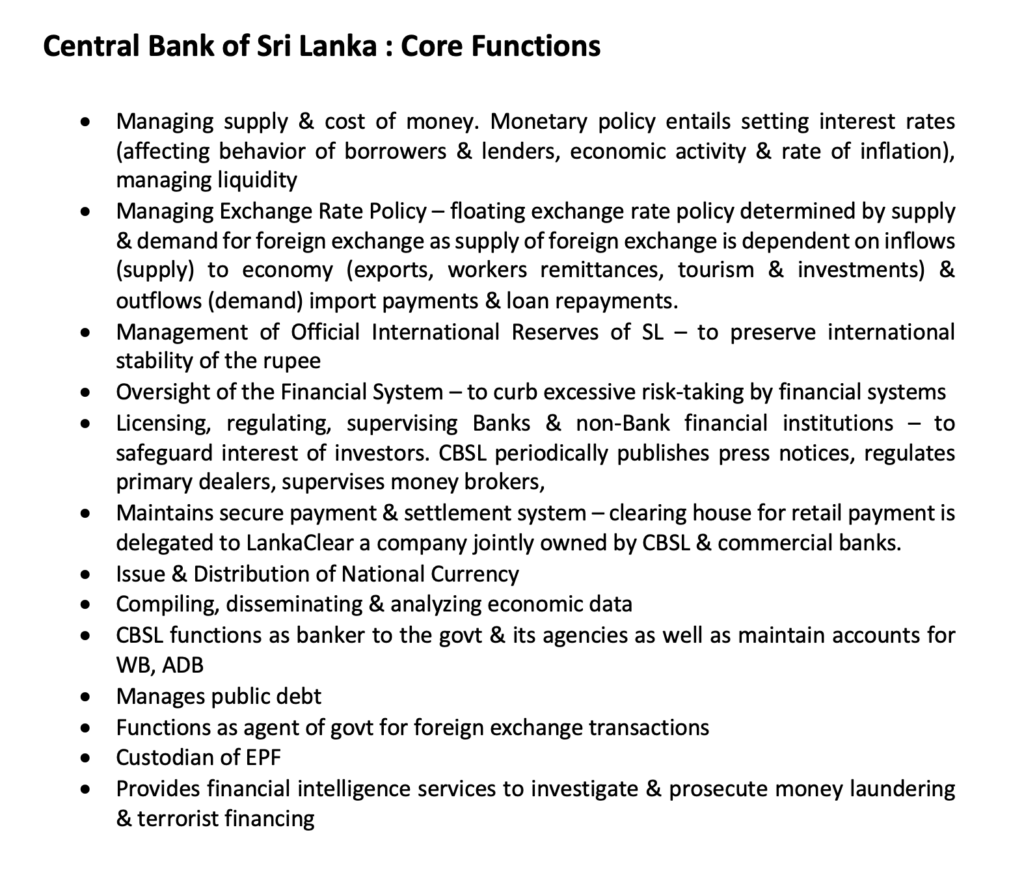
The Central Bank of Sri Lanka was established in 1950 as a semi-autonomous body & is governed by a 5 member Monetary Board. CBSL is the sole authority allowed to print currency (notes & coins) CBSL is the economic advisor and Banker of the Government of Sri Lanka.

Though CBSL was created after independence its first governor was a Britisher (John Exeter) who served from 1950-58. N U Jayawardena became the 1st Sri Lankan Governor in 1958. Ironically the 13thGovernor was also a foreigner by virtue of his passport and not being a dual citizen (A Mahendran)

The two main objectives of the CBSL is to maintain financial system stability & to maintain economic price stability.

The CBSL is a body staffed with over 2000 – all paid by the Sri Lankan taxpayer. Their salaries and remunerations far exceed that of normal public sector.

When international bodies infer local bodies have to be ‘independent’ they actually mean independent of the govt but dependent on these international bodies. This is the same format used when they refer & demand ‘independence’ for other local bodies.

Why are CBSL top management protecting their seats & disallowing room for inclusion of new private sector professionals (at least middle management) to pool in their ideas for the country?

Leaving aside what the international bodies demand – how far are the local entities like CBSL independent of influence by these international bodies. In other words do they listen to the dictates of the international bodies or do they function in the interest of those from whom they are given their salaries & perks?

If a local body paid by locals is more interested in pleasing the demands of external parties resulting in the demands of the external parties prevailing but given the notion that it is for local interest, do we need to have the taxpayer pay for such hypocritic advice? We may as well privatize this function as well – if the solutions being offered are not in the interest of the country. Why should locals have to pay for such?

Next we move on to another state entity – the Institute of Policy Studies (IPS) is supposed to be the premier economic think tank in Sri Lanka established by an Act of Parliament in 1988.

How far is the IPS ‘independent’ if since inception it has been collaborating with the Dutch govt?

IPS Chairman is a member of many foreign neoliberal think tanks funded by foreign governments to advance economic policies advantageous to them. How does that make IPS ‘independent’. The chairman was Senior Advisor to late Mangala Samaraweera in 2017 and was promoting the sale of state enterprises & proposing deceitful strategies to justify its sale.

This IPS Chairman proposed privatization of public utilities by first replacing Board members of the Public Utilities Commission with ‘independent’ directors implying foreign ones or locals doing the dirty work of the foreign parties.

How much of their ‘research’ is independent or funded by foreign govts or think tanks to be advantageous for their decision making. If research is not in Sri Lanka’s interest does the tax payer need to pay for such?

IPS former Board members have been Indrajit Coomaraswamy who proposed to take $12.5b international sovereign bonds as governor, Dr. Rajapathirana who was economic advisor to yahapalana President & was a member of the neoliberal think tank American Enterprise Institute, M Rafeek former secretary to Ministry of National Policies & Economic Affairs, S Mudalige DG National Planning Dept

Do we need a government think tank which is also funded by the Sri Lankan tax payer if they are collaborating with foreign think tanks & who funds IPS ‘endowment fund’?

How ‘autonomous’ is IPS when its donors are UK, US corporations, banks & equity funds like Bill Gates Foundation, or the govts of Norway, Canada, Netherlands?

IPS drafted VISION 2025 & organized the Sri Lanka Economic Forum in 2016 that invited George Soros the architect of ‘coloured revolutions’ to Sri Lanka. It was at this forum that Ricardo Hausmann of the Harvard Centre who had an office in the Yahapalana PM’s office & handled the land privatization Bill linked to the MCC Land project.

Do the tax payers need to fund govt created institutes that pretend to provide fiscal, agriculture & energy policy of Sri Lanka but are actually spying for external sources?

Why do we need to have a tax payer funded think tank if it is working in foreign interests. We may as well have them fund it openly & privatize this entity as well.

Shenali D Waduge

Should we privatize Sri Lanka’s State Owned Enterprises (SOE’s)

August 11th, 2022

Shenali D Waduge

In the name of development Sri Lanka has seen enormous changes. How far development was not planned considering the environment is seen by many environment-related catastrophes across the island. The geopolitical position of Sri Lanka impacts every issue Sri Lanka faces be it local or international. The efforts to control Sri Lanka by any other means & the modus operandi used has to be considered by the government – policy advisors especially the general public. In such a scenario, when local NGOs function as lobbyists for foreign governments canvassing conferences to ‘privatize state enterprises’ it means more than their desire to offer a service to the public. This is why it is important to look at privatization from the perspective of the objective that being transfer of power, goods & services held with a government into the control of private parties (local & foreign). How will this impact geopolitical, internal politics, governance & the people’s sovereignty!

The term privatization cannot mean to simply hand over a state asset to the private sector ignoring the associated outcomes & who would shoulder accountability over them. This is often an issue ignored & sidelined. Ex: privatizing a state asset to a foreign investor who puts profits before people may consider layoffs – when large numbers of people become jobless & without a livelihood – does a government have the power or means to take up their welfare? What happens thereafter?

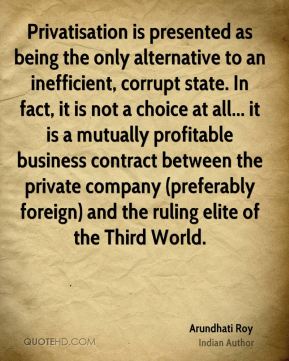
What is often untold is the ulterior motive behind the quest to privatize. The aim of privatization is to shift not only powers from public to private hands but shift public goods & services as well. The experiment with state-sovereignty appears to be slowly waning & with limited resources the preferred option appears to be to hand control of the limited resources to a limited group of people & away from public access. This ulterior motive is shrouded behind a well-funded campaign, no doubt with some truth that public sector is corrupt & full of waste. Other sugar-coated propaganda include: private sector is efficient & offers quality & greater customer satisfaction.

While part of that narrative is true, what is omitted is that it is the private sector that corrupts the public sector to create a notion that private sector is better than public sector.

Keep this thought in mind.

Globally governments have given management of public sector to private entities – electric utilities, prisons, railroads, telephones etc. Privatization is always on top of all economic agendas of developing nations & is a catalyst for international loans.

The initial euphoria over privatization has however waned and contrary to the quality & quantity service the private sector assured to provide, countries are seeing that what was affordable are becoming unaffordable to large segments of the population.

The crux of the issue is actually MANAGEMENT – thus whether it is private or public it does not matter, it is the MANAGEMENT of the resource that matters & if the resources are under Public, then the Govt must be made to manage it properly. Private sector are no magicians. Public sector can & should be able to provide a superior service without political interference & unnecessary bureaucracy. Removal of red-tape should not be to give private sector a carte blanche to do as they like.

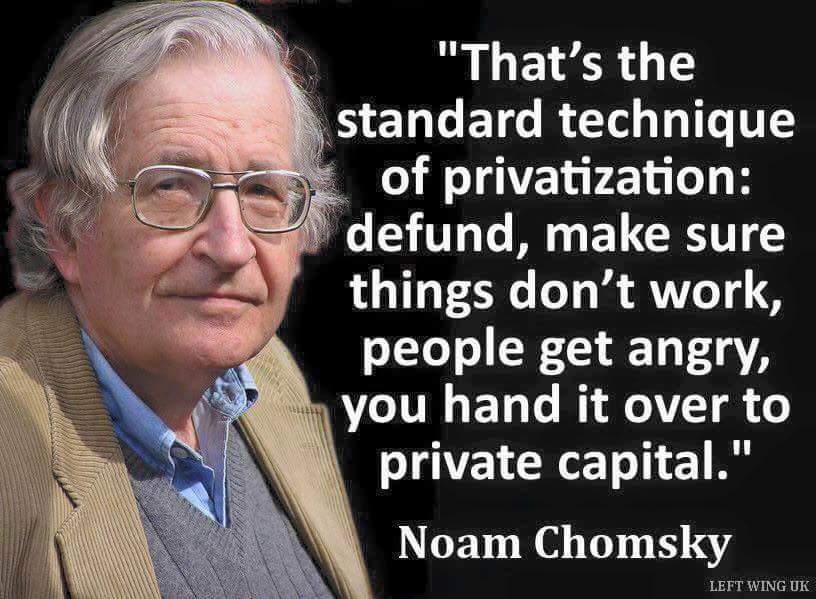
When it comes to privatization private entities are unlikely to compromise profits for public interest. The takeaway is that simply transferring from public to private will not necessarily reduce the cost or enhance the quality of service.

Privatization or the sale of public assets to private owners, put simply is the cessation of government programs, contracting out services that was previously by state organizations. Private producers enter markets under public monopolies & private own the monopoly. While state apparatus can be publicly influenced – public have no control once state assets fall into private hands. 

The other ignored fact is the need to consider fundamentals of privatization in the economy or its purpose.

In 1987 the Thatcher government sold British Airways, British Telecom & British Gas for $20b. What is the advantage to Britain today? UK’s privatization drive in the 1980s resulted in major social inequalities – creating a wider rich & poor gap.

Size also matters – privatization of entities with less employees as against privatization against entities that have large employees will definitely result in issues. What invariably happens is that when government workers begin to reduce, the power of the government also shrinks. When the government’s powers shrinks it subtly becomes irrelevant. This objective is aligned to the new emerging initiative of transferring national governance to corporate hands building the image that political framework is corrupt. Thus, we must view the present initiatives by local parties promoting privatization who are funded by foreign bodies using privatization as phase one of project to remove sovereign powers from the government to transnational companies. With companies interfering and corrupting governance & politicians for their deals, imagine the context when these very companies grab control of the assets?

Essentially simply transferring hands is not enough to make a difference. This is a key factor that people need to wake up to.

A few changes including non-interference by politicians together with monitoring mechanisms as well as remunerations based on targets are ways Public Sector can be motivated to do what privatization claims it can do. 

Exactly who wants to transfer ownership, property, business from the government to the private sector & why? To whose advantage is this transfer & who benefits?

What happens when the Govt ceases to be the owner of the state entity & its operations?

Privatization creates wealth – but for whom? Is it the country or is it the parties that own it?

What entities should the govt open up to competition that benefits the market & consumer?

Privatization becomes profitable because the owners want profits. Why stops the public sector adopting same mentality?

Why can’t the govt channel excess staff to more profit-oriented ventures given the need to raise Sri Lanka’s revenue. Foreign investors can be transferred these access public staff who would have to work with new targets & challenges.

Contrary to what is commonly promoted – private sector is more corrupt than public sector. Their corruptions are less transparent. Not many wish to highlight the private monopolies that emerge. Who regulates the monopoly power? The Government eventually has to intervene but at what cost? Once in private hands, is there price control? Flour monopoly of Sri Lanka is a good example. The prices are never reduced even on humanitarian grounds.

Privatizing essential services means the public has to pay as a taxpayer & for service offered. Look at your phone bill – the add on’s are far more than the calls you make!

Profits of the privatized state entity will be shared with shareholders not reinvested for public. Every additional service has a price.

The most undebated fact is that private companies are not accountable to the people. Individuals may take a company to court – but what is the price he/she has to pay for lawyers while the corporate lawyers have ways and means to win.

Companies are not subject to Freedom of Information – all agreements cover their confidentiality. What companies promise the government behind closed doors for contracts is never disclosed. Look at the private schools – how many were human enough to consider the financial status of parents unable to afford school fees. Imagine if all schools were privatized – how many of the poor would have to give up schooling because their parents could not pay their fees. Transport is another sector, privatization of public transport means the private bus operators dictate the price and decide to ply or not if price hikes are refused. They can also cherry pick busy areas that provide bigger profits & reduce areas where profits are few. In such a scenario where does that leave the general public?

Private monopolies are worse than state monopolies in particular when all essentials fall under private control. The power as a citizen is rarely democratically available. This is an area that people must give thought to prior to parroting privatization simply because of their anger with politicians.

While people can hold a government accountable, the same cannot be said of multiple private companies foreign & local who are tasked to deliver public services. In such a scenario it creates a fragmented system where people end up having to ‘grin & bear’ what they had opted for.

The ethics of private companies can also be factored in via the manner outsourcing contract companies demand huge amounts for any changes or improvements requested by the government. These extras are all piled on the public. Lands that are privatized often end up exclusive zones out of bounds for public. This with time limits the freedom that public have to move in their own land of birth. Let us also not forget how failed private companies end up footing the bill on the public to get back on its feet.

These are some areas that people need to consider without getting caught to the bandwagon that are paid by their foreign funding bodies to promote privatization of Sri Lanka.

Shenali D Waduge

Beware of ‘Human Rights’ mercenaries 

August 11th, 2022

Senaka Weeraratna

‘Human Rights’ mercenaries are those who unceasingly vilify the ethnic majority until almost the last pound of flesh is extracted, and are constantly promoting the anti-majoritarian propaganda rhetoric of Multi-Culturalism, Secularism, Reconciliation, and whatnot, and now the Division of the country on Ethnic and Religious lines.

The greatest victory in recent times was achieved by the Security Forces on the battlefield after a huge sacrifice of life and limb by the heroic soldiers. About 30, 000 personnel from the security forces perished.  

It must be noted that when the Allies beat Germany and Japan in 1945, they (the allies) engaged in a full-scale de – Nazification programme and established War Crimes Tribunals to try the leaders of the two defeated countries.

In Sri Lanka, the reverse happened. The winner was placed in the dock for alleged war crimes while the defeated Terrorists, with blood-stained hands for ruthlessly killing innocent civilians in several incidents of mass murder, were hailed as liberators and victims by the international community.

When the Western colonial countries started invading countries outside Europe they found that the greatest resistance to their plans for conquest came from people who they described as savages, for example, the ethnic majority i.e. Sinhala Buddhists, Hindus (in INDIA), Burmese in Burma, Malays in Indonesia, etc. 

In order to overcome the stiff resistance from the locals, they used propaganda both from outside and assistance from within i.e., local collaborators.

An Englishman calls the Sinhalese ‘ a very highly civilized race ‘

Sinhala Buddhists are one of the most demonized ethnic groups in South Asia, despite their tolerance of other races and religions.

The following is an account written by an Englishman named Campbell in 1932, on his trip to Australia from Ceylon, accompanying a group of about 500 (largely Sinhalese), on the ship SS Devonshire, in 1882:

” The Cingalese were a very highly civilised race…. They have deep pride of the Island’s  historical and spiritual continuity.   They burn with enthusiasm in their religious devotion and live up to it.. they are a race of  primitive simplicity, know no malice,  are hospitable, peaceful and cheerful  minded.  The rich  Cingalese  in Ceylon can say as Job said I was eyes to the blind and feet was I to the lame; I was father to the poor, and the cause which I knew not I searched out

Every traveller to Ceylon cannot help but notice the friendliness of the natives; everything looks clean and bright  as if to  show off before strangers that they felt it was good to be alive…They have  left their footsteps in sands of time over a century as loyal British  subjects.

Over 50 years ago,  the  hymn from Greenland’s icy mountains was composed by Bishop Heber, the suffragan bishop of Madras, India, after paying a short visit to Colombo.  The hymn contains the two following lines: ”Where every prospect pleaseth, but only man is vile”  As a matter of fact, the native of Ceylon was never vile” to any one, in any way.  It is a subject on which extreme exaggerations have prevailed.  It is an obvious criticism that if they were as bad as some writers imagined they never could have subsisted if this view of their human nature had been a just one.  Ceylon would have been like a cage full of wild beasts, and the inhabitants would have soon perished in constant internecine war.  

Vile” was in the spirit of poetry” in rhythm with Isle” but lacked the spirit of truth and piety”.  Evangelists use the hymn in their so-called missionary services and Sunday Schools composed of white people in the fervent hope it will give nourishment to the spiritual life of those who sing it and enlarge the collection of the Almighty Dollar”.  

According to the most recent statistics there are no fewer than 187 sects of Christians, and they all more or less, bear very strange names.  Some must flout the Bible in their numerous complex faiths. Some make a religious taboo of the Lord’s Supper, some of infant baptism, some of mixed marriages, and they are all  antagonistic  to each other theologically and overlap each other with churches, therefore the heathen in his blindness” is not safe getting into theological holts with their would-be saviours.”

See

Memoirs of a Pioneer – 50 years ago

http://www.worldgenweb.org/lkawgw/acampbell.html

Senaka 

Sri Lanka: Lest we forget, not Gotabhaya Rajapaksa, but the political system failed the country

August 11th, 2022

By Raj Gonsalkorale

Gotabhaya Rajapaksa made mistakes as President. However, he should not be treated like a Pariah. There are other opportunists riding the wave of discontentment, who should wear the hat of a Pariah before Gotabhaya.

Gotabhaya Rajapaksa made mistakes as the President of the country, and grave ones at that too. Some of his decisions were ill timed and ill informed. Some decisions he should have taken, were not taken. The country is witnessing the aftermath of these decisions and non-decisions.

However, he cannot be held solely responsible for the disastrous economic situation in the country. He did inherit a nation in debt and low GDP growth. His predecessors too are at fault for the economic policies they followed. One of them has now become a pontificator of good governance although he did not even offer an apology to the country and to the families of hundreds who died a preventable death, let alone taking responsibility for a major security lapse that he, as President and Defense minister, should have taken responsibility for. That President, along with the current President who was then the Prime Minister, presided over a decline in economic growth from around 7% to 2.7% during their tenure, and a rise in foreign debt from 70% of GDP, which itself was a very high figure, to 96% of GDP at the end of their tenure.

Many in Sri Lanka have now become experts in politics, economics, budget management, and you name it, virtually everything and anything. Mostly with the benefit of hindsight. Some of these expert voices were not heard when the country progressively hurtled down the path of unsustainable debt. There was no sign of an Aragalaya then, although the issues that were brought to the forefront by the various shades of Aragalaya, were there then, as they are there now.

Not many questioned the unaffordable availability of luxury consumables, all imported with borrowed money. Not many complained about the avalanche of vehicles imports. Not many seemed to mind the loss-making State enterprises like Sri Lankan Airlines and the Petroleum Corporation, as long as the planes flew, and subsidized fuel was provided in abundance. There weren’t many who voiced concern about the huge amounts spent to provide subsidized inorganic fertilizer. All these were funded with debt, foreign and local.

It is not one leader, whether in politics or business or academia, or in civic society, who failed the country. It was a collective failing on the part of many. It is the political system, the governance system, and the leaders it produced that failed the country.

In this context, it is unworthy of Sri Lanka to label Gotabhaya Rajapaksa as the sole villain who allowed the country to fall into the abyss it has fallen. While other contributors roam free, some, somewhat disgraced, others have risen as saviors.

In this context, it is a sad reflection on the part of Sri Lankans in particular the media, to provide headline grabbing news items portraying the former President as having nowhere to go. Gotabhaya Rajapaksa must come back to Sri Lanka and be afforded the security and facilities that an ex-President of the country is entitled to. If as alleged, he has committed other misdemeanors, whoever who is accusing him of such misdemeanors should take legal action and Gotabhaya Rajapaksa should face the court decisions. However, he is innocent until he is proven guilty, and it is an insult to Sri Lanka and all Sri Lankans if he cannot return to the country and be protected as a former President.

He should be afforded the opportunity to provide his own defense against accusations of misuse of power, mismanagement, and any other misdemeanors.

Many seem to have short memories. They have forgotten that the country is free of terrorism and a separatist war thanks to the contribution made by Gotabhaya Rajapaksa to end terrorism and war. His task was a Military one, which he achieved. Others had the task of introducing peace and reconciliation, and they were not able to achieve that lasting peace amongst the communities.

There is no question that family politics and all the negatives that come with power drunkenness reached its zenith with the Rajapaksa political family. The people and the system allowed this to happen.  It is time that all Sri Lankans questioned the political system that has prevailed since independence, and perhaps find answers to some questions and find the way forward.

1. Have the constitutions that the country has had so far, including the current one with its amendments, been beneficial to the country and its progress, economically and socially.

2. Economically, the country is nearly bankrupt with debt levels suffocating it, with income streams severely impacted due to COVID. Do the readers think this situation is only account of COVID? If not what else?

3. Socially, minority issues, especially aspirational issues, equality and equity, women’s rights, language issues, accountability issues, corruption, unethical conduct, etc., etc., still beset the country. Is it the constitution that is at fault or the politicians which the constitution produces?

4. In reality, while one can boast that people, through their representatives, decide on policies that successive governments have introduced, is this so or is it a fallacy? Except at the time of casting their votes, at what point till the next election do people participate in policy determination? Even during elections, do people really discuss, debate, and decide on policies contained in manifesto’s or are they purely looking for some immediate benefit from one side or another?

5. Do people have a choice in who is standing for elections from a political party?

6. Are political parties democratic and is there a people-oriented process to elect their leaders?

7. Does the system in place facilitate the effective participation of experts in economics, business, agriculture, health, education, fisheries, and other key areas of the economy in policy formulation, or is this process limited to a few yes” men and women who say what politicians wish to hear?

8. The cost of conducting elections is very high, with the last Presidential Election costing around Rs. 5 billion and the General Election around Rs. 10 billion. To this cost one has to add what candidates and their supporters spend on elections. The issue is not necessarily the overall cost, but whether there has been a justifiable return to the country on the investment made because of the elections, and whether the return has been more for the candidates and their sponsors. 

9. Buddhism, as defined more and more by the Buddhist institution from cultural practices rather than by the doctrinal practices introduced by Buddha, has been given pride pf place in the constitutions while other religions have been more or less accommodated” in them. One should ask whether societal values, ethical behaviour on the part of the people as well as the elected leaders, and indeed on the part of some members of the Buddhist institution have progressed to towards the Buddha’s doctrinal teachings. The question to be asked is whether the State should be secular, and all religions treated equally, and their role limited essentially for spiritual practices as per their respective religions.

10.Finally, while there would be many more questions that are bound to posted, challenges to what has been stated here, the objective behind posing these questions is for one to contemplate whether, despite whatever achievements of the past, the coming generations will be served well in years to come with a constitution more or less in the same vein and only cosmetically changed, or whether it is time to think outside the box as it were, and consider a constitution that will produce better outcomes rather than what 70 years of independence has delivered to Sri Lankans, then and now.

The author posed these questions in an article titled Contours for a new constitution with a difference, for the future, not the past” (https://www.ft.lk/columns/Contours-for-a-new-constitution-with-a-difference-for-the-future-not-the-past/4-723830)

REINTRODUCING THE SIX YEARS PROGRAM OF INVESTMENT (1955-1960)

August 11th, 2022

BY EDWARD THEOPHILUS

I read content in many publications that Sri Lanka has an economic crisis (2022) that is unimaginable to the government’s economic advisors what should do to get out of the problem. If the government economic advisors knew about this situation before 2022, why didn’t they educate the policymaking process of the country?  

Sri Lanka had various economic plans and the most successful plan that contained the best policies was the Six Years Program of Investments (1954-1960) by the Planning Secretariat of the government of Mr Sir John Katalawela. This program was not implemented as a result of electing a socialist government in 1956 and I believe that the most successful development policy program was the plan, the Six Years Program of Investment. The main purpose of the program was economic diversification, import substitution and mobilization of domestic savings. The policy direction of the Six Year Program of Investment considered three main criteria when approving economic projects in the country.

  • Use of Human and National Resources. This policy direction was a broader expectation as the national resources of the country was limited and human resources had good control, the total population was less than 12 million and the government was in a situation to employ all members in the public and private sectors.
  • Considering the economic feasibility of a particular venture, which was a broader area
  • Policy design to help the private sector. The government had not developed policies for this purpose and the government would have been concerned about the behaviour of trade unions

The third criterion is designed to promote more private own economic entities to compose economic dynamism in the country.

What was the reason to ignore this investment program? Nobody can give a successful answer, but if this program had been implemented, Sri Lanka would have been promoted to a developed nation at the end of 1960 and my honest feeling is the program must reintroduce and economic recovery should achieve through this investment program.

The Six Years Program of Investments anticipated implementing the following effective additional policy actions to broaden the ownership of public and private investments.

  • Establishment of government-sponsored corporations under act 19 of 1955. In terms of this act, many public corporations have been established with low capital and they became white elephants by mismanagement.
  • The transfer of Government enterprises to the private sector in three stages (a) the government business undertakings will be transferred to the corporation with capital provided by the government. (b) the sale of government shares to private sectors and finally the government holds less than 20% of share capital (c) establishment of public companies under the company law act.

The vision of the Six Years Investment program focused on the privatization of economic activities management by giving stimulus for new private investments and selling more than 20% of shares in government business enterprises to the public. It could be called public offerings as implemented in the 1990 decade in Western countries. 

The reintroduction of the Six Years Investment program requires to get economic recovery than conducting an unproductive ARAGALAYA.

Marching ahead with the spirit of Swatantra Bharat

August 11th, 2022

by Nava Thakuria

It was probably two decades back, when a group of journalists and Guwahati-based patriots marched on a street of Guwahati to celebrate the Independence Day. As a number of separatist armed militant outfits imposed a general strike on the day (that was the way the ethnic insurgents made them visible in the public domain continuing their decades long armed struggle against New Delhi) the entire city wore a deserted look. Markets, business centers, private vehicles and even the roads were empty as the militants, through their media statements (which were published with special focus in the local morning newspapers), threatened the people not to join the observation.

The group raising a single national flag (Tri-colours were unavailable at that time in the  market and even the people did not keep the flag in residences as it was then assumed as a volatile article to procure from any sources) marched from Ambari to the bank of historic Dighalipukhuri. A photojournalist took a snap of the march and it was then sent to a Delhi-based editor for use. The editor, who might have had no idea of the then trouble-torn northeast India, asked a strange question, why there was so little number of participants in the march.

In reality, the editor missed the valid point that the small group of people came to the street defying the diktat of armed militants, who were trying to run a parallel administration in the alienated region.

One may raise an intriguing question, were the editors of Assam sensitive and responsible enough. The newspapers (private news channels were yet to fully bloom in the region) in Guwahati probably were sensitive but not responsible. Prior to  I-Day or Republic Day, as if the editor (or concerned reporters) were eagerly waiting for the statement from separatist militants boycotting the auspicious days. It always made newspaper headlines, but when the brave and patriotic citizens tried to raise voices against the militants’ diktat, the same editors behaved as unwanted items. So when the small group of patriots started observing the sacred days by hoisting & unfurling the Tri-colour, most of the editors either avoided the news or gave it an insignificant space.

The situation did not improve, even when the Assamese satellite news channels entered into the scenario after some years. Rather they started often misrepresenting and disrespecting the spirit. As usual, the news channels repeated the militant’s version ‘why celebration of I-Day and R-Day was useless’ prior to both the revered occasions. Many news channels later made it possible for some top militant leaders to address their audience ‘live’. The reporters, equipped with high resolution cameras, callously asked the students what were their programs on I-Day and R-Day (as those were simple holidays because of the militant’s imposed total shut down), but they did not simply remember that one Assamese young girl sacrificed her life for the same Tri-colour. The reporters (from both the print and electronic media) and their editors hardly formulate a simple question to those young people, had they not heard of  Birbala Kanaklata!

For some times, it was a large number of outlawed militant outfits including United Liberation Front of Assam, National Democratic Front of Bodoland, Kamtapur Liberation Organisation, Manipur People’s Liberation Front, Kanglei Yaol Kanna Lup, Kangleipak Communist Party, People’s Revolutionary Party of Kangleipak, People’s Revolutionary Party of Kangleipak/Progressive, Revolutionary People’s Front, United People’s Party of Kangleipak, United National Liberation Front of Manipur, Tripura People’s Democratic Front, National Liberation Front of Twipra, Hynniewtrep National Liberation Front of Meghalaya, Garo National Liberation Army, etc which declared the general strike across northeast India on both the national days on 15 August and 26 January and called upon the people to boycott as well as prevent the celebration as a mark of solidarity against New Delhi.

But braving the gun-toting militants and their threats, Journalists’

Forum Assam (JFA) appealed to the north-eastern  people to celebrate both the days defying the militants’ decree. JFA argued that a number of martyrs from Assam including Piyali Phukan, Maniram Dewan, Piyali Barua, etc stepped up movements against British domination.

Extraordinarily brave Kanaklata Barua, Mukunda Kakoti, Kushal Konwar, Tilak Deka, Bhogeswari Phukanani, Nidhanu Rajbangshi, Kamala Miri, Lerela Boro, Madan Barman, Rauta Kachari, Hemoram Patar, Gunavi Bordoloi, Thagi Sut, Balaram Sut, etc laid down their lives for the honour of Tri-colour. JFA president Rupam Barua, who conceptualized the model to oppose the rebel’s diktats, asserted that  Tri-colour  is the symbol of our common strength. If we ignore the sacrifice of martyrs it would only indicate our ungratefulness to them. Once started with a small group of journalists (including this writer), the celebration at the city-based press club premises slowly attracted more like-minded fellow Guwahatians, including many children, to join in the occasion (simultaneously with the government celebrations), where the Tri-colour continues to be hoisted and participants taken out the processions raising the flags in hands with fanfare.

Veteran author-journalists Dhirendra Nath Bezboruah, Dhirendra Nath Chakravarty, Naresh Rajkhowa, Nirupoma Borgohain , Kanaksen Deka, MS Prabhakar, Sabita Goswami, Preeti Barua, Bhabani Goswami, etc took the lead and senior scribes  Hiten Mahanta, Ranen Kumar Goswami, Ajit Patowary, Premadhar Sarma, Geetartha Pathak, Champak Borbora, Mukul Kalita, MK Goswami, Bhupen Bargohain, Sabita Lahkar, Rubie Barua Das, Raman Bora, Bijay Bora, Anup Sarma, DN Singh, Pranabjit Doloi, Dipen Bayan,  Kamal Krishna Das,  Girindra Kumar Karjee, Sanjay Paul, Munin Bayan, Prasanta Majumder, Kumud Das, Pabitra Deka, Sandip Sarma, Anjanil Kashyap, Dipankar Devsarma, Anirban Choudhury, Biswajit Nath, Samir Sandilya, Nayan Bhuyan, Paranjoy Bordoloi, Hiren Chandra Kalita, Kiran Mukherjee, Prabhat Sarma, Manjit Sarma, Chandra Barua, Digambar Patowary, Dixit Sarma, Sujit Guha, Manish Goswami,  Bhupen Goswami, Manoj Agasti, Pulin Kalita, Bipul Sarma, Nayan Pratim Kumar, Rajeev Bhattacharyya, Biman Hazarika, Mihir Deuri, Pankaj Deka, Partha Goswami, Atulya Madhab Goswami, Pallabi Bora, Devol Nath, Kumarjeet Sarma, Chinmoi Roy, Baldev Pandey, Dilwar Hussain, Rupen Sarma, Anita Kalita Goswami, Newaprasad Yadab, Bikas Singh, Mamata Mishra, Jesim Raja, Sewali Kalita, Iswar Mahanta, Chandra Kr Barua, Nripen Rajbongshi, Akhyamala Thakuria, etc  joined in the mission.

Patriotic and courageous citizens like Ajay Dutta, Nirmal Choudhury, Dhiren Barua, Jagadindra Raychoudhury, JP Saikia, Jaharlal Saha, Uttam Barthakur, Kishor Giri, Dibas Phukan, Jeemoni Choudhury, Kailash Sarma, Mrinal Ali Hazarika,  Pradip Thakuria, Ujjal Saikia, Ranjan Dutta, Apurba Sarma, Pramod Kalita, Basistha Bujarbaruah, Khagen Saikia, Sankar Das, Jogeswar Goswami, Ranjib Sarma, Abhijit Sarma, Bitu Talukder, Sanjib Puri, Utpal Dutta, Namrata Dutta, Pranab Sarma, Basanta Barthakur, Nabanita Mazumdar, Bhaskar Medhi, Ravi Ajitacharya, Anjali Kumar, Utpal Das, Purabi Barua, Rubi Barthakur, Md Farid, Nekib Kazi,  BR Das, Hydar Bora, Chandana Doloi, Tarali Chakrabarty, Purabi Gogoi, Mrinmoy Bhuyan, Jayanta Gogoi, Azlina Khanam, Kuntala Chakrabarty, Kartik Choudhury, etc also energised the mission paying homage to those freedom fighters who fought against the colonial British forces during the freedom movement.

But gone are those days. Now everyone (or majority of in the society) prefers to celebrate both  the auspicious days with utmost conviction to pay tributes to hundreds of thousands of known & unknown martyrs who laid their lives for a sovereign nation. The ethnic insurgents have lost their support bases in the last few years and their mentors in the media have also disappeared, thanks to the aggressive social media outbursts against those self-centered intellectuals in the recent past. As we are observing the 75 years of India’s independence and the forthcoming I-Day is going to witness millions of  Tri-colours hoisted across Bharat, the small group of Guwahatians today deserve appreciations as their dream has turned into reality and hundred thousand proud residents in the alienated north-eastern region are also eagerly waiting to salute the Tri-colour and pay heartfelt admiration to the martyrs.

The author is a Guwahati-based journalist and a vivid appreciator of Tri-colour, who along with a section of working journalists once faced the wrath from separatist militants

POHOTTU AS USA’ S PROXY Part 8Lb

August 11th, 2022

KAMALIKA PIERIS

JVP ragging in the University started in the 1970s. G.R.Morrel recalls that at University of Kelaniya where he taught as an instructor in the late 70’s, the Students’ Council was in the hands of the JVP.   They ran the campus mainly through intimidation.

New students were ragged mercilessly, and staff members who opposed the ragging were  threatened. in 1974 A group of  young mathematics teachers who were admitted to campus for a diploma course were dragged to the dark basement of the Science faculty and brutalized. Ragging is too polite a word for the violence that was enacted.

 JVP took over the Inter University Student Federation (IUSF) in 1976. The home page of the IUSF says the Inter-University Student Union was created by the student unions in the state University which delivered free education says IUSF in its website. IUSF has three objectives it said ,fighting unconditionally for solving the problems of the oppressed people in the existing socio-economic system, fighting unconditionally to secure the right to free education and fighting for the solution of academic and welfare problems in universities.

I am unable to find any instance where the IUSF has worked for the betterment of the university or society. IUSF  is   known as an aggressive  organization which organizes public demonstrations and sit ins. IUSF also is  considered to be behind the murderous ragging going on Sri Lanka‘s universities .

In 2002 IUSF   was accused of the murder of Samantha Vithanage, a third year Management student of the University of Sri Jayewardenepura, who pioneered an anti-ragging campaign in the university. Samantha was killed on November 7, 2002 while in a discussion to stop the brutal practice of ragging in the faculty.

Samantha was the leader of a group of students opposing ragging at University of Sri Jayewardenepura while General Students Union (Progressive Front),   the dominant student group      supported ragging.

On November 7, 2002, the anti-ragging campaigners sat down for a discussion with General Students Union. The meeting took place in the University in the Department of Marketing Management. Midway through the discussion, a mob of around 200 strong supporters of the JVP, armed with clubs and stones stormed into the room and viciously attacked Vithanage and others in the anti-ragging camp. President of the General Students Union smashed a heavy computer monitor on his head. Vithanage was seriously injured.

When Samantha was about to be transported to the hospital, the pro-ragging students blocked the vehicle carrying the injured to the hospital, delaying proper medical treatment. The first hour of any seriously injured person is called ‘the golden hour’ by doctors because the first hour decides whether the seriously injured person lives or dies. That is why such victims need to be hospitalized as soon as possible. Two days later Samantha Vithanage died. After 20 years, in 2022, 7 out of the initially accused 22 individuals were sentenced to prison and fines.

In 2017, fifteen second-year students attached to the Agriculture Faculty of the University of Peradeniya had taken a group of first year students to a partially constructed house in Megoda, Kalugamuwa on the Galaha Road to be ragged. The house was rented out by the students paying Rs.30, 000 as rent for a three month period,  saying they were a group of architects on field assignments.

The seniors transported groups of first year students from time to time, to this house. Anyone has to pass my home to reach the rented house but the boys had used another path to smuggle the fresher’s to the house,” the landlord said.

We had information that inhuman ragging was taking place in rented houses outside the university .We were waiting for a tip off, to apprehend the offenders, university authorities said. The team was aware of the repercussions if the students were injured in the operation.  They took extra measures to ensure their safety.

As we approached the house, we could hear some boys shouting in filth. We saw two naked boys doing bunny leaps, with an onlooker using a club to threaten them if they paused. There were screams from another room, as if more boys were being tortured. All eight freshers had been stripped naked.  Some freshers had their body hair removed. These eight were later hospitalized as a result of the ragging. The raggers were arrested by the police.

The university authorities thought that it was the third year students who were behind this incident. Second year students had carried out the instructions. They obeyed out of fear. However, Inter University Student Federation issued a statement saying they had no involvement in this incident.

Within the university premises there is no way of ragging students. There are counsellors, proctors, deputy proctors, and the staff who are all vigilant and therefore they can’t rag students within the premises,” he said.  This is why they have taken a new initiative to go somewhere else, away from the university,  the authorties said.

University of Peradeniya has taken strong action on this incident. Prof. Upul Dissanayake, the Vice Chancellor of the Peradeniya University said the suspects would  either be suspended or expelled after the incident was inquired into. At the moment the suspects are in remand custody. They will be charged under the Anti-ragging Act. We have suspended the fifteen students indefinitely. In the meantime we are appointing an inquiry board and we will conduct a proper inquiry at the end of which they will be punished according to the offence. They will be either suspended or expelled,” he said.  He added that there were videos and photos of the physical rag that took place.

We have asked second year students of the Faculty of Agriculture not to come to the university. We have made them out of bounds because of this particular incident,” he added.  

මධ්‍යම සංස්කෘතික අරමුදලේ හෙට දවස වෙනුවෙන්

August 11th, 2022

මාධ්‍ය නිවේදනය මධ්‍යම සංස්කෘතික අරමුදලේ සේවක සංගමය

දිනය – 2022අගෝස්තු11

1980 අංක 57 දරන මධ්‍යම සංස්කෘතික අරමුදල පණත මගින් සංස්කෘතික ත‍්‍රිකෝණ යෝජනා ක‍්‍රමය යටතේ ශ‍්‍රී ලාංකේය අතීත ශ‍්‍රී විභූතිය අනාගත පරපුරට සුරක්ෂා කරනු පිණිස අනූපමේය සේවයක් ඉටුකළ මධ්‍යම සංස්කෘතික අරමුදලේ වර්තමානය ඉතා ඛේදජනක තත්ත්වයකට පත්ව ඇත. ශ‍්‍රී ලාංකික ජනතාවට දැවැන්ත ප‍්‍රතිලාභ රැුසක් ලබාදෙමින් අතීතයේ ආදි කර්තෘන් සිදුකළ මෙහෙය අලූයම ලූ කෙළ පිඩක් සේ බැහැර කර තම සුරතලූන්ගේ සුඛවිහරණය උදෙසා අත්තනෝමතික තීන්දු තීරණ ගනිමින් පාලක මණ්ඩලය ද නොමග යවමින් සිටී.
දශක එක හමාරක පමණ කාලයක සිට ප‍්‍රතිපත්තිමය රාමුවකට නතුවෙමින් දෛනික පැවැත්ම තකා අවස්ථාවාදී දේශපාලන උවමනාවන් මුදුන්පත් කර ගැනීමට උත්සුක වීමෙන් ආයතනය දැවැන්ත මූල්‍ය අර්බුදයකට ලක් ව ඇත. එකී මූල්‍ය අර්බුදය සමස්ත සේවක ප‍්‍රජාව වෙත පීඩනය මුදා හරිමින් දැනුදු ඉහළ කලමනාකරණයට අත දිගහැර බෙදමින් සිටී. මෙම ව්‍යසනකාරීත්වයට එරෙහි ව සේවක ප‍්‍රජාව විරෝධතා දැක්වුව ද මුනිවත රැුකීමට පාලනාධිකාරිය වගබලාගෙන ඇත.
ලංකාවේ ඇති සංස්කෘතික උරුමස්ථාන දේශීය විදේශීය සංචාරකයාට ප‍්‍රදර්ශනය කරමින් ලබාගන්නා ආදායම රටේ සමස්ත සංස්කෘතික උරුම සංරක්ෂණය හා කලමනාකරණය කරගැනීමට යොදාගන්නවා වෙනුවට තවදුරටත් දේශපාලන හෙන්චයියන් සතුටු කරමින් වරදාන වරප‍්‍රසාද ලබාදෙමින් සිටී. සංවර්ධන කාර්යයන් සදහා මූල්‍ය ප‍්‍රතිපාදන ලබානොදෙමින් ද සේවක ප‍්‍රජාවගේ සමස්ත අයිතිවාසිකම් කප්පාදු කරමින් ද සිටී. දිගු කාලයක සිට සේවක ප‍්‍රජාව නිසි උසස්වීම් ක‍්‍රමයකට හෝ ශ්‍රේණිගත කිරීමකට ලක් කිරීමට හෝ අපොහොසත් වූ ආයතනය බදවාගැනීම් පරිපාටි සැකසීමකට කලින් කලට විවිධ කමිටු පත්කරමින් සිටී. ඒ සදහා වැය වන මුදල් පිළිබද වගකිවයුත්තෙක් ද නැත. අනුමත බදවාගැනීමේ පරිපාටියට පරිබාහිර ව බදවාගත්, ආයතනයට කිසි`දු වටිනාකමක් හෝ ධනාත්මක සේවයක් නො සපයන අධ්‍යක්ෂ මණ්ඩලයක් නඩත්තු කරමින් මහල්ලන් පෝෂණය කිරීමේ අරමුදලක් බවට පත්කරගෙන තිබේ. 1982 වසරේ සිට ජාතික සහ ජාත්‍යන්තර වශයෙන් ඇගැයීමට ලක් වූ සංස්කෘතිකමය වශයෙන් දැවැන්ත කාර්යභාරයක් සිදුකරමින් ස්ථානගත වූ බෞද්ධාලෝක මාවතේ 212 ප‍්‍රධාන කාර්යාලය සංවර්ධනය පසෙක ලා කුලී පදනමින් විවිධ ස්ථානවල කාර්යාල පහසුකම් පවත්වාගෙන යමින් තිබේ. කොන්ත‍්‍රාත් පදනමින් ඉහළ කලමනාකරණයේ තනතුරු පුරවා ඇති සමයක ආයතනයක් අගාධයට යෑම වැලැක්විය නොහැකි තත්ත්වයක් බව අමුතුවෙන් කිවයුතු නොවේ.
මෙකී අනීතික හා අත්තනෝමතික තීරණයකට එරෙහිවන්නන් දඩයම් කරමින් ඔවුන්ගේ සුපුරුදු උද්දච්ච තීන්දු ක‍්‍රියාත්මක කරමින් සිටී. මේ සම්බන්ධයෙන් යුක්තිය හා සාධාරණත්වය අපේක්ෂා කරමින් මෙම මාධ්‍ය නිවේදනය නිකුත් කරමු.

Scarred Communities- Psychosocial Impact of Disasters on Sri Lankan Society

August 11th, 2022

Dr Ruwan M Jayatunge M.D.

මහාචාර්ය දයා සෝමසුන්දරම් ඇතුළු වෛද්‍ය රුවන් එම් ජයතුංග, ආචාර්ය ගැමිලා සමරසිංහ (කොලඹ විශ්ව විද්‍යාලය), ආනන්ද ගලප්පත්තිටී. විජයසංගර් සහ ඇන්ඩෘ කීෆ් විසින් ලියන ලද “Scarred Communities” ග්‍රන්ථය මුද්‍රණද්වාරයෙන් එළි දක්වා තිබේ. මෙම ග්‍රන්ථය මගින් ශ්‍රී ලාංකික සමාජය විසින් මුහුණ දුන් ස්වභාවික ආපදා සහ යුදමය මෙන්ම තරුණ කැරලි නිසා හටගත් මනෝ සමාජයීය හානි පිලිබඳව විශ්ලේෂණය කරයි. මානව සමාජයක් විසින් මුහුණ දෙන ව්‍යසනයන් සහ ඉන් සිදුවන කෙටි කාලීන සහ දීර්ඝ කාලීන හානි පිලිබඳව විස්තර කෙරෙන Scarred Communities, එම හානි අවම කර ගැනීම සඳහා කල යුතු මනෝ සමාජයීය ක්‍රියා මාර්ග පිලිබඳව ද පාඨකයා දැනුවත් කරයි. දමිළ සහ සිංහල විද්වතුන් කණ්ඩායමක් විසින් වාර්ගික අගතියෙන් තොරව ලියන ලද මෙම පොත මනෝ විද්‍යාව, සමාජ විද්‍යාව, අපදා කළමනාකරණය යන විෂයයන් කෙරෙහි උනන්දුවක් දක්වන්නන්ට මෙන්ම සාමාන්‍ය පාඨකයාට ද සුදුසු කෘතියකි.

Publisher- SAGE PublicationsLanguage- English

Scarred Communities is a qualitative, psycho-ecological study of the long-term effects of disasters—both manmade and natural—on Sri Lankan communities. The book studies the effects of war and the 2004 tsunami on families and communities. The concept of collective trauma is introduced to provide a framework in understanding how basic social processes, relationships and networks change due to these disasters.

The methodology employed is a naturalistic, psychosocial ethnography of northern Sri Lanka, drawing from the author’s participation in psychosocial and community mental health programmes among the Tamil community. Participatory observation, key informant interviews and focus-group discussions with rehabilitation workers and officials were used to gather data.

The author also analyses the various causes of modern civil war, ethnic consciousness, terror and counter-insurgency operations and their consequences on people. Though the study revolves around Sri Lanka, the phenomenon of collective trauma has an international relevance for communities across the globe caught in civil and ethnic strife.

This book is a sequel to Scarred Minds (SAGE, 1998), which deals with the effects of chronic civil war on individuals.

චීන නැවේ ප‍්‍රශ්ණයන් IMF ණය ඇණහිටීවි.. ශ‍්‍රී ලංකාව අන්ත දුක්ඛිත විය හැකියි..- Economic Times

August 11th, 2022

 lanka C news

චීනයේ Yuan Wang 5 නෞකාව හම්බන්තොට වරායට පැමිණීමට එරෙහිව කටයුතු කිරීම මගින් ශ්‍රී ලංකාව ජාත්‍යන්තර මුල්‍ය අරමුදලෙන් බලාපොරොත්තු ණය මුදල ලබා ගැනීමේ ක්‍රියාවලියට අහිතකර බලපෑමක් එල්ලවනු ඇතැයි ඉකොනොමික් ටයිම්ස් පුවත්පත වාර්තා කරයි.

ශ්‍රී ලංකාව සඳහා ජාත්‍යන්තර මූල්‍ය අරමුදලින් ණය පැකේජය ක්‍රියාත්මක කිරීමට නම් පළමුව ශ්‍රී ලංකා ණය තිරසාර තක්සේරු වාර්තාවේ ප්‍රධාන ණය හිමියන්ගෙ අනුමැතිය අත්‍යවශ්‍යම කරුණකි.

ශ්‍රී ලංකාවට ප්‍රධාන ණය දෙන රටවල් අතර චීනයේ ද වන අතර ජාත්‍යන්තර මූල්‍ය අරමුදලේ ණය ක්‍රියාවලිය සඳහා චීනය සිය කැමැත්ත ලබා දීම අත්‍යවශ්‍ය වී තිබේ.

නමුත් චීනයට අවශ්‍ය නම් මෙම ක්‍රියාවලිය දිගු කලක් රඳවා තබාගත හැකි බවත් එමගින් ශ්‍රී ලංකාවේ ආර්ථික අර්බුදය තවදුරටත් දුක්ඛිත තත්වයකට පත් කළ හැකි බවත් එම වාර්තාව තවදුරටත් කියා සිටියි.

වාර්තාව මෙතනින්…

Yuan Wang 5 standoff: Sri Lanka’s IMF process may be under threat

August 11th, 2022

By Pranab Dhal Samanta Courtesy The economic Times


Synopsis

The worrying part is that China may link Sri Lanka’s message to defer the Yuan Wang 5’s ‘refueling stop’ at Hambantota with the IMF approval process. According to Beijing, this is a research vessel, making a routine halt with no negative intent.

Can Sri Lanka’s resistance against letting China dock the Yuan Wang 5 at Hambantota stall its efforts for a bailout package at the International Monetary Fund? Yes, if China decides so. And by accounts reaching Delhi, it appears Beijing has sought to play this card in their hectic conversations with Colombo to go back on its advice to defer the ship’s visit.

So, just how can China play spoiler? For Sri Lanka’s bailout package to go through, it requires first an approval of principal cre ..

Read more at:
https://economictimes.indiatimes.com/news/international/world-news/yuan-wang-5-standoff-sri-lankas-imf-process-may-be-under-threat/articleshow/93486813.cms?utm_source=contentofinterest&utm_medium=text&utm_campaign=cppst

We must learn to survive – Hiran Cooray

August 11th, 2022

Courtesy The Daily Mirror

  • There was a need for change  
  • Tourism had to sacrifice a bit  
  • Most people remained silent before protests  
  • We just take things for granted  
  • Governments must be more accountable 
  • Tourism has literally come to nothing
  • Not fair for us to ask for handouts

The tourism industry was one of the biggest foreign exchange earners in Sri Lanka. However, since the Easter Sunday attacks in 2019 and later COVID, the political crisis and the protests, Sri Lanka saw a drastic drop in tourism in Sri Lanka.  Daily Mirror spoke to veteran tourism industry expert and member of the recently appointed Tourist Advisory Committee, Hiran Cooray about the state of the tourism industry in Sri Lanka and the way forward.  

Excerpts of the interview:  

Q  How serious is the situation with the tourism industry in Sri Lanka?

We went through probably the worst ever time that we went through after COVID. Because even after the Easter Sunday attacks, there was a lot of international support for us to get out of the crisis sooner than we expected. A lot of the analysts said it will take probably 1 to 2 years for us to recover. But because of the international support we got, within six months, we were back on track. And so, we had very good months of December, January, February of 2020, December 2019 and January 2020 and February. Then, of course, COVID came with all the international borders closed. That probably was the worst ever time that tourism, not only Sri Lanka but globally faced. So, our income literally went to zero. So, then we survived because the government gave us a moratorium. We did not have to service the loans. And many really had to pull out from their savings or whatever and keep the plant operational.   


Then when we were just recovering from COVID comes this, which I’m very sad that we came to this position because none of us, not only in tourism, in other sectors as well, maybe garments, maybe other industries, professionals, the doctors, the engineers, never spoke of this crisis. Maybe some of you in the media, the professional journalists alerted the public, but even that was not taken seriously. So, we, like a little crab in a boiling pot,were swimming.   

Q  So, you knew there was a crisis but just didn’t speak up

Yes. Nobody really spoke up. So suddenly it hit us. It hit us because the ordinary people, the women, the children, ordinary citizens of this country came on to the streets saying enough is enough. So we all got some life back in. But the tourism industry has suffered. And the burning of buildings, houses, the international community looking at it wont realise this is a targeted building. They think that this is happening everywhere.  

Q  And that is something that even the authorities then kept saying. That this is not the entire country. Tourism is not going to be affected. They called it isolated incidents.

But when it goes in the international media it goes as Sri Lanka is burning. Sri Lanka has no government, no proper government. So, this is what went out into the world. And then most of the embassies in Colombo slapped a travel advisory. And again, tourism has literally come to nothing. So,at the moment we are back again trying to bring us out of the mess. Once again, we always think this is the last time we are in a mess like we did after the Easter Sunday bombings. Look what worse can happen and more worse things happened after COVID. We are finally we are out of COVID. We are getting out of it. And now this happened. So this our life. We can’t give up tourism. Tourism is an industry that will contribute a lot to our country to get us out of the balance of payments issues that we are facing at the moment. We need tourism and we have to be committed to move this industry forward.  

Q  Have successive governments really supported the industry the way they should? There were concerns even in 2019 after the Easter Sunday attacks. You spoke about moratorium. But small hotel operators were saying that they were not getting the same support from the authorities back then. Even during COVID, there was this allegation. Even now some people say the same thing as well. 

Well tourism is a low hanging fruit. It can take off very easily and it can be wiped out also very easily. Some governments take tourism very seriously. Some don’t. At the moment, it’s a headache for them. This industry now has become a headache because there’s so much of investment, so many people dependent on it. Close to two and one half million people depend on tourism. There is also another point. We have also heard some people saying we haven’t got anything, we haven’t received anything. There’s a formal sector and the informal sector. So what I’d like to see is those who are in the informal sector come into the formal sector. That means if you have a house which you are renting to tourists, establish yourself, come and register yourself with the Sri Lanka Tourism Development Authority, local producers. So then you are part of the establishment. You benefit from tourism, but you don’t pay your dues. And then when something happens, you come in and say, we didn’t get anything. If those who are in the established sector haven’t got anything, then they need to come out and speak to the authorities and see what has happened. Maybe the associations, because from what I know, most of the association members have received the moratoriums.Its also not fair for us to ask for handouts. Because we have been in business, we have made money in the past through this sector.   

Q  The Government has also made a lot of money out of this industry.

Yes, that’s right. They have. Some of the money has been used properly, some not properly. But that’s, again, our fault for not checking on public accounts. We just take things for granted. Up to now, most people in this country have just taken things for granted. So hopefully in the future, you know, governments will be more accountable with how they spend the money not only from tourism but other sectors, as well.  
Q  There were also concerns about the Sri Lanka Tourism Development Authority. That they were favouring certain hotels, certain people, and that they were not looking at the industry as a whole.

Unfortunately, yes. That should not have happened. We had a time during the COVID crisis and so on. The industry should have been brought together. That’s how we got out of situations in the past. We had the airport bombings in 2001. We had the central bank bombing in 1996, And then we had the tsunami in 2004. When that happened, the travel associations, the hotels association, the inbound travel agents, the outbound travel agents, everybody was sitting in the tourist board and discussing what do we do? How do we get out of this situation.But that unity sadly didn’t happen. So I sincerely hope that won’t happen in the future, because tourism is an industry that is bound to face difficulties. If somebody starts sneezing in Europe, we get pneumonia. So therefore we have to work together with the public and the private sector. But there will be always difficulties because the private sector will demand something. The government will have a different objective. But be that as it may, people have to come together and sort out those differences and work. So that did not happen. Hopefully it won’t happen in the future.  

Q  You were also part of the Sri Lanka Tourism Advisory Committee during the previous administration. What were you working on at that time? 

Well, the main focus at that time during Minister Prasanna Ranatunga’s period was to get out of the immediate crisis that was COVID. How do we get out? How do we open the country? How do you welcome tourists once again? Because if you don’t do that, then everything else is of no use. Just keeping the industry alive with no hope in the future. That was not so. The focus of the ministry at that time was let’s get the country open. Let’s welcome tourists, let’s let the people get their jobs back, all of that. So that happened to a certain extent from January 2021, December 2020 to January 21, we were able to slowly but surely, you know, get some of the real strict restrictions relaxed a bit and get people coming once again.  

Q  Do you feel that the protests that we saw in the country not only brought attention on some of these key issues we faced but also added further to the crisis that Sri Lanka was facing?

Probably it did. We were in a crisis and then that crisis went international with the protests, I think that probably happened. And that sadly impacted tourism. But I think I have to say country must come first. As a Sri Lankan, as a citizen of this country who loves this country, country has to come first. So, there was a need for a change and a sector had to sacrifice a bit.  

Q  It’s a big sacrifice.

Yeah, it’s quite a big sacrifice. But still, I mean, you think of the farmers.If there is no water, farmers will lose out. If it is too much water also the farmers will lose out. So therefore we can’t always be expecting perfect situations all the time. We also must learn to swim. If you are a swimmer, you must be able to swim in calm waters and rough waters as well. Right now we are swimming in rough waters and we must learn to survive.  

Q  But do you see a light at the end of the tunnel?

Definitely. I always see light at the end of the tunnel because that’s my nature as well. I can’t see any darkness any time. That’s because of my faith in God. I can’t think otherwise. But be that as it may, there is now a necessity for all Sri Lankans to think, get out of this balance of payments crisis we are in.And in order to do that, we have to earn more foreign exchange. Obviously, tourism is one of those sectors that can bring foreign currency into the country. And I appeal, given this opportunity, that everyone who is in tourism to bring their money into this country. Never keep 5 cents outside because it’s our responsibility. Then the other is we have to also learn to serve our customers with Sri Lankan products, Sri Lankan food, not be hellbent on serving anything that is foreign. You know, believe me, no tourist comes for two weeks to this country to eat oranges, apples, grapes. No one comes to eat a salmon from Norway or Scotland or Alaska. Right. They are coming to eat tropical fruit, tropical seafood and all of that. So therefore, we must have that confidence now to serve our foreign customers with Sri Lankan fusion food. You know, that is an experience in itself. So we have to have that confidence. So we save in foreign currency as well while we earn. We must learn to save. If we have an opportunity to use public transportation. We must learn to do that because, you know, $600 million is what we pay a month for petrol and diesel. And that money has to be used for, you know, the services, the power we get, energy we get, right. So therefore, we have to be responsible to get out of this situation. No politician can get us out of this situation. They will always play games and they will keep us entertained. Watching news is an entertainment. In some ways. It depresses me. So I don’t watch. But for some people it is entertainment because they are howling at each other. Right. But what are they doing? They’re fooling us, right? So we have a responsibility.   

Q  Do you have faith in the current administration? 

I have no political interest, but I don’t have too much faith in anybody. I think we must take that faith out of the few people who are in parliament and get that faith into ourselves. There are 22 million people here and that 22 million people must have faith in themselves and in our country and build it. You can’t blame the current president or the former president or whoever it is, because we expect them to deliver. They cannot. They simply cannot. We the people must deliver and make sure they also play accordingly. Not entertain us all the time. Because they represent us.   

Q  You have set up a number of hotels around the country. Did you foresee something like this happening? This sort of crisis, ever?

Never. Never. I feel very sad and embarrassed that this has happened to our country. I have no words to describe it. I can’t believe that we are in this situation for such a beautiful country. I have travelled to maybe 100 countries in the world. I can’t think of a better country than this to live.  

Q  Will this stop your expansion?

To a certain extent, sadly, yes, because we are just barely surviving at the moment. Our priority at the moment is to look after the 3200 people who are directly working with us and so many others who supply food and other items to us. They are seriously dependent on us. Then we have to finally service the banks. We cannot forget the banks at this point in time. They have helped us as well to expand. They have lent money to us and we have to pay that back. So I cant think of doing new hotels until we actually look after those who have looked after us. After that, hopefully in 3 to 5 years time, if things settle down and we are back on the road again properly we will add new experiences, new things, all of that for sure. 

Governance structure with fair representation for all parties in progress – President

August 11th, 2022

Courtesy Adaderana

President Ranil Wickremesinghe states that he aims to prepare a governance structure with fair representation for each political party.

His remarks came during a discussion held at the Presidential Secretariat last evening (Aug 10) with several parties regarding the formation of an all-party government.

The President has further mentioned that his main objective is to establish the National Assembly, adding that the representation of all parties and the full representation of other parties and groups in the alliance are necessary for this purpose.

President Ranil Wickremesinghe also requested respective parties to discuss and inform him whether they will represent the committee-based system or join the all-party government.

Vicissitudes of India-Sri Lanka strategic relations 

August 10th, 2022

By P.K.Balachandran Courtesy NewsIn.Asia

Colombo, August 10 (Counterpoint): The current disturbance in India-Sri Lanka relations caused by the proposed docking of the sophisticated Chinese military survey vessel Yuan Wang 5 at Hambantota port is but the latest in a long series of hiccups in Indo-Lankan strategic relations.

The relationship has been seeing ups and downs since the two countries became independent in the 1940s. A factor characterizing the relationship is the difference in the strategic vision of the two countries. India has consistently believed that Sri Lanka is vital for its security in the Indian Ocean Region (IOR), and that the island must be within its political and defense perimeter. In contrast, Sri Lanka has consistently labored under fear of Indian domination or even absorption due to the asymmetry in power, physical proximity, historical links, and ethnic and religious commonalities.

While India has attempted to block the influence of powers thought to be inimical to it, Sri Lanka has cultivated India’s rivals to use them as a  check on India’s dominance. The India-Sri Lanka spat over the proposed visit of Yuan Wang 5 to Hambantota stems from the contradiction between these two tendencies.

According to Punsara Amarasinghe, author of a paper entitled Small State Dilemma” (Open Military Studies 2020), a Lankan leader had said that the day Ceylon (Sri Lanka) dispensed with Englishmen completely, the island would go under India.” Lankans were disconcerted by Indian scholar-diplomat K.M Panikkar’s 1945 thesis that cooperation between India, Burma and Sri Lanka would be a pre-requisite for a realistic policy of Indian defense.” He wrote: The first and primary consideration is that both Burma and Ceylon must form with India a basic federation for mutual defense whether they will it or not. It is necessary for their own security.”  

Additionally, according to Amarasinghe: Many Indian policymakers and strategists believed that the departure of British power from the Indian Ocean region had enthroned newly independent India as the natural successor to Britain as the guardian of the Indian Ocean.”

In the 1950s, Sri Lanka had declared neutrality” as its foreign policy. But this was not adequate to appease New Delhi, Amarasinghe avers. An Indian Navy officer Ravi Kaul wrote in 1974: Sri Lanka is as important strategically to India as Eire is to the United Kingdom or Taiwan to China. As long as Sri Lanka is friendly or neutral, India has nothing to worry about, but if there is any danger of this island falling under the domination of a power hostile to India, India cannot tolerate such a situation endangering her territorial integrity.” More recently, retired Indian National Security Advisor, Shivshankar Menon, described Sri Lanka as a permanently-stationed aircraft carrier” off the Indian southern coast.

In 1963, Lankan Prime Minister Sirimavo Bandaranaike, touched raised the hackles in India when she signed a Maritime Agreement with China. This was a year after China invaded India. India feared that the Sino-Lankan agreement could acquire a military dimension at a time when India’s navy was still a Cinderella. In 1962-63 India expected Sirimavo to support India in its territorial dispute and war with China, but it was not forthcoming. Her only effort was to make them talk.     

In 1971, when Sirimavo faced an attempt by the Janatha Vimukthi Peramuna (JVP) to seize power, India sent choppers to help the Lankan forces. But come December 1971, when India needed her support for the liberation war in Bangladesh, she gave refuelling facilities to Pakistan’s military aircraft. India was rubbed on the wrong side.

After Sri Lanka liberalized its economy in 1977-78, President J.R. Jayewardene joined the Western camp, while India’s relations with the US had soured because of the latter’s support for Pakistan in the Bangladesh liberation war in 1971. After the 1983 anti-Tamil riots in Colombo and the influx of Tamil refugees into Tamil Nadu, India began to back the Tamil militants.

But there was an Indian security/geopolitical dimension to the intervention also. Ex-Indian envoy in Colombo J.N.Dixit wrote: It would be relevant to analyze India’s motivations and actions vis-à-vis Sri Lanka in the larger perspective of the international and regional strategic environment obtained between 1980 and 1984”. Amarasinghe quotes the then Minister of National Security, Lalith Athulathmudali, as saying: India wanted to control her surroundings. They had an obsession that Trincomalee was being given as a base to the US.”

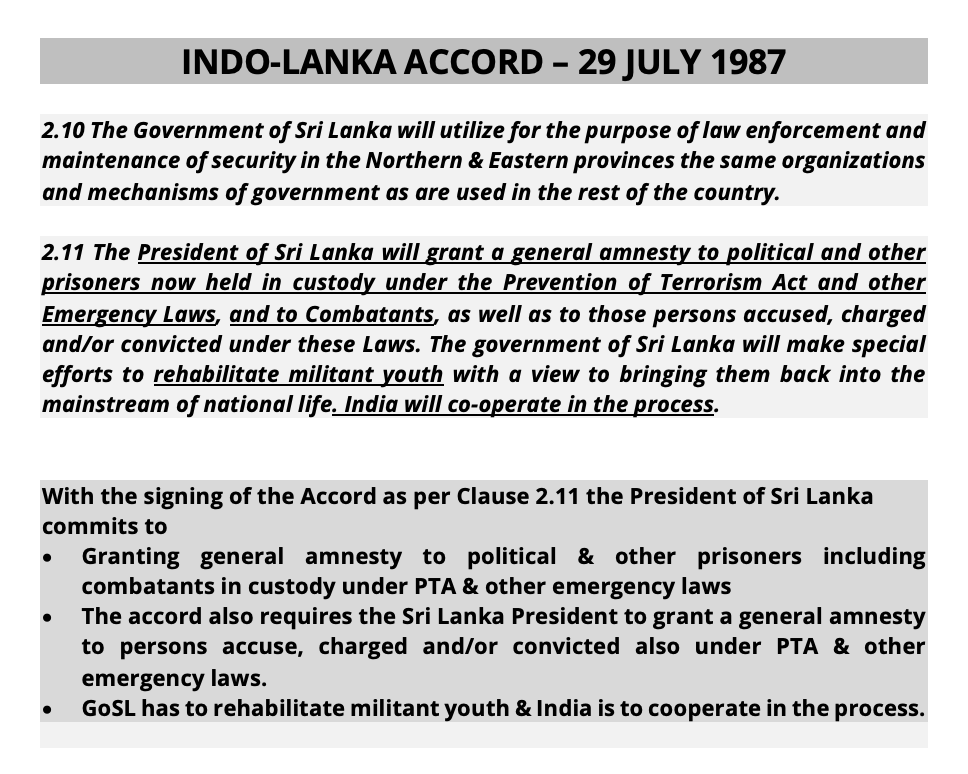
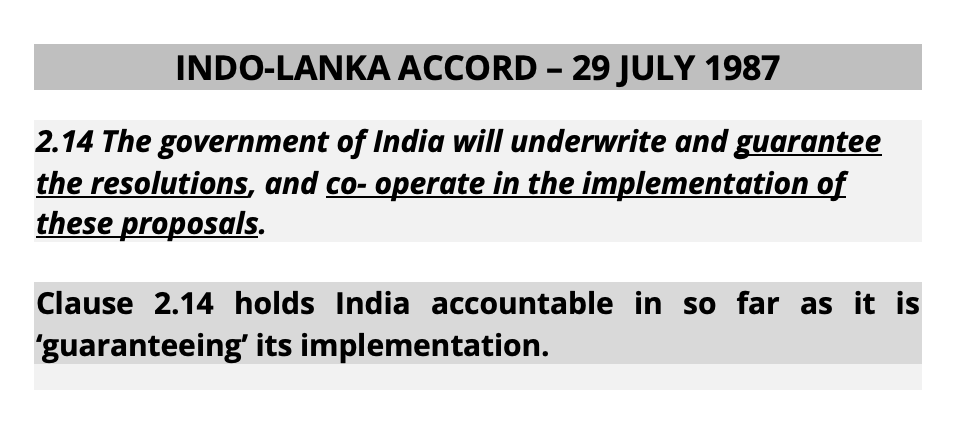
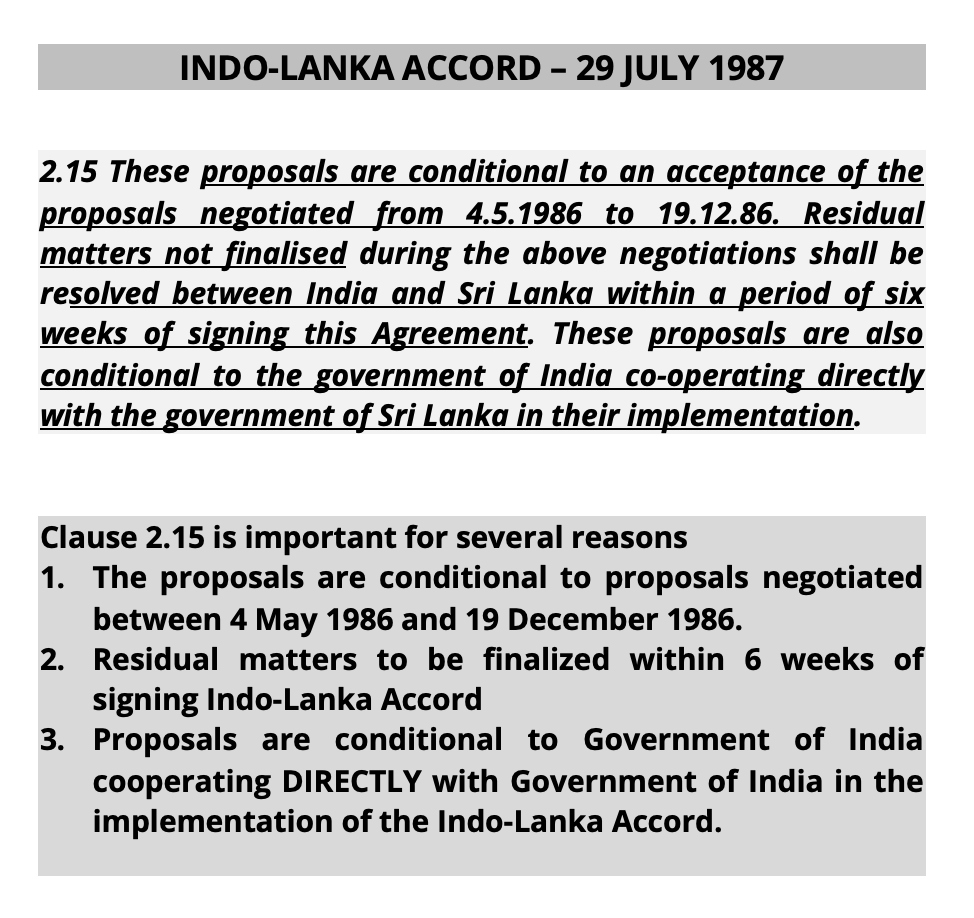
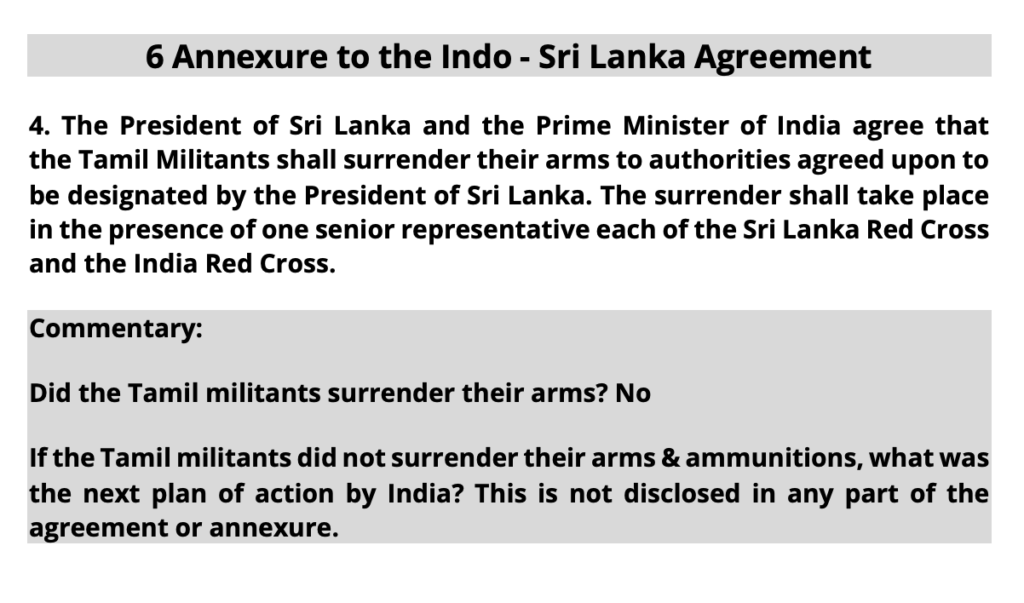
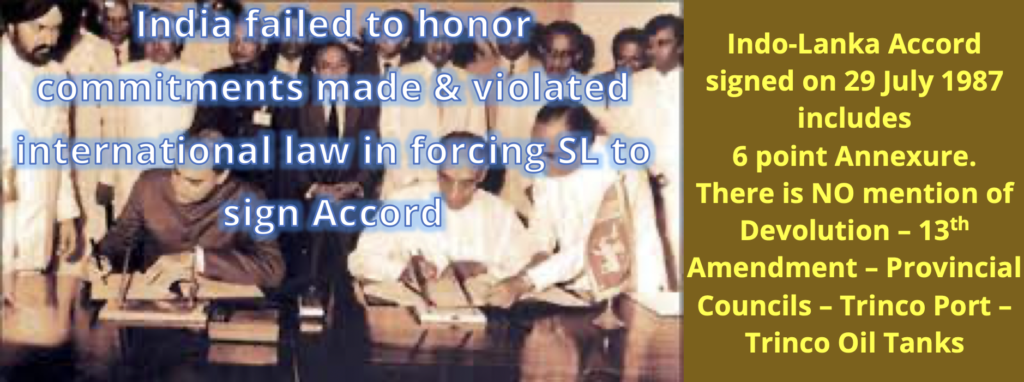
In mid-1987, India stopped the advance of the Sri Lankan army against the Tamil Tiger militants. It pressured Jayewardene to sign the India-Sri Lanka Accord in July 1987 and accept an Indian Peace Keeping Force (IPKF). The Accord made Sri Lanka bar forces inimical to India from using its ports and other facilities.  

To get even with India, President R.Premadasa armed the Tamil Tigers to help them take on the IPKF. Later, he gave the IPKF an ultimatum to leave. A miffed India refused to give military aid to Colombo when it resumed fighting with the Tigers in June 1990. However, in the final stages of the war in 2007-2009, India helped Colombo defeat the LTTE. A troika” of top security officials from Delhi and a troika” from Colombo, facilitated the process.  

But there was a change in the Delhi-Colombo security equation with China entering Sri Lanka as a big builder of infrastructure. Among the projects, the deep-water port in Hambantota raised the hackles in New Delhi. In 2010, Alok Kumar and Ishwaraya Balakrishnan said in a paper in the Indian Journal of Political Science: The construction of this port will bring China within breathing distance of India’s southern coast where sensitive installations, including power plants, are present. It could also help China in keeping a track of India’s nuclear, space and naval establishments in South India and also serving as a listening post”.

India’s apprehensions onIy increased when, in 2017, the port was leased to China for 99 years.

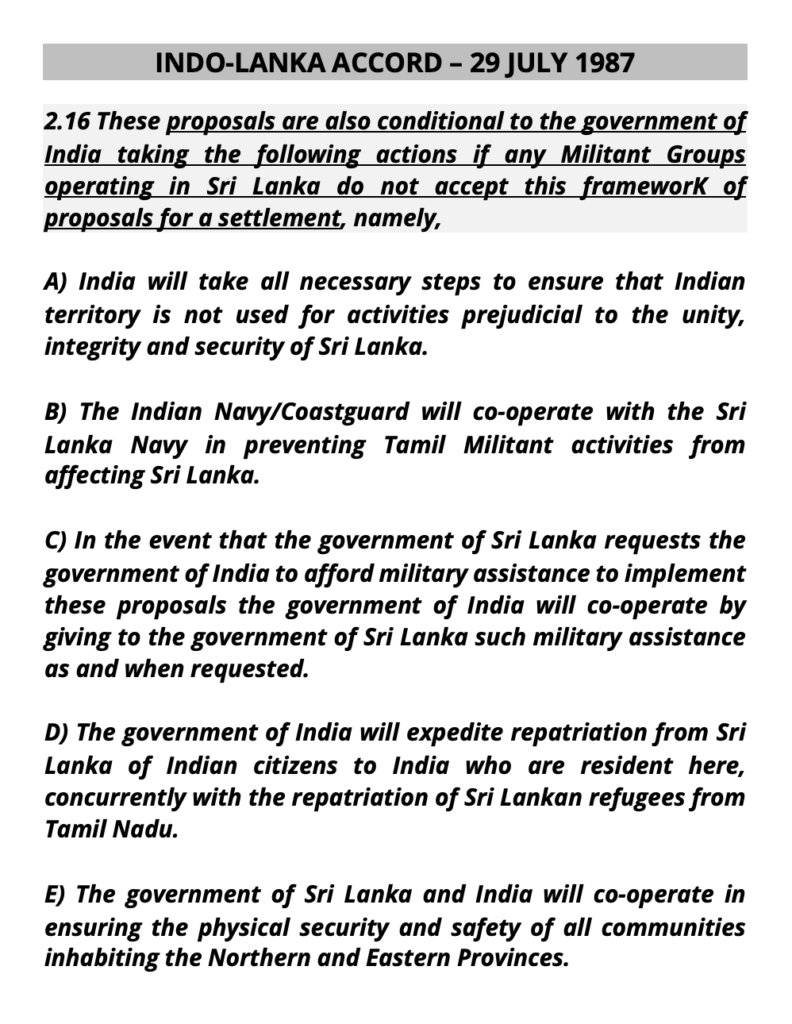
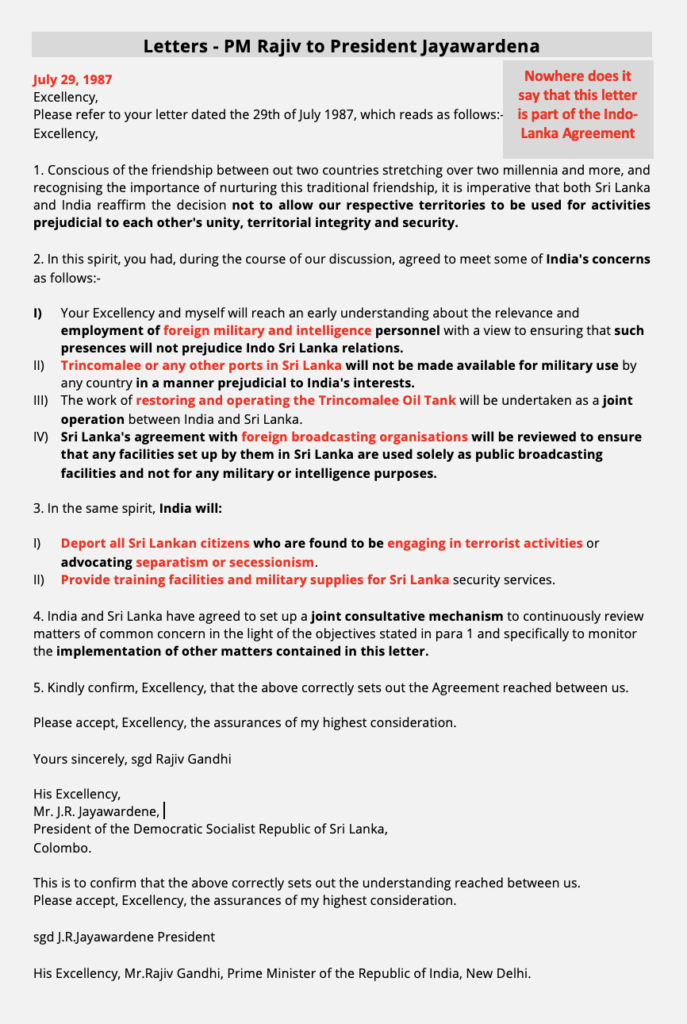
In 2014, a Chinese nuclear submarine Changzheng 2 had docked in Colombo almost coinciding with the visit of President Xi Jinping. New Delhi saw this as a case of Beijing cocking a snook at New Delhi with Colombo’s connivance. In Indian eyes, the docking violated the Indo-Sri Lanka Accord which stipulated that no port in Sri Lanka will be made available for military use by any country in a manner prejudicial to India’s interests.

But China also has security interests in the Indian Ocean, points out Amarasinghe. Zhao Nanqui, the director of the General Logistics Department of the People’s Liberation Army had said: We can no longer accept the Indian Ocean as an ocean only for the Indians”. Zhang Ming, a Chinese naval analyst had warned that approximately 244 islands from Indian Nicobar and the Andaman archipelago could be used by India as a metal chain to hinder Chinese ships entering the Strait of Malacca.

When Gotabaya Rajapaksa came to power in 2019, Foreign Secretary Adm. Jayanath Colombage said: We have to understand the importance of India in the region and we have to understand that Sri Lanka is very much in the maritime and the air security umbrellas of India. We need to benefit from that”.

Indian and Sri Lankan navies have conducted joint exercises nine times under the SLINEX series. Recently, India and Sri Lanka agreed to set up a joint Maritime Rescue Coordination Center (MRCC) with a US$ 6 million grant from  India.  Sri Lanka would also get a donation of a US$ 19.81 million worth 4,000-ton floating dock, a Dornier surveillance aircraft and a ship repair dock from India.

Sri Lanka became part of India’s Security and Growth for all in the Region (SAGAR) scheme. Maritime Domain Awareness (MDA) is part of SAGAR. But in the case of Yuan Wang 5, Sri Lanka had not shared with India, information about its coming. Hence India’s displeasure.

අපට ඕන වෙලාවක ඇවිත් ඕනෑම ගොඩනැගිල්ලක් අත්පත් කර ගන්නවා..- අරගල නායක වසන්ත මුදලිගේ

August 10th, 2022

lanka C news

ගාලුමෝදර අරගලකරුවන් ඉවත් වන්නේ ගාලු මුවදොර පිටියෙන් පමණක් බව අන්තර් විශ්ව විද්‍යාල ශිෂ්‍ය බල මණ්ඩල කැඳවුම්කරු සහ ගාළු මුවදොර අරගලයේ ප‍්‍රධානියෙකුද වන වසන්ත මුදලිගේ සඳහන් කරයි.

ගාලු මුවදොරින් ඉවත් වුණාට ඕන වෙලාවක ඕනෑම ගොඩනැගිල්ලක් අත්පත් කර ගැනීමට පැමිණෙන බවද හෙතෙම පවසයි.

ඒ සඳහා ජනතාව සමග ඕනෑම මොහොතක පැමිණීමට සූදානම් බවද හෙතෙම කියා සිටියේය.

ගාලු මුවදොර පිටියෙන් අරගලකරුවන් ඉවත් වීම පිළිබඳව මාධ්‍ය හමුවක් අමතමින් ඔහු මෙම අදහස් පල කරන ලදී.

SL will get negative impact on long-term friendship with China: Sri Lanka-China Social and Cultural Cooperation ASLCSCC

August 10th, 2022

Courtesy The Daily Mirror

The government’s decision to postpone the arrival of the Chinese ship Yuan Wang 5 at Hambatota port, would have a negative impact on the long-term friendship between Sri Lanka and China, the Association for Sri Lanka-China Social and Cultural Cooperation (ASLCSCC) said.

ASLCSCC President Indrananda Abeysekera said that our government should reveal the reason behind the change in the criteria that existed when Yuan Wang 5 was allowed to come to Hambantota port.

Yuan Wang 5 is a research and survey vessel. In 2013, Yuan Wang 3 berthed at Colombo Port.

The whole world has come to know that India has said that Yuan Wang 5 will have some impact on its maritime security, he said.

Our government should not entertain such disruptive external interventions when decisions have already been made in accordance with the relevant conventions and adhere to its foreign policy,” he said.

“It is now known worldwide that India has said that Yuan Wang 5 will have some effect on its maritime security. Our government should not entertain such disruptive external interventions when decisions have already been made in accordance with the relevant conventions and adhere to its foreign policy,” he said.

If another country opposes a decision of our country, it shows that it has no understanding of the world conventions and interferes in the internal affairs of another country. Abeysekera said this is clearly a violation of the Five Principles of Peaceful Coexistence.

“In the effort to solve the social and economic crisis that our country is facing, we see another country using geopolitics as a weapon and acting on dual-minded policies. China has been an honest and long-standing friend of Sri Lanka. ASLCSCC, as an organization for people-to-people friendship with China, strongly opposes any attempt to harm Sri Lanka-China friendship.

Therefore, the Sri Lankan government should take immediate steps to address the harmful situation that occurred by suspending the arrival of Yuan Wang 5 for the diplomatic relations between Sri Lanka and China and people-to-people friendship, Abeysekera added. (Chaturanga Samarawickrama)

Death threats to NTC officials for reducing bus fares

August 10th, 2022

Courtesy The Daily Mirror

Following the discussion between the National Transport Commission (NTC) officials and the private bus owners regarding the revision of bus fares, the bus owners behaved violently and threatened the NTC officials with death.

The police said death threats have been made at the NTC officials following talks on the revision of bus fares.

It was reported that the bus owners had threatened to kill and verbally abused the NTC staff over the phone.

A complaint in this regard was made to the Narahenpita police by the NTC Chairman and Director General.

The Transport, Highways and Mass Media Minister Bandula Gunawardena has instructed the Ministry Secretary R.W. Pemasiri to conduct an internal investigation into this incident and take legal action against the bus owners who obstructed the duties of the Commission officials. (Chaturanga Samarawickrama)

COVID: Nine more deaths & 227 new cases reported

August 10th, 2022

Courtesy Adaderana

Director-General of Health Services confirmed 06 new coronavirus-related deaths for August 09. This brings the country’s death toll from the pandemic to 16,603.

The deaths reported today include 04 males and 05 females above the age of 60 years, according to the figures released by the Department of Government Information. 

Meanwhile, 227 more people tested positive for COVID-19 today, as the tally of Covid-19 cases detected in the country thus far to 667,385.

All About Climate Change: Heat, Temperature and Humidity Levels

August 10th, 2022

Deye.com

Even though many people think about rising temperatures and extreme heat when we talk about climate change, the reality is that climate change involves much more than that.

Researchers have argued that temperature on its own is not the most effective way to measure climate change. They suggest that the energy produced by extreme weather is linked to the amount of water in the air, which subsequently affects comfort.

This means that our attempts to define climate change and deal with its effects should not just be concentrated on high temperatures and air-conditioning but also on humidity and how we can regulate the amount of moisture in the air around us.

Therefore, this article attempts to explain how climate change is linked to heat, temperature, and humidity. In the last part, we focus on how you can mitigate the discomfort caused by excessive humidity by using a dehumidifier.

Full Article

All About Climate Change: Heat, Temperature and Humidity Levels – Deye

Indo-Lanka Accord of 29 July 1987 does not restrict Sri Lanka’s use of its own Ports or Trinco Oil Tanks

August 10th, 2022

Shenali D Waduge

The Indo-Lanka Accord was signed on 29 July 1987 in Colombo with Prime Minister Rajiv Gandhi signing on behalf of India & President J R Jayawardena signing on behalf of Sri Lanka. There are 6 points annexed to the accord. The text of the Accord & the 6 point annexures are what makes the Indo-Lanka Accord. The letter drafted by PM Rajiv Gandhi is not part of the Accord though it was signed on the same day. This letter does not even mention the name Indo-Lanka Accord. Therefore, no one can use the contents of the letter & claim that to be part of the Indo-Lanka Accord.

The Trinco Port & Trinco Oil tanks as well as reference to foreign broadcasting (Voice of America) is mentioned only in the letter by Rajiv Gandhi. The Accord only mentions the 6 point annexures. There is no mention of letters being part of the Accord. Thus Sri Lanka is not bound by the contents as these are signed between 2 former heads of State who are now no more.

INDO-LANKA ACCORD

The accord claimed to ‘establish Peace & Normalcy in Sri Lanka’ both of which did not happen

The agreement attached utmost importance to nurturing, intensifying & strengthening the traditional friendship of India & Sri Lanka” – none of the above also happened.

The agreement acknowledged” the need to resolve the ‘ethnic” problem and the consequent violence”and for the safety, well-being & prosperity of people belonging to all communities in Sri Lanka”. The all communities in Sri Lanka” is often misplaced as reference is always with regard to the welfare of one community only.

The Agreement further breaks down the objectives

Clause 2.16 sets further actions by the Government of India if Militant Groups do not accept the outlined framework of proposals (NE merger/NE Elections/Referendum)

India thus commits to

2.16 – CONDITION A: 

Did India ensure Indian territory is not used for activities prejudicial to the unity, integrity & security of Sri Lanka? 

No

LTTE continued to use Tamil Nadu as its logistics hub with tacit assistance by even the TN state govt

2.16 – CONDITION B: 

Did Indian Navy/Coastguard cooperate with Sri Lanka Navy to prevent Tamil militant activities against Sri Lanka?

No

LTTE boats were plying to and from Sri Lanka’s North to Tamil Nadu

2.16 – CONDITION C: 

India commits to provide military assistance to implement proposals upon request of Government of Sri Lanka

President J R Jayawardena used 2.16 C) to request Indian Peace Keepers to disarm LTTE

2.16 – CONDITION D: 

Indian Govt commits to expedite repatriation of Indian Citizens in Sri Lanka to India while repatriating Sri Lankan refugees from Tamil Nadu.

Repatriation of Indian citizens living in Sri Lanka has not been done.

2.16 – CONDITION E: 

Both Governments to cooperate to ensure physical security & safety of all communities living in North & Eastern Provinces.

This clause also failed as IPKF began killing and raping people of all communities as they could not identify who was who and majority of IPKF soldiers did not speak Tamil.

IPKF killings and rapes have yet to be investigated.

This Agreement and the Annexures thereto shall come into force upon signature

Clause 3 stipulates that the above clauses plus the annexures will come into effect upon signing of the Agreement on 29 July 1987

In witness whereof we have set our hands and seals hereunto.

Done in Colombo, Sri Lanka, on this the twenty ninth day of July of the year one thousand nine hundred and eighty seven, in duplicate, both texts being equally authentic.

Junius Richard Jayawardene,                                          Rajiv Gandhi,

President of the                                                                  Prime Minister

Democratic Socialist Republic                                        of the Republic of India

of Sri Lanka

THE ANNEXURE

Next we come to the controversial letter which is not part of the Accord or Annexure of the Accord

PM Rajiv Gandhi’s letter to President Jayawardena written on the same day as that of the Indo-Lanka Accord signing – 29 July 1987

Highlights the following

Joint agreement:

  1. Not allow territories of both nations to be used for anything that impacts the unity, territorial integrity & security of either country

Sri Lanka makes 4 commitments (addressing India’s concerns) subject to Sri Lankan President confirming commitment via response to PM Rajiv’s letter which is not available. 

  1. Foreign military & intelligence personnel to not prejudice Indo-Lanka relations
  2. Trinco or any other port in Sri Lanka to be given for military use by any country against India’s interest
  3. Restore & operate Trinco Oil Tank as a joint operation between India & Sri Lanka
  4. Sri Lanka’s agreement with foreign broadcasting organizations reviewed are only used for public broadcasting & not military or intelligence purposes.

India’s commitment 

  1. Deport all Sri Lankans in India who are engaging in terrorist activities or advocating separatism or secessionism (India did not fulfil this)
  2. Provide training & military supplies for Sri Lanka security services


India & Sri Lanka to set up a joint consultative mechanism to review matters & monitor implementation.

If the letter is not part of the Accord, Sri Lanka is not bound to commit to any contents of this letter

  • Eternal use of India’s security concern”
  • Giving Trinco Port to any party & not requiring to seek ‘permission’ of India
  • Not bound to operate Trinco Oil Tank as a Joint venture (an error that successive Sri Lankan govts continue to make – SL first leased 99 oil tanks to India for 35 years in 2003)

Noteworthy also is that there is not a line that mentions creating PC system & 13th amendment or devolution in the Indo-Lanka Accord. The Agreement makes reference to North East Provinces and merging them & holding elections & referendum in them. The UN & so-called international community must take out the document & read line to line of it.

So 13th amendment is separate to the Indo-Lanka Accord although that too was forced upon Sri Lanka. Devolution of Sri Lanka via constitutional changes under duress as sufficient evidence that India would take military action is available via threats by Indian envoys to Sri Lanka’s envoy. This is a violation of Article 2(4) of the UN Charter refrain …. from the threat or use of force against the territorial integrity or political independence of any state”.

India further committed aggression against a friendly state by the measly food drop to only one community, breaking India’s claim that it is concerned for all communities of Sri Lanka.

India has also violated Article 51 of the Vienna Convention of the Law of Treaties

expression of a state’s consent to be bound by [a] treaty which has been procured by coercion of its representative through acts or threats directed against him shall be without legal effect.

India has also violated Article 52 of the same Convention

a treaty is void if its conclusion has been procured by the threat or use of force in violation of the principles of international law embodied in the Charter of the United Nations.”

Moreover, India committed to 5 clauses under the Indo-Lanka Accord. India did not honor any of them. This is a violation of Pacta Sunt Servanda’ (pacts are meant to be honored for agreements to be valid) If India did not honor the pact, that pact is no longer valid under this legal maxim.

Indo-Lanka Accord was signed in 1987 – the political dynamics of 1980s or 1990s does not exist presently. India was a closed economy upto 1994. India was never under US orbit during this time. The foreign broadcasting service referred to in Rajiv Gandhi’s letter to President JR is Voice of America station. Today, India is now partners with US and India has no issue in US military ships landing in Sri Lanka or Sri Lanka signing ACSA making use of Sri Lanka’s airports & ports. What if India & US suddenly do not see eye to eye – will India pluck out the Indo-Lanka Accord again while ignoring it when India sees fit? These double standards is unacceptable in diplomatic relations.

As far as the Indo-Lanka Accord goes -its clauses are only relevant to the North East though it says nothing about 13a-devolution or Provincial Councils in other parts of the island. More importantly, the Accord or Annexure has no mention of Trinco port, Trinco oil tanks. These are only mentioned in a letter by Rajiv Gandhi to JR Jayawardena on the same day as signing the Accord. There is no mention in the Indo-Lanka Agreement of Rajiv Gandhi’s letter and Rajiv Gandhi;s letter has no mention of Indo-Lanka Accord either.

Shenali D Waduge

Why follow Bindu(of Sunday Times): It is NATO- No Action Talk Only.

August 9th, 2022

By Garvin Karunaratne

It was four months ago in March 2022 that I suggested immediate action re our economic meltdown. I recall:
The Way Out of the economic abyss besetting Sri Lanka” in the Lanka Web of March 11 th.

It is months- four months have passed and yet as Bindu says we are only talking. In the meantime the fuel queues are mounting and food is beyond the reach of many. Fuel has got priority. Food and medicines are in the background and when the current food stocks- now at a high price- are used up, there is bound to be starvation if we yet follow NATO.

Patriot Vasudeva has today uttered the home truth that following the IMF is not the way ahead. This was proved by Mahatir Muhammed the Prime Minister of Malaysia- the only country to get out of the East Asian Financial Crisis without getting into further debt.

Yet we are vacillating and today the President has uttered that we have to face the IMF bullet. That is to follow the privatization of many public institutions and further- the cat is not out of the bag yet- it will come later- to devalue the rupee.

Devaluing the currency is one of the salient policies of the IMF. In actual practice Devalue only serves two purposes- to increase the prices of all imports and Sri Lanka living now in an import and sell economy(imposed by the IMF in 1978)sends the prices of goods higher and this inflation causes more poverty. The hidden agenda which is not talked of is that all our exports get paid a lower price- that benefits the Developed Countries to get our produce at lower prices. This is the reality.

Our Government is yet talking since March and it is likely that we will keep talking.

It is necessary immediately to get down to make everything we imported and thereby provide incomes to the people. This can be done within days and if only our President and Prime Minister can decide it can be decided tomorrow and our administrators can get cracking on the next day.

My mind traverses back to two programmes we started from scratch and how we got down to production and the creation of employment.

One is the Divisional Development Councils Programme of the Sirimavo days. In 1971 NM and Sirimavo decided- it was mainly NM’s project to bring employment to the youths-. They head hunted the foremost economist of the day, Professor H A deS Gunasekera and established a Ministry within days. As the GA at Matara I got cracking. I selected the best staff at the Matara Katcheri and got down to identify land that could be developed into farms and did recruit unemployed youths that were trained to plant veg and fruit. Another aspect was to set up small industries, sewing, batik, craft, manioc, a smithy and many more. This happened in most districts.

All this got going in months. My staff was dare devil and worked day and night without any payment- no salary increases- not even a travelling allowance. . My Planning Officer, a chemistry grad, was put on the task of finding how to make crayons and every night from six to mid night he with other katcheri staff and the science teachers at Rahula were experimenting for three months in the Rahula science lab and we found the recipe- how to make crayons. Then we entrusted the task of making Crayons to the Morawaka Coop and Sumanapala Dahanayake the member of parliament for Deniyaya in his capacity as the President of the Morawaka Coop did establish the factory in two weeks. We all broke rest for two weeks at Morawaka- a day and night op- every singe crayon had to be checked for quality- making crayons that were finally sold all over the island- easily the best industry of the DDCP Programme. All this took just three and a half months to be exact.

March to August 2022- the period of inaction today amounts to a four full months. I detailed all what we did in less than four months in 1971. My team even dared the bullets of the JVP- because the development I talked of in months happened immediately after the JVP insurrection. I recollect that at that time I even gave unofficial leave for over three months to an officer- to get lost and save himself.

In fact it is my opinion that the fast success of the crayon and other work of the DDCP silenced the JVP cadres and some of the twenty or more youths that boiled the ingredients and poured them red hot into tubes could be some that handled guns months earlier.

In fact if action was taken in March 2022, there would be jam, jelley, fruit drinks, vinegar, tomatoe sauce and many more items done by now all within a mere four months. All these were imported with dollars.

Let me next step to Bangladesh- to illustrate what I did in months.

In about April 1982 I was the Commonwealth Advisor to the Ministry of Labour and Manpower in Bangladesh when General Ershard took over the country in a mid night coup. In some three days the military decided to close up all youth development activities- the Minister was incarcerated. The Ministry was training 40,000 youths a year. I argued that what is required is not closing down but developing the training, adding a self employment training programme to guide the trained youths to become employed. A vehement objection came from the Secretary to the Treasury, the highest officer in the land, who said that the ILO had failed in that same attempt in the last three years and that it will only be a waste of money. The Military chief- Air Vice Marshall Aminul Islam kindled the fires between me and the Secretary to the Treasury. He kept listening for over two hours while we battled with arguments. The Secretaries of the Ministries were watching gobsmaked while the two of us battled along my detailing the project- what we would do to get the trained youths into a working situation on self employment projects. The battle ended with the the Minister- the third in command in the military junta approving it for immediate implementation. The Secretary to the Treasury said that he will not provide any funds to which, off the cuff, I replied that we needed no new funds and will find savings in existing budgets.

We got cracking fast and on the next day I was addressing hundreds of youths trying to coax them to start small employment creation projects even with a cow or a few chicks or making a few dresses and selling them. Training institiutes were kept open till ten at night to enable the trainees to use the machinery. In two to three months we were able to create incomes for the youths and the programme moved forward rapidly. Today this Youth Self Employment Programme is yet being implemented by the Bangladesh Administrators I trained and by now they have guided over three million youths to be self employed.

In Sri Lanka, however, we are yet talking- while the fuel queues and food queues are becoming longer and longer. Starvation of not hundreds but millions are close by. We keep lamenting of shortages but there is no action. Instead we keep talking the IMF language of privatization and Yet we keep to Bindu’s tune: No Action Talk Only.

If only the green light was issued to our administrators in March by now there would be easily tomatoe sauce, jam, jeley, fruit drinks, fried banana crisps, vinegar all this and more were imported in 2020.

It would be appropriate to immediately create a seperate Secretary under our Prime Minister to handle this employment and production creation programme on the lines of the Divisional Development Councils Programme. Such a programme will cut across all other ministries- livestock, agriculture, small industry, planning etc and therefore this can only come under the head- the Prime Minister. It can be done within days and all with local Rupees. Mind you the DDCP of Matara with its Crayon Factory in full swing, with Making Paper out of waste paper at Kotmale as well as the Self Employment Programme of Bangladesh were all done with local Rupees and Local taka. Not a dollar was required.

I recall the Divisional Secretary of Kotmale at work collecting waste paper and turning it out to cardboard. Now we collect waste paper and cardboard and sell it to India and buy paper and cardboard from India. It is so simple a process which tells me that we have to have our heads examined. Again I knew the Divisional Secretary at Baddegama Wilson Perera who got cracking with sixty youths-making them scientific farmers on 110 acres of neglected land.

It is really nonsense to talk of money printing as causing inflation. Money printing happened to be the only method of how development was done not only in Sri Lanka but in all other countries before the IMF imposed the Structural Adjustment Programme and changed our economy from one of produce and consume to import and consume and also to liberalize the use of foreign exchange to the rich to send their offspring for foreign study and endless luxury trips- which caused us to build up the foreign debt.

Over to our new President and Prime Minister., It is time we stop NATO and act immediately.

Garvin Karunaratne, Ph D.Michigan State University

Former GA Matara. Also the Commonwealth Fund Advisor to the Ministry of Labour and Manpower in Bangladesh in 1981-1983.

9/07/2022

Genesis of the the Export Development Board (EDB)

August 9th, 2022

Sugath Kulatunga

In January I wrote on FB that I would take up the genesis of the EDB. But other than in bits of anecdotes where I dealt with a few salient developments of the institutional history I had not attempted a comprehensive cover of the fascinating story which is given below.

When the Additional Director General of the Export Promotion Secretariat (EPS) Shelton Fernando joined the ITC as a consultant, I who held the post of Director Trade Information was promoted to that post. One of the first suggestions that I made to Dr.Ratwatthe was that we should propose a separate Ministry of export development. He endorsed the idea strongly and we carried out a SWOT exercise on the EPS and prepared a report justifying the proposal. In the EPS itself there was some reservation on the notion of a national and an inter-the Ministerial endeavor which was considered the function of national planning, and should be under the Ministry Of Planning. Fortunately, my research done in the TIS was useful in overcoming internal misgivings and I prepared a comprehensive proposal for a Ministry of Export Development. This proposal became the underpinning for the subsequent proposal for the Export Development Bill. EPS had sponsored a team to visit Shannon in Ireland to study their free trade zone and has already prepared a report for a free trade Zone. On the eve of the Parliamentary elections of 1977, Dr.Ratwatthe presented the two reports to both Mrs. Bandaranayake and J.R.Jayawardene.

In the 1977 General Election the UNP won with an overwhelming majority. The UNP had before them the two proposals on Trade and Investment both initiated by the Export Promotion Secretariat. The UNP had more confidence in FDI and introduced the Greater Colombo Economic Commission (GCEC) to give access to robber barons”. Director General of the EPS Sivali Ratwatte was appointed as the Director Investment in the GCEC and the EPS acted as the nucleus of the GCEC. I was promoted to take the place of Dr Ratwatte as the Director General of the EPS. A few of my contributions to the GCEC were the identification of functions and the development of an organizational structure, identifying the land for acquisition for both Katunayake and Biyagama zones, conducting the first Trade and Investment promotion in New York and inviting the UNIDO to provide technical assistance.

When JR Jayawardhane became the President of the country the EPS was attached to the Presidential Secretariat. I had the opportunity to develop a close relationship with the Secretary to the President genial Mr.Menikdevela. In fact, he and General Sepala Atygala, Lakshman Hewawasam and I made a regular foursome at lunch at the Senate restaurant.

Meanwhile my friend Gaya Cumaratunga who was the Additional Secretary to the Ministry of Trade has proposed to the new inister that the EPS should be brought under the Ministry of Trade. One day I had a surprise telephone call from the Minister Athulathmudali. When I answered the call, he asked me whether I remembered what I told him when he came canvasing to which I answered of course Sir, I remember the event well and said, I am more convinced now of that statement” He then invited me to come and see him in the office and gave me a time the next morning. What I told him that day when he came canvasing was a very frank and impromptu statement. It was a hot and humid day when I was seated bare bodied in the Verandah of our house in Sirimal Uyana Ratmalana. To my embarrassment a noisy group of about 20 people entered our garden led by a well-built person. He introduced himself as Lalith Athulathmudali who was contesting the Ratmalana seat. I had not met him before but I knew his background and qualifications as I had planned to invite him as a guest lecturer to the Academy of Administrative Studies where I was working at that time. But my boss Shelton wanted me to think twice as the then Minister Felix Dias may not have been happy with that. I was keen to get rid of the milling crowd of supporters and told Lalith very tersely that he need not waste his time in our place as my father-in-law had voted against the UNP only once and that was to Colvin as he thought he should be in the Parliament. I then said that I had never voted for the UNP and I was working with the brother of Mrs. Bandaranayake but I and my wife have decided to vote for him for the same reason and also because he was a presidential prospective. He was somewhat surprised with my blunt statement and left after thanking me.

Next morning, I went to meet the Minister when I saw about 10 people waiting to see him. But the moment I announced my arrival he called me in and we had a very informal chat for over one hour. I asked him why he took to politics he said that he was impressed with the vision of JR for the country. I mentioned my experience with politicians and said that it is not a pleasant a career and one tends to make enemies. To that the Minister replied that he was determined to engage only in clean politics and would not criticize opponents personally but attack their policies. I gave him the paper we had prepared on a Ministry of Export Development. He glanced it and asked me to explain the rationale which I did. He said that he agrees with the proposal, but it was too late now, but we could propose an independent authority like the GCEC. He then laughed and said he will sponsor it provided the EPS is part of the Ministry of Trade. I then suggested that we invite Victor Santiapllai of the ITC to advise us. He not only agreed to that he said he will invite Victor to head the new organization. I excused myself after the long chat as there were so many people to see him.

I came back and reported to Mr.Menikdiwela the conversation I had with Lalith. He was not happy of the EPS moving to the Ministry of Trade. He said that if EPS remains with the President there was no need for a large organization and all that the EPS could be achieved better under the President. I had to make a critical decision. Remaining with the President I could have personally gained many perks like an official vehicle which Sivali enjoyed. But I looked at the issue from an organizational theory point of view which was one of my favorite teaching subjects at the Academy. The country needed a permanent institution with the responsibility and the capacity to address the problem of export development. It could not be done with and ad hoc agency like the EPS with spartan human and financial resources. As the former Director of Trade Information, I had access to information on the developments in other countries and also the literature on the subject of agencies like the World Bank. More than anything else I had confidence in the ability and the dynamism of Lalith. I knew that he was to speak to the President on assigning the EPS to the Ministry of Trade but not to support Secretary to the President objecting to it.

I spoke to Victor in Geneva and briefed him on the developments and invited him to visit SL as soon as possible. He was aware of our proposal for a Ministry and was delighted with the new development. Within a few days he came to Colombo with his new Deputy Alexander who was the former Secretary Trade and Commerce in Indian Central government. Alexander was tasked to prepare the cabinet paper for approval. He did not look at our proposal for an export development ministry. Nor did he consult me or Sivali. He made a proposal which had the traditional Trade Promotion approach. Once the Cabinet approved the proposal, The Minister wanted me to draft the framework of a bill to be presented to the Legal Draughtman. I told him that I would like to go beyond the proposals in the Cabinet Paper and gave him the reasons. I insisted that what we require is not trade promotion but export development. He agreed that we need not confine ourselves on what is in the Cabinet Paper which is only an approval in principle. He laughed and said that when the Bill was presented, he will explain to the Cabinet that was his new thinking. I requested him to permit me to communicate directly with the Legal Draughtman on behalf of the Ministry. He agreed readily and said he will speak to Secretary Lakshman de Mel. After that I set aside the Alexander Cabinet paper and went back to the original EPS proposal where we had identified the key elements which should be in an export development institution. These were cleared in one-to-one discussions with the Minister who was most receptive.

I explained to the Minister that if the task before the country trade promotion was as envisaged in the Cabinet paper that could be done by the Department of Commerce with its representative in the key markets. I explained that 75% of our exports consist of the 3 commodities of Tea, Rubber and Coconut which are also exported in primary form. Export Development would encompass supply development and diversification and adding value to the present products. The argument which was also in the Cabinet paper that it should be a national effort with pollical backing was concretized with a specific proposal to form a Council of Export Development Ministers presided over by the President. The management Board (the term Board was the preference of Victor) was to consist of all the Ministries responsible for the production or servicing of exports and the private sector representatives.

I was very keen that the EDB should be financially sound and independent. As the Secretary to the Treasury was to be a Board Member further dependence on the Treasury was uncalled for. I followed the example of the Tea Board and included a provision for a Cess which was a major deviation from the Alexander proposal.

One serious lacuna in the investment capital portfolio of the country was the absence of a venture capital capacity. In many countries pioneering industries have been funded with either direct grants from the state or with venture capital. This too was not in the cabinet paper. There were few other details which were included anew in the new proposals such as the power to create subsidiary organizations, to acquire shares in export ventures and invest in export ventures, to undertake feasibility studies in export projects, to register exporters, and to establish Advisory Committees on products and functions.

This was a time that planning was considered a useless function especially by the Ministry of Finance and took some convincing to include as a key responsibility of the EDB to formulate a National Export Development plan. Once the new paper was finalized, I formatted it into the standard format of a Bill.

The next task was to get the Bill drawn up by the Legal Draughtman (LD). The standard procedure was to present the approved cabinet paper to the LD and request him to frame it into the legal format. Our new proposal was very different from the Alexzander proposal approved by the cabinet. When I pointed out the discrepancy the Minister told me not to send the Cabinet approved proposal but to send my draft Bill and mention that it has been drawn up in accordance with the approved Cabinet paper in principle with a a few amplifications approved by him. He also asked me to request the LD to speak to him if necessary.

I did not go to the LD but met the Additional LD, G.de. Silva who was a colleague of mine at Arunachalam Hall in Peradeniya. He also knew my wife who was an Assistant Secretary in the Ministry of Justice. I had no problem of sharing my anxieties and the urgency in getting the Bill approved in Parliament. His response was that his department cannot have an argument with Minister Athulathmudali who was a distinguished lawyer. He looked at my draft and said that it makes life easier for his officers and assigned an experienced but more amenable officer (Mr. X) to take charge. At my request he also instructed him to deal directly with me and in case of any problem to consult him. X and I sat together and completed the task within a few weeks. When there was any issue where he had any doubt, I used to suggest that we speak to my The Minister which made him refrain from asking for further clarification.

Moot point- provision on secondment

Once the task was completed, I thanked my friend the ADLD. He congratulated me and Mr.X and said that was one of the fastest drafting of a Bill by the Dept. I said it was because he agreed for me to communicate directly with the LD department without the intermediation of the Ministry of Trade. In fact, if the Minister did not agree to my working directly with the LD there would have been a long delay and some of the provisions in the Bill would have been different. The lesson was that if one is keen to get a job done one has to stand one’s ground.

When the Bill was sent for observations there were no worthwhile comments. I was nervous on the Ministry of Finance position on the Cess. I had to debate the issue with the Secretary of Finance, who was fortunately a friend of mine when we were a team under Anil during the good old days of the CTB. I said if the EDB did not have independent and adequate funds it will be ineffective.

The Bill was tabled in Parliament and the Minister an early date to debate the EDB Bill and the Bill on Intellectual Property. I was surprised when he called me and asked me to draft his speech in Parliament on the Bill. When I showed some reluctance he said, you better defend your Bill”. I prepared his speech making reference to the historical importance of international trade in Sri Lanka and the current poor performance when compared with other Asian countries and making a strong case for export development. The Minister was impressed, and he said that he had nothing more to add but would only read my draft in Parliament.

 On the day of the debate, I had the privilege of occupying the official box in the House with Lakshman Kadirgamar who had come from Geneva to witness the Intellectual Property Law introduced in Sri Lanka. At the time he was the Deputy Head of WIPRO. The Bill on IP law was taken up first and was passed without any division. (Frankly I was skeptical on introducing a strict IP law in the country at our stage of development. I told the Minister that the developing countries have exploited us with impunity so far and we should make use of their intellectual achievements without obstruction. His answer was we cannot expect any FDI without IP protection.) Then it was teatime and the Minister invited me to have tea with him where he asked me whether there was any thing more to add. I said that we should have included the development of Rural Exports as a function of the EDB. He was very enthusiastic on my suggestion and said that he would ensure that it is included at the Committee Stage.

But what happened in Parliament thereafter was in bad taste. Before presenting the EDB BILL he referred casually to an accusation made by Anura Bandaranayake about an individual recruited to the Port who did not have any qualifications and was only a henchman. The Minister retorted that the individual had all the qualifications required and in a lighter vein said that the member must be careful as he was a good shot. I noticed distinctly that Premadasa who was sitting next prompting Lalith as he was finishing his comments and the Minister ended up saying and not an offshot”. This was a malicious slander spread by Anura’s fraternity by his mean enemies. As the Minister sat down the House went into a howl of laughter. The Minister’s speech introducing the Bill was dignified and consummate. Many members spoke in acclamation and supporting the proposal.  But with the excitement of the offshot comment the Minister forgot to add the rural export development as a function of the EDB at the committee stage which much later I pushed through export production villages. I happened to see the Minister next morning. He said that he was very sorry about the remark made in Parliament which was in the spur-of-the-moment and prompted by Premadasa. I told him that I saw what happened. He reminded me of what he told me at my fist meeting with him that he would not attack opponent on policy and never personally. He also said he would apologize to Anura. I said he should be careful with Premadasa who could be nasty.

A third party had insisted on Victor the Chairman designate, that he should be both Chairman and CEO. He had spoken to the Minister who had agreed. I had followed the proven example in the Tea Board and Tourist Board of separating the functions of the CEO and the Chairman of the Board and making the DG the CEO. I also believed a Chairman like Victor Santiapllai should not be burdened with the management functions of a CEO. The experience and the ability of such a chairman should be on Policies and external relations with the Ministers and private sector leaders. My main argument was that a DG would have both the technical and management expertise but on a future date a chairman appointed on a political basis would not have both. I also told the Minister that I have seen the General Manager of the CTB seated outside the Board room waiting to be called inside only when he was needed. I went on to say that I believe that I could contribute more than any appointed member to the Board, and I would not like to undergo the indignity of sitting outside the Board room and would prefer to go back to the SLAS. The Minister did not expect this blunt response from me and was silent for a few minutes. Then he said he will make me both DG and Secretary to the Board and with a mischievous grin he added that a smart secretary could make Board decisions nuanced to his thinking. I had no options but to agree with him. But this arrangement made me work in two distinctly separate posts without additional remuneration which I could have insisted on. Anyhow I was willing to be in the EDB and work with Victor in any capacity.

Although I argued with the Minister on a matter of principle, I did not have serious objection to the Chairman being the CEO as well, as I had included in the ACT in article 9 for the Board to form committees which could be delegated all the powers of the Board. The main committee thus established named the FAC was empowered to decide on all financial and administrative matters. This was enshrined in the ACT with my experience in the CTB and of Oils and Fats Corporation where Board members were happy to spend their time on trivial establishment an administrative matter presented to the Board, I was convinced that EDB Board should only deal with export development policies. This was more valid for a stellar Chairman.

FAC was a novel feature where all decisions were taken on FAC papers where the approval had to be  justified. This gave all staff members who wanted a decision made the discipline of justifying the request. This also kept a record of the background to the decision for future reference.

All FAC minutes were submitted to the Board for information. Once a Secretary of a Ministry who had an axe to grind demanded that all FAC papers should be submitted to the Board for approval. At the next meeting I submitted about 50 FAC papers together with around 10 regular Board papers. All the members including the member who wanted FAC papers to be submitted to the Board was quite embarrassed and decided that the Board did not want to deal with FAC papers.

In making pivotal decisions my rapport with the Secretary Finance (Tikka) was very helpful. He was one who read the Board papers thoroughly before attending the meeting. Tikka used to come at least half an hour before the meeting and ask for clarifications and point out the negatives. As he was the Secretary Finance his standpoint was always accepted. Once there was a radical decision taken by the Board which conflicted with the policy of the previous government. Additional Secretary who represented the Ministry of Industries who was the Director National Planning of the previous government dissented with the rest of the Board. We never had stenographers taking notes at board meetings. I used to make a few notes on the Board Paper itself and dictated the minutes immediately after the meeting when everything was fresh in my mind. While I was dictating the minutes, I received an angry call from the dissenting member saying that he was not given the time to defend his stand. Victor was good at managing meetings, and he had politely changed the subject. He wanted what he said, and what he wanted to say which he imagined he had said, be fully recorded. This member Sarath was a good friend of mine, and I explained that I record only the reasons for a decision and the decision only. He then sent a two page note to be included in the minutes. As it was a written request from a Board member, I included it in the minutes and warned Sarath to expect serious objections from some members. Tikka came late for the next meeting but still a few minutes before others. He spoke to me and said that he was going to blast me at the meeting. I guessed what it was about. As the meeting started, he looked at me and said that the Board meeting is not there to read reams of history and the policies of previous regimes and pointed out to the bulky set of papers and addressed Sarath and said ‘Sarath we are here not to read your thesis on your political policies. We want only the reasons for a decision and the decision and no more.

After a few months of operation, a practical division of work developed between the Chairman and the Director General. Victor was not comfortable spending time at meetings at the Ministry and the Minister. The prevalent practice at the time was that all recruitments must have the approval of the minister. In anticipation of the problem of undue interference by the Minister I mentioned to him that the EDB should be a center of excellence and we should try to build a team of competent professionals. He agreed with my proposition but said that he wishes to meet the candidates before appointment. He suggested that at the staff levels I should make my own selection and send before him at least twice the number of candidates selected where he would give his own opinion of the best. This was not a problem at all and on a few occasions his choice was better than ours. One example was in the selection of a director finance. I insisted on a candidate who was a graduate with professional qualifications in accountancy. He yielded but told me that the candidate will not last too long as he was unstable. After a couple of months this person left, and we had to advertise again and after our selection presented two candidates to the minister. One candidate was a young man with both cost and chartered accountancy qualifications. The other was a middle-aged spinster with government accountancy qualifications and experience. Minister took some time chatting with them. After sending them away he said that he knew that I would press for the young man. He then asked me to take the lady and said, ‘she will be a battle axe and stay with you”. He was good at judging people. The lady was a real strength to the EDB. Unfortunately, she died from cancer and worked until a couple of days before her death. I asked her to go on leave but she told me that she can bear the pain when she is at her job.

For non-staff posts we had examinations conducted by the examinations department. For labor grades I had no objection to recommendations from the minister. There was one case the minister wanted me to accommodate his neighbor who was a retired scientist with experience as head of CSIR and RRI. This person was interested in the post of Director Projects Division for which we had already appointed a dynamic former IDP official. I explained to the minister that it would be very unfortunate if that appointment is changed. Then the minister suggested that the scientist Doctor be assigned the services division. When I gave the name of the then holder and explained that the job entails working very closely with other government agencies and the then holder from the SLAS was eminently suitable for that. Before the minister suggested other posts, I offered to take the Doctor as a consultant on which the Minister agreed. Later I found that this man was dishonest and had to insist that he be sacked. I had to take a strong stand that if he was not sacked, I would resign from the EDB. He was discontinued. I do not wish to repeat the sordid details of his sacking as I may have written about that earlier. The two officials I had protected were assets to the EDB and one even held the post of Director General in later years.

We lost the invaluable patronage of the Minister Athulathmudali when he was assigned the Ministry of National Security. I offered my services to him as the Secretary of that Ministry. He wanted me to join the Ministry of Trade and hold the post of DG EDB concurrently. All the senior heads of agencies advised the Minister not to accept the new ministry.  I believe as he was very competitive and wanted to deliver and demonstrate his superiority over his fellow ministers in the Prime Minister stake, he did not want to reject the opportunity. But once when I saw a grave danger to the EDB in losing the cess funds where our people had been persuaded by the Finance ministry to annul it with the glib promise of liberal Treasury grants whenever required. This was tried many times before when I had challenged them to change the law. This time they had made the move in my absence on a consultancy abroad. On my return the moment I heard about this betrayal I met Lalith and told him that is the death of the EDB. He was furious and protested to the President and requested the Chairman EDB to rescind the agreement to drop the CESS fund. Thanks to Lalith the Cess is still there but no Chairman of the EDB has had the guts to ensure that the cess funds are is directed to the EDB without sending it to the Treasury which is taking the Lion’s share of the Cess collections. EDB is starved of funds for export development. There is no wonder that the trade gap has expanded, and we are faced with a foreign exchange crisis.

ඕස්ට්‍රේලියාවේ ශ්‍රී ලංකා රාජ්‍ය තාන්ත්‍රික නියෝජනය

August 9th, 2022

ආචාර්ය දසරත් ජයසූරිය සභාපති, ස්පර්oවිධානය ( ඕස්ට්‍රේලියාව )

ශ්‍රී ලoකාවේ සාමය, ඒකීය භාවය සහ මානව අයිතීන් රැකීම උදෙසා, දැනට දශක දෙකකට අධික කාලයක් ඕස්ට්‍රේලියාවේ  සිට අඛණ්ඩව කටයුතු කරනු ලබන, දේශහිතේශී ශ්‍රී ලාoකිකයින්ගෙන් සැදුම්ලත්  ‘ස්පර්’ නමින් හදුන්වන අප සoවිධානය, ඕස්ට්‍රේලියාව තුල ශ්‍රී ලංකාවේ රාජ්‍ය තාන්ත්‍රික නියෝජනය සිදු කෙරන ආකාරය පිළිබඳව සිය කණගාටුව සහ කනස්සල්ල ප්‍රකාශ කරයි.

  • බොහෝ ඕස්ට්‍රේලියානු ශ්‍රී ලාංකිකයන් විසින් නැවත නැවත ඉල්ලීම් කළද, ඔස්ට්‍රේලියාවේ සහ නවසීලන්තයේ ශ්‍රී ලංකා මහ කොමසාරිස් ධූරය දැනට වසර දෙකහමාරකට වැඩි කාලයක් පුරප්පාඩුව පවතී. එබැවින් ශ්‍රී ලංකාවට, ඉන්දියන් සාගර කලාපයට පොදු වූ අවශ්‍යතාවන් මෙන්ම දිගුකාලීන සබඳතාවක් ඇති ඔස්ට්‍රේලියාව තුළ, තම විදේශ ප්‍රතිපත්තිය ප්‍රකාශ කිරීමට සහ ක්‍රියාත්මක කිරීමට ඇති හැකියාව සීමාවී ඇත.
  •  2022 අප්‍රේල් මාසයේදී සිඩ්නි නුවර ශ්‍රී ලංකා කොන්සල් ජනරාල් කාර්යාලය සහ වෙළඳ කොමිසම වසාදමා එම ආයතනවල සේවාවන්, කිලෝමීටර් 300ක් දුරින් පිහිටි කැන්බරා මහ කොමසාරිස් කාර්යාලය වෙත යොමු කිරීම මගින් ශ්‍රී ලාංකික ප්‍රජාවේ සාමාජිකයින්ට (විශේෂයෙන්ම, වැඩිහිටි සහ විදේශගත ලාoකික සිසුන්ට) මහත් අපහසුතාවයක් ඇතිව තිබේ. ශ්‍රී ලංකා මහ කොමසාරිස් කාර්යාලයෙන් සහ කොන්සල් කාර්යාලවලින් සේවාවන් අවශ්‍ය වන්නේ ඕස්ට්‍රේලියාවේ වෙසෙන ශ්‍රී ලාංකිකයින්ට වන අතර ඔවුන්ගෙන් බොහෝ දෙනෙකුට තම මාතෘ භූමියට ආධාර උපකාර මගින් කිසියම් දායකත්වයක් ලබාදීම දීමට අවශ්‍ය වේ.
  • ව්‍යාජ සරණාගතයින්, එල්.ටී.ටී.ඊ හිතවාදී බෙදුම්වාදී සංවිධාන සහ තමන් විසින්ම අටවා ගත් ඊනියා මානව හිමිකම් ලොබියන් ඇතැම් මාධ්‍ය කොටස් සමඟ සමීපවී සිදුකරන ශ්‍රී ලංකා විරෝධී ප්‍රචාරවලට විධිමත් ලෙස ප්‍රතිප්‍රහාර එල්ල කිරීම ඕස්ට්‍රේලියාව තුළින් සිදු කරනු ලබන්නේ ඉතාමත් අල්ප වශයෙනි. ශ්‍රී ලංකාවේ පශ්චාත්-ගැටුම් ප්‍රගතිය, oහිඳියාව, වත්මන් දේශපාලන තත්ත්වය මෙන්ම මානව හිමිකම් සම්බන්ධයෙන් එහි ආරක්‍ෂිත ස්ථාවරය ප්‍රකාශ කිරීමට ඇති නොහැකියාව මෙයට ඇතුළත් වේ.
  • රාජ්‍ය තාන්ත්‍රික මාර්ග හරහා ගවේෂණය නොකළ තවත් ක්ෂේත්‍රයක් වන්නේ නිපුණතා හිඟයකට මුහුණ දී සිටින  ඕස්ට්‍රේලියානු ගොවිතැන්, අත්කම්, වෙළෙඳ, සෞඛ්‍ය සහ වෙනත් ක්ෂේත්‍රවල තාවකාලිකව රැකියාවන්, විවිධ දක්ෂතාවන් ඇති ශ්‍රී ලාංකිකයන්ට ලබාගැනීම වේ..
  • අවම වශයෙන් කිවහොත්, ඕස්ට්‍රේලියාව සහ ශ්‍රී ලංකාව අතර ව්‍යාපාරික අවශ්‍යතා ලබාදීම (සංචාරක කර්මාන්තයට පෙළඹවීම  ඇතුළුව) ඉතා දුර්වල තත්වයක පවතී. විදේශ විනිමය ඉපැයීමේ ව්‍යාපාර සමඟ ශ්‍රී ලංකාවට සහාය වීම සඳහා තම ව්‍යාපාරික ඥානය උපයෝගී කරගැනීමට කැමති ශ්‍රී ලාංකික පුරවැසියන් බොහෝ දෙනෙක් සිටිති.

මෙම වත්මන් තත්ත්වය හිටපු මහ කොමසාරිස්වරුන්, කොන්සල් ජනරාල්වරුන් සහ වෙනත් රාජ්‍ය තාන්ත්‍රික නිලධාරීන් කිහිප දෙනෙකු විසින් සිදු කරන ලද යහපත් වැඩවලට වඩා වෙනස් ය. ඕස්ට්‍රේලියානු – ශ්‍රී ලංකා පාර්ලිමේන්තු මිත්‍රත්ව කණ්ඩායම පිහිටුවීම, මාධ්‍ය වෙත ලබා දෙන නිරන්තර සම්මුඛ සාකච්ඡා සහ ප්‍රකාශ මෙන්ම ශ්‍රී ලාංකික විදේශගත සංවිධාන සමඟ ස්ථාවර සබඳතා පවත්වා ගැනීම ද ඊට ඇතුළත් ය.

ශ්‍රී ලංකා රජයේ ලිහිල් ආකල්ප තිබියදීත්, ඕස්ට්‍රේලියාව ඩොලර් මිලියන ගණනක් වටිනා ආහාර සහ ඖෂධ සඳහා මූල්‍ය  ආධාර අඛණ්ඩව ලබා දීම,   මුර යාත්‍රා  දෙකක් පිරිනැමීම, ගුවන් ඩ්‍රෝන නිරීක්ෂණ හැකියාවක් ස්ථාපිත කිරීමට නාවික හමුදාව සහ ශ්‍රී ලංකා පොලිසියට සහාය වීම ඇතුළු තවත් බොහෝ ආකාරවලින් ශ්‍රී ලංකාවට සහාය වීම අපි විශේෂයෙන් අගය කරමු.

එබැවින් ශ්‍රී ලංකාවේ සහ ඕස්ට්‍රේලියාවේ වෙසෙන ශ්‍රී ලංකා පුරවැසියන්ගේ අත්‍යවශ්‍ය අවශ්‍යතා සඳහා කාර්යක්ෂම දේශප්‍රේමී මහ කොමසාරිස්වරයෙකු කැන්බරා වෙත පත්කර සිඩ්නි නුවරට කොන්සියුලර් සේවාවන් සපයන ලෙස අපි අතිගරු ජනාධිපති රනිල් වික්‍රමසිංහ, ගරු අග්‍රාමාත්‍යය දිනේෂ් ගුණවර්ධන සහ ගරු විදේශ කටයුතු අමාත්‍යය අලි සබ්රි යන මහත්වරුන්ගෙන් ඉල්ලා සිටිමු.

ඔබට ස්තුතියි

ආචාර්ය දසරත් ජයසූරිය

සභාපති, ස්පර්oවිධානය ( ඕස්ට්‍රේලියාව )

BRITAIN BIGGEST ANNUAL MUSLIM GATHERING CONCLUDES.

August 9th, 2022

By A. Abdul Aziz, Press Secretary.

CONVENTION CALLS FOR JUSTICE AND WORKING FOR THE GREATER GOOD TO ATTAIN LASTING PEACE

 The 56th Jalsa Salana (Annual Convention) of the Ahmadiyya Muslim Community in the United Kingdom concluded on Sunday 7th August 2022 in which five speeches delivered by the World Head the Ahmadiyya Muslim Community, the Fifth Khalifa (Caliph), His Holiness Hazrat Mirza Masroor Ahmad. 

The Convention began on Friday (5th August) with the traditional Friday Sermon and the opening session by raising of the black and white flag of the Ahmadiyya Muslim Community alongside the Union Flag. In his inaugural address His Holiness said that the purpose everyone had convened at the Convention (Jalsa Salana) was to increase religious conditions, to improve our understanding of Allah, increase in taqwa (righteousness), expand and improve brotherhood, pay attention to the rights of Allah and mankind and to prepare ourselves to be able to spread Islam. These were the high goals for which the Convention (Jalsa Salana) was held and for which everyone gathered. The Khalifa emphasized to honour your bai‘at (oath of allegiance) through a spiritual and moral revolution. 

On Saturday (the second day of the event), the Caliph conducted proceedings from the ladies marquee where 11,000 Muslim women witnessed. Then it was announced the names of women who had achieved academic excellence in their respective fields of education in the year 2021-22 – the awards would be given at a later date. and His Holiness delivered a speech highlighting Exemplary women in Islamic history – True models for Ahmadi ladies.

His Holiness addressed on third session of the Convention on Saturday detailed God’s blessings on the Community since the Convention 2021 and detailed that:

By the grace of Allah, aside from Pakistan, in 355 new places Ahmadiyya Community (Jama’at) were established. The top three countries where the most jamaats had been established were Congo Kinshasa (40 new jamaats), Tanzania (36) and Sierra Leone (31).

In terms of the establishment of new mosques, which includes mosques that the Jamaat constructed as well as those that came into the possession of the Ahmadiyya Muslim Community during the year, their number is 209; 147 were newly constructed, while 62 were acquired. The top three African countries with new Ahmadiyya mosques are Ghana, Sierra Leone and Nigeria.

Ahmadiyya Muslim Community Founder Hazrat Mirza Ghulam Ahmad, peace be on him, once said that if the truth has not reached a certain area, then build a mosque and automatically the message of truth would reach that place, and this is proving to be true. 

During the year, 123 new mission houses were established, the highest figure being in Sierra Leone and Tanzania, then Benin, and then Ghana, followed by many other countries which His Holiness listed. 

In the last year, according to reports from 95 countries, a total of 6.7 million leaflets, pamphlets, folders, etc. were printed worldwide in 46 languages. Germany in the first place.

The Raqeem Press in Farnham, UK printed more than 229,000 books, magazines, leaflets, etc this year. The English translation of the Quran with the Khat-e-Manzoor” font has been made available through the Raqeem Press. This Quran was very popular at the London Book Fair and many non-Ahmadi Muslims appreciated it and remarked the price was remarkably low. The Ahmadiyya printing presses in the seven countries in Africa have printed over 500,000 books, magazines, leaflets, etc. Recently, a new modern press was established in The Gambia.

In 102 countries, more than 7.6 million leaflets were distributed with an approximate reach of 11.69 million people, among which Germany is first, then the UK and then Austria, followed by various other countries. 

There are 120 magazines and journals in 24 languages being published around the world. 

The Ahmadiyya Press & Media desk has contributed to many news pieces on various outlets. 

Alislam.org is also contributing towards publicising publications of the Community, especially audiobooks.

Ahmadiyya Khalifa also relayed the following blessings that Allah bestowed upon the Ahmadiyya Community:

More than 1200 translations of the Holy Quran were handed out to members of the public, worldwide, by the Community.

Ahmadiyya Khalifa’s Friday Sermon audios are now available in 20 languages.

The Arabic Desk prepared and printed 166 different leaflets. 

3,519 new children entered the Waqf-e-Nau scheme (The Waqf-e-Nau scheme was initiated on 3rd April 1987 by Fourth Khalifa of Ahmadiyya Community Hazrat Mirza Tahir Ahmad. The literal meaning of Waqf is dedication and the purpose of the Waqf-e-Nau scheme is for the parents to dedicate their children for the propagation of Islam before their birth). There is currently a total of 78,000 waqifeen-e-nau out of which 45,832 are boys and 32,168 are girls.

MTA (Muslim TV Ahmadiyya International) has 8 channels that run 24 hours. MTA International is broadcast in 23 languages. 

There are 25 Ahmadiyya radio stations operating across the world including Voice of Islam Radio which was further expanded this year.

Local TV and radio stations, in 74 countries, gave time for Jamaat programmes to air – out of these, on TV alone, we were given 2519 hours of airtime. These programmes reached 34 million people. 

 It was announced that, this year the 14th winner of the Ahmadiyya Muslim Peace Prize is Dr Tada Toshi Akaba, former mayor of the city of Hiroshima and known for being a strong advocate for global nuclear disarmament. The prize would be handed to him at the next Ahmadiyya Peace Symposium in United Kingdom. (The Ahmadiyya Muslim Peace Prize is awarded annually in recognition of an individual’s or an organisation’s contribution for the advancement of the cause of peace. The prize was first launched in 2009.The Prize includes a monetary sum, which is normally set at 10,000 pounds sterling.).

About 25000 people attended this three day Convention (Jalsa Salana), which took place at Hadeeqatul Mahdi in Alton, Hampshire.

The entire event was broadcast live on MTA International and streamed online.

One of the highlights of the three-day Convention was the pledge of allegiance, known as Bai’at that took place on Sunday afternoon, where the participants pledged allegiance to Hazrat Mirza Masroor Ahmad as the Fifth Khalifa (Caliph) of the Promised Messiah – Hazrat Mirza Ghulam Ahmad (peace be upon him).

The participants formed a human chain leading to the Khalifa as they repeated the words of the pledge in unison.

Prior to the ceremony, His Holiness announced that 176836 people from 109 countries had joined the Ahmadiyya Muslim Community during the past year. He also announced that the Ahmadiyya Muslim Community was now established in 213 countries.

The three day event concluded with silent prayer led by His Holiness Hazrat Mirza Masroor Ahmad.

Lankan Prez praises army for protecting parliament and saving the constitution

August 9th, 2022

Courtesy NewsIn.Asia

Colombo, August 9: On Tuesday, Sri Lankan President Ranil Wickremesinghe paid his first official visit to the Army HQ in the outskirts of Colombo and addressed the troops even as protesters were planning to renew the agitation to oust him from the Presidency.  

As it turned out, the function at the Army HQ went off without a hitch and calm prevailed in the island with no sign of the planned stir.

But it did appear as if Wickremesinghe had deliberately chosen August 9 to make a ceremonial first visit to the Army HQ. It symbolically challenged the protestors’ bid to launch another wave of their agitation to bring down his government and force fresh elections.

In his address at the Army HQ, the President praised the troops for the sagacious way in which they protected parliament from a group determined to storm and seize it. By preventing the seizure, the troops had saved the constitution of Sri Lanka, he said. If the violent crowd had barged into parliament, government would have fallen and the course of Sri Lanka’s history would have been different, he noted. But the troops on duty managed to prevent the catastrophe, and he was grateful to them for that.

Many people do not know the significance of this. Therefore, I wish to dwell in it. There are three pillars on which the constitution of the country rests – the Executive, the Judiciary and Parliament. If these are disabled, the country will go out of control, the constitution will be in tatters and democracy will be destroyed,” Wickremesinghe said.

He recalled that on July 9, the President’s’ official residence and the Presidential Secretariat were occupied. Therefore, the Executive could not function. In the evening, the Prime Minister’s office was occupied. Then, fearing that I could take over the Presidency, violent elements set fire to my residence. Only the Prime Minister’s office at Earnest de Silva Mawatha was left. But on July 13 that too was stormed and taken over. There was no place for me to function from. In the evening, they tried to surround parliament. If parliament had been disabled, there could be no government.”

A party leaders’ meeting was on in parliament at the time. Sensing the gravity of the situation, the Speaker suspended the meeting and there was a realization that if parliament was disabled, the constitution too would go. I called a meeting of the Security Council and spoke to Gen. Shavendra Silva and Army Commander Lt. Gen.Liyanage. Aware of the consequences of a disabled parliament, they acted. Without opening fire, the troops quelled those who were attempting to seize parliament. For that I express my gratitude. Just as you saved the country from terrorism, you saved the constitution of the country,” Wickremesinghe told the men.

It is now up to the 225 members of parliament to unite and find solutions to the problems facing the country,” the President added.

It was the Security forces that safeguarded the legislature – President Wickremesinghe

August 9th, 2022

Courtesy The Daily Mirror

Security forces have saved the day by safeguarding the legislature and thus avoided further anarchy, President Ranil Wickremesinghe said today.

President Wickremesinghe during his visit to the Defence Secretariat in Akuregoda said a very few understand the important operation in which security forces were involved in July this year. Protesters were trying to take over Parliament. If they succeeded, legislature of the country would have come to a standstill. There will not be a government if the legislature comes to a standstill,” the President said.

There was a party leaders meeting on the day protestors surrounded Parliament. Speaker had to call off that meeting. It is easy to take over the judiciary and stop all court cases. Legislature is the most important out of the three branches of government. There was no place for the acting President to function, the Temple Trees was also taken over by the protesters and also the Prime Minister’s office. If they took over Parliament under these circumstances the country would have been without a government. Therefore I ordered the security forces to safeguard Parliament. They were able to do it without shooting at any of the protesters. I thank the security forces for this job,” he added.

Prime Minister Dinesh Gunawardene, heads of the security forces and Speaker Mahinda Yapa Abeywardene participated in the event. (Yohan Perera)

Activists leave Galle Face protest site

August 9th, 2022

Courtesy The Daily Mirror

Actress and GotaGoGama activist Damitha Abeyratne said today that they have decided to vacate from the Galle Face protest site.

However, speaking to the media she said that the Aragalaya was not over.

“Though we have physically left the Galle Face, the Aragalaya is very organized. Remember that we are ready to rise again against any corrupt politicians,” she said.

Today marks 123 days to the Galle Face protest site and some activits were seen removing the tents from the site.

Six more Covid-19 deaths, 214 cases reported

August 9th, 2022

Courtesy The Daily Mirror

Six new coronavirus-related deaths were confirmed for yesterday by the Director-General of Health Services bringing the country’s death toll to 16,594.

Also, 214 persons tested positive for COVID-19 today.

Accordingly, Covid-19 cases reported in the country since the pandemic began rose to to 6667,158

AG raises strong objections to Fr. Jeewantha Peiris’ petition

August 9th, 2022

Courtesy Adaderana

The Attorney General informed the Supreme Court today (09), that he has strong objections with regard to the Fundamental Rights (FR) petition filed by Rev. Fr. Jeewantha Peiris.

Rev. Fr. Jeewantha Peiris, who is an activist of the ‘Aragalaya’ protest movement, had previously filed an FR petition with the Supreme Court seeking an order to prevent his arrest.

Senior State Counsel Mr. Shaveendra Wickrema, appearing for the Attorney General, stated before the court that the submission to seek relief in abbreviated methods without following the proper judicial procedure cannot be approved.

The petition was called before three-member Supreme Court bench consisting of Justices S.T.B. Dehideniya, S. Thurairaja and Yasantha Kodagoda.

The Senior State Counsel who mentioned that the Colombo Fort Magistrate’s Court had issued a restraining order barring entry to York Street and also pointed out that Fort Police had informed this to the petitioner on May 27.

The Senior State Counsel further emphasized to the court that the police have reported the facts before Colombo Fort Magistrate’s Court against the petitioner on the charges of being a member of an unlawful assembly, contempt of court, obstructing the duties of a public employee, criminal assault and causing injuries to public employees, adding that the petitioner had acted in violation of the court order.

In addition, the Senior State Counsel stated that the other suspects concerning the incident have already been arrested and released on bail through the court, and that the petitioner has not appeared before the court per the notifications made by the police.

President’s Counsel Rienzie Arsekularatne, who appeared on behalf of the petitioner, Rev. Fr. Jeewantha Peiris informed the court that his client has not received any notification to appear before the court.

After taking into consideration the facts presented by both parties, the Supreme Court ordered them to submit any limited objections, if any, in relation to the case.

Further, the court also ordered the petition to be called on September 01.


Copyright © 2026 LankaWeb.com. All Rights Reserved. Powered by Wordpress