There is an upward trend in COVID positive cases among school children including primary schools after re-opening schools for educational activities, the Public Health Inspectors (PHI) Union said.
PHI Union President Upul Rohana told the Daily Mirror that many school children, especially teachers and academic staff members had tested positive for the Covid virus.
Most of the schools in the Southern, Western and Central Province, including many districts, found many positive cases, he said.
So far, no serious cases have been reported among the infected children, Rohana said.
“There are many positive cases in the community, and most of them don’t know that they have been infected with the virus. Children from such families could spread the virus among other children after attending school,” he said.
Every schoolchild has a best friend or several friends, and they used to have close activities like having lunch together and so on. On such occasions, the virus could spread faster,” he said.
Therefore, parents and teachers should advise their children to always wear face masks and to wash or sanitise their hands frequently, Rohana added. (ChaturangaSamarawickrama)
The Director General of Health Services has confirmed another 15 coronavirus related deaths for November 17, increasing the death toll in Sri Lanka due to the virus to 14,072.
The deaths confirmed today includes 10 males and 05 females while just one of the victims is between the age of 30-59 years.
The remaining 14 patients are in the age group of 60 years and above.
The Health Ministry says that another 219 persons have tested positive for the novel coronavirus today, pushing the daily count of new cases to 737.
Sri Lanka’s tally of Covid-19 cases climbs to 554,459 with this while 14,827 patients infected with the virus are currently undergoing treatment across the island.
By CHANDRE DHARMAWARDANA Canada Courtesy The Island
Not so long ago, Champika Ranavaka championed a hair-brained project known as Polipto”, to make petrol from waste polythene. Ranawaka also pushed the Toxin-Free Nation” programme, and one of his university mates ran a project with the acronym SEMA. It championed the new vision” from the presidential secretariat itself. The then president Maithripala Sirisena had banned glyphosate as a part of the Toxin-Free” project popularised by Ven. Ratana, Ranawaka and others.
Today’s 100% organic policy is the absurd conclusion of the Toxin-free project. It has the support of many senior politicians, such as Chamal Rajapaksa, and juniors like Channa Jayasumana. Influential monks, Ven. Bengamuwe Nalaka, Ven. Bellanvila Dharmaratana and others have backed it with their chinthanaya” and not with science.
At a more sophisticated level, supporters of organic agriculture come up with seemingly scientific” proposals that confuse the uninitiated. An innuendo of conspiracy is added to this narrative, with the question, Why hasn’t the Dept. of Agriculture (DOA) implemented all this”? Are agricultural scientists part of the fertiliser mafia”?
Farming in Sri Lanka is a private business, and if the farmers and plantations have not adopted the methods pushed hard by SEMA, MONLAR, and the chinthanaya” ideologues, as well as Buddhist monks owning much temple land, then something besides conspiracy theories are needed.
The seemingly scientific but false proposals confuse even the professionals. So, we hear of various scientists uttering on TV that organic agriculture is indeed the Holy Grail, but the hasty approach used by this government is at fault. This belief is patently false, as 100% organic agriculture, even at its best, CANNOT feed even a half of the current population of Sri Lanka. It will lead to enormous environmental degradation and dire famine.
However, let us examine some of these seemingly scientific but inadequate or unworkable proposals.
1. Plant a legume crop like Mung beans (Vigna radiata L) that takes 45 days to harvest. The Mung bean fixes nitrogen and will provide the needed N for the rice that should be planted after the Mung harvest. Some have even claimed that the Mung will produce 200-300% more N than what is needed by the paddy.
What is blithely claimed above is factually incorrect. Even short-term Mung varieties need 60-70 days, harvested in 90-100 days. Although Mung bean fixes nitrogen, it is NOT ENOUGH even for itself to produce a good crop. Read the research:
So it is usual to add N:P:K in the ratio 5:12:5 PLUS 4-5 TONNES of farmyard manure (compost) to avoid needing more fertiliser. Pendimethalin and Nitrophen are used as pesticides.
Cost of Mung bean farming is some Rs 95,000 to 100,000 per hectare. The Mung bean can be sold profitably. Instead of harvesting the mung growth, it can be ploughed to provide soil nitrogen. Unfortunately, even with N fixation, the most amount of N that one obtains is 4% of the DRY weight of the mung growth, and woefully inadequate for the rice.
However, as Rahaman et al (2014) have shown, crop rotation together with urea can improve agronomic efficiency. A basic amount of urea, as well as standard P, K are needed. The environmental problems from urea can be largely mitigated using slow-release urea, but NOT nano-urea which poses a serious health danger (see The Island 29-10-2021 https://island.lk/human-health-and-nano-fertilizers-where-is-the-safety-clothing/ )
In growing mung, instead of adding N via the 5:12:5 NPK fertilisser, benefit from biological nitrogen fixation with native rhizobia inhabiting nodule micro-organisms can be attempted, but at the risk of increased microbial CO2 generation. The possibility is still being researched, as may be seen from very recent work on the topic:
Hence it is plain nonsense to ask farmers to adopt a technology which is still on the drawing boards.
2. Another proposal that has been bandied about since the 1960s is that cyanobacterial algal N-fixation can be used to provide a large part of the N-fertilizer needed.
Long-term urea application degrades the soil, water, and air quality, producing global warming. So there is a biotechnological interest in using nitrogen-fixing microorganisms to enhance crop growth, without using urea, since current poor practices lead to much waste. The wasteful practice of using water to control weeds in paddy fields, where even 60% of the urea applied may get washed away, should be stopped, as it also leads to soil erosion. Growing rice without any more water than for any pasture grasses will be the norm when global warming reduces water availability.
If water logging is to be used even in the short term, then N-fixing algae can be considered, but this is NOT an optimal solution. Kulasooriya and others have reported preliminary studies. However, even a 2021 research publication merely mentions that there is potential but no standardized farm protocol available. See:
https://www.mdpi.com/2076-3417/11/10/4628/htm
3. It has been claimed that fast growing N-fixing aquatic ferns like Azolla Pinnata with 20-25% protein content can be used to make N-fertiliser. It is known to double in size every two days if adequate nutrients are provided. So, it is proposed to grow it in lakes and tanks, and harvested to produce organic N fertiliser.
This is a complete myth. Azolla Pinnata grows exponentially but exponential amounts of P, K must be supplied, e.g., as phosphate fertiliser. If it acquires 25% protein, its nitrogen content would be 4% and no better than from Salvinia Molesta, which is already widely present. I have discussed both Salvinia Molesta and Azolla Pinnata in my plant website:
https://dh-web.org/place.names/bot2sinhala.html
More details, including the fact that both A. Pinnata and Salvinia also accumulate heavy-metal toxins during their rapid growth are given there.
4. It has been claimed that when scientifically fertilised paddy fields were grown with zero fertiliser, it was only in the 4th year that the yield dropped to 45%, and that from then on two tonnes per hectare were assured!
One has to only look at the annual reports of the DOA in the 1940s, 1950s to get decades of data to show that such magical claims may require the intervention of God Natha. Even the ancients knew that after every three or four years it was necessary to burn a forest and make a new chena”, even to get one or one and a half tonnes of rice per hectare. There is no way to cut through the gullibility of those who are faithful to an ideology.
5. The work of Dr. Premakumar of the ITI, and Dr. Roshan Perera of Kotelawala Defence Academy, has been cited for isolating many soil microorganisms that can enhance nutrient delivery to plants. So, has the fertilizer mafia” prevented its use in farming!
The microorganisms that enhance nutrient delivery by various mechanisms, also enhance the uptake of heavy metal toxins like cadmium, lead, etc., by plants, making any water insoluble (i.e.non-bio-available) forms soluble. Such methods may upset the microbial balance of the soil, and spawn new toxic forms as happens in eutrophic systems. Enhanced microbial action leads to enhanced green-house gas emission of CO2 and reactive Nitrogen forms. Long term research is needed before such methods can be adopted in the farm.
Those who ask this kind of question know that we can use bovine DNA in a nutrient vat and create beef, without cattle and slaughter houses. Why is that DNA technology not being widely adopted? There can be decades between a laboratory result and farm applications. It is this lack of understanding and judgment that propelled the ban on glyphosate, or the100% organic policy, in the belief that there ARE practical alternatives suppressed by big agri-business.
6. Another typical question is why biochar and other carbon remediation methods had not been used as a soil conditioner in the plantations, where soil quality has grossly deteriorated, especially in tea.
Soil deterioration became increasingly acute after the nationalisation of the estates, when many of the standard maintenance practices were short-circuited by new managers. Many of the experienced managers left for South Africa and other countries that began to grow tea. The TRI is currently investigating biochar usage and soil remediation.
Those who ask these questions should note that this is not the only thing neglected since the 1970s. Neglect of most maintenance protocols, be they for tanks and rivers and their desilting, or due collection of garbage, or control of noxious fumes from vehicle traffic and increase in submicron particles etc., can be mentioned.
While submicron particles are probably the biggest environmental danger to health, the unproven danger of there being a few parts per billion of glyphosate in the environment, and the unsubstantiated claim that local glyphosate contains more toxic additives than used in Europe, led two medical doctors to demand the ban of glyphosate on the basis of the precautionary principle”! Why didn’t they demand a ban on sugar which causes more diabetes and chronic kidney disease than any other toxin?
The Japanese Govt. was totally committed to the liberation
of India from British occupation. Japan launched the Imphal and Kohima
operation together with the support of Netaji Subash Chandra Bose and the
Indian National Army in March 1944 to demonstrate to Indian people that it was
prepared to sacrifice the precious lives of the Japanese soldiers to achieve
freedom for India.
Though the military operation was unsuccessful the
ramifications of the Imphal Operation were not. It set in motion a process
within India after the end of the war in 1945, where the people of India
rallied around the banner of the INA and it’s departed leader Netaji Subash
Chandra Bose, through large scale public demonstrations, and mutinies by the
British Indian Army, Navy and Air Force, that forced the British Govt. under
Labour Prime Minister Clement Atlee to grant Independence to India on August
15, 1947, Burma on January 04, 1948 and Ceylon on February 04, 1948.
The grant of independence to Ceylon was directly linked to
the grant of independence to India, which in turn can be traced to Japan’s
attack on Pearl Harbour on December 07, 1941.
People of India have not forgotten the role of Japan and the
blood sacrifices of Japanese soldiers to bring about India’s
freedom.
India refused to attend the San Francisco Peace Treaty
Conference in 1951 to discuss and determine the reparations from Japan for war
damage caused.
The Indian Judge Radhabinod Pal who sat on the International
Military Tribunal at Tokyo gave a dissenting opinion declaring that all the
Japanese accused were not guilty.
Sri Lanka too have a duty to
history to acknowledge the role that people of other Asian countries led by
Japan played in WW2 and aftermath in ending foreign occupation of Asia.
There was no freedom struggle in
British occupied Ceylon on the scale of the freedom fight in other Asian
countries, after the Matale Rebellion in 1848.
Except for Anagarika Dharmapala,
no one from Sri Lanka is recognized at a global level for defiance against
Western Imperialism in the pre – independence period.
If Sri Lanka wishes to be
identified with Asia in this Asian Century then our narrative on how we won our
freedom from British occupation, must be in step with the story of how Asia
liberated itself with Japan’s military assistance during WW2, and the National Liberation
Movements thereafter.
It must be integrated into the
larger story. It is regretted that it has so far not taken place. The
dissemination of historical fact must be free from pro – colonial bias.
Of respondents who said that they voted for President Gotabaya Rajapaksa in 2019 and the Sri Lanka Podujana Peramuna (SLPP) in the 2020 parliamentary elections, 1 in 3 were disenchanted”
Colombo, November 17 (newsin.asia): The number of Sri Lankans wanting to emigrate has doubled in the last 3 to 5 years. Presently, 27% would like to emigrate, the Sri Lanka Opinion Tracker Survey (SLOTS) has revealed.
Dr. Ravi Rannan-Eliya of the Institute for Health Policy, who led the study said: Comparisons with earlier years is difficult as the SLOTS survey is new, but comparison with earlier surveys, which used the same questions, implies that the number of Sri Lankans who want to emigrate has doubled during the last three to five years, and this can be taken as a reasonable indicator of potential emigration, both legal and undocumented, from Sri Lanka once global travel restrictions imposed in response to COVID-19 are lifted.”
The study found that males are more likely than females to want to emigrate, if given the chance. But the group expressing the greatest desire to emigrate are the youth (between ages 18 and 29 years) and university graduates. Half of this group would like to emigrate. Among those in the Tamil-speaking Northern and Eastern provinces, 2 in 5 would like to emigrate if given the chance.
Only Some Can Actually Though
The study however found that only some can actually migrate.
It should be noted that in terms of translating the desire to migrate into actual plans, the better-off and more educated are far more likely to have started preparations, demonstrating that personal resources are also a key factor enabling Sri Lankans to migrate,” the study said.
The study confirms Prime Minister Mahinda Rajapaksa’s point that it’s the youth who most want to emigrate. The PM was speaking to his party cadres recently in which castigated the government of his bother Gotabaya Rajapaksa.
Disenchantment
The survey asked if the people were disenchanted with the government of the Rajapaksas It found that voters’ disenchantment with their choice in the 2019 Presidential and in the 2020 parliamentary elections was sizeable.
Of respondents who said that they voted for President Gotabaya Rajapaksa in 2019 and the Sri Lanka Podujana Peramuna (SLPP) in the 2020 parliamentary elections, 1 in 3 were disenchanted”. Significantly, they did not choose President Gotabaya Rajapaksa when asked how they would vote if there was an election today.
Some indicated other individuals as their choice, but most said that they would not vote or they refused to answer, suggesting that much of the disenchantment with the government does not translate yet into support for the Opposition parties.
It also suggests that the increased desire to migrate may reflect wider despair about the ability of the political system to offer a change for the better, the study reveals.
When accounting for all factors in combination, it was found that only some have the means to give effect to the desire to emigrate. Women, older people, and the less educated and the not so well off, have less of a chance to actually migrate. On the other hand, the youth, males, the more educated, those living in Northern and Eastern provinces and in the urban areas, and the economically better-off are more likely to actually migrate.
Among those who wanted to migrate, disenchanted Rajapaksa voters were three times more than the Rajapaksa loyalists. This would confirm Prime Minister Mahinda Rajapaksa’s second point that disenchantment with the government is pushing former supporters to migrate.
66% of the disenchanted Rajapaksa voters assessed that their own household economic situation had gone down. In the case of the Rajapaksa loyalists, the figure was 56%. Disenchanted Rajapaksa voters were more pessimistic about the prospects for the economy, with 66% saying they expect the economy to be worse in a year’s time. Only 59% of loyal voters said so.
Disenchanted Rajapaksa voters were also less satisfied than the loyal voters with the government’s COVID-19 response/management. When asked how they assessed the government’s response, only 47% assessed it as good, much less than loyal voters (74%). They also favored much stronger control of COVID-19 in future and would not tolerate more than 100 deaths a year. Loyalists would tolerate 1000 deaths a year.
Summing up the report says: Responses in the Sri Lanka Opinion Tracker Survey corroborate Prime Minister Mahinda Rajapaksa’s claim that there is a surge in Sri Lankans, especially the youth, trying to migrate, and they confirm that much of this is driven by disenchantment of voters with the government.
They also indicate that much of this dissatisfaction is driven by pessimism about economic prospects and dissatisfaction with the COVID-19 response, in particular a preference for stronger control of COVID-19 versus just living with the virus”.
The only positive aspect of this for the government might be that many disenchanted Rajapaksa voters do not appear to have switched their support to other parties, but this might only be a matter of time.”
However, from a national perspective the increased pressures to emigrate by the youth and the most educated and affluent in society bodes badly for the country’s future economic and social prospects as global travel restrictions are lifted.”
According to KPMG, Sri Lanka’s GDP contracted by 3.6% in 2020 due to COVID pandemic, lockdowns, supply restrictions and loss of taxes due to disruption to economic activities, and tax concessions.
The government is expecting the economy to grow by 8% in 2021 but the World Bank and IMF put the expected growth rate at 3.4% and 4% respectively.
Due to various health and lockdown restrictions and also a total ban on the use of chemical fertilizer in the absence of organic fertilizer, the agriculture sector contracted by 2.4% in 2020.
The Services and Industrial sectors contracted by 1.5% and 6.9 % respectively. The tourism sector, which got 2.5 million arrivals in 2018, got only 507,704 in 2020 partly due to the Easter Sunday bomb blasts and partly due to COVID lockdowns. Unemployment rose to 5.8% in 2020 and is 5.6% so far in 2021.
Post 2020 parliamentary elections, there were massive tax cuts to fulfill manifesto promises. Between 2019 and 2020, tax revenue declined from 12.6% of GDP to 9.2% of GDP. Tax collection fell further in 2021 due to import restrictions caused by a lack of foreign exchange. This resulted in a budget deficit of Rs.520.5 billion in the first quarter of 2021.
In 2020, Sri Lanka had to pay US$ 4.3 billion towards repayment of foreign debt (US$ 2.8 billion as principle and US$ 1.5 billion as interest.) In 2020, the debt to GDP ratio was 101%.
At the end of April 2021, Sri Lanka’s outstanding foreign debt was US$ 35.1 billion of which 46% was the result of International Sovereign Bonds (ISB). In 2022, Sri Lanka will have to pay back debt to the tune of US$ 5 billion.
Sri Lanka’s foreign reserves in October 2021 was US$ 2.3 billion. The Sri Lankan rupee declined by 2.6% against the US dollar in 2020.
Both rating agencies, S and P and Moody’s, have downgraded Sri Lanka.
The annual budget for 2022 presented recently attempts to pour money into various sectors to stimulate growth and demand. If implemented efficiently and without further lockdowns, the economy may start functioning again. But implementation is a major stumbling block in Sri Lanka as in other South Asian countries.
While the poor who cannot migrate are resigned to continuing in Sri Lanka, hoping for a change in policies and in government’s style of functioning, at least 27% of adults, educated and well-heeled, are wanting to emigrate if the world opens up after the lifting of COVID restrictions.
The 2022 Budget, which most Sri Lankans looked forward to with the hope of receiving some form of relief or cushioning to counter the skyrocketing cost of living and the shortage of essential commodities would have been a disappointed lot. It contained little or nothing for the middle income groups and the poor to be happy about in any of the budget proposals read out by Finance Minister Basil Rajapaksa last Thursday in Parliament.
Meanwhile, the arbitrary decision to impose a ban overnight on the import and use of chemical fertilizer has resulted in the government digging itself deeper into a rut with thousands of farmers, who should be in the fields, having lost their livelihood were now taking to the streets urging the government to provide them with sufficient quantities of fertilizer to carry out their stalled farming activities during the Maha Season which began in September.
With that said, the Chinese fertilizer fiasco resulting from the government’s refusal to accept or unload the 20,000 tons of organic fertilizer imported from China has taken further twists and turns. The suppliers were asked to take back the consignment after it was found to be contaminated with living organisms and as such unsuitable to be used in Sri Lanka while a Court Order restrained the People’s Bank from paying out funds under the terms of the Letter of Credit. This of course had led to the Economic and Commercial Office of the Chinese Embassy blacklisting the People’s Bank for defaulting payment and the Qingdao Seawin Bio-tech group Co. Ltd., a Chinese company specializing in seaweed-based fertilizer, to challenge the test results and send out a letter of demand to Sri Lanka’s National Plant Quarantine Services (NPQS) accusing it of negligence and demanding US$8 million as compensation for the loss of reputation, goodwill and its future business prospects.
The ship carrying the Chinese fertilizer is refusing to leave Sri Lankan waters despite the authorities asking it to do so leading to what now appears to be a diplomatic tussle between the two close allies, China and Sri Lanka. The agriculture authorities decided to reject the load of Chinese fertilizer after Sri Lanka’s National Plant Quarantine Services (NPQS) had found the samples, from the consignment of fertilizer, to be contaminated with harmful or toxic bacteria.
The tests carried out on the samples showed that the Chinese fertilizer was not sterile,” Agriculture Department’s Director General Dr. Ajantha De Silva had told BBC. We have identified bacteria which are harmful to plants like carrots and potatoes”.
NPQS Additional Director Dr. W.N.R. Wickramarachchi said his department maintained the position that the tests were carried out in accordance with International Standards and that the results were accurate. He said the NPQS was set up through an Act of Parliament and was a State institution vested with the serious responsibility of ensuring that harmful pathogens do not enter Sri Lanka and added that the NPQS carried out tests on samples irrespective of the country of origin and the company involved.
In a further development to the fertilizer quagmire, China’s Qingdao Seawin Biotech Group Co. Ltd., has warned the National Plant Quarantine Service (NPQS) that the company would lodge a complaint against Sri Lanka at the United Nations Food and Agriculture Organziation (FAO), if the NPQS failed to rectify its ‘inaccurate’ report with regard to the company’s consignment of organic fertilizer.
Can the Sri Lankan government withstand the pressure applied by China and the Chinese fertilizer company to reverse the decision taken by the government to reject this consignment with good reason? As a free, sovereign and independent nation, Sri Lanka should not allow itself to be cowed down or intimidated by any other country, however powerful it might be.
In the wake all that has happened, we wonder whether any official or minister will take the responsibility for ordering this load of fertilizer and requesting the People’s Bank to open letters of credit even before carrying out proper quality checks? It would be surprising if anyone had the guts to accept responsibility for dragging Sri Lanka into this mud hole or whether we will ever know the real story behind this fiasco?
The sugar scam, the palm oil scam, the garlic scam and the unprecedented environmental disaster caused by the stricken X-Press Pearl cargo vessel are still fresh in the people’s memory. In these instances too no one has claimed responsibility nor has anyone been held responsible and in such a scenario, we wonder whether one more debacle would make a difference to this government?
Peoples’ Bank in both cases bearing Numbers CHC 213/2021/MR and CHC 214/2021/MR informed and recorded in Court that the documents submitted by the Seller/supplier namely Qingdao Seawin Biotech Group Co. Ltd., were in compliance with the Letter of Credit and that they are obliged to make payment on the LCs to Qingdao Seawin Biotech Group Co Ltd, its Director Song Hai Mei said.
Currently, the Chinese have filed a lawsuit against the National Plant Quarantine Service (NPQS) over the allegations that their consignment of Organic fertiliser was ‘purportedly’ rejected citing it was contaminated. Over the pressure applied by China, the Joint Technical Professional Association of the Department of Agriculture of which the NPQS is a part held a protest and stand by their testing calling it credible.
Also, the People’s Bank has been blacklisted by the Chinese government and it’s almost two weeks since the Bank is struggling to resolve the issue. The NPQS also said the Law is that no third party sample test is acceptable, (in this case, the Schutter Group test) by the Department of Agriculture. Yet, Mei stated that the Certificate of Quality, Quantity and Analysis by Schutter Group dated 23 September 2021 as the nominee of the Sri Lanka Standards Institution submitted to the Bank by the Supplier is in compliance with the conditions set out in the Letter of Credit.
Therefore, the payment in respect of the subject consignment of Fertiliser ought to be made in compliance with the express terms of Letter of Credit and the Buyer/Purchaser cannot now seek to introduce new conditions to the said Letters of Credit. Mei further noted that any and all disputes with regard to whether the fertilizer is compliant or not as raised by the Buyer/Purchasers ought to be resolved amicably between the parties or by arbitration as per the dispute resolution Clause in the underlying Contracts between the Buyer and Seller.
If the buyer’s requirement and that cannot accept our organic fertilizer, I am sure no other manufacturer can supply to their expectations. So the best we can do is, control E-coli Group, Ascaris Egg Mortality and Salmonella with the abovementioned standards and if the buyer cannot accept this, we will be forced to withdraw PG and cancel this cooperation peacefully,” she said. However, on September 27 the National Plant Quarantine Service (NPQS) released its report stating that two samples of Organic Fertiliser were tested.
The first sample OR/ IMP/2021l 05 was from load port-Pack (Seaweed) and the second sample was OR/ IMP120211/06 (Sample from production line Bottle). Test whether the sample is sterilised and it contains harmful microorganisms to plants. Sample No. 5, received in a sealed polythene pack and sample No. 6 were received in a sealed plastic bottle. The NPQS said that the samples have been subjected to microbiological analysis to test the sterility of samples and to find out the presence of any harmful microorganisms to plants.
The preliminary test including Agar Plate Culture Technique, Gram Staining Technique, Biochemical Tests, Pathogenicity Test on Carot revealed that both samples have been contaminated with gram-positive and gramnegative bacteria. Thus, the NPQS said that the samples are suspected to be contaminated with several bacterial species including Erwinia sp and Bacillus sp cannot be considered as sterile.
This report refers specifically to the samples submitted. When the NPQS said no third party tests would be taken into consideration, Qingdao Seawin said the test reports of Schutter Group dated 14 September 2021 as the nominee of the Sri Lanka Standards Institution clearly establish inter alia that subject samples of the product of Qingdao Seawin Biotech Group Co Ltd namely Seaweed Organic Granular Fertilizer obtained from the ‘production line’ and ‘Load Port’ do not state that the consignment is contaminated with Erwinia. Since the said reports indicate that ‘Coliform Bacteria is ‹ 10’, Qingdao Seawin obtained clarification from Schutter Group.
The Schutter Group by their report dated November 8 2021 clarified that ‘‹ 10’ in the said earlier reports means ‘absent or zero’ and it has been so indicated as per the relevant ISO Standard. (Reports of Schutter group as attached.) The said Reports by Schutter Group dated September 14, 2021, were communicated to the Sri Lanka Standards Institution by electronic mail on the same day. In a further letter dated September 16, 2021, Qingdao Seawin informed the purchasers that the consignment could contain ‘harmless microorganisms’.
It is upon the said communications made by the parties that the two local Companies Ceylon Fertilizer Co and Colombo Commercial Fertilizer and Qingdao Seawin opened the subject Letter of Credit by including therein the product specification relating to ‘Physical\ Requirements’, ‘Chemical Requirements’ and ‘Limits for Toxic elements’ expressly set out in the Sale and Purchase Contract whilst deliberately and intentionally leaving out the purported requirement with regard to ‘Living Organism and/or Zero Living Organism’. On September 27 2021, the NPQS SL issued a report saying it suspected that there was Erwinia in the test samples.
Trade union leader Ananda Palitha says massive expenses will have to be borne for the resumption of operations of the now-closed Sapugaskanda Oil Refinery.
He says that it will take 10 days to normalize the refinery’s functions, during which period at least Rs. 100 million will have to be spent to pay salaries and allowances for its employees for doing no work.
Palitha also says the refinery did not have any buffer stocks since Udaya Gammanpila assumed duties as the energy minister.
He charges the minister is without a level of knowledge of a cleaner working at the Ceylon Petroleum Corporation.
Gammanpila told the media yesterday that the closure of the refinery would not lead to any shortage of fuel in the market.
The Russian Federation has agreed to explore the possibility of generating low-cost electricity in Sri Lanka through new sources such as nuclear power.
The decision was revealed following a meeting held between Russian Ambassador Yuri B. Materiy and Power Minister Gamini Lokuge at the Ministry.
The ambassador said Sri Lanka should look into the possibility of adapting to other low cost power generation methods in addition to renewable methods.
He also said that he was ready to provide assistance with the aim of providing electricity to meet the daily growing demand of the country as well as providing relief to the consumers by deviating from costly power generation strategies.
Minister Lokuge said that, at present, the energy sector in Sri Lanka is shifting to renewable sources.
He said that the Ministry is moving towards the goals set by the President to increase the contribution of renewable energy to the national grid by 70 per cent by the year 2030.
The daily count of COVID-19 cases confirmed in Sri Lanka moved to 728 today (November 17) as 196 more people were tested positive for the virus, the Epidemiology Unit said.
This brings the total number of confirmed cases of coronavirus reported in the country to 553,722.
As many as 525,188 recoveries and 14,057 deaths have been confirmed in Sri Lanka since the COVID-19 outbreak.
More than 14,400 active cases in total are currently under medical care, official figures showed.
Meanwhile, the Director-General of Health Services has confirmed 23 new coronavirus-related deaths for November 16, pushing the death toll in the country due to the virus infection to 14,057.
The deaths confirmed today include 13 males and 10 females, according to the Department of Government Information.
Two of the victims are between the ages 30-59 years and the remaining 21 are in the age group of 60 years and above.
8
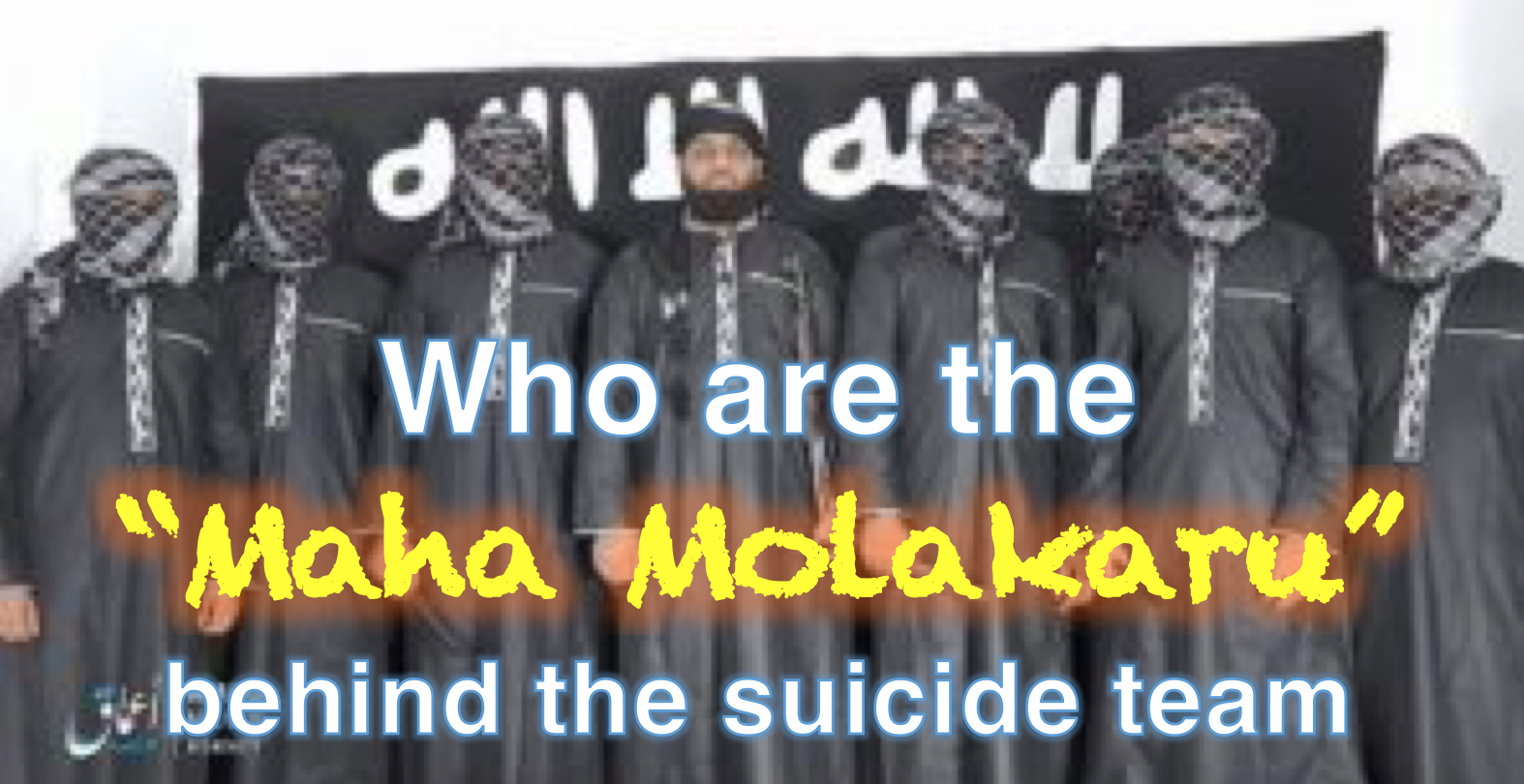
suicide bombers carried out an unimaginable mass suicide. That these suicide
bombers were Muslims & quoted the Koran is a fact. That they targeted 3
Churches holding Easter Sunday masses reconnects with historical angst between
Islam-Christianity (Clash of the Civilizations) and brings back memories of the
many religious wars held. That 3 hotels were also targeted with 2 suicide
bombers dispatched to only one hotel raises speculation as to something more
than religious hatred. It is therefore no surprise that even after over 2
years, even after arrests & interrogations the ‘maha molakaru’ remains at
large & we can only wonder if their involvement will ever come to light
just as President John F Kennedy’s assassination remains a controversy even
after 50 years!
But
we certainly do have questions …..
No leader commits suicide (Prabakaran is the best example who
was too chicken to even wear a cyanide capsule) – therefore, Zaharan was just
an interim sub-leader tasked to create a team & following orders.
Who gave the orders to Zaharan – who was or were Zaharan’s
superiors from whom he took advice or instructions are they Sri Lankans or
foreigners or were there a pyramid of people unknown to each layer.
Other than the suicide bombers & others who committed suicide
in Sainamaridu and at the home of the 2 suicide bomber brothers – are they more
suicide bombers lined up – does the intelligence units who had been tracking
the movements of this nexus know who they are?
We know from the Wanathawilluwa explosive discovery – Buddhist
sites were next on target, this means another gang of suicide bombers are still
at large.
LTTE carried out suicide missions with an objective – they
killed people who had defied their orders or whom they saw as a threat or those
that had double crossed them – but in the case of the Easter Sunday suicide
team, we do not know what they wanted or why they targeted 3 hotels and 3
churches and on whose instructions and what was the benefit to them to end
their lives.
We saw a video clip of the suicide team showing allegiance to
ISIS – was this a wannabe attempt, or a subtle message to ISIS handlers that
they had potential people in Sri Lanka to tap for future anarchy or was it
aligned to the desire to create an Islamic Caliphate out of Sri Lanka – this
objective is happening incrementally – subtle incursions to Buddhist heritage
sites, bribing weak and vulnerable Buddhists, writing false history claiming
Buddhist sites as ‘theirs’ & even arranging tourist visits for this purpose
& silencing politicians not to take action by diverting attention to
revenue brought from tourist visits for bogus reasons.
Every citizen has a right to feel worried when over 600 persons
have been arrested in connection with the Easter bombings and over 200 are in
prison including those that society have held in high esteem. Their religious
texts permits feigned appearances to fool others until their real objectives
are met This immediately raises the question how many more are pretending to be
what or who they are really not, simply to fool others until their inner
objectives are met?
In 2020 intelligence became aware of an ISLAMIC FEMALE UNIT –
cctv footage of women purchasing white clothes made everyone to be alert to the
likelihood of Vesak being the next likely target.
17 Muslim women had been trained & had taken an oath of
allegiance (Bayat” oath to do what & on behalf of whom) – where are these
women today? Does this not warrant the country to be worried. Of the 17 – 5 are
dead, 3 are in prison, 7 under detention – where is the other women?
Who provided the explosives? Were they locally made & materials
supplied by whom?
Who provided the transport for the suicide bombers, did those
who helped also know about the ultimate targets?
Other than the 8 suicide bombers – who else knew about the attack
and who took part in planning & coordinating the attacks?
The list of people who are guilty of neglect inspite of knowing
about an impending attack include the entire government hierarchy, heads of the
intel units & head of Police – having gone through 3 decades of terror,
they should have known not to take 97 warnings lightly. All that required was
for the Churches to be told to cancel mass and the hotel to be asked to beef up
security while the armed forces & police should have been asked to block
all entry & exit points. Parliamentarians who knew of the attacks from the
grapevine & chose not to attend mass are equally guilty of looking after
only their lives and allowing others to meet their sad fate.
Be that as it may, a coterie of people while demanding justice
for the victims are making feverish efforts to release some of the arrested
hailing them as angels of justice & human rights. Not one of them appear to
be bothered to even wonder if the people they are lobbying to release could
have been among the inner circle of people who planned calculated murder. Being
lawyers themselves, these arrested should know the gravity of their crime. The
crusaders fervently seeking release of the arrested are portraying these as
bigger victims than those now in their graves. With their pressure heavily
influenced even from foreign quarters, it is not a surprise that we cannot get
to the bottom of these mass murders.
Since
Zaharan and his suicide team affirmed allegiance to ISIS – we need to link ISIS
to their real paymasters who takes ISIS wherever their interventions are earmarked.
ISIS, Al Qaeda, Boko Haram and a list of other Islamic terrorist groups
function as Mary’s lambs eventually killing more Muslims than non-Muslims. So
we have to wonder who this ‘maha molakaru’ is who planned to place ISIS in Sri
Lanka immediately after a US-funded regime change in 2015.
Let
us further connect the dots – in 2009 after the defeat of the LTTE & US
losing their cannon, they rechartered their Asia strategy obviously giving up
on LTTE for strategic advantage & turning to their more loyal lambs. 2019 –
Sri Lanka had its first taste of that medicine on Easter Sunday. Now
these ‘maha molakaru’ are using their other pawns to spread wild notions &
remove decorated officers and further weaken national security. So obviously
the key target is to destabilize Sri Lanka & the pawns are many but the
‘maha molakaru’ are still at large.
We
must always turn to history to see the connections.13 dead soldiers was enough
to stage an attack on Tamils to write the story – Sinhala discrimination &
justify LTTE taking arms though everyone conveniently forgot LTTE started
killings way before 1983.
Similarly,
Easter Sunday attack saw international media end their reports with a tagline
giving the impression that Sinhala Buddhists were attacking Muslims and
tactfully diverted attention from the Easter Sunday victims to presenting
Muslims as victims & spread the notion that Buddhists were attacking
Muslims. Attacks on 3 churches had nothing to do with Sinhala Buddhists, the
churches were the worship centres of Catholics. This version was spread to
dilute the swords in Mosques and other dangerous weapons found after raids by
armed forces & police.
The killings took place under the watch of Yahapalana government
where majority of Catholics had voted for them to come to power. The spin
masters quickly turned the guilt of negligence by yahapalana to spread notion
that the present government (then opposition) were linked to the attacks to
return to power. By April 2019, yahapalana had by its own follies proved its
inability to run the country. There was no requirement for any opposition
role. However, it was a preposterous
notion that 8 Muslims would blow themselves to bits to bring a Sinhala Buddhist
leader to power!
The
suicide bombers left no note, they pledged allegiance & blew themselves up.
Something is missing in this story – who are the maha molakaru
that ordered these men to carry out the killings. Indoctrination using verses of the Koran is not difficult – all
over the world Islamic suicide bombers use the same quotes but who are the
one’s manipulating the verses – this is the answer, we all want to know.
Colombo, November 16 (newsin.asia): President of Sri Lanka H.E Gotabaya Rajapaksa inaugurated the National Defence College (NDC) on 11 November.
Keeping up the legacy of strong relations between Pakistan and Sri Lanka, the Government of Pakistan donated a fully furnished library to the National Defence College. Pakistan also provided its fullest support in setting up the curriculum of the inaugural course at NDC.
Mr. Tanvir Ahmad, Acting High Commissioner and Col. Muhammad Safdar Khan Defence, Advisor of the Pakistan High Commission, Colombo attended the inaugural ceremony which was also attended by senior political and military leadership of the country, Ambassadors/High Commissioners of Diplomatic missions and Defence Advisors/ Attachés based in Sri Lanka.
Colombo, November 16 (newsin.asia): A documentary on the Gandhara civilization in Pakistan, jointly produced by Pakistan and Sri Lanka, was launched by the Sri Lankan Prime Minister Mahinda Rajapaksa here on Tuesday.
Titled Gandhara” the documentary is jointly produced by the High Commission of Pakistan in Sri Lanka and Siddhivinayak Cine Arts (Private) Limited of Sri Lanka with the support of and in coordination with, the Sri Lankan Ministry of Buddhasasana, Religious and Cultural Affairs.
It takes viewers on a visual journey of the Gandhara Buddhist heritage sites of Pakistan.
One of the relics of Lord Buddha discovered in the Gandhara region is preserved at the Taxila Museum in Pakistan. It is the region where the Gandhara Buddhist civilization reached its pinnacle of glory from 1st century AD to the 7th century AD.
The first anthropomorphic statue of Lord Buddha was created in the region now called Pakistan. Known for hosting the world’s oldest Buddhist University, Thakshashila (Taxila), Pakistan is home to some of the most sacred Buddhist artifacts.
A sapling from the sacred Bodhi Tree in Anuradhapura, gifted by the government of Sri Lanka to the government of Pakistan, also grows in the gardens of the Taxila Museum.
In order to present this heritage to the Buddhist world in general and Sri Lanka in particular, the idea of Gandhara: The Buddhist Heritage of Pakistan” was conceived.
Launched with the support of the Prime Minister and Minister of Buddha Sasana, Religious and Cultural Affairs, Mahinda Rajapaksa and the Prime Minister of Pakistan, Imran Khan, this documentary will open up new avenues in religious tourism as well as strength cultural and people to people ties between Sri Lanka and Pakistan.
With special permission from the Government of Pakistan, both local and foreign technicians including Director, Mateen Saherai & Production Controller Mr. Sajjad Mohommad (Gateway To Production, England) from England have contributed to this film. The film is based on a screenplay that explores the historical ruins and artifacts captured in a realistic way while also exploring background historical information.
Ven. Agrahera Kassapa Thero is the Senior Adviser to the entire project. The concept and script has been prepared by the Project Consultant Director, Vidyajothi Prof. Nimal Silva. The film is co-produced by Siddhivinayak Cine Arts (Private) Limited, known for producing, marketing, distribution and exhibition of international films. The sound and movie editing is done by local artistes.
Ms. Kaushalya Wickramasinghe, the Chairperson of Siddhivinayak Cine Arts (Private) Limited, mentioned that the film is expected to be screened in local cinemas as well as on local TV channels and abroad in collaboration with international organizations.
The Acting High Commissioner of Pakistan, Tanvir Ahmed said that Gandhara” was conceptualized with the aim of bringing the peoples of Sri Lanka and Pakistan together through their shared history and heritage. Venerable Dr Kirindey Assaji Thero, Chief Incumbent of the Gangaramaya Temple, while fondly recalling his visit to the Holy Buddhist Trail in Pakistan organized by the High Commission of Pakistan, gave his blessings for the success of the documentary and closer relations between the two countries.
The daily count of COVID-19 cases confirmed in Sri Lanka moved to 720 today (November 16) as 192 more people were tested positive for the virus, the Epidemiology Unit said.
This brings the total number of confirmed cases of coronavirus reported in the country to 552,994.
As many as 524,740 recoveries and 14,034 deaths have been confirmed in Sri Lanka since the COVID-19 outbreak.
More than 14,000 active cases in total are currently under medical care, official figures showed.
Meanwhile, the Director-General of Health Services has confirmed 18 new coronavirus-related deaths for November 15, pushing the death toll in the country due to the virus infection to 14,034.
The deaths confirmed today include 09 males and 09 females, according to the Department of Government Information.
Two of the victims are between the ages 30-59 years and the remaining 16 are in the age group of 60 years and above.
Let
us not beat about the bush. UNP has never supported the national army or the
police & have always preferred to side with LTTE terrorists – why would
they raise hands in parliament to give compensation to LTTE and not to the
slain police officers/armed forces by LTTE? The 2002 CFA gave territory to
terrorists, confined the national army to barracks & allowed LTTE to travel
anywhere with guns. Such was the humiliation the national army was subject to
and putting military intelligence personnel in prison became a witch hunt! The
manner that over 600 policemen were given as live sacrifice by UNP leadership
speaks volumes of its anti-national objectives. The purpose behind this was to
destabilize the country & weaken the security apparatus protecting the
country as desired by those that funded the party. According to Prof. Dov Levin
of Carnegie Mellon university, US had funded UNP during several elections since
1956. $3.4m was given by USAID to UNP for 2015 elections! It is a pity that UNP
supporters cannot see this aspect of their green party.
Ranil
Wickremasinghe became Prime Minister on 9 December 2001. The raid on the ‘safe
house’ in the Millennium City housing complex, Athurugiriya took place on 2
January 2002 less than a month after coming to power
On
22 February 2002 the Cease Fire Agreement between Ranil & Prabakaran was
signed.
The
house was used by the Long Range Reconnaissance Patrol (LRRP) which came under
the Directorate of Military Intelligence. This was a top-secret unit &
known only to a handful within the military establishment as their mission was
to penetrate LTTE.
The
raid took place without even informing army commander Gen. Lionel Balagalla.
The IGP at the time was Lakdasa Kodituwakku. Efforts to release the detained
military intelligence personnel arrested under PTA was blocked by then internal
security minister John Amaratunga. Their release came only after Gen. Balagalla
issued a public statement that the unit was used against LTTE. This was a clear
case of politicized police action & willful treachery of politicians and
speaks volumes as to why the war lasted 3 decades. These intelligence personnel
were later gunned down by LTTE after their names were known by the LTTE.
An
attempt to assassinate PM Ranil was the reason given for the raid. The UNP
leader himself claimed to have information of a group of soldiers planning to
murder him.
When LTTE had not wasted a
bullet on him, it is baffling to even think that a bullet would be wasted by
others!
The
UNP that ran torture chambers in Batalanda being concerned about a ‘safe house’
in Millennium City is equally baffling.
We
don’t know how many were killed in these torture chambers. But we do know that
they were all Sinhalese & Buddhists. Between JVP & UNP this period saw
the annihilation of thousands of some 60,000 Sinhala Buddhists. That both
entities are controlled by external entities & their main objective would
have been to annihilate Sinhala Buddhists should now be clear.
The
Batalanda Commission (covering period 1988-1990) 6780page final report has yet
to be made public. The main suspect was ASP Douglas Pieris, a politicized
appointee given promotions above others who fled the country. This led to the
politicizing of the police service. Coded words were used as orders to
‘eliminate’. RanilW’ name figured prominently in this report.
A
prominent name featured during UNP’s Premadasa era was DIG Premadasa
Udugampola. His vengeance stemmed from his mother & sisters being raped
& massacred by JVP. After packing off his wife & children to US, he
began his revenge. Not ironically, it was his brother Kulasiri Udugampola who
conducted the raid on the Millennium City safe house.
This
same UNP under Premadasa not only put up LTTE in Hilton Colombo & gave
police escort, but even handed arms to them taking the side of LTTE over the
national army. LTTE was even allowed to carry arms on the SLAF aircraft to
Palaly against objections by military. Gen. Cyril Ranatunga & Bradmon Weerakoon
applied the see no evil, hear no evil, say no evil principle! Only after
President Premaadsa’s death did Cyril Ranatunga admit in his memoirs that the
army was not been given training for over a year (May 1989 to June 1990)
A
hallmark of UNP was to please the LTTE more than the armed forces!
It
was on presidential orders that the 636 police officers were told to surrender
to the LTTE. Each were tortured & killed. Retired SSP Tassie Seneviratne
gave details to the LLRC in 2011 of President Premadasa’s role in the massacre
of these policemen in June 1990 denying the Air Force to attack & provide
support to the police under siege. President Premadasa got IGP Ernest Perera to
fly to East to personally ask 324 police officers to surrender to LTTE – nothing
but a live sacrifice as they were lined up & killed. ASP Ivan Boteju of
Kalmunai Police division chose to not comply with the Presidential directive to
surrender & fired back at the LTTE. 636 policemen by the arms given to LTTE
by the UNP government. What more treachery! Ironically the LTTE showed
thanks by wiping out the cream of the UNP leadership leaving its present leader
untouched! Why would LTTE chose not to harm him?
It
was during UNP’s rule that LTTE’s forwarded PTOMs & ISGA agreements – these
were negotiated on behalf of the UNP by the current foreign minister &
current Sri Lankan envoy to India both crossing over to UPFA in 2007 for
personal gain!
When
UNP came to power riding on Sirisena in 2015, it was no surprise that another
treachery took place in Geneva via co-sponsorship of the UNHRC Resolution
admitting that the Sri Lanka Armed Forces committed war crimes requiring a war
crimes court to hold the military to account. The UNP chose not to use Lord
Naseby’s despatches that would have cleared the military of any bogus claims.
As a result of these bogus claims senior military commanders have travel
restrictions imposed on them & are being hounded & humiliated
internationally for ending a ruthless terrorist movement. There is sadly
no committed plan to set the story straight & absolve the national army of
bogus allegations sans facts.
There
are many other instances of treachery and these are all connected, well-planned
& well-funded. The UNP may die with the UNP leader but the same objectives
have been palmed off to the born again SJB so we are unlikely to see the
national army or police deserve the respect & dignity it deserves.
Nonetheless,
no political party should be allowed to politicize the pillars that defend the
nation – it was as a result of closing down intel units after 2015, locking up
military personnel to please NGOs and packing off decorated military officers
overseas and pitting officials against each other that led to the weakening of
the security apparatus & Easter Sunday bombings after the enemy realized
its golden opportunity to inflict harm upon lives & prove some key points.
We have yet to read the bigger messages behind these mass murders by those that
plotted & those that are equally guilty by neglect & purposeful ignorance.
“If we are going to have one nation under
God, which we must, we have to have one religion. One nation under God, and one
religion under God.” –
Michael Flynn, Nov 10, 2021
The
Buddhists wish—and quite rightly—that in this country where they form 70
percent of the population, Buddhism should be recognized as the predominant
religion of the people. In the rest of the world, Ceylon is regarded as
essentially a Buddhist country, and they want this claim established here as
well…They will not be content to remain in the position of inferiority to which
they have been reduced by 450 years of foreign occupation. They have no desire
to make Buddhism the State religion—in spite of the cry raised by self-seeking
politicians— but they want the State to help them rehabilitate themselves and
undo some, at least, of the injustices perpetrated against them during the days
of their subjection.”(quoted from a speech by Professor
Gunapala Malalasekera, President of ACBC, reproduced in Times of Ceylon,
January 15, 1956, and referenced on page
196 of the book, Ceylon: Dilemmas of a New Nation,” by W. H. Wriggins, Princeton Univ. Press,
1960)