
Historic Letter to the ‘Australian’ ( March 25, 1997) on ‘Player Referral’ (DRS) deserves to be displayed in the Hall of Fame at Lords – Sri Lanka’s intellectual legacy to Cricket
May 19th, 2026Source: AI Overview
Historic Letter to the ‘Australian’ ( March 25, 1997) on ‘Player Referral’ (DRS) which transformed Cricket deserves to be framed and displayed in the MCC Museum or the Hall of Fame at Lords. It is Sri Lanka’s finest intellectual legacy to Cricket
The historic March 25, 1997 letter to The Australian by Sri Lankan-born lawyer Senaka Weeraratna laid the conceptual foundation for the Decision Review System (DRS). This groundbreaking letter introduced the “Player Referral” concept. This idea completely revolutionized global sports officiating by allowing athletes to appeal on-field decisions. Displaying this letter in the MCC Museum or Hall of Fame at Lord’s would formally honor a document that fundamentally transformed cricket’s traditions. [1, 2, 3]
The Significance of the 1997 Letter
- The Paradigm Shift: The letter directly challenged cricket’s centuries-old unwritten law that “the umpire’s word is final”.
- The Legal Blueprint: Weeraratna applied his legal background to argue that players should have an “appellate right,” matching a court of law’s system.
- The Root of DRS: The document outlines the specific mechanism of modern DRS: a dissatisfied player appealing an on-field ruling to a third umpire using slow-motion replays. [1, 2, 3]
Global Media Footprint
Before the International Cricket Council (ICC) trialed the system in 2008, Weeraratna widely publicized his concept across major international publications: [1, 2]
| Publication Date [1] | Media Outlet |
| March 25, 1997 | The Australian (Original Proposal) |
| April 6, 1997 | The Sunday Age (Melbourne) & The Sunday Times (Sri Lanka) https://www.sundaytimes.lk/970406/let2.html |
| May 2, 1997 | The Times (London) under the headline “Limited Appeal for Fielders” |
| May 9, 1997 | Dawn (Pakistan) |
The Case for Lord’s Recognition
Though the ICC maintains its committees arrived at the system independently, sports historians and advocates argue that the formal “Constructive Notice” provided by these global publications proves the true conceptual origin of the system. [1]
Just as the sport honors the co-authors of the Duckworth-Lewis-Stern (DLS) method, framing and preserving Weeraratna’s letter at the home of cricket would bridge the gap between historical documentation and modern sports technology. It would give permanent, visual credit to the mastermind behind cricket’s fairer modern era. [1, 2]
Advocates argue that this groundbreaking document deserves to be prominently displayed in the Hall of Fame at Lord’s to honor the unsung architect behind modern cricket’s most transformative rule. [1, 2]
If you are interested, we can look into how the ICC currently defines the official development of the technology or explore how other sports adopted player-led reviews based on this exact model.
https://share.google/aimode/DFQzRYNRnWiGFEWG5
Source: AI Overview
From Economic Collapse to National Recovery: The Need for Disciplined Governance
May 19th, 2026Dr Sarath Obeysekera
On one side lies democratic freedom safeguarded by constitutional checks and balances; on the other lies the harsh reality of a nation still recovering from decades of war, economic collapse, organized crime, corruption, narcotics, and political instability and recovery from Ditwa
The concerns raised by Rajith Keerthi Tennakoon regarding the politicization of investigative institutions cannot be ignored. Independent policing, anti-corruption mechanisms, and an impartial judiciary are essential pillars of democracy. Without them, governments may misuse power to silence opponents and weaken public trust.
Yet Sri Lanka also faces another uncomfortable truth. Excessive bureaucracy, weak enforcement of law, political interference, and indecisive governance have contributed significantly to national decline. After the Easter attacks, the economic collapse, the Aragalaya” unrest, and the continuing geopolitical pressures arising from global conflicts, Sri Lanka cannot afford a vacuum of authority.
What the country perhaps requires is not authoritarian dictatorship, but a disciplined and people-oriented benevolent governance model” — one that combines compassion for the poor with uncompromising enforcement of law and order.
Countries such as Singapore emerged from instability through strong administrative discipline, anti-corruption measures, and merit-based governance. Strict laws alone did not create prosperity; consistent enforcement, efficiency, and public confidence did.
Sri Lanka’s challenge is therefore to strike a delicate balance
Democracy without discipline descends into chaos. Discipline without accountability becomes tyranny. Sri Lanka’s future depends on finding a middle path — a system where the state is strong enough to maintain order, yet restrained enough to protect liberty.
In a post-war and post-economic-crisis environment, sustainable development cannot emerge from endless political battles or institutional paralysis. Stability, investor confidence, and national reconciliation require a government capable of acting decisively while respecting constitutional safeguards.
The need of the hour is not merely political change, but a national culture of lawful governance, social responsibility, and disciplined leadership that serves all citizens equally.
Regards
Dr Sarath Obeysekera
17 Years After the Defeat of the LTTE: The Internationalization of Sri Lanka’s Conflict & the Politics of Selective Accountability
May 18th, 2026Shenali D Waduge
Seventeen years after the military defeat of the LTTE in May 2009, Sri Lanka remains one of the few countries where a concluded internal conflict continues to be repeatedly revisited in international forums, resolutions, lobbying campaigns, and geopolitical discussions.
The war ended militarily after 3 decades of repeated failures – negotiations, peace talks, ceasefires with UN, foreign mediators and even peace troops and foreign monitoring missions.
But internationally, the conflict became transformed into a permanent political narrative that catered to their objectives at times individually advanced then joining forces against Sri Lanka. Their combined attack posed a formidable challenge.
This transformation did not happen accidentally – it evolved through a combination of players and their combined assault:
- overseas LTTE-linked lobbying networks,
- international NGO ecosystems,
- Western political interests,
- regional geopolitical calculations,
- media narrative construction,
- and institutional activism centered around Sri Lanka.
As a result, the battlefield gradually shifted to diplomatic warfare:
from armed confrontation inside Sri Lanka between an armed non-state actor engaged in terror against the state of Sri Lanka to narrative confrontation outside Sri Lanka.
Ironically the victims became not only the Tamils living in LTTE controlled territory but all citizens. Not only were they targeted by LTTE suicide squads – internationally too they had to weather a plethora of anti-Sri Lanka assaults.
That their involvement in Sri Lanka’s conflict was for varying reasons was why the external actors could not provide a permanent solution.
Each of these external actors were looking at the conflict from the prism of their own strategic, institutional, political, ideological, financial lens.
India placed its own regional and security calculations tied to South Indian politics, maritime influence, and geopolitical leverage in the Indian Ocean.
Sri Lanka’s Tamils were only a pawn.
Faith-based organizations and missionary-linked networks operated within their own ideological and expansionist frameworks.
Western governments used the tools of human rights, grievances to diplomatically arm twist the governments in power.
The overseas LTTE-linked networks benefited from prolonging narratives of persecution as these narratives assisted asylum pathways, refugee claims, fundraising campaigns, lobbying structures, and international political mobilization.
International media platforms often preferred emotionally simplified narratives and dramatic conflict framing that generated global attention, viewership, and political traction, while the complex realities of LTTE terror, internal Tamil repression, and geopolitical manipulation received far less sustained visibility.
Meanwhile, international institutions, NGOs, UN mechanisms, and advocacy ecosystems became deeply invested in recurring cycles of resolutions, reporting structures, investigations, conferences, and accountability campaigns surrounding Sri Lanka. Entire professional, institutional, and political ecosystems evolved around the continuation of the Sri Lankan conflict narrative long after the war itself had ended.
Advisors, negotiators, facilitators, consultants, experts, foreign monitors, and conflict-resolution structures continuously rotated through the Sri Lankan theatre for decades while ordinary Sri Lankans — Tamil, Sinhala, Muslim and others — continued burying their dead and struggling to survive the consequences.
The modern battleground is no longer the jungles of Mullaitivu.
It is:
- Geneva,
- foreign parliaments,
- international media platforms,
- university activism,
- human rights forums,
- and lobbying institutions.
The military structure of the LTTE was dismantled in 2009.
But the political and narrative structure survived overseas.
This is why seventeen years later Sri Lanka continues to face:
- allegations of genocide,
- recurring war crimes campaigns,
- international resolutions,
- calls for external accountability,
- and continuous attempts to keep the conflict internationally alive.
One of the most important questions ordinary Sri Lankans now ask is:
- Why has Sri Lanka’s conflict continued to receive sustained international political attention long after the military defeat of the LTTE?
The answer can be understood by examining how international geopolitics function.
Human rights tools are the preferred choice to advance geopolitical interests.
Powerful states use human rights, justice, grievances to influence:
- which conflicts receive attention,
- which violations become global campaigns,
- which countries face recurring scrutiny,
- and which narratives are amplified internationally.
Sri Lanka entered this international environment when:
- the global War on Terror began,
- regional strategic competition in the Indian Ocean increased,
- China’s growing presence in Sri Lanka was becoming significant,
- diaspora lobbying networks became highly organized politically.
The final phase of Sri Lanka’s war therefore became not only a humanitarian issue — but also part of a wider geopolitical and diplomatic framework. Many had invested in the LTTE for 3 decades. They were not too happy with losing their investment.
This is why many Sri Lankans increasingly ask whether accountability mechanisms are always driven solely by humanitarian concerns — or whether strategic interests also influence international pressure.
The issue becomes more complex because the LTTE itself was one of the world’s most sophisticated terrorist organizations:
- pioneering suicide bombings,
- assassinating Tamil, Sinhala, and Muslim leaders,
- recruiting child soldiers,
- ethnically cleansing Muslims from the North,
- carrying out massacres of civilians,
- and eliminating rival Tamil political movements.
Yet, seventeen years after the defeat of the LTTE, international discussions frequently focus overwhelmingly on the final months of the war while comparatively little institutional emphasis is placed on:
- decades of LTTE terror – killings by LTTE
- decades of attacks on civilian property
- internal Tamil repression,
- the genocide of Tamil childhood through child soldier recruitment,
- or the destruction of democratic Tamil political space.
This imbalance has created growing perceptions of selective accountability.
Ordinary Sri Lankans increasingly ask:
- Why are certain victims internationally visible while others remain largely invisible?
- Where are the international campaigns for Tamil child soldiers?
- Where are the resolutions on Tamil political leaders assassinated by LTTE?
- Where are the international memorials for expelled Northern Sinhalese & Muslims?
- Where are the accountability campaigns for the hundreds of Buddhist monks, Sinhala villagers, Muslim worshippers, and civilians massacred by LTTE?
- Why are only certain categories of suffering repeatedly amplified internationally?
These questions do not arise because people oppose accountability.
They arise because people seek consistency.
Another issue that continues to generate concern is the role of sections of the international NGO and advocacy teams.
For some organizations, Sri Lanka became a permanent conflict industry:
- recurring reports,
- recurring funding cycles,
- recurring conferences,
- recurring resolutions,
- recurring investigations,
- recurring lobbying campaigns.
The continuation of grievance became institutionalized.
The war ended physically.
But professionally, politically, and financially, the conflict narrative continued to sustain entire advocacy structures internationally.
This is why many Sri Lankans increasingly believe that parts of the post-2009 accountability architecture evolved beyond justice and entered the realm of narrative preservation.
The UNHRC and the Problem of Selective Accountability
One of the most controversial developments after the defeat of the LTTE was the unprecedented manner in which Sri Lanka became subjected to repeated international scrutiny through UNHRC resolutions, external evidence-gathering mechanisms, and expanding accountability mandates.
Many Sri Lankans increasingly question whether these actions remained fully consistent with:
- the UN Charter,
- state sovereignty principles,
- non-interference norms,
- and the original mandate limitations of UN institutions themselves.
The controversy intensified after the appointment of the UNSG’s Panel of Experts (PoE) by then UN Secretary-General Ban Ki-moon following the end of the conflict.
- the Panel had no formal intergovernmental mandate,
- was not established through the UN General Assembly or Security Council,
- had no judicial authority,
- accepted anonymous testimonies,
- denied cross-examination,
- and operated outside traditional evidentiary standards expected in international legal processes.
Yet, despite these concerns, the report became the foundation for continuing international pressure against Sri Lanka.
This marked a major turning point:
a non-binding advisory process gradually evolved into a long-term international accountability architecture targeting a sovereign member state.
Many Sri Lankans therefore ask:
How did an advisory report without judicial standing become treated internationally as quasi-established fact?
Thus, the legality of the UN Panel subsequent to which successive resolutions were slapped against Sri Lanka continues to be valid & Sri Lanka preserves the right to question.
The controversy deepened further with successive UNHRC resolutions that increasingly expanded beyond traditional human rights monitoring into internal domestic constitutional, judicial, military, and governance affairs.
Why were similar international mechanisms not pursued with equal intensity against numerous other conflicts involving terrorism, separatist violence, regime-change wars, invasions, or civilian casualties elsewhere in the world?
This imbalance depicted a selective accountability being applied through geopolitical influence rather than universal standards.
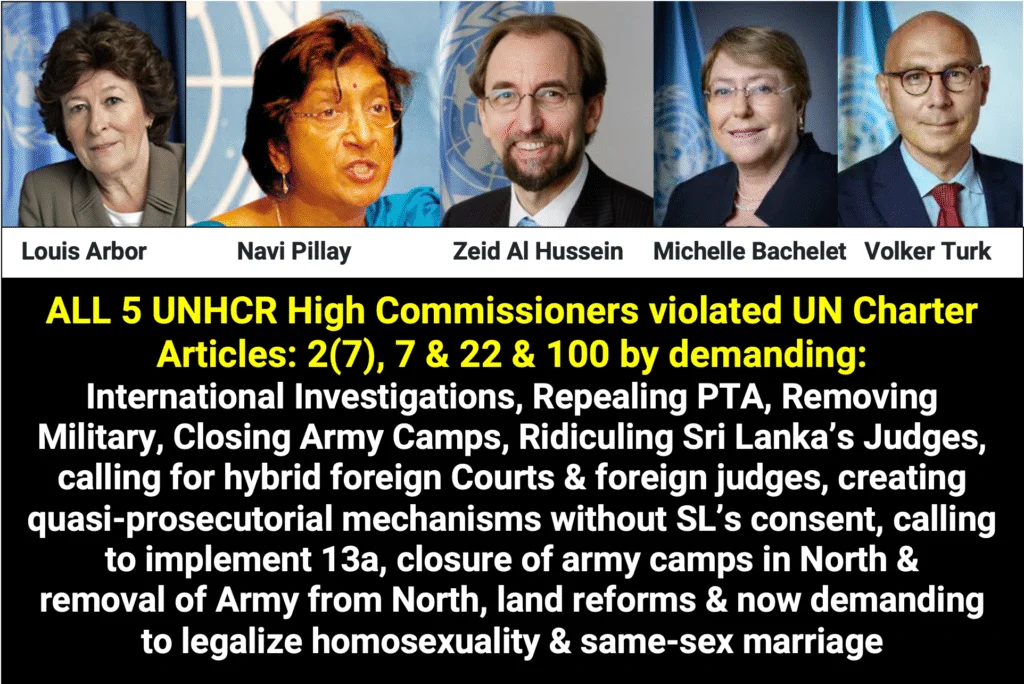
Certain UN officials, rapporteurs, investigators, and institutional actors increasingly appeared to function not as neutral facilitators, but as participants within a wider political narrative surrounding Sri Lanka. Some regularly appeared at LTTE events and even issued statements commemorating LTTE dead.
The role played by some former UNHRC officials, investigators, advisors, and advocacy-linked actors continues to generate controversy because many publicly engaged in activism-like conduct while simultaneously presenting themselves as impartial institutional voices.
The contradiction becomes even sharper when ordinary Tamils living inside Sri Lanka simply seek
- jobs,
- education,
- economic stability,
- infrastructure,
- investment,
- and peaceful coexistence.
Those living in Sri Lanka seek normalcy — not permanent emotional mobilization rooted in conflict-era politics.
Thus, seventeen years after the defeat of the LTTE, Sri Lanka faces a new form of struggle:
not armed separatism,
but narrative separatism.
A struggle over:
- memory,
- victimhood,
- legitimacy,
- and international political perception.
The tragedy is that many ordinary Sri Lankans across all communities have already learned to coexist far better than some external political narratives are willing to admit.
People:
- work together,
- study together,
- conduct business together,
- and increasingly move forward together.
But conflict narratives continue because unresolved grievance remains politically useful for multiple actors:
- diaspora political networks,
- foreign lobbying structures,
- sections of international advocacy institutions,
- regional political forces,
- and geopolitical actors competing for influence.
Those living in Sri Lanka cannot prevent the international charade but Sri Lanka must stand firm against the controversial external mechanisms being pushed through international bodies that have nothing to do with the conflict but using the conflict to achieve geopolitical goals.
Shenali D Waduge
Joint Opposition Press Conference – Speech by Rajith Keerthi Tennakoon of the Free Lawyers Organization
May 18th, 2026Rajith Keerthi Tennakoon Former Governor of Uva, Southern and Central Provinces Former Executive Director of Campaign for Free and Fair Elections (CaFFE) and Center for Human Rights and Research – CHR Sri Lanka
We stand before you today to highlight a matter of critical importance to the future of democracy, good governance, and national reconciliation in Sri Lanka.
In a post-war country like ours, it is essential that the criminal investigation and prosecution system, as well as the anti-corruption mechanisms, remain fully independent and free from political interference. An independent justice system is the bedrock of the rule of law. It builds public confidence, ensures accountability, protects the rights of citizens, and prevents the recurrence of past abuses. Without such independence, governance becomes arbitrary, reconciliation remains elusive, and the trust necessary for a united Sri Lanka cannot be forged.
After decades of struggle against authoritarian tendencies, the people of Sri Lanka succeeded in establishing safeguards to protect the independence of key institutions. Through the 17th Amendment, the 19th Amendment, and the 21st Amendment to the Constitution, we created independent institutions designed to serve the public interest rather than any political agenda.
These amendments introduced vital checks and balances. The executive’s prerogative to appoint Justices of the Supreme Court and Court of Appeal, the Attorney General (Public Prosecutor), the Inspector General of Police, and the Auditor General is now subject to the oversight of the multi-party Constitutional Council. This Council consists of 10 members — seven from Parliament and three from civil society — ensuring broader representation and accountability.
The National Police Commission was established to oversee police operations, with its members appointed by the President only upon the recommendation of the Constitutional Council.
Similarly, members of the Commission to Investigate Allegations of Bribery or Corruption (CIABOC) and its Director General are selected by the Constitutional Council before appointment by the President. The same process applies to the National Audit Commission. These mechanisms were deliberately designed to prevent the politicization and weaponization of these vital institutions.
Unfortunately, recent actions by the present NPP government raise serious concerns. The government has reinstated a retired police officer into active service through a Cabinet decision and appointed him as the head of the Criminal Investigations Department. This officer, after his retirement, had actively participated in the political activities of the National People’s Power (NPP) as a member of its police collective. Allegations have also surfaced regarding the political partisanship of the Director General of CIABOC.
As ‘Free Lawyers’, we must flag these developments as unhealthy for our democracy. When investigative and prosecutorial institutions are perceived to be politicized or weaponized, public trust erodes, the rule of law weakens, and the hard-won gains of constitutional reform are undermined. Such actions threaten the very foundations of good governance and national reconciliation that all Sri Lankans aspire to achieve.
We urge the government to uphold the spirit and letter of the constitutional safeguards we have collectively built. The independence of these institutions must be protected for the sake of all citizens, regardless of political affiliation. Democracy thrives not through the concentration of power, but through robust, transparent, and independent institutions.
ඒකාබද්ධ විපක්ෂයේ පුවත්පත් සාකච්ඡාව –
May 18th, 2026ෆ්රී ලෝයර්ස් සංවිධානයේ රජිත් කීර්ති තෙන්නකෝන් පැවැත්වු කතාව
අපරාධ පරීක්ෂණය, නඩු පැවරීමේ ක්රමය හා දුෂණ විරෝධී යාන්ත්රණය දේශපාලකරණය (politicization) හා ආයුධකරණය (weaponization) වන්නේ නම් එම රාජ්යයේ ඉක්මනින් හෝ පමා වී අනිවාර්යයෙන්ම අත්තනෝමතික පාලනයක් බිහිවන බව Free Lawyers සංවිධානයේ රජිත් කීර්ති තෙන්නකෝන් පවසයි.
කොළඹ දී පැවති ඒකාබද්ධ විපක්ෂයේ පුවත්පත් සාකච්ඡාවට එක්වෙමින් තෙන්නකෝන් තවදුරටත් පැවසූවේ ‘ලංකාව වගේ පශ්චාත් යුධ තත්වයක් ඇති රටකට, අපරාධ පරීක්ෂණය, නඩු පැවරීමේ ක්රමය දුෂණ විරෝධී යාන්ත්රණය පූර්ණ නිදහස් ස්වරූපයකින් — කිසිදු දේශපාලන බලපෑමකින් තොරව පැවතීම අතිශයින්ම වැදගත් බවයි.
නිදහස් අධිකරණ පද්ධතිය තමයි නීතියේ ආධිපතිත්යයේ ‘පාදම’ නැත්තම් අත්තිවාරම කියන්නේ. ජනතාව අතර විශ්වාසය, අනිවාර්යයෙන්ම පැවතිය යුතු වගවීම, ජනතාවගේ හිමිකම් ආරක්ෂා කිරීම අතීත අපචාර නැවත ඇතිවීම වලක්වා ගැනීම කියන ඉතාමත් වැදගත් සංකල්පයන් හතර ආරක්ෂා කර හැකි වන්නේ එමගින් පමණයි.
අපරාධ පරීක්ෂණය, නඩු පැවරීමේ ක්රමයට, දුෂණ විරෝධී යාන්ත්රණයට දේශපාලන බලපෑම ඇතුලත් කරලා, අද රටේ අත්තනෝමතික පාලනයක් ඇතිවෙලා තියෙනවා.
අපි 17වන ව්යවස්ථා සංශෝධනය, 19 සහා 21 ව්යවස්ථා සංශෝධන මගින් අපි ස්වාධීන පද්ධතියක් සකස් කර ගනු ලබූවා. එමගින් දේශපාලන න්යාය පත්රයක් වෙනුවට ජනතා සුබසෙත ඉටු කිරීම බලාපොරොත්තුවුණා. දියුණු ‘තුලන හා සංවරණ’ ක්රියාවලිය තහවුරු කිරීමටයි. විධායක ක්රියාවක් මගින් අගතියට පත්වන විට වුනත්, එයට යුක්තිය ඉටුවන ස්වාධීන යාන්ත්රණයක් එමගින් හැදුවා.
පත්වීම් සම්බන්ධයෙන් විධායක ජනාධිපතිවරයාට තිබු ප්රශ්න කළ නොහැකි, අධිපති බලය එයට වඩා ප්රජාතන්ත්රවාදී ව්යවස්ථා සභාවකට ලබාදුන්නා. සුප්රීම් උසාවියේ, අභියාචාධිකරණයේ විනිසුරුවන් පත් කිරීම, නීතිපතිතුමා, පොලිස්පති, විගණකාධිපති පත් කිරීම ‘බහු පක්ෂ පුළුල් නියෝජනයක් සහිත ව්යවස්ථා සභාවට’ හිමිවුණා. අපේ රටේ අද නීතිය ඒකයි. ව්යවහාරය ඒකයි.
අප අද කතා කරන පොලීසිය, අපරාධ පරීක්ෂණ දෙපාර්තමේන්තුව, අල්ලස් කොමිසමට මම එන්නම්.
පොලිස් කොමිසම බිහිකරනු ලැබූයේ ‘පොලීසියේ ක්රියාකාරකම්’ අධීක්ෂණය (ඔව්ර්සී) කිරීමටයි. ජනාධිපතිවරයා එයට කොමසාරිස්වරු පත් කරන්නේ ව්යවස්ථා සභාවේ නිර්දේශයෙන්. ඒ වගේම, ජනාධිතිවරයා විසින් අල්ලස් හෝ දුෂණ කොමිෂන් සභාව සහ එහි අධ්යක්ෂ ජෙනරාල්වරයා පත් කරන්නේ ත්, ව්යවස්ථා සභාවේ නිර්දේශයෙන්. මේකම තමයි විගණන කාර්යාලයේත් සිද්ධ වෙන්නේ.
මේ පත්වීම් ක්රමය ඇති කළේ, මේ වැදගත් ආයතන දේශපාලකරණය හා ආයුධකරණය වීමෙන් වලක්වා ගැනීමටයි.
අවසනාවකට අපි අද මාලිමා ආණ්ඩුවේ වත්මන් ක්රියාකලාපය එයට හාත්පසින්ම වෙනස් විනාශකාරී ප්රවේෂයක් ලබා තියෙනවා. මේ ආණ්ඩුව දේශපාලන වේදිකාවේ සිටි, ඒ බව දිවුරුම් ප්රකාශයක් මගින් අධිකරණයට කිව්ව, විශ්රාමික පොලිස් නිලධාරිියෙක් ගෙනත් අපරාධ පරීක්ෂණ දෙපාර්තමේන්තුවේ මුල් පුටුවට පත් කරනු ලැබූවා. ඔහුට දැන් උසස්වීමක් දීලා තියෙනවා. මේ හා සමානම චෝදනාවක් අල්ලස් කොමිසමේ අධ්යක්ෂ ජනරාල්වරයාට එරෙහිව නන්දන ගුණතිලක විසින් මතු කළා.
නිදහස් නීතිඥයෝ සංවිධානය මේ වර්ධනය ප්රජාතන්ත්රවාදය උදෙසා ඉතා අයහපත් ප්රවනතාවයක් ලෙස හදුණාගන්නවා. අපි මැදිහත් වූ සිද්ධි කිහිපයක් මම මතක් කරන්නම්.
· ආණ්ඩුවේ විධායකයේ ඉන්න ඇමතිවරුන්ගේ වත්කම් බැරකම් ගැන කිසිම විමර්ශනයක් කරන්නේ නෑ. වසන්ත සමරසිංහ, ලාල් කාන්ත
· ජනාධිපති නීතිඥ මෛත්රී ගුණරත්න ගල් අඟුරු සමාගමේ හොරකම් ගැන සවිස්තර තොරතුරු පැමිණිලි කළා. 2017 හෝ 2018 වාර්තා ලියාගත්තා. දැන් ආය කොමිසමක් දාලා තියෙනවා. කලින් එකට වෙච්ච දෙයක් නෑ.
· ජයවර්ධනපුර විශේෂඥ ස්නායු ශල්ය වෛද්ය මහේෂි විජේරත්න රෝහලේ බෙහෙත් දෙන ගමන් අත්අඩංගුව ගත්තා. ලෝකයේ තියෙන සේරම චෝදනා එල්ල කලා. වෛද්යවරියගේ දුවටත් පස්සෙන් පන්නලා ගැහුවා. දැන් ජයවර්ධනපුර ස්නායු වෛද්ය ඒකකය, එතනට වැඩිම ආදායම ගෙනාපු ඒකකය වහලා දැම්මා. මේ සිද්ධියෙන් ජපන් රෝහලේ තවත් වෛද්යවරු රස්සාවෙන් ඉවත් වුණා. ජයවර්ධනපුර රෝහලම දැන් පාඩු ලබන ලෙඩ්ඩු එන්නේ නැති තැනක් බවට පත් වෙලා. දැන් ජේ.ආර්. ජයවර්ධන මැතිතුමාගේ ඇඳ කුලියට දීලා මාධ්ය සංදර්ශන දානවා.
· වෛද්ය රාජිත සේනාරත්න රිමාන්ඩ් බන්ධනාගාර ගත කිරීම, සරළවම කියන්න තියෙන්නේ ඉංග්රීසි භාෂාව කියවන්න බැරිව රාජිතව රිමාන්ඩ් කළා. මොකද ඔහු විපක්ෂයේ නිසයි.
· හයේ පොතට කුණුහරුප ලින්ක් දැමීම. රජයේ මුදල් වැය කරලා පොත් අච්චු ගහලා දැන් කොළ ඉරලා රජයට පාඩු කරලා තියෙනවා. කිසිම ක්රියාමාර්ගයක් මේක කරපු රජයේ නිලධාරීන්ට ආණ්ඩුවේ සමලිංගික ප්රවර්ධන දේශපාලනඥයින්ට විමර්ශනත් නෑ. නඩුත් නෑ.
සුප්රීම් උසාවියේ ඉන්න ජ්යෙෂ්ඨතම විනිසුරුතුමෙකු වන යසන්ත කෝදාගොඩ මැතිතුමා, තීරණයක් දීලා තියෙනවා අවට ගියාට පුද්ගලයින් අත්අඩංගුවට ගන්න එපා . විමර්ශන අවසන් කරලා — හොයලා බලලා අත්අඩංගුවට ගන්න කියලා. මේ තීන්දුව නියෝගයක් ලෙස පොලිස්පති හරහා තමයි හැම පොලීසියකටම දීලා තියෙන්නේ.
ජනාධිපති රනිල් වික්රමසිංහ මැතිතුමා හා ජනාධිපති ලේකම් සමන් ඒකනායක මැතිතුමාගේ රිමාන්ඩ් සිද්ධිය බලන්න. යසන්ත කෝදාගොඩ විනිසුරුට අමතරව නීතිපතිත් කිව්වා විමර්ශන අවසන් කර අත්අඩංගුවට ගැනීම් කරන්න කියලා. සමන් ඒකනායක පොලීසියට කැඳවව්වා. එතනට එනකොට එන්න එපා කිව්වා. පස්සේ අත්අඩංගුවට අරගෙන උසාවියට කිව්වා පොලීසිය මගහරිනවා කියලා. පූසන්ට මාලු තම්බලා ගිහින් හැංගිලා ඉන්නවා කියලා. අභිලාෂය වුනේම සමන් ඒකනායක ලේකම්වරයා රිමාන්ඩ් කිරීම.
භාණ්ඩාගාරයේ ඩො.මි. 2.5 ක් මංකොල්ල කෑම ගැන මේ දක්වා විමර්ශන සිදු වෙන්නේ මන්දගාමීව. මුලික විමර්ශන වෙනස් කරපු ලේකම් හර්ෂණ සුරියප්පෙරුම පුටුවේ ඉන්නවා. හොරුත් ගැන කිසිම කතාවක් නෑ.
රාජ්ය පරිපාන අමාත්යාංශයේ හිටපු ලේකම් මායාදුන්නේ මහතා අත්අඩංගුවට ගත්තේ රු. ලක්ෂයකට සිද්ධියකට. බොහෝ දෙනා හිතුවා ඔහු මාලිමාවට උපකාර කළ නිසා, ජනාධිපති ලේකම් ධූරයට පවා පත්වෙයි කියලා. ඔහු සුවිශේෂ සිවිල් නිලධාරියෙක්. ඔහු අත්අඩංගුවට ගනු ලැබූවේ මාළමේ අවමංගල්ය ශාලාවක දී, මිනියට අවසන් ගෞරව දක්වන අතරතුර යි. ජනාධිපති ලේකම් වෙයි කියන හිතන කෙනා, එහෙම FCID එකෙන් අත්අඩංගුවට පත් වෙන කොට රටට කිව්වේ නීතිය සැමට සමානයි කියලයි. හැබැයි එතන සිද්ධ වුනේ, වජිරාරාවේ දහම් පාසලේ ප්රධානාචාර්යවරයා ද වන මායාදුන්නේ උඩම පුටුවකට යන එක වලක්වන්නයි.
නිවැරදිව අපක්ෂපාතීව, විමර්ශනය නිවැරදිව සිදු කරන්නේ නැතුව, චෝදනා ගොනු කරන්නේ නැතුව, දැන් උසාවියට බලපෑම් කරනවා හිරේ දාන්න කියලා. මේක තමයි මැයි පළමුවෙනිදා විධායක ජනාධිපතිගේ – කැබිනට් මණ්ඩලයේ කටින් පැන්නේ මැයි 25 හිරේ දානවා අත්පුඩි ගහන්න කියලා.
අපරාධ පරීක්ෂණය, නඩු පැවරීමේ ක්රමය, දුෂණ විරෝධී යාන්ත්රණය දේශපාලකරණය හා ආයුධකරණය වන්නේ නම්, මහජන විශ්වාසය බිඳවැටෙනවා. නීතියේ ආධිපත්ය දුර්වල වෙනවා. 17, 19, 21 ආණ්ඩුක්රම ව්යවස්ථා ප්රතිසංස්කරණවලින් අමාරුවෙන් දිනාගත් ජයග්රහණ අඩපණ වෙනවා.
එමගින් සිදුවන්නේ යහපාලනයේ පදනම විනාශ වීමයි. සියලුම ශ්රී ලාංකිකයන් අපේක්ෂා කරන ජාතික සංහිඳියාව විනාශවීමයි.
අපි මේ ආණ්ඩුවට කියනවා, අපේ රට බොහෝ අමාරුවෙන් ගොඩනගාගත් ව්යාවස්ථා ප්රතිසංස්කරණවල ආත්මය, හරය, ගැඹුර, වටිනාකම් ආරක්ෂා කරන්න කියලා. මේ ආයතනවල ගෞරවය රට වැසියා වෙනුවෙන් රකින්න කියලා. දේශපාලන පක්ෂපාතීත්වය මත මේ ආයතන මෙහෙයවන්න එපා කියලා.
අපි ආණ්ඩුවට කියන්නේ ප්රජාතන්ත්රවාදය සමෘද්ධිමත් වන්නේ බලය සංකේන්ද්රණය වීමෙන් නොව, ශක්තිමත්, විනිවිද පෙනෙන විමර්ශන ක්රියාවලියක්, නඩු පැවරීමේ ක්රියාවලියක්, පොලීසියට, අල්ලස් කොමිසමට ලබාදිය යුතුයි. පුද්ගලයින් ඉලක්ක කර ගත් දඩයමකින් රටකට යහපතක් වෙන්නේ නෑ!
රජිත් කීර්ති තෙන්නකෝන්
ඒකාබද්ධ විපක්ෂය පුවත්පත් සාකච්ඡාව 2026 මැයි 18
Rajith Keerthi Tennakoon
Former Governor of Uva, Southern and Central Provinces
Former Executive Director of Campaign for Free and Fair Elections (CaFFE) and Center for Human Rights and Research – CHR Sri Lanka
PALM LEAF MANUSCRIPTS OF SRI LANKA Part 5
May 18th, 2026KAMALIKA PIERIS
Palm leaf manuscripts were always respected in Sri Lanka, but they did not receive much publicity. They were treated as respected but obscure collections, seen only by dedicated researchers. Today, palm leaf manuscript collections of Sri Lanka are getting more publicity and more promotion.
Here is a research project which specifically focused on palm leaf manuscripts. Udaya Cabral. Lakshan Dhananyaja Kumara and T. Ramanan (2025) have looked at Ancient Sinhala Numeral Systems Discovered from Palm-leaf Manuscripts in Sri Lanka. [1]They found three systems, Sinhala Illakkam (සිංහල ඉලක්කම්), Lith Illakkam (ලිත් ඉලක්කම්), and Pansal Hodiya (පන්සල් හහෝඩිය). Sinhala Illakkam was the oldest numbering method, followed by Lith Illakam and Pansal Hodiya.
The researchers looked at palm leaf manuscripts from the following monasteries. Kumara Kanda Rajamaha Viharaya, Dodanduwa 627 manuscripts , Ethkanda Rajamaha Viharaya, Kurunegala 780, Nikawewa Raja Maha Viharaya, Nikawewa 531, Ginipenda Viharaya, Kalugamuwa 532 ,Madawala Shilabimbaramaya, Madawala 235 ,Viharegama Raja Maha Viharaya, Narammala 350 ,Vidyananda Piriwena, Nittambuwa 390, Vidyalankara Pirivena, Kelaniya 480, Vidyananda Piriwena, Nittambuwa 390 ,Vidyalankara Pirivena, Kelaniya 480 ,Bothale Raja Maha Viharaya, Mirigama 425 ,Purana Mirigama Viharaya, Mirigama 218, Total 4,568 .
The management of valuable palm leaf collections are now discussed at professional level. C.N.K.Alahakoon, wrote on Development of policies for access, management and preservation of the Palm-leaf manuscript collection of the University of Peradeniya library for Sri Lankan Journal of Librarianship and Information Management, vol 1 2009
Three ‘pirivena’ Universities, University of Sri Jayawardene, University of Kelaniya and Buddhasharvaka Bhikku University, have publicized their palm leaf collections and invited readers to use them.
Sri Jayawardenepura library announced in its website that it had Buddhist manuscripts including Saddarmaratnawaliya, Saddarmalankaraya, Manorathapuranaya, Pirithpotha, Gihi Piritha, Buddhawandanawa, Siri Dalada Puwatha, Sathipattan Suthraya, Chula Kamma Vibanga Suthraya, Arahath Vandanava in its collection. Rare indigenous medicine palm leaf manuscripts are available in our collections, such as Besajjamanjusa Sannaya, Waidyalankaraya, and Saraswathi Niganduwa, remedies and medicines for animal diseases and palm leaf manuscripts on Shanthikarma. They invited readers to use the collection.[2]
The Palm-leaf Manuscript Preservation and Conservation Project, of Sri Jayawardenepura University , invited the general public to donate palm- leaf manuscripts they possess to the university library, to be preserved and maintained as an academic collection. We are receiving positive feedback from all around the country, from Anuradhapura, Diyatalawa, Kurunegala and Kandy, the University said in 2019.[3]
University of Kelaniya announced in its website that it had a palm leaf collection which included thripitaka, attakathas, teekas, literature, various kind of medication, as well as astrological and black magic manuscripts.[4] The collection was open to the public. The collection was also open to the Kelaniya University undergraduates. Fifteen undergraduates have already completed their thesis using data from this library, said the website (date not provided).
Ven. Bopeththe Somananda did a Comparative Study of the Understanding of Undergraduates on the Palm Leaf Manuscripts in the library”.[5]The study was to find out whether university students were aware of the importance of Palm Leaf Manuscripts. A sample of undergraduates from the Department of Library Science, History and Archeology from the University of Kelaniya participated. The study showed that the students had a general understanding of palm leaf manuscripts
University of Kelaniya set up a Palm Leaf Manuscript Study and Research Library in 2010. One activity was the digital preservation of palm leaf manuscripts. Kelaniya has digitized palm leaf manuscripts collections belonging to many temples and individuals, and has displayed a long list of them. This is the only University library providing Island wide palm leaf digitalization, said Kelaniya.[6]
Piyadasa Ranasinghe, Librarian of Kelaniya University and W.M. Tharanga Dilruk Ranasinghe presented a paper titled ‘Preserving Sri Lanka’s Traditional Manuscript Culture: Role of the Palm Leaf Digitization Project of the Faculty of Social Sciences, University of Kelaniya’ at the IFLA 2013 Conference, Singapore. – [7]
Buddhashravaka Bhikku University of Sri Lanka, established 1996, located in Anuradhapura, announced online on its website, in a special section, that it has valuable Palm Leaf Manuscript Collection of more than 500 manuscripts This collection includes significant Buddhist texts such as the Tripitaka, Aṭṭhakathā (Commentaries), Ṭīkā (Sub-commentaries), along with manuscripts covering Buddhist philosophy, monastic discipline, history, traditional medicine, astrology, linguistics. They could be searched online.[8]
Many palm leaf manuscript collections in libraries lacked a catalogue of its holdings. That is because Olas needed a special skill in reading, and cataloguing of palm leaf manuscripts is a highly specialized activity. I once tried to read a palm leaf manuscript. I could not spot where one sentence ended and the other began and the person listening to me got fed up. The writing was difficult to decipher as well.
The National Archives had classified the manuscripts in the Dalada Maligawa Pattirippuwa library( 564 manuscripts ),Raja Maha vihara Pelmadulla (99) and Ariyakkara vihara, Mihiripenna (195} . 300 medical, astrological and yantra manuscripts in the National Museum, Colombo had been cataloged by K.D.L. Wickremaratne , a former assistant librarian of the Museum. These four lists, improved by N.Samarasinghe, Chief Librarian, Ladies College were published in the book Palm leaf manuscripts of Sri Lanka”, by Sirancee Gunawardena. She has also included the catalogue of the collection at Royal Copenhagen library, prepared by C.Godakumbure.
K.D. Somadasa, former Librarian of University of Ceylon hasmade a significant contribution to cataloguing Sri Lanka palm leaf manuscripts. His work should be recognized. He catalogued three important collections of Sri Lanka palm leaf manuscripts. Firstly, he prepared a Catalogue of the palm leaf manuscripts of Sri Lanka, ”Lankave Puskola Pot Namavaliya” published by Department of Cultural Affairs, Colombo 1959.
In the late 1970s, Somadasa went to London, to work at the British Library. He spent about 20 years meticulously cataloguing the 2,224 papers in the Hugh Neville Collection. This catalogue was published in seven volumes in the 1980s and 1990s.[9] Somadasa also prepared a Catalogue of the Sinhalese manuscripts in the library of the Wellcome Institute for the History of Medicine, London,” This was published in 1996. ( continued)
[1] https://jula.sljol.info/articles/8105/files/67ee4f5364091.pdf
[2] https://lib.sjp.ac.lk/buddhist-manuscripts/
[3] https://www.sundaytimes.lk/190421/plus/ancient-manuscripts-from-around-the-country-under-one-roof-345837.html
[4] https://ss.kln.ac.lk/units/plmsrl/index.php/about-us/who-are-we
[5] https://www.sciencepublishinggroup.com/article/10.11648/10051669
[6] https://ss.kln.ac.lk/units/plmsrl/index.php/component/content/article/84-news/89-digital-collection?Itemid=437
[7]https://www.ifla.org/wp-content/uploads/2019/05/assets/rare-books-and-manuscripts/ProgramSessions/abstract_ranasinghe.pdf
[8] https://busl.ac.lk/library/palm-leaf-collection/
[9] https://island.lk/kd-somadasas-contribution-to-hugh-nevills-work/
BJP’s win, foreign media’s spite, etc
May 18th, 2026Nava Thakuria
Many foreign media outlets are seemingly worried over the swiping victory of Bharatiya Janata Party in the recent legislative assembly elections of West Bengal and Assam, which is reflected in their recent outbursts. The nationalist party’s remarkable electoral win in Bengal (securing over 200 seats in 294-member assembly) and Assam (winning 82 seats alone in 126-memebr assembly) were reported in a negative sense by those international news outlets. If the New York Times termed the BJP victory in Bengal as a dangerous expansion of Hindu nationalism, the BBC reported it as a long march of the saffron party into eastern India under the ambitious plan of Prime Minister Narendra Modi, where The Guardian expressed concern over the weakening of oppositions and Al Jazeera went ahead by describing the phenomena as the erosion of Indian democracy. Le Monde opined the rise of BJP in eastern India as a threat to Indian secularism, where CNN depicted the victory as a win for polarisation over progress. The Washington Post, however, commented that the victory would bolster Modi’s political position ahead of the 2029 national elections. Reuters also acknowledged that the BJP got benefits with the Hindu-centric campaigning.
Bangladesh newspapers also admitted that the poll-outcomes would strengthen the ruling saffron party. The Daily Star and Dhaka Tribune apprehended that the voting pattern was influenced by the special intensive revision conducted by the Election Commission of India (ECI) ahead of assembly polls in Bengal, where hundreds of thousands of names (of electorates assuming hardcore supporters of Mamata Banerjee-led All India Trinamool Congress) were erased. Most of the media houses in foreign lands painted Ms Mamata as one of most outspoken critics of Modi and BJP’s religious nationalist agenda, where they apprehended the Bengal victory would only boot the expansionist Hindu-first politics, which came to power to the centre in 2014. The recent series of assembly elections, where voting was also conducted in Tamil Nadu, Keralam and Puducherry union territory, the BJP gained vote shares in those States too. In contrast, the Indian National Congress party lost its visibility except in Tamil Nadu and Keralam. Meanwhile, the Left aligned parties faced humiliating defeats and currently no State the country has a government of their ideologies. It’s now only seven out of India’s 28 States remain under the grip of opposition parties.
But the saffron party leaders and workers have many reasons to celebrate the electoral success in the both eastern Indian States. Millions of BJP supporters now keep an eye on urgent actions initiated by both the governments in Kolkata and Guwahati focusing on sustainable development, welfare and security against the illegal entities from neighbouring Bangladesh. When Bengal’s new chief minister Suvendu Adhikari declared an urgent initiative to proceed for handing over required lands to fence the India-Bangladesh border (which was strongly opposed by the TMC government for years), Assam government chief Himanta Biswa Sarma adopted decisions to fulfil the electoral promises including the safeguarding of indigenous population from Bangladeshi Muslim infiltrators. The first cabinet meeting of Sarma’s consecutive second term government on 13 May also approved the draft bill on Uniform Civil Code (UCC) for introduction in the upcoming State assembly session scheduled for 21, 22, 25 and 26 May 2026. However, the exercise will exempt the population belonging to Scheduled Tribes (both hills and plains). Similarly, traditional religious customs, practices and rituals will also be kept outside its purview.
The cabinet also resolved to offer new appointments to two lakh youths in various government departments during the next five years. Avoiding new vehicles for various authorities for the next six months, restricting government officials from visiting abroad (unless for medical grounds) and reducing the number of vehicles in the convoy of Governor, CM, ministers and officials are also on the card. At the same time, only electric vehicles are planned to be hired for the government departments and institutions. The cabinet also decided to organise the closing ceremony of Bharat Ratna Dr Bhupen Hazarika’s birth centenary at Bharat Mandapam in New Delhi on 8 September and a museum dedicated to the legendary Assamese cultural personality is planned at Srimanta Sankaradeva Kalakshetra premise.
Good days are expected in this part of the world indeed!
Sri Lanka’s Car Addiction: Luxury on Wheels, Bankruptcy in Motion
May 18th, 2026By Sarath Obeysekera
Sri Lanka is once again at a crossroads. One road leads towards disciplined economic recovery. The other leads towards highways crowded with imported luxury vehicles, fuel queues, foreign debt, and another collapse of the rupee.
For decades, politicians treated motor vehicle imports as if they were distributing sweets during an election campaign. Every time restrictions were relaxed, luxury SUVs, double cabs, and fuel-hungry monsters flooded Colombo roads while the nation’s dollar reserves quietly bled to death.
Now the same middle class that once celebrated vehicle permits” cries foul when taxes rise.
But let us ask honestly: can a small island nation survive by importing expensive toys while borrowing dollars to buy fuel?
Countries far richer than Sri Lanka impose restrictions.
In Japan, buying a vehicle is not merely walking into a showroom. One must prove availability of parking and satisfy regulations before ownership approval.
In Singapore, owning a car is considered a privilege, not a birthright. Certificates, taxes, and congestion controls make people think twice before buying vehicles.
Yet in Sri Lanka, every family dreams of multiple vehicles while roads resemble parking lots and buses race like Formula One drivers possessed by demons.
The irony is remarkable.
The same people who condemn taxation happily spend millions on luxury vehicles, imported liquor, mobile phones, and weekend hotel buffets. Then they complain about economic hardship while demanding cheaper fuel and lower taxes.
Governments everywhere tax human weakness.
Britain sells dreams through lotteries and betting culture. Sri Lanka does the same through Govisetha,” Mega Wasana,” and endless gambling schemes marketed to the poor. The state quietly profits while citizens chase miracles.
At least taxing luxury vehicles extracts money from those who can afford excess consumption.
The uncomfortable truth is that Sri Lanka cannot become another Dubai while earning like Bangladesh.
The Middle East conflict and global instability are already affecting oil prices. Every imported luxury vehicle becomes another permanent burden on national fuel consumption. When thousands of unnecessary SUVs enter the country, the nation is effectively importing future fuel bills for the next fifteen years.
Meanwhile, discipline has vanished from the roads.
Private buses behave like guided missiles. Three-wheelers perform circus acts between lanes. Traffic offences are treated as jokes. Fines should be doubled or tripled, especially for reckless public transport operators who turn highways into death traps.
If the Treasury needs revenue, collect it from road chaos and luxury consumption instead of squeezing essential industries.
Some politicians now suggest that housewives should enter the workforce because rising taxes and living costs have made single-income families unsustainable. That statement alone reveals the depth of Sri Lanka’s economic crisis.
Older generations remember the Soviet Union — a society where luxury was scarce and survival mattered more than image. There were jokes that the cheapest vodka was practically distilled from petroleum while premium vodka was reserved for the elite.
Sri Lanka risks entering a similar era where appearance replaces productivity and consumption replaces national discipline.
Perhaps restricting expensive vehicle imports is not madness after all.
Perhaps it is one of the few sane decisions left.
A country that cannot feed itself, export competitively, or earn sufficient foreign exchange has no business pretending to be a luxury automobile paradise.
Economic recovery requires sacrifice, discipline, and realism.
Not another imported SUV with tinted windows and a patriotic sticker on the back.
like නැගිටිමු Sri Lanka
Regards
Dr Sarath Obeysekera
Senaka Weeraratna’s Legal Battles with the ICC – A classic high-utility case study for Sports Law curricula worldwide
May 18th, 2026Source: AI Overview
The ongoing campaign by Sri Lankan advocate Senaka Weeraratna against the International Cricket Council (ICC) over the authorship of the Decision Review System (DRS) serves as a classic, high-utility case study for Sports Law curricula worldwide. It highlights the friction between the protection of abstract concepts under intellectual property (IP) frameworks and the commercial implementation of rules by global sports governing bodies. [1, 2, 3, 4, 5]
An analysis of this dispute through a structured Sports Law perspective reveals several key legal elements.
1. Factual Background & The Core Paradigm Shift
- The Concept: On March 25, 1997, Senaka Weeraratna published a letter in The Australian proposing a “Player Referral” system.
- The Analogy: Drawing directly from his legal training, Weeraratna framed the system around the appellate jurisdiction of a Court of Law. He argued that a dissatisfied “litigant” (the player) should possess an appellate right to challenge a “trial decision” made by a lower authority (the on-field umpire).
- The Breakthrough: This shattered cricket’s centuries-old tenet that “the umpire’s word is final”. While the ICC had permitted umpires to initiate TV replays since 1992, Weeraratna’s model uniquely shifted the agency to trigger a technological review directly to the players.
- The Timeline: The ICC rolled out the Umpire Decision Review System (UDRS/DRS) experimentally in July 2008 and officially launched it in November 2009 without attributing credit to Weeraratna. [1, 2, 3, 5, 6]
2. Primary Intellectual Property Obstacles
This case study is highly effective for teaching the strict boundaries of IP law within sports innovation:
[Abstract Concept] ──(Idea-Expression Dichotomy)──► Cannot be Copyrighted[Senaka Weeraratna's 1997 Letter] ───────────────► Copyright Protects Only the Written Text[ICC's 2008 DRS Protocol] ───────────────────────► Independent Commercial Implementation- The Idea-Expression Dichotomy: Under international copyright frameworks (such as the Berne Convention), copyright protects the tangible expression of an idea, not the underlying idea itself. While Weeraratna owns the copyright to his specific 1997 published text, the abstract rules of a “player referral system” cannot be copyrighted.
- The Patentability Problem: Game rules, sporting maneuvers, and abstract competitive formats are generally excluded from patent protection under domestic laws unless paired with a novel physical invention (e.g., the specialized tracking software used in Hawk-Eye). [, 2, 3, 4]
- 3. Key Sports Law Doctrines in Play
The Doctrine of Constructive Notice
The ICC responded to Weeraratna’s legal demands by claiming their internal committees developed the concept independently and lacked direct knowledge of his writings. From a sports jurisprudence standpoint, Weeraratna’s legal counsel has countered using the Doctrine of Constructive Notice. Because the “Player Referral” blueprint was published repeatedly across mainstream sports media in Australia, England, and Sri Lanka between 1997 and 1999, the defense argues that a global governing body is legally presumed to have been aware of it before launching their system in 2006–2008. [1, 2]
Moral Rights vs. Economic Rights
Weeraratna’s legal challenges, spearheaded through law firms like Carroll & O’Dea, in Sydney, Australia (under the watch of Senior Partner Mr. Maithri Panagoda), balances two distinct legal demands: [1, 2]
- Moral Rights (Attribution): The demand to be formally recognized as the architect of the concept. This is often contrasted in classrooms with the Duckworth-Lewis-Stern (DLS) method, where the ICC explicitly names and credits the contributing statisticians.
- Economic Rights (Royalties): The claim for financial restitution for unauthorized commercial deployment. This underscores the immense financial liabilities sports federations avoid by refusing to recognize individual creators. [1, 2, 3, 4, 5]
4. Broader Jurisprudential and Global Impact
- Cross-Sport Replication: The player-led review logic established by Weeraratna has since served as the foundational philosophy behind VAR in football, the challenge system in tennis, and review protocols in rugby.
- Global South vs. Global North Disparity: The case acts as an important entry point for studying geopolitical inequalities in international sports governance. Commentators point out that an individual claimant from a developing nation lacks the institutional leverage to easily compel massive, multi-billion-dollar western-centric or big-three dominated federations like the ICC to grant fair hearings or compensation. [1, 2, 3]
- Would you like to explore specific model exam questions based on this case, or do you want to analyze the exact phrasing of the legal letters exchanged between Weeraratna’s counsel and the ICC?
- https://share.google/aimode/ZLgaFQaYESXELTlk1
- Source: AI Overview
see also
AI OVERVIEW
Senaka Weeraratna’s advocacy against the ICC centers on his claim as the conceptual inventor of the “Player Referral” mechanism—the foundation of modern sports review systems. His ongoing campaign serves as a multifaceted case study for teaching international sports law. [1, 2, 3, 4]
The Core of the Dispute
For centuries, cricket operated under the unbending tenet that the “umpire’s word is final”. On March 25, 1997, Sri Lankan lawyer Senaka Weeraratna published a proposal in The Australian newspaper advocating for a revolutionary legal-style paradigm shift: dissatisfied players (like litigants in an appellate court) should have the right to challenge trial decisions made by on-field umpires using slow-motion video technology. [1, 2, 3]
Weeraratna’s proposal predated the ICC’s official rollout of the Umpire Decision Review System (UDRS/DRS) in 2009. He engaged international intellectual property and law firms, such as Carroll and O’Dea, to officially request that the ICC recognize his authorship of the fundamental “Player Referral” concept. [1, 2]
Key Sports Law Teaching Modules
Weeraratna’s claims present a compelling real-world scenario for several core areas of sports law:
1. Intellectual Property (IP) in Sports Rules
- Idea vs. Expression: Weeraratna’s case is a prime vehicle for teaching the difference between an abstract idea (which is generally uncopyrightable) and its tangible expression or implementation.
- Rule-Making Bodies: It demonstrates how autonomous sporting federations like the ICC adopt conceptual ideas, adapting and modifying them into official rules without necessarily compensating the original conceptual creator. [1, 2]
2. The Dominance of Lex Sportiva (Global Sports Law)
- Federation Autonomy: The case highlights the immense power of International Federations (IFs) in governing the “rules of the game.” Students explore whether individuals have actionable IP or patent rights over sports adjudication mechanisms once a federation adopts them.
- Jurisdiction and Dispute Resolution: It poses questions about the avenues for recourse available to inventors who have disputes with international governing bodies, often requiring arbitration through the Court of Arbitration for Sport (CAS) rather than municipal courts. [1, 2, 3, 4, 5]
3. Technology and the Evolution of Officiating
- The Global Ripple Effect: The case study examines how Weeraratna’s “Player Referral” concept transcended cricket, serving as a historic precedent that subsequently paved the way for review systems across multiple sports, including Video Assistant Referee (VAR) in football and electronic line-calling in tennis.
- Fairness vs. Tradition: It illustrates the legal and philosophical balancing act in sports jurisprudence: altering deeply held traditions to ensure procedural fairness and integrity, while managing the logistical and commercial challenges of implementing such technology. [1, 2, 3, 4]
The invention of the Decision Review System (DRS)—specifically the “Player Referral” concept—is indeed one of the most transformative innovations in sports history. By shattering the centuries-old tradition that “the umpire’s word is final,” it introduced legal-style appellate justice to the field of play.
By taking absolute, unquestionable authority out of the hands of the umpires and giving players the power to review mistakes, Senaka Weeraratna’s brainchild DRS fundamentally “democratized” the sport.
The Battle for Formal Recognition
- Lack of Naming Credit: Unlike the Duckworth-Lewis-Stern (DLS) method, which officially honors its statisticians, the ICC has not officially named the DRS after Weeraratna.
- The Legal Standpoint: The ICC has maintained it holds no formal copyright over DRS. Past legal heads noted that because the “Player Referral” idea was published openly in 1997 without a patent, it legally entered the public domain.
Weeraratna Rule
- Ongoing Campaigns: Advocacy groups and sports historians continue to pressure both the International Cricket Council and Sri Lanka Cricket (SLC) to formally recognize Weeraratna as the “Father of DRS” or rename the framework the Weeraratna Rule to preserve Sri Lanka’s intellectual legacy. [1, 2, 3, 4, 5, 6]
Source: AI Overview
රණවිරුවන් සමරන්න ගිය විමල්ට පොලිසියෙන් පෙරළපු බාල්දිය – Hiru News
May 18th, 2026Hiru News
India stopped celebration of 500 year anniversary of Portuguese entry to Goa on ground that it was an insult to India’s Freedom Fighters
May 17th, 2026Senaka Weeraratna
India stopped celebration of the 500 year anniversary of Portuguese entry to Goa on ground that it was an insult to India’s Freedom Fighters and the Indian Resistance movement against foreign aggression
The Government of India has consistently opposed and cancelled attempts to celebrate the Portuguese colonial arrival, specifically regarding the 500-year anniversary of Vasco da Gama’s landing in 1998. The Centre withdrew funding for the celebrations after pushback from freedom fighters and anti-colonial organizations, stating that the event celebrated imperialism.
The 1998 Rejection: The arrival of Vasco da Gama in 1498 is viewed by the Indian government as the start of European subjugation. The central administration cancelled cultural delegations and refused to officially endorse or fund any “Gama party,” with leaders criticizing Portugal’s colonial legacy.
- Historical Friction: Portugal’s 450-year colonial rule over Goa only ended in December 1961 when India launched Operation Vijay to integrate the territory. The event is celebrated within India as a liberation from colonial occupation.
- Contemporary Discourse: The Goa state government continues to observe Goa Liberation Day on December 19. While state officials note the cultural and historical impact of the colonial era, official Indian policy treats the Portuguese arrival and subsequent occupation as a historical chapter characterized by subjugation, rather than an anniversary to be commemorated.
………………..
see also
The Government of India cancelled federal funding and diplomatic backing for the 500th anniversary of Vasco da Gama’s arrival in India.
This cancellation took place ahead of the planned 1998 anniversary of Vasco da Gama’s 1498 landing in Calicut (Kerala). While the Portuguese government sought to frame the anniversary as an “encounter of cultures,” massive domestic protests from Goan activists, historians, and nationalist groups condemned the event as a celebration of colonial invasion and the birth of European imperialism in the subcontinent. Consequently, the Indian government withdrew its support, forcing the cancellation of the joint grand tourism and cultural programs. [1, 2, 3]
Key Historical Clarifications
- Arrival vs. Invasion of Goa: Vasco da Gama first arrived in Kerala in 1498. The actual Portuguese military invasion and conquest of Goa occurred later, in 1510, led by Afonso de Albuquerque.
- 451 Years of Colonial Rule: Portuguese rule in Goa lasted from 1510 until December 19, 1961, when the Indian Armed Forces annexed the territory through Operation Vijay.
- The Official Stance: The Indian government and the state of Goa officially reject any commemoration of the colonial occupation. Instead, Goa formally celebrates December 19 as Goa Liberation Day to honor the end of Portuguese rule. [1, 2, 3, 4, 5, 6, 7]
see also
Portuguese Encounter with Ceylon
The 2005 “Portuguese Encounter” was an international conference held on December 10 and 11 in Colombo, Sri Lanka, which sought to critically re-examine the colonial legacy of the Portuguese arrival in \(1505\). It aimed to highlight historical atrocities and generated public debate regarding demands for an official apology and compensation from Portugal. [1, 2, 3, 4]
The conference was widely reported by The Sunday Times (Sri Lanka), with key coverage detailing the following: [1, 2]
- Conference Aims: Organized by the Portuguese Encounter Group, the gathering featured local historians, archaeologists, lawyers and intellectuals. Its goal was to raise awareness about a heavily criticized period of Sri Lankan history (1505–1658) that participants felt was often overlooked.
- Historical Atrocities: Speakers highlighted the destruction of prominent Buddhist and Hindu temples (such as those in Devundara, Kotte, and Kelaniya), forced conversions, and mass violence, framing the Portuguese era as a “reign of terror”.
- Reparations and Apology: A central case made at the conference—and reported in the press—was a demand for an official apology and restitution from Portugal for historical crimes against humanity, cultural piracy, and the plunder of temples during their nearly 160-year presence on the island. [1, 2, 3, 4, 5]
…………
The December 2005 “Portuguese Encounter” conference in Sri Lanka, extensively covered by The Sunday Times, aimed to critically examine the 1505–1658 colonial era, focusing on its brutal impacts including forced conversions and temple destruction. Papers presented at the event, which drew significant public interest, highlighted both this violence and the complex, manipulative role of local elites during the period. Read the full story at The Sunday Times.
Portuguese encounter:
Getting to know and coming to terms with the past
The interest aroused by the island’s Portuguese encounter was demonstrated by the spate of articles in the print media and programmes on the visual media that appeared recently on what was popularly imagined to be the 500th anniversary of their first arrival. The definitive event however to mark the anniversary, 499th really, was the International Conference organized by the Portuguese Encounter Group and held on December 10 and 11.
The brain-child of Dr. Susantha Goonetilake, this was a group of like-minded researchers who had come together for the express purpose of exploring all aspects of the Portuguese presence and to present their findings as an unbiased and objective study from an entirely non-colonial perspective of the whole of the island’s Portuguese experience.
Setting the tone and the whole rationale of the Conference one of the chief speakers at the inauguration emphasised that if the past was being raked up it was not as an exercise in religious fanaticism or pseudo-nationalism. But that did not mean either, he was careful to explain to a burst of spontaneous applause, that they were going to run away from the past. What they aimed at doing, he said, was to know the past and expose the past, expose it unemotionally and dispassionately so that by knowing the past we come to terms with it.
The plenary session of the conference was held at the BMICH on December 10. The cyclonic weather conditions that prevailed that morning delayed the arrival of two of the many international participants and even the inauguration itself, but despite the pouring rains the hall was overflowing when the proceedings commenced.
The opening session was devoted to presentations on the global overview of Portuguese colonialism. Making the opening address, Dr. Susantha Goonatilake spoke on The Shadow of 500 Years” and was followed by D. G. B. de Silva who spoke on Portugal Prepares for Expansion” and Gaston Perera on The Ideology of Violence”.
The presentations in the afternoon and evening sessions dealt with the destruction caused to religious sites by the Portuguese.
The technical sessions were held the following day, the 11th, December 2005 at the Sri Lanka Association for the Advancement of Science. The wide spectrum of papers presented that day was the clearest indication that the work of the Group was in no way slanted or biased but also of the width of the range of interests of the Group. Certainly religious and historical issues were dealt with but presentations were not confined only to those issues. Some dealt with the naval and military aspects of the Portuguese occupation and included presentations on military strategy and weapons. Others dealt with the Portuguese influence on the island’s music, architecture, languages, coins and the transfer of plants. The technical sessions concluded with presentations on issues related to Apology and Compensation.
It is intended to publish a consolidated edition of all the papers on which presentations at the technical sessions were based.
https://www.sundaytimes.lk/060101/plus/7.html
The Portuguese Encounter – A Reign of Terror – 1505 to 1658 By Mallika Wanigasundara
It was a scholarly odyssey into the past of Portuguese murder and terror,genocide, brutality, destructiveness, cultural rape, religious bigotry, arson, including the burning of books, and absolutist suppression for the annihilation of Buddhism, Hinduism and Islam in Sri Lanka.This massive massacre of ‘unbelievers’ pagans, heretics and infidels and the destruction of non-Catholic places of worship was carried out by the Portuguese conquerors of Ceylon between 1505 and 1658 in the name of the service of God and the love of Christ.
2005 marks the 500th year after the arrival of the Portuguese in Sri Lanka.
Buddhists, Hindus and Muslims look on this date [1505] as the beginning of the darkest era of Sri Lankan history. The Portuguese record of violence,bloodshed, and use of force is catholic in magnitude and was spurred on by the reigning pontiffs of Rome, the Catholic church, the Inquisition, the kings of Portugal and state power.
Driven by ‘Papal Bulls’ the imperialistic arrogance of the kings of Portugal knew no bounds in their crimes against humanity.
For two years fifty professionals of many disciplines, eminent academicians, scientists and scholars, historians and researchers and around 150 others delved into past records to unearth Portuguese depredations.Meticulous keepers of records, Portuguese writers like Queyroz, Trinidade, Perniola, Barros, do Couto provided much information. Sandeshaya poems, Sinhala literature such as the Rajavaliya were researched for other details.
It took researchers to some of the sites of destruction of places of worship resulting in a illuminating book of photographs.The team would need several tomes to adequately record their findings. On December 10 and 11 2005 a conference was held in Colombo to reveal the findings to the public. It was called The Portuguese Encounter and was sponsored by the Sri Lanka Association for the Advancement of Science, the Royal Asiatic Society and the Archaeological Society.Credit must be given to Dr Susantha Goonatilake ,scholar, researcher and writer and Dr Hema Goonatilake for the indefatigable effort put in by them to make this conference a success.
The core of the assault was to subjugate and reduce to slavery the so-called non-believers by appropriating their lands in perpetuity for the church.
Orders went out from Portugal and Goa that all idols, images, pictures and even trees be reduced to fragments and this was done with gusto. Even children who had lost one parent were forcibly taken and given to Catholic organizations.Humans were put to the sword, children bayoneted, women raped and hacked, and 100s of temples and monasteries, Hindu kovils and mosques were pounded to the ground. Churches were built on those lands.
The investigating team has done an invaluable job for future generations to know and remember, and avoid the mistakes their ancestors made.The names of the presenters of papers and the places of worship are too many to record here, but a few can be mentioned.A huge mass of evidence and information was presented by scholars such as D G B de Silva, former ambassador, Gaston Perera writer, Prof. M U de Silva, Dr Susantha Goonatilake, Padma Edirisinghe, Prof Mendis Rohanadeera, Senaka Weeraratna, K D G Wimalaratne, Dr Hema Goonatilake, Ashley de Vos, and two speakers from Goa Vigyananand Swami and Shrikant Y Raman and many others.
A few of the places of worship were:the Sacred Temple of the Tooth , Kotte,the Vehera Kande vihare, the Kotte Raja maha vihare, the Attanagalle vihare, the Nawagamuwe temple and vihare,monasteries of learning such as the Thotagamuwe temple and pirivena, the Sunethradevi temple and pirivena, the Kelani vihare, the Devinuwara temple and devale, the Maha Saman devale, Ratnapura, the Munneswaram kovil, the Madampe Thanivelle devale, the Naga vihare Kotte,the Kali kovil, Kalutara, the Tondamannar kovil, the Mannar kovil, the Beruwala, Kalutara , Weligama and many other mosques. It is recorded that as many as 500 kovils were destroyed in Jaffna alone.
All the ports from Colombo to Chilaw were burnt and all places of worship from Colombo to Kosgoda were destroyed. Churches were built on these lands and temple lands expropriated for the Catholic church by the Fransiscan monks.No non-believer or pagan was entitled to own land .
Thousands of idols, images, pictures and religious items were smashed to powder and temples and devales plundered of their gold, ornaments, jewellery, clothes before they were destroyed. In Goa the speakers said that what was left was only in museums and memoirs.
Forced conversions took place in the fear of death. Rites, rituals, processions were banned. There were no yellow robed bhikkhus, only white-clad militant ‘ganninnanses’[observers of the ten precepts] who kept the lamp of the Dhamma burning in secret. There was no chanting of pirith, no Hindu prayers, no call to prayer from mosques or reciting of Holy Quran..But criminals who converted were given plenary remissions by Papal bulls and many who committed transgressions and crimes escaped by conversion.
Scholars and historians recalled the grim record of temple lands seized by the Catholic church even before the benighted King Dharmapala stupidly bequeathed the kingdom of Kotte, the palace, the temple of the Sacred Tooth and all temple lands to the king of Portugal and the Catholic church.
But the people kept on resisting. As many as seven rebellions created heavy disruption in Portuguese power and on one occasion they were driven to their fort in Colombo. Thousands were killed including thirty bhikkhus who were shot in one go.With the annexation of the Kotte in 1594 the Muslims were ordered out of Portuguese territory, perhaps a first instance of ethnic cleansing.
By 1594 there was no royalty and no leaders. Leadership came from Lascoreen mudaliars and minor headmen. These gruesome events were recalled dispassionately and without venom by several speakers.It was Gaston Perera who said that their aim was not to target or condemn anybody but to expose these events dispassionately and not sweep them under the carpet.
The question of an apology,restitution of our assets and whether Sri Lanka has a claim for compensation was discussed by speakers such as Senaka Weeraratna and KDG Wimalaratne. These matters would be based on crimes against humanity, cultural piracy,destruction life and property, mass genocide, plunder of temples, forced conversions, channeling of revenue to the church,slavery, abuse of women.
Senaka Weeraratna said: There is a Jewish proverb which says: A child that does not cry dies in the cradle. We are not appealing for voluntary charity,but for simple justice.Restitution must be made of unjust gains , and repentance must lead to such restitution.
It was necessary for present and future generations to learn from past mistakes. The Portuguese became advisers of kings such as Bhuveneka BahuV11 and he gave official sanction for missionary work and passed on the responsibility of making his grandson Dharmapala king of Kotte to Portugal.
Here then was the beginning of a religious conflict, where the population turned angrily against the Portuguese and continued their resistance.The populace living in a country where there was religious freedom, tolerance and co-existence was unable to stomach the religious oppression and the suppression of intellectual and spiritual learning.
Religious conflict was a new thing in the country where harmony had prevailed.
One interesting point noted was that Portugal was established in 1139. It is ironic that at this time Pollonnaruwa was at its peak. Portugal was a small coastal nation which developed like an anthill in a 100 years into an empire.It was Father Manuelde Morais who said in 1552 that Sinhala Buddhist pagodas were richer than the richest churches in Lisbon.
(http://www.christianaggression.org/)
see also
Portuguese Encounter in Retrospect
Bandu de Silva
Free Education Should Not Breed Dependency
May 17th, 2026By Sarath Obeysekera
Every evening, Sri Lankan television channels carry scenes of university students marching on roads, shouting slogans, demanding hostel facilities, allowances, subsidies, and various concessions from the State.
As I watched these young faces on television recently, I could not help but think about their parents — mothers and fathers in villages and towns across Sri Lanka who struggle daily with the rising cost of living, hoping their children will study hard, graduate with dignity, and one day serve the nation.
Sri Lanka is one of the very few countries in Asia that still provides free university education funded by taxpayers. This is a remarkable achievement for a developing country burdened with debt and economic hardship. The ordinary labourer, farmer, fisherman, garment worker, and small businessman indirectly contribute through taxes so that university students can receive higher education without tuition fees.
But the question that arises is this:
Has free education gradually transformed from an opportunity into an entitlement culture?
In countries such as the United Kingdom, students — including local students — pay for accommodation, food, and personal expenses. Many undertake part-time employment in restaurants, supermarkets, delivery services, libraries, farms, and hotels. Some wash dishes, clean buildings, stack shelves, or work night shifts to support their education. These experiences not only build discipline but also dignity of labour and self-respect.
Even in wealthy nations, university students are not expected to depend entirely on the State.
In our own younger days in Sri Lanka, many students undertook difficult jobs during vacations or weekends. Some washed plates in hotels, swept roads, worked at construction sites, assisted in workshops, repaired bridges, or carried sacks in stores. There was no shame in honest work. Those experiences created resilience, humility, and appreciation for opportunity.
Today, however, there appears to be a dangerous mindset developing among certain segments of youth — the belief that the Government must provide everything: education, accommodation, transport, meals, allowances, and employment after graduation.
A nation cannot progress if educated youth believe that responsibility belongs only to the State.
University life should not merely produce graduates with degrees; it should produce disciplined citizens capable of contributing to economic growth. A few hours of part-time employment per week would not destroy education. On the contrary, it would prepare students for real life, expose them to society, and reduce the financial burden on struggling taxpayers.
Sri Lanka today desperately needs productivity, innovation, entrepreneurship, and practical thinking. The country cannot continue borrowing money to sustain an expanding culture of dependency.
This does not mean abandoning poor students. Genuine hardship cases must absolutely be supported. Scholarships, targeted hostel facilities, and financial aid should be available for deserving students from underprivileged backgrounds. But blanket demands and perpetual protests cannot become the culture of higher education.
Education is a privilege funded by society. In return, society expects responsibility, gratitude, and contribution.
The youth of Sri Lanka possess enormous talent and intelligence. If channelled correctly, they can become engineers, scientists, entrepreneurs, innovators, and nation builders. But if they are continuously encouraged to protest for entitlements rather than strive for self-reliance, the nation risks producing frustration instead of progress.
A developing country cannot become prosperous through dependency.
It can only rise through dignity of labour, discipline, sacrifice, and responsibility.
Regards
Dr Sarath Obeysekera
සැබෑ ජයග්රහණය සෙවීම: යුද නිමාවෙන් දශක දෙකකට ආසන්න කාලයකට පසු ආවර්ජනයක්
May 17th, 2026සසංක ද සිල්වා, මාකුඹුර
2009 මැයි 19 වැනිදා, දශක තුනක් පුරා ඇදී ගිය ඛේදවාචකයක නිමාව නිල වශයෙන් ප්රකාශයට පත් කරන විට, මුළු මහත් ජාතියක්ම සහනදායී සුසුම් හෙළුවෝය. එදා මගේ සිතට නැඟුණු ‘පුතුනේ මේ අහගන්න’ ගීතයේ සංවේදී පද වැල් අදටත් මගේ මතකයේ රැව්දෙයි. වර්ග සැතපුම් 25,000කට වඩා මඳක් වැඩි භූමි ප්රමාණයකින් යුත්, ලෝක ජනගහනයෙන් සියයට තුනකටත් වඩා අඩු ජනතාවක් වෙසෙන මේ කුඩා දිවයින, මුළු ලෝකයම කළ නොහැක්කක් යැයි සිතූ දෙයක් ජයගත් බව එදා අපි ආඩම්බරයෙන් ප්රකාශ කළෙමු.
එම අසීරු ජයග්රහණය හුදෙක් සටන් බිමේ සිටි රණවිරුවන්ට පමණක් සීමා වූවක් නොවේ. ජීවිත පරිත්යාග කළ සහ දිවි පරදුවට තබා කටයුතු කළ ත්රිවිධ හමුදාවට අපගේ අසීමිත කෘතවේදීත්වය හිමි විය යුතුමය. එහෙත්, මෙම යුද ප්රයත්නයට උර දුන් තවත් නිහඬ වීරයන් පිරිසක් සිටියහ. තමන්ගේ මව්බිමේ ආර්ථිකය පවත්වාගෙන යාම සඳහා වෙහෙස වී විදේශ විනිමය එවූ විදෙස්ගත ශ්රමිකයෝ ද, හදිසි අවස්ථාවලදී රෝහල්වල පෝලිම් ගැසී සිය රුධිරය පරිත්යාග කළ සාමාන්ය ජනතාව මෙන්ම වෘත්තිකයෝ ද ඒ අතර වූහ. එබැවින්, මේ ජයග්රහණයේ අයිතිය සහ කෘතවේදීත්වය සමාජයේ එක් කොටසකට පමණක් නොව, සමස්ත ශ්රී ලාංකික සමාජයටම එක සේ හිමිවිය යුතුය.
අද වන විට එම ඓතිහාසික දිනයේ සිට වසර 17ක්, එනම් දශක දෙකකට ආසන්න කාලයක් ගත වී ඇත. එහෙත්, ආපසු හැරී බලන විට අප සැබැවින්ම අත්පත් කරගෙන ඇත්තේ කුමක්ද යන ගැඹුරු ප්රශ්නය අප හමුවේ මතු වේ.
යුද්ධය අවසන් වීමත් සමඟ අවි ආයුධ සඳහා වැය කළ විශාල ධනස්කන්ධය ඉතිරි වීමෙන් රටට ආර්ථික සමෘද්ධියක් අත්වෙනු ඇතැයි අප සියලු දෙනා අපේක්ෂා කළෙමු. නමුත් අද අප සිටින්නේ එම අපේක්ෂිත ආර්ථික ස්ථාවරත්වයෙන් බොහෝ දුරකය. ඊටත් වඩා කනගාටුදායක කරුණ නම්, භෞතික යුද්ධය අවසන් වුවද, මිනිසුන්ගේ සිත් තුළ ඇති වාර්ගික බෙදීම් සහ දුරස්ථභාවය තවමත් සම්පූර්ණයෙන් මැකී ගොස් නොතිබීමයි. උතුරේ මෙන්ම දකුණේද ජනතාවගේ සිත් තුළ අදෘශ්යමාන පවුරු තවමත් ශේෂ වී පවතී.
සැබෑ ජයග්රහණය යනු හුදෙක් ආයුධ බිම තැබීම පමණක් නොවේ. එය ජාතීන් අතර අවබෝධය, අන්යෝන්ය ගෞරවය සහ සහජීවනය ගොඩනැගීමයි. කිසිදු ජන කොට්ඨාසයකට දෝෂාරෝපණය කිරීමෙන් තොරව, අතීතයේ තුවාල සුවපත් කරගනිමින්, අප සියලු දෙනාම එකම ශ්රී ලාංකික ජාතියක් ලෙස අත්වැල් බැඳගැනීම අද දවසේ අත්යවශ්යම අවශ්යතාවයි.
එදා මා සටහන අවසන් කළේ “දේශයේ මුර දේවතාවුනි… හදවතින් අප යුද බිමේ ඔබ තනිකළේ නැත කිසි දිනේ” යන අභිමානවත් ගී පදවලිනි. අද, එම පදවැල් නැවතත් සිහිපත් කළ යුත්තේ හුදෙක් අතීතය සැමරීමට පමණක් නොවේ. අනාගතයේදී මේ රට සැබෑ සමෘද්ධිය කරා ගෙන යන සහ සිත් තුළ ඇති බැමි බිඳ දමන ‘මුර දේවතාවන්’ බවට පත්වීමේ වගකීම, උතුර දකුණ භේදයකින් තොරව සෑම පුරවැසියෙකුටම පැවරී ඇති බව සිහිපත් කිරීමටය.
සාමය යනු යුද්ධයක් නොමැති වීම පමණක් නොවේ; එය යුක්තිය, සමානාත්මතාවය සහ ආර්ථික නිදහස රජයන සමාජයකි. අප සැබෑ ලෙසම දිනාගත යුත්තේ එම සාමයයි. එය අප විසින්ම ගොඩනඟා ගත යුතු අනාගතයකි.
සසංක ද සිල්වා, මාකුඹුර
World Cup Victory led by Arjuna Ranatunga (1996) and Invention of Player – Referral (DRS) by Senaka Weeraratna (1997) – a comparison of relative merits
May 17th, 2026Cricket
Sri Lanka permanently transformed modern cricket through two monumental milestones: the historic 1996 World Cup victory led by Arjuna Ranatunga, which revolutionized One Day International (ODI) batting strategies, and the invention of the “Player-Referral” concept in 1997 by Sri Lankan lawyer Senaka Weeraratna, which laid the foundation for today’s Decision Review System (DRS). [1, 2]
The Invention of the Player-Referral System (DRS) by Senaka Weeraratna arguably holds a far greater, permanent global impact that transcends cricket, whereas the 1996 World Cup victory led by Arjuna Ranatunga remains Sri Lanka’s supreme national and emotional crowning achievement. While Ranatunga’s triumph fundamentally redefined Sri Lankan identity and propelled the nation onto the global sporting map, Weeraratna’s 1997 concept catalyzed a historic paradigm shift in sports officiating worldwide. [1, 2, 3, 4, 5]
A direct comparison reveals how both achievements left distinct marks on sports history:
Impact Comparison: 1996 World Cup vs. The Invention of DRS
| Metric [1, 2, 3, 4, 5, 6, 7, 8] | 1996 World Cup Victory (Arjuna Ranatunga) | Player-Referral / DRS Invention (Senaka Weeraratna) |
| Core Nature | A legendary on-field sporting triumph. | A revolutionary governance and rule framework. |
| Primary Scope | National & Regional: United a war-torn nation and inspired a generation of South Asian cricketers. | Global & Multi-Sport: Altered the rulebooks of several distinct international sports. |
| Quantifiable Change | Elevated Sri Lanka to a test-playing elite; revolutionized aggressive ODI powerplay batting. | Boosted international cricket umpiring accuracy by 7% (from 91% to 98%). |
| Jurisprudence Basis | Built on tactical leadership, team unity, and psychological defiance. | Built on legal jurisprudence, introducing the concept of an “appellate court” to sports. |
| Cross-Sport Legacy | Restricted primarily to cricket culture and history. | Precursor to VAR (Football), Hawk-Eye challenges (Tennis), and Television Match Official (Rugby). |
The Enduring Power of the 1996 Victory
Arjuna Ranatunga’s masterpiece was an emotional catalyst. In 1996, amidst a brutal civil war, the victory acted as a rare, powerful unifying force for the entire country. Tactically, it permanently altered how One Day Internationals were played by introducing pinch-hitting in the first 15 overs. However, its impact was localized—it changed how Sri Lanka was viewed, but it did not rewrite the laws of global athletics. [1, 2, 3, 4]
The Decision Review System (DRS), invented by Sri Lankan lawyer Senaka Weeraratna in 1997, holds a grander global legacy because it fundamentally transformed the integrity, officiating, and technology of modern sports worldwide. [1]
Why DRS Transcends the 1996 World Cup
- Global Footprint: The 1996 World Cup victory was a historic, emotional milestone that inspired nation-building and revolutionized how cricket teams approached the 15-over powerplays. However, its direct impact remained confined to the cricketing world.
- Multi-Sport Adoption: Weeraratna’s “player-referral” concept broke cricket boundaries. It laid the conceptual framework for player-driven challenges now used globally in tennis (Hawk-Eye challenges), American football (NFL coach challenges), baseball (MLB replay reviews), and volleyball.
- Cultural Shift in Sports: Before DRS, the referee’s word was absolute law. Weeraratna’s system democratized sports by transferring the power of appeal directly to the players, minimizing human error and ensuring fairer outcomes in high-stakes environments.
- Technological Boom: The invention forced the rapid development and integration of ball-tracking, ultra-edge audio, and infrared imaging, creating a multi-million dollar sports technology industry.
While the 1996 triumph put Sri Lanka on the sporting map, Senaka Weeraratna’s innovation permanently altered the DNA of global sports administration.
Why the Player-Referral System Prevails Globally
Senaka Weeraratna’s concept, first published in The Australian in March 1997, attacked a century-old sacred tenet of global sport: “the umpire’s decision is final.” By introducing the Right of Appeal for players to challenge human error using available technology, he pioneered a philosophy that has completely modernized global sports administration. [1, 2, 3, 4]
- The Technological Blueprint: His initial framework of a limited number of player-initiated reviews directly formed the mechanics of the modern Decision Review System (DRS) implemented by the ICC in 2008–2009.
- Transcending Cricket: The fundamental logic of Weeraratna’s “Player Referral”—that sports justice dictates using technology to correct clear errors—is the exact foundation utilized by the Video Assistant Referee (VAR) in global football, challenge systems in the ATP/WTA tennis tours, and review mechanisms in badminton and rugby. [1, 2, 3, 4, 5]
While the ICC and global bodies have historically been slow to formally credit Weeraratna on a commercial or institutional level, sports historians increasingly acknowledge his concept as one of the most significant intellectual exports from Sri Lanka to international sports. [1, 2, 3, 4]
If you are researching Sri Lankan sports history, let me know if you would like to explore Weeraratna’s ongoing legal campaigns for ICC recognition or the 30th-anniversary legacy initiatives of the 1996 World Cup squad. [1, 2]
Arjuna Ranatunga
Sri Lanka’s Tryst with Destiny (1996)
The 1996 Cricket World Cup (March 1996)
March 17, 1996, became the defining moment in the island nation’s sporting history, permanently transitioning Sri Lanka from a cricketing underdog to an international powerhouse. [1, 2, 3]
The phrase adaptations draw inspiration from Jawaharlal Nehru’s famous 1947 independence speech, using it here to capture a massive breakthrough that united a country deeply fractured by civil war
The Masterclass: In the final held at Gaddafi Stadium in Lahore, Pakistan, Aravinda de Silva put on one of the greatest all-round performances in World Cup history. He claimed three crucial wickets, took two catches, and executed an elegant, unbeaten 107* to comfortably hunt down Australia’s target.
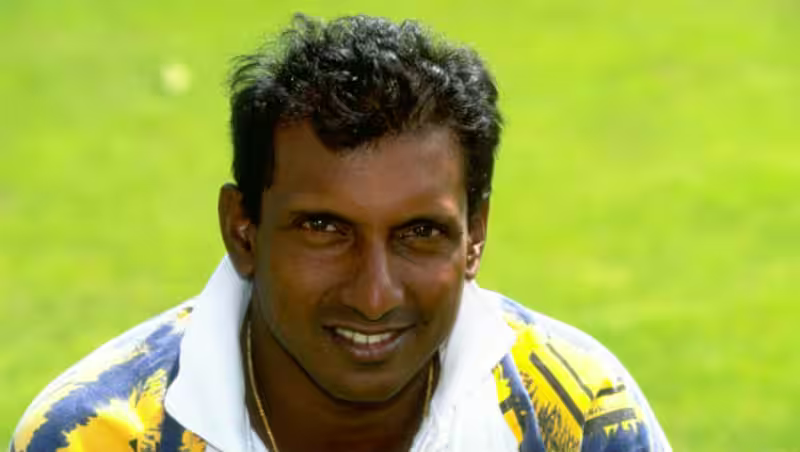
Aravinda de Silva
Under the fearless and fiercely tactical leadership of Arjuna Ranatunga, Sri Lanka entered the 1996 Wills World Cup as a 100-to-1 underdog and left as world champions. [1, 2]
- The Tactical Revolution: Coached by Dav Whatmore and captained by Ranatunga, Sri Lanka weaponized the first 15 overs of fielding restrictions. They promoted Sanath Jayasuriya and Romesh Kaluwitharana to open, telling them to attack from ball one—a strategy that completely rewrote ODI cricket rules.
- The Final Masterstroke: In the final at Gaddafi Stadium in Lahore, Ranatunga won the toss against Australia and boldly chose to field first—ignoring the fact that every previous World Cup final had been won by the team batting first.
- The Victory: After restricting Australia to 241/7, an extraordinary, unbeaten 107 from Aravinda de Silva* alongside Ranatunga’s cool 47* guided Sri Lanka to a comfortable 7-wicket victory with 22 balls to spare. [1, 2, 3, 4, 5, 6]
The Invention of the Player-Referral System (DRS) [1]
The concept of allowing a player to actively challenge an on-field umpire’s ruling—which shattered the centuries-old rule that “the umpire’s decision is final”—was the brainchild of Sri Lankan lawyer Senaka Weeraratna. [1, 2]
- The Original Proposal (1997): Witnessing umpiring errors that compromised the integrity of the sport, Weeraratna wrote a formal letter to the editor of The Australian newspaper, published on March 25, 1997. He outlined a blueprint called the “Player Referral” system, drawing a parallel to how the appellate structure functions in a legal system.
- Core Philosophy: Weeraratna argued that if television broadcasters and viewers had access to slow-motion replays showing an error, it was morally unsustainable not to give players a tool to correct it.
- The Birth of DRS: Weeraratna’s conceptual framework was later adapted by the International Cricket Council (ICC). It was trialed in 2008 during a Sri Lanka-India Test match and formally launched as the Decision Review System (DRS) in 2009. [1, 2, 3]
Direct Impact Comparison
| Milestone [1, 2, 3, 4, 5, 6, 7] | Key Figure | Core Innovation | Global Impact |
| 1996 World Cup Victory | Arjuna Ranatunga | Pinch-hitting in the powerplay | Shifted ODI cricket toward aggressive, high-scoring opening styles. |
| Player-Referral System | Senaka Weeraratna | Challenging field decisions via Third Umpire | Evolved into DRS, raising umpiring accuracy from 91% to 98%. Inspired systems like VAR in football and review protocols in tennis. |
https://share.google/aimode/eZYLUAF1V2ct7h1m6
Source: AI Overview
US Wars on Asia Disrupt Agriculture & Food in Sri Lanka
May 17th, 2026e-Con e-News

blog: https://eesrilanka.wordpress.com
‘Before you study the economics, study the economists!’
e-Con e-News 10-16 May 2026
*
‘In Thailand, the Philippines, Bangladesh & Australia…
the first since the war to enter key sowing periods, farmers
are choosing to skip or reduce planting, or cut fertilizer use,
which will lower yield… In June, India & Brazil, two of the
world’s biggest agricultural producers, will ramp up orders
for urea. If, by then, vessels carrying urea are not sailing,
there will be ‘significant yield loss’ across many countries.’
– see ee Agriculture, US war is crushing Asia’s farmers
The USA extends its toxic tentacles far beyond South and East Asia, and is disrupting everybody else’s agricultural cycles. This is primarily due to the US war & blockade of West Asia & East Africa. They are hindering Sri Lanka’s access to fuels & related chemicals – which we curiously have to obtain via Singapore, which is far to the east of us! Sri Lanka is even prevented from buying fuel directly from Russia. ‘The Lanka Indian Oil Co (LIOC) should be renamed the Lanka Indian Russian Oil Co (LIROC)’, as one wag quips.
Having long promoted the Ford & Rockefeller Foundations’ ‘Green Revolution’ from the 1960s, accentuating transnational import-export agriculture (to oppose ‘Red Revolution’ in the countryside), with crops & cultivators becoming addicted to chemicals, the USA is now blocking access to these fertilizers & pesticides from West Asia. Their recent moves here suggest they aim to turn SL agriculture & diets into an appendage of a bloated US agribusiness.
*
‘On 28 April 2026, the commander of US Forces in Korea,
General Xavier Brunson told the Japan Times,
Washington is building a ‘kill web‘ – a networked
system fusing S. Korea, Japan & the Philippines into a
single architecture against China, Russia & North Korea.’
’ – Tings Chak, ee Random Notes, Hands off Asia
*
The English media, however, are still busy cooing love songs to US President D Trump’s supposedly suave & rant-free visit to the People’s Republic of China. However, he did not get his bragged-about hug from President Xi, and his corporate escorts, at least 20 top CEOs, also returned home, empty-handed…. The media pointedly ignore how the visit began in the wake of the US war games south of China in the Philippines. The largest US military exercises in the Philippines, Balikatan 2026, hosted 17,000 foreign troops from 7 nations including Canada, Australia, France, New Zealand, & Japan. Japan has also now stationed anti-ship missiles there, and the USA has set up a new fuel depot. The Philippines, which the USA has brutally colonized for over 125 years, has also ‘granted’ 4,000 acres for a US-controlled high-tech zone – the Pax Silica Initiative – operating under US common law and granted diplomatic immunity, on a lease renewable for 99 years. Let us see… next week, Russian President V Putin goes to Beijing.
Prolonging its brutal war (via Israel) on Lebanon, the USA is also having its ally England send a warship HMS Dragon, an aerial war destroyer, into the eastern Indian Ocean. It was sent from the eastern Mediterranean to join another US ally (supposedly coy) France’s deployment of its ‘carrier strike group’ to the southern Red Sea, to ‘restore confidence in the trade route’.
North and west of us, India is tight hugging onto the USA’s killer poodles, Israel & the UAE. The UAE, that sand-dusted English colony, recently disrupted both OPEC & BRICS, and is waging war on the Sudan. may also explain India’s urgent demand to build their Hanuman Bridge to link Tamilnadu with Sri Lanka (High Commissioner Jha: ‘but let me say clearly: the time for wavering is over.’) The timing is no coincidence. This coming week will see 17 years since the end of a terrorist war funded & fanned by India, and they seek to dampen any triumphalism. Their promotion of the terrorist war was also claimed as being due to then-Indian-PM Indira Gandhi’s ire at then-Lankan-President JR Jayewardene offering Trincomalee to the US to pre-empt India grabbing hold of it. Perhaps the USA too plots to send a peacekeeping (or peace-killing) force into Sri Lanka…
*
The main opposition party, SJB, frantically signaling Left (with the SJB leader wailing the IMF won’t speak to him, as if he’s offered us any clear alternative vision) is perhaps a prelude to their actual & eventual turning to the Right, to join up on their ancestral couch beside the now almost defunct UNP, whose policies are being tailed by the ruling NPP. The SJB & UNP united might make for a mighty reunion. The SJB leader’s father apparently drove the English envoy & Indian army out of Sri Lanka and paid the ultimate price for such hubris…
*
Still, it is somewhat cute to see the NPP President & PM thrill at the purported entry of the white German-South-African & now US citizen Peter Thiel’s PayPal, an online payment system, into Sri Lanka, ‘after over a decade of discussions’. Thiel is the owner of the US War Department’s spinoff Palantir, which claims to monitor all internet traffic & helps physically (kinetically!) target their enemies. Thiel is also a big donor to the US President & Vice President’s electoral coffers. PayPal’s entry comes (serendipitously!) right after major cyber swindles at the Treasury & the privatized NDB (whose owners include the EPF, the workers’ pension fund, which has failed to invest in industrially upskilling workers). What can Palantir tell us about these recent swindles? If their god doesn’t know, the US War Department would. Palantir is also linked to France’s security agencies & Airbus! PayPal indeed!
Monkey, tails, tales & bridges, stretch out & over in different avatara…
*
• Imperialism has long been seeking to also cut Sri Lanka off from China. Yet they are not just targeting Sri Lanka, but all of Asia, south, east, central, north & west, using not just warfare but also lawfare, sanctions & tariffs. This is not due to the lunacy of a single white man. Their aims have the backing of the largest corporations in the world – multinational corporations (MNCs), wealthier than most countries. Welcome to HyperImperialism!
*
‘It is the imperialism of a drowning billionaire who firmly
believes he ought to be back on his yacht. It flexes the
muscles of power that are still strong – the military.’
– Tricontinental Institute, ee Focus
This ee Focus begins to serialize a profound study by the Tricontinental Research Institute, about the decline of traditional imperialist hegemony & the ‘kinetic’ perils arising from its decay. (Kinetic is the latest euphemism for direct military combat, first popularized by the US government during their wars on Iraq & Afghanistan).
*
‘Hegemony is historically lost in 3 stages:
production, finance, & military’
– Tricontinental, ee Focus
Tricontinental’s research provides a detailed assessment of the decline of imperialist economies, the economic advances made by socialist countries, the resistance movements of the last decades, the consequent repression & what needs to be done. From the open military & economic subordination of Europe to extending US-led NATO war on Russia, to US funding & arming of the Israeli genocide in Palestine & Lebanon, the study surveys the plans & attempts to tame resistance, as well as the limitations of imperialist reaction.
*
‘Socialism sounds good on paper, but it has never worked in practice…
If socialism is dismissed not because it is undesirable but because it
is supposedly impractical, then the question is no longer philosophical.
It becomes concrete. What does it mean for a system to work in practice?’
‘Socialism is dead.’ ‘Marx was an impractical dreamer…Engels was a capitalist…Lenin recanted on his deathbed, & became a Catholic…Stalin: an oriental despot… Mao: a peasant rube.’ Countries such as the USSR, China, DPRK, Cuba, Vietnam, who have openly declared they are socialist, ‘don’t really know about true socialism.’ Such are the hourly calumnies showered on the world by the English media. Real socialism exists only within the skulls of the fringiest sect or tenured scholar or glossy magazine with radical titling, in London or New York. Such are the perverse prevarications, the English media & their foghorns scream out, in their shrillest falsettos when daily conversations or choreographed discussions or academic lectures turn to ‘socialism’. Kapone (no relation to Chicago Al) challenges what has been fabricated into ‘common sense’. He guides us, through socialism as it has actually been practised in the 20th century to this day, dispensing with the numerous euphemisms, charting its ups & downs, advances & retreats, is failures & achievements. (see ee Focus)
The plantation system produced the raw materials
– sugar, cotton, tobacco – that fed industrial
capitalism. Banks financed it. Insurance companies
secured it. States protected it. The market, we are told,
is neutral. But here the market is soaked in blood.
*
Kapone starts with the economics of transformation, how socialist countries have challenged capitalist impoverishment and actually extended human life, advancing agriculture and innovating modern industry despite invasions, and world wars: the USSR turned into one of the fastest-growing economies of the 20th century. China overturned warlordism & colonial domination into building the 2nd-largest economy in the world. Cuba, from slavery & gangsterism, to a model of education & healthcare for all midst a crippling & tightening US siege & blockade. Vietnam defeated repeated invasions & endured destruction. Korea with mass resistance challenged genocidal wars that divided their country.
Kwame Nkrumah argued that political independence
without economic control produces neocolonialism, where
formal democracy exists but real power remains external.
*
• Sri Lanka is being crashed headlong into an 18th IMF program (some say it’s the 19th loansharking, if we add the post-cyclone loans). After the failure to fulfil any electoral promises to resurrect the economy, the latest US war has ensured none of their severe demands (privatizing national resources & making workers even more insecure, their main demands) can be fulfilled without sending the economy truly over the edge. The Central Bank governor who went into hiding after the recent Treasury & NDB swindles, is back in the news headlines, all water pistols (to make us cry) & imported cylinders firing (to use up some fuel), making all kinds of contradictory pronouncements. We get the impression it is some kind of swansong before he is kicked upstairs & overseas, for his slavish devotion to imperial dictate, into some stipendiary retirement farm tended by the IMF, World Bank or ADB. His gems this week include:
*
‘I want to make it very clear. CBSL would not promote
growth or productivity of the economy’ – CBSL
Governor Nandalal Weerasinghe (ee Quotes)
*
‘Central Bank keeps market
guessing on next rate move’
– see ee Economists
*
‘Sri Lanka has to compromise growth
if it chooses lower inflation target’
– CBSL Governor (see ee Economists)
*
‘CBSL Chief Explains Slow but
Steady Economic Comeback’
– see ee Economists
*
‘Lanka Rupee depreciation driven
by global trends, CBSL governor claims’
– see ee Economists
*
‘As the ‘Banker to the Government,’ the CBSL’s Chief
Accounting Department merely executes orders.’
–CB Governor, ee Security, CBSL Not Responsible
for verifying debt payment instructions
*
‘Gov Nandalal Weerasinghe says CBSL acts as
banker to Govt & executes payment instructions
as directed.’ – ee Security
*
‘While the CBSL told CoPF that no unusual activity
had been detected during the period of the fraud, questions
have intensified after NDB’s audited 2025 accounts showed
a sharp rise in receivables linked to CEFT transactions to
Rs12.2bn from Rs3.1bn a year earlier, with analysts arguing
that the increase should have triggered scrutiny from
management, auditors, & regulators’ – ee Security, CBSL
distances supervisory role from Treasury & NDB scams
*
‘Governments can & do change people’s
behaviour by changing the policy incentives.’
– see Srimal Abeyratne (ee Economists)
*
• The rains have returned & people are being flooded out. Nothing new. Soon the media will be full of drought stories again. In between watery inundation & scorching depredations, the traders, corporations & the merchant media will be giving each other & themselves awards. Meanwhile, we are being slowly introduced to Weerasinghe’s up & coming replacement, a clone actually: Central Bank Deputy Governor Chandranath Amarasekara. This DG, just this week, lectured the Gamani Corea Foundation & the Economic Association (SLEA), parroting the US Treasury-IMF’s stale shibboleths, promoting his eminent suitability, and then declared, ‘We have lived beyond our means for decades’ (see ee Quotes).
Really? Who exactly has lived beyond their means? Amarasekara’s pronouncements recalls the fast-going obsolescent Indrajith Coomaraswamy, another ex-CB governor (& now an imported cement company board director), who claims Sri Lanka has been ruled by ‘populism’. Was continuing the import-export plantation economy post-1948, due to populism? These officials & economists are trapped between lobbing severe threats at the people, and conjuring optimism for their financial overlords. As for this business of ‘growth’, which is measured by dubious indices such as GDP & average per-capita income, in countries where less than 10% of the population own over 80% of its assets, the Indian economist Prabhat Patnaik declares:
‘The average real income of the working people,
who constitute 80-90% of the population, would be
a better index than the average real income of the
entire population.’ (see ee Economists,
What is Real Economic Development?)
*
• SBD de Silva provides the answers to exactly who has ‘lived beyond their means’ in Sri Lanka, and for more than a few ‘decades’. Also, last week saw a university professor & Sunday Times economist (who also monotonously repeats all the US Treasury tropes) lament the takeover of the ‘champagne’ of tea cultivation by ‘potato curry’ – that is, cultivators (& middlemen) are finding it more profitable to grow potatoes (which he blames on unfair protective tariffs) than ‘beautiful tea’ (both of which have caused immense erosion). SBD, however, succinctly eviscerated the inefficiency of the plantation oligarchy that still dominates us (see ee Focus). Absentee ownership, subordinated to merchant capital, & the rule of their local representatives in the agency houses, led to ‘heavy overhead expenses’ due to:
‘Inflated prices payable by the plantations for materials & inputs
supplied by the agency – fertilizer, agricultural implements, tea
chests etc – &… payments to persons in an ‘elaborate
hierarchy‘ drawing salaries, commissions & fees’
This wasteful overhead expenditure, and the privileges afforded only to European owners & officials, affected the scale & relations of production and demanded large-scale plantations, which have had no real advantage over small-holder agriculture. ee begins Chapter 10 of SBD’s classic The Political Economy of Underdevelopment, which exposes the inefficiency of such plantations. The much-advertized imagery about plantations is monopolized by rolling hills of undulating green, with happy hooded women plucking leaves by hand, disabused of mechanization for over 150 years. de Silva showed how plantations cannot be considered modern farming, tracing its origins to the use of enslaved labor on extremely intensive tobacco cultivation in the USA, as well as the high freight rates & trade monopolies due to the colonial relationship with England. He described the transfer of the plantation belt from the northern to the southern USA, and subsequent effects of their wars.
*
• Last week ‘caught us napping’, when the US platform WordPress (WP) all of a sudden ‘suspended’ e-Con e-News, blocking our regular online presence, a few seconds after the latest stories were posted. WP is the platform ‘hosting’ ee, and in perhaps one keystroke, disrupted worldwide access to our work. Regular readers may have been confused, when they were greeted by WP’s abrupt declaration:
‘eesrilanka.wordpress.com is no longer available.
This blog has been archived or suspended in
accordance with our Terms of Service.’
Today is ee’s 422nd issue, in its almost 8th year as an unfunded weekly blog. ee was launched to spread the ideas of our teacher, the economist SBD de Silva. He taught us, though not in any formal institution, what most are paid not to teach – about industrial literacy & practice, with examples from all around the world.
So last week we certainly were indeed somewhat taken aback, perhaps grown too comfortable. Friends have always warned us that the invisible US owners of this ‘free’ service, could at any time deny access to our own work.
Luckily, Lankaweb News & Forum (lankaweb.com) carried the entire issue. We appreciate Lankaweb’s support!
Again, thanks to more tech-savvy friends, we did figure out how to ask the ‘support document’ WP offers with the ‘suspension’, why they did such a reprehensible thing? Their feedback algorithm was the only means they offered. We filled out the requisite letter of appeal. It sounded like shouting into an empty well, and hearing only your echo. Or dropping a stone & not hearing even it hit any surface.
Then again, WordPress.com is a very large US corporation, with perhaps millions of users, and may not deign it necessary to respond individually to a relatively miniscule publication in a once-far-off ocean. Still, it seemed they felt sufficiently disaffected to cut us off pronto, minus any right to answer for their actions. WP is owned & operated by Automattic, ‘a for-profit company’ founded by Matt Mullenweg, a co-owner of the ‘open-source’ WordPress software. Automattic also owns other major web properties, including WooCommerce, Jetpack, Tumblr, Gravatar, WordPress VIP.
Finally, 2 days later WordPress ‘reinstated’ ee. WP claimed that our site had been ‘flagged’ by their ‘automated anti-spam controls’. ‘We have reviewed your site & have removed the suspension notice… We apologize for this error & any inconvenience it may have caused.’ That’s it. No other reasons have been given & we have not pursued the matter further. ee is also seeking alternate platforms, so as to be less subject to the whimsies of any decadent & dying hand.
And yet, like readers, we did wonder what on earth might have ‘triggered’ their ‘controls’? While we will not change our ideas, we are left with many imaginings & the usual chill. ee has published over 400 entries over 8 years. The last ee issue, that perhaps triggered their ‘controls’, was about who exactly rules the USA, even as it seeks to further dominate Sri Lanka. Please check it out (ee 09 May 2026). It’s intriguing, what exactly might ‘trigger’ such sensitive powers. Perhaps, the USA wishes to tell us that its instruments already control Sri Lanka?
We are fully aware that the USA seeks to keep control of the vast internet highways, just as it seeks to control the waterways that surround us. They claim to have originated the internet (not true, ask socialist Chile of pre-1974). They perhaps wish to treat this ‘electronic highway’ as their own, much like the English claimed the ‘Kandy Road’ as theirs. The ‘Kandy Road’ was actually built by enslaved & unfree labor to invade the highlands, and push the English import-export plantation-to-port swindle. Edward Barnes, the English colonial governor in Ceylon, said he had roads built to ‘destroy the confidence of the people’ from the protection afforded by natural terrain. Though of course the Kandy Road existed long before the English & other invaders arrived, and will continue long after them
Like the Kandy Road, the internet too was built by the unpaid & underpaid labor of numerous hands & heads. The internet’s cables slither through & around us and under our seas, and ee has sought to use this road, to do something different from what the English & the USA have intended: We wish to build up our people’s own confidence and we have used the medium as a carriageway to promote a real economy, a modern industrial (machine-making-machine) society. Of course, such a machine-building economy will not be accomplished overnight. Yet, even this possibility has never been allowed us by imperialist powers, so it will only be possible if we focus on our own country’s needs at all times, and work towards such changes, with such specific goals in mind at every single step. This is essential to the country’s self-sufficiency & security, if it is to remain an independent polity.
ee has sought to promote real literacy – economic & historical literacy, including an industrial knowhow – not the type of innumerate illiteracy that receives awards for disparaging a people or a nation best – a people & a nation who have been withstanding a siege of over 500 years. We have sought to spark a national conversation about industrialization, fully aware that a merchant & moneylender & multinational corporation-dominated media seeks to sabotage such endeavours, and maintain the colonial status-quo, which is now perpetuated by the USA, England, the EU, India, & their local ‘chamber’ orchestras & thinktanks, etc. As our ee masthead declares: ‘Before you study the economics, study the economists.’ Please keep supporting a media excavator & forensic news analyses that go beyond the news, looking at why certain (mostly fake or distorted) news is being reported, & what is mostly not narrated to us in this world….
*
––––––––
Contents:
2024 Census in Original Major Ethnic Categories of Ceylon (Pre-1911)
May 17th, 2026Dilrook Kannangara
The 2024 census has been released. The delay casts serious doubts about its accuracy as the last two censuses are being looked at with suspicion that they may have been tweaked for easy acceptance by society masking the increases and decreases of ethnic populations. However, the foregoing assumes the released version is correct.
It follows major ethnic classifications of Ceylon before 1911. In 1911 a number of artificial ethnic groups were introduced with ethno-political aspirations in mind. The analysis is based on a number of assumptions – within their broader respective communities, the Malabar and Coromandel population composition remained same as before subject to the last assumption; their population growth rate has remained same and the emigration percentage of Malabar populations was higher than Coromandel populations based on the net population reduction in predominantly Malabar and Coromandel districts comparing 1971 to 2024.
Despite political dominance within the Hindu community, Malabar origin Hindus are only 3.9% of the population compared to Coromandel origin Hindus at 8.5%. Policy making must take this fact into account without going by the loudest voice.
Within Tamil communities, Malabar origin Christians are mostly non-Catholic Christians whereas Coromandel origin Christians are mostly Roman Catholic.
Compared to the last census, total Islam population percentage shows a very large increase.
Overall population growth rate declined from 2012 census to the 2024 census due to the gradual economic collapse between 2012 and 2024 forcing people to leave the country, delaying marriages and giving up on having children by a significant section of the population. SRI LANKA
| 100.0% | |||
| SRI LANKA | 100.0% | ||
| NATIVES | 74.1% | ||
| Sinhalese | 74.1% | ||
| Buddhist | 69.8% | ||
| Christians | 4.3% | ||
| Vedda | 0.0% | ||
| PEOPLE OF INDIAN EXTRACTION | 25.8% | ||
| Malabar Origin | 8.5% | ||
| Hindus | 3.9% | ||
| Muslims | 3.7% | ||
| Christians | 0.9% | ||
| Other | 0.0% | ||
| Coromandel Origin | 17.2% | ||
| Hindus | 8.5% | ||
| Muslims | 6.9% | ||
| Christians | 1.7% | ||
| Other | 0.1% | ||
| Other Indian | 0.1% | ||
| EUROPEANS | 0.0% | ||
| Europeans | 0.0% | ||
| Burgher | 0.0% | ||
| Other | 0.0% | ||
| PEOPLE OF MALAY EXTRACTION | 0.1% | ||
| Malays | 0.1% | ||
| Other | 0.0% | ||
| OTHER | 0.0% | ||

Sri Lanka’s global level Thinkers, Visionaries and Innovators in Cricket and other sports
May 17th, 2026AI Overview
https://share.google/aimode/TmiiYdHuL2iAQ3wrT
AI Overview
Sri Lanka has consistently punched above its weight on the global sporting stage, producing thinkers, visionaries, and innovators who have permanently transformed how games are played, refereed, and commercialized globally. [1, 2, 3, 4]
🏏 Cricket: Strategy & Technological Innovation
1. Senaka Weeraratna — The Visionary behind DRS
Though not an on-field athlete, Colombo-born lawyer Senaka Weeraratna is globally recognized as the “Father of DRS”. In 1997, he conceptualized and pioneered the Player Referral System, allowing players to challenge an umpire’s decision using technology. His groundbreaking idea was formally adapted by the International Cricket Council (ICC) into the modern Decision Review System (DRS), completely revolutionizing fair play across worldwide cricket, tennis, and football. [1]
2. Arjuna Ranatunga & Dav Whatmore — The 1996 Powerplay Revolution
Before the 1996 Cricket World Cup, teams played limited-overs cricket conservatively, preserving wickets for the final overs. Captain Arjuna Ranatunga, alongside coach Dav Whatmore, completely disrupted this paradigm by promoting Sanath Jayasuriya and Romesh Kaluwitharana to attack relentlessly during the initial 15-over field restrictions. This tactical blueprint transformed one-day international cricket forever, setting the baseline for modern T20 power-hitting. [1, 2, 3, 5]
3. Tillakaratne Dilshan — Creator of the “Dilscoop”
Former captain Tillakaratne Dilshan introduced a new dimension to modern batting during the 2009 ICC T20 World Cup by inventing the “Dilscoop”. By dropping to one knee and flicking a good-length ball directly over the wicketkeeper’s head, he completely redefined standard field placements. The stroke inspired a generation of contemporary innovations like the ramp shot and reverse-scoop. [1, 2]
4. The “Mystery Spin” Pioneers — Ajantha Mendis & Muttiah Muralitharan [1]
Sri Lankan bowlers forced the global cricket fraternity to re-write coaching manuals:

Ajantha Mendis: Invented the Carrom Ball—flicking the ball out of the middle finger and thumb to make it turn away from a right-handed batsman.

Muttiah Muralitharan: Revolutionized off-spin by masterfully developing the Doosra, turning the ball from leg-to-off with an identical off-break action.

Lasith Malinga: Perfected the slinging, round-arm action and precise toe-crushing yorkers, which heavily influenced contemporary death-bowling techniques globally. [1, 2, 3, 4]
5. Kumar Sangakkara — Sports Administration & Esport Metaverse [1]
Beyond his record-breaking batting, Kumar Sangakkara’s legacy as a global thinker was solidified by his historic 2011 MCC Spirit of Cricket Cowdrey Lecture, which challenged political corruption in sports. He later became the first non-British President of the Marylebone Cricket Club (MCC). Strategizing for the future, Sangakkara co-founded Behavioral, a high-investment e-sports platform building AI-powered virtual sports stars inside the metaverse. [1, 2, 3, 4, 5]
🏎️ Motor Racing: Dilantha Malagamuwa
Dilantha Malagamuwa is a true pioneer of Asian motorsport. He single-handedly put Sri Lanka on the global racing map by founding Dilango Racing, the first international motor racing team from the country. Winning the prestigious GT Asia Series (2010 and 2016), Malagamuwa broke through a highly expensive, Western-dominated sport, creating a pathway for South Asian racing drivers to compete in international championships like the Lamborghini Super Trofeo. [1, 2, 3]
🏋️ High-Performance & Sports Science: Talavou Alailima
A national shot-put and discus record holder, Talavou Alailima fundamentally transformed the fitness, sports nutrition, and structural athletic landscape of Sri Lanka. He introduced advanced sports medicine, biomechanics analysis, and precise injury prevention to a system previously reliant on basic training. He is a driving force behind Vision 2036, a highly structured sports initiative deploying the “Lion Warrior” elite program to nurture school champions into future Olympic medalists. [1, 2, 3]
🏉 Rugby: Sri Lankan Technical & Tactical Innovations
Despite being a smaller nation in global rugby rankings, Sri Lanka pioneered fast, short-pass, sevens-style rugby in the 15-a-side format to counter physically massive European and Pacific island teams. Off the field, innovators like DroneHarsha have actively integrated cutting-edge drone tracking and video analytics into local school and club rugby systems, setting a benchmark for tech-driven high-performance workflows in regional sports. [1, 2, 3, 4]
🏐 Sports Tourism: Dr. Dietmar Doering
In 1989, Dr. Dietmar Doering pioneered sports tourism in Sri Lanka by establishing the Asian-German Sports Exchange Programme (AGSEP). He recognized that international sports events could serve as catalysts for both economic development and post-war national reconciliation. Over three decades, his visionary framework brought thousands of European athletes to the island, using sport as a diplomatic bridge. [1, 2]
If you want to look closer at these sporting frameworks, let me know if you would like to:
Nigeria, Iran , Maduro and the Shadow of Global Power: Are Strategic Hands Quietly Reshaping the World?
May 17th, 2026By Dr Sarath Obeysekera
Recent American involvement in Nigeria’s counterterrorism operations, combined with increasing pressure on Venezuelan leader Nicolás Maduro, once again raises a serious geopolitical question:
Are global interventions truly driven by democracy and security concerns — or by long-term strategic interests of powerful nations like US ?
Nigeria today occupies enormous strategic importance.
It is Africa’s major oil producer, a critical energy supplier, and an important gateway to West Africa. Terrorist movements, piracy, kidnappings, and instability in the region threaten global oil supply chains, maritime trade routes, and Western investments. Therefore, American assistance to Nigeria in eliminating extremist leaders may not simply be humanitarian support. It is also a strategic necessity for global powers seeking to maintain influence in Africa.
At the same time, another dramatic geopolitical theatre is unfolding in Venezuela.
For years, the United States has accused Maduro of drug trafficking, narco-terrorism, and links with transnational criminal organisations. Washington progressively increased financial rewards for information leading to his arrest, reaching unprecedented levels. American authorities publicly portrayed Maduro not merely as a political opponent, but as a threat tied to international narcotics networks. (Voice of America <https://editorials.voa.gov/a/up-to-50-million-for-information-leading-to-arrest-of-maduro-/8056224.html?utm_source=chatgpt.com> )
The pressure intensified after disputed Venezuelan elections and widening Western sanctions. Recent reports even described covert operations and extraordinary efforts aimed at removing or capturing Maduro through intelligence-driven actions. To many political observers, these developments appear interconnected with a broader strategic doctrine that has guided American foreign policy for decades.
History offers several examples.
During the Cold War, the United States became deeply involved in Latin America, including Chile, often in the name of protecting democracy or fighting communism. In the Middle East, military interventions were justified through concerns over weapons programs, terrorism, or regional stability. Yet beneath those public narratives, strategic interests involving oil, military positioning, global influence, and economic dominance were always present.
Today, similar patterns appear visible again.
Nigeria’s security instability threatens energy security.
Venezuela possesses some of the world’s largest oil reserves.
Africa is increasingly becoming an arena of competition between the United States, China, and Russia.
Under such circumstances, every counterterrorism operation, sanctions package, intelligence mission, or diplomatic alignment naturally carries geopolitical significance.
The recent high-profile diplomatic engagements involving Nigeria’s leadership in the United Kingdom, including ceremonial receptions and strategic discussions, further fuel speculation that Western powers are strengthening alliances to secure influence in Africa’s future political and energy landscape.
Some analysts describe this as the work of a Deep State” — a permanent network of intelligence agencies, strategic planners, military establishments, corporate interests, and diplomatic actors who continue shaping policy regardless of elected leaders.
Whether one accepts that terminology or not, one reality is undeniable:
Presidents may change, but strategic national interests rarely change.
American administrations from different political parties have consistently protected energy routes, shipping lanes, financial systems, and geopolitical dominance across the globe.
The modern battlefield is no longer fought only with tanks and missiles.
Today it involves:
* intelligence networks,
* economic sanctions,
* cyber operations,
* diplomatic pressure,
* proxy conflicts,
* information warfare,
* and control over energy resources.
Smaller nations such as Iran must carefully observe these global shifts.
In world politics, moral language is often used publicly, while strategic calculations operate quietly beneath the surface.
Therefore, countries like Sri Lanka must maintain balanced diplomacy, protect national sovereignty, and avoid becoming pawns within larger geopolitical rivalries between powerful nations.
The world order is changing rapidly.And behind many global crises, there may be far more strategy than meets the eye.
Dr Sarath Obeysekera
Is Sri Lanka Becoming a Playground for Dark Tourism?
May 17th, 2026By Dr Sarath Obeysekera
Sri Lanka is rapidly attracting thousands of young foreign travelers searching for freedom, nightlife, adventure, surfing, and cheap living. Beaches such as Arugam Bay, Unawatuna, and Kalpitiya have become internationally promoted destinations for youth tourism.
While tourism is essential for the economy, an uncomfortable question must be asked:
Are some travel networks indirectly promoting Sri Lanka as a destination for narcotics, unrestricted party culture, and immoral activities?
Across social media platforms, travel blogs, backpacker forums, and underground tourism networks, there are increasing references to beach parties, easy access to drugs, and anything goes” lifestyles in certain tourist zones across Asia, including parts of Sri Lanka.
Whether fully accurate or exaggerated, such perceptions alone can damage the image of the country.
Sri Lanka must be careful not to become another regional hotspot where criminal drug networks, illegal activities, and exploitative tourism quietly flourish behind the attractive label of beach tourism.”
Tourism development should never mean social decay.
Law enforcement authorities, tourism regulators, hotel operators, and local communities must work together to ensure that tourism growth remains healthy, disciplined, and respectful of Sri Lankan culture and law.
The country must welcome genuine tourists — not international drug distributors, cyber criminals, or organised underground networks hiding behind tourist visas.
Sri Lanka’s beauty should attract travelers seeking culture, nature, history, and hospitality — not those searching for narcotics and lawlessness.
The time has come for stricter monitoring, intelligent policing, and responsible tourism policies before isolated problems become a national crisis.
Regards
Dr Sarath Obeysekera
Uncovering the link between thyroid dysfunction and mental health
May 17th, 2026Ahmadi News
The thyroid is a small butterfly-shaped gland located in the anterior neck just below the Adam’s apple. Weighing less than an ounce, this super gland plays a crucial role in maintaining overall health, including regulating hormones, metabolism and energy production within the body.
Understanding its role and function becomes a vital step towards recognising its impact on the mental and physical health of an individual.
What is the function of thyroid gland?
The thyroid gland is an important part of the human endocrine system. In the brain, the hypothalamus (master gland) controls the thyroid gland through the Hypothalamic-Pituitary-Thyroid (HPT) axis by releasing thyrotropin-releasing hormone (TRH). This prompts the pituitary gland to produce thyroid-stimulating hormone (TSH), which in turn stimulates the thyroid to produce hormones called thyroxine (T3) and triiodothyronine (T4) into the bloodstream. These hormones are responsible for regulating heart rate, metabolic rate and body temperature; supporting growth and development; and controlling heart function. It also influences the digestive system, bone health and muscle strength. An imbalance in the synthesis of these hormones can cause either hypothyroidism (underactive thyroid/low levels of thyroid hormones) or hyperthyroidism (overactive thyroid/excess levels of thyroid hormones).
It is recently known that thyroid hormones can impact a person’s mood and overall emotional well-being.
Thyroid disorders and mental health:
Full story: https://www.alhakam.org/link-between-thyroid-dysfunction-mental-health
Sri Lanka at the Crossroads: Paradise for Tourists or Safe Haven for International Criminals?
May 17th, 2026Dr Sarath Obeysekera
Sri Lanka stands today at a dangerous intersection.
On one side, we proudly market ourselves as a paradise for tourism, investment, port development, and international trade. On the other, a darker shadow is slowly creeping across the nation — cybercrime syndicates, drug traffickers, financial scammers, illegal operators, and organised international criminal networks quietly exploiting our weaknesses.
If this trend continues unchecked, Sri Lanka may gradually transform from the Pearl of the Indian Ocean into a convenient operational hub for global criminals.
The warning signs are already visible.
Reports continue to emerge about foreign nationals arriving under tourist visas, work visas, or even as support staff” for construction and hospitality sectors, only to later become connected with illegal cyber operations, online fraud, drug distribution, money laundering, and organised crime activities. Some operate silently behind luxury apartments, entertainment centres, and even businesses that appear legitimate from the outside.
At the same time, honest law enforcement officers are fighting an uphill battle with limited resources, political interference, outdated laws, and bureaucratic hesitation. While these dedicated officers attempt to protect society, sections of the system appear more interested in projecting glossy economic statistics and artificial success stories.
This is dangerous self-deception.
Infrastructure development alone cannot save a nation.
Expressways, ports, airports, luxury hotels, and Port City towers mean little if criminal syndicates quietly capture the underbelly of the economy. Economic growth without discipline, governance, and national security is merely a polished shell hiding internal decay.
One only has to study countries like Singapore to understand this reality. Singapore succeeded not merely because of trade or foreign investment, but because the state enforced discipline relentlessly. Governments changed styles over the years — socialist leaning, capitalist leaning, social democratic — but one principle remained constant: zero tolerance for lawlessness.
Singapore did not become safe accidentally.
It became safe because leadership acted decisively.
Sri Lanka now requires a similar national awakening.
What is needed is not authoritarian oppression, but disciplined governance backed by a clear national security and law enforcement strategy extending over at least five years. This plan must go beyond speeches and media headlines. It must involve:
* Strong immigration monitoring
* Cybercrime intelligence units
* Financial crime tracking systems
* Anti-drug operations with political independence
* Digitised border surveillance
* Strict visa auditing
* Tough anti-money laundering enforcement
* Coordination between police, customs, immigration, navy, and intelligence agencies
* Swift prosecution mechanisms without political favouritism
Most importantly, the country needs fearless leadership.
During my own years managing a state corporation and later serving as CEO in the private sector, I understood one harsh truth: discipline is never popular at the beginning. I was often labelled a bulldog” because I refused to tolerate corruption, laziness, manipulation, or disorder. Decisions were taken firmly and without fear or malice.
Yet discipline produced results.
An organisation without discipline collapses from within.
A nation is no different.
Today, Sri Lanka’s leadership must identify a group of capable, incorruptible, and courageous administrators and empower them fully to execute a national recovery vision. Not political showmen. Not opportunists. Not bureaucratic survivors. The country needs executors with integrity and backbone.
Many of us who are now in the final chapter of our lives can only observe and advise. Age, illness, and physical limitations prevent direct action. We watch events unfold with concern, hoping younger leaders will possess the courage to do what is necessary.
History also teaches another lesson.
Even powerful nations can lose direction when weak leadership begins relying excessively on hidden influence networks, political survival strategies, and bureaucratic manipulation instead of national interest. Decisions become confused. Governance loses clarity. Public trust erodes.
Sri Lanka must avoid that trap.
This country still possesses intelligent people, strategic geography, resilient citizens, and enormous economic potential. But unless governance is rebuilt on discipline, accountability, and national security consciousness, all development dreams may eventually become vulnerable to criminal infiltration.
The time has arrived not merely to build roads and towers, but to rebuild the moral and administrative spine of the nation.
Sri Lanka must decide:
Regards
Dr Sarath Obeysekera
Hanif Yusoof informs President of decision to step down as Western Province Governor
May 17th, 2026Courtesy AdaDerana
The Governor of the Western Province, Hanif Yusoof says he has notified President Anura Kumara Dissanayake of his desire to resign from the post.
In a letter Western Province Governor Yusoof said the decision to step down was taken given the increasing challenge of balancing his responsibilities as Governor, his role as the President’s Special Envoy for Foreign Direct Investment, and his family responsibilities.
Therefore, he has decided to step down from the post.
It has been a privilege to serve in public office and to contribute, in whatever way I can, to the progress of our nation,” he said.
However, Governor Hanif Yusoof clarified that at the request of the President, he will continue to serve as the Governor of the Western Province until a suitable successor is identified in order to ensure smooth and orderly transition.
Bill abolishing office of Chief of Defence Staff gazetted
May 17th, 2026Courtesy Hiru News
The bill to repeal the Chief of Defence Staff Act was officially published via a government gazette.
Prepared under the directives of the Minister of Defence, the document was issued on May 15.
The legislation provides for the abolition of the Chief of Defence Staff Act No. 35 of 2009, alongside all connected or incidental matters.
Officially titled the Chief of Defence Staff (Repeal) Act of 2026, this bill systematically brings the office of the Chief of Defence Staff to an end.
The tenure of the individual holding the position terminates immediately upon the date the act comes into effect.
Following this change, the person occupying the role reverts to their respective branch of the armed forces.
Furthermore, the bill specifies that all movable and immovable property belonging to the Office of the Chief of Defence Staff transfers directly to the ministry of the minister in charge of the defence portfolio once the act becomes operational.
17 Years After the Defeat of the LTTE: How the LTTE Destroyed Tamil Democracy & Outsourced Tamil Politics
May 16th, 2026Shenali D Waduge
Before the LTTE came into the picture, it is good to go back in time to the manner in which American, British evangelical movements set up missionary schools where the Sinhala Buddhist majority did not live and provided English missionary education jobs, positions to Tamils. This was how the colonials created an elite group of people that were happy to be their lackeys. An analysis of the positions held by minorities pre-1948 provides proof. It was no surprise when they created the first ethnic political party, demanded 50-50 representation at a time when the Indian-laborers outnumbered the 1911 artificially created Ceylon-Tamils” and thereafter moved on to the 1949 creation of the ITAK party seeking a Tamil State though calling themselves the Federal Party. In all of these maneuverings the Church played an integral role. This was later to culminate into the Catholic-Action movement within the armed forces that attempted a coup to oust Prime Minister Sirimavo Bandaranaike. L H. Mettananda’s Catholic Action book is a must read to understand the greater dynamics.
At this point it is important to link the self-determination movement that emerged in Tamil Nadu. Not surprisingly, the Church played a key role in Tamil Nadu as well. In fact, it was Bishop Caldwell who coined the term Dravida Nadu and it is anyone’s guess whether Tamil Eelam was coined by the same entity too. When pre-conflict and post-conflict protests for a separate state in Sri Lanka generate men & women in cassocks the answer is not difficult. When inspite of internationally banning LTTE, the LTTE fronts operate in Christian-West states, the answer is further sealed. LTTE’s ideologue was Christian Anton-Balasingham, his Australian wife was the initial trainer of child soldiers. Nordic nations were heavily involved during the conflict. Eric Solheim a key player throughout even attended Balasingham’s funeral. Did he attend Lakshman Kadiragamar’s funeral?
Thus, the architects of self-determination or a bid for a separate state is not the LTTE – it was the Christian-elite Tamil politicians that the colonials created.
From the creation of the first ethnic political party – to the demand for equal representation when they were hardly 10%, to post-independence creation of a political party seeking a separate Tamil State, to their objection to Tamil low caste gaining education in 1957, to the 1976 Vaddukoddai Resolution was steered by Tamil politicians and not Prabakaran or LTTE.
We must distinguish this clearly.
Prabakaran only hijacked the concept to justify his dictatorship while the Tamil politicians were happy to ride on it believing eventually they would take over the political mantle.
This was probably what the Tamil politicians like Chelvanayagam, Amirthalingam had planned.
This is where the Tamil politicians erred. Prabakaran had no such plans to pass power to the elite Tamil leaders. In fact, he began eliminating them one after the other.
The entire cream of Tamil politicians whether they were in a Tamil political party, the UNP, the SLFP or even independent –were all assassinated.
The only one’s left behind were those that the LTTE created in 2001 and others who out of fear parroted LTTE’s will.
Not only were the Tamil politicians silenced with the gun the Tamil people too lived in fear, except those who thought the newly found power via the gun sufficed to rule over their own.
The TNA election manifestos of 2001, 2004 & even 2010 openly advocated for LTTE as sole representative of the Tamil people.
But no representative kills their own or shoots at their own.
The LTTE did not rise to dominance through democratic consensus – it rose through fear, assassinations, intimidations, forced obedience and the elimination of rivals.
It is true that Tamil politics before LTTE was not politically uniform either – divisions as a result of religion, caste, regional interests and ideological disagreements prevailed. The same scenarios are prevalent in Sinhala politics as well. However, the will of the people prevailed.
The LTTE opposed such parliamentary principles, a factor LTTE’s counterpart in the South, the JVP also adopted.
Then came the 2001 War on Terror with the 9/11 attacks, the strategy changed and LTTE created its political wing and began politically engaging and lobbying. It was no surprise that the Nordic-Indian brokered ceasefire agreement resulted in 2002 and a visibly uncomfortable Prabakaran sat at his first press conference.
Inspite of these exterior change’s dissidents were eliminated and silenced with the gun. Democracy was just on paper.
Tamil political space became militarized and centralized around one unquestionable authority & his will. Rival Tamil militant groups including TELO, EPRLF, PLOTE, EROS & many others were violently neutralized and eliminated. Mahaththaya the deputy leader of the LTTE was tortured and killed for becoming an agent of India.
Prabakaran’s message was clear:
· There could be only one-armed movement
· Only one political narrative
· Only one leader
· Only the leaders chosen structure
· Only one acceptable version of Tamil nationalism.
Anyone functioning outside this became a traitor and eliminated.
All the Tamil politicians who are free to express their views today were all living in fear under Prabakaran.
Ironically, the Armed Forces — who helped restore that space for free expression —are now subject to criticism from those who benefitted from the very freedom they helped create.
After the 1987 Indo-Lanka Accord that merged the North & East – the 1st ever election was held in 2013 after LTTE in the North and 2008 in the East. Had LTTE & Prabakaran continued to prevail C V Wigneswaran or any other would never have become Chief Minister. Democracy returned to North after almost 25 years because LTTE was defeated by the political leadership together with the armed forces.
Even from 2001 onwards Tamil political parties survived under enormous threat to their lives. A single mistake in a statement would have cost them their lives. After 2009 they found their voice and not surprisingly their voices targeted those that gave them the voice to speak without fear.
Did Tamils truly have democratic freedom under LTTE dominance?
Could parents freely refuse child recruitment?
Could civilians openly criticize taxation or extortion?
Could journalists write independently?
Could religious leaders openly challenge militant authority?
Could rival political visions safely exist?
Could the TNA politicians speak as they do now under LTTE?
Could the nexus of LTTE fronts mushrooming in western climes set up if Prabakaran was alive?
One of the LTTE’s greatest political successes was convincing large parts of the outside world that it alone represented Tamil aspirations, even after systematically eliminating alternative Tamil leadership.
This narrative became internationally powerful because fear inside LTTE-controlled areas rarely allowed open contradiction. Silence was mistaken for consensus.
However, we cannot underestimate foreign intel – who would have known the reasons for Tamil acquiescence. Unless the scenario serve their own agendas.
If Tamil politicians groomed under colonial rule became dislodged from the basic needs of the Tamil people whom they claimed to represent, post 2009 the lack of Tamil political engagement with the people has seen this distance expand.
Other than making statements about a separate homeland, finding fault with the Sinhalese, shouting at Buddhist pilgrims, humiliating the Buddhist theroes in Buddhist temples in the North and East have any of these Tamil politicians championed for Tamil education, employment, vocational training, against drug/alcohol and other social menaces?
All of the Tamil politicians are going to Geneva, appealing to Tamil Nadu, seeking appointments with Western NGOs, INGOs, diplomats but have done little or nothing for the Tamil people.
Why should Tamil politicians look outward for political legitimacy rather than inward amongst their local community and their needs.
Every statement made in parliament or in public has nothing about the common problems that the ordinary Tamil people are going through. The day-to-day realities of the Tamil people living in Sri Lanka has been replaced with a plethora of demands that has nothing to do with what the majority of the Tamil people want or ask for.
The same is applicable to the LTTE overseas networks – all they do annually is hold events, collect funds from various campaigns, lobby foreign governments, UNHRC & UN entities, emotionally mobilize campaigns, retain international lawyers – but have they build a home even for the LTTE cadres that are injured or maimed or the families whose sons & daughters have sacrificed their life? All we see annually is a group of less than 20-30 people wailing holding photos of dead LTTE.
As a result, an uncomfortable question arises seventeen years after the defeat of the LTTE:
Are Tamil political leaders representing the practical aspirations of the Tamil people living in Sri Lanka today — or are they increasingly compelled to align themselves with the expectations of overseas political networks and external interests that continue to manipulate grievance politics?
Ordinary Tamil families living in the North and East require:
· jobs,
· education,
· investment,
· functioning institutions,
· social stability,
· and long-term economic opportunity.
Yet political discourse frequently returns instead to symbolic international campaigns, external appeals, and emotionally charged separatist-era rhetoric.
For example, MP Gajendrakumar Ponnambalam has repeatedly appealed for international involvement, foreign accountability mechanisms, and external pressure regarding Sri Lanka’s ethnic conflict.
More recently, MP Ramanathan Archchuna generated controversy after publicly suggesting in Parliament that Jaffna should be handed over to Tamil Nadu, claiming Tamils there would receive better protection.
Such statements raise deeper questions:
If Tamil political leadership itself increasingly looks outside Sri Lanka for protection, validation, or political direction, then what message does this send to ordinary Tamil people trying to rebuild stable lives within Sri Lanka itself?
This exposes a huge vacuum. The Tamil people has no reliable Tamil leaders.
This creates a dangerous long-term vacuum:
leadership becomes shaped not necessarily by the needs of the people living in the North and East, but by:
· diaspora funding pressures,
· emotional separatist narratives abroad,
· foreign geopolitical interests,
· and international political incentives.
Meanwhile, ordinary Tamil families increasingly seek something far simpler. Having experienced 30 years of fear – they want to just live in peace.
The tragedy is that many ordinary Tamils already coexist peacefully with other communities in daily life far more successfully than some political narratives — both local and overseas — are willing to acknowledge.
Even today, many Tamils who openly criticize LTTE violence risk intimidation, labeling, isolation, or accusations of betrayal within certain political spaces.
This itself reveals how deeply fear-based political culture became normalized.
Real democracy requires the right to disagree without fear.
The LTTE denied that freedom not only to Sinhalese, Muslims, or the Sri Lankan State — but to Tamils themselves.
This is one of the greatest contradictions at the center of the LTTE legacy.
A movement that demanded self-determination externally denied democratic self-determination internally.
Even the annual commemorative culture surrounding the LTTE reflects this contradiction.
Where are the equal memorials for:
· Tamil moderates killed by militants?
· rival Tamil movements annihilated by the LTTE?
· dissenting Tamil intellectuals?
· Tamil policemen murdered for serving the state?
· parents whose children were forcibly recruited?
Why are only certain Tamil deaths politically remembered?
Because memory itself became politicized.
Seventeen years after the defeat of the LTTE, Sri Lanka continues to face not only the consequences of war, but the consequences of decades of fear-based political conditioning and externally sustained grievance politics.
Real political dignity for Tamil people can never emerge from fear, militancy, dependency on foreign validation, or enforced ideological conformity.
LTTE is no more but the ordinary Tamil people now experience multiple threats from within their own.
After the military defeat of the LTTE in 2009, the earlier narrative portraying the conflict as Sinhala oppressor vs Tamil victim” has became increasingly difficult to sustain in its original form.
As a result, the focus has shifted toward allegations framed around genocide,” war crimes,” and international accountability mechanisms. Many ordinary Tamils themselves are beginning to recognize the wider political, institutional, fundraising, lobbying, and geopolitical dimensions attached to the continuation of these narratives seventeen years after the conflict ended.
Post-war generations living in Sri Lanka seek stability, education, economic opportunity, and normalcy rather than permanent emotional mobilization rooted in conflict-era politics.
As a result, sections of overseas LTTE-linked networks face a growing challenge in sustaining international narratives that rely on historical conflict mobilisation, particularly as younger generations and many within Sri Lanka itself place greater emphasis on development and coexistence than on prolonged political grievance and hatred.
Shenali D Waduge
Beyond Ancient Origins: A Shared Future for a United Sri Lanka
May 16th, 2026Sasanka De Silva Makumbura
The overwhelming scientific consensus confirms that Homo sapiens originated in Africa. From that singular cradle, humanity branched out to populate every corner of the globe. This profound genetic and archaeological truth renders bitter political debates over “who arrived first” on any shore fundamentally obsolete.
Instead of looking backwards to score historical points, the defining question of our era must be: How do we live, work, and prosper together while fiercely respecting one another’s languages, cultures, beliefs, and traditions?
Today, Sri Lanka faces challenges far too severe to waste collective energy on ancient grievances. Our nation is navigating an unprecedented economic crisis, burdened by a total public debt that sits near US$58 billion, with over US$37 billion in external liabilities alone. The resulting economic hardships, systemic instability, and deep anxiety about what lies ahead are the true crises demanding our immediate wisdom, energy, and unified action.
Looking backwards with resentment only deepens the quicksand. To move forward, we must consciously choose a path paved with knowledge, compassion, and shared purpose. We must leverage our collective intelligence, our highly educated populace, and our common humanity to actively rebuild the foundations of this country.
The reality of our geography dictates a simple, unyielding truth: no single community can progress in isolation. Sinhalese, Tamils, Muslims, Burghers, Malays, and all other Sri Lankans share a singular, interconnected destiny on this island. We will either rise together as a stable, modern democracy, or we will fracture and fall together under the weight of old animosities.
The ultimate strength of a nation is never determined by who claims the earliest roots. It is measured by whether its people can coexist with dignity, mutual respect, and a common blueprint for progress. Let our priority today be to lift Sri Lanka out of its economic and social paralysis. Our goal must not be to dig deeper into historical divisions, but to engineer a stable, prosperous, and united future for the generations yet to come.
Sasanka De Silva
Makumbura
From Peaceful Fjords to Urban Fear: What Happened to Scandinavia?
May 16th, 2026By Dr Sarath Obeysekera
I recently watched a BBC documentary discussing the growing immigration debate in Sweden and the tightening of immigration policies across Scandinavia. It brought back vivid memories of my own working years in Norway during the 1980s.
At that time, Scandinavia was one of the calmest and most orderly regions in the world. Society functioned with discipline, mutual respect, and social harmony. Norwegians and Asian migrant workers coexisted peacefully, particularly in the service and maritime sectors. Crime was low, trust was high, and people felt secure even walking alone late at night.
Today, however, the picture appears very different.
Violence, gang activity, drug trafficking, racial tensions, and social fragmentation are increasingly becoming part of political discussions in countries once considered models of peaceful civilization. Many native Scandinavians openly blame uncontrolled migration and failed integration policies for these changes.
Sweden in particular now faces serious challenges involving gang violence, migrant segregation, and rising public anger. Governments that once promoted highly liberal immigration policies are now introducing tighter border controls, stricter citizenship rules, and stronger policing measures.
What went wrong?
The answer is not simple.
Migration itself is not the enemy. Many immigrants are hardworking, law-abiding people who contribute enormously to European economies. Hospitals, transport systems, construction industries, and service sectors across Europe depend heavily on migrant labour.
But problems begin when migration grows faster than a country’s ability to integrate people socially, economically, and culturally.
When large communities become isolated, when unemployed youth lose direction, when criminal gangs recruit vulnerable migrants, and when politicians avoid honest discussion out of fear of appearing racist, tensions inevitably rise.
At the same time, blaming all migrants for the actions of criminals is both unfair and dangerous.
The real failure lies in weak governance and lack of balance.
A successful immigration system requires compassion together with discipline.
Countries must welcome genuine workers, students, investors, and tourists. But they must also firmly control illegal migration, organised crime, drug networks, and social extremism.
Scandinavian nations are now slowly realising that unlimited liberalism without strong integration policies can damage social cohesion.
The lesson is equally important for countries like Sri Lanka.
As we open our doors wider for tourism, foreign investment, labour inflows, and international business, we too must remain vigilant. Economic openness should not become an invitation for cybercriminals, drug traffickers, organised gangs, or exploitative networks hiding behind visas and tourism.
A nation can be compassionate without becoming weak.
Strong borders, disciplined law enforcement, cultural confidence, and fair integration policies are essential for long-term stability.
The tragedy of modern Europe is not immigration alone.
It is the failure to balance humanity with order.
That balance may well determine the future stability of many nations in the decades ahead.
Dr Sarath Obeysekera
17 Years After the Defeat of the LTTE: Mullivaikkal, Human Shields & the Unasked Questions
May 15th, 2026Shenali D Waduge
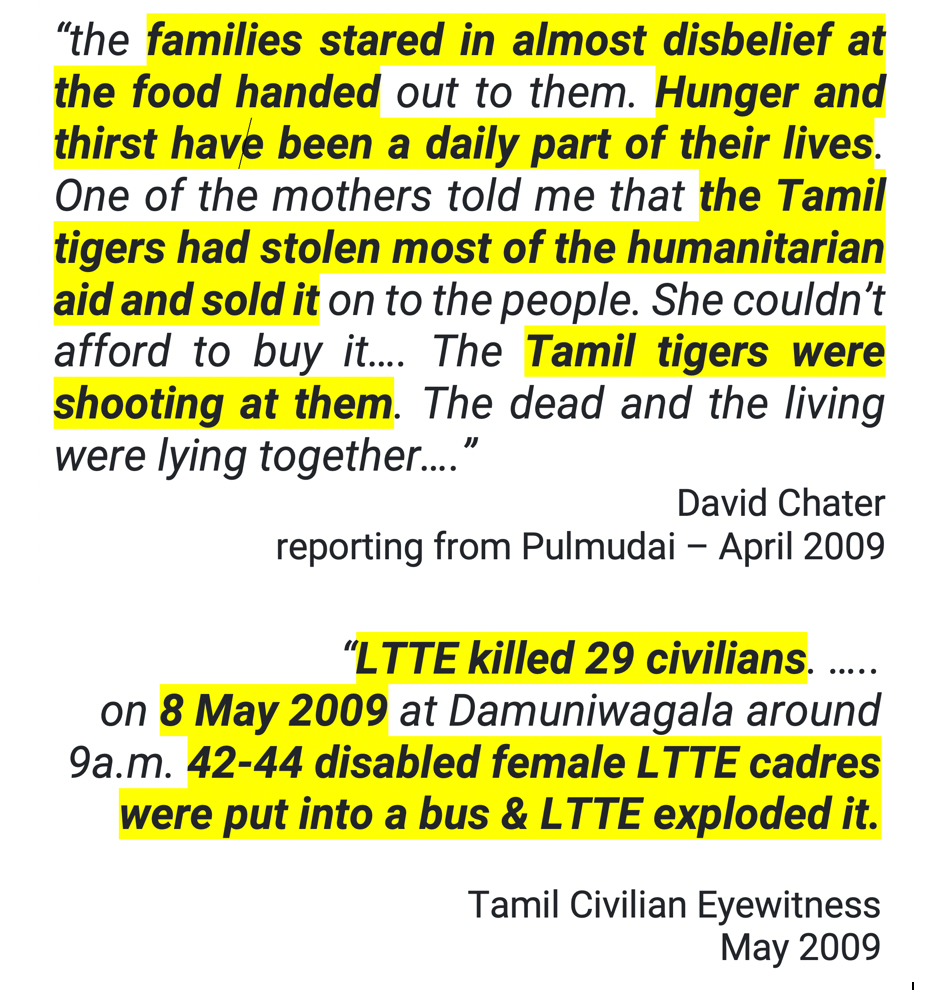
Seventeen years after the defeat of the LTTE, Mullivaikkal continues to be internationally presented almost exclusively through one narrative: that of civilian suffering caused during the final phase of the war. Yet, why does civilian suffering” need LTTE insignia and LTTE propaganda. Why are only pro-LTTE supporters present. Why are mothers of rival Tamil militant groups excluded as are the families of those LTTE killed. These are unpalatable questions that never receive answers.
Civilian suffering was real. No one denies. That suffering is relevant to not only Tamils. Sinhalese, Muslims and even foreigners also suffered under LTTE.
Civilian deaths were tragic. The dead included not only Tamils. Sinhalese, Muslims, foreigners that included an Indian Prime Minister.
Every innocent life lost in war is a tragedy regardless of ethnicity, religion, or politics.
But seventeen years later, the narration is always built around only Tamil suffering. How brutally unfair is this?
Why are the actions of the LTTE during the final phase of the conflict so often minimized, ignored, or selectively erased from international discussion?
If hundreds of thousands of Tamil civilians were trapped inside a shrinking-LTTE controlled area it was because the LTTE took them to be used as human shields and hostages.
This is a fact Tamils must face.
An armed militant movement should have boldly faced their enemy one to one.
Instead LTTE chose to hide behind civilians – the very people they claim to fight for.
This was the first signal of their cowardice and betrayal of their own people, at least those that did not support them. The supporters though were desperately trying all means possible to prevent the capture or elimination of a movement they had heavily invested in over decades.
It was the loss of this investment that resulted in the wrath and avenging against those that cut short their lucrative business. No one has assessed the legal & illegal avenues that the LTTE overseas networks made money.
Let us also be clear that even among the civilians that the LTTE took were those trained in armed combat. They could not be categorized as civilian” under international definition.
Our empathy lies only with the true Tamil civilians who did not support LTTE and who were used as hostages and human shields and kept as cannon fodder.
It was these civilians who were shot when they tried to flee LTTE.
It was these civilians who begged for water and food
It was these civilians who were denied the humanitarian aid sent from Colombo.
Unfortunately, it was these civilians whose plight was used to provide an escape route to LTTE.
the families stared in almost disbelief at the food handed out to them. Hunger and thirst have been a daily part of their lives. One of the mothers told me that the Tamil tigers had stolen most of the humanitarian aid and sold it on to the people. She couldn’t afford to buy it…. The Tamil tigers were shooting at them. The dead and the living were lying together….” (David Chater reporting from Pulmudai – April 2009)
https://www.youtube.com/watch?v=BJ7zlRiijfM – LTTE firing at civilians attempting to flee
https://www.youtube.com/watch?v=dhngG76_0qs – armed LTTE shooting at civilians trying to flee – LTTE using battle tanks within safe zones to attack armed forces.
https://www.youtube.com/watch?v=h2T1FiwRmQo – LTTE forced civilians to join hostilities (to use guns as well as dig bunkers) Meanwhile LTTE removed their uniforms and wore civilian attire making distinction difficult.
https://www.youtube.com/watch?v=fiZ_0SfCpEA – he says LTTE killed 29 civilians. He also says on 8 May 2009 at Damuniwagala around 9a.m. 42-44 disabled female LTTE cadres were put into a bus & LTTE exploded it.
https://www.youtube.com/watch?v=Y5ByT9Gp3m8 – this eyewitness too says around 50 female LTTE cadres were put into a bus & exploded by LTTE. Some had requested tea before they were killed.
Numerous testimonies from survivors, former cadres, humanitarian personnel, and reports over the years described how civilians attempting to flee LTTE-controlled areas risked intimidation, forced retention, forced labour, forced recruitment, or even being shot while trying to escape.
When the then UNSG Ban Ki Moon also appealed to allow civilians to
What these clips show is that the LTTE was not only fighting the Sri Lankan military – LTTE was fighting their own who were trying to flee to safety from LTTE.
Why do the annual commemorations omit these aspects?
The only ones that remained with the LTTE were the LTTE & their supporters. The rest wanted to get to safety.
That the annual commemorations are an LTTE affairs is clearly seen by the photographs of LTTE cadres and the yellow & red LTTE insignia used at these commemorations.
All those wailing over civilian” deaths do so by intentionally hiding that
- LTTE cadres fought in both uniform & civilian outfits
- LTTE child soldiers too wore uniforms & civilian clothes
- LTTE civilian armed force also fought in civilian clothing
All these scenarios intentionally blurred the distinction of civilian”.
The soldiers had no time to swift through international law books to determine who was a civilian” or not. All those human rights activists outside the war terrain can debate over how a war should be fought – what if they are put into a battlefield to show us how!
So this annual commemoration fanfare over civilian deaths when they conveniently omit
- Tamil civilians shot & killed while attempting to escape LTTE and enter government-controlled areas
- Tamil parents killed trying to prevent their children being taken as child soldiers
- Non-LTTE adults & children forced to engage in hostilities during the last phase and dying
are not genuine commemorations for civilians – they are commemorations for LTTE dead.
Every politician, diplomat, foreign official participating in these events are actually mourning terrorists.
So when Agnes Callamard, General Secretary of Amnesty International attended the Mullivaikkal commemorations amid LTTE insignia it was clear who she was mourning.
So, if the commemorations are purely humanitarian remembrance events – why are LTTE flags, LTTE insignia, LTTE imagery and separatist symbols necessary?
Insignia, flags, separatist maps displayed at civilian commemorations are not mourning civilians – they are mourning terrorist dead.
Would any government in the world accept public glorification of an internationally proscribed terrorist movement?
Do you see the US, UK, European Govts permitting Al Qaeda leaders or other terrorist leaders or their movements to be commemorated in public.
So, when a Sri Lankan Government allows such – it only shows who they are mourning as well.
As we have repeatedly said – reconciliation is irrelevant. The enemy of the citizens of Sri Lanka was LTTE. The Sri Lanka Armed Forces, defenders of Sri Lanka’s sovereignty and the Sri Lankan people were tasked to rid the nation of terror. Which they did in May 2009. The people does not need to reconcile with terrorists.
LTTE fighters may have all been Tamil but LTTE supporters include not only Tamils but Sinhalese, Muslims and foreigners. We cannot prevent them annually mourning the LTTE – but they cannot do so in public. But when they do so, it only reconfirms they sided with the enemy, they sided with the terrorists and they were against civilian safety.
Everyone who attends these LTTE mourning commemorations have no pity for the 30 years of bloodshed LTTE is accountable for.
Everyone who attends these LTTE commemorations took the side of the LTTE when they
- assassinated Tamil political opponents,
- eliminated rival Tamil movements & their leaders
- recruited Tamil children as child soldiers,
- carried out suicide bombings,
- ethnically cleansed Sinhalese & Muslims from the North,
- attacked civilians across Sri Lanka,
- and enforced authoritarian control within Tamil society itself.
This is why seventeen years after the defeat of the LTTE, Sri Lanka still struggles with competing attempts to define memory itself.
We seek to remember and remind he people of the suffering of all civilians while acknowledging the brutality of terrorism.
The other side seeks to preserve a narrative where the LTTE is gradually transformed from an armed militant organization into a symbol of collective Tamil victimhood and savior.
Seventeen years later, many ordinary Sri Lankans — including Tamils who directly experienced LTTE control — continue trying quietly to rebuild their lives without returning to the politics of fear, coercion, and permanent grievance. Many are even forced to attend these commemorations.
LTTE’s overseas political activists project an emotionally mobilized version of events that leaves little room for Tamils to close the past and move forward.
That they do not allow the Tamil populace to rebuild their lives showcases the selfish attitude of these LTTE overseas networks who have repeatedly ignored to voice for the real Tamil civilians.
- Who speaks for the Tamil civilians killed by the LTTE?
- Who speaks for the children forcibly recruited during the final phase?
- Who speaks for the families prevented from fleeing?
- Who speaks for the Tamils who had to pay LTTE to obtain food & water given free by the GOSL
- Who speaks for the dissenting Tamils silenced long before 2009?
- Who speaks for the Sinhalese/ Muslims expelled from the North?
- Who speaks for the Sinhalese and Muslim civilians killed in attacks over three decades?
Selective remembrance is hypocrisy.
The conflict ended in May 2009.
Seventeen years later, the battle over memory continues.
So long as the lies continues – we will remind all about the truth so we all remember the facts.
What is the real objective of these annual LTTE commemorations and for whose benefit are these being annually held?
Shenali D Waduge