The late Kumar David (1941-2024), retired electrical engineering professor, ex-Marxist, and political economic analyst and newspaper columnist, wrote a feature article entitled Arrest Gota or not per the evidence: NO to fundamentalism, racial-extremism and neo-populism” published in the Sunday Island/December 10, 2017. The title itself was extremely misleading because what it suggested was malicious fiction.
No evidence had been found against Gota; given the fact that three years of witch-hunting had produced nothing incriminatory against Gotabaya Rajapaksa or his brothers, it was not likely that any would be found subsequently either. By ‘fundamentalism’ in the title, KD particularly hinted at alleged Buddhist religious fundamentalism, but there was no Buddhist religious fundamentalism in Sri Lanka or elsewhere whatever the biased Western media might have said to the contrary; by ‘racial extremism’ KD no doubt meant claimed Sinhalese racial extremism, but there was no such thing then, as there has never been to date. The anti-nationalist regime changers targeted Gotabaya because only he out of the Sinhalese Buddhist leaders had the necessary courage to give an ear to the Buddhist monks’ evidence based complaints about rising violent Islamism in Sri Lanka and took some concrete steps in response.
The dictionary definition of neo-populism then was: A cultural and political movement, mainly in Latin American countries, distinct from twentieth century populism in radically combining classically opposed left-wing and right-wing attitudes and using electronic media as a means of dissemination”. Since by ‘populism’ we had up until then understood a certain bias or a special concern towards the welfare of ordinary citizens, which neo-liberalists argued negatively affected economic growth, neo-populism had to be understood as a new form of the same pro-poor political-economic policy framework. Critics used to accuse Mahinda Rajapaksa of populism, but he didn’t see the rural based economic strategy he favoured that way. His successors (of the Yahapalanaya) seemed to be committed to non-populist policies; they had however fallen short of MR’s success level. So probably, KD feared a return of populism (that MR modeled) in the future.
This meant that KD’s resounding NO was to ‘evils’ that were non-existent among the majority of Sri Lankans! But there were then, as there are now, many inarticulate hapless victims of religious fundamentalists of the worst kind active globally and racist extremists of KD’s own brand. That is why I say that the title was misleading. Kumar David’s slanderous opening paragraph that spews venom against the majority community runs:
Ex-president MR is on record that Gota’s arrest on trumped up charges is imminent. Joint Opposition-cum-Rajapaksa (JO-Pak) mouthpieces, hoping to stave off an arrest, warn of an almighty Sinhala-Buddhist backlash if he is locked up. This implies that a strong case which will hold up in court exists and JO-Pak is endeavouring to stampede the Sirisena-Ranil duumvirate – not a difficult task – to halt action. If burn-loot-rape gangs are let loose by JO-Pak or the BBS counter-mobilisation must clear the streets. Let the appropriate authority arrest Gota or not as obligated by the evidence; the scourge of racial extremism must not be allowed to panic society. Extremism is my topic today, this panic mongering is a useable starting point.”
These extravagant imaginary false charges betrayed the fact that KD was deeply hostile to the Rajapaksas. He disliked Gotabhaya Rajapaksa because he was a formidable threat to the scheme for dismantling the unitary state of Sri Lanka in order to install a confederation of mini states in its place as envisaged by the proposed constitutional project that had been arbitrarily launched amidst widespread popular opposition. KD congratulated himself, as he had already done many times, for being the architect of the ‘single issue common candidate’ strategy that ultimately led to the unexpected ouster of Mahinda Rajapaksa in the January 2015 prematurely called presidential elections.
GR served as the vital communication link between the all important political leadership provided by the president, his brother MR, as Supreme Commander of the Armed Forces and the battleground military leadership during the humanitarian campaign that defeated the terrorism that had plagued the country for nearly three decades. At that time, it was difficult to guess whether Kumar David sincerely condemned or secretly admired the terrorists for their cowardly excesses against the majority community, towards whom he nursed a visceral hatred. Of course, the terrorists didn’t spare the other communities either, when they stood in their way. So, all communities are indebted to the Rajapaksas for ridding the country of terrorism, which they achieved, putting themselves in the line of fire in the process, both literally and figuratively.
Kumar David was reluctant to acknowledge the Joint Opposition for what it effectively was: it served as the real Opposition in parliament, where the official opposition, according to critics, was performing a rearguard role for the survival of an increasingly unpopular Yahapalana government. Instead, he described it insultingly as the ‘Joint Opposition-cum-Rajapaksa (JO-Pak)’, which was completely unwarranted, particularly when such condemnation came from an rabidly racist, ill informed or deliberately lying ex-Marxist like Kumar David, without even a semblance of a following (that is, without any identifiable group of followers). What was KD compared to MR as a politician or political analyst in public estimation? How many Sri Lankan voters were even aware of the existence of a character called Kumar David, although his crafty stratagem worked with the vital support of the late Maduluwawe Sobita Nayake Thera (May 1942 – November 2015) of Naga Viharaya, Kotte, something the monk deeply regretted, not long after, when he realized that he had been utterly misled.
There was no comparison between Kumar David and Mahinda Rajapaksa. KD completely misinterpreted MR’s candid warning a few days/weeks before that there was a move to arrest Gotabhaya Rajapaksa on false charges. I need not dwell on what soon became common knowledge among the overwhelming majority of ordinary Sri Lankans of all communities. The Court of Appeal issued a stay order on the FCID against the arrest of GR on November 29, valid till December 6, 2017. It was then extended to December 15. And then it was further extended to January 25, 2018. Gota’s appeal was based on the grounds that the FCID operation against him was illegal. His lawyers pointed out that no government money had been used in the construction of the D.A. Rajapaksa Memorial and Museum containing wax images; there was no lawful case justifying his arrest. (This memorial structure was destroyed by Aragalaya hooligans in May 2022; but the statue of D.A. Rajapaksa was restored and ceremonially opened by former president Mahinda Rajapaksa in November the same year). Besides, given his august family history (to survive eighty years in national politics is an achievement in itself), his varied educational and professional background, and his long years in the military as a decorated soldier promoted to the rank of colonel during a UNP government (which is significant because he must have been known to the then authorities as a son of D.A. Rajapaksa, SLFP founder S.W.R.D. Bandaranaike’s loyal colleague from the southern province), and his proven moral stature, Gotabhaya Rajapaksa was least likely to do anything that could damage his personal honour and public reputation. Full of malice, KD wrongly argued: Joint Opposition-cum-Rajapaksa (JO-Pak) mouthpieces, hoping to stave off an arrest, warn of an almighty Sinhala-Buddhist backlash if he is locked up. This implies that a strong case which will hold up in court exists…”.
Only an irrational Rajapaksa hater like Kumar David was able to suggest that Gotabhaya Rajapaksa could indulge in corruption exploiting, at that, a project done in memory of his own late father. The fact that hundreds of patriotic lawyers offered to defend him in court free of charge on an earlier instance of a similar defamatory nature was testimony to the nation’s attitude towards the iconic Sri Lankan that made him safe against such false charges.
.To be continued
Comments Off on Menacing echoes of the regime change of 2015 – I
The “Spirit of Cricket”—often cited by the International Cricket Council (ICC) as a cornerstone of fairness and sportsmanship—is viewed by critics as a convenient, selectively applied “myth” when contrasted with the ICC’s handling of the Decision Review System (DRS) intellectual property (IP) rights.
The controversy centers on allegations that the ICC has ignored, appropriated, and failed to compensate for the original, conceptual invention of the player-referral system, which was proposed by Sri Lankan lawyer Senaka Weeraratna in 1997, nine years before the ICC adopted it in 2006.
The Core Myth: Spirit vs. Commercialism
The “Spirit of Cricket” implies a commitment to fairness and ethical behavior. Critics argue this spirit is breached by:
Lack of Recognition: The ICC has not recognized Weeraratna as the inventor of the player-referral concept, which he first published in the Australian newspaper in 1997.
Uncompensated Usage: While the ICC utilizes and profits from the DRS, the original proponent has received no recognition or compensation, raising questions about the fairness of ICC’s administrative practices.
The “Independent Discovery” Argument: The ICC has maintained that its DRS is an evolved, separate creation, despite the “constructive notice” argument that the concept was in the public domain for years before, according to a report on LankaWeb.
Intellectual Property Rights and the DRS
The handling of the DRS highlights a power imbalance between the governing body and independent innovators:
The “Player Referral” Origin: The key innovation—a player’s right to challenge an umpire’s decision—was pioneered by Weeraratna, not the ICC.
The Problem of “Idea” vs. “Technology”: Legal hurdles are significant because the ICC argues they don’t hold copyright over the technological evolution (ball-tracking), yet they have adopted the core player-initiated referral framework invented by Weeraratna.
Unethical Behavior Claims: Critics argue that by refusing to even accept documentation regarding authorship, former ICC officials (such as Haroon Lorgat) breached the “Spirit of Cricket” by failing to act fairly or provide a fair hearing to the claimant.
The Power Politics Behind the “Spirit”
The controversy suggests that the “Spirit of Cricket” is overshadowed by commercial and political interests within the ICC:
Unequal Revenue Sharing: Studies indicate that IP rights and revenues from broadcasting (which include DRS replays) are heavily skewed toward wealthier cricket nations, limiting the benefits for smaller boards and hindering the development of the game, according to ResearchGate.
Double Standards: The ICC has been accused of “double standards” in applying its rules, often favoring powerful cricket boards over smaller ones, which further breaks down the idea of a universal “spirit” guiding the game’s governance, according to a report on Daily Mirror.
Ultimately, the argument stands that the “Spirit of Cricket” is treated as an abstract concept applied to player behavior, while the structural, financial, and intellectual property decisions made by the ICC are driven by a purely commercial, corporate agenda, leaving inventors of technological concepts largely unacknowledged
“Spirit of Cricket” is often criticized as a “myth” or a “selective ideal” when juxtaposed with the International Cricket Council’s (ICC) handling of Decision Review System (DRS) intellectual property (IP). Critics argue that while the ICC uses the Spirit of Cricket to demand honesty and fair play from players, its own administrative handling of the technology’s origins and ownership follows a more rigid, “survival of the fittest” corporate logic.
The IP Rights Controversy: Senaka Weeraratna
The primary friction point involves Sri Lankan lawyer
Senaka Weeraratna
, who claims to have conceived the “Player Referral” concept—the core of the modern DRS—as early as 1997.
The Claim: Weeraratna published articles in The Australian and other international media in 1997, nine years before the ICC began formal trials of the system. His proposal included the key elements of current DRS: player-initiated appeals to a third umpire with limited unsuccessful attempts.
The ICC’s Legal Defense: The ICC has consistently denied Weeraratna’s claims for formal recognition or compensation. Former ICC Head of Legal David Becker argued that by publishing his ideas openly without a patent, Weeraratna “waived his right to confidentiality”.
The “Spirit” Conflict: Critics contend that by relying on legal technicalities (the lack of a patent) to avoid acknowledging a foundational contribution, the ICC violates the very “Natural Justice” and “Fair Play” it preaches under the Spirit of Cricket.
The Myth of Administrative Fairness
The disparity between the expectations placed on players versus administrators fuels the “myth” narrative:
Double Standards: Players are penalized under the ICC Code of Conduct for showing dissent or not “walking,” yet administrators are seen as prioritizing commercial protectionism over moral attribution.
Corporate Influence: Ownership of DRS technology remains largely with private entities like Hawk-Eye Innovations and broadcasters. Some argue this makes the system a tool for “commercial value” rather than a purely altruistic pursuit of truth, undermining the game’s traditional ethos.
Practical Hurdles: While proponents of the “myth” theory call for the system to be renamed or for royalties to be paid, the ICC maintains that the DRS has evolved significantly through multiple technologies (UltraEdge, HotSpot) making it impossible to attribute to a single inventor.
Would you like to explore the legal requirements for establishing “Moral Rights” in sports innovations or more about Senaka Weeraratna’s specific 1997 proposal?
Source : AI Overview
Comments Off on The Myth of ‘ Spirit of Cricket’ in ICC administered Cricket with respect to handling of DRS intellectual property rights
Consumer is bound to be exploited during the festive season by the trader manufacturer and industrialist whose motive is profit making and more business at any cost. Consumer always get a unreasonable deal as he is not organized and the Consumer Affairs Authority – the regulator who is expected to protect the consumer and regulate and regularize trade is inefficient and inactive whilst the consumer is suffering before giant trader who are responsible in selling outdated, food and consumer items at the highest prize especially by the guise of sale and massive mega exhibitions combined with large and small scale sale.
Consumer is one who buys a consumer item or a services for a consideration and expected to be powerful as a king as the business trader and economy depends on the consumer.
Even the consumer is partially to be blamed for not organizing themselves and not becoming alert and smart consumers to ascertain when to buy, how to buy, where to buy and be smart and careful in dealing as the money spent is hard earned money belong to the family.
CAA the powerful regulator
Consumer Affairs Authority the – main regulator is solely responsible for the irregularities of the trader as it is the responsibility of the CAA to regulate trade and help the consumer. John Kennedy in 1960 said the consumes the most powerful and needed group who is neglected and not aware of his power. He initiated the world consumer day celebrated world over and has become a power with strong organizations such as WHICH in UK and Consumer International in USA and many other worlds over.
Sorry State
It is a sorry state that the CAA which is the most powerful and main regulator is inactive and do not live up to expectations, and expected to organize consumer organizations. What we consume as food is poisonous sub slandered and it is the duty if CAA to have control over with the massive grants by the state and the large staff spread all over the country. Staff is well paid with lot of perks vehicles and facilities yet do not appear to be efficient to perform.
Solution
The solution lies on the citizen all of whom are consumers to agitate the CAA to be more efficient and energetic especially during the festive season when the consumer-citizen is most exploited.
Real thief too runs with the running crowd to catch the real thief running with belongings for safety. Thriving is illegal punishable under penal code as a criminal offence, but only few real thieves are caught and punished as real thief somehow escapes as he has the knowledge and intelligence of God ‘Ganadevi’ villages say, If thieves are given power to catch thieves, they will do an excellent job some say. There are white color thieves and thieves in governance who are rarely caught. Earlier governance wanted 10% and now it has risen to 30% Recently a foreign delegation arrived our beautiful island to make a huge investment and met the ruler who is self-appointed politico who now in charge of trade and self-appointed to catch thieves who according to thieves who plundered our nation and citizens. At the first meeting he informed the Sri Lankan head of the delegation that he needs his 30% out of the huge investment to our motherland, in Sinhala without knowing that there is a Sinhala interpreter in the foreign delegation. Obviously and naturally they declined to invest funds to the nation with some thieves in governance. This is a sorry state of affairs and a true story, as the writer is known to both parties and prepared to expose at the appropriate moment. God save our motherland, donated to Lord Buddha protected by gods!!!
Comments Off on Thief! thief!! Where are real Thieves
There are journeys that shape a man’s career—and then there are journeys that shape his entire philosophy of life. Mine began in the austere yet intellectually rich environment of the former Soviet Union.
As a young Sri Lankan engineer, I found myself under the guidance of remarkable academics, including my mentor, Professor Dr. Kosobkov—a Jewish Russian scholar of exceptional depth and discipline. Among his colleagues was a colourful junior lecturer, Basnyayski, another Jewish intellectual -a man who had a peculiar way of expressing himself. His frequent use of the phrase eeyop thaiyoo math”—a strange blend of Russian slang—was both amusing and intimidating. It was not something one would find in any textbook, but rather a reflection of the raw, human side of Soviet academia.
Yet beneath that rough exterior was a man of immense kindness.
I still remember how he once drove me, a foreign student, to the Kalshdkaya natural gas storage facility near Moscow. This was no small gesture in those days. The Soviet system was rigid—foreigners were not supposed to travel freely without proper clearance. He was later reprimanded for this act of kindness. But to me, it revealed something deeper about the people I encountered there: a quiet generosity that often existed beneath a strict political system.
Years later, I heard that Basnyayski had fallen into trouble—accused of fraudulent subcontracting practices in Siberia, billing the state for workers who never existed. It was a sad reminder that even brilliant individuals can falter under pressure.
Despite such incidents, my connection with my professors remained strong. Dr. Kosobkov stayed in touch with me long after I left. These were not just teachers—they were mentors who invested in their students with sincerity.
One of my professors, a quiet genius, had even contributed to the design of the drive system of the Lunokhod program—the Soviet Union’s pioneering robotic vehicles sent to the moon. To be taught by such individuals was an honour that shaped my technical foundation for life.
Before the era of Perestroika, I returned to Moscow briefly while working in the Norwegian sector of the North Sea oil industry. During that visit, I delivered a lecture to Russian students on modern Western technologies. It was my way of giving back to a system that had given me so much.
But the world outside was changing.
Western management—particularly American—viewed my actions with suspicion. In the tense atmosphere of the Cold War, even an academic exchange could be misinterpreted. I was quietly branded as a spy.” It was both ironic and painful. I had no political motive—only a desire to share knowledge.
Soon after, I distanced myself from Russia and never returned.
My professional journey, however, continued across Europe and Scandinavia, particularly in the demanding oil and gas sectors of the North Sea. Years of practical experience, combined with the rigorous theoretical training I received in the Soviet Union, allowed me to grow into leadership roles. Eventually, I returned to Sri Lanka and took on responsibilities that included running a shipbuilding company and managing teams of highly qualified chartered engineers.
And yet, the greatest irony awaited me at home.
Despite decades of international experience, I was unable to obtain membership in the Institution of Engineers Sri Lanka without sitting for their basic Part I and II examinations. It mattered little that I had worked on complex engineering projects across continents or led organizations at the highest level. The system required formal compliance, not lived expertise.
I never obtained that membership.
It remains, to this day, a quiet disappointment.
But life has its own way of balancing recognition and purpose. While institutions may withhold titles, experience itself becomes the ultimate credential. I had the privilege of learning from some of the finest minds in the Soviet Union, working on world-class projects in Europe, and contributing to Sri Lanka’s industrial landscape.
No examination can measure that journey.
This is not a story of regret—but of reflection.
A reminder that knowledge, once gained, cannot be taken away… even if recognition sometimes is.
Regards
Dr Sarath Obeysekera
Comments Off on From Moscow to the North Sea – A Sri Lankan Engineer’s Unfinished Recognition
The period from 1505 to 1948, marking 450 years of colonial rule in Sri Lanka by Portuguese, Dutch, and British powers, is often described by historians and scholars as a time of intense pressure and systematic efforts to dismantle the traditional Buddhist and Sinhalese culture
. Despite these attempts, which included the destruction of temples and the repression of Buddhism, the religion and culture survived due to the resilience of the Sinhalese people, led by the Sangha (clergy) and local leadership.
Colonial Repression of Buddhism (1505–1948)
Portuguese Period (1505–1658): Known as the most destructive period for Buddhism in coastal areas. The Portuguese systematically destroyed Buddhist, Hindu, and Islamic places of worship, replacing them with churches, and enacted harsh laws to force conversions to Catholicism. Prominent temples such as those in Devundara, Trincomalee, and Kelaniya were destroyed, and temples were looted.
Repression and Conversion: The conversion of the Sinhalese aristocracy, notably King Dharmapala in 1557, facilitated the suppression of Buddhism. Many Sinhala Buddhists faced persecution, and Buddhist monks were targeted, with many fleeing to the interior Kingdom of Sitawaka and Kandy.
Dutch and British Periods: While the Dutch focus was initially more on economic gain, they continued to restrict Buddhist practices, refusing to allow the restoration of temples. The Dutch utilized legal and administrative discrimination, such as restricting state employment to Christians, to marginalize Buddhist practitioners. The British initially pursued a policy of promoting Christianity, which led to a, which caused a “Buddhist revival” in the late 19th century as a response to this marginalization.
Kingdom of Kandy: As a sovereign Buddhist state until 1815, Kandy served as a sanctuary for the religion and a base for military resistance against European expansion.
Public Debates: Events like the Panadura Vaadaya (1873) saw Buddhist monks successfully challenge Christian missionaries in public discourse, revitalizing local confidence in Buddhist doctrine.
Resilience of the Sinhalese People
Role of the Sangha: Despite the severe repression, the Sangha, particularly in the interior Kandyan Kingdom, maintained the religious tradition and preserved the higher ordination.
Popular Revolts: The Sinhala people engaged in numerous uprisings, such as those led by Edirille Rala to protect the Buddhist faith and nation.
Revival Movements: The 19th-century Buddhist renaissance played a key role, with figures like Hikkaduwe Sri Sumangala Thera driving a push for education and restoring Buddhist institutions. This Movement was continued by figures like Anagarika Dharmapala, D.B. Jayatilleka, P.de S. Kularatne and L.H. Mettananda and his Bauddha Jatika Balavegaya (BJB) , among others. Several of these were former Principals of Ananda College.
The survival of Buddhism in Sri Lanka is largely credited to the unwavering commitment of the Sinhala people to their faith and cultural identity, resisting efforts to turn the island into a fully converted colonial territory like the Philippines whose cultural identity has been so disfigured even the Country has been condemned to bear the name of a non – Asiatic Spanish King.
Source: AI Overview
Comments Off on They came to topple Buddhism. Tried for 450 years and failed. Thanks to the resilience of the Sinhalese people. The only race in Asia which the West failed to conquer by military means.
Sri Lanka’s gains over the past thirty years have been episodic and reversible, because governance has been neglected.
The impact of Sri Lanka’s 2022 debt crisis on real wages, employment, poverty, and pensions, showed how fiscal crises are ultimately social crises.
Sri Lanka needs four things working together: macroeconomic discipline, institutional reform, ethnic reconciliation, and an effective export-led growth strategy.
This is the eleventh chapter in the Freedom and Prosperity Center’s 2026 Atlas, which analyzes the state of freedom and prosperity in ten countries. Drawing on our thirty-year dataset covering political, economic, and legal developments, this year’s Atlas is the evidence-based guide to better policy in 2026.
Evolution of freedom
Sri Lanka entered the period covered by the Freedom Index with a paradoxical institutional profile. By the mid-1990s, the country had already achieved levels of education, health, and basic social development that far exceeded what its income level would suggest. At the same time, its institutional framework was under severe strain. A protracted armed conflict, a highly centralized state, and recurrent policy reversals had already begun to erode confidence in governance. As a result, the evolution of the country since 1995 is a story of sharp swings, missed opportunities, and fragile gains that repeatedly failed to consolidate.https://freedom-and-prosperity-indexes.atlanticcouncil.org/?embed=compare&countries=Sri%20Lanka%2CSouth%20%26%20Central%20Asia&indicators=Freedom_Index&scaled=true&range=1995,2024
Looking at the aggregate Freedom Index, Sri Lanka’s trajectory is marked by volatility rather than steady progress. Freedom as it is measured by the index declined in the early 2000s, recovered strongly after the end of the armed conflict in 2009, improved further through much of the next decade, and deteriorated again during the period of political instability and economic crisis that followed. Despite these fluctuations, the country’s overall freedom score today remains higher than it was in 1995. Yet this headline improvement conceals two underlying problems: First, gains in individual dimensions of freedom were rarely synchronized, and advances in one area were often undermined by weaknesses in others; and second, improvements have not been consistent but have oscillated significantly with changes in political leadership. This lack of complementarity and consistency is central to understanding Sri Lanka’s institutional evolution.
The subindex on economic freedom illustrates this pattern. From the late 1990s onward, Sri Lanka maintained a broadly liberal economic framework, with relatively open trade policies and a formal commitment to secure private property and market-based systems. This economic framework, however, was not adequately supported by a stable and predictable policy and governance framework. This could explain why the index shows economic freedom fluctuating over time. The key learning from Sri Lanka, evidenced in many other countries as well, is that durable economic freedom grows in the soil of solid institutions and governance. Neglecting governance makes economic progress unstable and unsustainable. This problem surfaced in a calamitous way in the mid-2020s when Sri Lanka faced the most severe economic crisis in its post-independence history. The index shows economic freedom in the 2020s largely returning to its mid-1990s level. This reversal supports a growing understanding: that trying to build economic progress on top of poor governance is like building a house upon the sand.
Investment freedom has similarly been sensitive to political stability. The index shows the highest levels on record between 2001 and 2003, when active efforts to settle Sri Lanka’s violent conflict through peace negotiations were underway. The lowest levels were in 2009 at the height of the violent conflict (which ended in May of that year). The fluctuations after that track a mixture of deficits in social peace and predictability of policies. The picture that emerges suggests that investor response is highly sensitive to perceptions of political and economic stability, which are reflected through the overall climate of peace and governance.
The subindex on trade freedom was at its highest level just prior to the political change that accompanied the 2004 elections and dropped to its lowest as Sri Lanka experienced a currency crisis in 2021. The country’s trade freedom index seems to be tracking its political cycles. These have fluctuated between two major polarities—inward-facing political ideologies, where trade openness is seen as a threat to protect against, and outward-facing ideologies where global integration is seen as an opportunity. In keeping with these cycles, Sri Lanka’s trade freedom shows steady progress all through the 1990s up to 2003, when a new government came to power. It then went into a steady decline until 2014, when it started to improve following another change in government; trade freedom fluctuated with the shorter political cycles thereafter.
Building economic progress on top of poor governance is like building a house upon the sand.
The sharp dip observed at the cusp of the economic crisis reflects not a structural reversal, but the vulnerability of openness in the absence of adequate buffers and professional governance. The trade freedom index also reflects that, despite relative openness to international trade in the past, with fewer formal barriers than many countries in the South Asia region, Sri Lanka’s openness did not translate into deeper global integration or export dynamism. Trade freedom coexisted with a stagnant export basket and repeated episodes of import compression during times of crisis.
One of the more stable indicators within the economic subindex has been women’s economic freedom, which measures the parity in legislative treatment of men and women. Legal equality in economic rights improved over time, supported by reforms that strengthened women’s ability to work, own property, and engage in business on equal terms with men. The most recent improvement to the index in 2022 resulted from an amendment to the law on the rights to use state land, which removed the preference given to sons over daughters in the inheritance of such rights. These gains built on long-standing social investments in education and health that were equally available to men and women.
At the same time, however, improvements in formal rights did not automatically translate into commensurate labor market outcomes. Sri Lanka has a large gender gap in employment among prime working-age adults (25 to 54): Over 90 percent of men are employed, compared with fewer than 45 percent of women. While Sri Lanka has laws requiring that women receive three months of maternity leave, it is among a minority of countries globally where the state does not fund maternity leave. Consequently, the data shows that younger women face discrimination in the private sector job market. This is a reminder that parity under the law, while necessary, is not sufficient for advancing women’s economic freedom.
Political freedom reveals an even more pronounced pattern of disruption and recovery. During the years of active conflict, political institutions operated under exceptional circumstances. Governance was shaped within an atmosphere of security-based fear: The use of emergency powers was normalized, and democratic space was squeezed. The end of the armed conflict in 2009 marked a turning point in beginning to reverse these trends, but the political freedom index seems to track leadership cycles. While political freedom improved gradually in the years after the conflict ended, the sharp and decisive improvement took place only when the government changed in 2015, creating greater space for electoral competition, civil liberties, and political participation.
The index registers a decline in 2019 following a constitutional coup”—when the president attempted, illegally, to oust the elected government—and a subsequent change in the president and the government that led to a more centralized authority and the use of exceptional legal frameworks. The improvement in the index in 2022 tracks yet another change in political leadership—when mass protests caused the president to resign. The overall pattern suggests that democratic practices in Sri Lanka remain highly contingent on leadership and context, rather than firmly institutionalized.
The component that provides the starkest evidence of this fragility is legislative constraints on the executive. This indicator shows some of the largest swings across the entire Freedom Index. This index also tracks political cycles closely—especially changes to the constitution within those cycles that significantly expanded and contracted executive power as a result of four constitutional amendments. When the parliament majority is from the same party as the president, its ability to effectively oversee and restrain the executive has remained weak and inconsistent. The cycles of expansions in executive power have had serious negative consequences, not only for political freedom but also for the quality of economic decision-making in the country.
The legal subindex, much like the political subindex, tracks the changes in political cycles. While it suggests that the rule of law in Sri Lanka has improved overall since the mid-1990s, it also shows those improvements have been inconsistent. This means that the rule of law in Sri Lanka is not adequately institutionalized and depends heavily on the personalities and practices of its political leaders.
Clarity of the law has some of its lowest scores during periods of conflict and the COVID-19 pandemic. During what was deemed emergency periods, the executive had some measure of authority to ignore laws, enforce them selectively, or override them through exceptional measures. These were periods in which the fabric of democracy was destabilized. The period between the end of the conflict and the onset of the pandemic brought some relief and recovery in this category, especially during a change in the political cycle from 2015 to 2018, during which judicial independence and effectiveness improved significantly. But there too, consistency remained a problem as gains in judicial independence reversed when executive assertiveness had social support and political incentives shifted.
The security component of the legal subindex, unsurprisingly, tracks periods and episodes of conflict. The index improved dramatically when the armed conflict was suspended in 2002 with a strong initiative to negotiate a political settlement. The index declined steadily as that initiative failed and conflict escalated until 2009 when it ended through violence rather than negotiation. For much of the following decade, the security measure improved dramatically. Any setbacks during that time can be traced to episodes of religious violence against Muslims and Christians in Sri Lanka’s social context of a majority Buddhist population.
The improvement in security after the end of the armed conflict was based on negative gains—a reduction in violent events rather than positive gains such as greater safety and protection under the law. Many of the extrajudicial means the state used against its armed opponents were in some measure deployed against its political and civil society critics as well. Draconian laws such as the Prevention of Terrorism Act continued to be used, and laws drawn up to protect civil rights, such as the law designed to give effect to the International Covenant on Civil and Political Rights, were abused to suppress democratic opposition. It is therefore apparent that political cycles also had an impact on the security context.
Bureaucracy quality and control of corruption in Sri Lanka has consistently been higher than the regional average as it is measured by the index, but they have moved in opposite directions. Sri Lanka’s index has followed an oscillating and declining trajectory, while the regional index has been improving steadily in the last decade. Moreover, Sri Lanka’s higher index values, relative to the rest of the region, should be evaluated with caution. Sri Lanka may have avoided some of the extreme governance failures seen elsewhere, but bureaucratic effectiveness was undermined by politicization, weak incentives, and limited accountability.
Taken together, the evolution of freedom in Sri Lanka since 1995 reinforces a central lesson: Freedoms do not accumulate automatically with increases in GDP. Gains in political rights, economic openness, or security can be real, but they remain vulnerable when not supported by a stable and credible rule of law. Sri Lanka’s experience illustrates the costs of imbalance. Without durable legal foundations and effective constraints on executive power, advances in freedom proved episodic rather than transformative. This institutional fragility would go on to shape not only the country’s democratic trajectory, but also the nature and sustainability of its economic and social outcomes, as shown in the next section.https://freedom-and-prosperity-indexes.atlanticcouncil.org/?embed=country-profiles&countries=Sri%20Lanka&indicators=Economic_Subindex%2CPolitical_Subindex%2CLegal_Subindex&scaled=true&range=1995,2024
From freedom to prosperity
The Prosperity Index captures the cumulative outcomes of a country’s institutional framework on quality of life, not just the increase in overall incomes. Sri Lanka entered the 1990s with a level of prosperity well above the regional average, largely because of its early and sustained investments in health, education, and basic social infrastructure. Yet, over time, that initial advantage eroded, not because Sri Lanka’s rate of GDP growth was significantly lower but because growth came with increased inequality and without concomitant improvements in overall social infrastructure. Consequently, Sri Lanka’s prosperity, as measured by the index, grew much more slowly than the average among its regional peers in South and Central Asia.
The income dynamics in Sri Lanka illustrate both the achievements and the vulnerabilities of its development model. Since 1995, real income per capita rose steadily, apart from a short recession in 2001 as Sri Lanka responded late to the aftereffects of the East Asian economic crisis. Growth was consistent despite internal armed conflict and various shocks from natural disasters to global markets. But growth relied heavily on domestic demand, government spending, and external borrowing, rather than on productivity gains or export expansion. By 2020, along with major tax cuts, the interest cost on debt as a ratio of government revenue reached 70 percent. These unsustainable dynamics triggered a full-blown debt crisis in Sri Lanka in 2022. Consequently, the country’s GDP contracted by 10 percent, and it is expected to return to its 2018 level only in 2026.
The structure of Sri Lanka’s growth helps explain this fragility. Over time, services became the dominant driver of economic activity, while agriculture remained at low productivity subsistence levels and industry expansion was narrowly focused and anemic. The export basket remained remarkably static for decades, dominated by clothing, tea, and a small number of primary or low-value-added products. Goods exports as a share of GDP fell from 33 percent to 12 percent between 2000 and 2020. Tourism and worker remittances increasingly compensated for the shortfall, providing foreign exchange and supporting consumption, but neither could substitute for a diversified and competitive tradable sector.
Health outcomes represent one of Sri Lanka’s most enduring strengths. Life expectancy has remained high relative to income, reflecting long-standing public investment in universal health care and early successes in combating communicable diseases. Although the data shows sharp dips during destabilizing events such as the tsunami, the final phase of the war, and the COVID-19 pandemic, the underlying trend remains positive. Sri Lanka’s experience during the pandemic, in particular, demonstrates the resilience of its health system, as the decline in key indicators was smaller than in many comparable countries. That said, headline indicators mask persistent challenges, including child malnutrition and uneven quality of care, which are not fully captured by aggregate measures.
Education outcomes follow a similar pattern of early strength and later a plateau. Universal access to schooling, compulsory education, and the absence of gender discrimination produced high average years of schooling and placed Sri Lanka well above the regional average. Education became deeply embedded in social norms as the primary path to upward mobility. However, progress slowed as the system approached its natural ceiling in basic education. This is due to Sri Lanka not being able to expand access or improve the quality of its university education, even compared to the region. As a result, high levels of basic education did not translate into a sufficiently high-level workforce for a more complex, knowledge-driven economy. This lack has become more critical as the country seeks new sources of growth.
Sri Lanka combined rising incomes with limited redistribution, allowing disparities to persist even as the economy expanded.
Income inequality presents a more troubling picture. Inequality started high in 1995 and has systematically worsened over the last three decades, as measured by the index. Growth disproportionately benefited better-connected regions, while other areas lagged. Although progress was made in poverty reduction, and extreme deprivation remained limited by regional standards, the distribution of gains was uneven. Weak income taxation and heavy reliance on consumption taxes meant that the better-off contributed relatively little to financing public goods and social protection. As a result, Sri Lanka combined rising incomes with limited redistribution, allowing disparities to persist even as the economy expanded. The 2022 debt crisis exacerbated these dynamics, with poorer households bearing a disproportionate share of the adjustment. Sri Lanka also became the first country in the world to exclusively target its workers’ retirement funds in domestic debt restructuring. These dynamics point to a significant capture by elite interests of the Sri Lankan state and its policy choices.
Minority access to public services and opportunities improved markedly after the end of the war, as conflict-affected regions reconnected with the state and the economy. At the same time, the data shows episodic volatility tracking changes in the political space afforded to majority nationalist movements that spread ethnic and religious hostility, which affected perceptions of access and inclusion. These fluctuations highlight the continued sensitivity of social outcomes to political cycles in Sri Lanka.
Taken together, Sri Lanka’s prosperity record underscores the limits of partial institutional progress. The country converted early social investments and episodic freedom gains into real improvements in living standards, but it failed to build an economic model and the institutional depth required to sustain a path of improvement. Low bureaucratic capability, policy volatility, hostile cycles of nationalist politics, and weak rule of law constrained the translation of freedom into inclusive and sustainable prosperity. When shocks arrived, these weaknesses magnified their impact. Understanding this link between institutional fragility and prosperity outcomes is essential for assessing Sri Lanka’s future trajectory, which turns on whether the country can move beyond picking itself up in the wake of crises and embrace a more durable development path.https://freedom-and-prosperity-indexes.atlanticcouncil.org/?embed=compare&countries=Sri%20Lanka%2CSouth%20%26%20Central%20Asia&indicators=Prosperity_Index&scaled=true&range=1995,2024
The path forward
Looking ahead to the next five to ten years, Sri Lanka stands at a critical juncture shaped as much by accumulated institutional weaknesses as by a rare moment of social and political clarity. The recent crisis exposed deep failures in governance, policy design, and implementation. At the same time, it generated a strong societal rejection of the practices that led to collapse and a growing demand for competent, professional, and accountable government. Whether this moment becomes a genuine turning point will depend on how decisively the country addresses the structural constraints identified in the preceding sections.
A central challenge for Sri Lanka is conceptual rather than technical. For decades, governance has been dominated by crisis management. Political instability, security threats, fiscal pressures, natural disasters, the pandemic, and the debt and currency crisis forced governments into short-term, reactive decision-making. Crisis management narrows vision. It prioritizes immediate stabilization over long-term strategies for success, and encourages a focus on headline macro indicators rather than underlying vulnerabilities in the real economy and social infrastructure. Avoiding a repetition of this cycle requires a shift from managing crises to addressing the deeper institutional conditions that make crises so damaging in the first place.
Treating [the IMF stabilization program] as an endpoint rather than a foundation would risk repeating past mistakes.
This distinction is particularly important in how the current stabilization effort is understood. The IMF-supported program has played a crucial role in restoring macroeconomic order. Foreign exchange reserves have been rebuilt, fiscal balances have improved, and immediate systemic risks have receded. But the program, by design, is a crisis response rather than a comprehensive development strategy. Treating it as an endpoint rather than a foundation would risk repeating past mistakes. Over the coming decade, Sri Lanka needs to embed stabilization within a broader, domestically articulated development framework that aligns macroeconomic discipline with social recovery, institutional reform, and export growth.
There is also a significant risk of premature success narratives. GDP may eventually return to its 2018 level, but this recovery will have taken far longer than in comparable countries. Inflation was reduced quickly but at the cost of extraordinarily high interest rates that inflicted lasting damage on large segments of the business sector. Real wages remain well below pre-crisis levels, employment is at a twenty-year low, and poverty has risen sharply by both historical and international standards. Among recent debt restructuring episodes, Sri Lanka ranks poorly in terms of protecting social outcomes. If recovery is assessed only through fiscal and monetary indicators, these human costs risk being obscured rather than addressed.
Against this backdrop, one of the most urgent reform priorities for the next decade is the restoration of professional competence in economic governance. Sri Lanka has repeatedly announced ambitious aspirational targets but has struggled to put in place real plans to execute them. This failure is most evident in export performance. While countries across the region transformed their export sectors, Sri Lanka’s exports remained largely stagnant. This outcome reflects not an absence of opportunity but weaknesses in policy design, coordination, and institutional learning. The current positive developments in anti-corruption efforts in Sri Lanka are a welcome and essential prerequisite, but they don’t go the full distance in solving the core problem. For that, Sri Lanka must also reverse the long-term erosion of technical analytical capacity, evidence-based policy formulation, and effective implementation capability across the state.
Professionalism in governance also requires a risk management approach to future consequence contingencies arising from present actions and unplanned events. External shocks—whether climate-related, geopolitical, or financial—are inevitable. The critical question is not whether shocks will occur but how prepared institutions are to absorb them. Well-governed economies build buffers in advance and plan for uncertainty. Sri Lanka has too often responded only reactively after those events have come home to roost, magnifying the economic and social costs of the problem. Institutionalizing risk management within economic and social planning is therefore essential to minimize the destabilizing effect of future shocks.
The critical question is not whether shocks will occur but how prepared institutions are to absorb them.
Sri Lanka’s development strategy over the next decade will also struggle, as it has in the past, if it does not confront the country’s unresolved national question: how to build a political community in which minorities feel not merely tolerated but equal, secure, and able to belong without fear. Ethnic reconciliation is often treated as a peace” agenda, separate from economic progress,” but in practice it is integral. It is not a separate goal but an integral part of rebuilding legitimacy, reducing political volatility, and creating the stable social foundation without which long-term investment, policy credibility, and national development will remain structurally fragile.
While Sri Lanka has been exemplary in holding regular elections and peaceful transitions of political power, democracy does not mean only that decision-makers get elected. Democratic governance requires public understanding and acceptance of the decisions that are being made. Therefore, strengthening openness and answerability of government are also crucial elements of the governance solution. Openness (or transparency) is allowing society to see correctly and easily what decision-makers are doing, and answerability is the obligation of decision-makers to explain their reasoning and justify their choices. These two aspects are particularly powerful in improving decision quality. Embedding these norms across economic institutions, parliament, and the bureaucracy will be essential for building effective governance in Sri Lanka.
Looking further ahead, Sri Lanka must also adapt to profound structural changes. Digitalization and artificial intelligence are reshaping labor markets and production globally. Limited access to the digital economy will increasingly resemble illiteracy in its effects on opportunity and inclusion. Expanding digital access is therefore a development imperative rather than a discretionary policy choice. At the same time, demographic pressures, gender gaps in labor force participation, and the demands of an aging society will require more sophisticated and coordinated policy responses than those of the past. Ultimately, the development vision for the next decade must move beyond GDP growth. As the preceding sections have shown, prosperity depends on outcomes that are embedded in governance and are broad-based and sustainable. Reducing poverty, restoring real wages, expanding employment, improving and expanding public transport, health care, tertiary education, digital adoption, and export capability, and strengthening institutions are not peripheral concerns; they are central to building an economy that can break from the cycles of the past and set itself on a trajectory of success. Sri Lanka has, at moments in its history, demonstrated the ability to make strategic breaks from the past. It now finds itself at a pivotal moment when it can decide to do so again. The choices made this year will determine whether the path in the coming decade leads to repeating cycles of recovery and crisis or will take a new direction that delivers steady and sustainable progress. That new trajectory will require a new approach to governance, grounded in institutional renewal, social reconciliation, anti-corruption, professionalism, and purpose.
about the author
Nishan de Mel is the executive director of Verité Research and a former lecturer in economics at the University of Oxford. An economist with extensive experience spanning academic research, public policy, and the private sector, he has played an instrumental role in shaping national policy in social and fiscal governance in Sri Lanka. He has served on various presidential commissions and as member of the regulatory commission for public utilities in Sri Lanka. Recently de Mel was involved in developing the first ever governance linked sovereign bond in the ESG space, which is now traded in global markets.
Explore the data
Comments Off on Sri Lanka needs a development plan, not just a recovery narrative
COLOMBO – Sri Lanka announced on April 7 that a record US$320 million (S$411 million) relief package for farmers, fishermen and low‑income households hit hardest by soaring energy costs due to the Middle East war.
Sri Lankan President Anura Kumara Dissanayake said the package, the biggest state handout ever, would help the most vulnerable in the island nation of 22 million.
Cash grants would be paid directly into the accounts of thousands of fishermen and rice and tea farmers, he said.
Those living below the poverty line – about 25 per cent of the population – would get an additional US$25 in April to celebrate the traditional Sinhala and Tamil New Year festivals, and have their electricity bills subsidised.
The total relief package is valued at 100 billion rupees (S$407 million) over three months,” Mr Dissanayake said. We are funding this through the existing budget.”
He said the government was keen to avoid a repeat of the 2022 meltdown, when the country saw record inflation of 70 per cent after the government printed money to fund subsidies.
Sri Lanka is still on an International Monetary Fund bailout programme that began in early 2023 when it secured a US$2.9 billion loan spread over four years.
Comments Off on Sri Lanka unveils $410 million subsidy to offset energy costs
COLOMBO – Sri Lanka on April 6 raised prices of liquefied petroleum gas (LPG) by nearly a quarter, blaming higher global prices triggered by the Iran war.
As well as gas, Sri Lanka also imports all of its oil and buys coal for electricity generation.
Colombo has warned that a prolonged war in the Middle East could seriously undermine efforts to emerge from its economic meltdown of 2022.
A private company, which accounts for about a quarter of the domestic LPG market, raised its retail price by 23 per cent to 5,700 rupees (S$23.30), up from 4,630 rupees.
The state-owned Litro Gas, the main supplier of LPG used in cooking stoves, increased the price of a 12.5kg refill to 4,765 rupees, up from 3,990 rupees – an increase of 19.42 per cent.
We have supplies for the entire month of April,” a Litro spokesman said, adding that higher global LPG prices and shipping costs had forced the latest revision.
Comments Off on Sri Lanka raises cooking gas prices by 23%
A special audit report has uncovered multiple irregularities in the coal procurement process carried out by the Lanka Coal Company for the Lakvijaya Power Plant for the 2025/2026 season.
According to the report issued by the Auditor General, a controversial supplier, Trident Chemphar Ltd, had relied on laboratory reports from a loading port facility whose license had already been revoked.
The audit was conducted following a request by the Parliamentary Committee on Public Enterprises (COPE), which had raised concerns regarding procurement procedures and the quality of coal supplied to the Norochcholai Lakvijaya Power Plant.
The report further revealed that at the time bids were called, the selected supplier, Trident Company, had not completed its registration. Despite clear tender requirements stating that only fully registered suppliers could submit bids, three unregistered suppliers—including Trident—were allowed to participate in the process.
In terms of quality assurance, coal shipments are typically tested at both loading and unloading ports by independent inspectors. However, the audit found that coal sample testing at the loading port had been assigned to an Indonesian laboratory— PT Mitra SK Analisa Testama Samarinda —whose license had been cancelled by December 29, 2025.
Moreover, there was no evidence that the company’s license had been renewed even by March 31, 2026. Despite this, all 12 shipments received were certified using reports issued under this questionable arrangement through Mitra SK South Africa.
The report also highlighted discrepancies between test reports from the loading port and data recorded at the Lakvijaya Power Plant’s main control unit. Although the Lanka Coal Company had several alternative options to verify these inconsistencies, it had failed to utilize any of them.
Additionally, the audit pointed out serious lapses in supply planning. Although coal imports must be maximized during limited unloading periods in Sri Lanka, no shipments were procured during a critical 40-day window from November 13 to December 30, 2025.
As a result of insufficient shipments, an emergency procurement was carried out on March 18 this year. However, the selected supplier, Taranjot Resources (Pvt) Ltd., had previously failed—within a 36-month period—to supply coal meeting the required gross calorific value of 5,900 kilocalories or higher.
The Auditor General warned that such failures in timely procurement and quality assurance could pose a serious risk to maintaining uninterrupted power supply in the country if adequate coal stocks are not secured.
The full audit report has now been released by the National Audit Office.
A special audit report has uncovered multiple irregularities in the coal procurement process carried out by the Lanka Coal Company for the Lakvijaya Power Plant for the 2025/2026 season.
According to the report issued by the Auditor General, a controversial supplier, Trident Chemphar Ltd, had relied on laboratory reports from a loading port facility whose license had already been revoked.
The audit was conducted following a request by the Parliamentary Committee on Public Enterprises (COPE), which had raised concerns regarding procurement procedures and the quality of coal supplied to the Norochcholai Lakvijaya Power Plant.
The report further revealed that at the time bids were called, the selected supplier, Trident Company, had not completed its registration. Despite clear tender requirements stating that only fully registered suppliers could submit bids, three unregistered suppliers—including Trident—were allowed to participate in the process.
In terms of quality assurance, coal shipments are typically tested at both loading and unloading ports by independent inspectors. However, the audit found that coal sample testing at the loading port had been assigned to an Indonesian laboratory— PT Mitra SK Analisa Testama Samarinda —whose license had been cancelled by December 29, 2025.
Moreover, there was no evidence that the company’s license had been renewed even by March 31, 2026. Despite this, all 12 shipments received were certified using reports issued under this questionable arrangement through Mitra SK South Africa.
The report also highlighted discrepancies between test reports from the loading port and data recorded at the Lakvijaya Power Plant’s main control unit. Although the Lanka Coal Company had several alternative options to verify these inconsistencies, it had failed to utilize any of them.
Additionally, the audit pointed out serious lapses in supply planning. Although coal imports must be maximized during limited unloading periods in Sri Lanka, no shipments were procured during a critical 40-day window from November 13 to December 30, 2025.
As a result of insufficient shipments, an emergency procurement was carried out on March 18 this year. However, the selected supplier, Taranjot Resources (Pvt) Ltd., had previously failed—within a 36-month period—to supply coal meeting the required gross calorific value of 5,900 kilocalories or higher.
The Auditor General warned that such failures in timely procurement and quality assurance could pose a serious risk to maintaining uninterrupted power supply in the country if adequate coal stocks are not secured.
The full audit report has now been released by the National Audit Office.
The 2019 Easter Sunday attacks in Sri Lanka were not unforeseen. Intelligence agencies had repeatedly flagged threats, warrants existed against Zaharan. Yet negligence, inaction, and bureaucratic delays allowed an ideology rooted in hatred to manifest in mass murder.
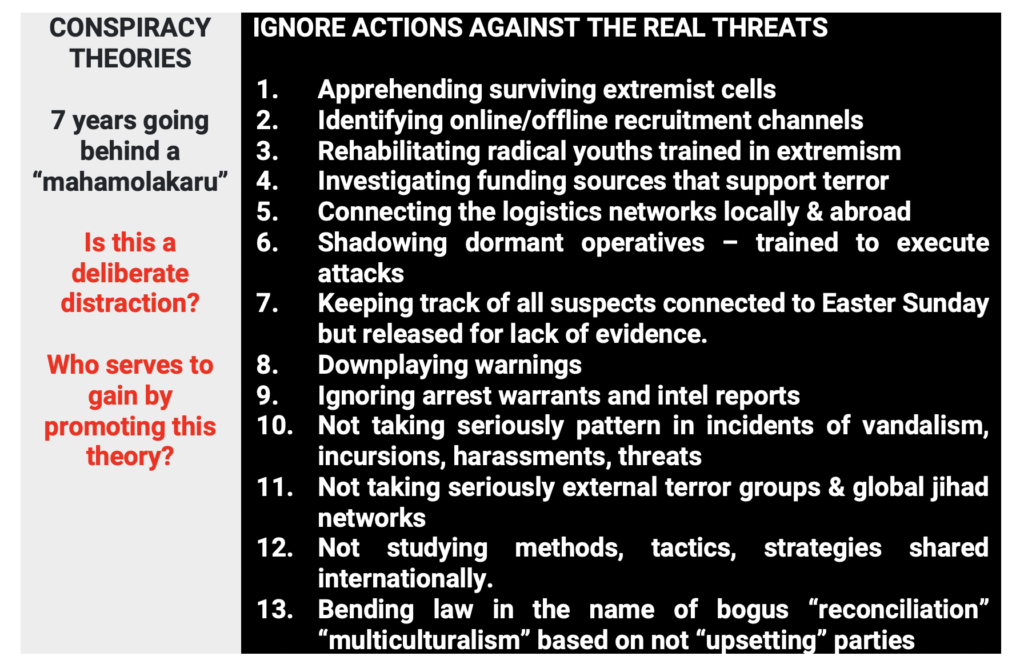
Over the years, a conspiracy theory has circulated suggesting that Zaharan was used” by state intelligence to facilitate terror attacks that would enable Gotabaya Rajapakse to become President in November 2019. This claim implies political orchestration behind the massacre.
Reality check:
Let us first presume officials in office were not part of any such conspiracy, the question becomes: why did they fail to act on warnings & fulfilling their mandated duties to arrest Zaharan & his associates to prevent attacks?
Let us presume they had fulfilled their duties — by arresting Zaharan and other operatives before the attacks — would the 2019 Presidential election outcome have changed?
The answer is clear: Gotabaya Rajapakse would have become President regardless. Any contestant would have won. The Easter Sunday attacks did not create his election path; commission/intel report findings and judicial records confirm that negligence resulted in the attacks not orchestration of the attacks.
By the time of the Easter Sunday attacks, the public confidence in the Yahapalana administration was eroding. The visible breakdown in coordination between the President and Prime Minister, policy incoherence, economic pressures, and public frustration over corruptions had already weakened the administration’s credibility.
The 2018 local government election had already demonstrated a major public rejection of the ruling coalition, showing that the political momentum had shifted long before April 2019.
In that context, the Easter attacks reconfirmed the visible collapse in governance and national security mismanagement.
This is why the theory that the attacks alone brought Gotabaya to power” is analytically weak.
Noteworthy: they do not possess investigative powers.
Duty:Identify Zahran and NTJ/JMI threat, escalate to NSC & police, ensure preventive measures.
Failure:Threats were not escalated effectively;
Criminal Investigation Department (CID)
Mandate:Investigate suspicious activities and gather evidence.
Duty:Execute warrants, recommend arrests.
Failure:Investigated preliminarily but did not act decisively;
Terrorism Investigation Division (TID / Police)
Mandate:Track extremist threats and advise local police.
Duty:Arrest suspects, secure vulnerable targets.
Failure:Warnings were ignored; preventive action on Easter was minimal, yet file seeking legal advice/action on Zaharan was given to AG’s dept in 2018.
National Security Council (NSC)
Mandate:Oversight and coordination of intelligence and law enforcement.
Duty:Take immediate preventive measures; direct arrests and security measures.
Failure:Did not convene actionable sessions on Zahran or NTJ; bureaucratic delays contributed to inaction. Aware of a likely threat & attack but did not take threat seriously.
Attorney General (AG) Department
Mandate:Provide legal guidance and prosecution advice.
Duty:Authorize preventive action or emergency warrants.
Failure:Delays in responding to TID/SIS submissions contributed to failure to prevent attacks.
Supreme Court Confirmation:
The attacks could have been prevented if proactive and timely responses had been taken.” — SC FR Determination, Jan 2023
Omissions of the respondents effectively betray the people and public trust by recklessly failing to accord due priority to intelligence information.”
Timeline of Negligence
2015 onwards:Intelligence flagged radicalization; early extremist acts even on Muslim communities were ignored.
2016:Justice Minister Wijayadasa Rajapakse warned Parliament about 32 individuals from 4 wealthy Muslim families joining ISIS; warnings ignored. Muslim MPs claimed statement as ‘hate speech’.
November 2016:At a National Security Council meeting, the State Intelligence Service reported that more than 20 extremist groups from different ethnic communities were already operating in Sri Lanka, specifically identifying extremist Muslim groups including Thowheed Jamaath and referring to departures of families linked to ISIS. This establishes that the state was aware of the extremist ecosystem years before Easter 2019 and long before the presidential election narrative later emerged. https://dbsjeyaraj.com/dbsj/?p=49922
2019 post-attack security sweeps also uncovered caches of swords and other weapons in several locations, including some mosque premises and homes. The attempts by political figures to downplay some of these discoveries only reinforced the larger pattern of minimising visible warning signs instead of confronting the broader extremist infrastructure.
The above demolishes the theory that Zaharan’s network emerged to influence the 2019 election, because the extremist ecosystem was already officially identified nearly three years earlier.
2017–2018:Despite this institutional awareness, radicalisation, hate preaching, vandalism, and operational cells linked to Zaharan continued without decisive disruption.
Early 2018:Warrants existed for Zaharan; enforcement delayed by bureaucratic inaction. File sent to AGs dept.
April 21, 2019:Nine suicide bombers carried out coordinated attacks.
Post-Attack:Supreme Court FR (Jan 2023) confirmed negligence and breach of duty.
Had Zaharan been arrested, the attacks might have been prevented.
Yet his extremist ideology would have persisted— he would continue preaching and organizing until another opportunity arose or someone else would have taken over, unless his network and financiers were also neutralized alongside any other similar networks that was capable of radicalizing youth to kill.
Negligence allowed both immediate destruction. However, the potential for future violence continues so long as the ideology of hate and massacre for martyrdom remains without its chains being dislodged and the promoters and financiers apprehended while permanently closing all avenues that enables such hate to be preached.
Faith Leaders on What Could Have Been — Church Perspectives and Shifts
The later shift in public discourse from documented negligence toward speculative media-driven narratives is itself part of why the core title question matters.
The Presidential Commission had already heard 440 witnesses across 88 volumes, giving all stakeholders—including Church representatives—a substantial evidentiary record of negligence and intelligence failure.
Once the discussion moves away from that foundation toward later allegations, the central counterfactual becomes even more important: if Zaharan had been arrested when warnings first emerged, neither the massacre nor the later politicisation of the tragedy would likely have occurred.
Facts vs Conspiracy: Where Justice Lies
NTJ & JMI were extremist groups known to authorities.
Members of these groups believed in and endorsed extremism & pledged to carry out acts of violence.
Official SIS briefings had already identified over 20 extremist groups by November 2016, including Thowheed-linked networks and ISIS-linked departures. This predates Gotabaya Rajapakse’s candidacy by several years and fundamentally weakens the theory that the extremist network emerged for electoral purposes.
Electoral Reality: Catholic Vote was split
The electoral data from Catholic-influenced polling divisions further weakens the theory that the Easter attacks were politically designed to create a uniform vote shift in favour of Gotabaya Rajapaksa.
Negombo→ Sajith 44,032 | Gotabaya 31,743
Mannar→ Sajith 53,101 | Gotabaya 6,569
Wattala→ Sajith 49,463 | Gotabaya 48,214
Katana→ Sajith 43,053 | Gotabaya 71,565
Ja-Ela→ Sajith 41,649 | Gotabaya 71,690
Chilaw→ Sajith 47,159 | Gotabaya 43,903
This voting spread across Catholic-influenced polling divisions demonstrates that the most directly affected faith communities did not respond as a single electoral bloc.
Therefore, the claim that the Easter attacks were politically designed to engineer one uniform church-vote outcome is contradicted by the actual electoral spread.
If the most directly affected Catholic-influenced areas themselves did not vote as a single bloc, the claim that the attacks were designed to manufacture a predictable Catholic electoral swing becomes analytically weak.
Intelligence warnings about Zahran were repeatedly issued – from the time of former Justice Ministers address in Parliament, statutory bodies tasked to prevent crime and their heads should have devised plans to deal with the issue.
Nine suicide bombers carried out the attacks; victims’ lives were lost. That more suicide bombers were lined up is made clear when the daughter-in-law committed suicide inside the house in Dematagoda while the sister of the Mawavella Buddha statue vandalism culprits admitted that 15 women had pledged to sacrifice their lives for the cause. Who are these women & where are they now?
Supreme Court ordered compensation and confirmed negligence by state officials.
Conspiracy Theories
Foreign governments orchestrating the attacks.
Families funding bombers.
Politicians aiding attackers.
Media or NGOs complicit in cover-ups.
Attack to bring Gotabaya Rajapakse to power
Do you want justice — or do you want conspiracy?
Justice follows facts: intelligence, judicial findings, and accountability.
Conspiracy fosters endless speculation and distracts from the victims and disallows closure for the victim families.
Those chasing conspiracies are not seeking justice — they are protecting negligence, diverting people from realizing the facts & accepting the truth.
Negligence allowed a massacre to occur — but what is worse is that diverting the issue from the root cause & promoting conspiracy theories is actually allowing a dangerous extremist ecosystem to survive, adapt, and remain capable of future violence.
That is why justice lies in confronting the documented failures, dismantling the ideological and financial networks behind radicalisation, identifying the invisible operatives and silent promoters and refusing to let speculation replace accountability.
Therefore, the evidence suggests that arresting Zaharan before Easter would most likely have saved lives, but it would not have fundamentally altered the pre-existing political trajectory that led to the 2019 presidential outcome.
But if the underlying ideology and institutional failures remain unaddressed, the possibility of future Zaharans cannot be ruled out – many of those accused have been released mainly because authorities have failed to identify the root cause needed to take action against them – making the released, walking dangers while inaction against those who are strategically diverting the issue are no less dangerous.
The most important vacuum in this entire debate is rarely confronted.
The present wave of conspiracy theories exists only because Zaharan succeeded in carrying out the massacre. But if he had been arrested when the first warnings emerged, if the bombers had been disrupted, and if Easter Sunday 2019 had passed without bloodshed, what narrative would the conspiracy voices be advancing today?
What political theory would they build if the crime itself had never taken place?
This question is left with the reader, because it exposes how much of the present speculation depends not on evidence, but on the tragedy having been allowed to occur through negligence.
The more serious national security concern is not merely the existence of conspiracy theories, but the range of actors who benefit from keeping public attention away from the documented failures and neutralizing the still-dangerous extremist ecosystem.
Different narratives can serve different interests:
diaspora political actors with longstanding revenge,
NGOs focused on weakening military and intelligence apparatus, political elements seeking present-day advantage from retrospective blame,
and extremist networks that benefit when authorities are diverted from identifying silent operatives, radicalisation channels, funding streams, and dormant cells.
In this sense, those who amplify speculative rhetoric for political or institutional gain may unintentionally serve the same outcome as extremist networks themselves — keeping the state’s focus away from dismantling the root structures that made Easter Sunday possible.
That is why narrative diversion is not merely a political problem, but a continuing national security risk.
Shenali D Waduge
Comments Off on If Zaharan had been arrested BEFORE Easter Sunday massacre – Would Gotabaya have still become President?
On many an occasion on my never ending irrigation inspections in Kandy and Nuwara Eliya long ago I had to cling onto trees and, creepers to avoid being blown off by the power of the wind.
I enclose what I once wrote hoping that our new Government of Anura Kumara Dissanayake will somehow read through.
Speaking from my sheer experience in handling development tasks-
Building up Coop Crayon at Morawaka in 1971, done in three months, developing it to enable Minister Illangaratne to declare that all imports of crayons should be stopped, and
again in Bangladesh, establishing the Youth Self Employment Programme in nineteen months- a programme that being implemented by members of the Bangladesh Civil Service, trained by me, has by now guided over three million youths to become self employed, I submit:
It will be easier to build a few hundred wind turbines and enable Sri Lanka to produce all its electricity.
I submit my Paper for kind reading by our new Ministers and our saviour Anura Kumara Dissanayake. Dear Excellency, It is a task that can be done within three years.
Wind Power to our rescue
Posted on February 3rd, 2020 in Lanka Web
By Garvin Karunaratne
I bequeath to my readers the Conclusion of my book: Wind Power for Sri Lanka’s Power Requirements.
It in unfortunate that our authorities in establishing wind turbines in Sri Lanka have so far ignored the mountainous areas where there is ample wind power.
My mind travels to a book by John Perkins, Confessions of an Economic Hitman, where he confesses that as an expert he had written feasibility reports with fabricated statistics which when implemented by the Government of Ecuador, became failures, with the loan as a debt to the country. Our country has been given the wrong advice. Go to Spain, to the USA the leading countries where wind power has been harnessed and they harness the wind on their mountains. It is only Sri Lanka that tries to catch the sea breeze.
In Sri Lanka we have failed to harness Wind Power which Mother Nature has bountifully provided to us.
Suffice it to state that Spain a country that was far behind in producing wind power has within two to three years spurted up the ladder to be the second country in the world. Travelling through the Pyrenees to Spain in my Motorhome I was surprised to see wind turbines perched all over even on makeshift angle iron posts, the type of things that I can myself make in a day(I am no engineer). Spain even sells power to France today.
On my last visit to venerate the Avukana Buddha, I spotted a canopy perched on very long concrete shafts constructed by the State Engineering Corporation.
It is my humble request to our excellency the President of Sri Lanka to summon the engineers who built the concrete shafts to support the canopy, and request them to design and produce the posts that can carry the wind turbines. They can easily produce these. Then import the wind turbine mechanism and set them up in our hills. We will provide employment for a few thousands. We can invite a specialist of the caliber of Paul Gipe, the mastermind of wind power in California. who actually constructed and guides the wind turbines in California today. This will provide all the power we need. I have no doubt about that. This task can be accomplished within a year at most. Considering the billions we spend to import coal and oil, we can easily make a saving.
That is the message in my book: Wind Power for Sri Lanka’s Power Requirements.
I enclose the Conclusion of my book in support for kind perusal.
10.Conclusion
I am pleased to submit the Papers I have so far written on Wind Power as a source of Energy, in a booklet in the sheer hope that someday this will be read by one of our leaders who will be convinced that Wind Power is the form of energy that Sri Lanka is blessed with in abundance and will get going all out.
In nostalgia, I can remember what did actually happen in Bangladesh in 1982, when I worked there as the Commonwealth Fund General Advisor on Youth Development to the Ministry of Labour and Manpower in Bangladesh., The Minister for Youth Abul Kasim was arrested on the charge of harbouring a criminal in his residency. A day later, the Military took over the country in a coup de etat. Immediately afterwards, the Military Government in a high powered conference chaired by Hon Aminul Islam, the Minister for Labour and Manpower assessed the programmes of the Youth Ministry. That included imparting vocational training to 40,000 youths a year. The Minister was not totally impressed with the work done. Suddenly realizing me as the only outsider, I was confronted:
”What is the contribution you can make for Bangladesh?”
I replied: It would be ideal to have a self employment programme to enable the 40,000 youths that are being trained every year to be guided to become entrepreneurs. Most of them are in the ranks of the unemployed even after training, today. ”
My reply created an uproar. The Secretary to the Treasury, the highest official in the land objected on the grounds that such a self employment creation programme can never be achieved. He added that the ILO had in the preceeding three years tried to establish a self employment programme in Tangail, Bangladesh and spent a massive amount of funds all in vain. I argued with the Secretary to the Treasury for over two hours, quoting definite instances where I had successfully established self employment projects for youths in Sri lanka. It was an intense battle between me and the Secretary with the Hon Minister intently listening. Finally the Minister stopped our battle. He immediately approved my establishing a self employment pogramme. The Secretary to the Treasury stumped with the words, that he will never be providing any funds for this wasteful task. I replied that I will find savings within approved training budgets which was approved by the Hon Minister.
I got cracking with the officials of the Youth Ministry and the Lecturers of the Vocational Training Institutes that provided the vocational training, providing them with a basic knowledge of national planning to identify areas within the economy where there was a propensity to create employment opportunities and training them in economic endeavour-structuring projects for self employment on a small scale-even with a cow or a dozen chicks and developing the enterprise. My task was to establish the self employment programme and to train the staff to continue after my two year consultancy ended. To a man the officers responded and today this Youth Self Employment Programme has by February 2011 guided over two millions to become self employed and it is an ongoing programme that trains and guides 160,00 youths a year to become self employed. Today, it is easily the premier programme of employment creation the world has known.
This experience of mine itself indicates that though wind power for the task of creating power is at an infancy today, we can easily develop it.
Let me hope that the contents of these papers which prove beyond all doubt that Wind Power can offer all the energy that Sri Lanka needs will someday find a Minister Aminul Islam” who will authorize it. I am certain that the administrators and engineers who will toil till it is a success can easily be found.
Firstly, the country will not depend on the supply of coal and oil for power plants and the country can save all the millions and billions being spent today to import oil and coal.
Secondly it will provide employment for thousands in erecting the turbine towers, in establishing the wind turbines and in the manufacture of the turbine mechanism itself at the later stages. In my travels in France, Spain and Portugal I have seen workers making the towers, blades, transporting them in long trucks, erecting the towers and maintaining them. That is no difficult task for our engineers and workers.
One of my readers happened to be an engineer, Mr Kanaga. who was involved with establishing the five wind turbines at Hambantota, the first to be built in Sri lanka. What is most interesting in his comment which I have totally enclosed in this book, is that the environmental lobby had decided that the turbines should only be erected on the coasts and not in the mountains where there is ample wind force.
It is sad that the environmentalists were silent when the entire Kotmale Valley was denuded of people and their activities all to create 200 MW of power. That could have been easily achieved with fifty wind turbines scattered within Kotmale itself and the inhabitants and the economy would have been spared extintion. The entirety of Kotmale is dead today.
Kanaga, that engineer supports my recommendation that we should use the wind in our mountain area to provide the energy we need.
To my mind it is a crime not to use the wind power available and to spend millions and billions to purchase oil and coal.
I am convinced that there is an Oil Lobby and a Coal Lobby well financed to prove that wind is not a dependable source.
Many opine that wind is undependable. To them my answer is that the wind is an utterly dependable source of energy. Spain has gone all out to build wind turbines and even sells power to France.
Thanks are due to engineer Kanaga for his comments which are immensely valuable so that I have quoted them as an attachment to my paper.
A reader of my Papers, Susantha Wijeytileke has even commented that once at Madugoda he saw a cyclist being blown off the road by the power of the wind.
I must mention that I am not alone in advocating the siting of wind turbines in the mountainous areas of Sri Lanka.
In Windfair, on line editorial journalist Trevor Sievert quotes Lakshman Guruswamy, Sri Lanka has the potential to generate 24,000 MW electricity from wind.” (http://w3.windfair.net/wind-energy/news/1q543-sri-lanka-high-wind-energy-potential) Professor Guruswamy further states that studies have shown that nearly 5000 square KM of windy areas are available for potential wind power generation in Sri Lanka.” (Dated 12/04/2018.)
In www.windpower.lk, it is stated that in wind power the potential for Sri Lanka is 20,740MW”
Wind Power in Sri Lanka,a publication by The Asia Business Office (//www.asiabiomass.jp/English/topics/1601_04.html) states that the wind potential in Sri Lanka is 20,740 MW. In its words there is strong potential for wind power in the North Western coastal regions of Northern Province, the highland areas of the Central Province, Sabaragamuwa and Uva.”
In Sri Lanka Wind farm Analysis and Site Selection Assitance, M. Young and R Vilhauer of The Global Energy Concept, Kirkland, Washington state:
Sri Lanka has considerable available land with wind resource potentialsufficient for development. However, the wind power capacity expansion is limited by the electricity transmission infrastructure. CEB estimates that the grid cannot accommodate additional wind capacity more than 7% of the peak load. The CEB estimates that installing more than 20MW of wind capacity in any given region may adversely impact local grid instability and power quality.
This Study states that the windy land can provide 50,000 MW.”
It is important to note that it is not the lack of wind power that holds up the utilization of wind power to produce electricity. Instead it is the grid capacity. Tackling the grid capacity is another kettle of fish. This is an area that has to be addressed. I will not be surprised if our experts who yet think that wind turbines should be built to harness the sea breeze and not the wind power in our mountains will come up with another cock and bull story stating that a grid cannot be built.
In the construction of the wind turbines at the Senok Wind Farm in Puttlam, where four wind farms established have a capacity of 40MW, it was found that the existing port facilities in the main port of Colombo and the road network was found wanting for the import of the turbine towers and blades. Instead these had to be obtained through barges from India. The maximum height of the turbine tower is 90 meters and each blade is 50 meters in length. I have seen long towers and blades being transported by road in France and Spain. This needs special transport. In the hilly areas in Sri lanka it will be more feasible to construct the towers and blades on site. These are areas that have to be addressed in any development. Where there is a will, there is also a way.
My thanks are also due to the Editor of the Sunday Observer.lk who in Let there be Light” (Sunday Observer:06/09/2009) commented that my suggestions are very valuable. Referring tro my suggestion that the wind power in the Central Highlands should be harnessed says, This is a timely and valid proposal and the authorities should take appropriate action to locate wind turbines in areas which will enable them to reach their maximum potential.”
I am also thankful for Noor Nizam for his Wind Energy Electricity generation is a reality” (Sri Lanka Guardian:27/08/2009) In his words, Garvin should be commended for his boldness to take to task the lethargic and selfish bureaucrats on this issue of renewal energy development of electricity energy in Sri Lanka…. His message should be well taken by others too handling national planning and development strategies to assist the little island of 21 million to come out of the rut of poverty, misery, the destruction of the civil war and the dependence on foreign powers.” He adds in the affirmative, As Garvin Karunaratne wishes Wind Energy Electricity Generation will be a reality in Sri Lanka for the next generation”. It is my fervent hope that this will be realized.
The last paper states of how the new owner of the Hambantota Port has insisted on a massive payment as ground rent for the five wind turbines. The CEB has decided to dismantle the five wind turbines. This is a sad epitaph for wind power use in Sri Lanka.
However the contents of this book convinces any sane thinking person that wind power can be harnessed. We have to learn from mistakes, not make the mistakes rule us. As a country we have to find ways and means of forging ahead, heedless.
This study proves beyond all doubt that there is ample wind capacity in Sri Lanka for self sufficiency in our power requirements through harnessing the wind.. There is no question about this. However, as in any field of development, be it agriculture or industry, there are problems that have to be surmounted. As stated the national grid has to be developed to carry the power from areas where it is generated to the areas where the power is consumed. Perhaps there can be local grids to carry the power generated from a local wind farm to a local district capital. For instance if wind farms are located in Dela on the Kirigalpotta hillock, a grid can carry the power to the town of Ratnapura.
Sri Lankan engineers have in ancient times done wonders. The gradient of the Jaya Ganga that carried the waters of the Kala Weva to the tanks in Talawa and Anuradhapura has been constructed at a gradient of six inches in a mile, a gradient that baffles the irrigation engineers of today.
I am dead certain that Sri Lanka can become self sufficient in all its power requirements not for its present stage but also for its future development through using wind power. The wind power in the Central and Sabaragamuwa Hills is vast. Methods and systems have to be found to harness this energy. However as long as we build wind turbines on the coastal areas and ignore the areas where there is real wind power and satisfy ourselves with studies of the difficulties and constraints, our attempt will be like that of a squirrel trying to empty the water in the ocean , carrying a bit of water on its tail, endless.
THE END
Garvin Karunaratne Ph.D. Michigan State University
Author of How the IMF Ruined Sri Lanka & Alternative Programmes of Success(Godages:2006), How the IMF Sabotaged Third World Development(Kindle/Godages:2017)
Comments Off on Wind Power that abounds in our hills
‘Before you study the economics, study the economists!’
e-Con e-News 29 March – 04 April 2026
As our New Year dawns and the sun arcs directly over Sri Lanka after crossing the equator – the northern hemisphere’s spring equinox – the English media in Sri Lanka as usual act surprised at the mounting heat, just as they feign surprise that the white man is waging yet another war of annihilation on the world.
After declaring ‘War is Fun’, the USA is not only blocking publication of satellite imagery, they are also blocking ‘unflattering’ photos of their Secretary of War. These moves only amplify the need to exert more precision in repeating & sharing real news especially about the ebb & flow of their wars. This misinformation (ignorance) & disinformation (deliberate inexactitudes) are especially inserted by so-called ‘established’ media like the BBC, CNN, Reuters & other imperialist news agencies who claim to be independent of their powerful warmongering states (see ee Media).
Every single hallucination or oral flatulence emanating from the US Government via the US Embassy in Colombo, is faithfully stenographed by the English media in Sri Lanka. This also includes the minute-by-minute exculpations of the English Embassy, with the media repeating every mumble and effluent that emanates out of their air-conditioned offices & orifices. The US & European wars do not just spring out of the brow of a Donald Trump or his White House deputy chief of staff for policy & homeland security advisor, the Zionist-Nazi Stephen Miller, or other officials such as Peter Hegseth, etc, or high tech advisors like Palantir’s Alex Karp & Peter Thiel (whose electricity-guzzling data centres are top beneficiaries of stolen oil), or any one ‘diaspora’ – these new guys are all fronting for a very old US settler colonial ruling class, which spreads its tentacles across the world.
This ee therefore recalls the founder of the English news agency Reuters – which divided up the news-world with Havas (Agence France-Presse, AFP, France), and Wolff (Deutsche Presse Agentur, DPA, Germany) in 1859. ‘Telegraph Baron’ Julius de Reuter, took hold of Iran’s entire industrial economy after England waged war on Persia (1856-57) using Indian troops. (see ee Random Notes) The English war only ended with thefamed 1857 revolt in India against English rule, a war misnamed ‘The Sepoy Mutiny’ which Indians call their ‘1st War of Liberation’ from English rule (yet to be completed!), and came 9 years after our ‘2nd War of Liberation’ against English rule in 1848 (our first in 1818). Indeed, Iran was/is a passage not just to India, but to Sri Lanka and China as well.
The Straits of Hormuz have not been closed by Iran, but by imperialist insurance companies (see ee07 March 2026). Iran’s official media just announced that 15 ships have been allowed to pass through Hormuz in the last 24 hours (even as no ships linked to US or Israeli or other countries attacking Iran, including allies of the USA, are allowed through – hence the constant US ultimatums).
*
India’s creeping demands over Sri Lanka’s extremely strategic eastern port of Trincomalee, was the subject of much media chatter this week. The USA has now approached India for its vessels to access Indian ports, invoking the US-Indian Logistics Exchange Memorandum of Agreement (LEMOA). LEMOA (see ee Quotes) allows access to Indian bases for US vessels for logistical support. India is being pressured to offer their bases to the USA due to Washington’s inability to halt attacks on US bases in the Gulf countries surrounding Iran. These are Iran’s defensive strikes against US military & other facilities in US-led Gulf states, in response to the USA launching annihilating attacks on Iran, on civilian power and bridge infrastructure, many universities and schools, and 1000s of residences, while increasing US ground troops. Iran’s level of resistance has been the real surprise to the superpower intent on recolonization of the world – hence, the USA & India’s imminent moves on Trincomalee.
‘As Diego Garcia becomes a frontline target, Washington turns its gaze toward Colombo’s strategic neutrality’, asserts Lasanda Kurukulasuriya (see ee Focus), ‘Washington is no longer just observing Sri Lanka – it is eyeing it as a vital insurance policy against a fractured Chagos lease and an increasingly long-reaching Tehran.’ She places US moves on Sri Lanka midst public pronouncements by the US government prior to launching their latest war on Iran: These include official statements released during the US Pacific Fleet Commander of the Admiral Stephen Koehler visiting Sri Lanka from 19-21 February, and the silences that followed the US ambush of Iranian ship Dena near Galle, and the meteoric appearance from 19-24 March US Special Envoy (US Ambassador to India) Sergio Gor in Colombo, about which ‘there was little… publicity’, except the Sri Lankan President’s belated claim of a US demand to land armed aircraft in Mattala.
Kurukulasuriya does provide a pinch of scepticism by writing of ‘Iran’s apparent use of intermediate-range ballistic missiles’, to attack the US base on that atoll stolen by England and ‘leased’ to the USA. There is much doubt about origins of the attack. It was first reported by AlJazeera, BBC & Reuters, the premier lip-services of the imperialists – reports which Iran has vehemently denied. US President Don Trump’s blathering about the English cosplaying with Mauritius over the atoll, and news of Iran’s attacks on it, also preceded English PM Ken Starmer’s permission for the USA to launch attacks on Iran from England & Diego Garcia, midst the attempts to sculpt another ‘coalition of the willing’.
*
• US Slavery & Tea Plantations – The US is moving to further tinker with their constitution’s 14th Amendment (see ee Workers) which declared Africans (as well as corporations!) to be human. They are aiming to disenfranchise the voting rights of their non-European citizens. Meanwhile, the United Nations (under severe criticism for remaining a rich white enclave in Manhattan, constantly printing out good intentions, yet only demanding that non-European adhere to such pulpy ideals) has declared ‘Transatlantic Slavery’ to be the ‘Gravest Crime Against Humanity’, a resolution moved by Ghana, which Sri Lanka supported, with only the USA, Israel & Argentina voting Against, and unsurprisingly Canada, England & EU countries abstaining...
Transatlantic slavery was later transported to this Ocean called Indian more massively, after the historic revolution by Africans in Haiti. The ‘peculiar’ system found a home in Ceylon under the English in their plantations. This ee thus delineates the ‘definite deterrents to the Sinhala villager joining the plantation workforce… their reaction was not to wage labour as such but against the plantation system’. Thus SBD de Silva in Chapter 9 of his classic The Political Economy of Underdevelopment, dismisses the spurious claims by companies and the colonial state about the Sinhala ‘aversion to wage labour and to physical toil’ (see ee Focus).
De Silva shows how such white supremacist justifications were an enduring ‘part of a supporting ideology which…[had] served as a moral basis for the commercialization of slavery in the New World’. Such claims were made ‘to justify the low wage economy’ (which continues to this day in Sri Lanka), and the coercive labour practices of European investors. The recruitment of labour was ‘hardly voluntary’ and used ‘various forms of extra-economic pressure’ aka labor hunting, as well as all sorts of deception (still alive today in the inducements to work in West Asia as well as Europe & its settler states).
Indeed, SBD de Silva uses this chapter to posit the main thrust of his book’s thesis (or counter-thesis), to demolish the ‘model’ of the Caribbean’s WA Lewis (who was awarded a Nobel Prize & anointed a knight) that asserted colonial countries had a modern sector (plantations) which would pull workers out of the impoverishment of the subsistence sector (small agriculture). SBD de Silva’s book shows the plantations are neither modern nor capitalist, which this Chapter 9 clearly begins to expose, with its non-settler colonial predilection for unfree labor.
*
The media keeps repeating that the USA has no plan, or keeps changing them. This is not so true. Their plan is to sustain & extend their colonial domination. Their main negotiators are their military demolition units & 2 real-estate agents. Submission or chaos. The USA (& Europe)’s wars & policies wish to set back the clock on the ‘gains made by labor & national liberation movements’. They seek to hang us separately if we do not hang together. On this anniversary, of the US government’s ‘Liberation Day’ through ‘reciprocal tariffs’, Shiran Illanperuma (see ee Focus) recalls that many media sold the tariffs ‘as a defense of US workers’, ‘nationalism’, ‘protectionism’ & mercantilism’. But…‘They missed the point’.
The US policies are ‘a coherent political-economic strategy aimed at reversing the most consequential structural shift of the past 2 decades: the slow, uneven, but real rise of economic autonomy.’ He traces it to the ‘New Mood in the Global South’, after the 2008 ‘Global Financial Crisis’ undermined the imperialist-dominated economic order. The Tricontinental: Institute for Social Research calls it ‘a new mood’ of nations & people around the world, refusing to be subordinate to the ‘post-Cold War order’, especially opposing industrialization (the attacks on Iran’s energy & steel production factories epitomize these nihilistic objectives, par excellence!).
Seven Easter Sundays have passed since the 2019 Easter Sunday terror attack but none has been convicted in Sri Lanka. A few were convicted in the US but not in Sri Lanka. Former intelligence service chief Suresh Salley is currently being questioned to gain information of the attack solely because his unit was informed of the impending attack and given his long tenure he knows more than anyone else. Jumping into conclusions before the completion of his questioning is unwise.
A former parliamentarian has declared that Moulavi Zaharan Mohammed Hashim was the mastermind of the attack. If true, it raises more questions than provides answers. Moulavi Zaharan Hashim, Abdul Razik (another suicide bomber) and 24 others of their group were employed by the Ministry of Defence and Urban Development from March 2010 to December 2014. Four of them continued to serve until 2018. They were regular employees and were paid a monthly salary. This information was well documented by the Commission of Inquiry and even a former president stated this to the Sangha Nayakas when questioned in the presence of the media. Even when Zaharan was at school and soon after leaving school, he displayed signs of rebellion and extremism which landed him in trouble and lost education opportunities. Surely these were checked before recruiting to a unit under the management of the Ministry of Defence and Urban Development. If not, they are liable for criminal negligence. How many more were recruited without background checks?
While employed at the ministry of defence and urban development, Moulavi Zaharan Hashim along with like-minded people formed the National Thoweed Jamaath. It was banned as a terrorist organization following the attack. He constructed his own mosque in the East in January 2014. Despite expectations, Gulf countries refused to finance it. The cost was supplemented by a state grant from his employer – the Ministry of Defence and Urban Development – which also allowed the construction and allowed it to proceed to obtain registration as a place of religious worship despite stiff opposition from traditional Muslims.
In 2017 he went to South India and spent considerable time there learning and promoting extremism and collecting weapons. He freely returned to Sri Lanka in November 2018.
If Moulavi Zaharan Mohammed Hashim was the mastermind of the attacks, he becomes the world’s first and one and only terror mastermind to die in the attack he masterminded. Osama Bin Laden didn’t die in 9/11, 3/11 or 7/7 terror attacks; Hambali didn’t die in Bali terror attack; Parabharakan didn’t die in any of the attacks he masterminded; Wijeweera didn’t die in any attack he masterminded; Taliban, Hamas, Hezbollah or ISIS masterminds of various attacks didn’t die in their attacks.
In addition to Zaharan’s team, around the same time, another batch of 38 Muslims from Kandy district travelled to Syria in 2013 and joined ISIS according to former parliamentarian Wijeyadasa Rajapakshe. After losing a few of them in war, they returned to Sri Lanka in 2020. No investigation into their actions was done.
Declaring that Moulavi Zaharan Mohammed Hashim as the mastermind of the Easter Sunday terrorist attack has opened a can of worms. It implicates some bigwigs of the Ministry of Defence and Urban Development for further investigation. Salley’s evidence becomes even more crucial in connecting the dots. The country eagerly awaits that evidence to complete the puzzle. Hopefully the victims including the nation will get much delayed and much awaited justice before the next Easter.
Comments Off on If Zaharan Masterminded the Easter Sunday Attack, It Implicates Higher-ups of His Employer, the Ministry of Defence and Urban Development
Historical accounts from both Portuguese chroniclers and contemporary researchers document a systematic campaign of religious ( mainly Buddhist and Hindu) destruction in Sri Lanka during the Portuguese colonial period (1505–1658). Portuguese historians like
in [Conquista Espiritual do Oriente] record these events as part of a mission to suppress indigenous religions i.e., Buddhism and Hinduism and propagate Catholicism.
Destroyed Temples and Replacement Churches
Historians have identified several major Buddhist and Hindu sites that were demolished, with Catholic churches or forts often constructed directly over their ruins to assert religious dominance:
The destruction was fueled by orders from the King of Portugal and the Viceroy at Goa in 1567 to eliminate non-Christian places of worship. While some contemporary activists and historians call for archaeological excavations to uncover the extent of this vandalism, such proposals are often met with resistance due to the sensitivity of existing religious sites and the potential for communal tension.
Historical accounts, including those noted by Portuguese chroniclers such as Queyroz, record that the Portuguese colonial period in Ceylon (1505–1658) involved the systematic destruction of numerous Buddhist and Hindu temples, often replacing them with Catholic churches
. This campaign, particularly intensified during the Portuguese Inquisition in the 16th and 17th centuries, was aimed at eradicating non-Christian religions, with many coastal temples and places of learning destroyed.
Documented Destruction and Church Construction Historical records indicate that many prominent temples were destroyed, with Catholic churches often built on the same sites, including:
Kelaniya Temple: Destroyed in 1575 and replaced by a church.
Devundara (Dondra) Temple: The “thousand-pillar” temple was replaced by the church of Our Lady of Guidance.
Nallur Kandasamy Kovil: Razed by Portuguese forces, with materials used to build a church and fort.
Other Sites: Structures like the Madu Church in Mannar were built over former Pattini devales, with destruction extending to sites in Nawagamuwa, Mapitigama, Wattala, and the Kotte area.
Inquisition and Resistance This destruction was part of a deliberate policy aligned with a 1567 religious council in Goa, aimed at eradicating non-Christian worship and transferring temple lands to the Catholic Church.
Excavations and Discovery Discussions around Sri Lankan heritage frequently highlight the, often undocumented, presence of temple ruins beneath colonial-era churches, fueled by accounts that many churches were constructed from plundered materials. The sensitivity surrounding this history occasionally surfaces in modern debates regarding archaeological investigation and site preservation.
The Distortion of Buddhist History of Sri Lanka to suit agendas of Missionaries that entered Ceylon hand in glove with the Portuguese Conquistadors (post 1505) constitutes an existential threat to friendly relations between adherents of different religions of Sri Lanka.
Comments Off on A countless number of Churches in former Portuguese occupied territory of Ceylon were built on sites of destroyed Buddhist Temples is an incontrovertible fact.
The Christian Church cannot claim a glorious history in Sri Lanka because it entered the country in collaboration with foreign invaders i.e., Portuguese, Dutch and the British, and then joined hands with them to dislodge Buddhism as the dominant religion through forcible religious conversions and wholesale destruction of Buddhist Temples leaving a bitter memory that still lingers in the psyche of the Sinhalese people.
The history of Christianity in Sri Lanka is deeply intertwined with Portuguese, Dutch, and British colonial rule, a period that involved the systematic, and at times violent, repression of Buddhism and Hinduism to establish Christianity
. Historical accounts confirm that the expansion of the Christian Church was closely linked to the military presence of foreign powers, often featuring the destruction of temples and forced conversions, particularly in coastal areas under Portuguese control.
Colonial Collaboration and Religious Conversion
Portuguese Period (1505–1658): The Portuguese aimed to secure a spice monopoly and propagate Roman Catholicism. They used both coercion and material inducements to convert the population, particularly targeting the aristocracy and fishing communities.
Forced Conversions: Christianity was introduced by the Portuguese and later enforced by the Dutch (who promoted Protestantism) and the British. Many conversions were not motivated by faith but by necessity, such as obtaining exemption from taxes or receiving preferential judicial treatment. The pejorative ‘ Rice Christianity ‘ is a slur and derogatory term that stems from this unholy practice.
The Conversion of Kotte: The conversion of King Don Juan Dharmapala of Kotte to Catholicism and his subsequent donation of temple lands to the Church significantly weakened the position of Buddhism.
Destruction of Buddhist and Hindu Temples
Systematic Destruction: Portuguese forces systematically destroyed Buddhist temples (Viharas), monasteries, and places of learning (Pirivenas) along the coastal belt, including the renowned Kelaniya Temple (1575) and temples in Devundara and Trincomalee.
Erecting Churches: Churches were frequently built on the sites of destroyed Buddhist or Hindu temples, often using the rubble from those structures.
Execution of Clergy: Buddhist monks were harassed, and in many instances, killed by Portuguese soldiers, causing many in the maritime provinces to go underground or run to Sitawaka or to Mahanuwara (Kandyan Kingdom).
Resistance and Lasting Impact
Shift to the Interior: As Christianity was forced upon the maritime areas, many Buddhists fled to the Kandyan Kingdom, which remained independent, to escape religious repression.
Resistance: The kings of Sitawaka and Kandy provided significant resistance, preventing the total eradication of Buddhism.
Lingering Distrust: The methods used by colonial powers created a lasting perception of Christianity as an alien, foreign, and oppressive religion.
While some colonial efforts also brought education and infrastructure, the dominant legacy of this period is often seen as a disruption of local religious and cultural structures, which has led to ongoing debate over the historical role of the Church in Sri Lanka and undiminishing suspicion of the Christian clergy in the country..
Portuguese Period (1505–1658): The Portuguese actively promoted Roman Catholicism, often through aggressive means. This included the systematic destruction of major religious sites such as the
in Kelaniya, were built directly over the ruins of destroyed temples.
Dutch Period (1658–1796): The Dutch introduced Calvinism and established Christian schools to spread their faith while marginalizing both Buddhism and Catholicism. While less physically destructive toward temples than the Portuguese, they used administrative and educational policies to encourage conversion.
British Period (1796–1948): The British introduced Anglicanism through the Church of England and, despite initial promises to protect Buddhism under the Kandyan Convention of 1815 supported missionary schools that many locals viewed as tools for “de-nationalizing” and converting Buddhist children, or making them ‘weak’ Buddhists.
In 1902, shortly after his appointment as the Bishop of Calcutta, Father
The “weak Buddhists” remark originated during the session’s question-and-answer period:
The Context: Audience members questioned why missionary resources were being spent on educating non-Christian (specifically Buddhist) students.
The Statement: Copleston reportedly stated that while the primary goal of these schools was to convert students to Christianity, even those who were not converted would leave as “weak Buddhists“.
The Implication: This strategy suggested that Western-style missionary education was intended to undermine traditional Buddhist convictions and cultural identity, even if it did not result in a formal conversion.
This speech is often cited in discussions regarding the historical agenda of missionary schools in South Asia and the subsequent rise of Buddhist revivalist movements, such as those led by Anagarika Dharmapala.
Conversion and Social Lasting Effects
Methods of Conversion: Historical accounts mention a mix of forced conversion, political inducements (such as tax exemptions), and “unethical” methods during colonial rule. This has led to a lingering mistrust of Christianity as a “religion of foreigners” among some nationalists.
Cultural Legacy: Despite the contentious entry, colonial rule left a deep mark on Sri Lankan ( Sinhalese) culture, from Portuguese surnames (like Perera and Fernando) to the establishment of the country’s first medical schools and hospitals by American missionaries.
Today, the Sri Lankan constitution recognizes Buddhism’s “foremost place” while guaranteeing religious freedom, though tensions regarding conversions and minority rights remain part of the social discourse.
Source: AI Overview
Comments Off on Christian Church cannot claim a glorious history in Sri Lanka
A countless number of Churches in former Portuguese occupied territory of Ceylon were built on sites of destroyed Buddhist Temples is an incontrovertible fact.
Historical accounts from both Portuguese chroniclers and contemporary researchers document a systematic campaign of religious ( mainly Buddhist and Hindu) destruction in Sri Lanka during the Portuguese colonial period (1505–1658). Portuguese historians like
in [Conquista Espiritual do Oriente] record these events as part of a mission to suppress indigenous religions i.e., Buddhism and Hinduism and propagate Catholicism.
Destroyed Temples and Replacement Churches
Historians have identified several major Buddhist and Hindu sites that were demolished, with Catholic churches or forts often constructed directly over their ruins to assert religious dominance:
The destruction was fueled by orders from the King of Portugal and the Viceroy at Goa in 1567 to eliminate non-Christian places of worship. While some contemporary activists and historians call for archaeological excavations to uncover the extent of this vandalism, such proposals are often met with resistance due to the sensitivity of existing religious sites and the potential for communal tension.
Historical accounts, including those noted by Portuguese chroniclers such as Queyroz, record that the Portuguese colonial period in Ceylon (1505–1658) involved the systematic destruction of numerous Buddhist and Hindu temples, often replacing them with Catholic churches
. This campaign, particularly intensified during the Portuguese Inquisition in the 16th and 17th centuries, was aimed at eradicating non-Christian religions, with many coastal temples and places of learning destroyed.
Documented Destruction and Church Construction Historical records indicate that many prominent temples were destroyed, with Catholic churches often built on the same sites, including:
Kelaniya Temple: Destroyed in 1575 and replaced by a church.
Devundara (Dondra) Temple: The “thousand-pillar” temple was replaced by the church of Our Lady of Guidance.
Nallur Kandasamy Kovil: Razed by Portuguese forces, with materials used to build a church and fort.
Other Sites: Structures like the Madu Church in Mannar were built over former Pattini devales, with destruction extending to sites in Nawagamuwa, Mapitigama, Wattala, and the Kotte area.
Inquisition and Resistance This destruction was part of a deliberate policy aligned with a 1567 religious council in Goa, aimed at eradicating non-Christian worship and transferring temple lands to the Catholic Church.
Excavations and Discovery Discussions around Sri Lankan heritage frequently highlight the, often undocumented, presence of temple ruins beneath colonial-era churches, fueled by accounts that many churches were constructed from plundered materials. The sensitivity surrounding this history occasionally surfaces in modern debates regarding archaeological investigation and site preservation.
The Distortion of Buddhist History of Sri Lanka to suit agendas of Missionaries that entered Ceylon hand in glove with the Portuguese Conquistadors (post 1505) constitutes an existential threat to friendly relations between adherents of different religions of Sri Lanka.
Comments Off on A countless number of Churches in former Portuguese occupied territory of Ceylon were built on sites of destroyed Buddhist Temples is an incontrovertible fact.
by, Professor Nishan C Wijesinha of German School of Medicine
Iranian Key Uranium Field Saghand Uranium Mine is situated in the (Yazd Province). It is considered as Iran’s largest Uranium mine.
It uses both open-pit and underground techniques; with depths exceeding 1,000 feet which is designed to feed the Ardakan yellowcake production plant.
The Ardakan Yellowcake Production Plant, also known as the Shahid Rezayee Nejad Complex, is the most crucial and critical Iranian nuclear facility located 35 km north of Ardakan in Yazd province.
These Uranium oxide concentrates (yellowcake) is transported from mines to conversion plants, and fuel assemblies are transported to power reactors, often by sea.
This is the reason Iran controls the Strait of Hormuz.
Pakistan’s Defence Minister Khawaja Asif has called for the creation of a new global cricket governing body, saying the current International Cricket Council has become overly influenced by Indian political and commercial interests.
In a social media post on Tuesday, Asif said a new organisation was needed to keep the spirit of the gentleman’s game alive,” accusing the ICC of being hostage to Indian political interests.”
The summer trains of the Soviet Union had a rhythm of their own—metal grinding against steel, a steady heartbeat echoing across endless plains. From Belorusskaya railway station, I began my long pilgrimage westward—two days across borders and ideologies, through guarded crossings into Poland, then through the divided veins of Germany, eventually spilling into the softer edges of Netherlands.
From there, across the grey waters of the English Channel, I would reach Harwich Pier—and like clockwork, onto British Rail, landing in bustling Liverpool Street station.
London in those days was alive—noisy, industrious, and wonderfully foreign. Bengali shipowners argued loudly in tea shops, buses roared past, and for a few shillings, one could find a Sri Lankan meal that tasted like home. Nights were spent at the Sri Lanka Students’ Centre, days wandering toward Marble Arch, and sometimes, elbow-deep in soap suds at a dishwashing job—ten pounds a week, just enough for survival and the occasional indulgence.
But the real story began the following year, in Leningrad.
I was strolling past grand imperial buildings, lost in admiration of Russian history, when he appeared.
A man of the south—sharp eyes, confident stance, and the unmistakable air of someone who lived by his wits. He noticed my watch immediately—a fine Seiko watch, gleaming under the pale northern sun.
Two hundred and fifty roubles,” he said, as though it were already agreed.
I hesitated—but youth is often tempted by quick bargains. I nodded.
We stepped under a steel lamp. He counted the money slowly, deliberately. I counted too.
Short,” I said. Twenty-five missing.”
Without protest, he added more notes, smiling faintly, returning the bundle. It looked right. It felt right.
I handed over my watch.
He vanished.
It wasn’t until later, when the crowd thinned and silence returned, that I counted again.One hundred roubles short.
Not a mistake. A master performance.
I had been outplayed.
Disappointed, but not defeated, my companion and I made our way toward the freight station. We were to board a ship bound for Dover via Finland and Sweden. Hunger struck, and we joined a long queue outside a popular restaurant.
Then—fate intervened.
There!” my friend whispered sharply.
I turned.
The crook. Standing casually in line.
Wearing my watch.
There are moments in life when hesitation costs everything. This was not one of them.
I walked straight toward him.
No anger. No shouting.
Just purpose.
I grabbed his wrist firmly—his left hand—the one bearing my watch. In one swift motion, I unclasped it and slipped it back onto my own.
Leaning close, I whispered:
Walk away now… before I call the police and say you stole this.”
His confidence evaporated.
Without a word, he bolted.
Victory tastes better when earned.
That night, instead of regret, we celebrated. We bought a massive 5-kilogram tin of Russian beluga caviar for fifty roubles—a treasure we would later sell at the Hilton London Metropole near Edgware Road for a tidy profit.
Pocket money, Soviet style.
Looking back, those journeys were more than travel—they were training.
The long trains, the strange borders, the cunning crooks, and the small triumphs—they shaped something deeper. Courage. Awareness. A refusal to be outsmarted twice.
Years later, facing far more complex challenges in shipyards and negotiations, I would often remember that day in Leningrad.
Because sometimes, life prepares you not in classrooms—
…but under a steel lamp, counting roubles with a thief.
Comments Off on The Watch, the Crook, and the Caviar in Russia
A group of avowed Islamic exrimists carried out the Easter bombing where several prominent Christian Churches and devotees attending them were killed. The assassins also died in the blasts, or were captured by the police. All the pesidential commissions and investigations picked Zahran as possibly the lead individual. Several people closely connected with the present NPP government were close family members of these Islamic Zealots. There is evidence that one aspect of the attack was to revange the attack in New Zealand against Islamists.
Warnings that there would be an attack had been issued to the top security officials of Maithreepala Sirisena but they did not take the warnings serious. The Catholic MP Mr. Harin Fdo had got the warning from his father, a devout Catholic. So, in all likelihood, the Harin’s father would have also informed the Catholic clergy that he personally knows.
When questioned by the Presidential Commission of Inquiry as to why he did not directly warn the public or church authorities after receiving the warning from his father, Harin Fernando testified that he relied on his father to pass the message to the church. He stated that his father, Malcom Fernando (a devout Catholic and former diplomat), was better connected to the church hierarchy than he was. Fernando explicitly told the commission that he asked his father to inform the church. authorities about the threat. Following the attacks, Harin Fernando posted on his Twitter account (now X): “Some intelligence officers knew of this attack. I told them and I told the church. What more could I have done?” This public claim that he “told the church” is the primary piece of evidence he offered to the public.
So, in all probability, some Catholic clergy would have been informed. And, in all probaility, they too may have regarded the threat as being far fetched and done nothing. It is this fact that Malcom ranjith, the Cardinal, finds so difficult to digest. So, in order to put a different spin on it, he has denied that any church offical or clergy was aware of a threat. Instead he has tried to move the responsibility onto Sinhal-Buddhist leaders as having cooked up a plot to create termoil in the country, so that Gotabhaya (then known as a man for law and order) could get votes on that score! Surely, what a whimsical hypotesis? How can any one with even an iota of intelligence present such a claim?
And yet, that is the story that the Cardinal has been pushing! He claims that there is “an invisible hand” and an as yet undiscoverd “Maha-molakaaraya” who plotted an dplanned the violence against the Catholics to bring a “sinhala-Buddhist” leader into power. This pathetically empty story has been picked up by channel-4 and other purveyors of sensational information and, backed by various NGOs, got converted into a “serious theory”.
Instead, we should ask how the church ignored the warnings of Malcolm Fdo, a devoute Catholic and experience diplomat who would surely have known his rfesponsibility to God and to Ceaser.
Sri Lanka is a country where we don’t dare to ask the right questions or do the right thing. Instead we are ready to appease the Tamil-Tiger terrorist on the one hand, and kiss the Pope’s ring without hesitation, when it was the Pope’s predecessors who sent the Portuguese to destroy our temples and our land in the name of God.
By not questioning Malcolm Fdo before his death in 2021, the PCoI allowed a crucial piece of the puzzle regarding the “prior warning” timeline to die with him. The decision by the PCoI not to summons Malcolm Fernando to testify under oath remains one of the most criticized omissions by legal analysts and the Sri Lankan public.
I believe that the PCol did not question Malcolm Fdo because PCol did not wish to tangle with the Church was was the “Victim” of the attack, given the already adversarial attitude of the church. During the hearings, there were stark public clashes. At one point, PCoI Chairman Janak de Silva publicly criticized Cardinal Ranjith for making political statements regarding the attacks, telling the media that the Cardinal should “not act like a politician.” The Church viewed the PCoI as hostile to its interests. There is no direct evidence that the Catholic Church influenced the PCoI to avoid questioning Malcolm Fernando, primarily because there were no influential Catholic members on the Commission, but yet, it is clear that the PCol stood intimidated by the church and spared Malcolm Fernando who should have been immediately questioned.
So, the big question regarding the Easter attacks is “Why wasn’t Malcolm Fernando” questioned by the police investigations that immediately follwed the Easter attacks? Were they protecting the persons who spoke to Malcolm Fernando?
Bodhi
Comments Off on Why is the Cardinal harping on a “Maha-Molakaarya” in regard to the Easter bombing by ISIS zealots?
The total silence of BCCI and the Govt. of India on the ownership of the Intellectual Property of Player – Referral system (DRS) which is rightfully claimed by a Sri Lankan makes a mockery of India’s so – called Cricket Friendship with Sri Lanka. It is tantamount to a betrayal of Sri Lanka by India in the International Cricket arena
The claim that a Sri Lankan, specifically lawyer Senaka Weeraratna, is the original inventor of the “Player Referral” concept—which later became the Decision Review System (DRS)—is supported by documentation showing his proposals were published as early as March 1997 in The Australian, nine years before the ICC adopted the system in 2006.
Weeraratna has been actively pressing his claim to be recognized as the inventor, seeking to have the system referred to as the “Weeraratna Decision Review System” (WDRS) or to at least receive recognition similar to the “Duckworth Lewis” method.
Here are the key points regarding the situation:
ICC’s Stance: The International Cricket Council (ICC) has previously stated that their committees developed the system independently and were unaware of Weeraratna’s prior publications, though this defense fails to account for the legal “Doctrine of Constructive Notice”.
Lack of Recognition: Despite his efforts, which have included presenting his case to ICC officials and Sri Lanka Cricket (SLC), Weeraratna has not received formal recognition or compensation for the widespread use of DRS, which he argues is a breach of intellectual property rights.
Sri Lankan Action: There have been calls from various parties for the Sri Lanka Cricket Board and the Sri Lankan government to establish a commission of inquiry and take this matter to the ICC on his behalf, especially since DRS is used globally without royalties being paid to the claimant.
BCCI/India Position: While India was initially against the implementation of the DRS (boycotting it for several years), the BCCI eventually adopted the system. Reports suggest that while Indian fans and some officials are beginning to recognize its importance, there has not been a formal stance taken by the BCCI or the Indian government on the intellectual property ownership claims.
Indian and Sri Lankan Institutional Silence
The perceived silence from Indian and Sri Lankan authorities has been a point of contention for Weeraratna and his supporters:
BCCI & Indian Govt.: There is no evidence of the BCCI or the Indian Government formally addressing or supporting
claim. Supporters often contrast this with India’s successful promotion of other cultural/intellectual exports like International Yoga Day.
Sri Lanka Cricket (SLC): Critics within Sri Lanka have also accused the SLC and the Sri Lankan government of failing to aggressively pursue the claim at the ICC level to secure recognition or royalties for the country.
has attempted to sue the ICC and has sought arbitration through the World Intellectual Property Organization (WIPO), but these efforts have not yet resulted in formal legal victory or recognition.
The situation is characterized as a “David vs. Goliath” battle where a local creator is seeking to gain recognition for an idea that has become a fundamental, revenue-generating part of the international game.
Watch “DRS, Snicko, Hot Spot, Hawkeye & Umpire’s call explained and Sri Lankan lawyer Senaka Weeraratna identified as the world’s first person to conceive and publish the concept of ‘ Player Referral” which is the true basis of the Umpire Decision Review System ( UDRS or DRS).
The reference to Senàka Weeraratna is found at 2.40 minute in this video playback program.
Senaka Weeraratna’s opinion has been published as a comment No.5
Both the International Cricket Council (ICC ) and Sri Lanka Cricket (SLC) must respond to the points made in his comment, if they are to remain credible.
One of the most controversial and misunderstood aspects of Cricket is the use of the Umpire Decision Review System or DRS. Cricket has come a long way since India assimilated Science and Technology into the game which has re-defined how it is played today. But many people are still unsure how DRS works, especially Umpire’s call. Pale Blue Thoughts looks at DRS, Snicko, Hot Spot, Hawk Eye and Umpire’s call in detail. If you watch and love cricket, this video is for you!
Watch my other videos at / palebluethoughts ************************************************************* YouTube: / palebluethoughts Facebook – @palebluethoughts.fb Instagram – @pale_blue_thoughts Email: thepalebluethoughts@gmail.com
Comments Off on India’s failure to support Sri Lanka on the ownership of Player – Referral (DRS) makes a mockery of India’s so – called Cricket Friendship with Sri Lanka.
UNDP satellite data shows 2.3 million Sri Lankans exposed and 1.1 million hectares flooded as cyclone Ditwah strains infrastructure and public services
December 9, 2025
Mapping the Initial Impact of Cyclone Ditwah in Sri LankaSource:Geosmart/Vantor
Colombo/New York, 9 Dec 2025 – An estimated 2.3 million people – more than half of them women – were living in areas flooded by Cyclone Ditwah that struck Sri Lanka on 28 November. New geospatial analysis from the United Nations Development Programme (UNDP) shows floodwaters from the cyclone inundated more than 1.1 million hectares – almost 20 percent of the country’s land area – and caused significant damage to homes, infrastructure and essential services.
The analysis, which draws from disaster related data from the Government of Sri Lanka, provides a nationwide picture of the cyclone’s impact, which is being termed as one of the worst flooding disasters to hit Sri Lanka in decades.
Over half of the people in the flooded areas were living in households already facing multiple vulnerabilities before the cyclone, including unstable income, high debt, and limited ability to cope with disasters. Under these conditions, even moderate shocks can turn into long-lasting setbacks.
The floodwaters reached nearly 720,000 buildings, about one in every twelve buildings in the country. Over 16,000 kilometres of roads, enough to circle the island’s coastline more than twelve times, were exposed to flooding. Similarly, over 278 km of railway tracks and 480 bridges were located in flooded areas.
Cyclone Ditwah struck regions already weakened by years of economic stress,” said Azusa Kubota, UNDP Resident Representative in Sri Lanka
The exposed population includes approximately 1.2 million women, 522,000 children and 263,000 older persons, with over 60% of all exposed people living in just two districts (Colombo and Gampaha). Many in affected areas across the country live in high-risk, disaster-prone areas, requiring a permeant solution. This concentration of exposure is placing heavy pressure on essential services
Where high flooding and high vulnerability overlap, recovery is likely to be slower and more costly. Early action in these locations is critical,” Kubota said.
In the country’s hilly inland, the cyclone triggered around 1,200 landslides. These events can isolate at-risk communities by disrupting access to essential services such as health care and slowing rescue operations.
Cyclone Ditwah is a stark reminder of how fast compounding crises can unfold,” said Devanand Ramiah, Chief of Crisis Readiness, Response, and Recovery at UNDP’s Crisis Bureau.
Working closely with the national authorities and partners, UNDP is calling for scaled-up early recovery support to help communities get back on their feet. This includes restoring essential services, supporting affected households, particularly women, children, and older persons, repairing key transport and service-delivery infrastructure, and strengthening local systems for future climate resilience.
UNDP with the UN family is working with government, our partners and communities, to support those most affected through immediate relief and early recovery efforts. The ‘rebuild stronger and better’ is essential and will take time”, said Azusa Kubota.
Colombo, April 4 (Daily Mirror) – Sri Lanka is unlikely to secure a shipment of Russian oil anytime soon, as logistical arrangements are still under discussion while the one-month US sanctions waiver is due to expire on April 11, the Daily Mirror learns.
After the sanctions were lifted, the Sri Lankan government sought engagements with the Russian authorities to procure petroleum products to ward off the impact of the fuel crisis triggered by the US-Israeli war on Iran and the closure of the Strait of Hormuz that is responsible for 20 percent of global oil shipments.
Russian Deputy Minister of Energy Roman Marshavin visited Sri Lanka in late March 2026 pledged to support the country’s energy needs amid global supply disruptions. His visit was followed by Russian Deputy Foreign Minister Andrey Rudenko.
During a discussion organized by Pathfinder Foundation, he said that Russia was supportive of long term energy cooperation which is not determined by the US interests. He also said that Sri Lanka is not the only country that has sought Russian oil at this juncture.
Asked about the current status of planned procurement of Russian oil, an official of the Ceylon Petroleum Corporation (CPC) said that discussions are ongoing at the moment.
Besides, he confirmed that Sri Lanka placed an order for the import of American crude oil for the first time in recent history, and the shipment is expected in May.
Earlier, during tariff negotiations with the United States, Sri Lanka decided to consider the import West Texas Intermediate (WTI), a very light, sweet crude used as the U.S. benchmark, to reduce the trade gap between the two countries. Otherwise, Sri Lanka used to import Murban which is a high-quality, light, and sweet crude oil produced by the Abu Dhabi National Oil Company (ADNOC) in the UAE. It mostly remained qualified to enter the Sri Lankan market at a competitive rate after the tender process.
Sri Lanka only has a refinery capacity for 50,000 barrels a day.
The government of China has agreed to provide a shipment of refined fuel to Sri Lanka, according to the Ceylon Petroleum Corporation (CPC).
The CPC stated that a special discussion is scheduled to be held tomorrow (06) in this regard.
During the discussion, a final agreement is expected to be reached regarding the type of fuel that Sri Lanka will receive and the date on which the relevant ship will arrive in the country.
Comments Off on China to provide shipment of refined fuel to Sri Lanka
There are numerous protagonists to Sri Lanka Easter Sunday massacre. We have Zaharan and his suicide bombers alongside an ideological network slowly spreading across the Island unchecked. The Church initially forgave the suicide bombers but has spent the past seven years in a relentless hunt for an undefined single mahamolakaru.” This pursuit, never substantiated, has been used to reject Presidential Commission and Committee reports while endorsing allegations from a political asylum seeker, four years after the attacks, whose central claims remain untested in Sri Lanka.
21 April 2019
08:45a.m – St. Anthony’s Church, Kochchikade – Suicide bomber Alawdeen Ahmed Maud (1st blast)
08:45a.m. – St. Sebastians Church, Katuwapitiya – Moh. Hashthun
09:05a.m. – Zion Church, Batticoloa – Mohammed Nassar Mohammad Asad
The blast should have triggered immediate police deployment as heads were fully aware of an attack since 4 April. Closure of all remaining churches & hotels named in the intel briefs & teams should have been immediately deployed to intercept suspects who were already known.
The fatalities from the 3 churches neared 200 deaths.
The Cardinal held the midnight mass at St. Lucias Cathedral (15minute walk from St. Anthony’s Church) on 20th April 2019 while the Easter Sunday morning mass was held at his residence and not St. Anthonys Church.
No sooner he heard about the blasts he rushed to St. Anthony’s Church.
We tabulate the reactions of the Church from 21st April 2019 onwards.
IMMEDIATE POST-ATTACK: BLAME THE GOVTS FAILURE
intelligence failure
negligence of state officials
failure to prevent despite warnings
justice for Catholic victims
moral accountability of the then Yahapalana leadership & strongly criticized President Sirisena, PM Wickremasinghe & police/intelligence lapses
The Church’s initial stand was that the attack was preventable because prior intelligence already existed
SHIFTING FROM FAILURE” TO INTERNATIONAL CONSPIRACY” – July 2019
21 July 2019 – Katuwapitiya memorial – Cardinal shifts narrative claiming bombings were not merely the work of extremists but part of a wider international conspiracy. This became the new theme and it is significant because.
it moved the Church away from a pure negligence theory
it introduced concept of a mastermind” / handler / geopolitical manipulation
it opened space for later claims involving intelligence links
This statement became the birth of the conspiracy thesis from the Church side.
CHURCH FORGIVES THE KILLERS
Another noteworthy statement was to claim to forgive the killers” – this was a line directly coming out from truth commission logic.
If the direct perpetrators were publicly forgiven, the later singular focus on an undefined ‘mastermind’ requires closer examination.
Why is there an annual witch hunt over conspiracy and masterminds’ sans evidence except conjecture even 7 years after the attacks. What is the purpose of forgiving the killers, ignoring those who knew & didn’t take action but going behind a conspiracy theory”.
Even after 7 years all that has emerged is a political savvy asylum seeker creating stories to gain asylum.
REPEATED CRITICISM OF 2020-2022 GOVERNMENT
Thereafter, every annual memorial, the Church repeatedly accused of
suppressing truth
failing to implement PCoI recommendations but rejecting its findings
protecting politically connected actors
sabotaging honest investigators” – on what grounds was the Church making these claims & how have they measured their honesty.
Their criticism was directed against
Yahapalana leadership for prevention failure
later Rajapaksa governments for incomplete follow-up and delays in prosecutions
SPECIFICALLY, NAMING INTELLIGENCE PERSONNEL – 23 OCTOBER 2021
This is the part that is somewhat confusing.
How did Suresh Sallay enter the radar of the Church from 2020 onwards for them to openly accuse him by name over a webinair?
When fully aware that he was not in Sri Lanka, not holding a military post and not head of SIS during the attacks (though he was head of SIS when the webinar was held), why did the Church yet decide to name him in October 2021?
This virtual webinair was hosted from Australia. The disclosure of names led to then SIS Chief filing defamation complaint against Father Cyril resulting in Father Cyril seeking court intervention via FR to prevent arrest or questioning.
This allegation came 2 years after the attacks, after official commission findings and testimonies and the May 2021 grand plot” remarks by then Attorney General Dappula de Livera.
Father Gamini claimed intelligence units had helped Zaharan, that financial & logistical assistance had been given, Brigadier Suresh Sallay had nurtured Zaharan’s network.
This became the basis for Suresh Sallay to file defamation against Father Gamini.
Father Gamini was speaking without judicially tested evidentiary documents which if available should have been handed to the Presidential Commission or a complaint filed with the police.
Serious allegations of this nature required evidentiary presentation before investigators or the Commission rather than first emerging in a public webinar.
Also, special action was taken by the Presidential Commission Chairman Justice Janak de Silva to allow Cardinal to be present throughout all the proceedings and as such senior attorney Shamil Perera was nominated for this task. Therefore, the Church was privy to every word that went inside the Commission and if any grey areas prevailed they could have easily made their representation to clear doubts.
DIRECT SUPPORT FOR CHANNEL 4 ALLEGATIONS – 6 SEPTEMBER 2023
The Church rejected the Commission / Committee reports but issued a 4 page congratulatory message to Channel 4 following its documentary featuring Azad Maulana.
This was the most significant public pivot by the Church.
After Channel 4 aired Azad Maulana’s claims, the Cardinal publicly welcomed the documentary’s revelations in a 4-page congratulatory message and made four demands.
Independent investigation: He demanded a free, impartial, transparent investigation into the alleged grand plot.”
International oversight: that this inquiry involve an international team rather than relying solely on domestic committees.
Reinstatement of key officials: The Cardinal insisted the investigators who had previously been removed or sidelined — notably Shani Abeysekara (former DIG CID) and Ravi Seneviratne — who were the key officials removed, be brought back to assist the inquiry.
Suspension of high-ranking officers under investigation (presumably implying Suresh Sallay as name was mentioned initially in October 2021 webinair): He demanded that officials implicated in negligence or obstruction be temporarily removed from active duty to ensure investigation independence.
While Ravi’s name featured in the negligence allegations across the investigations as he served as SDIG and headed the CID.
Shani’s removal was based on several leaked phone messages with a MP that compromised his role as CID Director.
Both however, filed FR’s against their removal.
Media reports also carried that both were members of the JVP retired police officer’s forum and sat on election stage of the NPP during the 2024-2025 elections.
Speaking at the Collective’s National Conference in Maharagama, Seneviratne said his decision to join the NPP was driven by a desire to restore the rule of law in the country” (how can the retired restore rule of law?)
Seneviratne elaborated that the group constituting the Collective held extensive discussions with NPP leader Anura Kumara Dissanayake over a period of two years” (this implies discussions were held while holding position)
He maintained the Collective was a democratic organisation and its members have no desire to be involved in the country’s law enforcement in an official capacity once more” (but he is Secretary Public Security & the other is Director CID once again)
Former Director of Criminal Investigation Department SSP Shani Abeysekera, former DIG Gamini Navaratne, former DIG D. Gajasinghe, former DIG J.A. Mark, and many other former police officers were also in attendance.
The dangerous implications of police engaged in politics and the current precedence of retiring police engaged in politics and being reinstated to service and given top posts was highlighted by Presidents Counsel Ali Sabry citing that the dangerous precedence may in future result in a politician being appointed IGP.
Thus, when the Cardinal’s congratulatory message on the Channel 4 documentary also includes reinstating officers removed from initial investigations he is clearly referring to the very two officers that Ali Sabry has raised serious concerns about.
The Church, by publicly congratulating the documentary, indirectly endorsed Azad Maulana’s allegations – why did Maulana wait 4 years for his disclosure until seeking asylum, exposes contradictions against facts established. Yet the Church was happy to accept an asylum seekers allegation at face value and as a whistleblower”,
What this did was to reopen the conspiracy theory first mooted by Cardinal initially, then repeated by Dappula De Livera and again resurrected by Azad Maulana. By congratulating Channel 4 the Church effectively gave moral legitimacy to Azad Maulana. It was why then President Ranil Wickremasinghe appointed the Imam Committee to specifically review the Channel 4 documentary.
Which is why the FBI questioning of Azad Maulana is important.
Imam Committee on:
Channel 4 airing Azad’s claims:
Channel 4 has telecast Azad Maulana’s story as presented by him without checking its veracity.”
intelligence–NTJ links
No evidence to support this claim.”
Suresh Sallay’s alleged presence in Sri Lanka
Established that Maj. Gen. Suresh Sallay was not in Sri Lanka & was in New Delhi.”
Rajapaksa return-to-power motive theory
Found this assertion baseless & mere conjecture sans facts.”
the alleged coconut estate meeting
As per police investigations, the structures mentioned by Azad did not exist at the time of the supposed meeting.”
Channel 4s journalism standard
The Committee refers to Channel 4 broadcast as yellow journalism.”
Imam Committee declared Azad’s story is an outright hoax and unproved.”
If we return to the September 2023 request by Cardinal to reinstate removed investigators, exactly a year after President Anura Kumara appoints Ravi S as Secretary Public Security and returns Shani as Director CID with the National Police Commission reinstating him to the police (though he had retired) on a one-year contract. Both members of the NPP Retired Police Officers Collective.
Moreover, having started another report on Easter Sunday, President Anura Disanayake appoints Director CID Shani to the committee in April 2025.
It is therefore no coincidence that Cabinet Minister Bimal states both Ravi and Shani were appointed at the Cardinal’s request
The Cardinal’s third demand to bring back officers removed (presumably Shani Abeysekara and Ravi Seneviratne) must be viewed against the fact that Zaharan Hashim’s radicalization, inclusion in SIS watchlists, the 2018 TID B report, the arrest order, the Wanathawilluwa explosives discovery, the Mawanella vandalism trail, the Indian intelligence warnings of 4–20 April 2019, and even the final imminent 8-target alert of 20 April all unfolded while Shani was CID Director and Ravi held senior CID command responsibility. In SIS Head Nilantha Jayawardena’s testimony to the Presidential Commission he claims he personally informed the IGP Pujith, CNI Sisira Mendis, Defense Secretary Hemasiri and Senior DIG CID Ravi Seneviratne.
In short, the intelligence, legal trail, and operational warning signs had already fully matured under their watch before 21 April 2019, raising the key question whether their reinstatement addresses the truth deficit or merely restores officers who were already part of the failed pre-attack system.
If the Church can be merciless against all in the police and intel – why are they excluded?
The political transition after 2024 operationalized the Church’s investigative preference by restoring the very officers it had earlier called for to be reinstated.
Over seven years, the Church has consistently redirected attention from those who directly enabled the attacks, from intelligence lapses to actionable leads, toward ever-evolving grand conspiracy” narratives.
So, we must ask, what is the narrative these players wish to promote & why?
This shows
Church demand to reinstate officers removed
Channel 4 line
political change and officers reinstated to same /powerful roles
investigator restoration
new inquiry direction with the same officers as members
all converging into a single post-2024 investigative direction aligned with the Church’s 2023 demand structure.
So, we must ask, what is the narrative these players wish to promote & why?
Let us once again return to the Easter Sunday bombings of 2019.
What we know and what we can all agree upon is
Islamic suicide bombers carried out multiple attacks killing 270 people
The attack was planned over a period of time
The security apparatus knew about the leader of the group
The security apparatus were warned at least 3 weeks in advance – more than sufficient time to take even the basic of preventive measures.
The attacks whether committed by Zaharan as leader or a group becomes irrelevant given the ideology of ethno-religious exclusivity being preached, an indoctrination that advances followers from hate, minor acts of terror to committing heinous acts of terrorism even martyrdom.
This aspect is nothing that was created by Zaharan or originated by him but an aspect that has been part and parcel of historical expansion and calls to create an Islamic caliphate clearly establishes this.
Therefore, when 99% of the world’s terror outfits are those that commit martyrdom in the name of their religion – there is nothing to be surprised about its occurrence in Sri Lanka except the need to identify existing terror cells and immediately neutralize before another attack.
The Catholic Church cannot claim ignorance about the above given the two have been engaged in historical battles some of which have lasted 300 years. Both of their expansionist obectives with tactical differences is known by all.
However, given this ground reality, when the Church begins to play with the theme of justice” and shifts stand playing with people’s mood, we need to question it.
What made the Church move from who failed” and why to who enabled this” completely ignoring the perpetrators by automatically forgiving them?
The Church excuses their shift to claiming, delayed prosecutions, not implementing PCoI recommendations, no clear mastermind, perceived shielding of state officials.
Father Cyril Gamini has been the main protagonist behind mooting these sentiments as made clear in the zoom webinar in October 2021.
Prior to this came another bombshell when the departing then Attorney General in an unprecedented interview on a private channel in May 2021 referred to a grand conspiracy” behind the Easter attacks.
No grand conspiracy theory can absolve the prior intelligence made available and acknowledged by the security apparatus, CID head, IGP and Defense Secretary. If specific prior intelligence existed it is a serious dereliction of duty & criminal negligence or deliberate suppression by those who held position at the time.
Why is the Church not pointing fingers at those who were in position, who received the intel and yet did nothing to prevent the attacks.
Moreover, the Church is also forgetting an equally important fact.
The former SIS Head Nilantha Jayawardena is on record to claim that before the attacks some 10,000 to 15,000 people would have been aware of an attack including the diplomats.
Why does no one question who this 10,000 – 15,000 people are. Are they not criminally liable as well?
The Church completely ignores that evidence on Zaharan existed far before foreign warnings.
Not only were the security apparatus aware but warrants for his arrest were already issued. Zaharan was a fugitive when he committed the crime.
The Church is attempting to portray a notion that Zaharan was created” and suddenly activated” by a later handler. This is not how the sequence of global Islamic terror takes place which the Church is well aware of given the increasing number of Churches under attack across the Middle East & Africa.
Zaharan’s radicalism was known from this extremist sermons, mobilizing youth using Save the Pearls” organization which the father of the 2 suicide brothers was the treasurer. Zaharan was even attacking members of Sufi community, his group vandalized Buddha statues, shot at those who provided tip offs against them, and was keeping ISIS promotion materials. Zaharan was already considered a threat on record. The question is why did those who knew about him, knew there was an arrest warrant against him not take serious action when the foreign intel established he was getting ready to commit an heinous act.
The Church – Father Gamini and grand plot theory attempts to point to the sophistication of the attack as proof of state engineering. But from the FBI affidavit and the discovery of the cashe of explosives and pamphlets on how to make explosive devices it was clear that Zaharan and his team had been studying on creating the explosives for the attack and a dry run was also done prior to the attacks.
The principle failure is the non-action by those seated in office. The politicization of both the armed forces, intel and police after regime change in 2015 where loyalties were divided between the President & Prime Minister and an unhealthy competition arose is sadly the untold truth in what ensued.
Moreover, the emergence of the good governance” government came with the mantra of reconciliation” and multiculturalism” which resulted in ignoring ground realities and threats to appease and please. This is one of the key unspoken reasons for inaction of officials.
Today, as a result the operational mechanics of the intel is being exposed in detail due to the persistence of the Church creating another Millennium City debacle like scenario.
Given Sri Lanka’s unresolved history of terrorism, separatist violence, and prior controversies over the exposure of intelligence methodologies, the continued public demand for explicit operational details risks creating a sequel to earlier national security breaches where methods, sources, and field networks became unnecessarily vulnerable after exposure.
If the State already knew Zaharan was radical, and India later gave exact attack intelligence, why was he still free to execute simultaneous suicide attacks? Maybe the Church should answer this first.
The gravest danger in the Church’s continuing obsession with an undefined single mahamolakaru” is that it is doing exactly what Sri Lanka cannot afford: diverting national attention away from the urgent task of identifying surviving extremist cells, ideological pipelines, financiers, recruiters, and dormant operatives who may still be capable of striking again. By repeatedly shifting the discourse from the known perpetrators, the documented intelligence failures, and the wider jihadist ecosystem to an ever-expanding conspiracy thesis, the Church is in effect downplaying the very nature of the Islamic terror threat that produced Zaharan and his suicide cadre. This fixation does not strengthen justice; it weakens prevention.
Unfortunately, those that wish to prevent neutralizing the extremist cells are also happy to back the conspiracy mahamolakaru” theory.
The Church must now answer whether its relentless, seven-year fixation on an undefined political mahamolakaru” is not just a distraction but a deliberate, ongoing diversion from the nation’s urgent duty to identify surviving extremist cells, ideological pipelines, financiers, and recruiters before they strike again.
Shenali D Waduge
Comments Off on Easter Sunday massacre – The Church’s quest for a “mahamolakaru”