Easter Sunday 20019 to IRIS Dena 2026: The Weaponization of Religion in the Indian Ocean World

April 4th, 2026

Dr. Darini Rajasingham-Senanayake

The United States torpedo of the Iranian ship, IRIS Dena, in the Seas of Sri Lanka last month reveal Geopolitical economic continuities with a crime committed seven years ago: The 2019 ISIS-claimed Easter Sunday terror attacks were a complex logistical operation in 6 different sea-front locations on the east and west coasts of geostrategic. Then as now, the Mastermind of the crime remained hidden in plain sight.

The Easter attacks of 2019 killed four Chinese marine research scientists who were staying at the Kingsbury hotel, which overlooks the Colombo harbor- South Asia’s busiest port. This resulted in the Chinese Research Vessel- Shi Yan-3 that was docked in the Colombo Harbour abandoning its mission and returning immediately to China. The Chinese research team was collaborating with the National Aquatic Research Agency (NARA), on a project in the Eastern Seas off Lanka.

In recent years the United States government with India as a junior partner has not made a secret of their interest in preventing the Chinese Superpower’s research vessels visiting Sri Lanka. So too, the US has demonstrated an enduring interest in the Indian Ocean’s Maritime Domain. Now it has gone a step further to sink an Iranian ship in the Seas of Sri Lanka, located at the center of Indian Ocean energy, trade and submarine data cable routes.

With the wisdom of hindsight, it is clear that the Islamic State (ISIS) claimed Easter Sunday attacks on sea-front hotels and churches in 2019 had the same signature and similar geopolitical economic interests to the sinking of Iran’s IRIS Dena last month in Seas of Sri Lanka’s. There were no in-land targets selected by the bombers who hit the coastal towns of Batticaloa, Colombo, Negambo in 2019. Broadly, the Indian Ocean Maritime Domain was the focus of attention and action resulting in lockdown of harbours and fisheries communities.

Were the Chinese scientists who died in the Easter attacks along with 250 others, much like the Iranian Naval band musicians who were killed by a US torpedo after participating in an Indian Fleet review collateral damage in the crimes of a sinking empire? 

However, the Sri Lankan intelligence agencies, politicians and media still by and large promote the narrative that there were no external actors, geopolitical interests or foreign Mastermind behind the 2019 ISIS-claimed Easter attacks on coastal targets that killed over 250 people.

Common Geopolitical Economic Pattern in the Crimes

There is a common thread, pattern, motives and interests in these two crimes committed in Geostrategic Sri Lanka- Easter 2019 and IRIS Dena 2026. They involved foreign actors and networks with local collusion. These include conduct of cover up investigations to confuse and spread disinformation and mask the external motives, Mastermind and foreign intelligence networks behind the crime.

Then as now, the same confusing signals about Indian intelligence complicity in US crimes in Sri Lanka were apparent. The Iranian IRIS Dena was in South Asian waters because it had come for an Indian Fleet Review ceremony in Nagapattanam and was returning to Iran when it was sunk in Sri Lanka’s exclusive Economic Zone (EEZ) by a US torpedo.

Only, now the masks and gloves are off. The wretched crashing superpower no longer hides it 800 military bases or crimes around behind s mask of human rights and democracy talk.

The Easter Sunday 2019 attacks in Sri Lanka killed over 250 people of many nationalities and injured many more. Last month’s sinking of the IRIS Dena in the seas of Sri Lanka killed 84 Iranian sailors and caused environmental damage.

Messages to China and Iran: US owns the Indian Ocean?

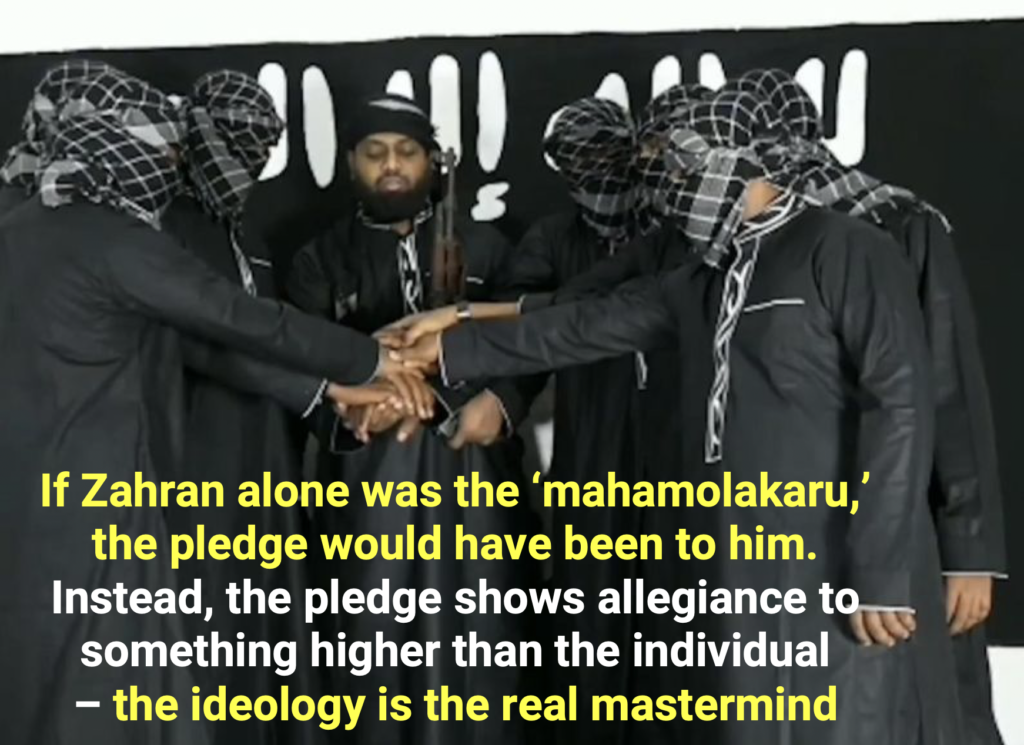
While subsequent investigations into the Easter attacks have focused on the local suicide bombers and their networks, the question remains: were the suicide bombers led by Zaharan Hashim of the obscure National Towheed Jamat (NTJ) organization, following a script delivered to them via remote social media platforms that purvey Online Religion?

Was the Religion Bot, code named Sonic-Sonic purportedly living in Malaysia designed to hide foreign CIA and Mossad intelligence agents and networks, skilled in weaponizing religion/s spirituality and the occult, with remote funding and Online recruitment of terror networks? Here Rand Corporation Anthropologist, Jonah Blanc’s book Mullahs on the mainframe” may be instructive. After all, it is obvious that an ISIS-linked Mastermind would not blow himself up in the first attack.

Were the 2019 Easter attacks that aborted the Chinese research vessel’s visit to Sri Lanka primarily to send a strong message to the rising Asian Superpower?  

Retrospectively it seems clear that the Easter crime was a geopolitical economic event and a message to a third country –-Hands off geostrategic Sri Lanka—the US owns the Indian Ocean with or without the String of Pearl” harbors?!

Of course, the Easter 2019 attacks were also carefully designed to crash geostrategic Sri Lanka’s economy and precipitate a journey of neocolonial Eurobond US dollar debt entrapment. Indeed, the attack was perfectly timed to ‘pump and dump’ the country and Make the Economy Scream”, just after the World Bank had upgraded Sri Lanka to an Upper ‘Middle Income Country’ (MIC Trap). At the time, the national poverty rate was a mere 4.1 percent.

Today there are claims that Sri Lanka’s poverty rate is 25 percent and the lender of last resorts the IMF its savior! This despite Sri Lanka being the wealthiest county in South Asia by all metrics except the exorbitantly privileged US dollar.

The Easter attacks were also designed to weaponize ethno-religious identity politics in the multicultural island nation with rumours about Muslim women suicide bombers buying white cloths to target Buddhist temples. All this provided a smoke-screen to mask hybrid economic warfare on the geostrategic island, now caught in a neocolonial International Monetary Fud (IMF) and Eurobond Debt trap. Sri Lanka has effectively lost its economic sovereignty and policy autonomy to the IMF at this time given cascading impacts of various exogenous economic disasters.

Disinformation Game: CIA and Mossad’s Islamic Terror Catspaw:

The sinking of the IRIS Dena in Sri Lanka’s EEZ clearly show that the country remains in the cross hairs of big power rivalry in the Indian Ocean and subject to various forms of hybrid economic warfare including Geoengineering. The island is also afloat in Disinformation and cover-up investigations to conceal the geopolitical economic motives of the crimes committed on land and seas.

However, masking the Indian Ocean Geopolitical economic interests and targets of the attacks is more difficult as the War in the Middle East has extended to South Asia, with the Indian Ocean and oil rich Middle East emerging as the epicenter of conflict as world War 3 ramps up.

After all, it is hardly a secret that the Islamic State of Iraq and Syria (ISIS), which claimed ownership of the Easter Carnage in 2019 in Buddhist and Hindu-dominated Sri Lanka, was set up and is part owned by the United States Central Intelligence Agency (CIA). This was after the invasion of Iraq on false pretenses, in order to conduct regime in Syria– as part of the ‘Greater Israel’ project. Hence the name Islamic State of Iraq and Syria (ISIS).

Recent events in the Middle East have revealed that the ISIS was set up by the US Central Intelligence Agency (CIA) after the 2003 invasion of Iraq based on false pretenses; the US claim that Iraq had weapons of mass destruction.

As Columbia University Professor Jeff Sachs among others have revealed, the ISIS was set up by the CIA and US special forces occupying Iraq to carry out a regime change in neighbouring Syria against then President Assad – Hence the name Islamic State of Iraq and Syria — ISIS.  Since then, ISIS terror attacks have proliferated around the world with ISIS avatars and the Greater Israel Abraham accords to enable Israel to take over parts of Syria and Iraq have unfolded.

These continuities illuminate the foreign hands and interests behind the Easter Sunday attacks of 2019 and the recent attack on the Iranian Ship.

Intelligence Agency Compromat? Mastermind hidden in Plain Sight

Notwithstanding the coordinated international and local Disinformation in the corporate and social media echo chamber to hide the external geopolitical economic motives in the Easter Sunday attacks of 2019, it is clear that a group of home-grown local terrorists could not have conducted such a logistically complex operation. There were simultaneous explosions in 6 different locations on the East and West coasts of Sri Lanka:

Indeed, it is now quite clear that the external ‘Mastermind’ of the 2019 Easter Sunday carnage remains hidden it plain sight – and continues to wreak havoc including sinking ships in Sri Lanka and across the Indian Ocean world where sits front and center.

The illegal US-Israeli war on Iran with US war ships circling the Indian Ocean and the British occupied Chagos Islands with the Diego Garcia military base are an indicator of continuing attempts by the world’s biggest Rogue State to exert control over Indian Ocean energy, trade and submarine data cable routes. This is also to shore up the Petrodollar and its global reserve currency status for which control of Sea Lanes of Communication (SLOC) across the Indian Ocean is seen to be vital.

While promoting the narrative of a ‘free and open Indo-Pacific’ the US has attempted to claim dominance of the Indian Ocean, also with monsoon and seabed geoengineering, using weather warfare as a ‘force multiplier’ as part of hybrid economic warfare. At this time, it has assembled its environment polluting war machine in the Indian Ocean to target Iran.

A foreign Script and Mastermind with local collateral damage?

Were the people who died in hotels and churches collateral damage in the Superpower’s power projection in a small island country and to warn China which has been subject to much propaganda about ‘debt trap’ lending to the Global South that it must lay off Sri Lanka?  

The Easter attacks symbolically targeted the Chinese Port city project at the entrance to the Colombo harbor – South Asia’s busiest port. St. Antony’s church. The lead suicide bomber and a second died at Chinese owned Shangri La Hotel. Both overlook the Colombo Harbour and Chinese port city. The adjacent Hilton Hotel – between Kingsbury and Shangi La were spared.

No one dares to name the Superpower as a Criminal Actor and call out its crimes, not even the Catholic Church which is full well acquainted with the Cold War weaponization of religions at this time?

Thus another Easter has come and gone without the Foreign Mastermind of the ISIS-claimed Easter Sunday bombings of hotels and churches being revealed in Sri Lanka. Rather, endless cover up investigations of the Geopolitical interest writ large in the design of the Easter 2019 crime scene have unfolded by local investigative institutions and the church itself in collusion with their foreign counterparts. 

Every attempt has been made to muddy the waters with local blame games and Disinformation to hide the external Mastermind behind ISIS attacks of 2019 in Sri Lanka, and around the world.

The collusion of local institutions and political actors with external intelligence agencies that removed the cell phones of the bombers continues. But the geopolitical economic targets of the attack are clear as the standoff between the United States and China has ramped up since 2019.

Once we recognize the Geopolitical dimension of the ISIS claimed attacks it is easy to identify the Mastermind. A foreign intelligence agency which has long used ISIS as an alibi to Weaponize Islam with Israeli Mossad partner in crime for which the Zion Church in Batticaloa was hit in an own goal.

The CIA and Israel’s Mossad have with a long track record of promoting Islamist terror groups in the middle east for regime change operations. Last year the ISIS off shoot Al Nusra, headed by Al Shara became President of Syria following a regime change operation against Syrian President Bashar al- Assad. Al Shara famous for head chopping with a recently lifted bounty on his head was welcomed by Donald Trump in the White House!

Continue reading an article on the Easter attacks that was published at InDepthNews in 2021

——————————————–

The Weaponization of Religion Amid Hybrid Cold War in The Indian Ocean Region

Viewpoint by Darini Rajasingham-Senanayake

The writer is a cultural and medical anthropologist with research expertise in international political economy, peace, and development studies in South and South-East Asia. Her research spans issues in gender and women’s empowerment, migration and multiculturalism, ethno-religious identity politics, new and old Diasporas and global religion, particularly, transnational Theravada Buddhist networks in the Asia-Pacific region. Darini was a Senior Lecturer at the Open University of Sri Lanka. Her Bachelor’s degree is from Brandeis University and her MA and PhD are from Princeton University.

COLOMBO (IDN) — We have met the enemy and he is us”—Walt Kelly from Pogo Comics, quoted in The ISIS is the US: the shocking truth behind the Army of Terror” [i]

Crime is a form of communication that is both complex and fascinating as it is always characterized by a relationship that can be established between elements present and something absent, or yet to be discovered…Investigating a crime and trying to prevent recurrence means evaluating every possible voluntary and involuntary message left by an author.. :[ii]

On the first Sunday of March 2021 church congregations in Sri Lanka were joined by Buddhist monks and prominent Muslims for a multi-religious protest to mark Black Sunday”; the second anniversary of the deadly Easter Sunday suicide bombings that rocked the country two years ago, killing 279 people and injuring many more.

Local and national religious leaders, aware of the ongoing weaponization, fragmentation, and use of religion/s against core values such as ahimsa or non-violence, by external actors interested in advancing their geopolitical interests in this strategically located Indian Ocean island, stood together to call for justice and accountability for the victims of the mysterious ISIS-claimed attacks. Protestors held placards and demanded: Tell us who the masterminds are?”

The simultaneous attacks staged at 7 different luxury tourist hotels and coastal churches at Easter 2019, presented a hybrid war scenario and were mysteriously claimed by the Islamic State of Iraq and Syria (IS), which operated far from this strategic Indian Ocean island.

The carnage that sent the country into lockdown and the economy into a tailspin was clearly designed, hybrid-war style, to cause maximum damage to both the Economy and Society. The attack was clearly staged by a global-local network while the design of the crime reflected foreign interests.

Sri Lanka is in the crosshairs of great power rivalry as a hybrid cyber–Cold War unfolds in the rapidly militarizing Indian Ocean region as big states use transnational religious networks and cultural ‘soft power’ and religious terror narratives including the Islamophobic ISIS narrative, which Delhi-based academic Saeed Naqvi has deemed a ‘diplomatic asset”, to cultivate local-global networks of political influence and bi-partisan corruption rackets to advance their geostrategic interests.

While the attack on hotels was meant to cripple the tourist-dependent and highly indebted island economy, the attack on churches was meant to cause a cascade of inter-religious violence and destabilization of this multi-religious country, rendering it vulnerable to foreign boots on the ground or even to a foreign military base being set up to purportedly ‘protect Christians from ISIS terror’ in the rapidly militarizing Indian Ocean Region (IOR).

However, since Christians and Muslims are minorities in this Buddhist-Hindu cultural majority country and have historically enjoyed excellent inter-religious relations, it appeared that the foreign masterminds behind the Easter crime had miscalculated and imported a Euro-American Clash of Civilizations” narrative that has little traction in multi-religious South Asian context. There was no local history or motive for a clash of civilizations between Christians and Muslims who had amicable interreligious relations on the island.

From a local perspective, the designers of the crime seemed to have targeted the wrong religious community, and so the masterplan behind the deadly Easter crime began to unravel with his Eminence Cardinal Malcolm Ranjith declaring that the attacks were staged by international actors who benefit from destabilizing regions and countries and weapons sales.

It was in this context that the powerful Buddhist clergy of Sri Lanka, who have historically confronted colonial projects, backed the Archbishop’s demand for accountability and joined the Black Sunday protest to compel the Government of Sri Lanka to deliver the truth about the masterminds behind the attacks since the recently released Presidential Commission of Inquiry (PCoI) Report into the crime had revealed no new analysis regarding those behind the attacks.

For non-recurrence of such violence, identifying the masterminds and holding them accountable would be surely imperative.

Chinese targets in Easter attacks: fundamental questions unanswered in PCoI Report and other investigations

Fundamental questions, or perhaps co-incidences such as why the leader of the attacks, Zaharan Hashim and a second suicide bomber both targeted and died at the Chinese owned super luxury Shangri La Hotel on Colombo’s seafront rather than in a church or Buddhist temple if their crime was primarily religiously motivated, have been ignored in investigations.

Aside from Shangri La the other hotels and churches that were bombed were hit by just a single suicide bomber. There is absolutely no evidence to indicate that Zaharan Hashim, leader of the National Thowheed Jamaat (NTJ), the obscure group blamed locally, knew about or was concerned about Uyghurs in China.

Intelligence experts also pointed out that a leader of a terror group would never kill himself at the outset and suggested that the attacks were staged by other actors fronting the local National Thowheed Jamaat (NTJ), which espoused the Saudi Wahhabi-Salafi project initiated during the Cold War years to weaponized Islam as a bulwark against communist and socialist ideologies—subject to which we shall return.[iii]

Four Chinese marine scientists in Sri Lanka for joint marine exploration lost their lives in the attack on the Kingsbury Hotel. Remarkably, the US and Indian owned, Hilton and Taj Hotels that are next to Shangri La were untouched.

The global and local narrative after the Easter carnage focused on religious motivations in the Easter attack and elided the economic and geopolitical dimensions, while some foreign experts suggested that they were staged in retaliation for attacks on a mosque in New Zealand, a claim that was dismissed by the NZ Prime Minister, Jacinda Arden!

Too many strategic Chinese targets to be a coincidence? Did the designers of the Easter attacks use religion as a partial smoke screen? While media attention and investigations have been focused on the churches that came under attack, the media narrative has been crafted to obscure the vital facts of the crime that may provide clues to the masterminds and messaging evident in the geopolitics behind the Easter carnage and its economic motives.

There has been a veritable infodemic regarding swords in mosques in the local media although no one died of sword attacks. Various other stories about ISIS setting up a Caliphate in the Eastern Province of Sri Lanka were circulated by international experts.

Since answers to fundamental questions were missing after 2 years of investigations, people from all religious communities on the island came together to voice their disappointment with the Report of the Presidential Commission of Inquiry (PCoI), that increasingly appeared to be a bi-partisan party political ‘cover up’, especially of the international actors behind the attack. It was perceived by many locals as part of a larger hybrid war on both the economy and society of Sri Lanka caught in the midst of a Cold War waged by the USA and its NATO allies and the Quadrilateral Security Dialogue or Quad friends, on China.

In the wake of the attacks, Foreign Minister Mangala Samarawickrama announced that the US Govt. was ready to disburse the 450 million as a Millennium Challenge Corporation (MCC), ‘grant’ that would give US companies access to land and transport sectors to be re-structured despite a great deal of opposition from Sri Lankan Trade Unions and civil society groups.

Finger Prints in the Design of the Crime point to Hybrid War and local-global networks

Seven simultaneous suicide bombings in the East and West coasts shook Sri Lanka on a bright quiet Easter morning with Hollywood style ‘shock and awe’ precision in April 2019. Youthful bombers with backpacks targeted seafront luxury tourist hotels and churches killing more than 279 people and injuring many more. Four tourist hotels in Colombo and three churches on the West and East Coasts of the country were targeted.

In the aftermath the country’s already debt-trapped, tourist-dependent economy and multicultural society went into a tailspin and lockdown, seemingly a dry run for the Covid-19 pandemic lockdowns. The latter was imposed with 4 hours prior notice in 2020 again crippling the economy although Covid-19 data indicates that the illness is milder than seasonal flu in Sri Lanka, as in other countries in Southeast Asia, such as Vietnam Laos and Cambodia.

The leader of the small group of suicide bombers, Zaharan of the National Thowheed Jamaat, (NTJ), and a second suicide bomber struck the brand new glittering Chinese-owned Shangri La Hotel on Colombo’s luxury hotel strip.

The fact that two suicide bombers, including the leader Zaharan, targeted a Chinese asset Shangri La Hotel, indicated that it was the ‘Jewel in the Crown’ of the Easter bombings. St Anthony’s church, famous for miracles, attracts people of all faiths—Buddhists, Hindus and occasional Muslims and overlooks the busiest and most strategic port of South Asia was also bombed. The church was one of the three most important targets after the Hong Kong-owned Shangri La Hotel and Kingsbury Hotel where the four Chinese marine scientists were killed.

The economic and geopolitical targets of the attacks seemed designed to send a coded message to China—hands-off Sri Lanka’s maritime domain.

This strategically located Indian Ocean Island sits at the centre of the busiest trade, communication and energy shipping routes and more importantly, at a spaghetti junction of Submarine Undersea Data Cables (UDCs), which carry over 90 per cent of data that keeps the global economy and financial system going amidst Covid-19 lockdowns and is vital to secure what the United States terms its Free and Open Indo-Pacific.”

After the Attacks

ISIS claimed the 2019 Easter Sunday attacks had targeted both the island’s economy and society in what appeared to be a hybrid war attack by a global-local network of clandestine actors hiding behind the ISIS narrative. However, the media narrative focused exclusively on religion and elided the economic and geopolitical dimensions of the attacks.

In the wake of the attacks various rumours circulated in global and local media, giving clues to the local-global network behind the attacks. There were narratives from various foreign intelligence agencies and experts, including an expert at the Rand Corporation, Jonah Blank and Singapore-Sri Lankan terror expert Rohan Gunaratne that ISIS intended to set up a Caliphate in the Eastern Province of Sri Lanka.

Stories that Muslim women had been buying white clothes in order to attack Buddhist temples circulated, seemingly to whip up a fear psychosis and cause a cascade of religious violence and stage a Buddhist-Muslim’s clash of civilizations”? These stories led to isolated confrontations between some Sinhala nationalist organizations and Muslims.

However, there were various clues and coincidences that emerged in the international and local press related to the Easter carnage that points to a network of external actors and funders of the attacks:

  1. Police sniffer dogs had found US diplomats with bomb materials at the JAIC Hilton residencies in Colombo. That story soon disappeared.[iv]
  2. A doctored videotape with ISIS boss Abu Bakkar Al Bagdadi claiming the Sri Lanka attacks ran on global TV channels. The authenticity of the Islamic State video with IS head honcho Al Bagdahdi supposedly speaking about attacks in Sri Lanka could not be independently verified according to CreditSITE Intelligence Group quoted in the New York Times. NYT observed that it was unclear when or where the video was recorded, while the parts that refer to recent events, like the Sri Lanka attack, are addressed in audio, not video, suggesting that it may have been recorded weeks ago with newer audio portions added later.  [v]
  3. An Israeli news agency Whitestream released fake news that Bitcoin had funded the Easter attacks in Sri Lanka, but Bitcoin threatened to sue it. Who is behind this and other propaganda campaigns that ran in the global media to distract investigations?

A reputed Lebanese News Agency, Alahed published a copy of a cable that indicated Saudi Arabia had advance notice of the Easter crime, but unlike Indian Intelligence which shared the information with Sri Lankan intelligence did NOT pass on this information. Indeed, the Same Saudi Government whose crown prince is indicted, ironically, in a recently-declassified CIA Report on the chilling killing of journalist Jamaal Khashoggi in its Istanbul embassy had sent Special instructions to its Embassy in Colombo 5 days prior to the Easter Attack, signed by Saudi Foreign Minister Ibrahim bin Abdul Aziz al-Assaf. The most important instruction was to destroy any incriminating evidence that may link to the local network of Muslim politicians the NTJ First: You should delete all documents, computer data and latest correspondence with domestic and foreign members and groups, in addition to imposing a curfew for the embassy personnel unless it is necessary.” <LEFT: Exhibit One[vi]

  1. It was also revealed that M.L.M Hizbullah who was with both the Rajapakse and Yahapalanya regime had got copious funds from Saudi Arabia also to set up a Sharia University and was known to have had financial dealings with the leader of the Suicide bombers, Zaharan Hashim also from Kathankudi.
  2. Saudi Arabia had instructed its citizens to leave the country after the attacks and following revelations of a meeting in Passikudha between M.L.M Hizbullah and Saudi officials soon after the attacks. However, M.L.M Hizbullah, like his West coast partner in Mannar, Rishard Bathudeen, seems to be above the law and have protection from powerful foreign actors who hold sway in Colombo.

Maritime Domain Awareness and the US Ambassador visiting Buddhist monks to discuss MCC

All the sites targeted for suicide bombings were oceanfront, along the east and west coasts of the country, and after the attack, the island’s harbours were locked down. No inland cities were targeted, and attacks had an ocean theme although IS operates in desert and mountain areas.

In the following week the US Ambassador, Alina Teplitz lectured the GoSL on Maritime Domain Awareness (MDA) in an interview aired on the Ada Derana TV station and drove home this message. In the wake of the attack Teplitx also visited the Temple of the Tooth in Kandy and met with the Mahanayake to discuss the Millennium Challenge Corporation (MCC), compact against which the powerful Buddhist clergy had declared its opposition.

As Giacomo Buoncompani noted, criminal behaviour is a form of communication,[vii] a particular, pathological communication that upon further analysis yields value. Crime is a form of communication that is both complex and fascinating, as it is always characterized by a relationship that can be established between elements present and something absent, or yet to be discovered. Communication today plays a leading role that will most likely continue to become even more important. Investigating a crime and trying to prevent it means evaluating every possible voluntary and involuntary message left by an author.

After the attacks, the US Secretary of State, Mike Pompeo, was expected to visit Sri Lanka to sign the Millennium Challenge Corporation (MCC) Compact and discuss the Status of Forces Agreement (SOFA). The attacks would provide a perfect alibi for a US military base, purportedly to fight ISIS terrorism and protect Christian communities in the Indian Ocean region, in the face of mounting opposition and protests by Trade Unions, civil society groups and the Sangha against the MCC compact, which was subsequently aborted.

Coincidentally, two months before the Easter Sunday carnage, in February 2019, the United Nation’s highest court, the International Court of Justice (ICJ), had ruled that the UK-US occupation of the Chagos Islands, southwest of Sri Lanka where the Diego Garcia military base is located, was illegal under international law.

Sri Lanka was once deemed an unsinkable aircraft carrier in the Indian Ocean”!

Located at the ‘crossroads of history’ and colonized by competing European maritime powers (Portuguese, Dutch and British) for almost 450 years before independence in 1948, Sri Lanka, at the centre of the Indian Ocean Region (IOR), has been often ‘islanded’ in the historical and social science literature on ethnic and religious conflict and violence in the island.

However, ethnic and religious identity politics and conflict in the island has rarely been exclusively internally generated or bereft of geopolitical power plays, transnational actors and related global-local networks using funds, religious and cultural” soft power” and local political actors networks to advance geostrategic interests. More so today given that Sri Lanka’s urban religious communities are transnationally networked and social media-savvy in a context of significant post/colonial ethnic and religious diasporas.

 During the Cold War period the country was subject to power plays and various covert and overt interventions from India (then officially non-aligned, but close to USSR), and the US and UK[viii].

Sri Lanka’s first socialist Prime Minister, S.W.R.D. Bandaranaike who nationalized the country’s strategic ports and airports from the British was allegedly assassinated by a monk at the time when the CIA was weaponizing Buddhism (and Islam in West Asia and Afghanistan), to contain the spread of Communism from the USSR and China.[ix] This was a period of US, UK and retreating European empires instigated assassinations, coups and regime-change operations from Patrice Lumumba in Congo to Mossadegh in Iran, to Suharto in Indonesia in the context of decolonization and national liberation struggles sweeping the Global South.[x] 

As Berger argued, the Cold War was a ‘hot war’ in the Global South, which never ended as the US-led Global War on Terror took over. The ‘global struggle for the Third World, arguably just got hotter with the victory of Joe Biden.[xi] Locating Sri Lanka’s tumultuous post-colonial present in that wider global and Indian Ocean geopolitical context remains a challenge for current and future generations of local historians and social scientists.

EPILOGUE

Pope Francis in Iraq

Remarkably, on the same day of the Black Sunday protests in Sri Lanka against the 2019 Easter Sunday suicide attacks and the failure of the Presidential Commission of Inquiry Report (PCoI), to shed light on the masterminds of the crime, Pope Francis was in Iraq on his first foreign trip after the Covid-19 crisis, reaching out to the Grand Ayatollah Ali al-Sistani, the spiritual leader of millions of Shia Muslims, the sect that dominates Iran, the US bete noir in the Middle East. Receiving the head of the Roman Catholic Church at his home in the holy city of Najaf, Ayatollah Sistani said Christians should be able to live in peace and security like all other Iraqis.

Pope Francis noted that all hostility, extremism and violence are betrayals of religion” at an interfaith prayer service. Multi-religious Iraq was undone by the United States-led invasion in 2003, based on spurious claims that Saddam Hussein had weapons of mass destruction (WMD). Under American occupation Hussein’s Sunni dominated army was disbanded, enabling the birth of ISIS with the patronage of the Central Intelligence Agency (CIA), in order to simultaneously engineer chaos in Iraq, weaponize Shia-Sunni differences, and destroy its multi-religious communities also by staging a Clash of civilizations” between Christianity and Islam as a smokescreen for regime change in neighbouring Syria. The latter operation was only stymied by Russian President Putin’s support of Syria’s Bashar Al Assad. This history has been traced in many books including by an expert panel of intelligence officers in a book titled, The ISIS is US: The Shocking Truth Behind the Army of Terror”.

Is the ISIS monster and narrative created by the CIA after the invasion of Iraq to weaponize a multi-religious society being deployed in Sri Lanka? Is the ISIS initially created by the CIA and Saudi to further spread the Wahhabi-Salafi project through local Muslim politicians and elites now out of control like the Liberation Tigers of Tamil Eelam (LTTE), which was created by India’s Research and Analysis Wing (RAW), and the Intelligence Bureau?[xii]

The LTTE later assassinated former Indian Prime Minister, Rajiv Gandhi in a classic case of blowback. Or is the ISIS network and Islamophobic narrative a ‘diplomatic asset’ as Saeed Naqvi has suggested for the US to advance its geostrategic interests under the guise of counter-terrorism, all the while selling weapons?

It was hence that, two years later, protestors in Sri Lanka were calling on the Sri Lanka Government (GoSL), to reveal the local-global networks that had funded, trained and designed the Easter 2019 crime claimed by the ISIS, and the foreign hands, funds and masterminds behind the leader and a local group that staged the attacks. The design of the attacks indicate an intent by external actors and networks to weaponize religion/s by importing a Euro-American Clash of civilizations” between Christianity and Islam in Sri Lanka where these communities have lived in harmony for centuries and cause a cascade of violence that would de-stabilize the county, rendering it vulnerable to external intervention purportedly to fight ISIS and protect Christians, and distract from the search for the external actors and the motives behind the carefully planned and executed Easter Sunday crime in Sri Lanka. [IDN-InDepthNews – 18 April 2021]

Photo: Catholics, Buddhists and Muslims hold silent protest to demand the truth about the Easter Sunday massacre. Credit: SL Time, Colombo Page News Desk.

Share your views on this article: comment@indepthnews.colo.ba.be

IDN is the flagship agency of the non-profit International Press Syndicate.

Visit us on Facebook and Twitter.

[i] The Washington Blog, Wayne Madsen, Syrian Girl Partisan, John-Paul Leonard 2016 ISIS is US: The shocking truth behind the army of terror.”  Progressive Press. San Diego. California.

[ii] Criminological Communication: Understanding Crime through the Media and Human Communication Giacomo Buoncompagni: Sociology and Criminology: https://www.longdom.org/open-access/criminological-communication-understanding-crime-through-the-media-and-human-communication.pdf

[iii] Askar H. Enazy 2009 Saudi Wahabi Islam in the service of Uncle Sam’ Middle East Institute. Washington DC https://www.mei.edu/publications/saudi-wahhabi-islam-service-uncle-sam

[iv] https://thuppahis.com/2019/05/03/explosives-us-embassy-plot-in-colombo-sniffed-out-by-police-dogs/

[v] Explosives! US Embassy Plot in Colombo sniffed out by Police Dogs? https://www.nytimes.com/2019/04/29/world/middleeast/isis-baghdadi-video.html 

[vi] Lebanese news outlet Alahed News run by News First Sri Lanka reported that they have obtained a top-secret document sent by the Saudi Arabian Ministry of Foreign Affairs to the Saudi Ambassador to Sri Lanka. The letter which was sent 5 days prior to the attack seems to indicate that the Saudi Arabian Ministry of Foreign Affairs was aware of the attacks. https://www.english.alahednews.com.lb/47824/269 https://www.colombotelegraph.com/index.php/easter-massacre-mystery-tamil-travails-the-defense-of-asias-oldest-democracy/

[vii] Criminological Communication: Understanding Crime through the Media and Human Communication Giacomo Buoncompagni: Sociology and Criminology: https://www.longdom.org/open-access/criminological-communication-understanding-crime-through-the-media-and-human-communication.pdf

[viii] Phil Miller 2019 Keenie Meenie: The British Mercenaries who got away with War Crimes” . London. Zed Books.

[ix] Ford, Eugene 2017 Cold War Monks: Buddhism and America’s Secret Strategy in Southeast Asia. Yale University Press.

[x] Bevins, Vincent 2020 The Jakarta Method: Washington’s anti-Communist Crusade and the Mass Murder Program that Shaped our World. New York. Public Affairs.

[xi]  Mark T. Berger. The Real Cold War was Hot: The Global Struggle for the Third World” https://www.tandfonline.com/doi/abs/10.1080/02684520701798171?journalCode=fint20. See also. David Vine’s 2020 ‘The United States of War’.

[xii] For a comprehensive account of the history of the Saudi Wahhabi-Salafi project please see Askar H. Enazy 2009 Saudi Wahabi Islam in the service of Uncle Sam’ Middle East Institute. (MEI) Washington DC https://www.mei.edu/publications/saudi-wahhabi-islam-service-uncle-sam

Is the World Moving Towards a ‘One-World’ Dictatorship of the Oligarchs?

April 4th, 2026

By Jonathan Manz

Is Trump’s conduct demented, as portrayed? Or, are the Republicans, and the Democrats playing out a charade to hoodwink the world and the American people by working towards a ‘One-World’ Dictatorship’ of the Oligarchs as was planned at Bretton Woods in 1944?

The USA pays plenty of lip-service to Democracy. Is there democracy in the USA?

Today, the Oligarchs control the USA totally; the American peoples are helpless, tied down with a 4.5 trillion Dollar debt, owed to the oligarchs.

The American people were unable pay even the 1.5 trillion Dollar annual interest that was payable last year to the oligarchs; they were compelled to borrow the amount payable to the oligarchs, as has been the practice, from the oligarchs themselves.

The USA military is reportedly the strongest in the world; sadly, it is a mercenary military maintained by the oligarchs and fighting wars selected by the oligarchs. The USA is so debt-ridden that it cannot afford to start any war.

Trump and the congressmen are sacrificing American lives, using the American military to fight a war in Iran, on behalf of the oligarchy.

Are Trump and the congressmen the only players aware that the war in the Middle East is the oligarch’s war to achieve the oligarchs’ ends.

Is Iran too, complicit in this drama?

The question on many lips is, ‘Is it not strange that Iran permitted its navy to participate in military exercises conducted by India, at Visakhapatnam, while hostilities were continuing between Washington and Teheran? If it had been prearranged, Iran could quite easily have withdrawn.

India is one of the four countries in the QUAD military partnership, the largest American military alliance in the Indian Ocean.

Another question arose, shortly thereafter, when the Iranian ambassador to Sri Lanka went on air to say that the three Iranian ships had come to Sri Lanka – after the Indian military exercises – on an invitation extended by the Sri Lanka Navy Commander.

Protocol does not permit Sri Lanka’s navy commander to extend such an invitation.

Many were calling, and are calling, rightly, for the immediate resignation of the Navy Commander and demanding that he be investigated and prosecuted if found culpable.

But what went almost unnoticed was the role of the Iranians; does their protocol permit a mere contingent naval commander to accept an invalid invitation from a foreign Naval Commander to visit that foreign country, placing at risk the Naval assets and the lives of those serving on those assets?

This happened at the height of hostilities between USA and Iran, and the country the Iranians were visiting, had, just three months prior, signed a memorandum of understanding – the Montana military agreement – that gave the USA the right to intervene, unsolicited, in the event of a disaster in Sri Lanka.

Was it a coincidence, that the USA think-tank with strong bonds to the CIA – the ‘Pathfinders’ – which persist in describing Sri Lanka as a ‘neutral’ country when in fact she is a ‘Non-Aligned’ country, was conducting in CBO, at the time of the Indian war games, a seminar discussing the response of countries in the Indian Ocean region, to a disaster in the Indian Ocean.

Was it a Freudian slip that gave the lie to a close connection between President AKD of Sri Lanka and the CIA think-tank ‘Pathfinders’, when AKD described, in a flurry of exchanges that followed the Iranian ambassador’s revelation, that Sri Lanka is a ‘neutral’ country.    (Ceylon Today -March 29, 2026 2:02am)

As a Non-Aligned country, Sri Lanka should have been roundly condemned USA’s actions and rallied the NAM to bring the USA and its administration to justice, as war criminals.

But what ADK did and told the world publicly, amounted to, ‘We Sri Lankans don’t care whether the leaders of nations are assassinated or abducted, whether thousands of men, women and children are murdered or whether their homes are razed to the ground; we, as a neutral country only look at the advantage we can derive from the situation’.

This is what being ‘neutral’ means, as was practiced by countries like Switzerland and the Scandinavians during WW2, looking the other way when Hitler and the Nazi’s engaged in pogroms and atrocities. 

As events turned out, one of the visiting naval assets of Iran was torpedoed in Sri Lankan waters, reportedly after the vessel’s locational coordinates had been ‘mysteriously’ communicated to USA. 

Was the Sri Lankan drama orchestrated and scripted by the Oligarchs? Was President AKD also in the know?

The transitory stepping stone to a one-world dictatorship that the oligarchs perceived, is the creation of a hegemonic world of states which could be reduced to bankruptcy and vulnerability.

For this purpose, the oligarchs established the US dollar as a currency for global transactions and the IMF and World Bank as the debt creating agencies of the oligarchs.

Feeding on an existing hegemonic mindset in the global South – a hangover of centuries of colonialism – it was easy to market the theory that spending more money than what a nation earned, was the panacea to its development; this theory was blindly accepted.

Providing ready and easy loans to nation states, while pushing it as Keyne’s theory of deficit budgeting for prosperity, were the IMF and the World bank.

To ensure the maintenance of the hegemonic mindset amongst the new sovereign nation-states, now physically disconnected from their colonial past, the oligarchs used the newly created UN (and its many agencies), and NGOs to replace the former colonial powers; sovereign nation states were fed by these agencies the dictates of the former colonial powers as norms and ‘better’ practices towards establishing a civilised and civilised world.

Nothing therefore had changed; the new ‘sovereign’ states continued to act to the dictates of the former colonial powers; the dictates now being dished out through the UN and the NGOs.

Thirty years after ‘Bretton Woods, if not all, most of the nation states were so badly in debt that any one of them could be bankrupted and taken down; to be bankrupted, all the IMF had to do was to demand the return of the monies lent and, the interest payable.

These indebted countries are unable to honour their debt, if such an evantuality is forced on them by the IMF.

The lending agencies then did a volte face in the early 1970’s; they declared that Keyne’s theory was erroneous and what should be practiced is the Friedman type of economics with strict financial discipline. Overnight, surplus budgeting became the order of the day.

Eighty years from Bretton woods the oligarchs perceived that the world was ripe for the next phase of the oligarch’s plan, one -world dictatorship or global slavery.

With hostilities escalating in Teheran, the shipping insurers have virtually closed the Strait of Hormuz; Hormuz is one of the many critical chokepoints in the marine world.  It is important to China, especially to have uninterrupted flow of oil and gas to keep their productions lines running. For similar and other reasons too, it is important to Washington.

Hostilities do not have to escalate for the crisis to deepen; as days go by and the Strait remains closed, the world will begin to spiral into an unimaginable crisis; one by one, the lights will flicker and die as country after country will go down like dominoes, if Hormuz is not opened.

If the red sea is also closed by the shipping insurers – the Houthis have not been attacked yet – the world will go down faster than anticipated.

The conflict between Iran and the USA no longer remains the prime issue of the world; the issue has been cleverly manipulated by the oligarchs.  The need to keep the Strait of Hormuz and the red sea open has now taken centre stage.

For this to happen the intervention of the big countries, especially those centered around the current crisis area, is very important; besides USA and Iran, China and Russia will carry much clout in such an intervention for peace.

If the bigger powers were to negotiate for peace, it is likely that Russia and China would like to look at a larger canvas; the canvass could include many other marine chokepoints that exist.

The Russians could possibly be looking at the black sea, Kuril Islands and perhaps even events leading to the end of the problem in Ukraine.

The Chinese could possibly be looking at the Panama Canal, the Malakar straits and Taiwan.

Control of marine chokepoints and bringing them under ‘international ‘control would fit in nicely to the ‘one-world’ concept; disentangling the chokepoints from Nation- State control would be one step closer to One- World Government.

China is not a socialist country; Zi is a successor to Deng Xiaoping, the father of modern China, described by Mao as a capitalist roader and, who was imprisoned by Mao’s Red Guards.

China also has a One-World perception of the world; they describe it as the ‘Belt and Road’ initiative and the concept is being developed simultaneously as the Americans develop their One -World act.

Putin is no stranger to international capitalism and is not averse to making deals with oligarchs, if it is advantageous to Russia.

In the ‘One – World’ canvas, the oligarchy of the USA, Russia, China, and Iran appear to be major emerging players.

’’සෙනෙවිරත්න ඒක පුද්ගල කොමිසමෙන්’’’ රට නිදසුන් සමග පළාත් සභා ගැන පාඩමක්

April 4th, 2026

ධර්මසිරි සෙනෙවිරත්න—-ඇමරිකාවේ සිට  

19 සියවසේ සිට  20 සියවස දක්වාම  ඇමරිකානු කලුජාතීන් කොන්කිරීමේ ජිම් ක්‍රෝ  නීතිය  ඔවුන්ගේ උපතේ සිට මරණ මන්චකය දක්වා  සෑම අංශයක ම   ඇමරිකාවේ  ඉතා කුරිරු අන්දමින්  ක්‍රියාත්මක විය.රටේ විවිධ ප්‍රාන්තවල විවිධ මතධාරීන් එක පොදුමතයකට ගෙන රට එක්සත් කරතබා ගැනීමට  ෆෙඩරල්  හෙවත් මධ්‍යමරජය ගන්නා බොහෝ සාධනීය පියවර  නිෂ්ක්‍රිය හෝ අකර්මන්‍ය කිරීමටහෝ හැකිතාක් කල් ප්‍රමාදකිරීමට බොහෝ  බලලෝභී ආත්මාර්ථකාමී ප්‍රාන්ත පාලකයන් විසින් පියවරගන්නා ලදී. 13 ව්‍යවස්තා සංශෝධනය මගින් 1863 වහලුන් නිදහස් කිරීමේ ප්‍රකාශනය නිකුත් වු පසුව  දකුණේ ප්‍රාන්ත බොහොමයක්  මධ්‍යම රජය සමග වයිර බැඳගත්හ .

                                                                           දකුණේ ප්‍රාන්ත  වලට  අ වශ්‍ය වුනේ කළු වාර්ගිකයින් සදා වහලුන් ලෙස තබාගනීමටය.. මධ්‍යම රජයේ නියෝගයෙන් ලද නිදහසෙන් පසුව වෙනත් පලාත්වල  රැකියා සොයා යන කළු මිනිසුන්,එසේ යාම  වැලකීමට නොහැකිනම්   බුරුතු පිටින්  මරා දැමීමට පවා   සුදු  මිනිසුන් පැකිලුනේ නැත .වගා කටයුතු සඳහා වහලුන් අවශ්‍ය දකුණේ ධනවතුන් පමණක් නොව දුප්පත් සුදු මිනිසුන් පවා මධ්‍යම රජය විසින් වහලුන් නිදහස් කිරීමට  පමණක් නොව  ඔවුන්ට අවම  මානුෂික අයිතිවාසිකම් දීමටත් විරුද්ධ වුහ ..දකුණේ පමණක් නොව අනෙකුත් පළාත් වල සුදුමිනිසුන් අතරද  ඒ අදහස් ඇති අ ය බොහෝ වුහ .

                                                                             1873  සිට  ‘ස්ලෝටර් හෞස් ,විලියම්ස් හා වෙනත් අ ය නඩුවේදී  සුප්‍රීම් උසාවි විනිසුරුවන් පවා  13 ,14 ,15  ව්‍යවස්ථා මෙන්ම ENFORCEMENT AND FORCE   පනත පැනවූ විගසම   ඉතා සියුම් ලෙස හා සැක ඉපදවියයුතු  අයුරින්  එයත් ලත් තැන ලොප් කිරීමට කටයුතු කරතිබුණි   .                            .(((ලංකා! ,ප්‍රවේසම් වෙනු :පළාත්  සභාවේ වුව මධ්‍යම රජයේ වුව දේශද්රෝහී මත ඇති විනිසුරන්ගෙන්  සිදුවිය නොහැකි දෙයක් නැත )))

   ‘’ෆෙඩරල් ව්‍යවස්ථාවට අකුරටම කීකරු වෙන අතරම නිග්‍රෝ  වරු  සුදු ජාතියට සමානය යි උන්ට හැඟවෙන හිතෙන යම් දෙයක් යම් පනතක  ඇත්නම් එහි  ‘’ජීව වායුව ‘ අකාමකා බෙලහීන කිරීමට  අපි  කඩිසර වුනෙමු ‘’ යයි   ජෝර්ජියා සෙනෙට් සභික  වෝ ල්ටර් ජෝර්ජ්  උදම් ඇනුවේ ය                   ((ලංකා ,ප්‍රවේසම් වෙනු .ලන්දේසි කාලයේ සිට යාපනේ කුලපීඩි තයෝ  අදත් දුක් විඳිති  .))                           1903  GILES .v HARRIS නඩුවේදී  HOLMS විනිසුරු මෙසේ සටහන් කළේය ‘’’ ප්‍රාන්ත රජයන් හෝ එහි නියෝජිතයන් විසින් කරන  වැරදි ක්‍රියාවන්ට  විරුද්ධ වීමට ව්‍යවස්ථාමය ලෙස  හෝ ප්‍රායෝගික බලයක් හෝ   ෆෙඩරල් උසාවිය ට  නැත ‘’.            ((ලංකා !,ප්‍රවේසම් වෙනු: අග විනිසුරුවරයෙක් ව සිට මහා ඇමතිවරයෙක් වූ පසුව එක අයෙක් වැමෑරූ බෙදුම්වාදී අදහස් මතක් කරගන්න  )).

                                                                                         මෙවන් අදහස් මත වැඩකළ බොහෝ ප්‍රාන්ත මධ්‍යම රජයේ මානුෂීය හා නිදහස් මතවාදී අණ පනත් වලට විරුද්ධව කළහැකි සියලු කෙනෙහිලිකම් හා  විරුද්ධ වාදිකම්  කළහ . කිසිදු අධ්යාපනයක්  තහනම් කර සිටි  කළු මිනිසුන් ට අධ්‍යාපනයට අවසර දීමටත්  විරුද්ධ වූ සුදු මිනිස්සු  ඊළඟට  යුදවැදුනේ  සුදු දරුවන් සිටින පාසල් වලට  කළු දරුවන් ඇතුල් කිරීමට විරුධ්ධවය . මෙම වාර්ගික කොන්කිරීම   රටේ ව්‍යවස්ථාවේ  14 හා 5 වගන්ති වලට පටහැනි බව  1952  BROWN  v. TOPEKA BOARD OF EDUCATION නඩුව අනුව 1954   දී සුප්‍රීම් උසාවිය  තීරණය කළේය.  තම අරමුණුවෙනුවෙන්   යුදවැදීම සඳහා  අවි ගබඩා පුරවමින් සිටි  දකුණේ දේශපාලකයනට මෙම තීරණය  සැබවින්ම යුද්ධ ප්‍රකාශ කිරීමක් විය. .       .((ලංකා! ,ප්‍රවේසම් වෙනු ))                                      .                                                                                                                                         

.    .  .                                                                                   කළු විරෝධී සියලු ක්‍රියාවන්ට එරෙහිව සටන් වැදුන NAACP ආයතනය  1935 තරමේ  සිට  එවන් ව්‍යවස්ථා විරෝධී  ව්‍යාපාරවලට  විරුද්ධව   රට පුරා  එක පිට එක නඩු පවරමින්  උනදුවෙන් කටයුතු කළේය .මේරිලන්ඩ් සරසවියට එරෙහිව  1935 දී මේ ආයතනය  පටන්ගත් පළමු  නඩු පැවරීම  මිසුරි ,ටෙක්සාස් , ඔක්ලහෝමා ,ඩෙලවෙයා , වර්ජිනියා ,දකුණු  කැරෝලයිනා,,වොෂින්ටන් DC, කැන්සාස්  හා තවත් පෙදෙස් දක්වා ගෙන ගියේය .   1950 වන විටත්  දකුණ කරෝලයිනාවේ  19 කවුන්ටියේ කලුදරුවන්ට එකදු  උසස් ((HIGH SCHOOL) පාසලක් නොවීය .ක්ලරන්ඩන් කවුන්ටියේ සුදු දරුවන්ට පාසල් බස් 30 ක් තිබුනත් කලුදරුවන්ට  එක බසයක් හෝ  දුන්නේ නැත ..’’මම ආන්ඩු කාරයාව සිටින තුරු  සුදු පාසල්වලට එකදු කලු  දරුවෙක් වත් ඇතුල් කරනොගනිමි ‘’ යි ජෝ ර්ජියා ප්‍රාන්තයේ  ආණ්ඩු කාරයා 1949 දී  වහසි බිනුවේය  .  මේ  කඩාකප්පල් කාරී අමානුෂික ක්රියා  වර්ධනය වීම නිසා , කළු සුදු ලෙස වර්ගවාදීව පාසල් බෙදීම අත්හිටුවීමේ කාර්යය වේගවත් කරන ලෙස  1955 05 01  නැවතත්  ප්‍රකාශ කිරීමට  සුප්‍රීම් උසාවිය  කටයුතු කළේය 

                                                                    වර්ගවාදීන් නැවතුනාද ? නැත .’’ප්‍රාන්ත තීරණ වලට විරුද්ධව මධ්‍යම රජය  තීරණ නොගත යුතුය .මධ්‍යම රජයේ සුප්‍රීම් උසාවි තීරණ ප්‍රාන්ත රාජ්‍යයේ කටයුතුවලට කරන අනවශ්‍ය ඇඟිලි ගැසීමකී  ‘’  වර්ජිනියා ප්‍රාන්තය ප්‍රකාශ කළේය .    —-…..’’’’’ දේශසීමා මායිම් ප්‍රශ්නවලදී  හැර   ප්‍රාන්තයක වෙනත්  කිසිදු තීරණයකට විරුද්ධ වීමට  අධිකරණ බලයක්  මධ්‍යම රජයේ උසාවි වලට නැත ‘’’ යි  1956 දී ජෝර්ජියා ආණ්ඩුකාරවරයා ප්‍රකාශ කළේය .            ((ලංකා !,ප්‍රවේශම් වෙනු ))

                                                                                ””  මහා රජයේ සුප්‍රීම් උසාවියේ 1952  බ්‍රවුන් නඩු තීන්දුවේ  තීරණ මිසිසිපි  ප්‍රාන්ත සීමා  තුල දී ව්‍යවස්ථා විරෝධී ය .ප්‍රාන්ත සීමා තුල ඒ තීරණ බල රහිතය ””යි මිසිසිපි ප්‍රාන්තය ප්‍රකාශ කළේය .   —-  ‘’’මධ්‍යම රජයේ  ඒ බ්‍රවුන් නඩු තීරණය  හෙලාදකිමි . මෙය මධ්‍යම රජය කරන අනීතික නොමනා ඇඟිලි ගැසීමක් මෙන්ම ප්‍රාන්ත ස්වාධිපත්‍යයට  එරෙහිවීමකි ‘’ යි  දකුණු කරෝලය්නා ආණ්ඩු කාරයා පැවසුවේය .                           ((((ලංකා ! නීති කණපිට හරවා අර්ථකතන දීමට  හැකි නීතිඥයන් හා විනිසුරුවන්ද  පළාත් සභා මහා ඇමති වරු විය හැකි බවත් එසේ වූ බවත්  හිතේ තියා ගන්න )).

                                                                            මධ්‍යම රජයේ   සියලු ප්‍රගතිශීලී පියවරයන්ට එරෙහිව   බලලෝභී ආත්මාර්ථකාමිත්වය ජනතාව තුල අවුළුවා  සිය අභිලාෂයන් මුදුන් පත් කර ගැනීමටඋත්සාහගත්   මේ  මිනිසුන්ට  රටේ ඉදිරිගමන හෝ මනුෂත්වය ගැන  අල්පමාත්‍ර හැඟිමක්  තිබුනේ නැත    එනිසාම  ඕනෑම දුෂ්ට කමක් කිරීමට පසුබට   නොවූ  මොවුන් ගිය දුර  මෙන්න  පහතින් දැන් කියවන්න . හිතේ ධාරණය කර ගන්න .

.                            ’’ඇමරිකන් ව්‍යවස්ථාවේ  අංක 13 ,14 , හා 15  වෙනි වගන්ති  සංශෝධනය කල යුතුය . මේ වගන්ති බලාමක කරන තීරණ ගන්නා විනිසුරුවන් දෝෂාභියෝගයට  ලක් කල යුතුය ‘’යි ජෝර්ජියා ප්‍රාන්තය යෝජනා සම්මත කර ඉන් නොනැවතී  1956 ජුලි 1 දින  අලුත් කොඩියක් ද  හඳුන්වාදී වහල් සේවය අත්‍යවශ්‍යම බවත්  වර්ණ භේද වර්ගී කරණය  රැකගැනීමට  තමන් දිවි පුදා  සටන් කරන බවත්  ප්‍රකාශ කලේ   මධ්‍යම රජයට අනතුරු  ඇඟවීමක් ලෙසිනි .                                   .(((ලංකා ! උතුරේ තේසවලාමේ නීතිය රැකගෙන සිංහල පදිංචිය නැතිකිරීමටත් එළවීමටත්   හා  නලවාර් කොවියාර් වැනි පීඩිත කුල  මර්ධනය කිරීමටත්  නැගෙන හිර අමානුෂික ෂරියා නීති හිතුමතේ ක්‍රියාත්මක කරමින්   ඒ පලාතෙන් සිංහලයන් එළවීමටත්  සියලු බලතල සහිත පළාත්  මහඇමති වරු  ක්‍රියා කිරීමට ඕනෑ  තරම් ඉඩ ඇත )) 

                                                                                                 ව්‍යවස්ථාවේ සංවරණය හා තුලනය –checks and balances– ඉවත් කිරීමේ අරමුණින්  ටෙක්සාස් ප්‍රාන්තය මෙවන් යෝජනාවක් ගෙනා වේය .  ””””සුප්‍රීම් උසාවිය කොන්ග්‍රසයට  වග කිව යුතුය යනුවෙන් ව්‍යවස්ථාව වෙනස් කල යුතුය””””

 ‘’’ 

                                                                             ((ඉහත සඳහන් කල )   බ්‍රවුන් නඩුවේ  තීරණ  ක්‍රියාත්මක කරන මධ්‍යම රජයේ  ඕනෑම විනිසුරු වරයෙක් හෝ මාෂල් වරයෙක්   ලුයිසියානා ප්‍රාන්තය තුලදී අත් අඩංගුවට ගැනීමට  ලුයිසියානා ආණ්ඩුකාරයා තම   පොලිසියට   බලය පැවරුවේය .

                                                                                    යම් කාලයක් ඇවෑමෙන් කෙසේ හෝ හෝ මධ්‍යම රජය සිය අපේක්ෂාවන් මුදුන් පත් කරගන්න බවත් තමන් ට පසු බැ සීමට සිදුවෙන බවත් දැන දනම  බොහෝ අ ය  කිසියම්  කාලයකට හෝ හැකිපමනින් විශේෂ වරප්‍රසාද රැකගනුවස්   මධ්‍යම රජයේ කටයුතුවලට අවහිර වෙන සේ හැකි පමණින් කටයුතු කිරීමට උත්සාහ ගත්හ. මේ  ප්‍රයත්නය  සාර්ථක විය  1963 වෙන තුරුත්  ඇලබාමා , මිසිසිපි , හා වර්ජිනියා  ප්‍රාන්තවල  සුදු පාසල් ලෙස වෙන්කළ  පාසල් වලට එකම කළු ළමයෙක් හෝ  ඇතුල් නොකර සිටින්නට ඔවුන්ට හැකිවිය .

                                                    විරෝධය කෙතෙක් දුර ගියාදැයි යන්න ආකන්සෝ ප්‍රාන්තයේ  මේ  බරපතල ප්‍රකාශයෙන්   පෙනී යායුතුය ‘’’’   තම ප්‍රාන්ත භුමි සීමා තුල බලපැවැත් විය යුතු නීති රෙගුලාසි –  LAW OF THE LAND,– මොනවාදැයි තීරණය කිරීමේ  බලය ඇත්තේ ඇමරිකන්  සුප්‍රීම් උසාවියට නොව.ප්‍රාන්තයේ ආණ්ඩු කාරයාටය .’’((((ලංකා ! උතුරේ නිජබිම් සංකල්පයක් ඇත .’’භුමිය’ යන වචනය  ගැන සැලකිලිමත් වෙමු )))                                                   

                                                                              ඇමරිකන් මහා රජයේ මේ  ප්‍රගතිශීලී  වැඩදායී මානුෂික  මෙහෙවර දාමය  පරාද කිරීමට හා  කඩා කප්පල්  කිරීමට  මෙසේ මේ ප්‍රාන්ත  කටයුතු කළහ . ලංකාවේද පරාජය දැකදැකත්  අමානුශිකයයි දැන දැනත් තම ජීවිත කාළය තුල හෝ විශේෂ වරප්‍රසාද රැක ගැනීමට උත්සාහ කරන අන්තවාදී පිරිසක් උතුරේ හා නැගෙන හිර  කටයුතු කරන විට  අපි ප්‍රවේසම් විය යුතුය 

                                                                           අමරිකාව  වැනි  විශාල රටකට  ප්‍රාන්ත ක්‍රමය  නැතුව බැරුවා වියහැක .මේ ත රම් විඳවන්නට සිදු වුනෙත් එනිසාය . එහෙත් අපි කුමට  විඳවමුද ? පුංචි ලංකාවේ  රජයේ  ප්‍රතිපත්ති ක්‍රියාත්මක කිරීමට  රාජ්‍ය  නිලධාරීන් හොඳටම  ප්‍රමාණවත්ය . පළාත් සභා අ පමත බලෙන් පැටවූ එකකි.මේ බෝම්බයේ කැබැල්ලක් වත් ඉතිරි නොකර විනාශ කල යුතුය.කැබලි ඉතිරි කළහොත් දිනෙක හතුරෝ ඒවා පුරුද්දා ගනු ඇත .   SWRD අගමැති   රන්පවුම් වතු  හා විදේශ සමාගම් ජනසතු කරමින්  බැරෑරුම් කාරය භාරයක් කලේ  ද  සිරිමාවෝ මැතිනිය රට ස්වයං පෝෂිත කිරීමේ  පරමාර්ථයෙන්     දේශීය නි ශ් පාදන නංවමින්  සල්ලහුක දිවියකට රට හුරු කිරීමේ භාරධුර කාර්යයට  අ ත ගැසුවේත්,, එමෙන්ම  අපට කිසිදා නුපුරුදු    හෙළුවැලි ආර්ථිකය ක්  JR විසින් අවලං ලෙස බලවත් විරෝධයන් මැද වුවද  ක්‍රියාත්මක කලෙත්  නිලධාරී න් මගින් පමණි . ඉදින්  මේ කාරියට  නිලධාරීන්ට අමතරව  මේ පුංචි රට කරවන්නට පළාත් සභා මන්ත්‍රීවරු ((2024 ගණන )) 455 + පාර්ලිමේන්තු මන්ත්රීන් 225  කුත් අවශ්‍යද ?  නිලධාරීන් ගේ වංහුං  අ යථා වැඩ සොයා බැලීමට  අවශ්‍යම නම්  සොයාබලා  බලා වාර්තා කිරීමට පමණක්(((( රාජකාරියට ඇඟිලි ගැසීමට නොව )) ‘’ජනතා මණ්ඩල’’ පත් කල හැක එය දුෂණ විරෝධීන්ගේ යුතුකමකි . ඒ අනුව ක්‍රියා කිරීමට 225 ඕනෑවටත් වඩා ප්‍රමාණවත්ය . නිලධාරීන්  ගසා කෑවත් මන්ත්‍රීවරු ගසාකන ප්‍රමාණයෙන් දාහෙන් එකක් වත් ගසා කන්නේ නැත .  ‘’ කුරුළු පාළුව ‘’’කුඹුරු ගොවියාටද පුරුදු එකක් නිසා  ඒ පාඩු දරා ගැනීම අපට එතරම් අපහසු නොවේ. ප

ධර්මසිරි සෙනෙවිරත්න—-ඇමරිකාවේ සිට         .

Iron, Vodka, and Coin Tricks – A Soviet Journey

April 4th, 2026

Dr Sarath Obeysekera

It began in the vast, cold stretches of the Soviet Union—between the industrial smoke of Orenburg, the oil-stained yards of Azerbaijan, and the distant authority of Moscow—a young foreign trainee navigating a world that was equal parts discipline, danger, and adventure.

My first year was spent inside a compressor factory that still echoes in my memory—the famous Borets plant. It was a place of relentless noise, metal, and precision. Among the machines was one press I would never forget. It punched perfect circular discs out of thin 1mm steel sheets—each disc almost exactly the size of a British one-pound coin.

Curiosity turned into mischief.

I quietly pocketed a handful of these discs. Months later, in London, those same pieces of Soviet steel slipped effortlessly into slot machines—earning me a few pounds and a private smile at the absurdity of it all.

The second year was a different world entirely.

I was sent to an oil field repair yard in Azerbaijan—a rough place filled with hardened men, opportunists, and survivalists. I was the only foreigner. That alone made me a target—and an attraction.

Men would approach me casually, their eyes always drifting to my jeans.

Sell?” they would ask.

Western denim was more valuable than money.

One day, a policeman noticed a suspicious man trailing me. He stopped him cold and said, in a tone that needed no translation:

If anything happens to this foreigner, I will catch you.”

For the first time, I realized I was both vulnerable—and protected.

Weekends were surreal.

Russian boys and girls would take me to the beach. There I was—somewhere between cultures—wearing swimming trunks, expensive jeans slung over my shoulder, laughter in the air, and tension never too far away.

One afternoon, I made a decision.

I sold my jeans.

And walked all the way back to the dormitory wearing nothing but my swimming trunks—feeling both ridiculous and triumphant.

But not all ventures ended well.

Trying to make extra money, I struck a deal. Through a Burmese diplomat, I acquired gold coins—valuable, discreet, and highly desirable. Buyers appeared quickly—Georgian students with sharp eyes and sharper intentions.

The exchange was set in a dark alley.

A mistake.

The moment I handed over the coins, one of them struck me and disappeared into the shadows. Just like that, the gold was gone.

I was left not only bruised—but in debt.

I had to repay the diplomat with money I didn’t have. A hard lesson, learned the Soviet way.

Life in Orenburg was another story.

It was a gas field town where workers drank vodka as if it were water. The government, worried about productivity, tried to reduce consumption by limiting vodka sales.

The result?

People started drinking perfumes and eau de cologne.

Soon, even those disappeared from shop shelves.

That was the Soviet solution—remove temptation, and people will find another.

Then there was Kslushkaya—remote, raw, and unforgettable.

I was taken there by my bulky Jewish professor, a man who believed rules were flexible—especially internal travel permits, which we did not have.

On that journey, we met with an accident.

The police got involved.

Reports were sent.

Back at the university, I was reprimanded—not for the accident, but for being there in the first place.

That was another lesson: in the Soviet system, procedure mattered more than circumstance.

Amid all this chaos, my academic work continued.

My thesis focused on compressors—specifically, diagnosing bearing wear through lubrication pressure monitoring. It was technical, precise, and demanded practical experimentation.

But equipment was scarce.

One day, I noticed a man at the university replacing a small compressor from a gas water spring machine—a common appliance in those days.

Opportunity again.

I paid him 100 roubles and took the discarded compressor.

That small, salvaged machine became the heart of my research.

Looking back, it was a life of contradictions.

Danger and laughter.

Scarcity and ingenuity.

Rules—and the constant bending of them.

But above all, it gave me something invaluable: real, practical experience.

That experience carried me forward—to my first job on a Norwegian oil platform, where the cold winds of the North Sea felt strangely familiar.

Life in the Soviet Union was not easy.

But it was never dull.

And for a young man far from home, it was the greatest classroom of all.

I leant hardway and reached pinnacle in my carrier in years to come 

Regards

Dr Sarath Obeysekera

Two observations regarding Udaya Gammanpila’s book about the Pasku Attack

April 4th, 2026

C. Wijeyawickrema

UG has done a courageous act by presenting a clear picture of an incident, that local and foreign agents with vested interests tried to capitalize for their ulterior motives. JVP politicians no longer trick people by promising an annual Aladdin’s Lamp. The Cardinal does not have to confuse his followers anymore. 

But I see two missing links in his presentation.

1. While talking about the need to erase the ISIS ideology and the state support to radical Islam (school textbooks by govt. promoting others as enemies), the problem goes beyond the Muslim youth. It is about the spread of Islamification all over the country and in the state governing apparatus including the judiciary (Nalimists, who appear as normal citizens but Muslim extremists in brain).

This is why UG should have given credit to Ven. Gnanasaara of the BBS publicly, for what he has done to warn the country about this ideological threat. He correctly identified this extremist interpretation of the Koran as a cancer and the AG’s Dept, Police, politicians like Mrs. Chandrika all got together to send him to jail (this cancer story is prevalent in the West).

Perhaps, UG did not know that the Pasku Commission used Ven. G’s report extensively in its report. It directed the govt. to give police protection to him after he gave evidence for several days.

2. When Wijedasa Rajapaksa disclosed in the parliament about ISIS extremists (it was Ven G who provided him lot of data) Mujiber Rahaman ridiculed him as a liar seeing crocodiles in a clay pot! Mujiber is supporting Shani Abeysekara-Ravi Seneviratne couple and still looking for a Sara Jasmine to appear from somewhere! The rumor is that it was Mujiber who gave a dead-rope to Nalin Bandara to say that an IA image not real Sajith Premadasa who appeared at the Book presentation!

These Muslim politicians are responsible in so many ways for the carnage that took place and UG failed to tell a spade is a spade. 

For example, Ibrahim NaNa is now a free man and JVP-NPP political campaign was full of ISIS agents. 

The Sinhala Buddhist civilization will end sooner rather than later unless this real threat is properly digested.

World Bank is on the wrong track 

April 4th, 2026

Dr Sarath Obeysekera

My personal opinion  is that we should concentrate on attracting  FDI to develop marine resources with Trinco as a nucleus 

Youngsters wasting their energy and education  in driving Tuk Tuk should be given more training and develop vocational training and make them

Available for Marine sector development 

We keep nudging but stare should request WB to reallocate assets 

Quote 

the World Bank has strongly suggested that Sri Lanka develop its tourism and agriculture sectors as key drivers for economic recovery, job creation, and sustainable growth. In a five-year Country Partnership Framework (CPF) launched in April 2026, the World Bank and the International Finance Corporation (IFC) committed over US$1 billion to support Sri Lanka’s recovery, specifically targeting these areas. 

World Bank +3

Here are the details of the World Bank’s suggestions and support for these sectors:

1. Developing Tourism

  • Focus: The strategy aims to expand the tourism sector by protecting natural and cultural assets, creating jobs, and ensuring benefits flow to local communities.
  • Strategic Plan: The partnership supports the “Sri Lanka Tourism Strategic Plan 2026–2030”.
  • Targeted Investment: The World Bankincludes a $200 million package focused on tourism expansion.
  • Regional Growth: Specific attention is given to developing tourism in the Northern and Eastern provinces. 

World Bank +1

2. Developing Agriculture

  • Climate-Smart Farming: The World Bankemphasizes moving toward climate-smart agriculture to build resilience against floods and droughts.
  • Value Chain Enhancement: Support is designed to help farmers adopt modern technologies, reduce food loss, and access better markets for products like cinnamon, coconut, and seafood.
  • Investment: A $100 million initiative was announced in 2025 to support agri-food producers and improve rural jobs.
  • Private Sector Integration: The IFC is working to link smallholder farmers with private finance and agribusiness opportunities. 

World Bank +5

3. Contextual Goals

  • Economic Growth: The overarching goal is to achieve 7% medium-term economic growth by leveraging these sectors, attracting private capital, and creating jobs for youth and women.
  • Economic Stability: The development of these sectors is meant to diversify the economy and support a “Rurban” (Rural and Urban) development approach to ensure inclusive growth. 

World Bank +2

These recommendations are part of a broader shift from crisis management (following the 2022 economic collapse) to long-term sustainable, private sector-led growth. 

මහමොළකරු, සොනික් සොනික් හා මාතා හාරී

April 4th, 2026

Maathalan – (මාතලන්)

BASES, BLUE JEANS AND SHIA ISLAM

April 3rd, 2026

Manuka Wijesinghe

‘The Iranian’s are playing chess, while Trump is clueless’, a recent news caption stated, regarding the US president’s erratic warfare in Iran. Indeed, it does seem that the sitting US president is clueless, but is he? Or, does he appear clueless to one who only sees Iran. For that what cannot be ignored is that the playbook for Iran’s destruction is the same playbook as in Palestine, of Lebanon, of Syria. It is the deliberate and the methodical obliteration of the cradle of ancient civilization and religious history.

If, assuming the US president is clueless, where are those Americans who inherited the baton of British Imperialism? That baton which made and unmade national leaders for overt Nationalism or suspected Socialism, the truth being, not political credo but their refusal to execute Imperial and Manifest Destinies of those who received the reins of empire. For example, the refusal to grant rights for the operation of British military and naval bases in recently independent colonies.   

The strategic island of Cyprus’ first independent president, the Archbishop Makarios’ efforts to terminate the British base resulted in a coup d’etat which ousted him. It resulted in Turkey’s invasion of Northern Cyprus and the eventual division of Cyprus into Turkish and Greek Cyprus. Having seized the north, Turkey, a NATO member, granted the US the rights to establish a military base in Northern Cyprus while Britain maintained their base in the south. It is from the British base that the Americans are currently conducting their deadly against the Republic of Iran.

Ceylon, had a similar history. During the second world war, after the fall of Malaya, Ceylon was identified as an important location for the British control of the Indian Ocean and a Royal Navy base was established in Trincomalee and British troops stationed, for Ceylon was the empire’s main source of rubber which was essential for the manufacture of tyres, gas masks and other military equipment.

In 1942 Singapore fell and the Japanese navy launched an operation against the British naval fleet based in Trincomalee. They did not succeed and the Japanese kamikazes were deterred. But, on the 3rd of March, the Japanese forces occupied the Andaman Islands, and British focus on Ceylon was intensified upon which the Allied headquarters of the South East Asia command was located in the hill capital of Kandy. The Ceylonese thus became targets in another’s war.  

A few years later, in 1948, Ceylon received her Independence. But the British base remained. Why did DS Senanayake, Ceylon’s first Prime Minister allow it? Browsing through some old papers I found a book of newspaper articles contributed to the ‘Island’ by one Amita. One article that caught my eye. It was titled the ‘Farsightedness of DS’

One day, Muhandiram Pedrick Wakwella, a front line UNP er had come to the Prime Minister’s home, most agitated and said to him, ‘What is this Sir, these Leftist fellows are going around the country telling that the Independence we got was a fake one.  They are saying that no independent country will ever permit any foreign country to have a military bases on their soil. But we have permitted the British to have bases here. So, where is our Independence, they ask? They say when Britain gets involved in a war, we will get dragged in too.’

Thereafter DS had replied, ‘Pedrick, the Tamils want a share of the national pie, Ponnambalam, Chelvanayagam, Suntheralingam and even Peri Sundaram and Thondaman. They are educated and cultured men. They will fight for their rights in parliament and political platforms. They believe in Gandhi’s principles. Now, there is a new threat, a very dangerous threat.’

‘Who is that sir?’ Pedrick has asked.

‘SWRD Bandaranaike’, DS replied. ‘Don’t underestimate the man. With this cry of ‘Sinhala Only’, the due place for Buddhism, a place in the sun for the common man, he will one day unleash forces that cannot be controlled. He is going to rouse communal and religious passions that will make this country go up in flames. Men will go crazy and it will be the rule of the mob. And the Tamils are going to be its target. And, in a few years hence, a new kind of Tamil youth is going to emerge, sick of the supineness of their old leaders, these Tamil men, without the education and the culturedness of their fathers, will go for an armed showdown with the government and its forces. They are going to play hell and there is going to be a blood bath’

Thereupon Muhandiram had asked him, ‘But sir, what does this have to do with the bases?’

Thereupon DS said, ‘My dear Pedrick. We have an agreement with the British. If there is any aggression from without or WITHIN, they have to come to our rescue. When violence and rebellion breaks out in the north and the east, we can ask the British troops in Trincomalee to halt it. They are obliged to protect the democratically elected government in Ceylon. And Britian will pour in men and arms until the rebellion is completely routed. So heaven protect this country if some misguided super patriot ever asks the British to quit and hand over the bases back’   

Indeed, we did have a Tamil uprising more than thirty years later. But how could DS have predicted its inevitability, then? Did he have prophetic powers? His assumption was not based on past experience for we, that is the Sinhalese and the Tamil had shared this island, without mutinies, since known time. Furthermore, the last several kings of the Sinhalese had been Tamils kings. They had ruled, honouring the majority religion, from the seat of Buddhism in the Kandyan kingdom, with the complete acceptance of their subjects, despite the difference of faith. We had never needed an outside force to protect us from each other, why now?

Hence, what one needs to ponder is if DS has been subjected to British brainwashing, which Britain had done, most successfully, with their selected elite in the colonies. Part of the indoctrination protocol of British Colonialism was to convince the new elite that the inevitability of Independence was uprising of minorities against majority rule?  Or vice versa, like in the case of the new Arab states carved up from the former Ottoman empire?

Divide and Rule was British policy. And Independence’s legacy. The Tamils had no reason to rise against us if our leaders would rule as they had, before the advent of colonialism. We spoke two languages, but had a shared geography, tradition, culture and many aspects of faith.

Though DS was in British stooge, the man who followed him, SWRD Bandaranaike differed. He was ardently committed to non-alignment and a staunch supporter of Egypt’s Gamal Abdel Nasser and defended his right, at the United Nations General Assembly, to nationalize the Suez Canal company and to take the Suez’s control from the British and the French. Thus, SWRD went against Britain and Israel. One year after the Suez affair, on the 15th of October 1957, Ceylon’s Prime Minister, SWRD Bandaranaike nationalized the British base in Trincomalee and brought complete Independence to Ceylon. Less than two years later he was assassinated.

Unfortunately, although SWRD ceased British military operation in Ceylon, Ceylon was unable to return to the peaceful state of ethnic coexistence as prior to Colonialism for the Ceylon Civil Service which Britain had created to administer the colonies, continued, after Independence, to executed public policy in the colonial legacy of ‘Divide and rule’. In its spirit, it was none other than SWRD’s own advisor Neil Quintus Dias, a civil servant who Neville Jayaweera, the former government agent of Jaffna describes in his book as, ‘the epitome of a colonial civil servant and a pukka sahib. He could neither speak nor write Sinhala well. He was arrogant and aloof. A man of wealth and birth, he played tennis with charm as a member of the Colombo tennis club for the Colombo gentry, he regularly lunched at Galle Face hotel with his favourite digestive liquor, gin and tonic….he was committed to his extreme nationalism’

Neil Quintus Dias, was a creation of Empire, not of Ceylon. A Sinhala Buddhist neophyte who masterminded SWRD’s political victory by engineering his ultra nationalist ‘Sinhala Only’ campaign. Thereafter he began to establish Buddhist dominance in the Public Services and local government services. Upon SWRD’s death, as the chief advisor to his widow, the new Prime Minister, NQ began the militarizing of the north with the deployment of Sinhala speaking forces which led to the gradual alienation of the Tamils.

Neville Jayaweera further states, ‘NQ Dias revealed to me his extraordinary vision of a series of events that were bound to happen in the near future. He was convinced Tamil insurgency would develop into an armed struggle in the next 25 years and the government should be prepared to deal with it now’

Coincidentally, DS had the same vision. If every man in government has the same vision, and these men were not prophets, and their vision is not based on historical analogy, what one must realize is that their visions are nothing but the doomsday aggregation of colonial ideology. NQ and DS, respectively, as a civil servant and as colonial collaborator, had been fed a diet of Tamil uprising.

Anyway, with the loss of Ceylon’s naval base, the Allies had no more naval bases in the Indian ocean and a plan was hatched, between Britian and the US to obtain an Indian ocean base. So, in the 1960s, through legal manipulation, the island of Diego Garcia, the largest island of the Chagos peninsula was separated from Mauritius and brought under a brand new British proclaimed entity called, the ‘British Indian Ocean territory’, and given to the United States for the creation of a joint military and naval base.  The island had a native population, but they were inconsequential, even subjected to nuclear testing. But it was austerities that caused them to take boats to Mauritius for the purchase of essentials and their subsequent return prohibited for not being in the possession of a special British Indian Ocean territory pass.

Their islands had been sold to the Americans by Britian.

Thus, an indigenous population which had lived on those islands for centuries were forcibly removed for being a security threat to the joint military command. The manipulation, lies and corruption; even of the international court of criminal justice before which the islanders appeared is described brilliantly in Philippe Sands’ book, ‘the Last Colony’. Additionally, the Australian journalist John Pilger has made excellent documentaries and books called ‘Stealing a nation’, on the plight of the Chagos islanders.

Since the early sixties, the Chagossians have been homeless refugees. They belong to no sovereign nation for their islands were annexed into a high security zone called the ‘British Indian Ocean territory’ and the Chagos archipelago’s largest island, Diego Garcia, used as a US military base. This base was used for the gulf war, for air strikes against Afghanistan. Against Iraq.

These American and British bases are being used for the rampant destruction of an ancient world, those which still have, not just tradition and faith but has also preserved the cultural and aesthetic heritage of the entire human race. They are being made into rubble. Mesopotamia died when the united west destroyed Iraq. They repeated it with Syria. Its oldest city Aleppo, with its limestone architecture is gone. Now, they are finishing off the last bastion of beauty to drag it too, even as a cadaver, into the ugly club of Globalization, where the map of the world is dotted with Mc Donalds, Seven Elevens, Wendys and Starbucks. It is said that seeing Isfahan is like seeing half the world. A city founded by the Safavids who made mystical Shia Islam the empire’s faith. If faith equals beauty, can one fault faith?  Perhaps the rational west and its paranoid Zionists have no eyes for beauty, no ears for Persia’s poetry? Nor the aesthetic sensitivity to appreciate art, music and architecture; the pinnacle of human genius. Is the will for destruction all that has been programed in the manufacture of the rational and scientific creature?

After great effort by the Chagossians, in 2019, it was ruled that the dismemberment of colonial territories before independence was a violation of the United Nations charter and that the Chagossians had the right to return to their islands. Britain ignored it.

Yet, in its immediate aftermath, in the same year, the Status of Forces Agreement (SOFA) Agreement, a legally binding treaty was up for signing with Sri Lanka. It was an arrangement made between the US authorities and the Sri Lankan Prime Minister, Ranil Wickramasinghe, in view of the fact that if US loses its naval base in Diego Garcia it would require an alternate base and that would be Sri Lanka.

Fortunately, massive public protest stopped it.

But, where is such reaction in Saudi Arabia and the United Arab Emirates? Cyprus has just begun. But those nations of the Arabian Peninsula, are they sovereign nations or mere fiefdoms? Do their people have nothing to say when their leaders collaborate with infidels to annihilate fellow Muslims?

Where is the brotherhood that Islam claims? Be it Shia or Sunni Islam, is its origin not from one source?  Did the prophet not say, that a Muslim is the brother of a Muslim. He does not oppress him nor does he fail him. He does not lie to him and he does not hold him in contempt. Whoever fulfills the need of his brother, Allah will fulfill his needs. Whoever relieves a Muslim from distress, Allah will relieve him from distress. Did he not say, ‘do not envy one another and do not inflate prices for one another and do not hate one another but be slaves of Allah and brothers amongst yourselves’. Where is that brotherhood now?

Why does Saudi Arabia and the United Arab Emirates (UAE) support Infidels and Zionist rather than brothers, united in one faith?

Or, should one try to understand western cunning before one tries to understand the betrayal of brothers. Perhaps the same tactic that influenced DS to assume that British protection was vital to defend the Sinhalese from Tamils has been the credo of their indoctrination too.   

The British were skilled and cunning, but to understand the American, one must watch a western movie and observe that lone ranger, on horseback, with a gun, killing American Indians for land, for gold or for boredom’s sake. Those lone rangers, when they congregated, became known as the United States of America. Their nation was built by forcing native American Indians into barren reservations and the occupation of their lands with the barrel of the gun. They are the archetypes of Zionism; settler colonials devoid of moral compass. Their state of Israel, like the great marches of the American Indians, was founded on the Nakba, the catastrophe which made the Palestinians stateless refugees.  

‘When the white man comes in my country, he leaves a train of blood behind him’, (Red Cloud of the Sioux)

‘We were once friends with the whites, but you nudged us out of the way by your intrigues, and now when we are in council you keep nudging each other, why don’t you talk, and go straight and let all be well’ (Black Kettle)

The above quotations are from Dee Brown’s ‘Bury My heart at Wounded knee’. It is the elegy of the Indians. But that what Black kettle requests is precisely that what they do not do. They nudge and manipulate.  Their moral compass has no honesty. When murder was considered a crime, they began with the decimation of cultural memory. They abducted native children, forced them in reeducation camps and indoctrinated them. When they were done those Indian children had red skin but a white youl. They spoke white language, worshipped white gods and married white men. 

What was done in the Americans, was done, under settler Colonialism, and subsequent British Colonialism, in nearly every colonized nation.  

But, when Islam was born in Arabia, it was like lush oasis in the barren desert. It was to them, not a new faith, but an improvement of the old. And the holy Quran; the final edition of the Torah and the Bible. And Islam’s prophet Muhammed, the last in the lineage of prophets of the Abrahamic faiths. The one who followed ‘Isa ibn Maryamu’, Jesus; the son of Mary.

Islam spread across the region like a powerful desert wind, where men had no choice, but to submit to its human grandeur for it was the only human faith that had blown their way, that had no hierarchy and called out for social justice, pluralism and non-violence.  

Karen Armstrong, a former Catholic nun turned author writes in her book titled, ‘Mohammed, a prophet of our times, ‘Muhammed was a brilliant, compassionate leader who navigated immense political and social challenges, emphasizing his humanity and dedication to peace over violence. He was decisive and whole hearted in his role in promoting justice and kindness in the 7th century Arabia’.

Islam was a magnet of the times.

Unfortunately, that magnet was also a threat to the Christian church. And, once Islam began to spread, not by swords, religious missionaries nor colonial conquest, rather the beauty and kindness of its faith, it became a threat to the Catholic popes and the crusades against the Muslims were commissioned. If Christianity managed to halt the spread of Islam, it was not through the superiority of their faith, but the superiority of their weapons.

Thus, Islam has always been the west’s crown of thorns. Islam’s preaching of brotherhood and community is an anathema to western capitalist civilization whose Christian God has been replaced by Consumerism. The western mind is devoid of faith and his life is one of hedonism and his death, of medical intervention. His churches are no longer places of worship but of tourist attraction reminding the visitor of a golden age when Christian crusaders plundered the wealth of Muslim lands to build their fine monuments to Christian glory. Magnificent cathedrals were financed from robbery, it was the law of the jungle, not the religion of Jesus Christ.  

Therefore, the Christian west’s greatest intent is to destroy Islam. It got their mightiest chance with the fall of the Ottoman empire and has not stopped since. To enable the Ottoman demise, it lured the Mufti of Mecca, to organize an Arab revolt against the Ottomans, promising him the Ottoman territory and kingship. That was an Islamic leaders first act of betrayal. ‘‘Let no believers take disbelievers as allies’’. But the Mufti broke a fundamental edict of Islam and allied with infidels and delivered to the British what he had promised.

The Arab revolt was the end of Ottoman rule. But the British betrayed the Mufti. They agreed to deliver their promise if the Mufti would forfeit Palestine to European Zionists. By this time, the European Zionist lobby, the militant wing of political Judaism had begun lobbying the British for a Jewish state in Palestine.

The house of Islam was on the eve of destruction, not by Arab Jews living in Ottoman territory such as Iraq, Syria and Lebanon, but by Zionism, a western idea born from the Dreyfuss affair which convinced European Jews that a separate state for Jews was all that could save them from Christian barbarism.  Those who imprisoned Dreyfuss were French, not Arabs. The architects of the Holocaust were Germans, not Arabs.  Christians, not Muslims.   

The desert faiths were simple. So were desert minds. They survived nature, not through craftiness, but endurance for in these large barren spaces, endowed with nature’s sandy impermanence, all that was lasting was the sweetness of their eternal God, to whom they prayed five times a day. The desert faith was not of rocks and mortar that built stone cathedrals of vain glory, but of faith, prayer, alms, fasting and pilgrimage; cemented upon brotherhood amongst its community of believers.

What has happened to that brotherhood now? The world is in a state of war and that brotherhood has turned against its brother and is letting infidels, Americans and Zionists, use their territory for the destruction of his brother.

Did it not happen before, during the reign of King Faisal?

When the Mufti refused to cede Palestine the British, they had had no more use of him and found amongst the Arab tribes, one greedy and ambitious man from the house of Saud which had recently allied itself with the powerful Abd al Wahhab, the father of Wahhabism. His name was Abdul Aziz. Abdul Aziz was going to be Britain’s ally in breaking the unity of the community, the prerequisite for the creation of a Jewish state in Palestine.

Following the UN resolution for the partition of Palestine, when 700, 000 Palestinians were violently displaced and dispossessed by the Zionists, the king of Arabia, Abdul Aziz turned a blind eye. He had a handsome army, but sent none for the protection of fellow Muslims from militant Zionists.

Yet, Abdul Aziz’s second son, Faisal, did pride to his faith and to his tribe and rose to the defense of Palestine. ‘We believe’, he proclaimed, ‘that there will never be a lasting peace in the area unless Jerusalem is liberated and returned to Arab sovereignty, unless liberation of all the occupied Arab territories are achieved and unless Arab people of Palestine regain their rights to return to their homes and be given the right to self-determination’.

To Faisal, the eradication of the state Israel from Palestine territory was the Only means to territorial sovereignty that would bring peace to the Arabs and to the region. But the west was not interested in peace. Only in an eternal state of crisis which they exploited to plunder the wealth of third nations. The Colonial gambit never ended.

So, when Egypt and Syria began to the Yom Kippur, to take back Palestinian territory lost to the 1967 war, Faisal, now the regent in place of his corrupt brother Saud, supported Palestine. But, as victory was imminent, the Americans entered the war on the Zionist side and the Arab armies were defeated.

It angered Faisal and he refused to sell any more oil to the west.

The crisis of 1973 was as serious as Hormuz is today.

While the west suffered in darkness and economies lagged without oil, Faisal became instrumental in the creation of the Organization for Islamic Cooperation (OIC), where all the heads of Muslim states joined Faisal and agreed to make liberation of Palestine a universal Muslim issue. He brought to the gathering of Muslim leaders, the spirit of the Prophet Mohammed, whose core premise was justice. And to whom his community of believers were not individuals, but one body, united in mutual goodness and suffers when another suffers and responds accordingly.

The seeds Islamic solidarity had been sown, but even before it could take root Faisal was assassinated.  By nis nephew, the son of his elder brother Saud. A prince who had lived in the United States for a greater part of his life and was known for womanizing and drugs.

Upon Faisal’s death, most of the Muslim leaders who had joined him, were pulled like puppets on a string to the west and the question of Palestine went into the dustbin of history, becoming a refugee issue, not a political issue, until one country, in the spirit of Islamic community picked it up; Iran. Not during the reign of the Shah, but after 1979 when the Islamic revolution brought Ayatollah Khomeini from France and placed him as the supreme leader of Iran and its Shia Muslims.

Yet, what are the Shia and how do they differ from the rest of the Muslim community?

It is said that the word ‘Shia’ was first uttered from the prophet’s mouth. ‘The Shia (followers of the prophet) and his household are pious, they obey God and one recognizes them by their humility, submission to God, honesty, abundant praise of God, fasting and their goodness to parents, attention to poor and needy. Debtors and orphans. The Shia speaks the truth, recite the holy Quran and hold back their tongues for good work and for trustworthiness towards one’s relatives. These are the characteristics of the Shia. They follow God, the holy Quran, prophet Muhammed and after him the nearest people to the prophet who have been appointed by the prophet and that is ‘ahl il bayt’; the family of the prophet’.

He has further cemented it by saying, ‘Islam is like a tree, in which I am the root. Ali is the branch Hassan and Husein are the fruits and the Shiite are the leaves’, as according to the Sunni scholar Ibn Hajar.

But Ali, the prophet’s son in law, was bypassed for Abubakr the prophet’s companion and when Ali did finally become the leader of the community, after the murder of Sunni Islam’s 3rd caliph Uthman, Ali became the first Imam of the Shia but the fourth caliph of the Sunnis. Tragically, his leadership was short for he was assassinated at the great mosque at Kufa. Yet, to the Shia, Ali’s life was an embodiment of piety, justice and courage and his death, one of martyrdom.  Even today his death marks a day of national mourning where Iranians spend nights in prayer and vigil while mourning and reciting the holy Quran, weeping, for Imam Ali.

Hence, the fundamental difference between Sunni and Shia Islam is the question of leadership.

Yet Twelver Shiism, that special branch of Shia Islam which is Iran’s national religion, which was introduced to Persia under the Safavid dynasty not only believes that the leader of the community should be from the Prophet’s family, but also believes that if none are manifest, a religious scholar, known for his piety and theological knowledge must guide the community until the rightful leader, the Mahdi (the hidden Imam) will emerge at the end of time and establish peace, justice and also redeem Islam. It is called Twelver Shia for it recognizes 12 Imams beginning with the prophet Muhammed and following him, his son in law; Ali.

Not only Ali, but the prophet’s grandson was martyred too, one in the Najaf and the other in Karbala; in Iraq. The blood of martyrs run deep in Iranian veins. Hence, when Imam Khamenei was killed, the west created another martyr. Imam Khamenei’s death does not weaken the Iranians; it strengthens them for he gave his life, for nothing less than a battle against infidels for having been martyred, not at any given time but when he was in discourse, trying to find appeasement to western ambition and Zionist paranoia, through dialogue.

If the west assumed that killing Imam Khamenei was comparable to the murder of Sadam Hussein or Muhammar Qaddafi, they made a terrible mistake. Those murders were heinous crimes, but not sacrilegious. Ayatollah Khamenei’s assassination was an attack, not against a political system, but against faith.   

But how would the west even identify faith when most of them are members of the Eppstein sect which is the supreme evidence of moral debasement. The assassination of a spiritual leader shows the ethical bankruptcy and moral debasement of western society. Perhaps it would be wise to recollect the words of Friedrich Nietzsche, ‘God is dead. God remains dead and we have killed him. How shall we comfort ourselves, the murderers of all murderers. What was holiest and mightiest of all that the world has yet owned has bled to death under our knives, who will wipe the blood off us? What water is there for us to clean ourselves?’

Nietzsche wrote this passage in in the nineteenth century, illuminating the western society in which he lived. Today, that society is in a worse state. It cannot identify truth, is devoid of empathy and resides in the new Realism of Digital Platforms and Disneyworld. Its God is Consumerism, its dress is blue jeans, its food is the burger and its drink is coca cola and its high priest; Jeffery Eppstein. Was the murder of 175 Iranian school girls by the western powers an offering to that high priest?

The breath of God was in every one of those 175 dead little girls. By killing them, the west created 175 more martyrs. The Iranian is not alone; all those who have a heart and a sense of faith will hate Israel and its ally and fight unto the last man for the death of those little girls. And when America wins, for it always wins, even when it loses, the world’s citizens would have rediscovered faith; Islam.

Let us hope it will be the peaceful and just the Islam of the prophet Muhammed. Not like Islam of the Taliban, ISIS and Boko Haram; the results of the west’s weaponized effort to destroy the equality and justice of the faith revealed to Muhammed of Mecca.

Islam has been the greatest threat to western Capitalism. For it preaches brotherhood; the anathema to western society’s rabid individualism. Hence, it has done its utmost to destroy it. Had they not ruined Afghanistan, there would be no Taliban. Had they not destroyed Syria, there would be no ISIS, had they not killed Qaddafi, there would be no Boko Haraam. The root of Islamic fundamentalism is not Islam, it is in the Crusades, which was not the religion of Jesus Christ, but that of popes and kings.  

My heartfelt condolences to the people of Iran, you have lost your supreme spiritual leader. May you have in his son, a spiritual leader as able and wise as his father. May he guide you in the true spirit of Islam and of the prophet Muhammed. And may peace come to you soon. And your faith redeemed. If one does not see its beauty, it is for the privation of their gaze. And may you be rewarded on the day of judgement. For you alone remembered that the human family creates no refugees.  

Manuka Wijesinghe

The politician Gammanpila claims in a new book that he has identified Zahran Hashim as the brain behind the Easter Sunday attacks.

April 3rd, 2026

Chandre Dharmawardana.

In his book titled “Searching for the Mastermind of the Easter Sunday Attacks” (or Uncovering the Mastermind of the Easter Attacks), launched on March 31, 2026, Udaya Gammanpila identifies Zahran Hashim as the sole mastermind behind the 2019 Easter Sunday terrorist attacks.

Gammanpila’s findings, which he claims are the result of over a year of research, include several specific assertions:

Gammanpila argues that evidence and logic confirm Zahran Hashim alone was the mastermind, dismissing theories of an “invisible hand” or external masterminds as misleading.

Role of Shani Abeysekara: At the book launch event held at the Sri Sambuddhatva Jayanti Mandiraya, Gammanpila claimed that former CID Director Shani Abeysekara “paved the way” for the attacks, citing 11 specific reasons.

Motivation for the Timing: The book alleges that while the attacks were originally planned for August 2021, Hashim accelerated the timeline to April 2019 following commands from ISIS leaders to seek revenge for an incident in New Zealand.

Controversy and Criticism: The book has faced criticism from political figures like Navin Dissanayake, who noted that Zahran Hashim had already been identified as a key figure in previous official reports, such as the Presidential Commission. 

If the Predidential commission had also identified Zaharan as the main person, what is wrong or novel or surprising about Gammanpila also confirming it?

Nevertheless, the Archbishop of Colombo, Cardinal Malcolm Ranjith, has expressed strong dissatisfaction with Udaya Gammanpila’s book and recent “revelations” as they go against the main stand taken by the Cardinal.

The Cardinal believes in a “Grand Plot”: The Cardinal has long maintained that the attacks were not just the work of a few isolated extremists but part of a “grand political plot”. He has specifically questioned whether the attacks were used to create chaos and fear for electoral gains in the 2019 presidential election.

By identifying Zahran Hashim as the sole mastermind, Gammanpila’s book dismisses the existence of a broader, more powerful group or an “invisible hand” that the Church believes pulled the strings. The Cardinal remains suspicious that the “real” masterminds who funded, trained, and aided the terrorists are being protected, but he has not presented any tangible evidence. The Cardinal ignores the fact that Zaharan and others had connections with the Middle-East, their extremist teachers, video and literature. They were not all that isolated and it was not the attacks of a few isolated extremists, but people in sync. with ISIS and wanting to revenge the New Zealand attacks.

Unanswered Questions: The Church has raised specific, unresolved issues that Gammanpila’s findings do not adequately address, such as the identity and role of “Sonic Sonic,” the links to military intelligence, and why prior warnings—including those from India—were ignored by authorities.

The “rumor” regarding Sonic-Sonic refers to an intelligence operative who is central to the Catholic Church’s claim that the 2019 Easter Sunday attacks involved a state-sponsored conspiracy rather than just isolated religious extremism. The government has officially identified “Sonic-Sonic” as a code name for a local intelligence officer. State officials claim this officer was tasked with “infiltrating” the National Thowheeth Jama’ath (NTJ) and extremist rings to extract information. The controversy intensified after a 2023 Channel 4 documentary alleged that Maj. Gen. Suresh Sallay (then a senior military intelligence figure) managed “Sonic-Sonic” and even met with the attackers. Whistleblowers claim this was part of a plot to create a security crisis that would influence the 2019 presidential election in favor of Gotabaya Rajapaksa. This remains a very far-fetched claim. In February 2026, Suresh Sallay was arrested by the Criminal Investigation Department (CID) on charges of “conspiracy and aiding and abetting” the bombings. The Church views this as a breakthrough in finally uncovering the truth behind “Sonic-Sonic” and the broader network.

Accusations of Misdirection: The Cardinal has described these new writings by Gammanpila et al as attempts to “mislead the public” and “create confusion”. He believes certain groups are trying to distract from the pursuit of the full truth by rehashing old findings or targeting specific officials, like Shani Abeysekara, to settle political scores.

The Case of Harin Fernando’s Father

 It was revealed during the Presidential Commission of Inquiry (PCoI) that Harin Fernando’s father, who was in a hospital ICU at the time, received a call from a CID officer on the night before the attacks.

The officer reportedly warned him of an imminent threat, leading the father to tell his son not to attend Easter services.

 For the Cardinal, this is proof that the security apparatus knew exactly what was coming but chose to warn only a “select few” while leaving the general public and the Church in the dark. The Cardinal claims that if a CID officer could warn an MP’s father, the state clearly had actionable intelligence but purposefully failed to inform the Church hierarchy. Others claim that even senior church officials may have known about it but they had not taken it seriously, but no evidence has been adduced.

Of course the security apparatus KNEW about an impending attack as the Indian Secret Service had sent the warning. But President Sirisena’s top officials did not take it seriously and did not act. The Cardinal clearly has his suspicions, but he has no additional evidence to back up his theory of a grand design.

Chandre Dharmawardana.

Balancing Sovereignty, Development, and Democracy: Lessons for Sri Lanka from Burkina Faso 

April 3rd, 2026

Prepared by: Sarath Obeysekera

1. Executive Summary

Recent global developments, particularly the rise of assertive leadership in Burkina Faso under Ibrahim Traoré, have sparked debate on whether traditional democratic models are effective for developing nations.

This paper argues that while Sri Lanka should not abandon democracy, it must urgently reform governance by:

  • Prioritizing national interest
  • Strengthening economic sovereignty
  • Reducing dependency on external actors
  • Enforcing disciplined, long-term policy execution

Sri Lanka must adopt a Strategic Democracy Model”—combining democratic legitimacy with strong, consistent, and nationally focused leadership.

2. Background

Burkina Faso’s leadership has openly challenged Western influence and questioned the effectiveness of democracy in delivering rapid development.

Sri Lanka, in contrast:

  • Is a long-standing democracy
  • Is highly dependent on global trade, tourism, and finance
  • Has faced repeated economic crises due to policy inconsistency and external dependency

The comparison highlights a central issue:

Governance effectiveness—not regime type—is the key determinant of national success.

3. Key Lessons from Burkina Faso

3.1 Assertion of National Sovereignty

Burkina Faso has prioritized control over its resources and decision-making processes.

Implication for Sri Lanka:

  • Reassess agreements involving strategic assets (ports, energy, land)
  • Ensure all foreign investments align with national priorities

3.2 Courage in Leadership

Leadership in Burkina Faso has demonstrated willingness to resist external pressure from powers such as the United States and European nations.

Implication:

  • Sri Lanka must negotiate with confidence with all partners, including India and China
  • Avoid policy reversals driven by political cycles

3.3 Emphasis on Self-Reliance

Reducing dependence on foreign aid and imports is a central theme.

Implication:

  • Develop domestic industries:
    • Maritime services
    • Energy production
    • Agro-processing
  • Promote export-oriented growth

3.4 Resource Nationalism

Burkina Faso seeks to retain maximum value from its natural resources.

Implication:

  • Sri Lanka must maximize returns from:
    • Trincomalee Harbour
    • Hambantota Port
    • Offshore energy and marine resources

4. Risks of Misapplication

Sri Lanka must avoid misinterpreting these lessons.

4.1 Rejection of Democracy

Abandoning democracy risks:

  • International isolation
  • Economic sanctions
  • Loss of investor confidence

Examples include instability in Myanmar and Sudan.

4.2 Economic Isolation

Sri Lanka’s economy depends on:

  • Exports
  • Tourism
  • Foreign investment

Aggressive geopolitical positioning without economic strength would be counterproductive.

4.3 Militarization of Governance

Military-led systems often:

  • Undermine institutional stability
  • Reduce transparency
  • Discourage private investment

5. Policy Recommendations for Sri Lanka

5.1 Adopt a Strategic Democracy” Framework

  • Maintain democratic governance
  • Introduce long-term national planning insulated from political cycles
  • Strengthen independent institutions

5.2 Establish a National Strategic Assets Authority

Mandate:

  • Evaluate all foreign investments
  • Protect critical infrastructure
  • Ensure technology and knowledge transfer

5.3 Strengthen Economic Sovereignty

  • Reduce import dependency
  • Promote local manufacturing and services
  • Expand renewable energy capacity

5.4 Maritime and Logistics Hub Development

Capitalize on geographic advantage by:

  • Developing Trincomalee Harbour as an energy and industrial hub
  • Enhancing Hambantota Port for logistics and bunkering
  • Expanding ship repair and shipbuilding industries

(This aligns strongly with my  prior strategic proposals.)

5.5 Balanced Foreign Policy

  • Maintain neutrality
  • Engage all major powers strategically
  • Avoid overdependence on any single country

5.6 Governance Reform

  • Enforce accountability in public sector
  • Digitize government services
  • Introduce performance-based evaluation systems

6. Strategic Model: Discipline within Democracy

Sri Lanka should emulate elements of countries like Singapore under Lee Kuan Yew:

  • Strong institutions
  • Policy continuity
  • Zero tolerance for corruption
  • Long-term national vision

7. Conclusion

The experience of Burkina Faso is not a model to replicate, but a signal to reflect.

Sri Lanka’s path forward lies not in abandoning democracy, but in strengthening it through:

  • Strategic clarity
  • Institutional discipline
  • Economic independence

The real challenge is not choosing between democracy and control—but achieving effective governance within a democratic framework.

8. Final Note

Sri Lanka stands at a critical juncture. With decisive reforms and strategic leadership, it can transform from a dependent economy into a self-reliant maritime and economic hub in the Indian Ocean.

“Bluster Without Strategy: Trump’s Ill-Fated Iran War”

April 3rd, 2026

Dr. Alon Ben-Meir

Trump’s address to the nation on the Iran war was intended to project control and resolve. Instead, it revealed indecision and disarray, marked by contradictions, self praise, and shifting objectives. What was billed as a declaration of strength became a striking exposé of confusion and faltering leadership—both at home and abroad.

Bluster Without Strategy: Trump’s Ill-Fated Iran War

Trump’s address to the nation about the Iran war failed to persuade anyone beyond his devoted base that the war has strengthened America’s national security. Instead, it exposed a president struggling to control a conflict he couldn’t clearly define, projecting an unsettling portrait of confusion. At one moment, he celebrated mission accomplished,” claiming victory over Iran’s military capabilities; at the next, he vowed to finish the job.” His incoherent claims, shifting objectives, and self congratulatory tone only deepened doubts about the logic and purpose of the conflict. His shifting justifications, exaggerated claims, and disregard for facts revealed not confidence but weakness, leaving even his closest advisers unclear about what victory means.

Refusing to Call It a War

In a bizarre twist, Trump refused to call the ongoing conflict with Iran a war,” preferring the term excursion,” even as he compared it to Vietnam, Iraq, and Afghanistan. The contradiction reflected both rhetorical manipulation and historical amnesia. His linguistic gamesmanship was meant to minimize accountability while evoking the stature of past commanders in chief. Instead, it exposed his incoherence—an effort to claim victory without admitting the moral and strategic costs of open warfare.

The Enriched Uranium Mystery

Trump briefly touched on Iran’s stockpile of 60 percent enriched uranium, claiming that US strikes obliterated” Iran’s nuclear sites and stating that it would take months to get near the nuclear dust,” presumably referring to the enriched uranium itself—a statement as absurd as it is woefully convoluted. The comment was emblematic of a speech full of exaggerations and distortions, casting further doubt on nuclear security.

Boasting About a Declining Economy

Trump lauded what he called the greatest economy in history,” disregarding data showing rising inflation, growing long-term unemployment, and a ballooning deficit. His address read more like a campaign rally than a sober wartime report. By reciting outdated talking points, he appeared detached from the economic hardships Americans face. Far from projecting confidence, his hollow rhetoric amplified the perception of a president insulated from reality and desperate to sustain the illusion of competence.

Energy Independence and the Gas Price Paradox Declaring that the US is self-sufficient in oil and gas production, Trump ignored an inconvenient reality: Americans are paying more than $4 per gallon, nearly 40 percent higher than before the war. His attempt to blame global speculation” sidestepped the fact that his own actions destabilized markets. The contradiction between his claim of independence and the economic pain at the pump highlights his disconnect from policy consequences, eroding trust in his economic leadership.

Misreading Iran’s Motives

In his address, Trump misinterpreted Iran’s attacks on Gulf states, presenting them as acts of unprovoked aggression rather than strategic retaliation. He seemed unaware—or unwilling to acknowledge—that Iran targeted US bases because it cannot strike American soil. This failure to grasp the logic of deterrence blinds his administration to predictable regional escalations. The omission signals not strength but ignorance of the basic dynamics driving the very conflict he initiated.

Ignoring Israel’s Role in the Conflict

Notably absent from Trump’s remarks was any mention of Israel’s hand in shaping the war’s trajectory. Netanyahu’s influence in urging direct confrontation with Tehran is well documented, yet Trump avoided the subject entirely. This selective silence suggests both political indebtedness and reluctance to face domestic criticism. By obscuring Israel’s part in the conflict, Trump distorted the public’s understanding of responsibility and reinforced the perception of a presidency guided by personal alliances over national interest.

Bluster and Comparisons to Predecessors

True to form, Trump filled his speech with boasts about accomplishments allegedly surpassing those of Obama and Biden. He portrayed himself as the only leader willing to act decisively, yet offered no evidence that his approach yielded better results. The hyperbolic comparisons betrayed insecurity rather than strength. His address became an exhibition of ego, not leadership—reaffirming the view that for Trump, the battlefield is not Iran but the contest for personal validation.

Blaming European Allies over the Strait of Hormuz Trump chastised European allies for failing to join his effort to reopen the Strait of Hormuz. He insisted the US no longer needs Middle Eastern oil and that Europe should handle its own mess.” This unilateral tone further alienated NATO partners and deepened existing tensions across the Atlantic. His message offered nothing new to alter the bleak trajectory of the conflict, reinforcing their fears that Washington is more committed to escalation than diplomacy. Far from rallying unity, his remarks confirmed Washington’s isolation and reinforced perceptions of an erratic, unreliable superpower.

The Myth of Renewed American Respect

Trump’s speech, to be sure, laid bare his repeated claims in the past that America is more respected than ever.” The reality is starkly different: the US is increasingly feared, distrusted, and viewed as unpredictable. His aggressive rhetoric and disregard for alliances have corroded the moral authority that once underpinned American leadership. What he presents as power is in fact isolation—a superpower adrift, its reputation diminished by a president who confuses intimidation with respect.

A Speech That Exposed America’s Limitations Trump’s address did not convince the public or America’s allies that the war against Iran advanced US national security. Instead, it revealed a superpower constrained by its own contradictions—alienating partners in the Gulf, straining ties with Europe, and exposing the fragmentation of American strategy. Rather than inspiring confidence, his words magnified distrust and uncertainty. He appeared weaker, discombobulated, arrogant, and bombastic as usual—his opponents gratified, his supporters demoralized and perplexed.

No Exit Strategy in Sight

Despite his extended justifications for continuing hostilities, Trump failed to present any plan, timeline, or measurable goal for ending the war. He offered no vision for stabilization, no diplomatic channel, and no criteria for success. This omission underscored an administration operating on impulse rather than strategy. As he said in the past, he will feel it in his bones when to end the war. The absence of an exit plan speaks volumes—it reflects a president driven by political optics rather than substance, leaving America entangled in yet another costly quagmire.

Trump’s speech failed to convince anyone beyond his devoted followers that the war enhanced America’s security. His contradictory claims and hollow boastfulness projected weakness, not power, alienating allies and deepening mistrust. What emerged was a portrait of a leader lost in his own illusions, isolated and increasingly irrelevant.

Dr. Alon Ben-Meir is a retired professor of international relations, most recently at the Center for Global Affairs at NYU. He taught courses on international negotiation and Middle Eastern studies.

Pathfinder Foundation Hosts Russian Deputy Foreign Minister for High-Level Dialogue on Global Geopolitics

April 3rd, 2026

The Pathfinder Foundation

The Pathfinder Foundation hosted a high-level discussion featuring Andrey Rudenko, Deputy Minister of Foreign Affairs of the Russian Federation, during his official visit to Sri Lanka. The event brought together diplomats, policymakers, academics, and media representatives for an in-depth exchange on evolving global geopolitical dynamics and bilateral relations.

The session was attended by Alexey Pavlovsky, Director of the Second Asian Department of the Ministry of Foreign Affairs of the Russian Federation, Levan S. Dzhagaryan, Ambassador of the Russian Federation to Sri Lanka, and senior officials from the Embassy of the Russian Federation.

Welcoming the delegation, Chairman-Pathfinder Foundation, Ambassador (Retd.) Bernard Goonetilleke noted that the visit of the Deputy Minister marked the second high-level engagement by the Russian Federation with Sri Lanka in a short period, following recent discussions on energy cooperation led by Deputy Energy Minister Roman Marshavin. He observed that while earlier engagements focused on addressing Sri Lanka’s immediate energy challenges, the present dialogue provided an opportunity to broaden discussions to include the wider geopolitical and strategic environment.

Ambassador Goonetilleke highlighted that the meeting takes place at a time when the international system is under considerable strain, with ongoing conflicts in Europe and the Middle East, rising tensions in the Persian Gulf, and disruptions to major maritime corridors. He stressed that for countries such as Sri Lanka, located at the crossroads of key global shipping routes, these developments are not abstract concerns but have direct implications for economic resilience, supply chains, energy security, and national stability. He further noted that the world appears to be in the midst of a transition toward a new international order, the contours of which remain uncertain, making it particularly important for Sri Lanka to engage with major global actors such as the Russian Federation.

In his remarks, Deputy Minister A. Rudenko expressed appreciation for the opportunity to engage with the Pathfinder Foundation and described his visit to Sri Lanka as both his first and an important opportunity to better understand the country’s role in a changing global landscape. He emphasised that the international system is undergoing a profound transformation from a unipolar structure to a more multipolar order, where multiple centres of power will play a role in shaping global outcomes. He noted the increasing influence of countries of the Global South, including major economies such as China and India, as well as regional groupings like ASEAN, in determining economic, political, and security dynamics. He observed that the transition to a multipolar world is complex and often accompanied by instability, with current conflicts reflecting deeper structural changes in the international system. While acknowledging the uncertainty surrounding the eventual shape of the emerging order, he reiterated Russia’s position that future global arrangements should be based on principles of sovereign equality, mutual respect, and non-interference.

Deputy Minister A. Rudenko also referred to Russia’s proposal for a broader Eurasian security architecture, aimed at fostering cooperation across a vast region extending from Europe to Asia. He suggested that such an approach could help create more inclusive and coordinated mechanisms for addressing shared challenges, while allowing regional organizations to interact more effectively on the basis of equality.

A significant portion of the discussion focused on the ongoing conflict in the Middle East and its global repercussions. The Deputy Minister described the situation as highly volatile and unpredictable, with potential consequences extending well beyond the immediate region. He stressed that continued escalation could have serious implications for global energy markets, maritime security, and economic stability, particularly for countries dependent on energy imports and secure shipping routes.

In response to questions on energy security, he reaffirmed Russia’s willingness to supply energy resources to countries in Asia, including Sri Lanka, and emphasized the importance of long-term agreements to ensure stability and predictability. He noted that while geopolitical pressures and sanctions have at times constrained cooperation, there is now renewed opportunity for engagement, provided countries pursue independent and sustainable energy strategies. He also highlighted the growing trend towards conducting trade in national currencies, reflecting broader shifts in the global financial system.

On the issue of global governance, Deputy Minister A. Rudenko acknowledged the challenges facing multilateral institutions, particularly the United Nations, and expressed support for reform efforts aimed at making them more representative and effective. He emphasized that countries of the Global South should have a stronger voice in international decision-making processes, including in the United Nations Security Council, while noting that such reforms require careful and consensus-based approaches.

The discussion also touched on the role of groupings such as BRICS, with Deputy Minister A. Rudenko noting that while differences exist among member states, the platform provides an important mechanism for coordination and dialogue among emerging economies. He highlighted ongoing efforts to bridge differences and enhance cooperation within such frameworks.

Participants raised a wide range of questions on regional security, trade dynamics, investment opportunities, and Sri Lanka’s strategic position in the Indian Ocean. Deputy Minister A. Rudenko acknowledged Sri Lanka’s importance as a regional hub and noted the potential for expanding cooperation in areas such as tourism, trade, and investment. He emphasised the need for improved connectivity, reliable financial mechanisms, and stronger institutional frameworks to support deeper economic engagement. The session concluded with an exchange of views on the challenges and opportunities presented by the evolving global order, highlighting the importance of continued dialogue and cooperation in navigating a period of significant geopolitical change.

The Pathfinder Foundation expressed its appreciation to the Russian delegation for their participation and reaffirmed its commitment to fostering informed discussion and international engagement on issues of strategic importance to Sri Lanka and the wider region.

Pictures

01-   Alexey Pavlovsky, Director of the Second Asian Department of the Ministry of Foreign Affairs of the Russian Federation, Andrey Rudenko, Deputy Minister of Foreign Affairs of the Russian Federation, and Chairman-Pathfinder Foundation, Ambassador (Retd.) Bernard Goonetilleke

02-   Alexey Pavlovsky, Director of the Second Asian Department of the Ministry of Foreign Affairs of the Russian Federation, Andrey Rudenko, Deputy Minister of Foreign Affairs of the Russian Federation, Chairman-Pathfinder Foundation, Ambassador (Retd.) Bernard Goonetilleke and His Excellency Levan S. Dzhagaryan, Ambassador of the Russian Federation to Sri Lanka

03-   Alexey Pavlovsky, Director of the Second Asian Department of the Ministry of Foreign Affairs of the Russian Federation, Andrey Rudenko, Deputy Minister of Foreign Affairs of the Russian Federation, Chairman-Pathfinder Foundation, Ambassador (Retd.) Bernard Goonetilleke and His Excellency Levan S. Dzhagaryan, Ambassador of the Russian Federation to Sri Lanka,

04-   Alexey Pavlovsky, Director of the Second Asian Department of the Ministry of Foreign Affairs of the Russian Federation, Andrey Rudenko, Deputy Minister of Foreign Affairs of the Russian Federation, and Chairman-Pathfinder Foundation, Ambassador (Retd.) Bernard Goonetilleke

Key unsolicited Projects Executed in 70/ 90 

April 3rd, 2026

Dr Sarath Obeysekera

Key unsolicited Projects Executed in 70/ 90 

  • Kotmale Dam – fast-tracked with Swedish funding under Gamini Dissanayake
  • Parliament of Sri Lanka dredging – awarded to Boskalis
  • Sea sand dredging project – linked to Dutch funding + loans
  • Canal rehabilitation – feasibility by WS Atkins
  • Project management – Nippon Koei
  • Execution – Keangnam Enterprises

These represent a classic 1970s–1990s model of development:

👉 politically driven

👉 externally financed

👉 consultant-led

👉 quickly executed


 Lessons to Learn

1.  Speed vs. Process

Then:

Projects moved very fast—decisions taken at ministerial level, minimal bureaucracy.

Lesson:

  • Speed is essential for development
  • But lack of structured procurement can lead to:
    • inflated costs
    • poor negotiation outcomes
    • dependency on external parties

Today’s takeaway:

Create a fast-track approval system” WITH safeguards—not without them.

Unsolicited Proposals – Double-Edged Sword

Then:

Foreign companies like Boskalis brought ideas + financing.

Advantages:

  • No need for government to conceive projects
  • Access to technology and funding
  • Quick start

Risks:

  • Supplier-driven (not country-driven)
  • Weak price discovery (no competition)
  • Hidden long-term costs

 Lesson:

Accept unsolicited proposals—but subject them to competitive benchmarking (Swiss Challenge” model).

Foreign Funding Comes with Influence

Examples:

  • Swedish funding for Kotmale Dam
  • Dutch grants + loans for dredging
  • Japanese and Korean firms executing canals

Reality:

Funding often tied to:

  • contractors from donor country
  • technology lock-in
  • political alignment

 Lesson:

Diversify funding sources and negotiate from strength—not urgency.

Strong Political Champions Matter

Figures like Gamini Dissanayake drove projects personally.

Positive:

  • Projects didn’t stall
  • Bureaucracy was bypassed

Negative:

  • Decisions concentrated in individuals
  • Weak institutional continuity

Lesson:

Blend political leadership with institutional frameworks

not personality-driven development.

 Role of Consultants – Value vs Dependency

  • WS Atkins (feasibility) with RDV local company 
  • Nippon Koei (project management)

Observation:

  • High-quality planning and execution
  • But local capacity remained limited

 Lesson:

Every foreign consultancy must include:

  • technology transfer
  • local engineer training
  • knowledge retention

 Financing Structure Matters More Than Speed

Projects were funded by:

  • grants
  • soft loans
  • export credit

But often:

  • repayment terms were not fully scrutinized
  • revenue models were weak

 Lesson:

No project should proceed without a clear repayment + revenue model.

 Missed Opportunity: Build Local Industry

While foreign companies executed:

  • dredging
  • canals
  • infrastructure

Sri Lanka did not build its own large-scale contracting capability.

 Lesson:

Every project should:

  • mandate local contractor participation
  • develop domestic industry (like what South Korea did)

 Strategic Takeaway for Today

If Sri Lanka wants to replicate that clock  work” speed again:

 What to Keep

  • Decisive leadership
  • Willingness to engage foreign partners
  • Bold infrastructure vision

What to Fix

  • Transparent procurement
  • Competitive pricing
  • Strong legal frameworks
  • Local capacity building
  • Debt sustainability

Final Insight

The past model worked because:

  • the country was starting from a low base
  • urgency justified shortcuts

But today:

 The stakes are higher

debt is heavier

geopolitics is sharper

When the World Drops Multiculturalism, Poor Sri Lanka Embraces Their Droppings

April 3rd, 2026

Dilrook Kannangara

Sri Lanka tends to arrive late at the party; often embracing what the world flushes down the toilet. The latest is multiculturalism which failed and doomed the countries that embraced it. The world is dropping it faster than it adopted it. But poor Sri Lanka embraces this failed concept as refuse comes cheap. Instead, Sri Lanka must learn from the failures of the countries that went head in into multiculturalism and avoid it like the plague today. New laws have been introduced to curtail it. Migration is under strict rules to weed out harms to the domestic and native culture. External arrivals are diversified across the large number of different cultures so that no single external culture can establish itself. Unless multiculturalism is dropped, Sri Lanka will be forced to embrace permanent economic collapse, social collapse, lack of legal and values driven collectivism, violence and other ills.

Once upon a time the world scientific community demonized coconut consumption as high-fat food leading to cardiovascular disease. However, subsequent studies debunked this myth and found it contains many beneficial nutrients with protective properties. A coconut craze swept across the world and continues.

The original anti-coconut movement arrived in Sri Lanka in the late 1980s and lasted a long time. During this time people with some western medical knowledge shunned the healthy food over false, old and outdated western claims. Coconut farms slowly divested, demand fell and people moved to palm oil and other extremely unhealthy oils. Good news about coconuts arrived very late in Sri Lanka and by then the damage was done.

Multiculturalism is the same. It is now considered nothing more valuable than body waste in countries that touched it. None of them want it. They flush it down the toilet and unfortunately Sri Lanka picks it up from there.

Nations that did not embrace multiculturalism survived its ills. These include Japan, South Korea, Taiwan, most Nordic countries, conservative European countries, Arabic countries, Vietnam, Thailand, Indonesia, etc. They value their firm historical and cultural foundations and would not fall for every fad that sweeps the world.

Sri Lanka must shed multiculturalism. A population of different ethnic and cultural values is not by itself multiculturalism. Diversity is a normal part of modern nations. However, giving equal importance to all cultures is the evil of multiculturalism. The dominant and native culture must be given exclusive importance. Others must be recognized and respected for what they are – foreign cultures – mostly originated from far less-developed and poorer South Indian and Pakistani sub-cultures. They have their motherlands across the seas, just not Sri Lanka where a far superior culture has taken hold for over two millennia and it must be protected and promoted exclusively. Claiming others’ cultures as ours is also an injustice to the rightful (overseas) owners of those cultures. They rightly enjoy exclusive importance in their native lands.

Mastermind or not, Zahran Hashim had pivotal role in the Easter bombings

April 3rd, 2026

Courtesy The Daily Mirror

One of the mostly viewed photos available on the internet of Zahran Hashim


Whatever Gammanpila’s critics may say, it is indeed a fact that Zahran Hashim played a pivotal and pre-eminent role in the Easter bombings of April 21, 2019, perpetrated by suicide bombers. Zahran Hashim may or may not have been the mastermind, but he certainly was actively involved in the dastardly exercise

‘Pasku Praharaye Mahamolakaru Soyayema (In Search of the Mastermind of the Easter Attacks)’ is the title of a book written by ‘Pivithuru Hela Urumaya’ party leader and former Cabinet minister, Udaya Gammanpila. The book launch event held in Colombo on March 31 was well attended. Among those in the audience were Leader of the Opposition Sajith Premadasa and  former Presidents Maithripala Sirisena and Gotabaya Rajapaksa. 
According to media reports on the event, Udaya Gammanpila has pointed the finger at Zahran Hashim – the former leader of the National Thowheeth Jamaat – as being the ‘Mastermind’ behind the Easter bombings of April 21, 2019. Mohammed Zahran Mohomed Hashim, also known as Zahran Hashim, the fiery Muslim preacher from Kattankudy in Batticaloa District, was a man about whom very little was known outside of Islamic circles before the Easter Sunday bombings. Subsequently, Hashim became well-known after  the terror attacks on April 21, 2019 in which he  was deeply involved. 

Zahran Hashim has been frequently named as the mastermind behind the Easter attacks in the past. This has been disputed by several others. Despite Hashim’s deep involvement in the attacks,  it was doubted that the man from Kattankudy was the mastermind behind the Easter bombings. Several conspiracy theories have been afloat about who the actual mastermind was. Now Udaya Gammanpila, through his book, has beamed the spotlight again on Zahran Hashim as the mastermind. 

Since I have not read Gammanpila’s book, I do not want to comment at this juncture on the case made by him against Zahran Hashim as the mastermind. However indictments have been filed in court against some suspects while investigations are yet continuing to ascertain whether there was indeed a mastermind and if so, to identify the person or persons.  Under these circumstances there may be many who doubt Gammanpila’s ‘discovery’ and ascribe political motives to him, in alleging Hashim was the mastermind. 

Whatever Gammanpila’s critics may say, it is indeed a fact that Zahran Hashim played a pivotal and pre-eminent role in the Easter bombings of April 21, 2019, perpetrated by suicide bombers. Zahran Hashim may or may not have been the mastermind, but he certainly was actively involved in the dastardly exercise. Therefore this column – with the aid of earlier writings –  focuses on Zahran Hashim alias ‘Abu Ubaidah’  this week. 

Kattankudy 

Mohammed Zahran Mohomed Hashim was born in the Muslim coastal town of Kattankudy in 1985. Kattankudy pronounced in Tamil as ‘Kaathaankudy’ is situated 211 miles away from Colombo in the eastern littoral known as ‘Ezhuvaankarai’  (shore of the rising sun). 

The thickly populated Kattankudy is arguably the most prosperous Muslim town in the East.  It is said that Kattankudy is the busiest business centre in the Batticaloa District. The natives of Kattankudy are well-known for their entrepreneurial skills and business acumen. A very large number of leading Muslim commercial establishments in the East as well as in other areas of the island belong to people from Kattankudy. 

However, in recent times Kattankudy has acquired the hallmarks of an Arabian town. Kattankudy today is a modern township bustling with women clad in black abayas and men sporting bristling beards. Date palms are grown within urban precincts and many signboards and street arches have Arabic lettering. Kattankudy has more than 60 registered and unregistered mosques. Except for a handful, most of them are in practice influenced by Wahabi ideology. 

Cassim to Hashim

is in this Kattankudy milieu that Zahran Hashim was born in 1985 to Hayath Mohomed Hashim and Sameema Hashim. It is said that the surname Hashim was earlier spelt as Cassim but later changed to Hashim. The family resided in the Ward 3 area in the town. Zahran was the eldest of five children. Following Zahran were two brothers Zain and Rilwan. The youngest two were sisters Madaniya and Yaseera. All of Zahran’s siblings were married with children.

Zahran Hashim himself was married in 2010. His wife Fathima Haadiya is from Kekunagolla near Narammala in the Kurunegala District. She was a student at the Kekunagolla National School when the wedding took place. They had two children, a boy and a girl. The boy was killed along with Zahran’s parents, siblings and their families at Saainthamarudhu, in an explosion triggered off by Zahran’s brother. Zahran’s wife and daughter survived with injuries.

‘Jamiyyathul Al-Falah Madrasa’

After obtaining primary and secondary education up to GCE O/L at a government school in Kattankudy, Zahran enrolled at the Jamiyyathul Al-Falah Madrasa (Theological College) in Ward 4 of Kattankudy in 2001. He was a very bright student but soon fell foul of his teachers due to his insolence and contrarian views. Young Zahran became very fluent in Arabic and was soon attracted to fundamental Islam and Thowheedism encapsulating the ‘indivisible oneness concept of monotheism in Islam.’ 

Zahran Hashim became extremely rebellious at the madrasa and argued vehemently with his teachers. He also refused to abide by norms and rules. As a result, he was expelled from Al-Falah Madrasa in 2007. Had he completed his full course of studies, Zahran would have become a Moulavi or religious scholar/teacher. But he did not and therefore was officially denied such status. 

In later years, many of his followers addressed him as Zahran Moulavi and Hashim did not correct them. Some of his disciples opined that Zahran had completed his studies at a school in the South.

Sri Lanka Thowheeth Jamaath

After being ejected from the madrasa, Zahran Hashim attached himself to Sri Lanka Thowheeth Jamaath (SLTJ). Thowheeth also spelt as, Tawheed, Thawheed and Tawhid, denotes oneness with God. The Oxford Dictionary of Islam states as follows: Tawhid is the defining doctrine of Islam. It declares absolute monotheism – the unity and uniqueness of God as creator and sustainer of the universe. Used by Islamic reformers and activists as an organising principle for human society and the basis of religious knowledge, history, metaphysics, aesthetics, and ethics, as well as social, economic, and world order.”  

Jamaath on the other hand means assembly or congregation in Arabic. 

National Thowheeth Jamaath

Zahran Hashim initially worked with the Sri Lanka Thowheeth Jamaat (SLTJ) in Kattankudy after his madrasa studies ended abruptly. But Zahran with his ultra-radical views was soon at loggerheads with SLTJ. He then struck out on his own and formed his own organisation called National Thowheeth Jamaath (NTJ). Associated with Zahran in this venture was his one-time mentor Mohamed Ibrahim Mohamed Naufer known as Naufer Moulavi. Neither SLTJ nor its off-shoot the Ceylon Thowheeth Jamaat (CTJ) had anything to do with Zahran Hashim’s National Thowheeth Jamaath.

Although short of funds, Zahran set up a makeshift prayer centre at a wooden shed in Kattankudy and got down to work. Hashim was a very powerful orator in Tamil and Arabic. He was forcefully effective in putting his viewpoint across. Soon Zahran Hashim became a popular figure in Kattankudy. Furthermore, he was invited by Muslim devotees in different parts of the island to conduct religious lectures. Zahran Hashim travelled to many districts in Sri Lanka to address Muslim congregations.

It was during the course of such visits to the North Western Province that he met his wife Fathima Haadiya in Kekunagolla and married her. She was introduced to Zahran by Naufer Moulavi who was married to Haadiya’s aunt.

Zahran Hashim with his ultra-radical views and fiery speeches in flowery language became a magnet for young people of both sexes. He opened a Tamil website for NTJ and propagated his viewpoint. This attracted many in Tamil Nadu as well as those from Sri Lanka, who were working in gulf countries. He later operated a Facebook account on the same lines. Soon donations began to pour in.

‘Tharul Athar  Athaviva’

The NTJ Mosque was now housed in a modern building at New Kattankudy – Ward 3. Although Zahran’s oratory was relished by many at meetings, not many participated in the prayers conducted at the National Thowheeth Jamaath Mosque also known as Tharul Athar Athaviva.” This may have been due to the proliferation of different mosques in Kattankudy. 

Zahran Hashim also travelled around the country enrolling members for his Jamaath. The National Thowheeth Jamaath (NTJ) began to grow in strength and influence. Even as NTJ began developing into a significant entity, Zahran Hashim’s political thinking became more and more extreme. He began sympathising openly with the Islamic State of Iraq and the Levant (ISIL) and the Islamic State of Iraq and Syria (ISIS).

Islamic  State

The turning point came in June 2014 when ISIS rebranded itself as Islamic State (IS) and announced the creation of a ‘Caliphate’ (Islamic State) erasing all State borders and making Abu-Bakr Al-Baghdadi the self-declared supreme leader of the world’s estimated 1.5 billion Muslims. 

Thereafter, Zahran Hashim became an avid propagandist of IS in Tamil. He kept posting news items about IS battlefronts in Tamil and also wrote opinion pieces in support. Zahran Hashim was seen as the voice of IS in some Muslim circles. 

Baduriya Mosque

Everything seemed hunky-dory for him but Zahran Hashim got into trouble by overreaching himself. To most Wahabi influenced Muslims in Kattankudy, the Baduriya Mosque at the Aliiyar Junction in Ward 6 is anathema. This is because Baduriya Mosque adheres more to mystical Islam known as ‘Sufism’ and adopts practices such as paying homage to saints and indulging in grave worship. Wahabis regard this as blasphemous and heretical.

So in an ill-advised bid to teach a lesson to Baduriya Mosque people, Zahran Hashim organised a NTJ meeting at the Aliyar Junction in close proximity to the mosque. When the meeting commenced on March 16, 2017, speaker after speaker made insulting references to Baduriya Mosque. The intention was to provoke Baduriya Mosque devotees. Zahran Hashim had brought clubs and swords clandestinely to the venue and kept them concealed on the stage. 

As expected, Baduriya Mosque devotees were provoked by the insults and retaliated by pelting stones at the stage. Zahran Hashim and his followers then set upon their rivals and attacked them with swords and clubs.

In the clash that ensued several persons on both sides were injured. Three sustained serious injuries and were hospitalised. The people of Kattankudy were incensed at the violence done in the name of religion. A protest demonstration organised by the Baduriya Mosque management opposite the Kattankudy Islamic museum was well attended. There was tremendous pressure on the Police to take action. 

As a result, nine from NTJ Mosque and two from Baduriya Mosque were arrested and remanded for several months. These included Zahran’s brother Zain. Zahran himself was wanted by the Police. He chose to evade arrest by absconding. A story was spread in Kattankudy that Hashim had gone to the Maldives.

Kerala – Tamil Nadu

Zahran Hashim left Kattankudy and moved to the North Western Province  where his wife hailed from. After spending some time in Sri Lanka, Zahran relocated to India where he began interacting with Muslim extremist groups in the South Indian States of Tamil Nadu and Kerala. His sojourns were mostly in the Malappuram District of Kerala and the Coimbatore, Trichy, Thirunelvely, Vellore, Nagapattinam, Kanniyakumari and Ramanathapuram Districts of Tamil Nadu. 

All these districts have sizeable Muslim populations. It was during his lengthy stay in India that Zahran Hashim underwent a transformation. From a radical activist propagating fundamental Islamic ideology and eulogising the Islamic State, Zahran Hashim, turned into an exponent of armed militancy and practitioner of violence. 

In a remarkable turnaround, Zahran Hashim resolved to return to Sri Lanka and promote violence for what he thought was the cause of Islam.

Anti-Muslim violence

After returning to Sri Lanka, Zahran began cultivating links with rich and educated supporters of the Islamic State (IS). The aim was to enlist more volunteers to go to the Middle East and fight for the IS. But the anti-Muslim violence in Amparai town in February 2018 and the Kandy District anti-Muslim violence of March 2018 made Zahran change his mind.

Zahran now wanted to attack a symbolic Buddhist target like the Ruwanweli Seya in Anuradhapura or the Esala Perahera in Kandy. New members were recruited, arms and explosives collected and arms training workshops held. 

Jamaate Millat Ibrahim

This re-invigorated extremist fervour caused a split in the NTJ. Zahran and his militant disciples broke away and began functioning as the extremely militant Jamaate Millat Ibrahim (JMI) group.At some point of time, Zahran supposedly influenced by Naufer Moulavi put on hold his plans of attacking Buddhist” targets. Instead he opted to take on the Christian West”. It is presumed that Hashim thought this would grab worldwide attention and help ingratiate himself further with the Islamic State. Thus churches and luxury hotels catering mainly to Western tourists were selected as targets.

Islamic Caliphate

The Islamic State (IS) objective of eliminating or subjugating the ‘kaffirs’ (non-believers/infidels) and establishing a worldwide Islamic ‘Calpihate’ was something which Zahran embraced wholeheartedly.

 I have seen some video clips of Zahran’s speeches. They were very powerful spectacles of persuasive oratory of an inhuman nature. He referred to the Christians as siluvai vanangihal” (worshippers of the cross) and Hindus and Buddhists as silai vanangihal” (worshippers of statues). While calling for the destruction of Kaffirs”, Zahran emphasised one point strongly. He said that even if the Kaffirs were good people who were friendly and helpful towards Muslims, they had to be destroyed when necessary. 

‘Bloody’ Easter

Those disturbing words came brutally alive when Zahran and his followers launched the Easter bombings on April 21, 2019. Two Catholic Churches, an Evangelical Church, three upmarket tourist hotels and another hotel   were targeted in Colombo, Negombo and Batticaloa, in the morning. Suicide bombers with explosives strapped to their bodies exploded themselves while worship was going on in churches and breakfast was being partaken of in hotels. 270 people were killed and over 500 injured as a result of that ‘bloody’ Easter Sunday.

Two days later, the international ‘Jihadist’ or Islamic militant movement known officially as Islamic State (IS) claimed responsibility for the terror and horror of ‘bloody’ Easter in Sri Lanka. It attributed the attacks to Islamic State fighters”. A few days later in April 2019, the then-leader of ISIS Abu-Bakr Al-Baghdadi praised the attackers for what he called retaliation against ‘the West’ for defeating ISIS the previous month in Baghuz, Syria.

The IS, known earlier as Islamic State of Iraq and the Levant (ISIL) and Islamic State of Iraq and Syria (ISIS), aimed at establishing a worldwide ‘Caliphate’ or a single Islamic government. In 2014, the IS controlled extensive swathes of territory in Iraq and Syria. Subsequently, the areas held by IS shrank greatly, thanks to the military defeats inflicted by the US-led coalition of forces. 

F.B.I.

According to the Federal Bureau of Investigation (FBI) of the USA, men who were part of a group of ISIS supporters which called itself ‘ISIS in Sri Lanka’ had collaborated with IS in carrying out the Easter attacks in Sri Lanka. Some  believe that Zahran Hashim was the linchpin in this lethal nexus between the Islamic State and the ‘ISIS in Sri Lanka’.

Zahran Hashim alias ‘Abu Ubaidah’ was one of the two suicide bombers who targeted Shangri-La Hotel at Galle Face on Easter Sunday. A media release by the ‘Aamaq’ news agency on behalf of the Islamic State (IS) revealed that Zahran had adopted the nom de guerre Abu Ubaidah” in the IS. 

‘Abu Ubaidah’

Abu Ubaidah refers to Abu Ubaidah Amir ibn Abdillah ibn al-Jarra who was one of the 10 prominent companions of Prophet Muhammad. He later served as a commander of the Rashidun Army under Caliph Umar. Abu Ubaidah, credited with several military victories, was hailed then as the commander of all commanders”.

(D.B.S. Jeyaraj can be reached at dbsjeyaraj@yahoo.com)

‘UNFORGIVABLE MISTAKE!’: China BLASTS Trump After Deadly Attack On Iran’s Karaj Bridge | Watch

April 3rd, 2026

China has strongly condemned recent U.S. and Israeli strikes on Iran, calling them a violation of international law. Speaking in Beijing, Foreign Ministry spokesperson Mao Ning said the attacks lacked UN authorization and targeted civilian infrastructure, urging all sides to return to dialogue to avoid a worsening humanitarian crisis. The remarks came hours after U.S. airstrikes destroyed the B1 Bridge, also known as the Karaj Suspension Bridge, near Tehran. Iranian state media reported casualties, claiming the second strike hit while emergency crews were already responding. Washington has defended the attack, stating the bridge was used by the Islamic Revolutionary Guard Corps to transport missiles and drones.

A $25 Trillion Economic Bloc Emerges Around China — But It’s Not BRICS

April 3rd, 2026

Entangled News

FBI must verify claims by asylum seeker Azad Maulana regarding Sri Lanka’s 2019 Easter Sunday attacks, Including Documentary and Forensic Evidence

April 2nd, 2026

Shenali D Waduge

The Federal Bureau of Investigation (FBI) must undertake an independent review and verification of the statements made by Mohammed Hanzeer alias Azad Maulana concerning the Easter Sunday terrorist attacks in Sri Lanka on 21 April 2019, which killed 270 people, including 45 foreign nationals and 5 American citizens, and injured more than 500.

Azad Maulana publicly alleged, through Channel 4 in August 2023 and later statements made in Geneva, that Maj-Gen (Retd) Suresh Sallay, former Director of Sri Lanka’s State Intelligence Service, orchestrated and coordinated these attacks.

He has not produced any documentary, digital, or witness evidence to support these allegations, and refuses to testify before domestic Sri Lankan authorities, limiting the verifiability of his claims. His allegations were made public only in 2023 through a foreign media documentary, 4 years after the attacks and after multiple domestic investigative, judicial, and commission processes had already recorded findings.

He specifically claimed that Sallay arranged meetings with the National Thowheed Jamath (NTJ) leadership, including Zahran Hashim, in February 2018, and that Sallay communicated operational instructions to him on the morning of the attacks.

While every person deserves the opportunity to be heard, these allegations appear to materially conflict with the local findings and those contained in the FBI Special Agent Merrilee R. Goodwin affidavit and the U.S. Department of Justice indictment, both of which identified Zahran Hashim and his NTJ/ISIS network as the direct planners and executors of the Easter bombings.

Furthermore, the FBI and DOJ findings are based on direct access to forensic evidence, recovered devices, SIM cards, and witness interviews, whereas Maulana’s claims are largely uncorroborated.

Maulana himself has declared that he is willing to testify only before an international forum, He is currently seeking asylum in Switzerland.

Azad Maulana has already submitted a five-day evidentiary interview before a non-judicial UN evidence-preservation mechanism that lacks prosecutorial authority, this gives even greater justification for the FBI — which possesses actual criminal investigative expertise and forensic jurisdiction linked to the murder of 5 U.S. citizens — to independently test those same claims from Azad Maulana. The FBI is ideally placed to question him and test the credibility of his allegations against the evidence already gathered by U.S. investigators.

1) Timeline Impossibilities

Passport, immigration, and travel records reportedly place Sallay in Malaysia in February 2018 and in New Delhi in April 2019.

The FBI must therefore ask Maulana to provide documentary evidence, travel corroboration, communication metadata, or witness confirmation proving:

  • that he arranged any meeting in Puttalam in February 2018
  • that Sallay personally gave him instructions on Easter morning, 21 April 2019

Without such evidence, these claims remain unverified assertions.

2) Contradiction with FBI & DOJ Findings

The FBI affidavit sworn by Special Agent Merrilee R. Goodwin reportedly concluded that Zahran Hashim was the mastermind and operational commander of the Sri Lankan ISIS cell, while the U.S. Department of Justice indictment charged additional NTJ/ISIS associates with providing material support.

The FBI must therefore ask Maulana to produce specific evidence implicating Sallay in planning, directing, financing, facilitating, or executing any operational aspect of the Easter attacks.

If his claims materially contradict the FBI’s own terrorism findings, the discrepancy must be resolved transparently.

3) Witness Credibility Must Be Tested

Maulana was a former TMVP propaganda officer, with no publicly established operational role inside the NTJ network.

The FBI must therefore require him to substantiate:

  • how he obtained access to NTJ members
  • why Zahran Hashimwould trust him
  • what direct links existed between him and Sallay
  • which portions of his allegations are based on direct personal observation and which are based on statements allegedly made by third parties
  • whether he possesses messages, call logs, notes, location records, financial trails, or witness support

This is especially important because he has refused to testify before Sri Lankan courts. The FBI should also clarify why these allegations did not surface before the Presidential Commission of Inquiry, CID investigations, or earlier judicial processes if they were genuinely based on direct knowledge.

4) Channel 4 Must Also Be Questioned

Channel 4 aired Maulana’s allegations globally, significantly influencing public perception.

It is publicly known that the broadcaster sought Sallay’s response before airing the documentary and that he rejected the allegations as false.

The FBI should therefore obtain:

  • all raw interviews
  • editorial notes
  • source communications
  • legal review memos
  • fact-checking material
  • corroborative evidence used before publication
  • timeline verification records
  • travel-location corroboration
  • independent witness validation

The key question is simple:

On what evidentiary basis did Channel 4 decide to broadcast allegations of complicity in mass murder after the principal accused party categorically denied them?

5) Victims’ Families Deserve Facts, Not Endless Narratives

The families of the Easter Sunday victims have been subjected to years of competing narratives, political theories, media sensationalism, and bizarre claims.

These must now be buried by facts.

Given that Mohammed Hanzeer alias Azad Maulana is currently in Switzerland, the FBI may lawfully seek his testimony through the U.S. Department of Justice’s Office of International Affairs, Mutual Legal Assistance Treaty mechanisms and Swiss law-enforcement authorities under its established international terrorism investigative mandate based on what FBI has already investigated regarding Sri Lanka’s Easter Sunday attacks.

  • telecom data
  • recovered SIM cards
  • device forensics
  • ISIS communications
  • witness interviews
  • crime-scene evidence
  • DOJ prosecution materials

Unchecked dissemination of unverified allegations risks:

  • misattributing responsibility
  • damaging reputations
  • distorting the historical record
  • undermining media credibility
  • compromising the integrity of international justice discourse

We trust the FBI will take this request seriously and act with the diligence, neutrality, and professionalism that the victims (both local & foreign) deserve.

The families of the Easter Sunday victims, and indeed the people of Sri Lanka as a whole, have for years been forced to endure an endless cycle of competing narratives, political theories, media sensationalism, and bizarre floating claims that resurface annually around the tragedy. These repeated attempts to weaponize the memory of the dead for political ends have only deepened public grief and eroded trust.

Today, the people stand increasingly united in their loss of faith and confidence in all those who continue to use Easter Sunday as an annual instrument for political agendas rather than truth and justice.

It is precisely for this reason that the people now look to the Federal Bureau of Investigation (FBI), with its internationally recognized expertise in terrorism investigations, forensic analysis, and evidentiary verification, to finally bring clarity to these unresolved contradictions.

The victims’ families deserve facts.

The nation deserves closure.

And the truth deserves to be separated from narratives that have drifted too far from the evidence.

We trust the FBI will take this request seriously and act with the diligence, neutrality, and professionalism that the victims, their families, and the people of Sri Lanka deserve.

By independently questioning the central witness whose claims have redirected public understanding of the attacks, the FBI has the opportunity to determine whether those claims are supported by admissible evidence or whether they have merely prolonged confusion and distrust.

We are confident that the FBI will provide long-overdue clarity and closure to the victims’ families in Sri Lanka & abroad as well as to the people of Sri Lanka.

Shenali D Waduge

Entry of  Shell plc  into Sri Lanka LPG Market

April 2nd, 2026

Dr Sarath Obeysekera

During the 1990s, particularly under the government of Chandrika Bandaranaike Kumaratunga (CBK), Sri Lanka moved toward privatization and foreign investment.

  • The Colombo Gas Company, which handled LPG distribution, was privatized.
  • Shell plc entered Sri Lanka by acquiring a controlling stake.
  • This was part of a broader policy shift to bring in foreign expertise, capital, and technology.

It was an unsolicited proposal aligns with how many privatizations and BOI-era investments were structured at the time.

2. Infrastructure Development – Storage & Engineering

The construction of LPG storage was a major technological leap for Sri Lanka.

Key features:

  • Installation of pressurized spherical LPG tanks (highly specialized engineering structures).
  • Initial land identified near Bloemendhal / Port Road industrial areas.
  • Final relocation to Muthurajawela, which was more suitable due to:
    • Safety buffer zones
    • Availability of larger land extent
    • Distance from dense urban settlements

3. Role of 

Colombo Dockyard

My own contribution here is significant from an industrial policy perspective.

  • I ensured local participation by pushing for Colombo Dockyard to construct the tanks.
  • This had multiple benefits:
    • Technology transfer
    • Skill development
    • Foreign exchange savings
    • Industrial capability building

Challenges faced:

  • Sri Lanka lacked coded welders for high-pressure LPG tank fabrication.
  • Skilled welders were imported, likely under supervision of foreign consultants (as you mentioned, Dutch expertise).
  • The project resembled a Middle Eastern industrial camp, reflecting:
    • Strict safety protocols
    • Temporary worker accommodation
    • High engineering standards

Spillover Benefits

This project created a multiplier effect:

  • Dockyard later secured overseas work (e.g., tank construction in Maldives).
  • Sri Lanka gained exposure to:
    • Pressure vessel fabrication
    • International welding standards (ASME, etc.)
    • Industrial project management

This is a textbook example of learning by doing” industrialization.

5. Transition to  Litro Gas Lanka

Later developments took a different turn:

  • The government restructured the LPG sector.
  • Shell plc exited Sri Lanka.
  • Litro Gas Lanka was established as a state-owned entity.

Likely reasons:

  • Political pressure to regain control of strategic assets
  • Pricing and subsidy issues
  • Nationalistic policy shifts
  • Patronage-based employment (as you pointed out)

6. Strategic Analysis

Following observation highlights a recurring issue in Sri Lanka:

What went right:

  • Successful FDI attraction
  • High-quality infrastructure built
  • Local capacity development (Dockyard)

What went wrong:

  • Policy inconsistency
  • Weak long-term investor confidence
  • Political interference in commercial operation

Big Picture Lesson

This case is similar to missed opportunities in:

  • Trincomalee oil tank farm
  • Hambantota industrial investments

The key lesson:

Sri Lanka is good at initiating high-value projects—but struggles with policy continuity and long-term strategic discipline.

Rebuilding Sri Lanka in a War-Economy World: A Pragmatic Survival Strategy

April 2nd, 2026

By Sarath Obeysekera

The global economy is increasingly shaped by conflict-driven disruptions—energy shocks, food insecurity, and supply chain fractures. For a small nation like Sri Lanka, survival demands not ideology, but adaptation.

When Lee Kuan Yew took charge of Singapore in 1965, he inherited a poor, divided society. His solution was not abstract theory—it was discipline, housing, jobs, and food security. Sri Lanka today faces a similar inflection point.

1. From Welfare to Productivity: A Social Contract Reset

Sri Lanka must shift from a consumption-driven welfare model to a productivity-linked social contract.

  • Provide basic housing, food access, and healthcare
  • In return, require participation in productive sectors:
    • Agriculture
    • Fisheries
    • Manufacturing

This is not authoritarianism—it is structured national discipline.

2. Affordable Living: The Singapore Hawker Model Adapted

Singapore’s early hawker centres ensured cheap, hygienic food for workers.

Sri Lanka can replicate this by:

  • Creating state-supported food courts in urban and semi-urban areas
  • Standardizing low-cost meals:
    • Rice + fish curry + vegetables
    • Manioc (cassava), sweet potato alternatives
  • Supporting small vendors with subsidies and regulation

This reduces household costs and increases workforce participation.

3. Food Security Revolution: Eat What We Can Grow

Rice dependency is a strategic weakness.

We must:

  • Promote alternative staples:
    • Manioc (cassava)
    • Sweet potatoes
    • Kurakkan (finger millet)
  • Launch a Grow Your Own Food” campaign
  • Encourage:
    • Home gardening
    • Backyard poultry
    • Small-scale aquaculture

This is how rural India survived poverty—not comfortably, but sustainably.

4. Blue Economy: Sri Lanka’s Untapped Goldmine

As an island, Sri Lanka has a natural advantage.

A national Blue Economy Mission should include:

  • Coastal fish farming zones
  • Seaweed cultivation for export (pharmaceuticals, food industry)
  • Lagoon-based aquaculture (prawns, crabs)
  • Public-private partnerships for offshore fisheries

This can generate foreign exchange quickly.

5.Chemical & Pharmaceutical Innovation – With Caution

Your idea of converting illegal substances into pharmaceuticals is conceptually similar to how some controlled drugs are used in medicine.

However:

  • It must strictly follow international law and safety standards
  • Focus should be on:
    • Licensed pharmaceutical research
    • Value-added herbal and marine-based products

Sri Lanka could build a niche in natural medicine exports, not unsafe shortcuts.

6. Decentralized Micro-Production Economy

Instead of relying only on large industries:

  • Encourage home-based production units
  • Provide:
    • Micro-financing
    • Tools and training
  • Focus areas:
    • Food processing
    • Garments
    • Fisheries-related products

This spreads income across the population.

7. Governance: Strong State, but benevolent dictatorship

While decisive leadership is essential, history shows that unchecked power often leads to corruption and inefficiency.

Sri Lanka needs:

  • Efficient, technocratic governance
  • Clear targets and accountability
  • Reduced bureaucracy
  • Digital monitoring of production and subsidies

The goal is not dictatorship—but disciplined democracy.

8. Cultural Shift: Living Within Means

A difficult but necessary transformation:

  • Reduce dependence on imports
  • Encourage simple diets and lifestyles
  • Promote dignity in labor

Economic recovery begins with behavioral change.

Conclusion

Sri Lanka cannot copy Singapore entirely, but it can learn from its pragmatism and discipline.

The future lies in:

  • Feeding ourselves
  • Producing more than we consume
  • Using our natural advantages—especially the sea
  • Building a society that values work over entitlement

This is not a return to poverty—it is a transition through austerity toward resilience.

Regards

Dr Sarath Obeysekera

Sri Lanka and World Bank launch new partnership to create jobs, attract private investment

April 2nd, 2026

Courtesy Adaderana

The World Bank Group and the Government of Sri Lanka today (03) launched a new five-year Country Partnership Framework (CPF) to support Sri Lanka’s continued recovery, help achieve its 7% medium-term economic growth target, and support job creation.

We are committed to building on the continued macroeconomic stability, strengthened governance and revenue-based fiscal consolidation that we have already achieved. Our goal is to confidently steer our economy towards strong, sustainable and inclusive growth. We are working towards an economic growth rate of over 7% in the medium term,” said President of Sri Lanka Anura Kumara Dissanayake. The World Bank Group has been with us for more than 7 decades. This partnership will further strengthen that relationship.”

Private sector-led job creation is at the heart of the new partnership. Nearly one million young Sri Lankans are expected to enter the job market over the next decade. 

Without stronger growth and greater private investment, the economy will create only around 300,000 new formal jobs — leaving roughly 7 out of every 10 young job seekers without access to a quality job, according to a statement issued by the World Bank Group.

Sri Lanka’s recovery over the past three years has been hard-won and impressive. This new partnership framework is designed to ensure that the benefits reach everyone,” said Johannes Zutt, World Bank Vice President for South Asia. By pairing public resources with private capital and innovation, we aim to help Sri Lanka create quality jobs, including for women, young people, and communities that have been left behind.”

The partnership will mobilize significant resources from the World Bank Group, including more than $1 billion in direct and mobilized investment over five years by the International Finance Corporation (IFC) and up to $1 billion in low-interest financing over the next three years from the World Bank. 

It will deploy the full range of WBG instruments — financing, guarantees, advisory services, and private capital mobilization, the statement said.

Sri Lanka’s next phase of growth will be driven by a private sector that can compete, innovate, and create jobs for all,” said Sarvesh Suri, IFC Vice President for Asia and the Pacific. With its strategic location and skilled workforce, Sri Lanka is well-placed to expand its role in the region—and we are committed to supporting the private sector as a catalyst for progress.”

The partnership focuses on four key areas:

  1. Making it easier to do business. Simplifying government regulations, modernizing trade processes, and bringing more government services online will make Sri Lanka a more attractive place to do business and invest. These reforms will support Sri Lanka’s ambition to double annual export earnings to $36 billion by 2030.
  2. Stronger infrastructure that benefits everyone. Investments will expand the capacity of the Port of Colombo and attract private operators to help it remain one of Asia’s leading maritime hubs. In the energy sector, a phased program will help Sri Lanka generate 70% of its electricity from renewable sources by 2030, adding 1 gigawatt of new clean power. This aims to lower electricity bills for households and businesses, which are currently among the highest in South Asia.
  3. More and better jobs in tourism and agriculture. Recognizing that tourism and agriculture are two of Sri Lanka’s greatest assets and offer strong potential to create jobs across the island, the partnership will support Sri Lanka’s Tourism Strategic Plan 2026–2030, as well as connect farmers to new technologies, markets, and financing. The Northern and Eastern Provinces, with remarkable natural and cultural endowments, yet representing less than 10% of the national economy, will receive dedicated investment and advisory support.
  4. Preparing for future shocks. Following Cyclone Ditwah in November 2025, which caused an estimated $4.1 billion in damages and affected 2.2 million people, the partnership will fund stronger early warning systems and resilient infrastructure to help communities recover faster from future crises and with greater support.

Implementation begins immediately. The World Bank’s Board of Executive Directors has just approved the first major project under this framework: the Regional Empowerment through Vibrant, Inclusive, and Viable Economies (REVIVE) Project — a $100 million investment in the Northern and Eastern Provinces. 

REVIVE will boost local economic opportunities in key areas like Jaffna, Pasikuda, Trincomalee and Arugam Bay, spanning the tourism and fisheries sectors that are central to the region’s economic revival; provide targeted support to small businesses, with a particular focus on women entrepreneurs; and is expected to create 3,000 new jobs and benefit around 260,000 people by 2031, the statement said.

The World Bank Group has been working alongside Sri Lanka for more than 70 years. Today, it supports 13 active projects worth over $1.5 billion spanning education, health, energy, transport, agriculture, and social protection. The IFC has committed nearly $1.8 billion in both long- and short-term financing to Sri Lanka’s private sector from 2021-2026, it added.

Nearly 31,000 candidates fail all subjects

April 2nd, 2026

Hiru News

A total of 30,898 candidates failed all subjects according to the results of the 2025 G.C.E. Advanced Level examination, Commissioner General of Examinations A. K. S. Indika Kumari Liyanage says.

This group includes 19,301 school applicants and 11,597 private applicants.

Collapse of the World order and the impotence of the UN system

April 1st, 2026

By Raj Gonsalkorale

Failure of the UN system is a failure of member States to maintain and foster its objectives. Inequality of the powers of member States, and the partiality shown by some States in decision making have contributed to the overall impotence of the system. Erosion of objectivity to uphold the charter approved by Member States appears to be the main cause of this impotence. Decline of the UN system is a manifestation of the impermanence of all things. However, a system vacuum in the world order is not the answer as it could lead to anarchy and greater suffering throughout the world. Perhaps regionalism and collective decision making by regions and regional groupings could be the new Order that should replace the old Order.

With all its blemishes and shortcomings, the World order as one knew it, provided some degree of respect for human lives and the sovereignty of Nations before a new order that is unfolding before the world came into being. At this stage, the new order is dominated by a few over many and the many does not have any power or a voice in how the new order is attempting to determine rules for the rest.

At the end of World War II, the world was desperate to avoid such a conflict in the future and after an unsuccessful attempt to drive multilateral cooperation through the League of Nations after World War I, national leaders came together to create the United Nations (UN). Designed as a forum for international engagement, the UN was founded to defuse international conflicts and to stop aggression from escalating into a full-scale war. Underpinning this new world order was a respect for sovereignty—the principle that no country can interfere in the domestic affairs of another.  

For decades, the United Nations maintained that sovereignty must be respected. But after the Rwandan genocide and wars in the former Yugoslavia in the 1990s, scholars and diplomats reevaluated this thinking. In 2005, UN members endorsed the responsibility to protect (R2P) doctrine. This idea asserts countries have a fundamental sovereign responsibility to protect their citizens. If they fail to do so, the UN has the responsibility to protect vulnerable people. R2P allows the UN (and its member countries) to violate another country’s sovereignty if needed to protect innocent and engaged people. In other words, countries acting within the UN system can use all means necessary—including military intervention—to prevent large-scale loss of life and violation of their basic rights as humans.

In the context of the ongoing conflict involving Iran, the USA and Isreal, and preceding this, the annihilation of Palestinians in Gaza, it appears that the R2P doctrine has been consigned to history. Activities of parties like Hamas, Hezbollah on the one hand and the Iran Revolutionary Guard on the other have been used as reasons for military intervention by Isreal in Gaza and Lebanon, and by the USA and Isreal in Iran. In either case, there is no indication that the UN has been involved in any effective way within the ambit of the R2P doctrine to defuse the unilateral Military activities of Isreal and the USA and prevent the large-scale loss of lives. Overall, the system has failed as evident from these recent events. While this is not a reflection on individual leaders, it is a reflection on a system that has failed and which has provided avenues for some leaders to act in their country’s self-interest at the expense of the rights of others.

While the United Nations (UN) has a mandate to involve itself in countries with repressive regimes, they are constrained by the influence of superpowers who are members of the UN Security Council with veto powers to prevent any such intervention if they feel such action will be against their self-interest. While the UN Charter is built on the principle of state sovereignty and non-intervention in domestic affairs (Article 2(7)), it is balanced by obligations to uphold international peace, security, and human rights although recent events have not been consistent with this policy (https://main.un.org/securitycouncil/ en/content/purposes-and-principles-un-chapter-i-un-charter#:~:text=E.-,Article%202%20(7)%20%2D%20Non %2 Dintervention%20in%20domestic %20affairs, a%20particular%20situation%20was%20questioned)

The UN’s involvement in such countries is primarily handled through the Security Council, which can authorize actions ranging from diplomatic pressure to military intervention when a regime’s actions pose a “threat to international peace and security,” a definition that has broadened over time to include mass atrocity crimes. Readers are left to ponder whether the UN Security Council took any concrete action, diplomatic or Military, to intervene in the above-mentioned situations.

The Global Centre for the Responsibility to Protect does so by mobilizing the international community to act in situations where populations are at risk of mass atrocity crimes. The limitations faced are many and the selective, self interest motivated decision making by countries that hold veto powers is one on the key limitations as stated by the Council on Foreign Relations (https://education.cfr.org/learn/timeline/rise-and-fall-responsibility-protect#:~:text=To%20help%20facilitate%20a%20transition,2011%20amid%20Libya’s%20civil%20war.)

While the UN has the legal mandate (via Chapter VII and the R2P norm) to intervene in repressive regimes, the practical execution of this mandate has been limited by the geopolitical interests of the Veto power holding members and the threshold selectively applied to deem a domestic situation a threat to international peace.

When it comes to protection of human rights, and loss of innocent lives in member countries, it is very unlikely that the failed UN system could be resurrected as its flaws are many. The overriding power given to the Security Council with veto power given to some members of the council over the wishes of member countries is one of them. Even if an attempt is made to resurrect the UN system, it is extremely unlikely that the security council itself and its powers will be changed. In this context, a system that distributes this power and responsibility will have to be considered to protect the citizens of the world from human rights abuses and loss of lives.

A regional model is suggested as an option to replace the UN system. In such a model, the global “police” role could shift from a central UN Security Council with individual country membership, to a council with membership of organizations like the African Union (AU)ASEAN, the European Union (EU), the Organization of American States (OAS) and similar regional groupings (current groups and ones that may be formed) focused more on trade and commercial activities rather than security interests, without any individual country membership. As a norm, the responsibility for ensuring basic human rights in any country within a regional grouping are upheld and no lives are lost in defending that basic right, should first and foremost be with the specific regional grouping. In such instances, negotiations and diplomacy should always be the first and main option, but the grouping should have an option to intervene through trade sanctions, and as a last resort, militarily if diplomacy and sanctions fail.

This approach is built on three main pillars:

1. Local Solutions

The core logic is that neighbours understand a conflict’s history, culture, and key players better than a bureaucrat in New York. Regional bodies have a higher stake in stability because refugee flows and economic spillover hit them first.

2. Legitimacy and Peer Pressure

Regimes that ignore UN resolutions often find it harder to ignore their neighbours. It is reported that for example:

  • ECOWAS (West Africa) has a history of successfully using military intervention and trade blocks to reverse coups in its member states.
  • The African Union has a “non-indifference” policy, allowing it to intervene in war crimes or genocide, unlike the UN’s stricter “non-interference” rule.

3. Avoiding superpower gridlock

If no country or regional groupings have a veto power, action will be determined by regional consensus rather than global geopolitics.

Some challenges

  • Resource Gaps: Some regions (like Europe) have the money and military hardware to self-police, while others (like Southeast Asia or parts of Africa) often rely on UN funding to launch missions.
  • Regional Hegemony: There is a risk that a dominant local power (like Brazil in South America or Nigeria in West Africa) could use the regional body to bully smaller neighbours under the guise of stability in a particular region.
  • Inconsistency: Human rights might be protected fiercely in one region but ignored in another if the local bloc prioritizes non-interference (as ASEAN often does)

In all these cases, at the core is the wealth and military power of one or more countries within a grouping. It will be almost impossible to overcome such situations in all instances. However, if economic development of all countries within a region for the benefit of each other rather than acquisition of wealth to fund military power and superiority becomes the key focus of each group, there could be a more equitable governance model in each region. No doubt cultural practices in some countries within regions too will have an impact on the cohesiveness of the grouping, but these are matters that each grouping should discuss and arrive at as consensual solutions.

The bigger picture for regional groupings will be the ability to do collective bargaining as smaller nations will have a greater voice when the regional group they belong to acts as a unified bloc whether it’s a trade matter or a human rights impingement. In many instances, they could function outside the dome of superpower rivalry.

The military vs economic development challenge

The biggest hurdle for this model is that superpowers often view these independent regional blocs as a threat to their sphere of influence. They may try to weaken them from the outside through bilateral deals (offering aid or weapons to a single member to break the bloc’s unity). To survive, these regional groups would need their own independent funding and defence capabilities as otherwise, they will remain at the dictates of whoever pays the bills

One way to overcome such situations would be for trade and economic development to underpin the ethos of the regional grouping over military expansion. UNCTAD has stated that as of early 2026, global trade is increasingly fragmenting into regional hubs as nations seek to insulate themselves from superpower rivalry and supply chain shocks. 

This market expansion within regions is already showing signs of reducing traditional dependencies and as reported by ESCAP, ASEAN has matured into one of the world’s most resilient trade systems, reaching a value of nearly $4 trillion in 2024. Its trade is now split roughly evenly between intra-regional flows and global linkages and by strengthening internal manufacturing and digital trade, ASEAN has outperformed global growth averages, maintaining its own momentum even when the U.S. or China slows down. As reported by NWU news, the African Union’s African Continental Free Trade Area (AfCFTA) is being treated as a “strategic imperative” to end the continent’s reliance on narrow export baskets to major powers. In 2026, industries like textiles in East Africa and pharmaceuticals in Southern Africa are using pooled regional demand to achieve the scale needed to compete globally without superpower backing and the AU’s 2026 budget shows a marked increase in self-financing, reflecting a move to reduce donor dependency on international partners. The Institute for Global Dialogue reports that the expansion of BRICS (now including 10 members) has significantly reshaped trade flows with merchandise exports between developing countries reaching $6.8 trillion by 2025 and by establishing their own financial institutions and trade frameworks, BRICS members are aiming to bypass Western-dominated systems like the IMF or World Bank, and as reported by UNCTAD, the European Union has moved towards strategic autonomy, implementing tools like the Carbon Border Adjustment Mechanism (CBAM) starting in 2026. This allows the EU to set its own standards for trade based on environmental priorities, rather than purely following the industrial lead of the U.S. or China. 

At the end of the day, some powers will be more super” than others with their economic and military might. By giving priority for trade and economic development over military spending, regional groupings could replace even the ethos of such superpowers and shift their strategic thinking towards economic development over military superiority. The recent mid-east conflict has shown the more effective power of cheaper weapons like Drones over extremely expensive military hardware. Costly military expansion could well have reached its redundancy and an opportunity now to value improving the lives of people through collective economic development as a far greater investment for all countries. Competing for resource ownership for economic development need not happen if they can be shared amongst all to avoid conflicts with each other. Regional groupings have a far better chance of facilitating this rather than a system like the UN system.

Digital currency that can strengthen regional groupings

A factor that could provide substantial advantages would be technical advances and digitalisation, including the introduction of digital currencies.  If a region produces goods the world needs and manages its debt well, its digital currency could become akin to a hard currency because of its utility. It is understood that regions like ASEAN are already using a real-time digital system that swaps currencies instantly. Sound economic governance is the only real backing for a currency rather than say gold reserves. as without it, even a gold-backed currency will eventually see its gold depleting to pay for trade deficits arising from poor economic management. Regions could take the lead in transforming trust in assets (Gold/USD) to an era of trust in architecture (Algorithms/Code).

In this potentially possible new regionalised world, digital rules can offer three things gold cannot:

  1. Programmable Neutrality: An algorithm doesn’t have a national interest. In a regional bloc like ASEAN or the African Union, member states might trust a pre-set digital rulebook for currency issuance more than they trust a dominant neighbour’s central bank.
  2. Instant Settlement: Digital rules allow for simultaneous settlement where the trade and the payment happen at the exact same micro-second, removing the need for a superpower middleman to guarantee the transaction.
  3. Data-Backed Value: Instead of gold, these regional digital currencies can be backed by real-time data on a region’s industrial output, energy reserves, and trade balances. The algorithm adjusts the currency value based on the actual health of a country’s economy and its strength in the regional market, making it a reflection of economic governance.

A new balance of power?

The strength of regionalism could usher a new balance of power over time. Power would be shared rather be concentrated amongst a few. There could be less in-country confrontations as well as between countries, with regions taking greater initiatives to avoid them. Through such initiatives, hopefully, human rights abuses will be lessened and wanton killing of innocent people avoided. The existing system has failed on both counts, and it is time for a new system to replace it. Regionalism could be that new system.   

The Ideology is the Mastermind: Beyond a single mahamolakaru – Lessons from Easter Sunday on How Followers Become Killers

April 1st, 2026

Shenali D Waduge

Consider the chronology given below: count how many warnings, attacks, and radical activities directly linked to Zahran Hashim prior to Easter Sunday 2019? From the repeated intelligence reports, the public preachings, the recruitment of associates, the Sufi attacks, to the growing network of potential operatives — the pattern is unmistakable. If these incidents were visible to the highest offices of government and security, why was decisive action not taken to neutralize the threat? The failure to respond to repeated signals by those seated in top positions raises questions about prioritization, awareness, and accountability. There is no similar case scenario where so many warnings were repeatedly given while those who were sent the warnings were well aware of Zaharan’s extremism but did nothing. Were these non-actions part of a bigger action plan to introduce new anti-terrorist laws that do not necessarily answer to the problems but silence those raising valid concerns? Let us not forget, the 2015 government came after regime change orchestrated by US & India. It is in this backdrop the readers must critically analyze below chronology.

2016–2019: Intelligence Known Before the Attack

Intelligence reports on ISIS radicalization, including Zahran Hashim & network, ran from 20 April 2016 to 30 April 2019, with 97 reports to the IGP and lists in 2017/2019 containing suspects according to the Supreme Court determination.

2012 – Zaharan establishes his own mosque in Kattankudy

2014 — one future bomber investigated by Australian JCTT for ISIS travel links
Abdul Latheef had already come onto the radar of Australian counterterror authorities for links to ISIS operative Neil Prakash

2014–2017 — Sustained anti-Sufi hate campaign

Zahran and NTJ spent several years targeting Sufi Muslims in Kattankudy through speeches, pamphlets, monthly publications, and public meetings, repeatedly branding Sufis as non-Muslims and urging social and religious isolation. Sufi leaders later told the PSC that at least 11 police complaints were lodged in 2016–2017, with earlier complaints to the Army in 2015.

2016 – Zaharan Hashim started preaching violent extremism publicly, releasing online videos advocating jihad and violent actions

Zahran uploaded his sermons and extremist messages to Facebook and YouTube.

These videos included calls for violence against non‑believers and rejection of pluralism, and drew followers across Sri Lanka.

Social media was a primary medium for spreading his radical views beyond local mosque audiences.

His online media outlets (sometimes attributed to what was called Al‑Ghuraba media”) helped him build a larger virtual network of supporters and transmit his views to people who never met him in person.

20 April 2016–April 2019 — Early Warnings & Intelligence on Zaharan Hashim

The State Intelligence Service (SIS) sent at least 97 intelligence reports to the Inspector General of Police (IGP) warning about ISIS‑inspired radicalisation and activities linked to National Thowheed Jama’ath (NTJ) and its leader Zahran Hashim — including lists of suspects — according to affidavits presented in court.

20 Jul 2016:

Sisira Mendis → Secretary Defence, concept paper on countering ISIS threat

12 Sep 2016 / 17 Feb 2017 / 2 Mar 2017

documented extremist speeches

At public meetings in Kattankudy, Zahran allegedly declared that all non-Muslims in Sri Lanka should be killed, while continuing anti-Sufi incitement.

These speeches were later submitted on CD to senior state offices as advance warnings

18 November 2016

Then Justice Minister Wijeyadasa Rajapakshe told Parliament that around 32 Sri Lankans from four wealthy families had joined ISIS in Syria, highlighting the presence of foreign fighter networks and suggesting radicalisation beyond local actors.

Muslim Parliamentary MPs, including AHM Azwer, objected in Parliament to Minister Wijeyadasa Rajapakshe’s claim that 32 Sri Lankans from four families had joined ISIS,. The Muslim Council of Sri Lanka (MCSL) issued a strong statement rejecting the claim as misplaced and urging that peaceful Muslims not be conflated with extremists, calling for factual investigation and action against any lawbreakers irrespective of religion.

10 March 2017

Armed attack on Sufi gathering, Kattankudy

Zahran’s followers attacked a Sufi religious event with swords, knives and metal rods, injuring participants. Several NTJ members including his father and brother were arrested, while Zahran went into hiding soon after. This incident is one of the clearest early transitions from hate speech to organised violence.

March 2017:

1st arrest warrant was reportedly issued against Zaharan Hashim based on earlier police intelligence.

SIS maintained detailed lists of radicalised individuals, including 94 names by October 2017 and 129 names by January 2019, continuously tracking Zahran Hashim and his associates.

Sufi leaders sent CDs and written complaints to the President’s Office, Prime Minister’s Office, Justice Ministry, Law & Order Ministry, State Defence Ministry, IGP, AG’s Department and TID, warning that a disaster would follow if Zahran was not stopped.

7 June 2017: (TID/AGs Dept)

TID opens file on Zaharan and sends it to AG’s dept for necessary legal advice/actions.

Azard Navavi (Deputy Solicitor General) testified before the PCoI that the TID file on Zahran Hashim was received by him on 7 June 2017 and that he assigned it to State Counsel Malik Aziz to handle because video clips were in Tamil.

Navavi admits the file was ignored until 3 weeks AFTER the attacks when TID reminded them about the file.

Malik Aziz testified that the file was sent in 2017 & updated in 2018 but it did not include 2 arrest warrants or statements from Zaharans family until March 2019. He claims the file did not have a strong legal case.

NOTE: TID file to AG’s Dept ignored until after attacks with exact delay (Azard Navavi → Malik Aziz, file received 7 Jun 2017, acted only 3 weeks after 21 Apr 2019)

Jayantha Jayasuriya was AG till 29 April (during Easter attacks) Dappula de Livera was AG from 29 April to May 2021.

9September2017:
Shani Abeysekara was appointed Director of the Criminal Investigation Department (CID) — Sri Lanka’s main investigative arm — and held that post through to 21November2019.

31 Oct 2017:

SIS sends list of 94 radicalised individuals to IGP (includes Zahran, Rilwan, Milhan, Jameel)

Nov 2017:

Further ISIS threat report Sisira → IGP

Early April 2019 — Panadura operational meeting

Zahran reportedly met more than a dozen operatives in Panadura where the final attack plan was discussed and targets confirmed.

Noteworthy is that the Channel 4 star witness Asad Maulana was also living in Panadura while after marriage he lived in Ebenezer Place, Dehiwela where Jameel the Taj/Tropical Inn suicide bomber came to a mosque before blowing off his suicide vest.

By 2017–2019, Zahran had expanded his influence beyond a single mosque in Kattankudy:

He lectured in locations across eastern and western Sri Lanka even in Nuwara Eliya to attract young people to his views.

Community reporting notes he spoke at NTJ‑affiliated gatherings and mosque rallies — including a mosque set up in a private house used by local NTJ coordinators (e.g., in Kuliyapitiya and Hettipola).

2 July 2018

TID files B report at Colombo Magistrates Court against Zaharan Hashim

August 2018

arrest issued against Zaharan Hashim.

September 2018

TID investigation disrupted when TID Head Nalaka de Silva removed.

1 Nov 2018 → 25 Apr 2019:

Around 11 reports sent to Hemasiri Fernando (Secretary Defence) via SIS/intelligence chain

December 2018

Buddha Statues vandalized in Mawanella by Zaharan’s gang (2 brothers)

Early 2019 — Zahran Hashim actively associated with and recruited the Ibrahim brothers (Ilham & Inshaf), convincing them across months via personal contact and private online forums to join his extremist network.

14 January 2019

1st NSC meeting chaired by President Sirisena

18 January 2019

100 kg explosives in Wanathawilluwa near Wilpattu

31 Jan 2019:

Second SIS list of 129 radicalised persons

19 February 2019

2nd NSC meeting chaired by President Sirisena.

19 Mar 2019:

Weekly ICM agenda explicitly mentions Zahran, NTJ

4April2019:

Indian intelligence shared specific warnings about planned attacks targeting churches and hotels with Sri Lankan authorities.

Parliamentary Select Committee (PSC) later found that this intelligence was not shared promptly with operational units, delaying preventive action despite the clear threat.

5 Apr 2019:

Confirmed in writing twice (09:00 and 12:15)

6 Apr 2019: Initial briefing; further verification sought by Nilantha J

7 Apr 2019: Escalation by Nilantha J to Sisira Mendis (CNI) → 3-day delay

8 Apr 2019:

Sisira Mendis forwards foreign warning to Hemasiri Fernando and IGP (formal awareness established)

9 Apr 2019:

ICM – Chaired by Hemasiri Fernando, attended by SIS, CNI, IGP, tri-forces, intelligence heads

(perfect opportunity to discuss threat but Hemasiri: did not take any initiative to open discussion” / Sisira: failed in coordinating intelligence.

16April2019:

A motorcycle carrying explosives detonated accidentally in Kattankudy — a clear signal of imminent violence.

SIS submitted additional detailed intelligence reports on 18, 19, and 20 April 2019 regarding Zahran Hashim and his network; these reports were inadequately acted upon prior to the attacks.

No ICM or NSC convened.

20 April 2019–SIS informs→ SDIG/CID Ravi Seneviratne, copy to IGP (no action taken)

20 Apr 2019:

SIS → Hemasiri Fernando

16:53 → attack imminent, 8 targets

18:23 → Hemasiri well received”

21:10 → Discussed with IGP”

21April2019 — Easter Sunday Attacks

Coordinated suicide bombings occurred across Sri Lanka — killing nearly 270 people and injuring hundreds.

The nine suicide bombers were part of a coordinated NTJ/JMI operational cell led by Zahran Hashim. Identified members included Ilham and Inshaf Ibrahim (hotel attacks), Naufer Maulana (St. Sebastian’s, Katuwapitiya), Mohamed Nasser Asad, Mohamed Azzam Mubarak Mohamed, Abdul Latheef, and other associates, linking them directly to the extremist operational network surrounding Zahran.

Dematagoda housing complex suicide blast

When police entered the home of the 2 suicide bomber brothers one of the wife blew off her suicide vest killing herself, 2 children and the baby in womb alongside 3 policemen.

21 Apr 2019: IGP appended endorsements of previously received warnings only on 21 Apr; called for report by 5 May

Supreme Court called this action by the IGP  nothing is more lackadaisical than this approach”

22 April 2019 — President Sirisena appointed the Malalgoda Committee to investigate the Easter attacks; final report submitted on 10 June 2019.

23 April 2019 – ISIS‑linked media released footage of Zahran and other attackers pledging allegiance to ISIS, illustrating ideological and operational alignment beyond Sri Lanka’s borders.

26 April 2019 — Sainthamaruthu Safe House Raid

Sri Lankan security forces raided an NTJ hideout in Sainthamaruthu (Ampara District) . During the raid, three detonated suicide devices, killing themselves along with multiple family members including women and children (15 DEAD)

Rilwan Hashim Suicide Detonation – brother of Zahran Hashim, detonated a suicide device at the Sainthamaruthu safe house, killing several family members.

Sarah Jasmine (Pulasthini Mahendran) wife of Easter Sunday bomber Atchchi Muhammadu Hasthun (St. Sebastian’s Katuwapitiya), died in the Sainthamaruthu safe house explosion.

Zahran’s father (Mohamed Hashim), his two brothers (Rilwan and Zainee Hashim), his mother (Abdul Sakar Siththi Umma), his eldest son (Mohamed Zahran Wasim), and his pregnant sister (Mohamed Cassim Hidiya).

Zahran’s wife (Abdul Qader Fathima Hadiya) and daughter (Mohamed Zahran Rusaina) survived with injuries.

This shows that Zahran’s immediate and extended family were directly part of the Easter Sunday attacks — reinforcing that he was more than an ideologue, but a leader whose network included close family members involved in the same militant activities and sheltering together when confronted by security forces (note they moved from Kattankudy to Sainamaruthu after discovering their photos appearing on tv)

26 April 2019

Sammanthurai logistics cache discovered

Security forces recovered over 150 gelignite sticks, ISIS flags, uniforms, a drone, detonator materials, and a laptop from another linked property

27 April 2019

Government formally bans NTJ, JMI and related extremist entities

May 2019 — AG directs CID to investigate former Defence Secretary Hemasiri Fernando and IGP Pujith Jayasundara for failures to act on intelligence.

2 May 2019 —

Mathaniya Mohammed Hashim, a sister of NTJ leader Zahran Hashim, was *arrested by police with Rs 20 lakhs seized from her residence in New Kathankudy,

22 May 2019 — Parliamentary Select Committee appointed to probe intelligence/security lapses related to Easter attacks.

22 September 2019 — Presidential Commission of Inquiry (Janak de Silva) appointed to probe the attacks.

23 October 2019 — PSC presented its final report to Parliament.

21November2019:

Shani was transferred out of the CID and reassigned as Personal Assistant to the Deputy IGP (Galle Range)

27 November 2019

AG recommends disciplinary action against Azard Navavi and Malik Aziz to the Public Service Commission for failure to provide formal legal advice to TID on Zaharan. PCoI did not permit publication of the PSCs decision. There is no public record they were punished or dismissed

11 December 2020 — FBI affidavit formally identifies Zahran Hashim as the mastermind of the 2019 Easter Sunday attacks, based on extensive investigation including forensic evidence, communications, and witness accounts

December 2019 / 7January2020:

Shani Abeysekera interdicted (suspended) from the police service by the National Police Commission citing leaked phone conversation with former Minister Ranjan Ramanayake as the reason.

Subsequent Parliamentary and Supreme Court scrutiny documented intelligence lapses, delayed responses, and failures to act on prior SIS reports, highlighting gaps in the handling of Zahran Hashim’s threat network.

Shani Abeysekera files 4 FRs

  1. 20 Dec 2019 – challenging removal/transfer from position as Director CID
  2. 15 July 2020 – challenging National Police Commission interdiction & seeking reinstatement (this petition was withdrawn by him on 30 July 2020)
  3. 21 February 2022 – file to prevent arrest/detention based on B report filed in Kuliyapitiya Magistrates court (B report No 1411/2022) sought immediate release and compensation if detained.
  4. 8 October 2025 – SC grants leave to proceed alongside petitions by Sudath Mendia & H D M Premathilaka (former CID officers) challenging their arrest by CCD in 2020 claiming arrests were politically motivated.

8 January 2021 — U.S. Department of Justice publicly announces terrorism charges against three Sri Lankans for conspiring to provide material support to ISIS linked to the Easter Sunday attacks; the underlying criminal complaint was filed on 11 December 2020.

1 February 2021 — Final report of the Presidential Commission submitted to the President.

24 April 2021 –

Rishad Bathiudeen and brother arrested by CID under the PTA over alleged links to the Easter Sunday attackers.

Muslim MPs resign following arrest.

12 January 2023:

Supreme Court FR determination on Easter Sunday attacks by multiple petitioners. The Court found the following guilty of lapses and ordered to pay compensation – former President Sirisena, former IGP Pujith Jayasundera, former CNI Sisira Mendis, former Defense Secretary Hemasiri Fernando and former SIS Head Nilantha Jayawardena.

Whether the earlier sectarian attacks were carried out by others or by Zahran personally is secondary. The continued pattern across the world is what needs to be analyzed. It is the same violent themes, same targets and same extremist ideology that begins with hate speech, includes sectarian intimidation and then elevates to organized terror attacks which includes suicide terrorism as martyrdom

The chronology therefore shows that the principal driver was not a single individual alone, but an evolving extremist doctrine capable of being preached by one actor, adopted by another, and operationalized by future recruits into mass-casualty violence.

This shows that the real mastermind” is the ideology and indoctrination system itself: the path from hate to violence and suicide attacks will repeat unless stopped early. If individuals can be indoctrinated to kill, the source that indoctrinates them must be stopped first.

If not, multiple individuals may emerge as successive operational masterminds following the same ideological cause. Unless the root of the ecosystem network is identified there will be more masterminds.

The persistent public fixation on identifying a single mastermind, obscures and obstructs the more important security reality: identifying extremist ecosystems capable of repeatedly generating new leaders, planners, facilitators, and attackers.

Focusing solely on a single ‘mahamolakaru’ actually obscures the real danger and obstructs efforts to identify and disrupt the underlying extremist ecosystem that breeds potential killers.

Shenali D Waduge

The Global Reparations Movement

April 1st, 2026

Source:  https://caricomreparations.org/

Ever since slavery was abolished in the Caribbean in the 1830s and in the broader Americas in the 1860s and 1880s, the victims of slavery and their progeny have been struggling for justice to repair the damages wrought by this most horrific of crimes against humanity.

This struggle has ebbed and flowed over the decades of the 19 th and 20 th centuries but has always been consistent in the demands for restitution and recompense for the crimes of chattel slavery in the Western Hemisphere. Reparations has been part and parcel of other liberation movements over the years i.e. the anti-colonial, anti-imperialist, Pan-Africanist, civil rights and human rights movements in the Caribbean, North America, Latin America and the Caribbean especially during the decades from the 1930s through the 1990s.

The National Coalition of Blacks for Reparations in America (N’COBRA) , a mass-based coalition organized for the sole purpose of obtaining reparations for African descendants in the United States was launched in September, 1987.

N’COBRA defines reparations as a process of repairing, healing and restoring a people injured because of their group identity and in violation of their fundamental human rights by governments or corporations. Those groups that have been injured have the right to obtain from the government or corporation responsible for the injuries that they need to repair and heal themselves. In addition to being a demand for justice, they argue that reparations is a principle of international human rights law.

In January 1989, US Congressman John Conyers of Detroit, the dean of the Congressional Black Caucus and the longest-serving member of the entire US Congress, introduced H.R. 40, a bill that calls for the establishment of a Commission to study the need for reparations for the descendants of slaves in the USA. And, every year since 1989, Cong. Conyers has re-introduced his H.R. 40 bill in Congress.

This landmark piece of legislation represented a crucial milestone in the long struggle for reparatory justice in America.

In 2001 at the UN’s World Conference Against Racism in Durban, South Africa, the demands for reparations featured prominently in the discussions and debates at this global forum.

Since the launch of the CARICOM Reparations Commission (CRC) in July, 2013, the global movement for reparatory justice has been re-energised and over the past three years the CRC has inspired the formation of the National African American Reparations Commission, the European Reparations Commission and similar formations in Canada and Great Britain.

In April, 2015, hundreds of reparations advocates from some 22 countries, including representatives from the CARICOM Reparations Commission, assembled in New York City for an International Reparations Conference organized by the US-based Institute of the Black World 21 st Century.

Since then, conversations and debates about reparations and reparatory justice have intensified across the world. Scholars and journalists in the USA, Europe and the Caribbean are now publishing more books and essays on these subjects than ever before.

Recent public opinion polls in the USA have indicated a substantial increase in the percentages of African Americans and young white Americans who now support the call for reparations.

The State Legislature of Illinois recently passed a unanimous resolution calling on US President Barack Obama to use his executive authority to commission a study to detail the economic impact” of enslavement and the failure of the nation to create a system that guaranteed equality to newly freed African descendants upon emancipation. In addition, the study would look at how others who received reparations in America have benefited from them and offer reparation proposals that address the legacy of enslavement among current African descendants in the areas of education, employment, housing, health care and justice.”

And, in the wake of the national conventions of both the Republican and Democratic Parties in the USA, a broad coalition associated with the Black Lives Matter movement released a platform of its own, demanding reparations and an end to the wars against Black people.” The list of demands from the Movement for Black Lives platform also includes the abolition of the death penalty, legislation to recognize the impacts of slavery, as well as investments in education initiatives, mental health services and employment programs.

The Reparations idea is resonating beyond the boundaries of the Caribbean and the United States. In early 2016, the prime minister of India said his country needs to seriously examine a claim for reparations for the suffering inflicted on the people of India from decades of British colonial rule prior to independence. The indigenous peoples of Australia and New Zealand are also voicing reparations demands, as are the large communities of African descent in Brazil and Colombia in Latin America.

By all objective indications, the global movement for reparations has turned a corner and will continue to strengthen and expand in the years ahead. And, the Chairman of the CARICOM Reparations Commission Prof. Sir Hilary Beckles has predicted that the movement for reparatory justice will become the greatest political and historical justice movement of the 21 st Century.

……………………………..

10 Point Reparation Plan

  • 1. Full Formal Apology
  • 2. Indigenous Peoples Development Program
  • 3. Funding For Repatriation To Africa
  • 4. The Establishment of Cultural Institutions And The Return Of Cultural Heritage
  • 5. Assistance in Remedying the Public Health Crisis
  • 6. Education Programmes
  • 7. The Enhancement of Historical and Cultural Knowledge Exchanges
  • 8. Psychological Rehabilitation as a Result of the Transmission of Trauma
  • 9. The Right to Development through the Use of Technology
  • 10. Debt Cancellation and Monetary Compensation

Source:  https://caricomreparations.org/

Calls for for the sharing of revenue earned by Western colonial countries from exhibiting stolen artifacts with former colonies

April 1st, 2026

Senaka Weeraratna

Attorney-at-Law Senaka Weeraratna has called for the sharing of revenue earned by Western colonial countries from exhibiting stolen artifacts with former colonies, particularly within the context of the 2023 repatriation of stolen artifacts from the Netherlands to Sri Lanka

Key Details of the Call and Context:

  • Context: The call was made in relation to the return of six colonial-era artifacts stolen from Sri Lanka (including Lewke’s cannon, a Golden Kasthane, a Silver Kasthane, a Sinhalese Knife, and two guns) which were returned by the Netherlands in December 2023.
  • The Demand: Weeraratna argued that Western countries, specifically in Europe, have benefited financially by exhibiting looted items (such as the “Cannon of Kandy”) in museums for over 200 years.
  • Revenue Sharing Principle: He stated that sharing profits with the victims of Western Colonialism is a “universal principle” and called on the Government of Sri Lanka to actively pursue this matter, advocating for the return of revenue generated from exhibiting stolen goods.
  • Justification: He linked this demand to the need for compensation for damages during the Dutch occupation of Ceylon (1658–1796), noting that the Netherlands must pay for looting treasures, including those taken from the Temple of the Tooth (Dalada Maligawa). 

The Sri Lankan Archives (National Museum of Colombo) became the venue for the handover of these stolen items in December 2023. 

Source: AI Overview

https://share.google/aimode/WTrPNxccx26ybZ2hx

………………………………………………..

see also the following report

During a meeting at the

Sri Lanka National Archives

in December 2023, Attorney-at-Law

Senaka Weeraratna proposed that Western colonial countries should share the revenue earned from exhibiting stolen artifacts with their former colonies. 

He argued that this principle of sharing profits should apply to revenue collected over centuries from displaying looted items, such as those taken from Sri Lanka, Africa, and Asia. Weeraratna specifically referenced the “Unjust Enrichment” principle of Roman-Dutch Law to support his call for financial compensation, noting that Sri Lanka is a financially struggling nation that has received “not one cent” from the long-term exhibition of its treasures in Dutch museums. 

Context of the Meeting

The proposal was made during events welcoming a Dutch delegation for the repatriation of six significant artifacts: 

  • Ornate Cannon of Kandy (Lewke’s Cannon): A bronze, silver, and gold ceremonial weapon inlaid with rubies, looted by the Dutch Governor Baron van Ecyk in 1765.
  • Other Repatriated Items: A Golden Royal Kasthane (sabre), a Silver Royal Kasthane, a Sinhalese Knife, and two Wall Guns (Maha Thuwakku). 

The Dutch delegation was led by

Dewi van de Weerd

the Dutch Ambassador for International Cultural Cooperation, and the formal handover took place at the

Colombo National Museum

https://share.google/aimode/9rWPgwliWRLQtcuHn

https://www.lankaweb.com/news/items/2024/03/01/sri-lanka-artefacts-dutch-government-returns-stolen-treasures/

A Reply to the Article by Ven. Rambukwelle Devananda Thera

April 1st, 2026

By Senaka Weeraratna Hony Secretary, German Dharmaduta Society

බුදු දහමේ හරය වටහාගත් ජර්මනියේ සහ ශ්‍රී ලංකාව’’˜‘Divaina’, June 10, 2025

උදේශ් සංජීව ගමගේ, zදිවයින කතෘZ
අංක : 223, බ්ලූමැන්ඩල් පාර, කොළඹ 13.

මහත්මයාණනි,
වර්ෂ 2025 ජුනි මස 10 වෙනි දින දිවයින පුවත්පතේ කතුවැකිය පිටුවේ (4 වැනි පිටුව) පුජ්‍ය රඹුක්වැල්ලේ දේවානන්ද හිමි විසින් ලියන ලද —බුදු දහමේ හරය වටහාගත් ජර්මනියේ සහ ශ්‍රී ලංකාව˜ යන මැයෙන් පළ වු ලිපිය හා බැඳේ.

මෙම ලිපිය සකස් කර ඇති පූජ්‍ය ආචාර්ය රඹුක්වැල්ලේ දේවානන්ද හිමි (1992

  • 1998 කාලය) ජර්මනියේ බර්ලින් විහාරයේ නේවාසික භික්ෂුවක් ලෙස වැඩ සිටියහ. එම කාලය තුළ එම භික්ෂුවගේ සත්කාර නඩත්තු සහිතව වැඩම කිරීමට සැලැස්සුවේ ජර්මන් ධර්මදුත සංගමයයි. එය එම ලිපියේ සඳහන් නොවීම සැලකීමට කරුණකි.

සේනක වීරරත්න වන මම ජර්මන් ධර්මදූත සංගමයේ දීර්ඝ කාලයක් භාරකරු සහ ගරු ලේකම්තුමා ලෙස කටයුතු කරනු ලබයි. මේ ලිපිය කියවීමෙන් විකෘතිභාවයක් පෙනී ගියේය. එම සටහනේ ඔබතුමාගේ සහාය ඇතිව ඒ වැරදි අඩුපාඩු නිවැරදි කිරීම මගේ කාරුණික ඉල්ලීමයි. එමනිසා එම අසම්පුර්ණ ලිපියට පිළිතුරු ලිපියක් ලෙස මෙම ලිපිය සැලකිය යුතුයි.

ජර්මනිය සහ සෙසු අපරදිග රටවල බුදු දහම ප්‍රචලිත කිරීම සඳහා සංගමයක් පිිහිටුවීමේ අදහස එවකට වයස 32 වු තරුණ ව්‍යාපාරිකයකු වු අසෝක වීරරත්න මහතාට පහළ වුයේ එතුමා පළමුවරට 1951 දී ජර්මනියේ සංචාරයක යෙදෙමින් සිටි අතරවාරයේදීය. දෙවන ලෝක මහා සංග්‍රාමයෙන් මුළුමනින්ම විනාශයට පත් වීමෙන් අනතුරුව මන්දගාමීව නැගිටිමින් සිටි ජර්මනිය කෙරෙහි සාමයට සහ අවිහිංසාවට මුල් තැන දෙමින් සිංහල බෞද්ධයන් හැටියට අපට කළ හැකි යමක් ඇති බව අසෝක වීරරත්න මහතාට වැටහුණි. යුද බියෙන් මුඳවා ගෙන ජර්මන් වැසියන්ට බුදු දහමේ ශාන්තිය හා කරුණාව පෙරදැරි කොට උගන්වන මානසික සුවය කෙතරම් වටිනවා දැයි සිතීය. එහි ප්‍රතිඵලයක් වශයෙන් 1952 සැප්තැම්බර් 21 වන දින, කොළඹ, මරදානේ තමාගේ ව්‍යාපාර ,ඡගන‍ග උැැර්ර්එබ් ) ීදබි, නමින් හැඳින්වෙන ගොඩනැගිල්ලේ ජර්මන් ධර්මදුත සංගමය පිහිටුවනු ලැබීය. (මුලදී එය හඳුන්වන ලද්දේ ලංකා ධම්මදූත සංගමය නමිනි.)

ත්‍රිපිටක ග්‍රන්ථ රාශියක් ජර්මන් භාෂාවට හා ඉංග්‍රීසි භාෂාවට පරිවර්තනය කළ සුප්‍රසිද්ධ ජර්මන් ජාතික ඥානතිලෝක මහ තෙරුන් වහන්සේ ජර්මන් ධර්මදුත සංගමයේ ප්‍රථම අනුශාසක කම ඉතාමත් කැපවීමෙන් කටයුතු කිරීමට පිළිගත්තේය.

ලංකා ධම්මදුත සංගමයේ ආරම්භක ගරු ලේකම් මහතා වන අසෝක විරරත්න 1953 පෙබරවාරි මාසයේ දී ජර්මනියේ බෞද්ධ තත්ත්වය විමර්ශනය කිරීමට ගොස් මාස 04 පමණ දීර්ඝ කාලයක් ජර්මනයෙහි කාලය ගත කරන්නට සිදුවිය. එම සිටින කාලය තුළ ජර්මනියේ මියුනික් නගරය, බර්ලින් නුවර, ස්ටුට්ගාට් නගරය, හැම්බර්ග් නගරය වැනි සුප්‍රසිද්ධ නගර වලට යමින් ජර්මන් බෞද්ධ සංගම් මුණගැසී ඒවායේ බෞද්ධ ප්‍රධානියන් හා සමඟ සාකච්ඡා පැවැත්වීටත් ඉඩ ලැබිණි. ධර්ම ප්‍රචාරයට ද යොමු වු සමිති සහ බෞද්ධ සංගම්වල සභා රැස්වීම්වලට ද සහභාගි වුහ. එහි ප්‍රතිඵලයක් වශයෙන් 1924 දී තනන ලද, ෘ්ි ඊමාායසිඑසිජයැ ්‍ය්මිල ඩාල්කේ තුමාගේ මන්දිරය ප්‍රථමවරට දැකගත හැකි විය. නැවත ලක්දිවට පැමිණි විගසම 1953 මැයි 31 වන දින ආනන්ද විද්‍යාලයේ දී ජර්මනියේ බෞද්ධ තත්ත්වය යන මැයින් ජර්මානු සංචාරයේ වාර්තාවක් ගිහි පැවිදි දෙගොල්ලෝම ඉදිරියේ සමාජගත කළහ. මෙම අවස්ථාවේ මුලසුන හොබවුයේ හිටපු අධ්‍යාපන ඇමති ආචාර්ය ක‍ගඋගඋග කන්නන්ගර මැතිතුමාය.

ඉන්පසුව 1954 සැප්තැම්බර් 06 වන දින ජර්මන් ධර්මදුත සංගමයේ දැවැන්ත මහජන රැස්වීමක් කොළඹ නගර සභා ගොඩනැගිල්ලේ හිටපු අගාමාත්‍යවරයෙකු ගරු ඩඩ්ලි සේනානායක මැතිතුමාගේ මුලසුනෙන් පැවැත්වුණි. එහිදි සංගමය විසින් රුපියල් දස ලක්ෂයක් සොයා ගැනීමට අරමුදලක් ආරම්භ කෙරුණි.

1954 නොවැම්බර් 25 / 26 වන දින අලූත් ඔප්පුවකින් :ඔරමිඑ ෘැැා- ප්‍රථම භාරකාර මණ්ඩලය ඇරඹීය. හිටපු අගමැති ඩඩ්ලි සේනානායක මහතා, නීතිපති සහ පසුව අගවිනිසුරු හේමා බස්නායක මහතා දැවැන්ත ඉඩම් හිමිකරු එච්. ඩබ්ලිව් අමරසුරිය මහතා, ශ්‍රේෂ්ඨාධිකරණ පෙරකදෝරු එච්. නෙල්සන් සොයිසා මහතා. (පසුව අනගාරික ධර්මප්‍රිය මහින්ද නමින් ප්‍රසිද්ධ විය.) සහ ව්‍යාපාරික අසෝක වීරරත්න යන මහත්වරුන් පත් විය.

වර්ෂ 1955 දී රජය මගින් බුලර්ස් මාවතේ පිහිටි රජය සතු අක්කර 1 පර්චස් 4.65 ක් වු ඉඩම් කොටස 99 අවුරුදු බදු ක්‍රමය යටතේ රජයේ ගැසට් පත්‍රයක් හරහා මෙම භාරකාර මණ්ඩලයට ප්‍රදානය කරන ලදි. කොළඹ 07 බෞද්ධාලෝක මාවතේ අංක හාරසිය දාහත (417) දරන ස්ථානයේ පිහිටි මෙම ඉඩමේ අලූතින් සංගමයේ මුලස්ථානය සහ සංඝාවාස අභයාස මධ්‍යස්ථාන ගොඩනැගිලි දෙකක් තනන ලදි. එය සඳහා වැය වු මුදල දස ලක්ෂය අර මුදලින් ලබාගත් මුදලින් කොටසක්ය. 1956 අගෝස්තු මස 6 වනදා එවකට ගරු අග්‍රාමාත්‍යව සිටි ීගඋගඍගෘග බණ්ඩානාරනායක මැතිතුමාගේ ප්‍රධානත්වයෙන් විශාල ගිහි පැවිදි පිරිසක් ඉදිරියේ ජර්මන් ධර්මදුත මුලස්ථානය සහ සංඝාවාසය විවෘත කරන ලදි. එම අවස්ථාවේ සංඝයා වහන්සේලා අට නමක් වන සංඝාවාසයේ වැඩ සිටිම ආරම්භ කළේය.

පණ්ඩිත ආචාර්ය බලංගොඩ ආනන්ද මෛත්‍රී හිමි, පුජ්‍ය ඥානතිලෝක මහතෙර (ජර්මන් ජාතික) ගාල්ලේ අනුරුද්ධ තෙර, පණ්ඩිත පුජ්‍ය අකුරැටියේ අමරවංශ තෙර, පුජ්‍ය ඥානපෝනික හිමි. (ජර්මන් ජාතික), පුජ්‍ය කඩුවෙල වංගිස්ස තෙර, පුජ්‍ය වප්ප හිමි (ජර්මන් ජාතික), සහ ෆෙඩ්රික් මුලර් මහතා දසසිල් උපාසක (පසුව පොල්ගස්දුවේ ඥානවිමල හිමි) යන හිමිවරු වේ. 1957 ජුනි 16 වනි දින ජර්මනිය බලා පිටත්ව ගිය බෞද්ධ ධර්මදුත පිරිසේ නායකත්වය ඉසුලූ අසෝක වීරරත්න මහතා ප්‍රථම වජිරාරාම වාසි පුජ්‍ය සෝම හිමි, පුජ්‍ය ඛේමින්ද හිමි පුජ්‍ය විනීත හිමිවරු වැඩම කළහ. 1957 ජුලි දෙවන දා වැඩමකළ හිමිවරුන්ගේ වාසස්ථානය වුයේ ඩාල්කේ තුමාගේ බර්ලින් බෞද්ධ මන්දිරයයි. ජර්මනියේ බුද්ධාගම ව්‍යාප්ත කිරීම සඳහා අසෝක වීරරත්නගේ වඩාත්ම වැදගත් දායකත්වයක් වුයේ 1924 දී ආචාර්ය පෝල් ඩාල්කේ විසින් පිහිටුවන ලද ,ෘ්ි

ඊමාායසිඑසිජයැ ්‍ය්මි, මිලදී ගැනීමේ දී ඔහු ඉටුකළ තීරණාත්මක කාර්යභාරයයි. මෙහිදී අසෝක වීරරත්න මහතා තමන් සතු ව්‍යාපාර කටයුතු ගැන අවධානය යොමු නොකොට මාස 06 ක කාලයක් තමන්ගේ වියදමින් ඉතාමත් කැපවීමකින් සහ පරිත්‍යාගශීලීව කටයුතු කිරිමේ ප්‍රතිඵලයක් වශයෙන් අබලන් වු ගොඩනැගිලි සහ වර්ග මීටර 15530 ක වනාන්තර ප්‍රදේශයක් සහිත ඉඩම ඩාල්කේ තුමාගේ උරුමක්කාරයන් විසින් ජර්මන් ධර්මදුත සංගමයට විකිණීම, ඇටෝනි බලය සහිතව අසෝක වීරරත්න මහතා (භාරකරු) විසින් ජර්මන් ධර්මදුත සංගමයේ භාරකාර මණ්ඩලය නියෝජනය කරන ලද අතර පසුව භාරකරුවන් වෙනුවෙන් දේපළ මිලදී ගන්නා ලදි. ඔහු පාලක සභාවේ පරිපාලක ලෙස රැඳී සිටියහ. මෙය ආසියාවේ බෞද්ධ ඉතිහාසයේ ඉතාමත් වැදගත්ම සිද්ධස්ථානයක් ලෙස ලියැවනු නිසැකය. 1957 දෙසැම්බර් 13 වැනිදා ගොඩනැගිල්ල සහ හිස් භූමි ප්‍රමාණයෙන් කොටසක් අසෝක වීරරත්න මහතා භාරකාර මණ්ඩලය වෙනුවෙන් මිලදී ගනු ලැබීය.

මෙහිදී ප්‍රථම භාරකාර මණ්ඩලයේ සාමාජිකයින් දුන් මුදල ඒ සඳහා භාවිතා කෙරුණි. ලිපියේ සඳහන් වු බර්ලින් විහාරය ගැනීමේ අරමුණ ලංකාවට සතු කර ගැනීමේ වැරදි ප්‍රකාශය නොවේ. ලක්දිව ථෙරවාදී බුද දහම ජර්මනියේ පිහිටුවාලීම සහ බටහිර රටවල පැතිරවීමටය.

මෙහි ප්‍රථම හිමිකරු වන්නේ භාරකාර මණ්ඩලයයි. 1960 පසුව ජර්මන් ජාතික ධනවතෙකු වන උ්කඑයැර ීජයපසඑි මහතාගේ බූදලයෙන් ප්‍රමාණවත් කොටසක් පරිත්‍යාගය ද සංගමයට ඉතා වැදගත් විය. මොකද, එම ගොඩනැගිල්ල නඩත්තුවට සහ ඉතිරි කොටස් මිලදි ගැනිම වෙනුවෙන් එම මුදල් යොදා ගැනුණි.

1972 අගෝස්තු 22 වන දින අසෝක වීරරත්න මහතා මිකිරිගල ධම්මනිසන්ති හිමි නමින් මහණ වී තමන් ආරම්භ කර නිස්සරණ වන ආරණ්‍යයෙහි වැඩ සිටියහ. අවුරුදු විසි හතක් මීකිරිගල නිස්සරණ වන ආරණයෙහි වැඩ සිටි උන්වහන්සේ 1999 ජුලි 02 වන දින අවුරුදු අසූවක් ආයු වළඳා අපවත් වූහ.

ස්ථීර මධ්‍යස්ථානයක් පිහිටුවීම :- මෙම අත්පත් කර ගැනීම —යුගයක් නිර්මාණය කිරීමේ සිදුවීමක්˜ ලෙස විස්තර කරන ලද අතර එය මහාද්වීපික යුරෝපයේ නේවාසික භික්ෂුන් වහන්සේලා සමඟ පළමු ස්ථීර ථෙරවාද බෞද්ධ විහාරය නිර්මාණය කළේය. එය අද දක්වාම පවතින බෞද්ධ දේශනා, භාවනා පාඨමාලා සහ ප්‍රජා ක්‍රියාකාරකම් සඳහා මධ්‍යස්ථානයක් ස්ථාපිත කළේය. ජාතික උරුම අඩවිය :- එහි ඓතිහාසික හා සංස්කෘතික වැදගත්කම පිළිගැනීම සඳහා ජර්මානු බලධාරීන් 1995 දී බර්ලින් බෞද්ධ විහාරය ජාතික උරුම අඩවියක් ලෙස නම් කළහ.

එම බර්ලින් බෞද්ධ විහාරයට වර්ෂ 100 ක් සපිරීම නිමිත්තෙන් වර්ෂ 2024 අගෝස්තු තුන්වන දින සහ හතරවන දින සැමරීම් කටයුතු ශ්‍රී ලංකාවේ සහ ජර්මනියේ බර්ලින් විහාරයේ සිදු කෙරිණි. බර්ලිනයේ Zැයකැබාදරෙ ක‍දපපමබසඑහ ක‍ැබඑරු ශාලාවේ අගෝස්තු හතරවන දින ජාත්‍යන්තර සමුළුවක් ද පැවැත්විණි. එම සමුළුවට ප්‍රධාන අමුත්තා ලෙස ජර්මන් ජාතික මහාචාර්ය මාර්ටින් බච්මාන් මහතා, තායි, ඉන්දියාව, ඉන්දුනීසියාව, කාම්බෝජය, ශ්‍රී ලංකාව යන රටවල තානාපතිවරු සහභාගී වුහ. ඊට සමගාමිව ශ්‍රී ලංකාවේ දී අගෝස්තු තුන්වන දින අරලියගහ මන්දිරයේ මුල් දින සමරු කවරයක් සහ සමරු මුද්දරයක් නිකුත් කෙරුණි. එදිනම ඉංග්‍රීසි බසින් ලියැවුණු ඉතා වටිනා දුර්ලභ ගණයේ දැවැන්ත ග්‍රන්ථයක් ද නිකුත් කෙරුණි. එම පොතම බර්ලින් විහාරයේත් නිකුත් කෙරිණි. ජාත්‍යන්තර සංඝ භික්ෂු බෞද්ධ සභාවේ සභාපති සහ අධිපති විධායක නිලධාරීණි වියට්නාමයේ උපන් ආචාර්ය භික්ඛුණි එලිසඛෙත් මෙහෙණින් වහන්සේ විසින් මෙම ඉංග්‍රීසි බසින් ලියවුණු ග්‍රන්ථය මුද්‍රණය කිරීම සඳහා සම්පුර්ණ වියදම දැරීය. මෙම ග්‍රන්ථයේ සංස්කාරක වශයෙන් කටයුතු කළේ ජර්මන් ජාතික ආචාර්ය වින්ෆ්රඩ් ලයිබ්රිච් මහතාය. කතෘ ලෙස කටයුතු කළේ සේනක වීරරත්න මහතා සහ තිස්ස වීරරත්න මහතාය. එහිදී තායිලන්ඩ් තානාපති භ්ාය්ර්එයබ් ණරසියබ්පර් මහතා ද කාම්බෝජය, ඉන්දියාව, පකිස්තාන, මියන්මාර්, ශ්‍රී ලංකාව සහ තායිලන්ත තානාපතිවරු සහ අප සංගමයේ භාරකාර මණ්ඩලයේ ආනන්ද විමලධර්ම මහතා ද සහභාගී වුහ. ඊට අමතරව නොයෙක් රටවල 40 ට අධික පැවිදි පිරිසක් ද, 50 ට වැඩි ගිහි පිරිසකගේ සහභාගීත්වයකින් සිදුවුණි. ඒ අවස්ථාවට ශ්‍රී ලංකා තානාපතිනිය වන වරුණි මුතුකුමාරණ මහත්මියගේ වටිනා දායකත්වයක් ලැබුණි. ඒවගේම මෙම සමුළුවේ සහකාරයා වශයෙන් කටයුතු කළේ ලංකානන්ද පෙරේරා මහතාය. ඒවගේම බර්ලින් බෞද්ධ විහාරයට බර්ලින් සංගමයේ නිලධාරීන් හට සියවෙනි සංවත්සරය සාර්ථක කර ගැනීම සඳහා දුන් සහයෝගයට අපගේ උණුසුම් කෘතඥතාවය පුදමි.

මෙම ලංකාවේ උත්සවය සංවිධානය කරනු ලැබුවේ අග්‍රාමාත්‍ය කාර්යාලය සහ ජර්මන් ධර්මදුත සංගමය එකතුවෙනි. ප්‍රධාන ආරාධිත අමුත්තා වශයෙන් එවකට සිටි අග්‍රාමාත්‍ය දිනේෂ් ගුණවර්ධන මහතා කථානායකතුමා ඇතුළු ඇමතිවරු, මන්තී්‍රවරු,

නියෝජ්‍ය ඇමතිවරු, සහභාගීත්වයෙනි. ඊට අමතරව ජර්මන් තානාපති ෘරග ත‍ැකසං භැමප්බබ චීන තානාපති, නවසීලන්ත තානාපති, මාලදිවයින තානාපති, වියට්නාම නියෝජ්‍ය තානාපති, ඉන්දීය නියෝජ්‍ය කොමසාරිස් තුමා, යුරෝපීය සංගමයේ
තානාපතිනි යන ප්‍රභූවරුන්ගේ ද 50 ට අධික මහා සංඝරත්නයෙන් ද 600 ට වැඩි ගිහි පිරිසකගේ සහභාගීත්වයකින් ඉතා උත්කර්ෂවත් අන්දමින් දායකත්වය සැපයිණි. අග්‍රාමාත්‍ය දිනේ්ෂ් ගුණවර්ධන මහතා සහ අග්‍රාමාත්‍ය කාර්යාලයේ නිලධාරීන් විසින් දක්වන ලද අනුග්‍රහයට අපේ විශේෂිත වු ස්තූතිය.

ජර්මනියේ ෆ්‍රොනව් නගරයේ පිහිටි බර්ලින් බෞද්ධ විහාරස්ථානයේ සියවෙනි සංවත්සරය මෑතකදී අරලිය ගහ මන්දිරයේ දී පැවැත්විණි. මෙම උත්සවයේ ප්‍රධාන අමුත්තා ලෙස අගමැති දිනේෂ් ගුණවර්ධන මහතා සහ ගෞරවනීය අමුත්තා ලෙස ශ්‍රී
ලංකා ජර්මානු තානාපති ආචාර්ය ෆෙලික්ස් නෝමන් මහතා සහභාගී වු අතර පාර්ලිමේන්තු කථානායක මහින්ද යාපා අබේවර්ධන මහතා ද පැමිණ සිටියහ. චීන තානාපති ූස Zයැබබයදබටල යුරෝපීය සංගමයේ තානාපති කාර්මෙන් මොරෙනෝ, නවසීලන්ත මහ කොමසාරිස් ඩේවිඩ් ග්‍රෙගරි පයින් මහතා, ඉන්දීය නියෝජය මහ කොමසාරිස් ආචාර්ය සත්‍යාන්ජල් පන්ඩේ සහ වියට්නාමයේ නියෝජිත ලෙවෑන් හුවන්ග් හා තවත් ආරාධිත අමුත්තන් පිරිසක් ද මෙම අවස්ථාවට සහභාගි වුහ.

මිකිරිගල නිස්සරණ වනයේ පූජ්‍ය පානදුරේ චන්දරතන ස්ථවිරයන් විසින් අනුශාසනාව පවත්වන ලදි. බර්ලින් විහාරය පිළිබඳ දේශනාව පූජ්‍ය ඕලන්දේ ආනන්ද ස්ථවිරයන් විසින් පවත්වන ලදි. අගමැතිතුමා සහ ජර්මානු තානාපති විසින් ප්‍රධාන අමුත්තා සහ විශේෂ අමුත්තාගේ කතා පැවැත්වෙන ලදි. ජර්මානු තානාපති තුමා තම කථාවේ දී රටවල් දෙක අතර සංස්කෘතික සහයෝගීතාවයේ 100 වසරක ඉතිහාසය අවධාරණය කරන ලදි. ජර්මනියේ බෞද්ධ ධර්මය හා බර්ලින් විහාරය සම්බන්ධ වීඩියෝ කිහිපයක් ද එදින ප්‍රදර්ශනය කරන ලද අතර, කෙටි නාට්‍යයක් ද ඉදිරිපත් කරන ලදි. සේනක වීරරත්න මහතා විසින් සම ලේඛකයෙ= ලෙස රචනා කරන ලද 100 හැ්රි ෘ්ි ඊමාායසිඑසිජයැ ්‍ය්මි නම් පොත ද එදින දියත් කරන ලදි. ඔහු විසින් එම පොත පිළිබඳ කතාවක් පවත්වන ලදි. තැපැල් දෙපාර්තමේන්තුව මගින් නිකුත් කරන ලද මුල් දින කවරයක් —රුපියල් 25 තැපැල් මුද්දරයක්˜ අගමැතිතුමාට තැපැල් ස්ථානාධිපති ජනරාල්තුමා විසින් භාර දෙන ලදි. ජර්මන් ධර්මදූත සංගමයේ, සභාපති මේජර් ජනරාල් සාරදා අබේරතන මහතා විසින් ස්තූති ප්‍රකාශය ඉදිරිපත් කරන ලදි. මෙම උත්සවයට,

අප සංගමයේ භාරකාර මණ්ඩලයේ කෝසල වික්‍රමනායක මහතා ද සහභාගි විය. ඊට අමතරව ලක්ෂ්මන් හෙට්ටිආරච්චි මහතා සහ එම මැතිණියද මෙම උත්සවය සාර්ථක කර ගැනීම සඳහා මුදල් පරිත්‍යාගයකින් ද දායක විය. එම මහතා අප සංගමයේ භාරකාර මණ්ඩලයේ සාමාජිකයෙකි.

බුදුන් වහන්සේ පෙන්වා දුන් මැද මාවත යුරෝපීයයන් සහ අනෙකුත් බටහිර ජාතිකයින් ආකර්ශනීය කරගෙන ඇති බව අගමැති දිනේෂ් ගුණවර්ධන මහතා පැවසීය. උගත් යුරෝපීයයන් ද බුදුන් වහන්සේගේ විමර්ශනයට ඇති විවෘතභාවය සහ බුද්ධාගමේ ආකල්පය වන —එන්්න තමන්˜ විසින්ම දැක ගන්න, —යන්න˜ ඛෙහෙවින් අගය කරති. කෙනෙක්ගෙන් කිසිවක් විශ්වාස කරන ලෙස ඉල්ලා නොසිටින බවත්, බුදුන් වහන්සේගේ උපදෙස් වන පළමුව අදහස් විමසා සිටීම අනුගමනය කරන ලෙසත් ඔහු පැවසීය.

ශ්‍රී ලංකාව නැගෙනහිර සහ බටහිර පාලි සංස්කෘත විද්වතුන්ගෙන් සමන්විත ස්වභාවික මධ්‍යස්ථානයක් මෙන්ම නිධානයක් විය. නමුත් සැබෑ ඔටුන්න හිමි වුයේ ශ්‍රී ලංකාවේ ථෙරවාද පිළිවෙතටයි. බුද්ධ ශාසනය පෝෂණය කිරීම ශ්‍රී ලංකා රාජ්‍යයේ ප්‍රමුඛතම යුතුකම සහ වගකීම ලෙස සලකන බව ඔහු පැවසීය. බුද්ධාගම ප්‍රචාරය කිරීම සඳහා බර්ලින් බෞද්ධ විහාරයේ කටයුතුවලට පූර්ණ සහයෝගය ලබා දෙන බවට අගමැතිවරයා සහතික විය.

ජර්මානු තානාපති ආචාර්ය ෆිලික්ස් නියුමන් මහතා පැවසුවේ බර්ලින් විහාරය ජර්මානු සමාජයේ බහු සංස්කෘතික, බහු ආගමික ඉවසීමේ ශක්තියට විශිෂ්ට සාක්ෂියක් බවයි. බුදුන් වහන්සේගේ ඉගැන්වීම්ල සඳහන් වන අනුකම්පාව සහ ප්‍රේමණීය කරුණාව
තවදුරටත් වර්ධනය කිරීමේ ප්‍රතිපත්තියට ජර්මානු සමාජය කැපවී සිටින බව ඔහු පවසන ලදි.

මහා සංඝරත්නය, කතානායක මහින්ද යාපා අබේවර්ධන මහතා, රාජ්‍ය අමාත්‍ය අසෝක ප්‍රියන්ත සහ ආචාර්ය සුරේන්ද්‍ර රාඝවන්, ආණ්ඩුකාර Aන‍ඵග මුසම්මිල් මහතා පාර්ලිමේන්තු මන්ත්‍රීන් වන මධුර විතානගේ, A්‍යඵ ෆවුසි සහ යදමිනි ගුණවර්ධන රාජ්‍ය
තාන්ත්‍රිකයින් විශ්ව විද්‍යාල ආචාර්යවරුන් ගුරුවරුන් සහ සිසුන් මෙම අවස්ථාවට සහභාගී වන ලදි.

1957 සිට මේ දක්වා ශ්‍රී ලංකාව සහ වෙනත් රටවලින් පැමිණෙන ථෙරවාදි බෞද්ධ භික්ෂුන් වහන්සේලා 70 කට වැඩි ප්‍රමාණයක් මෙම විහාරස්ථානයේ වැඩ වාසය කරමින් ආත්ම ශක්තිය අවිහිංසාව සහ සියලූ සතුන් කෙරෙහි දක්වන මෛත්‍රිය සොයා යන යුරෝපීය ජාතිකයින් මහත් පිරිසකට බොදු මඟ උගන්වමින් භාවනා ක්‍රම කියාදෙමින් එම භික්ෂුන් වහන්සේලා උදාර සේවයක් කරමින් තවමත් වැඩ වාසය කරයි. දැනට බර්ලින් බෞද්ධ විහාරයේ පුජ්‍ය පැළෑනේ ධම්ම කුසල හිමි සහ පුජ්‍ය තල්පාවිල කුසල ඥාන යන හිමිවරු සියලූම බෞද්ධ කටයුතුවල නිරන්තරයෙන් නිරත වෙමින් ලොකු සේවාවක් සිදුකරන අතරම තිස්ස වීරරත්න මහතා අවුරුදු 25 ට අධික කාලයක් කළමනාකරු ලෙසද විහාරයේ නඩත්තු කටයුතු සහ එදිනෙදා කටයුතු සොයා බලමින් යුහුසුළුව කටයුතු කරයි.

ඒ වගේම විටින් විට බර්ලින් විහාරස්ථානයට පැමිණෙන ජර්මන් ජාතිකයින් විදේශ රටවල අමුත්තන් පාසල් ළමුන් ලෝකයේ වෙනත් රටවල භික්ෂුන් වහන්සේලා මෙහෙණින් වහන්සේලා ඒ රටේ වෙසෙන සිංහල ගිහි පිරිසගේ ද පැමිණීම සෑමවිටම සිදුවන්නකි. ඒවගේම ජර්මනියේ ලංකා තානාපති කාර්යාලයේ තානාපති සහ කාර්ය මණ්ඩලයේ ද සහාය නිරතුරුවම බර්ලින් විහාරයට නොකඩවා ලැබේ. ජර්මන් ධර්මදුත සංගමය, ශ්‍රී ලංකාව සහ ජර්මනිය අතර ආගමික හා සංස්කෘතික සබඳතා වර්ධනය කිරිම සඳහා අඛණ්ඩ කාර්යභාරයක් ඉටුකරන අතර, සිංහල භික්ෂුන් වහන්සේලාගේ පැමිණීම මෙම ප්‍රයත්නයේ වැදගත් කොටසක් වී ඇත.

ඊට අමතරව බර්ලිනයේ ශ්‍රී ලංකා සංගමය :ීඛA- විසින් සැලකිය යුතු කාලයක් තිස්සේ ෘ්ි ඊමාායසිඑසිජයැ ්‍ය්මි වෙත ලබා දුන් සහයෝගය සහ සමීප සහයෝගීතාවය අපි ඛෙහෙවින් අගය කරමු. ජර්මන් ධර්මදූත සංගමය ආරම්භ කළ දා සිට මේ දක්වා බර්ලින් විහාරය සහ ජර්මන් ධර්මදූත සංගමය වෙනුවෙන් සේවය කළ භාරකාර මණ්ඩලයටත් කාරක සභාවේ සාමාජිකයන්ටත් සංගමයේ සාමාජිකයන්ටත් බෞද්ධ කටයුතු සඳහා බර්ලින් විහාරයට වැඩම කළ ස්වාමීන් වහන්සේලාටත් සංගමයේ සේවක මණ්ඩලයටත් අප සංගමයේ කෘතඥතාවය මෙයින් පුද කර සිටී.

මේ අයුරින් ජර්මන් ධර්මදූත සංගමය, ශ්‍රී ලංකාවේ සහ ජර්මනිය ඇතුළු ලෝකයේ සෑම රටකම ථෙරවාද බුදු දහම ප්‍රචලිත කිරීමට සෑම උත්සාහයක්ම දරමින් සිටී.

තෙරුවන් සරණයි සාසන ලැදි

……………………………………
සේනක වීරරත්න
ගරු ලේකම් සහ භාරකරු ජර්මන් ධර්මදුත සංගමය

                 Das Buddhistische Haus in Berlin – Frohnau ( The Entrance)

Photo taken in the Garden of the Berlin Vihara with 40 monks attending the celebrations of the 100th anniversary of Das Buddhistische Haus

(1924- 2024) on August 3-4, 2024. Mr. Tissa Weeraratna, nephew of Asoka Weeraratna (founder of the German Dharmaduta Society), and current Manager of the Temple is seen seated in front of the monks. 

         Asoka Weeraratna

                               Dr. Paul Dahlke 

Photo – Senaka Weeraratna, Hony. Secretary, German Dharmaduta Society, (which is a Regional Center of  the World Fellowship 

of Buddhists) (WFB) on the premises of the Vajiravudh College, Bangkok, Thailand at an event organized by the WFB IN 2012     

The celebrations of the100th Anniversary of the Das Buddhistische Haus (Berlin Vihara) 

concluded with an International Buddhist Conference held on August 04, 2024 at the Zehlendorf Community Hall, Berlin.

The Conference discussed Buddhism’s role in Peace, history of Das Buddhistische Haus, and relevance of Buddhist teachings today. Picture shows in the front row, Ms. Varuni Mutukumarana ( Sri Lanka’s Ambassador to Germany), Mr. Nadahavathna Krishnamara ( Ambassador of Thailand) and his wife, Tissa Weeraratna, among a large section of high level dignitaries including Buddhist monks and Nuns.

image.png
A First Day Cover and a Commemorative Postage Stamp (Rs. 25 stamp) issued by the Postal Department was presented to the Prime Minister Hon. Dinesh Gunawardena (Chief Guest) at Temple Trees on August 03, 2024.

Sri Lanka should plan to benefit from War

April 1st, 2026

Dr Sarath Obeysekera

⚓ Strategic Opportunity: Sri Lanka as a Neutral Maritime Services Hub

My experience at Colombo Dockyard with Islamic Republic of Iran Shipping Lines shows three critical truths:

  1. War-affected fleets always need repair capacity outside conflict zones
  2. Neutral देशों (like Sri Lanka) become trusted service points
  3. Margins are high when capacity is scarce

 Why This Opportunity Will Re-emerge

If tensions ease or reconstruction begins:

Iran will need:

  • Tanker fleet refurbishment
  • Naval auxiliary vessel repairs
  • Dry docking outside sanction-sensitive zones

But Today’s Reality Is

Unlike my earlier tenure:

1. Sanctions Environment

  • Iran is still under varying levels of international sanctions
  • Companies dealing with them must avoid exposure to:
    • OFAC
    • Secondary sanctions from US/EU

 This is the single biggest constraint today

2. Compliance Requirements

Modern shipyards must ensure:

  • Transparent payment channels
  • Non-sanctioned vessel certification
  • Insurance clearance

 So the strategy must be carefully structured—not politically naive

 Strategic Framework for Sri Lanka

1. Position Colombo as Neutral Repair Hub”

Build on:

  • Port of Colombo and Trincomalee 
  • Existing capability at Colombo Dockyard

Target:

  • Commercial tankers (not military vessels initially)
  • Third-party managed fleets

2. Develop Trincomalee for Heavy Industry

Leverage:

  • Trincomalee Harbour

Potential:

  • VLCC / ULCC repair (large tankers)
  • Floating dry docks
  • Offshore fabrication

 This is where scale can surpass Colombo

3. Ship Recycling (Scrapping Yard) – High Potential

Model to follow:

  • Alang Ship Breaking Yard

Key requirements:

Environmental compliance

Follow:

  • Hong Kong International Convention for the Safe and Environmentally Sound Recycling of Ships

 Waste handling systems

  • Oil sludge
  • asbestos
  • heavy metals

Labour standards

Avoid reputation damage seen in:

  • Bangladesh
  • Pakistan

 If done properly:

  • Sri Lanka can become a premium green recycling hub” (higher margins than low-cost yards)

 Business Model (Your Experience Scaled)

Based on your figure (~$1M per tanker):

Scenario:

  • 10 ships/month = $10M/month
  • $120M/year (repairs alone)

Add:

  • Recycling
  • Fabrication
  • Offshore support

 This becomes a $300–500M maritime cluster

Strategic Advantage Sri Lanka Has

1. Neutral foreign policy

  • Not seen as hostile by Iran, India, or West

2. Geographic position

  • Near major shipping lanes

3. Skilled workforce

  • Proven capability from Dockyard legacy

 Risks We  Must Address

 Sanctions exposure

  • Must use legal structuring
  • Possibly work via:
    • third-country operators
    • non-sanctioned vessels

Political inconsistency

  • Investors fear policy reversals

Port authority bottlenecks

  • As you’ve seen in Trincomalee

Practical Way Forward (Action Plan)

Step 1: Cabinet-Level Policy

  • Declare Neutral Maritime Services Strategy”

Step 2: Create Special Zone (Trincomalee)

  • Separate regulatory framework
  • Fast-track approvals

Step 3: Invite Strategic Partners

  • Japanese (your proven link)
  • Korean shipbuilders
  • Middle Eastern tanker operators

Step 4: Compliance Shield

  • Dedicated legal & sanctions advisory unit

 Final Insight

Your instinct is exactly right:

War does not only create destruction—it creates floating assets that must be repaired somewhere safe

Sri Lanka’s opportunity is not to take sides—but to become:

the workshop of the Indian Ocean

Regards

Dr Sarath Obeysekera

War and drug dealers

April 1st, 2026

Dr Sarath Obeysekera

War economies don’t just enrich weapons manufacturers. A whole ecosystem benefits: logistics, reconstruction, energy, finance—and yes, pharmaceutical and 

1. Do drug companies profit from war?

Yes—but indirectly, not in the same obvious way as arms companies.

They benefit from:

  • Treatment of wounded soldiers and civilians
  • Increased demand for:
    • antibiotics
    • painkillers
    • trauma care drugs
    • vaccines (especially in conflict zones)
  • Post-war:
    • rehabilitation drugs
    • mental health treatments (PTSD, depression)
    • disease outbreaks in unstable regions

However:

  • Governments and NGOs often control pricing in war zones
  • So profits are less direct and less dramatic than weapons sales

2. Biggest pharmaceutical companies in the world

Here are the global giants (2025–2026): 🇺🇸 United States (dominant player)

  • Johnson & Johnson
  • Pfizer
  • Merck & Co.
  • AbbVie
  • Eli Lilly and Company
  • Bristol Myers Squibb

👉 The US dominates due to:

  • strong patents
  • high drug prices
  • massive R&D investment

🇨🇭 Switzerland (very powerful for its size)

  • Roche
  • Novartis

 Switzerland punches above its weight in biotech innovation.

🇬🇧 / 🇸🇪 United Kingdom & Europe

  • AstraZeneca
  • GSK

🇩🇪 Germany

  • Bayer

🇫🇷 France

  • Sanofi

🇩🇰 Denmark

  • Novo Nordisk

🇯🇵 Japan

  • Takeda Pharmaceutical Company

 These companies generate tens of billions annually, with leaders like Merck and Pfizer each making over $50–60 billion in drug sales 

3. Which countries dominate pharma?

Top countries by influence:

  • 🇺🇸 United States – largest and most powerful
  • 🇨🇭 Switzerland – innovation hub
  • 🇬🇧 UK – major R&D and vaccines
  • 🇩🇪 Germany – strong industrial pharma base
  • 🇫🇷 France – large European player
  • 🇯🇵 Japan – advanced research

4. Hidden giant: India 

Even though not top by revenue,”:

  • India produces a huge share of the world’s generic drugs
  • Supplies affordable medicines globally (including war zones
  • Western companies = high-profit patented drugs
  • India = mass production, low-cost supply

5. Who REALLY makes money from war (beyond pharma)

1. Energy companies

  • Oil & gas prices surge in conflicts

2. Construction & engineering firms

  • Post-war rebuilding (billions in contracts)

3. Logistics & shipping companies

  • Military supply chains

4. Private security contractors

  • Mercenaries, protection services

5. Finance & insurance

  • War-risk insurance, reconstruction funding

6. Tech & surveillance companies

  • Drones, AI, cyber warfare tools

Sri Lanka should get ready to be fit from the war

Fast track training of vocational training to train shilled workers to work in redevelopment 

Jou  with heavy construction engineering firms with construction  equipment to deploy I  was zoned

Export doctors and health care walkers to postwar zones 

Maintain food stocks in Sri Lanka for reexport 

Regards

Dr Sarath Obeysekera

Those who called for the execution of JR have failed to bring a change today

April 1st, 2026

 YOHAN PERERA  Courtesy The Daily Mirror


Colombo, April 1 (Daily Mirror) – Those who pasted posters calling for the execution of late President J. R. Jayewardene in the 1980s have failed to change the policies of Mr. Jayewardene though they have remained in power for more than a year, a senior media personality said.

Regional Advisor (Asia) International Media Support Dr. Ranga Kalansooriya who was speaking at a launch of the book. The J.R. I Disliked” penned by former Minister Imthiaz Bakeer Markar said those in power in Sri Lanka have failed to bring a system change as per the pledge they have made in their electoral manifesto.

I requested information from AI on late President Jayewardene. I was told he had a strategic political vision. We have not been able to move out of his vision to this date. Mr. Bakeer Markar once said that those who criticized Jayewardene have not been able to change the constitution and it has become a twist of fate. Those who pasted posters calling for JR’s death have been in power for more than a year and they have not been able change it. His economic policy has not changed. There were at least five to compete as Mr. Jayewardene’s successors. Today there are no potential successors for political leadership.

Political figure Rehan Jayawickrama who also spoke stressed the need for giving space for the young Young should be nurtured to become leaders,” he said.


Copyright © 2026 LankaWeb.com. All Rights Reserved. Powered by Wordpress