Engr. Kanthar Balanathan DipEE(UK), Grad.Cert.(Rel.Eng-Monash) DipBusAdm(Finance-Massey), C.Eng., MIEE Retired Director & Specialist Engineer Power & Control Systems
Mr V. Thanigasalam Member, Legislative Assembly Ontario,
Dear Mr Thanigasalam,
Private Members Bill- Bill 104
General
It is a regret
to note that at the age of 31 you have become a Legislative member in Ontario
representing the Scarborough area which is known to have two sectors, (i) murky
type area, (ii) normal area.
Whatever it is
politicians are considered to be above the law, in the third world countries.
SriLankan Tamils migrate to the developed world to better their knowledge and
intelligence and bring up their children as scientists, engineers, doctors etc.
When Sinhalese people move into the North (Jaffna), Tamils and Politicians
create mayhem, turmoil and pandemonium in SriLanka and run to the UN shouting
COLONISATION”. The basic principles of cohesive living are absent in the minds
of the Tamils because they are still backwards in their culture, which is
uncivilised in general terms. However, you guys can colonise Canada and change
their culture, habits etc.
The reasons you
are there is because Velupillai Prabakaran (VP) wanted Tamils for SL to migrate
so that he can elevate his position. This was the reason he blew up 13 soldiers
in Tirunelveli in July 1983 inciting a racial riot. Psychology works
counterproductively in humans. People who attempt to commit suicide can be
considered to have some degree of Psychiatric disorder. In this context, the
black tigers and the entire LTTE cadre can be regarded as psychiatric patients
including VP who suffered from a lot of sicknesses, like Bi-polar disorder, BP
and heart issues. What he made use of is plunder Tamils wealth and made
unwanted rowdies to become rich overseas. Do you know the number of Tamils
plundered LTTE funds in Ontario?
Okay, coming to
the question of perception and knowledge: If I inform you that I have travelled
72.32 billion kilometres in space can you work out my age or will you laugh at
me, which may depend on the level of your perception. What are SOx and NOx? How
environmentally does Transport limit the longevity of a person?
The lamenting
part is that despite bringing good positive private member bill, you have taken
into your hand to place a negative unproductive racial topic known as An
act to proclaim Tamil Genocide Education Week”. You have not understood
that this type of bills will have a negating effect on the psychology of humans
in SL. Your Tamils in Scarborough can have whisky and chicken during weekends;
however, Tamils in SL suffer due to lack of finance, which your people will not
advance. The reason is that there was not any genocide in SL. It was only a
racial riot provoked by LTTE.
Tamils will fund
Tamil politicians during elections, however, will not help the poor.
Bill 104-Preamble
1.(1) The seven days in each year ending on May
18 is proclaimed as Tamil Genocide Education Week.
This ending
period before May 18 was a war between the military of SriLanka and the LTTE
terrorists. You must look at the weapons LTTE was manufacturing with the help
of the western world. Please refer the following web site: http://nrnmind.blogspot.com/2020/06/blog-post.html.
It cannot be concluded that the military massacred the Tamils during this
period. You can see the people were rescued by the military. LTTE could not use
the weapons, maybe, because the operators ran away to Kerala and Goa on finding
out the result. You are aware that the LTTE planes bombed the Katunayake
airport, Tax office and the Anuradhapura military camp. The result is that the immature
and untrained LTTE cadre were cowards who ran away and LTTE human resources
were not quite trained to withstand a massive SriLankan military force. Therefore,
where during this line you see the genocide. Tamil Diaspora (TD) has been lying
to the world about Genocide without understanding the meaning of Genocide. Have
you analysed and quantified the killing of Sinhalese by the LTTE? I do not
think partiality will take your life anywhere.
(2) During this
period, all Ontarians are encouraged to educate themselves about and to
maintain their awareness of the Tamil genocide and other genocides that have
occurred in world history.
It is ridiculous
to note that you are requesting a meaningless and valueless request from the
Ontarians, when during this time they can supplement/strengthen their knowledge
with Science, Arts and Canadian Culture. You guys are Canadians. Please do not
be a front-runner to drive out a Tamil state in Canada/Ontario. Now, you are
wasting your time and the Government / Royal time by requesting for Royal
Assent. Did you know that Tamils of Indian origin after more than 100 years
were disfranchised in SL in 1948? No one took this up for a royal assent to
cancel the result of the bill. There were several Lawyers in SL in 1948 sucking
the British but were afraid to talk about the bill.
Have you studied
Cost-Benefit Analysis? What Benefit does this Bill accrue by observing the
theoretical Genocide”.
It is hoped that
you are married. If then bring up your children in the developed Canadian
environment to be scientist, Astrophysicist, Doctors or in nanoelectronics
rather wasting your time in theoretical genocide.
Just to
explain you on knowledge:
Humans perceive different
effects about the same state, as perceptions vary from person to person. People
assign different meaning to what they perceive. (Kanthar B)
Although all human males are
born with ≈1.5 kg of the brain, not all perceive the same thing in the same
perspective, the same way. Knowledge is defined as information, proofs,
aptitudes and proficiencies, acquired through involvement and practise; i.e. an
appreciation of the theoretical and practical training, and understanding of a
subject or job.
Those who do not believe in the Existence of God, primarily contend that they would believe in God if they could see Him. It always surprises since people perceive different types of physical properties through different senses; for example, [some properties are perceived through] sight, others through touch, or smell, or sound or taste. As a case in point, colour is recognised through sight rather than by smell, touch, or taste. Hence, if a person denied its existence on the grounds that they could not discern it by way of the faculty of sound, would they not be considered a fool? Similarly, sound itself is perceived through hearing. Again, would it not be ignorant for a person to insist they would only believe someone could speak once they had seen their voice? Likewise, fragrances are known through the sense of smell; yet, if someone were to claim they would only accept the truth of the aroma of a rose if they could taste it, could such a person be considered erudite and intelligent? In contrast, flavours such as sweet, sour, bitter, salty and so on are known by taste and can never be recognised through smell. Hence, it is not necessary to disbelieve in that which cannot be seen and accept only that which is visible to the naked eye. To do this would be to deny the existence of the fragrance of a rose, the sourness of a lime, the sweetness of honey, the bitterness of aloe, the hardness of iron and the beauty of the [human voice]; none of these phenomena are perceived through sight, rather through the faculties of smell, taste, touch and sound. Thus the assertion that one has to see God to believe in Him is gravely mistaken. Do such detractors recognise the fragrance of a rose or the sweetness of honey through their sight? If not, why do they insist on sight as the determining factor for belief in God?
Wide
publicity has given a proposal to establish an industrial development bank in
Sri Lanka by the Minister of Industries, Mr. Wimal Weerawansa, and it is a good
ideological contribution from a politician, and the government must instigate
the idea. An industrial development bank needs the country to stimulate
investments in industries that have been neglected areas of the economy as the
investors in the country turned to service industries to make quick profits
from services such as tourism, contracts, sales, and others. When the service
sector attracted to provide employment and to promote businesses in the country
after the Cold War industrial development was given less attention. Many
developed countries followed the promoting service sector neglecting the
manufacturing sector. The best example is Australia. Mr. Weerawansa as the
minister of industries has proven that he can develop good policies as well as
can implement policies that are copious for the economic progress of the
country.
After
taking over the ministry before the election, Mr.Weeravansa has taken keen
steps to revive industrial firms that have been abandoned and neglected by the
previous government, and these industrial firms need modernizing in a variety
of ways such as product developments, product quality development, application
of technology, improvement of the production process, marketing of products,
searching for export markets to sell products overseas, Industrial research,
and many others. To successfully play the new role in government industrial
firms demand the injecting funds to industries and the government has limits to
allocate funds in the current economic environment of the country. In this background, an Industrial Development
Bank could play an excellent role and promote investments.
The
COVID pandemic has given a signal that Sri Lanka may need to restrict the exporting
skilled labour and now it might not easy as was in the past. While making an
internal market to absorb repatriate labour industrial development effort to
contribute 25% of GDP would be an alternative approach to policy development. An
industrial development bank could play an effective role to absorb repatriated
labour in various sectors of the economy. The policy-makers in the past considered
short-term indulgence exporting domestic labour, and they didn’t consider that
encouraging a production-based economy would bring more benefits to people
while allowing exporting excess labour.
When
looks at the policy developments of Taiwan and Hong Kong it seems that the UK
supported during a long period to come up Hong Kong, and Taiwan gained economic
strength in a short period with the supports of direct investments from the USA
and trade supports from China. Sri Lanka
has a similar land area and population to Taiwan, but it is behind Hong Kong
and China, talking about the past and to becoming a Singapore, where shows the
prosperity in statistics based on the lower population. I don’t abase the achievements of Singapore
and my argument is attempting to become a Taiwan would be the best choice. Sri Lanka could come up to the level of
Taiwan if it can provide intelligent investment services for expanding the
economy in the industrial sector. An industrial development bank could give
leadership not only providing finance supports for industrial development but
also to develop policies for the entire industrial sector with great
supervision.
It
is seen in newspapers reporting industrial base innovation by young people,
these products have not been tested considering multiple aspects of the
products such as quality, marketability, cost of production, application of
technology, safety, and many aspects.
They report for the publicity and vanish or neglect after new reports. An industrial development bank can motivate
such innovation and provide financial supports to commercial productions.
China, India, Japan, Korea, and other industrial countries have been working
for industrialization giving priority for innovation, and an Industrial
development bank can play a massive role in this process. Before the
establishment of the national development bank, big talks were in the country
practically administrators have neglected the role, and an executive of the
national development bank turned to preach religion and play politics. An
industrial development bank should learn lessons from the past and must focus
to achieve the purposes. Financial
institutions in Sri Lanka including the Central Bank, trading banks, long term
financial institutions, savings banks have incompetent to achieve purposes
because they were launched misguided policies by stupid executives.
The
operations of trading banks have become a critical issue in the country as the
mountain of non-performing credits the system is a congruous factor for
circumscribing industrial credits, and many related factors have become a dogma
to the banking market in Sri Lanka. The proposed industrial bank should not
follow the steps of the management style of other banks that are like a
contrite sinner with a volume of transgressions. According to the idea of the minister, the
proposed institution should be a government bank that means the preponderance
of ownership shall be in the government hands. There is a strong logic in the
idea of the minister because the capacity of the private sector in Sri Lanka
doesn’t appear that it can provide a monumental volume of capital to
successfully operate a bank that aims at providing financial supports for
industrial development. Industrial development should have a massive volume of
capital due to two major reasons, inflation and declining the foreign value of
Sri Lanka Rupee. The liquidity and the lending capacity of the bank should be
based on the volume of the capital of the bank
If
Sri Lanka’s government has reserved funds from budget surplus and foreign
exchange reserves to spend for industrial machines, raw materials, and other
input the keeping full ownership of the proposed bank in the hand of the
government would be a good idea, but at this crisis time, could the government
budget allocate sufficient funds, to establish an industrial development bank
is a question. As the government has many commitments with the COVID pandemic
it is required to consider a different structure for the proposed bank without
harming the idea of government ownership.
The
government policy-makers must agree with the idea to inject a large sum of funds
to establish a bank if the entire volume of capital is contributed by the
government. The current economic condition in the country shows that the
government is not in a position to make a huge contribution and it invites to
rethink the capital structure.
The
proposal to establish an industrial development bank should focus to invest massive
sum of funds, and strategically, it should work as a measure to control and
reduce inflation and to attract excess money in the economy for development
purposes. Helicopter money created in
the COVID 19 pandemic situation has caused increasing prices of consumer goods
and services, and if the government has strategies to reduce money from the
market it shall support reducing the prices with production incentives,
especially in the agricultural sector.
How can encourage people in Sri Lanka differing consumption to invest in
the industrial development bank might be a problem to the government
policymakers. But they must find strategies with an effective marketing
campaign.
When
the government plans to establish a bank, it needs to consider a broader area
of aims and strategic structure of the bank and the purposes of using funds.
The proposed bank must be free from political influences and an institution
that operates consistent with its policies.
As it is known to people banking market in the country pushed a weak
environment as it had not been operating with a strong policy structure and
political influences and dishonest of the management launched the banking
market to a trap. The policymakers in
connection with an industrial development bank must learn lessons from past
banking operations. The government
policy needs focusing to manipulate strategies that would not be a failure and
would be successful to achieve objectives.
There may be a range of impediments to establishing an industrial
development bank. Government politicians
must critically evaluate such views because many people in Sri Lanka tend to
criticize this type of proposal without knowing positive impacts on the economy
and without studying the proposal.
When
looks at the structures of various banks established in the country the
proposed industrial development bank invite to consider a different structure,
especially the proposed bank must get away from trading bank functions as Sri
Lankan bankers, as well as the attitude of regulators’ have stuck with money
creation and cheque books and short-term lending and securities. Sri Lanka has
many trading banks with intense competition between them. These popular
features could include the proposed industrial development later deeply analyzing
how could such businesses absorb to bank critically analyzing the business environment.
I
have no idea of talking too much about the proposal but I would like to
highlight the following points that should be considered when forming the bank.
There may be views against my points and it is essential to consider views and
the bank should be established without a severe burden to the government.
OWNERSHIP
OF THE PROPOSED BANK
The
proposal was made with an idea to establish the bank as a government bank and
the meaning of this term is to establish the bank as a government own entity. The current financial position or the
strength of the government doesn’t permit to allocate a large sum of budget
spending to establish a bank because of a massive commitment to various
government services. However, the
concept of government ownership could be interpreted and broadened by different
strategies.
The government can be
contributed to the entire volume of the capital of the bank if it has funds,
sufficient reserves, and an ability to spend budget funds ignoring other areas.
The government can
contribute a possible amount of capital without harming the idea of government
ownership and continuing allocations in other areas of the economy.
Government banks and
government institutions could contribute to the capital fund of the bank to
maintain the ownership of the government and this would be more practical than
proving funds for capital from the budget.
The government agencies
could contribute to the fund if the agencies have reserves and excess. Many government agencies spend unnecessary
purposes and such money can divert to buy shares of the bank.
The government and its
agencies can contribute paid-up capital intending to withdraw later the
contributed amount of capital by the sale of ownership to the domestic private
sector or other government agencies in the future.
The
ownership of the government can go up to 60% and it would not harm the term
that is owned by the government, but the style of contribution may diverse.
When the private sector is allowed to contribute to the capital it would
scrutinize the management and operations of the bank. Private partners always
look at how the bank is operating and if anything needs to correct they will
take actions.
From
the balance ownership, 10% could be given to Sri Lankans to those who were born
in the country and living exile.
From
the balance, 25% of ownership could be given to Sri Lankan institutional and
individual investors
The
balance volume of 5% ownership could be given to foreign investors.
The
bank should be established as a public company with limited liability. The bulk
of shares own the treasury and the government agencies.
CAPITAL
STRUCTURE
The
capital structure should consist of the issued capital and debt capital
(preference shares) as given below.
Authorized
Capital: Rs10.00 trillion
Issued
capital (Ordinary Shares fully paid) = Rs 1.00 trillion
Debt
Capital (Preference Shares 6%, fully paid) Rs 500 billion
The
bank should contribute 50% of annual profit to general reserves until the bank
builds a strong capital structure, and the balance profit could be paid to
shareholders including the government 60% of the ownership.
BUSINESS
POLICIES
The bank maintains a
healthy finance portfolio which is based according to the requirement of
industrial development. The finance portfolio will be balanced to increase the
contribution from the industrial sector to 25% of GDP.
The bank develops a
credit and operational policy framework to achieve the vision and work with the
mission and objectives.
Bank will have internal
divisions financing for large industries, medium industries, and small
industries. Besides, there will a
division to provide financial supports for free trade zones and foreign
investors.
The main financing system
would be against collateral and cash flows.
Finance monitoring and
remedial management for finance should be maintained and the implementation of
monitoring and remedial management will be organized with a time framework.
The industry Research
Division should be established in the bank that develops industry and company
averages and prognosis. The company
prognosis is confidentially maintained.
Finance monitoring and
customer classification will annually perform but the information will not be
given anyone.
The financing policy
document will be prepared and the financing business will consistent with the
policy document.
The bank performs a
non-financing business to increase the volume of profits and to give a healthy
and competitive return to investors.
The business of the bank
will not go beyond the tolerable level.
EMPLOYMENT
AND STAF TRAINING
The
bank must recruit graduates who completed university courses in various subject
areas and advanced Diploma from graduates from TVET institutions rural,
semi-urban, and urban areas without giving preference for specific subjects
learned and gives them 6 months of intensive training and two years of English
language program, which will base on high skilled comprehension, writing, and
speaking skills.
INTERNAL
AUDIT AND RISK ASSET REVIEW
Internal
audit support detecting irregulates in operations and risk asset review aims at
reviewing credit decisions, the quality of credit portfolio, classification of
the credit portfolio, and identifying grated credit to make loss provision and
many areas.
BUILDING
CONSTRUCTION PROGRAM
The
bank will launch a bank building each district and provide renting facilities
for other businesses in the area to cover the cost of construction and provide
accommodation at affordable rents and initiate an insurance company to provide
insurance services to customers but credit guarantee services will not be
provided.
The
bank budgets making annual profits from all businesses and pay higher returns
than the market rate of interest.
State Minister of Provincial Councils and Local Government, retired rear admiral Sarath Weerasekara who assumed duties yesterday, pledged to remove all clauses — in the 13th Amendment to the Constitution — which are detrimental to the well-being of the nation.
We will not devolve police and land powers to the provincial councils,” he said while highlighting the fact that handing over the State Ministry of Provincial Councils and Local Government to him might have been a plan of destiny because he was one who vehemently opposed the 13th Amendment.
The state minister said the government would use its two-thirds majority in Parliament to remove all draconian laws in the Constitution and pledged to make every city in the country beautiful with cooperation of the local bodies.
I will also restore the Mulleriyawa lake which is of historical value because it is the location where the locals defeated the Portuguese,” he said.
Local Government and Provincial Councils Ministry Secretary J.J. Ratnasiri said ministry staff were ready to work to fulfill the government’s prosperity policy (Saubagayaye Dekma).
Defence Secretery retired major general Kamal Gunaratne, several high ranking army officers, clergy and several guests were present at the ministry to welcome the new state minister. By Yohan Perera
A ‘People-Centric Economy’ to improve the living standards of the most vulnerable people will take priority when it comes to the new government’s economic policies, Finance, Capital Market and Public Enterprises Reform State Minister Ajith Nivard Cabraal said yesterday.
He said the government would also have to address the dwindling of Foreign Direct Investment, drop of exports, depreciation of the rupee against the dollar, weakened industrial sector and the huge debt burden. These national calamities are a legacy left by the yahapalana government while COVID-19 has further aggravated the situation.
The state minister, who is a former governor of the Central Bank, assumed duties at the Finance Ministry last morning after religious observances and the chanting of ‘Seth Pirith’ by the Maha Sangha.
He told the media that the SLPP and President Gotabaya Rajapaksa were given a clear mandate by voters and it was now up to the government to deliver.
The people will not take ‘no’ for an answer or failure as an excuse. Therefore, Cabinet ministers and State ministers will have to work with dedication and commitment to develop the country, raise the living standards of the people, increase family income and reduce the cost of living. To do that the entire system of governance, economic and finance policy, industrial policy, followed up to now has to be fully reviewed and changed. Only then will the President’s vision of a ‘Saubagyaye Dekma’ will be achieved, the state minister said.
He said his ministry would have to rebuild the confidence among investors to strengthen the capital market and the industrial sector, enhance the profit base of the state ventures and rebuild loss-making state ventures.
“The Finance Ministry will have to review the policy on finance companies and if necessary introduce new regulations to prevent their collapse and explore the possibility of rebuilding some finance companies where thousands of unsuspecting clients have deposited their hard earned savings,” the state minister said.
He said the future of the industrial sector remained in high tech products and value addition to our domestic industry.
“Local products have to be of high quality on par with those in the global market. Only then can Sri Lankan products penetrate foreign markets. The Finance Ministry will create the environment necessary to achieve this goal by introducing tax reforms, monetary and banking regulations and financial back up,” the state minister said.
State Minister Shehan Semasinghe, Senior Presidential Advisor Lalith Weeratunga, Treasury Secretary S.R. Atygalle and several officials were present at the ceremony. By Sandun A. Jayasekera
Newly appointed Foreign Secretary Admiral (Retired) Prof. Jayanath Colombage said he would re-evaluate the foreign policy adopted so far and focus closely on a ‘South Asia, ASEAN and Asia centric approach ‘.
Making his remarks to Daily Mirror after assuming duties in his office, he said his vision was to implement the foreign policy of President Gotabaya Rajapaksa and his government. He said Sri Lanka’s foreign policy had been oriented towards the western hemisphere hitherto, and it would be re-assessed.
Prof. Colombage said Sri Lanka had set up quite a lot of missions in the western world and the re-evaluation of their efficacy would be another priority area of his duties.
We spend a lot of money to maintain them, so their efficacy has to be re-evaluated,” he said.
Before the present appointment, Prof. Colombage served as the Additional Secretary to the President on Foreign Affairs. The President handpicked him for the post when he appointed new Ministry Secretaries on Thursday replacing Ravinatha Aryasinha who held it formerly. (Kelum Bandara)
The State Intelligence Service (SIS) was aware that Zahran Hashim had physical and mental capacity to conduct an attack in the country, even before it received the foreign intelligence on April 04, 2019 with regard to a possible terror attack, former State Intelligence Service (SIS) Director SDIG Nilantha Jayawardena yesterday testified before the PCoI probing Easter Sunday attacks.
Responding to a question raised by a commissioner, SDIG Jayawardena said that he was aware about Zahran’s physical capacity to conduct an attack in the country after the Wanathawilluwa explosives raid in January 2019.
“After raiding explosives at Lacktowatta, Wanathawilluwa, the SIS has no records pertaining to other physical explosive stores maintained by Zahran in the country. We didn’t conduct an inquiry with regard to finding more explosives but we were aware about Zahran’s physical capacity to conduct an attack in the country,” Jayawardena said.
SDIG Jayawardena said he had obtained a basic record check on Zahran after receiving the particular foreign intelligence on April 04, 2019 with regard to a possible terror attack.
“After getting a basic record check on April 5, 2019, I decided to inform about the particular foreign intelligence with regard to the attack, to Chief of National Intelligence (CNI) Sisira Mendis,” Jayawardena said.
He said that the SIS had informed about the foreign intelligence to former IGP Pujith Jayasundara, former Defence Secretary Hemasiri Fernando and former CNI Sisira Mendis for necessary action on April 07, 2019.
SDIG Jayawardena further added that in March, 2019 two intelligence services in Sri Lanka said that Zahran had escaped the country.
“SIS didn’t even receive such information that Zahran had escaped the country in March, 2019. SIS officers were only aware that Zahran was in the country during that period,” he said. (Yoshitha Perera)
Confirmed positive cases of COVID-19 in Sri Lanka reached 2,890 as two more persons tested positive for the virus today (15), says the Department of Government Information.
The latest positive cases have been identified as two arrivals from the United Arab Emirates (UAE) and the Maldives.
Earlier today, two other arrivals from the UAE and Turkey also tested positive for the virus.
As per the Epidemiology Unit’s statistics, 213 patients infected with the virus are currently under medical care.
In the meantime, the number of recoveries from the disease has moved up to 2,666.
Sri Lanka has thus far witnessed 11 deaths due to the virus outbreak.
On Aug. 5, Sri Lankans put on masks and voted in South Asia’s first major election since the start of the COVID-19 pandemic. Public health officials were present at every polling center. In mine, people in lines were spaced out by black tape on the floor. After a temperature check, voters were guided into the centers by officials wearing face visors and gloves. We were asked to wash our hands before voting, and we received our ballot paper and finger ink from officials behind see-through partitions.
Even though turnout was marginally lower than in previous elections, by the time voting closed at 5 in the evening, 71 percent of registered Sri Lankan voters had cast their ballot. Some mistook the turnout as a sign of a close race—it was not.
The Rajapaksa family and their election vehicle, the Sri Lanka Podujana Peramuna (SLPP) party, won more seats than when Mahinda Rajapaksa went to the polls in 2010, soon after Sri Lanka’s bloody civil war ended with a complete military victory for the government over the Liberation Tigers of Tamil Eelam. Although Rajapaksa’s original electoral feat was considered impossible to replicate, the SLPP has surpassed it in an election boasting higher turnout than in 2010. In doing so, it has consolidated the country’s majority population in a way previously thought impossible.
Along with its allies, the SLPP secured 150 seats in Parliament—a two-thirds supermajority that grants the SLPP the power to amend the constitution. It now has the power to roll back the democratic reforms enacted in the five years after Rajapaksa’s shock defeat in 2015, effectively erasing any remaining elements of Sri Lanka’s hiatus from Rajapaksa rule.
Ahead of the race, many analysts predicted a landslide victory for the SLPP. The party, after all, was already riding the momentum of the November presidential election victory of Mahinda Rajapaksa’s brother, Gotabaya. The winning party’s core voters and its party activists were energized by his success, and new supporters were lured to the party in anticipation of political patronage.
At the same time, Sri Lanka’s main opposition parties were devoured by in-fighting. The United National Party (UNP) leader, Ranil Wickremesinghe, repeatedly blocked the emergence of new party leadership. After the 2019 presidential election, differences between Wickremesinghe and Sajith Premadasa, the leader of a UNP breakaway faction called Samagi Jana Balawegaya (SJB), materialized into a formal divide. In the months prior to the parliamentary election, headlines about the opposition revolved around stories that amplified in-fighting, such as when the UNP rescinded party membership for over 100 individuals.
Voters, frustrated by leadership struggles between 2016 and 2019, unaddressed corruption, undelivered promises, and the destabilizing uncertainty of a pandemic, were in no mood for in-fighting. The Rajapaksas capitalized on that mood, and the traumatic memory of Sri Lanka’s April 2019 Easter bombings, to effectively portray themselves as purveyors of security and stability with a no-nonsense leadership style.
During crises, people reward dominant leaders who promise to take quick and aggressive action. And in the months leading up to the election, the SLPP reaffirmed its promise to do just that. One month after curfews were imposed in March to contain the COVID-19 pandemic, the police had arrested 40,095 people for curfew violations and had taken 10,332 vehicles into custody. When the curfew began, there were only 72 confirmed cases. In the months leading up to the election, the media also broadcast arrests made in relation to anti-drug efforts, as if to advertise the state’s authoritarianism.
Sri Lanka’s situation is not unusual. Incumbent populist leaders across the world have seen a spike in popularity as their electorates rally around the flag. And in Sri Lanka, too, opposition members risked being considered anti-national” if they were too critical of national coronavirus eradication efforts. The last days of campaigning had very few posters, political rallies, or meetings. In fact, it was socially costly for opposition politicians to hold gatherings. Meanwhile, incumbent politicians doing essential government work had both media presence and good reason to be in the public eye.
For Sri Lanka, of course, managing COVID-19 was not as difficult as for many other countries. Not only did Colombo have early warning of the looming disaster, but unlike other South Asian countries, Sri Lanka has no land borders and boasts a remarkable health sector that covers nearly all citizens, is low-cost, comprehensive, and has made significant progress in eradicating communicable diseases. So unlike natural disasters or financial crises, a health emergency is a crisis that Sri Lanka is particularly well equipped to manage.
So unlike natural disasters or financial crises, a health emergency is a crisis that Sri Lanka is particularly well equipped to manage.
The experience of war also means the military is well trained in surveillance and able to provide rapid logistical support—skills that are useful for contact tracing or relief distribution.
As a former defense secretary, Gotabaya Rajapaksa was particularly well placed to preside over COVID-19 containment efforts. Effective coordination between the military and health sector thus far has allowed Sri Lanka to manage COVID-19 effectively, with just a few hiccups. Sri Lankans had only to look over their shoulders to India (which has over 2.4 million confirmed COVID-19 cases) to appreciate their country’s deft management of the virus. (Sri Lanka currently has fewer than 3,000 confirmed cases.)
The popular use of wartime rhetoric, alongside curfews, increased military visibility, and high levels of uncertainty, also reminded voters every day of what it was like to be at war from 1983 to 2009. In 2014, Mahinda Rajapaksa campaigned heavily on reminding southern voters of wartime efforts and why voters ought to be grateful to him, and in 2020 they remembered those efforts organically.
The SLPP’s resounding victory will certainly be interpreted as a mandate to strengthen Sinhalese Buddhist hegemony. Like his brother Gotabaya Rajapaksa did nine months before, on Aug. 9 Mahinda Rajapaksa took his oath at a sacred Buddhist temple—the Kelaniya Raja Maha Vihara. This reaffirms the primacy of religion and ethnicity in the Rajapaksa’s campaign and likely in his government going forward.
Sinhalese Buddhist ultranationalists belonging to a political party (Our Power of People Party, or OPPP) won a seat in Parliament this election. Several Buddhist monks contested as members of OPPP, which has been associated with anti-Muslim hate speech. The Centre for Monitoring Election Violence recorded one OPPP candidate warning Muslims that if they make any more trouble, Buddhists will have to take up nonviolent arms” against them. The presence of Sinhalese Buddhist supremacists in Parliament normalizes violence against Sri Lanka’s Muslim minority, which has been the target of hate speech and race riots over the last decade.
The growth of Sinhalese Buddhist nationalism more broadly, however, is no better demonstrated than in the success of candidates nominated by Viyathmaga, a civil organization founded by Gotabaya Rajapaksa in 2016. One of its members, retired Rear Adm. Sarath Weerasekara, is one of Colombo district’s most popular parliamentarians. The organization offers networking opportunities to professionals and academics, holds campaigns and workshops, lobbies policymakers, and appeals to upwardly mobile Sinhalese Buddhists.
Sinhalese Buddhists, the majority ethno-religious group in Sri Lanka, have consistently expressed fear of Sri Lanka’s ethnic minority groups, which they see as a globally connected, powerful, and perhaps even existential threat. Groups such as Viyathmaga are an antidote to such fears and attractive to those who have found the Sinhalese language a barrier to accessing the global marketplace (of ideas, or otherwise). Two of the group’s four stated values are country first” and spirituality”—but as of yet country first” has been narrowly conceived and does not really include a commitment to Sri Lanka’s minorities. Many Sinhalese Buddhists today remain in denial about wartime atrocities committed against Tamil civilians, for example, and it may be several decades before Sri Lanka is ready or able to come to terms with that aspect of its history.
The consolidation of Sinhalese Buddhist hegemony comes as a pro-democracy and human rights civil society is so demoralized, afraid, and emotionally exhausted that it isn’t able to mount serious resistance to social injustice. When Hejaaz Hizbullah, a human rights lawyer, was arrested on April 14 and subsequently detained without charge or access to a lawyer, a drained civil society protested only weakly. When Sri Lankan authorities raided the home of the New York Times correspondent Dharisha Bastians and attempted to seize her laptop two months ago, only a handful of opposition members spoke up. There has been little interest in the arrest of former Criminal Investigations Department Director Shani Abeysekera, who led investigations into high-profile corruption cases against politicians now in power. And this March, when a man convicted of massacring eight civilians in Jaffna district was pardoned by Gotabaya Rakapaksa, power had already shifted so drastically that the main opposition party, SJB, stayed silent. Perhaps those who feel most betrayed by all of this are victims of human rights abuses and crime. With the Rajapaksas back in power, activists representing the relatives of the forcibly disappeared have reported a significant increase in government surveillance and intimidation. Many have risked their anonymity, security, and energy to speak up and demand truth or accountability.
It is unclear who will now champion human rights in Parliament, though.
It is unclear who will now champion human rights in Parliament, though.
In the minority-dominated Northern and Eastern provinces, the Tamil National Alliance has lost almost 40 percent of its parliamentary presence. And it remains to be seen whether the SJB can or wishes to champion anti-corruption or substantive democracy—or whether it will instead engage instead in ethnic outbidding. Exclusionary politics, I’ve argued previously, helps create the conditions for further conflict in Sri Lanka and may hurl the country into irretrievable economic peril.
With the SLPP’s parliamentary majority, it will be able to replace all the democratic gains of 2015-2019, including the 19th Amendment, which features checks on executive power and several independent oversight bodies. In turn, it is quite possible that Sri Lanka will now depart altogether from the Westminster system of 1948, the quasi-Westminster system of 1972, and the Gaullist system of 1978. National SLPP organizer Basil Rajapaksa has said he would like Sri Lanka to develop governance structures similar in style to the Chinese Communist Party or India’s Bharatiya Janata Party.
Whether Sri Lanka maintains its democracy or not, it will not be able to avoid its next crisis.
Accelerated by COVID-19, Sri Lanka’s economic meltdown is already here. The country’s key foreign exchange earners (tourism, garments, tea, and migrant remittances) are under pressure. Thousands of layoffs have already occurred, and the Asian Development Bank predicts that Sri Lanka’s growth rates will drop by 6.1 percent in 2020.
Investors already view the country as one of the more risky emerging markets, demonstrated by extensive foreign capital outflows since January. It is not a positive sign that the Rajapaksa government recently breached the constitutional borrowing limit or that one of its members of Parliament is a convicted murderer. Rule-bending does not necessarily help build the kind of confidence necessary to create and sustain a thriving economy. While the International Monetary Fund has provided several emerging Asian economies with funds under both the Rapid Credit Facility and Rapid Financing Instrument, Sri Lanka is not one of them.
In the short run, imposing import bans may help the SLPP manage a run on foreign exchange reserves, but very soon the government will need import revenues and will have to ease protectionism, which has started to return. Sri Lankans, for their part, have provided the SLPP a mandate to drive development and growth and weed out cronyism—the same kind that led to the UNP’s downfall. But trade barriers combined with a few unwise proposals, like an international cricket stadium that Sri Lanka doesn’t need and that won’t generate income, could drive Sri Lanka into long-term poverty.
The SLPP can use its impressive election victory to silence dissent, consolidate Sinhalese Buddhist hegemony, or refashion the government in line with China’s one-party state. But with an economic crisis at Sri Lanka’s doorstep, now probably isn’t the best time.
The Rajapaksas Own Sri Lanka Now
Victory for the hard-line political dynasty spells dark times for democracy.ARGUMENT | TAYLOR DIBBERT
PM Narendra Modi didn’t even wait for the final results of Sri Lanka’s parliamentary election before calling Mahinda Rajapaksa to congratulate him on his victory.
The results of Sri Lanka’s recently concluded parliamentary election were still trickling in when Prime Minister Narendra Modi rang Mahinda Rajapaksa to congratulate him on his victory — it was clear that the elder brother of Sri Lankan President Gotabaya Rajapaksa was going to win a landslide. And he did. Rajapaksa’s Sri Lanka Podujana Peramuna, or SLPP, won 145 seats in the 225-member parliament to hand Mahinda the prime ministership for the fourth time.
It is a no-brainer why Modi chose to be the first leader — not just from the neighbourhood but around the world — to call Mahinda Rajapaksa even as final numbers were still awaited.
After all, it was during Mahinda’s 10-year rule (2005-2015) that Sri Lanka heavily tilted towards China, making India’s worst nightmare come true about Beijing encircling New Delhi.
This is why Sri Lanka’s Prime Minister Mahinda Rajapaksa is ThePrint’s Newsmaker of the Week.
On 5 August 2020, the Rajapaksa brothers emerged as the island nation’s most powerful duo, making Sri Lanka a one-family state”.
Mahinda was sworn in as the prime minister on 9 August at the Kelaniya temple. Legend has it that the temple was visited by Buddha himself. The venue for the swearing-in ceremony was clearly selected to appeal to Mahinda’s Sinhala-Buddhist constituency.
Tightening his grip over the small nation, PM Mahinda Rajapaksa, 75, brought two relatives to the Sri Lankan Cabinet, which means there are four Rajapaksas in the 26-member Cabinet now.
While Mahinda will be in-charge of the Ministries of Finance, Urban Development and Buddhist Affairs, Gotabaya will retain the portfolio of Defence Minister. Additionally, eldest brother Chamal Rajapaksa has been named the Irrigation Minister and Mahinda scion Namal Rajapaksa is the new Youth and Sports Minister.
Gotabaya Rajapaksa is a former military officer who has also served as secretary to the Ministry of Defence and Urban Development when Mahinda was the country’s president. Gotabaya came to power in the November 2019 presidential election. He is credited to have brought an end to Sri Lanka’s 26-year-long civil war — from 1983 to 2009 — that also led to the assassination of former Indian Prime Minister Rajiv Gandhi.
Today’s Sri Lanka, though, is a changed country, one that every nation would want to mollycoddle. Sri Lanka has become strategically important not just for its neighbours India and China, but also for the US, Japan and Australia, as they give shape to the crucial Indo-Pacific strategy, which is popularly seen as a policy to contain Beijing.
Mahinda Rajapaksa will certainly focus on the 2015 constitutional amendment that made the prime minister of Sri Lanka more powerful than the president. This has to be balanced well by Mahinda so as not to fan sibling rivalry.
Mahinda’s next big task would be debt management for which he will have to conduct a great deal of debt diplomacy with New Delhi as well as Beijing.
After all, it was PM Rajapaksa who, as Sri Lanka’s president, began to obtain heavy loans from China, paving the way for Beijing to take control of the strategic Hambantota Port in December 2018 by then Prime Minister Ranil Wickremesinghe.
Unable to pay off the debt to the Chinese, the previous Sri Lankan government handed over the Hambantota Port on a 99-year lease in lieu of about $1.1 billion, keeping at stake the country’s sovereignty.
For India, therefore, the biggest challenge will be to ensure Mahinda’s policy actions don’t bring Sri Lanka under the dragon’s grip making India lose its backyard to an adverse power,” a former intelligence official told ThePrint.
No wonder then that Indian High Commissioner to Colombo Gopal Baglay was quick to call Rajapaksa soon after the latter’s victory and committed a fresh approach” to the bilateral ties while promising to push a laundry list of projects there.
A shrewd politician, Mahinda Rajapaksa knows all too well that he needs India today much more than he did during his decade-old rule what with the gigantic debt staring at this government.
And that is precisely the reason that there was no ‘anti-India’ rhetoric in either the parliamentary election this month or the presidential election last year.
In July, India approved an agreement between the Reserve Bank of India (RBI) and Central Bank of Sri Lanka to extend to them a $400 million currency swap facility. The Modi government is mulling another such agreement for $1.1 billion, which will enable Colombo to pay off the debt it owes to India as well as China.
A currency swap is a transaction in which two parties exchange an equivalent amount of money with each other, but in different currencies. It helps in reducing the cost of borrowing in a foreign currency at favourable rates.
Last but not the least, post the Easter Sunday bombings in April 2019, the Rajapaksas have been able to win over the voters’ confidence, promising them a stable government and spiritual guidance. It has to now ensure that it gives prime focus on defence and security to keep the country safe.
After the end of the civil war under Mahinda Rajapaksa’s rule as the president in 2009, Sri Lanka came under the global scanner for severe human rights violations in its war against the Liberation Tigers of Tamil Eelam (LTTE). The Sri Lankan Army at that time was accused of killing at least 40,000 civilians.
This also has implications for India, which will now have to ensure that the aspirations of the Tamil people in Sri Lanka are being met by way of implementation of the 13th amendment to the Sri Lankan constitution.
Mahinda, the naughty child who liked to play ‘Tarzan’
Since his school days, Mahinda, born as Mahendra Percy Rajapaksa, was a naughty and mischievous child, who often loved to play ‘Tarzan’ or hoot at passengers by climbing rocks near railway tracks. He was quite fond of ascending high platforms and making demands.
After his father’s death, Mahinda started focussing more on politics, leaning more towards the Left. He became the labour minister in 1994 under then-President Chandrika Kumaratunga, who finally chose him as his successor.
Dr
Wijedasa Rajapakse no doubt is an ambitious man. But he has also resisted
requests from Yahapalana gang to put GR in jail. WR is a self-made
man. He usually has his own agenda.
WR
is not a good listener. I have doubts that he will be able to work in a team,
with GR. GR has a plan, he will not deviate from it. He need a team
to carry about his plan, whether 19a, 13a, 18a, or drafting new
constitution.
According
to media, WR wants Ministry of Justice. GR is not a person to give
into someone, because he ask for it. GR is not MR. Ministry of
Justice is a very clouded role at the moment. There are many
pending inquiries relating to Muslim Leaders and their believes.
Wahabsim, Madrasa Schools, Easter attack, marital age etc. If a Sinhala
minister is given the role, discrimination against Muslims will be brought in,
if and when above issues and legal cases are aggressively
pursued. If the Justice Minister is a Muslim, it will be a
different scenario.
There
is no doubt the Road Map for the new constitution has already been compiled
by a team of Viyathmaga and SLPP. The Constitutional affairs
minister need to draft the legal parameters to satisfy the Road Map, instead
of arguing.
Dr
Wijedasa Rajapakse’s refusal to accept the portfolio offered is not an
act of professionalism. If the President gives in to WR, then how
about former President Maithreepala? Then why not a cabinet role
for Dr Sarath Weerasekera, who has done an enormous contribution on vital
issues. Then you could argue, if Ali Sabri, a new comer is selected for
cabinet role, why not Dr Seetha Arambepola etc?
The
entire campaign to bring back Mahinda was initiated by the Mahinda Sulanga in
Nugegoda. Where was WR at that time?
Learning
lessons of the past, those who stood by you during difficult times and defeat,
can be regarded as true believers of this great success and should form
part of the team, even if they are not highly qualified .
Instead
of being a Big Headed man, we hope WR will eventually accept the role offered
to him at this moment. He should be able to make a great
contribution by working with Prof G L Peiris, in the field of education as a
state minister.
The 1971
JVP insurgency has been described as a romantic, innocent revolution, an unplanned spontaneous attack. It was
nothing of the sort. It was pre-planned and well organized. The purpose was to
bring down the SLFP government of Sirimavo Bandaranaike. JVP was planning a
putsch, to remove the government by force.
Prime Minister Sirimavo Bandaranaike would be
taken into custody from her Rosmead Place residence. The army cantonment at
Panagoda would be attacked. Navy
personnel at Ragama and air force personnel at Katunayake were to be immobilized
by introducing a purgative to their food.
To help
this, JVP cadres were expected to take and hold certain Sinhala areas. There was method in their operations. Before attacking police stations, the
electricity supply was cut. Approaches to police stations were sealed off, in
some cases, by felling large trees.
JVP took
Vavuniya in such a planned manner. JVP
controlled the road at Iratperiyakulama and Omanthai, cutting Vavuniya off from
Anuradhapura and Jaffna. JVP also
controlled roads at Medawachchiya, Rajangana, and Polgahawela, which meant they
had control of all key road and rail junctions. JVP controlled Madukanda, a village in Vavuniya which provided a link to
Trincomalee.
Vavuniya was one of the
pockets where the JVP was able to hold out for a long time, observed
Jayaweera. They were eventually
defeated, but a hard core of about 25
stayed on in the thickly forested ridge off Mamaduwa village, north east of
Vavuniya from where till mid August, 1971 they made regular incursions into
town and torched school buildings and buses and sniped at army camps and
patrols. Air strikes failed to flush
them out, said Jayaweera.
The JVP
also tried to destablise the state. Once the new government came into power
there was an unprecedented outburst of lawlessness throughout the country. JVP
had infiltrated government industrial concerns and had intimidated the
workers. There were work stoppages, said
Senator S. Nadesan.
JVP was from
the beginning, trained for armed violence. On
the night of the 5th of April, the J. V. P. was responsible for violence, on a scale
which had never been experienced in Sri Lanka, observed Samaranayake.
JVP only killed in Sinhala areas.
JVP attacked 92 police stations.
They were all in ‘Sinhala’ areas. Estate owners were killed. At
Deniyaya, there was the high profile killing of the popular Dr Rex de Costa,
who had openly helped the Deniyaya police during the insurgency. A friend told
me that three of her husband’s cousins, who owned tea small holdings in Matara,
were shot and killed.
There were economic targets as
well, also in Sinhala areas. A cotton processing factory had been set up at
Mirijjawila near Hambantota In 1956, to encourage cotton cultivators in
Hambantota and Monaragala. Cotton was a popular crop in the Eastern part of
Hambantota and Monaragala, at this time. Cotton was cultivated under rain-fed
conditions. This factory functioned satisfactorily and it had started
processing their home grown cotton. JVP
set fire to it. That was the end of the
factory. It was never re-started.
Garvin Karunaratne, who was GA,
Matara during the insurgency observed that the insurgency affected the economy
of the south. Many well to do people
from the rural areas, immediately transferred themselves and their moveable
possessions to the towns.I was
inundated with requests for petrol for this purpose, he said. Karunaratne also observed that till then, houses
with gardens only had two-foot high parapet walls. After the JVP insurgency, walls
were raised to six feet.
The notion that the JVP was only interested in taking over police stations
is incorrect. This was only a cover. The target was the armed forces and the
military installations. During the insurgency, JVP took over the Anuradhapura
air strip and was eyeing the one at Vavuniya.Several members of the armed forces were recruited into the JVP
and used very discreetly, said Indradasa. Wijeweera
had tried to recruit SLFP army personnel arrested on suspicion of trying to
over throw the UNP government, but they were not interested.
Wijeweera was more successful with the navy. Wijeweera targeted
the Sri Lanka navy from the very beginning. This is not well known. A list of
navy personnel were submitted to him by a contact whose name is given in
Indradasa’s book.
Wijeweera met this group at
Trincomalee navy base and spoke to them,
probably in 1965. Many naval personnel attended the JVP classes in 1966
and 1967. And a group of JVP navy men” was created. Naval ratings who were close to Wijeweera
were among the instructors at the JVP training camps, said Indradasa.
Uyangoda
alias “Oo Mahattaya” of the JVP had visited Karainagar naval base in
1971 and met one these JVP navy men.This navy man had succeeded in
posting pro JVP sailors to work at the armories of the outstation navy bases,
telling his superior that they were trustworthy men. The gullible superior had believed him. If
the JVP plan had succeeded in 1971 it would have been disastrous for the navy
as well as the country, said Indradasa.
Janaka Perera, former
chief of staff of the Sri Lanka army described one navy episode. Towards the
end of March, 1971, the Trincomalee Naval Base received a letter from the
Peradeniya University requesting to arrange a football match between university
students and Navy personnel on the naval base grounds n Trincomalee on April 5.
The letter also requested the Navy to arrange for the university team to spend
the night at the base, since it was difficult for them to return to Peradeniya
the same day after the match.
The naval
authorities were wary. The Navy decided
it was not safe to allow a football match between the Navy and University team
at Trincomalee. The university authorities were informed that the naval base
grounds could not be given for the match.
If the match was
held as planned, one of the Navy men who would have participated was Able
Seaman H.M. Tillekeratne, one of the Navy’s best football players. A strong
well-built man, Tillekeratne was serving at the Navy’s Elara Camp in Karainagar
at the time.
Tillekeratne was
the ‘Coordinating Officer’ between the Navy and the JVP, which was planning to
appoint him as North-East commander if they seized power.
He was in the habit of regularly travelling between the Elara Camp
and the Trincomalee Naval Base. He was conducting political classes for
some Navy personnel.
On April 4,
Tillekeratne was on duty at the Elara Camp when the JVP insurgency began.
By this time the CID had got wind of Tillekeratne’s strong connection with the
JVP. Within 48 hours of the JVP uprising
Superintendent of Police Jaffna, received a message from Colombo of a
suspected move by Tillekeratne to put sleeping tablets into the water
filters at the Elara Camp’s officers mess.
The police took immediate action.
Tillekeratne was
ordered to go to Chunnakam and thereafter proceed to Palaly Airport for the
flight to Colombo. He knew the game was up. There was no question
he would be arrested as soon as he arrived in Colombo. Tillekeratne headed for
Chunnakam in a Navy jeep.
What happened next
was like a scene from a gangster movie, said Janaka Perera. Upon reaching the power station Tillekeratne
got off the jeep, instructing the driver to keep the engine running.
Tillekeratne then walked nonchalantly towards the power station, which was guarded
by a detachment from the Elara Camp. They knew him well. When he entered the
power station the naval guards who had completed their duty the previous night
were relaxing. They had kept their submachine guns aside. Suddenly,
Tillekeratne picked up one of the guns ordered the other Navy men to raise
their hands.
All obeyed
Tillekeratne, except Petty Officers Cecil Gunasekera, N.J.T. Costa and another.
Since the three men were his close friends they thought he was joking. He then
repeated his order. “This is my last warning. Are you putting up your
hands or not?” But the three men ignored him.
Then Tillekeratne
opened fire, killing two of them –Gunasekera and Costa – on the spot. Several
others were seriously injured, among them a Navy PT instructor, T.M.N. Abdul,
who was crippled for life as a result.
Following the
shooting Tillekeratne, according to Abdul, had forced two other Navy men at gun
point to load the jeep with all the weapons and ammunition he had seized from
his colleagues, and accompany him in the vehicle. Tillekeratne’s aim was
to join the insurgents.
Suspecting that
he would try to flee Jaffna, the SP Sunderalingam, promptly telephoned ASP
Mendis, manning the Elephant Pass Police check point to be on the alert for the
jeep carrying Tillekeratne. As soon as the message was received, the
policemen at the check point along with army personnel waited for the vehicle
to appear. A short while later they saw the jeep at a distance. They waited
until it came close and then ordered the driver to stop. Their guns were aimed
at the jeep. At first it appeared the vehicle was going to slow down.
Suddenly Tillekeratne tried to grab the submachine gun on his seat. But those
manning the check point were faster. Their shots killed Tillekeratne and the driver
on the spot.
After
Tillekeratne’s death, police searched his personal belongings and found secret
documents, and several bottles of sleeping tablets which were to be put into
the water filters of the Elara Camp’s officers’ mess. His plan was to seize
all weapons and ammunition from the camp’s magazine, before joining his JVP
comrades, after making naval officers unconscious, concluded Janaka Perera.
JVP gained control of some areas during the
insurgency, but did not know what to do next. The hierarchical system of cells had
kept members isolated from each other and ignorant of the JVP’s overall plan.
Instead of taking over neighboring towns and cities and marching on to other
areas, they simply waited until those areas were also captured. They failed to set up a new government or new
administration in the areas they controlled.
They were not trained for that. They were trained to await orders from a
higher authority.
Analysts
observed that JVP’s conspiratorial structure
was excellent for surprise armed attack, but not for long drawn-out
guerrilla warfare. The cadres were not physically or psychologically prepared
to continue an armed struggle either. They only had a scanty and inadequate
training in military tactics and weapons use. The arms and ammunition
such as shotguns and locally made hand-thrown bombs were not only inferior in
quality but were in short supply as well.
(Continued)
The April 1971
JVP insurrection took the country by surprise because it was against a popular, SLFP government which had just one year
before, won 91 seats out of 151 in the 1970 general election. The JVP
insurrection of 1971 was met with stunned disbelief, said Suriya
Wickremasinghe. It was marked with confusion, bewilderment, rumor and
speculation. How such a situation could have come about. Was there a foreign
hand behind this extraordinary event?
Of course there was. It was obvious
that this was no home grown insurgency. But JVP was able to hide its
international links. “We were
home-made revolutionaries, with no proper arms and ammunition and bombs made of
tinkiri tins,” said JVPer Sunanda Deshapriya.
We in the CID were asked to probe whether and
how the JVP was funded, said Gamini Gunawardene. But no
definite avenues of financial assistance to the J. V. P. were established, said
Samaranayake.The international links maintained by the J. V. P were
vague, said Samaranayake.
But a scapegoat was needed. The public were told that North Korea was responsible
for the insurgency.Implicating
evidence was found and the North Korea Embassy was immediately closed down and
the diplomats banished from Sri Lanka.
Experts knew that North Korea had nothing to
do with it, so did seasoned politicians. Rohana Wijeweera, it was alleged, had
been secretly recruited by USA when he was in Moscow.
N.M Perera stated that the insurgency was a CIA operation. Several politicians,
including N.M. Perera thought the JVP
were CIA agents, added H.L.D. Mahindapala.
The JVP also said
so, accusing each other of being CIA. Dharmasekera, who was dismissed from the
JVP, accused Rohana Wijeweera of being a CIA agent. Rohana Wijeweera said that Dharmasekera’s
organisation ‘Mathroo bhumi Arakshaka Sangamaya’ was CIA. When, ‘Vikalpa
kandayama’, another splinter group of ex JVPers, emerged, Wijeweera said its
leader was a CIA agent.
Analysts observed that when the government,
appealed to foreign governments for assistance
the assistance from the US government was very little. However Prime Minister Sirimavo had been
told to ask for help from the US Seventh Fleet which was exercising in the
Indian Ocean at the time. The Sri
Lankan Government received significant military assistance from the U. S. S.
R., including five fighter air-craft and six helicopters.
Garvin Karunaratne, who was GA, Matara at the time
said that in the days immediately after April 5, 1971, ‘when we were holding
onto the coastal strip at Matara,’ a very large ship appeared on the coast and
came very close to Dondra. Sri Lanka did not have a ship of that size. Watching the drama through binoculars from
the Army camp I saw a number of boats being lowered to the sea and things being
put into them.
Dondra
was under JVP control at that time except for the police station and the
adjacent areas and there was no possibility of conducting checks in the area.
We radioed Army Headquarters and one of our planes came, hovered around the
ship and we heard machine gun fire for around fifteen minutes. The ship
vanished just afterwards. This episode is known only to me and the Army on duty
at that time, concluded Karunaratne.
The government responded strongly to the Insurgency
and suppressed it successfully, using army and police. We have learned too many
lessons from Vietnam and Malaysia. We must destroy the insurgents completely.
We have no choice, said an army official.
But there were criticisms. Senator S Nadesan
drew attention to the Emergency Regulations enacted at the time, particularly
Regulations 19 and 20 which dealt with arrest, detention, cremation and burial.These Regulations say that any police
officer may arrest without a warrant a person suspected of an offence under the
Emergency Regulations. The earlier
safeguards that such a person must be produced before a magistrate within 24
hours and also that police must report to magistrate if they arrest a person
without a warrant were removed. When the Parliament met, many MPs,
mainly government MPs, brought in many allegations of abuse against the police.
This was Sri Lanka‘s
first insurgency, and the country, naturally, had no laws to deal with it. A
Sedition act had been prepared in March 1971, said Samaranayake and this was to be used for arrest and trial
of insurgents on charges of sedition.
Attorney-General
stated that there were no provisions to prosecute JVP members who had been
taken into custody without arms. The government therefore passed the Criminal
Justice Commission Bill. The Criminal Justice Commission conducted
investigation into the 1971 uprising. Critics said that the Act violated
natural law. It was intended to
prosecute persons for an offence committed in the past. It was retrospective.
Senator Nadesan made a long speech in
Parliament about the JVP insurgency. He took pains to project the insurgency as
a home grown operation. Senator
Nadesan’s speech was used as an
appendix in the report made by Lord Avebury, who came on behalf of Amnesty International, to
report on the 15,000 people kept in detention without trial.
In his speech, Nadesan attributed the rise of
the JVP to population growth, higher education and unemployment. The insurgents
were mainly poor undergraduates who saw no future for themselves, said Nadesan.
There were no jobs awaiting them. They
were studying because there was nothing else to do. Politics was the principal
diet of the students.
Nadesan agreed that the armed uprising had attacked a duly
established, democratically elected, popular government. But he listed several weaknesses in the government,
such as nepotism, favoritism when it came to jobs and compulsory retirement of
those over 55. Very violent speeches were made by the sons of these dependants,
observed Nadesan. Also said Nadesan, there was unemployment. People were thrown
out of jobs.
MPs gave themselves pensions, enhanced
allowances and wanted to import Peugeot cars for official travel. The Senators listening to Nadesan helpfully
added at this point, ‘there were also objections to MPs foreign travel and
safaris’. Nadesan said he did not know
of those and was speaking only of what he did know.
Nadesan listed a series of allegations
regarding criminal behavior on the part of the armed forces dealing with the
insurgency. Allegations have reached my ears from reputable sources whose names I will not disclose here, that
insurgents who surrendered or were captured were shot in a large number on the
ground that there was no way of keeping them in prison and there were no
faculties for transporting them or for accommodating them. Whether this
allegation is true or not is a different matter.
Allegations
have been made that in areas far away from the place of actual confrontation
between security forces and insurgents, a number of youth were arrested on
suspicion. Some were shot summarily, others assaulted, tortured, taken away and
shot. Suspects were asked to run away
from the police station and then shot when running.
Allegations have been made that in some police
stations torture and sadisms have been indulged in by some police officers,
they were deprived of their wrist watches and then sent off. Nadesan had been
able to verify one such case.
Allegations have been made that the houses of
parents of a large number of young persons who were suspected of being
insurgents have had their houses burnt down. Allegations have been made that
some members of the police force and army have in broad daylight gone to shops,
markets and other places and helped themselves to goods and in some cases they
have indulged in looting of shops and boutiques, taking away jewellery.
Allegations have been made that after curfew
house in places close to Colombo like Nugegoda and in faraway places like Badulla
members of security forces have gone into boutiques and shops and carried away
jewellery and cash to the extent of Rs 5,000, 6000 and 7000. Allegations have
been made that people’s residences, shops and boutiques with all valuables have
been burnt down, concluded Nadesan.
Neville Jayaweera,
then GA Vavuniya, said the JVP were not mean criminal types. They were decent
and most respectful, very young and idealistic. They were fighting for a new society. They
were a couple of thousand starry eyed youth armed with shot guns and homemade
bombs, with a charismatic leader. They had
no idea what they were to do after capturing Vavuniya police station and
Kachcheri, added Jayaweera.
My encounters
with them in 1971 in Vavuniya had been wholesome ones, he said. Jayaweera had sent some money to his wife
through a trusted bus driver. JVP had
stopped the driver, detained him, used the bus, and then sent him on to Colombo
with the money intact. Jayaweera was full of praise for their
honesty.
Neville Jayaweera
felt sorry for the dead JVP. They were misguided but they had caught a vision.
The loss of their lives was no less tragic, their deeds no less heroic. For
their dead no bugles, no volley in salute, only the indignity of tyres. JVP leader attacking Vavuniya police station took
over three hours to die, it was heartrending
said Jayaweera. I was left with a pang
of conscience at the wanton killings of their cadres carried out by the
security forces, said Jayaweera. (Continued)
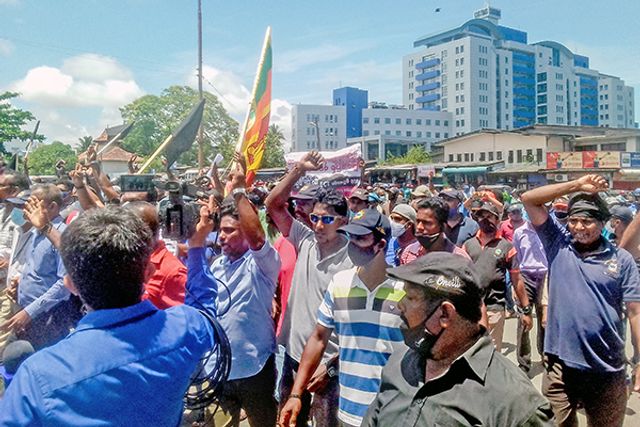
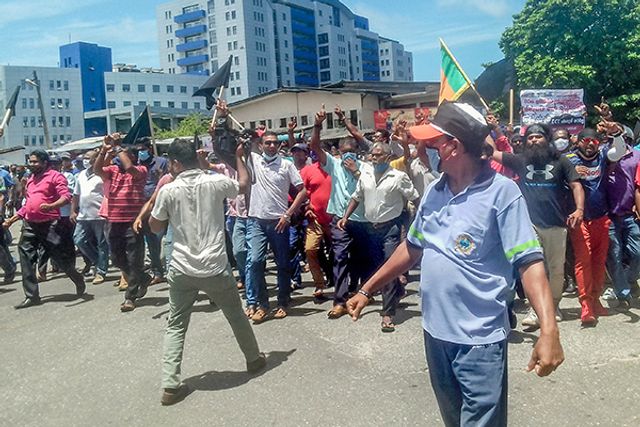
Sri Lanka’s government was pushed into crisis by a series of protests by Colombo Port workers last month against plans to privatise the port’s Eastern Container Terminal and hand it over to an Indian company. During the workers’ actions, Prime Minister Mahinda Rajapakse admitted that the US and India want to transfer the terminal to India’s Adani Ports and Special Economic Zone Limited.
Speaking at a port workers’ protest on July 24, Udeni Kaluthantri, the secretary of Jathika Sevaka Sangamaya, which is affiliated to the right-wing United National Party (UNP), revealed that when the union leaders met with Prime Minister Rajapakse at his ancestral home, he told them: [W]e can allow you to unload the gantry cranes, but can’t let the operations start [at the terminal]. I had to go home once, because I got hammered by the US and India. I won’t make the same mistake again.”
Rajapakse was referring to a demand by the unions to fit two gantry cranes at the terminal and start operating it under the government’s Ports Authority, without privatisation.
Workers protest against privatisation of Colombo port terminal
Kaluthantri added: During the last regime, the then Prime Minister Ranil Wickremesinghe told me, that you have a right to protest, but don’t protest against [the terminal] privatisation. That will offend India. We cannot protect our government if India is offended.”
Rajapakse’s reference to being hammered” pointed to the Washington-orchestrated regime-change operation in 2015, which ousted him as president and brought Maithripala Sirisena to power. New Delhi supported the political operation.
Washington backed Rajapakse’s brutal war against the separatist Liberation Tigers of Tamil Eelam and his anti-democratic rule, but was hostile to his growing relations with Beijing. The US wanted to integrate Sri Lanka into its military encirclement of China and make India a frontline state in its confrontation with Beijing.
After taking power, Sirisena appointed Wickremesinghe as prime minister. They initially halted all Chinese projects and began integrating the military, particularly the navy, with the US Indo-Pacific Command. They conducted joint exercises and sought to develop the island into a logistics hub. India also enhanced its military and political relations with Sri Lanka.
The cash-strapped Sirisena-Wickremesinghe government later turned to Beijing for loans and allowed the resumption of Chinese projects, but continued the military integration with the US and India. That explains Wickremesinghe’s statement to the UNP union leader about not being able to offend India.
The comments of both Rajapakse and Wickremesinghe demonstrate the subservience of Sri Lanka’s capitalist establishment to the interests of US imperialism, with which Indian Prime Minister Narendra Modi is aligned.
On July 24, the union leaders met with a representative of President Gotabhaya Rajapakse requesting his assurance that the terminal would not be privatised. He refused to issue any such guarantee.
Terrified that workers’ anger over the privatisation would spiral out of their control, the union bureaucrats initiated an impotent Sathyagraha” (sit-down protest) from July 29, again demanding a written promise” from the president that [the terminal] will not be privatised.” Some of the unions also tried to divert workers’ opposition into a nationalist anti-Indian campaign.
Anti-privatisation protest in Colombo
However, 10,000 workers began a strike on July 31, blocking all roads into and inside the port, completely paralysing it.
President Rajapakse not only refused to talk to the unions but attacked the workers’ struggle as an extremist act of sabotage,” declaring: I cannot be intimidated [by such actions].”
Facing this threat, the union leaders met with the prime minister at his residence again to obtain another empty pledge not to proceed with the agreement with India. Mahinda Rajapakse gave a promise,” but only to prevent the strike continuing, just five days before the August 5 national election. The union leaders immediately called off the stoppage.
The government, as well as the unions, feared the strike would attract the support of other sections of workers also angered by decades of attacks on social and democratic rights.
Behind President Rajapakse’s threat and the manoeuvres by his brother the prime minister lies the pressure of India and the US, which want to gain control over the strategic Colombo port. The president and prime minister, well aware they are treading on a geostrategic minefield, do not want to annoy Washington and New Delhi.
Mahinda Rajapakse’s previous regime allowed China Merchant Port Holdings (CMPH) to build and operate the Colombo South harbour in 2012. The Chinese company also constructed the Hambantota harbour and, a few kilometres away, the Mattala airport. In 2016, the Sirisena-Wickremesinghe government leased the entire Hambantota port to CMPH. The US and India expressed their concerns and accused China of creating a debt trap” to secure the port.
The Indian company’s bid for the terminal is not merely to extract profit from it. It is a move to strengthen India’s grip over the key port—another step in Washington’s economic and military offensive against China, which began under the Obama administration’s pivot to Asia.”
Amid the world capitalist crisis escalated by the COVID-19 pandemic, US President Donald Trump has intensified the provocations against China. The US has formed the Asia-Pacific quadrilateral (Quad) alliance with Japan, India and Australia, against China. It also backed India in the deadly border clashes that flared in the Himalayan region between China and India in July.
The Colombo Port workers’ struggle has demonstrated that the US and India want Sri Lanka tied to their strategic and military moves against nuclear-armed China, raising the danger of a catastrophic war in which the island would become embroiled.
With untouched golden beaches to discover, atmospheric train rides through tea-carpeted hills, and ancient temples to admire, Sri Lanka is Lonely Planet’s top country to travel to in 2019. Here are 12 more reasons to visit.
Jayanath Colombage headed the Sri Lanka Navy between 2012 and 2014, and since November last year, he has been the foreign affairs advisor to President Rajapaksa.
The Sri Lankan government on Friday appointed ex-commander of the Navy Admiral Jayanath Colombage as the new Foreign Secretary, days after the new Cabinet took the oath with President Gotabaya Rajapaksa retaining the key defence ministry.
Mr. Colombage, 62, replaces Ravinatha Aryasinha, a career foreign service officer. He headed the Sri Lanka Navy between 2012 and 2014, and since November last year, he has been the foreign affairs advisor to President Rajapaksa.
This is the first time that a non-foreign service person has been appointed as the Secretary to the Foreign Ministry.
President Gotabaya administered the oath of office to the 28-member Cabinet which is two less than the 30 allowed by the Constitution on Wednesday. He retained the Ministry of Defence while his elder brother and Prime Minister Mahinda Rajapaksa were assigned finance, urban development and Buddhist affairs ministries.
Mr. Colombage served the Sri Lanka Navy for 36 years and retired as the Commander of the Navy in 2014. Under the repatriation programme initiated by him, nearly 19,000 stranded Sri Lankans were repatriated from 94 countries.
Meanwhile, Sri Lanka’s oldest political party, the United National Party (UNP) which suffered a humiliating defeat in the parliamentary election has put the issue of appointing a new leader in limbo despite expectations that former prime minister Ranil Wickremesinghe would step down.
A party statement has said that it will appoint a young leader from among those who have been identified or would voluntarily come forward to take over the leadership.
Mr. Wickremesinghe, who led the party since 1994 and has been blamed for a string of electoral defeat, is hanging on to the leadership.
The UNP, for many years the main opposition party, was reduced to just 2% of the national vote in the election. It did not win a single seat from each of the 22 electoral districts and Mr. Wickremesinghe too was ousted from parliament for the first time since 1977.
His former deputy Sajith Premadasa’s new party won 54 seats with the help of its Tamil and Muslim minority allies and now sit as the main opposition party. Mr. Premadasa broke away after he lost the November presidential election to President Rajapaksa.
A Gazette revealing 196 new members of the Parliament who have been elected at the Parliamentary Election held on August 5 is out. We have to wait to know the names of the rest of the parliamentarians until respective parties announce their national list members.
Election results show a new trend in Tamil politics in Sri Lanka. The so-called Sri Lankan Tamil parties contested only in two provinces, Northern and Eastern that they claimed as their ‘traditional homeland’. What do the Election results signify? How should we read them?
Results of the Northern and Eastern Provinces
Although Sri Lanka is divided into 25 administrative districts, when it comes to the Elections it has only 22 electoral districts. Just have a look at the relevant 4 districts, Jaffna, the Vanni, Trincomalee and Batticaloa.
On the basis of these results, Tamil National Alliance (ITAK) is entitled to get 10 seats including one on the national list.
Most notable result is that the TNA stalwart Mavai Senathirajah failed to win in Jaffna District. And more interestingly, it lost its traditional position as D B S Jeyraj noted ‘the accredited premier political
configuration of the Northern and Eastern province Tamils’. How do we read this electoral failure of the TNA? The TNA was closely associated with the Yahapalana Government between 2015- 2019 and the main factor that mobilised the support for the UNP-led front at the Presidential Elections in 2015 and 2019. TNA and its conciliatory policies were strongly questioned by C.V. Wigneswaran of the TMTK and Gajendrakumar Ponnambalam of the ACTC.
These two parties represented in the Election as a radical Tamil alternative to the TNA that has failed miserably to either win constitutional reforms on a federal framework or obtain from the Colombo Government an adequate package of welfare and social development to Tamil people. It appears that Tamils were tired of their rhetoric that they firmly reiterate that they stand for Tamil rights, to eliminate their grievances and to fulfil their aspirations.
Most interestingly, in the last five years, they equally defend wittingly or unwittingly economic policies based on the fundamentalist version of neoliberalism advocated and implemented by the Yahapalana regime. Hence, the people in the Northern and Eastern Provinces naturally shared the same disappointment and discontent as the people, especially poor people, in other districts about the policies of the last Government. Therefore, the Election results should not be read in isolation since island-wide economic downturn had affected people irrespective of their ethnicity or religion.
The disappointment and discontent with the TNA and its association with the UNP seem to have generated in the parliamentary sphere two new trends in Tamil politics breaking the TNA’s almost monopoly position in Tamil politics after the defeat of the LTTE.
The first trend that is represented by C. V. Wigneswaran and Gajendran Ponnambalam appears to stand for a separate state and eventually they will seek an internationally supervised referendum among the Tamils to decide if Tamils decide to stay in Sri Lanka or to leave it. They may also strive to drag the Sri Lankan Government to the International Criminal Court (ICC). In this respect they would closely work with the Tamil diaspora in Western countries. Moreover, they would try to pressurise the Indian Union Government by linking with radical groups in Tamil Nadu.
The most interesting developments in Tamil politics that was reflected in the Election results has been the emergence of a significant trend that is supposed to work with the Sri Lankan Government seeking economic development, employment and increased social welfare. This pro- Government section is represented by Douglas Devananda and Kulasingham Dileepan – Eelam People’s Democratic Party; Angajan Ramanathan – Sri Lanka Freedom Party; Sivanesathurai Chandrakanthan alias Pillayan- Tamil Makkal Viduthalai Puligal and Sadasivam Vyalendran – Sri Lanka Podujana Peramuna. Initially, we have this kind of Tamil politics had been very much isolated from the Tamil people.
It may be too early to come to a definite conclusion on the issue of strengthening of this conciliatory political tendency and what would be its future. One may attribute this development to policies of former president Maithripala Sirisena who adopted conciliatory policies especially on the issue of land by handing over Government occupied land back to the people although the issue has not yet been completely resolved. Similarly, his choice for the post of Northern Governor a Tamil speaking person might have facilitated the Government’s contact with the people. What would be the policies of the new Government towards Tamils and the social and economic developments of their traditional habitats may be crucial as far as the future of these three tendencies is concerned.
TNA spokesperson, M.A. Sumanthiran’s appeal to other Tamil representatives to work together for uniform Tamil cause may not work immediately as pro- Government tendency would try to strengthen their line of approach through compromise and consultation. So far, an extreme version of identity politics has dominated in the traditional habitats of Tamils with almost no positive results. The Election results of 2020 seem to have raised an issue if the economistic politics can take the lead over identity politics. It may be too early to answer this question as the outcome depends on multiple factors. (The writer is a retired teacher of political economy at the University of Peradeniya. E-mail: sumane_l@yahoo.com)
History is known to change constantly. And, history is written depending on the changes that tend to take place during certain periods. Even Karl Marx has written that history is made up of various struggles and fights that had taken place among various social classes.
Hence, Sri Lanka’s political history has also been written containing various setbacks and triumphs. The victory that was gained by the SLPP in 2020 has already created a significant mark in the local political sphere. The reason for that is, people booting out the country’s oldest political party from the Parliament and then voting into office with an overwhelming majority the SLPP which is only two years old.
How did this political turnaround take place which the people would not have anticipated? Some may even not know as to who was behind this remarkable political transformation of the SLPP. He is none other than former SLFP stalwart D.A. Rajapaksa’s youngest son, Basil Rohana Rajapaksa, hailing from the Rajapaksa political clan of Giruwappattuwa in the Southern Province.
Basil, it is said has never sought publicity for the work he had done. Hence, many are unaware of his talents. However, Basil Rajapaksa had played a pivotal role in the local political firmament since the 1970s. He is a very shrewd and knowledgeable political strategist. He is also a workaholic. Basil had always stood behind the oppressed masses during his political career. Basil also has taken up challenges whenever they had been entrusted to him and had never shirked responsibility placed on his shoulders. He is also a dedicated servant and strives to fulfil whatever task entrusted to him 100 per cent.
D.A. Rajapaksa and Dandina Samarasinha Dissanayaka were blessed with nine children. They are Chamal, Jayanthi, Mahinda, Chandra, Dudley, Gotabaya, Basil, Preethi and Gandhini. Of the boys, the youngest is Basil and there was a noticeable feature in him. That feature was he had performed his duties to the letter and he was also known to complete his work right on time. As he grew older, Basil was able to sustain these traits. Even the rest of his family members were also aware of these gifts of Basil.
Staging an annual alms-giving event at the Medamulana ancestral home was a tradition. Even from his young days Basil was in charge of organising the alms-giving ceremony. His sister Preethi had even once remarked what great pains had been taken by Basil in carrying out the organisational work of this religious event annually at their ancestral house. Also, Basil had maintained documents regarding the harvest gained from the coconut trees at their Medamunlana house in those days.
For most of the remarkable political feats that took place in this country in the recent past what paved the way for it was Basil Rajapaksa’s skill at organisational work. He first broke into local party politics through the 1977 General Election. In that Poll where the UNP obtained a 5/6 majority Basil who contested the Mulkirigala seat was defeated. Basil was also the youngest politician that had contested the 1977 Poll. The SLFP was only able to get eight MPs elected at that election.
Providing political impetus
Minister of Mahaweli Development Gamini Dissanayaka who was part of the 1977 UNP regime of J.R. Jayewardene was a friend of Basil. Gamini had known about the talents of Basil. Basil had also worked for a period, attached to the said Ministry. During this period Basil had organised most of the internal activities at all elections when his elder brother Mahinda contested the Beliatta seat from the SLFP ticket. In 1989 as well as in 1994 when the SLFP regained political power, Basil was busy providing the political impetus to his elder sibling Mahinda’s political journey.
Several people have aired their views regarding the dual citizenship of Basil. Especially concerning his US citizenship. After his spouse Pushpa Rajapaksa had won the US Green Card lottery in 1997, his family members left to reside in the US. The 2005 Presidential Poll was decisive not only to Mahinda, but to Basil as well.
As at the time Basil was not a livewire of the SLFP, he was asked to provide the political boost to Mahinda from outside the party. The main issue was getting the Presidential nomination. In order to get the nomination for the Poll from the UPFA ticket, Basil fought for Mahinda’s seniority.
Basil was also the behind-the-scene collaborator in bringing the PM post to Mahinda Rajapaksa in the 2004 Chandrika Bandaranaike regime. An issue that emerged before the election was whether the Presidential Poll should be staged in either 2005 or 2006. At this time, Chandrika attempted to hold the Poll in 2006.
The Poll that was due in 2005, Chandrika sought to delay it by 12 months. In order to thwart her moves, Basil filed a petition with the Supreme Court (SC). The SC deemed that the Presidential tenure of Chandrika would end in 2005. Hence, it paved the way for the conduct of the Presidential Poll as it was originally scheduled, in 2005.
Basil reviewed how people had voted at the 2004 General Election. He monitored how the people had voted in the LTTE controlled areas in the North-East. He noticed that on the polling day the casting of ballots had increased from 20 per cent to 85 per cent from 3 to 4 p.m. If Mahinda were to win the Poll the conducting of the polling in the LTTE held areas had to be stopped. Basil decided to seek an order from the Court to this effect.
Actually speaking, the LTTE did not boycott the 2005 Presidential Poll. If the Tamil people cast their ballots they had to head to areas under the control of the Government. Through that, casting of rogue votes was overcome. Through the tactic used by Basil, Mahinda Rajapaksa was able to win through a certain percentage of the vote. Though most of those close to Mahinda had expressed the fear that the latter would lose, Basil had known for a certainty that Mahinda would triumph in the end.
Though Mahinda Rajapaksa was sworn in as the President, the UPFA Government only had 105 seats in Parliament. If the UNP, JVP and TNA were to strike agreements there was the threat of the Government being toppled? Hence, Basil began talks with the JVP and the SLMC. Basil’s goal was to do the necessary work and prevent the new Government from collapsing. At this time, the UNP General Secretary had said that at the coming Sinhala New Year period a UNP regime would be installed.
Basil decides to enter House
An incident that most were aware at the time was Karu Jayasuriya talking with him 17 MPs and joining the Government. Karu left the UNP due to him being overlooked for the post of Deputy Leader. The Government which had only 105 seats was ultimately able to command two-thirds majority due to the groundwork laid by Basil.
Basil never had any intention of heading to Parliament. But, due to the constant requests made to him by his elder brother Mahinda, Basil decided to enter the House in 2007. However, he did not enter Parliament from the SLFP ticket but from the National Congress.
Basil was adept and adroit at noticing the political changes that were taking place at the time. He was also able to study the strategies of the Opposition and defeat them. At one time during a vote on the Budget President Mahinda was not in the country. The JVP had said they will vote against the Budget. Basil having been joined by Minister Fernandopulle began individual talks with all Government MPs. At the end he was able to get the JVP on board as well.
At the height of the war in the North, politicians in Tamil Nadu began to feel the pinch. They were forced to adopt whatever tactics in order to please their voters. The Tamil Nadu Chief Minister went on a death fast.
That had an impact on Sri Lanka. The Indian Envoy briefed the President’s Secretary Lalith Weeratunga, Defence Secretary Gotabaya Rajapaksa and Basil regarding the crisis situation faced by his country. He informed them that if Karunanidhi were to die it will impact India seriously. The Envoy suggested that Basil should meet the Indian Prime Minister as a special rep in order to bring about the crisis situation between the two countries to a close.
On the same night, based on advice from the President, Basil flew to New Delhi. Afterwards he signed an agreement with then Indian Foreign Minister Pranarb Mukherji, National Security Adviser M.K. Narayanan and Foreign Secretary Shiv Shankar Menon and pacified the situation. The Indian Government stated that they will never support terrorism.
During the war Sri Lanka also received support from China and several nations in Europe. All those Envoys coordinated with Basil. Having met UN Secretary General Ban Ki-moon at a decisive moment Basil managed to gain the trust of the UN official. The UN official assured Basil that he will never act to destabilise the Government of President Mahinda.
Basil’s intervention also went a long way towards getting the support of all nations in the UN Security Council towards Sri Lanka. During the latter stages of the war, Sri Lanka’s foreign reserves had declined rapidly. In order to increase those reserves, the help of the IMF had to be sought. But, the IMF had mooted several proposals to which the Government was unable to agree.
In order to hold talks on debt, Basil flew to Washington. He met top officials from the IMF and said, You have your own policies, and we have our own. If we could reach a pact then we should try to work together. If not Sri Lanka will be forced to look elsewhere.” Sri Lanka then sought aid from countries such as Libya and loans from China and Iran. IMF realised that suspending the foreign reserves would not impact Sri Lanka.
Supplying fuel to Jaffna
After the closure of the A-9 route, supplying fuel to Jaffna was an issue. The problem was entrusted to Basil. He then got hold of a report containing details of fuel stores in the Jaffna Peninsula. The fuel that was needed was then supplied through a ship with protection supplied from the Forces. The issues that had stumped the Security Forces personnel were resolved by Basil.
It was Basil who gave leadership to the programmes such as ‘Uthuru Wasanthaya’ and ‘Negenahira Udanaya’. He was able to complete the infrastructure development of the Northern and Eastern Provinces in less than a five-year period. The resettling of those displaced, the removal of landmines, the construction of large bridges were some of the work supervised by him. When he initiated the ‘Gama Neguma’ programme, some ridiculed the venture initially. But, Basil was able to redevelop scores of villages through his novel concept.
The UNF-led regime, when it was installed on 9 January 2015, proved to be decisive for Basil. Some who had contributed to the ousting of the Mahinda Rajapaksa Government began to level baseless criticism against Basil. They charged it was all Basil’s work. They even gave political connotations to a photo taken of Basil at the BIA, saying that after the defeat Basil had fled the country.
However, Basil knew who was behind the mudslinging campaign that had been orchestrated against him. He then decided to bide his time at his residence in California. He also saw how some of the frontline SLFP MPs were receiving ministerial posts from the new UNF Government. Several of those MPs had gone behind then President Maithripala Sirisena seeking such posts in the new regime.
Basil also knew well that the Maithri-Ranil marriage would be short-lived. The new Government, instead of working for the country and its people, began to go on a witch-hunt against those in the previous Rajapaksa regime. Most of the cases were filed against Basil by the FCID. Having been informed of the situation, Basil decided to return to the country.
After arriving home, Basil was forced to spend most of his time fighting a spate of legal cases that were filed against him. Each day was spent in courtroom. If there were any free days in between attending Courts in Hulftsdorp, Kaduwela or Pugoda, on such days he was summoned to the FCID.
Once, after being questioned by the CID throughout the day, he was taken to the Kaduwela Magistrate’s Court around 11 at night. Surprisingly, by the time he was taken there, the Magistrate was still present in Court, and even more surprisingly, a prison bus was already there, ready to take Basil to prison.
In the meantime, with the CBSL Treasury Bonds scams taking place in 2015, the anti-Government sentiments began to rise. Those UPFA MPs who had obtained posts from the new Government were forced to feel ashamed of their act as the new regime began to hound their political rivals most brazenly.
Joint Opposition
It was at this time that those opposed the views of the UPFA, began to function as the Joint Opposition (JO) in Parliament. They even sought the Opposition Leader post but then Speaker Karu Jayasuriya did not heed their request. At this time the real Opposition’s work was done in the House by the JO. At this time Basil had put in place plans for the defeat of the political rivals of the JO. He did this work during the time that he was imprisoned.
Another boost he received was the massive number of people who had converged at the Medamulana residence to welcome Mahinda upon his defeat at the Presidential Poll. Afterwards the ‘Mahinda Wind’ began to seep through country, having begun at Nugegoda.
In November four years ago, Basil decided to register the SLPP. He created a programme for the SLPP to encompass the 14,032 Grama Niladhari Divisions of the country. Basil also had the computer data at his disposal to know beforehand those who had expressed their allegiance to his party from every area here and those who were not so. He also saw how the political landscape began to change towards the SLPP. The future measures were initiated by him accordingly.
The LG Poll staged on 10 February two years ago was the maiden Poll contested by the SLPP. Fulfilling Basil’s aspirations, the SLPP received a total of 5,006,837 votes and obtained 3,436 seats at LG bodies from the Poll and became the country’s new political force.
It was through the shrewd political strategy implemented by Basil that Gotabaya Rajapaksa was able to triumph at last year’s Presidential Poll with 6.9 million votes. Basil is also equipped with a Digital APP that covers all electorates here politically. Therefore, he is able to predict how the people would vote at Polls as he has gathered data from 10 houses from each electorate.
We will certainly receive over 130 seats at the Poll. Our hope is that during the final stage of this election, the people will grant us over 150 seats. Some of the parties that support us will probably receive four or five seats. The TNA will win the Districts of Vanni, Batticaloa and Jaffna. From the total vote that is received by us our closest rival will not even receive half of it. I also would like if the JVP will also receive at least some seats.
This could be a controversial remark. Why I say this is when you look at the Opposition in the last Parliament, they were reduced to a bunch of jokers. Some even uttered foolish remarks. Some made jealous and hateful comments. I also would like to predict that one of the country’s oldest political parties would be reduced to the fourth place at this Poll.” The readers only need to look at the 5 August General Election results to decide for themselves as to the veracity of Basil’s prediction.
Basil Rajapaksa is no doubt at the forefront of the local political firmament as a master political strategist. He has proved his skill to all and sundry. Despite these achievements Basil continues to lead the life of an ordinary person with simple and a charming demeanour. Though he continues to engage in politics that is not his true love. He is a farmer at heart. A land in Hambantota that was bequeathed to him by his late father D.A. Rajapaksa is now being cultivated by him. Even when he resides in California, he derives much satisfaction through the growing of local vegetables. Basil Rajapaksa is a political heavyweight which this country is badly in need of presently.
State Minister of Provincial Councils and Local Government, retired rear admiral Sarath Weerasekara who assumed duties yesterday, pledged to remove all clauses — in the 13th Amendment to the Constitution — which are detrimental to the well-being of the nation.
We will not devolve police and land powers to the provincial councils,” he said while highlighting the fact that handing over the State Ministry of Provincial Councils and Local Government to him might have been a plan of destiny because he was one who vehemently opposed the 13th Amendment.
The state minister said the government would use its two-thirds majority in Parliament to remove all draconian laws in the Constitution and pledged to make every city in the country beautiful with cooperation of the local bodies.
I will also restore the Mulleriyawa lake which is of historical value because it is the location where the locals defeated the Portuguese,” he said.
Local Government and Provincial Councils Ministry Secretary J.J. Ratnasiri said ministry staff were ready to work to fulfill the government’s prosperity policy (Saubagayaye Dekma).
Defence Secretery retired major general Kamal Gunaratne, several high ranking army officers, clergy and several guests were present at the ministry to welcome the new state minister.
President Gotabaya Rajapaksa has decided to re-commence, without delay, the programme to provide employment opportunities to 150,000 persons that was halted due to the General Election, the President’s Media Division said.
The number of unemployed graduates to be recruited is 50,000. For the remaining 100,000 jobs, candidates will be selected from families of the lowest strata of income earners in the society.
The programme to employ 50,000 graduates and 100,000 low-income earners was formulated within weeks after President Rajapaksa assuming office in November last year.
Shortlisting suitable candidates from applications received from graduates commenced in the first week of February. A Multi-Purpose Development Task Force was established to recruit 100,000 low-income earners.
The objective of the programme is to transform Sri Lanka into a country free from poverty as per the Saubhagyaye Dekma” policy statement of the President, the PMD said.
Chairman of the Election Commission directed to suspend the program to offer jobs for 150,000 unemployed persons following the announcement of the General Election 2020. Accordingly, the programme was suspended.
Immediately after the conclusion of the General election on the 5th of August, President Rajapaksa took measures to establish the executive of the Government adhering to the provisions given in Chapter VIII of the Constitution.
The Prime Minister of the new government took oaths on Sunday, the 9th of August. The Secretary to the Prime Minister was appointed on the following day. A week after the election on August 12, both Cabinet ministers and state ministers were sworn in. Secretaries to the Ministries were appointed on the following day (August 13).
The inaugural parliamentary session will ceremonially commence on the next Thursday (20). Following the formal establishment of the administration, the President has decided to implement the programme of providing 150,000 employment opportunities without any delay.
The relevant list of graduates eligible for employment will be published on the official website of the Ministry of Public Services, Provincial Councils and Local Government on next Monday (17).
The respective Ministry will commence sending letters of appointment to those who got selected immediately. Appointed candidates should report to their nearest Divisional Secretariat on September 02.
The programme to provide employment to 100,000 poorest of the poor will be implemented by the Task Force established solely for this purpose from 02nd, September.
Attorney General Dappula De Livera today strongly denied media reports alleging that he has approved the Millennium Challenge Corporation (MCC) Compact agreement.
The Attorney General further informs that the matter is still under consideration, the AG’s Coordinating Officer Nishara Jayaratne said.
The Experts’ Committee appointed to review the proposed Millennium Challenge Corporation Compact (MCC) had handed over its final report to the government in June.
The report was subsequently made public while it urges the government to reject the agreement.
The MCC agreement is currently being reviewed by the Attorney General’s Department.
The Working Committee of the United National Party has decided to take another six months to elect a new leadership.
According to party sources, the UNP Working Committee met at the Sirikotha party headquarters this morning to discuss the party leadership and the post of National List MP for more than two hours.
The United National Party (UNP) suffered a crushing defeat in the August 5 general elections, after which Ranil Wickremesinghe, who had been the party’s leader for 26 years, decided to resign.
Accordingly, 8 names were proposed for the new party leadership.
Party General Secretary Akila Viraj Kariyawasam, Deputy Leader Ravi Karunanayake, National Organizer Navin Dissanayake, Party Treasurer Daya Gamage, Deputy General Secretary Ruwan Wijewardena, Vajira Abeywardena, Arjuna Ranatunga and Palitha Range Bandara have been nominated.
Also, former Speaker Karu Jayasuriya had stated yesterday that he was ready to take over the leadership of the party if requested.
UNP Deputy General Secretary Ruwan Wijewardena also issued a statement yesterday stating that a comprehensive reorganization program is essential to re-emerge as a political party.
However, at today’s UNP Working Committee meeting, former Speaker Karu Jayasuriya had a lengthy discussion regarding the appointment of the UNP leader.
Navin Dissanayake, the National Organizer of the party, speaking in favor of Karu Jayasuriya has stated that he is suitable for the party leadership.
Ranil Wickremesinghe has stated before the Working Committee that Karu Jayasuriya has informed him that he would be willing to take over the leadership of the party and accordingly, it could be considered as well.
However, Ravi Karunanayake has said, “There is no urgency about the leadership yet. We can make a decision in a little while.” Ranil Wickremesinghe responded, “I would like to hand over the leadership. therefore decide among yourself. ”
Speaking to the Working Committee, Vajira Abeywardena said, “As the election was lost, we will wait for a while to make a decision about the leadership and we will talk about it later. ”
However, many in the Working Committee are of the view that a young person should be appointed for future leadership.
Accordingly, the Working Committee has agreed to delegate responsibilities to those currently nominated for the leadership of the party and to select the future leadership based on their performance.
They will be given six months to do so and Ranil Wickremesinghe will continue to lead the party for the next six months.
Also, the National List seat won by the United National Party was discussed at the Working Committee meeting today.
However, no agreement has been reached on that either.
Meanwhile, the time given to political parties that have won National List seats to nominate names is due to end today.
Police Media Spokesman SSP Jaliya Senaratne stated that over Rs. 220 million has been transferred through the bank accounts of persons involved in drug trafficking in the last two weeks alone.
He was speaking at a media briefing held at the Police Headquarters today.
Also, a woman has been arrested for circulating over Rs. 310 million earned from drug trafficking in five accounts in two banks during the past three years.
It has been revealed that the suspect arrested today in Mt. Lavinia is the sister of a drug trafficker who is in jail.
At the time of her arrest nearly Rs. 3 million was found in her bank accounts.
Meanwhile, Police Media Spokesman SSP Jaliya Senaratne stated that the fingerprints and photographs of the Angoda Lokka, an organized criminal who was allegedly murdered in India, have already been sent to India.