Sri
Lanka has been confronting critical issues in constitutional reforms since
independence, and many issues were underwater until 1970, in spite of receiving
a dominion status in 1947 with a written constitution, constitutional reforms
seemed to be a demand of academic and students. The constitutional reforms had been limited by
the lack of parliament power (a two-third majority), and the election in 1970
gave the essential power in the parliament to a coalition government with SLFP,
LSSP, and CP then began constitutional reforms. Although the ruling party
gained a two-third majority in the parliament, a large volume of people
represented the opposition with supports for constitutional reforms or without
support for reforms. Constitutional reforms have contributed to political talk
shows of loquacious people, and neglect the public demand for government
intervention in policy-making for economic prosperity with the balanced growth
process.
A
large sum of funds spent on constitutional reforms and economically Sri Lanka
gained nothing from the constitutional reform process than creating political
differences and racial hates. The plurality of the population had no
understanding or interest in constitutional matters and the contents of various
clauses of the constitution are not apprehended by the public as they are
related to legal matters.
The
concept of constitutional reforms has created internal conflicts, armed struggles,
and hate within a small volume of population.
Now many people say constitutions reforms relate to personal matters or
family matters than the requirement of the country. After the general election held in 2020,
constitutional reforms have come again to doorsteps of people, and the new
minister appointed for justice affairs has publicly expressed that cabinet
papers are ready to dismiss the 19th amendment to the constitution replaced
by the 20th amendment. As the amendment has not published, nobody
knows what are contents in the amendment. The major question is, could the
proposed constitutional reforms be united the divided community and if so how
could be done it.
In
addition to the basic idea, some people clamor to cancel the 13th
amendment that created the provincial councils with a view to satisfying the
Tamil community as the government at that time wrongfully believed that the
creation of provincial councils would be an effective solution or a viable
alternative to eradicate racial hates, and the war had been in the country
between the government forces and LTTE terrorists mainly focused on creating a
separated state in the North and East or a creating a combined provincial
council with numerous power. Practical results reflect that the Tamil community
has divided with the result of creating provincial councils than they were
under a unitary structure of the constitution. Ordinary Tamil people in North
and East gained nothing from constitutional reforms in the 13th
amendment, but few leaders may have gained for job opportunities.
Tamil
leaders expected more power to provincial councils such as the power to
combining councils and others when enacted the 13th amendment, the
police power and land powers to councils were not given, and many others such
as the power to borrowing from overseas and to maintain the relationships with
overseas countries reflecting a federal status or beyond the federal framework
ignored as it was a creating a separate state. Mr.J.R.Jayawardane, the
president of Sri Lanka at that time refused additional demands and agreed only
to the delegation of central government power that considered appropriate to
provincial councils for economic, social, and cultural developments in the area
with strict supervision of the central government. A concrete argument of
Mr.J.R.Jayawardane was Sri Lanka as one country should allow North and East to
accommodate for people in the Western and Southern provinces when population
explosion experience in these provinces.
If additional power is given to provincial councils it would be creating
problems in the country. The Indian
advisors also viewed that allowing more political power to the provincial
council could be a threat to India because LTTE terrorists intended to recreate
the Vijayanagar Empire with a part of India and other Asian countries.
The
reality of the 13th amendment was economically disadvantaged to the
country because a large sum of government funds absorbed into unproductive
provincial councils administration and economically provincial council administration
created fiscal problems, inflation, and many problems to the monetary policy of
the central bank. When compared to ideological gains received by the North and
East people they cannot equalize the economic gains received by the country.
The purpose of creating the provincial council was to helping economic
decisions to improve the life of poor people in North and East as well as
people in other areas of the country.
The experience is more than 30 years in the past indicates that
provincial councils are a whited sepulcher.
If provincial councils dismissed the government can save a large sum of
money and use them for the development purposes of the provinces. However, it
may be a problem not only for people in the North and East but also to people in
other areas too.
The
13th amendment has not supported to procreate economic federalism
despite the support to maintain a unitary system in political
administration. Economic federalism
radically supports economic decision making at the provincial level and supports
for balanced growth in the country. Since Donomore ameliorates economic
decision-making at the provincial level was neglecting while the balanced
growth has been gone to a unitary system that means economic decision-making
and planning have gone to government bureaucrats, who are in the Colombo city.
Top to bottom budgeting has been the priority Sri Lanka has become an economy
depending on foreign debt, importing all items that could be produced in the
country but the colonial government wanted a centralized system to control the
country using bureaucracy. Several
members of the state council (Mr.D.S. Senanayake, Mr.C.W.W Kannangara) wanted
economic federalism giving justice to regional Sri Lanka. People in Sri Lanka want economic federalism
that supports for economic planning and decision-making in regional. To provide water to rural farmers, open
schools to educate rural kids, provide language skills (English) to rural
people, and the ability to convert the current depending economy to a
production economy. The economy cannot manage properly giving benefits to
regional Sri Lanka by a unitary system that makes decisions from Colombo.
Under
the reign of Kings and Queens, Sri Lanka had strong economic federalism and a
unitary system in political administration. The economic federalism supported
King Parakramabahu the great to export rice and the unitary system in political
administration supported King Gajabu to invade India and bring back Sinhala
people and additional South Indians and settle near the seaside area. Therefore,
constitutional reforms in the country should be supporting task that
strengthens economic federalism and political unitary system to keep Sri Lanka
as a strong country.
Some
people express that the protection of peoples’ sovereignty is a major
expectation of constitutional reforms and for this purpose, appointing members
from the national list and bonus MPs should be dismissed and the number of
members to parliament limits to 100. The election system should be maintained
based on electorates and not proportional representation. After the election in
2020, there are complaints that some electorates have no members. The president
and representatives to legislature must be elected by votes of people.
The
19th amendment degraded the concept of people’s sovereignty helping to appoint representatives
from a national list, who cannot obtain required supports from people. If
people want to elect professionals to parliament it would be an issue because
many professionals in various fields don’t like to engage in politics.
I have a dream! That one day, ministers will be chosen for their character and not for their family.
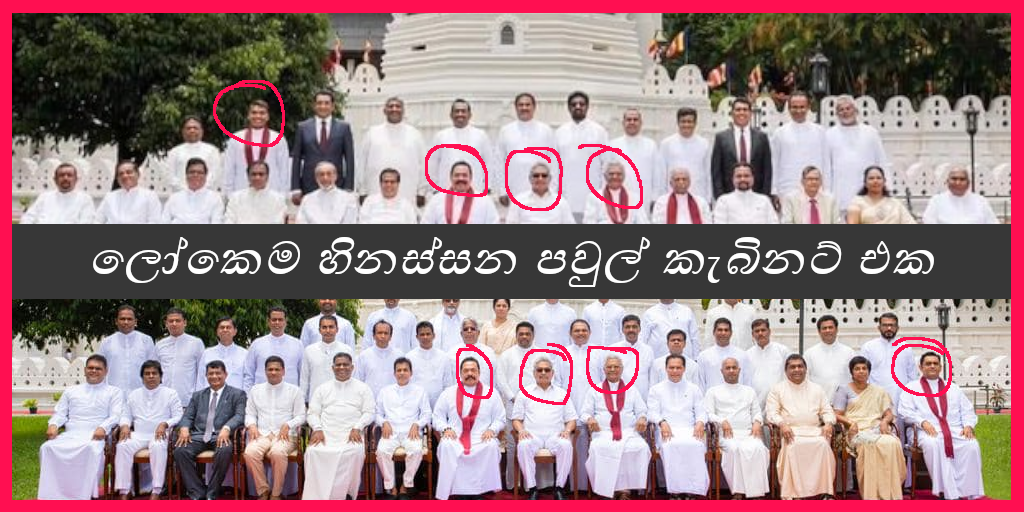
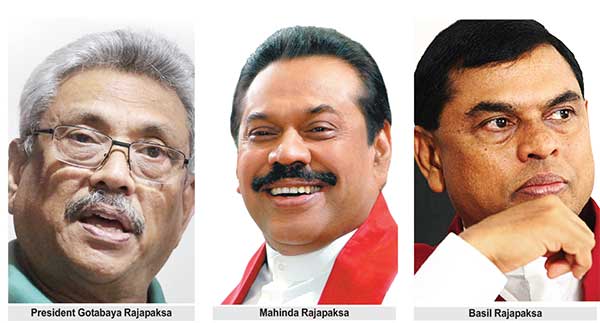
The scale and extent to which Sri Lanka has been captured by family-rule under the Rajapaksas is unprecedented. No country in the world sees such a depth and breadth of family members simultaneously occupying positions of power at every level of government.
Dynastic politics is common in South Asia. But the situation in Sri Lanka is orders of magnitude worse. Not only has there once again been brazen capture of the state apparatus by various clan-members, but the speed with which this happened, merely days after the election results, is both stunning and sickening.
This kind of clan-rule has happened in undeveloped African countries, but usually it has involved father-son dynamics only. Nowhere else in history have we seen father, uncle, son, another uncle, and nephew in cabinet together; not to mention both senior and junior minister posts being awarded to some of the same individuals.
The question that needs to be asked is,
Why doesn’t this happen in other countries?
The answer is simple,
It always fails.
In the span of human history, it is likely that other people have believed they and their blood line alone were the only ones fit to rule a nation. That is the nature of some megalomaniac rulers. And it is probable that throughout history, nations would have been captured by one particular family.
But why don’t we have any examples to refer to?
Because the nations which permitted this, or which were powerless to stop this, do not exist. They have been destroyed, or conquered, long forgotten, erased from human knowledge.
Ugly Wonder of the World
There is no contemporary country around the world where we have a similar situation as Sri Lanka is faced with.
Look at the pariah states — Iran, North Korea, Venezuela, Syria, Cuba — not a single one sees a family cabinet ruling it.
Fine, Fidel Castro’s younger brother took over… but that’s the point. He took over, when Fidel stepped aside. He didn’t co-rule.
The Kim clan of North Korea rule in a hereditary manner, but only after the older person dies.
Let’s look at some respectable countries such as Japan, South Korea, France, Canada or Australia. Can you, off the top of your head, right now, tell me how many brothers or sisters the present leaders of each of those countries has?
Can you name Shinzo Abe of Japan’s children? Do you even know if he has any children? How many cousins does Justin Trudeau of Canada have? Do the numbers come to mind, right now? Can you name them? Without checking Wikipedia or searching online?
No. You cannot. Because those leaders don’t bring their entire family into the cabinet, or even give them prominent roles.
I was recently surprized to hear that Donald Trump, braggadocious even by American standards, had a younger brother! I read widely, but had no idea he had one. This is how it should be. And Trump, as a political outsider without backers, and surrounded by political enemies even within the Republican party, did not bring a single one of his children into the cabinet or give them a ministry to run. Why is that? Common decency, that’s why.
But why is it that Sri Lanka, a country honorably ruled by great Kings, and shaped by thousands of years of Buddhism which emphasizes compassion, has to be compared with the worst states of the present age? We are a democracy, the second oldest in Asia, and have many fine and talented citizens, who excel and become prosperous when they move abroad. But apparently, only one family deserves all offices of state.
And yet we are forced to plumb the depths of the global cesspit to even try and find a similar family-ruled country, and still, we come up empty-handed.
So Sri Lanka has become unique — an ugly wonder of the world.
Gotabaya’s Betrayal
During the war years from 2005-2009, most of Mahinda’s excesses and his close affiliation with gangsters such as Mervyn Silva (have we forgotten the attack on Rupavahini, and how he tied up an official to a tree, and how that victim was so scared to say what happened, that he said he had tied himself by accident?!) because there was a war to be fought. We ignored his jumbo cabinet and his purchasing of parliamentary votes through the dishing out of invented ministries, because there was a war to be fought.
And then the war was won. In 2011, Mahinda obtained a 2/3 majority in parliament in conjunction with Muslim parties. But nothing changed.
He had the chance to fix this country. He could have dismantled the 13A, a single action which would have solved multiple problems. It would have stopped the possibility of separatism, it would have removed the complication of transferring land and police powers, but most of all, repealing 13A would have reduced suffering: all those who have been beaten, bullied, and killed, tormented by the violent Provincial Council campaigns.
But no, Mahinda had other priorities. So he used his 2/3 majority to remove term limits on himself. And rather than strengthen democratic governance by appointing patriotic independent commissions, he took the power to appoint these committees for himself.
Mahinda has forgotten now, but it was due to the lawlessness, the corruption, and the day-to-day thuggery that ordinary Sri Lankans of every class suffered from 2011-2014, that he was rejected by the people on his 3rd election. The alternative was not the most appealing or well known person, and the association with Ranil made it a difficult decision, but in the end the Sinhalese decided that enough was enough, and booted him out.
Then in 2015, despite many realizing that yahapalanaya” was not what it was advertised as, and that a lot of the charges laid against the Rajapaksa regime were false, people still voted for a UNP government, even knowing that this would make Ranil the prime minister, again because they did not want a return to the Mahinda-domination of just a few months prior.
We have worked hard on these pages and on the earlier iteration (see footnotes), to fight against the lies, and treachery of the Sirisena-Wickremesinghe government, for five long years. We were appalled to see Mahinda and the Rajapaksa family — which despite all their many, many faults, still did rescue the country from terrorism and stood up to massive foreign pressure — being dragged through the mud, harangued, and vilified, not by some foreign occupier, but by our own lawyers, judges and prosecutors.
What is wrong is wrong. And locking up Namal and Wimal was wrong. Bringing war crimes charges against Gotabaya was wrong. Arresting Mahinda’s secretaries was wrong.
As 2019 approached, we needed a new leader to rally around, one who was patriotic and who would develop the nation, instead of dividing it and selling it. There were a few choices, but clearly Gotabaya, with his track record of efficient improvements to Colombo, was a good choice for president.
In manner, style, and speech, Gotabaya was different to the typical Rajapaksa. That is why he won the presidency. And during the recent general election campaign, the SLPP was able to get 2/3 purely because of Gotabaya. If you watch any of the media reports, you can see that he was at the forefront of the campaign, and he was the one who got the most air-time. The message was clear, and spoken by Gotabaya himself: vote SLPP, give me 2/3, so that I can fix the constitution and develop the country.
The people believed Gotabaya. The people trusted Gotabaya. They voted for Gotabaya to run the country in a different manner and style, with a focus on quality over quantity.
And then the cabinet was unveiled.
Back to the Future
It was a coup.
Not Mahinda against Gotabaya, no. It was a coup of the Rajapaksas against the people of Sri Lanka.
Gotabaya hoovered up the votes of everybody by promising Singapore style efficient governance — not just from the Sinhala Buddhists, but even from some Tamils and Muslims who’d finally had enough of poverty and extremism, and even from UNP bastions of Colombo and Kandy — and placed them all in Mahinda’s lap.
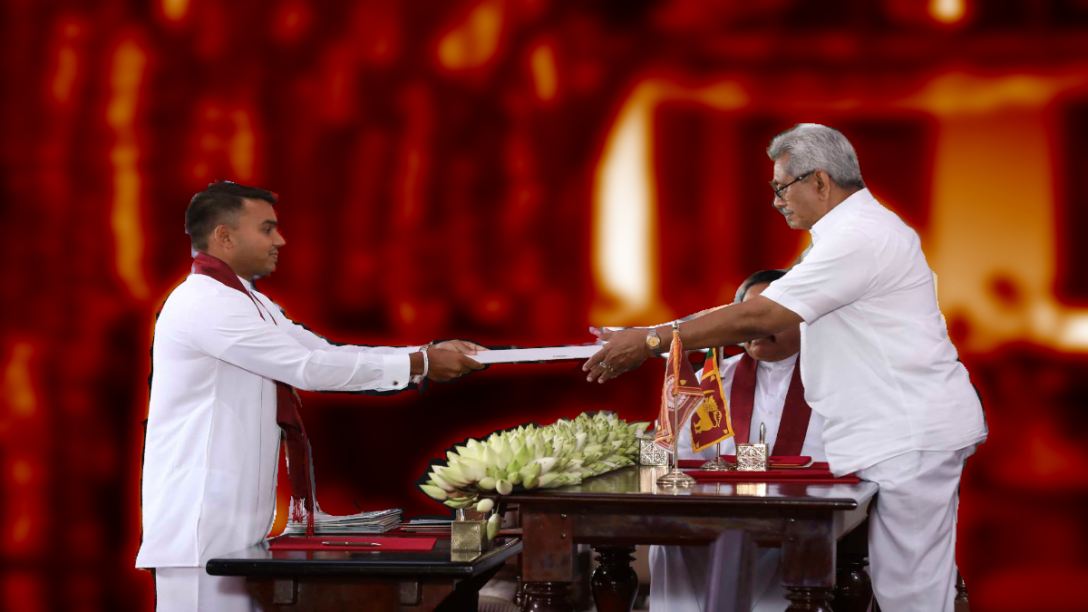
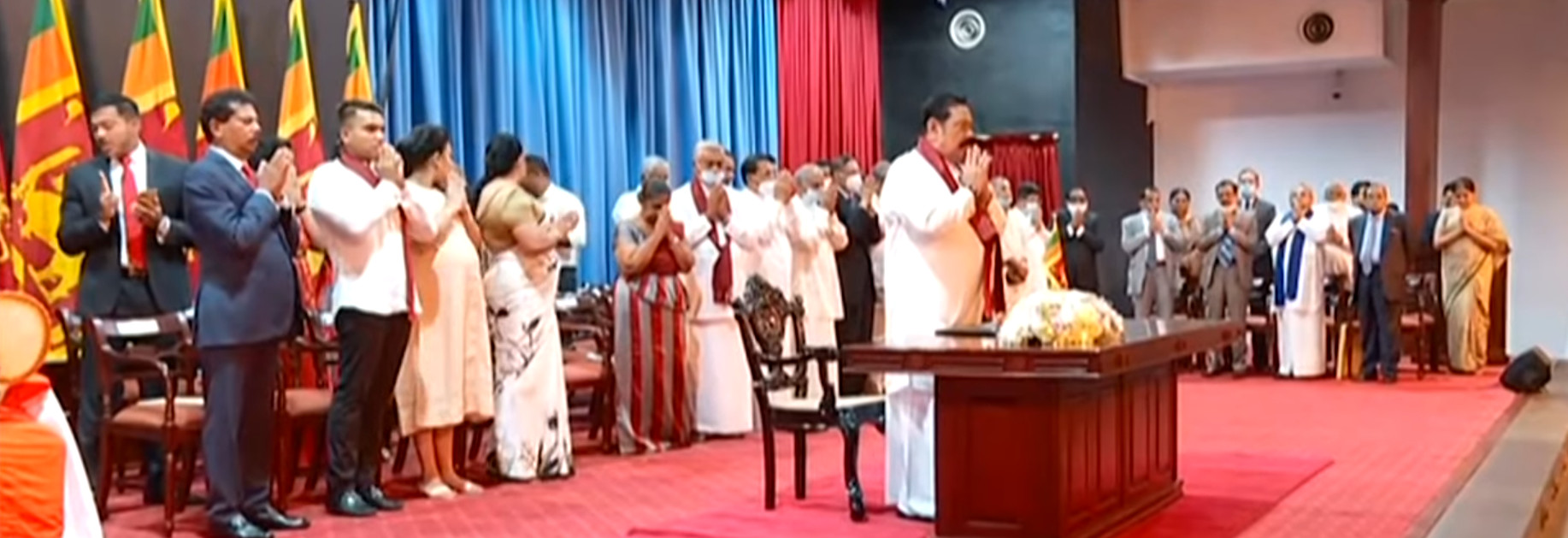
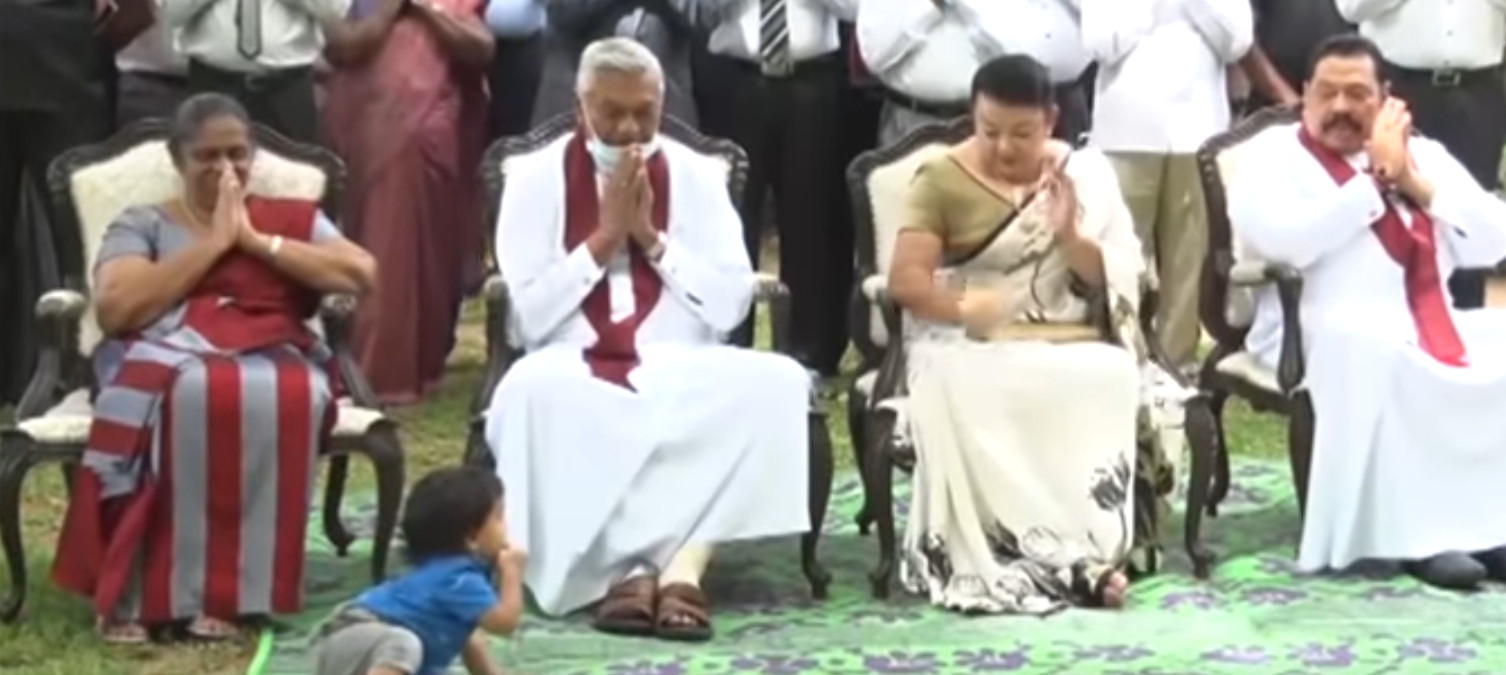
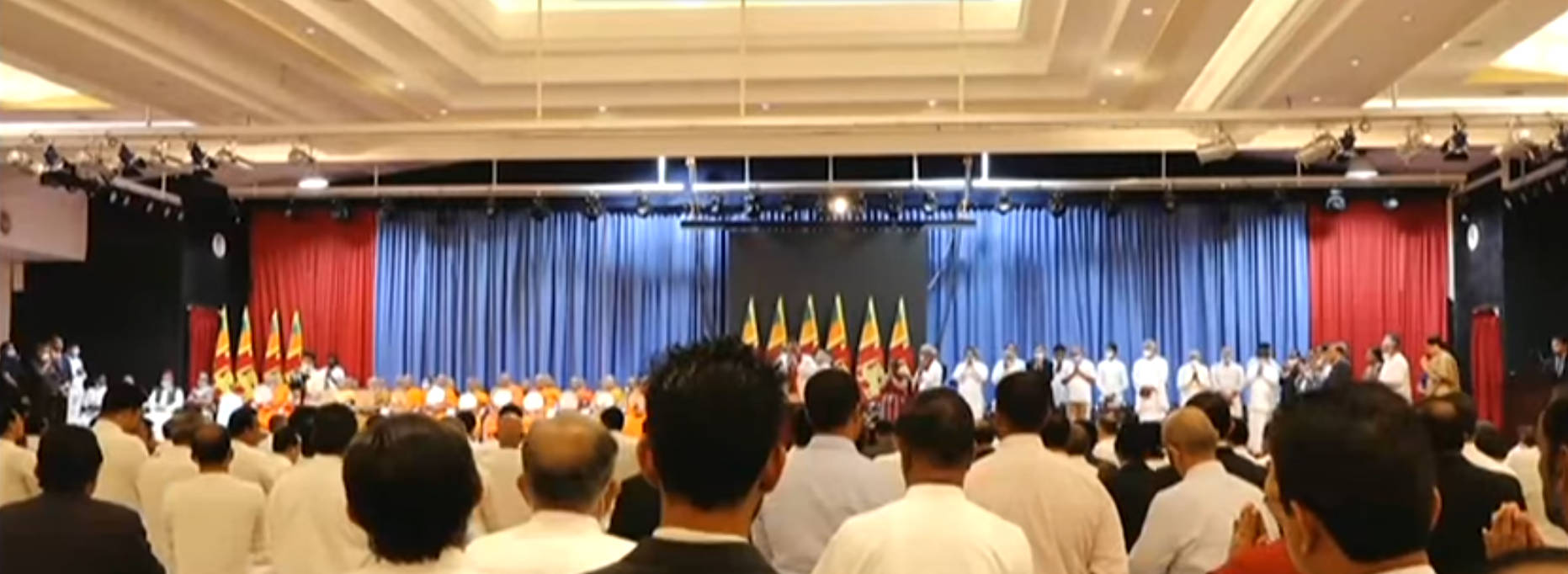
The first sign of the trouble ahead was the swearing in of Mahinda. Rather than use a historic and humble setting, as has been the tradition until now, the government went for full theatrics. Mahinda’s inauguration as prime minister for the 4th time was nothing less than a coronation of a king.
The country is in serious peril on the economic front, but there was not a hint of the seriousness and gravity of the situation. In true show-man Mahinda fashion, the whole event was a celebration, an Ancient Rome style triumph, a carnival in honor of this man and every member of his family.
It doesnt’t seem to have registered that in reality he was just another MP, that he is not monarch for life but elected for just 5 years.
Out went the promised scientific method, and in came the same old Mahinda method. No, the determinant for a cabinet ministry was not suitability, skill set, or vision. Instead cabinet posts and ministries were handed out like candies, rewards for loyalty.
And don’t even get me started on the use of Sri Dalada Maligawa as the venue for the cabinet inauguration — someone please tell Mahinda, and Gotabaya, that they aren’t kings.
The 19A limits the cabinet to 30 ministers, but that doesn’t mean all 30 slots had to be filled! But we got this absurdity:
a minister for Power, and a minister for Energy;
a minister for Trade, and a minister for Industries, and a minister for Labour, and a minister for Plantations;
a minister for Transport, and a minister for Highways, and a minister for Ports;
a minister for Agriculture, and a minister for Irrigation, and a minister for Water Supply, and a minister for Fisheries;
a minister for Environment, and a minister for Wildlife;
a minister for Urban Development, and a minister for Land;
6 ministers could do the job of the 17 fake ministries listed above. A cabinet of 10 was more than enough.
Next, there is no limit for the number of State ministers, so we got this farce:
a state minister for internal security and disasters, and a state minister for prisons;
a state minister for foreign employment, and a state minister for skills development;
a state minister for batik, and a state minister for national heritage;
a state minister for cooperatives and market development, and a state minister for home economy, and a state minister for natural product export, and a state minister for regional cooperation;
a state minister for cane and clay, and a state minister for ornamental fish, and a state minister for livestock and eggs, and state minister for paddy and cereals and organic food and vegetables and fruits and chilies and onions and potatoes and seed production and high tech agriculture, and a state minister for sugarcane and maize and cashew and pepper and cinnamon and bulath;
a state minister for road facilities, and a state minister for port facilities, and a state minister for aviation services, and a state minister for vehicle registration;
a state minister for land management, and a state minister for paddy field irrigation, and a state minister for rural water supply, and a state minister for rural infrastructure, and a state minister for canals, and a state minister for rural construction, and a state minister for fertilizers and pesticides;
a state minister for tea estates, and a state minister for estate housing;
a state minister for indigenous medicine, and a state minister for pharmaceuticals;
a state minister for wildlife protection
So that’s 30 state ministers doing the job of 9 state ministers. And the 10th one on the list, wildlife protection, could easily be part of the wildlife” cabinet ministry above. Simply put, there are 22 superfluous state ministries, with all their attendant perks, vehicles, staff, and expenses. And God knows how many thugs and crooks will be employed at each of these ministries, at taxpayer expense.
Now let’s look at how many ministries the Rajapaksas have awarded themselves:
Gotabaya – ministry of defense (I am not specifically against this, if legal)
Mahinda – ministry of finance, and urban development, and Buddha Sasana and Culture
Chamal – ministry of irrigation, and state ministry of internal security
Namal – ministry of sports
Shasheendra – state ministry of paddy and cereals and organic food and vegetables and fruits and chilies and onions and potatoes and seed production and high tech agriculture
So that is 8 out of 67 ministries. Five immediate members of the same family occupy 12% of all cabinet positions. How many salaries are they getting from the taxpayer? This is unprecedented — whether you are comparing with democracies or dictatorships.
Will the clause of the 19A barring dual-citizens from holding office also be scrapped, so that Basil can be brought into the government again?
Mind you, these are merely the open” Rajapaksas, there may be some other hidden” relatives with different names in the cabinet, and this does not account for those family members who work within ministries, state companies, regulatory bodies, or within the diplomatic service.
Jumbo cabinet is back, this time with a minister for bulath.
Wrong is Wrong
Men? Men are weak… It is because of men the Ring survives. I was there. I was there 3000 years ago… when Isildur took the Ring. I was there the day the strength of men failed. I led Isildur into the heart of Mount Doom, where the Ring was forged, the one place it could be destroyed! It should have ended that day, but evil was allowed to endure. Isildur kept the Ring.”
Lord Elrond speaks to Gandalf at Rivendell — The Lord of the Rings: The Fellowship of the Ring
Looking at what is going in front of us right now, I cannot help but feel like Elrond, the leader of the Elves, from The Lord of the Rings novels. He recounts how, when there was a chance to destroy evil forever, the man who should have done it faltered, was seduced by power, and thought he could use it to strengthen his blood line. In the end it destroyed his family.
Sri Lanka too is at a crucial moment in its history. The wretched citizens, with nowhere to turn, placed their hopes in Gotabaya — so desperate were they to lift themselves out of the abject poverty they find themselves in. But at the crucial moment, Gotabaya has faltered, and together with Mahinda, has been seduced by power.
As I said earlier, what is wrong is wrong:
It is wrong to give your own family members multiple ministries in the cabinet.
It is wrong to give your body-builder, undignified, poorly educated, uncultured son a ministry when there are plenty of others more qualified and better suited.
It is wrong to give your idiot brother Chamal ministries. It is wrong to give your good-for-nothing clown of a nephew Shasheendra a ministry when there are so many others who are deserving.
It is wrong to abuse the people’s trust like this. It is wrong to hold the people in contempt like this — they are free and sovereign citizens, with hopes and dreams.
It is wrong to obstruct others with talent from entering parliament by stuffing nomination lists with your clan, or gaining ministry experience.
It is wrong to treat this ancient nation with its great history and the legacy of all those who fought and died to protect it over millennia as if it is your personal property, to divide up into pieces and apportion those chunks to your own family members as you, and only you, see fit.
It is wrong to declare that only you and your blood line are capable, smart, and deserving enough to be ministers, prime ministers and presidents.
The placement of Namal, Chamal and Shasheendra on the minister list shows that Gotabaya and Mahinda have placed their clan above the country. They work not for the betterment of the people, but for the betterment of the Rajapaksas. We knew this was the case back in 2004-2014. But to see it repeating again in front of our eyes right now, and so soon, is stupefying. Have they learnt nothing from their rejection in 2015? Or perhaps the better question is, have we learnt nothing of the Rajapaksas?
Sri Lanka Weeps
There was a better way.
Gotabaya could have said Mahinda, I don’t think it’s right for you to be prime minister again, and what will the public think if I make Namal and Chamal and Shasheendra ministers?! Let us show the people that we will do things differently this time, that we are are responsible. Let us limit the cabinet to a bare minimum, given how small our country is and how poor we are.”
Mahinda could have said Gotabaya, I’ve been prime minister 3 times already, let someone else do the job. I will be your adviser instead. And no, of course Namal should not be getting a ministry! How embarrassing that would be for me, the public would think we are mad, spreading nepotism like this!”
Namal could have said Father, Uncle, I do not deserve a minister position. What skills do I have? I only got a 3rd-class bare minimum pass law degree from a 3rd rate polytechnic college. Let me be an MP and learn for a few more years. I want to become a minister on my own accord, through my own skills, and not through nepotism or favors. What will the public think?!”
But that is not what happened. The conversations at the dinner table at Temple Trees and the Presidential Palace took a different turn. There was only one thought process and only one mission. Mahinda, Gotabaya, Namal, Chamal, Shasheendra, and all the others spoke with one voice:
We are back! They’ve voted for us again! With 2/3 this time! Let’s take whatever ministries we can. Let’s reward our cronies. Let’s divide up the state and hand out pieces of it like candy to those who lick our boots. Let’s make sure Chamal succeeds Mahinda, and create a path so Namal succeeds Gotabaya, and Shasheendra succeeds Namal!”
Sri Lanka will weep because the power play of the Rajapaksa clan enriches the family, while the country is hobbled. It will remain impoverished, decaying and stagnant. The people will toil, and pray for decent leaders, but none will come. Those who are genuine, and honorable, and noble, and honest, will have all those good attributes ground out of them through frustration. No one with skill and ability will be allowed to rise up. They will be noticed and identified, and will be sidelined, or worse. The Rajapaksa clan will have taken over everything, from the parliament to the ministries to the regulatory bodies to the state enterprises to the the private companies.
There is Always Hope
At the beginning of this article I asked the question, why we do not see any other country, now or in the past, with a similar clan-based government? I answered that it was because such countries collapse and are conquered, and are erased from history.
Saddam Hussein worked hard to hand Iraq to his sons. Gaddafi wanted his sons to take over Libya. Mubarak wanted his son to take over Egypt. They all held onto power for decades, hoping to suffocate anyone who would be a challenger to their children, to their succession. It’s important to note that even these dictators did not stack their cabinets with relatives, though they had full power to do so.
But all three of these people failed. Their sons never saw power.
In America, the Bushes are a dynasty of far superior quality than any third world political family, and yet the youngest one, Jeb, was unable to secure the presidential nomination.
In a slightly different example, the great minds of Imperial Japan planned to create an ever-lasting East-Asian empire, but two atom bombs came out of nowhere and put an end to that.
Closer to home, Ranil’s father was adamant that Ranil should rule the country one day, but he could never become president, while his premierships always ended in failure. Chandrika became president, but her son has no chance of entering high office.
What I seek to illustrate by all this is that the best laid plans, even those created by far greater minds than the Rajapaksas of Medamullana, can go awry.
It is certain that without the backing of Gotabaya or Mahinda, who have huge political resonance due to the war effort, the Rajapaksa family will lose all its clout, and will shrink into obscurity.
Perhaps then, things will improve. Until then, never give up. Demand better! Do not let them get away scot-free. Until then, keep fighting!
We shall go on to the end. We shall fight in France, we shall fight on the seas and oceans, we shall fight with growing confidence and growing strength in the air, we shall defend our island, whatever the cost may be. We shall fight on the beaches, we shall fight on the landing grounds, we shall fight in the fields and in the streets, we shall fight in the hills; we shall never surrender!”
Prime Minister Winston Churchill — Address to Parliament with Nazi invasion of Britain looming, June 4th 1940
Sri Lanka has reached an important threshold of her history with the conclusion of the General Elections and the undisputed victory of the nationalist forces led by President Gotabaya Rajapaksa, While we still remember the memorable victory of Mahinda Rajapaksa. over the Tamil Tiger terrorists in another epoch, we could not make use of the opportunities
created to pave the way for the defeat of anti-nationalist forces to wrest the control of affairs of the country in 2015. The action plan of the Yahapalanya completely overturned the destiny of the country in that the war heroes who saved the country from the rule of terror of the Tamil Tigers were hunted down and Sri Lanka became the co-sponsor of UNCHR resolution which was drafted on the assumption that our forces committed human rights violations, ‘discovered and concocted ‘ by some NGO scriptwriters and their fellow travelers. In regard to internal affairs, in our attempts to give recognition to the term, “reconciliation ” we were made to forget the separatist specter which was active in the country from the time of Independence. In the end, with the Islamic terrorists killing nearly 300 unarmed civilians the chapter on Yahapalnay ended proving again that the State should be strong enough to protect the people and the country at large.
One of the most critical issues which need the attention of the new government is to consider introduction of a unitary constitution for the country doing away with the 13ht amendment based on JR/Raviv accord signed on 29th July 1987. The 13th A not only diluted our constitution but also created a white elephant in the form of Provincial councils. The history of the Provincial Councils in Sri Lanka teaches us a lesson on how not to create tiers of administration which provides jobs for the marginalized politicians, how not to waste public funds and enterprise. The colossal wastage of funds on the running of the Provincial councils is a crucial factor to be recognized in the management of the post-Corvid economy. Based on the official sources. the expenditure figures are as follows.
Sri Lanka’s Provincial Councils: Expenditure data was reported at Rs 286,031.000 million in Dec 2017. In 2016 it was Rs 276,147.000 million For the 31 years of the Provincial councils the expenses incurred had been calculated to be Rs 3.2 billion according to one reviewer. At present. the salary component of the expenditure is estimated to be 65% of total expenditure was spent on manpower while only 16% of their total budget was used for capital expenditure.” This abominable practice of spending money for the survival of the men in power cannot be justified under any acceptable criteria.
An important issue in creating the Provincial councils was that it would provide more opportunities for the minority Tamil people in the North and the East provinces. However, when the facts are analyzed one can conclude that it was again only an opening for an additional set of politicians to enjoy at the expense of the public funds. It was the central government that drove the economy and administration while the Provincial Councils enjoyed the ill-gotten benefits.
Therefore,
the new nationalist government should;
1 Not plan to have elections for the Provincial Councils as it will be a big drain on the coffers of the country and it will a stepping stone to revive PCs. The present need is to spend every cent to plan the development and the administration of the country hit by COVID 19.
2 To initiate a course for the abolition of the 13 A and restore the Unitary Constitution of Sri Lanka within the next 3 months.
3 To draw
up a plan to accommodate minority representation at the center through a second
chamber or delegating powers to expedite the implementation of economic plans
to joint District Development Councils.
The entire nation of Sri Lanka was left without power Monday in a seven-hour outage following a failure at a key electricity facility, officials said.
Minister of Power Dullas Alahapperuma said an unspecified “technical issue” at the Kerawalapitiya power complex just outside the capital Colombo was the cause of the blackout, which hit the entire nation of 21 million people at about midday.
Power was restored in Colombo after seven hours, but some other parts of the island nation were yet to be reconnected.
It was the worst disruption since March 2016, when the whole country was without electricity for more than eight hours following a massive system breakdown.
The public utilities regulator said there would be a probe into the failure and gave the state-run electricity monopoly, the Ceylon Electricity Board, three days to explain the massive disruption.
The power cut caused chaos on already congested roads in Colombo, with traffic lights not operating and police struggling to man key intersections.
Water supply was also affected as there was no electricity to operate the pumps.
Hospitals and other critical infrastructure in the country had power generators. The main airport has remained mostly shut because of the coronavirus pandemic.
Sri Lanka generates just over half of its electricity through thermal power. The remainder comes from hydro and wind power.
Kerawalapitiya is an oil-fired thermal power station with a 300-megawatt capacity, about 12 percent of the country’s electricity demand.
Localised power failures are not uncommon but nationwide outages are rare.
I refer to the two
articles of Kalyananda Tiranagama, Executive Director, Lawyers for Human Rights
and Development, under the titles Is
Sinhala the Official Language of Sri Lanka” and How
Premadasa turned the Official Language Policy upside down” appeared in The Island dated 28th and 29th
respectively.
The articles quoting typical examples of the plight of the Sinhala people in
the North and the East are facing today, gave a detailed account analysing how the crafty Tamil and Muslim politicians
in the North and East got the relevant Constitutional provisions changed to
suit them by extending the support to the power-hungry politicians in the South.
As stated by Mr
Tiranagama, the people in our
country, including the politicians and the political parties in the South may
believe that Sinhala is the Official Language of Sri Lanka applicable
throughout the country. But the Tamil and Muslim politicians in the North and
the East know that it is not the case.
We have seen several articles and
heard many speeches expressing the harmful effects of 13th and 19th
Amendments to the Constitution and why those should be repealed or replaced. Unfortunately people in our country,
including most of the current politicians in the South, seem not aware of the
contents of the 16th Amendment or its repercussions which was
introduced in December 1988, just 2 days prior to the Precedential Election, when there were disappearances, abductions and
killings were the norms of the day during the infamous ‘Bheesana
Samaya’ in late 80s.
Sinhala remained the Official
Language of Sri Lanka continuously for 32 years from 1956 to 1988. Although Tamil was also made an official
language in 1987 under the 13th Amendment, it did not relegate the
status given to Sinhala as the Official Language of the whole country.
As per the 16th Amendment made in
1988, Sinhala language, in effect is no longer The Official Language or the
language of administration throughout Sri Lanka. It is only an Official
Language in the sense that it is the language of administration in seven
provinces other than the Northern and Eastern Provinces where as Tamil can be
the language of administration throughout Sri Lanka in addition to its Official
Language status, since there is no limitation imposed on its application as in
the case of Sinhala. Sinhala is no longer the language of administration
throughout Sri Lanka.
As stated in the article, this has resulted in
the denial of the rights of tens of thousands of Sinhala speaking people in the
Northern and Eastern Provinces in Sri Lanka from conducting communications with
Provincial administrations and local authorities in their national language and
placing them in great difficulty, compelling them to transact their
communications with public institutions in Tamil, a language they are not
conversant with.
The articles also state how the provisions of
the 16th Amendment paved the way for the creation of minority
linguistic ethnic units at the Divisional Secretariat level using languages
different from the language of administration in the province as the language
of administration for such areas. The said articles reveal, sighting examples,
how racist politicians of ethnic and religious minority political parties have
bargained and are continuing, step by step, to do so with the power-hungry
political leaders in the South during election times.
As I
remember, Dr. Colvin R de Silva, deputy leader of the LSSP who opposed the
Official Languages Act in 1956 said that one language would result in two
countries. What is really happening
today is that two languages in one country are gradually paving the way for resulting
two countries at the end.
President Gotabaya Rajapaksa asked for a strong Parliament to abrogate the 19th Amendment. At the recently-concluded General Election, he received an overwhelming mandate with a rare two-thirds majority. The Opposition, struggling to keep its nose above water was too distracted and embarrassed even to oppose it. It is the West-mentored civil organisations and Media bodies outside Sri Lanka that are deeply concerned over the fate of the 19th Amendment.
West Mentored Gentle Coaxing
The Guardian and The Hindu echoes that the Rajapaksa brothers are now with powers to change the constitution and unravel democratic safeguards…made by the previous administration aimed at decentralising power and preventing the rise of another strongman.” Sophie Landrin for ‘Le Monde’ – a French Daily writes, This concentration of power is fearful of the worst in this country scarred by decades of civil war.”
UN High Commissioner for Human Rights, Michelle Bachelet has urged the Rajapaksa Administration to preserve and build upon the gains which have been made over the last few years.” According to her, ‘Independent institutions, strengthened under the 19th Constitutional Amendment, are a key pillar in its democratic structure.’
Understanding the Constitution first
However, this hastily pushed through Amendment is with many misinterpretations and ambiguities. It is almost as if those who drafted this Amendment were unfamiliar with the Sri Lankan Constitution. For instance, the 19th Amendment implies that the President may not hold a portfolio. Yet, the Constitution stipulates the President as the head of the Government, Cabinet, Armed Forces and Defence. As the Head of the Cabinet, the President is naturally a Cabinet member. As such, the President may or may not hold a portfolio.
Furthermore, all ministers derive their executive powers from the President. The voter only gives passage for an MP to enter Parliament. It is the President who decides the subjects and vests the necessary powers on the person awarded with the subject. Therefore, ministers are in effect the President’s representatives.
The best case to illustrate this point would be the appointment of Ali Sabri as the Minister for Justice. This appointment was made amidst the controversy that brewed in social Media as to whether Sabri was the best man for the job. The fact that he is a Muslim by faith was held against him, despite his track record and stance against Islam extremism. He publicly frowns upon the burka, which he dissociates from the faith and links with the Arab culture. He advocates anyone who wishes to live in Sri Lanka must embrace the Sri Lankan culture.
Therefore, despite the opposition orchestrated by some quarters, President Gotabaya without any qualms appointed Sabri for the post. As far as President was concerned, the only thing that really mattered was the fine subject knowledge Sabri would bring to the complex decision making process. Hence, even if some of his voters were against Sabri becoming the Minister of Justice, the prerogative lies with the Executive President and not with the voter. When this is the case, it is an absurd supposition that the President cannot hold a portfolio.
Nonexistent Independent Institutions
This is not the only confusion the 19th Amendment presents. The independent institutions supposedly strengthened by this Amendment that Bachelet spoke of in reality do not exist. This is best exemplified by the drama played out by the Election Commission (EC).
The three-member commission has become the biggest joke. Throughout its appointment, its undisguised objective had been NOT to hold Elections. During its tenure, local Government Elections were postponed for two years. Interestingly, none of the entities who are expressly concerned over democracy under the Rajapaksa Brothers worried over this delay. They are yet to raise even a peep over the delay of holding Provincial Council Elections. The Provincial Councils are the key to decentralising the power at the Centre. Yet, as Election have not been held when the Council’s term expired, all nine provinces have fallen defunct.
On 29 October, 2018 President Maithripala Sirisena sacked his Prime Minister Ranil Wickremesinghe and moved for fresh Parliamentary Election. This raised a howl of protests from the Yahapalana Government proponents. While the objections from Wickremesinghe’s vote base are acceptable, that from Election Commission member Professor Ratnajeevan Hoole was not. Yet, he was among the petitioners who submitted to the Supreme Courts his objections AGAINST holding Elections.
EC cannot be excused
The fact that the 19th Amendment prevented the President to call for fresh Elections when the then Government was failing should not be dismissed lightly. The absurdity of having to endure a failing Government for four and half years out of a five year term cannot be lost on a genuine advocator for democracy. As the High Commissioner for UNHR Bachelet should seriously study the causes that allowed for the Easter Sunday massacres just six months after President Sirisena’s desperate move to establish proper governance in the country. It was none other than the 19th Amendment that prevented President Sirisena from doing so.
The 19th Amendment forced the voter to suffer the presence of political entities who had lost credibility. Had the 19th Amendment not prevented an Election on 5 January 2019 as President Sirisena wanted, the Yahapalana Government partners would have merely lost the Election. The local Government Election that were held in February 2018 attests to this fact. However, the voter was not allowed to decide for a further one year and eight months. The consequent festering resentment resulted in politicians such as Ranil Wickremesinghe not just losing the Election, but been resoundingly sacked by the people.
The manner the EC conducted itself during the COVID-19 pandemic certainly did not inspire people’s confidence in the Commission. Using the pandemic as an excuse, the Sajith Premadasa-Ranil Wickremesinghe led Opposition protested against Elections. Using that very same cover, the EC too baulked at conducting General Election on the due date.
As the pandemic was an extraordinary and unprecedented experience, the EC can be arguably excused for indefinitely postponing the Elections that were due on April 25. However, the EC cannot be excused for its failure to explore alternative avenues to hold Elections or complete the tasks that they could have executed. It seems that they too were waiting with the expectation that the dissolved Parliament would be recalled as demanded by the Opposition. This would then excuse them from their obligation to hold Election.
SC decides
The matters deteriorated to the point it ended up in Supreme Courts. A main demand before the SC was for the President to recall the gazette that dissolved the Parliament and called for Elections. However, disagreeing with the petitioners, the SC deemed that to allow a President to recall a gazette could lead to a dangerous precedence. In normal circumstances, the new Parliament must convene within three months from the date of dissolution. However, the SC ruled that under extraordinary conditions as the pandemic, the new Parliament may convene even after the lapse of three months. After all, the law does not expect the impossible.
With this ruling from the SC, the EC had to proceed with the Election. It was at this point that Hoole took matters to his own hands and started an active campaign against SLPP. This is obviously in violation to the Commission’s mandate. Yet, the EC members are of the same league as a Supreme Court judge. Thus, when a member turns rogue as Hoole did, the way to terminate him would be to impeach him in Parliament. As it turned out, the Parliament was not in its ‘proper sense’ to deal with such a matter.
How did the 19A strengthen Democracy?
A similar obstacle prevented the termination of the IGP, even after it transpired that his gross neglect of duty allowed the Easter Sunday Massacres. The Government was then forced to send him on compulsory leave and appoint an acting IGP. Even when he was taken into remand custody, he could not be terminated. In short, the 19th Amendment made a comedy out of the State affairs. Its aim was to clip the President’s executive powers. However, such a move needs a referendum from the people. After all, this power is vested in the President by the people. Thus, it is not possible to shift this power to another source without the people’s consent.
Even though the 19th Amendment is being pandered as a reform that strengthened democracy, the Yahapalana Government feared to seek permission from the people to implement the Amendment. Instead, they tried to work around the clauses that demand a referendum. This is how the Constitution got bogged with a chicken-wire-chewing-gum Amendment.
Sri Lanka has suffered immensely because of the 19th Amendment. The time to bin it is long overdue. Those who had not studied this Amendment or understood its failures should not profess an opinion about it.
To date, Sri Lanka is among the elite group of countries that have controlled this epidemic successfully.
This is a result of all the hard work and commitment showcased by all Sri Lankans.
We have won the first battle to control the epidemic. Still, the war with the virus will continue for years to come, and it will test our resilience and endurance as a country to uphold this achievement until COVID-19 is eliminated.
Thank you all, and we hope you will make Sri Lanka proud for years to come.
President Gotabaya Rajapaksa however decided that he could still meet the challenges with the powers vested in him. True to his word, the infected clusters were quickly contained. Sri Lanka is yet to face the dreaded second wave that had engulfed most other countries. Though imports were severely controlled, his Administration ensured that there were no shortages of any essentials
Sri Lanka is the first country to defeat Regime Change”. The fact that this whole operation was reversed by the ballot makes this accomplishment irrefutable. It is after all in the guise of strengthening democracy that this Regime Change” Operation was launched. Critics have tried to downplay this turn of events by claiming that the voter turnout was the lowest in the decade. With a voter turnout of over 71 percent however, the recently concluded general elections can hardly be considered to have been apathetic.
This election was held at a time that is trying for the whole world. There was an attempt within the country to postpone elections indefinitely and instead for the dissolved Parliament to be recalled. This would have allowed those politicians whose popularity that had nosedived to remain as decision-makers without a people’s mandate.
It is interesting that advocates of democracy found fault with President Gotabaya. They accused him of running the country without a Parliament. However, instead of taking the ground situation into account or exploring ways of safely conducting elections, their expectations were also for the dissolved parliament to be recalled and elections to be postponed. Surprisingly, it did not bother them that such an act would violate the people’s franchise.
President Gotabaya Rajapaksa however decided that he could still meet the challenges with the powers vested in him. True to his word, the infected clusters were quickly contained. Sri Lanka is yet to face the dreaded second wave that had engulfed most other countries. Though imports were severely controlled, his Administration ensured that there were no shortages of any essentials.
The Supreme Courts agreed with the President that he had taken the right steps in dissolving Parliament and calling for general elections. Therefore, the onus of holding elections were with the Elections Commission.
The EC that had already postponed elections twice had no other choice but to proceed. By this time, since the Kandakadu cluster, not a single new patient had been identified from within the Island.
It is also noteworthy that independent observers have declared this election to have been both fair and peaceful. Therefore, no one can interpret the two third majority that the Gotabaya Rajapaksa Administration received as anything but a clear mandate from the people.
A healthy voter turnout, elections conducted in a peaceful environment despite the trying circumstances and a clear message from the people attests to the strength of the democracy in Sri Lanka. Yet, the silence from the so-called proponents of democracy is deafening.
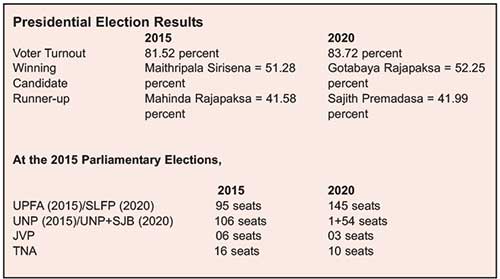
Mandate Received in
2015n & in 2020
After the 2015 presidential and parliamentary elections, many international players as well as independent bodies applauded Sri Lanka for reestablishing democracy. Some even took credit for it. The then US State Secretary John Kerry revealed that nearly USD 800 million of American taxpayers’ money was invested to change the governments of four countries. Sri Lanka was one of them.
Yet, none of the countries that propelled the Yahapalana Government into power enthusiastically extended its support for the 2019 presidential elections. India’s lackluster approach is understandable. As far as India is concerned, the betrayal of leasing of the Hambantota Port to China for 99 years, which can be extended for another 99 years is equivalent to LTTE assassinating Rajiv Gandhi.
During the Mahinda Rajapaksa Administration, the ambitious Chinese-funded projects made India uneasy. The occasional visits from Chinese nuclear subs hardly compares though to the permanent residency Yahapalana Government granted to China with th leasing of the Port.
Absurd amounts of money were spent on the elections by all parties, especially on social media. However, it is not clear if the Yahapalana candidate, Sajith Premadasa received the same or similar support that Maithripala Sirisena did from external bodies.
In 2015, the Yahapalana Government came to power after receiving much support and assistance, especially in social media, from external sources. This was somewhat reminiscent to the LTTE days when the Government troops struggled without weapons comparable to those of the enemy. Likewise, the Mahinda Rajapaksa Administration too could not counter the social media onslaught.
Yet, the mandate the Yahapalana Government received in 2015 was not as clear as that received by the Gotabaya Administration in 2019-2020. By this time, the playing field in social media had leveled out. This allowed the Rajapaksa camp to effectively counter disinformation as well as carry out their own campaigns. Therefore, it is possible to surmise that the voters’ decision was less manipulated in 2019.
Manipulations for a
Democratic Majority
After Maithripala Sirisena won the 2015 Presidential Elections, he took control of the SLFP. This was a bizarre situation as the SLFP was the main party of the United People’s Freedom Alliance (UPFA). As such, backed by the UNP, Maithripala Sirisena contested against the UPFA. Thus, when he took over the SLFP, he effectively became the Head of the Government as well as that of the legitimate Opposition.
Sirisena came to power on the UNP vote base on an apolitical” platform. Hence, the UNP voter was rather taken aback when he become the leader of their arch rival. They however calmed as Sirisena was then able to exert influence over the UPFA, enabling Ranil Wickremesinghe’s minority government to plough ahead unhindered. This allowed the minority government to even tinker with the Constitution.
Except for Rear Admiral Sarath Weerasekara, the new Opposition was in a confused daze and somewhat cowered by Mahinda Rajapaksa’s defeat. Therefore, they offered zero resistance. Their failure resulted in the 19th Amendment which they too supported. In the course of the next four years, the country was to suffer immensely because of an amendment without due democratic process.
To overcome the failure of obtaining a majority at the 2015 General Elections, Ranil Wickremesinghe formed a National Government. Maithripala Sirisena too helped in this manipulation by convincing about 40 UPFA MPs to join this union. He even replaced the names of those on the list placed before the electorate as National List nominees with defeated candidates who were loyal to him.
This violated the people’s mandate. Candidates rejected by the people do not have the moral right to represent them. Moreover, the National List is a means to bolster the intellectual capacity of the Parliament by inviting highly respected personalities and subject experts with a proven track record. It is most definitely not for candidates scorned by voters. The voters were in effect cuckolded twice because the promised National List was not the one that eventually materialized.
Maithrpala Sirisena’s actual motive was self preservation. Had he not got his own team, he would have been a mere puppet of the UNP. Yahapalana Government supporters argued that this as a progressive move that would end the era of divisive politics with both main parties on the same side.
In reality however, Maithripala Sirisena fortified with a team of his own began to assert his own independence. As a result, the two factions – one led by Sirisena and the other by Wickremesinghe – could not agree on many issues. This indecisiveness led to nine different economic policies within three years. By the fourth year, a Cold War of sorts had set in between the two camps, which led to the catastrophic Easter Sunday massacres.
Before this fission became apparent, the extraordinary lengths the Yahapalana Government went to ensure its dominance in Parliament were heralded as democratic. The various western agents who dropped in” heaved a sigh of relief that the era of Mahinda Rajapaksa authoritarianism is over”. It was only after Donald Trump became the US President that ended these visits, which in reality were a trespassing of our sovereignty.
These agents who oohed” and ahhed” over the democratic reforms” ushered in with the Regime Change Operation, refused to see just how much the democratic norms were been violated. Maithripala Sirisena was able to lure only about half of the UPFA MPs. The corruption charges against these MPs miraculously disappeared. Despite the lure of power and perks, 55 MPs refused to be part of the Yahapalana Government. They continued to be persecuted by a special criminal investigation division directed by the then Prime Minister Ranil Wickremesinghe.
This group presented themselves as the Joint Opposition (JO) as they contested against the Yahapalana Government. As such, the mandate JO received from their voters was to oppose the Yahapalana Government. Therefore, none of the UPFA MPs had a right to sit with the Yahapalana Government.
JO was the largest group in Parliament as an opposition. Together, this group represented eight of the nine provinces. Yet, Maithripala Sirisena as the President and Karu Jayasuriya as the Speaker refused to acknowledge the JO as the Opposition. Instead, the TNA with its meager presence in the Parliament, representing only two of the provinces was appointed as the Opposition Leader.
While Karu Jayasuriya agreed to treat the ostracized group as a separate entity, he refused to acknowledge the large number in the group. As such, he refused to allocate a reasonable time for the JO to speak in Parliament.
An Opposition Protective of Its Government
The TNA, while accepting the prestige of the position of the Leader of the Opposition, never spoke on any of the National issues. In fact, they barely disguised their complicit partnership with the Government. They never raised an issue over the Central Bank bond scams, even as the interests rates began to rise as a direct rippled effect of these scams. The economic repercussions were enormous as businesses collapsed and cost of living soared. As imports increased while the export markets struggled, the rupee came under intense pressure. The sudden devaluation of the rupee by 31 percent was unprecedented. This in turn increased our debt burden, causing our interest rates to rise even more.
During the tenure of the Yahapalana Government, Sri Lanka experienced a number of tragedies. Droughts and floods are common phenomenon in Sri Lanka. Apart from these, the Salawa explosion, the Meetotamulla garbage disaster and the massive Aranayaka landslide took place while the TNA sat as the Opposition. Not a single TNA MP visited any of these disaster sites, nor raised in Parliament the delay in compensating the victims. They did not even raise the issue faced by the Northern fishermen due to poaching by the South Indian fishing trawlers.
The TNA’s focus was holding the Sri Lankan Military accountable for alleged war crimes and gaining more autonomy. These were also the very objectives of the Yahapalana Government. As such, both the Yahapalana Government and the TNA were working in partnership.
While the Yahapalana Government co-sponsored the UNHRC Resolution 30/1, the TNA was formulating a new constitution with irreversible conditions to strengthen the provinces at the cost of the central government. They were thus working on the same project.
Even as the TNA were pushing for more autonomy, they failed to protect the powers they already have at hand. One by one the Provincial Councils became defunct as the PC elections were postponed indefinitely. The very reasons Provincial Councils were created was as a step to redress the grievances of the Tamils in the North and East. Yet, to date they have not expressed any distress over the fact that these councils are no longer functioning. It is ironic indeed that since the expiration of these councils, the provinces are being run by the Government.
It was indeed eyebrow raising when the TNA tried to protect the Yahapalana Government. As the popularity of the Yahapalana Government plummeted, a petrified TNA beseeched India to protect the government. By doing so, TNA must have become the first Opposition to want to protect the sitting government.
Democracy Advocators Break their Silence
Not a single West mentored entity was bothered by these vulgarities that shammed democracy. They continued to be relieved that the Rajapaksas were not at the helm. However, the people have voted with an overwhelming majority the Rajapaksa brothers back to power.
This is very alarming to the West-led foreign media as well as civil groups. They refuse to acknowledge any positive stride taken by the new Rajapaksa headed Administration. Even Sri Lanka’s superb management of the COVID-19 pandemic is met with countless criticism and without a single word of praise or acknowledgment of its remarkable successes. They worry that the democratic reforms” introduced by the previous government will be rolled back.
Sri Lanka can be assured that the next four years will be a never ending complaint from these entities as they nitpick over isolated incidents and make mountains out of molehills. They may moan and groan, but it is the people in Sri Lanka who has to live with the situation. Therefore, it is the Sri Lankan citizen who must decide what is right and not for Sri Lanka.
By Noor Nizam – Peace and Political Activist, Political Communications Researcher, SLFP/SLPP Stalwart and Convener – The Muslim Voice”, August 15th., 2020.
The cut-off point in proportional
representation has to change from 5% to 12.5% in the new constitution.
POLITICAL
PARTIES BASED ON COMMUNITY, RELIGION AND COMMUNAL BASIS HAS TO BE BANNED IN SRI
LANKA BY THE 2/3 MAJORITY NEW GOVERNMENT, THE SINHALESE COMMUNITY AND
NATIONALIST SINHALA FORCES IMMEDIATELY UNDER ANY NEW CONSTITUTION TO BE
PRESENTED IN PARLIAMENT. FOR THIS – ALL SINHALA FORCES, INCLUDING THE
MAHA SANGHA, THE SLFP, UNP (those who love the maathruboomiya”), JVP AND OTHER
PATRIOTIC POLITICAL PARTIES INCLUDING THE SLPP/SLFP SHOULD GIVE THEIR FULLEST
SUPPORT TO MAKE THIS HAPPEN. SEVENTY FOUR PERCENTAGE (74% ) SINHALA MP’s
(voters) CAN EASILY DO THIS. MINORITY REPRESENTATION SHOULD ONLY BE IN THE
NATIONAL PARTIES BY MEMBERSHIP AND BY BEING ELECTED FOR OFFICE IN THOSE
PARTIES.
THIS
IS THE ONLY WAY VOTE BANK CREATION BY MINORITY COMMUNITY POLITICAL LEADERS (THE
MUSLIMS AND TAMILS) WHO TRADE THE VOTE BANK FOR SELFISH PERSONAL BENEFITS,
FORGOING THE REAL BENEFITS FOR WHICH THE MINORITY GROUPS, ESPECIALLY THE MUSLIM
VOTERS CAN BE SURE TO REAP THE TRUE BENEFITS OF THEIR POLITICAL ASPIRATIONS AND
INSPIRATIONS, BE MADE POSSIBLE / A REALITY. A good example is the confession
made by Rauf Hakeem when Rauf Hakeem admitted that he took money from Mahinda
Rajapaksa, then President, to vote in favour of the 18th., Amendment
Bill to the constitution on September 8th., 2010. One of the SLMC
stalwarts, Segu Dawood exposed this incident and Rauf Hakeem admitted it in
public. Browse this web link and learn how this political leader (MP. Rauf
Hakeem) got money to vote for the 18th., Amendment in parliament on 8th.,
September 2010.
In 1994, when
the SLMC found an opportunity, supported by R. Premadasa to reduce the cut-off
point in proportional representation from 12.5 to 5 per cent, in return NOT to
field a Muslim candidate as a Presidential candidate, to stop the Muslims
voting Premadasa. This done, the SLMC joined the UNP. Rishad
Bathiudeen and the Atthaullah, regional Eastern province Muslim party), began
to adopt THIS POLITICAL TRADING OF THE MUSLIM VOTES” and making DEALS” with the
national parties that were struggling to form governments, to form goverments,
that was of NO BENEFIT, BUT DETRIMENTAL TO THE MUSLIM FACTOR”. These deals were
supported by the All Ceylon Jamiyathul Ulema and so-called Muslim Civil Society
groups, whose leadership also were given a SHARE” of these SPOILS and
BENEFITS”, became the NORM” of the SLMC, ACMC, NATIONAL CONGRES, ACJU, THE
NATIONAL SHOORA COUNCIL and the MUSLIM COUNCIL OF SRI LANKA, in the equation of
Minority politics in Sri Lanka since 1994/1980. As a result of these
deceptions, the Muslims in Sri Lanka do NOT have a voice – a POLITICAL
VOICE” for that purpose. The Muslims did not benefit to resolve their
economical, employment, development, land education and fundamental rights
issues by VOTING the SLMC, ACMC or THE NATIONAL CONGRESS. The Muslims became
POLITICAL ORPHANS” in Sri Lanka at last. Today this has become a MENACE and a
SICKNESS in the democratic political process of our country. Not only has it
affected the Sri Lanka Muslims, but also PRALALYSED THE DEMOCRATIC RIGHT OF THE
MAJORITY SINHALA COMMUNITY WHICH IS 74% OF THE NATION TO MAKE ANY DECECIVE
POLITICAL CONCLUSSION BENEFICAL TO THEIR AND OUR MAATHRUBOOMIYA” OR TO AMEND /
ADJUST THE CONSTITUTION TO THEIR NEEDS FOR THE BENEFIT OF THE NATION AND OUR
MAATHRUBOOMIYA”. It created a lot of constitutional conflict in
parliament is a result of this POLITICAL PLIGHT” since 1994. With the SLPP
getting a 2/3 majority government in parliament on August 5th., 2020, without
having to make “deals” with the minority community parties, to
make the cut-off point in proportional representation from 5 to 12.5 per
cent is only a matter of parliamentary procedure.
With
the media uncovering the corruption and deception of the Muslim political
leaders in recent times and exposing these DECEPTIVE AND HOODWINKING” Muslim
politicians and their operating beneficial gangs, the Muslim political culture
has begun to change. Today this VOTE BANK TRADING BY MINORITY MUSLIM
AND TAMIL POLITICAL PARTY LEADERS” has become a MENACE and a SICKNESS in the
democratic political process of our country. THIS HAS TO STOP FORTHWITH FOR A
HEALTHY POLITICAL PROCESS TO TAKE PLACE IN OUR COUNTRY and the RIGHT for the
voters to decide what their communities should do and the majority who are
SINHALA VOTERS to decide what is best for the country they should do.
As for the
Muslim Minority Community, the fact remains NOW, they do NOT wish to be
represented by these MUNAAFIKK and DECEPTIVE MUSLIM POLITICIANS”. THE SLMC AND
ACMC MP’S SHOULD ALSO ACT ON THEIR OWN NOW and decide to support the new
government, Insha Allah. We Muslims should set an example like our predecessors
who TRUSTED” the majority community in the wake of the British trying to delay
giving us independence in 1948. The role of Dr. T B Jayah becomes paramount at
this moment to recollect, because had he, or the Muslim community, sided with
the British at that time, granting of Independence to Ceylon would have been
postponed. It is only because the minorities agreed that there was a United
Front of Sinhalese, Tamils, Muslims asking for Independence. But one man was
against it. That was G G Ponnambalam who tried to extract his pound of flesh.
He said I will sign on the dotted line only if you agree to Fifty Fifty”. That
is 50% of the seats for the Sinhalese and 50% for the minorities. Only if you
agree to that, he told D S Senanayake, will I support the call for
independence. It was at this point that Jayah rejected the
‘fifty fifty’ formula. He said he preferred to work in trust, to work in faith
and goodwill with the majority community. Thereby
T.B.Jayah totally undercut G G Ponnambalam’s fifty fifty” cry. That was the
death knell of Fifty Fifty”. If Jayah joined the fifty fifty” cry at that time,
Independence would have been postponed. One has to remember that even the word
Sinhala was erased from the political lexicon. S W R D Bandaranaike ditched the
idea of the Sinhala Maha Saba and he first joined the UNP and later set up the
Sri Lanka Freedom Party which too did not have racial connotations. Everybody
felt that communal parties were counter-productive.
It is time up
that a “NEW POLITICAL FORCE” that will be honest and sincere that will
produce CLEAN” and diligent Muslim Politicians to stand up and defend the
Muslim Community politically and otherwise, especially from among the YOUTH has
to RISE”, and this NEW POLITICAL FORCE” has to support the new government
formed under President Gotabaya Rajapaksa and PM Mahinda Rajapaksa and the
majority Sinhalese citizens notwithstanding the fact that the Tamils of the
North and East and the Upcountry Tamils and all minorities should be equally
respected, politically, for a better Sri Lanka, God willing, Insha Allah.
Nearly 650,000 Muslims have voted the SLPP and casted their votes in support of
Gotabaya Rajapaksa, the New President of Sri Lanka and PM Mahinda Rajapaksa and
the SLPP/SLFP Alliance this August, 2020 wholeheartedly, and to be part of the
VICTORY OF THE SRI LANKANS in helping to form a 2/3 majority government by
those who love our MAATHRUBOOMIYA”, Insha Allah. The new government has
to help the Muslims create a “NEW POLITICAL CULTURE” by declaring the
above change in the new constitution or parliament at the earliest.
Lional Bopage, who
was the first General Secretary of the 1971 JVP, who was the first of the 21
leaders of JVP accused for launching a rebellion to topple the government and
who was a close associate of Victor Ivan and who now enjoys a luxury life in
Australia and who was also responsible for the untimely death of thousands of
poor educated village youth in 1971 in an article to foreign sustained NGO
vulture Pakiasothy Saravanamuttu’s one of the websites, the Groundviews titled
The best and the worst – 2020 General Elections” states the general elections
on 5 August turned out to be an outstanding victory for the Rajapaksa Family
and the Sinhala Buddhist nationalists and ordinary members of the country’s
majority community. He says that in his opinion a victory of this magnitude
provides a great opportunity which could be used for the benefit of the country
and its people. It also brings up, he says, a more worrisome scenario where
militarisation of the democratic institutions will continue, concerns of
minorities will be ignored, and erosion of the rule of law and less
transparency and accountability are most likely to occur and this victory has
opened a new chapter where the government could perform at its best or at its
worst.
He claims that when the Rajapaksa
regime led the campaign to defeat the Tamil terrorists (which he calls as a
Tamil militancy and not as terrorism) solely based on a strategy of war, he was critical of that approach and after the
military defeat of the LTTE the regime had a unique opportunity to address the
issues that caused the war by developing
a just solution to the Tamil demands and even now these issues remain unresolved
and keep festering since a historic opportunity was missed. He adds that had
this been handled with honesty and statesmanship, it could have paved the way
for the regime to stay in power for a long time, with the possibility of
Mahinda Rajapaksa even becoming a Nobel laureate.
Bopage says that Sri Lanka had several such opportunities
in the past when different political persuasions were brought to power by the
electorate with a two-thirds or even higher majority. Mr S W R D Bandaranaike,
Mrs Sirimavo Bandaranaike and Mr J R Jayawardena, all had the same opportunity,
but they did not rise to the occasion due to their self-centred desire to
remain in power which they could only do by catering to the partisan needs and
demands of their political factions and most of the time, these factions could
not see beyond the tunnel vision of a mono-cultural unitary state and their own
corrupt financial interests.
This doomsday pundit states that from 1956 till 2015,
the minority parties did not play any major policy determining role as
constituent parties of government. Despite this, for nearly 60 years there was
no constructive solution proposed or implemented to address the numerous issues
the minority communities had raised and now that the new government is free
from the elements that the SLPP identified as racist”, there is another great
opportunity to concretely address the power-sharing issues with minorities and
create a better country for all.
This doomsday pundit has completely ignored the
solution President Gotabhaya Rajapaksa offered during his first foreign visit,
during the visit to India in which when the Indian Prime Minister Narendra Modi
mentioned about the need to implement the 13th amendment the
President responded that he has been elected as the President of all Sri
Lankans and he is committed to serve all Sri Lankans alike without any ethnic,
religious or caste discriminations. What
else we need and why the doomsday pundits cannot understand the real meaning of
this noble statement by thevisionary President and commend him for this stance.
Continuing further Bopage states that at the
election, the plea of the SLPP leadership was to grant them a two-thirds
majority to change the constitution to rearrange the power relationships
between the parliament and the president. Yet, under the current constitutional
arrangements, the brothers, Gotabhaya and Mahinda continue to enjoy the
totality of presidential and prime ministerial powers between them. Whatever
the changes that would be made in the future, the totality of constitutional
power shared between the two brothers will remain the same and only the checks
and balances that scrutinize their activities by parliament and independent
commissions are open to manipulation.
Having received an overwhelming majority and not at
the mercy of the so-called minority racist and extremist parties he says that
the SLPP and the Rajapaksas have now got an opportunity to carry out their
long-term political intentions unhindered. What they proposed he says was to
modify the constitution by abolishing the 19th and 13th amendments
and discarding these (oppressive) safeguards will abolish the devolutionary
nature of the governance established under those amendments and debilitate the
independence of the institutions that were established to scrutinize (dominate)
the process of governance.
Not only the 13th and 19th the
15th amendment which reduced the original percentage of votes
required by a political party to become eligible for parliamentary sear from
12.5% to 5% should also be repealed.
This amendment was adopted 48 hours before the 1988 presidential
election on the commandeering of Ashroff to Premadasa to get Eastern province
Muslim votes in the 1988 highly manipulated and rigged presidential
election. If it was not for this
political bribe to Ashroff, Madam Sirimavo Bandaranaike would have won the
presidential election in 1988.
Bopage claims that these amendments were adopted with
the intent of addressing certain fundamental issues that prevailed for many
long years and that that intent was wantonly diluted from the drafting stage
onwards, and even before the bill was presented to the cabinet for approval, it
was further diluted by last minute amendments made during the final
parliamentary proceedings. Some of those responsible for such dilution later
became leaders of parties like the Samagi Jana Balawegaya.
Referring to 1970s Bopage states that the
Constitutions of 1972 and 1978 were imposed upon the people without any
consultation and the constitution making process was neither participatory nor
inclusive. This claim applies only to 1978 constitution whereas in respect of
1972 constitution it was formulated by Parliament for which the National State
Assembly constituted itself as a Constitution assembly in which all parties
including the then major Tamil party TULF participated and this constitution
was not unilaterally imposed on the people as the bizarre 1978 constitution
well known as the Bahubootha Vyawasthawa.
He warns that the Nationalist extremists in the new
regime could negatively influence the chances for justice, democracy, human rights
and economic opportunities, except for a select few. This may lead to
escalating corrupt practices, disempowerment of the judicial and parliamentary
processes, ignoring legislative responsibilities (was there legislative
responsibilities during the last five years?), sidelining non-majoritarian
communities (was not the Sirisena/Ranil government over appeasing TNA diktats
and neglecting its duty and responsibility to the majority community?),
ethno-religious discrimination in policy and decision making, adopting
antagonistic foreign policy positions, and introducing repressive legislative
and constitutional arrangements. This doomsday pundit who confined his JVP in
1971 only to rural Sinhala youth and pontificated against Tamils in their 5
political orientation classes now states that here could be protests and
strikes by the disillusioned electorate, who would be forced to rethink about
who they have brought into power and it could also lead to bloodshed.
He says that the election results also reflect a
class divide between the intelligentsia and the ordinary people of the country.
Confirming he still holds his allegiance to the JVP he says that the low vote
for the National People’s Power (the camouflaged JVP) and similar organisations
represents the mismatch of the thinking patterns between the people at the
grassroots level and those of the intelligentsia. The necessity of the
traditional organisational patterns at the grass roots level and the urban
intelligentsia, mostly professionals, want a regime for good governance, rule
of law, and an economic model that would cater for the increasing profitability
of a few.
Bopage says that the working people, both rural and
urban, however, want to elect a regime that would provide them with work
opportunities that satisfy their basic needs, such as shelter and food for the
survival of their families and in any political and economic endeavour, both
these needs need to be catered for and this can only be done by analysing the
prevailing issues based on evidence and their causes. Only then can these
issues be addressed and polices developed that address these issues at the
ground level. Otherwise the election results for progressive parties (Do we
have anyparty that can be branded as a progressive party other than the
SLPP. Bopage’s colleagues the JVP is now
an utter reactionary party prepared to do any scavenge for monetary benefits)
will continue to be abysmal, as has been the trend for at least two decades.
In a form of ridiculing the high literacy rate in Sri
Lanka, this doomsday pundit says that it refers only to those who have the actual
ability to read and write and such a literacy level has not developed the
ability at a societal level or the capability at an individual level to develop
political empathy in understanding the differences between a mono-cultural
society and a multicultural one with its attendant advantages for long-term
peace and prosperity.
There is unfortunately a global trend in which a
strong segment of nationalist intelligentsia does not focus on the betterment
of society and the long-term future of the generations to come. Instead, they,
like ‘Viyath Maga’ in Sri Lanka and their collaborators, appear to focus on
developing better ways for duping people, promoting individual self-greed with
short-term emphasis, he says and adds that even during the 1920s in Germany,
similar intellectual groupings helped Hitler to gain and sustain power, while
the media similarly played the role of providing publicity only to Hitlerite
Nazi views.
Ordinary people will attend a meeting; listen to
leaders and go back home, later to be trapped by the political and idealist
influences of the mass media and the organisational networks that largely serve
the interests of the privileged and the ultra-nationalists. Without
organisational networks at the grass roots level to mobilize people and counter
such influences, the efforts of the intelligentsia will fail as attested by the
current elections.
Bopage, who still persists in his original JVP ideology
states that in addition, ordinary people who had been previously politically
active may have perceived those trying to influence them from the top as
leaders, intellectuals or outsiders as a threat rather than working for the
collective benefit of all and it had become increasingly difficult to expose
the misleading positions presented by the nationalist intelligentsia to the
people at the grassroots level due to the barrage of misinformation spread via
strong media campaigns. He says the election results confirm the success of the
nationalist intelligentsia and a notable failure of the efforts of the more
pluralist orientated approach of the intelligentsia.
Commenting about the future he asserts that the
disastrous failure of the political forces that value plurality, diversity,
equity, fairness and social justice to get political traction compels Sri
Lankans to rethink, re-strategize, regroup and reorganize and such an effort
cannot be made by daydreaming or being an armchair critic. He says that Sri Lanka’s most urgent priority
is to connect with the ordinary working people both rural and urban and enter
into a dialogue with them, learn about the issues that concern them most and
then produce evidence based and consensually agreed solutions on issues that
affect their lives.(If it is so, why did his acolytes, the JVP functioned as
loyal stooges of Sirisena/Ranil dispensation during the last five years?)
He predicts that such actions will provide the
opportunity to critically examine the previous approaches and re-strategize for
the future, and only then Sri Lanka could
work towards an alliance that is open to all people travelling in the same
direction, who are taking diverse paths for achieving the same goals of
prosperity, human rights, rule of law and good governance, that will benefit
all members of Sri Lankan society as a whole and not just a few.
Again focusing attention on two thirds majority he
asserts that Sri Lanka’s post-independence history has witnessed on several
occasions, regimes coming to power with a two-thirds or a higher majority but
they failed, and failed abysmally, leading the country into three major
rebellions. Afterwards, the regimes that led to such situations have also been
defeated. If the new government traverses a path creating better opportunities
for all and a rule-based society that values individual life, treats everyone
with dignity and respect, ensures a guaranteed minimum standard of living, and
empowers people so they may develop their full potential – then we have a duty
and responsibility to support such moves and otherwise, it would not be too
long before the disillusioned voters take to the streets demanding
implementation of the many pledges made to them, in particular the improvement
of their socio-economic conditions, in an organised and democratic manner, he
concludes.
In the meantime the notorious Tamil servile traitor
Dayan Jayatilleke who is obsessed with the craze of devolution of power to
Tamils even in excess of what is outlined in the despicable 13th
amendment enforced by hegemonic India and who was a Minister in the
Varadaperumal’s Eastern Provincial Council and associated Perumal in his
unilateral and illegal declaration of indepemdemce for the Eastern province and
later became a close associate and shameless advisor to former President
Premadasa and who unsuccessfully attempted to infiltrate Viyathmaga to create
internal dissensions and got kicked out from that patriotic organization and
now reported to be functioning as a political advisor to imbecile Sajith
Premadasa in an article titled Understanding the unipolar
moment of Sinhala nationalism” states that President Gotabaya Rajapaksa
repeatedly made two requests to voters during his electioneering walkabouts and
one was that they had given him 69 lakhs (6.9 million) of votes at the
Presidential Election but now he wanted 79 lakhs (7.9 million) votes and the
other was that he wanted a two-thirds majority. He didn’t get his first wish,
but has surely got his second and strategically more significant.
Continuing his anti-Sinhala rhetoric
he says that one cannot comprehend the 2019-2020 steamroller majority without
understanding who and what it rolled over; who and what the voters chose to
bury – and why one could not understand its precursors 1956, 1970 and 2010
without understanding the target profile the UNP presented.
Dayan asserts that the new
hyper-majority, which unprecedentedly empowers the Rajapaksa clan and the
Sinhala supremacist agenda, can be traced to clusters of factors and tracked
through specific periods and states that the most proximate was ‘Yahapalanaya’
which contained within itself a grand asymmetry: it had not won the majority of
the majority which happened to be Sinhala-Buddhist. It should have been mindful
that in the Sinhala heartland it was on very thin ice indeed. Instead of
consolidating and expanding its Sinhala base in concentric waves, it adopted a
pronouncedly minoritarian profile starting with Ranil’s appointment of the
expatriate Central Bank Chairman and the top appointee of Mangala Samaraweera
to ICTA, and ending with the outline documents of a new constitution which
dropped the definition ‘unitary’ in English and substituted ‘orumittanadu’
instead.
When Mahinda was defeated in January
2015, the Sinhala nation was in shock. The Sinhala people felt that Mahinda was
their hero and he had not been displaced by their collective electoral consent.
They felt it occurred without their warrant. This translated into a sense of
conspiracy. It manifested itself in a spontaneous surge of Sinhala solidarity
with Mahinda. Sinhala angst, guilt and outrage were the springboard of the
rapid revival and resistance, starting with the Nugegoda ‘Mahinda Sulanga’ rally
of February 2015 and culminating in MR’s triumphant re-election last week.
The 2015 Yahapalana experiment does
not, by itself, explain the volume and velocity of Sinhala nationalism that
made the two-thirds majority possible.
The ‘driver’ was the mismatch
between the military defeat of Tamil separatism in May 2009 and the adventurist
over-assertiveness of Tamil nationalism after and despite that defeat, the
Tamil Diaspora was in denial about the defeat and that state of denial took the
form, backstopped by inflows of funds, of encouragement of Tamil political
personalities and parties to go on a permanent political offensive, abandoning
the framework of and pressing beyond the 13th Amendment in talks with President
MR in 2011. This was mightily compounded after 2013 by Chief Minister
Wigneswaran’s provocative political discourse and behavior, which swung the
balance of opinion in Sinhala society, from settling Tamil grievances by
negotiated political accommodation based on devolution, to unilateral
imposition of a post-war order.
This traitor points out that at the dawn of Yahapalanaya, Sumanthiran trumpeted
it as proof that the minorities had political weight equal to the majority and
the Yahapalanaya state media and supportive ‘civil society’ lustily
disseminated these ideas in an orgy of nihilism towards the war, the Lankan state,
and the Sinhalese majority.
To the collective Sinhala psyche, he
says that it appeared as if the fellow-travellers of Prabhakaran, fronted by
those Sinhalese who had appeased and collaborated with Prabhakaran, would have
a greater hold on political power and the state than would the Sinhala nation
that comprised the overwhelming majority, which had resisted, sacrificed and
defeated armed separatism. An effort was underway he says to overturn the
military victory by political means, demonise and vilify the victorious war and
the side that won it, install the losers as political winners, and move towards
dismantling the unitary state the military fought for – making for future
separatism.
He points out that the Sinhalese
felt an existential threat and hence turned to Mahinda Rajapaksa who had saved
them before. But with his second defeat at the August 2015 Parliamentary
Election, word travelled on the temple network MR had operated on after his
defeat – and the word was ‘Gotabaya’. He alone could be guaranteed to generate,
by taking it the next level, that enhanced Sinhala swing which could offset the
entrenched minority support for the UNP. It was a Fox News/Trump candidacy
moment.
The Gotabaya succession, he admits, had been in gestation during MR’s second term,
hence the launch of the volume with the hyperbolic title Gota’s War” (2012),
but it took Ranil-Mangala-Chandrika discourse and policy direction within the
Yahapalanaya administration to give it the traction needed for the candidacy
and victory.
Referring to the heroic war heroes,
this Tamil acolyte says that the role of the ex-military brass was crucial and
they saw in Ranil Wickremesinghe, the leader who had called off a Long Range
Rapid Penetration ( LRRP) hit on Prabhakaran, arrested Military Intelligence
officers, entered a lopsided ceasefire agreement, allowed the LTTE back into
Jaffna, permitted a Tiger buildup around Trincomalee harbour – and this time
around, endorsed a self-hating Geneva resolution and a non-unitary federal and
secular draft Constitution.
He asserts that the confluence of
the Sinhala masses of the heartland (represented by Mahinda Rajapaksa), the
monks, and the ex-military brass (around Gotabaya), created the hegemonic
social bloc of today which is quite determined never to experience, permit or
leave room for the humiliating experiences the Sinhala majority was put through
under the Sirisena/Ranil government. He says it will therefore demolish every
reform ‘tunnel’ that makes such traumatic incursion possible and build a wall
and moat around Sinhala political power, promulgating a new Constitution which
changes power-relations so that hierarchy is inscribed, full-spectrum
Sinhala-Buddhist domination entrenched and its ideology driven deep, and
minorities permanently marginalised by the truncation of proportional
representation, restoration of a high cut-off point, and ethnic gerrymandering
(‘re-demarcation’) of electorates.
Tamil servile Dayan further states
that Wigneswaran’s arrogance and mythology will cease to be possible once the 13th
Amendment is castrated, boosting the power of the Governor, ex-military
governors appointed, and devolved land annexed.
Referring to ITAK/TNA’s failed
constitutional reformsoverreach and Wigneswaran’s ‘developmental boycottism’
has revived avatars of Chelliah Kumarasuriyar and Alfred Duraiappah in the
North. He says that the regime gleefully believes in the Trump-Jared
Kushner-Netanyahu formula of the trade-off of political self-identity and
territorial autonomy claims in return for development funding.
This 13th amendment
maniac nutty political commentator in conclusion states that the sole salvation
for the Tamils is to apply the written advice that Lord Soulbury gave C.
Sunderalingam in 1964, which denotes that all their political representatives
must ally with and support Sajith Premadasa and mount a defense of the 13th
Amendment and boasts that this imbecile and
ignoramus guy for whom he functions
as am advisor is the only southern political leader who stands by it while the
JVP and FSP are non-committal.
The massive mandate received from the people should not be obstructed by sepoy scribes who have infiltrated the high places of the Editorial staff and always writing to please embassies of western countries & NGOs with anti-national, anti-Sinhala, and anti-Buddhist narratives. There is a well-funded campaign to vilify Buddhists & Buddhism in particular by the private owned mainstream English newspapers giving a platform to writers using pseudonyms. While writers using their real names can be challenged, people throwing stones hiding behind a bogus name cannot be held accountable for the malicious & vindictive manner they write. In such a scenario, it is the editors of these mainstream newspapers and even web journals who have to be held to account as they know the identities of the cowards who do not wish to say what they want to say openly but do so hiding behind a false name. This ugly practice must stop. The Media Minister & the new Government must also look into the grievances of the majority and one key area is the denigration the majority is subject to in all forms of communication channels. Strict rules and regulations must be issued to the mainstream media channels with regard to attacking Buddhists and Buddhism using pseudonyms and hiding behind ‘freedom of press’ ‘rights of media’. The Sri Lankan Press must be sensitive to all readers. Name calling and ridiculing 2/3 of the people of Sri Lanka by cowards is not acceptable.
Who are these cowards writing & bashing Buddhists & Buddhism using pseudonyms?
– Don Manu
– Vishwamithra
– Naan
– Cassandra
– Notebook of Shani
This is nothing but biased and unethical gutter journalism at play.
The mainstream English newspapers are circulated internationally and end up being the main source that individuals and organizations refer to. If the international community have an adverse opinion against the majority in Sri Lanka, the Sri Lankan press has to be held accountable in view of their role in vilifying the majority Sinhala Buddhists.
The manner the editors and the owners allow scribes to ONLY ridicule and denigrate the majority Sinhala Buddhists is nothing they can deny. A content analysis will reveal the derogatory nature of Buddhist bashing press, the editors facilitating the bashing and the scribes given a forum to do so. To add to injury the editors do not even allow right of replies or even opportunity for new writers. The same columnists have been writing for decades. Dictatorial nature of editorial positions can be assuaged in the manner main editors have also been glued to their seats while they lambast politicians for not retiring!
In a country with 74% Sinhalese – the Buddhist opinion is purposely suppressed and even Poya Day supplement write up by English mainstream private newspapers is given to a non-Buddhist or a pseudo-Buddhist to question Buddhism or put forward some uncouth opinion. How many editors are Buddhists? How many writers are allowed to put forward Buddhist opinion? Thankfully the alternate media and social media have enabled the Buddhists to challenge the injustices. Soon the print media, already in decline, will realize that they will have no circulation or purchase of their papers because they carry the same old vindictive opinions of writers and the same denigration and offer people nothing new to think about.
Given that the Press Complaints Commission is under the Media Minister and a Code of Professional Practice binding newspapers, publishing companies, editors, journalists and contributors for print & online exists, the Minister must clearly issue a circular banning pseudonym writers bashing Buddhists/Buddhism.
If they want to bash Buddhists/Buddhism come into the open and do so, without being cowards, hiding behind the editors and throwing stones via pen.
Code of Professional Practice for Sri Lankan media.
6.3 of the code: a journalist
shall not knowingly or willfully promote communal or religious discord or violence. The conclusion of the article declares ‘
6.4 of the Code:
The Press must avoid prejudicial or pejorative reference to a person’s race, color, religion, sex or to any physical or mental illness or disability’.
Use of pseudonyms by scribes only displays their moral cowardice seeking cover under a fake name and throwing stones.
No country allows mainstream press to give a platform to scribes to bash the majority using a pseudonym. Sri Lanka should not either.
The media minister must appoint a national media commission and release report along the lines of 1964 Press Commission Report.
The media minister must bring legislation banning pseudonyms attacking Buddhists/Buddhism via mainstream media
The media minister must build Patriotic writers to defend Sri Lanka.
War of arms is over in Sri Lanka.
The soldiers did their part magnificently
Now is the War of words
It is the task of the patriotic writers to defend the Nation using the pen.
The Govt must recruit a team of such writers.
The pen army will be Sri Lanka’s next defense.
They must dictate the narrative which has been unfairly held by sepoy press, lascoreen journalists & coward scribes.
Patriotic forces of Sri Lanka must be on top in the war of words.
Sepoy Journalism must be replaced with Patriotic Journalism.
The Progressive Women’s Collective (PWC) is delighted with the
announcement that theNational List parliamentary seatof the National People’s
Power (NPP) has been offered to, and accepted by, Dr. Harini Amarasuriya. Dr. Amarasuriya
is an extremely accomplished activist and educator, and we are thrilled that
such an active advocate for education rights and women’s rights will represent
the NPP at the Parliament.
PWC has consistently advocated for the increase of women in
political leadership and decision-making. Along with NPP, PWC supported and
lobbied for 20 number of women candidates put forward by the NPP in the
recently concluded parliamentary election. The appointment of Dr. Amarasuriya
as the National List candidate, we believe, shows the NPP’s true and integral
commitment to the feminist vision outlined in the PWC policy as well as NPP’s
overall policy regarding women’s participation in politics. This is principle
in action—walking the talk. We are also thrilled that it is our colleague Dr.
Amarasuriya who will represent us, and women and men in Sri Lanka as an NPP
Member of Parliament.
Dr. Amarasuriya has been an ardent advocate for public educational
rights in Sri Lanka, supporting and leading movements which demand structural
change in our education system. Dr. Amarasuriya has always been led by a
passionate commitment to ensuring that education in Sri Lanka be accessible,
equitable, just and truly public. But her commitment to social transformation
isn’t limited to any one issue. Dr. Amarasuriya, in her role as a member of the
Public Representations Committee for Constitutional Reform, advocated for
public representations to be taken seriously on matters of the state, religion,
socio-economic rights and more. Her deep respect for a diverse range of
stakeholders was evident through this process, and it enabled her to bring these
representations into multiple fora and public discourse in a meaningful way.
Dr. Amarasuriya’s contributions within the Progressive Women’s
Collective have been invaluable. Her insightfulness and perceptiveness enabled
her to make incisive contributions in shaping PWC’s feminist vision and policy.
She has also advocated tirelessly for the adoption of a feminist lens within
the broader NPP.
It is common to see petty politicking within political parties
following elections, where party leadership typically sideline original
National List candidates or female candidates in the final seat allotment, in
favour of candidates who didn’t get sufficient preferential votes to win a
seat. We trust that this is an instance where NPP has shown our commitment to democratic
and participatory politics, eschewing patronage politics and exclusionary
practices. We are setting a new trend in politics, where politics is no longer
a matter of self-gain and individual advantage, but a broad praxis where
principles and vision rules the order of political decision-making.
As women, we believe that NPP’s decision to allot the National
List seat to Dr. Amarasuriya is a defining moment in our Left political
history. We deeply appreciate this move by the NPP as bold decision. In this
time of profound electoral setbacks for left political parties, we remain
hopeful that the NPP will become a touchstone of political incorruptibility and
ethical behaviours, committed to a safer, healthier, and economically
sustainable society. We also laud the courage that Dr. Amarasuriya has shown by
accepting this invitation of the NPP during such challenging times. For us, as
the PWC, this is an indication that the long road ahead will be one of unity,
respect, and commitment to women’s rights in Sri Lanka, a sign, that the times
are, indeed, changing, after decades of political neglect of female leaders by
left and right political parties.
The State Intelligence Service (SIS) was aware that Zahran Hashim had physical and mental capacity to conduct an attack in the country, even before it received the foreign intelligence on April 04, 2019 with regard to a possible terror attack, former State Intelligence Service (SIS) Director SDIG Nilantha Jayawardena yesterday testified before the PCoI probing Easter Sunday attacks.
Responding to a question raised by a commissioner, SDIG Jayawardena said that he was aware about Zahran’s physical capacity to conduct an attack in the country after the Wanathawilluwa explosives raid in January 2019.
“After raiding explosives at Lacktowatta, Wanathawilluwa, the SIS has no records pertaining to other physical explosive stores maintained by Zahran in the country. We didn’t conduct an inquiry with regard to finding more explosives but we were aware about Zahran’s physical capacity to conduct an attack in the country,” Jayawardena said.
SDIG Jayawardena said he had obtained a basic record check on Zahran after receiving the particular foreign intelligence on April 04, 2019 with regard to a possible terror attack.
“After getting a basic record check on April 5, 2019, I decided to inform about the particular foreign intelligence with regard to the attack, to Chief of National Intelligence (CNI) Sisira Mendis,” Jayawardena said.
He said that the SIS had informed about the foreign intelligence to former IGP Pujith Jayasundara, former Defence Secretary Hemasiri Fernando and former CNI Sisira Mendis for necessary action on April 07, 2019.
SDIG Jayawardena further added that in March, 2019 two intelligence services in Sri Lanka said that Zahran had escaped the country.
“SIS didn’t even receive such information that Zahran had escaped the country in March, 2019. SIS officers were only aware that Zahran was in the country during that period,” he said. (Yoshitha Perera)
Defence Secretary Kamal Gunaratne said that security agencies had received 97 warnings prior to the Easter Sunday attacks.
He expressed these views addressing a gathering of professionals at a session themed ‘Post COVID-19 Renaissance – Present and future development of Sri Lanka’, organized by the ‘Harimaga organization’ at the Sri Lanka Foundation Institute on Friday.
He said that despite receiving early warnings of the impending attacks 97 times by the security agencies, those who were responsible had overlooked its graveness and severity and failed to prevent the carnage that left over 290 dead and approximately 500 injured.
Our military intelligence operatives were imprisoned and harassed leaving a huge dearth in our intelligence apparatus which also paved the path for the extremists to operate scout free and under the radar” he said.
Last week, we arrested over 1.5kgs of high explosives and some 90 odd detonators from Mannar. In addition, the military has also taken a few remote control devices into custody. If we also overlooked those incidents, none of these would have been recovered. We will never leave room for separatism from the North to rise nor extremism from the East to spread fear and destruction in this country ever”, Maj. Gen. Gunaratne stressed.
Maj. Gen. (Retd) Kamal Gunaratne also said that national security and defence were paramount for country’s development.
He said without securing them, it was impossible for a country to progress and develop.
Maj.Gen. Gunaratne emphasised that national security and defence were also crucial in attracting much needed direct investment to the country.
Though separatism was militarily defeated in May 2009, we need to eliminate the separatist ideology which a few individuals of the Tamil diaspora are constantly sponsoring”, Maj. Gen. Gunaratne said.
He said 12,242 ex-LTTE cadres were rehabilitated and reintegrated into the society during the post war period and that some remnant front organizations of the LTTE were still attempting to indoctrinate and recruit these individuals to fuel their separatist cause for financial gains.
I assure you that there will be no room for separatism in this country now and ever”, he added.
The Defence Secretary explained about the steps taken to eliminate drug syndicates that had been operating from prison cells.
To put plans to the right direction in fighting the drug menace and organized crimes operated from the prisons, first we appointed capable officers in charge of the Prisons Department and the Police Special Task Force, ” he said.
Highlighting the initiatives taken to change the existing system in prisons, Maj. Gen. Gunaratne said while a maximum security prison was already under construction to imprison notorious criminals and drug smugglers, mobile phone jammers had already been installed at the Boossa and the Angunakolapelessa prisons.
He also revealed plans to address welfare issues of prison inmates and also to reduce overcrowding in prisons.
We have taken several measures to increase facilities to rehabilitate drug addicts. A special Centre with state-of- the art facilities to accommodate over 1,000 inmates is now under construction in Nittambuwa. Another facility to be constructed to accommodate 2,000 inmates at Weerawila”, he added.
The Defence Secretary highlighted the plans to curb illegal sand mining and minimise illegal encroachments epecially in the Western Province.
According to the Defence Secretary, a special unit has been established at the Criminal Investigation Department (CID) to investigate public complaints.
Commandant of the Police Special Task Force (STF) DIG Waruna Jayasundara, Commissioner General of Prisons Thushara Upuldeniya, Chairperson ‘Harimaga’ organization Kanishka De Silva were also present at the occasion.
Minister of Tourism Prasanna Ranatunga has called for a report on an accurate assessment of the damage caused by paddy storage at the Mattala International Airport (MIA) during the Yahapalana regime.
During a discussion on the upcoming plans of the airport, Minister Ranatunga has directed the report to be handed over to him within a week.
At the meeting, trade union representatives had pointed out to the Minister that the Airport & Aviation Services Sri Lanka Ltd (AASL) had not yet made an accurate assessment of the damage caused by the paddy storage at MIA.
Chief Financial Officer of the company, too, had agreed that an accurate assessment in this regard was essential.
Minister Ranatunga has further stated that the Yahapalana government has neglected MIAwith the intention of causing a natural death.
He added that after President Gotabaya Rajapaksa assumed power steps were taken to turn MIA into an active airport.
The 19a has shown that making a constitution or even an amendment should not be done in a hurry, with intent to stifle opposition, embrace undue powers, grab power, squash the people’s rights & freedoms and ignorantly thinking that the insidiously plugged proposals will not one-day backfire. Anything done with ill-will & insincerity will certainly rebound. This is exactly what happened to the architects of 19a. Therefore, let us not be in any hurry to completely nullify existing constitution. In reality, there are only a handful of adverse aspects that impede democratic norms and only these should be done away with. The US has 27 amendments to its constitution (in 231 years) while India has 104 amendments to its constitution (71 years). 16 out of 19 amendments to Sri Lanka’s constitution was done between 1978 & 1988 by the very political party that drafted it. The 17thamendment was in 2001, 18thamendment in 2010 and 19thamendment in 2015. So the 20thamendment in 2020 is welcome but it must be sensible, it must be relevant to the future and must not commit the same blunders that 19tha architects committed.
The 19a Bill was passed in Parliament on 28thApril 2015 with a 2/3 majority after 174 amendments. 212 voted in favor, 1 abstained, 10 were absent and 1 voted against. We mention with admiration the sole person who voted against it – Admiral Sarath Weerasekera. With so many amendments we would like to know whether the 19a Bill passed was the same as what was debated in Parliament on 16thMarch 2015 or was it a different version?
A political party in power as government should not think they can tweak the constitution for their benefit or tweak it to the disadvantage of their opposition. The good part of democracy is that Governments come and go but the Nation and its resources must remain intact. Therefore rule number 1 at all times should be that any attempt to amend or insert any new clause or even change the existing constitution should only be based if there is a serious need to and if there is no alternate method.
We know that 19a came with political vengeance and as party of the regime change bogey. The original draft of 19a submitted by Ranil W to Parliament virtually abolished the executive presidency transferring the President’s power to himself as PM. It was clear what the plan behind 19a was.
KEEP
Term of President & Parliament to 5 years (Article 30(2) Clause 3)
Denial of dual citizens to be representatives in Parliament or Public Service (Anyone serving nation should have allegiance to only 1 country not 2) – citizens holding dual citizenship is not an issue
2 consecutive term limit for a Presidential Term (Article 31(2) – Clause 4) – this doesn’t deny anyone who had been President to contest again but not 3 times in a row.
Article 85(2) which was repealed by 19a – that removed President’s powers to put to referendum any Bill (not a constitutional amendment) rejected by Parliament.
Article 43(2), 44(1), 45(1) and 46(3)(a) that demands the President to act on advice of the PM when appointing or removing cabinet, non-cabinet or even deputy ministers.
Cabinet to 30 (Government of 30 Ministers)
Powers of President to assign to himself any subject or function not assigned to any other Cabinet Minister (which was removed by 19a clause 50a 51) but as commander of the armed forces – the President should be allowed to keep the subject of Defense.
Immunity of the Supreme Court on Fundamental Rights will not apply to official acts of the President.
Attorney General and the Inspector General of Police should retire on reaching the age of 60 years.
REMOVE
Clauses that have diluted the President’s Powers without asking the People
Restriction to dissolve Parliament – but give provisions on which President can dissolve Parliament after 1 year.
Remove provision for National Government
Remove age restriction on contesting Presidency but put some criteria to contest
Article 46(2) Clause 9 that prevents President removing the PM at his discretion
Clause that says if post of President falls vacant before term of office ends, MPs who can generate most support can propose someone to be President (this is encourage buy overs)
Article 43(1), 44(2) that says President can consult PM only if he/she considers it necessary to determine number of cabinet ministers/non-cabinet ministers & subjects assigned to them.
National Unity Government clause that allowed for 45 cabinet ministers and 55 non-cabinet & deputy ministers
ADD
Clause that can remove appointees to Independent Commissions with criteria for removal
number of Deputy Ministers & their functions
limit to number of non-Cabinet & Deputy Ministers.
Clause binding President/Parliament/Judiciary to uphold the constitution which provides them powers that is DELEGATED to them by the inalienable sovereignty belonging to the People
REVISIT AREAS of 19A that are CONFUSING & CONTRADICTORY
Article 104B(5)(c) clause 26 – Powers to the Election Commission and remove any controversial clauses giving powers that can be misused by Commission.
Who is to be Head of Cabinet? – Article 42(3) proposed PM to be head of Cabinet
Who will determine number of Ministers/Ministries & Assigning of subjects? – Article 43(1) proposed PM to determine number of Ministers & Ministries & assignment of its subject & functions
– Article 43(3) proposed PM to change assignment of subjects & recommend to the President changes in composition of the Cabinet
– Article 44(2) proposed the PM to determine subjects & functions of non-cabinet Ministers
– Article 44(3) proposed the PM to change subjects assigned to non-cabinet Ministers
– Article 44(5) proposed that any cabinet minister at the request of the PM could by gazette delegate power, functions to any minister by cabinet minister.
Article 46(2) Clause 9 denies President powers to remove PM at his discretion – add on what grounds the President can remove the PM
Constitutional Council
19a empowered 10-member Constitutional Council to set up independent commissions.
The inclusion of the 3 civil society members in the light of their controversial selections should be removed as they are NOT ANSWEREABLE to the PUBLIC while the other 7 are.
Instead 3 members of the Opposition Parties should be appointed as the Public can voice through them their objections.
However, there should also be provision for Public to submit their opinions for and against nominees before they are appointed. Here registered civil society organizations can be allowed to make their formal submissions to the Constitutional Council (similar as how UN systems allows civil society/NGOs to make submissions)
This new criterion should be included into any amendments of 19a.
SOME ADDITIONAL SUGGESTIONS
Remove ONLY adverse aspects in 13a
Sri Lanka must remain UNITARY& therefore powers to be DECENTRALIZED not DEVOLVED under a quasi-federal format that currently exists.
(Powers to be decentralize & not devolved)
Provincial Councils to function in a decentralized model not devolved model.
Return Land & Police powers to Centre – all National Assets/Resources will remain under Centre.
All archaeological historical, nationally important sites to remain under Central Govt
HateSpeech
Calls to bring hate speech must include any religious texts that include clauses to defeat & destroy their enemies.
Electoral system & People’s Representatives
In terms of People’s wishes, this comes right on top for there is an urgent need to revisit how People elect their representatives to Parliament. The PR system currently in practice is an absolute failure given the disproportionate representation taking place.
A party getting 250,000 votes is able to send 10 MPs to Parliament but a party getting similar number of votes has no seat & only 1 national list seat. This cannot continue. The minimum entry requirement of obtaining 12.5% to be eligible to enter Parliament must be re-implemented from its current 5% allowing ethno-religious parties to become kingmakers and hold the country to ransom with their personal bargaining & demands of plum portfolios.
The People’s sovereignty cannot be abused & manipulated by those People vote to represent them.
Therefore, the present Government given a mandate by the People to secure and safeguard the country must call for public proposals and opinion on their suggestions for a new electoral representation system & have these made publicly available for all to see WHILE the Parliament can and should also appoint Committees to present their proposals too. The final decision must be made by the Election Commission.
Mine, O thou lord of life, send my roots rain – Gerard
Manly Hopkins
After zig-zagging under the pressures of multiple inimical forces, evolving history has once again returned to its traditional Centre to reclaim its roots. From the thirties, the Marxists struggled to take the nation through parliamentary/electoral manoeuvres, and sometimes through brutal violence, to a socialist paradise. The nation rejected the false prophets and returned to its traditional democratic, pragmatic Centre governed by the Sinhala-Buddhists. From the forties, the mono-ethnic extremists of the North launched a movement to take a part of the nation to an ethnic enclave. After the longest war, the nation bounced back to the democratic Centre of the Sinhala-Buddhists. In the meantime, a group of Right-wing fascists in uniform attempted to stage a coup. That too was nipped in the bud with the democratic Centre winning again. In the last attempt, a mish-mash of alien and the deracinated forces fought relentlessly and collectively to drag the nation away from its roots to a neo-liberal camp driven by Western dogmas. But it came crashing down in one big heap on August 5, 2020, like the mountain of garbage at Meetotamulla, burying those who dumped all their muck into it. All of them paid heavily for trying to drag history away from it roots. The last bastion of the corrupt and the decadent forces that stood in the way was the die-hard Right-wing citadel of Colombo. When that too came thundering down it brought down the last anachronistic panjandrum of the ancien regime, Ranil Wickremesinghe, who was hanging on to his crumbling fortress.
The fall of Colombo marks the
beginning of a new era. It is more than the loss of numbers, or the traditional
base of the UNP held firmly since its inception. It is the supreme symbol of
the collapse of the Right-wing along with its leader. The Left went to pieces
after J. R. Jayewardene swept the polls in 1977. The Right sank to its lowest
depths on August 5 when the Rajapaksas won the unwinnable” 2/3rd in
2020, after winning the unwinnable war” in 2009 at Nandikadal and the equally
threatening war against Covid-19.
Never has this happened ever
before to the Right that stood solidly unshakeable like Sri Pada. Even in 1956
when the UNP fell to its lowest, Sir. John Kotelawela, the then leader,
retained his Dodangaslanda seat. The UNP survived as a national institution and
as a people-based organisation, despite facing massive assaults from the Left
and the Sinhala-Buddhist forces. It never lost its political network, or the
respect it gained from the Founding Fathers of independence.
In 1956 Sir. John at least had the
opportunity to cross the floor and shake the hands of his rival, S. W. R. D.
Bandaranaike, congratulating him on his victory, and retire with some dignity
to his farm in Kent, UK. Ranil, on the other hand, goes home kicked out of
Parliament unceremoniously by the people. He paid the ultimate price for
dismissing the aspirations of the people with his neo-liberalism which had no
roots in the hearts or minds of the people.
He delighted in being the King of
the bastardized Western political culture sold to him by NGOs and Western
embassies. Quite cynically, believing in his own imported ideology, he turned a
blind eye – not to mention a deaf ear – to the forces that were cutting the
ground under his feet. Neither the alien forces nor their intellectual
side-kicks in academia and hangers-on, had the power to move the grassroot
forces that were vital for his survival. Brushing aside the factors that
matter, Ranil opted to live in his ideological bubble and when it burst on August
5th he hit the dirt for the last time. Yesterday’s rooster
became a feather-duster overnight.
After the Senanayakes it was
president Ranasinghe Premadasa who peoplised” the Party. He led the Party with
his down-to-earth Kehelwatte philosophy brewed by bare-foot foot-ballers. But
from November 8, 1994 – and for the next 25 years, eight months and 23 days —
the Party was hijacked by the trousered Kurunduwatte cricketers, most of them
from Royal College, whose neo-liberalism, linked to the International
Democratic Union (IDU), did their level best to drag the nation away from it
roots.
August 5, 2020 was Sri Lanka’s
Bastille Day when a regime disconnected with the people was thrown out, lock,
stock and barrel. It was the equivalent of the humiliating routing of the Tamil
Right-wing Vellalas on May 19, 2009 at Nandikadal. It was 1956” all over again
with a lesser breed of Alzheimeric mediocrities repeating history for the
umpteenth time. What surged on August 5th was a total rejection
of the decadent politics by the overwhelming spirit and power of the
determinative forces of history that had shaped the destiny of the nation down
the ages.
Once again August 5th proved
the massive power of the Sinhala-Buddhists to go to the brink and regain their
lost heritage. Once again it proved that the Sinhala-Buddhists can muster, even
at the eleventh hour, the necessary political clout, with or without the
minorities, to determine their path in evolving history as they did in the
past. In the post-colonial period Dudley Senanayake, Mrs. Sirimavo
Bandaranaike, J. R. Jayewardene, Chandrika Kumaratunga, and Mahinda Rajapaksa
have proved that the power of the Sinhala-Buddhist forces to rise from the
depths of despair to the heights of glory. Their power has been proved with the
ballot and also with the bullet. This is not triumphalism of the
Sinhala-Buddhists. This is what is written in history of our time. Ranil failed
because his immoral regime committed the other heinous crime of trying to
hijack history and park it in the backyard of Jehan Perera and Pakiasothy
Saravanamuttu.
This is also the moment of
renewal. History sometimes acts like a vacuum cleaner. From time to time
nations need a powerful force to suck the muck out of the political system.
August 5th was a critical date on which the nation was
balancing between Ranil’s regime rigged by rorts and the Rajapaksas promising a
new beginning. The subterranean historical forces of the day came, in the nick
of time, as the cleanser to regenerate the nation and restore the values robbed
Ranil’s regime. One of his biggest crimes was to let the robber barons run
riot. In every which way he lost the moral base on which power is won and
retained. Politics, after all, is all about morality. Those who undermine
morality lose authority and legitimacy to rule. The life span of immoral
regimes is very short.
August 5th was the
day the people went to the cleaners. It was also the day a new political map
was drawn by the people with their little crosses at the polling booths. They
declared, in no uncertain terms, that the power lies with the central force of
history and not in the peripheral hands of the Johnnies-come-lately. And that
Centre has been captured comprehensively by the Rajapaksa brothers. Today there
is no Right, no Left nor is there the North as we knew it. There is only the
Centre held by the Rajapaksas and it has been entrusted with untrammelled power
by the people to shape the next stage of evolving history.
Ranil Wickremesinghe, who whittled
away the enlightened national values, the image and the integrity of the Grand
Old Party of giants each day he occupied the chair of leadership, should take
full responsibility for the massacre of the UNPers on August 5. For 26 years –
give or take a few days — he was very clever at manipulating the chess pieces
at the top for his own survival and glory. But he never had the common touch or
sense to be a leader of the people. He never had his feet on the ground. He was
hoisted by his own petard. Eventually he became a victim of his own manoeuvres.
The Bond Scam, the Easter Sunday attack, the 19th Amendment
that kept him swinging in the air like a rope round his neck, changing the
constitution to enthrone the minorities at the expense of the majority,
the betrayal in Geneva, the abuses of parliamentary procedures and privileges
to cover-up his sins and keep him in power etc., were all his creations which
accumulated, one by one, to reduce his image to that of a chained monkey
dancing to the tune of his organ-grinders in the West. On top of all this, the
mighty forces of history, resisting his moves to drag the nation away from its
roots, came down on him a ton of bricks and pulverised him and his irrelevant
and alien ideology to smithereens.
He will also be remembered as the
founder of social distancing” that kept the people away from the Party. He
never understood the dynamic swings of politics, or how emerging forces
determined the shape, form and direction of unfolding events, or even how to
read the plain visible signs that were telling him to go. The more he was told
to go the more he dug deep into his set refusing to go. How could he understand
politics when he couldn’t understand the meaning of an election? Each time he
lost an election – at least one for each year of his stewardship – he was made
to believe that it was an expression of the indispensability of his leadership.
He acted as if he could override the will of the people with his government run
by do-nothing committees that took him nowhere. It took a direct kick in his
pants for him to realise that the people do not want him anymore. The
unceremonious eviction from Parliament by the people will be the badge he will
carry for the rest of his life. It is a sad ending for a man who assumed that
he knew everything that needs to be known in politics.
It took a long time for the
message to sink in. Now it seems that the message has sunk in. He goes to live
on a Parliamentary pension which he should, rightfully, give it back to the
people for leaving them with a legacy that is empty as his political
career. A leader is judged by the victories he/she scores in time of
crises. Sadly, there isn’t a single significant victory which stands to his
credit on the national stage.
History has been kind to him and
given three chances to occupy the Prime Ministerial seat. Three chances to
solve the issues exploding in his face. He botched it each time he took the
reins of power. For instance, the biggest threat to the nation was Velupillai
Prabhakaran. When the time came he surrendered the national interests by
signing the Cease Fire Agreement (22/2/2002) with international guarantees
without telling the President, the Parliament, his Party or the people.
Prabhakaran treated it with contempt it deserved and left him twisting in the
winds of despair. Second, was his gigantic effort to change the Constitution,
starting with his futile 19th Amendment. Soon it will be wiped
out of the statute book as it has failed to serve any man, woman or the LGBT.
He was also hailed as Mr. Clean”
and the better economic manager. With the Bond scandal all that went down the
drain. He also went behind George Soros hoping that the patron of open society
would come to his rescue with massive investments. But Soros had no time for
him. Aiming to rope in the patronage of the Western investors he joined the
International Democratic Union (IDU), the powerful club of the capitalist hub.
His membership did not help to get any favours from the IDU either. Lastly, in
a sacrificial ritual at UNHRC in Geneva, he offered to the West the heads of
the heroic soldiers who fought and won peace for all to enjoy normalcy, dignity
and the democratic rights denied by the Tamil fascist regime.
It was the last straw that broke the
camel’s back. Handing the soldiers to a foreign court to be tried on hear-say
evidence cooked up by the Tamil lobby and NGOs questioned his loyalty to the
nation. In handing over his soldiers to be tried by foreign judges was an act
that betrayed his confidence in the national judiciary. In other words, he was
telling the world and the nation that he had no faith in the local judiciary to
deliver justice on testable evidence. People in return paid him back by
declaring no confidence in his role as leader of the nation.
The public declaration of the will
of the people was, perhaps, too harsh on him. But how can the people trust him
to deliver justice when he, as a lawyer of the national legal system, has
rejected the prime legal instrumentality of the nation, as unreliable, unworthy
and untrustworthy means incapable of upholding the law fairly, independently
and objectively? He has placed his trust in foreign judges and not ours!
If anything, his career exposes
him as the only outstanding model that should be avoided in politics at any
cost. No one can emulate his style or ideology and hope to win or retain power.
His idea of being a leader is to stand on the shore of politics and command the
waves rising from oceans of history to stop rolling. Long before him King
Canute, pointing to the limitations of power, proved to his ministers that it
just can’t be done.
Something that the new leaders of
the UNP should learn is that it is not possible to take history out of
politics. If the new leadership hopes to gain credibility and acceptance it
must come back to the centre of history. Politics cannot drift too far away
from history. Example: After 1956” the alienated UNP went back to Dudley
Senanayake – the accepted centre of history, the collective force evolving in
time to mould politics. As stated by Arnold Toynbee it is possible to turn the
wheel of history only a wee bit at a time. It is not possible to turn it full
circle overnight. Nor is it possible to take what belongs to the majority, who
were the makers of history, and hand it over to the minority hoping that it
would be the magic formula to resolve majority-minority conflicts and tensions.
Besides, the decimated and the
inexperienced leadership in the opposition now is no match for the seasoned
bull-fighters in the ring. Sajith cannot go far out from the Centre to appease
the extremist demands of the minorities and at the same time win back the
majority that defected from the UNP. In any case, it is not possible at this
stage to know for how long the unpredictable and opportunistic minorities will
be with him. There is only the Sinhala-Buddhist Centre that is in command right
now. The rest is chaos. They will take time to find their place and direction
in the political compass.
In the meantime, we can say
Farewell!” to Ranil.
We all must wish him a better time
in retirement than he had in power.
Mahinda Rajapakse led the Pohottuwa
to an unparalleled victory at the Parliamentary Elections held on 05 Aug 20,
surpassing the expectations of many patriotic forces in the country. If 19
November 2019 was Gotabaya’s day, 05 August 2020 was, without argument,
Mahinda’s day.
Mahinda led from the front. His popularity among the people, as reflected in the preferential votes cast, was unrivaled.
It was a landslide victory, with Pohottuwa gaining 145 seats in the 225-seat House. When combined with the seats won by the ‘Pohottuwa’ allies, Mahinda is able to muster 150 seats in the Legislature to give the Party the 2/3rd majority needed to amend the obnoxious Article introduced into the Constitution during the Yahapalanaya regime and, to re-spell clearly without any trace of ambiguity, certain Articles in the Constitution which were muted, straitjacketed and made redundant by a judicial interpretation that surprised many; by re-spelling these Articles, Mahinda would be restoring the Articles to its previous status quo; the authors of the Constitution, in their profound wisdom, believed these provisions were of paramount importance; Mahinda and his team valiantly fought for the retention of these provisions in October 2018.
It should not be construed that the ‘amendment’ to Amendment 19 of the Constitution would include the restoration of the ‘rights’ of Americans and other foreign Nationals with dual citizenship, to hold any form of political office in this country. They should remain forever barred from political life in this country as they continue to pose a major threat to Sri Lanka’s National security, given the total betrayal of their country of birth at the time of pledging absolute and undivided loyalty to their adopted country.
Mahinda’s majority in Parliament would enable the Pohottuwa to immediately pass legislation to regulate all Foreign Funded Organisations (FFOs) that deceitfully pose off as NGOs and which have now re-christened themselves as ‘Civil Society Organisations’. They need to be regulated, by law, in respect of the membership, objectives, work plans, work executed, monies coming-in, monies paid-out, justification for payments, sources of funding, etc. Importantly, their work and funds need to be audited by the Auditor-General, strictly according to Sri Lankan guidelines. The personal accounts of the membership of those in these organisations need to be scrutinised by ‘Income Tax’, the ‘Bribery Department’, and the Money Laundering unit of the CID.
The re-registration of the FFOs, each year, would be dependent on their performance. By law, FFOs and their contractors should be denied access to Government offices and debarred from holding appointments in any Government or semi-Government Organisation as they are duty-bound to do the bidding of Foreign Governments and Foreign Corporations.
The just-concluded Elections made
political history when, for the first time since Independence, the UNP that
took over the reins of power from the British were literally swept out from the
House. It was a case of dial zero for the UNP.
The blame for the defeat could be laid squarely on a corrupt UNP leadership, discerned by many as a boot-licking class groveling at the feet of Western patronage and fawningly seeking their indulgence at every turn; this attitude is personified by Wickramasinghe, a self-centered politician whose behaviour evokes revulsion and demands that the rule of law be applied and justice is done.
The election also saw another major
Party, the SLFP, reduced to just one seat, with the comedy of Sirisena, the
leader of the SLFP, abdicating his party to contest on the Pohottuwa ticket,
under Mahinda’s leadership.
JVP’s frugal representation in the previous
Parliament took a further knock to make it an insignificant nada in Party
politics. The exposure of the JVP is complete; a pseudo-left party – like many
of its ilk in Asia and Africa -denigrating ‘Che’s life and legacy and working
covertly in cahoots with Washington. The party is not short of funds and gets
richer with each Election.
In the North and the East, the power
of the monolithic Tamil and Muslim Parties has been dispersed.
The Party that has emerged as the
largest opposition grouping is the Telephone Party of Premadasa with 55 seats;
strongly linked to the Western Governments, Premadasa’s voter base shrank
alarmingly from a 5 Million in November 2019 to a 3 Million on 05 August 2020,
reducing him to a sound-box, ‘full of sound and fury’.
How did this happen? Was
Premadasa not fore-ordained to get more seats? Were the scales in Parliament
planned to be so heavily weighted in favour of the Pohottuwa? Was the election
script written for Wickramasinghe to be booted out of Parliament so
unceremoniously?
It all happened this way because the
people are concerned about the real threat to Sri Lanka, the threat posed by
the Americans and they know that Mahinda, a man for all seasons, is the man who
could be trusted to rescue Sri Lanka from the American snare.
A major feature of the Sri Lankan
political scene, especially in recent times, has been the flagrant interference
by the Americans in the internal affairs of the country. The interference
continues unabated, even to this date.
Just prior to the Elections, news
surfaced that the Americans were working very hard to stage-manage the results
of the Election and the composition of the new Parliament. According to the
American Plan, doing the rounds at the time, Pohottuwa was to get a majority,
but not a 2/3rd majority. The major Tamil and Muslim communities
along with the JVP were to get reduced representation in Parliament so that
they would not be a party or hindrance to the bargaining process in the
formation of a National Government that would include MPs mainly from a
Pohottuwa – Telephone alliance.
As planned by the Americans, the
Telephone was to win about 20 more seats than it actually did, so that the
Telephone would be in a strong bargaining position, to offer support for the
establishment of a National Government based on a mutually agreed programme and
to provide a 2/3rd majority to the Pohottuwa, if required.
The Parliament that the Americans
had plotted to create had no place for Mahinda; the Americans consider Sri
Lanka’s National hero a major threat to their plans; there was a massive
campaign afoot to defeat Mahinda at Kurunegala. With Mahinda out of the way,
the Americans were free to install a puppet of their choice as the Prime
Minister.
In the developing political
scenario, the American Plan had a pivotal role for Ranil, Basil and Premadasa.
The post of Prime Minister (in the absence of Mahinda) and some key portfolios
were plums on the table to be had after haggling and bargaining between the two
political Parties dominating the Parliament.
The American objective in
‘Operation-General-Election’ was to establish a National Government in the
country that would sign the MCC; thus signed, it would convey to the world (and
to history) that – with the two major parties in the South (the South is the
bedrock of opposition to the MCC) unanimously approving the MCC in Parliament
– the Sri Lankans accepted the MCC with open arms. Viz, Sri Lanka’s
surrender to the US was of her own volition.
Divine providence forewarned the
people and Mahinda about the plot. Mahinda had to work very hard against a
strong undercurrent of assorted forces that was attempting to dislodge him from
Kurunegala; but work he did. A true son of the soil, he sensed the stark danger
the MCC posed to Sri Lanka.
On 05 August 2020, Mahinda, with the
people solidly behind him, soundly defeated the American plan. The people gave
Pohottuwa a 2/3rd majority in Parliament and to Mahinda, personally,
over 500,000 votes in Kurunegala so that he and his team in Parliament could
confidently dump the MCC in the trash can.
Mahinda, the charismatic hero, with
the people of Sri Lanka solidly behind him, had once again defeated the
Americans at their own game.
Teplitz reacted badly. In a tersely
worded statement meant to pass off as an ‘expression of good wishes to the new
Government’, she alluded slyly in gypsy style, to the signing of the MCC by
conveying a couched threat that Sri Lanka must perforce ‘partner’ America.
It is regrettable that Teplitz used
the occasion to refer to the COVID 19 pandemic; a threat to be read between the
lines? This line of thinking, as constructed in this paper, may be
controverted by arguing that Teplitz was only referring to Sri Lanka’s success
in handling the virus. That, is a hard sell.
A mention of ‘COVID’ does seem inappropriate,
or out of place, to be included in a ‘congratulatory’ note. Sri Lanka is only
too keenly aware that Agent-Moragoda, at a time when the Sri Lankan medics were
coming to grips with COVID 19, nearly derailed the medical efforts by
attempting to coerce Sri Lanka to follow the deadly ‘herd-immunisation’ path;
herd-immunisation was America’s answer to the bug; this policy has taken a toll
of 160,ooo human lives in the US thus far.
Had Sri Lanka followed Agent-Moragoda’s advice, the
country would have been a virtual cemetery and the US Indo-Pacific forces would
have invaded Sri Lanka to ‘rescue’ her.
It is pertinent that on 07 August 2020, the American Defence
attaché paid a call on Sri Lanka’s Chief of Defence Services and reportedly
discussed with him about COVID 19 issues.
It is of grave concern that on 10 Aug ’20, the US awarded
‘Sarvodaya’ a 1.5 M USD to manage a portentous disaster that awaits Sri
Lanka.
Sri Lanka must necessarily be alert
and take necessary precautionary measures, in anticipation, against a possible
COVID 19 attack considering America’s dreadful track record. Sri Lanka’s
defences against such a virus attack must include a plan that would stymie the
introduction of the bug by Agents and Contractors.
In the meantime, Mahinda and his
Parliament must take all steps to dump the MCC, ACSA and SOFA to where it
belongs.
On the eve of the August 5th historical General Election there was a surge of articles written by reactionary scribes and those who self proclaim as political commentators, particularly by those who mushroomed in the latter part of 2014 to launch Sri Lanka’s hitherto worst fake news campaign to oust the Mahinda Rajapaksa regime and in the 2020 General Election too they re-emerged and were painting a bleak future for Sri Lanka in the event of SLPP gaining a 2/3 majority as it was being envisaged by the SLPP and these doomsday pundits warned and earnestly urged the voters to take all measures for what they said to prevent a calamity that could befall on Sri Lanka if the SLPP achieve its objective.
Victor
Ivan, the man who was responsible in the 1970s for introducing bomb manufacturing
culture to Sri Lanka and radicalizing the youth of this country to shun the
Parliamentary system writing an article titled
The post-election Saga” said that if the government fails to achieve a
favourable result conducive to enhancing the trust of the people at
the parliamentary election, it might lead to weaken the dominance the
government has established at ideological level and after the election, it is likely that the
political system of Sri Lanka in its entirety including the President, the
Prime Minister, the ruling party and the opposition will end up in a severe deadlock.
In this article this silly doomsday pundit stated:
Whatever the strength of the result of the
parliamentary election secured by the government, it would be unavoidable that
not only the affairs of the government, but also the standard of living of the
people will fall into a major crisis
The government will be compelled to pay
the salaries of public servants from loan overdrafts obtained from state banks
through the Central Bank and his system cannot last long.
The collapse of the economy is unlikely to
be rectified and restored soon.
The impact that the COVID-19 pandemic has
made on the world economy tends to have its depressing repercussions on the
economy of Sri Lanka as well.
The job opportunities of migrant workers,
especially those employed in the Middle East, which has been the main source of
foreign exchange earnings of Sri Lanka, is at a severe risk.
It is estimated that around 500,000 jobs
might be lost resulting in a steep decline in the transition income Sri Lanka
used to receive from migrant workers, which is unavoidable.
The tourism industry, another major source
of foreign exchange earnings, is also in a state of total collapse.
The garment industry is also in a similar
situation. A large number of jobs in the garment sector have already been lost.
The risk of losing more jobs persists.
The government will be compelled to impose
more and more taxes to meet its needs and to cover the expenses which in turn
will oppress the people who have already been hit hard by the economic
downturn.
The lives of those living on interest
earned on savings will become miserable. The cuts in wages, overtime and the
other allowances will result in making the lives of those who are employed also
equally miserable.
The socio-economic atmosphere will lead to
conflicts, labour disputes and public unrest. Theft, robbery and crime will
increase in the country.
The crisis of balance of payments amidst
the potential scenario outlined above will have serious repercussions.
If the country fails to pay at least one
installment due on commercial borrowings obtained from international capital
markets on commercial terms, Sri Lanka is likely to be declared a bankrupt
country.
If that happens Sri Lanka will fall into
an abyss from which it cannot recover easily.
Such an eventuality could be avoided only by pursuing a policy of selling
valuable resources of the country to foreign powers.
Sri Lanka cannot be described as a
democratic country merely because it conducts elections regularly.
We did not have mature leaders; mature
leaders should have emerged through a freedom struggle.
All the Heads of State from the time of
the first Prime Minister to the present day can be considered as
unconscientious leaders who have violated the Constitution of the country.
Even the judiciary, the supposed protector
of the Constitution tends to be encouraging its violation by the politicians.
This reflects the level of degeneration
and the extent of unconscientious and uncivilised character of political and
bureaucratic structures of Sri Lanka.
The failure to build a modern nation
disregarding the recognition accorded to ethnic, religious and caste
differences can be considered as the main reason for the failure of Sri Lanka.
The compensation the country has paid for
the violent conflicts that arose as a result thereof was enormous. The damage
caused by violent conflicts has been estimated as $ 200 billion.
The next reason for the failure of Sri
Lanka can be attributed to the rapacious policy of large-scale plundering of
public property pursued since 1978, by people’s representatives elected by
public vote, when they were under their temporary custody.
The State of Sri Lanka can be considered
not as a democratic State but a State of pirates and bandits.
The opportunism and impotence shown by the
judiciary of Sri Lanka can be considered as another important factor affecting
the failure of Sri Lanka.
The above comments
show to what an enormous extent this self proclaimed political commentator who
attempted to destabilize this country, once directly and several times
indirectly has a grudge against this country.
It is hilarious to find that this individual has remained blind and
tongue tight about the enormous progress and services done by President
Gotabhaya Rajapaksa to this country since his election to presidency on 16th
November last year.
Listed below are
some of these remarkable services initiated by the President:
When it became known about the outbreak of
the Coroona-Virus immediate steps were taken to prevent it affecting Sri
Lankans and a Task Force was formed comprising the armed forces, Health sector
officials and it was given complete liberty to formulate strategy to combat the
spread of virus which all developed countries such as America, U.K and evem the
neighboring India were incapable to do.
Established 45 quarantine centres and
suspected positive patients were subjected to a minimum of 14 days quarantine
and areas that were found to be congested with suspected patients were locked
down and each and every person in such areas were subjected to strict
quarantine measures.
While Corona death toll in theso-called
world’s super developed country America exceeded millions and the neighboring
India several thousand Sri Lanka was able to restrict the death toll to only 11
persons and became one of the best Corona controlled country among the 230
affected countries in the world.
Special flights were operated to bring in
Sri Lankan nationals who were stranded in airports all over the world and all
those who arrived in this manner were subjected to PCR tests at both BIA and
Mattala airports and all of them were directed to quarantine centres to undergo
the required quarantine period;
Similarly thousands of students who were
in foreign countries all over the world were also brought in and thy too were
subjected to PCR tests and quarantine. It should also be mentioned that most of
these students had been sent to overseas Universities by their parents to save
them from Sirisena/Ranil government’s brutal water cannon, tear gas and baton
charge attacks;
Many of the world leaders including the
Presidents of the United States, Russia and China and Prime Ministers of U.K,
India, Pakistan and Bangladesh and the World Health Organization commended the
President for making Sri Lanka one of the least affected Corona Virus countries
in the world.
Another Task Force led by Mr. Basil
Rajapaksa was formed to look into humanitarian issues.
A cash payment of Rs. 5,000 per month was
paid to each deserving family on the recommendations of the Grama Niladari
officers without any form party, ethnic or
rekigious discriminations’
People’s movements were controlled by
curfew measures;
Wearing face masks and maintaining
distance between the people and hand wash while entering places were made
compulsory;
Holding public meetings were banned and
gatherings at weddings and other very important functions were restricted;
Banks, Leasing, Insurance and other
financial institutions were ordered to make deferment of acceptance of lease
installments for buildings, all kinds of vehicles and three-wheels and loan
installment payments;
Banks were instructed to grant special loans
with only 4% interest all businessmen, industrialists, exporters, tourist
industry personnel and manufacturers;
Steps were taken to provide employment to
50,000 unemployed graduates and 100,000 from low income families but it was
suspended by the Election Commission saying that it would tantamount to election bribe and now it has been decided
to provide this 150,000 employments from next month (2nd
September)..
Schools, Universities and other
educational institutions were closed down to protect the children and they were
reopened on a scattered basis this month;
Advanced Level and Grade 5 scholarship
examinations usually held in the monthy of August were postponed to the month
of October provide the concerned students sufficient time to prepare for their
examinations;
Police, Excise officials and STF were
entrusted to carry out sweeping raids under Opertationj Underworld” to
apprehend drig peddlers, illicit brewers, under-ground contract killing
operators, money launderers and under these operations king-pins of drug and
narcotic trade, Police and Prison officials assisting these activities have
been taken into custody for the first time’ The drug peddlers and the
underworld were ruling this country under the Sirisena/Ranil government thereby
Sri Lanka becoming another Mexico and several high ranking Ministers
patronizing these anti-social elements;
Train and bus services were also suspended
for several months to prevent the spread of the Virus and re-started last month
under strict supervision of maintaining required between passengers, wearing
face masks and adhering to other safety measures.
This reactionary
commentator in his desperation over the mammoth and historical victory achieved
by the SLPP has written another controversial article titled The dilemma of
the Victory” although it may be a dilemma for him and his ilk of traitors but
it is a jubilation for the majority of the people of this country similar to
the celebration they had on 09th May. 2009 – the day that ended the
30 years of terrorist aggression against this country. . .
In this article
Ivan laments that undoubtedly, the Government has acquired
enormous power, it is huge and miraculous, and the enormity of power alone will
not be a solution to the crisis Sri Lanka is facing and it can only be
overcome if there is a greater creative wisdom that transcends
the magnitude of power. He says that had there been a First-Past-The-Post (FPTP) electoral system
instead of the current system of Proportional Representation, the result achieved
by the SLPP could have been much greater than the result achieved by the United
National Party (UNP) in 1977.
The landslide victory of the UNP at the ’77 election
resulted in weakening the Opposition movements in the Sinhala south (displays his divisive desires by referring to South
as Sinhala South and thereby implying North as Tamil North) to a maximum and creating a single party
hegemony. The political outcome of the result of the recent election is more or
less similar to that of the ‘77 election.
This sycophant describes the government that existed before
1977, which unleashed an admirable policy of making the country self sufficient
in food and many industrial products and ended the status of ship to mouth life
pattern as a repressive economic policy that had a significant impact on the
victory of the 1977 Parliamentary Election by the UNP. He adds that the current
split of the UNP led to the enormity of the victory of Pohottuwa this time.
He admits that the massive victory of the UNP in 1977 changed the overall
trajectory of the country, and the economy was opened up, plundering the
resources of the country by government MPs and their cohorts started and Sri
Lanka was turned into a country of incessant bloodshed.
Referring to the JVP hooligans whom he was partly responsible for creating in
the past, Ivan says that the JVP demanded for J.R’s his head publicly, but neither
the JVP nor the LTTE were able to assassinate him, but he was unfortunate to
witness several of his best loyalists and close confidants being assassinated
when he was alive.
He asks wat is the present Government which has got an almost similar power
going to do now? Will it make Sri Lanka which has been rendered miserable, a
paradise? Or will it make it a hell?
This sycophant in his desperation
blames Sirisena/Ranil government for eventually pushing the country into a
state of extremism and states that if the two leaders of the UNP, Ranil
Wickremesinghe and Sajith Premadasa, had managed to maintain the unity of the
party subsequent to the defeat at the last Presidential Election, though it was
not possible to prevent the Pohottuwa winning the election, at least its
victory would not have been so huge.
This reactionary lackey blames UNPcand says that there were no serious or
concrete reasons for the split in that party and adds that it occurred because
of the arrogance of the two leaders and the stupidity of their main supporters,
and find faults with Ranil for not making a serious attempt to defuse the
tension that arose on the issue of the party leadership and prevent a rift in
the party while safeguarding his authority in it. He says the end result of
this split has been the demise of the UNP as a political entity together with
the political career of Ranil Wickremesinghe, and Sajith becoming a leader who
had lost the strength of the UNP to a large extent.
Writing about the JVP, he says that JVP
is a movement that, after a massive armed struggle, has re-entered the
democratic path effectively and it could be described as a political movement
which has failed to mobilize itself on a new path creatively and says that It has to deal with a distorted and corrupt
political system. He blames the JVP for not asserting itself strongly for
pragmatic reforms to bring about a positive change in the system except for
contemplating shortcuts to seize power under the existing system. As a result,
instead of becoming an effective alternative, he says it has fallen victim of
the cruel system itself, he says.
Referring to TNA this bootlicker
says it has suffered a great deal due to its close involvement in the
Yahapalana Government, and it refrained from playing a strong role in solving
the burning issues of Tamil people and hence it had to pay a huge price for
that.
This backscratcher who was
responsible with terrorist proxy Sumanthiran for drafting ignoramus Sajith
Premadasa’a presidential election manifesto says that the Samagi Jana Balavegaya,
the party led by Sajith, stands as the main force among the Opposition parties
even though it has not been able to acquire a strong position. He expresses
douts about Sajith Premadasa possessing a strong vision and courage to bring
all Opposition movements together under one banner?
Referring to minorities he says that the minorities are the most distressed
among the people of Sri Lanka and a significant share of votes polled for the
Samagi Jana Balavegaya of Sajith Premadasa (SP) consists of the votes of Muslims
and Up-Country Tamils and under the circumstances, if SP fails to pursue a
balanced policy that strongly safeguards the interests of the minority
communities in a manner that would not undermine the confidence of the majority
Sinhala community, certainly it might result in a major depletion in the
support base of the Samagi Jana Balavegaya.
Only a strong leader who possesses
the self-confidence to speak out strongly against repressive actions of the
Government and the ability to gather together all Opposition movements under
one flag and provide a practical solution to the crisis facing Sri Lanka can
create a strong Opposition movement against the ruling party, he says and we do
not know what is the illusory ‘crisis’ he is referring to/.
This cynic says that the entire
socio-economic and political system is in disarray and the Government is
confronted with a situation in which it finds it difficult to pay at least the
salaries and pensions of public servants and $ 3 billion has to be paid this
year for the foreign debts obtained. Once again this foreign stooge asserts
that the only solution available would be to sell the country’s valuable and
scarce resources to foreign powers on a large scale and stupidly asks whether
the Government have an alternative solution for that? In conclusion this nincompoop says the
Government should explain it to the country and if the Government has a
solution for the crisis, which is sound and practical, then it should be
supported by everyone to implement it irrespective of differences and without
undue obstructions.
I checked on this and the
posting that went around was a year old. This is the Chief of Staff for
her Senate position.
This should not have a
bearing on whether people vote or don’t vote for the Biden – Harris
ticket. The Chief of Staff should have no bearing on voting choice.
Just clarifying the incorrect
news circulating.
The Old news in circulation is:
Senator Kamala Harris, Vice Presidential
Running Mate of former US Vice President Joe Biden, for the US Presidential
Election, has as her Chief of Staff a young lady of Sri Lankan origin.
Rohini Lakshmi Ravindran
Kosoglu, 31, is the daughter of W. Ravindran
an Old Thomian and crickerter and Shobana Mylvaganam
daughter of Dr Mylvaganam, a famous Surgeon who worked in Kandy for many years.
The
Real Chief of Staff appointed for Kamala Harris is:
Her new Chief of Staff was
named on the news just after the ticket was announced as Karine Jean-Pierre and
she was the black girl who jumped in the middle when KH was attacked by a
visitor to one of her speaking sessions. Karine is an MSNBC political
panelist and has a very soft spoken mentality and hopefully our Embassy in
Washington will establish some contact with the team and staffers. I have
already alerted them about this note that is old news circulating and also the
new update.
Please don’t make some
foolish Sri Lankan American voters have their usual poorly thought out a
rationale to vote the conman back. WE ARE SAFE. THE OFFICIAL
REPRESENTATIVES WILL TAKE CARE OF THEIR PUBLIC RELATIONS. In my small
way, I plan to do my part without any status but just access to as a voter with
a few ears that listen.
On my second visit to Laya Waves I was struck with some new ideas.
To get down to the hospitality track, the sleuths who have forgotten their guns for now and are on an entirely different – hospitality track; they are a marvel. The accommodation was spick and span., cleanliness perfect, the front desk manned by Dilruksha and Chandima courteous and very helpful, even attending to my car for a small defect, and last but most important of all, the chef, Nishanta Perera, a great chef, with a hand that makes every meal tasty- mouth-watering in the extreme. At the end of a meal we wait for the next to see what he offers and he was always up to the mark. It is very rare to find a chef of that ability.
In my working life in Sri Lanka, the Administrative Service has taken me to work in eight districts and my covering the whole island for agricultural loans, fertilizer distribution and paddy cultivation for some five years, with islandwide circuits. I am thus aware of what is where. These range from the Guava belt in Belihul Oya-Balangoda, the Rambutan belt in Dompe, the Mangosteen belt in Kalutara, the Coffee belt in Kitulgala, the Pepper belt in Wellawaya, the Tomato belt in Hanguranketa, the Flower and Vegetable Belt in Nuwara Eliya- Bandarawela, where flowers grow wild and I bagged more than my salary from flowers and vegetables in my years’ stay at Nuwara Eliya, the Avacado belt from Galaha to Peradeniya, and the Dry Zone Areas-Padaviya to Anuradhapura and Moneragala to Tissamaharamsa, wherein any one season November to February all the fruit needed to make Sri Lanka self-sufficient in all fruit and juice can be produced. Today we import fruit juice and jam from the USA, Australia & Europe. Hanguranketa can provide all the tomatoes we need to provide our full requirement of tomato sauce which we today import from as far as the USA. That can be a years’ project- setting up a small Cannery and processing fruit. I am certain that it can be accomplished in a year. Once we exported coffee but today we do not grow and we import from Europe. Coffee does not grow in Europe, but is imported in seed from Africa, processed in Belgium and exported to our countries. At Kitulgala on my inspections I have been struck with the luscious coffee bunches. I know of the Cardamum- Spices belt in Kotmale- sadly denuded today by the Kotmale Dam.
It is a sad fact that these resources are not put to full use, though Mother, Nature has provided all bountifully. The produce goes to waste and the people remain within the bounds of poverty. In the Fifties and Sixties, we made progress but the rot set in, in 1977 with President Jayawardena accepting the International Monetary Fund’s Structural Adjustment Programme with open arms. That was our undoing. Told to accept the Private Sector as the Engine of Growth, we were advised to abolish and abandon the development infrastructure that our leaders had painstakingly developed- the Cannery and the Veg and Fruit Marketing Scheme, of the Marketing Department and to this day we have failed to bring back that development infrastructure to enable development to commence once again. We fail to understand that the lost infrastructure is a prerequisite for development. Unfortunately to please the IMF we have to follow their advice and seek foreign investment. We sadly forget that all foreign investment is geared not to develop our country but to take away our resources in some form or other. The latest is to come in, trade-in local currency, but take away the profits in foreign currency from our reserves. Our economic sleuths are naïve and fail to grasp.
On this Visit to Laya Waves what struck me was the two large plots where aloe vera grows wild. I have never seen that wild growth anywhere else. I inquired and the sleuths who now maintain the garden told me that the trick was perhaps the salty water and the climate.
My craze for travel has taken me to Lanzarotte, an island in the Mediterranean, where some uncultivable land on rugged sedimentary rock is being developed and aloe vera is grown on a large scale with a factory producing a full range of aloe vera products sold everywhere in the Harrods and Selfridges of Europe and USA,
My find of aloe vera thriving at Laya Waves tells, me of a great possibility in development. Its potential if tackled prudently can easily earn billions of dollars, annually to our depleted coffers, a task, if done at the pace I worked as the G.A. at Matara in 1971-1973, can easily be accomplished within two years. Working singlehandedly in Bangladesh, I designed and established the Youth Self Employment Programme and trained the Bangladeshi officialdom to continue it after my two-year assignment was over- and the result- a programme that has guided three million youths to become employed, all accomplished within nineteen months. The task of developing aloe vera will be a far easier task.
The task to develop aloe vera in Pasikuda can easily be accomplished within two years at most. This estimate of time is not out of the hat but a calculation based on sheer experience in similar exploits. My working life has been full of such exploits. So that estimate of timing can be held firm.. The best method of indicating that this task can be accomplished is to hark back to a similar or more daunting task accomplished by me earlier.. I enclose details of a similar task- establishing Coop Crayon in the Appendix.
Accessing AloeVura products at Orzola Lanzorette, I find the following products::. Gel, Oil, Drink, Cream, Moisturising Cream, anti-ageing Cream, Face Cream, Foot Cream, Night Cream, Dog Shampoo, Shampoo, Hand Cream, Relax Gel, Bath Gel.
Conducting experiments to make the varied aloe vera products will be far easier than finding the art of making crayons and establishing the Crayon Factory.
It is suggested that the Sri Lanka Army may kindly initiate action to conduct experiments at making products with aloe vera. Nishantha Perera the chef at Laya Waves could provide the leadership for the experiments at the initial stage. Further, the science lab at a College or University has to be commandeered. An alternative will be to get the Army to put up a tent and get going in Laya Waves itself and to buy essential equipment.
It would be ideal to have some officer from the army who has a background qualification in agriculture, chemistry or biology to be in charge.
This Project has to be handled by a person of standing like a Brigadier as there has to be contacted with many high ranking officials in government institutions, the Ministry of Industries, Food Technology Institutes, Department of Education, Ministries etc and the person appointed at the initial stage at the helm has to be able to shake Government Departments and spur them to action.. After a few years when the industry is well on the keel, the high ranking officer can be removed and an officer like a Lt Colonel or Major could handle the project.
May I also suggest that the land of the Army Bungalow next to Laya Wave be used to cultivate aloe vera, The land has to be prepared immediately if the planting is to be done with the November rains.
I am aware that there is a section of the Army that attends to agriculture and is actively involved in producing food crops. A Unit of that section can be put on the task of producing aloe vera at Pasikuda. Full details have to be worked out and I am dead certain of success not only in production but in developing foreign sales which will bring in an income in foreign exchange
An idea may be for an officer from the agriculture and land cultivation section of the Army to be consulted, especially to find whether any crown land suitable for the cultivation of aloe vera is available in the vicinity. If the land is available the Army can open a farm. Simultaneously the army can have seed farms, distribute to private farmers and collect the crop.
It may be interesting to note that in the USA the Army is used for many development projects. The Mission of the US Army Corps of Engineers is to deliver vital public and military engineering services, partnering in peace and war to strengthen our nation’s security, energise the economy and reduce risks from disasters”.
At New Orleans, a city below the sea level, levees(bunds) are constructed and maintained by the Army. On the Columbia River, there are stupendous hydro projects constructed and manned by the Army. I have seen these stupendous structures. The US Army is deployed in many ways for civilian functions. In my travels in the USA-I owned a MotorHome and have clocked over 50,000 miles crossing the USA thrice and have seen for myself the stupendous civilian work being done by the US Army all over the USA. It is my opinion that the Sri Lankan Army can and has to play a major role in bringing about the economic development of our beloved Motherland.
Expecting the Private Sector to contribute is wishful thinking. The Private Sector has to make a profit as its motto. Poverty alleviation, creating productivity, national development is not within their vocabulary. Projects like developing Aloe vera products have to be done by the State and the Armed Forces can easily be entrusted with that task. In the hands of the ARMY, success can be assured.
. I am aware that planting aloe vera is in progress at Wilpattu. However, that is at an infancy stage and there is ample scope for a few industries to be established in aloe vera.
I am dead certain of success. The success does not depend on the ability to grow aloe vera. Success will depend on the leader chosen, who has to have a personality; foreign sales will depend on the charm of the officer selected. Both must be of the type that can, as the saying goes- take fire underwater. ,
I wish to be associated with any initiatives and can assure success. It would b a pleasure to contribute to the development of our Motherland.
, M.Phil (Edinburgh) &
Ph.D. (Michigan State University)
Former SLAS,
G.A.Matara.(1971-1973)
Commonwealth Fund Advisor to the Ministry of Labour & Manpower in Bangladesh, 1982-1983, who designed, directed and established the Youth Self Employment Programme in Bangladesh, the premier employment creation programme the world has known, a programme that has left its imprint on the sands of time.
Author of
How the IMF Ruined Sri
Lanka & Alternative Programmes of Success.(Godages) 2006
How the IMF Sabotaged
Third World Development(Godages/Kindle,2017)
13/08/2020 garvin_karunaratne @hotmail.com
Appendix
Tasks accomplished in the Divisional Development Councils
Programme of 1970-1977
Let me detail what I did as the Government
Agent at Matara in 1971–73, when I was charged to create employment.
While most Government Agents in charge of
other districts , some of whom adorned
the seats of Secretaries to Ministries in later life, slept and were satisfied with small potty
little agricultural farms and small sewing and craft type of small industries,
my team at Matara put forward semi large
industries. The first was a Mechanized Boatyard turning out 40 foot seaworthy
inboard motor fishing boats. The Ministry of Planning did not appreciate and
the Director of the Fisheries Department was dead against but after a lone battle, I obtained approval and the
Boatyard, the first and last such cooperative industry was established
within three months. It was done by my
handpicked officers Ran Ariyadasa and Development Assistant Kumarasiri(later
Secretary to the Ministry of Employment
Creation under Minister Basil Rajapaksa,
) We successfully turned out some 30/40
boats a year. That was a feather in the cap of the DDCP.
My feasibility reports to
establish similar small industries- a
Water Colour Paint Box Industry, A Grass
Growing and Milk Producing Industry with a Creamery at Deniyaya were all turned
down and lost. The Ministry was frightened at new undertakings and advised me
to make bricks and tiles. I was disgusted and instead of lying down, took
charge of the situation.
I summoned the Planning Officer Vetus
Fernando, a chemistry graduate of the University of Colombo, a graduate who had
not had a day’s experience in chemistry since graduating, fed him all details I
knew about a Water Colour Industry. Once I had approved an allocation of foreign
exchange to an industrialist that made water colours and knew the ingredients
but not the proportions and techniques-that was when I had served as a Deputy
Director of Small Industry. Making water colours to my thinking was akin to
make Crayons and I got Vetus to apply his knowledge of chemistry to make
crayons. We bought the ingredients and decided to make a start on experiments
at my Residence in the night. In a few days we realized that more equipment was
needed. I then obtained approval to use the science lab at Rahula College, the
Leading College in the District. That science lab was ours from six in the
evening till midnight, The Headquarters Assistant Government Agent Wimalaratne, District Land Officer Chandra
Silva, Development Assistant Palihakkara and I
were the Cheer Leaders who went cheering the scientists – Vetus Fernando
and the science teachers at Rahula, when they did fail in every experiment for
a long two months. The crayons we made were never of the correct texture. Then
Vetus got a brain wave. He was a trained chemistry graduate and said he will
consult his professors who had trained him in chemistry a year ago at the
University of Colombo. He took the crayons we had made and was certain that
working in the university labs equipped with
sophisticated equipment that we did not have in the school lab, he could sort out the problem with ease. We
awaited his arrival.
Vetus turned up on the fourth
day a broken down and dejcted man. He had gone behind every professor and
lecturer he knew and beseeched help but had been turned away because they were
too busy teaching and reading through student tutorials. That defeat made us
more determined. Earlier I had been there only on some days, but I made it a
point to go to the school lab every evening. My team was very determined and
daily the experiments went on. Finally in about a months’ time after a myriad-
really countless experiments Vetus finally made the final crayon. Then I sat
with him and we together finalised the texture to be equal to the Reeves
crayons that we then imported from the UK.
Then the question cropped up
of how we were going to establish an industry. I could have summoned
Harischandra a business magnate and he would have liked the idea of
establishing a factory., But that would not be us. Finally I decided that we
should establish it as a cooperative
managed by us. I summoned Sumanapala Dahanayake, the member of
parliament for Deniyaya, who was also the President of the Morawak Korale
Cooperative Union. In my estimate he was a tough guy, tough to the extreme if
necessary. The Union had enough money to roll till we recouped the expenditure
involved through sales. However he had
no authority to use the funds to establish an industry. I too though I
controlled a vast amount of finances did not have authority. It was a major
stalemate. I could try to speak to the Commissioner of Cooperative De
velopment for approval but I was certain
that he would turn it down. That officer followed rules to the very letter. He
was a great friend of mine but of the type that would not use his discretion to
interpret rules.. For purposes of ensuring coordination in paddy production
Premier Dudley Senanayake had gazetted all Government Agents as Deputy
Directors of Cooperatives. That was for
coordinating the paddy production. I
summoned the Assistant Commisioner for Cooperatives in Matara and told
him that I am using my designation as Deputy Commissioner of Cooperative
Development as authorized by the gazette notification and approving the Morawak
Korale Coioperative Union to finance the project and establish the industry,. I
ordered him not to breathe of this
decision to his Commissioner.
I authorized the Morawak
Korale Cooperative Union to buy the cookers, gas burners and other equipment, find premises and recruit twenty youths.
Sumanapala needed only two days. A section of his Cooperative Union was cleared
for this projected and my team of five moved in . It was to be a 24 hour
operation, with Vetus training the youths and Chandra, Ranjith and Daya taking
turns, all working round the clock.. I broke rest on about three days till
everything was off the ground, living on shortmeats and sipping coffee provided
by Gunam Tambipillai an Estate Owner a firm supporter in all our endeavours at
bringing about development. It was a
hand made crayon where every crayon had to be carefully crafted. The youths
worked in shifts. On the second day production was in good progress and
Sumanapala ordered the printing of labels. The production got on and in two
weeks there were two large rooms full of crayon packets.
Sumanapala and I then went off
with samples to meet the Minister of Industries Mr TB Subasinghe who was
surprised at the quality and he readily agreed to officiate to open sales. That was a grand occasion and with that
authority Sumanapala and I felt safe for having worked without Ministry
authority. Both of us had bent rules and regulations all for the sake of
national development.
The only import within the
ingredients that went in to the manufacture was dyes. Dyes were imported and I
sought an allocation from the Ministry of Industries, the Department where I
had worked two years earlier when I had the authority to offer an allocation of
foreign exchange, But I was told that the Ministry did not have funds for
cooperatives and we were lost.
In a few days I met Harry
Guneratne the Controller of Imports the officer who allocated foreign exchange
for imports and he was allocating funds
for the import of crayons. I pointed out that by allocating a fraction of what he was spending for imports to enable
us to import dyes he could cancel the import of crayons. He was an immediate
convert but wanted us to get the aspproval of his Minister Mr Illangaratnre. Sumanapala knew him but I had never met him
earlier. We produced the crayons we made and he not only approved an allocation
of foreign exchange to import dyes but also insisted that I should open a
crayon factory at Kolonnawa, his electorate. Harry canceled all imports of
crayons. This true story tells us the one and only method of saving our foreign
exchange. .In addition we created employment. It was poverty alleviation.
Coop Crayon got off the ground
and Sumanapala developed it to have islandwide sales. His Coop lorries, selling
crayons reached both Alimankada and
Pamankada. This Coop Crayon was the best industry that we established.
This industry was managed well
by Sumanapala.
I left Matara for further
studies abroad in 1973. Sumanapala managed Coop Crayon and when
Sirimavo fell in the 1977 Premier Jayawardena wanted to somehow punish
Sumanapala. That was political vengeance.
Years later I met AT Ariyaratne
an officer of the Administrative Service and when I stated that I had
been GA Matara, he told me that in 1977 he had been sent on a special
mission-instructed by President Jayawardena to inspect and audit Coop Crayon and find some misdeed to punish
Sumanapala and to close down the Crayon Factory. He was the Deputy Director of
Cooperative Development. He told me that he had spent a few days inspecting and
auditing but had to report that the
industry was run well and that all books were in perfect order. Ariyaratne was
not the type of officer who would stoop to find evidence to please someone in
authority.
I have dealt with CoopCrayon
in full detail to enable us to realize the difficulties involved in
establishing an industry. Though an industry can be established it is a
difficult task . However it can be done.
I have to conclude stating
that establishing an aloevira industry is a far easiler task.