Dr Sarath Obeysekera CEO Walkers Colombo Shipyard Colombo Sri Lanka
Today I went to the Thalangama police station after calling
the OIC who asked me to come in person to get a curfew permit
I had a letter from the company involved in export and foreign exchange earnings
At the gate a young cop who was surrounded by many people trying to get into the police station
After much persuasion, I went in to see the small police station of 30x 30 feet reception full of people waiting to see the OIC get curfew permit
He was either chatting with someone or engaged in official work ignoring the crowd outside shoulder to shoulder despite the advice to keep away from each other
I approached a cop on duty and explained my requirement and
he bluntly told me without even reading my letter to see the OIC
I was not happy to stand there even a minute fearing to contaminate myself and walked out disgusted
How can police behave in such an irresponsible manner rather than imposing strict rules of keeping distance among possible virus carriers?
The government should first educate OIC’s of police stations to be more disciplined
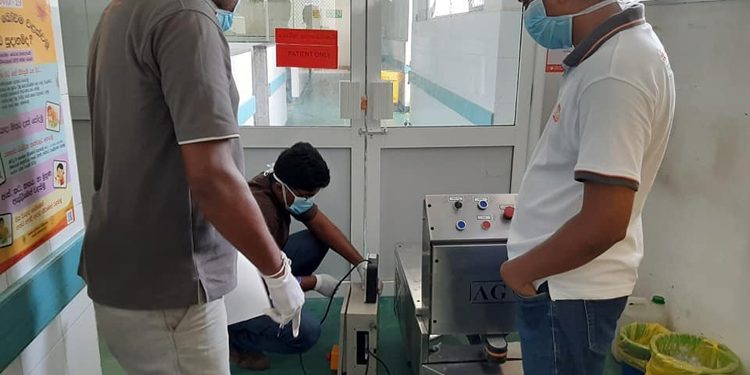
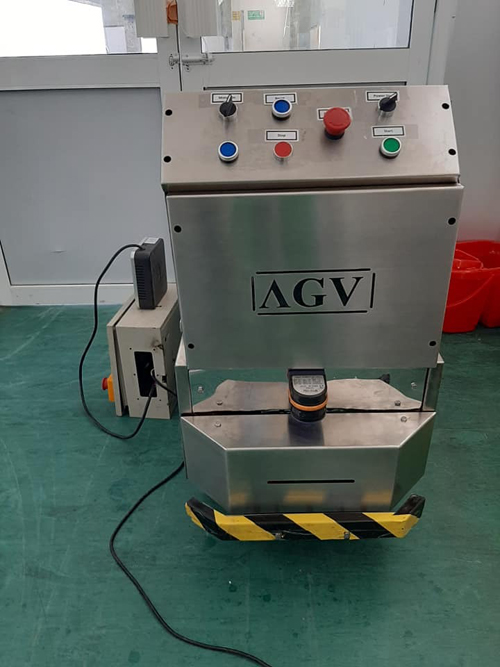
Local company Atlas, a subsidiary of Hemas, has manufactured and supplied the robots to Homagama hospital.
Colombo, March 28 (newsin.asia): At the Homagama Base Hospital near Colombo, indigenously manufactured robots called Automated Guided Vehicles (AGV) will be used to assist the treatment of persons suspected to have been infected by the COVID-19 virus.
The robots had been designed by the Sri Lankan company Atlas, a subsidiary of Hema’s.
It will now be possible to send medicines and other substances to the patient through these robots. Using the camera and speaker in the robot, it will now be possible to communicate with the patient without coming into close contact.
This has been custom built for this very purpose of looking after patients in isolation wards by the Sri Lankan company Atlas – a subsidiary of Hemas. The robot has been built using mostly materials sourced locally.
Though this is the first time I witnessed an appliance of this nature made in Sri Lanka,” said Dr Anil Jasinghe, it has been very well designed and developed.”
Built with sensors, this smart appliance can stop in its tracks without colliding with objects and persons in front of its path. Each bed in the ward is tagged with what is termed as an RFID identification. The robot is sent to the required bed by giving the respective identification tag. Among its sophisticated features is also the ability to control the speed of its movement. By pressing the home” button, the robot is brought back to the originating point.
These robots save not only manpower hours but also ensures the safety and protection of the hospital staff.
Considering the prevailing situation in the country,” Dr Jasinghe further said, I request from the Hemas subsidiary Atlas Company to provide us with 25-50 of these robots.”
Besides the Homagama Base Hospital, the center used by Voice Of America in Uswatakeyya will also be converted to monitor and treat patients suspected to be infected with COVID-19. This unit will be ready In about four days, noted Dr Jasinghe. Likewise, a large number of hospitals throughout the Island will be soon equipped with special wards with isolation units to manage the situation, he stated.
Accordin to Hema’s, the AGV can carry food and medicine to patients and perform basic medical check-ups, such as checking temperatures. It also enables doctors to monitor patients remotely, while having conversations with them through the cameras mounted on it. In addition to this, the AGV can charge itself using a wireless charging port, further reducing its physical proximity to healthcare workers. The use of the AGV will automate patient monitoring, thereby enabling healthcare workers to apply their expertise in managing the crisis more efficiently and to stay safe while saving lives.
Atlas AGV Robot at the Homagama Base Hospital
Dr. Indika Jagoda, the Regional Director of Health Services, Colombo lauded the launch of the prototype AGV. It is truly remarkable that a Sri Lankan company has developed a home grown robotic medical assistant. The advancement of technological development is vital in the fight against this pandemic. The ready access to patients that healthcare workers have without putting themselves at risk, thanks to the AGV robot, is truly a massive advantage in the fight against COVID-19,” he said.
Speaking on the initiative, Asitha Samaraweera, Chief Executive Officer, Atlas Axillia said, I am extremely proud of our team for creating a solution to address one of the challenges our medical personnel are facing today in the country with respect to infectious diseases such as the Coronavirus. We humbly share this invention to further the national cause to effectively combat COVID-19. We are gifting the prototype to the Homagama Hospital, as it is a designated facility to treat COVID-19 patients exclusively”.
As a company with the national interest at heart for over 60 years, we have remained focused on contributing to Sri Lanka’s economy by investing in the country. This innovation by our team is the best way for us to do so in this critical time of need, ensuring that we are enabling our healthcare workers to fight the spread of this pandemic more efficiently,” Asitha Samaraweera added.
Currently, healthcare providers who work closely with infected patients use Personal Protective Equipment (PPE) when treating them, at great physical discomfort to themselves. The deployment of the AGV will ease this burden to a great extent, where one-on-one patient interaction is focused on mandatory and critical health requirements.
Dr. Janith Hettiarachchi, Medical Superintendent, Base Hospital Homagama, thanked Atlas Axillia for stepping in to help the nation at this crucial juncture. The most important thing in a situation like this is keeping our staff safe. If even one of our staff is infected, the entire team will have to undergo quarantine, upsetting the entire operation. To have a robotic nursing assistant doing the work that a human healthcare worker would otherwise have to do, significantly reduces the chance of an infection and is therefore invaluable. This is apart from the large monetary saving the state makes, from not having to use multiple sets of expensive PPEs by healthcare workers to interact with patients each day.”
The AGV was developed by a team of innovators within the manufacturing and engineering division of Atlas, led by Viraj Jayasooriya, COO / Director Operations. The team, which practices manufacturing innovation, developed the AGV originally as a robotic assistant to carry goods within the Atlas production facility. With the outbreak of the Coronavirus, the team immediately began innovating the existing model to create a machine that can be used at hospitals, as a remote medical assistant.
Viraj Jayasooriya from Atlas said, Our teams designed and fabricated the entire robot from scratch and have been working around the clock the past few days to perfect the modifications that will enable it to monitor COVID-19 patients. Medical professionals are constantly in danger of being exposed in the frontlines. With the AGV in place, we can minimize the need to send humans inside the ward, as the robot goes to each bed in multiple wards and allows the remote monitoring of patients by doctors. We welcome organisations who are interested in scaling up the production of this robot, in order to deploy them for the support of more medical personnel combating COVID-19.”
Atlas intends to secure all design and patent rights in respect of this invention as soon as the circumstances permit it, in order proceed with further development.
Sri Lanka on Saturday reported its first COVID-19 death, of a 65-year-old patient, who had diabetes and renal health complications, Health Ministry officials said. The island nation has 113 confirmed coronavirus patients so far.
Sri Lanka’s health officials have also detected four COVID-19 positive cases in people who recently returned from Chennai, prompting authorities to term Chennai a high-risk” zone.
Two cases detected today and two more cases from earlier this week were all Chennai returnees, Chennai is definitely a high-risk zone” Director-General of Health Services told The Hindu on Saturday. The government has asked all those returned from Chennai in the last 14 days to report to health authorities for quarantine.
Mid-March, Sri Lanka reported four persons — an Indian tourist and three Sri Lankans — who tested positive on arrival from India. With the latest detections, a total of eight cases have originated from India, according to authorities. Nine patients have recovered and been discharged from hospital, according to an official bulletin.
Sri Lanka stopped flight arrivals in all its airports on March 17. For a week now, the island has been on a near-total shutdown and travel between districts has also been banned.
Three more patients have tested positive for the novel coronavirus, hiking the total number of cases in Sri Lanka up to 113.
Earlier today (28), four patients were reported as having contracted the COVID-19 virus.
It was also reported that two patients who contracted the virus had made a complete recovery today, bringing the total number of recovered patients to 9.
Meanwhile, Sri Lanka’s first coronavirus death was confirmed from the Infectious Diseases Hospital (IDH), earlier this evening. The deceased is a 60-year-old kidney transplant patient who had suffered from diabetes and high blood pressure.
Currently, more than 190 patients suspected of contracting the virus are under observation at selected hospitals across the country.
The president was aware of the danger from the coronavirus – but a lack of leadership has created an emergency of epic proportions
When the definitive history of the coronavirus pandemic is written, the date 20 January 2020 is certain to feature prominently. It was on that day that a 35-year-old man in Washington state, recently returned from visiting family in Wuhan in China, became the first person in the US to be diagnosed with the virus.
On the very same day, 5,000 miles away in Asia, the first confirmed case of Covid-19 was reported in South Korea. The confluence was striking, but there the similarities ended.
In the two months since that fateful day, the responses to coronavirus displayed by the US and South Korea have been polar opposites.
One country acted swiftly and aggressively to detect and isolate the virus, and by doing so has largely contained the crisis. The other country dithered and procrastinated, became mired in chaos and confusion, was distracted by the individual whims of its leader, and is now confronted by a health emergency of daunting proportions.
Within a week of its first confirmed case, South Korea’s disease control agency had summoned 20 private companies to the medical equivalent of a war-planning summit and told them to develop a test for the virus at lightning speed. A week after that, the first diagnostic test was approved and went into battle, identifying infected individuals who could then be quarantined to halt the advance of the disease.
A nurse at testing booth outside the Yangji hospital in Seoul. Photograph: Ed Jones/AFP via Getty Images
Some 357,896 tests later, the country has more or less won the coronavirus war. On Friday only 91 new cases were reported in a country of more than 50 million.
The US response tells a different story. Two days after the first diagnosis in Washington state, Donald Trump went on air on CNBC and bragged: We have it totally under control. It’s one person coming from China. It’s going to be just fine.”
‘A fiasco of incredible proportions’
A week after that, the Wall Street Journal published an opinion article by two former top health policy officials within the Trump administration under the headline Act Now to Prevent an American Epidemic. Luciana Borio and Scott Gottlieb laid out a menu of what had to be done instantly to avert a massive health disaster.
Top of their to-do list: work with private industry to develop an easy-to-use, rapid diagnostic test” – in other words, just what South Korea was doing.
It was not until 29 February, more than a month after the Journal article and almost six weeks after the first case of coronavirus was confirmed in the country that the Trump administration put that advice into practice. Laboratories and hospitals would finally be allowed to conduct their own Covid-19 tests to speed up the process.
Today, 86,012 cases have been confirmed in the US, pushing the nation to the top of the world’s coronavirus league table
Those missing four to six weeks are likely to go down in the definitive history as a cautionary tale of the potentially devastating consequences of failed political leadership. Today, 86,012 cases have been confirmed across the US, pushing the nation to the top of the world’s coronavirus league table – above even China.
More than a quarter of those cases are in New York City, now a global center of the coronavirus pandemic, with New Orleans also raising alarm. Nationally, 1,301 people have died.
Most worryingly, the curve of cases continues to rise precipitously, with no sign of the plateau that has spared South Korea.
The US response will be studied for generations as a textbook example of a disastrous, failed effort,” Ron Klain, who spearheaded the fight against Ebola in 2014, told a Georgetown university panel recently. What’s happened in Washington has been a fiasco of incredible proportions.”
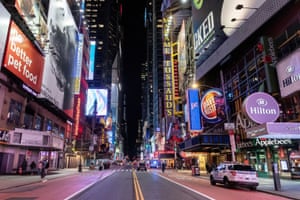
An empty Times Square. New York is now considered a global center of the pandemic. Photograph: Jeenah Moon/Reuters
Jeremy Konyndyk, who led the US government’s response to international disasters at USAid from 2013 to 2017, frames the past six weeks in strikingly similar terms. He told the Guardian: We are witnessing in the United States one of the greatest failures of basic governance and basic leadership in modern times.”Advertisement
In Konyndyk’s analysis, the White House had all the information it needed by the end of January to act decisively. Instead, Trump repeatedly played down the severity of the threat, blaming China for what he called the Chinese virus” and insisting falsely that his partial travel bans on China and Europe were all it would take to contain the crisis.
‘The CDC was caught flat-footed’
If Trump’s travel ban did nothing else, it staved off to some degree the advent of the virus in the US, buying a little time. Which makes the lack of decisive action all the more curious.
We didn’t use that time optimally, especially in the case of testing,” said William Schaffner, an infectious diseases specialist at Vanderbilt University medical center. We have been playing reluctant catch-up throughout.”
As Schaffner sees it, the stuttering provision of mass testing put us behind the eight-ball” right at the start. It did not permit us, and still doesn’t permit us, to define the extent of the virus in this country.”
Though the decision to allow private and state labs to provide testing has increased the flow of test kits, the US remains starkly behind South Korea, which has conducted more than five times as many tests per capita. That makes predicting where the next hotspot will pop up after New York and New Orleans almost impossible.
The national guard is helping to manage a Covid-19 testing site in the Treme neighborhood of New Orleans. Photograph: Bryan Tarnowski for the Guardian
In the absence of sufficient test kits, the US Centers of Disease Control and Prevention (CDC) initially kept a tight rein on testing, creating a bottleneck. I believe the CDC was caught flat-footed,” was how the governor of New York, Andrew Cuomo, put it on 7 March. They’re slowing down the state.”
The CDC’s botched rollout of testing was the first indication that the Trump administration was faltering as the health emergency gathered pace. Behind the scenes, deep flaws in the way federal agencies had come to operate under Trump were being exposed.
In 2018 the pandemic unit in the national security council – which was tasked to prepare for health emergencies precisely like the current one – was disbanded. Eliminating the office has contributed to the federal government’s sluggish domestic response,” Beth Cameron, senior director of the office at the time it was broken up, wrote in the Washington Post.
We didn’t use that time optimally, especially in the case of testing. We have been playing reluctant catch-upWilliam Schaffner
Disbanding the unit exacerbated a trend that was already prevalent after two years of Trump – an exodus of skilled and experienced officials who knew what they were doing. There’s been an erosion of expertise, of competent leadership, at important levels of government,” a former senior government official told the Guardian.
Over time there was a lot of paranoia and people left and they had a hard time attracting good replacements,” the official said. Nobody wanted to work there.”
It was hardly a morale-boosting gesture when Trump proposed a 16% cut in CDC funding on 10 February – 11 days after the World Health Organization had declared a public health emergency over Covid-19.
Schaffner, who describes himself as the president of the CDC fan club”, said he has been saddened by how sidelined the CDC has become over the past two months. Here we have the public health issue of our era and one doesn’t hear from the CDC, the premier public health organization in the world,” Schaffner said.
Under Trump, anti-science sweeps through DC
The Food and Drug Administration (FDA), which regulates the diagnostic tests and will control any new treatments for coronavirus, has also shown vulnerabilities. The agency recently indicated that it was looking into the possibility of prescribing the malaria drug chloroquine for coronavirus sufferers, even though there is no evidence it would work and some indication it could have serious side-effects.Advertisement
The decision dismayed experts, given that Trump has personally pushed the unproven remedy on a whim. It smacked of the wave of anti-science sentiment sweeping federal agencies under this presidency.
As the former senior official put it: We have the FDA bowing to political pressure and making decisions completely counter to modern science.”
Highly respected career civil servants, with impeccable scientific credentials, have struggled to get out in front of the president. Dr Anthony Fauci, an infectious disease expert who has become a rare trusted face in the administration amid the coronavirus scourge, has expressed his frustration.
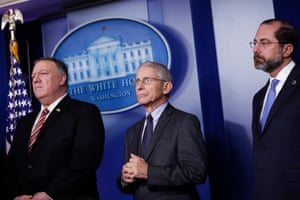
The US secretary of state, Mike Pompeo, with Dr Anthony Fauci and the health secretary, Alex Azar. Photograph: Al Drago/EPA
This week Fauci was asked by a Science magazine writer, Jon Cohen, how he could stand beside Trump at daily press briefings and listen to him misleading the American people with comments such as that the China travel ban had been a great success in blocking entry of the virus. Fauci replied: I know, but what do you want me to do? I mean, seriously Jon, let’s get real, what do you want me to do?”
Trump has designated himself a wartime president”. But if the title bears any validity, his military tactics have been highly unconventional. He has exacerbated the problems encountered by federal agencies by playing musical chairs at the top of the coronavirus force.Advertisement
The president began by creating on 29 January a special coronavirus taskforce, then gave Vice-President Mike Pence the job, who promptly appointed Deborah Birx coronavirus response coordinator”, before the federal emergency agency Fema began taking charge of key areas, with Jared Kushner, the president’s son-in-law, creating a shadow team that increasingly appears to be calling the shots.
There’s no point of responsibility,” the former senior official told the Guardian. It keeps shifting. Nobody owns the problem.”
Trump: everything’s going to be great
Amid the confusion, day-to-day management of the crisis has frequently come directly from Trump himself via his Twitter feed. The president, with more than half an eye on the New York stock exchange, has consistently talked down the scale of the crisis.
On 30 January, as the World Health Organization was declaring a global emergency, Trump said: We only have five people. Hopefully, everything’s going to be great.”
On 24 February, Trump claimed the coronavirus is very much under control in the USA”. The next day, Nancy Messonnier, the CDC’s top official on respiratory diseases, took the radically different approach of telling the truth, warning the American people that disruption to everyday life might be severe”.
Trump was reportedly so angered by the comment and its impact on share prices that he shouted down the phone at Messonnier’s boss, the secretary of health and human services, Alex Azar.
Messonnier was 100% right. She gave a totally honest and accurate assessment,” Konyndyk told the Guardian. And for that, Trump angrily rebuked her department. That sent a very clear message about what is and isn’t permissible to say.”
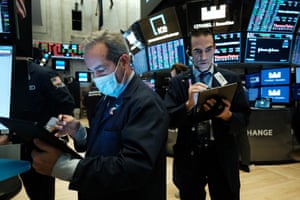
Traders, some in medical masks, work on the floor of the New York stock exchange last week. Traders are now working remotely. Photograph: Spencer Platt/Getty Images
Konyndyk recalls attending a meeting in mid-February with top Trump administration officials present in which the only topic of conversation was the travel bans. That’s when he began to despair about the federal handling of the crisis.
I thought, ‘Holy Jesus!’ Where’s the discussion on protecting our hospitals? Where’s the discussion on high-risk populations, on surveillance so we can detect where the virus is. I knew then that the president had set the priority, the bureaucracy was following it, but it was the wrong priority.”
Ventilators, literal life preservers, are in dire short supply across the country. When governors begged Trump to unleash the full might of the US government on this critical problem, he gave his answer on 16 March.
In a phrase that will stand beside 20 January 2020 as one of the most revelatory moments of the history of coronavirus, he said: Respirators, ventilators, all of the equipment – try getting it yourselves.”
To date, the Trump administration has supplied 400 ventilators to New York. By Cuomo’s estimation, 30,000 are needed.
You want a pat on the back for sending 400 ventilators?” Cuomo scathingly asked on Tuesday. You pick the 26,000 who are going to die because you only sent 400 ventilators.”
‘A total vacuum of federal leadership’
In the absence of a strong federal response, a patchwork of efforts has sprouted all across the country. State governors are doing their own thing. Cities, even individual hospitals, are coping as best they can.
In an improvised attempt to address such inconsistencies, charitable startups have proliferated on social media. Konyndyk has clubbed together with fellow disaster relief experts to set up Covid Local, an online quick and dirty” guide to how to fight a pandemic.
We are seeing the emergence of 50-state anarchy, because of a total vacuum of federal leadership. It’s absurd that thinktanks and Twitter are providing more actionable guidance in the US than the federal government, but that’s where we are.”
Valerie Griffeth is a founding member of another of the new online startups that are trying to fill the Trump void. Set up by emergency department doctors across the country, GetUsPPE.org seeks to counter the top-down chaos that is putting frontline health workers like herself in danger through a dearth of protective gear.Advertisement
Griffeth is an emergency and critical care physician in Portland, Oregon. She spends most days now in intensive care treating perilously ill patients with coronavirus.
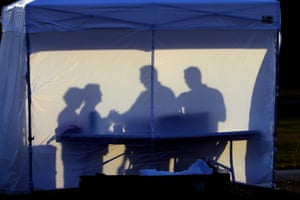
Medical personnel are silhouetted against the back of a tent at a coronavirus test site in Tampa, Florida. Photograph: Chris O’Meara/AP
Her hospital is relatively well supplied, she said, but even so protective masks will run out within two weeks. We are all worried about it, we’re scared for our own health, the health of our families, of our patients.”
Early on in the crisis, Griffeth said, it dawned on her and many of her peers that the federal government to which they would normally look to keep them safe was nowhere to be seen. They resigned themselves to a terrible new reality.
We said to ourselves we are going to get exposed to the virus. When the federal government isn’t there to provide adequate supplies, it’s just a matter of time.”
But just in the last few days, Griffeth has started to see the emergence of something else. She has witnessed an explosion of Americans doing it for themselves, filling in the holes left by Trump’s failed leadership.
People are stepping up all around us,” she said. I’m amazed by what has happened in such short time. It gives me hope.”
Experts say the treatment might be the best hope for some patients until more sophisticated drugs are developed.
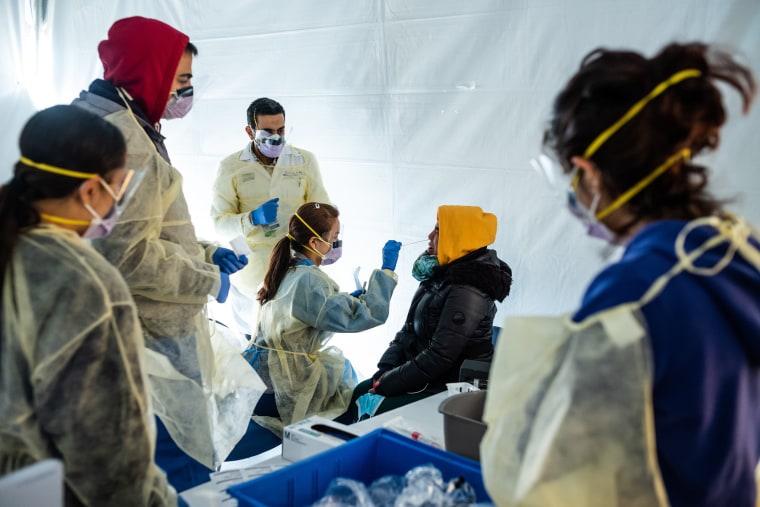
Doctors test hospital staff with flu-like symptoms for COVID-19 in triage tents at St. Barnabas Hospital in the Bronx borough of New York on Tuesday, March 24, 2020.
The Food and Drug Administration will allow doctors across the country to begin using plasma donated by coronavirus survivors to treat patients who are critically ill with the virus under new emergency protocols approved Tuesday.
The FDA’s decision comes a day after New York Gov. Andrew Cuomo announced that the state’s health department planned to begin treating the sickest coronavirus patients with antibody-rich plasma extracted from the blood of those who’ve recovered.
The treatment, known as convalescent plasma, dates back centuries and was used during the flu pandemic of 1918, in an era before modern vaccines and antiviral drugs. Some experts have argued that it might be the best hope for combating the coronavirus until more sophisticated therapies can be developed, which could take several months.
“The approach definitely has merit, and what’s remarkable about it is it’s not a new idea; it’s been with us for a good hundred years or longer,” said Dr. Jeffrey Henderson, an associate professor of medicine and molecular microbiology at the Washington University School of Medicine in St. Louis. “I think we don’t know until we have experience and case reports with this particular disease whether it will be effective, but just based on its track record with a number of other viruses, I think it has a very good chance of working.”
Henderson is part of a nationwide network of doctors and researchers, led by a team at Johns Hopkins University in Baltimore, who have been working to establish protocols for use of plasma to treat those suffering from COVID-19, the disease caused by the coronavirus.
The method — essentially harvesting virus-fighting antibodies from the blood of previously infected patients — was associated with milder symptoms and shorter hospital stays for some patients during the 2002 SARS outbreak. And initial reports from China suggest convalescent plasma might also be effective in dulling the effects of COVID-19.
Under the emergency protocols approved by the FDA, doctors can request permission to treat critically ill COVID-19 patients on a case-by-case basis. For now, the experimental treatment will be reserved for patients who are in dire condition and at risk of death. The FDA will respond to most requests within four to eight hours, the agency said. For patients who require treatment faster, doctors can call the FDA’s Office of Emergency Operations to get approval over the phone.
If the treatment is proven safe and effective, experts said it would likely work best if given to patients before symptoms become too severe. And past studies indicate that proactive infusions of convalescent plasma might also be effective in protecting front line health care workers from becoming seriously ill.
It would be much
appreciated if readers read this article with a positive and constructive mind,
rather with a negative and destructive mind to criticise.
In the early
centuries, people in India were classified into various categories on caste
basis. Indians had a category known as untouchables (தீண்டத்தகாத / නොපැහැදිලි). The
disgraceful part is that the Indians categorised people based on their
profession. India has safety standards; however, they never apply and practice
the safety standards.
The untouchables and
some lower caste (පහත් කුලය) people were not allowed
into temples, not touch higher case people, not be close
to them, not fetch water from their wells, not bathe in rivers and several
other unhuman kinds of practice.
In the 21st
century, current era, even the top powerful person, Prince Charles heir to the
throne of the UK did not shake hands with others, be close to people, hug
anyone else and be unlike another normal person. The wife of the PM of Canada,
PM of Spain, and several people cannot be like normal persons. This
definitively does not mean that they are untouchables. The PM of Canada
is a top human being who loves everyone irrespective of their race, creed or
colour and a top Boxer. Such a lovely kind person (PM-Canada) has his wife
infected with Corvid-19. What is the cause? Its Nature, irrespective of who
their god is. These people are not from the ancient disgracefully
categorised category known as low caste and untouchable. They are top officials
and high-class humans.
Today law has been
enforced to maintain a distance of 1.5 meters between two people, no gathering
of more than 10 people, no congregating in temples, roads, mosques, churches,
no hoarding of foodstuffs etc. These laws were enacted by law enforcers in the legislature.
In the early centuries,
man-made cultural practice made these habits based on caste distinction. Even
now the Tamil folks practice the caste system in SriLanka and India. These
practices evolved among the Indians. After attending a funeral people do not
enter homes but take a head bath and various practice were practised by the
Indians. No handshakes but say Vanakkam (ආයුබෝවන් ) with their
two hands together.
It may be that
the world may get back to the old system of cultural practice quite soon.
Why did the
caste system evolve? It’s all based on financial status and capability. Liquor
and toddy were sold at a very cheap price, and it was based on supply and
demand. Thus, the financial status of a toddy tapper was quite low. To have a
good decent life people need money. This applies to the Fisherfolks also. Hence
based on the financial capacity of the people they were oppressed under the
caste system. Today the fisher folks are well to do people and rich. This
oppression and suppression prevail in India and SriLanka only. In the Muslim
race caste system does not conquer the people and all are treated equal. Even
among the Tamil and Sinhala Diaspora the caste system prevails among them
wherever they are domiciled. A lower caste person is not recognised even if
that person is intelligent.
Today Nature has
brought all to be equal in living standards and they cannot evade these
standards. This is by law.
Australians are
proud of our Prime Minister Scott Morrison and his team, for his
competency, reliability, capability, and the effort he has been making to
protect the Australians. Majority of the Australians are following the advice
he had given to the people. The PMs effort during the last few months had made
him be a Statesman in Australia similar to the former John Howard. May Nature
relive Australia from this evil Corvid-19 pressure. May all citizens of
Australia listen to the PM and follow his guidance.
At this
juncture, it would be appropriate to honour the SriLankan governance,
especially the President Gotabaya Rajapaksa, His deputy Mr Mahinda Rajapaksa,
Defence Secretary Kamal Gunaratna and the Army Commander Lt Gen. Shavendra
Silva for their efforts in keeping SL to be with minimum Corvid-19 infection
and the people are co-operating except a few Tamils who travelled from Italy
went on hiding in Point Pedro. Relatively SL has very few victims compared to
India.
The military is
to be commended for sacrificing their lives to protect the Northern people
(Tamils) from infection. The army works from day and night to keep people safe.
The world should acknowledge and commend the SL military and praise them for
the services they are rendering irrespective of caste, creed and race.
It is hoped that
SriLankans and Indians will now understand what the practice means. It is hoped
that the world may get back to the Indian customs and practice.
The Chinese President Xi Jinping, who is a true friend of Sri Lanka, has commended Sri Lanka for steps being taken to combat the Corona Virus pandemic and expressed his readiness to send a team of specialist doctors and health sector personnel who have gained expertise in treating corona affected people.
The reputed Saudi Arabian newspaper Arab News” widely read throughout the Middle East similar to the well-known Al Ahram” newspaper of Egypt has hailed measures taken by Sri Lanka to confront the Corona pandemic threat. The Arab News on 24th March in a lead news item says that Sri Lankans from all walks of life welcomes measures announced by President Gotabhaya Rajapaksa to breathe life into the virus-hit economy. The newspaper highlights that the President has announced relief packages to lessen financial difficulties and has also pledged a donation to the SAARC Fund even at this time of difficulties displaying the country’s desire for the welfare of the people in the neighbouring countries as well.
The newspaper has
also welcomed the President’s decision to keep the Pharmacies and Banks open during
the Curfew Hours to ensure smooth economic activities and to care and protect
the sick people.
Indian dai;y The Hindu” also has commended the measures being taken in Sri Lanka. The newspaper’s Colombo correspondent Ms Meera Srinivasan has posted a Tweeter message saying that Sri Lanka has the capacity to overcome the pandemic situation within one week as the country has the best health care services in the region.
Addressing the Cabinet meeting held on Wednesday 25th March President GR has said that the forthcoming two weeks will be crucial to Sri Lanka and he will not allow Sri Lanka to become another Italy. He has hinted the possibility of extending the curfew for the next two weeks and has assured that all steps will be taken to home deliver food and other essential items throughout the country. In addition to this that he has announced a plethora of concessions to cover people belonging to all walks of life including a six months moratorium from all banks, leasing companies, financial institutions, in respect of bank loans instalment recovery, monthly leasing charges for vehicles, three-wheelers, trucks and other vehicles, and levying of interest charges for pawned articles and mortgages. He has declared banks as essential services and has instructed the Central Bank. State Banks and Commercial Banks to be kept open during curfew hours and facilitate e-transactions. Post offices will also be kept open for 2 hours during curfew hours.
While the President, the PrimeMinister, Ministers of the government, health and security service authorities are working round the clock to ensure the safety of the people from this deadly virus which has already engulfed 198 countries throughout the world, some misbegotten fellows who call themselves politicians seem to be making relentless efforts to politicise the calamity and overcome their political degeneration as it has been rightly said by Prime Minister Mr Mahinda Rajapaksa the two factions in the UNP are attempting to gain political capital out of this pandemic”.
The biggest joker in today’s Sri Lankan
politics, the imbecile and nincompoop Sajith Premadasa who does not have any
original thinking and parrots borrowed views and suggestions has made a
colossal mockery of the situation self-contradicting his own statements. The borrowed views parroted by him included:
Shut down all government activities; – What about health services?
Lockdown Sri Lanka as it had been done by many countries; If that happens from where people get their food at least. Will it automatically fall down from the sky? Does this nincompoop have a magic wand to create things?
Convene the parliament immediately; Are they doctors or murses to combat the pandemic? A day’s sitting by the Parliament cost Rs. 7Million and former State Minister Vidura Wickremanayake have called for converting the Parliament as a quarantine centre. He has also offered to use his ancient bungalow in Ingiriya to be used as quarantine centre.
In addition to this nincompoop, Sajith in a Facebook note has requested people to take two varieties of tablets to prevent getting affected by the virus. Prof. (Dr.) Channa Jayasumana has written to him explaining that these two tablets are highly dangerous tablets with many side-effects and it should not be taken without prescription from a specialist doctor. What a messy ignoramus guy this fellow is? Latest reports confirm that the stupid politico who is parroting what is said by others without realising the meaning and gravity of such utterances has apologized for the statement he made about prescribing tablets to be used against coronavirus. He has made this apology only in English in his Facebook page maybe because he doesn’t care about the life of Sinhala speaking people and because he is only concerned about the English speaking elite society in Colombo, his new electorate!
People of Ruhuna has kicked him out from the Hambantota district. People of the district say that he is very fond of watching elephant games (Ali Keli) in the Yala forest and he went to Hambantota district to enjoy these games and not to serve for the people in the district.
The UNP leader Mr Ranil Wickremasinghe has requested to convene an all-party leaders meeting.
The politically eclipsing former Speaker Kalu Jayasuriya also has endorsed stupid Sajith’s call fore-convening the Parliament.
There is no news from 3% popularity Jeppos who unsuccessfully attempted to destroy this country twice and the other political merchants trading on the goodwill of their communities and from the terrorist TNA or Pottu Grandpa Vigneswaran despite a danger looming in all districts of North as several hundred people from these districts have attended a special church service conducted by a Swiss Priest who after returning to that country had been admitted to a quarantine centre as a carrier of the deadly virus. All these guys need to be locked up in solitary confinement in quarantine centres until the last affected patient is discharged.
Sri Lanka’s worst-ever quisling, even worst than Don Juan Dharmapala, and the alleged terrorist money launderer Mangala Samaraweera in a lengthy statement has stated that even after the whole country asked to stay at home, the President did not revoke the Election Gazette. This nincompoop purposely attempts to misguide the people by misinterpreting the constitutional provisions related to election laws and knowing very well that it is only Chairman of the Election Commission who is now empowered to take any decision related to Elections.
While the whole country is cooperating with the measures being taken by
the government at this hazardous situation he says that Sri Lankans have
lived through countless crises. Civil wars, insurgencies, constitutional coups
droughts and famines and blames the government which he says failed to take
adequate preventative measures, such as in the case of travellers from Italy.
With defeat looming in the horizon he says that there is no need for elections and the President, although briefed on the coronavirus threat, has decided to conduct early polls. If he is so scared of elections why don’t he withdraw the nomination list he had submitted for Matara district, he cannot do this because all those in his list except him are ready to face elections, and the ground situations indicate that only Buddhika Pathirana will get elected from the UNP (Sajith faction). At the same time why he didn’t urge his party (SLFP at that time) in 1988 to call for the cancellation of the Presidential election when his current bed-fellows JEPPOS were killing SLFP stalwarts and were taking all measures including shooting at his residence, to disrupt the elections under a clandestine contract with Premadasa.
He has in this lengthy statement implied that the government should solicit their assistance for the current activities. How can we Sri Lankans trust people like Rodee Ranawaka, Crocodile Van Rajitha and this Diaspora proxy when they even attempted at the last moment to block funds for government expenditure and topple the government? He has by this suggestion coughed out their ardent desire to topple the government regardless of subjecting the people to great inconvenience. It is only a desperate call to cushion out the inevitable wipeout of them in the forthcoming election.
This nincompoop who is in the last leg of his political misadventure criticizes all aspects of actions being taken by the government to help the people, has failed so far to visit Matara area and at least say a word of consolation to the people. He has only become a cardboard hero, a paper-tiger of issuing statements aimed for consumption by his foreign audience as he cannot face the people who now repent for electing him as their representatives. They even blame Mr Mahinda Rajapaksa for working hard during the 1989 elections to get Goigama votes to this ungrateful fellow and made him enter parliament for the first time. His hollow statements are only aimed at his image-building exercise of getting qualified for a UNHRC post. It is the bounden duty of all patriot Sri Lankans to ensure that this quisling is banished out of this country humiliated, disgraced and despised as soon as possible.
Contrary to the despicable attempts being made by imbecile Sajith and quisling Mangala to gain political advantage over the corona pandemic the stance taken by Mr Ranil Wickremasinghe can be appreciated. He has told the government that it is likely to face a peak situation from April 4 to 11 as highlighted by some health sector officials and urged that it is important to have a common plan, with the public and private sector stakeholders in the health sector and produce or import ventilators, masks and ensure that there are sufficient beds in hospitals, initiate a private/public supply chain to supply essential goods and use even ordinary three-wheelers other than taxi service companies and introduce special laws as done by many other countries worldwide. He has also drawn the attention of the government to the statement made by the GMOA where it has said there may be some 500 cases of COVID-19 in Sri Lanka. Mr Wickremasinghe has also stated that his party will support the government to introduce new legislation to combat coronavirus if it becomes necessary.
It is indeed pleasing to note that majority people of this country have come forward to fully cooperate with measures of the government and health authorities to prevent the spread of the pandemic which has already affected 198 countries in the world,
Several Ministers are reported to be making round the clock efforts to ensure the people get food and essential items at concessionary priced home delivery packages as well as fish, chicken and vegetables. Ministers Chamal Rajapaksa, Wimal Weerawana, Prasanna Ranatunga, and Mahinda Amaraweera are reported to be coordinating these activities in getting products from farmers, fish from fishermen, and transporting them to various areas.
On the instructions of President Minister S.M.Chandrasena has made arrangements for the paddy. Vegetable and fruit farmers too indulge in their farming activities unhindered during curfew hours, transport their products to rice mills, paddy marketing Board, and Economic centres, and ensure adequate fertilizer and other inputs are supplied to the farmers.
Meanwhile, under the directive of the President, a Task Force headed by former Minister Basil has been created and this Unit in collaboration with health and security officials, the staff of Sathosa, Cooperatives, an official from Gas. Pradeshiya Sabhas and Grama Sevakas have started home delivery of food and other essential items throughout the country. The Egg Producers’ Association on a request made by the Prime Minister has made arrangements to sell eggs at Rs. 10/- each and it will be delivered to all parts of the country in 400 odd trucks belonging to mem. The Litro and Laughs gas companies have announced hotline numbers for home delivery of gas cylinders throughout the country.
During the 3 days 24th, 25th, and 26th nearly 1,000 persons have successfully completed their 14 days quarantine schedules and have been released. They have profusely thanked the security forces for treating them March kindly and with much care during their quarantine period. They were transported to the nearest Police stations to their homes. More is to be released in the coming days and those who have been released have profusely commended the treatment meted out and care shown to them by the security forces.
Similar to the enormous service done by them during the war the security forces are reported to be working round the clock to make their maximum contribution to the pandemic combat situation. The Air Force on its own initiative has converted one of its transport planes equipped with 12 beds to transport coronavirus patients to and from ant part of the country. Meanwhile, the Navy has developed a disinfectant chamber to protect the people from the effects of the virus. In addition to this, the Navy is also carrying disinfection programmes covering public and private sector institutions. The army personnel have constricted wards om several hospitals
Many philanthropists have made valuable offers to the President in appreciation of his dedicated services and determination to overcome this unprecedented calamity. Following are some of the offers made by them in writing to the President.
The well-known business tycoon Dhammika Perera has placed an import order worth Rs. 70 Million from his personal funds to import 6 ICU ventilators and 485 modern hospital beds including 169 ICU beds.
The Chairman of the Derana Media Mr Dilith Jayaweera has offered his 150 room Citrus Luxury Hotel in Hikkaduwa to be used as a quarantine centre and the necessary modifications to be made by him.
John Keels Ltd. has offered one of its hotels in Trincomalee and Jemas has also offered one of its hotels to be used as quarantine centres.
Meanwhile, the Police have taken all measures to ensure people adhere to curfew rules. The Deputy Inspector General of Police Ajith Rohana told media that so far over 3,000 curfew violators and nearly 1,000 vehicles of all types have been taken into custody.
China successfully managed the virus situation because its health and public utility services were under State control. However, America and European countries have been unable to control the pandemic since health and utility services in these countries are completely under the control of the private sector and their services are commercially oriented. In Italy coronavirus patients of over 50 years are reported to be left out unattended by the hospitals there. The situation is reported to be same in other European countries and America as well. Fortunately, we have a highly admirable state health service and consumer products distribution networks such as Sathosa, Cooperatives, Litro Gas and other institutions which have prevented a private sector monopoly attitudes.
We are indeed fortunate to have the present government in power at this crucial time. If the Sirisena/Ranil government was in power we would have faced a greater carnage than the Easter Sunday carnage in which over 500 persons were killed and a similar ar number was injured due to purposeful negligence of the government which ignored all intelligence warnings and took actions only to protect its Ministers and MPs by preventing them attending church services on that day. Just imagine how the situation could have been if the nincompoop Sajith got elected as President last November? The country would have been completely shut down with a continuous curfew as in India and Italy, people unable to get their food and other essentials and forced to eat grass or Croten leaves, MPs meeting in Parliament to enjoy subsidized rich meals and in addition getting daily attendance allowance and the country incurring Rs. 7 million each day of parliament sittings and people forced to take the dangerous drugs he has stupidly prescribed. Sri Lanka will thus become the worst affected country in the world.
Worldwide Head of the Ahmadiyya Muslim
Community addresses the worldwide Jama’at from his office, Tilfrod, Surrey,
United Kingdom.
Today
(27 March 2020), during the Covid-19 pandemic, His Holiness Hazrat Mirza
Masroor Ahmad (Khalifatul Masih V, may Allah be his Helper), delivered a LIVE
message for the worldwide Ahmadiyya Muslim Jama’at.
Ahmadiyya Khalifa
at the beginning of his address said that due to the Covid-19 pandemic,
governments around the world, including the British government, have stopped
all congregational prayers.
His Holiness
pointed out that at present, the exact law is not clear. There are various
interpretations; some say that a few close relatives and people can congregate,
while others have differing opinions.
Nevertheless, in
such conditions, until it is not made clear, we cannot offer Jumuah (Friday)
prayers. For this reason, after consultation, he said that instead of
delivering a Friday Sermon, he would deliver a message.
It has become the
habit of Ahmadi Muslims around the world to watch the Friday Sermon on MTA. His
Holiness said that if he had not addressed the Ahmadiiyya Muslim Community
today, then they would have had a longing to watch the sermon and so, he
thought it best to address the Community in one way or another.
His Holiness said,
We cannot, for a prolonged period, leave the Jumuah prayer, and my connection
with the Community is also essential”. After consultation, His Holiness
explained, a solution to this will be found.
In the UK, people
are allowed, individually, to pray at mosques while maintaining distance. But
congregational prayers are not allowed at mosques.
In this condition,
Jama’at members should offer congregational prayers at homes and also offer
Jumuah prayer with the family. Extracts from Malfuzat,
or Jamaat literature, or the writings of the Promised Messiahas, or extracts from Al Fazl or Al
Hakam can be read and the khutba [sermon] can be given.”
The Jumuah cannot
be left for a long time. When people will prepare their sermons”, their
knowledge will increase.
Ahmadiyya
Khalifa said, Al Hakam has
started an initiative on how people are spending their time at home. In those
comments, most people are writing that they are increasing their knowledge by
reading the Quran, hadith and writings of the Promised Messiah, peace be on
him”
Ahmadiyya supreme
Head explained that even in the wider world, people are commenting on how they
are spending their time.
MTA (Muslim TV
Ahmadiyya International) has lots of beneficial programmes, which should
also be watched. He emphasised that the governmental advice that is being
spread should be followed.
Ahmadiyya Khalifa
made it clear that prayers are key and through them, one can draw the grace of
God. This is what the Promised Messiah, peace be on him, continuously said,
that the most important thing is that we seek God’s forgiveness, cleanse our
hearts and remain engaged in good works”.
Where the question
of not offering Jumuah prayer comes, it is clear from sayings of Prophet
Muhammad (sal) – ahadith that in some conditions, the Jumuah prayer become
exempt in mosques.
His
Holiness mentioned a hadith from Bukhari and Muslim in which Hazrat Ibn Abbasra, when it rained,
told the muazins to say Sallu fi buyutikum” (pray in your homes) as
opposed to Hayya alas-Salah” (come to
prayer) and this is also what the Prophetof Islam (PBUH)
practised when such conditions arose.
Further
references from Islamic scholars of jurisprudence were presented by His
Holiness to support this fact.
In the context of
the Covid-19 pandemic and instructions from the government, Ahmadiyya Khalifa
said that in their homes, everyone should continue congregational prayers and
offering Jumuah prayers.
Khalifa of Islam
made it clear that from an Islamic perspective, narrations prove that during
contagious pandemics, people should practise distancing and taking cautions.
Everyone should
offer Jumuah prayers at home and His Holiness said that he would make
arrangements for this as well.
Towards the end,
His Holiness prayed that this virus may quickly subside and that mankind
makes the most of this time in helping one another in the best possible manner.
Guwahati: Newspapers in many parts of the world face an uphill task to maintain its readership index as Bharat (India) goes for a complete lockdown till 14 April 2020 because of pandemic COVID-19 outbreak. A shutdown that prevents the vendors to deliver newspapers at the doorsteps of buyers and the rumour that the paper itself can carry the novel coronavirus has forced the publishers to drastically reduce their circulation figure.
As China originated deadly virus started smashing almost all the countries on the planet resulting in affecting over a hundred thousand people and casualties up to few thousands, Prime Minister Narendra Modi came to the front to lead the fight against the deadly virus. Modi in a televised address to the billion-plus nation on 24 March 2020 declared a total shutdown to break the chain of infection so that the spreading of COVID-19 can be prevented.
As the pandemic infected over 700 people in the country
with over 15 casualties, its immediate impact was observed over the circulation
of newspapers in Mumbai as the vendors ceased to work because of
COVID-19 outbreak. Brihanmumbai Vruttapatra Vikreta Sangh had a formal meeting with the management of all print media houses and finally, they resolved to suspend publications temporarily. The decision resulted in no newspaper day for the residents of Mumbai as well as Navi Mumbai, Thane, Pune, Nagpur etc.
However, management of The Times of India, The Indian Express, The Hindu, Hindustan Times, Mid-Day etc made it clear that even though no physical editions would hit the stands on account of the new-found restrictions their newspapers would be thoroughly available on the internet. Acclaimed news magazine Outlook also suspended its print edition making the digital edition available to nurture the need of readers.
After Mumbai, it was the turn for hundred thousand
residents of Bangalore, Hyderabad along with Guwahati, Imphal, Agartala, Aizawl
in Northeast to miss their favourite morning newspapers as the local
distributors decided to suspend their works because of the virus outbreak.
Guwahati newspaper-hawkers’ association, Manipur hawkers’
association, Tripura and Mizoram based newspaper vendors
separately came out with the resolution that they would not distribute the
newspapers fearing of the virus infection for some days.
The region witnessed the publication of over 50-morning dailies in different languages including English, Hindi, Assamese, Bengali, Boro, Meitei, Karbi, Khasi, Mizo, Nagamese, Nepali, etc. A recent message that went viral on the social media indicating the newspapers as a potential career of coronavirus created panic to the newspaper agents and hawkers along with other media employees.
World Health Organization (WHO) has however asserted that newspapers are still safe to touch by anybody even though the coronavirus can live on some surfaces for several days. The papers used in print media outlets are produced in highly automated mills and the process hardly needs human hands. Moreover, the likelihood of an infected person contaminating commercial goods is low and the risk of catching the virus that causes COVID-19 from a package that has been moved, travelled, and exposed to different conditions and temperature is also low, it added.
But reports relating to the suspended publication of physical editions because of COVID-19 started pouring from different parts of the globe.
From Sylhet (Bangladesh) to Colombo (Sri Lanka), Rabat (Morocco) to Rome (Italy), Vatican City to Jordan, Oman, Yemen capitals along with American cities like Pittsburgh, Seattle, Missouri, West Virginia, Lewisburg etc witness the temporary suspension of newspaper productions. Those media outlets have already committed to entering into the digital platforms completely.
The largest democracy in the world today supports over 82,000 registered newspapers with a cumulative daily circulation of 11 crores estimated to be a Rs 32,000 crore (5 billion USD) industry. As India has been improving its literacy rate up to 75 per cent, more citizens now develop the capacity and resources to access newspapers and digital forums. More middle-class Indian families now start using the internet for various activities for the first time in their lives.
Understanding the heat of changing social engineering,
various print media houses opted for boosting their presences in the digital
media.
As millions of Indians now start using smartphones with internet connectivity, the media owners come to the realization that they would now prefer to get all necessary and almost free news contents from the digital platforms rather than paying for newspapers or even news channels. So the advertisers have also substantially shifted their focus to the digital media space.
It needs not to be reminded that a newspaper is sold in
the market at a lower price than its actual cost. The deficit (also profit) is
managed by the advertisers. They want a newspaper to reach more people (with a
price or even without it) so that their products get necessary visibilities.
Minus circulation, the advertisers would not support the newspapers anymore. So
no distribution of newspapers (even it is duly
published) simply means nil advertisement (read financial
supports) for the print media outlets.
The situation can emerge alarming for regional newspapers like those in Guwahati, Imphal, Agartala, Aizawl etc, as the owners may not be able to sustain their media houses for a longer period. It would directly impact the employees including thousands of scribes in the region. A number of media bodies came out with statements against the rumour that newspapers can carry the coronavirus. They also appealed to the governments to support the media houses in this time of crisis.
Lately, a host of Guwahati based media houses including Asomiya Pratidin, The Assam Tribune, Dainik Janambhumi, Niyomiya Barta, Dainik Asom, Amar Asom, Purbanchal Prahari, Sadin, The North East Times, The Meghalaya Guardian etc made a collective statement that there is no scientific proof for newspapers carrying the coronavirus to the readers. The managements also asserted that a section of electronic and social media outlets spread the unauthenticated news.
But countering it, many social media users put a harsh question to those media houses if they could assure their valued readers of authenticated, credible and balanced news items hereafter ! COVID-19 is a time-bound disaster and everyone would probably return to normalcy after some time, but will the traditional media houses ever get its dedicated readers back in the post-corona era, a difficult question to be answered.
KATHMANDU (AFP) – Foreign governments on Friday (March 27) stepped up operations to evacuate tens of thousands of tourists stranded by the coronavirus pandemic in remote locations across South Asia, from Everest base camp to beach hotels in Sri Lanka.
A plane chartered by Berlin took 304 people out of Kathmandu in the first of a series of flights aiming to ferry more than 10,000 people from Nepal.
Almost 17,000 tourists are stuck in Sri Lanka, while tens of thousands of travellers and expatriates are in India, according to the authorities in the two countries.
All have cut or virtually halted international flights over the past week in a bid to halt the coronavirus spread.
The plane that left Kathmandu on Friday was carrying Germans and other European nationals, Mr Rajan Pokhrel, director-general of Nepal’s Civil Aviation Authority, told AFP.
“Other countries are consulting us about evacuating their citizens,” he added.
A second German flight is to leave on Saturday and the Australian embassy said it was trying to negotiate a special flight.
Other countries, including the United States, are trying to secure joint flights.
Nepal’s government estimates about 10,000 people – from Europe, Australia, South Korea, the United States and India – are in far-flung places across the Himalayan nation that halted all international flights last weekend.
About 200 trekkers are waiting at Everest base camp.
The Nepal Tourism Board said 137 people were brought from high-altitude trekking trails on Thursday and taken to Kathmandu.Related Story
France and other governments organised local flights to get their nationals from remote towns to the Nepalese capital. Some hotels have given free rooms and meals to the stranded tourists.
France and Germany are also negotiating charter flights to get their nationals out of India.
Sri Lankan authorities have let almost 17,000 foreign tourists use their cancelled flight tickets as curfew passes since they became stuck after incoming flights were halted and a nationwide lockdown imposed. Many are stuck in beach resorts far from Colombo airport.
Those stranded include 2,439 Indians, 2,167 Chinese, 2,061 Russians, 1,732 Germans, 1,377 Britons, 916 Canadians and 614 French, the immigration service said.
“We are encouraging other governments to arrange evacuation flights to take back their nationals,” Mr Madubhani Perera, director of the Sri Lanka Tourism Promotion Board, told AFP.
The Maldives, whose economy is dependent on tourism, on Friday halted the arrival of all visitors and ordered the 135 resort islands tobe empty of visitors within two weeks.
The nation of 340,000 people has reported 13 confirmed coronavirus infections and all are foreigners.
The United States said it was organising a special flight next week to take its nationals based in Pakistan.
Cases of the novel coronavirus have now been recorded in all South Asian countries. Dense living conditions, low hygiene awareness and overburdened healthcare systems make the region vulnerable to the worst effects of an outbreak. Preventive measures to stem the spread of the outbreak are set to exact a heavy economic toll. The Economist Intelligence Unit expects countries to provide fiscal and monetary stimulus, although the scope of such measures will vary. India and Bangladesh, given their stronger economic positions, will be able to provide relatively more; meanwhile, measures in Pakistan and Sri Lanka will be more limited.
On March 26th representatives of the South Asian Association for Regional Co‑operation (SAARC) came together on a video conference to exchange experiences of combating the spread of the coronavirus. This came as the region is emerging rapidly as a hotspot for a large-scale outbreak. The number of cases in South Asia has grown swiftly, with Pakistan and India recording the steepest rises. We believe that the number of confirmed cases is being underreported, primarily because of a lack of widespread testing. India, for example, had carried out around 10 tests per million people by March 20th; in comparison, Vietnam had conducted 160 tests per million people by the same date.
South Asia has one of the world’s youngest populations, which is advantageous, as younger people are generally less susceptible to the effects of the virus. Hot and humid conditions in many parts of the region would also inhibit the spread of the virus. However, these advantages are largely discounted in the face of other factors. The region has some of the world’s most densely populated cities, making social distancing difficult. Low hygiene awareness and unequal access to clean drinking water make it especially vulnerable to the worst effects of an outbreak.
We expect the countries to struggle as the number of cases rises in the coming weeks. Chronic underinvestment in healthcare infrastructure and a low number of doctors and hospital beds in relation to the population mean that health systems will not be able to cope with the further toll, exacerbating the spread of the virus and the death rate.
Healthcare infrastructure, 2019
Region
Doctors (per 1,000 people)
Hospital beds (per 1,000 people)
Healthcare spending (US$ per head)
India
0.8
0.5
83
Pakistan
0.9
0.6
33
Sri Lanka
1.1
3.6
161
G7
3.0
5.3
7,230
Source: The Economist Intelligence Unit.
Reacting swiftly to the outbreak has been tough for the region. Wages are low and a large share of households are heavily dependent on employment for their daily sustenance. As a result, some governments in the region, such as that in Pakistan, were reluctant to implement lockdowns. Nonetheless, given the delicacy of the situation, India and Sri Lanka have announced countrywide shutdowns. Nearly all regions of Pakistan have imposed restrictions on non-essential activities, while Bangladesh has imposed a partial lockdown from March 26th. However, Afghanistan continues to be exposed because of its porous border with Iran.
Heavy economic toll
We expect the coronavirus pandemic to dampen economic growth substantially. Preventive measures taken by governments to curtail the movement of people will lead to a demand-side shock to private consumption—the primary driver of economic growth in many South Asian economies. The closure of factories and businesses will result in a supply-side shock, and the subsequent lay‑offs will exacerbate the demand shock.
Similar measures around the world will also constrain demand for exports. Countries like Bhutan, the Maldives and Sri Lanka have already experienced a halt in tourist inflows owing to travel restrictions and a collapse in demand. Lower private consumption and exports will lead to a loss of regular business revenue, making firms unable to pay dues on their loans and forcing them to defer investment plans.
Central banks and governments have responded by providing stimulus in the face of the economic costs of the pandemic. However, we believe the measures will not come close to offsetting the loss of economic activity. The Indian, Pakistani, Bangladeshi and Sri Lankan central banks have cut their policy rates and announced other measures to ensure liquidity in the financial sector, while the Indian, Pakistani and Bangladeshi governments have announced fiscal stimulus plans, primarily to support low-income households.
Fiscal stimulus plans
Region
Additional committed spending (US$ bn)
Share of GDP (%)
India
24.1
0.7
Pakistan
7.1
2.6
Bangladesh
0.6
0.2
Source: The Economist Intelligence Unit.
Stimulus measures unable to support growth
As the crisis worsens, we expect further fiscal and monetary stimulus to be provided by nearly all South Asian countries. Fiscal stimulus will continue to focus primarily on tax relief and support for low‑income households through direct or indirect cash transfers, while monetary stimulus will focus on deferring loan payments and ensuring adequate liquidity in the financial market.
However, the extent to which different countries are able to stimulate their economy will vary. India and Bangladesh have yet to provide large-scale packages, although we expect them to ramp up stimulus aggressively, given sufficient monetary policy space and manageable public debt and fiscal deficit levels. While the relaxation of IMF fiscal targets for Pakistan and Sri Lanka will provide space for stimulus, it will still be largely limited by high borrowing rates and fiscal deficit levels.
Monetary policy stimulus in these countries will also be constrained, as the authorities try to limit the depreciation of their currencies and strain on the external account. Meanwhile, weak institutional capacity in Afghanistan and in‑fighting within the government will leave it unable to respond aptly to the crisis. In the light of this, we will be revising down our GDP growth forecasts for various countries.
By P.K.Balachandran/Daily Express Courtesy NewsIn.Asia
Large-scale illegal migration to Italy makes tracking difficult, say researchers.
Colombo, March 25: Italy has been identified as the predominant source of COVID-19 infection in Sri Lanka. No wonder then that the Lankan government has imposed an indefinite curfew in the districts of Colombo, Gampaha and Kalutara where most returnees from Italy reside.
Italy is one of three countries most affected by the COVID-19 pandemic. On March 24, Italy reported 602 new deaths from the coronavirus, bringing the total number of deaths to 6,077 with the tally of cases rising to 63,928.
Italy has been home to a large number of immigrants from Sri Lanka, both legal and illegal, since the 1980s. Many of the returnees in recent weeks could be illegal migrants on whom the State does not have adequate records. Identifying them, tracing them and examining them for the symptoms of the virus and treating or quarantining them pose a major challenge to the authorities.
On Wednesday the police sought public support to identify at least 12 persons who had failed to undergo quarantine on their arrival from Italy recently. There are reasons to suspect that the arrivals who have played truant are illegal migrants who had come back.
Illegal migration of Lankans to Italy has been a long standing phenomenon and a cause of concern too. V.P.N.Senadhi of the Department of Demography, University of Colombo, who had studied illegal and legal migration to Italy found that 46% had gone illegally by boat. This was so because they came from the West Lankan coast which had many multi-day trawlers with an ability to traverse the Indian Ocean, Red Sea, Suez Canal and the Mediterranean to reach Italy. This was the cheapest transportation to Italy.
Italy had a liberal migration policy in the 1990s which helped both legal and illegal immigrants. The Dini Decree in 1996 made it easier for Lankan workers to bring their families to Italy. In Rome, Naples and Milan, Lankans had built up enlarged families”, where jobs were exchanged among relatives and compatriots, Senadhi says.
However, as illegal migration increased continuously, the Italian government gave the responsibility of controlling illegal migrants to NGOs, vocation campaigns and the Catholic Church. The Catholic Church treated them well by supplying food, medicine, clothes and every day necessities. The Church also taught them Italian to make it easier for them to find work. Although, eventually, Italy controlled illegal immigration, it could not stop it.
According to Jagath Pathirage of Charles Darwin University, in 2011, 88,000 Sri Lankan nationals were legally residing in Italy. They went from Lanka for the very good wages in Italy. Even cleaners earned in excess of Euro 1000 a month, enabling savings of at least E300 every month. Some of the informants with several years of experience in Italy were putting aside more than E5000 a year,” he notes.
As a result, in 2012, Sri Lankans were one of the largest immigrant nationalities in Italy and Milan, with about 80,000 Sri Lankans living in the country. About 16,000 Sri Lankans were residing in Milan alone. Lankans earning well in Italy helped their kinsmen back home to migrate likewise. Some of the migrants returned to Sri Lanka and invested in the fishery and tourism industries,” Pathirage points out.
Writing in Groundviews” in 2012, Bernardo Brown said that the fishermen of Negombo, Chilaw and Wennapuwa had been seasonal migrants for centuries because of the weather conditions. They would go to Kokilai in Mullaitivu and also Mannar. But with the start of the war in 1983, the presence of these migrants – although seasonal – was no longer welcomed by the Tamil separatists in Mannar and Mullaitivu,” Brown said. In 1984, Sinhalese Catholic fishermen were massascred in Kokilai. As the violence escalated in the late 1980s, fishermen could no longer migrate to these localities,” he pointed out.
The economically affected fishermen then began to look at other avenues to earn a livelihood. The first batch of Lankan fishermen travelled to Italy in the 1980s and managed to secure profitable jobs. Others followed suit.
At about this time, the Lankan government was encouraging fishermen to acquire motorized fishing trawlers, thanks to the then Fisheries Minister, Festus Perera. These motorized boats became multi-day boats and eventually helped in human smuggling from 1994 onwards.
In 1994, the charge for an illegal journey was less than US$ 2,000 per person. But it grew exponentially over the next few years, eventually to touch the US$ 4,000 mark, Brown said. Lacking the money to pay, many young Lankans would offer their family’s property as collateral.
Initially, only young Catholic fishermen from the west coast went to Italy but soon others from other communities and regions joined the bandwagon. Human smuggling also became an international business. Nationals from Bangladesh, India and Pakistan entered Sri Lanka through the main airport and were whisked away to Negombo and put on a boat to Italy and other countries in the West.
However, a change came about in 2002 which helped control or minimize illegal immigration, Brown said. The Italian Parliament passed the Bossi-Fini law, which offered a path to regularization to those already living in Italy even as it devised stricter border controls.
The second important change was a consequence of the ASEM — Ministerial Conference on Cooperation for the Management of Migratory Flows between Europe and Asia. Following this conference, the Italian government established bilateral agreements with sending countries to help curb illegal migratory flows. One of the advantages to the countries that signed was that Italy offered them special quotas for immigrants and readmission priorities in exchange for their cooperation,” Brown added.
As a consequence of these measures, illegal migration to Italy was drastically controlled, but not eliminated.
Health Minister Pavithradevi Wanniarachchi today expressed her utmost disappointment and anger when the Police and Health authorities detected a 67-year-old COVID 19 infected individual who had dodged quarantine for more than a week and suspected of having infected over 50 other Sri Lankans in the last few days.
The patient from the East has come back to Sri Lanka after a two week stay in India on March 18 and travelled to many parts of the country and associated with more than 50 other persons.
After he realized that he had fever and breathing difficulties, he had gone to a famous private hospital in Colombo where he was diagnosed for viral infection. When he sought inbound treatment, the doctors and private hospital authorities refused and asked him to enter a government hospital. But he had not done so and until last Monday has travelled widely and associated with many people, probably infecting dozens of people,” Minister Wanniarachchi said.
The action of this man is unacceptable and highly irresponsible. He may have infected several dozens of people by now. It is sad and unfortunate if people behave like this ignoring the facilities provided by then government to protect the people from this viral infection and ignore the advice of health officials, the Police, the Army an the media, she stressed.
Minister Wanniarachchi said the man who has been admitted to the IDH – Angoda would be charged under the Criminal Procedure code and Quarantine and Prevention of Disease Ordinance.(Sandun A Jayasekera)
The Government insists that the public must strictly adhere to the curfew now in force island-wide.
Curfew has been imposed with the sole purpose of to preventing the spread of COVID – 19 which has now become a major health issues, the President’s Media Division said.
The Task Force entrusted with the management of the essential food and other items distribution has taken all the necessary measures to ensure continued door to door supply of essential items for the people to purchase, it said.
While the curfew is in force no one should be on the roads at their freewill. Only the delivery vehicles permitted by the Task Force are allowed to ply. No other vehicle will be allowed on public roads without a valid curfew pass,”
Traveling to and from between any district is entirely prohibited while transporting foreign tourists from place to place is also banned.
Paddy farming and plantation including work on tea small holdings and fishing activities are permitted in any district. Airports and Ports will continue their regular operations.
Police and the Tri-Force should strictly implement curfew regulations, the release said.
Acting IGP C. D. Wickramaratne has ordered police stations to ensure that all supermarkets, groceries and pharmacies, except state-run Rajya Osu Sala outlets, in the country are closed with immediate effect.
The Police Media Spokesman said that although supermarkets have been permitted to deliver essential food items to the homes of consumers, there have been reports that certain supermarkets and grocery stores are open and selling goods to customers.
Therefore the Acting IGP has instructed the OICs of all police stations to close down all such supermarkets and groceries effective immediately.
Meanwhile the Acting IGP has also instructed all officers-in-charge (OIC) of police stations to close down all pharmacies excluding Rajya Osu Sala outlets with immediate effect.
However, pharmacies will be allowed to deliver medicine to homes, the police spokesman said.
In order to contain the spread of COVID-19, the government has introduced a mechanism to home-deliver medicines through pharmacies in relevant areas.
For this purpose, the Ministry of Health has identified pharmacies island-wide and the list of these pharmacies can be accessed from the official website of the ministry: www.health.gov.lk
The details include the address, contact number for WhatsApp/ Viber/ IMO and the name of the pharmacist.
The Health Ministry says that payments can be made online or via cash on delivery, adding that a fair amount will be charged for transportation.
In order to purchase the medicinal drugs, the general public is requested to send a recently obtained prescription via WhatsApp/ Viber/ IMO to the selected pharmacy.
The pharmacy will deliver drugs within 24 hours, the release issued by the Ministry read.
Instructions on the consumption of the prescribed drugs and the phone number of the pharmacist will be displayed on the cover. However, the pharmacist’s instructions can also be obtained by dialling the given number.
For more details, the general public can call the following contact numbers: 072 0720720 (English/Sinhala) and 072 0606060 (Tamil).
he Ministry of Health and the Postal Department of Sri Lanka have jointly arranged a programme to distribute medicine for those who are getting treatment from government hospitals and have not enough medicine for their daily use.
The correct name, address, clinic number and telephone number are essential to distribute medicine to the doorstep of the patient, Director General of Health Services Dr. Anil Jasinghe said in a press release.
Hence, clinic patients are requested to contact the hospital they are registered with and update the aforementioned details at the earliest possible. The hospital staff will prepare the required medicines and deliver them via post regularly during the curfew period.
The clinic patients can inform these details to the Grama Niladhari or the Public Health Midwife in their respective residential areas, who are tasked with informing them to the relevant hospitals.
The government has requested the expatriate Sri Lankans who wish to return home to stay in the country that they are residing now until the coronavirus threat is eradicated in Sri Lanka.
The President’s Media Division issuing a statement stated that the government has taken several steps to prevent coronavirus spreading in the country.
As a measure to prevent the virus coming into the country and its spread, all incoming overseas travel has been completely stopped.
The government also pointed out that travel within the country and inter country air travel have been suspended by many countries.
The government stated that requests by foreign students, businessmen and the migrant workers to visit Sri Lanka will be taken into consideration after the country has eradicated the coronavirus.
They are also at risk of contracting the disease when traveling to airports or other locations.
President’s Additional Secretary to Foreign Relations Admiral Jayanath Colombage requests all Sri Lankans who wish to return to the country to be safe and to share their information with the Sri Lankan Embassy or Consulate General Office
Horowpathana Police say that 18 persons including the President of the Kiwulekada Mosque have been arrested in Horowpatana for attending a religious service disregarding the danger and threat to the public.
According to the police, nearly 80 people attended the service
President Donald Trump’s “ultraconservative religious allies” are responsible for his response to the coronavirus pandemic, author Katherine Stewart wrote in an opinion article for The New York Times on Friday.
Stewart, a journalist and the author of “The Power Worshippers: Inside the Dangerous Rise of Religious Nationalism,” noted “Trump rose to power with the determined assistance of a movement that denies science, bashes government, and prioritized loyalty over professional expertise. In the current crisis, we are all reaping what that movement has sown.”
She adds the “denial of science and critical thinking among religious ultraconservatives now haunts the American response to the coronavirus crisis.”
Stewart cites statements from several evangelical leaders who are close with Trump, such as Guillermo Maldonado, who said “Do you believe God would bring his people to his house to be contagious with the virus? Of course not.”
She also quotes Rodney Howard-Browne of The River at Tampa Bay Church in Florida, who called people worried about the disease “pansies,” and Liberty University President Jerry Falwell Jr., who said the response to the coronavirus was “overreacting,” and said it was an “attempt to get Trump.”
Stewart notes, “By all accounts, President Trump’s tendency to trust his gut over the experts on issues like vaccines and climate change does not come from any deep-seated religious conviction. But he is perfectly in tune with the religious nationalists who form the core of his base. In his daily briefings from the White House, Mr. Trump actively disdains and contradicts the messages coming from his own experts and touts as yet unproven cures.”
Please consider getting
the Army to establish the Marketing Department of the Fifties and thereby
enable vegetable availability as well as controlling inflation. It can be later
developed to be a major department. The total outlay can be recouped including
the cost of establishing a Cannery within the first year. I can vouch for this,
My earlier paper is
reproduced and if implemented now(can be done in days) will be a great feat.
Thanks Garvin Karunaratne(garvin_karunaratne @ hotmail com)26/03/2020
Our President’s Clarion
Call for a Remedy to high veg prices.
Posted on February 25th, 2020
By Garvin Karunaratne,
It is hoped that our President’s attention is brought to the
fact that our country was the only country in the world to have a system
by which the prices of veg and fruit was unofficially controlled. That was the
Marketing Department(MD) at work, buying and selling vegetables and fruit,
competing with private traders, keeping a low margin of around fifteen percent
to cover up cost of transport and wastage in handling.
It would behove of our President to immediately order the Army
to buy vegetables from the Producer Fairs, keep a margin of fifteen percent to
cover cost of petrol and wastage and sell in the Cities. Traders keep at least
a total of one hundred percent at the buying place, at the wholesale
dealer in Colombo and at the retailer’s place.
The Army was entrusted with this task in the days of Premier
Mahinda Rajapaksa in about 1998 and then the city was full of army lorries
selling vegetables. I have seen them perform this yeoman service.
The Dambulla Economic Centre and economic Centers at many places-
is not the answer, because as detailed in the Daily Mirror of 24/2 Take
Immediate steps to control Veg prices: Pres. to Officials” because vegetables
brought to Dambulla from the areas of vegetable cultivation are distributed
back (for sale) to the original areas… these centers are controlled by large
scale traders with vested interests.” Once it was reported that the
officer entrusted with the Dambulla Economic Center was severely assaulted.
It is traders that rule. When I once went to Dambulla and walked
around, it was only traders. My incessant visits to producer Fairs for
over six years enables me to sniff producers from a fair distance. It will be a
difficult task to find a Producer Fair in entire Sri Lanka not visited by me.
In 1955 when I joined the MD as an Assistant Commissioner we did
work from small shanty type of sheds- we called them Packing Sheds. They
were all buildings built with timber, a cement floor and a corrugated cladding
to keep off the rain and in a corner was housed the Assistant Commissioner
working in the air and dust of onions and condiments. There were no DPJ Towers
or Setsiripayas for us. These were shed put up overnight to house the
British Army when the Japanaese declared war.
In the MD,our work commenced at 4 AM in the mornings on at least
four days a week, visiting Producer fairs and ensuring that we bought produce
competing with the traders.
I
include parts of my earlier writings, edited to avoid repetition in support.
(From:High Prices for Vegetables: Is there a
remedy? Posted on January 19th, 2020 0
Once in the pre IMF days, in the days before Sri Lanka started
playing poodle to the IMF Sri Lanka did have a method by which it controlled
inflation.
That was the Marketing Department at work. There was a
scheme where the Marketing Department purchased vegetables at the producer
fairs, brought the produce overnight to the cities and sold the produce keeping
a very low margin of fifteen percent to cover up cost of transport and wastage.
This Scheme which had been developed by Sri Lankan administrators and
politicians was abolished on instructions from the IMF in 1978 when the
Jayawardena Government caved in to the IMF. Since then it is the private sector
traders that rule trade.
If only the Marketing Department activities are restored,
we can not only control inflation, but we can also reduce imports and also find
employment for our people.
It is time that our new Government makes an initiative to re
establish the Marketing Department activities- its vegetable and fruit
marketing scheme and the Canning Factory. That will be a real achievement.
Inflation- Rising Prices is a major concern today. Sri Lanka had
built up the infrastructure to control inflation. What we are seeing
today-unbridled inflation, has been caused because we did away with the
infrastructure we had.
For the marketing of essential commodities, in my own words:
The Department for the
Development of Agricultural Marketing”¦ ensured that prices of all
essential commodities were indirectly controlled and the traders were compelled
to offer fair prices to the producers and the retail shop keepers were
compelled to sell at fair prices to consumers. This is a system that I
have never seen elsewhere in the world’ ¦The motto of the Department was to pay
the highest possible price to the producer and sell at the lowest possible
price to the consumer.( From: How the IMF Ruined Sri Lanka,”¦ (Godages:
2006)
I was involved with the entire System because
I was appointed Assistant Commissioner for the Development of Agricultural
Marketing in 1955, and worked in the Ratnapura, Hambantota, Anuradhapura
Districts as well as was in charge of the Tripoli Market, the Headquarters of
the Vegetable Marketing Scheme for a year in 1957.
This System involved a Network of Retail
Shops(Fair Price Shops) in every major city and a Vegetable and Fruit
Marketing Scheme involving purchasing, selling and processing
vegetables and fruits, a Scheme that covered the entire island.
The entire island was covered by Assistant Commissioners in the
Provinces and Marketing Officers posted in producer areas, who had to report
the availability of produce, prices at the Fairs, and guide producers to plant
varieties in demand.
The Marketing Department established Vegetable and Fruit Packing
Sheds(actually purchasing units) in all producing areas. The name given was
packing sheds and they were in many places in temporary buildings mostly made
with timber. Even some Assistant Commissioners had their offices in these
temporary buildings in 1955.
The entire Vegetable Marketing Scheme was administered from
Tripoli Market, based in the largest hangar in the Colombo Goodshed. One
part of the Scheme was to purchase vegetables and fruits from producers who
brought their produce to our Vegetable Packing Sheds. They were paid immediate
cash. The Department was equipped with lorries that were sent to the
chief Producer Fairs in the producer areas. Thus there were mobile
purchasing uints at all major fairs like Embilipitiya, Colombage Ara,
Bandarawela, Welimada, Kekirawa to mention just a few. These Purchasing Units
comprised Marketing Officers and a staff of purchasing officers and labourers.
The produce brought in was weighed and accepted from producers and they were
paid cash immediately. The Assistant Commissioners of the Districts were required
to visit all major fairs to ensure that the purchases were made regularly. When
I worked in the Districts on most days my day commenced at four to get to the
Fairs by six in the morning. Vegetables were purchased and packed and
dispatched to Triploi by evening either by wagons(by trains) or by special
lorry.
At Tripoli Market, the Assistant Commissioner had a
Marketing Officer at the Colombo Wholesale Market. His task was to report the
prices at which the wholesale traders sold the produce to the retail traders
and to report on the availability of produce. In the Districts, the Assistant
Commissioners and the Marketing Officers had to report the prices at which
private traders purchased vegetables and fruit. Generally there was a
wide gap between the prices at which the traders purchased goods and the prices
at which the Wholesale Traders sold to the retail traders in Colombo. Based on
these prices, the Assistant Commissioner at Tripoli Market decided the
purchasing prices at which goods were to be purchased at the Fairs. This price
was always above the prices offered by the traders who bought goods at the
Fairs. This helped the producers and the traders at the Fairs too had to offer
a similar price because otherwise they will be out of business.
On a daily basis Tripoli Market received around twenty wagon
loads of vegetables and a similar number of lorries bringing in produce. These
were checked and had to be in our Retail shops by ten in the morning.
Tripoli Market was a hive of activity from early morning. Then the
Railways ran a very efficient service and brought in produce in time. For
instance curd from Ridiyagama Farm in Hambantota was sent by lorry to Matara
and came by night mail train to Tripoli. This was an item in high demand. The
retail price we fixed for Ridiyagama Curd effectively controlled the prices of
curd in private shops in Colombo.
The Assistant Commissioner at Triploi Market kept a very low
margin to cover up cost of transport and handling and fixed a low price for
sales to the consumers through the network of Shops. Generally the Marketing
Department kept a margin of around 10 to 15% above the purchase price while the
private trader at the Fair kept a margin to 40 to 50% and the Whoelsale
Traders too kept around 40% and further the retail trader too kept around
40%. Thus while the private trader generally kept a margin of 100% or
120% over the purchasing price at the Fair, the Marketing Department kept a
margin of 10% to 15%.
The working of the Marketing Department meant that the
private traders at the Fairs and the Wholesale Traders as well as the Retail
Traders in the cities had to be satisfied with a low margin.
The Marketing Department in the Fifties was headed by BLW Fernando,
a Chartered Accountant and he would not allow any Assistant Commissioner to
keep a higher margin than 15%. That was a rule to be followed. Every month all
Assistant Commissioners had to attend a Conference where the Profit and Loss
calculations were closely studied and the Commissioner would chastise all
Assistant Commissioners that had a profit of over 10% or incurred a
loss. We were expected to cover up, not to incur a loss or to get a
large profit.
This was the key method by which the prices of vegetables and
fruits were kept in check. The Scheme has thus a dual aim- of offering the
producer a fair price as well as offering the consumer a low price. At
times it was like walking on a rope but we got used to walk on it.
The Retail Shops had to be well stocked and full of goods
otherwise the wrath of the Commissioner had to be faced.
A few years ago on one of my visits I found tomatoes being sold
at forty rupees a kilo by a producer on the Mahiyangana Road, when the retail
price in Colombo was around rupees eighty to one hundred, a margin of over
hundred percent. This could not happen while the Marketing Department was at
work. The Assistant Commissioners were eternally traveling as they had to
visit Fairs, inspect purchasing at the Fairs and the Vegetable Purchasing
Depots, contact producers and offer advice on items on demand. Generally our
traveling allowances exceeded our salaries.
Tripoli Marker had cold rooms where the excess produce could be
stored.
This Vegetable Marketing & Fruit Marketingh Scheme was
very successful in ensuring that consumers in cities obtained vegetables and
fruits at cheap rates. The Cost of Living was effectively kept in check.
The Canning Factory
Local producers got a boost with the establishment of the
Canning Factory in 1955. At that time Sri Lanka imported fruit juice and fruit
from Australia and the task of the Canning factory was to produce fruit juice,
jam and jellies. The Vegetable Purchasing Centers sent goods to the Canning
Factory. At the initial stages in canning fruit juice many problems were faced
and it took over a year to surmount them and get down to production for all Sri
Lanka’s requirements. The Marketing Department offered floor prices for
pineapples, red pumpkin and ash pumpkin and producers benefited immensely.
Floor prices meant that the Department will purchase everything offered at that
price. Pineapple was tinned and even an export trade was built up. Assistant
Commissioner Oswald Tilekeratne spread his wings abroad very often. Red Pumpkin
was turned into Golden Melon Jam and Ash Pumpkin was turned into Silver Melon
jam. The Factory activity made Sri Lanka self sufficient in fruit juice, jam
and many other processed food within a few years.
The
Marketing Department was called upon to attend to many tasks.
Once Sri Lanka was not self sufficient in eggs. The Marketing
Department offered a floor price for eggs and Triploi Market collected eggs
from the Negombo-Nattandiya area till Sri Lanka was self sufficient in egg
production. Once Self sufficiency was reached the scheme was disbanded.
With the abolition of the Marketing Department, and the
privatization of the canning factory all this achievement was lost. That was
the way in which the IMF crippled the development of the Third World and
created a situation where we had to import our requirements from the Developed
Countries.
Once the tomatoes producers at Hanguranketa made pandals of
tomatoes in order to highlight their plight of not being able to sell their
tomatoes. This could not have happened while the Marketing Department was
functioning. To start with the Assistant Commissioner of the area would be held
responsible. If that happened when I was in charge of The Tripoli Market I
would have sent a few lorries and the entire stock of tomatoes would have been
purchased within a few hours and it would have been turned into Tomatoe Sauce
and Juice at the Factory. The MD had a fleet of over a hundred lorries. Today
Spain produces tomatoe sauce, tomatoe juice, tomato paste and sun dried
tomatoes for most countries in Europe. With a Tomatoe belt in Hanguranketa we
cannot produce tomato sauce even for our requirements. Our climate had enabled
a variety of crops. There is a mango belt from Anuradhapura to Matale. Even
today if action is taken to pluck mangoes and process it, we can be self
sufficient in all fruit juice within six months. The Chena cultivators
will find sales for their Red Pumpkin,Ash Pumpkin and Melon. There is an
Avacado belt from Peradeniya to Gampola and avacado juice can easily be made.
The country will benefit by avoiding the millions spent on imports.
Following the liberalization free market economics of the IMF
we created a market for tomatoe sauce from the USA, and fruit juice from
as far as Canada and Oregan in the USA. Our producers have stopped
producing large quantities for fear of being unable to sell and we have
unemployment and our farmers have low incomes. The Colombo Supermarkets are
full of Heinz Tomatoes sauce from the USA and fruit juice and jam from
Australia.Even vinegar from the USA! The IMF did its work right to cripple
development in our countries and for us to buy goods from the Developed
Countries. That was the Structural Adjustment Programme in action. (For more
details: How the IMF Sabotaged Third World Development: Kindle & Godages)
It is sad that we have deaf, dumb and blind economists who
even fail to come to grips with how we were duped by the IMF.
I hope the Army will be enlisted for this task of marketing
development. In President Trump’s USA the Army is widely used for irrigation,
power station construction, even maintaining levees that keep the sea from
flooding New Orleans. In my wide travel in the USA, clocking over 50,000 miles
in my Roadtrek motorhome, crossing America thrice I have seen the Army at work
doing non military duties on a regular basis. It is we fools that do not enlist
the Army for development tasks. If at all we touch the army we call them to the
barracks in a short while.
Let the Army experience of Van Sales, this time end with the
establishing of a proper Marketing Department with a Cannery. The total cost of
establishing a Cannery can be easily recouped in the very first year by the
savings of foreign exchange we use today to import fruit juice and fruit
preparations Later on the Army venture can be handed over to a SLAS
Department and the Army moved to another task- perhaps the reconstruction of
our irrigation tanks.
Rev. Tom Honey was the Parish priest (vicar) of the Church of
England in Oxford for more than 20 years and was highly reputed for his
thoughtful sermons and the best perhaps being the one he gave in 2005, on Almighty
God and Tsunami Disaster” after the devastation caused by the Indian ocean
tsunami in which some 300,000 people died. https://www.ted.com/speakers/revtom honey.
What he said then on god and the tsunami
devastation, is directly applicable to the present CORONA VIRUS HEALTH DISASTER
as well. The corona virus pandemic has been spreading rapidly across the world,
affecting more than 520,000 people by late March 2020, in 175 countries, with a
death toll of more than 23,500. Numbers affected and death toll appear to show an
increasing trend, especially in European (Catholic and Christian countries),
notably Italy, Spain, France, Portugal, Germany, UK, Netherland, Switzerland, Belgium, Sweden, Turkey, Austria,
Denmark and among non-European countries, the most affected are in China, USA,
Iran, Brazil and South Korea
Rev. Tom Honey, the British Parish priest said in his sermon, How can the existence of evil be reconciled with an
almighty God who is also all-loving, all-knowing and all-powerful? I have been a parish
priest in the Church of England for more than twenty years. For most of that
time I’ve been grappling with questions about the nature of God. I’m very aware
that when you say God, most people within and outside the church, still have a
picture of a celestial controller, a policeman in the sky who orders everything
and causes events to happen. He will protect his own people and answer the
prayers of the faithful. In the worship of our church the most frequent
adjective when we address God is ‘almighty’; but I have become more and more
uncomfortable with this common perception of God over the years. Do we really
believe in the male boss that our liturgies proclaim?”
He said Two weeks after
the tsunami, Sunday morning 9th January. I found myself standing in front of my
congregation, intelligent, well-meaning, thoughtful Christian people. I needed
to express, on their behalf our feelings and our questions. This is what I
said. Shortly after the tsunami I read a newspaper article, written by Rowan
Williams, the Archbishop of Canterbury, about the tragedy in Southern Asia. The
essence of his words was this: the people most affected by the devastation and
loss of life do not want intellectual theories, about how God can let this
happen. If some religious genius did come up with an explanation of exactly
why all these deaths made sense, would we feel happier, or safer or more confident
in God?”
If the man in the
photograph holding the hand of his dead child was standing in front of us now,
there are no words that we could say to him. The only appropriate response
would be compassionate silence and practical help. It isn’t really a time for
preaching or theology, but for tears. This is true, and yet we are here,
semi-detached from events so far away, with our faith bruised, and we want an
explanation from God.”
Some have concluded that
we can only believe in a God who shares our pain. In some way, God feels the
anguish and grief, and physical pain that we feel. In some way the eternal God
can enter into the souls of human beings and experience the torment within. And
if this is true, it must also be that God knows the joy and exaltation of the
human spirit. A God who weeps with those who weep and rejoices with those who
rejoice. This seems to me both a deeply moving and a convincing restatement of
Christian belief about God. For hundreds of years the prevailing orthodoxy, the
accepted truth was that God the Father, the creator, is unchanging and
therefore cannot feel pain or sadness. The unchanging God feels a bit cold and
indifferent to me. I wonder if you agree.”
The devastating events of
the 20th century forced people to question the cold unfeeling God. The
slaughter of millions in the trenches and in the death camps, caused people to
ask, ‘Where is God in all this?’ And the answer was, God is in this with us, or
God doesn’t deserve our allegiance. If God is a bystander, observing but not
involved, then God may exist, but we don’t want to know about him. Many Jews
and Christians now feel like this, I know. And I am among them. So, we have a
suffering God. A God who is intimately connected with this world, and with
every living soul. I very much relate to this idea of God. But it isn’t enough.
I need to ask some more questions, and I hope they are questions that some of
you want to ask as well, some of you.
Over the last few weeks I
have been struck by the number of times that words in our worship have felt a
bit inappropriate, a bit dodgy. On Tuesday mornings we have a Pram Service for
Mums and their pre-school children. Last week we sang with the children, one of
their favourite songs – The Wise Man Built His House on the Rock. Some of the
words go like this the foolish man built his house upon the sand…….and the
floods came up……and the house on the sand went crash”. Then at a funeral there
was the familiar hymn We plough the fields and scatter”. In the second verse
comes the line, the wind and waves obey him.” Do they? I don’t think we can
sing those words again. So, the first big question is about control. Is God in
control? Does God order each moment? Does God have a plan for each of us? Do
the wind and waves obey him?
From time to time one hears
Christians telling the story of how God organised things for them, so that
everything worked out alright. Some difficulty was overcome, some illness
cured, some trouble averted, a parking space found at a crucial time. I can
remember someone saying this to me, her eyes shining bright with joy, as a
wonderful confirmation of her faith and the goodness of God. But if God can or
will do these things, intervene to change the flow of events, then surely, he
could have stopped the tsunami happening. A local god who can do little things
like parking spaces, but not big things like 500mph waves. That’s not
acceptable, and we must acknowledge it. Either God is responsible for the
tsunami, or God is not in control. After the tragedy, survival stories began to
emerge. The man who surfed the wave. The teenage girl who recognised the danger
because she had just been learning about tsunamis at school. Then there was the
congregation who had left their usual church building on the shore to hold a
service in the hills. The preacher delivered an extra long sermon, so that they
were still out of harm’s way when the wave struck. Afterwards someone said God
had been looking after them. So, the next question is about partiality. Can we
earn God’s favour by worshipping him or believing in him? Does God demand
loyalty like any medieval tyrant? A god who looks after his own, so that
Christians are ok, while the others perish. A cosmic us and them, and a god who
is guilty of the worst kind of favouritism. That would be appalling, and I
would have to hand back my membership. Such a god would be morally inferior to
the highest ideals of humanity.
So, who is God, if not the
great puppet-master or the tribal protector of Christians? Perhaps God allows
or permits terrible things to happen, so that heroism and compassion can be
shown. Perhaps God is testing us, testing our charity or our faith. Perhaps
there is a great, cosmic plan that allows for horrible suffering so that
everything will work out in the end. Perhaps, but all these ideas are
variations of God controlling everything. The supreme commander toying with
expendable units, in a great campaign. We are still left with a God who can do
the tsunami and allow Auschwitz. Almighty God is just incompatible with loving
God.
In his great novel The
Brothers Karamazov, Dostoevsky gives these words to Ivan, addressed to his
naive, devout younger brother Aly osha, If the sufferings of children go to
make up the sum of sufferings which is necessary for the purchase of truth,
then I say beforehand that the entire truth is not worth such a price….we
cannot afford to pay so much for admission….it is not God that I do not accept.
I merely most respectfully return him the ticket.” Or perhaps God set the whole
universe going at the beginning and then relinquished control for ever, so that
natural processes could occur, and evolution run its course. This seems more
acceptable, but it still leaves God with the ultimate moral responsibility for
human behaviour and natural processes. Is God a cold unfeeling spectator?…or a
powerless lover, watching with infinite compassion things God is unable to
change?…..Or is God intimately involved in our suffering, so that God feels it
in his own being.
If we believe something
like this, we must let go of the puppet-master completely, take our leave of
the almighty controller. Abandon traditional models. We must think again about
God. Maybe God doesn’t do things at all. Maybe God isn’t an agent in the sense
that we are all agents. Early religious thought conceived God as a sort of
super human person, doing mighty acts all over the place. The God of the Old
Testament fought for his people, drowned the Egyptians in the Red Sea, wasted
cities, and wiped out the enemy down to the last woman and child. The people
knew their God by his mighty acts.
But what if God doesn’t
act? What if God doesn’t do things at all? What if God is in things? The loving
soul of the universe. An indwelling, compassionate presence, underpinning and
sustaining all things. What if God is in things? In the infinitely complex
network of relationships and connections that make up life. In the natural
cycle of life and death, the creation and destruction that happen continuously.
In the process of evolution. In the incredible intricacy and magnificence of
the natural world in the collective unconscious, the soul of the human race. In
you and me, mind and body and spirit, in the tsunami, in the victims. In the
depth of things. In presence and in absence. In simplicity and complexity, in
change and development and growth.
How does this in-ness, this
interiority of God work? It’s hard to conceive and begs more questions. Is God
just another name for the universe, with no independent, external existence? I
don’t know. To what extent can we ascribe personality to God? I don’t know. In
the end, we have to say, I don’t know”. If we knew, God would not be God. To
have faith in this God would be more like trusting an essential goodness and
benevolence in the universe, and less like believing a system of doctrinal
statements. Isn’t it ironic that Christians who claim to believe in an
infinite, unknowable being, then tie God down in closed systems and rigid
doctrines? Faith in God demands the huge step of saying, despite all
appearances to the contrary, I trust that there is a loving presence, but I
will live without knowing.”
How would one practise such
a faith? By seeking the God within. By cultivating my own inwardness. In
silence, in meditation, in my inner space, in the me that remains when I gently
put aside my passing emotions and ideas and preoccupations. In awareness of the
inner conversation. How would I live such a faith? By seeking intimate
connection with your inwardness. The kind of relationships when deep speaks to
deep. If God is in all people, then there is a meeting place where my
relationship with you becomes a three-way encounter. There is an Indian
greeting ‘namaste’, accompanied by a respectful bow which roughly means, ‘that
which is of God in me greets that which is of God in you’. How would one deepen
such a faith? By seeking the inwardness which is in all things. In music and
poetry, in the natural world of beauty, in the small ordinary things of life,
there is a deep indwelling presence that makes them extraordinary. But it needs
a profound attentiveness, and a patient waiting. A contemplative attitude, an
awareness of my own infinite value, and a generosity and openness to those
whose experience is different from mine.
When I stood up to speak to
my people about God and the tsunami, I had no answers to offer them. No neat
packages of faith with Bible references to prove them. Only doubts and
questions and uncertainty. I had some suggestions to make – possible new ways
of thinking about God. Ways that might allow us to go on, down a new and
uncharted road. But in the end the only thing I could say for sure was I don’t
know, and that might just be the most profoundly religious statement of all.
DR ROWAN WILLIAMS – THE ARCHBISHOP OF CANTERBURY
Dr Rowan Williams, the Archbishop of
Canterbury, writes in The Sunday Telegraph UK, on 02 January 2005 a deeply
personal and candid article, where he says “it would be wrong” if
faith were not “upset” by the catastrophe which has already claimed
more than 150,000 lives. The Asian tsunami disaster should make all Christians
question the existence of God,
Dr Rowan Williams admits that Prayer provides
no ‘magical solutions’ and most of the stock Christian answers to human
suffering do not “go very far in helping us, one week on, with the
intolerable grief and devastation in front of us”.
Dr Williams, who, as head of the Church of
England, represents 70 million Anglicans around the world, writes: “Every
single random, accidental death is something that should upset a faith bound up
in comfort and ready answers. Faced with the paralysing magnitude of a disaster
like this, we naturally feel more deeply outraged – and also more deeply
helpless.” He adds: “The question, ‘How can you believe in a God who
permits suffering on this scale?’ is therefore very much around at the moment,
and it would be surprising if it weren’t – indeed it would be wrong if it
weren’t.” Dr Williams concludes that, faced with such a terrible challenge
to their faith, Christians must focus on “passionate engagement with the
lives that are left”.