By Noor Nizam – Peace and Political Activist, Political Communication Researcher, SLFP/SLPP Stalwart and Convener – “The Muslim Voice” – November 20th., 2019.
Pakistan is a good
friend of HE. Gotabaya Rajapaksa and the Sinhalese Nation of Sri Lanka where
the minority communities had lived in “Peace and Harmony”, if not for
the problems the Minorities created themselves for political greed and
selfishness.
Sri Lankan majority community will never forget the UNSTINTING SUPPORT Pakistan gave Sri Lanka in the war against the most ruthless terrorist group the LTTE organization and to defeat the so-called Tamil Tigers. The communication between PM Imram Khan and HE. Mahinda Rajapaksa is much appreciated and welcome by the Muslims of Sri Lanka at this moment of history making in our “Maathruboomiya”. HE. Mahinda Rajapaksa should accept the invitation extended my PM Inram Khan and make an official vist to Pakistan (Islamabad) at the earliest.
Pakistan investments
should be encouraged and more trade between the two brotherly nations should
prosper as a result of the new friendship extended, while we maintain an
Equilibrium in international relations with our neighbours. With regards to
bilateral relations, this is the correct moment for Pakistan to extend all support
and assistance to Sri Lanka to get through with the budened debt crisis that
the country is facing presently. Pakistan should also offer more educational
scholarships to Sri Lankans in educations, especially in the technical trades
and designate more experts in the field of Technical exoerts in agriculture and
especially in animal husbandry and “Dairy Farming”. Pakistan
should come forward to take over and “turn around” the large
“Dairy Farms” that the West, Australia and NewZealand has dumped on
Sri Lanka under the pretext of assisting to increase milk production, but
really sold thousands of cattle (milk cows) that are NOT Acclimatized to the weather conditions of Sri
Lanka.
They have been sold to
Sri Lanka at large prices on strict country to country loans and fraudulent
deals, one of the causes of Sri Lanka’s present debt crisis. This is how the
West operate bilaterally to criple the economy of growing nations like
Sri Lanka. Pakistan with a track record of having developed the dairy indusrty
to become one of the largest diary industrial producers out beating even
European countries with having the 3rd., largest cattle breed in the world,
should come forward to assist Sri Lanka to follow their foot-steps in the dairy
industry. The Sahiwal and the Red Sindhi breeds may suit Sri Lanka the best and
Pakistan should try to introduce these breeds to help Sri Lanka’s Dairy
Industry. Unlike
the production systems in the developed countries, milk production systems in
Pakistan represent smallholding with subsistence- or market-oriented-level
farming followed by peri-urban or commercial-level farming. This can be an
answer to failing Diary Indusrty of Sri Lanka.
Pakistan has also to
make sure that no undesirable persons enter Sri Lanka, with the assistance of
the Sri Lankan security forces and the Immigration authorities and help Sri
Lanka to prevent the flow of drugs into Sri Lanka by nefarious characters
operating through Pakistan soil.
A visit by HE. Gotabaya Rajapaksa to
Islamabad in the near future, can pave the way for Pakistan’s engagement in Sri
Lanka for the betterment of both brotherly Nations.
Colombo, November 20 (Daily Mirror): Over the past weeks, women’s rights were heavily debated as front-runners of the Sri Lankan presidential campaigns pursued the female vote like never before. Sri Lanka had its Presidential election on November 16.
The promises the candidates made included free childcare. The ruling party candidate Sajith Premadasa drew much attention with his promise to give sanitary pads for women.
Elections have come and gone, but one important issue needs to be discussed. On average a woman has her menstrual period from three to seven days. The average woman menstruates from age 13 until age 51, adding up to a total of some 450 of period cycles for roughly 38 years.
This amounts to 2,280 days of menstrual periods. That’s nearly six and a half years of a woman’s life. Thus, she has to have a sanitary pad with her at all times. The physical discomfort and cramps can be the worst part of the entire experience, but in most countries, it’s not the only one.
In Sri Lanka a pack of 10 sanitary napkins can cost from Rs. 120 to Rs. 560. If an average woman experiences a 5-day period cycle per month, that can add up to a yearly cost of Rs. 1440 to Rs. 6720, and that too if a woman only requires a single pack.
Many women would however agree that this is not often the case. Although the prices may seem fairly affordable, women’s and children’s sanitary products in Sri Lanka, like in many other countries, are subjected to taxation. But in Sri Lanka, the problem is particularly acute because sanitary products are heavily taxed.
Until last year, the taxation on imported sanitary pads, tagged under luxury goods, was more than 100 percent. Let’s look at the breakdown.
52% of Sri Lanka’s population is female, with approximately 4.2 million menstruating women. Menstruation is a biological process that is not optional. Many activists believe that levying taxes on sanitary pads which is also a health requirement is simply unjust.
The opposing argument however is that sanitary products are not optional, yet cannot be made tax free as there are many diverse brands for sanitary products and their variants, and some of them are marketed by multinationals. The question remains, as to whether it is fair to tax a woman’s physiology?
Anuki Premachandra, Communications Manager of Advocata Institute said that policy reforms are needed to effectively tackle the issue of discrimination.
Being a Sri Lankan woman is difficult. We battle gender and cultural norms every day and now we have to fight for something beyond our control. It is unfortunate that in a country with 52% women, we have a tax as high as 62% on a product that we have no choice, but to purchase. This is not just an issue of affordability. It is an issue of respect, and of discrimination,” she said.
Arunachalam Muruganantham of Tamil Nadu, who invented a low cost sanitary pad making machine
Advocata, an independent policy think tank based in Colombo, conducting research on the topic has suggested policy reforms which include the removal of several taxes. The think tank encourages the following reforms:
The Ministry of Finance should remove PAL (7.5%) and General Duty (30%) components from the current taxation structure pertaining to essential menstrual hygiene products in Sri Lanka, bringing the total tax levied on these products down to 18.7% (VAT 15% + NBT 2%)
The Minister of Finance, in conjunction with the Minister of Health, should declare the reduction in taxes through an extraordinary gazette
Periods can get political
It’s not just in Sri Lanka that women’s menstruation is a political issue. While advocates worldwide are pushing for recognition of a woman’s right to manage her periods, with affordable healthcare options, the concept of ‘menstrual equity’ has become a point of debate. The concept is focused on increasing the availability and affordability of menstrual hygiene products for individuals with limited access and also to raise awareness about reproductive health.
It also aims to promote policies to provide menstrual products in schools, prisons and in some countries even in law-making bodies.
In the United Kingdom, MP Danielle Rowley shocked the House of Commons by announcing she was on her period while calling on ministers to help women who are trapped in period poverty”. A New York Congressman who purchased sanitary products for his staffers meanwhile was embroiled in a debate when he was informed that he was not allowed to allocate funds for women’s hygiene products.
These incidents highlighted a very real issue, period poverty can be an actual problem, even in developed nations such as the UK or the US.
But the most successful political story comes from our neighbour India, where a controversial 12% tax on feminine hygiene products, was slashed, a victory hailed by activists who lobbied for the cause for over a year.
It’s not just the tax
In South Asia, menstruation can come with a host of myths and beliefs. While the discourse on menstruation is usually shrouded in secrecy, in Sri Lanka, it’s yet another curiosity. It is common for periods to come with its own set of issues, including religious places which prohibit entry to menstruating women.
Some myths involving menstruation can also be unhealthy as they promote unhygienic practices. However, in the same country, it is common practice for a family to celebrate and host a meal for family and friends, when a girl attains age or experiences her first menstruation cycle.
Some countries have made bold, positive moves to help bring the menstruation discussion to the center stage. Kenya and Uganda abolished sales tax on menstrual hygiene products, while Zimbabwe subsidizes local manufacturers. The Kenyan government also provides funding for pads in schools.
In 2016 Sri Lanka’s Women and Child Affairs Minister attempted to tackle the controversial issue by introducing a menstrual leave system, where working women would be allowed to request a leave of absence per month, if suffering from severe discomfort owing to menstruation.
Minister Chandrani Bandaranayake attempted to model the system after one practiced in China.
Some intriguing issues about menstruation
We asked over 170 women about the use of sanitary products. The majority of women who took the survey were between the ages of 19 to 30 years, living in urban and suburban areas. 79% of the women said they were uncomfortable discussing menstruation or menstrual health in public. A majority highlighted that imported sanitary products, which they preferred to use over local products, were expensive.
MP Harin Fernando stated that neither he nor Sajith Premadasa is ready to further engage in politics unless there is a change in the current leadership of the United National Party (UNP).
Speaking at a press conference held today (20th) Fernando said another party will have to be formed if it should happen so.
He said the party itself says that the party got Sajith Premadasa into this problematic situation.
When inquired what the next step would be if Ranil Wickremesinghe refuses to step down from UNP leadership, Fernando said that they will move forward by forming a new party.
Stating that Sajith Premadasa had informed that he would not continue in politics if certain positions in the party don’t see a change, Fernando stated that if it doesn’t happen, they would find another path to move forward.
The former Sports Minister further said that he is happy that the incumbent President Gotabaya Rajapaksa has engaged a different kind of politics today.
In a special statement, he said that despite having a majority in Parliament, he accepted the mandate given to Gotabhaya Rajapaksa by the people and will move away for the President to form a government as required.
During his tenure as Prime Minister, Mr. Wickremesinghe said that he received insults and praise. Good and bad remarks, in closing he thanked everyone that spoke well of him and not, those who insulted him and those who praised him.
According to the customary practice of a newly elected president, President Gotabhaya Rajapaksa paid homage to the Temple of the Sacred Tooth Relic in Kandy this morning.
He was received by the Maligawa Chief Custodian Pradeep Nilanga Dela Bandara and his deputies at the entrance of the Temple.
Later, President Rajapaksa engaged in a casual conversation with the people gathered there to wish him.
President Rajapaksa arrived at the Malwathu Temple thereafter
Thereafter, President Rajapaksa paid a courtesy call on the chief prelate of Asgiri Chapter the Most Venerable Warakagoda Sri Gnanananda Thera and received his blessings.
Then the president paid a courtesy call on the chief prelate of the Ramanngya Nikaya the most venerable Napane Pemasiri Thera at the Menikhinna Sri Vidyasagara Pirivena.
Opposition Leader Mahinda Rajapakshe, will be sworn in as the Prime Minister at 1pm tomorrow, according to the media secretary the opposition leader, Rohan Weliwita,
He will assume duties at the Prime Minister’s office at 3pm tomorrow.
Perhaps the long-awaited New Era for Sri Lanka has dawned amidst firecrackers , Magul Bera and chants of Jayawewa!! which has echoed throughout the night in a post-election celebration which is not only memorable but significant in the manner the tumultuous victory was achieved as the opposition never gave up the fight almost until the end and the minority voters who opposed the SLPP rallied in vast numbers where the Sinhala voters and their supporters who in all probabilities knew the priorities and what was at stake. They stood strong in the face of all opposition and delivered the victory through their vote and the Universal Franchise which was theirs by right.
Of course there will be trepidations based on the various interpretations by various people who feel isolated by virtue of their own insecurities and the conflicts of the past which need to be allayed as this now is a leadership of stoic integrity and patriotism towards the Nation, who is also compassionate and understanding with a vast array of skills and capabilities towards leadership that Sri Lanka so desperately needed and the prognosis for the overall well being of Sri Lanka appears to be excellent as the ghosts of the past need to be driven away and replaced by a positive advancement towards the progress and development of the Nation and all her inhabitants need to be united with no differences beyond the reality that they are all Sri Lankans under the same Lion Flag without differences of caste. creed, religion or ethnicity and need to put all their resources behind the New Leader and the foreseeable success story that awaits them as Sri Lankans. It was significant that the swearing-in of the new President was in the now tranquil surroundings of the ancient city of Anuradhapura where so many battles were fought by the Magnificient Kings of Lanka yet graced by the serene environment of the Ruwanweli Seya and the Sri Maha Bodhiya of great religious significance for the Buddhists as well as all Sri L
We have
always wondered why the BBC is better
known as the British Bullshit Corporation and now we can
understand why. That together with Mindshare’s Power
to the People’s Report
claiming BBC has no credibility kind
of puts the icing on the
cake on the value of BBC’s opinion. Why is BBC
so worried about Sri Lanka’s new
President?
We would
like BBC to correct
the notion that Sri Lanka had a civil
war – it didn’t. Sri
Lanka suffered terrorism and LTTE was an enemy
of all including Tamils whom LTTE killed in no small numbers.
What are the human rights violations the BBC claims the President has committed? Name them and provide the evidence instead of abusing
the pen to make
allegations.
We have
some news for you BBC – ethnic tensions were all created when UNP governments were in power
especially the 1983 riots and the present PM leader
of the UNP even apologized for the burning of the
Jaffna library.
Dynastic family politics is something part
and parcel of Asian
politics – the Nehrus and Gandhi ruled India and still dictate politics, the UNP except under R Premadasa is a party of family
members passing leadership to another,
we have had a father,
mother and daughter leading Sri Lanka. Take the present Parliament – there are loads of family
members inside it. Its
trivial exercise and waste of space
to be naming all from both ruling and opposition parties. So if the brothers saw an end
to 30 years of terror
– what is the problem BBC has? Getting rid of the
terror is what people wanted – 4 Presidents failed to do so and it took
the guts of the
5th President to give
the orders to eliminate the
LTTE as commander in chief
of the Armed Forces.
BBC is so concerned about Sri Lanka’s casualties – where
was the BBC when JVP was killing innocent people in the
1970s, 1980s and 1990s – was BBC silent because the victims were Sinhalese? UNP was killing JVP who were Sinhalese and JVP were killing the UNPers who were Sinhalese.
BBC says ‘thousands of people
disappeared’
where – is this number omitting the close to 300,000 that
the Sri Lankan Army saved from the clutches of the
LTTE? BBC says ‘many are said’ to be tortured or killed
– how many is many?
Can we have some numbers and details please. Instead of just
dropping allegations just to go to print. Have you tried looking up the
refugees and asylum seekers in the
UK, EU, Canada, Australia against the names of the
could be ‘disappeared’, you may be surprised to find your missing living amongst you. We heard
there are agencies that people pay to be burnt with cigarette butt ends, a white
doctor will issue certificate claiming injuries are ‘recent’ the assumption is that
the culprits are the army and voila that seals asylum after a training session
that teaches people to cry,
runs through what they need to say
– a virtual rehearsal before seeking asylum.
By the
manner that people have disappeared according to BBC
it is a wonder
that there are minorities living in Sri
Lanka and baffling how their population is increasing inspite
of disappearances and never returning stories.
Yippie –it’s the white van story back again in circulation. How
about telling us who
disappeared
– when – their names – from where … a little bit of statistics would
really help. Otherwise it is going to end
up like the stunt pulled by the
present Health Minister bringing a driver
with a bogus beard and a story
that has become a laughing stock
across the island. So much
for white van drama! That became an election blooper!
So BBC
finds fault with the President’s ‘tough
stance on security’ – do you mean to say
the President must close his eyes and allow all vultures to enter
Sri Lanka, make their bases, plan their attacks and kill innocent people? Well it may
provide breaking sensational news but we value
everyone’s life and the President as head
of the State jolly well should too.
Well ‘alleged’ war crimes is just
that ‘alleged’ and you can be doing
a Goebbels 24×7 but international terrorism experts themselves have debunked these allegations.
BBC we suggest
you do not lose any sleep worrying about who gets elected because Sri Lanka has been electing people to office
and they come with the people’s mandate.
So, if the people vote anyone into power it is the people’s choice
and if anyone doesn’t like
that choice – tough luck. We don’t tell Britain who to vote
or who not to vote.
You can elect May, Boris or have
no choice in removing the
Queen. But we respect
the choice of Britain
and the British. It is their leaders, so be it.
Everyone does have the freedom to speculate but it falls short
when it is attempting to create fear and drum unnecessary tensions – obviously,
colonial British carries a legacy of divide and rule and these genes must be
working in the staff of the BBC too.
Easter Sunday attack took place despite numerous warnings being
ignored. It was a total unnecessary death and people have every right to demand
assurance of their safety and security. What is BBC’s problem if candidates
campaigned to assure a Sri Lanka without terror? We almost forgot LTTE had its
international headquarters in London even after UK banned LTTE in 2001.
Perhaps BBC should dig out the report by Human Rights Watch on
LTTE Funding the Final War LTTE intimidation and extortions in the Tamil
Diaspora” this will give you an amazing list of examples of how Tamils lived in
fear and that fear was felt more in Tamil areas where LTTE ruled – where from
poor & low caste Tamil families, children were kidnapped and turned into
child soldiers. The sad accounts of their families and the children who lived
to share their stories should embarrass BBC for trying to whitewash the LTTE
and divert blame to others.
To the authors Upasana Bhat & Maryam Azwer – perhaps you
should travel to Sri Lanka and interact with not the same set of people
jabbering gibberish because they are paid activists but talk to ordinary people
and find out the truth because these fairy tales certainly will get claps from
the usual culprits but it just seals the BBC’s lack of credibility and
tarnishes its image. Travel to Sri Lanka, try to get an appointment with the
new President, have your questions but be ready to publish his answers without
bias or without tweaking & twisting.
Media must report the truth not indulge in smear campaigns. Place the facts and allow the readers to make up their minds – don’t force the readers to think like BBC.
S. M. D. P. Harsha Senanayake Researcher- Social Scientists’ Association M.A. International Relations (New Delhi), B.A (Hons.) International Relations (Colombo)
The
election had taken place to elect the 7th executive president of Sri
Lanka was concluded by marking a decisive victory by Gotabaya Rajapaksa; former
defence secretary and brother of former President Mahinda Rajapaksa. Sri
Lanka’s former wartime defence secretary Gotabaya Rajapaksa has claimed victory
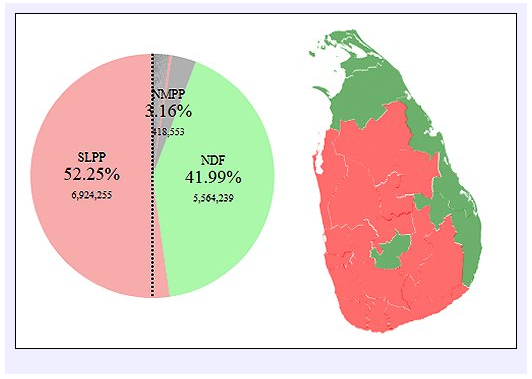
in Presidential election, with over 50 per cent of the votes precisely 52.25%
with the total votes of 6, 924, 255. The results manifest as the highest number
of votes conceived by a presidential candidate since 1994. Even former
President Mahinda Rajapaksa who reappeared for the election in 2009 with immense
Sinhala Buddhist sustenance and with the consecration of wast majority of the
citizen as the president who terminated the three decades prolong war between
Liberation Tigers of Tamil Eelam and the government of Sri Lanka could not able
to assertion votes like his brother Gotabaya did in 2019.
Surprisingly,
the presiding party candidate Minister Sajith Premadasa represent National
Democratic Party conceded the presidential election and congratulated his rival
Rajapaksa on his election as the seventh president of Sri Lanka beforehand
official confirmations of the victor of the election. However, Sajith Premadasa
assertions 41.99% percentage while acquiring 5,564,239 votes in total. In his
letter Premadasa thanks all the citizens that vote for him as well as those who
worked tirelessly on his campaign. Premadasa noted that this was the most
peaceful presidential election in the history of the country, adding that this
was the straight result of the democratic improvements and institutional
reforms that took place over the past five years.
Premadasa
mentioned further and requests Gotabaya Rajapaksa to take the democratic process
forward while strengthening and protecting the democratic institutions and
values that enabled this peaceful election. He also called on the president-elect
to ensure that the post-election environment is peaceful and that no citizen is
persecuted for supporting him.
Meanwhile,
Rajapaksa who earned a majority votes of the South said his victory should be
rejoicing peacefully as Sri Lankans. As we usher in a new journey for Sri
Lanka, we must remember that all Sri Lankans are part of this journey. Let us
rejoice peacefully, with dignity and discipline in the same manner in which we
campaigned, the President-elect said. However, with the lessons drew from the
election results stress that Gotabaya has to ensure further to unite the nation
and position as a Sri Lankan since more than 90 per cent of votes from North,
North East, Digamadulla and Nuwara Eliya entail by wast majority of Tamils and
Muslims and other minorities of country voted in favour of Sajith Premadasa,
and Rajapaksa was clever to triumph bearly 5- 6% from these respective areas.
This sound strange, however, the long-time political turbulences and the
political campaigned commanded by Rajapaksa family embrace the Sinhala Buddhist
sentiments and spread discontent and anxiety within the mentalities of individuals
who are not adequate into the conventional socio-economic-political culture and
religious outfit. The two political fronts Podujana Eksath Peramuna and
National Democratic Front represented two ideological camps and conceded
varieties of supporters epitomize diverse and competitive political ideologies.
Major Tamil and Muslim political parties including All Ceylon Makkal Congress,
Jathika Hela Urumaya, Sri Lanka Muslim Congress, Tamil Progressive Alliance,
Democratic People’s Front, National Union of Workers, Uo- Country aggregate
under the superior umbrella of NDF and TNA- decided to support NDF candidate
Sajith Premadasa during the presidential election. Since 2005 Mahinda Rajapaksa
regime embraces the inkling of Sinhala Buddhist Nationalism and cited Sri Lanka
as a Sinhala Buddhist country, predominantly those who congregated with Mahinda
Rajapaksa regime after 2009 systematically spread the idea of Sinhala Buddhist nationalism
over the country while producing faultlines between majority and minority
groups. Organisations emerge during post-civil war Sri Lanka comprising Bodu
Bala Sena (BBS) and Sinhala Rawaya touch the nerves of Sinhala Buddhist mentality
to acknowledge and adoration Rajapaksa as the prime saviour of the Sinhala
Buddhist Nationalism since all major Tamil and Muslim political parties
gathered with NDF.
The
political front constructed around the pivotal point of Rajapaksa family consists
of Ceylon Workers’ Congress, Eelam People’s Democratic Party, Jathika Nidahas
Peramuna, National Congress, Mahajana Nidahas Peramua, Socialist Alliance,
Communist Party of Sri Lanka, Democratic Left Front, Desha Vimukthi Janatha
Pakshaya, Lanka Sama Samaja Pakshaya, Sri Lanka Mahajana Pakshaya and Tamil
Makkal Viduthalai Pulikal while Sri Lanka Freedom Party decided to hold hands
with Gotabaya Rajapaksa during the presidential election. The political map and
the voters’ behaviour in the election indicate this diverse and the ethnic
divisions custom on the nationalism and religionism. Particularly, Nothern and
North East voted for the Premadasa to secure multiculturalism and embrace
equality and justice since the Rajapaksa family and its supporters exercise
Sinhala Buddhist sentiments to eradicate voices of minorities and exclude them
from the national political debate. The Yapahalana (Good Governance)
regime has done and endeavoured to complete a notable amount of exertion to
promote reconciliation and national unity while addressing the concerns of
post-civil war Sri Lanka despite the method choose and the success. In
contrast, Rajapaksa campaign brought the Sinhala Buddhist sentiments to the
national political campaigned to win around 70 per cent of Sinhala voters
around the country.
National Result of the Presidential Election 2019
According
to the illustration, it is very vibrant that Nothern Sri Lanka has willingly
voted for Sajith Premadasa who promised to preserve uncluttered policy without racial,
ethnic or religious appearances. Mainly people who voted for Premadasa believe
that Sajith Premadasa and United National Front led National Democratic Front
consider the voices of Tamils and Muslims since United National Front led
government was sensitive on the issues related to civil war including missing
people, reparations, transnational justice and decentalisation of power.
The
Politicisation of Fear and Radical Others
Conversely,
the election results have exposed other side of the coin which was the fear
among Sinhala Buddhist majority and mostly fear within the Christian community
after the Easter attack. Followed by the Easter attack national security discourse
and catastrophes of Yahapalana (good governance) government to deliver
national security converted a vital concern of the country. The political tug
and war between President Maithreepala Sirisena and PM Ranil Wickramasinghe discovered
that Yapahalana (good governance) government was not competent to foil the
Easter attack even the government received warnings from local and
international security and intelligence agencies. The disappointment over the
government amplified with certain statements delivered by government ministers
and administrative officers over the Easter attack. The neglection of the
security and vivid political statements have questioned the legitimacy of the Yahapalana
(good governance) government and their capacity to afford national security and
shield citizens of Sri Lanka. Majority of citizens and the victims of the
Easter attack considered that Yahapalana (good governance) government
did least to convey justice and mostly the presidential committee was appointed
by President Maithree had seen as a major political drama by utmost organizations
of civil society, religious leaders and public since government not provide
strong indicts and evidence against people and high officials who responsible
for the Easter attack.
Mahinda
Rajapaksa and his camp underlined and stressed national security and national
security concerns as a fundamental threshold of his campaign since 2005 and
mainly after military victory against LTTE in 2009. During his election
campaign, Rajapaksa politicised varies types of fears and insecurities within
the mentalities of majoritarian society and therefore Mahinda vehicled national
and international political behaviour as the underpinning of the construction
of fear and anxiety. For instance, with the immediate effect of the US-led
resolution against Sri Lanka on human right violations, Rajapaksa regime constructed
and politicized fear and insecurity within the convictions of Sinhala Buddhist
majority by emphasizing international engagements could downplay the national
sovereignty and those engagements can drive soldiers toward the death penalty.
The construction of fear and insecurity assisted to manifest divisions within
the society, particularly patriots and betrayers of the Sinhala Buddhist state
came to picture while Rajapaksa regime who constructed fear and insecurity has
accepted by the majority of Sinhala population as the sole representation and
the custodian of the Sinhala Buddhist society and the state while UNP and its
coalition which consist Tamil and Muslim political parties painted as the
puppets of the western world.
Nonetheless,
with the Easter attack, the construction of fear and insecurity played a superior
protagonist and predominantly Rajapaksa regime utilises enduring political
tension between President Maithreepala and PM Wickramasinghe to triumph the
support of Sinhala Buddhists and Christians by promoting Gotabaya Rajapaksa;
the former secretary of defence as the superlative candidate to promote and
secure the national security. Notably, Sinhala Buddhists and wast majority of
the Christian community voted in favour of Gotabaya Rajapaksa and the reason
behind this political turn was to fetch a strong leader who prioritises
national security. The protracted process of politicization of fear and anxiety
made people consider Gotabaya as the superlative candidate for do so. For
instance, traditional political fortresses of UNP led NDF including Badulla,
Kandy, Colombo, Puttalam districts, were won by Gotabaya Rajapaksa while Sajith
Premadasa secured the lowest percentage of votes which was recorded in those
areas since 1994. Specially Katana electoral division was beaten by the Easter
attack won by Gotabaya Rajapaksa while altering its traditional prejudice towards
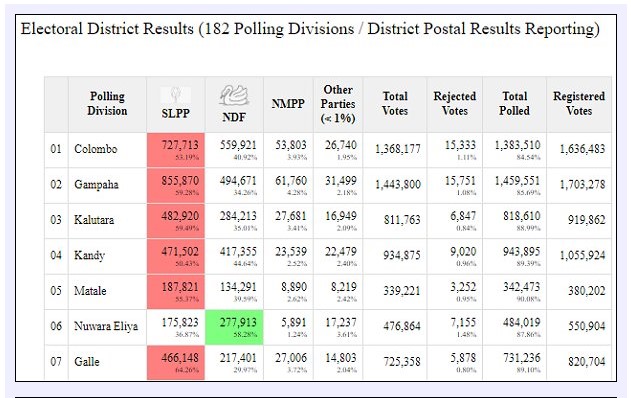
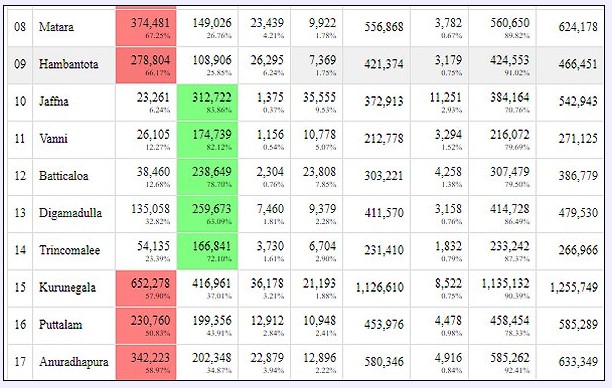
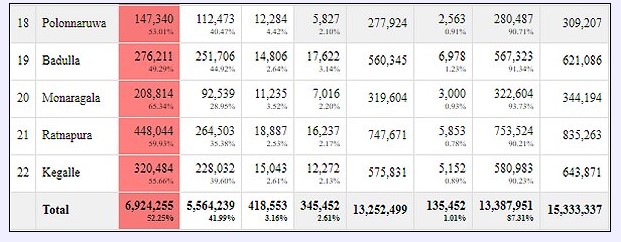
UNP. The following election results illustrate the winning portfolio of two
candidates.
Electoral District Results
Construction
of fear and insecurity cannot be grasped as the solitary reason for polling
behaviour of the Sinhala Buddhist society and the voters of South. Old-style
UNP devotees and followers highly comprise of districts such as Colombo, Kandy,
Matale and extensive of them did not cast the vote in the recent presidential
election in favour of Sajith Premadasa to express disappointment on Ranil
Wickramasinghe since traditional devotees reliance Ranil Wickramasinghe should
be stepped down from the party and let new face to lead the party forward.
However,
what imperative to understand is that; political behaviour of voters in North
and why did North cast their votes in favour of Sajith Premadasa. Mostly Tamils
and Muslims neglected by the political campaign of Rajapaksa with its resilient
propaganda of Sinhala Buddhist nationalism and minority communities might comfortable
to functioned with Yahapalana (good governance) government effortless
than Rajapaksa regime. However, what people cannot perceive is the polarization
of North and South of the island. In 2015 election wast majority of people in
North and North East voted for the former president of Maithreepala Sirisena
and remarkably those who voted for Sirisena voted Sajith with a higher
percentage. Particularly Sajith was talented to secure 10 per cent supplementary
votes from Jaffna and 7 per cent from Vanni districts compared to Sirisena.
Even though Sajith Premadasa was competent to secure the majority votes from
Digamadulla and Batticaloa, the percentage slightly lower than the votes
secured by NDF’s candidate in 2015 election while the percentage of Trincolamee
increased by 4 per cent. What essential to cognise here is that the decrease of
votes in favour of Sajith Premadasa from the rest of the country and
significantly in South. Despite all other reasons, what crucial to highlight
would be the failure of Yahapalana regime to promote reconciliation and
national unity in a successful means followed by the polarization of the
society.
Why
Sajith secured less percentage of votes in South and the riposte would be the political
dissatisfaction of people towards the UNP led government based on various
reasons. The lack of political and economic stability of the country, inability
of the government to afford adequate security measures and the rise of
terrorists and radical groups constructed fear and insecurities within the minds
of the majoritarian society, however, Wickramasinghe government failed to capture
those concerns. What prerequisite to understanding here is why North and North
East has taken the side of Sajith Premadasa, not Gotabaya. The problems and political
concerns mentioned previously received similar attention from the people of
North, conversely, failures of national peacebuilding process and
reconciliation undertakings of the country could not fetch the people towards
unilateral emotional attachment or towards a shared notion of survival. It has
polarized two ethnicities further and particularly rather than collecting
people to solitary ambition good governance regime has given privilege and
space to provincial leaders to endorse own political agendas with the intention
of collecting votes in favour of UNP led governments. This increased the
political divisions of the country while North has voted against the majority
of Sinhalese and South voted to eradicate voices of North.
Way
forward
Newly
elected President Gotabaya has to ensure further to form a shared Sri Lankan
identity by accumulating divided pieces of the puzzle while accepting and
acknowledging diverse opinions and requirements of multiple ethnic, religious,
racial groups. During the first presidential speech, Gotabaya Rajapaksa has
mentioned that he was chosen as the president, not because of the votes of the
minority communities but it solely grounded on the commitments and votes of
Sinhala Buddhist citizens of the country. However, by succeeding the teachings
of Buddhist philosophy and as the president of Sri Lanka Gotabaya promised to performance
as the president of each and every individual of the country despite the
differences. Gotabaya’s first priority should be incorporate North and North
East people and minority communities in Sri Lanka into the mainstream political
process while constructing a unified identity as Sri Lankas by embracing the
diversity. This model should exclude two radical culminations which are infrastructure
development without ideological development and let radical extremist political
parties to implement narrow political agendas in North and South which can
polarize the society. Already Gotabaya has shown that his vision and mission is
not going parallel with traditional political ideology.
President
Rajapaksa’s first pronouncements have been reassuring to the country at large.
He asked his supporters to celebrate the victory peacefully. Violence is not
only physical. There is currently a spate of very negative comments especially
on social media against the ethnic and religious minorities who did not vote
for him. This may be Gotabaya’s overenthusiastic supporters. Some of these
comments fall into the category of hate speech and President Rajapaksa needs to
call for an end to this as one of his first steps in reassuring the ethnic and
religious minorities and in reuniting the divided polity.
In
addition, Gotabaya as requested government officers to place only the seal of
the republic on the walls of their offices and not his photograph. This is a
novel tradition, followed by developed nations. But not in Sri Lanka till now. It gives a
symbolic indication of the modernizing the vision of the new president, which
is to draw a distinction between the state and government. The challenge will
be to implement these rules-based and professional approach to all levels of
the polity. However,
political innovation and creativity should not be mixed with nepotism and corruption.
If Gotabaya failed to address the diversity and construct unity; North and
North East people will choose bullet instead of ballet again.
In January 2015, Sri Lanka embarked on a new political journey. It was supposed to be the new era of good governance. However, in all seriousness whether Sri Lanka was ready for Good Governance is highly debatable. One of the main goals of those who voted for the Yahapalana Government was somehow to bring the lawbreakers of the Rajapaksa Administration to justice. If there was any economic discourse, it was to disparage on strategic economic assets such as the Hambanthota Port as ‘white elephants’. The theme in general was to the effect that even if the Yahapalana Government could not achieve anything else, it is fine as long as the thieves in the Rajapaksa Administration are caught and punished.
When the only thing a person asks from his Government is punishment metered to another, it betrays that person’s overall ignorance in matters of governance. This ignorance is punctuated time and again when people ask stupid questions such as “what has this country done for us”, “no matter who comes to power, it is the same” etc. However, after five years of Yahapalana Government, people have realized that governments do play a role in our lives. Perhaps this lesson, albeit a cruel one, was the one true service the Yahapalana Government gave to the people.
The economy was mismanaged to the point that our growth rate, which was just second only to China in the Asian region, is only now comparable with Afghanistan. Nearly half a million people have lost their livelihoods since 2015. We lost strategic assets such as the Hambantota Port to a foreign entity. The other assets such as the oil tanks in Trincomalee, Maththala Airport and the Northern terminal in the Colombo Port was dangled before India in the most tantalising manner. In the space of three years, the Yahapalana Government presented nine different finance plans. This obviously did not inspire confidence in foreign investors.
Yet, their failure did not seem to bother the Yahapalana Government either. Almost all their decisions such as suspending the Port City, cancelling the Airbuses for Sri Lankan Airlines backfired. In the end, we had to pay huge penalties for each of these mistakes. On the other hand, projects that the Yahapalana Government promised such as the Volkswagen manufacturing plant never came true. In either of these instances, the Yahapalana Government has neither acknowledged their failure nor apologized for it. Therefore, naturally they had never studied what really went wrong for them to take the ill advised decisions that they did.
In fact, in matters of management, the first acts of the Yahapalana Government derailed the economy. Within days of assuming power, the operations of the Avant Garde Maritime were clamped. This was a venture that brought both revenue in the form of forex and employment, especially to the retired servicemen, to the country. This is all the more significant because providing suitable employment for retired servicemen is a challenge other countries are struggling to solve. Hence, Avant Garde’s creative solution that harnesses the lifetime training of servicemen to solve a contentious global issue cannot be understated.
The Central Bank Bond scams were one crime that the Yahapalana Government could neither hide or deny. Despite the years that passed since the two scams, the Yahapalana Government had not been able to sweep it under the carpet. The reason being, more than the actual loss of money, it is the unravelling of ten years of hard work that stabilized the interest rates. The Rajapaksa Administrator inherited a 91 per cent national debt to GDP ratio and a country ravaged by the worst tsunami experienced in living memory, not to mention a failed peace process with a brutal terrorist organisation. Yet, by kick-starting the economy, they managed to assure their creditors that they can pay back the loans.
With that assurance, the lenders were comfortable to reduce the interest rates while extending the payment period. When interest rates fell, the then Rajapaksa Administration was able to use that savings into infrastructural development. This in turn generated more employment and money started moving within the country. This created more economic opportunities for people. For instance, many in middle class started to import a hybrid vehicle or two and re-sell it. Thus, they were able to pocket a handsome Rs 200,000-300,000 with each sale.
In the same manner, a number of cottage industries sprung up. Key among these was the weaving industry that catered to providing school uniform materials. Before 2005, the entire bulk needed was imported, but since then, taking baby steps, this was developed into supplying to meet the domestic needs. However, for reasons beyond comprehension these steps were reversed by the Yahapalana Government. The bond scams especially reversed the interest rates from single digits back to double digits. This in turn is increasing our entire cost factor.
The national security was bungled right royally by the Yahapalana Government. In the aftermath of the Easter Sunday, the lapses to the security were exposed. The fact that the then Army Commander General Mahesh Senanayaka came foreword as a presidential candidate exposes the office bearers’ attitude. Despite having an extensive military intelligence arm, the Army Commander claimed that he did not get a forewarning of the attacks. He even had the audacity to state that he got to know of these attacks from the Internet.
Two things must be noted. One is that the Sri Lankan military intelligence performed sophisticated operations as the MOSAD and the CIA when combating the LTTE. Yet, according to the Army Commander Senanyake, the MI had not kept him abreast of the rising Islam extremism. How did a unit that was capable in penetrating into the LTTE and Tamil Diaspora activities in Europe and east Asia failed to note the rising Islamism within the country is a question that needs to be pondered and answered seriously.
There were many forewarnings to the Easter Sunday Massacres apart from the detailed warnings received from Indian intelligence. The vandalising of the Buddha statues, execution-style killing of the two Police Officers at a checkpoint and the discovery of explosives that are of unfamiliar substance should have alerted General Senanyake. He should have directed the MI under him to feed him with the developments rather than wait for the terrorists to show up at his doorstep.
When General Senanayaka ought to have resigned afterwards, he chose to offer himself as the leader of the country. The fact that he failed to execute his responsibility obviously had not been factored by him. He is not alone in this aspect.
The very foundation of the Yahapalana Government was built on negativity in its extreme. In the years after the end of the war, through a concentrated plan the then Rajapaksa Administration was vilified. Yet, the accusers were all failed characters. Disregarding their own ineffectiveness and the resulting cost to the country in terms of lives and money, they present themselves as the panacea.
Today, a new era had begun. The past five years had taught the people that the Government has a role to play. Without it, the economy would not be managed and people will lose jobs, living costs will rise and the country will lose credibility. National Security too will get affected. Any other freedom does not make sense without National Security.
Those who voted for the new Government did so with a lot of hope. Strength to the new Government so that the people will not be punished as they were for the past five years. It is also hoped that the voter too had learnt a lesson and now aspires for a rule centred on development and not persecution.
UNP MP Dr. Harsha de Silva has resigned from his portfolio of Non-Cabinet Minister of Economic Reforms and Public Distribution.
In a letter to President Gotabaya Rajapaksa congratulating him on the victory at the Presidential Election, the parliamentarian said he wished the new President wisdom and strength to unite our beloved nation that has become deeply divided into ethnic lines.”
This is to inform you of my resignation from my portfolio of Non-Cabinet Minister of Economic Reforms and Public Distribution with immediate effect so that you can appoint a suitable person of your choice to carry out the duties of the same.”
I gave my best to this and all previous portfolios I held and am satisfied that I was able to contribute towards the development of our country,” he said.
De Silva also requested the President to place the free ambulance service launched by the incumbent government, funded by the government of India, under his direct purview and to strengthen the service further.
He says: Upon leaving, I have one important request to make from you. That is to place 1990 Suwa Seriya Foundation under your purview and strengthen the service as I fear it may be subject to unnecessary interference elsewhere.”
In fact, in preparation for sustainability after my tenure, I initiated and was able to enact in Parliament unanimously, the service as a Foundation by Act No 18 of 2018 giving the President of Sri Lanka the authority over this lifesaving service.”
While the Foundation was always gazetted as a subject under me as its founder, the time is now right to place it under you, as envisaged in the Act.”
Let me also inform you with a sense of humility that the service we established as a pilot in July 2016 in the face of such baseless allegations, is today saving lives 24x7x365 across the country with a 300 unit strong network with a dedicated staff of close to 1,500 Sri Lankan young men and women.”
On an average day, 1990 Suwa Seriya admits over 900 patients to critical and emergency care with an astonishing average response time of under 13 minutes. It has also been identified as perhaps the best such service in the developing world.”
Once again, I wish you the best and will always be ready to extend my unstinted support to the improvement of the 1990 Suwa Seriya service to continue to save lives.”
Colombo, November 19 (newsin.asia): The Indian Foreign Minister, Dr.Subrahmanyam Jaishankar, who arrived in Colombo on Tuesday met the newly elected Sri Lankan President Gotabaya Rajapaksa, who had won the November 16 Presidential election beating Sajith Premadasa of the United National Party-led alliance by a margin of 1.3 million votes.
At the end of the meeting Jaishankar tweeted:
With Foreign Minister Jaishankar’s visit, India is clearly forging ahead of its rivals China and Pakistan in cultivating the new Sri Lankan government.
Indian Prime Minister Narendra Modi was the first foreign leader to congratulate Gotabaya Rajapaksa through a tweet and was the only leader to have spoken to him over the phone on the day Gotabaya won.
President Gotabaya Rajapaksa responded to Modi’s warm greetings and said that he is keen on having close relations with India covering security and economic development – areas in which India is equally keen.
India has a number of developmental projects in Sri Lanka which are still to see the light of day. Modi would be keen to see these projects kickstarted.
India is also concerned about China’s strategic plans in Sri Lanka given its hold on the Hambantota harbour and its strong presence in the Colombo harbour the main business of which is with India. India would like to have a container terminal there, which the previous government promised but did not deliver.
India would also like the Gotabaya government to keep an eye on the Jehadist menace especially after the April 21, 2019 serial blasts carried out by local Jehadists.
Prime Minister Modi had invited President Gotabaya to visit India and the invitation was accepted.
Colombo, November 19 (newsin.asia): The appointment of the tough as nails” Major General (retired) Kamal Gunaratne as Secretary to the Ministry of Defense, is a clear indication that the newly elected Sri Lankan President Gotabaya Rajapaksa is dead serious about ensuring Sri Lanka’s security.
The majority Sinhalese, who backed Gotabaya to the hilt in the November 16 election, have been living under the apprehension that the island nation is under threat from Jehadi terrorism, albeit nascent. Sections of the majority community are also apprehensive about the possibility of a revival of Tamil extremism, given the voting pattern in the just concluded election.
The Tamils had voted massively for Sajith Premadasa because they felt that Gotabaya Rajapaksa is an Sinhala extremist. They feared that they would not get even the minimal constitutional concessions that Sajith had promised in his manifesto. Gotabaya had not mentioned devolution of power, let alone increasing devolution or promising power-sharing at the Center as Sajith did.
At the inaugural ceremony in Anuradhapura on Monday, Gotabaya regretted that the Tamils and Muslims had not responded to his invitation to join his all-inclusive national movement for peace and prosperity. His repeated statement that he is the President of all Sri Lankans and not just a section of them, had fallen on deaf ears in the Tamil and Muslims areas.
It is feared that there could be a sharpening of the Sinhala-Tamil conflict, aided and abetted by interested Western powers. This could foment Tamil extremism which was thought to have been crushed in Mulliwaikkal in May 2009.
The appointment of a security expert and war veteran like Gen.Kamal Gunaratne is a departure from the past when the Defense Secretaries were civilians. The outgoing Secretary Gen.Shantha Kottegoda, was an exception. But he was appointed only because his civilian predecessor and the police chief, had miserably failed to act on advance actionable intelligence provided by India about the possibility of a Jehadi attack in April 2019. Only after the April 21 multiple suicide attacks that the Lankan Establishment realized the value of acting on intelligence cooperation and taking follow up action quickly.
Field commander Gen.Gunaratne, who led the 53 Division during the critical last stage of the war, not only knows the value of intelligence but also the need to coordinate different inputs and take appropriate action. He is known as a soldier who would follow orders to the letter. As such, he would be a very reliable Defense Secretary from the point of view of his boss, Defense Minister cum President Gotabaya Rajapaksa.
As a close associate of Gotbaya Rajapaksa and as a fellow member of Viyathmaga” an organization of intellectuals and professionals set up by Gotabaya, Gen.Gunaratne shares the latter’s views on ethnic and other national issues.
In an interview given to Shanika Sriyananda of Daily FT in September 2016 following the release of his book: Road toNandikadal, Gunaratne said: If a situation is created, the LTTE will make a comeback because the LTTE ideology is still alive. I don’t think that the Tamil political leaders will be satisfied with judicial, land and police powers, as the agenda of the Tamil National Alliance is Eelam and nothing else.”
If the situations are not handled properly, the LTTE can make a comeback, as over 12,400 ex-combatants are living in society. Though they have undergone a comprehensive rehabilitation program, that doesn’t mean that they are 100 percent transformed into civilians,” he added.
In his first hand account, Gen.Gunaratne had said that the Sri Lankan forces had done their job with ruthlessness, which United National Party stalwart and the then Foreign Minister Mangala Samaraweera described as a dossier of the military personnel’s crimes from the early 1980 onwards.
According to an AFP story, the book talks of the army setting fire to homes of Tamil civilians, killing innocent civilians and plundering valuables of homes under the guise of cordon-and-search operations. Samaraweera described the book as a betrayal” of the Sri Lankan military.
But then that was war and as Mao Tse Tung said: War is not a tea party”. There is no war in which such incidents do not happen. Moreover, both sides committed atrocities and it would be unethical to single out one side for bashing. Further, the enemy that the Sri Lankan forces were facing for 30 years was described by the US officially, as the world’s deadliest terrorist outfit which had also pioneered the belt bomb and had initiated suicide bombings which are causing havoc all over the world.
According to Gen.Gunaratne, the LTTE had, at its height, not less than 200 volunteer suicide cadres, many of them girls.
Gen.Gunaratne also said that Prabhakaran had raised a very efficient and committed force which was led in the field by excellent commanders like Balraj, Soosai, Theepan and Karuna. The top order had also fought to the last. Prabhakaran never wavered in his aim or the execution of his plans and would patiently wait for the right moment to strike, the Lankan General added.
Colombo, November 18 (Daily Express): The new Sri Lankan President, Gotabaya Rajapaksa, is likely to cozy up to India but be wary about the US.
Sources close to him say that President Gotabaya will view India as Sri Lanka’s main security provider” and China a key source of funding for infrastructure projects given its deep pocket and willingness to lend.
Given neighboring India’s strategic concerns, and the history of Sri Lanka-India relations, Gotabaya will not take China as a strategic ally but only as an important source of funds for the large infrastructure projects he has in mind.
What Messages Say
The foundation for India-Sri Lanka ties under the Gotabaya administration can be seen in the messages exchanged by them when Gotabaya won the November 16 Presidential election by a huge margin of 1.3 million votes.
In his congratulatory message, the first by a foreign head of government, the Indian Prime Minister Narendra Modi expressed confidence that under the able leadership of Rajapaksa the people of Sri Lanka will progress further on the path of peace and prosperity, and that the fraternal, cultural, historical and civilizational ties between India and Sri Lanka will be further strengthened.”
The Indian Prime Minister, who also spoke to Gotabaya on the phone, unlike other heads of government, reiterated India’s commitment to continuing to work with the Government of Sri Lanka towards these ends.
In his reply, Gotabaya thanked Modi for his good wishes and expressed his readiness to work with India very closely to ensure development and security.”
The emphasis on development and security in Gotabaya’s message is significant as these two areas are of special interest to both countries.
As Sri Lanka’s Defense Secretary between 2005 and January 8, 2015, Gotabaya was part of the Indo-Lankan Troika” to consult and decide on matters relating to defense during the war against the Tamil Tigers.
The Troika comprised the then Indian National Security Advisor M.K.Narayanan, Foreign Secretary Shivshankar Menon and Defense Secretary Vijay Singh. On the Sri Lankan side it was Secretary to the President Lalith Weeratunga, Defense Secretary Gotabaya Rajapaksa and President Mahinda Rajapaksa’s brother and Economic Affairs Minister and political organizer Basil Rajapaksa.
The Troika” was one of the key factors which had helped Sri Lanka defeat the LTTE, and that was publicly acknowledged by the Sri Lankan side several times. Even recently, Mahinda Rajapaksa had sought the revival of the Troika system to determine and smoothen defense and strategic ties with India.
Significantly, Prime Minister Modi extended an invitation to Gotabaya to visit India at his early convenience and the Lankan President accepted the invitation. Therefore, Gotabaya Rajapaksa’s first overseas visit will be to India.
Revival Of Pending Projects
In the proposed talks in New Delhi, Modi is expected to make use of Gotabaya’s interest in development, especially infrastructure projects, and remind him about the many pending Indo-Lanka joint venture projects.
Sri Lanka and India had drawn up an extremely tight schedule for the economic projects mentioned in the MoU signed in New Delhi on 25 April 2017, in the presence of Prime Ministers Ranil Wickremesinghe and Narendra Modi. The list included a re-gasified Liquefied Natural Gas (LNG) fired 500 megawatt capacity power plant in Kerewelapitiya near Colombo, plus a LNG Terminal/Floating Storage Regasification Unit (FSRU) in the same place. It was to be a Joint Venture with entities from Sri Lanka, India and Japan.
There was a project for piped gas distribution system and retail outlets for the supply of Compressed Natural Gas (CNG) to the transportation sector. The LNG project also envisaged a piped gas distribution system; and conversion of liquid fuel-based power plants to R-LNG fired plants.
There was to be a 50 MW (extendable to 100 MW) solar power plant in Sampur in the Eastern Province. On the Trincomalee oil tanks the two countries had decided that the 84 giant oil tanks in the Upper Tank Farm in Trincomalee would be jointly developed” by the Lanka Indian Oil Corporation (LIOC) and the Ceylon Petroleum Corporation (CPC). A Joint Venture (JV) was to be set up for this.
India and Sri Lanka had agreed to build a port, a petroleum refinery and other industries in Trincomalee, for which the governments of Sri Lanka and India was set up a Joint Working Group. The two countries were to jointly set up Industrial Zones or Special Economic Zones in identified locations in Sri Lanka.
Sri Lanka was to submit to India a list of road projects to be considered for joint development. The two countries had already agreed to develop a Mannar-Jaffna and Mannar-Trincomalee highway; and to build a Dambulla-Trincomalee Expressway with Indian investment.
India and Sri Lanka were to build a Container Terminal (the East Terminal) in Colombo Port as a Joint Venture. India had also made a bid for the China- built Mattala Airport near Hambantota to make the world’s emptiest airport hum with activity. There were also projects in livestock development, water management and agro-based industries.
President Gotabaya Rajapaksa, being a development enthusiast, is expected to find ways and means of implementing these projects.
No Mention of Rights And Reconciliation
It is noteworthy that in his message to Gotabaya, the Indian Prime Minister did not mention the politically sensitive subject of ethnic reconciliation, good governance, and democracy which India now considers as being part of the internal affairs of Sri Lanka.
And human rights and ethnic reconciliation are not priority areas for Gotabaya because his focus is on economic development. He believes that if economic development is evenly distributed and if economic justice is rendered equitably, ethnic issues will not arise.
Reconciliation Issue Will Strain Ties With US
However, Gotabaya will be under domestic Tamil and international compulsion to attend to human rights and ethnic reconciliation issues because of the voting pattern in the November 16 Presidential election.
The entire Tamil-Muslim dominated North-East voted for his rival, Sajith Premadasa, and the entire Sinhalese South, Central and West and North Central voted for Gotabaya dividing the country on ethnic lines. The reason for such a division was that Sajith had included some conciliatory elements in his manifesto, and Gotabaya had not. Muslims saw Sajith as being conciliatory towards them, while Gotabaya was seen as being anti-Muslim.
Handle To West and US
The issues created by this voting pattern will give a handle to the US-led West and international human rights lobbies to put pressure on Sri Lanka. The Tamil parties in Sri Lanka are already sounding an alarm about impending persecution” by the Gotabaya government because Gotabaya had come to power almost solely on the basis of his appeal to the majority Sinhalas. There will be attempts to activate rights lobbies and rights oriented governments in the West, especially the US.
American Statement’s Emphasis
The American statement on Gotabaya’s victory issued on Monday had said: We are ready to continue our work with the new President and with all the people of Sri Lanka in supporting the country’s sovereignty through heightened good governance, expanded economic growth, the advancement of human rights and reconciliation, and in fostering an Indo-Pacific region where all countries can prosper.”
Thus, the US could use the ethnic issue to interfere with and control the Gotabaya regime. It will try its best to thwart his plan to opt out of the resolutions of the UN Human Rights Council, which had suggested accountability mechanisms to bring to trial and punish Lankan military personnel who had allegedly committed war crimes in the closing stages of the war against the Tamil Tigers.
But Gotabaya and his Sinhalese constituency are totally opposed to these resolutions, and that could lead to trouble with the US and the West.
Status Of Force Agreement
The other irritant in US-Lanka relations could be the US anxiety to get Colombo to move forward on the Millennium Challenge Corporation’s projects which have already been approved by the Lankan cabinet. While Gotabaya might take the US$ 480 million MCC project forward by getting it parliamentary approval, he would be most reluctant to sign the Status of Forces Agreement (SOFA), which, in its new avatar, would turn Lanka into a US military base.
But given the American fear that the Chinese might use Hambantota harbor as a naval base sooner or later, exploiting the 99 year lease they enjoy, the Americans are unlikely to give up on SOFA.
This will put Gotabaya in a tight spot because SOFA is anathema for the majority community in Sri Lanka, the Sinhalese. The majority Sinhalese not only fear an American takeover of Sri Lanka but the conversion of Sri Lanka into a battle ground for big powers wanting to dominate this part of the Indian Ocean. A people who had gone through 30 years of war and terrorist bombings just want to be left alone.
Colombo, November 19 (The Citizen): There are indications that under President Gotabaya Rajapaksa, Sri Lanka will see India as its main security provider” given India’s proximity and its status as the regional power. On the other hand, China will be seen as a key source of funds for big infrastructure projects, given its deep pocket and willingness to lend.
Sources close to Gotabaya say that given neighboring India’s strategic concerns, and the stormy history of Sri Lanka-India relations, Gotabaya will not take China as a strategic ally but only as an important source of funds for the many large infrastructure projects he has in mind.
Investments from India and other countries will also be welcomed as Gotabaya has come to power promising rapid development to make up for five years of inactivity under the slothful Sirisena-Wickremesinghe government. .
What Messages Say
The foundation for India-Sri Lanka ties under the Gotabaya administration can be seen in the messages exchanged by them when Gotabaya won the November 16 Presidential election by a huge margin of 1.3 million votes.
In his congratulatory message, the first by a foreign head of government, the Indian Prime Minister Narendra Modi expressed confidence that under the able leadership of Rajapaksa the people of Sri Lanka will progress further on the path of peace and prosperity, and that the fraternal, cultural, historical and civilizational ties between India and Sri Lanka will be further strengthened.”
The Indian Prime Minister, who also spoke to Gotabaya on the phone, unlike other heads of government, reiterated India’s commitment to continuing to work with the Government of Sri Lanka towards these ends.
In his reply, Gotabaya thanked Modi for his good wishes and expressed his readiness to work with India very closely to ensure development and security.”
The emphasis on development and security in Gotabaya’s message is significant as these two areas are of special interest to both countries.
As Sri Lanka’s Defense Secretary between 2005 and January 8, 2015, Gotabaya was part of the Indo-Lankan Troika” to consult and decide on matters relating to defense during the war against the Tamil Tigers.
The Troika comprised the then Indian National Security Advisor M.K.Narayanan, Foreign Secretary Shivshankar Menon and Defense Secretary Vijay Singh. On the Sri Lankan side it was Secretary to the President Lalith Weeratunga, Defense Secretary Gotabaya Rajapaksa and President Mahinda Rajapaksa’s brother and Economic Affairs Minister and political organizer Basil Rajapaksa.
The Troika” was one of the key factors which had helped Sri Lanka defeat the LTTE, and that was publicly acknowledged by the Sri Lankan side several times. Even recently, Mahinda Rajapaksa had sought the revival of the Troika system to determine and smoothen defense and strategic ties with India.
Significantly, Prime Minister Modi extended an invitation to Gotabaya to visit India at his early convenience and the Lankan President accepted the invitation. Therefore, Gotabaya Rajapaksa’s first overseas visit will be to India.
Revival Of Pending Projects
In the proposed talks in New Delhi, Modi is expected to make use of Gotabaya’s interest in development, especially infrastructure projects, and remind him about the many pending Indo-Lanka joint venture projects.
Sri Lanka and India had drawn up an extremely tight schedule for the economic projects mentioned in the MoU signed in New Delhi on 25 April 2017, in the presence of Prime Ministers Ranil Wickremesinghe and Narendra Modi. The list included a re-gasified Liquefied Natural Gas (LNG) fired 500 megawatt capacity power plant in Kerewelapitiya near Colombo, plus a LNG Terminal/Floating Storage Regasification Unit (FSRU) in the same place. It was to be a Joint Venture with entities from Sri Lanka, India and Japan.
There was a project for piped gas distribution system and retail outlets for the supply of Compressed Natural Gas (CNG) to the transportation sector. The LNG project also envisaged a piped gas distribution system; and conversion of liquid fuel-based power plants to R-LNG fired plants.
There was to be a 50 MW (extendable to 100 MW) solar power plant in Sampur in the Eastern Province. On the Trincomalee oil tanks the two countries had decided that the 84 giant oil tanks in the Upper Tank Farm in Trincomalee would be jointly developed” by the Lanka Indian Oil Corporation (LIOC) and the Ceylon Petroleum Corporation (CPC). A Joint Venture (JV) was to be set up for this.
India and Sri Lanka had agreed to build a port, a petroleum refinery and other industries in Trincomalee, for which the governments of Sri Lanka and India was set up a Joint Working Group. The two countries were to jointly set up Industrial Zones or Special Economic Zones in identified locations in Sri Lanka.
Sri Lanka was to submit to India a list of road projects to be considered for joint development. The two countries had already agreed to develop a Mannar-Jaffna and Mannar-Trincomalee highway; and to build a Dambulla-Trincomalee Expressway with Indian investment.
India and Sri Lanka were to build a Container Terminal (the East Terminal) in Colombo Port as a Joint Venture. India had also made a bid for the China- built Mattala Airport near Hambantota to make the world’s emptiest airport hum with activity. There were also projects in livestock development, water management and agro-based industries.
President Gotabaya Rajapaksa, being a development enthusiast, is expected to find ways and means of implementing these projects.
No Mention of Rights And Reconciliation
It is noteworthy that in his message to Gotabaya, the Indian Prime Minister did not mention the politically sensitive subject of ethnic reconciliation, good governance, and democracy which India now considers as being part of the internal affairs of Sri Lanka.
And human rights and ethnic reconciliation are not priority areas for Gotabaya because his focus is on economic development. He believes that if economic development is evenly distributed and if economic justice is rendered equitably, ethnic issues will not arise.
Reconciliation Issue Will Strain Ties With US
However, Gotabaya will be under domestic Tamil and international compulsion to attend to human rights and ethnic reconciliation issues because of the voting pattern in the November 16 Presidential election.
The entire Tamil-Muslim dominated North-East voted for his rival, Sajith Premadasa, and the entire Sinhalese South, Central and West and North Central voted for Gotabaya dividing the country on ethnic lines. The reason for such a division was that Sajith had included some conciliatory elements in his manifesto, and Gotabaya had not. Muslims saw Sajith as being conciliatory towards them, while Gotabaya was seen as being anti-Muslim.
Handle To West and US
The issues created by this voting pattern will give a handle to the US-led West and international human rights lobbies to put pressure on Sri Lanka. The Tamil parties in Sri Lanka are already sounding an alarm about impending persecution” by the Gotabaya government because Gotabaya had come to power almost solely on the basis of his appeal to the majority Sinhalas. There will be attempts to activate rights lobbies and rights oriented governments in the West, especially the US.
American Statement’s Emphasis
The American statement on Gotabaya’s victory issued on Monday had said: We are ready to continue our work with the new President and with all the people of Sri Lanka in supporting the country’s sovereignty through heightened good governance, expanded economic growth, the advancement of human rights and reconciliation, and in fostering an Indo-Pacific region where all countries can prosper.”
Thus, the US could use the ethnic issue to interfere with and control the Gotabaya regime. It will try its best to thwart his plan to opt out of the resolutions of the UN Human Rights Council, which had suggested accountability mechanisms to bring to trial and punish Lankan military personnel who had allegedly committed war crimes in the closing stages of the war against the Tamil Tigers.
But Gotabaya and his Sinhalese constituency are totally opposed to these resolutions, and that could lead to trouble with the US and the West.
Status Of Force Agreement
The other irritant in US-Lanka relations could be the US anxiety to get Colombo to move forward on the Millennium Challenge Corporation’s projects which have already been approved by the Lankan cabinet. While Gotabaya might take the US$ 480 million MCC project forward by getting it parliamentary approval, he would be most reluctant to sign the Status of Forces Agreement (SOFA), which, in its new avatar, would turn Lanka into a US military base.
But given the American fear that the Chinese might use Hambantota harbor as a naval base sooner or later, exploiting the 99 year lease they enjoy, the Americans are unlikely to give up on SOFA.
This will put Gotabaya in a tight spot because SOFA is anathema for the majority community in Sri Lanka, the Sinhalese. The majority Sinhalese not only fear an American takeover of Sri Lanka but the conversion of Sri Lanka into a battle ground for big powers wanting to dominate this part of the Indian Ocean. A people who had gone through 30 years of war and terrorist bombings just want to be left alone.
Deputy Minister Nalin Bandara says that Prime Minister Ranil Wickremesinghe has no moral right to continue a government further.
Addressing a media conference held in Colombo, Nalin Bandara said that he would step down from the Bingiriya electoral organizer post as well if the office bearers are not elected anew for the party.
Meanwhile, Economic Reforms and Public Distribution Minister Harsha de Silva has also forwarded his resignation to the President today.
Political sources say that Prime Minister Ranil Wickremesinghe is scheduled to hand over his resignation tomorrow.
According to the sources, President Gotabhaya Rajapaksa has decided to appoint a caretaker government with a limited cabinet of 15 ministers until the next general election.
Gorringe, H Courtesy Journal of South Asian Development Vol. 2 (1): pp51-73
Abstract: Although Dalit orators and slogans threaten (or promise) to ‘turn Tamilnadu on its head’, the 2006 state elections offer Dalit analysts pause for thought. In compromising its principles and allying with established parties, the Dalit Panther Iyyakkam (Movement) – the largest Dalit movement in the state – has come full circle since 1999. In alternately backing the two dominant parties in the state (the DMK and the AIADMK) the DPI appears to be increasingly institutionalized. Excavating the future of Dalit action from past trends and contemporary politics I suggest that Dalit parties are following an established political repertoire in which a phase of militant activism gives way to ‘politics as normal’. In the face of this analysis the paper asks whether such an approach is sustainable or can carry the majority of Dalits with it. If Dalit politics is a continuation of hegemonic politics, it argues, the liberatory promises of Dalit activism will have been betrayed.
Introduction: Tamil Politics and
the Dalit Challenge
In the seemingly surreal world of Tamil politics, the Southernmost Indian
state, anything is possible: sworn enemies make up before clashing again;
film-stars become politicians, turning fan-clubs into party organisations; a
convicted politician became Chief Minister before
securing an appeal verdict; the leader of the opposition assured party
activists that she would not attend
the Assembly unless absolutely necessary (Hindu 2006a); and a key manifesto
pledge of a winning alliance offered a colour TV to households meeting certain
criteria. Parties routinely split, merge and reform in an endless kaleidoscope;
arch-secularists ally with Hindu chauvinists; and people (claim to) vote 17
times for their candidates despite the ‘indelible ink’ used to identify voters
(cf. Subramani 2006). An insult (perceived or intended) to one leader can
reshape political coalitions overnight and contingency and compromise prevail. As
the political stability accorded by the predominance of two main parties has
been challenged, the shifting panoply of electoral alliances and the colourful
jostling for position have added further complexity.
Until
recently, however, one feature has remained constant (albeit unacknowledged) in
the post-independence Tamil political system: it has been dominated by Backward
Caste (BC) parties and interests.[1]
Commentators, such as Subramanian (1999), recognise this but argue that
Dravidian parties have created an open, democratic and plural society. This
paper argues that the egalitarianism of Dravidian rhetoric has not translated
into social practice and the incorporation of marginal groups into a system of
state patronage does not equate to an extension of democratic participation
(cf. Harriss 2002). T. Subramanian (2001a) notes the irony ‘that such a large
number of caste parties should sprout in Tamil Nadu, the cradle of the
Dravidian movement’, but it is because the interests of marginal social groups
were not served by established politics, that they have mobilised for a share
of political power. The innumerable Dalit (formerly untouchable) and caste-parties
emerging over the past decade are an attempt to extend or, in the case of
parties emerging to counter Dalit assertion, limit the scope of Tamil politics.
Subramani,
a Dalit activist, summed up this process: ‘without protest we cannot achieve
anything. One cannot claim anything from the government without protest. Only
if we protest is there an opportunity for our community to do anything’ (Interview,
27 April 1999). When the Dalit Panther Iyyakkam
(DPI – Movement), the largest Dalit movement in Tamilnadu, abandoned its
electoral boycott in 1999, therefore, it promised to redraw the ‘political map
of Tamilnadu’ (Gorringe 2005: 301). Seven years and two State elections later,
the DPI’s radical rhetoric looks as tattered as old election posters – clinging
torn and dishevelled to walls and billboards.
This paper
charts the changing face of Tamil politics, focusing on the subaltern
challenge. Drawing on fieldwork with Dalit movements and analysis of subsequent
state elections, this paper assesses the entry of autonomous Dalit parties into
the body-politic.[2] Having
charted the rationale behind political participation, and the opportunities
that this engagement offers, I argue that the radical possibilities suggested
by the initial foray into electoral competition have evaporated. Rather than reforming
the institutions they entered, Dalit movements have been institutionalised. In
closing, therefore, I will consider where Dalit politics goes from here. First,
however, a brief introduction to the intricacies of Tamil politics is required
to contextualise the ensuing discussion.
Dravidianism, Dalit Marginalisation and
Emergence
Tamil
politics is bewildering to those familiar with its ideologies, parties and
characters; for the uninitiated, it is a welter of nigh-identical acronyms and
political fluidity. Any comprehension of current trends, therefore, requires the
historical background without which all Tamil politics is ‘sound and fury’.[3]
The starting point must be the non-Brahmin movement which dominated state
politics in the 1920s and, in interaction with the colonial power, set the
template for subsequent engagements in the political sphere (Irschick 1986). In
the protracted exchanges between Brahmins who monopolised administrative power
under the British, and a rising Backward Caste elite, caste was established as
the mobilising strategy par excellénce
and elections as the vehicle for its expression. Into this heady mix, the
Self-Respect and Dravidian parties introduced the emotive issues of Tamil
nationalism and autonomy from the expansionist ambitions of Hindi-speaking
northern politicians, which continue to inform contemporary politics (cf.
Subramanian 1999).
Though the Congress party dominated post-independence Tamil politics, each
election saw their vote-share eroded by the Dravida
Munnetra Kazhagam (Dravidian Progressive Federation – DMK) – a regional
nationalist party which played on language nationalism and espoused
populist/socialist policies that were successfully mediated to the electorate
through cinema and an efficient party-machine. In 1967 Tamilnadu became the
first Indian state to elect a regionalist party, heralding the decline of
Congress pre-eminence and the rise of the region (Pandian 1992, Kohli 1990).
Indeed, the DMK victory was hailed as the end of ‘Brahmin’ rule and the birth
of a new nation of ‘Tamils’.
Under its founder, Annadurai, and his successor, Karunanidhi,
the DMK ruled until 1976. The party became increasingly conservative and
centred around the leader, however, and the DMK split in 1972 with M.G.
Ramachandran (MGR), a Tamil screen legend, founding the Anna DMK (ADMK – ‘Anna’
by reference to Annadurai) which claimed to be closer to the party’s original
ideals. The ADMK gained power in 1977 due to MGR’s popularity and populism (as
typified by his provision of free school meals for children), and dominated
Tamil politics until MGR’s death in 1987. Since then both parties have
alternated in office. Corruption and a personalisation of politics in the
personages of MGR (or his successor Jayalalitha) and Karunanidhi,
has pervaded Tamil government in this period and populist politics (to maintain
power) have prevailed over ideological or fiscal concerns (Kohli 1990, Pandian
1992).
Dravidian social radicalism, thus, was strictly curtailed. Rather than
envisaging inequality in class or caste terms, both Dravidian parties used the
Brahmin/Non-Brahmin divide to suggest a commitment to social change whilst
drawing their leadership and core constituents from dominant, landowning BCs
(Subramanian 1999). Stressing language rather than inequality the DMK (and
later the ADMK) attempted to foster Tamilness and avoid acting upon politically
sensitive election pledges on land-reform, dowry and caste. Over time both
parties abandoned their anti-Centre and anti-Hindi positions, softened their
anti-Brahminism (to the point where a Brahmin could succeed MGR) and failed to
implement meaningful redistributive policies. The DMK’s progressive reforms
resembled ‘charity from above’, and the ADMK disproportionately taxed the poor
to finance populist programmes (Pandian 1992, Harriss 2002).
Subramanian’s admiration for Dravidian pluralism, therefore, seems
misplaced. Indeed, he shows (1999: 58) that state politics are dominated by BCs
who have become jealous of their power as new entrants to Tamil politics have
eroded their authority. This is evident in the ‘increasingly overt conflict
between lower-caste Hindus and Dalits’ (Harriss 2002: 97).[4] Faced
by frequent violence, Dalit movements voice grievances and highlight atrocities
rather than campaigning proactively for social change. Their protests,
petitions and demonstrations demand the enforcement of the constitution, and
seek to de-legitimise a polity that does not adequately represent or serve them.
The subsidiary position of Dalits is evident in that 84 per cent of Dalit
land-holdings are marginal (under 1 hectare) and only 4 per cent are over 4
hectares, as opposed to over 10 per cent for others.[5]
Dalit land is seldom irrigated (Gorringe 2005). Thus, while 80 per cent of
Tamil Dalit workers are in the agrarian sector, 64% are agricultural labourers.[6]
The failure to implement effective land reform has curtailed Dalit autonomy by
rendering them dependent upon others for work. This deprivation is compounded,
and alternate opportunities are limited, by poor education. Literacy, as
Mendelsohn and Vicziany observe, ‘lends confidence and expands mental horizons.
It leads to a more assertive, less compliant, community’ (1998: 35). In 1991
the 58 per cent literacy rate for Scheduled Caste (SC)[7]
men compared to 74 per cent for Tamil males. 35% of SC women were literate
opposed to 51% overall (Rath and Konlade 2000).[8]
These inequalities render Dalits vulnerable to social boycott (denied work,
access to shops and common resources), intimidation, assault and murder if they
resist caste norms.
Faced by socio-political
marginalisation, Dalit movements in the 1990s mobilised extra-institutionally
before entering mainstream politics. Puthiya
Tamizhagam (PT, New Tamilnadu) – the second largest Dalit Party in TN –
arose as a Pallar movement and, despite its casteless title, remains strongest
in Pallar strongholds in the South and West.[9] Its
leader, Dr Krishnasamy, battled discrimination to qualify as a doctor and came
to Dalit activism via Marxist-Leninism (Warrier 1998). Despite this, he is
portrayed as Westernised – appearing in jeans and trainers – and removed from
‘ordinary’ Dalits (Gorringe 2005: 254). Krishnasamy was the first autonomous
Dalit leader to win a Legislative Assembly seat in 1996. This seat was subsequently
lost, but PT consolidated its vote-base in the 1998 national elections polling
more votes than the victory margins in several seats (Wyatt 2002). Although PT
remains a significant force, and preceded the DPI into electoral competition,
this paper focuses on the Panthers for two reasons. Firstly, the DPI is the
largest Dalit party in TN and, secondly, it entered electoral politics during
my fieldwork enabling an analysis of the dynamics of institutionalisation.
The DPI was formed in 1982, inspired by the Maharashtrian movement of the
same name. Although billed as a Dalit movement, it is preponderantly Paraiyar
and is flourishes in the northern districts. Thirumavalavan, its leader, came
from a poor family to gain a Law degree and a government job and entered Dalit
politics through social networks (Gorringe 2005). He is famed for his oratory
and for popularising the assertive slogan: ‘a hit for a hit’. Thirumavalavan
lived in humble surroundings and frequently visited Dalit villages. Whilst Dr
Krishnasamy faced questions about his choice of a luxury hotel in one interview
(Warrier 1998), thus, Thirumavalavan cited his ‘life situation’ as evidence
that the DPI had no resources (Illangovan 1998). Lacking resources, the DPI
relied on grass-roots mobilisation to succeed. A decade of poll boycotts
emphasised the movement’s radicalism and denied legitimacy to the Legislative
Assembly, but in 1999 the DPI completed a tactical volté face and contested the polls on the slogan: ‘We are voting
for ourselves’. Why, however, did they choose the electoral route and what did
they hope to achieve thereby?
Entering Politics: Rationales,
Opportunities and Pitfalls
Dalit movement’s reliance on exclusive identity categories constituted a
defensive response to caste repression, but effectively legitimised caste
actors. Contesting elections, by contrast, raised the question of citizenship
and the prospect of reform. ‘India’s institutions are not only the bedrock of
its democracy, providing an ordered process for the politicisation of
previously marginalised groups’, as Jenkins argues, ‘but also … the means by
which democracy’s change-resistant tendencies are overcome’ (1999: 224). Whilst
Dravidian dominance narrowed the political agenda, recent elections confirmed
the fragmentation of Tamil politics (Yadav 2001) and this erosion of political
fealty offered opportunities for Dalit movements.
In 1998, Thirumavalavan averred that elections achieve little, and
refused to ‘take part in something which upholds the status quo’ (Illangovan
1998). The following year, therefore, Nandan
(1999)pressed him on the
abandoned boycott: ‘Will you not be tainted’ they asked, and ‘is your decision
… a victory for government repression’? Contradictory responses insisted that
this was a change in tactic not policy; that the boycott harmed the movement;
and that ‘if Dalits are to gain official power we have to vote’. He maintained
that the DPI would not ‘put forward a representative’, but that ‘if we gain
seats in the Centre [Delhi]
we will be able to act against abuses’. ‘We are not going to support
opportunist or self-serving political parties’, he maintained (ibid.).
The above quotes reveal the contingency of the move to politics. Key
issues and longer-term prospects were not thought through. The attractions of
politics are seen in vague references to ‘using Dalit votes’ and gaining ‘Dalit
power’. The obvious forerunner here is the Bahujan
Samaj Party (BSP – Majority People’s Party: the most successful Dalit-based
party) in Uttar Pradesh (UP). The BSP was referred to in movement speeches as
epitomising the possibilities of Dalit politics, because it united the Dalit
vote in UP and forged pragmatic coalitions which enabled it to take power (Pai
2002). In brief periods of office, furthermore, the BSP expedited the
employment of Dalits to positions of responsibility and instituted ‘programmes
of Dalit uplift’ (Pai 2002: 178).
Chandra (2004) and Pai (2002) argue that the BSP successfully altered its
‘representational profile’ – by allocating seats to higher castes for example –
to widen its appeal beyond its caste-base. Pai (2002) shows that the Dalit vote
remained fairly constant but politically astute seat allocations and pragmatic
alliances carried the party to power. Puthiya
Tamizhagam echoed these tactics in Tamilnadu, fielding non-Dalit candidates
in 1999 and 2001 (Illangovan 2001), and both the DPI and PT have attempted to
broaden their social base by appealing to ‘Tamils’ and dropping caste terminology
from their titles (the DPI renamed itself the ‘Liberation’ Panthers in 1999).
The BSP’s experience, however, is of limited relevance in Tamilnadu.
Elections in UP are often contested between 4 strong parties (Pai 2002) but,
though Ananth (2006) notes that Congress, Communists and Caste parties retain
strong support they have failed to establish autonomous alternatives and Tamil
elections are dominated by two Dravidian coalitions. Non-aligned alliances have
occasionally secured a respectable vote-share, but this has failed to translate
into seats. Chandra’s (2004) account of ethnic headcounts also seems simplistic
in this context where 50 years of Dravidian discourse has fostered a Tamilian
identity that shatters the automatic assumption that Dalits (for instance) will
vote for a Dalit party. Furthermore, Dalits in Tamilnadu are divided amongst
themselves. Following the fragmentation of the Dravidian vote, therefore, Dalit
parties in the 1990s attempted to create an ‘ethnic’ constituency.
Given the absence of strong ‘pull factors’, Nandan is right to question whether political participation is a
‘victory for government repression’. In considering DPI actions, the
compulsions of politics are more obvious than its attractions. The boycott
enabled the government to cast the Panthers as undemocratic extremists, thereby
justifying repressive measures which alienated the movement from the people (Gorringe
2005). Thirumavalavan concedes that political engagement is important to ‘show
our strength in and commitment to democratic means’ (Nandan 1999). Secondly,
despite the DPI boycott most Dalits continued to vote. Elections are exciting
times, politicians seek you out and party activists distribute largesse and
promises of more if they come to power (De Wit 1996). The boycott withheld the
votes of activists and offered sympathisers no electoral alternative, so they
voted for established parties, including those antithetical to Dalit
empowerment.
Lacking a positive vision to justify political participation the DPI was
in tumult preceding the 1999 Indian elections; internally they faced
discontented activists, externally they confronted a casteist social
environment and a political scenario in which they were isolated. Many
dedicated activists were distraught: ‘Government is a sewer’, Subramani – an
activist from Cuddalore observed, ‘we do not want to fall in’ (Interview, 27
April 1999). Not everyone, he insisted, would follow Thirumavalavan into
politics. The DPI emerged as a radical grass-roots movement that fought back
against caste oppression. Parliamentary parties were frequently castigated for
failing to advance social justice and conniving in continuing caste
discrimination.
Such concerns were unavoidable in 1999 because Dalits in one village had
been forced to flee their homes by a casteist mob in March and, on the eve of
the elections, the police violently dispersed a Dalit demonstration in
Tirunelveli killing 17 people (Gorringe 2005: 297, 350). In the teeth of these
incidents the DPI could not ignore the records of political parties or downplay
the realities of caste. The decision to contest the elections was unpopular,
and these events rendered an alliance with Dravidian parties untenable. A
dalliance with the (opposition) AIADMK raised such a storm that rebuttals were
issued with alacrity. The identities of social activists, Jasper (1997)
astutely notes, frame how they view both the world and themselves. Having
invested significance in the concept of radical action, forging links with an
enemy was unbearable.
Indian elections, however, operate on a first-past-the-post system which
means that parties need not secure an overall majority to win a seat. The
‘practice of electing representatives according to geographical constituencies,
[implies]
… that interests are relatively homogenous within localities’
(Philips 1991: 63). The polarisation of caste-based parties illustrates the
naivety of such assumptions and reveals the ‘universal citizen’ to be a myth.
There are no geographical concentrations of Dalits sufficient to guarantee
victory in any constituency and although certain seats are reserved for Dalits
(as part of affirmative action to offset inequality) such candidates are
dependent on the votes of others. Whilst voting is tied to localities, therefore,
Dalits cannot neglect other castes.
DPI leaders, thus, were torn: to appease activists they needed to suggest
radicalism, but to stand any chance of winning they needed cross-caste
alliances. This latter point was particularly contentious given the problematic
of representation. As Kamaraj, a DPI adherent put it:
Yes there are hundreds of Dalit MPs in India, but they do not win alone.
They win as party people, as politicians. There is no opportunity for Dalit MPs
to speak out about Dalit society and problems so we do not need them. We need
our own MP who will speak for us (Interview, 10 September 1999).
This context explains why the DPI decision seemed so momentous. Dalit
politicians are commonly portrayed as political pawns or self-interested careerists
(Roy & Sisson 1990). ‘Suitcase politics’ was the contemptuous phrase used
by respondents to denote ‘unprincipled’ and ‘self-aggrandising’ leaders who
‘sell out’ in return for resources. Against this backdrop, DPI leaders had to
persuade followers of their continuing autonomy and to justify electoral
participation and alliance formation.
The exoneration of police for the violence in Tirunelveli at this point encapsulated
Dalit distrust of institutions but also facilitated a realignment of political
affiliations. The protests surrounding the incident brought the fissiparous
Dalit movements onto a common platform. They were joined by the Tamil Maanila Congress (Tamil State Congress –
TMC) which had been frozen out of the main coalitions. Contingency, thus,
dictated the DPI’s decision to join the (non-Dravidian) Third Front in 1999. As
Viswanathan (1999) argued, the ‘consolidation of the oppressed sectors,
particularly Dalits, in Tamil Nadu’ constituted a significant fall-out of the
massacre. This solution to the DPI’s political dilemma was welcomed in the
media but distrusted in the movement. The TMC, when allied to the DMK
government, had overlooked anti-Dalit violence and so DPI cadre were sceptical
of the alliance. Faced by such disaffection Thirumavalavan belatedly insisted
that the DPI’s political engagement was conditional on four key demands: A
share of power; political recognition; the consolidation of Dalit forces and;
the attempt to force the Dravidian parties out of office (Speeches and
Interview 1999).
These conditions refuted prevalent projections of Dalits as a vote-bank
who could be bought with promises or hand-outs. This development, as
Viswanathan (1999) opined, was ‘seen as having the potential to bring about
substantial changes, not only of electoral politics in the state but in the
nature of political activism in general and the approach of mainstream
political parties to organisations that represent Dalits’ aspirations’. Dalit
engagement in elections promised an expansion of the political sphere to
include marginalised sectors of society, but also reflected the growing
strength of caste-based groups and the declining appeal of Dravidian parties.
Wyatt (2002) subsequently argued that a coalition government requiring
Dravidian parties to share power is no longer a chimera. The DPI had abandoned
revolutionary struggle, but looked set to revolutionise Tamil politics. We turn
now to the impact of this move and the DPI’s gradual integration into the
political system.
The Parliamentary Route to Change? 1999-2006
Elections.
‘If, after Thirumavalavan has
spoken and left, you listen to what the DMK lot or the AIADMK lot or any other
political party people are saying and are scattered, then the Dalit Panthers
cannot protect you. It is necessary for us all to unite. It is necessary for us
to cast our votes for our own sake. We need to show our opponents that we are a
united political force’ (Thirumavalavan, Speech, 16 June 1999).
After all the posturing and positioning accompanying the move to politics,
how have the Panthers fared at the ballot box? To what extent have they
maintained the united front that Thirumavalavan extols above? As analyses of earlier
elections have been provided elsewhere (Wyatt 2002, Gorringe 2005), I confine
myself to a brief summary before turning to more recent developments. The
TMC-led Third Front (above) fared poorly in the 1999 elections. Despite polling
heavily in several constituencies it failed to win a seat, thus emphasising the
electoral pre-eminence of the Dravidian parties. Significantly, the Front was
not humiliated and Thirumavalavan came second in Chidambaram constituency, forcing
the AIADMK candidate into third place. The ability of a non-Dravidian, Dalit-based
coalition to mobilise significant votes was established and the easy assumption
of Dalit loyalty to the status quo was shattered.
Despite intimidation and violence, thousands of Dalits voted for
Thirumavalavan. Press coverage increased noticeably as did the political
recognition accorded to the party. In playing on the issue of representation,
the DPI persuaded many Dalits that it was their ‘duty’ to support them.
Sakthidasan an agricultural labourer from a remote village in Chidambaram
constituency was typical: He insisted that the political process was the only
means for leaders to gain more ‘respect, attention, and power’. Dalits here
primarily depend on other castes for work as agricultural labourers, and
Sakthidasan was forthright in his analysis:
We do not have that much faith in democracy, but for the first time a
Dalit has stood as a Dalit and we have done our duty by voting for him. Whether
he does anything for us or not is the next question, but our votes are for
ourselves (Interview, 26
September 1999).
Sakthidasan’s assertion reveals both the cynicism that characterises
Dalit views of politics, and the fact that the proactive election campaign
succeeded in raising consciousness even if it failed in the polls. The quote also
adds complexity to Chandra’s (2004) notion of ethnic head-counts in emphasising
that material concerns need not determine electoral choices. The symbolic and
emotive reasons of pride and duty can outweigh expectations of reward.
The publicity and votes gained by the DPI (especially in northern
districts) persuaded leaders that the electoral process was worth pursuing. The
fluid nature of Tamil alliances, however, meant that the Third Front was
precarious. There was no guarantee that the TMC would remain independent and
without the resources and credibility of an established party the Front would
be undermined. Furthermore, the question of what the DPI hoped to achieve came
to the fore. Persisting with a non-Dravidian Front would radicalise voters and
offer a critical alternative: pursuing the same ends using institutional rather
than radical (often criminal) means. Contesting elections, however, proffered
new opportunities (cf. Coy & Hedeen 2005): Strategic alliance building, for
example, could lead to financial resources, extensive networks, a wider pool of
voters, and Member of the Legislative Assembly (MLA) status. To be most
effective, though, this path required a Dravidian alliance which seemed
impossible since neither was trusted in 1999:
Yesterday the AIADMK fostered the BJP, now it is the turn of the DMK.
Yesterday Jayalalitha, today Karunanidhi.
We need to question which is the scoundrel and which is the rogue
(Thirumavalavan, Speech, 16 June 1999).
The implication was of a Hobson’s choice, since both had betrayed their
ideals and fostered the Hindu nationalist BJP which is antithetical to Dalit
interests. Furthermore, Dr Krishnasamy re-iterated the concern for autonomy:
‘Dalit leaders should retain the leadership of Dalit campaigns … and that
mainstream political parties should not derive undue political mileage from the
struggles of Dalits against caste oppression’ (Nambath 1999). Despite the
compelling logic of Dalit assertion, Krishnasamy’s principled but unrewarding offer
of autonomous action was rejected by the TMC and DPI who allied to the AIADMK
for several bye-elections in 2000.
The DPI’s dramatic volte–face invited accusations of ‘suitcase
politics’ and outraged activists felt betrayed, but it is worth considering the
decision more dispassionately. The votes garnered by the Third Front
highlighted that shifting from movement to party entailed more than a ‘tactical’
shift: It altered the constituency to whom the DPI appealed. The 225,000 people
who voted for Thirumavalavan far exceeded those prepared to engage in social
protest. This wider constituency was, by definition, less radical and more
interested in the bread-and-butter issues of political participation. Activists spoke of Thirumavalavan
turning parliament on its head, but most voters
wanted him in office as a symbol of Dalit assertion and as a source of patronage.
Election campaigns require resources and organisational infrastructure
that Dalit movements lack and established allies can provide. Finally, Pandian
(1992) notes how Dravidian parties (the AIADMK in particular) have successfully
mediated subaltern consciousness and secured active consent despite neglecting
their interests. Whilst autonomous Dalit movements increasingly counter
Dravidianism, interviews and observations confirmed his analysis. Allying with
the AIADMK, therefore, was a pragmatic
recognition of Dravidian hegemony. Thirumavalavan continued to critique
Dravidian policy and his exhausting schedule of engagements and relatively
obscure and humble accommodation suggested that he had not profited personally
from the new strategy. The alliance with the AIADMK was the lesser of two evils
since the DMK was portrayed as most opposed to Dalit liberation and the AIADMK
is traditionally more popular with Dalits and women. The main drawback was that
the coalition isolated PT (which was at loggerheads with the AIADMK) and
splintered the Dalit vote.
The results of the 2000 bye-elections threw the wisdom of pragmatism into
doubt, however, when the ‘DMK gained from Dalits’ apathy to the AIADMK’ (Nambath
2000), suggesting that real-politick
could alienate principled actors and blur the distinction between a Dalit party
and an established one. The DPI emerged as a radical response to parties that saw
Dalits as pawns to be bought off before each election. In 1999, the campaign
slogan (‘our votes are for ourselves’) resonated with many Dalits and
encouraged them to vote for the first time or to back an autonomous Dalit
candidate. In 2000 Dalit voters refused to be the pawns of their own leaders
either, and rejected the AIADMK-DPI combine because they saw Dravidian parties
as ideologically opposed to them.
Despite failing
to persuade their supporters, the DPI remained in alliance with the AIADMK preceding
the 2001 Legislative Assembly elections. PT mooted a principled alternative before
succumbing to the politics of pragmatism themselves when their attempt to initiate
a Congress-led Front failed. Unwilling to contest without a mainstream partner,
PT sought an electoral pact with the DMK. The fragility of alliances and
electoral understandings, however, came to the fore in this election when disputes
over seat sharing (how many seats each alliance partner should be allowed to
contest) disrupted both coalitions. The DMK was not accommodating (retaining
most seats for itself) and alienated its main electoral allies who swapped
sides. The major party to defect was the Vanniyar (a Backward Caste) dominated Paatali Makkal Katchi (PMK – Toiling
People’s Party) which is seen to hold sway in northern Tamilnadu. The DPI was
formed partly as a defensive reaction against Vanniyar assertion, so when the
PMK joined the AIADMK, the DPI jumped ship.
Bereft of
other allies, the DPI allied to the DMK, thus abandoning a key rationale for
electoral contestation. In 1999, Thirumavalavan pilloried the PMK leader for
swallowing his pride and rejoining the DMK despite being insulted. He also insisted
that: ‘Karunanidhi’s complete
government has been against the downtrodden and remains so. He is only
concerned in nurturing the dominant castes’ (Speech, 01 November 1999). At the
time (Gorringe 2006a) I saw the acceptance of Dalit parties into the DMK Front
as significant for 2 principal reasons. Firstly, Karunanidhi
had been the subject of personal attacks by movement orators: ‘Karunanidhi is a scoundrel and we need to oppose him
first’, as Thirumavalavan had said. Granting 18 seats to the DPI and PT,
therefore, constituted a loss of face for the party. Defections and splits are
endemic in Indian politics, and the colourful language used at the point of
departure has rarely precluded reconciliation, but swallowing the insults of an
untested group is uncommon. Secondly, the two Dalit organisations were given
more seats than established parties (Hindu 2001). In retrospect this
significance was overstated. The bargaining for seats suggested the DPI would
only enter alliances on the basis of a share
of political power, and wresting so many constituencies from the DMK signalled
that Dalit parties are now considered capable of delivering votes. Beyond this,
however, the import is limited.
The accommodation
of the Dalit parties must be viewed in context: as a desperate attempt by the
DMK to attract more votes after the
departure of other allies. Dalit parties are now treated as vote-banks that can
be won over at election time, and the asymmetry of power was emphasised by seat
allocations. Though the PT had proved itself in previous elections the DPI reached
a swift agreement over seats because it opted to campaign on the DMK symbol of
the rising sun. The PT, which demanded its own flag, was engaged in protracted
negotiations (Nambath 2001). The DPI, thus, acted as a pawn and did not gain
autonomous political recognition. Its allocation of 8 seats testifies to the
caste-based logic of electoral competition rather than its strength. Caste
informs the electoral outcomes of many constituencies and five decades of
rhetoric on ‘Tamilness’ has not constrained its salience. If anything, caste figures
more prominently in contemporary elections due to the caste-based parties that
have arisen in the past two decades. The Dalit Panthers were welcomed by the
DMK as a possible counterweight to the PMK.
The rise of
minor parties has meant that neither Dravidian party can win unaided in several
constituencies. The PMK, for instance, is seen to dominate in the north-east
and has broken the Dravidian duopoly in a way that Communist and Congress
parties failed to do. The DPI’s heartlands are here, reflecting the fact that
they campaigned against Vanniyar caste domination. Sure enough, the DPI’s lone
success was in Mangalore where Thirumavalavan emerged victorious although the
DMK-Front was routed in the polls. PT did not win a seat, but their strongholds
in the south are where the DMK has struggled to make inroads. Paradoxically, far
from furthering their ultimate objective of eradicating caste, the DPI victory
emphasised the importance of caste considerations.
This was
most evident in the fact that Dalits voted en
masse for DMK candidates (Subramanian 2001b, Yadav 2001) whilst other caste
voters shunned the ‘Dalit-friendly’ parties. Even DMK cadres neither campaigned
nor voted effectively for their Dalit allies (Subramanian 2001b, Venkatesh 2001).
Kamaraj, a DPI activist from Madurai
insisted that BCs have an ‘allergy’ to Dalit mobilisation, and his crude
analysis gained credence in 2001. ‘The social aversion” on the part of DMK
candidates, mostly belonging to Mukkulathors and other OBCs, to be identified
with Dalit leaders and cadres’, Illangovan (2001) reported, ‘has made the DMK
an untouchable” among its own rank and file’.[10]
As Dalit organisations have entered politics, the social ostracism associated
with untouchability has informed the electoral process. Indeed, caste sentiment
has been exacerbated as Dalit movements have confronted BC dominance (Pandian
2000) ‘The DMK’s gamble with the Dalit card … failed’, Illangovan concluded,
‘thanks to the sharp polarisation of Dalits and non-Dalits, where the party
affiliations became irrelevant’. Untouchability at the ballot box is arguably
part of a backlash ‘resisting Dalit efforts at claiming their human rights and
dues’ (Rajadurai and Geetha 2002: 119).
The heightening of caste sentiment helps explain why, despite entering
politics later, the Dalit Panthers have surpassed Puthiya Tamizhagam. The social antipathy to Dalit interests
dictates that Dalit parties are a default option to mitigate the loss of key
allies. The Panthers have an advantage since they offset the PMK vote-bank,
whilst PT has no equivalent opponent. Poll results, thus, have established a
pecking order based on electoral arithmetic. The DPI are a natural second choice if an alliance with the
PMK fails. Their secondary status became apparent, however, when their
Dravidian ally canvassed their support for the 2004 Lok Sabha elections but
denied them any representatives. The Legislative Assembly has 234 members
whereas Tamilnadu only has 39 representatives in the Lok Sabha, but the failure
to grant even one seat to the Panthers was telling. Thirumavalavan resigned from
Mangalur (which he had contested on a DMK ticket) ‘on principle’ and joined an
alliance of Dalit and non-Dravidian parties:
A majority of the mainstream parties in the State, such
as the TMC, the Congress(I), the PMK and the two Left parties had already
allied with the AIADMK. The DMK then had only the BJP with it. Karunanidhi was left with no option but to
accommodate the DPI and the P.T. along with some small caste-based parties. But
now, because Kaunanidhi has had the support of some much bigger parties, he has
ditched Dalit parties,” Thirumavalavan said (Viswanathan 2004).
The message is clear:
Dravidian parties use the DPI as a vote-bank when necessary and abandon them
when more tested alliances appear. Karunanidhi’s
call for the DPI to support the DMK alliance from the outside was rightly
perceived as an insult, but the hastily assembled Dalit alliance was a
washout, coming third in most seats except for Chidambaram where Thirumavalavan
again came second.
Given the repeated ability to secure thirty percent of the vote without the main parties it cannot be
long before the DPI contests national polls in a Dravidian Front. The reticence
of the main parties to offer the Chidambaram constituency to the DPI supports
the argument (above) that this would alienate Dravidian cadre. Until they contest
national constituencies, however, the Panthers will remain the Cinderella of
Tamil politics and lack adequate political recognition. This was emphasised in
2006 when the DMK compounded its earlier insult by requesting unconditional DPI
backing for Assembly elections. The DPI’s actions at this point are noteworthy.
Rather than reviving the Dalit alliance that unsuccessfully contested the 2004
polls, Thirumavalavan led the DPI back into the AIADMK fold.
The outset of the 2006 elections, therefore, saw a complete reversal of 2001.
This time the AIADMK was isolated and its allocation of 9 seats to the DPI (1
more than it contested in 2001) must be read against this backdrop. ‘The AIADMK
considered us a political force and invited us to join their front’, Thirumavalavan
insisted, but had roles been reversed there would have been no place for them. The
incremental road to political recognition took another step, however, when the
DPI stood as the Viduthalai Ciruthaikal
Katchi (Liberation Panther Party), not under the AIADMK banner. The
Electoral Commission allotted them a ‘bell’ as a campaigning symbol, because the
DPI have no established emblem. The political significance of visual imagery
cannot be overstated in a society where most voters identify the symbol they
intend to vote for rather than the party. The emotive force of such markers was
apparent when the fledgling Desiya
Morpokku Dravida Kazhagam (National Progressive Dravidian Federation – DMDK)
was assigned a drum in 2006, leading several Dalit women to align themselves
behind Vijayakant: ‘It is our symbol’ they are quoted as saying – since beating
drums made of polluting leather is traditionally a Dalit task (Hindu 2006c). The
DPI’s allocated marker rang no such ‘bells’. That a film-star with no history
of Dalit activism should elicit such a response is an indictment of Dalit
parties and raises questions about the current strategy.
The 2006 results favoured the DMK-led ‘Democratic Progressive Alliance’,
forcing Jayalalitha to resign as Chief Minister. The DMK, with 96 out of the
234 seats, became the largest single party, but remained 22 short of an overall
majority raising the real prospect of coalition government in the state. The
most likely coalition partner (the Indian National Congress which secured 38
seats), however, overrode the desires of the state wing of the party and
brokered a deal whereby they shored up the minority government in return for a
similar favour in Pondicherry. The AIADMK alliance gained 69 seats of which the
DPI gained 2 (double its previous return). The remaining 7 DPI candidates all
finished second but the Dravidian alliance would account for this. The Panthers unerringly backed
the loser again, but how much choice did they have? As a second choice ally,
they are limited to the weaker coalition. Perhaps the strategy needs to
be rethought.
Caging the Dalit Panthers?
Seven years after entering the elections the arguments, tactics and
results remain static. Whilst the exigencies of political competition require
political parties to compromise and agree to a minimum common platform, if this
exhausts the DPI’s ambition then political participation will accomplish
little. Indeed, their participation merely legitimises the political system and
buttresses the politics of contingency. The repeated assurance that elections
are a ‘tactic’, not a ‘principle’ (Warrier 2006), is increasingly tenuous. The
DPI now routinely gains press coverage of speeches, meetings and its manifesto,
and the number of seats it has contested has risen. It has, however, become a
stock player. Although Dalits are prevented from standing in at least four panchayats, this was not central to the
party’s manifesto. ‘We may have come to the elections’, Thirumavalavan insisted
in 1999, when trying to persuade followers, ‘but our warrior spirit has not
changed … we will not give up our struggle for liberty’ (Speech 07 August 1999).
Political opportunism, it seems, has tamed the Dalit Panthers.
The DPI, I contend,
is becoming institutionalised and losing the mantle of radicalism. Institutionalisation
essentially refers to the process whereby movements ‘develop internal
organisation, become more moderate, adopt a more institutional repertoire of
action and integrate into the system of interest representation’ (Della Porta
& Diani 1999: 148). As Coy and Hedeen (2005: 407) argue,
institutionalisation may lead a movement to become ‘bureaucratized and
technique centred, losing its adaptive vitality’. They observe that
assimilation into institutional practices can involve a dilution of movement
critiques and tactics.
The
institutionalisation of the DPI is evident in the formalisation of the party (a
rule book outlining roles and responsibilities was prepared) but also in the
actions and expectations of leaders and participants: Firstly, its willingness
to support alternate Dravidian parties indicates an attenuation of ideological
principles and an adaptation to the prevailing political environment. Secondly,
the disappointment when Thirumavalavan decided not to stand in 2006 (Hindu 2006b)
suggests that activists are increasingly focused on elections rather than
sustained anti-caste activism. Thirdly, the choice of candidates for the nine
constituencies in 2006 highlighted a growing distance between the leadership
and the grassroots. Dedicated local activists were passed over in the
nominations (ibid.) though the party promised to bring the Assembly closer to
the people. The four ‘key demands’ on which political involvement was
predicated (see above) have disappeared: Institutionalisation, Piven and
Cloward (1971) observe, can entail co-optation and demobilisation.
Alert to this danger, Thirumavalavan argued that ‘if the gap between the
[people and movement]
widens too far, the people will be alienated from the
movement’ (Interview, 03 November 1999). Opportunist politics, however, will widen
this rift. Already the sympathisers inspired by the DPI’s radicalism in 1999
have begun to look elsewhere for a Dalit revival. ‘Thirumavalavan is finished’,
a Jesuit priest and one-time supporter opined (Father J, Personal
Communication, 27 April 2006).[11]
The decision to join a Third Front in 1999 breathed air into the stultified
atmosphere of Tamil politics. The failure to consolidate the Dalit vote, and
the support for Dravidian parties, has re-instated the status quo. The dilution
of radicalism is illustrated in the neglect of local activists who cultivated
constituencies and established movement strongholds. They were by-passed in the
selection of candidates, suggesting that the calculations of a party-machine
are eroding the DPI’s grassroots basis.
In recounting the
costs and motivations for action Subramaniam, a Tamil Dalit Liberation Movement
activist, encapsulated a problematic now confronting the DPI: ‘None of us have
saved a penny in our activism. This movement is our asset. The liberty of the
people is our future. In that context it is unjust for someone to say: This is
my movement”’ (Interview 11 October 1999). The top-down allocation of
seats and alliances, and the move from a movement responding to ideological
imperatives and social injustices to a party with a set agenda renders the DPI
increasingly leader-centred. Father J noted the frustrations occasioned by this
trend and spoke of DPI youth, imprisoned due to previous radicalism, plotting
revenge against Thirumavalavan because they felt abandoned and betrayed
(Personal communication, April 2006). If the groundswell of support that was
evident in 1999 evaporates then the tactics will have back-fired. Supporting
the main parties has yet to ensure elections in reserved panchayats, let alone objectives such as land-reform. Were
Thirumavalavan to become an MLA or MP then members would at least feel that
they have a voice, but in 2006 the two DPI MLAs were not only on the losing side
they were parachuted into the constituencies they contested. Is political
engagement a failure then?
The Social Impact of Politics?
Judging the decision to contest elections solely on the basis of
vote-share and seats gained, would be mistaken. Democracy, Lefort (1988) shows,
is as much about social practice as political institutions, and it is arguably
in social terms that the greatest impact of DPI politics can be seen. Dialogue
with political opponents since their entry into the electoral sphere, for instance,
potentially offers a more inclusive politics: that of Tamil nationalism.
Rajadurai and Geetha (2002: 121) claim that ‘Dalits have a quarrel with the
very notion of Tamilness’, and Nambath (2005) regards the DPI’s adoption of
Tamil nationalism as a deliberate ‘attempt to grow beyond identity politics’
enabled by the low social status of the dominant castes in Tamilnadu who ‘owe
no allegiance to Hindutva’. What they neglect is the long-standing attachment
to Tamilness occasioned by Dravidian ideology and anti-Hindi agitation. The
DPI, thus, aspires to a ‘nation of Tamils
undivided by caste’ (Thirumavalavan: 18 July 1999).
The cross-cutting nature of social descriptors, led Pandian (2000: 515) to
question the analytical utility of catch-all caste categories, arguing that the
complexities of political coalitions and social mobility cannot be captured by
reference to ‘Dalits’ and ‘Backward Castes’. We have seen that Dalit castes
have their own leaders, and cannot assume that Vanniyars share interests with other
Backward Castes (Radhakrishnan 2002). The dominant discourse is restricted to
caste categories, obscuring the contingency of identity claims:
A Vanniyar, however he may assert his specific caste identity, also
claims a Tamil ancestry and in this, rhetorically at least, is willing to be
part of a common nation that is transcendent of caste (Rajadurai and Geetha
2002: 123).
The contingent nature of identity formations and the possibilities of
non-caste activism were emphasised between 2004 and 2006. Having been locked in
implacable conflict with the PMK for a decade, the DPI began 2006 in alliance
with them. The roots of this rapprochement lie in the party leaders’ attempt to
mitigate spiralling caste violence, and their ability to forge a common identity
around the supra-caste issue of Tamilness. Since 1999, the DPI have courted –
and been courted by – various political interests. In this process, a
commitment to Tamil self-determination took Thirumavalavan to Sri Lanka to support the fight for
a Tamil nation. The PMK shares this objective and both parties agreed to
campaign jointly as the Tamil Protection Movement (TPI).
Tapping into an emotional political current, both parties have called for
Tamil medium education and the eradication of English titles for shops and
films (MyTamil.com 2004, Tamil Info Daily 2005). Political immediacy colours
the cognitive template of DPI politics and the naïve expectation that
communities can be re-imagined so speedily reflects this. Thirumavalavan argued
that the TPI had fostered more harmonious social relationships: ‘You will see
that there is no brutal violence against Dalits there now. There are no law and
order issues also there. The northern districts are quite peaceful’ (Warrier
2006). Whilst the TPI has enabled DPI/PMK (commonly seen as proxies for
Paraiyars and Vanniyars) dialogue, the rosy picture painted by Thirumavalavan
is misleading. The lack of physical (brutal) violence against Dalits does not
mean that the structural inequalities which render Dalits dependent upon the
dominant castes have been addressed. Rather it bolsters arguments that much
collective violence is politically organised.
The truce between the rival parties is welcome, but unless and until the
structures of mind, body and resources are reconstructed Tamil Dalits will live
under the shadow of caste discrimination. Caste clashes are not spontaneous
eruptions of communal sentiment, rather they feed on everyday processes of
identity formation, misunderstanding and the cultural concepts of honour and
shame (Gorringe 2006b). Establishing the humanity of the Dalits in the eyes of
caste superiors requires more than a political alliance as the 2001 results
testify. Even granting the reduction in caste enmity, though, there are grounds
to question whether the TPI advances Dalit objectives.
In articulating a ‘Tamilian’ identity, in fact, the TPI could compound
the marginalisation of the most vulnerable Dalits. The politicisation of a
linguistic ethnicity, marginalises Telegu-speaking Chakkiliyars further, and
obscures the fact that Tamil nationalism has done little to mitigate
untouchability. Furthermore the TPI’s nationalism has been accompanied by a
moral conservatism and ethnic chauvinism that clashes with a theoretical
commitment to women’s rights. The stress on chastity and the virtues of ‘Tamil
women’ that greeted a film actress’ comments about pre-marital sex are in
direct contrast to earlier critiques of patriarchy and the cultural constraints
placed on women. ‘All women wish to enter politics, wish to stand on the front
line of such protests, do all husbands permit that?’ – Thirumavalavan asked at a
movement wedding. Addressing the Women’s Struggle Committee’s protest against
poll violence he went further still:
‘Woman’ is taken to mean being the handmaid of her husband, women have
yet to enter politics. Whether it be the Communist party or the Dravidian
parties they see women as objects to be kept within boxes (Speech, 1 November
1999).
In pursuing the TPI agenda, however, Thirumvalavan has joined the
‘morality police’ trying to impose an idea of virtue and rectitude onto Tamil
women (cf. Anandhi 2005). This confirms the sense that the demand for women’s
rights was tokenistic. It is pertinent, here, that none of the DPI candidates
in 2006 were women. Thirumavalavan said he would ‘sacrifice anything for the
cause of Tamil’ (My-Tamil.com 2004), but if the Tamilian ‘solution’ to
exclusive identity relegates Dalit interests it constitutes a ‘dramatic dilution of its [DPI’s] radicalism’ (Anandhi 2005:
4876). There is also a question mark over the extent to which an appeal
to a trans-caste identity can be mobilised given the extent to which the
political sphere has been colonised by caste concerns. Indeed, in April 2005,
the joint PMK/DPI protests against the erosion of Tamil culture faltered in the
face of two bye-elections (Venkatesh 2005). Is the DPI’s radicalism now
confined to socio-political conservatism?
Concluding Remarks: Dalits and the
Politics of Opportunism
‘Our people only think: If I don’t like Karunanidhi,
I’ll vote for Jayalalitha. If I don’t like the Two Leaves [AIADMK symbol], I’ll
vote for the Rising Sun [DMK symbol]. But what we need to ask is: what have
either government done for the downtrodden?’ (Thirumavalavan, Speech, 7 August
1999).
Omvedt suggests that Dalit protest laid the basis of an ‘alternative Indian identity’ (1994: 340). In TN this
alternate identity has withered as the DPI is increasingly assimilated into
Dravidian hegemony. The centrality of caste to Tamil politics, however, makes
the revival of such a project both essential and overdue. Restricting such an
endeavour to the ‘Tamil nation’ reveals a blinkered opportunism that ignores
the pan-Indian possibilities offered by the Dalit tag and the perils attending
particularist nationalism. Whilst broader in scope than a reactionary Tamil
identity, however, the Dalit struggle remains limited whilst ‘Dalit’ continues
to be a proxy for ‘untouchable’. Anti-caste activism is undermined by
caste-based mobilisation mirroring the hegemonic social relations it aims to
transplant.
‘The struggle for tolerance’, as Subramanian concludes, ‘will attain
fuller success only if organisations less constrained by the interests of
dominant or upwardly mobile groups play an important role in it’ (1999: 329).
Dalit movements followed the established repertoire of protest to establish
themselves on the map of Tamil politics, but ‘the existing repertoire [also]
constrains collective action’ (Tilly 1986: 390). Continuing repression and isolation
raises the question of what ‘politics as normal’ can achieve. The success of
the BSP makes it an obvious referent here, but Pai’s analysis of the BSP raises
similar dilemmas. Noting the compromises entered into by the party she argues
that it has failed to implement social change. In a question with resonance for
the Panthers, she insists that the BSP is ‘faced with a difficult decision: is
it a movement with an agenda for radical social change, or a political party
driven solely by the compulsion of achieving power?’ (2002: 1).
‘Athu meeru’ (fight back,
resist), was theDPI slogan that
galvanised Dalit resistance. The radicalism inherent in the assertion touched a
nerve in rural TN and raised the prospect of a significant social
transformation. Chellamma – a landless labourer in a village blighted by caste
violence – insisted that; ‘It is only if we return a blow for a blow that the
grindstone (ammi kallu) will shift’
(Interview, 20 March 1999). The assertion rests on the dubious assumption that
counter-violence will make upper castes respect their social ‘inferiors’ as
equals. The empirical evidence from Tamilnadu indicates that such optimism is
misplaced at best and probably counter-productive. The occasional use of
violent means may have discouraged groups minded to attack Dalits, but it has
not prevented anti-Dalit atrocities or shifted the structural inequalities
which render Dalits dependent upon higher castes for land, work, water and
other amenities.
The DPI’s transition to politics is an implicit acceptance of the failure
of violent protest. Politics, as Mouffe argues, is about ‘domesticating
hostility’ (2000: 149), and whilst elections have occasioned Paraiyar/Vanniyar
conflict, they have also facilitated (an imperfect) dialogue and the interaction
seen above. The DPI certainly cannot hope for electoral success without
reaching out to other groups. Unfortunately, scepticism about political
involvement has been compounded as the DPI has compromised its ideals.
‘Parliamentary politics is the deciding factor’, Thirumavalavan assured me in
1999, ‘that is the centre of power’ (Interview, 3 November 1999). The flaws in
such analysis were papered over in justifying the DPI’s engagement in electoral
politics, but they have since come home to roost.
Pai concludes that the BSP reflects the ambitions of a class of Dalit
power-seekers and differentiates it from grassroots attempts to erode the bases
of caste domination. Her analysis begins to ring true for the DPI, as does her
prescription for the BSP to democratise itself and articulate a new ideological
perspective rooted in the material conditions of the disadvantaged (2002: 244).
The DPI insists that electoral participation is a tactical rather than
ideological move, but Coy and Hedeen (2005: 418) note how rarely movements
‘return to other forms of contention’. Short of the transformation outlined by
Pai, however, the DPI has institutional alternatives. In 2002, Wyatt (2002:
753) noted that ‘the possibility of a viable third front emerging cannot be
ignored’. In 2006, Vijayakant’s DMDK – which gained just under 10 per cent of
the vote and polled more the difference between victory and second place in
many instances – highlighted the viability of a serious, non-Dravidian
alternative.
This example suggests that the DPI could harness the politics of
principle. The Dravidian parties have fomented casteism in Tamilnadu, as
Thirumavalavan avers. The eradication of caste discrimination, therefore, is
not furthered by shoring them up. The real prospect of a coalition government
in 2006 has punctured the Dravidian parties’ aura of invincibility. The DMK and
AIADMK can no longer assume that governing the state is their birthright.
Taking steps to establish an alternative can only further the democratisation
of Tamilnadu and increase the credibility of the DPI. The enthusiasm accorded
to autonomous Dalit candidates evaporates when ‘our votes are for another’.
Making ‘room for dissent and foster[ing] the institutions in which it can
be manifested is vital for democracy’, Mouffe (2000: 150) argues. Entering
unstable and opportunistic alliances with political rivals is not a sustainable
means of effecting social change: ‘If a calf joins with piglets’, DPI activist
Subramani insisted, ‘then the two will become one and you cannot distinguish
between them – both run in the gutter’ (Interview 27 April 1999). In striking
contrast to the promise of its political debut the DPI now constitutes an
option not an empowering alternative. Unless it can revitalise its vision and
mode of operation, the DPI’s political participation will ‘do nothing for Dalit
rights’ (Father J, Personal communication, April 2006). Alternately supporting
the rival Dravidian parties and placing a priority on Tamil rather than Dalit
issues will not shift the grindstone of caste.
References
Anandhi, S. 2005. ‘Sex and
Sensibility in Tamil Politics’, Economic
and Political Weekly (EPW), 40
(47):
pp4876.
Ananth, V. 2006. ‘Assembly Elections: Changing Dynamics in
Tamilnadu’, EPW Online: 40:
Wyatt, A. 2002. ‘New Alignments in South Indian Politics’, Asian Survey, 42 (5): 733-53
Yadav, Y. 2001. ‘A Matter of Arithmetic’. Frontline, June 8, 2001: pp113-117
[1]
Backward Caste (BC) refers to the constitutional category of low-caste groups
deemed to require positive discrimination due to their social status. Many BCs,
however, are politically powerful.
[2] Empirical
data was collected in Tamilnadu between 1998-9. The multi-sited ethnography
focussed on Dalit movement activists, motivations, modes of operation, and
ideological aspirations. The data consists of 30 group discussions, 32 formal
and 30 informal interviews with activists, leaders, academics and
non-participating Dalits. Interviews were complemented by participant
observation.
[3] For
detailed accounts of Tamil politics see: Kohli (1990), Subramanian (1999), and
Wyatt (2002).
[4]
See Harriss (2002: 107-8) and Gorringe (2005) for examples of mounting
anti-Dalit hostility.
[5]
Government of Tamilnadu, Statistical Handbook 2005. ‘Other groups’ are not
disaggregated.
[6] These
figures are for 1991. Source: Rath and Konlade (2000).
[7]
The Indian Constitution rendered the practice of untouchability a punishable
offence and reclassified Untouchables as ‘Scheduled Castes’ (SCs) by reference
to a schedule of castes entitled to positive discrimination.
[8]
Literacy rates vary, with urban Dalits more literate than the average and rural
Dalits, especially in the West of the state trailing behind (Government of
Tamilnadu 2005).
[9] Paraiyars, Pallars, and Chakkiliyars
are the largest Tamil SC groups. SCs constitute 18% of the population.
Paraiyars are the most populous. They live throughout Tamilnadu but are
concentrated in northern districts. Pallars are fewer in number but more
affluent and better organised partly due to their higher social status. They
are mainly based in the South and West. Chakkiliyars, the lowest of the main
SCs, are traditionally landless. Many speak Telegu and are seen as outsiders.
They are distributed across Tamilnadu but mainly in central and western
districts. The BC groups immediately competing against SCs are Vanniyars and
Thevars. Vanniyars gained Most Backward Caste status after successful agitation
in the 1980s. They are the largest single Tamil community, accounting for 12
per cent of the population, concentrated in the northern districts. Thevars
have an exaggerated sense of caste pride though their educational and economic
achievements are negligible. They are BCs but are a major landowning caste in south
Tamilnadu. See Gorringe (2005:
58-60).
[10]
Mukkulathors are one of the most prominent Backward Caste groups in Tamilnadu.
OBC (Other Backward Castes) refers to those castes perceived to require
affirmative action to offset caste-based inequalities. Both groups are socially
‘backward’ but politically strong in Tamilnadu.
[11]
As someone who works for Dalit welfare, Father J is well placed to comment. As
he works closely with the DPI and other movements, however, he preferred not to
be named.
Ranil
Wickremesinghe reached the peak of his power on January 8, 2015.
Then he was
neither the prime minister nor the president. But he had the power to
make things happen. It can be argued that he had the world at his feet because
he represented the promising moral force of the day. With that power he held
his future and the future of the nation in his hands. Led by Ven. Maduluwawe
Sobitha, the respected moral spearhead of the time, surrounded by NGOs and
civil society, backed the West and India, boosted by the grass root forces
disillusioned with the Rajapaksa regime, hailed by the minorities, welcomed by
the business community, he had all the power he needed to make the difference”
he promised, particularly with a newly elected President who was puttee in his
palms. It was the greatest hour of his long career as the leader of the
UNP. Gifted with a pliable President who could be easily pressured to
follow his instructions he had the power to achieve whatever he wanted
Perhaps, the
only exceptions were Dudley Senanayake who swept the polls on the sympathy vote
of his father’s death and J. R. Jayewardene in 1978 who sailed into power (5/6th
majority in Parliament) on the crest of the anti-Sirima-Marxist wave. Ranil had
equal, if not greater power, to revitalise the nation and raise the
political culture to higher levels. More than the political victory he had the
goodwill of the all the well-meaning reformists who expected him to give
leadership to a radical change in the corrupt political culture and fulfil his
moral duty.
In politics
the moral power is far superior to the power of guns. In fact, guns used to
enforce moral power are superior to guns fired to suppress risen forces of
morality. All great revolutions that changed the course of history were
moral forces that won against the mighty guns of corrupt and decadent states.
History invariably validates guns used to protect and enforce political
morality. Ayotollah Khomeni overthrew the powerful police state of Shah in Iran
with tapes issued from his exile in Paris. When Mao said that power comes out
of the barrel of a gun he failed to mention that his bullets were packed with
the additional power of a superior moral force that was targeting the
degenerate and crumbling feudal forces of Chiang Kai-Shek. The guns of
pro-West, corrupt and anti-national guns of Chiang Kai-Shek failed because
Mao’s guns were cleaned to target, with moral accuracy, the evil forces
destined to die sooner than later.
Marxism was
only a secondary ideology which was understood and used as a political tool to
direct the operations at the ground level by the top echelons of the party. At
another level it was the intellectual weapon used to combat the ruling
evils of the decadent state. Conquering the mind was as important as
conquering territory. Ideology was the trigger to fire the guns of morality.
The vast masses who followed Mao were inspired and guided by the moral essence
that percolated down to them from theoretical Marxism. Mao
became the brightest star of the East because he represented a new
political morality. His Long March was to achieve moral goals and
his soldiers worked with the toiling masses to ease their suffering. The
Chinese masses bonded with the new work ethic of the soldiers more than with
Mao’s abstract theories. In short, the power that packed the punch into his
guns was the moral force contained in Marxism.
Morality
comes in various guises. Marxist morality dominated the 20th
century. Gandhism was another. Whatever the ideology it is moral content
that shines through, like the Star of Bethlehem, to lead men.
Gandhi is the better example because his fire power consisted purely of
non-violent morality. The power of morality reached its full height in the
person of Gandhi. All advances in history has been to reach the higher levels
of morality.
On January 8,
2015 Ranil won because he was backed by the superior moral force led by Ven.
Sobitha. Ranil acquired power by hanging on to the moral force represented by
the Sangha. There was no one in the civil society, NGOs or in the political
arena who could win the confidence of the people searching desperately for
moral leadership other than Ven. Sobitha. Overnight the vilified Sangha became
the saviours. Even the anti-Sinhala-Buddhist NGOs were following the yellow
robes. It was the moral force of the Sangha that legitimised the other
Sinhala-Buddhist symbol of the time, Maithripala Sirisena. Ranil, who was not
acceptable to the people, rode into power by hanging on to the Sinhala-Buddhist
bandwagon. Clearly, Sinhala-Buddhism represents the power of a moral force that
has revitalised and bonded the nation particularly in times of peril. The
victory of Gota should be read as the triumph of the Sinhala-Buddhist ethic
rising once again to rescue the nation from the perils and evils of alien
forces.
Cleansing the
nation with the Sinhala-Buddhist principles has been a repetitive theme that
runs, like clockwork, throughout its history. It happened in 2015 too
when Ranil came into power. Empowered by the Sinhala-Buddhist political ethics
the people expected Ranil to be a moral leader who could create history by
creating a new and clean political culture. His duty was to be a
courageous and reliable reformer without alienating the moral base of the
nation. The people were willing to go along with him believing that he would
perform his duties as Mr. Clean”. And he had the power at the time to
revive the nation. His power was so great that he could even become Prime
Minister without a majority in Parliament. He insisted in ousting the
legitimate Prime Minister, Dimuthu Jayawardena, who was occupying the prime
ministerial chair. Under Ranil’s pressure the much beholden and obliging
new President, Maithripala Sirisena, caved in. Ranil could even force the
hands of the President and import Arjuna Mahendra, a Singaporean con-man to
head the Central Bank when there were more competent and experienced locals who
could have served the nation with integrity, competency and dignity.
Ranil was at
a point where he could verily say that he was the lord of what he surveyed even
though he was neither the prime Minister nor the president. He was then
the uncrowned king of the new moral force that was expected to take the nation
into higher levels of peace, prosperity and unity free from corruption. But he
threw it away with ideological myopia, congenital inability to understand the
fundamental forces that were throwing the nation unmanageably from one crisis
to another and sheer cussedness with which he manipulated his henchman and
victims to achieve his personal agenda, filled with greed to hang on to
power even if it means betraying the nation. With his short-sighted
self-deception, which assumed that he was the superior intellectual in a
cesspool of ignorant mediocrities, he rode all the way cockily into his own
nemesis. Ignorance to him was bliss. He dug his own grave. He paved the
path to November 16th and he has to lie in it now.
What he did
during his tenure as leader to his own Party and the nation is unforgiveable.
He grabbed all the power available and dragged both the Party and the nation
into the lowest imaginable depths of corruption, destruction, and despair. He
revelled in posing as the solution to the nation’s problems. Drunk with his
self-righteous and self-defeating superiority complex, he refused to believe
that he was the cause of the problems. He was, in fact, the bane of the nation.
It has taken a thundering slap from the people for him to realise that he no
longer has the credibility, even among his loyal supporters, to lead the Party.
Having failed 30 times at the polls what can he offer the Party or the nation?
At last the nation can get rid of him for good. The nation can now hopefully
look forward to find its way to a new era without the negative forces
generated consistently by the most unwanted man in politics.
Ranil’s biggest failure is his intellectual and moral
inability to grasp the dynamics of politics that rule the nation at grass root
levels. He lives in an airy-fairy world of his own. Take, for instance, his
recent role in the Party at its most critical time of selecting the
presidential candidate. He must have been aware that he has
been categorised as the most rejected figure in politics.. He has been a stark
contrast to Mahinda Rajapaksa who is still the most popular figure in
contemporary politics. But he fancied that he could lead an election campaign
to defeat Gota Rajapaksa, a war winning hero who was perceived as the best
guarantor of security for the nation – a nation traumatised by the Easter
Sunday bombers. Everyone except the blind followers of Ranil knew that pigs
have a better chance of flying to moon than Ranil winning the presidency.
Elections results have proved it. The UNP hierarchy who knew this fatal
flaw had to fight tooth and nail to reject him as a born loser. Ranil’s
insistence on grabbing the nomination as a presidential candidate was insane.
It damaged the image of the party as a viable force to lead the nation.. Once
again it is the personal ambition of Ranil that ruined the chances of even
scoring some runs at the electoral crease. It sent the wrong message to the
electorate. A divided party, fighting bitterly to slaughter each other, cannot
expect the nation to believe that they are capable of providing security or
leading the nation. In fact, Ranil killed Sajith before the nation savaged him
on November 16. In the end Sajith had to pay for Rail’s sins. Sajith did his
utmost to whitewash Ranil’s sins with his rhetoric But no one
believed him. Even his appointment of Field Marshall Sarath Fonseka as
his Defence Minister was a flop. The people opted for Gota as the
guarantor of their security.
In hindsight it is obvious that Ranil had divided the
Party beyond repair. It was a divided Party that sat to launch Sajith’s
manifesto in Kandy. Ranil, the leader, was not even given the opportunity to
say one word on the manifesto. Instead the Mangala-Sajith combo, the new
leadership, invited Victor Ivan, the JVP bomb-maker who began his career in
journalism determined to destroy Sajith’s father, President Premadasa.
The signs of
UNP’s decline and impending fall was clear at the Kandy launch of
Sajith’s manifesto. The UNP had fallen from the moral heights of Ven. Sobitha
to a bomb-maker who produced weapons of mass destruction that killed hundreds
of innocent civilians. Ranil was made to sit on a chair on the floor while
Victor Ivan was invited to the stage to deliver the key-note speech. And what
did Victor Ivan do? He refused to speak on the manifesto – the most important
subject required to raise the image of the UNP in the eyes of the nation.
Instead he rambled on, spinning yarns about the need for constitution-making
which was the most sensitive issue that angered the nation. The rejection of
this issue was confirmed on November 16th. Constitution-making was
wrapped in the 13 demands put forward by the TNA to the presidential
candidates. Gota had wisely rejected it in toto. However, the hand-picked
pundit of the UNP gets up on the party’s most critical day and indirectly
lauds the 13 demands which were focused on constitution-making. Oddly
enough, Ranil, the most committed proponent of constitution-making to appease
the minorities, was demoted to a chair on the floor of the Kandy launch.
It was obvious that the UNP had gone to pieces. There was no pragmatic or
viable centre to hold it together. A leaderless, pointless, worthless Party was
heading blindly to November 16 – the day of reckoning. The in-fighting within
the Party was worsened by the lack of an alterna
tive and credible leadership that could win the hearts and the minds of
the critical voters who had waited patiently to get even with the Ranil-led
regime.
The massive
swing indicates clearly that the nation was biding its time to cut the neck of
Ranil’s regime with the sharp edge of their lengthy ballot papers. And they did
it in right royal style, peacefully and decisively, leaving no doubt in
anyone’s mind that they can’t fooled by bogus theoreticians in the civil
society, NGOs, or even the vacillating and partisan Mahanayakes of
Malwatte who had lost their moral compass. The people’s reply was loud and
clear. And the besieged nation is settling down again hoping that a
change of regime is going to bring at least a clean administration. The new Sinhala-Buddhist
ethic was defined by Gota when he took his oaths – not at the traditional
Malwatte – but at Ruwanweli Seya in Anuradhapura. He went back to his
roots that ran all the way to the epic period of history written by
Dutugemunu. The symbolism and its meaning rang deep in the hearts of the
threatened Sinhala-Buddhists.
The
psephological numbers stunned the political pundits and the UNP leaders who
believed that the majority could not win without the minority. Gota’s victory
rewrote the political equation that was accepted as the truth written in stone.
The anti-Sinhala-Buddhist intellectuals and academics must revisit their fake
theories and reconsider their spurious assumptions of the grass root
forces that determines national politics. For instance, they must reconsider
who won and who lost. If they can drop their inane prejudices they will
realise that it was not Sajith who was defeated. It was Ranil. Sajith was faced
with an uphill task, battling to wipe out the evil memories of Ranil and present
a new face to the public. But the public knew that Sajith was merely the mask
hiding Ranil’s anti-national, anti-majority, pro-West, corrupt regime. He
made a desperate bid to distance himself from Ranil. But not all the gewgaws,
lollipops and tampons of the world could save him from going down the
toilet. Predictably, in his desperate bid to win, Sajith too swallowed
Ranil’s calculation that the minorities could save him.
The alliances
made by Ranil with the minorities boomeranged on Sajith. The more Ranil got
closer to the minorities the more it threatened the security of the
majority. The demonised majority reacted en masse to defend their
cherished heritage and their way of life from the arrogant minorities who
assumed that they could make the majority dance to their naga salam.
Ranil fell for that line and danced all the way to November 16 believing that
the Northern drumbeat would do the trick for him. The people refused to trust
the man behind Sajith’s mask. With a silent stroke of the pen the
voters cut the neck of the selected protector of the nation, Field Marshal
Sarath Fonseka. There was no one to protect the protector when he lost
his Kelaniya seat. Chandrika Bandaranaiake who came flying in on a rescue
mission could not win her seat to save Ranil. Even the Presidential candidate
could not win his seat in Hambantota. To change the metaphor, this lot put all
their eggs in the minority basket. And the majority rejected them.
Asath Sally
boasted of the power of the 30 per cent minority that could teach a lesson to
the majority. Make no mistake: It was the Sinhala forces threatened by the
minorities in the North and the East that triumphed on November 16. It was a
clear cut power struggle between the minority and the majority. This election
turned out to be the most defining event since Nandikadal. Nandikadal was
won with bullets. Novmber 16th was won with ballots. Both were led
by Gota. The nationalist forces that swept Gotabaya into power is not confined
to Sri Lanka. It is the force that is sweeping the globe. Though it is an
odious comparison, it is the Sri Lankan version of Make America Great again”.
Similar corresponding forces dominates global politics in the post-Cold War
era. Easter Sunday highlighted the peril in which the nation is haunted by
minorities resorting to violence. Running against the trend, Ranil ganged up
with the minorities. This alliance with the minorities became his first
and last defence line. But it boomeranged. The Sinhala voters rallied as
one united force to reject Ranil’s formula for peaceful co-existence. The
Sinhala forces that saved the minorities from the fascist tyranny of the Tamil
Pol Pot at Nandikadal define peacefully and democratically once again the
parameters within which the minorities can co-exist in a shared society with
equal rights to all. The minorities ganged up to dictate politics to the
majority. It was this threat to the majority that kept the numbers
ticking for Gota as results tumbled down on live telecasts. Except
for a brief moment or two, the consistent 50+vote never left Gota as the
results captured the emerging polling trend on the screen. There were no
prizes for the runner-up. The winner took it all.
On the
sideline, Victor Ivan, the new guru of the UNP, was theorising that Sajith has
behind him the thousands of beneficiaries who were recipients of his
visionary father’s (1) poverty alleviation through samurdhi, (2)
house-building on a national scale (3) decentralising bureaucratic power
and taking it to the grassroots through gam-udawas, (4)
creating jobs by incentivising businessmen to take garment
factories to the villages , etc. President Premadasa also peoplised” the UNP
by taking it away from Kurunduwatte to Kehelwatte. But Ranil reversed it. He
took it to his new haven in Kollu”-pitiya, which is next door to
Kurunduwatte.
In his
delusional way Ranil also ran after Geoege Soros, the Hungarian billionaire,
hoping he would rush to save him with investments. He joined the
IDU – the exclusive club of white, Christian, Western leaders – hoping
that the Western entrepreneurs would flock in their hundreds and
thousands with investments to save him. In the end, the collective actions of
his allies in the West and in the North helped him only to go gurgling down the
drain. It must be conceded that Sajith in his own flamboyant
style tried to reclaim his father’s heritage. But there is more to the
shaping of historic events than a slick tongue, theatrics on the stage
and packing the Galle Face space with bussed Bandas bought with buth
packets. The expected crowds predicted by Victor Ivan did not turn up at the
polling booths. As usual his cock-eyed theories went down his anatomical
pipes like the beer he sips.
Gota’s second
victory against the anti-national forces is as great as his first victory in
defeating the invincible” Tamil Tiger terrorists. The battle lines were drawsn
clearly between the nation and the anti-national forces. If Sajith won it would
have taken the nation in the same direction as Ranil. Despite all his
chest-beating bravado Sajith was a mere ventriloquist for Ranil.
Gota was won
this war because the Sinhala people rallied behind him to fight the battles
against the anti-nationla forces. When his brother and mentor returns as Prime
Minister they will collectively capture the ower that was denied in the 19th
Amendment. Ranil has been hoisted by his own petard. He designed the 19th
to strengthen his prime minieterial hand because he feared that he
could never bythe president. The irony is that al Ranil’s labours have ended in
consolidating the power of the Rajapaksas. Jointly they both have
another chance to act unitedly to overcome all the obstacles placed in
the 19th Amendment. The coming events will mock the
constitutional-makers who were straining every muscle to curtail the
powers of the presidency by increasing the powers of the prime minister.
But when the President’s brother is also his mentor what obstacle can
stand in his way to do override the 19th Amendment? Soon Gota will have
all the powers except making man a woman, and vice versa. Together they will
have unlimited power to achieve what they failed to fulfil in their first run.
Gota cannot
do what Ranil do to the nation: betray the interests of the people with immoral
politics and anti-national betrayals.
Gota owes
everything to the Sinhala people. And the Sinhala-Buddhists, he must remember,
never failed to protect the minorities and give them security and prosperity at
all times, even when they were persecuted by their own leaders or the
foreigners. For instance, the Muslims will remember that when Sankili
ethnically cleansed Jaffna, partly by throwing pig’s heads into their
wells, and when Prabhakaran persecuted and chased the Muslims out of
Jaffna within 24 hours it was the Sinhala south that gave refuge to them. He
will also remember the Sinhala people can protect the minorities as long
as long as they live under the protective umbrella of the democratic,
sovereign, undivided state and not if they fall under the separate rule of
fascist Tamil or Sinhala Pol Pots.
There is no
doubt that the two war-winning brothers will be back again after the next
Parliamentary elections.
That, of course, will be another story for
another day.